EP2648202A1 - Schutzschalter - Google Patents
Schutzschalter Download PDFInfo
- Publication number
- EP2648202A1 EP2648202A1 EP13161682.3A EP13161682A EP2648202A1 EP 2648202 A1 EP2648202 A1 EP 2648202A1 EP 13161682 A EP13161682 A EP 13161682A EP 2648202 A1 EP2648202 A1 EP 2648202A1
- Authority
- EP
- European Patent Office
- Prior art keywords
- arcing
- circuit breaker
- arc
- contact
- pressure chamber
- Prior art date
- Legal status (The legal status is an assumption and is not a legal conclusion. Google has not performed a legal analysis and makes no representation as to the accuracy of the status listed.)
- Withdrawn
Links
Images



Classifications
-
- H—ELECTRICITY
- H01—ELECTRIC ELEMENTS
- H01H—ELECTRIC SWITCHES; RELAYS; SELECTORS; EMERGENCY PROTECTIVE DEVICES
- H01H33/00—High-tension or heavy-current switches with arc-extinguishing or arc-preventing means
- H01H33/02—Details
- H01H33/04—Means for extinguishing or preventing arc between current-carrying parts
- H01H33/08—Stationary parts for restricting or subdividing the arc, e.g. barrier plate
-
- H—ELECTRICITY
- H01—ELECTRIC ELEMENTS
- H01H—ELECTRIC SWITCHES; RELAYS; SELECTORS; EMERGENCY PROTECTIVE DEVICES
- H01H33/00—High-tension or heavy-current switches with arc-extinguishing or arc-preventing means
- H01H33/70—Switches with separate means for directing, obtaining, or increasing flow of arc-extinguishing fluid
- H01H33/7015—Switches with separate means for directing, obtaining, or increasing flow of arc-extinguishing fluid characterised by flow directing elements associated with contacts
-
- H—ELECTRICITY
- H01—ELECTRIC ELEMENTS
- H01H—ELECTRIC SWITCHES; RELAYS; SELECTORS; EMERGENCY PROTECTIVE DEVICES
- H01H33/00—High-tension or heavy-current switches with arc-extinguishing or arc-preventing means
- H01H33/70—Switches with separate means for directing, obtaining, or increasing flow of arc-extinguishing fluid
- H01H33/7015—Switches with separate means for directing, obtaining, or increasing flow of arc-extinguishing fluid characterised by flow directing elements associated with contacts
- H01H33/7084—Switches with separate means for directing, obtaining, or increasing flow of arc-extinguishing fluid characterised by flow directing elements associated with contacts characterised by movable parts influencing the gas flow
-
- H—ELECTRICITY
- H01—ELECTRIC ELEMENTS
- H01H—ELECTRIC SWITCHES; RELAYS; SELECTORS; EMERGENCY PROTECTIVE DEVICES
- H01H1/00—Contacts
- H01H1/12—Contacts characterised by the manner in which co-operating contacts engage
- H01H1/36—Contacts characterised by the manner in which co-operating contacts engage by sliding
- H01H1/38—Plug-and-socket contacts
- H01H1/385—Contact arrangements for high voltage gas blast circuit breakers
-
- H—ELECTRICITY
- H01—ELECTRIC ELEMENTS
- H01H—ELECTRIC SWITCHES; RELAYS; SELECTORS; EMERGENCY PROTECTIVE DEVICES
- H01H33/00—High-tension or heavy-current switches with arc-extinguishing or arc-preventing means
- H01H33/02—Details
- H01H33/28—Power arrangements internal to the switch for operating the driving mechanism
- H01H33/30—Power arrangements internal to the switch for operating the driving mechanism using fluid actuator
- H01H33/32—Power arrangements internal to the switch for operating the driving mechanism using fluid actuator pneumatic
Definitions
- the present invention relates to a circuit breaker for a medium or high-voltage electrical circuit. Furthermore, the invention relates to a method for circuit interruption by means of such a circuit breaker and the use of such a circuit breaker in a medium or high-voltage power transmission or distribution network. Also, the invention relates to a power transmission or distribution network comprising such a circuit breaker.
- Prior art circuit breakers can comprise compressed fluids (i.e. gases and/or liquids) as energy reservoirs and piston mechanisms as actuators.
- the stored drive energy is in general used for both mechanical actuation (e.g. separation) of electrical contacts and for pressure build-up in an arc extinguishing fluid.
- nominal contacts i.e. medium or high-voltage contacts that are used during normal, i.e., non-tripping operation
- arcing contacts i.e. medium or high-voltage contacts that are used during tripping of the circuit
- a plasma arc is formed between the already separated arcing contacts.
- this plasma arc between the arcing contacts is purged by a flow of arc extinguishing fluid during a natural induced zero crossing of the current (i.e. in an AC network) or during an artificially induced zero crossing of the current (i.e. in a DC network) through the arcing contacts.
- high blowing pressures are necessary in the arc extinguishing fluid. If the arc extinguishing fluid is not pre-pressurized, e.g.
- the necessary build-up of pressure in the arc extinguishing fluid normally takes place by means of a compression of a gaseous volume of the arc extinguishing fluid (so-called “puffer” technology) in a way similar to handheld pumps for bicycles.
- the circuit breaker is designed such that additional pressure can be generated in the arc extinguishing fluid during the high current arcing phase. This extra pressure is then used for arc interruption at current zero (so-called "self-blast” technology).
- US 5,187,339 discloses a high-voltage circuit breaker comprising a first compartment with pressurized SF6 as arc extinguishing fluid.
- the high-voltage arcing contacts are arranged inside this first compartment.
- a second, normally unpressurized compartment is located at a distance to the first compartment and comprises a pneumatic jack which is mechanically connected to the arcing contacts.
- valves separating the first compartment from the pneumatic jack are opened and the pneumatic jack is actuated by the pressurized gas contained in the first compartment.
- the arcing contacts can be separated.
- US 3,379,849 discloses a high-voltage circuit breaker with pressurized reservoirs containing the arc extinguishing fluid SF6. Valves are opened for a tripping of the circuit and the arc extinguishing fluid is on the one hand used to actuate a piston mechanism which separates the arcing contacts and on the other hand it is used for arc extinguishing in the arcing chamber, which is located at a distance to the piston mechanism.
- US 7,528,332 discloses an actuating device and a circuit breaker device that rely on an electrical discharge in a gas volume.
- the electrical discharge is used to rapidly heat the gas and thus increase its pressure.
- a connected piston mechanism converts the resulting pressure build-up in the gas into a mechanical movement which can be used to mechanically actuate electrical contacts.
- the disclosed devices and/or methods have the disadvantage, however, that their setup is rather complicated and/or that they exhibit rather slow mechanical contact actuating and/or arc extinguishing performances.
- a circuit breaker for tripping an electrical connection in a medium- or high-voltage power transmission network comprises at least a first arcing contact and a second arcing contact. These arcing contacts are structured to be separated from each other for tripping the medium or high-voltage electrical connection.
- the arcing contacts are arranged in an arcing chamber of the circuit breaker and at least the first arcing contact is movable with respect to the second arcing contact from a first position to a second position.
- the electrical connection between the arcing contacts is closed, i.e. connected, in the first position and open, i.e. disconnected, in the second position.
- the electrical connection is trippable or disconnectable by moving at least the first arcing contact of the circuit breaker from the first position to the second position.
- the circuit breaker comprises an arc extinguishing fluid for extinguishing an arc that is formed between the first and the second arcing contact during tripping of the electrical connection (see below). This arc is formed due to the voltages above e.g. 1 kV during or after the arcing contacts are mechanically separated.
- the arc extinguishing fluid is also used for moving the first arcing contact from the first (closed) position to the second (open) position.
- the pressurized arc extinguishing fluid acts as an energy reservoir for actuating the movement of the first arcing contact with respect to the second arcing contact.
- the circuit breaker comprises at least one nozzle which is arranged in the arcing chamber. The nozzle is adapted - when the electrical connection is tripped or, in other words, the arcing contacts are separated - to direct a flow of the pressurized arc extinguishing fluid towards the arc for extinguishing the arc.
- the arc is purged by the arc extinguishing fluid during a natural or artificially induced current zero.
- Such an artificially induced current zero can advantageously be produced by a commutation or resonant circuit in a DC network via a passive and/or active resonance scheme.
- the circuit breaker comprises a pressure chamber and an expansion chamber.
- the arc extinguishing fluid is - at least when the circuit breaker is closed or, in other words, when the first arcing contact is in its first position - arranged in the pressure chamber at an overpressure (of advantageously at least 7 bar, more preferably at least 30 bar, even more preferably at least 60 bar) compared to the pressure in the expansion chamber.
- the arc extinguishing fluid is arranged in the pressure chamber at the overpressure compared to the expansion chamber at least when the first arcing contact is in the first position (i.e. when the electrical circuit is closed), and/or
- the pressure chamber and the arcing chamber are not separated by a valve, or, in other words, no valve and/or no fluid conduction means such as tubings is or are arranged between the arcing chamber and the pressure chamber.
- the circuit breaker comprises at least one movable sealing wall which is mechanically interconnected to the first arcing contact.
- the sealing wall is structured to transfer a movement of the sealing wall to the first arcing contact.
- At least a part of the pressure chamber is formed by the sealing wall at least when the first arcing contact is in its first position.
- the sealing wall acts as a piston that is moved by the pressurized arc extinguishing fluid and this movement is transferred to the first arcing contact which is brought from its first to its second position.
- the arc between the first and second arcing contacts is concurrently purged by the flowing arc extinguishing fluid.
- the energy which is stored in the pressurized arc extinguishing fluid is used
- At least a part of the pressure chamber is formed by the arcing chamber.
- the pressure chamber and the arcing chamber are the same chambers.
- At least one of the arcing contacts - preferably both of the arcing contacts - is or are arranged in the pressure chamber. This has the advantage that the circuit breaker setup is simplified.
- the nozzle comprises a first section with a linearly or nonlinearly converging inner diameter and a second section with a linearly or nonlinearly diverging inner diameter.
- the nozzle additionally comprises at least one third section with a constant inner diameter.
- inner diameter relates to a lateral diameter of an inner volume of the nozzle which encloses the arc extinguishing fluid.
- the sections can be arranged such that between the first and the second section the inner diameter of the nozzle has a minimum.
- the third section with the constant diameter shall form the minimum inner diameter of the nozzle and shall thus form the nozzle throat.
- a lateral cross section of the nozzle profile can show a convex shape (see e.g.
- the first and second arcing contacts are arranged in a coaxial configuration.
- axes of the arcing contacts e.g. symmetry axes
- a contact separation movement direction is also congruent with these symmetry axes.
- the arcing contacts are arranged in a tulip-plug-configuration or in a head-to-head-configuration.
- one arcing contact comprises a convex section or protrusion which is adapted to be insertable into a concave section or recess of the other arcing contact.
- convex or flat head sections of the respective arcing contacts are adapted to touch each other.
- a more reliable electrical connection is achieved when the arcing contacts are closed while a separation of the arcing contacts is not impeded.
- the sealing wall can be structured to exhibit different shapes.
- the sealing wall can be flat, curved, or calotte-shaped.
- the circuit breaker can - additionally to the sealing wall - comprise at least one movable baffle that can, e.g., act as "assistant piston" in addition to the sealing wall.
- the baffle is mechanically interconnected to the first arcing contact, and a movement of the baffle is transferred to the first arcing contact similarly as for the sealing wall.
- the baffle additionally to the sealing wall can act as a piston that is moved by the pressurized arc extinguishing fluid, and this movement is transferred to the first arcing contact which is brought from its first to its second position.
- a latch is arranged in the circuit breaker for inhibiting a movement of the first arcing contact from the first position to the second position.
- the overpressure of the arc extinguishing fluid in the pressure chamber is kept up.
- Suitable sealing means e.g. O-rings, can be arranged, e.g., on the sealing wall and/or on non-moving parts for this purpose. Then, for tripping the electrical connection, the latch is opened and the pressurized arc extinguishing fluid moves the sealing wall and thus mechanically separates the arcing contacts by moving the first arcing contact from its first position to its second position.
- the circuit breaker comprises a contact closer which moves the first arcing contact from its second position back to its first position.
- the contact closer is used - e.g. after a tripping of the electrical connection - to reclose the arcing contact.
- the contact closer comprises an energy storage unit which is adapted to store at least a part of the kinetic energy of a movement of said first arcing contact from said first position to said second position. Thus, energy is saved.
- the circuit breaker is adapted to move the first arcing contact from its first position to its second position and to extinguish the arc between the arcing contacts within 20 ms, preferably within 10 ms, more preferably within 5 ms.
- a use of a circuit breaker as described above is disclosed for tripping an electrical connection in a medium or high-voltage power transmission or distribution network, in particular in a medium or high-voltage DC power transmission or distribution network.
- the circuit breaker i.e. circuit breaker with DC interruption capability
- an artificially induced current zero is induced, e.g. by using a commutation circuit or a resonant circuit for, in particular over, the circuit breaker, and subsequently the current is interrupted at this current zero.
- the circuit breaker can, for example, achieve DC interruption capability by its very fast interruption times (e.g. achieved according to the present invention) and/or by a commutation or resonant circuit being arranged in the network (e.g. being arranged in parallel and/or in series to the circuit breaker).
- a method for interrupting, e.g. tripping, or establishing, i.e. closing, an electrical connection in a medium or high-voltage power transmission or distribution network by means of a circuit breaker as described above is disclosed.
- the electrical connection can more swiftly be tripped and damage in the power transmission or distribution can be avoided or reduced.
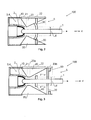
- Fig. 1a shows a cross section through a first embodiment of a circuit breaker 100 in a closed position.
- the circuit breaker 100 comprises the first arcing contact 1 and a second arcing contact 2 which are arranged coaxially (about symmetry axis z) in a tulip-plug configuration.
- the first arcing contact 1 is in a first position, i.e. is electrically connected to the second arcing contact 2.
- An arc extinguishing fluid (e.g. technical air) 10 is arranged at an overpressure of 60 bar (compared to an absolute pressure of a few bar, i.e.
- arcing chamber relates to the volume of the circuit breaker where an electrical arc is formed between the first and the second arcing contacts 1, 2 during a separation of the arcing contacts 1, 2.
- the arcing or pressure chamber 3, 4 is delimited on one side by a sealing wall 30 which provides a fluid-tight seal.
- the sealing wall 30 is mechanically fixed to the first arcing contact 1, which is structured to be movable along the +z direction.
- an initial force F with direction +z is exerted onto the sealing wall 30 and the first arcing contact 1.
- Initial pushing forces on the order of O(10 1 ) kN are typically obtained.
- the initial pushing force F is counteracted by a holding force F' along -z from a latch 50, which holds the sealing wall 30 in position, thus seals the pressure chamber 4, and keeps up the overpressure of the arc extinguishing fluid 10 in the pressure chamber 4.
- the initial pushing force F is counteracted by a holding force F' along -z from a latch 50, before a separation operation of the arcing contacts 1, 2 is initiated and/or before a tripping command is received by the circuit breaker 100, wherein the latch 50 holds the sealing wall 30 in position, thus seals the pressure chamber 4, and keeps up the overpressure of the arc extinguishing fluid 10 in the pressure chamber 4.
- the circuit breaker comprises a nozzle 20 with a first section 21 and a second section 22.
- the nozzle 20 exhibits a linearly converging inner diameter d along +z (i.e. the nozzle's lateral opening diameter decreases along +z) whereas in the second section 22, the nozzle 20 exhibits a linearly diverging inner diameter d.
- the inner diameter d of the nozzle 20 has a minimum (so-called "nozzle throat") between the first section 21 and the second section 22.
- a contact position of the first and second arcing contacts 1, 2 is arranged near the nozzle throat.
- the axial contact position (i.e. axial position of contacting or touching) of the first and second arcing contacts 1, 2 can be arranged near the axial position of the nozzle throat, in particular can be in vicinity to the center of the nozzle throat, e.g. can have an axial distance to the center of the nozzle throat of less than five times of the diameter of the nozzle throat.
- Fig. 1b shows a cross section through the first embodiment of the circuit breaker from Fig. 1a in a partly opened position.
- a tripping command has been issued to the circuit breaker, which leads to an opening or releasing of the latch 50, e.g. by an electromagnetic coil in the latch 50.
- the initial force F pushes the sealing wall 30 and the first arcing contact 1 along the +z direction.
- the sealing wall 30 acts as a piston in this case.
- the relatively high initial force F leads to high accelerations of the moving parts, i.e. of the sealing wall 30 and the first arcing contact 1.
- Typical movable masses are in the range of few kg, and preferably below 10 kg, in this embodiment, typical initial accelerations are in the range of several km/s 2 , i.e. preferably larger than 1 km/s 2 .
- the arcing contacts 1, 2 are mechanically separated and an arc 11 starts to build up between the first and second arcing contact 1 and 2.
- an annular exhaust gap 99 is created between the diverging section 22 of the nozzle 20 and the sealing wall 30, that leads to fluid flow (black arrows) and drop of overpressure in the pressure chamber 4.
- this phase (which may be called first phase), the design of the nozzle 20 and the sealing wall 30 ensures that this gap is the "throat" of the pressure chamber 4 for several centimeters, e.g. 10 cm, of travel along +z of the sealing wall 30 and the first arcing contact 1.
- the term "throat” relates to the smallest opening of the pressure chamber 4 in a down-pressure direction. In other words, this means that up-stream of the throat there is a subsonic (and thus still high pressure) arc extinguishing fluid flow regime that continues to apply a large force F>F" and pushes the sealing wall 30 and the first arcing contact 1 further along the +z direction.
- contact separation occurs and the arc 11 is "drawn" between the first arcing contact 1 and the second arcing contact 2; then the arc 11 burns in the high pressure subsonic flow regime of the arc extinguishing fluid 10.
- Fig. 1c shows a cross section through the first embodiment of the circuit breaker 100 from Figs. 1a and 1b in a further opened position.
- the first arcing contact 1 is almost in a fully opened second position, i.e. it is mechanically disconnected from the second arcing contact 2 but still electrically connected through the burning arc 11.
- this arc 11 is about to be purged by the flow of the arc extinguishing fluid 10 during a natural (for AC currents) or artificially induced (for DC currents) current zero through the arc 11.
- the annular exhaust area defined by the gap between the sealing wall 30 and the diverging section 22 of the nozzle 20 becomes bigger than the nozzle throat area (i.e.
- the circuit breaker 100 is capable of performing a faster contact separation and arc extinguishing because it is actuated by self-stored pressurized arc extinguishing fluid 10.
- self-stored relates to the fact that the storage volume for the pressurized arc extinguishing fluid 10 (i.e. the pressure chamber 4) is actually at least in part made up by the arcing chamber 3 itself. Therefore, no tubings or similar fluid conduction means need to be used.
- the pressure chamber 4 In the first position, the pressure chamber 4 is closed by the sealing wall 30, which is fixed to the movable first arcing contact 1.
- the sealing wall 30 acts as a valve and as a piston, because it opens the outflow of the pressurized arc extinguishing fluid 10 and it concurrently actuates the contact separation.
- Proper design and dimensioning of the circuit breaker enables the stored pressurized arc extinguishing fluid 10 to perform very fast contact displacement (in a few ms, i.e. below 10 ms) and to perform blowing of the gaseous arc 11 for arc extinction on the same timescale.
- Fig. 2 shows a cross section through a second embodiment of a circuit breaker 100 according to the invention.
- the second embodiment is very similar to the first embodiment described above, with the exception of a curved (concave-shaped) sealing wall 30 instead of the flat sealing wall 30 from the first embodiment. This leads to a higher mechanical robustness. Other shapes are possible, as well.
- Fig. 3 shows a cross section through a third embodiment of a circuit breaker 100 according to the invention.
- the third embodiment is very similar to the first and second embodiments described above, with the exception that it additionally to the sealing wall 30 comprises a baffle 40 fixed on the first arcing contact 1.
- the nozzle is shaped differently, i.e. it comprises two third sections 23a and 23b with constant inner diameters.
- the sealing wall 30 takes care of the sealing of the pressure chamber 4, while the whole pressure chamber volume including the volumes on both sides of the baffle 40 is or are at overpressure. After a release of the latch 50, the sealing wall 30 is more strongly accelerated due to its larger diameter.
- Fig. 4 shows a cross section through a fourth embodiment of a circuit breaker 100 according to the invention comprising a two-part pressure chamber 4, which is in part arranged around the arcing chamber 3.
- the fourth embodiment further comprises a damper 60, which is a part of a contact closer 70. Otherwise, the fourth embodiment is very similar to the first to third embodiments.
- the additional part of the pressure chamber 4, which is arranged around the arcing chamber 3, provides additional initial acceleration to the sealing wall 30.
- the additional part of the pressure chamber 4 can be separated or connected to the original pressure chamber 4, i.e. the inner part of the pressure chamber 4, which is congruent with the arcing chamber 3.
- connection holes 98 are connected to the inner part of the pressure chamber 4 through connection holes 98, as shown in Fig. 4 . Due to the larger contact area of the pressurized arc extinguishing fluid 10 with the sealing wall 30, the initial acceleration of the sealing wall or outer plate 30 is increased. This leads to reduced contact separation and arc extinguishing times.
- nominal contacts can be implemented by using the sealing wall 30 as nominal contact in its closed or first position.
- the sealing wall 30 can be part of a nominal contact system of the circuit breaker 100.
- the damper 60 comprises e.g. a set of springs (mechanical, pneumatic, etc.) that are compressed and latched after compression. These springs also act as an energy storage unit 71 for the contact closer 70.
- the secondary latches (not shown) can be part of the contact closer 70, and they can be released to reclose the nominal and arcing contacts 1, 2 of the circuit breaker 100. The energy required during the CLOSE operation is harnessed from the kinetic energy produced during the OPEN operation as described above.
- the CLOSE operation has to counteract mainly the plug-tulip contact force (on the order of O(100) N) and the friction force between the nominal contacts (not shown).
- the latch 50 is energized again and the pressure chamber 4 is then refilled with pressurized arc extinguishing fluid 10 to be ready for the next OPEN operation.
- An OPEN - CLOSE - OPEN (O-C-O) operation is also possible, when the pressure chamber 4 is rapidly refilled with arc extinguishing fluid 10 at the necessary overpressure. Because a volume of the order of 1 liter, i.e. O(1) liters, is sufficient, a fast pressure charging of the pressure chamber 4 is achievable, e.g. by means of several filling inlets.
- Fig. 5 shows a cross section through a fifth embodiment of a circuit breaker 100 according to the invention.
- the fifth embodiment comprises a nozzle 20 with sections 21 and 22 with nonlinearly converging and nonlinearly diverging inner diameters d.
- the nozzle 20 has a nonlinearly converging first section 21 (i.e. with decreasing diameter when moving through the nozzle 20 from left to right or along a preferred gas blowing direction) and a nonlinearly diverging second section 22 (i.e. with increasing diameter when moving through the nozzle 20 from left to right or along a preferred gas blowing direction).
- the nozzle sections may also be nonlinearly converging and linearly diverging, or vice versa linearly converging and nonlinearly diverging.
- the first and second arcing contacts are swapped, i.e. the first arcing contact 1 is movable along the -z direction and structured as tulip, while the second (fixed) arcing contact 2 is structured as plug.
- an additional sealing tube 31 is arranged in the arcing or pressure chamber 3, 4 and moves along -z together with the first arcing contact 1 and the sealing wall 30.
- Fig. 6 shows a schematic representation of a DC medium- or high-voltage power transmission or distribution network comprising a circuit breaker 100 according to the invention.
- the circuit breaker 100 is used to open and/or to close an electrical connection between a first bus bar 201 and a second bus bar 202. Contact separation and arc extinguishing is achieved within less than 10 ms.
- a resonant circuit (203) can be arranged in parallel to the circuit breaker 100 for creating an artificially induced current zero via a passive and/or active resonance scheme during which the arc is extinguished.
- the invention relates to a method for interrupting or establishing an electrical connection in a medium- or high-voltage power transmission or distribution network 200, in particular in a medium- or high-voltage DC power transmission and distribution network, by means of a circuit breaker 100 as disclosed herein.
- the method for interrupting the electrical connection in the medium- or high-voltage DC power transmission network 200 comprises steps of
- the exhaust gap 99 forms a throat of the pressure chamber 4 during a first period, and wherein a nozzle throat forms a throat of the pressure chamber 4 during a second period, in particular wherein the arc 11 is purged during the second period.
- the method does not comprise a step of opening a valve between the pressure chamber 4 and the arcing chamber 3.
- fluid relates to "a substance, such as a liquid [and/] or gas, that can flow, has no fixed shape, and offers little resistance to an external stress" (from http://www.thefreedictionary.com/fluid, accessed on 9/11/2011).
- medium-voltage relates to AC or DC voltages larger than or equal to 1 kV.
- high-voltage relates to AC or DC voltages larger than or equal to 72 kV.
- Typical tripping currents are on the order of 10 kA, i.e. O(10 1 ) kA, or more.
- arcing chamber relates throughout this application to the volume of the circuit breaker where an electrical arc is formed between the first and the second arcing contacts 1, 2 during a separation of the arcing contacts 1, 2.
- throat relates throughout this application, to the smallest opening of the pressure chamber 4 in a down-pressure direction.
- Down-pressure direction means the direction of diminishing pressure.
- tapping shall be understood broadly to also encompass actuating or starting moving or moving the electrical contacts.
Landscapes
- Circuit Breakers (AREA)
Priority Applications (1)
| Application Number | Priority Date | Filing Date | Title |
|---|---|---|---|
| EP13161682.3A EP2648202A1 (de) | 2012-04-05 | 2013-03-28 | Schutzschalter |
Applications Claiming Priority (2)
| Application Number | Priority Date | Filing Date | Title |
|---|---|---|---|
| EP12163269 | 2012-04-05 | ||
| EP13161682.3A EP2648202A1 (de) | 2012-04-05 | 2013-03-28 | Schutzschalter |
Publications (1)
| Publication Number | Publication Date |
|---|---|
| EP2648202A1 true EP2648202A1 (de) | 2013-10-09 |
Family
ID=47915139
Family Applications (1)
| Application Number | Title | Priority Date | Filing Date |
|---|---|---|---|
| EP13161682.3A Withdrawn EP2648202A1 (de) | 2012-04-05 | 2013-03-28 | Schutzschalter |
Country Status (3)
| Country | Link |
|---|---|
| US (1) | US20130265693A1 (de) |
| EP (1) | EP2648202A1 (de) |
| CN (1) | CN103367027A (de) |
Families Citing this family (4)
| Publication number | Priority date | Publication date | Assignee | Title |
|---|---|---|---|---|
| CN105680706A (zh) * | 2014-11-18 | 2016-06-15 | 台达电子工业股份有限公司 | 直流供电装置 |
| EP3261107A1 (de) * | 2016-06-20 | 2017-12-27 | ABB Schweiz AG | Gasisolierter nieder- oder mittelspannungsschalter mit wirbelungsvorrichtung |
| EP3503151B1 (de) * | 2017-12-20 | 2022-04-13 | Hitachi Energy Switzerland AG | Schutzschalter und verfahren zur durchführung einer stromabschaltungsoperation |
| CN114121525B (zh) * | 2021-10-08 | 2026-07-21 | 山东电力设备有限公司 | 中置开关柜电动手车的闭锁方法及操作孔闭锁密封装置 |
Citations (5)
| Publication number | Priority date | Publication date | Assignee | Title |
|---|---|---|---|---|
| US3379849A (en) | 1964-12-17 | 1968-04-23 | Westinghouse Electric Corp | Dual-pressure gas-blast circuit breaker with piston means and interrupting unit in closed tank |
| US4553008A (en) * | 1984-06-14 | 1985-11-12 | Cooper Industries, Inc. | Load interrupter |
| US5187339A (en) | 1990-06-26 | 1993-02-16 | Merlin Gerin | Gas insulated high-voltage circuit breaker with pneumatic operating mechanism |
| JP2003022737A (ja) * | 2001-07-06 | 2003-01-24 | Mitsubishi Electric Corp | ガス遮断器 |
| US7528332B1 (en) | 2004-11-17 | 2009-05-05 | Utron Inc. | High speed actuating device and circuit breaker |
Family Cites Families (6)
| Publication number | Priority date | Publication date | Assignee | Title |
|---|---|---|---|---|
| US4114003A (en) * | 1974-05-08 | 1978-09-12 | Westinghouse Electric Corp. | Quick-acting movable operating-column tripping device |
| JPH01243328A (ja) * | 1988-03-25 | 1989-09-28 | Hitachi Ltd | パツフア式ガス遮断器 |
| JPH0495322A (ja) * | 1990-08-03 | 1992-03-27 | Hitachi Ltd | ガス遮断器 |
| JP4174094B2 (ja) * | 1998-01-29 | 2008-10-29 | 株式会社東芝 | ガス遮断器 |
| JP2005332745A (ja) * | 2004-05-21 | 2005-12-02 | Hitachi Ltd | ガス遮断器 |
| WO2011050832A1 (en) * | 2009-10-27 | 2011-05-05 | Abb Technology Ag | An hvdc breaker and control apparatus for controlling an hvdc breaker |
-
2013
- 2013-03-28 EP EP13161682.3A patent/EP2648202A1/de not_active Withdrawn
- 2013-04-05 US US13/857,651 patent/US20130265693A1/en not_active Abandoned
- 2013-04-08 CN CN2013101190973A patent/CN103367027A/zh active Pending
Patent Citations (5)
| Publication number | Priority date | Publication date | Assignee | Title |
|---|---|---|---|---|
| US3379849A (en) | 1964-12-17 | 1968-04-23 | Westinghouse Electric Corp | Dual-pressure gas-blast circuit breaker with piston means and interrupting unit in closed tank |
| US4553008A (en) * | 1984-06-14 | 1985-11-12 | Cooper Industries, Inc. | Load interrupter |
| US5187339A (en) | 1990-06-26 | 1993-02-16 | Merlin Gerin | Gas insulated high-voltage circuit breaker with pneumatic operating mechanism |
| JP2003022737A (ja) * | 2001-07-06 | 2003-01-24 | Mitsubishi Electric Corp | ガス遮断器 |
| US7528332B1 (en) | 2004-11-17 | 2009-05-05 | Utron Inc. | High speed actuating device and circuit breaker |
Non-Patent Citations (1)
| Title |
|---|
| "a substance, such as a liquid [and/] or gas, that can flow, has no fixed shape, and offers little resistance to an external stress", FLUID, 9 November 2011 (2011-11-09), Retrieved from the Internet <URL:http://www.thefreedictionary.com/fluid> |
Also Published As
| Publication number | Publication date |
|---|---|
| US20130265693A1 (en) | 2013-10-10 |
| CN103367027A (zh) | 2013-10-23 |
Similar Documents
| Publication | Publication Date | Title |
|---|---|---|
| CN101573774B (zh) | 带有径向穿流开口的压缩气体断路器 | |
| JP5516568B2 (ja) | パッファ形ガス遮断器 | |
| CN107077988B (zh) | 高电压压气式断路器及具有这种压气式断路器的断路器单元 | |
| US9299507B2 (en) | Gas circuit breaker | |
| JP2008210710A (ja) | 電力用ガス遮断器 | |
| KR20060063720A (ko) | 퍼퍼형 가스차단기의 전류차단방법 및 그것에 사용하는퍼퍼형 가스차단기 | |
| US20190115174A1 (en) | Gas-insulated low- or medium-voltage load break switch | |
| US20130265693A1 (en) | Circuit breaker | |
| KR20220046124A (ko) | 복합 소호형 가스 차단기 | |
| CN104054151B (zh) | 气体断路器 | |
| CN101300654B (zh) | 具有两个压缩腔室的中断腔室 | |
| KR101786521B1 (ko) | 초고압 차단기 | |
| JP2015056249A (ja) | 開閉器 | |
| US10170256B2 (en) | Circuit breaker equipped with an extensible exhaust cover | |
| JP7135199B2 (ja) | ガス遮断器 | |
| JP6980090B2 (ja) | アークブラストユニットが設けられた電気スイッチ | |
| KR101550299B1 (ko) | 가스 절연 개폐장치용 차단기 | |
| CN101006539B (zh) | 大功率开关 | |
| US3670126A (en) | Compressed-gas circuit interrupter having a pair of rapid transfer insulating nozzles | |
| JP7155283B2 (ja) | ガス遮断器 | |
| US11217408B2 (en) | Gas circuit breaker | |
| CN112673445B (zh) | 气体绝缘开关 | |
| CN101901721B (zh) | 中断室、hvdc旁路中断器,和具有此室的高压直流换流变电站 | |
| CN101256915B (zh) | 具有降低的压气容积压力的压气式断路器 | |
| CN112289628A (zh) | 一种双压力膨胀室灭弧室 |
Legal Events
| Date | Code | Title | Description |
|---|---|---|---|
| PUAI | Public reference made under article 153(3) epc to a published international application that has entered the european phase |
Free format text: ORIGINAL CODE: 0009012 |
|
| AK | Designated contracting states |
Kind code of ref document: A1 Designated state(s): AL AT BE BG CH CY CZ DE DK EE ES FI FR GB GR HR HU IE IS IT LI LT LU LV MC MK MT NL NO PL PT RO RS SE SI SK SM TR |
|
| AX | Request for extension of the european patent |
Extension state: BA ME |
|
| 17P | Request for examination filed |
Effective date: 20140401 |
|
| RBV | Designated contracting states (corrected) |
Designated state(s): AL AT BE BG CH CY CZ DE DK EE ES FI FR GB GR HR HU IE IS IT LI LT LU LV MC MK MT NL NO PL PT RO RS SE SI SK SM TR |
|
| GRAP | Despatch of communication of intention to grant a patent |
Free format text: ORIGINAL CODE: EPIDOSNIGR1 |
|
| RIC1 | Information provided on ipc code assigned before grant |
Ipc: H01H 33/32 20060101AFI20151001BHEP Ipc: H01H 33/50 20060101ALI20151001BHEP Ipc: H01H 33/70 20060101ALI20151001BHEP |
|
| INTG | Intention to grant announced |
Effective date: 20151019 |
|
| STAA | Information on the status of an ep patent application or granted ep patent |
Free format text: STATUS: THE APPLICATION IS DEEMED TO BE WITHDRAWN |
|
| 18D | Application deemed to be withdrawn |
Effective date: 20160301 |