EP2650776A1 - System und Verfahren zur Lieferung verbesserter Austauschanwendungen natürlicher Sprache - Google Patents
System und Verfahren zur Lieferung verbesserter Austauschanwendungen natürlicher Sprache Download PDFInfo
- Publication number
- EP2650776A1 EP2650776A1 EP13163008.9A EP13163008A EP2650776A1 EP 2650776 A1 EP2650776 A1 EP 2650776A1 EP 13163008 A EP13163008 A EP 13163008A EP 2650776 A1 EP2650776 A1 EP 2650776A1
- Authority
- EP
- European Patent Office
- Prior art keywords
- language
- request
- user
- natural language
- interaction engine
- Prior art date
- Legal status (The legal status is an assumption and is not a legal conclusion. Google has not performed a legal analysis and makes no representation as to the accuracy of the status listed.)
- Withdrawn
Links
- 230000003993 interaction Effects 0.000 title claims abstract description 164
- 238000000034 method Methods 0.000 title claims description 132
- 230000004044 response Effects 0.000 claims abstract description 88
- 230000009471 action Effects 0.000 claims abstract description 23
- 230000009118 appropriate response Effects 0.000 claims abstract description 15
- 238000007781 pre-processing Methods 0.000 claims description 9
- 230000008569 process Effects 0.000 description 78
- 238000010586 diagram Methods 0.000 description 38
- 238000013515 script Methods 0.000 description 35
- 239000000306 component Substances 0.000 description 30
- 238000004458 analytical method Methods 0.000 description 29
- 230000015654 memory Effects 0.000 description 24
- 238000012545 processing Methods 0.000 description 20
- 230000007704 transition Effects 0.000 description 17
- 238000013459 approach Methods 0.000 description 16
- 238000004891 communication Methods 0.000 description 15
- 230000000694 effects Effects 0.000 description 15
- 230000006870 function Effects 0.000 description 15
- 238000007726 management method Methods 0.000 description 11
- 230000006399 behavior Effects 0.000 description 8
- 230000011218 segmentation Effects 0.000 description 8
- 238000003860 storage Methods 0.000 description 8
- 230000001960 triggered effect Effects 0.000 description 8
- 230000008451 emotion Effects 0.000 description 7
- 230000000977 initiatory effect Effects 0.000 description 7
- 238000012360 testing method Methods 0.000 description 7
- 238000005516 engineering process Methods 0.000 description 6
- 239000012634 fragment Substances 0.000 description 6
- 238000005457 optimization Methods 0.000 description 6
- 238000012937 correction Methods 0.000 description 5
- 230000005291 magnetic effect Effects 0.000 description 5
- 239000000203 mixture Substances 0.000 description 5
- 238000012986 modification Methods 0.000 description 5
- 230000004048 modification Effects 0.000 description 5
- 230000000877 morphologic effect Effects 0.000 description 5
- 230000001419 dependent effect Effects 0.000 description 4
- 238000011161 development Methods 0.000 description 4
- 230000018109 developmental process Effects 0.000 description 4
- 230000002996 emotional effect Effects 0.000 description 4
- 238000005111 flow chemistry technique Methods 0.000 description 4
- 230000010354 integration Effects 0.000 description 4
- 241000282412 Homo Species 0.000 description 3
- 238000004422 calculation algorithm Methods 0.000 description 3
- 238000006243 chemical reaction Methods 0.000 description 3
- 239000000470 constituent Substances 0.000 description 3
- 238000013500 data storage Methods 0.000 description 3
- 238000011156 evaluation Methods 0.000 description 3
- 230000007246 mechanism Effects 0.000 description 3
- 230000003287 optical effect Effects 0.000 description 3
- 238000007619 statistical method Methods 0.000 description 3
- 102100034761 Cilia- and flagella-associated protein 418 Human genes 0.000 description 2
- 101100439214 Homo sapiens CFAP418 gene Proteins 0.000 description 2
- 230000003190 augmentative effect Effects 0.000 description 2
- 230000008901 benefit Effects 0.000 description 2
- 239000003795 chemical substances by application Substances 0.000 description 2
- 235000014510 cooky Nutrition 0.000 description 2
- 238000007405 data analysis Methods 0.000 description 2
- 238000013461 design Methods 0.000 description 2
- 230000007613 environmental effect Effects 0.000 description 2
- 238000001914 filtration Methods 0.000 description 2
- 238000010304 firing Methods 0.000 description 2
- 239000012530 fluid Substances 0.000 description 2
- 230000000737 periodic effect Effects 0.000 description 2
- 230000002093 peripheral effect Effects 0.000 description 2
- 238000002360 preparation method Methods 0.000 description 2
- 238000009877 rendering Methods 0.000 description 2
- 239000010979 ruby Substances 0.000 description 2
- 229910001750 ruby Inorganic materials 0.000 description 2
- 238000012546 transfer Methods 0.000 description 2
- 230000000007 visual effect Effects 0.000 description 2
- 238000012800 visualization Methods 0.000 description 2
- 108091027981 Response element Proteins 0.000 description 1
- 230000003213 activating effect Effects 0.000 description 1
- 230000004075 alteration Effects 0.000 description 1
- 230000003466 anti-cipated effect Effects 0.000 description 1
- 238000003491 array Methods 0.000 description 1
- 238000013473 artificial intelligence Methods 0.000 description 1
- 230000005189 cardiac health Effects 0.000 description 1
- 230000008859 change Effects 0.000 description 1
- 238000005352 clarification Methods 0.000 description 1
- 230000001427 coherent effect Effects 0.000 description 1
- 239000003086 colorant Substances 0.000 description 1
- 238000004590 computer program Methods 0.000 description 1
- 230000001143 conditioned effect Effects 0.000 description 1
- 230000008602 contraction Effects 0.000 description 1
- 239000008358 core component Substances 0.000 description 1
- 238000012517 data analytics Methods 0.000 description 1
- 230000007547 defect Effects 0.000 description 1
- 230000007812 deficiency Effects 0.000 description 1
- 238000001514 detection method Methods 0.000 description 1
- 238000009826 distribution Methods 0.000 description 1
- 239000000835 fiber Substances 0.000 description 1
- 238000011049 filling Methods 0.000 description 1
- 230000010006 flight Effects 0.000 description 1
- 230000001976 improved effect Effects 0.000 description 1
- 230000006872 improvement Effects 0.000 description 1
- 238000002372 labelling Methods 0.000 description 1
- 238000011068 loading method Methods 0.000 description 1
- 230000007774 longterm Effects 0.000 description 1
- 238000012423 maintenance Methods 0.000 description 1
- 238000004519 manufacturing process Methods 0.000 description 1
- 238000005259 measurement Methods 0.000 description 1
- 230000007935 neutral effect Effects 0.000 description 1
- 230000008520 organization Effects 0.000 description 1
- 230000002085 persistent effect Effects 0.000 description 1
- 230000002028 premature Effects 0.000 description 1
- 238000003825 pressing Methods 0.000 description 1
- 238000013138 pruning Methods 0.000 description 1
- 238000007670 refining Methods 0.000 description 1
- 238000011160 research Methods 0.000 description 1
- 230000002441 reversible effect Effects 0.000 description 1
- 238000012552 review Methods 0.000 description 1
- 238000005070 sampling Methods 0.000 description 1
- 239000007787 solid Substances 0.000 description 1
- 241000894007 species Species 0.000 description 1
- 238000012549 training Methods 0.000 description 1
- 238000013518 transcription Methods 0.000 description 1
- 230000035897 transcription Effects 0.000 description 1
- 230000001131 transforming effect Effects 0.000 description 1
- 230000001755 vocal effect Effects 0.000 description 1
Images







Classifications
-
- G—PHYSICS
- G10—MUSICAL INSTRUMENTS; ACOUSTICS
- G10L—SPEECH ANALYSIS TECHNIQUES OR SPEECH SYNTHESIS; SPEECH RECOGNITION; SPEECH OR VOICE PROCESSING TECHNIQUES; SPEECH OR AUDIO CODING OR DECODING
- G10L15/00—Speech recognition
- G10L15/08—Speech classification or search
- G10L15/18—Speech classification or search using natural language modelling
- G10L15/1822—Parsing for meaning understanding
-
- G—PHYSICS
- G10—MUSICAL INSTRUMENTS; ACOUSTICS
- G10L—SPEECH ANALYSIS TECHNIQUES OR SPEECH SYNTHESIS; SPEECH RECOGNITION; SPEECH OR VOICE PROCESSING TECHNIQUES; SPEECH OR AUDIO CODING OR DECODING
- G10L15/00—Speech recognition
- G10L15/28—Constructional details of speech recognition systems
- G10L15/30—Distributed recognition, e.g. in client-server systems, for mobile phones or network applications
Definitions
- the invention relates to the field of artificial intelligence, and more particularly to the field of natural language interaction-based applications, such as virtual assistants.
- Virtual assistants are an example of applications, referred to herein as natural language applications that interact through natural language (such as English, Swedish, Spanish, Chinese) with a human user. With respect to virtual assistants in particular, these applications perform functions similar to those provided by human assistants, in that they can engage in conversations with their users in order to perform functions similar to those provided by human assistants, including for example providing information, carrying out routine tasks, or performing other operations as required. Many virtual assistants have been used in association with web sites, with these virtual assistants often featuring the use of graphical images or avatars to simulate the experience of interacting with a human being.
- a system for delivering advanced natural language interaction applications comprises a dialog interface module, a natural language interaction engine, a solution data repository component operating comprising at least one domain model, at least one language model, and a plurality of flow elements and rules for managing interactions with users, and an interface software module.
- the dialog interface module Upon receipt of a request from a user via a network, the dialog interface module preprocesses the request and transmits it to the natural language interaction engine.
- the natural language interaction engine interprets the request using a plurality of language recognition rules stored in the solution data repository, and based at least determined semantic meaning or user intent, the natural language interaction engine forms an appropriate response and delivers the response to the user via the dialog module, or takes an appropriate automated action based o the request.
- a method for delivering advanced natural language interaction applications comprises the steps of: (a) receiving a request from a user at a dialog interface module; (b) pre-processing the request by the dialog interface module; (c) transmitting the request in text form to a natural language interpretation engine; (d) evaluating the request against a plurality of conditions until either a determination is made that additional input is needed from the user or not further conditions exist; (e) sending an appropriate response to the user or taking an appropriate action based at least on the results of step (d); and (f) awaiting a further user request or a session end event.
- an automated assistant operating on a computing device comprises a dialog interface module operating on the computing device and adapted for exchanging information with a user using one of a plurality of input and output means of the computing device, a natural language interaction engine coupled to the dialog interface module, for interpreting a received user request, a solution data repository component operating comprising at least one domain model, at least one language model, and a plurality of flow elements and rules for managing interactions with users, and an interface software module coupled to the natural language interaction engine and adapted to exchange data or commands with a plurality of external software services over a network.
- the dialog interface module Upon receipt of a request from a user via an input means of the computing device, the dialog interface module preprocesses the request and transmits it to the natural language interaction engine.
- the natural language interaction engine interprets the request using a plurality of language recognition rules stored in the solution data repository, and based at least determined semantic meaning or user intent, the natural language interaction engine forms an appropriate response and delivers the response to the dialog module, which uses one or more output means of the computing device to provide a response to the user, or takes an appropriate automated action based on the request.
- Fig. 1 is a block diagram illustrating an exemplary hardware architecture of a computing device used in an embodiment of the invention.
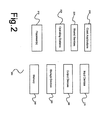
- Fig. 2 is a block diagram illustrating an exemplary logical architecture for a client device, according to an embodiment of the invention.
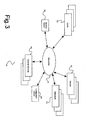
- Fig. 3 is a block diagram illustrating an exemplary architectural arrangement of clients, servers, and external services, according to an embodiment of the invention.
- Fig. 4 is a block diagram providing a conceptual overview of a method by which human users may interact with a virtual assistant according to an embodiment of the invention
- Fig. 5 is a high-level process diagram of a method for responding via a natural language interaction engine to user requests, according to a preferred embodiment of the invention.
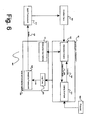
- Fig. 6 is a high-level system architecture diagram of a preferred embodiment of the invention.
- Fig. 7 is a detailed architecture diagram of a preferred embodiment of the invention.
- Fig. 8 is a process flow diagram illustrating a method for initial handling of a request, according to an embodiment of the invention.
- Fig. 9 is a process flow diagram illustrating a method for pre-processing input data for a parsing and interpretation process, according to an embodiment of the invention.
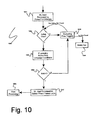
- Fig. 10 is a process flow diagram illustrating a method for interpreting natural language input from a user, according to an embodiment of the invention.
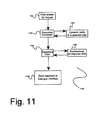
- Fig. 11 is a process flow diagram illustrating a method for preparing a response for delivery in response to a request, according to an embodiment of the invention.
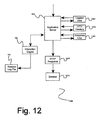
- Fig. 12 is a process flow diagram illustrating a method for delivering a response to a user, according to an embodiment of the invention.
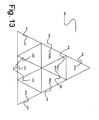
- Fig. 13 is a block diagram illustrating language object types within a language object library pyramid within a natural language application, according to an embodiment of the invention.
- Fig. 14 is a block diagram illustrating a building process for a language library within a natural language application, according to an embodiment of the invention.
- Fig. 15 is a block diagram illustrating how language object types may perform within a natural language application, according to an embodiment of the invention.
- Fig. 16 is a block diagram of a system and method for library creation and optimization, according to an embodiment of the invention.
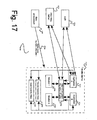
- Fig. 17 is a block diagram of a system with a natural language interaction engine residing on a mobile device, according to an embodiment of the invention.
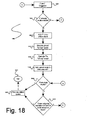
- Fig. 18 is a process flow diagram of a method for processing dialog flows, according to an embodiment of the invention.
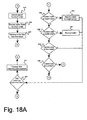
- Fig. 18A is a process flow diagram of a set of methods used in accordance with an embodiment of the invention, with the method of Fig. 18 .
- the inventor has conceived, and reduced to practice, various systems and methods for advanced natural language interaction by applications.
- Devices that are in communication with each other need not be in continuous communication with each other, unless expressly specified otherwise.
- devices that are in communication with each other may communicate directly or indirectly through one or more intermediaries, logical or physical.
- steps may be performed simultaneously despite being described or implied as occurring non-simultaneously (e.g., because one step is described after the other step).
- the illustration of a process by its depiction in a drawing does not imply that the illustrated process is exclusive of other variations and modifications thereto, does not imply that the illustrated process or any of its steps are necessary to one or more of the invention(s), and does not imply that the illustrated process is preferred.
- steps are generally described once per embodiment, but this does not mean they must occur once, or that they may only occur once each time a process, method, or algorithm is carried out or executed. Some steps may be omitted in some embodiments or some occurrences, or some steps may be executed more than once in a given embodiment or occurrence.
- virtual assistant means a software, hardware, or hybrid hardware/software application that provides assistance to humans analogous to that provided by human assistants, generally using an intuitive user interface, such as one that allows a user to express her needs in natural language.
- natural language interpretation means interpretation, by a machine, of one or a series of utterances made by a human user speaking or writing naturally; in some cases “natural language” may be supplemented by gestural, haptic, or other input combined with natural language input (for example, saying “move this here” while pointing or clicking on an object and a later a location). That is, a “natural language interpreter” generally does not require users to format their requests in simple, fixed patterns (such as a program might be required to do, as for example when invoking a web service or an application programming interface (API)).
- API application programming interface
- a "dialog” is a conversational exchange between two or more participants consisting of a generally unstructured sequence of natural language contributions in the form of requests, responses, statements and the like.
- a dialog is an interaction sequence that actually occurs (i.e., in run-time) during a conversation exchange between a user and a natural language system.
- a "flow" is a logical task unit comprising a set of related interaction steps required (and preconfigured) in order to perform a task.
- a flow may comprise one or more transition conditions and operative nodes.
- a flow is typically defined in a natural language system as a series of predefined steps to perform when some triggering condition is satisfied.
- an "instructional path” is a sequence of instructions from one or more flows that were invoked or executed during the delivery of a dialog by a natural language system.
- an instructional path is the realization of one or more flows that occurs in an actual conversation (or dialog) between a user and a natural language system; it represents the sequence of decisions (or instructions) taken in support of natural language conversation (whereas the corresponding dialog is the actual sequence of what was "said" during the conversation by the parties involved, rather than why it was said).
- a "natural language interaction system” or a “natural language system” is a computer-based system capable of interacting via dialogs with one or more users using natural language (perhaps augmented by haptics, gestures, or other nonverbal means). Natural language systems carry out their function using dialogs, which can be thought of also as the actual, as executed, sequence of interaction steps between a user and a natural language system. A natural language system may participate in a dialog, by following the instructional steps of flows.
- a "language object” means an abstract representation of a logical unit of human linguistic expression that has meaning and is suitable for processing by automated systems such as virtual assistants.
- Language objects in their simplest form, are represented as sets of words that represent a plurality of variants of word forms or of a single common meaning, including inflectional variants and variants connected by synonymy. That is, generally a language object represents all variants and synonyms of a core word that represents it, and language objects may contain grammatical variants of words as well (such as verb tenses, contractions, and so forth).
- script means an executable sequence of instructions, generally stored (or at least rendered for execution) as plain text, which can be executed by an appropriate script interpreter.
- Scripts may be written in any scripting language known in the art, such as Perl, Python, PHP, Ruby, Groovy, and the like, or in any similar scripting language including proprietary scripting languages.
- scripts generally are executed upon occurrence of specific events, such as initiation or termination of a user interaction session, or the triggering of a business rule such as "execute the following script if the number of active sessions exceed a configured number”.
- Scripts can be nodes in flows (in which case they are referred to as "script nodes").
- request or “question” means a user-supplied or automatically supplied input to a natural language interaction-based system (as opposed to a system-supplied output).
- response means a system-supplied output from a natural language interaction system (as opposed to a user-supplied or automatically supplied input).
- condition means a rule or logical expression that, if satisfied, will allow for execution of one or more actions or will generate one or more effects.
- conditions There are several types of conditions envisioned according to the invention, comprising for example: language recognition rules, skip conditions and transition conditions.
- a "language recognition rule” is a specific type of condition built up from language objects and used to parse or interpret a natural language expression.
- trigger or a “flow trigger” is a construct which holds a condition, and which makes the system activate and start executing a flow if the condition is fulfilled.
- listener is a rule construct with a conditional part and an operational part.
- the operational part is invoked or executed, whereupon it updates current state based on information present in the current state and in the natural language input (the user request).
- Listeners may be configured to operate on a global level, on a flow level, or on a transition level, and they are generally evaluated in that order.
- transition or “transition condition” means a condition that determines whether the system should pass a transition to enter a new instructive step or process, a node (or a new transition). Transition may be input consuming (requires user input) or non-input consuming (does not require user input). Transitions may comprise one or more conditions and transitions can follow each other directly.
- skip condition means a condition that is verified prior to executing an instructive step (i.e., entering a node, for example of a flow). If the condition is met (e.g. some values have already been set previous in the system), the system will skip executing the instructional step and will continue as if it has already been executed.
- small talk means generally off-topic conversation elements or social dialog (such as greetings, acknowledgements, and the like), that may be used to respond to user request. For example, if, during a flow devoted to making an airline reservation, a user asks "do you like to fly yourself?" a preprogrammed response (or a random or other selection from a plurality of possible responses) may be invoked which causes a response such as "I never fly myself, because I live in a machine!.
- safety net means a special flow type which is invoked when a user request fails to satisfy any language recognition rule in any other flow (i.e., no matches were found); it is used to ensure that some form of response is made, after which generally the last active flow is resumed where it left off.
- lemma means a word form chosen to represent a substantially complete set of inflectional variants of a given word.
- a lemma is typically the canonical or dictionary head form of a word, e.g., the nominative singular for nouns or the infinitive for verbs.
- the inflectional variants may be seen as possible instances of the lemma, whereas the lemma itself is an abstraction.
- a “domain model” is an ontological, hierarchical model of a specific domain of knowledge, such as “financial services”.
- Such a model comprises a plurality of concepts, which are typically represented as high-level language objects, and relationships between those concepts (for example, relationships such as genus and species, hypernymy and hyponymy, and so forth).
- the techniques disclosed herein may be implemented on hardware or a combination of software and hardware. For example, they may be implemented in an operating system kernel, in a separate user process, in a library package bound into network applications, on a specially constructed machine, on an application-specific integrated circuit (ASIC), or on a network interface card.
- ASIC application-specific integrated circuit
- Software/hardware hybrid implementations of at least some of the embodiments disclosed herein may be implemented on a programmable network-resident machine (which should be understood to include intermittently connected network-aware machines) selectively activated or reconfigured by a computer program stored in memory.
- a programmable network-resident machine which should be understood to include intermittently connected network-aware machines
- Such network devices may have multiple network interfaces that may be configured or designed to utilize different types of network communication protocols.
- a general architecture for some of these machines may be disclosed herein in order to illustrate one or more exemplary means by which a given unit of functionality may be implemented.
- At least some of the features or functionalities of the various embodiments disclosed herein may be implemented on one or more general-purpose computers associated with one or more networks, such as for example an end-user computer system, a client computer, a network server or other server system, a mobile computing device (e.g., tablet computing device, mobile phone, smartphone, laptop, and the like), a consumer electronic device, a music player, or any other suitable electronic device, router, switch, or the like, or any combination thereof.
- at least some of the features or functionalities of the various embodiments disclosed herein may be implemented in one or more virtualized computing environments (e.g., network computing clouds, virtual machines hosted on one or more physical computing machines, or the like).
- one or more aspects, or all aspects, of the invention may optionally be implemented via a specially programmed chip (for instance, an application specific integrated circuit, or ASIC, or an erasable programmable read only memory, or EPROM), or via some other hardware-only approach known in the art.
- a specially programmed chip for instance, an application specific integrated circuit, or ASIC, or an erasable programmable read only memory, or EPROM
- FIG. 1 there is shown a block diagram depicting an exemplary computing device 100 suitable for implementing at least a portion of the features or functionalities disclosed herein.
- Computing device 100 may be, for example, any one of the computing machines listed in the previous paragraph, or indeed any other electronic device capable of executing software- or hardware-based instructions according to one or more programs stored in memory.
- Computing device 100 may be adapted to communicate with a plurality of other computing devices, such as clients or servers, over communications networks such as a wide area network a metropolitan area network, a local area network, a wireless network, the Internet, or any other network, using known protocols for such communication, whether wireless or wired.
- communications networks such as a wide area network a metropolitan area network, a local area network, a wireless network, the Internet, or any other network, using known protocols for such communication, whether wireless or wired.
- computing device 100 includes one or more central processing units (CPU) 102, one or more interfaces 110, and one or more busses 106 (such as a peripheral component interconnect (PCI) bus).
- CPU 102 may be responsible for implementing specific functions associated with the functions of a specifically configured computing device or machine.
- a computing device 100 may be configured or designed to function as a server system utilizing CPU 102, local memory 101 and/or remote memory 120, and interface(s) 110.
- CPU 102 may be caused to perform one or more of the different types of functions and/or operations under the control of software modules or components, which for example, may include an operating system and any appropriate applications software, drivers, and the like.
- CPU 102 may include one or more processors 103 such as, for example, a processor from one of the Intel, ARM, Qualcomm, and AMD families of microprocessors.
- processors 103 may include specially designed hardware such as application-specific integrated circuits (ASICs), electrically erasable programmable read-only memories (EEPROMs), field-programmable gate arrays (FPGAs), and so forth, for controlling operations of computing device 100.
- ASICs application-specific integrated circuits
- EEPROMs electrically erasable programmable read-only memories
- FPGAs field-programmable gate arrays
- a local memory 101 such as non-volatile random access memory (RAM) and/or read-only memory (ROM), including for example one or more levels of cached memory
- RAM non-volatile random access memory
- ROM read-only memory
- Memory 101 may be used for a variety of purposes such as, for example, caching and/or storing data, programming instructions, and the like.
- processor is not limited merely to those integrated circuits referred to in the art as a processor, a mobile processor, or a microprocessor, but broadly refers to a microcontroller, a microcomputer, a programmable logic controller, an application-specific integrated circuit, and any other programmable circuit.
- interfaces 110 are provided as network interface cards (NICs).
- NICs control the sending and receiving of data packets over a computer network; other types of interfaces 110 may for example support other peripherals used with computing device 100.
- the interfaces that may be provided are Ethernet interfaces, frame relay interfaces, cable interfaces, DSL interfaces, token ring interfaces, graphics interfaces, and the like.
- interfaces may be provided such as, for example, universal serial bus (USB), Serial, Ethernet, FirewireTM, PCI, parallel, radio frequency (RF), BluetoothTM, near-field communications (e.g., using near-field magnetics), 802.11 (WiFi), frame relay, TCP/IP, ISDN, fast Ethernet interfaces, Gigabit Ethernet interfaces, asynchronous transfer mode (ATM) interfaces, high-speed serial interface (HSSI) interfaces, Point of Sale (POS) interfaces, fiber data distributed interfaces (FDDIs), and the like.
- USB universal serial bus
- RF radio frequency
- BluetoothTM near-field communications
- near-field communications e.g., using near-field magnetics
- WiFi WiFi
- frame relay TCP/IP
- ISDN fast Ethernet interfaces
- Gigabit Ethernet interfaces asynchronous transfer mode (ATM) interfaces
- HSSI high-speed serial interface
- POS Point of Sale
- FDDIs fiber data distributed interfaces
- FIG. 1 illustrates one specific architecture for a computing device 100 for implementing one or more of the inventions described herein, it is by no means the only device architecture on which at least a portion of the features and techniques described herein may be implemented.
- architectures having one or any number of processors 103 may be used, and such processors 103 may be present in a single device or distributed among any number of devices.
- a single processor 103 handles communications as well as routing computations, while in other embodiments a separate dedicated communications processor may be provided.
- different types of features or functionalities may be implemented in a system according to the invention that includes a client device (such as a tablet device or smartphone running client software) and server systems (such as a server system described in more detail below).
- the system of the present invention may employ one or more memories or memory modules (such as, for example, remote memory block 120 and local memory 101) configured to store data, program instructions for the general-purpose network operations, or other information relating to the functionality of the embodiments described herein (or any combinations of the above).
- Program instructions may control execution of or comprise an operating system and/or one or more applications, for example.
- Memory 120 or memories 101, 120 may also be configured to store data structures, configuration data, encryption data, historical system operations information, or any other specific or generic non-program information described herein.
- At least some network device embodiments may include nontransitory machine-readable storage media, which, for example, may be configured or designed to store program instructions, state information, and the like for performing various operations described herein.
- Examples of such nontransitory machine- readable storage media include, but are not limited to, magnetic media such as hard disks, floppy disks, and magnetic tape; optical media such as CD- ROM disks; magneto-optical media such as optical disks, and hardware devices that are specially configured to store and perform program instructions, such as read-only memory devices (ROM), flash memory, solid state drives, memristor memory, random access memory (RAM), and the like.
- program instructions include both object code, such as may be produced by a compiler, machine code, such as may be produced by an assembler or a linker, byte code, such as may be generated by for example a JavaTM compiler and may be executed using a Java virtual machine or equivalent, or files containing higher level code that may be executed by the computer using an interpreter (for example, scripts written in Python, Perl, Ruby, Groovy, or any other scripting language).
- object code such as may be produced by a compiler
- machine code such as may be produced by an assembler or a linker
- byte code such as may be generated by for example a JavaTM compiler and may be executed using a Java virtual machine or equivalent
- files containing higher level code that may be executed by the computer using an interpreter (for example, scripts written in Python, Perl, Ruby, Groovy, or any other scripting language).
- systems according to the present invention may be implemented on a standalone computing system.
- FIG. 2 there is shown a block diagram depicting a typical exemplary architecture of one or more embodiments or components thereof on a standalone computing system.
- Computing device 200 includes processors 210 that may run software that carry out one or more functions or applications of embodiments of the invention, such as for example a client application 230.
- Processors 210 may carry out computing instructions under control of an operating system 220 such as, for example, a version of Microsoft's WindowsTM operating system, Apple's Mac OS/X or iOS operating systems, some variety of the Linux operating system, Google's AndroidTM operating system, or the like.
- an operating system 220 such as, for example, a version of Microsoft's WindowsTM operating system, Apple's Mac OS/X or iOS operating systems, some variety of the Linux operating system, Google's AndroidTM operating system, or the like.
- one or more shared services 225 may be operable in system 200, and may be useful for providing common services to client applications 230.
- Services 225 may for example be WindowsTM services, user-space common services in a Linux environment, or any other type of common service architecture used with operating system 210.
- Input devices 270 may be of any type suitable for receiving user input, including for example a keyboard, touchscreen, microphone (for example, for voice input), mouse, touchpad, trackball, or any combination thereof.
- Output devices 260 may be of any type suitable for providing output to one or more users, whether remote or local to system 200, and may include for example one or more screens for visual output, speakers, printers, or any combination thereof.
- Memory 240 may be random-access memory having any structure and architecture known in the art, for use by processors 210, for example to run software.
- Storage devices 250 may be any magnetic, optical, mechanical, memristor, or electrical storage device for storage of data in digital form. Examples of storage devices 250 include flash memory, magnetic hard drive, CD-ROM, and/or the like.
- systems of the present invention may be implemented on a distributed computing network, such as one having any number of clients and/or servers.
- a distributed computing network such as one having any number of clients and/or servers.
- FIG. 3 there is shown a block diagram depicting an exemplary architecture for implementing at least a portion of a system according to an embodiment of the invention on a distributed computing network.
- any number of clients 330 may be provided.
- Each client 330 may run software for implementing client-side portions of the present invention; clients may comprise a system 200 such as that illustrated in Fig. 2 .
- any number of servers 320 may be provided for handling requests received from one or more clients 330.
- Clients 330 and servers 320 may communicate with one another via one or more electronic networks 310, which may be in various embodiments any of the Internet, a wide area network, a mobile telephony network, a wireless network (such as WiFi, Wimax, and so forth), or a local area network (or indeed any network topology known in the art; the invention does not prefer any one network topology over any other).
- Networks 310 may be implemented using any known network protocols, including for example wired and/or wireless protocols.
- servers 320 may call external services 370 when needed to obtain additional information, or to refer to additional data concerning a particular call. Communications with external services 370 may take place, for example, via one or more networks 310.
- external services 370 may comprise web-enabled services or functionality related to or installed on the hardware device itself. For example, in an embodiment where client applications 230 are implemented on a smartphone or other electronic device, client applications 230 may obtain information stored in a server system 320 in the cloud or on an external service 370 deployed on one or more of a particular enterprise's or user's premises.
- clients 330 or servers 320 may make use of one or more specialized services or appliances that may be deployed locally or remotely across one or more networks 310.
- one or more databases 340 may be used or referred to by one or more embodiments of the invention. It should be understood by one having ordinary skill in the art that databases 340 may be arranged in a wide variety of architectures and using a wide variety of data access and manipulation means.
- one or more databases 340 may comprise a relational database system using a structured query language (SQL), while others may comprise an alternative data storage technology such as those referred to in the art as "NoSQL” (for example, Hadoop, MapReduce, BigTable, and so forth).
- SQL structured query language
- database architectures such as column-oriented databases, in-memory databases, clustered databases, distributed databases, or even flat file data repositories may be used according to the invention.
- database any combination of known or future database technologies may be used as appropriate, unless a specific database technology or a specific arrangement of components is specified for a particular embodiment herein.
- database may refer to a physical database machine, a cluster of machines acting as a single database system, or a logical database within an overall database management system.
- security systems 360 and configuration systems 350 may make use of one or more security systems 360 and configuration systems 350.
- Security and configuration management are common information technology (IT) and web functions, and some amount of each are generally associated with any IT or web systems. It should be understood by one having ordinary skill in the art that any configuration or security subsystems known in the art now or in the future may be used in conjunction with embodiments of the invention without limitation, unless a specific security 360 or configuration 350 system or approach is specifically required by the description of any specific embodiment.
- functionality for implementing systems or methods of the present invention may be distributed among any number of client and/or server components.
- various software modules may be implemented for performing various functions in connection with the present invention, and such modules can be variously implemented to run on server and/or client components.
- Fig. 4 is a block diagram providing a conceptual overview of a method 400 by which human users may interact with a natural language interaction application such as a virtual assistant according to an embodiment of the invention.
- user input or user request 410 is provided to a natural language interaction engine 420, which attempts to construct one or more appropriate responses to request 410 and provides any resulting responses 430 to user queries (or, analogously, responses or reactions to requests, for example when a virtual system does something as a result of being requested to do it, such as filling in a form or scheduling a meeting) using those constructed responses.
- Requests 410 to natural language interaction engine 420 may be made using any of a number of user interface means known in the art, including but not limited to use of text-based requests 412 (for instance, generated by typing a question or command into a text entry field in a user interface, such as on a mobile device application, on a web site, or in an email or other message), spoken requests 411 (for example, if a user speaks a command or a question into a microphone on a mobile device, the command or question then being converted into a more computer-usable form-typically but not necessarily a text string that comprises either a full transcription of the spoken command or request, or a standardized text element that is substantially semantically related to the spoken command or request), or even haptic or other user interface means 413 (for instance, taking actions such as pressing a button on a mobile device, or shaking or orienting a mobile device in a specific way, or similar actions).
- text-based requests 412 for instance, generated by typing a question or command into a text entry
- responses 430 may be rendered as speech 431, text 432, graphics 433 (for example, a plurality of images to allow a user to review possible hotel choices), haptics 434 (for example, touch-sensitive or mechanical buttons, slide bars, selection interface elements that allow a user to select a region or a plurality of specific elements of a screen, and so forth), or emotions 435 (for example, an avatar adapted to dynamically display different emotions as appropriate for particular responses 430).
- response 430 may take any appropriate form or combination of forms (for example, in a multimodal interaction, a response might also be multimodal, comprising for example speech output and approximately simultaneous display of an appropriate image on a device screen).
- Responses may comprise a natural language response (including for example text-based output, spoken output), or a changes in one or more graphical user interface elements (for example, in response to a request, "Please tell me where I can eat near here", a list of selected restaurants might be displayed on a screen of a mobile device), or both, for example.
- a natural language response including for example text-based output, spoken output
- a changes in one or more graphical user interface elements for example, in response to a request, "Please tell me where I can eat near here", a list of selected restaurants might be displayed on a screen of a mobile device, or both, for example.
- natural language interaction engine 420 In order to formulate one or more appropriate responses to request 410, natural language interaction engine 420 carries out a process that can be broadly described as taking place in three steps. First, natural language interaction engine 420 analyzes 421 request 410 to determine its meaning (usually, by determining the user's intent). Analysis 421 may require preprocessing, for example to convert a spoken request 411 into a textual form suitable for further analysis (although it should be noted that, in some embodiments, audio data obtained from a spoken request 411 could be analyzed directly using one or more speech analytics technologies known in the art). Analysis 421 typically involves parsing request 410 and then analyzing its semantic content to determine one or more possible user intentions that motivated request 410.
- output from analysis 421 could involve a certain amount of uncertainty, for instance in cases where an output of analysis step 421 comprises a list of possible user intents, perhaps with weights indicating their likelihood of being the user's actual intention.
- natural language interaction engine 420 may undertake a reasoning step 422 to further elaborate or to better determine user intent.
- Interaction engine 420 may use advanced linguistic interpretation and business rules to simulate "intelligent thinking", allowing interaction engine 420 to appear to reason like a human and to determine a most appropriate way to respond to a user request 410.
- interaction engine 420 may take into account many contextual factors such as date, time, location of user, entities and facts discussed in a current or recent dialog, active flows, local context, global context, information picked up in previous dialogs, data about a user, and the like.
- inferences may be drawn based on data about one or more users (for example, when users do "this” they normally also want to do “that”).
- interaction engine 420 may understand context of "next year", but may need to seek clarification about whether the user is asking about home or motor insurance.
- the goal of reasoning 422 is to reduce ambiguity about what a user meant in request 410, and to apply rules or other logical processing to take into account the extended context in which request 410 was made, in order to facilitate the final step of reacting 423.
- natural language interaction engine 420 may select and execute appropriate actions needed to react 423 to request 410.
- Suitable reactions may be to give an appropriate verbal, textual, visual, or haptic response, to ask for more information to disambiguate user intent (when for example disambiguation could not be carried out during reasoning step 422), to open a webpage, to play a video, to open another application, to automatically fill in a form, to invoke or update or interact with a third party service, to perform some form of multimodal output, or to execute a transaction for example by updating a database or by integrating with one or more backend or e-commerce systems.
- These three steps analyze 421, reason 422, and react 423 may all happen seamlessly in milliseconds with interaction engine 420 able to handle thousands of interactions simultaneously, or they may occur over an extended period of time, depending on context and the state of the device being used or its connectivity.
- Fig. 5 is a high-level process diagram of a method 500 for responding via a natural language interaction application (such as a virtual assistant) to user requests, according to a preferred embodiment of the invention.
- method 500 typically begins upon receipt of a request 501 from a user, the request 501 generally comprising a plurality of data elements such as a session identifier (typically but not necessarily a 32- or 64-bit unsigned integer) and additional request-specific data such as the actual user input provided, a transaction identifier, and any other relevant information.
- a session identifier typically but not necessarily a 32- or 64-bit unsigned integer
- additional request-specific data such as the actual user input provided, a transaction identifier, and any other relevant information.
- device state data may be included in request 501, comprising data such as time of the request, physical location of a device associated with the request or of the user, a uniform resource locator (URL) corresponding to a web location from which the request was sent, and so forth.
- URL uniform resource locator
- a timer or other computer-generated event may be intercepted by natural language interaction engine 420 that triggers a deferred request, represents a standard automated request, or in some other way acts in a fashion analogous to request 501, in that it signals a need for natural language interaction engine 420 to process the event and to formulate a response 580 which may be provided to a user. For instance, at a certain time a timer event might be triggered to alert a user that a scheduled calendar event is about to begin, and natural language interaction engine 420 may then formulate response 580 to notify the user in a natural way, such as by displaying or speaking a message such as, "Your meeting with Bob is scheduled to start in 10 minutes".
- engine 420 might take note of the facts that the scheduled meeting was supposed to occur in a specific conference room, and (based on device location data) that the user/recipient was not in a location from where it would be possible to attend the meeting in person.
- Engine 420 might, in such a case, instead formulate a more situationally relevant response 580 such as, "Your meeting with Bob is scheduled to be held in fifteen minutes in the Shasta Room, but it looks like you won't be able to make it.
- natural language interaction engine 420 may formulate an appropriate response 580 to present to its user; request 501 should be considered as exemplary of any appropriate triggering event that starts process 500.
- initial processing of request 501 takes place.
- initial processing substeps may be taken as needed, including for example (but not limited to) preparing data received in request 501 by transforming it into a form in which it can be used by further steps (for instance by transcribing spoken audio input into text form suitable for parsing), evaluating one or more data elements to determine whether there are any missing elements (and if so, attempting to retrieve those missing elements either from the author of request 501 or from a separate data source such as on-device data storage), checking to see whether the request 501 pertains to an existing interaction session (in which case its data is appended to that sessions' data store) or represents a new session (in which case new session identifier may be created, and a new session data store instantiated and populated with data from request 501), and so forth.
- step 530 preparations are made to carry out an interpretation process, specifically by one or more of segmenting request 501 into sentences, tokenizing the resulting sentences (for example, by breaking them down into individual words, numerals, and other tokens), and simplification of the results by removing unnecessary words and optionally formatting the processed request into a format suitable for use in interpretation process 540.
- Step 530 is carried out using one or more of interpretation aids 520 such as language properties (characteristics of the language in which request 501 was rendered, such as standard sentence orders, verb tenses, and the like), standard or custom abbreviations (which may in some embodiments include domain-specific abbreviation sets, such as those used in making travel arrangements), and standard or customized auto-correction settings (or both).
- interpretation aids 520 such as language properties (characteristics of the language in which request 501 was rendered, such as standard sentence orders, verb tenses, and the like), standard or custom abbreviations (which may in some embodiments include domain-specific abbreviation sets, such as those used
- step 540 an interpretation process is carried out to determine whether any queries, requests, rules, or other artifacts in one or more loaded knowledge bases 525 are satisfied (and if more than one satisfied rule is found, choosing an appropriate rule). Interpretation is typically done one (processed) sentence at a time, so following step 530 a check is made to see if another request exists (that is, whether was there more than one logical request or sentence in request 501); if yes 542, then interpretation process 530 may be repeated with the further request; if no 541 then execution passes to step 550.
- step 550 outputs generated by interpretation process 530 are concatenated if necessary (for instance, if there were two or more logical requests in request 501), and then in step 560 session state variables may be updated. For example, as a result of a request 501, one or more steps in a flow may have been accomplished, so state variables such as "current flow state”, "next flow step”, and "flow history” might be updated.
- frequently more than one flow may be instantiated at a time within a given user interaction session, for example when a user may switch between related topics naturally and each topic is the subject of one or more flows; in such situations, one flow may be activated by a request 501 and a previously active flow might be put on a flow stack until it is reactivated by a subsequent request 501 or by completion of the newly activated flow.
- one or more preconfigured views 575 is selected for rendering output to the user who submitted request 501 (or another user, for example in the case where a first user's request is to notify a second user of something; in this case, such a request 501 could be considered as two requests, one requiring notification of the second user of the thing requested, and the other being notification of the first user that the desired notification of the second user was carried out and possibly whether it was responded to or acknowledged by the second user).
- Views 575 may be graphical user input elements, or may be some other output modality such as spoken text.
- response documents is prepared and sent in step 580 as a response; responses are commonly (but not necessarily) rendered via hypertext transfer protocol (HTTP) or a secure version thereof, although other output protocols are known in the art may be used according to the invention.
- HTTP hypertext transfer protocol
- Fig. 6 is a block diagram illustrating a conceptual architecture of a system 400 for efficiently delivering natural language applications such as virtual assistants, according to a preferred embodiment of the invention.
- the embodiment shown in Fig. 6 may be implemented using any of the hardware architectures described above, or using a different type of hardware architecture.
- At least some systems for efficiently delivering natural language applications such as virtual assistants may be configured to use natural language interaction engine 420, a core component of a process 400 that manages conversations with users, creates responses from its own content base, and receives and sends data from and to external systems.
- Natural language applications according to the invention may understand or use free-format sentences, even when grammatical or spelling errors may be present.
- Virtual assistants or other natural language interaction applications according to the invention may allow for change of topic or task, interruptions, initiation of subtasks, or asking of counter-questions, and then may return to a previous topic or resume a task within a conversation either on request by the user or initiated itself.
- Natural language applications may be able to handle jargon, specialized corporate vocabulary, idioms, and slang. For example, a customer may ask their questions in a conversational style without having to go through a series of yes/no queries or standardized prompts and questions.
- a natural language application might not provide the same response to a given request or question when provided twice, as it may for example select a context-dependent answer to a question (e.g., a different response dependent on the time of the day), and may handle deferred requests easily.
- Dialog interface module 610 may preprocess request 680 by various means, for instance by converting a spoken request 680 into a textual or other form suitable for interpretation by natural language interaction engine 603. Dialog interface module 610 may also, in some embodiments, process or provide one or more emotional or other attributes received with or about request 680; for example, a text-based request 680 may be accompanied by one or more metadata elements that specify emotional context, or other attributes not present in the actual text of request 680, so that such attributes may be considered by natural language interaction engine 603 when interpreting request 680.
- Natural language interaction engine 603 manages execution and state of one or more flows, and manages transitions between flows as required by subsequent requests 680 (for example, when a user changes topics). Natural language interaction engine 603 uses a process 500 such as that described at a high level with respect to Fig. 5 to carry out an interpretation process such as that briefly described above using language recognition rules from one or more solution data repositories 630 built up from one or more language objects, flows, language recognition rules, and the like. Interpretation may be carried out by natural language interaction engine to determine one or more semantic meanings or user intents associated with a request 680.
- Natural language interaction engine 603 may commonly be integrated and interact with a back office environment 620, which may for example comprise one or more enterprise (or third party) applications 621, log files 622, and analytics frameworks 625.
- Enterprise applications 621 may, for example, be a customer relationship management (CRM) system, a corporate transaction database, a trouble ticket tracking system, or any other type of enterprise applications 621 known in the art.
- Connections between interaction engine 601 and enterprise applications 621 may be any of a number of interface means known in the art, including but not limited to web services invocations, proprietary application programming interfaces (APIs), Java remote procedure calls, and so forth.
- Log files 622 may be written directly to a file system, or may be processed by a log server (not shown) which collects information from interaction engine 601 and processes it (for instance by parsing raw data and compressing it into a more efficient format for storage), and may then either write log files directly to disk or add log entries in a relational database or other data storage system.
- logs As logs are loaded, either periodically, continuously, or on demand, they may be loaded into analytics framework 625, where either automated or manual analysis (or both) may be conducted.
- Analysis may be performed, for example, in order to identify common dialog models (that is, sequences of dialog steps or flows that occur often in interactions between humans and virtual assistants) or dialog flows that tend to result in abandonment or in user's seeking help or expressing frustration with a virtual assistant; such analytical results may be helpful in improving one or more virtual assistants by identifying best and worst practices in virtual assistant dialog or flow designs, and by identifying problems with language or domain models contained in solution data repository 630.
- useful lessons When such useful lessons are learned, they may be passed via periodic or occasional updates 626 to build environment 640, where they can be used by human natural language interface (NLI) developers to improve an existing natural language application (such as a virtual assistant).
- NLI human natural language interface
- modifications to data stored in solution data repository 630 may be made automatically as a result of patterns or defects detected by analytics framework 625 (for example, if it was determined that a certain node in a flow was always abandoned because the applicable language model had an error).
- natural language interaction engine 601 (which for brevity may also be referred to simply as “interaction engine” 601) makes use of one or more solution data repositories 630.
- Solution data repository 630 will be described in detail below, but in general comprises one or more collections of language objects and ontologies or domain models relevant to a particular natural language application or "solution”.
- Solution data repositories 630 are generally prepared in a build environment 640, although in many embodiments prebuilt solution data repositories may be supplemented (using build environment 640) by addition of organization-specific or domain-specific data.
- a knowledge base of solution data 630 is a collection of language recognition rules, conditions, flows, language objects, ontologies, scripts, or domain models.
- a virtual assistant request 680 may be generated, as discussed in the previous paragraph, either by being spoken in various forms, being provided as text in various forms, being provided by haptics (clicking, pointing, gesturing, and the like), or by any combination of these.
- a dialog interface module 610 which may be comprised as voice and, or text processing applications, turns a user input 604 into a request form that natural language interaction engine 603 may "understand".
- Natural language interaction engine 603 may prepare, evaluate, interpret and identify a dialog session, use enterprise and third party applications 661 (from a back office environment 620) as deemed valuable to process; then apply segmentation and tokenization processes to break a user input into its constituent elements, which are then passed to a parsing and interpretation process, then may generate an appropriate response or perform an appropriate action 605, and send it back through a dialog interface module 610 and on back to requestor 680.
- logging activity 621 within a back office environment 620 captures data pertaining to one or more session events, which allows dialogs to be analyzed by an analysis framework 650 at a later time, which may provide insights into customer behavior and for possible quality and very specific structural metrics as desired.
- Analysis framework 650 may publish metrics and specific dialog criteria as captured by logging and analysis, sending criteria on to a build environment 640 for possible updating and inclusion into learning for new requests.
- Build environment 640 may contain a large array of knowledge divided into items such as language and domain libraries, previously captured knowledge and, using coding and testing tools, create dialogs for a variety of request types. Additional knowledge tools helpful to development process may contain rules for responding, various object types for a variety of requests, and information from similar request development activities, and may be available for natural language interaction engine 603 as a request session develops.
- Fig. 7 is a block diagram illustrating an exemplary arrangement of components of a system 700 for efficiently delivering natural language applications according to an embodiment of the invention, showing more detail regarding the high-level conceptual architecture shown in Fig. 6 .
- key elements of system 700 typically comprise a natural language interaction environment 701, one or more solution data repositories 730, a build environment 740, and a back office environment 720. Each of these may in turn be comprised of several components, in varying combinations, as will be described in detail herein.
- Interaction environment 701 normally comprises a dialog interface 710 and an interaction processing core engine 703.
- Dialog interface 710 performs functions necessary for media-specific interactions with users.
- a principal role of dialog interface 710 is to receive input from a user in order that interaction engine core 703 can successfully determine a user's meaning (and the user's intent), and to provide feedback or responses back to the user.
- interaction may be either via a phone 714 (for example when a virtual assistant is used in place of a conventional IVR application) or via a dedicated voice application 713 (for example when a user of a mobile application or a web site interacts with a virtual assistant using an application, and no phone is involved).
- ASR 711 and/or TTS 712 are deployed integrally to system 700 (as shown in Fig. 7 ), while in others they may be deployed as separate services delivered over a network such as the Internet or a telecommunications network; such external services architectures may employ ASR 711 or TTS 712 provided by one or more third party service providers.
- Input may also be received (and output sent) via text-based media channels such as 715, dedicated virtual assistant interfaces 716 (for instance, when a virtual assistant equipped with a graphical avatar is embedded in a web site and, when activated by a user, is interacted with directly), a social media interface 717 such as FacebookTM, LinkedInTM, TwitterTM, and the like, or any of a number of other text-based media channels known in the art but not shown in Fig. 7 (such as, for example, text-based interaction with a virtual assistant from within a document such as a word processing document, a spreadsheet document, or a presentation document; kiosks such as at airport check-in counters, and so forth).
- text-based media channels such as 715, dedicated virtual assistant interfaces 716 (for instance, when a virtual assistant equipped with a graphical avatar is embedded in a web site and, when activated by a user, is interacted with directly), a social media interface 717 such as FacebookTM, LinkedInTM, TwitterTM, and the like, or any of
- responses 705 are generated and sent to dialog interface 710, they are converted (using TTS 712) to speech form or spoken output, if required, and delivered to a user via either or both of a voice application 713 or a phone 714, or if response 705 is already in textual form it is passed directly to a text-based output channel such as email 715, virtual assistant 716, social media 716, and the like.
- a text-based output channel such as email 715, virtual assistant 716, social media 716, and the like.
- a user presses a button to initiate the application, which displays or plays a welcome prompt (or both) to the user.
- the user may say an utterance expressing her intent or goal (for example, "I would like to arrange travel to Berlin tomorrow morning.")
- the application may then display a selection of radio-button style choices on the screen of the mobile phone, for example comprising "Flights", “Hotel”, “Car/Transport”, and "Recommended”.
- the application may speak a phrase such as, "Where would you like to start to make travel plans?
- NLI core 702 When input 704 is received by natural language interaction engine 703, it is handled by a natural language interaction core (NLI core) process 702, in order to determine one or more meanings of a user's input 704 and to infer therefrom the user's intent. Once a user's intent is understood (or a determination is made that understanding of intent is not possible), NLI core 702 carries out flow processing, dialog management, and output generation processes as described in more detail below in order to formulate one or more appropriate responses to input 704. Once a plurality of responses are identified, NLI core 702 passes responses 705 to dialog interface 710, which prepares them and renders them to the requesting user in an appropriate form and via an appropriate delivery channel (speech, email, IM, chat, virtual assistant bot, etc.).
- log file generation module 709 generates one or more log files 721 in order to capture a history of interactions between users and natural language applications.
- more or less detailed information pertaining to processes carried out by NLI core 702 is passed to log file generation module 709 as well, in order that not only what transpired is recorded (that is, the inputs 704 and outputs 705), but also how it was done and why (that is, a history of decisions made, rules executed, and so forth in NLI core 702 is captured).
- NLI core 702 may, in order to process user inputs or to create responses, require access to one or more external data sources or external services; such access is provided by one or more connection APIs of interface software module or integration manager 706, which manage interactions between NLI core 702 and external data sources and services.
- external entities may comprise a plurality of enterprise applications 761 such as customer relationship management (CRM) systems, transaction management systems, trouble ticket tracking systems, inventory management systems, and so forth (it will be appreciated by one having ordinary skill in the art that essentially any enterprise or third party applications may be interacted with using standards-based APIs or other integration technologies, and thus any such enterprise applications known in the art may be used by interaction environment 701 as needed to serve users).
- CRM customer relationship management
- Such external entities may also comprise a plurality of third-party cloud-based applications 762, or any other third party services or applications accessible via public or private interfaces (whether standards-based or proprietary), subject only to findability and security constraints.
- NLI core 702 when processing requests received from dialog manager 710, uses one or more solution data repositories (or simply "solutions") 730 that it loads as required.
- Solutions 730 generally comprise various combinations of business rules 731, integrations 732 (that is, configuration data necessary to carry out communications via connect APIs of interface software module 706 with enterprise applications 761, third party cloud applications 762, and the like), custom objects 733 (such as script objects used to encapsulate frequently used functionality), domain objects 734 (which are collections of ontologies or ontological data sets that represent knowledge about one or more subject domains such as travel, finance, heart health, furniture, and so forth), language recognition rules 735 built up from language objects (which may comprise a large number of formal models of various language elements for one or more languages; language objects will be discussed in detail below), scripts (executable code and data units which may be invoked within language recognition rules), and flows 736.
- business rules 731 that is, configuration data necessary to carry out communications via connect APIs of interface software module 706 with enterprise applications 7
- solution data 730 components in turn may be preloaded as standardized knowledge bases when a natural language application is created, or they may be hand-crafted by one or more natural language interaction (NLI) developer within build environment 740 (or both; it is quite common to start with a prebuilt set of knowledge base 730 components, and then to add new components or extend the added components from within build environment 740).
- NLI natural language interaction
- Build environment 740 comprises several components, organized in a preferred embodiment into a single application 741 (sometimes referred to as a "studio"), from which an NLI developer may access client knowledge and data 744, domain libraries 743, and language libraries 742.
- Build environment 741 typically comprises a graphical coding tool 745 and one or more automated testing tools 746.
- a developer building a new natural language interaction application such as a virtual assistant would, within a coding tool 745 in build environment 741, load one or more prebuilt language libraries 742 and domain libraries 743, edit these based on available client knowledge and data 744, and then test the resulting knowledge base 730 using one or more automated (or manual) testing tools 746 in order to test the behavior of her new application prior to its use.
- NLI core 702 Once satisfied with a new solution 730 (and with the associated application's behavior), the developer would publish knowledge base 730, which would then be available for NLI core 702 to load and use in handling user requests 704.
- a key benefit of the build environment 740 approach envisioned by the inventors is that it enables NLI developers who are not necessarily research scientists (such as computational linguists) to rapidly prototype, test, refine, and then tune natural language applications for particular domains or business needs. This makes it possible to move natural language application development from being an activity typical of university research labs to one practiced commonly by mainstream application developers and users such as businesses (large and small) and other organizations desiring to use natural language applications in production.
- the process just described is part of an overall closed-loop process.
- the loop is made "closed” by the availability of an analytics framework 750, which can be used to automatically or manually analyze natural language application performance in order to eliminate poorly functioning dialog elements, improve customer satisfaction, and so forth.
- Analytics framework 750 generally takes as input a plurality of log files 721 generated by log file generation module 709, although in some embodiments analytics framework 750 may take input directly in real time from interaction engine 710, for example by receiving requests 704, responses 705, raw user inputs, and processed outputs to users as they occur directly from the corresponding components of interaction engine 710 (and of course diagnostic information about decision-making and operational processes occurring within interaction engine 710 could similarly be obtained as they occur).
- analytics framework may comprise one or more of a top response analysis module 757, a dialog browser 751, a category analysis module 752, a log file loader 753, a report generator 754, and a time-based analytics module 756.
- some, most, or all of these components may be present within analytics framework 750; moreover, in some embodiments one or more of these components (or other analytical components known in the art such as business intelligence engines, datamarts, and the like), may be implemented as standalone components separate from analytics framework, including for example delivery as web-based or cloud-based services from a third party analytics platform provider. It should be apparent to one having ordinary skill in the art that any combination or architecture of these and other analytical components may be used according to the invention, and that the particular arrangement shown in Fig. 7 is intended to be exemplary and not limiting.
- Top response analytics module 757 is a software module that computes a ranked list of responses 705 generated by interaction engine 710 to user requests 704; in many embodiments, a corresponding ranked list of requests 704 that led to a particular response 705 may be provided (often by provision of a "drill-down" capability, so that when viewing a ranked list of responses 705, a user may right-click or take some other action to see what requests 704 led to that response 705 most commonly).
- Responses 705 (and corresponding requests 704) may be ranked according to one of many numerical or qualitative parameters, such as most popular, most used, most often abandoned from, most often viewed, most often complained about, or any other similar ranking metric.
- Top response analytics module 757 may automatically generate and maintain ranked lists of responses 705, or may do so on request from an analyst or other authorized user (or both).
- users may be allowed to specify one or more custom ranking criteria (as long as they are susceptible of measurement based on data received from interaction engine 710); such custom rankings may be conducted on an ad hoc basis, although useful rankings may be added to the last of available standard rankings, and could be added to any automated ranking processes as well, if desired.
- Dialog browser 751 is a user interface element that allows an analyst or other authorized user to view (or hear) one or more interactions or dialogs between users and natural language applications. Users may be allowed to request random interaction sessions, in which case one or more sessions would be displayed for viewing at a time; such a view would be useful for example to a marketing analyst who wants to "see” how users interact by randomly browsing among user experiences. Users may also select one or more sessions for viewing (or listening), based typically on any of a wide range of filters or selection criteria made available through a user interface of dialog browser 751. For example, a user could request to view all interactions with a specific user, or with a specific user/application pair, or relating to a particular subject such as a particular product, and so forth. Users may also request a specific interaction by providing a time, or a session identifier, or a customer name and a time, or any other filtering arrangement that can distinguish the desired session from all others.
- Category analysis module 752 is typically a graphical user interface component that allows an analyst or other authorized user to view one or more, or all, sessions or interactions that pertain to a particular category (such as a category within a domain model, for instance by requesting to view a sampling of sessions involving furniture-related questions). Users of category analysis module 752 may be able, for example, to view all or a set of sessions (or to view aggregated numerical data pertaining to such sessions) that were about home equity loans.
- Time-based analysis module 756 is typically a graphical user interface element that allows an analyst or other authorized user to configure, conduct, schedule, and view the results of various analyses of one or more time-based behaviors of natural language applications and/or their users.
- time-based analysis module 756 may in some embodiments be used to identify trends in user behavior, such as the emergence of new dominant questions or shifts in linguistic usage over time.
- new capabilities for instance, new language models, improved business rules, richer interaction modality options, or expansion of domain coverage
- new capabilities for instance, new language models, improved business rules, richer interaction modality options, or expansion of domain coverage
- their use by those who interact with the modified natural language application is likely to vary over time as more and more users become accustomed to the new capabilities; such user assimilation can be studied to learn how long to wait before expecting changes in user behavior (such knowledge would be quite useful in avoiding for example the premature termination of an experimental feature, which might occur if knowledge engineers misunderstood a normal "uptake curve" for lack of user interest).
- time-based analysis of users' natural language inquiries may uncover emerging linguistic elements, such as the emergence of new "buzzwords", common off-topic questions such as "What do you think of the Avengers movie?", or topics of interest (any of which might suggest modifications to knowledge base to maintain a high degree of user acceptance and virtual assistant fluency).
- Report generator 754 is typically a graphical user interface element that allows an analyst or other authorized user to design, configure, schedule, edit, manage distribution of, or view one or more periodic or ad hoc reports regarding operation of interaction engine 710 or virtual assistants hosted by it. Similarly to output from time-based analysis module 756, reports generally prove very useful in detecting trends or emerging problems with natural language applications, language or domain models, or the infrastructure or applications of interaction engine 710.
- a report might provide tabular and graphical data pertaining to the number of occurrences of various types of interactions using one or more applications, and data for each row or category of interaction for each time period might include items such as the number and/or percentage of sessions that terminated either prematurely or in an unexpected way, the number of sessions that resulted in or involved a product sales inquiry, the number of those that resulted in a sale, and so forth. It is common in the art for reports to be useful in understanding such issues as diurnal patterns of user behavior (for example, users might be more likely to conclude purchases during early evening hours, and might engage in a higher level of off-topic "small talk" in the hours after midnight).
- Log file loader 753 is typically a graphical user interface element that allows an analyst or other authorized user to manage the configuration and scheduling of log file loading (or to configure real time data acquisition, when that approach is taken to gathering data from interaction engine 710), and to carry out ad hoc log file activities such as log file pruning, exporting of log files to other systems, archiving or configuring archival of log files onto long term storage systems, and so forth.
- the various components of analytics framework 750 are tightly coupled, for instance by allowing an analyst or other user to move directly from one tool or view to another with a simple user interface action such as selecting a button, choosing a tab, or picking a different view from a context-sensitive menu.
- a user viewing a list of sessions in a category analysis screen 752 might select one or more sessions from a list (for example, by shift-clicking them using a mouse, or using a check button interface element) and then select "browse dialogs" to view the selected sessions in dialog browser 751.
- a user viewing a list of sessions in a category analysis screen 752 might select one or more sessions from a list (for example, by shift-clicking them using a mouse, or using a check button interface element) and then select "browse dialogs" to view the selected sessions in dialog browser 751.
- Fig. 8 is a process flow diagram illustrating a method 800 for initial handling of a request 501, according to an embodiment of the invention.
- request 501 may be submitted by a user, for example via a web browser, a dedicated virtual assistant application, a speech application, a kiosk, or any other input means, to application server 802 for handling.
- requests 501 or events submitted automatically by a third party application or by interaction environment 701 itself for example, in response to a timer event's firing, a request 501 might be submitted to notify a user of an impending calendared meeting), so it is not necessary for initiation of method 800 that a user take express action.
- request 501 will be treated herein as representative of any of the various means of initiation of a dialog step (that is, initiation of method 800 and related or follow-on methods).
- Request 501 will typically provide some amount of data 801 within its payload for use by interaction environment 701, such as a session identifier (typically but not necessarily a 32- or 64-bit unsigned integer) and additional request-specific data such as the actual user input provided, a transaction identifier, and any other relevant information. It should be appreciated by one having ordinary skill in the art that there are many types of request-specific data that might occur in different situations, any of which may be included in request 501 according to the invention.
- device state data may be included in request 501, comprising data such as time of the request, physical location of a device associated with the request or of the user, a uniform resource locator (URL) corresponding to a web location from which the request was sent, and so forth.
- request 501 if request 501 is a new request not associated with any existing interaction session, request 501 might not comprise a session identifier, or it might comprise a temporary sessions identifier provided by a web browser or other software via which request 501 is submitted; as discussed below, in most cases such a temporary session identifier would be replaced by a session identifier generated by application server 802.
- a user initiating a session might be recognized automatically by natural language engine 420 based, for example, on her Internet Protocol (IP) address or a cookie resident on her machine (many means for identifying returning web or application users are known in the art, any of which may be used according to the invention).
- IP Internet Protocol
- a cookie resident on her machine many means for identifying returning web or application users are known in the art, any of which may be used according to the invention.
- step 810 it checks to see if it has an active session with the same session identifier as request 501 (of course, if request 501 only has a locally-generated (that is, generated locally to the source of request 501 rather than at application server 802) temporary session identifier, this will not be the case). If a permanent session identifier exists, then in step 812 that session is continued; otherwise, in step 811 a new session is created.
- application server 802 instantiates a session object, which typically is instantiated with certain default session data 820 (for instance, at least a new unique session identifier, which can be used to associate future requests 501 and responses 580 with the particular session object, and therefore with session data); other common default data types may comprise session state variables, default session configuration options, and so forth.
- session creation a user data 821 is generally initiated with at least a portion of the data 801 from request 501.
- script events 822 may be loaded, each of which may be configured to execute upon occurrence of one or more specific events (for instance, session-specific events such as “session_created”, “session_termination”, “session_timeout”, and the like; or other events such as environmental events, for example "environment_network_connected” or “environment_network_disconnected”).
- session-specific events such as “session_created”, “session_termination”, “session_timeout”, and the like
- other events such as environmental events, for example “environment_network_connected” or “environment_network_disconnected”
- scripts that are to be loaded on session creation 811 are determined based on factors such as session type (speech-enabled, browser-based, etc.) and the identity of the virtual assistant associated with the session (which is usually determined by some configurable combination of session type and request data 801).
- all session data 820 is accessible to authorized scripts (that is, scripts that might be loaded as request-based scripts, as session-based scripts-such as a script which is executed on occurrence of a "session_created" event-or as system-level scripts-such as scripts that are executed every n minutes to collect data from active sessions).
- scripts are provided with access to script-accessible data 830 comprising for example (but not limited to) cookies 831, key-value pairs (KVPs) 832, environment variables 833, and the like.
- identifiers for specific request/response pairs i.e., request identifiers
- flow identifiers i.e., flow identifiers
- transactions i.e., transaction identifiers
- a request identifier could be generated for the specific request 501 that led to the creation of a new session-although a request identifier could be generated at the source of the request and used throughout the system thereafter, since application server 802 would not necessarily need to uniquely assign request identifiers, since it can drop a request identifier upon handling all flow-related activities required to generate one or more responses 580 to the request 501).
- Fig. 9 is a process flow diagram illustrating a method 900 for pre-processing input data 704 prior to its submission to parsing or interpretation process 1000, according to an embodiment of the invention.
- user input being prepared for parsing or interpretation process 900 continues after preparation and evaluation of request data 801 have been completed, with request data 801 going through a process of segmentation into sentences 901.
- segmentation of user input into sentences 901 may be carried out using various approaches known in the art, such as using a list of sentence delimiters (for example, ".”, "!, and "?”, although many other approaches known in the art may be used as well. Corresponding entries in an abbreviation list may override sentence segmentation.
- Tokenization 902 of a sentence (typically into words) follows in accordance with one or more lists of word delimiters, or using other tokenization approaches known in the art. For example, the two-sentence text passage discussed above would be tokenized as follows.
- Simplification 903 may be defined by a set of defaults and possibly additional language-specific properties.
- automatic spelling correction 904 individual words forming sentences may be compared with entries in one or more auto correction property files 910. If an entry is found, that word is exchanged with the corrected form. For example, in the second sentence of the example we have been discussing two letters are switched, a typographical error that a standard auto correction list 911 anticipates: it contains an entry of (compny, company). Spelling tolerance 920 may be applied to all (or some portion of) words in user input 704 that are not found in solution dictionary 930 (it should be noted that various approaches to spelling tolerance 920 are known in the art, beyond the novel one described herein; any automated spelling correction techniques known in the art, such as i-spell or a-spell, may be used according to the invention).
- Dictionary 930 may be composed of words taken from language objects. For these words, a property file mechanism 910 finds a closest match in dictionary 930 within some defined spelling tolerance value 920. Instead of an unknown word, a closest dictionary 930 word may be used within parsing or interpretation process 1000, although in some cases unknown words may be left unchanged (for example, to be considered using various analytics tools at a later time by an NLI developer, possibly leading to creation of one or more new language objects incorporating the unknown word). It has been found that spelling tolerance 920 has an important effect on performance.
- a default spelling tolerance 920 threshold (such as 15%) it could be, depending on solution data 730, that input ocntact fulfills a word condition contact (correspondence generally depends on both dictionary 930 and a threshold value).
- special evaluation rules may be used to assist; for instance, the example just shown has two errors in seven characters, which would generate an error value of around 29%, but a special evaluation rule that looks for two switched characters brings the value within threshold 920 and causes a match to occur.
- the threshold is set to 0%, spelling tolerance 920 is skipped.
- modified user input 940 is delivered to subsequent steps (most particularly to parsing and interpretation process 1000).
- Fig. 10 is a process flow diagram illustrating a method 1000 for determining the most suitable interpretation rule in the most suitable flow to interpret a natural language input from a user, according to an embodiment of the invention.
- process 1000 carries out a series of steps that involve determining one or more language recognition rules that the user input satisfies, and then taking appropriate actions each time a rule is satisfied.
- natural language input 940 is processed by one or more global pre-listeners.
- Global pre-listeners are language recognition rules that are specified globally within a specific solution (that is, within solution data 730), and that are checked first when a new user input or request 940 is received (after input pre-processing 900 is completed).
- Global pre-listeners are generally used to extract information from a user input 940, for later use in other language recognition rules or script conditions.
- a global pre-listener might be configured to extract a user identity from one or more data fields that may be present in request data 801, and populating an appropriate session-level variable if such data is found; such session variables as may be populated during processing by global pre-listeners is then accessible to any language recognition rules 735, integrations 732, flows 736, or other script or processing elements.
- the natural language application verifies whether there is any active flow currently for the application (active flows are typically kept in memory 240 but may be stored elsewhere in some embodiments).
- step 1003 the application will evaluate conditions belonging to any flow triggers to determine whether user input 940 satisfies any flow triggers, which if satisfied will identify a new flow to make active.
- Flow triggers are generally configured within solution data 730 to be executed in a specific order, which allows developers to deterministically manage how flows are invoked; however, other approaches are possible according to the invention, for example evaluating all valid flow triggers and scoring each successfully satisfied trigger using some scoring process, and then selecting a highest scoring flow based on these scores and activating that trigger (in such exemplary embodiments, scripts may dynamically carry out scoring using parameters which may depend on an identity of the user, or on system or application status, on time of day, or any other programmatically accessible value).
- step 1004 one or more safety net rules may be executed, and process 1000 terminates.
- a safety net might be invoked that leads to a response such as, "I'm sorry, I don't understand your question; could you ask me another way?"
- a plurality of safety net flows may be configured either within solution data 730 or as global properties of interaction environment 701; in such embodiments, in step 1004 a random (or other programmatic) selection of a safety net expression from one of the plurality of safety net flows is selected and provided to the user.
- step 1002 the application will process user input 940 using one or more language recognition rules (or conditions) that are defined for the active flow in step 1005; generally, language recognition rules may be selected at least in part based on an identity of or results from the last visited node of the active flow or of the application as a whole (that is, user input 940 is tested against one or more outgoing language recognition rules of the last visited node of the currently active flow.
- step 1006 a check is made whether a language recognition rule was satisfied in step 1005; if so, then user input 940 may be further processed in step 1007 with post-listeners on global, flow and transition level in that order. These listeners are typically used to extract information from the matching user input 940 for use in the currently active flow.
- flow handling process 1000 ends and dialogue manager takes over as the application resumes flow processing in step 1008, repeating process 1000 until no matching transition exists (as checked in step 1006), or until a transition is reached which requires new user input. If no language recognition rule was satisfied (when checked in step 1006), the application again evaluates any conditions of flow triggers in step 1003 to potentially identify a flow to activate (or to invoke a safety net in step 1004, at which point process 1000 terminates).
- Fig. 18 is a process flow diagram illustrating a method 1800 for processing dialog flows, according to an embodiment of the invention.
- a flow F is triggered, as described above with reference to Fig. 10 .
- a check is made to determine if flow F is already present on an active flow stack (in some embodiments, a single persistent flow stack is maintained, even when empty; in others, flow stacks may be deleted when emptied, in which case a new flow stack would be created as a preliminary in step 1802 when no flow stack was present when flow F was triggered in step 1801).
- step 1803 flow F is added to the top of the active flow stack.
- step 1804 one or more global "on top” scripts may be executed if present; “on top” refers to the active stack, and in general "on top” scripts are executed whenever an active stack pointer is moved to the top of an active stack (as in this case, when flow F is placed on top of the stack).
- step 1805 any "on top” scripts belonging to flow F itself is executed.
- step 1806 the current node variable (or stack pointer) is set to point to the first node of flow F, and execution passes to an execution loop starting with step 1810.
- step 1810 a check is made to determine if the active flow stack is empty. If it is, then in step 1830 the output queue is processed (the output queue is a stack or queue comprising output elements added during flow processing; in many cases, as will be seen, various steps trigger an output but do not signify the end of flow processing, and in these cases the triggered output is added to the output queue and execution proceeds with the next required step).
- Processing of the output queue involves creating a response document suitable for rendering to a user of a natural language application, the document being composed from any outputs present in the output queue when step 1830 is invoked and thereupon emptying the output queue and proceeding to exit the method in step 1821.
- Output processing is described in detail below with reference to Fig. 11 . If the active flow stack is not empty in step 1810, then in step 1811 a check is made to determine if the outgoing transition of the current node is an input-consuming transition.
- step 1820 execution again passes to step 1820 and the output queue is processed (which delivers any output to the user and requests the appropriate input), and the process exits at step 1821, and natural language interaction engine 703 then waits for further user requests or for a session end event (for example, a session end event might be generated if either a user closes an application through which she was interacting with natural language interaction engine 703, or if a timeout occurs without further user action and thereby triggers firing of a session end event). If the current node's output transition is not input-consuming, then execution passes to the subprocess starting at step 1840, which is described below with respect to Fig. 18A .
- Fig. 18A is a process flow diagram of a set of subprocesses of the method of Fig. 18 , in accordance with an embodiment of the invention.
- a check is made to determine if the current node is an output node (that is, a node that generates output). If it is, then in step 1841 any generated output is appended to the output queue and execution continues with step 1870. If the current node is not an output node, then in step 1850 a check is made to determine if the current node is a script node (that is, a node which comprises an executable script). If it is, then in step 1851 the script corresponding to the script node is executed, and again execution passes to step 1870.
- a script node that is, a node which comprises an executable script
- step 1860 a check is made to determine if the current node is a flow node (that is, a node within a flow that requires initiation of a new flow); if it is, then in step 1861 a further check is made to determine if the current flow node corresponds to a sub-flow (that is, a flow that is specifically intended to operate as a nested flow within a parent flow, in an analogous fashion to the behavior of subroutines in programming, returning execution to the current node of the active parent flow when the sub-flow is completed). If it is, then execution proceeds via label C to step 1801 in Fig.
- step 1870 a check is made to determine if there are any matching post-transitions (post-transitions are conditions that are tested, in a defined order, upon completion of processing of a node; a matching post-transition is a post-transition whose condition is satisfied).
- step 1871 the first matching post-transition is traversed (which replaces the current node variable with the identity or address of a new node referred to in the post-transition), and execution resumes using the new current node at step 1840. If there are no matching post-transitions, then execution resumes at step 1810 with a check of the flow stack to determine if it is empty.
- Step 1830 is the first step of a subprocess for dropping an active node.
- any global "on drop” scripts are executed in a specified order (there will often be no global “on drop” scripts, so in effect this step, and indeed step 1831, is an optional step).
- step 1831 if any "on drop” scripts are specified in the active flow being dropped, they are executed in order, and finally in step 1832 the active flow is removed from the flow stack and execution passes to step 1810 with a check of the flow stack to determine if it is empty.
- Fig. 11 is a process flow diagram illustrating a method 1100 for preparing a response 580 for delivery in response to a request 501, according to an embodiment of the invention.
- a final response 501 to a user request 580 is taken as an input to the process.
- the final response could in many cases be comprised of more than one response element, for example there could be two specific informational responses followed by a prompt.
- This output text is assembled, in step 1105, into an output document, for example by creating an HTML document that is suitable for display on a web page, or a VoiceXML document suitable for passing to a voice browser, in cases where a speech-enabled dialog is being conducted.
- one or more of session data elements 820 may comprise an emotion attribute.
- a response document might contain a markup fragment such as shown below.
- the code sample shown is an example of a dynamic interface according to the invention, wherein one or more user interface elements displayed as part of a response 580 to a user's request 501 is rendered "dynamic", in that it is possible, through manipulation of session-level variables such as emotions, to indicate to the user interface renderer (for example a web browser) which of several possible emotion-indicating avatar visualizations should be shown the requesting user.
- a typical markup format in this case, JSON
- emotionPath refers to a (relative or absolute) path to one or more resources files (images, video clips, and the like), each of which may correspond to one or more of the available emotions (in this example, one or more of "neutral”, "happy", and “sad”. Also, the example shows a selection of a default or initial emotion for visualization ("happy"), and a fallback emotion for use when for example a request 501 results in a safety net response 580.
- the embodiment enables a much more dynamic and natural user experience (when optional step 1105 is used).
- the selected response may effect, among other things, certain processes (such as mailing or writing of files; such actions may be triggered by scripts that run after detection) and therefore in step 1110 response data is made available as needed. Parts of these data form, together with more general interaction environment 701 data, a dynamic part of a response document, and are available in the output data.
- one or more view variables that receive their values from response data may be modified in step 1111 during runtime via script expression replacement and/or via modifiable variables.
- Fig. 12 is a process flow diagram illustrating a method 1200 for delivering a response 580 to a user, according to an embodiment of the invention.
- application server 802 will typically take the created view 1201, and optionally one or more additional HTTP headers 1202, that have been created, and add a response line 1203 to it.
- the completed HTTP response 1205 thus generated is then delivered to the requester, for example by delivery to the requester's web browser 1210 from which request 501 was originally sent, which displays the document (or computes changes in a currently viewed document from the transferred data).
- session information is integrated by the application server to identify the next request of requester as belonging to the same session.
- a session timeout timer is activated in order to detect, for example, abandoned sessions (sessions where the user leaves without “saying goodbye”). If the user makes another request before the session timeout timer fires, the current session is continued.
- application server 802 informs interaction environment 701 that the session has timed out, and interaction environment 701 then takes the dialog data and writes it into a session log file 721.
- Fig. 13 is a block diagram illustrating language object types within a language object library pyramid 1300 that may be used within a natural language interaction engine (and correspondingly within one or more natural language interpretation applications implemented within a natural language interaction engine), according to an embodiment of the invention.
- language object libraries 1300 are structured hierarchically with lexical entries at bottom and complex linguistic structures at the highest level of hierarchy.
- An underlying principle behind this hierarchical arrangement is that higher levels reference elements from lower, linguistically less complex levels.
- higher-level reference elements benefit from any improvements that may be made that occur on lower levels in context of maintenance.
- Rigorous re-use of lower-lying elements in hierarchy may increase an overall consistency of the language object base and produce a leaner, more coherent overall structure.
- Language objects are linguistic rules that have meaning and structure and that are used to recognize words, phrases, or a combination of both.
- a language object may include one or more synonyms and phrasings that depict the same idea (e.g., different ways of answering affirmatively such as “yes”, “yeah”, “okay”, “of course”, “by all means”, “sounds great”, “give it a go”, and so forth).
- a language object may contain the required grammatical alternatives for a word. For example, for “to be”, a language object might contain, among others, tokens (words) such as "be”, “am”, “is”, “are”, “were”, “was”, and so forth.
- a special character such as "%" may be used as the first character in the name of a language object to signify that the name is that of a language object; in some embodiments, a lexical convention of this sort assists natural language interaction engine 703 in identifying the beginning of a sub-rule such as a language object.
- Language object types are listed ordered roughly by their increasing degree of linguistic complexity.
- Lexicon Language Objects (LEX. * )
- Identical words may sometimes have a similar part of speech, but may inflect differently. In that case, they may correspond to two different lemmas and therefore possibly two different LEX 1301 language objects may need to be created, one for each word.
- the word land in Swedish may have two meanings (country and garden patch), which share several inflectional forms but not all of them. This may be modeled as: LEX . LAND ⁇ 1.
- ⁇ NN land / lands / ismet / landerts / l ⁇ a ⁇ ⁇ nder / l ⁇ a ⁇ nders / l ⁇ a ⁇ ⁇ naca / l ⁇ a ⁇ ⁇ Veronicaas countries LEX . LAND ⁇ 2.
- ⁇ NN : land / lands / litret / litrets / landen / landens garden patch
- Multi-Word Units (MUL. * )
- MUL 1302 language objects may form the multi-word correspondence to LEX 1301 language objects, as they capture dictionary-level entries of multi-word units that are meant for use as building blocks in higher-level language objects.
- MUL 1302 language objects may be generally built from LEX 1301 language objects.
- MUL 1302 language objects may only contain inflectional variations of a multi-word unit captured by their kernel name (as opposed to higher level language objects which may also contain synonymic variations thereof). Exceptions to this general rule may be constituted by slight changes in word order and variations in function words.
- Phrasal verbs form typical MUL 1302 language objects (for example, the phrasal verb "give up” may constitute a MUL 1302 language object comprising two LEX 1301 objects ("give" and "up”). MUL 1302 language objects may also be used for other kinds of word groups that often appear consecutively, therefore it may be convenient to have language objects that may be referred to when building higher-level language objects.
- MIX. * Mixed Language Objects
- This type of language object may be referred to as a mixed language object since it may contain entries with various parts of speech (for example, a mixed language object 1303 could comprise a language object further comprising the LEX objects LEX.HAPPY.ADJ, LEX.HAPPILY.ADV, and so forth.
- MIX 1303 language object may be defined with various degrees of restrictiveness as deemed appropriate in its respective context of use. Due to a potentially diverse list of language objects referenced by a MIX 1303 language object, names of MIX 1303 language objects typically do not reference a specific part of speech. Grouping only an adjective and its corresponding adverb (rather than all words deriving from a same root) may be used in the same context. In this case, only a certain subset of all possible parts of speech may be included in the language object. This may be signaled in a language object name by adding a corresponding part of speech suffixes in alphabetical order, separated by underscores. Included are parts of speech suffixes in those cases to provide a clearer description of the language object's content. Word-Level Synonym Language Objects (SYN.*)
- Synonymy may occur at word-level (for example, different words denoting a same concept), or at phrase level (for example, different, linguistically more complex ways of expressing a same concept). Synonym language objects may similarly either be at word-level or at phrase level.
- SYN 1304 language objects are conventionally synonym language objects at word-level.
- SYN 1304 language objects All words grouped in a SYN 1304 language object are interchangeable. Phrase-level language objects are marked as PHR 1305 language objects (see paragraph below referring to PHR 1305 language objects). SYN 1304 language objects may group LEX 1301 and MUL 1303 (and occasionally also PHR 1305) language objects to represent words or phrases sharing the same, or a very similar meaning.
- Words may generally have more than one meaning-their senses.
- SYN 1304 language objects may be defined with respect to a certain sense of a word.
- An adjective sharp may have at least two senses: an original one used with knives for instance, and a metaphorical one used for describing intelligent people. He is really sharp means the same as He is really intelligent, yet the knife is sharp cannot be replaced by the knife is intelligent. Therefore, these two senses may be represented by different SYN 1304 language objects.
- One may be able to think of a context in which all words grouped in a SYN 1304 language object are interchangeable. Since words may have several senses, basic SYN 1304 language objects are sometimes context-dependent.
- Proper synonyms may typically belong to a single part of speech. This may hold for basic SYN 1304 language objects. Whenever entries in a SYN 1304 language object are of the same part of speech, an appropriate part of speech suffix may be added to a language object name. If a language object contains entries with different parts of speech, no suffix will generally be added (again, naming described herein is merely exemplary of one embodiment, and not limiting).
- SYN 1304 language objects may be used to capture close synonymic relationships between words; this may be referred to as a language object having narrow semantic scope.
- To mark an extended coverage of these wider-scope synonym language objects we add the suffix .WIDE to the language object name.
- PHR 1305 language objects may represent all possible ways of expressing a phrase or partial sentence, for example: "What is the price of X?", "Agreement/Consent", or "How long will it take for X to happen?"
- a linguistic phrase may be arbitrarily complex and so may PHR 1305 language objects.
- Some PHR 1305 language objects may capture noun phrase units, while others may capture several sentence constituents.
- PHR 1305 language objects may typically reference LEX 1301, MUL 1303, SYN 1304 and other PHR 1305 language objects.
- a PHR 1305 language object may refer to other PHR 1305 language objects, as when PHR 1305 "what is your name” is composed from phrases 1305 "tell me”, “what is”, as well as LEX 1301 objects "your” and "name”.
- a PHR 1305 language object is comprised of content-light words such as I, is, what, extra attention may need to be paid to word order. It should be noted that other words may come between conditioned constituents when using a +-operator. Important PHR 1305 language objects may be tested against real inputs. For example, a code may be restricted by for number, tense or any other morphosyntactic feature where appropriate. In a language object like PHR.CAN_I_BUY it does, for example, not make sense to allow for past tense forms of a verb.
- LIST 1307 language objects contain lists of concepts, such as colors, car brands and countries. LIST 1307 language objects may be composed of other LIST 1307 language objects. List language objects 1307 that list entries of the same part of speech (POS) may also indicate this part of speech in language object name.
- POS part of speech
- Theme 1306 language objects may group words on basis of theme. Words generally have different meaning, but are associated to a common theme. One may think of theme language objects as keyword language objects. An ideal THEME 1306 language object may not be dependent on context, but signals a theme regardless of where it is triggered. For example, a THEME 1306 language object could be "CAR”, and could comprise various synonyms for "car”, as well as other language objects such as “car parts” (a LIST 1307 object), "car brands”, and so forth.
- REC's 1308 are "quasi-rec's", which may not fit under PHR 1305 or any other category. They may be very wide, or rather specific, but may not have consistent structure. Both their scope and naming may be highly pragmatic.
- PROJECT language objects PROJECT language objects
- a language object structure may provide us with capability to refine broader language objects by imposing specific constraints or filters upon them.
- One application of a constraining operation may be to obtain only past tense forms for a given verb from a language object representing all inflectional forms of that verb.
- a constraint operator '?' may be used to selectively form conditional subsets of entities represented by a given language object.
- a new language object may be created to capture those specific entities, we may also use a constraint operator on a generic language object to filter for its past tense forms.
- Fig. 14 is a block diagram illustrating a building process 1400 for a language library within a natural language application, according to an embodiment of the invention.
- language models 1410 are built by assembling a large set of small building blocks.
- language library objects With the exception of LEX 1301 language objects, language library objects always refer to other language objects.
- Lower-level language objects are used when defining higher-level language objects. Optimization of lower level language objects may propagate into higher-level language objects, which reference them.
- a language model 1410 of a target language In order to build a language model, one typically starts with a prebuilt language model 1410 of a target language.
- Language model 1410 is built by conducting morphological analysis of a language to determine its underlying structure and its vocabulary (that is, a set of lemmas from which utterances in the target language may be built).
- an NLI developer After obtaining an applicable language model, an NLI developer typically acquires a balanced corpus 1420 representing a large set of utterances (typically, but not necessarily only, a corpus 1420 of text samples such as Wikipedia, logs of natural language interactions between users or between users and virtual assistants or other natural language applications, or question-and-answer pairs, or "QAPs" that are representative of the language to be modeled.
- a balanced corpus 1420 representing a large set of utterances (typically, but not necessarily only, a corpus 1420 of text samples such as Wikipedia, logs of natural language interactions between users or between users and virtual assistants or
- preprocessing of corpus 1420 is performed to tag each word according to its part of speech (a process known as "POS tagging", which may be performed manually or, more typically and preferably, using any of various POS tagging tools known in the art).
- POS tagging a process known as "POS tagging”
- data analysis 1430 usually comprises at least morphological analysis and a variety of statistical analyses. Morphological analysis is conducted to "lemmatize" corpus 1420; that is, each word is analyzed (or “stemmed”) to determine which lemma is the basis for the word.
- the word “banking” could be many things; after POS tagging, it would be tagged as a gerund/noun, but ambiguity would remain because would is unclear whether “banking” refers to an activity of a financial institution or of an airplane. Morphological analysis would convert “banking” to its lemma form (“bank”). Once morphological analysis has been conducted on corpus 1420, various statistical analyses may be conducted, typically comprising at least an analysis of lemma frequencies (that is, what percentage of word in corpus 1420 belong to each specific lemma), to enable a modeler to prioritize activities (since rare words might be ignored at least initially to allow more time for thorough modeling of more commonly-used language elements).
- An inflector 1440 creates all word forms of the lemmas found (even word forms not found in the corpus) in order to build the LEX language objects semi-automatically. Thus, as an output from inflector 1440 we would have a full collection of word forms for those words found most commonly in the target language.
- Statistical analysis of corpus 1420 may also comprise analyzing frequencies of various combinations of words (for example, bigrams, trigrams, and n-grams), in order to identify commonly occurring word pairs, triplets, and so forth. These common groupings may be used to build a collection of higher-level language objects 1450 such as PHR (phrase) objects. These high-level language objects may in turn be augmented by expanding the library 1460 to fill in gaps identified either automatically or by the modeler.
- a language modeler may build a language library suitable for use by NLI developers to rapidly build natural language applications that are capable of realistically interacting with users using natural language utterances.
- Fig. 15 is a block diagram illustrating how language object types may perform within a natural language interpretation application such as a virtual assistant, according to an embodiment of the invention.
- language object types 1500 positions some language object types and categorizes them based on the number of lemmas 1501 they may contain as well as based on fragment size of an input sentence 1502 that each language object type typically may intend to capture. As the size of a captured sentence fragment grows 1502, the number of lemmas contained 1501 within it typically also grows. For example: a LEX 1301 language object, as a basic building block, is at the lower end of Fig. 15 and the language object types chart 1500.
- Fig. 16 is a block diagram of a system and method 1600 for library creation and optimization, according to an embodiment of the invention.
- library build and optimization 1600 consists of external data 1601 (corpus) being processed into usage for many languages 1620. It will be appreciated by one having ordinary skill in the art that there are any number of other written and spoken languages that could be adopted; these exemplary embodiments are not to be taken as limiting.
- external data 1601 flows into new library builds 1602; new library builds 1602 may be created using a build toolbox 1603 of language elements.
- Library optimization and management 1630 represents series of processes that enable a natural language interface developer to extend and refine existing language libraries and/or to create new libraries.
- library optimization 1615 may comprise a series of automated tools (described below) that identify problems (such as redundant language objects) the tools then either guiding a user in correcting them, or automatically correcting any identified deficiencies.
- Library management 1610 provides tools and processes for maintaining a plurality of language libraries, for example by implementing version control, consistency checking, automated regression testing, and other management functions.
- Language libraries are models of natural languages such as English, Spanish, Swedish, Chinese, or any other natural languages 1620, and may cover both spoken and written language.
- one or more language library models or standards 1640 may be provided to assist NLI developers in creating natural language applications.
- Model and standards 1640 may be used, in conjunction with various library development processes 1641 (described in detail below) and language model training 1642 (also described below) to build one or more language models 1604 that may then be edited, extended, refined, or otherwise modified using build toolbox 1603 to create new library builds 1602; such editing and refining will generally incorporate into language model 1604 various external data elements 1601, for example an additional corpus 1420).
- Build toolbox 1602 may comprise one or more elements useful for creation and expansion of library elements, as discussed above within Fig. 13 .
- Fig. 17 is a block diagram of a system 1700 with a natural language interaction engine residing on a mobile device, according to an embodiment of the invention.
- a portion of the functionality of natural language interaction engine 703 and its associated components may be deployed on a mobile device 1710.
- natural language interaction engine 1720 may be deployed in full or in part on mobile device 1710, which is advantageous at least because, to the extent a fully functional natural language interaction engine 1720 is deployed on a mobile device 1710, one or more natural language applications 1711, 1712 may be executable on mobile device 1710 even when the device lacks network connectivity.
- Apple's SiriTM virtual assistant product only works when connected via a mobile telephony network to one or more servers operated by Apple, which represents a usability problem for situations where users lose network connectivity (for example, in many places users traveling in cars, trains, or planes may go for significant periods with no network connectivity, and may also experience only degraded or intermittent network connectivity when on a network).
- natural language interaction engine 1720 may interact or utilize ASR 1770 or other third party services 1771 (such as, for example, text-to-speech, search engines, and the like) when connected to a network to augment functionality available to either application A 1711 or application B 1712 or both (of course, applications 1771 and 1772 are merely exemplary, and more or fewer applications may be deployed continuously or intermittently on mobile device 1710, according to the invention; for example, some applications may be uploaded temporarily to run on mobile device 1710 and then deleted once used until they are needed again).
- third party services 1771 such as, for example, text-to-speech, search engines, and the like
- ASR 1770 may be deployed on a mobile device 1710 if such a device has sufficient processing power to handle a particular set of speech recognition tasks; it is anticipated that such deployments may become more and more common as the processing power available in mobile devices continues to improve. In other embodiments, some portion of ASR 1770 may be deployed on device 1710 while others remain on one or more network-connected servers. For example, simple ASR 1770 grammars might be used on-device, and unrecognized or poorly-recognized speech might be sent as needed to a server for further ASR 1770 processing.
- build environment 400 may be used to develop and deploy natural language applications such as application A 1711 and application B 1712.
- natural language interaction engine 1720 is a mobile application that is deployed from an application store or downloaded directly from a web site or other source by a user, and that interacts with one or more separate mobile applications 1711, 1712 using data from one or more solutions 1731, 1732.
- solutions 1731 and 1732 might be loaded directly into applications 1711 and 1712, respectively.
- a solution 1731 and a natural language interaction engine 1720 may be embedded fully into a standalone mobile application 1711; while in other embodiments individual solutions 1731, 1732 may be deployed either as separate mobile applications 1711, 1712 that interact with engine 1720 or as modules that are downloaded to device 1720 and installed as add-ons to engine 1720.
- Build environment 400 will typically comprise exemplary features described above with reference to Fig. 4 .
- mobile-ready application deployment 1760 may be carried out across one or more data networks or mobile telephony networks, to deliver the resulting application to a plurality of mobile devices 1710, either on demand, as implicitly needed, or via for example the mediation of an "app store" such as are well known in the art (in which case, typically a user of mobile device 1710 would explicitly select a mobile-ready natural language application 1711, 1712 and upload it to her mobile device 1710.
- natural language applications need not be tightly bound in a one-to-one relationship with solutions such as solution 1 1730 and solution 2 1731.
- solution 1 1730 might be a travel-related solution, comprising elements such as those described above with reference to item 730 in Fig. 7
- solution 2 1731 might be a credit card transaction solution.
- Both solution 1 1730 and solution 2 1731 may be deployed (either permanently or temporarily under user of system control) on a single mobile device 1710 (and indeed a plurality of other solutions may be as well, limited only by available resources on mobile device 1710).
- application A 1711 might be an airline reservation application (perhaps provided by an airline itself, or by a third party application vendor), which might make use of language recognition rules and flows (among other items) from both solution 1 1730 (for travel-related flows) and solution 2 1731 (for credit card transaction related flows).
- application B 1712 might be a virtual assistant application using natural language user interaction, facilitated by natural language interaction engine 1720.
- a virtual assistant application might only occasionally have need to use solution 1 1730 (for example, when the user of mobile device 1710 desires to set up a flight itinerary using virtual assistant application 1712); similarly, virtual assistant 1712 might also have occasional need for solution 2 1731 to conduct credit card transactions (whether or not related to travel).
- solution 1 1730 for example, when the user of mobile device 1710 desires to set up a flight itinerary using virtual assistant application 1712
- virtual assistant 1712 might also have occasional need for solution 2 1731 to conduct credit card transactions (whether or not related to travel).
- a plurality of solutions 1730-1731 may be deployed on mobile device 1710, and that these solutions may make their capabilities available to all or a portion of a plurality of natural language applications 1711-1712 deployed on mobile device 1710.
- natural language applications 1711-1712 may typically be provided with access (generally subject to application-based or user role-based security restrictions imposed by mobile device 1710) to device-specific data 1740 (such as location data, device 1710 orientation and other environmental data, map data stored on or accessible via mobile device 1710, and so forth) or user-specific data 1750 (such as a user's address, phone number, location history, preferences, or even sign-on data to various online services such as TwitterTM, FacebookTM, and the like).
- device-specific data 1740 such as location data, device 1710 orientation and other environmental data, map data stored on or accessible via mobile device 1710, and so forth
- user-specific data 1750 such as a user's address, phone number, location history, preferences, or even sign-on data to various online services such as TwitterTM, FacebookTM, and the like.
- FIG. 17 shows a valuable embodiment of the invention in which a user of a mobile device 1710, even when only intermittently connected to the Internet or a mobile telephony network, may enjoy rich, natural language-based applications with low latency resulting from their residence on the mobile device 1710 itself (while still being able to invoke or utilize any number of network-resident services such as ASR 1770 and other third-party services or servers 1771).
- a system for delivering advanced natural language applications, the system comprising: a dialog interface module operating on a server computer and adapted for exchanging information with a user via a network; a natural language interaction engine operating on a server computer and coupled to the dialog interface module, for interpreting a received user request; a solution data repository component operating on a server computer and coupled to the natural language interaction engine, the solution data repository comprising a plurality of hierarchical ontological domain models, a plurality of hierarchical language models comprising a preconfigured, hierarchical arrangement of language objects, a plurality of language recognition rules expressed in terms of elements of the plurality of hierarchical language models, and a plurality of flow elements and rules for managing interactions with users; and an interface software module coupled to the natural language interaction engine and adapted to exchange data or commands with a plurality of external software services over a network; wherein upon receipt of a request from a user via a network, the dialog interface module preprocesses the
- a method for delivering advanced natural language interaction applications, the method comprising the steps of: (a) receiving a request from a user at a dialog interface module; (b) pre-processing the request by the dialog interface module; (c) transmitting the request in an appropriate form to a natural language interaction engine; (d) evaluating the request using a plurality of hierarchical language models, a plurality of language recognition rules expressed in terms of elements of the plurality of hierarchical language models comprising a preconfigured, hierarchical arrangement of language objects, a plurality of hierarchical ontological domain models, and a plurality of flow elements stored in the solution data repository until either a determination is made that additional input is needed from the user or that no further conditions exist; (e) sending an appropriate response to the user or taking an appropriate action based at least on the results of step (d); and (f) awaiting a further user request or a session end event.
- an automated assistant operating on a computing device, the assistant comprising: a dialog interface module operating on the computing device and adapted for exchanging information with a user using one of a plurality of input and output means of the computing device; a natural language interaction engine coupled to the dialog interface module, for interpreting a received user request; a solution data repository component, comprising a plurality of hierarchical ontological domain models, a plurality of hierarchical language models comprising a preconfigured, hierarchical arrangement of language objects, a plurality of language recognition rules expressed in terms of elements of the plurality of hierarchical language models, and a plurality of flow elements and rules for managing interactions with users; and an interface software module coupled to the natural language interaction engine and adapted to exchange data or commands with a plurality of external software services over a network; wherein upon receipt of a request from a user via an input means of the computing device, the dialog interface module preprocesses the request and transmits it to the natural language interaction engine; and wherein the natural language interaction engine interpret
Landscapes
- Engineering & Computer Science (AREA)
- Artificial Intelligence (AREA)
- Computational Linguistics (AREA)
- Health & Medical Sciences (AREA)
- Audiology, Speech & Language Pathology (AREA)
- Human Computer Interaction (AREA)
- Physics & Mathematics (AREA)
- Acoustics & Sound (AREA)
- Multimedia (AREA)
- User Interface Of Digital Computer (AREA)
Applications Claiming Priority (2)
| Application Number | Priority Date | Filing Date | Title |
|---|---|---|---|
| US201261622341P | 2012-04-10 | 2012-04-10 | |
| US13/565,790 US8346563B1 (en) | 2012-04-10 | 2012-08-02 | System and methods for delivering advanced natural language interaction applications |
Publications (1)
| Publication Number | Publication Date |
|---|---|
| EP2650776A1 true EP2650776A1 (de) | 2013-10-16 |
Family
ID=47388373
Family Applications (1)
| Application Number | Title | Priority Date | Filing Date |
|---|---|---|---|
| EP13163008.9A Withdrawn EP2650776A1 (de) | 2012-04-10 | 2013-04-09 | System und Verfahren zur Lieferung verbesserter Austauschanwendungen natürlicher Sprache |
Country Status (2)
| Country | Link |
|---|---|
| US (1) | US8346563B1 (de) |
| EP (1) | EP2650776A1 (de) |
Cited By (12)
| Publication number | Priority date | Publication date | Assignee | Title |
|---|---|---|---|---|
| EP3392781A1 (de) * | 2017-04-21 | 2018-10-24 | Tata Consultancy Services Ltd. | System und verfahren zur glaubensbasierten mensch-bot-konversation |
| RU2688758C1 (ru) * | 2018-05-31 | 2019-05-22 | Публичное Акционерное Общество "Сбербанк России" (Пао Сбербанк) | Способ и система для выстраивания диалога с пользователем в удобном для пользователя канале |
| EP3513308A1 (de) * | 2016-09-16 | 2019-07-24 | Oracle International Corporation | Internet-cloud-gehostetes interaktives nachrichtenübermittlungssystem in natürlicher sprache mit entitätsbasierter kommunikation |
| CN110288993A (zh) * | 2019-06-26 | 2019-09-27 | 广州探迹科技有限公司 | 一种基于容器技术的个性化智能语音交互方法及装置 |
| EP3629218A1 (de) * | 2018-09-28 | 2020-04-01 | Verint Americas Inc. | Rechtschreibkorrektur, morphologische und syntaxanalyse für potentiell ungrammatischen sprachinput |
| US10904200B2 (en) | 2016-10-11 | 2021-01-26 | Talla, Inc. | Systems, apparatus, and methods for platform-agnostic message processing |
| US11232508B2 (en) * | 2017-04-11 | 2022-01-25 | Apttus Corporation | Quote-to-cash intelligent software agent |
| US11550786B1 (en) | 2020-02-04 | 2023-01-10 | Apttus Corporation | System, method, and computer program for converting a natural language query to a structured database update statement |
| US11615089B1 (en) | 2020-02-04 | 2023-03-28 | Apttus Corporation | System, method, and computer program for converting a natural language query to a structured database query |
| US11615080B1 (en) | 2020-04-03 | 2023-03-28 | Apttus Corporation | System, method, and computer program for converting a natural language query to a nested database query |
| US12014387B1 (en) | 2021-07-23 | 2024-06-18 | Apttus Corporation | System, method, and computer program for providing a pricing platform for performing different types of pricing calculations for different customers |
| US12067037B1 (en) | 2022-02-28 | 2024-08-20 | Apttus Corporation | System, method, and computer program for performing natural language searches for documents in a database using alternate search suggestions |
Families Citing this family (312)
| Publication number | Priority date | Publication date | Assignee | Title |
|---|---|---|---|---|
| US8181205B2 (en) | 2002-09-24 | 2012-05-15 | Russ Samuel H | PVR channel and PVR IPG information |
| US8677377B2 (en) | 2005-09-08 | 2014-03-18 | Apple Inc. | Method and apparatus for building an intelligent automated assistant |
| US9318108B2 (en) | 2010-01-18 | 2016-04-19 | Apple Inc. | Intelligent automated assistant |
| US8073681B2 (en) | 2006-10-16 | 2011-12-06 | Voicebox Technologies, Inc. | System and method for a cooperative conversational voice user interface |
| US7818176B2 (en) | 2007-02-06 | 2010-10-19 | Voicebox Technologies, Inc. | System and method for selecting and presenting advertisements based on natural language processing of voice-based input |
| US8977255B2 (en) | 2007-04-03 | 2015-03-10 | Apple Inc. | Method and system for operating a multi-function portable electronic device using voice-activation |
| US8140335B2 (en) | 2007-12-11 | 2012-03-20 | Voicebox Technologies, Inc. | System and method for providing a natural language voice user interface in an integrated voice navigation services environment |
| US10002189B2 (en) | 2007-12-20 | 2018-06-19 | Apple Inc. | Method and apparatus for searching using an active ontology |
| US9330720B2 (en) | 2008-01-03 | 2016-05-03 | Apple Inc. | Methods and apparatus for altering audio output signals |
| US10176827B2 (en) | 2008-01-15 | 2019-01-08 | Verint Americas Inc. | Active lab |
| US9305548B2 (en) | 2008-05-27 | 2016-04-05 | Voicebox Technologies Corporation | System and method for an integrated, multi-modal, multi-device natural language voice services environment |
| US20100030549A1 (en) | 2008-07-31 | 2010-02-04 | Lee Michael M | Mobile device having human language translation capability with positional feedback |
| US8676904B2 (en) | 2008-10-02 | 2014-03-18 | Apple Inc. | Electronic devices with voice command and contextual data processing capabilities |
| US10489434B2 (en) | 2008-12-12 | 2019-11-26 | Verint Americas Inc. | Leveraging concepts with information retrieval techniques and knowledge bases |
| US8326637B2 (en) | 2009-02-20 | 2012-12-04 | Voicebox Technologies, Inc. | System and method for processing multi-modal device interactions in a natural language voice services environment |
| US10255566B2 (en) | 2011-06-03 | 2019-04-09 | Apple Inc. | Generating and processing task items that represent tasks to perform |
| US8943094B2 (en) | 2009-09-22 | 2015-01-27 | Next It Corporation | Apparatus, system, and method for natural language processing |
| US8527269B1 (en) * | 2009-12-15 | 2013-09-03 | Project Rover, Inc. | Conversational lexicon analyzer |
| US10276170B2 (en) | 2010-01-18 | 2019-04-30 | Apple Inc. | Intelligent automated assistant |
| US8682667B2 (en) | 2010-02-25 | 2014-03-25 | Apple Inc. | User profiling for selecting user specific voice input processing information |
| US9634855B2 (en) | 2010-05-13 | 2017-04-25 | Alexander Poltorak | Electronic personal interactive device that determines topics of interest using a conversational agent |
| US10904178B1 (en) | 2010-07-09 | 2021-01-26 | Gummarus, Llc | Methods, systems, and computer program products for processing a request for a resource in a communication |
| US9122744B2 (en) | 2010-10-11 | 2015-09-01 | Next It Corporation | System and method for providing distributed intelligent assistance |
| US9472185B1 (en) | 2011-01-05 | 2016-10-18 | Interactions Llc | Automated recognition system for natural language understanding |
| US9245525B2 (en) | 2011-01-05 | 2016-01-26 | Interactions Llc | Automated speech recognition proxy system for natural language understanding |
| US9262612B2 (en) | 2011-03-21 | 2016-02-16 | Apple Inc. | Device access using voice authentication |
| US10057736B2 (en) | 2011-06-03 | 2018-08-21 | Apple Inc. | Active transport based notifications |
| US9836177B2 (en) | 2011-12-30 | 2017-12-05 | Next IT Innovation Labs, LLC | Providing variable responses in a virtual-assistant environment |
| US9026441B2 (en) | 2012-02-29 | 2015-05-05 | Nant Holdings Ip, Llc | Spoken control for user construction of complex behaviors |
| US10134385B2 (en) | 2012-03-02 | 2018-11-20 | Apple Inc. | Systems and methods for name pronunciation |
| US9223537B2 (en) | 2012-04-18 | 2015-12-29 | Next It Corporation | Conversation user interface |
| US10417037B2 (en) | 2012-05-15 | 2019-09-17 | Apple Inc. | Systems and methods for integrating third party services with a digital assistant |
| US20130325483A1 (en) * | 2012-05-29 | 2013-12-05 | GM Global Technology Operations LLC | Dialogue models for vehicle occupants |
| US8577671B1 (en) * | 2012-07-20 | 2013-11-05 | Veveo, Inc. | Method of and system for using conversation state information in a conversational interaction system |
| US9396179B2 (en) * | 2012-08-30 | 2016-07-19 | Xerox Corporation | Methods and systems for acquiring user related information using natural language processing techniques |
| US9536049B2 (en) | 2012-09-07 | 2017-01-03 | Next It Corporation | Conversational virtual healthcare assistant |
| US9105268B2 (en) * | 2012-09-19 | 2015-08-11 | 24/7 Customer, Inc. | Method and apparatus for predicting intent in IVR using natural language queries |
| US10019135B1 (en) | 2012-10-18 | 2018-07-10 | Sitting Man, Llc | Methods, and computer program products for constraining a communication exchange |
| US10033672B1 (en) | 2012-10-18 | 2018-07-24 | Sitting Man, Llc | Methods and computer program products for browsing using a communicant identifier |
| WO2014073206A1 (ja) * | 2012-11-07 | 2014-05-15 | 日本電気株式会社 | 情報処理装置、及び、情報処理方法 |
| US9530405B2 (en) * | 2012-11-30 | 2016-12-27 | Mitsubishi Electric Corporation | Intention estimating device and intention estimating method |
| US9633071B1 (en) * | 2012-12-26 | 2017-04-25 | United Services Automobile Association | System and method for modeling a search query |
| CN103076893B (zh) * | 2012-12-31 | 2016-08-17 | 百度在线网络技术(北京)有限公司 | 一种用于实现语音输入的方法与设备 |
| KR102072826B1 (ko) * | 2013-01-31 | 2020-02-03 | 삼성전자주식회사 | 음성 인식 장치 및 응답 정보 제공 방법 |
| DE112014000709B4 (de) | 2013-02-07 | 2021-12-30 | Apple Inc. | Verfahren und vorrichtung zum betrieb eines sprachtriggers für einen digitalen assistenten |
| US9977766B2 (en) * | 2013-02-21 | 2018-05-22 | Red Hat, Inc. | Keyboard input corresponding to multiple languages |
| US10102845B1 (en) * | 2013-02-25 | 2018-10-16 | Amazon Technologies, Inc. | Interpreting nonstandard terms in language processing using text-based communications |
| US9830039B2 (en) | 2013-03-04 | 2017-11-28 | Microsoft Technology Licensing, Llc | Using human wizards in a conversational understanding system |
| US10652394B2 (en) | 2013-03-14 | 2020-05-12 | Apple Inc. | System and method for processing voicemail |
| US10748529B1 (en) | 2013-03-15 | 2020-08-18 | Apple Inc. | Voice activated device for use with a voice-based digital assistant |
| US9130900B2 (en) * | 2013-03-15 | 2015-09-08 | Bao Tran | Assistive agent |
| US9607617B2 (en) * | 2013-04-02 | 2017-03-28 | Nuance Communications, Inc. | Concept cloud in smart phone applications |
| WO2014169269A1 (en) | 2013-04-12 | 2014-10-16 | Nant Holdings Ip, Llc | Virtual teller systems and methods |
| US10445115B2 (en) * | 2013-04-18 | 2019-10-15 | Verint Americas Inc. | Virtual assistant focused user interfaces |
| US9736088B1 (en) | 2013-05-01 | 2017-08-15 | PongPro LLC | Structured communication framework |
| WO2014197335A1 (en) | 2013-06-08 | 2014-12-11 | Apple Inc. | Interpreting and acting upon commands that involve sharing information with remote devices |
| KR101959188B1 (ko) * | 2013-06-09 | 2019-07-02 | 애플 인크. | 디지털 어시스턴트의 둘 이상의 인스턴스들에 걸친 대화 지속성을 가능하게 하기 위한 디바이스, 방법 및 그래픽 사용자 인터페이스 |
| US10176167B2 (en) | 2013-06-09 | 2019-01-08 | Apple Inc. | System and method for inferring user intent from speech inputs |
| US9728184B2 (en) | 2013-06-18 | 2017-08-08 | Microsoft Technology Licensing, Llc | Restructuring deep neural network acoustic models |
| US9519461B2 (en) | 2013-06-20 | 2016-12-13 | Viv Labs, Inc. | Dynamically evolving cognitive architecture system based on third-party developers |
| US9633317B2 (en) | 2013-06-20 | 2017-04-25 | Viv Labs, Inc. | Dynamically evolving cognitive architecture system based on a natural language intent interpreter |
| US10474961B2 (en) | 2013-06-20 | 2019-11-12 | Viv Labs, Inc. | Dynamically evolving cognitive architecture system based on prompting for additional user input |
| US9594542B2 (en) | 2013-06-20 | 2017-03-14 | Viv Labs, Inc. | Dynamically evolving cognitive architecture system based on training by third-party developers |
| US9589565B2 (en) | 2013-06-21 | 2017-03-07 | Microsoft Technology Licensing, Llc | Environmentally aware dialog policies and response generation |
| US9311298B2 (en) | 2013-06-21 | 2016-04-12 | Microsoft Technology Licensing, Llc | Building conversational understanding systems using a toolset |
| US9772994B2 (en) * | 2013-07-25 | 2017-09-26 | Intel Corporation | Self-learning statistical natural language processing for automatic production of virtual personal assistants |
| US9342592B2 (en) | 2013-07-29 | 2016-05-17 | Workday, Inc. | Method for systematic mass normalization of titles |
| KR101749009B1 (ko) | 2013-08-06 | 2017-06-19 | 애플 인크. | 원격 디바이스로부터의 활동에 기초한 스마트 응답의 자동 활성화 |
| US20150046152A1 (en) * | 2013-08-08 | 2015-02-12 | Quryon, Inc. | Determining concept blocks based on context |
| US9640173B2 (en) | 2013-09-10 | 2017-05-02 | At&T Intellectual Property I, L.P. | System and method for intelligent language switching in automated text-to-speech systems |
| US20150088765A1 (en) * | 2013-09-24 | 2015-03-26 | Oracle International Corporation | Session memory for virtual assistant dialog management |
| US9396031B2 (en) | 2013-09-27 | 2016-07-19 | International Business Machines Corporation | Distributed UIMA cluster computing (DUCC) facility |
| US9460719B1 (en) * | 2013-10-15 | 2016-10-04 | 3Play Media, Inc. | Automated delivery of transcription products |
| US10296160B2 (en) | 2013-12-06 | 2019-05-21 | Apple Inc. | Method for extracting salient dialog usage from live data |
| EP2881898A1 (de) * | 2013-12-09 | 2015-06-10 | Accenture Global Services Limited | Interaktivitätsplattform mit virtuellem Assistenten |
| US10474747B2 (en) | 2013-12-16 | 2019-11-12 | International Business Machines Corporation | Adjusting time dependent terminology in a question and answer system |
| US20150169285A1 (en) * | 2013-12-18 | 2015-06-18 | Microsoft Corporation | Intent-based user experience |
| US9823811B2 (en) | 2013-12-31 | 2017-11-21 | Next It Corporation | Virtual assistant team identification |
| US9514748B2 (en) | 2014-01-15 | 2016-12-06 | Microsoft Technology Licensing, Llc | Digital personal assistant interaction with impersonations and rich multimedia in responses |
| US9324321B2 (en) | 2014-03-07 | 2016-04-26 | Microsoft Technology Licensing, Llc | Low-footprint adaptation and personalization for a deep neural network |
| US9529794B2 (en) | 2014-03-27 | 2016-12-27 | Microsoft Technology Licensing, Llc | Flexible schema for language model customization |
| US9614724B2 (en) | 2014-04-21 | 2017-04-04 | Microsoft Technology Licensing, Llc | Session-based device configuration |
| US9520127B2 (en) | 2014-04-29 | 2016-12-13 | Microsoft Technology Licensing, Llc | Shared hidden layer combination for speech recognition systems |
| US20150317973A1 (en) * | 2014-04-30 | 2015-11-05 | GM Global Technology Operations LLC | Systems and methods for coordinating speech recognition |
| US9384335B2 (en) | 2014-05-12 | 2016-07-05 | Microsoft Technology Licensing, Llc | Content delivery prioritization in managed wireless distribution networks |
| US9430667B2 (en) | 2014-05-12 | 2016-08-30 | Microsoft Technology Licensing, Llc | Managed wireless distribution network |
| US9384334B2 (en) | 2014-05-12 | 2016-07-05 | Microsoft Technology Licensing, Llc | Content discovery in managed wireless distribution networks |
| US10111099B2 (en) | 2014-05-12 | 2018-10-23 | Microsoft Technology Licensing, Llc | Distributing content in managed wireless distribution networks |
| US9874914B2 (en) | 2014-05-19 | 2018-01-23 | Microsoft Technology Licensing, Llc | Power management contracts for accessory devices |
| US9715875B2 (en) | 2014-05-30 | 2017-07-25 | Apple Inc. | Reducing the need for manual start/end-pointing and trigger phrases |
| US9633004B2 (en) | 2014-05-30 | 2017-04-25 | Apple Inc. | Better resolution when referencing to concepts |
| WO2015184186A1 (en) | 2014-05-30 | 2015-12-03 | Apple Inc. | Multi-command single utterance input method |
| US9430463B2 (en) | 2014-05-30 | 2016-08-30 | Apple Inc. | Exemplar-based natural language processing |
| US10170123B2 (en) | 2014-05-30 | 2019-01-01 | Apple Inc. | Intelligent assistant for home automation |
| US10037202B2 (en) | 2014-06-03 | 2018-07-31 | Microsoft Technology Licensing, Llc | Techniques to isolating a portion of an online computing service |
| US9367490B2 (en) | 2014-06-13 | 2016-06-14 | Microsoft Technology Licensing, Llc | Reversible connector for accessory devices |
| US9338493B2 (en) | 2014-06-30 | 2016-05-10 | Apple Inc. | Intelligent automated assistant for TV user interactions |
| WO2016018111A1 (en) * | 2014-07-31 | 2016-02-04 | Samsung Electronics Co., Ltd. | Message service providing device and method of providing content via the same |
| US20160071517A1 (en) | 2014-09-09 | 2016-03-10 | Next It Corporation | Evaluating Conversation Data based on Risk Factors |
| US9818400B2 (en) | 2014-09-11 | 2017-11-14 | Apple Inc. | Method and apparatus for discovering trending terms in speech requests |
| EP4478276A3 (de) | 2014-09-16 | 2025-01-22 | VB Assets, LLC | Sprachkommerz |
| US9898459B2 (en) | 2014-09-16 | 2018-02-20 | Voicebox Technologies Corporation | Integration of domain information into state transitions of a finite state transducer for natural language processing |
| US10127911B2 (en) | 2014-09-30 | 2018-11-13 | Apple Inc. | Speaker identification and unsupervised speaker adaptation techniques |
| US9668121B2 (en) | 2014-09-30 | 2017-05-30 | Apple Inc. | Social reminders |
| US10074360B2 (en) | 2014-09-30 | 2018-09-11 | Apple Inc. | Providing an indication of the suitability of speech recognition |
| CN107003999B (zh) | 2014-10-15 | 2020-08-21 | 声钰科技 | 对用户的在先自然语言输入的后续响应的系统和方法 |
| US10614799B2 (en) | 2014-11-26 | 2020-04-07 | Voicebox Technologies Corporation | System and method of providing intent predictions for an utterance prior to a system detection of an end of the utterance |
| US10431214B2 (en) | 2014-11-26 | 2019-10-01 | Voicebox Technologies Corporation | System and method of determining a domain and/or an action related to a natural language input |
| US9898455B2 (en) * | 2014-12-01 | 2018-02-20 | Nuance Communications, Inc. | Natural language understanding cache |
| US10417345B1 (en) * | 2014-12-22 | 2019-09-17 | Amazon Technologies, Inc. | Providing customer service agents with customer-personalized result of spoken language intent |
| US10572810B2 (en) | 2015-01-07 | 2020-02-25 | Microsoft Technology Licensing, Llc | Managing user interaction for input understanding determinations |
| US10050868B2 (en) * | 2015-01-16 | 2018-08-14 | Sri International | Multimodal help agent for network administrator |
| US11663409B2 (en) | 2015-01-23 | 2023-05-30 | Conversica, Inc. | Systems and methods for training machine learning models using active learning |
| US10250641B2 (en) | 2015-01-27 | 2019-04-02 | Sri International | Natural language dialog-based security help agent for network administrator |
| US10205637B2 (en) | 2015-01-27 | 2019-02-12 | Sri International | Impact analyzer for a computer network |
| US9508339B2 (en) | 2015-01-30 | 2016-11-29 | Microsoft Technology Licensing, Llc | Updating language understanding classifier models for a digital personal assistant based on crowd-sourcing |
| US10762143B2 (en) | 2015-02-13 | 2020-09-01 | Microsoft Technology Licensing, Llc | Extension of third party application functionality for intent determination |
| US10152299B2 (en) | 2015-03-06 | 2018-12-11 | Apple Inc. | Reducing response latency of intelligent automated assistants |
| US9721566B2 (en) | 2015-03-08 | 2017-08-01 | Apple Inc. | Competing devices responding to voice triggers |
| US9886953B2 (en) | 2015-03-08 | 2018-02-06 | Apple Inc. | Virtual assistant activation |
| US10460227B2 (en) | 2015-05-15 | 2019-10-29 | Apple Inc. | Virtual assistant in a communication session |
| US10446142B2 (en) * | 2015-05-20 | 2019-10-15 | Microsoft Technology Licensing, Llc | Crafting feedback dialogue with a digital assistant |
| US10083688B2 (en) | 2015-05-27 | 2018-09-25 | Apple Inc. | Device voice control for selecting a displayed affordance |
| US10200824B2 (en) | 2015-05-27 | 2019-02-05 | Apple Inc. | Systems and methods for proactively identifying and surfacing relevant content on a touch-sensitive device |
| US10679013B2 (en) | 2015-06-01 | 2020-06-09 | AffectLayer, Inc. | IoT-based call assistant device |
| US10387573B2 (en) | 2015-06-01 | 2019-08-20 | AffectLayer, Inc. | Analyzing conversations to automatically identify customer pain points |
| US10181326B2 (en) | 2015-06-01 | 2019-01-15 | AffectLayer, Inc. | Analyzing conversations to automatically identify action items |
| US10360911B2 (en) | 2015-06-01 | 2019-07-23 | AffectLayer, Inc. | Analyzing conversations to automatically identify product features that resonate with customers |
| US10324979B2 (en) | 2015-06-01 | 2019-06-18 | AffectLayer, Inc. | Automatic generation of playlists from conversations |
| US10110743B2 (en) | 2015-06-01 | 2018-10-23 | AffectLayer, Inc. | Automatic pattern recognition in conversations |
| US10367940B2 (en) | 2015-06-01 | 2019-07-30 | AffectLayer, Inc. | Analyzing conversations to automatically identify product feature requests |
| US10133999B2 (en) | 2015-06-01 | 2018-11-20 | AffectLayer, Inc. | Analyzing conversations to automatically identify deals at risk |
| US9578173B2 (en) | 2015-06-05 | 2017-02-21 | Apple Inc. | Virtual assistant aided communication with 3rd party service in a communication session |
| US10496749B2 (en) | 2015-06-12 | 2019-12-03 | Satyanarayana Krishnamurthy | Unified semantics-focused language processing and zero base knowledge building system |
| US10274911B2 (en) * | 2015-06-25 | 2019-04-30 | Intel Corporation | Conversational interface for matching text of spoken input based on context model |
| US20160378747A1 (en) | 2015-06-29 | 2016-12-29 | Apple Inc. | Virtual assistant for media playback |
| US10169452B2 (en) | 2015-06-30 | 2019-01-01 | International Business Machines Corporation | Natural language interpretation of hierarchical data |
| US10249297B2 (en) | 2015-07-13 | 2019-04-02 | Microsoft Technology Licensing, Llc | Propagating conversational alternatives using delayed hypothesis binding |
| IN2015CH03914A (de) * | 2015-07-30 | 2015-08-14 | Wipro Ltd | |
| US10740384B2 (en) | 2015-09-08 | 2020-08-11 | Apple Inc. | Intelligent automated assistant for media search and playback |
| US10747498B2 (en) | 2015-09-08 | 2020-08-18 | Apple Inc. | Zero latency digital assistant |
| US10331312B2 (en) | 2015-09-08 | 2019-06-25 | Apple Inc. | Intelligent automated assistant in a media environment |
| US10671428B2 (en) | 2015-09-08 | 2020-06-02 | Apple Inc. | Distributed personal assistant |
| US11587559B2 (en) | 2015-09-30 | 2023-02-21 | Apple Inc. | Intelligent device identification |
| US10691473B2 (en) | 2015-11-06 | 2020-06-23 | Apple Inc. | Intelligent automated assistant in a messaging environment |
| US10956666B2 (en) | 2015-11-09 | 2021-03-23 | Apple Inc. | Unconventional virtual assistant interactions |
| US10049668B2 (en) | 2015-12-02 | 2018-08-14 | Apple Inc. | Applying neural network language models to weighted finite state transducers for automatic speech recognition |
| US10223066B2 (en) | 2015-12-23 | 2019-03-05 | Apple Inc. | Proactive assistance based on dialog communication between devices |
| US10249207B2 (en) * | 2016-01-19 | 2019-04-02 | TheBeamer, LLC | Educational teaching system and method utilizing interactive avatars with learning manager and authoring manager functions |
| US11113079B2 (en) * | 2016-04-19 | 2021-09-07 | Verizon Media Inc. | Mobile assistant |
| US11645444B2 (en) * | 2016-05-10 | 2023-05-09 | Trustees Of Tufts College | Systems and methods enabling online one-shot learning and generalization by intelligent systems of task-relevant features and transfer to a cohort of intelligent systems |
| US11227589B2 (en) | 2016-06-06 | 2022-01-18 | Apple Inc. | Intelligent list reading |
| US10049663B2 (en) | 2016-06-08 | 2018-08-14 | Apple, Inc. | Intelligent automated assistant for media exploration |
| US12223282B2 (en) | 2016-06-09 | 2025-02-11 | Apple Inc. | Intelligent automated assistant in a home environment |
| US10586535B2 (en) | 2016-06-10 | 2020-03-10 | Apple Inc. | Intelligent digital assistant in a multi-tasking environment |
| DK179415B1 (en) | 2016-06-11 | 2018-06-14 | Apple Inc | Intelligent device arbitration and control |
| US12197817B2 (en) | 2016-06-11 | 2025-01-14 | Apple Inc. | Intelligent device arbitration and control |
| DK201670540A1 (en) | 2016-06-11 | 2018-01-08 | Apple Inc | Application integration with a digital assistant |
| CN106057200A (zh) * | 2016-06-23 | 2016-10-26 | 广州亿程交通信息有限公司 | 基于语义的交互系统及交互方法 |
| US20180018616A1 (en) * | 2016-07-18 | 2018-01-18 | Avaya Inc. | Systems and methods for lifecycle management of limited duration knowledge in automated interaction systems |
| US10331784B2 (en) | 2016-07-29 | 2019-06-25 | Voicebox Technologies Corporation | System and method of disambiguating natural language processing requests |
| US12020174B2 (en) | 2016-08-16 | 2024-06-25 | Ebay Inc. | Selecting next user prompt types in an intelligent online personal assistant multi-turn dialog |
| US10474753B2 (en) | 2016-09-07 | 2019-11-12 | Apple Inc. | Language identification using recurrent neural networks |
| US10446137B2 (en) | 2016-09-07 | 2019-10-15 | Microsoft Technology Licensing, Llc | Ambiguity resolving conversational understanding system |
| US10043516B2 (en) | 2016-09-23 | 2018-08-07 | Apple Inc. | Intelligent automated assistant |
| US11671383B2 (en) | 2016-09-26 | 2023-06-06 | Microsoft Technology Licensing, Llc | Natural language service interaction through an inbox |
| US10645052B2 (en) | 2016-09-26 | 2020-05-05 | Microsoft Technology Licensing, Llc | Service integration into electronic mail inbox |
| US10860898B2 (en) | 2016-10-16 | 2020-12-08 | Ebay Inc. | Image analysis and prediction based visual search |
| US11748978B2 (en) | 2016-10-16 | 2023-09-05 | Ebay Inc. | Intelligent online personal assistant with offline visual search database |
| US11004131B2 (en) | 2016-10-16 | 2021-05-11 | Ebay Inc. | Intelligent online personal assistant with multi-turn dialog based on visual search |
| JP2018072560A (ja) * | 2016-10-28 | 2018-05-10 | 富士通株式会社 | 情報処理システム、情報処理装置及び情報処理方法 |
| US10970768B2 (en) | 2016-11-11 | 2021-04-06 | Ebay Inc. | Method, medium, and system for image text localization and comparison |
| US10515632B2 (en) * | 2016-11-15 | 2019-12-24 | At&T Intellectual Property I, L.P. | Asynchronous virtual assistant |
| US10268680B2 (en) * | 2016-12-30 | 2019-04-23 | Google Llc | Context-aware human-to-computer dialog |
| US11204787B2 (en) | 2017-01-09 | 2021-12-21 | Apple Inc. | Application integration with a digital assistant |
| US10489400B2 (en) * | 2017-03-03 | 2019-11-26 | International Business Machines Corporation | Question pre-processing in a question and answer system |
| US10755047B2 (en) * | 2017-03-28 | 2020-08-25 | Microsoft Technology Licensing, Llc | Automatic application of reviewer feedback in data files |
| US20180302348A1 (en) * | 2017-04-13 | 2018-10-18 | FastForward. ai, Inc. | System And Method For Parsing A Natural Language Communication From A User And Automatically Generating A Response |
| US10203938B2 (en) | 2017-04-21 | 2019-02-12 | Accenture Global Solutions Limited | Application engineering platform |
| AU2018202532B1 (en) * | 2017-04-21 | 2018-09-20 | Accenture Global Solutions Limited | Application engineering platform |
| US10887423B2 (en) * | 2017-05-09 | 2021-01-05 | Microsoft Technology Licensing, Llc | Personalization of virtual assistant skills based on user profile information |
| US10417266B2 (en) | 2017-05-09 | 2019-09-17 | Apple Inc. | Context-aware ranking of intelligent response suggestions |
| DK201770383A1 (en) | 2017-05-09 | 2018-12-14 | Apple Inc. | USER INTERFACE FOR CORRECTING RECOGNITION ERRORS |
| DK180048B1 (en) | 2017-05-11 | 2020-02-04 | Apple Inc. | MAINTAINING THE DATA PROTECTION OF PERSONAL INFORMATION |
| US10395654B2 (en) | 2017-05-11 | 2019-08-27 | Apple Inc. | Text normalization based on a data-driven learning network |
| US10726832B2 (en) | 2017-05-11 | 2020-07-28 | Apple Inc. | Maintaining privacy of personal information |
| DK179745B1 (en) | 2017-05-12 | 2019-05-01 | Apple Inc. | SYNCHRONIZATION AND TASK DELEGATION OF A DIGITAL ASSISTANT |
| DK179496B1 (en) | 2017-05-12 | 2019-01-15 | Apple Inc. | USER-SPECIFIC Acoustic Models |
| DK201770428A1 (en) | 2017-05-12 | 2019-02-18 | Apple Inc. | LOW-LATENCY INTELLIGENT AUTOMATED ASSISTANT |
| US11301477B2 (en) | 2017-05-12 | 2022-04-12 | Apple Inc. | Feedback analysis of a digital assistant |
| DK201770411A1 (en) | 2017-05-15 | 2018-12-20 | Apple Inc. | Multi-modal interfaces |
| US10403278B2 (en) | 2017-05-16 | 2019-09-03 | Apple Inc. | Methods and systems for phonetic matching in digital assistant services |
| US10311144B2 (en) | 2017-05-16 | 2019-06-04 | Apple Inc. | Emoji word sense disambiguation |
| US20180336892A1 (en) | 2017-05-16 | 2018-11-22 | Apple Inc. | Detecting a trigger of a digital assistant |
| US10303715B2 (en) | 2017-05-16 | 2019-05-28 | Apple Inc. | Intelligent automated assistant for media exploration |
| DK179560B1 (en) | 2017-05-16 | 2019-02-18 | Apple Inc. | FAR-FIELD EXTENSION FOR DIGITAL ASSISTANT SERVICES |
| EP4060476B1 (de) * | 2017-06-13 | 2025-08-06 | Google LLC | Aufbau von audiobasierten netzwerksitzungen mit nichtregistrierten ressourcen |
| US10666799B2 (en) * | 2017-06-20 | 2020-05-26 | OpenPath Security Inc. | Virtual office receptionist |
| US10387463B2 (en) | 2017-07-06 | 2019-08-20 | International Business Machines Corporation | Dialog agent for conducting task-oriented computer-based communications |
| US10388285B2 (en) * | 2017-08-31 | 2019-08-20 | International Business Machines Corporation | Generating chat bots from web API specifications |
| US11954612B2 (en) | 2017-09-05 | 2024-04-09 | International Business Machines Corporation | Cognitive moderator for cognitive instances |
| US10445429B2 (en) | 2017-09-21 | 2019-10-15 | Apple Inc. | Natural language understanding using vocabularies with compressed serialized tries |
| US10755051B2 (en) | 2017-09-29 | 2020-08-25 | Apple Inc. | Rule-based natural language processing |
| US10963801B2 (en) | 2017-09-29 | 2021-03-30 | X Development Llc | Generating solutions from aural inputs |
| US10841249B2 (en) | 2017-10-02 | 2020-11-17 | Samsung Electronics Co., Ltd. | System and method for bot platform |
| US10673787B2 (en) * | 2017-10-03 | 2020-06-02 | Servicenow, Inc. | Virtual agent conversation service |
| US10552540B2 (en) * | 2017-11-27 | 2020-02-04 | International Business Machines Corporation | Automated application composer with natural language processing |
| US10636424B2 (en) | 2017-11-30 | 2020-04-28 | Apple Inc. | Multi-turn canned dialog |
| DE102017128651A1 (de) * | 2017-12-02 | 2019-06-06 | Tobias Rückert | Dialogsystem und Verfahren zur Umsetzung von Anweisungen eines Nutzers |
| WO2019113122A1 (en) * | 2017-12-04 | 2019-06-13 | Conversica, Inc. | Systems and methods for improved machine learning for conversations |
| US11004013B2 (en) * | 2017-12-05 | 2021-05-11 | discourse.ai, Inc. | Training of chatbots from corpus of human-to-human chats |
| US10929611B2 (en) * | 2017-12-05 | 2021-02-23 | discourse.ai, Inc. | Computer-based interlocutor understanding using classifying conversation segments |
| US10733982B2 (en) | 2018-01-08 | 2020-08-04 | Apple Inc. | Multi-directional dialog |
| EP3616080B1 (de) * | 2018-01-16 | 2022-09-21 | Google LLC | System, verfahren und gerät für die zurverfügungstellung von deep links zur übergabe von drittanbieter dialog sitzungen |
| US10991369B1 (en) * | 2018-01-31 | 2021-04-27 | Progress Software Corporation | Cognitive flow |
| US10733375B2 (en) | 2018-01-31 | 2020-08-04 | Apple Inc. | Knowledge-based framework for improving natural language understanding |
| US10521462B2 (en) * | 2018-02-27 | 2019-12-31 | Accenture Global Solutions Limited | Virtual services rapid deployment tool |
| US10789959B2 (en) | 2018-03-02 | 2020-09-29 | Apple Inc. | Training speaker recognition models for digital assistants |
| US10592604B2 (en) | 2018-03-12 | 2020-03-17 | Apple Inc. | Inverse text normalization for automatic speech recognition |
| US10818288B2 (en) | 2018-03-26 | 2020-10-27 | Apple Inc. | Natural assistant interaction |
| US10909331B2 (en) | 2018-03-30 | 2021-02-02 | Apple Inc. | Implicit identification of translation payload with neural machine translation |
| US11429725B1 (en) * | 2018-04-26 | 2022-08-30 | Citicorp Credit Services, Inc. (Usa) | Automated security risk assessment systems and methods |
| US10305826B1 (en) * | 2018-05-03 | 2019-05-28 | Progressive Casualty Insurance Company | Intelligent conversational systems |
| US11438283B1 (en) * | 2018-05-03 | 2022-09-06 | Progressive Casualty Insurance Company | Intelligent conversational systems |
| US10928918B2 (en) | 2018-05-07 | 2021-02-23 | Apple Inc. | Raise to speak |
| US11145294B2 (en) | 2018-05-07 | 2021-10-12 | Apple Inc. | Intelligent automated assistant for delivering content from user experiences |
| US10984780B2 (en) | 2018-05-21 | 2021-04-20 | Apple Inc. | Global semantic word embeddings using bi-directional recurrent neural networks |
| US11127395B1 (en) * | 2018-05-23 | 2021-09-21 | Amazon Technologies, Inc. | Device-specific skill processing |
| US10264122B1 (en) | 2018-05-31 | 2019-04-16 | RapdiDeploy, Inc. | Emergency data gateway device |
| US11386266B2 (en) | 2018-06-01 | 2022-07-12 | Apple Inc. | Text correction |
| DK180639B1 (en) | 2018-06-01 | 2021-11-04 | Apple Inc | DISABILITY OF ATTENTION-ATTENTIVE VIRTUAL ASSISTANT |
| US10892996B2 (en) | 2018-06-01 | 2021-01-12 | Apple Inc. | Variable latency device coordination |
| DK201870355A1 (en) | 2018-06-01 | 2019-12-16 | Apple Inc. | VIRTUAL ASSISTANT OPERATION IN MULTI-DEVICE ENVIRONMENTS |
| DK179822B1 (da) | 2018-06-01 | 2019-07-12 | Apple Inc. | Voice interaction at a primary device to access call functionality of a companion device |
| US10504518B1 (en) | 2018-06-03 | 2019-12-10 | Apple Inc. | Accelerated task performance |
| US10705892B2 (en) * | 2018-06-07 | 2020-07-07 | Microsoft Technology Licensing, Llc | Automatically generating conversational services from a computing application |
| US11604722B2 (en) | 2018-08-01 | 2023-03-14 | Sauce Labs Inc. | Methods and systems for automated software testing |
| CN110874202B (zh) * | 2018-08-29 | 2024-04-19 | 斑马智行网络(香港)有限公司 | 交互方法、设备、介质和操作系统 |
| US11568175B2 (en) | 2018-09-07 | 2023-01-31 | Verint Americas Inc. | Dynamic intent classification based on environment variables |
| US10902207B2 (en) * | 2018-09-13 | 2021-01-26 | International Business Machines Corporation | Identifying application software performance problems using automated content-based semantic monitoring |
| US11049501B2 (en) * | 2018-09-25 | 2021-06-29 | International Business Machines Corporation | Speech-to-text transcription with multiple languages |
| US11010561B2 (en) | 2018-09-27 | 2021-05-18 | Apple Inc. | Sentiment prediction from textual data |
| US11170166B2 (en) | 2018-09-28 | 2021-11-09 | Apple Inc. | Neural typographical error modeling via generative adversarial networks |
| US11462215B2 (en) | 2018-09-28 | 2022-10-04 | Apple Inc. | Multi-modal inputs for voice commands |
| US10839159B2 (en) | 2018-09-28 | 2020-11-17 | Apple Inc. | Named entity normalization in a spoken dialog system |
| US11023687B2 (en) * | 2018-10-08 | 2021-06-01 | Verint Americas Inc. | System and method for sentiment analysis of chat ghost typing |
| CN111046150B (zh) * | 2018-10-15 | 2023-04-25 | 阿里巴巴集团控股有限公司 | 人机交互处理系统及其方法、存储介质、电子设备 |
| US11232264B2 (en) | 2018-10-19 | 2022-01-25 | Verint Americas Inc. | Natural language processing with non-ontological hierarchy models |
| US11196863B2 (en) | 2018-10-24 | 2021-12-07 | Verint Americas Inc. | Method and system for virtual assistant conversations |
| US11475898B2 (en) | 2018-10-26 | 2022-10-18 | Apple Inc. | Low-latency multi-speaker speech recognition |
| TWI666558B (zh) | 2018-11-20 | 2019-07-21 | 財團法人資訊工業策進會 | 語意分析方法、語意分析系統及非暫態電腦可讀取媒體 |
| US11309082B2 (en) | 2018-12-10 | 2022-04-19 | Groop Internet Platform, Inc. | System and method for monitoring engagement |
| CN109783621B (zh) * | 2018-12-17 | 2021-10-08 | 北京百度网讯科技有限公司 | 对话生成方法、装置及设备 |
| US11638059B2 (en) | 2019-01-04 | 2023-04-25 | Apple Inc. | Content playback on multiple devices |
| US10983789B2 (en) | 2019-01-25 | 2021-04-20 | Allstate Insurance Company | Systems and methods for automating and monitoring software development operations |
| US10565365B1 (en) | 2019-02-21 | 2020-02-18 | Capital One Services, Llc | Systems and methods for data access control using narrative authentication questions |
| US11348573B2 (en) | 2019-03-18 | 2022-05-31 | Apple Inc. | Multimodality in digital assistant systems |
| US10558982B1 (en) * | 2019-04-05 | 2020-02-11 | Capital One Services, Llc | Systems and methods for understanding and solving customer problems by extracting and reasoning about customer narratives |
| US10902220B2 (en) | 2019-04-12 | 2021-01-26 | The Toronto-Dominion Bank | Systems and methods of generating responses associated with natural language input |
| US11307752B2 (en) | 2019-05-06 | 2022-04-19 | Apple Inc. | User configurable task triggers |
| US11475884B2 (en) | 2019-05-06 | 2022-10-18 | Apple Inc. | Reducing digital assistant latency when a language is incorrectly determined |
| US11423908B2 (en) | 2019-05-06 | 2022-08-23 | Apple Inc. | Interpreting spoken requests |
| DK201970509A1 (en) | 2019-05-06 | 2021-01-15 | Apple Inc | Spoken notifications |
| US11017157B2 (en) | 2019-05-15 | 2021-05-25 | International Business Machines Corporation | Group pattern based electronic dictionary modification and presentation |
| US10929596B2 (en) | 2019-05-15 | 2021-02-23 | International Business Machines Corporation | Pattern based electronic dictionary modification and presentation |
| US11140099B2 (en) | 2019-05-21 | 2021-10-05 | Apple Inc. | Providing message response suggestions |
| US10671941B1 (en) | 2019-05-23 | 2020-06-02 | Capital One Services, Llc | Managing multifaceted, implicit goals through dialogue |
| DK201970510A1 (en) | 2019-05-31 | 2021-02-11 | Apple Inc | Voice identification in digital assistant systems |
| US11289073B2 (en) | 2019-05-31 | 2022-03-29 | Apple Inc. | Device text to speech |
| DK180129B1 (en) | 2019-05-31 | 2020-06-02 | Apple Inc. | User activity shortcut suggestions |
| US11496600B2 (en) | 2019-05-31 | 2022-11-08 | Apple Inc. | Remote execution of machine-learned models |
| US11227599B2 (en) | 2019-06-01 | 2022-01-18 | Apple Inc. | Methods and user interfaces for voice-based control of electronic devices |
| US11360641B2 (en) | 2019-06-01 | 2022-06-14 | Apple Inc. | Increasing the relevance of new available information |
| US11687825B2 (en) | 2019-06-10 | 2023-06-27 | Wipro Limited | Method and system for determining response to queries in virtual assistance system |
| CN110399040B (zh) * | 2019-07-23 | 2023-05-12 | 芋头科技(杭州)有限公司 | 多模态交互方法、用户端设备、服务器及系统 |
| US11636509B2 (en) * | 2019-08-01 | 2023-04-25 | Patty, Llc | Self-optimizing, multi-channel, cognitive digital health and life insurance rate quoting, comparison shopping and enrollment system and method |
| US11397859B2 (en) | 2019-09-11 | 2022-07-26 | International Business Machines Corporation | Progressive collocation for real-time discourse |
| US11488406B2 (en) | 2019-09-25 | 2022-11-01 | Apple Inc. | Text detection using global geometry estimators |
| US11405768B2 (en) | 2019-10-16 | 2022-08-02 | RapidDeploy, Inc. | Data relay for multi-tenant emergency call system |
| US11587561B2 (en) * | 2019-10-25 | 2023-02-21 | Mary Lee Weir | Communication system and method of extracting emotion data during translations |
| US11769013B2 (en) * | 2019-11-11 | 2023-09-26 | Salesforce, Inc. | Machine learning based tenant-specific chatbots for performing actions in a multi-tenant system |
| CN111124347B (zh) * | 2019-12-03 | 2023-05-26 | 杭州蓦然认知科技有限公司 | 一种聚合形成交互引擎簇的方法、装置 |
| US10841251B1 (en) * | 2020-02-11 | 2020-11-17 | Moveworks, Inc. | Multi-domain chatbot |
| CN115066679B (zh) * | 2020-03-25 | 2024-02-20 | 苏州七星天专利运营管理有限责任公司 | 一种提取专业领域内的自造术语的方法及系统 |
| US11061543B1 (en) | 2020-05-11 | 2021-07-13 | Apple Inc. | Providing relevant data items based on context |
| US11183193B1 (en) | 2020-05-11 | 2021-11-23 | Apple Inc. | Digital assistant hardware abstraction |
| US11755276B2 (en) | 2020-05-12 | 2023-09-12 | Apple Inc. | Reducing description length based on confidence |
| US11367447B2 (en) * | 2020-06-09 | 2022-06-21 | At&T Intellectual Property I, L.P. | System and method for digital content development using a natural language interface |
| US11490204B2 (en) | 2020-07-20 | 2022-11-01 | Apple Inc. | Multi-device audio adjustment coordination |
| US11438683B2 (en) | 2020-07-21 | 2022-09-06 | Apple Inc. | User identification using headphones |
| US12561391B2 (en) * | 2021-04-02 | 2026-02-24 | Relativity Oda Llc | Methods and systems for presenting user interfaces to render multiple documents |
| US12159116B1 (en) * | 2021-04-07 | 2024-12-03 | Tableau Software, LLC | Contextual utterance recommendations for natural language interfaces that support conversational visual analysis |
| US11595517B2 (en) * | 2021-04-13 | 2023-02-28 | Apple Inc. | Digital assistant integration with telephony |
| US12198688B2 (en) * | 2021-06-23 | 2025-01-14 | The Travelers Indemnity Company | Digital assistance development system |
| CN113468303B (zh) * | 2021-06-25 | 2022-05-17 | 贝壳找房(北京)科技有限公司 | 对话交互处理方法及计算机可读存储介质 |
| US11875128B2 (en) | 2021-06-28 | 2024-01-16 | Ada Support Inc. | Method and system for generating an intent classifier |
| CN114120993A (zh) * | 2021-07-15 | 2022-03-01 | 意欧斯物流科技(上海)有限公司 | 一种基于仓储的语音语义交互系统 |
| US11735186B2 (en) | 2021-09-07 | 2023-08-22 | 3Play Media, Inc. | Hybrid live captioning systems and methods |
| US12135945B2 (en) * | 2021-11-30 | 2024-11-05 | Kore.Ai, Inc. | Systems and methods for natural language processing using a plurality of natural language models |
| US12271987B2 (en) * | 2022-01-13 | 2025-04-08 | CodeBaby, Inc. | Preprocessor system for natural language avatars |
| US11416494B1 (en) | 2022-01-28 | 2022-08-16 | People Center, Inc. | Providing triggers based on one-to-many or many-to-one relationships in a system of record |
| WO2023212271A1 (en) * | 2022-04-28 | 2023-11-02 | Theai, Inc. | Observation-based training of artificial intelligence character models |
| US20240028305A1 (en) * | 2022-07-20 | 2024-01-25 | Lyght Al | System, method and apparatuses for improved script creation |
| US12614234B2 (en) | 2023-02-20 | 2026-04-28 | State Farm Mutual Automobile Insurance | Ground truth insurance database |
| US12332928B2 (en) | 2023-02-24 | 2025-06-17 | State Farm Mutual Automobile Insurance Company | Systems and methods for analysis of user telematics data using generative AI |
| US20240311922A1 (en) * | 2023-03-13 | 2024-09-19 | State Farm Mutual Automobile Insurance Company | Error checking for code |
| US12400283B2 (en) | 2023-04-03 | 2025-08-26 | State Farm Mutual Automobile Insurance Company | Artificial intelligence for flood monitoring and insurance claim filing |
| US12248993B2 (en) | 2023-06-06 | 2025-03-11 | State Farm Mutual Automobile Insurance Company | Chatbot for reviewing social media |
| US20250245299A1 (en) * | 2024-01-25 | 2025-07-31 | Dell Products L.P. | Microservice point-of-use interface for an information handling system |
| CN117892828B (zh) * | 2024-03-18 | 2024-05-31 | 青岛市勘察测绘研究院 | 一种地理信息系统自然语言交互方法、装置、设备及介质 |
| CN118069111B (zh) * | 2024-04-12 | 2024-07-19 | 南京感动科技有限公司 | 一种基于llm的代码优化系统及方法 |
| US12242827B1 (en) | 2024-04-30 | 2025-03-04 | People Center, Inc. | Dynamic user interface customization for no-code application development |
Citations (2)
| Publication number | Priority date | Publication date | Assignee | Title |
|---|---|---|---|---|
| EP0597630A1 (de) * | 1992-11-04 | 1994-05-18 | Conquest Software Inc. | Verfahren, um natursprachliche Abfragen von Textdatenbanken zu lösen |
| EP1391817A2 (de) * | 2002-08-21 | 2004-02-25 | Deutsche Telekom AG | Verfahren zum sprachgesteuerten Zugriff auf Informationen unter Berücksichtigung inhaltlicher Beziehungen |
Family Cites Families (5)
| Publication number | Priority date | Publication date | Assignee | Title |
|---|---|---|---|---|
| DE69232407T2 (de) * | 1991-11-18 | 2002-09-12 | Kabushiki Kaisha Toshiba, Kawasaki | Sprach-Dialog-System zur Erleichterung von Rechner-Mensch-Wechselwirkung |
| US5918222A (en) * | 1995-03-17 | 1999-06-29 | Kabushiki Kaisha Toshiba | Information disclosing apparatus and multi-modal information input/output system |
| US7197460B1 (en) * | 2002-04-23 | 2007-03-27 | At&T Corp. | System for handling frequently asked questions in a natural language dialog service |
| US7640160B2 (en) | 2005-08-05 | 2009-12-29 | Voicebox Technologies, Inc. | Systems and methods for responding to natural language speech utterance |
| US8140335B2 (en) | 2007-12-11 | 2012-03-20 | Voicebox Technologies, Inc. | System and method for providing a natural language voice user interface in an integrated voice navigation services environment |
-
2012
- 2012-08-02 US US13/565,790 patent/US8346563B1/en active Active
-
2013
- 2013-04-09 EP EP13163008.9A patent/EP2650776A1/de not_active Withdrawn
Patent Citations (2)
| Publication number | Priority date | Publication date | Assignee | Title |
|---|---|---|---|---|
| EP0597630A1 (de) * | 1992-11-04 | 1994-05-18 | Conquest Software Inc. | Verfahren, um natursprachliche Abfragen von Textdatenbanken zu lösen |
| EP1391817A2 (de) * | 2002-08-21 | 2004-02-25 | Deutsche Telekom AG | Verfahren zum sprachgesteuerten Zugriff auf Informationen unter Berücksichtigung inhaltlicher Beziehungen |
Cited By (16)
| Publication number | Priority date | Publication date | Assignee | Title |
|---|---|---|---|---|
| EP3513308A1 (de) * | 2016-09-16 | 2019-07-24 | Oracle International Corporation | Internet-cloud-gehostetes interaktives nachrichtenübermittlungssystem in natürlicher sprache mit entitätsbasierter kommunikation |
| US10904200B2 (en) | 2016-10-11 | 2021-01-26 | Talla, Inc. | Systems, apparatus, and methods for platform-agnostic message processing |
| US11720951B2 (en) | 2017-04-11 | 2023-08-08 | Apttus Corporation | Quote-to-cash intelligent software agent |
| US20220148071A1 (en) * | 2017-04-11 | 2022-05-12 | Apttus Corporation | Quote-to-cash intelligent software agent |
| US11232508B2 (en) * | 2017-04-11 | 2022-01-25 | Apttus Corporation | Quote-to-cash intelligent software agent |
| EP3392781A1 (de) * | 2017-04-21 | 2018-10-24 | Tata Consultancy Services Ltd. | System und verfahren zur glaubensbasierten mensch-bot-konversation |
| WO2019231346A1 (ru) * | 2018-05-31 | 2019-12-05 | Публичное Акционерное Общество "Сбербанк России" | Способ и система для выстраивания диалога с пользователем в удобном для пользователя канале |
| RU2688758C1 (ru) * | 2018-05-31 | 2019-05-22 | Публичное Акционерное Общество "Сбербанк России" (Пао Сбербанк) | Способ и система для выстраивания диалога с пользователем в удобном для пользователя канале |
| US10984191B2 (en) | 2018-09-28 | 2021-04-20 | Verint Americas Inc. | Experiential parser |
| EP3629218A1 (de) * | 2018-09-28 | 2020-04-01 | Verint Americas Inc. | Rechtschreibkorrektur, morphologische und syntaxanalyse für potentiell ungrammatischen sprachinput |
| CN110288993A (zh) * | 2019-06-26 | 2019-09-27 | 广州探迹科技有限公司 | 一种基于容器技术的个性化智能语音交互方法及装置 |
| US11550786B1 (en) | 2020-02-04 | 2023-01-10 | Apttus Corporation | System, method, and computer program for converting a natural language query to a structured database update statement |
| US11615089B1 (en) | 2020-02-04 | 2023-03-28 | Apttus Corporation | System, method, and computer program for converting a natural language query to a structured database query |
| US11615080B1 (en) | 2020-04-03 | 2023-03-28 | Apttus Corporation | System, method, and computer program for converting a natural language query to a nested database query |
| US12014387B1 (en) | 2021-07-23 | 2024-06-18 | Apttus Corporation | System, method, and computer program for providing a pricing platform for performing different types of pricing calculations for different customers |
| US12067037B1 (en) | 2022-02-28 | 2024-08-20 | Apttus Corporation | System, method, and computer program for performing natural language searches for documents in a database using alternate search suggestions |
Also Published As
| Publication number | Publication date |
|---|---|
| US8346563B1 (en) | 2013-01-01 |
Similar Documents
| Publication | Publication Date | Title |
|---|---|---|
| US8346563B1 (en) | System and methods for delivering advanced natural language interaction applications | |
| US8892419B2 (en) | System and methods for semiautomatic generation and tuning of natural language interaction applications | |
| US12505303B2 (en) | Database systems and methods of defining conversation automations | |
| US12307221B2 (en) | Adaptive user interfacing | |
| US12423341B2 (en) | Omnichannel virtual assistant using artificial intelligence | |
| JP7851245B2 (ja) | ダイアログ管理のためのシステム及び方法 | |
| US10949287B2 (en) | Finding, troubleshooting and auto-remediating problems in active storage environments | |
| CN106575292B (zh) | 用于跨应用填写表单的命名实体的概念识别和捕获 | |
| US11188193B2 (en) | Method and system for generating a prioritized list | |
| CN114503115A (zh) | 生成丰富的动作项目 | |
| US20170337261A1 (en) | Decision Making and Planning/Prediction System for Human Intention Resolution | |
| CN112487157A (zh) | 用于聊天机器人的基于模板的意图分类 | |
| CN115398436A (zh) | 用于自然语言处理的噪声数据扩充 | |
| US20140244712A1 (en) | System and methods for virtual assistant networks | |
| US11032217B2 (en) | Reusing entities in automated task-based multi-round conversation | |
| US20250094480A1 (en) | Document processing and retrieval for knowledge-based question answering | |
| US20150286943A1 (en) | Decision Making and Planning/Prediction System for Human Intention Resolution | |
| JP2009528621A (ja) | 適応的セマンティックプラットフォームアーキテクチャ | |
| JP2023129389A (ja) | コンピュータ実装方法、コンピュータシステム、コンピュータプログラム(意図的な分類のためのメッセージマッピング及び組み合わせ) | |
| US11107479B2 (en) | Determining contextual relevance in multi-auditory scenarios | |
| US12518111B2 (en) | Automating large-scale data collection | |
| WO2023225264A1 (en) | Personalized text suggestions | |
| Bruno | Conversational interfaces supporting the search for content within the juridical field | |
| Ribeiro | Chatbot for VILT’S Helpdesk Team | |
| Raj | Building Chatbots the Hard Way |
Legal Events
| Date | Code | Title | Description |
|---|---|---|---|
| PUAI | Public reference made under article 153(3) epc to a published international application that has entered the european phase |
Free format text: ORIGINAL CODE: 0009012 |
|
| AK | Designated contracting states |
Kind code of ref document: A1 Designated state(s): AL AT BE BG CH CY CZ DE DK EE ES FI FR GB GR HR HU IE IS IT LI LT LU LV MC MK MT NL NO PL PT RO RS SE SI SK SM TR |
|
| AX | Request for extension of the european patent |
Extension state: BA ME |
|
| STAA | Information on the status of an ep patent application or granted ep patent |
Free format text: STATUS: THE APPLICATION IS DEEMED TO BE WITHDRAWN |
|
| 18D | Application deemed to be withdrawn |
Effective date: 20140417 |