EP2652913B1 - Echtzeit-medienoptimierung über entfernte sitzungen - Google Patents
Echtzeit-medienoptimierung über entfernte sitzungen Download PDFInfo
- Publication number
- EP2652913B1 EP2652913B1 EP11848951.7A EP11848951A EP2652913B1 EP 2652913 B1 EP2652913 B1 EP 2652913B1 EP 11848951 A EP11848951 A EP 11848951A EP 2652913 B1 EP2652913 B1 EP 2652913B1
- Authority
- EP
- European Patent Office
- Prior art keywords
- real
- computing device
- server
- path
- media data
- Prior art date
- Legal status (The legal status is an assumption and is not a legal conclusion. Google has not performed a legal analysis and makes no representation as to the accuracy of the status listed.)
- Not-in-force
Links
Images


Classifications
-
- H—ELECTRICITY
- H04—ELECTRIC COMMUNICATION TECHNIQUE
- H04N—PICTORIAL COMMUNICATION, e.g. TELEVISION
- H04N7/00—Television systems
- H04N7/14—Systems for two-way working
- H04N7/15—Conference systems
-
- H—ELECTRICITY
- H04—ELECTRIC COMMUNICATION TECHNIQUE
- H04L—TRANSMISSION OF DIGITAL INFORMATION, e.g. TELEGRAPHIC COMMUNICATION
- H04L65/00—Network arrangements, protocols or services for supporting real-time applications in data packet communication
- H04L65/1066—Session management
- H04L65/1069—Session establishment or de-establishment
-
- H—ELECTRICITY
- H04—ELECTRIC COMMUNICATION TECHNIQUE
- H04L—TRANSMISSION OF DIGITAL INFORMATION, e.g. TELEGRAPHIC COMMUNICATION
- H04L12/00—Data switching networks
- H04L12/28—Data switching networks characterised by path configuration, e.g. LAN [Local Area Networks] or WAN [Wide Area Networks]
-
- H—ELECTRICITY
- H04—ELECTRIC COMMUNICATION TECHNIQUE
- H04L—TRANSMISSION OF DIGITAL INFORMATION, e.g. TELEGRAPHIC COMMUNICATION
- H04L65/00—Network arrangements, protocols or services for supporting real-time applications in data packet communication
- H04L65/40—Support for services or applications
- H04L65/402—Support for services or applications wherein the services involve a main real-time session and one or more additional parallel non-real time sessions, e.g. downloading a file in a parallel FTP session, initiating an email or combinational services
- H04L65/4025—Support for services or applications wherein the services involve a main real-time session and one or more additional parallel non-real time sessions, e.g. downloading a file in a parallel FTP session, initiating an email or combinational services where none of the additional parallel sessions is real time or time sensitive, e.g. downloading a file in a parallel FTP session, initiating an email or combinational services
Definitions
- Videoconferencing uses telecommunications of audio and video to bring people at different sites together for a meeting. This can be as simple as a conversation between two people in private offices (point-to-point) or involve several sites (multi-point) with more than one person in large rooms at different sites. Besides the audio and visual transmission of meeting activities, videoconferencing can be used to share documents, computer-displayed information, and whiteboards.
- US 2010/274848 A1 relates to a stream transport protocol supporting realtime network communications between communicants operating on respective network nodes.
- the stream transport protocol supports remote management of client communication sessions, including provisioning of each pair of client network nodes with a respective session definition defining a respective peer-to-peer session over a network connection between the constituent client network nodes of the pair.
- the stream transport protocol has relatively low computational resource requirements so that realtime communications performance can be achieved using a wide range of computing devices and network connections that currently are available.
- US 2008/209021 A1 relates to an apparatus and method for facilitating a synchronous display of a time-based media object (e.g., a video or audio file) with a remote device.
- the apparatus comprises control logic for controlling the display of a media object in response to a user entered command with a first device, and communication logic for causing communication of the user entered command (e.g., play, pause, skip, etc.) and a metric (e.g., time or frame reference) associated with the media object to a second device for synchronizing the display of the media object with the first and second devices.
- the first and second devices may communicate via peer-to-peer communications, for example, in a collaborative or social application such as an IM application.
- the apparatus may include various devices such as a personal computer, mobile phone device and/or mobile personal entertainment device, DVR, or the like.
- US 2009/030976 A1 relates to a variable media provision system and method for providing variable fidelity media over peer-to-peer (P2P) networks.
- P2P peer-to-peer
- US 2008/146256 A1 relates to mobile communication devices which can share data during a voice call, which data may include documents, media streams, and/or any other information that can be stored on or accessible to the devices. These shared data may be associated with an item currently being accessed on or viewed by one of the mobile communication devices.
- a data connection is established without interrupting the voice call.
- a user interface on the mobile communication device may facilitate the selection of the data to share while the voice call is in progress.
- Real-time media optimization may be provided.
- a remote session may be established with a remote computing device.
- non-real-time media data may be exchanged with the remote computing device over a server path.
- real-time media data may be exchanged with the remote computing device over a media path during the remote session.
- Desktop virtualization may be used by enterprises that have sensitive data and applications and cannot afford (e.g. security reasons) for the sensitive data or applications to reside on a client side machine. Consequently, with desktop virtualization, a thin client may run on the client side machine with the sensitive data and applications running on a server controlled by the enterprise. In this situation, the application is actually running on the server and all the user sees is just a user interface (UI) on the client side machine. Accordingly, a system administrator with the enterprise may update the server side image. Then, when a user logs into the server, the user gets the latest software that the system administrator wants to push.
- UI user interface
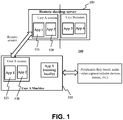
- FIG. 1 is a block diagram of a virtualized environment 100.
- the actual processing may be done on a server 105 instead of a client-side machine 110.
- Such applications i.e., applications running in virtualized environment 100
- Such applications may be referred to as "virtualized applications.”
- a first application 115 and a second application 120 may actually be running on server 105.
- Client-side machine 110 may render and display a first user interface 125 and a second user interface 130 respectively corresponding to first application 115 and a second application 120.
- Virtualized applications may be acceptable for non-real-time applications (e.g. word processing, spreadsheets, etc.) in which raw data (e.g. key inputs, etc.) may be sent from the client-side machine to the server where the virtualized application running on the server gets the user input and process the data.
- raw data e.g. key inputs, etc.
- Real-time audio/video conferencing applications may run as virtualized applications in the aforementioned virtualized environment.
- Real-time audio/video conferencing applications may take raw audio/video data captured from the client-side machine, encode the data, and transmit the encoded data over a wire for example.
- real-time audio/video conferencing applications may receive an encoded data stream from a network, decode the encoded data stream, and render the decoded data stream on the client-side machine.
- there are additional hops e.g. through the server
- the "virtualized" real time application needs to traverse compared to "non-virtualized” real time application running locally on the client-side machine.
- the client-side application catches audio/video from the devices, encodes, and sends it over a wire from the client-side machine.
- the captured raw audio/video data may be sent to the server, for example, by remoting the capturing device or by sending a raw data stream coming from capturing devices over a remote desktop channel to the server.
- the server in the virtualized environment sends out an encoded stream. Consequently, in the virtualized environment, there are additional hops (e.g. from the client-side machines to the server) in the path of audio/video. These additional hops may increase delay/latency in the real-time audio/video data flow.
- FIG. 2 shows a real-time media system 200 consistent with embodiments of the inventions.
- Real-time media system 200 may comprise a first client-side machine 205 (e.g. a local computing device), a second client-side machine 210 (e.g. a remote computing device), a server 215, and a network 220. Consistent with embodiments of the invention, non-virtualized, real-time audio/video conferencing may be performed between first client-side machine 205 and second client-side machine 210 over network 220.
- first hop 225 and a second hop 230 there would be additional hops (e.g. from first client-side machine 205 to server 215 and from server 215 to second client-side machine 210) in the path of the audio/video data between first client-side machine 205 and second client-side machine 210.
- additional hops may increase, for example, delay/latency in the real-time audio/video data flow between first client-side machine 205 and second client-side machine 210.
- the aforementioned delay/latency in the real-time audio/video data flow between first client-side machine 205 and second client-side machine 210 may be avoided by not involving server 215 in the real-time audio/video data flow.
- the audio/video data may be transmitted between first client-side machine 205 and second client-side machine 210 over a media path 235 that does not involve server 215.
- media path 235 is not established or if it fails after it is established, the audio/video data may be transmitted between first client-side machine 205 and second client-side machine 210 over the server path.
- first client-side machine 205, second client-side machine 210, and server 215 may comprise, but is not limited to, a desktop computer, a notebook computer, a mobile device, a smart telephone, or a personal digital assistant, for example.
- Network 220 may comprise the internet or any type network over which first client-side machine 205, second client-side machine 210, and server 215 may communicate.
- Any one of first client-side machine 205, second client-side machine 210, and server 215 may be implemented using, for example, a computing device 500 as described in greater detail below with respect to FIG. 5 .
- FIG. 3 is a flow chart setting forth the general stages involved in a method 300 consistent with an embodiment of the invention for providing real-time media optimization.
- Method 300 may be implemented using real-time media system 200 as described above. Ways to implement the stages of method 300 will be described in greater detail below.
- Method 300 may begin at starting block 305 and proceed to stage 310 where first client-side machine 205 may establish a remote session with a remote computing device (e.g. second client-side machine 210.)
- a remote computing device e.g. second client-side machine 210.
- an application 405 may be running on sever 215.
- Application 405 may comprise a videoconferencing application.
- a thin client running on first client-side machine 205 may render and display a user interface 415 corresponding to application 405 running on sever 215.
- Application 405 may complete a remote session between first client-side machine 205 and second client-side machine 210.
- first client-side machine 205 may exchange, during the remote session, non-real-time media data with the remote computing device (e.g. second client-side machine 210) over the server path.
- the exchanged non-real-time media data may comprise, for example, any non-audio or non-video data corresponding to a videoconferencing session between first client-side machine 205 and second client-side machine 210.
- the non-real-time media data may comprise data corresponding to a location of first client-side machine 205 used, for example, for emergency 911 calls.
- the non-real-time media data may comprise, but is not limited to, client and server capabilities. These capabilities may be used to influence the direct communication between two clients.
- first client-side machine 205 exchanges the non-real-time media data in stage 320
- method 300 may continue to stage 330 where first client-side machine 205 may exchange, during the remote session, real-time media data with the remote computing device over media path 235.
- the real-time media data may comprise audio or video data. If embodiments of the invention used the server path (i.e. first hop 225 and second hop 230) for the real-time media data, there would be additional hops (e.g. from first client-side machine 205 to server 215 and from server 215 to second client-side machine 210) in the path of the audio/video data between first client-side machine 205 and second client-side machine 210. These additional hops may increase, for example, delay/latency in the real-time audio/video data flow between first client-side machine 205 and second client-side machine 210.
- Embodiments of the invention may avoid the aforementioned delay/latency by having a remote media manager (RMM) (e.g. a remote media manager application 410) on first client-side machine 205 that may capture, encode, and transmit the real-time media data (e.g. audio/video and other modalities can be added) directly from first client-side machine 205 to second client-side machine 210, without involving server 215 in media path 235.
- RMM may receive encoded real-time media data from network 220 (e.g. sent directly from second client-side machine 210 over media path 235), decode the received encoded real-time media data, and render directly into user interface 415 the decoded real-time media data it received from second client-side machine 210.
- RMM may work in conjunction with application 405 on server 215.
- application 405 may send and receive data using input devices (e.g. a camera 420 and a microphone 425) and output devices (e.g. a speaker 430) connected to first client-side machine 205.
- RMM may also utilize the same input and output devices. Consequently, RMM may work in conjunction with application 405 on server 215 in order to share input and output devices.
- the input and output devices may be shared between data sent/received over media path 235 and data sent/received over the server path.
- RMM may work in conjunction with application 405 on server 215
- data from media path 235 and data from the server path is synchronized.
- On example may comprise geometry tracking. Geometry tracking may allow for (when video data is coming straight to first client-side machine 205 sent directly from second client-side machine 210 over media path 235 and bypassing the server path) placing, on display 415, the video where it should be shown.
- application 405 may send the position and shape of the video region to first client-side machine 205 on the server path.
- First client-side machine 205 may then render the video (coming on media path 235) on a "proxy" window that tracks information (e.g. position and shape) sent by application 405.
- Application 405 may continuously monitor any changes that may happen to the video location and shape and may keep updating first client-side machine 205 with this information.
- First client-side machine 205 in-turn may keep updating the "proxy" window with application 405's info. In this way, the video display on first client-side machine 205 may be synchronized.
- first client-side machine 205 exchanging, during the remote session, real-time media data with the remote computing device over media path 235 may comprise performing network address translation (NAT) from first client-side machine 205 to the remote computing device.
- network address translation may comprise the process of modifying network address information in datagram (IP) packet headers while in transit across a traffic routing device for the purpose of remapping one IP address space into another.
- IP datagram
- An embodiment consistent with the invention may comprise a system for providing real-time media optimization.
- the system may comprise a memory storage and a processing unit coupled to the memory storage.
- the processing unit may be operative to establish a remote session with a remote computing device.
- the processing unit may be operative to exchange, during the remote session, non-real-time media data with the remote computing device over a server path and exchange, during the remote session, real-time media data with the remote computing device over a media path.
- the system may comprise a memory storage and a processing unit coupled to the memory storage.
- the processing unit may be operative to establish a remote session between a local computing device and a remote computing device.
- the processing unit may be operative to exchange, during the remote session, non-real-time media data between the local computing device and the remote computing device over a server path including a server.
- the processing unit may be operative to exchange, during the remote session, real-time media data comprising audio and video data between the local computing device and the remote computing device over a media path.
- the server is not in the media path.
- Yet another embodiment consistent with the invention may comprise a system for providing real-time media optimization.
- the system may comprise a memory storage and a processing unit coupled to the memory storage.
- the processing unit may be operative to establish a remote session with a remote computing device.
- the processing unit being operative to establish the remote session may comprise the processing unit being operative to establish a server path wherein a server is involved in the server path, and to establish a media path wherein the server is not involved in the server path and the media path is established directly with the remote computing device.
- the processing unit may be operative to exchange, during the remote session, non-real-time media data with the remote computing device over the server path and to exchange, during the remote session, real-time media data with the remote computing device over the media path.
- FIG. 5 is a block diagram of a system including computing device 500.
- the aforementioned memory storage and processing unit may be implemented in a computing device, such as computing device 500 of FIG. 5 . Any suitable combination of hardware, software, or firmware may be used to implement the memory storage and processing unit.
- computing device 500 may run in a virtual machine or on a physical machine.
- the memory storage and processing unit may be implemented with computing device 500 or any of other computing devices 518, in combination with computing device 500.
- the aforementioned system, device, and processors are examples and other systems, devices, and processors may comprise the aforementioned memory storage and processing unit, consistent with embodiments of the invention.
- computing device 500 may comprise an operating environment for first client-side machine 205 or second client-side machine 210 as described above. First client-side machine 205 or second client-side machine 210 may operate in other environments and is not limited to computing device 500.
- a system consistent with an embodiment of the invention may include a computing device, such as computing device 500.
- computing device 500 may include at least one processing unit 502 and a system memory 504.
- system memory 504 may comprise, but is not limited to, volatile (e.g. random access memory (RAM)), nonvolatile (e.g. read-only memory (ROM)), flash memory, or any combination.
- System memory 504 may include operating system 505, one or more programming modules 506, and may include a program data 507. Operating system 505, for example, may be suitable for controlling computing device 500's operation.
- programming modules 506 may include, for example, remote media manager application 410.
- embodiments of the invention may be practiced in conjunction with a graphics library, other operating systems, or any other application program and is not limited to any particular application or system. This basic configuration is illustrated in FIG. 5 by those components within a dashed line 508.
- Computing device 500 may have additional features or functionality.
- computing device 500 may also include additional data storage devices (removable and/or non-removable) such as, for example, magnetic disks, optical disks, or tape.
- additional storage is illustrated in FIG. 5 by a removable storage 509 and a non-removable storage 510.
- Computing device 500 may also contain a communication connection 516 that may allow device 500 to communicate with other computing devices 518, such as over a network in a distributed computing environment, for example, an intranet or the Internet.
- Communication connection 516 is one example of communication media.
- Computer readable media may include computer storage media.
- Computer storage media may include volatile and nonvolatile, removable and non-removable media implemented in any method or technology for storage of information, such as computer readable instructions, data structures, program modules, or other data.
- System memory 504, removable storage 509, and non-removable storage 510 are all computer storage media examples (i.e. memory storage.)
- Computer storage media may include, but is not limited to, RAM, ROM, electrically erasable read-only memory (EEPROM), flash memory or other memory technology, CD-ROM, digital versatile disks (DVD) or other optical storage, magnetic cassettes, magnetic tape, magnetic disk storage or other magnetic storage devices, or any other medium which can be used to store information and which can be accessed by computing device 500.
- Computing device 500 may also have input device(s) 512 such as a keyboard, a mouse, a pen, a sound input device, a touch input device, etc.
- Output device(s) 514 such as a display, speakers, a printer, etc. may also be included.
- the aforementioned devices are examples and others may be used.
- Computer readable media may also include communication media.
- Communication media may be embodied by computer readable instructions, data structures, program modules, or other data in a modulated data signal, such as a carrier wave or other transport mechanism, and includes any information delivery media.
- modulated data signal may describe a signal that has one or more characteristics set or changed in such a manner as to encode information in the signal.
- communication media may include wired media such as a wired network or direct-wired connection, and wireless media such as acoustic, radio frequency (RF), infrared, and other wireless media.
- RF radio frequency
- program modules 506 may perform processes including, for example, one or more method 300's stages as described above.
- processing unit 502 may perform other processes.
- Other programming modules that may be used in accordance with embodiments of the present invention may include electronic mail and contacts applications, word processing applications, spreadsheet applications, database applications, slide presentation applications, drawing or computer-aided application programs, etc.
- program modules may include routines, programs, components, data structures, and other types of structures that may perform particular tasks or that may implement particular abstract data types.
- embodiments of the invention may be practiced with other computer system configurations, including hand-held devices, multiprocessor systems, microprocessor-based or programmable consumer electronics, minicomputers, mainframe computers, and the like.
- Embodiments of the invention may also be practiced in distributed computing environments where tasks are performed by remote processing devices that are linked through a communications network.
- program modules may be located in both local and remote memory storage devices.
- embodiments of the invention may be practiced in an electrical circuit comprising discrete electronic elements, packaged or integrated electronic chips containing logic gates, a circuit utilizing a microprocessor, or on a single chip containing electronic elements or microprocessors.
- Embodiments of the invention may also be practiced using other technologies capable of performing logical operations such as, for example, AND, OR, and NOT, including but not limited to mechanical, optical, fluidic, and quantum technologies.
- embodiments of the invention may be practiced within a general purpose computer or in any other circuits or systems.
- Embodiments of the invention may be implemented as a computer process (method), a computing system, or as an article of manufacture, such as a computer program product or computer readable media.
- the computer program product may be a computer storage media readable by a computer system and encoding a computer program of instructions for executing a computer process.
- the computer program product may also be a propagated signal on a carrier readable by a computing system and encoding a computer program of instructions for executing a computer process.
- the present invention may be embodied in hardware and/or in software (including firmware, resident software, micro-code, etc.).
- embodiments of the present invention may take the form of a computer program product on a computer-usable or computer-readable storage medium having computer-usable or computer-readable program code embodied in the medium for use by or in connection with an instruction execution system.
- a computer-usable or computer-readable medium may be any medium that can contain, store, communicate, propagate, or transport the program for use by or in connection with the instruction execution system, apparatus, or device.
- the computer-usable or computer-readable medium may be, for example but not limited to, an electronic, magnetic, optical, electromagnetic, infrared, or semiconductor system, apparatus, device, or propagation medium. More specific computer-readable medium examples (a non-exhaustive list), the computer-readable medium may include the following: an electrical connection having one or more wires, a portable computer diskette, a random access memory (RAM), a read-only memory (ROM), an erasable programmable read-only memory (EPROM or Flash memory), an optical fiber, and a portable compact disc read-only memory (CD-ROM).
- RAM random access memory
- ROM read-only memory
- EPROM or Flash memory erasable programmable read-only memory
- CD-ROM portable compact disc read-only memory
- the computer-usable or computer-readable medium could even be paper or another suitable medium upon which the program is printed, as the program can be electronically captured, via, for instance, optical scanning of the paper or other medium, then compiled, interpreted, or otherwise processed in a suitable manner, if necessary, and then stored in a computer memory.
- Embodiments of the present invention are described above with reference to block diagrams and/or operational illustrations of methods, systems, and computer program products according to embodiments of the invention.
- the functions/acts noted in the blocks may occur out of the order as shown in any flowchart.
- two blocks shown in succession may in fact be executed substantially concurrently or the blocks may sometimes be executed in the reverse order, depending upon the functionality/acts involved.
Landscapes
- Engineering & Computer Science (AREA)
- Signal Processing (AREA)
- Multimedia (AREA)
- Computer Networks & Wireless Communication (AREA)
- Business, Economics & Management (AREA)
- General Business, Economics & Management (AREA)
- Information Transfer Between Computers (AREA)
- Computer And Data Communications (AREA)
- Data Exchanges In Wide-Area Networks (AREA)
- Two-Way Televisions, Distribution Of Moving Picture Or The Like (AREA)
Claims (10)
- Verfahren an einem lokalen Computergerät (205) zum Bereitstellen einer Echtzeit-Medienoptimierung, wobei das Verfahren umfasst:Einrichten (310) einer Sitzung mit einem entfernten Computergerät (210), das das Einrichten eines Hops zwischen einem auf dem lokalen Computergerät laufenden Client und einer auf einem Server (215) laufenden Anwendung einschließt, wobei sich der eingerichtete Hop in einem Serverpfad (225,230) befindet, und Einrichten eines Medienpfads (235), der ein Pfad ist, der direkt mit dem entfernten Computergerät eingerichtet ist und den Server nicht einbezieht;Austauschen (320) von Nicht-Echtzeit-Mediendaten mit dem entfernten Computergerät während der Sitzung über den Serverpfad, wobei das Austauschen der Nicht-Echtzeit-Mediendaten mit dem entfernten Computergerät über den Serverpfad das Weiterleiten der Nicht-Echtzeit-Mediendaten durch den Server auf dem Serverpfad umfasst;Austauschen (330) von Echtzeit-Mediendaten mit dem entfernten Computergerät über den Medienpfad während der Sitzung; undSynchronisieren der Echtzeit-Mediendaten aus dem Medienpfad und der Nicht-Echtzeit-Mediendaten aus dem Serverpfad, wobei das Synchronisieren umfasst:Empfangen einer Position und einer Form eines Videobereichs, der sich auf die Echtzeit-Mediendaten bezieht, von dem Server; undDarstellen der aus dem Medienpfad ausgetauschten Echtzeit-Mediendaten in einem Proxy-Fenster, wobei das Proxy-Fenster die Position und die Form des von dem Server empfangenen Videobereichs verfolgt.
- Verfahren nach Anspruch 1, bei dem die Nicht-Echtzeit-Informationen Informationen umfassen, die einem Ort des lokalen Computergerätes entsprechen.
- Verfahren nach Anspruch 1, bei dem das Austauschen der Echtzeit-Mediendaten mit dem entfernten Computergerät über den Medienpfad das Erfassen, Codieren und Senden der Echtzeit-Mediendaten umfasst.
- Verfahren nach Anspruch 1, bei dem das Austauschen der Echtzeitmediendaten mit dem entfernten Computergerät über den Medienpfad das Empfangen der Echtzeitmediendaten von dem entfernten Computergerät über den Medienpfad, Dekodieren der Echtzeit-Mediendaten und Darstellen der dekodierten Echtzeit-Mediendaten umfasst.
- Verfahren nach Anspruch 1, bei dem das Austauschen der Echtzeit-Mediendaten mit dem entfernten Computergerät über den Medienpfad das Ausführen einer Netzwerkadressenübersetzung durch Modifizieren von Netzwerkadresseninformationen in IP-Paketköpfe zum Zwecke der Neuzuordnung eines IP-Adressraums in einen anderen umfasst.
- Computerlesbares Medium zum Bereitstellen einer Echtzeit-Medienoptimierung, umfassend von einem Computer ausführbare Anweisungen, die, wenn sie von einem Prozessor ausgeführt werden, den Prozessor veranlassen, folgende Schritte auszuführen:Einrichten (310) einer Sitzung zwischen einem lokalen Computergerät (205) und einem entfernten Computergerät (210), umfassend das Einrichten eines Hops zwischen einem auf dem lokalen Computergerät laufenden Client und einer auf einem Server (215) laufenden Anwendung, wobei sich der eingerichtete Hop in einem Serverpfad (225,230) befindet, und Einrichten eines Medienpfads (235), der ein Pfad ist, der direkt mit dem entfernten Computergerät eingerichtet ist und den Server nicht einbezieht;Austauschen (320) von Nicht-Echtzeit-Mediendaten zwischen dem lokalen Computergerät und dem entfernten Computergerät über den Serverpfad, wobei das Austauschen der Nicht-Echtzeit-Mediendaten das Weiterleiten der Nicht-Echtzeit-Mediendaten durch den Server auf dem Serverpfad umfasst;Austauschen (330) von Echtzeit-Mediendaten, die Audio- und Videodaten umfassen, mit dem entfernten Computergerät über den Medienpfad während der Sitzung; undSynchronisieren der Echtzeit-Mediendaten aus dem Medienpfad und der Nicht-Echtzeit-Mediendaten aus dem Serverpfad, wobei das Synchronisieren umfasst:Empfangen einer Position und einer Form eines Videobereichs, der sich auf die Echtzeit-Mediendaten bezieht, von dem Server; undDarstellen der aus dem Medienpfad ausgetauschten Echtzeit-Mediendaten in einem Proxy-Fenster, wobei das Proxy-Fenster die Position und die Form des von dem Server empfangenen Videobereichs verfolgt.
- Computerlesbares Medium nach Anspruch 6, bei dem der Medienpfad zwischen einem entfernten Medien-Manager, der in dem auf dem lokalen Computergerät laufenden Client ausgeführt wird, und dem entfernten Computergerät eingerichtet ist.
- Computerlesbares Medium nach Anspruch 6, bei dem das Austauschen der Nicht-Echtzeit-Mediendaten mit dem entfernten Computergerät über den Serverpfad das Weiterleiten von Nicht-Echtzeit-Informationen zu dem Server auf dem Serverpfad umfasst, wobei die Nicht-Echtzeitinformationen, Informationen umfassen, die einem Ort des lokalen Computergerätes entsprechen.
- Computerlesbares Medium nach Anspruch 6, bei dem das Austauschen der Echtzeit-Mediendaten mit dem entfernten Computergerät über den Medienpfad das Empfangen der Echtzeit-Mediendaten von dem entfernten Computergerät über den Medienpfad, das Decodieren der Echtzeit-Mediendaten und das Darstellen der dekodierten Echtzeit-Mediendaten umfasst.
- System zum Bereitstellen einer Echtzeit-Medienoptimierung, wobei das System umfasst:einen Speicher (504); undeine Verarbeitungseinheit (502), die mit dem Speicher verbunden ist, wobei die Verarbeitungseinheit betätigt werden kann um:eine Sitzung mit einem entfernten Computergerät (210) einzurichten, wobei, dass die Verarbeitungseinheit betätigt werden kann, um die Sitzung einzurichten, umfasst, dass die Verarbeitungseinheit betätigt werden kann für das:Einrichten eines Serverpfads (225, 230), wobei ein Server (215) an dem Serverpfad beteiligt ist, undEinrichten eines Medienpfads (235), wobei der Server nicht beteiligt ist und der Medienpfad direkt mit dem entfernten Computergerät eingerichtet wird;Austauschen, während der Sitzung, der Nicht-Echtzeit-Mediendaten mit dem entfernten Computergerät über den Serverpfad;Austauschen, während der Sitzung, der Echtzeit-Mediendaten mit dem entfernten Computergerät über den Medienpfad; undSynchronisieren der Echtzeit-Mediendaten von dem Medienpfad und der Nicht-Echtzeit-Mediendaten von dem Serverpfad, wobei das Synchronisieren weiterhin umfasst, dass es betätigt werden kann für das:Empfangen einer Position und einer Form eines Videobereichs, der sich auf die Echtzeit-Mediendaten bezieht, von dem Server; undDarstellen der Echtzeit-Mediendaten, die von dem Medienpfad in einem Proxy-Fenster ausgetauscht werden, wobei das Proxy-Fenster die Position und die Form des vom Server empfangenen Videobereichs verfolgt.
Applications Claiming Priority (2)
| Application Number | Priority Date | Filing Date | Title |
|---|---|---|---|
| US12/967,100 US9276972B2 (en) | 2010-12-14 | 2010-12-14 | Real-time media optimization over remoted sessions |
| PCT/US2011/062269 WO2012082347A2 (en) | 2010-12-14 | 2011-11-28 | Real-time media optimization over remoted sessions |
Publications (3)
| Publication Number | Publication Date |
|---|---|
| EP2652913A2 EP2652913A2 (de) | 2013-10-23 |
| EP2652913A4 EP2652913A4 (de) | 2014-07-23 |
| EP2652913B1 true EP2652913B1 (de) | 2019-04-24 |
Family
ID=46200509
Family Applications (1)
| Application Number | Title | Priority Date | Filing Date |
|---|---|---|---|
| EP11848951.7A Not-in-force EP2652913B1 (de) | 2010-12-14 | 2011-11-28 | Echtzeit-medienoptimierung über entfernte sitzungen |
Country Status (9)
| Country | Link |
|---|---|
| US (2) | US9276972B2 (de) |
| EP (1) | EP2652913B1 (de) |
| JP (1) | JP5961185B2 (de) |
| KR (1) | KR101900969B1 (de) |
| AU (2) | AU2011341522B2 (de) |
| BR (1) | BR112013014766A8 (de) |
| CA (1) | CA2818516C (de) |
| RU (1) | RU2595548C2 (de) |
| WO (1) | WO2012082347A2 (de) |
Families Citing this family (3)
| Publication number | Priority date | Publication date | Assignee | Title |
|---|---|---|---|---|
| US9276972B2 (en) | 2010-12-14 | 2016-03-01 | Microsoft Technology Licensing, Llc | Real-time media optimization over remoted sessions |
| JP6353793B2 (ja) * | 2015-01-16 | 2018-07-04 | Kddi株式会社 | 画面共有システム、ソース端末、シンク端末及び画面共有方法 |
| US11016717B1 (en) | 2019-11-08 | 2021-05-25 | Microsoft Technology Licensing, Llc | Selective electronic content casting |
Family Cites Families (21)
| Publication number | Priority date | Publication date | Assignee | Title |
|---|---|---|---|---|
| KR20020041830A (ko) * | 1999-10-29 | 2002-06-03 | 암만 챨스 비. | 텔레비전 화상 회의 시스템 |
| TW575447B (en) | 2000-02-02 | 2004-02-11 | Nextech Corp | Network system processing method and network system |
| GB0108041D0 (en) * | 2001-03-30 | 2001-05-23 | Nokia Networks Oy | Presence service in IP multimedia |
| US7634533B2 (en) | 2004-04-30 | 2009-12-15 | Microsoft Corporation | Systems and methods for real-time audio-visual communication and data collaboration in a network conference environment |
| US7590750B2 (en) * | 2004-09-10 | 2009-09-15 | Microsoft Corporation | Systems and methods for multimedia remoting over terminal server connections |
| JP4643386B2 (ja) | 2005-08-09 | 2011-03-02 | 株式会社野村総合研究所 | 転送制御プログラム、送受信制御プログラム及びイベント情報送受信システム |
| US7860808B2 (en) * | 2006-01-05 | 2010-12-28 | International Business Machines Corporation | System and method for hybrid conservation of fossil fuel |
| US9374263B2 (en) | 2006-09-29 | 2016-06-21 | Avaya Ecs Ltd. | Latency differential mitigation for real time data streams |
| US20080146256A1 (en) | 2006-12-19 | 2008-06-19 | Jeffrey Charles Hawkins | Sharing data during a voice call using a mobile communications device, and associated user interface |
| US9253222B2 (en) | 2007-02-22 | 2016-02-02 | Match.Com. L.L.C. | Synchronous delivery of media content in a collaborative environment |
| US7953882B2 (en) | 2007-07-26 | 2011-05-31 | Realnetworks, Inc. | Adaptive variable fidelity media distribution system and method |
| US7769806B2 (en) * | 2007-10-24 | 2010-08-03 | Social Communications Company | Automated real-time data stream switching in a shared virtual area communication environment |
| US20090288007A1 (en) | 2008-04-05 | 2009-11-19 | Social Communications Company | Spatial interfaces for realtime networked communications |
| US8732236B2 (en) * | 2008-12-05 | 2014-05-20 | Social Communications Company | Managing network communications between network nodes and stream transport protocol |
| EP2053825B1 (de) | 2007-10-25 | 2015-07-08 | Alcatel Lucent | Verteilung gemeinsam benutzter Inhaltsströme in Kommunikationsnetzen |
| US8890874B2 (en) * | 2007-12-14 | 2014-11-18 | Microsoft Corporation | Changing visual content communication |
| JP5721634B2 (ja) | 2008-12-05 | 2015-05-20 | ソーシャル・コミュニケーションズ・カンパニー | リアルタイムカーネル |
| JP5381194B2 (ja) | 2009-03-16 | 2014-01-08 | 富士通株式会社 | 通信プログラム、中継ノード、および通信方法 |
| US8429647B2 (en) | 2009-05-06 | 2013-04-23 | Vmware, Inc. | Virtual machine migration across network by publishing routes to the associated virtual networks via virtual router after the start of migration of the virtual machine |
| CN101841563A (zh) | 2010-04-16 | 2010-09-22 | 上海亚图软件有限公司 | 服务器控制的基于p2p网游同步方法 |
| US9276972B2 (en) | 2010-12-14 | 2016-03-01 | Microsoft Technology Licensing, Llc | Real-time media optimization over remoted sessions |
-
2010
- 2010-12-14 US US12/967,100 patent/US9276972B2/en active Active
-
2011
- 2011-11-28 RU RU2013127119/08A patent/RU2595548C2/ru not_active IP Right Cessation
- 2011-11-28 JP JP2013544511A patent/JP5961185B2/ja not_active Expired - Fee Related
- 2011-11-28 KR KR1020137014949A patent/KR101900969B1/ko active Active
- 2011-11-28 CA CA2818516A patent/CA2818516C/en active Active
- 2011-11-28 WO PCT/US2011/062269 patent/WO2012082347A2/en not_active Ceased
- 2011-11-28 BR BR112013014766A patent/BR112013014766A8/pt not_active Application Discontinuation
- 2011-11-28 EP EP11848951.7A patent/EP2652913B1/de not_active Not-in-force
- 2011-11-28 AU AU2011341522A patent/AU2011341522B2/en not_active Ceased
-
2015
- 2015-12-21 US US14/976,030 patent/US9699225B2/en not_active Expired - Fee Related
-
2016
- 2016-01-29 AU AU2016200543A patent/AU2016200543B2/en not_active Ceased
Non-Patent Citations (1)
| Title |
|---|
| None * |
Also Published As
| Publication number | Publication date |
|---|---|
| US9699225B2 (en) | 2017-07-04 |
| RU2595548C2 (ru) | 2016-08-27 |
| KR20130143078A (ko) | 2013-12-30 |
| WO2012082347A2 (en) | 2012-06-21 |
| JP5961185B2 (ja) | 2016-08-02 |
| CA2818516A1 (en) | 2012-06-21 |
| CA2818516C (en) | 2018-07-17 |
| AU2011341522A1 (en) | 2013-06-06 |
| US9276972B2 (en) | 2016-03-01 |
| EP2652913A2 (de) | 2013-10-23 |
| CN102571764A (zh) | 2012-07-11 |
| JP2014507697A (ja) | 2014-03-27 |
| BR112013014766A2 (pt) | 2016-10-04 |
| KR101900969B1 (ko) | 2018-09-20 |
| EP2652913A4 (de) | 2014-07-23 |
| AU2016200543A1 (en) | 2016-02-18 |
| BR112013014766A8 (pt) | 2017-12-19 |
| AU2016200543B2 (en) | 2017-04-06 |
| US20120151008A1 (en) | 2012-06-14 |
| AU2011341522B2 (en) | 2015-10-29 |
| WO2012082347A3 (en) | 2012-08-16 |
| RU2013127119A (ru) | 2014-12-20 |
| US20160112468A1 (en) | 2016-04-21 |
Similar Documents
| Publication | Publication Date | Title |
|---|---|---|
| EP3340564B1 (de) | System und verfahren zur qualitätsbewussten aufzeichnung in grossen kollaborativen clouds | |
| TWI865716B (zh) | 同步本地房間和遠端共享 | |
| JP2016508357A (ja) | 複数のメディア・ストリームの使用による無線リアルタイム・メディア通信 | |
| US10778736B2 (en) | On demand in-band signaling for conferences | |
| WO2020248649A1 (zh) | 音视频数据同步播放方法、装置、系统、电子设备及介质 | |
| US9276982B2 (en) | Multimedia conversation transfer | |
| US10009404B2 (en) | Enterprise class virtual desktop infrastructure | |
| US9544253B2 (en) | Multimedia conversation transfer | |
| EP2652913B1 (de) | Echtzeit-medienoptimierung über entfernte sitzungen | |
| US20160094354A1 (en) | Multi-Device Simultaneous Content Sharing | |
| US20150295960A1 (en) | Collaborative Multimedia Conversation Manager | |
| CN102571764B (zh) | 远程会话上的实时媒体优化 | |
| US9503812B2 (en) | Systems and methods for split echo cancellation | |
| HK1171135B (en) | Real-time media optimization over remoted sessions | |
| HK1171135A (en) | Real-time media optimization over remoted sessions | |
| US20180367446A1 (en) | Dual network interface implementation in multipath networking | |
| US9288436B2 (en) | Systems and methods for using split endpoints in video communication systems |
Legal Events
| Date | Code | Title | Description |
|---|---|---|---|
| PUAI | Public reference made under article 153(3) epc to a published international application that has entered the european phase |
Free format text: ORIGINAL CODE: 0009012 |
|
| 17P | Request for examination filed |
Effective date: 20130612 |
|
| AK | Designated contracting states |
Kind code of ref document: A2 Designated state(s): AL AT BE BG CH CY CZ DE DK EE ES FI FR GB GR HR HU IE IS IT LI LT LU LV MC MK MT NL NO PL PT RO RS SE SI SK SM TR |
|
| DAX | Request for extension of the european patent (deleted) | ||
| A4 | Supplementary search report drawn up and despatched |
Effective date: 20140620 |
|
| RIC1 | Information provided on ipc code assigned before grant |
Ipc: H04L 12/28 20060101AFI20140613BHEP Ipc: H04N 7/15 20060101ALI20140613BHEP Ipc: H04L 29/06 20060101ALI20140613BHEP |
|
| RAP1 | Party data changed (applicant data changed or rights of an application transferred) |
Owner name: MICROSOFT TECHNOLOGY LICENSING, LLC |
|
| 17Q | First examination report despatched |
Effective date: 20160226 |
|
| GRAP | Despatch of communication of intention to grant a patent |
Free format text: ORIGINAL CODE: EPIDOSNIGR1 |
|
| STAA | Information on the status of an ep patent application or granted ep patent |
Free format text: STATUS: GRANT OF PATENT IS INTENDED |
|
| INTG | Intention to grant announced |
Effective date: 20181120 |
|
| GRAS | Grant fee paid |
Free format text: ORIGINAL CODE: EPIDOSNIGR3 |
|
| GRAA | (expected) grant |
Free format text: ORIGINAL CODE: 0009210 |
|
| STAA | Information on the status of an ep patent application or granted ep patent |
Free format text: STATUS: THE PATENT HAS BEEN GRANTED |
|
| AK | Designated contracting states |
Kind code of ref document: B1 Designated state(s): AL AT BE BG CH CY CZ DE DK EE ES FI FR GB GR HR HU IE IS IT LI LT LU LV MC MK MT NL NO PL PT RO RS SE SI SK SM TR |
|
| REG | Reference to a national code |
Ref country code: GB Ref legal event code: FG4D |
|
| REG | Reference to a national code |
Ref country code: CH Ref legal event code: EP |
|
| REG | Reference to a national code |
Ref country code: AT Ref legal event code: REF Ref document number: 1125439 Country of ref document: AT Kind code of ref document: T Effective date: 20190515 Ref country code: IE Ref legal event code: FG4D |
|
| REG | Reference to a national code |
Ref country code: DE Ref legal event code: R096 Ref document number: 602011058402 Country of ref document: DE |
|
| REG | Reference to a national code |
Ref country code: NL Ref legal event code: FP |
|
| REG | Reference to a national code |
Ref country code: LT Ref legal event code: MG4D |
|
| PG25 | Lapsed in a contracting state [announced via postgrant information from national office to epo] |
Ref country code: NO Free format text: LAPSE BECAUSE OF FAILURE TO SUBMIT A TRANSLATION OF THE DESCRIPTION OR TO PAY THE FEE WITHIN THE PRESCRIBED TIME-LIMIT Effective date: 20190724 Ref country code: ES Free format text: LAPSE BECAUSE OF FAILURE TO SUBMIT A TRANSLATION OF THE DESCRIPTION OR TO PAY THE FEE WITHIN THE PRESCRIBED TIME-LIMIT Effective date: 20190424 Ref country code: LT Free format text: LAPSE BECAUSE OF FAILURE TO SUBMIT A TRANSLATION OF THE DESCRIPTION OR TO PAY THE FEE WITHIN THE PRESCRIBED TIME-LIMIT Effective date: 20190424 Ref country code: HR Free format text: LAPSE BECAUSE OF FAILURE TO SUBMIT A TRANSLATION OF THE DESCRIPTION OR TO PAY THE FEE WITHIN THE PRESCRIBED TIME-LIMIT Effective date: 20190424 Ref country code: PT Free format text: LAPSE BECAUSE OF FAILURE TO SUBMIT A TRANSLATION OF THE DESCRIPTION OR TO PAY THE FEE WITHIN THE PRESCRIBED TIME-LIMIT Effective date: 20190824 Ref country code: SE Free format text: LAPSE BECAUSE OF FAILURE TO SUBMIT A TRANSLATION OF THE DESCRIPTION OR TO PAY THE FEE WITHIN THE PRESCRIBED TIME-LIMIT Effective date: 20190424 Ref country code: AL Free format text: LAPSE BECAUSE OF FAILURE TO SUBMIT A TRANSLATION OF THE DESCRIPTION OR TO PAY THE FEE WITHIN THE PRESCRIBED TIME-LIMIT Effective date: 20190424 Ref country code: FI Free format text: LAPSE BECAUSE OF FAILURE TO SUBMIT A TRANSLATION OF THE DESCRIPTION OR TO PAY THE FEE WITHIN THE PRESCRIBED TIME-LIMIT Effective date: 20190424 |
|
| PG25 | Lapsed in a contracting state [announced via postgrant information from national office to epo] |
Ref country code: RS Free format text: LAPSE BECAUSE OF FAILURE TO SUBMIT A TRANSLATION OF THE DESCRIPTION OR TO PAY THE FEE WITHIN THE PRESCRIBED TIME-LIMIT Effective date: 20190424 Ref country code: LV Free format text: LAPSE BECAUSE OF FAILURE TO SUBMIT A TRANSLATION OF THE DESCRIPTION OR TO PAY THE FEE WITHIN THE PRESCRIBED TIME-LIMIT Effective date: 20190424 Ref country code: GR Free format text: LAPSE BECAUSE OF FAILURE TO SUBMIT A TRANSLATION OF THE DESCRIPTION OR TO PAY THE FEE WITHIN THE PRESCRIBED TIME-LIMIT Effective date: 20190725 Ref country code: PL Free format text: LAPSE BECAUSE OF FAILURE TO SUBMIT A TRANSLATION OF THE DESCRIPTION OR TO PAY THE FEE WITHIN THE PRESCRIBED TIME-LIMIT Effective date: 20190424 Ref country code: BG Free format text: LAPSE BECAUSE OF FAILURE TO SUBMIT A TRANSLATION OF THE DESCRIPTION OR TO PAY THE FEE WITHIN THE PRESCRIBED TIME-LIMIT Effective date: 20190724 |
|
| REG | Reference to a national code |
Ref country code: AT Ref legal event code: MK05 Ref document number: 1125439 Country of ref document: AT Kind code of ref document: T Effective date: 20190424 |
|
| PG25 | Lapsed in a contracting state [announced via postgrant information from national office to epo] |
Ref country code: IS Free format text: LAPSE BECAUSE OF FAILURE TO SUBMIT A TRANSLATION OF THE DESCRIPTION OR TO PAY THE FEE WITHIN THE PRESCRIBED TIME-LIMIT Effective date: 20190824 |
|
| REG | Reference to a national code |
Ref country code: DE Ref legal event code: R097 Ref document number: 602011058402 Country of ref document: DE |
|
| PG25 | Lapsed in a contracting state [announced via postgrant information from national office to epo] |
Ref country code: CZ Free format text: LAPSE BECAUSE OF FAILURE TO SUBMIT A TRANSLATION OF THE DESCRIPTION OR TO PAY THE FEE WITHIN THE PRESCRIBED TIME-LIMIT Effective date: 20190424 Ref country code: RO Free format text: LAPSE BECAUSE OF FAILURE TO SUBMIT A TRANSLATION OF THE DESCRIPTION OR TO PAY THE FEE WITHIN THE PRESCRIBED TIME-LIMIT Effective date: 20190424 Ref country code: SK Free format text: LAPSE BECAUSE OF FAILURE TO SUBMIT A TRANSLATION OF THE DESCRIPTION OR TO PAY THE FEE WITHIN THE PRESCRIBED TIME-LIMIT Effective date: 20190424 Ref country code: DK Free format text: LAPSE BECAUSE OF FAILURE TO SUBMIT A TRANSLATION OF THE DESCRIPTION OR TO PAY THE FEE WITHIN THE PRESCRIBED TIME-LIMIT Effective date: 20190424 Ref country code: AT Free format text: LAPSE BECAUSE OF FAILURE TO SUBMIT A TRANSLATION OF THE DESCRIPTION OR TO PAY THE FEE WITHIN THE PRESCRIBED TIME-LIMIT Effective date: 20190424 Ref country code: EE Free format text: LAPSE BECAUSE OF FAILURE TO SUBMIT A TRANSLATION OF THE DESCRIPTION OR TO PAY THE FEE WITHIN THE PRESCRIBED TIME-LIMIT Effective date: 20190424 |
|
| PG25 | Lapsed in a contracting state [announced via postgrant information from national office to epo] |
Ref country code: SM Free format text: LAPSE BECAUSE OF FAILURE TO SUBMIT A TRANSLATION OF THE DESCRIPTION OR TO PAY THE FEE WITHIN THE PRESCRIBED TIME-LIMIT Effective date: 20190424 Ref country code: IT Free format text: LAPSE BECAUSE OF FAILURE TO SUBMIT A TRANSLATION OF THE DESCRIPTION OR TO PAY THE FEE WITHIN THE PRESCRIBED TIME-LIMIT Effective date: 20190424 |
|
| PLBE | No opposition filed within time limit |
Free format text: ORIGINAL CODE: 0009261 |
|
| STAA | Information on the status of an ep patent application or granted ep patent |
Free format text: STATUS: NO OPPOSITION FILED WITHIN TIME LIMIT |
|
| PG25 | Lapsed in a contracting state [announced via postgrant information from national office to epo] |
Ref country code: TR Free format text: LAPSE BECAUSE OF FAILURE TO SUBMIT A TRANSLATION OF THE DESCRIPTION OR TO PAY THE FEE WITHIN THE PRESCRIBED TIME-LIMIT Effective date: 20190424 |
|
| 26N | No opposition filed |
Effective date: 20200127 |
|
| PG25 | Lapsed in a contracting state [announced via postgrant information from national office to epo] |
Ref country code: SI Free format text: LAPSE BECAUSE OF FAILURE TO SUBMIT A TRANSLATION OF THE DESCRIPTION OR TO PAY THE FEE WITHIN THE PRESCRIBED TIME-LIMIT Effective date: 20190424 |
|
| REG | Reference to a national code |
Ref country code: CH Ref legal event code: PL |
|
| PG25 | Lapsed in a contracting state [announced via postgrant information from national office to epo] |
Ref country code: CH Free format text: LAPSE BECAUSE OF NON-PAYMENT OF DUE FEES Effective date: 20191130 Ref country code: MC Free format text: LAPSE BECAUSE OF FAILURE TO SUBMIT A TRANSLATION OF THE DESCRIPTION OR TO PAY THE FEE WITHIN THE PRESCRIBED TIME-LIMIT Effective date: 20190424 Ref country code: LI Free format text: LAPSE BECAUSE OF NON-PAYMENT OF DUE FEES Effective date: 20191130 Ref country code: LU Free format text: LAPSE BECAUSE OF NON-PAYMENT OF DUE FEES Effective date: 20191128 |
|
| REG | Reference to a national code |
Ref country code: BE Ref legal event code: MM Effective date: 20191130 |
|
| PG25 | Lapsed in a contracting state [announced via postgrant information from national office to epo] |
Ref country code: IE Free format text: LAPSE BECAUSE OF NON-PAYMENT OF DUE FEES Effective date: 20191128 |
|
| REG | Reference to a national code |
Ref country code: DE Ref legal event code: R082 Ref document number: 602011058402 Country of ref document: DE Representative=s name: PAGE, WHITE & FARRER GERMANY LLP, DE |
|
| PG25 | Lapsed in a contracting state [announced via postgrant information from national office to epo] |
Ref country code: BE Free format text: LAPSE BECAUSE OF NON-PAYMENT OF DUE FEES Effective date: 20191130 |
|
| PG25 | Lapsed in a contracting state [announced via postgrant information from national office to epo] |
Ref country code: CY Free format text: LAPSE BECAUSE OF FAILURE TO SUBMIT A TRANSLATION OF THE DESCRIPTION OR TO PAY THE FEE WITHIN THE PRESCRIBED TIME-LIMIT Effective date: 20190424 |
|
| PG25 | Lapsed in a contracting state [announced via postgrant information from national office to epo] |
Ref country code: MT Free format text: LAPSE BECAUSE OF FAILURE TO SUBMIT A TRANSLATION OF THE DESCRIPTION OR TO PAY THE FEE WITHIN THE PRESCRIBED TIME-LIMIT Effective date: 20190424 Ref country code: HU Free format text: LAPSE BECAUSE OF FAILURE TO SUBMIT A TRANSLATION OF THE DESCRIPTION OR TO PAY THE FEE WITHIN THE PRESCRIBED TIME-LIMIT; INVALID AB INITIO Effective date: 20111128 |
|
| PG25 | Lapsed in a contracting state [announced via postgrant information from national office to epo] |
Ref country code: MK Free format text: LAPSE BECAUSE OF FAILURE TO SUBMIT A TRANSLATION OF THE DESCRIPTION OR TO PAY THE FEE WITHIN THE PRESCRIBED TIME-LIMIT Effective date: 20190424 |
|
| P01 | Opt-out of the competence of the unified patent court (upc) registered |
Effective date: 20230517 |
|
| PGFP | Annual fee paid to national office [announced via postgrant information from national office to epo] |
Ref country code: NL Payment date: 20231020 Year of fee payment: 13 |
|
| PGFP | Annual fee paid to national office [announced via postgrant information from national office to epo] |
Ref country code: GB Payment date: 20231019 Year of fee payment: 13 |
|
| PGFP | Annual fee paid to national office [announced via postgrant information from national office to epo] |
Ref country code: FR Payment date: 20231019 Year of fee payment: 13 Ref country code: DE Payment date: 20231019 Year of fee payment: 13 |
|
| REG | Reference to a national code |
Ref country code: DE Ref legal event code: R119 Ref document number: 602011058402 Country of ref document: DE |
|
| REG | Reference to a national code |
Ref country code: NL Ref legal event code: MM Effective date: 20241201 |
|
| GBPC | Gb: european patent ceased through non-payment of renewal fee |
Effective date: 20241128 |
|
| PG25 | Lapsed in a contracting state [announced via postgrant information from national office to epo] |
Ref country code: NL Free format text: LAPSE BECAUSE OF NON-PAYMENT OF DUE FEES Effective date: 20241201 |
|
| PG25 | Lapsed in a contracting state [announced via postgrant information from national office to epo] |
Ref country code: DE Free format text: LAPSE BECAUSE OF NON-PAYMENT OF DUE FEES Effective date: 20250603 |
|
| PG25 | Lapsed in a contracting state [announced via postgrant information from national office to epo] |
Ref country code: GB Free format text: LAPSE BECAUSE OF NON-PAYMENT OF DUE FEES Effective date: 20241128 |
|
| PG25 | Lapsed in a contracting state [announced via postgrant information from national office to epo] |
Ref country code: FR Free format text: LAPSE BECAUSE OF NON-PAYMENT OF DUE FEES Effective date: 20241130 |