EP2654094A1 - Corps piézoélectrique composite polymère et son procédé de fabrication - Google Patents
Corps piézoélectrique composite polymère et son procédé de fabrication Download PDFInfo
- Publication number
- EP2654094A1 EP2654094A1 EP11848696.8A EP11848696A EP2654094A1 EP 2654094 A1 EP2654094 A1 EP 2654094A1 EP 11848696 A EP11848696 A EP 11848696A EP 2654094 A1 EP2654094 A1 EP 2654094A1
- Authority
- EP
- European Patent Office
- Prior art keywords
- cyanoethyl
- piezoelectric body
- polymer
- composite
- polymer composite
- Prior art date
- Legal status (The legal status is an assumption and is not a legal conclusion. Google has not performed a legal analysis and makes no representation as to the accuracy of the status listed.)
- Granted
Links
Images


Classifications
-
- H—ELECTRICITY
- H10—SEMICONDUCTOR DEVICES; ELECTRIC SOLID-STATE DEVICES NOT OTHERWISE PROVIDED FOR
- H10N—ELECTRIC SOLID-STATE DEVICES NOT OTHERWISE PROVIDED FOR
- H10N30/00—Piezoelectric or electrostrictive devices
- H10N30/704—Piezoelectric or electrostrictive devices based on piezoelectric or electrostrictive films or coatings
-
- H—ELECTRICITY
- H10—SEMICONDUCTOR DEVICES; ELECTRIC SOLID-STATE DEVICES NOT OTHERWISE PROVIDED FOR
- H10N—ELECTRIC SOLID-STATE DEVICES NOT OTHERWISE PROVIDED FOR
- H10N30/00—Piezoelectric or electrostrictive devices
- H10N30/01—Manufacture or treatment
- H10N30/09—Forming piezoelectric or electrostrictive materials
- H10N30/098—Forming organic materials
-
- C—CHEMISTRY; METALLURGY
- C08—ORGANIC MACROMOLECULAR COMPOUNDS; THEIR PREPARATION OR CHEMICAL WORKING-UP; COMPOSITIONS BASED THEREON
- C08K—Use of inorganic or non-macromolecular organic substances as compounding ingredients
- C08K3/00—Use of inorganic substances as compounding ingredients
- C08K3/02—Elements
- C08K3/04—Carbon
-
- C—CHEMISTRY; METALLURGY
- C08—ORGANIC MACROMOLECULAR COMPOUNDS; THEIR PREPARATION OR CHEMICAL WORKING-UP; COMPOSITIONS BASED THEREON
- C08K—Use of inorganic or non-macromolecular organic substances as compounding ingredients
- C08K3/00—Use of inorganic substances as compounding ingredients
- C08K3/02—Elements
- C08K3/08—Metals
-
- C—CHEMISTRY; METALLURGY
- C08—ORGANIC MACROMOLECULAR COMPOUNDS; THEIR PREPARATION OR CHEMICAL WORKING-UP; COMPOSITIONS BASED THEREON
- C08K—Use of inorganic or non-macromolecular organic substances as compounding ingredients
- C08K3/00—Use of inorganic substances as compounding ingredients
- C08K3/18—Oxygen-containing compounds, e.g. metal carbonyls
- C08K3/24—Acids; Salts thereof
-
- C—CHEMISTRY; METALLURGY
- C08—ORGANIC MACROMOLECULAR COMPOUNDS; THEIR PREPARATION OR CHEMICAL WORKING-UP; COMPOSITIONS BASED THEREON
- C08L—COMPOSITIONS OF MACROMOLECULAR COMPOUNDS
- C08L29/00—Compositions of homopolymers or copolymers of compounds having one or more unsaturated aliphatic radicals, each having only one carbon-to-carbon double bond, and at least one being terminated by an alcohol, ether, aldehydo, ketonic, acetal or ketal radical; Compositions of hydrolysed polymers of esters of unsaturated alcohols with saturated carboxylic acids; Compositions of derivatives of such polymers
- C08L29/02—Homopolymers or copolymers of unsaturated alcohols
- C08L29/04—Polyvinyl alcohol; Partially hydrolysed homopolymers or copolymers of esters of unsaturated alcohols with saturated carboxylic acids
-
- H—ELECTRICITY
- H10—SEMICONDUCTOR DEVICES; ELECTRIC SOLID-STATE DEVICES NOT OTHERWISE PROVIDED FOR
- H10N—ELECTRIC SOLID-STATE DEVICES NOT OTHERWISE PROVIDED FOR
- H10N30/00—Piezoelectric or electrostrictive devices
- H10N30/01—Manufacture or treatment
- H10N30/04—Treatments to modify a piezoelectric or electrostrictive property, e.g. polarisation characteristics, vibration characteristics or mode tuning
- H10N30/045—Treatments to modify a piezoelectric or electrostrictive property, e.g. polarisation characteristics, vibration characteristics or mode tuning by polarising
-
- H—ELECTRICITY
- H10—SEMICONDUCTOR DEVICES; ELECTRIC SOLID-STATE DEVICES NOT OTHERWISE PROVIDED FOR
- H10N—ELECTRIC SOLID-STATE DEVICES NOT OTHERWISE PROVIDED FOR
- H10N30/00—Piezoelectric or electrostrictive devices
- H10N30/01—Manufacture or treatment
- H10N30/07—Forming of piezoelectric or electrostrictive parts or bodies on an electrical element or another base
- H10N30/074—Forming of piezoelectric or electrostrictive parts or bodies on an electrical element or another base by depositing piezoelectric or electrostrictive layers, e.g. aerosol or screen printing
- H10N30/077—Forming of piezoelectric or electrostrictive parts or bodies on an electrical element or another base by depositing piezoelectric or electrostrictive layers, e.g. aerosol or screen printing by liquid phase deposition
-
- H—ELECTRICITY
- H10—SEMICONDUCTOR DEVICES; ELECTRIC SOLID-STATE DEVICES NOT OTHERWISE PROVIDED FOR
- H10N—ELECTRIC SOLID-STATE DEVICES NOT OTHERWISE PROVIDED FOR
- H10N30/00—Piezoelectric or electrostrictive devices
- H10N30/01—Manufacture or treatment
- H10N30/09—Forming piezoelectric or electrostrictive materials
- H10N30/092—Forming composite materials
-
- H—ELECTRICITY
- H10—SEMICONDUCTOR DEVICES; ELECTRIC SOLID-STATE DEVICES NOT OTHERWISE PROVIDED FOR
- H10N—ELECTRIC SOLID-STATE DEVICES NOT OTHERWISE PROVIDED FOR
- H10N30/00—Piezoelectric or electrostrictive devices
- H10N30/80—Constructional details
- H10N30/85—Piezoelectric or electrostrictive active materials
- H10N30/852—Composite materials, e.g. having 1-3 or 2-2 type connectivity
-
- H—ELECTRICITY
- H10—SEMICONDUCTOR DEVICES; ELECTRIC SOLID-STATE DEVICES NOT OTHERWISE PROVIDED FOR
- H10N—ELECTRIC SOLID-STATE DEVICES NOT OTHERWISE PROVIDED FOR
- H10N30/00—Piezoelectric or electrostrictive devices
- H10N30/80—Constructional details
- H10N30/85—Piezoelectric or electrostrictive active materials
- H10N30/857—Macromolecular compositions
Definitions
- the present invention relates to polymer composite piezoelectric bodies suitable for piezoelectric devices, sensors, ultrasound probes, electric power generating devices, vibration-powered generators, and the like, as well as methods of manufacturing such piezoelectric bodies.
- the present invention is particularly directed to a polymer composite piezoelectric body having piezoelectric particles uniformly mixed by dispersion in a polymer matrix composed of cyanoethylated polyvinyl alcohol, and a method of manufacturing such a piezoelectric body.
- Polymeric piezoelectric materials are those piezoelectric materials which have characteristics inherent to polymer materials, such as good flexibility, high-impact properties, ease of machining, and ability to have an increased area, which are high in power output constant (piezoelectric "g" constant) as compared with inorganic piezoelectric materials, and which are similar in acoustic impedance to the human body or water, so that their application to various sensors, or ultrasonic transducers such as an ultrasound probe and a hydrophone, vibration controllers (dampers), or to the vibration energy harvesting is expected nowadays.
- piezoelectric materials which have a piezoelectric strain constant ("d" constant) as an index to the strain amount per unit electric field (signal sending ability) and a "g” constant as an index to the strength of electric field generated per unit stress (signal receiving ability) both favorable in magnitude, or are excellent in balance between the constants.
- d piezoelectric strain constant
- g strength of electric field generated per unit stress
- the polymeric piezoelectric materials are known to include piezoelectric polymers, namely, the polymers piezoelectric in themselves as typified by polyvinylidene fluoride (PVDF), which are low in "d” constant as compared with inorganic piezoelectric materials and, accordingly, cannot effect adequate performance if used for the above applications as a polymeric piezoelectric material.
- PVDF polyvinylidene fluoride
- the polymer composite piezoelectric which is obtained by using a polymer material as a matrix and mixing an inorganic piezoelectric into the polymer matrix to produce a piezoelectric composite is a piezoelectric allowed to have the above advantages typical of polymer materials and an excellent piezoelectric performance ("d" constant) of the inorganic piezoelectric in an effective manner.
- Polymer composite piezoelectrics are claiming attention as a piezoelectric variable in material design with different applications by changing the type of a polymer serving as a matrix, the type or composition of the inorganic piezoelectric, the connectivity, or the shape, or the blending ratio. In consequence, a variety of polymer composite piezoelectrics have been proposed (see Patent Literature 1, for instance).
- a piezoelectric with high piezoelectric performance is used for a polymer composite piezoelectric, so that use is chiefly made of lead-based piezoelectric materials having extremely high "d" constants, such as lead zirconate titanate (Pb(Zr,Ti)O 3 : PZT).
- lead-based piezoelectric materials having extremely high "d" constants such as lead zirconate titanate (Pb(Zr,Ti)O 3 : PZT).
- Patent Literature 1 discloses the electronic component material having good dielectricity, pyroelectricity and piezoelectricity that is obtained by forming a composite product by uniformly mixing by dispersion a ferroelectric substance consisting of ceramic particles with a perovskite-type crystal structure in a dielectric binder composed of cyanoethylated cellulose and/or cyanoethylated pullulan, and applying a specified voltage to the composite product.
- the composite product as a combination of cyanoethylated pullulan and piezoelectric particles that is formed on a substrate by casting is liable to undergo, during subsequent poling (polarization treatment) conducted thereon, dielectric breakdown at spots with low withstand voltages caused therein by an uneven thickness or nonuniform particle dispersion, which makes large-area production difficult.
- cyanoethylated pullulan has a poor adhesion to other types of materials, and is liable to have troubles, such as cracking and peeling off, during the step of drying following the casting, which also makes large-area production difficult.
- An object of the present invention is to solve the above problems with the prior art so as to provide a method of manufacturing a polymer composite piezoelectric body, allowing manufacture with high yields involving neither dielectric breakdown nor peeling off even for polymer composite piezoelectric bodies of large area, and a polymer composite piezoelectric body manufactured by such a method.
- the present invention provides a polymer composite piezoelectric body obtained by conducting poling on a composite having piezoelectric particles uniformly mixed by dispersion in a polymer matrix comprising cyanoethylated polyvinyl alcohol (cyanoethylated PVA).
- cyanoethylated PVA cyanoethylated polyvinyl alcohol
- the polymer matrix is cyanoethylated polyvinyl alcohol to which is added at least one high-dielectric or ferroelectric polymer out of fluoropolymers, such as polyvinylidene fluoride, vinylidne fluoride - tetrafluoroethylene copolymer, vinylidene fluoride - trifluoroethylene copolymer, polyvinylidene fluoride - trifluoroethylene copolymer, and polyvinylidene fluoride - tetrafluoroethylene copolymer; or out of cyano group- or cyanoethyl group-containing polymers, such as vinylidene cyanate - vinyl acetate copolymer, cyanoethyl cellulose, cyanoethyl hydroxysaccharose, cyanoethyl hydroxycellulose, cyanoethyl hydroxypullulan, cyanoethyl meth
- fluoropolymers such
- the piezoelectric particles comprise ceramic particles having a perovskite-type crystal structure.
- the ceramic particles are composed of, for instance, lead zirconate titanate, lead lanthanate zirconate titanate, barium titanate, or a solid solution of barium titanate and bismuth ferrite.
- the present invention also provides a method of manufacturing a polymer composite piezoelectric body, comprising the steps of: forming, on a substrate, a composite having piezoelectric particles uniformly mixed by dispersion in a polymer matrix comprising cyanoethylated polyvinyl alcohol; and conducting poling on the composite.
- the step of forming a composite includes casting a piezoelectric particle-containing coating solution onto the substrate, with the coating solution being obtained by dispersing the piezoelectric particles in an organic solvent in which a dielectric binder comprising the cyanoethylated polyvinyl alcohol has been dissolved; and then evaporating the organic solvent so as to form a coating film.
- the substrate is preferably any of various metal sheets, or a polymer film provided on its at least one face with a coating/foil of metal, such as aluminum or copper, serving as a lower electrode.
- a composite product comprising an organic polymer and conductive particles may also be used for the substrate.
- the organic polymer is preferably composed of at least one out of a thermoplastic resin, a thermoplastic elastomer, and a vulcanized rubber.
- the conductive particles C, Pd, Fe, Sn, Al, Ni, Pt, Au, Ag, Cu, Cr, Mo, or an alloy thereof is used.
- the method of casting the coating solution onto the substrate may be any of conventional solution casting methods including doctor coating and blade coating.
- a composite formed by a conventional casting method generally has a thickness of about 50 to 100 ⁇ m.
- the step of conducting poling preferably includes providing an upper electrode on a surface of the composite that is opposite with a face in contact with the substrate, then heating the composite to a specified temperature, and applying a direct electric field between the substrate (lower electrode) and the upper electrode for a specified period of time.
- the step of conducting poling includes the step of applying a specified direct electric field between the substrate (lower electrode) and a corona electrode in rod or wire form, which is positioned at a specified distance from a surface of the composite that is opposite with a face in contact with the substrate, and which is movable along the surface of the composite, while heating the composite to a specified temperature and keeping it at that temperature, so as to cause corona discharge; and, under the corona discharge, causing the corona electrode to move relatively to the composite along the surface of the composite.
- the temperature to which the composite is to be heated during the poling is preferably 60 to 120°C.
- the piezoelectric particles comprise ceramic particles having a perovskite-type crystal structure.
- the ceramic particles are composed of, for instance, lead zirconate titanate, lead lanthanate zirconate titanate, barium titanate, or a solid solution of barium titanate and bismuth ferrite.
- the dielectric binder may be cyanoethylated polyvinyl alcohol to which is added at least one high-dielectric or ferroelectric polymer out of fluoropolymers, such as polyvinylidene fluoride, vinylidne fluoride - tetrafluoroethylene copolymer, vinylidene fluoride - trifluoroethylene copolymer, polyvinylidene fluoride - trifluoroethylene copolymer, and polyvinylidene fluoride - tetrafluoroethylene copolymer; or out of cyano group- or cyanoethyl group-containing polymers, such as vinylidene cyanate - vinyl acetate copolymer, cyanoethyl cellulose, cyanoethyl hydroxysaccharose, cyanoethyl hydroxycellulose, cyanoethyl hydroxypullulan, cyanoethyl methacrylate, cyanoe
- cyanoethylated PVA having a softening temperature in the vicinity of room temperature is used for a polymer matrix
- mechanical constraints on piezoelectric particles can be reduced at relatively low heating temperatures with no increase in leak current.
- a field strength required for poling is significantly reduced, which makes it possible to suppress dielectric breakdown even if there are spots with low withstand voltages caused in a composite by an uneven thickness or nonuniform dispersion of piezoelectric particles.
- cyanoethylated PVA having a good adhesion to other types of materials such troubles as cracking and peeling off are suppressed during the step of drying following the casting.
- cyanoethylated PVA for a polymer matrix thus makes it possible to attain the method of manufacturing a polymer composite piezoelectric body that allows manufacture with high yields involving neither dielectric breakdown nor peeling off even for polymer composite piezoelectric bodies of large area, and the polymer composite piezoelectric body which is free from dielectric breakdown and peeling off even if large in area.
- Fig. 1 is a schematic diagram showing a polymer composite piezoelectric body as an embodiment of the present invention.
- a polymer composite piezoelectric body (piezoelectric composite) 10 shown in Fig. 1 is obtained by conducting poling on a composite 16 having piezoelectric particles 14 of a ferroelectric material uniformly dispersed in a polymer matrix 12 composed of cyanoethylated polyvinyl alcohol (hereafter also referred to as "cyanoethylated PVA").
- the polymer composite piezoelectric body 10 includes a lower electrode 20 and an upper electrode 22, with the former being provided on a bottom face 16b, and the latter on a top face 16a, of the composite 16 for instance.
- the polymer matrix 12 is not limited to cyanoethylated PVA alone but may be the cyanoethylated PVA to which is added at least one high-dielectric or ferroelectric polymer out of fluoropolymers, such as polyvinylidene fluoride, vinylidne fluoride - tetrafluoroethylene copolymer, vinylidene fluoride - trifluoroethylene copolymer, polyvinylidene fluoride - trifluoroethylene copolymer, and polyvinylidene fluoride - tetrafluoroethylene copolymer; or out of cyano group- or cyanoethyl group-containing polymers, such as vinylidene cyanate - vinyl acetate copolymer, cyanoethyl cellulose, cyanoethyl hydroxysaccharose, cyanoethyl hydroxycellulose, cyanoethyl hydroxypullulan, cyan
- the piezoelectric particles 14 are comprised of ceramic particles having a perovskite-type crystal structure.
- the ceramic particles which constitute the piezoelectric particles 14 are composed of lead zirconate titanate (PZT), lead lanthanate zirconate titanate (PLZT), barium titanate (BaTiO 3 ) or a solid solution (BFBT) of barium titanate and bismuth ferrite (BiFe 3 ), for instance.
- the polymer composite piezoelectric body 10 is excellent in flexibility because the polymer matrix 12 is used for it.
- the polymer composite piezoelectric body 10 may include a conductive or nonconductive substrate provided on at least one out of the top face 16a and the bottom face 16b of the composite 16.
- the substrate is preferably flexible.
- the manufacturing method of the polymer composite piezoelectric body 10 is described in reference to Fig. 2 .
- the lower electrode 20 of conductive nature is initially prepared.
- the lower electrode 20 may also be a conductive film formed on another substrate (not shown) by sputtering or the like.
- the composite 16 is formed on a surface 20a of the lower electrode 20.
- a specified amount of the piezoelectric particles 14 are dispersed uniformly in an organic solvent, such as methyl ethyl ketone, cyclohexanone or dimethylformamide (DMF), with a dielectric binder dissolved therein, which is composed of cyanoethylated PVA and adapted to serve as the polymer matrix 12, so as to obtain a piezoelectric particle-containing coating solution, and the coating solution is cast onto the surface 20a of the lower electrode 20, then the organic solvent is evaporated to form the composite 16.
- an organic solvent such as methyl ethyl ketone, cyclohexanone or dimethylformamide (DMF)
- the composite 16 may be formed by, apart from the method by casting as above, a method by extrusion using a melted dielectric binder with piezoelectric particles dispersed therein.
- the dielectric binder to be used is not limited to cyanoethylated PVA alone but may be the cyanoethylated PVA to which is added at least one high-dielectric or ferroelectric polymer out of fluoropolymers, such as polyvinylidene fluoride, vinylidne fluoride - tetrafluoroethylene copolymer, vinylidene fluoride - trifluoroethylene copolymer, polyvinylidene fluoride - trifluoroethylene copolymer, and polyvinylidene fluoride - tetrafluoroethylene copolymer; or out of cyano group- or cyanoethyl group-containing polymers, such as vinylidene cyanate - vinyl acetate copolymer,
- the upper electrode 22 is then formed on the top face 16a of the composite 16 by sputtering, for instance.
- the lower electrode 20 and the upper electrode 22 are connected with a DC power source 24.
- a heating means for heating the composite 16 and keeping it heated such as a hot plate, is set so as to heat the composite 16 to a temperature of, for instance, 100°C.
- a DC electric field of several tens to several hundreds kV/cm, 50 kV/cm for instance is applied between the lower and upper electrodes 20 and 22 by the power source 24 for a specified period of time so as to carry out poling.
- a DC electric field is applied to the piezoelectric particles 14 along the direction of the thickness of the composite 16, in which direction the lower electrode 20 and the upper electrode 22 are opposite to each other, so as to carry out poling and thereby obtain the polymer composite piezoelectric body 10.
- the lower electrode 20 and the upper electrode 22 are so conductive as to allow a specified voltage to be applied to the composite 16 during poling, and may be composed of C, Pd, Fe, Sn, Al, Ni, Pt, Au, Ag, Cu, Cr, Mo, or an alloy thereof.
- the lower electrode 20 and the upper electrode 22 may be formed by vapor deposition, such as vacuum deposition and sputtering, or by printing, such as screen printing and inkjet printing. It is also possible to provide the lower electrode 20 and the upper electrode 22 in the form of foil composed of the above C, Pd, Fe, Sn, Al, Ni, Pt, Au, Ag, Cu, Cr, Mo, or alloy thereof.
- the lower electrode 20 and the upper electrode 22 may also be provided using a composite product composed of an organic polymer and conductive particles.
- the organic polymer to be used may be at least one out of a thermoplastic resin, a thermoplastic elastomer and a vulcanized rubber
- the conductive particles to be used may be particles of the above C, Pd, Fe, Sn, Al, Ni, Pt, Au, Ag, Cu, Cr, Mo, or alloy thereof.
- poling may be carried out as shown in Figs. 3(a) and 3(b) .
- a corona electrode 26 in rod or wire form which is movable along the top face 16a of the composite 16 is provided above the top face 16a of the composite 16 at a distance ⁇ of up to several mm, 1 mm for instance, from the top face 16a, as seen from Figs. 3(a) and 3(b) .
- the corona electrode 26 and the lower electrode 20 are connected with the DC power source 24.
- a heating means for heating the composite 16 and keeping it heated, such as a hot plate, is prepared.
- a DC voltage of several kV, 6 kV for instance is applied between the lower electrode 20 and the corona electrode 26 by the power source 24 so as to generate corona discharge, and poling is carried out by moving the corona electrode 26 located above the top face 16a of the composite 16 along the top face 16a.
- the poling utilizing corona discharge is also referred to as "corona poling treatment.”
- a known moving means can be used.
- the poling is not necessarily carried out by moving the corona electrode 26 but may be carried out by providing a mechanism for moving the composite 16 so as to move the composite 16.
- the moving means for the corona electrode 26 is not particularly limited as long as it allows the corona electrode 26 to move relatively to the composite 16.
- the lower electrode 20 may be removed after the poling.
- the corona electrode 26 is not limited in number to one, that is to say, may be two or more in number.
- a roll-to-roll method may be employed so as to conduct poling on the composite 16 transported in its longitudinal direction with a plurality of corona electrodes 26 provided in the transport path for the composite 16 so that they may be opposite to the top face 16a of the composite.
- the polymer composite piezoelectric body 10 can be manufactured with a large area.
- the polymer composite piezoelectric body of this embodiment is usable as, for instance, various sensors including an ultrasonic sensor, a pressure sensor, a tactile sensor, and a strain sensor; acoustic devices such as a microphone, a pickup, and a speaker; ultrasonic transducers such as an ultrasound probe and a hydrophone; a vibration controller (damper) for use in vehicles, buildings, or sporting goods such as skis and rackets; or even as an electric power generating device.
- the piezoelectric body of this embodiment is suitably used as a vibration-powered generator applied to a floor, a shoe, a tire, and the like.
- polymer composite piezoelectric bodies were fabricated using cyanoethylated PVA for a dielectric binder, and measured in d 33 under their respective poling conditions.
- polymer composite piezoelectric bodies for comparison were fabricated using cyanoethylated pullulan for a dielectric binder, and similarly measured in d 33 under their respective poling conditions.
- a piezoelectric particle-containing coating solution was prepared by adding PZT particles and cyanoethylated PVA (CR-V manufactured by Shin-Etsu Chemical Co., Ltd.) as a binder to an organic solvent composed of dimethylformamide (DMF) at the compositional ratio as below and dispersing them in the solvent using a propeller mixer (at a number of revolution of 2000 rpm).
- PZT particles and cyanoethylated PVA CR-V manufactured by Shin-Etsu Chemical Co., Ltd.
- DMF dimethylformamide
- the composite was divided into 20 mm-square pieces along with the aluminum substrate, and an upper electrode composed of aluminum and having a diameter of 15 mm and a thickness of 0.5 ⁇ m was formed on each composite piece by vacuum deposition. Finally, poling was carried out by applying a specified DC electric field between the upper electrode and the aluminum substrate (lower electrode). Poling conditions were as follows.
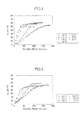
- Fig. 4 represents the relationship between poling conditions and d 33 in the polymer composite piezoelectric bodies as fabricated in this working example by using cyanoethylated PVA for a binder.
- Fig. 5 represents the relationship between poling conditions and d 33 in the polymer composite piezoelectric bodies as fabricated for comparison by using cyanoethylated pullulan for a binder. It is seen from Figs. 4 and 5 that the rise of d 33 with respect to the electric field was improved with the increase in temperature irrespective of whether cyanoethylated PVA or cyanoethylated pullulan was used for a binder.
- d 33 values at electric fields of 50 kV/cm and 100 kV/cm as shown in Fig. 4 are plotted.
- Fig. 7 the d 33 values at electric fields of 50 kV/cm and 100 kV/cm as shown in Fig. 5 are plotted.
- d 33 was improved at poling temperatures not lower than 40°C if cyanoethylated PVA was used.
- d 33 was high, that is to say, not lower than 55 pC/N in the temperature range of 100 to 120°C at an electric field of 50 kV/cm, and in the temperature range of 60 to 120°C at an electric field of 100 kV/cm.
- d 33 was improved at poling temperatures not lower than 100°C if cyanoethylated pullulan was used.
- the value of d 33 was not higher than 50 pC/N at any temperature in the case of an electric field of 50 kV/cm, and was only higher than 55 pC/N at a temperature of 120°C in the case of an electric field of 100 kV/cm.
- piezoelectric ceramics with a perovskite-type crystal structure typified by PZT
- PZT have no center of symmetry in the crystal structure and are polarized by the displacement of ions at temperatures lower than the Curie point. More considerable ion displacement will make a higher energy (field strength) required for poling, that is to say, make dielectric breakdown more liable to occur during poling. In addition, more considerable ion displacement will increase the deformation associated with poling, and cracks in ceramics, accordingly.
- a sample is heated to a temperature not higher than the Curie point so as to increase the symmetry of crystal and achieve thereby reduction in field strength required for poling and in deformation associated with poling.
- the poling temperature range in which d 33 got maximum varies between the case where cyanoethylated PVA was used for a binder and the case where cyanoethylated pullulan was used for a binder in spite of the fact that the piezoelectric ceramic particles as used were the same in both cases.
- each of the different binders cyanoethylated PVA and cyanoethylated pullulan
- an organic solvent composed of dimethylformamide (DMF) was dissolved in an organic solvent composed of dimethylformamide (DMF)
- the resultant solution was applied onto an aluminum substrate (300 ⁇ m in thickness) in an A4-sized coating area thereof (30 cm x 21 cm) so that the dried coating film might have a thickness of 30 ⁇ m, before DMF was evaporated by the drying by heating on a hot plate at 120°C.
- the relevant binder in the form of an A4-sized sheet with a thickness of 30 ⁇ m was thus formed on the aluminum substrate.
- each binder was divided into 20 mm-square pieces along with the aluminum substrate, and an upper electrode composed of aluminum and having a diameter of 15 mm and a thickness of 0.5 ⁇ m was formed on each binder piece by vacuum deposition.
- the different binders in sheet form which had been formed as described above were measured in dielectric constant by using an impedance analyzer (4294A manufactured by Agilent Corp.) in the temperature range of 20 to 120°C and at a frequency of 1 kHz.
- the binders were also measured in hardness by using a thermomechanical analyzer (TMA-60 manufactured by SHIMADZU CORPORATION) at a rate of temperature increase of 10°C/min. and with a load of 10g.
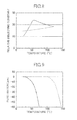
- Fig. 8 shows the temperature dependence of the relative dielectric constant in the different binders.
- the property of cyanoethylated PVA is represented by a solid curve while that of cyanoethylated pullulan is represented by a dotted curve.
- the dielectric constant of cyanoethylated PVA abruptly increased with the increase in temperature, got maximum at about 60°C, and then decreased again.
- the strength of electric field applied to a piezoelectric ceramic in a polymer binder increases as the binder has a higher dielectric constant, so that a temperature near 60°C is expected to be most suitable for poling if the dielectric constant is solely to be taken into account.
- d 33 began to increase at about 40°C and got maximum at about 100°C in the case of a field strength of 50 kV/cm.
- the dielectric constant of cyanoethylated pullulan increased concomitantly with the increase in temperature in an almost linear manner.
- d 33 did not change in the range of 20 to 100°C but began at last to increase at about 120°C in the case of a field strength of 50 kV/cm.
- Fig. 9 shows the temperature dependence of the penetration in the different binders.
- the property of cyanoethylated PVA is represented by a solid curve while that of cyanoethylated pullulan is represented by a dotted curve.
- the softening point of cyanoethylated PVA was about 30 to 40°C while that of cyanoethylated pullulan was about 100 to 120°C.
- the softening points of the binders as such are evidently consistent with the temperatures at which d 33 began to increase in the relationships between the poling temperature and d 33 ( Figs. 6 and 7 ) as described before.
- the poling of a piezoelectric ceramic physically means nothing but the orientation of polarization by the displacement of a 180° domain wall in each crystal grain. If the piezoelectric ceramic is being dispersed in a polymer matrix, as is the case with the polymer composite piezoelectric body of this working example, many of 180° domain walls are under constraint of a binder, so that it is necessary for the displacement of 180° domain walls to overcome the constraint of the binder. In addition, the displacement of 180° domain walls is known to involve the displacement of non-180° domain walls. Such displacement causes considerable deformation of ceramic particles and, accordingly, requires again that the resistance from the binder be overcome.
- the use of cyanoethylated PVA for a polymer matrix thus makes it possible to attain the method of manufacturing a polymer composite piezoelectric body that allows manufacture with high yields involving neither dielectric breakdown nor peeling off even for polymer composite piezoelectric bodies of large area, and the polymer composite piezoelectric body which is free from dielectric breakdown and peeling off even if large in area.
Landscapes
- Chemical & Material Sciences (AREA)
- Engineering & Computer Science (AREA)
- Chemical Kinetics & Catalysis (AREA)
- Medicinal Chemistry (AREA)
- Polymers & Plastics (AREA)
- Organic Chemistry (AREA)
- Health & Medical Sciences (AREA)
- Manufacturing & Machinery (AREA)
- Composite Materials (AREA)
- Materials Engineering (AREA)
- Physics & Mathematics (AREA)
- Spectroscopy & Molecular Physics (AREA)
- Compositions Of Macromolecular Compounds (AREA)
- Ultra Sonic Daignosis Equipment (AREA)
- Processes Of Treating Macromolecular Substances (AREA)
- Transducers For Ultrasonic Waves (AREA)
- Particle Formation And Scattering Control In Inkjet Printers (AREA)
Applications Claiming Priority (3)
| Application Number | Priority Date | Filing Date | Title |
|---|---|---|---|
| JP2010282068 | 2010-12-17 | ||
| JP2011153022A JP5588934B2 (ja) | 2010-12-17 | 2011-07-11 | 高分子複合圧電体およびその製造方法 |
| PCT/JP2011/077678 WO2012081403A1 (fr) | 2010-12-17 | 2011-11-30 | Corps piézoélectrique composite polymère et son procédé de fabrication |
Publications (3)
| Publication Number | Publication Date |
|---|---|
| EP2654094A1 true EP2654094A1 (fr) | 2013-10-23 |
| EP2654094A4 EP2654094A4 (fr) | 2017-05-03 |
| EP2654094B1 EP2654094B1 (fr) | 2020-07-29 |
Family
ID=46244512
Family Applications (1)
| Application Number | Title | Priority Date | Filing Date |
|---|---|---|---|
| EP11848696.8A Active EP2654094B1 (fr) | 2010-12-17 | 2011-11-30 | Corps piézoélectrique composite polymère et son procédé de fabrication |
Country Status (6)
| Country | Link |
|---|---|
| US (1) | US8771541B2 (fr) |
| EP (1) | EP2654094B1 (fr) |
| JP (1) | JP5588934B2 (fr) |
| KR (1) | KR101694579B1 (fr) |
| CN (1) | CN103262275B (fr) |
| WO (1) | WO2012081403A1 (fr) |
Cited By (5)
| Publication number | Priority date | Publication date | Assignee | Title |
|---|---|---|---|---|
| FR3060857A1 (fr) * | 2016-12-20 | 2018-06-22 | Compagnie Generale Des Etablissements Michelin | Composites piezoelectriques en matrice souple |
| WO2019243750A1 (fr) | 2018-06-21 | 2019-12-26 | Compagnie Generale Des Etablissements Michelin | Dispositif en matrice élastomère comprenant des charges piézoélectriques et des électrodes |
| EP3687769A4 (fr) * | 2017-11-17 | 2021-06-16 | Hewlett-Packard Development Company, L.P. | Impression tridimensionnelle |
| FR3105589A1 (fr) | 2019-12-23 | 2021-06-25 | Compagnie Generale Des Etablissements Michelin | Dispositif piezoelectrique ayant des proprietes piezoelectriques ameliorees |
| FR3105590A1 (fr) | 2019-12-23 | 2021-06-25 | Compagnie Generale Des Etablissements Michelin | Materiaux composites piezoelectriques ayant des proprietes piezoelectriques ameliorees |
Families Citing this family (48)
| Publication number | Priority date | Publication date | Assignee | Title |
|---|---|---|---|---|
| WO2013047872A1 (fr) * | 2011-09-30 | 2013-04-04 | 富士フイルム株式会社 | Convertisseur électroacoustique et dispositif d'affichage |
| JP6061374B2 (ja) * | 2012-08-02 | 2017-01-18 | アルプス電気株式会社 | 圧電素子の製造方法 |
| TWI484675B (zh) * | 2012-12-20 | 2015-05-11 | Nat Univ Tsing Hua | 具有複合式奈米結構的壓電薄膜及具有其的觸控感測裝置 |
| JP6221270B2 (ja) * | 2013-03-11 | 2017-11-01 | 株式会社リコー | 電気−機械変換素子の製造装置、電気−機械変換素子の製造方法 |
| JP6132190B2 (ja) * | 2013-03-15 | 2017-05-24 | 株式会社リコー | 液滴吐出ヘッド、液体吐出装置、画像形成装置、電気機械変換素子の分極処理方法、及び、液滴吐出ヘッドの製造方法 |
| JP6344634B2 (ja) * | 2013-03-15 | 2018-06-20 | 株式会社リコー | 液滴吐出ヘッド、液滴吐出装置、画像形成装置、電気機械変換素子の分極処理方法、及び、液滴吐出ヘッドの製造方法 |
| JP5993772B2 (ja) * | 2013-03-28 | 2016-09-14 | 富士フイルム株式会社 | 電気音響変換フィルム、フレキシブルディスプレイ、声帯マイクロフォンおよび楽器用センサー |
| WO2014157351A1 (fr) * | 2013-03-28 | 2014-10-02 | 富士フイルム株式会社 | Film de conversion électroacoustique, convertisseur électroacoustique, dispositif d'affichage souple, et écran de projecteur |
| JP6005089B2 (ja) * | 2013-03-29 | 2016-10-12 | 富士フイルム株式会社 | 電気音響変換フィルム |
| WO2014157684A1 (fr) | 2013-03-29 | 2014-10-02 | 富士フイルム株式会社 | Système de haut-parleur |
| JP6071932B2 (ja) * | 2013-04-01 | 2017-02-01 | 富士フイルム株式会社 | 電気音響変換フィルム |
| KR101442632B1 (ko) * | 2013-04-03 | 2014-09-22 | 한국세라믹기술원 | 압전 복합 필름 및 이를 포함하는 압전 장치 |
| KR101465346B1 (ko) * | 2013-06-27 | 2014-11-25 | 성균관대학교산학협력단 | 압전물질 및 중합체가 혼합된 복합체를 포함한 압전 에너지 발전 소자 |
| JP6099096B2 (ja) * | 2013-09-04 | 2017-03-22 | アルプス電気株式会社 | 複合圧電素子 |
| JP6255827B2 (ja) * | 2013-09-17 | 2018-01-10 | 株式会社リコー | 電気−機械変換素子、液滴吐出ヘッド及びインクジェット記録装置 |
| KR101994736B1 (ko) | 2014-07-16 | 2019-07-01 | 삼성전기주식회사 | 정전기 보호용 페이스트 및 이의 제조방법 |
| KR101577961B1 (ko) * | 2014-10-16 | 2015-12-16 | 한국세라믹기술원 | 압전 파이버 컴포지트 구조체 |
| JP6275018B2 (ja) * | 2014-11-25 | 2018-02-07 | 公益財団法人鉄道総合技術研究所 | 圧電材とその製造方法、接触検出装置、荷重検出装置及び異常状態検出装置 |
| TWI572262B (zh) * | 2014-12-16 | 2017-02-21 | 國立清華大學 | 壓電換能器之製造方法 |
| CN104638103A (zh) * | 2015-02-04 | 2015-05-20 | 兰州大学 | 一种可发电的透明薄膜及制备方法 |
| WO2016136591A1 (fr) * | 2015-02-27 | 2016-09-01 | 富士フイルム株式会社 | Transducteur électroacoustique et système de conversion électro-acoustique |
| JP6297204B2 (ja) * | 2015-03-12 | 2018-03-20 | 富士フイルム株式会社 | 高分子複合圧電体、電気音響変換フィルムおよび電気音響変換器 |
| KR101682912B1 (ko) * | 2015-04-10 | 2016-12-06 | 한국세라믹기술원 | 잉크젯 프린팅법을 이용한 플렉서블 압전 소자 제조 방법 |
| JP6993555B2 (ja) * | 2015-05-22 | 2022-01-13 | ダイキン工業株式会社 | 有機圧電フィルム |
| DE112016004292B4 (de) * | 2015-10-21 | 2019-03-07 | Fujifilm Corporation | Video-Audio-System |
| KR102339058B1 (ko) | 2016-03-11 | 2021-12-16 | 한국전자통신연구원 | 유연 압전 콤포지트 및 이를 포함하는 압전 장치 |
| US11529120B2 (en) | 2016-04-26 | 2022-12-20 | Koninklijke Philips N.V. | Ultrasound device contacting |
| KR102412750B1 (ko) | 2016-06-23 | 2022-06-24 | 니폰 가가쿠 고교 가부시키가이샤 | 압전체 재료용 필러, 복합 압전체 재료 및 복합 압전체 소자, 복합 압전체 재료용 필러 및 니오브산 알칼리 화합물의 제조 방법 |
| WO2018135457A1 (fr) * | 2017-01-17 | 2018-07-26 | 学校法人 関西大学 | Nouveau matériau ferroélectrique |
| CN106893236A (zh) * | 2017-03-01 | 2017-06-27 | 东北大学秦皇岛分校 | 一种铁酸铋有机-无机复合材料及其制备方法 |
| US10636959B2 (en) | 2017-03-31 | 2020-04-28 | General Electric Company | Insitu corona poling of piezoelectric ceramics |
| WO2019135911A1 (fr) * | 2018-01-08 | 2019-07-11 | Applied Materials, Inc. | Matériaux piézoélectriques et dispositifs ainsi que leurs procédés de préparation |
| WO2019180586A1 (fr) * | 2018-03-20 | 2019-09-26 | Sabic Global Technologies B.V. | Composites piézoélectriques souples et économiques présentant des valeurs d33 élevées |
| CN108504012B (zh) * | 2018-04-11 | 2020-06-30 | 中国科学院福建物质结构研究所 | 一种聚电解质复合介电层材料及其制备的有机薄膜晶体管 |
| FR3082781B1 (fr) * | 2018-06-21 | 2022-12-02 | Michelin & Cie | Pneumatique comprenant un composite piezoelectrique |
| JP7428659B2 (ja) * | 2018-11-28 | 2024-02-06 | 大阪有機化学工業株式会社 | 圧電材料および圧電材料用組成物 |
| CN110320519A (zh) * | 2019-06-09 | 2019-10-11 | 重庆工商大学融智学院 | 一种空间数据的表达与快速显示方法 |
| JP7155427B2 (ja) * | 2019-06-28 | 2022-10-18 | 富士フイルム株式会社 | 高分子複合圧電体、圧電フィルム、圧電スピーカー、フレキシブルディスプレイ |
| CN111048852A (zh) * | 2019-12-13 | 2020-04-21 | 深圳先进技术研究院 | 一种锂离子电池超声导波监测装置及方法 |
| CN111245081B (zh) * | 2020-01-21 | 2023-06-20 | 电子科技大学 | 自供能汽车尾气传感器与方法 |
| TWI751524B (zh) * | 2020-04-10 | 2022-01-01 | 馗鼎奈米科技股份有限公司 | 壓電薄膜之電極化方法 |
| CN111662469B (zh) * | 2020-04-23 | 2023-04-07 | 湖北大学 | 一种铁酸铋/聚偏二氟乙烯-三氟乙烯多层复合薄膜及其制备方法 |
| CN112708228B (zh) * | 2020-12-04 | 2022-09-27 | 南昌航空大学 | 一种高储能性能陶瓷/聚合物介电复合材料及其制备方法 |
| US12144260B2 (en) * | 2021-01-21 | 2024-11-12 | Wisconsin Alumni Research Foundation | Wafer-scale piezoelectric bio-organic thin films |
| FR3128606A1 (fr) * | 2021-10-22 | 2023-04-28 | Commissariat A L'energie Atomique Et Aux Energies Alternatives | Dispositif piezoelectrique a faible tension de polarisation |
| JPWO2024004695A1 (fr) * | 2022-06-30 | 2024-01-04 | ||
| WO2024210002A1 (fr) * | 2023-04-06 | 2024-10-10 | 積水化学工業株式会社 | Résine de polyalcool de vinyle, rouleau de film, et résine d'acétal polyvinylique |
| KR102829566B1 (ko) * | 2023-10-17 | 2025-07-08 | 서울과학기술대학교 산학협력단 | 압전 복합체 및 이를 포함하는 압전 센서 |
Family Cites Families (8)
| Publication number | Priority date | Publication date | Assignee | Title |
|---|---|---|---|---|
| JPH07119406B2 (ja) * | 1989-07-04 | 1995-12-20 | 日亜化学工業株式会社 | Elランプ |
| JPH05315072A (ja) * | 1992-05-11 | 1993-11-26 | Nichia Chem Ind Ltd | El素子 |
| JPH06267656A (ja) * | 1993-03-15 | 1994-09-22 | Fuji Electric Co Ltd | 電場発光素子 |
| JP3252010B2 (ja) * | 1993-04-05 | 2002-01-28 | 三菱化学株式会社 | 高分子複合圧電体の製造方法 |
| JP4572522B2 (ja) * | 2003-07-31 | 2010-11-04 | Dic株式会社 | エポキシ樹脂組成物、エポキシ樹脂硬化物、及びノボラック樹脂 |
| JP2007157413A (ja) | 2005-12-02 | 2007-06-21 | Forestry & Forest Products Research Institute | 良好な高誘電性、焦電性、圧電性を有する電子部品材料 |
| KR100903502B1 (ko) * | 2006-07-19 | 2009-06-17 | 주식회사 엘지화학 | 유/무기 복합체가 도입된 전극 및 상기 전극을 포함하는 전기화학소자 |
| JP7119406B2 (ja) * | 2018-02-13 | 2022-08-17 | 大日本印刷株式会社 | 伸縮性配線基板およびその製造方法 |
-
2011
- 2011-07-11 JP JP2011153022A patent/JP5588934B2/ja active Active
- 2011-11-30 CN CN201180060592.0A patent/CN103262275B/zh active Active
- 2011-11-30 EP EP11848696.8A patent/EP2654094B1/fr active Active
- 2011-11-30 WO PCT/JP2011/077678 patent/WO2012081403A1/fr not_active Ceased
- 2011-11-30 KR KR1020137015459A patent/KR101694579B1/ko active Active
-
2013
- 2013-06-03 US US13/908,660 patent/US8771541B2/en active Active
Cited By (13)
| Publication number | Priority date | Publication date | Assignee | Title |
|---|---|---|---|---|
| WO2018115742A1 (fr) | 2016-12-20 | 2018-06-28 | Compagnie Generale Des Etablissements Michelin | Composites piézoélectriques en matrice souple |
| CN110199399A (zh) * | 2016-12-20 | 2019-09-03 | 米其林集团总公司 | 包括柔性基体的压电复合材料 |
| FR3060857A1 (fr) * | 2016-12-20 | 2018-06-22 | Compagnie Generale Des Etablissements Michelin | Composites piezoelectriques en matrice souple |
| US11292189B2 (en) | 2017-11-17 | 2022-04-05 | Hewlett-Packard Development Company, L.P. | Three-dimensional printing |
| EP3687769A4 (fr) * | 2017-11-17 | 2021-06-16 | Hewlett-Packard Development Company, L.P. | Impression tridimensionnelle |
| WO2019243750A1 (fr) | 2018-06-21 | 2019-12-26 | Compagnie Generale Des Etablissements Michelin | Dispositif en matrice élastomère comprenant des charges piézoélectriques et des électrodes |
| FR3083005A1 (fr) | 2018-06-21 | 2019-12-27 | Compagnie Generale Des Etablissements Michelin | Dispositif en matrice elastomere comprenant des charges piezoelectriques et des electrodes |
| FR3105589A1 (fr) | 2019-12-23 | 2021-06-25 | Compagnie Generale Des Etablissements Michelin | Dispositif piezoelectrique ayant des proprietes piezoelectriques ameliorees |
| WO2021130434A1 (fr) | 2019-12-23 | 2021-07-01 | Compagnie Generale Des Etablissements Michelin | Materiaux composites piezoelectriques ayant des proprietes piezoelectriques ameliorees |
| WO2021130435A1 (fr) | 2019-12-23 | 2021-07-01 | Compagnie Generale Des Etablissements Michelin | Dispositif piezoelectrique ayant des proprietes piezoelectriques ameliorees |
| FR3105590A1 (fr) | 2019-12-23 | 2021-06-25 | Compagnie Generale Des Etablissements Michelin | Materiaux composites piezoelectriques ayant des proprietes piezoelectriques ameliorees |
| US12550617B2 (en) | 2019-12-23 | 2026-02-10 | Compagnie Generale Des Etablissements Michelin | Piezoelectric composite materials having improved piezoelectric properties |
| US12563970B2 (en) | 2019-12-23 | 2026-02-24 | Compagnie Generales des Etablissements Michelin | Piezoelectric device having improved piezoelectric properties |
Also Published As
| Publication number | Publication date |
|---|---|
| CN103262275A (zh) | 2013-08-21 |
| US8771541B2 (en) | 2014-07-08 |
| EP2654094A4 (fr) | 2017-05-03 |
| JP5588934B2 (ja) | 2014-09-10 |
| JP2012142546A (ja) | 2012-07-26 |
| EP2654094B1 (fr) | 2020-07-29 |
| US20130256581A1 (en) | 2013-10-03 |
| KR20140009253A (ko) | 2014-01-22 |
| WO2012081403A1 (fr) | 2012-06-21 |
| KR101694579B1 (ko) | 2017-01-09 |
| CN103262275B (zh) | 2015-12-02 |
Similar Documents
| Publication | Publication Date | Title |
|---|---|---|
| US8771541B2 (en) | Polymer composite piezoelectric body and manufacturing method for the same | |
| WO2013008781A1 (fr) | Élément piézoélectrique | |
| JP6018108B2 (ja) | 高分子複合圧電体 | |
| JP5859370B2 (ja) | エネルギ変換素子およびその製造方法 | |
| US5702629A (en) | Piezeoelectric ceramic-polymer composites | |
| TWI827851B (zh) | 高分子複合壓電體及壓電薄膜 | |
| KR20160066938A (ko) | 마찰대전 발전소자 | |
| JP2010103987A (ja) | 振動体 | |
| US20150322220A1 (en) | Ultrasonic transducer using ferroelectric polymer | |
| WO2008018278A1 (fr) | Sonde à ultrasons et procédé de fabrication d'une sonde à ultrasons | |
| KR102695804B1 (ko) | 유연성이 있는 적층형 압전 복합체를 제조하기 위한 방법 | |
| JPH07297461A (ja) | 圧電セラミックス−高分子複合材料及びその製造方法 | |
| JP5931127B2 (ja) | 圧電セラミックス、その製造方法、及び、それを有する圧電セラミックスピーカ | |
| EP2380220B1 (fr) | Matériaux électromécaniques et dispositifs comprenant ces matériaux | |
| Du et al. | The influence of processing parameters on piezoelectric and dielectric properties of dome-shaped composite PZT-epoxy actuators | |
| Almusallam et al. | Improving the dielectric and piezoelectric properties of screen-printed Low temperature PZT/polymer composite using cold isostatic pressing | |
| KR20160116603A (ko) | 아조벤젠 결합 pvdf필름을 이용하는 압전소자 및 그 제조방법 | |
| US12568766B2 (en) | Polymer-based piezoelectric composite material film | |
| JP7820812B2 (ja) | 発電用複合材料および発電用複合材料の製造方法 | |
| US20250221313A1 (en) | Apparatus, system and method for manufacturing piezoelectronics | |
| WO2023149075A1 (fr) | Film piézoélectrique | |
| JPH0462984A (ja) | 樹脂系圧電素子の製造方法 | |
| CN114730828A (zh) | 高分子复合压电体及复合体用原料粒子的制造方法 | |
| Arlt et al. | PZT/P (VDF-HFP) 0–3 composites: Preparation, electrical poling and piezoelectric properties |
Legal Events
| Date | Code | Title | Description |
|---|---|---|---|
| PUAI | Public reference made under article 153(3) epc to a published international application that has entered the european phase |
Free format text: ORIGINAL CODE: 0009012 |
|
| 17P | Request for examination filed |
Effective date: 20130606 |
|
| AK | Designated contracting states |
Kind code of ref document: A1 Designated state(s): AL AT BE BG CH CY CZ DE DK EE ES FI FR GB GR HR HU IE IS IT LI LT LU LV MC MK MT NL NO PL PT RO RS SE SI SK SM TR |
|
| DAX | Request for extension of the european patent (deleted) | ||
| RA4 | Supplementary search report drawn up and despatched (corrected) |
Effective date: 20170331 |
|
| RIC1 | Information provided on ipc code assigned before grant |
Ipc: H01L 41/08 20060101ALI20170327BHEP Ipc: H01L 41/45 20130101AFI20170327BHEP Ipc: C08L 29/04 20060101ALI20170327BHEP Ipc: H01L 41/37 20130101ALI20170327BHEP Ipc: H01L 41/18 20060101ALI20170327BHEP |
|
| STAA | Information on the status of an ep patent application or granted ep patent |
Free format text: STATUS: EXAMINATION IS IN PROGRESS |
|
| 17Q | First examination report despatched |
Effective date: 20170803 |
|
| REG | Reference to a national code |
Ref country code: DE Ref legal event code: R079 Ref document number: 602011068018 Country of ref document: DE Free format text: PREVIOUS MAIN CLASS: H01L0041260000 Ipc: H01L0041257000 |
|
| GRAP | Despatch of communication of intention to grant a patent |
Free format text: ORIGINAL CODE: EPIDOSNIGR1 |
|
| STAA | Information on the status of an ep patent application or granted ep patent |
Free format text: STATUS: GRANT OF PATENT IS INTENDED |
|
| RIC1 | Information provided on ipc code assigned before grant |
Ipc: H01L 41/18 20060101ALI20191009BHEP Ipc: H01L 41/37 20130101ALI20191009BHEP Ipc: C08L 29/04 20060101ALI20191009BHEP Ipc: H01L 41/257 20130101AFI20191009BHEP |
|
| INTG | Intention to grant announced |
Effective date: 20191031 |
|
| GRAJ | Information related to disapproval of communication of intention to grant by the applicant or resumption of examination proceedings by the epo deleted |
Free format text: ORIGINAL CODE: EPIDOSDIGR1 |
|
| STAA | Information on the status of an ep patent application or granted ep patent |
Free format text: STATUS: EXAMINATION IS IN PROGRESS |
|
| GRAP | Despatch of communication of intention to grant a patent |
Free format text: ORIGINAL CODE: EPIDOSNIGR1 |
|
| STAA | Information on the status of an ep patent application or granted ep patent |
Free format text: STATUS: GRANT OF PATENT IS INTENDED |
|
| INTC | Intention to grant announced (deleted) | ||
| GRAJ | Information related to disapproval of communication of intention to grant by the applicant or resumption of examination proceedings by the epo deleted |
Free format text: ORIGINAL CODE: EPIDOSDIGR1 |
|
| INTG | Intention to grant announced |
Effective date: 20200123 |
|
| GRAP | Despatch of communication of intention to grant a patent |
Free format text: ORIGINAL CODE: EPIDOSNIGR1 |
|
| INTG | Intention to grant announced |
Effective date: 20200221 |
|
| GRAS | Grant fee paid |
Free format text: ORIGINAL CODE: EPIDOSNIGR3 |
|
| GRAA | (expected) grant |
Free format text: ORIGINAL CODE: 0009210 |
|
| STAA | Information on the status of an ep patent application or granted ep patent |
Free format text: STATUS: THE PATENT HAS BEEN GRANTED |
|
| RAP1 | Party data changed (applicant data changed or rights of an application transferred) |
Owner name: FUJIFILM CORPORATION |
|
| AK | Designated contracting states |
Kind code of ref document: B1 Designated state(s): AL AT BE BG CH CY CZ DE DK EE ES FI FR GB GR HR HU IE IS IT LI LT LU LV MC MK MT NL NO PL PT RO RS SE SI SK SM TR |
|
| REG | Reference to a national code |
Ref country code: GB Ref legal event code: FG4D |
|
| REG | Reference to a national code |
Ref country code: CH Ref legal event code: EP |
|
| REG | Reference to a national code |
Ref country code: DE Ref legal event code: R096 Ref document number: 602011068018 Country of ref document: DE |
|
| REG | Reference to a national code |
Ref country code: AT Ref legal event code: REF Ref document number: 1296829 Country of ref document: AT Kind code of ref document: T Effective date: 20200815 |
|
| REG | Reference to a national code |
Ref country code: IE Ref legal event code: FG4D |
|
| REG | Reference to a national code |
Ref country code: LT Ref legal event code: MG4D |
|
| REG | Reference to a national code |
Ref country code: NL Ref legal event code: MP Effective date: 20200729 |
|
| REG | Reference to a national code |
Ref country code: AT Ref legal event code: MK05 Ref document number: 1296829 Country of ref document: AT Kind code of ref document: T Effective date: 20200729 |
|
| PG25 | Lapsed in a contracting state [announced via postgrant information from national office to epo] |
Ref country code: AT Free format text: LAPSE BECAUSE OF FAILURE TO SUBMIT A TRANSLATION OF THE DESCRIPTION OR TO PAY THE FEE WITHIN THE PRESCRIBED TIME-LIMIT Effective date: 20200729 Ref country code: HR Free format text: LAPSE BECAUSE OF FAILURE TO SUBMIT A TRANSLATION OF THE DESCRIPTION OR TO PAY THE FEE WITHIN THE PRESCRIBED TIME-LIMIT Effective date: 20200729 Ref country code: BG Free format text: LAPSE BECAUSE OF FAILURE TO SUBMIT A TRANSLATION OF THE DESCRIPTION OR TO PAY THE FEE WITHIN THE PRESCRIBED TIME-LIMIT Effective date: 20201029 Ref country code: SE Free format text: LAPSE BECAUSE OF FAILURE TO SUBMIT A TRANSLATION OF THE DESCRIPTION OR TO PAY THE FEE WITHIN THE PRESCRIBED TIME-LIMIT Effective date: 20200729 Ref country code: FI Free format text: LAPSE BECAUSE OF FAILURE TO SUBMIT A TRANSLATION OF THE DESCRIPTION OR TO PAY THE FEE WITHIN THE PRESCRIBED TIME-LIMIT Effective date: 20200729 Ref country code: NO Free format text: LAPSE BECAUSE OF FAILURE TO SUBMIT A TRANSLATION OF THE DESCRIPTION OR TO PAY THE FEE WITHIN THE PRESCRIBED TIME-LIMIT Effective date: 20201029 Ref country code: PT Free format text: LAPSE BECAUSE OF FAILURE TO SUBMIT A TRANSLATION OF THE DESCRIPTION OR TO PAY THE FEE WITHIN THE PRESCRIBED TIME-LIMIT Effective date: 20201130 Ref country code: ES Free format text: LAPSE BECAUSE OF FAILURE TO SUBMIT A TRANSLATION OF THE DESCRIPTION OR TO PAY THE FEE WITHIN THE PRESCRIBED TIME-LIMIT Effective date: 20200729 Ref country code: GR Free format text: LAPSE BECAUSE OF FAILURE TO SUBMIT A TRANSLATION OF THE DESCRIPTION OR TO PAY THE FEE WITHIN THE PRESCRIBED TIME-LIMIT Effective date: 20201030 Ref country code: LT Free format text: LAPSE BECAUSE OF FAILURE TO SUBMIT A TRANSLATION OF THE DESCRIPTION OR TO PAY THE FEE WITHIN THE PRESCRIBED TIME-LIMIT Effective date: 20200729 |
|
| PG25 | Lapsed in a contracting state [announced via postgrant information from national office to epo] |
Ref country code: LV Free format text: LAPSE BECAUSE OF FAILURE TO SUBMIT A TRANSLATION OF THE DESCRIPTION OR TO PAY THE FEE WITHIN THE PRESCRIBED TIME-LIMIT Effective date: 20200729 Ref country code: RS Free format text: LAPSE BECAUSE OF FAILURE TO SUBMIT A TRANSLATION OF THE DESCRIPTION OR TO PAY THE FEE WITHIN THE PRESCRIBED TIME-LIMIT Effective date: 20200729 Ref country code: PL Free format text: LAPSE BECAUSE OF FAILURE TO SUBMIT A TRANSLATION OF THE DESCRIPTION OR TO PAY THE FEE WITHIN THE PRESCRIBED TIME-LIMIT Effective date: 20200729 Ref country code: IS Free format text: LAPSE BECAUSE OF FAILURE TO SUBMIT A TRANSLATION OF THE DESCRIPTION OR TO PAY THE FEE WITHIN THE PRESCRIBED TIME-LIMIT Effective date: 20201129 |
|
| PG25 | Lapsed in a contracting state [announced via postgrant information from national office to epo] |
Ref country code: NL Free format text: LAPSE BECAUSE OF FAILURE TO SUBMIT A TRANSLATION OF THE DESCRIPTION OR TO PAY THE FEE WITHIN THE PRESCRIBED TIME-LIMIT Effective date: 20200729 |
|
| RAP4 | Party data changed (patent owner data changed or rights of a patent transferred) |
Owner name: FUJIFILM CORPORATION |
|
| PG25 | Lapsed in a contracting state [announced via postgrant information from national office to epo] |
Ref country code: IT Free format text: LAPSE BECAUSE OF FAILURE TO SUBMIT A TRANSLATION OF THE DESCRIPTION OR TO PAY THE FEE WITHIN THE PRESCRIBED TIME-LIMIT Effective date: 20200729 Ref country code: EE Free format text: LAPSE BECAUSE OF FAILURE TO SUBMIT A TRANSLATION OF THE DESCRIPTION OR TO PAY THE FEE WITHIN THE PRESCRIBED TIME-LIMIT Effective date: 20200729 Ref country code: DK Free format text: LAPSE BECAUSE OF FAILURE TO SUBMIT A TRANSLATION OF THE DESCRIPTION OR TO PAY THE FEE WITHIN THE PRESCRIBED TIME-LIMIT Effective date: 20200729 Ref country code: CZ Free format text: LAPSE BECAUSE OF FAILURE TO SUBMIT A TRANSLATION OF THE DESCRIPTION OR TO PAY THE FEE WITHIN THE PRESCRIBED TIME-LIMIT Effective date: 20200729 Ref country code: RO Free format text: LAPSE BECAUSE OF FAILURE TO SUBMIT A TRANSLATION OF THE DESCRIPTION OR TO PAY THE FEE WITHIN THE PRESCRIBED TIME-LIMIT Effective date: 20200729 Ref country code: SM Free format text: LAPSE BECAUSE OF FAILURE TO SUBMIT A TRANSLATION OF THE DESCRIPTION OR TO PAY THE FEE WITHIN THE PRESCRIBED TIME-LIMIT Effective date: 20200729 |
|
| REG | Reference to a national code |
Ref country code: DE Ref legal event code: R097 Ref document number: 602011068018 Country of ref document: DE |
|
| PG25 | Lapsed in a contracting state [announced via postgrant information from national office to epo] |
Ref country code: AL Free format text: LAPSE BECAUSE OF FAILURE TO SUBMIT A TRANSLATION OF THE DESCRIPTION OR TO PAY THE FEE WITHIN THE PRESCRIBED TIME-LIMIT Effective date: 20200729 |
|
| PLBE | No opposition filed within time limit |
Free format text: ORIGINAL CODE: 0009261 |
|
| STAA | Information on the status of an ep patent application or granted ep patent |
Free format text: STATUS: NO OPPOSITION FILED WITHIN TIME LIMIT |
|
| PG25 | Lapsed in a contracting state [announced via postgrant information from national office to epo] |
Ref country code: SK Free format text: LAPSE BECAUSE OF FAILURE TO SUBMIT A TRANSLATION OF THE DESCRIPTION OR TO PAY THE FEE WITHIN THE PRESCRIBED TIME-LIMIT Effective date: 20200729 Ref country code: MC Free format text: LAPSE BECAUSE OF FAILURE TO SUBMIT A TRANSLATION OF THE DESCRIPTION OR TO PAY THE FEE WITHIN THE PRESCRIBED TIME-LIMIT Effective date: 20200729 |
|
| REG | Reference to a national code |
Ref country code: CH Ref legal event code: PL |
|
| 26N | No opposition filed |
Effective date: 20210430 |
|
| PG25 | Lapsed in a contracting state [announced via postgrant information from national office to epo] |
Ref country code: LU Free format text: LAPSE BECAUSE OF NON-PAYMENT OF DUE FEES Effective date: 20201130 |
|
| REG | Reference to a national code |
Ref country code: BE Ref legal event code: MM Effective date: 20201130 |
|
| PG25 | Lapsed in a contracting state [announced via postgrant information from national office to epo] |
Ref country code: LI Free format text: LAPSE BECAUSE OF NON-PAYMENT OF DUE FEES Effective date: 20201130 Ref country code: SI Free format text: LAPSE BECAUSE OF FAILURE TO SUBMIT A TRANSLATION OF THE DESCRIPTION OR TO PAY THE FEE WITHIN THE PRESCRIBED TIME-LIMIT Effective date: 20200729 Ref country code: CH Free format text: LAPSE BECAUSE OF NON-PAYMENT OF DUE FEES Effective date: 20201130 |
|
| REG | Reference to a national code |
Ref country code: IE Ref legal event code: MM4A |
|
| PG25 | Lapsed in a contracting state [announced via postgrant information from national office to epo] |
Ref country code: IE Free format text: LAPSE BECAUSE OF NON-PAYMENT OF DUE FEES Effective date: 20201130 |
|
| PG25 | Lapsed in a contracting state [announced via postgrant information from national office to epo] |
Ref country code: TR Free format text: LAPSE BECAUSE OF FAILURE TO SUBMIT A TRANSLATION OF THE DESCRIPTION OR TO PAY THE FEE WITHIN THE PRESCRIBED TIME-LIMIT Effective date: 20200729 Ref country code: MT Free format text: LAPSE BECAUSE OF FAILURE TO SUBMIT A TRANSLATION OF THE DESCRIPTION OR TO PAY THE FEE WITHIN THE PRESCRIBED TIME-LIMIT Effective date: 20200729 Ref country code: CY Free format text: LAPSE BECAUSE OF FAILURE TO SUBMIT A TRANSLATION OF THE DESCRIPTION OR TO PAY THE FEE WITHIN THE PRESCRIBED TIME-LIMIT Effective date: 20200729 |
|
| PG25 | Lapsed in a contracting state [announced via postgrant information from national office to epo] |
Ref country code: MK Free format text: LAPSE BECAUSE OF FAILURE TO SUBMIT A TRANSLATION OF THE DESCRIPTION OR TO PAY THE FEE WITHIN THE PRESCRIBED TIME-LIMIT Effective date: 20200729 |
|
| PG25 | Lapsed in a contracting state [announced via postgrant information from national office to epo] |
Ref country code: BE Free format text: LAPSE BECAUSE OF NON-PAYMENT OF DUE FEES Effective date: 20201130 |
|
| REG | Reference to a national code |
Ref country code: DE Ref legal event code: R079 Ref document number: 602011068018 Country of ref document: DE Free format text: PREVIOUS MAIN CLASS: H01L0041257000 Ipc: H10N0030045000 |
|
| P01 | Opt-out of the competence of the unified patent court (upc) registered |
Effective date: 20230515 |
|
| PGFP | Annual fee paid to national office [announced via postgrant information from national office to epo] |
Ref country code: FR Payment date: 20250930 Year of fee payment: 15 |
|
| PGFP | Annual fee paid to national office [announced via postgrant information from national office to epo] |
Ref country code: DE Payment date: 20250930 Year of fee payment: 15 |
|
| PGFP | Annual fee paid to national office [announced via postgrant information from national office to epo] |
Ref country code: GB Payment date: 20251001 Year of fee payment: 15 |