EP2654231A1 - Verfahren und vorrichtung zur kodierung und verarbeitung von bestätigungsinformation - Google Patents
Verfahren und vorrichtung zur kodierung und verarbeitung von bestätigungsinformation Download PDFInfo
- Publication number
- EP2654231A1 EP2654231A1 EP12737177.1A EP12737177A EP2654231A1 EP 2654231 A1 EP2654231 A1 EP 2654231A1 EP 12737177 A EP12737177 A EP 12737177A EP 2654231 A1 EP2654231 A1 EP 2654231A1
- Authority
- EP
- European Patent Office
- Prior art keywords
- acknowledgement information
- dai
- information bits
- downlink
- sps
- Prior art date
- Legal status (The legal status is an assumption and is not a legal conclusion. Google has not performed a legal analysis and makes no representation as to the accuracy of the status listed.)
- Granted
Links
Images



Classifications
-
- H—ELECTRICITY
- H04—ELECTRIC COMMUNICATION TECHNIQUE
- H04L—TRANSMISSION OF DIGITAL INFORMATION, e.g. TELEGRAPHIC COMMUNICATION
- H04L5/00—Arrangements affording multiple use of the transmission path
- H04L5/003—Arrangements for allocating sub-channels of the transmission path
- H04L5/0053—Allocation of signalling, i.e. of overhead other than pilot signals
- H04L5/0055—Physical resource allocation for ACK/NACK
-
- H—ELECTRICITY
- H04—ELECTRIC COMMUNICATION TECHNIQUE
- H04L—TRANSMISSION OF DIGITAL INFORMATION, e.g. TELEGRAPHIC COMMUNICATION
- H04L1/00—Arrangements for detecting or preventing errors in the information received
- H04L1/004—Arrangements for detecting or preventing errors in the information received by using forward error control
- H04L1/0072—Error control for data other than payload data, e.g. control data
- H04L1/0073—Special arrangements for feedback channel
-
- H—ELECTRICITY
- H04—ELECTRIC COMMUNICATION TECHNIQUE
- H04W—WIRELESS COMMUNICATION NETWORKS
- H04W72/00—Local resource management
- H04W72/20—Control channels or signalling for resource management
- H04W72/23—Control channels or signalling for resource management in the downlink direction of a wireless link, i.e. towards a terminal
- H04W72/232—Control channels or signalling for resource management in the downlink direction of a wireless link, i.e. towards a terminal the control data signalling from the physical layer, e.g. DCI signalling
-
- H—ELECTRICITY
- H04—ELECTRIC COMMUNICATION TECHNIQUE
- H04L—TRANSMISSION OF DIGITAL INFORMATION, e.g. TELEGRAPHIC COMMUNICATION
- H04L1/00—Arrangements for detecting or preventing errors in the information received
- H04L1/12—Arrangements for detecting or preventing errors in the information received by using return channel
- H04L1/16—Arrangements for detecting or preventing errors in the information received by using return channel in which the return channel carries supervisory signals, e.g. repetition request signals
- H04L1/1607—Details of the supervisory signal
-
- H—ELECTRICITY
- H04—ELECTRIC COMMUNICATION TECHNIQUE
- H04L—TRANSMISSION OF DIGITAL INFORMATION, e.g. TELEGRAPHIC COMMUNICATION
- H04L1/00—Arrangements for detecting or preventing errors in the information received
- H04L1/12—Arrangements for detecting or preventing errors in the information received by using return channel
- H04L1/16—Arrangements for detecting or preventing errors in the information received by using return channel in which the return channel carries supervisory signals, e.g. repetition request signals
- H04L1/18—Automatic repetition systems, e.g. Van Duuren systems
- H04L1/1812—Hybrid protocols; Hybrid automatic repeat request [HARQ]
-
- H—ELECTRICITY
- H04—ELECTRIC COMMUNICATION TECHNIQUE
- H04W—WIRELESS COMMUNICATION NETWORKS
- H04W72/00—Local resource management
- H04W72/04—Wireless resource allocation
- H04W72/11—Semi-persistent scheduling
-
- H—ELECTRICITY
- H04—ELECTRIC COMMUNICATION TECHNIQUE
- H04W—WIRELESS COMMUNICATION NETWORKS
- H04W72/00—Local resource management
- H04W72/12—Wireless traffic scheduling
- H04W72/1263—Mapping of traffic onto schedule, e.g. scheduled allocation or multiplexing of flows
- H04W72/1273—Mapping of traffic onto schedule, e.g. scheduled allocation or multiplexing of flows of downlink data flows
-
- H—ELECTRICITY
- H04—ELECTRIC COMMUNICATION TECHNIQUE
- H04W—WIRELESS COMMUNICATION NETWORKS
- H04W72/00—Local resource management
- H04W72/20—Control channels or signalling for resource management
- H04W72/23—Control channels or signalling for resource management in the downlink direction of a wireless link, i.e. towards a terminal
-
- H—ELECTRICITY
- H04—ELECTRIC COMMUNICATION TECHNIQUE
- H04L—TRANSMISSION OF DIGITAL INFORMATION, e.g. TELEGRAPHIC COMMUNICATION
- H04L1/00—Arrangements for detecting or preventing errors in the information received
- H04L1/12—Arrangements for detecting or preventing errors in the information received by using return channel
- H04L2001/125—Arrangements for preventing errors in the return channel
Definitions
- the present invention relates to the field of mobile communication technologies, and in particular, to a method and an apparatus for encoding and processing acknowledgement information, including a method and an apparatus for encoding acknowledgement information, and a method and an apparatus for processing acknowledgement information.
- Hybrid Automatic Repeat Request Hybrid Automatic Repeat Request
- a data receiver needs to feed back acknowledgement information to a data transmitter to help the data transmitter confirm whether data is received correctly.
- acknowledgement Acknowledgement, ACK
- NACK Negative-acknowledgement
- the acknowledgement information may also be called ACK/NACK feedback information.
- E-UTRA evolved universal terrestrial radio access
- PUCCH Physical Uplink Control Channel
- LTE Long Term Evolution
- LTE-Advanced LTE-Advanced
- LTE-A LTE-Advanced
- a carrier aggregation technology is selected to be used for supporting wider bandwidth, so as to satisfy the requirement of the International Telecommunication Union for the peak data rate of a fourth generation communication technology.
- spectrums of two or more component carriers are aggregated to obtain wider transmission bandwidth.
- different quantities of uplink carriers and component carriers may be configured, and each component carrier has an independent HARQ process.
- acknowledgement information needs to be fed back with respect to the data transmitted on a physical downlink shared channel (Physical Downlink Shared Channel, PDSCH) of each component carrier to the user equipment or downlink control information (Downlink Control Information, DCI) indicating downlink semi-persistent scheduling (Semi-Persistent Scheduling, SPS) release.
- DCI Downlink Control Information
- SPS downlink semi-persistent Scheduling
- each component carrier has both uplink transmission and downlink transmission, to be specific, each component carrier serves as both an uplink component carrier and a downlink component carrier.
- the uplink transmission and downlink transmission are segmented and staggered only in units of subframes according to time, that is, some subframes are used for downlink transmission and are called downlink subframes (Downlink subframe), and some subframes are used for uplink transmission and are called uplink subframes (Uplink subframe).
- the number of uplink subframes may be asymmetric to the number of downlink subframes, that is, acknowledgement information corresponding to data transmission on multiple downlink subframes needs to be fed back on a same uplink subframe. That is, feeding back, by the component carrier used for uplink feedback of acknowledgement information, acknowledgement information of downlink subframes on the multiple component carriers, includes: feeding back acknowledgement information corresponding to the data transmission on multiple downlink subframes on each component carrier.
- the uplink/downlink subframe configuration in LTE/LTE-A TDD is shown in Table 1, where 'D' indicates a downlink subframe, 'U' indicates an uplink subframe, and 'S' indicates a special subframe, where the special subframe is also mainly used for downlink transmission.
- acknowledgement information feedback for a subframe position of a carrier on which no actual data is transmitted to a user, the user sets several acknowledgement information bits corresponding to the position to preset values during feedback. For example, for the subframe on which no actual data is transmitted to the user, the values of corresponding acknowledgement information bits are set to '0'.
- data is transmitted by the base station to the user, and the user equipment further needs to consume resources (such as power) to feed back the acknowledgement information that is known to the base station and is unnecessary to be fed back, resulting in waste of transmit power and performance loss of the user equipment.
- the present invention provides a method and an apparatus for encoding and processing acknowledgement information, which may reduce power waste and performance loss in comparison with the prior art.
- an embodiment of the present invention provides a method for encoding acknowledgement information, including the following steps:
- an embodiment of the present invention also provides a method for processing acknowledgement information, including the following steps:
- an embodiment of the present invention also provides an apparatus for encoding acknowledgement information, where the apparatus is located in a user equipment and includes:
- an embodiment of the present invention also provides an apparatus for processing acknowledgement information, where the apparatus is located in a base station and includes:
- the present invention also provides a method for encoding acknowledgement information, including the following steps:
- the present invention also provides a method for processing acknowledgement information, including the following steps:
- the present invention provides an apparatus for encoding acknowledgement information, including:
- the present invention also provides an apparatus for processing acknowledgement information, including:
- acknowledgement information bits are divided into two groups so that each group includes at least one acknowledgement information bit corresponding to a really scheduled subframe; then, the two groups of acknowledgement information bits are encoded and combined to obtain codeword bits finally carrying acknowledgement information; in this way, the acknowledgement information corresponding to those really scheduled subframes is evenly assigned to the codeword bits of the acknowledgement information as much as possible to avoid performance loss.
- the key of the technical solutions of the present invention is to properly order acknowledgement information bits which are to be transmitted and are corresponding to each downlink subframe on each component carrier, so that acknowledgement information bits corresponding to those subframes having actual data transmission are evenly assigned to two blocks of dual RM codes as much as possible to avoid performance loss.
- acknowledgement information bits which are to be transmitted and are corresponding to data transmission on each downlink subframe on each component carrier need to be arranged according to a definite sequence, so that after receiving the acknowledgement information bits, a base station can learn the correspondence between acknowledgement information bits and data transmissions of downlink subframes on component carriers, so as to learn whether a data transmission of a downlink subframe on a component carrier is received correctly or not.
- An embodiment of the present invention provides a method for encoding acknowledgement information, including the following steps:
- the method before generating acknowledgement information bits of the downlink component carrier, the method further includes:
- Determining the number D of downlink subframes for which the acknowledgement information bits need to be generated includes:
- Generating acknowledgement information bits corresponding to the component carrier according to the received component carrier includes: determining, according to the maximum number of codewords that the component carrier is configured to support in transmission and whether a bundling mode is used between codewords, the bit number a of acknowledgement information bits corresponding to each downlink subframe.
- Step 12 may specifically include:
- Ordering the acknowledgement information bits according to the DAI_max and N_sps includes:
- Alternately assigning the ordered acknowledgement information bits to the two groups includes:
- the first assignment mode and the second assignment mode are alternately used for ordered acknowledgement information corresponding to each component carrier according to a set sequence of arranging the component carrier.
- Determining the number D of downlink subframes for which the acknowledgement information bits need to be generated further includes: if the determined actual number of downlink subframes is an odd number, adding 1 to the actual number of downlink subframes to obtain a sum used as the number D of downlink subframes.
- the D is an odd number
- the number of component carriers b in which each downlink subframe corresponds to 2 acknowledgement information bits is an odd number
- alternately assigning the ordered acknowledgement information bits to the two groups includes: assigning last two acknowledgement information bits of the ordered acknowledgement information bits corresponding to each of the component carriers b to the two groups, respectively; or assigning last two acknowledgement information bits of acknowledgement information bits of a last component carrier b in the component carriers to the two groups, respectively, where the component carriers are arranged according to a set sequence.
- Step 12 may specifically include:
- the above method may be implemented by a receiver of a component carrier, for example, a terminal.
- a method for processing acknowledgement information is provided by an embodiment of the present invention, including the following steps:
- N_sps is the number of physical downlink shared channels PDSCHs scheduled by semi-persistent scheduling SPS in the downlink subframes
- the DCI is used for controlling PDSCH transmission and/or indicating downlink SPS release
- the downlink assignment index DAI field is located in the DCI
- a is the bit number of acknowledgement information bits corresponding to each downlink subframe.
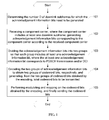
- a first embodiment of the present invention provides a processing flowchart for feeding back acknowledgement information, as shown in FIG. 1 , including the following steps:
- the number D of downlink subframes corresponding to the acknowledgement information that needs to be fed back by an uplink subframe may be determined according to the number of downlink subframes corresponding to the acknowledgement information that needs to be fed back by each uplink subframe in Table 4.
- acknowledgement information corresponding to multiple downlink subframes needs to be fed back by a same uplink subframe.
- the multiple downlink subframes make up a set of associated downlink subframes, and each downlink subframe in the set of associated downlink subframes is called a downlink subframe associated with the uplink subframe.
- the number of subframes in the set of associated downlink subframes is M
- the value of M may be 1, 2, 3, 4, or 9 according to the uplink/downlink subframe ratio.
- the value of M corresponding to the uplink/downlink subframe configuration in LTE/LTE-A in Table 1 is shown in HAQR Time Sequence Relationship Table 4.
- subframes with numbers shown in cells are definitely uplink subframes (referring to FIG. 1 ), and it may be considered that uplink subframes without numbers do not need to feed back acknowledgement information of any downlink subframe.
- the quantity of the numbers is the number of downlink subframes whose acknowledgement information needs to be fed back by the uplink subframe, that is, the value of M.
- a value of each number indicates that the downlink subframe that needs to be fed back by the uplink subframe is the downlink subframe preceding the uplink subframe at an interval of the value.
- the value 6 of subframe 2 in configuration 0 indicates subframe 6 in a previous 10 ms period (the duration of one subframe is 1 ms, and the previous 10 ms period represents a previous group of 10 subframes), and it is learned from Table 1 that subframe 6 is a special subframe for downlink transmission; conversely in other words, the acknowledgement information corresponding to downlink data transmission of the current subframe 6 needs to be fed back by uplink subframe 2 in a next 10 ms period after 6 subframes.
- acknowledgement information bits are fed back on a physical uplink control channel (Physical Uplink Control Channel, PUCCH)
- PUCCH Physical Uplink Control Channel
- each component carrier in a TDD system is the same.
- the maximum number of codewords (codeword) that each carrier is configured to transmit in physical downlink shared channel PDSCH transmission may be different.
- a carrier can transmit up to 1 codeword, and a carrier can transmit up to 2 codewords.
- 1 acknowledgement information bit is fed back.
- the value '1' indicates correct reception of physical downlink shared channel PDSCH transmission on a downlink subframe or correct reception of downlink control information DCI indicating downlink semi-persistent scheduling SPS release; and the value '0' indicates incorrect reception of physical downlink shared channel PDSCH transmission on the downlink subframe or failure to receive physical downlink shared channel PDSCH transmission on the downlink subframe and/or downlink control information DCI indicating downlink semi-persistent scheduling SPS release.
- the maximum number of codewords that can be transmitted by physical downlink shared channel PDSCH transmission on a carrier is 2 and no spatial bundling (spatial bundling) mode is configured between the two codewords, 1 bit needs to be fed back with respect to each codeword of each downlink subframe on the carrier and a total of 2 acknowledgement information bits d(0) and d(1) are needed.
- the value '1' indicates correct reception of one codeword in physical downlink shared channel PDSCH transmission on a downlink subframe; and the value '0' indicates incorrect reception of one codeword in physical downlink shared channel PDSCH transmission on the downlink subframe, or failure to receive data transmission of one codeword, or vice versa.
- the value '1' indicates correct reception of the other codeword in physical downlink shared channel PDSCH transmission on the downlink subframe; and the value '0' indicates incorrect reception of the other codeword in physical downlink shared channel PDSCH transmission on the downlink subframe, or failure to receive data transmission of the other codeword, or vice versa.
- d(0) corresponds to the acknowledgement information of a first codeword
- d(1) corresponds to the acknowledgement information of a second codeword.
- a carrier is configured to support up to 2 codewords in physical downlink shared channel PDSCH transmission
- only one codeword may be transmitted on a subframe
- the subframe is used for physical downlink shared channel PDSCH transmission scheduled by downlink semi-persistent scheduling SPS, or a codeword incorrectly received previously is transmitted on the subframe, or the subframe has no PDSCH transmission, but the subframe has only the DCI corresponding to downlink semi-persistent scheduling SPS (although this case is not completely the same as the codeword concept in the PDSCH, only 1 bit needs to be fed back, which is considered to be equivalent to transmission of one codeword).
- d(0) or d(1) is used to feed back acknowledgement information thereof.
- the other bit d(1) or d(0) is correspondingly set to '0'. Hence, if PDSCH transmission or DCI indicating downlink semi-persistent scheduling SPS release is not received, the values of the two bits d(0) and d(1) are both '0'.
- the maximum number of codewords that can be transmitted by physical downlink shared channel PDSCH transmission on a carrier is 2 but a spatial bundling mode is configured between the two codewords, only 1 bundled acknowledgement information bit d(0) needs to be fed back with respect to each downlink subframe on the carrier. For example, if the 1 bit is set to '1', it indicates correct reception of all codewords actually transmitted on a downlink subframe. Specifically, if one codeword is transmitted actually (including one codeword in the PDSCH or only the DCI indicating downlink semi-persistent scheduling SPS release), the codeword is received correctly; and if two codewords are transmitted actually, the two codewords are received correctly. If the 1 bit is set to '0', it indicates that at least one of the codewords actually transmitted on the downlink subframe is received incorrectly or that neither of the two codewords is received.
- acknowledgement information is actually feedback about reception of PDSCH transmission or DCI indicating downlink SPS release on the downlink subframe.
- acknowledgement information needs to be fed back with respect to the downlink subframe. Therefore, for ease of description, generally acknowledgement information is described as acknowledgement information corresponding to the downlink subframe.
- Step 102 Receive a component carrier, where the component carrier includes at least one downlink subframe; generate acknowledgement information bits corresponding to the component carrier according to the received component carrier.
- acknowledgement information bits to be fed back with respect to each component carrier may be arranged according to the maximum value of a downlink assignment index (Downlink Assignment Index, DAI) field in downlink control information DCI that is received on each component carrier by a user and is used for controlling physical downlink shared channel PDSCH transmission.
- DAI Downlink Assignment Index
- the base station transmits downlink control information DCI on a physical downlink control channel (Physical Downlink Control Channel, PDCCH) to the UE.
- DCI Downlink Control Information
- PDCCH Physical Downlink Control Channel
- DCI For PDSCH transmission scheduled in a non-SPS mode (that is, dynamic scheduling), the corresponding DCI and the PDSCH must be available on the same downlink subframe, and if no DCI is received, the corresponding PDSCH cannot be received.
- DCI For PUSCH transmission scheduled in a non-SPS mode, DCI may be available or unavailable.
- a 2-bit DAI command field is introduced and used to indicate the accumulative number of pieces of DCI assigned (or sent) to the user equipment until the current associated downlink subframe in a set of associated downlink subframes and corresponding to downlink PDSCH transmission or downlink SPS release on the associated subframes, where the DCI is used for indicating PDSCH transmission or downlink SPS release. It is hereinafter assumed that the DAI is counted from 1. Counting from other values is similar thereto. It should be noted that the values of 2 bits are '0, 0', '0, 1', '1, 0', and '1, 1'.
- the values indicated in binary notation are 0, 1, 2, and 3, respectively. However, in a normal sense, the values indicate 1, 2, 3, and 4. Therefore, when the value of the DAI field is '0, 0', it indicates that up to now, one piece of DCI has been sent to the user, and the rest may be inferred by analogy.
- the remaining (D ⁇ a-DAI_max ⁇ a) bits are all set to '0'.
- two component carriers are configured for a user, and 4 downlink subframes of each carrier need to be fed back by one uplink subframe, for example, uplink subframe 2 in uplink/downlink subframe configuration 2 in Table 4.
- the scheduling on the base station side at the current time is shown in Table 5.
- the user receives component carriers, and the maximum DAI received on carrier 1 is 3, and the maximum DAI received on carrier 2 is 2. Then, after being ordered according to the first arrangement mode in case 1, the acknowledgement information bits of carrier 1 and carrier 2 are shown in Table 6.
- Table 6 Carrier ⁇ Bit Position 2 Bits (1, 2) 2 Bits (3, 4) 2 Bits (5, 6) 2 Bits (7, 8) Carrier 1 (2 codewords)
- DAI 1 subframe acknowledgement information
- DAI 2 subframe acknowledgement information
- DAI 3 subframe acknowledgement information 0, 0
- DAI 1 subframe acknowledgement information
- 0 0
- the user receives component carriers, and the maximum DAI received on carrier 1 is 3, and the maximum DAI received on carrier 2 is 2. Then, after being ordered according to the first arrangement mode in case 2, the acknowledgement information bits of carrier 1 and carrier 2 are shown in Table 8.
- Step 103 Divide the acknowledgement information bits into two groups so that each group includes at least one acknowledgement information bit, where the at least one acknowledgement information bit corresponds to physical downlink shared channel PDSCH transmission and/or downlink control information DCI, where the DCI is used for indicating downlink semi-persistent scheduling SPS release.
- either of the two methods for assigning to the dual RM code may ensure that each code block of the dual RM code has acknowledgement information bits of actual data transmission; even if each carrier has only one downlink subframe that has actual data transmission, the method for assigning to the dual RM code as shown in Table 10 may also ensure that each code block has acknowledgement information bits of actual data transmission.
- the base station sends one piece of DCI, the user may not correctly receive the DCI.
- the user does not receive any data (the user does not receive PDSCH transmission and/or DCI indicating downlink SPS release)
- the user actually feeds back '0' or '0, 0' according to the number of acknowledgement information bits to be fed back.
- the acknowledgement information '0' or '0, 0' is different from the acknowledgement information '0' or '0, 0' of a subframe on which the base station actually sends no data.
- the base station does not learn that the former is definitely '0' or '0, 0', but the base station learns that the latter is definitely is '0' or '0, 0'.
- assignment may be based on granularity of a bit, that is, the object assigned at each time is 1 bit. It is assumed that one block in the dual RM code dual RM code is code block a, [a(0), a(1), a(2)...], and that the other block is code block b, [b(0), b(1), b(2)...].
- the ordered acknowledgement information bits in case 1 in the above example are alternately assigned to two code blocks, as shown in Table X1 or Table X2.
- Step 104 Encode the two divided groups of acknowledgement information bits to obtain two groups of codeword bits, respectively, and generate, from the two groups of codeword bits obtained by the encoding, total codeword bits to be transmitted.
- the uplink acknowledgement information is transmitted on a PUCCH by using a transmission format 3 (format 3).
- format 3 48 codeword bits need to be transmitted, that is, 48 codeword bits need to be generated by using a particular coding mode from the acknowledgement information bits to be transmitted, and then, the acknowledgement information bits can be transmitted in format 3.
- the specific coding mode in the TDD system is as follows: (1) When the number of acknowledgement information bits to be transmitted is not greater than 11 bits, the (32, O) RM (Reed-Muller) coding in LTE release 8 is used to generate 32 bits first, and then, this process is repeated until 48 codeword bits are obtained.
- the acknowledgement information bits to be transmitted are evenly divided into two groups first. Specifically, if the number of acknowledgement information bits to be transmitted is an even number, the number of bits in the two groups is the same; if the number of acknowledgement information bits to be transmitted is an odd number, one group has one bit more than the other group. Then, (32, O) RM coding in LTE release 8 is used to encode each group to generate 32 bits first, and then, the last 8 bits of the 32 bits are removed to obtain 24 codeword bits. In this way, a total of 48 codeword bits are obtained in the two groups.
- This coding method is hereinafter called dual RM coding (dual RM code/coding).
- (32, O) RM coding is shown in Table 13.
- Step 105 Perform scrambling, modulating, and mapping on the codeword bits obtained by encoding, and finally send the codeword bits.
- PUCCH format 3 is used for sending, and operations such as scrambling (scrambling), modulating (modulate), and mapping (mapping) may be performed according to the corresponding requirements of format 3. Details are omitted herein.
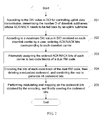
- a second embodiment of the present invention provides a processing flowchart for feeding back acknowledgement information, as shown in FIG. 2 , including the following steps:
- the corresponding DCI may be available or unavailable as described above. If a user does not receive DCI for controlling PUSCH transmission, the number D of downlink subframes whose acknowledgement information needs to be fed back by an uplink subframe is still determined by the HARQ time sequence relationship in the first embodiment. If the user receives DCI for controlling PUSCH transmission, the DCI also has a DAI field. In an LTE/LTE-A single-carrier system (only one component carrier is available), the DAI field is used to indicate the total number of pieces of DCI, sent in associated downlink subframes, for controlling PDSCH and/or indicating downlink SPS release.
- the difference between the DAI field in DCI for controlling PUSCH transmission and the DAI field in DCI for controlling PDSCH and/or indicating downlink SPS release lies in that the DAI field in DCI for controlling PDSCH and/or indicating downlink SPS release is used as a counter, while the DAI field in DCI for controlling PUSCH transmission indicates the total number.
- the DAI field in DCI for controlling PUSCH transmission is used to indicate a maximum value of the total number of pieces of DCI that is sent in associated downlink subframes on each carrier and is for PDSCH transmission and/or indicating downlink SPS release.
- the DAI field (if any) in DCI for controlling PUSCH transmission on each carrier is used to indicate a maximum value of the total number of pieces of DCI that is sent in associated downlink subframes on the carrier and is for controlling PDSCH transmission and/or indicating downlink SPS release, that is, the values are the same.
- 3 pieces of DCI in total are transmitted on carrier 1 and there is one PDSCH transmission scheduled by SPS (that is, without DCI control), while 2 pieces of DCI are transmitted on carrier 2, the value of the DAI field in the DCI for controlling PUSCH transmission is a maximum value 4 thereof.
- the number of downlink subframes whose acknowledgement information needs to be fed back by an uplink subframe may be determined according to the value of the DAI field in DCI for controlling PUSCH transmission.
- the number of subframes fed back may also be determined according to the number of associated subframes determined by the HARQ time sequence.
- Step 202 According to the maximum value of a downlink assignment index (Downlink Assignment Index, DAI) field in downlink control information DCI that is received on each component carrier by the user and used for controlling physical downlink shared channel PDSCH transmission, order acknowledgement information bits to be fed back with respect to each component carrier.
- DAI Downlink Assignment Index
- the base station transmits downlink control information DCI on a physical downlink control channel (Physical Downlink Control Channel, PDCCH) to a UE.
- DCI Downlink Control Information
- PDCCH Physical Downlink Control Channel
- DCI For PDSCH transmission scheduled in a non-SPS mode (that is, dynamic scheduling), the corresponding DCI and the PDSCH must be available on the same downlink subframe, and if no DCI is received, the corresponding PDSCH cannot be received.
- DCI For PUSCH transmission scheduled in a non-SPS mode, DCI may be available or unavailable.
- a 2-bit DAI command field is introduced and is used to indicate the accumulative number of pieces of DCI assigned (or sent) to the user equipment until the current associated downlink subframe in a set of associated downlink subframes and corresponding to downlink PDSCH transmission or downlink SPS release on the associated subframes, where the DCI is used for indicating PDSCH transmission or downlink SPS release. It is hereinafter assumed that the DAI is counted from 1. Counting from other values is similar thereto. It should be noted that the values of 2 bits are '0, 0', '0, 1', '1, 0', and '1, 1'.
- the values indicated in binary notation are 0, 1, 2, and 3, respectively. However, in a normal sense, the values indicate 1, 2, 3, and 4. Therefore, when the value of the DAI field is '0, 0', it indicates that up to now, one piece of DCI has been sent to the user, and the rest may be inferred by analogy.
- the remaining (D ⁇ a-DAI_max ⁇ a) bits are all set to '0'.
- two component carriers are configured for a user, and 4 downlink subframes of each carrier need to be fed back by one uplink subframe, for example, uplink subframe 2 in uplink/downlink subframe configuration 2 in Table 4.
- the scheduling on the base station side at the current time is shown in Table 14, and the base station has sent at least one piece of DCI for controlling PUSCH transmission.
- the value of the DAI is a maximum value 3 of 3 and 2.
- the user receives component carriers, and the maximum DAI received on carrier 1 is 3, and the maximum DAI received on carrier 2 is 2. At least one piece of DCI for controlling PUSCH transmission and a DAI field in the DCI are received.
- the remaining (D ⁇ a-(DAI_max+1) ⁇ a) bits are all set to '0'.
- two component carriers are configured for a user, and 4 downlink subframes of each carrier need to be fed back by one uplink subframe, for example, uplink subframe 2 in uplink/downlink subframe configuration 2 in Table 4.
- the scheduling on the base station side at the current time is shown in Table 16, and the base station has sent at least one piece of DCI for controlling PUSCH transmission.
- the value of the DAI is a maximum value 4 of 4 and 2.
- the user receives component carriers, and the maximum DAI received on carrier 1 is 3, and the maximum DAI received on carrier 2 is 2. At least one piece of DCI for controlling PUSCH transmission and a DAI field in the DCI are received.
- Step 203 Alternately assign the ordered acknowledgement information bits of each component carrier to two code blocks of a dual RM code dual RM code.
- either of the two methods for assigning to the dual RM code may ensure that each code block of the dual RM code has acknowledgement information bits of actual data transmission; even if each carrier has only one downlink subframe that has actual data transmission, the method for assigning to the dual RM code as shown in Table 19 may also ensure that each code block has acknowledgement information bits of actual data transmission.
- the bits of the two code blocks ordered according to Table 19 are more close.
- the base station sends one piece of DCI, the user may not correctly receive the DCI.
- the user does not receive any data (the user does not receive PDSCH transmission and/or DCI indicating downlink SPS release)
- the user actually feeds back '0' or '0, 0' according to the number of acknowledgement information bits to be fed back.
- the acknowledgement information '0' or '0, 0' is different from the acknowledgement information '0' or '0, 0' of a subframe on which the base station actually sends no data.
- the base station does not learn that the former is definitely '0' or '0, 0', but the base station learns that the latter is definitely is '0' or '0, 0'.
- Step 204 Perform encoding and rate matching on bits of each code block of the dual RM code.
- acknowledgement information is fed back on a PUSCH
- operations such as encoding and rate matching are performed according to the corresponding requirements of transmission on the PUSCH, and details are omitted herein.
- Step 205 Perform scrambling, modulating, and mapping on the codeword bits obtained by encoding, and finally send the codeword bits.
- PUCCH format 3 is used for sending, and operations such as scrambling (scrambling), modulating (modulate), and mapping (mapping) may be performed according to the corresponding requirements of format 3. Details are omitted herein.
- the difference between the second embodiment and the first embodiment lies in that different modes are used for determining the number of downlink subframes.
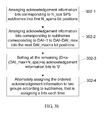
- a third embodiment of the present invention provides a processing flowchart for feeding back acknowledgement information, as shown in FIG. 3a , including the following steps:
- the number D of downlink subframes corresponding to acknowledgement information to be fed back by the uplink subframe may be determined by using the method of the first embodiment according to the number of associated downlink subframes determined by various HARQ time sequence relationships in Uplink/Downlink Configuration Table 4, or determined by using the method of the second embodiment according to the value of the DAI field in DCI for controlling PUSCH transmission, or the number D of downlink subframes may be determined in other manners, for example, the information is configured directly. No limitation is set forth by the present invention.
- Generating acknowledgement information bits includes: determining the acknowledgement information bits according to the reception of the component carrier and whether a bundling mode is used between codewords. Specifically,
- 1 acknowledgement information bit is fed back.
- the value '1' indicates correct reception of physical downlink shared channel PDSCH transmission on a downlink subframe or correct reception of downlink control information DCI indicating downlink semi-persistent scheduling SPS release; and the value '0' indicates incorrect reception of physical downlink shared channel PDSCH transmission on the downlink subframe or failure to receive physical downlink shared channel PDSCH transmission on the downlink subframe and/or downlink control information DCI indicating downlink semi-persistent scheduling SPS release.
- the maximum number of codewords that can be transmitted by physical downlink shared channel PDSCH transmission on a carrier is 2 and no spatial bundling (spatial bundling) mode is configured between the two codewords, 1 bit needs to be fed back with respect to each codeword of each downlink subframe on the carrier and a total of 2 acknowledgement information bits d(0) and d(1) are needed.
- the value '1' indicates correct reception of one codeword in physical downlink shared channel PDSCH transmission on a downlink subframe; and the value '0' indicates incorrect reception of one codeword in physical downlink shared channel PDSCH transmission on the downlink subframe, or failure to receive data transmission of one codeword, or vice versa.
- the value '1' indicates correct reception of the other codeword in physical downlink shared channel PDSCH transmission on the downlink subframe; and the value '0' indicates incorrect reception of the other codeword in physical downlink shared channel PDSCH transmission on the downlink subframe, or failure to receive data transmission of the other codeword, or vice versa.
- d(0) corresponds to the acknowledgement information of a first codeword
- d(1) corresponds to the acknowledgement information of a second codeword.
- a carrier is configured to support up to 2 codewords in physical downlink shared channel PDSCH transmission
- only one codeword may be transmitted on a subframe
- the subframe is used for physical downlink shared channel PDSCH transmission scheduled by downlink semi-persistent scheduling SPS, or a codeword incorrectly received previously is transmitted on the subframe, or the subframe has no PDSCH transmission, but the subframe has only the DCI corresponding to downlink semi-persistent scheduling SPS (although this case is not completely the same as the codeword concept in the PDSCH, only 1 bit needs to be fed back, which is considered to be equivalent to transmission of one codeword).
- d(0) or d(1) is used to feed back acknowledgement information thereof.
- the other bit d(1) or d(0) is correspondingly set to '0'. Hence, if PDSCH transmission or DCI indicating downlink semi-persistent scheduling SPS release is not received, the values of the two bits d(0) and d(1) are both set to '0'.
- the maximum number of codewords that can be transmitted by physical downlink shared channel PDSCH transmission on a carrier is 2 but a spatial bundling mode is configured between the two codewords, only 1 bundled acknowledgement information bit d(0) needs to be fed back with respect to each downlink subframe on the carrier. For example, if the 1 bit is set to '1', it indicates correct reception of all codewords actually transmitted on a downlink subframe. Specifically, if one codeword is transmitted actually (including one codeword in the PDSCH or only the DCI indicating downlink semi-persistent scheduling SPS release), the codeword is received correctly; and if two codewords are transmitted actually, the two codewords are received correctly. If the 1 bit is set to '0', it indicates that at least one of the codewords actually transmitted on the downlink subframe is received incorrectly or that neither of the two codewords is received.
- Step 302 Divide the acknowledgement information bits into two groups so that each group includes at least one acknowledgement information bit corresponding to a really scheduled subframe.
- This step may be implemented in many equivalent modes, and variations or equivalent replacements based on the embodiments of the present invention still fall within the protection scope of the present invention.
- a sequence of acknowledgement information bits of D downlink subframes on a carrier is generated according to the maximum DAI value (DAI_max) in DCI for controlling PDSCH transmission in associated subframes received by a user and the number N_sps of PDSCHs scheduled by SPS in the associated downlink subframes (generally, N_sps is equal to 0 or 1), where there are a total of D ⁇ a acknowledgement information bits.
- DAI_max the maximum DAI value
- N_sps is equal to 0 or 1
- N_sps is equal to 0 or 1.
- the sequence of SPS subframes may be subject to a preset sequence, for example, the preset sequence is a time sequence of SPS subframes. Because the number of SPS subframes and the positions of SPS subframes are configured in advance, and are not dynamic, and are known to both a base station and a user, data scheduled by SPS is not missed.
- Those subframes with DAI should be arranged according to a definite sequence. For example, those frames are arranged according to the values of DAIs. There is a case to be described: the scheduling shown in Table 22.
- DAI 1
- DAI 2 (missed during reception)
- DAI 3
- Step 302-3 Set all the remaining (D ⁇ a-(DAI_max+N_sps) ⁇ a) acknowledgement information bits to '0'. This is because all the remaining acknowledgement information bits correspond to subframes that are not actually scheduled by the base station, or those frames are scheduled by the base station but are not received by the user (missed).
- Step 302-4 Alternately assign the ordered acknowledgement information to two groups according to subframes, that is, assign bits with the granularity of a each time.
- one of the two groups to which the ordered acknowledgement information is assigned is code block a, [a(0), a(1), a(2)...], and that the other group is code block b, [b(0), b(1), b(2)...].
- the first a bits may be assigned to code block a firstly, and for some carriers, the first a bits may be assigned to code block b firstly.
- each carrier has a number (referred to as a cell index in LTE-A).
- Acknowledgement information may be assigned to the two groups in ascending order or in descending order of the numbers.
- Carriers supporting transmission of up to two codewords may be assigned firstly, and after all carriers supporting transmission of up to two codewords are assigned, carriers supporting transmission of up to one codeword are assigned.
- a sequence may be also set for the carriers supporting transmission of up to two codewords, for example, according to their numbers, and a sequence may be also set for the carriers supporting transmission of up to one codeword, for example, according to their numbers.
- carriers supporting transmission of up to one codeword may be assigned firstly, and then, carriers supporting transmission of up to two codewords are assigned.
- a sequence may be also set for the carriers supporting transmission of up to two codewords, for example, according to their numbers, and a sequence may be also set for the carriers supporting transmission of up to one codeword, for example, according to their numbers.
- all these assignment modes and assignment sequences are applicable. However, in later description, it is mentioned that it should be ensured that the difference between the number of bits in one group of the two groups and the number of bits in the other group of the two groups should be at most 1.
- the above assignment modes and assignment sequences are more applicable to meet this requirement. The following provides a practical example to describe the case of determining the number of subframes according to the number of associated downlink subframes determined by an HARQ time sequence relationship.
- two component carriers are configured for a user, and 4 downlink subframes of each carrier need to be fed back by one uplink subframe, for example, uplink subframe 2 in uplink/downlink subframe configuration 2 in Table 4.
- the scheduling on the base station side at the current time is shown in Table 23.
- Table 23 Carrier ⁇ Subframe Associated Subframe 1 Associated Subframe 2 Associated Subframe 3 Associated Subframe 4 Carrier 1 (2 codewords)
- DAI 1
- DAI 2
- DAI 3
- Carrier 2 (2 codewords)
- the user receives component carriers, and the maximum DAI received on carrier 1 is 3, and the maximum DAI received on carrier 2 is 2. Then, after being ordered according to the first arrangement mode in case 1, the acknowledgement information bits of carrier 1 and carrier 2 are shown in Table 24.
- Table 24 Carrier ⁇ Bit Position 2 Bits (1, 2) 2 Bits (3, 4) 2 Bits (5, 6) 2 Bits (7, 8) Carrier 1 (2 codewords)
- DAI 1 subframe acknowledgeme nt information
- DAI 2 subframe acknowledgeme nt information
- DAI 3 subframe acknowledgeme nt information 0, 0
- DAI 1 subframe acknowledgeme nt information
- either of the two methods for assigning to the dual RM code may ensure that each code block of the dual RM code has acknowledgement information bits of actual data transmission; even if each carrier has only one downlink subframe that has actual data transmission, the method for assigning to the dual RM code as shown in Table 10 may also ensure that each code block has acknowledgement information bits of actual data transmission.
- Some assignment modes and carrier assignment sequences above may cause the difference between the number of bits in one block of the two blocks and the number of bits in the other block of the two blocks in the dual RM mode to be more than one bit. If the difference between the number of bits in one block of the two blocks and the number of bits in the other block of the two blocks can only be 1 bit, as required by the dual RM code in the prior art, the following solutions may be adopted. The following analyzes each case.
- Case 2 If the determined number of downlink subframes to be fed back is an odd number, assignment mode 2 is used. If the number of carriers supporting two codewords is an even number (carriers supporting up to two codewords are firstly assigned, and then, carriers supporting up to one codeword are assigned), the carriers supporting two codewords are evenly assigned to two code blocks. In this case, no matter how many carriers supporting one codeword there are, the difference between the two code blocks is at most 1, as shown in Table 27 or Table 28.
- code block a has 2 bits more than code block b, as shown in Table 29.
- Table 29 CC ⁇ Subframe 1 2 D 3 Carrier 1 (2 codewords) Code block a (2bit) Code block b (2bit) Code block a (2bit) Carrier 2 (1 codeword) Code block b (1bit) Code block a (1bit) Code block b (1bit) Carrier 3 (1codeword) Code block a (1bit) Code block b (1bit) Code block a (1bit)
- code block a has 1 bit more than code block b, as shown in Table 30.
- Solution 1 If the determined number of subframes to be fed back is an odd number, one is added to form an even number, and therefore, only case 1 above always exists. Then, ordering and grouping as described above can both meet the requirement. If this solution is adopted, when the number of subframes to be fed back is determined, no matter whether the number of subframes is determined according to the number of subframes associated with an HARQ time sequence relationship or the number of subframes is determined according to the DAI corresponding to the DCI for controlling PUSCH transmission, if the determined number is an odd number, the final D is equal to the odd number D plus 1. Correspondingly, the number of acknowledgement information bits to be fed back also changes, which is not further described.
- Solution 2 If the determined number of subframes to be fed back is an odd number and the number of carriers supporting up to two codewords is an odd number, two acknowledgement information bits of the last subframe of each carrier after ordering are assigned to two code blocks, respectively, as shown in Table 32.
- the remaining (D ⁇ a-(DAI_max+N_sps) ⁇ a) bits are all set to '0'.
- acknowledgement information bits of downlink subframes whose DAI is an odd number are assigned to one code block
- acknowledgement information bits of downlink subframes whose DAI is an even number are assigned to the other code block
- '0' is padded in proper positions in the two code blocks of the dual RM code. Note: It is possible that acknowledgement information of a downlink subframe whose DAI is an odd number in a carrier and acknowledgement information of a downlink subframe whose DAI is an even number in another carrier are assigned to a same code block.
- Step 303 Encode each group of acknowledgement information bits to obtain two groups of codeword bits, respectively, and generate, from the two groups of codeword bits obtained by the encoding, total codeword bits to be transmitted.
- Step 304 Perform rate matching, scrambling, modulating, and mapping on the encoded bits, and then, send the bits.
- a fourth embodiment of the present invention provides a processing method for receiving acknowledgement information by a base station. It should be noted that product implementation may not be necessarily based on the following method. The following only describes how the base station side can correctly obtain acknowledgement information of each subframe.
- the fourth embodiment of the present invention provides a processing flowchart for receiving acknowledgement information by a base station, as shown in FIG. 4 , including the following steps:
- Each group of acknowledgement information bits includes at least one acknowledgement information bit, where the at least one acknowledgement information bit corresponds to physical downlink shared channel PDSCH transmission and/or downlink control information DCI, where the DCI is used for indicating downlink semi-persistent scheduling SPS release.
- DAI_max is the maximum value of a DAI in DCI that is sent by the base station and is for controlling PDSCH transmission or for indicating downlink SPS release.
- the last N_sps ⁇ a bit positions store acknowledgement information bits corresponding to N_sps PDSCHs;
- the number D of subframes is determined by an HARQ relationship.
- the subframes are ordered as shown in Table 35.
- Table 35 Carrier ⁇ Subframe Carrier 1 (2 codewords)
- DAI 1 subframe
- DAI 2 subframe
- DAI 3 subframe Remaining subframe 1
- Carrier 2 (2 codewords)
- DAI 1 subframe
- DAI 2 subframe Remaining subframe 1 Remaining subframe 2
- Step 403 Map the two groups of acknowledgement information bits to feedback information bits of the downlink subframes to obtain acknowledgement information of the downlink subframe.
- the obtained two groups of acknowledgement information bits are a(0), a(1), ... and b(0), b(1), ..., respectively.
- the two groups of acknowledgement information bits are alternately mapped to the ordered subframes, as shown in Table 36.
- the base station After the alternately mapping, the base station obtains acknowledgement information of each scheduled downlink subframe.
- the base station learns which subframes have no actual data transmission, for example, the remaining subframe 1 above, and learns that the corresponding acknowledgement information bits are all set to '0'. In fact, the base station does not need to care about the value of the acknowledgement information of the remaining subframe, and only needs to care about the acknowledgement information of the subframes having actual data transmission.
- the remaining subframe only serves the purpose of occupying a position so that the correspondence between subframes and acknowledgement information is correct (also applicable to the preceding embodiments).
- the base station may be unable to accurately obtain acknowledgement information of each downlink subframe that has actual data transmission.
- DAI_max 2
- Table 37 Carrier ⁇ Subframe 2 Bits (1, 2) 2 Bits (3, 4) 2 Bits (5, 6) 2 Bits (7, 8)
- Carrier 1 (2 codewords)
- DAI subframe
- DAI 2 subframe
- DAI 3 subframe 0, 0 Code block a(0), a(1) b2(0), b2(1) a(2), a(3) b(2), b(3)
- Carrier 2 (2 codewords)
- the base station assumes that all the users receive.
- the simulated ordering and assignment are shown in Table 38.
- Table 38 Carrier ⁇ Subframe 2 Bits (1, 2) 2 Bits (3, 4) 2 Bits (5, 6) 2 Bits (7, 8) Carrier 1 (2 codewords)
- DAI subframe
- DAI 2 subframe
- DAI 3 subframe 0, 0 a(0), a(1) b(0), b(1) a(2), a(3) b(2), b(3)
- Carrier 2 (2 codewords)
- DAI 1 subframe
- DAI 2 subframe
- DAI 3 subframe 0, 0 b(4), b(5) a(4), a(5) b(6), b(7) a(6), a(7)
- a fifth embodiment of the present invention provides an apparatus for encoding acknowledgement information, where the apparatus is configured to execute the method steps described in the above embodiments and the apparatus is located in a user equipment and includes:
- the apparatus may include:
- the apparatus further includes:
- the downlink subframe number determining module includes a first downlink subframe number determining unit or a second downlink subframe number determining unit, where:
- the acknowledgement information generating module includes:
- the grouping module includes:
- the ordering unit further includes:
- the assigning unit includes:
- the assigning unit further includes: a first assigning subunit, configured to assign a subgroup having an odd subgroup number to a first group of the two groups, and assign a subgroup having an even subgroup number to a second group of the two groups; and/or a second assigning subunit, configured to assign a subgroups having an even subgroup number to a first group of the two groups, and assign a subgroup having an odd subgroup number to a second group of the two groups.
- the assigning unit alternately uses the first assigning subunit and the second assigning subunit for the ordered acknowledgement information corresponding to each of the component carriers according to a set sequence of arranging component carriers.
- the actual number of downlink subframes determined by the downlink subframe number determining module is an odd number, 1 is added to the actual number of downlink subframes to obtain a sum used as the number D of downlink subframes.
- the assigning unit further includes a third assigning subunit, configured to: when the component carrier includes multiple carriers, and the D is an odd number, and in the component carriers, the number of component carriers b in which each downlink subframe corresponds to 2 acknowledgement information bits is an odd number, assign last two acknowledgement information bits of the ordered acknowledgement information bits corresponding to each of the component carriers b to the two groups, respectively; or assign last two acknowledgement information bits of acknowledgement information bits of a last component carrier b in the component carriers to the two groups, respectively, where the component carriers are arranged according to a set sequence.
- a third assigning subunit configured to: when the component carrier includes multiple carriers, and the D is an odd number, and in the component carriers, the number of component carriers b in which each downlink subframe corresponds to 2 acknowledgement information bits is an odd number, assign last two acknowledgement information bits of the ordered acknowledgement information bits corresponding to each of the component carriers b to the two groups, respectively; or assign last two acknowledgement information bits of acknowledgement information bits of a last component carrier
- the grouping module is configured to:
- the acknowledgement information generating module is further specifically configured to generate acknowledgement information bits corresponding to a first codeword and a second codeword transmitted on each downlink subframe in each of the component carriers, and map the acknowledgement information bits corresponding to the first codeword and the second codeword transmitted on each downlink subframe to two acknowledgement information bits d(0) and d(1), respectively, so that when only one codeword is transmitted on at least one first downlink subframe in each of the component carriers, acknowledgement information bits corresponding to one codeword transmitted on the at least one first downlink subframe are mapped to d(0), and/or so that when only one codeword is transmitted on at least one second downlink subframe in each of the component carriers, acknowledgement information bits corresponding to one codeword transmitted on the at least one second downlink subframe are mapped to d(1).
- a sixth embodiment of the present invention provides an apparatus for processing acknowledgement information, where the apparatus is configured to execute the method steps described in the above embodiments and the apparatus is located in a base station and includes:
- the apparatus may include:
- mapping module In the feedback information bits of the downlink subframe which are obtained by mapping by the mapping module:
- N_sps is the number of physical downlink shared channels PDSCHs scheduled by semi-persistent scheduling SPS in the downlink subframes
- the DCI is used for controlling PDSCH transmission and/or indicating downlink SPS release
- the downlink assignment index DAI field is located in the DCI
- a is the bit number of acknowledgement information bits corresponding to each downlink subframe.
- the number D of downlink subframes whose acknowledgement information needs to be fed back by the uplink subframe may be determined by using the method of the first embodiment according to the number of associated downlink subframes determined by various HARQ relationships in Uplink/Downlink Configuration Table 2, or determined by using the method of the second embodiment according to the value of the DAI in the DCI for controlling uplink PUSCH transmission.
- Generating acknowledgement information bits includes: determining, according to the number of codewords that the component carrier is configured to support in transmission and whether a bundling mode is used between codewords, the number of acknowledgement information bits to be fed back with respect to each downlink subframe. Specifically,
- the data refers to PDSCH transmission or downlink control information (Downlink Control Information, DCI) used for indicating downlink semi-persistent scheduling (Semi-persistent Scheduling, SPS) release (Release).
- DCI Downlink Control Information
- the number of codewords that can be transmitted on a carrier is 2 and no spatial bundling (spatial bundling) mode is configured between the two codewords, 1 bit needs to be fed back with respect to each codeword of each downlink subframe on the carrier and a total of 2 acknowledgement information bits d(0) and d(1) are needed.
- the value '1' indicates correct reception of data transmission of one codeword on a downlink subframe; and the value '0' indicates incorrect reception of data transmission of one codeword on the downlink subframe, or failure to receive data of one codeword on the downlink subframe, or vice versa.
- the value '1' indicates correct reception of data transmission of the other codeword on the downlink subframe; and the value '0' indicates incorrect reception of data transmission of the other codeword on the downlink subframe, or failure to receive data of the other codeword on the downlink subframe, or vice versa.
- d(0) corresponds to the acknowledgement information bit of a first codeword
- d(1) corresponds to the acknowledgement information bit of a second codeword.
- a carrier is configured to support 2 codewords in transmission, in fact, sometimes, only one codeword may be transmitted on a subframe.
- the subframe is used for PDSCH data transmission scheduled by SPS, or a codeword incorrectly received previously is transmitted on the subframe, or the subframe has no PDSCH transmission, but the subframe has only the CDI corresponding to downlink SPS release (although this case is not completely the same as the concept of a codeword, only 1-bit acknowledgement information needs to be fed back, which is considered to correspond to one codeword).
- the acknowledgement information of the codeword corresponds to d(0) and d(1)
- the acknowledgement information corresponding to the one codeword corresponds to bit d(0)
- the acknowledgement information corresponding to the one codeword corresponds to bit d(1).
- only one codeword is transmitted on the downlink subframe 1, and the acknowledgement information corresponding to the one codeword corresponds to bit d(0); only one codeword is transmitted on the downlink subframe 2, and the acknowledgement information corresponding to the one codeword corresponds to bit d(1); only one codeword is transmitted on the downlink subframe 3, and the acknowledgement information corresponding to the one codeword corresponds to bit d(0); and only one codeword is transmitted on the downlink subframe 4, and the acknowledgement information corresponding to the one codeword corresponds to bit d(1). If it is considered that the other codeword is not received, the other bit d(1) or d(0) is correspondingly set to '0'. Hence, if PDSCH transmission or DCI indicating downlink SPS release is not received, the values of the two bits d(0) and d(1) are both set to '0'.
- the number of codewords that can be transmitted on a carrier is 2 but a spatial bundling mode is configured between the two codewords, only 1 bundled acknowledgement information bit d(0) needs to be fed back with respect to each downlink subframe on the carrier. If the 1 bit is set to '1', it indicates correct reception of all codewords actually transmitted on the downlink subframe. Specifically, if one codeword is transmitted actually (including one codeword in the PDSCH or only the DCI indicating downlink SPS release), the codeword is received correctly; and if two codewords are transmitted actually, the two codewords are received correctly.
- the 1 bit is set to '0', it indicates that data transmission of at least one of the codewords actually transmitted on the downlink subframe is received incorrectly or that none of data of the two codewords is received on the downlink subframe.
- Step 702 Order the acknowledgement information bits of D downlink subframes of the downlink carrier to obtain an acknowledgement information bit sequence to be sent.
- acknowledgement information bits corresponding to D downlink subframes of a first downlink carrier are arranged, and then, acknowledgement information bits corresponding to D downlink subframes of a second downlink carrier are arranged, and so on, until acknowledgement information bits corresponding to downlink subframes of all downlink carriers are arranged.
- each downlink carrier For example, 2 downlink carriers are configured for a user, and 4 downlink subframes on each downlink carrier correspond to the same uplink subframe.
- a transmission mode is transmission of two codewords (codeword).
- codeword uses one bit to indicate acknowledgement information of the codeword (without spatial bundling).
- Step 703 Divide bits of the obtained acknowledgement information bit sequence to be sent into two groups, where acknowledgement information bits in odd positions are assigned to a first group, and acknowledgement information bits in even positions are assigned to a second group.
- acknowledgement information bit sequence [a(0), a(1), ..., a(15)] obtained in the above example
- [a(0), a(2), ..., a(14)] form the first group
- [a(2), a(3), ..., a(15)] form the second group.
- the first group and the second group are only used for distinguishing two groups rather than limiting the sequence of the two groups.
- Step 704 Encode each group of acknowledgement information bit sequences.
- Step 705 Perform rate matching on the encoded bits, perform mapping, and send the bits.
- the disclosed system, apparatus, and method may be implemented in other manners.
- the described apparatus embodiment is merely exemplary.
- the unit division is merely logical function division and may be other division in actual implementation.
- a plurality of units or components may be combined or integrated into another system, or some features may be ignored or not performed.
- the displayed or discussed mutual couplings or direct couplings or communication connections are implemented through some interfaces.
- the indirect couplings or communication connections between the apparatuses or units may be implemented in electronic, mechanical, or other forms.
- the units described as separate parts may or may not be physically separate, and parts displayed as units may or may not be physical units, may be located in one position, or may be distributed on a plurality of network units. A part or all of the units may be selected according to actual needs to achieve the objectives of the solutions of the embodiments of the present invention.
- each of the units may exist alone physically, or two or more units may be integrated into a unit.
- the integrated unit may be implemented in the form of hardware, or may be implemented in the form of a software functional unit.
- the integrated unit When the integrated unit is implemented in the form of a software functional unit and sold or used as an independent product, the integrated unit may be stored in a computer-readable storage medium. Based on such understanding, the technical solutions of the present invention essentially, or the part contributing to the prior art, or all or a part of the technical solutions may be implemented in the form of software product.
- the computer software product is stored in a storage medium and includes several instructions for instructing a computer device (which may be a personal computer, a server, a processor, a network device, or the like) to perform all or a part of steps of the method described in each embodiment of the present invention.
- the storage medium includes: any medium that can store program codes, such as a USB flash disk, a removable hard disk, a read-only memory (ROM, Read-Only Memory), a random access memory (RAM, Random Access Memory), a magnetic disk, or an optical disk.
- program codes such as a USB flash disk, a removable hard disk, a read-only memory (ROM, Read-Only Memory), a random access memory (RAM, Random Access Memory), a magnetic disk, or an optical disk.
Landscapes
- Engineering & Computer Science (AREA)
- Signal Processing (AREA)
- Computer Networks & Wireless Communication (AREA)
- Mobile Radio Communication Systems (AREA)
- Detection And Prevention Of Errors In Transmission (AREA)
Priority Applications (2)
| Application Number | Priority Date | Filing Date | Title |
|---|---|---|---|
| EP17201481.3A EP3367600A1 (de) | 2011-01-17 | 2012-01-17 | Verfahren und vorrichtung zur codierung und verarbeitung von bestätigungsinformation |
| EP14194830.7A EP2866371B1 (de) | 2011-01-17 | 2012-01-17 | Verfahren und Vorrichtung zur Codierung und Verarbeitung von Bestätigungsinformation |
Applications Claiming Priority (3)
| Application Number | Priority Date | Filing Date | Title |
|---|---|---|---|
| CN201110009349 | 2011-01-17 | ||
| CN201110206570.2A CN102594493B (zh) | 2011-01-17 | 2011-07-22 | 一种应答信息的编码、处理方法和装置 |
| PCT/CN2012/070488 WO2012097726A1 (zh) | 2011-01-17 | 2012-01-17 | 一种应答信息的编码、处理方法和装置 |
Related Child Applications (3)
| Application Number | Title | Priority Date | Filing Date |
|---|---|---|---|
| EP17201481.3A Division EP3367600A1 (de) | 2011-01-17 | 2012-01-17 | Verfahren und vorrichtung zur codierung und verarbeitung von bestätigungsinformation |
| EP14194830.7A Division-Into EP2866371B1 (de) | 2011-01-17 | 2012-01-17 | Verfahren und Vorrichtung zur Codierung und Verarbeitung von Bestätigungsinformation |
| EP14194830.7A Division EP2866371B1 (de) | 2011-01-17 | 2012-01-17 | Verfahren und Vorrichtung zur Codierung und Verarbeitung von Bestätigungsinformation |
Publications (3)
| Publication Number | Publication Date |
|---|---|
| EP2654231A1 true EP2654231A1 (de) | 2013-10-23 |
| EP2654231A4 EP2654231A4 (de) | 2013-10-30 |
| EP2654231B1 EP2654231B1 (de) | 2014-12-31 |
Family
ID=46482727
Family Applications (3)
| Application Number | Title | Priority Date | Filing Date |
|---|---|---|---|
| EP14194830.7A Active EP2866371B1 (de) | 2011-01-17 | 2012-01-17 | Verfahren und Vorrichtung zur Codierung und Verarbeitung von Bestätigungsinformation |
| EP17201481.3A Withdrawn EP3367600A1 (de) | 2011-01-17 | 2012-01-17 | Verfahren und vorrichtung zur codierung und verarbeitung von bestätigungsinformation |
| EP12737177.1A Active EP2654231B1 (de) | 2011-01-17 | 2012-01-17 | Verfahren und vorrichtung zur kodierung und verarbeitung von bestätigungsinformation |
Family Applications Before (2)
| Application Number | Title | Priority Date | Filing Date |
|---|---|---|---|
| EP14194830.7A Active EP2866371B1 (de) | 2011-01-17 | 2012-01-17 | Verfahren und Vorrichtung zur Codierung und Verarbeitung von Bestätigungsinformation |
| EP17201481.3A Withdrawn EP3367600A1 (de) | 2011-01-17 | 2012-01-17 | Verfahren und vorrichtung zur codierung und verarbeitung von bestätigungsinformation |
Country Status (8)
| Country | Link |
|---|---|
| US (3) | US9408203B2 (de) |
| EP (3) | EP2866371B1 (de) |
| KR (2) | KR101591370B1 (de) |
| CN (2) | CN102594493B (de) |
| CA (1) | CA2824876C (de) |
| PT (1) | PT2654231E (de) |
| RU (1) | RU2549154C2 (de) |
| WO (1) | WO2012097726A1 (de) |
Cited By (1)
| Publication number | Priority date | Publication date | Assignee | Title |
|---|---|---|---|---|
| CN107005365A (zh) * | 2015-08-10 | 2017-08-01 | 华为技术有限公司 | 反馈信息的发送、接收方法、用户设备及接入网设备 |
Families Citing this family (37)
| Publication number | Priority date | Publication date | Assignee | Title |
|---|---|---|---|---|
| WO2010114252A2 (en) | 2009-03-29 | 2010-10-07 | Lg Electronics Inc. | Method for transmitting control information in wireless communication system and apparatus therefor |
| CN102594493B (zh) * | 2011-01-17 | 2014-08-20 | 华为技术有限公司 | 一种应答信息的编码、处理方法和装置 |
| US9378560B2 (en) | 2011-06-17 | 2016-06-28 | Advanced Micro Devices, Inc. | Real time on-chip texture decompression using shader processors |
| WO2013125860A1 (ko) * | 2012-02-20 | 2013-08-29 | 엘지전자 주식회사 | 반송파 집성 시스템에서 ack/nack 전송 방법 및 장치 |
| CN104956749B (zh) * | 2013-01-29 | 2019-08-16 | 太阳专利托管公司 | 基站、终端以及通信方法 |
| JP5931828B2 (ja) * | 2013-09-26 | 2016-06-08 | 株式会社Nttドコモ | ユーザ端末、基地局及び無線通信方法 |
| KR20150060118A (ko) | 2013-11-25 | 2015-06-03 | 주식회사 아이티엘 | Harq ack/nack의 전송방법 및 장치 |
| WO2015147544A1 (ko) * | 2014-03-25 | 2015-10-01 | 엘지전자 주식회사 | 무선 통신 시스템에서 제어 정보 전송 방법 및 장치 |
| CN105515733B (zh) * | 2014-09-24 | 2019-03-12 | 中兴通讯股份有限公司 | 一种反馈方法及装置 |
| EP3627750B1 (de) | 2015-01-20 | 2022-04-13 | LG Electronics Inc. | Verfahren zur übertragung von uplink-steuerinformationen und vorrichtung dafür |
| CN105992345A (zh) * | 2015-01-27 | 2016-10-05 | 中兴通讯股份有限公司 | 非授权载波资源的使用方法及装置 |
| US9888465B2 (en) * | 2015-04-06 | 2018-02-06 | Samsung Electronics Co., Ltd. | Codeword determination for acknowledgement information |
| JP6101311B2 (ja) * | 2015-06-26 | 2017-03-22 | 株式会社Nttドコモ | ユーザ端末、無線基地局及び無線通信方法 |
| GB2540628A (en) * | 2015-07-24 | 2017-01-25 | Fujitsu Ltd | Control messages in wireless communication |
| US10568081B2 (en) * | 2016-03-21 | 2020-02-18 | Samsung Electronics Co., Ltd. | Scheduling uplink transmissions |
| KR102909813B1 (ko) | 2016-04-04 | 2026-01-09 | 삼성전자 주식회사 | 무선 통신 시스템에서 피드백 송수신 방법 및 장치 |
| US10305637B2 (en) * | 2016-04-04 | 2019-05-28 | Samsung Electronics Co., Ltd. | Method and apparatus for transmitting and receiving feedback in wireless communication system |
| WO2017183896A1 (ko) | 2016-04-22 | 2017-10-26 | 엘지전자 주식회사 | 무선통신 시스템에서 harq ack/nack 신호를 전송/수신하는 방법 및 이를 위한 장치 |
| EP3482596B1 (de) * | 2016-08-11 | 2021-10-06 | Samsung Electronics Co., Ltd. | Verfahren und vorrichtung zur datenübertragung in zellularen netzwerken der nächsten generation |
| US10917938B2 (en) | 2016-10-10 | 2021-02-09 | Apple Inc. | User equipment (UE), evolved node-b (eNB) and methods for dynamic hybrid automatic repeat request (HARQ) |
| EP3536079B1 (de) * | 2016-11-04 | 2020-08-19 | Telefonaktiebolaget LM Ericsson (publ) | Semipersistente übertragungsplanung |
| RU2718174C1 (ru) | 2016-11-04 | 2020-03-30 | Телефонактиеболагет Лм Эрикссон (Пабл) | Полупостоянное планирование в операции под-подкадра |
| CN108282881B (zh) * | 2017-01-06 | 2020-12-15 | 华为技术有限公司 | 一种资源配置方法及装置 |
| CN108809534B (zh) * | 2017-05-05 | 2022-07-01 | 北京三星通信技术研究有限公司 | 调度方法、harq-ack反馈方法和相应设备 |
| CN114826490B (zh) * | 2017-05-05 | 2024-06-21 | 北京三星通信技术研究有限公司 | 调度方法、harq-ack反馈方法和相应设备 |
| WO2019033384A1 (en) * | 2017-08-18 | 2019-02-21 | Panasonic Intellectual Property Corporation Of America | TERMINAL AND METHOD OF COMMUNICATION |
| WO2019047243A1 (zh) * | 2017-09-11 | 2019-03-14 | Oppo广东移动通信有限公司 | 资源分配方法、终端、网络设备和计算机存储介质 |
| CN111525978B (zh) * | 2019-02-01 | 2022-11-08 | 中兴通讯股份有限公司 | 索引信息的发送方法及装置、存储介质、电子装置 |
| WO2020191636A1 (zh) | 2019-03-26 | 2020-10-01 | Oppo广东移动通信有限公司 | 通信方法、终端设备和网络设备 |
| ES2945229T3 (es) | 2019-03-29 | 2023-06-29 | Ericsson Telefon Ab L M | Método para diferenciar múltiples esquemas de transmisión de canal compartido de enlace descendente físico (PDSCH) |
| EP4510481A3 (de) | 2019-05-02 | 2025-05-07 | Wilus Institute of Standards and Technology Inc. | Verfahren, vorrichtung und system für downlink-datenempfang und harq-ack übertragung in einem drahtlosen kommunikationssystem |
| EP3963800A1 (de) | 2019-05-03 | 2022-03-09 | Telefonaktiebolaget LM Ericsson (publ) | Dynamische anzeige von multi-trp pdsch-übertragungsschemata |
| JP6892897B2 (ja) * | 2019-06-14 | 2021-06-23 | シャープ株式会社 | 端末装置、基地局装置、および、通信方法 |
| US11533738B2 (en) * | 2019-06-28 | 2022-12-20 | Qualcomm Incorporated | Joint activation and/or release for multiple configured grant and/or semi-persistent scheduling configurations |
| US12349127B2 (en) | 2019-08-17 | 2025-07-01 | Wilus Institute Of Standards And Technology Inc. | Method, device, and system for transmitting or receiving physical uplink shared channel (PUSCH) in wireless communication system |
| CN115299139B (zh) * | 2020-04-04 | 2026-03-17 | 高通股份有限公司 | 用于pdsch上的dci传输的方法和装置 |
| CN115811383A (zh) * | 2021-09-10 | 2023-03-17 | 上海朗帛通信技术有限公司 | 一种被用于无线通信的节点中的方法和装置 |
Family Cites Families (22)
| Publication number | Priority date | Publication date | Assignee | Title |
|---|---|---|---|---|
| BR0114892A (pt) | 2000-10-24 | 2004-07-06 | Nortel Networks Ltd | Sistemas e métodos arq de estrutura de canal compartilhado |
| KR100800795B1 (ko) * | 2004-05-31 | 2008-02-04 | 삼성전자주식회사 | 통신 시스템에서 상향 링크 응답 정보 송/수신 방법 및 장치 |
| KR101387475B1 (ko) * | 2006-03-22 | 2014-04-22 | 엘지전자 주식회사 | 복수의 네트워크 엔터티를 포함하는 이동 통신시스템에서의 데이터 처리 방법 |
| US8155067B2 (en) | 2008-03-24 | 2012-04-10 | Interdigital Patent Holdings, Inc. | Method and apparatus for signaling the release of a persistent resource |
| US8942080B2 (en) | 2008-04-17 | 2015-01-27 | Texas Instruments Incorporated | Transmission of bundled ACK/NAK bits |
| CN101267284B (zh) | 2008-04-25 | 2013-01-16 | 中兴通讯股份有限公司 | 在物理上行共享信道进行确认信息反馈的方法 |
| CN101616492B (zh) * | 2008-06-26 | 2012-04-04 | 中兴通讯股份有限公司 | 上行应答消息反馈方法 |
| KR101571566B1 (ko) * | 2008-08-11 | 2015-11-25 | 엘지전자 주식회사 | 무선 통신 시스템에서 제어신호 전송 방법 |
| CN101826947B (zh) * | 2009-03-04 | 2013-04-24 | 电信科学技术研究院 | 增强型长期演进系统中ack/nack的传输方法、基站 |
| WO2010124238A2 (en) * | 2009-04-24 | 2010-10-28 | Interdigital Patent Holdings, Inc. | Method and apparatus for sending hybrid automatic repeat request feedback for component carrier aggregation |
| US8885479B2 (en) | 2009-05-07 | 2014-11-11 | Qualcomm Incorporated | Multicarrier retransmission feedback |
| CN101925110B (zh) * | 2009-06-16 | 2013-08-07 | 中兴通讯股份有限公司 | 中继链路上行反馈信息的传输方法、中继站及基站 |
| KR101802754B1 (ko) * | 2010-01-17 | 2017-11-29 | 엘지전자 주식회사 | 무선 통신 시스템에서 제어 정보의 전송 방법 및 장치 |
| US9332537B2 (en) * | 2010-04-01 | 2016-05-03 | Jung-Fu Cheng | System and method for signaling control information in a mobile communication network |
| US8537787B2 (en) * | 2010-04-28 | 2013-09-17 | FutueWei Technologies, Inc. | System and method for mapping and decoding codewords in acknowledgement information communications |
| KR101782928B1 (ko) | 2010-04-29 | 2017-10-23 | 엘지전자 주식회사 | Ack/nack 신호의 전송 방법과, 이를 위한 기지국 및 사용자기기 |
| CN101841398B (zh) * | 2010-05-06 | 2015-10-21 | 中兴通讯股份有限公司 | 一种上行控制信令的传输方法及用户设备 |
| US9083495B2 (en) * | 2010-05-06 | 2015-07-14 | Telefonaktiebolaget Lm Ericsson (Publ) | System and method for signaling control information in a mobile communication network |
| US9112692B2 (en) * | 2010-08-16 | 2015-08-18 | Qualcomm Incorporated | ACK/NACK transmission for multi-carrier operation |
| CN102469506B (zh) | 2010-11-08 | 2014-06-11 | 华为技术有限公司 | 应答信息的传输方法、装置及系统 |
| KR101191216B1 (ko) * | 2010-11-24 | 2012-10-16 | 엘지전자 주식회사 | 상향링크 제어정보 전송방법 및 사용자기기와, 상향링크 제어정보 수신방법 및 기지국 |
| CN102594493B (zh) * | 2011-01-17 | 2014-08-20 | 华为技术有限公司 | 一种应答信息的编码、处理方法和装置 |
-
2011
- 2011-07-22 CN CN201110206570.2A patent/CN102594493B/zh active Active
-
2012
- 2012-01-17 PT PT127371771T patent/PT2654231E/pt unknown
- 2012-01-17 RU RU2013138364/08A patent/RU2549154C2/ru active
- 2012-01-17 KR KR1020137020230A patent/KR101591370B1/ko active Active
- 2012-01-17 CN CN201280004923.3A patent/CN103314549B/zh active Active
- 2012-01-17 EP EP14194830.7A patent/EP2866371B1/de active Active
- 2012-01-17 EP EP17201481.3A patent/EP3367600A1/de not_active Withdrawn
- 2012-01-17 CA CA2824876A patent/CA2824876C/en active Active
- 2012-01-17 KR KR1020167002398A patent/KR101612728B1/ko active Active
- 2012-01-17 WO PCT/CN2012/070488 patent/WO2012097726A1/zh not_active Ceased
- 2012-01-17 EP EP12737177.1A patent/EP2654231B1/de active Active
-
2013
- 2013-07-17 US US13/944,047 patent/US9408203B2/en active Active
-
2016
- 2016-07-29 US US15/223,411 patent/US10171219B2/en active Active
-
2018
- 2018-12-18 US US16/224,523 patent/US10715295B2/en active Active
Non-Patent Citations (5)
| Title |
|---|
| HUAWEI ET AL: "ACK/NACK transmission schemes for TDD in LTE-A", 3GPP DRAFT; R1-105246, 3RD GENERATION PARTNERSHIP PROJECT (3GPP), MOBILE COMPETENCE CENTRE ; 650, ROUTE DES LUCIOLES ; F-06921 SOPHIA-ANTIPOLIS CEDEX ; FRANCE, vol. RAN WG1, no. Xi'an; 20101011, 5 October 2010 (2010-10-05), XP050450430, [retrieved on 2010-10-05] * |
| HUAWEI ET AL: "Coding and resource mapping for UCI on PUSCH", 3GPP DRAFT; R1-106446, 3RD GENERATION PARTNERSHIP PROJECT (3GPP), MOBILE COMPETENCE CENTRE ; 650, ROUTE DES LUCIOLES ; F-06921 SOPHIA-ANTIPOLIS CEDEX ; FRANCE, vol. RAN WG1, no. Jacksonville, USA; 20101115, 19 November 2010 (2010-11-19), XP050469915, [retrieved on 2010-11-19] * |
| HUAWEI ET AL: "Remaining details on PUCCH format 3 for LTE-A TDD", 3GPP DRAFT; R1-105831, 3RD GENERATION PARTNERSHIP PROJECT (3GPP), MOBILE COMPETENCE CENTRE ; 650, ROUTE DES LUCIOLES ; F-06921 SOPHIA-ANTIPOLIS CEDEX ; FRANCE, vol. RAN WG1, no. Jacksonville, USA; 20101115, 9 November 2010 (2010-11-09), XP050489401, [retrieved on 2010-11-09] * |
| RESEARCH IN MOTION: "Large Payload ACK/NACK Bit Mapping for TDD", 3GPP DRAFT; R1-106319_PAYLOADTDD, 3RD GENERATION PARTNERSHIP PROJECT (3GPP), MOBILE COMPETENCE CENTRE ; 650, ROUTE DES LUCIOLES ; F-06921 SOPHIA-ANTIPOLIS CEDEX ; FRANCE, vol. RAN WG1, no. Jacksonville, USA; 20101115, 9 November 2010 (2010-11-09), XP050489717, [retrieved on 2010-11-09] * |
| See also references of WO2012097726A1 * |
Cited By (5)
| Publication number | Priority date | Publication date | Assignee | Title |
|---|---|---|---|---|
| CN107005365A (zh) * | 2015-08-10 | 2017-08-01 | 华为技术有限公司 | 反馈信息的发送、接收方法、用户设备及接入网设备 |
| EP3309986A4 (de) * | 2015-08-10 | 2018-06-27 | Huawei Technologies Co., Ltd. | Sende- und empfangsverfahren für rückmeldeinformationen sowie benutzergerät und zugangsnetzvorrichtung |
| US10433329B2 (en) | 2015-08-10 | 2019-10-01 | Huawei Technologies Co., Ltd. | Methods for sending and receiving feedback information, user equipment, and access network device |
| CN107005365B (zh) * | 2015-08-10 | 2020-05-08 | 华为技术有限公司 | 反馈信息的发送、接收方法、用户设备及接入网设备 |
| EP3764574A1 (de) * | 2015-08-10 | 2021-01-13 | Huawei Technologies Co., Ltd. | Verfahren zum senden und empfangen von rückmeldungsinformation, benutzergerät und zugangsnetzvorrichtung |
Also Published As
| Publication number | Publication date |
|---|---|
| US20190123880A1 (en) | 2019-04-25 |
| KR101612728B1 (ko) | 2016-04-15 |
| EP3367600A1 (de) | 2018-08-29 |
| KR20160015405A (ko) | 2016-02-12 |
| US9408203B2 (en) | 2016-08-02 |
| US20130301586A1 (en) | 2013-11-14 |
| US10715295B2 (en) | 2020-07-14 |
| CN102594493B (zh) | 2014-08-20 |
| CA2824876C (en) | 2015-04-07 |
| EP2654231A4 (de) | 2013-10-30 |
| KR101591370B1 (ko) | 2016-02-03 |
| RU2549154C2 (ru) | 2015-04-20 |
| CN103314549B (zh) | 2017-12-01 |
| KR20130116911A (ko) | 2013-10-24 |
| WO2012097726A1 (zh) | 2012-07-26 |
| CN102594493A (zh) | 2012-07-18 |
| EP2654231B1 (de) | 2014-12-31 |
| EP2866371B1 (de) | 2017-11-15 |
| PT2654231E (pt) | 2015-04-16 |
| US20160338029A1 (en) | 2016-11-17 |
| CA2824876A1 (en) | 2012-07-26 |
| US10171219B2 (en) | 2019-01-01 |
| EP2866371A1 (de) | 2015-04-29 |
| CN103314549A (zh) | 2013-09-18 |
| RU2013138364A (ru) | 2015-02-27 |
Similar Documents
| Publication | Publication Date | Title |
|---|---|---|
| EP2654231B1 (de) | Verfahren und vorrichtung zur kodierung und verarbeitung von bestätigungsinformation | |
| US11071134B2 (en) | Feedback information receiving method, base station and user equipment | |
| US11240813B2 (en) | Method for sending control information, user equipment, and base station | |
| CN107332646B (zh) | Harq-ack的发送方法及装置 | |
| EP3242434B1 (de) | Verfahren und vorrichtung zur übertragung von rückkopplungsinformationen in einem kommunikationssystem | |
| EP3343821B1 (de) | Verfahren zum senden von steuerungsinformationen und kommunikationsvorrichtung | |
| US10171226B2 (en) | Systems and methods for frequency division duplex communication | |
| CN101267285A (zh) | 确认信息反馈方法 | |
| EP3761544B1 (de) | Informationssendeverfahren, informationsempfangsverfahren und vorrichtung | |
| JP2019146258A (ja) | 制御情報を送信するための方法、ユーザ機器、及び基地局 |
Legal Events
| Date | Code | Title | Description |
|---|---|---|---|
| PUAI | Public reference made under article 153(3) epc to a published international application that has entered the european phase |
Free format text: ORIGINAL CODE: 0009012 |
|
| 17P | Request for examination filed |
Effective date: 20130717 |
|
| AK | Designated contracting states |
Kind code of ref document: A1 Designated state(s): AL AT BE BG CH CY CZ DE DK EE ES FI FR GB GR HR HU IE IS IT LI LT LU LV MC MK MT NL NO PL PT RO RS SE SI SK SM TR |
|
| A4 | Supplementary search report drawn up and despatched |
Effective date: 20131002 |
|
| RIC1 | Information provided on ipc code assigned before grant |
Ipc: H04L 1/12 20060101ALI20130926BHEP Ipc: H04L 1/00 20060101ALI20130926BHEP Ipc: H04L 1/16 20060101AFI20130926BHEP |
|
| DAX | Request for extension of the european patent (deleted) | ||
| GRAP | Despatch of communication of intention to grant a patent |
Free format text: ORIGINAL CODE: EPIDOSNIGR1 |
|
| RIC1 | Information provided on ipc code assigned before grant |
Ipc: H04L 1/16 20060101AFI20140626BHEP Ipc: H04L 1/12 20060101ALI20140626BHEP Ipc: H04W 72/04 20090101ALI20140626BHEP Ipc: H04L 1/00 20060101ALI20140626BHEP |
|
| INTG | Intention to grant announced |
Effective date: 20140722 |
|
| GRAS | Grant fee paid |
Free format text: ORIGINAL CODE: EPIDOSNIGR3 |
|
| GRAA | (expected) grant |
Free format text: ORIGINAL CODE: 0009210 |
|
| AK | Designated contracting states |
Kind code of ref document: B1 Designated state(s): AL AT BE BG CH CY CZ DE DK EE ES FI FR GB GR HR HU IE IS IT LI LT LU LV MC MK MT NL NO PL PT RO RS SE SI SK SM TR |
|
| REG | Reference to a national code |
Ref country code: CH Ref legal event code: EP Ref country code: GB Ref legal event code: FG4D |
|
| REG | Reference to a national code |
Ref country code: IE Ref legal event code: FG4D |
|
| REG | Reference to a national code |
Ref country code: AT Ref legal event code: REF Ref document number: 704921 Country of ref document: AT Kind code of ref document: T Effective date: 20150215 |
|
| REG | Reference to a national code |
Ref country code: DE Ref legal event code: R096 Ref document number: 602012004680 Country of ref document: DE Effective date: 20150219 |
|
| REG | Reference to a national code |
Ref country code: NL Ref legal event code: T3 |
|
| REG | Reference to a national code |
Ref country code: PT Ref legal event code: SC4A Free format text: AVAILABILITY OF NATIONAL TRANSLATION Effective date: 20150327 |
|
| REG | Reference to a national code |
Ref country code: SE Ref legal event code: TRGR |
|
| PG25 | Lapsed in a contracting state [announced via postgrant information from national office to epo] |
Ref country code: FI Free format text: LAPSE BECAUSE OF FAILURE TO SUBMIT A TRANSLATION OF THE DESCRIPTION OR TO PAY THE FEE WITHIN THE PRESCRIBED TIME-LIMIT Effective date: 20141231 Ref country code: LT Free format text: LAPSE BECAUSE OF FAILURE TO SUBMIT A TRANSLATION OF THE DESCRIPTION OR TO PAY THE FEE WITHIN THE PRESCRIBED TIME-LIMIT Effective date: 20141231 Ref country code: NO Free format text: LAPSE BECAUSE OF FAILURE TO SUBMIT A TRANSLATION OF THE DESCRIPTION OR TO PAY THE FEE WITHIN THE PRESCRIBED TIME-LIMIT Effective date: 20150331 |
|
| REG | Reference to a national code |
Ref country code: LT Ref legal event code: MG4D |
|
| PG25 | Lapsed in a contracting state [announced via postgrant information from national office to epo] |
Ref country code: RS Free format text: LAPSE BECAUSE OF FAILURE TO SUBMIT A TRANSLATION OF THE DESCRIPTION OR TO PAY THE FEE WITHIN THE PRESCRIBED TIME-LIMIT Effective date: 20141231 Ref country code: GR Free format text: LAPSE BECAUSE OF FAILURE TO SUBMIT A TRANSLATION OF THE DESCRIPTION OR TO PAY THE FEE WITHIN THE PRESCRIBED TIME-LIMIT Effective date: 20150401 Ref country code: LV Free format text: LAPSE BECAUSE OF FAILURE TO SUBMIT A TRANSLATION OF THE DESCRIPTION OR TO PAY THE FEE WITHIN THE PRESCRIBED TIME-LIMIT Effective date: 20141231 Ref country code: HR Free format text: LAPSE BECAUSE OF FAILURE TO SUBMIT A TRANSLATION OF THE DESCRIPTION OR TO PAY THE FEE WITHIN THE PRESCRIBED TIME-LIMIT Effective date: 20141231 |
|
| PG25 | Lapsed in a contracting state [announced via postgrant information from national office to epo] |
Ref country code: SK Free format text: LAPSE BECAUSE OF FAILURE TO SUBMIT A TRANSLATION OF THE DESCRIPTION OR TO PAY THE FEE WITHIN THE PRESCRIBED TIME-LIMIT Effective date: 20141231 Ref country code: CZ Free format text: LAPSE BECAUSE OF FAILURE TO SUBMIT A TRANSLATION OF THE DESCRIPTION OR TO PAY THE FEE WITHIN THE PRESCRIBED TIME-LIMIT Effective date: 20141231 Ref country code: RO Free format text: LAPSE BECAUSE OF FAILURE TO SUBMIT A TRANSLATION OF THE DESCRIPTION OR TO PAY THE FEE WITHIN THE PRESCRIBED TIME-LIMIT Effective date: 20141231 Ref country code: ES Free format text: LAPSE BECAUSE OF FAILURE TO SUBMIT A TRANSLATION OF THE DESCRIPTION OR TO PAY THE FEE WITHIN THE PRESCRIBED TIME-LIMIT Effective date: 20141231 |
|
| REG | Reference to a national code |
Ref country code: CH Ref legal event code: PL |
|
| PG25 | Lapsed in a contracting state [announced via postgrant information from national office to epo] |
Ref country code: PL Free format text: LAPSE BECAUSE OF FAILURE TO SUBMIT A TRANSLATION OF THE DESCRIPTION OR TO PAY THE FEE WITHIN THE PRESCRIBED TIME-LIMIT Effective date: 20141231 Ref country code: LU Free format text: LAPSE BECAUSE OF FAILURE TO SUBMIT A TRANSLATION OF THE DESCRIPTION OR TO PAY THE FEE WITHIN THE PRESCRIBED TIME-LIMIT Effective date: 20150117 Ref country code: IS Free format text: LAPSE BECAUSE OF FAILURE TO SUBMIT A TRANSLATION OF THE DESCRIPTION OR TO PAY THE FEE WITHIN THE PRESCRIBED TIME-LIMIT Effective date: 20150430 |
|
| REG | Reference to a national code |
Ref country code: DE Ref legal event code: R097 Ref document number: 602012004680 Country of ref document: DE |
|
| PG25 | Lapsed in a contracting state [announced via postgrant information from national office to epo] |
Ref country code: CH Free format text: LAPSE BECAUSE OF NON-PAYMENT OF DUE FEES Effective date: 20150131 Ref country code: DK Free format text: LAPSE BECAUSE OF FAILURE TO SUBMIT A TRANSLATION OF THE DESCRIPTION OR TO PAY THE FEE WITHIN THE PRESCRIBED TIME-LIMIT Effective date: 20141231 Ref country code: EE Free format text: LAPSE BECAUSE OF FAILURE TO SUBMIT A TRANSLATION OF THE DESCRIPTION OR TO PAY THE FEE WITHIN THE PRESCRIBED TIME-LIMIT Effective date: 20141231 Ref country code: MC Free format text: LAPSE BECAUSE OF FAILURE TO SUBMIT A TRANSLATION OF THE DESCRIPTION OR TO PAY THE FEE WITHIN THE PRESCRIBED TIME-LIMIT Effective date: 20141231 Ref country code: LI Free format text: LAPSE BECAUSE OF NON-PAYMENT OF DUE FEES Effective date: 20150131 |
|
| REG | Reference to a national code |
Ref country code: IE Ref legal event code: MM4A |
|
| PLBE | No opposition filed within time limit |
Free format text: ORIGINAL CODE: 0009261 |
|
| STAA | Information on the status of an ep patent application or granted ep patent |
Free format text: STATUS: NO OPPOSITION FILED WITHIN TIME LIMIT |
|
| REG | Reference to a national code |
Ref country code: FR Ref legal event code: PLFP Year of fee payment: 5 |
|
| 26N | No opposition filed |
Effective date: 20151001 |
|
| PG25 | Lapsed in a contracting state [announced via postgrant information from national office to epo] |
Ref country code: IE Free format text: LAPSE BECAUSE OF NON-PAYMENT OF DUE FEES Effective date: 20150117 |
|
| PG25 | Lapsed in a contracting state [announced via postgrant information from national office to epo] |
Ref country code: SI Free format text: LAPSE BECAUSE OF FAILURE TO SUBMIT A TRANSLATION OF THE DESCRIPTION OR TO PAY THE FEE WITHIN THE PRESCRIBED TIME-LIMIT Effective date: 20141231 |
|
| REG | Reference to a national code |
Ref country code: AT Ref legal event code: UEP Ref document number: 704921 Country of ref document: AT Kind code of ref document: T Effective date: 20141231 |
|
| PG25 | Lapsed in a contracting state [announced via postgrant information from national office to epo] |
Ref country code: BE Free format text: LAPSE BECAUSE OF FAILURE TO SUBMIT A TRANSLATION OF THE DESCRIPTION OR TO PAY THE FEE WITHIN THE PRESCRIBED TIME-LIMIT Effective date: 20141231 |
|
| REG | Reference to a national code |
Ref country code: FR Ref legal event code: PLFP Year of fee payment: 6 |
|
| PG25 | Lapsed in a contracting state [announced via postgrant information from national office to epo] |
Ref country code: MT Free format text: LAPSE BECAUSE OF FAILURE TO SUBMIT A TRANSLATION OF THE DESCRIPTION OR TO PAY THE FEE WITHIN THE PRESCRIBED TIME-LIMIT Effective date: 20141231 |
|
| PG25 | Lapsed in a contracting state [announced via postgrant information from national office to epo] |
Ref country code: BG Free format text: LAPSE BECAUSE OF FAILURE TO SUBMIT A TRANSLATION OF THE DESCRIPTION OR TO PAY THE FEE WITHIN THE PRESCRIBED TIME-LIMIT Effective date: 20141231 Ref country code: SM Free format text: LAPSE BECAUSE OF FAILURE TO SUBMIT A TRANSLATION OF THE DESCRIPTION OR TO PAY THE FEE WITHIN THE PRESCRIBED TIME-LIMIT Effective date: 20141231 Ref country code: HU Free format text: LAPSE BECAUSE OF FAILURE TO SUBMIT A TRANSLATION OF THE DESCRIPTION OR TO PAY THE FEE WITHIN THE PRESCRIBED TIME-LIMIT; INVALID AB INITIO Effective date: 20120117 |
|
| PG25 | Lapsed in a contracting state [announced via postgrant information from national office to epo] |
Ref country code: CY Free format text: LAPSE BECAUSE OF FAILURE TO SUBMIT A TRANSLATION OF THE DESCRIPTION OR TO PAY THE FEE WITHIN THE PRESCRIBED TIME-LIMIT Effective date: 20141231 |
|
| PG25 | Lapsed in a contracting state [announced via postgrant information from national office to epo] |
Ref country code: TR Free format text: LAPSE BECAUSE OF FAILURE TO SUBMIT A TRANSLATION OF THE DESCRIPTION OR TO PAY THE FEE WITHIN THE PRESCRIBED TIME-LIMIT Effective date: 20141231 |
|
| REG | Reference to a national code |
Ref country code: FR Ref legal event code: PLFP Year of fee payment: 7 |
|
| PG25 | Lapsed in a contracting state [announced via postgrant information from national office to epo] |
Ref country code: MK Free format text: LAPSE BECAUSE OF FAILURE TO SUBMIT A TRANSLATION OF THE DESCRIPTION OR TO PAY THE FEE WITHIN THE PRESCRIBED TIME-LIMIT Effective date: 20141231 |
|
| PG25 | Lapsed in a contracting state [announced via postgrant information from national office to epo] |
Ref country code: AL Free format text: LAPSE BECAUSE OF FAILURE TO SUBMIT A TRANSLATION OF THE DESCRIPTION OR TO PAY THE FEE WITHIN THE PRESCRIBED TIME-LIMIT Effective date: 20141231 |
|
| P01 | Opt-out of the competence of the unified patent court (upc) registered |
Effective date: 20230514 |
|
| PGFP | Annual fee paid to national office [announced via postgrant information from national office to epo] |
Ref country code: GB Payment date: 20251204 Year of fee payment: 15 |
|
| PGFP | Annual fee paid to national office [announced via postgrant information from national office to epo] |
Ref country code: NL Payment date: 20251215 Year of fee payment: 15 Ref country code: FR Payment date: 20251208 Year of fee payment: 15 |
|
| PGFP | Annual fee paid to national office [announced via postgrant information from national office to epo] |
Ref country code: SE Payment date: 20251210 Year of fee payment: 15 |
|
| PGFP | Annual fee paid to national office [announced via postgrant information from national office to epo] |
Ref country code: DE Payment date: 20251203 Year of fee payment: 15 |
|
| PGFP | Annual fee paid to national office [announced via postgrant information from national office to epo] |
Ref country code: AT Payment date: 20251230 Year of fee payment: 15 |
|
| PGFP | Annual fee paid to national office [announced via postgrant information from national office to epo] |
Ref country code: IT Payment date: 20251219 Year of fee payment: 15 |
|
| PGFP | Annual fee paid to national office [announced via postgrant information from national office to epo] |
Ref country code: PT Payment date: 20260116 Year of fee payment: 15 |