EP2654236B1 - Procédé de retransmission asynchrone dans un système de communication radio, appareil de transmission et appareil de réception - Google Patents
Procédé de retransmission asynchrone dans un système de communication radio, appareil de transmission et appareil de réception Download PDFInfo
- Publication number
- EP2654236B1 EP2654236B1 EP20120305458 EP12305458A EP2654236B1 EP 2654236 B1 EP2654236 B1 EP 2654236B1 EP 20120305458 EP20120305458 EP 20120305458 EP 12305458 A EP12305458 A EP 12305458A EP 2654236 B1 EP2654236 B1 EP 2654236B1
- Authority
- EP
- European Patent Office
- Prior art keywords
- retransmission
- rpi1
- process indicator
- retransmission process
- rpi
- Prior art date
- Legal status (The legal status is an assumption and is not a legal conclusion. Google has not performed a legal analysis and makes no representation as to the accuracy of the status listed.)
- Not-in-force
Links
- 238000000034 method Methods 0.000 claims description 378
- 230000008569 process Effects 0.000 claims description 313
- 230000005540 biological transmission Effects 0.000 claims description 170
- JGSMCYNBVCGIHC-QPEQYQDCSA-N (3z)-3-[(4-hydroxyphenyl)methylidene]-5,6-dimethoxy-1h-indol-2-one Chemical compound C1=2C=C(OC)C(OC)=CC=2NC(=O)\C1=C/C1=CC=C(O)C=C1 JGSMCYNBVCGIHC-QPEQYQDCSA-N 0.000 claims description 58
- 101150104980 RPI1 gene Proteins 0.000 claims description 57
- 238000013507 mapping Methods 0.000 claims description 57
- 238000004891 communication Methods 0.000 claims description 32
- 208000016381 Brown-Vialetto-van Laere syndrome 1 Diseases 0.000 claims description 11
- 208000033312 RFVT2-related riboflavin transporter deficiency Diseases 0.000 claims description 11
- 208000033313 RFVT3-related riboflavin transporter deficiency Diseases 0.000 claims description 10
- BEOLWJVNPROZQJ-AQSKNYQYSA-N rtd-1 Chemical compound C([C@@H]1NC(=O)CNC(=O)[C@H](CCCNC(N)=N)NC(=O)[C@H]([C@@H](C)O)NC(=O)[C@@H]2CSSC[C@H](NC1=O)C(=O)N[C@@H](CCCNC(N)=N)C(=O)N[C@H]1CSSC[C@H](NC(=O)[C@H](CCCNC(N)=N)NC(=O)[C@@H]3CSSC[C@@H](C(N[C@@H](CCCNC(N)=N)C(=O)N[C@@H](CCCNC(N)=N)C(=O)NCC(=O)N[C@H](C(=O)N3)C(C)C)=O)NC(=O)[C@H](CC(C)C)NC1=O)C(=O)N[C@H](C(N2)=O)[C@@H](C)CC)C1=CC=CC=C1 BEOLWJVNPROZQJ-AQSKNYQYSA-N 0.000 claims description 10
- 101100417168 Arabidopsis thaliana RPI2 gene Proteins 0.000 description 77
- 208000037918 transfusion-transmitted disease Diseases 0.000 description 55
- 230000011664 signaling Effects 0.000 description 26
- 102100036409 Activated CDC42 kinase 1 Human genes 0.000 description 13
- 101000928956 Homo sapiens Activated CDC42 kinase 1 Proteins 0.000 description 13
- 102100022087 Granzyme M Human genes 0.000 description 7
- 101000900697 Homo sapiens Granzyme M Proteins 0.000 description 7
- 101000741965 Homo sapiens Inactive tyrosine-protein kinase PRAG1 Proteins 0.000 description 7
- 102100038659 Inactive tyrosine-protein kinase PRAG1 Human genes 0.000 description 7
- 230000006870 function Effects 0.000 description 6
- 238000010586 diagram Methods 0.000 description 5
- 101100288236 Arabidopsis thaliana KRP4 gene Proteins 0.000 description 4
- 101100433979 Bos taurus TNK2 gene Proteins 0.000 description 4
- 101100385394 Zea mays ACK2 gene Proteins 0.000 description 4
- 230000008901 benefit Effects 0.000 description 4
- 230000007480 spreading Effects 0.000 description 4
- 101100510298 Arabidopsis thaliana KIN7A gene Proteins 0.000 description 2
- 101100510301 Arabidopsis thaliana KIN7B gene Proteins 0.000 description 2
- 101100510300 Nicotiana tabacum NACK1 gene Proteins 0.000 description 2
- 101100510303 Nicotiana tabacum NACK2 gene Proteins 0.000 description 2
- 230000006978 adaptation Effects 0.000 description 2
- 230000008859 change Effects 0.000 description 2
- 230000003247 decreasing effect Effects 0.000 description 2
- 238000011084 recovery Methods 0.000 description 2
- 238000001228 spectrum Methods 0.000 description 2
- 101100417166 Caenorhabditis elegans rpi-1 gene Proteins 0.000 description 1
- 101000726148 Homo sapiens Protein crumbs homolog 1 Proteins 0.000 description 1
- 102100027331 Protein crumbs homolog 1 Human genes 0.000 description 1
- 101000825534 Saccharomyces cerevisiae (strain ATCC 204508 / S288c) 40S ribosomal protein S2 Proteins 0.000 description 1
- 230000003044 adaptive effect Effects 0.000 description 1
- 238000004364 calculation method Methods 0.000 description 1
- 230000015556 catabolic process Effects 0.000 description 1
- 230000001413 cellular effect Effects 0.000 description 1
- 238000006731 degradation reaction Methods 0.000 description 1
- 230000000694 effects Effects 0.000 description 1
- 230000003993 interaction Effects 0.000 description 1
- 230000007774 longterm Effects 0.000 description 1
- 230000007246 mechanism Effects 0.000 description 1
- 238000013468 resource allocation Methods 0.000 description 1
Images



Classifications
-
- H—ELECTRICITY
- H04—ELECTRIC COMMUNICATION TECHNIQUE
- H04L—TRANSMISSION OF DIGITAL INFORMATION, e.g. TELEGRAPHIC COMMUNICATION
- H04L1/00—Arrangements for detecting or preventing errors in the information received
- H04L1/12—Arrangements for detecting or preventing errors in the information received by using return channel
- H04L1/16—Arrangements for detecting or preventing errors in the information received by using return channel in which the return channel carries supervisory signals, e.g. repetition request signals
- H04L1/18—Automatic repetition systems, e.g. Van Duuren systems
-
- H—ELECTRICITY
- H04—ELECTRIC COMMUNICATION TECHNIQUE
- H04L—TRANSMISSION OF DIGITAL INFORMATION, e.g. TELEGRAPHIC COMMUNICATION
- H04L1/00—Arrangements for detecting or preventing errors in the information received
- H04L1/12—Arrangements for detecting or preventing errors in the information received by using return channel
- H04L1/16—Arrangements for detecting or preventing errors in the information received by using return channel in which the return channel carries supervisory signals, e.g. repetition request signals
- H04L1/18—Automatic repetition systems, e.g. Van Duuren systems
- H04L1/1867—Arrangements specially adapted for the transmitter end
- H04L1/1896—ARQ related signaling
-
- H—ELECTRICITY
- H04—ELECTRIC COMMUNICATION TECHNIQUE
- H04L—TRANSMISSION OF DIGITAL INFORMATION, e.g. TELEGRAPHIC COMMUNICATION
- H04L5/00—Arrangements affording multiple use of the transmission path
- H04L5/003—Arrangements for allocating sub-channels of the transmission path
- H04L5/0058—Allocation criteria
Definitions
- the invention relates to wireless communications and, more particularly but not exclusively, to asynchronous retransmission in a radio communication system.
- HARQ hybrid automatic repeat request
- UMTS Universal Mobile Telecommunication Systems
- LTE Long Term Evolution
- HARQ is used in these systems in conjunction with adaptive modulation and coding so as to compensate for transmission errors caused by imperfect link adaptation. Imperfect link adaptation causes significant throughput degradation as compared to the theoretical limits, despite of using HARQ.
- CRC Cyctic Redundancy Check
- PASS or FAIL the result of the CRC check
- NACK Negative Acknowledgement
- Soft combining improves error rate performance as compared to simply discarding the first transmission attempt at the receiver,
- RV redundancy version
- the retransmission of the whole codeword size of the first transmission may consume more radio link capacity than required.
- incremental redundancy only a subset of the information bits or none of the information bits of the first transmission and only parity bits are retransmitted.
- eight HARQ processes can be applied simultaneously. Each HARQ process is identified by a retransmission process indicator, which is called HARQ process number in case of LTE (see 3GPP Technical Specification 36.212).
- a transmitter chooses based on at least one packet parameter a partial error protection to be applied to the at least one packet.
- the transmitter indicates the applied partial error protection to a receiver in a way agreed between the transmitter and the receiver.
- the bits to be included in the partial error protection calculations are implicitly provided to the receiver by a combination of usage of certain size of transmitted data blocks and usage of a certain HARQ process.
- the way of signalling HARQ processes in a radio communication system effects an allocation of radio resources for control information and affects an overall throughput for user data in the radio communication system. It is an object of the invention to reduce an allocation of radio resources for control information in the radio communication system and to increase the overall throughput for user data in the radio communication system.
- the object is achieved by a method for asynchronous retransmission in a radio communication system,
- the method contains the steps of splitting at a transmitting apparatus a retransmission process indicator into at least a first part and at least a second part, transmitting the at least first part of the retransmission process indicator for an initial transmission or a retransmission of radio transmission data from the transmitting apparatus to a receiving apparatus, providing the at least second part of the retransmission process indicator from the transmitting apparatus to the receiving apparatus by a mapping to a radio resource parameter that is applied for the initial transmission or the retransmission, deducing at the receiving apparatus the provided at least second part of the retransmission process indicator based on the applied radio resource parameter and based on the mapping, and determining at the receiving apparatus the retransmission process indicator from the received at least first part and the deduced at least second part.
- the object is further achieved by a transmitting apparatus for asynchronous retransmission in a radio communication system and by a receiving apparatus for asynchronous retransmission in a radio communication system.
- the method for indicating initial transmissions or retransmissions such as HARQ process numbers from a transmitting apparatus to a receiving apparatus is based on an explicit transmission and a further implicit provision of information, which is split at the transmitting apparatus into two parts and which are merged at the receiving apparatus to obtain the whole information.
- control information is explicitly transmitted from the transmitting apparatus to the receiving apparatus.
- the at least second part is based on information, which is not explicitly transmitted but which can be deduced from a radio resource parameter, which is applied for the HARQ process.
- the radio resource parameter is a radio resource parameter for transmitting the initial transmission or the retransmission or is a radio resource parameter for transmitting the at least first part of the retransmission process indicator or is a radio resource parameter for transmitting an indication for a radio resource, which contains the at least first part of the retransmission process indicator.
- the radio resource parameter may be for example a time parameter, a frequency parameter or a coding parameter.
- a higher number of HARQ processes may be required for example, if resource coverage of redundancy information of a single retransmission is decreased so that two or more retransmissions fit into a radio resource of a conventional retransmission and if a continuous scheduling to a single receiving apparatus shall be guaranteed.
- a number of HARQ processes may increase linearly with a number of simultaneous data streams from the transmitting apparatus to the receiving apparatus and/or to further receiving apparatuses resulting in a large number of HARQ processes, which require an adequate identification at the receiving apparatus and/or the further receiving apparatuses.
- an increase of the amount of radio resources for signalling the additional HARQ processes can be avoided or at least can be reduced.
- an initial transmission may be performed on a first stream and a retransmission may be performed on a second stream; such retransmission can be enabled if a so-called HARQ process ID is signalled together with a stream ID that relates to pre-coding information, such as the "Transport block to codeword swap flag" in DCI Format 2 of LTE Rel8 (3GPP Technical Specification 36.212).
- a so-called HARQ process ID is signalled together with a stream ID that relates to pre-coding information, such as the "Transport block to codeword swap flag" in DCI Format 2 of LTE Rel8 (3GPP Technical Specification 36.212).
- TTI transmission time interval
- Further redundancy information for a retransmission of data of previous initial transmissions via one, two or more than two streams may be multiplexed to a single data packet within a single TTI and this data packet is transmitted from the transmitting apparatus to the receiving apparatus.
- CoMP Cooperative Multi Point
- the different streams can be transmitted from different cells or sites, e.g.
- the method offers a second benefit of reducing a number of signalling bits for the retransmission process indicator, if a number HARQ processes is kept constant in an existing radio communication system.
- the method provides a third benefit of designing a new radio communication system with fewer signalling bits for transmitting the retransmission process indicators.
- the method contains the steps of predefining at the transmitting apparatus and at the receiving apparatus the mapping between a first state of the at least second part of the retransmission process indicator and a first range of the radio resource parameter and between at least a second state of the at least second part of the retransmission process indicator and at least a second range of the radio resource parameter
- the determining step may contain the sub-steps of deducing at the receiving apparatus the at least second part of the retransmission process indicator based on the mapping and based on the first range or the at least second range of the received radio resource parameter, and determining at the receiving apparatus the retransmission process indicator from the received at least first part of the retransmission process indicator and from the deduced at least second part of the retransmission process indicator.
- the time parameter is a time period of at least two transmit time intervals, the at least two transmit time intervals are numbered serially, even numbered transmit time intervals of the at least two transmit time intervals are allocated to a first one of the at least two states and odd numbered transmit time intervals of the at least two transmit time intervals are allocated to a second one of the at least two states.
- the frequency parameter is a frequency range of at least two transmit frequency sub-ranges, a first one of the at least two transmit frequency sub-ranges is allocated to a first one of the at least two states and a second one of the at least two transmit frequency sub-ranges is allocated to a second one of the at least two states.
- the coding parameter is a group of at least two transmit codes, a first one of the at least two transmit codes is allocated to a first one of the at least two states and a second one of the at least two transmit codes is allocated to a second one of the at least two states.
- the radio resource parameter is a frequency location for transmitting the initial transmission or the retransmission or for transmitting the at least first part of the retransmission process indicator or is a radio resource parameter for indicating a radio resource, which contains the at least first part of the retransmission process indicator.
- the method further contains the steps of transmitting at least a first part of at least one further retransmission process indicator for at least one further initial transmission or at least one further retransmission of radio transmission data from the transmitting apparatus to the receiving apparatus and determining at the receiving apparatus the at least one further initial transmission or the at least one further retransmission based on the received at least first part of the at least one further retransmission process indicator and based on the provided at least second part of the retransmission process indicator.
- the further improved embodiment provides the advantage of avoiding a transmission of two or more full size retransmission process indicators.
- the signaling overhead can be further decreased for example for a retransmission of combined HARQ processes such as described in EP 2 131 518 A2 or EP 2178239 A2 .
- the further improved embodiment may be applied, if for example a retransmission of a former initial transmission and a new initial transmission are superimposed for example by a modulo-2 addition to a combination by the transmitting apparatus and the combination is transmitted from the transmitting apparatus to the receiving apparatus such as described for example in EP 2131518 A2 or EP 2178239 A2 . In such a case, e.g.
- a first part of the further retransmission process indicator for the further retransmission of the further former initial transmission is explicitly signaled to the receiving apparatus and a second part of the further retransmission process indicator is implicitly signaled to the receiving apparatus based on the applied one of the at least two states of the parameter and based on the explicitly signaled first part of the further retransmission process indicator.
- the initial transmission, a retransmission for the initial transmission and further retransmissions for the initial transmission are allocated to a same state or are allocated alternating to the first one of the at least two states and to the second one of said at least two states.
- the number of retransmission processes between the transmitting apparatus and the receiving apparatus may be given as a binary number and the one of the at least two states may be interpreted as at least one least significant bit or as at least one most significant bit for determining the retransmission process indicator.
- FIG. 1 shows a radio communication system RCS comprising a radio access network RAN.
- the core network of the radio communication system RCS and connections of the radio communication system RCS to further radio communication systems, to the Internet or to fixed line communications systems are not shown for simplification.
- the radio access network RAN comprises a base station BS.
- the term "base station” may be considered synonymous to and/or referred to as a base transceiver station, base station, Node B, enhanced Node B, access point etc.
- the base station BS provides wireless coverage for a specific geographical area being a radio cell RC.
- the term "radio cell” considered synonymous to and/or referred to as radio cell, cell, radio sector, sector etc.
- a mobile station MS is located within a wireless coverage area of the radio cell RC.
- the term "mobile station” may be considered synonymous to, and may hereafter be occasionally referred to, as a mobile unit, mobile station, mobile user, access terminal, user equipment, subscriber, user, remote station etc.
- the mobile station MS may be for example a cellular telephone, a portable computer, a pocket computer, a hand-held computer, a personal digital assistant, a USB flash drive with a radio interface or a car-mounted mobile device.
- the base station BS communicates with the mobile station MS via a radio link RL.
- the base station BS and the mobile station MS may use on a downlink from the base station BS to the mobile station MS a retransmission scheme such as a HARQ transmission scheme and/or may use on an uplink from the mobile station MS to the base station BS a further retransmission scheme.
- the retransmission scheme and/or the further retransmission scheme may be asynchronous, which means that there is no time period predefined for the time between an initial transmission and a retransmission for the initial transmission.
- the radio cell RC may further comprise a relay station RS (indicated by dotted lines in Figure 1 ).
- the base station BS may communicate with the relay station RS via a first radio link RL1 and the relay station RS may communicate with the mobile station MS via a second radio link RL2 and on one or both radio links RL1, RL2 a HARQ transmission scheme may be applied.
- the base station BS may communicate with the relay station RS via the first radio link RL1, the relay station RS may communicate with the mobile station MS via the second radio link RL2, and the base station BS may communicate with the mobile station MS via the radio link RL for transmitting for example signalling information between the base station BS and the mobile station MS.
- a communication between the base station BS and the mobile station MS is relayed by more than one relay station.
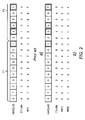
- the retransmission scheme will be described and compared in the following with a common HARQ transmission scheme as defined by 3GPP LTE (see Figure 2 a) ).
- the HARQ process ID HARQ-ID in a number range from 0 to 7 for an initial transmission or a retransmission is explicitly signalled by a retransmission process indicator RPI on a downlink link control channel (e.g.
- a TTI is also called a subframe with a time length of 1 ms.
- a radio frame of a time length of 10 ms consists of 10 subframes, which are numbered serially from #0 to #9.
- Such a serial numbering can be provided for example by applying a modulo 10 arithmetic to an endless sequence of TTI sequence numbers.
- FIG 2 a shows a first radio frame F1 with all TTIs from #0 to #9 and a second radio frame F2 with TTIs from #0 to #5.
- Figure 2 a indicates each of 16 TTis by a rectangle.
- TTI sequence numbers TTI-SN are given below the rectangles.
- the HARQ process IDs HARQ-ID are given within the rectangles.
- Initial transmissions are shown as not hatched rectangles and retransmissions for previous initial transmissions are shown as hatched rectangles.
- TTI sequence number TTI-SN #9 of the first radio frame F1 for a second HARQ process ID #1 in TTI sequence number TTI-SN #1 of the second radio frame F2 for a fourth HARQ process ID #3, in TTI sequence number TTI-SN #2 of the second radio frame F2 for a fifth HARQ process ID #4 and in TTI sequence number TTI-SN #5 of the second radio frame F2 for an eighth HARQ process ID #7.
- TTI sequence number TTI-SN #8 of the first radio frame F1 and the TTI sequence numbers TTI-SN #0, #3 and #4 of the second radio frame F2 further initial transmissions are provided from the eNodeB to the UE with HARQ process IDs #0, #2, #5 and #6.
- HARQ process IDs #0, #2, #5 and #6 Whether a transmission for a specific HARQ process ID is an initial transmission or a retransmission is indicated from the eNodeB to the UE with a further control signalling bit, which is a so-called new data indicator (not shown in Figure 2 a) for simplification).
- the present invention provides an improved method for signalling a retransmission process indicator such as the HARQ process ID applied in 3GPP LTE based on following general principle:
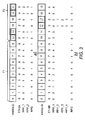
- the retransmission process indicator RPI for an initial transmission or a retransmission may be given regarding Figure 2 b) in binary notation RPI 1-3 with 3 bits and may be split into a first integral part RPI 1 1-2 for the two most significant bits by setting the least significant bit to "0" and a second integral part RPI 2 3 for the least significant bit by setting the two most significant bits to "0" by using for example following equation:
- RPI 1 - 3 RPI ⁇ 1 1 - 2 + RPI ⁇ 2 3
- the first and the second integral parts may be further reduced or compressed by deleting the corresponding set zero bit(s).
- the first integral part RPI1 may be transmitted as a whole from the base station BS to the mobile station MS.
- the first integral part RPI1 may be further split into two or more than two first integral sub-parts and the two or more than two first integral sub-parts may be transmitted separately from the base station BS to the mobile station MS.
- the second integral part RPI2 may be provided from the base station BS to the mobile station MS not by an explicit transmission of the second integral part RPI2 but by a correlation to a radio resource parameter that is used for the initial transmission or the retransmission.
- the second integral part RPI2 may be further split into two or more than two second integral sub-parts and the two or more than two second integral sub-parts may be provided from the base station BS to the mobile station MS by two or more correlations to two or more radio resource parameters that are used for the initial transmission or the retransmission.
- the radio resource parameter or the two or more radio resource parameters may belong to a transmission of the first integral part or the two or more than two first integral sub-parts and/or may belong to the initial transmission or the retransmission itself.
- the correlation may be based for example on a mapping table between the information in the second integral part RPI2 and a range of the radio resource parameter.
- the mapping table may be stored at the base station BS and the mobile station MS.
- the radio resource parameter is a time parameter and the time parameter is a sub-frame such as a TTI of the radio frames F1, F2. Even numbered TTIs (#0, #2, #4, #6, #8) are allocated to a first bit state "0" and odd numbered TTIs (#1, #3, #5, #7, #9) are allocated to a second bit state "1".
- Table 1 a decimal and a binary notation of the HARQ process ID HARQ-ID are shown.
- the binary notation of the HARQ process ID HARQ-ID is transmitted as the retransmission process indicator RPI from the eNodeB to the UE.
- mapping table 2 the binary version of the retransmission process indicator RPI is split exemplarily into the first integral part RPI1 denoted as a first retransmission process indicator in the following and the second integral part RPI2 denoted as a second retransmission process indicator in the following.
- the first retransmission process indicator RPI1 contains the most significant bit and a middle bit of the binary version of the retransmission process indicator RPI and the second retransmission process indicator RPI2 contains the least significant bit of the binary version of the retransmission process indicator RPI.
- the mapping between even and odd numbered TTIs and bit states "0" and "1" is shown in columns 3 and 4 of mapping Table 2.
- the bit states "0" and "1" of the second retransmission process indicator RPI2 are interpreted as a least significant bit of the retransmission process indicator RPI.
- the transmission of the first retransmission process indicator RPI1 requires one bit less than the transmission of the overall retransmission process indicator RPI.
- HARQ-ID decimal HARQ-ID binary RPI 0 000 1 001 2 010 3 011 4 100 5 101 6 110 7 111 Mapping table 2 HARQ-ID decimal RPI1 binary RPI2 binary TTI-SN 0 00 0 0 1 00 1 1 2 01 0 2 3 01 1 3 4 10 0 4 5 10 1 5 6 11 0 6 7 11 1 7
- the state of the second retransmission process indicator RPI2 only depends on the TTI sequence number TTI-SN.
- the mapping of the TTI sequence numbers TTI-SN to the states of the second retransmission process indicator RPI2 can be obtained for example by applying a modulo 2 arithmetic to the TTI sequence numbers TTI-SN and by using the remainder of the modulo 2 arithmetic as the state of the second retransmission process indicator RPI2.
- the bit states "0" and "1" of the second retransmission process indicator RPI2 may be interpreted as a most significant bit of the retransmission process indicator RPI, which is shown in mapping table 3.
- a sequence of HARQ process IDs HARQ-ID is changed from a serial numbering (see Table 2) to following sequence: #0, #4, #1, #5, #2, #6, #3, #7.
- the mobile station MS which receives the initial transmission or the retransmission and the first retransmission process indicator RPI1 obtains the information of the second retransmission process indicator RPI2 by applying the mapping table 2 or 3 to the TTI sequence numbers TTI-SN, which are known from a position of a TTI within the radio frame F1, F2.
- the mobile station MS combines the first retransmission process indicator RPI1 and the second retransmission process indicator RPI2 to determine the overall retransmission process indicator RPI for the initial transmission or for the retransmission.
- the mobile station MS adds the second retransmission process indicator RP12 as the least significant bit to the bits of the first retransmission process indicator RPI1
- the mobile station MS adds the second retransmission process indicator RPI2 as the most significant bit to the bits of the first retransmission process indicator RPI1.
- an initial transmission, a retransmission for the initial transmission and if required further retransmissions for the initial transmission may be allocated to a same state such as the bit state "0" or the bit state "1".
- the initial transmission, the retransmission for the initial transmission and if required the further retransmissions for the initial transmission may be allocated alternating to the first one of two states and to the second one of the two states.
- the number of simultaneous HARQ processes is 8
- the number of different versions of the first retransmission process indicator RPI1 is 4
- the number of different states for the second retransmission process indicator is 2.
- N 2 m ⁇ s with:
- a number of HARQ process IDs HARQ-ID is increased from 8 to 16 (not all HARQ process IDs HARQ-ID are shown in Figure 3 a) and 3 b ) for simplification) in comparison to Figure 2 a) and 2 b ).
- initial transmissions are performed during TTI sequence numbers TTI-SN #0 to #9 of the first radio frame F1 and during TTI sequence numbers TTI-SN #2 and #3 of the second radio frame F2 for HARQ process IDs HARQ-ID #0 to #11.
- a retransmission may be performed for the HARQ process ID HARQ-ID #0 by combining further redundancy information for the HARQ process ID HARQ-ID #0 with a new initial transmission for the HARQ process ID HARQ-ID #2.
- Such a combination of a retransmission with a new initial transmission is described for example in EP 2131518 A2 or EP 2178239 A2 .
- a retransmission may be performed by combining further redundancy information of the HARQ process IDs HARQ-ID #0 and #2, which are combined or superimposed by a method such as described for example in US 2010/0061287 A1 for a binary XOR addition or modulo 2 addition of three or more packets.
- a retransmission may be performed either for one of the HARQ process IDs by applying a combination of further redundancy information of one of the two respective HARQ process IDs with a new initial transmission of the further one of the two respective HARQ process IDs or a retransmission may be performed for both HARQ process IDs by applying a combination of further redundancy information for both HARQ processes.
- the combination and transmission of two HARQ processes are executed during an odd or even TTI sequence number TTI-SN in such a way, that initial transmissions of both HARQ process IDs HARQ-ID belong to TTI sequence numbers TTI-SN of a same state.
- the initial transmissions for HARQ process IDs #0, #2 are performed by TTI sequence numbers TTI-SN #0 and #2, which are both even sequence numbers.
- the retransmission for one or both of the HARQ process IDs #0, #2 based on a combination of further redundancy information for one HARQ process ID and new data of a further initial transmission for the other HARQ process ID or based on a combination of further redundancy information for both HARQ process IDs is applied by the TTI sequence number TTI-SN #0 of the second radio frame F2, which is also an even sequence number.
- mapping table 4 The mapping between the TTI sequence numbers TTI-SN, a first retransmission process indicator RPI1_1 and the second retransmission process indicator RPI2 is shown by following mapping table 4: Mapping table 4 HARQ-ID decimal RPI1_1 decimal RPI1_1 binary RPI2 binary TTI-SN 0 0 000 0 0 1 0 000 1 1 2 1 001 0 2 3 1 001 1 3 4 2 010 0 4 5 2 010 1 5 6 3 011 0 6 7 3 011 1 7 8 4 100 0 8 9 4 100 1 9 10 5 101 0 0 11 5 101 1 1 ⁇ ⁇ ⁇ ⁇ 15 7 111 1 7
- the first retransmission process indicator RPI1_1 is shown in Figure 3 a) in a decimal notation.
- the mapping table 4 shows the corresponding binary notation.
- the decimal HARQ process ID HARQ-ID is equal to a summation of the bits of the binary version of the first retransmission process indicator RPI1_1 and the bit of the second retransmission process indicator RPI2 as a least significant bit. If a retransmission is performed by a combination of two HARQ processes, a further first retransmission process indicator RPI1_2 needs to be transmitted from the base station BS to the mobile station MS for example on a control channel or by a so-called in-band signalling, which means, that the further first retransmission process indicator RPI1_2 may be transmitted together with the radio transmission data for example on a same user data channel.
- the second retransmission process indicator RPI2 can also be used and is also valid for the further first retransmission process indicator RPI1_2.
- the second retransmission process indicator RPI2 which is deduced by the mobile station MS from the mapping table 4, can be applied also for an identification of a second HARQ process ID by a summation of the received bits of the binary version of the further first retransmission process indicator RPI1_2 and the bit of the second retransmission process indicator RPI2 for example as a least significant bit as shown in mapping table 4.
- the method described according to Figure 3 a) is extended to combination of four HARQ processes as shown in Figure 3 b) .
- initial transmissions are performed during TTI sequence numbers TTI-SN #0 to #9 of the first radio frame F1 and during TTI sequence numbers TTI-SN #0, #1, #4 and #5 of the second radio frame F2 for HARQ process IDs HARQ-ID #0 to #13.
- TTI sequence number TTI-SN #2 of the second radio frame F2 a retransmission may be performed for a combination such as a modulo-2 addition of HARQ process IDs #0, #2, #4 and #6. The combination may be based for example on a combination of three retransmissions for HARQ process IDs #0, #2 and #4 and of one new initial transmission for HARQ process ID #6.
- Such a combination of several retransmissions with a new initial transmission is similar to a method as described in EP 2131518 A2 or EP 2178239 A2 for a simple combination of two HARQ processes.
- a retransmission may be performed for redundancy versions of the HARQ process IDs HARQ-ID #0, #2, #4 and # 6 which are combined by a method such as described for example in US 2010/0061287 A1 .
- a retransmission may be performed either by applying a similar method as described in EP 2131518 A2 or EP 2178239 A2 with at least one new initial transmission or by applying a similar method as described in US 2010/0061287 A1 with a combination of only redundancy versions of previous initial transmissions.
- the combination of four HARQ processes are executed in such a way, that all four HARQ process IDs HARQ-ID belong to TTI sequence numbers TTI-SN, which are either both odd or both even sequence numbers.
- the HARQ process IDs #0, #2, #4, #6 of the TTI sequence number TTI-SN #2 of the second radio frame F2 belong to the TTI sequence numbers TTI-SN #0, #2, #4, #6, which are all even sequence numbers.
- the mapping table 4 as described above may also be used for the mapping between the TTI sequence numbers TTI-SN and the second retransmission process indicator RPI2 regarding the embodiment of Figure 3b ).
- the second retransmission process indicator RPI2 which is deduced by the mobile station MS from the mapping table 4, can be applied also for an identification of the remaining three HARQ process IDs of a combination by a summation of the received bits of the binary version of the further first retransmission process indicators RPI1_2, RPI1_3, RPI1_4 and the bit of the second retransmission process indicator RPI2 for example as a least significant bit as shown in mapping table 4.
- the number of the steps for performing the method MET1 is not critical, and as can be understood by those skilled in the art, that the number of the steps and the order of the steps may vary without departing from the scope of the invention.
- VoIP Voice of Internet Protocol
- a similar downlink method may be performed between the base station BS and the relay station RS and/or between the relay station RS and the mobile station MS.
- a similar method may be performed for an uplink transmission of uplink user data from the mobile station MS to the base station BS.
- the relay station RS is used between the mobile station MS and the base station BS, a similar uplink method may be performed between the mobile station MS and the relay station RS and/or between the relay station RS and the base station BS.
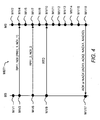
- the method MET1 is exemplarily described with respect to Figure 2 b) and Figure 3a ).
- a mapping is predefined at the base station BS between a first state of the second retransmission process indicator RPI2 (state "0") and a first range of said radio resource parameter (TTI sequence numbers TTI-SN #0, #2, #4, #6, #8) for transmitting radio transmission data RTD and between a second state of the retransmission process indicator RPI2 (state "1") and a second range of the radio resource parameter (TTI sequence numbers TTI-SN #1, #3, #5, #7, #9) for transmitting the radio transmission data RTD.
- the second retransmission process indicator RPI2 is mapped to the transmission of the radio transmission data RTD.
- the second retransmission process indicator RPI2 may be alternatively mapped to the transmission of the first retransmission process indicator RPI1.
- the mapping is also predefined at the mobile station MS between the first state of the second retransmission process indicator RPI2 (state "0") and the first range of said radio resource parameter (TTI sequence numbers TTI-SN #0, #2, #4, #6, #8) and between the second state of the retransmission process indicator RPI2 (state "1") and the second range of the radio resource parameter (TRI sequence numbers TTI-SN #1, #3, #5, #7, #9).
- the base station BS transmits for example via a control channel by applying an asynchronous HARQ method the first retransmission process indicator RPI1 (see Figure 2 b) ) for a HARQ process ID HARQ-ID #2 for the first radio frame F1 and a new data indicator NDI for example set to state "1" for a next initial transmission of the radio transmission data RTD to the mobile station MS, which receives the first retransmission process indicator RPI1 or RPI1_1 in a further step M1/4.
- the new data indicator NDI is set to state "0".
- a new initial transmission may be indicated by a change of state of the new data indicator NDI from state "0" to state "1” or vice versa, and a retransmission by no change of state of the NDI, when comparing the state of the received new data indicator NDI to the previous state of new data indicator NDI received for the same HARQ process number.
- the first retransmission process indicator RPI1 may be split by the base station BS into two or more than two parts and the base station BS performs separate transmissions to the mobile station MS for the two or more than two parts.
- the base station BS may split the first retransmission process indicator RPI1 into two parts and the base station BS transmits a first part of the two parts via the step M1 /3 and transmits a second part of the two parts for example via in-band signaling.
- the mobile station MS which receives the two or more than two parts performs a combination of the two or more than two parts, which is an inverse process to the splitting performed by the base station BS, to obtain the first retransmission process indicator RPI1.
- the base station BS transmits the first retransmission process indicator RPI1_1 for a HARQ process ID HARQ-ID #0 of the second radio frame F2 and a new data indicator NDI set to state "0" for a next retransmission of radio transmission data RTD to the mobile station MS.
- the first retransmission process indicator RPI1 or RPI1_1 and new data indicator NDI or NDI_1 may be transmitted for example as part of a scheduling grant such as applied in 3GPP LTE.
- the radio transmission data RTD are located in a same TTI as applied for the transmission of the scheduling grant.
- the scheduling grant is transmitted two time slots ahead to the transmission of the radio transmission data RTD, so that the mobile station MS implicitly knows, if it receives a scheduling grant, that the radio transmission data RTD will be received after two further time slots.
- the mobile station MS may store the received first retransmission process indicator RPI1 or RPI1_1 and the received new data indicator NDI or NDI_1 for later processing.
- the base station BS transmits in a further step M1/6 the further first retransmission process indicator RPI1_2 for a HARQ process ID HARQ-ID #2 of the second radio frame F2 and a further new data indicator NDI_2 set to state "0" for the next retransmission of the radio transmission data RTD to the mobile station MS, which receives the further first retransmission process indicator RPI1_2 and the further new data indicator NDI_2 in a next step M1/7.
- the mobile station MS may store the received further first retransmission process indicator RPI1_2 and the received further new data indicator NDI_2 for later processing.
- the base station BS transmits the radio transmission data RTD to the mobile station MS, which receives the radio transmission data RTD in a further step M1/10.
- the base station BS applies for the transmission of the radio transmission data RTD a TTI sequence number TTI-SN, which corresponds to this implicit or explicit signaling.
- the base station BS provides implicitly the second retransmission process indicator RPI2 to the mobile station MS, because the radio transmission data RTD are transmitted with a TTI sequence number TTI-SN #2 (see Figure 2 a) ) or with a TTI sequence number TTI-SN #0 (see Figure 3 a) ), which are both even numbers and therefore both mapped to the state "0" of the second retransmission process indicator RPI2.
- the mobile station MS identifies the HARQ process ID HARQ-ID of the initial transmission (see Figure 2 b) or of the retransmission (see Figure 3 a) ) based on the received first retransmission process indicator RPI1 or RPI1_1 and based on the provided second retransmission process indicator RPI2. Therefore, the mobile station MS derives the TTI sequence number based on an application of a conventional downlink frame synchronization algorithm.
- predefined synchronization signals are transmitted within predefined time-frequency positions of each radio frame. A time location of these synchronization signals is detected by the mobile station MS, e.g. by computing the cross-correlation of the predefined sequences with the received sequences.
- step M1/11 the mobile station MS deduces the second retransmission process indicator RPI2 based on the TTI sequence number TTI-SN #2 (see Figure 2 a) ) or the TTI sequence number TTI-SN #0 (see Figure 3 a) ), which have been applied for the transmission of the radio transmission data RTD and based on the predefined mapping.
- step M1/12 the mobile station MS may store the deduced second retransmission process indicator RPI2 for later processing in step M1/13.
- the mobile station MS determines retransmission process indicator RPI for the HARQ process ID HARQ-ID #2 (see Figure 2 b) ) or #0 (see Figure 3 a) ) from the received first retransmission process indicator RPI1 (see Figure 2 b) ) or RPI1_1 (see Figure 3 a) ) and from the deduced second retransmission process indicator RPI2.
- a determination may be for example based on generating a bit sequence of the bits of the first retransmission process indicator RPI1 and of the bit of the second retransmission process indicator RPI2 as described above and based on a following interpretation of the bit sequence.
- the mobile station MS performs for example an algorithm, which is inverse to the algorithm, which is described with respect to equation (1).
- the mobile station MS further identifies in a next step M1 /14 the further retransmission process indicator RPI for the HARQ process ID HARQ-ID #2 by determining the further retransmission process indicator RPI for the HARQ process ID HARQ-ID #2 from the received further first retransmission process indicator RPI1_2 and from the deduced second retransmission process indicator RPI2 by generating a further bit sequence similar to the method as described above.
- the mobile station MS performs a conventional data recovery for the received radio transmission data RTD for an initial transmission or a retransmission of a single HARQ process, for example, by a maximal ratio combining of the sampled receive signals of the initial transmission and retransmission(s) of the initial transmission prior to demodulation and decoding such as described for example in Chapter 3.2 of D. Tse and P. Viswanath, "Fundamentals of Wireless Communication,” Cambridge University Press 2005, or alternatively by adding soft bits, e.g.
- the mobile station MS may transmit an acknowledgement ACK, if the mobile station MS has successfully recovered the received radio transmission data RTD or transmits a negative acknowledgement NACK, if the mobile station MS has not successfully recovered the received radio transmission data RTD.
- the base station BS receives the acknowledgement ACK or the negative acknowledgement NACK.
- the mobile station MS may transmit a first acknowledgement ACK1, if the mobile station MS has successfully recovered the received radio transmission data RTD of the HARQ process ID HARQ-ID #0 or transmits a first negative acknowledgement NACK1, if the mobile station MS has not successfully recovered the received radio transmission data RTD of the HARQ process ID HARQ-ID #0.
- the mobile station MS may transmit a second acknowledgement ACK2, if the mobile station MS has successfully recovered the received radio transmission data RTD of the HARQ process ID HARQ-ID #2 or transmits a second negative acknowledgement NACK2, if the mobile station MS has not successfully recovered the received radio transmission data RTD of the HARQ process ID HARQ-ID #2.
- the base station BS transmits a new initial transmission for the same HARQ process ID and a corresponding first retransmission process indicator RPI1 or RPI1_1 if the base station BS has received the acknowledgement ACK, ACK1 or ACK2 or the base station BS transmits a further redundancy version for the same HARQ process ID and a corresponding retransmission process indicator RPI1 or RPI1_1 if the base station BS has received the negative acknowledgement NACK, NACK1 or NACK2.
- An explicit transmission of the acknowledgement ACK, ACK1 or ACK2 is not required, if for example it is predefined at the base station BS and the mobile station MS, that the acknowledgement doesn't need to be transmitted, if the base station BS starts a timer at the point of time, when the radio transmission data RTD are transmitted and if the base station BS interprets a non-reception of the acknowledgement ACK, ACK1 or ACK2 as a successful data recovery at the mobile station MS.
- Figure 5 a shows another possibility for signalling and providing retransmission process indicators from the base station BS to the mobile station MS.
- the transmission and retransmission method is exemplarily shown for four HARQ processes with decimal HARQ process IDs HARQ-ID #0, #1, #2 and #3.
- the retransmission process indicator RPI for signalling the HARQ process ID from the base station BS to the mobile station MS is split into the first retransmission process indicator RPI1 and the second retransmission process indicator RPI2.
- the first retransmission process indicator RPI1 is transmitted via the radio link RL from the base station BS to the mobile station MS, whereas the second retransmission process indicator RPI2 is provided from the base station to the mobile station MS in a following way:
- a frequency spectrum FS of the radio link RL may be split into a first frequency block FB1 below a predefined radio frequency PRF and a second frequency block FB2 above the predefined radio frequency PRF.
- the predefined radio frequency PRF may be for example a mean radio frequency of the frequency spectrum FS.
- the second retransmission process indicator RPI2 may be mapped for example to a "0" bit state and for an initial transmission or a retransmission via the second frequency block FB2, the second retransmission process indicator RPI2 may be mapped for example to a "1" bit state.
- mapping table 5 An exemplary mapping between the bit states of the second retransmission process indicator RPI2 and the frequency blocks FB1, FB2 regarding the embodiment of Figure 5 a) is shown in mapping table 5.
- the bit state of the second retransmission process indicator RPI2 may be the most significant bit of the retransmission process indicator RPI.
- Figure 5 b shows a further embodiment for signalling and providing retransmission process indicators from the base station BS to the mobile station MS.
- the transmission and retransmission method is exemplarily shown for eight HARQ processes with decimal HARQ process IDs HARQ-ID #0 to #7 but only four HARQ processes with decimal HARQ process IDs HARQ-ID #0 to #3 are shown for simplification.
- the retransmission process indicator RPI for signalling the HARQ process ID from the base station BS to the mobile station MS is split into the first retransmission process indicator RPI1 and the second retransmission process indicator RPI2.
- the first retransmission process indicator RPI1 is transmitted via the radio link RL from the base station BS to the mobile station MS, whereas the second retransmission process indicator RPI2 is provided from the base station to the mobile station MS in a following way:
- a downlink physical resource DPR such as an 3GPP LTE downlink physical resource of the radio link RL may be split into four frequency blocks FB1, FB2, FB3, FB4.
- Each frequency block may be split into 25 resource blocks RB (see mapping table 6), for example assuming 20 MHz system bandwidth (100 RBs).
- Each resource block RB may contain 12 frequency subcarriers with a 15 kHz subcarrier spacing such as applied in 3GPP LTE.
- Each frequency block is mapped to a two bit state of the second retransmission process indicator RPI2 as shown in the mapping table 6.
- Resource coverage of radio transmission data RTD1, RTD2, RTD3 and RTD4 for each of the four HARQ process IDs HARQ-ID #0 - #3 is also shown in Figure 5 b) .
- Each of the radio transmission data RTD1, RTD2, RTD3 and RTD4 covers several resource blocks RB of the downlink physical resource DPR.
- a resource block with smallest frequency subcarriers RB_IND1, RB-IND2, RB-IND3, RB-IND4 covered by the radio transmission data RTD1, RTD2, RTD3 or RTD4 may be used for example for indicating the two bit state of the second retransmission process indicator RPI2 to the mobile station MS as the receiver of the radio transmission data RTD1, RTD2, RTD3 and RTD4.
- the two bit state of the second retransmission process indicator RPI2 may be the two least significant bits of the retransmission process indicator RPI.
- RPI ⁇ 2 RB_ IND mod s
- the states of the second retransmission process indicator RPI2 may be alternatively mapped to an indexed pool or group of at least two transmit codes such as Hadamard, DFT or Zadoff-Chu spreading codes.
- transmit codes such as Hadamard, DFT or Zadoff-Chu spreading codes.
- a first block may be mapped to a first state such as a first bit state "0" of the second retransmission process indicator RPI2 and a second block may be mapped to a second state such as a second bit state "1" of the second retransmission process indicator RPI2.
- a smallest index of two or more than two applied transmit codes may determine a state of the second retransmission process indicator RPI2 by a corresponding mapping table.
- the second retransmission process indicator RPI2 may be tagged for example to a smallest transmit code index, which is applied for a multi-code resource allocation. In 3GPP HSDPA for example 16 different transmit codes are applied within a radio cell.
- Such a mapping may be used, if for example in case of 3GPP HSDPA the base station BS transmits user data to the mobile station MS via two spreading codes and a first group of the user data is coded with the first spreading code and a second group of the user data is coded with the second spreading code.
- the second retransmission process indicator RPI2 may be split into two or more parts and for each of these parts a mapping may be predefined at the base station BS and at the mobile station MS between two or more states of this part of the second retransmission process indicator RPI2 and two or more ranges of a different radio resource parameter.
- a first mapping of a first part of the second retransmission process indicator RPI2 may be predefined between two states of the first part of the second retransmission process indicator RPI2 and even or odd TTI sequence numbers TTI-SN as described above (see for example embodiment regarding Figure 2 b) ).
- a second mapping of a second part of the second retransmission process indicator RPI2 may be predefined between two states of the second part of the second retransmission process indicator RPI2 and high or low frequency ranges as described above (see for example embodiment regarding Figure 5 a) ).
- FIG. 6 a further embodiment for signalling and providing the retransmission process indicator RPI from the base station BS to the mobile station MS is shown.
- the main difference between this embodiment and the preceding embodiments shown in Figures 2 b) , 3 a) , 3 b) , 5 a) and 5 b) is based on the fact, that the implicit indication of the second retransmission process indicator RPI2 is not provided by a radio resource parameter of the transmission of the radio transmission data RTD, RTD1, RTD2, RTD3, RTD4 but provided by a radio resource parameter of the transmission of the first retransmission process indicator RPI1.
- Figure 6 shows exemplarily four control channels CC1, CC2, CC3, CC4, which are used for transmitting the first retransmission process indicator RPI1 from the base station BS to the mobile station MS.
- a HARQ process ID HARQ-ID can be identified at the mobile station MS by a transmission of the first retransmission process indicator RPI1 and further by a control channel, which either transmits the first retransmission process indicator RPI1 or which transmits radio resource assignment information for in-band signalling of the first retransmission process indicator RPI1.
- the transmitted radio resource assignment information allows the receiving apparatus such as the mobile station MS to know, where to find control information (here the first retransmission process indicator RPI1) within resource blocks for a transmission of the radio transmission data RTD.
- mapping table 7 HARQ-ID decimal RPI1 binary RPI2 binary Control channel 0 0 0 CC1 1 0 1 CC2 2 1 0 CC3 3 1 1 CC4
- the CPU TA-CPU and the computer readable medium TA-MEM may be based for example on a digital baseband board.
- the CPU TA-CPU is foreseen for executing a computer readable program TA-PROG.
- the computer readable medium TA-MEM is foreseen for storing the computer readable program TA-PROG.
- the computer readable program TA-PROG is foreseen for executing steps of the method MET1 belonging to the transmitting apparatus TA.
- the computer readable medium TA-MEM may store one or several of the mapping tables as described above.
- the base station BS, the mobile station MS or the relay station RS may contain the transmitting apparatus TA for example as part of a transceiver.
- a CPU central processing unit
- RA-CPU central processing unit
- RA-MEM computer readable medium
- RA-OUT for providing the recovered application for example to an application such as a video client.
- Further conventional components of the receiving apparatus RA such as power supply/battery, radio receiver, demodulator, and baseband processing are not shown for simplification.
- the CPU RA-CPU and the computer readable medium RA-MEM may be based for example on a digital baseband board.
- the CPU RA-CPU is foreseen for executing a computer readable program RA-PROG.
- the computer readable medium RA-MEM is foreseen for storing the computer readable program RA-PROG.
- the computer readable program RA-PROG is foreseen for executing steps of the method MET1 belonging to the receiving apparatus RA.
- the computer readable medium RA-MEM may store one or several of the mapping tables as described above and may store the received first retransmission process indicator RPI1, the further first retransmission process indicator RPI1_2, the received further new data indicator NDI_2 and the deduced second retransmission process indicator RPI2.
- the base station BS, the mobile station MS or the relay station RS may contain the receiving apparatus RA for example as part of a transceiver.
- unit or "means for " shall be understood as functional blocks comprising circuitry that is adapted for performing a certain function, respectively.
- a "means for s.th” may as well be understood as a “means being adapted or suited for s.th.”.
- a means being adapted for performing a certain function does, hence, not imply that such means necessarily is performing said function (at a given time instant).
- the functions of the various elements of the transmitting apparatus TA shown in Figure 7 a) and of the receiving apparatus RA shown in Figure 7 b) may be provided through the use of dedicated hardware as well as the through the use of hardware capable of executing software in association with appropriate software.
- the functions may be provided by a single dedicated processor, by a single shared processor, or by a plurality of individual processors, some of which may be shared.
- processor or “controller” should not be construed to refer exclusively to hardware capable of executing software, and may implicitly include, without limitation, digital signal processor (DSP) hardware, network processor, application specific integrated circuit (ASIC), field programmable gate array (FPGA), read only memory (ROM) for storing software, random access memory (RAM), and non volatile storage. Other hardware, conventional and/or custom, may also be included.
- DSP digital signal processor
- ASIC application specific integrated circuit
- FPGA field programmable gate array
- ROM read only memory
- RAM random access memory
- non volatile storage Other hardware, conventional and/or custom, may also be included.
- any switches shown in the Figures are conceptual only. Their function may be carried out through the operation of program logic, through dedicated logic, through the interaction of program control and dedicated logic, or even manually, the particular technique being selectable by the implementer as more specifically understood from the context. It should be appreciated by those skilled in the art that any block diagrams herein represent conceptual views of illustrative circuitry embodying the principles of the invention
Landscapes
- Engineering & Computer Science (AREA)
- Signal Processing (AREA)
- Computer Networks & Wireless Communication (AREA)
- Mobile Radio Communication Systems (AREA)
- Detection And Prevention Of Errors In Transmission (AREA)
Claims (14)
- Procédé (MET1) de retransmission asynchrone dans un système de communication radio (RCS), ledit procédé (MET1) comprenant les étapes suivantes :- diviser dans un appareil de transmission (TA) un indicateur de processus de retransmission (RPI) en au moins une première partie (RPI1, RPI1_1) et au moins une deuxième partie (RPI2),- transmettre (M1/3) au moins ladite première partie (RPI1, RPI1_1) dudit indicateur de processus de retransmission (RPI) pour une transmission initiale ou une retransmission de données de radiotransmission (RTD, RTD1, RTD2, RTD3, RTD4) à partir dudit appareil de transmission (TA) vers un appareil de réception (RA),- fournir (M1/3, M1/7) au moins ladite deuxième partie (RPI2) dudit indicateur de processus de retransmission (RPI) à partir dudit appareil de transmission (TA) vers ledit appareil de réception (RA) par une mise en correspondance avec un paramètre de ressources radio (TTI-SN #0..#9, FB1, FB2, RB #0..#99, CC1..CC4) qui est appliqué pour ladite transmission initiale ou ladite retransmission,- déduire (M1/11) dans ledit appareil de réception (RA) au moins ladite deuxième partie fournie (RPI2) dudit indicateur de processus de retransmission (RPI) sur la base dudit paramètre de ressources radio appliqué (TTI-SN #0..#9, FB1, FB2, RB #0..#99, CC1..CC4) et sur la base de ladite mise en correspondance, et- déterminer (M1/13) dans ledit appareil de réception (RA) ledit indicateur de processus de retransmission (RPI) à partir au moins de ladite première partie reçue (RPI1, RPI1_1) et au moins de ladite deuxième partie déduite (RPI2).
- Procédé (MET1) selon la revendication 1, ledit procédé (MET1) comprenant en outre l'étape de prédéfinition (M1/1, M1/2) dans ledit appareil de transmission (TA) et dans ledit appareil de réception (RA) de ladite mise en correspondance entre un premier état au moins de ladite deuxième partie (RPI2) dudit indicateur de processus de retransmission (RPI) et une première plage desdits paramètres de ressources radio (TTI-SN #0..#9, FB1, FB2, RB #0..#99, CC1..CC4) et entre au moins un deuxième état au moins de ladite deuxième partie (RPI2) dudit indicateur de processus de retransmission (RPI) et au moins une deuxième plage desdits paramètres de ressources radio (TTI-SN #0..#9, FB1, FB2, RB #0..#99, CC1..CC4), et dans lequel ladite étape de détermination (M1/11..M1/14) comprend les sous-étapes suivantes :- déduire (M1/11) dans ledit appareil de réception (RA) au moins ladite deuxième partie (RPI2) dudit indicateur de processus de retransmission (RPI) sur la base de ladite mise en correspondance et sur la base de ladite première plage ou au moins de ladite deuxième plage desdits paramètres de ressources radio reçus (TTI-SN #0..#9, FB1, FB2, RB #0..#99, CC1..CC4), et- déterminer (M1/13) dans ledit appareil de réception (RA) ledit indicateur de processus de retransmission (RPI) à partir au moins de ladite première partie reçue (RPI1, RPI1_1) dudit indicateur de processus de retransmission (RPI) et à partir au moins de ladite deuxième partie déduite (RPI2) dudit indicateur de processus de retransmission (RPI).
- Procédé (MET1) selon l'une quelconque des revendications précédentes, dans lequel ledit paramètre de ressources radio (TTI-SN #0..#9, FB1, FB2, RB #0..#99, CC1..CC4) est un paramètre de ressources radio (TTI-SN #0,.#9, FB1, FB2, RB #0..#99) pour transmettre ladite transmission initiale ou ladite retransmission ou est un paramètre de ressources radio (CC1..CC4) pour transmettre au moins ladite première partie (RPI1, RPI1_1) dudit indicateur de processus de retransmission (RPI) ou est un paramètre de ressources radio pour transmettre une indication pour une ressource radio (RPI_1, RPI1_1) qui comprend au moins ladite première partie (RPI1, RPI1_1) dudit indicateur de processus de retransmission (RPI).
- Procédé (MET1) selon l'une quelconque des revendications précédentes, dans lequel ledit paramètre de ressources radio (TTI-SN #0..#9, FB1, FB2, RB #0..#99, CC1..CC4) est un paramètre de temps, un paramètre de fréquence ou un paramètre de codage.
- Procédé (MET1) selon la revendication 4, dans lequel ledit paramètre de temps est une période d'au moins deux intervalles de temps de transmission (TTI-SN #0..#9), dans lequel lesdits au moins deux intervalles de temps de transmission (TTI-SN #0..#9) sont numérotés en série, dans lequel des intervalles de temps de transmission pairs desdits au moins deux intervalles de temps de transmission sont attribués à un premier état parmi lesdits au moins deux états et dans lequel des intervalles de temps de transmission impairs desdits au moins deux intervalles de temps de transmission sont attribués à un deuxième état parmi lesdits au moins deux états.
- Procédé (MET1) selon la revendication 4, dans lequel ledit paramètre de fréquence est une plage de fréquences d'au moins deux sous-plages de fréquences de transmission (FB1, FB2, RB #0..#99) pour transmettre ladite transmission initiale ou ladite retransmission ou pour transmettre au moins ladite première partie dudit indicateur de processus de retransmission ou pour transmettre une indication pour une ressource radio (RPI1, RPI1_1) qui comprend au moins ladite première partie (RPI1, RPI1_1) dudit indicateur de processus de retransmission (RPI) et dans lequel une première sous-plage parmi lesdites au moins deux sous-plages de fréquences de transmission (FB1, FB2, RB #0..#99) est attribuée à un premier état parmi lesdits au moins deux états et dans lequel une deuxième sous-plage parmi lesdites au moins deux sous-plages de fréquences de transmission (FB1, FB2, RB #0.,#99) est attribuée à un deuxième état parmi lesdits au moins deux états.
- Procédé (MET1) selon la revendication 4, dans lequel ledit appareil de codage est un groupe d'au moins deux codes de transmission, dans lequel un premier code de transmission parmi lesdits au moins deux codes de transmission est attribué à un premier état parmi lesdits au moins deux états et dans lequel un deuxième code parmi lesdits au moins deux codes de transmission est attribué à un deuxième état parmi lesdits au moins deux états.
- Procédé (MET1) selon l'une quelconque des revendications précédentes, ledit procédé comprenant en outre les étapes suivantes :- transmettre (M1/5) au moins une première partie (RPI1_2) d'au moins un autre indicateur de processus de retransmission pour au moins une autre transmission initiale ou au moins une autre retransmission de données de radiotransmission à partir dudit appareil de transmission (TA) vers ledit appareil de réception (RA), et- déterminer (M1/14) dans ledit appareil de réception (RA) ladite au moins une autre transmission initiale ou ladite au moins une autre retransmission sur la base au moins de ladite première partie reçue (RPI1_2) dudit au moins un autre indicateur de processus de retransmission et sur la base au moins de ladite deuxième partie fournie (RPI2) dudit indicateur de processus de retransmission (RPI).
- Procédé (MET1) selon l'une quelconque des revendications 5 à 7, dans lequel ladite transmission initiale, une retransmission pour ladite transmission initiale et d'autres retransmissions pour ladite transmission initiale sont attribuées à un même état ou sont attribuées en alternance audit premier état parmi lesdits au moins deux états et audit deuxième état parmi lesdits au moins deux états.
- Procédé (MET1) selon l'une quelconque des revendications 5 à 7, dans lequel un nombre de processus de retransmission entre ledit appareil de transmission (TA) et ledit appareil de réception (RA) est donné en tant que nombre binaire et dans lequel ledit état parmi lesdits au moins deux états est interprété comme au moins un bit de poids faible ou comme au moins un bit de poids fort pour déterminer ledit indicateur de processus de retransmission (RPI).
- Procédé (METI) selon la revendication 10, dans lequel ledit nombre de processus de retransmission est égal à une multiplication d'un nombre de valeurs au moins de ladite première partie (RPI1, RPI1_1) dudit indicateur de processus de retransmission (RPI) par un nombre desdits au moins deux états.
- Procédé (MET1) selon la revendication 11, dans lequel ledit nombre de processus de retransmission est N, ledit nombre desdits au moins deux états est s, et un nombre m de bits pour transmettre au moins ladite première partie dudit indicateur de processus de retransmission complète l'équation N = 2m x s.
- Appareil de transmission (TA) pour une retransmission asynchrone dans un système de communication radio (RCS), ledit appareil de transmission (TA) comprenant :- moyens pour diviser un indicateur de processus de retransmission (RPI) en au moins une première partie (RPI1, RPI1_1) et au moins une deuxième partie (RPI2),- moyens (TA-CPU, TA-PROG, TA-OUT) pour transmettre au moins ladite première partie (RPI1, RPI1_1) dudit indicateur de processus de retransmission (RPI) pour une transmission initiale ou une retransmission de données de radiotransmission (RTD, RTD1, RTD2, RTD3, RTD4), et- moyens (TA-CPU, TA-PROG, TA-OUT) pour fournir au moins ladite deuxième partie (RPI2) dudit indicateur de processus de retransmission (RPI) par une mise en correspondance avec un paramètre de ressources radio (TTI-SN #0..#9, FB1, FB2, RB #0..#99, CC1..CC4) qui est appliqué pour ladite transmission initiale ou ladite retransmission.
- Appareil de réception (RA) pour une retransmission asynchrone dans un système de communication radio (RCS), ledit appareil de réception (RA) comprenant :- moyens (RA-CPU, RA-PROD, RA-IN) pour recevoir une première information pour une transmission initiale ou une retransmission de données de radiotransmission (RTD, RTD1, RTD2, RTD3, RTD4) à partir d'un appareil de transmission (TA),- moyens (RA-CPU, RA-PROG, RA-IN) pour obtenir une deuxième information par une mise en correspondance avec un paramètre de ressources radio (TTI-SN #0..#9, FB1, FB2, RB #0..#99, CC1..CC4) qui est appliqué pour ladite transmission initiale ou ladite retransmission, etcaractérisé en ce que ladite première information est au moins une première partie (RPI1, RPI1_1) d'un indicateur de processus de retransmission (RPI), ladite deuxième information est au moins une deuxième partie (RPI2) dudit indicateur de processus de retransmission (RPI) et ledit appareil de réception (RA) comprend en outre des moyens pour déduire au moins ladite deuxième partie fournie (RPI2) dudit indicateur de processus de retransmission (RPI) sur la base dudit paramètre de ressource radio appliqué (TTI-SN #0..#9, FB1, FB2, RB #0..#99, CC1..CC4) et sur la base de ladite mise en correspondance, et des moyens pour déterminer ledit indicateur de processus de retransmission (RPI) à partir au moins de ladite première partie reçue (RPI1, RPI_1_1) et au moins de ladite deuxième partie déduite (RPI2).
Priority Applications (2)
| Application Number | Priority Date | Filing Date | Title |
|---|---|---|---|
| EP20120305458 EP2654236B1 (fr) | 2012-04-20 | 2012-04-20 | Procédé de retransmission asynchrone dans un système de communication radio, appareil de transmission et appareil de réception |
| PCT/EP2013/052715 WO2013156172A1 (fr) | 2012-04-20 | 2013-02-12 | Procédé de retransmission asynchrone dans un système de radiocommunication, appareil d'émission et appareil de réception associés |
Applications Claiming Priority (1)
| Application Number | Priority Date | Filing Date | Title |
|---|---|---|---|
| EP20120305458 EP2654236B1 (fr) | 2012-04-20 | 2012-04-20 | Procédé de retransmission asynchrone dans un système de communication radio, appareil de transmission et appareil de réception |
Publications (2)
| Publication Number | Publication Date |
|---|---|
| EP2654236A1 EP2654236A1 (fr) | 2013-10-23 |
| EP2654236B1 true EP2654236B1 (fr) | 2014-05-21 |
Family
ID=47740928
Family Applications (1)
| Application Number | Title | Priority Date | Filing Date |
|---|---|---|---|
| EP20120305458 Not-in-force EP2654236B1 (fr) | 2012-04-20 | 2012-04-20 | Procédé de retransmission asynchrone dans un système de communication radio, appareil de transmission et appareil de réception |
Country Status (2)
| Country | Link |
|---|---|
| EP (1) | EP2654236B1 (fr) |
| WO (1) | WO2013156172A1 (fr) |
Family Cites Families (10)
| Publication number | Priority date | Publication date | Assignee | Title |
|---|---|---|---|---|
| WO2008104099A1 (fr) * | 2007-02-28 | 2008-09-04 | Huawei Technologies Co., Ltd. | Transmission de paquets de données dans un système de télécommunication sans fil |
| US7996744B2 (en) * | 2007-04-30 | 2011-08-09 | Nokia Corporation | Method and apparatus for providing a data retransmission scheme |
| EP2104261B1 (fr) * | 2008-03-17 | 2020-10-07 | III Holdings 11, LLC | Gestion de processus HARQ améliorée |
| JP5298648B2 (ja) | 2008-06-06 | 2013-09-25 | 富士通株式会社 | 送信機及び受信機並びに送信方法及び受信方法 |
| US20100061287A1 (en) | 2008-09-10 | 2010-03-11 | Samsung Electronics Co., Ltd. | Efficient coding schemes for retransmissions in multicast transmission |
| CN101729224A (zh) | 2008-10-20 | 2010-06-09 | 富士通株式会社 | 传输数据生成装置和接收机 |
| US8654661B2 (en) * | 2009-05-04 | 2014-02-18 | Industrial Technology Research Institute | Method and apparatus for multicast and broadcast retransmission in wireless communication systems |
| KR101695023B1 (ko) * | 2010-03-29 | 2017-01-10 | 삼성전자주식회사 | 다중 안테나 기술을 지원하는 무선 통신 시스템의 상향 링크에서 재전송 제어 방법 및 장치 |
| EP2416518B1 (fr) * | 2010-08-02 | 2013-01-02 | Alcatel Lucent | Procédé de transmission de données dans un système de communication radio, premier nýud de réseau et deuxième nýud de réseau correspondants |
| US9083520B2 (en) * | 2010-09-15 | 2015-07-14 | Lg Electronics Inc. | Apparatus for transmitting control information in a wireless communication system and method thereof |
-
2012
- 2012-04-20 EP EP20120305458 patent/EP2654236B1/fr not_active Not-in-force
-
2013
- 2013-02-12 WO PCT/EP2013/052715 patent/WO2013156172A1/fr not_active Ceased
Also Published As
| Publication number | Publication date |
|---|---|
| EP2654236A1 (fr) | 2013-10-23 |
| WO2013156172A1 (fr) | 2013-10-24 |
Similar Documents
| Publication | Publication Date | Title |
|---|---|---|
| JP6802369B2 (ja) | 送信ブロックサイズを決定する方法及び無線機器 | |
| EP3590214B1 (fr) | Procédés et appareil permettant une meilleure efficacité spectrale et une meilleure fiabilité de transmission sans autorisation | |
| KR100925444B1 (ko) | 상향링크 채널을 통해 데이터와 제어 정보를 포함하는 상향링크 신호를 전송하는 방법 | |
| KR101612667B1 (ko) | 무선통신 시스템에서 상향링크 제어 채널을 위한 자원 할당 방법 및 장치 | |
| US9253766B2 (en) | Method for setting subframe in wireless communication system | |
| EP2922357B1 (fr) | Procédé d'exploitation d'un terminal dans un système d'agrégation de porteuses, et appareil utilisant ledit procédé | |
| KR102239576B1 (ko) | 무선 통신 시스템에서 harq 프로세스의 개수를 결정하는 방법 및 장치 | |
| EP2624497B1 (fr) | Procédé et appareil pour la transmission d'une confirmation de réception dans un système de communication sans fil | |
| CN103563322B (zh) | 用于发送控制信息的方法及其设备 | |
| US11129202B2 (en) | Method for transmitting or receiving signal in wireless communication system and device therefor | |
| US20180287735A1 (en) | Method and device for transmitting uplink control signal in wireless communication system | |
| CN111149321B (zh) | 在无线通信系统中发送/接收数据的方法和装置 | |
| CN111052653A (zh) | 在无线通信系统中发送或接收数据信道和控制信道的方法、装置和系统 | |
| EP3242433A1 (fr) | Procédé destiné à transmettre un accusé de réception/accusé de réception négatif dans un système de communication sans fil et dispositif l'utilisant | |
| EP2562949A2 (fr) | Procédé et appareil permettant de transmettre des informations de contrôle de liaison montante dans un système d'agrégation de porteuses | |
| EP2764650A1 (fr) | Rapport simultané d'ack/nack et d'informations d'état de canal au moyen de ressources de pucch format 3 | |
| KR20110010681A (ko) | 무선 통신 시스템에서 수신 확인 수신 방법 및 장치 | |
| CN110999491A (zh) | 在无线通信系统中发送和接收物理下行链路共享信道的方法及其设备 | |
| WO2014189304A1 (fr) | Procédé de communications pour terminal dans un système de communications sans fil et terminal l'utilisant | |
| WO2015122734A1 (fr) | Procédé et appareil de transmission d'accusé de réception harq (harq-ack) dans un système de communication sans fil | |
| EP2654236B1 (fr) | Procédé de retransmission asynchrone dans un système de communication radio, appareil de transmission et appareil de réception | |
| EP3300285A1 (fr) | Procédés et équipements pour utiliser un downlink control information en deux etapes | |
| HK1193519A (en) | Simultaneous reporting of ack/nack and channel-state information using pucch format 3 resources | |
| NZ623748B2 (en) | Simultaneous reporting of ack/nack and channel-state information using pucch format 3 resources |
Legal Events
| Date | Code | Title | Description |
|---|---|---|---|
| PUAI | Public reference made under article 153(3) epc to a published international application that has entered the european phase |
Free format text: ORIGINAL CODE: 0009012 |
|
| 17P | Request for examination filed |
Effective date: 20130211 |
|
| AK | Designated contracting states |
Kind code of ref document: A1 Designated state(s): AL AT BE BG CH CY CZ DE DK EE ES FI FR GB GR HR HU IE IS IT LI LT LU LV MC MK MT NL NO PL PT RO RS SE SI SK SM TR |
|
| AX | Request for extension of the european patent |
Extension state: BA ME |
|
| GRAP | Despatch of communication of intention to grant a patent |
Free format text: ORIGINAL CODE: EPIDOSNIGR1 |
|
| INTG | Intention to grant announced |
Effective date: 20140129 |
|
| GRAS | Grant fee paid |
Free format text: ORIGINAL CODE: EPIDOSNIGR3 |
|
| 111Z | Information provided on other rights and legal means of execution |
Free format text: AL AT BE BG CH CY CZ DE DK EE ES FI FR GB GR HR HU IE IS IT LI LT LU LV MC MK MT NL NO PL PT RO RS SE SI SK SM TR Effective date: 20140303 |
|
| GRAA | (expected) grant |
Free format text: ORIGINAL CODE: 0009210 |
|
| AK | Designated contracting states |
Kind code of ref document: B1 Designated state(s): AL AT BE BG CH CY CZ DE DK EE ES FI FR GB GR HR HU IE IS IT LI LT LU LV MC MK MT NL NO PL PT RO RS SE SI SK SM TR |
|
| RBV | Designated contracting states (corrected) |
Designated state(s): AL AT BE BG CH CY CZ DE DK EE ES FI FR GB GR HR HU IE IS IT LI LT LU LV MC MK MT NL NO PL PT RO RS SE SI SK SM TR |
|
| REG | Reference to a national code |
Ref country code: GB Ref legal event code: FG4D |
|
| REG | Reference to a national code |
Ref country code: CH Ref legal event code: EP |
|
| REG | Reference to a national code |
Ref country code: AT Ref legal event code: REF Ref document number: 670051 Country of ref document: AT Kind code of ref document: T Effective date: 20140615 |
|
| REG | Reference to a national code |
Ref country code: IE Ref legal event code: FG4D |
|
| REG | Reference to a national code |
Ref country code: DE Ref legal event code: R096 Ref document number: 602012001886 Country of ref document: DE Effective date: 20140703 |
|
| REG | Reference to a national code |
Ref country code: CH Ref legal event code: PCOW Free format text: NEW ADDRESS: 148/152 ROUTE DE LA REINE, 92100 BOULOGNE-BILLANCOURT (FR) |
|
| RAP2 | Party data changed (patent owner data changed or rights of a patent transferred) |
Owner name: ALCATEL LUCENT |
|
| REG | Reference to a national code |
Ref country code: AT Ref legal event code: MK05 Ref document number: 670051 Country of ref document: AT Kind code of ref document: T Effective date: 20140521 Ref country code: NL Ref legal event code: VDEP Effective date: 20140521 |
|
| REG | Reference to a national code |
Ref country code: LT Ref legal event code: MG4D |
|
| PG25 | Lapsed in a contracting state [announced via postgrant information from national office to epo] |
Ref country code: NO Free format text: LAPSE BECAUSE OF FAILURE TO SUBMIT A TRANSLATION OF THE DESCRIPTION OR TO PAY THE FEE WITHIN THE PRESCRIBED TIME-LIMIT Effective date: 20140821 Ref country code: LT Free format text: LAPSE BECAUSE OF FAILURE TO SUBMIT A TRANSLATION OF THE DESCRIPTION OR TO PAY THE FEE WITHIN THE PRESCRIBED TIME-LIMIT Effective date: 20140521 Ref country code: FI Free format text: LAPSE BECAUSE OF FAILURE TO SUBMIT A TRANSLATION OF THE DESCRIPTION OR TO PAY THE FEE WITHIN THE PRESCRIBED TIME-LIMIT Effective date: 20140521 Ref country code: GR Free format text: LAPSE BECAUSE OF FAILURE TO SUBMIT A TRANSLATION OF THE DESCRIPTION OR TO PAY THE FEE WITHIN THE PRESCRIBED TIME-LIMIT Effective date: 20140822 Ref country code: IS Free format text: LAPSE BECAUSE OF FAILURE TO SUBMIT A TRANSLATION OF THE DESCRIPTION OR TO PAY THE FEE WITHIN THE PRESCRIBED TIME-LIMIT Effective date: 20140921 |
|
| PG25 | Lapsed in a contracting state [announced via postgrant information from national office to epo] |
Ref country code: ES Free format text: LAPSE BECAUSE OF FAILURE TO SUBMIT A TRANSLATION OF THE DESCRIPTION OR TO PAY THE FEE WITHIN THE PRESCRIBED TIME-LIMIT Effective date: 20140521 Ref country code: PL Free format text: LAPSE BECAUSE OF FAILURE TO SUBMIT A TRANSLATION OF THE DESCRIPTION OR TO PAY THE FEE WITHIN THE PRESCRIBED TIME-LIMIT Effective date: 20140521 Ref country code: SE Free format text: LAPSE BECAUSE OF FAILURE TO SUBMIT A TRANSLATION OF THE DESCRIPTION OR TO PAY THE FEE WITHIN THE PRESCRIBED TIME-LIMIT Effective date: 20140521 Ref country code: HR Free format text: LAPSE BECAUSE OF FAILURE TO SUBMIT A TRANSLATION OF THE DESCRIPTION OR TO PAY THE FEE WITHIN THE PRESCRIBED TIME-LIMIT Effective date: 20140521 Ref country code: LV Free format text: LAPSE BECAUSE OF FAILURE TO SUBMIT A TRANSLATION OF THE DESCRIPTION OR TO PAY THE FEE WITHIN THE PRESCRIBED TIME-LIMIT Effective date: 20140521 Ref country code: AT Free format text: LAPSE BECAUSE OF FAILURE TO SUBMIT A TRANSLATION OF THE DESCRIPTION OR TO PAY THE FEE WITHIN THE PRESCRIBED TIME-LIMIT Effective date: 20140521 Ref country code: RS Free format text: LAPSE BECAUSE OF FAILURE TO SUBMIT A TRANSLATION OF THE DESCRIPTION OR TO PAY THE FEE WITHIN THE PRESCRIBED TIME-LIMIT Effective date: 20140521 |
|
| PG25 | Lapsed in a contracting state [announced via postgrant information from national office to epo] |
Ref country code: PT Free format text: LAPSE BECAUSE OF FAILURE TO SUBMIT A TRANSLATION OF THE DESCRIPTION OR TO PAY THE FEE WITHIN THE PRESCRIBED TIME-LIMIT Effective date: 20140922 |
|
| PG25 | Lapsed in a contracting state [announced via postgrant information from national office to epo] |
Ref country code: BE Free format text: LAPSE BECAUSE OF FAILURE TO SUBMIT A TRANSLATION OF THE DESCRIPTION OR TO PAY THE FEE WITHIN THE PRESCRIBED TIME-LIMIT Effective date: 20140521 Ref country code: CZ Free format text: LAPSE BECAUSE OF FAILURE TO SUBMIT A TRANSLATION OF THE DESCRIPTION OR TO PAY THE FEE WITHIN THE PRESCRIBED TIME-LIMIT Effective date: 20140521 Ref country code: RO Free format text: LAPSE BECAUSE OF FAILURE TO SUBMIT A TRANSLATION OF THE DESCRIPTION OR TO PAY THE FEE WITHIN THE PRESCRIBED TIME-LIMIT Effective date: 20140521 Ref country code: DK Free format text: LAPSE BECAUSE OF FAILURE TO SUBMIT A TRANSLATION OF THE DESCRIPTION OR TO PAY THE FEE WITHIN THE PRESCRIBED TIME-LIMIT Effective date: 20140521 Ref country code: SK Free format text: LAPSE BECAUSE OF FAILURE TO SUBMIT A TRANSLATION OF THE DESCRIPTION OR TO PAY THE FEE WITHIN THE PRESCRIBED TIME-LIMIT Effective date: 20140521 Ref country code: EE Free format text: LAPSE BECAUSE OF FAILURE TO SUBMIT A TRANSLATION OF THE DESCRIPTION OR TO PAY THE FEE WITHIN THE PRESCRIBED TIME-LIMIT Effective date: 20140521 |
|
| REG | Reference to a national code |
Ref country code: DE Ref legal event code: R097 Ref document number: 602012001886 Country of ref document: DE |
|
| PG25 | Lapsed in a contracting state [announced via postgrant information from national office to epo] |
Ref country code: NL Free format text: LAPSE BECAUSE OF FAILURE TO SUBMIT A TRANSLATION OF THE DESCRIPTION OR TO PAY THE FEE WITHIN THE PRESCRIBED TIME-LIMIT Effective date: 20140521 |
|
| PLBE | No opposition filed within time limit |
Free format text: ORIGINAL CODE: 0009261 |
|
| STAA | Information on the status of an ep patent application or granted ep patent |
Free format text: STATUS: NO OPPOSITION FILED WITHIN TIME LIMIT |
|
| REG | Reference to a national code |
Ref country code: FR Ref legal event code: PLFP Year of fee payment: 4 |
|
| 26N | No opposition filed |
Effective date: 20150224 |
|
| PG25 | Lapsed in a contracting state [announced via postgrant information from national office to epo] |
Ref country code: IT Free format text: LAPSE BECAUSE OF FAILURE TO SUBMIT A TRANSLATION OF THE DESCRIPTION OR TO PAY THE FEE WITHIN THE PRESCRIBED TIME-LIMIT Effective date: 20140521 |
|
| REG | Reference to a national code |
Ref country code: DE Ref legal event code: R097 Ref document number: 602012001886 Country of ref document: DE Effective date: 20150224 |
|
| PG25 | Lapsed in a contracting state [announced via postgrant information from national office to epo] |
Ref country code: SI Free format text: LAPSE BECAUSE OF FAILURE TO SUBMIT A TRANSLATION OF THE DESCRIPTION OR TO PAY THE FEE WITHIN THE PRESCRIBED TIME-LIMIT Effective date: 20140521 |
|
| PG25 | Lapsed in a contracting state [announced via postgrant information from national office to epo] |
Ref country code: LU Free format text: LAPSE BECAUSE OF FAILURE TO SUBMIT A TRANSLATION OF THE DESCRIPTION OR TO PAY THE FEE WITHIN THE PRESCRIBED TIME-LIMIT Effective date: 20150420 Ref country code: MC Free format text: LAPSE BECAUSE OF FAILURE TO SUBMIT A TRANSLATION OF THE DESCRIPTION OR TO PAY THE FEE WITHIN THE PRESCRIBED TIME-LIMIT Effective date: 20140521 |
|
| REG | Reference to a national code |
Ref country code: CH Ref legal event code: PL |
|
| REG | Reference to a national code |
Ref country code: IE Ref legal event code: MM4A |
|
| PG25 | Lapsed in a contracting state [announced via postgrant information from national office to epo] |
Ref country code: LI Free format text: LAPSE BECAUSE OF NON-PAYMENT OF DUE FEES Effective date: 20150430 Ref country code: CH Free format text: LAPSE BECAUSE OF NON-PAYMENT OF DUE FEES Effective date: 20150430 |
|
| REG | Reference to a national code |
Ref country code: FR Ref legal event code: PLFP Year of fee payment: 5 |
|
| PG25 | Lapsed in a contracting state [announced via postgrant information from national office to epo] |
Ref country code: IE Free format text: LAPSE BECAUSE OF NON-PAYMENT OF DUE FEES Effective date: 20150420 |
|
| PGFP | Annual fee paid to national office [announced via postgrant information from national office to epo] |
Ref country code: GB Payment date: 20160421 Year of fee payment: 5 Ref country code: DE Payment date: 20160421 Year of fee payment: 5 |
|
| PGFP | Annual fee paid to national office [announced via postgrant information from national office to epo] |
Ref country code: FR Payment date: 20160421 Year of fee payment: 5 |
|
| PG25 | Lapsed in a contracting state [announced via postgrant information from national office to epo] |
Ref country code: MT Free format text: LAPSE BECAUSE OF FAILURE TO SUBMIT A TRANSLATION OF THE DESCRIPTION OR TO PAY THE FEE WITHIN THE PRESCRIBED TIME-LIMIT Effective date: 20140521 |
|
| PG25 | Lapsed in a contracting state [announced via postgrant information from national office to epo] |
Ref country code: SM Free format text: LAPSE BECAUSE OF FAILURE TO SUBMIT A TRANSLATION OF THE DESCRIPTION OR TO PAY THE FEE WITHIN THE PRESCRIBED TIME-LIMIT Effective date: 20140521 Ref country code: HU Free format text: LAPSE BECAUSE OF FAILURE TO SUBMIT A TRANSLATION OF THE DESCRIPTION OR TO PAY THE FEE WITHIN THE PRESCRIBED TIME-LIMIT; INVALID AB INITIO Effective date: 20120420 Ref country code: BG Free format text: LAPSE BECAUSE OF FAILURE TO SUBMIT A TRANSLATION OF THE DESCRIPTION OR TO PAY THE FEE WITHIN THE PRESCRIBED TIME-LIMIT Effective date: 20140521 |
|
| PG25 | Lapsed in a contracting state [announced via postgrant information from national office to epo] |
Ref country code: CY Free format text: LAPSE BECAUSE OF FAILURE TO SUBMIT A TRANSLATION OF THE DESCRIPTION OR TO PAY THE FEE WITHIN THE PRESCRIBED TIME-LIMIT Effective date: 20140521 |
|
| PG25 | Lapsed in a contracting state [announced via postgrant information from national office to epo] |
Ref country code: TR Free format text: LAPSE BECAUSE OF FAILURE TO SUBMIT A TRANSLATION OF THE DESCRIPTION OR TO PAY THE FEE WITHIN THE PRESCRIBED TIME-LIMIT Effective date: 20140521 |
|
| REG | Reference to a national code |
Ref country code: DE Ref legal event code: R119 Ref document number: 602012001886 Country of ref document: DE |
|
| GBPC | Gb: european patent ceased through non-payment of renewal fee |
Effective date: 20170420 |
|
| REG | Reference to a national code |
Ref country code: FR Ref legal event code: ST Effective date: 20171229 |
|
| PG25 | Lapsed in a contracting state [announced via postgrant information from national office to epo] |
Ref country code: DE Free format text: LAPSE BECAUSE OF NON-PAYMENT OF DUE FEES Effective date: 20171103 Ref country code: FR Free format text: LAPSE BECAUSE OF NON-PAYMENT OF DUE FEES Effective date: 20170502 |
|
| PG25 | Lapsed in a contracting state [announced via postgrant information from national office to epo] |
Ref country code: GB Free format text: LAPSE BECAUSE OF NON-PAYMENT OF DUE FEES Effective date: 20170420 |
|
| PG25 | Lapsed in a contracting state [announced via postgrant information from national office to epo] |
Ref country code: MK Free format text: LAPSE BECAUSE OF FAILURE TO SUBMIT A TRANSLATION OF THE DESCRIPTION OR TO PAY THE FEE WITHIN THE PRESCRIBED TIME-LIMIT Effective date: 20140521 |
|
| PG25 | Lapsed in a contracting state [announced via postgrant information from national office to epo] |
Ref country code: AL Free format text: LAPSE BECAUSE OF FAILURE TO SUBMIT A TRANSLATION OF THE DESCRIPTION OR TO PAY THE FEE WITHIN THE PRESCRIBED TIME-LIMIT Effective date: 20140521 |