EP2654565B1 - Système et procédé perfectionnés de surveillance de saturation en oxygène - Google Patents
Système et procédé perfectionnés de surveillance de saturation en oxygène Download PDFInfo
- Publication number
- EP2654565B1 EP2654565B1 EP11852192.1A EP11852192A EP2654565B1 EP 2654565 B1 EP2654565 B1 EP 2654565B1 EP 11852192 A EP11852192 A EP 11852192A EP 2654565 B1 EP2654565 B1 EP 2654565B1
- Authority
- EP
- European Patent Office
- Prior art keywords
- band
- signal cable
- identification
- identification band
- patient
- Prior art date
- Legal status (The legal status is an assumption and is not a legal conclusion. Google has not performed a legal analysis and makes no representation as to the accuracy of the status listed.)
- Not-in-force
Links
- QVGXLLKOCUKJST-UHFFFAOYSA-N atomic oxygen Chemical compound [O] QVGXLLKOCUKJST-UHFFFAOYSA-N 0.000 title claims description 35
- 229910052760 oxygen Inorganic materials 0.000 title claims description 35
- 239000001301 oxygen Substances 0.000 title claims description 35
- 238000000034 method Methods 0.000 title claims description 29
- 238000012544 monitoring process Methods 0.000 title claims description 29
- 210000000707 wrist Anatomy 0.000 claims description 44
- 238000002106 pulse oximetry Methods 0.000 claims description 18
- 239000000853 adhesive Substances 0.000 claims description 17
- 230000001070 adhesive effect Effects 0.000 claims description 17
- 201000002859 sleep apnea Diseases 0.000 claims description 15
- 238000002405 diagnostic procedure Methods 0.000 claims description 13
- 238000002845 discoloration Methods 0.000 claims description 6
- 238000013154 diagnostic monitoring Methods 0.000 claims description 5
- 208000019116 sleep disease Diseases 0.000 claims description 3
- 208000020685 sleep-wake disease Diseases 0.000 claims description 3
- 230000032798 delamination Effects 0.000 claims 4
- 238000012360 testing method Methods 0.000 description 62
- 238000013461 design Methods 0.000 description 38
- 230000000241 respiratory effect Effects 0.000 description 24
- 239000000463 material Substances 0.000 description 15
- 230000001747 exhibiting effect Effects 0.000 description 7
- 238000012806 monitoring device Methods 0.000 description 7
- 230000001939 inductive effect Effects 0.000 description 5
- 238000005259 measurement Methods 0.000 description 5
- 206010041349 Somnolence Diseases 0.000 description 4
- 229920000690 Tyvek Polymers 0.000 description 4
- 229920003023 plastic Polymers 0.000 description 4
- 239000004033 plastic Substances 0.000 description 4
- LFQSCWFLJHTTHZ-UHFFFAOYSA-N Ethanol Chemical compound CCO LFQSCWFLJHTTHZ-UHFFFAOYSA-N 0.000 description 3
- 210000000038 chest Anatomy 0.000 description 3
- 238000004891 communication Methods 0.000 description 3
- 230000008569 process Effects 0.000 description 3
- 238000012552 review Methods 0.000 description 3
- 229920001474 Flashspun fabric Polymers 0.000 description 2
- 239000004775 Tyvek Substances 0.000 description 2
- 210000001015 abdomen Anatomy 0.000 description 2
- 230000006978 adaptation Effects 0.000 description 2
- 208000008784 apnea Diseases 0.000 description 2
- 230000008901 benefit Effects 0.000 description 2
- 238000010586 diagram Methods 0.000 description 2
- 208000037265 diseases, disorders, signs and symptoms Diseases 0.000 description 2
- 208000035475 disorder Diseases 0.000 description 2
- 230000000694 effects Effects 0.000 description 2
- 210000003414 extremity Anatomy 0.000 description 2
- 239000002657 fibrous material Substances 0.000 description 2
- 239000004751 flashspun nonwoven Substances 0.000 description 2
- 230000006870 function Effects 0.000 description 2
- 238000009532 heart rate measurement Methods 0.000 description 2
- 238000009434 installation Methods 0.000 description 2
- 230000007246 mechanism Effects 0.000 description 2
- 230000000116 mitigating effect Effects 0.000 description 2
- 238000012986 modification Methods 0.000 description 2
- 230000004048 modification Effects 0.000 description 2
- 210000003739 neck Anatomy 0.000 description 2
- 230000029058 respiratory gaseous exchange Effects 0.000 description 2
- 238000010008 shearing Methods 0.000 description 2
- 206010011953 Decreased activity Diseases 0.000 description 1
- 206010041235 Snoring Diseases 0.000 description 1
- 244000223014 Syzygium aromaticum Species 0.000 description 1
- 235000016639 Syzygium aromaticum Nutrition 0.000 description 1
- 239000002390 adhesive tape Substances 0.000 description 1
- 230000002411 adverse Effects 0.000 description 1
- 210000003423 ankle Anatomy 0.000 description 1
- 230000006399 behavior Effects 0.000 description 1
- 230000009286 beneficial effect Effects 0.000 description 1
- 244000309466 calf Species 0.000 description 1
- 230000000747 cardiac effect Effects 0.000 description 1
- 230000027288 circadian rhythm Effects 0.000 description 1
- 230000000052 comparative effect Effects 0.000 description 1
- 230000001186 cumulative effect Effects 0.000 description 1
- 230000003247 decreasing effect Effects 0.000 description 1
- 230000006735 deficit Effects 0.000 description 1
- 238000003745 diagnosis Methods 0.000 description 1
- 238000002565 electrocardiography Methods 0.000 description 1
- 238000000537 electroencephalography Methods 0.000 description 1
- 239000004744 fabric Substances 0.000 description 1
- 230000036541 health Effects 0.000 description 1
- 208000013403 hyperactivity Diseases 0.000 description 1
- 230000000670 limiting effect Effects 0.000 description 1
- 239000002184 metal Substances 0.000 description 1
- 229910052751 metal Inorganic materials 0.000 description 1
- 150000002739 metals Chemical class 0.000 description 1
- 238000005065 mining Methods 0.000 description 1
- 208000001797 obstructive sleep apnea Diseases 0.000 description 1
- 238000002496 oximetry Methods 0.000 description 1
- 238000012856 packing Methods 0.000 description 1
- 239000004800 polyvinyl chloride Substances 0.000 description 1
- 230000003449 preventive effect Effects 0.000 description 1
- 230000001681 protective effect Effects 0.000 description 1
- 230000035484 reaction time Effects 0.000 description 1
- 230000002829 reductive effect Effects 0.000 description 1
- 230000036387 respiratory rate Effects 0.000 description 1
- 238000005070 sampling Methods 0.000 description 1
- 238000012216 screening Methods 0.000 description 1
- 208000024891 symptom Diseases 0.000 description 1
- 238000010200 validation analysis Methods 0.000 description 1
- 125000000391 vinyl group Chemical group [H]C([*])=C([H])[H] 0.000 description 1
- 229920002554 vinyl polymer Polymers 0.000 description 1
- 230000037303 wrinkles Effects 0.000 description 1
Images






Classifications
-
- A—HUMAN NECESSITIES
- A61—MEDICAL OR VETERINARY SCIENCE; HYGIENE
- A61B—DIAGNOSIS; SURGERY; IDENTIFICATION
- A61B5/00—Measuring for diagnostic purposes; Identification of persons
- A61B5/145—Measuring characteristics of blood in vivo, e.g. gas concentration or pH-value ; Measuring characteristics of body fluids or tissues, e.g. interstitial fluid or cerebral tissue
- A61B5/1455—Measuring characteristics of blood in vivo, e.g. gas concentration or pH-value ; Measuring characteristics of body fluids or tissues, e.g. interstitial fluid or cerebral tissue using optical sensors, e.g. spectral photometrical oximeters
- A61B5/14551—Measuring characteristics of blood in vivo, e.g. gas concentration or pH-value ; Measuring characteristics of body fluids or tissues, e.g. interstitial fluid or cerebral tissue using optical sensors, e.g. spectral photometrical oximeters for measuring blood gases
-
- A—HUMAN NECESSITIES
- A61—MEDICAL OR VETERINARY SCIENCE; HYGIENE
- A61B—DIAGNOSIS; SURGERY; IDENTIFICATION
- A61B5/00—Measuring for diagnostic purposes; Identification of persons
- A61B5/02—Detecting, measuring or recording for evaluating the cardiovascular system, e.g. pulse, heart rate, blood pressure or blood flow
- A61B5/0205—Simultaneously evaluating both cardiovascular conditions and different types of body conditions, e.g. heart and respiratory condition
-
- A—HUMAN NECESSITIES
- A61—MEDICAL OR VETERINARY SCIENCE; HYGIENE
- A61B—DIAGNOSIS; SURGERY; IDENTIFICATION
- A61B5/00—Measuring for diagnostic purposes; Identification of persons
- A61B5/145—Measuring characteristics of blood in vivo, e.g. gas concentration or pH-value ; Measuring characteristics of body fluids or tissues, e.g. interstitial fluid or cerebral tissue
- A61B5/14542—Measuring characteristics of blood in vivo, e.g. gas concentration or pH-value ; Measuring characteristics of body fluids or tissues, e.g. interstitial fluid or cerebral tissue for measuring blood gases
-
- A—HUMAN NECESSITIES
- A61—MEDICAL OR VETERINARY SCIENCE; HYGIENE
- A61B—DIAGNOSIS; SURGERY; IDENTIFICATION
- A61B5/00—Measuring for diagnostic purposes; Identification of persons
- A61B5/145—Measuring characteristics of blood in vivo, e.g. gas concentration or pH-value ; Measuring characteristics of body fluids or tissues, e.g. interstitial fluid or cerebral tissue
- A61B5/1455—Measuring characteristics of blood in vivo, e.g. gas concentration or pH-value ; Measuring characteristics of body fluids or tissues, e.g. interstitial fluid or cerebral tissue using optical sensors, e.g. spectral photometrical oximeters
- A61B5/14551—Measuring characteristics of blood in vivo, e.g. gas concentration or pH-value ; Measuring characteristics of body fluids or tissues, e.g. interstitial fluid or cerebral tissue using optical sensors, e.g. spectral photometrical oximeters for measuring blood gases
- A61B5/14552—Details of sensors specially adapted therefor
-
- A—HUMAN NECESSITIES
- A61—MEDICAL OR VETERINARY SCIENCE; HYGIENE
- A61B—DIAGNOSIS; SURGERY; IDENTIFICATION
- A61B5/00—Measuring for diagnostic purposes; Identification of persons
- A61B5/48—Other medical applications
- A61B5/4806—Sleep evaluation
-
- A—HUMAN NECESSITIES
- A61—MEDICAL OR VETERINARY SCIENCE; HYGIENE
- A61B—DIAGNOSIS; SURGERY; IDENTIFICATION
- A61B5/00—Measuring for diagnostic purposes; Identification of persons
- A61B5/48—Other medical applications
- A61B5/4806—Sleep evaluation
- A61B5/4818—Sleep apnoea
-
- A—HUMAN NECESSITIES
- A61—MEDICAL OR VETERINARY SCIENCE; HYGIENE
- A61B—DIAGNOSIS; SURGERY; IDENTIFICATION
- A61B5/00—Measuring for diagnostic purposes; Identification of persons
- A61B5/68—Arrangements of detecting, measuring or recording means, e.g. sensors, in relation to patient
- A61B5/6801—Arrangements of detecting, measuring or recording means, e.g. sensors, in relation to patient specially adapted to be attached to or worn on the body surface
- A61B5/6813—Specially adapted to be attached to a specific body part
- A61B5/6824—Arm or wrist
-
- A—HUMAN NECESSITIES
- A61—MEDICAL OR VETERINARY SCIENCE; HYGIENE
- A61B—DIAGNOSIS; SURGERY; IDENTIFICATION
- A61B5/00—Measuring for diagnostic purposes; Identification of persons
- A61B5/68—Arrangements of detecting, measuring or recording means, e.g. sensors, in relation to patient
- A61B5/6801—Arrangements of detecting, measuring or recording means, e.g. sensors, in relation to patient specially adapted to be attached to or worn on the body surface
- A61B5/6813—Specially adapted to be attached to a specific body part
- A61B5/6825—Hand
-
- A—HUMAN NECESSITIES
- A61—MEDICAL OR VETERINARY SCIENCE; HYGIENE
- A61B—DIAGNOSIS; SURGERY; IDENTIFICATION
- A61B5/00—Measuring for diagnostic purposes; Identification of persons
- A61B5/68—Arrangements of detecting, measuring or recording means, e.g. sensors, in relation to patient
- A61B5/6801—Arrangements of detecting, measuring or recording means, e.g. sensors, in relation to patient specially adapted to be attached to or worn on the body surface
- A61B5/6813—Specially adapted to be attached to a specific body part
- A61B5/6825—Hand
- A61B5/6826—Finger
-
- A—HUMAN NECESSITIES
- A61—MEDICAL OR VETERINARY SCIENCE; HYGIENE
- A61B—DIAGNOSIS; SURGERY; IDENTIFICATION
- A61B5/00—Measuring for diagnostic purposes; Identification of persons
- A61B5/68—Arrangements of detecting, measuring or recording means, e.g. sensors, in relation to patient
- A61B5/6801—Arrangements of detecting, measuring or recording means, e.g. sensors, in relation to patient specially adapted to be attached to or worn on the body surface
- A61B5/683—Means for maintaining contact with the body
- A61B5/6831—Straps, bands or harnesses
-
- A—HUMAN NECESSITIES
- A61—MEDICAL OR VETERINARY SCIENCE; HYGIENE
- A61B—DIAGNOSIS; SURGERY; IDENTIFICATION
- A61B5/00—Measuring for diagnostic purposes; Identification of persons
- A61B5/68—Arrangements of detecting, measuring or recording means, e.g. sensors, in relation to patient
- A61B5/6801—Arrangements of detecting, measuring or recording means, e.g. sensors, in relation to patient specially adapted to be attached to or worn on the body surface
- A61B5/683—Means for maintaining contact with the body
- A61B5/6832—Means for maintaining contact with the body using adhesives
-
- A—HUMAN NECESSITIES
- A61—MEDICAL OR VETERINARY SCIENCE; HYGIENE
- A61B—DIAGNOSIS; SURGERY; IDENTIFICATION
- A61B90/00—Instruments, implements or accessories specially adapted for surgery or diagnosis and not covered by any of the groups A61B1/00 - A61B50/00, e.g. for luxation treatment or for protecting wound edges
- A61B90/90—Identification means for patients or instruments, e.g. tags
-
- A—HUMAN NECESSITIES
- A61—MEDICAL OR VETERINARY SCIENCE; HYGIENE
- A61B—DIAGNOSIS; SURGERY; IDENTIFICATION
- A61B90/00—Instruments, implements or accessories specially adapted for surgery or diagnosis and not covered by any of the groups A61B1/00 - A61B50/00, e.g. for luxation treatment or for protecting wound edges
- A61B90/90—Identification means for patients or instruments, e.g. tags
- A61B90/94—Identification means for patients or instruments, e.g. tags coded with symbols, e.g. text
-
- G—PHYSICS
- G16—INFORMATION AND COMMUNICATION TECHNOLOGY [ICT] SPECIALLY ADAPTED FOR SPECIFIC APPLICATION FIELDS
- G16H—HEALTHCARE INFORMATICS, i.e. INFORMATION AND COMMUNICATION TECHNOLOGY [ICT] SPECIALLY ADAPTED FOR THE HANDLING OR PROCESSING OF MEDICAL OR HEALTHCARE DATA
- G16H40/00—ICT specially adapted for the management or administration of healthcare resources or facilities; ICT specially adapted for the management or operation of medical equipment or devices
- G16H40/60—ICT specially adapted for the management or administration of healthcare resources or facilities; ICT specially adapted for the management or operation of medical equipment or devices for the operation of medical equipment or devices
- G16H40/63—ICT specially adapted for the management or administration of healthcare resources or facilities; ICT specially adapted for the management or operation of medical equipment or devices for the operation of medical equipment or devices for local operation
-
- A—HUMAN NECESSITIES
- A61—MEDICAL OR VETERINARY SCIENCE; HYGIENE
- A61B—DIAGNOSIS; SURGERY; IDENTIFICATION
- A61B2562/00—Details of sensors; Constructional details of sensor housings or probes; Accessories for sensors
- A61B2562/08—Sensors provided with means for identification, e.g. barcodes or memory chips
-
- A—HUMAN NECESSITIES
- A61—MEDICAL OR VETERINARY SCIENCE; HYGIENE
- A61B—DIAGNOSIS; SURGERY; IDENTIFICATION
- A61B5/00—Measuring for diagnostic purposes; Identification of persons
- A61B5/02—Detecting, measuring or recording for evaluating the cardiovascular system, e.g. pulse, heart rate, blood pressure or blood flow
-
- A—HUMAN NECESSITIES
- A61—MEDICAL OR VETERINARY SCIENCE; HYGIENE
- A61B—DIAGNOSIS; SURGERY; IDENTIFICATION
- A61B5/00—Measuring for diagnostic purposes; Identification of persons
- A61B5/08—Measuring devices for evaluating the respiratory organs
- A61B5/087—Measuring breath flow
-
- A—HUMAN NECESSITIES
- A61—MEDICAL OR VETERINARY SCIENCE; HYGIENE
- A61B—DIAGNOSIS; SURGERY; IDENTIFICATION
- A61B5/00—Measuring for diagnostic purposes; Identification of persons
- A61B5/103—Measuring devices for testing the shape, pattern, colour, size or movement of the body or parts thereof, for diagnostic purposes
- A61B5/11—Measuring movement of the entire body or parts thereof, e.g. head or hand tremor or mobility of a limb
- A61B5/113—Measuring movement of the entire body or parts thereof, e.g. head or hand tremor or mobility of a limb occurring during breathing
- A61B5/1135—Measuring movement of the entire body or parts thereof, e.g. head or hand tremor or mobility of a limb occurring during breathing by monitoring thoracic expansion
-
- G—PHYSICS
- G09—EDUCATION; CRYPTOGRAPHY; DISPLAY; ADVERTISING; SEALS
- G09F—DISPLAYING; ADVERTISING; SIGNS; LABELS OR NAME-PLATES; SEALS
- G09F3/00—Labels, tag tickets, or similar identification or indication means; Seals; Postage or like stamps
- G09F3/02—Forms or constructions
- G09F3/03—Forms or constructions of security seals
Definitions
- the present invention relates generally to portable/unattended sleep study monitoring, recording, and overnight oximetery testing, and more specifically to securing a sensor (such as an oximetry /oxygen saturation sensor) to an individual for purposes of conducting a sleep study with test fraud mitigation by virtue of preventing "test switching" between patients.
- a sensor such as an oximetry /oxygen saturation sensor
- Sleep apnea is a disorder affecting many individuals, and the disorder can have various adverse consequences, including death in the most extreme circumstances.
- One area where sleep apnea is of particular concern is when persons are performing "risk sensitive" job activities, such as operating dangerous machinery, driving vehicles on public roads, public transportation, security, military and medical jobs, and mining and oil work.
- Sleep apnea testing, screening, and monitoring requirements have created an environment where individuals wishing to obtain or keep a commercial drivers license (or any other "fit for duty status") are fearful of testing positive for sleep apnea, failing to achieve compliant usage, and thus having their license refused or revoked.
- the fear of losing a job has led some drivers to introduce fraud during ambulatory sleep apnea monitoring.
- the individual being monitored may switch their oxygen saturation-monitoring device to another person who may be known to present an acceptable oxygen saturation level. The person believed to have acceptable levels wears the device during his or her sleep period, thereby providing a false negative indication for apnea in the desired test subject.
- Ambulatory (e.g., portable), sleep apnea tests can be hours in duration and are typically set up in locations such as, but not limited to, a sleep lab, test subject's home, truck cab, or a hotel. Signals are recorded while the patient is asleep. Prior to or during the testing stage of the oxygen saturation monitoring procedure, the patient being studied may remove the sensing device and give the device to another individual believed to have satisfactory saturation levels. Also, current designs may fail to properly exhibit evidence of tampering when an individual attempts to remove the testing device and associated apparatuses.
- US 2003/173408 describes an identification appliance that includes a sensor and security features such as tamper-evident and tamper-resistant features.
- the sensors obtain information about the wearer. If someone tampers with the appliance, circuit functions may be disabled or certain data erased.
- US 2004/236199 describes a tamper proof transdermal alcohol content monitoring device.
- the device includes a sampling circuit which draws a skin perspiration sample from the skin.
- a distance measurement of the device from the skin of the user and skin temperature of the user are monitored along with alcohol content and transmitted to a modem when the monitoring device is in proximity to the modem.
- the present design is directed to securing a pulse oximetry sensing device (e.g. oxygen saturation sensor), and associated signal cable, using a device such as an identification band, with any of a tearable, shredable and/or one-time securing snap region, for attaching the sensor to the test subject (e.g. patient) during ambulatory sleep monitoring and recording.
- a pulse oximetry sensing device e.g. oxygen saturation sensor
- a device such as an identification band
- the identification band arrangement may fix the sensing device and signal cable to the patient in a manner sufficient to reliably monitor the test subject, by protecting the sensor device from tampering and decreasing the likelihood of potential test fraud during sleep apnea testing. Such operation may occur when a respiratory therapist (e.g. clinician) follows the installation protocol called for herein.
- a respiratory therapist e.g. clinician
- the system disclosed may include, but is not limited to, at least one identification band device that encircles the patient's finger and runs back to the patient's wrist using a secure affixing arrangement with identification numbers in combination with a finger sensor device configured with a signal cable for affixing and positioning the sensor and cable prior to undergoing testing.
- the installation protocol further includes providing for accurate test subject identification and education prior to starting the procedure.
- the present design may involve, but is not limited to, inter looping of two identification bands, requiring a patient to mark his or her identification band, inter looping the signal cable to circle around the identification band, and for applying a shearable tape, such as packing tape, to partially cover the sensor and cable.
- the methods may include, but are not limited to, securing a cable and/or sensor to the patient using adhesive, plastics, and so forth from one or more identification bands, and recording the identification numbers from the identification bands.
- the present design may enable the respiratory therapist to identify evidence, for example a torn identification band or a sheared tape, resulting from an attempt to manipulate the monitored results.
- the tamper resistant and secure method for affixing a pulse-oximetry sensor for ambulatory PSG (polysonography) monitoring described herein may be used with other testing devices employing a sensor affixed to the patient.
- Ambulatory sleep diagnostic testing and monitoring and pulse oximetery may further involve the use of other types of sensors such as accelerometers (measuring limb movement), and inductive bands (monitoring breathing characteristics, such as effort and rate).
- accelerometers measuring limb movement
- inductive bands monitoring breathing characteristics, such as effort and rate
- the methods and protocols disclosed herein may be used for securing these additional sensor types in a generally tamper-proof manner.
- an accelerometer may be attached to each of the patient's legs, and/or inductive bands may be attached to the patient's chest, secured in accordance with the present design.
- the present design may be applied to other forms of ambulatory sensor based monitoring, including for example to document sleep behaviors and patterns, circadian rhythm, respiration measurements, hyper and hypo-activity, and cardiac output that may be associated with study procedures such as found in electrocardiography and electroencephalography.
- the present design is not limited to ambulatory testing. For example hospital facilities, in-patient labs, and the military may use the present reliable monitoring system for overnight or "at home” testing.
- the present design can provide for a safe, comfortable, reliable, and tamper resistant sensor deployment in conjunction with a portable PSG monitoring and recording system.
- one embodiment of the present design is in conjunction with a sleep diagnostic testing, monitoring and recording medical system that comprises an independent recorder module and pulse-oximetry sensor device connected by a signal cable.
- FIG. 1 illustrates a functional block diagram of a portable sleep diagnostic test medical system 100 including the major components and interfaces for a monitoring and recording instrument that may be employed in accordance with the present design.
- Portable sleep diagnostic test recorder 110 may receive multiple communication signals delivered from individual cables attached to sensors positioned on sleep study patient 120. The signals may be received from a microphone sensor, an oxygen saturation/pulse sensor, nasal flow and pressure sensors, right and left leg accelerometers, and/or inductive sensors placed at the abdomen and at the rib cage.
- Portable sleep diagnostic test recorder 110 may include processor 112 and memory 114 to monitor and record the received input sensor signals. Sleep diagnostic test recorder 110 may process the received communication signals and convert the signals into data and information readable by interpretive software 130.
- Interpretive software 130 may receive the communication signals from the sleep diagnostic test recorder and present the information on a display monitor device for review by the respiratory therapist, doctor, or other appropriate individual.
- the interpretive software may receive information from sleep diagnostic test recorder 110 and present graphical representations and/or cumulative results for monitored patient's pulse rate, respiratory rate and effort, oxygen saturation, snoring, and limb, (e.g., leg, movement, and so forth).
- FIG. 2 illustrates a portable sleep diagnostic test polysomnography medical system 200 configured to receive signals from an array of sensors affixed to a patient in order to monitor sleep apnea characteristics.
- This configuration includes right leg accelerometer 205 and left leg accelerometer 210, pulse-oximetry sensor, abdomen inductive sensor 220, rib-cage inductive sensor 225, microphone 230, and nasal flow sensor/pressure sensor 235.
- the present design provides a method or protocol for providing reliable oxygen saturation monitoring for ambulatory sleep apnea monitoring.
- the protocol may provide for relatively secure, tamper evident, uninterrupted measuring, and an efficient and effective means for managing ambulatory testing.
- the protocol may provide education and specific instructions to the patient prior to test conduct.
- the present design may involve a Type 1 Monitoring device configured for use during in-lab polysomnography monitoring, or may involve a Type 2, 3, or 4 Monitoring device configured for use during ambulatory polysomnography monitoring.
- the present design may involve educating the patient by explaining the reasons behind the protocol and procedures about to be used. Education may include, but is not limited to, discussing the need for reliable results, addressing situations where previous patients have invalidated their results, such as switching the sensor device with another individual, obtaining a baseline measurement for comparison and validation of test outcome, in the context of preventive measures that ensure the accuracy of the test results.
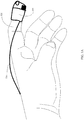
- FIG. 3A illustrates a generalized view of an exemplary oxygen saturation sensing device design for use in sleep study monitoring.
- the present design may be configured to work with currently approved Type II, Type III, and Type IV pulse-oximetry oxygen sensing devices.
- a respiratory therapist, doctor, registered polysomnographic technologist, clinician, or other operator may position oxygen sensor 310 over patient's finger 320 and attach the sensor, which may be employing an adhesive backing mechanism, in accordance with directions for employing the sensor.
- Oxygen sensor 310 such as a pulse-oximetry sensor, may communicate signals to a PSG recorder over signal cable 330.
- Signal cable 330 may be routed along the hand, backside of wrist, and along the arm of the patient in a comfortable manner, such as using the patient's non-dominant arm.
- the respiratory therapist may check the patient's commercial or regular driver's license, passport, and like documentation to positively confirm patient's identity, and record the identifying information on a test form.
- the therapist may record serial numbers from one or more identification bands and the date and time of study. The therapist may ask the patient to review the test form for accuracy and then sign the form.
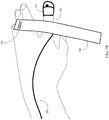
- FIG. 3B illustrates an exemplary identification band positioned to cover an oxygen saturation monitoring device signal cable and lay across a patient's finger.
- the identification bands may include tamper-proof bands.
- the identification bands may be any suitable identification band including those that are non-abrasive, malleable, tamper resistant or tamper evident.
- the present design may involve identification bands exhibiting unique serial numbers, markable such as by using a pen, and the band's material shreds and/or tears when removed. With respect to the serial numbers and markings used to distinguish the identification bands, unique is meant to indicate that the serial number or markings are unusual, not common, or not easily reproduced.
- Suitable materials for constructing the disclosed identification bands may include, but is not limited to, Tyvek® (flashspun high-density polyethylene fiber material), plastic, vinyl, polyvinyl chloride (PVC), and various metals and fabrics.
- Tyvek® flashspun high-density polyethylene fiber material
- plastic vinyl, polyvinyl chloride (PVC)
- PVC polyvinyl chloride
- the present design may configure one of these materials, or a combination of these materials, for exhibiting tampering evidence when removed, such as tear marks resulting from being torn and shredded during removal.
- Identification band 340 is positioned over the patient's finger 320 where oxygen sensor 310 is attached.
- the respiratory therapist may lay identification band 340 in a near perpendicular relationship to the patient's finger and arranged to cover signal cable 330.
- FIG. 3B illustrates the identification bands integral serial number 350 facing outward in a manner for easy viewing.
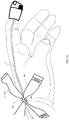
- FIG. 3C illustrates an identification band tied in a knot around the oxygen saturation sensing device signal cable positioned at the patient's finger.
- the respiratory therapist may configure identification band 340 by forming a loop arrangement available for routing signal cable 330 through the loop and then tighten the loop creating knot 360 in the identification band encircling around the signal cable.
- Knot 360 may include, but is not limited to, types such as overhand, clove hitch, sheet, bowline, and figure eight. Independent of the knot type employed, proper tying and securing are paramount to successful deployment.
- the signal cable can be secured to the band with the adhesive section of the band, or snaps, loops, or the like.
- FIG. 3D illustrates identification band 340 affixed to itself and in an arrangement to position serial number 350 for viewing by appropriate personnel, such as a respiratory therapist.
- the respiratory therapist may wrap each end of identification band 340, in opposite directions, to encircle patient's finger 320.
- the therapist may remove the protective backing and affix the band ends together.
- Other band types may be affixed to the patient according to the band manufacturer instructions. For example a band that employs a single snap on one end of the band, and provides a mate to the snap at the opposite end of the band, may entail the therapist aligning the snap with the mate to affix the band.
- the present design may provide a secure, proof-positive, and uninterruptable sensor device-to-patient arrangement, sufficient for realizing reliable oxygen saturation measurements.
- FIG. 3E is a close up perspective view of signal cable 330 passing through knot 360 formed by affixing the band ends together in accordance with the method disclosed herein.
- Signal cable 330 may provide connector 370 for attaching signal cable 380 at connector 390 to communicate sensor signals for monitoring and recording by portable PSG recorder 110. Prior to test conduct, connector 370 is joined with connector 380 to complete the signal path.
- Serial number 350 is shown positioned for easy viewing by a register therapist. In another embodiment, the therapist may add a separate identification band by where the band is looped around the connection of signal cable 330 and the PSG recorder signal cable 380 where the cables meet and connect via connector 370 being plugged into connector 390.
- the signal cable 330 can be secured to the band placing it directly under the adhesive section of the band, which may be under the serial number 350, or with other securing methods such as snaps, loops, or the like.
- the present design may involve the therapist recording a baseline pulse measurement as a further identity check prior to ambulatory test conduct.
- the baseline pulse measurement may be use as a profile for checking the test results.
- the check may include matching the patient's test results with the previously recorded baseline measurement. In the situation where the profile does not match the test results, the test outcome is deemed unreliable.
- FIG. 4A illustrates an exemplary identification band positioned to cover the oxygen saturation sensing device signal cable and lay across a patient's wrist.
- the identification bands may be tamper-proof, numbered using a unique serial number, and/or designed to shred and/or tear when removed, such as the band types previously described and shown in FIGs. 3B - 3E .
- Identification band 405 and pulse-oximetry sensor device 410 are shown attached to finger 420.
- Identification band 440 is positioned over the patient's wrist 445 and signal cable 430 originating from sensor device 410.
- the respiratory therapist may lay identification band 440 in a near perpendicular relationship to the patient's wrist and arranged to simultaneously cover signal cable 430.
- FIG. 4A illustrates the identification band's integral serial number 450 facing outwards in a manner for easy viewing.
- FIG. 4B illustrates an identification band tied in a knot around the oxygen saturation sensing device signal cable positioned at the patient's wrist.
- the respiratory therapist may configure identification band 440 by forming a loop arrangement available for routing signal cable 430 through the loop and then tighten the loop creating knot 460 in the identification band encircling around the signal cable. The therapist may ensure knot 460 is properly tied and secured prior to placing in-use.
- FIG. 4C illustrates identification band 440 affixed to itself and arranged to position serial number 450 for viewing by a respiratory therapist.
- the respiratory therapist may wrap each end of identification band 440, in opposite directions, to encircle patient's wrist 445.
- the cable can be secured to the band with the adhesive section of the band, or snaps, loops, or the like.
- Band types may be affixed to the patient's wrist in according to manufacturer instructions.
- FIG. 4D illustrates a first and second identification band, each marked by the patient, in an arrangement to position a first and second serial number for viewing by a respiratory therapist.
- identification band 470 is marked at point 471 and identification band 475 is marked at point 476.
- the patient under test such as a commercial truck driver, may mark each identification band with their signature or other mark for ensuring a "chain of custody" is established.
- the individual overseeing the test may mark the identification bands, either separate from or in combination with the patient's mark for improving test reliability.
- FIG. 4E is a perspective view illustrating a loop formed by a signal cable circling around a first identification band affixed at the finger, and a loop formed by the signal cable circling around a second identification band affixed at the wrist.
- FIG. 4E illustrates a further embodiment of the present design where the therapist may loop signal cable 430 around identification band 470 at point 431. In combination with or separately the therapist may loop signal cable 430 around identification band 475 at point 432, again for improving test reliability.
- FIG. 4F shows an exemplary configuration of two identification bands joined together by a bridging identification band 480.
- the bands are shown before affixing to the patient.
- the smaller identification band 475 may be a pediatric identification band or a standard identification band cut to size.
- the larger identification bands, the ones used to encircle a patient's wrist 470 and to bridge 480 the wrist and finger identification bands, may be of the same material or different material.
- the connection between the three bands may be made through the adhesive manufactured on the bands or additional adhesives or attachment devices, such as staples, may be used.
- the bridging identification band 480 may be replaced by another type of material that will be resistant to tearing but show evidence of tampering, such as bands that irreversibly snap together, tape or material treated with pressure sensitive ink, plastic that irreversibly deforms when strained, or a combination of such materials.
- Serial numbers which are used as distinguishing marks and are described above, may be present on the identification bands which help to verify that the same identification bands are present at the conclusion of a test as at the beginning of the test. The serial numbers may be placed to show tampering with the connection between the three identification bands. In other words, if the serial numbers are misaligned, do not match, or otherwise do not appear as they did prior to the start of the test, this shows evidence of tampering.
- FIG. 4G is a representative depiction of a first identification band secured at the finger 475 of a patient and a second identification band secured at the wrist 470 of a patient with a third bridging identification band 480 used to join the first and second bands.
- the third bridging band 480 may be placed under the signal cable 430, as shown, or over the signal cable.
- the adhesive of the third bridging band 480 may be used to secure the signal cable 430 in place with respect to the first and second identification bands, 470 and 475.
- a knot or loop securing any of the identification bands to the signal cable 430 may not be necessary.
- the third bridging band 480 may serve to maintain the relative position of the first 475 and second 475 bands, as shown in FIG. 4G .
- maintaining the relative position of the bands about the wrist and finger prevents the band about the finger from being slid off the finger of the patient without evidence of tampering, and in turn may prevent the transferring of the pulse-oximetry sensor device 410 to another person.
- the third bridging band tears, shreds, necks, delaminates, changes color, or otherwise physically deforms upon tampering.
- the identification bands and identification band configuration used in this depiction may be used with other systems that utilize a finger-tip pulse-oximetry sensor device.
- FIG. 5A illustrates a generalized view of an exemplary oxygen saturation sensing device design indicating where a respiratory therapist marks the signal cable at a crossing point formed when the cable meets a patient's wrist.
- the therapist may place mark 535 on cable 530 and patient wrist 545.
- FIG. 5B illustrates a first identification band tied in a loose knot positioned at the mark on the signal cable.
- the respiratory therapist may configure identification band 540 by forming a loop arrangement available for routing signal cable 530 through the loop and then tighten the loop creating loose knot 560 in the identification band encircling around the signal cable.
- FIG. 5C illustrates a second identification band positioned through the loop formed by the first identification band and tied in a knot positioned at the mark on the signal cable.
- the respiratory therapist may configure second identification band 555 by forming a loop arrangement available for routing signal cable 530 through the loop and then tighten the loop creating knot 561 in identification band 555 encircling around the signal cable.
- the therapist may ensure identification band 555 is pulled at each end to properly tighten knot 561 and identification band 540 is pulled at each end to properly tighten knot 560 are properly tied, tighten, and secured prior to placing in-use.
- FIG. 5D illustrates a first and a second identification band joined together at the mark on the signal cable and circling a patient's wrist.
- Identification band 540 may be affixed to itself and arranged to position serial number 541 for viewing by a respiratory therapist. After the knot is tightened around the signal cable, sufficient for securing the band to the cable, the respiratory therapist may wrap each end of identification band 540, in opposite directions, to encircle patient's wrist 545.
- identification band 555 may be affixed to itself and arranged to position serial number 556 for easy viewing. The respiratory therapist may wrap each end of identification band 555, in opposite directions, to encircle patient's wrist 545. Each band may be affixed to the patient's wrist in according to instructions.
- FIG. 6A illustrates a design employing two identification bands in combination with a tape, positioned to cover an oxygen saturation sensing device and associated signal cable, wrapped to circle around a patient's finger.
- a first identification band 625 may be affixed to the patient's finger and a second identification band 655 may be affixed the patient's wrist as shown.
- the identification bands are designed to shred and tear when removed.
- the therapist may wrap tape 675 in a circle around a test individual's finger positioned to cover pulse-oximetry sensor device 690 in combination with simultaneously covering the sensor's signal cable.
- Tape 675 is constructed from materials used to form the identification bands so that they exhibit shredding and tearing affects on removal.
- the present design may realized using at least one band, affixed at either the patient's finger or wrist, and may include any combination and quantity of bands disclosed herein.
- FIG. 6B illustrates a generalized view of two identification bands exhibiting tampering evidence.
- First identification band 625 exhibits evidence 626 of fraud resulting from an attempt to remove the band.
- second identification band 655 exhibits evidence 656 resulting from an unauthorized attempt to remove the band.
- FIG. 6C illustrates a generalized view of a patient's finger exhibiting a torn tape.
- Tape 675 exhibits evidence 676, in the form of shredding or tearing, resulting from an unauthorized attempt to remove the band.
- the present design may provide for an efficient and financially effective means for providing reliable oxygen saturation monitoring for ambulatory sleep apnea monitoring.
- the present design's protocol may provide for secure, tamper evident, uninterrupted measuring, for managing ambulatory testing.
- FIG. 6D is a generalized view of an identification band at the finger 625 and an identification band at the wrist 655 joined by a bridging band, all showing evidence of tampering.
- the band at the finger 625 shows tampering evidence from an attempt to remove the band 626.
- the band at the wrist 655 shows evidence of an attempt to remove the band at the adhesive point 656.
- the bridging band 660 shows a tear or wrinkle 665 resulting from an attempt to stretch the bridging band.
- the bridging band may be comprised of a material different from the other two identification bands.
- signs of tampering may include fraying of the material, stretching or tearing of the material, discoloration, discoloration due to pressure sensitive ink or dye, fraying or detachment of the bridging band at the points where it is joined to the wrist and finger bands, or any combination thereof.
- the bridging band 660 may also show signs of an attempt to move the oxygen saturation sensor cable when the adhesive of the bridging band is used to hold the sensor cable in place. In such instances, the signs of attempting to move or tampering with the oxygen saturation sensor cable may include the indications listed above for tampering with the bridging band.
- FIG. 7 illustrates the general protocol of the present design.
- box 701 indicates attaching a sensor, such as a pulse-oximetry sensor, to a test subject's finger with a signal cable routed along the patient's hand.
- Box 702 represents configuring an identification band in a loop arrangement to form a knot where the signal cable is routed through the formed loop.
- Box 703 indicates securely fixing the identification band to the patient.
- Box 704 represents connecting a sensor signal cable, such as a pulse-oximetry sensor signal cable, to a monitoring device, such as a portable sleep diagnostic test or polysomnography monitoring system, during test conduct.
- the identification band is configured to encircle the patient's finger and to shred and/or tear when removed. It should be understood that the cable can be secured to the band with the adhesive section of the band, snaps, loops, or the like, in place of a knot.
- FIG. 8 An alternative embodiment is shown in FIG. 8 and operates as follows. Initially, at box 801, appropriate personnel check the patient's identity, such as by using a driver's license to positively confirm identity. Box 802 represents documenting patient identity, such as on the test set-up form. Box 802 may also include documenting the type of ID band(s) being used, as well as serial number(s), size(e.g. pediatric size and/or adult sized), and the date of the test. In optional box 803, the patient may indicate, such as via signature or otherwise, that the information is accurate. Box 804 represents setting up the test device.
- box 805 further can include that the operator/therapist assembles a bridged unit that is made up of bands to be fitted around the patient's finger and wrist that are connected by a third band (see figure 4F ). Additionally, if pre-assembled bridged units are available, box 805 may represent the procurement of a bridged unit.
- Box 806 further represents wrapping an ID band around the pulse-oximetry sensor signal cable near the finger, in an area where the patient would wear a ring, and optionally tying a simple but tight knot in the band with the serial number facing away from the patient. In place of a knot, the cable may be secured to the band with the adhesive section of the band, loops, snaps, or the like.
- Box 807 calls for flattening the band on both sides (with the serial code side away from wrist), and wrapping the two ends around the wrist so they overlap with the unique ID code on top.
- Box 808 indicates removing the adhesive tape liner, and fastening that ID code side securely to the other end.
- Box 809 indicates that the operator/therapist presses down firmly on the ID code area to ensure it cannot be pulled back off without shearing.
- Box 810 indicates that the operator/therapist ensures that the adhesive element cannot be removed with shearing the band or other evidence of tampering.
- Box 811 which is optional, indicates repeating the process with a second ID band on the patient's wrist.
- Box 812 further indicates that if the band around the patient's wrist and on the finger are bridged, the operator/therapist signs or marks across the bridging points such that tampering with the connections between finger and wrist bands at may be more evident. Subsequent to the foregoing, the test is performed.
- Certain embodiments involve the use of passive securing methods, such as an identification band forming a knot, loop or other arrangement around the sensor and associated cable.
- a cable associated with a sensor may be attached to an identification band with the adhesive section of the band or snaps.
- the identification band may include an active component, such as employing wiring creating an electric circuit when the band is looped around the patient, and connected.
- the electric circuit design may be configured to monitor breaking of the electrical circuit to indicate tampering, such as monitoring voltage or current and recording when/if a reading goes to zero.
- Other forms of secure attachment to the patient may be employed.
- the present design is not limited in such attachment techniques. As described herein, multiple loops may be employed, as well as tapes, locking plastic arrangements or other materials that secure around the patient, Tyvek® (flashspun high-density polyethylene fiber material), other attachments, and so forth. And while some embodiments of the present device illustrates attachment around a wrist of a patient, other embodiments may attach to ankle/calf regions, neck, arm, around the head, or other appropriate locations on the patient depending on the needs of the test and requirements for securing. While sleep testing for apnea situations is disclosed in some embodiments, the present invention is not limited and may be used for other patient testing that may benefit from secure attachment to the patient.
- embodiments of the present design provide for tamper evident and tamper resistant ambulatory monitoring of a patient's oxygen saturation level, during the course of an overnight sleep study, and affords a high degree of control over the monitoring of signals generated from a pulse-oximetry sensor that advantageously positions and affixes the sensor and associated signal cable for reduced risk of fraud during test conduct.
- the system is thus configured to provide an identification band for fixing the signal cable to the patient's wrist or finger.
- a bridging identification band may be used to bridge two identification bands at the wrist and finger or two similarly adjacent locations on the body, such that the relative position of the two bands is maintained.
- a bridging identification band may additionally secure a sensor cable in place, such that tampering with the position of the sensor cable will be evident.
- the identification band material is able to retain markings from a pen, stamp, or like writing instrument.
- a tape configured to shred and/or tear when removed may be wrapped around the sensor and cable in combination with using the identification band(s).
Landscapes
- Health & Medical Sciences (AREA)
- Life Sciences & Earth Sciences (AREA)
- Engineering & Computer Science (AREA)
- Physics & Mathematics (AREA)
- Surgery (AREA)
- Biomedical Technology (AREA)
- Medical Informatics (AREA)
- General Health & Medical Sciences (AREA)
- Public Health (AREA)
- Heart & Thoracic Surgery (AREA)
- Molecular Biology (AREA)
- Pathology (AREA)
- Animal Behavior & Ethology (AREA)
- Veterinary Medicine (AREA)
- Biophysics (AREA)
- Optics & Photonics (AREA)
- Cardiology (AREA)
- Physiology (AREA)
- Spectroscopy & Molecular Physics (AREA)
- Nuclear Medicine, Radiotherapy & Molecular Imaging (AREA)
- Oral & Maxillofacial Surgery (AREA)
- Pulmonology (AREA)
- Business, Economics & Management (AREA)
- General Business, Economics & Management (AREA)
- Epidemiology (AREA)
- Primary Health Care (AREA)
- Measurement Of The Respiration, Hearing Ability, Form, And Blood Characteristics Of Living Organisms (AREA)
Claims (13)
- Appareil comprenant :une première bande d'identification (475) formant une boucle, dans laquelle la première bande d'identification (475) montre une preuve d'altération lors du retrait, la preuve d'altération comprenant le déchiquetage, la déchirure, la décoloration, la délamination ou le changement de dimensions physiques ; etun capteur de saturation d'oxygène (410) ; caractérisé en ce que l'appareil comprend en outre :une deuxième bande d'identification (470) formant une boucle, dans laquelle la deuxième bande d'identification (470) montre une preuve d'altération lors du retrait, la preuve d'altération comprenant le déchiquetage, la déchirure, la décoloration, la délamination ou le changement de dimensions physiques ; une bande de transition (480) connectée aux première et deuxième bandes d'identification ; etun câble de signal de capteur (430) fixé au capteur de saturation d'oxygène (410) et passé par la boucle formée par la première bande d'identification (475), étendue le long de la bande de transition (480), et passé par la boucle formée par la deuxième bande d'identification (470).
- Appareil selon la revendication 1, dans lequel la première bande d'identification (475) est configurée pour être placée autour d'un doigt d'un patient et la deuxième bande d'identification (470) est configurée pour être placée autour d'un poignet du patient.
- Appareil selon l'une quelconque des revendications précédentes, dans lequel les première (475) et deuxième (470) bandes d'identification comprennent des numéros de série.
- Appareil selon la revendication 3, dans lequel les première (475) et deuxième (470) bandes d'identification comprennent en outre des patchs adhésifs ou des fixations de sécurité à usage unique.
- Appareil selon l'une quelconque des revendications précédentes, dans lequel le capteur (410) est un capteur d'oxymétrie de pouls et l'appareil est configuré pour, lorsqu'il est installé sur un patient, surveiller la saturation en oxygène du patient à l'aide des informations obtenues à partir du capteur d'oxymétrie de pouls (410) afin de déterminer la probabilité du trouble du sommeil du patient.
- Appareil selon la revendication 5, dans lequel le trouble du sommeil est l'apnée du sommeil.
- Procédé pour la fixation de manière sûre d'un capteur sur un patient, comprenant :la fixation d'un capteur de saturation d'oxygène (410) avec un câble de signal de capteur (330, 430) au doigt d'un patient, dans lequel le câble de signal de capteur est fixé au capteur de saturation d'oxygène ;la formation d'une première boucle dans une première bande d'identification (475), dans laquelle la première bande d'identification (475) est configurée pour montrer des preuves d'altération lors du retrait, la preuve d'altération comprenant le déchiquetage, la déchirure, la décoloration, la délamination ou le changement de dimensions physiques ;caractérisé en ce que le procédé comprend en outre :la formation d'une deuxième boucle dans une deuxième bande d'identification (470), dans laquelle la deuxième bande d'identification est configurée pour montrer des preuves d'altération lors du retrait, la preuve d'altération comprenant le déchiquetage, la déchirure, la décoloration, la délamination ou le changement de dimensions physiques, et la connexion d'une bande de transition (480) à la première bande d'identification (475) et à la deuxième bande d'identification (470) ; etle passage du câble de signal du capteur (330, 430) à travers la boucle formée à partir de la première bande d'identification (475) et la boucle formée à partir de la deuxième bande d'identification (470), le câble de signal du capteur s'étendant le long de la bande de transition (480) ;
- Procédé selon la revendication 7, comprenant en outre :la configuration de la première bande d'identification (475) avec des numéros de série uniques dans un agencement sécurisé, dans lequel l'agencement sécurisé maintient le capteur (410) au câble de signal du capteur (330, 430) ; etla connexion du câble de signal du capteur (330, 430) à un système de surveillance de test de diagnostic (110).
- Procédé selon la revendication 7 ou 8, comprenant en outre la configuration de la deuxième bande d'identification (470) qui est connectée au câble de signal du capteur (330, 430) à fixer sur le patient.
- Procédé selon la revendication 9, dans lequel la deuxième bande d'identification (470) est située à la base d'un doigt au-dessus du poignet.
- Procédé selon la revendication 10, comprenant la fixation du câble de signal du capteur (330, 430) en place à l'aide de la bande de transition (480), de sorte que l'altération de la position du câble de signal du capteur soit évidente.
- Procédé selon l'une quelconque des revendications 8 à 11, comprenant en outre la connexion d'un câble de signal d'entrée du système d'enregistrement PSG (polysonographie) (380) au câble de signal du capteur (330), en encerclant une connexion formée là où le câble de signal du capteur (330) rencontre et se connecte au câble de signal d'entrée du système d'enregistrement PSG (380) avec la première bande d'identification (475) ou la deuxième bande d'identification (470) ; et la connexion du câble de signal d'entrée du système d'enregistrement PSG (380) à un système de surveillance de diagnostic (110).
- Procédé selon l'une quelconque des revendications 7 à 12, comprenant en outre :la formation d'une troisième boucle avec le câble de signal du capteur (330, 430) ; etle passage d'au moins une des première bande d'identification (475) et deuxième bande d'identification (470) à travers la troisième boucle.
Applications Claiming Priority (2)
| Application Number | Priority Date | Filing Date | Title |
|---|---|---|---|
| US12/928,903 US8771185B2 (en) | 2010-12-22 | 2010-12-22 | System and method for reliable sleep diagnostic testing |
| PCT/US2011/065646 WO2012087843A2 (fr) | 2010-12-22 | 2011-12-16 | Système et procédé perfectionnés de surveillance de saturation en oxygène |
Publications (4)
| Publication Number | Publication Date |
|---|---|
| EP2654565A2 EP2654565A2 (fr) | 2013-10-30 |
| EP2654565A4 EP2654565A4 (fr) | 2017-03-29 |
| EP2654565B1 true EP2654565B1 (fr) | 2019-11-13 |
| EP2654565B8 EP2654565B8 (fr) | 2020-11-11 |
Family
ID=46314785
Family Applications (1)
| Application Number | Title | Priority Date | Filing Date |
|---|---|---|---|
| EP11852192.1A Not-in-force EP2654565B8 (fr) | 2010-12-22 | 2011-12-16 | Système et procédé perfectionnés de surveillance de saturation en oxygène |
Country Status (3)
| Country | Link |
|---|---|
| US (3) | US8771185B2 (fr) |
| EP (1) | EP2654565B8 (fr) |
| WO (1) | WO2012087843A2 (fr) |
Families Citing this family (14)
| Publication number | Priority date | Publication date | Assignee | Title |
|---|---|---|---|---|
| US20100274104A1 (en) * | 2007-10-09 | 2010-10-28 | Khan Sitara R | Infant/child monitor |
| US8771185B2 (en) | 2010-12-22 | 2014-07-08 | Sleepsafe Drivers, Inc. | System and method for reliable sleep diagnostic testing |
| WO2013022911A1 (fr) | 2011-08-10 | 2013-02-14 | Wristdocs Llc | Système biotélémétrique |
| WO2014189545A1 (fr) * | 2013-05-20 | 2014-11-27 | Wristdocs Llc | Capteur d'oxymètre de pouls |
| EP3232913B1 (fr) * | 2014-12-18 | 2022-05-04 | Koninklijke Philips N.V. | Système et procédé de détection de sommeil lent profond |
| GB2587297B (en) | 2015-03-31 | 2021-08-04 | Fisher & Paykel Healthcare Ltd | A user interface and system for supplying gases to an airway |
| CN105232057A (zh) * | 2015-11-23 | 2016-01-13 | 康泰医学系统(秦皇岛)股份有限公司 | 一种利于长时间佩戴的血氧探头 |
| US10617302B2 (en) | 2016-07-07 | 2020-04-14 | Masimo Corporation | Wearable pulse oximeter and respiration monitor |
| KR20240157114A (ko) | 2016-08-11 | 2024-10-31 | 피셔 앤 페이켈 핼스케어 리미티드 | 압궤 가능 도관, 환자 인터페이스 및 헤드기어 연결부 |
| CN108567434A (zh) * | 2018-05-15 | 2018-09-25 | 无锡市人民医院 | 一种人工智能睡眠呼吸障碍疾病自筛查系统 |
| US12495968B2 (en) | 2018-10-12 | 2025-12-16 | Masimo Corporation | System for transmission of sensor data using dual communication protocol |
| CA3115108A1 (fr) | 2018-10-12 | 2020-04-16 | Masimo Corporation | Systeme de transmission de donnees d'un capteur a l'aide d'un protocole de communication double |
| WO2023132952A1 (fr) * | 2022-01-05 | 2023-07-13 | Masimo Corporation | Système d'oxymétrie de pouls porté au poignet et au doigt |
| WO2024184896A1 (fr) * | 2023-03-09 | 2024-09-12 | Itamar Medical Ltd | Sonde de doigt optique pour mesure non invasive de paramètres physiologiques |
Family Cites Families (59)
| Publication number | Priority date | Publication date | Assignee | Title |
|---|---|---|---|---|
| US3153869A (en) * | 1961-12-01 | 1964-10-27 | Avery Products Corp | Identification band |
| US3698383A (en) * | 1970-07-20 | 1972-10-17 | Baxter Laboratories Inc | Recipient identification |
| US4121360A (en) * | 1977-09-06 | 1978-10-24 | Vlerebome June S | Identification bracelet |
| US5452930A (en) * | 1993-10-07 | 1995-09-26 | Morgan; Brian R. | Tamper evident security device |
| US5631446A (en) * | 1995-06-07 | 1997-05-20 | Hughes Electronics | Microstrip flexible printed wiring board interconnect line |
| US20070148393A1 (en) * | 2003-08-05 | 2007-06-28 | Sellars Neil G | Reactive labels and methods of making and using the same |
| CA2162637C (fr) * | 1995-11-10 | 2000-04-25 | Secure Luggage Systems Inc. | Methode d'emballage de bagages |
| CN1310616C (zh) * | 1996-04-08 | 2007-04-18 | 精工爱普生株式会社 | 锻炼测验用辅助装置 |
| US5904646A (en) * | 1997-09-08 | 1999-05-18 | Jarvik; Robert | Infection resistant power cable system for medically implanted electric motors |
| US7047682B2 (en) * | 2002-09-27 | 2006-05-23 | Laser Band, Llc | Wristband/label assembly business form and method |
| US7017294B2 (en) * | 2002-09-27 | 2006-03-28 | Laser Band, Llc | Wristband/cinch with inboard label assembly business form and method |
| IL124787A0 (en) * | 1998-06-07 | 1999-01-26 | Itamar Medical C M 1997 Ltd | Pressure applicator devices particularly useful for non-invasive detection of medical conditions |
| US6220876B1 (en) * | 1998-09-29 | 2001-04-24 | Delphi Technologies, Inc. | Electrical interconnect system and method for integrating a bussed electrical distribution center with a printed circuit board |
| US6050119A (en) * | 1999-01-25 | 2000-04-18 | Potts; Fran | Universal key ring assembly |
| US6382204B1 (en) * | 1999-10-14 | 2002-05-07 | Becton Dickinson And Company | Drug delivery system including holder and drug container |
| GB9924415D0 (en) * | 1999-10-16 | 1999-12-15 | Glaxo Group Ltd | Medicament pack |
| US6377829B1 (en) | 1999-12-09 | 2002-04-23 | Masimo Corporation | Resposable pulse oximetry sensor |
| US6588812B1 (en) * | 2001-02-22 | 2003-07-08 | The Regents Of The University Of California | Enhanced tamper indicator |
| US6600956B2 (en) * | 2001-08-21 | 2003-07-29 | Cyberonics, Inc. | Circumneural electrode assembly |
| US7204425B2 (en) * | 2002-03-18 | 2007-04-17 | Precision Dynamics Corporation | Enhanced identification appliance |
| EP1575438A4 (fr) * | 2002-08-08 | 2011-03-23 | Scott Lab Inc | Systeme de kit de reanimation et procede associe, et protocoles de pre-utilisation destines a un systeme de sedation et d'analgesie |
| US7779569B2 (en) * | 2002-09-27 | 2010-08-24 | Laser Band, Llc | Business form and self-laminating wristband with improved print area and single layer straps |
| US20040138535A1 (en) * | 2003-01-13 | 2004-07-15 | Ogilvie John W.L. | Recreational facility with security and medical screening |
| US7423526B2 (en) * | 2003-01-29 | 2008-09-09 | Despotis George J | Integrated patient diagnostic and identification system |
| US7462149B2 (en) * | 2003-05-19 | 2008-12-09 | Alcohol Monitoring Systems, Inc. | Method and apparatus for remote blood alcohol monitoring |
| US20040260154A1 (en) | 2003-06-18 | 2004-12-23 | Boris Sidelnik | Human physiological and chemical monitoring system |
| US20050125363A1 (en) * | 2003-10-16 | 2005-06-09 | Wilson Charles E. | System and method for authorizing transactions |
| WO2005105217A1 (fr) * | 2004-04-28 | 2005-11-10 | Mine Safety Appliances Company | Dispositifs, systemes et procedes pour la descente en urgence d'une hauteur |
| US20100056886A1 (en) | 2004-07-09 | 2010-03-04 | Jean Denis Hurtubise | Vital sign monitor system and method |
| EP1812880A2 (fr) * | 2004-09-30 | 2007-08-01 | Koninklijke Philips Electronics N.V. | Systeme automatique continu et fiable d'identification d'un patient permettant d'associer des dispositifs medicaux sans fil a des patients |
| US7388493B2 (en) * | 2004-10-08 | 2008-06-17 | Bartronics America, Inc. | Method and system for preventing unauthorized removal and use of an RFID apparatus |
| US20060225332A1 (en) * | 2005-03-21 | 2006-10-12 | Zenisek Robert F | Luggage tampering detection system |
| JP2009500133A (ja) * | 2005-07-08 | 2009-01-08 | フォード, ジョン ピー. | 全身抗癌療法のための定量および安全およびコンプライアンスパッケージング |
| US20070073116A1 (en) | 2005-08-17 | 2007-03-29 | Kiani Massi E | Patient identification using physiological sensor |
| KR20080059438A (ko) * | 2005-10-13 | 2008-06-27 | 시큐로씰 피티와이 리미티드 | 변형 표시 밴드 |
| JP2007117591A (ja) * | 2005-10-31 | 2007-05-17 | Konica Minolta Sensing Inc | 脈波解析装置 |
| EP1962632A4 (fr) * | 2005-12-07 | 2010-07-07 | Sato Kk | Bande d'identification neonatale |
| EP2104451A4 (fr) * | 2006-01-25 | 2010-01-06 | Pipex Inc | Dispositifs de recueil de gouttelettes et méthodes de détection et de contrôle de maladies transmissibles par l'air, utilisant un rfid |
| US7481370B2 (en) * | 2006-05-02 | 2009-01-27 | Typenex Medical, L.L.C. | Removable patient identification strap for blood recipient verification |
| US20080021334A1 (en) * | 2006-07-19 | 2008-01-24 | Finburgh Simon E | Apparatus and methods for non-invasively measuring hemodynamic parameters |
| US7621269B2 (en) * | 2006-08-16 | 2009-11-24 | Rescue Air Systems, Inc. | Breathable air safety system and method having at least one fill site |
| US8396527B2 (en) * | 2006-09-22 | 2013-03-12 | Covidien Lp | Medical sensor for reducing signal artifacts and technique for using the same |
| EP2096617A4 (fr) * | 2006-12-25 | 2010-10-27 | Sato Kk | Poignet et son procédé d'utilisation |
| WO2008154686A1 (fr) * | 2007-06-19 | 2008-12-24 | Securoseal Pty Ltd | Système de sécurité pour les articles en transit |
| US20080319327A1 (en) * | 2007-06-25 | 2008-12-25 | Triage Wireless, Inc. | Body-worn sensor featuring a low-power processor and multi-sensor array for measuring blood pressure |
| US7750815B2 (en) * | 2008-02-22 | 2010-07-06 | Quantum Electronics Ltd. | Portable monitoring apparatus with over the air programming and sampling volume collection cavity |
| US20100231378A1 (en) * | 2008-06-16 | 2010-09-16 | Linda Rosita Ward | Personal Security System |
| US8028450B2 (en) * | 2008-07-31 | 2011-10-04 | Typenex Medical, Llc | Recipient verification systems and methods of use including recipient identification |
| US8679012B1 (en) | 2008-08-13 | 2014-03-25 | Cleveland Medical Devices Inc. | Medical device and method with improved biometric verification |
| US8909330B2 (en) * | 2009-05-20 | 2014-12-09 | Sotera Wireless, Inc. | Body-worn device and associated system for alarms/alerts based on vital signs and motion |
| US8444570B2 (en) * | 2009-06-09 | 2013-05-21 | Nellcor Puritan Bennett Ireland | Signal processing techniques for aiding the interpretation of respiration signals |
| US8505821B2 (en) * | 2009-06-30 | 2013-08-13 | Covidien Lp | System and method for providing sensor quality assurance |
| US8490307B2 (en) * | 2009-08-07 | 2013-07-23 | Typenex Medical, Llc | Patient identification systems and methods of use, including recipient verification |
| US20110115221A1 (en) * | 2009-11-17 | 2011-05-19 | Charlotte Kaplan | Decorative knot sequence and method for its formation |
| US8591411B2 (en) * | 2010-03-10 | 2013-11-26 | Sotera Wireless, Inc. | Body-worn vital sign monitor |
| US8410926B1 (en) * | 2010-05-07 | 2013-04-02 | Rf Technologies, Inc. | Alarm for security tag |
| US20120071741A1 (en) * | 2010-09-21 | 2012-03-22 | Zahra Moussavi | Sleep apnea monitoring and diagnosis based on pulse oximetery and tracheal sound signals |
| US8771185B2 (en) * | 2010-12-22 | 2014-07-08 | Sleepsafe Drivers, Inc. | System and method for reliable sleep diagnostic testing |
| US8887313B2 (en) * | 2012-03-30 | 2014-11-18 | Aaron McGuin | Wrap for human appendage |
-
2010
- 2010-12-22 US US12/928,903 patent/US8771185B2/en active Active
-
2011
- 2011-12-16 EP EP11852192.1A patent/EP2654565B8/fr not_active Not-in-force
- 2011-12-16 WO PCT/US2011/065646 patent/WO2012087843A2/fr not_active Ceased
- 2011-12-16 US US13/328,995 patent/US9754079B2/en not_active Expired - Fee Related
-
2017
- 2017-04-18 US US15/490,366 patent/US11284821B2/en active Active
Non-Patent Citations (1)
| Title |
|---|
| None * |
Also Published As
| Publication number | Publication date |
|---|---|
| WO2012087843A2 (fr) | 2012-06-28 |
| WO2012087843A3 (fr) | 2012-08-09 |
| EP2654565A4 (fr) | 2017-03-29 |
| US9754079B2 (en) | 2017-09-05 |
| US20120165630A1 (en) | 2012-06-28 |
| US20120165628A1 (en) | 2012-06-28 |
| US20170215799A1 (en) | 2017-08-03 |
| US8771185B2 (en) | 2014-07-08 |
| US11284821B2 (en) | 2022-03-29 |
| EP2654565A2 (fr) | 2013-10-30 |
| EP2654565B8 (fr) | 2020-11-11 |
Similar Documents
| Publication | Publication Date | Title |
|---|---|---|
| US11284821B2 (en) | Advanced system and method for oxygen saturation monitoring | |
| US8485448B2 (en) | Tamper-proof identification device particularly useful as a bracelet to be applied to the wrist or ankle of a patient | |
| US6922148B2 (en) | Patient identification system | |
| US6377829B1 (en) | Resposable pulse oximetry sensor | |
| US6255951B1 (en) | Electronic identification bracelet | |
| US20020084904A1 (en) | Electronic identification apparatus | |
| CA2478677A1 (fr) | Appareil d'identification ameliore | |
| US6579252B2 (en) | Safety indicium to protect body extremities | |
| JP2007105316A (ja) | 生体情報測定器 | |
| US20160287134A1 (en) | An apparatus and method for tracking a device | |
| US7684842B2 (en) | System and method for preventing sensor misuse | |
| US6428492B2 (en) | Safety sleeve to protect body extremities | |
| US20080028654A1 (en) | Patient status system | |
| WO2020008456A1 (fr) | Bande d'identification résistante à la déchirure | |
| EP3669782A1 (fr) | Chapeau et système de surveillance | |
| JP2023156403A (ja) | 装置及びシステム | |
| KR101475501B1 (ko) | 수면 무호흡 환자를 위한 스마트 안대, 그리고 이를 이용한 수면 무호흡 환자 보호 방법 | |
| US5711425A (en) | Method and apparatus for indicating a dosage of medicine | |
| CN213664016U (zh) | 一种医用儿童手环以及医用智能系统 | |
| US20130096389A1 (en) | Chain of custody for physiological monitoring system | |
| CN101268874A (zh) | 具有射频识别标签的抛弃式腕带 | |
| JP3119049U (ja) | 投薬監視システムおよび投薬監視装置 | |
| US20180368746A1 (en) | Sensor and vital sign information processing system | |
| US11523758B2 (en) | SpO2 sensor having partitioned electronics | |
| US20200022645A1 (en) | Methods and apparatus for sleep testing |
Legal Events
| Date | Code | Title | Description |
|---|---|---|---|
| PUAI | Public reference made under article 153(3) epc to a published international application that has entered the european phase |
Free format text: ORIGINAL CODE: 0009012 |
|
| 17P | Request for examination filed |
Effective date: 20130718 |
|
| AK | Designated contracting states |
Kind code of ref document: A2 Designated state(s): AL AT BE BG CH CY CZ DE DK EE ES FI FR GB GR HR HU IE IS IT LI LT LU LV MC MK MT NL NO PL PT RO RS SE SI SK SM TR |
|
| DAX | Request for extension of the european patent (deleted) | ||
| A4 | Supplementary search report drawn up and despatched |
Effective date: 20170224 |
|
| RIC1 | Information provided on ipc code assigned before grant |
Ipc: A61B 5/087 20060101ALI20170220BHEP Ipc: G09F 3/00 20060101ALI20170220BHEP Ipc: A61B 5/00 20060101ALI20170220BHEP Ipc: A61B 5/1455 20060101AFI20170220BHEP Ipc: A61B 90/90 20160101ALI20170220BHEP |
|
| STAA | Information on the status of an ep patent application or granted ep patent |
Free format text: STATUS: EXAMINATION IS IN PROGRESS |
|
| 17Q | First examination report despatched |
Effective date: 20180124 |
|
| RIC1 | Information provided on ipc code assigned before grant |
Ipc: A61B 5/1455 20060101AFI20170220BHEP Ipc: A61B 90/90 20160101ALI20170220BHEP Ipc: A61B 5/00 20060101ALI20170220BHEP Ipc: A61B 5/087 20060101ALI20170220BHEP Ipc: G09F 3/00 20060101ALI20170220BHEP |
|
| RIC1 | Information provided on ipc code assigned before grant |
Ipc: A61B 90/90 20160101ALI20170220BHEP Ipc: G09F 3/00 20060101ALI20170220BHEP Ipc: A61B 5/087 20060101ALI20170220BHEP Ipc: A61B 5/00 20060101ALI20170220BHEP Ipc: A61B 5/1455 20060101AFI20170220BHEP |
|
| GRAP | Despatch of communication of intention to grant a patent |
Free format text: ORIGINAL CODE: EPIDOSNIGR1 |
|
| STAA | Information on the status of an ep patent application or granted ep patent |
Free format text: STATUS: GRANT OF PATENT IS INTENDED |
|
| INTG | Intention to grant announced |
Effective date: 20190605 |
|
| RIN1 | Information on inventor provided before grant (corrected) |
Inventor name: KNIGHT, ADRIAN Inventor name: VOIEN, DANA |
|
| GRAS | Grant fee paid |
Free format text: ORIGINAL CODE: EPIDOSNIGR3 |
|
| GRAA | (expected) grant |
Free format text: ORIGINAL CODE: 0009210 |
|
| STAA | Information on the status of an ep patent application or granted ep patent |
Free format text: STATUS: THE PATENT HAS BEEN GRANTED |
|
| AK | Designated contracting states |
Kind code of ref document: B1 Designated state(s): AL AT BE BG CH CY CZ DE DK EE ES FI FR GB GR HR HU IE IS IT LI LT LU LV MC MK MT NL NO PL PT RO RS SE SI SK SM TR |
|
| REG | Reference to a national code |
Ref country code: GB Ref legal event code: FG4D |
|
| REG | Reference to a national code |
Ref country code: CH Ref legal event code: EP Ref country code: AT Ref legal event code: REF Ref document number: 1200838 Country of ref document: AT Kind code of ref document: T Effective date: 20191115 |
|
| REG | Reference to a national code |
Ref country code: DE Ref legal event code: R096 Ref document number: 602011063413 Country of ref document: DE |
|
| REG | Reference to a national code |
Ref country code: IE Ref legal event code: FG4D |
|
| REG | Reference to a national code |
Ref country code: NL Ref legal event code: MP Effective date: 20191113 |
|
| REG | Reference to a national code |
Ref country code: LT Ref legal event code: MG4D |
|
| PG25 | Lapsed in a contracting state [announced via postgrant information from national office to epo] |
Ref country code: FI Free format text: LAPSE BECAUSE OF FAILURE TO SUBMIT A TRANSLATION OF THE DESCRIPTION OR TO PAY THE FEE WITHIN THE PRESCRIBED TIME-LIMIT Effective date: 20191113 Ref country code: BG Free format text: LAPSE BECAUSE OF FAILURE TO SUBMIT A TRANSLATION OF THE DESCRIPTION OR TO PAY THE FEE WITHIN THE PRESCRIBED TIME-LIMIT Effective date: 20200213 Ref country code: NO Free format text: LAPSE BECAUSE OF FAILURE TO SUBMIT A TRANSLATION OF THE DESCRIPTION OR TO PAY THE FEE WITHIN THE PRESCRIBED TIME-LIMIT Effective date: 20200213 Ref country code: ES Free format text: LAPSE BECAUSE OF FAILURE TO SUBMIT A TRANSLATION OF THE DESCRIPTION OR TO PAY THE FEE WITHIN THE PRESCRIBED TIME-LIMIT Effective date: 20191113 Ref country code: SE Free format text: LAPSE BECAUSE OF FAILURE TO SUBMIT A TRANSLATION OF THE DESCRIPTION OR TO PAY THE FEE WITHIN THE PRESCRIBED TIME-LIMIT Effective date: 20191113 Ref country code: PT Free format text: LAPSE BECAUSE OF FAILURE TO SUBMIT A TRANSLATION OF THE DESCRIPTION OR TO PAY THE FEE WITHIN THE PRESCRIBED TIME-LIMIT Effective date: 20200313 Ref country code: LV Free format text: LAPSE BECAUSE OF FAILURE TO SUBMIT A TRANSLATION OF THE DESCRIPTION OR TO PAY THE FEE WITHIN THE PRESCRIBED TIME-LIMIT Effective date: 20191113 Ref country code: PL Free format text: LAPSE BECAUSE OF FAILURE TO SUBMIT A TRANSLATION OF THE DESCRIPTION OR TO PAY THE FEE WITHIN THE PRESCRIBED TIME-LIMIT Effective date: 20191113 Ref country code: LT Free format text: LAPSE BECAUSE OF FAILURE TO SUBMIT A TRANSLATION OF THE DESCRIPTION OR TO PAY THE FEE WITHIN THE PRESCRIBED TIME-LIMIT Effective date: 20191113 Ref country code: NL Free format text: LAPSE BECAUSE OF FAILURE TO SUBMIT A TRANSLATION OF THE DESCRIPTION OR TO PAY THE FEE WITHIN THE PRESCRIBED TIME-LIMIT Effective date: 20191113 Ref country code: GR Free format text: LAPSE BECAUSE OF FAILURE TO SUBMIT A TRANSLATION OF THE DESCRIPTION OR TO PAY THE FEE WITHIN THE PRESCRIBED TIME-LIMIT Effective date: 20200214 |
|
| PG25 | Lapsed in a contracting state [announced via postgrant information from national office to epo] |
Ref country code: IS Free format text: LAPSE BECAUSE OF FAILURE TO SUBMIT A TRANSLATION OF THE DESCRIPTION OR TO PAY THE FEE WITHIN THE PRESCRIBED TIME-LIMIT Effective date: 20200313 Ref country code: HR Free format text: LAPSE BECAUSE OF FAILURE TO SUBMIT A TRANSLATION OF THE DESCRIPTION OR TO PAY THE FEE WITHIN THE PRESCRIBED TIME-LIMIT Effective date: 20191113 Ref country code: RS Free format text: LAPSE BECAUSE OF FAILURE TO SUBMIT A TRANSLATION OF THE DESCRIPTION OR TO PAY THE FEE WITHIN THE PRESCRIBED TIME-LIMIT Effective date: 20191113 |
|
| PG25 | Lapsed in a contracting state [announced via postgrant information from national office to epo] |
Ref country code: AL Free format text: LAPSE BECAUSE OF FAILURE TO SUBMIT A TRANSLATION OF THE DESCRIPTION OR TO PAY THE FEE WITHIN THE PRESCRIBED TIME-LIMIT Effective date: 20191113 |
|
| REG | Reference to a national code |
Ref country code: DE Ref legal event code: R119 Ref document number: 602011063413 Country of ref document: DE |
|
| PG25 | Lapsed in a contracting state [announced via postgrant information from national office to epo] |
Ref country code: DK Free format text: LAPSE BECAUSE OF FAILURE TO SUBMIT A TRANSLATION OF THE DESCRIPTION OR TO PAY THE FEE WITHIN THE PRESCRIBED TIME-LIMIT Effective date: 20191113 Ref country code: EE Free format text: LAPSE BECAUSE OF FAILURE TO SUBMIT A TRANSLATION OF THE DESCRIPTION OR TO PAY THE FEE WITHIN THE PRESCRIBED TIME-LIMIT Effective date: 20191113 Ref country code: CZ Free format text: LAPSE BECAUSE OF FAILURE TO SUBMIT A TRANSLATION OF THE DESCRIPTION OR TO PAY THE FEE WITHIN THE PRESCRIBED TIME-LIMIT Effective date: 20191113 Ref country code: RO Free format text: LAPSE BECAUSE OF FAILURE TO SUBMIT A TRANSLATION OF THE DESCRIPTION OR TO PAY THE FEE WITHIN THE PRESCRIBED TIME-LIMIT Effective date: 20191113 |
|
| REG | Reference to a national code |
Ref country code: CH Ref legal event code: PL |
|
| REG | Reference to a national code |
Ref country code: AT Ref legal event code: MK05 Ref document number: 1200838 Country of ref document: AT Kind code of ref document: T Effective date: 20191113 |
|
| REG | Reference to a national code |
Ref country code: BE Ref legal event code: MM Effective date: 20191231 |
|
| PG25 | Lapsed in a contracting state [announced via postgrant information from national office to epo] |
Ref country code: MC Free format text: LAPSE BECAUSE OF FAILURE TO SUBMIT A TRANSLATION OF THE DESCRIPTION OR TO PAY THE FEE WITHIN THE PRESCRIBED TIME-LIMIT Effective date: 20191113 Ref country code: SK Free format text: LAPSE BECAUSE OF FAILURE TO SUBMIT A TRANSLATION OF THE DESCRIPTION OR TO PAY THE FEE WITHIN THE PRESCRIBED TIME-LIMIT Effective date: 20191113 Ref country code: SM Free format text: LAPSE BECAUSE OF FAILURE TO SUBMIT A TRANSLATION OF THE DESCRIPTION OR TO PAY THE FEE WITHIN THE PRESCRIBED TIME-LIMIT Effective date: 20191113 |
|
| GRAT | Correction requested after decision to grant or after decision to maintain patent in amended form |
Free format text: ORIGINAL CODE: EPIDOSNCDEC |
|
| PLBE | No opposition filed within time limit |
Free format text: ORIGINAL CODE: 0009261 |
|
| STAA | Information on the status of an ep patent application or granted ep patent |
Free format text: STATUS: NO OPPOSITION FILED WITHIN TIME LIMIT |
|
| 26N | No opposition filed |
Effective date: 20200814 |
|
| RAP2 | Party data changed (patent owner data changed or rights of a patent transferred) |
Owner name: SLEEPSAFEDRIVERS, INC. |
|
| GBPC | Gb: european patent ceased through non-payment of renewal fee |
Effective date: 20200213 |
|
| PG25 | Lapsed in a contracting state [announced via postgrant information from national office to epo] |
Ref country code: LU Free format text: LAPSE BECAUSE OF NON-PAYMENT OF DUE FEES Effective date: 20191216 Ref country code: DE Free format text: LAPSE BECAUSE OF NON-PAYMENT OF DUE FEES Effective date: 20200701 Ref country code: IE Free format text: LAPSE BECAUSE OF NON-PAYMENT OF DUE FEES Effective date: 20191216 Ref country code: FR Free format text: LAPSE BECAUSE OF NON-PAYMENT OF DUE FEES Effective date: 20200113 |
|
| PG25 | Lapsed in a contracting state [announced via postgrant information from national office to epo] |
Ref country code: LI Free format text: LAPSE BECAUSE OF NON-PAYMENT OF DUE FEES Effective date: 20191231 Ref country code: CH Free format text: LAPSE BECAUSE OF NON-PAYMENT OF DUE FEES Effective date: 20191231 Ref country code: BE Free format text: LAPSE BECAUSE OF NON-PAYMENT OF DUE FEES Effective date: 20191231 Ref country code: AT Free format text: LAPSE BECAUSE OF FAILURE TO SUBMIT A TRANSLATION OF THE DESCRIPTION OR TO PAY THE FEE WITHIN THE PRESCRIBED TIME-LIMIT Effective date: 20191113 Ref country code: SI Free format text: LAPSE BECAUSE OF FAILURE TO SUBMIT A TRANSLATION OF THE DESCRIPTION OR TO PAY THE FEE WITHIN THE PRESCRIBED TIME-LIMIT Effective date: 20191113 |
|
| PG25 | Lapsed in a contracting state [announced via postgrant information from national office to epo] |
Ref country code: GB Free format text: LAPSE BECAUSE OF NON-PAYMENT OF DUE FEES Effective date: 20200213 Ref country code: IT Free format text: LAPSE BECAUSE OF FAILURE TO SUBMIT A TRANSLATION OF THE DESCRIPTION OR TO PAY THE FEE WITHIN THE PRESCRIBED TIME-LIMIT Effective date: 20191113 |
|
| PG25 | Lapsed in a contracting state [announced via postgrant information from national office to epo] |
Ref country code: CY Free format text: LAPSE BECAUSE OF FAILURE TO SUBMIT A TRANSLATION OF THE DESCRIPTION OR TO PAY THE FEE WITHIN THE PRESCRIBED TIME-LIMIT Effective date: 20191113 |
|
| PG25 | Lapsed in a contracting state [announced via postgrant information from national office to epo] |
Ref country code: HU Free format text: LAPSE BECAUSE OF FAILURE TO SUBMIT A TRANSLATION OF THE DESCRIPTION OR TO PAY THE FEE WITHIN THE PRESCRIBED TIME-LIMIT; INVALID AB INITIO Effective date: 20111216 Ref country code: MT Free format text: LAPSE BECAUSE OF FAILURE TO SUBMIT A TRANSLATION OF THE DESCRIPTION OR TO PAY THE FEE WITHIN THE PRESCRIBED TIME-LIMIT Effective date: 20191113 |
|
| PG25 | Lapsed in a contracting state [announced via postgrant information from national office to epo] |
Ref country code: TR Free format text: LAPSE BECAUSE OF FAILURE TO SUBMIT A TRANSLATION OF THE DESCRIPTION OR TO PAY THE FEE WITHIN THE PRESCRIBED TIME-LIMIT Effective date: 20191113 |
|
| PG25 | Lapsed in a contracting state [announced via postgrant information from national office to epo] |
Ref country code: MK Free format text: LAPSE BECAUSE OF FAILURE TO SUBMIT A TRANSLATION OF THE DESCRIPTION OR TO PAY THE FEE WITHIN THE PRESCRIBED TIME-LIMIT Effective date: 20191113 |