EP2658514B2 - Reinigungszusammensetzung, insbesondere für künstlich gefärbtes haar - Google Patents
Reinigungszusammensetzung, insbesondere für künstlich gefärbtes haar Download PDFInfo
- Publication number
- EP2658514B2 EP2658514B2 EP11815697.5A EP11815697A EP2658514B2 EP 2658514 B2 EP2658514 B2 EP 2658514B2 EP 11815697 A EP11815697 A EP 11815697A EP 2658514 B2 EP2658514 B2 EP 2658514B2
- Authority
- EP
- European Patent Office
- Prior art keywords
- sodium
- surfactant
- polyquaternium
- composition according
- surfactants
- Prior art date
- Legal status (The legal status is an assumption and is not a legal conclusion. Google has not performed a legal analysis and makes no representation as to the accuracy of the status listed.)
- Active
Links
Classifications
-
- A—HUMAN NECESSITIES
- A61—MEDICAL OR VETERINARY SCIENCE; HYGIENE
- A61K—PREPARATIONS FOR MEDICAL, DENTAL OR TOILETRY PURPOSES
- A61K8/00—Cosmetics or similar toiletry preparations
- A61K8/18—Cosmetics or similar toiletry preparations characterised by the composition
- A61K8/30—Cosmetics or similar toiletry preparations characterised by the composition containing organic compounds
- A61K8/60—Sugars; Derivatives thereof
- A61K8/602—Glycosides, e.g. rutin
-
- A—HUMAN NECESSITIES
- A61—MEDICAL OR VETERINARY SCIENCE; HYGIENE
- A61K—PREPARATIONS FOR MEDICAL, DENTAL OR TOILETRY PURPOSES
- A61K8/00—Cosmetics or similar toiletry preparations
- A61K8/18—Cosmetics or similar toiletry preparations characterised by the composition
- A61K8/30—Cosmetics or similar toiletry preparations characterised by the composition containing organic compounds
- A61K8/33—Cosmetics or similar toiletry preparations characterised by the composition containing organic compounds containing oxygen
- A61K8/39—Derivatives containing from 2 to 10 oxyalkylene groups
-
- A—HUMAN NECESSITIES
- A61—MEDICAL OR VETERINARY SCIENCE; HYGIENE
- A61K—PREPARATIONS FOR MEDICAL, DENTAL OR TOILETRY PURPOSES
- A61K8/00—Cosmetics or similar toiletry preparations
- A61K8/18—Cosmetics or similar toiletry preparations characterised by the composition
- A61K8/30—Cosmetics or similar toiletry preparations characterised by the composition containing organic compounds
- A61K8/40—Cosmetics or similar toiletry preparations characterised by the composition containing organic compounds containing nitrogen
- A61K8/41—Amines
- A61K8/416—Quaternary ammonium compounds
-
- A—HUMAN NECESSITIES
- A61—MEDICAL OR VETERINARY SCIENCE; HYGIENE
- A61K—PREPARATIONS FOR MEDICAL, DENTAL OR TOILETRY PURPOSES
- A61K8/00—Cosmetics or similar toiletry preparations
- A61K8/18—Cosmetics or similar toiletry preparations characterised by the composition
- A61K8/30—Cosmetics or similar toiletry preparations characterised by the composition containing organic compounds
- A61K8/40—Cosmetics or similar toiletry preparations characterised by the composition containing organic compounds containing nitrogen
- A61K8/42—Amides
-
- A—HUMAN NECESSITIES
- A61—MEDICAL OR VETERINARY SCIENCE; HYGIENE
- A61K—PREPARATIONS FOR MEDICAL, DENTAL OR TOILETRY PURPOSES
- A61K8/00—Cosmetics or similar toiletry preparations
- A61K8/18—Cosmetics or similar toiletry preparations characterised by the composition
- A61K8/30—Cosmetics or similar toiletry preparations characterised by the composition containing organic compounds
- A61K8/40—Cosmetics or similar toiletry preparations characterised by the composition containing organic compounds containing nitrogen
- A61K8/44—Aminocarboxylic acids or derivatives thereof, e.g. aminocarboxylic acids containing sulfur; Salts; Esters or N-acylated derivatives thereof
- A61K8/442—Aminocarboxylic acids or derivatives thereof, e.g. aminocarboxylic acids containing sulfur; Salts; Esters or N-acylated derivatives thereof substituted by amido group(s)
-
- A—HUMAN NECESSITIES
- A61—MEDICAL OR VETERINARY SCIENCE; HYGIENE
- A61K—PREPARATIONS FOR MEDICAL, DENTAL OR TOILETRY PURPOSES
- A61K8/00—Cosmetics or similar toiletry preparations
- A61K8/18—Cosmetics or similar toiletry preparations characterised by the composition
- A61K8/30—Cosmetics or similar toiletry preparations characterised by the composition containing organic compounds
- A61K8/46—Cosmetics or similar toiletry preparations characterised by the composition containing organic compounds containing sulfur
- A61K8/463—Cosmetics or similar toiletry preparations characterised by the composition containing organic compounds containing sulfur containing sulfuric acid derivatives, e.g. sodium lauryl sulfate
-
- A—HUMAN NECESSITIES
- A61—MEDICAL OR VETERINARY SCIENCE; HYGIENE
- A61K—PREPARATIONS FOR MEDICAL, DENTAL OR TOILETRY PURPOSES
- A61K8/00—Cosmetics or similar toiletry preparations
- A61K8/18—Cosmetics or similar toiletry preparations characterised by the composition
- A61K8/30—Cosmetics or similar toiletry preparations characterised by the composition containing organic compounds
- A61K8/49—Cosmetics or similar toiletry preparations characterised by the composition containing organic compounds containing heterocyclic compounds
- A61K8/494—Cosmetics or similar toiletry preparations characterised by the composition containing organic compounds containing heterocyclic compounds with more than one nitrogen as the only hetero atom
- A61K8/4946—Imidazoles or their condensed derivatives, e.g. benzimidazoles
-
- A—HUMAN NECESSITIES
- A61—MEDICAL OR VETERINARY SCIENCE; HYGIENE
- A61K—PREPARATIONS FOR MEDICAL, DENTAL OR TOILETRY PURPOSES
- A61K8/00—Cosmetics or similar toiletry preparations
- A61K8/18—Cosmetics or similar toiletry preparations characterised by the composition
- A61K8/30—Cosmetics or similar toiletry preparations characterised by the composition containing organic compounds
- A61K8/60—Sugars; Derivatives thereof
- A61K8/604—Alkylpolyglycosides; Derivatives thereof, e.g. esters
-
- A—HUMAN NECESSITIES
- A61—MEDICAL OR VETERINARY SCIENCE; HYGIENE
- A61Q—SPECIFIC USE OF COSMETICS OR SIMILAR TOILETRY PREPARATIONS
- A61Q5/00—Preparations for care of the hair
- A61Q5/004—Preparations used to protect coloured hair
-
- A—HUMAN NECESSITIES
- A61—MEDICAL OR VETERINARY SCIENCE; HYGIENE
- A61Q—SPECIFIC USE OF COSMETICS OR SIMILAR TOILETRY PREPARATIONS
- A61Q5/00—Preparations for care of the hair
- A61Q5/02—Preparations for cleaning the hair
-
- A—HUMAN NECESSITIES
- A61—MEDICAL OR VETERINARY SCIENCE; HYGIENE
- A61Q—SPECIFIC USE OF COSMETICS OR SIMILAR TOILETRY PREPARATIONS
- A61Q5/00—Preparations for care of the hair
- A61Q5/06—Preparations for styling the hair, e.g. by temporary shaping or colouring
- A61Q5/065—Preparations for temporary colouring the hair, e.g. direct dyes
-
- A—HUMAN NECESSITIES
- A61—MEDICAL OR VETERINARY SCIENCE; HYGIENE
- A61Q—SPECIFIC USE OF COSMETICS OR SIMILAR TOILETRY PREPARATIONS
- A61Q5/00—Preparations for care of the hair
- A61Q5/10—Preparations for permanently dyeing the hair
-
- A—HUMAN NECESSITIES
- A61—MEDICAL OR VETERINARY SCIENCE; HYGIENE
- A61Q—SPECIFIC USE OF COSMETICS OR SIMILAR TOILETRY PREPARATIONS
- A61Q5/00—Preparations for care of the hair
- A61Q5/12—Preparations containing hair conditioners
-
- A—HUMAN NECESSITIES
- A61—MEDICAL OR VETERINARY SCIENCE; HYGIENE
- A61K—PREPARATIONS FOR MEDICAL, DENTAL OR TOILETRY PURPOSES
- A61K2800/00—Properties of cosmetic compositions or active ingredients thereof or formulation aids used therein and process related aspects
- A61K2800/40—Chemical, physico-chemical or functional or structural properties of particular ingredients
- A61K2800/42—Colour properties
- A61K2800/43—Pigments; Dyes
- A61K2800/432—Direct dyes
- A61K2800/4322—Direct dyes in preparations for temporarily coloring the hair further containing an oxidizing agent
-
- A—HUMAN NECESSITIES
- A61—MEDICAL OR VETERINARY SCIENCE; HYGIENE
- A61K—PREPARATIONS FOR MEDICAL, DENTAL OR TOILETRY PURPOSES
- A61K2800/00—Properties of cosmetic compositions or active ingredients thereof or formulation aids used therein and process related aspects
- A61K2800/40—Chemical, physico-chemical or functional or structural properties of particular ingredients
- A61K2800/59—Mixtures
- A61K2800/592—Mixtures of compounds complementing their respective functions
- A61K2800/5922—At least two compounds being classified in the same subclass of A61K8/18
-
- A—HUMAN NECESSITIES
- A61—MEDICAL OR VETERINARY SCIENCE; HYGIENE
- A61K—PREPARATIONS FOR MEDICAL, DENTAL OR TOILETRY PURPOSES
- A61K2800/00—Properties of cosmetic compositions or active ingredients thereof or formulation aids used therein and process related aspects
- A61K2800/80—Process related aspects concerning the preparation of the cosmetic composition or the storage or application thereof
- A61K2800/88—Two- or multipart kits
- A61K2800/884—Sequential application
Definitions
- the present invention relates to an aqueous cleansing composition
- an aqueous cleansing composition comprising at least three anionic surfactants and a non-ionic surfactant providing exceptionally good colour stability for artificially coloured human hair.
- Cleansing compositions have been known for many years. Many patent applications and scientific publications deal with such compositions aiming at cleansing, especially improved conditioning effects after cleansing. Cleansing compositions wash out dirt on the hair and at the same time dyestuffs deposited onto or into hair are also washed out, which leads to shorter colour durability after coloration services and is not economical in terms of frequent hair dressing need and also health of hair. Attempts have been made to reduce colour wash out from coloured hair with various ways. One of them is so called colour sealing which requires application of an additional mostly hydrophobic composition right after colouring hair so that the dyes are not easily solubilised by the high surfactant content of cleansing compositions. The other approach has been to use a special surfactant combination which interacts with dyestuff molecules and also with hair in a lesser extent. None of the approaches are optimal for variably coloured hair and, therefore, there is a great need for further improvements in the field.
- Aim of the present invention is to provide an aqueous cleansing composition having optimal benefits in terms of foam properties measured with its volume and creaminess as well as improved conditioning effects on keratin fibres, especially human hair, providing optimized combability, smoothness, elasticity, softness, volume and body and at the same time washes out artificial hair colour in a lesser extend so that the coloured hair keeps its colour for a longer time and therefore its shine and healthy appearance.
- an aqueous cleansing composition comprising three anionic surfactants and a non-ionic surfactant and free from amphoteric surfactants provides excellent foam and conditioning properties and also washes out less colour from hair so that long lasting colours are achieved.
- the first object of the present invention is an aqueous cleansing composition comprising three anionic surfactants and an alkyl polyglucoside as a nonionic surfactant wherein it is free of amphoteric surfactants and the total surfactant concentration is in the range of 7.5 to 50% by weight calculated to the total of the composition.
- the second object of the present invention is the use of the aqueous cleansing composition of the present invention for cleansing hair especially artificially coloured hair.
- the fourth object of the present invention is kit for treating hair comprising the cleansing composition of the present invention and optionally at least one composition comprising a hair dye.
- compositions actually do not comprise amphoteric surfactant but small quantities may be comprised which does not disturb in solving the problem solved with the present invention.
- compositions of the present invention comprise surfactants at a total concentration of 7.5 to 50% by weight calculated to the total of the composition.
- the total surfactant concentration is in the range of 7.5 to 30% and most preferably 10 to 30% and in particular 10 to 25% by weight (all values are included in the given ranges) calculated to the total of the composition.
- Compositions comprise anionic surfactants in the range of 50 to 95% by weight of the total surfactants.
- the total anionic surfactant concentration is in the range of 60 to 95%, more preferably 70 to 95% and most preferably 75 to 95% by weight of the total surfactants.
- Cleansing compositions of the present invention comprises three anionic surfactants.
- the first surfactant is an alkyl ether sulphate surfactant according to the following general structure R 1 (OCH 2 CH 2 ) n OSO 3 M wherein R 1 is a saturated or unsaturated, branched or straight alkyl chain with 10 to 18C atoms, n is a number between 1 and 5 (the values are included) and M is a monovalent cation preferably selected from ammonium, sodium and potassium.
- R 1 is lauryl, n is on average between 1.5 and 3 (the values are included) and M is sodium.
- Suitable sulphate surfactants are laureth, myreth or coceth sulphates or their salts such as sodium, potassium or ammonium salts. Most preferred are sodium laureth sulphates with 1.5 to 3 ethoxy units on average.
- Concentration of the first sulphate surfactant is in the range of 20 to 80%, preferably 30 to 70%, more preferably 40 to 70% and most preferably 45 to 60% by weight of the total anionic surfactants in the compositions of the present invention.
- the second and the third anionic surfactants are amino acid surfactants and selected from the following general structure wherein R 2 is a saturated or unsaturated, straight or branched alkyl chain with 7 to 17 C atoms, R 3 is H or a methyl, R 4 is H, COO - M + , CH 2 COO - M or COOH, n is 0 to 2, X is COO - or SO 3 - and M is independent from each other H, sodium, potassium or ammonium.
- amino acid surfactants especially those surfactants are meant derived from taurate, glutamate, alanin or alaninate, sarcosinate and aspartate.
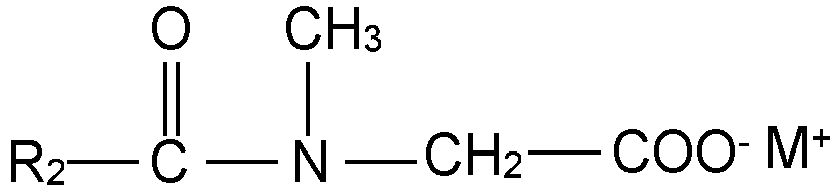
- the second anionic surfactant is a sarcosinate surfactant according to the general formula wherein R 2 is a saturated or unsaturated, straight or branched alkyl chain with 7 to 17 C atoms, and more preferably 9 to 13 C atoms, and M is H, sodium, potassium or ammonium.
- Suitable examples are potassium lauroyl sarcosinate, potassium cocoyl sarcosinate, sodium cocoyl sarcosinate, sodium lauroyl sarcosinate, sodium myristoyl sarcosinate, and sodium palmitoyl sarcosinate and mixtures thereof.
- Preferred are potassium lauroyl sarcosinate, potassium cocoyl sarcosinate, sodium cocoyl sarcosinate, and sodium lauroyl sarcosinate and mixtures thereof. More preferred are sodium cocoyl sarcosinate, and sodium lauroyl sarcosinate and mixtures thereof.
- the third anionic surfactant is a glutamate surfactant according to the general formula wherein R 2 is a saturated or unsaturated, straight or branched alkyl chain with 7 to 17 C atoms, and more preferably 9 to 13 C atoms, and M is independent from each other H, sodium, potassium or ammonium.
- Suitable examples are dipotassium capryloyl glutamate, dipotassium undecylenoyl glutamate, disodium capryloyl glutamate, disodium cocoyl glutamate, disodium lauroyl glutamate, disodium stearoyl glutamate, disodium undecylenoyl glutamate, potassium capryloyl glutamate, potassium cocoyl glutamate, potassium lauroyl glutamate, potassium myristoyl glutamate, potassium stearoyl glutamate, potassium undecylenoyl glutamate, sodium capryloyl glutamate, sodium cocoyl glutamate, sodium lauroyl glutamate, sodium myristoyl glutamate, sodium olivoyl glutamate, sodium palmitoyl glutamate, sodium stearoyl glutamate, and sodium undecylenoyl glutamate and mixtures thereof.
- disodium capryloyl glutamate disodium cocoyl glutamate, disodium lauroyl glutamate, potassium capryloyl glutamate, potassium cocoyl glutamate, potassium lauroyl glutamate, sodium capryloyl glutamate, sodium cocoyl glutamate, and sodium lauroyl glutamate and mixtures thereof.
- potassium cocoyl glutamate potassium lauroyl glutamate, sodium cocoyl glutamate, and sodium lauroyl glutamate.
- Sodium cocoyl and lauroyl glutamates are particularly preferred.
- the second and the third anionic surfactants particularly sarcosinate and glutamate surfactants are comprised in the compositions at a weight ratio of the sarcosinate to glutamate surfactant in the range of 1:1 to 10:1, preferably 1:1 to 8:1 and more preferably 1:1 to 6:1 and most preferably 1:1 to 5:1 and in particular in the range of 3:1 to 4:1.
- compositions of the present invention comprise an alkyl polyglucoside as a non-ionic surfactant.
- alkyl (poly)glucosides according to the general formula R 8 -O-(R 9 O) n -Z x , wherein R 8 is an alkyl group with 8 to 18 carbon atoms, R 9 is an ethylene or propylene group, Z is a saccharide group with 5 to 6 carbon atoms, n is a number from 0 to 10 and x is a number between 1 and 5.
- Suitable non-limiting examples are caprylyl glucoside, decyl glucoside, lauryl glucoside, myrystyl glucoside and cocoyl glucoside. Preferred are decyl glucoside, lauryl glucoside and cocoyl glucoside.
- aqueous cleansing composition consists of three anionic surfactants preferably a sulphate surfactant, a sarcosinate surfactant and a glutamate surfactant and a non-ionic surfactant preferably an alkyl (poly)glucoside.
- Nonionic surfactants are comprised in the cleansing compositions of the present invention at a concentration of 5 to 80% by weight of the total surfactants.
- the total nonionic surfactant concentration is in the range of 5 to 70%, more preferably 5 to 60% and most preferably 5 to 50% by weight of the total surfactants.
- compositions of the present invention may comprise additional surfactants known generally in the cleansing compositions excluding the amphoteric ones as the compositions are substantially free of amphoteric surfactants.
- Additional anionic surfactants may be ⁇ -olefin sulfonates or the salts thereof, and in particular alkali salts of sulfosuccinic acid semiesters, for example, the disodium salt of monooctyl sulfosuccinate and alkali salts of long-chain monoalkyl ethoxysulfosuccinates and carboxylates such as alkyl polyether carboxylic acids and the salts thereof of the formula R 7 -(C 2 H 4 O) n -O-CH 2 COOX, wherein R 7 is a C 8 -C 20 -alkyl group, preferably a C 12 -C 14 -alkyl group, n is a number from 1 to 20, preferably 2 to 17, and X is H or preferably a cation of the group sodium, potassium, magnesium and ammonium, which can optionally be hydroxyalkyl-substituted, as well as alkyl amido polyether carboxylic
- anionic surfactants may be taurate surfactants, alanine or alaninate surfactants, glycine surfactants and aspartate surfactants.
- Taurate surfactants to mention are according to the general formula wherein R 2 is a saturated or unsaturated, straight or branched alkyl chain with 7 to 17 C atoms, and more preferably 9 to 13 C atoms, R 3 is H or methyl, and M is H, sodium or potassium.
- Nonlimiting examples are potassium cocoyl taurate, potassium methyl cocoyl taurate, sodium caproyl methyl taurate, sodium cocoyl taurate, sodium lauroyl taurate, sodium methyl cocoyl taurate, sodium methyl lauroyl taurate, sodium methyl myristoyl taurate, sodium methyl oleoyl taurate, sodium methyl palmitoyl taurate, and sodium methyl stearoyl taurate and mixtures thereof.
- Alanine or alaninate surfactants to mention are according to the general formula wherein R 1 is preferably a saturated or unsaturated, straight or branched alkyl chain with 7 to 17 C atoms, and more preferably 9 to 13 C atoms, R 2 is H or methyl and M is H, sodium or potassium.
- R 1 is preferably a saturated or unsaturated, straight or branched alkyl chain with 7 to 17 C atoms, and more preferably 9 to 13 C atoms
- R 2 is H or methyl
- M is H, sodium or potassium.
- Nonlimiting examples are cocoyl methyl ⁇ -alanine, lauroyl ⁇ -alanine, lauroyl methyl ⁇ -alanine, myristoyl ⁇ -alanine, potassium lauroyl methyl ⁇ -alanine, sodium cocoyl alaninate, sodium cocoyl methyl ⁇ -alanine and sodium myristoyl methyl ⁇ - alanine and mixtures thereof.
- Glycine surfactants to mention are according to the general formula wherein R 2 is preferably a saturated or unsaturated, straight or branched alkyl chain with 7 to 17 C atoms, and more preferably 9 to 13 C atoms, and M is H, sodium or potassium.
- R 2 is preferably a saturated or unsaturated, straight or branched alkyl chain with 7 to 17 C atoms, and more preferably 9 to 13 C atoms
- M is H, sodium or potassium.
- Nonlimiting examples are palmitoyl glycine, sodium lauroyl glycinate, sodium cocoyl glycinate, sodium myristoyl glycinate, potassium lauroyl glycinate, and potassium cocoyl glycinate and mixtures thereof.
- Aspartate surfactants to mention are according to the general formula wherein R 2 is a saturated or unsaturated, straight or branched alkyl chain with 7 to 17 C atoms, and more preferably 9 to 13 C atoms, and M is independent from each other H, sodium, potassium or ammonium.
- Nonlimiting examples are sodium lauroyl aspartate, sodium myristoyl aspartate, sodium cocoyl aspartate, sodium caproyl aspartate, disodium lauroyl aspartate, disodium myristoyl aspartate, disodium cocoyl aspartate, disodium caproyl aspartate, potassium lauroyl aspartate, potassium myristoyl aspartate, potassium cocoyl aspartate, potassium caproyl aspartate, dipotassium lauroyl aspartate, dipotassium myristoyl aspartate, dipotassium cocoyl aspartate, and dipotassium caproyl aspartate and mixtures thereof.
- Nonionic surfactants may be comprised in the cleansing compositions of the present invention, are such as long-chain fatty acid dialkanolamides, namely coco fatty acid diethanolamide and myristic fatty acid diethanolamide, various sorbitan esters, such as polyethylene glycol sorbitan stearic acid ester, fatty acid polyglycol esters or polycondensates of ethyleneoxide and propyleneoxide, as they are on the market, for example, under the trade name "Pluronics R ", as well as fatty alcohol ethoxylates, amineoxides such as C 12 -C 18 - alkyl dimethyl amineoxides namely lauryl dimethyl amineoxide, C 12 -C 18 - alkyl amidopropyl or -ethyl amineoxides, C 12 -C 18 -alkyl di(hydroxyethyl) or (hydroxypropyl) amineoxides, or also amineoxides with ethyleneoxid
- cleansing composition of the present invention comprises hair-conditioning agents.
- Conditioning agents can be selected from oily substances, non-ionic substances, cationic amphiphilic ingredients, cationic polymers other than the one described above or their mixtures.
- Oily substances are selected from such as silicone oils, either volatile or non-volatile, natural and synthetic oils.
- silicone oils those can be added to the compositions include dimethicone, dimethiconol, polydimethylsiloxane, DC fluid ranges from Dow Corning, arylated silicones such as phenyl trimethicone or any other silicone with up to 5 aryl, preferably phenyl, group in its molecule such as trimethyl pentaphenyl trisiloxane, natural oils such as olive oil, almond oil, avocado oil, wheatgerm oil, ricinus oil and the synthetic oils, such as mineral oil, isopropyl myristate, palmitate, stearate and isostearate, oleyl oleate, isocetyl stearate, hexyl laurate, dibutyl adipate, dioctyl adipate, myristyl myristate and oleyl erucate.
- Non-ionic conditioning agents can be polyols such as glycerin, glycol and derivatives, polyethyleneglycoles known with trade names Carbowax PEG from Union Carbide and Polyox WSR range from Amerchol, polyglycerin, polyethyleneglycol mono or di fatty acid esters having general formula R 11 CO(OCH 2 CH 2 ) n OH or R 11 CO(OCH 2 CH 2 ) n OOCR 12 where R 11 and R 12 are independent from each other saturated, unsaturated or branched or non-branched alkyl chain with 7 to 21 C atoms and n is typically 2 - 100.
- polyols such as glycerin, glycol and derivatives, polyethyleneglycoles known with trade names Carbowax PEG from Union Carbide and Polyox WSR range from Amerchol, polyglycerin, polyethyleneglycol mono or di fatty acid esters having general formula R 11 CO(OCH 2 CH 2 ) n OH or R 11
- Composition of the present invention comprises preferably at least one cationic polymer as a conditioning agent.
- Cationic polymers are comprised in the compositions at a concentration of 0.01 to 5%, preferably 0.02 to 4%, more preferably 0.05 to 3% and most preferably 0.1 to 2.5% by weight calculated to the total the composition.
- Suitable cationic polymers are of best known with their INCI category name Polyquaternium.
- Polyquaternium 1 Polyquaternium 2
- Polyquaternium 4 Polyquaternium 5
- Polyquaternium 6 Polyquaternium 7, Polyquaternium 8, Polyquaternium 9, Polyquaternium 10
- Polyquaternium 11 Polyquaternium 12, Polyquaternium 13, Polyquaternium 14, Polyquaternium 15, Polyquaternium 16, Polyquaternium 17, Polyquaternium 18, Polyquaternium 19, Polyquaternium 20, Polyquaternium 22, Polyquaternium 24, Polyquaternium 27, Polyquaternium 28, Polyquaternium 29, Polyquaternium 30, Polyquaternium 31, Polyquaternium 32, Polyquaternium 33, Polyquaternium 34, Polyquaternium 35 and Polyquaternium 36, Polyquaternium-37, Polyquaternium 39, Polyquaternium 42, Polyquaternium 43, Polyquaternium 44, Polyquaternium 45, Polyquaternium 46, Polyquaternium 47, Polyquaternium 48, Polyquaternium-49, Polyquaternium 50, Polyquaternium 51, Polyquaternium 52, Polyquaternium 53, Polyqua
- cationic cellulose type polymers known as Polymer JR type from Amerchol such as Polyquaternium 10 or cationic galactomannans such as cationic guar gum known with trade name Jaguar from Rhône-Poulenc which are chemically for example Guar hydroxypropyl trimonium chloride and cationic tara gum an its derivatives known with INCI name Caesalpinia spinosa hydroxypropyltrimonium chloride, are preferred ones.
- chitosan and chitin can also be included in the compositions as cationic natural polymers.
- the most preferred cationic polymers are those of cationic cellulose derivatives, cationic guar gum derivatives, cationic Caesalpinia spinosa gum derivatives, polyquaternium 6, polyquaternium 7, polyquaternium 67, polyquaternium 87 and polyquaternium 70.
- the cationic polymers also include the quaternized products of graft polymers from organopolysiloxanes and polyethyl oxazolines described in EP-A 524 612 and EP-A 640 643 .
- cleansing compositions of the present invention may comprise additionally one or more cationic surfactant(s) as conditioner presented with the general formula where R 13 is a saturated or unsaturated, branched or non-branched alkyl chain with 8-24 C atoms or R 17 CONH(CH 2 ) n where R 17 is saturated or unsaturated, branched or non-branched alkyl chain with 7-21 C atoms and n has value of 1 - 4, or R 18 COO(CH 2 ) n where R 18 is saturated or unsaturated, branched or non-branched alkyl chain with 7-21 C atoms and n has value of 1 - 4, and R 14 is unsaturated or saturated, branched or non-branched alkyl chain with 1 - 24 C atoms or R 17 CONH(CH 2 ) n or R 18 COO(CH 2 ) n where R 17 , R 18 and n are same as above.
- R 15 and R 16 are lower alkyl chain with 1 to 4 carbon atoms which may be substituted with one or more hydroxyl groups, and X is anion such as chloride, bromide, methosulfate.
- Typical examples of those ingredients are cetyl trimethly ammonium chloride, steartrimonium chloride, behentrimonium chloride, stearamidopropyl trimonuim chloride, palmitamidopropyltrimonium chloride, dioleoylethyl dimethyl ammonium methosulfate, dioleoylethyl hydroxyethylmonium methosulfate.
- compositions according to the invention may also comprise further conditioning substances such as protein hydrolyzates and polypeptides, e.g., keratin hydrolyzates, collagen hydrolyzates of the type “Nutrilan R " or elastin hydrolyzates, as well as also in particular plant protein hydrolyzates, optionally, cationized protein hydrolyzates, e.g., "Gluadin R ".
- protein hydrolyzates and polypeptides e.g., keratin hydrolyzates, collagen hydrolyzates of the type "Nutrilan R " or elastin hydrolyzates
- plant protein hydrolyzates e.g., cationized protein hydrolyzates, e.g., "Gluadin R ".
- Typical concentration range for any of those conditioners of cationic polymers, silicone oil and derivatives and cationic surfactants is in the range of 0.01 to 5% by weight, preferably 0.01 to 3.5% by weight, more preferably 0.05 to 2.5% and most preferably 0.1 to 1.5% by weight calculated to the total composition.
- Most preferred conditioning agents are cationic polymers.
- aqueous cleansing composition comprises at least one organic solvent such as ethanol, propanol, isopropanol, benzyl alcohol, benzyloxyethanol, ethoxydiglycol, alkylene carbonates such as ethylene carbonate and propylene carbonate, phenoxyethanol, butanol, isobutanol, cyclohexane, cyclohexanol, hexyleneglycol, ethylenecarbonate, propyleneglycol, polypropyleneglycols, ethyleneglycol monoethylether, ethylene glycol monobutyl ether, ethylene glycol monophenyl ether, 1-phenylethylalcohol, 2-phenylethylalcohol, o-methoxyphenol.
- organic solvent such as ethanol, propanol, isopropanol, benzyl alcohol, benzyloxyethanol, ethoxydiglycol, alkylene carbonates such as ethylene carbonate and propylene carbon
- Total concentration of organic solvents in the shampoo composition should not exceed 5% by weight, preferably in the range of 0.1 to 3%, more preferably 0.5 to 2.5% by weight calculated to total composition.
- Further conditioning additives are hair conditioning and/or styling polymers. These may be nonionic polymers, preferably alcohol- and/or water-soluble vinyl pyrrolidone polymers, such as a vinyl pyrrolidone homopolymers or copolymers, in particular with vinyl acetate.
- Useful vinyl pyrrolidone polymers are, e.g., those known by the trade name "Luviskol®", for example, the homopolymers "Luviskol® K 30, K 60 and K 90", as well as the water-or alcohol-soluble copolymers from vinyl pyrrolidone and vinyl acetate, distributed by BASF AG under the trade name "Luviskol® VA 55 respectively VA 64".
- nonionic polymers are vinyl pyrrolidone/vinyl acetate/vinyl propionate copolymers such as "Luviskol® VAP 343", vinyl pyrrolidone/(meth)acrylic acid ester copolymers, as well as chitosan derivatives.
- Amphoteric polymers are found to be useful in conditioning shampoo composition of the present invention. They are incorporated alone or in admixture with at least one additional cationic, nonionic or anionic polymer, particularly copolymers of N-octyl acrylamide, (meth)acrylic acid and tert.-butyl aminoethyl methacrylate of the type "Amphomer®”; copolymers from methacryl oylethyl betaine and alkyl methacrylates of the type "Yukaformer®", e.g., the butyl methacrylate copolymer "Yukaformer® Am75”; copolymers from monomers containing carboxyl groups and sulfonic groups, e.g., (meth)acrylic acid and itaconic acid, with monomers such as mono- or dialkyl amino alkyl(meth)acrylates or mono- or dialkyl aminoalkyl (meth)acrylamides containing basic groups, in particular amino
- Aqueous cleansing composition of the present invention may comprise at least one glyceryl ether of the following formula wherein R 20 is straight or branched, saturated or unsaturated alkyl chain with 4 to 24 C atoms, preferably 4 to 18 and more preferably 4 to 12 C atoms and R 21 is H, or straight or branched, saturated or unsaturated alkyl chain with 4 to 24 C atoms, 4 to 18 and more preferably 4 to 12 C atoms and most preferably R 5 is H, at a concentration of 0.1 to 15%, preferably 0.1 to 10% and more preferably 0.25 to 7.5% and most preferably 0.5 to 5% by weight calculated to total composition.
- Suitable unlimited examples are glyceryl butyl ether, glyceryl isobutyl ether, glyceryl tert-butyl ether, glyceryl pentyl ether, glyceryl isopentyl ether, glyceryl hexyl ether, glyceryl isohexyl ether, glyceryl heptyl ether, glyceryl octyl ether, glyceryl ethylhexyl ether, glyceryl nonyl ether, glyceryl decyl ether, glyceryl isodecyl ether, glyceryl lauryl ether, glyceryl myristyl ether, glyceryl palmityl ether, glyceryl stearyl ether and glyceryl behenyl ether and their mixtures.
- glyceryl butyl ether glyceryl isobutyl ether, glyceryl tert-butyl ether, glyceryl pentyl ether, glyceryl isopentyl ether, glyceryl hexyl ether, glyceryl isohexyl ether, glyceryl heptyl ether, glyceryl octyl ether, glyceryl ethylhexyl ether, glyceryl nonyl ether, glyceryl decyl ether, glyceryl isodecyl ether are glyceryl lauryl ether, and their mixtures.
- glyceryl decyl ether is used as synonym of decyl glycerine.
- decyl glycerine is used as synonym of decyl glycerine.
- Aqueous cleansing composition of the present invention may further comprise at least one fatty alcohol of the following formula R 25 -OH wherein R 25 is straight or branched, saturated or unsaturated alkyl chain with 8 to 24, preferably 10 to 22, more preferably 12 to 18 and most preferably 12 to 16C atoms at a concentration of 0.1 to 5%, preferably 0.1 to 4% and more preferably 0.25 to 3% and most preferably 0.5 to 2.5% by weight calculated to total composition.
- R 25 is straight or branched, saturated or unsaturated alkyl chain with 8 to 24, preferably 10 to 22, more preferably 12 to 18 and most preferably 12 to 16C atoms at a concentration of 0.1 to 5%, preferably 0.1 to 4% and more preferably 0.25 to 3% and most preferably 0.5 to 2.5% by weight calculated to total composition.
- Suitable non-limiting preferred examples are decyl alcohol, myristyl alcohol, lauryl alcohol, cetyl alcohol, stearyl alcohol, behenyl alcohol, and arachidyl alcohol and their mixtures. More preferred are decyl alcohol, myristyl alcohol, lauryl alcohol, cetyl alcohol, and stearyl alcohol. Most preferred are decyl alcohol, myristyl alcohol and lauryl alcohol, and their mixtures.
- Cleansing composition of the present invention is preferably pearly. Pearl-shiny appearance is achieved with those dispersed in cleansing conditioning compositions in crystalline form, i.e. so called pearl-shine or pearlizing agents.
- the preferred once are PEG-3 distearate and ethylene glycol distearate.
- the concentration of those can typically be from 0.1 to 3%, preferably 0.5 to 2% by weight, calculated to the total composition.
- These compounds are preferably added to the compositions in admixture with anionic, nonionic and/or amphoteric surfactants. Such kinds of mixtures are available commercially.
- Solubilizers may be added to the compositions especially when oily substances are chosen as conditioning agents and fragrance oils with highly lipophilic properties.
- Typical solubilizers may be hydrogenated castor oil known with the trade mark Cremophor CO series from BASF. It should be noted that as well the surfactant mixture can be a good solubilizer for fragrance oils.
- Typical concentration of the solubilizers can be in the range of 0.01 - 2% by weight, preferably 0.1 - 1% by weight, calculated to total composition.
- the cleansing composition may contain active ingredients selected from UV filters, moisturisers, sequestering agents, and natural ingredients.
- the moisturizing agents are selected from panthenol, polyols, such as glycerol, polyethylene glycols with molecular weight 200 to 20,000.
- the moisturizing ingredients can be included in the conditioner compositions at a concentration range of 0.01 - 2.5% by weight calculated to the total composition.
- the sequestering agents are preferably selected from polycarboxy acids.
- the preferred one is ethylene diamine tetraacetic acid, EDTA.
- Typical useful concentration range for sequestering agents is of 0.01 - 2.5% by weight calculated to the total composition.
- the UV filters are that oil and water soluble ones for the purpose of protecting hair and hair colour.
- anionic and non-ionic, oily, UV filters are suitably used in the compositions of the present invention.
- Suitable UV-absorbing substances is are: 4-Aminobenzoic acid and the esters and salts thereof, 2-phenyl benzimidazole-5-sulfonic acid and the alkali and amine salts thereof, 4-dimethyl aminobenzoic acid and the esters and salts thereof, cinnamic acid and the esters and salts thereof, 4-methoxycinnamic acid and the esters and salts thereof, salicylic acid and the esters and salts thereof, 2.4-dihydroxybenzophenone, 2.2'.4.4'-tetrahydroxybenzophenone, 2-hydroxy-4-methoxybenzophenone and its 5-sulfonic acid or the sodium salt thereof, 2.2'-dihydroxy-4.4'-dimethoxybenzophenone, 2-hydroxy-5-chlorobenzophen
- Natural plant extracts are incorporated usually in an amount of about 0.01 % to about 10 %, preferably 0.05 % to 7.5 %, in particular 0.1 % to 5 % by weight, calculated as dry residue thereof to the total composition.
- Suitable aqueous e.g.
- alcoholic or hydro-alcoholic plant extracts known per se are in particular extracts from leaves, fruits, blossoms, roots, rinds or stems of aloe, pineapple, artichoke, arnica, avocado, valerian, bamboo, henbane, birch, stinging nettle, echinacea, ivy, wild angelica, gentian, ferns, pine needles, silver weed, ginseng, broom, oat, rose hip, hamamelis, hay flowers, elderberry, hop, coltsfoot, currants, chamomile, carrots, chestnuts, clover, burr root, cocoanut, cornflower, lime blossom, lily of the valley, marine algae, balm, mistletoe, passion flower, ratanhia, marigold, rosemary, horse chestnut, pink hawthorn, sage, horsetail, yarrow, primrose, nettle, thyme, walnut, wine leaves, white hawthorn, etc.
- compositions of the present invention may comprise further at least one compound according to the formula where n is a number from 1 to 10.
- compositions of the present invention can certainly comprise more than one ubiqinone.
- Preferred ubiqinones are the ones where n is a number between 6 and 10 and especially preferred is Ubiqinone 50 where n is 10, also known as Coenzyme Q10.
- Concentration ubiqinone of the above formula in the compositions is from 0.0001 to 1%, preferably from 0.0002 to 0.75%, more preferably from 0.0002 to 0.5% and most preferably from 0.0005 to 0.5% by weight, calculated to total composition.
- Cleansing compositions of the present invention can also comprise synthetic mica as a further shine enhancer.
- Suitable metal oxide or oxides for coating synthetic mica are titanium dioxide, chromium oxide, ferric oxide or mixtures thereof.
- the preferred is synthetic mice coated with titanium dioxide.
- Such materials are commercially available from Sun Chemical Corporation and known with their INCI names Synthetic Fluorphologopite.
- the particle size distribution of synthetic mica coated with a metal oxide or oxides is in the range of 1 to 750 ⁇ m, preferably 1 to 250 ⁇ m, more preferably 1 to 100 ⁇ m and most preferably 20 to 95 ⁇ m.
- the particle sizes referred are relating to the volume particle size distribution meaning that particles found in the coated synthetic mica having volume particle size in the given ranges.
- Concentration of synthetic mica coated with at least metal oxide or oxides is from 0.001 to 10%, preferably 0.05 to 7.5%, more preferably 0.1 to 5% and most preferably 0.20 to 2.5% by weight calculated to total composition.
- compositions comprise at least one direct dye and as well deposit dyestuffs on the hair.
- Suitable direct dyes are of cationic, anionic and neutral nitro dyes. It should be noted that they can also be used in combination with each other.
- a composition according to present invention can comprise an anionic and a cationic dye as well as an anionic and a nitro dye or a cationic and a nitro dye. Certainly the combination of all three dyestuff categories is also possible.
- Any cationic direct dye is in principal suitable for the compositions.
- Examples are Basic Blue 6, Basic Blue 7, Basic Blue 9, Basic Blue 26, Basic Blue 41, Basic Blue 99, Basic Brown 4, Basic Brown 16, Basic Brown 17, Natural Brown 7, Basic Green 1, Basic Orange 31, Basic Red 2, Basic Red 12 Basic Red 22, Basic Red 51, Basic Red 76, Basic Violet 1, Basic Violet 2, Basic Violet 3, Basic Violet 10, Basic Violet 14, Basic Yellow 57 and Basic Yellow 87, and mixtures thereof
- Any anionic dye is in principal suitable for the compositions. Suitable examples are such as Acid Black 1, Acid Blue 1, Acid Blue 3, Food Blue 5, Acid Blue 7, Acid Blue 9, Acid Blue 74, Acid Orange 3, Acid Orange 6, Acid Orange 7, Acid Orange 10, Acid Red 1, Acid Red 14, Acid Red 18, Acid Red 27, Acid Red 50, Acid Red 52, Acid Red 73, Acid Red 87, Acid Red 88, Acid Red 92, Acid Red 155, Acid Red 180, Acid Violet 9, Acid Violet 43, Acid Violet 49, Acid Yellow 1, Acid Yellow 23, Acid Yellow 3, Food Yellow No. 8, D&C Brown No. 1, D&C Green No. 5, D&C Green No. 8, D&C Orange No. 4, D&C Orange No. 10, D&C Orange No. 11, D&C Red No. 21, D&C Red No. 27, D&C Red No.
- the preferred anionic dyestuffs are Acid Red 52, Acid Violet 2, Acid Red 33, Acid Orange 4, Acid Red 27 and Acid Yellow 10 and their salts, and mixtures thereof.
- the most preferred anionic dyes are Acid Red 52, Acid Violet 2, Acid Red 33, Acid Orange 4 and Acid Yellow 10, and their salts, and mixtures thereof.
- Neutral dyes so called nitro dyes for shading purposes are also optionally contained in the compositions. Suitable ones are HC Blue No.2, HC Blue No.4, HC Blue No.5, HC Blue No.6, HC Blue No.7, HC Blue No.8, HC Blue No.9, HC Blue No.10, HC Blue No.11, HC Blue No.12, HC Blue No.13, HC Brown No.1, HC Brown No.2, HC Green No.1, HC Orange No.1, HC Orange No.2, HC Orange No.3, HC Orange No.5, HC Red BN, HC Red No.1, HC Red No.3, HC Red No.7, HC Red No.8, HC Red No.9, HC Red No.10, HC Red No.11, HC Red No.13, HC Red No.54, HC Red No.14, HC Violet BS, HC Violet No.1, HC Violet No.2, HC Yellow No.2, HC Yellow No.4, HC Yellow No.5, HC Yellow No
- Concentration of one or more direct dyes in total is in the range of 0.001 to 5% by weight, preferably 0.01 to 4% more preferably 0.05 to 3% and most preferably 0.1 to 2.5% by weight calculated to total composition.
- the most preferred among the direct dyes is cationic direct dyes.
- the shampoos according to the invention may comprise other substances customarily used in such compositions such as preservatives, fragrances.
- the pH of the compositions according to the present invention is suitably between 2 and 8.0, preferably in the range of 2.5 to 7.0, more preferably 3 to 6.5 and most preferably 4 to 6.0 measured at ambient temperature with a suitable pH meter.
- Acidic compounds can be inorganic and organic acid or their mixtures.
- Nonlimiting suitable examples are citric acid, lactic acid, glycolic acid, hydroxyacrylic acid, glyceric acid, malic acid and tartaric acid and of the dicarboxylic acids are malonic acid, succinic acid, glutaric acid, adipic acid, maleic acid, fumaric acid and phtalic acid.
- Alkaline compounds such as sodium hydroxide can be used to adjust the pH of the compositions.
- Aqueous cleansing composition of the present invention preferably comprises one or more thickeners. Suitable ones are ethoxylated polyglyceryl esters with total ethoxy units in the range of 50 to 200 and fatty acyl chain length of 8 to 22 C atoms such as PEG-80 glyceryl cocoate, PEG-90 glyceryl isostearate, PEG-120 glyceryl stearate, PEG-200 glyceryl stearate, PEG-80 glyceryl tallowate, PEG-82 glyceryl tallowate, PEG-130 glyceryl tallowate, and PEG-200 glyceryl tallowate, PEG-18 gylceryl oleate/cocoate, PEG-160 sorbitan triisostearate and inorganic salt in particular sodium chloride when especially composition comprise alkyl ether sulphate type of surfactants.
- PEG-80 glyceryl cocoate PEG
- Cleansing compositions of the present invention preferably has a viscosity in the range of 500 to 20,000 mPa.s, more preferably 1,000 to 15,000 mPa.s and most preferably 1,500 to 10,000 mPa.s measured at 20°C with a Brookfield viscosimetre using fro example Spindle 5 at appropriate rotation speed.
- the following examples are to illustrate the invention, but not to limit.
- the products according to the invention are prepared by mixing the individual components in water, whereby it is also possible to use pre-mixtures of various ingredients.
- Hair tresses were coloured with a commercially available oxidative colouring composition comprising oxidative and direct dyes.
- the tresses so coloured were washed 10 times with above compositions and before starting the test and afterwards L, a and b values were measured. With the help of the known equation ⁇ E values were calculated to present colour difference numerically.
- cleansing composition according to the invention produces the lowest ⁇ E value. Similar effects were observed with the following compositions.
- the above shampoo was judged to have rich and creamy foam in a monadic test by the volunteers. It was furthermore mentioned that it foams very quickly. Additionally, the hair washed was excellently combable and had good shine.
- the above composition has excellent creamy rich foam and conditions hair excellently in terms of combability and soft hair feeling.
- the above composition improves hair volume, gives hair more elasticity in addition to the excellent creamy foam and conditioning effect in terms of combability, shine and soft hair feeling. Colour wash out effect was observed to be excellent.
- the above composition gives hair a red shine, and additionally delivers excellent conditioning effect in terms of more elasticity, combability, shine and soft hair feeling in addition to the excellent creamy rich foam.
- the composition foams very quickly.
- fragrance q.s Water to 100 * Synthetic fluorphologopite used is commercially available from Sun Chemical Corporation under the trade name SunShine Glitter White with a particle size distribution in the range of 20 to 95 ⁇ m.
- the above composition delivered excellent volume and shine to dark blonde fine hair. Foam characteristics were found to be excellent in terms of volume, speed and creaminess in a monadic test.
- the above shampoo conditions hair excellently in terms of combability, softness, shine and elasticity and additionally gives fine hair excellent long lasting volume.
- the above shampoo conditions hair excellently in terms of combability, shine, softness and elasticity and additionally gives fine hair excellent long lasting volume.
Landscapes
- Health & Medical Sciences (AREA)
- Life Sciences & Earth Sciences (AREA)
- Animal Behavior & Ethology (AREA)
- General Health & Medical Sciences (AREA)
- Public Health (AREA)
- Veterinary Medicine (AREA)
- Birds (AREA)
- Epidemiology (AREA)
- Emergency Medicine (AREA)
- Dermatology (AREA)
- Cosmetics (AREA)
Claims (14)
- Wässrige Reinigungszusammensetzung für Keratinfasern, insbesondere für menschliche Haare, dadurch gekennzeichnet, dass sie drei anionische Tenside aufweist, wobei das erste anionische Tensid ein Alkylethersulfat-Tensid gemäß der folgenden allgemeinen Struktur
R1 (OCH2CH2)n OSO3 M
ist, wobei R1 für eine gesättigte oder ungesättigte, verzweigte oder lineare Alkylkette mit 10 bis 18 C-Atomen steht, n eine Zahl zwischen 1 und 5 ist (die Werte sind eingeschlossen) und M für ein monovalentes Kation steht, vorzugsweise ausgewählt aus H, Ammonium, Natrium und Kalium, und das zweite und das dritte anionische Tensid Aminosäure-Tenside sind, ausgewählt aus der folgenden allgemeinen Struktur
- Zusammensetzung nach Anspruch 1, dadurch gekennzeichnet, dass das erste anionische Tensid aus Natriumlaurethsulfaten mit durchschnittlich 1,5 bis 3 Ethoxy-Einheiten ausgewählt ist.
- Zusammensetzung nach Anspruch 1 und 2, dadurch gekennzeichnet, dass die Konzentration des ersten Sulfat-Tensids im Bereich von 20 Gewichts-% bis 80 Gewichts-% liegt, bezogen auf die gesamten anionischen Tenside.
- Zusammensetzung nach einem der vorhergehenden Ansprüche, dadurch gekennzeichnet, dass das zweite anionische Tensid ein Sarcosinat-Tensid gemäß der allgemeinen Formel
- Zusammensetzung nach einem der vorhergehenden Ansprüche, dadurch gekennzeichnet, dass das zweite anionische Tensid ein Glutamat-Tensid gemäß der allgemeinen Formel

- Zusammensetzung nach einem der vorhergehenden Ansprüche, dadurch gekennzeichnet, dass das nichtionische Tensid ein Alkyl(poly)glucosid ist, gemäß der allgemeinen Formel
R8-O-(R9O)n-Zx,
wobei R8 für eine Alkylgruppe mit 8 bis 18 Kohlenstoffatomen steht, R9 für eine Ethylen- oder Propylengruppe steht, Z für eine Saccharidgruppe mit 5 bis 6 Kohlenstoffatomen steht, n eine Zahl von 0 bis 10 ist und x eine Zahl zwischen 1 und 5 ist. - Zusammensetzung nach einem der vorhergehenden Ansprüche, dadurch gekennzeichnet, dass sie anionische Tenside in einer Konzentration im Bereich von 50 Gewichts-% bis 95 Gewichts-% der Gesamttenside aufweist.
- Zusammensetzung nach einem der vorhergehenden Ansprüche, dadurch gekennzeichnet, dass sie als das erste anionische Tensid ein Tensid aufweist, das aus Laureth-, Myreth- und Cocethsulfaten oder deren Salzen, wie z.B. Natrium-, Kalium- oder Ammoniumsalzen, ausgewählt ist, es sich vorzugsweise um Natriumlaurethsulfate mit durchschnittlich 1,5 bis 3 Ethoxyeinheiten handelt.
- Zusammensetzung nach einem der vorhergehenden Ansprüche, dadurch gekennzeichnet, dass sie das erste anionische Tensid in einer Konzentration von 30 Gewichts-% bis 70 Gewichts-% aufweist, bezogen auf den Gesamtgehalt an anionischen Tensiden der Zusammensetzung.
- Zusammensetzung nach einem der vorhergehenden Ansprüche, dadurch gekennzeichnet, dass sie das zweite Sarcosinat-Tensid und das dritte Glutamat-Tensid in einem Gewichtsverhältnis des Sarcosinat-Tensids zum Glutamat-Tensid im Bereich von 1:1 bis 10:1, vorzugsweise 1:1 bis 8:1 und mehr bevorzugt 1:1 bis 6:1 und am meisten bevorzugt 1:1 bis 5:1 und insbesondere im Bereich von 3:1 bis 4:1 aufweist.
- Zusammensetzung nach einem der vorhergehenden Ansprüche, dadurch gekennzeichnet, dass sie nichtionisches Tensid in einer Konzentration im Bereich von 5 Gewichts-% bis 80 Gewichts-%, vorzugsweise 5 Gewichts-% bis 70 Gewichts-%, mehr bevorzugt 5 Gewichts-% bis 60 Gewichts-% und am meisten bevorzugt 5 Gewichts-% bis 50 Gewichts-% der Gesamttenside aufweist.
- Zusammensetzung nach einem der vorhergehenden Ansprüche, dadurch gekennzeichnet, dass sie einen oder mehrere der Inhaltsstoffe aufweist, ausgewählt aus- kationischem Polymer,- Haarfarbstoff, insbesondere Direktfarbstoff,- Fettalkohol,- organischem Lösungsmittel,- Verdickungsmittel,- Perlglanzmittel,- Duftstoff,- Coenzym und- UV-Filter.
- Verwendung einer Zusammensetzung nach Anspruch 1 bis 12 zum Reinigen von Haaren, insbesondere künstlich gefärbten Haaren.
- Kit zum Behandeln von Haaren, welches eine Reinigungszusammensetzung nach Anspruch 1 bis 12 und gegebenenfalls mindestens eine Zusammensetzung aufweist, welche einen Haarfarbstoff aufweist.
Priority Applications (1)
| Application Number | Priority Date | Filing Date | Title |
|---|---|---|---|
| EP11815697.5A EP2658514B2 (de) | 2010-12-28 | 2011-12-27 | Reinigungszusammensetzung, insbesondere für künstlich gefärbtes haar |
Applications Claiming Priority (3)
| Application Number | Priority Date | Filing Date | Title |
|---|---|---|---|
| EP10197193A EP2471505A1 (de) | 2010-12-28 | 2010-12-28 | Reinigungszusammensetzung, insbesondere für künstlich gefärbtes Haar |
| EP11815697.5A EP2658514B2 (de) | 2010-12-28 | 2011-12-27 | Reinigungszusammensetzung, insbesondere für künstlich gefärbtes haar |
| PCT/EP2011/074067 WO2012089719A2 (en) | 2010-12-28 | 2011-12-27 | Cleansing composition especially for artificially coloured hair |
Publications (3)
| Publication Number | Publication Date |
|---|---|
| EP2658514A2 EP2658514A2 (de) | 2013-11-06 |
| EP2658514B1 EP2658514B1 (de) | 2019-04-24 |
| EP2658514B2 true EP2658514B2 (de) | 2021-11-24 |
Family
ID=43943111
Family Applications (2)
| Application Number | Title | Priority Date | Filing Date |
|---|---|---|---|
| EP10197193A Withdrawn EP2471505A1 (de) | 2010-12-28 | 2010-12-28 | Reinigungszusammensetzung, insbesondere für künstlich gefärbtes Haar |
| EP11815697.5A Active EP2658514B2 (de) | 2010-12-28 | 2011-12-27 | Reinigungszusammensetzung, insbesondere für künstlich gefärbtes haar |
Family Applications Before (1)
| Application Number | Title | Priority Date | Filing Date |
|---|---|---|---|
| EP10197193A Withdrawn EP2471505A1 (de) | 2010-12-28 | 2010-12-28 | Reinigungszusammensetzung, insbesondere für künstlich gefärbtes Haar |
Country Status (3)
| Country | Link |
|---|---|
| US (2) | US20130276810A1 (de) |
| EP (2) | EP2471505A1 (de) |
| WO (1) | WO2012089719A2 (de) |
Families Citing this family (10)
| Publication number | Priority date | Publication date | Assignee | Title |
|---|---|---|---|---|
| JP6896381B2 (ja) * | 2015-07-10 | 2021-06-30 | 花王株式会社 | 毛髪化粧料 |
| GB201616660D0 (en) * | 2016-09-30 | 2016-11-16 | Innospec Ltd | Methods, compositions and uses relating thereto |
| US10265261B2 (en) | 2016-10-31 | 2019-04-23 | L'oreal | Cleansing compositions with conditioning properties |
| JP2020033495A (ja) | 2018-08-31 | 2020-03-05 | 保土谷化学工業株式会社 | 塩基性染料とアミノ酸を含有する化合物、染毛用染料および染毛用組成物 |
| CN113164362A (zh) * | 2018-12-14 | 2021-07-23 | 高露洁-棕榄公司 | 基于乳液的无有机硅个人护理组合物及用于其的方法 |
| US11883514B2 (en) | 2019-11-01 | 2024-01-30 | Colgate-Palmolive Company | Stable low pH personal care compositions and methods for the same |
| FR3123806B1 (fr) * | 2021-06-10 | 2024-06-14 | Oreal | compositions cosmÉtiques et de soins personnels contenant des tensioactifs cationiques et des composÉs anioniques |
| US12290589B2 (en) | 2020-12-29 | 2025-05-06 | L'oreal | Cosmetic and personal care compositions containing cationic surfactants and anionic compounds |
| JP7103706B1 (ja) | 2022-03-16 | 2022-07-20 | 株式会社ナンバースリー | 毛髪染色剤及び毛髪染色方法 |
| FR3170305A1 (fr) * | 2024-12-23 | 2026-06-26 | L'oreal | Composition comprenant un colorant, une guar cationique particuliere et un tensioactif anionique |
Family Cites Families (24)
| Publication number | Priority date | Publication date | Assignee | Title |
|---|---|---|---|---|
| US3927199A (en) | 1972-04-14 | 1975-12-16 | Nat Starch Chem Corp | Hair fixing compositions containing N-alkyl acrylamide or methacrylamide interpolymer |
| IT1050562B (it) | 1974-05-16 | 1981-03-20 | Oreal | Agente cosmetico a base di polimeri quaternizzati |
| LU76955A1 (de) | 1977-03-15 | 1978-10-18 | ||
| DE3044738C2 (de) | 1979-11-28 | 1994-09-15 | Oreal | Mittel und Verfahren zur Behandlung von menschlichem Haar |
| LU83349A1 (fr) | 1981-05-08 | 1983-03-24 | Oreal | Composition sous forme de mousse aerosol a base de polymere cationique et de polymere anionique |
| US4565647B1 (en) * | 1982-04-26 | 1994-04-05 | Procter & Gamble | Foaming surfactant compositions |
| MY105119A (en) | 1988-04-12 | 1994-08-30 | Kao Corp | Low irritation detergent composition. |
| JPH0525025A (ja) | 1991-07-22 | 1993-02-02 | Kao Corp | 毛髪化粧料 |
| EP0640643B1 (de) | 1993-08-10 | 2000-04-26 | Kao Corporation | Organopolysiloxane und ein Verfahren zum Haarfestigen unter Verwendung derselben |
| ATE204464T1 (de) * | 1995-10-16 | 2001-09-15 | Procter & Gamble | Polyalkylenglykol enthaltendes haarpflegeshampoo |
| US5756436A (en) * | 1996-03-27 | 1998-05-26 | The Procter & Gamble Company | Conditioning shampoo compositions containing select cationic conditioning polymers |
| US6284230B1 (en) * | 1996-12-30 | 2001-09-04 | The Procter & Gamble Company | Hair conditioning shampoo compositions comprising primary anionic surfactant |
| DE19737604C5 (de) * | 1997-08-28 | 2008-02-07 | Kao Corp. | Verwendung einer Zusammensetzung als Haarwaschmittel |
| DE10059825A1 (de) * | 2000-12-01 | 2002-06-13 | Clariant Gmbh | Verwendung von kammförmigen Copolymeren auf Basis von Acryloyldimethyltaurinsäure in kosmetischen, pharmazeutischen und dermatologischen Mitteln |
| DE10221813A1 (de) | 2002-05-16 | 2003-11-27 | Beiersdorf Ag | Stark schäumendes Reinigungsgel |
| ES2250798T3 (es) * | 2003-08-08 | 2006-04-16 | Kpss-Kao Professional Salon Services Gmbh | Composicion cosmetica para el cabello, que comprende cetil peg/ppg-10/1 dimeticona y una ceramida. |
| EP1925290B1 (de) * | 2006-11-06 | 2015-10-07 | Kao Germany GmbH | Reinigungsmittelzusammensetzung |
| US20080189876A1 (en) * | 2007-02-12 | 2008-08-14 | David Leigh Trigg | Multistep hair color revitalizing kit and associated methods |
| DE202008018609U1 (de) * | 2007-10-24 | 2016-08-29 | Kao Corporation | Zweiteiliges Haarfärbemittel |
| EP2110119A1 (de) * | 2008-04-15 | 2009-10-21 | KPSS-Kao Professional Salon Services GmbH | Scher-verdickende Reinigungszusammensetzung |
| EP2161018A1 (de) * | 2008-09-05 | 2010-03-10 | KPSS-Kao Professional Salon Services GmbH | Reinigungsmittelzusammensetzung |
| EP2161017A1 (de) * | 2008-09-05 | 2010-03-10 | KPSS-Kao Professional Salon Services GmbH | Reinigungsmittelzusammensetzung |
| EP2184051A1 (de) | 2008-11-11 | 2010-05-12 | KPSS-Kao Professional Salon Services GmbH | Reinigungsmittelzusammensetzung |
| EP2196186A1 (de) * | 2008-12-15 | 2010-06-16 | KPSS-Kao Professional Salon Services GmbH | Reinigungsmittelzusammensetzung |
-
2010
- 2010-12-28 EP EP10197193A patent/EP2471505A1/de not_active Withdrawn
-
2011
- 2011-12-27 US US13/976,099 patent/US20130276810A1/en not_active Abandoned
- 2011-12-27 EP EP11815697.5A patent/EP2658514B2/de active Active
- 2011-12-27 WO PCT/EP2011/074067 patent/WO2012089719A2/en not_active Ceased
-
2016
- 2016-08-29 US US15/249,977 patent/US20160361246A1/en not_active Abandoned
Also Published As
| Publication number | Publication date |
|---|---|
| US20130276810A1 (en) | 2013-10-24 |
| US20160361246A1 (en) | 2016-12-15 |
| EP2658514B1 (de) | 2019-04-24 |
| EP2658514A2 (de) | 2013-11-06 |
| WO2012089719A3 (en) | 2013-06-13 |
| EP2471505A1 (de) | 2012-07-04 |
| WO2012089719A2 (en) | 2012-07-05 |
Similar Documents
| Publication | Publication Date | Title |
|---|---|---|
| EP2376057B1 (de) | Reinigungsmittelzusammensetzung | |
| EP2358342B1 (de) | Reinigungsmittel | |
| EP2717840B1 (de) | Haarreinigungsmittelzusammensetzung | |
| EP2320862B1 (de) | Reinigungsmittel | |
| EP2130529B1 (de) | Volumenspendende Reinigungszusammensetzung | |
| EP2658514B1 (de) | Reinigungszusammensetzung, insbesondere für künstlich gefärbtes haar | |
| EP2512426B1 (de) | Reinigungsmittelzusammensetzung | |
| EP2320863B1 (de) | Reinigungsmittel | |
| WO2011072852A2 (en) | Cleansing composition | |
| EP2717841B1 (de) | Reinigungsmittelzusammensetzung |
Legal Events
| Date | Code | Title | Description |
|---|---|---|---|
| PUAI | Public reference made under article 153(3) epc to a published international application that has entered the european phase |
Free format text: ORIGINAL CODE: 0009012 |
|
| 17P | Request for examination filed |
Effective date: 20130711 |
|
| AK | Designated contracting states |
Kind code of ref document: A2 Designated state(s): AL AT BE BG CH CY CZ DE DK EE ES FI FR GB GR HR HU IE IS IT LI LT LU LV MC MK MT NL NO PL PT RO RS SE SI SK SM TR |
|
| DAX | Request for extension of the european patent (deleted) | ||
| 17Q | First examination report despatched |
Effective date: 20160212 |
|
| STAA | Information on the status of an ep patent application or granted ep patent |
Free format text: STATUS: EXAMINATION IS IN PROGRESS |
|
| REG | Reference to a national code |
Ref country code: DE Ref legal event code: R079 Ref document number: 602011058373 Country of ref document: DE Free format text: PREVIOUS MAIN CLASS: A61K0008440000 Ipc: A61Q0005020000 |
|
| RIC1 | Information provided on ipc code assigned before grant |
Ipc: A61K 8/60 20060101ALI20181031BHEP Ipc: A61K 8/46 20060101ALI20181031BHEP Ipc: A61Q 5/02 20060101AFI20181031BHEP Ipc: A61K 8/44 20060101ALI20181031BHEP Ipc: A61Q 5/06 20060101ALI20181031BHEP Ipc: A61K 8/39 20060101ALI20181031BHEP Ipc: A61K 8/41 20060101ALI20181031BHEP Ipc: A61Q 5/00 20060101ALI20181031BHEP Ipc: A61K 8/49 20060101ALI20181031BHEP Ipc: A61Q 5/12 20060101ALI20181031BHEP |
|
| GRAP | Despatch of communication of intention to grant a patent |
Free format text: ORIGINAL CODE: EPIDOSNIGR1 |
|
| STAA | Information on the status of an ep patent application or granted ep patent |
Free format text: STATUS: GRANT OF PATENT IS INTENDED |
|
| INTG | Intention to grant announced |
Effective date: 20181210 |
|
| GRAS | Grant fee paid |
Free format text: ORIGINAL CODE: EPIDOSNIGR3 |
|
| GRAA | (expected) grant |
Free format text: ORIGINAL CODE: 0009210 |
|
| STAA | Information on the status of an ep patent application or granted ep patent |
Free format text: STATUS: THE PATENT HAS BEEN GRANTED |
|
| AK | Designated contracting states |
Kind code of ref document: B1 Designated state(s): AL AT BE BG CH CY CZ DE DK EE ES FI FR GB GR HR HU IE IS IT LI LT LU LV MC MK MT NL NO PL PT RO RS SE SI SK SM TR |
|
| REG | Reference to a national code |
Ref country code: GB Ref legal event code: FG4D |
|
| REG | Reference to a national code |
Ref country code: CH Ref legal event code: EP |
|
| REG | Reference to a national code |
Ref country code: AT Ref legal event code: REF Ref document number: 1123422 Country of ref document: AT Kind code of ref document: T Effective date: 20190515 Ref country code: IE Ref legal event code: FG4D |
|
| REG | Reference to a national code |
Ref country code: DE Ref legal event code: R096 Ref document number: 602011058373 Country of ref document: DE |
|
| REG | Reference to a national code |
Ref country code: NL Ref legal event code: MP Effective date: 20190424 |
|
| REG | Reference to a national code |
Ref country code: LT Ref legal event code: MG4D |
|
| PG25 | Lapsed in a contracting state [announced via postgrant information from national office to epo] |
Ref country code: NL Free format text: LAPSE BECAUSE OF FAILURE TO SUBMIT A TRANSLATION OF THE DESCRIPTION OR TO PAY THE FEE WITHIN THE PRESCRIBED TIME-LIMIT Effective date: 20190424 |
|
| PG25 | Lapsed in a contracting state [announced via postgrant information from national office to epo] |
Ref country code: SE Free format text: LAPSE BECAUSE OF FAILURE TO SUBMIT A TRANSLATION OF THE DESCRIPTION OR TO PAY THE FEE WITHIN THE PRESCRIBED TIME-LIMIT Effective date: 20190424 Ref country code: LT Free format text: LAPSE BECAUSE OF FAILURE TO SUBMIT A TRANSLATION OF THE DESCRIPTION OR TO PAY THE FEE WITHIN THE PRESCRIBED TIME-LIMIT Effective date: 20190424 Ref country code: ES Free format text: LAPSE BECAUSE OF FAILURE TO SUBMIT A TRANSLATION OF THE DESCRIPTION OR TO PAY THE FEE WITHIN THE PRESCRIBED TIME-LIMIT Effective date: 20190424 Ref country code: AL Free format text: LAPSE BECAUSE OF FAILURE TO SUBMIT A TRANSLATION OF THE DESCRIPTION OR TO PAY THE FEE WITHIN THE PRESCRIBED TIME-LIMIT Effective date: 20190424 Ref country code: PT Free format text: LAPSE BECAUSE OF FAILURE TO SUBMIT A TRANSLATION OF THE DESCRIPTION OR TO PAY THE FEE WITHIN THE PRESCRIBED TIME-LIMIT Effective date: 20190824 Ref country code: NO Free format text: LAPSE BECAUSE OF FAILURE TO SUBMIT A TRANSLATION OF THE DESCRIPTION OR TO PAY THE FEE WITHIN THE PRESCRIBED TIME-LIMIT Effective date: 20190724 Ref country code: HR Free format text: LAPSE BECAUSE OF FAILURE TO SUBMIT A TRANSLATION OF THE DESCRIPTION OR TO PAY THE FEE WITHIN THE PRESCRIBED TIME-LIMIT Effective date: 20190424 Ref country code: FI Free format text: LAPSE BECAUSE OF FAILURE TO SUBMIT A TRANSLATION OF THE DESCRIPTION OR TO PAY THE FEE WITHIN THE PRESCRIBED TIME-LIMIT Effective date: 20190424 |
|
| PG25 | Lapsed in a contracting state [announced via postgrant information from national office to epo] |
Ref country code: GR Free format text: LAPSE BECAUSE OF FAILURE TO SUBMIT A TRANSLATION OF THE DESCRIPTION OR TO PAY THE FEE WITHIN THE PRESCRIBED TIME-LIMIT Effective date: 20190725 Ref country code: RS Free format text: LAPSE BECAUSE OF FAILURE TO SUBMIT A TRANSLATION OF THE DESCRIPTION OR TO PAY THE FEE WITHIN THE PRESCRIBED TIME-LIMIT Effective date: 20190424 Ref country code: BG Free format text: LAPSE BECAUSE OF FAILURE TO SUBMIT A TRANSLATION OF THE DESCRIPTION OR TO PAY THE FEE WITHIN THE PRESCRIBED TIME-LIMIT Effective date: 20190724 Ref country code: LV Free format text: LAPSE BECAUSE OF FAILURE TO SUBMIT A TRANSLATION OF THE DESCRIPTION OR TO PAY THE FEE WITHIN THE PRESCRIBED TIME-LIMIT Effective date: 20190424 Ref country code: PL Free format text: LAPSE BECAUSE OF FAILURE TO SUBMIT A TRANSLATION OF THE DESCRIPTION OR TO PAY THE FEE WITHIN THE PRESCRIBED TIME-LIMIT Effective date: 20190424 |
|
| REG | Reference to a national code |
Ref country code: AT Ref legal event code: MK05 Ref document number: 1123422 Country of ref document: AT Kind code of ref document: T Effective date: 20190424 |
|
| PG25 | Lapsed in a contracting state [announced via postgrant information from national office to epo] |
Ref country code: IS Free format text: LAPSE BECAUSE OF FAILURE TO SUBMIT A TRANSLATION OF THE DESCRIPTION OR TO PAY THE FEE WITHIN THE PRESCRIBED TIME-LIMIT Effective date: 20190824 |
|
| REG | Reference to a national code |
Ref country code: DE Ref legal event code: R026 Ref document number: 602011058373 Country of ref document: DE |
|
| PG25 | Lapsed in a contracting state [announced via postgrant information from national office to epo] |
Ref country code: DK Free format text: LAPSE BECAUSE OF FAILURE TO SUBMIT A TRANSLATION OF THE DESCRIPTION OR TO PAY THE FEE WITHIN THE PRESCRIBED TIME-LIMIT Effective date: 20190424 Ref country code: AT Free format text: LAPSE BECAUSE OF FAILURE TO SUBMIT A TRANSLATION OF THE DESCRIPTION OR TO PAY THE FEE WITHIN THE PRESCRIBED TIME-LIMIT Effective date: 20190424 Ref country code: EE Free format text: LAPSE BECAUSE OF FAILURE TO SUBMIT A TRANSLATION OF THE DESCRIPTION OR TO PAY THE FEE WITHIN THE PRESCRIBED TIME-LIMIT Effective date: 20190424 Ref country code: SK Free format text: LAPSE BECAUSE OF FAILURE TO SUBMIT A TRANSLATION OF THE DESCRIPTION OR TO PAY THE FEE WITHIN THE PRESCRIBED TIME-LIMIT Effective date: 20190424 Ref country code: RO Free format text: LAPSE BECAUSE OF FAILURE TO SUBMIT A TRANSLATION OF THE DESCRIPTION OR TO PAY THE FEE WITHIN THE PRESCRIBED TIME-LIMIT Effective date: 20190424 Ref country code: CZ Free format text: LAPSE BECAUSE OF FAILURE TO SUBMIT A TRANSLATION OF THE DESCRIPTION OR TO PAY THE FEE WITHIN THE PRESCRIBED TIME-LIMIT Effective date: 20190424 |
|
| PLBI | Opposition filed |
Free format text: ORIGINAL CODE: 0009260 |
|
| PLAX | Notice of opposition and request to file observation + time limit sent |
Free format text: ORIGINAL CODE: EPIDOSNOBS2 |
|
| PG25 | Lapsed in a contracting state [announced via postgrant information from national office to epo] |
Ref country code: IT Free format text: LAPSE BECAUSE OF FAILURE TO SUBMIT A TRANSLATION OF THE DESCRIPTION OR TO PAY THE FEE WITHIN THE PRESCRIBED TIME-LIMIT Effective date: 20190424 Ref country code: SM Free format text: LAPSE BECAUSE OF FAILURE TO SUBMIT A TRANSLATION OF THE DESCRIPTION OR TO PAY THE FEE WITHIN THE PRESCRIBED TIME-LIMIT Effective date: 20190424 |
|
| 26 | Opposition filed |
Opponent name: HENKEL AG & CO. KGAA Effective date: 20200124 |
|
| PG25 | Lapsed in a contracting state [announced via postgrant information from national office to epo] |
Ref country code: TR Free format text: LAPSE BECAUSE OF FAILURE TO SUBMIT A TRANSLATION OF THE DESCRIPTION OR TO PAY THE FEE WITHIN THE PRESCRIBED TIME-LIMIT Effective date: 20190424 |
|
| PG25 | Lapsed in a contracting state [announced via postgrant information from national office to epo] |
Ref country code: SI Free format text: LAPSE BECAUSE OF FAILURE TO SUBMIT A TRANSLATION OF THE DESCRIPTION OR TO PAY THE FEE WITHIN THE PRESCRIBED TIME-LIMIT Effective date: 20190424 |
|
| PGFP | Annual fee paid to national office [announced via postgrant information from national office to epo] |
Ref country code: CH Payment date: 20200113 Year of fee payment: 9 |
|
| PLBB | Reply of patent proprietor to notice(s) of opposition received |
Free format text: ORIGINAL CODE: EPIDOSNOBS3 |
|
| REG | Reference to a national code |
Ref country code: BE Ref legal event code: MM Effective date: 20191231 |
|
| PG25 | Lapsed in a contracting state [announced via postgrant information from national office to epo] |
Ref country code: MC Free format text: LAPSE BECAUSE OF FAILURE TO SUBMIT A TRANSLATION OF THE DESCRIPTION OR TO PAY THE FEE WITHIN THE PRESCRIBED TIME-LIMIT Effective date: 20190424 |
|
| PG25 | Lapsed in a contracting state [announced via postgrant information from national office to epo] |
Ref country code: IE Free format text: LAPSE BECAUSE OF NON-PAYMENT OF DUE FEES Effective date: 20191227 Ref country code: LU Free format text: LAPSE BECAUSE OF NON-PAYMENT OF DUE FEES Effective date: 20191227 |
|
| PG25 | Lapsed in a contracting state [announced via postgrant information from national office to epo] |
Ref country code: BE Free format text: LAPSE BECAUSE OF NON-PAYMENT OF DUE FEES Effective date: 20191231 |
|
| PLBP | Opposition withdrawn |
Free format text: ORIGINAL CODE: 0009264 |
|
| PG25 | Lapsed in a contracting state [announced via postgrant information from national office to epo] |
Ref country code: CY Free format text: LAPSE BECAUSE OF FAILURE TO SUBMIT A TRANSLATION OF THE DESCRIPTION OR TO PAY THE FEE WITHIN THE PRESCRIBED TIME-LIMIT Effective date: 20190424 |
|
| PG25 | Lapsed in a contracting state [announced via postgrant information from national office to epo] |
Ref country code: MT Free format text: LAPSE BECAUSE OF FAILURE TO SUBMIT A TRANSLATION OF THE DESCRIPTION OR TO PAY THE FEE WITHIN THE PRESCRIBED TIME-LIMIT Effective date: 20190424 Ref country code: HU Free format text: LAPSE BECAUSE OF FAILURE TO SUBMIT A TRANSLATION OF THE DESCRIPTION OR TO PAY THE FEE WITHIN THE PRESCRIBED TIME-LIMIT; INVALID AB INITIO Effective date: 20111227 |
|
| REG | Reference to a national code |
Ref country code: CH Ref legal event code: PL |
|
| PUAH | Patent maintained in amended form |
Free format text: ORIGINAL CODE: 0009272 |
|
| STAA | Information on the status of an ep patent application or granted ep patent |
Free format text: STATUS: PATENT MAINTAINED AS AMENDED |
|
| 27A | Patent maintained in amended form |
Effective date: 20211124 |
|
| AK | Designated contracting states |
Kind code of ref document: B2 Designated state(s): AL AT BE BG CH CY CZ DE DK EE ES FI FR GB GR HR HU IE IS IT LI LT LU LV MC MK MT NL NO PL PT RO RS SE SI SK SM TR |
|
| REG | Reference to a national code |
Ref country code: DE Ref legal event code: R102 Ref document number: 602011058373 Country of ref document: DE |
|
| PG25 | Lapsed in a contracting state [announced via postgrant information from national office to epo] |
Ref country code: LI Free format text: LAPSE BECAUSE OF NON-PAYMENT OF DUE FEES Effective date: 20201231 Ref country code: CH Free format text: LAPSE BECAUSE OF NON-PAYMENT OF DUE FEES Effective date: 20201231 |
|
| PG25 | Lapsed in a contracting state [announced via postgrant information from national office to epo] |
Ref country code: MK Free format text: LAPSE BECAUSE OF FAILURE TO SUBMIT A TRANSLATION OF THE DESCRIPTION OR TO PAY THE FEE WITHIN THE PRESCRIBED TIME-LIMIT Effective date: 20190424 |
|
| P01 | Opt-out of the competence of the unified patent court (upc) registered |
Effective date: 20230426 |
|
| PGFP | Annual fee paid to national office [announced via postgrant information from national office to epo] |
Ref country code: GB Payment date: 20251218 Year of fee payment: 15 |
|
| PGFP | Annual fee paid to national office [announced via postgrant information from national office to epo] |
Ref country code: FR Payment date: 20251218 Year of fee payment: 15 |
|
| PGFP | Annual fee paid to national office [announced via postgrant information from national office to epo] |
Ref country code: DE Payment date: 20251222 Year of fee payment: 15 |