EP2660218A1 - Verfahren zur Herstellung eines hydraulischen Bindemittels, entsprechendes Additiv sowie dessen Verwendung. - Google Patents
Verfahren zur Herstellung eines hydraulischen Bindemittels, entsprechendes Additiv sowie dessen Verwendung. Download PDFInfo
- Publication number
- EP2660218A1 EP2660218A1 EP20120166743 EP12166743A EP2660218A1 EP 2660218 A1 EP2660218 A1 EP 2660218A1 EP 20120166743 EP20120166743 EP 20120166743 EP 12166743 A EP12166743 A EP 12166743A EP 2660218 A1 EP2660218 A1 EP 2660218A1
- Authority
- EP
- European Patent Office
- Prior art keywords
- integer
- atoms
- radical
- cement clinker
- different
- Prior art date
- Legal status (The legal status is an assumption and is not a legal conclusion. Google has not performed a legal analysis and makes no representation as to the accuracy of the status listed.)
- Withdrawn
Links
- 239000000654 additive Substances 0.000 title claims abstract description 29
- 238000000034 method Methods 0.000 title claims abstract description 28
- 230000008569 process Effects 0.000 title claims abstract description 19
- 230000000996 additive effect Effects 0.000 title claims abstract description 16
- 238000004519 manufacturing process Methods 0.000 title description 6
- 239000007767 bonding agent Substances 0.000 title 1
- 239000004568 cement Substances 0.000 claims abstract description 57
- 239000000203 mixture Substances 0.000 claims abstract description 44
- 238000000227 grinding Methods 0.000 claims abstract description 40
- 239000011230 binding agent Substances 0.000 claims abstract description 23
- XLYOFNOQVPJJNP-UHFFFAOYSA-N water Substances O XLYOFNOQVPJJNP-UHFFFAOYSA-N 0.000 claims abstract description 20
- 239000002518 antifoaming agent Substances 0.000 claims abstract description 16
- 150000001875 compounds Chemical class 0.000 claims abstract description 12
- -1 aliphatic hydrocarbon radical Chemical class 0.000 claims description 25
- 125000004432 carbon atom Chemical group C* 0.000 claims description 20
- 239000000178 monomer Substances 0.000 claims description 20
- SLINHMUFWFWBMU-UHFFFAOYSA-N Triisopropanolamine Chemical compound CC(O)CN(CC(C)O)CC(C)O SLINHMUFWFWBMU-UHFFFAOYSA-N 0.000 claims description 19
- 239000013530 defoamer Substances 0.000 claims description 19
- 238000003801 milling Methods 0.000 claims description 11
- 229910052739 hydrogen Inorganic materials 0.000 claims description 10
- 239000001257 hydrogen Substances 0.000 claims description 10
- 229920005646 polycarboxylate Polymers 0.000 claims description 10
- 239000004215 Carbon black (E152) Substances 0.000 claims description 7
- 229920001577 copolymer Polymers 0.000 claims description 7
- 229930195733 hydrocarbon Natural products 0.000 claims description 7
- RTZKZFJDLAIYFH-UHFFFAOYSA-N Diethyl ether Chemical compound CCOCC RTZKZFJDLAIYFH-UHFFFAOYSA-N 0.000 claims description 6
- 150000002170 ethers Chemical class 0.000 claims description 6
- 150000002431 hydrogen Chemical group 0.000 claims description 6
- 235000013379 molasses Nutrition 0.000 claims description 6
- 150000003839 salts Chemical class 0.000 claims description 6
- 239000011398 Portland cement Substances 0.000 claims description 5
- 150000001413 amino acids Chemical class 0.000 claims description 5
- 229920000151 polyglycol Polymers 0.000 claims description 5
- 239000010695 polyglycol Substances 0.000 claims description 5
- 150000005846 sugar alcohols Polymers 0.000 claims description 5
- BDHFUVZGWQCTTF-UHFFFAOYSA-M sulfonate Chemical compound [O-]S(=O)=O BDHFUVZGWQCTTF-UHFFFAOYSA-M 0.000 claims description 5
- HZAXFHJVJLSVMW-UHFFFAOYSA-N 2-Aminoethan-1-ol Chemical compound NCCO HZAXFHJVJLSVMW-UHFFFAOYSA-N 0.000 claims description 4
- QGZKDVFQNNGYKY-UHFFFAOYSA-O Ammonium Chemical compound [NH4+] QGZKDVFQNNGYKY-UHFFFAOYSA-O 0.000 claims description 4
- UFHFLCQGNIYNRP-UHFFFAOYSA-N Hydrogen Chemical compound [H][H] UFHFLCQGNIYNRP-UHFFFAOYSA-N 0.000 claims description 4
- 229920001732 Lignosulfonate Polymers 0.000 claims description 4
- GSEJCLTVZPLZKY-UHFFFAOYSA-N Triethanolamine Chemical compound OCCN(CCO)CCO GSEJCLTVZPLZKY-UHFFFAOYSA-N 0.000 claims description 4
- 235000001014 amino acid Nutrition 0.000 claims description 4
- 239000003995 emulsifying agent Substances 0.000 claims description 4
- 239000010881 fly ash Substances 0.000 claims description 4
- 238000002360 preparation method Methods 0.000 claims description 4
- 150000003254 radicals Chemical class 0.000 claims description 4
- 239000002893 slag Substances 0.000 claims description 4
- 125000003107 substituted aryl group Chemical group 0.000 claims description 4
- 235000000346 sugar Nutrition 0.000 claims description 4
- 150000008163 sugars Chemical class 0.000 claims description 4
- ZFECCYLNALETDE-UHFFFAOYSA-N 1-[bis(2-hydroxyethyl)amino]propan-2-ol Chemical compound CC(O)CN(CCO)CCO ZFECCYLNALETDE-UHFFFAOYSA-N 0.000 claims description 3
- SQAINHDHICKHLX-UHFFFAOYSA-N 1-naphthaldehyde Chemical compound C1=CC=C2C(C=O)=CC=CC2=C1 SQAINHDHICKHLX-UHFFFAOYSA-N 0.000 claims description 3
- 235000019738 Limestone Nutrition 0.000 claims description 3
- 150000001412 amines Chemical class 0.000 claims description 3
- 150000005840 aryl radicals Chemical class 0.000 claims description 3
- 239000002956 ash Substances 0.000 claims description 3
- 150000001768 cations Chemical class 0.000 claims description 3
- ZBCBWPMODOFKDW-UHFFFAOYSA-N diethanolamine Chemical compound OCCNCCO ZBCBWPMODOFKDW-UHFFFAOYSA-N 0.000 claims description 3
- 239000006028 limestone Substances 0.000 claims description 3
- CRVGTESFCCXCTH-UHFFFAOYSA-N methyl diethanolamine Chemical compound OCCN(C)CCO CRVGTESFCCXCTH-UHFFFAOYSA-N 0.000 claims description 3
- BYACHAOCSIPLCM-UHFFFAOYSA-N 2-[2-[bis(2-hydroxyethyl)amino]ethyl-(2-hydroxyethyl)amino]ethanol Chemical compound OCCN(CCO)CCN(CCO)CCO BYACHAOCSIPLCM-UHFFFAOYSA-N 0.000 claims description 2
- GAWIXWVDTYZWAW-UHFFFAOYSA-N C[CH]O Chemical group C[CH]O GAWIXWVDTYZWAW-UHFFFAOYSA-N 0.000 claims description 2
- 229920000877 Melamine resin Polymers 0.000 claims description 2
- 229920002873 Polyethylenimine Polymers 0.000 claims description 2
- 150000001414 amino alcohols Chemical class 0.000 claims description 2
- 150000001244 carboxylic acid anhydrides Chemical class 0.000 claims description 2
- 150000001733 carboxylic acid esters Chemical class 0.000 claims description 2
- 150000001734 carboxylic acid salts Chemical class 0.000 claims description 2
- LVTYICIALWPMFW-UHFFFAOYSA-N diisopropanolamine Chemical compound CC(O)CNCC(C)O LVTYICIALWPMFW-UHFFFAOYSA-N 0.000 claims description 2
- 229940043276 diisopropanolamine Drugs 0.000 claims description 2
- IVJISJACKSSFGE-UHFFFAOYSA-N formaldehyde;1,3,5-triazine-2,4,6-triamine Chemical compound O=C.NC1=NC(N)=NC(N)=N1 IVJISJACKSSFGE-UHFFFAOYSA-N 0.000 claims description 2
- 150000003949 imides Chemical class 0.000 claims description 2
- NLYAJNPCOHFWQQ-UHFFFAOYSA-N kaolin Chemical compound O.O.O=[Al]O[Si](=O)O[Si](=O)O[Al]=O NLYAJNPCOHFWQQ-UHFFFAOYSA-N 0.000 claims description 2
- 229910052751 metal Inorganic materials 0.000 claims description 2
- 239000002184 metal Substances 0.000 claims description 2
- 229920000233 poly(alkylene oxides) Polymers 0.000 claims description 2
- 238000006116 polymerization reaction Methods 0.000 claims description 2
- 229910021487 silica fume Inorganic materials 0.000 claims description 2
- 150000001732 carboxylic acid derivatives Chemical class 0.000 claims 2
- 238000010276 construction Methods 0.000 claims 2
- 239000004570 mortar (masonry) Substances 0.000 description 14
- PEDCQBHIVMGVHV-UHFFFAOYSA-N Glycerine Chemical compound OCC(O)CO PEDCQBHIVMGVHV-UHFFFAOYSA-N 0.000 description 11
- 238000002156 mixing Methods 0.000 description 11
- 230000000052 comparative effect Effects 0.000 description 9
- 238000012360 testing method Methods 0.000 description 8
- 239000000463 material Substances 0.000 description 7
- 230000000694 effects Effects 0.000 description 6
- 238000002474 experimental method Methods 0.000 description 6
- 239000011148 porous material Substances 0.000 description 5
- 235000011187 glycerol Nutrition 0.000 description 4
- QTBSBXVTEAMEQO-UHFFFAOYSA-N Acetic acid Chemical compound CC(O)=O QTBSBXVTEAMEQO-UHFFFAOYSA-N 0.000 description 3
- LFQSCWFLJHTTHZ-UHFFFAOYSA-N Ethanol Chemical compound CCO LFQSCWFLJHTTHZ-UHFFFAOYSA-N 0.000 description 3
- VYPSYNLAJGMNEJ-UHFFFAOYSA-N Silicium dioxide Chemical compound O=[Si]=O VYPSYNLAJGMNEJ-UHFFFAOYSA-N 0.000 description 3
- 230000008901 benefit Effects 0.000 description 3
- 238000011161 development Methods 0.000 description 3
- 230000018109 developmental process Effects 0.000 description 3
- 238000009826 distribution Methods 0.000 description 3
- 230000009467 reduction Effects 0.000 description 3
- 239000004576 sand Substances 0.000 description 3
- 0 CC*[N-][N+](C)* Chemical compound CC*[N-][N+](C)* 0.000 description 2
- ROSDSFDQCJNGOL-UHFFFAOYSA-N Dimethylamine Chemical compound CNC ROSDSFDQCJNGOL-UHFFFAOYSA-N 0.000 description 2
- 235000002918 Fraxinus excelsior Nutrition 0.000 description 2
- BAVYZALUXZFZLV-UHFFFAOYSA-N Methylamine Chemical compound NC BAVYZALUXZFZLV-UHFFFAOYSA-N 0.000 description 2
- 230000009471 action Effects 0.000 description 2
- KBPLFHHGFOOTCA-UHFFFAOYSA-N caprylic alcohol Natural products CCCCCCCCO KBPLFHHGFOOTCA-UHFFFAOYSA-N 0.000 description 2
- 150000001735 carboxylic acids Chemical class 0.000 description 2
- PAFZNILMFXTMIY-UHFFFAOYSA-N cyclohexylamine Chemical compound NC1CCCCC1 PAFZNILMFXTMIY-UHFFFAOYSA-N 0.000 description 2
- DMBHHRLKUKUOEG-UHFFFAOYSA-N diphenylamine Chemical compound C=1C=CC=CC=1NC1=CC=CC=C1 DMBHHRLKUKUOEG-UHFFFAOYSA-N 0.000 description 2
- 150000002191 fatty alcohols Chemical class 0.000 description 2
- 239000000945 filler Substances 0.000 description 2
- 238000010438 heat treatment Methods 0.000 description 2
- 238000000265 homogenisation Methods 0.000 description 2
- 239000011396 hydraulic cement Substances 0.000 description 2
- 235000012054 meals Nutrition 0.000 description 2
- 239000002245 particle Substances 0.000 description 2
- 230000008092 positive effect Effects 0.000 description 2
- 239000000843 powder Substances 0.000 description 2
- 239000002994 raw material Substances 0.000 description 2
- 238000010079 rubber tapping Methods 0.000 description 2
- 239000000126 substance Substances 0.000 description 2
- GETQZCLCWQTVFV-UHFFFAOYSA-N trimethylamine Chemical compound CN(C)C GETQZCLCWQTVFV-UHFFFAOYSA-N 0.000 description 2
- CZMRCDWAGMRECN-UHFFFAOYSA-N 2-{[3,4-dihydroxy-2,5-bis(hydroxymethyl)oxolan-2-yl]oxy}-6-(hydroxymethyl)oxane-3,4,5-triol Chemical compound OCC1OC(CO)(OC2OC(CO)C(O)C(O)C2O)C(O)C1O CZMRCDWAGMRECN-UHFFFAOYSA-N 0.000 description 1
- PLLBRTOLHQQAQQ-UHFFFAOYSA-N 8-methylnonan-1-ol Chemical compound CC(C)CCCCCCCO PLLBRTOLHQQAQQ-UHFFFAOYSA-N 0.000 description 1
- QTBSBXVTEAMEQO-UHFFFAOYSA-M Acetate Chemical compound CC([O-])=O QTBSBXVTEAMEQO-UHFFFAOYSA-M 0.000 description 1
- PAYRUJLWNCNPSJ-UHFFFAOYSA-N Aniline Chemical compound NC1=CC=CC=C1 PAYRUJLWNCNPSJ-UHFFFAOYSA-N 0.000 description 1
- OYPRJOBELJOOCE-UHFFFAOYSA-N Calcium Chemical compound [Ca] OYPRJOBELJOOCE-UHFFFAOYSA-N 0.000 description 1
- OKTJSMMVPCPJKN-UHFFFAOYSA-N Carbon Chemical group [C] OKTJSMMVPCPJKN-UHFFFAOYSA-N 0.000 description 1
- VEXZGXHMUGYJMC-UHFFFAOYSA-M Chloride anion Chemical compound [Cl-] VEXZGXHMUGYJMC-UHFFFAOYSA-M 0.000 description 1
- RGHNJXZEOKUKBD-SQOUGZDYSA-M D-gluconate Chemical compound OC[C@@H](O)[C@@H](O)[C@H](O)[C@@H](O)C([O-])=O RGHNJXZEOKUKBD-SQOUGZDYSA-M 0.000 description 1
- XBPCUCUWBYBCDP-UHFFFAOYSA-N Dicyclohexylamine Chemical compound C1CCCCC1NC1CCCCC1 XBPCUCUWBYBCDP-UHFFFAOYSA-N 0.000 description 1
- KRHYYFGTRYWZRS-UHFFFAOYSA-M Fluoride anion Chemical compound [F-] KRHYYFGTRYWZRS-UHFFFAOYSA-M 0.000 description 1
- BDAGIHXWWSANSR-UHFFFAOYSA-M Formate Chemical compound [O-]C=O BDAGIHXWWSANSR-UHFFFAOYSA-M 0.000 description 1
- DGAQECJNVWCQMB-PUAWFVPOSA-M Ilexoside XXIX Chemical compound C[C@@H]1CC[C@@]2(CC[C@@]3(C(=CC[C@H]4[C@]3(CC[C@@H]5[C@@]4(CC[C@@H](C5(C)C)OS(=O)(=O)[O-])C)C)[C@@H]2[C@]1(C)O)C)C(=O)O[C@H]6[C@@H]([C@H]([C@@H]([C@H](O6)CO)O)O)O.[Na+] DGAQECJNVWCQMB-PUAWFVPOSA-M 0.000 description 1
- JLVVSXFLKOJNIY-UHFFFAOYSA-N Magnesium ion Chemical compound [Mg+2] JLVVSXFLKOJNIY-UHFFFAOYSA-N 0.000 description 1
- 229910002651 NO3 Inorganic materials 0.000 description 1
- NHNBFGGVMKEFGY-UHFFFAOYSA-N Nitrate Chemical compound [O-][N+]([O-])=O NHNBFGGVMKEFGY-UHFFFAOYSA-N 0.000 description 1
- 240000007594 Oryza sativa Species 0.000 description 1
- 235000007164 Oryza sativa Nutrition 0.000 description 1
- 239000004721 Polyphenylene oxide Chemical group 0.000 description 1
- ZLMJMSJWJFRBEC-UHFFFAOYSA-N Potassium Chemical compound [K] ZLMJMSJWJFRBEC-UHFFFAOYSA-N 0.000 description 1
- QAOWNCQODCNURD-UHFFFAOYSA-L Sulfate Chemical compound [O-]S([O-])(=O)=O QAOWNCQODCNURD-UHFFFAOYSA-L 0.000 description 1
- 239000002253 acid Substances 0.000 description 1
- 150000008065 acid anhydrides Chemical class 0.000 description 1
- 238000005054 agglomeration Methods 0.000 description 1
- 230000002776 aggregation Effects 0.000 description 1
- 230000032683 aging Effects 0.000 description 1
- 125000001931 aliphatic group Chemical group 0.000 description 1
- 150000001338 aliphatic hydrocarbons Chemical class 0.000 description 1
- 239000007900 aqueous suspension Substances 0.000 description 1
- 230000009286 beneficial effect Effects 0.000 description 1
- 239000011575 calcium Substances 0.000 description 1
- 229910001424 calcium ion Inorganic materials 0.000 description 1
- 229910052799 carbon Inorganic materials 0.000 description 1
- 125000003178 carboxy group Chemical group [H]OC(*)=O 0.000 description 1
- 235000013339 cereals Nutrition 0.000 description 1
- 230000008859 change Effects 0.000 description 1
- 239000002800 charge carrier Substances 0.000 description 1
- 239000002131 composite material Substances 0.000 description 1
- 239000004567 concrete Substances 0.000 description 1
- 210000004087 cornea Anatomy 0.000 description 1
- 125000004122 cyclic group Chemical group 0.000 description 1
- 125000001511 cyclopentyl group Chemical group [H]C1([H])C([H])([H])C([H])([H])C([H])(*)C1([H])[H] 0.000 description 1
- 150000001990 dicarboxylic acid derivatives Chemical class 0.000 description 1
- 238000004090 dissolution Methods 0.000 description 1
- 230000002708 enhancing effect Effects 0.000 description 1
- 229940050410 gluconate Drugs 0.000 description 1
- 150000002334 glycols Chemical class 0.000 description 1
- 239000010440 gypsum Substances 0.000 description 1
- 229910052602 gypsum Inorganic materials 0.000 description 1
- 239000008240 homogeneous mixture Substances 0.000 description 1
- 239000010903 husk Substances 0.000 description 1
- 230000036571 hydration Effects 0.000 description 1
- 238000006703 hydration reaction Methods 0.000 description 1
- 125000002887 hydroxy group Chemical group [H]O* 0.000 description 1
- 229910001425 magnesium ion Inorganic materials 0.000 description 1
- 125000002496 methyl group Chemical group [H]C([H])([H])* 0.000 description 1
- 150000002762 monocarboxylic acid derivatives Chemical class 0.000 description 1
- TVMXDCGIABBOFY-UHFFFAOYSA-N n-Octanol Natural products CCCCCCCC TVMXDCGIABBOFY-UHFFFAOYSA-N 0.000 description 1
- 238000006386 neutralization reaction Methods 0.000 description 1
- 238000005457 optimization Methods 0.000 description 1
- 150000007524 organic acids Chemical class 0.000 description 1
- 235000005985 organic acids Nutrition 0.000 description 1
- 125000001997 phenyl group Chemical group [H]C1=C([H])C([H])=C(*)C([H])=C1[H] 0.000 description 1
- 230000000704 physical effect Effects 0.000 description 1
- 229920000570 polyether Chemical group 0.000 description 1
- 239000011591 potassium Substances 0.000 description 1
- 229910001414 potassium ion Inorganic materials 0.000 description 1
- 230000002265 prevention Effects 0.000 description 1
- 238000012545 processing Methods 0.000 description 1
- YLQLIQIAXYRMDL-UHFFFAOYSA-N propylheptyl alcohol Chemical compound CCCCCC(CO)CCC YLQLIQIAXYRMDL-UHFFFAOYSA-N 0.000 description 1
- 230000006798 recombination Effects 0.000 description 1
- 238000005215 recombination Methods 0.000 description 1
- 235000009566 rice Nutrition 0.000 description 1
- 229920006395 saturated elastomer Polymers 0.000 description 1
- 238000009738 saturating Methods 0.000 description 1
- 238000000926 separation method Methods 0.000 description 1
- 239000011734 sodium Substances 0.000 description 1
- 229910001415 sodium ion Inorganic materials 0.000 description 1
- 238000003892 spreading Methods 0.000 description 1
- 230000007480 spreading Effects 0.000 description 1
- 238000003860 storage Methods 0.000 description 1
- 125000000542 sulfonic acid group Chemical group 0.000 description 1
- 229910021653 sulphate ion Inorganic materials 0.000 description 1
- STCOOQWBFONSKY-UHFFFAOYSA-N tributyl phosphate Chemical compound CCCCOP(=O)(OCCCC)OCCCC STCOOQWBFONSKY-UHFFFAOYSA-N 0.000 description 1
- 238000013022 venting Methods 0.000 description 1
Classifications
-
- C—CHEMISTRY; METALLURGY
- C04—CEMENTS; CONCRETE; ARTIFICIAL STONE; CERAMICS; REFRACTORIES
- C04B—LIME, MAGNESIA; SLAG; CEMENTS; COMPOSITIONS THEREOF, e.g. MORTARS, CONCRETE OR LIKE BUILDING MATERIALS; ARTIFICIAL STONE; CERAMICS; REFRACTORIES; TREATMENT OF NATURAL STONE
- C04B24/00—Use of organic materials as active ingredients for mortars, concrete or artificial stone, e.g. plasticisers
- C04B24/02—Alcohols; Phenols; Ethers
- C04B24/023—Ethers
-
- B—PERFORMING OPERATIONS; TRANSPORTING
- B01—PHYSICAL OR CHEMICAL PROCESSES OR APPARATUS IN GENERAL
- B01D—SEPARATION
- B01D19/00—Degasification of liquids
- B01D19/02—Foam dispersion or prevention
- B01D19/04—Foam dispersion or prevention by addition of chemical substances
- B01D19/0404—Foam dispersion or prevention by addition of chemical substances characterised by the nature of the chemical substance
-
- C—CHEMISTRY; METALLURGY
- C04—CEMENTS; CONCRETE; ARTIFICIAL STONE; CERAMICS; REFRACTORIES
- C04B—LIME, MAGNESIA; SLAG; CEMENTS; COMPOSITIONS THEREOF, e.g. MORTARS, CONCRETE OR LIKE BUILDING MATERIALS; ARTIFICIAL STONE; CERAMICS; REFRACTORIES; TREATMENT OF NATURAL STONE
- C04B24/00—Use of organic materials as active ingredients for mortars, concrete or artificial stone, e.g. plasticisers
- C04B24/12—Nitrogen containing compounds organic derivatives of hydrazine
- C04B24/121—Amines, polyamines
-
- C—CHEMISTRY; METALLURGY
- C04—CEMENTS; CONCRETE; ARTIFICIAL STONE; CERAMICS; REFRACTORIES
- C04B—LIME, MAGNESIA; SLAG; CEMENTS; COMPOSITIONS THEREOF, e.g. MORTARS, CONCRETE OR LIKE BUILDING MATERIALS; ARTIFICIAL STONE; CERAMICS; REFRACTORIES; TREATMENT OF NATURAL STONE
- C04B24/00—Use of organic materials as active ingredients for mortars, concrete or artificial stone, e.g. plasticisers
- C04B24/12—Nitrogen containing compounds organic derivatives of hydrazine
- C04B24/122—Hydroxy amines
-
- C—CHEMISTRY; METALLURGY
- C04—CEMENTS; CONCRETE; ARTIFICIAL STONE; CERAMICS; REFRACTORIES
- C04B—LIME, MAGNESIA; SLAG; CEMENTS; COMPOSITIONS THEREOF, e.g. MORTARS, CONCRETE OR LIKE BUILDING MATERIALS; ARTIFICIAL STONE; CERAMICS; REFRACTORIES; TREATMENT OF NATURAL STONE
- C04B24/00—Use of organic materials as active ingredients for mortars, concrete or artificial stone, e.g. plasticisers
- C04B24/12—Nitrogen containing compounds organic derivatives of hydrazine
- C04B24/123—Amino-carboxylic acids
-
- C—CHEMISTRY; METALLURGY
- C04—CEMENTS; CONCRETE; ARTIFICIAL STONE; CERAMICS; REFRACTORIES
- C04B—LIME, MAGNESIA; SLAG; CEMENTS; COMPOSITIONS THEREOF, e.g. MORTARS, CONCRETE OR LIKE BUILDING MATERIALS; ARTIFICIAL STONE; CERAMICS; REFRACTORIES; TREATMENT OF NATURAL STONE
- C04B24/00—Use of organic materials as active ingredients for mortars, concrete or artificial stone, e.g. plasticisers
- C04B24/16—Sulfur-containing compounds
- C04B24/161—Macromolecular compounds comprising sulfonate or sulfate groups
-
- C—CHEMISTRY; METALLURGY
- C04—CEMENTS; CONCRETE; ARTIFICIAL STONE; CERAMICS; REFRACTORIES
- C04B—LIME, MAGNESIA; SLAG; CEMENTS; COMPOSITIONS THEREOF, e.g. MORTARS, CONCRETE OR LIKE BUILDING MATERIALS; ARTIFICIAL STONE; CERAMICS; REFRACTORIES; TREATMENT OF NATURAL STONE
- C04B24/00—Use of organic materials as active ingredients for mortars, concrete or artificial stone, e.g. plasticisers
- C04B24/16—Sulfur-containing compounds
- C04B24/18—Lignin sulfonic acid or derivatives thereof, e.g. sulfite lye
-
- C—CHEMISTRY; METALLURGY
- C04—CEMENTS; CONCRETE; ARTIFICIAL STONE; CERAMICS; REFRACTORIES
- C04B—LIME, MAGNESIA; SLAG; CEMENTS; COMPOSITIONS THEREOF, e.g. MORTARS, CONCRETE OR LIKE BUILDING MATERIALS; ARTIFICIAL STONE; CERAMICS; REFRACTORIES; TREATMENT OF NATURAL STONE
- C04B24/00—Use of organic materials as active ingredients for mortars, concrete or artificial stone, e.g. plasticisers
- C04B24/24—Macromolecular compounds
- C04B24/38—Polysaccharides or derivatives thereof
-
- C—CHEMISTRY; METALLURGY
- C04—CEMENTS; CONCRETE; ARTIFICIAL STONE; CERAMICS; REFRACTORIES
- C04B—LIME, MAGNESIA; SLAG; CEMENTS; COMPOSITIONS THEREOF, e.g. MORTARS, CONCRETE OR LIKE BUILDING MATERIALS; ARTIFICIAL STONE; CERAMICS; REFRACTORIES; TREATMENT OF NATURAL STONE
- C04B28/00—Compositions of mortars, concrete or artificial stone, containing inorganic binders or the reaction product of an inorganic and an organic binder, e.g. polycarboxylate cements
- C04B28/02—Compositions of mortars, concrete or artificial stone, containing inorganic binders or the reaction product of an inorganic and an organic binder, e.g. polycarboxylate cements containing hydraulic cements other than calcium sulfates
-
- C—CHEMISTRY; METALLURGY
- C04—CEMENTS; CONCRETE; ARTIFICIAL STONE; CERAMICS; REFRACTORIES
- C04B—LIME, MAGNESIA; SLAG; CEMENTS; COMPOSITIONS THEREOF, e.g. MORTARS, CONCRETE OR LIKE BUILDING MATERIALS; ARTIFICIAL STONE; CERAMICS; REFRACTORIES; TREATMENT OF NATURAL STONE
- C04B28/00—Compositions of mortars, concrete or artificial stone, containing inorganic binders or the reaction product of an inorganic and an organic binder, e.g. polycarboxylate cements
- C04B28/02—Compositions of mortars, concrete or artificial stone, containing inorganic binders or the reaction product of an inorganic and an organic binder, e.g. polycarboxylate cements containing hydraulic cements other than calcium sulfates
- C04B28/04—Portland cements
-
- C—CHEMISTRY; METALLURGY
- C04—CEMENTS; CONCRETE; ARTIFICIAL STONE; CERAMICS; REFRACTORIES
- C04B—LIME, MAGNESIA; SLAG; CEMENTS; COMPOSITIONS THEREOF, e.g. MORTARS, CONCRETE OR LIKE BUILDING MATERIALS; ARTIFICIAL STONE; CERAMICS; REFRACTORIES; TREATMENT OF NATURAL STONE
- C04B40/00—Processes, in general, for influencing or modifying the properties of mortars, concrete or artificial stone compositions, e.g. their setting or hardening ability
- C04B40/0028—Aspects relating to the mixing step of the mortar preparation
- C04B40/0039—Premixtures of ingredients
-
- C—CHEMISTRY; METALLURGY
- C04—CEMENTS; CONCRETE; ARTIFICIAL STONE; CERAMICS; REFRACTORIES
- C04B—LIME, MAGNESIA; SLAG; CEMENTS; COMPOSITIONS THEREOF, e.g. MORTARS, CONCRETE OR LIKE BUILDING MATERIALS; ARTIFICIAL STONE; CERAMICS; REFRACTORIES; TREATMENT OF NATURAL STONE
- C04B2103/00—Function or property of ingredients for mortars, concrete or artificial stone
- C04B2103/40—Surface-active agents, dispersants
-
- C—CHEMISTRY; METALLURGY
- C04—CEMENTS; CONCRETE; ARTIFICIAL STONE; CERAMICS; REFRACTORIES
- C04B—LIME, MAGNESIA; SLAG; CEMENTS; COMPOSITIONS THEREOF, e.g. MORTARS, CONCRETE OR LIKE BUILDING MATERIALS; ARTIFICIAL STONE; CERAMICS; REFRACTORIES; TREATMENT OF NATURAL STONE
- C04B2103/00—Function or property of ingredients for mortars, concrete or artificial stone
- C04B2103/50—Defoamers, air detrainers
-
- C—CHEMISTRY; METALLURGY
- C04—CEMENTS; CONCRETE; ARTIFICIAL STONE; CERAMICS; REFRACTORIES
- C04B—LIME, MAGNESIA; SLAG; CEMENTS; COMPOSITIONS THEREOF, e.g. MORTARS, CONCRETE OR LIKE BUILDING MATERIALS; ARTIFICIAL STONE; CERAMICS; REFRACTORIES; TREATMENT OF NATURAL STONE
- C04B2111/00—Mortars, concrete or artificial stone or mixtures to prepare them, characterised by specific function, property or use
- C04B2111/20—Resistance against chemical, physical or biological attack
-
- Y—GENERAL TAGGING OF NEW TECHNOLOGICAL DEVELOPMENTS; GENERAL TAGGING OF CROSS-SECTIONAL TECHNOLOGIES SPANNING OVER SEVERAL SECTIONS OF THE IPC; TECHNICAL SUBJECTS COVERED BY FORMER USPC CROSS-REFERENCE ART COLLECTIONS [XRACs] AND DIGESTS
- Y02—TECHNOLOGIES OR APPLICATIONS FOR MITIGATION OR ADAPTATION AGAINST CLIMATE CHANGE
- Y02W—CLIMATE CHANGE MITIGATION TECHNOLOGIES RELATED TO WASTEWATER TREATMENT OR WASTE MANAGEMENT
- Y02W30/00—Technologies for solid waste management
- Y02W30/50—Reuse, recycling or recovery technologies
- Y02W30/91—Use of waste materials as fillers for mortars or concrete
Definitions
- the invention relates to cement additives, and more particularly to a process for producing a hydraulic binder wherein a composition containing cement clinker is contacted with a specific defoaming agent and at least one air-carrying compound before, during or after the grinding process. There is further disclosed a corresponding additive and its use for improving the compressive strength of cured structural products made therefrom.
- hydraulic binders are cement and pozzolans, such as fly ash, blast furnace slag and trass.
- Cement has the greatest economic importance among hydraulic binders. Cemented with water, cement produces cement paste which solidifies and hardens due to hydration and which remains firm and stable even after hardening under water.
- Cement consists essentially of Portland cement clinker and may further contain, for example, blastfurnace slag, pozzolan, fly ash, limestone, fillers and cement additives.
- the cement components must be statistically homogeneous in terms of their composition, which can be achieved in particular by adequate grinding and homogenization.
- a key step in cement production is the grinding of the cement clinker. Since cement clinker are very hard, the crushing is very energy consuming. It is important for the properties of the cement to be present as a fine powder. Therefore, the fineness of the cement is an important quality feature. To facilitate crushing in powder form so-called grinding aids are used. This greatly reduces meals and energy costs. Mahloskar have in particular the task, for example, in cement clinker or Kalksteinmahlung to allow a higher fineness of the ground material.
- Milling aids act by sheathing the agglomeration-prone particles with thin, in particular monomolecular layers and thus lead to a neutralization of the surface charges. From a physical point of view, the milling aids rapidly deliver charge carriers which are available for saturating the charges which form on the fracture surfaces during the fracture of the clinker particles and thereby reduce the agglomeration tendency. In addition, grinding aids are absorbed on the fracture surfaces of the not yet separated grains and prevent their recombination under the action of temperature and pressure.
- the effectiveness of known grinding aids is very different.
- the addition amount of grinding aids, based on the millbase, is typically between 0.05 and 0.2 wt .-%.
- the known grinding aids include, for example, glycols, in particular mono-, di-, tri- and polyglycols, polyalcohols such as glycerol, alkanolamines, in particular triethanolamine and triisopropanolamine, organic acids, in particular acetic acid or its salts, amino acids, molasses and organic and inorganic salts, in particular based on acetate, formate, gluconate, chloride, fluoride, nitrate and sulphate.
- the cement raw material is ground dry.
- the raw material components are fed via metering devices of a mill in a certain mixing ratio and finely ground to raw meal.
- the temperature of the ground material removed from the grinding unit can be 80 to 120 ° C.
- grinding aids may have a positive effect on the subsequent hardening and the mechanical properties of the cement, in addition to their effect during the grinding process, which is of particular advantage.
- grinding aids can also be added to change the physical properties of the finished cement.
- US-A-5 017 234 and US-A-5 084 103 describe that certain higher trihydroxyalkylamines such as triisopropanolamine and N, N-bis (2-hydroxyethyl) -2-hydroxypropylamine improve the late strength after 28 days after the preparation of the wet cement mixture of Portland cement.
- the strength enhancing higher trihydroxyalkylamine additives described in these patents are described as being particularly useful in mixed cements.
- the WO 2010/085425 discloses the use of polycarboxylate ethers as grinding aids which have a "backbone” based on carbon and polyether side chains. These compounds are compared with those occurring in the grinding of hydraulic binders conditions, such as high temperatures and Shear forces, stable and lead to better processability of the composition produced.
- HLB hydrophilic-lipophilic-balance
- these defoaming agents are difficult to incorporate into the dry cement because they can not be distributed homogeneously due to the small amount used.
- these defoaming agents are not miscible with the commonly used additives and thus can not be used with the invariably water-miscible conventional additives as a mixture.
- the addition of such a defoamer to other dissolved in water additives leads after a very short time to the separation of the defoamer, which thus can not be supplied to the composition to be treated in a useful manner.
- Defoamers are generally very effective and must therefore be used in very small amounts and homogeneously distributed in the compositions containing a hydraulic binder.
- the currently known antifoams are difficult to control in terms of their dosage and their distribution in the composition to be treated. This leads to undesirable effects, with both the amount of air introduced, due to under- or overdosing, and the distribution of the introduced air bubbles, due to inhomogeneous distribution of the defoamer, often a problem.
- the WO 2011/022217 deals with mixtures of cement additives that introduce air into the cementitious system and defoamers based on ethoxylated, propoxylated fatty alcohols and alkylphenols. These defoamers have the advantage of being stable to those encountered in the milling of hydraulic binders, such as high temperatures and shear forces. Furthermore, however, these defoaming agents have the disadvantage that their defoaming action is only slight and that the compounds described in some cases even lead to increased entry of air.
- the additive according to the invention is very effective not only in terms of grinding.
- the stated object has been solved in full, wherein when mixing with water only a small amount of air is introduced into the composition obtained according to the invention.
- the product treated with the additive according to the invention after mixing with water, has both a very good early strength after one day and excellent compressive strength after 28 days.
- R 10 is a branched or unbranched C 7 to C 15 alkyl radical, m is 2, x is an integer between 7 and 11, d is each independently equal to each (C d H 2d -O-) moiety or different for an integer between 4 and 14 and c for an integer between 1 and 3.
- R 10 is C 10 , m is 2, x is 10, d is 5 and c is 1.5.
- R 10 is C 9 , m is 2, x is 7, d is 4 and c is 1.5 and R 10 is C 9 , m is 2, x is 10, d is 5 and c is 1.5.
- the defoaming agent (a) consists of at least one defoaming agent of the formula (I).
- the air-carrying compound may preferably be at least one selected from polycarboxylate ethers, ligninsulfonate, melamine-formaldehyde sulfonate, naphthalene formaldehyde sulfonate, mono-, di-, tri- and polyglycols, polyalcohols, in particular glycerol, alkanolamine, amino acids, sugars, molasses, organic and inorganic salts act.
- the air-carrying additive (b) is preferably polycarboxylate ether.
- copolymers according to the present invention contain at least two monomer building blocks. However, it may also be advantageous to use copolymers with three or more monomer units.
- the ethylenically unsaturated monomer (II) is represented by at least one of the following general formulas from the group (IIa), (IIb) and (IIc):
- R 1 and R 2 independently represent hydrogen or an aliphatic one Hydrocarbon radical having 1 to 20 carbon atoms, preferably a methyl group.
- Y is H, -COOM a , -CO-O (C q H 2q O) r -R 3 , -CO-NH- (C q H 2q O) r -R 3 .
- the organic amine radicals used are preferably substituted ammonium groups which are derived from primary, secondary or tertiary C 1-20 -alkylamines, C 1-20 -alkanolamines, C 5-8 -cycloalkylamines and C 6-14 -arylamines.
- Examples of the corresponding amines are methylamine, dimethylamine, trimethylamine, ethanolamine, diethanolamine, triethanolamine, methyldiethanolamine, cyclohexylamine, dicyclohexylamine, phenylamine, diphenylamine in the protonated (ammonium) form.
- the aliphatic hydrocarbons here may be linear or branched and saturated or unsaturated.
- Preferred cycloalkyl radicals are cyclopentyl or cyclohexyl radicals, phenyl or naphthyl radicals which are preferred as aryl radicals, which may in particular be substituted by hydroxyl, carboxyl or sulfonic acid groups.
- R 4 and R 5 independently of one another are hydrogen or an aliphatic hydrocarbon radical having 1 to 20 C atoms, a cycloaliphatic hydrocarbon radical having 5 to 8 C atoms, an optionally substituted aryl radical having 6 to 14 C atoms.
- Q can be the same or different and is represented by NH, NR 3 or O, where R 3 has the abovementioned meaning.
- R 7 is H, -COOM a , -CO-O (C q H 2q O) r -R 3 , -CO-NH- (C q H 2q O) r -R 3 where M a , R 3 , q and r have the meanings given above.
- R 8 is hydrogen, an aliphatic hydrocarbon radical having 1 to 10 C atoms, a cycloaliphatic hydrocarbon radical having 5 to 8 C atoms, an optionally substituted aryl radical having 6 to 14 C atoms.
- the ethylenically unsaturated monomer (III) is represented by the following general formulas: where p is an integer from 0 to 6, y is 0 or 1, v is a whole number between 3 and 500, and w are each independently (C w H 2w O) for each unit the same or different is an integer between 2 and 18.
- R 1 , R 2 and R 3 have the abovementioned meaning.
- p is an integer between 0 and 4
- v is an integer between 5 and 500
- w is independently the same or different for each (C w H 2w O) unit 2 or 3.
- the molar proportion of the monomers (II) and (III) in the polycarboxylate according to the invention can be freely selected within wide ranges. It has proved to be particularly advantageous if the proportion of the monomer (II) in the copolymer is 5 to 95 mol%, preferably 30 to 95 mol% and in particular 55 to 95 mol%. In a further preferred embodiment, the proportion of the monomer (III) in the copolymer is 1 to 89 mol%, in particular 1 to 55 mol% and particularly preferably 1 to 30 mol%.
- the monomer (III) has a molecular weight of 500 to 10,000 g / mol.
- the copolymer according to the invention has a molecular weight of 12000 to 75000 g / mol.
- the air-carrying additive (b) may also be alkanolamine, in particular at least one mono-, di- or tertiary alkanolamine from the series triethanolamine, triisopropanolamine, diethanolisopropanolamine, ethanoldiisopropanolamine, poly (hydroxyalkylated) polyethyleneamine, N, N Bis (2-hydroxypropyl) -N- (hydroxyethyl) amines, 1- (N, N-bis (2-hydroxyethyl) amino) propan-2-ol, N, N, N ', N'-tetra- (2 hydroxyethyl) ethylenediamine, methyldiethanolamine, monoethanolamine, diethanolamine, monoisoporopanolamine and diisopropanolamine.
- the alkanolamine is triisopropanolamine.
- the composition containing cement clinker in the milling optionally also includes other components from the series fly ash, blast furnace slag, metakaolin, silica fume, limestone, pozzolans and ashes, in particular ashes from rice husks and corneas.
- the process according to the invention can also be used for the production of mixed cements.
- individual cements which are each prepared separately by grinding, are mixed, wherein at least one of the individual cements is ground by the method according to the invention or a mixture of several cement clinkers with the additives of the invention is ground to obtain a mixed cement.
- individual cements can be made by simultaneous or separate grinding of clinker and composite materials.
- the composition containing cement clinker consists of more than 60 wt .-% of Portland cement clinker.
- the grinding process usually takes place in a ball mill. However, in principle, other mills, such as are known in the cement industry, can be used. In a preferred embodiment, the grinding is carried out in at least one mill from the series ball mill, good bed roller mill and horizontal mill.
- At least one further known grinding aid can also be used in the process according to the invention.
- water is added to the composition containing cement clinker, before or during the milling process.
- composition containing cement clinker is heated by a heating source during the milling process.
- the composition contains an emulsifier.
- it may be at least one oxo or fatty alcohol ethoxylate of the formula R 11 - (C 2 H 4 -O-) x -H, in which R 11 is a branched or unbranched C 8 - to C 20 -alkyl radical and x is an integer between 2 and 20.
- R 11 is C 9 to C 13 and x is an integer between 2 and 14, more preferably R 11 is C 13 and x is an integer between 4 and 12.
- R 11 is C 13 and x is 6 or x is 10.
- R 11 is preferably C 10 to C 18 and x is 7.
- the emulsifiers can increase the stability of the defoamer in the hydraulic binder.
- the composition of the invention comprises between 0.0000001 to 0.5 wt .-%, in particular between 0.0000005 to 0.5 wt .-% of at least one emulsifier.
- Another aspect of the present invention is a hydraulic binder made by the process of the invention. Furthermore, by the present invention comprises a hardened building product, which was prepared from a hydraulic binder according to the invention.
- the additive according to the invention is preferably applied as an aqueous suspension to the composition containing a hydraulic binder.
- the additive comprises between 10 and 30 parts by weight of water.
- the additive consists of (a), (b) and optionally (c).
- Another object of the present invention is the use of an additive according to the invention, comprising (a), (b) and optionally (c), in a composition containing cement clinker, wherein the additive added before, during or after the grinding process for the preparation of a hydraulic binder is to improve the compressive strength of the produced therefrom, hardened Baustoffmaschinenisses.
- the present invention provides a process for the preparation of hydraulic binders in which the additives used, in addition to having an excellent effect during the grinding process, also have a positive effect on the subsequent hardening and mechanical properties of the milled product.
- the additives used in addition to having an excellent effect during the grinding process, also have a positive effect on the subsequent hardening and mechanical properties of the milled product.
- the cements thus obtained were then tested in the mortar according to DIN EN 196-1.
- the air-pore content can be significantly reduced compared with that when using TiPA.
- the standard mortar results of the cements show significantly improved compressive strength at all measuring times.
Landscapes
- Chemical & Material Sciences (AREA)
- Engineering & Computer Science (AREA)
- Ceramic Engineering (AREA)
- Materials Engineering (AREA)
- Structural Engineering (AREA)
- Organic Chemistry (AREA)
- Chemical Kinetics & Catalysis (AREA)
- Inorganic Chemistry (AREA)
- Health & Medical Sciences (AREA)
- Toxicology (AREA)
- Dispersion Chemistry (AREA)
- Curing Cements, Concrete, And Artificial Stone (AREA)
- Compositions Of Macromolecular Compounds (AREA)
- Adhesives Or Adhesive Processes (AREA)
Abstract
Die Erfindung betrifft ein Verfahren zur Herstellung eines hydraulischen Bindemittels, umfassend in Kontakt bringen einer Zusammensetzung, enthaltend Zementklinker, vor, während oder nach dem Mahlvorgang, mit (a) einem Entschäumungsmittel und (b) 0,0005 bis 2 Gew.-%, bezogen auf die gesamte Zusammensetzung, mindestens einer lufteintragenden Verbindung, wobei das Entschäumungsmittel (a) 0,0001 bis 0,5 Gew.- %, bezogen auf die gesamte Zusammensetzung, mindestens ein Entschäumungsmittel der Formel R 10 - (C m H 2m -O-) x -(C d H 2d -O-) c -H umfasst und das Verhältnis von (a) zu (b) zwischen 1:1 bis 1:200 beträgt.
Description
- Die Erfindung betrifft Zementadditive und im speziellen ein Verfahren zur Herstellung eines hydraulischen Bindemittels, wobei eine Zusammensetzung, enthaltend Zementklinker, vor, während oder nach dem Mahlvorgang, mit einem speziellen Entschäumungsmittel und mindestens einer lufteintragenden Verbindung in Kontakt gebracht wird. Es wird weiterhin ein entsprechendes Additiv sowie dessen Verwendung zur Verbesserung der Druckfestigkeit von damit hergestellten gehärteten Baustofferzeugnissen offenbart.
- Als hydraulisch werden Stoffe angesehen, die sowohl an der Luft als auch unter Wasser erhärten und wasserbeständig sind. Insbesondere handelt es sich bei hydraulischen Bindemitteln um Zement und Puzzolane, wie etwa Flugasche, Hochofenschlacke und Trass.
- Zement hat unter den hydraulischen Bindemitteln die größte wirtschaftliche Bedeutung. Mit Wasser angemacht ergibt Zement Zementleim, der durch Hydratation erstarrt und erhärtet und der auch nach dem Erhärten unter Wasser fest und raumbeständig bleibt. Zement besteht im Wesentlichen aus Portlandzementklinker und kann weiterhin beispielsweise Hüttensand, Puzzolan, Flugasche, Kalkstein, Füller und Zementzusatzmittel enthalten. Die Zementbestandteile müssen hinsichtlich ihrer Zusammensetzung statistisch betrachtet homogen sein, was insbesondere durch adäquate Mahl- und Homogenisierungsverfahren erreicht werden kann.
- Ein zentraler Schritt in der Zementherstellung ist somit das Mahlen des Zementklinkers. Da Zementklinker sehr hart sind, ist das Zerkleinern sehr energieaufwändig. Für die Eigenschaften des Zementes ist es wichtig, dass er als feines Pulver vorliegt. Deshalb ist die Feinheit des Zementes ein wichtiges Qualitätsmerkmal. Um das Zerkleinern in Pulverform zu erleichtern werden sogenannte Mahlhilfsmittel eingesetzt. Dadurch werden die Mahlzeiten und Energiekosten stark reduziert. Mahlhilfsmittel haben insbesondere auch die Aufgabe beispielsweise bei der Zementklinker- oder Kalksteinmahlung eine höhere Mahlfeinheit des Mahlgutes zu ermöglichen.
- Mahlhilfsmittel wirken durch Ummantelung der zu Agglomeration neigenden Partikel mit dünnen, insbesondere monomolekularen Schichten und führen damit zu einer Neutralisation der Oberflächenladungen. Physikalisch gesehen liefern die Mahlhilfsmittel rasch Ladungsträger, die zum Absättigen der während des Bruchs der Klinkerpartikel auf den Bruchflächen entstehenden Ladungen zur Verfügung stehen und dadurch die Agglomerationsneigung reduzieren. Außerdem werden Mahlhilfsmittel auf den Bruchflächen der noch nicht separierten Körner absorbiert und verhindern deren Rückvereinigung unter Einwirkung von Temperatur und Druck.
- Die Wirksamkeit bekannter Mahlhilfsmittel ist sehr unterschiedlich. Die Zugabemenge von Mahlhilfsmitteln, bezogen auf das Mahlgut, liegt typischerweise zwischen 0,05 und 0,2 Gew.-%. Zu den bekannten Mahlhilfsmitteln zählen beispielsweise Glykole, insbesondere Mono-, Di-, Tri- und Polyglykole, Polyalkohole wie etwa Glycerin, Alkanolamine, insbesondere Triethanolamin und Triisopropanolamin, organische Säuren, insbesondere Essigsäure oder deren Salze, Aminosäuren, Molasse sowie organische und anorganische Salze, insbesondere auf Basis von Acetat, Formiat, Gluconat, Chlorid, Fluorid, Nitrat und Sulfat.
- Trotz zahlreicher Entwicklungen in der Mahltechnologie wird der größte Teil des Zements immer noch in Rohr-Kugelmühlen gemahlen, bei denen dem Effekt von Mahlhilfsmitteln eine besondere Bedeutung zukommt. In der Regel wird das Zement-Rohmaterial trocken vermahlen. Bei der trockenen Aufbereitung werden die Rohmaterialkomponenten über Dosiereinrichtungen einer Mühle in einem bestimmten Mischungsverhältnis aufgegeben und zu Rohmehl feingemahlen. Während des Mahlvorgangs kommt es zu einer Erwärmung des Mahlgutes, wobei die Temperatur des aus dem Mahlaggregat entnommenen Mahlgutes 80 bis 120°C betragen kann.
- In der Praxis erfolgt die Auswahl eines geeigneten Mahlhilfsmittels dahingehend, daß eine Optimierung insbesondere folgender Kenngrößen angestrebt wird: Verhinderung von Anbackungen im Mahlaggregat, Erzielung einer möglichst hohen Mahlfeinheit beziehungsweise großen spezifischen Oberfläche des Mahlgutes, Verbesserung der Fließfähigkeit des Mahlgutes, Homogenisierung des Mahlgutes, Auflösung von Agglomeraten des Mahlgutes und Reduzierung der Mahlhilfsmittel-Kosten. Insbesondere in der Endvermahlung von hydraulischen Bindemitteln können Mahlhilfsmittel neben ihrer Wirkung während des Mahlvorgangs auch einen positiven Effekt auf die spätere Härtung und die mechanischen Eigenschaften des Zements haben, was von besonderem Vorteil ist.
- Mahlhilfsmittel können somit auch zugefügt werden, um die physikalischen Eigenschaften des fertigen Zements zu ändern.
US-A-4 990 190 ,US-A-5 017 234 undUS-A-5 084 103 beschreiben, dass bestimmte höhere Trihydroxyalkylamine, wie Triisopropanolamin und N,N-Bis(2-hydroxyethyl)-2-hydroxypropylamin die Spätfestigkeit nach 28 Tagen nach der Herstellung des Nasszementgemisches von Portlandzement verbessern. Die in diesen Patenten beschriebenen, festigkeitserhöhenden höheren Trihydroxyalkylaminadditive werden als besonders brauchbar in gemischten Zementen beschrieben. - Die
WO 2010/085425 offenbart die Verwendung von Polycarboxylatethern als Mahlhilfsmittel, welche ein "Rückgrat" auf Basis von Kohlenstoff und Polyetherseitenketten aufweisen. Diese Verbindungen sind gegenüber denen bei der Vermahlung von hydraulischen Bindemitteln auftretenden Bedingungen, wie hohen Temperaturen und Scherkräften, stabil und führen zu einer besseren Verarbeitbarkeit der hergestellten Zusammensetzung. - Es ist allerdings auch bekannt, dass viele Mahlhilfsmittel, wie etwa Triisopropanolamin und Polycarboxylatether, dazu neigen, die beim Anmachen in den Zement eingetragene Luftmenge zu erhöhen. Die Herstellung von Beton und Mörtel erfordert das Mischen von hydraulischem Zement, Sand, Füllstoffen und ggf. weiteren Additiven mit Wasser, wobei eine weitgehend homogene Mischung erhalten wird. In Folge des Vermischens der Komponenten wird in diesem System Luft eingeschlossen, welche in der Regel in Form von fein verteilten Bläschen vorliegt. Ein geringer Lufteintrag ist tolerierbar und hat sogar vorteilhafte Wirkungen auf die Frost-Tau-Beständigkeit, wenn sich die Luftmenge und die Größe der Luftbläschen in bestimmten Grenzen bewegt. Im Allgemeinen ist das Einführen von Luft in diese Zusammensetzungen allerdings nachteilig, da hierdurch die Druckfestigkeit der daraus hergestellten gehärteten Produkte deutlich verringert wird. Als Faustregel wird angenommen, dass durch jedes Volumenprozent eingeführte Luftblasen die Druckfestigkeit um etwa 5 % verringert wird.
- Es wird bereits eine Reihe von Additiven in der Zementindustrie eingesetzt, um die Menge an Luft in gehärteten hydraulischen Zement zu verringern. Diese in der Regel als Entschäumer bezeichneten Additive haben einen kleinen HLB-Wert (hydrophiliclipophilic-balance), wie etwa tri-n-Butylphosphat und n-Octanol. Allerdings sind die Eigenschaften dieser Verbindungen nicht in jeder Hinsicht befriedigend. Zunächst können diese Entschäumungsmittel nur schwer in den trockenen Zement eingearbeitet werden, da sie aufgrund der geringen eingesetzten Menge nicht homogen verteilt werden können. Weiterhin sind diese Entschäumungsmittel nicht mit den gewöhnlich eingesetzten Additiven mischbar und können somit auch nicht mit den ausnahmslos wassermischbaren konventionellen Additiven als Mischung eingesetzt werden. Die Zugabe eines solchen Entschäumers zu anderen in Wasser gelösten Additiven führt nach kürzester Zeit zur Separation des Entschäumers, welcher somit der zu behandelnden Zusammensetzung nicht in brauchbarer Weise zugeführt werden kann.
- Entschäumer sind generell sehr effektiv und müssen deshalb in sehr geringen Mengen eingesetzt und in den Zusammensetzungen, enthaltend ein hydraulisches Bindemittel, homogen verteilt werden. Die derzeit bekannten Entschäumer können hinsichtlich ihrer Dosierung und ihrer Verteilung in der zu behandelnden Zusammensetzung nur schwer kontrolliert werden. Dies führt zu unerwünschten Wirkungen, wobei sowohl die eingebrachte Luftmenge, aufgrund von Unter- oder Überdosierung, als auch die Verteilung der eingebrachten Luftbläschen, aufgrund von inhomogener Verteilung des Entschäumers, häufig ein Problem darstellt.
- Die
WO 2011/022217 beschäftigt sich mit Mischungen aus Zementadditiven, welche Luft in das zementäre System einführen sowie Entschäumern auf Basis von ethoxylierten, propoxylierten Fettalkoholen sowie Alkylphenolen. Diese Entschäumer haben den Vorteil, dass sie gegenüber denen bei der Vermahlung von hydraulischen Bindemitteln auftretenden Bedingungen, wie hohen Temperaturen und Scherkräften, stabil sind. Weiterhin weisen diese Entschäumungsmittel aber den Nachteil auf, dass ihre Entschäumungswirkung nur gering ist und das die beschrieben Verbindungen teilweise sogar zu einem erhöhten Eintrag von Luft führen. - Aufgabe der vorliegenden Erfindung war es deshalb, verbesserte Entschäumungsmittel in Verbindung mit lufteinführenden Additiven für hydraulische Bindemittel enthaltende Zusammensetzungen zur Verfügung zu stellen. Neben sehr guten Eigenschaften als Mahlhilfsmittel sollten diese Mischungen beim Anmachen mit Wasser zu einem möglichst geringen Lufteintrag in die ein hydraulisches Bindemittel enthaltende Zusammensetzungen führen, wobei gleichzeitig verbesserte Verarbeitungseigenschaften erzielt werden sollten.
- Gelöst wurde diese Aufgabe durch ein Verfahren zur Herstellung eines hydraulischen Bindemittels, umfassend in Kontakt bringen einer Zusammensetzung, enthaltend Zementklinker, vor, während oder nach dem Mahlvorgang, mit
- (a) einem Entschäumungsmittel und
- (b) 0,0005 bis 2 Gew.-%, bezogen auf die gesamte Zusammensetzung, mindestens einer lufteintragenden Verbindung,
wobei das Entschäumungsmittel (a) 0,0001 bis 0,5 Gew.-%, bezogen auf die gesamte Zusammensetzung, mindestens ein Entschäumungsmittel der Formel
R10- (CmH2m-O-)x-(CdH2d-O-)c-H (I)
wobei- R10
- für einen verzweigten oder unverzweigten C4- bis C20-Alkylrest,
- m
- für jede (CmH2m-O-)-Einheit unabhängig voneinander gleich oder verschieden für 2 oder 3,
- d
- für jede (CdH2d-O-)-Einheit unabhängig voneinander gleich oder verschieden für eine ganze Zahl zwischen 4 und 20,
- x
- für eine ganze Zahl zwischen 2 und 20 und
- c
- für eine ganze Zahl zwischen 1 und 5 steht, umfasst
- Überraschend wurde gefunden, dass das erfindungsgemäße Additiv nicht nur hinsichtlich der Vermahlung sehr effektiv ist. Die gestellte Aufgabe wurde in vollem Umfang gelöst, wobei beim Anmachen mit Wasser nur ein geringer Eintrag von Luft in die erfindungsgemäß erhaltene Zusammensetzung erfolgt. Weiterhin weist das mit dem erfindungsgemäßen Additiv behandelte Produkt nach dem Anmachen mit Wasser sowohl eine sehr gute Frühfestigkeit nach einem Tag als auch eine hervorragende Druckfestigkeit nach 28 Tagen auf.
- In einem bevorzugten erfindungsgemäßen Entschäumungsmittel der Formel (I) stehen die Reste für folgende Bedeutung:
- R10
- für einen verzweigten oder unverzweigten C4- bis C16-Alkylrest,
- d
- für jede (CdH2d-O-)-Einheit unabhängig voneinander gleich oder verschieden für eine ganze Zahl zwischen 4 und 14,
- x
- für eine ganze Zahl zwischen 4 und 14 und
- c
- für eine ganze Zahl zwischen 1 und 4.
- Besonders bevorzugt steht R10 für einen verzweigten oder unverzweigten C7- bis C15-Alkylrest, m für 2, x für eine ganze Zahl zwischen 7 und 11, d für jede (CdH2d-O-)-Einheit unabhängig voneinander gleich oder verschieden für eine ganze Zahl zwischen 4 und 14 und c für eine ganze Zahl zwischen 1 und 3.
- In einer besonders bevorzugten Ausführungsform steht R10 für C10, m für 2, x für 10, d für 5 und c für 1,5. In weiterhin besonders bevorzugten Ausführungsformen steht R10 für C9, m für 2, x für 7, d für 4 und c für 1,5 sowie R10 für C9, m für 2, x für 10, d für 5 und c für 1,5.
- In einer bevorzugten Ausführungsform besteht das Entschäumungsmittel (a) aus mindestens einem Entschäumungsmittel der Formel (I).
- Bevorzugt kann es sich bei der lufteintragenden Verbindung um mindestens eine aus der Reihe Polycarboxylatether, Ligninsulfonat, Melaminformaldhydsulfonat, Naphtalinformaldehydsulfonat, Mono-, Di-, Tri- und Polyglykole, Polyalkohole, insbesondere Glycerin, Alkanolamin, Aminosäuren, Zucker, Molasse, organische und anorganische Salze handeln.
- Bei dem lufteintragenden Additiv (b) im Sinne der vorliegenden Erfindung handelt es sich bevorzugt um Polycarboxylatether.
- Insbesondere handelt es sich bei dem Polycarboxylatether um ein Copolymer, welches erhältlich ist durch Polymerisation einer Mischung von Monomeren, umfassend
- (II) mindestens ein ethylenisch ungesättigtes Monomer, welches mindestens einen Rest aus der Reihe Carbonsäure, Carbonsäuresalz, Carbonsäureester, Carbonsäureamid, Carbonsäureanhydrid und Carbonsäureimid umfasst
und - (III) mindestens ein ethylenisch ungesättigtes Monomer mit einem Polyalkylenoxid-Rest.
- Die Copolymere entsprechend der vorliegenden Erfindung enthalten mindestens zwei Monomerbausteine. Es kann aber auch vorteilhaft sein, Copolymere mit drei oder mehr Monomerbausteinen zu verwenden.
- In einer bevorzugten Ausführungsform wird das ethylenisch ungesättigte Monomer (II) durch mindestens eine der folgenden allgemeinen Formeln aus der Gruppe (IIa), (IIb) und (IIc) repräsentiert:
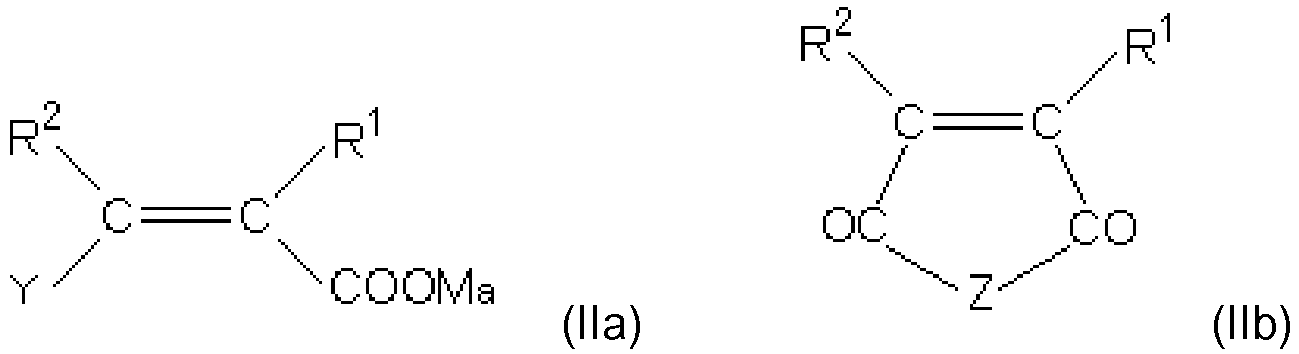
- Bei dem Mono- oder Dicarbonsäure-Derivat (IIa) und dem in cyclischer Form vorliegenden Monomer (IIb), wobei Z = O (Säureanhydrid) oder NR2 (Säureimid) darstellen, steht R1 und R2 unabhängig voneinander für Wasserstoff oder einen aliphatischen Kohlenwasserstoffrest mit 1 bis 20 C-Atomen, vorzugsweise eine Methylgruppe. Y bedeutet H, -COOMa, -CO-O(CqH2qO)r-R3, -CO-NH-(CqH2qO)r-R3.
- M bedeutet Wasserstoff, ein ein- oder zweiwertiges Metallkation, vorzugsweise Natrium-, Kalium-, Calcium- oder Magnesium-Ion, weiterhin Ammonium oder ein organischer Aminrest sowie a = ½ oder 1, je nachdem, ob es sich bei M um ein ein- oder zweiwertiges Kation handelt. Als organische Aminreste werden vorzugsweise substituierte Ammonium-Gruppen eingesetzt, die sich ableiten von primären, sekundären oder tertiären C1-20-Alkylaminen, C1-20-Alkanolaminen, C5-8-Cycloalkylaminen und C6-14-Arylaminen. Beispiele für die entsprechenden Amine sind Methylamin, Dimethylamin, Trimethylamin, Ethanolamin, Diethanolamin, Triethanolamin, Methyldiethanolamin, Cyclohexylamin, Dicyclohexylamin, Phenylamin, Diphenylamin in der protonierten (Ammonium)Form.
- R3 bedeutet Wasserstoff, ein aliphatischer Kohlenwasserstoffrest mit 1 bis 20 C-Atomen, ein cycloaliphatischer Kohlenwasserstoffrest mit 5 bis 8 C-Atomen, ein Arylrest mit 6 bis 14 C-Atomen, der ggf. noch substituiert sein kann, q = 2 , 3 oder 4 sowie r = 0 bis 200, vorzugsweise 1 bis 150. Die aliphatischen Kohlenwasserstoffe können hierbei linear oder verzweigt sowie gesättigt oder ungesättigt sein. Als bevorzugte Cycloalkylreste sind Cyclopentyl- oder Cyclohexylreste, als bevorzugte Arylreste Phenyloder Naphthylreste anzusehen, die insbesondere noch durch Hydroxyl-, Carboxyl- oder Sulfonsäuregruppen substituiert sein können.
- Die folgende Formel stellt das Monomer (IIc) dar:
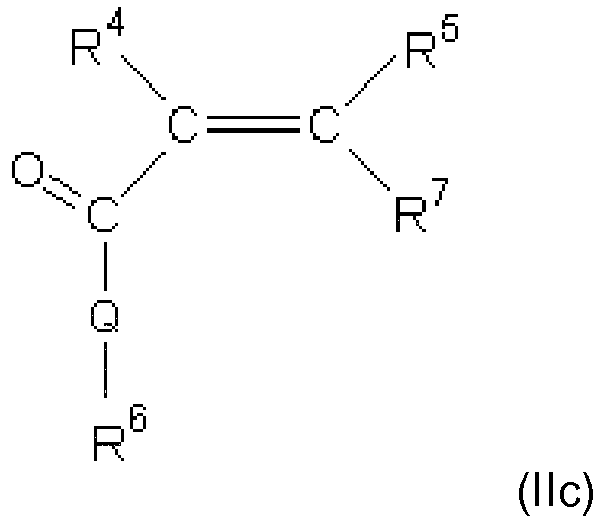
- Hierbei steht R4 und R5 unabhängig voneinander für Wasserstoff oder einen aliphatischen Kohlenwasserstoffrest mit 1 bis 20 C-Atomen, einen cycloaliphatischen Kohlenwasserstoffrest mit 5 bis 8 C-Atomen, einen ggf. substituierten Arylrest mit 6 bis 14 C-Atomen. Q kann gleich oder verschieden sein und wird durch NH, NR3 oder O repräsentiert, wobei R3 die oben genannte Bedeutung besitzt.
- Weiterhin ist R6 gleich oder verschieden und wird durch (CnH2n)-SO3H mit n = 0, 1, 2, 3 oder 4, (CnH2n)-OH mit n = 0, 1, 2, 3 oder 4; (CnH2n)-PO3H2 mit n = 0, 1, 2, 3 oder 4, (CnH2n)-OPO3H2 mit n= 0, 1, 2, 3 oder 4, (C6H4)-SO3H, (C6H4)-PO3H2, (C6H4)-OPO3H2 und (CnH2n)-NR8 b mit n = 0, 1, 2, 3 oder 4 und b = 2 oder 3 repräsentiert.
- R7 bedeutet H, -COOMa, -CO-O(CqH2qO)r-R3, -CO-NH-(CqH2qO)r-R3, wobei Ma, R3, q und r die oben genannte Bedeutungen besitzen.
- R8 steht für Wasserstoff, einen aliphatischen Kohlenwasserstoffrest mit 1 bis 10 C-Atomen, einen cycloaliphatischen Kohlenwasserstoffrest mit 5 bis 8 C-Atomen, ein ggf. substituierter Arylrest mit 6 bis 14 C-Atomen.
- Weiterhin bevorzugt im Sinne der vorliegenden Erfindung wird das ethylenisch ungesättigte Monomer (III) durch folgende allgemeine Formeln repräsentiert:

R1, R2 und R3 besitzen die oben genannte Bedeutung. - In einer bevorzugten Ausführungsform stehen in der allgemeine Formeln (III) p für eine ganze Zahl zwischen 0 und 4, v für eine ganze Zahl zwischen 5 und 500 und w unabhängig voneinander für jede (CwH2wO)-Einheit gleich oder verschieden für 2 oder 3.
- Der molare Anteil der Monomere (II) und (III) in dem erfindungsgemäßen Polycarboxylatether kann in weiten Bereichen frei gewählt werden. Als besonders vorteilhaft hat es sich erwiesen, wenn der Anteil des Monomeren (II) an dem Copolymer 5 bis 95 Mol-%, bevorzugt 30 bis 95 Mol-% und insbesondere 55 bis 95 Mol-% beträgt. In einer weiterhin bevorzugten Ausführungsform beträgt der Anteil des Monomeren (III) an dem Copolymer 1 bis 89 Mol-%, insbesondere 1 bis 55 Mol-% und besonders bevorzugt 1 bis 30 Mol-%.
- Es ist hierbei als bevorzugt anzusehen, dass das Monomer (III) ein Molekulargewicht von 500 bis 10000 g/mol aufweist.
- In einer bevorzugten Ausführungsform besitzt das erfindungsgemäße Copolymer ein Molekulargewicht von 12000 bis 75000 g/mol.
- Bei dem lufteintragenden Additiv (b) im Sinne der vorliegenden Erfindung kann es sich weiterhin um Alkanolamin, insbesondere mindestens ein mono-, di- oder tertiäres Alkanolamin aus der Reihe Triethanolamin, Triisopropanolamin, Diethanolisopropanolamin, Ethanoldiisopropanolamin, Poly(hydroxyalkyliertes)polyethylenamin, N,N-Bis(2-hydroxypropyl)-N-(hydroxyethyl)amine, 1-(N,N-Bis(2-hydroxyethyl)amino)propan-2-ol, N,N,N',N'-Tetra-(2-hydroxyethyl)-ethylendiamin, Methyldiethanolamin, Monoethanolamin, Diethanolamin, Monoisoporopanolamin und Diisopropanolamin handeln. Insbesondere bevorzugt handelt es sich bei dem Alkanolamin um Triisopropanolamin.
- In einer bevorzugten Ausführungsform umfasst die Zusammensetzung enthaltend Zementklinker bei der Vermahlung gegebenenfalls auch noch weitere Komponenten aus der Reihe Flugasche, Hochofenschlacke, Metakaolin, Silicastaub, Kalksteinmehl, Puzzolane und Asche, insbesondere Asche aus Reisschalen und Kornspelzen. Das erfindungsgemäße Verfahren kann auch für die Herstellung von Mischzementen verwendet werden. Hierzu können individuelle Zemente, die jeweils separat durch Mahlung hergestellt werden, gemischt werden, wobei mindestens einer der individuellen Zemente nach dem erfindungsgemäßen Verfahren vermahlen wird oder es wird eine Mischung von mehreren Zementklinkern mit den erfindungsgemäßen Additiven gemahlen, um einen Mischzement zu erhalten. Ebenfalls können individuelle Zemente durch gleichzeitige oder separate Vermahlung von Klinker und Kompositmaterialien hergestellt werden. Es ist jedoch als bevorzugt anzusehen, dass die Zusammensetzung enthaltend Zementklinker zu mehr als 60 Gew.-% aus Portlandzementklinker besteht.
- Der Mahlprozess erfolgt üblicherweise in einer Kugelmühle. Es können aber grundsätzlich auch andere Mühlen, wie sie in der Zementindustrie bekannt sind, eingesetzt werden. In einer bevorzugten Ausführungsform wird die Mahlung in mindestens einer Mühle aus der Reihe Kugelmühle, Gutbettwalzenmühle und Horizontalmühle durchgeführt.
- Weiterhin kann in dem erfindungsgemäßen Verfahren auch mindestens ein weiteres bekanntes Mahlhilfsmittel eingesetzt werden. In einer bevorzugten Ausführungsform wird der Zusammensetzung enthaltend Zementklinker, vor oder während des Mahlvorgangs, Wasser zugegeben.
- In einer weiterhin bevorzugten Ausführungsform wird die Zusammensetzung, enthaltend Zementklinker, während des Mahlvorgangs durch eine Heizquelle erwärmt.
- Es ist weiterhin als bevorzugt anzusehen, dass die Zusammensetzung einen Emulgator enthält. Insbesondere kann es sich um mindestens ein Oxo- oder Fettalkoholethoxylat, der Formel R11 - (C2H4-O-)x-H handeln,
wobei
R11 für einen verzweigten oder unverzweigten C8- bis C20-Alkylrest und
x für eine ganze Zahl zwischen 2 und 20 steht.
Bevorzugt steht R11 für C9 bis C13 und x für eine ganze Zahl zwischen 2 und 14, besonders bevorzugt steht R11 für C13 und x für eine ganze Zahl zwischen 4 und 12. In einer besonders bevorzugten Ausführungsform steht R11 für C13 und x für 6 oder x für 10. Weiterhin bevorzugt steht R11 für C10 bis C18 und x für 7. - Die Emulgatoren können die Stabilität des Entschäumers in dem hydraulischen Bindemittel erhöhen. Insbesondere umfasst die erfindungsgemäße Zusammensetzung zwischen 0,0000001 bis 0,5 Gew.-%, insbesondere zwischen 0,0000005 bis 0,5 Gew.-% mindestens eines Emulgators.
- Ein weiterer Aspekt der vorliegenden Erfindung ist ein hydraulisches Bindemittel, welches nach dem erfindungsgemäßen Verfahren hergestellt wird. Weiterhin wird durch die vorliegende Erfindung ein gehärtetes Baustofferzeugnis umfasst, welches aus einem erfindungsgemäßen hydraulischen Bindemittel hergestellt wurde.
- Ein weiterer Gegenstand der vorliegenden Erfindung ist ein Additiv umfassend
- (a) 0,1 bis 1 Gewichtsteile mindestens eines
Entschäumungsmittels der Formel
R10- (CmH2m-O-)x-(CdH2d-O-)c-H (I)
wobei- R10
- für einen verzweigten oder unverzweigten C4- bis C20-Alkylrest,
- m
- für jede (CmH2m-O-)-Einheit unabhängig voneinander gleich oder verschieden für 2 oder 3,
- d
- für jede (CdH2d-O-)-Einheit unabhängig voneinander gleich oder verschieden für eine ganze Zahl zwischen 4 und 20,
- x
- für eine ganze Zahl zwischen 2 und 20 und
- c
- für eine ganze Zahl zwischen 1 und 5 steht
- (b) 1 bis 20 Gewichtsteile mindestens einer Verbindung aus der Reihe Polycarboxylatether, Ligninsulfonat, Melaminformaldhydsulfonat, Naphtalinformaldehydsulfonat, Mono-, Di-, Tri- und Polyglykole, Polyalkohole, insbesondere Glycerin, Aminoalkohole, Aminosäuren, Zucker, Molasse, organische und anorganische Salze und
- (c) 0 bis 40 Gewichtsteile Wasser.
- Das erfindungsgemäße Additiv wird bevorzugt als wässrige Suspension auf die ein hydraulisches Bindemittel enthaltende Zusammensetzung aufgebracht. In einer bevorzugten Ausführungsform umfasst das Additiv zwischen 10 und 30 Gewichtsteile Wasser.
- In einer besonders bevorzugten Ausführungsform besteht das Additive aus (a), (b) und ggf. (c).
- Ein weiterer Gegenstand der vorliegenden Erfindung ist die Verwendung eines erfindungsgemäßen Additives, umfassend (a), (b) und ggf. (c), in einer Zusammensetzung enthaltend Zementklinker, wobei das Additiv vor, während oder nach dem Mahlvorgang zur Herstellung eines hydraulischen Bindemittels zugegeben wird, zur Verbesserung der Druckfestigkeit des daraus hergestellten, gehärteten Baustofferzeugnisses.
- Insbesondere wird durch die vorliegende Erfindung ein Verfahren zur Herstellung von hydraulischen Bindemitteln zur Verfügung gestellt, in welchem die eingesetzten Additive neben einer hervorragenden Wirkung während des Mahlvorgangs auch einen positiven Effekt auf die spätere Härtung und die mechanischen Eigenschaften des vermahlenen Produktes haben. Beim Anmachen mit Wasser erfolgt bei der nach dem erfindungsgemäßen Verfahren erhaltenen Zusammensetzung nur ein geringer Lufteintrag. Insbesondere wurden hierdurch sehr gute Festigkeitseigenschaften der erfindungsgemäßen Zusammensetzung in allen Alterungsstufen nach dem Anmachen mit Wasser erreicht, wobei eine sehr gute Frühfestigkeit nach einem Tag sowie eine hohe Druckfestigkeit nach 28 Tagen erzielt werden konnte.
- Die nachfolgenden Beispiele verdeutlichen die Vorteile der vorliegenden Erfindung.
- Die Mahlversuche wurden in einer Planetenkugelmühle (Retsch GmbH) durchgeführt. Pro Planet wurden 150,0 g Portlandzementklinker; 7,5 g Gips (CaSO4 · 2 H2O); 0,088 g Triisopropanolamin (TiPA) 85% (technical grade, 85%-ige Lösung in Wasser) und die jeweils unten angegebene Menge des Entschäumers eingewogen.
- Anschließend wurde 2 Minuten bei 200 min-1 (Drehzahl der Hauptscheibe) und 2 Minuten bei 400 min-1 gemahlen. Die Mahlung wurde bei Raumtemperatur ohne zusätzliche Wärmezufuhr gestartet, durch die Reibung während der Mahlung stieg die Temperatur jedoch bis auf ca. 60 - 70°C zum Mahlende an. Der so erhalte Zement wurde zur Abtrennung der Mahlkugeln durch ein 1 mm Sieb gesiebt.
- Pro Versuch wurden je 10 Mahlungen durchgeführt, die jeweils erhaltenen Zemente vereint und die Probe homogenisiert.
- Die so erhaltenen Zemente wurden anschließend im Mörtel nach DIN EN 196-1 getestet. Hierzu wurden die Zemente mit Normensand (Sand zu Zement Verhältnis 3:1) bei konstantem Wasser/Zementverhältnis (W/Z) = 0,5 gemischt und folgende Werte bestimmt: Luftporengehalt nach DIN 18555-2 nach dem Anmischen (Initial), Mörtelausbreitmaß nach dem Anmischen und nach 30 Minuten, Mörtelrohdichte nach dem Anmischen und nach 30 Minuten, Druckfestigkeit an Normenprüfkörpern nach 1, 7 und 28 Tagen (Herstellung, Lagerung und Prüfung der Druckfestigkeit nach DIN EN 196-1).
- Für die Versuche wurden folgende Entschäumerstrukturen der Formel (I) verwendet:
Bezeichnung Chemische Struktur Startalkohol (R10) (CmH2m-O-)x (CdH2d-O-)c Blank - - - Blank + TiPA - - - Vergleichsbeispiel 1 C13 - C15 Alkohol m=2;x=12 c=5;d=3 Vergleichsbeispiel 2 C13 - C15 Alkohol m = 2; x = 16 c = 4; d = 3 Entschäumer 1 2-Propylheptanol m=2;x=10 c = 1,5; d = 5 Entschäumer 2 Isodekanol m=2;x=7 c = 1,5; d = 4 - Als Vergleichsbeispiel 1 und 2 wurden Entschäumerstrukturen verwendet, wie sie in Patentanmeldung
WO2011/022217 beschrieben sind. Pro Mahlung wurden 0,075 g Entschäumer dosiert (0,05 Gew.-% bezogen auf die Zementeinwaage). Für die Versuche "Blank" wurde nur der Klinker ohne Verwendung von TiPA und Entschäumer gemahlen, bei der Serie "Blank + TiPA" wurde der Zement mit TiPA aber ohne Entschäumerzugabe gemahlen. - Bei Durchführung des Normenmörteltests nach DIN EN 196-1 konnten folgenden Ergebnisse erhalten werden:
Eigenschaften des Frischmörtels :Klopfmaß (cm) Luftporen-gehalt (%) Mörtelrohdichte (kg·dm-3) Initial 30 min Initial 30 min Blank 18,4 17,2 3,8% 2,215 2,213 Blank + TiPA 19,5 17,5 7,1% 2,142 2,165 Vergleichsbeispiel 1 22,3 20,4 21,5% 1,792 1,819 Vergleichsbeispiel 2 22,4 20,7 19,5% 1,799 1,852 Erfindungsgemäßes Beispiel 1 19,1 17,2 4,9% 2,202 2,204 Erfindungsgemäßes Beispiel 2 19.3 17,7 5,1% 2,194 2,199 Entschäumer Druckfestigkeit (MPa) Druckfestigkeit (% gegenüber Blank) 1 Tag 7 Tage 28 Tage 1 Tag 7 Tage 28 Tage Blank 9,1 40,0 58,8 - - - Blank + TiPA 9,2 43,3 58,3 + 1,1 + 8,3 - 0,8 Vergleichsbeispiel 1 4,0 16,7 19,4 - 56,0 - 58,3 - 67,0 Vergleichsbeispiel 2 4,2 16,7 21,6 - 53,8 - 58,3 - 63,3 Erfindungsgemäßes Beispiel 1 9,7 45,3 61,9 + 6,5 + 13,3 + 5,3 Erfindungsgemäßes Beispiel 2 10,5 47,3 61,5 +15,4 + 18,3 + 4,6 - Bei der Mahlung unter Zugabe von TiPA steigt erwartungsgemäß der Luftporengehalt bei der anschließenden Austestung des Zementes in Normenmörtel gegenüber dem Test mit Zement ohne TiPA deutlich an, was sich auch in einer leichten Reduktion der 28 Tage Festigkeiten auswirkt. Die Druckfestigkeiten nach 1 und 7 Tage sind leicht bzw. deutlich erhöht.
- Unter Verwendung der in
WO2011/022217 beschriebenen Entschäumer (Vergleichsbeispiel 1 und 2) zeigt sich im Normmörtel ein sehr starker Luftporeneintrag und weitaus geringere Mörtelrohdichten. Die deutlich reduzierten Druckfestigkeiten bei allen Messzeiten zeugen davon, dass auch zu späteren Zeiten keine Entlüftung stattfindet und die Luftporen im Mörtel verbleiben. - Unter Verwendung der erfindungsgemäßen Entschäumer 1 und 2 (Erfindungsgemäßes Beispiel 1 und 2) kann hingegen der Luftporengehalt gegenüber dem bei Verwendung von TiPA deutlich reduziert werden. Die Normmörtelergebnisse der Zemente zeigen deutlich verbesserte Druckfestigkeiten bei allen Messzeiten.
- Für diese Versuchsserie wurde der Entschäumer 2 verwendet. Die Versuchsdurchführung erfolgte analog zu den vorher beschriebenen, jedoch wurden unterschiedliche Mengen an Entschäumer zugegeben, um die Aktivität auch bei geringeren Dosierungen zu testen.
- Bei Durchführung des Normenmörteltests (siehe Versuchsbeschreibung) konnte folgendes Ergebnis erhalten werden:
Eigenschaften des Frischmörtels :Entschäumer Entschäumer (g) Klopfmaß (cm) Luftporengehalt (%) Mörtelrohdichte (kg·dm-3) Initial 30 min Initial 30 min Blank - 18,4 17,2 3,8% 2,215 2,213 Blank + TiPA - 19,5 17,5 7,1% 2,142 2,165 Erfindungsgemäßes Beispiel 4 7,5·10-4 18,8 17,6 5,8% 2,168 2,182 Erfindungsgemäßes Beispiel 5 7,5·10-3 18,9 17,3 5,4% 2,185 2,175 Erfindungsgemäßes Beispiel 6 7,5·10-2 19,3 17,7 5,1% 2,194 2,199 Entschäumer Druckfestigkeit (MPa) Druckfestigkeit (% gegenüber Blank) 1 Tag 7 Tage 28 Tage 1 Tag 7 Tage 28 Tage Blank 9,1 40,0 58,8 - - - Blank + TiPA 9,2 43,3 58,3 + 1,1 + 8,3 - 0,8 Erfindungsgemäßes Beispiel 4 10,3 42,8 57,6 + 13,1 + 7,0 - 2,0 Erfindungsgemäßes Beispiel 5 10,0 44,0 57,4 + 9,9 + 10,0 -2,4 Erfindungsgemäßes Beispiel 6 10,5 47,3 61,5 + 15,4 + 18,3 + 4,6 - Bereits bei geringen Dosierungen von 7,510-4 g (0,0005 Gew.-% bezogen auf das Zementgewicht) kann eine Reduktion des Luftporengehalts erzielt werden sowie eine Steigerung der 1 Tag- und 7 Tage-Druckfestigkeiten, während die 28 Tage-Druckfestigkeiten nahezu unverändert bleiben. Dies zeigt deutlich die Effektivität des erfindungsgemäßen Entschäumers.
Claims (15)
- Verfahren zur Herstellung eines hydraulischen Bindemittels, umfassend in Kontakt bringen einer Zusammensetzung, enthaltend Zementklinker, vor, während oder nach dem Mahlvorgang, mit(a) einem Entschäumungsmittel und(b) 0,0005 bis 2 Gew.-%, bezogen auf die gesamte Zusammensetzung, mindestens einer lufteintragenden Verbindung,dadurch gekennzeichnet, dass das Entschäumungsmittel (a) 0,0001 bis 0,5 Gew.-%, bezogen auf die gesamte Zusammensetzung, mindestens ein Entschäumungsmittel der Formel
R10- (CmH2m-O-)x-(CdH2d-O-)c-H (I)
wobei
R10 für einen verzweigten oder unverzweigten C4- bis C20-Alkylrest,
m für jede (CmH2m-O-)-Einheit unabhängig voneinander gleich oder verschieden für 2 oder 3,
d für jede (CdH2d-O-)-Einheit unabhängig voneinander gleich oder verschieden für eine ganze Zahl zwischen 4 und 20,
x für eine ganze Zahl zwischen 2 und 20 und
c für eine ganze Zahl zwischen 1 und 5 steht, umfasst
und das Verhältnis von (a) zu (b) zwischen 1:1 bis 1:200 beträgt. - Verfahren nach Anspruch 1, dadurch gekennzeichnet, dass es sich bei der lufteintragenden Verbindung um mindestens eine aus der Reihe Polycarboxylatether, Ligninsulfonat, Melaminformaldhydsulfonat, Naphtalinformaldehydsulfonat, Mono-, Di-, Tri- und Polyglykole, Polyalkohole, Alkanolamin, Aminosäuren, Zucker, Molasse, organische und anorganische Salze handelt.
- Verfahren nach Anspruch 2, dadurch gekennzeichnet, dass es sich bei dem Polycarboxylatether um ein Copolymers handelt, welches erhältlich ist durch Polymerisation einer Mischung von Monomeren, umfassend(II) mindestens ein ethylenisch ungesättigtes Monomer, welches mindestens einen Rest aus der Reihe Carbonsäure, Carbonsäuresalz, Carbonsäureester, Carbonsäureamid, Carbonsäureanhydrid und Carbonsäureimid umfasst und(III) mindestens ein ethylenisch ungesättigtes Monomer mit einem Polyalkylenoxid-Rest.
- Verfahren nach Anspruch 3, dadurch gekennzeichnet, dass das ethylenisch ungesättigte Monomer (II) durch mindestens eine der folgenden allgemeinen Formeln aus der Gruppe (IIa), (IIb) und (IIc) repräsentiert wird
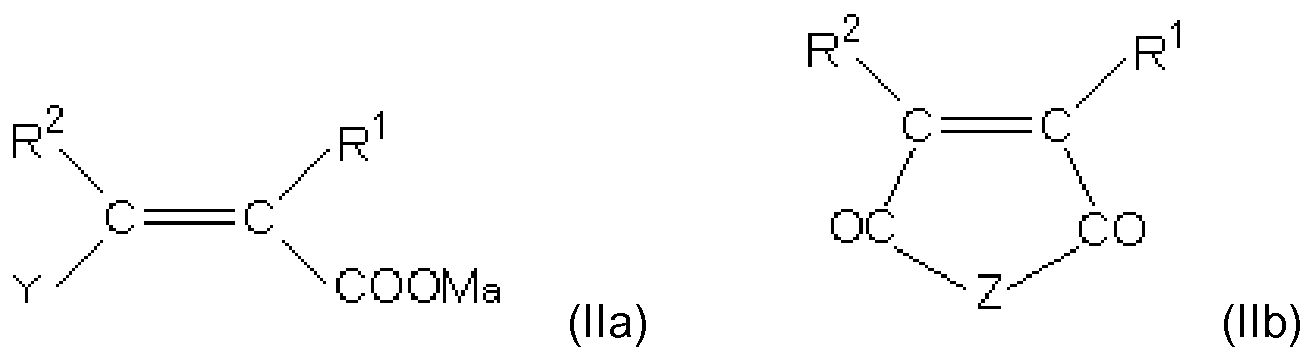 R1 und R2 unabhängig voneinander für Wasserstoff oder einen aliphatischen Kohlenwasserstoffrest mit 1 bis 20 C-AtomenY für H, -COOMa, -CO-O(CqH2qO)r-R3, -CO-NH-(CqH2qO)r-R3M für Wasserstoff, ein ein- oder zweiwertiges Metallkation, Ammoniumion oder einen organischen Aminresta für ½ oder 1R3 für Wasserstoff, einen aliphatischen Kohlenwasserstoffrest mit 1 bis 20 C-Atomen, einen cycloaliphatischen Kohlenwasserstoffrest mit 5 bis 8 C-Atomen, einen ggf. substituierten Arylrest mit 6 bis 14 C-Atomenq unabhängig voneinander für jede (CqH2qO)-Einheit gleich oder verschieden 2, 3 oder 4 undr für 0 bis 200Z für O, NR3stehen,
 R4 und R5 unabhängig voneinander für Wasserstoff oder einen aliphatischen Kohlenwasserstoffrest mit 1 bis 20 C-Atomen, einen cycloaliphatischen Kohlenwasserstoffrest mit 5 bis 8 C-Atomen, einen ggf. substituierten Arylrest mit 6 bis 14 C-AtomenQ gleich oder verschieden sowie repräsentiert durch NH, NR3 oder O; wobei R3 die oben genannte Bedeutung besitztR6 gleich oder verschieden sowie repräsentiert durch (CnH2n)-SO3H mit n = 0, 1, 2, 3 oder 4, (CnH2n)-OH mit n = 0, 1, 2, 3 oder 4; (CnH2n)-PO3H2 mit n = 0, 1, 2, 3 oder 4, (CnH2n)-OPO3H2 mit n= 0, 1, 2, 3 oder 4, (C6H4)-SO3H, (C6H4)-PO3H2, (C6H4)-OPO3H2 und (CnH2n)-NR8 b mit n = 0, 1, 2, 3 oder 4 und b = 2 oder 3R7 für H, -COOMa, -CO-O(CqH2qO)r-R3, -CO-NH-(CqH2qO)r-R3, wobei Ma, R3, q und r oben genannte Bedeutungen besitzenR8 für Wasserstoff, einen aliphatischen Kohlenwasserstoffrest mit 1 bis 10 C-Atomen, einen cycloaliphatischen Kohlenwasserstoffrest mit 5 bis 8 C-Atomen, ein ggf. substituierter Arylrest mit 6 bis 14 C-Atomen.
 - Verfahren nach einem der Ansprüche 3 bis 4, dadurch gekennzeichnet, dass das ethylenisch ungesättigte Monomer (III) durch folgende allgemeine Formeln repräsentiert wird
 p für eine ganze Zahl zwischen 0 und 6y für 0 oder 1v für eine ganze Zahl zwischen 3 und 500w unabhängig voneinander für jede (CwH2wO)-Einheit gleich oder verschieden für eine ganze Zahl zwischen 2 und 18, wobei R1, R2 und R3 die oben genannte Bedeutung besitzen stehen.
 - Verfahren nach Anspruch 2, dadurch gekennzeichnet, dass es sich bei dem Alkanolamin um mindestens ein mono-, di- oder tertiäres Alkanolamin aus der Reihe Triethanolamin, Triisopropanolamin, Diethanolisopropanolamin, Ethanoldiisopropanolamin, Poly(hydroxyalkyliertes)polyethylenamin , N,N-Bis(2-hydroxypropyl)-N-(hydroxyethyl)amin, 1-(N,N-Bis(2-hydroxyethyl)amino)propan-2-ol, N,N,N',N'-Tetra-(2-hydroxyethyl)-ethylendiamin, Methyldiethanolamin, Monoethanolamin, Diethanolamin, Monoisoporopanolamin und Diisopropanolamin handelt.
- Verfahren nach einem der Ansprüche 1 bis 6, dadurch gekennzeichnet, dass die Zusammensetzung enthaltend Zementklinker mindestens eine weitere Komponente aus der Reihe Flugasche, Hochofenschlacke, Metakaolin, Silicastaub, Kalksteinmehl, Puzzolane und Asche umfasst.
- Verfahren nach einem der Ansprüche 1 bis 7, dadurch gekennzeichnet, dass die Zusammensetzung enthaltend Zementklinker zu mehr als 60 Gew.-% aus Portlandzementklinker besteht.
- Verfahren nach einem der Ansprüche 1 bis 8, dadurch gekennzeichnet, dass der Mahlvorgang in mindestens einer Mühle aus der Reihe Kugelmühle, Gutbettwalzenmühle und Horizontalmühle durchgeführt wird.
- Verfahren nach einem der Ansprüche 1 bis 9, dadurch gekennzeichnet, dass der Zusammensetzung enthaltend Zementklinker, vor oder während des Mahlvorgangs, Wasser zugegeben wird.
- Verfahren nach einem der Ansprüche 1 bis 10, dadurch gekennzeichnet, dass die Zusammensetzung mindestens einen Emulgator enthält.
- Hydraulisches Bindemittel, hergestellt nach einem der Ansprüche 1 bis 11.
- Gehärtetes Baustofferzeugnis hergestellt aus einem hydraulischen Bindemittel nach Anspruch 12.
- Additiv umfassend(a) 0,1 bis 1 Gewichtsteile mindestens eines
Entschäumungsmittels der Formel
R10- (CmH2m-O-)x-(CdH2d-O-)c-H (I)
wobeiR10 für einen verzweigten oder unverzweigten C4- bis C20-Alkylrest,m für jede (CmH2m-O-)-Einheit unabhängig voneinander gleich oder verschieden für 2 oder 3,d für jede (CdH2d-O-)-Einheit unabhängig voneinander gleich oder verschieden für eine ganze Zahl zwischen 4 und 20,x für eine ganze Zahl zwischen 2 und 20 undc für eine ganze Zahl zwischen 1 und 5 steht(b) 1 bis 20 Gewichtsteile mindestens einer Verbindung aus der Reihe Polycarboxylatether, Ligninsulfonat, Melaminformaldhydsulfonat, Naphtalinformaldehydsulfonat, Mono-, Di-, Tri- und Polyglykole, Polyalkohole, Aminoalkohole, Aminosäuren, Zucker, Molasse, organische und anorganische Salze und(c) 0 bis 40 Gewichtsteile Wasser. - Verwendung eines Additives nach Anspruch 14 in einer Zusammensetzung enthaltend Zementklinker, wobei das Additiv vor, während oder nach dem Mahlvorgang zur Herstellung eines hydraulischen Bindemittels zugegeben wird, zur Verbesserung der Druckfestigkeit des daraus hergestellten, gehärteten Baustofferzeugnisses.
Priority Applications (12)
| Application Number | Priority Date | Filing Date | Title |
|---|---|---|---|
| EP20120166743 EP2660218A1 (de) | 2012-05-04 | 2012-05-04 | Verfahren zur Herstellung eines hydraulischen Bindemittels, entsprechendes Additiv sowie dessen Verwendung. |
| PCT/EP2013/058241 WO2013164213A1 (en) | 2012-05-04 | 2013-04-22 | Process for manufacturing a hydraulic bonding agent, corresponding additive and its use |
| RU2014148710A RU2630341C2 (ru) | 2012-05-04 | 2013-04-22 | Способ изготовления гидравлического вяжущего, соответствующей добавки и их применение |
| CN201380023572.5A CN104302596B (zh) | 2012-05-04 | 2013-04-22 | 制造水硬性粘合剂的方法、相应的添加剂及其用途 |
| DK13717514.7T DK2844624T3 (en) | 2012-05-04 | 2013-04-22 | Process for manufacturing a hydraulic bonding agent, corresponding additive and its use |
| ES13717514T ES2848448T3 (es) | 2012-05-04 | 2013-04-22 | Proceso para fabricar un agente de unión hidráulico, aditivo correspondiente y su uso |
| CA2871819A CA2871819C (en) | 2012-05-04 | 2013-04-22 | Process for manufacturing a hydraulic bonding agent, corresponding additive and its use |
| US14/396,787 US9162926B2 (en) | 2012-05-04 | 2013-04-22 | Process for manufacturing a hydraulic bonding agent, corresponding additive and its use |
| JP2015509366A JP2015520723A (ja) | 2012-05-04 | 2013-04-22 | 水硬性結合剤を製造する方法、対応する添加剤及びその使用 |
| EP13717514.7A EP2844624B1 (de) | 2012-05-04 | 2013-04-22 | Verfahren zur herstellung eines hydraulisches bindemittel, entsprechendes additiv sowie dessen verwendung. |
| MX2014013339A MX382957B (es) | 2012-05-04 | 2013-04-22 | Proceso para la fabricación de un agente de unión hidráulico, aditivo correspondiente y su uso. |
| BR112014023191-5A BR112014023191B1 (pt) | 2012-05-04 | 2013-04-22 | Método de produção de um ligante hidráulico, ligante hidráulico, produto de material de construção curado, aditivo e seu uso |
Applications Claiming Priority (1)
| Application Number | Priority Date | Filing Date | Title |
|---|---|---|---|
| EP20120166743 EP2660218A1 (de) | 2012-05-04 | 2012-05-04 | Verfahren zur Herstellung eines hydraulischen Bindemittels, entsprechendes Additiv sowie dessen Verwendung. |
Publications (1)
| Publication Number | Publication Date |
|---|---|
| EP2660218A1 true EP2660218A1 (de) | 2013-11-06 |
Family
ID=48142793
Family Applications (2)
| Application Number | Title | Priority Date | Filing Date |
|---|---|---|---|
| EP20120166743 Withdrawn EP2660218A1 (de) | 2012-05-04 | 2012-05-04 | Verfahren zur Herstellung eines hydraulischen Bindemittels, entsprechendes Additiv sowie dessen Verwendung. |
| EP13717514.7A Active EP2844624B1 (de) | 2012-05-04 | 2013-04-22 | Verfahren zur herstellung eines hydraulisches bindemittel, entsprechendes additiv sowie dessen verwendung. |
Family Applications After (1)
| Application Number | Title | Priority Date | Filing Date |
|---|---|---|---|
| EP13717514.7A Active EP2844624B1 (de) | 2012-05-04 | 2013-04-22 | Verfahren zur herstellung eines hydraulisches bindemittel, entsprechendes additiv sowie dessen verwendung. |
Country Status (11)
| Country | Link |
|---|---|
| US (1) | US9162926B2 (de) |
| EP (2) | EP2660218A1 (de) |
| JP (1) | JP2015520723A (de) |
| CN (1) | CN104302596B (de) |
| BR (1) | BR112014023191B1 (de) |
| CA (1) | CA2871819C (de) |
| DK (1) | DK2844624T3 (de) |
| ES (1) | ES2848448T3 (de) |
| MX (1) | MX382957B (de) |
| RU (1) | RU2630341C2 (de) |
| WO (1) | WO2013164213A1 (de) |
Cited By (1)
| Publication number | Priority date | Publication date | Assignee | Title |
|---|---|---|---|---|
| WO2019138319A3 (en) * | 2018-01-09 | 2019-10-03 | Holcim Technology Ltd | Method for the production of underground foundations |
Families Citing this family (12)
| Publication number | Priority date | Publication date | Assignee | Title |
|---|---|---|---|---|
| ES2863002T3 (es) * | 2012-11-05 | 2021-10-08 | Sika Tech Ag | Uso de un agente auxiliar de molienda para clínker de cemento a base de éteres de policarboxilato y ligninsulfonatos |
| EP2784038A1 (de) * | 2013-03-26 | 2014-10-01 | Basf Se | Fließmittel auf Zuschlägen |
| EP2873657A1 (de) * | 2013-11-13 | 2015-05-20 | Huntsman Petrochemical LLC | Beimengungszusammensetzung zur Verbesserung der Festigkeit von zementgehärteten Produkten |
| MY167711A (en) * | 2015-07-09 | 2018-09-21 | Nippon Catalytic Chem Ind | Cement additive, cement composition, and raw material for cement additive |
| EP3415481A1 (de) * | 2017-06-14 | 2018-12-19 | HeidelbergCement AG | Verbundstoffzement und verfahren zur herstellung von verbundstoffzement |
| RU2766880C2 (ru) * | 2017-12-07 | 2022-03-16 | Констракшн Рисерч Энд Текнолоджи Гмбх | Диспергирующая композиция |
| EP4073013A4 (de) * | 2019-11-13 | 2023-10-11 | Plustechno Danismanlik ve Yapi Kimyasallari Sanayi Ticaret Anonim Sirketi | Neuartiges verfahren für hochleistungszemente |
| FR3104588B1 (fr) | 2019-12-17 | 2021-12-24 | Chryso | Composés fluidifiants pour compositions hydrauliques |
| EP3872049A1 (de) * | 2020-02-25 | 2021-09-01 | Sika Technology AG | Prozesshilfsmittel und deren verwendung in einem verfahren zur gewinnung von zuschlagstoffen und/oder pulverförmigem mineralischem material |
| CN112441768B (zh) * | 2020-11-26 | 2022-07-29 | 江苏超力建材科技有限公司 | 一种水洗砂石处理剂及制备混凝土的方法 |
| MX2024006522A (es) * | 2021-12-20 | 2024-06-11 | Holcim Technology Ltd | Metodo de produccion de una premezcla, para hormigon o mortero, que comprende cemento portland, un superplastificante y un agente desespumante. |
| EP4703333A1 (de) * | 2024-08-30 | 2026-03-04 | Sika Technology AG | Multifunktionelles additiv zum mahlen von mineralischen bindemittelmaterialien und daraus hergestellte zusammensetzungen |
Citations (11)
| Publication number | Priority date | Publication date | Assignee | Title |
|---|---|---|---|---|
| US4948429A (en) * | 1989-06-14 | 1990-08-14 | W. R. Grace & Co.-Conn. | Method of controlling air entrainment in concrete compositions |
| US4990190A (en) | 1989-10-06 | 1991-02-05 | W. R. Grace & Co.-Conn. | Strength enhancing additive for certain portland cements |
| US5017234A (en) | 1989-10-06 | 1991-05-21 | W. R. Grace & Co.-Conn. | Processing additives for blended cements |
| US5084103A (en) | 1989-10-06 | 1992-01-28 | W. R. Grace & Co.-Conn. | Strength enhancing additive for certain portland cements |
| FR2706447A1 (fr) * | 1993-06-11 | 1994-12-23 | Sandoz Sa | Contrôle de fluidité des compositions de ciment. |
| WO2001042161A2 (en) * | 1999-12-10 | 2001-06-14 | Mbt Holding Ag | Water-soluble air-controlling agents for cementitious compositions |
| US20030187101A1 (en) * | 1999-12-10 | 2003-10-02 | Mbt Holding Ag | Solubilized defoamers for cementitious compositions |
| US20070266905A1 (en) * | 2004-08-20 | 2007-11-22 | Amey Stephen L | Admixture dispensing system and method |
| WO2010085425A1 (en) | 2009-01-21 | 2010-07-29 | W. R. Grace & Co.-Conn. | Robust polycarboxylate containing ether linkages for milling preparation of cementitious materials |
| WO2011022217A1 (en) | 2009-08-20 | 2011-02-24 | W.R. Grace & Co.-Conn. | Robust air-detraining for cement milling |
| WO2011149714A1 (en) * | 2010-05-25 | 2011-12-01 | W.R. Grace & Co.-Conn. | Defoamers for hydratable cementitious compositions |
Family Cites Families (9)
| Publication number | Priority date | Publication date | Assignee | Title |
|---|---|---|---|---|
| WO1998031643A1 (en) | 1997-01-21 | 1998-07-23 | W.R. Grace & Co.-Conn. | Emulsified comb polymer and defoaming agent composition and method of making same |
| AU731822B2 (en) | 1997-06-25 | 2001-04-05 | Gcp Applied Technologies Inc. | Admixture and method for optimizing addition of EO/PO superplasticizer to concrete containing smectite clay-containing aggregates |
| CN1168685C (zh) * | 1997-10-01 | 2004-09-29 | 格雷斯公司 | 水硬性水泥组合物 |
| EP1308427A4 (de) * | 2000-08-11 | 2006-07-19 | Nippon Catalytic Chem Ind | Zement mischung und zement zusammensetzung |
| JP4209685B2 (ja) | 2001-05-01 | 2009-01-14 | ダブリュー・アール・グレイス・アンド・カンパニー−コネチカット | 減水剤混和剤用消泡剤 |
| US6358310B1 (en) | 2001-06-14 | 2002-03-19 | W. R. Grace & Co.-Conn. | Air entraining admixture compositions |
| WO2010000020A1 (en) | 2008-06-30 | 2010-01-07 | Cathrx Ltd | A catheter |
| KR101673275B1 (ko) * | 2008-12-18 | 2016-11-07 | 아크조 노벨 엔.브이. | 알콕시화 2-프로필헵탄올을 포함하는 소포제 조성물 |
| WO2011000020A1 (en) | 2009-06-12 | 2011-01-06 | Sbc Research Pty Ltd | Enhanced method of detection |
-
2012
- 2012-05-04 EP EP20120166743 patent/EP2660218A1/de not_active Withdrawn
-
2013
- 2013-04-22 EP EP13717514.7A patent/EP2844624B1/de active Active
- 2013-04-22 US US14/396,787 patent/US9162926B2/en active Active
- 2013-04-22 RU RU2014148710A patent/RU2630341C2/ru active
- 2013-04-22 ES ES13717514T patent/ES2848448T3/es active Active
- 2013-04-22 CA CA2871819A patent/CA2871819C/en active Active
- 2013-04-22 CN CN201380023572.5A patent/CN104302596B/zh not_active Expired - Fee Related
- 2013-04-22 BR BR112014023191-5A patent/BR112014023191B1/pt not_active IP Right Cessation
- 2013-04-22 WO PCT/EP2013/058241 patent/WO2013164213A1/en not_active Ceased
- 2013-04-22 MX MX2014013339A patent/MX382957B/es unknown
- 2013-04-22 JP JP2015509366A patent/JP2015520723A/ja not_active Withdrawn
- 2013-04-22 DK DK13717514.7T patent/DK2844624T3/da active
Patent Citations (11)
| Publication number | Priority date | Publication date | Assignee | Title |
|---|---|---|---|---|
| US4948429A (en) * | 1989-06-14 | 1990-08-14 | W. R. Grace & Co.-Conn. | Method of controlling air entrainment in concrete compositions |
| US4990190A (en) | 1989-10-06 | 1991-02-05 | W. R. Grace & Co.-Conn. | Strength enhancing additive for certain portland cements |
| US5017234A (en) | 1989-10-06 | 1991-05-21 | W. R. Grace & Co.-Conn. | Processing additives for blended cements |
| US5084103A (en) | 1989-10-06 | 1992-01-28 | W. R. Grace & Co.-Conn. | Strength enhancing additive for certain portland cements |
| FR2706447A1 (fr) * | 1993-06-11 | 1994-12-23 | Sandoz Sa | Contrôle de fluidité des compositions de ciment. |
| WO2001042161A2 (en) * | 1999-12-10 | 2001-06-14 | Mbt Holding Ag | Water-soluble air-controlling agents for cementitious compositions |
| US20030187101A1 (en) * | 1999-12-10 | 2003-10-02 | Mbt Holding Ag | Solubilized defoamers for cementitious compositions |
| US20070266905A1 (en) * | 2004-08-20 | 2007-11-22 | Amey Stephen L | Admixture dispensing system and method |
| WO2010085425A1 (en) | 2009-01-21 | 2010-07-29 | W. R. Grace & Co.-Conn. | Robust polycarboxylate containing ether linkages for milling preparation of cementitious materials |
| WO2011022217A1 (en) | 2009-08-20 | 2011-02-24 | W.R. Grace & Co.-Conn. | Robust air-detraining for cement milling |
| WO2011149714A1 (en) * | 2010-05-25 | 2011-12-01 | W.R. Grace & Co.-Conn. | Defoamers for hydratable cementitious compositions |
Cited By (1)
| Publication number | Priority date | Publication date | Assignee | Title |
|---|---|---|---|---|
| WO2019138319A3 (en) * | 2018-01-09 | 2019-10-03 | Holcim Technology Ltd | Method for the production of underground foundations |
Also Published As
| Publication number | Publication date |
|---|---|
| US9162926B2 (en) | 2015-10-20 |
| JP2015520723A (ja) | 2015-07-23 |
| RU2630341C2 (ru) | 2017-09-07 |
| ES2848448T3 (es) | 2021-08-09 |
| CN104302596B (zh) | 2017-02-01 |
| BR112014023191B1 (pt) | 2021-03-30 |
| MX2014013339A (es) | 2015-02-10 |
| DK2844624T3 (en) | 2022-05-09 |
| WO2013164213A1 (en) | 2013-11-07 |
| RU2014148710A (ru) | 2016-06-27 |
| CA2871819A1 (en) | 2013-11-07 |
| MX382957B (es) | 2025-03-13 |
| EP2844624B1 (de) | 2020-09-02 |
| EP2844624A1 (de) | 2015-03-11 |
| CN104302596A (zh) | 2015-01-21 |
| CA2871819C (en) | 2020-03-31 |
| US20150114266A1 (en) | 2015-04-30 |
Similar Documents
| Publication | Publication Date | Title |
|---|---|---|
| EP2660218A1 (de) | Verfahren zur Herstellung eines hydraulischen Bindemittels, entsprechendes Additiv sowie dessen Verwendung. | |
| EP2660217A1 (de) | Mahlhilfsmittel für mineralische Bindemittel | |
| DE69839176T2 (de) | Zementzusammensetzung mit hohem anteil an durch puzzolan ersetzten zement und verträglichmachende gemische dafür | |
| EP1024120B1 (de) | Verfahren zur Reduzierung des Schwindens von hydraulischen Bindemitteln | |
| EP3019455B1 (de) | Zusatzmittelkombination aus einem mahlhilfsmittel und einem betonzusatzmittel zur beschleunigung der hydratation von zementösen bindemitteln | |
| EP2509930B1 (de) | Zusatzmittel für mineralische bindemittel mit verringertem braunverfärbungspotential | |
| EP2480514B1 (de) | Verwendung einer Zusatzmittelzusammensetzung enthaltend Ligninsulfonat zur Verminderung des Aufschwimmens von Russ auf mineralischen Bindemitteln | |
| EP1761473A1 (de) | Zementmahlhilfsmittel | |
| EP2527307A1 (de) | Dialkanolamine als Additive zum Mahlen von Feststoffen | |
| EP2746237B1 (de) | Anreger fuer Zement | |
| EP3455188A1 (de) | Verfahren zur behandlung von schlacke | |
| EP2899171A1 (de) | Additiv für hydraulisch abbindende Massen | |
| EP2714615B1 (de) | Erhärtungsbeschleuniger für mineralische bindemittel | |
| EP3109216B1 (de) | Erstarrungs- und erhaertungsbeschleuniger fuer hydraulische bindemittel | |
| EP2714622B1 (de) | Erhärtungsbeschleuniger für mineralische bindemittelzusammensetzungen | |
| EP2788299B1 (de) | Stabilisierung von rohpolyolen aus biomasse | |
| EP2609055B1 (de) | Beschleuniger | |
| EP2784038A1 (de) | Fließmittel auf Zuschlägen | |
| EP3538499B1 (de) | Erhärtungsbeschleuniger | |
| EP3204340A1 (de) | Zusatzmittel für die mahlung auf rollenmühlen | |
| EP3333138A1 (de) | Flüssiges zusatzmittel für schnelle belegreife von zementestrichen | |
| EP4417591B1 (de) | Zusammensetzung für die herstellung von beton, deren herstellungsverfahren und verwendung, sowie beton enthaltend diese zusammensetzung | |
| EP2784040A1 (de) | Schnell suspendierbare pulverförmige Zusammensetzung | |
| DD252369A5 (de) | Hydraulischer Bindemittel für Zementmischungen und Verfahren für deren Herstellung | |
| WO2013160158A1 (de) | Enzymatisch invertierte saccharose als mahlhilfsmittel |
Legal Events
| Date | Code | Title | Description |
|---|---|---|---|
| PUAI | Public reference made under article 153(3) epc to a published international application that has entered the european phase |
Free format text: ORIGINAL CODE: 0009012 |
|
| AK | Designated contracting states |
Kind code of ref document: A1 Designated state(s): AL AT BE BG CH CY CZ DE DK EE ES FI FR GB GR HR HU IE IS IT LI LT LU LV MC MK MT NL NO PL PT RO RS SE SI SK SM TR |
|
| AX | Request for extension of the european patent |
Extension state: BA ME |
|
| STAA | Information on the status of an ep patent application or granted ep patent |
Free format text: STATUS: THE APPLICATION IS DEEMED TO BE WITHDRAWN |
|
| 18D | Application deemed to be withdrawn |
Effective date: 20140507 |