EP2660673A2 - Centrale informatisée pour la configuration d'installations de traitement de produits - Google Patents
Centrale informatisée pour la configuration d'installations de traitement de produits Download PDFInfo
- Publication number
- EP2660673A2 EP2660673A2 EP20130002261 EP13002261A EP2660673A2 EP 2660673 A2 EP2660673 A2 EP 2660673A2 EP 20130002261 EP20130002261 EP 20130002261 EP 13002261 A EP13002261 A EP 13002261A EP 2660673 A2 EP2660673 A2 EP 2660673A2
- Authority
- EP
- European Patent Office
- Prior art keywords
- product
- data
- product processing
- production
- products
- Prior art date
- Legal status (The legal status is an assumption and is not a legal conclusion. Google has not performed a legal analysis and makes no representation as to the accuracy of the status listed.)
- Withdrawn
Links
Images



Classifications
-
- G—PHYSICS
- G05—CONTROLLING; REGULATING
- G05B—CONTROL OR REGULATING SYSTEMS IN GENERAL; FUNCTIONAL ELEMENTS OF SUCH SYSTEMS; MONITORING OR TESTING ARRANGEMENTS FOR SUCH SYSTEMS OR ELEMENTS
- G05B19/00—Program-control systems
- G05B19/02—Program-control systems electric
- G05B19/418—Total factory control, i.e. centrally controlling a plurality of machines, e.g. direct or distributed numerical control [DNC], flexible manufacturing systems [FMS], integrated manufacturing systems [IMS] or computer integrated manufacturing [CIM]
- G05B19/41865—Total factory control, i.e. centrally controlling a plurality of machines, e.g. direct or distributed numerical control [DNC], flexible manufacturing systems [FMS], integrated manufacturing systems [IMS] or computer integrated manufacturing [CIM] characterised by job scheduling, process planning, material flow
-
- B—PERFORMING OPERATIONS; TRANSPORTING
- B65—CONVEYING; PACKING; STORING; HANDLING THIN OR FILAMENTARY MATERIAL
- B65H—HANDLING THIN OR FILAMENTARY MATERIAL, e.g. SHEETS, WEBS, CABLES
- B65H39/00—Associating, collating, or gathering articles or webs
- B65H39/02—Associating,collating or gathering articles from several sources
-
- B—PERFORMING OPERATIONS; TRANSPORTING
- B65—CONVEYING; PACKING; STORING; HANDLING THIN OR FILAMENTARY MATERIAL
- B65H—HANDLING THIN OR FILAMENTARY MATERIAL, e.g. SHEETS, WEBS, CABLES
- B65H39/00—Associating, collating, or gathering articles or webs
- B65H39/02—Associating,collating or gathering articles from several sources
- B65H39/04—Associating,collating or gathering articles from several sources from piles
- B65H39/043—Associating,collating or gathering articles from several sources from piles the piles being disposed in juxtaposed carriers
-
- B—PERFORMING OPERATIONS; TRANSPORTING
- B65—CONVEYING; PACKING; STORING; HANDLING THIN OR FILAMENTARY MATERIAL
- B65H—HANDLING THIN OR FILAMENTARY MATERIAL, e.g. SHEETS, WEBS, CABLES
- B65H39/00—Associating, collating, or gathering articles or webs
- B65H39/02—Associating,collating or gathering articles from several sources
- B65H39/06—Associating,collating or gathering articles from several sources from delivery streams
- B65H39/075—Associating,collating or gathering articles from several sources from delivery streams by collecting in juxtaposed carriers
-
- B—PERFORMING OPERATIONS; TRANSPORTING
- B65—CONVEYING; PACKING; STORING; HANDLING THIN OR FILAMENTARY MATERIAL
- B65H—HANDLING THIN OR FILAMENTARY MATERIAL, e.g. SHEETS, WEBS, CABLES
- B65H43/00—Use of control, checking, or safety devices, e.g. automatic devices comprising an element for sensing a variable
-
- G—PHYSICS
- G05—CONTROLLING; REGULATING
- G05B—CONTROL OR REGULATING SYSTEMS IN GENERAL; FUNCTIONAL ELEMENTS OF SUCH SYSTEMS; MONITORING OR TESTING ARRANGEMENTS FOR SUCH SYSTEMS OR ELEMENTS
- G05B2219/00—Program-control systems
- G05B2219/30—Nc systems
- G05B2219/32—Operator till task planning
- G05B2219/32252—Scheduling production, machining, job shop
-
- G—PHYSICS
- G05—CONTROLLING; REGULATING
- G05B—CONTROL OR REGULATING SYSTEMS IN GENERAL; FUNCTIONAL ELEMENTS OF SUCH SYSTEMS; MONITORING OR TESTING ARRANGEMENTS FOR SUCH SYSTEMS OR ELEMENTS
- G05B2219/00—Program-control systems
- G05B2219/30—Nc systems
- G05B2219/32—Operator till task planning
- G05B2219/32297—Adaptive scheduling, feedback of actual proces progress to adapt schedule
-
- Y—GENERAL TAGGING OF NEW TECHNOLOGICAL DEVELOPMENTS; GENERAL TAGGING OF CROSS-SECTIONAL TECHNOLOGIES SPANNING OVER SEVERAL SECTIONS OF THE IPC; TECHNICAL SUBJECTS COVERED BY FORMER USPC CROSS-REFERENCE ART COLLECTIONS [XRACs] AND DIGESTS
- Y02—TECHNOLOGIES OR APPLICATIONS FOR MITIGATION OR ADAPTATION AGAINST CLIMATE CHANGE
- Y02P—CLIMATE CHANGE MITIGATION TECHNOLOGIES IN THE PRODUCTION OR PROCESSING OF GOODS
- Y02P90/00—Enabling technologies with a potential contribution to greenhouse gas [GHG] emissions mitigation
- Y02P90/02—Total factory control, e.g. smart factories, flexible manufacturing systems [FMS] or integrated manufacturing systems [IMS]
Definitions
- the invention relates to a computerized center and a computer-implemented method for configuring product processing plants.
- product processing systems for supplying products with feed conveyors to a conveyor and assembling them by collecting, inserting or collecting into product collections.
- the products include in particular flat printed products of different thickness but also other flat products, such as data carriers or other supplements.
- the product collections created from the products are sequentially fed by the conveyor to one or more further processing plants, for example for insertion, foliation, stapling, gluing, cutting and / or stacking.
- a product processing plant is designed with a revolving conveyor.
- An encircling conveyor allows the transport of products, product collections or collection carriers along a closed curve or path cyclically past the feeders.
- the product processing plants have different configurations, for example, a different number of feeders, different conveyor speeds, etc.
- Product collections also have different configurations, for example, a different number of assembled products, a different number of required copies, etc.
- For the production of required product collections is a product processing plant configured accordingly, for example, products provided at a feed conveyor, the speed of the conveyor set, etc.
- the configuration is particularly adapted to subsequent steps, in which, for example, for delivery By truck or other transport vehicles, the product collections are stacked by stacking stations to packages and then strapped.
- the feeders must be manually filled with the products to be supplied by operators of the product processing system before and during production.
- the products are typically brought to pallets to the feeders and supplied by the operator stack or bundle by a pallet to the respective feed conveyor.
- the production time is at the inefficient or unfavorable configuration of the product processing plant, for example, if re-allocations of feeders during production lead to production stoppages.
- the above objects are achieved by the present invention, in particular, by having a computerized center for configuring product processing facilities located remotely from the computerized center and each having a control module, a conveyor and a plurality of feeders, the control module being arranged, to control, based on configuration data, a particular product processing plant to produce one or more product collections from products supplied to the conveyor from the feeders.
- the computerized Central unit comprises at least one receiving module, which is set up to receive system data of the product processing installations and collection data of the one or more product collections via a telecommunication network.
- the computerized center comprises at least one production computation module configured to compute configuration data for one of the product processing plants, taking into account the plant data and the collection data of the product processing plant concerned, the configuration data for the feeders each defining an allocation plan with products constituted by feeders for producing the one or several product collections are to be supplied to the conveyor of the relevant product processing plant.
- the computerized center comprises at least one transmission module which is set up to transmit configuration data calculated via the telecommunication network to the control module of the relevant product processing installation.
- the computerized center is equipped such that the configuration data can be calculated quickly and efficiently, resulting in both efficient and inexpensive configuration of product processing facilities.
- the computerized center is easily and quickly adaptable to new insights, new plant components or new product collections to provide both efficient and convenient configuration of product processing equipment when calculating configuration data.
- the computerized center is provided for the calculation and transmission of configuration data for at least one product processing plant which is set up for isolated products, in particular for flat, flexible products.
- Products are provided as bundles of products at the feeders and are singulated with devices, the feeders being singulated products to the conveyor respectively.
- the separation of the products by means of suction grippers of different types of the product adapted.
- the at least one production computation module is configured to account for plant-specific data for computation of the configuration data, which depends on one or more of the following parameters: number of feeders, configuration of feeders, feeders 'performance data, feeders' operating costs, conveyor performance data, Type of feed feeder.
- the configuration data take into account the current configuration options of a product processing system and, where appropriate, subsequent processing systems.
- a high proportion of the operating costs of the feeders consists of personnel costs. If the products provided at a feeder are relatively large and heavy, a split operation or a backup operation of feeders may be required to supply a sufficient number of products to the conveyor. As a result, the operating costs increase in particular also due to the additional staff.
- the feeding method of the feeders includes, for example, feeding bundles by hand, feeding bars with products, loading as a disk or disc of wound product flakes, etc.
- the at least one production computing module is set up to take account of plant-specific data for the calculation of the configuration data, which depend on one or more of the following time parameters: Weekday, holiday.
- the configuration data take into account, in particular, factors dependent on time parameters, such as the production costs.
- the at least one production computing module is arranged to take into account collection data for calculating the configuration data, in particular product-specific parameters that depend on one or more of the following parameters: number of product collections, number of products in product collections, number of product collections to be produced, physical or geometric properties of the products, such as, in particular, magnetic properties, color, thickness, order of production of product collections, in particular for adherence to a delivery route order.
- the configuration data takes into account the required configurations of the product collections. Maintaining a route order is important because during shipment after unloading at a first destination, the product collections for the next destination should first be located on the transport surface to speed up the unloading and to avoid erroneous unloading.
- the at least one production computation module is configured to use one or more of the following optimization criteria to compute the configuration data: production cost, production time, production reliability, downtime, space requirements of the products, space requirements of the product collections, number of product movements, number of product collection movements, number Product change of feeders, number of persons to operate the at least one product processing plant.
- the configuration data are adapted to one or more optimization criteria and lead to a particularly efficient and favorable configuration of the product processing system.
- the at least one receiving module is configured to receive effective production data of multiple products relating to the production of product collections, and the at least one production computing module is configured to account for effective production data for calculating the configuration data.
- effective production data it is ensured that experience in the operation of product processing systems is taken into account in the calculation of the configuration data.
- the at least one receiving module is configured to receive change specifications concerning the configuration data
- the at least one production computing module is configured to take into account change specifications for calculating the configuration data.
- the change specifications for example, can be specified separately by the operator, for example, after the operator has checked configuration data and found in it desirable changes.
- the at least one production calculation module is configured to determine one or more configuration specifications regarding the product processing facility, and the at least one transmission module is configured to transmit the one or more configuration specifications to a monitoring unit of the product processing facility.
- monitoring configuration specifications for example, the reliability of the operation of the product processing system can be ensured.
- the invention in addition to a computerized center, relates to a computer-implemented method of configuring product processing equipment, which a computerized center and each having a control module, a conveyor and a plurality of feeders, wherein the control module is configured to control a product processing system based on configuration data to create one or more product collections from the feeders to the conveyor supplied products.
- the method comprises receiving via a telecommunication network in a computerized center of plant data of the product processing plants and collection data of the one or more product collections, calculating in the computerized center configuration data for one of the product processing plants taking into account the plant data and the collection data of the respective product processing plant, the configuration data for each of the feeders define an occupancy plan with products to be supplied by the feeder for the production of one or more product collections the conveyor of the product processing plant concerned, and transmitting the calculated configuration data from the computerized center via the telecommunications network to the control module of the relevant product processing plant.
- the computerized control center takes into account system data for the calculation of the configuration data, which depend on one or more of the following parameters: number of feeders, configuration of feeders, feeders 'performance data, feeders' running costs, conveyer performance data, feeder feed type.
- the computerized control center takes into account system data for the calculation of the configuration data, which depend on one or more of the following time parameters: time of day, day of the week, holiday.
- the computerized control center takes account of collection data that depend on one or more of the following parameters: number of product collections, number of products in product collections, physical or geometric properties of the products, in particular magnetic properties, color, thickness, number Specimens of product collections to be produced, order of production of product collections, in particular to comply with a route order at the time of delivery.
- the computerized control center uses one or more of the following optimization criteria to calculate the configuration data: production costs, production time, production reliability, downtime, space requirements of products, footprint of product collections, number of product movements, number of product collections movements, number of product changes of feeders , Number of people to operate the at least one product processing plant.
- the computerized center receives effective production data of a plurality of products relating to the production of product collections, and effective production data is taken into account by the computerized center for calculating the configuration data.
- the computerized center receives change specifications concerning the configuration data, and change specifications are taken into account by the computerized center for calculating the configuration data.
- one or more configuration specifications concerning the product processing system are determined by the computerized center, and it is determined by the computerized center which transmits one or more configuration specifications to a monitoring unit of the product processing system.
- the invention in addition to a computerized center and a computer implemented method, relates to a computer program product comprising a tangible computer readable storage medium having stored computer code arranged to control one or more processors of a computerized center for configuring product processing facilities located remote from the computerized center and each comprise a control module, a conveyor and a plurality of feeders, the control module being arranged to control, based on configuration data, a respective product processing facility to produce one or more product collections from products supplied to the conveyor from the feeders.
- the computer code controls the computerized center to: receive plant data of the product processing plants and collection data of the one or more product collections via a telecommunication network, to compile configuration data for one of the product processing plants taking into account the plant data and the collection data of the respective product processing plant, the configuration data for the feeders each defining an occupancy plan with products to be supplied by the feeder to create the one or more product collections to the conveyor of the product processing plant concerned, and the calculated configuration data are transmitted via the telecommunications network to the control module of the relevant product processing plant.
- the solution according to the invention can therefore be used in print finishing, in particular in printed product processing systems.
- Print finishing equipment involves very large and complex arrangements, often equipped with components from various suppliers.
- a configuration can also be determined for these complex and large plants, which leads to an efficient as well as favorable production process in the production of, for example, printed product collections.
- equipment in the field of post-press processing often, i. sometimes every day or even every hour to be configured, the solution according to the invention always allows a configuration to be determined which takes this into account and which always results in an efficient as well as favorable configuration in the print finishing equipment.
- a computerized center is configured to configure product processing facilities located remotely from the computerized center, each having a control module, a conveyor, and a plurality of feeders, the control module configured to control the product processing facility based on configuration data to create one or more product collections from products supplied by the infeed conveyors to the conveyor.
- the computerized center comprises: a receiving module which is adapted to receive configuration orders for product processing equipment via a telecommunications network, which configuration orders each comprise equipment data from one of the product processing equipment and collection data of the one or more product collections to be created by the respective product processing equipment, a production computing module which is set up , Configuration jobs for each of the product processing plants to calculate, taking into account the plant data and the collection data of the product processing plant concerned, the configuration data for the feeders of the relevant product processing plant defining an occupancy plan with products to be supplied by the feeders for the production of the one or more product collections to the conveyor of the relevant product processing plant, and Transmission module, which is set up to transmit the configuration data calculated for the configuration jobs via the telecommunications network to the control module of the plant processing plant that is about to start.
- the configuration jobs include, for example, a data structure containing plant data and collection data and, for example, a destination address of the computerized center and / or a sender address of the relevant product processing plant. Due to the sender address, the transmission to the corresponding product processing system is ensured after the calculation of the configuration data.
- the configuration jobs can have a priority according to which they are to be processed. For example, the priority can be used to derive the costs at which the configuration of a production plant is billed.
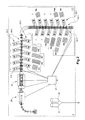
- FIG. 1 1 schematically shows a product processing installation 2, in particular a printed product processing installation, which has a control module 27, a conveyor 24 and a plurality of feed conveyors 23 and is set up to produce one or more product collections, in particular printed product collections, from products supplied by the feed conveyors 23.
- the product collections include various types of products, in particular printed products such as brochures, magazines, newspapers, etc. and / or other flat, flexible products such as data carriers, eg CDs, DVDs, Bluray discs, data storage cards, samples, for example bag soups or teabags, mail, packaged textiles, flexible display devices, eg e-paper, etc.
- the product processing installation 2 comprises, for example, several dozens or more than one hundred feed conveyers 23.
- a plurality of feed conveyors 23 are occupied by the same product, eg thick products, in which the manual loading of a single feed conveyor 23 by the operating personnel of the product processing plant 2 not in the required speed can be carried out so that a non-interruptible production of one or more product collections a non-stop feeding of the products to the conveyor 24 is ensured.
- a plurality of feeders 23 are provided to ensure a backup so that in case of failure of a feed conveyor 23, the interruption-free production of a product collection is guaranteed.
- the number of different products required for the production of several or all product collections is greater than the number of feeders 23 of the product processing equipment 2.
- FIG. 1 are further corresponding product processing systems 3, 4 shown schematically.
- the product processing system 2 is equipped with a revolving conveyor 24.
- a revolving conveyor 24 allows the transport of products, product collections resp. Collection carriers along a closed curve or web cyclically past the feeders 23.
- certain products resp. Product collections so several cycles on the rotating conveyor 24, so that the process of gathering can be performed several times, especially in the erroneous collection of products.
- conveyor 24 includes a plurality of serially arranged collection carriers, such as grippers, pedestals, pockets, or saddles, which are cyclically passed along feed line 23 along a closed line.
- the collection carriers are arranged to receive the products supplied by the feeders 23. The products are fed from the feeders 23 in a required order to the collection carriers and assembled into product collections.
- the product processing installation 2 comprises one or more further processing installations 25, 26.
- the conveyor 24 is followed by an insertion drum 25 for inserting the product collections, which are supplied, for example, from a separate feed conveyor, into a main product.
- the conveyor 24 is followed by a packaging installation 26, which is set up to collect and package product collections.
- the further processing plants 25, 26 comprise one or more of the following plants: a stacking station, a filming plant, a stapling installation, a trimming installation, a gluing installation, an installation for printing or affixing additional information such as name and address ,
- the control module 27 of the product processing installation 2 is set up for control tasks and is connected via communication connections, such as data lines, in particular to the feed conveyors 23, the conveyor 24 and the further processing installations 25, 26 of the product processing installation 2.
- the control module 27 is configured for monitoring tasks.
- the control module 27 is set up to receive configuration data and to control the production of product collections with the product processing equipment 2 based on the configuration data, for example by switching the feeders 23 on or off, signaling to the operators which products at which Feeders must be provided or refilled, the conveyor 24 is turned on or off, a speed of the feed conveyor 23 or the conveyor 24 is set, etc.
- the configuration data which relate in particular to configuration data of the feed conveyors 23, define, for example, the number and type of products which one Feed conveyor 23 are assigned, the time of change of products of a feed conveyor 23, the change of equipment of a feed conveyor 23 such as the type of suction gripper for sucking and feeding products, etc.
- the control module 27 includes, for example, a computer system having one or more processors, one or more communication interfaces for data transmission, a display unit such as a display unit. a screen, an input unit, e.g. a keyboard and a mouse or a touch-sensitive screen.
- the control module 27 comprises a plurality of functional modules, which are preferably designed as programmed software modules and comprise computer program code for controlling the processors of a computer system.
- the computer program code is stored on one or more computer-readable storage media fixedly or removably connected to the processors.
- FIG. 2 1 schematically shows a product processing installation 2 for producing one or more product collections, which are to be composed of one or more products P1, P2, P3, P4, P5, P6, P7, P8, P9, P10, Pn, for short products P1-Pn ,
- feeder 23.1 and a conveyor 24.1 a first section and feed conveyor 23.2 and a conveyor 24.2 a second section are provided, for example.
- the one or more product collections in the 1st section are put together by putting together first products P5, P6, P7, P8, P9, P10, Pn, briefly with the products P5-Pn, and in the 2nd section with second products P1, P2, P3, P4, in short with the products P1-P4.
- a first part of a product collection can be created, for example, which consists of a first set of products P9, P10, Pn, P1, P2, P3, P4, while subsequently, for example, the product collection is completed by, for example, products from a second set of products P8, P7, P6, P5, P1, P2, P3 , P4 are supplied.
- the product collections are defined on the basis of collection data 22, which in particular define the number of product collections, the order of the product collections, the products P1-Pn and the order of the products P1-Pn of a product collection, the number of copies of a product collection, etc.
- the collection data 22 defines a large number of features of product collections which are to be produced during the operation of a product processing installation 2.
- product collections include an assortment of a weekly magazine as a first product P1 and an advertisement flyer of a local fresh market, wherein a first product collection with the advertising flyer of a first fresh market, a second product collection with the flyer of a second fresh market, etc. are to be assembled.
- first product collections which contain the advertising flyer of the first fresh market in a first time window.
- copies are assembled with second product collections, third product collections and fourth product collections containing the advertising flyer of the second fresh market, the third fresh market, etc.
- 100,000 copies of the first, second, third and fourth product collections with the same weekly magazine and the advertising flyer of a first, second, third and fourth fresh market are assembled with the product processing system 2.
- the 100'000 copies are then transported to the local environment of the corresponding fresh market and there distributed or sold.
- the order of creation of each 100,000 copies for example, according to the distance between the product processing plant 2 and the respective fresh market done so that the local environment of the farthest fresh market, for example, at about the same time with the 100,000 copies can be supplied the local environments of the other fresh markets.
- the order of creation of each 100,000 copies can be made according to a delivery schedule, so that in a truck, which supplies the local environments of the respective fresh markets according to a delivery route, the corresponding 100'000 copies are in front of the front of the truck bed ,
- FIG. 3 schematically shows a product processing system 2 for creating one or more product collections, which are composed of one or more products P1, P2, P3, P4, P5, P6, P7, Pn, short of products P1-Pn.
- FIG. 2 and FIG. 3 illustrated examples of product processing equipment 2 are defined according to their configurations, which include, for example, different feed conveyor 23, conveyor 24, or further processing equipment 24, 25, by different system data 21.
- the plant data 21 define plant-specific data of the product processing plant 2, such as the number of sections with ready conveyors 24, 24.1, 24.2 and ready feeders 23, 23.1, 23.2, the configuration of the feeders 23, 23.1, 23.2 such as the installed or installable type one Suction gripper of a feed conveyor 23, 23.1, 23.2, the production speed which can be, for example, 27,000 cycles / h, the expected or average duration of a production interruption, for example 1 to 5 minutes, etc.
- the suction gripper of a feed conveyor 23, 23.1, 23.2 is to be set according to the product to be supplied or the suction gripper is to be replaced by another type.
- the suction grippers of the feed conveyor 23, 23.1, 23.2 are interchangeable.
- a Type 1 suction gripper may be provided for glossy inserts, particularly for thick product collections or inserts with a page number greater than e.g. 32 pages.
- a Type 2 suction gripper may be for newsprint, with the Type 2 gripper expensive and durable.
- a Type 3 suction gripper may also be provided for newsprint, the Type 3 gripper being inexpensive and not as durable.
- the suction gripper type 3 can be cost-effective and durable and replace the suction gripper type 2.
- a type 4 suction gripper may be provided for thin inserts of 1, 2 or 4 sides with the type 4 suction gripper set for high speeds.
- a type 5 suction gripper may be provided for thin inserts of 1, 2 or 4 sides with the type 5 suction gripper set for low to medium speeds.
- a suction gripper of type 6 can be used for stable products, e.g. CDs, cards, etc. may be provided.
- the collection data 22 include in corresponding Provide the necessary information about the products, so whether it is thick or thin products, gloss inserts or newspaper supplements, etc.
- the system data 21 include in a corresponding manner the necessary information about the feed conveyor 23 and the suction grippers with which these feeders can be equipped.
- a computerized center 1 a receiving module 11, which is adapted to receive system data 21 and collection data 22.
- the system data 21 and the collection data 22 are each combined in configuration orders, which contain, for example, a destination address of the computerized center 1 and a sender address of a product processing system 2 as structured data records.
- the plant data 21, the collection data 22 and / or the configuration jobs are stored in structured data records, for example according to an XML format (XML: eXtended Markup Language), which is transmitted over a communication link, for example via a data connection according to an IP protocol (IP: Internet Protocol), from a arranged in the local environment of the product processing system 2 data storage, are transmitted to the computerized center 1.
- XML eXtended Markup Language
- IP Internet Protocol
- a local computer system arranged in the local environment of the product processing installation 2 is connected to the computerized center 1 via an internet connection.
- the computerized center 1 thus forms an environment in the nature of a "cloud computing" from the perspective of a multiplicity of local computer systems of product processing installations 2.
- the computerized center 1 is thus as in FIG. 1 shown schematically in particular a variety of product processing systems 2, 3, 4 available.
- a configuration order comprises the plant data 21 of a respective product processing plant 2 and the collection data 22, according to which product productions P1-Pn are to be produced by the product processing plant concerned.
- a configuration job contains, for example, a destination address of a computerized center 1 in order to ensure the correct transmission of the configuration job via a telecommunication network.
- a configuration order also contains, for example, an address of a relevant product processing installation 2 in order to ensure the correct transmission of configuration data to the relevant product processing installation 2.
- the destination addresses may, for example, be implemented as IP addresses, as e-mail addresses or in another way.
- a configuration job includes a priority and the computerized center is e.g. set up to process configuration jobs according to the respective priority.
- the cost accounting is based on resources required by the computerized center 1, e.g. CPU time, memory requirements, etc. to calculate the configuration data for a configuration job.
- the configuration data define for each of the feeders 23 an allocation plan with products P1-Pn, which are to be supplied to the conveyor 24 by the feed conveyor for the production of the one or more product collections.
- the production calculation module 12 has required calculation routines.
- the calculation routines are, for example, set up such that the configuration data define an occupancy of the feed conveyors, which leads to a minimum service life of the production processing plant 2.
- a minimum service life is achieved, in particular, in that the feed conveyors 23 always have a sufficient number of products for the conveyance to the conveyor 24.
- the interruption-free production is only guaranteed if one of the feed conveyer 23 is not needed and is free for retooling for a new product.
- the production with the new product can be performed by retooling a free feeder 23 with the new product and then turning on this feeder 23 without interrupting production.
- the production calculation module considers this fact.
- the calculation routines take into account one or more of the following optimization criteria: production costs, production time, production reliability, downtime, space requirements of the products, space requirements of the product collections, number of product movements, number of product collection movements, number of product changes of feeders.
- Minimal production costs are achieved, for example, by the selection of low-cost production times, ie in particular during normal working hours during the week.
- a minimum production time is achieved, for example, by adjusting the maximum speed of the feed conveyor 23 and the conveyor 24.
- a maximum production reliability and / or a minimum Downtime is achieved for example by a parallel, redundant operation of feeders.
- a minimal space requirement of the products P1-Pn is achieved, for example, by an exact statement of the required product quantities.
- a minimal space requirement of product collections is achieved, for example, by stacking the product collections.
- a minimal number of movements of the products P1-Pn is achieved, for example, by avoiding unnecessary product changes in feeders 23.
- a minimum number of movements of the product collections is achieved, for example, by a choice of the order of production of product collections, so that the product collections do not have to be changed after production, for example for transport in a truck.
- a minimal number of product changes of feeders 23 is achieved, for example, by the skillful selection of the order in the production of product collections.
- the production calculation module 23 has calculation routines which are set up for one or more of the following calculation methods: linear programming, nearest neighbors' methods, nearest neighbors, genetic algorithms, etc. Further calculation methods are also known to the person skilled in the art Considering the system data 21 and the collection data 22, the configuration data can be calculated.
- the production calculation module 12 is set up to take into account system data 21 for calculating the configuration data, which comprises one or more of the following parameters: number of feeders 23, configuration of feeders 23, feeders 23 performance data, feeders 23 operating costs Number of feeders 23, for example, the production reliability be optimized by one or more products P1-Pn are fed in parallel from two or more feeders 23, so that in case of failure of a feed 23 the uninterrupted production is ensured by switching to a feed conveyor with the same product.
- the configuration of feeders it can be ensured that, for example, a product with a smooth surface is allocated to a suitable feed conveyor.
- performance data from feeders it can be ensured that, for example, a thick product is allocated to a suitable feed conveyor.
- the operating costs of feeders which include both the device itself and the personnel costs, it can be ensured that, for example, the processing costs are reduced by favoring feeders 23 with low operating costs over feeders 23 with high operating costs.
- the production computing module 12 is set up to take into account plant data 21 for the calculation of the configuration data, which depend on one or more of the following time parameters: time of day, day of the week, holiday.
- time of day day of the week
- holiday time parameters
- feeders must be regularly refilled with operating products by the operating personnel. Outside of normal working hours, eg in the evening, at night, on weekends, public holidays, the operator is charged a higher salary than normal working hours during the week.
- product collections that can be sold at a higher price for example due to high urgency, can be produced at off-peak times or during the night.
- product collections which require, for example, in smaller quantities the more work, can be made at normal working hours.
- the production computation module 12 is configured to account for collection data 22 for computation of the configuration data, which depends on one or more of the following parameters: number of product collections, number of products P1-Pn in product collections, number of product collection copies to be produced, sequence of product collections Production of product collections.
- the number of product collections produced in a work week may be several dozen.
- the number of products P1-Pn in the product collections may be, for example, several tens, e.g. 60.
- the number of copies of product collections may be, for example, tens of thousands, hundreds of thousands or millions, e.g. 100,000.
- the order of production of production collections may be, for example, due to urgency or logistical reasons such as e.g. the delivery route or the load order of a truck.
- the collection data 22 may include further information regarding the product collections to be produced.
- the computerized center 1 on a transmission module 13, which is adapted to transmit the configuration data to the control module 27 of the product processing system 2.
- the configuration data are determined taking into account the system data 21, the collection data 22 and / or configuration orders, they are transmitted to the control module 27 of the product processing system 2.
- the control module 27 is arranged to control the production of product collections based on the received configuration data.
- the control module 27 is also set up to monitor the production of product collections, eg to check the current number of copies of a product collection.
- the functional modules of the computerized center 1, in particular the receiving module 11, the production computing module 12 and the transmission module 13, are preferably embodied as programmed software modules comprising computer program code for controlling one or more processors of one or more computers.
- the computer program code is stored on one or more fixed or removably connected (tangible) computer readable storage media to the processors.
- the person skilled in the art will understand, however, that the functional modules in alternative embodiments can be partially or completely executed by hardware components.
- the computerized center 1 relates to a cluster with a plurality of computers, in particular a decentralized cluster.
- the cluster may include, for example, computers operated by different manufacturers of components of the product processing plant and which cooperate in particular in the calculation of configuration data for a product processing plant 2 such that an efficient as well as favorable configuration of the production processing plant 2 is determined.
- information about the components such as a maximum operating speed, can always be kept up to date by the various manufacturers. This considerably improves the configuration of a product processing system 2.
- the control module 27 is connected to the feeders 23, 23.1, 23.2 via communication links, so that the feed conveyors 23, 23.1, 23.2 can be switched on or off according to the required production process for the production of product collections, the speed can be adjusted, etc.
- control module 27 for example, a signaling routine, with which the operators of the feeders 23, 23.1, 23.2 the assignment of the feed conveyor with products, changing a suction gripper of a feed conveyor 23, 23.1, 23.2, etc. can be signaled.
- the signaling can be effected, for example, via corresponding messages which are displayed on a display arranged at a feed conveyor 23, 23.1, 23.2.
- the signaling via messages which are displayed on a display, which is arranged in a monitoring office of a manager of the production plant 2.
- the signaling takes place via messages which are displayed on portable devices that are available to the operating personnel.
- the control module 27 is connected to the conveyors 24, 24.1, 24.2 via communication links, so that the conveyors 24, 24.1, 24.2 according to the required production process for the production of product collections e.g.
- the control module 27 is connected via communication links to further processing equipment 25, 26 to control the stacking, wrapping, packaging, labeling, etc. of manufactured product collections.
- the receiving module 11 of the computerized center 1 is set up to receive effective production data relating to the production of product collections.
- the production calculation module 12 is set up to take into account effective production data for the calculation of the configuration data.
- effective production data such as the number of faults in the feeders 23, the number and duration of delays in changing products at a feeder 23, etc. can be detected. From the effective production data can be derived, for example, which combination of products P1-Pn lead with feeders 23 to relatively frequent disturbances.
- configuration data for example, certain combinations of products P1-Pn with feeders 23 can be avoided.
- the receiving module 11 is set up to receive modification specifications regarding the configuration data.
- the production calculation module 12 is set up to take into account change specifications for the calculation of the configuration data. Change specifications can be entered, for example, by the operator via a communication interface to the computerized central 1, for example after configuration data has been received from the control module 27 of the product processing system 2 and has been assessed by the operating personnel. For example, for individual reasons such as, for example, a disease-related reduction in the performance of operators, it may be too risky for the operator to make a specific product available only through a single feed conveyor 23, since the risk is considered too great that a fault will not be remedied within the usual time frame could.
- the change specifications can be made due to any of the operator individually known specifications. Due to the change specifications, correspondingly adapted configuration data are calculated by the production computing module 12 and transmitted to the control module 27 by the transmission module 13. This process can also be iterative and involve several runs, each with new change specifications and correspondingly calculated configuration data.
- the production calculation module 12 is set up to determine one or more configuration specifications concerning the product processing system 2.
- the transmission module 13 is set up, which has one or more configuration specifications to transmit to a monitoring unit of the product processing system 2.
- the monitoring unit is contained in a variant in the control module 27.
- Configuration specifications may relate to the equipment of feed conveyor 23 with a particular type of suction gripper. If the monitoring unit determines that configuration specifications have not been met, then, for example, a corresponding message can be displayed to the operating personnel of the product processing system 2 or in the case of operating reliability-relevant configuration specifications such as operational readiness of a conveyor of a maximum speed of the conveyor 24, a shutdown of the product processing system 2 triggered become.
- FIG. 4 1 shows a flowchart with a sequence of possible steps for calculating and transmitting configuration data for at least one product processing installation 2.
- plant data 21 are received in a computerized center 1 from at least one product processing plant 2 and from collection data 22 of the one or more product collections.
- the configuration data for the at least one product processing plant 2 is calculated taking into account the plant data 21 and the collection data 22, the configuration data for the feeders 23 each defining an occupancy plan with products P1-Pn, which from the feeder 23 to Creation of one or more product collections are the conveyor 24 supply.
- the configuration data are transmitted from the computerized center 1 to the control module 27 of the at least one product processing installation 2.
Landscapes
- Engineering & Computer Science (AREA)
- General Engineering & Computer Science (AREA)
- Manufacturing & Machinery (AREA)
- Quality & Reliability (AREA)
- Physics & Mathematics (AREA)
- General Physics & Mathematics (AREA)
- Automation & Control Theory (AREA)
- Management, Administration, Business Operations System, And Electronic Commerce (AREA)
- General Factory Administration (AREA)
Applications Claiming Priority (1)
| Application Number | Priority Date | Filing Date | Title |
|---|---|---|---|
| CH00612/12A CH706470A1 (de) | 2012-05-02 | 2012-05-02 | Computerisierte Zentrale zum Konfigurieren von Produktverarbeitungsanlagen. |
Publications (2)
| Publication Number | Publication Date |
|---|---|
| EP2660673A2 true EP2660673A2 (fr) | 2013-11-06 |
| EP2660673A3 EP2660673A3 (fr) | 2015-05-27 |
Family
ID=48366079
Family Applications (1)
| Application Number | Title | Priority Date | Filing Date |
|---|---|---|---|
| EP13002261.9A Withdrawn EP2660673A3 (fr) | 2012-05-02 | 2013-04-25 | Centrale informatisée pour la configuration d'installations de traitement de produits |
Country Status (2)
| Country | Link |
|---|---|
| EP (1) | EP2660673A3 (fr) |
| CH (1) | CH706470A1 (fr) |
Cited By (2)
| Publication number | Priority date | Publication date | Assignee | Title |
|---|---|---|---|---|
| WO2017149252A1 (fr) * | 2016-03-02 | 2017-09-08 | Safran Aircraft Engines | Installation et procede pour la fabrication d'une texture fibreuse en forme de bande presentant en section transversale un profil evolutif |
| CN111966066A (zh) * | 2020-08-18 | 2020-11-20 | 北京联合普肯工程技术股份有限公司 | 设备数据处理方法、装置和电子设备 |
Citations (3)
| Publication number | Priority date | Publication date | Assignee | Title |
|---|---|---|---|---|
| WO2005015328A1 (fr) * | 2003-08-09 | 2005-02-17 | Abb Research Ltd. | Systeme et procede de controle et de commande sur base web de plusieurs installations spatialement distribuees |
| DE102008053274A1 (de) * | 2008-10-27 | 2010-04-29 | Cae Factory Gmbh | Verfahren zur Steuerung einer Mehrzahl von Produktionsprozessen |
| US20100241260A1 (en) * | 2009-03-17 | 2010-09-23 | Comau, Inc. | Industrial communication system and method |
Family Cites Families (10)
| Publication number | Priority date | Publication date | Assignee | Title |
|---|---|---|---|---|
| US5237508A (en) * | 1989-08-10 | 1993-08-17 | Fujitsu Limited | Production control system |
| AU7212691A (en) * | 1990-07-09 | 1992-02-04 | Webcraft Technologies, Inc. | A system for producing an individualized packet |
| EP0639154A1 (fr) * | 1993-03-09 | 1995-02-22 | Grapha-Holding Ag | Procede pour l'obtention selective de produits imprimes |
| US5678680A (en) * | 1994-04-13 | 1997-10-21 | Sft Ag Spontanfoerdertechnik | Method and arrangement for producing consolidated lines of products |
| NL1020025C2 (nl) * | 2002-02-21 | 2003-08-25 | Konink Ptt Post B V | Inrichting en werkwijze voor het selectief vervaardigen van stapels drukwerk. |
| AU2003249336A1 (en) * | 2002-06-20 | 2004-01-06 | Graphic Management Associates, Inc. | Insert machine |
| EP1935821A1 (fr) * | 2006-12-18 | 2008-06-25 | Müller Martini Holding AG | Procédé destiné à former des piles de produits dýimpression, en particulier des livres, magazines, journaux et brochures et dispositif destiné à sa réalisation |
| CH702405A1 (de) * | 2009-12-09 | 2011-06-15 | Ferag Ag | Steuervorrichtung und verfahren zur steuerung einer druckproduktverarbeitungsanlage. |
| CH704690A1 (de) * | 2011-03-24 | 2012-09-28 | Ferag Ag | Steuervorrichtung und Verfahren zur Steuerung einer Druckproduktverarbeitungsanlage. |
| CH705598A1 (de) * | 2011-10-06 | 2013-04-15 | Ferag Ag | Steuervorrichtung und Verfahren zur Steuerung einer Produktverarbeitungsanlage. |
-
2012
- 2012-05-02 CH CH00612/12A patent/CH706470A1/de not_active Application Discontinuation
-
2013
- 2013-04-25 EP EP13002261.9A patent/EP2660673A3/fr not_active Withdrawn
Patent Citations (3)
| Publication number | Priority date | Publication date | Assignee | Title |
|---|---|---|---|---|
| WO2005015328A1 (fr) * | 2003-08-09 | 2005-02-17 | Abb Research Ltd. | Systeme et procede de controle et de commande sur base web de plusieurs installations spatialement distribuees |
| DE102008053274A1 (de) * | 2008-10-27 | 2010-04-29 | Cae Factory Gmbh | Verfahren zur Steuerung einer Mehrzahl von Produktionsprozessen |
| US20100241260A1 (en) * | 2009-03-17 | 2010-09-23 | Comau, Inc. | Industrial communication system and method |
Cited By (6)
| Publication number | Priority date | Publication date | Assignee | Title |
|---|---|---|---|---|
| WO2017149252A1 (fr) * | 2016-03-02 | 2017-09-08 | Safran Aircraft Engines | Installation et procede pour la fabrication d'une texture fibreuse en forme de bande presentant en section transversale un profil evolutif |
| FR3048435A1 (fr) * | 2016-03-02 | 2017-09-08 | Snecma | Installation et procede pour la fabrication d'une texture fibreuse en forme de bande presentant en section transversale un profil evolutif |
| CN108779590A (zh) * | 2016-03-02 | 2018-11-09 | 赛峰航空器发动机 | 用于制造横截面有变化轮廓的带状纤维织构的装置和方法 |
| US10309043B2 (en) | 2016-03-02 | 2019-06-04 | Safran Aircraft Engines | Installation and a method for fabricating a fiber texture in the form of a strip presenting a profile that varies in cross-section |
| CN111966066A (zh) * | 2020-08-18 | 2020-11-20 | 北京联合普肯工程技术股份有限公司 | 设备数据处理方法、装置和电子设备 |
| CN111966066B (zh) * | 2020-08-18 | 2021-12-10 | 北京联合普肯工程技术股份有限公司 | 设备数据处理方法、装置和电子设备 |
Also Published As
| Publication number | Publication date |
|---|---|
| CH706470A1 (de) | 2013-11-15 |
| EP2660673A3 (fr) | 2015-05-27 |
Similar Documents
| Publication | Publication Date | Title |
|---|---|---|
| DE3630876C2 (de) | Steuerung des Produktionsprozesses eines Zeitungsdruck- und Versandsystems | |
| EP2689306B1 (fr) | Dispositif de commande et procédé de commande d'une installation de traitement de produits imprimés | |
| EP1911583B1 (fr) | Traitement de blog | |
| EP1546826A2 (fr) | Procede et dispositifs pour alimenter une machine de traitement de maniere automatique en materiau, systeme de commande et imprimerie munie d'un systeme de commande | |
| EP3007057A1 (fr) | Procede d'optimisation de la sequence de production | |
| EP3151176A1 (fr) | Procede de planification et d'attribution de productions | |
| EP2509903B1 (fr) | Dispositif de commande, produit de programme informatique, et procédé de commande d'une installation de traitement de produits d'impression | |
| EP3056459B1 (fr) | Procédé de fonctionnement d'un dispositif de post-traitement et dispositif de post-traitement | |
| EP2763923B1 (fr) | Dispositif de commande informatisé, procédé mis en oeuvre sur ordinateur pour la commande d'une installation de traitement de produits et produit-programme informatique | |
| EP2176155A1 (fr) | Système d'assemblage de groupes d'objets plats | |
| EP2660673A2 (fr) | Centrale informatisée pour la configuration d'installations de traitement de produits | |
| EP2544980B1 (fr) | Dispositif de commande et procédé pour réguler la vitesse d'un convoyeur | |
| EP2832651B1 (fr) | Utilisation d'étiqueteuse dotée de modules d'étiquetage redondants | |
| EP2420384A2 (fr) | Installation de presse | |
| DE102012207289B4 (de) | Verfahren zur Verfolgung von Sendungen bei deren Erzeugung und Vorrichtung zur Erzeugung einer Mehrzahl von Sendungen | |
| EP2457859B1 (fr) | Procédé de fabrication de paquets constitués de produits imprimés | |
| CH702987A1 (de) | Steuereinrichtung für eine verarbeitungsanlage zur produktion von kollektionen von druckereiprodukten. | |
| EP3251993B1 (fr) | Procédé et dispositif de commande d'une installation de traitement ultérieur de produits d'impression | |
| EP2180387A1 (fr) | Procédé pour la préparation de commandes de produits imprimés et de produits additionnels à l'aide d'un système d'automatisation et système d'automatisation adapté à l'exécution du procédé | |
| EP2323086A1 (fr) | Procédé et dispositif de fabrication et de chargement de gerbes de produits d'impression | |
| Ito et al. | Proposal and development of an autonomous decentralized system for newspaper production | |
| EP1487721B1 (fr) | Procede et dispositif pour preparer des marchandises pour l'expedition | |
| EP4321347A1 (fr) | Dispositif pour la production de produits imprimés dans des supports inférieurs | |
| DE102019008839A1 (de) | Kundenspezifischer Aufdruck bei Lieferungen | |
| DE102009009540A1 (de) | Verfahren zum automatischen Steuern der Reihenfolge von Bearbeitungsaufträgen zur Bearbeitung von Materialgebinden |
Legal Events
| Date | Code | Title | Description |
|---|---|---|---|
| PUAI | Public reference made under article 153(3) epc to a published international application that has entered the european phase |
Free format text: ORIGINAL CODE: 0009012 |
|
| AK | Designated contracting states |
Kind code of ref document: A2 Designated state(s): AL AT BE BG CH CY CZ DE DK EE ES FI FR GB GR HR HU IE IS IT LI LT LU LV MC MK MT NL NO PL PT RO RS SE SI SK SM TR |
|
| AX | Request for extension of the european patent |
Extension state: BA ME |
|
| PUAL | Search report despatched |
Free format text: ORIGINAL CODE: 0009013 |
|
| AK | Designated contracting states |
Kind code of ref document: A3 Designated state(s): AL AT BE BG CH CY CZ DE DK EE ES FI FR GB GR HR HU IE IS IT LI LT LU LV MC MK MT NL NO PL PT RO RS SE SI SK SM TR |
|
| AX | Request for extension of the european patent |
Extension state: BA ME |
|
| RIC1 | Information provided on ipc code assigned before grant |
Ipc: G05B 19/418 20060101AFI20150423BHEP |
|
| 17P | Request for examination filed |
Effective date: 20150818 |
|
| RBV | Designated contracting states (corrected) |
Designated state(s): AL AT BE BG CH CY CZ DE DK EE ES FI FR GB GR HR HU IE IS IT LI LT LU LV MC MK MT NL NO PL PT RO RS SE SI SK SM TR |
|
| 17Q | First examination report despatched |
Effective date: 20160901 |
|
| STAA | Information on the status of an ep patent application or granted ep patent |
Free format text: STATUS: EXAMINATION IS IN PROGRESS |
|
| GRAP | Despatch of communication of intention to grant a patent |
Free format text: ORIGINAL CODE: EPIDOSNIGR1 |
|
| STAA | Information on the status of an ep patent application or granted ep patent |
Free format text: STATUS: GRANT OF PATENT IS INTENDED |
|
| INTG | Intention to grant announced |
Effective date: 20190703 |
|
| STAA | Information on the status of an ep patent application or granted ep patent |
Free format text: STATUS: THE APPLICATION IS DEEMED TO BE WITHDRAWN |
|
| 18D | Application deemed to be withdrawn |
Effective date: 20191101 |