EP2662049A2 - Suivi d'ablation automatique - Google Patents
Suivi d'ablation automatique Download PDFInfo
- Publication number
- EP2662049A2 EP2662049A2 EP13166904.6A EP13166904A EP2662049A2 EP 2662049 A2 EP2662049 A2 EP 2662049A2 EP 13166904 A EP13166904 A EP 13166904A EP 2662049 A2 EP2662049 A2 EP 2662049A2
- Authority
- EP
- European Patent Office
- Prior art keywords
- probe
- tissue sites
- map
- processor
- therapy
- Prior art date
- Legal status (The legal status is an assumption and is not a legal conclusion. Google has not performed a legal analysis and makes no representation as to the accuracy of the status listed.)
- Granted
Links
Images



Classifications
-
- A—HUMAN NECESSITIES
- A61—MEDICAL OR VETERINARY SCIENCE; HYGIENE
- A61N—ELECTROTHERAPY; MAGNETOTHERAPY; RADIATION THERAPY; ULTRASOUND THERAPY
- A61N1/00—Electrotherapy; Circuits therefor
- A61N1/02—Details
- A61N1/04—Electrodes
- A61N1/06—Electrodes for high-frequency therapy
-
- A—HUMAN NECESSITIES
- A61—MEDICAL OR VETERINARY SCIENCE; HYGIENE
- A61B—DIAGNOSIS; SURGERY; IDENTIFICATION
- A61B18/00—Surgical instruments, devices or methods for transferring non-mechanical forms of energy to or from the body
- A61B18/04—Surgical instruments, devices or methods for transferring non-mechanical forms of energy to or from the body by heating
- A61B18/12—Surgical instruments, devices or methods for transferring non-mechanical forms of energy to or from the body by heating by passing a current through the tissue to be heated, e.g. high-frequency current
- A61B18/14—Probes or electrodes therefor
- A61B18/1492—Probes or electrodes therefor having a flexible, catheter-like structure, e.g. for heart ablation
-
- A—HUMAN NECESSITIES
- A61—MEDICAL OR VETERINARY SCIENCE; HYGIENE
- A61B—DIAGNOSIS; SURGERY; IDENTIFICATION
- A61B34/00—Computer-aided surgery; Manipulators or robots specially adapted for use in surgery
- A61B34/10—Computer-aided planning, simulation or modelling of surgical operations
-
- A—HUMAN NECESSITIES
- A61—MEDICAL OR VETERINARY SCIENCE; HYGIENE
- A61B—DIAGNOSIS; SURGERY; IDENTIFICATION
- A61B34/00—Computer-aided surgery; Manipulators or robots specially adapted for use in surgery
- A61B34/20—Surgical navigation systems; Devices for tracking or guiding surgical instruments, e.g. for frameless stereotaxis
-
- A—HUMAN NECESSITIES
- A61—MEDICAL OR VETERINARY SCIENCE; HYGIENE
- A61B—DIAGNOSIS; SURGERY; IDENTIFICATION
- A61B34/00—Computer-aided surgery; Manipulators or robots specially adapted for use in surgery
- A61B34/25—User interfaces for surgical systems
-
- A—HUMAN NECESSITIES
- A61—MEDICAL OR VETERINARY SCIENCE; HYGIENE
- A61B—DIAGNOSIS; SURGERY; IDENTIFICATION
- A61B5/00—Measuring for diagnostic purposes; Identification of persons
- A61B5/05—Detecting, measuring or recording for diagnosis by means of electric currents or magnetic fields; Measuring using microwaves or radio waves
- A61B5/053—Measuring electrical impedance or conductance of a portion of the body
- A61B5/0538—Measuring electrical impedance or conductance of a portion of the body invasively, e.g. using a catheter
-
- A—HUMAN NECESSITIES
- A61—MEDICAL OR VETERINARY SCIENCE; HYGIENE
- A61B—DIAGNOSIS; SURGERY; IDENTIFICATION
- A61B5/00—Measuring for diagnostic purposes; Identification of persons
- A61B5/24—Detecting, measuring or recording bioelectric or biomagnetic signals of the body or parts thereof
- A61B5/25—Bioelectric electrodes therefor
- A61B5/279—Bioelectric electrodes therefor specially adapted for particular uses
- A61B5/28—Bioelectric electrodes therefor specially adapted for particular uses for electrocardiography [ECG]
- A61B5/283—Invasive
-
- A—HUMAN NECESSITIES
- A61—MEDICAL OR VETERINARY SCIENCE; HYGIENE
- A61B—DIAGNOSIS; SURGERY; IDENTIFICATION
- A61B5/00—Measuring for diagnostic purposes; Identification of persons
- A61B5/68—Arrangements of detecting, measuring or recording means, e.g. sensors, in relation to patient
- A61B5/6846—Arrangements of detecting, measuring or recording means, e.g. sensors, in relation to patient specially adapted to be brought in contact with an internal body part, i.e. invasive
- A61B5/6847—Arrangements of detecting, measuring or recording means, e.g. sensors, in relation to patient specially adapted to be brought in contact with an internal body part, i.e. invasive mounted on an invasive device
- A61B5/6852—Catheters
-
- A—HUMAN NECESSITIES
- A61—MEDICAL OR VETERINARY SCIENCE; HYGIENE
- A61B—DIAGNOSIS; SURGERY; IDENTIFICATION
- A61B5/00—Measuring for diagnostic purposes; Identification of persons
- A61B5/68—Arrangements of detecting, measuring or recording means, e.g. sensors, in relation to patient
- A61B5/6846—Arrangements of detecting, measuring or recording means, e.g. sensors, in relation to patient specially adapted to be brought in contact with an internal body part, i.e. invasive
- A61B5/6885—Monitoring or controlling sensor contact pressure
-
- A—HUMAN NECESSITIES
- A61—MEDICAL OR VETERINARY SCIENCE; HYGIENE
- A61B—DIAGNOSIS; SURGERY; IDENTIFICATION
- A61B5/00—Measuring for diagnostic purposes; Identification of persons
- A61B5/72—Signal processing specially adapted for physiological signals or for diagnostic purposes
- A61B5/7203—Signal processing specially adapted for physiological signals or for diagnostic purposes for noise prevention, reduction or removal
- A61B5/7207—Signal processing specially adapted for physiological signals or for diagnostic purposes for noise prevention, reduction or removal of noise induced by motion artifacts
-
- A—HUMAN NECESSITIES
- A61—MEDICAL OR VETERINARY SCIENCE; HYGIENE
- A61B—DIAGNOSIS; SURGERY; IDENTIFICATION
- A61B17/00—Surgical instruments, devices or methods
- A61B2017/00017—Electrical control of surgical instruments
- A61B2017/00022—Sensing or detecting at the treatment site
- A61B2017/00026—Conductivity or impedance, e.g. of tissue
-
- A—HUMAN NECESSITIES
- A61—MEDICAL OR VETERINARY SCIENCE; HYGIENE
- A61B—DIAGNOSIS; SURGERY; IDENTIFICATION
- A61B17/00—Surgical instruments, devices or methods
- A61B2017/00017—Electrical control of surgical instruments
- A61B2017/00022—Sensing or detecting at the treatment site
- A61B2017/00039—Electric or electromagnetic phenomena other than conductivity, e.g. capacity, inductivity, Hall effect
- A61B2017/00044—Sensing electrocardiography, i.e. ECG
- A61B2017/00048—Spectral analysis
- A61B2017/00053—Mapping
-
- A—HUMAN NECESSITIES
- A61—MEDICAL OR VETERINARY SCIENCE; HYGIENE
- A61B—DIAGNOSIS; SURGERY; IDENTIFICATION
- A61B17/00—Surgical instruments, devices or methods
- A61B2017/00017—Electrical control of surgical instruments
- A61B2017/00022—Sensing or detecting at the treatment site
- A61B2017/00084—Temperature
-
- A—HUMAN NECESSITIES
- A61—MEDICAL OR VETERINARY SCIENCE; HYGIENE
- A61B—DIAGNOSIS; SURGERY; IDENTIFICATION
- A61B17/00—Surgical instruments, devices or methods
- A61B2017/00681—Aspects not otherwise provided for
- A61B2017/00694—Aspects not otherwise provided for with means correcting for movement of or for synchronisation with the body
- A61B2017/00699—Aspects not otherwise provided for with means correcting for movement of or for synchronisation with the body correcting for movement caused by respiration, e.g. by triggering
-
- A—HUMAN NECESSITIES
- A61—MEDICAL OR VETERINARY SCIENCE; HYGIENE
- A61B—DIAGNOSIS; SURGERY; IDENTIFICATION
- A61B18/00—Surgical instruments, devices or methods for transferring non-mechanical forms of energy to or from the body
- A61B2018/00315—Surgical instruments, devices or methods for transferring non-mechanical forms of energy to or from the body for treatment of particular body parts
- A61B2018/00345—Vascular system
- A61B2018/00351—Heart
-
- A—HUMAN NECESSITIES
- A61—MEDICAL OR VETERINARY SCIENCE; HYGIENE
- A61B—DIAGNOSIS; SURGERY; IDENTIFICATION
- A61B18/00—Surgical instruments, devices or methods for transferring non-mechanical forms of energy to or from the body
- A61B2018/00571—Surgical instruments, devices or methods for transferring non-mechanical forms of energy to or from the body for achieving a particular surgical effect
- A61B2018/00577—Ablation
-
- A—HUMAN NECESSITIES
- A61—MEDICAL OR VETERINARY SCIENCE; HYGIENE
- A61B—DIAGNOSIS; SURGERY; IDENTIFICATION
- A61B18/00—Surgical instruments, devices or methods for transferring non-mechanical forms of energy to or from the body
- A61B2018/00636—Sensing and controlling the application of energy
- A61B2018/00773—Sensed parameters
- A61B2018/00779—Power or energy
-
- A—HUMAN NECESSITIES
- A61—MEDICAL OR VETERINARY SCIENCE; HYGIENE
- A61B—DIAGNOSIS; SURGERY; IDENTIFICATION
- A61B18/00—Surgical instruments, devices or methods for transferring non-mechanical forms of energy to or from the body
- A61B2018/00636—Sensing and controlling the application of energy
- A61B2018/00773—Sensed parameters
- A61B2018/00791—Temperature
-
- A—HUMAN NECESSITIES
- A61—MEDICAL OR VETERINARY SCIENCE; HYGIENE
- A61B—DIAGNOSIS; SURGERY; IDENTIFICATION
- A61B18/00—Surgical instruments, devices or methods for transferring non-mechanical forms of energy to or from the body
- A61B2018/00636—Sensing and controlling the application of energy
- A61B2018/00773—Sensed parameters
- A61B2018/00839—Bioelectrical parameters, e.g. ECG, EEG
-
- A—HUMAN NECESSITIES
- A61—MEDICAL OR VETERINARY SCIENCE; HYGIENE
- A61B—DIAGNOSIS; SURGERY; IDENTIFICATION
- A61B18/00—Surgical instruments, devices or methods for transferring non-mechanical forms of energy to or from the body
- A61B2018/00636—Sensing and controlling the application of energy
- A61B2018/00773—Sensed parameters
- A61B2018/00875—Resistance or impedance
-
- A—HUMAN NECESSITIES
- A61—MEDICAL OR VETERINARY SCIENCE; HYGIENE
- A61B—DIAGNOSIS; SURGERY; IDENTIFICATION
- A61B34/00—Computer-aided surgery; Manipulators or robots specially adapted for use in surgery
- A61B34/10—Computer-aided planning, simulation or modelling of surgical operations
- A61B2034/107—Visualisation of planned trajectories or target regions
-
- A—HUMAN NECESSITIES
- A61—MEDICAL OR VETERINARY SCIENCE; HYGIENE
- A61B—DIAGNOSIS; SURGERY; IDENTIFICATION
- A61B90/00—Instruments, implements or accessories specially adapted for surgery or diagnosis and not covered by any of the groups A61B1/00 - A61B50/00, e.g. for luxation treatment or for protecting wound edges
- A61B90/06—Measuring instruments not otherwise provided for
- A61B2090/064—Measuring instruments not otherwise provided for for measuring force, pressure or mechanical tension
- A61B2090/065—Measuring instruments not otherwise provided for for measuring force, pressure or mechanical tension for measuring contact or contact pressure
-
- A—HUMAN NECESSITIES
- A61—MEDICAL OR VETERINARY SCIENCE; HYGIENE
- A61B—DIAGNOSIS; SURGERY; IDENTIFICATION
- A61B5/00—Measuring for diagnostic purposes; Identification of persons
- A61B5/06—Devices, other than using radiation, for detecting or locating foreign bodies ; Determining position of diagnostic devices within or on the body of the patient
- A61B5/061—Determining position of a probe within the body employing means separate from the probe, e.g. sensing internal probe position employing impedance electrodes on the surface of the body
- A61B5/062—Determining position of a probe within the body employing means separate from the probe, e.g. sensing internal probe position employing impedance electrodes on the surface of the body using magnetic field
-
- A—HUMAN NECESSITIES
- A61—MEDICAL OR VETERINARY SCIENCE; HYGIENE
- A61B—DIAGNOSIS; SURGERY; IDENTIFICATION
- A61B5/00—Measuring for diagnostic purposes; Identification of persons
- A61B5/06—Devices, other than using radiation, for detecting or locating foreign bodies ; Determining position of diagnostic devices within or on the body of the patient
- A61B5/061—Determining position of a probe within the body employing means separate from the probe, e.g. sensing internal probe position employing impedance electrodes on the surface of the body
- A61B5/063—Determining position of a probe within the body employing means separate from the probe, e.g. sensing internal probe position employing impedance electrodes on the surface of the body using impedance measurements
-
- A—HUMAN NECESSITIES
- A61—MEDICAL OR VETERINARY SCIENCE; HYGIENE
- A61B—DIAGNOSIS; SURGERY; IDENTIFICATION
- A61B5/00—Measuring for diagnostic purposes; Identification of persons
- A61B5/103—Measuring devices for testing the shape, pattern, colour, size or movement of the body or parts thereof, for diagnostic purposes
- A61B5/11—Measuring movement of the entire body or parts thereof, e.g. head or hand tremor or mobility of a limb
- A61B5/113—Measuring movement of the entire body or parts thereof, e.g. head or hand tremor or mobility of a limb occurring during breathing
-
- A—HUMAN NECESSITIES
- A61—MEDICAL OR VETERINARY SCIENCE; HYGIENE
- A61B—DIAGNOSIS; SURGERY; IDENTIFICATION
- A61B5/00—Measuring for diagnostic purposes; Identification of persons
- A61B5/68—Arrangements of detecting, measuring or recording means, e.g. sensors, in relation to patient
- A61B5/6846—Arrangements of detecting, measuring or recording means, e.g. sensors, in relation to patient specially adapted to be brought in contact with an internal body part, i.e. invasive
- A61B5/6867—Arrangements of detecting, measuring or recording means, e.g. sensors, in relation to patient specially adapted to be brought in contact with an internal body part, i.e. invasive specially adapted to be attached or implanted in a specific body part
- A61B5/6869—Heart
Definitions
- the present invention relates generally to systems and methods for invasive medical treatment, and specifically to tracking and visualizing such treatment.
- Minimally-invasive intracardiac ablation is the treatment of choice for various types of arrhythmias.
- the physician typically inserts a catheter through the vascular system into the heart, brings the distal end of the catheter into contact with myocardial tissue in areas of abnormal electrical activity, and then energizes one or more electrodes at or near the distal end in order to create tissue necrosis.
- CARTO intracardiac ablation therapy
- Biosense Webster Inc. Diamond Bar, California
- CARTO tracks the position and operating parameters of the distal end of the catheter and displays this information electronically on a three-dimensional (3D) anatomical map of the heart.
- CARTO enables the system operator to electronically tag locations that have been ablated on the map and thus to keep track of the progress of the procedure.
- U.S. Patent Application Publication 2011/0125150 describes a system and method for assessing effective delivery of ablation therapy to a tissue in a body.
- a 3D anatomical map of the tissue is generated and displayed.
- An index is generated corresponding to a location and indicating a state of ablation therapy at the location. The index may be derived from factors such as the duration an ablation electrode is present at the location, the amount of energy provided, the degree of electrical coupling between the electrode and the tissue, and temperature.
- a visual characteristic e.g., color intensity
- Embodiments of the present invention that are described hereinbelow provide methods and systems for enhanced visualization of invasive therapies.
- a method for performing a medical procedure includes bringing a probe into contact with an organ in a body of a patient, displaying a map of the organ and tracking a location of the probe relative to the map.
- a therapy is applied via the probe at multiple tissue sites in the organ with which the probe is brought into contact.
- a stability of the contact between the probe and the tissue sites is assessed while applying the therapy, and the map is automatically marked, responsively to the assessed stability, to indicate the tissue sites at which the therapy was applied.
- automatically marking the map includes accepting a definition of a stability criterion, and marking the sites at which the assessed stability satisfied the stability criterion.
- Different, respective definitions may be set for different regions of the organ.
- the organ has a wall that contains the tissue sites to which the therapy is applied, and setting the different, respective definitions includes setting different thresholds responsively to variations of a thickness of the wall among the different regions.
- the stability criterion specifies a minimum time, and the map is automatically marked to indicate the tissue sites at which the probe was stable for no less than the minimum time.
- assessing the stability includes measuring changes in the location of the probe during application of the therapy, while compensating for a movement of the body, such as compensating for variations in a position of the heart due to respiration. Additionally or alternatively, assessing the stability includes measuring a force of the contact between the probe and the tissue sites.
- applying the therapy includes ablating the tissue sites.
- Automatically marking the map may include measuring an electrical impedance at the tissue sites using the probe, and marking the tissue sites responsively to a change in the impedance during the therapy. Additionally or alternatively, automatically marking the map includes measuring electrophysiological signals at the tissue sites using the probe, and marking the tissue sites responsively to a change in the electrophysiological signals during the therapy. Further additionally or alternatively, automatically marking the map includes measuring a temperature at the tissue sites using the probe, and marking the tissue sites responsively to a change in the temperature during the therapy. As yet another example, automatically marking the map includes measuring electrical power delivered to the tissue sites by the probe, and marking the tissue sites responsively to a cumulative power applied to each of the tissue sites during the therapy.
- apparatus for performing a medical procedure which includes an invasive probe, which is configured to be brought into contact with an organ in a body of a patient and to apply a therapy at multiple tissue sites in the organ with which the probe is brought into contact.
- a processor is coupled to the probe and is configured to display a map of the organ and to track a location of the probe relative to the map, to assess a stability of the contact between the probe and the tissue sites while applying the therapy, and to automatically mark the map, responsively to the assessed stability, to indicate the tissue sites at which the therapy was applied.
- a computer software product including a computer-readable medium in which program instructions are stored, which instructions are configured to be read by a processor that is coupled to an invasive probe for applying a therapy at multiple tissue sites in an organ with which the probe is brought into contact, and cause the processor to display a map of the organ and to track a location of the probe relative to the map, to assess a stability of the contact between the probe and the tissue sites while applying the therapy, and to automatically mark the map, responsively to the assessed stability, to indicate the tissue sites at which the therapy was applied.
- a physician conducting an ablation procedure marks ablation locations on a map of the organ by manually operating the controls of the system.
- the physician typically marks a given treatment location once she/he considers that the location has been adequately treated, based on experience and parameter readings that are available during the procedure.
- the parameters may include, for example, electrophysiological signals (also referred to as ECG), the location of the region being ablated, the elapsed time of ablation at a given site, the ablation power applied, the force (magnitude and direction) registered by the catheter, and one or more temperature measurements.
- ECG electrophysiological signals
- the location of the region being ablated the elapsed time of ablation at a given site
- the ablation power applied the force (magnitude and direction) registered by the catheter
- one or more temperature measurements may also be relevant, such as a rate of irrigation of the distal end of the catheter and impedances registered by electrodes at the distal end of the catheter.
- a processor coupled to the catheter receives the parameters described above.
- the processor marks the map automatically, instead of requiring the operator to mark the map manually, and keeps track of ablation parameters recorded at each site. Since the marking is computerized, it is not subject to inaccuracies caused by human map marking. The automated record-keeping enables the operator to review sites that have already been treated, and if necessary to choose further sites to ablate.
- the map upon which the ablations are marked may be divided into non-overlapping zones, such as in a Voronoi diagram.
- the ablation criteria may be preset according to zone characteristics, such as the zone position within the heart, a mean thickness of the zone heart wall, a local impedance of the wall, and/or a contractility of the wall.
- the principles of the present invention may similarly be applied in tracking and visualizing not only ablation but also other sorts of treatments, which may be applied to the heart or to other organs, using either catheters or other suitable types of invasive probes.
- an operator of a cardiac ablation system brings the distal end of a catheter into contact with the inner heart wall in a body of a patient.
- the ablation system displays a map of the heart and tracks and displays the location of the catheter in the heart relative to the map.
- the operator manipulates the catheter and controls the system to apply ablation therapy at multiple tissue sites in the heart with which the catheter is brought into contact.
- the system assesses the stability of contact between the catheter and the tissue sites while applying the therapy. On the basis of the assessed stability, the system then automatically marks the map to indicate the tissue sites at which the therapy was applied.
- the system marks sites on the map that satisfy a certain stability criterion, which may be defined by the system operator.
- the stability criterion may require, for example, that the catheter dwell at a given site (to within a certain maximum location deviation) for at least a certain minimum ablation time, and possibly that the force between the catheter and the heart wall during this period be no less than a predefined minimum force.
- Sites satisfying the criterion are marked on the map, while those that do not satisfy the criterion are not marked, or are marked in a way that distinguishes them from "stable" ablation sites.
- the definition of the stability criterion may vary for different regions of the heart, depending on variations in the thickness of the heart wall, among other factors.
- the system may compensate for movement of the body, and specifically may compensate for variations in the position of the heart due to respiration of the patient.
- the system may apply other criterion in automatically tracking the ablation process and in marking the corresponding sites on the map of the heart.
- the system may measure the electrical impedance at the ablated tissue sites using the catheter, and mark the tissue sites depending on the change in the impedance during the therapy.
- the system may mark the tissue sites responsively to changes in electrophysiological signals (such as ECG) measured by the catheter and/or to changes in temperature measured by the catheter during the therapy.
- ECG electrophysiological signals
- Another factor that the system may use in determining how to mark the ablation sites is the cumulative electrical power delivered to the tissue sites by the catheter.
- the system allows the operator to select the parameters that are to be used in marking ablation sites and in setting thresholds to distinguish between sites that have been adequately ablated and those that may not have been adequately ablated.
- the operator may choose any suitable combination of the measured parameters for this purpose.
- the system may decide which sites to mark or not mark, and/or may vary the appearance of the marks that it places on the map.
- Fig. 1 is a schematic, pictorial illustration of a cardiac mapping and ablation system 20, which operates in accordance with an embodiment of the invention.
- System 20 may be based, for example, on the above-mentioned CARTO system, with suitable additions to the system software.
- System 20 comprises a probe, such as a catheter 24, and a control console 34.
- catheter 24 is used in ablating sites of arrhythmias in one or more chambers of a heart 26 of a patient 30.
- catheter 24 or other suitable probes may be used, mutatis mutandis, for other therapeutic purposes in the heart or in other body organs.
- An operator 22 such as a cardiologist inserts catheter 24 through the vascular system of patient 30 so that the distal end of the catheter enters a chamber of heart 26. Operator 22 advances the catheter so that an electrode 28 at the distal tip of the catheter engages endocardial tissue at desired ablation sites.
- Catheter 24 is typically connected by a suitable connector at its proximal end to console 34, and specifically to a radio frequency (RF) generator 36, which generates RF energy for transmission via catheter 24 to electrode 28.
- RF radio frequency
- system 20 uses magnetic position sensing to determine position coordinates of the distal end of catheter 24 inside heart 26.
- a driver circuit 38 in console 34 drives field generators 32 to generate magnetic fields within the body of patient 30.
- field generators 32 comprise coils, which are placed below the patient's torso at fixed, known positions. These coils generate magnetic fields in a predefined working volume that contains heart 26.
- a magnetic field sensor (not shown) within the distal end of catheter 24 generates electrical signals in response to these magnetic fields.
- a signal processor 40 processes these signals in order to determine the position coordinates of the distal end of catheter 24, typically including both location and orientation coordinates.
- This method of position sensing is implemented in the above-mentioned CARTO system and is well known in the art.
- system 20 may use other methods of position sensing that are known in the art, such as ultrasonic or electrical impedance-based methods.
- catheter 24 may comprise a force sensor (not shown) in its distal end, for measuring the contact force between the catheter tip and the wall of heart 26.
- a force sensor (not shown) in its distal end, for measuring the contact force between the catheter tip and the wall of heart 26.
- the SmartTouchTM catheter developed by Biosense Webster Inc. for the CARTO system offers this sort of capability.
- a catheter of this sort is described, for example, in U.S. Patent Application Publication 2011/0130648 , whose disclosure is incorporated herein by reference.
- the force measurement is useful in ensuring that electrode 28 is in sufficiently firm contact with the heart wall to effectively transfer RF energy and ablate the heart tissue.
- Processor 40 in console 34 typically comprises a general-purpose computer processor, with suitable front end and interface circuits for receiving signals from catheter 24 and for controlling and receiving inputs from the other components of console 34.
- Processor 40 may be programmed in software to carry out the functions that are described herein.
- the software may be downloaded to processor 40 in electronic form, over a network, for example, or it may be provided, alternatively or additionally, on tangible, non-transitory media, such as optical, magnetic or electronic memory media. Further alternatively or additionally, some or all of the functions of processor 40 may be carried out by dedicated or programmable digital hardware components.
- processor 40 drives a display 42 to present operator 22 with a three-dimensional (3D) map 44 of heart 26.
- the map may indicate cardiac electrophysiological activity measured by catheter 24, as well as providing visual feedback regarding the position of the catheter in the patient's body and status information and guidance regarding the procedure that is in progress.
- Other parameters that may be measured by catheter 24 and by other elements of system 20 and shown on display 42 may include, for example, contact force between the catheter and heart tissue, electrical impedance of the heart tissue, local temperature, and RF power delivered through the catheter.
- Processor 40 assesses the parameters that it receives from system 20 as indicators of the adequacy of ablation at each treated site in heart 26. When the ablation parameters at a given site meet certain predefined criteria, the processor automatically places a mark 46 on map 44 to indicate the site. The processor may vary the appearance of marks 46 (such as their color) in response to the parameters at each site.
- the criteria for automatic marking of the ablation sites may be preconfigured, or they may, alternatively or additionally, be set by operator 22, typically using user interface controls 48 and on-screen menus.
- system 20 may alternatively or additionally comprise an automated mechanism (not shown) for maneuvering and operating the catheter within the body of patient 30.
- processor 40 generates a control input for controlling the motion of catheter 24 based on the signals provided by the magnetic field sensor in the catheter and other system parameters, such as those mentioned above.
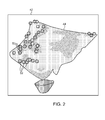
- Map 44 is a 3D representation of a chamber of the heart, which is colored to show local electrical activity, as in the above-mentioned CARTO system. (Colors are represented by hatching in the figure.)
- the map may be generated based simply on position measurements made using catheter 24, or alternatively, these position measurements may be registered with a pre-acquired image of the heart (such as a CT, MRI, or ultrasound image) in order to create the map.
- Processor 40 has placed marks 50, 52 on map 44 to indicate sites that have been ablated by catheter 24.
- the processor automatically marks sites at which the ablation parameters, such as dwell time and force applied by the catheter against the tissue, meet the predefined criteria.
- Marks 50 and 52 may be colored differently to indicate different ranges of measured parameters.
- the criteria to be applied by processor 40 in marking ablation sites may be defined by operator 22. Additionally or alternatively, the operator may choose to mark sites manually by manipulating appropriate system controls.
- FIGs. 1 and 2 show a particular system configuration and application environment, the principles of the present invention may similarly be applied in other mapping and therapeutic applications using not only catheters, but also probes of other types, both in the heart and in other body organs and regions.
- Fig. 3 is a flow chart that schematically illustrates a method for tracking intracardiac ablation, in accordance with an embodiment of the invention. The method is described, for the sake of clarity and convenience, with reference to system 20. As noted above, however, the principles of the methods described hereinbelow may similarly be applied in other systems and application environments.
- Processor 40 collects data continuously during the operation of system 20 and saves the data in a cyclic buffer in memory. The data are flushed from the buffer on a first-in/first-out basis. Data processing is initiated when ablation starts, at an initiation step 60, typically when operator 22 activates RF generator 36. At this point, processor 40 is able to collect and process data that accumulated in the buffer before ablation, at a pre-ablation collection step 68. The processor continues collecting data during ablation, at a periablation collection step 64, until the RF generator is deactivated, at an ablation termination step 62. The processor may continue collecting data after step 62, at a post-ablation collection step 70, for use in assessing the results of the ablation at the current site.
- Performing ablation at any given site typically takes at least several seconds, and may take as long as a minute.
- patient 30 will typically take one or more breaths, with the result that the location of heart 26 shifts (along with other parts of the patient's chest) relative to field generators 32.
- breaths are indicated in Fig. 3 by end-expirium points 66.
- position readings made by processor 40 with respect to catheter 24 will shift cyclically in synchronization with the respiration cycle, and the catheter coordinates will change even when the catheter is stably held in contact with a given ablation site.
- processor 40 corrects the position coordinates to compensate for respiration, at a respiration compensation step 70.
- processor 40 uses end-expirium points 66 as a baseline, determines the shift of heart 26 relative to this baseline at each point during the respiratory cycle, and then subtracts out this shift from the catheter coordinates in order to project all position readings to the equivalent end-expirium location.
- step 70 will convert the sequence of catheter position reads to a linear path between the start- and end-points of the movement.
- a method of compensation for respiratory motion that may be used at this step is described, for example, in U.S. Patent Application 13/017,469 , whose disclosure is incorporated herein by reference.
- Processor 40 filters the collected data to identify ablation sites that should be marked on map 44, at a filtering step 72.
- the processor evaluates whether a given site meets predefined criteria in terms of stability of the contact between the probe and the tissue and other factors, so as to qualify to be marked. This step is described in greater detail below with reference to Fig. 4 . Sites that satisfy the filter criteria are selected to be marked on the map, while sites that do not satisfy the criteria are discarded.
- Figs. 5 and 6 show how stability criteria are applied in this step, while Fig. 7 shows a user interface window that can be used by operator 22 (or other personnel) to set the filter criteria.
- processor 40 assigns the site data to a specific position in the 3D space corresponding to map 44, at a grid assignment step 74.
- the processor chooses a particular coordinate location to be marked, such as the center of mass of the compensated coordinate values.
- the position may be a specific voxel in a 3D grid, for example, or it may correspond to a zone of the map, such as zones in a Voronoi diagram corresponding to the map shape.
- Processor 40 then projects the volume points assigned at step 74 to corresponding locations on the surface of map 44, and creates marks 50, 52 at these surface locations, at a projection step 76. This step is described in greater detail with reference to Fig. 8 below.
- Fig. 4 is a flow chart that schematically illustrates a method for assessing intracardiac ablation that is applied at step 72, in accordance with an embodiment of the invention.
- Processor 40 applies decision logic 80 (typically in software) based on the date collected during ablation (step 64) at a given site, and possibly the data collected before and/or after the ablation (steps 68,70).
- decision logic 80 typically in software
- the following filters may be applied:
- processor 40 may apply other filters not shown in Fig. 4 .
- the processor may calculate the temperature increase at each ablation site during the procedure. If the temperature increase is above a predefined threshold, the processor may place a mark at the site. Additionally or alternatively, the mark may be colored according to the temperature increase.
- Processor 40 may also compute and filter integral measures of the contact force of the catheter against the tissue, which are indicative of the delivery of energy to the tissue. Integral measures of this sort may include, for example, the integral of force over time at a stable location, or the integral of the product of force and RF power.
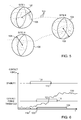
- Fig. 5 is a schematic representation of a part of map 44, showing a series of catheter location data points 100. This figure illustrates how processor identifies and filters ablation sites 102, 104, 106 based on catheter location stability, in accordance with an embodiment of the invention.
- Each data point 100 in Fig. 5 indicates a catheter location measurement (after compensation for respiratory movement).
- the data are collected at predefined time intervals, so that points 100 represent a time sequence of successive catheter locations.
- a radius 108 defines the spread of catheter locations that can be considered to belong to a single site. Even when operator 22 holds the catheter stably in place against the heart wall, the actual measured position may appear to change due to minor slippage, noise, and imperfect compensation for respiratory motion, for example.
- processor 40 considers the data points within each sphere to correspond to the catheter dwelling stably at each of the sites during the respective periods during which the data were collected.
- a predefined time threshold determines the length of time that the catheter must dwell at a given site (or equivalently, the number of data points 100 within a given sphere of radius 108) in order for the catheter to be considered to have dwelled stably at the site.
- processor 40 may consider the site to have been ablated and may mark the site accordingly.
- Both radius 108 and the threshold dwell time may be set by operator 22.
- Processor 40 may decide whether and how to mark a given site based not only on the dwell time, however, but also on other parameters, as explained above.
- Fig. 6 shows a schematic plot 110 of catheter contact force at an ablation site, in accordance with an embodiment of the invention.
- the upper trace in the figure illustrates how processor 40 identifies that catheter 24 is dwelling stably at a given site.
- Location data are accumulated before and during ablation, at steps 68 and 64 ( Fig. 3 ).
- the processor accumulates and processes the data over time until it determines, at a time 112, that the location data points over an interval that is equal to a time threshold 114 have all fallen within radius 108.
- the processor then retrospectively marks a time 116 and the corresponding location as the first stable location at the current ablation site. It is assumed in this example that the catheter remains stable within radius 108 of the current site after time 112, as well.
- processor 40 monitors the contact force between catheter 24 and heart 26 to generate and store force plot 110 and computes a running average of the contact force over a time window 120. At a time 118, processor 40 determines that the average force over the time window 120 ending at time 118 has exceeded the contact force threshold that is shown in Fig. 6 . (Both the duration of window 120 and the level of the contact force threshold may be set by operator 22.) Processor 40 then marks a time 122 at the beginning of window 120 and the corresponding location of the catheter as the first stable location at the current ablation site at which the catheter exerted sufficient force to ablate the heart tissue at the site.
- processor 40 accumulates ablation data over a time interval 124 during which the catheter location stability and average force level continue to satisfy the threshold criteria described above.
- a progress bar may be presented on display 42 to show operator 22 the cumulative length of effective ablation time at the current site.
- the accumulated data during interval 124 may include ECG, tissue impedance, temperature, and/or RF energy delivery, inter alia.
- the processor filters these data and then marks map 44 accordingly.
- Fig. 7 is a schematic representation of a window 130 that may be presented on display 42, in accordance with an embodiment of the invention.
- the window contains on-screen user controls 132 that operator 22 can use to set the thresholds to be applied by processor 40 to the ablation data values in choosing which ablation sites to mark on map 44.
- the data parameters and applicable criteria have all been explained above.
- a checkbox at the left side of the window allows the operator to indicate whether or not processor 40 is to consider the criterion in filtering ablation sites.
- a slider to the right of each parameter name enables the operator to set the threshold level, within bounds that are set by system 20.
- the duration (dwell time) for catheter stability may be set to a value between 0 and 60 sec, while the location stability (corresponding to radius 108) may be set to a value between 0 and 8 mm.
- the threshold for average contact force may be set to a value between 0 and 150 grams.
- Display preference controls 134 in the lower part of window 130 enable the operator to set other aspects of how map 44 will be displayed.
- window 130 as shown in Fig. 7 permits only a single value of each threshold to be set
- operator 22 may input different threshold values for different parts of the heart.
- processor 40 may compute different threshold values to apply based on operator inputs and on physiological parameters, such as local heart wall thickness.
- Fig. 8 is a schematic representation of 3D map 44 of a heart chamber showing how ablation marks 50 are applied to the map, in accordance with an embodiment of the present invention.
- ablation sites that satisfied the threshold criteria at step 72 are assigned to respective positions 140 in a 3D grid at step 74.
- Processor 40 projects positions 140 onto the nearest respective locations on the surface of map 44, and places marks 50 at these locations.
Landscapes
- Health & Medical Sciences (AREA)
- Life Sciences & Earth Sciences (AREA)
- Engineering & Computer Science (AREA)
- Surgery (AREA)
- Veterinary Medicine (AREA)
- Public Health (AREA)
- General Health & Medical Sciences (AREA)
- Animal Behavior & Ethology (AREA)
- Biomedical Technology (AREA)
- Heart & Thoracic Surgery (AREA)
- Molecular Biology (AREA)
- Medical Informatics (AREA)
- Physics & Mathematics (AREA)
- Biophysics (AREA)
- Pathology (AREA)
- Nuclear Medicine, Radiotherapy & Molecular Imaging (AREA)
- Cardiology (AREA)
- Radiology & Medical Imaging (AREA)
- Signal Processing (AREA)
- Robotics (AREA)
- Computer Vision & Pattern Recognition (AREA)
- Artificial Intelligence (AREA)
- Physiology (AREA)
- Plasma & Fusion (AREA)
- Otolaryngology (AREA)
- Psychiatry (AREA)
- Human Computer Interaction (AREA)
- Surgical Instruments (AREA)
- Radiation-Therapy Devices (AREA)
Applications Claiming Priority (1)
| Application Number | Priority Date | Filing Date | Title |
|---|---|---|---|
| US13/465,103 US8900225B2 (en) | 2012-05-07 | 2012-05-07 | Automatic ablation tracking |
Publications (3)
| Publication Number | Publication Date |
|---|---|
| EP2662049A2 true EP2662049A2 (fr) | 2013-11-13 |
| EP2662049A3 EP2662049A3 (fr) | 2016-09-07 |
| EP2662049B1 EP2662049B1 (fr) | 2020-11-04 |
Family
ID=48446062
Family Applications (1)
| Application Number | Title | Priority Date | Filing Date |
|---|---|---|---|
| EP13166904.6A Active EP2662049B1 (fr) | 2012-05-07 | 2013-05-07 | Suivi d'ablation automatique |
Country Status (7)
| Country | Link |
|---|---|
| US (1) | US8900225B2 (fr) |
| EP (1) | EP2662049B1 (fr) |
| JP (2) | JP6328375B2 (fr) |
| CN (1) | CN103385705B (fr) |
| AU (1) | AU2013205728B2 (fr) |
| CA (1) | CA2815755C (fr) |
| IL (1) | IL226190B (fr) |
Cited By (4)
| Publication number | Priority date | Publication date | Assignee | Title |
|---|---|---|---|---|
| EP2952151A1 (fr) * | 2014-06-02 | 2015-12-09 | Biosense Webster (Israel) Ltd. | Identification et visualisation d'écart entre des sites d'ablation cardiaque |
| EP4005467A1 (fr) * | 2020-11-25 | 2022-06-01 | Biosense Webster (Israel) Ltd | Guidage d'acquisition de cartographie électro-anatomique |
| WO2023114588A1 (fr) * | 2021-12-17 | 2023-06-22 | St. Jude Medical, Cardiology Division, Inc. | Procédé et système de visualisation de données de procédure d'ablation |
| US11896294B2 (en) * | 2016-12-07 | 2024-02-13 | Nuvaira, Inc. | Method and systems for reducing treatment variability and increasing treatment efficacy and durability |
Families Citing this family (56)
| Publication number | Priority date | Publication date | Assignee | Title |
|---|---|---|---|---|
| US10292763B2 (en) | 2016-01-25 | 2019-05-21 | Biosense Webster (Israel) Ltd. | Temperature controlled short duration ablation |
| US10405920B2 (en) | 2016-01-25 | 2019-09-10 | Biosense Webster (Israel) Ltd. | Temperature controlled short duration ablation |
| US10441354B2 (en) * | 2016-01-25 | 2019-10-15 | Biosense Webster (Israel) Ltd. | Temperature controlled short duration ablation |
| CN104066368B (zh) | 2011-09-22 | 2017-02-22 | 乔治华盛顿大学 | 用于使经消融组织可视化的系统和方法 |
| ES2727868T3 (es) | 2011-09-22 | 2019-10-21 | Univ George Washington | Sistemas para visualizar el tejido ablacionado |
| CN106456250B (zh) | 2013-08-13 | 2019-10-08 | 波士顿科学国际有限公司 | 解剖项的计算机可视化 |
| JP6737705B2 (ja) | 2013-11-14 | 2020-08-12 | ザ・ジョージ・ワシントン・ユニバーシティThe George Washingtonuniversity | 損傷部位の深さを決定するシステムの動作方法及び心臓組織の画像を生成するシステム |
| US20150141847A1 (en) | 2013-11-20 | 2015-05-21 | The George Washington University | Systems and methods for hyperspectral analysis of cardiac tissue |
| US10925511B2 (en) | 2014-07-24 | 2021-02-23 | Cardiosolv Ablation Technologies, Inc. | System and method for cardiac ablation |
| US10980439B2 (en) * | 2014-08-06 | 2021-04-20 | Biosense Webster (Israel) Ltd | Wavefront analysis based on ablation parameters |
| JP6771731B2 (ja) | 2014-11-03 | 2020-10-21 | 460メディカル・インコーポレイテッド460Medical, Inc. | 接触性評価システム及び方法 |
| EP3215002B1 (fr) | 2014-11-03 | 2024-03-20 | The George Washington University | Systèmes d'évaluation de lésion |
| EP3220844B1 (fr) | 2014-11-19 | 2020-11-11 | EPiX Therapeutics, Inc. | Systèmes de cartographie à haute résolution de tissu |
| WO2016081611A1 (fr) | 2014-11-19 | 2016-05-26 | Advanced Cardiac Therapeutics, Inc. | Cartographie haute résolution de tissus avec stimulation cardiaque |
| WO2016081650A1 (fr) | 2014-11-19 | 2016-05-26 | Advanced Cardiac Therapeutics, Inc. | Dispositifs d'ablation, systèmes et procédés d'utilisation d'ensemble électrode à haute résolution |
| CN106999732B (zh) * | 2014-12-10 | 2020-09-29 | 皇家飞利浦有限公司 | 针对介入过程引导跟踪形状重建 |
| US9636164B2 (en) | 2015-03-25 | 2017-05-02 | Advanced Cardiac Therapeutics, Inc. | Contact sensing systems and methods |
| US10779904B2 (en) | 2015-07-19 | 2020-09-22 | 460Medical, Inc. | Systems and methods for lesion formation and assessment |
| US20170065353A1 (en) * | 2015-09-04 | 2017-03-09 | Biosense Webster (Israel) Ltd. | Identifying and presenting suspected map shifts |
| US10548666B2 (en) | 2015-11-17 | 2020-02-04 | Covidien Lp | Systems and methods for ultrasound image-guided ablation antenna placement |
| US10792097B2 (en) | 2015-12-03 | 2020-10-06 | Biosense Webster (Israel) Ltd. | Ablation line contiguity index |
| CA3013270A1 (fr) | 2016-02-02 | 2017-08-10 | The University Of Western Ontario | Dispositif de commande de force de catheter |
| SG11201807618QA (en) | 2016-03-15 | 2018-10-30 | Epix Therapeutics Inc | Improved devices, systems and methods for irrigated ablation |
| CN109475316B (zh) * | 2016-06-22 | 2022-05-10 | 圣犹达医疗用品心脏病学部门有限公司 | 用于电生理程序的系统和方法 |
| US10592067B2 (en) | 2016-08-12 | 2020-03-17 | Boston Scientific Scimed, Inc. | Distributed interactive medical visualization system with primary/secondary interaction features |
| CN109564785A (zh) | 2016-08-12 | 2019-04-02 | 波士顿科学国际有限公司 | 具有用户界面特征的分布式交互医学可视化系统 |
| AU2017359338B2 (en) | 2016-11-11 | 2022-09-08 | Gynesonics, Inc. | Controlled treatment of tissue and dynamic interaction with, and comparison of, tissue and/or treatment data |
| US10420612B2 (en) | 2016-12-22 | 2019-09-24 | Biosense Webster (Isreal) Ltd. | Interactive anatomical mapping and estimation of anatomical mapping quality |
| US11083517B2 (en) | 2017-01-19 | 2021-08-10 | Biosense Webster (Israel) Ltd. | Enhancing efficiency of repeat ablation by merging current and previous maps |
| EP3614946B1 (fr) | 2017-04-27 | 2024-03-20 | EPiX Therapeutics, Inc. | Détermination de la nature d'un contact entre une pointe de cathéter et un tissu |
| US10610296B2 (en) * | 2017-05-31 | 2020-04-07 | Biosense Webster (Israel) Ltd. | Cardiac electrophysiology machine including catheter stability while estimating impedance drop |
| US10952795B2 (en) * | 2017-06-30 | 2021-03-23 | Biosense Webster (Israel) Ltd. | System and method for glass state view in real-time three-dimensional (3D) cardiac imaging |
| EP3709926B1 (fr) * | 2017-11-13 | 2024-08-21 | Koninklijke Philips N.V. | Commande d'outil robotique |
| WO2019168816A1 (fr) * | 2018-02-27 | 2019-09-06 | Kusumoto Walter | Thermométrie par ultrasons pour la protection de l'œsophage ou d'autres tissus pendant une ablation |
| US20200397329A1 (en) * | 2018-03-06 | 2020-12-24 | St. Jude Medical, Cardiology Division, Inc. | Methods and systems for transmural tissue mapping |
| US20200178831A1 (en) * | 2018-12-11 | 2020-06-11 | Biosense Webster (Israel) Ltd. | Display of arrhythmia type |
| US11364073B2 (en) * | 2019-02-20 | 2022-06-21 | Biosense Webster (Israel) Ltd. | Cardiac map segmentation |
| US11172984B2 (en) | 2019-05-03 | 2021-11-16 | Biosense Webster (Israel) Ltd. | Device, system and method to ablate cardiac tissue |
| US11844616B2 (en) * | 2019-08-13 | 2023-12-19 | Biosense Webster (Israel) Ltd. | Enhanced visualization of organ electrical activity |
| US12262999B2 (en) * | 2019-11-05 | 2025-04-01 | Biosense Webster (Israel) Ltd. | Using statistical characteristics of multiple grouped ECG signals to detect inconsistent signals |
| US12076081B2 (en) | 2020-01-08 | 2024-09-03 | 460Medical, Inc. | Systems and methods for optical interrogation of ablation lesions |
| EP4041077A1 (fr) * | 2020-02-10 | 2022-08-17 | St. Jude Medical, Cardiology Division, Inc. | Compensation de la respiration |
| WO2021243061A1 (fr) | 2020-05-27 | 2021-12-02 | The George Washington University | Visualisation de lésions par une approche à deux longueurs d'onde |
| US11896296B2 (en) * | 2020-11-10 | 2024-02-13 | Biosense Webster (Israel) Ltd. | End expirium identification methods, systems, and processes |
| US20220202370A1 (en) * | 2020-12-29 | 2022-06-30 | Biosense Webster (Israel) Ltd. | Systems, methods, and processes for detecting electrode wire noise |
| US11478182B2 (en) * | 2021-01-07 | 2022-10-25 | Biosense Webster (Israel) Ltd. | Incorporating a confidence level into an electrophysiological (EP) map |
| US12542209B2 (en) * | 2021-01-25 | 2026-02-03 | Biosense Webster (Israel) Ltd. | Automatic catheter stability determination |
| CN115886989B (zh) * | 2021-08-11 | 2025-12-02 | 上海鸿电医疗科技有限公司 | 消融系统 |
| US12521185B2 (en) * | 2022-05-20 | 2026-01-13 | Biosense Webster (Israel) Ltd. | Visualizing a quality index indicative of ablation stability at ablation site |
| CN117503346A (zh) * | 2022-07-28 | 2024-02-06 | 北京天智航医疗科技股份有限公司 | 位姿数据处理方法及装置 |
| JP2026503984A (ja) * | 2022-12-30 | 2026-02-03 | ボストン サイエンティフィック サイムド,インコーポレイテッド | カテーテルアセンブリの追跡及び視覚化表示 |
| US20250134574A1 (en) | 2023-10-25 | 2025-05-01 | Biosense Webster (Israel) Ltd. | Graphically encoded ablation tags according to regions of anatomy |
| US20250169765A1 (en) * | 2023-11-29 | 2025-05-29 | Biosense Webster (Israel) Ltd. | Respiration compensation for mapping |
| US20250221765A1 (en) | 2024-01-05 | 2025-07-10 | Biosense Webster (Israel) Ltd. | Controlling cardiac ablation using blood electrical conductivity |
| US20250352261A1 (en) | 2024-05-14 | 2025-11-20 | Biosense Webster (Israel) Ltd. | Ablation location prediction over anatomical maps |
| US20260033784A1 (en) * | 2024-07-30 | 2026-02-05 | Anumana, Inc. | Apparatus and method for filtering a potential signal using catheter velocity during electro-anatomical mapping |
Citations (2)
| Publication number | Priority date | Publication date | Assignee | Title |
|---|---|---|---|---|
| US20110125150A1 (en) | 2009-11-20 | 2011-05-26 | St. Jude Medical, Atrial Fibrillation Division, Inc. | System and method for assessing effective delivery of ablation therapy |
| US20110130648A1 (en) | 2009-11-30 | 2011-06-02 | Christopher Thomas Beeckler | Catheter with pressure measuring tip |
Family Cites Families (16)
| Publication number | Priority date | Publication date | Assignee | Title |
|---|---|---|---|---|
| IL126333A0 (en) | 1998-09-24 | 1999-05-09 | Super Dimension Ltd | System and method of recording and displaying in context of an image a location of at least one point-of-interest in body during an intra-body medical procedure |
| JP4037582B2 (ja) * | 1999-12-02 | 2008-01-23 | オリンパス株式会社 | 電気手術装置及び電気手術装置の出力制御方法 |
| US6292684B1 (en) * | 1999-12-14 | 2001-09-18 | Ge Medical Systems Global Technology Company, Llc | Respiratory displacement and velocity measurement using navigator MRI echo signals |
| US7001383B2 (en) * | 2002-10-21 | 2006-02-21 | Biosense, Inc. | Real-time monitoring and mapping of ablation lesion formation in the heart |
| US7438714B2 (en) * | 2003-09-12 | 2008-10-21 | Boston Scientific Scimed, Inc. | Vacuum-based catheter stabilizer |
| US10258285B2 (en) * | 2004-05-28 | 2019-04-16 | St. Jude Medical, Atrial Fibrillation Division, Inc. | Robotic surgical system and method for automated creation of ablation lesions |
| US8403925B2 (en) * | 2006-12-06 | 2013-03-26 | St. Jude Medical, Atrial Fibrillation Division, Inc. | System and method for assessing lesions in tissue |
| US8155416B2 (en) | 2008-02-04 | 2012-04-10 | INTIO, Inc. | Methods and apparatuses for planning, performing, monitoring and assessing thermal ablation |
| IL188262A (en) * | 2007-01-10 | 2011-10-31 | Mediguide Ltd | System and method for superimposing a representation of the tip of a catheter on an image acquired by a moving imager |
| US9204927B2 (en) * | 2009-05-13 | 2015-12-08 | St. Jude Medical, Atrial Fibrillation Division, Inc. | System and method for presenting information representative of lesion formation in tissue during an ablation procedure |
| JP5181291B2 (ja) * | 2008-12-22 | 2013-04-10 | 日本光電工業株式会社 | 呼吸機能測定装置 |
| US9808323B2 (en) * | 2009-06-04 | 2017-11-07 | Koninklijke Philips N.V. | Visualization apparatus |
| US8494613B2 (en) | 2009-08-31 | 2013-07-23 | Medtronic, Inc. | Combination localization system |
| US8926604B2 (en) * | 2009-12-23 | 2015-01-06 | Biosense Webster (Israel) Ltd. | Estimation and mapping of ablation volume |
| US10448837B2 (en) * | 2010-08-23 | 2019-10-22 | Knonklijke Philips N.V. | Mapping system and method for medical procedures |
| US9113824B2 (en) * | 2011-01-31 | 2015-08-25 | Biosense Webster (Israel), Ltd. | Compensation for respiratory motion |
-
2012
- 2012-05-07 US US13/465,103 patent/US8900225B2/en active Active
-
2013
- 2013-05-06 IL IL226190A patent/IL226190B/en active IP Right Grant
- 2013-05-07 EP EP13166904.6A patent/EP2662049B1/fr active Active
- 2013-05-07 CN CN201310164609.8A patent/CN103385705B/zh active Active
- 2013-05-07 CA CA2815755A patent/CA2815755C/fr active Active
- 2013-05-07 AU AU2013205728A patent/AU2013205728B2/en not_active Ceased
- 2013-05-07 JP JP2013097712A patent/JP6328375B2/ja active Active
-
2018
- 2018-01-25 JP JP2018010352A patent/JP6517382B2/ja active Active
Patent Citations (2)
| Publication number | Priority date | Publication date | Assignee | Title |
|---|---|---|---|---|
| US20110125150A1 (en) | 2009-11-20 | 2011-05-26 | St. Jude Medical, Atrial Fibrillation Division, Inc. | System and method for assessing effective delivery of ablation therapy |
| US20110130648A1 (en) | 2009-11-30 | 2011-06-02 | Christopher Thomas Beeckler | Catheter with pressure measuring tip |
Cited By (10)
| Publication number | Priority date | Publication date | Assignee | Title |
|---|---|---|---|---|
| EP2952151A1 (fr) * | 2014-06-02 | 2015-12-09 | Biosense Webster (Israel) Ltd. | Identification et visualisation d'écart entre des sites d'ablation cardiaque |
| US9757182B2 (en) | 2014-06-02 | 2017-09-12 | Biosense Webster (Israel) Ltd. | Identification and visualization of gaps between cardiac ablation sites |
| EP3243475A1 (fr) * | 2014-06-02 | 2017-11-15 | Biosense Webster (Israel) Ltd. | Identification et visualisation d'écart entre des sites d'ablation cardiaque |
| AU2015202835B2 (en) * | 2014-06-02 | 2019-04-11 | Biosense Webster (Israel) Ltd. | Identification and visualization of gaps between cardiac ablation sites |
| AU2019202347B2 (en) * | 2014-06-02 | 2019-10-03 | Biosense Webster (Israel) Ltd. | Identification and visualization of gaps between cardiac ablation sites |
| EP3597134A1 (fr) * | 2014-06-02 | 2020-01-22 | Biosense Webster (Israel) Ltd. | Identification et visualisation d'écart entre des sites d'ablation cardiaque |
| US10568679B2 (en) | 2014-06-02 | 2020-02-25 | Biosense Webster (Israel) Ltd | Identification and visualization of gaps between cardiac ablation sites |
| US11896294B2 (en) * | 2016-12-07 | 2024-02-13 | Nuvaira, Inc. | Method and systems for reducing treatment variability and increasing treatment efficacy and durability |
| EP4005467A1 (fr) * | 2020-11-25 | 2022-06-01 | Biosense Webster (Israel) Ltd | Guidage d'acquisition de cartographie électro-anatomique |
| WO2023114588A1 (fr) * | 2021-12-17 | 2023-06-22 | St. Jude Medical, Cardiology Division, Inc. | Procédé et système de visualisation de données de procédure d'ablation |
Also Published As
| Publication number | Publication date |
|---|---|
| CN103385705A (zh) | 2013-11-13 |
| JP6328375B2 (ja) | 2018-05-23 |
| AU2013205728B2 (en) | 2017-11-09 |
| AU2013205728A1 (en) | 2013-11-21 |
| JP2018061874A (ja) | 2018-04-19 |
| CA2815755C (fr) | 2020-11-03 |
| IL226190B (en) | 2018-07-31 |
| US8900225B2 (en) | 2014-12-02 |
| JP2013233436A (ja) | 2013-11-21 |
| EP2662049B1 (fr) | 2020-11-04 |
| CN103385705B (zh) | 2017-06-27 |
| JP6517382B2 (ja) | 2019-05-22 |
| EP2662049A3 (fr) | 2016-09-07 |
| US20130296845A1 (en) | 2013-11-07 |
| CA2815755A1 (fr) | 2013-11-07 |
Similar Documents
| Publication | Publication Date | Title |
|---|---|---|
| EP2662049B1 (fr) | Suivi d'ablation automatique | |
| US11517372B2 (en) | System and method for assessing lesions in tissue | |
| EP2613722B1 (fr) | Système et procédé de présentation d'informations représentatives d'une formation de lésion dans un tissu durant une intervention d'ablation | |
| EP3175807B1 (fr) | Indice de contiguïté de ligne d'ablation | |
| US10201388B2 (en) | Graphical user interface for real-time RF lesion depth display | |
| EP2445434B1 (fr) | Système permettant de déterminer la probabilité d'un barotraumatisme de l'endocarde dans un tissu lors d'une ablation | |
| JP5568140B2 (ja) | アブレーション治療の有効送達を評価するためのシステムおよび方法 | |
| US9610119B2 (en) | System and method for assessing the formation of a lesion in tissue | |
| EP2982293B1 (fr) | Analyse de front d'onde sur la base des paramètres d'ablation |
Legal Events
| Date | Code | Title | Description |
|---|---|---|---|
| PUAI | Public reference made under article 153(3) epc to a published international application that has entered the european phase |
Free format text: ORIGINAL CODE: 0009012 |
|
| AK | Designated contracting states |
Kind code of ref document: A2 Designated state(s): AL AT BE BG CH CY CZ DE DK EE ES FI FR GB GR HR HU IE IS IT LI LT LU LV MC MK MT NL NO PL PT RO RS SE SI SK SM TR |
|
| AX | Request for extension of the european patent |
Extension state: BA ME |
|
| PUAL | Search report despatched |
Free format text: ORIGINAL CODE: 0009013 |
|
| AK | Designated contracting states |
Kind code of ref document: A3 Designated state(s): AL AT BE BG CH CY CZ DE DK EE ES FI FR GB GR HR HU IE IS IT LI LT LU LV MC MK MT NL NO PL PT RO RS SE SI SK SM TR |
|
| AX | Request for extension of the european patent |
Extension state: BA ME |
|
| RIC1 | Information provided on ipc code assigned before grant |
Ipc: A61B 19/00 00000000AFI20160804BHEP |
|
| STAA | Information on the status of an ep patent application or granted ep patent |
Free format text: STATUS: REQUEST FOR EXAMINATION WAS MADE |
|
| 17P | Request for examination filed |
Effective date: 20170303 |
|
| RBV | Designated contracting states (corrected) |
Designated state(s): AL AT BE BG CH CY CZ DE DK EE ES FI FR GB GR HR HU IE IS IT LI LT LU LV MC MK MT NL NO PL PT RO RS SE SI SK SM TR |
|
| STAA | Information on the status of an ep patent application or granted ep patent |
Free format text: STATUS: EXAMINATION IS IN PROGRESS |
|
| 17Q | First examination report despatched |
Effective date: 20171215 |
|
| REG | Reference to a national code |
Ref country code: DE Ref legal event code: R079 Ref document number: 602013073743 Country of ref document: DE Free format text: PREVIOUS MAIN CLASS: A61B0019000000 Ipc: A61B0018140000 |
|
| GRAP | Despatch of communication of intention to grant a patent |
Free format text: ORIGINAL CODE: EPIDOSNIGR1 |
|
| STAA | Information on the status of an ep patent application or granted ep patent |
Free format text: STATUS: GRANT OF PATENT IS INTENDED |
|
| RIC1 | Information provided on ipc code assigned before grant |
Ipc: A61B 5/00 20060101ALI20190923BHEP Ipc: A61B 18/14 20060101AFI20190923BHEP |
|
| INTG | Intention to grant announced |
Effective date: 20191025 |
|
| RAP1 | Party data changed (applicant data changed or rights of an application transferred) |
Owner name: BIOSENSE WEBSTER (ISRAEL) LTD. |
|
| GRAS | Grant fee paid |
Free format text: ORIGINAL CODE: EPIDOSNIGR3 |
|
| GRAA | (expected) grant |
Free format text: ORIGINAL CODE: 0009210 |
|
| STAA | Information on the status of an ep patent application or granted ep patent |
Free format text: STATUS: THE PATENT HAS BEEN GRANTED |
|
| AK | Designated contracting states |
Kind code of ref document: B1 Designated state(s): AL AT BE BG CH CY CZ DE DK EE ES FI FR GB GR HR HU IE IS IT LI LT LU LV MC MK MT NL NO PL PT RO RS SE SI SK SM TR |
|
| REG | Reference to a national code |
Ref country code: GB Ref legal event code: FG4D |
|
| REG | Reference to a national code |
Ref country code: CH Ref legal event code: EP |
|
| REG | Reference to a national code |
Ref country code: AT Ref legal event code: REF Ref document number: 1329815 Country of ref document: AT Kind code of ref document: T Effective date: 20201115 |
|
| REG | Reference to a national code |
Ref country code: DE Ref legal event code: R096 Ref document number: 602013073743 Country of ref document: DE |
|
| REG | Reference to a national code |
Ref country code: IE Ref legal event code: FG4D |
|
| REG | Reference to a national code |
Ref country code: NL Ref legal event code: FP |
|
| REG | Reference to a national code |
Ref country code: AT Ref legal event code: MK05 Ref document number: 1329815 Country of ref document: AT Kind code of ref document: T Effective date: 20201104 |
|
| PG25 | Lapsed in a contracting state [announced via postgrant information from national office to epo] |
Ref country code: NO Free format text: LAPSE BECAUSE OF FAILURE TO SUBMIT A TRANSLATION OF THE DESCRIPTION OR TO PAY THE FEE WITHIN THE PRESCRIBED TIME-LIMIT Effective date: 20210204 Ref country code: PT Free format text: LAPSE BECAUSE OF FAILURE TO SUBMIT A TRANSLATION OF THE DESCRIPTION OR TO PAY THE FEE WITHIN THE PRESCRIBED TIME-LIMIT Effective date: 20210304 Ref country code: RS Free format text: LAPSE BECAUSE OF FAILURE TO SUBMIT A TRANSLATION OF THE DESCRIPTION OR TO PAY THE FEE WITHIN THE PRESCRIBED TIME-LIMIT Effective date: 20201104 Ref country code: FI Free format text: LAPSE BECAUSE OF FAILURE TO SUBMIT A TRANSLATION OF THE DESCRIPTION OR TO PAY THE FEE WITHIN THE PRESCRIBED TIME-LIMIT Effective date: 20201104 Ref country code: GR Free format text: LAPSE BECAUSE OF FAILURE TO SUBMIT A TRANSLATION OF THE DESCRIPTION OR TO PAY THE FEE WITHIN THE PRESCRIBED TIME-LIMIT Effective date: 20210205 |
|
| PG25 | Lapsed in a contracting state [announced via postgrant information from national office to epo] |
Ref country code: IS Free format text: LAPSE BECAUSE OF FAILURE TO SUBMIT A TRANSLATION OF THE DESCRIPTION OR TO PAY THE FEE WITHIN THE PRESCRIBED TIME-LIMIT Effective date: 20210304 Ref country code: PL Free format text: LAPSE BECAUSE OF FAILURE TO SUBMIT A TRANSLATION OF THE DESCRIPTION OR TO PAY THE FEE WITHIN THE PRESCRIBED TIME-LIMIT Effective date: 20201104 Ref country code: LV Free format text: LAPSE BECAUSE OF FAILURE TO SUBMIT A TRANSLATION OF THE DESCRIPTION OR TO PAY THE FEE WITHIN THE PRESCRIBED TIME-LIMIT Effective date: 20201104 Ref country code: SE Free format text: LAPSE BECAUSE OF FAILURE TO SUBMIT A TRANSLATION OF THE DESCRIPTION OR TO PAY THE FEE WITHIN THE PRESCRIBED TIME-LIMIT Effective date: 20201104 Ref country code: BG Free format text: LAPSE BECAUSE OF FAILURE TO SUBMIT A TRANSLATION OF THE DESCRIPTION OR TO PAY THE FEE WITHIN THE PRESCRIBED TIME-LIMIT Effective date: 20210204 Ref country code: ES Free format text: LAPSE BECAUSE OF FAILURE TO SUBMIT A TRANSLATION OF THE DESCRIPTION OR TO PAY THE FEE WITHIN THE PRESCRIBED TIME-LIMIT Effective date: 20201104 Ref country code: AT Free format text: LAPSE BECAUSE OF FAILURE TO SUBMIT A TRANSLATION OF THE DESCRIPTION OR TO PAY THE FEE WITHIN THE PRESCRIBED TIME-LIMIT Effective date: 20201104 |
|
| REG | Reference to a national code |
Ref country code: LT Ref legal event code: MG9D |
|
| PG25 | Lapsed in a contracting state [announced via postgrant information from national office to epo] |
Ref country code: HR Free format text: LAPSE BECAUSE OF FAILURE TO SUBMIT A TRANSLATION OF THE DESCRIPTION OR TO PAY THE FEE WITHIN THE PRESCRIBED TIME-LIMIT Effective date: 20201104 |
|
| PG25 | Lapsed in a contracting state [announced via postgrant information from national office to epo] |
Ref country code: LT Free format text: LAPSE BECAUSE OF FAILURE TO SUBMIT A TRANSLATION OF THE DESCRIPTION OR TO PAY THE FEE WITHIN THE PRESCRIBED TIME-LIMIT Effective date: 20201104 Ref country code: RO Free format text: LAPSE BECAUSE OF FAILURE TO SUBMIT A TRANSLATION OF THE DESCRIPTION OR TO PAY THE FEE WITHIN THE PRESCRIBED TIME-LIMIT Effective date: 20201104 Ref country code: SK Free format text: LAPSE BECAUSE OF FAILURE TO SUBMIT A TRANSLATION OF THE DESCRIPTION OR TO PAY THE FEE WITHIN THE PRESCRIBED TIME-LIMIT Effective date: 20201104 Ref country code: CZ Free format text: LAPSE BECAUSE OF FAILURE TO SUBMIT A TRANSLATION OF THE DESCRIPTION OR TO PAY THE FEE WITHIN THE PRESCRIBED TIME-LIMIT Effective date: 20201104 Ref country code: EE Free format text: LAPSE BECAUSE OF FAILURE TO SUBMIT A TRANSLATION OF THE DESCRIPTION OR TO PAY THE FEE WITHIN THE PRESCRIBED TIME-LIMIT Effective date: 20201104 Ref country code: SM Free format text: LAPSE BECAUSE OF FAILURE TO SUBMIT A TRANSLATION OF THE DESCRIPTION OR TO PAY THE FEE WITHIN THE PRESCRIBED TIME-LIMIT Effective date: 20201104 |
|
| REG | Reference to a national code |
Ref country code: DE Ref legal event code: R097 Ref document number: 602013073743 Country of ref document: DE |
|
| PG25 | Lapsed in a contracting state [announced via postgrant information from national office to epo] |
Ref country code: DK Free format text: LAPSE BECAUSE OF FAILURE TO SUBMIT A TRANSLATION OF THE DESCRIPTION OR TO PAY THE FEE WITHIN THE PRESCRIBED TIME-LIMIT Effective date: 20201104 |
|
| PGFP | Annual fee paid to national office [announced via postgrant information from national office to epo] |
Ref country code: GB Payment date: 20210414 Year of fee payment: 9 |
|
| PLBE | No opposition filed within time limit |
Free format text: ORIGINAL CODE: 0009261 |
|
| STAA | Information on the status of an ep patent application or granted ep patent |
Free format text: STATUS: NO OPPOSITION FILED WITHIN TIME LIMIT |
|
| 26N | No opposition filed |
Effective date: 20210805 |
|
| PG25 | Lapsed in a contracting state [announced via postgrant information from national office to epo] |
Ref country code: AL Free format text: LAPSE BECAUSE OF FAILURE TO SUBMIT A TRANSLATION OF THE DESCRIPTION OR TO PAY THE FEE WITHIN THE PRESCRIBED TIME-LIMIT Effective date: 20201104 |
|
| PG25 | Lapsed in a contracting state [announced via postgrant information from national office to epo] |
Ref country code: SI Free format text: LAPSE BECAUSE OF FAILURE TO SUBMIT A TRANSLATION OF THE DESCRIPTION OR TO PAY THE FEE WITHIN THE PRESCRIBED TIME-LIMIT Effective date: 20201104 |
|
| REG | Reference to a national code |
Ref country code: CH Ref legal event code: PL |
|
| PG25 | Lapsed in a contracting state [announced via postgrant information from national office to epo] |
Ref country code: CH Free format text: LAPSE BECAUSE OF NON-PAYMENT OF DUE FEES Effective date: 20210531 Ref country code: LI Free format text: LAPSE BECAUSE OF NON-PAYMENT OF DUE FEES Effective date: 20210531 Ref country code: LU Free format text: LAPSE BECAUSE OF NON-PAYMENT OF DUE FEES Effective date: 20210507 Ref country code: MC Free format text: LAPSE BECAUSE OF FAILURE TO SUBMIT A TRANSLATION OF THE DESCRIPTION OR TO PAY THE FEE WITHIN THE PRESCRIBED TIME-LIMIT Effective date: 20201104 |
|
| PG25 | Lapsed in a contracting state [announced via postgrant information from national office to epo] |
Ref country code: IE Free format text: LAPSE BECAUSE OF NON-PAYMENT OF DUE FEES Effective date: 20210507 |
|
| PG25 | Lapsed in a contracting state [announced via postgrant information from national office to epo] |
Ref country code: IS Free format text: LAPSE BECAUSE OF FAILURE TO SUBMIT A TRANSLATION OF THE DESCRIPTION OR TO PAY THE FEE WITHIN THE PRESCRIBED TIME-LIMIT Effective date: 20210304 |
|
| PGFP | Annual fee paid to national office [announced via postgrant information from national office to epo] |
Ref country code: NL Payment date: 20220420 Year of fee payment: 10 |
|
| PGFP | Annual fee paid to national office [announced via postgrant information from national office to epo] |
Ref country code: BE Payment date: 20220420 Year of fee payment: 10 |
|
| GBPC | Gb: european patent ceased through non-payment of renewal fee |
Effective date: 20220507 |
|
| REG | Reference to a national code |
Ref country code: FR Ref legal event code: PLFP Year of fee payment: 11 |
|
| PG25 | Lapsed in a contracting state [announced via postgrant information from national office to epo] |
Ref country code: HU Free format text: LAPSE BECAUSE OF FAILURE TO SUBMIT A TRANSLATION OF THE DESCRIPTION OR TO PAY THE FEE WITHIN THE PRESCRIBED TIME-LIMIT; INVALID AB INITIO Effective date: 20130507 Ref country code: GB Free format text: LAPSE BECAUSE OF NON-PAYMENT OF DUE FEES Effective date: 20220507 |
|
| PG25 | Lapsed in a contracting state [announced via postgrant information from national office to epo] |
Ref country code: CY Free format text: LAPSE BECAUSE OF FAILURE TO SUBMIT A TRANSLATION OF THE DESCRIPTION OR TO PAY THE FEE WITHIN THE PRESCRIBED TIME-LIMIT Effective date: 20201104 |
|
| REG | Reference to a national code |
Ref country code: NL Ref legal event code: MM Effective date: 20230601 |
|
| REG | Reference to a national code |
Ref country code: BE Ref legal event code: MM Effective date: 20230531 |
|
| PG25 | Lapsed in a contracting state [announced via postgrant information from national office to epo] |
Ref country code: NL Free format text: LAPSE BECAUSE OF NON-PAYMENT OF DUE FEES Effective date: 20230601 |
|
| PG25 | Lapsed in a contracting state [announced via postgrant information from national office to epo] |
Ref country code: MK Free format text: LAPSE BECAUSE OF FAILURE TO SUBMIT A TRANSLATION OF THE DESCRIPTION OR TO PAY THE FEE WITHIN THE PRESCRIBED TIME-LIMIT Effective date: 20201104 |
|
| PG25 | Lapsed in a contracting state [announced via postgrant information from national office to epo] |
Ref country code: BE Free format text: LAPSE BECAUSE OF NON-PAYMENT OF DUE FEES Effective date: 20230531 |
|
| PG25 | Lapsed in a contracting state [announced via postgrant information from national office to epo] |
Ref country code: TR Free format text: LAPSE BECAUSE OF FAILURE TO SUBMIT A TRANSLATION OF THE DESCRIPTION OR TO PAY THE FEE WITHIN THE PRESCRIBED TIME-LIMIT Effective date: 20201104 |
|
| PG25 | Lapsed in a contracting state [announced via postgrant information from national office to epo] |
Ref country code: MT Free format text: LAPSE BECAUSE OF FAILURE TO SUBMIT A TRANSLATION OF THE DESCRIPTION OR TO PAY THE FEE WITHIN THE PRESCRIBED TIME-LIMIT Effective date: 20201104 |
|
| PGFP | Annual fee paid to national office [announced via postgrant information from national office to epo] |
Ref country code: DE Payment date: 20250402 Year of fee payment: 13 |
|
| PGFP | Annual fee paid to national office [announced via postgrant information from national office to epo] |
Ref country code: IT Payment date: 20250422 Year of fee payment: 13 |
|
| PGFP | Annual fee paid to national office [announced via postgrant information from national office to epo] |
Ref country code: FR Payment date: 20250401 Year of fee payment: 13 |