EP2663246B1 - Entfernungsanzeiger - Google Patents
Entfernungsanzeiger Download PDFInfo
- Publication number
- EP2663246B1 EP2663246B1 EP12701578.2A EP12701578A EP2663246B1 EP 2663246 B1 EP2663246 B1 EP 2663246B1 EP 12701578 A EP12701578 A EP 12701578A EP 2663246 B1 EP2663246 B1 EP 2663246B1
- Authority
- EP
- European Patent Office
- Prior art keywords
- plunger
- housing
- guidewire
- respect
- relative
- Prior art date
- Legal status (The legal status is an assumption and is not a legal conclusion. Google has not performed a legal analysis and makes no representation as to the accuracy of the status listed.)
- Active
Links
- 239000012530 fluid Substances 0.000 claims description 3
- 238000004891 communication Methods 0.000 claims description 2
- 210000001519 tissue Anatomy 0.000 description 42
- 210000000988 bone and bone Anatomy 0.000 description 7
- 239000000758 substrate Substances 0.000 description 6
- 238000000034 method Methods 0.000 description 4
- 230000000149 penetrating effect Effects 0.000 description 4
- 238000001356 surgical procedure Methods 0.000 description 4
- 238000012800 visualization Methods 0.000 description 4
- 239000007943 implant Substances 0.000 description 3
- 238000003780 insertion Methods 0.000 description 3
- 230000037431 insertion Effects 0.000 description 3
- 239000000463 material Substances 0.000 description 3
- 238000005259 measurement Methods 0.000 description 3
- 238000012544 monitoring process Methods 0.000 description 3
- 239000000853 adhesive Substances 0.000 description 2
- 230000001070 adhesive effect Effects 0.000 description 2
- 230000008859 change Effects 0.000 description 2
- 230000000007 visual effect Effects 0.000 description 2
- 241001653121 Glenoides Species 0.000 description 1
- 230000015572 biosynthetic process Effects 0.000 description 1
- 238000011109 contamination Methods 0.000 description 1
- 230000008878 coupling Effects 0.000 description 1
- 238000010168 coupling process Methods 0.000 description 1
- 238000005859 coupling reaction Methods 0.000 description 1
- 238000006073 displacement reaction Methods 0.000 description 1
- 238000005553 drilling Methods 0.000 description 1
- 238000005755 formation reaction Methods 0.000 description 1
- 230000006870 function Effects 0.000 description 1
- 239000003550 marker Substances 0.000 description 1
- 230000000399 orthopedic effect Effects 0.000 description 1
- 230000035515 penetration Effects 0.000 description 1
- 230000008569 process Effects 0.000 description 1
- 238000004080 punching Methods 0.000 description 1
- 238000009877 rendering Methods 0.000 description 1
- 239000000523 sample Substances 0.000 description 1
- 239000012781 shape memory material Substances 0.000 description 1
- 230000001954 sterilising effect Effects 0.000 description 1
- 238000004659 sterilization and disinfection Methods 0.000 description 1
- 230000000451 tissue damage Effects 0.000 description 1
- 231100000827 tissue damage Toxicity 0.000 description 1
Images

Classifications
-
- A—HUMAN NECESSITIES
- A61—MEDICAL OR VETERINARY SCIENCE; HYGIENE
- A61B—DIAGNOSIS; SURGERY; IDENTIFICATION
- A61B90/00—Instruments, implements or accessories specially adapted for surgery or diagnosis and not covered by any of the groups A61B1/00 - A61B50/00, e.g. for luxation treatment or for protecting wound edges
- A61B90/06—Measuring instruments not otherwise provided for
-
- A—HUMAN NECESSITIES
- A61—MEDICAL OR VETERINARY SCIENCE; HYGIENE
- A61B—DIAGNOSIS; SURGERY; IDENTIFICATION
- A61B17/00—Surgical instruments, devices or methods
- A61B17/56—Surgical instruments or methods for treatment of bones or joints; Devices specially adapted therefor
- A61B17/58—Surgical instruments or methods for treatment of bones or joints; Devices specially adapted therefor for osteosynthesis, e.g. bone plates, screws or setting implements
- A61B17/88—Osteosynthesis instruments; Methods or means for implanting or extracting internal or external fixation devices
- A61B17/8897—Guide wires or guide pins
-
- A—HUMAN NECESSITIES
- A61—MEDICAL OR VETERINARY SCIENCE; HYGIENE
- A61B—DIAGNOSIS; SURGERY; IDENTIFICATION
- A61B90/00—Instruments, implements or accessories specially adapted for surgery or diagnosis and not covered by any of the groups A61B1/00 - A61B50/00, e.g. for luxation treatment or for protecting wound edges
- A61B90/06—Measuring instruments not otherwise provided for
- A61B2090/062—Measuring instruments not otherwise provided for penetration depth
-
- A—HUMAN NECESSITIES
- A61—MEDICAL OR VETERINARY SCIENCE; HYGIENE
- A61B—DIAGNOSIS; SURGERY; IDENTIFICATION
- A61B90/00—Instruments, implements or accessories specially adapted for surgery or diagnosis and not covered by any of the groups A61B1/00 - A61B50/00, e.g. for luxation treatment or for protecting wound edges
- A61B90/08—Accessories or related features not otherwise provided for
- A61B2090/0807—Indication means
- A61B2090/0811—Indication means for the position of a particular part of an instrument with respect to the rest of the instrument, e.g. position of the anvil of a stapling instrument
Definitions
- the present invention relates to a distance indicator and, more particularly, to a distance indicator for monitoring movement of a device with respect to a stationary reference.
- a marking/guide pin, guiding wire, or other elongate marker hereafter referenced as a "guidewire”
- This "landmarking" via a guidewire may be helpful, for example, during orthopedic surgery.
- a cannulated tool e.g., a drill
- implant e.g., a bone screw, acetabular component, glenoid component, bone plate, or the like
- device e.g., a cannulated device
- a cannulated device refers to a device having a small diameter through-passage throughout at least a portion of the entire length of the device, optionally coaxial with the device, that can be configured to insert a guidewire therethrough.
- a guidewire may be helpful in guiding a cannulated drill into a patient tissue (e.g., a bone tissue) to create an aperture measurement may be particularly important when the user is striving to avoid complete penetration and "punching through” the body tissue.
- a patient tissue e.g., a bone tissue
- the insertion depth has been difficult to determine interoperatively from mere visual observation of a penetrating device, either in cannulated/wire-guided or "freehand" operation modes.
- Several prior art depth indicators have been proposed as aids to determine insertion depth of a device into a patient tissue. These depth indicators tend to be one of two styles: a simple probe inserted into the aperture in the patient tissue to directly measure depth, or a measuring structure attached to the device and contacting the patient tissue beside the aperture. Both of these styles have disadvantages. The former style requires removal of the device from the aperture before measuring can take place, and thus real-time measurement cannot occur.
- an improved trephine instrument for use in bone surgery comprises a tubular casing, an annular cutting face disposed on one end of the casing, and a cannulated piston mounted on a spring in the housing.
- the cutting face comprises a plurality of prongs spaced from each other, with thickened cutting edges at their tips.
- the head of the piston exends beyond the cutting face in the forward position.
- a flange is formed at the head of the piston.
- a Kirschner wire is attached to the bone and inserted into the cannulation in the piston. The trephine instrument is then rotated and pressed foward to cut a bone plug.
- An elongate housing has first and second housing ends longitudinally separated by a housing body and a guidewire connector configured for operative connection to the guidewire to hold the housing stationary with respect thereto.
- a plunger has first and second plunger ends longitudinally separated by a plunger body. The plunger is operatively connected to the housing for longitudinal motion with respect to the housing. The first plunger end is configured to operatively contact the device.
- a biasing member urges the plunger longitudinally with respect to the housing to keep the first plunger end in operative contact with the device as the device moves with respect to the guidewire.
- the first plunger end is placed into operative contact with the device with the plunger and housing in a first relative plunger/housing position.
- the device moves longitudinally with respect to the guidewire and attached housing.
- the plunger moves into a second relative plunger/housing position assisted by the operative connection between the first plunger end and the device.
- the longitudinal difference between the first and second relative plunger/housing positions indicates a distance that the device has moved longitudinally with respect to the guidewire.
- a distance indicator is provided, the distance indicator including an elongate housing having first and second housing ends longitudinally separated by a housing body, and a plunger having first and second plunger ends longitudinally separated by a plunger body, the plunger being operatively connected to the housing for longitudinal motion with respect to the housing.
- the distance indicator Is operatively connected to the stationary reference to hold the housing stationary with respect to the stationary reference.
- the first plunger end is operatively connected to the device in a first relative plunger/housing position. The device is moved longitudinally with respect to the stationary reference.
- the plunger is urged longitudinally with respect to the housing to keep the first plunger end in operative contact with the device as the device moves with respect to the stationary reference.
- the plunger is moved into a second relative plunger/housing position assisted by the operative connection between the first plunger end and the device.
- a distance that the device has moved longitudinally with respect to the stationary reference is indicated by the longitudinal difference between the first and second relative plunger/housing positions.
- an apparatus for monitoring movement of a device with respect to a patient tissue is provided.
- the device is connected to the patient tissue by a guidewire having first and second guidewire ends longitudinally separated by a guidewire body.
- the first guidewire end contacts the patient tissue and the device is located longitudinally between the first and second guidewire ends and is movably connected to the guidewire.
- An elongate housing has first and second housing ends longitudinally separated by a housing body.
- a guidewire connector is configured to accept at least one of the guidewire body and the second guidewire end to hold the housing stationary with respect thereto.
- a plunger has first and second plunger ends longitudinally separated by a plunger body. The plunger is operatively connected to the housing for longitudinal motion with respect to the housing.
- the first plunger end is configured to operatively contact the device in a first relative plunger/housing position.
- a biasing member urges the plunger longitudinally with respect to the housing to keep the first plunger end in operative contact with the device as the device moves with respect to the guidewire.
- the biasing member is configured to move the plunger into a second relative plunger/housing position assisted by the operative connection between the first plunger end and the device.
- the longitudinal difference between the first and second relative plunger/housing positions indicates a distance that the device has moved longitudinally with respect to the guidewire.
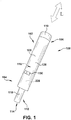
- Fig. 1 depicts a distance indicator 100 for indicating the distance that a device has traveled with respect to a guidewire.
- the use environment will be described herein as being a medical use environment, wherein a device is penetrating into a relatively stationary patient tissue, but could be any suitable environment in which a device moves in at least one dimension toward or away from a relatively stationary substrate.
- the term “device” is used herein to indicate a tool, component, implant, or other item having a one-dimensional displacement (i.e., in a "primary dimension", such as longitudinal direction L shown in the Figures) that a user wishes to measure.
- the term “guidewire” is used herein to indicate a relatively slender, elongate structure which is fixed in the primary dimension with respect to a patient tissue and extends outward from a patient tissue while the device is being used. It is contemplated that, for most embodiments of the present invention, the guidewire will extend from the patient tissue in the primary dimension and terminate at a location at least as far from the patient tissue in that primary dimension as the location at which a device is initially placed to interact with the patient tissue.
- the distance indicator 100 includes an elongate housing 102 having first and second housing ends 104 and 106, respectively, longitudinally separated by a housing body 108, as shown in Fig. 1 .
- a guidewire connector 110 is configured for operative connection to a guidewire (not shown in Fig. 1 ) to hold the housing 102 substantially stationary with respect to the guidewire.
- a plunger 112 has first and second plunger ends 114 and 116 (located within the housing 102 in Fig. 1 ), respectively, longitudinally separated by a plunger body 118.
- the plunger 112 is operatively connected to the housing 102 for longitudinal motion with respect to the housing.
- the first plunger end 114 is configured to operatively contact the device for which the movement distance is being measured, as will be described below.
- a biasing member 220 urges the plunger 112 longitudinally with respect to the housing 102 to keep the first plunger end in operative contact with the device as the device moves with respect to the guidewire (222 in the Figures).
- the biasing member 220 may urge the plunger 112 longitudinally toward or longitudinally away from the housing 102.
- the biasing member 220 is shown schematically as a spring in the Figures, but may be of any suitable type, such as, but not limited to, a spring, hydraulic actuator, pneumatic actuator, vacuum line, fluid pressure line, shape memory material structure, magnetic force, gravitational force, or any other means for exerting an appropriate force between the plunger 112 and the housing 102.
- the plunger 112 and guidewire 222 begin at a first relative plunger/housing position, then, as the device moves with respect to the guidewire, the biasing member 220 similarly urges the plunger 112 to move with respect to the housing 102 to at least one other relative plunger/housing position.
- This latter plunger/housing position is referenced herein as being a “second” plunger/housing position, but as will be explained below, the "second" plunger/housing position need not be a terminal plunger/housing position. In fact, the plunger 112 and housing 102 could move through the "second" plunger/housing position without pause, or with merely a brief pause, as desired by the user.
- the guidewire connector 110 is shown schematically in the Figures.
- the guidewire connector 110 may be of any suitable type configured and operative to hold the housing 102 in a relatively longitudinally fixed relationship with the guidewire 222.
- a guidewire aperture 224 may extend at least a portion of the longitudinal distance through the guidewire connector 110.
- the guidewire aperture 224 may serve to accept the guidewire 222 and place the housing 102 into a desired guidewire/housing position.
- the guidewire connector 110 may frictionally engage the guidewire 222 to hold the housing 102 in the relatively longitudinally fixed relationship with the guidewire 222 as described.
- a guidewire aperture 224 could be provided which has a slightly smaller diameter than the guidewire 222 and requires that the guidewire be forced into the guidewire aperture.
- at least a portion of the guidewire connector 110 may be made from a resilient and/or adhesive material which grips the guidewire 222 when brought into contact therewith under sufficient coupling force.
- a suitable guidewire connector 110 includes a clip (not shown) that can be selectively opened and closed by a user to grip and release, respectively, the guidewire 222.
- the guidewire connector 110 could engage directly with a terminal or free end of the guidewire, opposite the patient tissue.
- the guidewire connector 110 is shown in the Figures as being located in direct contact with the second housing end 106 for ease of description, but may be located in any orientation, directly contacting or spaced apart from other structures of the distance indicator 100. It is also contemplated that multiple guidewire connectors 110 could be provided to a single distance indicator 100; for example, there could be means provided at or near both the first and second housing ends 104 and 106 to serve as guidewire connectors and maintain the housing 102 and guidewire 222 in the desired guidewire/housing relationship.
- the guidewire connector 110 should be configured to resist relative motion between the guidewire 222 and the housing 102 when the housing and guidewire are in the desired guidewire/housing position and during use of the distance indicator.
- the housing 102 could include a plunger aperture 226 extending from the first housing end 104 into the housing body 108.
- the plunger aperture 226 may accept the second plunger end 116 and at least a portion of the plunger body 118 and allow relative motion of the plunger 112 either toward or away from the second housing end 106 during movement of the plunger from the first relative plunger/housing position to the second relative plunger/housing position, depending upon the direction of motion of the device with respect to the guidewire 222.
- the distance indicator 100 shown in Fig. 3 differs mainly from that in Fig. 2 in the arrangement of components. While the Fig. 2 configuration has a plunger 112 at least partially located within a housing 102, the Fig. 3 configuration is reversed, with the housing at least partially located within the plunger. Either of these configurations, and any others which provide distance indication as described, are contemplated by the present invention.
- Fig. 4 illustrates schematically that the distance indicator 100 can be located either between a device 432 and a patient tissue 434 (i.e., to the left in the orientation of Fig. 4 ), or the distance indicator can be located on a longitudinally opposite side of the device from the patient tissue (i.e., to the right in the orientation of Fig. 4 ).
- the distance indicator 100 will function agnostic of its spatial relationship with the device 432 and the guidewire 222, and one of ordinary skill in the art can readily configure the plunger 112, housing 102, and other structures of the distance indicator for use in either position.
- the user may want to avoid the interposition of a structure such as the distance indicator 100 between the device 432 and the patient tissue 434. Therefore, the below description presumes that the distance indicator 100 will be located on the longitudinally opposite side of the device from the patient tissue (i.e., to the right in the orientation of Fig. 4 ).
- the plunger aperture 226 is in at least one of visual and fluid communication with an outer surface 128 of the housing 102 through a viewing aperture 130 extending substantially laterally through at least a portion of the housing body 108.
- the viewing aperture 130 allows a user to visualize a position, usually a longitudinal position, of the plunger within the housing body 108.
- This position visualization may be binary, in which the user can just see whether enough of the plunger 112 is contained within the plunger aperture 226 so that the second plunger end 116 or a portion of the plunger body 118 can be seen through the viewing aperture.
- the position visualization may also be scalar, in which at least one visible mark inscribed on the plunger 112 can be seen through the viewing aperture.
- the plunger 112 could include a series of visible marks, and the user could use these visible marks to quantify the physical relationship of the plunger 112 and the housing 102 more precisely than in the binary position visualization.
- This position visualization regardless of the manner in which it is accomplished, may be helpful in indicating to the user the change in relative position between the plunger 112 and the housing 102 between the first and second relative plunger/housing positions.
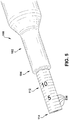
- Fig. 5 shows an alternate arrangement for indicating to a user the physical relationship of the plunger 112 and the housing 102, again by providing an indicator scale to at least one of the plunger and the housing.
- the plunger 112 is provided with a series of visible marks 536 (only a subset of which are numbered, for clarity) which together form an indicator scale configured to provide a quantitative indication of the longitudinal distance traveled by the plunger with respect to the housing 102 during movement of the plunger from the first relative plunger/housing position to the second relative plunger/housing position.
- the user could see on the indicator scale that the number "5" visible mark 536 is the rightmost (in the orientation of Fig.
- the distance indicator 100 would then be quantitatively indicating to the user that the distance between the first and second relative plunger/housing positions is 10 units, in whatever numerical system--standard (e.g., millimeters or inches) and/or task-specific--the indicator scale uses.
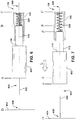
- This sequence shows schematically an example in which the guidewire 222 has first and second guidewire ends 638 and 640 longitudinally separated by a guidewire body 643.
- the first guidewire end 638 contacts the patient tissue 434, and may penetrate some distance into the patient tissue to maintain the guidewire 222 in a desired position.
- the device 432 is movably connected to the guidewire 222--a relatively stationary reference structure--in such a manner as to allow longitudinal motion of the device toward or away from the patient tissue 434.
- the guidewire connector 100 has been engaged to hold the housing 102 stationary with respect to the guidewire 222 and the first plunger end 114 has been placed into operative contact with the device 432 with the plunger 112 and the housing 102 in the first relative plunger/housing position.
- This operative contact between the first plunger end 114 and the device 432 could be as simple as a touching of the surface of one to the other, and/or could be aided by an adhesive; a mounting bracket, hook, or other mechanical coupler; or any other means for attaching the first plunger end 114 to the device 432.
- the biasing member 220 urges the plunger 112 toward the left, in the orientation of Figs.
- reference line "A” marks the longitudinal position of the device 432
- reference line “B” marks the longitudinal position of the second plunger end 116
- reference line “C” marks the longitudinal position of the second housing end 106
- reference line “D” marks the longitudinal position of the patient tissue 434.
- the biasing member 220 can be seen to be in a compressed state, as shown schematically in Fig. 6
- the device 432 is then moved longitudinally (in direction "L") with respect to the patient tissue 434, as shown in Fig. 7 .
- a cannulated drill is the device 432 and is being guided by the guidewire 222 to drill an aperture into the patient tissue 434
- the cannulated drill will move to the left, in the orientation of Figs. 6 and 7 . Since the guidewire 222 and housing 102 are relatively fixed with respect to the patient tissue 434, only the plunger 112 and device 432 will move in the depicted scenario. This movement is visually indicated in Fig.
- the biasing member 220 has expanded longitudinally to urge the plunger 112 longitudinally with respect to the housing 102, telescoping these portions of the distance indicator 100 outward, and thereby keep the first plunger end 114 in operative contact with the device 432.
- the biasing member 220 may instead be a mechanical connection (not shown) between the first plunger end 114 and the device 432 that pulls the plunger 112 along with the device to provide the depicted motion of the plunger with respect to the housing 102.
- the distance indicator 100 has been moved into the second relative plunger/housing position in the view of Fig. 7 , in which the plunger 112 has telescoped outward from the housing 102.
- the user can then observe the longitudinal difference (here, the distances A- ⁇ and B- ⁇ ) between the first and second relative plunger/housing positions and thereby deduce a distance that the device 432 has moved longitudinally with respect to the guidewire 222, and hence with respect to the patient tissue 434.
- gearing means of some type are present (not shown here) to change the component travel ratios, the distances A- ⁇ , and B- ⁇ will normally be substantially equal to each other and equal to the amount that the device 432 has moved with respect to the patient tissue 434.
- the indicator scale may assist with quantifying this movement distance of the device 432. For example, if the longitudinal movement of the cannulated drill device 432 is shown by the distance indicator to be two inches, the user will know that the aperture in the tissue has been made two inches deeper by movement of the drill device. This may be helpful in procedures where an initial observation (i.e., the distance indicator 100 is in the first relative plunger/housing position) is made with the drill bit tip just touching the patient tissue 434 surface, and then a later observation (i.e., the distance indicator 100 is in the first relative plunger/housing position) is made with the drill bit tip penetrating into the patient tissue surface.
- an initial observation i.e., the distance indicator 100 is in the first relative plunger/housing position
- a later observation i.e., the distance indicator 100 is in the first relative plunger/housing position
- the distance indicator 100 gives the user a real-time view of the depth of insertion of the drill (or other device 432) into the patient tissue 434, without requiring removal of the drill and/or direct contact with the patient tissue, as in the prior art devices.
- the user can stop drilling (or otherwise moving the device 432) to check the distance traveled, or can monitor the distance continually during movement of the device.
- the present invention may be used without a guidewire 222, as long as some reference structure extends from a substrate (such as the described patient tissue 434) longitudinally toward and/or beyond a longitudinally moving device.
- the reference structure should be relatively stationary with respect to the substrate.
- the distance indicator 100 could be designed to ride along a wall extending substantially perpendicular to a substrate being approached or retreated from by a device.
- the distance indicator 100 or portions thereof (e.g., the plunger 112) could contact the patient tissue 434 or other substrate directly during all or part of the distance indication process.
- the second housing end 106 could directly contact the patient tissue 434 and the first plunger end 114 could directly contact a structure of the device 432, so that the plunger 112 and housing 102 can relatively telescope inward or outward as the device moves, with or without the aid of a guidewire 222.
- all structures of the present invention may have any suitable shapes, sizes, configurations, relative relationships, cross-sectional areas, or any other physical characteristics as desirable for a particular application of the present invention.
- Any structures or features described with reference to one embodiment or configuration of the present invention could be provided, singly or in combination with other structures or features, to any other embodiment or configuration, as it would be impractical to describe each of the embodiments and configurations discussed herein as having all of the options discussed with respect to all of the other embodiments and configurations.
- the distance indicator 100 could be used with a bone screw or other medical implant, or with any other device 432 that moves longitudinally with respect to a substrate.
- the distance indicator 100 could be at least partially disposable or intended for one-time use, possibly by including a sacrifice feature (not shown) rendering the distance indicator unusable after an initial use--this may be particularly helpful in a medical use environment if the distance indicator is not intended for repeat sterilization and reuse.
- a "stop" component could be used in conjunction with the distance indicator 100 to prevent longitudinal motion of the device 432 above a certain amount.
Landscapes
- Health & Medical Sciences (AREA)
- Surgery (AREA)
- Life Sciences & Earth Sciences (AREA)
- Heart & Thoracic Surgery (AREA)
- Molecular Biology (AREA)
- Oral & Maxillofacial Surgery (AREA)
- Engineering & Computer Science (AREA)
- Biomedical Technology (AREA)
- Nuclear Medicine, Radiotherapy & Molecular Imaging (AREA)
- Medical Informatics (AREA)
- Pathology (AREA)
- Animal Behavior & Ethology (AREA)
- General Health & Medical Sciences (AREA)
- Public Health (AREA)
- Veterinary Medicine (AREA)
- Media Introduction/Drainage Providing Device (AREA)
- Surgical Instruments (AREA)
Claims (6)
- Entfernungsanzeiger (100) zum Anzeigen der Entfernung, die eine Vorrichtung in Bezug auf einen Führungsdraht (222) zurückgelegt hat, wobei der Entfernungsanzeiger (100) Folgendes umfasst:ein langgestrecktes Gehäuse (102), das erstes (104) und zweites (106) Gehäuseende aufweist, die in Längsrichtung durch einen Gehäusekörper (108) getrennt sind, und ein Führungsdrahtverbindungsstück (110), das zur Wirkverbindung mit dem Führungsdraht (222) gestaltet ist, um das Gehäuse (102) stationär in Bezug zu diesem zu halten;einen Kolben (112), der erstes (114) und zweites (116) Kolbenende aufweist, die in Längsrichtung durch einen Kolbenkörper (118) getrennt sind, wobei der Kolben (112) betriebsmäßig mit dem Gehäuse (102) zur Längsbewegung in Bezug zum Gehäuse (102) verbunden ist, und das erste Kolbenende (114) gestaltet ist, um die Vorrichtung betriebsmäßig zu berühren; undein Vorspannungselement (220), das den Kolben (112) in Längsrichtung in Bezug zum Gehäuse (102) treibt, um das erste Kolbenende (114) in Wirkkontakt mit der Vorrichtung zu halten, während sich die Vorrichtung in Bezug zum Führungsdraht (222) bewegt;wobei, während das Führungsdrahtverbindungsstück (110) das Gehäuse (108) stationär in Bezug zum Führungsdraht (222) hält, das erste Kolbenende (114) in Wirkkontakt mit der Vorrichtung mit dem Kolben (118) und dem Gehäuse (108) in einer ersten relativen Kolben/Gehäuse-Stellung gebracht wird, die Vorrichtung sich in Längsrichtung in Bezug zum Führungsdraht (222) und verbundenen Gehäuse (108) bewegt, und der Kolben (118) sich in eine zweite relative Kolben/Gehäuse-Stellung, durch die Wirkverbindung zwischen dem ersten Kolbenende (114) und der Vorrichtung unterstützt, bewegt, wobei der Längenunterschied zwischen der ersten und zweiten relativen Kolben/Gehäuse-Stellung eine Entfernung anzeigt, die die Vorrichtung sich in Längsrichtung in Bezug zum Führungsdraht (222) bewegt hat.
- Entfernungsanzeiger (100) nach Anspruch 1, wobei das Führungsdrahtverbindungsstück (110) eine Führungsdrahtöffnung (224) umfasst, die sich zumindest einen Teil der Längsentfernung durch dieses hindurch erstreckt, wobei die Führungsdrahtöffnung (224) gestaltet ist, um das Führungsdraht (222) aufzunehmen und das Gehäuse (102) in eine gewünschte Führungsdraht/Gehäuse-Stellung zu bringen, das Führungsdrahtverbindungsstück (110) gestaltet ist, um einer relativen Bewegung zwischen dem Führungsdraht (222) und dem Gehäuse (102) zu widerstehen, wenn das Gehäuse (102) und der Führungsdraht (222) in der gewünschten Führungsdraht/Gehäuse-Stellung sind, und optional wobei das Führungsdrahtverbindungsstück (110) in Reibungseingriff mit dem Führungsdraht (222) steht, um einer relativen Bewegung zwischen dem Führungsdraht (222) und dem Gehäuse (102) zu widerstehen, wenn das Gehäuse (102) und der Führungsdraht (222) in der gewünschten Führungsdraht/Gehäuse-Stellung sind.
- Entfernungsanzeiger nach Anspruch 1, wobei das Gehäuse (102) eine Kolbenöffnung (226) umfasst, die sich vom ersten Gehäuseende in den Gehäusekörper (108) erstreckt, wobei die Kolbenöffnung (226) das zweite Kolbenende (116) und zumindest einen Teil des Kolbenkörpers (118) aufnimmt und eine relative Bewegung des Kolbens (112) weg vom zweiten Gehäuseende (106) erlaubt, während das Vorspannungselement (220) den Kolben (112) von der ersten relativen Kolben/Gehäuse-Stellung zur zweiten relativen Kolben/Gehäuse-Stellung treibt.
- Entfernungsanzeiger nach Anspruch 1, wobei das Gehäuse (102) eine Kolbenöffnung (226) umfasst, die sich vom ersten Gehäuseende in den Gehäusekörper (108) erstreckt, wobei die Kolbenöffnung (226) das zweite Kolbenende (116) und zumindest einen Teil des Kolbenkörpers (118) aufnimmt und eine relative Bewegung des Kolbens (112) in Richtung zum zweiten Gehäuseende (106) erlaubt, während das Vorspannungselement (220) den Kolben (112) von der ersten relativen Kolben/Gehäuse-Stellung zur zweiten relativen Kolben/Gehäuse-Stellung treibt.
- Entfernungsanzeiger nach Anspruch 3 oder 4, wobei die Kolbenöffnung (226) in Fluidverbindung mit einer äußeren Oberfläche des Gehäuses (102) durch eine Sichtöffnung (130) ist, die sich im Wesentlichen seitlich durch zumindest einen Teil des Gehäusekörpers (108) erstreckt, wobei die Sichtöffnung (130) es einem Benutzer erlaubt, eine Stellung des Kolbens (112) innerhalb des Gehäusekörpers (108) zu visualisieren.
- Entfernungsanzeiger nach einem der vorhergehenden Ansprüche, wobei zumindest eines des Kolbens (112) und des Gehäuses (102) eine Anzeigeskala umfasst, die gestaltet ist, um eine quantitative Anzeige der Längsentfernung bereitzustellen, die vom Kolben (112) in Bezug zum Gehäuse (102) während der Bewegung des Kolbens (112) von der ersten relativen Kolben/Gehäuse-Stellung zur zweiten relativen Kolben/Gehäuse-Stellung zurückgelegt wurde.
Applications Claiming Priority (2)
| Application Number | Priority Date | Filing Date | Title |
|---|---|---|---|
| US201161431472P | 2011-01-11 | 2011-01-11 | |
| PCT/US2012/020898 WO2012097040A1 (en) | 2011-01-11 | 2012-01-11 | Distance indicator |
Publications (2)
| Publication Number | Publication Date |
|---|---|
| EP2663246A1 EP2663246A1 (de) | 2013-11-20 |
| EP2663246B1 true EP2663246B1 (de) | 2018-02-28 |
Family
ID=45554826
Family Applications (1)
| Application Number | Title | Priority Date | Filing Date |
|---|---|---|---|
| EP12701578.2A Active EP2663246B1 (de) | 2011-01-11 | 2012-01-11 | Entfernungsanzeiger |
Country Status (3)
| Country | Link |
|---|---|
| US (1) | US8784429B2 (de) |
| EP (1) | EP2663246B1 (de) |
| WO (1) | WO2012097040A1 (de) |
Families Citing this family (6)
| Publication number | Priority date | Publication date | Assignee | Title |
|---|---|---|---|---|
| US9907582B1 (en) | 2011-04-25 | 2018-03-06 | Nuvasive, Inc. | Minimally invasive spinal fixation system and related methods |
| US8870891B2 (en) | 2011-06-24 | 2014-10-28 | Depuy Mitek, Llc | ACL reconstruction tunnel gauge and method |
| ES2616212T3 (es) * | 2012-10-09 | 2017-06-09 | Biedermann Technologies Gmbh & Co. Kg | Instrumento de montaje de un dispositivo de anclaje óseo poliaxial |
| US10849707B2 (en) * | 2017-06-07 | 2020-12-01 | Boehringer Technologies, Lp | Laparoscopic measuring devices and methods of laparoscopic measuring |
| WO2021097293A1 (en) * | 2019-11-13 | 2021-05-20 | Conmed Corporation | Intra-articular measuring device |
| US12226135B1 (en) * | 2024-02-13 | 2025-02-18 | Surgeon Design Center LLC. | Surgical guide wire engagement device |
Family Cites Families (12)
| Publication number | Priority date | Publication date | Assignee | Title |
|---|---|---|---|---|
| US1459896A (en) * | 1921-12-08 | 1923-06-26 | William N John | Countersink gauge |
| US2243718A (en) | 1938-11-05 | 1941-05-27 | Moreira Francisco Elias Godoy | Surgical drill |
| CH593674A5 (de) | 1974-09-11 | 1977-12-15 | Friedrichsfeld Gmbh | |
| DK147350C (da) * | 1982-04-16 | 1984-12-03 | Leif Grundtvorn Larsen | Gevindmaalevaerktoej |
| US5180388A (en) | 1990-06-28 | 1993-01-19 | American Cyanamid Company | Bone pinning system |
| US5197967A (en) | 1991-04-02 | 1993-03-30 | Synthes (U.S.A.) | Trephine instrument and method for cutting annular holes |
| US5211647A (en) | 1992-02-19 | 1993-05-18 | Arthrex Inc. | Interference screw and cannulated sheath for endosteal fixation of ligaments |
| US5895389A (en) * | 1997-05-29 | 1999-04-20 | Synthes (U.S.A.) | Drilling guide and measuring instrumentation |
| US7166112B2 (en) * | 2002-03-25 | 2007-01-23 | Depuy Spine, Inc. | Device for determining distance between two points in a surgical site |
| US7207995B1 (en) | 2004-01-29 | 2007-04-24 | Biomer Manufacturing Corp. | Method and apparatus for retaining a guide wire |
| US20090254094A1 (en) | 2008-04-08 | 2009-10-08 | Knapp Troy D | Ratcheting mechanical driver for cannulated surgical systems |
| US8870891B2 (en) * | 2011-06-24 | 2014-10-28 | Depuy Mitek, Llc | ACL reconstruction tunnel gauge and method |
-
2012
- 2012-01-11 EP EP12701578.2A patent/EP2663246B1/de active Active
- 2012-01-11 WO PCT/US2012/020898 patent/WO2012097040A1/en not_active Ceased
- 2012-01-11 US US13/348,034 patent/US8784429B2/en active Active
Also Published As
| Publication number | Publication date |
|---|---|
| WO2012097040A1 (en) | 2012-07-19 |
| US8784429B2 (en) | 2014-07-22 |
| EP2663246A1 (de) | 2013-11-20 |
| US20120203237A1 (en) | 2012-08-09 |
Similar Documents
| Publication | Publication Date | Title |
|---|---|---|
| EP2663246B1 (de) | Entfernungsanzeiger | |
| EP1938039B1 (de) | Tiefenmessvorrichtung | |
| US9877786B2 (en) | Modular navigable probe | |
| US20150216541A1 (en) | Pointing device and drilling tool | |
| CN110121294B (zh) | 具有神经监测能力的外科深度仪器 | |
| JP5797361B1 (ja) | 内視鏡処置具 | |
| JP4810698B1 (ja) | 椎弓根挿入器具ガイド装置 | |
| WO2015175635A1 (en) | Guidance system mounts for surgical introducers | |
| US20180310956A1 (en) | Apparatus and method for use of an inclinometer-aided needle guide | |
| JP2017536909A5 (de) | ||
| EP2978375B1 (de) | Tunnellehre | |
| JP7281837B2 (ja) | 外科手術用測深器具 | |
| EP2797506B1 (de) | Runde tiefenmessvorrichtung | |
| CN110582221A (zh) | 挠性部形态推断装置及包括其的内视镜系统 | |
| KR101563737B1 (ko) | 외상외과용 깊이 게이지 | |
| CN104411261B (zh) | 单个患者用深度计 | |
| EP3000402A1 (de) | Punktionsbehandlungsinstrument für endoskop | |
| CN209122429U (zh) | 手术器械插入限位机构、手术插入装置及手术机器人 | |
| CN214387609U (zh) | 一种骨穿刺定位工具 | |
| CN218979087U (zh) | 股骨瞄准装置及医疗设备 | |
| CN106535786B (zh) | 逆向钻孔器管式深度计 | |
| EP2901946A1 (de) | Zeigevorrichtung und Bohrwerkzeug | |
| EP4169445A1 (de) | Vorrichtung zur messung der tiefe eines internen merkmals | |
| TW201318594A (zh) | 醫療用電鑽及其測量位移之方法 | |
| CN102335027A (zh) | 枪状镊 |
Legal Events
| Date | Code | Title | Description |
|---|---|---|---|
| PUAI | Public reference made under article 153(3) epc to a published international application that has entered the european phase |
Free format text: ORIGINAL CODE: 0009012 |
|
| 17P | Request for examination filed |
Effective date: 20130808 |
|
| AK | Designated contracting states |
Kind code of ref document: A1 Designated state(s): AL AT BE BG CH CY CZ DE DK EE ES FI FR GB GR HR HU IE IS IT LI LT LU LV MC MK MT NL NO PL PT RO RS SE SI SK SM TR |
|
| DAX | Request for extension of the european patent (deleted) | ||
| STAA | Information on the status of an ep patent application or granted ep patent |
Free format text: STATUS: EXAMINATION IS IN PROGRESS |
|
| 17Q | First examination report despatched |
Effective date: 20170215 |
|
| GRAP | Despatch of communication of intention to grant a patent |
Free format text: ORIGINAL CODE: EPIDOSNIGR1 |
|
| STAA | Information on the status of an ep patent application or granted ep patent |
Free format text: STATUS: GRANT OF PATENT IS INTENDED |
|
| RIC1 | Information provided on ipc code assigned before grant |
Ipc: A61B 90/00 20160101ALI20170711BHEP Ipc: A61B 17/17 20060101AFI20170711BHEP |
|
| INTG | Intention to grant announced |
Effective date: 20170801 |
|
| GRAS | Grant fee paid |
Free format text: ORIGINAL CODE: EPIDOSNIGR3 |
|
| GRAA | (expected) grant |
Free format text: ORIGINAL CODE: 0009210 |
|
| STAA | Information on the status of an ep patent application or granted ep patent |
Free format text: STATUS: THE PATENT HAS BEEN GRANTED |
|
| AK | Designated contracting states |
Kind code of ref document: B1 Designated state(s): AL AT BE BG CH CY CZ DE DK EE ES FI FR GB GR HR HU IE IS IT LI LT LU LV MC MK MT NL NO PL PT RO RS SE SI SK SM TR |
|
| REG | Reference to a national code |
Ref country code: GB Ref legal event code: FG4D Ref country code: CH Ref legal event code: EP |
|
| REG | Reference to a national code |
Ref country code: AT Ref legal event code: REF Ref document number: 973263 Country of ref document: AT Kind code of ref document: T Effective date: 20180315 |
|
| REG | Reference to a national code |
Ref country code: IE Ref legal event code: FG4D |
|
| REG | Reference to a national code |
Ref country code: DE Ref legal event code: R096 Ref document number: 602012043324 Country of ref document: DE Ref country code: CH Ref legal event code: NV Representative=s name: MICHELI AND CIE SA, CH |
|
| REG | Reference to a national code |
Ref country code: NL Ref legal event code: MP Effective date: 20180228 |
|
| REG | Reference to a national code |
Ref country code: LT Ref legal event code: MG4D |
|
| REG | Reference to a national code |
Ref country code: AT Ref legal event code: MK05 Ref document number: 973263 Country of ref document: AT Kind code of ref document: T Effective date: 20180228 |
|
| PG25 | Lapsed in a contracting state [announced via postgrant information from national office to epo] |
Ref country code: NO Free format text: LAPSE BECAUSE OF FAILURE TO SUBMIT A TRANSLATION OF THE DESCRIPTION OR TO PAY THE FEE WITHIN THE PRESCRIBED TIME-LIMIT Effective date: 20180528 Ref country code: FI Free format text: LAPSE BECAUSE OF FAILURE TO SUBMIT A TRANSLATION OF THE DESCRIPTION OR TO PAY THE FEE WITHIN THE PRESCRIBED TIME-LIMIT Effective date: 20180228 Ref country code: HR Free format text: LAPSE BECAUSE OF FAILURE TO SUBMIT A TRANSLATION OF THE DESCRIPTION OR TO PAY THE FEE WITHIN THE PRESCRIBED TIME-LIMIT Effective date: 20180228 Ref country code: ES Free format text: LAPSE BECAUSE OF FAILURE TO SUBMIT A TRANSLATION OF THE DESCRIPTION OR TO PAY THE FEE WITHIN THE PRESCRIBED TIME-LIMIT Effective date: 20180228 Ref country code: NL Free format text: LAPSE BECAUSE OF FAILURE TO SUBMIT A TRANSLATION OF THE DESCRIPTION OR TO PAY THE FEE WITHIN THE PRESCRIBED TIME-LIMIT Effective date: 20180228 Ref country code: CY Free format text: LAPSE BECAUSE OF FAILURE TO SUBMIT A TRANSLATION OF THE DESCRIPTION OR TO PAY THE FEE WITHIN THE PRESCRIBED TIME-LIMIT Effective date: 20180228 Ref country code: LT Free format text: LAPSE BECAUSE OF FAILURE TO SUBMIT A TRANSLATION OF THE DESCRIPTION OR TO PAY THE FEE WITHIN THE PRESCRIBED TIME-LIMIT Effective date: 20180228 |
|
| PG25 | Lapsed in a contracting state [announced via postgrant information from national office to epo] |
Ref country code: GR Free format text: LAPSE BECAUSE OF FAILURE TO SUBMIT A TRANSLATION OF THE DESCRIPTION OR TO PAY THE FEE WITHIN THE PRESCRIBED TIME-LIMIT Effective date: 20180529 Ref country code: RS Free format text: LAPSE BECAUSE OF FAILURE TO SUBMIT A TRANSLATION OF THE DESCRIPTION OR TO PAY THE FEE WITHIN THE PRESCRIBED TIME-LIMIT Effective date: 20180228 Ref country code: BG Free format text: LAPSE BECAUSE OF FAILURE TO SUBMIT A TRANSLATION OF THE DESCRIPTION OR TO PAY THE FEE WITHIN THE PRESCRIBED TIME-LIMIT Effective date: 20180528 Ref country code: SE Free format text: LAPSE BECAUSE OF FAILURE TO SUBMIT A TRANSLATION OF THE DESCRIPTION OR TO PAY THE FEE WITHIN THE PRESCRIBED TIME-LIMIT Effective date: 20180228 Ref country code: LV Free format text: LAPSE BECAUSE OF FAILURE TO SUBMIT A TRANSLATION OF THE DESCRIPTION OR TO PAY THE FEE WITHIN THE PRESCRIBED TIME-LIMIT Effective date: 20180228 Ref country code: AT Free format text: LAPSE BECAUSE OF FAILURE TO SUBMIT A TRANSLATION OF THE DESCRIPTION OR TO PAY THE FEE WITHIN THE PRESCRIBED TIME-LIMIT Effective date: 20180228 |
|
| PG25 | Lapsed in a contracting state [announced via postgrant information from national office to epo] |
Ref country code: AL Free format text: LAPSE BECAUSE OF FAILURE TO SUBMIT A TRANSLATION OF THE DESCRIPTION OR TO PAY THE FEE WITHIN THE PRESCRIBED TIME-LIMIT Effective date: 20180228 Ref country code: EE Free format text: LAPSE BECAUSE OF FAILURE TO SUBMIT A TRANSLATION OF THE DESCRIPTION OR TO PAY THE FEE WITHIN THE PRESCRIBED TIME-LIMIT Effective date: 20180228 Ref country code: RO Free format text: LAPSE BECAUSE OF FAILURE TO SUBMIT A TRANSLATION OF THE DESCRIPTION OR TO PAY THE FEE WITHIN THE PRESCRIBED TIME-LIMIT Effective date: 20180228 Ref country code: PL Free format text: LAPSE BECAUSE OF FAILURE TO SUBMIT A TRANSLATION OF THE DESCRIPTION OR TO PAY THE FEE WITHIN THE PRESCRIBED TIME-LIMIT Effective date: 20180228 |
|
| REG | Reference to a national code |
Ref country code: DE Ref legal event code: R097 Ref document number: 602012043324 Country of ref document: DE |
|
| PG25 | Lapsed in a contracting state [announced via postgrant information from national office to epo] |
Ref country code: SK Free format text: LAPSE BECAUSE OF FAILURE TO SUBMIT A TRANSLATION OF THE DESCRIPTION OR TO PAY THE FEE WITHIN THE PRESCRIBED TIME-LIMIT Effective date: 20180228 Ref country code: CZ Free format text: LAPSE BECAUSE OF FAILURE TO SUBMIT A TRANSLATION OF THE DESCRIPTION OR TO PAY THE FEE WITHIN THE PRESCRIBED TIME-LIMIT Effective date: 20180228 Ref country code: DK Free format text: LAPSE BECAUSE OF FAILURE TO SUBMIT A TRANSLATION OF THE DESCRIPTION OR TO PAY THE FEE WITHIN THE PRESCRIBED TIME-LIMIT Effective date: 20180228 Ref country code: SM Free format text: LAPSE BECAUSE OF FAILURE TO SUBMIT A TRANSLATION OF THE DESCRIPTION OR TO PAY THE FEE WITHIN THE PRESCRIBED TIME-LIMIT Effective date: 20180228 |
|
| PLBE | No opposition filed within time limit |
Free format text: ORIGINAL CODE: 0009261 |
|
| STAA | Information on the status of an ep patent application or granted ep patent |
Free format text: STATUS: NO OPPOSITION FILED WITHIN TIME LIMIT |
|
| PGFP | Annual fee paid to national office [announced via postgrant information from national office to epo] |
Ref country code: IE Payment date: 20181219 Year of fee payment: 8 |
|
| 26N | No opposition filed |
Effective date: 20181129 |
|
| PG25 | Lapsed in a contracting state [announced via postgrant information from national office to epo] |
Ref country code: SI Free format text: LAPSE BECAUSE OF FAILURE TO SUBMIT A TRANSLATION OF THE DESCRIPTION OR TO PAY THE FEE WITHIN THE PRESCRIBED TIME-LIMIT Effective date: 20180228 |
|
| PGFP | Annual fee paid to national office [announced via postgrant information from national office to epo] |
Ref country code: IT Payment date: 20181218 Year of fee payment: 8 |
|
| PG25 | Lapsed in a contracting state [announced via postgrant information from national office to epo] |
Ref country code: MC Free format text: LAPSE BECAUSE OF FAILURE TO SUBMIT A TRANSLATION OF THE DESCRIPTION OR TO PAY THE FEE WITHIN THE PRESCRIBED TIME-LIMIT Effective date: 20180228 |
|
| PG25 | Lapsed in a contracting state [announced via postgrant information from national office to epo] |
Ref country code: LU Free format text: LAPSE BECAUSE OF NON-PAYMENT OF DUE FEES Effective date: 20190111 |
|
| REG | Reference to a national code |
Ref country code: BE Ref legal event code: MM Effective date: 20190131 |
|
| PG25 | Lapsed in a contracting state [announced via postgrant information from national office to epo] |
Ref country code: BE Free format text: LAPSE BECAUSE OF NON-PAYMENT OF DUE FEES Effective date: 20190131 |
|
| PG25 | Lapsed in a contracting state [announced via postgrant information from national office to epo] |
Ref country code: TR Free format text: LAPSE BECAUSE OF FAILURE TO SUBMIT A TRANSLATION OF THE DESCRIPTION OR TO PAY THE FEE WITHIN THE PRESCRIBED TIME-LIMIT Effective date: 20180228 |
|
| PG25 | Lapsed in a contracting state [announced via postgrant information from national office to epo] |
Ref country code: MT Free format text: LAPSE BECAUSE OF NON-PAYMENT OF DUE FEES Effective date: 20190111 Ref country code: PT Free format text: LAPSE BECAUSE OF FAILURE TO SUBMIT A TRANSLATION OF THE DESCRIPTION OR TO PAY THE FEE WITHIN THE PRESCRIBED TIME-LIMIT Effective date: 20180628 |
|
| REG | Reference to a national code |
Ref country code: DE Ref legal event code: R082 Ref document number: 602012043324 Country of ref document: DE Representative=s name: VENNER SHIPLEY GERMANY LLP, DE Ref country code: DE Ref legal event code: R082 Ref document number: 602012043324 Country of ref document: DE Representative=s name: VENNER SHIPLEY LLP, DE |
|
| PG25 | Lapsed in a contracting state [announced via postgrant information from national office to epo] |
Ref country code: IT Free format text: LAPSE BECAUSE OF NON-PAYMENT OF DUE FEES Effective date: 20200111 Ref country code: IE Free format text: LAPSE BECAUSE OF NON-PAYMENT OF DUE FEES Effective date: 20200111 |
|
| PG25 | Lapsed in a contracting state [announced via postgrant information from national office to epo] |
Ref country code: IS Free format text: LAPSE BECAUSE OF FAILURE TO SUBMIT A TRANSLATION OF THE DESCRIPTION OR TO PAY THE FEE WITHIN THE PRESCRIBED TIME-LIMIT Effective date: 20180628 |
|
| PG25 | Lapsed in a contracting state [announced via postgrant information from national office to epo] |
Ref country code: HU Free format text: LAPSE BECAUSE OF FAILURE TO SUBMIT A TRANSLATION OF THE DESCRIPTION OR TO PAY THE FEE WITHIN THE PRESCRIBED TIME-LIMIT; INVALID AB INITIO Effective date: 20120111 |
|
| PGFP | Annual fee paid to national office [announced via postgrant information from national office to epo] |
Ref country code: CH Payment date: 20211210 Year of fee payment: 11 |
|
| PG25 | Lapsed in a contracting state [announced via postgrant information from national office to epo] |
Ref country code: MK Free format text: LAPSE BECAUSE OF FAILURE TO SUBMIT A TRANSLATION OF THE DESCRIPTION OR TO PAY THE FEE WITHIN THE PRESCRIBED TIME-LIMIT Effective date: 20180228 |
|
| REG | Reference to a national code |
Ref country code: CH Ref legal event code: PL |
|
| PG25 | Lapsed in a contracting state [announced via postgrant information from national office to epo] |
Ref country code: LI Free format text: LAPSE BECAUSE OF NON-PAYMENT OF DUE FEES Effective date: 20230131 Ref country code: CH Free format text: LAPSE BECAUSE OF NON-PAYMENT OF DUE FEES Effective date: 20230131 |
|
| PGFP | Annual fee paid to national office [announced via postgrant information from national office to epo] |
Ref country code: GB Payment date: 20241217 Year of fee payment: 14 |
|
| PGFP | Annual fee paid to national office [announced via postgrant information from national office to epo] |
Ref country code: FR Payment date: 20241217 Year of fee payment: 14 |
|
| PGFP | Annual fee paid to national office [announced via postgrant information from national office to epo] |
Ref country code: DE Payment date: 20241216 Year of fee payment: 14 |