EP2664094B1 - Traitement de messages d'accusé de réception dans un n ud de réseau relais - Google Patents
Traitement de messages d'accusé de réception dans un n ud de réseau relais Download PDFInfo
- Publication number
- EP2664094B1 EP2664094B1 EP12700597.3A EP12700597A EP2664094B1 EP 2664094 B1 EP2664094 B1 EP 2664094B1 EP 12700597 A EP12700597 A EP 12700597A EP 2664094 B1 EP2664094 B1 EP 2664094B1
- Authority
- EP
- European Patent Office
- Prior art keywords
- protocol layer
- indication
- response
- acknowledgement
- protocol
- Prior art date
- Legal status (The legal status is an assumption and is not a legal conclusion. Google has not performed a legal analysis and makes no representation as to the accuracy of the status listed.)
- Active
Links
Images



Classifications
-
- H—ELECTRICITY
- H04—ELECTRIC COMMUNICATION TECHNIQUE
- H04L—TRANSMISSION OF DIGITAL INFORMATION, e.g. TELEGRAPHIC COMMUNICATION
- H04L1/00—Arrangements for detecting or preventing errors in the information received
- H04L1/12—Arrangements for detecting or preventing errors in the information received by using return channel
- H04L1/16—Arrangements for detecting or preventing errors in the information received by using return channel in which the return channel carries supervisory signals, e.g. repetition request signals
- H04L1/1607—Details of the supervisory signal
-
- H—ELECTRICITY
- H04—ELECTRIC COMMUNICATION TECHNIQUE
- H04L—TRANSMISSION OF DIGITAL INFORMATION, e.g. TELEGRAPHIC COMMUNICATION
- H04L1/00—Arrangements for detecting or preventing errors in the information received
- H04L1/12—Arrangements for detecting or preventing errors in the information received by using return channel
- H04L1/16—Arrangements for detecting or preventing errors in the information received by using return channel in which the return channel carries supervisory signals, e.g. repetition request signals
- H04L1/18—Automatic repetition systems, e.g. Van Duuren systems
- H04L1/1822—Automatic repetition systems, e.g. Van Duuren systems involving configuration of automatic repeat request [ARQ] with parallel processes
-
- H—ELECTRICITY
- H04—ELECTRIC COMMUNICATION TECHNIQUE
- H04L—TRANSMISSION OF DIGITAL INFORMATION, e.g. TELEGRAPHIC COMMUNICATION
- H04L1/00—Arrangements for detecting or preventing errors in the information received
- H04L1/12—Arrangements for detecting or preventing errors in the information received by using return channel
- H04L1/16—Arrangements for detecting or preventing errors in the information received by using return channel in which the return channel carries supervisory signals, e.g. repetition request signals
- H04L1/18—Automatic repetition systems, e.g. Van Duuren systems
- H04L1/1867—Arrangements specially adapted for the transmitter end
- H04L1/1896—ARQ related signaling
-
- H—ELECTRICITY
- H04—ELECTRIC COMMUNICATION TECHNIQUE
- H04L—TRANSMISSION OF DIGITAL INFORMATION, e.g. TELEGRAPHIC COMMUNICATION
- H04L5/00—Arrangements affording multiple use of the transmission path
- H04L5/003—Arrangements for allocating sub-channels of the transmission path
- H04L5/0053—Allocation of signalling, i.e. of overhead other than pilot signals
-
- H—ELECTRICITY
- H04—ELECTRIC COMMUNICATION TECHNIQUE
- H04L—TRANSMISSION OF DIGITAL INFORMATION, e.g. TELEGRAPHIC COMMUNICATION
- H04L1/00—Arrangements for detecting or preventing errors in the information received
- H04L2001/0092—Error control systems characterised by the topology of the transmission link
- H04L2001/0097—Relays
Definitions
- the present invention relates to methods for handling acknowledgement messages between a first protocol layer and a second protocol layer in a network node operating as a relay network node, wherein said first protocol layer is lower than the second protocol layer, said acknowledgement messages being related to Automatic Repeat Request, ARQ, processes, and to relay network nodes comprising a first protocol layer and a second protocol layer and capable of performing ARQ processes.
- ARQ processes are employed as a method of error-control for data transmission that use acknowledgements (messages sent by the receiver indicating that it has correctly received a data frame or packet) and timeouts (specified periods of time allowed to elapse before an acknowledgment is to be received) to achieve reliable data transmission over an unreliable service like the radio link.
- acknowledgements messages sent by the receiver indicating that it has correctly received a data frame or packet
- timeouts specified periods of time allowed to elapse before an acknowledgment is to be received
- Such acknowledgements have to be delivered from a lower layer of a protocol stack, like a physical layer, PHY, towards one or more higher layers, like a Media Access Control, MAC, layer.
- a protocol stack like a physical layer, PHY
- PHY physical layer
- MAC Media Access Control
- ACK/NACK Acknowledged/Not-Acknowledged
- MAC layer a higher layer (or MAC layer) already exists, as is disclosed e.g. in 3GPP TS 36.213 V. 10.0.0.
- the delivery of ACK/NACK is directly tied to the PUSCH-PHICH timing, i.e. bound towards the signalling provided by the Physical Uplink Shared Channel-Physical Hybrid-ARQ Indicator Channel.
- PHICH Physical Hybrid-ARQ Indicator Channel
- PUSCH Physical Uplink Shared Channel
- relay nodes configured with a relay-specific control channel cannot expect HARQ feedback on the regular feedback channel (PHICH) for uplink transmissions as will become more evident in the following.
- 3GPP TS 36.216 V. 10.1.0 describes features and behavior of such relay nodes as follows: From a UE perspective a relay node is part of the radio access network and behaves like an eNB. A relay node is wirelessly connected to a donor eNB. A relay node includes at least two physical layer entities. A first physical layer entity is used for communication with UEs, another physical layer entity is used for communication with the donor eNB and it corresponds to UE functionality.
- PHICH is not defined for such connections and may therefore not be used.
- the above timing relation used by a UE for delivery of acknowledgement messages from PHY to MAC can not be employed in a relay node.
- This document discloses internally sending an ACK towards the MAC layer of the Relay Node, after the uplink data for which an R-PDCCH grant was received has been sent.
- the invention provides methods for handling acknowledgement messages between a first protocol layer and a second protocol layer in a network node operating as a relay network node, said acknowledgement messages being related to Automatic Repeat Request, ARQ, processes, in which the second protocol layer is, when receiving an acknowledgement message from the first protocol layer, enabled to determine to which of a number of ARQ processes this acknowledgement message relates.
- the invention provides relay network nodes comprising a first protocol layer and a second protocol layer and capable of performing ARQ processes which are adapted to enable the second protocol layer, when receiving an acknowledgement message from the first protocol layer, to determine to which of a number of ARQ processes this acknowledgement message relates.
- a method for handling acknowledgement messages between a first protocol layer and a second protocol layer in a network node operating as a relay network node said acknowledgement messages being related to Automatic Repeat Request, ARQ, processes, wherein a predetermined timing relation exists between delivery of an acknowledgement message from the first protocol layer to the second protocol layer and at least one other message being related to an ARQ process and/or between delivery of an acknowledgement message from the first protocol layer to the second protocol layer and at least one time slot or time interval provisioned or reserved or used for an ARQ process.
- the ARQ process to which the at least one other message relates respectively for which the at least one time slot or time interval is provisioned or reserved or used may be the same ARQ process as the one to which the acknowledgement message relates, or may be a different ARQ process.
- the predetermined timing relation may be such that one of a number of certain time slots or time intervals of a transmission scheme which are assigned to an ARQ process is used for delivery of said acknowledgement message.
- the predetermined timing relation may be such that the acknowledgement message is delivered in a time slot or time interval which is used or reserved or provisioned for transmission of data, particularly uplink data, related to an ARQ process, particularly the same ARQ process to which the acknowledgement message is related. I.e., an acknowledgement message is sent from the first protocol layer to the second protocol layer at the same time or immediately after sending the corresponding uplink data by the network node.
- the predetermined timing relation may be such that the acknowledgement message is delivered in a time slot or time interval which is used or reserved or provisioned for a downlink backhaul operation, e.g. reception of an uplink grant message for the ARQ process by the network node.
- the time slot or time interval which is used or reserved or provisioned for a downlink backhaul operation may be the one in which an uplink grant message for data to be sent in the current ARQ process is received.
- an acknowledgement message is sent from the first protocol layer to the second protocol layer at the same time or immediately after receiving an uplink grant for corresponding uplink data to be sent by the network node, and in a time slot or time interval being related to the ARQ process to which the acknowledgement message is related.
- the time slot or time interval which is used or reserved or provisioned for a downlink backhaul operation may be the next such time slot or time interval following the one in which an uplink grant message for data to be sent in the current ARQ process is received.
- This time slot or time interval may be related to another ARQ process than the one to which the acknowledgement message is related. It may also be related to the same ARQ process but following the one in which the uplink grant was received, i.e. a time slot or time interval in which an uplink grant may be expected for the ARQ process to which the acknowledgement message is related, regardless whether such an uplink grant is actually received or not.
- the predetermined timing relation may be such that the acknowledgement message is delivered within a time interval defined by an earliest starting point and a latest ending point.
- the earliest starting point is defined as an earliest time when it is known that data has to be acknowledged, e.g. at the time of sending the corresponding uplink data by the network node
- the latest ending point is defined as the latest time when the second protocol layer needs to be informed about successful or unsuccessful transmission of data, e.g. when it needs to decide whether to initiate a retransmission or transmission of new data.
- a method for handling acknowledgement messages between a first protocol layer and a second protocol layer in a network node operating as a relay network node said acknowledgement messages being related to Automatic Repeat Request, ARQ, processes, wherein with an acknowledgement message information suitable for identifying the ARQ process to which the acknowledgement message is related is provided.
- This information may comprise an ARQ process identifier, ID.
- the information may comprise an identification of a time slot or time interval which is related to the ARQ process, for example of the time slot or time interval in which an uplink grant for data relating to the ARQ process was received or in which uplink data relating to the ARQ process is transmitted.
- the information may comprise a time offset between the delivery of the acknowledgement message and a fixed timing instance of the transmission scheme, particularly the time slot or time interval in which uplink data corresponding to the ARQ process has been transmitted.
- a predetermined timing relation may exist between delivery of an acknowledgement message from the first protocol layer to the second protocol layer and at least one other message being related to an ARQ process and/or between delivery of an acknowledgement message from the first protocol layer to the second protocol layer and at least one time slot or time interval provisioned or reserved or used for an ARQ process, and at the same time information suitable for identifying the ARQ process to which the acknowledgement message is related may be provided.
- any of the above-mentioned timing relations may be combined with any of the above-mentioned information elements.
- a relay network node comprising a first protocol layer and a second protocol layer and capable of performing ARQ processes
- the first protocol layer comprises a timing module adapted to set a predetermined timing relation between delivery of an acknowledgement message from the first protocol layer to the second protocol layer and at least one other message being related to an ARQ process and/or between delivery of an acknowledgement message from the first protocol layer to the second protocol layer and at least one time slot or time interval provisioned or reserved or used for an ARQ process.
- a relay network node comprising a first protocol layer and a second protocol layer and capable of performing ARQ processes, wherein the first protocol layer comprises an ARQ identification module adapted to provide, with an acknowledgement message, information suitable for identifying the ARQ process to which the acknowledgement message is related.
- relay network nodes comprising a first protocol layer and a second protocol layer and capable of performing ARQ processes may comprise a timing module and an ARQ identification module as described above.
- any of the above relay network nodes may be adapted to perform any of the above-mentioned methods, i.e. a timing module as described above may be adapted to set any of the timing relations described above with respect to alternatives of the above method, and/or an ARQ identification module may be adapted to provide any of the information elements relations described above with respect to alternatives of the above method.
- the first protocol layer may be a physical, layer (PHY), and the second protocol layer may be a Media Access Control layer (MAC).
- PHY physical, layer
- MAC Media Access Control layer
- the Automatic Repeat Request, ARQ, process may be a Hybrid Automatic Repeat Request, HARQ, process.
- Said network node may in all above aspects be embodied by a relay network node, i.e. a network node relaying messages or transmissions between two other network nodes. It may particularly be a relay network node in a radio access network, e.g. of a mobile telecommunications system or any other radio based network, which may be used for relaying messages or transmissions between a subscriber node like a user terminal or the like and a network access node, e.g. an eNodeB, eNB. Said relay network node may be a network access node, e.g. an eNodeB, itself.
- a relay network node i.e. a network node relaying messages or transmissions between two other network nodes. It may particularly be a relay network node in a radio access network, e.g. of a mobile telecommunications system or any other radio based network, which may be used for relaying messages or transmissions between a subscriber node like a
- Figure 1 shows on the left hand side a protocol stack in a user equipment UE or relay network node RN and on the right hand side a protocol stack in a network access node eNB, e.g. an eNodeB.
- the protocol stack comprises in both cases a first protocol layer L1, e.g. a physical layer, PHY, and above the first protocol layer another protocol layer, e.g. a second protocol layer L2, e.g. a Medium Access Control layer, MAC.
- L1 e.g. a physical layer, PHY
- a second protocol layer L2 e.g. a Medium Access Control layer, MAC.
- MAC Medium Access Control layer
- acknowledgement messages ACK/NACK related to a (Hybrid) Automatic Repeat Request (H)ARQ protocol have to be delivered from a first protocol layer L1 to a second protocol layer L2 for each uplink transmission of data (i.e. for transmission of data from the user equipment UE or relay network node RN to the network access node eNB).
- a relay network node RN acts substantially in the same way like a user equipment UE for uplink transmissions.
- the Relay network node RN typically provides only ACKs (positive acknowledgements) towards the higher layer(s). However, this is dependent on the actual implementation of the first protocol layer L1.
- a regular UL grant requesting "old" data is sent towards the RN/UE.
- L1 may send a NACK message to L2 thereby triggering in fact a re-transmission. Therefore, even though within figure 1 the RN side is shown only to provide an ACK, it may also be that depending on the implementation also a NACK is provided as shown for the UE side.
- the timing of the delivery of the acknowledgement message for a given HARQ process depends on respective messages received via a channel PHICH (Physical Hybrid ARQ Indicator Channel) from the network access node eNB.
- PHICH Physical Hybrid ARQ Indicator Channel
- no PHICH channel is defined between a radio access node eNB and the relay network node RN.
- L1 shall always assume a successful reception, i.e., ACK and will indicate this to L2.
- the second network layer L2 has no knowledge to which HARQ process said message pertains. This may get even more crucial, in case that several different HARQ processes are handled in parallel.
- timing relations may be defined allowing for associating an ACK/NACK feedback with the corresponding (H)ARQ process.
- a first option is to deliver an ACK for the UL (uplink) sub-frame, in which PUSCH was transmitted. This solution will result in a fast delivery of ACK.
- the PHY layer (first protocol layer L1) of a relay network node delivers ACK to the higher layer even though such timing may deviate from the UL grant timing.
- UL grants are used to trigger re-transmissions or new initial transmissions.
- Another option is to deliver ACK for the next DL (downlink) backhaul sub-frame (following the UL sub-frame with the PUSCH transmission), which can carry the UL grant for the next occurrence of the same (H)ARQ process as used for the PUSCH transmission. This solution matches the UL grant timing. Also the ACK is delivered at almost the same point in time as a potential UL grant.
- a scheduler SCH within the relay network node RN may therefore be adapted to determine whether UL data should be retransmitted (e.g. by delivery of UL grant with non-toggled new data indicator), whether it is granted to transmit new data (delivery of UL grant with toggled new data indicator) or whether to do nothing (delivery of ACK, no UL grant).
- This option allows for using of time slots for delivery of acknowledgement messages which are anyway used for communication between the first protocol layer L1 and the second protocol layer L2, thus offering the benefit that no additional time slot is necessary. Thereby, depending on the implementation of this communication, overhead may be reduced and/or the number of interrupts may be reduced, thus enhancing efficiency and/or allowing for real-time capabilities.
- Both options will deliver an ACK from a lower protocol layer L1 (e.g. PHY, first protocol layer) towards a higher layer L2 (e.g. MAC, second protocol layer) for sub-frames which are configured for eNB-to-RN or RN-to-eNB transmissions (backhaul or Un sub-frames).
- L1 protocol layer
- L2 e.g. MAC, second protocol layer
- sub-frames which are configured for eNB-to-RN or RN-to-eNB transmissions
- backhaul sub-frames the protocol instances are already in the right state ("Un-state” instead of "Uu-state) and typically the protocol instances of PHY and MAC are already in to communication with each other.
- Un-state instead of "Uu-state”
- Still another option is to deliver ACK at a pre-defined, configurable time within a predetermined time interval defined by e.g. an "earliest starting point", e.g., when the PUSCH transmission is made within the lower layer L1, or e.g. by a "latest ending point", e.g., when the higher layer L2 needs to decide whether to construct another message such as a MAC PDU for the next transmission opportunity of the (H)ARQ process. It is understood that also any time interval in between these time intervals may be chosen.
- ACK may be delivered n sub-frames after the PUSCH transmission, whereby said parameter n may be preconfigured or specified or negotiated.
- E.g. n may be set to 4 sub-frames, which would correspond to the timing of Rel-8/9 UE timing within LTE FDD.
- This option provides freedom to choose the timing relation such that it is well adapted to implementation-specific processing time, while still providing a clear timing from which the corresponding (H)ARQ process can be identified.
- Yet another option (fourth option) utilizing a backhaul sub-frame is to deliver ACK already in DL backhaul sub-frame which contains the UL grant for the PUSCH transmission.
- This option would result in the fastest delivery of ACK.
- the PUSCH transmission has not been performed.
- This option allows for using of time slots for delivery of acknowledgement messages which are anyway used for communication between the first protocol layer L1 and the second protocol layer L2, thus offering the benefit that no additional time slot is necessary. Thereby, depending on the implementation of this communication, overhead may be reduced and/or the number of interrupts may be reduced, thus enhancing efficiency and/or allowing for real-time capabilities.
- Still another option (fifth option) utilizing a backhaul sub-frame is: to deliver ACK in a next available DL backhaul sub-frame, although this DL backhaul sub-frame may carry an UL grant for a different HARQ process.
- This option would result in a fast delivery of ACK.
- the PUSCH transmission has not yet been performed.
- the ACK is sent in response to a next available DL backhaul sub-frame, it may not be easily possible to associate the HARQ process to the ACK, e.g. if two UL backhaul sub-frames are followed by a same DL backhaul sub-frame.
- FIG. 2 A signalling diagram illustrating an exchange of signals between an eNB and embodiments of a relay network node is shown in Figure 2 .
- Figure 4 a schematic flow chart illustrating embodiments of method steps is shown.
- the relay network node RN is engaged with the network access node eNB in an uplink transmission.
- the relay network node RN receives in a step 10 ( Fig. 4 ) an uplink grant message UL grant indicating that data may be sent towards the network access node eNB.
- the first protocol layer L1 e.g. a physical layer, PHY
- the second protocol layer L2 e.g. a Medium Access Control, MAC, layer
- a backhaul sub-frame is utilized to deliver ACK already in DL backhaul sub-frame which contains the UL grant for the PUSCH transmission. This option will therefore result in a fast delivery of ACK.
- the method may jump immediately towards step 100.
- the acknowledgement message ACK/NACK (again a positive acknowledgement) may also be sent in a step 100 at a time t 2 , when uplink data UL data is actually sent by the relay network node RN to the network access node eNB in a step 20. I.e. an ACK for the UL (uplink) sub-frame, in which PUSCH was transmitted, is delivered. This solution will result in a fast delivery of ACK.
- the PHY layer (first protocol layer L1) of a relay network node delivers ACK to the higher layer even though such timing may deviate from the UL grant timing.
- UL grants are used to trigger re-transmissions or new initial transmissions. Note that between times t 1 and t 2 may be a predefined or predetermined time interval ⁇ t 1 .
- the acknowledgement message ACK/NACK may also be sent in a step 100 at a time t 3 when another uplink grant message can potentially be sent by network access node eNB in a step 30.
- Such uplink grant message may e.g. be an uplink grant for a retransmission when the original transmission was not successful.
- an acknowledgement message may be delivered to second protocol layer L2 irrespective whether another uplink grant message has been sent/received or not I.e. an ACK is delivered in a next available DL backhaul sub-frame, although this DL backhaul sub-frame may carry an UL grant for a different HARQ process. This option would result in a fast delivery of ACK.
- the acknowledgement message ACK/NACK (again a positive acknowledgement) may also be sent in a step 100 at a time t 4 in a step 40 when such uplink grant message can be received by relay network node RN.
- Such uplink grant message may e.g. be an uplink grant for a retransmission when the original transmission was not successful.
- an acknowledgement message may be delivered to second protocol layer L2 irrespective whether another uplink grant message has been sent/received or not. I.e.
- an ACK for the next DL (downlink) backhaul sub-frame (following the UL sub-frame with the PUSCH transmission), which can carry the UL grant for the next occurrence of the same (H)ARQ process as used for the PUSCH transmission is delivered.
- This solution matches the UL grant timing.
- the ACK is delivered at almost the same point in time as a potential UL grant.
- a scheduler within the Relay network node may therefore be adapted to determine whether UL date should be retransmitted (e.g. by delivery of UL grant with non-toggled new data indicator), whether it is granted to transmit new data (delivery of UL grant with toggled new data indicator) or whether to do nothing (delivery of ACK, no UL grant).
- This option allows for using of time slots for delivery of acknowledgement messages which are anyway used for communication between the first protocol layer L1 and the second protocol layer L2, offering the benefit that no additional time slot is necessary. Thereby, depending on the implementation of this communication, overhead may be reduced and/or the number of interrupts may be reduced, thus enhancing efficiency and/or allowing for real-time capabilities.
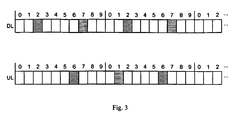
- Figure 3 is a diagram illustrating scheduling of messages in embodiments of a relay node.
- the shown timing exemplarily corresponds to the timing provisioned for LTE radio systems.
- data packets are transmitted in sub-frames (numbered 0 .... 9) of radio frames of a fixed length, e.g. 10 ms (thus, each sub-frame or transmission time interval TTI offers a length of 1 ms).
- Sub-frames pertaining to a certain number inside respective radio frames are typically assigned to certain information or data elements to be transmitted.
- acknowledgement messages from a first protocol layer L1 e.g. a PHY layer
- a second protocol layer L2 e.g. a MAC layer
- acknowledgement messages from a first protocol layer L1 may for example be delivered in a step 100 ( Fig. 4 ) within sub-frame 2 (in which an uplink grant message for a current (H)ARQ process is received), or in sub-frame 7 (which may be dedicated to another (H)ARQ process) of the downlink schedule DL.
- step 10 If DL sub-frame 2 of the first radio frame is used to trigger the sending of ACK, this corresponds to the above 4 th option (step 10). If DL sub-frame 2 of the second radio frame is used to trigger the sending of ACK, this corresponds to the above 2 nd option and DL sub-frame 7 of the first radio frame is used to trigger the sending of ACK, this corresponds to step 40.
- uplink UL shown in the lower half of Figure 3 and signed with UL
- sub-frame 6 tilting of each radio frame
- sub-frame 1 transverse hatching of each radio frame
- uplink data may be sent from the relay network node RN towards the network access node eNB.
- an acknowledgement message from a first protocol layer L1 e.g. a PHY layer
- a second protocol layer L2 e.g. a MAC layer
- the method may jump immediately towards step 100.
- Additional information may be delivered towards a higher layer, e.g. a MAC layer, along the ACK feedback.
- the additional information may comprise a (H)ARQ process ID, and/or A sub-frame number in which PUSCH was transmitted, and / or a time offset to the corresponding PUSCH transmission.
- Additional signalling may be provided for allowing such additional information
- the additional information comprises a (H)ARQ process ID, for which the ACK is valid
- the lower protocol layer L1 PHY, first protocol layer
- MAC higher protocol layer L2
- HARQ process IDs e.g., numbers, letters, names, or combinations thereof and their application, e.g., in a descending or ascending order or having a predetermined calculation scheme.
- HARQ process IDs may also be predefined.
- the higher protocol layer L2 may determine the corresponding (H)ARQ process.
- the sub-frame number is most probably known and it may be envisaged that the sub-frame number is the same in both the lower protocol layer L1 (PHY, (first protocol layer) and the higher protocol layer L2 (MAC, second protocol layer).
- PHY first protocol layer
- MAC second protocol layer
- the higher protocol layer L2 may determine the corresponding (H)ARQ process. It may be specified that the offset has a maximum length, thus determining also the number of the bits used for the indication. It should be understood that a timing relation can be defined in addition to the delivery of side information.
- the proposed solutions and embodiments enable higher layers (like second protocol layer L2, e.g. a MAC layer) to associate ACK feedback delivered from PHY layers (first protocol layer L1) with the corresponding (H)ARQ process. This allows proper operation of the (H)ARQ protocol.
- higher layers like second protocol layer L2, e.g. a MAC layer
- a Relay Node RN may be configured therefore for handling acknowledgement messages between a first protocol layer L1 and a second protocol layer L2 in a network node operating as a relay network node, wherein said first protocol layer L1 is lower than the second protocol layer L2, said acknowledgement messages ACK being related to Automatic Repeat Request (H)ARQ processes, the Relay Node RN being engaged in an Uplink transmission towards an network access node eNB.
- the Relay Node is receiving in a step 10 a first grant indication by said network access node eNB that an Uplink Transmission is granted at said first protocol layer entity. E.g. such information is the leftmost UL grant message indicated in Figure 2 . After reception of this grant, the lower protocol layer may send in a step 100 towards the higher protocol layer an indication of Acknowledgement.
- the Relay Node RN is performing the step 100 in response to the actual receipt of the first grant message (4 th option) or it may be envisaged that performing of step 100 is (also) bound to other issue(s).
- the Relay Node RN may send data after in an uplink direction towards the network access node eNB in a step 20.
- the Relay Node is performing the step 100 on or after sending of Data in an uplink direction towards the network access node eNB in a step 20 which is performed in response to said first received grant indication.
- the method may jump immediately towards step 100.
- the Relay Node RN is performing the step 100 in response to said first received grant information received 10 and another information in a sub-frame pertaining to a same HARQ process as shown with respect to figure 2 and 3 . I.e. on receipt of another DL radio frame and a sub-frame assigned to the same HARQ process as described with respect to sub-frame 2 in the first and second radio frame in Figure 3 , respectively the leftmost UL grant and the rightmost UL grant in respectively timing point t 4 Figure 2 .
- the Relay Node RN is performing the step 100 in response to said first received grant information received and another information received in a step 30 in a sub-frame pertaining to a different HARQ process as shown with respect to figure 2 and 3 .
- the method may jump immediately towards step 100.
- the Relay Node RN is performing the step in response to a second received grant information received in a step 40. Hence, the method may jump immediately towards step 100.
- the Relay Node RN is determining in a step 50 based on the received second grant information whether to resend said Data in an uplink direction towards the network access node, whether to transmit new data or whether to do nothing in response to said first and second received grant indication.
- the first protocol layer may provide additional information allowing the second protocol layer entity to determine the respective HARQ process. This information may be provided along the ACK information or may be provided by a separate signalling.
- the additional information may be selected from the group comprising a predetermined HARQ process ID, a sub-frame number, a time offset between delivery time and a step of sending Data in an uplink direction towards the network access node in response to said first received grant indication via said first protocol layer entity.
- a relay node may not envisage all the above described method steps but may only embody some thereof. Also it may be foreseen that the behaviour may be selectively influenced by the operator of the relay node, e.g. by setting certain configuration parameters.
- a Relay Node RN may comprise a first protocol layer entity and a second protocol layer entity. Said protocol layer entities are shown in Figure 5 as a first protocol layer L1 and a second protocol layer L2.
- the Relay Node RN is adapted to handle acknowledgement messages ACK between said first protocol layer L1 and said second protocol layer L2, e.g. via a transmission as indicated by arrow TX.
- Said first protocol L1 may also receive other data and / or instructions from said higher protocol layer L2 as indicated by arrow RX.
- the acknowledgement messages ACK are related to Automatic Repeat Request, such as an (H)ARQ, processes, and the Relay Node RN is typically engaged in an Uplink transmission, towards a network access node eNB.
- Said first protocol entity L1 is adapted to receive a first grant indication by said network access node that an Uplink Transmission is granted e.g. via a Radio Network RC, and said first protocol entity L1 is adapted to send thereafter an indication of Acknowledgement towards said second protocol layer entity L2.
- the first and second protocol entity L1, L2 may be embodied in software, hardware or a combination thereof. In particular it may be embodied by a processor such as a microprocessor, a FPGA, an ASIC, a DSP or the like.
- the Relay Node RN comprises an I/O Unit I/O ( Fig. 5 ) such as a transceiver or separate sending and receiving units allowing for communication via the Radio Network RC towards the network access node eNB.
- the Relay Node RN may comprise a scheduler SCH.
- the scheduler SCH may be adapted to determine whether UL data should be retransmitted (e.g. by delivery of UL grant with non-toggled new data indicator), whether it is granted to transmit new data (delivery of UL grant with toggled new data indicator) or whether to do nothing (delivery of ACK, no UL grant).
- the first protocol entity L1 is adapted to send an indication of Acknowledgement in response to said first received grant indication.
- the first protocol entity L1 is adapted to send Data in an uplink direction towards the network access node eNB in response to said first received grant indication.
- the first protocol entity L1 is adapted to send an indication of Acknowledgement in response to said sending of Data in an uplink direction.
- the first protocol entity L1 is adapted to send an indication of Acknowledgement in response to said first received grant information and further information received in a sub-frame pertaining to a same HARQ process.
- the first protocol entity L1 is adapted to send an indication of Acknowledgement in response to said first received grant information and further information received in a sub-frame pertaining to a different HARQ process.
- the first protocol entity L1 is adapted to send an indication of Acknowledgement in response to a second received grant information received.
- the second protocol entity L2 is adapted to determine based on the received second grant information whether to resend said Data in an uplink direction towards the network access node eNB, whether to transmit new data or whether to do nothing in response to said first and second received grant indication.
- the first protocol entity L1 is adapted to send information allowing the second protocol layer entity L2 to determine the respective HARQ process.
- the information is selected from the group comprising a predetermined HARQ process ID, a sub-frame number, a time offset between deliver time and a step of sending Data in an uplink direction towards the network access node in response to said first received grant indication via said first protocol layer entity L1.
Landscapes
- Engineering & Computer Science (AREA)
- Signal Processing (AREA)
- Computer Networks & Wireless Communication (AREA)
- Mobile Radio Communication Systems (AREA)
Claims (16)
- Procédé de gestion de messages d'accusé de réception entre une première couche de protocole et une seconde couche de protocole dans un noeud de réseau fonctionnant comme un noeud de réseau de relais, dans lequel ladite première couche de protocole est inférieure à la seconde couche de protocole, lesdits messages d'accusé de réception se rapportant à des processus de demande de répétition automatique, le noeud de réseau étant engagé dans une transmission en liaison montante vers un noeud d'accès de réseau, comprenant les étapes consistant à :• recevoir (10) une première indication d'accord provenant du dit noeud d'accès de réseau qu'une transmission de liaison montante est accordée au niveau de ladite première entité de couche de protocole, caractérisé en ce que• envoyer (100) de ladite première entité de couche de protocole à ladite seconde entité de couche de protocole une indication d'accusé de réception en réponse à ladite première indication d'accord reçue (10).
- Procédé selon la revendication 1, comprenant en outre l'étape d'envoi (20) de données dans une direction de liaison montante vers un noeud d'accès de réseau en réponse à ladite première indication d'accord reçue via ladite première entité de couche de protocole.
- Procédé selon la revendication 2, dans lequel l'envoi (100) une indication d'accusé de réception est effectuée en réponse au dit envoi (20) de données dans une direction de liaison montante.
- Procédé selon une quelconque des revendications 1 à 3, dans lequel l'étape d'envoi (100) une indication d'accusé de réception est effectuée en réponse à ladite première information d'accord reçue (10) et une autre information dans une sous trame se rapportant à un même processus HARQ, ou en réponse à ladite première information reçue et une autre information reçue (30) dans une sous trame se rapportant à un processus HARQ différent.
- Procédé selon une quelconque des revendications 1 à 3, dans lequel l'étape d'envoi (100) d'une indication d'accusé de réception est effectuée en réponse à une seconde information d'accord reçue (40).
- Procédé selon la revendication 5, comprenant en outre l'étape de détermination (50) sur la base de la seconde information d'accord reçue de renvoyer lesdites données dans une direction de liaison montante vers le noeud d'accès de réseau, de transmettre de nouvelles données ou de ne rien faire en réponse à ladite première et seconde indication d'accord reçue.
- Procédé selon une quelconque des revendications précédentes, comprenant en outre l'étape de fourniture d'information permettant à la seconde entité de couche de protocole de déterminer le processus HARQ respectif.
- Procédé selon la revendication 7, dans lequel l'information est sélectionnée dans le groupe comprenant un ID de processus HARQ prédéterminé, un numéro de sous trame, un décalage temporel entre un temps de remise et une étape d'envoi de données dans une direction de liaison montante vers le noeud d'accès de réseau en réponse à ladite première indication d'accord reçue via ladite première entité de couche de protocole.
- Dispositif de noeud de relais étant adaptée pour comprendre une première entité de couche de protocole et une seconde entité de couche de protocole, de telles entités étant contenues dans un logiciel, matériel ou une combinaison de ceux-ci, dans lequel ladite première couche de protocole est inférieure à la seconde couche de protocole, ledit noeud de relais étant adaptée pour gérer les messages d'accusé de réception entre ladite première couche de protocole et ladite seconde couche de protocole, lesdits messages d'accusé de réception étant relatifs aux processus de demande de répétition automatique, ARQ, le dispositif de noeud de relais étant adaptée pour s'engager dans une transmission de liaison montante vers un noeud d'accès de réseau, dans lequel :• ladite première entité de couche de protocole est adaptée pour recevoir une première indication d'accord provenant du dit noeud d'accès de réseau qu'une transmission de liaison montante est accordée, le dispositif de noeud de relais étant caractérisé en ce que• ladite première entité de couche de protocole est adaptée pour envoyer une indication d'accusé de réception vers ladite seconde entité de couche de protocole en réponse à la première indication d'accord reçue.
- Noeud de relais selon la revendication 9, dans lequel ladite première entité de protocole est adaptée pour envoyer des données dans une direction de liaison montante vers le noeud d'accès de réseau en réponse à ladite première indication d'accord reçue.
- Noeud de relais selon la revendication 10, dans lequel ladite première entité de protocole est adaptée pour envoyer une indication d'accusé de réception en réponse au dit envoi de données dans une direction de liaison montante.
- Noeud de relais selon une quelconque des revendications 9 à 11, dans lequel la première entité de protocole est adaptée pour envoyer une indication d'accusé de réception en réponse à ladite première information d'accord reçue et une autre information reçue dans une sous trame se rapportant à un même processus HARQ, ou envoyer une indication d'accusé de réception en réponse à ladite première information reçue et une autre information reçue dans une sous trame se rapportant à un processus HARQ différent.
- Noeud de relais selon une quelconque des revendications 9 à 11, dans lequel ladite première entité de protocole est adaptée pour envoyer une indication d'accusé de réception en réponse à une seconde information d'accord reçue.
- Noeud de relais selon la revendication 13, dans lequel ladite seconde entité de protocole est adaptée pour déterminer sur la base de la seconde information d'accord reçue de renvoyer lesdites données dans une direction de liaison montante vers le noeud d'accès de réseau, de transmettre de nouvelles données ou de ne rien faire en réponse à ladite première et seconde indication d'accord reçue.
- Noeud de relais selon une quelconque des revendications précédentes 9 à 14, dans lequel ladite première entité de protocole est adaptée pour envoyer une information permettant à la seconde entité de couche de protocole de déterminer le processus HARQ respectif.
- Noeud de relais selon la revendication 15, dans lequel l'information sélectionnée dans le groupe comprenant un ID de processus HARQ prédéterminé, un numéro de sous trame, un décalage temporel entre un temps de remise et une étape d'envoi de données dans une direction de liaison montante vers le noeud d'accès de réseau en réponse à ladite première indication d'accord reçue via ladite première entité de couche de protocole.
Applications Claiming Priority (2)
| Application Number | Priority Date | Filing Date | Title |
|---|---|---|---|
| US201161431236P | 2011-01-10 | 2011-01-10 | |
| PCT/EP2012/000059 WO2012095290A1 (fr) | 2011-01-10 | 2012-01-09 | Traitement de messages d'accusé de réception dans un nœud de réseau relais |
Publications (2)
| Publication Number | Publication Date |
|---|---|
| EP2664094A1 EP2664094A1 (fr) | 2013-11-20 |
| EP2664094B1 true EP2664094B1 (fr) | 2015-06-24 |
Family
ID=45509434
Family Applications (1)
| Application Number | Title | Priority Date | Filing Date |
|---|---|---|---|
| EP12700597.3A Active EP2664094B1 (fr) | 2011-01-10 | 2012-01-09 | Traitement de messages d'accusé de réception dans un n ud de réseau relais |
Country Status (4)
| Country | Link |
|---|---|
| US (1) | US20120224574A1 (fr) |
| EP (1) | EP2664094B1 (fr) |
| CN (1) | CN103404064B (fr) |
| WO (1) | WO2012095290A1 (fr) |
Families Citing this family (14)
| Publication number | Priority date | Publication date | Assignee | Title |
|---|---|---|---|---|
| CN107147480B (zh) * | 2011-04-22 | 2021-02-02 | 北京三星通信技术研究有限公司 | 一种支持pusch的同步harq传输的方法及装置 |
| US10764891B2 (en) * | 2011-08-17 | 2020-09-01 | Skyline Partners Technology Llc | Backhaul radio with advanced error recovery |
| US8385305B1 (en) | 2012-04-16 | 2013-02-26 | CBF Networks, Inc | Hybrid band intelligent backhaul radio |
| US8761100B2 (en) | 2011-10-11 | 2014-06-24 | CBF Networks, Inc. | Intelligent backhaul system |
| US10051643B2 (en) | 2011-08-17 | 2018-08-14 | Skyline Partners Technology Llc | Radio with interference measurement during a blanking interval |
| US8989762B1 (en) | 2013-12-05 | 2015-03-24 | CBF Networks, Inc. | Advanced backhaul services |
| US10708918B2 (en) | 2011-08-17 | 2020-07-07 | Skyline Partners Technology Llc | Electronic alignment using signature emissions for backhaul radios |
| US9713019B2 (en) * | 2011-08-17 | 2017-07-18 | CBF Networks, Inc. | Self organizing backhaul radio |
| US20220070867A1 (en) * | 2011-08-17 | 2022-03-03 | Skyline Partners Technology Llc | Backhaul radio with advanced error recovery |
| US8502733B1 (en) | 2012-02-10 | 2013-08-06 | CBF Networks, Inc. | Transmit co-channel spectrum sharing |
| US10716111B2 (en) | 2011-08-17 | 2020-07-14 | Skyline Partners Technology Llc | Backhaul radio with adaptive beamforming and sample alignment |
| US10548132B2 (en) | 2011-08-17 | 2020-01-28 | Skyline Partners Technology Llc | Radio with antenna array and multiple RF bands |
| US8928542B2 (en) | 2011-08-17 | 2015-01-06 | CBF Networks, Inc. | Backhaul radio with an aperture-fed antenna assembly |
| US8467363B2 (en) | 2011-08-17 | 2013-06-18 | CBF Networks, Inc. | Intelligent backhaul radio and antenna system |
Family Cites Families (6)
| Publication number | Priority date | Publication date | Assignee | Title |
|---|---|---|---|---|
| CN101578802A (zh) * | 2007-02-09 | 2009-11-11 | 诺基亚公司 | 用于确认信令的方法和装置 |
| US9203564B2 (en) * | 2008-10-20 | 2015-12-01 | Qualcomm Incorporated | Data transmission via a relay station in a wireless communication system |
| CN102396176B (zh) * | 2009-04-17 | 2015-07-15 | Lg电子株式会社 | 用于检测来自转发器的harq/nack反馈信号的方法 |
| US20100329188A1 (en) * | 2009-06-29 | 2010-12-30 | Yu-Chih Jen | Method for Handling Transmission Status and Related Communication Device |
| EP2770659B1 (fr) * | 2009-08-21 | 2016-02-24 | Telefonaktiebolaget LM Ericsson (publ) | Contrôle de transmission des informations dans un réseau de communication sans fil avec un noeud de relais |
| EP2306665A1 (fr) * | 2009-10-02 | 2011-04-06 | Panasonic Corporation | Protocole HARQ en liaison montante de retour de relais |
-
2012
- 2012-01-09 EP EP12700597.3A patent/EP2664094B1/fr active Active
- 2012-01-09 WO PCT/EP2012/000059 patent/WO2012095290A1/fr not_active Ceased
- 2012-01-09 US US13/346,156 patent/US20120224574A1/en not_active Abandoned
- 2012-01-09 CN CN201280012572.0A patent/CN103404064B/zh not_active Expired - Fee Related
Also Published As
| Publication number | Publication date |
|---|---|
| CN103404064A (zh) | 2013-11-20 |
| EP2664094A1 (fr) | 2013-11-20 |
| CN103404064B (zh) | 2017-04-05 |
| US20120224574A1 (en) | 2012-09-06 |
| WO2012095290A1 (fr) | 2012-07-19 |
Similar Documents
| Publication | Publication Date | Title |
|---|---|---|
| US20120224574A1 (en) | Handling of Acknowledgement Messages in a Relay Network Node | |
| CA2773568C (fr) | Procede et systeme pour operation hybride de demande de repetition automatique pour signalisation a points multiples coordonnes en liaison montante | |
| US9025573B2 (en) | Introducing a delay in the transmission of a nack for a packet received employing coordinated multi-point transmission | |
| CN101682855B (zh) | 移动通信系统中使用的基站装置、用户装置以及方法 | |
| JP6140447B2 (ja) | 中継ノードを有する無線通信ネットワークにおける情報送信制御 | |
| EP3002901B1 (fr) | (h)arq pour programmation semi-persistante | |
| JP6050482B2 (ja) | 意図しないダウンリンクサブフレームのためのharq−ackハンドリング | |
| KR101285730B1 (ko) | 업링크 harq 자원을 결정하기 위한 장치, 방법 및 제조 물건 | |
| CN102119511B (zh) | 用于在网络中通信的方法及用于其的次站和系统 | |
| US10873427B2 (en) | Message transmission method, user device, base station, and computer storage medium | |
| KR20100041860A (ko) | 기지국장치 및 이동국장치 및 통신제어방법 | |
| CN102474391B (zh) | 在无线中继网络中用于控制数据重传的方法及装置 | |
| CN101911570B (zh) | 移动通信系统、基站装置、用户装置以及方法 | |
| EP3051733A1 (fr) | Procédé de gestion de ressources, noeud, réseau et programme informatique | |
| CN107889242A (zh) | 一种传输方法、移动通信终端及网络侧设备 | |
| KR101232599B1 (ko) | 매체 접근 제어 프로토콜 데이터 유닛 재조립 방법 및 이를 수행하는 수신기 | |
| KR20090068317A (ko) | 상태 보고를 보고하는 방법 및 수신기 | |
| WO2017088920A1 (fr) | Mécanismes de reprise sur erreur au niveau de couches inférieures de systèmes de communication mobile | |
| CN104753651A (zh) | 一种用于tti捆绑用户的p-cqi传输方法与装置 | |
| CN103107874A (zh) | 一种发送数据块的方法及设备 |
Legal Events
| Date | Code | Title | Description |
|---|---|---|---|
| PUAI | Public reference made under article 153(3) epc to a published international application that has entered the european phase |
Free format text: ORIGINAL CODE: 0009012 |
|
| 17P | Request for examination filed |
Effective date: 20130718 |
|
| AK | Designated contracting states |
Kind code of ref document: A1 Designated state(s): AL AT BE BG CH CY CZ DE DK EE ES FI FR GB GR HR HU IE IS IT LI LT LU LV MC MK MT NL NO PL PT RO RS SE SI SK SM TR |
|
| DAX | Request for extension of the european patent (deleted) | ||
| RIC1 | Information provided on ipc code assigned before grant |
Ipc: H04L 1/16 20060101AFI20141128BHEP Ipc: H04L 5/00 20060101ALI20141128BHEP Ipc: H04L 1/18 20060101ALI20141128BHEP |
|
| GRAP | Despatch of communication of intention to grant a patent |
Free format text: ORIGINAL CODE: EPIDOSNIGR1 |
|
| INTG | Intention to grant announced |
Effective date: 20150115 |
|
| RAP1 | Party data changed (applicant data changed or rights of an application transferred) |
Owner name: TELEFONAKTIEBOLAGET L M ERICSSON (PUBL) |
|
| GRAS | Grant fee paid |
Free format text: ORIGINAL CODE: EPIDOSNIGR3 |
|
| GRAA | (expected) grant |
Free format text: ORIGINAL CODE: 0009210 |
|
| AK | Designated contracting states |
Kind code of ref document: B1 Designated state(s): AL AT BE BG CH CY CZ DE DK EE ES FI FR GB GR HR HU IE IS IT LI LT LU LV MC MK MT NL NO PL PT RO RS SE SI SK SM TR |
|
| REG | Reference to a national code |
Ref country code: GB Ref legal event code: FG4D |
|
| REG | Reference to a national code |
Ref country code: CH Ref legal event code: EP |
|
| REG | Reference to a national code |
Ref country code: AT Ref legal event code: REF Ref document number: 733307 Country of ref document: AT Kind code of ref document: T Effective date: 20150715 |
|
| REG | Reference to a national code |
Ref country code: IE Ref legal event code: FG4D |
|
| REG | Reference to a national code |
Ref country code: DE Ref legal event code: R096 Ref document number: 602012008198 Country of ref document: DE |
|
| PG25 | Lapsed in a contracting state [announced via postgrant information from national office to epo] |
Ref country code: LT Free format text: LAPSE BECAUSE OF FAILURE TO SUBMIT A TRANSLATION OF THE DESCRIPTION OR TO PAY THE FEE WITHIN THE PRESCRIBED TIME-LIMIT Effective date: 20150624 Ref country code: NO Free format text: LAPSE BECAUSE OF FAILURE TO SUBMIT A TRANSLATION OF THE DESCRIPTION OR TO PAY THE FEE WITHIN THE PRESCRIBED TIME-LIMIT Effective date: 20150924 Ref country code: HR Free format text: LAPSE BECAUSE OF FAILURE TO SUBMIT A TRANSLATION OF THE DESCRIPTION OR TO PAY THE FEE WITHIN THE PRESCRIBED TIME-LIMIT Effective date: 20150624 Ref country code: FI Free format text: LAPSE BECAUSE OF FAILURE TO SUBMIT A TRANSLATION OF THE DESCRIPTION OR TO PAY THE FEE WITHIN THE PRESCRIBED TIME-LIMIT Effective date: 20150624 |
|
| REG | Reference to a national code |
Ref country code: AT Ref legal event code: MK05 Ref document number: 733307 Country of ref document: AT Kind code of ref document: T Effective date: 20150624 |
|
| REG | Reference to a national code |
Ref country code: LT Ref legal event code: MG4D |
|
| PG25 | Lapsed in a contracting state [announced via postgrant information from national office to epo] |
Ref country code: RS Free format text: LAPSE BECAUSE OF FAILURE TO SUBMIT A TRANSLATION OF THE DESCRIPTION OR TO PAY THE FEE WITHIN THE PRESCRIBED TIME-LIMIT Effective date: 20150624 Ref country code: GR Free format text: LAPSE BECAUSE OF FAILURE TO SUBMIT A TRANSLATION OF THE DESCRIPTION OR TO PAY THE FEE WITHIN THE PRESCRIBED TIME-LIMIT Effective date: 20150925 Ref country code: BG Free format text: LAPSE BECAUSE OF FAILURE TO SUBMIT A TRANSLATION OF THE DESCRIPTION OR TO PAY THE FEE WITHIN THE PRESCRIBED TIME-LIMIT Effective date: 20150924 Ref country code: LV Free format text: LAPSE BECAUSE OF FAILURE TO SUBMIT A TRANSLATION OF THE DESCRIPTION OR TO PAY THE FEE WITHIN THE PRESCRIBED TIME-LIMIT Effective date: 20150624 |
|
| REG | Reference to a national code |
Ref country code: NL Ref legal event code: MP Effective date: 20150624 |
|
| REG | Reference to a national code |
Ref country code: FR Ref legal event code: PLFP Year of fee payment: 5 |
|
| PG25 | Lapsed in a contracting state [announced via postgrant information from national office to epo] |
Ref country code: EE Free format text: LAPSE BECAUSE OF FAILURE TO SUBMIT A TRANSLATION OF THE DESCRIPTION OR TO PAY THE FEE WITHIN THE PRESCRIBED TIME-LIMIT Effective date: 20150624 |
|
| PG25 | Lapsed in a contracting state [announced via postgrant information from national office to epo] |
Ref country code: SK Free format text: LAPSE BECAUSE OF FAILURE TO SUBMIT A TRANSLATION OF THE DESCRIPTION OR TO PAY THE FEE WITHIN THE PRESCRIBED TIME-LIMIT Effective date: 20150624 Ref country code: RO Free format text: LAPSE BECAUSE OF NON-PAYMENT OF DUE FEES Effective date: 20150624 Ref country code: ES Free format text: LAPSE BECAUSE OF FAILURE TO SUBMIT A TRANSLATION OF THE DESCRIPTION OR TO PAY THE FEE WITHIN THE PRESCRIBED TIME-LIMIT Effective date: 20150624 Ref country code: AT Free format text: LAPSE BECAUSE OF FAILURE TO SUBMIT A TRANSLATION OF THE DESCRIPTION OR TO PAY THE FEE WITHIN THE PRESCRIBED TIME-LIMIT Effective date: 20150624 Ref country code: PL Free format text: LAPSE BECAUSE OF FAILURE TO SUBMIT A TRANSLATION OF THE DESCRIPTION OR TO PAY THE FEE WITHIN THE PRESCRIBED TIME-LIMIT Effective date: 20150624 Ref country code: IS Free format text: LAPSE BECAUSE OF FAILURE TO SUBMIT A TRANSLATION OF THE DESCRIPTION OR TO PAY THE FEE WITHIN THE PRESCRIBED TIME-LIMIT Effective date: 20151024 Ref country code: PT Free format text: LAPSE BECAUSE OF FAILURE TO SUBMIT A TRANSLATION OF THE DESCRIPTION OR TO PAY THE FEE WITHIN THE PRESCRIBED TIME-LIMIT Effective date: 20151026 Ref country code: CZ Free format text: LAPSE BECAUSE OF FAILURE TO SUBMIT A TRANSLATION OF THE DESCRIPTION OR TO PAY THE FEE WITHIN THE PRESCRIBED TIME-LIMIT Effective date: 20150624 |
|
| REG | Reference to a national code |
Ref country code: DE Ref legal event code: R097 Ref document number: 602012008198 Country of ref document: DE |
|
| PG25 | Lapsed in a contracting state [announced via postgrant information from national office to epo] |
Ref country code: IT Free format text: LAPSE BECAUSE OF FAILURE TO SUBMIT A TRANSLATION OF THE DESCRIPTION OR TO PAY THE FEE WITHIN THE PRESCRIBED TIME-LIMIT Effective date: 20150624 Ref country code: DK Free format text: LAPSE BECAUSE OF FAILURE TO SUBMIT A TRANSLATION OF THE DESCRIPTION OR TO PAY THE FEE WITHIN THE PRESCRIBED TIME-LIMIT Effective date: 20150624 |
|
| PLBE | No opposition filed within time limit |
Free format text: ORIGINAL CODE: 0009261 |
|
| STAA | Information on the status of an ep patent application or granted ep patent |
Free format text: STATUS: NO OPPOSITION FILED WITHIN TIME LIMIT |
|
| PG25 | Lapsed in a contracting state [announced via postgrant information from national office to epo] |
Ref country code: BE Free format text: LAPSE BECAUSE OF NON-PAYMENT OF DUE FEES Effective date: 20160131 |
|
| 26N | No opposition filed |
Effective date: 20160329 |
|
| PG25 | Lapsed in a contracting state [announced via postgrant information from national office to epo] |
Ref country code: SI Free format text: LAPSE BECAUSE OF FAILURE TO SUBMIT A TRANSLATION OF THE DESCRIPTION OR TO PAY THE FEE WITHIN THE PRESCRIBED TIME-LIMIT Effective date: 20150624 Ref country code: LU Free format text: LAPSE BECAUSE OF FAILURE TO SUBMIT A TRANSLATION OF THE DESCRIPTION OR TO PAY THE FEE WITHIN THE PRESCRIBED TIME-LIMIT Effective date: 20160109 |
|
| REG | Reference to a national code |
Ref country code: CH Ref legal event code: PL |
|
| PG25 | Lapsed in a contracting state [announced via postgrant information from national office to epo] |
Ref country code: MC Free format text: LAPSE BECAUSE OF FAILURE TO SUBMIT A TRANSLATION OF THE DESCRIPTION OR TO PAY THE FEE WITHIN THE PRESCRIBED TIME-LIMIT Effective date: 20150624 |
|
| PG25 | Lapsed in a contracting state [announced via postgrant information from national office to epo] |
Ref country code: LI Free format text: LAPSE BECAUSE OF NON-PAYMENT OF DUE FEES Effective date: 20160131 Ref country code: CH Free format text: LAPSE BECAUSE OF NON-PAYMENT OF DUE FEES Effective date: 20160131 |
|
| REG | Reference to a national code |
Ref country code: IE Ref legal event code: MM4A |
|
| PG25 | Lapsed in a contracting state [announced via postgrant information from national office to epo] |
Ref country code: BE Free format text: LAPSE BECAUSE OF FAILURE TO SUBMIT A TRANSLATION OF THE DESCRIPTION OR TO PAY THE FEE WITHIN THE PRESCRIBED TIME-LIMIT Effective date: 20150624 |
|
| REG | Reference to a national code |
Ref country code: FR Ref legal event code: PLFP Year of fee payment: 6 |
|
| PG25 | Lapsed in a contracting state [announced via postgrant information from national office to epo] |
Ref country code: IE Free format text: LAPSE BECAUSE OF NON-PAYMENT OF DUE FEES Effective date: 20160109 |
|
| PG25 | Lapsed in a contracting state [announced via postgrant information from national office to epo] |
Ref country code: NL Free format text: LAPSE BECAUSE OF FAILURE TO SUBMIT A TRANSLATION OF THE DESCRIPTION OR TO PAY THE FEE WITHIN THE PRESCRIBED TIME-LIMIT Effective date: 20150624 Ref country code: SE Free format text: LAPSE BECAUSE OF FAILURE TO SUBMIT A TRANSLATION OF THE DESCRIPTION OR TO PAY THE FEE WITHIN THE PRESCRIBED TIME-LIMIT Effective date: 20150624 |
|
| PG25 | Lapsed in a contracting state [announced via postgrant information from national office to epo] |
Ref country code: MT Free format text: LAPSE BECAUSE OF FAILURE TO SUBMIT A TRANSLATION OF THE DESCRIPTION OR TO PAY THE FEE WITHIN THE PRESCRIBED TIME-LIMIT Effective date: 20150624 |
|
| REG | Reference to a national code |
Ref country code: FR Ref legal event code: PLFP Year of fee payment: 7 |
|
| PG25 | Lapsed in a contracting state [announced via postgrant information from national office to epo] |
Ref country code: HU Free format text: LAPSE BECAUSE OF FAILURE TO SUBMIT A TRANSLATION OF THE DESCRIPTION OR TO PAY THE FEE WITHIN THE PRESCRIBED TIME-LIMIT; INVALID AB INITIO Effective date: 20120109 Ref country code: SM Free format text: LAPSE BECAUSE OF FAILURE TO SUBMIT A TRANSLATION OF THE DESCRIPTION OR TO PAY THE FEE WITHIN THE PRESCRIBED TIME-LIMIT Effective date: 20150624 Ref country code: CY Free format text: LAPSE BECAUSE OF FAILURE TO SUBMIT A TRANSLATION OF THE DESCRIPTION OR TO PAY THE FEE WITHIN THE PRESCRIBED TIME-LIMIT Effective date: 20150624 |
|
| PG25 | Lapsed in a contracting state [announced via postgrant information from national office to epo] |
Ref country code: MT Free format text: LAPSE BECAUSE OF FAILURE TO SUBMIT A TRANSLATION OF THE DESCRIPTION OR TO PAY THE FEE WITHIN THE PRESCRIBED TIME-LIMIT Effective date: 20160131 Ref country code: TR Free format text: LAPSE BECAUSE OF FAILURE TO SUBMIT A TRANSLATION OF THE DESCRIPTION OR TO PAY THE FEE WITHIN THE PRESCRIBED TIME-LIMIT Effective date: 20150624 Ref country code: MK Free format text: LAPSE BECAUSE OF FAILURE TO SUBMIT A TRANSLATION OF THE DESCRIPTION OR TO PAY THE FEE WITHIN THE PRESCRIBED TIME-LIMIT Effective date: 20150624 |
|
| PG25 | Lapsed in a contracting state [announced via postgrant information from national office to epo] |
Ref country code: AL Free format text: LAPSE BECAUSE OF FAILURE TO SUBMIT A TRANSLATION OF THE DESCRIPTION OR TO PAY THE FEE WITHIN THE PRESCRIBED TIME-LIMIT Effective date: 20150624 |
|
| PGFP | Annual fee paid to national office [announced via postgrant information from national office to epo] |
Ref country code: FR Payment date: 20220125 Year of fee payment: 11 |
|
| PGFP | Annual fee paid to national office [announced via postgrant information from national office to epo] |
Ref country code: DE Payment date: 20230127 Year of fee payment: 12 |
|
| PG25 | Lapsed in a contracting state [announced via postgrant information from national office to epo] |
Ref country code: FR Free format text: LAPSE BECAUSE OF NON-PAYMENT OF DUE FEES Effective date: 20230131 |
|
| REG | Reference to a national code |
Ref country code: DE Ref legal event code: R119 Ref document number: 602012008198 Country of ref document: DE |
|
| PG25 | Lapsed in a contracting state [announced via postgrant information from national office to epo] |
Ref country code: DE Free format text: LAPSE BECAUSE OF NON-PAYMENT OF DUE FEES Effective date: 20240801 |
|
| PG25 | Lapsed in a contracting state [announced via postgrant information from national office to epo] |
Ref country code: DE Free format text: LAPSE BECAUSE OF NON-PAYMENT OF DUE FEES Effective date: 20240801 |
|
| PGFP | Annual fee paid to national office [announced via postgrant information from national office to epo] |
Ref country code: GB Payment date: 20260127 Year of fee payment: 15 |