EP2664324B1 - Nanokapseln mit einer polymerhülle - Google Patents
Nanokapseln mit einer polymerhülle Download PDFInfo
- Publication number
- EP2664324B1 EP2664324B1 EP12734760.7A EP12734760A EP2664324B1 EP 2664324 B1 EP2664324 B1 EP 2664324B1 EP 12734760 A EP12734760 A EP 12734760A EP 2664324 B1 EP2664324 B1 EP 2664324B1
- Authority
- EP
- European Patent Office
- Prior art keywords
- oil
- pga
- nanocapsules
- peg
- acid
- Prior art date
- Legal status (The legal status is an assumption and is not a legal conclusion. Google has not performed a legal analysis and makes no representation as to the accuracy of the status listed.)
- Active
Links
Images








Classifications
-
- A—HUMAN NECESSITIES
- A61—MEDICAL OR VETERINARY SCIENCE; HYGIENE
- A61K—PREPARATIONS FOR MEDICAL, DENTAL OR TOILETRY PURPOSES
- A61K9/00—Medicinal preparations characterised by special physical form
- A61K9/48—Preparations in capsules, e.g. of gelatin, of chocolate
- A61K9/50—Microcapsules having a gas, liquid or semi-solid filling; Solid microparticles or pellets surrounded by a distinct coating layer, e.g. coated microspheres, coated drug crystals
- A61K9/51—Nanocapsules; Nanoparticles
-
- A—HUMAN NECESSITIES
- A61—MEDICAL OR VETERINARY SCIENCE; HYGIENE
- A61K—PREPARATIONS FOR MEDICAL, DENTAL OR TOILETRY PURPOSES
- A61K9/00—Medicinal preparations characterised by special physical form
- A61K9/48—Preparations in capsules, e.g. of gelatin, of chocolate
- A61K9/50—Microcapsules having a gas, liquid or semi-solid filling; Solid microparticles or pellets surrounded by a distinct coating layer, e.g. coated microspheres, coated drug crystals
- A61K9/51—Nanocapsules; Nanoparticles
- A61K9/5107—Excipients; Inactive ingredients
-
- A—HUMAN NECESSITIES
- A61—MEDICAL OR VETERINARY SCIENCE; HYGIENE
- A61K—PREPARATIONS FOR MEDICAL, DENTAL OR TOILETRY PURPOSES
- A61K31/00—Medicinal preparations containing organic active ingredients
- A61K31/33—Heterocyclic compounds
- A61K31/335—Heterocyclic compounds having oxygen as the only ring hetero atom, e.g. fungichromin
- A61K31/337—Heterocyclic compounds having oxygen as the only ring hetero atom, e.g. fungichromin having four-membered rings, e.g. taxol
-
- A—HUMAN NECESSITIES
- A61—MEDICAL OR VETERINARY SCIENCE; HYGIENE
- A61K—PREPARATIONS FOR MEDICAL, DENTAL OR TOILETRY PURPOSES
- A61K31/00—Medicinal preparations containing organic active ingredients
- A61K31/70—Carbohydrates; Sugars; Derivatives thereof
- A61K31/7088—Compounds having three or more nucleosides or nucleotides
- A61K31/713—Double-stranded nucleic acids or oligonucleotides
-
- A—HUMAN NECESSITIES
- A61—MEDICAL OR VETERINARY SCIENCE; HYGIENE
- A61K—PREPARATIONS FOR MEDICAL, DENTAL OR TOILETRY PURPOSES
- A61K45/00—Medicinal preparations containing active ingredients not provided for in groups A61K31/00 - A61K41/00
- A61K45/06—Mixtures of active ingredients without chemical characterisation, e.g. antiphlogistics and cardiaca
-
- A—HUMAN NECESSITIES
- A61—MEDICAL OR VETERINARY SCIENCE; HYGIENE
- A61K—PREPARATIONS FOR MEDICAL, DENTAL OR TOILETRY PURPOSES
- A61K47/00—Medicinal preparations characterised by the non-active ingredients used, e.g. carriers or inert additives; Targeting or modifying agents chemically bound to the active ingredient
- A61K47/30—Macromolecular organic or inorganic compounds, e.g. inorganic polyphosphates
- A61K47/34—Macromolecular compounds obtained otherwise than by reactions only involving carbon-to-carbon unsaturated bonds, e.g. polyesters, polyamino acids, polysiloxanes, polyphosphazines, copolymers of polyalkylene glycol or poloxamers
-
- A—HUMAN NECESSITIES
- A61—MEDICAL OR VETERINARY SCIENCE; HYGIENE
- A61K—PREPARATIONS FOR MEDICAL, DENTAL OR TOILETRY PURPOSES
- A61K47/00—Medicinal preparations characterised by the non-active ingredients used, e.g. carriers or inert additives; Targeting or modifying agents chemically bound to the active ingredient
- A61K47/30—Macromolecular organic or inorganic compounds, e.g. inorganic polyphosphates
- A61K47/36—Polysaccharides; Derivatives thereof, e.g. gums, starch, alginate, dextrin, hyaluronic acid, chitosan, inulin, agar or pectin
-
- A—HUMAN NECESSITIES
- A61—MEDICAL OR VETERINARY SCIENCE; HYGIENE
- A61K—PREPARATIONS FOR MEDICAL, DENTAL OR TOILETRY PURPOSES
- A61K9/00—Medicinal preparations characterised by special physical form
- A61K9/48—Preparations in capsules, e.g. of gelatin, of chocolate
- A61K9/50—Microcapsules having a gas, liquid or semi-solid filling; Solid microparticles or pellets surrounded by a distinct coating layer, e.g. coated microspheres, coated drug crystals
- A61K9/51—Nanocapsules; Nanoparticles
- A61K9/5192—Processes
-
- B—PERFORMING OPERATIONS; TRANSPORTING
- B82—NANOTECHNOLOGY
- B82Y—SPECIFIC USES OR APPLICATIONS OF NANOSTRUCTURES; MEASUREMENT OR ANALYSIS OF NANOSTRUCTURES; MANUFACTURE OR TREATMENT OF NANOSTRUCTURES
- B82Y5/00—Nanobiotechnology or nanomedicine, e.g. protein engineering or drug delivery
-
- A—HUMAN NECESSITIES
- A61—MEDICAL OR VETERINARY SCIENCE; HYGIENE
- A61K—PREPARATIONS FOR MEDICAL, DENTAL OR TOILETRY PURPOSES
- A61K47/00—Medicinal preparations characterised by the non-active ingredients used, e.g. carriers or inert additives; Targeting or modifying agents chemically bound to the active ingredient
- A61K47/06—Organic compounds, e.g. natural or synthetic hydrocarbons, polyolefins, mineral oil, petrolatum or ozokerite
- A61K47/26—Carbohydrates, e.g. sugar alcohols, amino sugars, nucleic acids, mono-, di- or oligo-saccharides; Derivatives thereof, e.g. polysorbates, sorbitan fatty acid esters or glycyrrhizin
-
- A—HUMAN NECESSITIES
- A61—MEDICAL OR VETERINARY SCIENCE; HYGIENE
- A61K—PREPARATIONS FOR MEDICAL, DENTAL OR TOILETRY PURPOSES
- A61K9/00—Medicinal preparations characterised by special physical form
- A61K9/14—Particulate form, e.g. powders, Processes for size reducing of pure drugs or the resulting products, Pure drug nanoparticles
- A61K9/19—Particulate form, e.g. powders, Processes for size reducing of pure drugs or the resulting products, Pure drug nanoparticles lyophilised, i.e. freeze-dried, solutions or dispersions
-
- A—HUMAN NECESSITIES
- A61—MEDICAL OR VETERINARY SCIENCE; HYGIENE
- A61K—PREPARATIONS FOR MEDICAL, DENTAL OR TOILETRY PURPOSES
- A61K9/00—Medicinal preparations characterised by special physical form
- A61K9/48—Preparations in capsules, e.g. of gelatin, of chocolate
- A61K9/50—Microcapsules having a gas, liquid or semi-solid filling; Solid microparticles or pellets surrounded by a distinct coating layer, e.g. coated microspheres, coated drug crystals
- A61K9/51—Nanocapsules; Nanoparticles
- A61K9/5107—Excipients; Inactive ingredients
- A61K9/513—Organic macromolecular compounds; Dendrimers
- A61K9/5146—Organic macromolecular compounds; Dendrimers obtained otherwise than by reactions only involving carbon-to-carbon unsaturated bonds, e.g. polyethylene glycol, polyamines, polyanhydrides
-
- A—HUMAN NECESSITIES
- A61—MEDICAL OR VETERINARY SCIENCE; HYGIENE
- A61K—PREPARATIONS FOR MEDICAL, DENTAL OR TOILETRY PURPOSES
- A61K9/00—Medicinal preparations characterised by special physical form
- A61K9/48—Preparations in capsules, e.g. of gelatin, of chocolate
- A61K9/50—Microcapsules having a gas, liquid or semi-solid filling; Solid microparticles or pellets surrounded by a distinct coating layer, e.g. coated microspheres, coated drug crystals
- A61K9/51—Nanocapsules; Nanoparticles
- A61K9/5107—Excipients; Inactive ingredients
- A61K9/513—Organic macromolecular compounds; Dendrimers
- A61K9/5146—Organic macromolecular compounds; Dendrimers obtained otherwise than by reactions only involving carbon-to-carbon unsaturated bonds, e.g. polyethylene glycol, polyamines, polyanhydrides
- A61K9/5153—Polyesters, e.g. poly(lactide-co-glycolide)
-
- Y—GENERAL TAGGING OF NEW TECHNOLOGICAL DEVELOPMENTS; GENERAL TAGGING OF CROSS-SECTIONAL TECHNOLOGIES SPANNING OVER SEVERAL SECTIONS OF THE IPC; TECHNICAL SUBJECTS COVERED BY FORMER USPC CROSS-REFERENCE ART COLLECTIONS [XRACs] AND DIGESTS
- Y10—TECHNICAL SUBJECTS COVERED BY FORMER USPC
- Y10S—TECHNICAL SUBJECTS COVERED BY FORMER USPC CROSS-REFERENCE ART COLLECTIONS [XRACs] AND DIGESTS
- Y10S977/00—Nanotechnology
- Y10S977/70—Nanostructure
- Y10S977/773—Nanoparticle, i.e. structure having three dimensions of 100 nm or less
-
- Y—GENERAL TAGGING OF NEW TECHNOLOGICAL DEVELOPMENTS; GENERAL TAGGING OF CROSS-SECTIONAL TECHNOLOGIES SPANNING OVER SEVERAL SECTIONS OF THE IPC; TECHNICAL SUBJECTS COVERED BY FORMER USPC CROSS-REFERENCE ART COLLECTIONS [XRACs] AND DIGESTS
- Y10—TECHNICAL SUBJECTS COVERED BY FORMER USPC
- Y10S—TECHNICAL SUBJECTS COVERED BY FORMER USPC CROSS-REFERENCE ART COLLECTIONS [XRACs] AND DIGESTS
- Y10S977/00—Nanotechnology
- Y10S977/902—Specified use of nanostructure
- Y10S977/904—Specified use of nanostructure for medical, immunological, body treatment, or diagnosis
- Y10S977/906—Drug delivery
Definitions
- the present invention relates to a system for the administration of active ingredients comprising nano-sized nanocapsules, as well as to pharmaceutical compositions comprising the same and manufacturing methods thereof.
- Polyglutamic acid is a hydrophilic and biodegradable polymer made of negatively charged glutamic acid units. Due to its biological properties such as non-toxicity, its non-immunogenicity and biocompatibility, this polymer has been regarded as an important biomaterial for the development of new formulations for drug delivery ( Buescher & Margaritis, Crit RevBiotech 2007 ).
- polyglutamic acid is widely reported for the formation of drug-polymer complexes of interest in cancer treatment, being some formulations in advanced development stages.
- Xyotax a formulation consisting of conjugates between poly-L-glutamic acid and cytostatic agent paclitaxel, which is currently in Phase 3 clinical trials.
- this polymer has been used to design formulations for administering other antitumor agents such as doxorubicin (Shih et al., 2004).
- U.S. Pat 2006246096 reports the use of polyglutamic acid in the formulation of drug delivery systems, being used as shell in formulations for the carrying genetic material from them.
- nanoparticles Another type of delivery system developed from polyglutamic acid are the nanoparticles, as disclosed in U.S. Patent 2005238678 and U.S. 6,326,511 .
- polyglutamic acid has also been conjugated to polyethylene glycol (PEG) in order to effect changes on the surface of nanometric systems, attempting to provide greater stability of colloidal systems.
- PEG polyethylene glycol
- Such modification with PEG also minimizes recognition of nanosystems by proteins and cells of the reticuloendothelial system, thus increasing the circulation time thereof.
- Hyaluronic acid is a naturally occurring polymer. More specifically it is a glycosaminoglycan present in the extracellular matrix of connective tissues such as the subcutaneous and cartilaginous; it is also found in the vitreous body of the eye and synovial fluid of articular cavities. It is a polymer capable of interacting with CD44 and RHAMM endogenous receptors which are located at the cell surface in practically all cells of the body except red blood cells. The interaction of hyaluronic acid with these receptors allows regulating certain physiological processes such as mobility and cell proliferation. Due to these properties, hyaluronic acid has therapeutic use, as it plays an important role in processes such as morphogenesis and embryo development, cancer and inflammation.
- hyaluronic acid is used to promote epithelial healing.
- Proof of this biological activity are numerous jobs that include hyaluronic acid as active biomolecule, were we can mention those described by Sand et al. (Acta Ophthalmol. 67, 1989, 181-183 ), where hyaluronic acid is applied in the treatment of keratoconjunctivitis sicca, by Nishida et al. (Exp. Eye Res 53, 1991, 753-758 ), wherein it is applied to corena as healing agent and by Blanco et al. (Clin. Exp Rheumatol. 22 (3) 2004, 307-12 ), where the polymer is applied for the treatment of osteoarthritis, among others.
- hyaluronic acid and its derivatives under various forms of presentation, have been the subject of numerous patent documents wherein they are presented as active molecules.
- patent application WO 96/06622 which claims the use of hyaluronic acid and derivatives, alone or in combination with another therapeutic agent, to modulate cellular activity of those tissues and cells which express on their surface hyaluronic acid receptors, and thus treat or prevent inflammatory processes, fibrosis or oncogenesis.
- U.S. Patent 6,383,478 protects a delivery system consisting of microparticles, nanoparticles or films which incorporate hyaluronic acid as possible active molecule to promote angiogenesis.
- hyaluronic acid has also been the subject of numerous studies proposing its use as a biomaterial-excipient used in the development of drug delivery systems.
- the interest is due to the fact that it is a biodegradable polymer, biocompatible, non-immunogenic, mucoadhesive and selective affinity for receptors such as CD44.
- the following, among many other, can be mentioned:
- L-asparagine is described in the literature as an essential amino acid for growth and development of all cell types.
- L-asparagine is currently one of the more and better used strategies for cancer treatment, being commercialized a formulation that includes the enzyme required for its degradation. When administering this enzyme and achieve its deposition in the tumor periphery, a reduction in the concentration of the amino acid is obtained, causing deficiencies thereof; the cells are then prevented from synthesizing DNA and other proteins essential for survival.
- Such formulation is called OncasparTM or ElsparTM, L-asparaginase being the enzyme responsible for this degradation.
- references in the description to treatments or to methods of treatment refer to the systems, compositions or formulations of the present invention for use in a method of treatment.
- nanocapsular system easily obtained using different experimental procedures, wherein the nanocapsules comprise a polymer, an oil and a cationic surfactant.
- these nanocapsular systems enable an effective partnership of lipophilic active ingredients and as well as hydrophilic ones.
- the small size of said nanocapsules (diameter less than 1 ⁇ m) allows passage through biological barriers and internalized by cells.
- the presence of a polymeric shell, in addition to conferring greater stability to the nanocapsules, provides various beneficial characteristics depending on each particular type of shell.
- the invention is directed to a system for the administration of active ingredients comprising nanocapsules having a core comprising an oil, a cationic surfactant and a shell comprising a polymer selected from the group consisting of polyglutamic acid (PGA), polyglutamic-polyethyleneglycol acid (PGA-PEG), hyaluronic acid (HA) and polyasparagine (PAsn) or a combination thereof, and optionally an active ingredient, with the proviso that when said nanocapsules system includes polyglutamic acid or polyglutamic-polyethyleneglycol acid (PGA-PEG), then the active ingredient is not a didemnin or tamandarin, and wherein the cationic surfactant is selected from benzalkonium chloride, benzethonium chloride, cetylpyridinium chloride, cetyltiridinium bromide, dodecyltrimethylammonium bromide, trimethyltetradecylamonium
- nanocapsules of the invention may also comprise optionally other components such as a water-soluble surfactant an oil-soluble surfactant, or both.
- the invention in another aspect, relates to a pharmaceutical composition comprising the previously defined system.
- the invention relates to the use of said system in the preparation of a medicament.
- said use relates to the treatment of cancer.
- the invention is directed to a process for obtaining the above defined system (referred to in the examples solvent diffusion process in one stage), comprising:
- the encapsulation of a lipophilic active ingredient (hydrophobic) or amphiphilic is carried out by adding it in step b).
- the active ingredients of hydrophilic nature can be added in step a) of the process or at a stage later than stage d) through a process of incubation.
- the invention is directed to a process for obtaining the above defined systems, comprising coating a nanoemulsion, at least constituted by an oil, a cationic surfactant, optionally an oil-soluble surfactant and an aqueous phase optionally comprising a water-soluble surfactant, through a process of incubation with an aqueous solution of polyglutamic acid (PGA), polyglutamic-polyethyleneglycol acid (PGA-PEG), hyaluronic acid (HA), polyasparagine (PAsn) or a mixture thereof.
- PGA polyglutamic acid
- PGA-PEG polyglutamic-polyethyleneglycol acid
- HA hyaluronic acid
- PAsn polyasparagine
- the above process further comprises adding an active ingredient.
- the polymer is polyglutamic acid or polyglutamic-polyethyleneglycol acid (PGA-PEG)
- the active ingredient is not a didemnin or tamandarin.
- the active ingredient has a lipophilic character
- said active ingredient is added in the formation of the nanoemulsion, preferably dissolved in ethanol.
- the present invention is directed to the design and development of nanocapsules for the administration of active ingredients, wherein the nanocapsules of the system have a diameter less than 1 ⁇ m and is characterized by comprising (a) a shell of a polymer selected from the group consisting of polyglutamic acid, polyglutamic-polyethyleneglycol acid, hyaluronic acid, polyasparagine, or a combination thereof and (b) a core which in turn comprises an oil and a cationic surfactant selected from benzalkonium chloride, benzethonium chloride, cetylpyridinium chloride, cetyltiridinium bromide, dodecyltrimethylammonium bromide, trimethyltetradecylamonium bromide, hexadecyltrimethylammonium bromide and poloxamines, or mixtures thereof.
- a cationic surfactant selected from benzalkonium chloride, benzethonium chloride, cetyl
- the nanocapsules of the invention also preferably comprise at least one active ingredient, with the proviso that when the polymer is polyglutamic acid or polyglutamic-polyethyleneglycol acid (PGA-PEG), then the active ingredient is not a didemnin or tamandarin.
- PGA-PEG polyglutamic-polyethyleneglycol acid
- Nanocapsules nature and size
- nanocapsule systems with respect to emulsion systems is the presence of a polymer coating the oily cores that may confer greater stability and protection against aggregation, a change in the drug release profile of the drug associated, an increased cellular internalization and specific interaction with certain cell types.
- the nanocapsules Compared with other systems such as liposomes or nanoparticles which are generally conditioned to a limited drug loading, the nanocapsules have a greater charging possibility, in particular of lipophilic drugs, due to the presence of the oily core.
- Another major advantage of the nanocapsules is the ability to combine drugs of different nature, a lipophilic drug being encapsulated in the core and a hydrophilic drug associated to the shell; also the shell provides stability, protection and specificity.
- the nanosize of the delivery systems is essential to prevent clogging of the blood capillaries. It is also known that the chances of nanosystems reaching tumor tissue are strictly related to their size and also by the hydrophilicity of its surface.
- the nanocapsules of the system of the present invention have a mean diameter less than 1 ⁇ m, therefore responding to the definition of nanosystem, colloidal system formed from polymers with a size less than 1 ⁇ m, namely , which have a size of between 1 and 999 nm, preferably between 30 and 500 nm.
- the size of the nanocapsules is influenced mainly by the composition and formation conditions, and can be measured using standard procedures known to those skilled in the art and described, for example, in the experimental part below. The size thereof does not significantly vary when changing the ratio of shell compound in the formulation, in all cases obtaining nano-sized systems.
- Nanocapsules systems of the present invention differ from paclitaxel-polyglutamic complexes ( U.S. 2003170201 ) or hyaluronic acid ( Kim et al. J. Gene Med (2009) 11:791 ) because it is a nanocapsular transport system of the reservoir type, which core can accommodate a large number of molecules having more or less affinity for lipids (encapsulation) and whose shell can incorporate hydrophilic molecules having an affinity for the same (adsorption). These features allow to maintain the integrity and functionality of the nanostructure, and provide greater stability in the presence of biological fluids.
- PGA Polyglutamic acid
- PGA-PEG polyglutamic-polyethyleneglycol acid
- polyglutamic acid and its conjugated with PEG are very interesting biomaterials in designing delivery systems of active molecules.
- PGA includes water soluble salts of PGA, as the ammonium salt of PGA and metal salts such as lithium salt, sodium salt, potassium salt, magnesium salt, etc.
- the PGA form is selected from poly-D-glutamic acid, poly-L-glutamic acid, poly-D, L-glutamic acid, poly- ⁇ -glutamic acid, poly- ⁇ -D-glutamic acid, poly- ⁇ -L-glutamic acid, poly- ⁇ -D, L-glutamic acid, poly- ⁇ -glutamic acid, poly- ⁇ -D-glutamic poly- ⁇ -L-glutamic acid and poly- ⁇ -D, L-glutamic acid, and mixtures thereof.
- the preferred form of PGA is poly-L-glutamic acid, and most preferred is the sodium salt of poly-L-glutamic acid.
- the preferred form of PGA is poly- ⁇ -glutamic acid, and most preferred is the sodium salt of poly- ⁇ -glutamic acid.
- the nanocapsules of the invention may be formed from water-soluble derivatives of PGA or PGA-PEG, where PGA is substituted at one or more available positions, for example amine groups and / or carboxylic acid, with one or more appropriate groups.
- Suitable derivatives of PGA and PGA-PEG derivatives include poly (alkylglutamine) and derivatives of PEG-poly (alkylglutamine) such as poly (N-2-(2'-hydroxyethoxy) ethyl-L-glutamine) (PEEG), PEG-PEEG , poly (N-3-(hydroxypropyl)-L-glutamine) (PHPG), PEG-PHPG, poly (N-2-(hydroxyethyl)-L-glutamine) (PHEG) PEG-PHEG, poly (y-benzyl-L-glutamate) (pBG), PEG-pBG, poly (y-trichloroethyl-L-glutamate) (pTCEG) pTCEG-PEG, poly(dimethylaminoethyl-L-glutamine) (pDMAEG), PEGp-DMAEG, poly(pyridinoethyl-L-glutamine) (pPyAEG), PEG-
- nanocapsules greater stability in plasma and an increase in the residence time in the body, facilitating arrival at the therapeutic target.
- surface modification of nanostructures with PEG chains is capable of reducing their uptake by the mononuclear phagocyte system through what is termed the stealth system or long circulation systems (Park JH et al, 2008). Thanks to its prolonged presence in the bloodstream, it was observed that these systems possessed greater possibility of reaching target organs. This modification resulted interest for transport and guidance of cytostatic drugs, which target tissue typically present hypervascularization and increased permeability of blood vessels.
- Polyethylene glycol in its most common form, is a polymer of formula (I): H-(O-CH 2 -CH 2 ) p -OH (I) where p is an integer representing the PEG polymerization degree.
- modified PEG that can be used to obtain PGA-PEG conjugates
- those having the formula (II) can be included: X 1 -(O-CH 2 -CH 2 ) p -X 2 (II) wherein:
- the PEGs are attached to PGA and derivatives via amine groups and / or carboxylic acid of the latter.
- Pegylation of the polymers can be performed using any suitable method available in the art (as described in Veronese et al. DDT, 2005, 10 (21), 1451-1458 , Nishiyama et al. Cancer Research 2003, 63, 8977-8983 ; Cabrera et al. J. Control. Release, 2005, 101, 223-232 , U.S. 2003/0170201 ).
- a suitable molecular weight of PGA in PGA and PGA-PEG polymer may be between about 1 kDa and about 100 kDa, preferably between about 5 kDa and about 80 kDa, more preferably between about 10 kDa and about 50 kDa , and most preferably about 10 kDa, about 15 kDa, about 20 kDa, about 25 kDa, about 30 kDa and about 35 kDa.
- a molecular weight PEG in PGA-PEG polymers and water soluble derivatives thereof can be between about 1 kDa and about 50 kDa, preferably between about 2 kDa and about 40 kDa, more preferably between about 3 kDa to about 30 kDa, and still more preferably about 4 kDa, about 5 kDa, about 6 kDa, about 7 kDa, about 8 kDa, about 10 kDa, about 15 kDa, about 20 kDa, about 21 kDa, about 22 kDa, about 23 kDa, about 24 kDa, about 25 kDa and about 30 kDa.
- PGA-PEG polymers and water soluble derivatives thereof are available in a variety of degrees of pegylation, and pegylation degree appropriate for a given use is readily determined by a skilled artisan. This pegylation degree is defined as the percentage of functional groups or functional groups PGA or PGA derivatives that are functionalized with PEG.
- suitable pegylation grades in PGA-PEG polymers and water-soluble derivatives thereof can be between about 0.1% and about 10%, preferably about 0.2% and about 5%, more preferably between about 0.5% and about 2%, and most preferably about 0.5%, about 0.6%, about 0.7%, about 0.8%; about 0.9%, about 1%, about 1.1%; about 1.2%, about 1.3%, about 1.4%; about 1.5%, about 1.6%, about 1.7%; about 1.8%; about 1.9%; about 2%.
- the proportion of PEG in the PEG-PGA polymers and water-soluble derivatives thereof can be between about 10% and 90% (w / w) with respect to the total weight of the polymer, preferably between about 15% and 80% , more preferably between about 20% and 70%, and most preferably about 20%, about 22%, about 24%, about 26%, about 28%, about 30%, about 32%, about 34%, about 36% , about 38%, about 40%, about 42%, about 44%, about 46%, about 48%, about 50%, about 52%, about 54%, about 56%, about 58% and about 60%.
- hyaluronic acid on the surface of the nanocapsules gives them the ability to adhere to mucosal surfaces due to its known mucoadhesive property.
- they have great potential to achieve active vehiculation towards cells with rapid growth and CD44 receptor overexpression allowing them to form tissues; a clear example of such cell behavior is observed in several types of cancer cells.
- HA includes water-soluble salts and water-soluble derivatives of HA.
- the hyaluronic acid salt is selected from the group consisting of sodium, potassium, magnesium, calcium and zinc salts.
- a preferred form of hyaluronic acid salt is its sodium salt.
- Presence of Polyasparagine on the surface of the nanocapsules also provides greater specificity toward cancer cells by the systems, since such cells have an increased need of asparagine in order to maintain their development. Cancer cells are unable to self-satisfy their needs of this amino acid, contrary to what happens in normal cells.
- PAsn includes water soluble salts of PAsn and PAsn water-soluble derivatives.
- Nanocapsules comprise an oil and a cationic surfactant in the core.
- the oil may be volatile or nonvolatile and in a particular embodiment, is selected from natural oils, semisynthetic and synthetic pharmaceutical or a combination thereof, such as animal oils, vegetable oils, hydrocarbon or silicone oils.
- Suitable oils include, but are not limited to, mineral oil, squalene oil, flavor oils, silicone oil, essential oils, water insoluble vitamins, isopropyl stearate, butyl stearate, octyl palmitate, cetyl palmitate, tridecyl behenate, diisopropyl adipate, dioctyl sebacate, menthyl anthranilate, cetyl octanoate, octyl salicylate, isopropyl myristate, neopentyl glycol dicarpate cetols, Ceraphyls®, decyl oleate, C 12 -C 15 alkyl lactates, cetyl lactate, lauryl lactate, isoste
- the oil is chosen from peanut, cottonseed, olive, castor, soybean, safflower, and palm oil; vitamin E, isopropyl myristate, squalane, MiglyolTM, LabrafilTM, LabrafacTM, PeceolTM and MaisineTM or mixtures thereof. Preferred form the oil is MiglyolTM.
- the term "cationic surfactant” refers to a component having structures and / or functional groups that allow them to interact simultaneously with the lipophilic and hydrophilic portion of the formulation interacting with the latter being favored by the presence of a cationic functional group .
- the cationic surfactant is selected from primary, secondary and tertiary highly cationizable and quaternary amines.
- the cationic surfactant is selected from oleylamine, stearylamine, benzalkonium chloride, benzethonium chloride, cetylpyridinium chloride, cetyltiridinium bromide, dodecyltrimethylammonium bromide, trimethyltetradecylamonium bromide, hexadecyltrimethylammonium bromide and poloxamines (egTetronicTM) or mixtures thereof.
- the cationic surfactant is preferably benzalkonium chloride or hexadecyltrimethylammonium bromide.
- the nanocapsules according to the present invention optionally may contain an oil-soluble surfactant, a water-soluble surfactant, or one soluble in both, which sterically favor the system's stability and that allow modulation of the surface charge of the nanocapsules and to provide stability to the system.
- oil-soluble surfactant or “water-soluble surfactant” refer to components that have structures and / or functional groups that allow them to interact simultaneously with the lipophilic and hydrophilic parts of the formulation, the favored interaction being with the lipophilic part in the case of oil-soluble surfactants or with respect to the hydrophilic part in the case of water-soluble surfactants.
- suitable surfactants in the present invention include phospholipids such as lecithin, phosphatidylglycerol, phosphatidylserine, phosphatidylinositol, diphosphatidylglycerol, phosphatidic acid, phosphatidylcholine and phosphatidylethanolamine, cholesterol, glyceryl monostearate, polyoxyethylene polypropylene copolymers (poloxamers), polyethylene glycol, polypropylene glycol, cetyl alcohol, cetostearyl alcohol, stearyl alcohol, alkyl aryl polyether alcohols, fatty acid esters of sorbitan (such as SpanTM and ArlacelTM), fatty acid esters of polyoxyethylene (as MyrjTM), fatty acid esters of polyoxyethylenesorbitan (polysorbate), polyoxyethylenealkyl ethers (macrogol ethers), fatty
- the oil soluble surfactant is a phospholipid selected from lecithin, phosphatidylglycerol, phosphatidylserine, phosphatidylinositol, diphosphatidylglycerol, phosphatidic acid, phosphatidylcholine and phosphatidylethanolamine, preferably lecithin.
- the water soluble surfactant is a hydrophilic derivative of polyoxyethylene, preferably poloxamer or a polysorbate.
- polyoxyethylene preferably poloxamer or a polysorbate.
- polyxamer refers to a nonionic triblock copolymer composed of a central hydrophobic chain of polyoxypropylene connected to two polyoxyethylene hydrophilic chains.
- poloxamer 188 is a preferred form of poloxamer 188.
- the nanocapsules of the invention also optionally comprise at least one active ingredient.
- active ingredient means any substance used in the treatment, cure, prevention or diagnosis of disease or used to improve the physical and mental health of human beings and animals.
- the active ingredient may be for example a drug, a vitamin, etc..
- Nanocapsules systems object of the present invention are suitable for incorporating active ingredients lipophilic or hydrophilic nature.
- the active ingredient is docetaxel.
- the proportion of active ingredient incorporated in each case depends on the active ingredient to be incorporated, the indication for which it is used and its administration efficiency.
- Nanocapsules comprising an oil, a cationic surfactant, a polymer selected from PGA and PGA-PEG and an active ingredient selected from a didemnin or tamandarin fall outside the present patent application and are the subject of European patent application EP11382003.9 with the title "Nanocapsules for use in pharmaceutical compositions," filed on the same day as the present application. Tamandarins, didemnins are cyclodepsipeptides and that exhibit a wide variety of biological activities such as antitumor, antiviral and immunosupressant. Examples of such compounds (excluded from the present invention in nanocapsules of PGA or PGA-PEG) fall within the following general formula:
- the nanocapsules comprise polyglutamic acid or polyglutamic-polyethyleneglycol acid (PEG-PGA), then the active ingredient is aplidine.
- PEG-PGA polyglutamic-polyethyleneglycol acid
- nanocapsule systems are simple methods that avoid drastic conditions such as high temperatures. It is neither necessary to carry out any chemical reaction for obtaining the same, since as indicated previously obtaining this systems involves noncovalent interactions. It thus preserves the integrity of the molecules incorporated into the system, and which may be susceptible of degradation.
- oily cores are formed comprising an oil and a cationic surfactant, in which surface the coating polymer binds through different types of interaction. It is therefore a solvent diffusion process, which occurs in a controlled manner and provides stability to the system, without the need of creating covalent bonds between the components.
- One particular method for preparing the systems of the invention (referred to in the examples solvent diffusion process in in stage), comprises:
- the addition of the organic solvent c) can be performed in aliquots of a volume of between 250 ⁇ L and 500 ⁇ L at time intervals of between 15 and 25 seconds.
- Systems of the present invention can be prepared by an alternative procedure (called in the examples solvent diffusion process in two stages) comprising coating a cationic nanoemulsion with the coating polymer by a process of incubation with an aqueous solution of the polymer. Furthermore, the formation of the nanoemulsion may be aided by ultrasound (in the examples called sonication process) or homogenization (in the examples called homogenization procedure).
- the incubation process comprises mixing the cationic nanoemulsion with an aqueous solution of coating polymer.
- Said cationic nanoemulsion comprises at least an oil, a cationic surfactant and an aqueous phase.
- the aqueous phase may contain other surfactants, salts, and other auxiliary agents.
- the procedures for preparing said nanoemulsion are known in the art, and may comprise a diffusion process, sonication or homogenization ( Prego et al. J. NanoSci. Nanotechnol. (2006) 6:1 ; Tadros et al. Adv. Colloid Interface Sci (2004) 109:303 ).
- One particular method for producing the cationic nanoemulsion (hereinafter in the examples solvent diffusion method) comprises:
- Another particular method of obtaining the cationic nanoemulsion (referred as sonication process in the examples) comprises:
- homogenization process Another particular method of obtaining the cationic nanoemulsion (referred to as homogenization process in the examples) comprises:
- the active ingredient is lipophilic or amphiphilic
- said active ingredient is added to the organic solution of step b) or step i).
- said active ingredient is added to the solution of step a) or step ii).
- said hydrophilic active ingredient is added dissolved in an aqueous solution. It is also possible to incorporate said hydrophilic active ingredient by adsorption to the suspension of nanocapsules obtained in step d) or after the incubation process once the nanocapsules are formed.
- the formation of the nanocapsules are formed by mixing volumes of the above solutions containing cationic nanoemulsion with aqueous solutions of the coating polymer at different ratios, by varying the ratio of coating polymer.
- the ratio of PGA, PGA-PEG and HA is between 0.05 and 12% w / w (weight of coating polymer / formulation weight, dry basis).
- the aqueous solution of coating polymer comprises 0.1-25 mg / ml of said polymer.
- the PAsn ratio is between 2.5 and 30% w / w (weight of coating polymer / formulation weight, dry basis).
- the aqueous solution of the coating polymer comprises 1-60 mg / ml of said polymer.
- the solvent of the organic solution is preferably a mixture of polar solvents such as ethanol and acetone, which may also include non-polar solvents such as dichloromethane.
- polar solvents such as ethanol and acetone
- non-polar solvents such as dichloromethane.
- the oil and the cationic surfactant are incorporated, and optionally the oil-soluble surfactant.
- the active ingredient is also added.
- a particular example for obtaining nanocapsules systems of the invention comprising PGA or PGA-PEG following the first method described above comprises:
- a particular example for obtaining nanocapsules systems of the invention of PAsn following the first procedure described above comprises:
- a particular example for obtaining nanocapsules systems of the invention of HA following the first method described above comprises:
- the method of making nanocapsule systems may include an additional step of lyophilization, in order to preserve them during their storage so that they retain their original characteristics.
- lyophilizing the systems the addition of sugars carrying cryoprotective effect is required.
- Useful sugars to conduct lyophilization include, for example trehalose, glucose, sucrose, mannitol, maltose, polyvinylpyrrolidone (PVP).
- PVP polyvinylpyrrolidone
- the nanocapsules can be stored for long periods of time, and be easily regenerated, when necessary, simply by adding an optimum volume of water.
- the present invention also relates to nanocapsule systems comprising a shell of polyglutamic acid, polyglutamic-polyethyleneglycol acid, polyasparagine or hyaluronic acid in the form of a lyophilize.
- Nanocapsules systems described herein have suitable stability both in suspension and in lyophilized form. Furthermore, stability studies suggest that when administered to organisms, human or animal, they do not suffer a rapid process of aggregation or destruction, but remain in the nanocapsular form expected until the target tissue or cell is reached.
- Nanocapsules systems of this invention have advantages over other drug delivery and/or administration systems, due to their unique behavior in terms of:
- the invention in one particular embodiment relates to a pharmaceutical composition which comprises the nanocapsule systems above, and optionally one or more pharmaceutically acceptable excipients.
- the incorporation of active ingredients in the nanocapsules of the invention results in systems whose characteristics in terms of its composition, properties and morphology, makes them excellent candidates for the therapeutic area.
- the active ingredient to be incorporated in the systems of the invention is one with suitable pharmacotherapeutic properties according to the therapeutic application for which the formulation is intended.
- the active ingredient is selected from peptides, proteins, lipidic or lipophilic compounds, saccharide compounds, compounds such as nucleic acids or nucleotides oligonucleotides, polynucleotides or combinations of the aforementioned molecules.
- the lipophilic active ingredient is docetaxel.
- the active ingredient is selected from an oligonucleotide, RNA interference, a DNA plasmid or a polynucleotide, more preferably the active ingredient is a DNA plasmid.
- the active ingredient is of a hydrophobic, hydrophilic or amphiphilic nature.
- the active ingredients of hydrophobic or amphiphilic nature are preferably added in step b) of the method of preparation of nanocapsules of the invention.
- the active ingredients of hydrophilic in nature are preferably added in step a) of the process or at a later stage to d) by an incubation process.
- the invention also contemplates other embodiments such as adding in step b) an hydrophilic active ingredient dissolved in a small volume of aqueous phase.
- the active ingredients of hydrophilic nature may be associated to the surface of the same by adsorption.
- the active ingredient is not a didemnin or tamandarin.
- compositions may be administered by various routes, such as through the mucosa, topically or parenterally.
- the proportion of active ingredient incorporated in the systems can be up to about 50% by weight relative to the total weight, dry basis, of the components of the nanocapsule systems. However, the suitable proportion will depend in each case on the active ingredient to be incorporated, the indication for which it is used and administration efficiency.
- the ratio of lipophilic agent can be up to about 10% by weight, preferably up to about 5%.
- the nanocapsule systems described in the present invention incorporate more than one active ingredient, which may be dissolved in the same solution or separately, this depending on the nature of the molecules to be incorporated, preventing any interaction between them, either chemical or physical.
- the invention relates to the use of said system in the preparation of a medicament.
- said use relates to the treatment of cancer.
- Nanocapsules were prepared consisting of an oily core coated with PGA or PGA-PEG following the solvent diffusion process in two stages process:
- Tables 1, 2, 3, 4 show the values obtained from the above parameters depending on the amount of polyglutamic acid and polyglutamic-polyethyleneglycol acid of different molecular weights in step iv).
- Formulation PGA step iv (mg) Size (nm) PI Zeta Potential (mV) NC PGA 100 X NC PGA 50 X NC PGA 25 X NC PGA 10 199 ⁇ 7 0,1 -60 ⁇ 1 NC PGA 5 196 ⁇ 6 0,1 -54 ⁇ 4 NC PGA 1 206 ⁇ 6 0,1 -28 ⁇ 3 X do not form the nanocapsules TABLE 2 Formulation PGA-PEG 16000Da step iv (mg) Size (nm) PI Zeta Potential (mV) NC PGA-PEG 16000Da 100 X NC PGA-PEG 16000Da 50 X NC PGA-PEG 16000Da 25 198 ⁇ 4 0,1 -60 ⁇ 1 NC PGA-PEG 16000Da 10 194 ⁇ 8 0,1 -55 ⁇ 2 NC PGA-PEG 16000Da 5 219 ⁇ 15 0,2 -56 ⁇ 1 NC PGA-PEG 16000Da 1 25
- Nanocapsules were prepared consisting of an oily core or PGA or PGA-PEG according to the process of diffusion of the solvent in one stage:
- Tables 5, 6, 7 and 8 show the values obtained from the above parameters depending on the amount of PGA or PGA-PEG in the aqueous solution of step a).
- Formulation PGA step a Size (nm) PI Zeta Potential (mV) NC PGA 100 170 ⁇ 14 0,1 -57 ⁇ 52 NC PGA 50 155 ⁇ 7 0,1 -57 ⁇ 3 NC PGA 25 178 ⁇ 5 0,0 -43 ⁇ 2 NC PGA 10 202 ⁇ 5 0,126 -45 ⁇ 1,5 NC PGA 5 193 ⁇ 25 0,1 -48 ⁇ 1 NC PGA 1 217 ⁇ 3 0,1 -25 ⁇ 2 TABLE 6 Formulation PGA-PEG 16000Da step a (mg) Size (nm) PI Zeta Potential (mV) NC PGA-PEG 16000Da 100 151 ⁇ 5 0,1 -64 ⁇ 1 NC PGA-PEG 16000Da 50 172 ⁇ 8 0,2 -67 ⁇ 3 NC PGA-PEG 16000Da 25 169 ⁇ 4 0,1 -60 ⁇ 1 NC PGA-PEG 16000Da 10 152 ⁇ 3 0,1
- Nanocapsules were prepared consisting of an oily core and a PGA or PGA-PEG shell following the sonication procedure:
- Tables 9, 10, 11 and 12 show the values obtained from the above parameters depending on the amount of PGA or PGA-PEG in the aqueous solution of step v).
- Formulation PGA step v (mg) Size (nm) PI Zeta Potenttial (mV) NC PGA 100 X NC PGA 50 X NC PGA 25 X NC PGA 10 195 ⁇ 1 0,1 -62 ⁇ 4 NC PGA 5 192 ⁇ 2 0,1 -64 ⁇ 1 NC PGA 1 194 ⁇ 4 0,1 -27 ⁇ 2 X do not form the nanocapsules TABLE 10 Formulation PGA-PEG 16000Da step v (mg) Size (nm) PI Zeta Potenttial (mV) NC PGA-PEG 16000Da 100 X NC PGA-PEG 16000Da 50 X NC PGA-PEG 16000Da 25 202 ⁇ 25 0,2 -60 ⁇ 2 NC PGA-PEG 16000Da 10 194 ⁇ 5 0,1 -57 ⁇ 3 NC PGA-PEG 16000Da 5 193 ⁇ 4 0,1 -59 ⁇ 2 NC PGA-PEG 16000D
- Nanocapsules were prepared consisting of an oily core and a PGA or PGA-PEG shell according to the process of homogenization:
- Tables 13, 14, 15 and 16 show the values obtained from the above parameters depending on the amount of PGA or PGA-PEG in the aqueous solution of step v).
- Formulation PGA step v (mg) size (nm) PI Zeta Potential (mV) NC PGA 100 X NC PGA 50 X NC PGA 25 X NC PGA 10 187 ⁇ 7 0,2 -65 ⁇ 5 NC PGA 5 184 ⁇ 10 0,2 -55 ⁇ 1 NC PGA 1 234 ⁇ 7 0,3 -22 ⁇ 1 X do not form the nanocapsules TABLE 14 Formulation PGA-PEG 16000Da step v (mg) size (nm) PI Zeta Potential (mV) NC PGA-PEG 16000Da 100 X NC PGA-PEG 16000Da 50 X NC PGA-PEG 16000Da 25 199 ⁇ 17 0,2 -69 ⁇ 1 NC PGA-PEG 16000Da 10 197 ⁇ 7 0,1 -63 ⁇ 1 NC PGA-PEG 16000Da 5 202 ⁇ 15 0,2 -54 ⁇ 1 NC PGA-PEG 16000Da 1 206
- Nanocapsules of 35000 Da PGA or PGA-PEG in the form of a sodium salt, an oily core composed of lecithin, MiglyolTM 812 and the cationic surfactant benzalkonium chloride (7 mg) and poloxamer 188 were prepared. Incorporation of a lipophilic drug was effected, docetaxel being used for the occasion, an antitumor agent which is almost insoluble in water. Procedure corresponds to the procedure previously described in Example 1.1., with a modification, since a small aliquot of a stock solution of the active ingredient in ethanol (1-100 mg / ml) is incorporated into the oily phase.
- the system is rotoevaporated to obtain a constant volume and is incubated with a solution of PGA or PGA-PEG 35000 Da forming the nanocapsules encapsulating docetaxel with weight ratios of docetaxel / nanocapsules PGA or PGA-PEG 35000 Da up to 4%.
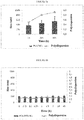
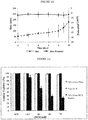
- Nanocapsules of 35000 Da PGA or PGA-PEG in the form of a sodium salt, an oily core composed of lecithin, MiglyolTM 812 and the cationic surfactant benzalkonium chloride (7 mg) and poloxamer 188 were prepared according to the previously described method. Measurements were taken for particle size over a relevant time, in order to obtain information on the system's evolution over time. Also, the effect of storage temperature (37 °C) on the stability of nanocapsules was evaluated. The results presented in Figures 1a and 1b show the small size variability of the nanocapsules of PGA or PGA-PEG 35000 Da at 5.8% w / w, during storage.
- Nanocapsules of 35000 Da PGA or PGA-PEG in the form of a sodium salt, an oily core composed of lecithin, MiglyolTM 812 and the cationic surfactant benzalkonium chloride (7 mg) and poloxamer 188 were prepared according to the previously described method.
- the cryoprotectant effect of the trehalose was evaluated during lyophilization of PGA or PGA-PEG nanocapsules and the subsequent recovery of particle size after resuspension, by testing two concentrations of trehalose, 5 to 10% w / v.
- the results in Figure 2a and 2b show the particle size of the nanocapsules of PGA or PGA-PEG after resuspension.
- Nanocapsules were prepared consisting of an oily core coated with HA according to the process of solvent diffusion in two stages:
- Tables 18 and 19 show the values obtained of the above parameters depending on the amount of HA 20000-50000 Da in step iv) and using benzalkonium chloride or hexadecyltrimethylammonium bromide, respectively.
- Table 20 shows the values of said parameters depending on the amount of 160000 Da HA added in step iv), and using benzalkonium chloride.
- Nanocapsules were prepared consisting of an oily core coated with HA according to the process of solvent diffusion in one step:
- Tables 21 and 22 show the values obtained of the above parameters depending on the amount of HA in step a) and using benzalkonium chloride or hexadecyltrimethylammonium bromide, respectively.
- Formulation HA step a (mg) size (nm) PI Zeta Potential (mV) NCs HA 25 186 ⁇ 6 0,1 -47 ⁇ 2 NCs HA 12,5 185 ⁇ 4 0,1 -44 ⁇ 2 NCs HA 0,5 251 ⁇ 5 0,1 37 ⁇ 1
- Formulation HA step a (mg) size (nm) PI Zeta Potential (mV) NCs HA 12,5 273 ⁇ 12 0,2 -35 ⁇ 2 NCs HA 6,25 170 ⁇ 6 0,1 -35 ⁇ 1 NCs HA 3,125 168 ⁇ 3 0,1 -35 ⁇ 2 NCs HA 0,1 228 ⁇ 17 0,1 33 ⁇ 3
- Nanocapsules were prepared consisting of an oily core coated with HA according to the sonication process:
- Nanocapsules were prepared consisting of an oily core coated with HA by the process of homogenization:
- Nanocapsules were prepared comprising HA as a sodium salt, an oily core composed of lecithin, MiglyolTM 812 and the cationic surfactants benzalkonium chloride (4 mg) or bromide hexadecyltrimethylammonium (1.8 mg) and poloxamer 188. Incorporation of a lipophilic drug was effected, docetaxel being used for the occasion, an antitumor agent which is almost insoluble in water. Procedure corresponds to the procedure previously described in Example 5.1., with a modification, since a small aliquot of a stock solution of the active ingredient in ethanol (1-100 mg / ml) is incorporated into the oily phase.
- the system is rotoevaporated to obtain a constant volume and is incubated with a solution of HA forming the nanocapsules encapsulating docetaxel with weight ratios of docetaxel / nanocapsules HA up to 4%.
- HA nanocapsules were prepared by encapsulating the lipophilic drug docetaxel following the procedure described in Example 6. The nanocapsules were diluted in water and incubated in this medium with horizontal shaking (100 rpm) at 37 oC. At different times samples were taken from the incubation media and nanocapsules were isolated in suspension by ultracentrifugation. Finally we evaluated the fraction of drug released quantifying the amount of free drug in infranate liquid which was compared with the fraction of drug remaining bound to the nanocapsules. Docetaxel quantification was performed as described in Example 6. The drug release profile of the nanocapsules of HA is included in Figure 4 .
- HA nanocapsules were prepared as a sodium salt, having an oily core composed of lecithin, MiglyolTM 812 and the cationic surfactant benzalkonium chloride (7 mg) or hexadecyltrimethylammonium (5.4 mg) and poloxamer 188 according to the previously described method. Measurements were taken for particle size over a relevant time, in order to obtain information on the system's evolution over time. Also, the effect of storage temperature (4 and 37 oC) on the stability of nanocapsules was evaluated.
- Nanocapsules of HA in the form of a sodium salt, an oily core composed of lecithin, MiglyolTM 812 and the cationic surfactant benzalkonium chloride (4 mg) and poloxamer 188 were prepared according to the previously described method.
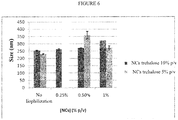
- the cryoprotectant effect of the trehalose was evaluated during lyophilization of HA nanocapsules and the subsequent recovery of particle size after resuspension, by testing two concentrations of trehalose, 5 to 10% w / v.
- the results in Figure 6 show the particle size of the nanocapsules of HA after resuspension.
- HA nanocapsules were prepared using hexadecyltrimethylammonium bromide (1.8 mg) according to the procedure described in Example 6.
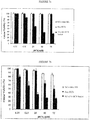
- the results in Figure 7 show the greatest ability to inhibit the proliferation of nanocapsules encapsulating docetaxel compared to the free molecule when systems are brought into contact for 2 to 48 h with the cancer cells. Moreover, one can see the safety of the systems without docetaxel.
- IC50 values the concentration which produces 50% mortality of the population, was calculated using Graph Pad Prism 2.1 (Graph Pad Software).
- the solution of docetaxel showed IC50 values of 105 nM and 36 nM when in contact with the cells for 2 to 48 respectively, while the formulations of HA nanocapsules encapsulating docetaxel showed values of about 29 and 13 nM in the same Incubation times, the docetaxel nanoencapsulation being 3.6 and 2.8 times more effective at inhibiting cell proliferation.
- Nanocapsules were prepared consisting of an oily core coated with PAsn according to the process of solvent diffusion in two stages:
- Tables 26 and 27 show the values obtained of the above parameters depending on the amount of PAsn in step iv) and using benzalkonium chloride or hexadecyltrimethylammonium bromide, respectively.
- Nanocapsules were prepared consisting of an oily core coated according PAsn solvent diffusion process in one step
- Tables 28 and 29 show the values obtained of the above parameters depending on the amount of PAsn in step a) and using benzalkonium chloride or hexadecyltrimethylammonium bromide, respectively.
- Nanocapsules were prepared consisting of an oily core coated with PAsn according to the sonication process:
- Nanocapsules were prepared consisting of an oily core coated with polyasparagine by the process of homogenization:
- Nanocapsules were prepared comprising PAsn, an oily core composed of lecithin, MiglyolTM 812 and the cationic surfactants benzalkonium chloride (4 mg) or bromide hexadecyltrimethylammonium (1.8 mg). Incorporation of a lipophilic drug, docetaxel, an antitumor agent which is almost insoluble in water was effected. Procedure corresponds to the procedure previously described in Example 11.1., with a small modification, a small aliquot of a stock solution of the active ingredient in ethanol (1-100 mg / ml) is incorporated into the oily phase.
- the system is rotoevaporated to obtain a constant volume and is incubated with a solution of PAsn forming the nanocapsules encapsulating docetaxel with weight ratios of docetaxel / nanocapsules PAsn up to 30%.
- PAsn nanocapsules were prepared by encapsulating the lipophilic drug docetaxel following the procedure described in Example 12. The nanocapsules were diluted in water and incubated in this medium with horizontal shaking (100 rpm) at 37 oC. At different times samples were taken from the incubation media and nanocapsules were isolated in suspension by ultracentrifugation. Finally we indirectly evaluated the fraction of drug released quantifying the amount of drug found in the nanocapsules. Docetaxel quantification was performed as described in Example 12. The drug release profile of the nanocapsules of PAsn is included in Figure 9 .
- polyasparagine nanocapsules were prepared, having an oily core composed of lecithin, MiglyolTM 812 and the cationic surfactant benzalkonium chloride (4 mg) or hexadecyltrimethylammonium (4 mg) according to the previously described method. Measurements were taken for particle size over a long period of time, in order to obtain information on the system's evolution over time. Also, the effect of storage temperature (4 and 37 oC) on the stability of nanocapsules was evaluated. The results presented in Figures 10a and 10b show the small size variability of the nanocapsules of PAsn, with benzalkonium chloride and hexadecyltrimethylammonium bromide, respectively, during storage.
- Nanocapsules of polyasparagine, an oily core composed of lecithin, MiglyolTM 812 and the cationic surfactant hexadecyltrimethylammonium bromide (1.8 mg) were prepared according to the previously described method.
- the cryoprotectant effect of the trehalose was evaluated during lyophilization of PAsn nanocapsules and the subsequent recovery of particle size after resuspension, by testing two concentrations of cryoprotector, 5 to 10% w / v.
- PAsn nanocapsules were prepared using hexadecyltrimethylammonium bromide (1.8 mg) according to the procedure described in Example 12.
- the results in Figure 11 show the greatest ability to inhibit the proliferation of nanocapsules encapsulating docetaxel compared to the free molecule when systems are brought into contact for 2 to 48 h with the cancer cells. Moreover, one can see the safety of the systems without docetaxel.
- IC50 values were calculated using Graph Pad Prism 2.1 (Graph Pad Software).
- the solution of docetaxel showed IC50 values of 105 nM and 36 nM when in contact with the cells for 2 to 48 respectively, while the formulations of PAsn nanocapsules encapsulating docetaxel showed values of about 30 and 13 nM in the same Incubation times, the docetaxel nanoencapsulation being 3.5 and 2.8 times more effective at inhibiting cell proliferation.
- Nanocapsules of a medium size of 100 nm were prepared according to the solvent diffusion process in one step having a shell of polyglutamic-polyethyleneglycol acid (PGA-PEG) as a sodium salt with a molecular weight of 35,000 Da, a 60% pegylation and a chain size of PEG of 20,000 Da; an oily core made of lecithin, MiglyolTM 812, hexadecyltrimethylammonium bromide.
- PGA-PEG polyglutamic-polyethyleneglycol acid
- nanocapsules with a mean size of 200 nm were prepared according to the same procedure consisting of a shell of polyglutamic-polyethyleneglycol acid (PGA-PEG) as the sodium salt of 35,000 Da, with a percentage of 60% Pegylation and PEG chain size of 20,000 Da, poloxamer 188 and an oily core composed of lecithin, MiglyolTM 812 and benzalkonium chloride.
- the size of the nanocapsules could be modulated to achieve such sizes, by suitably modifying the amounts of components and the method of addition of the organic phase over the aqueous phase.
- the nanocapsules were labelled with the lipophilic fluorescent marker DiD (1,1'-dioctadecyl-3,3,3',3'-tetramethylindodicarbocyanine perchlorate). Then, the two formulations of nanocapsules of 100 and 200 nm were isolated and diluted in a solution of 10% trehalose in water and administered subcutaneously (interscapular area) and intravenous (into tail vein) to SCID healthy mice in order to evaluate its biodistribution, with special attention to their accumulation in lymphoid tissues.
- DiD 1,1'-dioctadecyl-3,3,3',3'-tetramethylindodicarbocyanine perchlorate
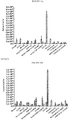
- the injection volume was 100 ⁇ l, and nanocapsules concentrations of 100 and 200 nm was 12 mg/ml and 13.6 mg / ml, respectively. In both cases DiD concentration was 11.7 ⁇ g / ml. Fluorescence intensity was evaluated in different organs by In Vivo Imaging System (IVISTM Spectrum, Caliper Life Sciences) at 6, 24 and 48 hours after administration. Figures 12 and 13 show the distribution profiles of the fluorescence associated with the nanocapsules of 100 and 200 nm, respectively.
- IVISTM In Vivo Imaging System
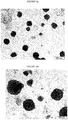
- Figures 12a , 12b, and 12c show the fluorescence levels (expressed in fotons/s/cm 2 /sr) in various organs and tissues after administration of polyglutamic-polyethyleneglycol acid (PGA-PEG) of 100 nm, after different periods of time: (a) 6 h, (b) 24 hours, (c) 48 hours ( subcutaneous administration, intravenous administration).
- PGA-PEG polyglutamic-polyethyleneglycol acid
- Figures 13a, 13b and 13c show the fluorescence levels (expressed in fotons/s/cm 2 /sr) in various organs and tissues after administration of polyglutamic-polyethyleneglycol acid (PGA-PEG) nanocapsules of 200 nm, after various periods time: (a) 6 h, (b) 24 hours, (c) 48 hours and ( subcutaneous administration, intravenous administration).
- PGA-PEG polyglutamic-polyethyleneglycol acid
- the results show the high lymphatic accumulation of fluorescence associated to the nanocapsules after administration in both ways, this being more pronounced for subcutaneous administration.
- marker vehiculization into the lymphatic system becomes apparent. This lymphatic accumulation is associated with a diminished accumulation in organs responsible for disposal, such as liver and spleen.
- Nanocapsules were prepared with different polymers including PAsn, PGA or PGA-PEG by means of the technique in one step described in Example 1.1 and 11.1. These systems were loaded with the fluorescent marker DiD (1,1'-dioctadecyl-3,3,3',3'-tetramethylindodicarbocyanine perchlorate)(concentration of DiD was 100 ⁇ g / ml in nanocapsules) prior to administration to Swiss mice (9-12 weeks old, 20-22 g). As control formulation an anionic nanoemulsion loaded with the same marker and at the same concentration was used. Also, a control experiment was performed to determine the residual fluorescence of plasma from blood samples of mice to which 150 ⁇ l of saline was administered.
- DiD 1,1'-dioctadecyl-3,3,3',3'-tetramethylindodicarbocyanine perchlorate
- the fluorescent formulations, nanoparticles and nanoemulsion, and the saline control sample were administered by IV injection into mice tails in a volume of 150 ⁇ l.
- blood samples were taken in triplicate by cardiac puncture.
- the samples were centrifuged for 10 min at 2000g in Vacutainer tube (SST II Advance, 5 ml, Becton Dickinson France SAS, France).
- SST II Advance, 5 ml, Becton Dickinson France SAS, France For determination of the fluorescence at time zero, fluorescent nanoemulsion and nanocapsules aliquots were mixed with blood at an adequate rate to simulate the in vivo concentration at time zero (150 ⁇ l of formulation in a weight of blood corresponding to 7.5% of the total animal weight, i.e.
- the fluorescence is expressed in fluorescence units (FU) and is calculated by the following equation: FU sample ⁇ FU of the plasma
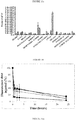
- Figure 14 shows the percentage of fluorescence dose injected (DiD concentration in mg / kg of the total weight of the animal at each time in relation to the concentration at time zero) remaining in plasma after different periods of time after intravenous injection in Swiss mice. 100% of the fluorescence corresponds to the fluorescence at time zero.
- Table 1 shows the values for the parameters: the half-life of distribution (alpha phase) (t 1/2 ⁇ , hours), calculated from 0 to 1 hours, the half-life of elimination (beta) (t 1/2 ⁇ , hours) calculated from 1 to 24 hours, the mean residence time (MRT, hours) calculated from 0 to 24 hours and area under the plasma level / time curve (AUC, hours) calculated from 0 to 24 hours.
- the results obtained for these parameters show the differences in plasma elimination kinetics of the different formulations. There is a considerable improvement of the parameters obtained for all formulations of nanocapsules compared to those obtained for the nanoemulsion without polymer coating (formulation control).
- the corresponding nanocapsules were prepared according to examples 1.1 and 11.1 . Also, such efficacy was compared with that of the commercial formulation TaxotereTM.
- the animals NMRI-nu naked athymic mice 6 weeks old, 20-24 g
- Tumor growth was evaluated by measuring the tumor with a Vernier caliber every 3 days.
- mice When the tumor reached a size of 200 mm 3 the mice were divided into 4 groups who were given different treatments (PAG-PEG nanocapsules, PAsn nanocapsules, the nanoemulsion commercial control formulation and Taxotere ®).
- PAG-PEG nanocapsules PAsn nanocapsules
- the nanoemulsion commercial control formulation Taxotere ®
- Docetaxel administered by IV injection was 2 mg of docetaxel / kg animal weight.
- Maximum formulation volume injected was 150 ⁇ L.
- the control group was given the same volume of saline. Tumor size was measured two times per week for a period of 24 days.
- Figure 15a shows the evolution of the increase of tumor volume (the size difference between each time and the initial size) of the animals treated with the drug-loaded nanocapsules and TaxotereTM and with the saline control.
- the first results indicate that the docetaxel retains antitumor activity in vivo when encapsulated.
- nanocapsule formulations were as effective as the commercial formulation, being both formulations effective in terms of reduction of tumor growth rate.
- Figure 15b shows the increase in tumor volume after 18 and 21 days compared to the size at time zero. It can be appreciated that the differences in tumor size of the treated and untreated animals (serum was administered) were significant for the two times. This analysis reflects the efficacy test of the concept of nanocapsule formulations developed.
- Figure 16 shows the percentage of mice surviving after different periods of time and after being subjected to different treatments, according to the Kaplan-Meier method. The results show a much higher survival rate in the case of mice treated with the formulations of nanocapsules (60-80% survival) than with TaxotereTM (30% survival). This reduction in drug toxicity of nanocapsules is to be attributed to higher selectivity of the treatment, which is consistent with prolonged circulation time in plasma of nanocapsules.
- the table also shows the statistical probability (p) associated with the differences in the parameter "mean survival time" for each of the formulations compared to the control (p ⁇ 0.05 was considered statistically significant.) Statistical differences were calculated using the log-rank test (Mantel-Cox test). The results of survival of the treated animals show the superiority of the nanocapsule formulations compared to TaxotereTM. Table 2: Mean survival time of treated animals with the different formulations of docetaxel loaded nanocapsules, compared to those obtained after administration of TaxotereTM and the saline control.
Landscapes
- Health & Medical Sciences (AREA)
- Chemical & Material Sciences (AREA)
- Life Sciences & Earth Sciences (AREA)
- Engineering & Computer Science (AREA)
- General Health & Medical Sciences (AREA)
- Medicinal Chemistry (AREA)
- Pharmacology & Pharmacy (AREA)
- Animal Behavior & Ethology (AREA)
- Veterinary Medicine (AREA)
- Public Health (AREA)
- Epidemiology (AREA)
- Bioinformatics & Cheminformatics (AREA)
- Nanotechnology (AREA)
- Molecular Biology (AREA)
- Physics & Mathematics (AREA)
- Biomedical Technology (AREA)
- Optics & Photonics (AREA)
- Crystallography & Structural Chemistry (AREA)
- Biophysics (AREA)
- Biotechnology (AREA)
- General Engineering & Computer Science (AREA)
- Medical Informatics (AREA)
- Biochemistry (AREA)
- Inorganic Chemistry (AREA)
- Proteomics, Peptides & Aminoacids (AREA)
- Medicinal Preparation (AREA)
- Pharmaceuticals Containing Other Organic And Inorganic Compounds (AREA)
Claims (16)
- System für die Verabreichung von Wirkstoffen umfassend Nanokapseln, mit einem Kern umfassend ein Öl und ein kationisches Tensid und einer Hülle umfassend ein Polymer ausgewählt aus der Gruppe bestehend aus Polyglutaminsäure (PGA), Polyglutamin-Polyethylenglycolsäure (PGA-PEG), Hyaluronsäure (HA) und Polyasparagin (PAsn) oder einer Kombination derselben, und wahlweise einen Wirkstoff,
mit der Maßgabe dass, wenn das genannte Nanokapselsystem beinhaltet Polyglutaminsäure oder Polyglutamin-Polyethylenglycolsäure (PGA-PEG), dann der Wirkstoff nicht ein Didemnin oder Tamandarin ist, und wobei das kationische Tensid aus Benzalkoniumchlorid, Benzethoniumchlorid, Cetylpyridiniumchlorid, Cetyltiridiniumbromid, Dodecyltrimethylammoniumbromid, Trimethyltetradecylamoniumbromid, Hexadecyltrimethylammoniumbromid und Poloxaminen, oder Mischungen derselben ausgewählt wird. - System nach Anspruch 1, wobei das Öl aus Mineralöl, Squalenöl, Aromaölen, Silikonöl, ätherischen Ölen, Isopropylstearat, Butylstearat, Octylpalmitat, Cetylpalmitat, Tridecylbehenat, Diisopropyladipat, Dioctylsebacat, Menthylanthranilat, Cetyloctanoat, Octylsalicylat, Isopropylmyristat, Neopentylglycoldicarpatcetolen, Decyloleat, C12-C15-Alkyllactaten, Cetyllactat, Lauryllactat, Isostearylneopentanoat, Myristyllactat, Isocetylstearoylstearat, Octyldodecylstearoylstearat, Kohlenwasserstoffölen, Isoparaffin, flüssigen Paraffinen, Isododecan, Vaseline, Arganöl, Rapsöl, Chiliöl, Kokosnussöl, Maisöl, Baumwollsamenöl, Leinsamenöl, Traubenkernöl, Senföl, Olivenöl, Palmöl, Palmkernöl, Erdnussöl, Rizinunsöl, Kiefersamenöl, Mohnöl, Kurbiskernöl, Reiskleienöl, Safloröl, Carthamus, Teeöl, Trüffelöl, Pflanzenöl, Aprikosen(kern)öl, Jojobaöl, Macadamiaöl, Weizenkeimöl, Mandelöl, Sojaöl, Sesamöl, Haselnussöl, Sonnenblumenöl, Hanföl, Boisöl, Kukuinussöl, Avokadoöl, Walnussöl, Fischöl, Beerenöl, Nelkenpfefferöl, Wacholderöl, Samenöl, Mandelkernöl, Anissamenöl, Selleriesamenöl, Kreuzkümmelsamenöl, Muskatnussöl, Basilikumblätteröl, Lorbeerblätteröl, Zimtblätteröl, Salbeiblätteröl, Eukalyptusblätteröl, Zitronengrasblätteröl, Myrtenheideblätteröl, Oreganoblätteröl, Patschuliblätteröl, Pfefferminzblätteröl, Kiefernnadelöl, Rosmarinblätteröl, Grünem Minzeblätteröl, Teebaumblätteröl, Thymianblätteröl, Wintergrünblätteröl, Blumenöl, Kamillenöl, Muskatellersalbeiöl, Nelkenöl, Geranie-Blumenöl, Ysopblumenöl, Jasminblumenöl, Lavendelblumenöl, Manukablumenöl, Majoramblumenöl, Orangenblumenöl, Rosenblumenöl, Ylang-Ylangblumenöl, Rindenöl, Kassiarindenöl, Zimtrindenöl, Sassafrasrindenöl, Holzöl, Kampferholzöl, Zedernholzöl, Rosenholzöl, Sandelholzöl, Rhizom(ingwer)holzöl, Harzöl, Weihrauchöl, Myrrhenöl, Schalenöl, Bergamotteschalenöl, Pampelmuseschalenöl, Zitronenschalenöl, Limetteschalenöl, Orangenschalenöl, Mandarinenschalenöl, Wurzelöl, Baldrianöl, Ölsäure, Linolsäure, Oleylalkohol, Isostearylalkohol, Ethyloleat, mittelkettigen Triglyceriden, und Kombinationen derselben ausgewählt wird.
- System nach einem der vorhergehenden Ansprüche, zusätzlich umfassend ein öllösliches Tensid.
- System nach Anspruch 3, wobei das öllösliche Tensid ein Phospholipid ausgewählt aus Lecithin, Phosphatidylglycerol, Phosphatidylserin, Phosphatidylinositol, Diphosphatidylglycerol, Phosphatidsäure, Phosphatidylcholin und Phosphatidylethanolamin ist.
- System nach einem der vorhergehenden Ansprüche, zusätzlich umfassend ein wasserlösliches Tensid.
- System nach Anspruch 5, wobei das wasserlösliche Tensid aus Poloxamer und Polysorbaten ausgewählt wird.
- System nach einem der vorhergehenden Ansprüche, wobei der Wirkstoff aus Peptiden, Proteinen, Lipiden oder lipophilen Verbindungen, wie Docetaxel, Saccharidverbindungen, Nukleinsäuren und Nukleotidverbindungen, wie einem Oligonukleotid, RNA-Interferenz, einem DNA-Plasmid oder einem Polynukleotid, oder Kombinationen derselben ausgewählt wird.
- System nach einem der vorhergehenden Ansprüche, dadurch gekennzeichnet, dass es in lyophilisierter Form vorliegt.
- Verfahren zur Herstellung des Systems nach einem der Ansprüche 1 bis 8, umfassend:a) das Zubereiten einer wässrigen Lösung umfassend ein Polymer ausgewählt aus der Gruppe bestehend aus Polyglutaminsäure (PGA), Polyglutamin-Polyethylenglycolsäure (PGA-PEG), Hyaluronsäure (HA) und Polyasparagin (PAsn) oder einer Kombination derselben, und wahlweise ein wasserlösliches Tensid;b) das Zubereiten einer organischen Lösung umfassend ein Öl und das kationische Tensid, und wahlweise ein öllösliches Tensid;c) das Mischen unter Rühren der in den Schritten a) und b) zubereiteten Lösungen, unter spontanem Erhalt der Nanokapseln, undd) wahlweise, das vollständige oder teilweise Verdampfen bis zu einem konstanten Volumen der organischen Lösungsmittel aus der im vorherigen Schritt erhaltenen Mischung.
- Verfahren nach Anspruch 9, zusätzlich umfassend das Hinzufügen eines Wirkstoffs, mit der Maßgabe dass, wenn das genannte Polymer Polyglutaminsäure oder Polyglutamin-Polyethylenglycolsäure (PGA-PEG) umfasst, dann der Wirkstoff nicht ein Didemnin oder Tamandarin ist.
- Verfahren zur Herstellung des Systems nach einem der Ansprüche 1 bis 8, umfassend das Beschichten einer Nanoemulsion, mindestens gebildet aus einem Öl, dem kationischen Tensid, wahlweise einem öllöslichen Tensid und einer wässrigen Phase wahlweise umfassend ein wasserlösliches Tensid, mittels eines Inkubationsverfahrens mit einer wässrigen Lösung von Polyglutaminsäure, Polyglutamin-Polyethylenglycolsäure, Hyaluronsäure, Polyasparagin oder einer Mischung derselben.
- Verfahren nach Anspruch 11, zusätzlich umfassend das Hinzufügen eines Wirkstoffs, mit der Maßgabe dass, wenn das genannte Polymer Polyglutaminsäure, Polyglutamin-Polyethylenglycolsäure (PGA-PEG) umfasst, dann der Wirkstoff nicht ein Didemnin oder Tamandarin ist.
- Pharmazeutischen Zusammensetzung umfassend das System nach einem der Ansprüche 1 bis 8.
- System nach einem der Ansprüche 1 bis 8, für dessen Verwendung als Medikament.
- System nach einem der Ansprüche 1 bis 8, für dessen Verwendung bei der Behandlung von Krebs.
- System nach einem der Ansprüche 1 bis 8, für dessen Verwendung als Träger für die Verabreichung von Wirkstoffen.
Applications Claiming Priority (2)
| Application Number | Priority Date | Filing Date | Title |
|---|---|---|---|
| ES201130015A ES2385995B2 (es) | 2011-01-10 | 2011-01-10 | Nanocápsulas con cubierta polimérica |
| PCT/ES2012/000008 WO2012095543A1 (es) | 2011-01-10 | 2012-01-09 | Nanocápsulas con cubierta polimérica |
Publications (3)
| Publication Number | Publication Date |
|---|---|
| EP2664324A1 EP2664324A1 (de) | 2013-11-20 |
| EP2664324A4 EP2664324A4 (de) | 2015-05-27 |
| EP2664324B1 true EP2664324B1 (de) | 2019-09-25 |
Family
ID=46506792
Family Applications (1)
| Application Number | Title | Priority Date | Filing Date |
|---|---|---|---|
| EP12734760.7A Active EP2664324B1 (de) | 2011-01-10 | 2012-01-09 | Nanokapseln mit einer polymerhülle |
Country Status (6)
| Country | Link |
|---|---|
| US (1) | US9415019B2 (de) |
| EP (1) | EP2664324B1 (de) |
| CN (1) | CN103596558A (de) |
| BR (1) | BR112013017750A8 (de) |
| ES (1) | ES2385995B2 (de) |
| WO (1) | WO2012095543A1 (de) |
Families Citing this family (17)
| Publication number | Priority date | Publication date | Assignee | Title |
|---|---|---|---|---|
| CN103096874A (zh) * | 2010-04-15 | 2013-05-08 | 华盛顿大学 | 前药组合物、前药纳米粒子及其使用方法 |
| CN103483353B (zh) * | 2012-06-13 | 2016-02-24 | 上海现代药物制剂工程研究中心有限公司 | 二硫杂环戊烯并吡咯酮化合物的纳米粒及制备方法 |
| ES2481940B1 (es) * | 2012-12-17 | 2015-05-06 | Universidade De Santiago De Compostela | Nanocápsulas de protamina |
| EP3368008A1 (de) * | 2015-10-30 | 2018-09-05 | The Johns Hopkins University | Schleimdurchdringende teilchen mit hohem molekulargewicht und dichten beschichtungen |
| ES2664584B2 (es) | 2016-09-19 | 2018-12-13 | Universidade De Santiago De Compostela | Nanoparticulas con interiores protegidos, y métodos de uso de las mismas |
| US20190343190A1 (en) * | 2016-09-30 | 2019-11-14 | President And Fellows Of Harvard College | Materials including polymeric fibers incorporating microcapsules or nanocapsules including an essential oil |
| US10918685B2 (en) * | 2017-01-05 | 2021-02-16 | Ravi Ramamoorthy Iyer | Herbal topical composition for muscle and joint health, recovery from exertion, and for pain management |
| WO2018169960A1 (en) * | 2017-03-17 | 2018-09-20 | The Johns Hopkins University | Nanoparticle formulations for enhanced drug delivery to the bladder |
| ES2711669A1 (es) * | 2017-11-02 | 2019-05-06 | Univ Santiago Compostela | Sistemas de liberacion de farmacos de acido polisialico y metodos |
| CA3124904A1 (en) | 2019-01-14 | 2020-07-23 | President And Fellows Of Harvard College | Focused rotary jet spinning devices and methods of use thereof |
| AU2020266770A1 (en) * | 2019-05-01 | 2021-10-14 | Universidade De Santiago De Compostela | Intracellular delivery of anti-KRAS antibodies formulated into nanocapsules |
| US20220304940A1 (en) * | 2019-06-20 | 2022-09-29 | Lyotropic Delivery Systems Ltd. | Polymeric soft films embedded with nanodomains and/or a bioactive and methods of producing same |
| CN111544643B (zh) * | 2020-04-23 | 2022-06-07 | 海南芬森医疗器械有限公司 | γ-聚谷氨酸皮肤屏障修复敷料及其制备方法 |
| US11696888B2 (en) | 2020-05-27 | 2023-07-11 | Mary Kay Inc. | Topical compositions and methods |
| CN115152739B (zh) * | 2021-04-01 | 2024-07-23 | 中国科学院理化技术研究所 | 一种加载海藻糖的聚合物纳米颗粒及其制备方法与应用 |
| CN113616604B (zh) * | 2021-10-12 | 2021-12-21 | 北京蓝晶微生物科技有限公司 | 一种可注射聚羟基脂肪酸酯微球及其制备方法 |
| CN115193263B (zh) * | 2022-08-03 | 2023-04-18 | 广西大学 | 一种旋转膜过滤净化装置及其应用、净化山茶油的方法 |
Family Cites Families (27)
| Publication number | Priority date | Publication date | Assignee | Title |
|---|---|---|---|---|
| US4670185A (en) * | 1982-07-19 | 1987-06-02 | Lion Corporation | Aqueous vesicle dispersion having surface charge |
| IL101241A (en) * | 1992-03-16 | 1997-11-20 | Yissum Res Dev Co | Pharmaceutical or cosmetic composition comprising stabilized oil-in-water type emulsion as carrier |
| JP2811036B2 (ja) * | 1992-05-26 | 1998-10-15 | 参天製薬株式会社 | ビタミンe点眼剤 |
| DE4244122C1 (de) * | 1992-12-24 | 1994-06-01 | Sanol Arznei Schwarz Gmbh | Lyophilisierte, wirkstoffhaltige Emulsion zur intravenösen Applikation |
| AU3159595A (en) | 1994-08-30 | 1996-03-22 | Hyal Pharmaceutical Corporation | Hyaluronic acid and derivatives for modulation of cellular activity |
| US6326511B1 (en) | 1997-08-18 | 2001-12-04 | Lajos Kossuth University | Polymeric product |
| WO2000064954A1 (en) | 1999-04-22 | 2000-11-02 | Vanderbilt University | Polymeric encapsulation system promoting angiogenesis |
| US6593308B2 (en) * | 1999-12-03 | 2003-07-15 | The Regents Of The University Of California | Targeted drug delivery with a hyaluronan ligand |
| US6365706B1 (en) * | 2000-06-21 | 2002-04-02 | Mississippi Chemical Corporation | Process for production of polyasparagine and the high nitrogen content polymer formed thereby |
| DE60121016T2 (de) | 2000-09-26 | 2006-12-21 | Toudai Tlo, Ltd. | Polymere mizelle mit darin eingeschlossenem cisplatin und ihre verwendung |
| US20040047891A1 (en) * | 2001-02-26 | 2004-03-11 | Sabina Glozman | Systems devices and methods for intrabody targeted delivery and reloading of therapeutic agents |
| JP2004529934A (ja) * | 2001-05-01 | 2004-09-30 | アンジオテック ファーマシューティカルズ,インコーポレイテッド | 抗微小管剤およびポリペプチドまたはポリサッカリドを含む組成物、ならびに炎症状態を処置するための医薬品の調製のためのそれらの組成物の使用 |
| PL369455A1 (en) * | 2001-06-01 | 2005-04-18 | Yamanouchi Europe B.V. | Lipid-polymer-conjugates |
| US20050196370A1 (en) * | 2003-03-18 | 2005-09-08 | Zhi-Jian Yu | Stable ophthalmic oil-in-water emulsions with sodium hyaluronate for alleviating dry eye |
| ES2226567B1 (es) | 2003-06-20 | 2006-07-01 | Universidad De Santiago De Compostela | Nanoparticulas de acido hialuronico. |
| ES2232287B1 (es) * | 2003-07-04 | 2006-11-01 | Advanced In Vitro Cell Technologies, S.L. | Nanoparticulas de derivados polioxietilenados. |
| US20060246096A1 (en) | 2003-12-29 | 2006-11-02 | University of Debrecen, Department of Colloid and Environmental Chemistry | Nanoparticles from biopolymers |
| US20050238678A1 (en) | 2004-03-05 | 2005-10-27 | Janos Borbely | Hydrogels from biopolymers |
| WO2005095344A1 (en) * | 2004-03-24 | 2005-10-13 | Array Biopharma Inc. | Thioalkeneamides as transketolase inhibitors |
| WO2006014706A2 (en) * | 2004-07-21 | 2006-02-09 | Serenex, Inc. | Methotrexate derivatives useful for treating cancer and arthritis |
| US8114842B1 (en) * | 2004-10-05 | 2012-02-14 | Gp Medical, Inc. | Nanoparticles for drug delivery |
| US7541028B2 (en) * | 2005-01-04 | 2009-06-02 | Gp Medical, Inc. | Nanoparticles for monoclonal antibody delivery |
| US20070099856A1 (en) * | 2005-05-13 | 2007-05-03 | Gumerlock Paul H | Combined treatment with docetaxel and an epidermal growth factor receptor kinase inhibitor using an intermittent dosing regimen |
| US7879818B2 (en) | 2005-12-23 | 2011-02-01 | Janos Borbely | Hyaluronic acid-based cross-linked nanoparticles |
| CN101062017B (zh) * | 2006-04-26 | 2010-05-12 | 科妍生物科技股份有限公司 | 一种透明质酸及其制备方法 |
| WO2009087678A2 (en) * | 2007-12-24 | 2009-07-16 | Sun Pharma Advanced Research Company Limited | Nanodispersion |
| BRPI0803473B8 (pt) * | 2008-09-18 | 2021-05-25 | Fund De Amparo A Pesquisa Do Estado De Sao Paulo Fapesp | nanopartícula de albumina transportadora de fármacos para terapia fotodinâmica e seu processo de preparo |
-
2011
- 2011-01-10 ES ES201130015A patent/ES2385995B2/es active Active
-
2012
- 2012-01-09 US US13/979,092 patent/US9415019B2/en active Active
- 2012-01-09 CN CN201280012254.4A patent/CN103596558A/zh active Pending
- 2012-01-09 WO PCT/ES2012/000008 patent/WO2012095543A1/es not_active Ceased
- 2012-01-09 BR BR112013017750A patent/BR112013017750A8/pt not_active Application Discontinuation
- 2012-01-09 EP EP12734760.7A patent/EP2664324B1/de active Active
Non-Patent Citations (1)
| Title |
|---|
| None * |
Also Published As
| Publication number | Publication date |
|---|---|
| BR112013017750A2 (pt) | 2016-10-11 |
| US20140023703A1 (en) | 2014-01-23 |
| EP2664324A1 (de) | 2013-11-20 |
| CN103596558A (zh) | 2014-02-19 |
| EP2664324A4 (de) | 2015-05-27 |
| US9415019B2 (en) | 2016-08-16 |
| ES2385995A1 (es) | 2012-08-06 |
| ES2385995B2 (es) | 2013-05-21 |
| WO2012095543A1 (es) | 2012-07-19 |
| BR112013017750A8 (pt) | 2018-03-06 |
Similar Documents
| Publication | Publication Date | Title |
|---|---|---|
| EP2664324B1 (de) | Nanokapseln mit einer polymerhülle | |
| JP7291967B2 (ja) | 異なる医薬品の制御送達のためのビヒクル | |
| Jia et al. | A novel dexamethasone-loaded liposome alleviates rheumatoid arthritis in rats | |
| Mo et al. | PEGylated hyaluronic acid-coated liposome for enhanced in vivo efficacy of sorafenib via active tumor cell targeting and prolonged systemic exposure | |
| Jain et al. | Nanocarrier based advances in drug delivery to tumor: an overview | |
| Shi et al. | Recent advances in intravenous delivery of poorly water-soluble compounds | |
| US20030059465A1 (en) | Stabilized nanoparticle formulations of camptotheca derivatives | |
| US20040009229A1 (en) | Stabilized nanoparticle formulations of camptotheca derivatives | |
| Gonzalo et al. | A new potential nano-oncological therapy based on polyamino acid nanocapsules | |
| Paolino et al. | Innovative drug delivery systems for the administration of natural compounds | |
| KR20110056042A (ko) | 종양세포 표적지향을 위한 나노 입자 및 이의 제조방법 | |
| EP2932965B1 (de) | Protaminnanokapseln | |
| Song et al. | Effects of surface modification of As2O3-loaded PLGA nanoparticles on its anti-liver cancer ability: An in vitro and in vivo study | |
| Pandey | Solid lipid nanoparticles: a multidimensional drug delivery system | |
| Xu et al. | Liposome-based delivery systems for ginsenoside Rh2: in vitro and in vivo comparisons | |
| BG Yameogo et al. | Progress in developing amphiphilic cyclodextrin-based nanodevices for drug delivery | |
| Rochín-Wong et al. | Lipid and polymeric nanocapsules | |
| Yang et al. | In vitro and in vivo evaluation of a novel mitomycin nanomicelle delivery system | |
| US20160128971A1 (en) | Nanoparticle Compositions | |
| Zhang et al. | Paclitaxel-loaded polymeric nanoparticles based on PCL–PEG–PCL: Preparation, in vitroandin vivoevaluation | |
| EP3999520B1 (de) | Hybrider htirna-/nanopartikel-komplex und seine verwendung zur behandlung einer krankheit des verdauungssystems | |
| Mahmood et al. | Engineered Liposomal Nanoparticles and Their Medical Applications | |
| Goyal et al. | Clinical Milestones in Nanotherapeutics: Current Status and Future Prospects | |
| WO2022207736A1 (fr) | Formulation pour la délivrance d'arn messager | |
| Booth et al. | PEGylated PLGA Nanoparticles for the Improved Delivery of Doxorubicin |
Legal Events
| Date | Code | Title | Description |
|---|---|---|---|
| PUAI | Public reference made under article 153(3) epc to a published international application that has entered the european phase |
Free format text: ORIGINAL CODE: 0009012 |
|
| 17P | Request for examination filed |
Effective date: 20130809 |
|
| AK | Designated contracting states |
Kind code of ref document: A1 Designated state(s): AL AT BE BG CH CY CZ DE DK EE ES FI FR GB GR HR HU IE IS IT LI LT LU LV MC MK MT NL NO PL PT RO RS SE SI SK SM TR |
|
| DAX | Request for extension of the european patent (deleted) | ||
| RA4 | Supplementary search report drawn up and despatched (corrected) |
Effective date: 20150428 |
|
| RIC1 | Information provided on ipc code assigned before grant |
Ipc: B82Y 5/00 20110101ALI20150421BHEP Ipc: A61K 31/337 20060101ALI20150421BHEP Ipc: A61K 47/34 20060101ALI20150421BHEP Ipc: A61K 47/36 20060101ALI20150421BHEP Ipc: A61K 9/51 20060101AFI20150421BHEP |
|
| STAA | Information on the status of an ep patent application or granted ep patent |
Free format text: STATUS: EXAMINATION IS IN PROGRESS |
|
| 17Q | First examination report despatched |
Effective date: 20170201 |
|
| GRAP | Despatch of communication of intention to grant a patent |
Free format text: ORIGINAL CODE: EPIDOSNIGR1 |
|
| STAA | Information on the status of an ep patent application or granted ep patent |
Free format text: STATUS: GRANT OF PATENT IS INTENDED |
|
| RIC1 | Information provided on ipc code assigned before grant |
Ipc: A61K 47/34 20170101ALI20190312BHEP Ipc: A61K 9/51 20060101AFI20190312BHEP Ipc: A61K 31/337 20060101ALI20190312BHEP Ipc: B82Y 5/00 20110101ALI20190312BHEP Ipc: A61K 31/713 20060101ALI20190312BHEP Ipc: A61K 47/36 20060101ALI20190312BHEP Ipc: A61K 9/19 20060101ALI20190312BHEP Ipc: A61K 47/26 20060101ALI20190312BHEP |
|
| INTG | Intention to grant announced |
Effective date: 20190415 |
|
| GRAS | Grant fee paid |
Free format text: ORIGINAL CODE: EPIDOSNIGR3 |
|
| GRAA | (expected) grant |
Free format text: ORIGINAL CODE: 0009210 |
|
| STAA | Information on the status of an ep patent application or granted ep patent |
Free format text: STATUS: THE PATENT HAS BEEN GRANTED |
|
| AK | Designated contracting states |
Kind code of ref document: B1 Designated state(s): AL AT BE BG CH CY CZ DE DK EE ES FI FR GB GR HR HU IE IS IT LI LT LU LV MC MK MT NL NO PL PT RO RS SE SI SK SM TR |
|
| REG | Reference to a national code |
Ref country code: GB Ref legal event code: FG4D |
|
| REG | Reference to a national code |
Ref country code: CH Ref legal event code: EP |
|
| REG | Reference to a national code |
Ref country code: AT Ref legal event code: REF Ref document number: 1183123 Country of ref document: AT Kind code of ref document: T Effective date: 20191015 |
|
| REG | Reference to a national code |
Ref country code: IE Ref legal event code: FG4D |
|
| REG | Reference to a national code |
Ref country code: DE Ref legal event code: R096 Ref document number: 602012064315 Country of ref document: DE |
|
| REG | Reference to a national code |
Ref country code: NL Ref legal event code: MP Effective date: 20190925 |
|
| PG25 | Lapsed in a contracting state [announced via postgrant information from national office to epo] |
Ref country code: NO Free format text: LAPSE BECAUSE OF FAILURE TO SUBMIT A TRANSLATION OF THE DESCRIPTION OR TO PAY THE FEE WITHIN THE PRESCRIBED TIME-LIMIT Effective date: 20191225 Ref country code: BG Free format text: LAPSE BECAUSE OF FAILURE TO SUBMIT A TRANSLATION OF THE DESCRIPTION OR TO PAY THE FEE WITHIN THE PRESCRIBED TIME-LIMIT Effective date: 20191225 Ref country code: LT Free format text: LAPSE BECAUSE OF FAILURE TO SUBMIT A TRANSLATION OF THE DESCRIPTION OR TO PAY THE FEE WITHIN THE PRESCRIBED TIME-LIMIT Effective date: 20190925 Ref country code: FI Free format text: LAPSE BECAUSE OF FAILURE TO SUBMIT A TRANSLATION OF THE DESCRIPTION OR TO PAY THE FEE WITHIN THE PRESCRIBED TIME-LIMIT Effective date: 20190925 Ref country code: HR Free format text: LAPSE BECAUSE OF FAILURE TO SUBMIT A TRANSLATION OF THE DESCRIPTION OR TO PAY THE FEE WITHIN THE PRESCRIBED TIME-LIMIT Effective date: 20190925 Ref country code: SE Free format text: LAPSE BECAUSE OF FAILURE TO SUBMIT A TRANSLATION OF THE DESCRIPTION OR TO PAY THE FEE WITHIN THE PRESCRIBED TIME-LIMIT Effective date: 20190925 |
|
| REG | Reference to a national code |
Ref country code: LT Ref legal event code: MG4D |
|
| PG25 | Lapsed in a contracting state [announced via postgrant information from national office to epo] |
Ref country code: GR Free format text: LAPSE BECAUSE OF FAILURE TO SUBMIT A TRANSLATION OF THE DESCRIPTION OR TO PAY THE FEE WITHIN THE PRESCRIBED TIME-LIMIT Effective date: 20191226 Ref country code: LV Free format text: LAPSE BECAUSE OF FAILURE TO SUBMIT A TRANSLATION OF THE DESCRIPTION OR TO PAY THE FEE WITHIN THE PRESCRIBED TIME-LIMIT Effective date: 20190925 Ref country code: RS Free format text: LAPSE BECAUSE OF FAILURE TO SUBMIT A TRANSLATION OF THE DESCRIPTION OR TO PAY THE FEE WITHIN THE PRESCRIBED TIME-LIMIT Effective date: 20190925 |
|
| REG | Reference to a national code |
Ref country code: CH Ref legal event code: NV Representative=s name: VALIPAT S.A. C/O BOVARD SA NEUCHATEL, CH |
|
| REG | Reference to a national code |
Ref country code: AT Ref legal event code: MK05 Ref document number: 1183123 Country of ref document: AT Kind code of ref document: T Effective date: 20190925 |
|
| PG25 | Lapsed in a contracting state [announced via postgrant information from national office to epo] |
Ref country code: AL Free format text: LAPSE BECAUSE OF FAILURE TO SUBMIT A TRANSLATION OF THE DESCRIPTION OR TO PAY THE FEE WITHIN THE PRESCRIBED TIME-LIMIT Effective date: 20190925 Ref country code: PT Free format text: LAPSE BECAUSE OF FAILURE TO SUBMIT A TRANSLATION OF THE DESCRIPTION OR TO PAY THE FEE WITHIN THE PRESCRIBED TIME-LIMIT Effective date: 20200127 Ref country code: AT Free format text: LAPSE BECAUSE OF FAILURE TO SUBMIT A TRANSLATION OF THE DESCRIPTION OR TO PAY THE FEE WITHIN THE PRESCRIBED TIME-LIMIT Effective date: 20190925 Ref country code: IT Free format text: LAPSE BECAUSE OF FAILURE TO SUBMIT A TRANSLATION OF THE DESCRIPTION OR TO PAY THE FEE WITHIN THE PRESCRIBED TIME-LIMIT Effective date: 20190925 Ref country code: PL Free format text: LAPSE BECAUSE OF FAILURE TO SUBMIT A TRANSLATION OF THE DESCRIPTION OR TO PAY THE FEE WITHIN THE PRESCRIBED TIME-LIMIT Effective date: 20190925 Ref country code: EE Free format text: LAPSE BECAUSE OF FAILURE TO SUBMIT A TRANSLATION OF THE DESCRIPTION OR TO PAY THE FEE WITHIN THE PRESCRIBED TIME-LIMIT Effective date: 20190925 Ref country code: NL Free format text: LAPSE BECAUSE OF FAILURE TO SUBMIT A TRANSLATION OF THE DESCRIPTION OR TO PAY THE FEE WITHIN THE PRESCRIBED TIME-LIMIT Effective date: 20190925 Ref country code: RO Free format text: LAPSE BECAUSE OF FAILURE TO SUBMIT A TRANSLATION OF THE DESCRIPTION OR TO PAY THE FEE WITHIN THE PRESCRIBED TIME-LIMIT Effective date: 20190925 Ref country code: ES Free format text: LAPSE BECAUSE OF FAILURE TO SUBMIT A TRANSLATION OF THE DESCRIPTION OR TO PAY THE FEE WITHIN THE PRESCRIBED TIME-LIMIT Effective date: 20190925 |
|
| PG25 | Lapsed in a contracting state [announced via postgrant information from national office to epo] |
Ref country code: IS Free format text: LAPSE BECAUSE OF FAILURE TO SUBMIT A TRANSLATION OF THE DESCRIPTION OR TO PAY THE FEE WITHIN THE PRESCRIBED TIME-LIMIT Effective date: 20200224 Ref country code: SK Free format text: LAPSE BECAUSE OF FAILURE TO SUBMIT A TRANSLATION OF THE DESCRIPTION OR TO PAY THE FEE WITHIN THE PRESCRIBED TIME-LIMIT Effective date: 20190925 Ref country code: CZ Free format text: LAPSE BECAUSE OF FAILURE TO SUBMIT A TRANSLATION OF THE DESCRIPTION OR TO PAY THE FEE WITHIN THE PRESCRIBED TIME-LIMIT Effective date: 20190925 Ref country code: SM Free format text: LAPSE BECAUSE OF FAILURE TO SUBMIT A TRANSLATION OF THE DESCRIPTION OR TO PAY THE FEE WITHIN THE PRESCRIBED TIME-LIMIT Effective date: 20190925 |
|
| REG | Reference to a national code |
Ref country code: DE Ref legal event code: R097 Ref document number: 602012064315 Country of ref document: DE |
|
| PG2D | Information on lapse in contracting state deleted |
Ref country code: IS |
|
| PG25 | Lapsed in a contracting state [announced via postgrant information from national office to epo] |
Ref country code: DK Free format text: LAPSE BECAUSE OF FAILURE TO SUBMIT A TRANSLATION OF THE DESCRIPTION OR TO PAY THE FEE WITHIN THE PRESCRIBED TIME-LIMIT Effective date: 20190925 Ref country code: IS Free format text: LAPSE BECAUSE OF FAILURE TO SUBMIT A TRANSLATION OF THE DESCRIPTION OR TO PAY THE FEE WITHIN THE PRESCRIBED TIME-LIMIT Effective date: 20200126 |
|
| PLBE | No opposition filed within time limit |
Free format text: ORIGINAL CODE: 0009261 |
|
| STAA | Information on the status of an ep patent application or granted ep patent |
Free format text: STATUS: NO OPPOSITION FILED WITHIN TIME LIMIT |
|
| PG25 | Lapsed in a contracting state [announced via postgrant information from national office to epo] |
Ref country code: MC Free format text: LAPSE BECAUSE OF FAILURE TO SUBMIT A TRANSLATION OF THE DESCRIPTION OR TO PAY THE FEE WITHIN THE PRESCRIBED TIME-LIMIT Effective date: 20190925 |
|
| 26N | No opposition filed |
Effective date: 20200626 |
|
| PG25 | Lapsed in a contracting state [announced via postgrant information from national office to epo] |
Ref country code: LU Free format text: LAPSE BECAUSE OF NON-PAYMENT OF DUE FEES Effective date: 20200109 |
|
| PG25 | Lapsed in a contracting state [announced via postgrant information from national office to epo] |
Ref country code: SI Free format text: LAPSE BECAUSE OF FAILURE TO SUBMIT A TRANSLATION OF THE DESCRIPTION OR TO PAY THE FEE WITHIN THE PRESCRIBED TIME-LIMIT Effective date: 20190925 |
|
| PG25 | Lapsed in a contracting state [announced via postgrant information from national office to epo] |
Ref country code: TR Free format text: LAPSE BECAUSE OF FAILURE TO SUBMIT A TRANSLATION OF THE DESCRIPTION OR TO PAY THE FEE WITHIN THE PRESCRIBED TIME-LIMIT Effective date: 20190925 Ref country code: MT Free format text: LAPSE BECAUSE OF FAILURE TO SUBMIT A TRANSLATION OF THE DESCRIPTION OR TO PAY THE FEE WITHIN THE PRESCRIBED TIME-LIMIT Effective date: 20190925 Ref country code: CY Free format text: LAPSE BECAUSE OF FAILURE TO SUBMIT A TRANSLATION OF THE DESCRIPTION OR TO PAY THE FEE WITHIN THE PRESCRIBED TIME-LIMIT Effective date: 20190925 |
|
| PG25 | Lapsed in a contracting state [announced via postgrant information from national office to epo] |
Ref country code: MK Free format text: LAPSE BECAUSE OF FAILURE TO SUBMIT A TRANSLATION OF THE DESCRIPTION OR TO PAY THE FEE WITHIN THE PRESCRIBED TIME-LIMIT Effective date: 20190925 |
|
| REG | Reference to a national code |
Ref country code: CH Ref legal event code: U11 Free format text: ST27 STATUS EVENT CODE: U-0-0-U10-U11 (AS PROVIDED BY THE NATIONAL OFFICE) Effective date: 20260201 |
|
| PGFP | Annual fee paid to national office [announced via postgrant information from national office to epo] |
Ref country code: GB Payment date: 20260121 Year of fee payment: 15 |
|
| PGFP | Annual fee paid to national office [announced via postgrant information from national office to epo] |
Ref country code: IE Payment date: 20260123 Year of fee payment: 15 Ref country code: DE Payment date: 20260122 Year of fee payment: 15 |
|
| PGFP | Annual fee paid to national office [announced via postgrant information from national office to epo] |
Ref country code: BE Payment date: 20260130 Year of fee payment: 15 |
|
| PGFP | Annual fee paid to national office [announced via postgrant information from national office to epo] |
Ref country code: FR Payment date: 20260122 Year of fee payment: 15 |
|
| PGFP | Annual fee paid to national office [announced via postgrant information from national office to epo] |
Ref country code: CH Payment date: 20260201 Year of fee payment: 15 |