EP2664656A1 - Weißpigmentkomposit - Google Patents
Weißpigmentkomposit Download PDFInfo
- Publication number
- EP2664656A1 EP2664656A1 EP13154267.2A EP13154267A EP2664656A1 EP 2664656 A1 EP2664656 A1 EP 2664656A1 EP 13154267 A EP13154267 A EP 13154267A EP 2664656 A1 EP2664656 A1 EP 2664656A1
- Authority
- EP
- European Patent Office
- Prior art keywords
- particles
- titanium dioxide
- pigment
- white pigment
- composite
- Prior art date
- Legal status (The legal status is an assumption and is not a legal conclusion. Google has not performed a legal analysis and makes no representation as to the accuracy of the status listed.)
- Granted
Links
Images


Classifications
-
- C—CHEMISTRY; METALLURGY
- C09—DYES; PAINTS; POLISHES; NATURAL RESINS; ADHESIVES; COMPOSITIONS NOT OTHERWISE PROVIDED FOR; APPLICATIONS OF MATERIALS NOT OTHERWISE PROVIDED FOR
- C09C—TREATMENT OF INORGANIC MATERIALS, OTHER THAN FIBROUS FILLERS, TO ENHANCE THEIR PIGMENTING OR FILLING PROPERTIES ; PREPARATION OF CARBON BLACK ; PREPARATION OF INORGANIC MATERIALS WHICH ARE NO SINGLE CHEMICAL COMPOUNDS AND WHICH ARE MAINLY USED AS PIGMENTS OR FILLERS
- C09C1/00—Treatment of specific inorganic materials other than fibrous fillers; Preparation of carbon black
- C09C1/28—Compounds of silicon
-
- C—CHEMISTRY; METALLURGY
- C09—DYES; PAINTS; POLISHES; NATURAL RESINS; ADHESIVES; COMPOSITIONS NOT OTHERWISE PROVIDED FOR; APPLICATIONS OF MATERIALS NOT OTHERWISE PROVIDED FOR
- C09C—TREATMENT OF INORGANIC MATERIALS, OTHER THAN FIBROUS FILLERS, TO ENHANCE THEIR PIGMENTING OR FILLING PROPERTIES ; PREPARATION OF CARBON BLACK ; PREPARATION OF INORGANIC MATERIALS WHICH ARE NO SINGLE CHEMICAL COMPOUNDS AND WHICH ARE MAINLY USED AS PIGMENTS OR FILLERS
- C09C1/00—Treatment of specific inorganic materials other than fibrous fillers; Preparation of carbon black
- C09C1/36—Compounds of titanium
- C09C1/3607—Titanium dioxide
- C09C1/3615—Physical treatment, e.g. grinding, treatment with ultrasonic vibrations
- C09C1/3638—Agglomeration, granulation, pelleting
-
- C—CHEMISTRY; METALLURGY
- C09—DYES; PAINTS; POLISHES; NATURAL RESINS; ADHESIVES; COMPOSITIONS NOT OTHERWISE PROVIDED FOR; APPLICATIONS OF MATERIALS NOT OTHERWISE PROVIDED FOR
- C09C—TREATMENT OF INORGANIC MATERIALS, OTHER THAN FIBROUS FILLERS, TO ENHANCE THEIR PIGMENTING OR FILLING PROPERTIES ; PREPARATION OF CARBON BLACK ; PREPARATION OF INORGANIC MATERIALS WHICH ARE NO SINGLE CHEMICAL COMPOUNDS AND WHICH ARE MAINLY USED AS PIGMENTS OR FILLERS
- C09C1/00—Treatment of specific inorganic materials other than fibrous fillers; Preparation of carbon black
- C09C1/36—Compounds of titanium
- C09C1/3607—Titanium dioxide
- C09C1/3653—Treatment with inorganic compounds
-
- C—CHEMISTRY; METALLURGY
- C01—INORGANIC CHEMISTRY
- C01P—INDEXING SCHEME RELATING TO STRUCTURAL AND PHYSICAL ASPECTS OF SOLID INORGANIC COMPOUNDS
- C01P2002/00—Crystal-structural characteristics
- C01P2002/70—Crystal-structural characteristics defined by measured X-ray, neutron or electron diffraction data
-
- C—CHEMISTRY; METALLURGY
- C01—INORGANIC CHEMISTRY
- C01P—INDEXING SCHEME RELATING TO STRUCTURAL AND PHYSICAL ASPECTS OF SOLID INORGANIC COMPOUNDS
- C01P2004/00—Particle morphology
- C01P2004/01—Particle morphology depicted by an image
- C01P2004/03—Particle morphology depicted by an image obtained by SEM
-
- C—CHEMISTRY; METALLURGY
- C01—INORGANIC CHEMISTRY
- C01P—INDEXING SCHEME RELATING TO STRUCTURAL AND PHYSICAL ASPECTS OF SOLID INORGANIC COMPOUNDS
- C01P2004/00—Particle morphology
- C01P2004/60—Particles characterised by their size
- C01P2004/61—Micrometer sized, i.e. from 1-100 micrometer
-
- C—CHEMISTRY; METALLURGY
- C01—INORGANIC CHEMISTRY
- C01P—INDEXING SCHEME RELATING TO STRUCTURAL AND PHYSICAL ASPECTS OF SOLID INORGANIC COMPOUNDS
- C01P2006/00—Physical properties of inorganic compounds
- C01P2006/22—Rheological behaviour as dispersion, e.g. viscosity, sedimentation stability
-
- C—CHEMISTRY; METALLURGY
- C01—INORGANIC CHEMISTRY
- C01P—INDEXING SCHEME RELATING TO STRUCTURAL AND PHYSICAL ASPECTS OF SOLID INORGANIC COMPOUNDS
- C01P2006/00—Physical properties of inorganic compounds
- C01P2006/60—Optical properties, e.g. expressed in CIELAB-values
Definitions
- the invention relates to a method for producing a titania-based white pigment composite according to the preamble of claim 1, as well as a white pigment composite according to the preamble of claim 6.
- Titanium dioxide has the highest refractive index compared to other white pigments. This results - as is known in the art - among other things, significant advantages in terms of whiteness, UV resistance and opacity in formulations prepared from it, such as manufactured colors, etc .. Titanium dioxide is due to the high global demand and the Only limited raw material deposits are very expensive and thus significantly influence the formulations thus produced. Furthermore, titanium dioxide has a very high CO 2 -Bilan due to its specific manufacturing process. For this reason, there are approaches to reduce the proportion of titanium dioxide by the addition of so-called extenders, such as carbonates, quartzes and silicates. However, this often involves a reduction in the quality of the formulation. For this reason, the prior art has already described a wide variety of methods for preventing the loss of quality.
- the WO 2011/134907 A1 a reduced titanium dioxide color composition having good opacity and good wet abrasion resistance.
- the paint has, inter alia, as opacifying pigments TiO 2 and polymeric hollow particles.
- Non-opacifying extenders include dolomite or lime or nepheline syenite or kaolin.
- a precipitate of calcium carbonate is produced on the surface of the titanium oxide particles, wherein the carbonate particles have a particle size of substantially 30 nm to 100 nm.
- a white pigment is known, inter alia based on titanium dioxide, in which talc can also be used as extender or substrate. Either the titanium dioxide particles or the talcum particles are coated with a surface-active reagent to improve the bond between the titanium dioxide and the talc particles.
- the object of the present invention is to produce a white pigment composite which has at least approximately the same properties as titanium dioxide with respect to its use as a pigment.
- This object is achieved in each case independently by the process for producing a white pigment composite described at the outset and by the white pigment composite itself, wherein the titanium dioxide particles are or are physically physisorptively permanently connected to the pigment replacement substance particles by mechanical attachment of the titanium dioxide particles to the pigment replacement substance particles.
- physisorption is understood as meaning a binding of the titanium dioxide particles to the surface of the pigment replacement substance particles by physical forces. Thus, there is no chemical association between the titanium dioxide particles and the pigment replacement particles.
- the advantage here is that the particles of titanium dioxide and the pigment substitute per se - apart from the permanent connection with each other - undergo little change, so in particular no chemical change of the surface takes place. Thus, the optical qualities of the titanium dioxide are not or not significantly changed. It is further advantageous that with this white pigment composite no or no significant system adjustments are required in various applications, such as the paint and paint industry or the plastics industry, even if the titanium dioxide is replaced to a greater extent by the pigment substitute. Normally, the addition of a filler also affects the extenders known in the art Finally, fillers - due to the larger or very different surface of a filler particle compared to the titanium dioxide particles, inter alia, the degree of whiteness, the gloss, the viscosity of the system, etc.
- the titanium dioxide particles are not detached from the talc particles by shear forces which occur with dissolvers operated at a peripheral speed of up to 30 m / s.
- the titanium dioxide particles are or are associated with the talcum particles, although a small amount of only adsorptively bound titania particles is permissible due to the production.
- These adsorptively bound titania particles are However, not permanently associated with the Talc particles, since the forces acting between the particles are so small that this adsorptive binding is destroyed when mixed into a formulation, for example, for a paint or a paint.
- the physisorptive compound of titanium dioxide with the pigment substitute by pressing, for example by rolling, or impressions (mechanical activation, mechanochemistry) or driving or molding the particles of titanium dioxide into the particles of this pigment substitute becomes. It can thus be easily made or improved the permanent connection of the particles with each other.
- the white pigment composite can be subjected to higher shear forces. This is advantageous, for example, in the incorporation or incorporation of the white pigment composite in paints or coatings or in plastics, since the composite of the particles essentially remains intact. The constancy of the optical properties of theInternationalpigmentkomposits can thus be further improved.
- a device with at least approximately punctiform or line-shaped pressurization of the particles is used for the injection or rolling of the particles of titanium dioxide in the particles of the pigment substitute.
- the energy input into the particles during the compounding of the particles can be increased, whereby a further increase in the strength of the physisorptive compound can be achieved.
- the particles are comminuted to the desired particle size even before their connection in a separate process step, so that the titanium dioxide particles and the pigment substitute particles undergo only a reduction of the particle size of more than 10% due to the energy input during compound formation.
- the avoidance of further comminution or a substantial further comminution of the particles during the compound formation with one another has the advantage that the energy with which the particles are charged at least largely into the compound formation itself is implemented, which in turn can be achieved a further increase in the connection strength.
- the physisorptive compound of the particles is carried out dry, whereby the particles can be brought into closer contact and thus the compound formation can take place more rapidly.
- the dry procedure also has the advantage that the electron mobility in the particles is increased by the resulting heating of the particles. This, in turn, is beneficial in terms of the physisorptive bonding forces acting between the particles and contributes to further strengthening the bonding of the particles together.
- the proportion of the pigment substitute based on the total mass of the white pigment composite, is selected from a range with a lower limit of 0.5% by weight and an upper limit of 50% by weight.
- a further reduction below 0.5 wt .-% is indeed possible, but has in view of the desired cost reduction of the white pigment titanium dioxide only a small effect.
- the upper limit it has been observed that a further increase in the proportion of pigment substitute in the composite can result in a significant change in the technical properties of the formulation.
- the titania particles are smaller than the pigment replacement particles. It is thus achieved that the titanium dioxide particles can be better pressed into the surface of the pigment substitute, whereby a denser covering of the surface of the pigment substitute with the titanium dioxide particles is achieved. This in turn is advantageous in view of the desired avoidance of the change in the optical properties of theInternationalpigmentkomposits by the addition of the pigment substitute.
- the particle size of the titanium dioxide particles is at most 20% of the particle size of the pigment substitute particles, as a result of which this effect can be further improved.
- the pigment substitute particles have a particle size of at most 30 ⁇ m.
- the invention relates to a method for producing aPartpigmentkomposits.
- This composite is a combination of a white pigment and talc.
- a white pigment which has a high refractive index (2.6-2.8) is used in particular as white pigment, it being possible for titanium dioxide to be present in the anatase or rutile modification and both modifications also to be surface-treated (DIN 55949).
- At least one pigment substitute is added to this titanium dioxide-based white pigment composite, talc from the group of phyllosilicates being selected as the pigment substitute.
- titanium dioxide and talcum are used as pigment substitutes. In addition to these ingredients, no other ingredients are included.
- the rutile or anatase form can be used. Commercially available forms of natural or synthetic origin are used. Naturally occurring titanium dioxide will also be pretreated according to its own color. This is known from the prior art and should therefore not be repeated. Reference is made to the relevant literature.
- the titanium dioxide has a purity of at least 80%.
- the talc so the natural talc to be ground has a maximum content of natural impurities of at most 12 wt .-%.
- These accompanying substances may be u.a. to act carbonates, silicates, chlorite or mixtures of these.
- the talc may be subjected to the usual pretreatment procedures, e.g. Purification process (e.g., flotation).
- Both the titanium dioxide and the talc are comminuted before the compound.
- the titanium dioxide is used with a particle size of not more than 5 microns.
- the talc is preferably used with a maximum particle size of 50 microns, in particular with a particle size of 1 micron to 30 microns. But it is also possible, especially for special applications, to use particle sizes of less than 1 micron.
- the titanium dioxide and the pigment replacement substance are thus already comminuted to the desired maximum particle size for the compound before the connection with one another, wherein it may be provided in this method step that this particle size is maximally 10%, in particular maximally 5%, preferably maximally 2.5%, is greater than the particle size of titanium dioxide and the pigment substitute in the final finished product, ie of the white pigment composite. It is therefore a further minor comminution of the particles, due to the procedure is not excluded, although this is preferably avoided.
- the fraction of the pigment substitute on the white pigment composite may be between 0.5% by weight and 50% by weight, in particular between 10% by weight and 50% by weight, preferably between 35% by weight and 45% by weight. be.
- the rest is titanium dioxide.
- the titanium dioxide particles will be physisorptively linked to the pigment replacement particles.
- no further binder is used so that the white pigment composite is thus binder-free.
- the titania particles become chemically, i. via chemically reactive groups or bonds, bound to the pigment substitute particles.
- the physisorptive association of the titania particles with the particles of pigment substitute is assisted by the in-rolling of the titania particles into the surface of the pigment replacement particles.
- the pigment substitute has a hardness of 1 to Mohs.
- the titanium dioxide particles have an upper particle size which is at most 20% of the particle size of the pigment substitute particles, since this makes it easier and safer to carry out the pressing or rolling in.
- the pigment replacement particles are formed platelet-shaped.
- the titanium dioxide particles may in this case either be on one side only, i. attach a surface or on both opposite surfaces of the platelets.
- the titanium dioxide particles deposit homogeneously (felt-like) on the surfaces of the talc.
- an attachment to the thin breaklines is also conceivable, although this is not so uniform due to the small surface area of the broken edges of the platelets.
- a product may arise in which "layers" of the titanium dioxide particles are separated by "layers" of pigment substitute particles, or in each case two "layers" of titanium dioxide particles are separated by pigment replacement substance particles.
- layer is not to be understood as meaning that continuous layers are formed in the product after the product, i. the white pigment formulation is particulate.
- a device which subjects the particles to an at least approximately punctiform or line-shaped pressurization. It is thus achieved that on a relatively small area, a relatively high pressure (high energy) can be applied.
- At least approximately punctiform or “at least approximately linear” is meant that the particles are not necessarily claimed in exactly one point or exactly one line, although this is the ideal execution, but that due to the mechanical use of the Stress can also be done on a relatively small area.
- the apparatus for producing the physisorptive compound may have corresponding compacts, such as balls or rollers, etc.
- the mechanical stress in the device the talcum particles are plastically deformed by the impressions of titanium dioxide particles (compulsion), whereby on the surface of talcum particles electronic defects are generated, so that in these areas also the outward binding forces deformed in these Areas are affected.
- This can be used to permanently bind the titanium dioxide particles in these areas to the talc particles.
- the talc particles are "activated" by the mechanical stress.
- the device can therefore also be referred to as a mechanical reactor.
- devices are used without impact stress of the particles for the attachment of the titanium dioxide particles to the talcum particles.
- Preferred embodiments of this device are commercially available mill units, such as those used for grinding of rocks. These mills are used for other purposes, as in them, as already stated above, no significant comminution of the particles should take place more, or only a comminution is allowed to a small extent. For this reason, these mills can be used to separate the fine fraction without the usual classifier.
- these mill units are operated at low particle loading rates.
- this stress rate is a maximum of 10 m / s, preferably a maximum of 6 m / s.
- mills examples include disc vibrating mills, drum mills, tube vibrating mills. Planetary mills, impact mills.
- the physisorptive compound is dry, ie that no slurry of the particles used takes place.
- the physisorptive connection is carried out in the above-mentioned apparatus in a continuous operation, although a discontinuous operation is possible.
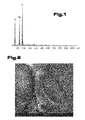
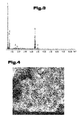
- X-ray diffractograms and SEM images of talc or titanium dioxide are shown in magnification of 10000 times.
- the platelet-shaped character of the talc is clearly recognizable from the SEM images ( Fig. 2 ) or the nodular or approximately cubic or spherical shape of the titanium dioxide ( Fig. 4 ).
- the two X-ray diffractograms prove that they are pure substances.
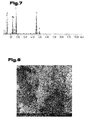
- the Fig. 6 shows the result using a hammer mill
- the Fig. 8 the result using a vibratory mill
- the Fig. 10 the result using a drum mill.
- the Fig. 6 . 8th and 10 are each SEM images with 30000x magnification.
- Table 1 shows the basic recipe.
- Table 2 contains the quantities of titanium dioxide and the white pigment to various inventive samples (HG 1 to HG 5) and samples with white pigment extenders according to the prior art (HG 6 to HG 10). All information on the composition in Tables 1 and 2 are to be understood as wt .-%. For comparative purposes, a sample was also prepared (HG 0) containing neither a white pigment extender nor the white pigment composite.
- Table 3 gives the measurements of gloss, whiteness, hiding power and viscosity (at 20 ° C) of the high gloss finish of these samples. The corresponding measurement standards are also given in this table.
- Table 4 shows the basic recipe.
- Table 5 contains the quantities of titanium dioxide and the white pigment for various samples according to the invention (ID-M 1 to ID-M 5) as well as samples with white pigment extenders according to the prior art (ID-M 6 to ID-M 10). All information on the composition in Tables 1 and 2 are to be understood as wt .-%.
- a sample was also prepared (IG-M 0) containing neither a white pigment extender nor the white pigment composite.
- Table 4 commodity name amount comment water 26.70 dispersants 0.10 eg Calgon N wetting agent 0.30 eg Nuosperse FX605 Methylcellulose 30000mPas 0.30 eg Bermocoll 481FQ Mineral defoamer (APEO-free) 0.20 eg Dapro DF7010 Can preservatives 0.10 eg Proxel BN PH adjustment 0.10 eg NaOH 10% Titanium dioxide See Table 5 eg 2190 Composite or extender See Table 5 Organic binder 10.00 eg Mowilith LDM1871 Talk spotted 5.00 eg intalc 6020LA Dolomite 20 ⁇ m 29,00 eg indolo 20 Dolomite 12 ⁇ m 18,00 eg indolo 12 PU thickener 0.20 eg RM 825 Total: 90.00 ID-M 0 10.00 Titanium dioxide ID-M 1 8.00 Titanium dioxide 2.00 achievepigmentkomposit ID-M 2 6.00 Titanium dioxide 4.00
- the white pigment composite according to the invention can be used in paints, lacquers, plastics, decor papers, etc.
- the exemplary embodiments merely show possible embodiments of the possible uses of the white pigment composite.
Landscapes
- Chemical & Material Sciences (AREA)
- Organic Chemistry (AREA)
- Cosmetics (AREA)
- Pigments, Carbon Blacks, Or Wood Stains (AREA)
- Compositions Of Macromolecular Compounds (AREA)
Abstract
Description
- Die Erfindung betrifft ein Verfahren zur Herstellung eines auf Titandioxid basierenden Weißpigmentkomposits entsprechend dem Oberbegriff des Anspruches 1, sowie ein Weißpigmentkomposit entsprechend dem Oberbegriff des Anspruches 6.
- Der Einsatz von Titandioxid als Weißpigment ist im Stand der Technik für unterschiedlichste Anwendungen und Formulierungen weit verbreitet. Im Vergleich zu anderen Weißpigmenten weist Titandioxid den höchsten Brechungsindex auf. Daraus ergeben sich - wie dies an sich bekannt ist - unter anderem deutliche Vorteile in Hinblick auf den Weißgrad, die UV-Beständigkeit und die Deckkraft in daraus hergestellten Formulierungen, wie z.B. hergestellten Farben, etc.. Titandioxid ist aufgrund des weltweit hohen Bedarfs und der nur begrenzten Rohstoffvorkommen sehr teuer und beeinflusst damit erheblich die damit hergestellten Formulierungen. Des Weiteren weist Titandioxid aufgrund seines spezifischen Herstellungsprozesses eine sehr hohe CO2-Bilan auf. Aus diesem Grund gibt es Ansätze den Anteil an Titandioxid durch den Zusatz von so genannten Extendern, wie z.B. Carbonaten, Quarzen und Silikaten, zu reduzieren. Damit verbunden ist aber häufig eine Reduktion der Qualität der Formulierung. Aus diesem Grund wurden im Stand der Technik bereits unterschiedlichste Verfahren zur Vermeidung des Qualitätsverlustes beschrieben.
- Beispielsweise offenbart die
WO 2011/134907 A1 eine Farbzusammensetzung mit reduziertem Titandioxidgehalt, die eine gute Opazität und eine gute Nassabriebbeständigkeit aufweist. Dazu weist die Farbe unter anderem als opakisierende Pigmente TiO2 und polymere Hohlpartikel auf. Als nicht opakisierende Extender sind Dolomit oder Kalk oder Nephelin Syenit oder Kaolin enthalten. - Gemäß der
WO 97/32934 A1 - Nach der
WO 2007/104465 A2 wird auf den Titanoxidpartikeln eine Beschichtung enthaltend Aluminiumphosphat, Aluminiumoxid und Hohlkörper ausgebildet. - Aus der
WO 2008/137175 A2 ist ein Weißpigment unter anderem auf Basis von Titandioxid bekannt, in dem auch Talkum als Extender bzw. Substrat eingesetzt werden kann. Dabei sind entweder die Titandioxidpartikel oder die Talkumpartikel mit einem oberflächenaktiven Reagens beschichtet um die Bindung zwischen den Titandioxid- und den Talkumpartikeln zu verbessern. - Die Aufgabe der vorliegenden Erfindung besteht darin, ein Weißpigmentkomposit herzustellen, das zumindest annähernd die gleichen Eigenschaften wie Titandioxid in Hinblick auf seine Verwendung als Pigment aufweist.
- Diese Aufgabe wird jeweils unabhängig durch das eingangs genannte Verfahren zur Herstellung eines Weißpigmentkomposits sowie durch das Weißpigmentkomposit selbst gelöst, wobei die Titandioxidteilchen mit den Pigmentersatzstoffteilchen physisorptiv dauerhaft durch mechanische Befestigung der Titandioxidteilchen mit den Pigmentersatzstoffteilchen verbunden werden bzw. sind.
- Unter dem Begriff Physisorption wird eine Anbindung der Titandioxidteilchen an die Oberfläche der Pigmentersatzstoffteilchen durch physikalische Kräfte verstanden. Es besteht also keine chemische Verbindung zwischen den Titandioxidteilchen und den Pigmentersatzstoffteichen.
- Von Vorteil ist dabei, dass die Teilchen des Titandioxids und des Pigmentersatzstoffes an sich - abgesehen von der dauerhaften Verbindung miteinander - eine geringe Veränderung erfahren, also insbesondere keine chemische Veränderung der Oberfläche erfolgt. Es werden damit die optischen Qualitäten des Titandioxids nicht bzw. nicht wesentlich verändert. Es ist weiter von Vorteil, dass mit diesem Weißpigmentkomposit keine bzw. keine wesentlichen Systemanpassungen im Einsatz in diversen Anwendungen, wie beispielsweise der Lack- und Farbenindustrie oder der Kunststoffindustrie, erforderlich sind, selbst wenn das Titandioxid in einem größeren Anteil durch den Pigmentersatzstoff ersetzt wird. Normalerweise beeinflusst die Zugabe eines Füllstoffes - auch die aus dem Stand der Technik bekannten Extender sind letztendlich Füllstoffe - aufgrund der im Vergleich zu den Titandioxidteilchen größeren bzw. sehr unterschiedlichen Oberfläche eines Füllstoffteilchens unter anderem den Weißgrad, den Glanzgrad, die Viskosität des Systems, etc. Die Folge davon ist, dass es nicht ausreicht nur das Titandioxid mengenmäßig durch den Füllstoff zu ersetzen, sondern dass die gesamte Rezeptur verändert und angepasst werden muss. Bei der Vielzahl an unterschiedlichen Farben bzw. Weißtönen die ein Hersteller normalerweise anbietet - es muss dabei auch beachtet werden, dass Weißpigmente auch mit anderen Pigmenten gemischt werden, um bestimmte Farbtöne zu erreichen - bedeutet der Ersatz des Titandioxids durch einen Füllstoff also einen kostenintensiven Eingriff in die Rezepturen, wodurch der Kostenvorteil durch die reduzierte Menge an Titandioxid zumindest teilweise aufgehoben bzw. zur Gänze neutralisiert wird. Dass heute derartige Titandioxid-Extender-Mischungen trotzdem eingesetzt werden ist u.a. auch darin begründet, dass Titandioxid mengenbezogen nur im beschränktem Umfang erhältlich ist. Mit dem Weißpigmentkomposit wurde hingegen beobachtet, dass sich die Produkteigenschaft wie z.B. Farbmetrik nicht (wesentlich) ändert, sodass also kein aufwändiger Abgleich von Rezepturen erforderlich ist und der gesamte Preisvorteil aufgrund der Mengenreduktion des Titandioxids realisiert werden kann.
- Unter dem Begriff "dauerhafte Verbindung" wird verstanden, dass bei normaler Verwendung des Weißpigmentkomposits, also ohne die bewusste Einwirkung von Kräften, die größer sind als jene Kräfte, die in den üblichen Dispergier-Aggregaten zur Herstellung der Endprodukte (z.B. Lacke, Farben, Putze) aus dem Weißpigmentkomposit, auftreten, die Titandioxidteilchen mit den Talkumteilchen verbunden bleiben. Die Verbindung wird also nicht durch das Einmischen des Weißpigmentkomposits in diverse Formulierungen (z.B. Lacke, Farben, Putze) zerstört.
- Insbesondere werden die Titandioxidteilchen nicht von den Talkumteilchen durch Scherkräfte abgelöst, die mit Dissolvern auftreten, welche mit einer Umfangsgeschwindigkeit bis zu 30 m/s betrieben werden.
- Es sei darüber hinaus darauf hingewiesen, dass im Sinne der Erfindung zumindest annähernd die gesamte Menge der Titandioxidteilchen mit den Talkumteilchen verbunden sind bzw. werden, wobei allerdings eine geringe Menge an nur adsorptiv gebundenen Titandioxidteilchen herstellungsbedingt zulässig ist. Diese adsorptiv gebundenen Titandioxidteilchen sind allerdings nicht dauerhaft mit den Talkumteilchen verbunden, da die zwischen den Teilchen wirkenden Kräfte so gering sind, dass diese adsorptive Anbindung beim Einmischen in eine Formulierung, beispielsweise für eine Farbe oder einen Lack, zerstört wird.
- Gemäß einer bevorzugten Ausführungsvariante des Verfahrens ist vorgesehen, dass die physisorptive Verbindung des Titandioxids mit dem Pigmentersatzstoff durch Einpressen, beispielsweise mittels Einwalzen, bzw. Eindrücken (mechanische Aktivierung, Mechanochemie) bzw. Eintreiben bzw. Einformen der Teilchen des Titandioxids in die Teilchen dieses Pigmentersatzstoffes hergestellt wird. Es kann damit die dauerhafte Verbindung der Teilchen miteinander einfach hergestellt bzw. verbessert werden. Damit kann das Weißpigmentkomposit höheren Scherkräften ausgesetzt werden. Dies ist beispielsweise bei der Einmischung bzw. Einarbeitung des Weißpigmentkomposits in Farben oder Lacke bzw. in Kunststoffe von Vorteil, da der Verbund aus den Teilchen im Wesentlichen erhalten bleibt. Die Konstanz der optischen Eigenschaften des Weißpigmentkomposits kann damit weiter verbessert werden.
- Es kann weiter vorgesehen werden, dass für das Einpressen bzw. Einwalzen der der Teilchen des Titandioxids in die Teilchen des Pigmentersatzstoffes eine Vorrichtung mit zumindest annähernd punktförmiger oder linienförmiger Druckbeaufschlagung der Teilchen verwendet wird. Es kann damit der Energieeintrag in die Teilchen während der Verbindungsbildung der Teilchen erhöht werden, wodurch eine weitere Erhöhung der Festigkeit der physisorptiven Verbindung erreicht werden kann.
- Der Energieeintrag kann dabei nach der Formel W = mKv2 B/2 berechnet werden, wobei mK für die Gesamtmasse der Körper steht, mit denen die Teilchen in der Vorrichtung beaufschlagt werden, und vB für die maximale Beanspruchungsgeschwindigkeit steht.
- Vorzugsweise werden die Teilchen bereits vor deren Verbindung in einem gesonderten Verfahrensschritt auf die gewünschte Teilchengröße zerkleinert, sodass die Titandioxidteilchen und die Pigmentersatzstoffteilchen durch den Energieeintrag während der Verbindungsbildung nur mehr eine Verringerung der Teilchengröße von maximal 10 % erfahren. Die Vermeidung einer weiteren Zerkleinerung bzw. einer wesentlichen weiteren Zerkleinerung der Teilchen während der Verbindungsbildung miteinander hat den Vorteil, dass die Energie, mit der die Teilchen beaufschlagt werden, zumindest Großteils in die Verbindungsbildung selbst umgesetzt wird, wodurch wiederum eine weitere Erhöhung der Verbindungsfestigkeit erreicht werden kann.
- Bevorzugt wird die physisorptive Verbindung der Teilchen trocken durchgeführt, wodurch die Teilchen in engeren Kontakt gebracht werden können und damit die Verbindungsbildung rascher erfolgen kann. Die trockene Verfahrensweise hat zudem den Vorteil, dass durch die dabei auftretende Erwärmung der Teilchen die Elektronenbeweglichkeit in den Teilchen erhöht wird. Dies wiederum ist von Vorteil hinsichtlich der zwischen den Teilchen wirkenden physisorptive Bindungskräfte und trägt zu einer weiteren Festigung der Verbindung der Teilchen miteinander bei.
- Nach einer Ausführungsvariante des Weißpigmentkomposits ist vorgesehen, dass der Anteil des Pigmentersatzstoffes, bezogen auf die Gesamtmasse des Weißpigmentkomposits, ausgewählt aus einem Bereich mit einer unteren Grenze von 0,5 Gew.-% und einer oberen Grenze von 50 Gew.-% ist. Eine weitere Reduktion unterhalb von 0,5 Gew.-% ist dabei zwar möglich, hat jedoch in Hinblick auf die gewünschte Kostenreduktion des Weißpigments Titandioxid nur einen geringen Effekt. In Bezug auf die obere Grenze wurde jedoch beobachtet, dass es mit einer weiteren Erhöhung des Anteils des Pigmentersatzstoffes in dem Komposit zu einer wesentlichen Veränderung der technischen Eigenschaften der Formulierung kommen kann.
- Vorzugsweise sind die Titandioxidteilchen kleiner als die Pigmentersatzstoffteilchen. Es wird damit erreicht, dass die Titandioxidteilchen besser in die Oberfläche des Pigmentersatzstoffes eingepresst werden können, wobei auch eine dichtere Belegung der Oberfläche des Pigmentersatzstoffes mit den Titandioxidteilchen erreicht wird. Dies wiederum ist von Vorteil in Hinblick auf die gewünschte Vermeidung der Änderung der optischen Eigenschaften des Weißpigmentkomposits durch die Zugabe des Pigmentersatzstoffes.
- Dabei ist es von Vorteil, wenn die Teilchengröße der Titandioxidteilchen maximal 20 % der Teilchengröße der Pigmentersatzstoffteilchen beträgt, wodurch dieser Effekt weiter verbessert werden kann.
- Aus demselben Grund ist es weiter bevorzugt, wenn die Pigmentersatzstoffteilchen eine Teilchengröße von maximal 30 µm aufweisen.
- Zum besseren Verständnis der Erfindung wird diese anhand der nachfolgenden Figuren näher erläutert.
- Es zeigen:
- Fig. 1
- ein Röntgendiffraktogramm von Talkum;
- Fig. 2
- die REM-Aufnahme des Talkums nach
Fig. 1 ; - Fig. 3
- ein Röntgendiffraktogramm von Titandioxid;
- Fig. 4
- die REM-Aufnahme des Talkums nach
Fig. 2 ; - Fig. 5
- ein Röntgendiffraktogramm eines Weißpigmentkomposits aus Titandioxid und Talkum hergestellt unter Verwendung einer Hammermühle;
- Fig. 6
- die REM-Aufnahme des Weißpigmentkomposits nach
Fig. 5 ; - Fig. 7
- ein Röntgendiffraktogramm eines Weißpigmentkomposits aus Titandioxid und Talkum hergestellt unter Verwendung einer Schwingscheibenmühle;
- Fig. 8
- die REM-Aufnahme des Weißpigmentkomposits nach
Fig. 7 ; - Fig. 9
- ein Röntgendiffraktogramm eines Weißpigmentkomposits aus Titandioxid und Talkum hergestellt unter Verwendung einer Kugelmühle;
- Fig. 10
- die REM-Aufnahme des Weißpigmentkomposits nach
Fig. 9 . - Einführend sei festgehalten, dass die in der Beschreibung gewählten Lageangaben, wie z.B. oben, unten, seitlich usw. auf die unmittelbar beschriebene sowie dargestellte Figur bezogen und bei einer Lageänderung sinngemäß auf die neue Lage zu übertragen sind.
- Die Erfindung betrifft ein Verfahren zur Herstellung eines Weißpigmentkomposits. Bei diesem Komposit handelt es sich um eine Kombination aus einem Weißpigment und Talkum. Als Weißpigment wird insbesondere ein Titandioxid, das einen hohen Brechungsindex (2,6-2,8) aufweist, verwendet, wobei Titandioxid in der Anatas- oder Rutilmodifikation vorliegen kann und beide Modifikationen auch oberflächenbehandelt (DIN 55949) sein können. Diesem einen auf Titandioxid basierenden Weißpigmentkomposit wird zumindest ein Pigmentersatzstoff zugesetzt, wobei als Pigmentersatzstoff Talkum aus der Gruppe der Schichtsilikate ausgewählt wird.
- Zur Herstellung des Weißpigmentkomposits wird Titandioxid und Talkum als Pigmentersatzstoff verwendet. Neben diesen Inhaltsstoffen sind keine weiteren Inhaltsstoffe enthalten.
- Als Titandioxid kann die Rutil- oder die Anatasform verwendet werden. Verwendet werden handelsübliche Formen, die natürlichen oder synthetischen Ursprungs sind. Natürlich vorkommendes Titandioxid wird je nach Eigenfärbung auch entsprechend vorbehandelt werden. Dies ist aus dem Stand der Technik bekannt und soll daher nicht wiederholt werden. Es sei dazu an die einschlägige Literatur verwiesen. Vorzugsweise weist das Titandioxid eine Reinheit von mindestens 80 % auf.
- Das Talkum, also der zu vermahlende natürliche Talk weist einen Maximalgehalt an natürlichen Begleitstoffen von maximal 12 Gew.-% auf. Bei diesen Begleitstoffen kann es sich u.a. um Carbonate, Silikate, Chlorit oder Gemische aus diesen handeln. Gegebenenfalls kann der Talk den üblichen Vorbehandlungsverfahren, wie z.B. Reinigungsverfahren (z.B. Flotation), unterzogen werden.
- Sowohl das Titandioxid als auch das Talkum werden vor der Verbindung miteinander zerkleinert. Vorzugsweise wird das Titandioxid mit einer Teilchengröße von maximal 5 µm eingesetzt.
- Das Talkum wird vorzugsweise mit einer Teilchengröße von maximal 50 µm, insbesondere mit einer Teilchengröße von 1 µm bis 30 µm, eingesetzt. Es ist aber auch möglich, insbesondere für spezielle Anwendungen, Teilchengrößen von kleiner 1 µm zu verwenden.
- Für die Zerkleinerung bzw. Vermahlung des Titandioxids, falls dieses nicht bereits in der bevorzugten Teilchengröße vorliegt, beispielsweise bei Einsatz eines synthetischen Titandioxids nach dessen Fällung, und des Talks/Talkums werden übliche, aus dem Stand der Technik bekannte Zerkleinerungsvorrichtungen bzw. Mühlen verwendet. Auch hierzu sei an den einschlägigen Stand der Technik verwiesen.
- Das Titandioxid und der Pigmentersatzstoff werden also für die Verbindung vor der Verbindung miteinander bereits auf die gewünschte maximale Teilchengröße zerkleinert, wobei in diesem Verfahrensschritt vorgesehen sein kann, dass diese Teilchengröße um maximal 10 %, insbesondere maximal 5 %, vorzugsweise maximal 2,5 %, größer ist, als die Teilchengröße von Titandioxid und dem Pigmentersatzstoff in dem fertigen Endprodukt, d.h. des Weißpigmentkomposits. Es ist also eine weitere geringfügige Zerkleinerung der Teilchen, bedingt durch die Verfahrensweise nicht ausgeschlossen, wenngleich dies vorzugsweise vermieden wird.
- Der Anteil des Pigmentersatzstoffes an der Weißpigmentkomposit kann zwischen 0,5 Gew.-% und 50 Gew.-%, insbesondere zwischen 10 Gew.-% und 50 Gew.-%, vorzugsweise zwischen 35 Gew.-% und 45 Gew.-% betragen. Den Rest bildet das Titandioxid.
- Es ist vorgesehen, dass die Titandioxidteilchen physisorptiv mit den Pigmentersatzstoffteilchen verbunden werden. Es wird also kein weiteres Bindemittel eingesetzt, sodass die Weißpigmentkomposit also bindemittelfrei ist. Ebenso wenig werden die Titandioxidteilchen chemisch, d.h. über chemisch reaktive Gruppen bzw. Bindungen, an die Pigmentersatzstoffteilchen angebunden.
- Vorzugsweise wird die physisorptive Verbindung der Titandioxidteilchen mit den Teilchen des Pigmentersatzstoffes durch das Einpressen bzw. Einwalzen der Titandioxidteilchen in die Oberfläche der Pigmentersatzstoffteilchen unterstützt. Dazu ist es von Vorteil, wenn der Pigmentersatzstoff eine Härte von 1 nach Mohs aufweist.
- Unterstützend ist dabei von Vorteil, wenn die Titandioxidteilchen eine obere Teilchengröße aufweisen, die maximal 20 % der Teilchengröße der Pigmentersatzstoffteilchen beträgt, da damit das Einpressen bzw. Einwalzen einfacher und sicherer durchgeführt werden kann.
- Nachdem in der bevorzugten Ausführungsvariante Talkum verwendet wird, sind die Pigmentersatzstoffteilchen plättchenförmig ausgebildet. Die Titandioxidteilchen können sich in diesem Fall entweder nur auf einer Seite, d.h. einer Oberfläche oder aber auch an beiden einander gegenüberliegenden Oberflächen der Plättchen anlagern. Insbesondere lagern sich die Titandioxidteilchen homogen (filzartig) auf den Oberflächen des Talkums an. Prinzipiell ist auch eine Anlagerung an den dünnen Bruchkanten denkbar, wenngleich dies wegen der geringen Flächenausdehnung der Bruchkanten der Plättchen nicht so gleichmäßig vorkommt. Es kann also ein Produkt entstehen, bei dem "Lagen" aus den Titandioxidteilchen durch "Lagen" von Pigmentersatzstoffteilchen getrennt sind, bzw. jeweils zwei "Lagen" von Titandioxidteilchen durch Pigementersatzstoffteilchen getrennt sind.
- Der Begriff "Lage" ist dabei nicht so zu verstehen, dass in dem Produkt durchgehende Schichten ausgebildet sind, nachdem das Produkt, d.h. die Weißpigementformulierung, partikulär ausgebildet ist.
- Zur Herstellung der physisorptiven Verbindung, insbesondere um die Titandioxidteilchen in die Oberfläche der Pigmentersatzstoffteilchen einzupressen, wird vorzugsweise eine Vorrichtung verwendet, die die Teilchen einer zumindest annähernd punktförmigen oder linienförmigen Druckbeaufschlagung aussetzt. Es wird damit erreicht, dass auf einer relativ kleinen Fläche ein relativ hoher Druck (hohe Energie) aufgebracht werden kann.
- Mit den Begriffen "zumindest annähernd punktförmig" bzw. "zumindest annähernd linienförmig" ist dabei gemeint, dass die Teilchen nicht zwangsweise in genau einem Punkt bzw. genau einer Linie beansprucht werden, wenngleich dies die Idealausführung ist, sondern dass bedingt durch den maschinellen Einsatz die Beanspruchung auch auf einer relativen kleinen Fläche erfolgen kann.
- Die Vorrichtung zur Herstellung der physisorptiven Verbindung kann dazu entsprechende Presskörper, wie beispielsweise Kugeln oder Rollen, etc. aufweisen.
- Es wird vermutet, dass durch die mechanische Beanspruchung in der Vorrichtung die Talkumteilchen durch das Eindrücken der Titandioxidteilchen plastisch deformiert werden (Formzwang), wodurch an der Oberfläche der Talkumteilchen elektronische Defekte erzeugt werden, sodass in diesen Bereichen auch die nach außen wirkenden Bindungskräfte in diesen deformierten Bereichen beeinflusst werden. Dies wiederum kann dazu verwendet werden, um die Titandioxidteilchen in diesen Bereichen dauerhaft an die Talkumteilchen zu binden. Mit anderen Worten ausgedrückt werden die Talkumteilchen durch die mechanische Beanspruchung "aktiviert". Die Vorrichtung kann daher auch als mechanischer Reaktor bezeichnet werden.
- Vorzugsweise werden Vorrichtungen ohne Schlagbeanspruchung der Teilchen für die Anbindung der Titandioxidteilchen an die Talkumteilchen eingesetzt.
- Bevorzugte Ausführungsvarianten dieser Vorrichtung sind handelsübliche Mühlenaggregate, wie sie zur Vermahlung von Gesteinen eingesetzt werden. Diese Mühlen werden dabei zweckentfremdet eingesetzt, da in ihnen, wie dies bereits voranstehend ausgeführt wurde, keine wesentliche Zerkleinerung der Teilchen mehr stattfinden soll, bzw. lediglich eine Zerkleinerung in geringem Umfang zugelassen wird. Aus diesem Grund können diese Mühlen ohne die üblicherweise vorhanden Sichter zur Abtrennung der Feinfraktion eingesetzt werden.
- Vorzugsweise werden diese Mühlenaggregate mit geringen Beanspruchungsgeschwindigkeiten der Teilchen betrieben. Insbesondere beträgt diese Beanspruchungsgeschwindigkeit maximal 10 m/s, vorzugsweise maximal 6 m/s.
- Beispiele für derartige Mühlen sind Scheibenschwingmühlen, Trommelmühlen, Rohrschwingmühlen. Planetenmühlen, Prallmühlen.
- Vorzugsweise erfolgt die physisorptive Verbindung trocken, d.h. dass keine Aufschlämmung der eingesetzten Teilchen erfolgt.
- Insbesondere wird die physisorptive Verbindung in der voranstehend genannten Vorrichtung in kontinuierlicher Arbeitsweise ausgeführt, wenngleich auch ein diskontinuierlicher Betrieb möglich ist.
- Zur besseren Veranschaulichung der Erfindung sind in den
Fig. 1 bis 4 Röntgendiffraktogramme sowie REM-Aufnahmen von Talkum bzw. Titandioxid in 10000-facher Vergrößerung dargestellt. Deutlich erkennbar ist aus den REM-Aufnahmen der plättchenförmige Charakter des Talkums (Fig. 2 ) bzw. die knollige bzw. annähernd kubische bzw. kugelförmige Gestalt des Titandioxids (Fig. 4 ). Die beiden Röntgendiffraktogramme belegen, dass es sich um Reinstoffe handelt. - Diese beiden Rohstoffe wurden entsprechend voranstehenden Ausführungen in verschiedenen Mühlen miteinander verbunden. Die
Fig. 6 zeigt dabei das Ergebnis unter Verwendung einer Hammermühle, dieFig. 8 das Ergebnis unter Verwendung einer Schwingscheibenmühle und dieFig. 10 das Ergebnis unter Verwendung einer Trommelmühle. Diese Mühlentypen sind prinzipiell aus dem Stand der Technik bekannt, sodass bezüglich ihres Aufbaus auf die einschlägige Literatur verwiesen sei. - Die
Fig. 6 ,8 und10 sind jeweils REM-Aufnahmen mit 30000-facher Vergrößerung. - In den
Fig. 5 ,7 und9 sind die jeweils zugehörigen Röntgendiffraktogramme dargestellt. Aus einem Vergleich mit denFig. 1 und3 ist ersichtlich, dass sich die in denFig. 6 ,8 und10 dargestellten Weißpigmentkomposite aus Titandioxid und Talkum zusammensetzen. Der Anteil an eingesetztem Talkum betrug dabei 50 Gew.-%. - Aus dem Vergleich der
Fig. 6 ,8 und10 ist ersichtlich, dass mit Zunahme der punktförmigen Beanspruchung der Teilchen in der Mühle auch die Flächenbelegung der Talkumteilchen mit den Titandioxidteilchen zunimmt. Während mit einer Hammermühle noch ein Weißpigmentkomposit entsteht, bei dem die Titandioxidteilchen Großteils noch sehr vereinzelt auf der Oberfläche der Talkumteilchen angeordnet sind, entsteht durch die Verwendung der Schwingscheibenmühle und insbesondere der Kugelmühle ein Weißpigmentkomposit, bei dem die Talkumteilchen "rasen- bzw. filzartig" mit den Titandioxidteilchen belegt sind, dies also eine höhere Flächenbeladung an Titandioxid aufweisen, wobei vorzugsweise aber generell keine Titandioxidagglomerate gebildet werden, womit entsprechenden Vorteile realisierbar sind. - Der Vollständigkeit halber sei angemerkt, dass die Zeit der Bearbeitung der Teilchen in den drei Mühlen jeweils gleich lang war.
- Zur Evaluierung der Produkteigenschaften des Weißpigmentkomposits wurden folgende Versuche anhand eines Hochglanzlackes auf Acrylbasis durchgeführt.
- In Tabelle 1 ist die Grundrezeptur wiedergegeben. Tabelle 2 enthält die Mengenangaben an Titandioxid und dem Weißpigment zu verschiedenen erfindungsgemäßen Proben (HG 1 bis HG 5) sowie Proben mit Weißpigment-Extendern nach dem Stand der Technik (HG 6 bis HG 10). Sämtliche Angaben zur Zusammensetzung in den Tabellen 1 und 2 sind als Gew.-% zu verstehen. Zu Vergleichswecken wurde auch eine Probe hergestellt (HG 0), die weder einen Weißpigment-Extender noch das Weißpigmentkomposit enthielt.
Tabelle 1 Rohstoffbezeichnung Menge Bemerkung Wasser 13,60 Dispergiermittel 0,30 z.B. Codis 95 Netzmittel 0,70 z.B. BYK 190 Lösungsmittel 4,00 z.B. Propylenglycol Filmkonservierungsmittel 0,30 z.B. Acticide MBS Acrylatverdicker 0,60 z.B. Rheo 2100 PU-Verdicker 1,40 z.B. RM 2020 Mineralentschäumer (APEO-frei) 0,20 z.B. Sin A Titandioxid Siehe Tabelle 2 z.B. RTC90 Extender Siehe Tabelle 2 Organisches Bindemittel 57,00 z.B. Mowilith Filmbildehilfsmittel 1,00 z.B. TPnB Silikonadditiv/Untergrundbenetzung/Slip 0,50 z.B. BYK 346 PU-Verdicker 0,40 z.B. RM 825 Summe: 80,00 Tabelle 2: HG 0 20,0 Titandioxid 0 Weißpigmentkomposit HG 1 18,00 Titandioxid 2,00 Weißpigmentkomposit HG 2 16,00 Titandioxid 4,00 Weißpigmentkomposit HG 3 14,00 Titandioxid 6,00 Weißpigmentkomposit HG 4 12,00 Titandioxid 8,00 Weißpigmentkomposit HG 5 10,00 Titandioxid 10,00 Weißpigmentkomposit HG 6 14,00 Titandioxid 6,00 Talkum D98 20µm HG 7 14,00 Titandioxid 6,00 Talkum D98 10µm HG 8 14,00 Titandioxid 6,00 Talkum D98 3µm HG 9 14,00 Titandioxid 6,00 Calcit D98 3µm HG 10 14,00 Titandioxid 6,00 Kaolin D98 3µm - Tabelle 3 gibt die Messwerte für den Glanz, den Weißgrad, die Deckkraft sowie die Viskosität (bei 20 °C) des Hochglanzlackes dieser Proben wieder. Die entsprechenden Messnormen sind ebenfalls in dieser Tabelle angegeben.
Tabelle 3: EN DIN ISO 13300 DIN 53214/53229 Rezeptur-Nr.: Glanz (60°) in % Weißgrad in % Deckkraft in % Viskosität in mPas HG 0 20/0 70 99,4 95 18540 HG 1 18/2 71 99,3 94,9 18610 HG 2 16/4 68 99,6 94 18600 HG 3 14/6 64 99,2 93,5 18710 HG 4 12/8 57 98,7 92,3 18825 HG 5 10/10 44 98,2 92 19010 HG 6 14/6 55 96,2 87 21200 HG 7 14/6 52 97,1 88,7 21710 HG 8 14/6 49 97,5 89,4 24940 HG 9 14/6 60 97 86,7 21500 HG 10 14/6 51 97,4 87 23640 - In Tabelle 4 ist die Grundrezeptur wiedergegeben. Tabelle 5 enthält die Mengenangaben an Titandioxid und dem Weißpigment zu verschiedenen erfindungsgemäßen Proben (ID-M 1 bis ID-M 5) sowie Proben mit Weißpigment-Extendern nach dem Stand der Technik (ID-M 6 bis ID-M 10). Sämtliche Angaben zur Zusammensetzung in den Tabellen 1 und 2 sind als Gew.-% zu verstehen. Zu Vergleichswecken wurde auch eine Probe hergestellt (IG-M 0), die weder einen Weißpigment-Extender noch das Weißpigmentkomposit enthielt.
Tabelle 4: Rohstoffbezeichnung Menge Bemerkung Wasser 26,70 Dispergiermittel 0,10 z.B. Calgon N Netzmittel 0,30 z.B. Nuosperse FX605 Methylcellulose 30000mPas 0,30 z.B. Bermocoll 481FQ Mineralentschäumer (APEO-frei) 0,20 z.B. Dapro DF7010 Topfkonservierungsmittel 0,10 z.B. Proxel BN PH-Einstellung 0,10 z.B. NaOH 10%ig Titandioxid Siehe Tabelle 5 z.B. 2190 Komposit bzw. Extender Siehe Tabelle 5 Organisches Bindemittel 10,00 z.B. Mowilith LDM1871 Talk gesichtet 5,00 z.B. intalc 6020LA Dolomit 20µm 29,00 z.B. indolo 20 Dolomit 12µm 18,00 z.B. indolo 12 PU-Verdicker 0,20 z.B. RM 825 Summe: 90,00 Tabelle 5: ID-M 0 10,00 Titandioxid ID-M 1 8,00 Titandioxid 2,00 Weißpigmentkomposit ID-M 2 6,00 Titandioxid 4,00 Weißpigmentkomposit ID-M 3 5,00 Titandioxid 5,00 Weißpigmentkomposit ID-M 4 2,00 Titandioxid 8,00 Weißpigmentkomposit ID-M 6 5,00 Titandioxid 5,00 Talkum D98 20µm ID-M 7 5,00 Titandioxid 5,00 Talkum D98 10µm ID-M 8 5,00 Titandioxid 5,00 Talkum D98 3µm ID-M 9 5,00 Titandioxid 5,00 Calcit D98 3µm ID-M 10 5,00 Titandioxid 5,00 Kaolin D98 3µm Tabelle 6: EN DIN ISO 13300 DIN
53214/53229Rezeptur-Nr.: Glanz (60°) in % Weißgrad in % Deckkraft in % Viskosität in mPas ID-M 0 10/0 4,8 89,2 97,9 16790 ID-M 1 8/2 4,8 89,4 98 16840 ID-M 2 6/4 4,7 89,2 98,1 16910 ID-M 3 5/5 4,7 89,2 98,3 17020 ID-M 4 2/8 4,5 88,6 98 17590 ID-M 6 5/5 4,6 88,5 96,8 19540 ID-M 7 5/5 4,6 88,7 97 20010 ID-M 8 5/5 4,5 88,8 97,2 21450 ID-M 9 5/5 4,6 88,5 96,9 19490 ID-M 10 5/5 4,5 88,6 96,5 21030 - Generell kann das Weißpigmentkomposit nach der Erfindung in Farben, Lacken, Kunststoffen, Dekorpapieren, usw. eingesetzt werden.
- Abschließend sei ausdrücklich darauf hingewiesen, dass in sämtlichen Beispielen die Teilchen des Weißpigmentkomposits vor deren Gebrauch miteinander verbunden worden sind. Die Ausbildung der physisorptiven Verbindung erfolgt also nicht während des Einsatzes bzw. der Verwendung bzw. der Einbringung des Weißpigmentkomposits in eine Formulierung.
- Die Ausführungsbeispiele zeigen lediglich mögliche Ausführungsvarianten der Einsatzmöglichkeiten des Weißpigmentkomposits.
Claims (10)
- Verfahren zur Herstellung eines auf Titandioxidteilchen basierenden Weißpigmentkomposits wonach dem Titandioxid Talkum als Pigmentersatzstoffteilchen zugesetzt werden, dadurch gekennzeichnet, dass die Titandioxidteilchen mit den Pigmentersatzstoffteilchen physisorptiv und dauerhaft durch mechanische Befestigung der Titandioxidteilchen mit den Pigmentersatzstoffteilchen verbunden werden.
- Verfahren nach Anspruch 1, dadurch gekennzeichnet, dass die physisorptive Verbindung des Titandioxids mit dem Pigmentersatzstoff durch Einpressen und/oder Einwalzen, und/oder Eindrücken und/oder Eintreiben und/oder Einformen der Teilchen des Titandioxids in die Teilchen des Pigmentersatzstoffes hergestellt wird.
- Verfahren nach Anspruch 2, dadurch gekennzeichnet, dass für das Einpressen, Eindrücken bzw. Einwalzen der der Teilchen des Titandioxids in die Teilchen des Pigmentersatzstoffes eine Vorrichtung mit zumindest annähernd punktförmiger oder linienförmiger Druckbeaufschlagung der Teilchen verwendet wird.
- Verfahren nach einem der Ansprüche 1 bis 3, dadurch gekennzeichnet, dass die Titandioxidteilchen und die Pigmentersatzstoffteilchen vor der physisorptiven Verbindung miteinander auf eine Teilchengröße zerkleinert werden, die um maximal 10 % größer ist, als die jeweilige endgültige Teilchengröße nach der physisorptiven Verbindung beträgt.
- Verfahren nach einem der Ansprüche 1 bis 4, dadurch gekennzeichnet, dass die physisorptive Verbindung trocken durchgeführt wird.
- Weißpigmentkomposit umfassend Titandioxidteilchen als Pigment und Talkum als Pigmentersatzstoffteilchen, dadurch gekennzeichnet, dass die Titandioxidteilchen mit den Pigmentersatzstoffteilchen physisorptiv durch mechanische Befestigung der Titandioxidteilchen mit den Pigmentersatzstoffteilchen verbunden sind.
- Weißpigmentkomposit nach Anspruch 6, dadurch gekennzeichnet, dass der Anteil des Talkums, bezogen auf die Gesamtmasse des Weißpigmentkomposits, ausgewählt ist aus einem Bereich mit einer unteren Grenze von 0,5 Gew.-% und einer oberen Grenze von 50 Gew.-%.
- Weißpigmentkomposit nach einem der Ansprüche 4 oder 5, dadurch gekennzeichnet, dass die Titandioxidteilchen kleiner sind als die Pigmentersatzstoffteilchen.
- Weißpigmentkomposit nach Anspruch 6, dadurch gekennzeichnet, dass die Teilchengröße der Titandioxidteilchen maximal 20 % der Teilchengröße der Pigmentersatzstoffteilchen beträgt.
- Weißpigmentkomposit nach Anspruch 4 bis 7, dadurch gekennzeichnet, dass die Pigmentersatzstoffteilchen eine Teilchengröße von maximal 25 µm aufweisen.
Applications Claiming Priority (1)
| Application Number | Priority Date | Filing Date | Title |
|---|---|---|---|
| AT5702012A AT512848A1 (de) | 2012-05-14 | 2012-05-14 | Weißpigmentkomposit |
Publications (2)
| Publication Number | Publication Date |
|---|---|
| EP2664656A1 true EP2664656A1 (de) | 2013-11-20 |
| EP2664656B1 EP2664656B1 (de) | 2015-07-08 |
Family
ID=47666008
Family Applications (1)
| Application Number | Title | Priority Date | Filing Date |
|---|---|---|---|
| EP13154267.2A Active EP2664656B1 (de) | 2012-05-14 | 2013-02-06 | Weißpigmentkomposit |
Country Status (2)
| Country | Link |
|---|---|
| EP (1) | EP2664656B1 (de) |
| AT (1) | AT512848A1 (de) |
Cited By (1)
| Publication number | Priority date | Publication date | Assignee | Title |
|---|---|---|---|---|
| RU2687231C1 (ru) * | 2018-08-03 | 2019-05-08 | Сергей Борисович Врублевский | Способ получения пигментов |
Citations (3)
| Publication number | Priority date | Publication date | Assignee | Title |
|---|---|---|---|---|
| DE2513483A1 (de) * | 1974-03-28 | 1975-10-02 | Johns Manville | Gemisch aus titandioxydteilchen und extender-pigmentteilchen und verfahren zu seiner herstellung |
| FR2575170A1 (fr) * | 1984-12-26 | 1986-06-27 | Luzenac Talcs | Pigment d'opacite ou de blanchiment et procede de preparation |
| DE102008046856A1 (de) * | 2008-09-12 | 2010-03-18 | Süd-Chemie AG | Verfahren zur Herstellung eines Composits, sowie Composit und dessen Verwendung |
-
2012
- 2012-05-14 AT AT5702012A patent/AT512848A1/de not_active Application Discontinuation
-
2013
- 2013-02-06 EP EP13154267.2A patent/EP2664656B1/de active Active
Patent Citations (3)
| Publication number | Priority date | Publication date | Assignee | Title |
|---|---|---|---|---|
| DE2513483A1 (de) * | 1974-03-28 | 1975-10-02 | Johns Manville | Gemisch aus titandioxydteilchen und extender-pigmentteilchen und verfahren zu seiner herstellung |
| FR2575170A1 (fr) * | 1984-12-26 | 1986-06-27 | Luzenac Talcs | Pigment d'opacite ou de blanchiment et procede de preparation |
| DE102008046856A1 (de) * | 2008-09-12 | 2010-03-18 | Süd-Chemie AG | Verfahren zur Herstellung eines Composits, sowie Composit und dessen Verwendung |
Cited By (1)
| Publication number | Priority date | Publication date | Assignee | Title |
|---|---|---|---|---|
| RU2687231C1 (ru) * | 2018-08-03 | 2019-05-08 | Сергей Борисович Врублевский | Способ получения пигментов |
Also Published As
| Publication number | Publication date |
|---|---|
| EP2664656B1 (de) | 2015-07-08 |
| AT512848A1 (de) | 2013-11-15 |
Similar Documents
| Publication | Publication Date | Title |
|---|---|---|
| EP2268729B1 (de) | Partikuläre wachskomposite mit kern/hülle-struktur und verfahren zu deren herstellung sowie deren verwendung | |
| EP1756234B1 (de) | Wässrige beschichtungszusammensetzung mit korrosionsstabilen dünnen deckenden aluminiumpigmenten, verfahren zu deren herstellung und verwendung derselben | |
| EP1845137B1 (de) | Verfahren zur Herstellung von Pigmentgranulaten und deren Verwendung | |
| EP3080207B1 (de) | Calciumphosphat-haltige titandioxid-kompositpigmente und verfahren zu ihrer herstellung | |
| EP2877539B1 (de) | Titandioxid-haltige und carbonat-haltige kompositpigmente und verfahren zu ihrer herstellung | |
| EP2268725B1 (de) | Partikuläre wachskomposite und verfahren zu deren herstellung sowie deren verwendung | |
| EP2102293A2 (de) | Verfahren zur oberflächenbehandlung von festkörperpartikeln, insbesondere titandioxid-pigmentpartikel | |
| EP2014830A1 (de) | Herstellung von Streichfarbendispersionen | |
| EP2141124A1 (de) | Verfahren zur Herstellung von grob- und/oder nanoskaligen, gecoateten, desagglomerierten Magnesiumhydroxidpartikeln | |
| DE202018007002U1 (de) | Wässrige Zusammensetzung und wässriges Beschichtungsmittel | |
| WO2015090540A1 (de) | Verfahren zur herstellung von kompositpartikeln | |
| DE102013009390A1 (de) | Verfahren zur Oberflächenbehandlung von anorganischen Pigmentpartikeln | |
| DE60116259T3 (de) | Zusammengesetzte pigmente enthaltend in situ gefälltem calciumcarbonat | |
| EP2664656B1 (de) | Weißpigmentkomposit | |
| EP2758477A1 (de) | Verfahren zur oberflächenmodifizierung von titandioxidpigment | |
| DE112015001175T5 (de) | Verfahren zum Herstellen eines Perlglanzpigments und dessen Anwendung | |
| EP3650503B1 (de) | Farbzusammensetzung und füllstoff für eine solche farbzusammensetzung | |
| DE202020106552U1 (de) | Wässriger Beschichtungsstoff sowie Dispersionsfarbe, Grundierung oder Putzmasse umfassend diesen wässrigen Beschichtungsstoff sowie Beschichtung erhalten durch Auftragen des wässrigen Beschichtungsstoffs | |
| EP4458786A1 (de) | Partikulärer füllstoff mit verringerter staubbildung, verfahren zu deren herstellung und deren verwendung | |
| EP2393885B1 (de) | Additiv zur verbesserung der lösemittelbeständigkeit und anderer eigenschaften von wasserbasierten bindemittelsystemen | |
| DE69825681T2 (de) | Gelbe Eisenoxidteilchen und Verfahren zu deren Herstellung | |
| DE19846744B4 (de) | Verfahren zur Modifizierung der Oberfläche eines Tonmineralgemisches und nach diesem Verfahren hergestellte Stoffe | |
| EP2183293B1 (de) | Beschichtungszusammensetzung für die herstellung von flüssigfolien | |
| EP2397448A1 (de) | Zubereitung, Herstellung und Anwendung von feinteiligem Pulvermaterial auf Glasbasis | |
| DE69130649T2 (de) | Methode zum brechen und mahlen |
Legal Events
| Date | Code | Title | Description |
|---|---|---|---|
| PUAI | Public reference made under article 153(3) epc to a published international application that has entered the european phase |
Free format text: ORIGINAL CODE: 0009012 |
|
| AK | Designated contracting states |
Kind code of ref document: A1 Designated state(s): AL AT BE BG CH CY CZ DE DK EE ES FI FR GB GR HR HU IE IS IT LI LT LU LV MC MK MT NL NO PL PT RO RS SE SI SK SM TR |
|
| AX | Request for extension of the european patent |
Extension state: BA ME |
|
| 17P | Request for examination filed |
Effective date: 20140129 |
|
| RBV | Designated contracting states (corrected) |
Designated state(s): AL AT BE BG CH CY CZ DE DK EE ES FI FR GB GR HR HU IE IS IT LI LT LU LV MC MK MT NL NO PL PT RO RS SE SI SK SM TR |
|
| 17Q | First examination report despatched |
Effective date: 20140407 |
|
| GRAP | Despatch of communication of intention to grant a patent |
Free format text: ORIGINAL CODE: EPIDOSNIGR1 |
|
| INTG | Intention to grant announced |
Effective date: 20150304 |
|
| GRAS | Grant fee paid |
Free format text: ORIGINAL CODE: EPIDOSNIGR3 |
|
| GRAA | (expected) grant |
Free format text: ORIGINAL CODE: 0009210 |
|
| AK | Designated contracting states |
Kind code of ref document: B1 Designated state(s): AL AT BE BG CH CY CZ DE DK EE ES FI FR GB GR HR HU IE IS IT LI LT LU LV MC MK MT NL NO PL PT RO RS SE SI SK SM TR |
|
| REG | Reference to a national code |
Ref country code: GB Ref legal event code: FG4D Free format text: NOT ENGLISH |
|
| REG | Reference to a national code |
Ref country code: AT Ref legal event code: REF Ref document number: 735403 Country of ref document: AT Kind code of ref document: T Effective date: 20150715 Ref country code: CH Ref legal event code: EP |
|
| REG | Reference to a national code |
Ref country code: CH Ref legal event code: NV Representative=s name: ABP PATENT NETWORK AG, CH |
|
| REG | Reference to a national code |
Ref country code: IE Ref legal event code: FG4D Free format text: LANGUAGE OF EP DOCUMENT: GERMAN |
|
| REG | Reference to a national code |
Ref country code: DE Ref legal event code: R096 Ref document number: 502013000828 Country of ref document: DE |
|
| REG | Reference to a national code |
Ref country code: NL Ref legal event code: FP |
|
| REG | Reference to a national code |
Ref country code: LT Ref legal event code: MG4D |
|
| PG25 | Lapsed in a contracting state [announced via postgrant information from national office to epo] |
Ref country code: LT Free format text: LAPSE BECAUSE OF FAILURE TO SUBMIT A TRANSLATION OF THE DESCRIPTION OR TO PAY THE FEE WITHIN THE PRESCRIBED TIME-LIMIT Effective date: 20150708 Ref country code: GR Free format text: LAPSE BECAUSE OF FAILURE TO SUBMIT A TRANSLATION OF THE DESCRIPTION OR TO PAY THE FEE WITHIN THE PRESCRIBED TIME-LIMIT Effective date: 20151009 Ref country code: NO Free format text: LAPSE BECAUSE OF FAILURE TO SUBMIT A TRANSLATION OF THE DESCRIPTION OR TO PAY THE FEE WITHIN THE PRESCRIBED TIME-LIMIT Effective date: 20151008 Ref country code: LV Free format text: LAPSE BECAUSE OF FAILURE TO SUBMIT A TRANSLATION OF THE DESCRIPTION OR TO PAY THE FEE WITHIN THE PRESCRIBED TIME-LIMIT Effective date: 20150708 Ref country code: FI Free format text: LAPSE BECAUSE OF FAILURE TO SUBMIT A TRANSLATION OF THE DESCRIPTION OR TO PAY THE FEE WITHIN THE PRESCRIBED TIME-LIMIT Effective date: 20150708 |
|
| REG | Reference to a national code |
Ref country code: FR Ref legal event code: PLFP Year of fee payment: 4 |
|
| PG25 | Lapsed in a contracting state [announced via postgrant information from national office to epo] |
Ref country code: PT Free format text: LAPSE BECAUSE OF FAILURE TO SUBMIT A TRANSLATION OF THE DESCRIPTION OR TO PAY THE FEE WITHIN THE PRESCRIBED TIME-LIMIT Effective date: 20151109 Ref country code: HR Free format text: LAPSE BECAUSE OF FAILURE TO SUBMIT A TRANSLATION OF THE DESCRIPTION OR TO PAY THE FEE WITHIN THE PRESCRIBED TIME-LIMIT Effective date: 20150708 Ref country code: RS Free format text: LAPSE BECAUSE OF FAILURE TO SUBMIT A TRANSLATION OF THE DESCRIPTION OR TO PAY THE FEE WITHIN THE PRESCRIBED TIME-LIMIT Effective date: 20150708 Ref country code: ES Free format text: LAPSE BECAUSE OF FAILURE TO SUBMIT A TRANSLATION OF THE DESCRIPTION OR TO PAY THE FEE WITHIN THE PRESCRIBED TIME-LIMIT Effective date: 20150708 Ref country code: SE Free format text: LAPSE BECAUSE OF FAILURE TO SUBMIT A TRANSLATION OF THE DESCRIPTION OR TO PAY THE FEE WITHIN THE PRESCRIBED TIME-LIMIT Effective date: 20150708 Ref country code: PL Free format text: LAPSE BECAUSE OF FAILURE TO SUBMIT A TRANSLATION OF THE DESCRIPTION OR TO PAY THE FEE WITHIN THE PRESCRIBED TIME-LIMIT Effective date: 20150708 Ref country code: IS Free format text: LAPSE BECAUSE OF FAILURE TO SUBMIT A TRANSLATION OF THE DESCRIPTION OR TO PAY THE FEE WITHIN THE PRESCRIBED TIME-LIMIT Effective date: 20151108 |
|
| REG | Reference to a national code |
Ref country code: DE Ref legal event code: R097 Ref document number: 502013000828 Country of ref document: DE |
|
| PG25 | Lapsed in a contracting state [announced via postgrant information from national office to epo] |
Ref country code: SK Free format text: LAPSE BECAUSE OF FAILURE TO SUBMIT A TRANSLATION OF THE DESCRIPTION OR TO PAY THE FEE WITHIN THE PRESCRIBED TIME-LIMIT Effective date: 20150708 Ref country code: EE Free format text: LAPSE BECAUSE OF FAILURE TO SUBMIT A TRANSLATION OF THE DESCRIPTION OR TO PAY THE FEE WITHIN THE PRESCRIBED TIME-LIMIT Effective date: 20150708 Ref country code: DK Free format text: LAPSE BECAUSE OF FAILURE TO SUBMIT A TRANSLATION OF THE DESCRIPTION OR TO PAY THE FEE WITHIN THE PRESCRIBED TIME-LIMIT Effective date: 20150708 Ref country code: IT Free format text: LAPSE BECAUSE OF FAILURE TO SUBMIT A TRANSLATION OF THE DESCRIPTION OR TO PAY THE FEE WITHIN THE PRESCRIBED TIME-LIMIT Effective date: 20150708 Ref country code: CZ Free format text: LAPSE BECAUSE OF FAILURE TO SUBMIT A TRANSLATION OF THE DESCRIPTION OR TO PAY THE FEE WITHIN THE PRESCRIBED TIME-LIMIT Effective date: 20150708 |
|
| PLBE | No opposition filed within time limit |
Free format text: ORIGINAL CODE: 0009261 |
|
| STAA | Information on the status of an ep patent application or granted ep patent |
Free format text: STATUS: NO OPPOSITION FILED WITHIN TIME LIMIT |
|
| PG25 | Lapsed in a contracting state [announced via postgrant information from national office to epo] |
Ref country code: RO Free format text: LAPSE BECAUSE OF FAILURE TO SUBMIT A TRANSLATION OF THE DESCRIPTION OR TO PAY THE FEE WITHIN THE PRESCRIBED TIME-LIMIT Effective date: 20150708 |
|
| 26N | No opposition filed |
Effective date: 20160411 |
|
| REG | Reference to a national code |
Ref country code: CH Ref legal event code: PCAR Free format text: NEW ADDRESS: OTHMARSTRASSE 8, 8008 ZUERICH (CH) |
|
| PG25 | Lapsed in a contracting state [announced via postgrant information from national office to epo] |
Ref country code: SI Free format text: LAPSE BECAUSE OF FAILURE TO SUBMIT A TRANSLATION OF THE DESCRIPTION OR TO PAY THE FEE WITHIN THE PRESCRIBED TIME-LIMIT Effective date: 20150708 |
|
| PG25 | Lapsed in a contracting state [announced via postgrant information from national office to epo] |
Ref country code: MC Free format text: LAPSE BECAUSE OF FAILURE TO SUBMIT A TRANSLATION OF THE DESCRIPTION OR TO PAY THE FEE WITHIN THE PRESCRIBED TIME-LIMIT Effective date: 20150708 Ref country code: LU Free format text: LAPSE BECAUSE OF FAILURE TO SUBMIT A TRANSLATION OF THE DESCRIPTION OR TO PAY THE FEE WITHIN THE PRESCRIBED TIME-LIMIT Effective date: 20160206 |
|
| REG | Reference to a national code |
Ref country code: IE Ref legal event code: MM4A |
|
| PG25 | Lapsed in a contracting state [announced via postgrant information from national office to epo] |
Ref country code: IE Free format text: LAPSE BECAUSE OF NON-PAYMENT OF DUE FEES Effective date: 20160206 |
|
| REG | Reference to a national code |
Ref country code: FR Ref legal event code: PLFP Year of fee payment: 5 |
|
| REG | Reference to a national code |
Ref country code: DE Ref legal event code: R081 Ref document number: 502013000828 Country of ref document: DE Owner name: EUROMINERALS GMBH, AT Free format text: FORMER OWNER: PALTENTALER MINERALS GMBH & CO KG, 8903 LASSING BEI SELZTHAL, AT Ref country code: DE Ref legal event code: R082 Ref document number: 502013000828 Country of ref document: DE Representative=s name: PATENTANWAELTE JECK, FLECK & PARTNER MBB, DE Ref country code: DE Ref legal event code: R082 Ref document number: 502013000828 Country of ref document: DE Representative=s name: JECK - FLECK PATENTANWAELTE, DE Ref country code: DE Ref legal event code: R082 Ref document number: 502013000828 Country of ref document: DE Representative=s name: PATENTANWAELTE JECK & FLECK, DE |
|
| REG | Reference to a national code |
Ref country code: CH Ref legal event code: NV Representative=s name: ISLER AND PEDRAZZINI AG, CH Ref country code: CH Ref legal event code: PFA Owner name: EUROMINERALS GMBH, AT Free format text: FORMER OWNER: PALTENTALER MINERALS GMBH, AT Ref country code: CH Ref legal event code: PFUS Owner name: PALTENTALER MINERALS GMBH, AT Free format text: FORMER OWNER: PALTENTALER MINERALS GMBH AND CO KG, AT |
|
| REG | Reference to a national code |
Ref country code: NL Ref legal event code: HC Owner name: EUROMINERALS GMBH; AT Free format text: DETAILS ASSIGNMENT: CHANGE OF OWNER(S), CHANGE OF OWNER(S) NAME; FORMER OWNER NAME: PALTENTALER MINERALS GMBH Effective date: 20170612 Ref country code: NL Ref legal event code: PD Owner name: PALTENTALER MINERALS GMBH; AT Free format text: DETAILS ASSIGNMENT: CHANGE OF OWNER(S), MERGE; FORMER OWNER NAME: PALTENTALER MINERALS GMBH & CO KG Effective date: 20170612 |
|
| PG25 | Lapsed in a contracting state [announced via postgrant information from national office to epo] |
Ref country code: MT Free format text: LAPSE BECAUSE OF FAILURE TO SUBMIT A TRANSLATION OF THE DESCRIPTION OR TO PAY THE FEE WITHIN THE PRESCRIBED TIME-LIMIT Effective date: 20150708 |
|
| REG | Reference to a national code |
Ref country code: DE Ref legal event code: R082 Ref document number: 502013000828 Country of ref document: DE Representative=s name: PATENTANWAELTE JECK, FLECK & PARTNER MBB, DE Ref country code: DE Ref legal event code: R082 Ref document number: 502013000828 Country of ref document: DE Representative=s name: JECK - FLECK PATENTANWAELTE, DE |
|
| GBPC | Gb: european patent ceased through non-payment of renewal fee |
Effective date: 20170206 |
|
| REG | Reference to a national code |
Ref country code: FR Ref legal event code: CD Owner name: EUROMINERALS GMBH, AT Effective date: 20171025 Ref country code: FR Ref legal event code: TP Owner name: EUROMINERALS GMBH, AT Effective date: 20171025 |
|
| REG | Reference to a national code |
Ref country code: FR Ref legal event code: PLFP Year of fee payment: 6 |
|
| REG | Reference to a national code |
Ref country code: AT Ref legal event code: PC Ref document number: 735403 Country of ref document: AT Kind code of ref document: T Owner name: EUROMINERALS GMBH, AT Effective date: 20180102 |
|
| PG25 | Lapsed in a contracting state [announced via postgrant information from national office to epo] |
Ref country code: GB Free format text: LAPSE BECAUSE OF NON-PAYMENT OF DUE FEES Effective date: 20170206 |
|
| PG25 | Lapsed in a contracting state [announced via postgrant information from national office to epo] |
Ref country code: CY Free format text: LAPSE BECAUSE OF FAILURE TO SUBMIT A TRANSLATION OF THE DESCRIPTION OR TO PAY THE FEE WITHIN THE PRESCRIBED TIME-LIMIT Effective date: 20150708 Ref country code: HU Free format text: LAPSE BECAUSE OF FAILURE TO SUBMIT A TRANSLATION OF THE DESCRIPTION OR TO PAY THE FEE WITHIN THE PRESCRIBED TIME-LIMIT; INVALID AB INITIO Effective date: 20130206 Ref country code: SM Free format text: LAPSE BECAUSE OF FAILURE TO SUBMIT A TRANSLATION OF THE DESCRIPTION OR TO PAY THE FEE WITHIN THE PRESCRIBED TIME-LIMIT Effective date: 20150708 |
|
| PG25 | Lapsed in a contracting state [announced via postgrant information from national office to epo] |
Ref country code: MK Free format text: LAPSE BECAUSE OF FAILURE TO SUBMIT A TRANSLATION OF THE DESCRIPTION OR TO PAY THE FEE WITHIN THE PRESCRIBED TIME-LIMIT Effective date: 20150708 Ref country code: TR Free format text: LAPSE BECAUSE OF FAILURE TO SUBMIT A TRANSLATION OF THE DESCRIPTION OR TO PAY THE FEE WITHIN THE PRESCRIBED TIME-LIMIT Effective date: 20150708 |
|
| PG25 | Lapsed in a contracting state [announced via postgrant information from national office to epo] |
Ref country code: BG Free format text: LAPSE BECAUSE OF FAILURE TO SUBMIT A TRANSLATION OF THE DESCRIPTION OR TO PAY THE FEE WITHIN THE PRESCRIBED TIME-LIMIT Effective date: 20150708 |
|
| PG25 | Lapsed in a contracting state [announced via postgrant information from national office to epo] |
Ref country code: AL Free format text: LAPSE BECAUSE OF FAILURE TO SUBMIT A TRANSLATION OF THE DESCRIPTION OR TO PAY THE FEE WITHIN THE PRESCRIBED TIME-LIMIT Effective date: 20150708 |
|
| REG | Reference to a national code |
Ref country code: CH Ref legal event code: U11 Free format text: ST27 STATUS EVENT CODE: U-0-0-U10-U11 (AS PROVIDED BY THE NATIONAL OFFICE) Effective date: 20260301 |
|
| PGFP | Annual fee paid to national office [announced via postgrant information from national office to epo] |
Ref country code: NL Payment date: 20260130 Year of fee payment: 14 |
|
| PGFP | Annual fee paid to national office [announced via postgrant information from national office to epo] |
Ref country code: DE Payment date: 20260130 Year of fee payment: 14 |
|
| PGFP | Annual fee paid to national office [announced via postgrant information from national office to epo] |
Ref country code: AT Payment date: 20260302 Year of fee payment: 14 |
|
| PGFP | Annual fee paid to national office [announced via postgrant information from national office to epo] |
Ref country code: BE Payment date: 20260130 Year of fee payment: 14 |
|
| PGFP | Annual fee paid to national office [announced via postgrant information from national office to epo] |
Ref country code: FR Payment date: 20260203 Year of fee payment: 14 |
|
| PGFP | Annual fee paid to national office [announced via postgrant information from national office to epo] |
Ref country code: CH Payment date: 20260301 Year of fee payment: 14 |