EP2664683A1 - Procédé de production de carbure mésoporeux - Google Patents
Procédé de production de carbure mésoporeux Download PDFInfo
- Publication number
- EP2664683A1 EP2664683A1 EP12168207.4A EP12168207A EP2664683A1 EP 2664683 A1 EP2664683 A1 EP 2664683A1 EP 12168207 A EP12168207 A EP 12168207A EP 2664683 A1 EP2664683 A1 EP 2664683A1
- Authority
- EP
- European Patent Office
- Prior art keywords
- alloy
- heat treatment
- process according
- mesoporous
- phase
- Prior art date
- Legal status (The legal status is an assumption and is not a legal conclusion. Google has not performed a legal analysis and makes no representation as to the accuracy of the status listed.)
- Granted
Links
Images


Classifications
-
- C—CHEMISTRY; METALLURGY
- C21—METALLURGY OF IRON
- C21D—MODIFYING THE PHYSICAL STRUCTURE OF FERROUS METALS; GENERAL DEVICES FOR HEAT TREATMENT OF FERROUS OR NON-FERROUS METALS OR ALLOYS; MAKING METAL MALLEABLE, e.g. BY DECARBURISATION OR TEMPERING
- C21D6/00—Heat treatment of ferrous alloys
- C21D6/002—Heat treatment of ferrous alloys containing Cr
-
- B—PERFORMING OPERATIONS; TRANSPORTING
- B01—PHYSICAL OR CHEMICAL PROCESSES OR APPARATUS IN GENERAL
- B01J—CHEMICAL OR PHYSICAL PROCESSES, e.g. CATALYSIS OR COLLOID CHEMISTRY; THEIR RELEVANT APPARATUS
- B01J35/00—Catalysts, in general, characterised by their form or physical properties
- B01J35/70—Catalysts, in general, characterised by their form or physical properties characterised by their crystalline properties, e.g. semi-crystalline
-
- B—PERFORMING OPERATIONS; TRANSPORTING
- B01—PHYSICAL OR CHEMICAL PROCESSES OR APPARATUS IN GENERAL
- B01J—CHEMICAL OR PHYSICAL PROCESSES, e.g. CATALYSIS OR COLLOID CHEMISTRY; THEIR RELEVANT APPARATUS
- B01J27/00—Catalysts comprising the elements or compounds of halogens, sulfur, selenium, tellurium, phosphorus or nitrogen; Catalysts comprising carbon compounds
- B01J27/20—Carbon compounds
- B01J27/22—Carbides
-
- B—PERFORMING OPERATIONS; TRANSPORTING
- B01—PHYSICAL OR CHEMICAL PROCESSES OR APPARATUS IN GENERAL
- B01J—CHEMICAL OR PHYSICAL PROCESSES, e.g. CATALYSIS OR COLLOID CHEMISTRY; THEIR RELEVANT APPARATUS
- B01J35/00—Catalysts, in general, characterised by their form or physical properties
- B01J35/60—Catalysts, in general, characterised by their form or physical properties characterised by their surface properties or porosity
- B01J35/64—Pore diameter
- B01J35/647—2-50 nm
-
- B—PERFORMING OPERATIONS; TRANSPORTING
- B01—PHYSICAL OR CHEMICAL PROCESSES OR APPARATUS IN GENERAL
- B01J—CHEMICAL OR PHYSICAL PROCESSES, e.g. CATALYSIS OR COLLOID CHEMISTRY; THEIR RELEVANT APPARATUS
- B01J37/00—Processes, in general, for preparing catalysts; Processes, in general, for activation of catalysts
- B01J37/08—Heat treatment
-
- B—PERFORMING OPERATIONS; TRANSPORTING
- B01—PHYSICAL OR CHEMICAL PROCESSES OR APPARATUS IN GENERAL
- B01J—CHEMICAL OR PHYSICAL PROCESSES, e.g. CATALYSIS OR COLLOID CHEMISTRY; THEIR RELEVANT APPARATUS
- B01J37/00—Processes, in general, for preparing catalysts; Processes, in general, for activation of catalysts
- B01J37/34—Irradiation by, or application of, electric, magnetic or wave energy, e.g. ultrasonic waves ; Ionic sputtering; Flame or plasma spraying; Particle radiation
- B01J37/348—Electrochemical processes, e.g. electrochemical deposition or anodisation
-
- C—CHEMISTRY; METALLURGY
- C22—METALLURGY; FERROUS OR NON-FERROUS ALLOYS; TREATMENT OF ALLOYS OR NON-FERROUS METALS
- C22C—ALLOYS
- C22C33/00—Making ferrous alloys
- C22C33/003—Making ferrous alloys making amorphous alloys
-
- C—CHEMISTRY; METALLURGY
- C22—METALLURGY; FERROUS OR NON-FERROUS ALLOYS; TREATMENT OF ALLOYS OR NON-FERROUS METALS
- C22C—ALLOYS
- C22C45/00—Amorphous alloys
- C22C45/02—Amorphous alloys with iron as the major constituent
-
- B—PERFORMING OPERATIONS; TRANSPORTING
- B01—PHYSICAL OR CHEMICAL PROCESSES OR APPARATUS IN GENERAL
- B01J—CHEMICAL OR PHYSICAL PROCESSES, e.g. CATALYSIS OR COLLOID CHEMISTRY; THEIR RELEVANT APPARATUS
- B01J2235/00—Indexing scheme associated with group B01J35/00, related to the analysis techniques used to determine the catalysts form or properties
- B01J2235/15—X-ray diffraction
-
- B—PERFORMING OPERATIONS; TRANSPORTING
- B01—PHYSICAL OR CHEMICAL PROCESSES OR APPARATUS IN GENERAL
- B01J—CHEMICAL OR PHYSICAL PROCESSES, e.g. CATALYSIS OR COLLOID CHEMISTRY; THEIR RELEVANT APPARATUS
- B01J2235/00—Indexing scheme associated with group B01J35/00, related to the analysis techniques used to determine the catalysts form or properties
- B01J2235/30—Scanning electron microscopy; Transmission electron microscopy
-
- C—CHEMISTRY; METALLURGY
- C21—METALLURGY OF IRON
- C21D—MODIFYING THE PHYSICAL STRUCTURE OF FERROUS METALS; GENERAL DEVICES FOR HEAT TREATMENT OF FERROUS OR NON-FERROUS METALS OR ALLOYS; MAKING METAL MALLEABLE, e.g. BY DECARBURISATION OR TEMPERING
- C21D2201/00—Treatment for obtaining particular effects
- C21D2201/03—Amorphous or microcrystalline structure
Definitions
- Present invention relates to a process for producing a mesoporous carbide wherein an amorphous alloy is subjected to a heat treatment and a chemical and/or electrochemical process, to a mesoporous carbide which is obtainable according to such process, to the use of the mesoporous carbide as catalyst or support material for a catalyst and to a crystallized steel obtainable from the amorphous steel alloy.
- Mesoporous materials present a large surface-to-volume ratio providing sites for catalysis, molecular separation, adsorption or chemical sensing.
- Some of the classical mesoporous materials employed include silica, alumina, zirconia, zeolites, and other diverse oxides such Ti or Co, and they are synthetized by routes as self-assembly, sol-gel, spray drying and some variations of these methods known in the state of the art.
- some elements of the platinum group such as Pd, Ru, and their alloys are broadly used and investigated, also as thin films on mesoporous supports to achieve lower costs or superior stability. Transition metals such Fe represent a cheaper option with high catalytic properties.
- One of the reasons that iron or its alloys are not considered for this purpose is its low environmental and thermal stability.
- Subject of present invention is therefore a process for producing a mesoporous carbide wherein an amorphous alloy comprising in atomic percent Fe a Cr b Mo c C d B e wherein a is a number between 35 and 65, b is a number between 10 and 20, c is a number between 10 and 20, d is a number between 12 and 20, e is a number between 0 and 10, and unavoidable impurities is subjected to a heat treatment in order to obtain a crystalline fraction above 50 % of the alloy, and the product from the heat treatment is subjected to a chemical and/or electrochemical treatment.
- a further subject of present invention is a mesoporous carbide obtainable according to the process mentioned above.
- the amorphous alloy is used as a precursor.
- the crystallization of the amorphous alloy results in the formation of a fine structure comprising crystals in a nanometer range.
- M M 23 C 6 carbides
- an amorphous alloy comprising Fe a Cr b Mo c C d B e , wherein a, b, c, d and e are as defined above is used as a starting material.
- a is a number between 35 and 65
- b is a number between 10 and
- c is a number between 10 and
- d is a number between 12 and 20
- e is a number between 0 and 10.
- the alloy used as starting material may comprise unavoidable impurities such as O, Si, Ti and/or Cu.
- amorphous alloy is subjected to a heat treatment in order to obtain preferably a crystalline fraction above 50 % in the alloy.
- the heat treatment includes initial devitrification, i. e. formation of crystals with a maximum size of approximately 50 nm by annealing the starting material at high temperatures.
- the range of temperatures for crystallization of the amorphous alloy can be assessed by Differential Scanning Calorimetry (DSC).
- the heat treatment is preferably carried out at a temperature range above the second crystallization temperature, if the amorphous alloy shows more than two crystallization temperatures, and the melting temperature.
- the heat treatment is preferably carried out between 600 °C and 1000 °C, most preferably between 650 °C and 1000 °C.
- the amorphous alloy used as a starting material may be obtained by a rapid quenching process, preferably from a melt spinning process or casting process, for example into copper mold, or by coating processes, as thermal spraying or physical vapor deposition of the alloy onto a support material or substrate.
- the product from the heat treatment is subjected to a chemical and/or electrochemical treatment.
- the chemical and/or electrochemical weak phases of the crystallized alloy are dissolved leading to the mesoporous structure.
- the chemical treatment can be carried out by immersing the heat treated material into an acidic or basic solution, for example with a strong acid such as HCl, HNO 3 , H 2 SO, or any mixture of them such as aqua regia.
- the electrochemical treatment of the crystallized alloy can be performed with either galvanostatic polarization or potentiostatic polarization. For the galvanostatic polarization the current is kept constant; typical values are 70-80 pA, dependent on the sample size.
- the potentiostatic polarization is carried out with a constant potential which is selected at the breakdown potential of the material.
- Typical values for the Fe a Cr b Mo c C d B e starting alloy are 430-480mV vs. a standard hydrogen electrode.
- a further subject of present invention is a mesoporous carbide which is obtainable by the process described above.
- the product from the chemical and/or electrochemical treatment is a mesoporous material having a pore size between 10 nm and 70 nm, preferably between 20 nm to 60 nm.
- the mesoporous structure may be present on the surface of the alloy or the alloy may be percolated by the pores, i. e. has the structure of a sponge.
- the mesoporous carbide has the form of a film, sheet, plate, bar or in the form of particles, the surface of each of these films shows the mesopores.
- the mesoporous carbide according to present invention may be used as a catalyst or as a support material for a catalyst.
- the crystallized steel shows preferably a crystalline fraction of above 50 % of the total form of the alloy.
- the crystallized fractions comprise preferably main phases (Fe, Cr, Mo) 23 (C,B) 6 and (Fe,Mo) 6 C, with M 7 C 3 and alpha-Fe in minor concentration.
- Amorphous ribbons of Fe 50 Cr 15 Mo 14 C 15 B 6 (at.%) were prepared by melt spinning with a speed of 40 m/s ( H. H. Liebermann, IEEE Transactions on Magnetics, 1976, 12, 921 ; A. L. Greer, Science, 1995, 267, 1947 ).
- the glass transition temperature (T g 550 °C)
- Crystallization of the amorphous alloy was then induced by thermal annealing in argon atmosphere at 620 °C, 650 °C, 670 °C and 800 °C for 20 min to obtain partially and fully crystalline conditions.
- the amorphous state and the lack of long range order in the as-quenched alloy are evidenced by the respective X-ray diffractogram displayed in Figure 2 .
- XRD measurements using a monochromatic Cu K ⁇ radiation (Bruker AXS) were set up in 2 ⁇ angle in the range of 10-110° with a step size of 0.05°.
- the pattern of the as-quenched ribbons shows the broad diffuse peaks characteristic of the amorphous alloys.
- the signals at 620 °C point to a composite structure of crystalline carbides in an amorphous matrix.
- a M 7 C 3 phase is also present in these intermediate states.
- the sample is considered fully crystallized.
- the relatively sharp Bragg peaks at this last state indicate the presence of two main nano-crystalline phases, identified by correlated analysis with Atom Probe Tomography (APT) as (Fe,Cr) 23 (C,B) 6 and ⁇ -Fe 3 Mo 3 C.
- APT Atom Probe Tomography
- APT analyses were performed using a local electrode atom probe (Imago LEAPTM 3000X HR) in voltage mode at 200 kHz pulse frequency, with a pulse fraction of 15% for a detection rate of 0.5%.
- the specimen base temperature was 60 K.
- APT specimens were prepared using a FEI Helios Nanolab 600 dual-beam focused ion beam as described in K. Thompson, D. Lawrence, D. J. Larson, J. D. Olson, T. F. Kelly, B. Gorman, Ultramicroscopy, 2007, 107, 131 ; M. K. Miller, K. F. Russell, G. B. Thompson, Ultramicroscopy, 2005, 102, 287 .
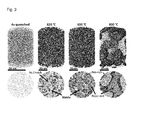
- Mo is increasingly enriched in the amorphous matrix (red areas in the reconstruction at 620 °C) until finally a secondary crystalline Mo-rich M 6 C phase is nucleated, highlighted by the isoconcentration surfaces at 22 at. % Mo in Figure 3 at 650 °C.
- Figure 3 shows the elemental mapping of Fe atoms for the sample annealed at 800 °C together with isoconcentration surfaces for 15 at. % of Cr and 32 at. % of Mo.
- Mo-rich and Cr-rich phases of size up to 50 nm, are clearly visible and their boundaries are indicated by the isoconcentration surfaces.
- composition of the Cr-rich region is in agreement with the (Fe,Cr) 23 (C,B) 6 phase identified by XRD, with a small amount of Mo atoms partially substituting some of the original metals.
- composition of the M 6 C phase corresponds to the data obtained from the Mo-rich region, with a small concentration of boron taking the place of carbon atoms.
- Annealing and crystallization at 800 °C then leads to concentrations of the two above main phases very close to the equilibrium predicted by thermodynamic calculations. Most important, a percolation of both crystalline phases throughout the fully crystallized sample is clearly visible.
- SAEM Scanning Auger Electron Microscopy
- Auger electron maps were recorded with a scanning Auger microprobe (Jeol JAMP-9500F).
- Figure 4A shows SAEM overlaying maps of O and N after heat treatment at 800 °C.
- a more detailed analysis of the Fe and Cr signatures of the recorded scans revealed the presence of Fe 2 O 3 and Cr 2 O 3 as main oxide components of the surface layer, while nitrogen, in smaller concentration, tends to form compounds with molybdenum.
- the corrosion behavior of the alloy at the different stages of crystallization was analyzed by electrochemical linear polarization sweeps in the anodic (positive) direction, in 0.1 M HCl solution, Figure 4C .
- Electrochemical measurements were performed using a scanning droplet cell with gold as counter electrode and a micro AglAgCl as reference electrode ( S. O. Klemm, Electrochim. Acta, 2011, 56, 4315 ). The sample was connected as working electode with an area of 374 ⁇ m -2 .
- Open circuit potential measurements were recorded for 100sec in 0.1 M HCl followed by linear polarization curves (in positive direction) starting -0.3 V with a scan rate of 2 mVs-1 at ambient pressure and temperature. All potentials were then referred to SHE.
- the fully amorphous alloy passivates spontaneously and shows the largest passivation range. Passivation occurs at low current density (less than 50 ⁇ A cm -2 ) only slightly higher than the presented by pure Cr, when compared in the plot.
- the breakdown potential reaches 1.1 V vs. SHE, linked to the massive dissolution of the elements present in the alloy, thus showing a highly protective film against acid solutions.
- An increasing annealing temperature to 620 °C leads to a moderately larger passive current and an initial dissolution peak with a clearly higher intensity than the as-quenched material.
- the polarization curve of the sample annealed at 650 °C presents rather a pseudopassive polarization curve with a breakdown potential near the fully amorphous state about 1.1 V.
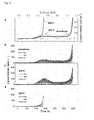
- the active samples (670°C and 800 °C) show at breakdown potential a dissolution stoichiometry with nearly 1:1 ratio of Fe and Mo with only little Cr dissolution ( Figure 5 ).
- This drastic change in dissolution stoichiometry therefore coincides with the sudden transition from a passive to an active state, indicating that an electrochemically, chromium depleted and Mo-rich phase dominates the corrosion behavior.
- the stoichiometry for this electrochemical weak phase in the nanocrystalline 800 °C sample agrees very well to the atomic ratio of the Mo-rich carbide found in APT (Table 2).
- phase separation and crystallization in the Fe 50 Cr 15 Mo 14 C 15 B 6 metallic glass causes formation of Mo-rich zones with low concentration of Cr, and this more unstable phase will dissolve preferentially.
- An interconnected network morphology as observed in the APT reconstructions at annealing temperature of 800°C ( Figure 3 ), would generate dissolution throughout the material causing an early breakdown.
- weak Mo-rich regions initiate the corrosion process.
- smaller crystal sizes, lack of percolation, and the remaining presence of the amorphous state block the dissolution.
- TEM Scanning Transmission Electron Microscopy
- EDX Energy Dispersive X-ray Spectroscopy
- TEM specimens were prepared from regions of interest using a FEI Helios Nanolab 600 dual-beam focused ion beam system operated at 30 kV. To minimize the effects of Ga ions beam damage, the final milling of the specimens was conducted at low ion energies (5 kV).
- TEM was performed using a Jeol JEM-2200FS operated at 200kV and equipped with Jeol EDX system for chemical analysis. Images with a high atomic number contrast were acquired using a high angle annular dark field (HAADF) detector in STEM mode.
- HAADF high angle annular dark field
- Fig. 2 shows the X-ray patterns of the alloy as-quenched (amorphous) and annealed for 20 min at 620 °C, 650 °C, 670 °C (partially crystalline) and 800 °C (fully crystalline).
- Fig. 3 shows the distribution of the metallic elements (Fe: green •, Cr: blue •, Mo: red •) in the as-quenched, partially and fully crystallized alloys. Isoconcentration surfaces of 22 at.% Mo and 16 at.% Cr highlight three different regions in the samples annealed at 620 °C and 650 °C. 32 at.% Mo and 15 at.% Cr are plotted for the crystallized alloy at 800 °C. Lower images are 2-5 nm thick cross-sections of the respective reconstructions.
- Fig. 4 shows the overlap of the individual SAEM maps after crystallization at 800 °C of
- Fig.5 shows Potential sweep data and online ICP-MS dissolution profiles
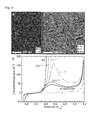
- FIG. 6 shows ( A ) APT reconstruction showing percolation of Mo-rich phases in the sample annealed at 800 °C (isoconcentration surfaces of 15 at.% Cr and 32 at.% Mo are presented in blue and red respectively). SEM images from the cross-section of the nano-crystalline alloy after galvanostatic polarization at 72 ⁇ A for 2000s (B) and 4000s (C). (D) HAADF-STEM micrograph after polarization for 4000s and (E) corresponding EDS map showing the molybdenum, iron and chromium distributions in the porous layer and the bulk. Examples of Mo-rich and Cr-rich areas are bordered by black and white dashed circles, respectively.
- the dissolution of the Mo-rich phases after crystallization were performed with either galvanostatic polarization or potentiostatic polarization.
- galvanostatic polarization a constant current is applied to the sample with usual values of 70-80 ⁇ A, dependent on the sample size.
- potentiostatic polarization a constant potential is applied with an usual voltage of 430-480mV vs. SHE, the potential is selected at the breakdown potential of the material.
- the sample is immersed in the acid or basic solution (0.1 M HCl or 0.1 M H 2 SO 4 for example) and the potential or current are applied for a defined period of time at the conditions explained before(typical immersion time is 1000-4000sec). With increasing immersion time the depth of the mesoporous structure will increase.
- the electrochemical measurements were carried out using a three electrode setup, where the sample is connected as working electrode, graphite and Ag/AgCl are used as counter electrode and reference electrode, respectively (any other counter and reference electrodes work as well).
Landscapes
- Chemical & Material Sciences (AREA)
- Engineering & Computer Science (AREA)
- Materials Engineering (AREA)
- Organic Chemistry (AREA)
- Chemical Kinetics & Catalysis (AREA)
- Mechanical Engineering (AREA)
- Metallurgy (AREA)
- Physics & Mathematics (AREA)
- Thermal Sciences (AREA)
- Crystallography & Structural Chemistry (AREA)
- Electrochemistry (AREA)
- Health & Medical Sciences (AREA)
- Plasma & Fusion (AREA)
- Toxicology (AREA)
- Catalysts (AREA)
- Manufacture Of Metal Powder And Suspensions Thereof (AREA)
Priority Applications (2)
| Application Number | Priority Date | Filing Date | Title |
|---|---|---|---|
| ES12168207.4T ES2686928T3 (es) | 2012-05-16 | 2012-05-16 | Proceso para la producción de un carburo mesoporoso |
| EP12168207.4A EP2664683B1 (fr) | 2012-05-16 | 2012-05-16 | Procédé de production de carbure mésoporeux |
Applications Claiming Priority (1)
| Application Number | Priority Date | Filing Date | Title |
|---|---|---|---|
| EP12168207.4A EP2664683B1 (fr) | 2012-05-16 | 2012-05-16 | Procédé de production de carbure mésoporeux |
Publications (2)
| Publication Number | Publication Date |
|---|---|
| EP2664683A1 true EP2664683A1 (fr) | 2013-11-20 |
| EP2664683B1 EP2664683B1 (fr) | 2018-07-04 |
Family
ID=46087553
Family Applications (1)
| Application Number | Title | Priority Date | Filing Date |
|---|---|---|---|
| EP12168207.4A Not-in-force EP2664683B1 (fr) | 2012-05-16 | 2012-05-16 | Procédé de production de carbure mésoporeux |
Country Status (2)
| Country | Link |
|---|---|
| EP (1) | EP2664683B1 (fr) |
| ES (1) | ES2686928T3 (fr) |
Cited By (2)
| Publication number | Priority date | Publication date | Assignee | Title |
|---|---|---|---|---|
| CN109338250A (zh) * | 2018-10-29 | 2019-02-15 | 昆明理工大学 | 一种铁基多孔非晶合金以及制备方法 |
| US20240043976A1 (en) * | 2019-12-31 | 2024-02-08 | Liquidmetal Coatings Enterprises, Llc. | System and method for applying high temperature corrosion resistant amorphous based coatings |
Citations (4)
| Publication number | Priority date | Publication date | Assignee | Title |
|---|---|---|---|---|
| US6258185B1 (en) * | 1999-05-25 | 2001-07-10 | Bechtel Bwxt Idaho, Llc | Methods of forming steel |
| WO2005116286A2 (fr) * | 2004-05-06 | 2005-12-08 | Battelle Energy Alliance, Llc | Procede de formation d'une surface durcie sur un substrat |
| WO2007029906A1 (fr) * | 2005-09-09 | 2007-03-15 | Korea Institute Of Science And Technology | Alliage amorphe et procede de fabrication associe |
| US20070267111A1 (en) * | 2006-05-19 | 2007-11-22 | Korea Institute Of Science And Technology | Metallic glass with nanometer-sized pores and method for manufacturing the same |
-
2012
- 2012-05-16 EP EP12168207.4A patent/EP2664683B1/fr not_active Not-in-force
- 2012-05-16 ES ES12168207.4T patent/ES2686928T3/es active Active
Patent Citations (4)
| Publication number | Priority date | Publication date | Assignee | Title |
|---|---|---|---|---|
| US6258185B1 (en) * | 1999-05-25 | 2001-07-10 | Bechtel Bwxt Idaho, Llc | Methods of forming steel |
| WO2005116286A2 (fr) * | 2004-05-06 | 2005-12-08 | Battelle Energy Alliance, Llc | Procede de formation d'une surface durcie sur un substrat |
| WO2007029906A1 (fr) * | 2005-09-09 | 2007-03-15 | Korea Institute Of Science And Technology | Alliage amorphe et procede de fabrication associe |
| US20070267111A1 (en) * | 2006-05-19 | 2007-11-22 | Korea Institute Of Science And Technology | Metallic glass with nanometer-sized pores and method for manufacturing the same |
Non-Patent Citations (24)
| Title |
|---|
| A. A. KUNDIG, ACTA MATER., vol. 52, 2004, pages 2441 |
| A. GEBERT; A.A. KUND!G; L. SCHULTZ; H. HONO, SCR. MATER., vol. 51, 2004, pages 961 |
| A. GEBERT; A.A. KUNDIG; L. SCHULTZ; H. HONO, SCR. MATER., vol. 51, 2004, pages 961 |
| A. KRAUPNER ET AL., J. MATER. CHEM., vol. 20, 2010, pages 6019 |
| A. KÜNDIG, ACTA MATER., vol. 52, 2004, pages 2441 |
| A. L. GREER, SCIENCE, vol. 267, 1995, pages 1947 |
| A. TAKEUCHI; A. INOUE, MAT. TRANS. JIM, vol. 41, 2000, pages 1372 |
| ARNBERG L ET AL: "New heat resistant tool materials produced from devitrified amorphous Fe@?Cr@?Mo@?C@?B and Fe@?Cr@?Mo@?C@?V powders", MATERIALS SCIENCE AND ENGINEERING A: STRUCTURAL MATERIALS:PROPERTIES, MICROSTRUCTURE & PROCESSING, LAUSANNE, CH, vol. 133, 15 March 1991 (1991-03-15), pages 288 - 291, XP024167121, ISSN: 0921-5093, [retrieved on 19910315], DOI: 10.1016/0921-5093(91)90071-T * |
| BASER ET AL: "Fe-based bulk metallic glasses with Y addition", JOURNAL OF ALLOYS AND COMPOUNDS, ELSEVIER SEQUOIA, LAUSANNE, CH, vol. 434-435, 29 March 2007 (2007-03-29), pages 176 - 179, XP022008629, ISSN: 0925-8388, DOI: 10.1016/J.JALLCOM.2006.08.190 * |
| H. H. LIEBERMANN, IEEE TRANSACTIONS ON MAGNETICS, vol. 12, 1976, pages 921 |
| INOUE A ET AL: "Preparation of Fe@?Cr@?Mo@?C amorphous powders and microstructure and mechanical properties of their hot-pressed products", MATERIALS SCIENCE ENGINEERING, ELSEVIER SEQUOIA, LAUSANNE, CH, vol. 95, November 1987 (1987-11-01), pages 101 - 114, XP025862517, ISSN: 0025-5416, [retrieved on 19871101], DOI: 10.1016/0025-5416(87)90502-7 * |
| J. JAYARAJ, INTERMETALLICS, vol. 17, 2009, pages 1120 - 1123 |
| J. JAYARAJ, SCR. MATER., vol. 55, 2006, pages 1063 - 1066 |
| JAYARAJ, INTERMETALLICS, vol. 17, 2009, pages 1120 - 1123 |
| K. HASHIMOTO, CORROSION, vol. 58, 2002, pages 715 |
| K. THOMPSON; D. LAWRENCE; D. J. LARSON; J. D. OLSON; T. F. KELLY; B. GORMAN, ULTRAMICROSCOPY, vol. 107, 2007, pages 131 |
| KRAUPNER ET AL., J. MATER. CHEM., vol. 20, 2010, pages 6019 |
| M. K. MILLER; K. F. RUSSELL; G. B. THOMPSON, ULTRAMICROSCOPY, vol. 102, 2005, pages 287 |
| MOVAHEDI B ET AL: "Study on nanocrystallization and amorphization in Fe-Cr-Mo-B-P-Si-C system during mechanical alloying", MATERIALS SCIENCE AND ENGINEERING B, ELSEVIER SEQUOIA, LAUSANNE, CH, vol. 172, no. 1, 15 August 2010 (2010-08-15), pages 50 - 54, XP027107427, ISSN: 0921-5107, [retrieved on 20100625] * |
| S. J. PANG, MATER. TRANS. JIM, vol. 43, 2002, pages 2137 |
| S. K. GADE ET AL., ADV. MATER., vol. 23, 2011, pages 3585 |
| S. O. KLEMM, ELECTROCHIM. ACTA, vol. 56, 2011, pages 4315 |
| V. PONAMBALAM, J. MATER. RES., vol. 19, 2004, pages 1320 |
| YANG Y ET AL: "Effects of crystallization on the corrosion resistance of Fe-based amorphous coatings", CORROSION SCIENCE, OXFORD, GB, vol. 59, 6 February 2012 (2012-02-06), pages 10 - 19, XP028417922, ISSN: 0010-938X, [retrieved on 20120223], DOI: 10.1016/J.CORSCI.2012.02.003 * |
Cited By (3)
| Publication number | Priority date | Publication date | Assignee | Title |
|---|---|---|---|---|
| CN109338250A (zh) * | 2018-10-29 | 2019-02-15 | 昆明理工大学 | 一种铁基多孔非晶合金以及制备方法 |
| US20240043976A1 (en) * | 2019-12-31 | 2024-02-08 | Liquidmetal Coatings Enterprises, Llc. | System and method for applying high temperature corrosion resistant amorphous based coatings |
| US12473624B2 (en) * | 2019-12-31 | 2025-11-18 | Integrated Global Services, Inc. | System and method for applying high temperature corrosion resistant amorphous based coatings |
Also Published As
| Publication number | Publication date |
|---|---|
| ES2686928T3 (es) | 2018-10-22 |
| EP2664683B1 (fr) | 2018-07-04 |
Similar Documents
| Publication | Publication Date | Title |
|---|---|---|
| Wei et al. | Corrosion mechanism of eutectic high-entropy alloy induced by micro-galvanic corrosion in sulfuric acid solution | |
| US8034200B2 (en) | Metallic glass with nanometer-sized pores and method for manufacturing the same | |
| Blanc et al. | Modelling the corrosion behaviour of Al2CuMg coarse particles in copper-rich aluminium alloys | |
| Duarte et al. | Crystallization, phase evolution and corrosion of Fe-based metallic glasses: An atomic-scale structural and chemical characterization study | |
| EP1230412A2 (fr) | Electrodes en metal amorphe/verre metallique pour procedes electrochimiques | |
| Li et al. | Improved passivation ability via tuning dislocation cell substructures for FeCoCrNiMn high-entropy alloy fabricated by laser powder bed fusion | |
| Dan et al. | Nanoporous palladium fabricated from an amorphous Pd42. 5Cu30Ni7. 5P20 precursor and its ethanol electro-oxidation performance | |
| Hakamada et al. | Preparation of nanoporous palladium by dealloying: Anodic polarization behaviors of Pd-M (M= Fe, Co, Ni) alloys | |
| Wang et al. | Formation mechanism and characterization of immiscible nanoporous binary Cu–Ag alloys with excellent surface-enhanced Raman scattering performance by chemical dealloying of glassy precursors | |
| Zeng et al. | Preparation of nanoporous CoCr alloy by dealloying CrCoNi medium entropy alloys | |
| Alves et al. | Corrosion behavior of nanocrystalline (Ni70Mo30) 90B10 alloys in 0.8 M KOH solution | |
| Paschalidou et al. | Partially and fully de-alloyed glassy ribbons based on Au: Application in methanol electro-oxidation studies | |
| Ge et al. | An investigation into the carbon nucleation and growth on a nickel substrate in LiCl–Li2CO3 melts | |
| Dan et al. | Mechanism of active dissolution of nanocrystalline FeSiBPCu soft magnetic alloys | |
| EP2664683B1 (fr) | Procédé de production de carbure mésoporeux | |
| Ma et al. | Influence of dealloying solution on the microstructure of nanoporous copper through chemical dealloying of Al75Cu25 ribbons | |
| Hyun et al. | Formation of nanoporous Cu-Ag by dealloying Mg-Cu-Y-Ag amorphous alloys and its electrocatalyst oxidation property | |
| Qin et al. | Corrosion behavior of Ti-based metallic glasses | |
| Olszok et al. | Synergizing ICP-MS, STEM-EDXS, and SMPS single particle analytics exemplified by superlattice L10 Pt/Fe aerosol nanoparticles produced by spark ablation | |
| Denis et al. | Microstructure and electrochemical properties of nanoporous gold produced by dealloying Au-based thin film nanoglass | |
| Horn et al. | Complex microshaping of bulk metallic glass surfaces by electrochemical means | |
| Liu et al. | Monolithic nanoporous copper ribbons from Mg-Cu alloys with copper contents below 33 at.%: fabrication, structure evolution and coarsening behavior along the thickness direction | |
| Gu et al. | Fabrication of nanoporous manganese by laser cladding and selective electrochemical de-alloying | |
| Yu et al. | Composition and corrosion resistance of palladium film on 316L stainless steel by brush plating | |
| Wolff et al. | Effect of surface pretreatment on the electrochemical activity of a glass-forming Zr–Ti–Al–Cu–Ni alloy |
Legal Events
| Date | Code | Title | Description |
|---|---|---|---|
| PUAI | Public reference made under article 153(3) epc to a published international application that has entered the european phase |
Free format text: ORIGINAL CODE: 0009012 |
|
| AK | Designated contracting states |
Kind code of ref document: A1 Designated state(s): AL AT BE BG CH CY CZ DE DK EE ES FI FR GB GR HR HU IE IS IT LI LT LU LV MC MK MT NL NO PL PT RO RS SE SI SK SM TR |
|
| AX | Request for extension of the european patent |
Extension state: BA ME |
|
| RBV | Designated contracting states (corrected) |
Designated state(s): AL AT BE BG CH CY CZ DE DK EE ES FI FR GB GR HR HU IE IS IT LI LT LU LV MC MK MT NL NO PL PT RO RS SE SI SK SM TR |
|
| 17P | Request for examination filed |
Effective date: 20140519 |
|
| REG | Reference to a national code |
Ref country code: DE Ref legal event code: R079 Ref document number: 602012047997 Country of ref document: DE Free format text: PREVIOUS MAIN CLASS: C21D0006000000 Ipc: C22C0033000000 |
|
| GRAP | Despatch of communication of intention to grant a patent |
Free format text: ORIGINAL CODE: EPIDOSNIGR1 |
|
| STAA | Information on the status of an ep patent application or granted ep patent |
Free format text: STATUS: GRANT OF PATENT IS INTENDED |
|
| RIC1 | Information provided on ipc code assigned before grant |
Ipc: B01J 35/10 20060101ALI20171214BHEP Ipc: C22C 33/00 20060101AFI20171214BHEP Ipc: C22C 45/02 20060101ALI20171214BHEP Ipc: C21D 6/00 20060101ALI20171214BHEP Ipc: B01J 35/00 20060101ALI20171214BHEP Ipc: B01J 37/08 20060101ALI20171214BHEP Ipc: B01J 37/34 20060101ALI20171214BHEP Ipc: B01J 27/22 20060101ALI20171214BHEP |
|
| INTG | Intention to grant announced |
Effective date: 20180103 |
|
| GRAS | Grant fee paid |
Free format text: ORIGINAL CODE: EPIDOSNIGR3 |
|
| GRAA | (expected) grant |
Free format text: ORIGINAL CODE: 0009210 |
|
| STAA | Information on the status of an ep patent application or granted ep patent |
Free format text: STATUS: THE PATENT HAS BEEN GRANTED |
|
| AK | Designated contracting states |
Kind code of ref document: B1 Designated state(s): AL AT BE BG CH CY CZ DE DK EE ES FI FR GB GR HR HU IE IS IT LI LT LU LV MC MK MT NL NO PL PT RO RS SE SI SK SM TR |
|
| REG | Reference to a national code |
Ref country code: GB Ref legal event code: FG4D |
|
| REG | Reference to a national code |
Ref country code: CH Ref legal event code: EP |
|
| REG | Reference to a national code |
Ref country code: AT Ref legal event code: REF Ref document number: 1014595 Country of ref document: AT Kind code of ref document: T Effective date: 20180715 |
|
| REG | Reference to a national code |
Ref country code: IE Ref legal event code: FG4D |
|
| REG | Reference to a national code |
Ref country code: DE Ref legal event code: R096 Ref document number: 602012047997 Country of ref document: DE |
|
| REG | Reference to a national code |
Ref country code: ES Ref legal event code: FG2A Ref document number: 2686928 Country of ref document: ES Kind code of ref document: T3 Effective date: 20181022 |
|
| REG | Reference to a national code |
Ref country code: NL Ref legal event code: MP Effective date: 20180704 |
|
| REG | Reference to a national code |
Ref country code: LT Ref legal event code: MG4D |
|
| REG | Reference to a national code |
Ref country code: AT Ref legal event code: MK05 Ref document number: 1014595 Country of ref document: AT Kind code of ref document: T Effective date: 20180704 |
|
| PG25 | Lapsed in a contracting state [announced via postgrant information from national office to epo] |
Ref country code: NL Free format text: LAPSE BECAUSE OF FAILURE TO SUBMIT A TRANSLATION OF THE DESCRIPTION OR TO PAY THE FEE WITHIN THE PRESCRIBED TIME-LIMIT Effective date: 20180704 |
|
| PG25 | Lapsed in a contracting state [announced via postgrant information from national office to epo] |
Ref country code: FI Free format text: LAPSE BECAUSE OF FAILURE TO SUBMIT A TRANSLATION OF THE DESCRIPTION OR TO PAY THE FEE WITHIN THE PRESCRIBED TIME-LIMIT Effective date: 20180704 Ref country code: BG Free format text: LAPSE BECAUSE OF FAILURE TO SUBMIT A TRANSLATION OF THE DESCRIPTION OR TO PAY THE FEE WITHIN THE PRESCRIBED TIME-LIMIT Effective date: 20181004 Ref country code: CZ Free format text: LAPSE BECAUSE OF FAILURE TO SUBMIT A TRANSLATION OF THE DESCRIPTION OR TO PAY THE FEE WITHIN THE PRESCRIBED TIME-LIMIT Effective date: 20180704 Ref country code: LT Free format text: LAPSE BECAUSE OF FAILURE TO SUBMIT A TRANSLATION OF THE DESCRIPTION OR TO PAY THE FEE WITHIN THE PRESCRIBED TIME-LIMIT Effective date: 20180704 Ref country code: PL Free format text: LAPSE BECAUSE OF FAILURE TO SUBMIT A TRANSLATION OF THE DESCRIPTION OR TO PAY THE FEE WITHIN THE PRESCRIBED TIME-LIMIT Effective date: 20180704 Ref country code: SE Free format text: LAPSE BECAUSE OF FAILURE TO SUBMIT A TRANSLATION OF THE DESCRIPTION OR TO PAY THE FEE WITHIN THE PRESCRIBED TIME-LIMIT Effective date: 20180704 Ref country code: AT Free format text: LAPSE BECAUSE OF FAILURE TO SUBMIT A TRANSLATION OF THE DESCRIPTION OR TO PAY THE FEE WITHIN THE PRESCRIBED TIME-LIMIT Effective date: 20180704 Ref country code: RS Free format text: LAPSE BECAUSE OF FAILURE TO SUBMIT A TRANSLATION OF THE DESCRIPTION OR TO PAY THE FEE WITHIN THE PRESCRIBED TIME-LIMIT Effective date: 20180704 Ref country code: NO Free format text: LAPSE BECAUSE OF FAILURE TO SUBMIT A TRANSLATION OF THE DESCRIPTION OR TO PAY THE FEE WITHIN THE PRESCRIBED TIME-LIMIT Effective date: 20181004 Ref country code: IS Free format text: LAPSE BECAUSE OF FAILURE TO SUBMIT A TRANSLATION OF THE DESCRIPTION OR TO PAY THE FEE WITHIN THE PRESCRIBED TIME-LIMIT Effective date: 20181104 |
|
| PG25 | Lapsed in a contracting state [announced via postgrant information from national office to epo] |
Ref country code: HR Free format text: LAPSE BECAUSE OF FAILURE TO SUBMIT A TRANSLATION OF THE DESCRIPTION OR TO PAY THE FEE WITHIN THE PRESCRIBED TIME-LIMIT Effective date: 20180704 Ref country code: LV Free format text: LAPSE BECAUSE OF FAILURE TO SUBMIT A TRANSLATION OF THE DESCRIPTION OR TO PAY THE FEE WITHIN THE PRESCRIBED TIME-LIMIT Effective date: 20180704 Ref country code: AL Free format text: LAPSE BECAUSE OF FAILURE TO SUBMIT A TRANSLATION OF THE DESCRIPTION OR TO PAY THE FEE WITHIN THE PRESCRIBED TIME-LIMIT Effective date: 20180704 |
|
| REG | Reference to a national code |
Ref country code: DE Ref legal event code: R097 Ref document number: 602012047997 Country of ref document: DE |
|
| PG25 | Lapsed in a contracting state [announced via postgrant information from national office to epo] |
Ref country code: RO Free format text: LAPSE BECAUSE OF FAILURE TO SUBMIT A TRANSLATION OF THE DESCRIPTION OR TO PAY THE FEE WITHIN THE PRESCRIBED TIME-LIMIT Effective date: 20180704 Ref country code: IT Free format text: LAPSE BECAUSE OF FAILURE TO SUBMIT A TRANSLATION OF THE DESCRIPTION OR TO PAY THE FEE WITHIN THE PRESCRIBED TIME-LIMIT Effective date: 20180704 Ref country code: EE Free format text: LAPSE BECAUSE OF FAILURE TO SUBMIT A TRANSLATION OF THE DESCRIPTION OR TO PAY THE FEE WITHIN THE PRESCRIBED TIME-LIMIT Effective date: 20180704 |
|
| PLBE | No opposition filed within time limit |
Free format text: ORIGINAL CODE: 0009261 |
|
| STAA | Information on the status of an ep patent application or granted ep patent |
Free format text: STATUS: NO OPPOSITION FILED WITHIN TIME LIMIT |
|
| PG25 | Lapsed in a contracting state [announced via postgrant information from national office to epo] |
Ref country code: SK Free format text: LAPSE BECAUSE OF FAILURE TO SUBMIT A TRANSLATION OF THE DESCRIPTION OR TO PAY THE FEE WITHIN THE PRESCRIBED TIME-LIMIT Effective date: 20180704 Ref country code: SM Free format text: LAPSE BECAUSE OF FAILURE TO SUBMIT A TRANSLATION OF THE DESCRIPTION OR TO PAY THE FEE WITHIN THE PRESCRIBED TIME-LIMIT Effective date: 20180704 Ref country code: DK Free format text: LAPSE BECAUSE OF FAILURE TO SUBMIT A TRANSLATION OF THE DESCRIPTION OR TO PAY THE FEE WITHIN THE PRESCRIBED TIME-LIMIT Effective date: 20180704 |
|
| 26N | No opposition filed |
Effective date: 20190405 |
|
| PG25 | Lapsed in a contracting state [announced via postgrant information from national office to epo] |
Ref country code: SI Free format text: LAPSE BECAUSE OF FAILURE TO SUBMIT A TRANSLATION OF THE DESCRIPTION OR TO PAY THE FEE WITHIN THE PRESCRIBED TIME-LIMIT Effective date: 20180704 |
|
| REG | Reference to a national code |
Ref country code: CH Ref legal event code: PL |
|
| GBPC | Gb: european patent ceased through non-payment of renewal fee |
Effective date: 20190516 |
|
| PG25 | Lapsed in a contracting state [announced via postgrant information from national office to epo] |
Ref country code: LI Free format text: LAPSE BECAUSE OF NON-PAYMENT OF DUE FEES Effective date: 20190531 Ref country code: MC Free format text: LAPSE BECAUSE OF FAILURE TO SUBMIT A TRANSLATION OF THE DESCRIPTION OR TO PAY THE FEE WITHIN THE PRESCRIBED TIME-LIMIT Effective date: 20180704 Ref country code: CH Free format text: LAPSE BECAUSE OF NON-PAYMENT OF DUE FEES Effective date: 20190531 |
|
| REG | Reference to a national code |
Ref country code: BE Ref legal event code: MM Effective date: 20190531 |
|
| PG25 | Lapsed in a contracting state [announced via postgrant information from national office to epo] |
Ref country code: LU Free format text: LAPSE BECAUSE OF NON-PAYMENT OF DUE FEES Effective date: 20190516 |
|
| PG25 | Lapsed in a contracting state [announced via postgrant information from national office to epo] |
Ref country code: TR Free format text: LAPSE BECAUSE OF FAILURE TO SUBMIT A TRANSLATION OF THE DESCRIPTION OR TO PAY THE FEE WITHIN THE PRESCRIBED TIME-LIMIT Effective date: 20180704 |
|
| PG25 | Lapsed in a contracting state [announced via postgrant information from national office to epo] |
Ref country code: GB Free format text: LAPSE BECAUSE OF NON-PAYMENT OF DUE FEES Effective date: 20190516 Ref country code: IE Free format text: LAPSE BECAUSE OF NON-PAYMENT OF DUE FEES Effective date: 20190516 |
|
| PG25 | Lapsed in a contracting state [announced via postgrant information from national office to epo] |
Ref country code: BE Free format text: LAPSE BECAUSE OF NON-PAYMENT OF DUE FEES Effective date: 20190531 |
|
| PG25 | Lapsed in a contracting state [announced via postgrant information from national office to epo] |
Ref country code: PT Free format text: LAPSE BECAUSE OF FAILURE TO SUBMIT A TRANSLATION OF THE DESCRIPTION OR TO PAY THE FEE WITHIN THE PRESCRIBED TIME-LIMIT Effective date: 20181105 Ref country code: FR Free format text: LAPSE BECAUSE OF NON-PAYMENT OF DUE FEES Effective date: 20190531 |
|
| PG25 | Lapsed in a contracting state [announced via postgrant information from national office to epo] |
Ref country code: CY Free format text: LAPSE BECAUSE OF FAILURE TO SUBMIT A TRANSLATION OF THE DESCRIPTION OR TO PAY THE FEE WITHIN THE PRESCRIBED TIME-LIMIT Effective date: 20180704 |
|
| PG25 | Lapsed in a contracting state [announced via postgrant information from national office to epo] |
Ref country code: GR Free format text: LAPSE BECAUSE OF FAILURE TO SUBMIT A TRANSLATION OF THE DESCRIPTION OR TO PAY THE FEE WITHIN THE PRESCRIBED TIME-LIMIT Effective date: 20180704 |
|
| PG25 | Lapsed in a contracting state [announced via postgrant information from national office to epo] |
Ref country code: HU Free format text: LAPSE BECAUSE OF FAILURE TO SUBMIT A TRANSLATION OF THE DESCRIPTION OR TO PAY THE FEE WITHIN THE PRESCRIBED TIME-LIMIT; INVALID AB INITIO Effective date: 20120516 Ref country code: MT Free format text: LAPSE BECAUSE OF FAILURE TO SUBMIT A TRANSLATION OF THE DESCRIPTION OR TO PAY THE FEE WITHIN THE PRESCRIBED TIME-LIMIT Effective date: 20180704 |
|
| REG | Reference to a national code |
Ref country code: DE Ref legal event code: R082 Ref document number: 602012047997 Country of ref document: DE Representative=s name: JANKE SCHOLL PATENTANWAELTE PARTG MBB, DE |
|
| PG25 | Lapsed in a contracting state [announced via postgrant information from national office to epo] |
Ref country code: MK Free format text: LAPSE BECAUSE OF FAILURE TO SUBMIT A TRANSLATION OF THE DESCRIPTION OR TO PAY THE FEE WITHIN THE PRESCRIBED TIME-LIMIT Effective date: 20180704 |
|
| PGFP | Annual fee paid to national office [announced via postgrant information from national office to epo] |
Ref country code: DE Payment date: 20240531 Year of fee payment: 13 |
|
| PGFP | Annual fee paid to national office [announced via postgrant information from national office to epo] |
Ref country code: ES Payment date: 20240614 Year of fee payment: 13 |
|
| REG | Reference to a national code |
Ref country code: DE Ref legal event code: R081 Ref document number: 602012047997 Country of ref document: DE Owner name: UNIVERSITAT POLITECNICA DE CATALUNYA, ES Free format text: FORMER OWNERS: MAX-PLANCK-INSTITUT FUER EISENFORSCHUNG GMBH, 40237 DUESSELDORF, DE; UNIVERSITAT POLITECNICA DE CATALUNYA, BARCELONA, ES Ref country code: DE Ref legal event code: R081 Ref document number: 602012047997 Country of ref document: DE Owner name: MAX-PLANCK-INSTITUT FUER NACHHALTIGE MATERIALI, DE Free format text: FORMER OWNERS: MAX-PLANCK-INSTITUT FUER EISENFORSCHUNG GMBH, 40237 DUESSELDORF, DE; UNIVERSITAT POLITECNICA DE CATALUNYA, BARCELONA, ES |
|
| REG | Reference to a national code |
Ref country code: DE Ref legal event code: R119 Ref document number: 602012047997 Country of ref document: DE |
|
| PG25 | Lapsed in a contracting state [announced via postgrant information from national office to epo] |
Ref country code: DE Free format text: LAPSE BECAUSE OF NON-PAYMENT OF DUE FEES Effective date: 20251202 |
|
| REG | Reference to a national code |
Ref country code: ES Ref legal event code: FD2A Effective date: 20260630 |
|
| PG25 | Lapsed in a contracting state [announced via postgrant information from national office to epo] |
Ref country code: ES Free format text: LAPSE BECAUSE OF NON-PAYMENT OF DUE FEES Effective date: 20250517 |