EP2665459B1 - Automatisiertes dosiersystem zur portionierten abgabe von medikamenten - Google Patents
Automatisiertes dosiersystem zur portionierten abgabe von medikamenten Download PDFInfo
- Publication number
- EP2665459B1 EP2665459B1 EP12701490.0A EP12701490A EP2665459B1 EP 2665459 B1 EP2665459 B1 EP 2665459B1 EP 12701490 A EP12701490 A EP 12701490A EP 2665459 B1 EP2665459 B1 EP 2665459B1
- Authority
- EP
- European Patent Office
- Prior art keywords
- cell
- cells
- cutting
- wafer
- knife
- Prior art date
- Legal status (The legal status is an assumption and is not a legal conclusion. Google has not performed a legal analysis and makes no representation as to the accuracy of the status listed.)
- Revoked
Links
- 239000003814 drug Substances 0.000 title claims description 111
- 229940079593 drug Drugs 0.000 title description 100
- 238000005520 cutting process Methods 0.000 claims description 80
- 230000033001 locomotion Effects 0.000 claims description 30
- 238000000034 method Methods 0.000 claims description 17
- 238000002360 preparation method Methods 0.000 claims description 14
- 235000012431 wafers Nutrition 0.000 description 100
- 239000003292 glue Substances 0.000 description 40
- 238000004806 packaging method and process Methods 0.000 description 37
- 230000009466 transformation Effects 0.000 description 23
- 238000003860 storage Methods 0.000 description 17
- 238000012545 processing Methods 0.000 description 15
- 238000000926 separation method Methods 0.000 description 12
- 238000006073 displacement reaction Methods 0.000 description 10
- 238000009517 secondary packaging Methods 0.000 description 10
- 238000009516 primary packaging Methods 0.000 description 9
- 238000004519 manufacturing process Methods 0.000 description 8
- 238000004026 adhesive bonding Methods 0.000 description 7
- 230000000694 effects Effects 0.000 description 7
- 239000000463 material Substances 0.000 description 7
- 238000007639 printing Methods 0.000 description 7
- 210000003456 pulmonary alveoli Anatomy 0.000 description 7
- 230000003750 conditioning effect Effects 0.000 description 6
- 239000012943 hotmelt Substances 0.000 description 6
- 238000012546 transfer Methods 0.000 description 6
- 230000008569 process Effects 0.000 description 5
- 239000004831 Hot glue Substances 0.000 description 4
- XAGFODPZIPBFFR-UHFFFAOYSA-N aluminium Chemical compound [Al] XAGFODPZIPBFFR-UHFFFAOYSA-N 0.000 description 4
- 229910052782 aluminium Inorganic materials 0.000 description 4
- 238000013459 approach Methods 0.000 description 4
- 238000000605 extraction Methods 0.000 description 4
- 230000000474 nursing effect Effects 0.000 description 4
- 239000006187 pill Substances 0.000 description 4
- 238000003825 pressing Methods 0.000 description 4
- 239000002699 waste material Substances 0.000 description 4
- 239000004480 active ingredient Substances 0.000 description 3
- 230000008901 benefit Effects 0.000 description 3
- 230000003749 cleanliness Effects 0.000 description 3
- 238000010276 construction Methods 0.000 description 3
- 230000006378 damage Effects 0.000 description 3
- 238000013461 design Methods 0.000 description 3
- 238000005259 measurement Methods 0.000 description 3
- 238000002844 melting Methods 0.000 description 3
- 230000008018 melting Effects 0.000 description 3
- 239000000203 mixture Substances 0.000 description 3
- 239000000047 product Substances 0.000 description 3
- 238000013519 translation Methods 0.000 description 3
- 238000011144 upstream manufacturing Methods 0.000 description 3
- 206010048232 Yawning Diseases 0.000 description 2
- 230000001133 acceleration Effects 0.000 description 2
- 239000000853 adhesive Substances 0.000 description 2
- 230000001070 adhesive effect Effects 0.000 description 2
- 230000033228 biological regulation Effects 0.000 description 2
- 239000000969 carrier Substances 0.000 description 2
- 230000008859 change Effects 0.000 description 2
- 238000012790 confirmation Methods 0.000 description 2
- 238000011109 contamination Methods 0.000 description 2
- 239000011888 foil Substances 0.000 description 2
- 238000007373 indentation Methods 0.000 description 2
- 238000012423 maintenance Methods 0.000 description 2
- 238000012986 modification Methods 0.000 description 2
- 230000004048 modification Effects 0.000 description 2
- 230000003287 optical effect Effects 0.000 description 2
- 238000012856 packing Methods 0.000 description 2
- 238000011084 recovery Methods 0.000 description 2
- 230000004043 responsiveness Effects 0.000 description 2
- 238000004513 sizing Methods 0.000 description 2
- 238000012360 testing method Methods 0.000 description 2
- 238000000844 transformation Methods 0.000 description 2
- 241001644893 Entandrophragma utile Species 0.000 description 1
- 208000027418 Wounds and injury Diseases 0.000 description 1
- 238000009825 accumulation Methods 0.000 description 1
- 230000009471 action Effects 0.000 description 1
- 230000001154 acute effect Effects 0.000 description 1
- 239000002390 adhesive tape Substances 0.000 description 1
- 230000000712 assembly Effects 0.000 description 1
- 238000000429 assembly Methods 0.000 description 1
- 230000015572 biosynthetic process Effects 0.000 description 1
- 238000006243 chemical reaction Methods 0.000 description 1
- 238000004140 cleaning Methods 0.000 description 1
- 230000001186 cumulative effect Effects 0.000 description 1
- 238000013479 data entry Methods 0.000 description 1
- 230000007547 defect Effects 0.000 description 1
- 230000000994 depressogenic effect Effects 0.000 description 1
- 238000001514 detection method Methods 0.000 description 1
- 208000037265 diseases, disorders, signs and symptoms Diseases 0.000 description 1
- 210000003811 finger Anatomy 0.000 description 1
- 230000006870 function Effects 0.000 description 1
- 230000005484 gravity Effects 0.000 description 1
- 230000036541 health Effects 0.000 description 1
- 230000017525 heat dissipation Effects 0.000 description 1
- 230000006872 improvement Effects 0.000 description 1
- 208000014674 injury Diseases 0.000 description 1
- 238000007641 inkjet printing Methods 0.000 description 1
- 238000003780 insertion Methods 0.000 description 1
- 230000037431 insertion Effects 0.000 description 1
- 238000012432 intermediate storage Methods 0.000 description 1
- 238000003698 laser cutting Methods 0.000 description 1
- 239000007788 liquid Substances 0.000 description 1
- 238000007726 management method Methods 0.000 description 1
- 239000003550 marker Substances 0.000 description 1
- 239000011159 matrix material Substances 0.000 description 1
- 238000002483 medication Methods 0.000 description 1
- 238000012544 monitoring process Methods 0.000 description 1
- 239000004081 narcotic agent Substances 0.000 description 1
- 230000008520 organization Effects 0.000 description 1
- 238000009512 pharmaceutical packaging Methods 0.000 description 1
- 230000035479 physiological effects, processes and functions Effects 0.000 description 1
- 238000004321 preservation Methods 0.000 description 1
- 230000001681 protective effect Effects 0.000 description 1
- 238000004080 punching Methods 0.000 description 1
- 230000003014 reinforcing effect Effects 0.000 description 1
- 230000002040 relaxant effect Effects 0.000 description 1
- 238000012857 repacking Methods 0.000 description 1
- 230000003252 repetitive effect Effects 0.000 description 1
- 230000008672 reprogramming Effects 0.000 description 1
- 230000000717 retained effect Effects 0.000 description 1
- 230000002441 reversible effect Effects 0.000 description 1
- 229920002379 silicone rubber Polymers 0.000 description 1
- 238000004088 simulation Methods 0.000 description 1
- 239000007921 spray Substances 0.000 description 1
- 238000005507 spraying Methods 0.000 description 1
- 238000000859 sublimation Methods 0.000 description 1
- 230000008022 sublimation Effects 0.000 description 1
- 239000000126 substance Substances 0.000 description 1
- 239000013589 supplement Substances 0.000 description 1
- 230000001629 suppression Effects 0.000 description 1
- 210000003813 thumb Anatomy 0.000 description 1
- 230000017105 transposition Effects 0.000 description 1
- 239000003190 viscoelastic substance Substances 0.000 description 1
- 238000003466 welding Methods 0.000 description 1
Images


Classifications
-
- B—PERFORMING OPERATIONS; TRANSPORTING
- B26—HAND CUTTING TOOLS; CUTTING; SEVERING
- B26D—CUTTING; DETAILS COMMON TO MACHINES FOR PERFORATING, PUNCHING, CUTTING-OUT, STAMPING-OUT OR SEVERING
- B26D7/00—Details of apparatus for cutting, cutting-out, stamping-out, punching, perforating, or severing by means other than cutting
- B26D7/01—Means for holding or positioning work
-
- B—PERFORMING OPERATIONS; TRANSPORTING
- B26—HAND CUTTING TOOLS; CUTTING; SEVERING
- B26D—CUTTING; DETAILS COMMON TO MACHINES FOR PERFORATING, PUNCHING, CUTTING-OUT, STAMPING-OUT OR SEVERING
- B26D1/00—Cutting through work characterised by the nature or movement of the cutting member or particular materials not otherwise provided for; Apparatus or machines therefor; Cutting members therefor
- B26D1/0006—Cutting members therefor
-
- G—PHYSICS
- G16—INFORMATION AND COMMUNICATION TECHNOLOGY [ICT] SPECIALLY ADAPTED FOR SPECIFIC APPLICATION FIELDS
- G16H—HEALTHCARE INFORMATICS, i.e. INFORMATION AND COMMUNICATION TECHNOLOGY [ICT] SPECIALLY ADAPTED FOR THE HANDLING OR PROCESSING OF MEDICAL OR HEALTHCARE DATA
- G16H20/00—ICT specially adapted for therapies or health-improving plans, e.g. for handling prescriptions, for steering therapy or for monitoring patient compliance
- G16H20/10—ICT specially adapted for therapies or health-improving plans, e.g. for handling prescriptions, for steering therapy or for monitoring patient compliance relating to drugs or medications, e.g. for ensuring correct administration to patients
- G16H20/13—ICT specially adapted for therapies or health-improving plans, e.g. for handling prescriptions, for steering therapy or for monitoring patient compliance relating to drugs or medications, e.g. for ensuring correct administration to patients delivered from dispensers
-
- B—PERFORMING OPERATIONS; TRANSPORTING
- B26—HAND CUTTING TOOLS; CUTTING; SEVERING
- B26D—CUTTING; DETAILS COMMON TO MACHINES FOR PERFORATING, PUNCHING, CUTTING-OUT, STAMPING-OUT OR SEVERING
- B26D1/00—Cutting through work characterised by the nature or movement of the cutting member or particular materials not otherwise provided for; Apparatus or machines therefor; Cutting members therefor
- B26D1/01—Cutting through work characterised by the nature or movement of the cutting member or particular materials not otherwise provided for; Apparatus or machines therefor; Cutting members therefor involving a cutting member which does not travel with the work
- B26D1/04—Cutting through work characterised by the nature or movement of the cutting member or particular materials not otherwise provided for; Apparatus or machines therefor; Cutting members therefor involving a cutting member which does not travel with the work having a linearly-movable cutting member
- B26D1/06—Cutting through work characterised by the nature or movement of the cutting member or particular materials not otherwise provided for; Apparatus or machines therefor; Cutting members therefor involving a cutting member which does not travel with the work having a linearly-movable cutting member wherein the cutting member reciprocates
- B26D1/065—Cutting through work characterised by the nature or movement of the cutting member or particular materials not otherwise provided for; Apparatus or machines therefor; Cutting members therefor involving a cutting member which does not travel with the work having a linearly-movable cutting member wherein the cutting member reciprocates for thin material, e.g. for sheets, strips or the like
-
- B—PERFORMING OPERATIONS; TRANSPORTING
- B26—HAND CUTTING TOOLS; CUTTING; SEVERING
- B26D—CUTTING; DETAILS COMMON TO MACHINES FOR PERFORATING, PUNCHING, CUTTING-OUT, STAMPING-OUT OR SEVERING
- B26D1/00—Cutting through work characterised by the nature or movement of the cutting member or particular materials not otherwise provided for; Apparatus or machines therefor; Cutting members therefor
- B26D1/0006—Cutting members therefor
- B26D2001/006—Cutting members therefor the cutting blade having a special shape, e.g. a special outline, serrations
-
- B—PERFORMING OPERATIONS; TRANSPORTING
- B26—HAND CUTTING TOOLS; CUTTING; SEVERING
- B26D—CUTTING; DETAILS COMMON TO MACHINES FOR PERFORATING, PUNCHING, CUTTING-OUT, STAMPING-OUT OR SEVERING
- B26D5/00—Arrangements for operating and controlling machines or devices for cutting, cutting-out, stamping-out, punching, perforating, or severing by means other than cutting
-
- B—PERFORMING OPERATIONS; TRANSPORTING
- B65—CONVEYING; PACKING; STORING; HANDLING THIN OR FILAMENTARY MATERIAL
- B65B—MACHINES, APPARATUS OR DEVICES FOR, OR METHODS OF, PACKAGING ARTICLES OR MATERIALS; UNPACKING
- B65B5/00—Packaging individual articles in containers or receptacles, e.g. bags, sacks, boxes, cartons, cans, jars
- B65B5/10—Filling containers or receptacles progressively or in stages by introducing successive articles, or layers of articles
- B65B5/101—Filling containers or receptacles progressively or in stages by introducing successive articles, or layers of articles by gravity
- B65B5/103—Filling containers or receptacles progressively or in stages by introducing successive articles, or layers of articles by gravity for packaging pills or tablets
-
- B—PERFORMING OPERATIONS; TRANSPORTING
- B65—CONVEYING; PACKING; STORING; HANDLING THIN OR FILAMENTARY MATERIAL
- B65B—MACHINES, APPARATUS OR DEVICES FOR, OR METHODS OF, PACKAGING ARTICLES OR MATERIALS; UNPACKING
- B65B61/00—Auxiliary devices, not otherwise provided for, for operating on sheets, blanks, webs, binding material, containers or packages
- B65B61/04—Auxiliary devices, not otherwise provided for, for operating on sheets, blanks, webs, binding material, containers or packages for severing webs, or for separating joined packages
- B65B61/06—Auxiliary devices, not otherwise provided for, for operating on sheets, blanks, webs, binding material, containers or packages for severing webs, or for separating joined packages by cutting
-
- F—MECHANICAL ENGINEERING; LIGHTING; HEATING; WEAPONS; BLASTING
- F04—POSITIVE - DISPLACEMENT MACHINES FOR LIQUIDS; PUMPS FOR LIQUIDS OR ELASTIC FLUIDS
- F04C—ROTARY-PISTON, OR OSCILLATING-PISTON, POSITIVE-DISPLACEMENT MACHINES FOR LIQUIDS; ROTARY-PISTON, OR OSCILLATING-PISTON, POSITIVE-DISPLACEMENT PUMPS
- F04C2270/00—Control; Monitoring or safety arrangements
- F04C2270/04—Force
- F04C2270/041—Controlled or regulated
Definitions
- the present invention relates to the field of the nominal delivery of drugs for example in a collective institution, such as hospital, clinic, nursing home or prison, and using a central pharmacy.
- the present invention aims to provide a fully secure automated system for the nominal delivery of unit doses of drugs to patients, to overcome the costs of medical staff currently used for the manual preparation of these individualized unit doses.
- the present invention aims to provide a system allowing excellent traceability of unit doses of drugs until they are delivered to patients, so as to avoid delivery errors and so, in case of a patient's tolerance problem to a drug , to be able to identify with certainty the batch of the drug that caused the problem.
- the present invention also aims to provide a system allowing, if necessary and if necessary, to establish a relationship between the computerization of the prescription and the automation of the issuance of this prescription in the collective institution in question.
- US Pat. No. 3,759,597 describes a unit dose system which minimizes the amount of information exchange to be performed by more than one person, this system employing individual dose carriers such as cards. informative that can be processed by a machine, these cards being part of the unit dose with all relevant pharmaceutical information (eg the commercial name of the drug, the name of the active ingredient, the dosage of active ingredient, side effects, incompatibilities , stability, and catalog number such as the nine-digit national drug code in effect in the United States) and with the required pharmaceutical identification numbers.
- the unit dose is packaged in a substantially flat envelope.
- the support comprises an individual dose adhesively attached thereto by means of an over-enveloping adhesive or film consisting of a medically inert substance.
- US Patent No. 3759597 also describes a storage system of these dose-support assemblies, capable of recovering a dose-support assembly selected individually.
- the pads pass an optical reader to read a bar code identification of the drug.
- the wafers are applied on the strip passing between two drive rollers, the face where the cells are formed facing towards the band, and the cells of the wafers engaging in the perforations of the band.
- the band with the boards glued on it then passes through a printing unit which prints on each cell passing through the band, the bar code read by the optical reader, and preferably the plain designation of the drug supplied according to the barcode read.
- the tape supporting the glued drug wafers is then introduced into a standby cartridge at an exit location of the packaging station, via a cutting unit provided for cutting the web into a lengthwise section of the cartridge.
- the robot for implementing the method comprises a hand comprising two half jaws each supporting a blade consisting of two straight portions forming an angle of between 45 and 135 degrees, the blades cooperating with each other in the manner of scissors to cut a wafer attached to a band.
- WO 2010/095102 discloses a device for processing unit goods (such as pills or tablets) stored in a package (eg blister) in which a unitary unit of goods comprising the unit goods and a part of the package surrounding the unit goods is separable from the rest of the package by means of a separating device, said processing device comprising a marking device by which the marking for unambiguous identification of the unit merchandise unit is added thereto.
- said processing device comprises a recording unit for recording information relating to the unit goods (in particular the characteristics thereof and / or a position of the unit goods in the package). from the package.
- the recording unit comprises for example a reader for reading a barcode and / or an RFID chip and / or another marking present on the packaging or an overpack.
- the processing device also comprises a fixing device (for example gluing point, assembly or welding device) for connecting the merchandise unit to a surrounding element comprising the marker.
- the treatment device also comprises a cutting device (such as laser, punch, shears, or air jet) to produce recesses of shape and / or size adapted to the unit goods.
- the treatment device comprises a device (such as laser, punch, shears or air jet) for separating the unit of unitary merchandise from the rest of the package, in which case the information relating to the unit goods and stored in the recording unit is directed to the separating device so that a separation according to the recorded information is possible. The unitary commodity thus separated is then received between the surrounding elements.
- the object of the present invention relates to a fully secure automated system, usable in a collective institution using a central pharmacy, for the nominal delivery of patient unit packs to patients, allowing excellent traceability of these unit packings to their delivery to patients, possibly allowing it to be linked to the computerization of the prescription of the said medicaments, and consisting of elements having acceptable ergonomics for the staff of the collective institution responsible for its use.
- an automated system for the secure delivery of a unit dose of a drug from a wafer comprising at least one cell containing the drug.
- the system comprises means for cutting the cell of the wafer and the means for cutting the cell are constituted by an L-shaped knife or a T-shaped knife, one of the horizontal branches has a shorter length than the other.
- the automated system further includes means for maintaining the position and orientation of the cell during cutting so that the notches are oriented substantially in alignment with the grooves between the cells.
- the means for maintaining the position of the cell at the start of cutting are constituted by a single tip provided at the heel of the L or at the corners of the knife T.
- the cutting of a cell is made in a single movement by said knife and the cutting of the other cells by successive cuts along the rows of cells, oriented substantially in alignment with at least one of the knife branches.
- a method for the secure preparation of a unit dose of a drug from a wafer comprising at least one cell containing the drug.
- the method includes the step of cutting the cell from the wafer using an L-shaped knife or a T-knife whose one horizontal leg has a shorter length than the other.
- the method further includes the step of maintaining the position and orientation of the cell during cutting so that the notches are oriented substantially in alignment with the grooves between the cells. Maintaining the position of the cell at the start of the cutting is performed by a single tip provided at the heel of the L or near the corners of the knife T.
- the method may include separating a cell into a movement by said knife and separating the other cells by successive cuts along rows of cells, substantially oriented in alignment with at least one of the knife legs.
- each cell plate is first provided with a loading support, also referred to as a "staple" which may comprise all the information elements.
- a loading support also referred to as a "staple” which may comprise all the information elements.
- cards are prepared that are capable of receiving at least a portion of this set of identifying information, then the cells containing the unit doses of medicament are taken from each plate and a data card is fixed to each cell thus removed without conditioning the cell. drug but transferring all of the identifying information from the staple or other source to each MS.
- the card can therefore be used as a vehicle for the unit dose of medication and, because of its ergonomic design, allows in particular an easy extraction of the unit dose at the time of administration to the patient by the nursing staff.
- the automated system makes it possible to work in masked time, while respecting to the maximum the flexibility of the organization of the personnel around the machine.
- the automated system by its modular design, allows the operation of the different modules can be separated both geographically and over time.
- Attaching a clip with a radio frequency identification chip makes it possible to give a unique identity to each wafer of drugs to be integrated into the system.
- This staple can be attached to the wafer at a workstation powered by an operator (eg a pharmacy dispatcher) who controls the quality and the integrity of the drugs before their transformation.
- This staple fastening workstation is preferably connected to one or more data banks relating to the medicament, assists the operator in its control and validates the input by allocating the RFID chip in the staple, the unique code that will be used for the successive identification of the drug throughout its storage or processing.
- the stapling is done at a pace and in a time that is not necessarily directly related to the production of the identification cards.
- the staple allows automatic handling by a storage robot as well as manual storage or its direct passage to the device producing the identified unit doses.
- This module at the heart of the system, unit dose producer without conditioning the drug, is fully automatic. He takes the cells containing the drugs in the platelets, prepares the identification cards and fixes them there without deconditioning, then presents them in a storage device such as a case.
- This central module can be done manually or automatically. In both cases the platelets of drugs were previously provided with a staple, which can contain all the necessary and sufficient information to recognize and trace the drug.
- the device reads this set of information and transfers it individually to each of the identification cards on which the cell is fixed with the unit dose of the corresponding drug.
- the production of the device comes out in the form of storage devices (eg cases) filled with identification cards on each of them an alveolus and the nomenclature of the drug. These cases can have different shapes adapted to their recipient.
- the production of the device is stored before being dispensed for delivery to patients.
- the storage shelves of the storage devices (cases) filled is done by means of a storage robot.
- Unit dose an individual cell with a drug, attached to a card and containing identifying information of the drug; normally the unit dose includes all the information necessary for traceability and is intended to be used at one time.
- Alveolus an element, generally closed, comprising a small housing in which is housed a drug, the small housing being closed above by a bell and below by a lid (the reverse side of the cell)
- Transformation system a system which "transforms" a blister, containing one or more cells, into a series of unit doses, while maintaining the traceability of the unit dose.
- Main axis of an alveolus in general, the longest axis of symmetry of the cell or the housing being on the cell; in the case where there are several of these axes (eg the case of a round housing), any of these axes.
- Safe delivery / preparation the delivery / preparation of a unit dose so that there is an unequivocal relationship between each cell, forming part of a unit dose and a cell, which was present on a blister.
- This operation can be made for example from cartons containing a variety of products packaged in boxes (of different sizes and formats) called secondary packaging.
- On the boxes can be printed information in letters and / or in barcode and / or -matriciel, information about the contents of each box such as name, active ingredient, date of manufacture, batch number, expiry date, manufacturer's name, box contents in individual dosage of each of these doses.
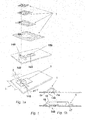
- Each box may contain platelets ( Fig. 2 and 3 ) of cells (1) (at least one wafer and at least one cell per wafer).
- the packaging of the drug is intact as long as the outside atmosphere remains excluded from within the cell (15) containing the drug.
- the primary packaging is the protective envelope of the drug formed by the intact walls (16) (17) of the cell.
- control device can be provided with a desk (18) for manual data entry or the data can be transcribed from the box by a sensor (19) code reader -Bars.
- an image (20) of the box for example a 3D rotating simulation
- two faces (21,22) of the blister type ( Fig. 3 ) it contains can be projected on a screen (23) nearby.
- the identification of the type of medication can be done in relation to a bank of data containing the defining and useful characteristics defining the parameters necessary for the operation of the system.
- the reading of the identifying information on each of the pads or on the back of each of the cells is not done in detail when the drug is placed in the store: the responsible staff relies on the information on the secondary packaging and on the vigilance of the personnel in question. downstream to control as possible the primary packaging at the time of dispensing and the administration to the patient. This results in errors, which can be avoided if the presentation of the drug during dispensing and administration to the patient is complete and easily readable or controllable.
- the elements of the proposed system are based on a process for presenting in ergonomic and standardized form any drug taken into account in unit dose identified individually during its preparation without the deconditioning of its primary packaging.
- the dimensions of the wafers varied as well as the cell height of the cells.
- the cell bells have different shapes: circular, oval or ellipsoidal.
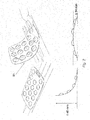
- the major axis of the non-circular bells is oriented at an angle that varies between 0 ° and + 90 ° and -90 ° with respect to the main axis of the outer edge of the plate and the arrangement of the bells is not necessarily at the same gap, regular over the entire plate. There is therefore a great variation in the arrangement and the shape of the cells (see the examples Fig. 3 ).
- the pads, out of their secondary packaging and laid on a smooth table side, are not necessarily completely flat but may have a curved profile (51).
- the wafer can be introduced until it reaches the stop at the bottom of a neck which makes it flat.
- a mechanical and standardized element called “loading support” or “staple” (55) can be attached to the wafer.
- the flanks, surfaces or outer forms of the staples may be provided with mechanical support points, called “registers" for positioning determined and accurate with respect to another part or support having the appropriate counterform.
- the loading station can be provided with a motorized axis, which directs the loading support.
- the contact with three stops is sufficient. It is provided an automatic control at each of the stops during loading and loading support is fixed to the plate that when it is in abeyance with the three marks.
- the loading support can be attached to the plate in an inseparable manner.
- the sides of the staple can act as positioning register for the individual identification of each of the cells. on the plate.
- the positioning tolerances of the edges of the wafers relative to the cells are sufficiently tight so that the separation of the cells by individual cutting of the majority of wafers can be made without difficulty.
- a measurement of the position of the rows of cells on the wafer may be necessary. In this case, the cutting of the cells should be done according to the measurement taken on the wafer.
- the staple may be provided with a data record relating to the position of the cells.
- This record may be a bar code, a 2-dimensional matrix code, an electronic chip, RFID or any other means of reading / writing.
- This recording could contain any information concerning the geometry, handling and cutting of the wafer held by the staple. This registration makes it possible to process platelets without connecting to a database listing the characteristics of all drugs under consideration.
- the positioning of the staple on the wafer is made taking into account the position of the cells, present on the wafer. Thus difficulties are avoided during the subsequent cutting of these cells. Indeed, the presence of the staple could make cutting difficult, or even impossible for some cells. The positioning of the staple is thus made so as to minimize the possible difficulties during cutting.
- Each plate has an identity, since it comes out of a particular secondary packaging, while the loading medium also contains specific data.
- This information and data form a unique identifier that the system can accord to the load carrier and wafer assembly (71); this identifier can be stored in order to be able to later locate the wafer and also each of the cells that it comprises.
- the means chosen to keep this information on board this set may be an RFID contained in the loading medium.
- the RFID has its own unique identifier code. The reading of this one makes it possible to find in the memory of the apparatus the file relating to the plate concerned.
- a programmable RFID allows the addition of supplements, identifying the time of steps.
- each plate has a unique identity, which refers to the original box.
- This traceable element may be stored in a store (73) for later dispensing or deferred processing. If necessary, by reading the RFID chip in the load carrier, the cells of the wafer thus identified, can themselves be easily identified during a manual separation as is commonly done in hospital departments. Even a wafer, from which a quantity of cells has been manually removed, can be reintegrated into the monitoring of the system in a secure manner, provided that the number and positions of cells remaining on the wafer are stored in the RFID chip, which can to be done with a local reprogramming of the chip. The new information can be known from the central memory by reading the reprogrammed RFID chip at any desired time.
- the assembly can be directly introduced to the repacking process described below.
- Packaging alveoli - Launch of a packaging campaign cell (s) or processing The cell packaging apparatus can be ordered on demand or act automatically.
- the internal safety devices of the device (voltage, glue temperature, spare cards, spare ink, pressurized air, closed safety doors, etc.) must allow the start of the packaging or "processing" device.
- the combination of presence of a wafer, a transformation order, a case for storing the finished products must be satisfied.
- the priority will generally be given to the termination of the current task, but interruptions must also be possible without loss of security. The lack of one of these elements must cause the interruption and the locking of the activity. Restarting and continuing the task after an interruption will be done automatically when the operating conditions are again met.
- the transformation command may define an integer number of wafers to be transformed or a number of cells, which may exceed the number contained on a single wafer.
- the wafer or a set-staple-identified with its plate carrying the corresponding drugs can be extracted from the store.
- the magazine can have forms ranging from a sequential system such as a loading carousel or a queue on a rail to the parallel system of a niche store, open access. In all cases, the choice for treatment starting with the oldest wafer is to be preferred, because in doing so, the risk of obsolete stocks is best mastered.
- a sequential system such as a loading carousel or a queue on a rail
- the parallel system of a niche store open access.
- the choice for treatment starting with the oldest wafer is to be preferred, because in doing so, the risk of obsolete stocks is best mastered.
- the outlet of the store is at the opposite end of its entrance.
- the wafer is identified by reading the store memory or by searching for the identifier, programmed in the load carrier, among the wafers kept in stock.
- the loading order of a sequential warehouse can determine the order of output and transformation.
- the operator can determine what the order of transformation will be by placing the wafers and their staple at the correct sequence in the direction of rotation of a carousel magazine. This implies that a device even without programming can perform transformations as long as it can read the contents of the RFIDs in the staples.
- the correct correspondence of the information concerning it and the selection criteria, defined by the order, can be verified and the identifiers can be kept in temporary memory of the device during the wafer processing stay.
- the security aspect is ensured by the RFID chip staple reprogrammable by the fact that the machine making the transformation does not have to rely solely on computer files that it holds alone to connect the transformation to the wafer, but can read the program carried in the RFID and in double security, to control the coherence with its own files.
- the device In order to transform the wafer, the device must load the transformation parameters stored in memory, which correspond to the wafer type.
- the memory can be a database or a (temporary) memory supplied by the operator in order to be able to cut.
- the RFID can hold any useful information about the wafer, including the instructions for processing (cutting) the wafer.
- the transformation can be executed from the information contained in the RFID, without having to refer to the files of the machine that programmed the clip.
- the scissors When cutting manually, the scissors are usually straight. There are several ways to cut, all of them succeed in getting around the cell to be separated. For example, it is sometimes possible to describe a curve starting from one edge of the wafer, around the cell and leaving the wafer on another edge. This way requires a fairly wide spacing between the cells. To separate manually a cell of the wafer, two straight cuts will suffice, as long as they meet at one point or they intersect while skirting the cell. These cuts are made successively and starting from two outer edges of the wafer, one practically at right angles to the other. A machine can perform such cutting, if it is equipped with straight knives, but necessarily, the cuts are made one after the other.
- the appliance is equipped with a single L-shaped knife, the two notches can be made in one movement as long as the L corner is positioned where the cuts of the manual cut meet. .
- Such a configuration has the advantage of increasing the productivity of the cutting (more than doubling). It is clear that to take a series of cells from a plate requires a series of successive cuttings. The position of the second division with respect to the first will logically also start from an edge (original or newly created) of the plate. and could theoretically be done by placing the corner of the L at a distance of one cell in the direction of the extension of one of the arms of L.
- Another solution uses the star-shaped free space at the intersection of the grooves separating the cells. Since the cells are made by a deformed bubble in the plastic or drug packaging aluminum, the cells have a generally rounded shape on the corners, which makes the space between the cells at this larger place. At this point without loss of generality, across the row of cells, an overflow of the notch of the previous cutout with respect to its theoretical minimum length is admissible over at least the minimum groove width or the positioning tolerance of the knife compared to the pads. This allows a second cut in the axis of the row of cells, made with a T knife open at 90 °, to encroach and communicate with the previous cut. A knife having a sufficient length to cut the larger cells, will not interfere with its application to the cutting of smaller cells.
- an inverted T-shaped knife is used; the shape of the knife resembles an L whose horizontal bar protrudes to the left (or the right, as the case may be).
- one of the horizontal branches may have a shorter length than the other branch.
- Exceeding the branch to the left or right may be small and it is sufficient that it is long enough to compensate for the lack of positioning accuracy expected: about 0.5mm overtaking will suffice while the main legs of the L have a length exceeding 35mm to circumvent even the largest cells.
- the grooves separating the cells may be narrow, they may also be irregularly wide. Some grooves may be so wide that the area of the wafer associated with each cell is larger than the space provided for receiving the cells on the packaging medium (the card), or such as the parts outside the sub-part. the cell bell protrude by more than 5mm. In this case the glue pads which are always close to the bell, will not support the parts of protruding pads (see below). These unsupported parts can be troublesome during subsequent operations and for handling by the nurse when administering the drug. In the case of cutting plates in oblique grooves, it is inevitable that cells from the vicinity of the edges of the wafer have quasi-triangular shapes with at least one pointed corner at an acute angle of less than 90 °. These angles are dangerous for nurses and other persons handling such cut-out cells and can cause injury.
- the cut parts can be removed by an additional cutting action, leaving a cell of shape and size more similar to its sisters and easier to handle.
- the cut parts are waste that there is no need to integrate in the rest of the transformation path. When they are cut, a suppression of the aspiration of the anvil and / or a reversal of the suction, replaced by a breath, ejects this waste.
- the apparatus will advantageously be equipped with guides or walls protecting its mechanical elements, so that the waste is evacuated without lodging there. The provision of a removable receptacle will make it easier to maintain and maintain the cleanliness of the machine.
- Additional cuts can be provided between the cell cuts to give a more regular shape and kept closer to the bell of the cell.
- the plates can be flattened by sliding them in a slot whose walls are spaced from the height of the cell bells. At the approach of this slot, a gutter neck with an opening large enough to receive the curved plates is expected. In practice it turns out that a neck exceeding the opening 50mm and equipped with a funnel-shaped diverter with a slope not exceeding 35 ° is sufficient to the task, even when the pads approach with the raised part the front.
- This type of flattener is suitable for an automated process, because the result is obtained in all the practical cases of platelet presentation.
- the cell bells vary in height from 1 to 11 mm, a fixed spacing of the walls of the slot of 11 mm will leave more freedom to a plate with bells of low cells than when they have a height of 11 mm. mm.
- a bell 3mm high still has 8mm free and, given the natural curvature of the plates, cells farthest away from the staple will be raised out of the theoretical plane. Since it is the cells furthest away from the staple that are the first to be cut, it will be advantageous, during the cutting itself, to force them against a completely flat surface. With this type of flattener, the opening of the knife can be minimized for all platelets, without having to take into account their initial natural curvature. This opening is sufficient to be slightly greater than the proposed height of the tunnel, ie> 11mm in the case described, instead of> 45mm if the most curved plates were to be introduced into the knife.
- Orientation of the wafer containing the cell relative to the reference axes of the system ( Fig. 3 ).
- Many of the wafers require angled cuts (117, 118) to cut the cells.
- the angles have a value between -75 °, 0 ° and + 75 ° with a concentration between 30 ° and 60 ° and -30 ° and -60 ° with respect to the edges of the wafer.
- the notches must be oriented substantially in alignment with the rows of cells (or in alignment with the grooves between these rows). ) and therefore in general case not necessarily with the edges of the plates. This relative alignment will be more easily by orienting the plate of cells relative to the axes of the knife of the machine than vice versa.
- flanks of the clip mounted on the wafer give a precise mechanical reference to guide it, despite its lack of rigidity and its tendency to bend out of his plane.
- the staple Since the staple has been attached to the wafer in a device locating on the flattened outer edges of the wafer, the correct arrangement of the cells will be found if the staple sidewalls of the staple serve to hold it again during cutting and that in addition the plate is flattened again.
- Requirement WO2010095102 (A1 ) is an example in which the wafers are orientated and positioned so that the cutting is done well in the narrow grooves separating the cells. After cutting, the cells fall randomly on a conveyor belt to be brought into an alignment neck to properly orient them for insertion into the next step (the package, occasionally). Systems that cut out the cells and drop them randomly, add a complexity dimension to their subsequent recovery because not only is their orientation and order of succession lost, but can they be reversed on the head.
- the cutting proposed by the invention by an L knife or T has the advantage of good productivity while maintaining, at least partially, the position of the cell, surrounded for a part by the legs of the knife. L or T.
- relatively large forces are exerted on the wafer by the knife. These forces tend to move the wafer in several directions: it will be generally driven out of the shear angle during the knife edge. It is thus necessary as well to hold the cell which will be separated as the plate itself.
- the wafer is held by the clip which serves as a reference of the position of the cells; this clip must maintain this relative position, throughout the cutting process.
- Cutting even by L knife is done starting with a stitching (120) at the heel of the L, to progress to the edges of the wafer.
- This stitching is provided by a single point, provided at the heel of the L-shaped knife.
- the stitching is provided by a single tip, located near the corners of the T (ie the corners between the horizontal portion of the T and the vertical portion). This cutting is done while the plate is on an anvil.
- this part of the knife anchors the wafer and the cell, until the cuts are protruding on the outside of the wafer.
- the notches will not come out at the same time.
- it In order to contain these reactions on the cell, it must be firmly held during cutting. This can be obtained by pressing on the surface of the cell, pressing it on the anvil which acts as a counter-blade and around which shears the blades of the knife in L.
- This axial pressure in the direction of the movement of cutting the knife, must be active before the first attack of the heel of the knife and persist until after complete removal of the blades out of the surface of the wafer.
- the pressure means pressing the cell on the (flat) surface of the anvil can be relaxed, without losing its position if, by suction through orifices) made in the area of the anvil, the cell stay there contiguous.
- the uninterrupted continuity of the vacuum in the suction pipe of the anvil confirms the quality of the fixation of the cell.
- the cells to be treated have very varied sizes and formats, since the smallest having for example an imprint cut from only 10mm x 10mm to larger with for example a footprint of 35mm x 40mm.
- the holding by suction of these different formats could be done by applying a suction on the entire surface of the anvil through perforations.
- the suction flow is a function of the area of the anvil not covered by the cell, seriously prejudicing the suction force for smaller cells.
- the prediction of several constellations of perforations each connected by a valve to its duct towards the vacuum system makes it possible to put in suction only the perforations covered by the cell in cutting.
- the result is a strong energy saving and also the possibility, even with a single common vacuum system, to obtain a strong suction of the room.
- the application of this system is made possible by the prior knowledge of the size of the cuts that will be made on the plates.
- the staple often hampers the entire positioning of this cell on the cutting anvil and on the other hand the last cell can have dimensions that differ from the dimensions of the other cells. Since the latter cell can not, in some cases, be separated from the staple by the knife, it is planned to be able to open the staple, once this latter cell is positioned on the anvil and held in position by means of the staple. 'pressing on it.
- the shape of the cell may vary according to its position in the wafer and it may be necessary to take it into account during the various operations on the cells.
- suction forces thus obtained are sufficient to maintain the position of the cell relative to the anvil during a displacement such as to a next workstation.
- the cell has still retained its orientation, which was known before cutting with respect to the anvil.
- the gripping of the socket contigated by suction can be done by any means not exerting forces which would disturb the position during the grip and which are able to overcome the weak resistance by suction
- a suitable choice is the holding by a suction cup (130), conforming by its flexible lips (131) easily to the different shapes of the dome of the cell and by a bellows (132), allowing an approach and initial contact almost without force. Relaxing the suction on the anvil side allows the bellows of the suction cup to raise the cell of the anvil, while releasing it for a smooth movement. As long as the depression in the suction cup bellows has not started, the relaxation of the suction at the level of the anvil should be avoided as this could lead to the loss of position and orientation, carefully preserved until at the moment.
- the cycle time of the device being shortened as much as possible, since this time is directly related to its productivity, the movements will be made as quickly as possible, involving strong accelerations soliciting the holding of the suction cup.
- This holding suction of the cell can be maximized, without having to change the suction cup depending on the type of cell to take, by choosing a very flexible material with a large opening bell compared to the inner diameter (133) of the bellows and the suction pipe.
- the maximum size of this bell should not prevent it from conforming around the smaller cupolas of cells to be treated, while remaining powerful enough to hold the largest and heaviest cells.
- the measurement of the vacuum in the duct connecting the suction cup to the vacuum pump gives an indication if there is good quality of conformation of the suction cup at (the surface of) the cell.
- the movement of the cell to the next workstation and the execution of the next work step are modified if a loss of position or orientation is suspected.
- the modification can be of the kind interruption or / and cancellation of the operation
- the positive maintenance without interruption of the holding of the cell, initially indirectly in the wafer and after the separation, by the direct holding of the cell has preserved all information concerning position, shape and orientation from the fastening of the staple to the wafer and the assignment of its unique identifier. This allows the certainty of the identity of the cell during its transfer to a desired position on a packaging medium.
- this packaging which is an individualized packaging, is only begun after confirmation that the cell is properly available for packaging.
- a number of criteria can be used to establish this confirmation, such as the level of suction vacuum in the suction cup carrying the cell, the fact that the cell has been lifted from the surface of the anvil, a detection signal given by sensors (vision, capacitive sensors ...) of the presence of the cell.
- the respect of this sequence of steps eliminates the risk of errors by avoiding the production of an "identified" packaging which could not be associated cell at all or, worse, could be associated with a non-corresponding cell.
- the system has never lost the identity of the drug, nor an individual cell, proposes to materialize unequivocally the information on the drug on the support which is fixed inseparably the cell and proposes a way to do it. It is proposed to use a card uniting the cell with information readable to the eye as well as other information readable by automata.
- an unequivocal identification must be associated with the cell when it is attached to its packaging support: this presupposes that the marking of the identification on the packaging medium is inseparable from it and only during the period of time, or only the corresponding cell is separated from the wafer.
- the HP system of DOD (drop-on-demand) by thermal jets is preferred to the jet piezo-electric because this system is very compact, containing its ink tank as well as on-board electronics and is also economical (full replacement after ink consumption).
- pre-glued labels which can be used as long as their adhesion to the packaging medium is permanent.
- the cell may be fixed on the packaging support by various means, among which may be mentioned: a mechanical staple of the cell, an adhesive tape, melting by LASER, a passpartout system trapping the cell or fixation permanent from the honeycomb to its packaging medium by an adhesive.
- the hot melt works at temperatures close to those of melting the material of the cell bells, but can advantageously be deposited on the flat strip side, farther from the bell and generally made of a thicker material and / or thermally more resistant, like aluminum.
- the hot-melt glue guns spray the glue through a nozzle into which the valve is incorporated, all mounted on a pressure vessel body and held beyond the melting temperature of the glue.
- This hot body is held at about 150 ° C and radiant emits considerable heat, it is advisable to keep away from the cell.
- the projection of the droplets mentioned over a distance of 50mm to 100mm is stable and repetitive and makes it possible to satisfy the physical spacing and thermal separation of the gun from the passageway of the cell and all the associated elements.
- the need for a high rate requires high responsiveness and processor-driven basketry in close synchronization with the manipulator.
- One of the purposes of the system is to make it easier for staff to check the correspondence between the drugs dispensed and those to be administered to a patient after the patient's prescription, to control the correct packaging of the drugs (date of expiry, dosage) and also responsible for the administration of drugs including deconditioning (extraction of the primary packaging) and the possible registration of these operations.
- the goal of making information about medicines clear and accessible is already achieved by printing identifiers and other data on the packaging media.
- the principle is to provide a weakness opening (148) (also called slit of weakness) in the card located under the cell.
- This opening is not functionally a notch or slot formed, but allows to realize a weakness oriented through an edge of the cell and has a length exceeding the edges of the cell ( Fig. 1a ).
- the slit of weakness 148 is arranged transversely on the map and confers a transverse axis of weakness AFT to the map around which the map can break.
- the PA attachment points (of the film drum of the cell containing the tablet) on the card are located on either side of the slot of weakness 148 (Cf. figure 1b ).
- the slit of weakness 148 has a minimum opening preventing that the attachment points PA can not obstruct the slot. For commercially available tablets, an opening having a length L of the order of 15 to 20 mm is sufficient to pass them.
- the slit of weakness is disposed across the cell and an edge of the drum of the cell is tangent to an edge of the slit of weakness.
- the surface of the slit of weakness is smaller than the surface of the lid.
- the cleft of weakness changes physiology completely when the map is cracked along the axis of weakness AFT. Indeed, a large yawn is created at the level of the slit of weakness and allows easy extraction of the tablet.
- the operculum is fixed (by gluing) preferably to at least two places (149,150) distributed on both sides of the weakness.
- this advantageous embodiment provides that the lid (of the cell to be opened) is fixed (by gluing) to at least two places distributed on each side. on another point of weakness.
- the card is folded U-shaped with the slot disemboweled in the hollow of the U and the slot open at the bottom.
- the relative positioning of the attachment points of the lid to the split card is important and is not obvious.
- the fixing points are on both sides of the slot. Since the slot is transverse, these attachment points are substantially aligned in the length of the card.
- the cell Since the cell is placed with the slot tangent to the circumference of the bell (actually tangent to the projection of the circumference of the bell on the map), the cell is arranged very asymmetrically with respect to the slot and one side does not exceeds the slot only slightly.
- This part which is a part where the lid is fused with the material forming the bell, is relatively rigid.
- a glue point will fix this rigid part on one side of the slot.
- On the other side of the slot basically finds the part of the cell covered by the operculum, like a drum skin.
- the second point of glue is planted towards the middle of the "drum” formed by the lid covering the bell of the cell. The spacing of this glue point with the first is therefore several millimeters, even for the smallest cells.
- the pressure pushes the tablet towards the operculum on the side of the cell closest to the slot and the operculum, held by its middle is all the more tense by the support of the card that begins to yawn at the level of the slit of weakness.
- the lack of support of the lid at this location and the increased pressure of the tablet towards this location causes the concentration of effort (stress concentration) sought which exceeds the resistance of the lid.
- a fracture primer is formed on the side of the cell tangent to the slot of weakness and progresses, guided by the folding of the U-shaped card, opening all the more the slot to allow the free passage to the tablet to exit.
- the cells have sizes and shapes and various materials: with this system, only one type of opening movement will be enough to expel all variants, because it is always possible for the manufacturer of the device to maintain the arrangement of the two points of glue as well as the precise location of the cell relative to the slot of weakness of the card to obtain the expected result. Typically, it turns out that it is not necessary to choose the middle of the drum skin for the second point of glue to obtain the good result on large cells and that an intermediate position (156) between the first glue point and the middle is optimal.
- the glue points are not points of the glue pads having a finite dimension when the glued socket is applied to the card.
- the glue pad placed on the rigid edge of the drum of the cell risks, flattening, to sink and to seal a simple notch serving as a slot in the map. This would prevent the proper functioning of the system because the slot would be "reinforced" by the glue.
- the slot would be "reinforced" by the glue.
- the slot has a width I of about 3 mm.
- the length L of the slot may for example be between 10 and 15 mm.
- the first and second plots of glue must also meet and form a resistant bridge "reinforcing" the slit of weakness. This is also ensured by the opening of 3 mm of the slot. Thus, even with a small cell whose two attachment points are necessarily close together, the bridging by the glue of the slot is avoided.
- glue pad is dosed in less than 0.02cc3.
- the heat provided by the hot-melt droplet which is liquid at temperatures above 110 ° C., causes a temperature rise that is lower than that experienced during the primary packaging of the tablet in the blister in a production line.
- Hot glue spraying with precision for a spacing of only a few millimeters between studs is achieved by moving the cell in slow motion in front of the glue gun.
- the two droplets projected with a speed of several m / sec, reach the cell in a regular way spaced a few milliseconds in time.
- Some media combined with some glues give a better adhesion if there is a rest time filming glue between its application to the first support and the final gluing.
- it is chosen to place first the glue pad having the longest thermal path, that of the middle of the cell, and the second edge having a higher thermal conduction through the structure of the cell.
- the rest time does not exceed the time required to move the glued cell to the packaging medium for its final affixation and productivity optimal can be achieved.
- the at least two droplets for fixing an alveolus may be of different sizes in order to obtain optimal adhesion
- the cutting of the cell is not done in the desired orientation for attachment to the packaging medium.
- the cards used in the system may come from a continuous band or stack of cards, without affecting what has been defined above.
- the sequence of operations will be different depending on the case.
- the cards come from a band they are linked together. So any manipulation of the cards influences all the cards upstream. It is clear that any movement of the cards in a direction that can make any of the operations difficult, must be limited or corrected.
- the tape with the cards will have been drawn in the direction of movement of the processed card. It is clear that in this case, rotations of the map are difficult to integrate and that the movements should be limited to transport in the longitudinal direction of the band, also excluding lateral movements.
- the cell having undergone most mechanical grips, is the favorite subject to make the positions and orientations.
- the positioning and orientations of the cell relative to the frame are also related to the train of cards.
- the staple and wafer assembly is formed separately from the processing apparatus and can be stored independently: the choice of orientation for introduction into the processing apparatus will facilitate the transfers.
- the cells can be arranged oriented correctly on a biaxial space: for their cutting two lateral displacements are to be expected Once cut of the wafer, the cell can assume the correct orientation and relative position to the card, to complete the transformation.
- a train of cards does not change lateral position or orientation during the transformation.
- the cell in the case of a train of cards, the cell must assume the position laterally with respect to the card train and the orientation thereof.
- the relative orientation between the train of cards and the cells is a free choice, influenced by the means implemented to compensate for the geometric differences between the cell types and to make the lateral displacement become necessary.
- Inkjet printers only work horizontally or downward but not upward.
- the card train goes from top to bottom, with the cards located according to the vertical.
- the inkjet printers can be very close (1 mm) of the medium to be printed, so printing a card with a cell attached to it is no longer possible on the cell side.
- Both sides of the card may carry the drug identifier.
- Cutting separation of the last assembled card can be done in the retraction path and save additional movement distances as well as a guillotine with a mouth wide enough to swallow the cells.
- the assembly position must be substantially the same height as that of the cutting.
- the second axis of the cutting position moves the staple and the wafer along the vertical without lateral translation.
- the cutting is always at the same height.
- the vertical position of the center of the cut cavity varies according to the vertical dimension of the cell and the shape of the bell.
- the lateral transposition of the cell to the assembly position to the card train must take into account the lateral position of the center of the cut-out cell.
- Compensation along the lateral axis can be performed by lateral transport from the cutting position to the intermediate position (which is now variable).
- Compensation along the vertical axis is partially achieved by positioning the card train more or less high or low during attachment of the cell.
- the compensation of the centering along the vertical axis for the socket of the cell is combined with the passage in front of the glue gun and with the lateral displacement in a single rotary movement.
- a rotary movement passes the cell along a horizontal path in front of the glue gun: glue dripping of the two studs will not mix, gluing is the lowest point of the trajectory.
- the rotary compensation introduces a reversal of the cell during its movement towards the train of cards, without affecting the system.
- the inverted orientation of the cell on the board places its edges exactly parallel to the board, provided that the arm always sweeps the same angle of rotation between the board. grasping and fixing.
- the retraction distance to the separation cutter of the card carrying the newly fixed cell is variable according to the compensations.
- the card train retraction distance is fixed from the trimmer to reset the printer.
- the card separated by the trimmer at a fixed position and orientation in space.
- the separation of the individually identified card with the indissociably affixed cell closes the transformation cycle and releases the device for the preparation of the next card.
- the gripping and transport of this card to an organized storage can be automated: clamp, piston ejector.
- the preferred axis for the ejection movement is perpendicular to the two axes of translation mentioned above: the completed card out of the work plane of the transformation apparatus and the grip of the cutter.
- the enfilade can be provided by a rail, a ring or a channel, compartmentalized by a screw thread or molded walls.
- the card assembly, identifiers, cell being created has a position and an orientation that is useful to keep for subsequent manipulations.
- the blisters mounted on valets, clips "or clip” or staples can be loaded by the operator on a carousel.
- the clamps can be equipped with an RFID system and the machine of a reader to know what is mounted in the clamp
- the carousel may contain about twenty blisters
- the orientation of the blisters on the clips can be done on a specific post
- Access to the carousel can be protected by a light curtain that will block dangerous movements.
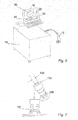
- a gantry with two digital axes equipped with a gripping system of valets can seize the blisters in the carousel
- a corridor system materialized by a plate on the front of the machine will straighten curved blisters.
- This plate will begin with a drain for easy passage of blisters in the corridor.
- This plate must be mobile to escape all movements of the rest of the machine.
- a second numerical axis X provided with a system of knives and anvil cutting the blisters according to a procedure contained in a file.
- the anvil may be provided with a series of holes for suctioning and holding the cell.
- suction holes can be activated: preferably 3 suction zones.
- the knife can be L-shaped with a lug protruding one of the legs of L.
- the knives can be moved by a jack.
- the anvil and knives can be referenced by the same piece.
- a block of visco-elastic material trapped between the knives can flatten the curved blisters before cutting
- a rotating arm system with a suction cup can grip the cut-out cell.
- the rotation can be made by an electric motor
- the cell is presented in front of a glue nozzle which triggers twice a jet according to the information encoder of the engine.
- the cell can be presented in front of the card to be applied.
- the cells can have a thickness ranging from 1.5 to 10.5 mm.
- the compensation of this variation will be made by a digital table on which will be embedded the motor of the rotational movement or the sucker will be mounted at the end of an actuator.
- the final positioning of the cell on the map is essential.
Landscapes
- Engineering & Computer Science (AREA)
- Health & Medical Sciences (AREA)
- Mechanical Engineering (AREA)
- Forests & Forestry (AREA)
- Life Sciences & Earth Sciences (AREA)
- General Health & Medical Sciences (AREA)
- Epidemiology (AREA)
- Medical Informatics (AREA)
- Primary Health Care (AREA)
- Public Health (AREA)
- Medicinal Chemistry (AREA)
- Bioinformatics & Cheminformatics (AREA)
- Chemical & Material Sciences (AREA)
- Medical Preparation Storing Or Oral Administration Devices (AREA)
Claims (4)
- Automatisiertes System für die gesicherte Zubereitung einer Einzeldosis eines Medikaments, ausgehend von einer Plakette, die wenigstens eine das Medikament enthaltende Wabe umfasst, wobei das System umfasst:- Mittel zum Ausschneiden der Wabe aus der Plakette, bei dem die Mittel zum Ausschneiden der Wabe durch ein L-förmiges oder T-förmiges Messer gebildet sind, dessen einer horizontaler Zweig eine geringere Länge hat als die andere und- Mittel zum Halten der Position und der Ausrichtung der Wabe während des Ausschneidens, die durch eine am Absatz des Ls vorgesehene einzigartige Spitze vorgesehen istoder sich in der Nähe der Ecken des Ts des Messers derart befindet, dass die Einschnitte im Wesentlichen in der Fluchtung mit den Rillen zwischen den Waben ausgerichtet sind.
- Automatisiertes System gemäß dem voranstehenden Anspruch, bei dem die Trennung einer Wabe in einer Bewegung durch das genannte Messer und die Trennung der anderen Waben durch das sukzessive Ausschneiden entlang der Wabenreihen erfolgt, die im Wesentlichen in der Fluchtung mit wenigstens einem der Zweige des Messers ausgerichtet sind.
- Verfahren für die gesicherte Zubereitung einer Einzeldosis eines Medikaments ausgehend von einer Plakette, die wenigstens eine das Medikament enthaltende Wabe umfasst, wobei die Methode die folgenden Schritte umfasst:- Ausschneiden der Wabe aus der Plakette durch Verwenden eines L-förmigen Messers oder eines T-förmigen Messers, dessen einer horizontaler Zweig eine kürzere Länge hat als der andere.- Halten der Position und der Ausrichtung der Wabe während des Ausschneidens durch eine einzigartige Spitze, die im Absatz des Ls oder in der Nähe der Ecken des Ts des Messers derart vorgesehen ist, dass die Einschnitte im Wesentlichen in der Fluchtung mit den Rillen zwischen den Waben ausgerichtet sind.
- Verfahren für die gesicherte Zubereitung einer Einzeldosis gemäß dem voranstehenden Anspruch 3, umfassend die folgenden Schritte:- Trennung einer Wabe in einer Bewegung durch das genannte Messer, und- Trennung der anderen Waben per sukzessivem Ausschneiden entlang der Wabenreihen, die im Wesentlichen in der Fluchtung mit wenigstens einem der Zweige des Messers ausgerichtet sind.
Applications Claiming Priority (2)
| Application Number | Priority Date | Filing Date | Title |
|---|---|---|---|
| FR1150505A FR2970647B1 (fr) | 2011-01-21 | 2011-01-21 | Systeme automatise de dose unitaire pour la delivrance nominative de medicaments |
| PCT/EP2012/050912 WO2012098247A1 (fr) | 2011-01-21 | 2012-01-20 | Système automatisé de dose unitaire pour la délivrance nominative de médicaments |
Publications (2)
| Publication Number | Publication Date |
|---|---|
| EP2665459A1 EP2665459A1 (de) | 2013-11-27 |
| EP2665459B1 true EP2665459B1 (de) | 2015-09-02 |
Family
ID=44479673
Family Applications (1)
| Application Number | Title | Priority Date | Filing Date |
|---|---|---|---|
| EP12701490.0A Revoked EP2665459B1 (de) | 2011-01-21 | 2012-01-20 | Automatisiertes dosiersystem zur portionierten abgabe von medikamenten |
Country Status (3)
| Country | Link |
|---|---|
| EP (1) | EP2665459B1 (de) |
| FR (1) | FR2970647B1 (de) |
| WO (1) | WO2012098247A1 (de) |
Cited By (1)
| Publication number | Priority date | Publication date | Assignee | Title |
|---|---|---|---|---|
| WO2025220049A1 (en) * | 2024-04-15 | 2025-10-23 | Logibiotech S.R.L. | Machine for preparing pre-dosed drug administration units |
Families Citing this family (3)
| Publication number | Priority date | Publication date | Assignee | Title |
|---|---|---|---|---|
| US9150119B2 (en) | 2013-03-15 | 2015-10-06 | Aesynt Incorporated | Apparatuses, systems, and methods for anticipating and delivering medications from a central pharmacy to a patient using a track based transport system |
| US9511945B2 (en) | 2012-10-12 | 2016-12-06 | Aesynt Incorporated | Apparatuses, systems, and methods for transporting medications from a central pharmacy to a patient in a healthcare facility |
| ITBO20130407A1 (it) * | 2013-07-26 | 2015-01-27 | Swisslog Italia Spa | Dispositivo e procedimento per singolarizzare prodotti raggruppati in blister |
Citations (4)
| Publication number | Priority date | Publication date | Assignee | Title |
|---|---|---|---|---|
| US5105703A (en) | 1987-12-14 | 1992-04-21 | Hitachi Metals, Ltd. | Sheet cutter |
| WO1998029084A1 (de) | 1996-12-30 | 1998-07-09 | P+P Materialfluss-Systeme Gmbh | Verfahren und vorrichtung zum automatischen kommissionieren von singulärem stückgut, insbesondere einer einzelpille |
| EP1176106A1 (de) | 2000-06-30 | 2002-01-30 | Assistance Publique Hopitaux De Paris | Verfahren und System zur automatischen Dosierung von Arzneimitteln gemäss einer computerisierten Verordnung |
| EP2025601A2 (de) | 2007-08-07 | 2009-02-18 | Grifols, S.A. | Maschine zur Handhabung von Blisterpackungen |
Family Cites Families (7)
| Publication number | Priority date | Publication date | Assignee | Title |
|---|---|---|---|---|
| GB1095734A (en) | 1963-12-24 | 1967-12-20 | Ernst Bittner | Improvements in or relating to bubble packs |
| US3942640A (en) | 1972-07-07 | 1976-03-09 | Hellstrom Harold R | Tear-away blister package |
| GB1507828A (en) | 1975-05-08 | 1978-04-19 | Goodman G | Package for small articles |
| EP1800645A1 (de) | 2005-12-21 | 2007-06-27 | Körber AG | Verpackung für medizinische Produkte und dergleichen |
| NL1033807C2 (nl) | 2007-05-04 | 2008-11-06 | 4C Care & Consultancy B V | Het betreft een herverpak methode van geneesmiddelen in eenheid aflever verpakkingen met behoud van de bescherming en informatie van de oorspronkelijk meervoud verpakking en de mogelijkheid extra informatie toe te voegen. |
| ES2560528T3 (es) | 2007-05-04 | 2016-02-19 | 4C Care & Consultancy Bv | Procedimiento para la medicación en un momento prescrito, un dispensador y una cinta para utilizarse con el procedimiento, y un bucle cerrado que comprende el dispensador y la cinta |
| EP2398709B1 (de) | 2009-02-19 | 2013-09-18 | Ethilog Sas | Verfahren und vorrichtung zum kommissionieren von stückgütern |
-
2011
- 2011-01-21 FR FR1150505A patent/FR2970647B1/fr not_active Expired - Fee Related
-
2012
- 2012-01-20 WO PCT/EP2012/050912 patent/WO2012098247A1/fr not_active Ceased
- 2012-01-20 EP EP12701490.0A patent/EP2665459B1/de not_active Revoked
Patent Citations (4)
| Publication number | Priority date | Publication date | Assignee | Title |
|---|---|---|---|---|
| US5105703A (en) | 1987-12-14 | 1992-04-21 | Hitachi Metals, Ltd. | Sheet cutter |
| WO1998029084A1 (de) | 1996-12-30 | 1998-07-09 | P+P Materialfluss-Systeme Gmbh | Verfahren und vorrichtung zum automatischen kommissionieren von singulärem stückgut, insbesondere einer einzelpille |
| EP1176106A1 (de) | 2000-06-30 | 2002-01-30 | Assistance Publique Hopitaux De Paris | Verfahren und System zur automatischen Dosierung von Arzneimitteln gemäss einer computerisierten Verordnung |
| EP2025601A2 (de) | 2007-08-07 | 2009-02-18 | Grifols, S.A. | Maschine zur Handhabung von Blisterpackungen |
Cited By (1)
| Publication number | Priority date | Publication date | Assignee | Title |
|---|---|---|---|---|
| WO2025220049A1 (en) * | 2024-04-15 | 2025-10-23 | Logibiotech S.R.L. | Machine for preparing pre-dosed drug administration units |
Also Published As
| Publication number | Publication date |
|---|---|
| FR2970647B1 (fr) | 2014-05-02 |
| WO2012098247A1 (fr) | 2012-07-26 |
| FR2970647A1 (fr) | 2012-07-27 |
| EP2665459A1 (de) | 2013-11-27 |
Similar Documents
| Publication | Publication Date | Title |
|---|---|---|
| EP2665460B1 (de) | Automatisiertes dosiersystem zur portionierten abgabe von medikamenten | |
| US12269635B2 (en) | Packaging system for pharmaceutical dispenser and associated method | |
| US11396418B2 (en) | High efficiency automated pharmaceutical dispenser | |
| EP2665458B1 (de) | Automatisiertes dosissystem zur portionierten abgabe von medikamenten | |
| US20160120743A1 (en) | Support for a unit dose drug | |
| EP2463205B1 (de) | Automatisierte Vorrichtung für die Herstellung von Produktlosen aus in Blister verpackten Produkten, insbesondere Medikamente | |
| EP2665459B1 (de) | Automatisiertes dosiersystem zur portionierten abgabe von medikamenten | |
| US10869813B1 (en) | Medication dispensing tray adapter and system | |
| EP1176106B1 (de) | Verfahren und System zur automatischen Dosierung von Arzneimitteln gemäss einer computerisierten Verordnung | |
| EP2866210A1 (de) | Hocheffiziente automatisierte pharmazeutische Spender | |
| KR102023139B1 (ko) | 복용날짜가 인쇄되는 약포지 프린터기 | |
| CA2829547A1 (en) | High efficiency automated pharmaceutical dispenser | |
| JP2019005040A (ja) | 医薬品包装体、その収納箱、医薬品服用者と医薬品包装体の確認方法および医薬品の服用チェック方法 |
Legal Events
| Date | Code | Title | Description |
|---|---|---|---|
| PUAI | Public reference made under article 153(3) epc to a published international application that has entered the european phase |
Free format text: ORIGINAL CODE: 0009012 |
|
| 17P | Request for examination filed |
Effective date: 20130820 |
|
| AK | Designated contracting states |
Kind code of ref document: A1 Designated state(s): AL AT BE BG CH CY CZ DE DK EE ES FI FR GB GR HR HU IE IS IT LI LT LU LV MC MK MT NL NO PL PT RO RS SE SI SK SM TR |
|
| DAX | Request for extension of the european patent (deleted) | ||
| 17Q | First examination report despatched |
Effective date: 20140618 |
|
| RIC1 | Information provided on ipc code assigned before grant |
Ipc: B65D 75/32 20060101ALI20150113BHEP Ipc: B26D 1/00 20060101ALI20150113BHEP Ipc: A61J 1/03 20060101AFI20150113BHEP Ipc: B65B 61/06 20060101ALI20150113BHEP Ipc: B65B 5/10 20060101ALI20150113BHEP Ipc: G07F 11/62 20060101ALI20150113BHEP Ipc: B26D 7/01 20060101ALI20150113BHEP Ipc: B26D 1/06 20060101ALI20150113BHEP Ipc: G09F 3/02 20060101ALI20150113BHEP Ipc: G06F 19/00 20110101ALI20150113BHEP Ipc: B26D 5/00 20060101ALI20150113BHEP Ipc: A61J 7/00 20060101ALI20150113BHEP |
|
| GRAP | Despatch of communication of intention to grant a patent |
Free format text: ORIGINAL CODE: EPIDOSNIGR1 |
|
| INTG | Intention to grant announced |
Effective date: 20150323 |
|
| GRAS | Grant fee paid |
Free format text: ORIGINAL CODE: EPIDOSNIGR3 |
|
| GRAA | (expected) grant |
Free format text: ORIGINAL CODE: 0009210 |
|
| AK | Designated contracting states |
Kind code of ref document: B1 Designated state(s): AL AT BE BG CH CY CZ DE DK EE ES FI FR GB GR HR HU IE IS IT LI LT LU LV MC MK MT NL NO PL PT RO RS SE SI SK SM TR |
|
| REG | Reference to a national code |
Ref country code: GB Ref legal event code: FG4D Free format text: NOT ENGLISH |
|
| REG | Reference to a national code |
Ref country code: AT Ref legal event code: REF Ref document number: 746079 Country of ref document: AT Kind code of ref document: T Effective date: 20150915 Ref country code: CH Ref legal event code: EP |
|
| REG | Reference to a national code |
Ref country code: IE Ref legal event code: FG4D Free format text: LANGUAGE OF EP DOCUMENT: FRENCH |
|
| REG | Reference to a national code |
Ref country code: DE Ref legal event code: R096 Ref document number: 602012010206 Country of ref document: DE |
|
| REG | Reference to a national code |
Ref country code: FR Ref legal event code: PLFP Year of fee payment: 5 |
|
| REG | Reference to a national code |
Ref country code: AT Ref legal event code: MK05 Ref document number: 746079 Country of ref document: AT Kind code of ref document: T Effective date: 20150902 |
|
| PG25 | Lapsed in a contracting state [announced via postgrant information from national office to epo] |
Ref country code: NO Free format text: LAPSE BECAUSE OF FAILURE TO SUBMIT A TRANSLATION OF THE DESCRIPTION OR TO PAY THE FEE WITHIN THE PRESCRIBED TIME-LIMIT Effective date: 20151202 Ref country code: FI Free format text: LAPSE BECAUSE OF FAILURE TO SUBMIT A TRANSLATION OF THE DESCRIPTION OR TO PAY THE FEE WITHIN THE PRESCRIBED TIME-LIMIT Effective date: 20150902 Ref country code: LV Free format text: LAPSE BECAUSE OF FAILURE TO SUBMIT A TRANSLATION OF THE DESCRIPTION OR TO PAY THE FEE WITHIN THE PRESCRIBED TIME-LIMIT Effective date: 20150902 Ref country code: LT Free format text: LAPSE BECAUSE OF FAILURE TO SUBMIT A TRANSLATION OF THE DESCRIPTION OR TO PAY THE FEE WITHIN THE PRESCRIBED TIME-LIMIT Effective date: 20150902 |
|
| REG | Reference to a national code |
Ref country code: NL Ref legal event code: FP |
|
| REG | Reference to a national code |
Ref country code: LT Ref legal event code: MG4D |
|
| PG25 | Lapsed in a contracting state [announced via postgrant information from national office to epo] |
Ref country code: PL Free format text: LAPSE BECAUSE OF FAILURE TO SUBMIT A TRANSLATION OF THE DESCRIPTION OR TO PAY THE FEE WITHIN THE PRESCRIBED TIME-LIMIT Effective date: 20150902 Ref country code: RS Free format text: LAPSE BECAUSE OF FAILURE TO SUBMIT A TRANSLATION OF THE DESCRIPTION OR TO PAY THE FEE WITHIN THE PRESCRIBED TIME-LIMIT Effective date: 20150902 Ref country code: AT Free format text: LAPSE BECAUSE OF FAILURE TO SUBMIT A TRANSLATION OF THE DESCRIPTION OR TO PAY THE FEE WITHIN THE PRESCRIBED TIME-LIMIT Effective date: 20150902 Ref country code: ES Free format text: LAPSE BECAUSE OF FAILURE TO SUBMIT A TRANSLATION OF THE DESCRIPTION OR TO PAY THE FEE WITHIN THE PRESCRIBED TIME-LIMIT Effective date: 20150902 Ref country code: SE Free format text: LAPSE BECAUSE OF FAILURE TO SUBMIT A TRANSLATION OF THE DESCRIPTION OR TO PAY THE FEE WITHIN THE PRESCRIBED TIME-LIMIT Effective date: 20150902 |
|
| PG25 | Lapsed in a contracting state [announced via postgrant information from national office to epo] |
Ref country code: CZ Free format text: LAPSE BECAUSE OF FAILURE TO SUBMIT A TRANSLATION OF THE DESCRIPTION OR TO PAY THE FEE WITHIN THE PRESCRIBED TIME-LIMIT Effective date: 20150902 Ref country code: IS Free format text: LAPSE BECAUSE OF FAILURE TO SUBMIT A TRANSLATION OF THE DESCRIPTION OR TO PAY THE FEE WITHIN THE PRESCRIBED TIME-LIMIT Effective date: 20160102 Ref country code: EE Free format text: LAPSE BECAUSE OF FAILURE TO SUBMIT A TRANSLATION OF THE DESCRIPTION OR TO PAY THE FEE WITHIN THE PRESCRIBED TIME-LIMIT Effective date: 20150902 Ref country code: SK Free format text: LAPSE BECAUSE OF FAILURE TO SUBMIT A TRANSLATION OF THE DESCRIPTION OR TO PAY THE FEE WITHIN THE PRESCRIBED TIME-LIMIT Effective date: 20150902 Ref country code: IT Free format text: LAPSE BECAUSE OF FAILURE TO SUBMIT A TRANSLATION OF THE DESCRIPTION OR TO PAY THE FEE WITHIN THE PRESCRIBED TIME-LIMIT Effective date: 20150902 |
|
| PG25 | Lapsed in a contracting state [announced via postgrant information from national office to epo] |
Ref country code: RO Free format text: LAPSE BECAUSE OF FAILURE TO SUBMIT A TRANSLATION OF THE DESCRIPTION OR TO PAY THE FEE WITHIN THE PRESCRIBED TIME-LIMIT Effective date: 20150902 Ref country code: PT Free format text: LAPSE BECAUSE OF FAILURE TO SUBMIT A TRANSLATION OF THE DESCRIPTION OR TO PAY THE FEE WITHIN THE PRESCRIBED TIME-LIMIT Effective date: 20160104 |
|
| REG | Reference to a national code |
Ref country code: DE Ref legal event code: R026 Ref document number: 602012010206 Country of ref document: DE |
|
| PLBI | Opposition filed |
Free format text: ORIGINAL CODE: 0009260 |
|
| 26 | Opposition filed |
Opponent name: SWISSLOG ITALIA S.P.A. Effective date: 20160531 |
|
| PLAX | Notice of opposition and request to file observation + time limit sent |
Free format text: ORIGINAL CODE: EPIDOSNOBS2 |
|
| REG | Reference to a national code |
Ref country code: DE Ref legal event code: R119 Ref document number: 602012010206 Country of ref document: DE |
|
| PG25 | Lapsed in a contracting state [announced via postgrant information from national office to epo] |
Ref country code: DK Free format text: LAPSE BECAUSE OF FAILURE TO SUBMIT A TRANSLATION OF THE DESCRIPTION OR TO PAY THE FEE WITHIN THE PRESCRIBED TIME-LIMIT Effective date: 20150902 Ref country code: SI Free format text: LAPSE BECAUSE OF FAILURE TO SUBMIT A TRANSLATION OF THE DESCRIPTION OR TO PAY THE FEE WITHIN THE PRESCRIBED TIME-LIMIT Effective date: 20150902 Ref country code: LU Free format text: LAPSE BECAUSE OF FAILURE TO SUBMIT A TRANSLATION OF THE DESCRIPTION OR TO PAY THE FEE WITHIN THE PRESCRIBED TIME-LIMIT Effective date: 20160120 |
|
| REG | Reference to a national code |
Ref country code: CH Ref legal event code: PL |
|
| GBPC | Gb: european patent ceased through non-payment of renewal fee |
Effective date: 20160120 |
|
| PG25 | Lapsed in a contracting state [announced via postgrant information from national office to epo] |
Ref country code: MC Free format text: LAPSE BECAUSE OF FAILURE TO SUBMIT A TRANSLATION OF THE DESCRIPTION OR TO PAY THE FEE WITHIN THE PRESCRIBED TIME-LIMIT Effective date: 20150902 |
|
| PG25 | Lapsed in a contracting state [announced via postgrant information from national office to epo] |
Ref country code: DE Free format text: LAPSE BECAUSE OF NON-PAYMENT OF DUE FEES Effective date: 20160802 Ref country code: CH Free format text: LAPSE BECAUSE OF NON-PAYMENT OF DUE FEES Effective date: 20160131 Ref country code: GB Free format text: LAPSE BECAUSE OF NON-PAYMENT OF DUE FEES Effective date: 20160120 Ref country code: LI Free format text: LAPSE BECAUSE OF NON-PAYMENT OF DUE FEES Effective date: 20160131 |
|
| REG | Reference to a national code |
Ref country code: IE Ref legal event code: MM4A |
|
| PLBB | Reply of patent proprietor to notice(s) of opposition received |
Free format text: ORIGINAL CODE: EPIDOSNOBS3 |
|
| REG | Reference to a national code |
Ref country code: FR Ref legal event code: PLFP Year of fee payment: 6 |
|
| PG25 | Lapsed in a contracting state [announced via postgrant information from national office to epo] |
Ref country code: IE Free format text: LAPSE BECAUSE OF NON-PAYMENT OF DUE FEES Effective date: 20160120 |
|
| PG25 | Lapsed in a contracting state [announced via postgrant information from national office to epo] |
Ref country code: MT Free format text: LAPSE BECAUSE OF FAILURE TO SUBMIT A TRANSLATION OF THE DESCRIPTION OR TO PAY THE FEE WITHIN THE PRESCRIBED TIME-LIMIT Effective date: 20150902 |
|
| REG | Reference to a national code |
Ref country code: FR Ref legal event code: PLFP Year of fee payment: 7 |
|
| REG | Reference to a national code |
Ref country code: DE Ref legal event code: R064 Ref document number: 602012010206 Country of ref document: DE Ref country code: DE Ref legal event code: R103 Ref document number: 602012010206 Country of ref document: DE |
|
| PGFP | Annual fee paid to national office [announced via postgrant information from national office to epo] |
Ref country code: FR Payment date: 20171221 Year of fee payment: 7 Ref country code: NL Payment date: 20171222 Year of fee payment: 7 |
|
| PGFP | Annual fee paid to national office [announced via postgrant information from national office to epo] |
Ref country code: BE Payment date: 20171220 Year of fee payment: 7 |
|
| RDAF | Communication despatched that patent is revoked |
Free format text: ORIGINAL CODE: EPIDOSNREV1 |
|
| PG25 | Lapsed in a contracting state [announced via postgrant information from national office to epo] |
Ref country code: SM Free format text: LAPSE BECAUSE OF FAILURE TO SUBMIT A TRANSLATION OF THE DESCRIPTION OR TO PAY THE FEE WITHIN THE PRESCRIBED TIME-LIMIT Effective date: 20150902 Ref country code: HU Free format text: LAPSE BECAUSE OF FAILURE TO SUBMIT A TRANSLATION OF THE DESCRIPTION OR TO PAY THE FEE WITHIN THE PRESCRIBED TIME-LIMIT; INVALID AB INITIO Effective date: 20120120 Ref country code: CY Free format text: LAPSE BECAUSE OF FAILURE TO SUBMIT A TRANSLATION OF THE DESCRIPTION OR TO PAY THE FEE WITHIN THE PRESCRIBED TIME-LIMIT Effective date: 20150902 |
|
| PG25 | Lapsed in a contracting state [announced via postgrant information from national office to epo] |
Ref country code: GR Free format text: LAPSE BECAUSE OF FAILURE TO SUBMIT A TRANSLATION OF THE DESCRIPTION OR TO PAY THE FEE WITHIN THE PRESCRIBED TIME-LIMIT Effective date: 20150902 Ref country code: MK Free format text: LAPSE BECAUSE OF FAILURE TO SUBMIT A TRANSLATION OF THE DESCRIPTION OR TO PAY THE FEE WITHIN THE PRESCRIBED TIME-LIMIT Effective date: 20150902 Ref country code: TR Free format text: LAPSE BECAUSE OF FAILURE TO SUBMIT A TRANSLATION OF THE DESCRIPTION OR TO PAY THE FEE WITHIN THE PRESCRIBED TIME-LIMIT Effective date: 20150902 Ref country code: HR Free format text: LAPSE BECAUSE OF FAILURE TO SUBMIT A TRANSLATION OF THE DESCRIPTION OR TO PAY THE FEE WITHIN THE PRESCRIBED TIME-LIMIT Effective date: 20150902 |
|
| RDAG | Patent revoked |
Free format text: ORIGINAL CODE: 0009271 |
|
| STAA | Information on the status of an ep patent application or granted ep patent |
Free format text: STATUS: PATENT REVOKED |
|
| PG25 | Lapsed in a contracting state [announced via postgrant information from national office to epo] |
Ref country code: BG Free format text: LAPSE BECAUSE OF FAILURE TO SUBMIT A TRANSLATION OF THE DESCRIPTION OR TO PAY THE FEE WITHIN THE PRESCRIBED TIME-LIMIT Effective date: 20150902 |
|
| 27W | Patent revoked |
Effective date: 20180125 |
|
| PG25 | Lapsed in a contracting state [announced via postgrant information from national office to epo] |
Ref country code: AL Free format text: LAPSE BECAUSE OF FAILURE TO SUBMIT A TRANSLATION OF THE DESCRIPTION OR TO PAY THE FEE WITHIN THE PRESCRIBED TIME-LIMIT Effective date: 20150902 |