EP2667237A1 - Équipement et procédé pour l'exploration, l'établissement de diagnostic ou l'aide à l'établissement de diagnostic et le traitement de problèmes fonctionnels de la vue - Google Patents
Équipement et procédé pour l'exploration, l'établissement de diagnostic ou l'aide à l'établissement de diagnostic et le traitement de problèmes fonctionnels de la vue Download PDFInfo
- Publication number
- EP2667237A1 EP2667237A1 EP12754754.5A EP12754754A EP2667237A1 EP 2667237 A1 EP2667237 A1 EP 2667237A1 EP 12754754 A EP12754754 A EP 12754754A EP 2667237 A1 EP2667237 A1 EP 2667237A1
- Authority
- EP
- European Patent Office
- Prior art keywords
- functional
- examining
- therapy
- aiding
- diagnosis
- Prior art date
- Legal status (The legal status is an assumption and is not a legal conclusion. Google has not performed a legal analysis and makes no representation as to the accuracy of the status listed.)
- Withdrawn
Links
- 230000004438 eyesight Effects 0.000 title claims abstract description 52
- 238000002560 therapeutic procedure Methods 0.000 title claims abstract description 30
- 238000003745 diagnosis Methods 0.000 title claims abstract description 29
- 238000000034 method Methods 0.000 title claims abstract description 8
- 230000000712 assembly Effects 0.000 claims abstract description 39
- 238000000429 assembly Methods 0.000 claims abstract description 39
- 238000004891 communication Methods 0.000 claims abstract description 8
- 238000001514 detection method Methods 0.000 claims abstract description 7
- 210000003128 head Anatomy 0.000 claims description 10
- 230000000903 blocking effect Effects 0.000 claims description 3
- 239000000428 dust Substances 0.000 claims description 3
- 230000003287 optical effect Effects 0.000 claims description 3
- 210000001747 pupil Anatomy 0.000 claims description 3
- 230000015572 biosynthetic process Effects 0.000 claims description 2
- 238000005755 formation reaction Methods 0.000 claims description 2
- 230000010354 integration Effects 0.000 claims description 2
- 239000000463 material Substances 0.000 claims description 2
- 230000007613 environmental effect Effects 0.000 claims 1
- 230000000007 visual effect Effects 0.000 claims 1
- 230000001755 vocal effect Effects 0.000 claims 1
- 238000003780 insertion Methods 0.000 description 4
- 230000037431 insertion Effects 0.000 description 4
- 238000012360 testing method Methods 0.000 description 4
- 230000006870 function Effects 0.000 description 3
- 230000008447 perception Effects 0.000 description 3
- 230000007547 defect Effects 0.000 description 2
- 230000005043 peripheral vision Effects 0.000 description 2
- 201000009310 astigmatism Diseases 0.000 description 1
- 230000005540 biological transmission Effects 0.000 description 1
- 230000006866 deterioration Effects 0.000 description 1
- 238000010586 diagram Methods 0.000 description 1
- 230000036040 emmetropia Effects 0.000 description 1
- 230000002996 emotional effect Effects 0.000 description 1
- 230000001095 motoneuron effect Effects 0.000 description 1
- 230000000737 periodic effect Effects 0.000 description 1
Images


Classifications
-
- A—HUMAN NECESSITIES
- A61—MEDICAL OR VETERINARY SCIENCE; HYGIENE
- A61B—DIAGNOSIS; SURGERY; IDENTIFICATION
- A61B3/00—Apparatus for testing the eyes; Instruments for examining the eyes
- A61B3/10—Objective types, i.e. instruments for examining the eyes independent of the patients' perceptions or reactions
- A61B3/14—Arrangements specially adapted for eye photography
-
- A—HUMAN NECESSITIES
- A61—MEDICAL OR VETERINARY SCIENCE; HYGIENE
- A61B—DIAGNOSIS; SURGERY; IDENTIFICATION
- A61B3/00—Apparatus for testing the eyes; Instruments for examining the eyes
-
- G—PHYSICS
- G02—OPTICS
- G02B—OPTICAL ELEMENTS, SYSTEMS OR APPARATUS
- G02B27/00—Optical systems or apparatus not provided for by any of the groups G02B1/00 - G02B26/00, G02B30/00
- G02B27/02—Viewing or reading apparatus
-
- A—HUMAN NECESSITIES
- A61—MEDICAL OR VETERINARY SCIENCE; HYGIENE
- A61B—DIAGNOSIS; SURGERY; IDENTIFICATION
- A61B3/00—Apparatus for testing the eyes; Instruments for examining the eyes
- A61B3/02—Subjective types, i.e. testing apparatus requiring the active assistance of the patient
- A61B3/028—Subjective types, i.e. testing apparatus requiring the active assistance of the patient for testing visual acuity; for determination of refraction, e.g. phoropters
-
- A—HUMAN NECESSITIES
- A61—MEDICAL OR VETERINARY SCIENCE; HYGIENE
- A61B—DIAGNOSIS; SURGERY; IDENTIFICATION
- A61B3/00—Apparatus for testing the eyes; Instruments for examining the eyes
- A61B3/02—Subjective types, i.e. testing apparatus requiring the active assistance of the patient
- A61B3/028—Subjective types, i.e. testing apparatus requiring the active assistance of the patient for testing visual acuity; for determination of refraction, e.g. phoropters
- A61B3/032—Devices for presenting test symbols or characters, e.g. test chart projectors
-
- A—HUMAN NECESSITIES
- A61—MEDICAL OR VETERINARY SCIENCE; HYGIENE
- A61B—DIAGNOSIS; SURGERY; IDENTIFICATION
- A61B3/00—Apparatus for testing the eyes; Instruments for examining the eyes
- A61B3/10—Objective types, i.e. instruments for examining the eyes independent of the patients' perceptions or reactions
- A61B3/113—Objective types, i.e. instruments for examining the eyes independent of the patients' perceptions or reactions for determining or recording eye movement
-
- A—HUMAN NECESSITIES
- A61—MEDICAL OR VETERINARY SCIENCE; HYGIENE
- A61F—FILTERS IMPLANTABLE INTO BLOOD VESSELS; PROSTHESES; DEVICES PROVIDING PATENCY TO, OR PREVENTING COLLAPSING OF, TUBULAR STRUCTURES OF THE BODY, e.g. STENTS; ORTHOPAEDIC, NURSING OR CONTRACEPTIVE DEVICES; FOMENTATION; TREATMENT OR PROTECTION OF EYES OR EARS; BANDAGES, DRESSINGS OR ABSORBENT PADS; FIRST-AID KITS
- A61F9/00—Methods or devices for treatment of the eyes; Devices for putting in contact-lenses; Devices to correct squinting; Apparatus to guide the blind; Protective devices for the eyes, carried on the body or in the hand
-
- A—HUMAN NECESSITIES
- A61—MEDICAL OR VETERINARY SCIENCE; HYGIENE
- A61H—PHYSICAL THERAPY APPARATUS, e.g. DEVICES FOR LOCATING OR STIMULATING REFLEX POINTS IN THE BODY; ARTIFICIAL RESPIRATION; MASSAGE; BATHING DEVICES FOR SPECIAL THERAPEUTIC OR HYGIENIC PURPOSES OR SPECIFIC PARTS OF THE BODY
- A61H5/00—Exercisers for the eyes
-
- A—HUMAN NECESSITIES
- A61—MEDICAL OR VETERINARY SCIENCE; HYGIENE
- A61H—PHYSICAL THERAPY APPARATUS, e.g. DEVICES FOR LOCATING OR STIMULATING REFLEX POINTS IN THE BODY; ARTIFICIAL RESPIRATION; MASSAGE; BATHING DEVICES FOR SPECIAL THERAPEUTIC OR HYGIENIC PURPOSES OR SPECIFIC PARTS OF THE BODY
- A61H5/00—Exercisers for the eyes
- A61H5/005—Exercisers for training the stereoscopic view
-
- G—PHYSICS
- G02—OPTICS
- G02B—OPTICAL ELEMENTS, SYSTEMS OR APPARATUS
- G02B27/00—Optical systems or apparatus not provided for by any of the groups G02B1/00 - G02B26/00, G02B30/00
- G02B27/01—Head-up displays
- G02B27/017—Head mounted
-
- G—PHYSICS
- G02—OPTICS
- G02B—OPTICAL ELEMENTS, SYSTEMS OR APPARATUS
- G02B27/00—Optical systems or apparatus not provided for by any of the groups G02B1/00 - G02B26/00, G02B30/00
- G02B27/01—Head-up displays
- G02B27/017—Head mounted
- G02B27/0172—Head mounted characterised by optical features
-
- G—PHYSICS
- G02—OPTICS
- G02B—OPTICAL ELEMENTS, SYSTEMS OR APPARATUS
- G02B7/00—Mountings, adjusting means, or light-tight connections, for optical elements
- G02B7/02—Mountings, adjusting means, or light-tight connections, for optical elements for lenses
- G02B7/12—Adjusting pupillary distance of binocular pairs
-
- A—HUMAN NECESSITIES
- A61—MEDICAL OR VETERINARY SCIENCE; HYGIENE
- A61H—PHYSICAL THERAPY APPARATUS, e.g. DEVICES FOR LOCATING OR STIMULATING REFLEX POINTS IN THE BODY; ARTIFICIAL RESPIRATION; MASSAGE; BATHING DEVICES FOR SPECIAL THERAPEUTIC OR HYGIENIC PURPOSES OR SPECIFIC PARTS OF THE BODY
- A61H2201/00—Characteristics of apparatus not provided for in the preceding codes
- A61H2201/16—Physical interface with patient
- A61H2201/1602—Physical interface with patient kind of interface, e.g. head rest, knee support or lumbar support
- A61H2201/1604—Head
-
- A—HUMAN NECESSITIES
- A61—MEDICAL OR VETERINARY SCIENCE; HYGIENE
- A61H—PHYSICAL THERAPY APPARATUS, e.g. DEVICES FOR LOCATING OR STIMULATING REFLEX POINTS IN THE BODY; ARTIFICIAL RESPIRATION; MASSAGE; BATHING DEVICES FOR SPECIAL THERAPEUTIC OR HYGIENIC PURPOSES OR SPECIFIC PARTS OF THE BODY
- A61H2201/00—Characteristics of apparatus not provided for in the preceding codes
- A61H2201/16—Physical interface with patient
- A61H2201/1602—Physical interface with patient kind of interface, e.g. head rest, knee support or lumbar support
- A61H2201/165—Wearable interfaces
-
- A—HUMAN NECESSITIES
- A61—MEDICAL OR VETERINARY SCIENCE; HYGIENE
- A61H—PHYSICAL THERAPY APPARATUS, e.g. DEVICES FOR LOCATING OR STIMULATING REFLEX POINTS IN THE BODY; ARTIFICIAL RESPIRATION; MASSAGE; BATHING DEVICES FOR SPECIAL THERAPEUTIC OR HYGIENIC PURPOSES OR SPECIFIC PARTS OF THE BODY
- A61H2201/00—Characteristics of apparatus not provided for in the preceding codes
- A61H2201/50—Control means thereof
- A61H2201/5007—Control means thereof computer controlled
-
- A—HUMAN NECESSITIES
- A61—MEDICAL OR VETERINARY SCIENCE; HYGIENE
- A61H—PHYSICAL THERAPY APPARATUS, e.g. DEVICES FOR LOCATING OR STIMULATING REFLEX POINTS IN THE BODY; ARTIFICIAL RESPIRATION; MASSAGE; BATHING DEVICES FOR SPECIAL THERAPEUTIC OR HYGIENIC PURPOSES OR SPECIFIC PARTS OF THE BODY
- A61H2201/00—Characteristics of apparatus not provided for in the preceding codes
- A61H2201/50—Control means thereof
- A61H2201/5007—Control means thereof computer controlled
- A61H2201/501—Control means thereof computer controlled connected to external computer devices or networks
-
- A—HUMAN NECESSITIES
- A61—MEDICAL OR VETERINARY SCIENCE; HYGIENE
- A61H—PHYSICAL THERAPY APPARATUS, e.g. DEVICES FOR LOCATING OR STIMULATING REFLEX POINTS IN THE BODY; ARTIFICIAL RESPIRATION; MASSAGE; BATHING DEVICES FOR SPECIAL THERAPEUTIC OR HYGIENIC PURPOSES OR SPECIFIC PARTS OF THE BODY
- A61H2201/00—Characteristics of apparatus not provided for in the preceding codes
- A61H2201/50—Control means thereof
- A61H2201/5023—Interfaces to the user
- A61H2201/5043—Displays
-
- A—HUMAN NECESSITIES
- A61—MEDICAL OR VETERINARY SCIENCE; HYGIENE
- A61H—PHYSICAL THERAPY APPARATUS, e.g. DEVICES FOR LOCATING OR STIMULATING REFLEX POINTS IN THE BODY; ARTIFICIAL RESPIRATION; MASSAGE; BATHING DEVICES FOR SPECIAL THERAPEUTIC OR HYGIENIC PURPOSES OR SPECIFIC PARTS OF THE BODY
- A61H2201/00—Characteristics of apparatus not provided for in the preceding codes
- A61H2201/50—Control means thereof
- A61H2201/5023—Interfaces to the user
- A61H2201/5048—Audio interfaces, e.g. voice or music controlled
-
- A—HUMAN NECESSITIES
- A61—MEDICAL OR VETERINARY SCIENCE; HYGIENE
- A61H—PHYSICAL THERAPY APPARATUS, e.g. DEVICES FOR LOCATING OR STIMULATING REFLEX POINTS IN THE BODY; ARTIFICIAL RESPIRATION; MASSAGE; BATHING DEVICES FOR SPECIAL THERAPEUTIC OR HYGIENIC PURPOSES OR SPECIFIC PARTS OF THE BODY
- A61H2201/00—Characteristics of apparatus not provided for in the preceding codes
- A61H2201/50—Control means thereof
- A61H2201/5058—Sensors or detectors
- A61H2201/5092—Optical sensor
-
- F—MECHANICAL ENGINEERING; LIGHTING; HEATING; WEAPONS; BLASTING
- F04—POSITIVE - DISPLACEMENT MACHINES FOR LIQUIDS; PUMPS FOR LIQUIDS OR ELASTIC FLUIDS
- F04C—ROTARY-PISTON, OR OSCILLATING-PISTON, POSITIVE-DISPLACEMENT MACHINES FOR LIQUIDS; ROTARY-PISTON, OR OSCILLATING-PISTON, POSITIVE-DISPLACEMENT PUMPS
- F04C2270/00—Control; Monitoring or safety arrangements
- F04C2270/04—Force
- F04C2270/041—Controlled or regulated
-
- G—PHYSICS
- G02—OPTICS
- G02B—OPTICAL ELEMENTS, SYSTEMS OR APPARATUS
- G02B27/00—Optical systems or apparatus not provided for by any of the groups G02B1/00 - G02B26/00, G02B30/00
- G02B27/01—Head-up displays
- G02B27/0101—Head-up displays characterised by optical features
- G02B2027/0127—Head-up displays characterised by optical features comprising devices increasing the depth of field
-
- G—PHYSICS
- G02—OPTICS
- G02B—OPTICAL ELEMENTS, SYSTEMS OR APPARATUS
- G02B27/00—Optical systems or apparatus not provided for by any of the groups G02B1/00 - G02B26/00, G02B30/00
- G02B27/01—Head-up displays
- G02B27/0101—Head-up displays characterised by optical features
- G02B2027/0138—Head-up displays characterised by optical features comprising image capture systems, e.g. camera
-
- G—PHYSICS
- G02—OPTICS
- G02B—OPTICAL ELEMENTS, SYSTEMS OR APPARATUS
- G02B27/00—Optical systems or apparatus not provided for by any of the groups G02B1/00 - G02B26/00, G02B30/00
- G02B27/01—Head-up displays
- G02B27/0101—Head-up displays characterised by optical features
- G02B2027/014—Head-up displays characterised by optical features comprising information/image processing systems
-
- G—PHYSICS
- G02—OPTICS
- G02B—OPTICAL ELEMENTS, SYSTEMS OR APPARATUS
- G02B27/00—Optical systems or apparatus not provided for by any of the groups G02B1/00 - G02B26/00, G02B30/00
- G02B27/01—Head-up displays
- G02B27/0179—Display position adjusting means not related to the information to be displayed
- G02B2027/0187—Display position adjusting means not related to the information to be displayed slaved to motion of at least a part of the body of the user, e.g. head, eye
Definitions
- the present invention relates to examining, diagnosing or aiding vision diagnosis and therapy, proposing equipment and a method which allows performing said functions practically.
- the eyes are the most important way for spatial orientation, emotional communication, and particularly for learning (for example, in relation to formal recognition skills, reading skills, reading comprehension skills, etc.), therefore it is convenient to perform a periodic eye examination to detect and treat functional problems that one may have.
- Apparatuses for testing vision which allow checking the condition of the eyes and the functional capacity of eyesight are known, but the existing apparatuses are generally simple, requiring the involvement of experts for evaluating patients' eye performance, such that given the shortage of professionals dedicated to serving the entire population, vision examinations cannot be conducted on people often enough.
- the invention proposes equipment and a method which allow examining, diagnosing or aiding the diagnosis and therapy of functional vision problems, with simple means which can be handled by the user himself or by a professional.
- the equipment comprises a spectacle-like device, which includes an image display screen, lens elements, one or more (visible or non-visible) light sources and an image capturing camera in the corresponding area in front of each eye, all of them being located in a casing determining a free space in front of the eye of application, and connected with an independent electronic unit which is in turn connected with a computer, with an audio communication system and with external light sensors and sensors for sensing the position of the user's head.
- a spectacle-like device which includes an image display screen, lens elements, one or more (visible or non-visible) light sources and an image capturing camera in the corresponding area in front of each eye, all of them being located in a casing determining a free space in front of the eye of application, and connected with an independent electronic unit which is in turn connected with a computer, with an audio communication system and with external light sensors and sensors for sensing the position of the user's head.
- Said assembly allows transmitting images by means of the electronic unit to the screen located in front of the eye, said images being seen by the eye through the lens elements, while at the same time the eye receives a light projection emitted by the light sources, whereby the eye produces reflections which are captured by the camera, signals being transmitted depending on the reflections to the electronic unit which combines said signals with those of the external sensors, generating data which is transmitted to the computer to be processed.
- an equipment exists which allows obtaining functional parameters of the eyes in real time, such as the movement, the point of convergence of a gaze, the pupil diameter, the distance of the focal plane and the lens curvature, for comparing this data with the pre-established patterns defining normal vision, thus determining the functional vision problems of the eye, for the purpose of adopting a therapy which allows reducing or eliminating those functional vision problems of the analyzed eye.
- the user can also interact with the equipment for determining actions which allow obtaining data of the specific parameters to be measured.
- the casing containing the functional elements which are arranged in front of the eyes allows using the equipment over the spectacles of the user if he/she had any, whereby the data obtained on the vision are completely real in relation to the particular circumstances of the eyes of each individual.
- the casing of each functional assembly has an opening for the selective insertion of cartridges having the lens elements. Therefore, depending on the test to which the user's eyes are to be subjected, the cartridge with the most suitable lens elements can be selected.
- said equipment object of the invention has very advantageous features for detecting functional vision problems, acquiring its own identity and preferred character for said function.
- the object of the invention relates to equipment and a method for examining eyesight for the purpose of detecting functional vision defects in healthy eyes to enable adopting a therapy for correcting said defects.
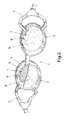
- the proposed equipment is envisaged to be formed by a spectacle apparatus (1), made up of functional assemblies (2) intended for application over each of the eyes, said apparatus (1) being provided with securing means (3) which can be of any type to establish a fixed fastening on the user's head.
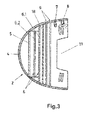
- Each of the functional assemblies (2) intended for conducting the eye examination comprises a casing (4), inside which there is arranged a display screen (5), and in front of the display there is arranged a set of lens elements (6) as well as an image capturing camera (7) and one or more light projecting sources (8).
- the lens elements (6) in said functional assembly (2) can be optical lenses or another type of element performing a similar function, for example, opaque discs with several holes or with a central slot, according to one embodiment one of said elements (6.1) being arranged in a fixed manner in the casing (4) and another element (6.2) in a mobile disposition with the possibility of moving closer to and away from said fixed element (6.1), allowing determining a variable focal length, like a zoom, whereas other elements (not depicted) are inserted in the slots (9) of the casing (4), being able to be replaced manually or by means of an automatic loader suitable to that end.
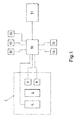
- the assembly of the equipment is connected with an electronic unit (10) controlling the operational actions of the functional assemblies (2) and through which the user or another person can interact with the system for determining the operating modes in relation to vision examinations to be performed on the eyes of application.
- the electronic unit (10) is connected with a computer (11), and an external variable detection system and an audio communication system, comprising the external variable detection system, for example, one or more sensors (12) for sensing the position of the user's head and a sensor (13) for sensing ambient light are further connected therewith, whereas the audio communication system comprises headphones (14) and a microphone (15).
- a control element (16) is also provided in relation to the electronic unit (10), by means of which the user can interact with the operating system of the functional assemblies (2) to perform the desired operations.
- the apparatus (1) is secured on the user's head with the functional assemblies (2) in a disposition in front of the eyes, images being sent by means of the electronic unit (10) to the screen (5), such that said images are seen by the corresponding eye through the lens elements (6), while at the same a ray of light is projected on the eye by means of the sources (8).
- the eye when the eye sees the images appearing on the screen (5), it reflects the light projected thereon, said reflections being captured together with the image of the eye by the camera (7), which transmits signals to the electronic unit (10) depending on the reflections, wherein said signals are combined with those provided by the external sensors (12-13), generating data corresponding to parameters of the examined eye, which is transmitted to the computer (11) to be processed.
- Data corresponding to different parameters of the eyes can thus be obtained in the action of the eyes upon viewing the images appearing on the screens (5), said data being compared with the pre-established patterns of a normal vision for determining functional vision anomalies, such that by means of projecting images on the screens (5) the eyes are subjected to exercises which allow improving the functional problems detected.
- the functional assemblies (2) are determined such that when in use, there is a free space between said functional assemblies (2) and the user's eyes which allows the user to use the equipment while wearing his usual spectacles, if he/she has any, whereby the results obtained from the vision examination are completely real in relation to the eyes of application.
- the casing (4) of the functional assemblies (2) is also provided with side openings (17) through which the ambient light can enter from the outside and the user can see the environment he/she is with his peripheral vision.
- the functional assemblies (2) incorporating the elements for vision examination are provided with a movement and orientation system (manual or automatic), for adjusting the position of said functional assemblies (2) depending on the interpupillary distance and on the plane perpendicular to the direction of vision of the eyes of each user, so that the results of vision examination are correct in each case.
- a movement and orientation system manual or automatic
- the functional assemblies (2) in the apparatus (1) can be structurally independent, each of them integrated in a respective casing (4), but similarly, without it altering the concept of the invention, the two functional assemblies (2) can be integrated in a single common casing (4), a single strategically incorporated image capturing camera (7) being able to be provided for working in relation to both functional assemblies (2).
- the slots (9) for inserting the replaceable lens elements (6) are further provided with brush-like hair strips to prevent in turn the entry of dust through said slots (9).
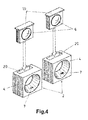
- Figure 4 shows another practical embodiment of the equipment object of the invention, wherein the casing (4) of each functional assembly (2) has an opening (20) for the selective insertion of one or more cartridges (19) having the lens elements (6). Therefore, depending on the test to which the user's eyes are to be subjected, the cartridge (19) with the most suitable lens elements (6) can be selected.
- the sectioned view of Figure 5 shows the cartridge (19) inserted in the corresponding casing (4), being arranged in front of the respective display screen (5).
- the cartridges (19) having the lens elements (6) are able to be inserted through openings defined in an outer casing (4.1), such that said outer casing (4.1) covers both the cartridges (19) and the casings (4) of the functional assemblies (2) in which the display screens (5), the image capturing cameras (7) and the light projecting sources (8) are arranged.
- one or more cartridges (19) which allow introducing additional optomechatronics to the equipment can be inserted in series in the openings defined in the outer casing (4.1). Therefore, the first cartridge closest to the eye can contain the optomechatronics of the lens elements (6) allowing the user to see the display screen of the display and the equipment to show the display screen (5) at any apparent distance of the user (for example, by means of a monofocal lens that can be moved axially or a multifocal lens), whereas the other cartridges can contain, for example, the optomechatronics for correcting emmetropia and/or astigmatism of the eye, or others.
- the images projected on the display screen (5) are stereoscopically and realistically seen by the user's eyes, it has been provided that the images depicted in each display screen (5) are geometrically out-of-phase depending on the perspective of each eye, and that the lens elements (6) can change their focal length depending on the area of the image which is being seen by the user's eyes.
- the lens elements (6) can be lenses or lens assemblies of any type which allows focusing images of the display screen (5) at variable distances, being able to be, for example, electro-optical lenses which can be electrically deformed (multifocal lenses), or several optical lenses which can be moved axially with respect to one another (mobile fixed focus lenses), or combinations thereof.
- the lens elements (6) are attached to the casing (4) of the cartridges (19) by means of elastic elements (22) which allows tilting said lens elements (6) to locate them in the required position.
- the elastic elements (22) can have different embodiments, therefore they can be a bellows arranged in the upper part of the cartridges (19) as depicted in drawings, a circumferential bellows, several helical springs in different directions or other similar embodiments.
- the lens elements (6) are tilted to the position required inside the housing casing (4) by means of a positioning carriage (23) which is assembled on a transverse guide inside the casings (4), said carriage (23) being able to be driven manually or by means of automatic elements. Therefore, once a cartridge (19) is correctly inserted in the opening (20) of the respective casing (4), the lower part of the cartridge (20) is anchored in the carriage (23) such that, by moving said carriage (23) laterally, the elastic elements (22) of the lens element (6) bend allowing said lens element (6) to be aligned in the required position in front of the corresponding eye of the user.
- the lens element (6) which is incorporated in the cartridge (19) encounters an obstacle which is the spear, which spear forces said lens element (6) to move laterally and/or vertically, which it will be able to do when the elastic elements (22) securing it are deformed. If the spears and the contact area of same on the lens element (6) are provided with a suitable geometry, said lens elements (6) will be aligned in a completely automatic and passive manner.
- said casings (4) are able to be moved vertically and/or horizontally.
- the casings (4) do not comprise the cartridges (19), as is the case of Figure 11 , the functional assemblies (2) or the cartridges (19) themselves can have means for moving vertically or horizontally, and therefore arranging the lens elements (6) depending on the interpupillary distance and on the direction of vision of the eyes of the user who is using the equipment.
- the apparatus (1) applied on a user's eyes, fastened with the means (3) establishing a fixed fastening on the head can be seen in Figure 8 .
- the side openings (17) through which the user can see the environment surrounding him with his peripheral vision being defined in relation to the casings (4) of the functional assemblies (2).
- practicable closure gates (21) in relation to said side openings (17) have been provided, such that, as seen in Figure 9 , in a normal position said gates (21) are moved leaving the respective side openings (17) free, and when required by the diagnosis conditions, as seen in Figure 10 , the gates (21) can be moved to block the side openings (17).
- closures made of electro-optical material susceptible to transparency variation are arranged in relation to the side openings (17), which closures allow selectively varying the passage of light through said side openings (17).
- the closures are arranged in a fixed manner in the side openings (17) and, by means of varying the opacity of said closures, the passage of light into the equipment can be selectively controlled.
- images are shown on the display screens (5) to the user, and parameters of the user's eyes while viewing said images are calculated, which parameters are compared with pre-established patterns for determining functional vision problems. Therefore, by means of projecting images on the screens (5) the eyes are subjected to exercises allowing improving the functional problems detected.
- the ocular neuromotor system of the user is in a virtual environment suitably representing the three-dimensional perception and the distance perception with respect to the perception of the actual equivalent environment.
- the images can be projected in the virtual space stereoscopically (three-dimensionally) and at different distances from the user by means of the display screens (5) and the lens elements (6).
- the image of the user's eyes is first captured by means of the cameras (7) and the direction of gaze of each eye, the point of convergence of a user's gaze and the distance of the point of convergence to the user are calculated from same in the electronic unit (10), controlling the lens elements (6) so that they adapt their focal length according to the actual depth corresponding to the distance of the point of convergence of the user's gaze to the user.
- each image projected on the display screens (5) is encoded according to actual depths, being able to assign for example, by means of the electronic unit (10), a specific blurriness, which for example is zero blurriness in the proximity of the focal plane of the user (which is that containing the point of convergence of the lines of gaze of a user's eyes) and progressively greater blurriness in increasingly further planes, to the contents of each plane of the three-dimensional image depicted on the plane of the display according to its virtual depth or distance to the user.
- a specific blurriness which for example is zero blurriness in the proximity of the focal plane of the user (which is that containing the point of convergence of the lines of gaze of a user's eyes) and progressively greater blurriness in increasingly further planes, to the contents of each plane of the three-dimensional image depicted on the plane of the display according to its virtual depth or distance to the user.
Landscapes
- Health & Medical Sciences (AREA)
- Life Sciences & Earth Sciences (AREA)
- Physics & Mathematics (AREA)
- Animal Behavior & Ethology (AREA)
- Veterinary Medicine (AREA)
- Ophthalmology & Optometry (AREA)
- Public Health (AREA)
- General Health & Medical Sciences (AREA)
- Engineering & Computer Science (AREA)
- Biomedical Technology (AREA)
- Heart & Thoracic Surgery (AREA)
- Surgery (AREA)
- Molecular Biology (AREA)
- Medical Informatics (AREA)
- Biophysics (AREA)
- General Physics & Mathematics (AREA)
- Optics & Photonics (AREA)
- Epidemiology (AREA)
- Pain & Pain Management (AREA)
- Physical Education & Sports Medicine (AREA)
- Rehabilitation Therapy (AREA)
- Human Computer Interaction (AREA)
- Vascular Medicine (AREA)
- Eye Examination Apparatus (AREA)
- Mobile Radio Communication Systems (AREA)
- Eyeglasses (AREA)
- Rehabilitation Tools (AREA)
Applications Claiming Priority (2)
| Application Number | Priority Date | Filing Date | Title |
|---|---|---|---|
| ES201100247A ES2387782B1 (es) | 2011-03-04 | 2011-03-04 | Equipo y procedimiento para exploracion, diagnostico o ayuda al diagnostico y terapia de problemas funcionales de la vision |
| PCT/ES2012/000051 WO2012120164A1 (fr) | 2011-03-04 | 2012-03-02 | Équipement et procédé pour l'exploration, l'établissement de diagnostic ou l'aide à l'établissement de diagnostic et le traitement de problèmes fonctionnels de la vue |
Publications (2)
| Publication Number | Publication Date |
|---|---|
| EP2667237A1 true EP2667237A1 (fr) | 2013-11-27 |
| EP2667237A4 EP2667237A4 (fr) | 2014-09-24 |
Family
ID=46797524
Family Applications (1)
| Application Number | Title | Priority Date | Filing Date |
|---|---|---|---|
| EP12754754.5A Withdrawn EP2667237A4 (fr) | 2011-03-04 | 2012-03-02 | Équipement et procédé pour l'exploration, l'établissement de diagnostic ou l'aide à l'établissement de diagnostic et le traitement de problèmes fonctionnels de la vue |
Country Status (15)
| Country | Link |
|---|---|
| US (1) | US20140002796A1 (fr) |
| EP (1) | EP2667237A4 (fr) |
| JP (1) | JP6117707B2 (fr) |
| KR (1) | KR20140034157A (fr) |
| AU (1) | AU2012224470B2 (fr) |
| BR (1) | BR112013022493A2 (fr) |
| CA (1) | CA2825659A1 (fr) |
| CL (1) | CL2013002147A1 (fr) |
| CO (1) | CO6781519A2 (fr) |
| ES (1) | ES2387782B1 (fr) |
| MX (1) | MX344408B (fr) |
| PE (1) | PE20141536A1 (fr) |
| RU (1) | RU2608235C2 (fr) |
| SG (1) | SG192155A1 (fr) |
| WO (1) | WO2012120164A1 (fr) |
Cited By (2)
| Publication number | Priority date | Publication date | Assignee | Title |
|---|---|---|---|---|
| WO2017070532A1 (fr) * | 2015-10-23 | 2017-04-27 | Eye Labs, LLC | Visiocasque de diagnostic et de traitement procurant une expérience multisensorielle |
| US10195076B2 (en) | 2015-10-23 | 2019-02-05 | Eye Labs, LLC | Head-mounted device providing diagnosis and treatment and multisensory experience |
Families Citing this family (18)
| Publication number | Priority date | Publication date | Assignee | Title |
|---|---|---|---|---|
| US11428937B2 (en) | 2005-10-07 | 2022-08-30 | Percept Technologies | Enhanced optical and perceptual digital eyewear |
| US9658473B2 (en) | 2005-10-07 | 2017-05-23 | Percept Technologies Inc | Enhanced optical and perceptual digital eyewear |
| US20070081123A1 (en) | 2005-10-07 | 2007-04-12 | Lewis Scott W | Digital eyewear |
| ES2429240B1 (es) * | 2012-04-04 | 2014-09-10 | Davalor Consultoria Estratégica Y Tecnólogica S.L. | Dispositivo para la sujeción de un equipo para la exploración de la visión, a la cabeza de un usuario |
| US11181740B1 (en) | 2013-03-15 | 2021-11-23 | Percept Technologies Inc | Digital eyewear procedures related to dry eyes |
| CN103784298A (zh) * | 2013-11-20 | 2014-05-14 | 中国科学院光电技术研究所 | 一种头戴式个性化人眼像差矫正视觉训练仪 |
| JP6465031B2 (ja) * | 2013-12-05 | 2019-02-06 | ソニー株式会社 | 表示装置 |
| CN204631869U (zh) * | 2014-06-09 | 2015-09-09 | 吴立中 | 视觉保护系统 |
| WO2016072272A1 (fr) * | 2014-11-04 | 2016-05-12 | 株式会社クリュートメディカルシステムズ | Dispositif d'examen de la vue, et dispositif d'affichage type visiocasque |
| KR101670667B1 (ko) * | 2015-03-04 | 2016-11-09 | 연세대학교 원주산학협력단 | 양안시 개선 장치 |
| CN109076662B (zh) * | 2016-03-21 | 2021-01-22 | 皇家飞利浦有限公司 | 用于镜子部件的自适应照明系统和控制自适应照明系统的方法 |
| KR101871792B1 (ko) | 2017-02-01 | 2018-06-29 | (주)세라젬 | 온열 치료 침대 |
| CN108403390A (zh) * | 2017-04-20 | 2018-08-17 | 岳予焕 | 眼科护理电子理疗仪 |
| CN107028738B (zh) * | 2017-06-21 | 2019-08-20 | 常州快来信息科技有限公司 | 基于眼动的视觉训练系统、智能终端及头戴设备 |
| CN108309710B (zh) * | 2018-03-15 | 2020-08-11 | 青岛伟宸松雷科技有限公司 | 一种视力训练仪的镜盘组件及控制方法 |
| CN110471183A (zh) * | 2019-08-06 | 2019-11-19 | 衡振兴 | 一种具有按摩功能的虚拟现实vr眼镜 |
| CN112505930A (zh) * | 2021-02-05 | 2021-03-16 | 宁波圻亿科技有限公司 | 一种光学矫正装置及穿戴装置 |
| US11914915B2 (en) * | 2021-07-30 | 2024-02-27 | Taiwan Semiconductor Manufacturing Company, Ltd. | Near eye display apparatus |
Family Cites Families (28)
| Publication number | Priority date | Publication date | Assignee | Title |
|---|---|---|---|---|
| US4402580A (en) * | 1980-07-31 | 1983-09-06 | Richard Ross | Optical exercising device |
| US4869589A (en) * | 1987-11-30 | 1989-09-26 | United Technologies Corporation | Automated visual screening system |
| JPH06324285A (ja) * | 1993-05-13 | 1994-11-25 | Olympus Optical Co Ltd | 視覚表示装置 |
| US7310072B2 (en) * | 1993-10-22 | 2007-12-18 | Kopin Corporation | Portable communication display device |
| US5583795A (en) * | 1995-03-17 | 1996-12-10 | The United States Of America As Represented By The Secretary Of The Army | Apparatus for measuring eye gaze and fixation duration, and method therefor |
| US5726916A (en) * | 1996-06-27 | 1998-03-10 | The United States Of America As Represented By The Secretary Of The Army | Method and apparatus for determining ocular gaze point of regard and fixation duration |
| US6386706B1 (en) * | 1996-07-31 | 2002-05-14 | Virtual-Eye.Com | Visual function testing with virtual retinal display |
| US6592222B2 (en) * | 1996-07-31 | 2003-07-15 | Massengill Family Trust | Flicker and frequency doubling in virtual reality |
| US5886822A (en) * | 1996-10-08 | 1999-03-23 | The Microoptical Corporation | Image combining system for eyeglasses and face masks |
| EP1027627B1 (fr) * | 1997-10-30 | 2009-02-11 | MYVU Corporation | Systeme d'interface pour verres optiques |
| WO2001055970A1 (fr) * | 2000-01-28 | 2001-08-02 | Namco Ltd. | Systeme de jeux et procede de creation d'images |
| CA2561287C (fr) * | 2004-04-01 | 2017-07-11 | William C. Torch | Biocapteurs,communicateurs et controleurs permettant de surveiller le mouvement de l'oeil et methodes d'utilisation de ces derniers |
| EP1749511A4 (fr) * | 2004-05-26 | 2009-04-01 | Panasonic Elec Works Co Ltd | Dispositif de formation de fonction cognitive |
| KR100624431B1 (ko) * | 2004-08-03 | 2006-09-19 | 삼성전자주식회사 | 입체영상 관찰을 위한 주시거리 조정 방법 및 그 장치 |
| JP2008534157A (ja) * | 2005-03-30 | 2008-08-28 | ノバビジョン, インコーポレイテッド | 視力訓練時にヘッドマウントディスプレイを用いて視覚刺激を与えるための方法および装置 |
| US20090153796A1 (en) * | 2005-09-02 | 2009-06-18 | Arthur Rabner | Multi-functional optometric-ophthalmic system for testing diagnosing, or treating, vision or eyes of a subject, and methodologies thereof |
| US7623726B1 (en) * | 2005-11-30 | 2009-11-24 | Adobe Systems, Incorporated | Method and apparatus for using a virtual camera to dynamically refocus a digital image |
| US9344612B2 (en) * | 2006-02-15 | 2016-05-17 | Kenneth Ira Ritchey | Non-interference field-of-view support apparatus for a panoramic facial sensor |
| US8668334B2 (en) * | 2006-02-27 | 2014-03-11 | Vital Art And Science Incorporated | Vision measurement and training system and method of operation thereof |
| JP4721941B2 (ja) * | 2006-03-30 | 2011-07-13 | 北海道公立大学法人 札幌医科大学 | 検査システム、訓練システムおよび視覚情報呈示システム |
| US7553020B2 (en) * | 2006-09-29 | 2009-06-30 | Welch Allyn, Inc. | Medical diagnostic instrument with variable focus liquid lens |
| JP3137375U (ja) * | 2007-09-10 | 2007-11-22 | 株式会社ニューオプト | 瞳孔撮像装置 |
| BRPI0908992A2 (pt) * | 2008-03-18 | 2015-11-24 | Pixeloptics Inc | dispositivo ótico eletro-ativo avançado |
| GB0815859D0 (en) * | 2008-09-01 | 2008-10-08 | Verma Dinesh | Ophthalmic diagnostic apparatus |
| GB2469278A (en) * | 2009-04-06 | 2010-10-13 | Univ City | Optometric testing system |
| HU0900696D0 (en) * | 2009-11-05 | 2009-12-28 | Holakovszky Laszlo | Binocular display device |
| US9326675B2 (en) * | 2009-12-24 | 2016-05-03 | Microsoft Technology Licensing, Llc | Virtual vision correction for video display |
| US8988463B2 (en) * | 2010-12-08 | 2015-03-24 | Microsoft Technology Licensing, Llc | Sympathetic optic adaptation for see-through display |
-
2011
- 2011-03-04 ES ES201100247A patent/ES2387782B1/es active Active
-
2012
- 2012-03-02 EP EP12754754.5A patent/EP2667237A4/fr not_active Withdrawn
- 2012-03-02 CA CA2825659A patent/CA2825659A1/fr not_active Abandoned
- 2012-03-02 KR KR1020137024390A patent/KR20140034157A/ko not_active Ceased
- 2012-03-02 RU RU2013144548A patent/RU2608235C2/ru not_active IP Right Cessation
- 2012-03-02 BR BR112013022493A patent/BR112013022493A2/pt not_active IP Right Cessation
- 2012-03-02 SG SG2013057005A patent/SG192155A1/en unknown
- 2012-03-02 AU AU2012224470A patent/AU2012224470B2/en not_active Ceased
- 2012-03-02 US US14/002,805 patent/US20140002796A1/en not_active Abandoned
- 2012-03-02 PE PE2013001584A patent/PE20141536A1/es not_active Application Discontinuation
- 2012-03-02 WO PCT/ES2012/000051 patent/WO2012120164A1/fr not_active Ceased
- 2012-03-02 MX MX2013009658A patent/MX344408B/es active IP Right Grant
- 2012-03-02 JP JP2013555910A patent/JP6117707B2/ja active Active
-
2013
- 2013-07-26 CL CL2013002147A patent/CL2013002147A1/es unknown
- 2013-08-22 CO CO13199371A patent/CO6781519A2/es active IP Right Grant
Cited By (2)
| Publication number | Priority date | Publication date | Assignee | Title |
|---|---|---|---|---|
| WO2017070532A1 (fr) * | 2015-10-23 | 2017-04-27 | Eye Labs, LLC | Visiocasque de diagnostic et de traitement procurant une expérience multisensorielle |
| US10195076B2 (en) | 2015-10-23 | 2019-02-05 | Eye Labs, LLC | Head-mounted device providing diagnosis and treatment and multisensory experience |
Also Published As
| Publication number | Publication date |
|---|---|
| CO6781519A2 (es) | 2013-10-31 |
| JP2014515625A (ja) | 2014-07-03 |
| PE20141536A1 (es) | 2014-11-01 |
| RU2013144548A (ru) | 2015-04-10 |
| WO2012120164A8 (fr) | 2013-09-12 |
| KR20140034157A (ko) | 2014-03-19 |
| CA2825659A1 (fr) | 2012-09-13 |
| RU2608235C2 (ru) | 2017-01-17 |
| ES2387782A1 (es) | 2012-10-01 |
| MX2013009658A (es) | 2014-02-11 |
| SG192155A1 (en) | 2013-08-30 |
| AU2012224470B2 (en) | 2015-08-13 |
| EP2667237A4 (fr) | 2014-09-24 |
| BR112013022493A2 (pt) | 2016-12-06 |
| ES2387782B1 (es) | 2013-05-24 |
| US20140002796A1 (en) | 2014-01-02 |
| MX344408B (es) | 2016-12-14 |
| JP6117707B2 (ja) | 2017-04-19 |
| WO2012120164A1 (fr) | 2012-09-13 |
| CL2013002147A1 (es) | 2014-02-28 |
Similar Documents
| Publication | Publication Date | Title |
|---|---|---|
| AU2012224470B2 (en) | Device and method for investigating, diagnosing, or helping to diagnose, and treating functional vision problems | |
| US11826099B2 (en) | Eye examination method and apparatus therefor | |
| EP3607872B1 (fr) | Dispositif de criblage de vision et procédés | |
| US9844317B2 (en) | Method and system for automatic eyesight diagnosis | |
| KR101704442B1 (ko) | Vr 기기를 이용한 시력측정시스템 | |
| EP3515285B1 (fr) | Dispositif optométrique | |
| KR102295587B1 (ko) | 가상현실 기반의 시야검사 방법 및 시스템 | |
| US12076088B2 (en) | Virtual reality-based portable nystagmography device and diagnostic test method using same | |
| CN103584833A (zh) | 检查、诊断或辅助功能视觉问题的诊断治疗的设备和方法 | |
| CN109890264A (zh) | 用于视力测试的系统和方法 | |
| US20210315453A1 (en) | Visual field examination method and system based on virtual reality | |
| KR102304369B1 (ko) | Vr을 이용한 안과검사방법 및 시스템 | |
| HK1190902A (en) | Equipment and method for examining, diagnosing or aiding the diagnosis and therapy of functional vision problems | |
| EP3951482B1 (fr) | Procédé de mesure pour mesurer une caractéristique de rotation d'un globe oculaire d'un sujet et procédé de réglage pour lentille à puissance progressive | |
| US20230013357A1 (en) | Examination device and eye examination method | |
| TW201404355A (zh) | 檢查、診斷或輔助功能性視力問題之診斷和治療的裝置及方法 | |
| JPH0622910A (ja) | 視力検査装置 | |
| WO2014158055A1 (fr) | Procédé pour examiner et évaluer le degré de fatigue des yeux d'un utilisateur d'ordinateur personnel | |
| WO2021104965A1 (fr) | Dispositif, procédé et programmes informatiques de rééducation de champ visuel |
Legal Events
| Date | Code | Title | Description |
|---|---|---|---|
| PUAI | Public reference made under article 153(3) epc to a published international application that has entered the european phase |
Free format text: ORIGINAL CODE: 0009012 |
|
| 17P | Request for examination filed |
Effective date: 20130821 |
|
| AK | Designated contracting states |
Kind code of ref document: A1 Designated state(s): AL AT BE BG CH CY CZ DE DK EE ES FI FR GB GR HR HU IE IS IT LI LT LU LV MC MK MT NL NO PL PT RO RS SE SI SK SM TR |
|
| DAX | Request for extension of the european patent (deleted) | ||
| A4 | Supplementary search report drawn up and despatched |
Effective date: 20140825 |
|
| RIC1 | Information provided on ipc code assigned before grant |
Ipc: A61H 5/00 20060101ALI20140819BHEP Ipc: A61B 3/028 20060101ALI20140819BHEP Ipc: G02B 27/01 20060101AFI20140819BHEP Ipc: A61B 3/032 20060101ALI20140819BHEP Ipc: A61F 9/00 20060101ALI20140819BHEP Ipc: A61B 3/00 20060101ALI20140819BHEP Ipc: G02B 7/12 20060101ALI20140819BHEP Ipc: A61B 3/14 20060101ALI20140819BHEP Ipc: A61B 3/113 20060101ALI20140819BHEP |
|
| STAA | Information on the status of an ep patent application or granted ep patent |
Free format text: STATUS: EXAMINATION IS IN PROGRESS |
|
| 17Q | First examination report despatched |
Effective date: 20180625 |
|
| STAA | Information on the status of an ep patent application or granted ep patent |
Free format text: STATUS: THE APPLICATION IS DEEMED TO BE WITHDRAWN |
|
| 18D | Application deemed to be withdrawn |
Effective date: 20200221 |