EP2668005B1 - Dispositif de serrage d'outil - Google Patents
Dispositif de serrage d'outil Download PDFInfo
- Publication number
- EP2668005B1 EP2668005B1 EP11802759.8A EP11802759A EP2668005B1 EP 2668005 B1 EP2668005 B1 EP 2668005B1 EP 11802759 A EP11802759 A EP 11802759A EP 2668005 B1 EP2668005 B1 EP 2668005B1
- Authority
- EP
- European Patent Office
- Prior art keywords
- tool
- clamping
- axial direction
- unit
- along
- Prior art date
- Legal status (The legal status is an assumption and is not a legal conclusion. Google has not performed a legal analysis and makes no representation as to the accuracy of the status listed.)
- Active
Links
Images

Classifications
-
- B—PERFORMING OPERATIONS; TRANSPORTING
- B24—GRINDING; POLISHING
- B24B—MACHINES, DEVICES, OR PROCESSES FOR GRINDING OR POLISHING; DRESSING OR CONDITIONING OF ABRADING SURFACES; FEEDING OF GRINDING, POLISHING, OR LAPPING AGENTS
- B24B23/00—Portable grinding machines, e.g. hand-guided; Accessories therefor
- B24B23/04—Portable grinding machines, e.g. hand-guided; Accessories therefor with oscillating grinding tools; Accessories therefor
-
- A—HUMAN NECESSITIES
- A61—MEDICAL OR VETERINARY SCIENCE; HYGIENE
- A61B—DIAGNOSIS; SURGERY; IDENTIFICATION
- A61B17/00—Surgical instruments, devices or methods
- A61B17/14—Surgical saws
- A61B17/142—Surgical saws with reciprocating saw blades, e.g. with cutting edges at the distal end of the saw blades
-
- B—PERFORMING OPERATIONS; TRANSPORTING
- B24—GRINDING; POLISHING
- B24B—MACHINES, DEVICES, OR PROCESSES FOR GRINDING OR POLISHING; DRESSING OR CONDITIONING OF ABRADING SURFACES; FEEDING OF GRINDING, POLISHING, OR LAPPING AGENTS
- B24B23/00—Portable grinding machines, e.g. hand-guided; Accessories therefor
- B24B23/02—Portable grinding machines, e.g. hand-guided; Accessories therefor with rotating grinding tools; Accessories therefor
- B24B23/022—Spindle-locking devices, e.g. for mounting or removing the tool
-
- B—PERFORMING OPERATIONS; TRANSPORTING
- B24—GRINDING; POLISHING
- B24B—MACHINES, DEVICES, OR PROCESSES FOR GRINDING OR POLISHING; DRESSING OR CONDITIONING OF ABRADING SURFACES; FEEDING OF GRINDING, POLISHING, OR LAPPING AGENTS
- B24B23/00—Portable grinding machines, e.g. hand-guided; Accessories therefor
- B24B23/04—Portable grinding machines, e.g. hand-guided; Accessories therefor with oscillating grinding tools; Accessories therefor
- B24B23/046—Clamping or tensioning means for abrasive sheets
-
- B—PERFORMING OPERATIONS; TRANSPORTING
- B24—GRINDING; POLISHING
- B24B—MACHINES, DEVICES, OR PROCESSES FOR GRINDING OR POLISHING; DRESSING OR CONDITIONING OF ABRADING SURFACES; FEEDING OF GRINDING, POLISHING, OR LAPPING AGENTS
- B24B45/00—Means for securing grinding wheels on rotary arbors
-
- B—PERFORMING OPERATIONS; TRANSPORTING
- B24—GRINDING; POLISHING
- B24B—MACHINES, DEVICES, OR PROCESSES FOR GRINDING OR POLISHING; DRESSING OR CONDITIONING OF ABRADING SURFACES; FEEDING OF GRINDING, POLISHING, OR LAPPING AGENTS
- B24B45/00—Means for securing grinding wheels on rotary arbors
- B24B45/003—Accessories therefor
-
- B—PERFORMING OPERATIONS; TRANSPORTING
- B24—GRINDING; POLISHING
- B24B—MACHINES, DEVICES, OR PROCESSES FOR GRINDING OR POLISHING; DRESSING OR CONDITIONING OF ABRADING SURFACES; FEEDING OF GRINDING, POLISHING, OR LAPPING AGENTS
- B24B45/00—Means for securing grinding wheels on rotary arbors
- B24B45/006—Quick mount and release means for disc-like wheels, e.g. on power tools
-
- B—PERFORMING OPERATIONS; TRANSPORTING
- B27—WORKING OR PRESERVING WOOD OR SIMILAR MATERIAL; NAILING OR STAPLING MACHINES IN GENERAL
- B27B—SAWS FOR WOOD OR SIMILAR MATERIAL; COMPONENTS OR ACCESSORIES THEREFOR
- B27B19/00—Other reciprocating saws with power drive; Fret-saws
- B27B19/006—Other reciprocating saws with power drive; Fret-saws with oscillating saw blades; Hand saws with oscillating saw blades
-
- B—PERFORMING OPERATIONS; TRANSPORTING
- B27—WORKING OR PRESERVING WOOD OR SIMILAR MATERIAL; NAILING OR STAPLING MACHINES IN GENERAL
- B27B—SAWS FOR WOOD OR SIMILAR MATERIAL; COMPONENTS OR ACCESSORIES THEREFOR
- B27B5/00—Sawing machines working with circular or cylindrical saw blades; Components or equipment therefor
- B27B5/29—Details; Component parts; Accessories
- B27B5/30—Details; Component parts; Accessories for mounting or securing saw blades or saw spindles
- B27B5/32—Devices for securing circular saw blades to the saw spindle
-
- Y—GENERAL TAGGING OF NEW TECHNOLOGICAL DEVELOPMENTS; GENERAL TAGGING OF CROSS-SECTIONAL TECHNOLOGIES SPANNING OVER SEVERAL SECTIONS OF THE IPC; TECHNICAL SUBJECTS COVERED BY FORMER USPC CROSS-REFERENCE ART COLLECTIONS [XRACs] AND DIGESTS
- Y10—TECHNICAL SUBJECTS COVERED BY FORMER USPC
- Y10T—TECHNICAL SUBJECTS COVERED BY FORMER US CLASSIFICATION
- Y10T279/00—Chucks or sockets
- Y10T279/33—Member applies axial force component
Definitions
- Tool clamping devices in particular oscillating tool clamping devices, which have a clamping unit are already known.
- the clamping unit in this case has a clamping element for clamping a machining tool in an axial direction and an operating unit for actuating the clamping element, as for example in the documents DE 20 2008 001 759 U1 and EP 1 180 416 A2 ,
- the invention is based on a tool clamping device, in particular of an oscillating tool clamping device, with at least one clamping unit which has at least one clamping element for clamping a machining tool in an axial direction and at least one operating unit for actuating the clamping element.
- the tool clamping device comprises at least one translation unit which is provided to change a transmission ratio as a function of at least one movement component of an operating element of the operating unit.
- the term "provided" is intended to define specifically equipped and / or specially designed.
- a “clamping unit” is to be understood here in particular as a unit which secures a machining tool by means of a positive connection and / or by means of a frictional connection along the axial direction, in particular on a tool holder of a portable machine tool.
- the clamping element of the clamping unit is formed pin-shaped.
- a “pin-shaped clamping element” is to be understood here in particular as a tensioning element which, in an assembled state, has a longitudinal extent along the axial direction that is greater than a transverse extent of the tensioning element along a direction perpendicular to the axial direction.
- the longitudinal extension is more than twice as large as the transverse extent of the tensioning element, preferably more than four times as large, and more preferably more than six times as large.
- the pin-shaped clamping element is at least partially formed as a hollow body.
- the clamping element has at least two partial regions designed as legs, which are arranged at least partially spaced apart along a direction extending at least substantially perpendicular to the axial direction.
- the clamping element is arranged captively in a hollow shaft of the portable power tool.
- the clamping unit has a clamping head arranged on the clamping element. In this case, the clamping head preferably comprises two partial areas which are movable relative to one another.
- the portions of the chuck are preferably formed integrally with one of the legs of the clamping element.
- a "chucking head” is to be understood here in particular as an element which has at least one clamping surface which bears against the clamping of the machining tool in the axial direction at least on a partial surface of the machining tool and acts on the machining tool with a clamping force along the axial direction.
- the term "axial direction” should in particular define a direction which preferably extends at least substantially parallel to a pivot axis and / or rotation axis of a drive shaft and / or spindle of a portable power tool provided for driving the machining tool.
- substantially parallel is to be understood here as meaning, in particular, an alignment of a direction relative to a reference direction, in particular in a plane, wherein the direction relative to the reference direction is a deviation, in particular less than 8 °, advantageously less than 5 ° and particularly advantageously less than 2 °.
- control unit is to be understood here as meaning, in particular, a unit which has at least one operating element which is directly accessible to an operator is operable, and which is intended to influence and / or change by means of an actuation and / or by input of parameters, a process and / or a state of a unit coupled to the operating unit.
- unit of translation is intended to define a unit intended to translate at least one value of a physical quantity, such as a speed, torque, force, etc., into another value of the same physical quantity, both values in a fixed ratio, in particular in a structurally determined relationship to each other.
- the translation unit is formed by a mechanical translation unit.
- the translation unit is designed in another way, which appears appropriate to a person skilled in the art.
- a “movement component” is to be understood here in particular as a component of a movement variable which defines a movement mathematically, such as a path, a speed, an angle, etc.
- the movement component is formed by an angle, in particular an opening angle, which the Operating element of the operating unit sweeps in a movement starting from a starting position.
- starting position should in particular define a position of the operating element in which a force effect of the operating element on the translation unit and / or the clamping unit for actuating the clamping unit is canceled and / or prevented.
- the translation unit changes a transmission ratio between a traveled distance of the operating element, in particular about an axis of rotation extending at least substantially parallel to the axial direction, and a distance traveled by the clamping element along the axial direction as a function of an opening angle swept by the operating element.
- the term "gear ratio" is intended here to define in particular a ratio of physical values which can be changed by means of the translation unit relative to one another, wherein both physical values deviate from zero, in particular the ratio itself likewise deviates from a value of zero and / or infinity.
- the translation unit comprise at least one control cam which, viewed along a course of the control cam in at least two different points of the control cam, has mutually different slopes in the axial direction.
- the different gradients of the cam in each of the two different points along a curve of the cam on a non-zero value are to be understood here in particular as a geometric shape which is intended to convert a movement form into another movement form and / or which is intended to control a component as a result of a movement, in particular a movement of the control cam about an axis which, as a result of the movement, carries out a movement predetermined by the geometric shape.
- the control cam is provided to convert a rotational movement in a translational movement.
- the term "slope" should in particular define a measure of a steepness of the control curve, in particular considered in a plane and / or a projection plane.
- the slope is formed by a mathematically defined slope, which can be determined by means of a difference quotient and / or by means of a differential equation in any point of the control curve.
- the control cam is arranged on one of the operating unit facing side of the clamping element on the clamping element.
- the control cam is formed integrally with the clamping element.
- an actuating force to be applied by an operator for actuating the clamping element can be influenced in a particularly advantageous manner by means of the operating unit; in particular, advantageously, a profile of the actuating force can be changed as a function of an opening angle of the operating element.
- the translation unit has at least one scanning element, which is provided to the clamping element in dependence of the course the cam to move along the axial direction.
- a "sensing element” is to be understood here in particular an element which scans the course of the control cam, in particular scans mechanically, and as a result of the course of the control cam controls a component which executes a dependent of the course of the control cam movement.
- the sensing element is at least in an operating state on the control cam. It can be advantageously achieved by the course of the control cam dependent movement of the clamping element.
- the sensing element is designed as a bolt.
- a "bolt” is to be understood here as meaning, in particular, an element which has a longitudinal extent which is greater than a transverse extent running perpendicular to the longitudinal extent.
- the bolt is cylindrical.
- the bolt is rotationally symmetrical about at least one axis.
- the bolt is formed of a solid material.
- the sensing element has another, a skilled person appear useful design. It can structurally simple a scanning element can be achieved.
- the bolt has a longitudinal extent which extends in an assembled state along a direction extending at least substantially perpendicular to the axial direction.
- the bolt has a longitudinal extent, which extends in an assembled state for sensing a course of the control cam along another direction that appears appropriate to a person skilled in the art. It can structurally simple contact surface and / or a contact surface between the bolt and the cam can be achieved.
- the tool clamping device comprises at least one decoupling unit which is provided for decoupling the operating unit in at least one operating mode from a movement of the clamping element.
- a "decoupling unit” is to be understood here in particular as a unit which has at least one mechanism and / or at least one component which effects a decoupling, in particular a decoupling of movements, between at least two elements.
- the decoupling unit is preferred intended to decouple the operating unit in at least one operating mode from an oscillating movement of the clamping element about an at least substantially parallel to the axial direction extending pivot axis of the clamping element.
- a protection of components in at least one operating mode can be achieved.
- the decoupling unit has at least one stop element, which is provided to limit a movement of the clamping element along the axial direction in the direction of the operating unit.
- the stop element is provided due to the limitation of the movement of the clamping element along the axial direction to ensure, at least in one operating state, a distance between the sensing element and the control cam along a direction perpendicular to the axial direction.
- a transmission of a movement of the clamping element via the control cam and the scanning element in at least one operating state to the operating element of the operating unit can be prevented.
- the operating element of the operating unit is designed as an operating lever, which is mounted pivotably about a pivot axis extending parallel to the axial direction.
- the operating lever is pivotally and / or rotatably mounted in a machine tool housing of the portable power tool.
- the operating lever is designed as a one-sided lever, are initiated in the actuating forces on one side of the operating lever.
- the operating lever is designed in another, a person skilled in the sense appearing manner.
- an actuating force of an operator for actuating the tensioning element can be applied by means of the operating lever.
- the operating unit comprises at least one Abtastworkelement for receiving a sensing element of the operating unit, which is at least rotatably connected to the operating lever.
- rotatably connected should be understood in particular a compound that transmits a torque and / or rotational movement unchanged.
- the Abtastworkelement by means of a screw rotatably with the operating lever connected.
- the Abtastworkelement by means of another, a person skilled in the sense appearing connection, such as cohesively and / or positively connected to the operating lever.
- the Abtastworkelement has at least one recess in which the scanning element is arranged in an assembled state. It can be advantageously achieved a storage of the sensing element.
- structurally simple the scanning element as a result of the movement of the operating lever to scan the course of the control cam and thus move the clamping element along the axial direction.
- the invention is based on a portable power tool, in particular a portable power tool with an oscillating drivable spindle, with at least one tool clamping device according to the invention.
- a "portable machine tool” is to be understood here in particular as meaning a machine tool, in particular a hand tool machine, which can be transported without transport machine by an operator.
- the portable power tool has a mass which is less than 40 kg, preferably less than 10 kg and particularly preferably less than 5 kg. It can be advantageously achieved a high ease of use for an operator of the machine tool.
- the tool clamping device according to the invention should not be limited to the application and embodiment described above.
- the tool clamping device according to the invention can have a number deviating from a number of individual elements, components and units specified here in order to fulfill a mode of operation described herein.
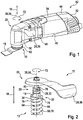
- FIG. 1 1 shows an electrically operated portable power tool 42 having a tool clamping device 10.
- the portable power tool 42 includes a power tool housing 44 that encloses an electric motor unit 46, a gear unit 48 and an output unit 50 of the portable power tool 42.
- the machine tool housing 44 in this case comprises two housing halves 52, 54 which are releasably connected to each other along a plane passing through an axial direction 18 level.
- the machine tool housing 44 has two or more cup-shaped housing parts which are releasably connectable to each other.
- the axial direction 18 runs along and / or parallel to a rotation axis 56 of a spindle 58 designed as a Hollow shaft 60 of the output unit 50 (FIG. FIG. 2 ).
- the hollow shaft 60 is provided to oscillate in a mounted state, a machining tool 16 to drive.
- An oscillating drive of the machining tool 16 in this case takes place in a manner already known to a person skilled in the art, such as by means of an eccentrically arranged on a drive shaft of the electric motor unit 46 pin (not shown here) of the gear unit 48, by means of a rocker and an oscillating sleeve (here not shown in more detail) of the gear unit 48 drives the hollow shaft 60 in an operation of the portable power tool 42.
- the spindle 58 designed as a hollow shaft 60 is driven in an oscillating manner.
- the machining tool 16 can be fastened to a tool holder 62 of the output unit 50 for machining workpieces.
- the tool holder 62 is non-rotatably connected by means of a positive and / or non-positive connection with the hollow shaft 60.
- the tool holder 62 is formed integrally with the hollow shaft 60. It can be a pivoting movement of the hollow shaft 60 are transmitted to the tool holder 62.
- FIG. 2 shows a detailed view of the tool clamping device 10.
- the tool clamping device 10 comprises a clamping unit 12 which has a clamping element 14 for clamping the machining tool 16 in the axial direction 18 and an operating unit 20 for actuating the clamping element 14.
- the clamping element 14 is pin-shaped.
- the clamping element 14 is movably arranged in the hollow shaft 60. In this case, the clamping element 14 extends along the axial direction 18 through the hollow shaft 60 therethrough.
- the clamping element 14 is arranged in a mounted state in the hollow shaft 60.
- the clamping element 14 has two legs 64, 66, which extend in an assembled state of the clamping element 14 at least substantially along the axial direction 18.
- the legs 64, 66 are formed integrally with the clamping element 14.
- the legs 64, 66 have a low material thickness, viewed along a direction perpendicular to the axial direction 18, in order to enable a deflection of the legs 64, 66.
- the legs 64, 66 as a result of material properties and / or a geometric shape of the legs 64, 66 are arranged relative to each other movable on the clamping element 14.
- the legs 64, 66 are in this case resiliently arranged on the clamping element 14.
- the legs 64, 66 along arranged perpendicular to the axial direction 18 extending direction relative to each other. The legs 64, 66 can move relative to each other due to the resilient arrangement on the clamping element 14 and the relative distance to each other along the direction perpendicular to the axial direction 18 extending direction.
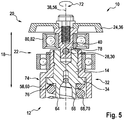
- the clamping unit 12 has a spring element 68, which is provided to act on the clamping element 14 along the axial direction 18 with a spring force ( FIG. 5 ).
- the spring element 68 is formed here as a compression spring 70.
- the spring element 68 is formed by another, a skilled person appearing appropriate spring element, such as a tension spring, a plate spring, etc.
- the clamping unit 12 more than a spring element 68 for acting on the Has clamping element 14 with a spring force.
- the clamping element 14 extends in an assembled state along the axial direction 18 through the compression spring 70 therethrough.
- the compression spring 70 is arranged along a circumferential direction 72 at least about a portion of the clamping element 14.
- the circumferential direction 72 extends in a plane which is at least substantially perpendicular to the axial direction 18.
- the compression spring 70 is supported in an assembled state with one end 74 on a contact surface 76 of the clamping element 14.
- the contact surface 76 is annular in this case.
- the tool clamping device 10 further comprises a translation unit 22 which is provided to change a transmission ratio as a function of at least one movement component of a control element 24 of the operating unit 20.
- the operating element 24 of the operating unit 20 is designed as an operating lever 36, which is mounted pivotably about a pivot axis 38 extending parallel to the axial direction 18.
- the pivot axis 38 in this case runs coaxially to the axis of rotation 56 of the hollow shaft 60.
- the translation unit 22 comprises a control cam 26 which, viewed along a curve of the control curve 26 in at least two different points of the control curve 26, has mutually different slopes in the axial direction 18 (FIG. FIG. 3 ).
- the control cam 26 is arranged on one of the operating unit 20 facing side of the clamping element 14.
- control cam 26 is integral with the clamping element fourteenth educated.
- the translation unit 22 also has a further control cam (not shown in detail here), which is arranged offset along the circumferential direction 72 to the control cam 26 on the clamping element 14.
- the further control cam has an analogous to the control curve 26 course.
- the further control cam viewed along a curve of the further control cam in at least two different points of the further control cam, has mutually different pitches in the axial direction 18.
- the translation unit 22 has a sensing element 28, which is provided to move the clamping element 14 in dependence on the course of the control cam 26 along the axial direction 18.
- the sensing element 28 is formed as a bolt 30.
- the bolt 30 has a longitudinal extent, which extends in an assembled state along a direction extending at least substantially perpendicular to the axial direction 18.
- the bolt 30 is intended to be brought in at least one operating mode in each case with two opposite ends of the bolt 30 with the control cam 26 and the other control cam in contact.
- the operating unit 20 comprises a Abtastworkelement 40 for receiving the sensing element 28 of the control unit 20, which is rotatably connected to the operating lever 36.
- the Abtastworkelement 40 extends in an assembled state along the axial direction 18.
- the Abtastworkelement 40 has a recess 78 which extends along an at least substantially perpendicular to the axial direction 18 extending through the Abtastanalysiselement 40.
- the recess 78 is formed by a through hole in which the sensing element 28 is arranged in an assembled state.
- a diameter of the recess 78 corresponds at least substantially to a dimension of the sensing element 28 along the axial direction 18.
- the sensing element 28 is held in the recess 78 by means of a press fit.
- the scanning element 28 it is also conceivable for the scanning element 28 to be held in the recess 78 in another manner which appears appropriate to a person skilled in the art.
- the sensing element 28 is formed integrally with the Abtastanalysiselement 40 and extending along an at least substantially perpendicular to the axial direction 18 extending direction at least two locations of the Abtastanalysiselement 40 away.
- the Abtastworkelement 40 is also intended to a bearing function of the operating lever 36 in the machine tool housing 44 ( FIG. 4 ).
- a ball bearing 80 designed as a bearing element 82 is arranged on the Abtastamelement 40.
- the ball bearing 80 encloses the Abtastageelement 40 in a portion of the Abtastanalysiselements 40 along the circumferential direction 72nd
- the tool clamping device 10 further has a decoupling unit 32, which is provided to decouple the operating unit 20 in at least one operating mode from a movement of the clamping element 14.
- the decoupling unit 32 is provided to decouple the operating unit 20 in at least one operating mode from an oscillating movement of the clamping element 14 about the axis of rotation 56.
- the decoupling unit 32 has a stop element 34, which is provided to limit a movement of the clamping element 14 along the axial direction 18 in the direction of the operating unit 20.
- the stop element 34 is in this case in an operating mode along the axial direction 18 at a projection of the hollow shaft 60 at.
- the arranged on the clamping element 14 control cam 26 and the other control cam are thus arranged in an operating mode along the axial direction 18 spaced from the sensing element 28.
- the operating lever 36 To mount the machining tool 16 on the tool holder 62, the operating lever 36, starting from a voltage applied to the machine tool housing 44 position of the operating lever 36, moved by the operator in a direction away from the machine tool housing 44 direction and thus rotated about the pivot axis 38.
- the sensing element 28 is first moved in the direction of the control cam 26 and the other cam until ends of the trained as a bolt 30 sensing element 28 come into contact with the control cam 26 and the other control cam.
- the trained as a bolt 30 sensing element 28 slides along the control cam 26 and the other control cam.
- the clamping element 14 is moved along the axial direction 18 in the direction of the tool holder 62.
- the clamping unit 12 is thereby transferred into a tool change mode.
- the movement of the clamping element 14 along the axial direction 18 in the direction of the tool holder 62 is dependent on a course of the control cam 26 and the further cam and an opening angle of the operating lever 36.
- the opening angle is swept by the operating lever 36 at a movement of the operating lever 36 about the pivot axis 38, starting from the voltage applied to the machine tool housing 44 position of the operating lever 36.
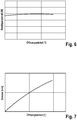
- FIG. 6 shows a relationship between the swept by the operating lever 36 opening angle and an applied by an operator operating force to move the clamping member 14 along the axial direction 18 in a diagram.
- the diagram shows a disproportionate course of the actuating force to the opening angle due to the course and / or a geometry of the control cam 26 and the other cam.
- an actuating force to be applied by the operator for moving the tensioning element 14 along the axial direction 18 as a result of the course and / or the geometry of the control cam 26 and the further control curve is disproportionate to the opening angle of the operating lever 36.
- FIG. 7 shows a relationship between a distance traveled by the clamping element 14 along the axial direction 18 and the swept by the operating lever 36 opening angle in another diagram.
- a course of the route is due to the course of the control cam 26 and the other control cam disproportionate to the opening angle.
- the further diagram shows a disproportionate course of the distance to the opening angle due to the course and / or the geometry of the control cam 26 and the other cam.
- a distance of the tensioning element 14 along the axial direction 18 due to the course and / or the geometry of the control cam 26 and the further control cam is also disproportionate to the opening angle of the operating lever 36 when the tensioning element 14 is actuated by the operating unit 20.
Landscapes
- Engineering & Computer Science (AREA)
- Mechanical Engineering (AREA)
- Jigs For Machine Tools (AREA)
- Cutting Tools, Boring Holders, And Turrets (AREA)
- Clamps And Clips (AREA)
- Constituent Portions Of Griding Lathes, Driving, Sensing And Control (AREA)
Claims (9)
- Dispositif de serrage d'outil, en particulier dispositif de serrage d'outil oscillant, avec au moins une unité de serrage (12), qui présente au moins un élément de serrage (14) pour le serrage d'un outil d'usinage (16) dans une direction axiale (18) ainsi qu'au moins une unité de commande (20) pour actionner l'élément de serrage (14), avec au moins une unité de transmission (22), qui est prévue pour changer un rapport de transmission en fonction d'au moins une composante de mouvement d'un élément de commande (24) de l'unité de commande (20), caractérisé en ce que l'élément de commande (24) de l'unité de commande (20) est réalisé sous la forme d'un levier de commande (36), qui est monté de façon pivotante autour d'un axe de pivotement (38) orienté parallèlement à la direction axiale (18).
- Dispositif de serrage d'outil selon la revendication 1, caractérisé en ce que l'unité de transmission (22) comprend au moins une came de commande (26) qui, considérée le long d'un tracé de la came de commande (26) en au moins deux points différents de la came de commande (26), présente des pentes différentes l'une de l'autre en direction axiale (18).
- Dispositif de serrage d'outil selon l'une quelconque des revendications précédentes, caractérisé en ce que l'unité de transmission (22) présente au moins un élément palpeur (28), qui est prévu pour déplacer l'élément de serrage (14) le long de la direction axiale (18) en fonction du tracé de la came de commande (26).
- Dispositif de serrage d'outil selon la revendication 3, caractérisé en ce que l'élément palpeur (28) est formé par un pivot (30).
- Dispositif de serrage d'outil selon la revendication 4, caractérisé en ce que le pivot (30) présente une extension longitudinale, qui dans un état monté s'étend le long d'une direction orientée au moins essentiellement perpendiculairement à la direction axiale (18).
- Dispositif de serrage d'outil selon l'une quelconque des revendications précédentes, caractérisé par au moins une unité de découplage (32), qui est prévue pour découpler l'unité de commande (20) d'un mouvement de l'élément de serrage (14) au moins dans un mode de fonctionnement.
- Dispositif de serrage d'outil selon la revendication 6, caractérisé en ce que l'unité de découplage (32) présente au moins un élément de butée (34), qui est prévu pour limiter un mouvement de l'élément de serrage (14) le long de la direction axiale (18) en direction de l'unité de commande (20).
- Dispositif de serrage d'outil selon l'une quelconque des revendications précédentes, caractérisé en ce que l'unité de commande (20) comprend au moins un élément de logement de balayage (40) destiné à recevoir un élément palpeur (28) de l'unité de transmission (22), qui est relié au moins sans rotation au levier de commande (36).
- Machine-outil portable, en particulier machine-outil portable avec une broche pouvant être entraînée de façon oscillante, avec au moins un dispositif de serrage d'outil selon l'une quelconque des revendications précédentes.
Applications Claiming Priority (2)
| Application Number | Priority Date | Filing Date | Title |
|---|---|---|---|
| DE102011003100A DE102011003100A1 (de) | 2011-01-25 | 2011-01-25 | Werkzeugspannvorrichtung |
| PCT/EP2011/074107 WO2012100894A1 (fr) | 2011-01-25 | 2011-12-27 | Dispositif de serrage d'outil |
Publications (2)
| Publication Number | Publication Date |
|---|---|
| EP2668005A1 EP2668005A1 (fr) | 2013-12-04 |
| EP2668005B1 true EP2668005B1 (fr) | 2018-10-03 |
Family
ID=45422160
Family Applications (1)
| Application Number | Title | Priority Date | Filing Date |
|---|---|---|---|
| EP11802759.8A Active EP2668005B1 (fr) | 2011-01-25 | 2011-12-27 | Dispositif de serrage d'outil |
Country Status (6)
| Country | Link |
|---|---|
| US (1) | US9463547B2 (fr) |
| EP (1) | EP2668005B1 (fr) |
| CN (1) | CN103328156B (fr) |
| DE (1) | DE102011003100A1 (fr) |
| RU (1) | RU2601716C2 (fr) |
| WO (1) | WO2012100894A1 (fr) |
Families Citing this family (11)
| Publication number | Priority date | Publication date | Assignee | Title |
|---|---|---|---|---|
| DE102012007926A1 (de) * | 2012-04-17 | 2013-10-17 | C. & E. Fein Gmbh | Handwerkzeug mit einer Spannvorrichtung für ein Werkzeug |
| AT516259B1 (de) | 2014-11-03 | 2016-04-15 | Zizala Lichtsysteme Gmbh | Lichtsystem für ein Kraftfahrzeug |
| KR101483963B1 (ko) * | 2014-11-25 | 2015-01-20 | 김창성 | 핸드 그라인더의 연마디스크 탈,부착장치 |
| US11154974B2 (en) * | 2015-08-31 | 2021-10-26 | Positec Power Tools (Suzhou) Co., Ltd. | Hand-held tool and clamping device thereof |
| US10682714B2 (en) * | 2016-08-31 | 2020-06-16 | Robert Bosch Tool Corporation | Oscillating interface for an oscillating power tool |
| DE102017212526A1 (de) * | 2017-07-20 | 2019-01-24 | Robert Bosch Gmbh | Schnellspannvorrichtung für eine tragbare Werkzeugmaschine |
| CN109159016B (zh) * | 2018-11-07 | 2024-11-01 | 惠州市新视觉实业有限公司 | 一种壳体抛光设备 |
| US11052475B2 (en) * | 2018-11-27 | 2021-07-06 | Zhejiang Burley Tools Co., Ltd. | Rapid replacing structure for multi-purpose saw |
| CN111975633B (zh) * | 2020-07-24 | 2022-03-15 | 湖南省方圆磨料磨具有限公司 | 一种砂轮安全安装固定机构 |
| US12623295B2 (en) * | 2023-05-12 | 2026-05-12 | Robert Bosch Tool Corporation | Mandrel assembly for use with a rotary tool |
| CN118021384B (zh) * | 2024-04-11 | 2024-08-06 | 苏州铸正机器人有限公司 | 一种具有定位功能的动力骨骼切割装置 |
Family Cites Families (16)
| Publication number | Priority date | Publication date | Assignee | Title |
|---|---|---|---|---|
| SU366031A1 (ru) * | 1970-11-20 | 1973-01-16 | ЗСьООЮЗИАЯ : пиШйО^ШИ'^ГК'?^ | |
| EP0152564B1 (fr) * | 1984-02-18 | 1989-08-23 | C. & E. FEIN GmbH & Co. | Fixation d'outil |
| DE3902874A1 (de) * | 1989-02-01 | 1990-08-09 | Fein C & E | Adapter zum befestigen eines zusatzwerkzeugs |
| DE59101383D1 (de) * | 1991-01-16 | 1994-05-19 | Fein C & E | Tragbare Schleifmaschine mit Schnellspanneinrichtung. |
| DE4314799C2 (de) | 1993-05-05 | 1995-04-13 | Fein C & E | Elektrowerkzeug |
| DE4336620C2 (de) * | 1993-10-27 | 1997-07-03 | Fein C & E | Elektrowerkzeug mit einer nur bei ausgeschaltetem Motor betätigbaren Spannvorrichtung |
| DE10039739A1 (de) * | 2000-08-16 | 2002-02-28 | C & E Fein Gmbh & Co Kg | Elektrowerkzeug mit Schnellspanneinrichtung |
| DE10040330A1 (de) * | 2000-08-17 | 2002-02-28 | Hilti Ag | Elektrowerkzeug mit Spanneinrichtung |
| ES2261795T3 (es) * | 2002-01-10 | 2006-11-16 | Black & Decker Inc. | Caja de engranajes. |
| DE10361810A1 (de) | 2003-12-30 | 2005-07-28 | Robert Bosch Gmbh | Handwerkzeugmaschine mit Spanneinrichtung |
| US7789737B2 (en) * | 2004-07-08 | 2010-09-07 | Metabowerke Gmbh | Rapid locking device |
| US7128641B1 (en) | 2005-06-08 | 2006-10-31 | Gison Machinery Co., Ltd. | Grinder capable of seizing rotary shaft |
| DE202008001759U1 (de) | 2008-02-01 | 2009-06-04 | C. & E. Fein Gmbh | Oszillierend antreibbare Werkzeugmaschine |
| DE202009001440U1 (de) * | 2009-01-30 | 2010-07-01 | C. & E. Fein Gmbh | Kraftgetriebenes Handwerkzeug mit Spanneinrichtung für ein Werkzeug |
| US20110039482A1 (en) * | 2009-07-29 | 2011-02-17 | Terry Timmons | Grinder |
| US9555554B2 (en) * | 2013-05-06 | 2017-01-31 | Milwaukee Electric Tool Corporation | Oscillating multi-tool system |
-
2011
- 2011-01-25 DE DE102011003100A patent/DE102011003100A1/de not_active Withdrawn
- 2011-12-27 EP EP11802759.8A patent/EP2668005B1/fr active Active
- 2011-12-27 US US13/981,524 patent/US9463547B2/en active Active
- 2011-12-27 RU RU2013139221/02A patent/RU2601716C2/ru not_active IP Right Cessation
- 2011-12-27 WO PCT/EP2011/074107 patent/WO2012100894A1/fr not_active Ceased
- 2011-12-27 CN CN201180065889.6A patent/CN103328156B/zh active Active
Non-Patent Citations (1)
| Title |
|---|
| None * |
Also Published As
| Publication number | Publication date |
|---|---|
| EP2668005A1 (fr) | 2013-12-04 |
| DE102011003100A1 (de) | 2012-07-26 |
| RU2601716C2 (ru) | 2016-11-10 |
| US20140070499A1 (en) | 2014-03-13 |
| CN103328156A (zh) | 2013-09-25 |
| CN103328156B (zh) | 2016-12-21 |
| RU2013139221A (ru) | 2015-03-10 |
| WO2012100894A1 (fr) | 2012-08-02 |
| US9463547B2 (en) | 2016-10-11 |
Similar Documents
| Publication | Publication Date | Title |
|---|---|---|
| DE102011003100A1 (de) | Werkzeugspannvorrichtung | |
| EP2667793B1 (fr) | Machine-outil portable avec dispositif de serrage d'outil | |
| EP2686148A1 (fr) | Dispositif de serrage d'outils | |
| WO2012126543A1 (fr) | Dispositif de serrage pour machine-outil | |
| WO2014001124A1 (fr) | Machine-outil portative | |
| DE102008043375B4 (de) | Handgeführte Hubsägemaschine | |
| DE102013113008A1 (de) | Oszillationsantrieb | |
| EP3263289A1 (fr) | Machine-outil portative | |
| WO2012156120A1 (fr) | Logement d'outil | |
| WO2012025329A1 (fr) | Machine-outil | |
| EP3181281B1 (fr) | Transmission | |
| DE102011089718A1 (de) | Werkzeugmaschine | |
| WO2012089637A2 (fr) | Dispositif de serrage de machine-outil à main | |
| WO2012089638A1 (fr) | Dispositif de serrage de machine-outil portative | |
| WO2013056890A1 (fr) | Dispositif de serrage pour machine-outil | |
| DE102016224577A1 (de) | Handwerkzeugmaschine | |
| EP2527111B1 (fr) | Fraiseuse avec commande oscillante | |
| WO2012089640A1 (fr) | Dispositif de serrage de machine-outil à main | |
| WO2014183916A1 (fr) | Dispositif de serrage d'outil | |
| EP1674210B1 (fr) | Outil avec poignée principale mécaniquement découplée | |
| DE102010064371B4 (de) | Handwerkzeugmaschinenspannvorrichtung mit Schaltelement | |
| EP2027972B1 (fr) | Machine-outil avec entraînement linéaire alternatif | |
| EP2668006B1 (fr) | Dispositif de serrage d'outil | |
| DE102021212740A1 (de) | Getriebevorrichtung für eine Werkzeugmaschine und Werkzeugmaschine mit der Getriebevorrichtung | |
| DE102019204097A1 (de) | Handwerkzeugmaschine |
Legal Events
| Date | Code | Title | Description |
|---|---|---|---|
| PUAI | Public reference made under article 153(3) epc to a published international application that has entered the european phase |
Free format text: ORIGINAL CODE: 0009012 |
|
| 17P | Request for examination filed |
Effective date: 20130826 |
|
| AK | Designated contracting states |
Kind code of ref document: A1 Designated state(s): AL AT BE BG CH CY CZ DE DK EE ES FI FR GB GR HR HU IE IS IT LI LT LU LV MC MK MT NL NO PL PT RO RS SE SI SK SM TR |
|
| DAX | Request for extension of the european patent (deleted) | ||
| GRAP | Despatch of communication of intention to grant a patent |
Free format text: ORIGINAL CODE: EPIDOSNIGR1 |
|
| INTG | Intention to grant announced |
Effective date: 20180620 |
|
| GRAS | Grant fee paid |
Free format text: ORIGINAL CODE: EPIDOSNIGR3 |
|
| GRAA | (expected) grant |
Free format text: ORIGINAL CODE: 0009210 |
|
| AK | Designated contracting states |
Kind code of ref document: B1 Designated state(s): AL AT BE BG CH CY CZ DE DK EE ES FI FR GB GR HR HU IE IS IT LI LT LU LV MC MK MT NL NO PL PT RO RS SE SI SK SM TR |
|
| REG | Reference to a national code |
Ref country code: GB Ref legal event code: FG4D Free format text: NOT ENGLISH |
|
| REG | Reference to a national code |
Ref country code: CH Ref legal event code: EP Ref country code: AT Ref legal event code: REF Ref document number: 1048103 Country of ref document: AT Kind code of ref document: T Effective date: 20181015 |
|
| REG | Reference to a national code |
Ref country code: IE Ref legal event code: FG4D Free format text: LANGUAGE OF EP DOCUMENT: GERMAN Ref country code: DE Ref legal event code: R096 Ref document number: 502011014808 Country of ref document: DE |
|
| REG | Reference to a national code |
Ref country code: NL Ref legal event code: MP Effective date: 20181003 |
|
| REG | Reference to a national code |
Ref country code: LT Ref legal event code: MG4D |
|
| PG25 | Lapsed in a contracting state [announced via postgrant information from national office to epo] |
Ref country code: NL Free format text: LAPSE BECAUSE OF FAILURE TO SUBMIT A TRANSLATION OF THE DESCRIPTION OR TO PAY THE FEE WITHIN THE PRESCRIBED TIME-LIMIT Effective date: 20181003 |
|
| PG25 | Lapsed in a contracting state [announced via postgrant information from national office to epo] |
Ref country code: LV Free format text: LAPSE BECAUSE OF FAILURE TO SUBMIT A TRANSLATION OF THE DESCRIPTION OR TO PAY THE FEE WITHIN THE PRESCRIBED TIME-LIMIT Effective date: 20181003 Ref country code: HR Free format text: LAPSE BECAUSE OF FAILURE TO SUBMIT A TRANSLATION OF THE DESCRIPTION OR TO PAY THE FEE WITHIN THE PRESCRIBED TIME-LIMIT Effective date: 20181003 Ref country code: BG Free format text: LAPSE BECAUSE OF FAILURE TO SUBMIT A TRANSLATION OF THE DESCRIPTION OR TO PAY THE FEE WITHIN THE PRESCRIBED TIME-LIMIT Effective date: 20190103 Ref country code: NO Free format text: LAPSE BECAUSE OF FAILURE TO SUBMIT A TRANSLATION OF THE DESCRIPTION OR TO PAY THE FEE WITHIN THE PRESCRIBED TIME-LIMIT Effective date: 20190103 Ref country code: PL Free format text: LAPSE BECAUSE OF FAILURE TO SUBMIT A TRANSLATION OF THE DESCRIPTION OR TO PAY THE FEE WITHIN THE PRESCRIBED TIME-LIMIT Effective date: 20181003 Ref country code: ES Free format text: LAPSE BECAUSE OF FAILURE TO SUBMIT A TRANSLATION OF THE DESCRIPTION OR TO PAY THE FEE WITHIN THE PRESCRIBED TIME-LIMIT Effective date: 20181003 Ref country code: LT Free format text: LAPSE BECAUSE OF FAILURE TO SUBMIT A TRANSLATION OF THE DESCRIPTION OR TO PAY THE FEE WITHIN THE PRESCRIBED TIME-LIMIT Effective date: 20181003 Ref country code: CZ Free format text: LAPSE BECAUSE OF FAILURE TO SUBMIT A TRANSLATION OF THE DESCRIPTION OR TO PAY THE FEE WITHIN THE PRESCRIBED TIME-LIMIT Effective date: 20181003 Ref country code: IS Free format text: LAPSE BECAUSE OF FAILURE TO SUBMIT A TRANSLATION OF THE DESCRIPTION OR TO PAY THE FEE WITHIN THE PRESCRIBED TIME-LIMIT Effective date: 20190203 Ref country code: FI Free format text: LAPSE BECAUSE OF FAILURE TO SUBMIT A TRANSLATION OF THE DESCRIPTION OR TO PAY THE FEE WITHIN THE PRESCRIBED TIME-LIMIT Effective date: 20181003 |
|
| PG25 | Lapsed in a contracting state [announced via postgrant information from national office to epo] |
Ref country code: GR Free format text: LAPSE BECAUSE OF FAILURE TO SUBMIT A TRANSLATION OF THE DESCRIPTION OR TO PAY THE FEE WITHIN THE PRESCRIBED TIME-LIMIT Effective date: 20190104 Ref country code: SE Free format text: LAPSE BECAUSE OF FAILURE TO SUBMIT A TRANSLATION OF THE DESCRIPTION OR TO PAY THE FEE WITHIN THE PRESCRIBED TIME-LIMIT Effective date: 20181003 Ref country code: RS Free format text: LAPSE BECAUSE OF FAILURE TO SUBMIT A TRANSLATION OF THE DESCRIPTION OR TO PAY THE FEE WITHIN THE PRESCRIBED TIME-LIMIT Effective date: 20181003 Ref country code: PT Free format text: LAPSE BECAUSE OF FAILURE TO SUBMIT A TRANSLATION OF THE DESCRIPTION OR TO PAY THE FEE WITHIN THE PRESCRIBED TIME-LIMIT Effective date: 20190203 Ref country code: AL Free format text: LAPSE BECAUSE OF FAILURE TO SUBMIT A TRANSLATION OF THE DESCRIPTION OR TO PAY THE FEE WITHIN THE PRESCRIBED TIME-LIMIT Effective date: 20181003 |
|
| REG | Reference to a national code |
Ref country code: DE Ref legal event code: R097 Ref document number: 502011014808 Country of ref document: DE |
|
| PG25 | Lapsed in a contracting state [announced via postgrant information from national office to epo] |
Ref country code: DK Free format text: LAPSE BECAUSE OF FAILURE TO SUBMIT A TRANSLATION OF THE DESCRIPTION OR TO PAY THE FEE WITHIN THE PRESCRIBED TIME-LIMIT Effective date: 20181003 Ref country code: IT Free format text: LAPSE BECAUSE OF FAILURE TO SUBMIT A TRANSLATION OF THE DESCRIPTION OR TO PAY THE FEE WITHIN THE PRESCRIBED TIME-LIMIT Effective date: 20181003 |
|
| REG | Reference to a national code |
Ref country code: CH Ref legal event code: PL |
|
| PLBE | No opposition filed within time limit |
Free format text: ORIGINAL CODE: 0009261 |
|
| STAA | Information on the status of an ep patent application or granted ep patent |
Free format text: STATUS: NO OPPOSITION FILED WITHIN TIME LIMIT |
|
| PG25 | Lapsed in a contracting state [announced via postgrant information from national office to epo] |
Ref country code: RO Free format text: LAPSE BECAUSE OF FAILURE TO SUBMIT A TRANSLATION OF THE DESCRIPTION OR TO PAY THE FEE WITHIN THE PRESCRIBED TIME-LIMIT Effective date: 20181003 Ref country code: SK Free format text: LAPSE BECAUSE OF FAILURE TO SUBMIT A TRANSLATION OF THE DESCRIPTION OR TO PAY THE FEE WITHIN THE PRESCRIBED TIME-LIMIT Effective date: 20181003 Ref country code: MC Free format text: LAPSE BECAUSE OF FAILURE TO SUBMIT A TRANSLATION OF THE DESCRIPTION OR TO PAY THE FEE WITHIN THE PRESCRIBED TIME-LIMIT Effective date: 20181003 Ref country code: LU Free format text: LAPSE BECAUSE OF NON-PAYMENT OF DUE FEES Effective date: 20181227 Ref country code: EE Free format text: LAPSE BECAUSE OF FAILURE TO SUBMIT A TRANSLATION OF THE DESCRIPTION OR TO PAY THE FEE WITHIN THE PRESCRIBED TIME-LIMIT Effective date: 20181003 Ref country code: SM Free format text: LAPSE BECAUSE OF FAILURE TO SUBMIT A TRANSLATION OF THE DESCRIPTION OR TO PAY THE FEE WITHIN THE PRESCRIBED TIME-LIMIT Effective date: 20181003 |
|
| 26N | No opposition filed |
Effective date: 20190704 |
|
| REG | Reference to a national code |
Ref country code: IE Ref legal event code: MM4A |
|
| REG | Reference to a national code |
Ref country code: BE Ref legal event code: MM Effective date: 20181231 |
|
| PG25 | Lapsed in a contracting state [announced via postgrant information from national office to epo] |
Ref country code: SI Free format text: LAPSE BECAUSE OF FAILURE TO SUBMIT A TRANSLATION OF THE DESCRIPTION OR TO PAY THE FEE WITHIN THE PRESCRIBED TIME-LIMIT Effective date: 20181003 Ref country code: IE Free format text: LAPSE BECAUSE OF NON-PAYMENT OF DUE FEES Effective date: 20181227 |
|
| PG25 | Lapsed in a contracting state [announced via postgrant information from national office to epo] |
Ref country code: BE Free format text: LAPSE BECAUSE OF NON-PAYMENT OF DUE FEES Effective date: 20181231 |
|
| PG25 | Lapsed in a contracting state [announced via postgrant information from national office to epo] |
Ref country code: LI Free format text: LAPSE BECAUSE OF NON-PAYMENT OF DUE FEES Effective date: 20181231 Ref country code: CH Free format text: LAPSE BECAUSE OF NON-PAYMENT OF DUE FEES Effective date: 20181231 |
|
| PG25 | Lapsed in a contracting state [announced via postgrant information from national office to epo] |
Ref country code: MT Free format text: LAPSE BECAUSE OF FAILURE TO SUBMIT A TRANSLATION OF THE DESCRIPTION OR TO PAY THE FEE WITHIN THE PRESCRIBED TIME-LIMIT Effective date: 20181003 |
|
| REG | Reference to a national code |
Ref country code: AT Ref legal event code: MM01 Ref document number: 1048103 Country of ref document: AT Kind code of ref document: T Effective date: 20181227 |
|
| PG25 | Lapsed in a contracting state [announced via postgrant information from national office to epo] |
Ref country code: TR Free format text: LAPSE BECAUSE OF FAILURE TO SUBMIT A TRANSLATION OF THE DESCRIPTION OR TO PAY THE FEE WITHIN THE PRESCRIBED TIME-LIMIT Effective date: 20181003 |
|
| PG25 | Lapsed in a contracting state [announced via postgrant information from national office to epo] |
Ref country code: AT Free format text: LAPSE BECAUSE OF NON-PAYMENT OF DUE FEES Effective date: 20181227 |
|
| PG25 | Lapsed in a contracting state [announced via postgrant information from national office to epo] |
Ref country code: CY Free format text: LAPSE BECAUSE OF FAILURE TO SUBMIT A TRANSLATION OF THE DESCRIPTION OR TO PAY THE FEE WITHIN THE PRESCRIBED TIME-LIMIT Effective date: 20181003 Ref country code: HU Free format text: LAPSE BECAUSE OF FAILURE TO SUBMIT A TRANSLATION OF THE DESCRIPTION OR TO PAY THE FEE WITHIN THE PRESCRIBED TIME-LIMIT; INVALID AB INITIO Effective date: 20111227 Ref country code: MK Free format text: LAPSE BECAUSE OF NON-PAYMENT OF DUE FEES Effective date: 20181003 |
|
| PGFP | Annual fee paid to national office [announced via postgrant information from national office to epo] |
Ref country code: GB Payment date: 20251218 Year of fee payment: 15 |
|
| PGFP | Annual fee paid to national office [announced via postgrant information from national office to epo] |
Ref country code: FR Payment date: 20251217 Year of fee payment: 15 |
|
| PGFP | Annual fee paid to national office [announced via postgrant information from national office to epo] |
Ref country code: DE Payment date: 20260223 Year of fee payment: 15 |