EP2668254B1 - Procédé de traitement d'une eau de traitement issue d'une installation de carbonisation hydrothermale de matières premières renouvelables et de résidus organiques - Google Patents
Procédé de traitement d'une eau de traitement issue d'une installation de carbonisation hydrothermale de matières premières renouvelables et de résidus organiques Download PDFInfo
- Publication number
- EP2668254B1 EP2668254B1 EP12704366.9A EP12704366A EP2668254B1 EP 2668254 B1 EP2668254 B1 EP 2668254B1 EP 12704366 A EP12704366 A EP 12704366A EP 2668254 B1 EP2668254 B1 EP 2668254B1
- Authority
- EP
- European Patent Office
- Prior art keywords
- water
- steam
- discharged
- process water
- process steam
- Prior art date
- Legal status (The legal status is an assumption and is not a legal conclusion. Google has not performed a legal analysis and makes no representation as to the accuracy of the status listed.)
- Active
Links
Images

Classifications
-
- C—CHEMISTRY; METALLURGY
- C02—TREATMENT OF WATER, WASTE WATER, SEWAGE, OR SLUDGE
- C02F—TREATMENT OF WATER, WASTE WATER, SEWAGE, OR SLUDGE
- C02F9/00—Multistage treatment of water, waste water or sewage
-
- C—CHEMISTRY; METALLURGY
- C02—TREATMENT OF WATER, WASTE WATER, SEWAGE, OR SLUDGE
- C02F—TREATMENT OF WATER, WASTE WATER, SEWAGE, OR SLUDGE
- C02F1/00—Treatment of water, waste water, or sewage
- C02F1/02—Treatment of water, waste water, or sewage by heating
- C02F1/04—Treatment of water, waste water, or sewage by heating by distillation or evaporation
-
- C—CHEMISTRY; METALLURGY
- C02—TREATMENT OF WATER, WASTE WATER, SEWAGE, OR SLUDGE
- C02F—TREATMENT OF WATER, WASTE WATER, SEWAGE, OR SLUDGE
- C02F1/00—Treatment of water, waste water, or sewage
- C02F1/66—Treatment of water, waste water, or sewage by neutralisation; pH adjustment
-
- C—CHEMISTRY; METALLURGY
- C02—TREATMENT OF WATER, WASTE WATER, SEWAGE, OR SLUDGE
- C02F—TREATMENT OF WATER, WASTE WATER, SEWAGE, OR SLUDGE
- C02F2101/00—Nature of the contaminant
- C02F2101/30—Organic compounds
-
- C—CHEMISTRY; METALLURGY
- C02—TREATMENT OF WATER, WASTE WATER, SEWAGE, OR SLUDGE
- C02F—TREATMENT OF WATER, WASTE WATER, SEWAGE, OR SLUDGE
- C02F2103/00—Nature of the water, waste water, sewage or sludge to be treated
- C02F2103/26—Nature of the water, waste water, sewage or sludge to be treated from the processing of plants or parts thereof
-
- C—CHEMISTRY; METALLURGY
- C02—TREATMENT OF WATER, WASTE WATER, SEWAGE, OR SLUDGE
- C02F—TREATMENT OF WATER, WASTE WATER, SEWAGE, OR SLUDGE
- C02F2301/00—General aspects of water treatment
- C02F2301/06—Pressure conditions
- C02F2301/063—Underpressure, vacuum
-
- C—CHEMISTRY; METALLURGY
- C02—TREATMENT OF WATER, WASTE WATER, SEWAGE, OR SLUDGE
- C02F—TREATMENT OF WATER, WASTE WATER, SEWAGE, OR SLUDGE
- C02F2301/00—General aspects of water treatment
- C02F2301/06—Pressure conditions
- C02F2301/066—Overpressure, high pressure
-
- C—CHEMISTRY; METALLURGY
- C02—TREATMENT OF WATER, WASTE WATER, SEWAGE, OR SLUDGE
- C02F—TREATMENT OF WATER, WASTE WATER, SEWAGE, OR SLUDGE
- C02F3/00—Biological treatment of water, waste water, or sewage
- C02F3/02—Aerobic processes
-
- Y—GENERAL TAGGING OF NEW TECHNOLOGICAL DEVELOPMENTS; GENERAL TAGGING OF CROSS-SECTIONAL TECHNOLOGIES SPANNING OVER SEVERAL SECTIONS OF THE IPC; TECHNICAL SUBJECTS COVERED BY FORMER USPC CROSS-REFERENCE ART COLLECTIONS [XRACs] AND DIGESTS
- Y02—TECHNOLOGIES OR APPLICATIONS FOR MITIGATION OR ADAPTATION AGAINST CLIMATE CHANGE
- Y02W—CLIMATE CHANGE MITIGATION TECHNOLOGIES RELATED TO WASTEWATER TREATMENT OR WASTE MANAGEMENT
- Y02W10/00—Technologies for wastewater treatment
- Y02W10/10—Biological treatment of water, waste water, or sewage
Definitions
- the invention relates to a method for the treatment of process water which is obtained in a system for hydrothermal carbonization (HTC) of renewable raw materials and organic residues.
- HTC hydrothermal carbonization
- the field of application of the invention is the treatment of a partial amount or the entire amount of process water to be discharged as waste water from an HTC system, which is used in the production of solid energy sources or soil improvers from renewable raw materials, residues from agricultural, forestry and food production and organic recyclable materials are obtained from waste processing in an HTC plant.
- renewable raw materials and organic residues or biomass are to be understood as meaning plant biomass and animal metabolic products, in particular renewable raw materials such as wood, wood chips, green cuttings from, for example, garden, park and landscape maintenance, grass and willow cuttings, plants, straw, Silage, and organic residues from agriculture and forestry as well as the food industry and waste management, as well as peat, raw lignite, paper and sewage sludge, pomace and the like, which are also referred to below as input materials.
- renewable raw materials such as wood, wood chips, green cuttings from, for example, garden, park and landscape maintenance, grass and willow cuttings, plants, straw, Silage, and organic residues from agriculture and forestry as well as the food industry and waste management, as well as peat, raw lignite, paper and sewage sludge, pomace and the like, which are also referred to below as input materials.
- hydrothermal carbonization is understood to mean a treatment of the feedstocks in the presence of liquid water at temperatures between about 150 ° C and about 300 ° C, with the feedstocks being refined to form a solid richer in carbon and lower in oxygen, essentially by splitting off water and carbon dioxide become.
- the ingredients are completely or partially surrounded by liquid water.
- the pressure during hydrothermal carbonization corresponds at least to the saturated steam pressure of water at the selected treatment temperature or is higher.
- the treatment temperature must reach a minimum level depending on the type of feedstock, this being at least about 150 ° C. for feedstocks rich in sugar and at least about 180 ° C. for feedstocks rich in cellulose and lignin.
- One temperature of about 300 ° C is not exceeded in hydrothermal carbonation.
- the duration of a hydrothermal carbonization depends on the desired properties of the carbonized feedstock, such as carbon content, grain size, oxygen content and can last between about 30 minutes and over 24 hours.
- An HTC system is understood to mean a system for hydrothermal carbonization of the input materials, which consists of several process steps that are spatially related to one another, with at least one hydrothermal carbonization, an introduction of the input materials into the hydrothermal carbonization and a discharge of the carbonized input materials from the hydrothermal carbonization, if necessary mechanical dewatering of the carbonized feedstock and thermal drying of the carbonized feedstock are required.
- process water refers to the water which, while the input materials are subjected to hydrothermal carbonization, comes into direct contact with them, is thereby contaminated with organic and inorganic substances and is discharged from the hydrothermal carbonation either together with the carbonized input materials or separately.
- Process steam is used to denote evaporated process water in the following.
- Process steam can be generated, for example, during thermal drying of the carbonized feedstock, evaporative cooling of the process water discharged from the hydrothermal carbonization and / or the carbonized feedstock, in an evaporation plant for process water or during hydrothermal carbonization through the exothermic nature of the carbonization process.
- process steam condensate condensed process steam
- wastewater should be understood to mean the amount of process water and process steam condensate that is discharged in liquid form from an HTC system.
- the amount of wastewater results essentially from the difference between the sum of the amount of fresh water introduced into the hydrothermal carbonization and the amount of water split off from the starting materials during the hydrothermal carbonization and the Sum of the amount of process water discharged from the HTC system with the carbonized feedstock and the amount of process water discharged directly from the HTC system as process steam.
- fresh water is used to denote water that is not routed as circulating water within the HTC system, but is introduced into a hydrothermal carbonation either separately or together with the raw materials.
- Fresh water refers in particular to the water adhering to the input materials, which is inevitably introduced into the HTC system together with them.
- process water during hydrothermal carbonization with water-soluble organic substances which can be detected, for example, by measuring the total organic carbon (TOC), and with water-soluble inorganic constituents of the input substances, e.g. salts, which can be detected, for example, by measuring the conductivity can, contaminated becomes.
- process steam is contaminated in particular with steam-volatile organic components of the process water.
- the aim of the invention is to reliably comply with the limit values specified by legal framework conditions for the direct or indirect discharge of wastewater from an HTC system by improving the state of the art in the treatment of at least a portion of the amount to be discharged as wastewater from an HTC system Process water from a hydrothermal carbonization of the input materials, especially with fluctuating composition of the input materials and changing process conditions of the hydrothermal carbonization.
- the object of the invention is to provide a simplified method for treating the amount of process water to be discharged from an HTC system as wastewater, which is characterized by low operating and investment costs and is suitable for polluting the wastewater with organic and inorganic cargo to be reduced to such an extent that the legal limit values are safely undershot, such as those specified in Germany by the waste water associations and the water balance law.
- the essential operating principle of the present invention lies in an intensive and inexpensive reduction of the organic load of at least part of the wastewater by converting the predominantly biodegradable components of the organic load of the process water into the vapor phase, the subsequent condensation, preferably an essentially complete condensation, of the process steam and the further biodegradation of the organic load of the process steam condensate made possible in this way.
- the calcium hydroxide can be used in solid, suspended or dissolved form, e.g. in the form of aqueous solutions or suspensions, preferably in the form of milk of lime.
- milk of lime according to the invention to raise the pH value of the process steam in the isothermal scrubbing, the amount of lime used for flue gas desulphurisation during the combustion of the carbonized and dried feedstocks can be reduced or, if necessary, completely replaced, thereby improving the ash melting behavior be contributed.
- At least partially is preferably understood to mean the amount of process water that essentially corresponds to the proportion that still adheres to the carbonized feedstock after mechanical dewatering, minus the proportion that still adheres to the carbonized feedstock after thermal drying.
- the essential operating principle of this preferred embodiment of the present invention lies in the execution of the thermal drying of the carbonized input materials in such a way that the process water evaporated there, essentially as pure process steam, which is only produced by essentially steam-volatile organic compounds and minor outgassing of the drying carbonized input materials is contaminated, is obtained.
- the improvement results from the possibility of using the thermal drying of the carbonized feedstocks to generate process steam, which is thus made available for the treatment according to the invention, combined with the omission of a separate treatment of the process steam that occurs in the thermal drying, possibly mixed with air , with regard to which the limit values for the emission of exhaust gas to the atmosphere apply (e.g. specified in Germany by the technical instructions for keeping the air clean (TA-Luft)).
- the inventive evaporation of process water during the evaporation cooling of the process water discharged from the hydrothermal carbonization and / or the carbonized feedstock is used to evaporate the process water and waste heat from the hydrothermal carbonization thus an improvement in the economic viability of the process according to the invention is achieved.
- the inventive evaporation of process water through the heat of reaction released during hydrothermal carbonization uses waste heat from hydrothermal carbonization to evaporate the process water, thereby improving the economic efficiency of the method according to the invention.
- the wastewater is optionally obtained during the evaporation cooling of the process water discharged from the hydrothermal carbonization as well as the carbonized input materials and possibly from the process water evaporated by the heat of reaction of the hydrothermal carbonization.
- the proportion of process steam condensate in the wastewater of the HTC system can be further increased and the wastewater quality can be further increased, whereby a minimum amount can be further increased through the direct discharge of process water as wastewater from the HTC plant, it is ensured that the requirements that the incineration or gasification technology in which the carbonized feedstock are used are met with regard to the ash melting behavior and that these can be incinerated or gasified without disruption .
- the aforementioned setting is advantageously carried out by regular control measurements of the ash softening behavior of the carbonized feedstock, with the amount of concentrate discharged as waste water or waste from the HTC plant being increased if the required or desired minimum temperatures are not reached, or the amount is increased if the same is significantly exceeded can also be reduced if necessary.
- the essentially complete evaporation according to the invention and subsequent condensation of the amount of process water that has to be discharged from the HTC system as wastewater makes it possible to further increase the wastewater quality without having to specify the water content of the starting materials and / or the Evaporation performance in thermal drying in a steam atmosphere must be increased, but the additional evaporation of process water can take place in an evaporation plant specially designed for this task.
- the evaporation plant can, for example, be designed as a forced circulation evaporator.
- the concentrate from the evaporation plant can be discharged from the HTC plant in whole or in part either as waste or in liquid form as a portion of the wastewater and by introducing the the remaining residue of the concentrate in the thermal drying of the carbonized starting materials (either directly or indirectly at least partially via the reintroduction of the concentrate into the process stage of the (actual) hydrothermal carbonization or the addition to the carbonized starting materials before their mechanical dewatering) the yield of dry carbonized starting materials can be increased. If part or all of the concentrate from the evaporation plant is discharged as waste water from the HTC plant, the amount of process steam condensate is reduced, which is obtained and discharged as waste water from the HTC plant accordingly.
- the waste heat from drying can be used directly to treat the process water using the method according to the invention, thereby increasing energy efficiency.
- the invention also relates to all combinations of preferred configurations, insofar as these are not mutually exclusive.
- the information "about” or “approx.” in connection with a figure means that at least 10% higher or lower values or 5% higher or lower values and in any case 1% higher or lower values are included.
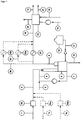
- Process water discharged from a hydrothermal carbonization is fed via line (1) to an evaporation unit (22) in which the process water is evaporated and discharged again as process steam. Further substances that are fed to the evaporation unit together with the process water via (1) and are not removed with the process steam can also be separately removed from the evaporation unit (not shown).
- the evaporation unit is heated by a heating medium (for example steam), which cools and / or condenses in the evaporation unit and is discharged from it again (not shown).
- a heating medium for example steam
- the process steam obtained in this way leaves the evaporation unit and is fed via line (2) to the isothermal scrubber (8), which is operated essentially at a temperature that corresponds to the saturated steam temperature, which corresponds to the pressure prevailing on the evaporation side of the evaporation unit .
- isothermal means that the process steam essentially does not condense in the washer, but leaves it again in the form of saturated steam.
- Further process water (1a, 1b, ...) can be evaporated via additional evaporation units (22a, 22b, ...) and fed to the isothermal scrubber (8) together with the process steam obtained in (22) via line (2).
- a base for example milk of lime
- the controlled addition of the base sets the pH of the process steam to a value greater than 6.
- Part of the wash water is removed from the scrubber via line (7) and returned via line (6).
- the organic load of the process steam separated from the process steam in the scrubber collects at the bottom of the scrubber and is discharged from the scrubber as a blowdown via line (18).
- Fresh washing water is fed to the scrubber via line (5).
- the process steam discharged from the scrubber via line (9) is condensed in a condenser (23) and fed as process steam condensate via line (10) to an aerobic biological treatment (13).
- a supplied cooling medium for example cooling water or process water to be evaporated
- a supplied cooling medium for example cooling water or process water to be evaporated
- the process steam (9) can also be divided into partial flows (9a, 9b, ...), which are then condensed in further condensers (23a, 23b, ...) and together with the partial flow condensed in condenser (23) via a line (10) are fed to the biological treatment.
- Air is introduced into the biological treatment via line (15) which, together with the gaseous degradation products (essentially CO2) of the organic load of the process steam condensate, leaves the biological treatment via line (20).
- Nutrients, in particular phosphorus and nitrate are fed to the biological treatment via line (19).
- the biologically treated process steam condensate leaves the biological treatment via line (14) and can be fed indirectly or directly into the public sewer system. Furthermore, sewage sludge is removed from the biological treatment via line (21).
- the invention is made using Figure 2 described using an exemplary embodiment as follows: 2.2 t / h wood chips with 55% water content (i.e. a 1.00 t / h dry wood chips and 1.20 t / h fresh water) are entered into the HTC system as input material via (S30), with 7, 80 t / h of process water (S25) mixed, fed via (S26) to a pump (15) which pressurizes the stream with 25 bar and conveys it. From this stream, 6.7 t / h, essentially process water, are separated off in a water separation (16) via (S27), relaxed in a throttle (19) mixed with 1.1 t / h process water (S24) and via (S25) the Feedstocks fed back.
- the input materials are fed into the hydrothermal carbonation via (S42), which essentially consists of a reactor (1st floor), together with the water not separated in (16) (1 t / h dry wood chips and 2.3 t / h fresh and process water) ) consists.
- S42 hydrothermal carbonation via
- the reactor there is a water bath (21) into which the starting materials are introduced and, with elimination of 0.1 t / h water and 0.1 t / h permanent gas, essentially carbon dioxide, carbonized starting materials at 0.8 t / h be refined.
- the fill level of the water bath (21) is controlled by withdrawing 0.5 t / h of process water via (S28), which is fed to a device for evaporative cooling (14). Permanent gases produced (0.1 t / h) are discharged from the HTC system controlled with valve (20) via (S29).
- the process water withdrawn via (S28) is recooled to about 100 ° C. by generating 0.1 t / h of process steam (S33) and expanded to ambient pressure.
- the carbonized feedstock forms a sediment with a dry matter content of about 30% (0.8 t / h solids and 1.9 t / h water) at the bottom of the reactor and is discharged from this via (S1) and via an evaporative cooling (2) With the release of 0.44 t / h process steam (S2), it is recooled to around 100 ° C and relaxed to ambient pressure.
- the recooled carbonized feedstock (S21) (0.8 t / h carbonized feedstock and 1.46 t / h process water) are mixed with 0.16 t / h blowdown (S7) from the isothermal wash (3) via (S43) a mechanical drainage (13) supplied.
- the organic salts of calcium are at least partially fed to the thermal drying system (12) via (S19) and discharged from the HTC system with the carbonized, dried feedstocks via (S20).
- the carbonized feedstock is dewatered to a dry matter content of 50%, with 0.82 t / h mainly process water being separated via (S22), mixed with 0.4 t / h recooled process water (S32) and partially fed via (S23) (0.12 t / h) to the aerobic biological treatment (9) and partially used via (S24) (1.1 t / h) as circulating water within the HTC system.
- the mechanically dewatered carbonized feedstock of 1.6 t / h is fed to a drying in a steam atmosphere (12) via (S19).
- the drying in a steam atmosphere is heated indirectly with a heat exchanger (17) in which 0.8 t / h process steam (S35) condenses and is discharged again as process steam condensate via (S36).
- 0.73 t / h of process water is evaporated and discharged as process steam via (S18) from the dryer in a steam atmosphere and together with 0.54 t / h of process steam (S40), which is used once during the evaporative cooling of the carbonized input materials and the this process water (S2) discharged from the hydrothermal carbonization and during the evaporation cooling of the process water (S33) discharged separately from the hydrothermal carbonization is produced via (S41) (1.27 t / h) isothermal scrubber (3) fed.
- the dried carbonized feedstock (0.87 t / h with 8% water content) is discharged from the HTC system via (S20).
- the pH value of the process steam (S41) is raised to 6 in the isothermal scrubber with the addition of 0.03 t / h milk of lime (S6), which is taken from a milk of lime reservoir (5) via a pump (6).
- S6 0.03 t / h milk of lime
- S8 1.27 t / h process steam (S8) pre-cleaned in this way, a partial flow (S10) is compressed to 5 bar at 0.68 t / h in a compressor (11), with the addition of 0.12 t / h process steam condensate via ( S11) cooled back to saturated steam conditions and condensed via (S35) to heat the dryer in a steam atmosphere (12) in the heat exchanger (17).
- the partial flow (S9) of the pre-cleaned process steam (S8) of 0.59 t / h not fed to the compressor via (S10) is condensed in a heat exchanger (7) and, if necessary, after recooling in (8) together with (S38) fed to the biological treatment (9) via (S12).
- the organic load of the process steam condensate (S12) and the process water (S23) is broken down by adding air (S16), which is conveyed via the compressor (10), to essentially CO 2 , which together with the air forms the biological Processing leaves via (S17). Introduced into the biological treatment via (S15) nutrients such as phosphorus and nitrogen. The wastewater leaves the biological treatment via (S13) and is discharged directly. Sewage sludge from the biological treatment is discharged via (S14).
- the process according to the invention in this example ensures that 1.14 t / h (approx. 90%) of the total of 1.26 t / h of waste water are treated by the process according to the invention and only 0.12 t / h (approx. 10%) can be discharged directly as process water.
- the inventive treatment of part of the process water and its removal as waste water of the HTC system, the organic load of the process water treated in this way is 20,000 mg / l TOC (total organic carbon) due to evaporation by approx. 70% to 6,000 mg / l, due to the increase in the pH value in the isothermal wash reduced by 70% to 1,800 mg / l and in biological treatment by 90% to 180 mg / l.
- the processing of the process water according to the invention takes place in this example advantageously without additional use of energy, since the process steam is obtained during the evaporation cooling of the process water discharged from the hydrothermal carbonization and the carbonized input materials and in a thermal drying of the carbonized input materials in a steam atmosphere. It is also advantageous to add part of the sludge from the isothermal scrubber to the dry, carbonized feedstocks, which improves their ash melting behavior. Furthermore, 10% of the process water is advantageously discharged from the HTC system as wastewater and thus water-soluble constituents of the ash of the feedstock are removed from the process, thereby also having a positive effect on the ash melting behavior.
Landscapes
- Life Sciences & Earth Sciences (AREA)
- Hydrology & Water Resources (AREA)
- Engineering & Computer Science (AREA)
- Environmental & Geological Engineering (AREA)
- Water Supply & Treatment (AREA)
- Chemical & Material Sciences (AREA)
- Organic Chemistry (AREA)
- Processing Of Solid Wastes (AREA)
- Treatment Of Sludge (AREA)
- Heat Treatment Of Water, Waste Water Or Sewage (AREA)
- Solid Fuels And Fuel-Associated Substances (AREA)
- Activated Sludge Processes (AREA)
Claims (7)
- Procédé pour le traitement d'eau usée d'une installation pour la carbonisation hydrothermique de biomasse (installation HTC), dans lequel▪ l'eau de traitement de la carbonisation hydrothermique (1) est partiellement évaporée au moyen d'un refroidissement par évaporation (2, 14) et d'un séchage thermique (12) optionnels,▪ la vapeur de traitement (S33, S2, S18) ainsi obtenue est condensée dans un échangeur de chaleur (7, 17),▪ le condensat de vapeur de traitement (S12) ainsi obtenu est déchargé de l'installation HTC au moins en tant que quantité partielle d'une eau usée, et▪ l'eau usée est traitée biologiquement (9),caractérisé en ce que- une quantité minimale d'eau de traitement (S32, S22) est déchargée en tant qu'eau usée (S23) de l'installation HTC, la quantité minimale déchargée d'eau de traitement (S32, S22) étant la quantité minimale requise pour augmenter le comportement à la fusion de cendres de la biomasse carbonisée de telle sorte qu'une augmentation de la température de ramollissement de cendres à au moins 1000°C soit atteinte,
et- soit la teneur en eau de la biomasse est limitée dans la mesure où
ou
la puissance évaporatrice d'un séchage thermique (12) de la biomasse carbonisée dans une atmosphère de vapeur est augmentée dans la mesure où,
l'eau de traitement résiduelle à décharger en tant qu'eau usée (S12) de l'installation HTC est évaporée et condensée dans le séchage thermique (12) de la biomasse carbonisée dans une atmosphère de vapeur, et le condensat de vapeur de traitement obtenu est déchargé en tant qu'eau usée (S12). - Procédé selon l'une ou plusieurs des revendications précédentes, caractérisé en ce que la condensation de la vapeur de traitement (S33, S2, S18) est effectuée après une augmentation de pression par compression ou une diminution de pression par détente.
- Procédé selon la revendication 2, caractérisé en ce que la vapeur de traitement est sensiblement complètement condensée pendant l'augmentation de pression ou la diminution de pression.
- Procédé selon l'une ou plusieurs des revendications précédentes, caractérisé en ce que▪ la vapeur de traitement est soumise à un lavage isotherme, et▪ le pH de la vapeur de traitement dans le lavage isotherme (3) est porté à au moins 6 par l'addition d'une base.
- Procédé selon la revendication 4, caractérisé en ce que▪ du lait de chaux est introduit dans le lavage isotherme (3) en tant que base pour augmenter le pH de la vapeur de traitement, et▪ la boue de l'épurateur isotherme (3) est soit alimentée à la carbonisation hydrothermique (1), soit ajoutée à la biomasse carbonisée (S1) avant sa déshydratation mécanique (S13), soit alimentée au séchage thermique (12).
- Procédé selon l'une ou plusieurs des revendications précédentes, caractérisé en ce que▪ une unité d'évaporation (12) de l'installation HTC fonctionne sous vide, et▪ le chauffage de l'unité d'évaporation (12) est au moins partiellement réalisé par la condensation de vapeur de traitement (S18) obtenue pendant le séchage thermique de la biomasse carbonisée (S19) dans une atmosphère de vapeur.
- Procédé selon la revendication 1, caractérisé en ce qu'une quantité minimale d'eau de traitement (S32, S22) est déchargée de l'installation HTC en tant qu'eau usée, ce qui est nécessaire pour augmenter le comportement à la fusion de cendres de la biomasse carbonisée de telle sorte qu'une augmentation de la température de ramollissement de cendres à au moins 1100°C soit atteinte.
Applications Claiming Priority (2)
| Application Number | Priority Date | Filing Date | Title |
|---|---|---|---|
| DE102011009775 | 2011-01-28 | ||
| PCT/EP2012/000375 WO2012100954A1 (fr) | 2011-01-28 | 2012-01-27 | Procédé de traitement d'une eau de traitement issue d'une installation de carbonisation hydrothermale de matières premières renouvelables et de résidus organiques |
Publications (2)
| Publication Number | Publication Date |
|---|---|
| EP2668254A1 EP2668254A1 (fr) | 2013-12-04 |
| EP2668254B1 true EP2668254B1 (fr) | 2021-05-26 |
Family
ID=45614805
Family Applications (1)
| Application Number | Title | Priority Date | Filing Date |
|---|---|---|---|
| EP12704366.9A Active EP2668254B1 (fr) | 2011-01-28 | 2012-01-27 | Procédé de traitement d'une eau de traitement issue d'une installation de carbonisation hydrothermale de matières premières renouvelables et de résidus organiques |
Country Status (8)
| Country | Link |
|---|---|
| US (1) | US9340440B2 (fr) |
| EP (1) | EP2668254B1 (fr) |
| JP (1) | JP6240508B2 (fr) |
| CN (1) | CN103380200B (fr) |
| BR (1) | BR112013018944B1 (fr) |
| CA (1) | CA2825462C (fr) |
| MY (1) | MY165257A (fr) |
| WO (1) | WO2012100954A1 (fr) |
Families Citing this family (9)
| Publication number | Priority date | Publication date | Assignee | Title |
|---|---|---|---|---|
| DE102012024463B4 (de) * | 2012-12-13 | 2016-12-08 | Maria Rogmans | Verfahren und Einrichtung zur Prozesswasserbehandlung aus der hydrothermalen Karbonisierung |
| EP2746231A1 (fr) * | 2012-12-19 | 2014-06-25 | CS Carbon Solutions | Procédé et appareil pour le traitement de l'eau de traitement provenant d'un processus de conversion de matériau organique hydrothermique |
| US9902816B2 (en) * | 2013-08-09 | 2018-02-27 | Suncoal Industries Gmbh | Method for extracting lignin from black liquor and products produced thereby |
| CN103724056B (zh) * | 2014-01-23 | 2016-03-09 | 杭州互惠环保科技有限公司 | 基于水热碳化的生活垃圾清洁增值处理方法 |
| DE102014103346A1 (de) * | 2014-03-12 | 2015-09-17 | Ava-Co2 Schweiz Ag | Verfahren und Vorrichtung zur Durchführung einer hydrothermalen Karbonisierungsreaktion und Verwendung eines Sensors oder Analysegeräts hierfür |
| CN104016541B (zh) * | 2014-05-09 | 2016-04-06 | 唐金荣 | 一种炭化竹木过程中产生的废水处理方法 |
| US10611657B2 (en) | 2016-07-29 | 2020-04-07 | Tongji University | Method and system for preparing fuel gas by utilizing organic waste with high water content |
| CN107129028B (zh) * | 2017-05-18 | 2020-12-25 | 珠海汇东环保科技有限公司 | 一种配套处理水热碳化系统废气和废水并生产作物营养水的方法 |
| CN110316928B (zh) * | 2019-06-21 | 2021-08-10 | 广东鸿发环境投资有限公司 | 一种热量自给的市政污泥连续水热碳化系统及方法 |
Family Cites Families (7)
| Publication number | Priority date | Publication date | Assignee | Title |
|---|---|---|---|---|
| JPH1057943A (ja) * | 1996-08-23 | 1998-03-03 | Ube Ind Ltd | フラッシュ操作を用いた反応生成スラリの廃水の分離方法 |
| JPH11267698A (ja) * | 1998-03-26 | 1999-10-05 | Ube Ind Ltd | 廃棄物の処理方法およびその装置 |
| JP2007260551A (ja) * | 2006-03-28 | 2007-10-11 | Ihi Corp | 有機性廃棄物処理装置及び方法 |
| DE102007056170A1 (de) * | 2006-12-28 | 2008-11-06 | Dominik Peus | Semikontinuierliches Verfahren zur Herstellung von Brennstoff aus Biomasse |
| EP2206688A1 (fr) * | 2008-12-16 | 2010-07-14 | Suncoal Industries Gmbh | Préparation thermochimique de l'eau de traitement d'une carbonisation hydrothermale |
| DE102009015257B4 (de) * | 2009-04-01 | 2013-03-14 | Suncoal Industries Gmbh | Verfahren zur hydrothermalen Karbonisierung nachwachsender Rohstoffe und organischer Reststoffe |
| JP2012522629A (ja) * | 2009-04-01 | 2012-09-27 | サンコール・インダストリーズ・ゲゼルシャフト・ミト・ベシュレンクテル・ハフツング | 再生可能原料および有機残留物の水熱炭化方法 |
-
2012
- 2012-01-27 US US13/981,662 patent/US9340440B2/en active Active
- 2012-01-27 JP JP2013550807A patent/JP6240508B2/ja active Active
- 2012-01-27 CN CN201280006905.9A patent/CN103380200B/zh active Active
- 2012-01-27 WO PCT/EP2012/000375 patent/WO2012100954A1/fr not_active Ceased
- 2012-01-27 EP EP12704366.9A patent/EP2668254B1/fr active Active
- 2012-01-27 MY MYPI2013002800A patent/MY165257A/en unknown
- 2012-01-27 CA CA2825462A patent/CA2825462C/fr active Active
- 2012-01-27 BR BR112013018944-4A patent/BR112013018944B1/pt active IP Right Grant
Non-Patent Citations (1)
| Title |
|---|
| None * |
Also Published As
| Publication number | Publication date |
|---|---|
| JP2014509930A (ja) | 2014-04-24 |
| JP6240508B2 (ja) | 2017-11-29 |
| WO2012100954A1 (fr) | 2012-08-02 |
| BR112013018944A2 (pt) | 2017-02-21 |
| CA2825462C (fr) | 2020-03-24 |
| US20130306553A1 (en) | 2013-11-21 |
| CN103380200B (zh) | 2017-05-17 |
| MY165257A (en) | 2018-03-14 |
| CA2825462A1 (fr) | 2012-08-02 |
| CN103380200A (zh) | 2013-10-30 |
| EP2668254A1 (fr) | 2013-12-04 |
| US9340440B2 (en) | 2016-05-17 |
| BR112013018944B1 (pt) | 2021-05-18 |
Similar Documents
| Publication | Publication Date | Title |
|---|---|---|
| EP2668254B1 (fr) | Procédé de traitement d'une eau de traitement issue d'une installation de carbonisation hydrothermale de matières premières renouvelables et de résidus organiques | |
| EP2414494B1 (fr) | Procédé de carbonisation hydrothermale de matières premières renouvelables et de résidus organiques | |
| DE102008060310B4 (de) | Verfahren und Anlage zur Reinigung von Roh- oder Biogas zur Gewinnung von Methan | |
| EP2038045B1 (fr) | Procédé de purification de biogaz produit par une installation de production de biogaz et système de purification de biogaz | |
| EP3197839B1 (fr) | Procédé et dispositif de traitement des eaux usées | |
| DE102009015257B4 (de) | Verfahren zur hydrothermalen Karbonisierung nachwachsender Rohstoffe und organischer Reststoffe | |
| WO2011018505A2 (fr) | Dispositif et procédé pour produire du biogaz et du biocharbon, et pour raffiner du biocharbon | |
| Georgiou et al. | Single-stage production of miscanthus hydrochar at low severity conditions and application as adsorbent of copper and ammonium ions | |
| Saleh et al. | Mg-modified sugarcane bagasse biochar for dual removal of ammonium and phosphate ions from aqueous solutions | |
| Oktaviana et al. | Effect of pyrolysis temperature of domestic sewage sludge biochar on CO2 adsorption | |
| DE102013013724A1 (de) | Verfahren zur Erzeugung eines homogenen Feststoffs aus Biomasse | |
| US20160075608A1 (en) | Production of nutrient-rich biochar from a residual material | |
| EP2353701A1 (fr) | Laveur de fumées doté d'une tour de refroidissement associée | |
| WO2016074990A1 (fr) | Digestion et gazéification de boues résiduaires produites par une station d'épuration | |
| DE102021123858B4 (de) | Verfahren zur umweltschonenden Behandlung des bei der Olivenpressung anfallenden Abwassers | |
| EP1274656A1 (fr) | Procede de conditionnement de substances solides biogenes | |
| DE112023002918T5 (de) | Extraktion von phosphor | |
| DE2935594A1 (de) | Verfahren zur druckent- und -vergasung von rohbraunkohle | |
| DE60222629T2 (de) | Verfahren zur verwendung von organischen materialien bei der energieerzeugung und erzeugung von wiederverwendbaren produkten | |
| DE3515484A1 (de) | Verfahren zum behandeln von kondensat aus dem produktgas der vergasung fester brennstoffe | |
| Hayat et al. | Biochar production from green waste: Remediation potential | |
| DE102005005235A1 (de) | Verfahren und Einrichtung zur Methanreaktivierung von Deponien | |
| AT510637B1 (de) | Verfahren zur aufbereitung der ausgangsfraktionen einer biogasanlage | |
| DE102017114599A1 (de) | Verfahren und Vorrichtung zur Erzeugung von Kohle aus Biomasse mittels hydrothermaler Carbonisierung | |
| WO2017067534A1 (fr) | Procédé de réaction biochimique pour la purification d'air d'évacuation |
Legal Events
| Date | Code | Title | Description |
|---|---|---|---|
| PUAI | Public reference made under article 153(3) epc to a published international application that has entered the european phase |
Free format text: ORIGINAL CODE: 0009012 |
|
| 17P | Request for examination filed |
Effective date: 20130726 |
|
| AK | Designated contracting states |
Kind code of ref document: A1 Designated state(s): AL AT BE BG CH CY CZ DE DK EE ES FI FR GB GR HR HU IE IS IT LI LT LU LV MC MK MT NL NO PL PT RO RS SE SI SK SM TR |
|
| DAX | Request for extension of the european patent (deleted) | ||
| 17Q | First examination report despatched |
Effective date: 20160802 |
|
| STAA | Information on the status of an ep patent application or granted ep patent |
Free format text: STATUS: EXAMINATION IS IN PROGRESS |
|
| REG | Reference to a national code |
Ref country code: DE Ref legal event code: R079 Ref document number: 502012016769 Country of ref document: DE Free format text: PREVIOUS MAIN CLASS: C10L0009080000 Ipc: C02F0003020000 |
|
| GRAP | Despatch of communication of intention to grant a patent |
Free format text: ORIGINAL CODE: EPIDOSNIGR1 |
|
| STAA | Information on the status of an ep patent application or granted ep patent |
Free format text: STATUS: GRANT OF PATENT IS INTENDED |
|
| RIC1 | Information provided on ipc code assigned before grant |
Ipc: C02F 1/66 20060101ALI20201118BHEP Ipc: C02F 1/04 20060101ALI20201118BHEP Ipc: C02F 103/26 20060101ALI20201118BHEP Ipc: C02F 101/30 20060101ALI20201118BHEP Ipc: C02F 9/00 20060101ALI20201118BHEP Ipc: C02F 3/02 20060101AFI20201118BHEP |
|
| INTG | Intention to grant announced |
Effective date: 20201221 |
|
| GRAS | Grant fee paid |
Free format text: ORIGINAL CODE: EPIDOSNIGR3 |
|
| GRAA | (expected) grant |
Free format text: ORIGINAL CODE: 0009210 |
|
| STAA | Information on the status of an ep patent application or granted ep patent |
Free format text: STATUS: THE PATENT HAS BEEN GRANTED |
|
| AK | Designated contracting states |
Kind code of ref document: B1 Designated state(s): AL AT BE BG CH CY CZ DE DK EE ES FI FR GB GR HR HU IE IS IT LI LT LU LV MC MK MT NL NO PL PT RO RS SE SI SK SM TR |
|
| REG | Reference to a national code |
Ref country code: GB Ref legal event code: FG4D Free format text: NOT ENGLISH |
|
| REG | Reference to a national code |
Ref country code: CH Ref legal event code: EP |
|
| REG | Reference to a national code |
Ref country code: AT Ref legal event code: REF Ref document number: 1396076 Country of ref document: AT Kind code of ref document: T Effective date: 20210615 |
|
| REG | Reference to a national code |
Ref country code: DE Ref legal event code: R096 Ref document number: 502012016769 Country of ref document: DE |
|
| REG | Reference to a national code |
Ref country code: IE Ref legal event code: FG4D Free format text: LANGUAGE OF EP DOCUMENT: GERMAN |
|
| REG | Reference to a national code |
Ref country code: FI Ref legal event code: FGE |
|
| REG | Reference to a national code |
Ref country code: SE Ref legal event code: TRGR |
|
| REG | Reference to a national code |
Ref country code: LT Ref legal event code: MG9D |
|
| REG | Reference to a national code |
Ref country code: DE Ref legal event code: R082 Ref document number: 502012016769 Country of ref document: DE Representative=s name: STEFFAN & KIEHNE PATENTANWAELTE PARTG MBB, DE |
|
| PG25 | Lapsed in a contracting state [announced via postgrant information from national office to epo] |
Ref country code: BG Free format text: LAPSE BECAUSE OF FAILURE TO SUBMIT A TRANSLATION OF THE DESCRIPTION OR TO PAY THE FEE WITHIN THE PRESCRIBED TIME-LIMIT Effective date: 20210826 Ref country code: HR Free format text: LAPSE BECAUSE OF FAILURE TO SUBMIT A TRANSLATION OF THE DESCRIPTION OR TO PAY THE FEE WITHIN THE PRESCRIBED TIME-LIMIT Effective date: 20210526 Ref country code: LT Free format text: LAPSE BECAUSE OF FAILURE TO SUBMIT A TRANSLATION OF THE DESCRIPTION OR TO PAY THE FEE WITHIN THE PRESCRIBED TIME-LIMIT Effective date: 20210526 |
|
| REG | Reference to a national code |
Ref country code: NL Ref legal event code: MP Effective date: 20210526 |
|
| PG25 | Lapsed in a contracting state [announced via postgrant information from national office to epo] |
Ref country code: LV Free format text: LAPSE BECAUSE OF FAILURE TO SUBMIT A TRANSLATION OF THE DESCRIPTION OR TO PAY THE FEE WITHIN THE PRESCRIBED TIME-LIMIT Effective date: 20210526 Ref country code: GR Free format text: LAPSE BECAUSE OF FAILURE TO SUBMIT A TRANSLATION OF THE DESCRIPTION OR TO PAY THE FEE WITHIN THE PRESCRIBED TIME-LIMIT Effective date: 20210827 Ref country code: IS Free format text: LAPSE BECAUSE OF FAILURE TO SUBMIT A TRANSLATION OF THE DESCRIPTION OR TO PAY THE FEE WITHIN THE PRESCRIBED TIME-LIMIT Effective date: 20210926 Ref country code: RS Free format text: LAPSE BECAUSE OF FAILURE TO SUBMIT A TRANSLATION OF THE DESCRIPTION OR TO PAY THE FEE WITHIN THE PRESCRIBED TIME-LIMIT Effective date: 20210526 Ref country code: PT Free format text: LAPSE BECAUSE OF FAILURE TO SUBMIT A TRANSLATION OF THE DESCRIPTION OR TO PAY THE FEE WITHIN THE PRESCRIBED TIME-LIMIT Effective date: 20210927 Ref country code: NO Free format text: LAPSE BECAUSE OF FAILURE TO SUBMIT A TRANSLATION OF THE DESCRIPTION OR TO PAY THE FEE WITHIN THE PRESCRIBED TIME-LIMIT Effective date: 20210826 Ref country code: PL Free format text: LAPSE BECAUSE OF FAILURE TO SUBMIT A TRANSLATION OF THE DESCRIPTION OR TO PAY THE FEE WITHIN THE PRESCRIBED TIME-LIMIT Effective date: 20210526 |
|
| PG25 | Lapsed in a contracting state [announced via postgrant information from national office to epo] |
Ref country code: NL Free format text: LAPSE BECAUSE OF FAILURE TO SUBMIT A TRANSLATION OF THE DESCRIPTION OR TO PAY THE FEE WITHIN THE PRESCRIBED TIME-LIMIT Effective date: 20210526 |
|
| PG25 | Lapsed in a contracting state [announced via postgrant information from national office to epo] |
Ref country code: ES Free format text: LAPSE BECAUSE OF FAILURE TO SUBMIT A TRANSLATION OF THE DESCRIPTION OR TO PAY THE FEE WITHIN THE PRESCRIBED TIME-LIMIT Effective date: 20210526 Ref country code: RO Free format text: LAPSE BECAUSE OF FAILURE TO SUBMIT A TRANSLATION OF THE DESCRIPTION OR TO PAY THE FEE WITHIN THE PRESCRIBED TIME-LIMIT Effective date: 20210526 Ref country code: EE Free format text: LAPSE BECAUSE OF FAILURE TO SUBMIT A TRANSLATION OF THE DESCRIPTION OR TO PAY THE FEE WITHIN THE PRESCRIBED TIME-LIMIT Effective date: 20210526 Ref country code: DK Free format text: LAPSE BECAUSE OF FAILURE TO SUBMIT A TRANSLATION OF THE DESCRIPTION OR TO PAY THE FEE WITHIN THE PRESCRIBED TIME-LIMIT Effective date: 20210526 Ref country code: CZ Free format text: LAPSE BECAUSE OF FAILURE TO SUBMIT A TRANSLATION OF THE DESCRIPTION OR TO PAY THE FEE WITHIN THE PRESCRIBED TIME-LIMIT Effective date: 20210526 Ref country code: SM Free format text: LAPSE BECAUSE OF FAILURE TO SUBMIT A TRANSLATION OF THE DESCRIPTION OR TO PAY THE FEE WITHIN THE PRESCRIBED TIME-LIMIT Effective date: 20210526 Ref country code: SK Free format text: LAPSE BECAUSE OF FAILURE TO SUBMIT A TRANSLATION OF THE DESCRIPTION OR TO PAY THE FEE WITHIN THE PRESCRIBED TIME-LIMIT Effective date: 20210526 |
|
| REG | Reference to a national code |
Ref country code: DE Ref legal event code: R097 Ref document number: 502012016769 Country of ref document: DE |
|
| PLBE | No opposition filed within time limit |
Free format text: ORIGINAL CODE: 0009261 |
|
| STAA | Information on the status of an ep patent application or granted ep patent |
Free format text: STATUS: NO OPPOSITION FILED WITHIN TIME LIMIT |
|
| 26N | No opposition filed |
Effective date: 20220301 |
|
| PG25 | Lapsed in a contracting state [announced via postgrant information from national office to epo] |
Ref country code: IS Free format text: LAPSE BECAUSE OF FAILURE TO SUBMIT A TRANSLATION OF THE DESCRIPTION OR TO PAY THE FEE WITHIN THE PRESCRIBED TIME-LIMIT Effective date: 20210926 Ref country code: AL Free format text: LAPSE BECAUSE OF FAILURE TO SUBMIT A TRANSLATION OF THE DESCRIPTION OR TO PAY THE FEE WITHIN THE PRESCRIBED TIME-LIMIT Effective date: 20210526 |
|
| PG25 | Lapsed in a contracting state [announced via postgrant information from national office to epo] |
Ref country code: IT Free format text: LAPSE BECAUSE OF FAILURE TO SUBMIT A TRANSLATION OF THE DESCRIPTION OR TO PAY THE FEE WITHIN THE PRESCRIBED TIME-LIMIT Effective date: 20210526 |
|
| PG25 | Lapsed in a contracting state [announced via postgrant information from national office to epo] |
Ref country code: MC Free format text: LAPSE BECAUSE OF FAILURE TO SUBMIT A TRANSLATION OF THE DESCRIPTION OR TO PAY THE FEE WITHIN THE PRESCRIBED TIME-LIMIT Effective date: 20210526 |
|
| REG | Reference to a national code |
Ref country code: CH Ref legal event code: PL |
|
| GBPC | Gb: european patent ceased through non-payment of renewal fee |
Effective date: 20220127 |
|
| REG | Reference to a national code |
Ref country code: BE Ref legal event code: MM Effective date: 20220131 |
|
| PG25 | Lapsed in a contracting state [announced via postgrant information from national office to epo] |
Ref country code: LU Free format text: LAPSE BECAUSE OF NON-PAYMENT OF DUE FEES Effective date: 20220127 Ref country code: GB Free format text: LAPSE BECAUSE OF NON-PAYMENT OF DUE FEES Effective date: 20220127 |
|
| PG25 | Lapsed in a contracting state [announced via postgrant information from national office to epo] |
Ref country code: BE Free format text: LAPSE BECAUSE OF NON-PAYMENT OF DUE FEES Effective date: 20220131 |
|
| PG25 | Lapsed in a contracting state [announced via postgrant information from national office to epo] |
Ref country code: LI Free format text: LAPSE BECAUSE OF NON-PAYMENT OF DUE FEES Effective date: 20220131 Ref country code: CH Free format text: LAPSE BECAUSE OF NON-PAYMENT OF DUE FEES Effective date: 20220131 |
|
| PG25 | Lapsed in a contracting state [announced via postgrant information from national office to epo] |
Ref country code: IE Free format text: LAPSE BECAUSE OF NON-PAYMENT OF DUE FEES Effective date: 20220127 |
|
| P01 | Opt-out of the competence of the unified patent court (upc) registered |
Effective date: 20230513 |
|
| PG25 | Lapsed in a contracting state [announced via postgrant information from national office to epo] |
Ref country code: HU Free format text: LAPSE BECAUSE OF FAILURE TO SUBMIT A TRANSLATION OF THE DESCRIPTION OR TO PAY THE FEE WITHIN THE PRESCRIBED TIME-LIMIT; INVALID AB INITIO Effective date: 20120127 |
|
| PG25 | Lapsed in a contracting state [announced via postgrant information from national office to epo] |
Ref country code: MK Free format text: LAPSE BECAUSE OF FAILURE TO SUBMIT A TRANSLATION OF THE DESCRIPTION OR TO PAY THE FEE WITHIN THE PRESCRIBED TIME-LIMIT Effective date: 20210526 Ref country code: CY Free format text: LAPSE BECAUSE OF FAILURE TO SUBMIT A TRANSLATION OF THE DESCRIPTION OR TO PAY THE FEE WITHIN THE PRESCRIBED TIME-LIMIT Effective date: 20210526 |
|
| PG25 | Lapsed in a contracting state [announced via postgrant information from national office to epo] |
Ref country code: MT Free format text: LAPSE BECAUSE OF FAILURE TO SUBMIT A TRANSLATION OF THE DESCRIPTION OR TO PAY THE FEE WITHIN THE PRESCRIBED TIME-LIMIT Effective date: 20210526 |
|
| PG25 | Lapsed in a contracting state [announced via postgrant information from national office to epo] |
Ref country code: TR Free format text: LAPSE BECAUSE OF FAILURE TO SUBMIT A TRANSLATION OF THE DESCRIPTION OR TO PAY THE FEE WITHIN THE PRESCRIBED TIME-LIMIT Effective date: 20210526 |
|
| REG | Reference to a national code |
Ref country code: CH Ref legal event code: U11 Free format text: ST27 STATUS EVENT CODE: U-0-0-U10-U11 (AS PROVIDED BY THE NATIONAL OFFICE) Effective date: 20260201 |
|
| PGFP | Annual fee paid to national office [announced via postgrant information from national office to epo] |
Ref country code: SE Payment date: 20260121 Year of fee payment: 15 |
|
| PGFP | Annual fee paid to national office [announced via postgrant information from national office to epo] |
Ref country code: DE Payment date: 20260121 Year of fee payment: 15 |
|
| PGFP | Annual fee paid to national office [announced via postgrant information from national office to epo] |
Ref country code: AT Payment date: 20260122 Year of fee payment: 15 |
|
| PGFP | Annual fee paid to national office [announced via postgrant information from national office to epo] |
Ref country code: FI Payment date: 20260129 Year of fee payment: 15 |
|
| PGFP | Annual fee paid to national office [announced via postgrant information from national office to epo] |
Ref country code: FR Payment date: 20260123 Year of fee payment: 15 |
|
| PGFP | Annual fee paid to national office [announced via postgrant information from national office to epo] |
Ref country code: CH Payment date: 20260201 Year of fee payment: 15 |