EP2668901A1 - Ensemble d'insertion de capteur, cartouche de capteur et dispositif d'insertion - Google Patents
Ensemble d'insertion de capteur, cartouche de capteur et dispositif d'insertion Download PDFInfo
- Publication number
- EP2668901A1 EP2668901A1 EP12170223.7A EP12170223A EP2668901A1 EP 2668901 A1 EP2668901 A1 EP 2668901A1 EP 12170223 A EP12170223 A EP 12170223A EP 2668901 A1 EP2668901 A1 EP 2668901A1
- Authority
- EP
- European Patent Office
- Prior art keywords
- sensor
- operable
- cartridge
- needle
- assembly
- Prior art date
- Legal status (The legal status is an assumption and is not a legal conclusion. Google has not performed a legal analysis and makes no representation as to the accuracy of the status listed.)
- Withdrawn
Links
Images




Classifications
-
- A—HUMAN NECESSITIES
- A61—MEDICAL OR VETERINARY SCIENCE; HYGIENE
- A61B—DIAGNOSIS; SURGERY; IDENTIFICATION
- A61B5/00—Measuring for diagnostic purposes; Identification of persons
- A61B5/68—Arrangements of detecting, measuring or recording means, e.g. sensors, in relation to patient
- A61B5/6846—Arrangements of detecting, measuring or recording means, e.g. sensors, in relation to patient specially adapted to be brought in contact with an internal body part, i.e. invasive
- A61B5/6847—Arrangements of detecting, measuring or recording means, e.g. sensors, in relation to patient specially adapted to be brought in contact with an internal body part, i.e. invasive mounted on an invasive device
- A61B5/6848—Needles
- A61B5/6849—Needles in combination with a needle set
-
- A—HUMAN NECESSITIES
- A61—MEDICAL OR VETERINARY SCIENCE; HYGIENE
- A61B—DIAGNOSIS; SURGERY; IDENTIFICATION
- A61B17/00—Surgical instruments, devices or methods
- A61B17/34—Trocars; Puncturing needles
- A61B17/3468—Trocars; Puncturing needles for implanting or removing devices, e.g. prostheses, implants, seeds, wires
-
- A—HUMAN NECESSITIES
- A61—MEDICAL OR VETERINARY SCIENCE; HYGIENE
- A61B—DIAGNOSIS; SURGERY; IDENTIFICATION
- A61B5/00—Measuring for diagnostic purposes; Identification of persons
- A61B5/145—Measuring characteristics of blood in vivo, e.g. gas concentration or pH-value ; Measuring characteristics of body fluids or tissues, e.g. interstitial fluid or cerebral tissue
- A61B5/14503—Measuring characteristics of blood in vivo, e.g. gas concentration or pH-value ; Measuring characteristics of body fluids or tissues, e.g. interstitial fluid or cerebral tissue invasive, e.g. introduced into the body by a catheter or needle or using implanted sensors
-
- A—HUMAN NECESSITIES
- A61—MEDICAL OR VETERINARY SCIENCE; HYGIENE
- A61B—DIAGNOSIS; SURGERY; IDENTIFICATION
- A61B5/00—Measuring for diagnostic purposes; Identification of persons
- A61B5/145—Measuring characteristics of blood in vivo, e.g. gas concentration or pH-value ; Measuring characteristics of body fluids or tissues, e.g. interstitial fluid or cerebral tissue
- A61B5/14532—Measuring characteristics of blood in vivo, e.g. gas concentration or pH-value ; Measuring characteristics of body fluids or tissues, e.g. interstitial fluid or cerebral tissue for measuring glucose, e.g. by tissue impedance measurement
-
- A—HUMAN NECESSITIES
- A61—MEDICAL OR VETERINARY SCIENCE; HYGIENE
- A61B—DIAGNOSIS; SURGERY; IDENTIFICATION
- A61B5/00—Measuring for diagnostic purposes; Identification of persons
- A61B5/145—Measuring characteristics of blood in vivo, e.g. gas concentration or pH-value ; Measuring characteristics of body fluids or tissues, e.g. interstitial fluid or cerebral tissue
- A61B5/14542—Measuring characteristics of blood in vivo, e.g. gas concentration or pH-value ; Measuring characteristics of body fluids or tissues, e.g. interstitial fluid or cerebral tissue for measuring blood gases
-
- A—HUMAN NECESSITIES
- A61—MEDICAL OR VETERINARY SCIENCE; HYGIENE
- A61B—DIAGNOSIS; SURGERY; IDENTIFICATION
- A61B5/00—Measuring for diagnostic purposes; Identification of persons
- A61B5/145—Measuring characteristics of blood in vivo, e.g. gas concentration or pH-value ; Measuring characteristics of body fluids or tissues, e.g. interstitial fluid or cerebral tissue
- A61B5/14546—Measuring characteristics of blood in vivo, e.g. gas concentration or pH-value ; Measuring characteristics of body fluids or tissues, e.g. interstitial fluid or cerebral tissue for measuring analytes not otherwise provided for, e.g. ions, cytochromes
-
- A—HUMAN NECESSITIES
- A61—MEDICAL OR VETERINARY SCIENCE; HYGIENE
- A61B—DIAGNOSIS; SURGERY; IDENTIFICATION
- A61B5/00—Measuring for diagnostic purposes; Identification of persons
- A61B5/145—Measuring characteristics of blood in vivo, e.g. gas concentration or pH-value ; Measuring characteristics of body fluids or tissues, e.g. interstitial fluid or cerebral tissue
- A61B5/1468—Measuring characteristics of blood in vivo, e.g. gas concentration or pH-value ; Measuring characteristics of body fluids or tissues, e.g. interstitial fluid or cerebral tissue using chemical or electrochemical methods, e.g. by polarographic means
- A61B5/1486—Measuring characteristics of blood in vivo, e.g. gas concentration or pH-value ; Measuring characteristics of body fluids or tissues, e.g. interstitial fluid or cerebral tissue using chemical or electrochemical methods, e.g. by polarographic means using enzyme electrodes, e.g. with immobilised oxidase
- A61B5/14865—Measuring characteristics of blood in vivo, e.g. gas concentration or pH-value ; Measuring characteristics of body fluids or tissues, e.g. interstitial fluid or cerebral tissue using chemical or electrochemical methods, e.g. by polarographic means using enzyme electrodes, e.g. with immobilised oxidase invasive, e.g. introduced into the body by a catheter or needle or using implanted sensors
-
- A—HUMAN NECESSITIES
- A61—MEDICAL OR VETERINARY SCIENCE; HYGIENE
- A61B—DIAGNOSIS; SURGERY; IDENTIFICATION
- A61B17/00—Surgical instruments, devices or methods
- A61B2017/0046—Surgical instruments, devices or methods with a releasable handle; with handle and operating part separable
- A61B2017/00469—Surgical instruments, devices or methods with a releasable handle; with handle and operating part separable for insertion of instruments, e.g. guide wire, optical fibre
-
- A—HUMAN NECESSITIES
- A61—MEDICAL OR VETERINARY SCIENCE; HYGIENE
- A61B—DIAGNOSIS; SURGERY; IDENTIFICATION
- A61B2560/00—Constructional details of operational features of apparatus; Accessories for medical measuring apparatus
- A61B2560/06—Accessories for medical measuring apparatus
- A61B2560/063—Devices specially adapted for delivering implantable medical measuring apparatus
Definitions
- the invention relates to sensors for in vivo monitoring of an analyte, in particular to devices for inserting a sensor into a subject.
- analyte levels in his or her blood stream.
- the subject routinely monitors the glucose levels to avoid hypoglycemic episodes and hyperglycemic episodes.
- other analytes such as lactate or oxygen, may be measured.
- a typical means of performing such monitoring is the repeated drawing of blood by the subject to provide a sample for analysis by a monitoring system. This provides a cost effective way monitoring chronic diseases such as diabetes, but it may be inconvenient and only provides data on the analyte concentration at the time intervals when the test was performed.
- an electrochemical sensor may be inserted into a subcutaneous region of the subject where the analyte concentration is continuously monitored and/or logged.
- United States patent application US 2008/0242962 A1 discloses a monitoring system for monitoring analyte concentration, such as glucose, with an implantable sensor.
- a disadvantage of current systems for inserting subcutaneous sensor systems is that the they may require that an inserter is used each time a sensor is inserted into a subject. This may require the disposal of the inserter.
- the invention provides for a sensor insertion assembly, a sensor cartridge, and an inserter in the independent claims. Embodiments are given in the dependent claims.
- the invention provides for a sensor insertion assembly comprising a sensor cartridge comprising an insertion needle and a sensor within a sterile capsule.
- the insertion needle may be a hollow needle with a cross-section that has been removed.
- the needle may have a cross-section that resembles the letter "c.” This enables the insertion needle to insert the sensor and then remove the needle while leaving the sensor within a subject.
- the sterile capsule keeps the insertion needle and the sensor sterile in order to prevent an infection in a subject.
- the sensor insertion assembly further comprises an inserter comprising a chamber for receiving the sensor cartridge.
- the inserter further comprises an insertion mechanism operable for actuating the insertion needle for inserting the sensor into a subject.
- the sensor cartridge is removable from the chamber.
- the sensor cartridge is operable for shielding the insertion needle upon removal of the sensor cartridge from the chamber.
- the insertion mechanism is operable for removing at least a portion of the insertion needle from the sterile capsule a predetermined time before inserting the sensor into the subject.
- the embodiment may be beneficial because the insertion needle is kept sterile for as long as possible before insertion into the subject. From the point of view of a subject or operator of the sensor insertion assembly the removal of the insertion needle from the sterile capsule and inserting the sensor into the subject occur simultaneously. The subject or operator performs one action and the insertion needle at least partially leaves the sterile capsule and then the insertion needle inserts the sensor into the subject.
- the sensor insertion assembly further comprises a failsafe mechanism which is operable for permitting the actuation of the insertion needle only once. This may be advantageous because it prevents the same insertion needle from being used twice. This reduces the chance of injury due to the insertion needle and may also reduce the chance of spreading infection when a needle is used by more than one subject.
- the sensor insertion assembly may be operable for resetting the fail safe mechanism when the sensor cartridge is inserted into the chamber. This may be advantageous because the fail safe ensures that the needle is used only once and when the sensor cartridge is inserted into the chamber ensures that the fail safe mechanism is in the proper state.
- the sensor assembly may be operable for resetting the fail safe mechanism when a sensor cartridge is removed from the chamber. This embodiment may have the advantage that the sensor insertion assembly does not need to be reset when a new cartridge is inserted into the chamber.
- the fail safe is incorporated into the sensor cartridge.
- the fail safe may be incorporated into each of the multiple sensor cartridges. This embodiment may be beneficial because it prevents a particular sensor cartridge from being used more than once.
- the sensor insertion assembly comprises a magazine comprising multiple sensor cartridges.
- the inserter is operable for reloading a second sensor cartridge into the chamber from the magazine after actuation of the insertion mechanism.
- This embodiment may be advantageous because it may simplify the use of the sensor insertion assembly. For instance a healthcare provider could provide a patient with a sensor insertion assembly that has been loaded with a cartridge. When the subject visits the doctor's office or is visited by a nurse at home the healthcare provider could change the magazine for the patient.
- the magazine is a linear magazine.
- the linear magazine could contain multiple sensor cartridges aligned in a linear fashion.
- the magazine is a cylindrical magazine.
- the magazines may be arranged in a cylindrical fashion.
- the sensor insertion assembly could therefore have a revolver-like arrangement for loading and unloading the sensor cartridges.
- the magazine is operable for shielding of the insertion needle after actuation of the insertion mechanism. For instance after use the sensor cartridge and the needle could be withdrawn back into a cell or container within the insertion mechanism.
- This embodiment may be advantageous because it protects the needle and may eliminate the need for a separate or individual sharps container when the magazine is disposed of.
- the sterile capsule is a hollow cavity.
- the insertion mechanism comprises a piston.
- the insertion mechanism is operable for pushing the piston into the hollow cavity for inserting the insertion needle into the subject.
- the insertion mechanism is further operable for retracting the insertion needle back into the hollow cavity after insertion of the sensor into the subject using the piston.
- This embodiment may be advantageous because the hollow cavity performs multiple functions. First it provides the sterile capsule to keep the insertion needle and sensor sterile and then later it also serves as a means of protecting the needle after use.
- the sterile capsule comprises a seal for sealing the sterile capsule.
- a seal for sealing the sterile capsule.
- the seal is a septum.
- the insertion mechanism is operable for pushing the insertion needle through the septum.
- the septum is operable for attaching to a sensor mounting unit with an adhesive for attaching to the outer surface of the subject.
- the sensor mounting unit is able to be attached to the subject using the adhesive.
- the adhesive may be a surface that holds the mounting unit onto the subject.
- the insertion needle is pressed through the septum and the mechanism also pushes the septum such that it attaches or sticks to the sensor mounting unit. After insertion the septum is operable for remaining fixed to the mounting unit and the insertion needle is withdrawn. The insertion needle is withdrawn back into the hollow cavity and is therefore protected.
- the seal is a pre-stressed foil.
- the insertion mechanism is operable for pushing the insertion needle through the pre-stressed foil.
- the pre-stressed foil is operable for opening the sterile capsule when pierced by the insertion needle.
- the needle pierces the pre-stressed foil the stresses within the pre-stressed foil cause the pre-stressed foil to open automatically.
- the needle weakens the pre-stressed foil and the forces already present in the pre-stressed foil cause it to open.
- the insertion mechanism is operable for actuating a cable when actuating the insertion needle.
- the cable is operable for removing the seal with actuated. This may be implemented in a variety of ways. For instance if the sterile capsule is a hollow cavity and the insertion mechanism is used when the piston is actuated it may also pull on a cable which is used to remove the seal.
- the sterile capsule contains a coil.
- the coil is operable for cutting open the seal when the insertion needle is actuated.
- a hollow cavity there may be a cylindrical coil or spring within the cavity.
- a knife-edge or sharp cutting edge may be at the end of the spring in contact with the seal.
- the coil spins and cuts open the seal.
- the chamber comprises a chamber knife-edge mount for receiving the sterile capsule.
- the chamber knife-edge mount as used herein is a knife-edge mounting or mount located in the chamber.
- the knife-edge mount is operable for opening the seal when the insertion mechanism is actuated. For instance the actuation of the insertion mechanism could cause the sterile capsule to be pressed against the knife-edge in such a way that the seal opens.
- the sterile capsule is in a fixed position and the knife-edge mount is moved during the actuation of the insertion mechanism such that the seal is opened.
- one of the sterile capsule and the inserter comprises a spring mechanism.
- the spring mechanism is operable for being put under stress when the sterile capsule is inserted into the chamber.
- the spring mechanism is operable for opening the seal when the insertion mechanism is actuated. This embodiment may be beneficial because the work necessary for opening the seal is stored in the spring mechanism. This reduces the amount of force necessary to actuate the insertion mechanism. This may make it easier or more pleasant for a subject to use the sensor insertion assembly for inserting the sensor.
- the insertion mechanism is operable for removing the seal automatically during actuation of the insertion needle.
- This embodiment may be advantageous because the operator of the insertion assembly does not need to worry about removing the seal.
- the opening of the sterile capsule and/or the insertion of the insertion needle and/or the retraction of the insertion needle and/or the mounting of the sensor or a portion of the sensor onto a mounting base may be performed automatically by the insertion mechanism..
- the sensor cartridge further comprises a sensor connector connected to the sensor.
- the insertion mechanism is operable for mounting the sensor connector into a sensor mounting unit upon actuation of the insertion needle.
- the sensor mounting unit comprises a knife edge mount (1102) for receiving the sterile capsule.
- the knife edge mount is operable for opening the seal.
- the insertion mechanism may press the seal against the knife edge mount when the insertion mechanism is actuated and open the seal.
- a user may press the sterile capsule against the knife edge mount during the process of aligning the sensor insertion assembly to the sensor mounting unit.
- the sensor connector is not mounted into a sensor mounting unit.
- the sensor may be left free or hanging.
- the sensor connector is inserted automatically into an electronic component instead of into the sensor mounting unit.
- the electronic component may, for example, be for logging or transmitting sensor data.
- the senor is an electrochemical sensor.
- the senor is any one of the following: a glucose sensor, a lactate sensor, and an oxygen sensor.
- the invention provides for a sensor cartridge comprising an insertion needle and a sensor within a sterile capsule.
- the sensor cartridge is operable for insertion into a chamber of an inserter.
- the insertion needle is operable for being actuated by an insertion mechanism of the inserter.
- the sensor cartridge is operable for removal from the chamber.
- the sensor cartridge is operable for shielding the insertion needle upon removal of the sensor cartridge from the chamber.
- the invention provides for an inserter comprising a chamber for receiving a sensor cartridge according to an embodiment of the invention.
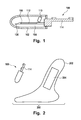
- Fig. 1 illustrates a sensor cartridge 100 according to an embodiment of the invention.
- the sensor cartridge 100 comprises a cap 102 which encloses a sterile capsule 104.
- Within the sterile capsule 104 there is an insertion needle 106 and a sensor 108.
- the insertion needle 106 has a hollow channel, is flat or has a rolled structure which enables the sensor to be inserted subcutaneously into a subject.
- the needle 106 is connected to a mechanical connector 114.
- the mechanical connector 114 is adapted to being connected to an insertion mechanism operable for actuating the insertion needle 106.
- the mechanical adaptor 114 is adapted for locking or snapping into the insertion mechanism.
- the mechanical adaptor 114 is a sliding carriage.
- Fig. 2 shows a sensor insertion assembly 200 according to an embodiment of the invention.
- the sensor insertion assembly 200 comprises a sensor cartridge 100 according to an embodiment of the invention.
- the sensor insertion assembly 200 further comprises an inserter 202 with a chamber 204 operable for receiving the sensor cartridge 100.
- the sensor cartridge 100 can be placed into the chamber 204.
- An actuator of some form which is not shown in this Fig. is then used to drive the insertion needle 106 to insert the sensor 108 into the subject.
- the sensor cartridge 100 is able to be removed from the chamber 204 after the insertion needle has been actuated.
- the inserter 202 is reusable as a new sensor cartridge 100 can be installed in the chamber 204.
- Fig. 3 shows a magazine 300 according to an embodiment of the invention.
- the magazine 300 shows a linear arrangement of four sterile capsules 104. Within each of the sterile capsules is a needle 106, with a sensor 108 in an arrangement similar to that shown in Fig. 1 .
- the magazine 300 forms the sterile capsules 104.
- Within one of the sterile capsules 104 a sensor cartridge 302 is shown.
- the sensor cartridge 100 of Fig. 1 could also be placed within a magazine.
- Fig. 4 shows an alternative embodiment of the magazine 400 according to the invention.
- a series of sterile capsules 104 are arranged in a cylindrical configuration.
- the inserter would change to different sensor cartridges 402 by rotating the magazine 400 in the same way that a revolver would change cartridges.
- a sensor cartridge 402 similar to that shown in Fig. 3 is shown in one of the sterile capsules 104.
- a sensor cartridge 100 according to Fig. 1 is used instead.
- the sterile capsule and the sterile magazine may be used as a container for storing the used insertion needles.
- the needle may not be reachable by a finger.
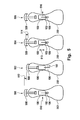
- Fig. 5 shows an example of a failsafe mechanism 508 according to an embodiment of the invention.
- an inserter 202 with a sensor cartridge 100 is shown.
- the cartridge 100 is inserted 510 into the chamber.
- 508 a plunger 508 is depressed 512. This loads the sensor cartridge 100 and the cap 102 which was protecting the insertion needle 106 is removed.
- the sensor may be inserted by actuating the needle 513.
- the plunger 508 is then retracted 514. This moves the cap 102 back into a protective place for protecting the insertion needle 106.
- view 506 the sensor cartridge 100 is removed from the chamber.
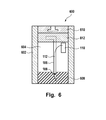
- Fig. 6 shows a sensor cartridge 600 according to an embodiment of the invention.
- the sensor cartridge 600 is formed by a tube 602 which forms a sterile capsule or hollow cavity 604.
- a septum 608 seals the tube 602.
- a mechanical actuator or adapter 610 is in contact with a top seal 612.
- the mechanical adapter 610 can be used to drive an insertion needle 106 through the septum 608 and also retract it.
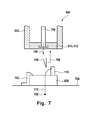
- Fig. 7 illustrates the operation of the sensor cartridge 600 as shown in Fig. 6 .
- a portion of an insertion mechanism 700 is shown as being attached to the mechanical adapter 610.
- the mechanical adapter has been used to drive the insertion needle 106 through the surface 704 of a subject.
- a sensor mounting unit 702 is attached to the surface of the subject 704.
- a sensor 108 has been inserted into the subject and the electrical connection 112 goes back to the sensor connector 110.
- the septum 608 is left in place and is connected to the sensor mounting unit 702.
- the insertion needle 106 is withdrawn 708. The retraction of the insertion mechanism 700 causes the insertion needle 106 to be withdrawn back into the tube 602.
- Fig. 8 shows an alternative embodiment of a sensor cartridge 800.
- a tube 602 sealed at one end by a septum 608.
- a mechanical adapter or piston 610 is used to push the insertion needle 106 through the septum 608.
- Fig. 9 shows a further example of a sensor cartridge 900 according to an embodiment of the invention.
- the sensor cartridge is in a tube-like configuration with a mechanical adapter 610 that acts as a piston.
- a seal 902 sealing one end.
- a cable 604 attached to one end of the seal 904. The cable is guided along rollers 908 and is connected to the mechanical adapter 610.
- the mechanical adapter 610 When the mechanical adapter 610 is actuated it pulls on the cable 904 which then in turn pulls open the seal 902.
- Fig. 10 shows a portion of a sensor cartridge 1000 according to a further embodiment of the invention.
- the embodiment shown in Fig. 10 is similar to that shown in Fig. 9 except a different mechanism is used for opening the seal 902.
- a spring or coil 1002 is within the tube 602. As a mechanical actuator is depressed it compresses the coil 1002 which causes a cutting edge 1004 in contact with the seal 902 to spin 1006. This causes the seal 902 to open.
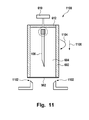
- Fig. 11 shows a further example of an embodiment of a sensor cartridge 1100 according to the invention.
- the sensor cartridge 1100 is again a tubular or cylindrical type sensor cartridge.
- There is a seal 902 which seals the sterile capsule or hollow cavity 604.
- the sensor cartridge 1100 when inserted into the inserter undergoes a movement to open the seal 902.
- the sensor cartridge 1100 may either be rotated or directly put 1104 or direct pushed to cause a motion in the direction 1106.
- the motion in direction 1106 causes the sensor cartridge 1100 to force the seal 1102 against a knife-edge 1102 of the inserter. This causes the seal 902 to open.
- the knife edge mount (1102) is on a sensor mounting unit.
- the insertion mechanism may actuate the sensor cartridge or the knife edge mount to open the seal.
- the operator may bring the sensor cartridge into contact with the knife edge before actuating the insertion mechanism.
- the knife edge may also serve as a means of aligning the sensor insertion assembly to a sensor mounting unit.
- Fig. 12 shows a further embodiment of a sensor cartridge 1200 according to the invention.
- the sensor cartridge 1200 is a cylindrical type sensor cartridge.
- the sensor cartridge 1200 When the sensor cartridge 1200 is loaded into the chamber it causes the spring 1202 to have one end moved to a loaded position 1206.
- the sensor mechanism When the sensor mechanism is actuated the end of the spring 1206 travels along a trajectory 1208. In the process this rips off the seal 902 of the sensor cartridge 1200.
Landscapes
- Health & Medical Sciences (AREA)
- Life Sciences & Earth Sciences (AREA)
- Physics & Mathematics (AREA)
- Surgery (AREA)
- Molecular Biology (AREA)
- General Health & Medical Sciences (AREA)
- Engineering & Computer Science (AREA)
- Biomedical Technology (AREA)
- Heart & Thoracic Surgery (AREA)
- Medical Informatics (AREA)
- Veterinary Medicine (AREA)
- Public Health (AREA)
- Animal Behavior & Ethology (AREA)
- Pathology (AREA)
- Biophysics (AREA)
- Optics & Photonics (AREA)
- Emergency Medicine (AREA)
- Chemical & Material Sciences (AREA)
- Chemical Kinetics & Catalysis (AREA)
- General Chemical & Material Sciences (AREA)
- Nuclear Medicine, Radiotherapy & Molecular Imaging (AREA)
- Measurement Of The Respiration, Hearing Ability, Form, And Blood Characteristics Of Living Organisms (AREA)
Priority Applications (4)
| Application Number | Priority Date | Filing Date | Title |
|---|---|---|---|
| EP12170223.7A EP2668901A1 (fr) | 2012-05-31 | 2012-05-31 | Ensemble d'insertion de capteur, cartouche de capteur et dispositif d'insertion |
| EP13724573.4A EP2854639B1 (fr) | 2012-05-31 | 2013-05-21 | Ensemble d'insertion de capteur comprenant une cartouche de capteur et un dispositif d'insertion |
| PCT/EP2013/060367 WO2013178501A1 (fr) | 2012-05-31 | 2013-05-21 | Ensemble d'insertion de capteur, cartouche capteur et dispositif d'insertion |
| US14/553,380 US10653445B2 (en) | 2012-05-31 | 2014-11-25 | Sensor insertion assembly, sensor cartridge, and inserter |
Applications Claiming Priority (1)
| Application Number | Priority Date | Filing Date | Title |
|---|---|---|---|
| EP12170223.7A EP2668901A1 (fr) | 2012-05-31 | 2012-05-31 | Ensemble d'insertion de capteur, cartouche de capteur et dispositif d'insertion |
Publications (1)
| Publication Number | Publication Date |
|---|---|
| EP2668901A1 true EP2668901A1 (fr) | 2013-12-04 |
Family
ID=48483065
Family Applications (2)
| Application Number | Title | Priority Date | Filing Date |
|---|---|---|---|
| EP12170223.7A Withdrawn EP2668901A1 (fr) | 2012-05-31 | 2012-05-31 | Ensemble d'insertion de capteur, cartouche de capteur et dispositif d'insertion |
| EP13724573.4A Active EP2854639B1 (fr) | 2012-05-31 | 2013-05-21 | Ensemble d'insertion de capteur comprenant une cartouche de capteur et un dispositif d'insertion |
Family Applications After (1)
| Application Number | Title | Priority Date | Filing Date |
|---|---|---|---|
| EP13724573.4A Active EP2854639B1 (fr) | 2012-05-31 | 2013-05-21 | Ensemble d'insertion de capteur comprenant une cartouche de capteur et un dispositif d'insertion |
Country Status (3)
| Country | Link |
|---|---|
| US (1) | US10653445B2 (fr) |
| EP (2) | EP2668901A1 (fr) |
| WO (1) | WO2013178501A1 (fr) |
Cited By (5)
| Publication number | Priority date | Publication date | Assignee | Title |
|---|---|---|---|---|
| EP2982302A1 (fr) | 2014-08-05 | 2016-02-10 | Roche Diagnostics GmbH | Applicateur médical |
| US10370692B2 (en) | 2013-12-20 | 2019-08-06 | Hoffmann-La Roche Inc. | Recombinant polypeptide production methods |
| US11584793B2 (en) | 2015-06-24 | 2023-02-21 | Hoffmann-La Roche Inc. | Anti-transferrin receptor antibodies with tailored affinity |
| US11603411B2 (en) | 2015-10-02 | 2023-03-14 | Hoffmann-La Roche Inc. | Bispecific anti-human CD20/human transferrin receptor antibodies and methods of use |
| US11787868B2 (en) | 2015-10-02 | 2023-10-17 | Hoffmann-La Roche Inc. | Bispecific anti-human A-beta/human transferrin receptor antibodies and methods of use |
Families Citing this family (11)
| Publication number | Priority date | Publication date | Assignee | Title |
|---|---|---|---|---|
| WO2015118550A2 (fr) | 2014-02-10 | 2015-08-13 | Elcam Medical Agricultural Cooperative Association Ltd. | Auto-injecteur semi-jetable |
| SI3097933T1 (sl) | 2015-05-26 | 2019-12-31 | F. Hoffmann-La Roche Ag | Kartuša in uvajalnik za medicinski sistem |
| WO2017033193A2 (fr) | 2015-08-27 | 2017-03-02 | E3D Agricultural Cooperative Association Ltd | Dispositif d'injection automatique réutilisable |
| PL4233721T3 (pl) | 2016-02-05 | 2024-10-21 | F. Hoffmann-La Roche Ag | Urządzenie medyczne do wykrywania co najmniej jednego analitu w płynie ustrojowym |
| DK3202324T3 (da) | 2016-02-05 | 2022-01-24 | Hoffmann La Roche | Medicinsk anordning til påvisning af mindst én analyt i en kropsvæske |
| HRP20230596T1 (hr) | 2017-12-21 | 2023-09-29 | F. Hoffmann - La Roche Ag | Medicinski sustav i postupak njegove proizvodnje |
| US10940554B2 (en) * | 2018-11-30 | 2021-03-09 | International Business Machines Corporation | Planar fabrication of micro-needles |
| US11672965B2 (en) * | 2021-09-28 | 2023-06-13 | Biolinq Incorporated | Microneedle enclosure and applicator device for microneedle array based continuous analyte monitoring device |
| CA3268251A1 (fr) | 2022-10-21 | 2024-04-25 | F. Hoffmann-La Roche Ag | Système d'insertion et procédé d'insertion d'un dispositif médical |
| CN122580047A (zh) | 2024-01-10 | 2026-08-14 | 罗氏糖尿病护理有限责任公司 | 连续分析物监测单元 |
| WO2026046754A1 (fr) | 2024-08-27 | 2026-03-05 | Roche Diabetes Care Gmbh | Système de capteur d'analyte en continu |
Citations (8)
| Publication number | Priority date | Publication date | Assignee | Title |
|---|---|---|---|---|
| US5098382A (en) * | 1989-12-11 | 1992-03-24 | Habley Medical Technology Corporation | Safety module-activator reshielding tool |
| US5868711A (en) * | 1991-04-29 | 1999-02-09 | Board Of Regents, The University Of Texas System | Implantable intraosseous device for rapid vascular access |
| WO2000069492A1 (fr) * | 1999-05-14 | 2000-11-23 | Joel Schoenfeld | Dispositif d'inviolabilite pour seringue et sa methode de mise en place |
| WO2008065646A1 (fr) * | 2006-11-28 | 2008-06-05 | Medingo Ltd. | Dispositif d'insertion et procédé pour insérer un élément insérable de manière sous-cutanée à l'intérieur d'un corps |
| US20080242962A1 (en) | 2007-03-20 | 2008-10-02 | Bernd Roesicke | System for in-vitro measurement of an analyte concentration |
| US20080255440A1 (en) * | 2004-08-10 | 2008-10-16 | Novo Nordisk A/S | Method of Forming a Sterilized Sensor Package and a Sterilized Sensor Package |
| WO2009016638A1 (fr) * | 2007-08-01 | 2009-02-05 | Medingo Ltd. | Dispositif destiné à faciliter l'injection de fluides thérapeutiques et la détection d'analytes dans l'organisme |
| US8002752B2 (en) * | 2007-06-25 | 2011-08-23 | Medingo, Ltd. | Protector apparatus |
Family Cites Families (9)
| Publication number | Priority date | Publication date | Assignee | Title |
|---|---|---|---|---|
| US5074318A (en) * | 1986-10-06 | 1991-12-24 | Bio Medic Data Systems, Inc. | Animal marker |
| US5267972A (en) * | 1992-07-20 | 1993-12-07 | Anderson Wayne W | Hypodermic syringe with needle guard |
| US5390671A (en) * | 1994-03-15 | 1995-02-21 | Minimed Inc. | Transcutaneous sensor insertion set |
| US6468264B1 (en) * | 1999-10-12 | 2002-10-22 | Durect Corporation | Closed exchange system |
| CA2529484C (fr) * | 2003-06-17 | 2013-02-19 | Adst Technologies Ltd. | Dispositif de transfert de fluide comportant une cartouche d'aiguilles amovible |
| US7946984B2 (en) * | 2004-07-13 | 2011-05-24 | Dexcom, Inc. | Transcutaneous analyte sensor |
| DE502005010414D1 (de) * | 2005-05-20 | 2010-12-02 | Roche Diagnostics Gmbh | Lanzettensystem mit Sterilschutz |
| US7927345B2 (en) * | 2006-11-02 | 2011-04-19 | Agamatrix, Inc. | Lancet cartridges and lancing devices |
| US20130060106A1 (en) * | 2011-09-06 | 2013-03-07 | Medtronic Minimed, Inc. | Optical sensing systems and methods |
-
2012
- 2012-05-31 EP EP12170223.7A patent/EP2668901A1/fr not_active Withdrawn
-
2013
- 2013-05-21 EP EP13724573.4A patent/EP2854639B1/fr active Active
- 2013-05-21 WO PCT/EP2013/060367 patent/WO2013178501A1/fr not_active Ceased
-
2014
- 2014-11-25 US US14/553,380 patent/US10653445B2/en active Active
Patent Citations (8)
| Publication number | Priority date | Publication date | Assignee | Title |
|---|---|---|---|---|
| US5098382A (en) * | 1989-12-11 | 1992-03-24 | Habley Medical Technology Corporation | Safety module-activator reshielding tool |
| US5868711A (en) * | 1991-04-29 | 1999-02-09 | Board Of Regents, The University Of Texas System | Implantable intraosseous device for rapid vascular access |
| WO2000069492A1 (fr) * | 1999-05-14 | 2000-11-23 | Joel Schoenfeld | Dispositif d'inviolabilite pour seringue et sa methode de mise en place |
| US20080255440A1 (en) * | 2004-08-10 | 2008-10-16 | Novo Nordisk A/S | Method of Forming a Sterilized Sensor Package and a Sterilized Sensor Package |
| WO2008065646A1 (fr) * | 2006-11-28 | 2008-06-05 | Medingo Ltd. | Dispositif d'insertion et procédé pour insérer un élément insérable de manière sous-cutanée à l'intérieur d'un corps |
| US20080242962A1 (en) | 2007-03-20 | 2008-10-02 | Bernd Roesicke | System for in-vitro measurement of an analyte concentration |
| US8002752B2 (en) * | 2007-06-25 | 2011-08-23 | Medingo, Ltd. | Protector apparatus |
| WO2009016638A1 (fr) * | 2007-08-01 | 2009-02-05 | Medingo Ltd. | Dispositif destiné à faciliter l'injection de fluides thérapeutiques et la détection d'analytes dans l'organisme |
Cited By (9)
| Publication number | Priority date | Publication date | Assignee | Title |
|---|---|---|---|---|
| US10370692B2 (en) | 2013-12-20 | 2019-08-06 | Hoffmann-La Roche Inc. | Recombinant polypeptide production methods |
| EP2982302A1 (fr) | 2014-08-05 | 2016-02-10 | Roche Diagnostics GmbH | Applicateur médical |
| US10405885B2 (en) | 2014-08-05 | 2019-09-10 | Roche Diabetes Care, Inc. | Medical applicator |
| US11584793B2 (en) | 2015-06-24 | 2023-02-21 | Hoffmann-La Roche Inc. | Anti-transferrin receptor antibodies with tailored affinity |
| US12252533B2 (en) | 2015-06-24 | 2025-03-18 | Hoffmann-La Roche Inc. | Anti-transferrin receptor antibodies with tailored affinity |
| US11603411B2 (en) | 2015-10-02 | 2023-03-14 | Hoffmann-La Roche Inc. | Bispecific anti-human CD20/human transferrin receptor antibodies and methods of use |
| US11787868B2 (en) | 2015-10-02 | 2023-10-17 | Hoffmann-La Roche Inc. | Bispecific anti-human A-beta/human transferrin receptor antibodies and methods of use |
| US12030952B2 (en) | 2015-10-02 | 2024-07-09 | Hoffmann-La Roche Inc. | Bispecific anti-human CD20/human transferrin receptor antibodies and methods of use |
| US12358997B1 (en) | 2015-10-02 | 2025-07-15 | Hoffmann-La Roche Inc. | Bispecific anti-human A-beta/anti-human transferrin receptor antibodies |
Also Published As
| Publication number | Publication date |
|---|---|
| US20150080684A1 (en) | 2015-03-19 |
| EP2854639A1 (fr) | 2015-04-08 |
| WO2013178501A1 (fr) | 2013-12-05 |
| EP2854639B1 (fr) | 2016-11-23 |
| US10653445B2 (en) | 2020-05-19 |
Similar Documents
| Publication | Publication Date | Title |
|---|---|---|
| EP2854639B1 (fr) | Ensemble d'insertion de capteur comprenant une cartouche de capteur et un dispositif d'insertion | |
| US12201808B2 (en) | Automated insertion assembly | |
| JP3672553B2 (ja) | 採血用システム | |
| EP2854638B1 (fr) | Cartouche de capteur | |
| CA2461109C (fr) | Accessoire de piquage comportant un systeme de lancettes protege contre la reutilisation | |
| US20080125801A1 (en) | Lancet system with a sterile protector | |
| HK1052852A1 (en) | Blood lancet with hygienic tip protection | |
| US20230364331A1 (en) | Insertion system and method for inserting a medical device | |
| CN116322833A (zh) | 用于插入医疗装置的插入装置及方法 | |
| US20250241679A1 (en) | Insertion system and method for inserting a medical device | |
| RU2839031C1 (ru) | Устройство для вставки и способ выполнения вставки медицинского устройства | |
| EP4651799A1 (fr) | Dispositif d'insertion | |
| WO2024218057A1 (fr) | Dispositif d'insertion | |
| HK1209011B (en) | Sensor cartridge and inserter |
Legal Events
| Date | Code | Title | Description |
|---|---|---|---|
| PUAI | Public reference made under article 153(3) epc to a published international application that has entered the european phase |
Free format text: ORIGINAL CODE: 0009012 |
|
| AK | Designated contracting states |
Kind code of ref document: A1 Designated state(s): AL AT BE BG CH CY CZ DE DK EE ES FI FR GB GR HR HU IE IS IT LI LT LU LV MC MK MT NL NO PL PT RO RS SE SI SK SM TR |
|
| AX | Request for extension of the european patent |
Extension state: BA ME |
|
| STAA | Information on the status of an ep patent application or granted ep patent |
Free format text: STATUS: THE APPLICATION IS DEEMED TO BE WITHDRAWN |
|
| 18D | Application deemed to be withdrawn |
Effective date: 20140605 |