EP2668974A2 - Dispositif d'ancrage de sécurité mobile - Google Patents
Dispositif d'ancrage de sécurité mobile Download PDFInfo
- Publication number
- EP2668974A2 EP2668974A2 EP13168910.1A EP13168910A EP2668974A2 EP 2668974 A2 EP2668974 A2 EP 2668974A2 EP 13168910 A EP13168910 A EP 13168910A EP 2668974 A2 EP2668974 A2 EP 2668974A2
- Authority
- EP
- European Patent Office
- Prior art keywords
- ring member
- anchoring device
- surrounding wall
- mobile safety
- vertical extension
- Prior art date
- Legal status (The legal status is an assumption and is not a legal conclusion. Google has not performed a legal analysis and makes no representation as to the accuracy of the status listed.)
- Withdrawn
Links
- 238000004873 anchoring Methods 0.000 title claims abstract description 53
- 238000012856 packing Methods 0.000 claims description 9
- 230000000903 blocking effect Effects 0.000 claims description 5
- 230000006835 compression Effects 0.000 claims description 2
- 238000007906 compression Methods 0.000 claims description 2
- 229910000831 Steel Inorganic materials 0.000 description 5
- 239000010959 steel Substances 0.000 description 5
- 238000005034 decoration Methods 0.000 description 1
- 230000000694 effects Effects 0.000 description 1
- 230000003028 elevating effect Effects 0.000 description 1
- 230000003014 reinforcing effect Effects 0.000 description 1
Images


Classifications
-
- A—HUMAN NECESSITIES
- A62—LIFE-SAVING; FIRE-FIGHTING
- A62B—DEVICES, APPARATUS OR METHODS FOR LIFE-SAVING
- A62B1/00—Devices for lowering persons from buildings or the like
- A62B1/06—Devices for lowering persons from buildings or the like by making use of rope-lowering devices
- A62B1/14—Devices for lowering persons from buildings or the like by making use of rope-lowering devices with brakes sliding on the rope
-
- A—HUMAN NECESSITIES
- A62—LIFE-SAVING; FIRE-FIGHTING
- A62B—DEVICES, APPARATUS OR METHODS FOR LIFE-SAVING
- A62B35/00—Safety belts or body harnesses; Similar equipment for limiting displacement of the human body, especially in case of sudden changes of motion
- A62B35/0043—Lifelines, lanyards, and anchors therefore
- A62B35/0068—Anchors
-
- F—MECHANICAL ENGINEERING; LIGHTING; HEATING; WEAPONS; BLASTING
- F16—ENGINEERING ELEMENTS AND UNITS; GENERAL MEASURES FOR PRODUCING AND MAINTAINING EFFECTIVE FUNCTIONING OF MACHINES OR INSTALLATIONS; THERMAL INSULATION IN GENERAL
- F16M—FRAMES, CASINGS OR BEDS OF ENGINES, MACHINES OR APPARATUS, NOT SPECIFIC TO ENGINES, MACHINES OR APPARATUS PROVIDED FOR ELSEWHERE; STANDS; SUPPORTS
- F16M13/00—Other supports for positioning apparatus or articles; Means for steadying hand-held apparatus or articles
- F16M13/02—Other supports for positioning apparatus or articles; Means for steadying hand-held apparatus or articles for supporting on, or attaching to, an object, e.g. tree, gate, window-frame, cycle
Definitions
- the invention relates to an anchoring device, more particularly to a mobile safety anchoring device adapted for securing a vertically extending member such as a lifeline.
- a conventional mobile safety anchoring device 1 disclosed in US Patent No. 3335469 and including a housing 11, a cone-shaped member 12 that is disposed in an end of the housing 11, a slider 13 that extends through the cone-shaped member 12, and a plurality of steel balls 14 that are received in the slider 13 and disposed adjacent to the cone-shaped member 12.
- the steel balls 14 will be pressured by the cone-shaped member 12 to move inwardly to press against and secure a rope 15 that extends through the slider 13, such that the conventional mobile safety anchoring device 1 can no longer move in relation to the cord 15.
- the slider 13 is downwardly pushed in relation to the main body 11, simultaneously moving the steel balls 14 downward until the cord 15 is released from being pressed against by the steel balls 14. At this time, the conventional mobile safety anchoring device 1 can slide along the cord 15 for position adjustment.
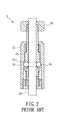
- FIG. 2 Shown in Fig. 2 is another conventional mobile safety anchoring device 2 disclosed in Japanese Patent Application Publication No. H10-184814 and including a housing 21 that has an inner coned surface 211, an inner sleeve member 22 disposed in the housing 21, a cover body 23 threadedly engaged to the inner sleeve member 22, and a plurality of spheres 24 received in the inner sleeve member 22.
- the conventional mobile safety anchoring device 2 functions similarly to the conventional mobile safety anchoring device 1, where the inner coned surface 211 is used to push the spheres 24 to press against a cord 25 that passes through the inner sleeve member 22, and where when the cover body 23 is pressed to move the inner sleeve member 22downwardly relative to the housing 21, the spheres 24 will be released from being pushed by the inner coned surface 211 and allow positioning adjustments of the conventional mobile safety anchoring device 2 along the cord 25.
- neither the slider 13 nor the inner sleeve member 22 may be secured so that the steel balls 14 and the spheres 24 may be released from clamping the rope 15 and the cord 25, leading to safety concerns.
- the spheres 24 will be at asymmetric positions relative to the inner coned surface 211, forming gaps therebetween, and making the clamping of the conventional mobile safety anchoring device 2 on the cord 25 unstable.
- the object of the present invention is to provide a mobile safety anchoring device that can eliminate the aforesaid drawbacks of the prior art.
- a mobile safety anchoring device adapted to be slidably sleeved around a vertical extension member.
- the mobile safety anchoring device includes an outer ring member, an inner ringmember, a plurality of positioning members, a resilient component and a limiting member.
- the outer ring member is adapted for surrounding the vertical extension member and includes an outer surrounding wall that defines an accommodating space.
- the outer surrounding wall has a top end and a bottom end that is opposite to the top end.
- An inner surface of the outer surrounding wall has a first converging portion that converges from the bottom end toward the top end.
- the inner ring member is adapted for surrounding the vertical extension member and is slidably and partially received in the accommodating space of the outer ring member.
- the inner ring member includes an inner surrounding wall that defines a passage for extension of the vertical extension member therethrough.
- the inner surrounding wall has a protruding portion that protrudes outwardly of the accommodating space, and a plurality of positioning holes that are disposed within the accommodating space.
- the positioning members are respectively disposed in the positioning holes in the inner ring member and between the first converging portion of the inner surface of the outer ring member and the vertical extension member.
- the resilient component abuts against the inner surrounding wall of the inner ring member for generating a biasing force that moves the inner ring member in relation to the outer ring member in a way that the positioning members are moved toward the first converging portion and forced by the first converging portion to abut against the vertical extension member, thereby positioning the mobile safety anchoring device on the vertical extension member.
- the limiting member is connected to the protruding portion of the inner ring member, and is operable to move relative to the inner ring member between a locked position and an unlocked position.
- the locked position the limiting member abuts against the outer ring member and prevents movement of the inner ring member relative to the outer ring member against the biasing force generated by the resilient component.
- the unlocked position the limiting member forms a gap with the outer ring member and is operable to bring the inner ring member to move relative to the outer ring member to overcome the biasing force of the resilient component such that the positioning members are no longer forced by the first converging portion of the outer ring member to abut against the vertical extension member to permit the mobile safety anchoring device to slide along the vertical extension member.
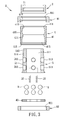
- a mobile safety anchoring device 3 is adapted to be slidably sleeved on a vertical extension member 91.
- the vertical extension member 91 may be a rod or a rope such as a lifeline and is not limited thereto.
- the mobile safety anchoring device 3 includes an outer ring member 4, an inner ring member 5, a plurality of positioning members 6, a plurality of resilient components 52 and a limiting member 7.
- the outer ring member 4 is adapted for surrounding the vertical extension member 91 and includes an outer surrounding wall 41 and a blocking wall 42.
- the outer surrounding wall 41 defines an accommodating space 415 and has a top end 411 and a bottom end 412 that is opposite to the top end 411.
- An inner surface of the outer surrounding wall 41 has spaced-apart first and second converging portions 413, 414 each converging from the bottom end 412 toward the top end 411.
- the blocking wall 42 is secured to the bottom end 412 of the outer surrounding wall 41.
- the inner ring member 5 is adapted for surrounding the vertical extension member 91 and is slidably and partially received in the accommodating space 415 of the outer ring member 4.
- the inner ring member 5 includes an inner surrounding wall 51 that defines a passage 511 for extension of the vertical extension member 91 therethrough.
- the inner surrounding wall 51 has a protruding portion 512 that protrudes outwardly of the accommodating space 415, and a plurality of positioning holes 513 that are disposed within the accommodating space 415.
- the positioning members 6 are each disposed in a respective one of the positioning holes 513 in the inner ring member 5 and between the vertical extension member 91 and a corresponding one of the first and second converging portions 413, 414 of the inner surface of the outer ring member 4.
- each of the positioning members 6 is a sphere.
- each of the resilient components 52 abut against and between the inner surrounding wall 51 of the inner ring member 5 and the blocking wall 42 of the outer ring member 4 for generating a biasing force that moves the inner ring member 5 in relation to the outer ring member 4, such that the positioning members 6 are moved respectively toward the first and second converging portions 413, 414 and are forced by the first and second converging portions 413, 414 to abut against the vertical extension member 91, thereby positioning the mobile safety anchoring device 3 on the vertical extension member 91.
- the positioning holes 513 in the inner ring member 5 are respectively aligned with the first and second converging portions 413, 414 when the biasing force generated by the resilient components 52 is not overcome.
- each of the resilient components 52 is a compression spring. It should be noted herein that this invention is not to be limited to the number of the resilient components 52.
- the limiting member 7 is connected to the protruding portion 512 of the inner ring member 5 and is operable to move relative to the inner ring member 5 between a locked position and an unlocked position.
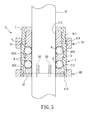
- the limiting member 7 forms a gap (G) with the outer ring member 4, and is operable to bring the inner ring member 5 to move relative to the outer ring member 4 to overcome the biasing force of the resilient components 52 such that the positioning members 6 are not forced by the corresponding first and second converging portions 413, 414 of the outer ring member 4 to abut against the vertical extension member 91 to thereby permit the mobile safety anchoring device 3 to slide along the vertical extension member 91.
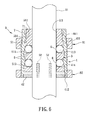
- the limiting member 7 when in the locked position, the limiting member 7 abuts against the outer ring member 4 and prevents movement of the inner ring member 5 relative to the outer ring member 4 against the biasing force generated by the resilient components 52.
- the mobile safety anchoring device 3 of this embodiment further includes a fixing ring 81 that is sleeved around the top end 411 of the outer surrounding wall 41 of the outer ring member 4 and the limiting member 7, and that includes an inner flange 811.
- the inner flange 811 abuts against the limiting member 7 when the limiting member 7 is in the unlocked position.
- the mobile safety anchoring device 3 further includes a packing ring 82 that is sleeved around the bottom end 412 of the outer surrounding wall 41 of the outer ring member 4 and that is spaced apart from the fixing ring 81.
- each of the outer surrounding wall 41 of the outer ring member 4 and the protruding portion 512 of the inner ring member 5 has an outer thread 416, 514.
- Each of the fixing ring 81 and the packing ring 82 has an inner thread 812, 821, that engages threadedly the outer thread 416 for securing the corresponding one of the fixing ring 81 and the packing ring 82 to the outer surrounding wall 41.
- the limiting member 7 has an inner thread 71 that engages threadedly and movably the outer thread 514 of the inner ring member 5 so that the limiting member 7 is movable between the locked position and the unlocked position.
- the manner of engagement of these components is not to be limited to the above.
- the resilient components 52 push the inner surrounding wall 51 of the inner ring member 5 in an upward direction from the bottom end 412 of the outer surrounding wall 41 toward the top end 411 of the outer surrounding wall 41 so that the positioning members 6 are pressed inwardly by the corresponding first and second converging portions 413, 414 to abut against the vertical extension member 91to position the mobile safety anchoring device 3 on the vertical extension member 91.
- the limiting member 7 is pressed relative to the outer ring member 4 to bring the inner ring member 5 to move toward the bottom end 412 of the outer surrounding wall 41 against the biasing force of the resilient components 52, until the positioning members 6 are no longer pressured by the corresponding first and second converging portions 413, 414 against the vertical extension member 91.
- the limiting member 7 may then be released to allow for the biasing force of the resilient members 52 to take effect again, pushing the inner ring member 5 to the position shown in Fig. 4 , and making the positioning members 6 cooperatively clamp on the vertical extension member 91 .
- the limiting member 7 is to be rotated threadedly to the locked position, i.e., until the limiting member 7 abuts against the top end 411 of the outer surrounding wall 41, such that the inner ring member 5 is unable to move in a downward direction from the top end 411 toward the bottom end 412 against the biasing force of the resilient members 52, and therefore incapable of releasing the clamping force of the positioning members 6 against the vertical extension member 91 to thereby maintain securely the mobile safety anchoring device 3 on the vertical extension member 91, and prevent accidental movement of the inner ring member 5.
- the limiting member 7 is rotated threadedly and upwardly to reach the position in Fig. 4 , where the inner flange 811 of the fixing ring 81 abuts against the limiting member 7 to prevent complete disengagement of the limiting member 7 from the inner ring member 5.
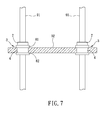
- multiple mobile safety anchoring devices 3 may be used together with a plurality of vertical extension members 91respectively extending therethrough. Once the mobile safety anchoring devices 3 are locked at desired locations on the respective vertical extension members 91 using the limiting members
- a plate 92 can be placed among the mobile safety anchoring devices 3 and clampedbetween the fixing ring 81 and the packing ring 82 of each mobile safety anchoring device 3.
- the plate 92 can be used for displaying decorations, or for storage purposes.
- the use of additional positioning members 6 is permitted to increase the clamping force on the vertical extension member 91.
- the clamping force on the vertical extension member 9 by the positioning members 6 is further enhanced with reduced gaps between the inner ring member 5 and the vertical extension member 91, permitting plates 92 of various lengths and weights or having uneven loads placed thereon to be securely fixed between the fixing ring 81 and packing ring 82.
- the mobile safety anchoring device 3 when the limiting member 7 is in the unlocked position, the mobile safety anchoring device 3 is permitted to slide along the vertical extension member 91 so as to be placed at any desirable position. Subsequently, by moving the limiting member 7 to the locked position, the mobile safety anchoring device 3 will securely clamp on the vertical extension member 91 such that inadvertent actions will not result in loosening of the mobile safety anchoring device 3 from the vertical extension member 91, thereby elevating safety of use.
Landscapes
- Health & Medical Sciences (AREA)
- General Health & Medical Sciences (AREA)
- Business, Economics & Management (AREA)
- Emergency Management (AREA)
- Engineering & Computer Science (AREA)
- General Engineering & Computer Science (AREA)
- Mechanical Engineering (AREA)
- Clamps And Clips (AREA)
- Telephone Set Structure (AREA)
- Mechanical Control Devices (AREA)
Applications Claiming Priority (1)
| Application Number | Priority Date | Filing Date | Title |
|---|---|---|---|
| TW101119139A TW201347805A (zh) | 2012-05-29 | 2012-05-29 | 升降調整裝置 |
Publications (2)
| Publication Number | Publication Date |
|---|---|
| EP2668974A2 true EP2668974A2 (fr) | 2013-12-04 |
| EP2668974A3 EP2668974A3 (fr) | 2015-04-15 |
Family
ID=48537779
Family Applications (1)
| Application Number | Title | Priority Date | Filing Date |
|---|---|---|---|
| EP13168910.1A Withdrawn EP2668974A3 (fr) | 2012-05-29 | 2013-05-23 | Dispositif d'ancrage de sécurité mobile |
Country Status (4)
| Country | Link |
|---|---|
| US (1) | US20130319799A1 (fr) |
| EP (1) | EP2668974A3 (fr) |
| JP (1) | JP2013245820A (fr) |
| TW (1) | TW201347805A (fr) |
Cited By (1)
| Publication number | Priority date | Publication date | Assignee | Title |
|---|---|---|---|---|
| GB2588722A (en) * | 2012-12-21 | 2021-05-05 | Electronic Theatre Controls Inc | Compact hoist accessories and combination systems |
Citations (2)
| Publication number | Priority date | Publication date | Assignee | Title |
|---|---|---|---|---|
| US3335469A (en) | 1963-11-19 | 1967-08-15 | Barrow Hepburn & Gale Ltd | Personal safety equipment |
| JPH10184814A (ja) | 1996-12-26 | 1998-07-14 | Yasuo Matsuda | スライドクランパー |
Family Cites Families (9)
| Publication number | Priority date | Publication date | Assignee | Title |
|---|---|---|---|---|
| JPS5491664A (en) * | 1977-12-29 | 1979-07-20 | Hideo Arakawa | Universal retainer and universal retaining device |
| DE8236311U1 (de) * | 1982-12-24 | 1983-03-03 | Skf Kugellagerfabriken Gmbh, 8720 Schweinfurt | Doppelfreilauf für lineare bewegungen |
| US4893810A (en) * | 1986-07-21 | 1990-01-16 | Lee Scott H | Quick release collar |
| US5141355A (en) * | 1989-03-22 | 1992-08-25 | Star Lock Systems, Inc. | Lock and release apparatus |
| JP2510827Y2 (ja) * | 1990-03-20 | 1996-09-18 | 荒川技研工業株式会社 | ワイヤ張装具 |
| CN2874100Y (zh) * | 2005-08-05 | 2007-02-28 | 冷鹭浩 | 一种伸缩管的锁紧装置 |
| US8037973B2 (en) * | 2008-06-10 | 2011-10-18 | Ruei-Hsing Lin | Fixing device for anti-slip cable lock |
| TW201135081A (en) * | 2010-04-09 | 2011-10-16 | Ming Ren Hang Co Ltd | Elevation adjustment device |
| CN101839270A (zh) * | 2010-05-19 | 2010-09-22 | 名人行有限公司 | 升降调整装置 |
-
2012
- 2012-05-29 TW TW101119139A patent/TW201347805A/zh not_active IP Right Cessation
-
2013
- 2013-05-17 US US13/896,463 patent/US20130319799A1/en not_active Abandoned
- 2013-05-22 JP JP2013107553A patent/JP2013245820A/ja active Pending
- 2013-05-23 EP EP13168910.1A patent/EP2668974A3/fr not_active Withdrawn
Patent Citations (2)
| Publication number | Priority date | Publication date | Assignee | Title |
|---|---|---|---|---|
| US3335469A (en) | 1963-11-19 | 1967-08-15 | Barrow Hepburn & Gale Ltd | Personal safety equipment |
| JPH10184814A (ja) | 1996-12-26 | 1998-07-14 | Yasuo Matsuda | スライドクランパー |
Cited By (2)
| Publication number | Priority date | Publication date | Assignee | Title |
|---|---|---|---|---|
| GB2588722A (en) * | 2012-12-21 | 2021-05-05 | Electronic Theatre Controls Inc | Compact hoist accessories and combination systems |
| US11319198B2 (en) | 2012-12-21 | 2022-05-03 | Electronic Theatre Controls, Inc. | Compact hoist accessories and combination systems |
Also Published As
| Publication number | Publication date |
|---|---|
| JP2013245820A (ja) | 2013-12-09 |
| US20130319799A1 (en) | 2013-12-05 |
| TW201347805A (zh) | 2013-12-01 |
| TWI492772B (fr) | 2015-07-21 |
| EP2668974A3 (fr) | 2015-04-15 |
Similar Documents
| Publication | Publication Date | Title |
|---|---|---|
| KR100980978B1 (ko) | 신축장치 및 삼각대 | |
| US9254577B2 (en) | Knife and sheath assembly with realeasable knife securing function | |
| HK1248971A2 (zh) | 用於绳的绳锁 | |
| US9193561B2 (en) | Cable management device | |
| JP5638143B2 (ja) | 伸縮装置 | |
| US10258146B2 (en) | Safety brake for telescoping furniture post | |
| US10859202B2 (en) | Coupler for releasably securing integrated segments of an assemblage against otherwise accommodated relative translational displacement | |
| EP2975456A1 (fr) | Dispositif d'extension/rétraction | |
| JP2017150498A (ja) | フレキシブルロックユニット | |
| KR200469702Y1 (ko) | 블록 지지장치 | |
| EP2668974A2 (fr) | Dispositif d'ancrage de sécurité mobile | |
| CN202065290U (zh) | 快速组接模块 | |
| CN102536983B (zh) | 快速组接装置 | |
| JP3191956U (ja) | フック装置 | |
| CN103375464A (zh) | 扣接装置 | |
| JP2009522523A (ja) | 留め具 | |
| JP3193302U (ja) | ハンガー | |
| CN102840204B (zh) | 具有活动扣接结构的快速扣接装置 | |
| CN102720737B (zh) | 升降调整装置 | |
| US20150211554A1 (en) | Clipping device | |
| JP6456045B2 (ja) | ロッド固定ユニット、及び、それを用いた伸縮ロッドユニット | |
| TWM473102U (zh) | 工具防墜索具的防鬆脫扣合裝置 | |
| KR20130136889A (ko) | 파이프 부재용 락킹장치 | |
| TWM474533U (zh) | 供防墜器使用之連接裝置 | |
| KR200484442Y1 (ko) | 모바일 디바이스용 고리형 액세서리 |
Legal Events
| Date | Code | Title | Description |
|---|---|---|---|
| PUAI | Public reference made under article 153(3) epc to a published international application that has entered the european phase |
Free format text: ORIGINAL CODE: 0009012 |
|
| AK | Designated contracting states |
Kind code of ref document: A2 Designated state(s): AL AT BE BG CH CY CZ DE DK EE ES FI FR GB GR HR HU IE IS IT LI LT LU LV MC MK MT NL NO PL PT RO RS SE SI SK SM TR |
|
| PUAL | Search report despatched |
Free format text: ORIGINAL CODE: 0009013 |
|
| AK | Designated contracting states |
Kind code of ref document: A3 Designated state(s): AL AT BE BG CH CY CZ DE DK EE ES FI FR GB GR HR HU IE IS IT LI LT LU LV MC MK MT NL NO PL PT RO RS SE SI SK SM TR |
|
| RIC1 | Information provided on ipc code assigned before grant |
Ipc: A62B 35/00 20060101AFI20150312BHEP |
|
| STAA | Information on the status of an ep patent application or granted ep patent |
Free format text: STATUS: THE APPLICATION IS DEEMED TO BE WITHDRAWN |
|
| 18D | Application deemed to be withdrawn |
Effective date: 20151016 |