EP2670081B1 - Signaturverarbeitungssystem, schlüsselerzeugungsvorrichtung, signaturvorrichtung, signaturverarbeitungsverfahren und signaturverarbeitungsprogramm - Google Patents
Signaturverarbeitungssystem, schlüsselerzeugungsvorrichtung, signaturvorrichtung, signaturverarbeitungsverfahren und signaturverarbeitungsprogramm Download PDFInfo
- Publication number
- EP2670081B1 EP2670081B1 EP11856860.9A EP11856860A EP2670081B1 EP 2670081 B1 EP2670081 B1 EP 2670081B1 EP 11856860 A EP11856860 A EP 11856860A EP 2670081 B1 EP2670081 B1 EP 2670081B1
- Authority
- EP
- European Patent Office
- Prior art keywords
- signature
- integer
- key
- basis
- vector
- Prior art date
- Legal status (The legal status is an assumption and is not a legal conclusion. Google has not performed a legal analysis and makes no representation as to the accuracy of the status listed.)
- Active
Links
Images


Classifications
-
- H—ELECTRICITY
- H04—ELECTRIC COMMUNICATION TECHNIQUE
- H04L—TRANSMISSION OF DIGITAL INFORMATION, e.g. TELEGRAPHIC COMMUNICATION
- H04L9/00—Cryptographic mechanisms or cryptographic arrangements for secret or secure communications; Network security protocols
- H04L9/08—Key distribution or management, e.g. generation, sharing or updating, of cryptographic keys or passwords
- H04L9/0816—Key establishment, i.e. cryptographic processes or cryptographic protocols whereby a shared secret becomes available to two or more parties, for subsequent use
-
- G—PHYSICS
- G09—EDUCATION; CRYPTOGRAPHY; DISPLAY; ADVERTISING; SEALS
- G09C—CIPHERING OR DECIPHERING APPARATUS FOR CRYPTOGRAPHIC OR OTHER PURPOSES INVOLVING THE NEED FOR SECRECY
- G09C1/00—Apparatus or methods whereby a given sequence of signs, e.g. an intelligible text, is transformed into an unintelligible sequence of signs by transposing the signs or groups of signs or by replacing them by others according to a predetermined system
-
- H—ELECTRICITY
- H04—ELECTRIC COMMUNICATION TECHNIQUE
- H04L—TRANSMISSION OF DIGITAL INFORMATION, e.g. TELEGRAPHIC COMMUNICATION
- H04L9/00—Cryptographic mechanisms or cryptographic arrangements for secret or secure communications; Network security protocols
- H04L9/30—Public key, i.e. encryption algorithm being computationally infeasible to invert or user's encryption keys not requiring secrecy
- H04L9/3066—Public key, i.e. encryption algorithm being computationally infeasible to invert or user's encryption keys not requiring secrecy involving algebraic varieties, e.g. elliptic or hyper-elliptic curves
- H04L9/3073—Public key, i.e. encryption algorithm being computationally infeasible to invert or user's encryption keys not requiring secrecy involving algebraic varieties, e.g. elliptic or hyper-elliptic curves involving pairings, e.g. identity based encryption [IBE], bilinear mappings or bilinear pairings, e.g. Weil or Tate pairing
-
- H—ELECTRICITY
- H04—ELECTRIC COMMUNICATION TECHNIQUE
- H04L—TRANSMISSION OF DIGITAL INFORMATION, e.g. TELEGRAPHIC COMMUNICATION
- H04L9/00—Cryptographic mechanisms or cryptographic arrangements for secret or secure communications; Network security protocols
- H04L9/32—Cryptographic mechanisms or cryptographic arrangements for secret or secure communications; Network security protocols including means for verifying the identity or authority of a user of the system or for message authentication, e.g. authorization, entity authentication, data integrity or data verification, non-repudiation, key authentication or verification of credentials
-
- H—ELECTRICITY
- H04—ELECTRIC COMMUNICATION TECHNIQUE
- H04L—TRANSMISSION OF DIGITAL INFORMATION, e.g. TELEGRAPHIC COMMUNICATION
- H04L9/00—Cryptographic mechanisms or cryptographic arrangements for secret or secure communications; Network security protocols
- H04L9/32—Cryptographic mechanisms or cryptographic arrangements for secret or secure communications; Network security protocols including means for verifying the identity or authority of a user of the system or for message authentication, e.g. authorization, entity authentication, data integrity or data verification, non-repudiation, key authentication or verification of credentials
- H04L9/3247—Cryptographic mechanisms or cryptographic arrangements for secret or secure communications; Network security protocols including means for verifying the identity or authority of a user of the system or for message authentication, e.g. authorization, entity authentication, data integrity or data verification, non-repudiation, key authentication or verification of credentials involving digital signatures
- H04L9/3255—Cryptographic mechanisms or cryptographic arrangements for secret or secure communications; Network security protocols including means for verifying the identity or authority of a user of the system or for message authentication, e.g. authorization, entity authentication, data integrity or data verification, non-repudiation, key authentication or verification of credentials involving digital signatures using group based signatures, e.g. ring or threshold signatures
Definitions
- the present invention relates to an attribute-based signature (ABS) scheme.
- ABS attribute-based signature
- Non-Patent Literatures 26, 29, 30, 34 to 37, 45, and 51 describe an attribute-based signature scheme.
- Non-Patent Literatures 36 and 37 describe an attribute-based signature scheme that supports a monotone predicate.
- the conventional attribute-based signature scheme does not support non-monotone predicates.
- An attribute-based signature scheme supports non-monotone predicates, and accordingly realizes an attribute-based signature scheme having diversified applications.
- a processing device is, for example, a CPU 911 (to be described later).
- a storage device is, for example, a ROM 913, a RAM 914, or a magnetic disk 920 (each will be described later).
- a communication device is, for example, a communication board 915 (to be described later).
- An input device is, for example, a keyboard 902 or the communication board 915 (to be described later). Namely, the processing device, the storage device, the communication device, and the input device are hardware.
- Formula 101 denotes that y is randomly selected from A according to the distribution of A. Namely, in Formula 101, y is a random number. y ⁇ R A
- Formula 102 denotes that y is uniformly selected from A. Namely, in Formula 102, y is a uniform random number. y ⁇ U A
- Formula 104 denotes an event that a machine (algorithm) A outputs a on input x.
- Formula 105 namely, F q , denotes a finite field of order q.
- a vector symbol denotes a vector representation over the finite field F q . Namely, Formula 106 is established.
- Formula 107 denotes the inner-product, indicated in Formula 109, of two vectors x ⁇ and y ⁇ indicated in Formula 108.
- X T denotes the transpose of matrix M.
- Formula 111 denotes a subspace generated by Formula 112.
- V0 represents V 0 .
- nt in F q nt represents n t .
- xt in sk gid,(t,xt) represents x t .
- ⁇ i,j is ⁇ i,j .
- a signature process includes a key generation process, a signature process, and a verification process.
- This embodiment describes an "attribute-based signature scheme”.
- DPVS dual pairing vector spaces
- an "attribute-based signature scheme” according to this embodiment will be described. Initially, the basic structure of the "attribute-based signature scheme” will be described. Subsequently, the basic structure of a "signature processing system 10" that implements the “attribute-based signature scheme” will be described. Then, the “attribute-based signature scheme” and the “signature processing system 10" according to this embodiment will be described in detail.
- the signing key and verification key are parameterized by attribute x and predicate v, respectively, and signed message (m, ⁇ ) generated by the signing key with parameter x, sk x , is correctly verified by public key pk and parameter v, if and only if predicate v accepts attribute x (when v(x) holds).
- Group signatures are also in this class of signatures (see Non-Patent Literature 19).
- Group signatures are signatures with predicate v, where v(x) holds if and only if predicate parameter v is the group identity and attribute x is a member identity of group v (or pk v is a public key identifying group v and sk x is a secret key of member x of group v).
- signatures generated using the secret key sk x release no information regarding member identity x except that x is a member of group v.
- This class of signatures includes an attribute-based signature with a more sophisticated predicate (see Non-Patent Literatures 26, 29, 30, 34 to 46, 45, and 51), where x for signing key sk x is a tuple of attributes (x 1 ,..., x i ), and v for verification is a threshold or access structure predicate.
- T( ⁇ ) : 1 if ⁇ is true
- T( ⁇ ) : 1 if ⁇ is false.
- Such a monotone predicate can express AND, OR, and Threshold gates.
- TH2 means the threshold gate with threshold value 2 (namely, a gate that requires two or more conditions being held).
- x A and x B are quite different, it is clear that v(x A ) and v(x B ) hold, and that there are many other attributes that satisfy v.
- a signature for v releases no information regarding the attribute of the signer, i.e., Alice or Bob (or other), except that the attribute of the signer satisfies the predicate v.
- a non-monotone predicate can express a NOT gate, as with AND, OR, and Threshold gates.
- the symmetric bilinear pairing groups (q, G, G T , g, e) are a tuple of a prime q, a cyclic additive group G of order q, a cyclic multiplicative group G T of order q, g ⁇ 0 ⁇ G, and a polynomial-time computable nondegenerate bilinear pairing e : G ⁇ G ⁇ G T .
- the pairing on the space V is defined by Formula 118.
- Linear transformation ⁇ i,j on the space V indicated in Formula 119 can achieve Formula 120.
- x : g 1 , ... g N
- Linear transformation ⁇ i,j will be called distortion maps.
- Dual pairing vector spaces are constructed from the symmetric bilinear pairing groups described above.
- Dual pairing vector spaces can be constructed from asymmetric bilinear pairing groups as well. The following description can be easily applied to a case where dual pairing vector spaces are constructed from asymmetric bilinear pairing groups.
- Fig. 1 is an explanatory drawing of a matrix M ⁇ .
- M ⁇ : (M, ⁇ ) is a labeled matrix where the matrix M is an (L rows ⁇ r columns) matrix over F q , and ⁇ is a label of each column of the matrix M and is related to one of literals ⁇ p 1 , ..., p n , ⁇ p 1 , ..., ⁇ p n ⁇ .
- a submatrix M ⁇ of the matrix M is defined.
- the matrix M ⁇ is a submatrix consisting of those rows of the matrix M, whose labels ⁇ are related to value "l" by the input sequence ⁇ .
- Fig. 2 is an explanatory drawing of the matrix M ⁇ .
- the labels ⁇ are related such that ⁇ 1 corresponds to ⁇ p 2 , ⁇ 2 to p 1 , ⁇ 3 to p 4 , ⁇ 4 to ⁇ p 5 , ⁇ 5 to ⁇ p 3 , and ⁇ 6 to ⁇ p 5 .
- a submatrix consisting of the rows of the matrix M which are related to literals (p 1 , p 3 , p 6 , p 7 , ⁇ p 2 , ⁇ p 4 , ⁇ p 5 ) surrounded by broken lines is the matrix M ⁇ . That is, the submatrix consisting of the 1st row (M 1 ), 2nd row (M 2 ), and 4th row (M 4 ) of the matrix M is the matrix M ⁇ .
- whether or not the j-th row of the matrix M is included in the matrix M ⁇ is determined by whether the value of the map ⁇ (j) is "0" or "1".
- the span program M ⁇ accepts an input sequence ⁇ if and only if 1 ⁇ ⁇ span ⁇ M ⁇ >, and rejects the input sequence ⁇ otherwise. Namely, the span program M ⁇ accepts the input sequence ⁇ if and only if linear combination of the rows of the matrix M ⁇ which are obtained from the matrix M ⁇ by the input sequence ⁇ gives 1 ⁇ . 1 ⁇ is a row vector which has value "1" in each element.
- the span program is called monotone if its labels ⁇ are related to only positive literals ⁇ p 1 , ..., p n ⁇ .
- the span program is called non-monotone if its labels ⁇ are related to the literals ⁇ p 1 , ..., p n , ⁇ p 1 , ..., ⁇ p n ⁇ .
- the span program is non-monotone.
- An access structure (non-monotone access structure) is constituted using the non-monotone span program.
- the application of the attribute-based signature scheme constituted using the span program widens.
- Map ⁇ (j) described above will be calculated using the inner-product of attribute vectors. Namely, which row of the matrix M is to be included in the matrix M ⁇ will be determined using the inner-product of the attribute vectors.
- Each U t includes identification information (t) of the sub-universe and n t -dimensional vector (v ⁇ ). Namely, U t is (t, v ⁇ ) where t ⁇ ⁇ 1, ..., d ⁇ and v ⁇ ⁇ F q nt .
- Set ⁇ (j) 0 otherwise.
- the map is calculated based on the inner-product of the attribute vectors v ⁇ and x ⁇ .
- which row of the matrix M is to be included in the matrix M ⁇ is determined by the map ⁇ . More specifically, which row of the matrix M is to be included in the matrix M ⁇ is determined by the inner-product of the attribute vectors v ⁇ and x ⁇ .
- the secret distribution scheme is distributing secret information to render it nonsense distributed information. For example, secret information s is let to be distributed among 10 lumps to generate 10 pieces of distributed information. Each of the 10 pieces of distributed information does not have information on secret information s. Hence, even when certain one piece of distributed information is obtained, no information can be obtained on the secret information s. On the other hand, if all of the 10 pieces of distributed information are obtained, the secret information s can be recovered.
- Another secret distribution scheme is also available according to which even when all of the 10 pieces of distributed information cannot be obtained, if one or more, but not all, (for example, 8 pieces) of distributed information can be obtained, then the secret information s can be recovered.
- a case like this where the secret information s can be recovered using 8 pieces out of 10 pieces of distributed information will be called 8-out-of-10. That is, a case where the secret information s can be recovered using t pieces out of n pieces of distributed information will be called t-out-of-n. This t will be called a threshold.
- Still another secret distribution scheme is available according to which when 10 pieces of distributed information d 1 , ..., d 10 are generated, the secret information s can be recovered if 8 pieces of distributed information d 1 , ..., d 8 are given, but cannot if 8 pieces of distributed information d 3 , ..., d 10 are given.
- this is a secret distribution scheme with which whether or not the secret information s can be recovered is controlled not only by the number of pieces of distributed information obtained but also depending on the combination of the distributed information.
- Fig. 3 is an explanatory drawing of s 0 .
- Fig. 4 is an explanatory drawing of s ⁇ T .
- a matrix M be an (L rows ⁇ r columns) matrix.
- f ⁇ be a column vector indicated in Formula 122.
- s 0 indicated in Formula 123 be secret information to be shared.
- an access structure is constructed by applying the inner-product predicate and the secret distribution scheme to the span program, as described above. Therefore, access control can be designed flexibly by designing the matrix M in the span program and the attribute information x and the attribute information v (predicate information) in the inner-product predicate. Namely, access control can be designed very flexibly. Designing of the matrix M corresponds to designing of conditions such as the threshold of the secret distribution scheme.
- the access structure in the attribute-based signature scheme according to this and the following embodiments constitutes a non-monotone access structure that uses a non-monotone span program.
- the attribute-based signature scheme according to this and the following embodiments is a signature scheme with non-monotone predicates.
- a collision resistance hash function is a hash function which is difficult to find two inputs that hash to the same output.
- a collision resistant hash function family H associated with algorithm G bpg , and a polynomial p ⁇ ly( ⁇ ) specify two items:
- ⁇ be a probabilistic polynomial-time machine.
- H is a collision resistant hash function family if for any probabilistic polynomial-time adversary ⁇ , Adv ⁇ H,CR ( ⁇ ) is negligible.
- the attribute-based signature scheme consists of four algorithms: Setup, KeyGen, Sig, and Ver.
- a Ver algorithm is an algorithm that takes as input the signature data ⁇ and the public parameter pk, and outputs Boolean value 1 (accept) or 0 (reject).
- a signature processing system 10 that executes the algorithms of the attribute-based signature scheme described above will be described.
- Fig. 5 is a configuration diagram of the signature processing system 10 which executes the attribute-based signature scheme.
- the signature processing system 10 is provided with a key generation device 100, a signature device 200, and a verification device 300.
- the key generation device 100 publicizes the generated public parameter pk.
- the signature device 200 transmits the generated signature data ⁇ to the verification device 300.
- the verification device 300 executes the Ver algorithm by taking as input the signature data ⁇ and the public parameter pk, and outputs Boolean value 1 (accept) or 0 (reject).
- Fig. 6 is a function block diagram showing the function of the key generation device 100.
- Fig. 7 is a function block diagram showing the function of the signature device 200.
- Fig. 8 is a function block diagram showing the function of the verification device 300.
- Figs. 9 and 10 are flowcharts showing the operation of the key generation device 100. Note that Fig. 9 is a flowchart showing the process of the Setup algorithm, and that Fig. 10 is a flowchart showing the process of the KeyGen algorithm. Fig. 11 is a flowchart showing the operation of the signature device 200 and the process of the Sig algorithm. Fig. 12 is a flowchart showing the operation of the verification device 300 and the process of the Ver algorithm.
- the function and operation of the key generation device 100 will be described.
- the key generation device 100 is provided with a master key generation part 110, a master key storage part 120, an information input part 130 (first information input part), a signing key generation part 140, and a key distribution part 150 (signing key transmission part).
- the signing key generation part 140 is provided with a random number generation part 141, a key element 0 generation part 142, a key element t generation part 143, and a key element d+1 generation part 144.
- H : (KH ⁇ , H hk ⁇ ,D ) is a collision resistant hash function family described above.
- the processes (4) to (8) are executed.
- v t , i , j i , j : ⁇ ⁇ X t T ⁇ 1
- the master key generation part 110 executes the following processes.
- the master key generation part 110 calculates Formula 132, to generate a hash key hk randomly. hk ⁇ R KH ⁇
- the master key generation part 110 treats a basis vector b* 0,1 of the basis B* 0 , as the master key sk.
- the master key storage part 120 stores the public parameter pk generated in (S103), in the storage device.
- the master key storage part 120 also stores the master key sk generated in (S104), in the storage device.
- the key generation device 100 In brief, from (S101) through (S104), the key generation device 100 generates the public parameter pk and the master key sk by executing the Setup algorithm indicated in Formula 135. Then, in (S105), the key generation device 100 stores the generated public parameter pk and master key sk, in the storage device.
- the public parameter is publicized via, e.g., a network, so the signature device 200 and verification device 300 can acquire it.
- t need not be all of the integers t within the range of 1 ⁇ t ⁇ d, but may be at least one of integers t within the range of 1 ⁇ t ⁇ d.
- the key element 0 generation part 142 With the processing device, the key element 0 generation part 142 generates a key element k* 0 , which is an element of the signing key sk ⁇ , as indicated in Formula 137.
- Formula 137 means that the coefficient for the basis vector of a basis B* 0 is set as described below.
- a basis vector b* 0,i is specified only by its i portion.
- a basis vector 1 signifies a basis vector b* 0,1 .
- Basis vectors 1, ..., 3 signify basis vectors b* 0,1 , ..., b* 0,3 , respectively.
- the random number ⁇ is set as the coefficient for the basis vector 1 of the basis B* 0 . 0 is set as the coefficient for basis vectors 1+1, ..., 1+u 0 .
- Random numbers ⁇ 0,1 , ..., ⁇ 0,w0 (where w0 represents w 0 ) are each set as the coefficient for basis vectors 1+u 0 +1, ..., 1+u 0 +w 0 .
- 0 is set as the coefficient for basis vectors 1+u 0 +w 0 +1, ..., 1+u 0 +w 0 +z 0 .
- the key element t generation part 143 With the processing device, the key element t generation part 143 generates a key element k*, which is an element of the signing key sk ⁇ , for each integer t of (t, x ⁇ t ) included in the attribute set ⁇ , as indicated in Formula 138.
- Formula 138 means that the coefficient for the basis vector of a basis B* t is set as described below.
- a basis vector b* t,i is specified only by its i portion.
- a basis vector 1 signifies a basis vector b* t,1 .
- Basis vectors 1, ..., 3 signify basis vectors b* t,1 , ..., b* t,3 , respectively.
- ⁇ x t,1 , ..., ⁇ x t,nt (where nt represents n t ) are each set as the coefficient for the basis vectors 1, ..., n t . 0 is set as the coefficient for basis vectors n t +1, ..., n t +u t .
- Random numbers ⁇ t,1 , ..., ⁇ t,wt (where wt represents w t ) are each set as the coefficient for basis vectors n t +u t +1, ..., n t +u t +w t . 0 is set as the coefficient for basis vectors n t +u t +w t +1, ..., n t +u t +w t +z t .
- the key element d+1 generation part 144 With the processing device, the key element d+1 generation part 144 generates a key element k* d+1,1 and a key element k* d+1,2 , which are elements of the signing key sk ⁇ , as indicated in Formula 139.
- Formula 139 means that the coefficient for the basis vector of the basis B* d+1 is set as described below.
- a basis vector b* d+1,i is specified only by its i portion.
- a basis vector 1 signifies a basis vector b* d+1,1 .
- Basis vectors 1, ..., 3 signify basis vectors b* d+1,1 , ..., b* d+1,3 , respectively.
- the random number ⁇ is set as the coefficient for the basis vector 1.
- 0 is set as the coefficient for the basis vector 2.
- 0 is set as the coefficient for basis vectors 2+1, ..., 2+u d+1 .
- Random numbers ⁇ d+1,1,1 , ..., ⁇ d+1,1,wd+1 are each set as the coefficient for basis vectors 2+u d+1 +1, ..., 2+u d+1 +w d+1 .
- 0 is set as the coefficient for basis vectors 2+u d+1 +w d+1 +1, ..., 2+u d+1 +w d+1 +z d+1 .
- 0 is set as the coefficient for the basis vector 1.
- the random number ⁇ is set as the coefficient for the basis vector 2.
- 0 is set as the coefficient for basis vectors 2+1, ..., 2+u d+1 .
- Random numbers ⁇ d+1,2,1 , ..., ⁇ d+1,2,wd+1 are each set as the coefficient for basis vectors 2+u d+1 +1, ..., 2+u d+1 +w d+1 .
- 0 is set as the coefficient for basis vectors 2+u d+1 +w d+1 +1, ..., 2+u d+1 +w d+1 +z d+1 .
- the key distribution part 150 distributes the signing key sk ⁇ , constituted by, as elements, the attribute set ⁇ , the key element k* 0 , the key element k* t (t in (t, x ⁇ t ) included in the attribute set ⁇ ), the key element k* d+1,1 , and the key element k* d+1,2 , to the signature device 200 in secrecy via the network.
- the signing key sk ⁇ may be distributed to the signature device 200 by another method.
- the key generation device 100 In brief, from (S201) through (S205), the key generation device 100 generates the signing key sk ⁇ by executing the KeyGen algorithm indicated in Formula 140. In (S206), the key generation device 100 distributes the generated signing key sk ⁇ to the signature device 200.
- the signature device 200 is provided with a signing key acquisition part 210, an information input part 220 (second information input part), a span program calculation part 230, a complementary coefficient calculation part 240, a signature data generation part 250, and a signature data transmission part 260 (signature data output part).
- the information input part 220 is provided with a predicate information input part 221 and a message input part 222.
- the signature data generation part 250 is provided with a random number generation part 251, a signature element 0 generation part 252, a signature element i generation part 253, and a signature element L+1 generation part 254.
- the signing key acquisition part 210 acquires the signing key sk ⁇ generated by the key generation device 100, via the network.
- the signing key acquisition part 210 also acquires the public parameter pk generated by the key generation device 100.
- the matrix M is a matrix of L rows ⁇ r columns.
- L and r are each an integer of 1 or more.
- the message input part 220 takes as input the message m to be signed.
- the matrix M of the access structure S is to be set depending on the condition of the system to be realized.
- the span program calculation part 230 checks whether or not the access structure S inputted in (S302) accepts the attribute set ⁇ included in the signing key sk ⁇ acquired in (S301).
- the span program calculation part 230 advances the process to (S304) if the access structure S accepts the attribute set ⁇ (accept in S303). If the access structure S rejects the attribute set ⁇ (reject in S303), the span program calculation part 230 ends the process.
- the complementary coefficient calculation part 430 calculates I and a constant (complementary coefficient) ⁇ i for each integer i included in I, which I and ⁇ i satisfying Formula 141.
- M i signifies the i-th row of the matrix M.
- r* 0 is defined by Formula 144 (see Formulas 110 through 112 and their explanations). r 0 * ⁇ U span ⁇ b 0,1 + u 0 + 1 * , ... , b 0,1 + u 0 + w 0 * ⁇
- r* i is defined by Formula 146 (see Formulas 110 through 112 and their explanations). r i * ⁇ U span ⁇ b t , n t + u t + 1 * , ... , b t , n t + u t + w t * ⁇
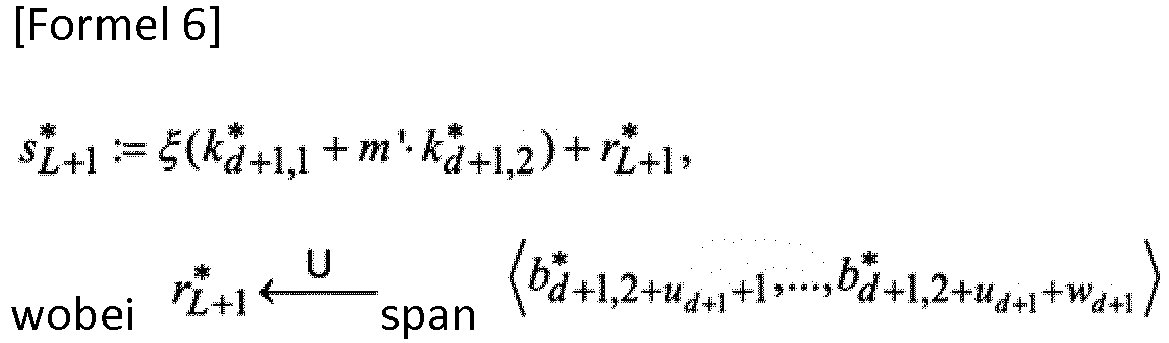
- the signature element L+1 generation part 254 With the processing device, the signature element L+1 generation part 254 generates a signature element s* L+1 , which is an element of the signature data ⁇ , as indicated in Formula 148.
- r* L+1 is defined by Formula 149 (see Formulas 110 through 112 and their explanations). r L + 1 * ⁇ U span ⁇ b d + 1,2 + u d + 1 + 1 * , ... , b d + 1,2 + u d + 1 + w d + 1 * ⁇
- the signature data ⁇ may be transmitted to the verification device 300 by another method.
- the signature device 200 In brief, from (S301) through (S308), the signature device 200 generates the signature data ⁇ by executing the Sig algorithm indicated in Formula 150. In (S309), the signature device 200 distributes the generated signature data ⁇ to the verification device 300.
- the verification device 300 is provided with a public parameter acquisition part 310, a data reception part 320, a verification key generation part 330, and a pairing operation part 340.
- the verification key generation part 330 is provided with a random number generation part 331, an f vector generation part 332, an s vector generation part 333, a verification element 0 generation part 334, a verification element i generation part 335, and a verification element L+1 generation part 336.
- the public parameter acquisition part 310 acquires the public parameter pk generated by the key generation device 100, via the network.
- the data reception part 320 receives the signature data ⁇ transmitted by the signature device 200, via the network.
- the f vector generation part 332 With the processing device, the f vector generation part 332 generates a vector f ⁇ having r pieces of elements, randomly as indicated in Formula 151.
- the s vector generation part 333 With the processing device, the s vector generation part 333 generates a vector s ⁇ T , based on the (L rows ⁇ r columns) matrix M of the access structure S included in the signature data ⁇ received in (S402) and the vector f ⁇ generated in (S403) and having r pieces of elements, as indicated in Formula 152.
- the verification element 0 generation part 334 With the processing device, the verification element 0 generation part 334 generates a verification element c 0 , which is an element of the verification key, as indicated in Formula 155.
- Formula 155 means that the coefficient for the basis vector of the basis B 0 is set as described below.
- a basis vector b 0,i is specified only by its i portion.
- a basis vector 1 signifies a basis vector b 0,1 .
- Basis vectors 1, ..., 3 signify basis vectors b 0,1 , ..., b 0,3 , respectively.
- -s 0 -s L+1 is set as the coefficient for the basis vector 1 of the basis B 0 .
- 0 is set as the coefficient for basis vectors 1+1, ..., 1+u 0 +w 0 .
- Random numbers ⁇ 0,1 , ..., ⁇ 0,z0 are each set as the coefficient for basis vectors 1+u 0 +w 0 +1, ..., 1+u 0 +w 0 +z 0 (where z0 represents z 0 ).
- Formula 156 means that the coefficient for the basis vector of the basis B t is set as described below.
- a basis vector b t,i is specified only by its i portion.
- a basis vector 1 signifies a basis vector b t,1 .
- Basis vectors 1, ..., 3 signify basis vectors b t,1 , ..., b t,3 , respectively.
- s i + ⁇ i v i,l is set as the coefficient for the basis vector 1.
- ⁇ i v i,2 , ..., ⁇ i V i,nt are each set as the coefficient for basis vectors 2, ..., n t .
- 0 is set as the coefficient for basis vectors n t +1, ..., n t +u t +w t .
- ⁇ i,1 , ..., ⁇ i,zt are each set as the coefficient for basis vectors n t +u t +w t +1, ..., n t +u t +w t +z t .
- s i v i,1 , ..., ⁇ i V i,nt are each set as the coefficient for the basis vectors 1, ..., n t .
- -s i is set as the coefficient for the basis vector 2.
- 0 is set as the coefficient for basis vectors n t +1, ..., n t +u t +w t .
- ⁇ i,1 , ..., ⁇ i,zt are each set as the coefficient for basis vectors n t +u t +w t +1, ..., n t +u t +w t +z t .
- ⁇ i and ⁇ i,i' 1, ..., z t ) are uniform random numbers generated by the random number generation part 233.
- the verification element L+1 generation part 336 With the processing device, the verification element L+1 generation part 336 generates a verification element c L+1 , which is an element of the verification key, as indicated in Formula 157.
- Formula 157 means that the coefficient for the basis vector of the basis B d+1 is set as described below.
- a basis vector b d+1,i is specified only by its i portion.
- a basis vector 1 signifies a basis vector b d+1,1 .
- Basis vectors 1, ..., 3 signify basis vectors b d+1,1 , ..., b d+1,3 , respectively.
- s L+1 - ⁇ L+1 ⁇ H hk ⁇ ,D (m
- ⁇ L+1 is set as the coefficient for the basis vector 2.
- 0 is set as the coefficient for basis vectors 2+1, ..., 2+u d+1 +w d+1 .
- Random numbers ⁇ L+1,1 , ..., ⁇ L+1,zd+1 (where zd+1 represents z d+1 ) are each set as the coefficient for basis vectors 2+u d+1 +w d+1 +1, ..., 2+U d+1 +w d+1 +z d+1 .
- the pairing operation part 340 conducts a pairing operation e(b 0,1 , s* 0 ).
- the pairing operation part 340 If the calculation result of the pairing operation e(b 0,1 , s* 0 ) is value 1, the pairing operation part 340 outputs value 0 indicating failure of the signature verification, and ends the process. If the calculation result of the pairing operation e(b 0,1 , s* 0 ) is not value 1, the pairing operation part 340 advances the process to S410.
- the pairing operation part 340 conducts a pairing operation indicated in Formula 158.
- ⁇ i 0 L + 1 e c i , s i *
- the pairing operation part 340 If the calculation result of the pairing operation indicated in Formula 158 is value 1, the pairing operation part 340 outputs value 1 indicating success of the signature verification; and otherwise value 0 indicating failure of the signature verification.
- the verification device 300 verifies the signature data ⁇ by executing the Ver algorithm indicated in Formula 160.
- the signature processing system 10 according to Embodiment 1 implements the attribute-based signature scheme using the access structure S constructed using the span program, inner-product predicate, and secret distribution.
- the signature processing system 10 according to Embodiment 1 uses a non-monotone span program, it implements an attribute-based signature scheme with a non-monotone predicate.
- the attribute-based signature scheme implemented by the signature processing system 10 according to Embodiment 1 is highly secure and satisfies privacy requirements. Being highly secure signifies that the signature is not likely to be forged by others.
- the pairing operation e(b 0,1 , s* 0 ) in (S409) is to check that the signature data ⁇ is not signature data generated without using the basis vector b* 0,1 which is secret (which is the master key sk).
- n t +u t +w t +z t is set in N t .
- n t +u t +w t +z t may be replaced by n t +n t +n t +1, and 3n t +1 may be set in N t .
- Ver algorithm indicated in Formula 159 is rewritten as indicated in Formula 165.
- the Setup algorithm may be executed only once at the setup of the signature processing system 10, and need not be executed every time a signing key is to be generated.
- the Setup algorithm and the KeyGen algorithm are executed by the key generation device 100.
- the Setup algorithm and the KeyGen algorithm may be executed by different devices.
- This embodiment describes the "decentralized multi-authority attribute-based signature scheme”.
- the "decentralized multi-authority attribute-based signature scheme” according to this embodiment will be explained. Initially, the basic structure of the "decentralized multi-authority attribute-based signature scheme” will be explained. Then, the basic structure of the "signature processing system 10" which implements the “decentralized multi-authority attribute-based signature scheme” will be explained. After that, the "decentralized multi-authority attribute-based signature scheme” and the “signature processing system 10" according to this embodiment will be explained in detail.
- Multi-authority signifies the presence of a plurality of authorities who generate the signing key.
- the security of the whole system depends on one certain party (authority).
- the security of the whole system depends on the key generation device 100 which generates the master key sk. If the security of the key generation device 100 is breached or the master key sk leaks, the whole signature processing system 10 no longer functions.
- Fig. 13 is an explanatory drawing of the multi-authority.
- a public office manages attributes such as the address, telephone number, and age.
- the police manage attributes such as the type of the driver's license.
- a company A manages attributes such as the position in the company A and the belonging department in the company A.
- a signing key 1 to indicate the attributes managed by the public office is issued by the public office.
- a signing key 2 to indicate the attributes managed by the police is issued by the police.
- a signing key 3 to indicate the attributes managed by the company A is issued by the company A.
- the signer who signs generates signature data using a signing key formed by putting together the signing keys 1, 2, and 3 issued by the respective authorities such as the public office, the police, and the company A. Namely, when seen from the signer, a signing key formed by putting together the signing keys issued by the respective authorities is the single signing key issued to himself or herself.
- the signature processing system does not function regarding the attributes on the company A, it functions regarding the attributes managed by the other authorities. Namely, if the signature data is verified, although the attributes managed by the company A cannot be trusted, the other attributes can be trusted.
- each authority manages a certain category (subspace) or definition range in the attributes and issues (a part of) a signing key regarding the attribute of the user in this category.
- decentralized means that any party can serve as an authority and issue (a part of) the signing key without interacting with the other parties, and that each user can acquire (a part of) the signing key without interacting with the other parties.
- a central authority exists, the system is not decentralized.
- a central authority is an authority superior to the other authorities. If the security of the central authority is breached, the security of every authority will be breached.
- a decentralized multi-authority attribute-based signature scheme consists of four algorithms: GSetup, ASetup, AttrGen, Sig, and Ver.
- a GSetup algorithm is a randomized algorithm that takes as input a security parameter ⁇ and outputs a public parameter gparam.
- An ASetup algorithm is a randomized algorithm that takes as input the public parameter gparam and authority identification information t, and outputs an authority secret key ask t and an authority public parameter apk t .
- a Ver algorithm is an algorithm that takes as input the signature data ⁇ , the public parameter gparam, and the authority public parameter apk t , and outputs Boolean value 1 (accept) or 0 (reject).
- a signature processing system 10 that executes the algorithms of the decentralized multi-authority signature-based signature scheme described above will be described.
- Fig. 14 is a configuration diagram of the signature processing system 10 which executes the algorithms of the decentralized multi-authority attribute-based signature scheme.
- the signature processing system 10 is provided with a plurality of key generation devices 100, a signature device 200, and a verification device 300.
- One (single) key generation device 100 executes the GSetup algorithm by taking as input the security parameter ⁇ , and generates the public parameter gparam. This key generation device 100 publicizes the generated public parameter gparam.
- Each key generation device 100 executes the ASetup algorithm by taking as input the public parameter gparam and the authority identification information t assigned to this key generation device 100, and generates the authority secret key ask t and the authority public parameter apk t .
- the signature device 200 transmits the generated signature data ⁇ to the verification device 300.
- the verification device 300 executes the Ver algorithm by taking as input the signature data ⁇ , the public parameter gparam, and the authority public parameter apk t , and outputs Boolean value 1 (accept) or 0 (reject).
- the decentralized multi-authority attribute-based signature scheme, and the function and operation of the signature processing system 10 which executes the decentralized multi-authority attribute-based signature scheme will be described with reference to Figs. 15 to 22 .
- Fig. 15 is a function block diagram showing the function of each key generation device 100.
- Fig. 16 is a function block diagram showing the function of the signature device 200.
- Fig. 17 is a function block diagram showing the function of the verification device 300.
- Figs. 18 to 20 are flowcharts showing the operation of the key generation device 100.
- Fig. 18 is a flowchart showing the process of the GSetup algorithm
- Fig. 19 is a flowchart showing the process of the ASetup algorithm
- Fig. 20 is a flowchart showing the process of the AttrGen algorithm.
- Fig. 21 is a flowchart showing the operation of the signature device 200 and the process of the Sig algorithm.
- Fig. 22 is a flowchart showing the operation of the verification device 300 and the process of the Ver algorithm.
- the function and operation of the key generation device 100 will be described.
- the key generation device 100 is provided with a master key generation part 110, a master key storage part 120, an information input part 130 (first information input part), a signing key generation part 140, and a key distribution part 150 (signing key transmission part).
- the master key generation part 110 is provided with a global parameter generation part 111 and an authority secret key generation part 112.
- the signing key generation part 140 is provided with a random number generation part 141 and a key element generation part 145.
- the GSetup algorithm executed by the key generation device 100 will be described first with reference to Fig. 18 .
- the GSetup algorithm may be executed by one key generation device 100 out of the plurality of key generation devices 100.
- the global parameter generation part 111 takes as input a security parameter ⁇ (1 ⁇ ).
- Hash functions H 1 and H 2 are determined as hash functions indicated in Formula 166.
- the global parameter generation part 111 With the processing device, the global parameter generation part 111 generates elements G 0 , G 1 , G 2 , G 3 , and G 4 of the global parameter gparam indicated in Formula 167.
- the master key storage part 120 stores param G generated in (S502), the hash functions H 1 and H 2 set in (S503) by the global parameter generation part 111, the generated elements G 0 , G 1 , G 3 , and G 4 , and the set values g t and g 4 , as a global parameter gparam in the storage device.
- the key generation device 100 In brief, from (S501) through (S503), the key generation device 100 generates the global parameter gparam by executing the GSetup algorithm indicated in Formula 168. Then, in (S504), the key generation device 100 stores the generated public global parameter gparam, in the storage device.
- the global parameter gparam is publicized via, e.g., a network, so that other key generation devices 100, the signature device 200, and the verification device 300 can acquire it.
- the ASetup algorithm executed by the key generation device 100 will be described with reference to Fig. 19 .
- the ASetup algorithm may be executed by all of the plurality of key generation devices 100, or only some of the plurality of key generation devices 100.
- the information input part 130 takes as input the identification information t assigned to itself (its key generation device 100). Note that different identification information t are assigned to the respective key generation devices 100.
- the information input part 130 acquires the global parameter gparam via the network. If this information input part 130 belongs to the key generation device 100 that has generated the global parameter gparam, the information input part 130 may read the global parameter gparam from the master key generation part 120.
- n t , u t , w t , and z t are each an integer of 1 or more.
- the authority secret key generation part 112 With the processing device, the authority secret key generation part 112 generates a basis B t and a basis B* t , as indicated in Formula 171.
- the authority secret key generation part 112 With the processing device, the authority secret key generation part 112 generates a subbasis B ⁇ t of the basis B t and a subbasis B ⁇ * t of the basis B* as indicated in Formula 173.
- the master key storage part 120 stores the parameter param Vt generated in (S602), and the subbasis B ⁇ t and the subbasis B ⁇ * t generated in (S606), in the storage device as an authority public parameter apk t .
- the master key storage part 120 also stores the linear transformation X t generated in (S604), in the storage device as the authority secret key ask t .
- the key generation device 100 In brief, from (S601) through (S606), the key generation device 100 generates the authority public parameter apk t and the authority secret key ask t by executing the ASetup algorithm indicated in Formula 174. Then, in (S607), the key generation device 100 stores the generated authority public parameter apk t and authority secret key ask t , in the storage device.
- the authority public parameter apk t is publicized via, e.g., a network, so that the signature device 200 and the verification device 300 can acquire it.
- the AttrGen algorithm executed by the key generation device 100 will be described with reference to Fig. 20 . Note that, as described above, the AttrGen algorithm is executed by the key generation device 100, among the plurality of key generation devices 100, that has executed the ASetup algorithm.
- the information input part 130 also acquires the global parameter gparam via the network. If this information input part 130 belongs to the key generation device 100 that has generated the global parameter gparam, the information input part 130 may read the global parameter gparam from the master key storage part 120.
- the information input part 130 also reads the authority secret key ask t from the master key storage part 120.
- Formula 177 means that the coefficient for the basis vector of a basis B* t is set as described below.
- a basis vector b* t,i is specified only by its i portion.
- a basis vector 1 signifies a basis vector b* t,1 .
- Basis vectors 1, ..., 3 signify basis vectors b* t,1 , ..., b* t,3 , respectively.
- Random numbers ⁇ t,j,1 , ..., ⁇ t,j,wt are each set as the coefficient for basis vectors 2n t +2+u t +1, ..., 2n t +2+u t +w t .
- 0 is set as the coefficient for basis vectors 2n t +2+u t +w t +1, ..., 2n t +2+u t +w t +z t .
- the key distribution part 150 distributes the signing key usk gid,(t,xt) , constituted as elements by the user identification information gid, the identification information t and the attribute information x ⁇ t , and the key element k* t,j , to the signature device 200 in secrecy via the network.
- the signing key usk gid,(t,xt) may be distributed to the signature device 200 by another method.
- the key generation device 100 generates the signing key usk gid,(t,xt) by executing the AttrGen algorithm indicated in Formula 178.
- the key generation device 100 distributes the generated signing key usk gid,(t,xt) to the signature device 200.
- the signature device 200 is provided with a signing key acquisition part 210, an information input part 220 (second information input part), a span program calculation part 230, a complementary coefficient calculation part 240, a signature data generation part 250, and a signature data transmission part 260 (signature data output part).
- the information input part 220 is provided with a predicate information input part 221 and a message input part 222.
- the signature data generation part 250 is provided with a random number generation part 251 and a signature element generation part 255.
- the signing key acquisition part 210 acquires the signing key usk gid,(t,xt) generated by each key generation device 100, via the network.
- the signing key acquisition part 210 also acquires the public parameter gparam generated by the key generation device 100.
- the matrix M is a matrix of L rows ⁇ r columns.
- L and r are each an integer of 1 or more.
- the message input part 220 takes as input the message m to be signed.
- the matrix M of the access structure S is to be set depending on the condition of the system to be implemented.
- the span program calculation part 230 checks whether or not the access structure S inputted in (S802) accepts the set ⁇ of the attribute information x ⁇ t included in the signing key usk gid,(t,xt) acquired in (S801).
- the span program calculation part 230 advances the process to (S804). If the access structure S rejects the set ⁇ of the attribute information x ⁇ t (reject in S803), the span program calculation part 230 ends the process.
- M i signifies the i-th row of the matrix M.
- r* i is defined by Formula 182 (see Formulas 110 through 112 and their explanations). r i * ⁇ U span ⁇ b t ,2 n t + 2 + u t + 1 * , ... , b t ,2 n t + 2 + u t + w t * ⁇
- the signature data ⁇ may be transmitted to the verification device 300 by another method.
- the signature device 200 In brief, from (S801) through (S806), the signature device 200 generates the signature data ⁇ by executing the Sig algorithm indicated in Formula 184. In (S807), the signature device 200 distributes the generated signature data ⁇ to the verification device 300.
- the verification device 300 is provided with a public parameter acquisition part 310, a data reception part 320 (data acquisition part), a verification key generation part 330, and a pairing operation part 340.
- the verification key generation part 330 is provided with a random number generation part 331, an f vector generation part 332, an s vector generation part 333, and a verification element generation part 337.
- the public parameter acquisition part 310 acquires the global parameter gparam and authority public parameter apk t generated by each key generation device 100, via the network.
- the data reception part 320 receives the signature data ⁇ transmitted by the signature device 200, via the network.
- the f vector generation part 332 With the processing device, the f vector generation part 332 generates a vector f ⁇ having r pieces of elements, randomly as indicated in Formula 185.
- the f vector generation part 332 With the processing device, the f vector generation part 332 generates a vector f ⁇ ' having r pieces of elements, randomly as indicated in Formula 188.
- the s vector generation part 333 With the processing device, the s vector generation part 333 generates a vector (s ⁇ ') T , based on the (L rows ⁇ r columns) matrix M and the vector f ⁇ ' having r pieces of elements, as indicated in Formula 189.
- the random number generation part 331 With the processing device, the random number generation part 331 generates a random number ⁇ ⁇ and a value ⁇ 0 , as indicated in Formula 190.
- Formula 114 is established for the bases B and B* indicated in Formula 113.
- Formula 191 means that the coefficient for the basis vector of the basis B t is set as described below.
- a basis vector b t,i is specified only by its i portion.
- a basis vector 1 signifies a basis vector b t,1 .
- Basis vectors 1, ..., 3 signify basis vectors b t,1 , ..., b t,3 , respectively.
- s i + ⁇ i v i,1 is set as the coefficient for the basis vector 1.
- ⁇ i v i,2, ..., ⁇ i v i,nt are each set as the coefficient for basis vectors 2, ..., n t .
- s i '+ ⁇ i 'v i,1 is set as the coefficient for a basis vector n t +1.
- H 2 (m, S) is set as the coefficient for a basis vector 2n t +1.
- H 2 (m, S) means that the message m and the access structure S are given as input to the hash function H 2 .
- S) may be possible.
- ⁇ i " is set as the coefficient for a basis vector 2n t +2.
- 0 is set as the coefficient for basis vectors 2n t +2+1, ..., 2n t +2+u t +w t .
- ⁇ i,1 , ..., ⁇ i,zt are each set as the coefficient for basis vectors 2n t +2+u t +w t +1, ..., 2n t +2+u t +w t +z t .
- s i v i,1 , ..., s i v i,nt are each set as the coefficient for the basis vectors 1, ..., n t .
- s i 'v i,1 , ..., s i 'v i,nt are each set as the coefficient for basis vectors n t +1, ..., 2n t .
- ⁇ i - ⁇ i "H 2 (m, S) is set as the coefficient for the basis vector 2n t +1.
- ⁇ i is set as the coefficient for the basis vector 2n t +2.
- 0 is set as the coefficient for the basis vectors 2n t +2+1, ..., 2n t +2+u t +w t .
- n i,1 , ..., ⁇ i,zt are each set as the coefficient for the basis vectors 2n t +2+u t +w t +1, ..., 2n t +2+u t +w t +z t .
- the pairing operation part 340 conducts a pairing operation indicated in Formula 192.
- ⁇ i 1 L e c i , s i *
- the pairing operation part 340 outputs value 1 indicating success of the signature verification; otherwise value 0 indicating failure of the signature verification.
- the verification device 300 verifies the signature data ⁇ by executing the Ver algorithm indicated in Formula 194.
- the signature processing system 10 implements the multi-authority attribute-based signature scheme in which the plurality of key generation devices 100 generate signing keys.
- the signature scheme implemented by the signature processing system 10 is a decentralized multi-authority attribute-based signature scheme with no central authority.
- the signature processing system 10 according to Embodiment 2 implements an attribute-based signature scheme with a non-monotone predicate, as the signature processing system 10 according to Embodiment 1 does.
- the attribute-based signature scheme implemented by the signature processing system 10 according to Embodiment 2 is highly secure and satisfies privacy requirements.
- the number of dimensions of each of the basis B t and the basis B* t is set to 2n t +2+u t +w t +z t .
- 2n t +2+u t +w t +z t may be replaced by 2+2+2+6+4+1, and the number of dimensions of each of the basis B t and the basis B* t may be set to 17.
- the GSetup algorithm may be executed only once by one generation device 100 at the setup of the signature processing system 10, and need not be executed every time a signing key is to be generated.
- the ASetup algorithm may be executed only once by each key generation device 100 at the setup of the signature processing system 10, and need not be executed every time a signing key is to be generated.
- the GSetup algorithm, the ASetup algorithm, and the KeyGen algorithm are executed by the key generation device 100.
- the GSetup algorithm, the ASetup algorithm, and the KeyGen algorithm may be executed by different devices.
- Embodiment 3 a method of implementing a signature process in dual additive groups will be described.
- the signature process is implemented in the cyclic group of the prime order q.
- a ring R is expressed as indicated in Formula 200 using a composite number M
- the signature process described in the above embodiments can also be applied to a module having the ring R as a coefficient.
- R : Z MZ
- the span program M ⁇ accepts the input sequence ⁇ if and only if linear combination of the rows of the matrix M ⁇ obtained from the matrix ⁇ by the input sequence ⁇ gives 1 ⁇ .
- the span program M ⁇ may accept the input sequence ⁇ if and only if another vector h ⁇ is obtained instead of 1 ⁇ .
- the hardware configuration of the signature processing system 10 (the key generation device 100, the signature device 200, and the verification device 300) in the above embodiments will be described.
- Fig. 23 is a diagram showing an example of the hardware configuration of each of the key generation device 100, signature device 200, and verification device 300.
- each of the key generation device 100, signature device 200, and verification device 300 includes the CPU 911 (also referred to as a Central Processing Unit, central processing device, processing device, computation device, microprocessor, microcomputer, or processor) which executes programs.
- the CPU 911 is connected to the ROM 913, the RAM 914, an LCD 901 (Liquid Crystal Display), a keyboard 902 (K/B), the communication board 915, and the magnetic disk device 920 via a bus 912, and controls these hardware devices.
- a storage device such as an optical disk device or memory card read/write device may be employed.
- the magnetic disk device 920 is connected via a predetermined fixed disk interface.
- the ROM 913 and the magnetic disk device 920 are examples of a nonvolatile memory.
- the RAM 914 is an example of a volatile memory.
- the ROM 913, the RAM 914, and the magnetic disk device 920 are examples of the storage device (memory).
- the keyboard 902 and the communication board 915 are examples of an input device.
- the communication board 915 is an example of a communication device.
- the LCD 901 is an example of a display device.
- the magnetic disk device 920, ROM 913, or the like stores an operating system 921 (OS), a window system 922, programs 923, and files 924.
- OS operating system
- the CPU 911, the operating system 921, and the window system 922 execute each program of the programs 923.
- the programs 923 store software and programs that execute the functions described as the "master key generation part 110", “master key storage part 120", “information input part 130", “signing key generation part 140", “key distribution part 150”, “signing key acquisition part 210", “information input part 220”, “span program calculation part 230", “complementary coefficient calculation part 240", "signature data generation part 250”, “signature data transmission part 260”, “public parameter acquisition part 310", “data reception part 320”, “verification key generation part 330”, “pairing operation part 340”, and the like in the above description.
- the programs 923 store other programs as well. The programs are read and executed by the CPU 911.
- the files 924 store information, data, signal values, variable values, and parameters such as the "public parameter”, “master key”, “signature data ⁇ ", “signing key”, “access structure S”, “attribute information”, “attribute set ⁇ ", “message m”, and the like of the above explanation, as the items of a “file” and “database”.
- the "file” and “database” are stored in a recording medium such as a disk or memory.
- the information, data, signal values, variable values, and parameters stored in the recording medium such as the disk or memory are read out to the main memory or cache memory by the CPU 911 through a read/write circuit, and are used for the operations of the CPU 911 such as extraction, search, look-up, comparison, computation, calculation, process, output, print, and display.
- the information, data, signal values, variable values, and parameters are temporarily stored in the main memory, cache memory, or buffer memory during the operations of the CPU 1911 including extraction, search, look-up, comparison, computation, calculation, process, output, print, and display.
- the arrows of the flowcharts in the above explanation mainly indicate input/output of data and signals.
- the data and signal values are stored in the memory of the RAM 914, the recording medium such as an optical disk, or in an IC chip.
- the data and signals are transmitted online via a transmission medium such as the bus 912, signal lines, or cables; or electric waves.
- the “part” in the above explanation may be a “circuit”, “device”, “equipment”, “means” or “function”; or a “step”, “procedure”, or “process”.
- the “device” may be a “circuit”, “equipment”, “means”, or “function”; or a “step”, “procedure”, or “process”.
- the “process” may be a “step”. Namely, the "part” may be implemented as firmware stored in the ROM 913. Alternatively, the "part” may be practiced as only software; as only hardware such as an element, a device, a substrate, or a wiring line; as a combination of software and hardware; or furthermore as a combination of software, hardware, and firmware.
- the firmware and software are stored, as programs, in the recording medium such as the ROM 913.
- the program is read by the CPU 911 and executed by the CPU 911. Namely, the program causes the computer to function as a "part” described above. Alternatively, the program causes the computer or the like to execute the procedure and method of the "part” described above.
- 10 signature processing system; 100: key generation device; 110: master key generation part; 111: global parameter generation part; 112: authority secret key generation part; 120: master key storage part; 130: information input part; 140: signing key generation part; 141: random number generation part; 142: key element 0 generation part; 143: key element t generation part; 144: key element d+1 generation part; 145: key element generation part; 150: key distribution part; 200: signature device; 210: signing key acquisition part; 220: information input part; 221: predicate information input part; 222: message input part; 230: span program calculation part; 240: complementary coefficient calculation part; 250: signature data generation part; 251: random number generation part; 252: signature element 0 generation part; 253: signature element i generation part; 254: signature element L+1 generation part; 255: signature element generation part; 260: signature data transmission part; 300: verification device; 310: public parameter acquisition part; 320: data reception part; 330: verification key generation part; 331: random
Landscapes
- Engineering & Computer Science (AREA)
- Computer Security & Cryptography (AREA)
- Computer Networks & Wireless Communication (AREA)
- Signal Processing (AREA)
- Theoretical Computer Science (AREA)
- Physics & Mathematics (AREA)
- General Physics & Mathematics (AREA)
- Mathematical Optimization (AREA)
- Mathematical Analysis (AREA)
- Mathematical Physics (AREA)
- Pure & Applied Mathematics (AREA)
- Algebra (AREA)
- Computing Systems (AREA)
- Storage Device Security (AREA)
- Collating Specific Patterns (AREA)
- Complex Calculations (AREA)
Claims (16)
- Signaturverarbeitungssystem (10), umfassend eine Schlüsselerzeugungseinrichtung (100), eine Signatureinrichtung (200) und eine Verifikationseinrichtung (300), und dazu dienend, einen Signaturprozess unter Verwendung einer Basis Bt und einer Basis B*t für jede ganze Zahl t = 0,..., d+1 (d ist eine ganze Zahl von 1 oder mehr) auszuführen,
wobei die Schlüsselerzeugungseinrichtung umfasst:einen ersten Informationseingabeteil (130), welcher als Eingabe eine Attributmenge Γ, enthaltend Identifikationsinformation t und Attributinformation x→ t := (xt,i) (i = 1, ..., nt, wobei nt eine ganze Zahl von 1 oder mehr ist) für zumindest eine ganze Zahl t = 1, ..., d nimmt,einen Schlüsselelement-0-Erzeugungsteil (142), welcher ein Schlüsselelement k*0 erzeugt, wobei ein vorherbestimmter Wert δ als ein Koeffizient für einen Basisvektor b*0,1 einer Basis B*0 eingestellt ist,einen Schlüsselelement-t-Erzeugungsteil (143), welcher ein Schlüsselelement k*t erzeugt, wobei δxt,1 (i = 1, ...,nt), erhalten durch Multiplizieren der Attributinformation x→ t mit dem vorherbestimmten Wert δ, als ein Koeffizient für einen Basisvektor b*t,i (i = 1, ..., nt) der Basis B*t eingestellt wird, bezüglich jeder Identifikationsinformation t, die in der durch den ersten Informationseingabeteil eingegebenen Attributmenge Γ enthalten ist,einen Schlüsselelement-d+1-Erzeugungsteil (144), welcher ein Schlüsselelement k*d+1,1, wobei der vorherbestimmte Wert δ als ein Koeffizient für einen Basisvektor b*d+1,1 einer Basis B*d+1 eingestellt ist, und ein Schlüsselelement k*d+1,2 erzeugt, wobei der vorherbestimmte Wert δ als ein Koeffizient für einen Basisvektor b*d+1,2 der Basis B*d+1 eingestellt ist, undeinen Signierschlüsselübertragungsteil (150), welcher an die Signatureinrichtung einen Signierschlüssel skΓ überträgt, enthaltend: das durch den Schlüsselelement-0-Erzeugungsteil erzeugte Schlüsselelement k*0, das durch den Schlüsselelement-t-Erzeugungsteil erzeugte Schlüsselelement k*t bezüglich jeder in der Attributmenge Γ enthaltenen Identifikationsinformation; das Schlüsselelement k*d+1,1 und das Schlüsselelement k*d+1,2, welche durch den Schlüsselelement-d+1-Erzeugungsteil erzeugt werden, und die Attributmenge Γ,wobei die Signatureinrichtung umfassteinen zweiten Informationseingabeteil (220), welcher als Eingabe eine Variable ρ(i) für jede ganze Zahl i = 1, ..., L (L ist eine ganze Zahl von 1 oder mehr), wobei die Variable ρ(i) entweder ein positives Tupel (t, v→ i) oder ein negatives Tupel ¬(t, v→ i) der Identifikationsinformation t (t ist eine ganze Zahl von t = 1, ..., d) und Attributinformation v→ t := (vt,i') (i'= 1, ..., nt) ist; eine vorherbestimmte Matrix M, aufweisend L Zeilen und r Spalten (r ist eine ganze Zahl von 1 oder mehr); und eine Nachricht m nimmt,einen Signierschlüsselerwerbungsteil (210), welcher den durch den Signierschlüsselübertragungsteil übertragenen Signierschlüssel skΓ erwirbt,einen Komplementärkoeffizientberechnungsteil (240), welcher, auf der Grundlage der durch den zweiten-Informationseingabeteil eingegebenen Variablen ρ(i) und der Attributmenge Γ, enthalten in dem durch den Signierschlüsselerwerbungsteil erworbenen Signierschlüssel skΓ, unter ganzen Zahlen i = 1, ..., L, eine Menge I von einer ganzen Zahl i spezifiziert, für welche die Variable ρ(i) ein positives Tupel (t,v→ i) ist und mit welcher ein inneres Produkt von v→ i des positiven Tupels und x→ t, enthalten in der Attributmenge Γ, angegeben durch die Identifikationsinformation t des positiven Tupels, 0 wird, und eine ganze Zahl i spezifiziert, für welche die Variable ρ(i) ein negatives Tupel ¬(t, v→ i) ist und mit welcher ein inneres Produkt von v→ i des negativen Tupels und x→ t, enthalten in der Attributmenge Γ, angegeben durch die Identifikationsinformation t des negativen Tupels, nicht 0 wird; und bezüglich i, enthalten in der spezifizierten Menge I, einen Komplementärkoeffizienten αi berechnet, mit welchem eine Gesamtheit von αiMi auf der Grundlage von Mi, welches ein Element in einer i-ten Zeile der durch den zweiten Informationseingabeteil eingegebenen Matrix M ist, ein vorherbestimmter Vektor h→ wird,einen Signaturelement-0-Erzeugungsteil (252), welcher ein Signaturelement s*0, das das im Signierschlüssel skΓ enthaltene Schlüsselelement k*0 enthält, erzeugt,einen Signaturelement-i-Erzeugungsteil (253), welcher für jede ganze Zahl i = 1 ...,L ein Signaturelement s*i erzeugt, enthaltend γik*t, erhalten durch Multiplizieren des im Signierschlüssel skΓ enthaltenen Schlüsselelements k*t mit einem Wert γi, durch Einstellung des Werts γi, um γi := αi zu erfüllen, wenn die ganze Zahl i in der durch den Komplementärkoeffizientberechnungsteil spezifizierten Menge I enthalten ist und die Variable ρ(i) ein positives Tupel (t,v→ i) ist; durch Einstellung des Werts γi, um γi := αi/(v→ j·x→ t) zu erfüllen, wenn die ganze Zahl i in der Menge I enthalten ist, und die Variable ρ(i) ein negatives Tupel ¬(t, v→ i) ist; und durch Einstellung des Werts γi, um γi := 0 zu erfüllen, wenn die ganze Zahl 1 nicht in der Menge I enthalten ist,einen Signaturelement-L+1-Erzeugungsteil (254), welcher ein Signaturelement s*L+1 erzeugt, enthaltend eine Summe des im Signierschlüssel skΓ enthalten Schlüsselelements k*d+1,1 und m'·k*d+1,2, erhalten durch Multiplizieren des Schlüsselelements k*d+1,2 mit einem unter Verwendung der Nachricht m erzeugten Wert m', undeinen Signaturdatenübertragungsteil (260), welcher an die Verifikationseinrichtung Signaturdaten σ überträgt, enthaltend: das das durch den Signaturelement-0-Erzeugungsteil erzeugte Signaturelement s*0; das für jede ganze Zahl i = 1, ..., L durch den Signaturelement-i-Erzeugungsteil erzeugte Signaturelement s*i; das durch den Signaturelement-L+1-Erzeugungsteil erzeugte Signaturelement s*L+1; die Nachricht m; die Variable ρ(i); und die Matrix M, undwobei die Verifikationseinrichtung umfassteinen Datenerwerbungsteil (320), welcher die durch den Signaturdatenübertragungsteil übertragenen Signaturdaten σ erwirbt,ein Verifikationselement-0-Erzeugungsteil (334), welcher ein Verifikationselement c0 erzeugt durch Einstellung, als einen Koeffizient für einen Basisvektor b0,1 einer Basis B0,-s0-sL+1, berechnet aus einem Wert s0 := h→·f→ und einem vorherbestimmten Wert sL+1, des Wert s0 := h→·f→, welcher unter Verwendung eines Vektors f→, aufweisend r Stücke von Elementen, und des Vektors h→ erzeugt wird,einen Verifikationselement-i-Erzeugungsteil (335), welcher, für jede ganze Zahl i = 1, ..., L und unter Verwendung eines Spaltenvektors s→T := (s1, ...,sL)T :=M·f→T, erzeugt auf der Grundlage des Vektors f→ und der Matrix M, welche in den durch den Datenerwerbungsteil erworbenen Signaturdaten σ enthalten ist, und einer vorherbestimmten Zahl θi für jede ganze Zahl i = 1, ..., L ein Verifikationselement ci erzeugt, wenn die Variable ρ(i) ein positives Tupel (t, v→ i) ist, durch Einstellung von si+θivi,1 als einen Koeffizient für einen Basisvektor bt,1 der Basis Bt, angegeben durch Identifikationsinformation t des positiven Tupels, und durch Einstellung von θivi,i' (i' = 2, ..., nt) als einen Koeffizient für einen Basisvektor bt,i' (i' = 2, ...,nt), und ein Verifikationselement ci erzeugt, wenn die Variable ρ(i) ein negatives Tupel ¬(t, v→ i) ist, durch Einstellung von sivi,i' (i' = 1, ..., nt) als einen Koeffizient für den Basisvektor bt,i' (i' = 1, ..., nt), angegeben durch Identifikationsinformation t des negativen Tupels,einen Verifikationselement-L+1-Erzeugungsteil (336), welcher ein Verifikationselement CL+1 erzeugt durch Einstellung von SL+1-θL+1m', berechnet aus dem vorherbestimmten Wert SL+1, dem Wert m' und einem vorherbestimmten Wert θL+1, als einen Koeffizient für einen Basisvektor bd+1,1 einer Basis Bd+1, und durch Einstellung des vorherbestimmten Werts θL+1 als einen Koeffizient für einen Basisvektor bd+1,2, undeinen Paarungsoperationsteil (340), welcher eine Authentizität der Signaturdaten σ verifiziert durch Durchführen einer Paarungsoperation Πi=0 L+1e(ci,s*i) für das durch den Verifikationselement-0-Erzeugungsteil erzeugte Verifikationselement c0, das durch den Verifikationselement-i-Erzeugungsteil erzeugte Verifikationselement ci, das durch den Verifikationselement-L+1-Erzeugungsteil erzeugte Verifikationselement cL+1 und die in den Signaturdaten σ enthaltenen Signaturelemente s*0, s*i und s*L+1. - Signaturverarbeitungssystem nach Anspruch 1, welches den Signaturprozess durchführt unter Verwendung von
einer Basis B0, aufweisend zumindest den Basisvektor bt,i (i = 1, ..., 1+u0, ..., 1+u0+w0, ..., 1+u0+w0+z0),
der Basis Bt (t = 1, ..., d), aufweisend zumindest den Basisvektor bt,i (i = 1, ..., nt, ..., nt+ut, ..., nt+ut,wt, ..., nt+ut-wt+zt) (ut, wt und zt sind jeweils eine ganze Zahl von 1 oder mehr),
der Basis Bd+1, aufweisend zumindest den Basisvektor bt,i (i = 1,2, ..., 2+ud+1, ..., 2+ud+1+wd+1,..., 2+ud+1+wd+1+d+1),
der Basis B*0, aufweisend zumindest einen Basisvektor b*t,i (i = 1, ..., 1+u0, ..., 1+u0+w0, ..., 1+u0+w0+z0),
der Basis B*t (t = 1, ..., d), aufweisend zumindest den Basisvektor b*t,i ( i = 1, ..., nt, ..., nt+ut, ...., nt+ut+wt, ..., nt+ut+wt+zt) (ut, wt und zt sind jeweils eine ganze Zahl von 1 oder mehr), und
der Basis B*d+1, aufweisend zumindest den Basisvektor b*t,i (i = 1,2, ..., 2+ud+1, ..., 2+ud+1+wd+1, ..., 2+ud+1+wd+1+zd+1),
wobei in der Schlüsselerzeugungseinrichtung
der Schlüsselelement-0-Erzeugungsteil das in Formel 1 angegebene Schlüsselelement k*0 erzeugt auf der Grundlage einer Zufallszahl δ und einer Zufallszahl φ0,i (i = 1, ..., w0),
der Schlüsselelement-t-Erzeugungsteil das in Formel 2 angegebene Schlüsselelement k*i für jede in der Attributmenge Γ enthaltene Identifikationsinformation t erzeugt auf der Grundlage der Zufallszahl δ und einer Zufallszahl φi,i (i = 1, ..., wt), und
der Schlüsselelement-d+l-Erzeugungsteil das Schlüsselelement k*d+1,1 und das Schlüsselelement k*d+1,2, welche in Formel 3 angegeben sind, erzeugt auf der Grundlage der Zufallszahl δ, einer Zufallszahl φd+1,1,i (i = 1, ..., wd+1) und einer Zufallszahl φd+1,2,i (i = 1, ..., wd+1),
wobei in der Signatureinrichtung
der Signaturelement-0-Erzeugungsteil das in Formel 4 angegebene Signaturelement s*0 erzeugt auf der Grundlage einer Zufallszahl ξ,
der Signaturelement-i-Erzeugungsteil das in Formel 5 angegebene Signaturelement s*i für jeden i = 1, ..., L erzeugt auf der Grundlage der Zufallszahl ξ, und
der Signaturelement-L+1-Erzeugungsteil das in Formel 6 angegebene Signaturelement s*L+1 erzeugt auf der Grundlage der Zufallszahl ξ und dem Wert m', und
wobei in der Verifikationseinrichtung
das Verifikationselement-O-Erzeugungsteil das in Formel 7 angegebene Verifikationselement c0 erzeugt auf der Grundlage des Werts s0, der Zufallszahl sL+1 und einer Zufallszahl η0,i (i = 1,..., z0),
der Verifikationselement-i-Erzeugungsteil das in Formel 8 angegebene Verifikationselement ci für jede ganze Zahl i = 1, ..., L erzeugt auf der Grundlage des Spaltenvektors s→T, der Zufallszahl θi und einer Zufallszahl ηi,i' (i = 1,..., L; i' = 1., ..., zt), und
der Verifikationselement-L+1-Erzeugungsteil das in Formel 9 angegebene Element cL+1 erzeugt auf der Grundlage der Zufallszahl sL+1, der Zufallszahl θL+1, einer Zufallszahl ηL+1,i' (i' = 1.,..., zd+1) und dem Wert m'.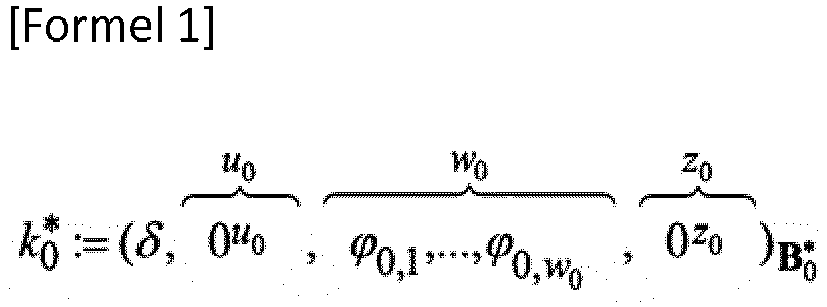




- Signaturverarbeitungssystem nach Anspruch 1 oder 2,
wobei in der Signatureinrichtung
der Signaturelement-L+1-Erzeugungsteil das Signaturelement s*L+1 erzeugt unter Verwendung eines Hashwerts, erhalten auf Eingabe der Nachricht m, der Matrix M und der Variablen ρ(i) für jede ganze Zahl i = 1, ..., L als den Wert m', und
wobei in der Verifikationseinrichtung
der Verifikationselement-L+1-Erzeugungsteil das Verifikationselement CL+1 erzeugt unter Verwendung des Hashwerts als den Wert m'. - Schlüsselerzeugungseinrichtung (100), welche einen Signierschlüssel skΓ in einem Signaturverarbeitungssystem (10) erzeugt, welches einen Signaturprozess unter Verwendung einer Basis Bt und einer Basis B*t für jede ganze Zahl t = 0, ..., d+1 (d ist eine ganze Zahl von 1 oder mehr) ausführt, wobei die Schlüsselerzeugungseinrichtung umfasst:einen ersten Informationseingabeteil (130), welcher als Eingabe eine Attributmenge Γ, enthaltend Identifikationsinformation t und Attributinformation x→ t := (xt,i) (i = 1, ..., nt, wobei nt eine ganze Zahl von 1 oder mehr ist) für zumindest eine ganze Zahl t = 1, ..., d nimmt;einen Schlüsselelement-O-Erzeugungsteil (142), welcher ein Schlüsselelement k*0 erzeugt, wobei ein vorherbestimmter Wert δ als ein Koeffizient für einen Basisvektor b*0,1 einer Basis B*0 eingestellt ist;einen Schlüsselelement-t-Erzeugungsteil (143), welcher ein Schlüsselelement k*t erzeugt, wobei δxt,i (i = 1, ..., nt), erhalten durch Multiplizieren der Attributinformation x→ t mit dem vorherbestimmten Wert δ, als ein Koeffizient für einen Basisvektor b*t,i (i = 1, ..., nt) der Basis B*t eingestellt ist, bezüglicher jeder Identifikationsinformation t, die in der durch den ersten Informationseingabeteil eingegebenen Attributmenge Γ enthalten ist,einen Schlüsselelement-d+1-Erzeugungsteil (144), welcher ein Schlüsselelement k*d+1,1, wobei der vorherbestimmte Wert δ als ein Koeffizient für einen Basisvektor b*d+1,1 einer Basis B*d+1 eingestellt ist, und ein Schlüsselelement k*d+1,2, wobei der vorherbestimmte Wert δ als ein Koeffizient für einen Basisvektor b*d+1,2 der Basis B*d+1 eingestellt ist, erzeugt; undeinen Signierschlüsselübertragungsteil (150), welcher an eine Signatureinrichtung (200) den Signierschlüssel skΓ überträgt, enthaltend: das durch den Schlüsselelement-0-Erzeugungsteil erzeugte Schlüsselelement k*0, das durch den Schlüsselelement-t-Erzeugungsteil erzeugte Schlüsselelement x*t bezüglich jeder in der Attributmenge Γ enthaltene Identifikationsinformation t; das Schlüsselelement k*d+1,1 und das Schlüsselelement k*d+1,2, welche durch das Schlüsselelement-d+1-Erzeugungsteil erzeugt werden; und die Attributmenge Γ, überträgt.
- Signatureinrichtung (100), welche Signaturdaten σ in einem Signaturverarbeitungssystem erzeugt, welches einen Signaturprozess unter Verwendung einer Basis Bt und einer Basis B*t für jede ganze Zahl t = 0, ..., d+1 (d ist eine ganze Zahl von 1 oder mehr) ausführt, wobei die Signatureinrichtung umfasst:einen Signierschlüsselerwerbungsteil (210), welcher als einen Signierschlüssel skΓ erwirbteine Attributmenge Γ, enthaltend Identifikationsinformation t und Attributinformation x→ t := (xt,i) (i = 1, ..., nt, wobei nt eine ganze Zahl von 1 oder mehr ist) für zumindest eine ganze Zahl t = 1, ..., d,ein Schlüsselelement k*0, wobei ein vorherbestimmter Wert δ als ein Koeffizient für einen Basisvektor b*0,1 einer Basis B*0 eingestellt ist,ein Schlüsselelement k*t, wobei δxt,i (i = 1, ..., nt), erhalten durch Multiplizieren der Attributinformation x→ t mit dem vorherbestimmten Wert δ, als ein Koeffizient für einen Basisvektor b*t,i(i = 1, ..., nt) der Basis B*t eingestellt ist, bezüglich jeder in der Attributmenge Γ enthaltene Identifikationsinformation t,ein Schlüsselelement k*d+1,1, wobei der vorherbestimmte Wert δ als ein Koeffizient für einen Basisvektor b*d+1,1 einer Basis B*d+1 eingestellt ist, undein Schlüsselelement k*d+1,2, wobei der vorherbestimmte Wert δ als ein Koeffizient für einen Basisvektor b*d+1,1 einer Basis B*d+1 eingestellt ist, undeinen zweiten Informationseingabeteil (220), welcher als Eingabe eine Variable ρ(i) für jede ganze Zahl i = 1, ..., L (L ist eine ganze Zahl von 1 oder mehr), wobei die Variable ρ(i) entweder ein positives Tupel (t, v→ i) oder ein negatives Tupel ¬(t, v→ i) der Identifikationsinformation t (t ist irgendeine ganze Zahl von t = 1, ..., d) und Attributinformation v→ i := (vi,i') (i' = 1, ..., nt) ist; eine vorherbestimmte Matrix M, aufweisend L Zeilen und r Spalten (r ist eine ganze Zahl von 1 oder mehr); und eine Nachricht m nimmt;
einen Komplementärkoeffizientberechnungsteil (240), welcher, auf der Grundlage der durch den zweiten Informationseingabeteil eingegebenen Variablen ρ(i) und der Attributmenge Γ, enthalten in dem durch den Signierschlüsselerwerbungsteil erworbenen Signierschlüssel skΓ, unter ganzen Zahlen i = 1, ..., L, eine Menge I von einer ganzen Zahl i spezifiziert, für welche die Variable ρ(i) ein positives Tupel (t,v→ i) ist und mit welcher ein inneres Produkt von v→ i des positiven Tupels und x→ t, enthalten in der Attributmenge Γ, angegeben durch die Identifikationsinformation t des positiven Tupels, 0 wird, und eine ganze Zahl i spezifiziert, für welche die Variable ρ(i) ein negatives Tupel ¬(t, v→ i) ist und mit welcher ein inneres Produkt von v→ i des negativen Tupels und x→ t, enthalten in der Attributmenge Γ, angegeben durch die Identifikationsinformation t des negativen Tupels, nicht 0 wird; und bezüglich i, das in der spezifizierten Menge I enthalten ist, einen Komplementärkoeffizienten αi berechnet, mit welchem eine Gesamtheit von αiMi auf der Grundlage von Mi, welches ein Element in einer i-ten Zeile der durch den zweiten Informationseingabeteil eingegebenen Matrix M ist, ein vorherbestimmter Vektor h→ wird;
einen Signaturelement-0-Erzeugungsteil (252), welcher ein Signaturelement s*0 erzeugt, enthaltend das im Signierschlüssel skΓ enthaltene Schlüsselelement k*0,
einen Signaturelement-i-Erzeugungsteil (253), welcher für jede ganze Zahl i = 1..., L ein Signaturelement s*i erzeugt, enthaltend γik*t, erhalten durch Multiplizieren des im Signierschlüssel skΓ enthaltenen Schlüsselelements k*t mit einem Wert γi; durch Einstellung des Werts γi, um γi := αi zu erfüllen, wenn die ganze Zahl i in der durch den Komplementärkoeffizientberechnungsteil spezifizierten Menge I enthalten ist und die Variable ρ(i) ein positives Tupel (t,v→ i) ist; durch Einstellung des Werts γi, um γi := αi/(v→ i·x→ t) zu erfüllen, wenn die ganze Zahl i in der Menge I enthalten ist und die Variable ρ(i) ein negatives Tupel ¬(t,v→ i) ist; und durch Einstellung des Werts γi, um γi := 0 zu erfüllen, wenn die ganze Zahl i nicht in der Menge I enthalten ist,
einen Signaturelement-L+1-Erzeugungsteil (254), welcher ein Signaturelement s*L+1 erzeugt, enthaltend eine Summe des im Signierschlüssel skΓ enthaltenen Schlüsselelements k*d+1,1 und m'·k*d+1,2, erhalten durch Multiplizieren des Schlüsselelements k*d+1,2 mit einem unter Verwendung der Nachricht m erzeugten Wert m'; und
einen Signaturdatenübertragungsteil (260), welcher an eine Verifikationseinrichtung Signaturdaten σ überträgt, enthaltend: das durch den Signaturelement-0-Erzeugungsteil erzeugte Signaturelement s*0; das für jede ganze Zahl i = 1, ..., L durch den Signaturelement-i-Erzeugungsteil erzeugte Signaturelement s*i; das durch den Signaturelement-L+1-Erzeugungsteil erzeugte Signaturelement s*L+1; die Nachricht m; die Variable ρ(i); und die Matrix M. - Verifikationseinrichtung (300), welche Signaturdaten σ verifiziert in einem Signaturverarbeitungssystem (10), welches einen Signaturprozess unter Verwendung einer Basis Bt und einer Basis B*t für jede ganze Zahl t = 0, ..., d+1 (d ist eine ganze Zahl von 1 oder mehr) ausführt, wobei die Verifikationseinrichtung umfasst:
einen Datenerwerbungsteil (320), welcher die Signaturdaten σ erzeugt, enthaltend: ein Signaturelement s*0; ein Signaturelement s*i für jede ganze Zahl i = 1, ..., L; ein Signaturelement s*L+1; eine Nachricht m; eine Variable ρ(i) für jede ganze Zahl i = 1, ..., L (L ist eine ganze Zahl von 1 oder mehr), wobei die Variable ρ(i) entweder ein positives Tupel (t, v→ i) oder ein negatives Tupel ¬(t, v→ i) der Identifikationsinformation t (t ist irgendeine ganze Zahl von t = 1, ..., d) und Attributinformation v→ i := (vi,i') (i' = 1, ..., nt) ist; und eine vorherbestimmte Matrix M, aufweisend L Zeilen und r Spalten (r ist eine ganze Zahl von 1 oder mehr);
einen Verifikationselement-0-Erzeugungsteil (334), welcher ein Verifikationselement c0 erzeugt durch Einstellung, als einen Koeffizient für einen Basisvektor b0,1 einer Basis B0,-s0-sL+1, berechnet aus einem Wert s0 := h→·f→ und einem vorherbestimmten Wert sL+1, des Wert s0 := h→·f→, der unter Verwendung eines Vektors f→, aufweisend r Stücke von Elementen, und eines Vektors h→, aufweisend r Stücke von Elementen, erzeugt wird;
einen Verifikationselement-i-Erzeugungsteil (335), welcher, für jede ganze Zahl i = 1, ..., L und unter Verwendung eines Spaltenvektors s→T := (s1, ...,sL)T := M·f→T, erzeugt auf der Grundlage des Vektors f→ und der Matrix M, enthalten in den durch den Datenerwerbungsteil erworbenen Signaturdaten σ, und einer vorherbestimmten Zahl θi für jede ganze Zahl i = 1, ..., L, ein Verifikationselement ci erzeugt, wenn die Variable ρ(i) ein positives Tupel (t, v→ i) ist, durch Einstellung von si+θivi,1 als einen Koeffizient für einen Basisvektor bt,1 der Basis Bt, angegeben durch Identifikationsinformation t des positiven Tupels, und durch Einstellung von θivi,i' (i' = 2, ..., nt) als einen Koeffizient für einen Basisvektor bt,i' (i' = 2, ...,nt), und ein Verifikationselement ci erzeugt, wenn die Variable ρ(i) ein negatives Tupel ¬(t, v→ i) ist, durch Einstellung von sivi,i'(i' = 1, ..., nt) als einen Koeffizient für den Basisvektor bt,i' (i' = 1, ..., nt), angegeben durch Identifikationsinformation t des negativen Tupels,
einen Verifikationselement L+1-Erzeugungsteil (336), welcher ein Verifikationselement cL+1 erzeugt durch Einstellung von sL+1θL+1m', berechnet aus dem vorherbestimmten Wert sL+1, einem Wert m', berechnet aus der Nachricht m, und einem vorherbestimmten Wert θL+1 als einen Koeffizient für einen Basisvektor Bd+1,1 einer Basis Bd+1, und durch Einstellung des vorherbestimmten Werts θL+1, als einen Koeffizient für einen Basisvektor bd+1,2, und
einen Paarungsoperationsteil (340), welcher eine Authentizität der Signaturdaten σ verifiziert durch Durchführen einer Paarungsoperation Πi=0 L+1e(ci,s*i) für das durch den Verifikationselement-0-Erzeugungsteil erzeugte Verifikationselement c0, das durch den Verifikationselement-i-Erzeugungsteil erzeugte Verifikationselement ci, das durch den Verifikationselement-L+1-Erzeugungsteil erzeugte Verifikationselement cL+1 und die in den Signaturdaten σ enthaltenen Signaturelemente s*0, s*i und s*L+1. - Signaturverarbeitungssystem (10), enthaltend d (d ist eine ganze Zahl von 1 oder mehr) Einheiten von Schlüsselerzeugungseinrichtungen (100), eine Signatureinrichtung (200) und eine Verifikationseinrichtung (300), und dazu dienend, einen Signaturprozess unter Verwendung von einer Basis Bt und einer Basis B*t für zumindest eine ganze Zahl t = 0, ...,d auszuführen,
wobei jede von den d Einheiten von Schlüsselerzeugungseinrichtungen umfasst
einen ersten Informationseingabeteil (130), welcher als Eingabe Attributinformation x→ t := (xt,i) (i = 1, ...,nt, wobei nt eine ganze Zahl von 1 oder mehr ist) für eine ganze Zahl t unter ganzen Zahlen t = 1, ..., d, welche für jede von den Schlüsselerzeugungseinrichtungen vorherbestimmt ist, nimmt,
einen Schlüsselelementerzeugungsteil (145), welcher für die ganze Zahl t und jede ganze Zahl j = 1,2 ein Schlüsselelement k*t,j, enthaltend einen in Formel 10 angegebenen Vektor, erzeugt auf der Grundlage der durch den ersten Informationseingabeteil eingegebenen Attributinformation x→ t, einem vorherbestimmten Wert δj und einem Basisvektor b*t,i (i = 1, ..., 2nt) der Basis B*t, und
einen Signierschlüsselübertragungsteil (150), welcher an die Signatureinrichtung einen Signierschlüssel usk überträgt, enthaltend: das durch den Schlüsselelementerzeugungsteil erzeugte Schlüsselelement k*t,j; und die Attributinformation x→ t,
wobei die Signatureinrichtung umfasst
einen zweiten Informationseingabeteil (220), welcher als Eingabe eine Variable ρ(i) für jede ganze Zahl i = 1, ..., L (L ist eine ganze Zahl von 1 oder mehr), wobei die Variable ρ(i) entweder ein positives Tupel (t,v→ i) oder ein negatives Tupel ¬(t, v→ i) der Identifikationsinformation t (t ist irgendeine ganze Zahl von t = 1, ..., d) und Attributinformation v→ i := (vi,i') (i' = 1, ..., nt) ist; eine vorherbestimmte Matrix M, aufweisend L Zeilen und r Spalten (r ist eine ganze Zahl von 1 oder mehr); und eine Nachricht m nimmt,
einen Signierschlüsselerwerbungsteil (210), welcher den Signierschlüssel usk erwirbt, der durch den Signierschlüsselübertragungsteil von zumindest einer Schlüsselerzeugungseinrichtung unter den d Einheiten von Schlüsselerzeugungseinrichtungen übertragen wurde,
einen Komplementärkoeffizientberechnungsteil (240), welcher, auf der Grundlage der durch den zweiten Informationseingabeteil eingegebenen Variablen ρ(i) und der Attributinformation x→ t, enthalten in dem durch den Signierschlüsselerwerbungsteil erworbenen Signierschlüssel usk, unter ganzen Zahlen i = 1, ..., L, eine Menge I einer ganzen Zahl i spezifiziert, für welche die Variable ρ(i) ein positives Tupel (t,v→ i) ist, wobei der Signierschlüssel usk, enthaltend x→ t, angegeben durch Identifikationsinformation t des positiven Tupels, durch den Signierschlüsselerzeugungsteil erworben wird, und mit welcher ein inneres Produkt von v→ i des positiven Tupels und der durch die Identifikationsinformation t des positiven Tupels angegebenen Attributinformation x→ t 0 wird, und eine ganze Zahl i spezifiziert, für welche die Variable ρ(i) ein negatives Tupel ¬(t, v→ i) ist, wobei der Signierschlüssel usk, enthaltend x→ t, angegeben durch Identifikationsinformation t des negativen Tupels, durch den Signierschlüsselerwerbungsteil erworben wird, und mit welcher ein inneres Produkt von v→ i des negativen Tupels und der Attributinformation x→ t, angegeben durch die Identifikationsinformation t des negativen Tupels, nicht 0 wird; und bezüglich i, das in der spezifizierten Menge I enthalten ist, einen Komplementärkoeffizient αi berechnet, mit welchem eine Gesamtheit von αiMi auf der Grundlage von Mi, welches ein Element in einer i-ten Zeile der durch den zweiten Informationseingabeteil eingegebenen Matrix M ist, ein vorherbestimmter Vektor h→ wird,
einen Signaturelementerzeugungsteil (255), welcher für jede ganze Zahl i = 1, ..., L ein Signaturelement s*i erzeugt, enthaltend einen in Formel 11 angegebenen Vektor, unter Verwendung des Basisvektors b*t,i (i = 2nt+1, 2nt+2) der Basis B*t, auf der Grundlage eines im Signierschlüssel usk enthaltenen Schlüsselelements k*t,1 und Schlüsselelements k*t,2, vorherbestimmter Werte ξ1, E und µ und einem aus der Nachricht m berechneten Wert m', durch Einstellung eines Werts γi, um γi := αi zu erfüllen, wenn die ganze Zahl i in der durch den Komplementärkoeffizientberechnungsteil spezifizierten Menge I enthalten ist und die Variable ρ(i) ein positives Tupel (t, v→ i) ist; durch Einstellung des Werts γi, um γi := αi/(vi·xt) zu erfüllen, wenn die ganze Zahl i in der Menge I enthalten ist und die Variable ρ(i) ein negatives Tupel ¬(t, v→ i) ist; und durch Einstellung des Werts γi, um γi := 0 zu erfüllen, wenn die ganze Zahl i nicht in der Menge I enthalten ist, und
einen Signaturdatenübertragungsteil (260), welcher an die Verifikationseinrichtung Signaturdaten σ überträgt, enthaltend: das durch den Signaturelementerzeugungsteil für jede ganze Zahl i = 1, ..., L erzeugte Signaturelement s*i; die Nachricht m; die Variable ρ(i); und die Matrix M, und
wobei die Verifikationseinrichtung umfasst:einen Datenerwerbungsteil (320), welcher die durch den Signaturdatenübertragungsteil übertragenen Signaturdaten σ erwirbt,einen Vektorerzeugungsteil (332, 333), welcher einen Spaltenvektor s→T := (s1, ..., sL)T := M·f→T erzeugt auf der Grundlage eines Vektors f→, aufweisend r Stücke von Elementen, und der Matrix M, enthalten in den durch den Datenerwerbungsteil erworbenen Signaturdaten σ, und einen Spaltenvektor (s→')T := (s1 ', ..., sL ')T := M·f→')T erzeugt auf der Grundlage der Matrix M und eines Vektors f→', aufweisend r Stücke von Elementen und s0 = h→·(f→')T erfüllend, wobei s0 = h→·f→T,einen Verifikationselementerzeugungsteil (337), welcher für jede ganze Zahl i = 1, ..., L und auf der Grundlage des Spaltenvektors s→T und des Spaltenvektors (s→')T, erzeugt durch den Vektorerzeugungsteil, und vorherbestimmter Werte θi, θi', θi" und σi für jede ganze Zahl i = 1, ..., L ein Verifikationselement ci erzeugt, enthaltend einen in Formel 12 angegebenen Vektor, wenn die Variable ρ(i) ein positives Tupel (t, v→ i) ist, unter Verwendung eines Basisvektors bt,i' (i' = 1, ..., 2nt+2) der Basis Bt, angegeben durch Identifikationsinformation t des positiven Tupels, und ein Verifikationselement ci erzeugt, enthaltend einen in Formel 13 angegebenen Vektor, wenn die Variable ρ(i) ein negatives Tupel ¬(t, v→ i) ist, unter Verwendung eines Basisvektors bt,i (i = 1, ..., 2nt+2), angegeben durch Identifikationsinformation t des negativen Tupels, undeinen Paarungsoperationsteil (340), welcher eine Authentizität der Signaturdaten σ verifiziert durch Durchführen einer Paarungsoperation Πi=1 Le(ci,s*i) für das durch den Verifikationselementerzeugungsteil erzeugte Verifikationselement ci, und das in den Signaturdaten σ enthaltene Signaturelement s*i.


- Signaturverarbeitungssystem nach Anspruch 7, welches einen Signaturprozess ausführt, unter Verwendung von, für zumindest eine ganze Zahl t = 1, ..., d, der Basis Bt, aufweisend zumindest den Basisvektor bt,i (i = 1, ..., 2nt+2, ..., 2nt+2+ut, ..., 2nt+2+ut+wt, ..., 2nt+2+ut+wt+zt) (wobei ut, wt und zt jeweils eine ganze Zahl von 1 oder mehr sind) und der Basis B*t, aufweisend zumindest den Basisvektor b*t,i (i = 1, ..., 2nt+2, ..., 2nt+2+ut, ..., 2nt+2+ut+wt, ..., 2nt+2+ut+wt+zt),
wobei in der Schlüsselerzeugungseinrichtung das in Formel 14 angegebene Schlüsselelement k*t,j für die ganze Zahl t und jede ganze Zahl j = 1,2 erzeugt wird auf der Grundlage der Attributinformation x→ t, der vorherbestimmten Werte δ und Δ und einer Zufallszahl φt,j,i (j = 1,2; i = 1 ..., wt),
wobei in der Signatureinrichtung
der Signaturelementerzeugungsteil für jede ganze Zahl i = 1 ..., L das in Formel 16 angegebene Signaturelement s*i erzeugt unter Verwendung von r*i, γi, y→ i := (yi,i) (i = 1, ..., nt), und y'→ i := (y'i,i) (i = 1, ..., nt), angegeben in Formel 15, auf der Grundlage des Schlüsselelements k*t,1 und des Schlüsselelements k*t,2, Zufallszahlen ξ1 und ξ2, vorherbestimmten Werten E, π, π', und µ und des Werts m', und
wobei in der Verifikationseinrichtung
der Verifikationselementerzeugungsteil für jede ganze Zahl i = 1, ..., L und auf der Grundlage des Spaltenvektors s→T und des Spaltenvektors (s→')T, Zufallszahlen θi, θi' und θi", des vorherbestimmten Werts σi und einer Zufallszahl ηi,i' (i = 1,..., L; i' = 1, ..., zt) das in Formel 17 angegebene Verifikationselement ci erzeugt, wenn die Variable ρ(i) ein positives Tupel (t, v→ i) ist, und das in Formel 18 angegebene Verifikationselement ci erzeugt, wenn die Variable ρ(i) ein negatives Tupel ¬(t, v→ i) is


- Signaturverarbeitungssystem nach Anspruch 7 oder 8,
wobei in der Signatureinrichtung
der Signaturelementerzeugungsteil das Signaturelement s*i erzeugt unter Verwendung eines Hashwerts, erhalten auf Eingabe der Nachricht m, der Matrix M und der Variablen ρ(i), für jede ganze Zahl i = 1, ..., L als den Wert m', und
wobei in der Verifikationseinrichtung
der Verifikationselementerzeugungsteil das Verifikationselement ci erzeugt unter Verwendung des Hashwerts als den Wert m'. - Schlüsselerzeugungseinrichtung (100), welche einen Signierschlüssel usk erzeugt, in einem Signaturverarbeitungssystem (10), welches einen Signaturprozess unter Verwendung von einer Basis Bt und einer Basis B*t für zumindest eine ganze Zahl t = 1 ..., d ausführt, wobei die Schlüsselerzeugungseinrichtung umfasst:
einen ersten Informationseingabeteil (130), welcher als Eingabe Attributinformation x→ t := (xt,i) (i = 1, ..., nt) für eine vorherbestimmte ganze Zahl t unter ganzen Zahlen t = 1, ..., d nimmt;
einen Schlüsselelementerzeugungsteil (145), welcher für die ganze Zahl t und jede ganze Zahl j = 1,2 ein Schlüsselelement k*t,j, enthaltend einen in Formel 19 angegebenen Vektor, erzeugt auf der Grundlage der durch den ersten Informationseingabeteil eingegebenen Attributinformation x→ t, eines vorherbestimmten Wertes δj und eines Basisvektors b*t,i (i = 1, ..., 2nt) der Basis B*t; und
einen Signierschlüsselübertragungsteil (150), welcher den Signierschlüssel usk, enthaltend: die durch den Schlüsselelementerzeugungsteil erzeugten Schlüsselelemente k*t,j; und die Attributinformation x→ t, an eine Signatureinrichtung (200) überträgt.
- Signatureinrichtung (200), welche Signaturdaten σ erzeugt, in einem Signaturverarbeitungssystem (10), welches einen Signaturprozess unter Verwendung von einer Basis Bt und einer Basis B*t für zumindest eine ganze Zahl t = 1, ..., d ausführt, wobei die Signatureinrichtung umfasst:einen Signierschlüsselerwerbungsteil (210), welcher für zumindest eine der ganzen Zahlen t von t = 1, ..., d; und jede ganze Zahl j = 1,2 und auf der Grundlage der Attributinformation x→ t := (xt,i) (i = 1, ..., nt), eines vorherbestimmten Werts δj und eines Basisvektors b*t,i (i = 1, ..., 2nt) der Basis B*t, einen Signierschlüssel usk erwirbt, enthaltend: ein Schlüsselelement k*t,j, das erzeugt wird, um einen in Formel 20 angegebenen Vektor zu enthalten; und die Attributinformation x→ t;einen zweiten Informationseingabeteil (220), welcher als Eingabe eine Variable ρ(i) für jede ganze Zahl i = 1, ..., L (L ist eine ganze Zahl von 1 oder mehr), wobei die Variable ρ(i) entweder ein positives Tupel (t, v→i) oder ein negatives Tupel ¬(t, v→ i) der Identifikationsinformation t (t ist irgendeine ganze Zahl von t = 1, ..., d) und Attributinformation v→ i := (vi,i') (i'= 1, ..., nt) ist; eine vorherbestimmte Matrix M, aufweisend L Zeilen und r Spalten (r ist eine ganze Zahl von 1 oder mehr); und eine Nachricht m nimmt,einen Komplementärkoeffizientberechnungsteil (240), welcher auf der Grundlage der durch den zweiten Informationseingabeteil eingegebenen Variablen ρ(i) und der Attributinformation x→ i, enthalten in dem durch den Signierschlüsselerwerbungsteil erworbenen Signierschlüssel usk, unter ganzen Zahlen i = 1, ..., L, eine Menge I einer ganzen Zahl i spezifiziert, für welche die Variable ρ(i) ein positives Tupel (t,v→ i) ist, wobei der Signierschlüssel usk, enthaltend x→ t, angegeben durch Identifikationsinformation t des positiven Tupels, durch den Signierschlüsselerwerbungsteil erworben wird, und mit welcher ein inneres Produkt von v→ i des positiven Tupels und der Attributinformation x→ t, angegeben durch die Identifikationsinformation t des positiven Tupels, 0 wird, und eine ganze Zahl i spezifiziert, für welche die Variable ρ(i) ein negatives Tupel ¬(t, v→ i) ist, wobei der Signierschlüssel usk, enthaltend x→ t, angegebenen durch Identifikationsinformation t des negativen Tupels, durch den Signierschlüsselerwerbungsteil erworben wird, und mit welcher ein inneres Produkt von v→ i des negativen Tupels und der Attributinformation x→ t, angegeben durch die Identifikationsinformation t des negativen Tupels nicht 0 wird; und v→ i und x→ t nicht gleich sind; und bezüglich i, das in der spezifizierten Menge I enthalten ist, einen Komplementärkoeffizient αi berechnet, mit welchem eine Gesamtheit von αiMi auf der Grundlage von Mi, welches ein Element in einer i-ten Zeile der durch den zweiten Informationseingabeteil eingegebenen Matrix M ist, ein vorherbestimmter Vektor h→ wird,einen Signaturelementerzeugungsteil (255), welcher für jede ganze Zahl i = 1, ..., L ein Signaturelement s*i erzeugt, enthaltend einen in Formel 21 angegebenen Vektor, unter Verwendung des Basisvektors b*t,i (i = 2nt+1, 2nt+2) der Basis B*t, auf der Grundlage eines im Signierschlüssel usk enthaltenen Schlüsselelements k*t,1 und Schlüsselelements k*t,2, vorherbestimmter Werte ξ1, E und µ, und eines Werts m', berechnet aus der Nachricht m, durch Einstellung des Werts γi, um γi := αi zu erfüllen, wenn die ganze Zahl i in der durch den Komplementärkoeffizientberechnungsteil spezifizierten Menge I enthalten ist und die Variable ρ(i) ein positives Tupel (t, v→ i) ist; durch Einstellung des Werts γi um γi := αi/(v→ i·x→ t) zu erfüllen, wenn die ganze Zahl i in der Menge I enthalten ist und die Variable ρ(i) ein negatives Tupel ¬ (t, v→ i) ist; und durch Einstellung des Werts γi, um γi := 0 zu erfüllen, wenn die ganze Zahl i nicht in der Menge I enthalten ist; undeinen Signaturdatenübertragungsteil (260), welcher an eine Verifikationseinrichtung (300) die Signaturdaten σ überträgt, enthaltend: das Signaturelement s*i, erzeugt für jede ganze Zahl i = 1, ..., L durch den Signaturelementerzeugungsteil; die Nachricht m; die Variable ρ(i); und die Matrix M.


- Verifikationseinrichtung (300), welche Signaturdaten σ verifiziert, in einem Signaturverarbeitungssystem (10), welches einen Signaturprozess unter Verwendung von einer Basis Bt und einer Basis B*t für zumindest eine ganze Zahl t = 1, ...., d ausführt, wobei die Verifikationseinrichtung umfasst:einen Datenerwerbungsteil (320), welcher die Signaturdaten σ erwirbt, enthaltend: ein Signaturelement s*i für jede ganze Zahl i = 1, ..., L; eine Nachricht m; eine Variable ρ(i) für jede ganze Zahl i = 1, ..., L (L ist eine ganze Zahl von 1 oder mehr), wobei die Variable p(i) entweder ein positives Tupel (t, v→ i) oder ein negatives Tupel ¬(t, v→ i) der Identifikationsinformation t (t ist eine ganze Zahl von t = 1, ..., d) und Attributinformation v→ i := (vi,i') (i' = 1, ..., nt) ist; und eine vorherbestimmte Matrix M, aufweisend L Zeilen und r Spalten (r ist eine ganze Zahl von 1 oder mehr);einen Vektorerzeugungsteil (332, 333), welcher einen Spaltenvektor s→T := (s1, ..., sL)T := M·f→T erzeugt auf der Grundlage eines Vektors f→, aufweisend r Stücke von Elementen, und der Matrix M, enthalten in den durch den Datenerwerbungsteil erworbenen Signaturdaten σ, und einen Spaltenvektor (s→')T := (s1', ..., sL')T := M·(f→')T erzeugt auf der Grundlage der Matrix M und eines Vektors f→', aufweisend r Stücke von Elementen und erfüllend s0 = h→·(f→')T, wobei s0 = h→·f→T;einen Verifikationselementerzeugungsteil (337), welcher für jede ganze Zahl i = 1, ..., L und auf der Grundlage des Spaltenvektors s→T und des Spaltenvektors (s→')T, erzeugt durch den Vektorerzeugungsteil, und vorherbestimmter Werte θi, θi', θi" und σi für jede ganze Zahl i = 1, ..., L ein Verifikationselement ci erzeugt, enthaltend einen in Formel 22 angegebenen Vektor, wenn die Variable ρ(i) ein positives Tupel (t, v→ i) ist, unter Verwendung eines Basisvektors bt,i' (i' = 1, ..., 2nt+2) der Basis Bt, angegeben durch Identifikationsinformation t des positiven Tupels, und ein Verifikationselement ci erzeugt, enthaltend einen in Formel 23 angegebenen Vektor, wenn die Variable ρ(i) ein negatives Tupel ¬(t, v→ i) ist, unter Verwendung eines Basisvektors bt,i (i = 1, ..., 2nt+2), angegeben durch Identifikationsinformation t des negativen Tupels; undeinen Paarungsoperationsteil (340), welcher eine Authentizität der Signaturdaten σ verifiziert durch Durchführen einer Paarungsoperation Πi=1 Le(ci,s*i) für das durch den Verifikationselementerzeugungsteil erzeugte Verifikationselement ci und das in den Signaturdaten σ enthaltene Signaturelement s*i.


- Signaturverarbeitungsverfahren des Ausführens eines Signaturprozesses unter Verwendung von einer Basis Bt und einer Basis B*t für jede ganze Zahl t = 0, ..., d+1 (d ist eine ganze Zahl von 1 oder mehr), umfassend:einen ersten Informationseingabeschritt des Nehmens, mit einer Schlüsselerzeugungseinrichtung (100), als eine Eingabe einer Attributmenge Γ, enthaltend Identifikationsinformation t und Attributinformation x→ t := (xt,i) (i = 1, ..., nt, wobei nt eine ganze Zahl von 1 oder mehr ist) für zumindest eine ganze Zahl t = 1, ..., d;einen Schlüsselelement-0-Erzeugungsschritt des Erzeugens, mit der Schlüsselerzeugungseinrichtung, eines Schlüsselelements k*0, wobei ein vorherbestimmter Wert δ als ein Koeffizient für einen Basisvektor b*0,1 einer Basis B*0 eingestellt ist;einen Schlüsselelement-t-Erzeugungsschritt des Erzeugens, mit der Schlüsselerzeugungseinrichtung, eines Schlüsselelements k*t, wobei δxt,i (i = 1, ..., nt), erhalten durch Multiplizieren der Attributinformation x→ t mit dem vorherbestimmten Wert δ, als ein Koeffizient für einen Basisvektor b*t,i (i = 1, ..., nt) der Basis B*t eingestellt ist, bezüglich jeder Identifikationsinformation t, die in der im ersten Informationseingabeschritt eingegebenen Attributmenge Γ enthalten ist;einen Schlüsselelement-d+l-Erzeugungsschritt des Erzeugens, mit der Schlüsselerzeugungseinrichtung, eines Schlüsselelements k*d+1,1, wobei der vorherbestimmte Wert δ als ein Koeffizient für einen Basisvektor b*d+1,1 einer Basis*d+1 eingestellt ist, und eines Schlüsselelements k*d+1,2, wobei der vorherbestimmte Wert δ als ein Koeffizient für einen Basisvektor b*d+1,2 der Basis B*d+1 eingestellt ist;einen Signierschlüsselübertragungsschritt des Übertragens, mit der Schlüsselerzeugungseinrichtung, an eine Signatureinrichtung (200), eines Signierschlüssels skΓ, enthaltend: das im Schlüsselelement-0-Erzeugungsschritt erzeugte Schlüsselelement k*0, das im Schlüsselelement-t-Erzeugungsschritt erzeugte Schlüsselelement k*t bezüglich jeder in der Attributmenge I enthaltenen Identifikationsinformation t; des Schlüsselelements k*d+1,1 und des Schlüsselelements k*d+1,2, welche im Schlüsselelement-d+1-Erzeugungsschritt erzeugt werden; und die Attributmenge Γ;einen zweiten Informationseingabeschritt des Nehmens, mit der Signatureinrichtung, als Eingabe einer Variablen ρ(1) für jede ganze Zahl i = 1, ..., L (L ist eine ganze Zahl von 1 oder mehr), wobei die Variable ρ(i) entweder ein positives Tupel (t, v→ i) oder ein negatives Tupel ¬(t, v→ i) der Identifikationsinformation t (t ist irgendeine ganze Zahl von t = 1, ..., d) und Attributinformation v→ i := (vi,i') (i' = 1, ..., nt) ist; einer vorherbestimmten Matrix M, aufweisend L Zeilen und r Spalten (r ist eine ganze Zahl von 1 oder mehr); und einer Nachricht m;einen Signierschlüsselerwerbungsschritt des Erwerbens, mit der Signatureinrichtung, des im Signierschlüsselübertragungsschritt übertragenen Signierschlüssels skΓ;einen Komplementärkoeffizientberechnungsschritt des Spezifizierendes, mit der Signatureinrichtung, auf der Grundlage der im zweiten Informationseingabeschritt eingegebenen Variablen ρ(i), und der Attributmenge Γ, enthalten in dem im Signierschlüsselerwerbungsschritt erworbenen Signierschlüssel skΓ, unter ganzen Zahlen i = 1, ..., L einer Menge I von einer ganzen Zahl i, für welche die Variable ρ(i) ein positives Tupel (t, v→ i) ist, und mit welcher ein inneres Produkt von v→ i des positiven Tupels und x→ t, enthalten in der Attributmenge Γ, angegeben durch Identifikationsinformation t des positiven Tupels, 0 wird, und einer ganzen Zahl i, für welche die Variable ρ(i) ein negatives Tupel ¬(t, v→ i) ist und mit welcher ein inneres Produkt von v→ i des negativen Tupels x→ t, enthalten in der Attributmenge Γ, angegeben durch Identifikationsinformation t des negativen Tupels, nicht 0 wird; und des Berechnens bezüglich i, das in der spezifizierten Menge I enthalten ist, eines Komplementärkoeffizienten αi, mit welchem eine Gesamtheit von αiMi auf der Grundlage von Mi, welches ein Element in einer i-ten Zeile der im zweiten Informationseingabeschritt eingegebenen Matrix M ist, ein vorherbestimmter Vektor h→ wird;einen Signaturelement-0-Erzeugungsschritt des Erzeugens, mit der Signatureinrichtung, eines Signaturelements s*0, enthaltend das im Signierschlüssel skΓ enthaltene Schlüsselelement k*0;einen Signaturelement-i-Erzeugungsschritt des Erzeugens, mit der Signatureinrichtung, für jede ganze Zahl i = 1 ..., L, eines Signaturelements s*i, enthaltend γik*t, erhalten durch Multiplizieren des im Signierschlüssel skΓ enthaltenen Schlüsselelements k*i mit einem Wert γi, durch Einstellung des Werts γi, um γi := αi zu erfüllen, wenn die ganze Zahl i in der im Komplementärkoeffizientberechnungsschritt spezifizierten Menge I enthalten ist und die Variable ρ(i) ein positives Tupel (t, v→ i) ist; durch Einstellung des Werts γi, um γi := αi/(v→ i·x→ t) zu erfüllen, wenn die ganze Zahl i in der Menge I enthalten ist und die Variable ρ(i) ein negatives Tupel ¬(t, v→ i) ist; und durch Einstellung des Werts γi, um γi := 0 zu erfüllen, wenn die ganze Zahl i nicht in der Menge I enthalten ist;einen Signaturelement-L+1-Erzeugungsschritt des Erzeugens, mit der Signatureinrichtung, eines Signaturelements s*L+1, enthaltend eine Summe des Schlüsselelements k*d+1,1, das im Signierschlüssel skΓ enthalten ist, und m'·k*d+1,2, erhalten durch Multiplizieren des Schlüsselelements k*d+1,2 mit einem unter Verwendung der Nachricht m erzeugten Wert m';einen Signaturdatenübertragungsschritt des Übertragens, mit der Signatureinrichtung, an eine Verifikationseinrichtung (300), von Signaturdaten σ, enthaltend: das im Signaturelement-0-Erzeugungsschritt erzeugte Signaturelement s*0; das im Signaturelement-i-Erzeugungsschritt für jede ganze Zahl i = 1, ..., L erzeugte Signaturelement s*i; das im Signaturelement-L+1-Erzeugungsschritt erzeugte Signaturelement s*L+1; die Nachricht m; die Variable ρ(i) und die Matrix M;einen Datenerwerbungsschritt des Erwerbens, mit der Verifikationseinrichtung, der im Signaturdatenübertragungsschritt übertragenen Signaturdaten σ;einen Verifikationselement-0-Erzeugungsschritt des Erzeugens, mit der Verifikationseinrichtung, eines Verifikationselements c0 durch Einstellung als einen Koeffizient für einen Basisvektor b0,1 einer Basis B0, -s0-sL+1, berechnet aus einem Wert s0 := h→·f→ und einem vorherbestimmten Wert sL+1, wobei der Wert s0 := h→·f→ unter Verwendung eines Vektors f→, aufweisend r Stücke von Elementen, und des Vektors h→ erzeugt wird;einen Verifikationselement-i-Erzeugungsschritt, mit der Verifikationseinrichtung, für jede ganze Zahl i = 1, ..., L und unter Verwendung eines Spaltenvektors s→T := (s1,...,sL)T := M·f→T, erzeugt auf der Grundlage des Vektors f→ und der Matrix M, enthalten in den im Datenerwerbungsschritt erworbenen Signaturdaten σ, und einer vorherbestimmten Zahl θi für jede ganze Zahl i = 1, ...,L, des Erzeugens eines Verifikationselements ci, wenn die Variable ρ(i) ein positives Tupel (t, v→ i) ist, durch Einstellung von si+θivi,1 als einen Koeffizient für einen Basisvektor bt,1 der Basis Bt, angegeben durch Identifikationsinformation t des positiven Tupels, und durch Einstellung von θivi,i' (i' = 2,..., nt) als einen Koeffizient für einen Basisvektor bt,i' (i' = 2, ...,nt), und des Erzeugens eines Verifikationselements ci, wenn die Variable ρ(i) ein negatives Tupel ¬(t, v→ i) ist, durch Einstellung von sivi,i' (i' = 1, ..., nt) als einen Koeffizient für den Basisvektor bt,i' (i' = 1, ...,nt), angegeben durch Identifikationsinformation t des negativen Tupels;einen Verifikationselement-L+1-Erzeugungsschritt des Erzeugens, mit der Verifikationseinrichtung, eines Verifikationselements cL+1 durch Einstellung von SL+1-θL+1m', berechnet aus dem vorherbestimmten Wert sL+1, dem Wert m', und einem vorherbestimmten Wert θL+1 als einen Koeffizient für einen Basisvektor bd+1,1 einer Basis Bd+1, und durch Einstellung des vorherbestimmten Werts θL+1 als einen Koeffizient für einen Basisvektor bd+1,2; undeinen Paarungsoperationsschritt des Verifizierens, mit der Verifikationseinrichtung, einer Authentizität der Signaturdaten σ durch Durchführen einer Paarungsoperation Πi=0 L+1e(ci,s*i) für das im Verifikationselement-0-Erzeugungsschritt erzeugte Verifikationselement c0, das im Verifikationselement-i-Erzeugungsschritt erzeugte Verifikationselements ci, das im Verifikationselement-L+1-Erzeugungsschritt erzeugte Verifikationselement cL+1 und die in den Signaturdaten σ enthaltenen Signaturelemente s*0, s*i und s*L+1.
- Signaturverarbeitungsprogramm, umfassend ein Schlüsselerzeugungsprogramm, das auf einer Schlüsselerzeugungseinrichtung (100) laufen soll, ein Signaturprogramm, das auf einer Signatureinrichtung (200) laufen soll, und ein Verifikationsprogramm, das auf einer Verifikationseinrichtung (300) laufen soll, und dazu dienend, einen Signaturprozess auszuführen, unter Verwendung von einer Basis Bt und einer Basis B*t für jede ganze Zahl t = 0, ..., d+1 (d ist eine ganze Zahl von 1 oder mehr),
wobei das Schlüsselerzeugungsprogramm einen Computer (911) veranlasst, auszuführen:einen ersten Informationseingabeprozess des Nehmens als eine Eingabe einer Attributmenge Γ, enthaltend Identifikationsinformation t und Attributinformation x→ t := (xt,i) (i = 1, ...,nt, wobei nt eine ganze Zahl von 1 oder mehr ist) für zumindest eine ganze Zahl t = 1, ...,d,einen Schlüsselelement-0-Erzeugungsprozess des Erzeugens eines Schlüsselelements k*0, wobei ein vorherbestimmter Wert δ als ein Koeffizient für einen Basisvektor b*0,1 einer Basis B*0 eingestellt ist,einen Schlüsselelement-t-Erzeugungsprozess des Erzeugens eines Schlüsselelements k*t, wobei δxt,i (i = 1, ..., nt), erhalten durch Multiplizieren der Attributinformation x→ t mit dem vorherbestimmten Wert δ, als ein Koeffizient für einen Basisvektor b*t,i (i = 1, ..., nt) der Basis b*t eingestellt wird bezüglich jeder Identifikationsinformation, die in der im ersten Informationseingabeprozess eingegebenen Attributmenge Γ enthalten ist,einen Schlüsselelement-d+1-Erzeugungsprozess des Erzeugens eines Schlüsselelements k*d+1,1, wobei der vorherbestimmte Wert δ als ein Koeffizient für einen Basisvektor b*d+1,1 einer Basis B*d+1 eingestellt ist, und eines Schlüsselelements k*d+1,2, wobei der vorherbestimmte Wert δ als ein Koeffizient für einen Basisvektor b*d+1,2 der Basis B*d+1 eingestellt ist, undeinen Schlüsselübertragungsprozess des Übertragens, an eine Signatureinrichtung, eines Signierschlüssels skΓ, enthaltend: das im Schlüsselelement-0-Erzeugungsporzess erzeugte Schlüsselelement k*0; das im Schlüsselelement-t-Erzeugungsprozess erzeugte Schlüsselelement k*t bezüglich jeder in der Attributmenge Γ enthaltenen Identifikationsinformation t; das Schlüsselelement k*d+1,1 und das Schlüsselelement k*d+1,2, welche im Schlüsselelement-d+1-Erzeugungsprozess erzeugt werden; und die Attributmenge Γ,wobei das Signaturprogramm den Computer veranlasst, auszuführen:einen zweiten Informationseingabeprozess des Nehmens als Eingabe einer Variablen ρ(i) für jede ganze Zahl i = 1, ..., L (L ist eine ganze Zahl von 1 oder mehr), wobei die Variable ρ(i) entweder ein positives Tupel (t,v→ i) oder ein negatives Tupel ¬(t, v→ i) der Identifikationsinformation t (t ist irgendeine ganze Zahl von t = 1, ...,d) und Attributinformation v→ i := (vi,i') (i' = i, ...,nt) ist; einer vorherbestimmten Matrix M, aufweisend L Zeilen und r Spalten (r ist eine ganze Zahl von 1 oder mehr); und einer Nachricht m;einen Signierschlüsselerwerbungsprozess des Erwerbens des im Signierschlüsselübertragungsprozess übertragenen Signierschlüssels skΓ,einen Komplementärkoeffizientberechnungsschritt, auf der Grundlage der im zweiten Informationseingabeprozess eingegebenen Variablen ρ(i) und der Attributmenge Γ, die in dem im Signierschlüsselerwerbungsprozess erworbenen Signierschlüssel skΓ enthalten ist, des Spezifizierens unter ganzen Zahlen i = 1, ..., L, einer Menge I einer ganzen Zahl i, für welche die Variable ρ(i) ein positives Tupel (t, v→ i) ist und mit welcher ein inneres Produkt von v→ i des positiven Tupels und x→ t, enthalten in der Attributmenge Γ, angegeben durch Identifikationsinformation t des positiven Tupels, 0 wird, und einer ganzen Zahl i, für welche die Variable ρ(i) ein negatives Tupel ¬(t, v→ i) ist und mit welcher ein inneres Produkt von v→ i des negativen Tupels und x→ t, enthalten in der Attributmenge Γ, angegeben durch die Identifikationsinformation t des negativen Tupels, nicht 0 wird; und Berechnens bezüglich i, das in der spezifizierten Menge I enthalten ist, eines Komplementärkoeffizienten αi, mit welchem eine Gesamtheit von αiMi auf der Grundlage von Mi, welches ein Element in einer i-ten Zeile der im zweiten Informationseingabeschritt eingegebenen Matrix M ist, ein vorherbestimmter Vektor h→ wird;einen Signaturelelement-0-Erzeugungsprozess des Erzeugens eines Signaturelements s*0, enthaltend das im Signierschlüssel skΓ enthaltene Schlüsselelement k*0,einen Signaturelement-i-Erzeugungsprozess des Erzeugens, für jede ganze Zahl i = 1 ..., L, eines Signaturelements s*i, enthaltend γik*t, erhalten durch Multiplizieren des im Signierschlüssel skΓ enthaltenen Schlüsselelements k*t mit einem Wert γi, durch Einstellung des Werts γi, um γi := αi zu erfüllen, wenn die ganze Zahl i in der im Komplementärkoeffizientberechnungsprozess spezifizierten Menge I enthalten ist und die Variable ρ(i) ein positives Tupel (t, v→ i) ist; durch Einstellung des Werts γi, um γi := αi/(v→ i·x→ t) zu erfüllen, wenn die ganze Zahl i in der Menge I enthalten ist und die Variable ρ(i) ein negatives Tupel ¬(t, v→ i) ist; und durch Einstellung des Werts γi um γi := 0 zu erfüllen, wenn die ganze Zahl i nicht in der Menge I enthalten ist;einen Signaturelement-L+1-Erzeugungsschritt des Erzeugens eines Signaturelements s*L+1, enthaltend eine Summe des Schlüsselelements k*d+1,1, das im Signierschlüssel skΓ enthalten ist, und m'·k*d+1,2, erhalten durch Multiplizieren des Schlüsselelements k*d+1,2 mit einem unter Verwendung der Nachricht m erzeugten Wert m'; undeinen Signaturdatenübertragungsprozess des Übertragens, an eine Verifikationseinrichtung, von Signaturdaten σ, enthaltend: das im Signaturelement-0-Erzeugungsprozess erzeugte Signaturelement s*0, das für jede ganze Zahl i = 1, ..., L im Signaturelement-i-Erzeugungsprozess erzeugte Signaturelement s*i; das im Signaturelement-L+1-Erzeugungsprozess erzeugte Signaturelement s*L+1; die Nachricht m; die Variable ρ(i) und die Matrix M, undwobei das Verifikationsprogramm den Computer veranlasst auszuführen:einen Datenerwerbungsprozess des Erwerbens der im Signaturdatenübertragungsprozess übertragenen Signaturdaten σ,einen Verfikationselement-0-Erzeugungsprozess des Erzeugens eines Verifikationselements c0 durch Einstellung, als einen Koeffizient für einen Basisvektor b0,1 einer Basis B0, -s0-sL+1, berechnet aus einem Wert s0 := h→·f→ und einem vorherbestimmten Wert sL+1, des Werts s0 := h→·f→, erzeugt unter Verwendung eines Vektors f→, aufweisend r Stücke von Elementen, und des Vektors h→,einen Verifikationselement-i-Erzeugungsprozess, für jede ganze Zahl i = 1, ..., L und unter Verwendung eines Spaltenvektors s→T := (s1, ..., sL)T := M·f→T, erzeugt auf der Grundlage des Vektors f→ und der Matrix M, enthalten in den im Datenerwerbungsprozess erworbenen Signaturdaten σ, und einer vorherbestimmten Zahl θi für jede ganze Zahl i = 1, ...,L, des Erzeugens eines Verifikationselements ci, wenn die Variable ρ(i) ein positives Tupel (t, v→ i) ist, durch Einstellung von si+θivi,1 als einen Koeffizient für einen Basisvektor bt,1 der Basis Bt, angegeben durch Identifikationsinformation t des positiven Tupels und durch Einstellung von θivi,i' (i' = 2, ..., nt) als einen Koeffizient für einen Basisvektor bt,i' (i' = 2, ..., nt), und des Erzeugens eines Verifikationselements ci, wenn die Variable ρ(i) ein negatives Tupel ¬(t, v→ i) ist, durch Einstellung von sivi,i' (i' = 1, ...,nt) als einen Koeffizient für den Basisvektor bt,i' (i' = 1, ...,nt), angegeben durch Identifikationsinformation t des negativen Tupels,einen Verifikationselement-L+1-Erzeugungsprozess des Erzeugens eines Verifikationselements cL+1 durch Einstellung von sL+1-θL+1m', berechnet aus dem vorherbestimmten Wert sL+1, dem Werts m', und einem vorherbestimmten Wert θL+1 als einen Koeffizient für einen Basisvektor bd+1,1 einer Basis Bd+1, und durch Einstellung des vorherbestimmten Werts θL+1 als einen Koeffizient für einen Basisvektor bd+1,2, undeinen Paarungsoperationsprozess des Verifizierens einer Authentizität der Signaturdaten σ durch Durchführen einer Paarungsoperation Πi=0 L+1e(ci,s*i) für das im Verifikationselement-0-Erzeugungsprozess erzeugte Verifikationselement c0, das im Verifikationselement-i-Erzeugungsprozess erzeugte Verifikationselement ci, das im Verifikationselement-L+1-Erzeugungsprozess erzeugte Verifikationselement cL+1, und die in den Signaturdaten σ enthaltenen Signaturelemente s*0, s*i und s*L+1. - Signaturverarbeitungsverfahren des Ausführens eines Signaturprozesses unter Verwendung von einer Basis Bt und einer Basis B*t für zumindest eine ganze Zahl t = 0, ..., d (d ist eine ganze Zahl von 1 oder mehr), wobei das Signaturverarbeitungsverfahren umfasst:einen ersten Informationseingabeschritt des Nehmens, mit zumindest einer Schlüsselerzeugungseinrichtung unter d Einheiten von Schlüsselerzeugungseinrichtungen (100), als eine Eingabe Attributinformation x→ t := (xt,i) (i = 1, ..., nt) für eine ganze Zahl t unter t = 1, ..., d, welche für jede von den Schlüsselerzeugungseinrichtungen vorherbestimmt ist;einen Schlüsselelementerzeugungsschritt des Erzeugens, mit der zumindest einen Schlüsselerzeugungseinrichtung, für die ganze Zahl t und jede ganze Zahl j = 1,2, eines Schlüsselelements k*t,j, enthaltend einen in Formel 24 angegebenen Vektor auf der Grundlage der im ersten Informationseingabeschritt eingegebenen Attributinformation x→ t, eines vorherbestimmten Werts δj und eines Basisvektors b*t,i (i = 1, ..., 2nt) der Basis B*t;einen Signierschlüsselübertragungsschritt des Übertragens, mit der zumindest einen Schlüsselerzeugungseinrichtung, an eine Signatureinrichtung (200), eines Signierschlüssels usk, enthaltend: das im Schlüsselelementerzeugungsschritt erzeugte Schlüsselelement k*t,j; und die Attributinformation x→ t;einen zweiten Informationseingabeschritt des Nehmens, mit der Signatureinrichtung, als eine Eingabe einer Variablen ρ(i) für jede ganze Zahl i = 1, ..., L (L ist eine ganze Zahl von 1 oder mehr), wobei die Variable ρ(i) entweder ein positives Tupel (t, v→ i) oder ein negatives Tupel ¬(t, v→ i) der Identifikationsinformation t (t ist irgendeine ganze Zahl von t = 1, ...,d) und Attributinformation v→ i := (vi,i') (i' = 1, ...,nt) ist; einer vorherbestimmten Matrix M, aufweisend L Zeilen und r Spalten (r ist eine ganze Zahl von 1 oder mehr); und einer Nachricht m;einen Signierschlüsselerwerbungsschritt des Erwerbens, mit der Signatureinrichtung, des im Signierschlüsselübertragungsschritt von zumindest einer Schlüsselerzeugungseinrichtung unter den d Einheiten der Schlüsselerzeugungseinrichtungen übertragenen Signierschlüssels usk,;einen Komplementärkoeffizientberechnungsschritt des, mit der Signatureinrichtung und auf der Grundlage der im zweiten Informationseingabeschritt eingegebenen Variablen ρ(i) und der Attributinformation x→ i, enthalten in dem im Signierschlüsselerwerbungsschritt erworbenen Signierschlüssel usk, Spezifizierens unter ganzen Zahlen i = 1, ..., L, einer Menge I einer ganzen Zahl i, für welche die Variable ρ(i) ein positives Tupel ist (t, v→ i), wobei der Signierschlüssel usk, enthaltend x→ t, angegeben durch Identifikationsinformation t des positiven Tupels, im Signierschlüsselerwerbungsschritt erworben wird, und mit welcher ein inneres Produkt von v→ i des positiven Tupels und der Attributinformation x→ t, angegeben durch die Identifikationsinformation t des positiven Tupels, 0 wird, und einer ganzen Zahl i, für welche die Variable ρ(i) ein negatives Tupel ¬(t, v→ i) ist, wobei der Signierschlüssel usk, enthaltend x→ t, angegeben durch die Identifikationsinformation t des negativen Tupels, im Signierschlüsselerwerbungsschritt erworben wird, und mit welcher ein inneres Produkt von v→ i des negativen Tupels und der Attributinformation x→ t, angegeben durch die Identifikationsinformation t des negativen Tupels, nicht 0 wird; und Berechnens, bezüglich i, das in der spezifizierten Menge I enthalten ist, eines Komplementärkoeffizienten αi, mit welchem eine Gesamtheit von αiMi auf der Grundlage von Mi, welches ein Element in einer i-ten Zeile der im zweiten Informationseingabeschritt eingegebenen Matrix M ist, ein vorherbestimmter Vektor h→ wird;einen Signaturelementerzeugungsschritt des, mit der Signatureinrichtung, Erzeugens für jede ganze Zahl i = 1, ..., L eines Signaturelement s*i, enthaltend einen in Formel 25 angegebenen Vektor, unter Verwendung des Basisvektors b*t,i (i = 2nt+1, 2nt+2) der Basis B*t auf der Grundlage eines im Signierschlüssel usk enthaltenen Schlüsselelements k*t,1 und Schlüsselelements k*t,2, vorherbestimmter Werte ξ1, E und µ, und einem aus der Nachricht m berechneten Wert m', durch Einstellung eines Werts γi, um γi := αi zu erfüllen, wenn die ganze Zahl i in der durch den Komplementärkoeffizientberechnungsschritt spezifizierten Menge I enthalten ist und die Variable ρ(i) ein positives Tupel (t, v→ i) ist; durch Einstellung des Werts γi, um γi := αi/(vi·xt) zu erfüllen, wenn die ganze Zahl i in der Menge I enthalten ist und die Variable ρ(i) ein negatives Tupel ¬(t, v→ i) ist; und durch Einstellung des Werts γi, um γi := 0 zu erfüllen, wenn die ganze Zahl nicht in der Menge I enthalten ist;einen Signaturdatenübertragungsschritt des Übertragens, mit der Signatureinrichtung, an eine Verifikationseinrichtung (300), von Signaturdaten σ, enthaltend: das im Signaturelementerzeugungsschritt für jede ganze Zahl i = 1, ..., L erzeugte Signaturelement s*i; die Nachricht m; die Variable ρ(i); und die Matrix M;einen Datenerwerbungsschritt des Erwerbens, mit der Verifikationseinrichtung, der im Signaturdatenübertragungsschritt übertragenen Signaturdaten σ;einen Vektorerzeugungsschritt des Erzeugens, mit der Verifikationseinrichtung, eines Spaltenvektors s→T := (s1, ...,sL)T :=M·f→T auf der Grundlage eines Vektors f→, aufweisend r Stücke von Elementen, und der Matrix M, enthalten in den im Datenerwerbungsschritt erworbenen Signaturdaten σ, und Erzeugens eines Spaltenvektors (s→')T := (s1', ...,sL ')T :=M·(f→')T auf der Grundlage der Matrix M und eines Vektors f→', aufweisend r Stücke von Elementen und s0 = h→·(f→')T erfüllend, wobei s0 = h→·f→T;einen Verifikationselementerzeugungsschritt des, mit der Verifikationseinrichtung, für jede ganze Zahl i = 1, ..., L und auf der Grundlage des im Vektorerzeugungsschritt erzeugten Spaltenvektors s→T und Spaltenvektors (s→')T, und vorherbestimmter Werte θi, θi', θi" und σi für jede ganze Zahl i = 1, ..., L, Erzeugens eines Verifikationselements ci, enthaltend einen in Formel 26 angegebenen Vektor, wenn die Variable ρ(i) ein positives Tupel (t, v→ i) ist, unter Verwendung eines Basisvektors bt,i' (i' = 1, ...,2nt+2) der Basis Bt, angegeben durch Identifikationsinformation t des positiven Tupels, und Erzeugens eines Verifikationselements ci, enthaltend einen in Formel 27 angegebenen Vektor, wenn die Variable ρ(i) ein negatives Tupel ¬(t, v→ i) ist, unter Verwendung eines Basisvektors bt,i (i' = 1, ..., 2nt+2), angegeben durch Identifikationsinformation t des negativen Tupels; undeinen Paarungsoperationsschritt des Verifizierens, mit der Verifikationseinrichtung, einer Authentizität der Signaturdaten σ durch Durchführen einer Paarungsoperation Πi=1 Le(ci,s*i) für das im Verifikationselementerzeugungsschritt erzeugte Verifikationselement ci und das in den Signaturdaten σ enthaltene Signaturelement s*i.


- Signaturverarbeitungsprogramm, umfassend ein Schlüsselerzeugungsprogramm, um auf d (d ist eine ganze Zahl von 1 oder mehr) Einheiten von Schlüsselerzeugungseinrichtungen (100) zu laufen, ein Signaturprogramm, um auf einer Signatureinrichtung (200) zu laufen, und ein Verifikationsprogramm, um auf einer Verifikationseinrichtung (300) zu laufen, und dazu dienend, einen Signaturprozess auszuführen unter Verwendung von einer Basis Bt und einer Basis B*t für zumindest eine ganze Zahl t = 0, ..., d,
wobei das Schlüsselerzeugungsprogramm einen Computer (911) veranlasst auszuführen:einen ersten Informationseingabeprozess des Nehmens als Eingabe einer Attributinformation x→ t := (xt,i) (i = 1, ...,nt) für eine ganze Zahl t unter ganzen Zahlen t = 1, ...,d, welche für jede der Schlüsselerzeugungseinrichtungen vorherbestimmt ist,einen Schlüsselelementerzeugungsprozess des Erzeugens, für die ganze Zahl t und jede ganze Zahl j = 1, 2, eines Schlüsselelements k*t,j, enthaltend einen in Formel 28 angegebenen Vektor, auf der Grundlage der im ersten Informationseingabeprozess eingegebenen Attributinformation x→ t, eines vorherbestimmten Werts δj und eines Basisvektors b*t,i (i = 1, ..., 2nt) der Basis B*t, undeinen Signierschlüsselübertragungsprozess des Übertragens, an die Signatureinrichtung, eines Signierschlüssels usk, enthaltend: das im Schlüsselelementerzeugungsprozess erzeugte Schlüsselelement k*t,j; und die Attributinformation x→ t,wobei das Signaturprogramm den Computer veranlasst, auszuführen:einen zweiten Informationseingabeprozess des Nehmens als Eingabe einer Variablen ρ(i) für jede ganze Zahl i = 1, ..., L (L ist eine ganze Zahl von 1 oder mehr), wobei die Variable ρ(i) entweder ein positives Tupel (t,v→ i) oder ein negatives Tupel ¬(t, v→ i) der Identifikationsinformation t (t ist irgendeine ganze Zahl von t = 1, ...,d) und Attributinformation v→ i := (vi,i') (i' = i, ...,nt) ist; einer vorherbestimmten Matrix M, aufweisend L Zeilen und r Spalten (r ist eine ganze Zahl von 1 oder mehr); und einer Nachricht m;einen Signierschlüsselerwerbungsprozess des Erwerbens des im Signierschlüsselübertragungsprozess von zumindest einer Schlüsselerzeugungseinrichtung unter den d Einheiten von Schlüsselerzeugungseinrichtungen übertragenen Signierschlüssels usk,einen Komplementärkoeffizientberechnungsprozess des, auf der Grundlage der im zweiten Informationseingabeschritt eingegebenen Variablen ρ(i) und der Attributinformation xt, enthalten in dem im Signierschlüsselerwerbungsprozess erworbenen Signierschlüssel usk, Spezifizierens unter ganzen Zahlen i = 1, ..., L, einer Menge I einer ganzen Zahl i, für welche die Variable ρ(i) ein positives Tupel (t, v→ i) ist, wobei der Signierschlüssels usk, enthaltend x→ t, angegeben durch die Identifikationsinformation t des positiven Tupels, im Signierschlüsselerwerbungsprozess erworbenen wird, und mit welcher ein inneres Produkt von v→ i des positiven Tupels und der Attributinformation x→ t, angegeben durch die Identifikationsinformation t des positiven Tupels, 0 wird, und einer ganzen Zahl i, für welche die Variable ρ(i) ein negatives Tupel ¬(t, v→ i) ist, wobei der Signierschlüssel usk, enthaltend x→ t, angegeben durch Identifikationsinformation t des negativen Tupels, im Signierschlüsselerwerbungsprozess erworben wird, und mit welcher ein inneres Produkt von v→ i des negativen Tupels und der Attributinformation x→ t, angegeben durch die Identifikationsinformation t des negativen Tupels, nicht 0 wird; und Berechnens, bezüglich i, das in der spezifizierten Menge I enthalten ist, eines Komplementärkoeffizienten αi, mit welchem eine Gesamtheit von αiMi auf der Grundlage von Mi, welches ein Element in einer i-ten Zeile der im zweiten Informationseingabeschritt eingegebenen Matrix M ist, ein vorherbestimmter Vektor h→ wird,einen Signaturelementerzeugungsprozess des Erzeugens, für jede ganze Zahl i = 1, ..., L, eines Signaturelement s*i, enthaltend einen in Formel 29 angegebenen Vektor, unter Verwendung des Basisvektors b*t,i (i = 2nt+1, 2nt+2) der Basis B*t, auf der Grundlage eines im Signierschlüssel usk enthaltenen Schlüsselelements k*t,1 und Schlüsselelements k*t,2, vorherbestimmter Werte ξ1, E und µ, und eines aus der Nachricht m berechneten Wertes m', durch Einstellung eines Werts γ1, um γi := αi zu erfüllen, wenn die ganze Zahl i in der durch den Komplementärkoeffizientberechnungsprozess spezifizierten Menge I enthalten ist und die Variable ρ(i) ein positives Tupel (t, v→ i) ist; durch Einstellung des Werts γi, um γi := αi/(v→ i·x→ t) zu erfüllen, wenn die ganze Zahl i in der Menge I enthalten ist und die Variable ρ(i) ein negatives Tupel ¬(t, v→i) ist; und durch Einstellung des Werts γi, um γi := 0 zu erfüllen, wenn die ganze Zahl i nicht in der Menge I enthalten ist, undeinen Signaturdatenübertragungsprozess des Übertragens, an die Verifikationseinrichtung, von Signaturdaten σ, enthaltend: das im Signaturelementerzeugungsprozess für jede ganze Zahl i = 1, ..., L erzeugte Signaturelement s*i; die Nachricht m; die Variable ρ(i); und die Matrix M, undwobei das Verifikationsprogramm den Computer veranlasst, auszuführen:einen Datenerwerbungsprozess des Erwerbens der in dem Schlüsselerzeugungsprozess übertragenen Signaturdaten σ,einen Vektorerzeugungsprozess des Erzeugens eines Spaltenvektors s→T := (s1, ..., sL)T := M·f→T auf der Grundlage eines Vektors f→, aufweisend r Stücke von Elementen, und der Matrix M, enthalten in den im Datenerwerbungsprozess erworbenen Signaturdaten σ, und Erzeugens eines Spaltenvektors (s→')T := (s1', ..., sL')T := M·(f→')T auf der Grundlage der Matrix M und eines Vektors f→', aufweisend r Stücke von Elementen und s0 = h→·(f→')T erfüllend, wobei s0 = h→·f→T ist,einen Verifikationselementerzeugungsprozess des, für jede ganze Zahl i = 1, ..., L und auf der Grundlage des Spaltenvektors s→T und des Spaltenvektors (s→')T, die im Vektorerzeugungsprozess erzeugt werden, und vorherbestimmter Werte θi, θi', θi" und σi für jede ganze Zahl i = 1, ..., L, Erzeugens eines Verifikationselements ci, enthaltend einen in Formel 30 angegebenen Vektor, wenn die Variable ρ(i) ein positives Tupel (t, v→ i) ist, unter Verwendung eines Basisvektors bt,i' (i' = 1, ..., 2nt+2) der Basis Bt, angegeben durch Identifikationsinformation t des positiven Tupels, und Erzeugens eines Verifikationselements ci, enthaltend einen in Formel 31 angegebenen Vektor, wenn die Variable ρ(i) ein negatives Tupel ¬(t, v→ i) ist, unter Verwendung eines Basisvektors bt,i (i = 1, ..., 2nt+2), angegeben durch Identifikationsinformation t des negativen Tupels, undeinen Paarungsoperationsprozess des Verifizierens einer Authentizität der Signaturdaten σ durch Durchführen einer Paarungsoperation Πi=1 Le(ci,s*i) für das im Verifikationselementerzeugungsprozess erzeugte Verifikationselement ci und das in den Signaturdaten σ enthaltene Signaturelement s*i.



Applications Claiming Priority (2)
| Application Number | Priority Date | Filing Date | Title |
|---|---|---|---|
| JP2011013281A JP5606344B2 (ja) | 2011-01-25 | 2011-01-25 | 署名処理システム、鍵生成装置、署名装置、検証装置、署名処理方法及び署名処理プログラム |
| PCT/JP2011/078463 WO2012101913A1 (ja) | 2011-01-25 | 2011-12-08 | 署名処理システム、鍵生成装置、署名装置、検証装置、署名処理方法及び署名処理プログラム |
Publications (3)
| Publication Number | Publication Date |
|---|---|
| EP2670081A1 EP2670081A1 (de) | 2013-12-04 |
| EP2670081A4 EP2670081A4 (de) | 2017-07-26 |
| EP2670081B1 true EP2670081B1 (de) | 2018-07-11 |
Family
ID=46580497
Family Applications (1)
| Application Number | Title | Priority Date | Filing Date |
|---|---|---|---|
| EP11856860.9A Active EP2670081B1 (de) | 2011-01-25 | 2011-12-08 | Signaturverarbeitungssystem, schlüsselerzeugungsvorrichtung, signaturvorrichtung, signaturverarbeitungsverfahren und signaturverarbeitungsprogramm |
Country Status (7)
| Country | Link |
|---|---|
| US (1) | US9106408B2 (de) |
| EP (1) | EP2670081B1 (de) |
| JP (1) | JP5606344B2 (de) |
| KR (1) | KR101431412B1 (de) |
| CN (1) | CN103348624B (de) |
| ES (1) | ES2684945T3 (de) |
| WO (1) | WO2012101913A1 (de) |
Families Citing this family (14)
| Publication number | Priority date | Publication date | Assignee | Title |
|---|---|---|---|---|
| EP2755158A1 (de) * | 2013-01-09 | 2014-07-16 | Thomson Licensing | Verfahren und Vorrichtung zur Datenverarbeitung unter Berücksichtigung der Privatsphäre |
| EP2860904A1 (de) * | 2013-10-08 | 2015-04-15 | Thomson Licensing | Verfahren zur Signierung eines Satzes von Binärelementen und Aktualisierung solch einer Signatur, zugehörige elektronische Vorrichtung und Computerprogrammprodukt |
| EP2860905A1 (de) * | 2013-10-09 | 2015-04-15 | Thomson Licensing | Verfahren zur Verschlüsselung einer Nachricht mittels einer geschlüsselten homomorphischen Verschlüsselungsfunktion, sowie entsprechendes elektronisches Gerät und Computerprogrammprodukt |
| JP6087849B2 (ja) * | 2014-01-17 | 2017-03-01 | 日本電信電話株式会社 | 代理署名装置、署名検証装置、鍵生成装置、代理署名システム、およびプログラム |
| JP6053983B2 (ja) | 2014-02-24 | 2016-12-27 | 三菱電機株式会社 | 暗号システム、署名システム、暗号プログラム及び署名プログラム |
| JP6204271B2 (ja) * | 2014-06-05 | 2017-09-27 | 日本電信電話株式会社 | 署名システム、鍵生成装置、およびプログラム |
| WO2016014048A1 (en) * | 2014-07-23 | 2016-01-28 | Hewlett-Packard Development Company, L.P. | Attribute-based cryptography |
| WO2019199283A1 (en) * | 2018-04-10 | 2019-10-17 | Visa International Service Association | Tamper-resistant data encoding for mobile devices |
| CN109728910A (zh) * | 2018-12-27 | 2019-05-07 | 北京永恒纪元科技有限公司 | 一种高效的门限分布式椭圆曲线密钥生成及签名方法和系统 |
| JP7233265B2 (ja) * | 2019-03-15 | 2023-03-06 | 三菱電機株式会社 | 署名装置、検証装置、署名方法、検証方法、署名プログラム及び検証プログラム |
| US12099997B1 (en) | 2020-01-31 | 2024-09-24 | Steven Mark Hoffberg | Tokenized fungible liabilities |
| CN113919008B (zh) * | 2021-10-28 | 2024-10-25 | 福建师范大学 | 具有固定签名长度的可追踪属性基签名方法及系统 |
| CN114189340B (zh) * | 2021-12-09 | 2023-05-23 | 电子科技大学 | 一种基于素数阶群的基于属性签名方法 |
| US12613991B2 (en) * | 2023-12-07 | 2026-04-28 | Cvs Pharmacy, Inc. | Credential to guarantee identity |
Family Cites Families (12)
| Publication number | Priority date | Publication date | Assignee | Title |
|---|---|---|---|---|
| AU724414B2 (en) * | 1995-11-03 | 2000-09-21 | Stefanus Alfonsus Brands | Cryptographic methods for demonstrating satisfiable formulas from propositional logic |
| US6320966B1 (en) | 1996-10-23 | 2001-11-20 | Stefanus A. Brands | Cryptographic methods for demonstrating satisfiable formulas from propositional logic |
| US7181017B1 (en) * | 2001-03-23 | 2007-02-20 | David Felsher | System and method for secure three-party communications |
| WO2006115021A1 (ja) * | 2005-04-18 | 2006-11-02 | Matsushita Electric Industrial Co., Ltd. | 署名生成装置及び署名検証装置 |
| JP5001176B2 (ja) * | 2005-12-28 | 2012-08-15 | パナソニック株式会社 | 署名生成装置、署名生成方法及び署名生成プログラム |
| KR101071790B1 (ko) * | 2006-05-21 | 2011-10-11 | 인터내셔널 비지네스 머신즈 코포레이션 | 어써션 메세지 시그너처 |
| EP2080314A2 (de) * | 2006-10-25 | 2009-07-22 | Spyrus, Inc. | Verfahren und system für den einsatz erweiterter kryptografischer algorithmen |
| US8281131B2 (en) * | 2008-08-28 | 2012-10-02 | International Business Machines Corporation | Attributes in cryptographic credentials |
| KR101246241B1 (ko) * | 2009-04-24 | 2013-03-22 | 니뽄 덴신 덴와 가부시키가이샤 | 암호화 장치, 복호장치, 암호화 방법, 복호방법, 세큐러티 방법, 프로그램 및 기록매체 |
| CN102369687B (zh) * | 2009-04-24 | 2014-09-17 | 日本电信电话株式会社 | 密码系统、密码通信方法、加密装置、密钥生成装置、解密装置、内容服务器装置、程序、存储介质 |
| US8949609B2 (en) | 2009-07-13 | 2015-02-03 | Nec Corporation | Anonymous authentication signature system, user device, verification device, signature method, verification method, and program therefor |
| JP5693206B2 (ja) | 2010-12-22 | 2015-04-01 | 三菱電機株式会社 | 暗号処理システム、鍵生成装置、暗号化装置、復号装置、暗号処理方法及び暗号処理プログラム |
-
2011
- 2011-01-25 JP JP2011013281A patent/JP5606344B2/ja active Active
- 2011-12-08 EP EP11856860.9A patent/EP2670081B1/de active Active
- 2011-12-08 US US13/981,679 patent/US9106408B2/en active Active
- 2011-12-08 KR KR1020137022196A patent/KR101431412B1/ko not_active Expired - Fee Related
- 2011-12-08 CN CN201180065941.8A patent/CN103348624B/zh not_active Expired - Fee Related
- 2011-12-08 WO PCT/JP2011/078463 patent/WO2012101913A1/ja not_active Ceased
- 2011-12-08 ES ES11856860.9T patent/ES2684945T3/es active Active
Non-Patent Citations (1)
| Title |
|---|
| None * |
Also Published As
| Publication number | Publication date |
|---|---|
| US20130322627A1 (en) | 2013-12-05 |
| US9106408B2 (en) | 2015-08-11 |
| EP2670081A4 (de) | 2017-07-26 |
| JP5606344B2 (ja) | 2014-10-15 |
| JP2012155088A (ja) | 2012-08-16 |
| ES2684945T3 (es) | 2018-10-05 |
| WO2012101913A1 (ja) | 2012-08-02 |
| KR20130130810A (ko) | 2013-12-02 |
| KR101431412B1 (ko) | 2014-08-19 |
| CN103348624B (zh) | 2016-04-27 |
| CN103348624A (zh) | 2013-10-09 |
| EP2670081A1 (de) | 2013-12-04 |
Similar Documents
| Publication | Publication Date | Title |
|---|---|---|
| EP2670081B1 (de) | Signaturverarbeitungssystem, schlüsselerzeugungsvorrichtung, signaturvorrichtung, signaturverarbeitungsverfahren und signaturverarbeitungsprogramm | |
| EP2565862B1 (de) | Verschlüsselungsverarbeitungssystem, schlüsselerzeugungsvorrichtung, verschlüsselungsvorrichtung, unterschriftenverarbeitungssystem und überprüfungsvorrichtung | |
| EP2690817B1 (de) | Codeverarbeitungssystem, schlüsselerzeugungsvorrichtung, kodierer, dekodierer, codeverarbeitungsverfahren und codeverarbeitungsprogramm | |
| EP2824652B1 (de) | Verschlüsselungssystem, verschlüsselungsverfahren und verschlüsselungsprogramm | |
| EP2424154B1 (de) | Verschlüsselungsverarbeitungssystem | |
| EP2503533B1 (de) | Verschlüsselungsverarbeitungssystem, schlüsselerzeugungsvorrichtung, schlüsseldelegationsvorrichtung, entschlüsselungsvorrichtung, verschlüsselungsverarbeitungsverfahren und verschlüsselungsverarbeitungsprogramm | |
| US8938623B2 (en) | Cryptographic processing system, key generation device, encryption device, decryption device, cryptographic processing method, and cryptographic processing program | |
| EP2947810B1 (de) | Verschlüsselungssystem, schlüsselerzeugungsvorrichtung für neuverschlüsselung, neuverschlüsselungsvorrichtung, verschlüsselungsverfahren und verschlüsselungsprogramm | |
| EP2523178B1 (de) | Kryptographisches verarbeitungssystem, schlüsselgenerierungsgerät, schlüsseldelegierungsgerät, verschlüsselungsgerät, entschlüsselungsgerät, kryptografie verarbeitungsverfahren und kryptographisches verarbeitungsprogramm | |
| EP2911137B1 (de) | Kryptosystem | |
| EP2675107B1 (de) | Verschlüsselungsverarbeitungssystem, schlüsselerzeugungsvorrichtung, verschlüsselungsvorrichtung, entschlüsselungsvorrichtung, schlüsselweitergabevorrichtung, verschlüsselungsverarbeitungsverfahren und verschlüsselungsverarbeitungsprogramm |
Legal Events
| Date | Code | Title | Description |
|---|---|---|---|
| PUAI | Public reference made under article 153(3) epc to a published international application that has entered the european phase |
Free format text: ORIGINAL CODE: 0009012 |
|
| 17P | Request for examination filed |
Effective date: 20130722 |
|
| AK | Designated contracting states |
Kind code of ref document: A1 Designated state(s): AL AT BE BG CH CY CZ DE DK EE ES FI FR GB GR HR HU IE IS IT LI LT LU LV MC MK MT NL NO PL PT RO RS SE SI SK SM TR |
|
| DAX | Request for extension of the european patent (deleted) | ||
| RA4 | Supplementary search report drawn up and despatched (corrected) |
Effective date: 20170623 |
|
| RIC1 | Information provided on ipc code assigned before grant |
Ipc: H04L 9/30 20060101ALI20170619BHEP Ipc: H04L 9/08 20060101ALI20170619BHEP Ipc: H04L 9/32 20060101AFI20170619BHEP Ipc: G09C 1/00 20060101ALI20170619BHEP |
|
| GRAP | Despatch of communication of intention to grant a patent |
Free format text: ORIGINAL CODE: EPIDOSNIGR1 |
|
| RIC1 | Information provided on ipc code assigned before grant |
Ipc: H04L 9/30 20060101ALI20180102BHEP Ipc: H04L 9/08 20060101ALI20180102BHEP Ipc: G09C 1/00 20060101ALI20180102BHEP Ipc: H04L 9/32 20060101AFI20180102BHEP |
|
| INTG | Intention to grant announced |
Effective date: 20180119 |
|
| INTG | Intention to grant announced |
Effective date: 20180119 |
|
| GRAS | Grant fee paid |
Free format text: ORIGINAL CODE: EPIDOSNIGR3 |
|
| GRAA | (expected) grant |
Free format text: ORIGINAL CODE: 0009210 |
|
| AK | Designated contracting states |
Kind code of ref document: B1 Designated state(s): AL AT BE BG CH CY CZ DE DK EE ES FI FR GB GR HR HU IE IS IT LI LT LU LV MC MK MT NL NO PL PT RO RS SE SI SK SM TR |
|
| REG | Reference to a national code |
Ref country code: GB Ref legal event code: FG4D |
|
| REG | Reference to a national code |
Ref country code: CH Ref legal event code: EP |
|
| REG | Reference to a national code |
Ref country code: AT Ref legal event code: REF Ref document number: 1018040 Country of ref document: AT Kind code of ref document: T Effective date: 20180715 |
|
| REG | Reference to a national code |
Ref country code: DE Ref legal event code: R096 Ref document number: 602011050056 Country of ref document: DE |
|
| REG | Reference to a national code |
Ref country code: IE Ref legal event code: FG4D |
|
| REG | Reference to a national code |
Ref country code: ES Ref legal event code: FG2A Ref document number: 2684945 Country of ref document: ES Kind code of ref document: T3 Effective date: 20181005 |
|
| REG | Reference to a national code |
Ref country code: NL Ref legal event code: MP Effective date: 20180711 |
|
| REG | Reference to a national code |
Ref country code: LT Ref legal event code: MG4D |
|
| REG | Reference to a national code |
Ref country code: AT Ref legal event code: MK05 Ref document number: 1018040 Country of ref document: AT Kind code of ref document: T Effective date: 20180711 |
|
| PG25 | Lapsed in a contracting state [announced via postgrant information from national office to epo] |
Ref country code: NL Free format text: LAPSE BECAUSE OF FAILURE TO SUBMIT A TRANSLATION OF THE DESCRIPTION OR TO PAY THE FEE WITHIN THE PRESCRIBED TIME-LIMIT Effective date: 20180711 |
|
| PG25 | Lapsed in a contracting state [announced via postgrant information from national office to epo] |
Ref country code: FI Free format text: LAPSE BECAUSE OF FAILURE TO SUBMIT A TRANSLATION OF THE DESCRIPTION OR TO PAY THE FEE WITHIN THE PRESCRIBED TIME-LIMIT Effective date: 20180711 Ref country code: SE Free format text: LAPSE BECAUSE OF FAILURE TO SUBMIT A TRANSLATION OF THE DESCRIPTION OR TO PAY THE FEE WITHIN THE PRESCRIBED TIME-LIMIT Effective date: 20180711 Ref country code: AT Free format text: LAPSE BECAUSE OF FAILURE TO SUBMIT A TRANSLATION OF THE DESCRIPTION OR TO PAY THE FEE WITHIN THE PRESCRIBED TIME-LIMIT Effective date: 20180711 Ref country code: GR Free format text: LAPSE BECAUSE OF FAILURE TO SUBMIT A TRANSLATION OF THE DESCRIPTION OR TO PAY THE FEE WITHIN THE PRESCRIBED TIME-LIMIT Effective date: 20181012 Ref country code: IS Free format text: LAPSE BECAUSE OF FAILURE TO SUBMIT A TRANSLATION OF THE DESCRIPTION OR TO PAY THE FEE WITHIN THE PRESCRIBED TIME-LIMIT Effective date: 20181111 Ref country code: RS Free format text: LAPSE BECAUSE OF FAILURE TO SUBMIT A TRANSLATION OF THE DESCRIPTION OR TO PAY THE FEE WITHIN THE PRESCRIBED TIME-LIMIT Effective date: 20180711 Ref country code: PL Free format text: LAPSE BECAUSE OF FAILURE TO SUBMIT A TRANSLATION OF THE DESCRIPTION OR TO PAY THE FEE WITHIN THE PRESCRIBED TIME-LIMIT Effective date: 20180711 Ref country code: NO Free format text: LAPSE BECAUSE OF FAILURE TO SUBMIT A TRANSLATION OF THE DESCRIPTION OR TO PAY THE FEE WITHIN THE PRESCRIBED TIME-LIMIT Effective date: 20181011 Ref country code: LT Free format text: LAPSE BECAUSE OF FAILURE TO SUBMIT A TRANSLATION OF THE DESCRIPTION OR TO PAY THE FEE WITHIN THE PRESCRIBED TIME-LIMIT Effective date: 20180711 Ref country code: BG Free format text: LAPSE BECAUSE OF FAILURE TO SUBMIT A TRANSLATION OF THE DESCRIPTION OR TO PAY THE FEE WITHIN THE PRESCRIBED TIME-LIMIT Effective date: 20181011 |
|
| PG25 | Lapsed in a contracting state [announced via postgrant information from national office to epo] |
Ref country code: AL Free format text: LAPSE BECAUSE OF FAILURE TO SUBMIT A TRANSLATION OF THE DESCRIPTION OR TO PAY THE FEE WITHIN THE PRESCRIBED TIME-LIMIT Effective date: 20180711 Ref country code: HR Free format text: LAPSE BECAUSE OF FAILURE TO SUBMIT A TRANSLATION OF THE DESCRIPTION OR TO PAY THE FEE WITHIN THE PRESCRIBED TIME-LIMIT Effective date: 20180711 Ref country code: LV Free format text: LAPSE BECAUSE OF FAILURE TO SUBMIT A TRANSLATION OF THE DESCRIPTION OR TO PAY THE FEE WITHIN THE PRESCRIBED TIME-LIMIT Effective date: 20180711 |
|
| REG | Reference to a national code |
Ref country code: DE Ref legal event code: R097 Ref document number: 602011050056 Country of ref document: DE |
|
| PG25 | Lapsed in a contracting state [announced via postgrant information from national office to epo] |
Ref country code: RO Free format text: LAPSE BECAUSE OF FAILURE TO SUBMIT A TRANSLATION OF THE DESCRIPTION OR TO PAY THE FEE WITHIN THE PRESCRIBED TIME-LIMIT Effective date: 20180711 Ref country code: CZ Free format text: LAPSE BECAUSE OF FAILURE TO SUBMIT A TRANSLATION OF THE DESCRIPTION OR TO PAY THE FEE WITHIN THE PRESCRIBED TIME-LIMIT Effective date: 20180711 Ref country code: EE Free format text: LAPSE BECAUSE OF FAILURE TO SUBMIT A TRANSLATION OF THE DESCRIPTION OR TO PAY THE FEE WITHIN THE PRESCRIBED TIME-LIMIT Effective date: 20180711 |
|
| PLBE | No opposition filed within time limit |
Free format text: ORIGINAL CODE: 0009261 |
|
| STAA | Information on the status of an ep patent application or granted ep patent |
Free format text: STATUS: NO OPPOSITION FILED WITHIN TIME LIMIT |
|
| PG25 | Lapsed in a contracting state [announced via postgrant information from national office to epo] |
Ref country code: DK Free format text: LAPSE BECAUSE OF FAILURE TO SUBMIT A TRANSLATION OF THE DESCRIPTION OR TO PAY THE FEE WITHIN THE PRESCRIBED TIME-LIMIT Effective date: 20180711 Ref country code: SM Free format text: LAPSE BECAUSE OF FAILURE TO SUBMIT A TRANSLATION OF THE DESCRIPTION OR TO PAY THE FEE WITHIN THE PRESCRIBED TIME-LIMIT Effective date: 20180711 Ref country code: SK Free format text: LAPSE BECAUSE OF FAILURE TO SUBMIT A TRANSLATION OF THE DESCRIPTION OR TO PAY THE FEE WITHIN THE PRESCRIBED TIME-LIMIT Effective date: 20180711 |
|
| 26N | No opposition filed |
Effective date: 20190412 |
|
| REG | Reference to a national code |
Ref country code: CH Ref legal event code: PL |
|
| PG25 | Lapsed in a contracting state [announced via postgrant information from national office to epo] |
Ref country code: SI Free format text: LAPSE BECAUSE OF FAILURE TO SUBMIT A TRANSLATION OF THE DESCRIPTION OR TO PAY THE FEE WITHIN THE PRESCRIBED TIME-LIMIT Effective date: 20180711 Ref country code: MC Free format text: LAPSE BECAUSE OF FAILURE TO SUBMIT A TRANSLATION OF THE DESCRIPTION OR TO PAY THE FEE WITHIN THE PRESCRIBED TIME-LIMIT Effective date: 20180711 Ref country code: LU Free format text: LAPSE BECAUSE OF NON-PAYMENT OF DUE FEES Effective date: 20181208 |
|
| REG | Reference to a national code |
Ref country code: IE Ref legal event code: MM4A |
|
| REG | Reference to a national code |
Ref country code: BE Ref legal event code: MM Effective date: 20181231 |
|
| PG25 | Lapsed in a contracting state [announced via postgrant information from national office to epo] |
Ref country code: IE Free format text: LAPSE BECAUSE OF NON-PAYMENT OF DUE FEES Effective date: 20181208 |
|
| PG25 | Lapsed in a contracting state [announced via postgrant information from national office to epo] |
Ref country code: BE Free format text: LAPSE BECAUSE OF NON-PAYMENT OF DUE FEES Effective date: 20181231 |
|
| PG25 | Lapsed in a contracting state [announced via postgrant information from national office to epo] |
Ref country code: LI Free format text: LAPSE BECAUSE OF NON-PAYMENT OF DUE FEES Effective date: 20181231 Ref country code: CH Free format text: LAPSE BECAUSE OF NON-PAYMENT OF DUE FEES Effective date: 20181231 |
|
| PG25 | Lapsed in a contracting state [announced via postgrant information from national office to epo] |
Ref country code: MT Free format text: LAPSE BECAUSE OF NON-PAYMENT OF DUE FEES Effective date: 20181208 |
|
| PG25 | Lapsed in a contracting state [announced via postgrant information from national office to epo] |
Ref country code: TR Free format text: LAPSE BECAUSE OF FAILURE TO SUBMIT A TRANSLATION OF THE DESCRIPTION OR TO PAY THE FEE WITHIN THE PRESCRIBED TIME-LIMIT Effective date: 20180711 |
|
| PG25 | Lapsed in a contracting state [announced via postgrant information from national office to epo] |
Ref country code: PT Free format text: LAPSE BECAUSE OF FAILURE TO SUBMIT A TRANSLATION OF THE DESCRIPTION OR TO PAY THE FEE WITHIN THE PRESCRIBED TIME-LIMIT Effective date: 20180711 |
|
| PG25 | Lapsed in a contracting state [announced via postgrant information from national office to epo] |
Ref country code: HU Free format text: LAPSE BECAUSE OF FAILURE TO SUBMIT A TRANSLATION OF THE DESCRIPTION OR TO PAY THE FEE WITHIN THE PRESCRIBED TIME-LIMIT; INVALID AB INITIO Effective date: 20111208 Ref country code: MK Free format text: LAPSE BECAUSE OF NON-PAYMENT OF DUE FEES Effective date: 20180711 Ref country code: CY Free format text: LAPSE BECAUSE OF FAILURE TO SUBMIT A TRANSLATION OF THE DESCRIPTION OR TO PAY THE FEE WITHIN THE PRESCRIBED TIME-LIMIT Effective date: 20180711 |
|
| P01 | Opt-out of the competence of the unified patent court (upc) registered |
Effective date: 20230512 |
|
| PGFP | Annual fee paid to national office [announced via postgrant information from national office to epo] |
Ref country code: DE Payment date: 20251028 Year of fee payment: 15 |
|
| PGFP | Annual fee paid to national office [announced via postgrant information from national office to epo] |
Ref country code: GB Payment date: 20251030 Year of fee payment: 15 |
|
| PGFP | Annual fee paid to national office [announced via postgrant information from national office to epo] |
Ref country code: IT Payment date: 20251121 Year of fee payment: 15 |
|
| PGFP | Annual fee paid to national office [announced via postgrant information from national office to epo] |
Ref country code: FR Payment date: 20251110 Year of fee payment: 15 |
|
| REG | Reference to a national code |
Ref country code: DE Ref legal event code: R081 Ref document number: 602011050056 Country of ref document: DE Owner name: MITSUBISHI ELECTRIC CORP., JP Free format text: FORMER OWNERS: MITSUBISHI ELECTRIC CORP., TOKYO, JP; NIPPON TELEGRAPH AND TELEPHONE CORP., TOKYO, JP Ref country code: DE Ref legal event code: R081 Ref document number: 602011050056 Country of ref document: DE Owner name: NTT, INC., JP Free format text: FORMER OWNERS: MITSUBISHI ELECTRIC CORP., TOKYO, JP; NIPPON TELEGRAPH AND TELEPHONE CORP., TOKYO, JP |
|
| PGFP | Annual fee paid to national office [announced via postgrant information from national office to epo] |
Ref country code: ES Payment date: 20260108 Year of fee payment: 15 |