EP2670706B1 - Condensats d'acide silicique à faible réticulation - Google Patents
Condensats d'acide silicique à faible réticulation Download PDFInfo
- Publication number
- EP2670706B1 EP2670706B1 EP12703742.2A EP12703742A EP2670706B1 EP 2670706 B1 EP2670706 B1 EP 2670706B1 EP 12703742 A EP12703742 A EP 12703742A EP 2670706 B1 EP2670706 B1 EP 2670706B1
- Authority
- EP
- European Patent Office
- Prior art keywords
- sol
- water
- organic
- solvent
- range
- Prior art date
- Legal status (The legal status is an assumption and is not a legal conclusion. Google has not performed a legal analysis and makes no representation as to the accuracy of the status listed.)
- Active
Links
Images


Classifications
-
- A—HUMAN NECESSITIES
- A61—MEDICAL OR VETERINARY SCIENCE; HYGIENE
- A61L—METHODS OR APPARATUS FOR STERILISING MATERIALS OR OBJECTS IN GENERAL; DISINFECTION, STERILISATION OR DEODORISATION OF AIR; CHEMICAL ASPECTS OF BANDAGES, DRESSINGS, ABSORBENT PADS OR SURGICAL ARTICLES; MATERIALS FOR BANDAGES, DRESSINGS, ABSORBENT PADS OR SURGICAL ARTICLES
- A61L26/00—Chemical aspects of, or use of materials for, wound dressings or bandages in liquid, gel or powder form
- A61L26/0004—Chemical aspects of, or use of materials for, wound dressings or bandages in liquid, gel or powder form containing inorganic materials
-
- A—HUMAN NECESSITIES
- A61—MEDICAL OR VETERINARY SCIENCE; HYGIENE
- A61L—METHODS OR APPARATUS FOR STERILISING MATERIALS OR OBJECTS IN GENERAL; DISINFECTION, STERILISATION OR DEODORISATION OF AIR; CHEMICAL ASPECTS OF BANDAGES, DRESSINGS, ABSORBENT PADS OR SURGICAL ARTICLES; MATERIALS FOR BANDAGES, DRESSINGS, ABSORBENT PADS OR SURGICAL ARTICLES
- A61L26/00—Chemical aspects of, or use of materials for, wound dressings or bandages in liquid, gel or powder form
- A61L26/0095—Composite materials, i.e. containing one material dispersed in a matrix of the same or different material
-
- A—HUMAN NECESSITIES
- A61—MEDICAL OR VETERINARY SCIENCE; HYGIENE
- A61L—METHODS OR APPARATUS FOR STERILISING MATERIALS OR OBJECTS IN GENERAL; DISINFECTION, STERILISATION OR DEODORISATION OF AIR; CHEMICAL ASPECTS OF BANDAGES, DRESSINGS, ABSORBENT PADS OR SURGICAL ARTICLES; MATERIALS FOR BANDAGES, DRESSINGS, ABSORBENT PADS OR SURGICAL ARTICLES
- A61L27/00—Materials for grafts or prostheses or for coating grafts or prostheses
- A61L27/02—Inorganic materials
- A61L27/025—Other specific inorganic materials not covered by A61L27/04 - A61L27/12
-
- A—HUMAN NECESSITIES
- A61—MEDICAL OR VETERINARY SCIENCE; HYGIENE
- A61L—METHODS OR APPARATUS FOR STERILISING MATERIALS OR OBJECTS IN GENERAL; DISINFECTION, STERILISATION OR DEODORISATION OF AIR; CHEMICAL ASPECTS OF BANDAGES, DRESSINGS, ABSORBENT PADS OR SURGICAL ARTICLES; MATERIALS FOR BANDAGES, DRESSINGS, ABSORBENT PADS OR SURGICAL ARTICLES
- A61L27/00—Materials for grafts or prostheses or for coating grafts or prostheses
- A61L27/40—Composite materials, i.e. containing one material dispersed in a matrix of the same or different material
- A61L27/44—Composite materials, i.e. containing one material dispersed in a matrix of the same or different material having a macromolecular matrix
- A61L27/446—Composite materials, i.e. containing one material dispersed in a matrix of the same or different material having a macromolecular matrix with other specific inorganic fillers other than those covered by A61L27/443 or A61L27/46
-
- A—HUMAN NECESSITIES
- A61—MEDICAL OR VETERINARY SCIENCE; HYGIENE
- A61L—METHODS OR APPARATUS FOR STERILISING MATERIALS OR OBJECTS IN GENERAL; DISINFECTION, STERILISATION OR DEODORISATION OF AIR; CHEMICAL ASPECTS OF BANDAGES, DRESSINGS, ABSORBENT PADS OR SURGICAL ARTICLES; MATERIALS FOR BANDAGES, DRESSINGS, ABSORBENT PADS OR SURGICAL ARTICLES
- A61L27/00—Materials for grafts or prostheses or for coating grafts or prostheses
- A61L27/40—Composite materials, i.e. containing one material dispersed in a matrix of the same or different material
- A61L27/44—Composite materials, i.e. containing one material dispersed in a matrix of the same or different material having a macromolecular matrix
- A61L27/48—Composite materials, i.e. containing one material dispersed in a matrix of the same or different material having a macromolecular matrix with macromolecular fillers
-
- C—CHEMISTRY; METALLURGY
- C01—INORGANIC CHEMISTRY
- C01B—NON-METALLIC ELEMENTS; COMPOUNDS THEREOF; METALLOIDS OR COMPOUNDS THEREOF NOT COVERED BY SUBCLASS C01C
- C01B33/00—Silicon; Compounds thereof
- C01B33/113—Silicon oxides; Hydrates thereof
- C01B33/12—Silica; Hydrates thereof, e.g. lepidoic silicic acid
- C01B33/14—Colloidal silica, e.g. dispersions, gels, sols
- C01B33/145—Preparation of hydroorganosols, organosols or dispersions in an organic medium
-
- C—CHEMISTRY; METALLURGY
- C01—INORGANIC CHEMISTRY
- C01B—NON-METALLIC ELEMENTS; COMPOUNDS THEREOF; METALLOIDS OR COMPOUNDS THEREOF NOT COVERED BY SUBCLASS C01C
- C01B33/00—Silicon; Compounds thereof
- C01B33/113—Silicon oxides; Hydrates thereof
- C01B33/12—Silica; Hydrates thereof, e.g. lepidoic silicic acid
- C01B33/14—Colloidal silica, e.g. dispersions, gels, sols
- C01B33/146—After-treatment of sols
- C01B33/148—Concentration; Drying; Dehydration; Stabilisation; Purification
- C01B33/1485—Stabilisation, e.g. prevention of gelling; Purification
-
- A—HUMAN NECESSITIES
- A61—MEDICAL OR VETERINARY SCIENCE; HYGIENE
- A61L—METHODS OR APPARATUS FOR STERILISING MATERIALS OR OBJECTS IN GENERAL; DISINFECTION, STERILISATION OR DEODORISATION OF AIR; CHEMICAL ASPECTS OF BANDAGES, DRESSINGS, ABSORBENT PADS OR SURGICAL ARTICLES; MATERIALS FOR BANDAGES, DRESSINGS, ABSORBENT PADS OR SURGICAL ARTICLES
- A61L2430/00—Materials or treatment for tissue regeneration
- A61L2430/02—Materials or treatment for tissue regeneration for reconstruction of bones; weight-bearing implants
-
- Y—GENERAL TAGGING OF NEW TECHNOLOGICAL DEVELOPMENTS; GENERAL TAGGING OF CROSS-SECTIONAL TECHNOLOGIES SPANNING OVER SEVERAL SECTIONS OF THE IPC; TECHNICAL SUBJECTS COVERED BY FORMER USPC CROSS-REFERENCE ART COLLECTIONS [XRACs] AND DIGESTS
- Y10—TECHNICAL SUBJECTS COVERED BY FORMER USPC
- Y10T—TECHNICAL SUBJECTS COVERED BY FORMER US CLASSIFICATION
- Y10T428/00—Stock material or miscellaneous articles
- Y10T428/29—Coated or structually defined flake, particle, cell, strand, strand portion, rod, filament, macroscopic fiber or mass thereof
- Y10T428/2913—Rod, strand, filament or fiber
- Y10T428/298—Physical dimension
-
- Y—GENERAL TAGGING OF NEW TECHNOLOGICAL DEVELOPMENTS; GENERAL TAGGING OF CROSS-SECTIONAL TECHNOLOGIES SPANNING OVER SEVERAL SECTIONS OF THE IPC; TECHNICAL SUBJECTS COVERED BY FORMER USPC CROSS-REFERENCE ART COLLECTIONS [XRACs] AND DIGESTS
- Y10—TECHNICAL SUBJECTS COVERED BY FORMER USPC
- Y10T—TECHNICAL SUBJECTS COVERED BY FORMER US CLASSIFICATION
- Y10T428/00—Stock material or miscellaneous articles
- Y10T428/29—Coated or structually defined flake, particle, cell, strand, strand portion, rod, filament, macroscopic fiber or mass thereof
- Y10T428/2982—Particulate matter [e.g., sphere, flake, etc.]
Definitions
- the invention relates to a biomaterial comprising silicic acid condensates with low crosslinking, and process for its preparation.
- a process for producing low crosslinked silicic acid structures which produces a sol while preventing further condensation when certain crosslinks of the silica are achieved. Further condensation is prevented by esterification of OH groups of the silicic acid condensates.
- the material predominantly comprises silicon dioxide (SiO 2 ), in particular that which is nanostructured and slightly crosslinked because of the esterification.
- the material can be used in medicine for therapeutic purposes or for cosmetic purposes and thereby make direct contact with biological tissue of the body. This material enters into chemical, physical and biological interactions with the corresponding biological systems.
- the material can be used as a medical device or as a nutritional supplement.
- silicon is an important trace element for the development of bone and collagen. (see eg M. Carlisle; Silicon: Essential Element for the Chick; Science 10 November 1972: Vol. 178. no. 4061, pp. 619-621 ). The exact biochemical processes are still unknown.
- silicon occurs primarily as silicon dioxide.
- silicon dioxide occurs as a crystalline compound (eg quartz, cristobalite), as a glass and as an amorphous substance. In the crystal and in the glass, the silicon dioxide is determined by an almost complete crosslinking of the SiO 4/2 tetrahedra.
- the amorphous silica with the main representative silica gel however, has a network that is not continuous and is characterized by more or less inner surface with open bonds (usually SiOH).
- “Fumed silica” consists of non-porous SiO 2 particles with a density of 2.2 g / cm 3 and a size between 5 and 50 nm (Wikipedia). The density, which is identical to that of the silica glass, as well as the lack of porosity, show that these are completely crosslinked SiO 2 structures.
- the patent US 7,074,981 B2 describes a wound dressing in which an absorbent or an adsorbent in the form of silica gel is used.
- An absorbent or an adsorbent made of silica gel according to the prior art is a xerogel, which is generally prepared from sodium waterglass solution, wherein a cross-linking of the SiO 2 structures typical of a xerogel takes place.
- Silica gel is a chemically inert, nontoxic, polar and dimensionally stable ( ⁇ 400 ° C or 750 ° F) amorphous form of SiO 2. It is prepared by the reaction between sodium silicate and acetic acid, which is followed by a series of post-treatment processes such as aging, pickling, etc. These after treatment methods results in various pore size distributions ".)
- Patent DE 37 80 954 T2 describes a method of silica glass fibers, wherein also the basic method of Sakka has been modified.
- the patent DE 10 2007 061 873 A1 describes the preparation of a silica sol material and its use as a bioabsorbable material.
- the patent DE 19609551C1 used.
- the fibers do not achieve optimal results in cytotoxicity tests after spinning, and the causes for this can be varied and are not related to the essential process steps.
- the second demarcation that it after DE 10 2007 061 873 A1 formation of a "solid phase" that forces filtering of the sol is not related to the essential process steps.
- the main claim 1 of the patent DE 10 2007 061 873 A1 essentially reproduces the PI sheet that M. Kusawe describes in her thesis (1999), which is also published in her diploma thesis in 1995. M.
- Kusawe divides the production of the spinnable sol into “hydrolysis”, “condensation” and “maturation”.
- the "condensation” is characterized by Kusawe in that the sol is withdrawn ethanol.
- the maturation is carried out at 4 ° C.
- the example corresponds to the standard approach of Kusawe (eg molar ratio water / TEOS 1.75, with Kusawe 1.8).
- the object of the present invention is to optimize the structure of silicic acid condensation products in such a way that controlled degradation can take place when used in vivo , and that these silicic acid condensation products can be present in certain application forms such as granules, microparticles, fibers or as layers on implants or wound dressings , For this purpose, production processes should also be provided.
- this object is achieved in that the condensation of the silica in aqueous or in alcoholic solution is controlled so that defined polyhedral structures are formed and that these polyhedron structures are retained in the following process steps, such as removal of the solvent.
- the aim is to produce low crosslinked silica structures characterized by the fact that they are not incorporated in a continuous network such as the silica glass network.
- the lowest degree of cross-linking is a polyhedron made of SiO 2 tetrahedra, whereby five-, six- or seven-ring form a spatial structure of about 0.5 nm in diameter.
- Such structures are described in: B. Th. Gerber and H.
- Gerber and B. Himmel The structure of silica glass, Journal of Non-Crystalline Solids, Amsterdam, 83 (1986) 324-334 ; B. Himmel, Th. Gerber and H.-G. Neumann: X-ray diffraction investigations of differently prepared amorphous silicas, Physica Status Solidi (a), 88 (1985) K127-K130 ).
- a starting material for the preparation of silicic acid condensation products is tetraethylorthosilicate (TEOS). With water in the presence of a catalyst silicic acid is formed, wherein the molar ratio of water / TEOS must be at least 4 in order to achieve complete hydrolysis to the starting point.
- the resulting monosilicic acid condenses and forms polyhedral structures of about 0.5 nm - 1 nm, so-called primary particles, which then form cluster clusters in a cluster aggregation fractal clusters. These clusters grow through the aggregation process and, given a certain size of the clusters, gelation occurs. This means that the clusters fill the vessel through their packing or through the resulting percussion network ( Th. Gerber, B.
- these or analogous structures can be generated.
- the sodium ions are preferably removed from the solution with an ion exchanger.
- the remaining silica is then already present as a condensation product.
- the aggregation clusters (solid skeleton, metal oxide) of the alkogel (solvent, alcohol) or of the hydrogel (solvent, water) are dried during drying due to the acting capillary forces and the ongoing condensation of the inner surface (2Si surface -OH ⁇ Si bulk -OM bulk + H 2 O) destroyed.
- the result is a xerogel whose inner surface, for example, in the Case SiO 2 in the range of 25-700 m 2 / g and its density in the range above 1.0 g / cm 3 .
- the defined polyhedron structures in the primary particles crosslink during drying. The result is a continuous network with the high inner surface described above. The crosslinking of the silicon dioxide is increased.
- EP 0 881 192 A1 discloses a process for the preparation of silicic acid structures in which the sol is stabilized by formation of Si-C bonds. An esterification of the silica structures is not described.
- WO 01/52618 A2 discloses a process for the preparation of silica structures which serve as a filler in rubber production. An esterification of the silica structures is not described.
- WO 2009/030919 A2 describes a biomaterial of silicic acid structures produced in a sol by hydrolysis of silanes.
- WO 2005/087284 A2 describes a bone substitute material of silica structures of a size of 10 nm to 10 microns.
- silicic acid structures with Si-OR groups on their surface are neither in the WO 2009/030919 A2 still in the WO 2005/087284 A2 described.
- the object of the present invention is to produce materials with a defined crosslinking of the silica. From this, products such as microparticles, fibers or layers can be produced.
- this object is achieved in that further condensation is prevented when certain crosslinking of the silica is achieved, in particular when the desired size of the silica gel clusters has been achieved by condensation, the desired size of the silica gel clusters preferably ranging from about 0.5 nm up to to about 1000 nm, more preferably from 0.5 nm to 20 nm, more preferably to 10 nm, to 5 nm, to 4 nm, to 3 nm, to 2 nm or to 1 nm.
- this object is achieved in one embodiment in that further condensation is prevented when certain crosslinking of the silica is achieved. In contrast to airgel production, this is still before gel formation.
- a very low level of crosslinking has the polyhedra described above in the primary particles of polysilicic acid or small (so) aggregates thereof, which may also be referred to as primary particles in the context of this invention. These are conserved by replacing the existing water with an organic solvent after their formation.
- the solvent may in particular be an alcohol having 1-10 C atoms, for example methanol, ethanol, propanol, butanol, pentanol, hexanol, etc. or phenol as aryl group, optionally substituted to a degree which is compatible with the use according to the invention, In particular, this solvent is ethanol or phenol, preferably ethanol.
- the proton is replaced by an organic group, such as an alkyl or aryl group, preferably having 1-10 C atoms, for example methyl, ethyl, propyl, butyl, pentyl, hexyl, etc. or phenyl as the aryl group, optionally substituted to a degree which is compatible with the use according to the invention, in particular this group is ethyl or phenyl, preferably ethyl. So it is carried out an esterification.
- the hydrolysis / esterification is an equilibrium reaction, which is shifted in the direction of esterification.
- the water can be eliminated by distilling off the water-solvent (eg ethanol) mixture and removing the water in the distillate through a molecular sieve and returning the solvent (eg ethanol).
- the degree of esterification in the materials obtained according to the invention is preferably about 50% to about 95%, more preferably about 60% to about 80% or about 70% to about 75%.
- the size of the silica gel clusters / aggregates which has been achieved by condensation is preferably in the range from about 0.5 nm up to 1000 nm, in particular from about 0.5 nm to about 20 nm or up to about 10 nm, up to about 4 nm, up to about 2 nm or up to about 1 nm. Gel formation is thus prevented by the method according to the invention.
- the esterified primary particles (or their aggregates) in alcoholic solution without water are now stable. They can be processed further. If they are now e.g. spray dried, the alcohol escapes from the droplets and in the microparticles (original droplets), a dense packing of the primary particles without further crosslinking.
- the degree of esterification should be between about 60% and 95%, so that the primary gravities can be connected via silanol bridges, but crosslinking of the SiO 2 structure is prevented.
- the organic groups such as ethyl groups can subsequently be removed again by hydrolysis or by treatment in oxygen plasma. Adjacent SiOH groups can then condense. However, there is no continuously networked structure as in the xerogel.
- SAXS Small-angle X-ray scattering
- WAXS Wide Small Angle X-ray Scattering
- Gerber and H.sum WAXS and SAXS investigations in alcoholic SiO2 solutions, Journal of Non-Crystalline Solids, Amsterdam, 119 (1990) 1-13 ; Gerber and H.pole: X-ray diffraction investigations of silica gel structures, Journal of Non-Crystalline Solids, Amsterdam, 91 (1987) 122-136 ; Gerber, W. Heyer and W. Blue: X-ray diffraction analysis of SiO 2 structure, Journal of Material Science, Chapman and Hall Ltd., London, 22 (1987) 1374-1378 ; Th.
- Gerber and B. Himmel The Structure of Silica Glass Dependent on the Fictive Temperature, Journal of Non-Crystalline Solids, Amsterdam, 92 (1987) 407-417 ; Th. Gerber and B. Himmel: The structure of silica glass, Journal of Non-Crystalline Solids, Amsterdam, 83 (1986) 324-334 ; B. Himmel, Th. Gerber and H.-G. Neumann: X-ray diffraction investigations of differently prepared amorphous silicas, Physica Status Solidi (a), 88 (1985) K127-K130 ).
- the position of the main maximum of the WAXS scattering curve of different SiO 2 structures is a measure of the degree of crosslinking.
- the lowest crosslinking (of a complete polyhedron) has a maximum at about 16.4 nm -1 .
- Complete crosslinking, as present in silica glass, has a maximum at about 14.7 nm -1 . This is used in the examples.
- a degree of crosslinking of the material according to the invention is present which leads to a main maximum of a WAXS scattering curve of more than 14.7 nm -1 and less than 16.4 nm -1 .
- the main maximum is preferably between 15.5 nm -1 and less than 16.4 nm -1 , for example about 16.0 nm -1 .
- esterified primary particles (or aggregates thereof) can now be prepared a spinnuckede solution.
- so much alcohol is removed that the viscosity is in the range of about 0.6-0.8 Pas, preferably of about 0.7 Pas.
- the solution is now pressed through a nozzle with a pressure of about 9-11 bar, preferably of about 10 bar.
- the threads dry in a tempered air stream and are collected on a grid. Similar to the microparticles, the esterified primary particles are present as dense packing in the threads. Again, the ethyl groups can be removed again.
- the esterified primary particles (or aggregates thereof) in alcoholic solution can also be used for the production of layers on implants or wound dressings.
- known coating methods such as dip coating, spin coating or spray coating can be used. It is again crucial that the layer is built up by a packing of the primary particles, whereby during drying no continuous network arises like in a xerogel.
- the esterification is facilitated by a catalyst, in particular an acid or base or an ion exchanger.
- a catalyst in particular an acid or base or an ion exchanger.
- an organic acid eg, formic acid, acetic acid, malic acid, oxalic acid
- inorganic acids such as HCl can be used.
- the catalyst is tissue-compatible in the amounts contained in the product. Orientation in the selection of a catalyst also offers CF Brinker and GW Scherer in "Sol-gel-science: the physics and chemistry of sol-gel processing", chapter 2.3.1. Effects of Catalysts (Academic Press, San Diego, 1990 ).
- the catalyst is still in the resulting biomaterial at the end of the process, which could possibly influence the biological activity.
- the catalyst can also be removed so that no or no significant amounts of catalyst are present in the material obtained.
- this can be prevented by using organic acids as catalyst for both the hydrolysis and the esterification. Since acetic acid and formic acid self-esterify easily, oxalic acid is preferred here.
- an oxygen plasma treatment the acid can be easily removed.
- an ion exchanger e.g. sulfonated polystyrene can be used as a catalyst.
- the advantage is that the ion exchanger (polystyrene beads) can be easily removed from the finished solution.
- the described process can also be carried out when the aggregation of the primary particles has begun. Are some primary particles connected by a condensation reaction and then, the esterification and the drying methods described above are carried out, it comes to the dense packing of these aggregates, which do not cross-link.
- the degree of crosslinking of the silica can be increased in a controlled manner in aqueous solution prior to esterification.
- the sol with the primary particles is adjusted to a pH between 7 and 9, preferably about pH 7, to about 7.4, about pH 8 or about pH 9. Since the isoelectric point of the silica at about pH 2, the particles are highly negatively charged and therefore can not aggregate. However, there is a growth of nanoparticles by Ostwaldreifung. Since the silica forms a network in the nanoparticles, the degree of crosslinking increases with particle growth. By replacing the solvent water and by esterification, the process is stopped and preserved.
- the sol can be generated by hydrolysis of tetraethyl orthosilicate (TEOS), preferably using an r W value (molar ratio of water to TEOS) of 4.
- TEOS tetraethyl orthosilicate
- r W value molar ratio of water to TEOS
- Ethanol is preferably used as the solvent.
- the water may then be replaced by an organic solvent, preferably ethanol, if the desired size of the silica gel clusters has been achieved by condensation, the size in the preferred range being from about 0.5 nm up to 1000 nm, in particular about 0.5 nm to about 20 nm or 1 to 10 nm.
- the sol can also be generated by ion exchange of sodium water glass solution.
- the water is then replaced by an organic solvent, preferably ethanol, when the desired size of the silica gel clusters has been achieved by condensation, the preferred size being in the range of about 0.5 nm up to 1000 nm, in particular about 1 nm to about 10 nm or 2 to 5 nm.
- an organic solvent preferably ethanol
- the groups present on the inner surface of the silica clusters are esterified to Si surface OR, where R is an organic group, such as an alkyl or aryl group, preferably having 1-10 C atoms, for example methyl, ethyl, propyl, butyl, pentyl, Hexyl, etc. or phenyl as the aryl group, optionally in a degree which is compatible with the use according to the invention, replaced, in particular, this group is ethyl or phenyl, preferably ethyl.
- the esterification is preferably realized in that in the presence of an acid, preferably an organic acid, particularly preferably oxalic acid, the water which is formed in the esterification, is removed. In this case, a degree of esterification of greater than 50% or achieved, in particular 60% or greater or 70% or greater.
- a spray-drying process is preferably used in the process according to the invention.
- the water contained in the sol is preferably replaced by an organic solvent if the silica gel clusters have a size of from 0.5 to 4 nm.
- the organic solvent is preferably ethanol.
- An esterification is carried out and that the esterified sol is preferably boiled to the extent that the solids content (SiO 2 ) in the sol is preferably in the range from 3 to 25% by weight.
- this sol is spray-dried, wherein the spray parameters are preferably selected so that hollow microparticles are formed.
- the solvent is preferably removed to such an extent that the viscosity of the sol is in the range from 0.1 Pas to 10 Pas, preferably in the range from 0.3 Pas to 0.7 Pas.
- This sol can be spun into threads in known methods.
- the water contained in the sol is preferably replaced by an organic solvent if the silica gel clusters have a size of from 0.5 to 4 nm.
- the organic solvent is preferably ethanol.
- Esterification is carried out and the esterified sol is preferably boiled down to such an extent that the sol preferably has a viscosity in the range from 0.3 Pas to 0.7 Pas.
- this sol is spun in known processes into gel filaments.
- a solids content (SiO 2 ) in the sol which is in the range from 3 to 25% by weight.
- this sol is used for known coating methods such as dip coating, spin coating or spray coating .
- a catalyst is preferably used in the process according to the invention, in particular an organic acid, preferably oxalic acid.
- the catalyst used may be an acidic ion exchanger, preferably sulfonated polystyrene R-SO 3 H.
- the sol is subjected to a ripening process before the surface is preserved as described above, wherein the solvent is water or a mixture of water and organic solvent and a pH is adjusted to> 7.
- the organic constituents are preferably oxidized, an oxygen plasma preferably being used. This takes place especially after the esterification.
- the low-crosslinked silicic acid structures prepared are added to an aqueous solution of polymers, the polymer content in the solution preferably being between 2 and 15% by weight and the proportion of SiO 2 relative to the polymer / water solution is preferably in the range of 2 to 40 wt.%,
- the solution is mixed with the homogeneously mixed silicic acid structures in a mold and freeze-dried.
- the water-soluble polymer may be polyvinylpyrrolidone.
- collagen can also be used.
- the invention also provides a biomaterial, obtainable by this process, which is composed of SiO 2 polyhedron structures which have a size of 0.5 nm to 4 nm, and which has Si-OH, Si-OR or SiR groups on the surface wherein R is an organic group such as an alkyl or aryl group, preferably having 1-10 C-atoms, for example methyl, ethyl, propyl, butyl, pentyl, hexyl, etc. or phenyl as the aryl group, optionally substituted in one degree which is compatible with the use according to the invention, in particular this group is methyl, ethyl or phenyl, preferably ethyl.
- the size of these structures is stable.
- the material can be present as granules.
- the material can also be present as microparticles, preferably hollow microparticles and / or preferably with a diameter in the range from 2 ⁇ m to 100 ⁇ m.
- the material may also be present as threads, preferably with a diameter in the range of 1 .mu.m to 50 .mu.m.
- the material can also be present as a layer on implants or wound dressings.
- the material according to the invention can be embedded in a carrier material, wherein preferably an organic membrane, an organic nonwoven or an organic sponge is used, preferably a biodegradable organic material is used.
- a carrier material preferably an organic membrane, an organic nonwoven or an organic sponge is used, preferably a biodegradable organic material is used.
- a gelatin sponge or a polyvinylpyrrolidone sponge may be used as the carrier.
- the invention also relates to a use of the material (biomaterial) according to the invention for medical devices, in particular for those which have a supporting or shielding function and / or at the same time can serve as a supplier for the tissue regeneration supporting silicon dioxide by virtue of the degradation.
- the term medical device is used as interchangeable with medical or pharmaceutical composition or drug, since the classification depends on national law, but does not change the substance of the invention.
- the invention also provides a use of the material according to the invention (biomaterials) as a dietary supplement.
- the thus esterified sol is forced through a nozzle system with 7 nozzles at 11 bar, the nozzles having a diameter of 0.2 mm.
- the spinning takes place in a 3 m high tower (stainless steel tube of 30 cm diameter) in a stream of air at a temperature of 60 ° C.
- a turbulent air flow transverse to the spinning direction at a temperature of 150 ° C the gel filaments are collected on a sieve, so that a nonwoven fabric is formed.
- Fig. 1 shows a photographic image of the gel fleece.
- Fig. 2 the interior of the fiber appears homogeneous.
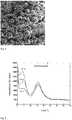
- the X-ray diffraction investigations ( Fig. 3 ) documents, however, that the fiber is determined by a packing of about 0.5 to 1nm large particles. This shows the peak at about 5 nm -1 .
- the peak at 16.4 nm -1 of the unwearable sample (main maximum of the WAXS scattering curve) documents a low cross-linking of the SiO 2 polyhedral structures. Only the temperature treatment leads to better networking, until from about 650 ° C a typical for silica glass complete network is formed. The peak at about 5 nm -1 has then disappeared.
- Fig. 4 shows the resulting microparticles in a scanning electron microscope.
- the X-ray diffraction in the Fig. 5 (Curve with degree of esterification of about 50%, determined by IR spectroscopy) shows the typical peak at about 5 nm -1 .
- Fig. 5 The X-ray diffraction of the resulting microparticles is in Fig. 5 (Curve with degree of esterification of about 75%, determined by IR spectroscopy).
- Fig. 5 The X-ray diffraction of the resulting microparticles is in Fig. 5 (Curve with degree of esterification of about 90%, determined by IR spectroscopy).
- Example 4 In 100 g of H 2 O 7 g of polyvinylpyrrolidone are dissolved. The microparticles prepared in Example 4 are treated for one hour in the oxygen plasma, whereby the ethyl groups and residues of the catalyst (oxalic acid) are removed. Subsequently, 3 g of these microparticles are added to the solution and distributed homogeneously. Then the material is placed in trays, so that the liquid height is 5 mm. The mixture of H 2 O, polyvinylpyrrolidone and the microparticles is frozen and freeze-dried. The result is a polyvinylpyrrolidone sponge with incorporated microparticles, as shown in the scanning electron micrograph FIGS. 6A and B can be seen.
- Example 4 In 100 g of H 2 O, 7 g of gelatin are dissolved. The microparticles prepared in Example 4 are treated for one hour in the oxygen plasma, whereby the ethyl groups and residues of the catalyst (oxalic acid) are removed. Subsequently, 3 g of these microparticles are added to the solution and distributed homogeneously. Then the material is placed in trays, so that the liquid height is 5 mm. The mixture of H 2 O, gelatin and microparticles is frozen and lyophilized. The result is a gelatin sponge with embedded microparticles, as shown in the scanning electron micrograph Figs. 7A and B can be seen.
Landscapes
- Chemical & Material Sciences (AREA)
- Health & Medical Sciences (AREA)
- Engineering & Computer Science (AREA)
- Materials Engineering (AREA)
- Organic Chemistry (AREA)
- Veterinary Medicine (AREA)
- Public Health (AREA)
- Epidemiology (AREA)
- Life Sciences & Earth Sciences (AREA)
- Animal Behavior & Ethology (AREA)
- General Health & Medical Sciences (AREA)
- Inorganic Chemistry (AREA)
- Composite Materials (AREA)
- Medicinal Chemistry (AREA)
- Dermatology (AREA)
- Transplantation (AREA)
- Oral & Maxillofacial Surgery (AREA)
- Dispersion Chemistry (AREA)
- Materials For Medical Uses (AREA)
- Silicon Compounds (AREA)
- Chemical Kinetics & Catalysis (AREA)
- Polymers & Plastics (AREA)
- Compositions Of Macromolecular Compounds (AREA)
- Processes Of Treating Macromolecular Substances (AREA)
- Silicon Polymers (AREA)
Claims (12)
- Procédé de production de structures d'acide silicique peu réticulées, dans lequela) on prépare un sol,b) on remplace l'eau contenue dans le sol par un solvant organique hydrosoluble,c) et une fois l'eau éliminée à l'aide d'un solvant organique, on estérifie les groupes Si surface -OH, présents dans le sol à la surface interne des clusters d'acide silicique, en groupes Si surface -OR où R représente un groupe organique, étant entendu que R représente un groupe alkyle ou aryle, choisi dans l'ensemble constitué par les groupes méthyle, éthyle, propyle, butyle, pentyle, hexyle et phényle, et étant entendu que le degré d'estérification des clusters d'acide silicique est supérieur à 50 %.
- Procédé conforme à la revendication 1, caractérisé en ce que l'on prépare le sol par hydrolyse d'orthosilicate de tétraéthyle (OSTE), étant entendu que :- de préférence, on utilise de l'eau en un rapport molaire rw de l'eau à l'OSTE valant 4,- et/ou, de préférence, on utilise de l'éthanol comme solvant,- et/ou, de préférence, on utilise un acide organique comme catalyseur pour l'hydrolyse, en particulier de l'acide oxalique,- et/ou, de préférence, on remplace l'eau par un solvant organique, en particulier de l'éthanol, quand les clusters d'acide silicique ont atteint par condensation la taille voulue, cette taille voulue se situant de préférence dans l'intervalle allant de 0,5 nm à 4 nm.
- Procédé conforme à la revendication 1, caractérisé en ce que l'on prépare le sol en opérant un échange d'ions dans une solution de silicate de sodium (verre soluble), étant entendu que, de préférence, on remplace l'eau par un solvant organique, en particulier de l'éthanol, quand les clusters d'acide silicique ont atteint par condensation la taille voulue, cette taille voulue se situant de préférence dans l'intervalle allant de 0,5 nm à 4 nm.
- Procédé conforme à l'une des revendications précédentes, dans lequel on opère de préférence l'estérification en éliminant l'eau formée lors de l'estérification en présence d'un acide, qui est de préférence un acide organique, et en particulier de l'acide oxalique.
- Procédé conforme à l'une des revendications précédentes, caractérisé en ce quea) on utilise un catalyseur, qui est choisi dans l'ensemble comprenant un acide organique, de préférence l'acide oxalique, et un échangeur d'ions acide, de préférence un polystyrène sulfoné R-SO3H,b) et/ou avant que les groupes Si surface -OH soient estérifiés, on fait subir au sol un processus de mûrissement, où le solvant est de l'eau ou un mélange d'eau et de solvant organique et le pH est ajusté à une valeur de 7 ou plus,c) et/ou l'on oxyde les constituants organiques, de préférence en utilisant un plasma d'oxygène,d) et/ou l'on élimine le solvant, de préférence en opérant un séchage par atomisation.
- Procédé conforme à l'une des revendications précédentes, caractérisé en ce quea) l'on remplace l'eau contenue dans le sol par un solvant organique quand les clusters de gel de silice ont une taille de 0,5 à 4 nm, étant entendu- que, de préférence, le solvant est de l'éthanol,- et que, de préférence, l'on opère une estérification, le sol estérifié étant alors, de préférence, concentré par ébullition à tel point que la teneur en solides (SiO2) du sol se situe de préférence dans l'intervalle allant de 3 à 25 % en poids,- et/ou que, de préférence, le sol est séché par atomisation,
les paramètres d'atomisation étant alors, de préférence, choisis de telle sorte qu'il se forme des microparticules creuses ;b) et/ou l'on élimine le solvant à tel point que la viscosité du sol se situe dans l'intervalle allant de 0,1 à 10 Pa.s, et de préférence dans celui allant de 0,3 à 0,7 Pa.s, étant entendu que, de préférence,
ce sol est filé et réduit à l'état de fils ;c) et/ou l'on remplace l'eau contenue dans le sol par un solvant organique quand les clusters de gel de silice ont une taille de 0,5 à 4 nm, étant entendu que ce solvant est de préférence de l'éthanol, on opère une estérification avec le groupe éthyle,
et de préférence, on concentre le sol estérifié, à tel point que le sol présente de préférence une viscosité située dans l'intervalle allant de 0,3 à 0,7 Pa.s, et ce sol est de préférence filé et réduit à l'état de fils de gel ;d) et/ou, en chassant du solvant ou en en ajoutant, l'on ajuste la teneur en solides (SiO2) du sol à une valeur située dans l'intervalle allant de 3 à 25 % en poids, ce sol étant utilisé de préférence dans des procédés de revêtement connus, comme le revêtement par immersion (dip coating), le revêtement par rotation (spin coating) ou le revêtement par projection (spray coating). - Procédé conforme à l'une des revendications précédentes, caractérisé en ce que les structures d'acide silicique peu réticulées sont produites dans une solution aqueuse d'un polymère choisi dans un ensemble comprenant un poly(vinyl-pyrrolidone) et un collagène, étant entendu- que, de préférence, la proportion de polymère dans la solution se situe entre 2 et 15 % en poids,- et/ou que, de préférence, la proportion de SiO2, par rapport à la solution aqueuse de polymère, se situe dans l'intervalle allant de 2 à 40 % en poids,- et/ou que, de préférence, on verse dans un moule la solution comprenant, en un mélange homogène, les structures d'acide silicique, et on la lyophilise.
- Biomatériau, accessible par un procédé conforme à l'une des revendications précédentes, qui est formé de structures en polyèdres de SiO2 présentant une taille de 0,5 à 4 nm, ainsi que, à leur surface, des groupes de formule Si-O-R où R représente un groupe organique, de préférence un groupe alkyle ou aryle comportant de 1 à 10 atomes de carbone, choisi dans l'ensemble comprenant les groupes méthyle, éthyle et phényle.
- Biomatériau conforme à la revendication 8, caractérisé en ce qu'il se présente sous une forme choisie dans l'ensemble constitué par les suivantes :- un granulat,- des microparticules, de préférence creuses, et présentant de préférence un diamètre situé dans l'intervalle allant de 2 à 100 µm,- des fils, présentant de préférence un diamètre situé dans l'intervalle allant de 1 à 50 µm,- une couche, laquelle couche est de préférence une couche placée sur un implant ou sur un pansement.
- Biomatériau conforme à la revendication 8, caractérisé en ce qu'il est enrobé dans un matériau support, lequel matériau support est de préférence une membrane organique, un non-tissé organique ou une éponge organique, et/ou lequel matériau support est de préférence un matériau organique biodégradable, étant entendu que de préférence, on utilise comme support une éponge en gélatine ou une éponge en poly(vinyl-pyrrolidone).
- Biomatériau, conforme à l'une des revendication 8 à 10, pour utilisationa) en tant que produit médical qui joue un rôle de soutien ou
de protection et qui, de préférence, peut servir en même temps,
en se dégradant, de pourvoyeur de dioxyde de silicium aidant à la régénération d'un ou de tissu(s),b) ou dans le traitement de blessures ou de cicatrices ou dans des applications cosmétiques, en particulier sous forme de pommade ou de crème. - Produit médical ou complément alimentaire, comprenant un biomatériau conforme à l'une des revendications 8 à 10.
Applications Claiming Priority (3)
| Application Number | Priority Date | Filing Date | Title |
|---|---|---|---|
| DE102011009838A DE102011009838A1 (de) | 2011-01-31 | 2011-01-31 | Kieselsäurekondensate für therapeutische Zwecke in der Medizin und Verfahren zur Herstellung |
| DE201110009839 DE102011009839A1 (de) | 2011-01-31 | 2011-01-31 | Kieselsäurekondensate in einer Polymermatrix für thera-peutische Anwendungen in der Medizin und Verfahren zur Herstellung |
| PCT/EP2012/051603 WO2012104320A1 (fr) | 2011-01-31 | 2012-01-31 | Condensats d'acide silicique à faible réticulation |
Publications (2)
| Publication Number | Publication Date |
|---|---|
| EP2670706A1 EP2670706A1 (fr) | 2013-12-11 |
| EP2670706B1 true EP2670706B1 (fr) | 2019-08-07 |
Family
ID=45592345
Family Applications (2)
| Application Number | Title | Priority Date | Filing Date |
|---|---|---|---|
| EP12703741.4A Active EP2670705B1 (fr) | 2011-01-31 | 2012-01-31 | Condensats d'acide silicique à faible réticulation incorporés dans un matrice polymère |
| EP12703742.2A Active EP2670706B1 (fr) | 2011-01-31 | 2012-01-31 | Condensats d'acide silicique à faible réticulation |
Family Applications Before (1)
| Application Number | Title | Priority Date | Filing Date |
|---|---|---|---|
| EP12703741.4A Active EP2670705B1 (fr) | 2011-01-31 | 2012-01-31 | Condensats d'acide silicique à faible réticulation incorporés dans un matrice polymère |
Country Status (5)
| Country | Link |
|---|---|
| US (3) | US20140037958A1 (fr) |
| EP (2) | EP2670705B1 (fr) |
| CA (2) | CA2829491C (fr) |
| ES (2) | ES2821395T3 (fr) |
| WO (2) | WO2012104320A1 (fr) |
Families Citing this family (12)
| Publication number | Priority date | Publication date | Assignee | Title |
|---|---|---|---|---|
| US9228785B2 (en) | 2010-05-04 | 2016-01-05 | Alexander Poltorak | Fractal heat transfer device |
| CA2829491C (fr) | 2011-01-31 | 2021-02-23 | Thomas Gerber | Condensats d'acide silicique a faible reticulation incorpores dans un matrice polymere |
| DE102013106758B4 (de) * | 2013-06-27 | 2022-06-09 | Aesculap Aktiengesellschaft | Unrunde Pedikelschraube |
| US10305885B2 (en) * | 2016-03-03 | 2019-05-28 | Blackberry Limited | Accessing enterprise resources using provisioned certificates |
| US10830545B2 (en) | 2016-07-12 | 2020-11-10 | Fractal Heatsink Technologies, LLC | System and method for maintaining efficiency of a heat sink |
| DE102017217539B4 (de) * | 2017-10-02 | 2021-04-22 | Fraunhofer-Gesellschaft zur Förderung der angewandten Forschung e.V. | Biodegradierbare Fasern, Verfahren zu deren Herstellung und deren Verwendung, sowie diese enthaltende Fasergeflechte oder -filter |
| US10445629B2 (en) * | 2017-11-20 | 2019-10-15 | Mastercard International Incorporated | Secure QR code service |
| US20190255223A1 (en) | 2018-02-16 | 2019-08-22 | American Nano, LLC | Silica fiber compositions and methods of use |
| US12440503B2 (en) | 2018-02-16 | 2025-10-14 | American Nano, LLC | Topical compositions incorporating silica fibers |
| US11135806B2 (en) | 2018-02-16 | 2021-10-05 | American Nano Llc. | Compositions incorporating silica fibers |
| US11759473B2 (en) | 2018-02-16 | 2023-09-19 | American Nano, LLC | Topical compositions incorporating silica fibers |
| AU2019234857B2 (en) * | 2018-03-16 | 2024-11-14 | American Nano, LLC | Compositions incorporating silica fibers |
Family Cites Families (15)
| Publication number | Priority date | Publication date | Assignee | Title |
|---|---|---|---|---|
| US5914162A (en) * | 1988-04-11 | 1999-06-22 | Minnesota Mining And Manufacturing Company | Coating for metal surfaces of unsaturated polymer and colloidal inorganic particles |
| JPH02248331A (ja) * | 1989-03-22 | 1990-10-04 | Hitachi Chem Co Ltd | シリカガラスの製造法 |
| DE69804373T2 (de) * | 1997-05-26 | 2002-10-24 | Nissan Chemical Industries, Ltd. | Verfahren zur Herstellung eines hydrophoben Kieselsäure Organosols |
| US6579929B1 (en) * | 2000-01-19 | 2003-06-17 | Bridgestone Corporation | Stabilized silica and method of making and using the same |
| DE102004012411A1 (de) * | 2004-03-13 | 2005-09-29 | Dot Gmbh | Kompositmaterialien auf der Basis von Polykieselsäuren und Verfahren zu deren Herstellung |
| US20060073205A1 (en) * | 2004-10-04 | 2006-04-06 | Kotoe Ohta | Controlled release granules comprising porous silica core |
| SE529440C2 (sv) * | 2005-06-01 | 2007-08-14 | Small Particles Technology Gbg | Dispergerbart pulver av kiselsyra |
| DE102006044520A1 (de) * | 2006-09-21 | 2008-04-03 | H.C. Starck Gmbh | Verfahren zur Herstellung feststoffreicher Kieselsole |
| US20080185041A1 (en) * | 2007-02-02 | 2008-08-07 | Guardian Industries Corp. | Method of making a photovoltaic device with antireflective coating containing porous silica and resulting product |
| US8535310B2 (en) | 2007-08-08 | 2013-09-17 | Cook Medical Technologies Llc | Sphincterotome |
| GB0717516D0 (en) * | 2007-09-07 | 2007-10-17 | Imp Innovations Ltd | Bioactive nanocomposite material |
| EP2151466A1 (fr) * | 2008-08-01 | 2010-02-10 | SiNatur GmbH | Acide silicique actif biologiquement |
| US20120276165A1 (en) * | 2009-12-09 | 2012-11-01 | Barlaa B.V. | Micro-colloidal silicic acid/boric acid composition and a method of preparing a bioenhancing solution and powder |
| CN101786139B (zh) * | 2009-12-31 | 2012-09-26 | 东莞市惠和硅制品有限公司 | 一种聚合物改性的硅溶胶及其制造方法 |
| CA2829491C (fr) | 2011-01-31 | 2021-02-23 | Thomas Gerber | Condensats d'acide silicique a faible reticulation incorpores dans un matrice polymere |
-
2012
- 2012-01-31 CA CA2829491A patent/CA2829491C/fr active Active
- 2012-01-31 ES ES12703741T patent/ES2821395T3/es active Active
- 2012-01-31 WO PCT/EP2012/051603 patent/WO2012104320A1/fr not_active Ceased
- 2012-01-31 CA CA2828759A patent/CA2828759C/fr active Active
- 2012-01-31 EP EP12703741.4A patent/EP2670705B1/fr active Active
- 2012-01-31 ES ES12703742T patent/ES2754053T3/es active Active
- 2012-01-31 EP EP12703742.2A patent/EP2670706B1/fr active Active
- 2012-01-31 US US13/981,599 patent/US20140037958A1/en not_active Abandoned
- 2012-01-31 US US13/981,598 patent/US10064974B2/en active Active
- 2012-01-31 WO PCT/EP2012/051581 patent/WO2012104310A1/fr not_active Ceased
-
2018
- 2018-08-07 US US16/057,611 patent/US10842909B2/en active Active
Non-Patent Citations (1)
| Title |
|---|
| None * |
Also Published As
| Publication number | Publication date |
|---|---|
| CA2829491A1 (fr) | 2012-08-09 |
| US10064974B2 (en) | 2018-09-04 |
| EP2670705A1 (fr) | 2013-12-11 |
| US20180344895A1 (en) | 2018-12-06 |
| CA2828759A1 (fr) | 2012-08-09 |
| CA2828759C (fr) | 2021-01-19 |
| ES2821395T3 (es) | 2021-04-26 |
| WO2012104320A1 (fr) | 2012-08-09 |
| US20140031452A1 (en) | 2014-01-30 |
| US20140037958A1 (en) | 2014-02-06 |
| CA2829491C (fr) | 2021-02-23 |
| ES2754053T3 (es) | 2020-04-15 |
| EP2670706A1 (fr) | 2013-12-11 |
| WO2012104310A1 (fr) | 2012-08-09 |
| EP2670705B1 (fr) | 2020-07-01 |
| US10842909B2 (en) | 2020-11-24 |
Similar Documents
| Publication | Publication Date | Title |
|---|---|---|
| EP2670706B1 (fr) | Condensats d'acide silicique à faible réticulation | |
| DE69733889T3 (de) | Lösliche oxide für biologische anwendungen | |
| Koudehi et al. | Preparation and evaluation of novel nano-bioglass/gelatin conduit for peripheral nerve regeneration | |
| EP2118006A1 (fr) | Méthode de production de compositions de silice, compositions de silice et leurs utilisations | |
| WO2020099201A1 (fr) | Procédé de fabrication d'aérogels et aérogels pouvant être obtenus par ce procédé | |
| Wenzhi et al. | Assessment of nano-hydroxyapatite and poly (lactide-co-glycolide) nanocomposite microspheres fabricated by novel airflow shearing technique for in vivo bone repair | |
| DE60035672T2 (de) | Biologisch abbaubare silicafasern aus einem silicasol | |
| EP4149885B1 (fr) | Procédé de fabrication d'aérogels et aérogels pouvant être obtenus par ce procédé | |
| CN101433734A (zh) | 一种纳米羟基磷灰石生物活性材料的合成方法 | |
| DE10323079A1 (de) | Verfahren zur Herstellung von porösen siliziumdioxidhaltigem Hydroxylapatitgranulat mit kontrollierter Morphologie | |
| EP3381479A1 (fr) | Composition de support pour matériau de substitution osseuse | |
| Zakaria et al. | Hydroxyapatite nanoparticles: electrospinning and calcination of hydroxyapatite/polyvinyl butyral nanofibers and growth kinetics | |
| DE102011009838A1 (de) | Kieselsäurekondensate für therapeutische Zwecke in der Medizin und Verfahren zur Herstellung | |
| EP2049449B1 (fr) | Corps solide poreux avec distribution bimodale de la taille des pores et procédé pour sa préparation | |
| JP2005194308A (ja) | 徐放性香料担体及びそれを用いた徐放性香料 | |
| KR101278100B1 (ko) | 키토산을 템플레이트로 이용한 다공성 생체활성유리 구형입자의 제조방법 및 그에 의해 제조된 구형입자 | |
| DE102005040848A1 (de) | Osteoinduktives Material und Verfahren zur Herstellung desselben | |
| KR101736835B1 (ko) | 나노섬유형 젤라틴/실리카 하이브리드 마이크로스피어 제조 방법 및 이에 의해 제조된 나노섬유형 마이크로스피어 | |
| KR102183306B1 (ko) | 이산화티탄 나노섬유 전기방사용액 조성물 및 이를 이용한 이산화티탄 나노섬유 제조방법 | |
| DE202022101351U1 (de) | Hochgefüllte prekeramische Fasern als Basismaterial für die Herstellung von Knochenersatzkörpern | |
| Rajkhowa et al. | Recent innovations in silk biomaterials | |
| DE102011009839A1 (de) | Kieselsäurekondensate in einer Polymermatrix für thera-peutische Anwendungen in der Medizin und Verfahren zur Herstellung | |
| Szewczyk et al. | Drug-loaded mesoporous silica/calcium phosphate composites for bone regeneration | |
| CN117843245A (zh) | 一种纳米级中空结构生物活性玻璃微球及其制备方法 | |
| CN101318033A (zh) | 抗生素/tcp复合纳米材料及其制备方法 |
Legal Events
| Date | Code | Title | Description |
|---|---|---|---|
| PUAI | Public reference made under article 153(3) epc to a published international application that has entered the european phase |
Free format text: ORIGINAL CODE: 0009012 |
|
| 17P | Request for examination filed |
Effective date: 20130805 |
|
| AK | Designated contracting states |
Kind code of ref document: A1 Designated state(s): AL AT BE BG CH CY CZ DE DK EE ES FI FR GB GR HR HU IE IS IT LI LT LU LV MC MK MT NL NO PL PT RO RS SE SI SK SM TR |
|
| DAX | Request for extension of the european patent (deleted) | ||
| STAA | Information on the status of an ep patent application or granted ep patent |
Free format text: STATUS: EXAMINATION IS IN PROGRESS |
|
| 17Q | First examination report despatched |
Effective date: 20170828 |
|
| REG | Reference to a national code |
Ref country code: DE Ref legal event code: R079 Ref document number: 502012015122 Country of ref document: DE Free format text: PREVIOUS MAIN CLASS: C01B0033145000 Ipc: A61L0026000000 |
|
| GRAP | Despatch of communication of intention to grant a patent |
Free format text: ORIGINAL CODE: EPIDOSNIGR1 |
|
| STAA | Information on the status of an ep patent application or granted ep patent |
Free format text: STATUS: GRANT OF PATENT IS INTENDED |
|
| RIC1 | Information provided on ipc code assigned before grant |
Ipc: A61L 26/00 20060101AFI20190121BHEP Ipc: C01B 33/145 20060101ALI20190121BHEP Ipc: A61L 27/02 20060101ALI20190121BHEP Ipc: C01B 33/148 20060101ALI20190121BHEP Ipc: A61L 27/48 20060101ALI20190121BHEP |
|
| INTG | Intention to grant announced |
Effective date: 20190220 |
|
| GRAS | Grant fee paid |
Free format text: ORIGINAL CODE: EPIDOSNIGR3 |
|
| GRAA | (expected) grant |
Free format text: ORIGINAL CODE: 0009210 |
|
| STAA | Information on the status of an ep patent application or granted ep patent |
Free format text: STATUS: THE PATENT HAS BEEN GRANTED |
|
| AK | Designated contracting states |
Kind code of ref document: B1 Designated state(s): AL AT BE BG CH CY CZ DE DK EE ES FI FR GB GR HR HU IE IS IT LI LT LU LV MC MK MT NL NO PL PT RO RS SE SI SK SM TR |
|
| REG | Reference to a national code |
Ref country code: GB Ref legal event code: FG4D Free format text: NOT ENGLISH |
|
| REG | Reference to a national code |
Ref country code: CH Ref legal event code: EP Ref country code: AT Ref legal event code: REF Ref document number: 1162815 Country of ref document: AT Kind code of ref document: T Effective date: 20190815 |
|
| REG | Reference to a national code |
Ref country code: DE Ref legal event code: R096 Ref document number: 502012015122 Country of ref document: DE |
|
| REG | Reference to a national code |
Ref country code: IE Ref legal event code: FG4D Free format text: LANGUAGE OF EP DOCUMENT: GERMAN |
|
| REG | Reference to a national code |
Ref country code: NL Ref legal event code: MP Effective date: 20190807 |
|
| REG | Reference to a national code |
Ref country code: LT Ref legal event code: MG4D |
|
| PG25 | Lapsed in a contracting state [announced via postgrant information from national office to epo] |
Ref country code: PT Free format text: LAPSE BECAUSE OF FAILURE TO SUBMIT A TRANSLATION OF THE DESCRIPTION OR TO PAY THE FEE WITHIN THE PRESCRIBED TIME-LIMIT Effective date: 20191209 Ref country code: LT Free format text: LAPSE BECAUSE OF FAILURE TO SUBMIT A TRANSLATION OF THE DESCRIPTION OR TO PAY THE FEE WITHIN THE PRESCRIBED TIME-LIMIT Effective date: 20190807 Ref country code: HR Free format text: LAPSE BECAUSE OF FAILURE TO SUBMIT A TRANSLATION OF THE DESCRIPTION OR TO PAY THE FEE WITHIN THE PRESCRIBED TIME-LIMIT Effective date: 20190807 Ref country code: NL Free format text: LAPSE BECAUSE OF FAILURE TO SUBMIT A TRANSLATION OF THE DESCRIPTION OR TO PAY THE FEE WITHIN THE PRESCRIBED TIME-LIMIT Effective date: 20190807 Ref country code: SE Free format text: LAPSE BECAUSE OF FAILURE TO SUBMIT A TRANSLATION OF THE DESCRIPTION OR TO PAY THE FEE WITHIN THE PRESCRIBED TIME-LIMIT Effective date: 20190807 Ref country code: BG Free format text: LAPSE BECAUSE OF FAILURE TO SUBMIT A TRANSLATION OF THE DESCRIPTION OR TO PAY THE FEE WITHIN THE PRESCRIBED TIME-LIMIT Effective date: 20191107 Ref country code: NO Free format text: LAPSE BECAUSE OF FAILURE TO SUBMIT A TRANSLATION OF THE DESCRIPTION OR TO PAY THE FEE WITHIN THE PRESCRIBED TIME-LIMIT Effective date: 20191107 Ref country code: FI Free format text: LAPSE BECAUSE OF FAILURE TO SUBMIT A TRANSLATION OF THE DESCRIPTION OR TO PAY THE FEE WITHIN THE PRESCRIBED TIME-LIMIT Effective date: 20190807 |
|
| PG25 | Lapsed in a contracting state [announced via postgrant information from national office to epo] |
Ref country code: IS Free format text: LAPSE BECAUSE OF FAILURE TO SUBMIT A TRANSLATION OF THE DESCRIPTION OR TO PAY THE FEE WITHIN THE PRESCRIBED TIME-LIMIT Effective date: 20191207 Ref country code: RS Free format text: LAPSE BECAUSE OF FAILURE TO SUBMIT A TRANSLATION OF THE DESCRIPTION OR TO PAY THE FEE WITHIN THE PRESCRIBED TIME-LIMIT Effective date: 20190807 Ref country code: GR Free format text: LAPSE BECAUSE OF FAILURE TO SUBMIT A TRANSLATION OF THE DESCRIPTION OR TO PAY THE FEE WITHIN THE PRESCRIBED TIME-LIMIT Effective date: 20191108 Ref country code: LV Free format text: LAPSE BECAUSE OF FAILURE TO SUBMIT A TRANSLATION OF THE DESCRIPTION OR TO PAY THE FEE WITHIN THE PRESCRIBED TIME-LIMIT Effective date: 20190807 Ref country code: AL Free format text: LAPSE BECAUSE OF FAILURE TO SUBMIT A TRANSLATION OF THE DESCRIPTION OR TO PAY THE FEE WITHIN THE PRESCRIBED TIME-LIMIT Effective date: 20190807 |
|
| PG25 | Lapsed in a contracting state [announced via postgrant information from national office to epo] |
Ref country code: TR Free format text: LAPSE BECAUSE OF FAILURE TO SUBMIT A TRANSLATION OF THE DESCRIPTION OR TO PAY THE FEE WITHIN THE PRESCRIBED TIME-LIMIT Effective date: 20190807 |
|
| REG | Reference to a national code |
Ref country code: ES Ref legal event code: FG2A Ref document number: 2754053 Country of ref document: ES Kind code of ref document: T3 Effective date: 20200415 |
|
| PG25 | Lapsed in a contracting state [announced via postgrant information from national office to epo] |
Ref country code: RO Free format text: LAPSE BECAUSE OF FAILURE TO SUBMIT A TRANSLATION OF THE DESCRIPTION OR TO PAY THE FEE WITHIN THE PRESCRIBED TIME-LIMIT Effective date: 20190807 Ref country code: EE Free format text: LAPSE BECAUSE OF FAILURE TO SUBMIT A TRANSLATION OF THE DESCRIPTION OR TO PAY THE FEE WITHIN THE PRESCRIBED TIME-LIMIT Effective date: 20190807 Ref country code: DK Free format text: LAPSE BECAUSE OF FAILURE TO SUBMIT A TRANSLATION OF THE DESCRIPTION OR TO PAY THE FEE WITHIN THE PRESCRIBED TIME-LIMIT Effective date: 20190807 Ref country code: PL Free format text: LAPSE BECAUSE OF FAILURE TO SUBMIT A TRANSLATION OF THE DESCRIPTION OR TO PAY THE FEE WITHIN THE PRESCRIBED TIME-LIMIT Effective date: 20190807 |
|
| PG25 | Lapsed in a contracting state [announced via postgrant information from national office to epo] |
Ref country code: CZ Free format text: LAPSE BECAUSE OF FAILURE TO SUBMIT A TRANSLATION OF THE DESCRIPTION OR TO PAY THE FEE WITHIN THE PRESCRIBED TIME-LIMIT Effective date: 20190807 Ref country code: SK Free format text: LAPSE BECAUSE OF FAILURE TO SUBMIT A TRANSLATION OF THE DESCRIPTION OR TO PAY THE FEE WITHIN THE PRESCRIBED TIME-LIMIT Effective date: 20190807 Ref country code: SM Free format text: LAPSE BECAUSE OF FAILURE TO SUBMIT A TRANSLATION OF THE DESCRIPTION OR TO PAY THE FEE WITHIN THE PRESCRIBED TIME-LIMIT Effective date: 20190807 Ref country code: IS Free format text: LAPSE BECAUSE OF FAILURE TO SUBMIT A TRANSLATION OF THE DESCRIPTION OR TO PAY THE FEE WITHIN THE PRESCRIBED TIME-LIMIT Effective date: 20200224 |
|
| REG | Reference to a national code |
Ref country code: DE Ref legal event code: R097 Ref document number: 502012015122 Country of ref document: DE |
|
| PLBE | No opposition filed within time limit |
Free format text: ORIGINAL CODE: 0009261 |
|
| STAA | Information on the status of an ep patent application or granted ep patent |
Free format text: STATUS: NO OPPOSITION FILED WITHIN TIME LIMIT |
|
| PG2D | Information on lapse in contracting state deleted |
Ref country code: IS |
|
| 26N | No opposition filed |
Effective date: 20200603 |
|
| PG25 | Lapsed in a contracting state [announced via postgrant information from national office to epo] |
Ref country code: MC Free format text: LAPSE BECAUSE OF FAILURE TO SUBMIT A TRANSLATION OF THE DESCRIPTION OR TO PAY THE FEE WITHIN THE PRESCRIBED TIME-LIMIT Effective date: 20190807 Ref country code: SI Free format text: LAPSE BECAUSE OF FAILURE TO SUBMIT A TRANSLATION OF THE DESCRIPTION OR TO PAY THE FEE WITHIN THE PRESCRIBED TIME-LIMIT Effective date: 20190807 |
|
| REG | Reference to a national code |
Ref country code: CH Ref legal event code: PL |
|
| REG | Reference to a national code |
Ref country code: BE Ref legal event code: MM Effective date: 20200131 |
|
| PG25 | Lapsed in a contracting state [announced via postgrant information from national office to epo] |
Ref country code: LU Free format text: LAPSE BECAUSE OF NON-PAYMENT OF DUE FEES Effective date: 20200131 |
|
| PG25 | Lapsed in a contracting state [announced via postgrant information from national office to epo] |
Ref country code: CH Free format text: LAPSE BECAUSE OF NON-PAYMENT OF DUE FEES Effective date: 20200131 Ref country code: LI Free format text: LAPSE BECAUSE OF NON-PAYMENT OF DUE FEES Effective date: 20200131 Ref country code: BE Free format text: LAPSE BECAUSE OF NON-PAYMENT OF DUE FEES Effective date: 20200131 |
|
| PG25 | Lapsed in a contracting state [announced via postgrant information from national office to epo] |
Ref country code: IE Free format text: LAPSE BECAUSE OF NON-PAYMENT OF DUE FEES Effective date: 20200131 |
|
| REG | Reference to a national code |
Ref country code: AT Ref legal event code: MM01 Ref document number: 1162815 Country of ref document: AT Kind code of ref document: T Effective date: 20200131 |
|
| PG25 | Lapsed in a contracting state [announced via postgrant information from national office to epo] |
Ref country code: AT Free format text: LAPSE BECAUSE OF NON-PAYMENT OF DUE FEES Effective date: 20200131 |
|
| PG25 | Lapsed in a contracting state [announced via postgrant information from national office to epo] |
Ref country code: MT Free format text: LAPSE BECAUSE OF FAILURE TO SUBMIT A TRANSLATION OF THE DESCRIPTION OR TO PAY THE FEE WITHIN THE PRESCRIBED TIME-LIMIT Effective date: 20190807 Ref country code: CY Free format text: LAPSE BECAUSE OF FAILURE TO SUBMIT A TRANSLATION OF THE DESCRIPTION OR TO PAY THE FEE WITHIN THE PRESCRIBED TIME-LIMIT Effective date: 20190807 |
|
| PG25 | Lapsed in a contracting state [announced via postgrant information from national office to epo] |
Ref country code: MK Free format text: LAPSE BECAUSE OF FAILURE TO SUBMIT A TRANSLATION OF THE DESCRIPTION OR TO PAY THE FEE WITHIN THE PRESCRIBED TIME-LIMIT Effective date: 20190807 |
|
| REG | Reference to a national code |
Ref country code: GB Ref legal event code: 732E Free format text: REGISTERED BETWEEN 20250710 AND 20250716 |
|
| REG | Reference to a national code |
Ref country code: DE Ref legal event code: R081 Ref document number: 502012015122 Country of ref document: DE Owner name: BIOCOMPOSITES GMBH, DE Free format text: FORMER OWNER: GERBER, THOMAS, 18059 PAPENDORF, DE Ref country code: DE Ref legal event code: R082 Ref document number: 502012015122 Country of ref document: DE Representative=s name: WUNDERLICH & HEIM PATENTANWAELTE PARTNERSCHAFT, DE |
|
| PGFP | Annual fee paid to national office [announced via postgrant information from national office to epo] |
Ref country code: GB Payment date: 20251120 Year of fee payment: 15 |
|
| PGFP | Annual fee paid to national office [announced via postgrant information from national office to epo] |
Ref country code: FR Payment date: 20251120 Year of fee payment: 15 |
|
| PGFP | Annual fee paid to national office [announced via postgrant information from national office to epo] |
Ref country code: ES Payment date: 20260225 Year of fee payment: 15 |
|
| PGFP | Annual fee paid to national office [announced via postgrant information from national office to epo] |
Ref country code: DE Payment date: 20260130 Year of fee payment: 15 |
|
| PGFP | Annual fee paid to national office [announced via postgrant information from national office to epo] |
Ref country code: IT Payment date: 20251121 Year of fee payment: 15 |