EP2671180B1 - Dispositif et procédé de surveillance de biomarqueurs - Google Patents
Dispositif et procédé de surveillance de biomarqueurs Download PDFInfo
- Publication number
- EP2671180B1 EP2671180B1 EP12702733.2A EP12702733A EP2671180B1 EP 2671180 B1 EP2671180 B1 EP 2671180B1 EP 12702733 A EP12702733 A EP 12702733A EP 2671180 B1 EP2671180 B1 EP 2671180B1
- Authority
- EP
- European Patent Office
- Prior art keywords
- biomarker
- data
- wellness
- memory
- period
- Prior art date
- Legal status (The legal status is an assumption and is not a legal conclusion. Google has not performed a legal analysis and makes no representation as to the accuracy of the status listed.)
- Active
Links
Images


Classifications
-
- G—PHYSICS
- G16—INFORMATION AND COMMUNICATION TECHNOLOGY [ICT] SPECIALLY ADAPTED FOR SPECIFIC APPLICATION FIELDS
- G16B—BIOINFORMATICS, i.e. INFORMATION AND COMMUNICATION TECHNOLOGY [ICT] SPECIALLY ADAPTED FOR GENETIC OR PROTEIN-RELATED DATA PROCESSING IN COMPUTATIONAL MOLECULAR BIOLOGY
- G16B50/00—ICT programming tools or database systems specially adapted for bioinformatics
-
- G—PHYSICS
- G16—INFORMATION AND COMMUNICATION TECHNOLOGY [ICT] SPECIALLY ADAPTED FOR SPECIFIC APPLICATION FIELDS
- G16B—BIOINFORMATICS, i.e. INFORMATION AND COMMUNICATION TECHNOLOGY [ICT] SPECIALLY ADAPTED FOR GENETIC OR PROTEIN-RELATED DATA PROCESSING IN COMPUTATIONAL MOLECULAR BIOLOGY
- G16B50/00—ICT programming tools or database systems specially adapted for bioinformatics
- G16B50/30—Data warehousing; Computing architectures
-
- G—PHYSICS
- G16—INFORMATION AND COMMUNICATION TECHNOLOGY [ICT] SPECIALLY ADAPTED FOR SPECIFIC APPLICATION FIELDS
- G16H—HEALTHCARE INFORMATICS, i.e. INFORMATION AND COMMUNICATION TECHNOLOGY [ICT] SPECIALLY ADAPTED FOR THE HANDLING OR PROCESSING OF MEDICAL OR HEALTHCARE DATA
- G16H10/00—ICT specially adapted for the handling or processing of patient-related medical or healthcare data
- G16H10/40—ICT specially adapted for the handling or processing of patient-related medical or healthcare data for data related to laboratory analysis, e.g. patient specimen analysis
-
- G—PHYSICS
- G16—INFORMATION AND COMMUNICATION TECHNOLOGY [ICT] SPECIALLY ADAPTED FOR SPECIFIC APPLICATION FIELDS
- G16H—HEALTHCARE INFORMATICS, i.e. INFORMATION AND COMMUNICATION TECHNOLOGY [ICT] SPECIALLY ADAPTED FOR THE HANDLING OR PROCESSING OF MEDICAL OR HEALTHCARE DATA
- G16H15/00—ICT specially adapted for medical reports, e.g. generation or transmission thereof
-
- G—PHYSICS
- G16—INFORMATION AND COMMUNICATION TECHNOLOGY [ICT] SPECIALLY ADAPTED FOR SPECIFIC APPLICATION FIELDS
- G16H—HEALTHCARE INFORMATICS, i.e. INFORMATION AND COMMUNICATION TECHNOLOGY [ICT] SPECIALLY ADAPTED FOR THE HANDLING OR PROCESSING OF MEDICAL OR HEALTHCARE DATA
- G16H50/00—ICT specially adapted for medical diagnosis, medical simulation or medical data mining; ICT specially adapted for detecting, monitoring or modelling epidemics or pandemics
- G16H50/30—ICT specially adapted for medical diagnosis, medical simulation or medical data mining; ICT specially adapted for detecting, monitoring or modelling epidemics or pandemics for calculating health indices; for individual health risk assessment
Definitions
- This invention relates to wearable monitoring devices.
- Allergies and asthma have become highly prevalent in the western world. Allergies and asthma now affect about one out of every four Americans, which is three times the number of people suffering from diabetes. Moreover, the prevalence of allergies and asthma has seen a significant increase since about 1960 as reported, for example, by Waltraud Eder, et al., "The asthma epidemic," The New England Journal of Medicine 355, no. 21 (November 23, 2006), pages 2226-2235 . Allergies and asthma are two examples of ailments which result from weakened or stressed immune systems.
- Treatment of chronic diseases and ailments is also adversely affected by lack of insight into the status of an individual's immune system.
- the lack of insight into the individual's immune system increases risks associated with the treatment or necessitates increased medical supervision and subsequent costs.
- adverse effects are discussed, for example, by Rudolf Valenta, "The future of antigen-specific immunotherapy of allergy,” National Review of Immunology 2, no. 6 (June 2002), pages 446-453 , and Mark Larche, et al., "Immunological mechanisms of allergen specific immunotherapy,” National Review of Immunology 6, no. 10 (October 2006), pages 761-771 .
- the reaction of the immune system of an individual's environment or exposure to a substance can be inferred by analysis of various biomarkers such as chemokines and cytokines as reported by K Gelhar, et al., "Monitoring allergen immunotherapy of pollen-allergic patients: the ratio of allergen specific IgG4 to IgG1 correlates with clinical outcome," Clinical and Experimental Allergy: Journal of the British Society for Allergy and Clinical Immunology 29, no. 4 (April 1999), pages 497-506 .
- biomarkers such as chemokines and cytokines
- diagnostic tests that can be performed at the point of care of an individual, such as at the bedside of a patient, at a care provider location, or at the home of the patient.
- the promise of such diagnostic tests is described, for example, by Leroy Hood et al., "Systems Biology and New Technologies Enable Predictive and Preventative Medicine," Science 306, no. 5696 (October 22, 2004): 640-643 .
- the substance tested may be human body fluids such as blood, serum, saliva, biological cells, urine, or other biomolecules. Diagnostic tests are not, however, limited to biomolecules since testing may be further desired on consumables such as milk, baby food, or water.
- affinity based sensors which are considered to be the state-of-the-art in detection of biomarkers.
- Affinity based sensors function according to a "key-lock" principal in which a molecule with very high association factor to the marker of interest is used for detection.
- a pregnancy test kit may incorporate a monoclonal antibody specific to a ⁇ -subunit of hCG (( ⁇ hCG).
- the antibody is conjugated with a tag, e.g., gold, latex, or fluorophore, which is used for detection. If the targeted molecule binds with the conjugated antibody, the tagged key-lock pair will be detectable such as by a visible test line.
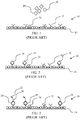
- FIG. 1 depicts an ELISA assay 10 wherein antibodies 12 are immobilized on a substrate 14.
- the substrate 14 may be positioned within a well (not shown).
- a blocker 16 is provided to cover the surface of the substrate around the antibody 12.
- a sample 18 is then added to the well in which the primary antibody 12 is immobilized.
- the sample is incubated for some time.
- the blocker 16 prevents the molecules of interest in the sample from binding to the surface of the substrate 14 in order to avoid false binding.
- some of the molecules of interest 18 become bound with some of the antibodies 12 as depicted in FIG. 2 .
- the remaining sample is washed to remove the unbound primary antibodies 18.
- a secondary antibody 20 with a bound label 22 is added to the well, incubated, and washed resulting in the configuration of FIG. 3 .
- the labeled secondary antibodies 20 are bound to the molecules of interest 18 that are in turn bound to the antibodies 12.
- the number of labels 22 bound by the antibodies 20 to the antigen 18 is proportional to the concentration of the target antigen.
- the number of labels can be finally detected using colorimetry, amperometry, magnetometry, voltammetry, luminescence, or fluorescence detection.
- Other label-free antibody processes such as surface plasmon resonance may alternatively be used.
- a physical activity monitoring method and system in one embodiment includes a communications network, a portable wellness device configured to form a communication link with the communications network, the portable wellness device including a detector configured to detect at least one biomarker in a biologic sample, a first memory, a plurality of program instructions stored in the first memory, and a processing circuit operably connected to the first memory and configured to execute the program instructions to generate wellness data based upon detection of the at least one biomarker in the biologic sample, and a remote user interface operably connected to the communications network and configured to render the wellness data.
- a biomarker monitoring system includes a communications network, a wearable detector device operably connectable to the communications network and configured to detect at least one biomarker in a biologic sample, a memory operably connected to the communications network, a plurality of program instructions stored in the memory, a processing circuit operably connected to the communications network and configured to execute the program instructions to generate wellness data indicative of the status of an immune system based upon detection of the at least one biomarker in the biologic sample, and a user interface operably connected to the processing circuit for rendering the wellness data.
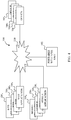
- the network 100 includes a portable wellness unit 102, other devices 104 x , web applications 106 and mobile applications 108.
- the portable wellness unit 102, other devices 104 x , web applications 106 and mobile applications 108 are operably connected to a communications network 110.
- the communications network 110 in one embodiment is a seamless wireless network such as the internet or a cellular telephone network.
- the components in the biomarker monitoring network 100 may be configured to utilize available Wi-Fi networks to connect to the internet.
- the components in the biomarker monitoring network 100 may further or alternatively be configured to access the communications network 110 directly through a wireless system like a cellular telephone network or in conjunction with the internet.
- the other devices 104 x may include portable wellness units, a user interface, graphical user interface, keyboards, pointing devices, remote and/or local communication links, displays, and other devices that allow externally generated information to be provided to the biomarker monitoring network 100, and that allow internal information of the biomarker monitoring network 100 to be communicated externally.
- the wellness unit 102 is described in more detail with reference to FIG. 5 .
- the wellness unit 102 includes a network interface 120, an I/O portion 122, a processor 124, a non-volatile memory126, a signal processing circuit 128, and detector electronics 130.
- a test port 132 is operably connected to or positioned with respect to the detector electronics 130.
- the network interface 120 is a communication circuit that effectuates communication with the communications network 110.
- the network interface 120 is further operable to, either alone or in conjunction with the processor 124, interpret messages in wireless communications received from the communications network 110.
- the network interface 120 may include a wired interface for use either alone or in conjunction with wireless capabilities to connect to the communications network 110.
- the I/O portion 122 may include a graphical user interface, a keyboard, a pointing device, remote and/or local communication links, displays, and other devices that allow externally generated information to be provided to the portable wellness unit 102, and that allow internal data of the portable wellness unit 102 to be communicated externally.
- the processor 124 may suitably be a general purpose computer processing circuit such as a microprocessor and its associated circuitry.
- the processor 124 is operable to control the general operation of the portable wellness unit 102 and to carry out the operations attributed to it herein.
- the programmable non-volatile memory 126 which may be embodied as a flash programmable EEPROM, stores configuration information for the detector electronics 130.
- the programmable non-volatile memory 126 includes an "address" or "ID" of the portable wellness unit 102 that is appended to any communications generated by the portable wellness unit 102.
- the memory 126 further includes set-up configuration information related to the system communication parameters employed by the processor 124 to transmit information to the communications network 110.
- a detector control program 134 and program instructions 136 Within the memory 126 is a detector control program 134 and program instructions 136.
- the detector control program 134 and program instructions 136 which are described more fully below, are executable by the processor 124 and/or any other components as appropriate.
- a factors database 138 is also located within the memory 126.
- the signal processing circuit 128 includes circuitry that interfaces with the detector electronics 130, converts analog detector signals to digital signals, and provides the digital signals to the processor 124.
- the processor 124 receives digital detector information from the signal processing circuit 128 and provides the information to the communication network 110.
- the detector electronics 130 in this embodiment includes a label reader.
- the label reader is configured to detect a signal associated with the concentration of a molecule of interest in a sample that is provided to one or more test sites of a sample collector which is either inserted into or provided by the test port 132.
- the type of sensor or sensors incorporated into the detector electronics 130 will vary depending upon the particular label used for a particular molecule of interest as discussed more fully below. Various embodiments may thus use luminescence, fluorescence, colorimetric, electrochemical, impedance, and magnetic sensors.
- the sample collector may be provided in the form of a variety of test site platforms including 96-well plates, plates with fewer or additional wells, microarray platforms, printed circuit board platforms, CMOS chip platforms, multiplexed assays, protein arrays, lateral flow devices, sandwich assays, competitive assays, bead based arrays or other appropriate platforms.
- the biomarker monitoring network 100 depicts one arrangement of a biomarker monitoring network
- the various components described above may be configured in a number of alternative networks.
- the factors database 138 and some program instructions 136 may be stored within the web applications 106 or mobile applications 108.
- the portable wellness unit 102 may be configured to access the web applications 106 or mobile applications 108 using one or more of the internet, a wireless cellular network, a local area network, or a wide area network.
- some of the functionality described in association with the portable wellness unit 102 may be provided in the web applications 106 or mobile applications 108.
- the portable wellness unit 102 in such an embodiment may be configured to obtain a limited number of samples and to communicate the sample data a limited number of times.
- the portable wellness unit 102 may be provided with sufficient power to make only a single communication.
- the detector control program (DCP) 134 may be stored within the memory 1126 (block 162).
- the detector control program 134 includes detector control program instructions for electronic control of the detector electronics 130.
- the detector control program instructions allow the processor 124 to control operation of the detector electronics 130 including performance of calibration procedures. Additionally or alternatively, the detector control program instructions may be provided in other components of the biomarker monitoring network.
- a portable wellness unit 102 is provided to a user (block 164).
- the portable wellness unit 102 is then activated (block 166).
- the processing circuit 106 Upon activation of the portable wellness unit 102, the processing circuit 106 initiates' data capture subroutines. Additionally, the processing circuit 102 establishes a link with the communications network 110 (block 168). Alternatively, the portable wellness unit 102 may establish a link with the communications network 110 at a later point in the process.
- Initial output from the detector electronics 120 is passed through the signal processing circuit 128 to the processor 124 (block 170).
- the initial sensor data is used by the processor 124 to calibrate the detector electronics 120 (block 172).
- the factors database 138 is then populated (block 174).
- the data used to populate the factors database 138 may be input from one or more of the other devices 104 x .
- the I/O portion 122 may be used by the wearer of the portable wellness unit 102 to input factors data.
- the wearer then provides a biologic sample (block 176).
- the form of the biologic sample depends upon the particular biomarkers to be detected.
- the biologic sample may be in the form of human body fluids such as blood, serum, saliva, biological cells, urine, or other biomolecules.
- the biologic sample is provided on a suitable sample platform which is inserted into the test port 132 (block 178).
- the detector control program instructions when executed by the processor 124, control the detector electronics 130 to process the biologic sample and detect labels attached to capture molecules having an affinity to a biomarker of interest (block 180).
- the detector electronics 130 are controlled to detect labels indicative of the concentration of Th1, Th2, and regulatory Tr1 cells.
- the concentration of these cells can be inferred based upon their cytokine profile as Th1 cells secrete IPN ⁇ , Th2 cells secrete IL-4, IL-5, and IL-13, and Tr1 cells secrete IL-10 and TGF ⁇
- the biomarker may be one or more of various cytokines, chemokines, metalloproteinase, toxicity biomarkers or antigens.
- IFN ⁇ IFN ⁇
- IL-2 IL-2
- IL-4 IL-5
- IL-7 IL-9
- IL-10 IL-12
- IL-15 IL-21
- IL-22 IL-23
- TGF ⁇ TNF ⁇
- MCP-1 IgG1-4, IgE, and IgM.
- the biomarker detector data is passed through the signal processing circuit 128 to the processor 124 (block 182).
- the biomarker detector data is processed by the processor 124 and stored along with a date/time stamp in the memory 126 (block 184).
- data associated with inferred concentrations of Th1, Th2, and Tr1 cells may be stored in the memory 126 along with a date/time stamp indicating when the biologic sample was processed.
- the foregoing actions may be performed in different orders.
- factors may be stored prior to providing a wellness unit 102 to a subject.
- the various actions may be performed by different components of the network 100.
- the output of the detector electronics 130 may be transmitted to a remote location such as a server remote from the sensor for storage.
- the portable wellness unit 102 is configured to provide wellness data which as used herein means data related to the immune system status of an individual based upon biomarker detector data.
- the wellness data is provided for example, by transmitting data over the communications network 110 for display by a device 104 x .
- the wellness data may be provided as feedback either in real time or at another time selected by the wearer or other authorized individual by access through a device 104 x .
- the wellness data based upon the biomarker detector data may be combined with other data as discussed more fully below.
- the wellness data is provided through the I/O portion 122 of the portable wellness unit 102.
- the screen 200 includes a navigation portion 202 and a data portion 204.
- a number of folders 206 are rendered within the data portion 204.
- the folders 206 in one embodiment are associated with different individuals.
- the folders are each associated with a single individual.
- each of the folders 206 is associated with a single individual and may be rendered by the I/O portion 122 of the portable wellness unit 102.
- the folders 206 include a summary folder 208, a first allergen folder 210, a second allergen folder 212, an asthma folder 214, and a cancer folder 216.
- the summary folder 208 includes a chart 218. Data that may be rendered on the chart 248 include identification of the individual or subject associated with the portable wellness unit 102, summary wellness data, and other desired data.
- the first allergen folder 210 displays wellness data related to the immune system of the subject based upon reactions to a first allergen.
- the first allergen folder 210 displays data fields 220, 222, and 224 which are used to display a visual representation of the subject's Th1/Th2 ratio, a numerical metric of the subject's Th1/Th2 ratio, and a word descriptor of the wellness of the subject's immune system, respectively.
- the data fields presented may be modified. For example, one or more data fields may be used to indicate other biological parameters of the individual such as respiration rate, heart beat rate, and blood oxygen content.
- the detector electronics 130 may include sensors to detect the biological parameters.
- the first allergen folder 210 further identifies personal factors in a personal factors window 226 and environmental factors in an environmental factors window 228.
- Personal factors are factors unique to the individual which may affect the subject's immune system. Personal factors may include the administration of a drug, type of activity the individual is engaged in such as hiking, sleeping, etc., and food intake. Some personal factors such as temperature, heart rate, and respiration rate, may be obtained from sensors provided within the detector electronics 130. Other personal factors may be provided by devices 104 x or by I/O portion 122.
- the portable wellness unit 102 may be configured to operably connect to a device such as a continuous positive airway pressure (CPAP) device to obtain sleep data.
- CPAP continuous positive airway pressure
- Environmental factors are factors that are not unique to the individual but which may affect the subject's immune system.
- Environmental factors include pollutants in the air such as the first allergen, air temperature, humidity, etc.
- the environmental factors may include the individual's physical location.
- the detector electronics 130 include sensors to obtain the data from which the environmental factors are determined.
- the detector electronics 130 may thus include temperature sensors, humidity sensors, etc.
- a GPS sensor in the portable wellness unit 102 or data obtained from a relay station may be used to provide physical location data.
- the first allergen folder 210 further includes a daily chart button 230. Selection of the daily chart button 230 causes a screen 240 to be rendered as shown in FIG. 9 .
- the screen 240 may be used to provide an easily navigable interface for reviewing activities over a twenty-four hour window.
- the screen 240 includes a navigation portion 242 and a data portion 244.
- the data portion 244 includes an identification field 246 for identifying the subject and a data field 248 which displays the date associated with the data in the data portion 244.
- a daily immune system condition chart 250 within the data portion 244 includes a line 252 illustrating a threshold of Th1:Th2 below which the immune system is considered to be healthy.
- the actual immune system wellness of the individual over a twenty-four hour period is identified by the wellness line 254.
- the chart 250 further includes representations of personal factors and environmental factors which may influence the health of the individual's immune system.
- the factor may be represented in the chart 250 by a horizontal line, a vertical line, or a band.
- the generally horizontal line 256 may be used to represent the air quality to which the individual is exposed while the vertical lines 258 and 260 respectively indicate the times at which the individual awoke and received an allergy shot.
- the band 262 is used to identify a time frame over which an apple was eaten by the individual. If desired, more or fewer personal and environmental factors may be rendered on the chart 250 to allow an individual to better ascertain the salient factors influencing immune system wellness.
- the data rendered in the chart 250 may be obtained from data stored in the memory 126 such as in the factors database 138.
- the stored data may be obtained from data generated by the detector electronics 130 as well as from data input through one or more of the devices 104 x or the I/O portion 122.
- the screen 240 further includes editable data fields 264 and 268.
- the editable data fields 264 and 268 allow a user to add or modify information related to personal factors and environmental factors, respectively. For example, by selecting the editable data field 264, a user may enter a date, time, and amount of a medication that was or will be taken.
- the biomarker monitoring network 100 may be used in a variety of scenarios. In addition to monitoring biomarkers to provide insight of an individual's immune system during normal activities, the biomarker monitoring network 100 may be used in conducting trials both formal and informal.
- the ability to access applications such as the web applications 106 and the mobile applications 108 through, and share data with, the devices 104 x enables a variety of different hypothesis to be tested either by an individual wearing the portable wellness unit 102 or by a researcher accessing data through a device 104 x .
- the portable wellness unit 102 may further be used by a treating physician to track the reaction of an individual to a prescribed medication.
- the data obtained from a portable wellness unit 102 can also be aggregated with the data from other portable wellness units 102 associated with other individuals to provide a number of different functionalities. For example, once patient specific data has been removed, the aggregate data may be made accessible to members of the general public. Thus, prior to travelling to a location, an individual known to react to a particular allergen, such as pollen, may access a database storing the aggregate data to determine if that allergen is of concern at the location based upon the biomarkers of individuals currently at that location.
- a particular allergen such as pollen
Landscapes
- Engineering & Computer Science (AREA)
- Physics & Mathematics (AREA)
- Health & Medical Sciences (AREA)
- Life Sciences & Earth Sciences (AREA)
- Theoretical Computer Science (AREA)
- Bioinformatics & Cheminformatics (AREA)
- Biophysics (AREA)
- Databases & Information Systems (AREA)
- Bioethics (AREA)
- Bioinformatics & Computational Biology (AREA)
- Biotechnology (AREA)
- Evolutionary Biology (AREA)
- General Health & Medical Sciences (AREA)
- Medical Informatics (AREA)
- Spectroscopy & Molecular Physics (AREA)
- Investigating Or Analysing Biological Materials (AREA)
- Apparatus Associated With Microorganisms And Enzymes (AREA)
Claims (10)
- Système de surveillance de biomarqueurs comprenant :un réseau de communications ;un dispositif portable de bien-être configuré pour former une liaison de communication avec le réseau de communication, le dispositif portable de bien-être comprenant :un détecteur configuré pour détecter au moins un biomarqueur dans un échantillon biologique,
l'au moins un biomarqueur comprenant :au moins un premier biomarqueur associé à un lymphocyte T auxiliaire 1 ;au moins un deuxième biomarqueur associé à un lymphocyte T auxiliaire 2 ; etau moins un troisième biomarqueur associé à un lymphocyte T régulateur,un détecteur configuré pour détecter au moins un facteur personnel choisi dans le groupe constitué par la température, la fréquence cardiaque ou la fréquence respiratoire,une première mémoire,une pluralité d'instructions de programme stockées dans la première mémoire, etun circuit de traitement connecté de manière fonctionnelle à la première mémoire et configuré pour exécuter les instructions de programme afin de générer des données de bien-être sur une période de temps sur la base de la détection de l'au moins un biomarqueur dans l'échantillon biologique ; etune interface utilisateur à distance connectée de manière fonctionnelle au réseau de communication et configurée pour restituer les données de bien-être,les données de bien-être restituées représentant une variation associée à l'au moins un biomarqueur et à l'au moins un facteur personnel pendant la période de temps ainsi qu'une ou plusieurs représentations d'une variation de l'au moins un facteur personnel pendant la période de temps et une représentation d'une variation d'un facteur environnemental pendant la période de temps. - Système selon la revendication 1, le dispositif portable de bien-être comprenant une interface utilisateur portable et le circuit de traitement étant en outre configuré pour exécuter les instructions de programme afin de restituer les données de bien-être avec l'interface utilisateur portable.
- Système selon la revendication 2, les données de bien-être comprenant des données quantitatives.
- Système selon la revendication 1, comprenant en outre une seconde mémoire distante de la première mémoire, la seconde mémoire étant connectée de manière fonctionnelle au réseau de communication, l'interface utilisateur à distance restituant les données de bien-être stockées dans la seconde mémoire.
- Système selon la revendication 1, chacun de l'au moins un premier biomarqueur et de l'au moins un deuxième biomarqueur comprenant une cytokine, une chimiokine, une métalloprotéinase, un biomarqueur de toxicité ou un antigène.
- Système selon la revendication 1, les données de bien-être étant associées à la quantité relative du lymphocyte T auxiliaire 1 et du lymphocyte T auxiliaire 2 dans l'échantillon biologique.
- Système selon la revendication 6, la variation représentée associée à l'au moins un biomarqueur comprenant une représentation de la quantité relative du lymphocyte T auxiliaire 1 et du lymphocyte T auxiliaire 2 pendant la période de temps.
- Système selon la revendication 7, les données de bien-être comprenant à la fois la représentation de la variation du facteur personnel pendant la période de temps et la représentation de la variation du facteur environnemental pendant la période de temps.
- Système selon la revendication 8, le facteur personnel comprenant un ou plusieurs éléments parmi :une période de sommeil ;un médicament ; ouune consommation.
- Système selon la revendication 8, le facteur environnemental comprenant un ou plusieurs éléments parmi :un emplacement ;une condition environnementale ; ouune activité.
Applications Claiming Priority (2)
| Application Number | Priority Date | Filing Date | Title |
|---|---|---|---|
| US13/017,391 US9946836B2 (en) | 2011-01-31 | 2011-01-31 | Biomarker monitoring device and method |
| PCT/US2012/022862 WO2012106194A2 (fr) | 2011-01-31 | 2012-01-27 | Dispositif et procédé de surveillance de biomarqueurs |
Publications (2)
| Publication Number | Publication Date |
|---|---|
| EP2671180A2 EP2671180A2 (fr) | 2013-12-11 |
| EP2671180B1 true EP2671180B1 (fr) | 2020-11-25 |
Family
ID=45563612
Family Applications (1)
| Application Number | Title | Priority Date | Filing Date |
|---|---|---|---|
| EP12702733.2A Active EP2671180B1 (fr) | 2011-01-31 | 2012-01-27 | Dispositif et procédé de surveillance de biomarqueurs |
Country Status (7)
| Country | Link |
|---|---|
| US (1) | US9946836B2 (fr) |
| EP (1) | EP2671180B1 (fr) |
| JP (2) | JP2014510903A (fr) |
| KR (1) | KR101971298B1 (fr) |
| CN (1) | CN103403726B (fr) |
| TW (1) | TWI551863B (fr) |
| WO (1) | WO2012106194A2 (fr) |
Families Citing this family (6)
| Publication number | Priority date | Publication date | Assignee | Title |
|---|---|---|---|---|
| HK1221053A1 (zh) | 2013-05-23 | 2017-05-19 | 艾弗诺泰普有限责任公司 | 用於保持或改善健康的方法和系统 |
| US20170199189A1 (en) * | 2014-06-28 | 2017-07-13 | Relevance Health | System for assessing global wellness |
| US10704944B2 (en) | 2014-09-14 | 2020-07-07 | Becton, Dickinson And Company | System and method for capturing dose information |
| US10971260B2 (en) | 2014-09-14 | 2021-04-06 | Becton, Dickinson And Company | System and method for capturing dose information |
| WO2018110716A1 (fr) * | 2016-12-12 | 2018-06-21 | (주)비비비 | Appareil médical mobile et procédé pour le faire fonctionner |
| JP7366073B2 (ja) | 2018-06-27 | 2023-10-20 | エフ. ホフマン-ラ ロシュ アーゲー | バイオケミカルセンサアレイの多重化アナログ構成要素 |
Family Cites Families (28)
| Publication number | Priority date | Publication date | Assignee | Title |
|---|---|---|---|---|
| US5497772A (en) * | 1993-11-19 | 1996-03-12 | Alfred E. Mann Foundation For Scientific Research | Glucose monitoring system |
| US5658744A (en) | 1994-07-22 | 1997-08-19 | The United States Of America As Represented By The Department Of Health And Human Services | Methods of identifying patients having an altered immune status |
| GB9923790D0 (en) | 1999-10-08 | 1999-12-08 | Isis Innovation | Immunoregulatory compositions |
| AU2002256168B2 (en) | 2001-04-10 | 2007-09-20 | The Board Of Trustees Of The Leland Stanford Junior University | Therapeutic and diagnostic uses of antibody specificity profiles |
| US20030149593A1 (en) | 2002-02-04 | 2003-08-07 | Msc Healthcare (S) Pte. Ltd. | Health-care system |
| US7248912B2 (en) * | 2002-10-31 | 2007-07-24 | The Regents Of The University Of California | Tissue implantable sensors for measurement of blood solutes |
| ATE491953T1 (de) * | 2003-09-15 | 2011-01-15 | Oklahoma Med Res Found | Verfahren zur verwendung von cytokintests zur diagnose, behandlung und beurteilung von ankyloider spondylitis |
| US20050118655A1 (en) * | 2003-11-17 | 2005-06-02 | University Of Iowa Research Foundation | Use of parasitic biological agents for diseases prevention and control |
| WO2006026748A1 (fr) | 2004-08-31 | 2006-03-09 | Lifescan Scotland Limited | Méthode de fabrication d’un détecteur s’auto-étalonant |
| CN1284512C (zh) | 2004-10-21 | 2006-11-15 | 中国人民解放军空军航空医学研究所 | 数字化全病区医学信息监测与控制系统 |
| EP1698902A1 (fr) | 2005-03-01 | 2006-09-06 | DKFZ Deutsches Krebsforschungszentrum | Utilisation de XCR1 pour le diagnostic et surveillance de la tolérance immunitaire |
| US20100073202A1 (en) | 2008-09-25 | 2010-03-25 | Mazed Mohammad A | Portable internet appliance |
| US20080154513A1 (en) * | 2006-12-21 | 2008-06-26 | University Of Virginia Patent Foundation | Systems, Methods and Computer Program Codes for Recognition of Patterns of Hyperglycemia and Hypoglycemia, Increased Glucose Variability, and Ineffective Self-Monitoring in Diabetes |
| EP2017612A1 (fr) | 2007-07-20 | 2009-01-21 | Genetel Pharmaceuticals Limited | Biocapteur piézoélectrique et réseau de biocapteur pour détection parallèle de plusieurs biomarqueurs |
| US20110020785A1 (en) | 2007-07-26 | 2011-01-27 | T2 Biosystems, Inc. | Diagnostic Information Generation and Use |
| CN201282481Y (zh) | 2007-11-22 | 2009-07-29 | 中国人民解放军第三军医大学野战外科研究所 | 一种远程健康监护服务装置 |
| US20090196852A1 (en) * | 2008-02-04 | 2009-08-06 | Watkinson D Tobin | Compositions and methods for diagnosing and treating immune disorders |
| WO2009105640A1 (fr) * | 2008-02-22 | 2009-08-27 | Virginia Commonwealth University | Signatures associées au rejet ou à la récurrence d'un cancer |
| KR20110097889A (ko) | 2008-12-23 | 2011-08-31 | 에프. 호프만-라 로슈 아게 | 수집 디바이스 상에서 구동하는 구조화된 수집 절차의 구현, 실행, 데이터 수집, 및 데이터 분석을 위한 관리 방법 및 시스템 |
| US9572532B2 (en) | 2009-01-23 | 2017-02-21 | Qualcomm Incorporated | Button sensor |
| WO2010099607A1 (fr) | 2009-03-02 | 2010-09-10 | Fio Corporation | Panneau d'essai de diagnostic pour le diagnostic de la malaria et d'infections bacteriennes graves |
| BRPI1015133A2 (pt) * | 2009-06-30 | 2016-04-19 | Lifescan Scotland Ltd | sistemas para o gerenciamento de diabetes e métodos |
| US20110010257A1 (en) * | 2009-07-09 | 2011-01-13 | Medtronic Minimed, Inc. | Providing contextually relevant advertisements and e-commerce features in a personal medical device system |
| US20120237954A1 (en) * | 2010-10-08 | 2012-09-20 | University Of Pittsburgh - Of The Commonwealth System Of Higher Education | Biomarkers for prognoses of pulmonary diseases |
| US8101065B2 (en) | 2009-12-30 | 2012-01-24 | Lifescan, Inc. | Systems, devices, and methods for improving accuracy of biosensors using fill time |
| US20110245633A1 (en) | 2010-03-04 | 2011-10-06 | Neumitra LLC | Devices and methods for treating psychological disorders |
| US8759302B2 (en) * | 2010-03-16 | 2014-06-24 | Teva Pharmaceutical Industries, Ltd. | Methods of treating a subject afflicted with an autoimmune disease using predictive biomarkers of clinical response to glatiramer acetate therapy in multiple sclerosis |
| US20110313680A1 (en) * | 2010-06-22 | 2011-12-22 | Doyle Iii Francis J | Health Monitoring System |
-
2011
- 2011-01-31 US US13/017,391 patent/US9946836B2/en active Active
-
2012
- 2012-01-27 WO PCT/US2012/022862 patent/WO2012106194A2/fr not_active Ceased
- 2012-01-27 CN CN201280011113.0A patent/CN103403726B/zh active Active
- 2012-01-27 EP EP12702733.2A patent/EP2671180B1/fr active Active
- 2012-01-27 KR KR1020137022754A patent/KR101971298B1/ko active Active
- 2012-01-27 JP JP2013552562A patent/JP2014510903A/ja active Pending
- 2012-01-31 TW TW101103000A patent/TWI551863B/zh active
-
2016
- 2016-05-09 JP JP2016093651A patent/JP6130955B2/ja active Active
Non-Patent Citations (2)
| Title |
|---|
| INES KAUFMANN ET AL: "Lymphocyte Subsets and the Role of Th1/Th2 Balance in Stressed Chronic Pain Patients", NEUROIMMUNOMODULATION, 1 February 2008 (2008-02-01), Basel, Switzerland, pages 272 - 280, XP055504268, Retrieved from the Internet <URL:https://www.karger.com/Article/Abstract/115041> DOI: 10.1159/000115041 * |
| SHIGERU SAITO ET AL: "REVIEW ARTICLE: Th1/Th2/Th17 and Regulatory T-Cell Paradigm in Pregnancy - Saito - 2010 - American Journal of Reproductive Immunology - Wiley Online Library", AMERICAN JOURNAL OF REPRODUCTIVE IMMUNOLOGY, 1 January 2010 (2010-01-01), pages 601 - 610, XP055504285, Retrieved from the Internet <URL:https://onlinelibrary.wiley.com/doi/epdf/10.1111/j.1600-0897.2010.00852.x> [retrieved on 20180904] * |
Also Published As
| Publication number | Publication date |
|---|---|
| US20120197534A1 (en) | 2012-08-02 |
| TWI551863B (zh) | 2016-10-01 |
| JP2014510903A (ja) | 2014-05-01 |
| WO2012106194A3 (fr) | 2013-01-31 |
| JP6130955B2 (ja) | 2017-05-17 |
| US9946836B2 (en) | 2018-04-17 |
| KR101971298B1 (ko) | 2019-04-23 |
| JP2016188862A (ja) | 2016-11-04 |
| EP2671180A2 (fr) | 2013-12-11 |
| CN103403726B (zh) | 2018-02-06 |
| KR20140006931A (ko) | 2014-01-16 |
| TW201235663A (en) | 2012-09-01 |
| WO2012106194A2 (fr) | 2012-08-09 |
| CN103403726A (zh) | 2013-11-20 |
Similar Documents
| Publication | Publication Date | Title |
|---|---|---|
| Plebani et al. | Point-of-care testing: state-of-the art and perspectives | |
| Niedzwiecki et al. | The exposome: molecules to populations | |
| Nicolaou et al. | Allergy or tolerance in children sensitized to peanut: prevalence and differentiation using component-resolved diagnostics | |
| JP6130955B2 (ja) | バイオマーカモニタリングシステム | |
| Schreiber et al. | Biliary atresia in 2021: epidemiology, screening and public policy | |
| US20190231240A1 (en) | System for Maintaining or Improving Wellness | |
| Jani et al. | How point-of-care testing could drive innovation in global health | |
| Wainstein et al. | Combining skin prick, immediate skin application and specific‐IgE testing in the diagnosis of peanut allergy in children | |
| US20050215868A1 (en) | Vital sign processing apparatus and vital sign processing system | |
| Newton-Dame et al. | Design of the New York City Macroscope: innovations in population health surveillance using electronic health records | |
| Li et al. | Point-of-care drug of abuse testing in the opioid epidemic | |
| Han et al. | Validation of a novel modified aptamer-based array proteomic platform in patients with end-stage renal disease | |
| Goto et al. | Sex and racial/ethnic differences in the reason for 30-day readmission after COPD hospitalization | |
| Arias-Fernández et al. | Fatty liver disease in patients with prediabetes and overweight or obesity | |
| Sheptulina et al. | Serum irisin, myostatin, and myonectin correlate with metabolic health markers, liver disease progression, and blood pressure in patients with metabolic dysfunction-associated fatty liver disease and hypertension | |
| González-Pérez et al. | The allergy crossroads of subtropical regions: mites, crustaceans, and the rise of edible insects | |
| Pušić et al. | Antibody arrays identified cycle-dependent plasma biomarker candidates of peritoneal endometriosis | |
| Oliveras et al. | Improvement of arterial stiffness one month after bariatric surgery and potential mechanisms | |
| Fleszar et al. | Sex, type of surgery, and surgical site infections are associated with perioperative cortisol in colorectal cancer patients | |
| Noar et al. | Gastrointestinal myoelectrical activity (GIMA) biomarker for noninvasive diagnosis of endometriosis | |
| US20130331671A1 (en) | Disease diagnosis apparatus and disease diagnosis method thereof, and disease diagnosis system and disease diagnosis method thereof | |
| Piętowska-Marczak et al. | The role of sex in body composition differences in hidradenitis suppurativa: insights from bioelectrical impedance analysis | |
| Auricchio et al. | From NAFLD to chronic liver diseases. assessment of liver fibrosis through non-invasive methods before liver transplantation: Can we rely on them? | |
| Opper et al. | Diagnosis of Immunoglobulin E-Mediated Food Allergy | |
| Lazova et al. | Atopic Status in Children with Asthma and Respiratory Allergies—Comparative Analysis of Total IgE, ImmunoCAP Phadiatop/Fx5 and Euroimmun Pediatric Immunoblot |
Legal Events
| Date | Code | Title | Description |
|---|---|---|---|
| PUAI | Public reference made under article 153(3) epc to a published international application that has entered the european phase |
Free format text: ORIGINAL CODE: 0009012 |
|
| 17P | Request for examination filed |
Effective date: 20130902 |
|
| AK | Designated contracting states |
Kind code of ref document: A2 Designated state(s): AL AT BE BG CH CY CZ DE DK EE ES FI FR GB GR HR HU IE IS IT LI LT LU LV MC MK MT NL NO PL PT RO RS SE SI SK SM TR |
|
| DAX | Request for extension of the european patent (deleted) | ||
| STAA | Information on the status of an ep patent application or granted ep patent |
Free format text: STATUS: EXAMINATION IS IN PROGRESS |
|
| 17Q | First examination report despatched |
Effective date: 20171026 |
|
| REG | Reference to a national code |
Ref country code: DE Ref legal event code: R079 Ref document number: 602012073375 Country of ref document: DE Free format text: PREVIOUS MAIN CLASS: G06F0019280000 Ipc: G16B0050000000 |
|
| RIC1 | Information provided on ipc code assigned before grant |
Ipc: G16H 50/30 20180101ALI20200117BHEP Ipc: G16H 15/00 20180101ALI20200117BHEP Ipc: G16B 50/00 20190101AFI20200117BHEP Ipc: G16H 10/40 20180101ALI20200117BHEP |
|
| RAP1 | Party data changed (applicant data changed or rights of an application transferred) |
Owner name: ROBERT BOSCH GMBH |
|
| GRAP | Despatch of communication of intention to grant a patent |
Free format text: ORIGINAL CODE: EPIDOSNIGR1 |
|
| STAA | Information on the status of an ep patent application or granted ep patent |
Free format text: STATUS: GRANT OF PATENT IS INTENDED |
|
| INTG | Intention to grant announced |
Effective date: 20200629 |
|
| GRAS | Grant fee paid |
Free format text: ORIGINAL CODE: EPIDOSNIGR3 |
|
| GRAA | (expected) grant |
Free format text: ORIGINAL CODE: 0009210 |
|
| STAA | Information on the status of an ep patent application or granted ep patent |
Free format text: STATUS: THE PATENT HAS BEEN GRANTED |
|
| AK | Designated contracting states |
Kind code of ref document: B1 Designated state(s): AL AT BE BG CH CY CZ DE DK EE ES FI FR GB GR HR HU IE IS IT LI LT LU LV MC MK MT NL NO PL PT RO RS SE SI SK SM TR |
|
| REG | Reference to a national code |
Ref country code: GB Ref legal event code: FG4D |
|
| REG | Reference to a national code |
Ref country code: CH Ref legal event code: EP |
|
| REG | Reference to a national code |
Ref country code: DE Ref legal event code: R096 Ref document number: 602012073375 Country of ref document: DE |
|
| REG | Reference to a national code |
Ref country code: AT Ref legal event code: REF Ref document number: 1339225 Country of ref document: AT Kind code of ref document: T Effective date: 20201215 |
|
| REG | Reference to a national code |
Ref country code: IE Ref legal event code: FG4D |
|
| REG | Reference to a national code |
Ref country code: AT Ref legal event code: MK05 Ref document number: 1339225 Country of ref document: AT Kind code of ref document: T Effective date: 20201125 |
|
| REG | Reference to a national code |
Ref country code: NL Ref legal event code: MP Effective date: 20201125 |
|
| PG25 | Lapsed in a contracting state [announced via postgrant information from national office to epo] |
Ref country code: RS Free format text: LAPSE BECAUSE OF FAILURE TO SUBMIT A TRANSLATION OF THE DESCRIPTION OR TO PAY THE FEE WITHIN THE PRESCRIBED TIME-LIMIT Effective date: 20201125 Ref country code: FI Free format text: LAPSE BECAUSE OF FAILURE TO SUBMIT A TRANSLATION OF THE DESCRIPTION OR TO PAY THE FEE WITHIN THE PRESCRIBED TIME-LIMIT Effective date: 20201125 Ref country code: PT Free format text: LAPSE BECAUSE OF FAILURE TO SUBMIT A TRANSLATION OF THE DESCRIPTION OR TO PAY THE FEE WITHIN THE PRESCRIBED TIME-LIMIT Effective date: 20210325 Ref country code: NO Free format text: LAPSE BECAUSE OF FAILURE TO SUBMIT A TRANSLATION OF THE DESCRIPTION OR TO PAY THE FEE WITHIN THE PRESCRIBED TIME-LIMIT Effective date: 20210225 Ref country code: GR Free format text: LAPSE BECAUSE OF FAILURE TO SUBMIT A TRANSLATION OF THE DESCRIPTION OR TO PAY THE FEE WITHIN THE PRESCRIBED TIME-LIMIT Effective date: 20210226 |
|
| PG25 | Lapsed in a contracting state [announced via postgrant information from national office to epo] |
Ref country code: LV Free format text: LAPSE BECAUSE OF FAILURE TO SUBMIT A TRANSLATION OF THE DESCRIPTION OR TO PAY THE FEE WITHIN THE PRESCRIBED TIME-LIMIT Effective date: 20201125 Ref country code: PL Free format text: LAPSE BECAUSE OF FAILURE TO SUBMIT A TRANSLATION OF THE DESCRIPTION OR TO PAY THE FEE WITHIN THE PRESCRIBED TIME-LIMIT Effective date: 20201125 Ref country code: IS Free format text: LAPSE BECAUSE OF FAILURE TO SUBMIT A TRANSLATION OF THE DESCRIPTION OR TO PAY THE FEE WITHIN THE PRESCRIBED TIME-LIMIT Effective date: 20210325 Ref country code: SE Free format text: LAPSE BECAUSE OF FAILURE TO SUBMIT A TRANSLATION OF THE DESCRIPTION OR TO PAY THE FEE WITHIN THE PRESCRIBED TIME-LIMIT Effective date: 20201125 Ref country code: BG Free format text: LAPSE BECAUSE OF FAILURE TO SUBMIT A TRANSLATION OF THE DESCRIPTION OR TO PAY THE FEE WITHIN THE PRESCRIBED TIME-LIMIT Effective date: 20210225 Ref country code: AT Free format text: LAPSE BECAUSE OF FAILURE TO SUBMIT A TRANSLATION OF THE DESCRIPTION OR TO PAY THE FEE WITHIN THE PRESCRIBED TIME-LIMIT Effective date: 20201125 |
|
| REG | Reference to a national code |
Ref country code: LT Ref legal event code: MG9D |
|
| PG25 | Lapsed in a contracting state [announced via postgrant information from national office to epo] |
Ref country code: HR Free format text: LAPSE BECAUSE OF FAILURE TO SUBMIT A TRANSLATION OF THE DESCRIPTION OR TO PAY THE FEE WITHIN THE PRESCRIBED TIME-LIMIT Effective date: 20201125 |
|
| PG25 | Lapsed in a contracting state [announced via postgrant information from national office to epo] |
Ref country code: LT Free format text: LAPSE BECAUSE OF FAILURE TO SUBMIT A TRANSLATION OF THE DESCRIPTION OR TO PAY THE FEE WITHIN THE PRESCRIBED TIME-LIMIT Effective date: 20201125 Ref country code: SK Free format text: LAPSE BECAUSE OF FAILURE TO SUBMIT A TRANSLATION OF THE DESCRIPTION OR TO PAY THE FEE WITHIN THE PRESCRIBED TIME-LIMIT Effective date: 20201125 Ref country code: RO Free format text: LAPSE BECAUSE OF FAILURE TO SUBMIT A TRANSLATION OF THE DESCRIPTION OR TO PAY THE FEE WITHIN THE PRESCRIBED TIME-LIMIT Effective date: 20201125 Ref country code: SM Free format text: LAPSE BECAUSE OF FAILURE TO SUBMIT A TRANSLATION OF THE DESCRIPTION OR TO PAY THE FEE WITHIN THE PRESCRIBED TIME-LIMIT Effective date: 20201125 Ref country code: CZ Free format text: LAPSE BECAUSE OF FAILURE TO SUBMIT A TRANSLATION OF THE DESCRIPTION OR TO PAY THE FEE WITHIN THE PRESCRIBED TIME-LIMIT Effective date: 20201125 Ref country code: EE Free format text: LAPSE BECAUSE OF FAILURE TO SUBMIT A TRANSLATION OF THE DESCRIPTION OR TO PAY THE FEE WITHIN THE PRESCRIBED TIME-LIMIT Effective date: 20201125 |
|
| REG | Reference to a national code |
Ref country code: DE Ref legal event code: R097 Ref document number: 602012073375 Country of ref document: DE |
|
| PG25 | Lapsed in a contracting state [announced via postgrant information from national office to epo] |
Ref country code: DK Free format text: LAPSE BECAUSE OF FAILURE TO SUBMIT A TRANSLATION OF THE DESCRIPTION OR TO PAY THE FEE WITHIN THE PRESCRIBED TIME-LIMIT Effective date: 20201125 Ref country code: MC Free format text: LAPSE BECAUSE OF FAILURE TO SUBMIT A TRANSLATION OF THE DESCRIPTION OR TO PAY THE FEE WITHIN THE PRESCRIBED TIME-LIMIT Effective date: 20201125 |
|
| REG | Reference to a national code |
Ref country code: CH Ref legal event code: PL |
|
| PG25 | Lapsed in a contracting state [announced via postgrant information from national office to epo] |
Ref country code: LU Free format text: LAPSE BECAUSE OF NON-PAYMENT OF DUE FEES Effective date: 20210127 |
|
| PLBE | No opposition filed within time limit |
Free format text: ORIGINAL CODE: 0009261 |
|
| STAA | Information on the status of an ep patent application or granted ep patent |
Free format text: STATUS: NO OPPOSITION FILED WITHIN TIME LIMIT |
|
| REG | Reference to a national code |
Ref country code: BE Ref legal event code: MM Effective date: 20210131 |
|
| PG25 | Lapsed in a contracting state [announced via postgrant information from national office to epo] |
Ref country code: IT Free format text: LAPSE BECAUSE OF FAILURE TO SUBMIT A TRANSLATION OF THE DESCRIPTION OR TO PAY THE FEE WITHIN THE PRESCRIBED TIME-LIMIT Effective date: 20201125 Ref country code: AL Free format text: LAPSE BECAUSE OF FAILURE TO SUBMIT A TRANSLATION OF THE DESCRIPTION OR TO PAY THE FEE WITHIN THE PRESCRIBED TIME-LIMIT Effective date: 20201125 Ref country code: NL Free format text: LAPSE BECAUSE OF FAILURE TO SUBMIT A TRANSLATION OF THE DESCRIPTION OR TO PAY THE FEE WITHIN THE PRESCRIBED TIME-LIMIT Effective date: 20201125 |
|
| 26N | No opposition filed |
Effective date: 20210826 |
|
| PG25 | Lapsed in a contracting state [announced via postgrant information from national office to epo] |
Ref country code: SI Free format text: LAPSE BECAUSE OF FAILURE TO SUBMIT A TRANSLATION OF THE DESCRIPTION OR TO PAY THE FEE WITHIN THE PRESCRIBED TIME-LIMIT Effective date: 20201125 Ref country code: LI Free format text: LAPSE BECAUSE OF NON-PAYMENT OF DUE FEES Effective date: 20210131 Ref country code: CH Free format text: LAPSE BECAUSE OF NON-PAYMENT OF DUE FEES Effective date: 20210131 Ref country code: ES Free format text: LAPSE BECAUSE OF FAILURE TO SUBMIT A TRANSLATION OF THE DESCRIPTION OR TO PAY THE FEE WITHIN THE PRESCRIBED TIME-LIMIT Effective date: 20201125 |
|
| PG25 | Lapsed in a contracting state [announced via postgrant information from national office to epo] |
Ref country code: IE Free format text: LAPSE BECAUSE OF NON-PAYMENT OF DUE FEES Effective date: 20210127 |
|
| PG25 | Lapsed in a contracting state [announced via postgrant information from national office to epo] |
Ref country code: IS Free format text: LAPSE BECAUSE OF FAILURE TO SUBMIT A TRANSLATION OF THE DESCRIPTION OR TO PAY THE FEE WITHIN THE PRESCRIBED TIME-LIMIT Effective date: 20210325 |
|
| PG25 | Lapsed in a contracting state [announced via postgrant information from national office to epo] |
Ref country code: BE Free format text: LAPSE BECAUSE OF NON-PAYMENT OF DUE FEES Effective date: 20210131 |
|
| PG25 | Lapsed in a contracting state [announced via postgrant information from national office to epo] |
Ref country code: HU Free format text: LAPSE BECAUSE OF FAILURE TO SUBMIT A TRANSLATION OF THE DESCRIPTION OR TO PAY THE FEE WITHIN THE PRESCRIBED TIME-LIMIT; INVALID AB INITIO Effective date: 20120127 Ref country code: CY Free format text: LAPSE BECAUSE OF FAILURE TO SUBMIT A TRANSLATION OF THE DESCRIPTION OR TO PAY THE FEE WITHIN THE PRESCRIBED TIME-LIMIT Effective date: 20201125 |
|
| PG25 | Lapsed in a contracting state [announced via postgrant information from national office to epo] |
Ref country code: MK Free format text: LAPSE BECAUSE OF FAILURE TO SUBMIT A TRANSLATION OF THE DESCRIPTION OR TO PAY THE FEE WITHIN THE PRESCRIBED TIME-LIMIT Effective date: 20201125 |
|
| PG25 | Lapsed in a contracting state [announced via postgrant information from national office to epo] |
Ref country code: TR Free format text: LAPSE BECAUSE OF FAILURE TO SUBMIT A TRANSLATION OF THE DESCRIPTION OR TO PAY THE FEE WITHIN THE PRESCRIBED TIME-LIMIT Effective date: 20201125 |
|
| PG25 | Lapsed in a contracting state [announced via postgrant information from national office to epo] |
Ref country code: MT Free format text: LAPSE BECAUSE OF FAILURE TO SUBMIT A TRANSLATION OF THE DESCRIPTION OR TO PAY THE FEE WITHIN THE PRESCRIBED TIME-LIMIT Effective date: 20201125 |
|
| PGFP | Annual fee paid to national office [announced via postgrant information from national office to epo] |
Ref country code: GB Payment date: 20260122 Year of fee payment: 15 |
|
| PGFP | Annual fee paid to national office [announced via postgrant information from national office to epo] |
Ref country code: DE Payment date: 20260319 Year of fee payment: 15 |
|
| PGFP | Annual fee paid to national office [announced via postgrant information from national office to epo] |
Ref country code: FR Payment date: 20260128 Year of fee payment: 15 |