EP2672366A1 - Vorrichtung und Verfahren zum Anzeigen eines Bildschirms mit flexibler Anzeige - Google Patents
Vorrichtung und Verfahren zum Anzeigen eines Bildschirms mit flexibler Anzeige Download PDFInfo
- Publication number
- EP2672366A1 EP2672366A1 EP12196965.3A EP12196965A EP2672366A1 EP 2672366 A1 EP2672366 A1 EP 2672366A1 EP 12196965 A EP12196965 A EP 12196965A EP 2672366 A1 EP2672366 A1 EP 2672366A1
- Authority
- EP
- European Patent Office
- Prior art keywords
- display
- displayed
- displaying
- controller
- deformation
- Prior art date
- Legal status (The legal status is an assumption and is not a legal conclusion. Google has not performed a legal analysis and makes no representation as to the accuracy of the status listed.)
- Withdrawn
Links
Images





Classifications
-
- G—PHYSICS
- G06—COMPUTING OR CALCULATING; COUNTING
- G06F—ELECTRIC DIGITAL DATA PROCESSING
- G06F3/00—Input arrangements for transferring data to be processed into a form capable of being handled by the computer; Output arrangements for transferring data from processing unit to output unit, e.g. interface arrangements
- G06F3/01—Input arrangements or combined input and output arrangements for interaction between user and computer
- G06F3/03—Arrangements for converting the position or the displacement of a member into a coded form
- G06F3/041—Digitisers, e.g. for touch screens or touch pads, characterised by the transducing means
- G06F3/0416—Control or interface arrangements specially adapted for digitisers
-
- G—PHYSICS
- G06—COMPUTING OR CALCULATING; COUNTING
- G06F—ELECTRIC DIGITAL DATA PROCESSING
- G06F1/00—Details not covered by groups G06F3/00 - G06F13/00 and G06F21/00
- G06F1/16—Constructional details or arrangements
- G06F1/1613—Constructional details or arrangements for portable computers
- G06F1/1633—Constructional details or arrangements of portable computers not specific to the type of enclosures covered by groups G06F1/1615 - G06F1/1626
- G06F1/1637—Details related to the display arrangement, including those related to the mounting of the display in the housing
- G06F1/1652—Details related to the display arrangement, including those related to the mounting of the display in the housing the display being flexible, e.g. mimicking a sheet of paper, or rollable
-
- G—PHYSICS
- G06—COMPUTING OR CALCULATING; COUNTING
- G06F—ELECTRIC DIGITAL DATA PROCESSING
- G06F1/00—Details not covered by groups G06F3/00 - G06F13/00 and G06F21/00
- G06F1/16—Constructional details or arrangements
- G06F1/1613—Constructional details or arrangements for portable computers
- G06F1/1626—Constructional details or arrangements for portable computers with a single-body enclosure integrating a flat display, e.g. Personal Digital Assistants [PDAs]
-
- G—PHYSICS
- G06—COMPUTING OR CALCULATING; COUNTING
- G06F—ELECTRIC DIGITAL DATA PROCESSING
- G06F1/00—Details not covered by groups G06F3/00 - G06F13/00 and G06F21/00
- G06F1/16—Constructional details or arrangements
- G06F1/1613—Constructional details or arrangements for portable computers
- G06F1/1633—Constructional details or arrangements of portable computers not specific to the type of enclosures covered by groups G06F1/1615 - G06F1/1626
- G06F1/1637—Details related to the display arrangement, including those related to the mounting of the display in the housing
- G06F1/1643—Details related to the display arrangement, including those related to the mounting of the display in the housing the display being associated to a digitizer, e.g. laptops that can be used as penpads
-
- G—PHYSICS
- G06—COMPUTING OR CALCULATING; COUNTING
- G06F—ELECTRIC DIGITAL DATA PROCESSING
- G06F3/00—Input arrangements for transferring data to be processed into a form capable of being handled by the computer; Output arrangements for transferring data from processing unit to output unit, e.g. interface arrangements
- G06F3/01—Input arrangements or combined input and output arrangements for interaction between user and computer
- G06F3/03—Arrangements for converting the position or the displacement of a member into a coded form
- G06F3/041—Digitisers, e.g. for touch screens or touch pads, characterised by the transducing means
-
- G—PHYSICS
- G06—COMPUTING OR CALCULATING; COUNTING
- G06F—ELECTRIC DIGITAL DATA PROCESSING
- G06F3/00—Input arrangements for transferring data to be processed into a form capable of being handled by the computer; Output arrangements for transferring data from processing unit to output unit, e.g. interface arrangements
- G06F3/01—Input arrangements or combined input and output arrangements for interaction between user and computer
- G06F3/048—Interaction techniques based on graphical user interfaces [GUI]
- G06F3/0481—Interaction techniques based on graphical user interfaces [GUI] based on specific properties of the displayed interaction object or a metaphor-based environment, e.g. interaction with desktop elements like windows or icons, or assisted by a cursor's changing behaviour or appearance
-
- G—PHYSICS
- G06—COMPUTING OR CALCULATING; COUNTING
- G06F—ELECTRIC DIGITAL DATA PROCESSING
- G06F3/00—Input arrangements for transferring data to be processed into a form capable of being handled by the computer; Output arrangements for transferring data from processing unit to output unit, e.g. interface arrangements
- G06F3/01—Input arrangements or combined input and output arrangements for interaction between user and computer
- G06F3/048—Interaction techniques based on graphical user interfaces [GUI]
- G06F3/0484—Interaction techniques based on graphical user interfaces [GUI] for the control of specific functions or operations, e.g. selecting or manipulating an object, an image or a displayed text element, setting a parameter value or selecting a range
-
- G—PHYSICS
- G06—COMPUTING OR CALCULATING; COUNTING
- G06F—ELECTRIC DIGITAL DATA PROCESSING
- G06F3/00—Input arrangements for transferring data to be processed into a form capable of being handled by the computer; Output arrangements for transferring data from processing unit to output unit, e.g. interface arrangements
- G06F3/01—Input arrangements or combined input and output arrangements for interaction between user and computer
- G06F3/048—Interaction techniques based on graphical user interfaces [GUI]
- G06F3/0487—Interaction techniques based on graphical user interfaces [GUI] using specific features provided by the input device, e.g. functions controlled by the rotation of a mouse with dual sensing arrangements, or of the nature of the input device, e.g. tap gestures based on pressure sensed by a digitiser
-
- G—PHYSICS
- G06—COMPUTING OR CALCULATING; COUNTING
- G06F—ELECTRIC DIGITAL DATA PROCESSING
- G06F3/00—Input arrangements for transferring data to be processed into a form capable of being handled by the computer; Output arrangements for transferring data from processing unit to output unit, e.g. interface arrangements
- G06F3/14—Digital output to display device ; Cooperation and interconnection of the display device with other functional units
-
- G—PHYSICS
- G09—EDUCATION; CRYPTOGRAPHY; DISPLAY; ADVERTISING; SEALS
- G09G—ARRANGEMENTS OR CIRCUITS FOR CONTROL OF INDICATING DEVICES USING STATIC MEANS TO PRESENT VARIABLE INFORMATION
- G09G5/00—Control arrangements or circuits for visual indicators common to cathode-ray tube indicators and other visual indicators
- G09G5/003—Details of a display terminal, the details relating to the control arrangement of the display terminal and to the interfaces thereto
- G09G5/005—Adapting incoming signals to the display format of the display terminal
-
- G—PHYSICS
- G06—COMPUTING OR CALCULATING; COUNTING
- G06F—ELECTRIC DIGITAL DATA PROCESSING
- G06F2203/00—Indexing scheme relating to G06F3/00 - G06F3/048
- G06F2203/041—Indexing scheme relating to G06F3/041 - G06F3/045
- G06F2203/04102—Flexible digitiser, i.e. constructional details for allowing the whole digitising part of a device to be flexed or rolled like a sheet of paper
-
- G—PHYSICS
- G06—COMPUTING OR CALCULATING; COUNTING
- G06F—ELECTRIC DIGITAL DATA PROCESSING
- G06F2203/00—Indexing scheme relating to G06F3/00 - G06F3/048
- G06F2203/048—Indexing scheme relating to G06F3/048
- G06F2203/04806—Zoom, i.e. interaction techniques or interactors for controlling the zooming operation
Definitions
- the present invention relates to an apparatus and method for displaying a display screen, and more particularly, to an apparatus and a method for a display screen using a flexible display.
- the flexible display is formed by replacing a glass substrate which surrounds a liquid crystal of a liquid crystal display (LCD) and an organic light-emitting diode (OLED) with a plastic film, thereby adding flexibility to allow for folding and unfolding.
- the flexible display is advantageous in that the flexible display is thin and light weight, as well as shock resistant, flexible, and capable of being bent and can be manufacture into a variety of forms.
- the flexible display can be expected to have an extended application life span compared to glass due to its inherent flexibility which allows for a more durable, light weight and thinner display, thereby making it easier to handle and less likely to break if dropped.
- the flexible display can form a curved surface thereon allowing for a wider range of applications.
- the display when using a flexible display, if the display is deformed, a difference occurs between an area visible to a user and an area the user intends to touch such that content located in a deformed portion can be difficult to be accurately recognized by the touch screen sensors.
- the user may have difficulty in accurately selecting an icon or a button displayed on the deformed portion of the flexible touch screen such that operability and feeling in the use of the display is significantly reduced.
- An aspect of the present invention is to substantially solve at least the above problems and/or disadvantages and provide additional advantages, by providing an apparatus and a method for displaying a display screen whereby the accuracy of a user's perception of the location of an object on the display is maintained when the display is deformed.
- Another aspect of the present invention is to accurately detect a selection input according to a user's intent even when a display is deformed, thereby improving the operability and the overall feel of the flexible display.
- displaying a display screen by using a display that is flexible includes: detecting a deformation of the display; determining whether an object is displayed within a set range from a folding line at which the deformation is detected; and modifying the displayed object and displaying the modified displayed object when the object is displayed within the set range.
- displaying a display screen by using a display that is flexible includes: detecting a deformation of the display; determining whether an object is displayed within a set range from a folding line at which the deformation is detected; and enlarging or moving a detection area for detecting an input for selecting the displayed object when the object is displayed within the set range.
- an apparatus for displaying a display screen using a display that is flexible includes: a display that is flexible; a sensor configured to detect a deformation of the display; and a controller configured to determine whether an object is displayed within a set range from a folding line at which the deformation is detected and configured to modify the displayed object and display the modified displayed object on the display when the object is displayed within the set range.
- an apparatus for displaying a display screen using a display that is flexible includes: a display that is flexible; a sensor configured to detect a deformation of the display; and a controller configured to determine whether an object is displayed within a set range from a folding line at which the deformation is detected and configured to enlarge or move a detection area for detecting an input to select the displayed object when the object is displayed within the set range.
- FIG. 1 is a block diagram illustrating a configuration of a display screen apparatus according to an exemplary embodiment of the present invention.
- a display screen apparatus 100 includes a sensor 130, a display 140, and a controller 190, and may further include a communication unit 110, an input unit 150, and a storage unit 170. Also, the controller 190 may include a detection area change unit 195.
- the communication unit 110 When the display screen apparatus 100 according to the present invention is used in a terminal device such as a mobile phone, an MP3, a tablet PC, and a TV, the communication unit 110 performs a data transmission and receiving function for wired or wireless communication.
- the communication unit 110 may include an RF transmitter for performing frequency up conversion and amplification of a signal to be transmitted and an RF receiver for performing low noise amplification and frequency down conversion of a received signal. Also, the communication unit 110 may receive data through a wireless channel, output the data to the controller 190, and transmit the data output to the controller 190 through the wireless channel.
- the sensor 130 may detect a deformation of the display.
- the sensor 130 is shown as a separate module from the display 140; however, in an actual embodiment, it is understood that the sensor 130 that detects the deformation of the display can be attached to or integrated with the display.
- the sensor 130 detects whether the display 140 is deformed at a predetermined amount or greater and outputs a result to the controller 190.
- the sensor 130 If the display 140 is deformed, physical force or physical pressure is applied to the sensor 130. When the sensor 130 experiences the physical pressure, the sensor 130 transmits an electrical signal corresponding to the physical pressure to the controller 190.
- the controller 190 receives the electrical signal from the sensor 130 indicating the deformation of the display 140 and if the amount of the deformation is greater than or equal to a preset threshold, the controller 190 may relocate or enlarge the item(s) near the folding line at which the deformation occurs.
- the sensor 130 can be implemented by one or more piezoelectric elements.
- the senor 130 can be implemented by a plurality of sensing elements, which sense changes of distances between themselves. If the display 140 is deformed, the distances between a sensing element located beside the folding line at which the deformation occurs and another sensing element also located beside the folding line becomes shorter. the sensing elements can detect the changes of distances between themselves via electromagnetic force or via other similar means.
- the display 140 is flexible and can be formed in a liquid crystal display (LCD) or an organic light-emitting diode (OLED) for displaying data and images generated during the execution of a program.
- LCD liquid crystal display
- OLED organic light-emitting diode
- a flexible plastic film may be used as a substrate thereof.
- the input unit 150 receives and detects an input signal and transfers the input signal to the controller 190.
- a touch panel may be used for the input unit 150 and, in that case, the input unit 150 may be formed integrally with the display 140.
- the input unit 150 and the display 140 may have a touch screen resulting in an input unit and a display integrated into one device.
- the input unit 150 may be a keyboard for receiving a key manipulation of a user for controlling the display screen 100 or a device such as a mouse. In this case, the input unit 150 may be included in the display screen apparatus 100 or a separate module that transmits an input signal to the display screen apparatus 100.
- the storage unit 170 stores programs and data needed for operating the display screen 100 and may include separately a program area and a data area.
- program area at least one program, an operating system, and various application programs for controlling an overall operation of the display screen 100 may be stored.
- values for settings that are used by the controller 190 in controlling the display screen 100 may be stored. For example, an object change range value corresponding to a slope at which the display is deformed may be a setting that is included.
- the controller 190 controls an overall operation of each element of the display screen 100.
- the controller 190 displays one or more objects to be displayed on the screen such as an icon, a button, an item displayed in a list, or a text on the screen, for example.
- the controller 190 determines whether an object is displayed within a set range from a folding line at which the deformation is detected.
- a range of the object to be modified may be set in units of a pixel, a length, or an area.
- the controller 190 accordingly modifies the object to be displayed. More specifically, the controller 190 may modify a location and/or size of the object to be displayed.
- the controller 190 may move the displayed object outwardly from the folding line and display the moved object. This is because an object that crosses over the folding line may not be easily recognizable by the user.
- the controller 190 may enlarge the size of the object and display the enlarged object on the display 150.
- the controller 190 may overlay the enlarged object to be displayed on a certain area and may display the enlarged object on the display 150 without a location change.
- the term 'overlay' refers to generating a separate layer and displaying the separate layer by overlapping an original layer.
- the controller 190 may enlarge or move the detection area for selecting the object displayed within the set range from the folding line.
- the controller 190 may include a detection area change unit 195.
- the detection area is an area for detecting an input for selecting the displayed object and an area that is set separately from an image, such as an icon or a button shown on the screen.
- the location of the object recognized by the user may be different from the actual location of the object displayed on the display. Therefore, by enlarging or moving the detection area by the detection area change unit 195, the input unit 150 detects a selection input even when the user may not accurately select the object due to the screen distortion.
- the above exemplary embodiments may be embodied individually or in a combination thereof.
- the controller 190 may enlarge or move the detection area while modifying each object to be displayed at the same time.
- the controller 190 may only enlarge or move the detection area without modifying the object displayed on the screen.
- the detection area change unit 195 is described as a separate unit, however, these examples are given for illustrative purposes only and do not necessarily mean that each function is performed by separate components. For example, a specific function performed by the detection area change unit 195 may be performed by the controller 190.
- the corresponding objects may maintain their display status without any change.
- the range set from the folding line may have a different value according to a given slope at which the display is bent. For example, when the slope at which the display is bent is large, the range used for determining whether to modify the object may be increased. Namely, when the display is bent at a larger slope, the controller may modify the object included within a wider range from the folding line than in the case in which the display is bent at a smaller slope.
- the controller 190 may display the object at a location prior to the deformation and return the object to the shape of the object prior to the deformation.
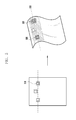
- FIG. 2 is a perspective view illustrating a range of an object to which a method applies when a display is deformed according to an exemplary embodiment of the present invention.
- the controller 190 modifies objects 250, 260, 270 displayed within a shaded area of a range 210 set from the folding line 200.
- the range 210 is used for determining whether to modify the object and is determined with consideration to the perceptibility of the object according to the degree at which the display is bent.
- the set range 210 may have a different value according to the slope at which the display is bent.
- An object 280 displayed outside the set range from the folding line 200 is determined not to be affected by the display deformation and is displayed on the display without any separate modification.
- FIGS. 3 through 7 exemplary embodiments of the screen display methods of the present invention are described.
- all objects shown in FIGS. 3 through 7 are objects that are displayed within the set range from the folding line 200 to be modified according to the present invention.
- FIG. 3 is a perspective view illustrating an exemplary embodiment in which a displayed objected is enlarged according to a method of the present invention.
- the controller 190 may enlarge the size of the object within the set range from the folding line 200 to be displayed.
- the size of the object may be controlled differently according to a degree of deformation of the display and the size of the object is preferably enlarged compared to a general display status so that the user may recognize the object more easily.
- FIG. 4 is a perspective view illustrating an exemplary embodiment in which a displayed objected is moved according to a method of the present invention.
- the controller 190 may move the location of the object within the set range from the folding line 200.
- the object on the folding line 200 may be moved outside the folding line 200.
- the object is moved so as not to be located on the folding line 200, making the object more perceivable to the user.
- Such a location change may be modified by user settings and the controller 190 may determine the location change of the object based not only on whether the object is included within the set range from the folding line 200 but also the slope at which the display is bent and the values detected by other sensors (e.g., a gravity sensor, an acceleration sensor, etc.)
- FIG. 5 is a perspective view illustrating an exemplary embodiment in which the detection range of a displayed object is enlarged or moved according to a method of the present invention.
- the controller 190 may move or enlarge the detection area of the object within the set range from the folding line 200.
- a rectangle shown in a solid line in FIG. 5 indicates an object image such as an icon and the rectangle shown by the dotted line indicates a detection area for detecting an input to select the object.
- the controller 190 due to the screen distortion, moves the detection area of object 530 by correcting a coordinate value thereof to a location where the object may be more accurately perceived to be located.
- the controller 190 enlarges the detection area such that a corresponding object may be selected even when the user touches a neighboring portion of the displayed object.
- FIG. 6 is a perspective view illustrating an exemplary embodiment in which an enlarged object is displayed without a location change according to a method of the present invention.
- the controller 190 may enlarge a displayed character to be displayed without a location change.
- a continuous sentence may be displayed on an entire screen without any margin. Therefore, the controller 190 may enlarge a text in a particular range to be displayed without a location change in order to prevent the perception of other text from being blocked, as shown by 600.
- FIG. 7 is a perspective view illustrating an exemplary embodiment in which an enlarged object is displayed in overlay according to the invention.
- the controller 190 may generate a separate layer to be displayed in a certain area.
- a bent portion may be outside of the field of view of the user. Therefore, in such a case, and as shown in FIG. 7 , it is preferable to display an object in a new area by opening an auxiliary enlarging window 700. Therefore, the controller 190 may overlay the enlarged object in a certain area to be displayed by considering the degree of the display deformation and the type of the object.
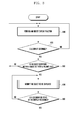
- FIG. 8 is a flowchart illustrating an exemplary embodiment in which an object is modified according to a method of the present invention.
- the controller 190 may display the object on the screen by performing an object display function in step 810.
- the controller 190 determines whether the object is displayed within a set range from the folding line at which deformation is detected at step 850.
- the controller modifies the object to be displayed at step 870. If the displayed object is a distance away from the folding line by a predetermined range, the corresponding object may maintain a display status thereof without modification.
- the range set from the folding line may have a different value according to a slope at which the display is bent.
- the controller 190 may display the object at the location prior to the deformation and return the shape of the object to that prior to the deformation.
- the object displayed on the display refers to an element displayed on the screen such as an icon, a button, an item displayed in a list, or a text, and the like.
- the type of object to which the present invention applies does not have specific limits.
- FIG. 9 is a flowchart illustrating a process of modifying an object to be displayed in a method according to an exemplary embodiment of the present invention.
- step 870 for modifying the object to be displayed may include the following steps.
- the controller 190 may modify a location and/or size of the object to be displayed at step 873.
- the controller may move the displayed object outside the folding line.
- the controller may enlarge or move the detection area at step 877.
- the detection area is an area for detecting an input in order to select the displayed object and in an area set separately from an image of an icon or a button shown on the screen, for example.
- the controller 190 may enlarge or move the detection area so that the input unit may detect the selection input even when the user may not accurately select the object due to the screen distortion.
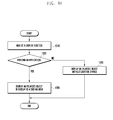
- FIG. 10 is a flowchart for illustrating in detail a process of modifying the size of an object to be displayed in a method according to an exemplary embodiment of the present invention.
- the controller 190 modifies the location and/or size of the object to be displayed, thereby enabling the user to accurately identify the object displayed in the deformed portion.
- the controller 190 may enlarge the size of the object in step 1010.
- the controller 190 determines whether the object is set to be displayed in an overlay at step 1030. When the overlay is set; the enlarged object may be displayed in an overlay in a certain area at step 1050.
- the overlay means generating a separate layer and displaying the separate layer by overlapping an original layer.
- an object displayed in the deformed portion may be difficult to be perceived such that the controller 190 may display the enlarged object in an overlay in an area to be more easily perceived by the user.
- the controller 190 may display the enlarged object without a location change in step 1070. In other words, the controller 190 may enlarge the size of the original object to be displayed without using a separate layer.
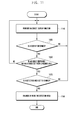
- FIG. 11 is a flowchart illustrating a process of enlarging or moving a detection area in a method according to another exemplary embodiment of the present invention.
- the controller 190 performs an object display function to display an object on the screen at step 1110.
- the controller 190 determines whether the object is displayed within the set range from the folding line at which the deformation is detected in step 1150.
- the controller 190 determines whether the detection area is set to change in step 1170.
- the controller 190 enlarges or moves the detection area, thereby enabling an accurate detection of a selection input of the user at step 1190.
- a user's ability to perceive an object may be maintained even when a display is modified.
- a selection input according to the user's intent may be accurately detected, thereby improving the operability and the overall feel of the flexible display.
- the above-described methods according to the present invention can be implemented in hardware, firmware or as software or computer code that can be stored in a recording medium such as a CD ROM, an RAM, a floppy disk, a hard disk, or a magneto-optical disk or downloaded over a network and stored on a non-transitory machine readable medium, so that the methods described herein can be rendered in such software using a general purpose computer, or a special processor or in programmable or dedicated hardware, such as an ASIC or FPGA.
- the computer, the processor, microprocessor controller or the programmable hardware include memory components, e.g., RAM, ROM, Flash, etc.
Landscapes
- Engineering & Computer Science (AREA)
- Theoretical Computer Science (AREA)
- General Engineering & Computer Science (AREA)
- Physics & Mathematics (AREA)
- General Physics & Mathematics (AREA)
- Human Computer Interaction (AREA)
- Computer Hardware Design (AREA)
- User Interface Of Digital Computer (AREA)
- Controls And Circuits For Display Device (AREA)
Applications Claiming Priority (1)
| Application Number | Priority Date | Filing Date | Title |
|---|---|---|---|
| KR1020120059609A KR20130136065A (ko) | 2012-06-04 | 2012-06-04 | 변형 가능한 디스플레이를 이용한 화면 표시 장치 및 방법 |
Publications (1)
| Publication Number | Publication Date |
|---|---|
| EP2672366A1 true EP2672366A1 (de) | 2013-12-11 |
Family
ID=47563037
Family Applications (1)
| Application Number | Title | Priority Date | Filing Date |
|---|---|---|---|
| EP12196965.3A Withdrawn EP2672366A1 (de) | 2012-06-04 | 2012-12-13 | Vorrichtung und Verfahren zum Anzeigen eines Bildschirms mit flexibler Anzeige |
Country Status (4)
| Country | Link |
|---|---|
| US (1) | US20130321260A1 (de) |
| EP (1) | EP2672366A1 (de) |
| KR (1) | KR20130136065A (de) |
| CN (1) | CN103455255A (de) |
Cited By (1)
| Publication number | Priority date | Publication date | Assignee | Title |
|---|---|---|---|---|
| DE102016125841A1 (de) * | 2016-12-29 | 2018-07-05 | Osram Oled Gmbh | Biegesensor für ein flexibles, organisches, lichtemittierendes bauelement, organische, lichtemittierende baugruppe und verfahren zum betreiben der organischen, lichtemittierenden baugruppe |
Families Citing this family (26)
| Publication number | Priority date | Publication date | Assignee | Title |
|---|---|---|---|---|
| KR20140044227A (ko) * | 2012-10-04 | 2014-04-14 | 삼성전자주식회사 | 플렉서블 디스플레이 장치 및 그의 제어 방법 |
| KR102028157B1 (ko) * | 2012-11-20 | 2019-10-07 | 삼성디스플레이 주식회사 | 플렉서블 터치 스크린 패널 이를 구비한 플렉서블 표시장치 |
| TWI528230B (zh) * | 2012-12-24 | 2016-04-01 | 富智康(香港)有限公司 | 可彎曲式面板的操作控制方法及系統 |
| TWI466089B (zh) * | 2012-12-24 | 2014-12-21 | Ind Tech Res Inst | 軟性顯示裝置的顯示方法與軟性顯示裝置 |
| TW201426545A (zh) * | 2012-12-24 | 2014-07-01 | Fih Hong Kong Ltd | 移動電子設備的休眠與喚醒控制方法及系統 |
| KR102097361B1 (ko) | 2013-02-01 | 2020-04-07 | 삼성디스플레이 주식회사 | 가요성 디스플레이 장치를 구비한 모바일 기기 및 이의 동작 방법 |
| TWI667644B (zh) | 2013-07-19 | 2019-08-01 | 日商半導體能源研究所股份有限公司 | 資料處理裝置 |
| JP2015104016A (ja) * | 2013-11-26 | 2015-06-04 | キヤノン株式会社 | 被写体検出装置、撮像装置、被写体検出装置の制御方法、被写体検出装置の制御プログラムおよび記憶媒体 |
| US20150242083A1 (en) * | 2014-02-27 | 2015-08-27 | Nokia Corporation | Circumferential span region of a virtual screen |
| WO2016010169A1 (ko) * | 2014-07-15 | 2016-01-21 | 엘지전자(주) | 이동 단말기 및 그 제어 방법 |
| CN104123137A (zh) * | 2014-07-21 | 2014-10-29 | 联想(北京)有限公司 | 一种信息处理方法及电子设备 |
| CN105761617A (zh) * | 2014-12-17 | 2016-07-13 | 昆山工研院新型平板显示技术中心有限公司 | 柔性显示屏的变形控制方法和系统 |
| CN104516675B (zh) * | 2014-12-25 | 2017-11-28 | 联想(北京)有限公司 | 一种可折叠屏幕的控制方法及电子设备 |
| CN104461254B (zh) * | 2014-12-29 | 2018-06-01 | 联想(北京)有限公司 | 控制方法及装置 |
| US10423249B2 (en) | 2014-12-29 | 2019-09-24 | Lenovo (Beijing) Co., Ltd. | Information processing method and electronic device |
| CN104932696B (zh) | 2015-06-29 | 2018-01-05 | 上海中航光电子有限公司 | 一种显示图像显示方法 |
| CN104965591B (zh) | 2015-06-29 | 2018-04-03 | 上海中航光电子有限公司 | 一种图像显示方法和系统 |
| CN104933977B (zh) | 2015-06-29 | 2017-10-24 | 上海中航光电子有限公司 | 一种图像显示系统 |
| US10345969B1 (en) * | 2015-10-23 | 2019-07-09 | Rockwell Collins, Inc. | Touch sensor behind emissive displays |
| CN105892664B (zh) * | 2016-03-31 | 2021-05-18 | 联想(北京)有限公司 | 一种信息处理方法及电子设备 |
| WO2017219257A1 (zh) * | 2016-06-21 | 2017-12-28 | 华为技术有限公司 | 具有柔性显示屏的电子设备及其处理方法 |
| CN107807752B (zh) * | 2017-10-27 | 2021-04-02 | 京东方科技集团股份有限公司 | 电子设备、柔性屏及其防误触控装置和方法 |
| CN108182045A (zh) * | 2018-01-31 | 2018-06-19 | 努比亚技术有限公司 | 显示效果的调整方法、移动终端及计算机可读存储介质 |
| CN113168299A (zh) * | 2018-12-29 | 2021-07-23 | 深圳市柔宇科技股份有限公司 | 一种显示控制方法、存储介质及显示终端 |
| CN110430319B (zh) * | 2019-07-17 | 2021-03-30 | 咪咕动漫有限公司 | 一种处理方法、终端及计算机可读存储介质 |
| WO2023191305A1 (ko) | 2022-03-28 | 2023-10-05 | 삼성전자 주식회사 | 플렉서블 디스플레이를 갖는 전자 장치 |
Citations (1)
| Publication number | Priority date | Publication date | Assignee | Title |
|---|---|---|---|---|
| US20080291225A1 (en) * | 2007-05-23 | 2008-11-27 | Motorola, Inc. | Method and apparatus for re-sizing an active area of a flexible display |
Family Cites Families (15)
| Publication number | Priority date | Publication date | Assignee | Title |
|---|---|---|---|---|
| US20040177325A1 (en) * | 2003-03-07 | 2004-09-09 | Keane Robert S. | Edit location indicator |
| US20100045705A1 (en) * | 2006-03-30 | 2010-02-25 | Roel Vertegaal | Interaction techniques for flexible displays |
| US8587539B2 (en) * | 2011-01-21 | 2013-11-19 | Blackberry Limited | Multi-bend display activation adaptation |
| US8669956B2 (en) * | 2011-12-30 | 2014-03-11 | Lg Electronics Inc. | Bending threshold and release for a flexible display device |
| US8963857B2 (en) * | 2012-02-21 | 2015-02-24 | Lg Electronics Inc. | Electronic device and method of controlling the same |
| KR101721046B1 (ko) * | 2012-04-08 | 2017-03-29 | 삼성전자주식회사 | 디스플레이 장치 및 그에 대한 제어 방법 |
| KR101692252B1 (ko) * | 2012-04-08 | 2017-01-04 | 삼성전자주식회사 | 플렉서블 디스플레이 장치 및 제어 방법 |
| CN104254871B (zh) * | 2012-04-23 | 2017-10-27 | 英派尔科技开发有限公司 | 扭曲校正可变形显示器 |
| KR102104588B1 (ko) * | 2012-07-11 | 2020-04-24 | 삼성전자주식회사 | 플렉서블 디스플레이 장치 및 그 동작 방법 |
| KR102088382B1 (ko) * | 2012-09-07 | 2020-03-12 | 삼성전자주식회사 | 애플리케이션 실행 방법, 콘텐트 공유 제어 방법 및 디스플레이 장치 |
| KR20140036499A (ko) * | 2012-09-17 | 2014-03-26 | 삼성전자주식회사 | 플렉서블 디스플레이 장치 및 그의 디스플레이 방법 |
| KR102215080B1 (ko) * | 2012-09-17 | 2021-02-10 | 삼성전자주식회사 | 플렉서블 디스플레이 장치 및 플렉서블 디스플레이 장치의 제어 방법 |
| KR102028717B1 (ko) * | 2012-09-18 | 2019-10-07 | 삼성전자주식회사 | 플렉서블 장치 및 그의 제어 방법 |
| KR20140044227A (ko) * | 2012-10-04 | 2014-04-14 | 삼성전자주식회사 | 플렉서블 디스플레이 장치 및 그의 제어 방법 |
| KR102163740B1 (ko) * | 2012-10-05 | 2020-10-12 | 삼성전자주식회사 | 플렉서블 디스플레이 장치 및 플렉서블 디스플레이 장치의 제어 방법 |
-
2012
- 2012-06-04 KR KR1020120059609A patent/KR20130136065A/ko not_active Withdrawn
- 2012-12-11 US US13/710,755 patent/US20130321260A1/en not_active Abandoned
- 2012-12-13 EP EP12196965.3A patent/EP2672366A1/de not_active Withdrawn
-
2013
- 2013-03-08 CN CN2013100752403A patent/CN103455255A/zh active Pending
Patent Citations (1)
| Publication number | Priority date | Publication date | Assignee | Title |
|---|---|---|---|---|
| US20080291225A1 (en) * | 2007-05-23 | 2008-11-27 | Motorola, Inc. | Method and apparatus for re-sizing an active area of a flexible display |
Cited By (1)
| Publication number | Priority date | Publication date | Assignee | Title |
|---|---|---|---|---|
| DE102016125841A1 (de) * | 2016-12-29 | 2018-07-05 | Osram Oled Gmbh | Biegesensor für ein flexibles, organisches, lichtemittierendes bauelement, organische, lichtemittierende baugruppe und verfahren zum betreiben der organischen, lichtemittierenden baugruppe |
Also Published As
| Publication number | Publication date |
|---|---|
| CN103455255A (zh) | 2013-12-18 |
| US20130321260A1 (en) | 2013-12-05 |
| KR20130136065A (ko) | 2013-12-12 |
Similar Documents
| Publication | Publication Date | Title |
|---|---|---|
| EP2672366A1 (de) | Vorrichtung und Verfahren zum Anzeigen eines Bildschirms mit flexibler Anzeige | |
| KR102284108B1 (ko) | 전자 장치가 외부 디스플레이 장치와 화면을 공유하는 방법 및 전자 장치 | |
| US10282067B2 (en) | Method and apparatus of controlling an interface based on touch operations | |
| US8648816B2 (en) | Information processing apparatus, threshold value setting method, and threshold value setting program | |
| US10282081B2 (en) | Input and output method in touch screen terminal and apparatus therefor | |
| KR102084582B1 (ko) | 화면에 표시된 개체의 크기 조정 방법 및 장치 | |
| US9632690B2 (en) | Method for operating user interface and electronic device thereof | |
| EP2270641A1 (de) | Operationskontrollapparat, Operationskontrollmethode und Computerprogramm | |
| EP2420914A2 (de) | Informationsverarbeitungsvorrichtung, Informationsverarbeitungsverfahren und Programm | |
| EP2757459A1 (de) | Vorrichtung und Verfahren für ein adaptives randloses Anzeigesystem für Mehrfachberührungsvorrichtungen | |
| US10613723B2 (en) | Information processing apparatus, information processing method, and computer program product | |
| US20120013645A1 (en) | Display and method of displaying icon image | |
| KR20130081458A (ko) | 영상 표시 장치에서 응용 프로그램의 레이아웃을 스케일링하기 위한 장치 및 방법 | |
| US20150193112A1 (en) | User interface device, user interface method, and program | |
| US10191630B2 (en) | Graphical interface and method for managing said graphical interface during the touch-selection of a displayed element | |
| EP2141566A3 (de) | Elektronische Vorrichtung mit Anzeige und umgebender berührungsempfindlicher Einfassung für eine Benutzeroberfläche und Steuerung | |
| KR101077308B1 (ko) | 터치패널의 압력센싱 모듈 및 그 작동방법 | |
| CN107704147A (zh) | 功能控件的响应终端、方法及计算机可读存储介质 | |
| US9405403B2 (en) | Control apparatus, operation controlling method and non-transitory computer-readable storage medium | |
| EP2426590A1 (de) | Mobiles Endgerät mit Berührungsbildschirm und Verfahren zur Anzeige von Inhalten darauf | |
| EP2735958A2 (de) | Eingabevorrichtung, Anzeigevorrichtung, Anzeigesystem und Steuerungsverfahren dafür | |
| KR20170043911A (ko) | 전자 장치 및 그 제어 방법 | |
| KR20120023405A (ko) | 사용자 인터페이스 제공 방법 및 장치 | |
| US20140068506A1 (en) | Method and apparatus for setting font size in a mobile terminal having a touch screen | |
| WO2012086133A1 (ja) | タッチパネル装置 |
Legal Events
| Date | Code | Title | Description |
|---|---|---|---|
| PUAI | Public reference made under article 153(3) epc to a published international application that has entered the european phase |
Free format text: ORIGINAL CODE: 0009012 |
|
| AK | Designated contracting states |
Kind code of ref document: A1 Designated state(s): AL AT BE BG CH CY CZ DE DK EE ES FI FR GB GR HR HU IE IS IT LI LT LU LV MC MK MT NL NO PL PT RO RS SE SI SK SM TR |
|
| AX | Request for extension of the european patent |
Extension state: BA ME |
|
| 17P | Request for examination filed |
Effective date: 20140605 |
|
| STAA | Information on the status of an ep patent application or granted ep patent |
Free format text: STATUS: THE APPLICATION HAS BEEN WITHDRAWN |
|
| 18W | Application withdrawn |
Effective date: 20161213 |