EP2672679A1 - Verfahren und Vorrichtung zur Aufrecherhaltung von Routing-Informationen - Google Patents
Verfahren und Vorrichtung zur Aufrecherhaltung von Routing-Informationen Download PDFInfo
- Publication number
- EP2672679A1 EP2672679A1 EP13182545.7A EP13182545A EP2672679A1 EP 2672679 A1 EP2672679 A1 EP 2672679A1 EP 13182545 A EP13182545 A EP 13182545A EP 2672679 A1 EP2672679 A1 EP 2672679A1
- Authority
- EP
- European Patent Office
- Prior art keywords
- nodes
- node
- super maintenance
- information
- routing
- Prior art date
- Legal status (The legal status is an assumption and is not a legal conclusion. Google has not performed a legal analysis and makes no representation as to the accuracy of the status listed.)
- Withdrawn
Links
Images



Classifications
-
- H—ELECTRICITY
- H04—ELECTRIC COMMUNICATION TECHNIQUE
- H04L—TRANSMISSION OF DIGITAL INFORMATION, e.g. TELEGRAPHIC COMMUNICATION
- H04L67/00—Network arrangements or protocols for supporting network services or applications
- H04L67/01—Protocols
- H04L67/10—Protocols in which an application is distributed across nodes in the network
- H04L67/104—Peer-to-peer [P2P] networks
-
- H—ELECTRICITY
- H04—ELECTRIC COMMUNICATION TECHNIQUE
- H04L—TRANSMISSION OF DIGITAL INFORMATION, e.g. TELEGRAPHIC COMMUNICATION
- H04L45/00—Routing or path finding of packets in data switching networks
-
- H—ELECTRICITY
- H04—ELECTRIC COMMUNICATION TECHNIQUE
- H04L—TRANSMISSION OF DIGITAL INFORMATION, e.g. TELEGRAPHIC COMMUNICATION
- H04L45/00—Routing or path finding of packets in data switching networks
- H04L45/02—Topology update or discovery
- H04L45/04—Interdomain routing, e.g. hierarchical routing
-
- H—ELECTRICITY
- H04—ELECTRIC COMMUNICATION TECHNIQUE
- H04L—TRANSMISSION OF DIGITAL INFORMATION, e.g. TELEGRAPHIC COMMUNICATION
- H04L67/00—Network arrangements or protocols for supporting network services or applications
- H04L67/01—Protocols
- H04L67/10—Protocols in which an application is distributed across nodes in the network
- H04L67/104—Peer-to-peer [P2P] networks
- H04L67/1044—Group management mechanisms
- H04L67/1051—Group master selection mechanisms
-
- H—ELECTRICITY
- H04—ELECTRIC COMMUNICATION TECHNIQUE
- H04L—TRANSMISSION OF DIGITAL INFORMATION, e.g. TELEGRAPHIC COMMUNICATION
- H04L67/00—Network arrangements or protocols for supporting network services or applications
- H04L67/01—Protocols
- H04L67/10—Protocols in which an application is distributed across nodes in the network
- H04L67/104—Peer-to-peer [P2P] networks
- H04L67/1087—Peer-to-peer [P2P] networks using cross-functional networking aspects
- H04L67/1093—Some peer nodes performing special functions
Definitions
- the present invention relates to the field of Peer-to-Peer (P2P) technologies, and in particular, to a method and an apparatus for maintaining routing information.
- P2P Peer-to-Peer
- a P2P network is a self-organized network system that nodes join or leave at random. Therefore, when a node joins or leaves the system, the system must update the routing information maintained by every node so that the routing is restored and that queries are reliable.
- the prior arts are generally based on a broadcast mechanism.
- a node joins the P2P system or fails, the system sends a broadcast message to notify all nodes in the network to update routing information.
- This mechanism is simple but has an obvious weakness: a large bandwidth is required, and when a certain number of nodes fail simultaneously, a network storm is likely to occur, which will result in a system crash.
- Embodiments of the present invention provide a method and apparatus for maintaining routing information so as to reduce the overhead incurred in the process of route maintenance.
- a method for choosing nodes includes:
- An apparatus for choosing nodes includes:
- a method for maintaining routing information includes:
- a method for maintaining routing information includes:
- a super maintenance node includes:
- a system for maintaining routing information includes a first ordinary node, a first super maintenance node, a second ordinary node, a third super maintenance node, a fourth ordinary node, a fourth super maintenance node and a fifth ordinary node, where:
- Another system for maintaining routing information includes a first ordinary node, a first super maintenance node, a second ordinary node, a second super maintenance node, and a third ordinary node, where:
- the method and apparatus for maintaining routing information in a P2P network in the embodiments of the present invention fully utilize nodes of strong processing capabilities at a network area border in the P2P system to enable such nodes to act as maintenance nodes, which are responsible for notifying ordinary nodes in their home network areas of received routing update information, and forwarding routing update information of their home network areas to super maintenance nodes in other network areas.
- maintenance nodes which are responsible for notifying ordinary nodes in their home network areas of received routing update information, and forwarding routing update information of their home network areas to super maintenance nodes in other network areas.
- routing update information of different network areas is only transferred between super maintenance nodes, and forwarded by super maintenance nodes to all nodes in the network, so as to significantly reduce the inter-area routing table maintenance overhead in the P2P network incurred by the change of nodes.
- a node of strong processing capabilities located at the network edge is chosen to act as a super maintenance node, which is responsible for forwarding routing update messages from its local network area to other network areas. In this way, inter-area traffic of routing information is reduced while the routing table is updated in time.
- the system chooses a node of strong processing capabilities located at the network border as a super maintenance node and other nodes as ordinary nodes; according to geographic information of the nodes, nodes near to the super maintenance node are grouped into one network area; when a node joins or fails, an ordinary node sends a detected routing update message only to the super maintenance node of the local network area; the super maintenance node notifies all nodes in the local network area of the routing update message.
- routing update messages of different network areas are only transferred between super maintenance nodes, and then forwarded by super maintenance nodes to all nodes in the network, so as to significantly reduce the inter-area routing table maintenance overhead in the P2P network.
- the super maintenance node referred to in the embodiment is a node of strong processing capabilities located at the border of a network area; the processing capabilities refer to the egress bandwidth or computing capability, or hard disk size, or memory size. For example, a node with a memory size larger than 4 GB is a super maintenance node.
- Nodes maintained by the super maintenance node may be:
- nodes near to the super maintenance node are grouped into one network area according to geographic information of the nodes and the super maintenance node is responsible for updating routing information of all nodes in the network area.
- the area to be maintained by the super maintenance node is defined according to geographic relations. For example, the super maintenance node and ordinary nodes within a province are grouped into one network area. Optionally, network areas are grouped according to the delay information between ordinary nodes and the super maintenance node. For example, ordinary nodes that have a transmission delay shorter than 20 ms with the super maintenance node are grouped into one network area.
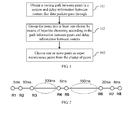
- FIG. 1 shows a method for choosing super maintenance nodes according to an embodiment of the present invention. The method includes the following steps:
- the method may determine a certain number of destination nodes among multiple nodes chosen from the system, execute the TraceRoute command, and process the returned trace results to obtain routing information between the nodes and delay information between routers that packets pass through.
- the TraceRoute command is a tool provided by the computer operating system, configured to obtain a list of router addresses that a packet passes through before it arrives at the destination node and the time when the packet reaches each router.
- the TraceRoute command may be executed by every node in the system by taking a number of other nodes as destination nodes so as to obtain the routing path between the nodes and the delay information between the routers in the path. For example, for every node in the system, two other nodes are chosen as the destination nodes, and the TraceRoute command is executed on every node. The chosen number of destination nodes is alterable as required, so long as the entire system is covered.
- the TraceRoute command may be executed on some nodes of strong capabilities or some special computers or servers by taking all nodes in the system as destination nodes.
- FIG. 2 illustrates how super maintenance nodes are chosen automatically according to an embodiment of the present invention.
- the TraceRoute command is executed to obtain the delay between router R1 and router R2 as 5 ms and the delay between R3 and R4 as 100 ms.
- Step 102 Group the nodes into at least one cluster by means of bipartite clustering according to the path information between nodes and delay information between routers.
- the node performs bipartite clustering according to the obtained path information and delay information between routers to obtain two sets of large delay and small delay. Addresses of all routers whose previous hop delay is small but the next hop delay is large along the path beginning with the node are regarded as identifiers of the home area of the node and such routers are called routers located at the network area border.
- the node registers these identifiers and information of the node itself into a Distributed Hash Table (DHT) or a certain data storage location.
- DHT Distributed Hash Table
- the system then clusters nodes that have the same area identifier. In this way, the multiple nodes in the system will be grouped into multiple clusters and each cluster makes up a network area.
- DHT Distributed Hash Table
- R3 is a first-level home area identifier of the node (comparable to "county”) and therefore all nodes whose home area identifier is the address of R3 are grouped into one cluster
- R5 is a second-level home area identifier of the node (comparable to "province”) and therefore all nodes whose home area identifier is the address of R5 are grouped into one cluster.
- Step 103 Choose one or more nodes, from the cluster of nodes, as super maintenance nodes.
- an apparatus for choosing super maintenance nodes is provided in an embodiment of the present invention.
- the apparatus is implemented based on the above method and may be placed in a node, or a server, or any other telecommunication device.
- FIG. 3 shows an apparatus for automatically choosing super maintenance nodes in an embodiment of the present invention.
- the apparatus includes:
- the probing unit 31 includes:
- a higher level super maintenance node may be chosen to manage multiple super maintenance nodes so that a map of grades is created where a super maintenance node of a higher grade manages multiple super maintenance nodes of a lower grade.
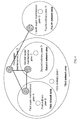
- FIG. 4 illustrates how a multi-level hierarchy of super maintenance nodes is constructed.
- a first network area includes a first super maintenance node A and a first ordinary node B; a second network area includes a second super maintenance node C and a second ordinary node D; a third network area includes a third super maintenance node E and a third ordinary node F, and contains the first network area and the second network area; a fourth network area includes a fourth super maintenance node G and a fourth ordinary node H.
- the third super maintenance node E forms a tree-like hierarchy with the first super maintenance node A and the second super maintenance node C and telecommunication connections are set up between them; a telecommunication connection is set up between the third super maintenance node E and the fourth super maintenance node G.
- a method for maintaining routing information by super maintenance nodes includes the following steps.
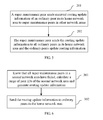
- FIG. 5 is a flowchart of the method for maintaining routing information by super maintenance nodes.
- Step 201 A super maintenance node obtains routing update information of an ordinary node in its home network area and sends the routing update information to super maintenance nodes in other network areas according to the routing update information.
- the ordinary node may send the routing update information to the super maintenance node in the local area and the super maintenance node receives the routing update information.
- the super maintenance node may obtain the routing update information from the ordinary node upon reception of a routing update notification from the ordinary node.
- the ordinary node When it is necessary to send a message to the super maintenance node, the ordinary node obtains the address of the super maintenance node in the home area.
- the ordinary node may obtain the address of the super maintenance node in the home area by multiple means.
- the super maintenance node registers its node ID, IP address, and hierarchical relations in a DHT and the ordinary node may query the DHT to obtain information of a super maintenance node in the P2P system, including the address of the super maintenance node.
- the super maintenance node may register in a public address by another means.
- the super maintenance node registers in a Domain Name System (DNS) or a database.
- DNS Domain Name System
- the ordinary node obtains the address of the super maintenance node from the DNS or database according to the registered name.
- the super maintenance node may register as an IP Anycast group member.
- the ordinary node initiates an Anycast request and a router returns information of the super maintenance node in its home area.
- the address of the super maintenance node in the home network area may be configured manually for the ordinary node.
- Step 202 A super maintenance node that receives the routing update information notifies ordinary nodes in its local network area to update routing information.
- the super maintenance node may send the updated routing information to ordinary nodes in the local area.
- the super maintenance node may send a routing update notification to the ordinary nodes according to the routing update information, and upon reception of the routing update notification, the ordinary nodes obtain the new routing information from the super maintenance node.
- the super maintenance node may send the routing update information by means of broadcast or spread the routing update information gradually by means of parallel multicast to ordinary nodes in the home network area.
- FIG. 6 shows another method for maintaining routing information according to an embodiment of the present invention. The method includes:
- the routing update information includes the ID range of failed nodes.
- Step 302 The super maintenance node in the first network area notifies ordinary nodes in its home area to update routing information.
- the super maintenance node may send the updated routing information to ordinary nodes in the local area.
- the super maintenance node may send a routing update notification to the ordinary nodes according to the routing update information, and upon reception of the routing update notification, the ordinary nodes obtain the new routing information from the super maintenance node.
- the super maintenance node may send the routing update information by means of broadcast or spread the routing update information gradually by means of parallel multicast to ordinary nodes in the home network area.
- the super maintenance node may obtain the range of node IDs of the home area of the failed super maintenance nodes according to the method for constructing a node ID that carries geographic location information and send the routing information of failed nodes within the range to ordinary nodes in its home network area at a time. In this way, the maintenance overhead incurred by sending routing update information of nodes in the failed network area one by one is largely reduced.
- An embodiment of the present invention provides a method for constructing node IDs that carry geographic location information.
- the method includes:
- a node will announce its geographic location when it joins the network. Therefore, the geographic location of the node can be obtained.
- Step 402 Determine the ID hash space of the node by means of striping.
- Step 403 Choose a hash value from the hash space randomly and construct a node ID with the hash value while considering other attributes of the node.
- the hash value chosen randomly from the hash space may be a portion of the node ID, for example, as a prefix, or a suffix, or a key field.
- FIG. 7 shows the method for choosing a node ID by means of striping in steps 402 and 403, where each area is represented by a stripe in a different color in the figure and the entire hash space is divided into N stripes. Each stripe is further divided into m entries (the value of m is the number of areas).
- a node in an area chooses an entry of the area randomly as a prefix (or suffix or key field) of the node ID.
- the node constructs the final node ID while considering other attributes of the node. In this way, a node ID with even division of a hash space according to geographic locations is implemented so that nodes in a large area are approximately distributed to entries via striping. The larger the area is, the more widely the nodes will be distributed.
- Shenzhen belongs to area B.
- the node will choose a stripe from the hash space randomly and find the hash range entry of area B in the stripe, and choose a hash value randomly from the hash range as a prefix (or suffix or key field) of its node ID.
- the node constructs the final node ID while considering other attributes of the node.
- striping scheme for ID construction the geographic location of a node will be deduced inversely according to a key field in the node ID and a striping rule. Therefore, the location of a user is known from its node ID.
- the process of constructing a node ID may be completed by the node or uniformly by a central server and the node requests allocation from the central server.
- a system for maintaining routing information is provided in an embodiment of the present invention.
- the system is implemented on the basis of the foregoing method.
- a structure of the system is shown in FIG. 8 , including: a first ordinary node, a first super maintenance node, a second ordinary node, a third super maintenance node, a fourth ordinary node, a fourth super maintenance node and a fifth ordinary node.
- the first super maintenance node is a super maintenance node in the home network area of the first ordinary node and the second ordinary node;
- the third super maintenance node is a super maintenance node in the home network area of the fourth ordinary node;
- the fourth super maintenance node is a super maintenance node in the home network area of the fifth ordinary node.
- the first ordinary node generates routing update information and sends the information to the first super maintenance node.
- the first super maintenance node receives the routing update information from the first ordinary node and sends routing update information to the third super maintenance node and the second ordinary node according to the routing update information.
- the second ordinary node receives the routing update information from the first super maintenance node and updates routing information according to the received routing update information.
- the third super maintenance node receives the routing update information from the first super maintenance node and sends routing update information to the fourth ordinary node and the fourth super maintenance node according to the routing update information.
- the fourth ordinary node receives the routing update information from the third super maintenance node and updates routing information according to the received routing update information.
- the fourth super maintenance node receives the routing update information from the third super maintenance node and sends routing update information to the fifth ordinary node according to the routing update information.
- the fifth ordinary node receives the routing update information from the fourth super maintenance node and updates routing information according to the received routing update information.
- FIG. 8 A structure of the system is shown in FIG. 8 , including: a first ordinary node, a first super maintenance node, a second ordinary node, a second super maintenance node, and a third ordinary node.
- the first super maintenance node is a super maintenance node in the home network area of the first ordinary node and the second ordinary node; the second super maintenance node is a super maintenance node in the home network area of the third ordinary node.
- the first ordinary node generates routing update information and sends the information to the first super maintenance node.
- the first super maintenance node receives the routing update information from the first ordinary node and sends routing update information to the second super maintenance node and the second ordinary node according to the routing update information.
- the second ordinary node receives the routing update information from the first super maintenance node and updates routing information according to the received routing update information.
- the second super maintenance node receives the routing update information from the first super maintenance node and sends routing update information to the third ordinary node according to the routing update information.
- the third ordinary node receives the routing update information from the second super maintenance node and updates routing information according to the received routing update information.
- the super maintenance node includes:
- the routing update information in one network area is uniformly forwarded by a super maintenance node to super maintenance nodes in other network areas or ordinary nodes in the home network area.
- inter-area routing update information is transferred only between super maintenance nodes so as to significantly reduce the inter-area routing table maintenance overhead incurred by the change of nodes in the P2P network.
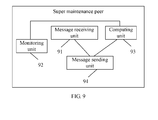
- FIG. 9 shows another super maintenance node in an embodiment of the present invention.
- the super maintenance node includes:
- a super maintenance node monitors all super maintenance nodes in other network areas. When all super maintenance nodes in another network area have failed, the super maintenance node is able to generate routing update information for the range that covers the failed node IDs and send the routing information of the failed nodes in the range to all ordinary nodes in the home network area at a time. In this way, the maintenance overhead incurred by sending routing update information of nodes in the failed network area one by one is largely reduced.
- the method and apparatus for maintaining routing information in the embodiments of the present invention fully utilize nodes of strong processing capabilities at the network area border in a P2P system to enable such nodes to act as super maintenance nodes, which are responsible for notifying ordinary nodes in the home network area of received routing update information and forwarding routing update information of the home network area to super maintenance nodes in other network areas.
- super maintenance nodes which are responsible for notifying ordinary nodes in the home network area of received routing update information and forwarding routing update information of the home network area to super maintenance nodes in other network areas.
- routing update information of different network areas is only transferred between super maintenance nodes, and forwarded by the super maintenance nodes to all nodes in the network, so as to significantly reduce the inter-area routing table maintenance overhead in the P2P network incurred by the change of nodes.
- the present invention may be implemented through hardware or through software plus a necessary universal hardware platform.
- the technical solution of the present invention may be made into software.
- the software may be stored in a non-volatile storage medium (for example, a CD-ROM, a USB disk, and a mobile hard disk), and include several notifications that instruct a computer device (such as a personal computer, a server, or a network device) to perform the methods provided in each embodiment of the present invention.
Landscapes
- Engineering & Computer Science (AREA)
- Computer Networks & Wireless Communication (AREA)
- Signal Processing (AREA)
- Computing Systems (AREA)
- Physics & Mathematics (AREA)
- Mathematical Physics (AREA)
- Theoretical Computer Science (AREA)
- Data Exchanges In Wide-Area Networks (AREA)
Applications Claiming Priority (2)
| Application Number | Priority Date | Filing Date | Title |
|---|---|---|---|
| CN2008100653642A CN101505263B (zh) | 2008-02-05 | 2008-02-05 | 一种选择超级维护节点的方法及装置 |
| EP09710044.0A EP2230802B1 (de) | 2008-02-05 | 2009-02-01 | Ein verfahren und gerät zur erhaltung von streckeninformation |
Related Parent Applications (2)
| Application Number | Title | Priority Date | Filing Date |
|---|---|---|---|
| EP09710044.0A Division-Into EP2230802B1 (de) | 2008-02-05 | 2009-02-01 | Ein verfahren und gerät zur erhaltung von streckeninformation |
| EP09710044.0 Division | 2009-02-01 |
Publications (1)
| Publication Number | Publication Date |
|---|---|
| EP2672679A1 true EP2672679A1 (de) | 2013-12-11 |
Family
ID=40956658
Family Applications (2)
| Application Number | Title | Priority Date | Filing Date |
|---|---|---|---|
| EP09710044.0A Active EP2230802B1 (de) | 2008-02-05 | 2009-02-01 | Ein verfahren und gerät zur erhaltung von streckeninformation |
| EP13182545.7A Withdrawn EP2672679A1 (de) | 2008-02-05 | 2009-02-01 | Verfahren und Vorrichtung zur Aufrecherhaltung von Routing-Informationen |
Family Applications Before (1)
| Application Number | Title | Priority Date | Filing Date |
|---|---|---|---|
| EP09710044.0A Active EP2230802B1 (de) | 2008-02-05 | 2009-02-01 | Ein verfahren und gerät zur erhaltung von streckeninformation |
Country Status (5)
| Country | Link |
|---|---|
| US (1) | US8732298B2 (de) |
| EP (2) | EP2230802B1 (de) |
| CN (1) | CN101505263B (de) |
| ES (1) | ES2523615T3 (de) |
| WO (1) | WO2009100671A1 (de) |
Families Citing this family (21)
| Publication number | Priority date | Publication date | Assignee | Title |
|---|---|---|---|---|
| CN101505263B (zh) | 2008-02-05 | 2011-10-26 | 华为技术有限公司 | 一种选择超级维护节点的方法及装置 |
| US9712423B1 (en) * | 2010-09-27 | 2017-07-18 | Rockwell Collins, Inc. | Routing protocol for an interconnection network |
| CN102195881B (zh) * | 2011-04-25 | 2016-12-07 | 南京中兴软件有限责任公司 | 一种端口信息更新的方法、装置及系统 |
| CN103139081B (zh) * | 2011-11-28 | 2017-08-11 | 中兴通讯股份有限公司 | 分布式哈希表路由表更新方法及节点 |
| EP2807574A4 (de) | 2012-01-24 | 2015-11-18 | L 3 Comm Corp | Verfahren und vorrichtung zur verwaltung von netzwerkverkehr |
| CN102845036B (zh) * | 2012-02-06 | 2016-01-27 | 华为技术有限公司 | 一种在分布式集群系统中传播节点状态信息的方法及系统 |
| US9774527B2 (en) | 2012-08-31 | 2017-09-26 | Nasdaq Technology Ab | Resilient peer-to-peer application message routing |
| US9207868B2 (en) | 2012-10-18 | 2015-12-08 | International Business Machines Corporation | Validation of storage arrays based on information stored in global metadata |
| US9244621B2 (en) | 2012-10-18 | 2016-01-26 | International Business Machines Corporation | Global data establishment for storage arrays controlled by a plurality of nodes |
| CN104093181B (zh) * | 2014-07-10 | 2017-09-12 | 北京邮电大学 | 内容中心多跳蜂窝网络路由方法及装置 |
| US10285110B2 (en) | 2014-11-04 | 2019-05-07 | At&T Intellectual Property I, L.P. | Intelligent traffic routing |
| WO2016122714A1 (en) * | 2015-01-30 | 2016-08-04 | Hewlett Packard Enterprise Development Lp | Job scheduling in an infiniband network based hpc cluster |
| US10447778B2 (en) * | 2015-04-17 | 2019-10-15 | Extreme Networks, Inc. | Synchronizing peer nodes of a multi-chassis switching cluster |
| US10230634B2 (en) * | 2015-09-25 | 2019-03-12 | Osram Sylvania Inc. | Route optimization using star-mesh hybrid topology in localized dense ad-hoc networks |
| CA2922449C (en) | 2015-09-25 | 2024-04-30 | Osram Sylvania Inc. | Route optimization using star-mesh hybrid topology in localized dense ad-hoc networks |
| CN106817261B (zh) * | 2017-02-06 | 2019-09-06 | 北京邮电大学 | 一种用于ndn网络的路由信息更新方法、装置及系统 |
| CN108495249B (zh) * | 2018-02-05 | 2019-12-03 | 西安电子科技大学 | 基于位置信息低功耗的自组网路由方法 |
| CN109743253A (zh) * | 2018-12-29 | 2019-05-10 | 杭州趣链科技有限公司 | 一种融合地理位置的分布式哈希表路由方法 |
| CN113259393B (zh) * | 2021-06-28 | 2021-09-24 | 北京华云安信息技术有限公司 | 基于多级节点的数据转发方法和装置 |
| US12177094B2 (en) | 2023-02-02 | 2024-12-24 | Bank Of America Corporation | System and method for servicing requests in a decentralized network |
| CN117395191B (zh) * | 2023-12-08 | 2024-04-09 | 北京华瀛安盛科技发展有限公司 | 覆盖网络的路由寻址方法及设备 |
Citations (2)
| Publication number | Priority date | Publication date | Assignee | Title |
|---|---|---|---|---|
| WO2001082678A2 (en) * | 2000-05-02 | 2001-11-08 | Sun Microsystems, Inc. | Cluster membership monitor |
| US20070050497A1 (en) * | 2005-08-29 | 2007-03-01 | Haley Michael R | System and method for detecting status changes in a network using virtual coordinate mapping |
Family Cites Families (17)
| Publication number | Priority date | Publication date | Assignee | Title |
|---|---|---|---|---|
| US6980537B1 (en) * | 1999-11-12 | 2005-12-27 | Itt Manufacturing Enterprises, Inc. | Method and apparatus for communication network cluster formation and transmission of node link status messages with reduced protocol overhead traffic |
| US7376121B2 (en) | 2003-06-06 | 2008-05-20 | Microsoft Corporation | Method and system for global routing and bandwidth sharing |
| US7644167B2 (en) | 2004-01-30 | 2010-01-05 | Hewlett-Packard Development Company, L.P. | Identifying a service node in a network |
| US7827279B2 (en) * | 2004-01-30 | 2010-11-02 | Hewlett-Packard Development Company, L.P. | Selecting nodes close to another node in a network using location information for the nodes |
| US7673143B1 (en) * | 2004-02-24 | 2010-03-02 | Sun Microsystems, Inc. | JXTA rendezvous as certificate of authority |
| EP1751935B1 (de) * | 2004-05-20 | 2009-01-07 | Alcatel Lucent | Offener mechanismus für das auffinden von diensten und das routing zum konfigurieren von cross-domain-telekommunikationsdiensten |
| GB2420257B (en) * | 2004-11-16 | 2007-12-12 | Vodafone Plc | Facilitating distribution of information in a network |
| US7701900B2 (en) | 2005-02-03 | 2010-04-20 | Control4 Corporation | Device discovery and channel selection in a wireless networking environment |
| CN100479415C (zh) | 2005-06-06 | 2009-04-15 | 腾讯科技(深圳)有限公司 | 一种实现数据通讯的系统及其方法 |
| CN1845524A (zh) * | 2006-05-18 | 2006-10-11 | 北京邮电大学 | 采用小区动态划分技术的对等网络系统实现方法 |
| CN101079783A (zh) * | 2006-05-27 | 2007-11-28 | 腾讯科技(深圳)有限公司 | 一种p2p网络中建立p2p通道的方法 |
| CN1852381B (zh) * | 2006-05-30 | 2011-06-22 | 四川长虹电器股份有限公司 | 多媒体通信方法 |
| CN100525210C (zh) * | 2006-06-26 | 2009-08-05 | 华为技术有限公司 | 域管理器系统、获知相邻域管理器及进行更新的方法 |
| CN100496006C (zh) * | 2007-02-02 | 2009-06-03 | 华为技术有限公司 | 选举超级节点、搜索网络节点或资源的方法、装置及系统 |
| CN101316224B (zh) * | 2007-05-30 | 2010-12-08 | 华为技术有限公司 | 建立对等体聚类的实现方法、对等体通信方法及p2p网络对等体 |
| CN101505263B (zh) | 2008-02-05 | 2011-10-26 | 华为技术有限公司 | 一种选择超级维护节点的方法及装置 |
| CN102123100B (zh) | 2008-02-05 | 2013-06-12 | 华为技术有限公司 | 一种维护路由信息的方法及装置 |
-
2008
- 2008-02-05 CN CN2008100653642A patent/CN101505263B/zh not_active Expired - Fee Related
-
2009
- 2009-02-01 EP EP09710044.0A patent/EP2230802B1/de active Active
- 2009-02-01 EP EP13182545.7A patent/EP2672679A1/de not_active Withdrawn
- 2009-02-01 ES ES09710044.0T patent/ES2523615T3/es active Active
- 2009-02-01 WO PCT/CN2009/070328 patent/WO2009100671A1/zh not_active Ceased
-
2010
- 2010-07-12 US US12/834,239 patent/US8732298B2/en active Active
Patent Citations (2)
| Publication number | Priority date | Publication date | Assignee | Title |
|---|---|---|---|---|
| WO2001082678A2 (en) * | 2000-05-02 | 2001-11-08 | Sun Microsystems, Inc. | Cluster membership monitor |
| US20070050497A1 (en) * | 2005-08-29 | 2007-03-01 | Haley Michael R | System and method for detecting status changes in a network using virtual coordinate mapping |
Non-Patent Citations (1)
| Title |
|---|
| YU ET AL: "CBT: A proximity-aware peer clustering system in large-scale BitTorrent-like peer-to-peer networks", COMPUTER COMMUNICATIONS, ELSEVIER SCIENCE PUBLISHERS BV, AMSTERDAM, NL, vol. 31, no. 3, 31 January 2008 (2008-01-31), pages 591 - 602, XP022442389, ISSN: 0140-3664, DOI: 10.1016/J.COMCOM.2007.08.020 * |
Also Published As
| Publication number | Publication date |
|---|---|
| US8732298B2 (en) | 2014-05-20 |
| EP2230802A4 (de) | 2011-01-05 |
| US20100281163A1 (en) | 2010-11-04 |
| EP2230802B1 (de) | 2014-09-10 |
| WO2009100671A1 (zh) | 2009-08-20 |
| CN101505263B (zh) | 2011-10-26 |
| CN101505263A (zh) | 2009-08-12 |
| ES2523615T3 (es) | 2014-11-27 |
| EP2230802A1 (de) | 2010-09-22 |
Similar Documents
| Publication | Publication Date | Title |
|---|---|---|
| US8732298B2 (en) | Method and apparatus for maintaining routing information | |
| CN102714665B (zh) | 用于分解对等网络并且使用分解的对等网络的方法和设备 | |
| US8675672B1 (en) | Hierarchical cluster tree overlay network | |
| WO2011113289A1 (zh) | 一种业务路由方法和业务网络 | |
| Hemmati et al. | A new approach to name-based link-state routing for information-centric networks | |
| CN105721301B (zh) | 支持可信度分级的路由计算方法 | |
| Ariefianto et al. | Routing in NDN network: A survey and future perspectives | |
| WO2009100637A1 (zh) | 一种建立路由的方法和装置 | |
| Torres et al. | Evaluating CRoS-NDN: A comparative performance analysis of a controller-based routing scheme for named-data networking | |
| CN102123100B (zh) | 一种维护路由信息的方法及装置 | |
| Jain et al. | Viro: A scalable, robust and namespace independent virtual id routing for future networks | |
| Maniymaran et al. | Build one, get one free: Leveraging the coexistence of multiple p2p overlay networks | |
| US8437274B2 (en) | Discovery of disconnected components in a distributed communication network | |
| Leong et al. | Achieving one-hop dht lookup and strong stabilization by passing tokens | |
| Singh et al. | Address allocation for MANET merge and partition using cluster based routing | |
| Gottron et al. | A cluster-based locality-aware mobile peer-to-peer architecture | |
| Wu et al. | k-Anycast routing schemes for mobile ad hoc networks | |
| Masdari et al. | A survey and taxonomy of name systems in mobile ad hoc networks | |
| WO2011150741A1 (zh) | P2p叠加网络及其数据资源操作方法和新节点加入方法 | |
| Stiemerling et al. | Application-layer traffic optimization (ALTO) deployment considerations | |
| Confais et al. | SToN: A New Fundamental Trade-off for Distributed Data Storage Systems | |
| Azgin et al. | Hash-based overlay routing architecture for information centric networks | |
| Warneke et al. | Load balancing in p2p networks: Using statistics to fight data and execution skew | |
| Czirkos et al. | Enhancing the kademlia p2p network | |
| Misra et al. | Dividing PKI in strongest availability zones |
Legal Events
| Date | Code | Title | Description |
|---|---|---|---|
| PUAI | Public reference made under article 153(3) epc to a published international application that has entered the european phase |
Free format text: ORIGINAL CODE: 0009012 |
|
| 17P | Request for examination filed |
Effective date: 20130902 |
|
| AC | Divisional application: reference to earlier application |
Ref document number: 2230802 Country of ref document: EP Kind code of ref document: P |
|
| AK | Designated contracting states |
Kind code of ref document: A1 Designated state(s): AT BE BG CH CY CZ DE DK EE ES FI FR GB GR HR HU IE IS IT LI LT LU LV MC MK MT NL NO PL PT RO SE SI SK TR |
|
| STAA | Information on the status of an ep patent application or granted ep patent |
Free format text: STATUS: THE APPLICATION HAS BEEN WITHDRAWN |
|
| 18W | Application withdrawn |
Effective date: 20140210 |