EP2673006B1 - Procédé de préparation de nanoparticules d'oxyde de fer enrobées d'une matière hydrophile et agent de contraste d'imagerie par résonance magnétique les utilisant - Google Patents
Procédé de préparation de nanoparticules d'oxyde de fer enrobées d'une matière hydrophile et agent de contraste d'imagerie par résonance magnétique les utilisant Download PDFInfo
- Publication number
- EP2673006B1 EP2673006B1 EP12744201.0A EP12744201A EP2673006B1 EP 2673006 B1 EP2673006 B1 EP 2673006B1 EP 12744201 A EP12744201 A EP 12744201A EP 2673006 B1 EP2673006 B1 EP 2673006B1
- Authority
- EP
- European Patent Office
- Prior art keywords
- iron oxide
- oxide nanoparticles
- dextran
- nanoparticles
- coated
- Prior art date
- Legal status (The legal status is an assumption and is not a legal conclusion. Google has not performed a legal analysis and makes no representation as to the accuracy of the status listed.)
- Active
Links
Images





Classifications
-
- A—HUMAN NECESSITIES
- A61—MEDICAL OR VETERINARY SCIENCE; HYGIENE
- A61K—PREPARATIONS FOR MEDICAL, DENTAL OR TOILETRY PURPOSES
- A61K49/00—Preparations for testing in vivo
- A61K49/06—Nuclear magnetic resonance [NMR] contrast preparations; Magnetic resonance imaging [MRI] contrast preparations
- A61K49/18—Nuclear magnetic resonance [NMR] contrast preparations; Magnetic resonance imaging [MRI] contrast preparations characterised by a special physical form, e.g. emulsions, microcapsules, liposomes
- A61K49/1818—Nuclear magnetic resonance [NMR] contrast preparations; Magnetic resonance imaging [MRI] contrast preparations characterised by a special physical form, e.g. emulsions, microcapsules, liposomes particles, e.g. uncoated or non-functionalised microparticles or nanoparticles
- A61K49/1821—Nuclear magnetic resonance [NMR] contrast preparations; Magnetic resonance imaging [MRI] contrast preparations characterised by a special physical form, e.g. emulsions, microcapsules, liposomes particles, e.g. uncoated or non-functionalised microparticles or nanoparticles coated or functionalised microparticles or nanoparticles
- A61K49/1824—Nuclear magnetic resonance [NMR] contrast preparations; Magnetic resonance imaging [MRI] contrast preparations characterised by a special physical form, e.g. emulsions, microcapsules, liposomes particles, e.g. uncoated or non-functionalised microparticles or nanoparticles coated or functionalised microparticles or nanoparticles coated or functionalised nanoparticles
- A61K49/1827—Nuclear magnetic resonance [NMR] contrast preparations; Magnetic resonance imaging [MRI] contrast preparations characterised by a special physical form, e.g. emulsions, microcapsules, liposomes particles, e.g. uncoated or non-functionalised microparticles or nanoparticles coated or functionalised microparticles or nanoparticles coated or functionalised nanoparticles having a (super)(para)magnetic core, being a solid MRI-active material, e.g. magnetite, or composed of a plurality of MRI-active, organic agents, e.g. Gd-chelates, or nuclei, e.g. Eu3+, encapsulated or entrapped in the core of the coated or functionalised nanoparticle
- A61K49/1851—Nuclear magnetic resonance [NMR] contrast preparations; Magnetic resonance imaging [MRI] contrast preparations characterised by a special physical form, e.g. emulsions, microcapsules, liposomes particles, e.g. uncoated or non-functionalised microparticles or nanoparticles coated or functionalised microparticles or nanoparticles coated or functionalised nanoparticles having a (super)(para)magnetic core, being a solid MRI-active material, e.g. magnetite, or composed of a plurality of MRI-active, organic agents, e.g. Gd-chelates, or nuclei, e.g. Eu3+, encapsulated or entrapped in the core of the coated or functionalised nanoparticle having a (super)(para)magnetic core coated or functionalised with an organic macromolecular compound, i.e. oligomeric, polymeric, dendrimeric organic molecule
- A61K49/1857—Nuclear magnetic resonance [NMR] contrast preparations; Magnetic resonance imaging [MRI] contrast preparations characterised by a special physical form, e.g. emulsions, microcapsules, liposomes particles, e.g. uncoated or non-functionalised microparticles or nanoparticles coated or functionalised microparticles or nanoparticles coated or functionalised nanoparticles having a (super)(para)magnetic core, being a solid MRI-active material, e.g. magnetite, or composed of a plurality of MRI-active, organic agents, e.g. Gd-chelates, or nuclei, e.g. Eu3+, encapsulated or entrapped in the core of the coated or functionalised nanoparticle having a (super)(para)magnetic core coated or functionalised with an organic macromolecular compound, i.e. oligomeric, polymeric, dendrimeric organic molecule the organic macromolecular compound being obtained otherwise than by reactions only involving carbon-to-carbon unsaturated bonds, e.g. PLGA
- A61K49/186—Nuclear magnetic resonance [NMR] contrast preparations; Magnetic resonance imaging [MRI] contrast preparations characterised by a special physical form, e.g. emulsions, microcapsules, liposomes particles, e.g. uncoated or non-functionalised microparticles or nanoparticles coated or functionalised microparticles or nanoparticles coated or functionalised nanoparticles having a (super)(para)magnetic core, being a solid MRI-active material, e.g. magnetite, or composed of a plurality of MRI-active, organic agents, e.g. Gd-chelates, or nuclei, e.g. Eu3+, encapsulated or entrapped in the core of the coated or functionalised nanoparticle having a (super)(para)magnetic core coated or functionalised with an organic macromolecular compound, i.e. oligomeric, polymeric, dendrimeric organic molecule the organic macromolecular compound being obtained otherwise than by reactions only involving carbon-to-carbon unsaturated bonds, e.g. PLGA the organic macromolecular compound being polyethyleneglycol [PEG]
-
- A—HUMAN NECESSITIES
- A61—MEDICAL OR VETERINARY SCIENCE; HYGIENE
- A61K—PREPARATIONS FOR MEDICAL, DENTAL OR TOILETRY PURPOSES
- A61K49/00—Preparations for testing in vivo
- A61K49/06—Nuclear magnetic resonance [NMR] contrast preparations; Magnetic resonance imaging [MRI] contrast preparations
- A61K49/18—Nuclear magnetic resonance [NMR] contrast preparations; Magnetic resonance imaging [MRI] contrast preparations characterised by a special physical form, e.g. emulsions, microcapsules, liposomes
- A61K49/1818—Nuclear magnetic resonance [NMR] contrast preparations; Magnetic resonance imaging [MRI] contrast preparations characterised by a special physical form, e.g. emulsions, microcapsules, liposomes particles, e.g. uncoated or non-functionalised microparticles or nanoparticles
- A61K49/1821—Nuclear magnetic resonance [NMR] contrast preparations; Magnetic resonance imaging [MRI] contrast preparations characterised by a special physical form, e.g. emulsions, microcapsules, liposomes particles, e.g. uncoated or non-functionalised microparticles or nanoparticles coated or functionalised microparticles or nanoparticles
- A61K49/1824—Nuclear magnetic resonance [NMR] contrast preparations; Magnetic resonance imaging [MRI] contrast preparations characterised by a special physical form, e.g. emulsions, microcapsules, liposomes particles, e.g. uncoated or non-functionalised microparticles or nanoparticles coated or functionalised microparticles or nanoparticles coated or functionalised nanoparticles
-
- A—HUMAN NECESSITIES
- A61—MEDICAL OR VETERINARY SCIENCE; HYGIENE
- A61K—PREPARATIONS FOR MEDICAL, DENTAL OR TOILETRY PURPOSES
- A61K49/00—Preparations for testing in vivo
- A61K49/06—Nuclear magnetic resonance [NMR] contrast preparations; Magnetic resonance imaging [MRI] contrast preparations
- A61K49/18—Nuclear magnetic resonance [NMR] contrast preparations; Magnetic resonance imaging [MRI] contrast preparations characterised by a special physical form, e.g. emulsions, microcapsules, liposomes
- A61K49/1818—Nuclear magnetic resonance [NMR] contrast preparations; Magnetic resonance imaging [MRI] contrast preparations characterised by a special physical form, e.g. emulsions, microcapsules, liposomes particles, e.g. uncoated or non-functionalised microparticles or nanoparticles
- A61K49/1821—Nuclear magnetic resonance [NMR] contrast preparations; Magnetic resonance imaging [MRI] contrast preparations characterised by a special physical form, e.g. emulsions, microcapsules, liposomes particles, e.g. uncoated or non-functionalised microparticles or nanoparticles coated or functionalised microparticles or nanoparticles
- A61K49/1824—Nuclear magnetic resonance [NMR] contrast preparations; Magnetic resonance imaging [MRI] contrast preparations characterised by a special physical form, e.g. emulsions, microcapsules, liposomes particles, e.g. uncoated or non-functionalised microparticles or nanoparticles coated or functionalised microparticles or nanoparticles coated or functionalised nanoparticles
- A61K49/1827—Nuclear magnetic resonance [NMR] contrast preparations; Magnetic resonance imaging [MRI] contrast preparations characterised by a special physical form, e.g. emulsions, microcapsules, liposomes particles, e.g. uncoated or non-functionalised microparticles or nanoparticles coated or functionalised microparticles or nanoparticles coated or functionalised nanoparticles having a (super)(para)magnetic core, being a solid MRI-active material, e.g. magnetite, or composed of a plurality of MRI-active, organic agents, e.g. Gd-chelates, or nuclei, e.g. Eu3+, encapsulated or entrapped in the core of the coated or functionalised nanoparticle
- A61K49/1851—Nuclear magnetic resonance [NMR] contrast preparations; Magnetic resonance imaging [MRI] contrast preparations characterised by a special physical form, e.g. emulsions, microcapsules, liposomes particles, e.g. uncoated or non-functionalised microparticles or nanoparticles coated or functionalised microparticles or nanoparticles coated or functionalised nanoparticles having a (super)(para)magnetic core, being a solid MRI-active material, e.g. magnetite, or composed of a plurality of MRI-active, organic agents, e.g. Gd-chelates, or nuclei, e.g. Eu3+, encapsulated or entrapped in the core of the coated or functionalised nanoparticle having a (super)(para)magnetic core coated or functionalised with an organic macromolecular compound, i.e. oligomeric, polymeric, dendrimeric organic molecule
- A61K49/1863—Nuclear magnetic resonance [NMR] contrast preparations; Magnetic resonance imaging [MRI] contrast preparations characterised by a special physical form, e.g. emulsions, microcapsules, liposomes particles, e.g. uncoated or non-functionalised microparticles or nanoparticles coated or functionalised microparticles or nanoparticles coated or functionalised nanoparticles having a (super)(para)magnetic core, being a solid MRI-active material, e.g. magnetite, or composed of a plurality of MRI-active, organic agents, e.g. Gd-chelates, or nuclei, e.g. Eu3+, encapsulated or entrapped in the core of the coated or functionalised nanoparticle having a (super)(para)magnetic core coated or functionalised with an organic macromolecular compound, i.e. oligomeric, polymeric, dendrimeric organic molecule the organic macromolecular compound being a polysaccharide or derivative thereof, e.g. chitosan, chitin, cellulose, pectin, starch
-
- B—PERFORMING OPERATIONS; TRANSPORTING
- B82—NANOTECHNOLOGY
- B82Y—SPECIFIC USES OR APPLICATIONS OF NANOSTRUCTURES; MEASUREMENT OR ANALYSIS OF NANOSTRUCTURES; MANUFACTURE OR TREATMENT OF NANOSTRUCTURES
- B82Y30/00—Nanotechnology for materials or surface science, e.g. nanocomposites
-
- C—CHEMISTRY; METALLURGY
- C01—INORGANIC CHEMISTRY
- C01G—COMPOUNDS CONTAINING METALS NOT COVERED BY SUBCLASSES C01D OR C01F
- C01G49/00—Compounds of iron
- C01G49/02—Oxides; Hydroxides
-
- C—CHEMISTRY; METALLURGY
- C09—DYES; PAINTS; POLISHES; NATURAL RESINS; ADHESIVES; COMPOSITIONS NOT OTHERWISE PROVIDED FOR; APPLICATIONS OF MATERIALS NOT OTHERWISE PROVIDED FOR
- C09C—TREATMENT OF INORGANIC MATERIALS, OTHER THAN FIBROUS FILLERS, TO ENHANCE THEIR PIGMENTING OR FILLING PROPERTIES ; PREPARATION OF CARBON BLACK ; PREPARATION OF INORGANIC MATERIALS WHICH ARE NO SINGLE CHEMICAL COMPOUNDS AND WHICH ARE MAINLY USED AS PIGMENTS OR FILLERS
- C09C1/00—Treatment of specific inorganic materials other than fibrous fillers; Preparation of carbon black
- C09C1/22—Compounds of iron
- C09C1/24—Oxides of iron
-
- C—CHEMISTRY; METALLURGY
- C09—DYES; PAINTS; POLISHES; NATURAL RESINS; ADHESIVES; COMPOSITIONS NOT OTHERWISE PROVIDED FOR; APPLICATIONS OF MATERIALS NOT OTHERWISE PROVIDED FOR
- C09C—TREATMENT OF INORGANIC MATERIALS, OTHER THAN FIBROUS FILLERS, TO ENHANCE THEIR PIGMENTING OR FILLING PROPERTIES ; PREPARATION OF CARBON BLACK ; PREPARATION OF INORGANIC MATERIALS WHICH ARE NO SINGLE CHEMICAL COMPOUNDS AND WHICH ARE MAINLY USED AS PIGMENTS OR FILLERS
- C09C3/00—Treatment in general of inorganic materials, other than fibrous fillers, to enhance their pigmenting or filling properties
- C09C3/08—Treatment with low-molecular-weight non-polymer organic compounds
-
- C—CHEMISTRY; METALLURGY
- C01—INORGANIC CHEMISTRY
- C01P—INDEXING SCHEME RELATING TO STRUCTURAL AND PHYSICAL ASPECTS OF SOLID INORGANIC COMPOUNDS
- C01P2002/00—Crystal-structural characteristics
- C01P2002/70—Crystal-structural characteristics defined by measured X-ray, neutron or electron diffraction data
- C01P2002/72—Crystal-structural characteristics defined by measured X-ray, neutron or electron diffraction data by d-values or two theta-values, e.g. as X-ray diagram
-
- C—CHEMISTRY; METALLURGY
- C01—INORGANIC CHEMISTRY
- C01P—INDEXING SCHEME RELATING TO STRUCTURAL AND PHYSICAL ASPECTS OF SOLID INORGANIC COMPOUNDS
- C01P2004/00—Particle morphology
- C01P2004/01—Particle morphology depicted by an image
- C01P2004/03—Particle morphology depicted by an image obtained by SEM
-
- C—CHEMISTRY; METALLURGY
- C01—INORGANIC CHEMISTRY
- C01P—INDEXING SCHEME RELATING TO STRUCTURAL AND PHYSICAL ASPECTS OF SOLID INORGANIC COMPOUNDS
- C01P2004/00—Particle morphology
- C01P2004/01—Particle morphology depicted by an image
- C01P2004/04—Particle morphology depicted by an image obtained by TEM, STEM, STM or AFM
-
- C—CHEMISTRY; METALLURGY
- C01—INORGANIC CHEMISTRY
- C01P—INDEXING SCHEME RELATING TO STRUCTURAL AND PHYSICAL ASPECTS OF SOLID INORGANIC COMPOUNDS
- C01P2004/00—Particle morphology
- C01P2004/51—Particles with a specific particle size distribution
-
- C—CHEMISTRY; METALLURGY
- C01—INORGANIC CHEMISTRY
- C01P—INDEXING SCHEME RELATING TO STRUCTURAL AND PHYSICAL ASPECTS OF SOLID INORGANIC COMPOUNDS
- C01P2004/00—Particle morphology
- C01P2004/60—Particles characterised by their size
- C01P2004/64—Nanometer sized, i.e. from 1-100 nanometer
-
- C—CHEMISTRY; METALLURGY
- C01—INORGANIC CHEMISTRY
- C01P—INDEXING SCHEME RELATING TO STRUCTURAL AND PHYSICAL ASPECTS OF SOLID INORGANIC COMPOUNDS
- C01P2006/00—Physical properties of inorganic compounds
- C01P2006/42—Magnetic properties
Definitions
- the present invention relates to a method of preparing iron oxide nanoparticles coated with a hydrophilic material, comprising: a) attaching magnetic iron oxide nanoparticles coated with a hydrophobic organic material onto salt particles, annealing a powder mixture comprising the magnetic iron oxide nanoparticles coated with the hydrophobic organic material and the salt particles under air conditions, removing the hydrophobic organic material from the surface of the magnetic iron oxide nanoparticles by the annealing, and thus obtaining iron oxide nanoparticles having no organic material; and b) coating a surface of the iron oxide nanoparticles having no organic material with a hydrophilic material.
- Magnetic nanoparticles have been widely used in such areas of the biomedical field as cell labeling, magnetic resonance imaging (MRI), drug delivery, and hyperthermia.
- MRI magnetic resonance imaging
- superparamagnetic iron oxide based nanoparticles have been broadly studied as a T2 MRI contrast agent because they have high magnetic susceptibility and superparamagnetic properties.
- T2 MRI contrast agents which are presently commercially available, such as Feridex, Resovist, and Combidex, are manufactured using reduction of iron chloride and co-precipitation in a hydrophilic polymer aqueous solution ( C. W. Jung, et. al. Magn. Reson. Imaging 1995, 13, 661 ).
- iron oxide nanoparticles thus manufactured have some defects. Because they are synthesized in an aqueous solution, it is difficult to perform a high-temperature reaction of 100°C or more, and magnetism is lowered due to low crystallinity. Recently, to overcome such defects as these, thorough research is ongoing into how to improve the magnetism of materials and develop new T2 MRI contrast agents. Methods of synthesizing iron oxide nanoparticles having uniformity and high crystallinity were developed over the past ten years and mass production thereof has become possible ( J. Park, et. al. Nat. Mater. 2004, 3, 891 ). For example, it is reported that manganese ferrite (MnFe2O4) nanoparticles have very high magnetism and thus exhibit superior T2 contrast effects ( J.-H. Lee, et al. Nat. Med. 2007, 13, 95 ).
- MnFe2O4 manganese ferrite
- magnetic nanoparticles synthesized at a high temperature of 100°C or more are not dispersed in an aqueous solution because they are coated with a hydrophobic surfactant.
- hydrophobic magnetic nanoparticles should be coated with a biocompatible and hydrophilic material such as dextran, starch, polyethyleneglycol (PEG) or silica.
- dextran-coated iron oxide nanoparticles are medically approved as a T2 MRI contrast agent and are being used.
- hydrophilic dextran is dispersed only in an aqueous solution, it is difficult to directly coat hydrophobic surfactant-coated nanoparticles.
- annealing treatment has been utilized.
- high-temperature annealing treatment causes the particles to agglomerate thus losing the inherent properties of nanoparticles.
- a wrap-bake-peel method has been devised ( Y. Piao, et al. Nat. Mater. 2008, 7, 242 ), so that the nanoparticles are coated with silica to prevent the nanoparticles from agglomerating during the annealing treatment.
- JARRETT, B. R. ET AL. "Size-controlled synthesis of dextran sulfate coated iron oxide nanoparticles for magnetic resonance imaging", NANOTECHNOLOGY, vol. 18, no. 3, 24 January 2007, page 035603 discloses the generation of nanoparticles for biological applications and that the control over synthetic parameters influencing the particles' physicochemical properties are of great interest due to the strong influence of particle size and surface properties on cellular uptake and biodistribution.
- WO 2007/095871 A2 discloses superparamagnetic nanoparticle probes based on iron, with modified surface, coated with mono-, di- or polysaccharides from the group including D-arabinose, D-glucose, D-galactose, D-mannose, lactose, maltose, dextrans and dextrins, or with amino acids or poly(amino acid)s from the group including alanine, glycine, glutamine, asparagine, histidine, arginine, L-lysine, aspartic and glutamic acid or with synthetic polymers based on (meth)acrylic acid and their derivatives selected from the group containing poly(N,N-dimethylacrylamide), poly(N,N-dimethylmethacrylamide), poly(N,N-diethylacrylamide), poly (N, iV-diethylmethacrylamide), poly(N-isopropylacrylamide), poly(N-isopropylme
- WO 2010/134087 A1 relates to an aqueous dispersible magnetic nanoparticle formulation with a high drug loading capacity used for sustained drug delivery.
- YUANZHE PIAO ET AL. "Wrap-bake-peel process for nanostructural transformation from ⁇ -FeOOH nanorods to biocompatible iron oxide nanocapsules", NATURE MATERIALS, vol. 7, no. 3, 17 February 2008, pages 242 - 247 discloses that thermal treatment of nanostructured materials to improve their properties generally results in undesirable aggregation and sintering. Therein, they report on a novel wrap-bake-peel process, which involves silica coating, heat treatment and finally the removal of the silica layer, to transform the phases and structures of nanostructured materials while preserving their nanostructural characteristics.
- ANASTASIA DELATTRE ET AL. "Stable Colloidal Solutions of High-Temperature-Annealed L10 FePt Nanoparticles", SMALL, vol. 6, no. 8, 23 April 2010, pages 932 - 936 discloses stable colloidal solutions of NaCl-annealed FePt nanoparticles, showing room-temperature ferromagnetism, which are obtained by adding an aqueous solution of cysteine molecules.
- the present invention is intended to provide a novel hydrophilic material coating method via annealing treatment using salt particles in order to solve problematic conventional techniques related to directly coating the hydrophobic surfactant-coated nanoparticles with a hydrophilic material.
- an object of the present invention is to provide a method of preparing iron oxide nanoparticles having increased stability and biocompatibility wherein the magnetism of organic material-coated iron oxide nanoparticles is improved via annealing treatment ( FIG. 1 ) and the annealed iron oxide nanoparticles are coated with a hydrophilic material.
- An object of the present disclosure is to provide iron oxide nanoparticles coated with a hydrophilic material having improved magnetism and biocompatibility.
- a further object of the present disclosure is to provide a magnetic resonance imaging (MRI) contrast agent comprising the nanoparticles having improved magnetism and biocompatibility.
- MRI magnetic resonance imaging
- Iron oxide nanoparticles may be prepared by reacting an iron complex comprising iron as a center atom and a C 4 ⁇ C 25 organic acid group (carboxylate) attached thereto as a ligand; a C 4 ⁇ C 25 fatty acid; and a C 4 ⁇ C 25 aliphatic alcohol or C 4 ⁇ C 25 aliphatic amine at 150 - 350°C.
- an iron complex comprising iron as a center atom and a C 4 ⁇ C 25 organic acid group (carboxylate) attached thereto as a ligand; a C 4 ⁇ C 25 fatty acid; and a C 4 ⁇ C 25 aliphatic alcohol or C 4 ⁇ C 25 aliphatic amine at 150 - 350°C.
- the iron precursor usable upon preparing the iron oxide nanoparticles is preferably provided in the form of a C 10 ⁇ C 22 fatty acid ligand being attached to an iron atom, and more preferable precursor is iron oleate.
- the fatty acid and the aliphatic alcohol may preferably include a C 10 ⁇ C 22 fatty acid and aliphatic alcohol (or aliphatic amine). More preferably the fatty acid and the aliphatic alcohol may include oleic acid and oleyl alcohol respectively, and in the case of the aliphatic amine, oleyl amine is usable.
- Preparing the iron oxide nanoparticles may be achieved by heating the reaction materials, for example, the iron complex, the fatty acid and the aliphatic alcohol (or aliphatic amine) to 200 ⁇ 310°C from room temperature at a heating rate of at least 5°C/min so that they react at 200 ⁇ 310°C for 5 ⁇ 60 min.
- the size of the iron oxide nanoparticles thus prepared may be controlled by adjusting the molar ratio of added reaction materials, namely, C 4 ⁇ C 25 fatty acid and C 4 ⁇ C 25 aliphatic alcohol (or aliphatic amine).
- preparing the iron oxide nanoparticles may include reacting an iron complex comprising an iron center atom and a C 4 ⁇ C 25 organic acid group (carboxylate) ligand attached thereto with a C 4 ⁇ C 25 fatty acid at 290 - 320°C at a heating rate of 3 ⁇ 3.5°C/min.
- an iron complex comprising ,an iron center atom and a C 4 ⁇ C 25 organic acid group (carboxylate) ligand attached thereto and a C 4 ⁇ C 25 fatty acid may be primarily reacted at 265 ⁇ 275°C and then secondarily reacted at 315 ⁇ 325°C thus preparing iron oxide nanoparticles.
- the iron oxide nanoparticles thus prepared may have a diameter of 1 ⁇ 100 nm, and preferably 2 ⁇ 20 nm.
- the kind of hydrophobic organic material attached to the surface of the prepared iron oxide nanoparticles is not limited but may preferably include at least one selected from a C 4 ⁇ C 25 fatty acid, a C 4 ⁇ C 25 aliphatic alcohol and a C 4 ⁇ C 25 aliphatic amine, and the fatty acid which is a hydrophobic organic material is preferably oleic acid.
- the mixture of iron oxide nanoparticles thus prepared and salt particles is annealed under air conditions, and an excess of the salt may be removed there from using distilled water. As such, the temperature may be decreased to room temperature before removing the salt.
- the kind of the salt is not limited but may preferably include sodium sulfate (Na 2 SO 4 ), sodium chloride (NaCl), potassium chloride (KCl), calcium chloride (CaCl 2 ), sodium bicarbonate (NaHCO 3 ), potassium bicarbonate (KHCO 3 ) and calcium bicarbonate (Ca(HCO 3 ) 2 ).
- the salt particles have an average diameter of 1 ⁇ 500 ⁇ m, and preferably 150 ⁇ m or less.
- the weight ratio of iron oxide nanoparticles to the salt may be adjusted considering the diameter of iron oxide nanoparticles and the salt particles but may be preferably in the range of 1:10 ⁇ 1:1000.
- the annealing treatment of the mixture comprising iron oxide nanoparticles and the salt is possible even under the flow of an inert gas such as nitrogen, argon or neon but is the most preferable in air.
- the annealing treatment in an inert gas atmosphere is problematic because the original shape and size of the nanoparticles are not well maintained, and the efficient removal of the hydrophobic organic material in the form of carbon dioxide from the surface of the nanoparticles is possible under air.
- the annealing treatment temperature and the application time of air conditions may be adjusted but are preferably set to 400 ⁇ 600°C and 1 ⁇ 10 hr.
- the process of removing the salt is not limited but preferably includes centrifugation which may be conducted under various conditions, for example, at about 13,000 rpm for about 30 min.
- the iron oxide nanoparticles are dispersed in an aqueous solution which is possible because of the hydroxyl group on the surface thereof. As the pH of the aqueous solution increases, changes in the zeta potential of the iron oxide nanoparticles may be observed.
- a hydrophilic material is used as a surface coating material.
- the hydrophilic material may include a dextran derivative, polyacrylic acid, starch, silica, polyethyleneglycol (PEG) and PEG-phosphate (PO-PEGs).
- coating with a hydrophilic material and removal of salt particles are simultaneously carried out ( FIG. 1 ). The powder mixture of annealed nanoparticles and the salt is added to an aqueous solution of hydrophilic material.
- the nanoparticles While the salt is dissolved in the aqueous solution of hydrophilic material, the nanoparticles are coated with the hydrophilic material.
- the hydrophilic material-coated nanoparticles are collected via centrifugation, and removal of the salt and coating with the hydrophilic material are repeated several times.
- a variety of commercially available dextran derivatives may be used to coat the particles.
- the iron oxide nanoparticles coated with hydrophilic material may be analyzed using transmission electron microscopy (TEM) and dynamic light scattering (DLS).
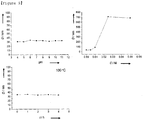
- the colloidal stability of the iron oxide nanoparticles coated with hydrophilic material may be measured based on the pH, NaCl concentration, and heat resistance.
- the nanoparticles should be stable in the presence of a predetermined amount of NaCl at a predetermined pH.
- the heat resistance is determined by measuring the binding force between the surface of the nanoparticles and the coating material. The stability test may be observed from changes in size with DLS.
- a cell toxicity test of the iron oxide nanoparticles coated with hydrophilic material may be carried out, and a MTT method using MDA-MB-231 as breast cancer cells may be applied.
- the applicability of the iron oxide nanoparticles coated with hydrophilic material as a magnetic resonance imaging (MRI) contrast agent may be confirmed via animal MRI testing.
- MRI magnetic resonance imaging
- high-temperature annealing treatment can increase the crystallinity of nanoparticles to enhance the magnetism of iron oxide nanoparticles.
- the iron oxide nanoparticles are coated with a hydrophilic material so as to ensure high stability and biocompatibility, and among a variety of hydrophilic materials, negatively charged carboxymethyl dextran (CM-dextran) is very effective at coating the nanoparticles to stabilize them. Because of their improved magnetism and coating of one or more nanoparticles with a dextran shell in the coating process, the contrast effects of the CM-dextran-coated iron oxide nanoparticles are superior.
- TEM Transmission electron microscopy
- XRD X-ray diffraction
- VSM vibrating sample magnetometer
- Iron oxide nanoparticles were synthesized from an iron oleate complex prepared in a 100 L pilot plant according to the method disclosed in J. Park et al. Nat. Mater. 2004, 4, 891 .
- This iron oleate complex was obtained by reacting sodium oleate with ferric chloride hexahydrate (FeCl 3 6H 2 O). Specifically, 1.08 kg of ferric chloride hexahydrate and 3.65 kg of sodium oleate were mixed with a solvent mixture comprising 6 L of water, 8 L of ethanol and 14 L of hexane and reacted at about 60°C for 1 hr with vigorous stirring.
- the transparent lower layer was removed from the separated two layers and the remaining brownish organic layer was mixed with water after which the water layer was removed again to remove the remaining aqueous salt. This water-washing process was repeated three times. The hexane solvent was evaporated from the purified complex solution, thus obtaining an iron oleate complex.
- JCPDS Joint Committee on Powder Diffraction Standards
- JCPDS is a file of diffraction data of materials collected and sorted from 1969 in which each of the diffraction patterns is recorded per card, and is thus used as a reference for determining the crystalline structure of a material from the measured XRD pattern.
- the XRD pattern of the nanoparticles after annealing treatment was similar to the XRD pattern of the nanoparticles before annealing treatment. Because small nanoparticles have a tendency to increase the width of the XRD peak, magnetite and maghemite ( ⁇ -Fe 2 O 3 , JCPDS 25-1402) having similar XRD patterns are difficult to clearly distinguish from each other via XRD analysis.
- magnetite when magnetite is annealed under air conditions, it may become maghemite or hematite ( ⁇ -Fe 2 O 3 ) via additional oxidation.
- the XRD pattern of hematite JCPDS 24-0072
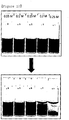
- the iron oxide nanoparticles after annealing treatment are brownish, whereas the iron oxide nanoparticles before annealing treatment are black in color ( FIG. 5 ).
- the annealed iron oxide nanoparticles appear to be maghemite via additional oxidation.
- magnetism of the samples was measured using VSM.
- the saturation magnetization was 78 emu/g [Fe] before annealing treatment, and was 103 emu/g [Fe] after annealing treatment ( FIG. 6 ). This is considered to be because crystallinity of the particles is increased via the high-temperature annealing treatment thus affecting the increase in magnetism.
- the annealed iron oxide nanoparticles were dispersed in an aqueous solution to thus increase the pH of the aqueous solution, so that the zeta potential of the iron oxide nanoparticles was observed to change from a positive charge to a negative charge, and accordingly the hydrodynamic diameter was also changed (Table 1).
- the zeta potential of the annealed nanoparticles is small and the particles have a tendency to agglomerate and sink because of the absence of a surfactant for stabilizing the surface thereof.
- the hydrodynamic diameter of the nanoparticles measured at pH 7 was observed to exceed 1 ⁇ m, unlike under acidic or basic conditions (Table 1).
- a mixture comprising iron oxide nanoparticles and salt particles was annealed in the same manner as in Example 1 with the exception that the iron oxide nanoparticles were coated with a hydrophilic material.
- a hydrophilic material Table 2
- 1 g of a hydrophilic material Table 2
- 12.5 g of annealed iron oxide nanoparticles and the salt powder were slowly added at a weight ratio of 1:12.5.
- the iron oxide nanoparticles coated with hydrophilic material was separated via centrifugation at 13,000 rpm for 30 min. Additional washing using the aqueous solution of hydrophilic material and centrifugation were repeated two times more.
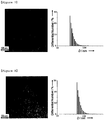
- the hydrodynamic diameter of the DS-coated iron oxide nanoparticles was 36.8 nm (Table 3), which was similar to the value (28.7 nm) of the PEG-phospholipid-coated iron oxide nanoparticles (Table 3).
- the hydrodynamic diameter of the CM-dextran-coated iron oxide nanoparticles was 66.4 nm, which was much larger than that of the DS-coated or the PEG-phospholipid-coated iron oxide nanoparticles (Table 3).
- CM-dextran one or more nanoparticles are considered to be coated together.
- dextran having no charge was used for coating the nanoparticles.
- the hydrodynamic diameter of the coated particles exceeded 100 nm (Table 3), and such particles were observed to easily sink over time. From this, the electrostatic action between the nanoparticles and the coating material is regarded as affecting the coating efficiency of particles and the stability.
- negatively charged dextran was efficient at coating, and particularly the DS-coated nanoparticles represented the smallest hydrodynamic diameter.
- the PEG-phosphate (PO-PEGs)-coated iron oxide nanoparticles were well dispersed in an aqueous solution. As shown in the TEM image, the particles did not agglomerate while being coated with PO-PEGs and had a hydrodynamic diameter of 69.2 nm ( FIG. 14 ).
- DS-coated iron oxide nanoparticles were prepared in the same manner as in Example 2 with the exception that the size of salt particles was 13 ⁇ m.
- the hydrodynamic diameter of the DS-coated iron oxide nanoparticles was 31.03 nm (Table 3).
- the DS-coated and the CM-dextran-coated iron oxide nanoparticles were measured using MTT method.
- the iron oxide nanoparticles at different concentrations were cultured in cells for 48 hr, after which the survival rate of cells was measured. Consequently, almost all of the cells were alive up to the concentration of 200 ⁇ g [Fe]/ml ( FIG. 15 ).
- the iron oxide nanoparticles were coated using CM-dextran instead of DS because of superior stability.
- the T2 MRI image of the nanoparticles dispersed in the aqueous solution shows a decrease in signal in proportion to an increase in the concentration of iron ions ( FIG. 16 ).
- r2 relaxivity was calculated, which is a gradient of a reciprocal of T2 relaxation time relative to a concentration of the contrast agent. This is an indicator that shows how much the T2 relaxation time sensitively varies depending on changes in concentration of the contrast agent.
- the relaxivity of the iron oxide nanoparticles coated with PEG-phospholipid without annealing treatment was 124.46 mM -1 s -1 and that of the iron oxide nanoparticles coated with CM-dextran after annealing treatment was 358.9 mM -1 s -1 which is an increase of 2.9 times.
- Such a high relaxivity is based on increased crystallinity during annealing treatment and coating of a plurality of particles with a single dextran shell in the course of coating with CM-dextran. As described in Example 1, the saturation magnetization after annealing treatment was increased because of additional crystallization.
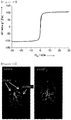
- the saturation magnetization (106 emu/g [Fe]) was similar to that after annealing treatment ( FIG. 17 ).
- the increase in r2 relaxivity was reported to be based on the magnetic relaxation switch ( J. M. Perez, et. al. Chem. Bio. Chem. 2004, 5, 261 ).
- the CM-dextran-coated iron oxide nanoparticles are determined to be useful as a biocompatible MRI contrast agent having high contrast effects.
- the CM-dextran-coated iron oxide nanoparticles were applied to animal MRI testing.
- the nanoparticles (2.5 mg [Fe] per kg of mouse body weight) were injected via the tail vein of the mouse.
- the MRI results before and after the injection of the nanoparticles show that the nanoparticles accumulate in the liver and the spleen thus achieving effective contrast ( FIG. 18 ).
- These nanoparticles were confirmed to be suitable for application in vivo.
Landscapes
- Chemical & Material Sciences (AREA)
- Health & Medical Sciences (AREA)
- Nanotechnology (AREA)
- Engineering & Computer Science (AREA)
- Life Sciences & Earth Sciences (AREA)
- Nuclear Medicine, Radiotherapy & Molecular Imaging (AREA)
- Organic Chemistry (AREA)
- Public Health (AREA)
- Radiology & Medical Imaging (AREA)
- Epidemiology (AREA)
- Animal Behavior & Ethology (AREA)
- General Health & Medical Sciences (AREA)
- Veterinary Medicine (AREA)
- Molecular Biology (AREA)
- Immunology (AREA)
- Composite Materials (AREA)
- Physics & Mathematics (AREA)
- Condensed Matter Physics & Semiconductors (AREA)
- General Physics & Mathematics (AREA)
- Materials Engineering (AREA)
- Crystallography & Structural Chemistry (AREA)
- Inorganic Chemistry (AREA)
- Medicines Containing Antibodies Or Antigens For Use As Internal Diagnostic Agents (AREA)
- Magnetic Resonance Imaging Apparatus (AREA)
- Compounds Of Iron (AREA)
- Soft Magnetic Materials (AREA)
Claims (17)
- Procédé de préparation de nanoparticules d'oxyde de fer revêtues d'un matériau hydrophile, comprenant :a) une fixation de nanoparticules d'oxyde de fer magnétiques revêtues d'un matériau organique hydrophobe sur des particules de sel, un recuit d'un mélange pulvérulent comprenant les nanoparticules d'oxyde de fer magnétiques revêtues du matériau organique hydrophobe et les particules de sel dans des conditions atmosphériques, une élimination du matériau organique hydrophobe à partir de la surface des nanoparticules d'oxyde de fer magnétiques par l'intermédiaire du recuit, et ainsi une obtention de nanoparticules d'oxyde de fer ne présentant pas de matériau organique ; etb) un revêtement d'une surface des nanoparticules d'oxyde de fer ne présentant pas de matériau organique avec un matériau hydrophile.
- Procédé selon la revendication 1, dans lequel le matériau organique hydrophobe fixé aux nanoparticules d'oxyde de fer en a) est au moins un choisi dans le groupe constitué par un acide gras en C4∼C25, un alcool aliphatique en C4∼C25, et une amine aliphatique en C4∼C25.
- Procédé selon la revendication 2, dans lequel l'acide gras fixé aux nanoparticules d'oxyde de fer en a) est de l'acide oléique.
- Procédé selon la revendication 1, dans lequel les particules de sel en a) est au moins un choisi parmi le sulfate de sodium (Na2SO4), le bicarbonate de sodium (NaHCO3), le bicarbonate de potassium (KHCO3), le bicarbonate de calcium (Ca(HCO3)2), le chlorure de sodium (NaCl), le chlorure de potassium (KCl) et le chlorure de calcium (CaCl2).
- Procédé selon la revendication 1, dans lequel les particules de sel en a) présentent un diamètre de 1 ∼ 500 µm.
- Procédé selon la revendication 1, dans lequel les nanoparticules d'oxyde de fer en a) sont obtenues en faisant réagir un complexe de fer comprenant du fer comme atome central et un groupe acide organique en C4∼C25 (carboxylate) fixé à celui-ci comme ligand avec un acide gras en C4∼C25.
- Procédé selon la revendication 6, dans lequel le complexe de fer est de l'oléate de fer.
- Procédé selon la revendication 6, dans lequel l'acide gras est de l'acide oléique.
- Procédé selon la revendication 1, dans lequel les nanoparticules d'oxyde de fer en a) présentent un diamètre de 1 ∼ 100 nm.
- Procédé selon la revendication 1, dans lequel les nanoparticules d'oxyde de fer et les particules de sel en a) présentent un rapport pondéral allant de 1:10 à 1:1 000.
- Procédé selon la revendication 1, dans lequel le recuit en a) est effectué en effectuant un chauffage à 400 ∼ 600 °C pendant 1 ∼ 10 heures dans une atmosphère d'air.
- Procédé selon la revendication 1, dans lequel, après le recuit en a), l'élimination des particules de sel est en outre effectuée.
- Procédé selon la revendication 12, dans lequel l'élimination du sel en a) est effectuée par centrifugation.
- Procédé selon la revendication 12, dans lequel la température est abaissée à la température ambiante avant d'éliminer le sel après le recuit en a).
- Procédé selon la revendication 1, dans lequel le matériau hydrophile en b) est un dérivé de dextrane, de l'acide polyacrylique, de l'amidon, de la silice, du polyéthylèneglycol (PEG) ou du PEG-phosphate (PO-PEG).
- Procédé selon la revendication 15, dans lequel le dérivé de dextrane qui est le matériau hydrophile en b) est le diéthylaminoéthyl-dextrane (DEAE-dextrane), le sulfate de dextrane (DS) ou le carboxyméthyl-dextrane (CM-dextrane).
- Procédé selon la revendication 1, dans lequel en b) le revêtement avec le matériau hydrophile et l'élimination du sel sont réalisés simultanément.
Applications Claiming Priority (2)
| Application Number | Priority Date | Filing Date | Title |
|---|---|---|---|
| KR1020110011294A KR101642903B1 (ko) | 2011-02-09 | 2011-02-09 | 친수성 물질이 코팅된 산화철 나노입자의 제조방법 및 이를 이용하는 자기공명영상 조영제 |
| PCT/KR2012/000845 WO2012108648A2 (fr) | 2011-02-09 | 2012-02-06 | Procédé de préparation de nanoparticules d'oxyde de fer enrobées d'une matière hydrophile et agent de contraste d'imagerie par résonance magnétique les utilisant |
Publications (3)
| Publication Number | Publication Date |
|---|---|
| EP2673006A2 EP2673006A2 (fr) | 2013-12-18 |
| EP2673006A4 EP2673006A4 (fr) | 2016-07-20 |
| EP2673006B1 true EP2673006B1 (fr) | 2020-12-30 |
Family
ID=46639034
Family Applications (1)
| Application Number | Title | Priority Date | Filing Date |
|---|---|---|---|
| EP12744201.0A Active EP2673006B1 (fr) | 2011-02-09 | 2012-02-06 | Procédé de préparation de nanoparticules d'oxyde de fer enrobées d'une matière hydrophile et agent de contraste d'imagerie par résonance magnétique les utilisant |
Country Status (6)
| Country | Link |
|---|---|
| US (1) | US9352058B2 (fr) |
| EP (1) | EP2673006B1 (fr) |
| JP (1) | JP5701408B2 (fr) |
| KR (1) | KR101642903B1 (fr) |
| CN (1) | CN103347543B (fr) |
| WO (1) | WO2012108648A2 (fr) |
Families Citing this family (23)
| Publication number | Priority date | Publication date | Assignee | Title |
|---|---|---|---|---|
| EP2808036B1 (fr) * | 2012-01-27 | 2026-04-15 | Soluciones Nanotecnológicas S.L. | Nanoparticules superparamagnétiques utilisées en tant qu'agent de contraste dans l'imagerie par résonance magnétique (irm) de susceptibilité magnétique (t2*) |
| KR101384977B1 (ko) * | 2013-08-20 | 2014-04-21 | 연세대학교 산학협력단 | 동축 노즐을 포함하는 나노 자성체 수용화 장치 |
| KR101508281B1 (ko) * | 2013-12-06 | 2015-07-09 | 한화케미칼 주식회사 | 균일한 금속 산화물 나노 입자를 재현성 높게 제조하는 방법 |
| WO2015088254A1 (fr) | 2013-12-10 | 2015-06-18 | 김태구 | Procédé simplifié pour passer un appel téléphonique et procédé simplifié pour demander un service basé sur la localisation |
| IN2014CH00598A (fr) * | 2014-02-10 | 2015-08-14 | Psg Institutions | |
| WO2016007194A1 (fr) * | 2014-07-10 | 2016-01-14 | Gerald Lee Wolf | Nanoparticules associées pour la théragnostique de maladies liées aux macrophages |
| KR101765335B1 (ko) * | 2014-09-26 | 2017-08-22 | 서울대학교산학협력단 | 암 세포 조영용 mri 조영제 조성물 |
| EA035898B1 (ru) | 2014-10-03 | 2020-08-28 | НАНОТИКС, ЭлЭлСи | Композиции и способы для ингибирования биологической активности растворимых биомолекул |
| US9861710B1 (en) * | 2015-01-16 | 2018-01-09 | Verily Life Sciences Llc | Composite particles, methods, and in vivo diagnostic system |
| CN107683310A (zh) * | 2015-06-29 | 2018-02-09 | 株式会社斯库林集团 | 颜料组合物及喷墨用水性墨组合物 |
| WO2017176762A1 (fr) | 2016-04-06 | 2017-10-12 | Nanotics, Llc | Particules comprenant des sous-particules ou des échafaudages d'acide nucléique |
| EP3708191A4 (fr) | 2017-11-06 | 2020-11-25 | Konica Minolta, Inc. | Particules composites pour imagerie, procédé de production de particules composites, cellules, structure cellulaire et dispersion mixte |
| JP7041952B2 (ja) * | 2018-04-27 | 2022-03-25 | 学校法人 名城大学 | 多糖類化学修飾金属酸化物粒子の製造方法 |
| BR112021012657A2 (pt) | 2018-12-27 | 2021-09-08 | Astellas Pharma Inc. | Método para produzir nanopartícula com partícula de metal que contém óxido de ferro ao qual um ou mais ligantes hidrofílicos são ligados por coordenação |
| CN114631158A (zh) * | 2019-10-30 | 2022-06-14 | 佳能株式会社 | 组合物及热传输装置 |
| JP7551446B2 (ja) * | 2019-10-30 | 2024-09-17 | キヤノン株式会社 | 組成物、及び熱輸送装置 |
| JP7551445B2 (ja) * | 2019-10-30 | 2024-09-17 | キヤノン株式会社 | 組成物、及び熱輸送装置 |
| CN110853865B (zh) * | 2019-11-20 | 2022-05-17 | 江南大学 | 一种四氧化三铁单层纳米膜的制备方法及其应用 |
| KR102610148B1 (ko) * | 2019-12-12 | 2023-12-06 | 주식회사 엘지화학 | 자성체 |
| EP4257554A4 (fr) * | 2020-12-29 | 2025-03-19 | ZTI Biosciences Co., Ltd. | Particules magnétiques d'oxyde de fer |
| WO2022145970A1 (fr) * | 2020-12-29 | 2022-07-07 | 주식회사 지티아이바이오사이언스 | Particules magnétiques d'oxyde de fer |
| WO2023040037A1 (fr) * | 2021-09-18 | 2023-03-23 | 中国科学院大学附属肿瘤医院 | Application de nanoparticules d'oxyde de fer dans la préparation d'un agent de contraste pour parathyroïdes et/ou ganglions lymphatiques |
| KR102681399B1 (ko) * | 2021-10-21 | 2024-07-04 | 주식회사 지티아이바이오사이언스 | 산화철 자성 입자를 포함하는 간암치료용 조성물의 제조방법 |
Family Cites Families (11)
| Publication number | Priority date | Publication date | Assignee | Title |
|---|---|---|---|---|
| JP2726520B2 (ja) * | 1989-10-20 | 1998-03-11 | 名糖産業株式会社 | 有機磁性複合体 |
| JPH03141119A (ja) | 1989-10-25 | 1991-06-17 | Nippon Telegr & Teleph Corp <Ntt> | 磁性微粒子の製造方法 |
| JP2006016236A (ja) * | 2004-06-30 | 2006-01-19 | Sumitomo Osaka Cement Co Ltd | 金属酸化物ナノ粒子の製造方法 |
| CZ301067B6 (cs) * | 2006-02-24 | 2009-10-29 | Ústav makromolekulární chemie AV CR | Superparamagnetické nanocástice na bázi oxidu železa s modifikovaným povrchem, zpusob jejich prípravy a použití |
| JP2009114066A (ja) * | 2006-02-24 | 2009-05-28 | International Medical Center Of Japan | 機能性分子が導入された有機磁性ナノ複合体 |
| KR100819377B1 (ko) | 2006-02-24 | 2008-04-04 | (주)에이티젠 | 양친매성 화합물을 이용한 자성 나노복합체 및 이를포함하는 조영제 |
| JP2010502992A (ja) | 2006-09-05 | 2010-01-28 | コロンバス ナノワークス,インコーポレーテッド | 磁性粒子、並びにその作製及び使用方法 |
| WO2009014201A1 (fr) | 2007-07-26 | 2009-01-29 | Tokyo Institute Of Technology | Procédé pour la production de particules inorganiques ayant un revêtement de surface |
| EP2432460B1 (fr) * | 2009-05-21 | 2015-04-22 | Institute Of Life Sciences | Formulation pouvant être dispersée dans l'eau de nanoparticules magnétiques comprenant du monooléate de glycéryle |
| GB2472446A (en) * | 2009-08-07 | 2011-02-09 | Ct Fuer Angewandte Nanotechnologie | Metal oxide particles coated with polyethylene glycol and their synthesis |
| JP2013526616A (ja) * | 2010-05-26 | 2013-06-24 | ザ ジェネラル ホスピタル コーポレイション | 磁性ナノ粒子 |
-
2011
- 2011-02-09 KR KR1020110011294A patent/KR101642903B1/ko active Active
-
2012
- 2012-02-06 CN CN201280008230.1A patent/CN103347543B/zh active Active
- 2012-02-06 WO PCT/KR2012/000845 patent/WO2012108648A2/fr not_active Ceased
- 2012-02-06 EP EP12744201.0A patent/EP2673006B1/fr active Active
- 2012-02-06 JP JP2013553345A patent/JP5701408B2/ja active Active
- 2012-02-06 US US13/983,367 patent/US9352058B2/en active Active
Non-Patent Citations (1)
| Title |
|---|
| None * |
Also Published As
| Publication number | Publication date |
|---|---|
| EP2673006A2 (fr) | 2013-12-18 |
| JP5701408B2 (ja) | 2015-04-15 |
| KR20120091513A (ko) | 2012-08-20 |
| WO2012108648A2 (fr) | 2012-08-16 |
| US20130323182A1 (en) | 2013-12-05 |
| EP2673006A4 (fr) | 2016-07-20 |
| US9352058B2 (en) | 2016-05-31 |
| CN103347543A (zh) | 2013-10-09 |
| JP2014511324A (ja) | 2014-05-15 |
| KR101642903B1 (ko) | 2016-07-27 |
| CN103347543B (zh) | 2016-11-16 |
| WO2012108648A3 (fr) | 2012-11-01 |
Similar Documents
| Publication | Publication Date | Title |
|---|---|---|
| EP2673006B1 (fr) | Procédé de préparation de nanoparticules d'oxyde de fer enrobées d'une matière hydrophile et agent de contraste d'imagerie par résonance magnétique les utilisant | |
| Khmara et al. | Chitosan-stabilized iron oxide nanoparticles for magnetic resonance imaging | |
| Liu et al. | Highly water‐dispersible biocompatible magnetite particles with low cytotoxicity stabilized by citrate groups | |
| Togashi et al. | Surfactant-assisted one-pot synthesis of superparamagnetic magnetite nanoparticle clusters with tunable cluster size and magnetic field sensitivity | |
| Cho et al. | Gold-coated iron nanoparticles: a novel magnetic resonance agent for T 1 and T 2 weighted imaging | |
| Hu et al. | Facile synthesis of ultrasmall PEGylated iron oxide nanoparticles for dual-contrast T 1-and T 2-weighted magnetic resonance imaging | |
| Shi et al. | Mesoporous superparamagnetic cobalt ferrite nanoclusters: Synthesis, characterization and application in drug delivery | |
| US7960025B2 (en) | Magnetic nanoparticles comprising a core formed from noble metals | |
| Digigow et al. | Preparation and characterization of functional silica hybrid magnetic nanoparticles | |
| CN103153348B (zh) | 极其小且均匀尺寸的氧化铁基顺磁性或伪顺磁性纳米颗粒的制备和使用所述纳米颗粒的mri t1显影剂 | |
| JP5765520B2 (ja) | 磁性粒子含有水分散体の製造方法 | |
| Lu et al. | Solid-state synthesis of monocrystalline iron oxide nanoparticle based ferrofluid suitable for magnetic resonance imaging contrast application | |
| Liu et al. | Preparation, characterization and MRI application of carboxymethyl dextran coated magnetic nanoparticles | |
| Park et al. | Transformation of hydrophobic iron oxide nanoparticles to hydrophilic and biocompatible maghemite nanocrystals for use as highly efficient MRI contrast agent | |
| Miola et al. | Reductant-free synthesis of magnetoplasmonic iron oxide-gold nanoparticles | |
| CN116370657B (zh) | 一种手性铁基超粒子纳米材料及其制备方法与应用 | |
| Yue et al. | Ultrasmall europium, gadolinium, and dysprosium oxide nanoparticles: Polyol synthesis, properties, and biomedical imaging applications | |
| EP2942064B1 (fr) | Agent de contraste irm comprenant un matériau de contraste t1 revêtu sur la surface d'un support de nanoparticules | |
| Saboktakin et al. | Synthesis and characterization of superparamagnetic nanoparticles coated with carboxymethyl starch (CMS) for magnetic resonance imaging technique | |
| Leonel et al. | Facile polyol synthesis of ultrasmall water-soluble cobalt ferrite nanoparticles | |
| Mansur et al. | Synthesis and characterization of iron oxide superparticles with various polymers | |
| Ene et al. | Single Step Synthesis of Glutamic/tartaric Acidstabilised Fe3O4 Nanoparticles for Targeted Delivery Systems | |
| Xia et al. | Preparation of magnetite–dextran microspheres by ultrasonication | |
| Faham et al. | Peg decorated glycine capped mn-ferrite nanoparticles synthesized by co-precipitation method for biomedical application | |
| CN109867309B (zh) | 一种水溶磁性氧化铁纳米晶及其制备方法 |
Legal Events
| Date | Code | Title | Description |
|---|---|---|---|
| PUAI | Public reference made under article 153(3) epc to a published international application that has entered the european phase |
Free format text: ORIGINAL CODE: 0009012 |
|
| 17P | Request for examination filed |
Effective date: 20130830 |
|
| AK | Designated contracting states |
Kind code of ref document: A2 Designated state(s): AL AT BE BG CH CY CZ DE DK EE ES FI FR GB GR HR HU IE IS IT LI LT LU LV MC MK MT NL NO PL PT RO RS SE SI SK SM TR |
|
| DAX | Request for extension of the european patent (deleted) | ||
| A4 | Supplementary search report drawn up and despatched |
Effective date: 20160616 |
|
| RIC1 | Information provided on ipc code assigned before grant |
Ipc: A61K 47/30 20060101ALI20160610BHEP Ipc: A61K 49/04 20060101ALI20160610BHEP Ipc: A61K 9/28 20060101ALI20160610BHEP Ipc: A61K 49/18 20060101AFI20160610BHEP Ipc: A61K 9/16 20060101ALI20160610BHEP |
|
| STAA | Information on the status of an ep patent application or granted ep patent |
Free format text: STATUS: EXAMINATION IS IN PROGRESS |
|
| 17Q | First examination report despatched |
Effective date: 20190313 |
|
| RIC1 | Information provided on ipc code assigned before grant |
Ipc: C09C 1/24 20060101ALI20200610BHEP Ipc: A61K 49/04 20060101ALI20200610BHEP Ipc: C01G 49/02 20060101ALI20200610BHEP Ipc: A61K 9/28 20060101ALI20200610BHEP Ipc: A61K 49/18 20060101AFI20200610BHEP Ipc: A61K 9/16 20060101ALI20200610BHEP Ipc: B82Y 30/00 20110101ALI20200610BHEP Ipc: A61K 47/30 20060101ALI20200610BHEP |
|
| GRAP | Despatch of communication of intention to grant a patent |
Free format text: ORIGINAL CODE: EPIDOSNIGR1 |
|
| STAA | Information on the status of an ep patent application or granted ep patent |
Free format text: STATUS: GRANT OF PATENT IS INTENDED |
|
| RIN1 | Information on inventor provided before grant (corrected) |
Inventor name: HYEON, TAEGHWAN Inventor name: PARK, YONG IL Inventor name: PIAO, YUANZHE |
|
| INTG | Intention to grant announced |
Effective date: 20200721 |
|
| RIN1 | Information on inventor provided before grant (corrected) |
Inventor name: PIAO, YUANZHE Inventor name: PARK, YONG IL Inventor name: HYEON, TAEGHWAN |
|
| GRAS | Grant fee paid |
Free format text: ORIGINAL CODE: EPIDOSNIGR3 |
|
| GRAA | (expected) grant |
Free format text: ORIGINAL CODE: 0009210 |
|
| STAA | Information on the status of an ep patent application or granted ep patent |
Free format text: STATUS: THE PATENT HAS BEEN GRANTED |
|
| AK | Designated contracting states |
Kind code of ref document: B1 Designated state(s): AL AT BE BG CH CY CZ DE DK EE ES FI FR GB GR HR HU IE IS IT LI LT LU LV MC MK MT NL NO PL PT RO RS SE SI SK SM TR |
|
| REG | Reference to a national code |
Ref country code: GB Ref legal event code: FG4D |
|
| REG | Reference to a national code |
Ref country code: DE Ref legal event code: R096 Ref document number: 602012073943 Country of ref document: DE |
|
| REG | Reference to a national code |
Ref country code: AT Ref legal event code: REF Ref document number: 1349282 Country of ref document: AT Kind code of ref document: T Effective date: 20210115 |
|
| REG | Reference to a national code |
Ref country code: IE Ref legal event code: FG4D |
|
| PG25 | Lapsed in a contracting state [announced via postgrant information from national office to epo] |
Ref country code: RS Free format text: LAPSE BECAUSE OF FAILURE TO SUBMIT A TRANSLATION OF THE DESCRIPTION OR TO PAY THE FEE WITHIN THE PRESCRIBED TIME-LIMIT Effective date: 20201230 Ref country code: FI Free format text: LAPSE BECAUSE OF FAILURE TO SUBMIT A TRANSLATION OF THE DESCRIPTION OR TO PAY THE FEE WITHIN THE PRESCRIBED TIME-LIMIT Effective date: 20201230 Ref country code: NO Free format text: LAPSE BECAUSE OF FAILURE TO SUBMIT A TRANSLATION OF THE DESCRIPTION OR TO PAY THE FEE WITHIN THE PRESCRIBED TIME-LIMIT Effective date: 20210330 Ref country code: GR Free format text: LAPSE BECAUSE OF FAILURE TO SUBMIT A TRANSLATION OF THE DESCRIPTION OR TO PAY THE FEE WITHIN THE PRESCRIBED TIME-LIMIT Effective date: 20210331 |
|
| REG | Reference to a national code |
Ref country code: AT Ref legal event code: MK05 Ref document number: 1349282 Country of ref document: AT Kind code of ref document: T Effective date: 20201230 |
|
| PG25 | Lapsed in a contracting state [announced via postgrant information from national office to epo] |
Ref country code: LV Free format text: LAPSE BECAUSE OF FAILURE TO SUBMIT A TRANSLATION OF THE DESCRIPTION OR TO PAY THE FEE WITHIN THE PRESCRIBED TIME-LIMIT Effective date: 20201230 Ref country code: SE Free format text: LAPSE BECAUSE OF FAILURE TO SUBMIT A TRANSLATION OF THE DESCRIPTION OR TO PAY THE FEE WITHIN THE PRESCRIBED TIME-LIMIT Effective date: 20201230 Ref country code: BG Free format text: LAPSE BECAUSE OF FAILURE TO SUBMIT A TRANSLATION OF THE DESCRIPTION OR TO PAY THE FEE WITHIN THE PRESCRIBED TIME-LIMIT Effective date: 20210330 |
|
| REG | Reference to a national code |
Ref country code: NL Ref legal event code: MP Effective date: 20201230 |
|
| PG25 | Lapsed in a contracting state [announced via postgrant information from national office to epo] |
Ref country code: HR Free format text: LAPSE BECAUSE OF FAILURE TO SUBMIT A TRANSLATION OF THE DESCRIPTION OR TO PAY THE FEE WITHIN THE PRESCRIBED TIME-LIMIT Effective date: 20201230 |
|
| REG | Reference to a national code |
Ref country code: LT Ref legal event code: MG9D |
|
| PG25 | Lapsed in a contracting state [announced via postgrant information from national office to epo] |
Ref country code: LT Free format text: LAPSE BECAUSE OF FAILURE TO SUBMIT A TRANSLATION OF THE DESCRIPTION OR TO PAY THE FEE WITHIN THE PRESCRIBED TIME-LIMIT Effective date: 20201230 Ref country code: PT Free format text: LAPSE BECAUSE OF FAILURE TO SUBMIT A TRANSLATION OF THE DESCRIPTION OR TO PAY THE FEE WITHIN THE PRESCRIBED TIME-LIMIT Effective date: 20210430 Ref country code: RO Free format text: LAPSE BECAUSE OF FAILURE TO SUBMIT A TRANSLATION OF THE DESCRIPTION OR TO PAY THE FEE WITHIN THE PRESCRIBED TIME-LIMIT Effective date: 20201230 Ref country code: SK Free format text: LAPSE BECAUSE OF FAILURE TO SUBMIT A TRANSLATION OF THE DESCRIPTION OR TO PAY THE FEE WITHIN THE PRESCRIBED TIME-LIMIT Effective date: 20201230 Ref country code: EE Free format text: LAPSE BECAUSE OF FAILURE TO SUBMIT A TRANSLATION OF THE DESCRIPTION OR TO PAY THE FEE WITHIN THE PRESCRIBED TIME-LIMIT Effective date: 20201230 Ref country code: CZ Free format text: LAPSE BECAUSE OF FAILURE TO SUBMIT A TRANSLATION OF THE DESCRIPTION OR TO PAY THE FEE WITHIN THE PRESCRIBED TIME-LIMIT Effective date: 20201230 Ref country code: NL Free format text: LAPSE BECAUSE OF FAILURE TO SUBMIT A TRANSLATION OF THE DESCRIPTION OR TO PAY THE FEE WITHIN THE PRESCRIBED TIME-LIMIT Effective date: 20201230 |
|
| PG25 | Lapsed in a contracting state [announced via postgrant information from national office to epo] |
Ref country code: PL Free format text: LAPSE BECAUSE OF FAILURE TO SUBMIT A TRANSLATION OF THE DESCRIPTION OR TO PAY THE FEE WITHIN THE PRESCRIBED TIME-LIMIT Effective date: 20201230 Ref country code: AT Free format text: LAPSE BECAUSE OF FAILURE TO SUBMIT A TRANSLATION OF THE DESCRIPTION OR TO PAY THE FEE WITHIN THE PRESCRIBED TIME-LIMIT Effective date: 20201230 |
|
| PG25 | Lapsed in a contracting state [announced via postgrant information from national office to epo] |
Ref country code: MC Free format text: LAPSE BECAUSE OF FAILURE TO SUBMIT A TRANSLATION OF THE DESCRIPTION OR TO PAY THE FEE WITHIN THE PRESCRIBED TIME-LIMIT Effective date: 20201230 Ref country code: IS Free format text: LAPSE BECAUSE OF FAILURE TO SUBMIT A TRANSLATION OF THE DESCRIPTION OR TO PAY THE FEE WITHIN THE PRESCRIBED TIME-LIMIT Effective date: 20210430 |
|
| REG | Reference to a national code |
Ref country code: DE Ref legal event code: R097 Ref document number: 602012073943 Country of ref document: DE |
|
| REG | Reference to a national code |
Ref country code: BE Ref legal event code: MM Effective date: 20210228 |
|
| PG25 | Lapsed in a contracting state [announced via postgrant information from national office to epo] |
Ref country code: LU Free format text: LAPSE BECAUSE OF NON-PAYMENT OF DUE FEES Effective date: 20210206 Ref country code: LI Free format text: LAPSE BECAUSE OF NON-PAYMENT OF DUE FEES Effective date: 20210228 Ref country code: IT Free format text: LAPSE BECAUSE OF FAILURE TO SUBMIT A TRANSLATION OF THE DESCRIPTION OR TO PAY THE FEE WITHIN THE PRESCRIBED TIME-LIMIT Effective date: 20201230 Ref country code: AL Free format text: LAPSE BECAUSE OF FAILURE TO SUBMIT A TRANSLATION OF THE DESCRIPTION OR TO PAY THE FEE WITHIN THE PRESCRIBED TIME-LIMIT Effective date: 20201230 Ref country code: CH Free format text: LAPSE BECAUSE OF NON-PAYMENT OF DUE FEES Effective date: 20210228 |
|
| PLBE | No opposition filed within time limit |
Free format text: ORIGINAL CODE: 0009261 |
|
| STAA | Information on the status of an ep patent application or granted ep patent |
Free format text: STATUS: NO OPPOSITION FILED WITHIN TIME LIMIT |
|
| PG25 | Lapsed in a contracting state [announced via postgrant information from national office to epo] |
Ref country code: DK Free format text: LAPSE BECAUSE OF FAILURE TO SUBMIT A TRANSLATION OF THE DESCRIPTION OR TO PAY THE FEE WITHIN THE PRESCRIBED TIME-LIMIT Effective date: 20201230 Ref country code: ES Free format text: LAPSE BECAUSE OF FAILURE TO SUBMIT A TRANSLATION OF THE DESCRIPTION OR TO PAY THE FEE WITHIN THE PRESCRIBED TIME-LIMIT Effective date: 20201230 |
|
| 26N | No opposition filed |
Effective date: 20211001 |
|
| PG25 | Lapsed in a contracting state [announced via postgrant information from national office to epo] |
Ref country code: IE Free format text: LAPSE BECAUSE OF NON-PAYMENT OF DUE FEES Effective date: 20210206 |
|
| PG25 | Lapsed in a contracting state [announced via postgrant information from national office to epo] |
Ref country code: SI Free format text: LAPSE BECAUSE OF FAILURE TO SUBMIT A TRANSLATION OF THE DESCRIPTION OR TO PAY THE FEE WITHIN THE PRESCRIBED TIME-LIMIT Effective date: 20201230 |
|
| PG25 | Lapsed in a contracting state [announced via postgrant information from national office to epo] |
Ref country code: IS Free format text: LAPSE BECAUSE OF FAILURE TO SUBMIT A TRANSLATION OF THE DESCRIPTION OR TO PAY THE FEE WITHIN THE PRESCRIBED TIME-LIMIT Effective date: 20210430 |
|
| PG25 | Lapsed in a contracting state [announced via postgrant information from national office to epo] |
Ref country code: BE Free format text: LAPSE BECAUSE OF NON-PAYMENT OF DUE FEES Effective date: 20210228 |
|
| PG25 | Lapsed in a contracting state [announced via postgrant information from national office to epo] |
Ref country code: HU Free format text: LAPSE BECAUSE OF FAILURE TO SUBMIT A TRANSLATION OF THE DESCRIPTION OR TO PAY THE FEE WITHIN THE PRESCRIBED TIME-LIMIT; INVALID AB INITIO Effective date: 20120206 Ref country code: CY Free format text: LAPSE BECAUSE OF FAILURE TO SUBMIT A TRANSLATION OF THE DESCRIPTION OR TO PAY THE FEE WITHIN THE PRESCRIBED TIME-LIMIT Effective date: 20201230 |
|
| P01 | Opt-out of the competence of the unified patent court (upc) registered |
Effective date: 20230608 |
|
| PG25 | Lapsed in a contracting state [announced via postgrant information from national office to epo] |
Ref country code: SM Free format text: LAPSE BECAUSE OF FAILURE TO SUBMIT A TRANSLATION OF THE DESCRIPTION OR TO PAY THE FEE WITHIN THE PRESCRIBED TIME-LIMIT Effective date: 20201230 |
|
| PG25 | Lapsed in a contracting state [announced via postgrant information from national office to epo] |
Ref country code: MK Free format text: LAPSE BECAUSE OF FAILURE TO SUBMIT A TRANSLATION OF THE DESCRIPTION OR TO PAY THE FEE WITHIN THE PRESCRIBED TIME-LIMIT Effective date: 20201230 |
|
| PG25 | Lapsed in a contracting state [announced via postgrant information from national office to epo] |
Ref country code: MT Free format text: LAPSE BECAUSE OF FAILURE TO SUBMIT A TRANSLATION OF THE DESCRIPTION OR TO PAY THE FEE WITHIN THE PRESCRIBED TIME-LIMIT Effective date: 20201230 |
|
| PG25 | Lapsed in a contracting state [announced via postgrant information from national office to epo] |
Ref country code: TR Free format text: LAPSE BECAUSE OF FAILURE TO SUBMIT A TRANSLATION OF THE DESCRIPTION OR TO PAY THE FEE WITHIN THE PRESCRIBED TIME-LIMIT Effective date: 20201230 |
|
| PGFP | Annual fee paid to national office [announced via postgrant information from national office to epo] |
Ref country code: GB Payment date: 20251218 Year of fee payment: 15 |
|
| PGFP | Annual fee paid to national office [announced via postgrant information from national office to epo] |
Ref country code: FR Payment date: 20251222 Year of fee payment: 15 |
|
| PGFP | Annual fee paid to national office [announced via postgrant information from national office to epo] |
Ref country code: DE Payment date: 20251216 Year of fee payment: 15 |