EP2673377B1 - Kombination von biomarkern zur prognose einer reaktion oder nichtreaktion auf eine anti-hcv-behandlung - Google Patents
Kombination von biomarkern zur prognose einer reaktion oder nichtreaktion auf eine anti-hcv-behandlung Download PDFInfo
- Publication number
- EP2673377B1 EP2673377B1 EP12703312.4A EP12703312A EP2673377B1 EP 2673377 B1 EP2673377 B1 EP 2673377B1 EP 12703312 A EP12703312 A EP 12703312A EP 2673377 B1 EP2673377 B1 EP 2673377B1
- Authority
- EP
- European Patent Office
- Prior art keywords
- lgals3bp
- combination
- mdk
- mbl2
- cxcl10
- Prior art date
- Legal status (The legal status is an assumption and is not a legal conclusion. Google has not performed a legal analysis and makes no representation as to the accuracy of the status listed.)
- Active
Links
Images

Classifications
-
- C—CHEMISTRY; METALLURGY
- C12—BIOCHEMISTRY; BEER; SPIRITS; WINE; VINEGAR; MICROBIOLOGY; ENZYMOLOGY; MUTATION OR GENETIC ENGINEERING
- C12Q—MEASURING OR TESTING PROCESSES INVOLVING ENZYMES, NUCLEIC ACIDS OR MICROORGANISMS; COMPOSITIONS OR TEST PAPERS THEREFOR; PROCESSES OF PREPARING SUCH COMPOSITIONS; CONDITION-RESPONSIVE CONTROL IN MICROBIOLOGICAL OR ENZYMOLOGICAL PROCESSES
- C12Q1/00—Measuring or testing processes involving enzymes, nucleic acids or microorganisms; Compositions therefor; Processes of preparing such compositions
- C12Q1/68—Measuring or testing processes involving enzymes, nucleic acids or microorganisms; Compositions therefor; Processes of preparing such compositions involving nucleic acids
- C12Q1/6876—Nucleic acid products used in the analysis of nucleic acids, e.g. primers or probes
-
- C—CHEMISTRY; METALLURGY
- C12—BIOCHEMISTRY; BEER; SPIRITS; WINE; VINEGAR; MICROBIOLOGY; ENZYMOLOGY; MUTATION OR GENETIC ENGINEERING
- C12Q—MEASURING OR TESTING PROCESSES INVOLVING ENZYMES, NUCLEIC ACIDS OR MICROORGANISMS; COMPOSITIONS OR TEST PAPERS THEREFOR; PROCESSES OF PREPARING SUCH COMPOSITIONS; CONDITION-RESPONSIVE CONTROL IN MICROBIOLOGICAL OR ENZYMOLOGICAL PROCESSES
- C12Q1/00—Measuring or testing processes involving enzymes, nucleic acids or microorganisms; Compositions therefor; Processes of preparing such compositions
- C12Q1/68—Measuring or testing processes involving enzymes, nucleic acids or microorganisms; Compositions therefor; Processes of preparing such compositions involving nucleic acids
- C12Q1/6876—Nucleic acid products used in the analysis of nucleic acids, e.g. primers or probes
- C12Q1/6883—Nucleic acid products used in the analysis of nucleic acids, e.g. primers or probes for diseases caused by alterations of genetic material
-
- G—PHYSICS
- G01—MEASURING; TESTING
- G01N—INVESTIGATING OR ANALYSING MATERIALS BY DETERMINING THEIR CHEMICAL OR PHYSICAL PROPERTIES
- G01N33/00—Investigating or analysing materials by specific methods not covered by groups G01N1/00 - G01N31/00
- G01N33/48—Biological material, e.g. blood, urine; Haemocytometers
- G01N33/50—Chemical analysis of biological material, e.g. blood, urine; Testing involving biospecific ligand binding methods; Immunological testing
- G01N33/53—Immunoassay; Biospecific binding assay; Materials therefor
- G01N33/576—Immunoassay; Biospecific binding assay; Materials therefor for hepatitis
- G01N33/5767—Immunoassay; Biospecific binding assay; Materials therefor for hepatitis non-A, non-B hepatitis
-
- C—CHEMISTRY; METALLURGY
- C12—BIOCHEMISTRY; BEER; SPIRITS; WINE; VINEGAR; MICROBIOLOGY; ENZYMOLOGY; MUTATION OR GENETIC ENGINEERING
- C12Q—MEASURING OR TESTING PROCESSES INVOLVING ENZYMES, NUCLEIC ACIDS OR MICROORGANISMS; COMPOSITIONS OR TEST PAPERS THEREFOR; PROCESSES OF PREPARING SUCH COMPOSITIONS; CONDITION-RESPONSIVE CONTROL IN MICROBIOLOGICAL OR ENZYMOLOGICAL PROCESSES
- C12Q1/00—Measuring or testing processes involving enzymes, nucleic acids or microorganisms; Compositions therefor; Processes of preparing such compositions
- C12Q1/70—Measuring or testing processes involving enzymes, nucleic acids or microorganisms; Compositions therefor; Processes of preparing such compositions involving virus or bacteriophage
- C12Q1/701—Specific hybridization probes
- C12Q1/706—Specific hybridization probes for hepatitis
- C12Q1/707—Specific hybridization probes for hepatitis non-A, non-B Hepatitis, excluding hepatitis D
-
- C—CHEMISTRY; METALLURGY
- C12—BIOCHEMISTRY; BEER; SPIRITS; WINE; VINEGAR; MICROBIOLOGY; ENZYMOLOGY; MUTATION OR GENETIC ENGINEERING
- C12Q—MEASURING OR TESTING PROCESSES INVOLVING ENZYMES, NUCLEIC ACIDS OR MICROORGANISMS; COMPOSITIONS OR TEST PAPERS THEREFOR; PROCESSES OF PREPARING SUCH COMPOSITIONS; CONDITION-RESPONSIVE CONTROL IN MICROBIOLOGICAL OR ENZYMOLOGICAL PROCESSES
- C12Q2600/00—Oligonucleotides characterized by their use
- C12Q2600/106—Pharmacogenomics, i.e. genetic variability in individual responses to drugs and drug metabolism
-
- C—CHEMISTRY; METALLURGY
- C12—BIOCHEMISTRY; BEER; SPIRITS; WINE; VINEGAR; MICROBIOLOGY; ENZYMOLOGY; MUTATION OR GENETIC ENGINEERING
- C12Q—MEASURING OR TESTING PROCESSES INVOLVING ENZYMES, NUCLEIC ACIDS OR MICROORGANISMS; COMPOSITIONS OR TEST PAPERS THEREFOR; PROCESSES OF PREPARING SUCH COMPOSITIONS; CONDITION-RESPONSIVE CONTROL IN MICROBIOLOGICAL OR ENZYMOLOGICAL PROCESSES
- C12Q2600/00—Oligonucleotides characterized by their use
- C12Q2600/158—Expression markers
-
- G—PHYSICS
- G01—MEASURING; TESTING
- G01N—INVESTIGATING OR ANALYSING MATERIALS BY DETERMINING THEIR CHEMICAL OR PHYSICAL PROPERTIES
- G01N2800/00—Detection or diagnosis of diseases
- G01N2800/52—Predicting or monitoring the response to treatment, e.g. for selection of therapy based on assay results in personalised medicine; Prognosis
Definitions
- the invention relates to means for establishing a prognosis of high probability of response or non-response to anti-Hepatitis C Virus (HCV) treatment.
- HCV Hepatitis C Virus
- the means of the invention make it possible to establish this prognosis before the anti-HCV treatment has even begun.
- Hepatitis C virus (HCV) infection leads, in the vast majority of cases, to chronic hepatitis C.
- Chronic hepatitis C can progress to hepatic cirrhosis, with complications of portal hypertension, and to hepatocellular carcinoma.
- One of the goals of treatment for HCV infection, especially chronic hepatitis C, is to ensure that the tissue damage to the liver caused by the viral infection regresses or is eliminated, or at least they do not progress. This allows in particular to reduce or eliminate the risk of complications and hepatocellular carcinoma.
- the treatments currently available to meet this goal are treatments, which aim to eradicate the virus. These treatments must initially induce a significant decrease in HCV viral load, so that they can reach an undetectable level at the end of treatment.
- Current anti-HCV therapies include the administration of a combination of pegylated interferon and ribavirin.
- the duration of these treatments is long: they are generally administered over a period of at least 24 weeks and up to 48 weeks or more.
- anti-HCV treatments cause major side effects for the patient.
- side effects are common and numerous. The most common side effect is flu-like symptoms (fever, arthralgia, headache, chills). Other possible side effects are: asthenia, weight loss, moderate hair loss, sleep disturbances, mood disorders with irritability that can affect daily life, difficulty concentrating and dryness skin. Some rare side effects may be serious and should be anticipated as psychiatric disorders. Depression can occur in about 10% of cases. This one must be detected and treated because it can have serious consequences (attempted suicide). Dysthyroidism can occur. Interferon treatment is also contraindicated during pregnancy.
- ribavirin the main side effect is hemolytic anemia. Anemia leads to discontinuation of treatment in approximately 5% of cases. Decompensation of coronary heart disease or underlying cardiac disease related to anemia may occur.
- Neutropenia is observed in approximately 20% of patients receiving pegylated interferon and ribavirin, and is the major cause of reduced dose of pegylated interferon.
- Patient-specific clinical factors such as age, weight, ethnicity and liver fibrosis score, are known to influence the efficacy of anti-HCV therapy.
- the rate of patients responding to anti-HCV treatment is lower among patients whose liver fibrosis score is F3 or F4, compared to those whose liver fibrosis score is F1 or F2 (scores according to the treatment system).
- F Metavir scores are also included in the rate of patients responding to anti-HCV treatment.
- the distribution of the different genotypes is not homogeneous according to the geographical locations, and the only detection of the viral genotype does not bring a predictive solution applicable to all the patients.
- Hidetsugu Saito et al. 2010 were able to identify combinations of biological, clinical, and viral factors with predictable performance that are reliable when applied during treatment, but have not yet achieved a combination that is sufficiently reliable when it is applied before start of anti-HCV treatment.
- a transcriptomic signature to predict, before HCV therapy is administered, whether a patient will respond or not respond to this treatment.
- This signature combines the expression levels of eighteen genes (G1P2, OAS2, G1P3, OAS3, RPLP2, CEB1, IFIT1, VIPERIN, RPS28, PI3KAP1, MX1, DUSP1, ATF5, LAP3, USP18, LGP1, ETEF1, STXBP5).
- At least two of these genes encode proteins that are exclusively membrane-bound (G1P3 and VIPERIN); the product of their expression can not be detected in the circulating blood.
- Asselah et al. 2008 analyzed the level of expression of fifty-eight genes before application of anti-HCV treatment in forty patients with chronic hepatitis C, fourteen of whom are non-responders to anti-HCV treatment. They have identified two signatures that can predict, before an anti-HCV treatment is administered, whether a patient will be non-responder to this treatment.
- the first signature is based on the expression levels of two genes, namely IFI27 and CXCL9, which are analyzed according to the KNN method ( k-nearest neighbor method ).
- the second signature is based on the expression levels of three genes, namely IFI27, CXCL9 and IFI-6-16, which are analyzed according to the WV method ( weighted voting method).
- the invention as defined by the appended claims 1-12 relates to means which make it possible to establish a prognosis of high probability of response or non-response to anti-HCV treatment.
- the means of the invention may further implement the dosage or measurement of one or more other clinical factors and / or one or more other virological factors and / or one or more other biological factors.
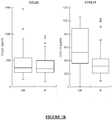
- Figures 1A and 1B Distribution of serum concentrations of IL8, LGALS3BP, MDK CXCL10 and CCL21 proteins according to the responder (R) or non-responder (NR) status of the patient.
- liver fibrosis score including the Metavir F score system, which comprises five stages of F0 to F4.
- the practitioner may decide not to administer anti-HCV treatment, whereas, when the score is at least F2, it is currently recommended to administer a treatment anti-HCV, regardless of the degree of necrotico-inflammatory activity.
- the invention proposes means that are intended to assist the decision administer or not administer anti-HCV therapy.
- the means of the invention allow a prognosis of high probability of response or non-response to anti-HCV treatment.
- the means of the invention make it possible to establish this prognosis before this treatment has even begun.
- the means of the invention comprise measuring or assaying the expression levels of selected genes. They concern subjects who are infected with one or more hepatitis viruses, including at least one HCV, and more particularly those of those subjects who have a liver fibrosis score of at least F1, more particularly at least F2, according to the F score system Metavir.
- anti-HCV treatment means therapeutic treatment, which is intended to induce reduction of the HCV load of the patient, so that at the end of treatment, it is possible to reach an undetectable level of HCV load, or even an eradication of the HCV (s).
- the desired therapeutic goal is in particular to stop, regress or even eliminate tissue lesions of the liver, that is to say, at the very least, to prevent the Hepatic fibrosis does not increase or even allow this score to decrease, preferably to decrease to a score of at most F1.
- the anti-HCV treatment comprises at least the administration of interferon, more particularly alpha interferon, in particular interferon alpha-2a or interferon alpha-2b, or an interferon prodrug.
- This interferon is usually a genetically engineered version of the natural human cytokine.
- This interferon may nevertheless be an interferon derived from Chinese hamster ovary cells (CHO cells), such as omega interferon (for example, omega interferon which is available from Intarcia Therapeutics, Hayward, California, USA). .
- This interferon may in particular be linked to other compounds, groups or chemical molecules, in particular to polyethylene glycol (for example, PEG-INTRON® marketed by Schering Plow Corporation, Kenilworth, New Jersey, USA, or PEGASYS® marketed by F. Hoffmann-La Roche Ltd., Basel, Switzerland).
- polyethylene glycol for example, PEG-INTRON® marketed by Schering Plow Corporation, Kenilworth, New Jersey, USA, or PEGASYS® marketed by F. Hoffmann-La Roche Ltd., Basel, Switzerland.
- the pegylated form of interferon has a longer lifespan in the human body, which limits the rate of administration to a single administration per week (in this case, to a single injection per week), instead of three administrations per week for the non-pegylated form.
- the pegylated form of interferon is therefore currently the preferred form of interferon.
- an anti-HCV treatment generally comprises the administration of at least one other antiviral agent.
- current anti-HCV treatment usually includes administration of ribavirin.
- Ribavirin is a nucleoside analogue of guanosine.
- the pro-drugs of ribavirin include taribavirin (eg, taribavirin which is available from Valeant, Aliso Viejo, California, USA).
- taribavirin eg, taribavirin which is available from Valeant, Aliso Viejo, California, USA.
- the administration of ribavirin is usually daily.
- ribavirin may be administered at 800 to 1200 mg / kg / day.
- Said NS3 protease inhibitor can be, for example, telaprevir (VX-950, Vertex, Cambridge, Massachusetts, USA) or boceprevir (SCH-503034, Schering-Plow, Kenilworth, New Jersey, USA).
- the combination of interferon (or an interferon analogue or prodrug), ribavirin (or a ribavirin analogue or prodrug) and a protease inhibitor HCV, such as telaprevir or boceprevir (or an analogue or pro-drug of this protease inhibitor) is a triple therapy that is especially considered for the treatment of patients who are infected with at least one HCV genotype 1 or 4.
- Said NS5B polymerase inhibitor may for example be a nucleoside analogue such as R1479, or its pro-drug R1626 (Roche, Basel, Switzerland), or the nucleoside analogue PSI-6130, or its pro-drug R7128 (Pharmasset Princeton, NJ, USA, Roche, Basel, Switzerland).
- the anti-HCV treatment may further comprise the administration of at least one other product, without direct anti-viral activity, such as a medication adjuvant, for example a hormone that stimulates the production of erythrocytes and / or leukocytes, such as erythropoietin (EPO).
- a medication adjuvant for example a hormone that stimulates the production of erythrocytes and / or leukocytes, such as erythropoietin (EPO).
- EPO erythropoietin
- the treatment may be one of the above-mentioned treatments, such as in particular a treatment comprising or consisting of the administration of ribavirin (or a pro-drug or an analogue of this active principle) and interferon alpha-2a or interferon alpha-2b, more particularly pegylated interferon (more particularly, pegylated interferon alpha-2a or pegylated interferon alpha-2b), or a prodrug or the like of this active ingredient.
- a treatment comprising or consisting of the administration of ribavirin (or a pro-drug or an analogue of this active principle) and interferon alpha-2a or interferon alpha-2b, more particularly pegylated interferon (more particularly, pegylated interferon alpha-2a or pegylated interferon alpha-2b), or a prodrug or the like of this active ingredient.
- Interferon is usually given at a rate of once a week, while ribavirin is usually given at a rate of twice a day.
- Either of these two treatment examples may be given for 24 weeks for those who were infected with at least one genotype 2 and / or 3 for HCV, and for 48 weeks for those who were infected. by at least one genotype 1 and / or 4 and / or 5 and / or 6 of HCV.
- IU International Units
- the inventors have identified genes whose expression levels are biomarkers which, when taken in combination, are relevant for determining the "responder” (R) or “non-responder” (NR) status of a subject.
- the inventors have further observed that, according to these combinations of expression levels, the population of the responder-relapse (RR) subjects segregates very strongly with that of the responders (R): the RR subjects are mainly classified as R's ( cf. examples below).
- genes thus identified are the following seventeen genes: MBL2, LGALS3BP, IL8, G1P2, CXCL10, CCL21, AFP, CRP, CXCL11, CXCL6, CXCL9, FGF7, MDK, MMP2, SFN, TGFB2, VEGFD.
- these seventeen genes are all genes encoding non-membrane proteins, that is to say genes that encode a protein whose location is intracellular and / or extracellular, and which can therefore be detected in a biological fluid of the subject, such as blood, serum or plasma.
- Each of these genes encodes a non-membrane protein, i.e. a protein that is not anchored in a cell membrane.
- the in vivo localization of these proteins is therefore intracellular and / or extracellular.
- These proteins are present in a biological fluid of the subject, such as for example in blood, serum, plasma or urine, especially in blood or serum or plasma.
- the means of the invention may further comprise the measurement of other factors, in particular of one or more clinical factors and / or of one or more virological factors and / or of one or more several biological factors other than the level of expression of genes selected from said list of seventeen genes.
- the number of mammalian genes (more particularly human genes) whose level of expression is assayed, and which are not genes selected from said list of seventeen genes of the invention (for example GGT and / or PAL), may preferably be at most 18, more preferably 14 or less, more preferably 11 or less, more particularly 6 or less, more particularly 4 or 3 or 2 or 1 or 0, more particularly 3 or 2 or 1 or 0, especially 2 or 1 or 0.
- the total number of genes whose level of expression is measured in a method according to the invention may preferably be from 2 to 35 genes, more particularly from 2 to 31, more particularly from 2 to 28, more particularly from 2 to 23, more particularly from 2 to 21, more particularly from 2 to 20, more particularly from 2 to 19, more particularly from 2 to 18, in particular from 2 to 17, more particularly from 2 to 16, more particularly from 2 to 15, more particularly from 2 to 14, more particularly from 2 to 13, more particularly from 2 to 12, more particularly from 2 to 11, more particularly from 2 to 10, more particularly from 2 to 9 , more particularly from 2 to 8, more particularly from 2 to 7, more particularly from 2 to 6 (for example of 2, 3, 4, 5 or 6), more particularly from 2 to 5 (for example of 2, 3, 4 or 5).
- the number of genes selected from the list of seventeen genes of the invention can advantageously be 2, 3, 4 or 5.
- the total number of mammalian genes whose level of expression is measured in a method according to the invention is therefore from 2 to 9, more particularly from 2 to 8, more particularly from 2 to 7, more particularly from 2 to 6, more particularly from 2 to 5, more particularly from 2 to 4.
- the means of the invention may optionally comprise the assay of the expression product (RNA or protein) of one or more non-human genes, plus particularly one or more viral genes, more particularly one or more hepatitis virus genes, more particularly one or more HCV genes.
- the means of the invention may optionally comprise the determination of the genotype (s) of the HCV (s) whose subject is infected.
- the means of the invention may optionally comprise the determination of one or more clinical factors of said subject such as the viral load before treatment (CVavantTTT in the examples below).
- a feature of the means of the invention is that they include dosing (or measuring) the level at which selected genes are expressed in the body of said subject.
- the expression "level of expression of a gene” or equivalent expression here refers to both the level at which this gene is transcribed into RNA, more particularly mRNA, than the level at which a protein encoded by this gene is expressed.
- dose or "measure” or equivalent term is understood according to its common sense in the field, and refers to quantifying.
- RNA The level of transcription (RNA) of each of said genes may be assayed, or the level of translation (protein) of each of said genes may be assayed, or the level of transcription may be assayed for some of the said selected genes and the level of translation for the others. of these selected genes. According to one embodiment of the invention, either the level of transcription or the level of translation of each of said selected genes is measured.
- Assaying (or measuring) the level of transcription of a gene comprises quantifying transcribed RNAs of that gene, more particularly determining the concentration of RNA transcribed by that gene (for example, the amount of these RNAs). relative to the total amount of RNA initially present in the sample, such as, for example, a Ct value normalized by the 2 - ⁇ Ct method, see below).
- Assaying (or measuring) the level of translation of a gene comprises quantifying proteins encoded by that gene, more particularly determining the concentration of proteins encoded by that gene (e.g., the amount of that protein by volume of biological fluid).
- the invention relates to the objects defined in the claims.
- the invention particularly relates to means for predicting whether an HCV-infected subject has a high probability of responding to an anti-HCV treatment which will include the administration of interferon and ribavirin, or if, at otherwise, this subject has a high probability of not responding to this anti-HCV treatment.
- the means of the invention are carried out before treatment of the HCV infection, and advantageously can be implemented before the anti-HCV treatment has been performed. started, especially before any anti-HCV treatment started.
- the invention thus relates to a method, more particularly an in vitro method , for predicting whether an HCV-infected subject has a high probability of responding to an anti-HCV treatment which will include the administration of interferon and hepatitis C. ribavirin, or if, on the contrary, this subject has a high probability of not responding to this anti-HCV treatment.
- the method comprises assaying the levels at which selected genes are transcribed or translated, said selected genes being genes selected from the following list of genes: MBL2, LGALS3BP, IL8, G1P2, CXCL10, CCL21, AFP, CRP, CXCL11, CXCL6, CXCL9, FGF7, MDK, MMP2, SFN, TGFB2, VEGFD.
- These assays may be made in a sample previously obtained from said subject.
- the total number of genes thus selected is 2, 3, 4 or 5.
- the prognostic method of the invention may further include assaying or measuring one or more other factors, including one or more virological factors and / or or one or more clinical factors and / or one or more biological factors other than the expression levels of genes selected from MBL2, LGALS3BP, IL8, G1P2, CXCL10, CCL21, AFP, CRP, CXCL11, CXCL6, CXCL9 , FGF7, MDK, MMP2, SFN, TGFB2, VEGFD.
- factors including one or more virological factors and / or or one or more clinical factors and / or one or more biological factors other than the expression levels of genes selected from MBL2, LGALS3BP, IL8, G1P2, CXCL10, CCL21, AFP, CRP, CXCL11, CXCL6, CXCL9 , FGF7, MDK, MMP2, SFN, TGFB2, VEGFD.
- the invention may be considered as a method of anti-HCV therapy, which comprises prognosing the response of a subject to anti-HCV treatment using the prognostic method of the invention.
- the practitioner may choose not to administer a treatment that includes (more particularly that essentially consists of) administration of interferon and administration of ribavirin (or their pro-drugs), more particularly not to administer such treatment as a first-line treatment.
- the practitioner may, for example, choose to administer an anti-HCV treatment that does not include (or is not essentially comprised of) administration of interferon and administration of ribavirin (or their pro-drugs). especially to administer such treatment as a first-line treatment.
- the practitioner may alternatively choose not to administer anti-HCV treatment, at least first-line. If said subject is responder prognostic, the practitioner may elect to administer an anti-HCV treatment, including a treatment that includes (more particularly that essentially consists of) administration of interferon and administration of ribavirin (or their pro-drugs) especially to administer as a first-line treatment which comprises (more particularly which essentially consists of) administration of interferon and administration of ribavirin (or their pro-drugs).
- a biological sample collected or taken from said subject may for example be a sample comprising a portion of tissue of said subject, in particular a portion of hepatic tissue, more particularly a portion of hepatic parenchyma.
- a biological sample collected or taken from said subject may for example be a sample comprising cells which have been, or may be, collected or collected from a tissue of said subject, in particular liver tissue, more particularly hepatic cells. .
- a biological sample collected or taken from said subject may for example be a biological fluid sample, such as a sample of blood, serum, plasma or urine, more particularly a sample of intracorporeal fluid such as a blood sample. or serum or plasma.
- a biological fluid sample such as a sample of blood, serum, plasma or urine
- intracorporeal fluid such as a blood sample. or serum or plasma.
- said biological sample is therefore a sample of biological fluid of said subject, such as a sample of intracorporeal fluid, such as blood, serum, plasma, or urine sample, and the levels of expression of said selected genes that are assayed may be levels of protein translation.
- the means of the invention are not limited to an implementation on a biopsy of tissue, especially liver tissue. They can be carried out on a sample obtained, or obtainable by a sample size or volume significantly smaller than a tissue sample, namely a sample that is limited to a few cells.
- the means of the invention may especially be used on a sample obtained, or obtainable by hepatic cytopuncture.
- hepatic cytopuncture has the advantage that it can be repeated at different times on the same patient (by example, to determine the course of liver fibrosis between two instants), while the PBH can not be reasonably repeated on the same patient.
- the hepatic cytopuncture therefore has, unlike PBH, the advantage of allowing to follow the clinical evolution of the patient.
- the assay is preferably a assaying for proteins and / or polypeptides and / or peptides, rather than a nucleic acid assay.
- a step of lysis of the cells, in particular lysis of the hepatic cells, contained in said biological sample may be carried out beforehand so as to render nucleic acids, or, where appropriate, proteins and / or polypeptides and / or peptides directly accessible to the patient. 'analysis.
- said subject is a human or a non-human animal, in particular a human or a non-human mammal, more particularly a human.
- the responder or non-responder status of said subject can be deduced, or determined from, the values of the measurements obtained for said subject, in particular by statistical induction and / or statistical classification, for example against reference cohorts (pre-) established according to their responder or non-responder status.
- a method of the invention may further include a step of deducing or determining the responder or non-responder status. said subject's responder from the measurement values obtained for said subject.
- This deduction or determination step is a step by which the measurement values obtained for said subject are analyzed to induce the responder or non-responder status of said subject.
- the deduction or determination of the responder or non-responder status of the subject may be made by comparing the values of the measurements obtained for said subject with their values, or the distribution of their values, in pre-established reference cohorts according to their responder or non-responder status to classify said subject in that reference cohort with respect to which he has the highest probability of belonging (i.e. subject audit status of responder or non-responder).
- the individuals composing these cohorts are individuals for whom it has been established, by application of anti-HCV treatment, that they are responders or non-responders to this treatment.
- the assays carried out on said subject and on the individuals of the reference cohorts or subpopulations are assays of levels of expression (transcription or translation) of genes.
- RNA Ribonucleic acid assay
- RNA or corresponding cDNAs can be done by amplification of nucleic acid, in particular by PCR. Reagents are described below for this purpose ( see Example 1 below). Examples of suitable primers and probes are also given ( see, for example, Table 32 below). Nucleic acid amplification conditions may be selected by those skilled in the art. Examples of amplification conditions are given in the "Examples" section which follows ( see Example 1 below).
- Such an assay may for example comprise measuring the concentration of proteins translated from each of said selected genes (for example, assaying proteins in the general circulation, especially in serum).
- the protein assay is well known to those skilled in the art.
- the proteins (and / or polypeptides and / or peptides) can be assayed by ELISA or any other immunometric method known to those skilled in the art, or by a method using mass spectrometry known to those skilled in the art.
- Assay values are concentration or proportion values, or values that represent a concentration or a proportion.
- the objective is that within the same combination, the dosage values of the expression levels of each of said selected genes reflect as accurately as possible, at least one relative to the other, the degree of to which each of these genes is expressed (degree of transcription or degree of translation), in particular by being proportional to these respective degrees.
- the assay is generally done by amplification.
- RNA by reverse transcription and PCR RT-PCR
- Ct values Cycle threshold
- Ct value gives a measure of the initial amount of amplified RNAs (the lower the Ct value, the higher the amount of these nucleic acids).
- Ct values measured for a target RNA are usually based on the amount of total RNA originally present in the sample, for example by deducting from this Ct target value of a reference Ct (Ct reference) , such as the Ct value that has been measured under the same operating conditions for the RNA of an endogenous control gene whose level of expression is stable (for example a gene involved in a cellular metabolic cascade, such as RPLPO or TBP, see Example 1 below).
- the assay is generally done by a immunometric method with the aid of specific antibodies, and by expression of the measurements thus made in quantities by weight or in international units, using a standard range.
- specific antibodies are shown in Table 29 below.
- protein dosage means are given in Table 44 below.
- a value for assaying the level of translation of a gene may be expressed as the quantity of this protein per volume of biological fluid, for example, per volume of serum (for example, in mg / ml or in ⁇ g / ml or in ng / mL or in ⁇ g / mL).
- the distribution of the dosage values obtained on the individuals of a cohort can be smoothed, so as to bring it closer to a Gaussian law.
- the assay values obtained on individuals in this cohort may be transformed by a transformation type Box-Cox (Box and Cox, 1964; see tables. 5, 10, 15, 19, 23 and 27 below, see Examples 2 to 4 below).
- Box-Cox Box and Cox, 1964; see tables. 5, 10, 15, 19, 23 and 27 below, see Examples 2 to 4 below.
- step ii) can in particular be done by combining the assay (or measurement) values obtained for said subject in a multivariate classification model.
- Such a multivariate classification model compares (in a combined manner) the values of the measurements obtained for said subject with their values, or the distribution of their values, in pre-established reference cohorts according to their responder or non-responder status to the subject.
- anti-HCV treatment to classify said subject in that of these cohorts of reference to which it has the highest probability of belonging, for example by giving it an output value indicative of responder or non-responder status of said subject.
- Such a multivariate classification model can be constructed, in particular previously constructed, by making an inter-cohort comparison of the measurement values obtained for said reference cohorts or distributions of these measurement values.
- such a multivariate classification model can be constructed, in particular previously constructed, by assaying or measuring the expression levels of said selected genes in pre-established reference cohorts according to their responder or non-responder status to the anti-cancer treatment. HCV, and analyzing these assay values, or their distribution, by a multivariate statistical method to construct a multivariate classification model that induces or determines responder or non-responder status to anti-HCV treatment from d-level values. expression of said selected genes.
- the classification model is of course constructed, in particular previously constructed, by assaying or measuring the same values in cohorts of pre-established reference according to their responder or non-responder status to anti-HCV treatment, and by analyzing these values, or their distribution, by a multivariate statistical method to construct a multivariate classification model that induces or determines responder status or non-responder to anti-HCV treatment from these values.
- a model can be constructed by a mathematical function, a non-parametric technique, a heuristic classification procedure or a probabilistic prediction approach.
- a typical example of classification based on the quantification of the level of expression of biomarkers is the discrimination of "healthy" versus "sick" subjects.
- characteristic values may for example represent gene expression values and / or protein data intensities and / or metabolic data intensities and / or clinical data.
- a model provides a decision rule (e.g., a mathematical function, an algorithm or procedure), which uses the information available to predict since x i y j observed in each sample. The aim is to use this model to predict the clinical status of the patient p, ie , p , from the available biological and / or clinical values, ie x p .
- the multivariate ROC method is a generalization of the Receiver Operating Characteristic (ROC) method ( see Reiser and Faraggi 1997, Su and Liu 1993, Shapiro, 1999). It calculates the area under the Area Under the Curve (AUC) curve for a linear combination of biomarkers and / or biomarker transformations (in the case of normalization), under the assumption of a normal distribution multivariate.
- the mROC method has in particular been described in Kramar et al. 1999 and Kramar et al. 2001. Reference is also made to the examples below, particularly in point 2 of example 1 below (model mROC).
- the mROC software version 1.0 available commercially from the designers (A. Kramar, A. Fortune, D. Farragi and B. Reiser) can for example be used to build a model mROC.
- Andrew Kramar and Antoine Fortune can be contacted at or via the Biostatistics Unit of the Regional Center for the Fight against Cancer (CRLC) Val d'Aurelle - Paul Lamarque (208, rue des Apothicaires, Euromedecine Park, 34298 Jardin Cedex 5, France).
- the family of artificial intelligence or machine learning methods is a family of algorithms which, instead of making explicit generalizations, compare the examples of a new problem with the examples considered in learning and which have been stored in memory. These algorithms directly construct the hypotheses from the learning examples themselves.
- a simple example of this type of algorithm is the algorithm k-nearest neighbor (k-nearest 'or neighbors KNN) and its possible extensions known by the name algorithm k nearest neighbors weighted (weighted k nearest' neighbors or WKNN) (Hechenbichler and Schliep, 2004).
- the simple founding idea is to have the nearest neighbors vote on this observation.
- the class (or clinical status) of x is determined according to the majority class among the k nearest neighbors of the observation x .
- KKNN specific function libraries are available for example in the R software (http://www.r-project.org/).
- the R software was originally developed by John Chambers and Bell Labs ( see Chambers 2008).
- the current version of this software suite is version 2.11.1.
- the source code is freely available under the terms of the "Free Software Foundation's GNU" general public license, at http: // www. R-project.org/.
- This software can be used to build a WKNN model. Reference is also made to the examples below, particularly in point 2 of Example 1 below (WKNN model).
- Random Forest ( Random Forest or RF) consists of a set of simple prediction trees, each of which is able to produce an answer when presented with a subset of predictors (Breiman 2001, Liaw and Wiener 2002). The calculations are done with the software R. This software can be used to build RF models. Reference is also made to the examples below, particularly in point 2 of Example 1 below (RF model).
- a neural network consists of an oriented weighted graph whose nodes symbolize the neurons.
- the network is built from examples of each class (for example, F2 versus F1), and is then used to determine which class a new element belongs to; cf. Intrator and Intrator 1993, Riedmiller and Braun 1993, Riedmiller 1994, Anastasiadis et. al. 2005; cf. http://cran.r-project.org/web/packages/neuralnet/index.html.
- the R software freely available at http://www.r-project.org/, (version 1.3 of Neuralnet, written by Stefan Fritsch and Frauke Guenther, following the work of Marc Suling) can for example be used to build a network of neurons.
- Each of these algorithms, software or methods makes it possible to construct a multivariate classification model, from the measurement values of each of said reference cohorts, and to combine the measurement values obtained on said subject in this model to induce its status of answering machine or non-answering machine.
- the multivariate classification model implemented in the method of the invention is expressed by a mathematical function, linear or nonlinear, more particularly a linear function (for example, a mROC model).
- a mathematical function for example, a mROC model.
- the responder or non-responder status of said subject is then induced by combining said measurement values obtained for said subject in this mathematical function, in particular a linear or non-linear function, to obtain an output value, more particularly a numerical value of output indicative of responder or non-responder status of said subject.
- the multivariate classification model implemented in the method of the invention is a learning model or artificial intelligence, a non-parametric classification model, or heuristic, or probabilistic prediction (by example, a model WKNN, RF or NN).
- the responder or non-responder status of said subject is then induced by combining said measured values obtained for said subject in a non-parametric, or heuristic, or probabilistic prediction model (for example, a WKNN, RF or NN model). ), to obtain an output value, more particularly an output label, indicative of the responder or non-responder status of said subject.
- said comparison of step ii) may comprise comparing the values of the measurements obtained for said subject, with at least one reference value which discriminates between an answering or non-answering status, for classify said subject in the group of responding individuals or in the group of non-responders.
- the reference value (s) used must make it possible to distinguish the responder from the non-responder status.
- comparison to several reference values This is particularly the case when the values of the measurements obtained for said subject are compared with their values in each of said subpopulations or reference cohorts, for example using a classification method by machine learning or by artificial intelligence. .
- a multivariate classification model in particular a multivariate statistical analysis model (for example a linear or nonlinear mathematical function) or a model of multivariate statistical analysis.
- learning or artificial intelligence for example, a learning algorithm or artificial intelligence
- statistical interpretation of data especially biological data.
- said subject or subjects whose responder or non-responder status is to be determined have this fibrosis due to a particular chronic liver disease, for example, due to infection with a particular genotype of HCV, advantageously uses individuals of comparable clinical situation.
- Individuals are also selected to constitute a statistically acceptable cohort, with no particular bias, including no particular clinical bias.
- the goal is to construct a multivariate classification model that is as relevant as possible from a statistical point of view.
- cohorts or subpopulations of individuals include as many individuals as possible. If the number of individuals is too small, the comparison or constructed model may not be sufficiently reliable and generalizable for the intended medical applications.
- cohorts or subpopulations that each comprise at least 30 individuals, for example at least 40 individuals, preferably at least 50 individuals, more particularly at least 70 individuals, and more particularly at least 100 individuals, will be used.
- a comparable number of individuals are present in each cohort or subpopulation.
- the number of individuals in a cohort or subpopulation does not exceed the threshold of 3 times the number of individuals in another cohort, especially the threshold of 2.5 times the number of individuals in a cohort or subpopulation. another cohort.
- the number of individuals required per cohort may be of the order of 20 to 40 individuals per reference cohort.
- an automatic learning analysis method such as a KNN, WKNN, RF or NN method
- the total number of individuals in all cohorts is more than 120.
- the individuals making up the reference cohorts are individuals who have received anti-HCV treatment and whose responder or non-responder status has been determined after the application of this treatment, in particular by measuring the HCV load of these individuals. individuals at the end of the treatment, and if this load then became undetectable, 6 months after treatment.
- the comparison of the values of the measurements in each of said cohorts can be done by any means known to those skilled in the art. It is usually done by treatment and statistical interpretation of these values. This multivariate statistical comparison makes it possible to construct a multivariate classification model that induces an responder or non-responder status value from the combination of these values.
- said multivariate classification model can be used for the analysis of the measurement values obtained for said subject, and especially be used for the analysis of the measurement values of other subjects.
- said multivariate classification model can be established independently of the measurements made for said one or more subjects, and can be previously constructed.
- said multivariate classification model is a particularly discriminating system.
- said multivariate classification model has an area under the ROC curve (or AUC) and / or a particular LOOCV error value (s).
- AUC refers to Area Under the Curve, that is, the area under the Receiver Operating Characteristic (ROC) curve.
- LOOCV LOOCV error value
- AUC AUC-associated classification models
- multivariate classification models which are defined by a mathematical function, as for example the models using a classification mROC method.
- models of artificial intelligence or machine learning multivariate which could not be characterized by a value of AUC, can on the other hand, like all other models of artificial intelligence or machine learning multivariate, be characterized by the value of the parameter "classification error" associated with them, such as for example the value of the LOOCV error.
- Said particular value of AUC may especially be at least 0.76, at least 0.77, at least 0.78, more particularly at least 0.79, more particularly at least 0.80, at least 0.81, at least 0.82, at least 0.83, at least 0.84, more preferably at least 0.85, more particularly at least 0.86, still more preferably at least 0.87, for example at least 0.88, 0.89 or 0.90 (preferably, with a 95% confidence interval at most ⁇ 11%, more particularly less than ⁇ 10.5%, more particularly less than ⁇ 9.5%, in particular less than ⁇ 8.5%); cf. for example, combinations No. 1 to No. 43 in Tables 6, 11, 16, 20, 24, 28 below.
- said particular error value LOOCV is at most 18%, at most 17%, at most 16%, at most 15%, at most 14%, at most 13%. %, not more than 12%, not more than 11%, not more than 10%, not more than 9%, not more than 8%, not more than 7%, not more than 6%, not more than 5%, not more than 4% at most 3%, at most 2%, at most 1% ( see, for example, combinations Nos. 1 to 8, 10 to 14, 16 to 29 in Table 13 below).
- PT Prediction Threshold
- Sensitivity can therefore be considered as the probability that the test is positive knowing that the status of the subject is a non-responder status; and the specificity can be considered to be the probability that the test is negative knowing that the status of the subject is an answering machine status.
- a ROC curve can be used to visualize the predictive power of the biomarker (or for the multivariate approach, the predictive power of the combination of biomarkers integrated into the model) for different PT values (Swets 1988). Each point of the curve represents the Sensitivity versus (1-Specificity) for a specific value PT.
- PT values can be successively set to 0.5; 1; 1.5; ...; 35.
- the tested samples are classified, the sensitivity and specificity are calculated and the resulting points are plotted on a graph.
- the area under the ROC curve (AUC) is a good indicator of diagnostic performance. This varies from 0.5 (non-discriminating biomarker) to 1 (perfectly discriminating biomarker). The value 0.76 induces a discriminant biomarker.
- ROC curve can be approximated by two main techniques: parametric and non-parametric (Shapiro 1999).
- the data is assumed to follow a specific statistical distribution (eg, Gaussian), which is then adjusted to the observed data to produce a smoothed ROC curve.
- Non-parametric approaches consider the estimation of Se and (1-Sp) from the observed data.
- the resulting empirical ROC curve is not a smoothed mathematical function, but a piecewise constant curve.
- ⁇ (delta)
- ⁇ (delta)
- the sensitivity can be at least 70%, at least 71%, at least 72%, at least 73%, or at least 74%, or at least at least 75%, or at least 76%, or at least 77%, or at least 78%, at least 79%, or at least 80%, or at least %, or at least 82% ( see , for example, combinations Nos. 1 to 43 of Tables 5, 7 and 12 below, more particularly the sensitivity characteristics of the combinations of the transcription or translation levels of these combinations shown in Tables 3, 8, 13, 17, 21, 25 below).
- the sensitivity may be at least 72%, at least 73%, or at least 74%, or at least 75%, or at least 76%, or at least 77%, or at least 78%, at least 79%, or at least 80%, or at least 81%, or at least 82% or higher ( cf. for example, combinations Nos. 1 to 26, 30, 33 to 35 and 37 to 39 of Tables 5, 7 and 12 below, more particularly the sensitivity characteristics of combinations Nos. 1 to 26, 30, 33 to 35. and 37-39 presented in Tables 3, 8, 13, 17, 21, 25 below).
- the expression levels assayed for the genes selected from said list of seventeen genes of the invention are protein expression levels (the biological sample then being advantageously a sample of biological fluid, in particular a sample of intracorporeal fluid, such as blood, serum, plasma), and the sensitivity of the combination of levels of expression thus measured is at least 79%, more particularly at least 80%, more particularly at least 81%, especially 82% or more ( see, for example, combination No. 15 in Table 3 below, combination No. 9 in Table 8 below, combination No. 24 in Table 17). below, combination No. 24 further combined with two other biological factors (in this case, GGT and / or PAL) and a virological factor, in Table 25 below).
- the biological sample then being advantageously a sample of biological fluid, in particular a sample of intracorporeal fluid, such as blood, serum, plasma
- the sensitivity of the combination of levels of expression thus measured is at least 79%, more particularly at least 80%, more particularly at least 81%, especially 82% or more ( see, for example, combination No. 15 in
- the specificity may be at least 70%, at least 71%, at least 72%, at least 73%, or at least 74%, or at least 75%. %, or at least 76%, or at least 77%, or at least 78%, or at least 79%, or at least 80%, or at least 81%, or at least 82%, or at least 83%, or at least 84%, or at least 85%, or at least 86%, or at least 87%, or at least 88%, or at least 89%, or at least 90%, or at least 91%, or at least 92%, or at least 92% ( cf. example, combinations Nos. 1 to 43 of Tables 5, 7 and 12 below, more particularly, the specificity characteristics of the combinations of the transcription or translation levels of these combinations presented in Tables 3, 8, 13, 17, 21, 25 below).
- the specificity may be at least 82%, or at least 83%, or at least 84%, or at least 85%, or at least 86%, or at least less 87%, or at least 88%, or at least 89%, or at least 90%, or at least 91%, or at least 92%, or at least 92% % ( see, for example, combinations No. 1 to 5, 7 to 13, 16 to 22, and 27 in Table 13 below).
- the Negative Prediction Values (VPN) reached, or likely to be achieved, by the means of the invention are particularly high.
- the VPN may be at least 78%, or at least 79%, or at least 80%, or at least 81%, or at least 82%, or at least 83%, or at least 84%, or at least 85%, or at least 86%, or at least 87%, or at least 88% ( cf. for example, combinations Nos. 1 to 43 of Tables 5, 7 and 12 below, more particularly the VPN characteristics of the combinations of the transcription or translation levels of these combinations presented in Tables 3, 8, 13, 17, 21. , 25 below).
- All combinations of VPN thresholds and / or sensitivity thresholds and / or specificity thresholds are explicitly included in the content of the description of the invention. More particularly, all combinations comprising at least the combination of a sensitivity threshold and a VPN threshold are explicitly included in the content of the description of the invention.
- VPP Positive Prediction Values
- the VPP can be at least 63%, or at least 64%, or at least 65%, or at least 66%, or at least 67%, or at least 68%, or at least 69%, or at least 70%, or at least 71%, or at least 72%, or at least 73%, or at least at least 74%, or at least 75%, or at least 76%, or at least 77%, or at least 78%, or at least 79%, or at least 80%, or at least 81%, or at least 82%, or at least 83%, or at least 84%, or at least 85%, or at least 86% , or at least 87%, or at least 88%, or at least 89%, or at least 90%, or at least 91%, or at least 92%, or at least 93%, or at least 94% ( see , for example, combinations Nos.
- the VPP may be at least 78%, or at least 79%, or at least 80%, or at least 81%, or at least 82%, or at least 83%, or at least 84%, or at least 85%, or at least 86%, or at least 87%, or at least 88%, or at least 89%, or at least 90%, or at least 91%, or at least 92%, or at least 93%, or at least 94% (see for example , combinations No. 1 to 5, 7 to 8, 10 to 14, 16 to 22, 27 and 30 in Table 13 below).
- VPP and / or VPN thresholds and / or sensitivity thresholds and / or specificity thresholds are explicitly included in the content of the description of the invention.
- the predictive combinations of the invention include combinations of gene expression levels, selected as above indicated.
- This or these other factors are preferably chosen so as to construct a classification model whose predictive power is further improved compared to the model that does not include this or these other factors.
- the value (s) of this (these) other factor (s) can then be taken into account to build the multivariate classification model, and can thus lead to further improved classification performance, particularly sensitivity and / or specificity characteristics and / or increased VPN and / or VPP.
- At least one of the characteristics of AUC (if any, of LOOCV error) sensitivity, specificity, VPN and VPP are improved.
- the total number of genes thus chosen is 2, 3, 4 or 5.
- genes are made according to the requirements or desired performance to be achieved, for example depending on the sensitivity and / or specificity and / or VPN and / or VPP that one wishes or wishes to achieve. Of course, the smaller the number of genes chosen, the simpler the implementation of the means of the invention.
- Tables 2 to 28 provide examples.
- Tables 2 to 6 (combination No. 15) illustrate the performance of the combination of the expression levels of two genes (in this case, serum concentrations of two proteins).
- Tables 7 to 11 illustrate the performance of the combination of the expression levels of three genes (in this case, serum concentrations of three proteins).
- Tables 12 to 16 illustrate the performance of the combination of the transcription levels of five genes (in this case, the Ct value that was measured for RNA transcripts of this gene and which has been normalized by the 2 - ⁇ Ct method).
- Tables 17 to 20 illustrate the performance of the combination of translation levels of five genes (in this case, serum concentrations of five proteins).
- ⁇ b> ⁇ u> Table 2 ⁇ / u>: example of combination of the expression levels of two genes ⁇ / b> No. of the combination Selected genes 15 CXCL10 LGALS3BP No.
- Tables 21 to 24 illustrate the performance of the combination of gene transcription levels (in this case, the Ct value that has been measured for the RNA transcripts of this gene and which has been normalized by the 2 - ⁇ Ct method), combined with one or more other biological, virological and clinical factors (in this case, CVavantTTT and PAL).
- Tables 25 to 28 illustrate the performance of the combination of gene translation levels (in this case, serum concentrations of two to five proteins), further combined with one or more other biological, virological factors. , clinics (in this case, CVavantTTT, GGT and PAL, or Age, CVavantTTT and ALT, or Age, CVavantTTT and GGT, or CVavantTTT, AST and PAL, or IMC).
- gene translation levels in this case, serum concentrations of two to five proteins
- the biological sample for measuring the expression levels of said genes selected from said list of seventeen genes of the invention may be a sample of PBH or hepatic cytopuncture, and the biological sample for measuring the values of said other factors may be a biological fluid sample, such as blood, plasma or serum. or urine.
- the nature of the level of expression measured may be different; for example, for measuring the level of expression of said selected genes, the levels of their transcription can be measured in RNA, whereas for those of said other factors which are biological factors, the level of expression measured will generally be a concentration. protein.
- the measurement or measurement of some of these factors could sometimes be considered as the measurement of the level of translation (measurement of the protein concentration) of a gene other than a gene chosen according to the invention (for example GGT and / or PAL and / or ALT and / or AST, see Tables 21 to 24 and 25 to 28 below, see Examples 2c) and 3b) below).
- a gene chosen according to the invention for example GGT and / or PAL and / or ALT and / or AST, see Tables 21 to 24 and 25 to 28 below, see Examples 2c) and 3b) below.
- the number of genes whose level of expression is assayed, and which are not genes selected from said list of seventeen genes of the invention is preferably at most 18, more preferably 14 or less, more preferably 11 or less, more preferably 6 or less, more preferably 4 or 3 or 2 or 1 or 0, more preferably 3 or 2 or 1 or 0, especially 2 or 1 or 0.
- this or these factors may more particularly be or comprise one or more clinical factors, in particular the clinical factor liver fibrosis score, which may be measured according to the Metavir system (Metavir F score) or according to the Ishak system, and / or or age on the date of collection (Age), for example, age on the date of the PBH, age at hepatic puncture, age at time of collection of blood, serum, plasma or urine, and / or body mass index (BMI).
- RNA transcripts RNA transcripts, more particularly when these RNAs are derived from a tissue sample or liver cells
- RNA transcripts more particularly when these RNAs are derived from a tissue sample or liver cells
- AFP AFP, CRP, CXCL11, CXCL6, CXCL9, FGF7, MDK, MMP2, SFN, TGFB2, VEGFD
- the expression levels assayed for the genes thus chosen are transcription levels.
- the number of genes chosen according to the invention is 2, 3 or 4.
- the biological sample is a biological fluid sample including a sample of intracorporeal fluid such as blood, serum, plasma, or a urine sample.
- the expression levels assayed for these genes can then be levels of translations.
- virological factors such as CV JerusalemTTT and / or genotype (s)). or HCV
- other biological factors such as GGT and / or PAL
- clinical factors such as liver fibrosis score
- combination No. 24 has better sensitivity and specificity when measured in translation levels than when measured in transcript levels (sensitivity of 82% and specificity of 74% for the serum protein assay , versus sensitivity of 73% and specificity of 74% for hepatic RNA assay, see Tables 17 and 13 below).
- the combination of genes selected from said list of seventeen genes of the invention is combination No. 15, or No. 9, or No. 24.
- the expression levels of these selected genes are levels of translations.
- one or more virological factors such as CV beforeTTT and / or genotype (s) of the HCV (s)
- CV beforeTTT and / or genotype (s) of the HCV (s) can be assayed or measured.
- one or more other biological factors such as GGT and / or PAL and / or ALT and / or AST
- clinical factors such as liver fibrosis score and / or Age and / or BMI.
- the invention relates to products or reagents for detecting and / or determining and / or assaying said measurements, more particularly for detecting and / or assaying expression levels. of said selected genes, and to manufactured articles, compositions, pharmaceutical compositions, kits, tubes, solid supports comprising such reagents, as well as to computer systems (in particular, computer program product and computer device), which are specially adapted for implementing a method of the invention.
- the invention may be implemented, for example, via a reagent which specifically detects a transcription product (RNA) of one of the said genes selected from the said list of seventeen genes of the invention, or a translation product of one of said genes selected from said list of seventeen genes of the invention (protein, or post-translational form of this protein, such as a specific fragment of this protein).
- RNA transcription product
- a translation product of one of said genes selected from said list of seventeen genes of the invention protein, or post-translational form of this protein, such as a specific fragment of this protein.
- the invention may be implemented via reagents which specifically detect each of the transcription products (RNA) of said genes selected from said list of seventeen genes of the invention, or each of the translation products of said genes selected from said list of seventeen genes of the invention (protein, or post-translational form of this protein, such as a specific fragment of this protein).
- a set of such reagents is formed, which detects each of said transcription products of said selected genes and / or which detects each of said translation products of said genes selected from said list of seventeen genes of the invention, that is, that is, a set of reagents that specifically detect at least one expression product for each of these genes.
- said reagents not only specifically detect a transcription or translation product, but also make it possible to quantify it.
- the invention relates in particular to an article of manufacture comprising said reagents as a combination product (or in combined form, or in combined preparation), in particular for their simultaneous, separate or spread over time use.
- This manufactured article may for example be in the form of a set of reagents, or a kit.
- Said reagents may, for example, hybridize specifically to the RNA of said selected genes and / or to the cDNA corresponding to these RNAs (under at least stringent conditions of hybridization), or to bind specifically to the proteins encoded by said selected genes (or specific fragments of these proteins), for example according to an antigen-antibody type reaction.
- the nucleic acids of the invention may for example be primers and / or probes ( see SEQ ID NO: 1 to 34 in Table 32 below), in particular primer pairs ( see FIG. primers shown in Table 32 below).
- primers and / or probes see SEQ ID NO: 1 to 34 in Table 32 below
- primer pairs see FIG. primers shown in Table 32 below.
- An article of manufacture of the invention may therefore comprise the number of primers and / or probes necessary for the detection of the RNA or cDNA of each of said selected genes.
- the nucleic acid sequence of the invention may, for example, be from 9 to 40 nucleotides, more particularly from 10 to 30 nucleotides, more particularly from 14 to 29 nucleotides, more particularly from 19 to 24 nucleotides.
- a primer pair of the invention advantageously has a Tm delta of about 1 ° C or less.
- a pair of primers of the invention targets an amplicon of about 70 to 120 bp (i.e., the sense primer and the antisense primer hybridize to such positions on the target nucleic acid, that the amplicon produced by elongation of these hybridized primers has a length of about 70 to 120 bp).
- a probe of the invention may in particular be a probe for real-time amplification, intended to be used with a pair of primers of the invention.
- detection in real-time PCR may use intercalent molecules (eg SYB green) which have the property of intercalating in double-stranded structures.
- the ligands of the invention which specifically bind to the proteins encoded by the genes selected from said list of seventeen genes of the invention (or to specific fragments of these proteins) may be for example proteins, polypeptides or peptides, for example aptamers, or antibodies or antibody fragments.
- Antibodies may for example be produced by immunization of a non-human mammal (such as a rabbit) with a protein encoded by said selected gene, or with an antigenic fragment of such a protein, optionally associated with or coupled to an adjuvant immunization (such as a Freund's adjuvant or such as KLH -keyhole limpet hemocyanin ), for example by intraperitoneal or subcutaneous injection, and by collecting the antibodies thus obtained in the serum of said mammal.
- an adjuvant immunization such as a Freund's adjuvant or such as KLH -keyhole limpet hemocyanin
- Monoclonal antibodies can be produced according to a lymphocyte hybridization technique (hybridomas) such as the Köhler and Milstein 1975 technique ( see also US 4,376,110 ), the human B-cell hybridoma technique (Kosbor et al., 1983, Cole et al., 1983), or the lymphocyte immortalization technique using the Epstein-Barr-EBV-virus (Cole et al. al. 1985).
- lymphocyte hybridization technique such as the Köhler and Milstein 1975 technique ( see also US 4,376,110 )
- the human B-cell hybridoma technique Kerat et al., 1983, Cole et al., 1983
- the lymphocyte immortalization technique using the Epstein-Barr-EBV-virus Cold e et al. al. 1985.
- Such antibodies may for example be IgG, IgM, IgE, IgA, IgD or any subclass of these immunoglobulins.
- Genetically engineered antibodies can be produced, such as recombinant, chimeric, humanized antibodies by grafting one or more CDR -Complementary Determining Region -.
- the antibodies used in the invention may be antibody fragments or artificial derivatives of such fragments, insofar as these fragments or derivatives have said specific binding property.
- Such fragments may for example be Fab, F (ab ') 2, Fv, Fab / c, scFv ( single chain Fragment variable ) fragments .
- Said reagents may further comprise a marker for their detection (for example, a fluorophore).
- a marker for their detection for example, a fluorophore
- Said reagents may be in the form of composition (s), pharmaceutical composition (s), for example in a tube (s) or in a well (s) of a plate of nucleic acid amplification
- Said reagents may be in a mixture, or in separate forms or physically separated from each other.
- Said reagents may be attached to a solid support, for example a support made of polymer, plastic, in particular polystyrene, glass or silicon.
- Said reagents may be attached directly or indirectly to said solid support, for example via a binding or capture agent which is attached to the solid support.
- the binding or capture agent may comprise a portion attached to said solid support and a portion that comprises a ligand that specifically binds to one of said selected genes.
- a ligand may for example be an antibody, a monoclonal antibody, in particular a human antibody such as IgG, IgM or IgA, or a fragment of such an antibody having retained the binding specificity.
- Said solid support may for example be a plastic plate, in particular polystyrene, comprising several analysis wells, such as a titration plate or protein microtitre, for example, an ELISA plate.
- Said solid support can also be magnetic microbeads or not, for micro-titrations, for example according to the technique described by Luminex.
- Said solid support may for example be a nucleic acid, protein or peptide chip, for example a chip made of plastic, glass or silicon.
- Said reagents may not be fixed to a solid support and may for example be contained in a solution, such as a buffer, for example for their storage until use. More particularly, the reagents may be nucleic acids not bound to a solid support, whose nucleotide sequence is adapted to the specific amplification (case of primers or primer pairs) and / or specific hybridization (case probes) of the transcription product (RNA) of one of said genes selected from said list of seventeen genes of the invention.
- a manufactured article according to the invention may optionally include other reagents, for example reagents allow to dose or determine one or more virological factors and / or one or more clinical factors.
- a manufactured article according to the invention may comprise reagents that specifically detect one or more hepatitis viruses, and / or its or their genotype.
- the number of mammalian genes, more particularly human genes whose transcription or translation products can be detected can be from 2 to 35, more particularly from 2 to 34, more particularly from 2 to 33, more particularly from 2 to 28, more particularly from 2 to 26, more particularly from 2 to 25, more particularly from 2 to 24, more particularly from 2 to 23, in particular from 2 to 22, more particularly from 2 to 20, more particularly from 2 to 19, more particularly 2 at 10, more particularly from 2 to 9, more particularly from 2 to 8, more particularly from 2 to 7, more particularly from 2 to 6 (for example of 2, 3, 4, 5 or 6), more particularly from 2 to 5 (for example 2, 3, 4 or 5).
- the mammalian genes, more particularly the human genes, whose transcription or translation products can be detected by the reagents contained in the manufactured article of the invention include said genes selected from said list of seventeen genes of the invention.
- the number of reagents that specifically detect the expression product of mammalian genes (more particularly human genes) that are not genes selected from said list of seventeen genes of the invention is preferably at most 5, more preferably 4 or less, more preferably 3 or less, more preferably 2 or less, more particularly 2 or 1 or 0.
- the manufactured article of the invention further comprises instructions (e.g., an instruction sheet) for assaying the level of expression of said selected genes on a biological sample collected or obtained from said subject, more particularly for implementing a method of the invention.
- instructions e.g., an instruction sheet
- the invention particularly relates to said manufactured article, or said reagents, for their use in a method for prognosing whether a subject infected with HCV (s) has a high probability of responding to an anti-HCV treatment which will include the administration of interferon and ribavirin (or their pro-drugs), or if, on the contrary, this subject has a high probability of not responding to this anti-HCV treatment, more particularly to said manufactured article, or to said reagents, for their use in a prognostic method of the invention.
- Said biological sample collection may be done by insertion of a sampling instrument, in particular by insertion of a needle or a catheter, into the body of said subject.
- the insertion of the sampling instrument is in particular made to collect intracorporeal fluid from said subject (such as for example blood) and / or a portion of liver tissue of said subject (for example by PBH) and / or hepatic cells of said subject (for example by hepatic cytopuncture).
- Such use may include, in particular, the use of said reagents in a method of the invention to predict whether a subject infected with HCV (s) has a high probability of responding to anti-HCV treatment which will include the administration of interferon and or if, on the contrary, this subject has a high probability of not responding to this anti-HCV treatment, more particularly in a method of anti-HCV therapy that includes administration of interferon and administration of ribavirin (or their pro-drugs), particularly in a method of anti-HCV therapy that includes, as a first-line treatment, administration of interferon and administration of ribavirin (or their pro-drugs).
- the practitioner may choose not to administer a treatment that includes (more particularly that essentially consists of) administration of interferon and administration of ribavirin (or their pro-drugs), more particularly not to administer such treatment as a first-line treatment.
- the practitioner may, for example, choose to administer an anti-HCV treatment that does not include (or is not essentially comprised of) administration of interferon and administration of ribavirin (or their pro-drugs). especially to administer such treatment as a first-line treatment.
- the practitioner may alternatively choose not to administer anti-HCV treatment, at least first-line.
- an anti-HCV treatment including a treatment that includes (more particularly that essentially consists of) administration of interferon and administration of ribavirin (or their pro-drugs) especially to administer as a first-line treatment which comprises (more particularly which essentially consists of) administration of interferon and administration of ribavirin (or their pro-drugs).
- the practitioner may choose not to administer a treatment that includes (more particularly that essentially consists of) administration of interferon and administration of ribavirin (or their pro-drugs), more particularly not to administer such treatment as a first-line treatment.
- the practitioner may, for example, choose to administer an anti-HCV treatment that does not include (or is not essentially comprised of) administration of interferon and administration of ribavirin (or their pro-drugs). especially to administer such treatment as a first-line treatment.
- the practitioner may alternatively choose not to administer anti-HCV treatment, at least first-line.
- an anti-HCV treatment including a treatment that includes (more particularly that essentially consists of) administration of interferon and administration of ribavirin (or their pro-drugs) especially to administer as a first-line treatment which comprises (more particularly which essentially consists of) administration of interferon and administration of ribavirin (or their pro-drugs).
- Said treatment may for example be an anti-HCV treatment as described above and below illustrated.
- the invention also relates to a medicament or medicinal combination intended for the treatment of hepatopathy involving tissue involvement of the liver, more particularly liver fibrosis (such as standard interferon or pegylated interferon, as monotherapy, or in combination therapy combining one or more other active ingredients, including ribavirin), including anti-HCV treatment, for use in the method of treatment of the invention.
- liver fibrosis such as standard interferon or pegylated interferon, as monotherapy, or in combination therapy combining one or more other active ingredients, including ribavirin
- anti-HCV treatment for use in the method of treatment of the invention.
- the invention may be implemented by a computer program product , intended to be stored in a memory of a processing unit, or on a removable memory medium intended to cooperate with a reader of said processing unit.
- the computer program product of the invention comprises instructions for the implementation of a method of the invention, in particular for the implementation of a statistical analysis adapted to the implementation of a method of the invention. invention (particularly adapted to the multivariate statistical analysis of the measurements, and more particularly to the expression levels of said selected genes) and / or for the construction of a multivariate classification model adapted to the implementation of a method of the invention.
- HCV hepatitis C virus
- the clinical diagnosis of hepatitis C virus infection in selected patients was established based on the detection of antibodies to HCV proteins and detection of circulating HCV RNA.
- PBH Hepatic puncture biopsy
- RNA transcription level Gene expression levels (in this case RNA transcription level) were assayed on each of 140 biopsies (1 biopsy per patient).
- Liver biopsies were crushed in nitrogen using a pestle and a ceramic mortar (100% manual grinding).
- the powder was recovered using a scalpel (Swann Morton 22, Reference 0208).
- the powder thus obtained was solubilized in 1 ml of RNAble® Ref. GEXEXT00, Laboratoires Eurobio, France, to which 100 ⁇ L of chloroform was added.
- the resulting mixture was placed in ice or at 4 ° C for 5 minutes and then centrifuged at 13,000 xg for 15 minutes.
- the upper aqueous phase containing the RNAs was recovered in a new tube and 1 volume of isopropanol was added thereto.
- the tube was shaken by turning and was placed at 4 ° C overnight and then centrifuged at 13,000 xg for 15 minutes. The supernatant was removed, and the pellet containing the RNAs was taken up in 70% ethanol (freshly prepared) and centrifuged again.
- RNA precipitate pellet obtained was dried in the open air for approximately 1 hour, then dissolved in 15 ⁇ l of water and then stored at -80 ° C.
- the evaluation of the concentration of extracted RNAs was performed by measuring the optical density by a spectrometer (Nanodrop), and was checked after a freeze / thaw cycle.
- RNAs were then diluted to obtain a 50 ng / ⁇ L solution.
- the quality controls of the RNA were carried out by real-time PCR (see below), by targeting an ubiquitous expression control gene (called endogenous) to verify that the RNA was not degraded. (in this case, targeting RPLPO).
- RT Reverse transcription stage
- Reverse transcription was performed on 200 ng of RNA in a reaction mixture made in a volume of 20 .mu.l comprising the following reagents: ⁇ u> ⁇ b> Table 31 ⁇ / b>: ⁇ / u> Reactive and product reference Starting solution Volume Reverse transcriptase SUPERSCRIPT II RNase H, Invitrogen, ref: 18064014 200 U / ⁇ L 0.5 ⁇ L SUPER SCRIPT 5X stamp - 4.0 ⁇ L Invitrogen, ref: 18064014 RNAsin 40 U / ⁇ L 0.5 ⁇ L Promega, ref: N2111 DTT 100 mM 2.0 ⁇ L The 4 dNTPs 10 mM 1 ⁇ L GE Healthcare, ref: 28406552 Primers Pd (N) RANDOMS HEXAMERS 0.5 ⁇ g / ⁇ L 6.0 ⁇ L 50 (A260) units, 51 Perbio, ref: MB216601 RNA 50 ng / ⁇ L 4.0 ⁇ L
- reaction mixtures were either frozen, or aliquoted, or directly used for real-time PCR amplification.
- Amplification was performed using a light Cycler® 480 (Roche Diagnostics, Mannheim, Germany). The results are generated by the software light Cycler® Software 4.05 / 4.1.
- the Light Cycler® technology allows continuous monitoring of the appearance of amplification products through the emission of a quantity of fluorescence proportional to the amount of amplified product, itself dependent on the amount of targets initially present in the sample to be analyzed.
- reaction mixtures and the protocol used are described in the package insert of the LIGHT CYCLER® 480 SYBR GREEN I MASTER MIX kit (Roche Diagnostics, Mannheim, Germany; US 4,683,202 ; US 4,683,195 ; US 4,965,188 ; US6,569,627 ).
- the reaction mixtures (cDNAs) were diluted to 1/40 th (for quality verification) or 1/100 th (for the target genes) before their use in PCRq.
- the reaction mixtures are generally prepared for 384-well plates.
- the following primers were used: ⁇ b> ⁇ u> Table 32: Primer Examples ⁇ / u> ⁇ /b> Symbol Primer meaning SEQ ID NO: Antisense primer SEQ ID NO: MBL2 GGCACGTATCAAAAAGTGGCTG 1 ATTTCACCATTGGTCAGGAAGAACT 2 G1P2 GAGGCAGCGAACTCATCTTTGCCA 3 CCGCCAGCATCTTCACCGTCA 4 MDK GGGCAGCGAGATGCAGCAC 5 CCACTCAGCGCACTCGCTCC 6 LGALS3BP TGACCCCTCCGAGGCTCTTC 7 ATGTCACCATCGTTCACGCCTT 8 CXCL10 CTGACTCTAAGTGGCATTCAAGGAG 9 GGTTGATTACTAATGCTGATGCAGG 10 FGF7 CACAGTGGTACCTGAGGATCGATAA 11 GCCACTGTCCTGATTTCCATGAT 12 IL8 CACCGGAAGGAACCATCTCACTGT 13 TCCTTGGCAAA
- RNA extraction In order to increase the reliability of bio-statistical analyzes, only data from very good and good quality RNA extraction (Ct RPLPO ⁇ 24) were retained, 128 biopsies [91.4% of 140 samples] 107 with strict responder or non-responder status; cf. Table 33 below.
- the amount of transcripts of a target gene was deduced from the Ct (" Cycle threshold ") which corresponds to the number of PCR cycles necessary to obtain a significant fluorescence signal.
- the target samples were standardized based on their RPLPO (or, if applicable, TBP) content according to the 2 - ⁇ Ct method.
- BMQ This standardized dosage value is generally noted here as "BMQ" (for biomarker).
- BMQ values obtained for each of the 128 patients are presented in Tables 34 to 36 below.
- each patient received an antiviral treatment which is currently considered the standard treatment for hepatitis C, namely a treatment based on the combination of two antiviral agents, namely alpha interferon and ribavirin .
- the treatment was administered for 24 weeks for those patients who were infected with at least one genotype 2 and / or 3 HCV, and for 48 weeks for those of patients who were infected with at least one genotype 1 and / or 4 and or 5 HCV.
- the viral load was measured at week 24, at the end of treatment and 6 months after the end of treatment, by quantification of the HCV RNA present in the serum of each patient, using the RNA quantification test.
- HCV VERSANT® HCV RNA 3.0 (bDNA) ASSAY from Siemens Healthcare Diagnostics (limit of quantification 615 - 7,690,000 IU / mL).
- Each patient was ranked according to their response to treatment as measured by the serum HCV viral load test.
- the viral load of HCV was considered undetectable in the patient's blood, when the HCV RNA assay in the patient's serum resulted in a value of less than 12 International Units (IU) per mL of serum, as measured in the patient's blood.
- VERSANT® HCV RNA 3.0 (bDNA) ASSAY kit from Siemens Healthcare Diagnostics above.
- subpopulations were formed (subpopulation of patients R, subpopulation of patients NR and subpopulation of patients RR).
- the dosage values obtained in ⁇ 1. above for the responder-relapse subpopulation (RR) were also compared to the assay values obtained for the R and NR subpopulations. It has been observed that the RR subpopulation is very strongly segregated with that of the Rs: RR patients are mainly classified as R.
- a classification model can be obtained using a multivariate statistical analysis method, or a multivariate mathematical analysis method.
- a suitable multivariate mathematical analysis method is the mROC method (Multivariate Receiver Operating Characteristic method).
- Andrew Kramar and Antoine Fortune can be contacted at or via the Biostatistics Unit of the Regional Center for the Fight against Cancer (CRLC) Val d'Aurelle - Paul Lamarque (208, rue des Apothicaires, Euromedecine Park, 34298 Jardin Cedex 5, France).
- the user identifies the reference value or threshold ( ⁇ ) that gives the best performance to this combination.
- This function and threshold is a multivariate classification model.
- the function f calculated by the mROC method was then applied to the assay values of the level of expression of the BMQ 1 , BMQ 2 , BMQ 3 ... genes measured for a test subject p.
- the calculated Z value for a test subject then was compared with the threshold ⁇ .
- WKNN Weighed k Nearest Neighbors
- WKNN models were constructed as described in Hechenbichler and Schliep 2004.
- the WKNN models thus constructed were then used to determine the subjects' R or NR status, by entering the dosage values of these subjects in the WKNN models thus constructed.
- the assay values of the expression levels of the selected genes of a test subject p were compared with those of these neighbors ( k ).
- the WKNN model calculates the weight to be assigned to the "subpopulation R" category and the weight to be assigned to the "NR subpopulation” category for this topic.
- the subject p is then classified by the WKNN model in the majority class, for example, in the class "NR subpopulation” if the weights of the "subpopulation R" and "NR subpopulation” classes calculated by the WKNN method. were 0.3 and 0.7, respectively.
- the Leave-One-Out-Cross-Validation (LOOCV) error is as defined in Hastie, Tibishirani and Friedman, 2009.
- Random forest models ( Random Forest or RF):
- Random Forest or RF Random Forest
- OOB estimate oferror rate overall error rate
- Confusion matrix NR R Class. error NR VP FN NR declassification error rate
- R FP VN declassification error rate of R ROC score (out-of-bag data): ROC score for predicted samples
- OOB is the acronym for Out-Of-Bag , and represents an assessment of the error.
- the output data also directly indicates the error rate and the ROC score of the constructed model.
- the RF models thus constructed were then used to determine the liver fibrosis score of test subjects.
- the assay values of the expression levels of the genes of these test subjects were entered into an RF model, which generates the output data as above presented, and classifies the tested subject in the class "subpopulation R" or " NR subpopulation ".
- the LOOCV error is as defined in Hastie, Tibishirani and Friedman, 2009.
- a neural network comprises an oriented weighted graph whose nodes symbolize the neurons.
- the network is constructed from the subpopulation assay values (in this case, R versus NR), and is then used to determine which class (in this case, R or NR) belongs to a new element (in the occurrence, a test patient p).
- neural network models were constructed as described in Intrator and Intrator 1993, Riedmiller and Braun 1993, Riedmiller 1994, Anastasiadis et. al. 2005; cf. http://cran.r-project.org/web/packages/neuralnet/index.html.
- the confusion matrix is extracted in a form of the following type:
- the following parameters are evaluated: the sensitivity (Se), the specificity (Spe), the Positive Predictive Value (VPP) and the Negative Predictive Value (VPN) ( see formulas of Se, Spe, VPP and VPN above).
- the ROC score is extracted directly from the output file on the line identified by "***" which corresponds to the best model.
- the neural network models thus constructed were then used to determine whether a test subject has a high probability of responding to, or not responding to, anti-HCV treatment.
- the assay values of the gene expression levels of these test subjects were entered into a neural network model, which generates data output as above, and classifies the test subject in the class "subpopulation R". "Or” NR subpopulation ".
- the inventors have thus identified genes whose levels of expression constitute biomarkers which, when taken in combination, are relevant for determining the "responder” (R) or “non-responder” (NR) status of a subject .
- genes are the following seventeen genes: MBL2, LGALS3BP, IL8, G1P2, CXCL10, CCL21, AFP, CRP, CXCL11, CXCL6, CXCL9, FGF7, MDK, MMP2, SFN, TGFB2, VEGFD.
- these seventeen genes are all genes encoding non-membrane proteins, that is to say genes that encode for a protein whose location is intracellular and / or extracellular, and which is therefore likely to be detected in a biological fluid of the subject, such as blood, serum or plasma.
- biomarker combinations include combinations of two, three or five biomarkers (combinations of the expression levels of two, three or five genes) presented in Tables 2, 7 and 12 above, partly descriptive.
- the predictive combinations of the invention are combinations of gene expression levels, chosen as above indicated.
- This or these other factors are preferably chosen so as to construct a classification model whose predictive power is further improved compared to the model that does not include this or these other factors.
- EXAMPLE 2 Hepatic biopsy puncture RNA (PBH) / applications to test patients
- RNA expression levels of genes MBL2, G1P2, LGALS3BP, TGFB2, CRP (combination No. 1 in Table 12 above):
- the LOOCV error associated with the combination of transcription levels (RNA) genes MBL2, G1P2, LGALS3BP, TGFB2, CRP (combination No. 1 in Table 12 ci above) is 12 ( see Table 13 above).
- RRs responders-relapses
- NR non-responders
- Table 37 An example of prediction on 20 subjects (human patients) is given in Table 37 below, which presents the assay values of the expression levels of the selected genes (BMQ values obtained by the 2 - ⁇ Ct method, see example 1 above).
- One or more clinical, biological, and virological factors can be combined with the five biomarkers listed above (expression levels of five genes), and lead to a decision rule whose predictive power is still greater than that of the rule above. presented.
- Table 37 Example of application of a classification model based on the combination of expression levels of genes MBL2, G1P2, LGALS3BP, TGFB2, CRP (combination # 1 of Table 12 above ) ⁇ / u> ⁇ /b> No.
- the AUC for the combination of MDK gene expression levels, LGALS3BP, CXCL10, IL8, CCL21 (combination No. 24 in Table 12 above) calculated on the responder (R) and non-responder population ( NR) of Example 1 (n 107 patients, see Table 33 above) is 0.771 ( see Table 16 above).
- the threshold maximizing the Youden index ( ⁇ ) for this combination is -2.309 ( see Table 14 above).
- RRs responders-reluctors
- NR non-responders
- Table 41 An example of prediction on 20 subjects (human patients) is given in Table 41 below, which presents the assay values of the expression levels of the selected genes (BMQ values obtained by the 2 - ⁇ Ct method, see example 1 above).
- One or more clinical, laboratory and virological factors can be combined with the five markers indicated above (expression levels of five genes), and lead to a decision rule whose predictive power is still greater than that of the rule above. presented.
- Tables 38 to 40 above show examples of such clinical, biological, and virological factors, as well as their values for the test patients in Table 41.
- Table 41 Example of Application of a Classification Model Based on the Combination of MDK Gene Expression Levels, LGALS3BP, CXCL10, IL8, CCL21 (Combination # 24 in Table 12 Above ) ⁇ / u> ⁇ /b> No.
- RNA expression levels of the MDK, LGALS3BP, CXCL10, IL8, CCL21 genes (combination No. 24 in Table No. 12 above) , further combined with clinical factors and / or other biological factors and / or virological factors :
- One or more clinical factors and / or one or more biological factors and / or one or more virological factors can be combined with the expression levels of genes selected according to the invention (in this case, RNA transcription levels measured in a sample of PBH), and thus lead to a decision rule whose predictive power is still greater than that of the only combination of said levels of expression.
- the threshold that maximizes the Youden index for this combination is 5.454 ( see Table 22 above).
- the parameters ⁇ are 0.04 for CXCL10; 0.02 for CCL21; -0.07 for LGALS3BP; 0.15 for MDK; 0.2 for CVavantTTT; and -0.26 for PAL ( see Table 13 above).
- RRs responders-relapses
- NR non-responders
- the threshold maximizing the Youden index ( ⁇ ) for this combination is 2,231 ( see Table 18 above).
- the parameters ⁇ are 0.41 for CXCL10, 0.33 for LGALS3BP, 0.23 for IL8 and -0.01 for CCL21 ( see Table 19 below). above).
- One or more clinical factors and / or one or more biological factors and / or one or more virological factors can be combined with serum expression levels of proteins selected according to the invention, and lead to a decision rule whose predictive power can be even greater than that of the rule presented above ( see example 1, see example 3b below).
- Table 42 Example of application of a classification model based on the combination of serum expression levels of genes CXCL10, LGALS3BP, IL8, CCL21 and MDK (combination No. 24 of Table 12 below) above) ⁇ / u> ⁇ /b> No.
- One or more clinical factors and / or one or more biological factors (other than the level of gene expression chosen according to the invention) and / or one or more virological factors may be combined with the serum expression levels of selected genes according to the invention (serum proteins), and thus lead to a decision rule whose predictive power is still greater than that of the only combination of said serum expression levels.
- the threshold that maximizes the Youden index for this combination is 4.516 ( see Table 26 above).
- the parameters ⁇ are 0.23 for IL8, 0.41 for CXCL10, 0.33 for LGALS3BP, -0.01 for CCL21, 0.20 for CVavantTTT, -0.01 for GGT and -0.11 for PAL ( see Table 27 above).
- Table 43 An example of prediction on 20 subjects (human patients) is given in Table 43 below, which presents the assay values (BMQ) of the selected biomarkers (serum expression levels of five genes chosen according to the invention, and value of virological factor CVavantTTT, and values of biological factors GGT and PAL). These are the same patients as those of Example 3a above.
- BMQ assay values
- Table 43 Example of application of a classification model based on the combination of serum expression levels of genes CXCL10, LGALS3BP, IL8, CCL21 and MDK (combination No. 24 of Table 12 below) above), combined with other factors ⁇ / u> ⁇ /b> No.
- the assays of the protein concentrations were carried out as described in Example 1 and Table 44 above.
- the threshold maximizing the Youden index ( ⁇ ) for this combination is 2.164 ( see Table 9 above).
- the parameters ⁇ are 0.41 for CXCL10 and 0.33 for LGALS3BP.
- One or more clinical factors and / or one or more biological factors and / or one or more virological factors can be combined with serum expression levels of proteins selected according to the invention, and lead to a decision rule whose predictive power can still be superior to that of the rule presented above ( see example 1 above).
- Table 46 Example of application of a classification model based on the combination of serum expression levels of the CXCL10, LGALS3BP and MDK genes (combination No. 9 in Table 7 above) ⁇ / u> ⁇ /b> No.
- the threshold maximizing the Youden index ( ⁇ ) for this combination is 2.169 ( see Table 4 above).
- the parameters ⁇ are 0.41 for CXCL10 and 0.33 for LGALS3BP ( see Table 5 above).
- One or more clinical factors and / or one or more biological factors and / or one or more virological factors can be combined with serum expression levels of proteins selected according to the invention, and lead to a decision rule whose predictive power can to be even superior to that of the rule presented above.
- Table 47 Example of application of a classification model based on the combination of serum expression levels of genes CXCL10 and LGALS3BP (combination # 15 in Table 2 above) ⁇ / u > ⁇ /b> No.
- EXAMPLE 6 Combination of Serum Expression Levels of Two Genes (LGALS3BP and CXCL10) (combination No. 15 in Table 2 above), further combined with clinical factors and / or biological factors and / or virological factors.
- One or more clinical factors and / or one or more biological factors and / or one or more virological factors can be combined with serum expression levels of proteins selected according to the invention, and lead to a decision rule whose predictive power can still be superior to that of the rule presented above ( see example 5).
- the threshold maximizing the Youden index for this combination is -2.345 ( see Table 26 above).
- the parameters ⁇ are 0.41 for CXCL10, 0.33 for LGALS3BP, 0.09 for Age, 0.2 for CVavantTTT and -0.09 for ALT ( cf. Table 27 above).
- the threshold maximizing the Youden index for this combination is 0.696 ( see Table 26 above).
- the parameters ⁇ are 0.41 for CXCL10, 0.33 for LGALS3BP, 0.09 for Age, 0.2 for CVavantTTT and -0.01 for GGT ( cf. Table 27 above).
- the threshold maximizing the Youden index for this combination is 3,862 ( see Table 26 above).
- the parameters ⁇ are 0.41 for CXCL10, 0.33 for LGALS3BP, 0.2 for CVavantTTT, -0.3 for AST and -0.11 for PAL ( cf. . table 27 above).
- the threshold maximizing the Youden index for this combination is 0.375 ( see Table 26 above).
- Sensitivity (Se) 81%
- specificity (Spe) 78% ( see Table 25 above).
- the parameters ⁇ are 0.41 for CXCL10, 0.33 for LGALS3BP, 0.08 for IMC ( see Table 27 above).
- Table 51 An example of prediction on 20 subjects (human patients) is given in Table 51 below, which presents assay values (BMQ) of the serum expression levels of the selected genes.
- Table 48 Example of application of a classification model based on the combination of the serum expression levels of the genes CXCL10, LGALS3BP and the clinical factor "age at the date of sampling” (Age), virological factor “viral load before treatment” (CVavantTTT)) and the biological factor “alanine aminotransferase concentration” (ALT), (example 6a).
Landscapes
- Life Sciences & Earth Sciences (AREA)
- Health & Medical Sciences (AREA)
- Chemical & Material Sciences (AREA)
- Engineering & Computer Science (AREA)
- Organic Chemistry (AREA)
- Proteomics, Peptides & Aminoacids (AREA)
- Immunology (AREA)
- Analytical Chemistry (AREA)
- Molecular Biology (AREA)
- Wood Science & Technology (AREA)
- Zoology (AREA)
- Physics & Mathematics (AREA)
- Genetics & Genomics (AREA)
- Microbiology (AREA)
- Biotechnology (AREA)
- Biochemistry (AREA)
- General Health & Medical Sciences (AREA)
- Hematology (AREA)
- Urology & Nephrology (AREA)
- Biomedical Technology (AREA)
- Pathology (AREA)
- Biophysics (AREA)
- Bioinformatics & Cheminformatics (AREA)
- General Engineering & Computer Science (AREA)
- General Physics & Mathematics (AREA)
- Cell Biology (AREA)
- Communicable Diseases (AREA)
- Medicinal Chemistry (AREA)
- Food Science & Technology (AREA)
- Pharmaceuticals Containing Other Organic And Inorganic Compounds (AREA)
- Measuring Or Testing Involving Enzymes Or Micro-Organisms (AREA)
- Medicines That Contain Protein Lipid Enzymes And Other Medicines (AREA)
Claims (12)
- In-Vitro-Verfahren zur Prognose vor der Behandlung, ob ein oder mehrere HCVinfizierter Patient eine hohe Wahrscheinlichkeit hat, auf eine Anti-HCV-Behandlung anzusprechen, die die Verabreichung von Interferon und die Verabreichung von Ribavirin oder einer Prodrug von Ribavirin umfasst, oder ob im Gegenteil dieser Patient eine hohe Wahrscheinlichkeit hat, nicht auf diese Anti-HCV-Behandlung anzusprechen,
wobei das Verfahren die folgenden Schritte umfasst:i) Durchführen folgender Maßnahmen:- Zumessen der Niveaus, bei denen ausgewählte Säugergene transkribiert bzw. translatiert werden, in einer Probe, die zuvor von dem Patienten gewonnen wurde, wobei die ausgewählten Säugergene, deren Transkriptions- bzw. Translationsniveaus zugemessen werden, die folgende Genkombination sind:(a)- zumindest ein Gen aus MBL2, LGALS3BP und IL8,
und- zumindest ein Gen aus G1P2, CCL21 und CXCL10,
wobei die Gesamtzahl der so ausgewählten Gene 2, 3, 4 oder 5 ist,
oder(b)- zumindest ein Gen aus MBL2, LGALS3BP und IL8,
und- zumindest ein Gen aus G1P2, CCL21 und CXCL10,
und- zumindest ein Gen aus AFP, CRP, CXCL11, CXCL6, CXCL9, FGF7, MDK, MMP2, SFN, TGFB2 und VEGFD,
wobei die Gesamtzahl der so ausgewählten Gene 3, 4 oder 5 ist, und- Zumessen der Transkriptions- bzw. Translationsniveaus von 0 bis 4 anderen Säugergenen als den Säugergenen, die ausgewählt sind aus MBL2, LGALS3BP, IL8, G1P2, CXCL10, CCL21, AFP, CRP, CXCL11, CXCL6, CXCL9, FGF7, MDK, MMP2, SFN, TGFB2, VEGFD, undii) Vergleichen der für den Patienten in Schritt i) erhaltenen Messwerte mit ihren Werten bzw. mit der Verteilung ihrer Werte in vordefinierten Referenzkohorten entsprechend ihrem Status des Ansprechens bzw. Nicht-Ansprechens auf die Anti-HCV-Behandlung, um den Patienten in diejenige dieser Referenzkohorten einzuordnen, gegenüber welcher er die höchste Zugehörigkeitswahrscheinlichkeit hat, wobei die von dem Patienten gewonnene Probe entnommen bzw. erhalten wird aus: Leber, Leberparenchym, Blut, Serum, Plasma oder Urin. - Verfahren nach Anspruch 1, wobei der Schritt i) ferner einen Schritt des Messens bzw. Bestimmens von dem Wert eines oder mehrerer anderer klinischer Faktoren und/oder eines oder mehrerer anderer virologischer Faktoren und/oder eines oder mehrerer anderer biologischer Faktoren als die Genexpressionsniveaus der Gene, ausgewählt aus MBL2, LGALS3BP, IL8, G1P2, CXCL10, CCL21, AFP, CRP, CXCL11, CXCL6, CXCL9, FGF7, MDK, MMP2, SFN, TGFB2, VEGFD, für den Patienten umfasst.
- Verfahren nach Anspruch 1 oder 2, wobei der Vergleich von Schritt ii) durch Kombination der in Schritt i) für den Patienten erhaltenen Messwerte in einem multivariaten Klassifikationsmodell erfolgt, das diese Werte mit ihren Werten bzw. der Verteilung ihrer Werte in vordefinierten Referenzkohorten je nach deren Ansprech- bzw. Nichtansprech-Status vergleicht, um den Patienten in diejenige dieser Referenzkohorten einzuteilen, gegenüber welcher er die höchste Zugehörigkeitswahrscheinlichkeit hat,
und/oder
wobei der Vergleich von Schritt ii) durch Kombination der in Schritt i) für den Patienten erhaltenen Messwerte in einem multivariaten Klassifikationsmodell erfolgt, das zuvor wie folgt erstellt wird:a) bei einer Population von Personen, die von derselben Spezies wie der Patient sind und die mit ein oder mehrere HCV infiziert sind, wird für jede dieser Personen bestimmt, ob sie auf eine Anti-HCV-Behandlung anspricht oder nicht, die die Verabreichung von Interferon und Ribavirin umfasst, und diese Personen werden in Subpopulationen eingeteilt, die sich je nachdem, ob sie auf diese Behandlung ansprechen oder nicht, unterscheiden und somit Referenzkohorten darstellen, die nach Ansprechen oder Nichtansprechen dieser Personen auf die Anti-HCV-Behandlung erstellt werden;b) bei zumindest einer Probe, die zuvor von jeder dieser Personen gewonnen wurde und deren Beschaffenheit identisch zu der der Probe des Patienten ist, werden die gleichen Maßnahmen ergriffen, die für den Patienten in Schritt i) erfolgt sind;c) es wird ein Kohortenvergleich der Werte der in Schritt b) erhaltenen Messwerte oder der Verteilung dieser Werte durchgeführt, um ein multivariantes Klassifikationsmodell zu erstellen, das einen Ansprech- bzw. Nichtansprech-Status auf die Anti-HCV-Behandlung angibt, und zwar ausgehend von der Kombination dieser in Schritt b) erhaltenen Messwerte,und/oder
wobei der Vergleich von Schritt ii) durch Kombination der in Schritt i) erhaltenen Messwerte in einer mathematischen Funktion, insbesondere in einer linearen oder nicht linearen, insbesondere in einer linearen Funktion erfolgt, um einen Ausgangswert zu erhalten, der den Ansprech- bzw. Nichtansprechstatus des Patienten angibt,
und/oder
wobei der Vergleich von Schritt ii) durch Kombination der in Schritt i) erhaltenen Messwerte in einem multivariaten maschinellen Lernmodell, beispielsweise einem multivariaten nichtparametrischen Klassifikationsmodell, einem multivariaten heuristischen Modell oder einem multivariaten probabilistischen Vorhersagemodell erfolgt, um einen Ausgangswert zu erhalten, der den Ansprech- bzw. Nichtansprech-Status des Patienten angibt. - Verfahren nach einem der Ansprüche 1 bis 3, wobei die Einteilung des Patienten in diejenige der Referenzkohorten, gegenüber welcher er die höchste Zugehörigkeitswahrscheinlichkeit hat, erfolgt mit:- einer Sensitivität (Se) von zumindest 70 %, von zumindest 71 %, von zumindest 72 %, von zumindest 73 %, oder von zumindest 74 %, oder von zumindest 75 %, oder von zumindest 76 %, oder von zumindest 77 %, oder von zumindest 78 %, oder von zumindest 79 %, oder von zumindest 80 %, oder von zumindest 81 %, oder von zumindest 82 %; und/oder mit- einer Spezifität (Sp) von zumindest 70 %, von zumindest 71 %, von zumindest 72 %, von zumindest 73 %, oder von zumindest 74 %, oder von zumindest 75 %, oder von zumindest 76 %, oder von zumindest 77 %, oder von zumindest 78 %, oder von zumindest 79 %, oder von zumindest 80 %, oder von zumindest 81 %, oder von zumindest 82 %, oder von zumindest 83 %, oder von zumindest 84 %, oder von zumindest 85 %, oder von zumindest 86 %, oder von zumindest 87 %, oder von zumindest 88 %, oder von zumindest 89 %, oder von zumindest 90 %, oder von zumindest 91 %, oder von zumindest 92 %, oder von zumindest 92 %; und/oder mit- einem negativen Vorhersagewert (VPN) von zumindest 78 %, oder von zumindest 79 %, oder von zumindest 80 %, oder von zumindest 81 %, oder von zumindest 82 %, oder von zumindest 83 %, oder von zumindest 84 %, oder von zumindest 85 %, oder von zumindest 86 %, oder von zumindest 87 %, oder von zumindest 88 %; und/oder mit- einem positiven Vorhersagewert (VPP) von zumindest 63 %, oder von zumindest 64 %, oder von zumindest 65 %, oder von zumindest 66 %, oder von zumindest 67 %, oder von zumindest 68 %, oder von zumindest 69 %, oder von zumindest 70 %, oder von zumindest 71 %, oder von zumindest 72 %, oder von zumindest 73 %, oder von zumindest 74 %, oder von zumindest 75 %, oder von zumindest 76 %, oder von zumindest 77 %, oder von zumindest 78 %, oder von zumindest 79 %, oder von zumindest 80 %, oder von zumindest 81 %, oder von zumindest 82 %, oder von zumindest 83 %, oder von zumindest 84 %, oder von zumindest 85 %, oder von zumindest 86 %, oder von zumindest 87 %, oder von zumindest 88 %, oder von zumindest 89, oder von zumindest 90 %, oder von zumindest 91 %, oder von zumindest 92 %, oder von zumindest 93 %, oder von zumindest 94 %,und/oder
wobei das multivariante Klassifikationsmodell aufweist:- ein Cut-Off in der ROC-Kurve (AUC) von zumindest 0,76, von zumindest 0,77, von zumindest 0,78, insbesondere von zumindest 0,79, besonders bevorzugt von zumindest 0,80, von zumindest 0,81, von zumindest 0,82, von zumindest 0,83, von zumindest 0,84, insbesondere von zumindest 0,85, besonders bevorzugt von zumindest 0,86, noch bevorzugter von zumindest 0,87, und/oder- einen LOOCV-Fehler von höchstens 18 %, von höchstens 17 %, von höchstens 16 %, von höchstens 15 %, von höchstens 14 %, von höchstens 13 %, von höchstens 12 %. - Verfahren nach einem der Ansprüche 1 bis 4, wobei in Schritt i)• die Gene, die ausgewählt sind aus:(a)sind:- zumindest einem Gen aus MBL2, LGALS3BP, IL8, und- zumindest einem Gen aus G1P2, CCL21, CXCL10,- LGALS3BP und CXCL10 (Kombination Nr. 15); oder- IL8, CCL21, CXCL10, G1P2, LGALS3BP (Kombination Nr. 37);oder• die Gene, die ausgewählt sind aus:
(b)- zumindest einem Gen aus MBL2, LGALS3BP, IL8 und- zumindest einem Gen aus G1P2, CCL21, CXCL10 und- zumindest einem Gen aus AFP, CRP, CXCL11, CXCL6, CXCL9, FGF7, MDK, MMP2, SFN, TGFB2, VEGFD,sind:- LGALS3BP, CXCL10 und MDK (Kombination Nr. 9); oder- LGALS3BP, IL8, CXCL10, CCL21 und MDK (Kombination Nr. 24); oder- CRP, G1P2, LGALS3BP, MBL2, TGFB2 (Kombination Nr. 1); oder- AFP, CXCL6, CXCL9, G1P2, MBL2 (Kombination Nr. 2); oder- AFP, FGF7, G1P2, MBL2, MMP2 (Kombination Nr. 3); oder- CXCL11, G1P2, IL8, MBL2, TGFB2 (Kombination Nr. 4); oder- G1P2, IL8, MBL2, SFN, TGFB2 (Kombination Nr. 5); oder- CCL21, FGF7, IL8, LGALS3BP, MBL2 (Kombination Nr. 6); oder- G1P2, LGALS3BP, MBL2, MDK, TGFB2 (Kombination Nr. 7); oder- G1P2, LGALS3BP, MBL2, MMP2, TGFB2 (Kombination Nr. 8); oder- G1P2, LGALS3BP, MBL2, SFN, TGFB2 (Kombination Nr. 10); oder- CXCL6, CXCL10, G1P2, MBL2, MMP2 (Kombination Nr. 11); oder- CXCL6, CXCL11, G1P2, MBL2, MMP2 (Kombination Nr. 12); oder- FGF7, G1P2, LGALS3BP, MBL2, TGFB2 (Kombination Nr. 13); oder- AFP, CXCL6, G1P2, IL8, MDK (Kombination Nr. 14); oder- CCL21, G1P2, LGALS3BP, MBL2, SFN (Kombination Nr. 16); oder- CXCL10, G1P2, LGALS3BP, MBL2, TGFB2 (Kombination Nr. 17); oder- CRP, CXCL6, G1P2, MBL2, SFN (Kombination Nr. 18); oder- CXCL10, CXCL11, G1P2, MBL2, MMP2 (Kombination Nr. 19); oder- CXCL11, G1P2, LGALS3BP, MBL2, MDK (Kombination Nr. 20); oder- G1P2, IL8, LGALS3BP, MBL2, TGFB2 (Kombination Nr. 21); oder- FGF7, G1P2, IL8, MDK, SFN (Kombination Nr. 22); oder- CCL21, FGF7, LGALS3BP, MBL2, MDK (Kombination Nr. 23); oder- CCL21, CXCL6, IL8, LGALS3BP, MDK (Kombination Nr. 25); oder- CCL21, FGF7, MBL2, MDK, VEGFD (Kombination Nr. 26); oder- CXCL6, IL8, CCL21, G1P2, MDK (Kombination Nr. 30); oder- CXCL6, IL8, CXCL10, G1P2, MDK (Kombination Nr. 33); oder- CCL21, CXCL10, G1P2, LGALS3BP, MDK (Kombination Nr. 34); oder- CXCL6, IL8, CCL21, G1P2, LGALS3BP (Kombination Nr. 35); oder- IL8, CXCL10, G1P2, LGALS3BP, MDK (Kombination Nr. 38); oder- CXCL6, IL8, G1P2, LGALS3BP, MDK (Kombination Nr. 39); oder- FGF7, G1P2, LGALS3BP, MBL2, MDK (Kombination Nr. 27); oder- CXCL10, FGF7, IL8, MDK, VEGFD (Kombination Nr. 28); oder- CCL21, CXCL6, CXCL10, LGALS3BP, MDK (Kombination Nr. 29); oder- IL8, CCL21, G1P2, LGALS3BP, MDK (Kombination Nr. 31); oder- IL8, CCL21, CXCL10, G1P2, MDK (Kombination Nr. 32); oder- CXCL6, IL8, CXCL10, G1P2, LGALS3BP (Kombination Nr. 36); oder- CXCL6, IL8, CCL21, CXCL10, G1P2 (Kombination Nr. 40); oder- CXCL6, CXCL10, G1P2, LGALS3BP, MDK (Kombination Nr. 41); oder- CXCL6, IL8, CCL21, CXCL10, LGALS3BP (Kombination Nr. 42); oder- CXCL6, CCL21, CXCL10, G1P2, LGALS3BP (Kombination Nr. 43). - Verfahren nach einem der Ansprüche 1 bis 5, wobei in Schritt i) die Translationsniveaus der ausgewählten Gene zugemessen werden.
- Verfahren nach Anspruch 2, wobei- der bzw. die klinischen Faktoren ausgewählt werden aus den nachfolgenden Faktoren: Geschlecht, Alter zum Zeitpunkt der Probenahme, Alter des Patienten zum Zeitpunkt der Infizierung, Alter des Patienten zu Beginn der Behandlung, Body-Mass-Index, Insulin-Sensitivitäts-Index, Diabetes, Alkoholkonsum, Steatosegrad, Übertragungsweg, Metavir-Aktivität, Leberfibrose-Score, gemessen nach dem Metavir-System (Metavir-F-Score) oder nach dem Ishak-System; und/oder- der bzw. die virologischen Faktoren ausgewählt werden aus den folgenden Faktoren: viraler Genotyp, Infektionsdauer, Viruslast vor der Behandlung, beim Patienten gemessene Viruslast zu Beginn der Behandlung, beim Patienten gemessene Viruslast zum Zeitpunkt der Probenahme; und/oder- der bzw. die anderen biologischen Faktoren als die Genexpressionsniveaus der Gene, ausgewählt aus MBL2, LGALS3BP, IL8, G1P2, CXCL10, CCL21, AFP, CRP, CXCL11, CXCL6, CXCL9, FGF7, MDK, MMP2, SFN, TGFB2, VEGFD, ausgewählt werden aus den folgenden Faktoren: Konzentration an Haptoglobin, Konzentration an Apolipoprotein A1, Gesamtbilirubingehalt, Konzentration an Gamma-Glutamyltranspeptidase, Konzentration an Aspartataminotransferase, Konzentration an Alaninaminotransferase, Thrombozytengehalt, Prothrombingehalt, HDL-Cholesteringehalt, Gesamtcholesteringehalt, Ferritin-Konzentration, glykämischer Gehalt, Peptid-C-Konzentration, Insulingehalt, Triglyceridkonzentration, Albumingehalt, Transferrin-Eisensättigungsfaktor, Konzentration an alkalischer Phosphatase,
und/oder
wobei- der bzw. die klinischen Faktoren den Leberfibrose-Score, gemessen nach dem Metavir-System (F Metavir-Score) oder nach dem Ishak-System, und/oder das Alter zum Zeitpunkt der Entnahme (Age), z. B. das Alter zum Zeitpunkt der PBH, das Alter zum Zeitpunkt der Leberzytopunktur, das Alter zum Zeitpunkt der Entnahme von Blut, Serum, Plasma oder Urin und/oder den Body-Mass-Index (BMI) umfassen; und/oder- der bzw. die virologischen Faktoren den viralen Genotyp und/oder die Viruslast vor der Behandlung umfassen; und/oder- der bzw. die anderen biologischen Faktoren als die Genexpressionsniveaus, ausgewählt aus MBL2, LGALS3BP, IL8, G1P2, CXCL10, CCL21, AFP, CRP, CXCL11, CXCL6, CXCL9, FGF7, MDK, MMP2, SFN, TGFB2, VEGFD, die Konzentration an Gammaglutamyl-Transpeptidase und/oder die Konzentration an alkalischer Phosphatase und/oder die Konzentration an Alaninaminotransferase und/oder die Konzentration an Aspartataminotransferase umfassen. - Verfahren nach Anspruch 7, wobei es umfasst:- Bestimmen, ob der Leberfibrose-Score des Patienten ein Score ist, der nach dem Metavir-Score-System zumindest F1, insbesondere zumindest F2, beträgt; und/oder- Bestimmen, ob das bzw. die HCV, womit der Patient infiziert ist, ein HCV des Genotyps 1, 4, 5 oder 6, insbesondere des Genotyps 1 oder 4, enthält/enthalten.
- Verfahren nach einem der Ansprüche 1 bis 8, wobei die zuvor von dem Patienten gewonnene Probe- eine Probe intrakorporaler biologischer Flüssigkeit ist, die zuvor von dem Patienten entnommen wurde, wie etwa eine Probe von Blut, Serum, Plasma oder eine Urinprobe des Patienten, oder- eine Probe ist, die Proteine und/oder Polypeptide oder Peptide enthält, die aus der biologischen Probe extrahiert oder aufgereinigt wurden.
- Fertigungsgegenstand, enthaltend Reagenzien in einer kombinierten Zubereitung zur gleichzeitigen, getrennten oder zeitlich gestaffelten Verwendung, wobei die Reagenzien aus Reagenzien bestehen, die jedes der Transkriptions- bzw. Translationsprodukte von 2 bis 9 menschlichen Genen spezifisch nachweisen, wobei die 2 bis 9 menschlichen Gene die gemäß Schritt i) nach einem der Ansprüche 1 bis 9 ausgewählten Gene umfassen,
wobei die Reagenzien Nukleinsäuren sind, die spezifisch mit der RNA der nach einem der Ansprüche 1 bis 9 ausgewählten Gene und/oder mit der durch reverse Transkription dieser RNAs erhaltenen cDNA hybridisieren, oder Proteine, Polypeptide oder Peptide sind, die sich auf spezifische Weise mit den durch die ausgewählten Gene codierten Proteinen binden, und wobei insbesondere die Reagenzien Amplifikationsprimer und/oder Nukleinsäuresonden oder Antikörper oder Antikörperfragmente oder Protein-, Polypeptid- oder Peptid-Aptamere sind, und
wobei die Reagenzien in einem oder mehreren Röhrchen oder in den Vertiefungen einer Nukleinsäureamplifikationsplatte zur Aufnahme einer Probe, die Nukleinsäuren und ein Nukleinsäureamplifikationsreaktionsgemisch enthält, oder in den Vertiefungen einer Protein-Titrationsplatte, insbesondere einer Protein-Mikrotiterplatte, beispielsweise einer ELISA-Platte, oder auf Mikrokügelchen oder auf einem Biochip zum Nachweis und zur Quantifizierung von Nukleinsäuren, Proteinen, Polypeptiden oder Peptiden enthalten sind. - Fertigungsgegenstand nach Anspruch 10 zum Durchführen des Verfahrens nach Anspruch 7, ferner enthaltend weitere Reagenzien in kombinierter Zubereitung zur gleichzeitigen, getrennten oder zeitlich gestaffelten Verwendung, wobei die weiteren Reagenzien das Nachweisen, Zumessen bzw. Bestimmen gestatten von- einem bzw. mehreren virologischen Faktoren, ausgewählt aus den folgenden Faktoren: viraler Genotyp, Infektionsdauer, Viruslast vor der Behandlung, beim Patienten gemessene Viruslast zum Zeitpunkt des Beginns der Behandlung, beim Patienten gemessene Viruslast zum Zeitpunkt der Probenahme; und/oder- einem bzw. mehreren anderen biologischen Faktoren als die Genexpressionsniveaus der Gene, ausgewählt aus MBL2, LGALS3BP, IL8, G1P2, CXCL10, CCL21, AFP, CRP, CXCL11, CXCL6, CXCL9, FGF7, MDK, MMP2, SFN, TGFB2, VEGFD, wie etwa einem oder mehreren biologischen Faktoren, ausgewählt aus: Haptoglobinkonzentration, Konzentration an Apolipoprotein A1, Gesamtbilirubingehalt, Konzentration an Gamma-Glutamyltranspeptidase, Konzentration an Aspartataminotransferase, Konzentration an Alaninaminotransferase, Thrombozytengehalt, Prothrombingehalt, HDL-Cholesteringehalt, Gesamtcholesteringehalt, Ferritin-Konzentration, glykämischer Gehalt, Peptid-C-Konzentration, Insulingehalt, Triglyceridkonzentration, Albumingehalt, Transferrin-Eisensättigungsfaktor, Konzentration an alkalischer Phosphatase,wobei die Reagenzien Nukleinsäuren sind, die spezifisch mit der RNA der nach einem der Ansprüche 1 bis 10 ausgewählten Gene und/oder mit der durch reverse Transkription dieser RNAs erhaltenen cDNA hybridisieren, oder Proteine, Polypeptide oder Peptide sind, die sich auf spezifische Weise mit den durch die ausgewählten Gene codierten Proteinen binden, und wobei insbesondere die Reagenzien Amplifikationsprimer und/oder Nukleinsäuresonden oder Antikörper oder Antikörperfragmente oder Protein-, Polypeptid- oder Peptid-Aptamere sind, und
wobei die Reagenzien in einem oder mehreren Röhrchen oder in den Vertiefungen einer Nukleinsäureamplifikationsplatte zur Aufnahme einer Probe, die Nukleinsäuren und ein Nukleinsäureamplifikationsreaktionsgemisch enthält, oder in den Vertiefungen einer Protein-Titrationsplatte, insbesondere einer Protein-Mikrotiterplatte, beispielsweise einer ELISA-Platte, oder auf Mikrokügelchen oder auf einem Biochip zum Nachweis und zur Quantifizierung von Nukleinsäuren, Proteinen, Polypeptiden oder Peptiden enthalten sind. - Verwendung eines Fertigungsgegenstands nach Anspruch 10 oder 11 zum Durchführen eines Verfahrens nach einem der Ansprüche 1 bis 9.
Applications Claiming Priority (5)
| Application Number | Priority Date | Filing Date | Title |
|---|---|---|---|
| US201161440980P | 2011-02-09 | 2011-02-09 | |
| FR1151031A FR2971258B1 (fr) | 2011-02-09 | 2011-02-09 | Combinaison de biomarqueurs pour le pronostic d'une reponse ou non-reponse a un traitement anti-vhc |
| US201161494470P | 2011-06-08 | 2011-06-08 | |
| FR1155004A FR2971259B1 (fr) | 2011-02-09 | 2011-06-08 | Combinaison de biomarqueurs pour le pronostic d'une reponse ou non-reponse a un traitement anti-vhc |
| PCT/EP2012/052231 WO2012107528A1 (fr) | 2011-02-09 | 2012-02-09 | Combinaison de biomarqueurs pour le pronostic d'une réponse ou non-réponse à un traitement anti-vhc |
Publications (2)
| Publication Number | Publication Date |
|---|---|
| EP2673377A1 EP2673377A1 (de) | 2013-12-18 |
| EP2673377B1 true EP2673377B1 (de) | 2019-04-10 |
Family
ID=45524644
Family Applications (1)
| Application Number | Title | Priority Date | Filing Date |
|---|---|---|---|
| EP12703312.4A Active EP2673377B1 (de) | 2011-02-09 | 2012-02-09 | Kombination von biomarkern zur prognose einer reaktion oder nichtreaktion auf eine anti-hcv-behandlung |
Country Status (6)
| Country | Link |
|---|---|
| US (1) | US9879320B2 (de) |
| EP (1) | EP2673377B1 (de) |
| AU (1) | AU2012215435B2 (de) |
| CA (1) | CA2826062C (de) |
| FR (2) | FR2971258B1 (de) |
| WO (1) | WO2012107528A1 (de) |
Families Citing this family (4)
| Publication number | Priority date | Publication date | Assignee | Title |
|---|---|---|---|---|
| FR2971256B1 (fr) | 2011-02-09 | 2024-09-27 | Bio Rad Pasteur | Combinaison de biomarqueurs pour la detection et l'evaluation d'une fibrose hepatique |
| WO2014015217A1 (en) * | 2012-07-19 | 2014-01-23 | Vertex Pharmaceuticals Incorporated | Biomarkers for hcv infected patients |
| FR3023003B1 (fr) * | 2014-06-27 | 2016-07-15 | Bio-Rad Innovations | Combinaison synergique de biomarqueurs pour la detection et l'evaluation d'une fibrose hepatique |
| CN111183360B (zh) | 2017-07-19 | 2024-10-18 | 生物辐射欧洲有限公司 | 同时评估非酒精性脂肪性肝炎和肝纤维化状态的生物标志物组合 |
Family Cites Families (9)
| Publication number | Priority date | Publication date | Assignee | Title |
|---|---|---|---|---|
| US4376110A (en) | 1980-08-04 | 1983-03-08 | Hybritech, Incorporated | Immunometric assays using monoclonal antibodies |
| US4965188A (en) | 1986-08-22 | 1990-10-23 | Cetus Corporation | Process for amplifying, detecting, and/or cloning nucleic acid sequences using a thermostable enzyme |
| US4683195A (en) | 1986-01-30 | 1987-07-28 | Cetus Corporation | Process for amplifying, detecting, and/or-cloning nucleic acid sequences |
| US4683202A (en) | 1985-03-28 | 1987-07-28 | Cetus Corporation | Process for amplifying nucleic acid sequences |
| JP3625503B2 (ja) * | 1994-11-11 | 2005-03-02 | 旭化成ファーマ株式会社 | 臨床検査用複合酵素含有組成物 |
| JP4540754B2 (ja) | 1996-06-04 | 2010-09-08 | ユニバーシティ オブ ユタ リサーチ ファウンデーション | Pcr中のハイブリダイゼーションのモニタリング |
| CA2528162A1 (en) | 2003-06-04 | 2004-12-16 | The Government Of The United States As Represented By The Secretary Of T He Department Of Health And Human Services, Centers For Disease Control | Pni microarray and uses |
| EP1953242A1 (de) | 2007-02-05 | 2008-08-06 | INSERM (Institut National de la Santé et de la Recherche Medicale) | Verfahren und Kits zur Bestimmung der Arzneimittelempfindlichkeit HCV-infizierter Patienten |
| EP2808402A3 (de) * | 2008-12-29 | 2015-03-25 | Yissum Research Development Company of the Hebrew University of Jerusalem Ltd. | Verfahren zur Vorhersage des Ansprechens auf Interferonbehandlung |
-
2011
- 2011-02-09 FR FR1151031A patent/FR2971258B1/fr not_active Expired - Fee Related
- 2011-06-08 FR FR1155004A patent/FR2971259B1/fr not_active Expired - Fee Related
-
2012
- 2012-02-09 US US13/983,405 patent/US9879320B2/en not_active Expired - Fee Related
- 2012-02-09 CA CA2826062A patent/CA2826062C/fr active Active
- 2012-02-09 AU AU2012215435A patent/AU2012215435B2/en not_active Ceased
- 2012-02-09 EP EP12703312.4A patent/EP2673377B1/de active Active
- 2012-02-09 WO PCT/EP2012/052231 patent/WO2012107528A1/fr not_active Ceased
Non-Patent Citations (1)
| Title |
|---|
| SILVIA LEE ET AL: "Decreased IP-10 and Elevated TGF[beta]1 Levels are Associated with Viral Clearance Following Therapy in Patients with Hepatitis C Virus", DISEASE MARKERS, 1 January 2010 (2010-01-01), pages 273 - 280, XP055262224, Retrieved from the Internet <URL:http://downloads.hindawi.com/journals/dm/2010/706984.pdf> [retrieved on 20160401], DOI: 10.3233/DMA-2010-0699 * |
Also Published As
| Publication number | Publication date |
|---|---|
| FR2971259B1 (fr) | 2020-02-07 |
| CA2826062C (fr) | 2022-08-30 |
| WO2012107528A1 (fr) | 2012-08-16 |
| US20130316332A1 (en) | 2013-11-28 |
| AU2012215435A1 (en) | 2013-05-02 |
| EP2673377A1 (de) | 2013-12-18 |
| CA2826062A1 (fr) | 2012-08-16 |
| FR2971258A1 (fr) | 2012-08-10 |
| AU2012215435B2 (en) | 2015-07-09 |
| US9879320B2 (en) | 2018-01-30 |
| FR2971259A1 (fr) | 2012-08-10 |
| FR2971258B1 (fr) | 2020-12-04 |
Similar Documents
| Publication | Publication Date | Title |
|---|---|---|
| EP2673375B1 (de) | Kombination von biomarkern zur detektion und evaluierung einer leberfibrose | |
| CN109072302B (zh) | 非酒精性脂肪性肝炎的非侵入性诊断 | |
| EP1745403B1 (de) | Verfahren für die diagnose von präsenz und/oder schweregrad einer leberpathologie bei einer person und/oder zur überwachung der wirksamkeit einer behandlung für eine derartige pathologie | |
| US11104953B2 (en) | Septic shock endotyping strategy and mortality risk for clinical application | |
| CN111032884A (zh) | 非酒精性脂肪性肝病、非酒精性脂肪性肝炎和/或肝纤维化的非侵入性诊断 | |
| MX2010011587A (es) | Terapia antiviral. | |
| Zheng et al. | Association between IFN-α and primary Sjogren's syndrome | |
| EP2673377B1 (de) | Kombination von biomarkern zur prognose einer reaktion oder nichtreaktion auf eine anti-hcv-behandlung | |
| US20210239713A1 (en) | Synergistic combination of biomarkers for detecting and assessing hepatic fibrosis | |
| US12462941B2 (en) | Pan-cancer tumor microenvironment classification based on immune escape mechanisms and immune infiltration | |
| FR2971257A1 (fr) | Combinaison de biomarqueurs pour le pronostic d'une reponse ou non-reponse a un traitement anti-vhc | |
| Class et al. | Patent application title: COMBINATION OF BIOMARKERS FOR THE PROGNOSIS OF RESPONSE OR NON-RESPONSE TO AN ANTI-HCV TREATMENT Inventors: Ivan Bieche (Suresnes, FR) Bénédicte Watelet (Saint Clement De Riviere, FR) Bénédicte Watelet (Saint Clement De Riviere, FR) Bénédicte Watelet (Saint Clement De Riviere, FR) Tarik Asselah (Paris, FR) Isabelle Catherine Batxelli (Aigues-Vives, FR) Eve Laure Mathieu (Montpellier, FR) Nathalie Jullian (Montrouge, FR) Michel Vidaud (Fontenay Sous Bois, FR) Patrick Marcellin (Paris, FR) Mohammad Afshar (Paris, FR) Assignees: BIO-RAD INNOVATIONS ARIANA PHARMACEUTICALS CENTRE NATIONAL DE LA RECHERCHE SCIENTIFIQUE Assistance Publique-Hopitaux De Paris Institut National de la Sante et de la Recherche Medicale | |
| CN112877440A (zh) | 生物标志物在预测肝癌复发中的应用 | |
| KR101416502B1 (ko) | 인간의 장암 진단용 키트 | |
| BR122025014053A2 (pt) | Método para o diagnóstico de esteato-hepatite não alcoólica e kit | |
| KR20110039525A (ko) | 인간의 장암 진단용 키트 |
Legal Events
| Date | Code | Title | Description |
|---|---|---|---|
| PUAI | Public reference made under article 153(3) epc to a published international application that has entered the european phase |
Free format text: ORIGINAL CODE: 0009012 |
|
| 17P | Request for examination filed |
Effective date: 20130722 |
|
| AK | Designated contracting states |
Kind code of ref document: A1 Designated state(s): AL AT BE BG CH CY CZ DE DK EE ES FI FR GB GR HR HU IE IS IT LI LT LU LV MC MK MT NL NO PL PT RO RS SE SI SK SM TR |
|
| DAX | Request for extension of the european patent (deleted) | ||
| 17Q | First examination report despatched |
Effective date: 20141023 |
|
| STAA | Information on the status of an ep patent application or granted ep patent |
Free format text: STATUS: EXAMINATION IS IN PROGRESS |
|
| REG | Reference to a national code |
Ref country code: DE Ref legal event code: R079 Ref document number: 602012058784 Country of ref document: DE Free format text: PREVIOUS MAIN CLASS: C12Q0001680000 Ipc: C12Q0001687600 |
|
| GRAP | Despatch of communication of intention to grant a patent |
Free format text: ORIGINAL CODE: EPIDOSNIGR1 |
|
| STAA | Information on the status of an ep patent application or granted ep patent |
Free format text: STATUS: GRANT OF PATENT IS INTENDED |
|
| RIC1 | Information provided on ipc code assigned before grant |
Ipc: C12Q 1/70 20060101ALI20180904BHEP Ipc: C12Q 1/6883 20180101ALI20180904BHEP Ipc: C12Q 1/6876 20180101AFI20180904BHEP Ipc: G01N 33/576 20060101ALI20180904BHEP |
|
| RAP1 | Party data changed (applicant data changed or rights of an application transferred) |
Owner name: INSTITUT NATIONAL DE LA SANTE ET DE LA RECHERCHE M Owner name: ARIANA PHARMACEUTICALS Owner name: CENTRE NATIONAL DE LA RECHERCHE SCIENTIFIQUE Owner name: ASSISTANCE PUBLIQUE - HOPITAUX DE PARIS Owner name: BIO-RAD INNOVATIONS |
|
| RIN1 | Information on inventor provided before grant (corrected) |
Inventor name: AFSHAR, MOHAMMAD Inventor name: WATELET, BENEDICTE Inventor name: ASSELAH, TARIK Inventor name: BIECHE, IVAN Inventor name: JULLIAN, NATHALIE Inventor name: MARCELLIN, PATRICK Inventor name: MATHIEU, EVE, LAURE Inventor name: BATXELLI, ISABELLE, CATHERINE Inventor name: VIDAUD, MICHEL |
|
| INTG | Intention to grant announced |
Effective date: 20180924 |
|
| GRAJ | Information related to disapproval of communication of intention to grant by the applicant or resumption of examination proceedings by the epo deleted |
Free format text: ORIGINAL CODE: EPIDOSDIGR1 |
|
| STAA | Information on the status of an ep patent application or granted ep patent |
Free format text: STATUS: EXAMINATION IS IN PROGRESS |
|
| GRAR | Information related to intention to grant a patent recorded |
Free format text: ORIGINAL CODE: EPIDOSNIGR71 |
|
| GRAS | Grant fee paid |
Free format text: ORIGINAL CODE: EPIDOSNIGR3 |
|
| STAA | Information on the status of an ep patent application or granted ep patent |
Free format text: STATUS: GRANT OF PATENT IS INTENDED |
|
| INTC | Intention to grant announced (deleted) | ||
| GRAA | (expected) grant |
Free format text: ORIGINAL CODE: 0009210 |
|
| STAA | Information on the status of an ep patent application or granted ep patent |
Free format text: STATUS: THE PATENT HAS BEEN GRANTED |
|
| INTG | Intention to grant announced |
Effective date: 20190212 |
|
| AK | Designated contracting states |
Kind code of ref document: B1 Designated state(s): AL AT BE BG CH CY CZ DE DK EE ES FI FR GB GR HR HU IE IS IT LI LT LU LV MC MK MT NL NO PL PT RO RS SE SI SK SM TR |
|
| REG | Reference to a national code |
Ref country code: GB Ref legal event code: FG4D Free format text: NOT ENGLISH |
|
| REG | Reference to a national code |
Ref country code: CH Ref legal event code: EP Ref country code: AT Ref legal event code: REF Ref document number: 1118700 Country of ref document: AT Kind code of ref document: T Effective date: 20190415 |
|
| REG | Reference to a national code |
Ref country code: IE Ref legal event code: FG4D Free format text: LANGUAGE OF EP DOCUMENT: FRENCH |
|
| REG | Reference to a national code |
Ref country code: DE Ref legal event code: R096 Ref document number: 602012058784 Country of ref document: DE |
|
| REG | Reference to a national code |
Ref country code: DE Ref legal event code: R081 Ref document number: 602012058784 Country of ref document: DE Owner name: ARIANA PHARMACEUTICALS, FR Free format text: FORMER OWNERS: ARIANA PHARMACEUTICALS, PARIS, FR; ASSISTANCE PUBLIQUE-HOPITAUX DE PARIS, PARIS, FR; BIO-RAD INNOVATIONS, MARNES-LA-COQUETTE, FR; CENTRE NATIONAL DE LA RECHERCHE SCIENTIFIQUE, PARIS, FR; INSTITUT NATIONAL DE LA SANTE ET DE LA RECHERCHE MEDICALE, PARIS, FR Ref country code: DE Ref legal event code: R081 Ref document number: 602012058784 Country of ref document: DE Owner name: CENTRE NATIONAL DE LA RECHERCHE SCIENTIFIQUE, FR Free format text: FORMER OWNERS: ARIANA PHARMACEUTICALS, PARIS, FR; ASSISTANCE PUBLIQUE-HOPITAUX DE PARIS, PARIS, FR; BIO-RAD INNOVATIONS, MARNES-LA-COQUETTE, FR; CENTRE NATIONAL DE LA RECHERCHE SCIENTIFIQUE, PARIS, FR; INSTITUT NATIONAL DE LA SANTE ET DE LA RECHERCHE MEDICALE, PARIS, FR Ref country code: DE Ref legal event code: R081 Ref document number: 602012058784 Country of ref document: DE Owner name: ASSISTANCE PUBLIQUE-HOPITAUX DE PARIS, FR Free format text: FORMER OWNERS: ARIANA PHARMACEUTICALS, PARIS, FR; ASSISTANCE PUBLIQUE-HOPITAUX DE PARIS, PARIS, FR; BIO-RAD INNOVATIONS, MARNES-LA-COQUETTE, FR; CENTRE NATIONAL DE LA RECHERCHE SCIENTIFIQUE, PARIS, FR; INSTITUT NATIONAL DE LA SANTE ET DE LA RECHERCHE MEDICALE, PARIS, FR Ref country code: DE Ref legal event code: R081 Ref document number: 602012058784 Country of ref document: DE Owner name: INSTITUT NATIONAL DE LA SANTE ET DE LA RECHERC, FR Free format text: FORMER OWNERS: ARIANA PHARMACEUTICALS, PARIS, FR; ASSISTANCE PUBLIQUE-HOPITAUX DE PARIS, PARIS, FR; BIO-RAD INNOVATIONS, MARNES-LA-COQUETTE, FR; CENTRE NATIONAL DE LA RECHERCHE SCIENTIFIQUE, PARIS, FR; INSTITUT NATIONAL DE LA SANTE ET DE LA RECHERCHE MEDICALE, PARIS, FR Ref country code: DE Ref legal event code: R081 Ref document number: 602012058784 Country of ref document: DE Owner name: BIO-RAD EUROPE GMBH, CH Free format text: FORMER OWNERS: ARIANA PHARMACEUTICALS, PARIS, FR; ASSISTANCE PUBLIQUE-HOPITAUX DE PARIS, PARIS, FR; BIO-RAD INNOVATIONS, MARNES-LA-COQUETTE, FR; CENTRE NATIONAL DE LA RECHERCHE SCIENTIFIQUE, PARIS, FR; INSTITUT NATIONAL DE LA SANTE ET DE LA RECHERCHE MEDICALE, PARIS, FR |
|
| RAP2 | Party data changed (patent owner data changed or rights of a patent transferred) |
Owner name: BIO-RAD EUROPE GMBH Owner name: ASSISTANCE PUBLIQUE - HOPITAUX DE PARIS Owner name: INSTITUT NATIONAL DE LA SANTE ET DE LA RECHERCHE M Owner name: ARIANA PHARMACEUTICALS Owner name: CENTRE NATIONAL DE LA RECHERCHE SCIENTIFIQUE |
|
| REG | Reference to a national code |
Ref country code: NL Ref legal event code: MP Effective date: 20190410 |
|
| REG | Reference to a national code |
Ref country code: LT Ref legal event code: MG4D |
|
| REG | Reference to a national code |
Ref country code: AT Ref legal event code: MK05 Ref document number: 1118700 Country of ref document: AT Kind code of ref document: T Effective date: 20190410 |
|
| PG25 | Lapsed in a contracting state [announced via postgrant information from national office to epo] |
Ref country code: NL Free format text: LAPSE BECAUSE OF FAILURE TO SUBMIT A TRANSLATION OF THE DESCRIPTION OR TO PAY THE FEE WITHIN THE PRESCRIBED TIME-LIMIT Effective date: 20190410 |
|
| PG25 | Lapsed in a contracting state [announced via postgrant information from national office to epo] |
Ref country code: SE Free format text: LAPSE BECAUSE OF FAILURE TO SUBMIT A TRANSLATION OF THE DESCRIPTION OR TO PAY THE FEE WITHIN THE PRESCRIBED TIME-LIMIT Effective date: 20190410 Ref country code: LT Free format text: LAPSE BECAUSE OF FAILURE TO SUBMIT A TRANSLATION OF THE DESCRIPTION OR TO PAY THE FEE WITHIN THE PRESCRIBED TIME-LIMIT Effective date: 20190410 Ref country code: FI Free format text: LAPSE BECAUSE OF FAILURE TO SUBMIT A TRANSLATION OF THE DESCRIPTION OR TO PAY THE FEE WITHIN THE PRESCRIBED TIME-LIMIT Effective date: 20190410 Ref country code: AL Free format text: LAPSE BECAUSE OF FAILURE TO SUBMIT A TRANSLATION OF THE DESCRIPTION OR TO PAY THE FEE WITHIN THE PRESCRIBED TIME-LIMIT Effective date: 20190410 Ref country code: PT Free format text: LAPSE BECAUSE OF FAILURE TO SUBMIT A TRANSLATION OF THE DESCRIPTION OR TO PAY THE FEE WITHIN THE PRESCRIBED TIME-LIMIT Effective date: 20190910 Ref country code: NO Free format text: LAPSE BECAUSE OF FAILURE TO SUBMIT A TRANSLATION OF THE DESCRIPTION OR TO PAY THE FEE WITHIN THE PRESCRIBED TIME-LIMIT Effective date: 20190710 Ref country code: ES Free format text: LAPSE BECAUSE OF FAILURE TO SUBMIT A TRANSLATION OF THE DESCRIPTION OR TO PAY THE FEE WITHIN THE PRESCRIBED TIME-LIMIT Effective date: 20190410 Ref country code: HR Free format text: LAPSE BECAUSE OF FAILURE TO SUBMIT A TRANSLATION OF THE DESCRIPTION OR TO PAY THE FEE WITHIN THE PRESCRIBED TIME-LIMIT Effective date: 20190410 |
|
| PG25 | Lapsed in a contracting state [announced via postgrant information from national office to epo] |
Ref country code: BG Free format text: LAPSE BECAUSE OF FAILURE TO SUBMIT A TRANSLATION OF THE DESCRIPTION OR TO PAY THE FEE WITHIN THE PRESCRIBED TIME-LIMIT Effective date: 20190710 Ref country code: PL Free format text: LAPSE BECAUSE OF FAILURE TO SUBMIT A TRANSLATION OF THE DESCRIPTION OR TO PAY THE FEE WITHIN THE PRESCRIBED TIME-LIMIT Effective date: 20190410 Ref country code: RS Free format text: LAPSE BECAUSE OF FAILURE TO SUBMIT A TRANSLATION OF THE DESCRIPTION OR TO PAY THE FEE WITHIN THE PRESCRIBED TIME-LIMIT Effective date: 20190410 Ref country code: LV Free format text: LAPSE BECAUSE OF FAILURE TO SUBMIT A TRANSLATION OF THE DESCRIPTION OR TO PAY THE FEE WITHIN THE PRESCRIBED TIME-LIMIT Effective date: 20190410 |
|
| PG25 | Lapsed in a contracting state [announced via postgrant information from national office to epo] |
Ref country code: AT Free format text: LAPSE BECAUSE OF FAILURE TO SUBMIT A TRANSLATION OF THE DESCRIPTION OR TO PAY THE FEE WITHIN THE PRESCRIBED TIME-LIMIT Effective date: 20190410 Ref country code: IS Free format text: LAPSE BECAUSE OF FAILURE TO SUBMIT A TRANSLATION OF THE DESCRIPTION OR TO PAY THE FEE WITHIN THE PRESCRIBED TIME-LIMIT Effective date: 20190810 |
|
| REG | Reference to a national code |
Ref country code: DE Ref legal event code: R097 Ref document number: 602012058784 Country of ref document: DE |
|
| PG25 | Lapsed in a contracting state [announced via postgrant information from national office to epo] |
Ref country code: EE Free format text: LAPSE BECAUSE OF FAILURE TO SUBMIT A TRANSLATION OF THE DESCRIPTION OR TO PAY THE FEE WITHIN THE PRESCRIBED TIME-LIMIT Effective date: 20190410 Ref country code: DK Free format text: LAPSE BECAUSE OF FAILURE TO SUBMIT A TRANSLATION OF THE DESCRIPTION OR TO PAY THE FEE WITHIN THE PRESCRIBED TIME-LIMIT Effective date: 20190410 Ref country code: RO Free format text: LAPSE BECAUSE OF FAILURE TO SUBMIT A TRANSLATION OF THE DESCRIPTION OR TO PAY THE FEE WITHIN THE PRESCRIBED TIME-LIMIT Effective date: 20190410 Ref country code: CZ Free format text: LAPSE BECAUSE OF FAILURE TO SUBMIT A TRANSLATION OF THE DESCRIPTION OR TO PAY THE FEE WITHIN THE PRESCRIBED TIME-LIMIT Effective date: 20190410 Ref country code: SK Free format text: LAPSE BECAUSE OF FAILURE TO SUBMIT A TRANSLATION OF THE DESCRIPTION OR TO PAY THE FEE WITHIN THE PRESCRIBED TIME-LIMIT Effective date: 20190410 |
|
| PLBE | No opposition filed within time limit |
Free format text: ORIGINAL CODE: 0009261 |
|
| STAA | Information on the status of an ep patent application or granted ep patent |
Free format text: STATUS: NO OPPOSITION FILED WITHIN TIME LIMIT |
|
| PG25 | Lapsed in a contracting state [announced via postgrant information from national office to epo] |
Ref country code: SM Free format text: LAPSE BECAUSE OF FAILURE TO SUBMIT A TRANSLATION OF THE DESCRIPTION OR TO PAY THE FEE WITHIN THE PRESCRIBED TIME-LIMIT Effective date: 20190410 |
|
| 26N | No opposition filed |
Effective date: 20200113 |
|
| PG25 | Lapsed in a contracting state [announced via postgrant information from national office to epo] |
Ref country code: TR Free format text: LAPSE BECAUSE OF FAILURE TO SUBMIT A TRANSLATION OF THE DESCRIPTION OR TO PAY THE FEE WITHIN THE PRESCRIBED TIME-LIMIT Effective date: 20190410 |
|
| PG25 | Lapsed in a contracting state [announced via postgrant information from national office to epo] |
Ref country code: SI Free format text: LAPSE BECAUSE OF FAILURE TO SUBMIT A TRANSLATION OF THE DESCRIPTION OR TO PAY THE FEE WITHIN THE PRESCRIBED TIME-LIMIT Effective date: 20190410 |
|
| REG | Reference to a national code |
Ref country code: GB Ref legal event code: 732E Free format text: REGISTERED BETWEEN 20200604 AND 20200610 |
|
| REG | Reference to a national code |
Ref country code: CH Ref legal event code: PL |
|
| REG | Reference to a national code |
Ref country code: BE Ref legal event code: MM Effective date: 20200229 |
|
| PG25 | Lapsed in a contracting state [announced via postgrant information from national office to epo] |
Ref country code: MC Free format text: LAPSE BECAUSE OF FAILURE TO SUBMIT A TRANSLATION OF THE DESCRIPTION OR TO PAY THE FEE WITHIN THE PRESCRIBED TIME-LIMIT Effective date: 20190410 Ref country code: LU Free format text: LAPSE BECAUSE OF NON-PAYMENT OF DUE FEES Effective date: 20200209 |
|
| PG25 | Lapsed in a contracting state [announced via postgrant information from national office to epo] |
Ref country code: CH Free format text: LAPSE BECAUSE OF NON-PAYMENT OF DUE FEES Effective date: 20200229 Ref country code: LI Free format text: LAPSE BECAUSE OF NON-PAYMENT OF DUE FEES Effective date: 20200229 |
|
| PG25 | Lapsed in a contracting state [announced via postgrant information from national office to epo] |
Ref country code: IE Free format text: LAPSE BECAUSE OF NON-PAYMENT OF DUE FEES Effective date: 20200209 |
|
| PG25 | Lapsed in a contracting state [announced via postgrant information from national office to epo] |
Ref country code: BE Free format text: LAPSE BECAUSE OF NON-PAYMENT OF DUE FEES Effective date: 20200229 |
|
| PG25 | Lapsed in a contracting state [announced via postgrant information from national office to epo] |
Ref country code: MT Free format text: LAPSE BECAUSE OF FAILURE TO SUBMIT A TRANSLATION OF THE DESCRIPTION OR TO PAY THE FEE WITHIN THE PRESCRIBED TIME-LIMIT Effective date: 20190410 Ref country code: CY Free format text: LAPSE BECAUSE OF FAILURE TO SUBMIT A TRANSLATION OF THE DESCRIPTION OR TO PAY THE FEE WITHIN THE PRESCRIBED TIME-LIMIT Effective date: 20190410 |
|
| PG25 | Lapsed in a contracting state [announced via postgrant information from national office to epo] |
Ref country code: MK Free format text: LAPSE BECAUSE OF FAILURE TO SUBMIT A TRANSLATION OF THE DESCRIPTION OR TO PAY THE FEE WITHIN THE PRESCRIBED TIME-LIMIT Effective date: 20190410 |
|
| PG25 | Lapsed in a contracting state [announced via postgrant information from national office to epo] |
Ref country code: GR Free format text: LAPSE BECAUSE OF FAILURE TO SUBMIT A TRANSLATION OF THE DESCRIPTION OR TO PAY THE FEE WITHIN THE PRESCRIBED TIME-LIMIT Effective date: 20190410 |
|
| PGFP | Annual fee paid to national office [announced via postgrant information from national office to epo] |
Ref country code: FR Payment date: 20230223 Year of fee payment: 12 |
|
| PGFP | Annual fee paid to national office [announced via postgrant information from national office to epo] |
Ref country code: IT Payment date: 20230220 Year of fee payment: 12 Ref country code: GB Payment date: 20230214 Year of fee payment: 12 Ref country code: DE Payment date: 20230227 Year of fee payment: 12 |
|
| P01 | Opt-out of the competence of the unified patent court (upc) registered |
Effective date: 20230905 |
|
| REG | Reference to a national code |
Ref country code: DE Ref legal event code: R119 Ref document number: 602012058784 Country of ref document: DE |
|
| GBPC | Gb: european patent ceased through non-payment of renewal fee |
Effective date: 20240209 |
|
| PG25 | Lapsed in a contracting state [announced via postgrant information from national office to epo] |
Ref country code: DE Free format text: LAPSE BECAUSE OF NON-PAYMENT OF DUE FEES Effective date: 20240903 |
|
| PG25 | Lapsed in a contracting state [announced via postgrant information from national office to epo] |
Ref country code: GB Free format text: LAPSE BECAUSE OF NON-PAYMENT OF DUE FEES Effective date: 20240209 |
|
| PG25 | Lapsed in a contracting state [announced via postgrant information from national office to epo] |
Ref country code: FR Free format text: LAPSE BECAUSE OF NON-PAYMENT OF DUE FEES Effective date: 20240229 |
|
| PG25 | Lapsed in a contracting state [announced via postgrant information from national office to epo] |
Ref country code: GB Free format text: LAPSE BECAUSE OF NON-PAYMENT OF DUE FEES Effective date: 20240209 Ref country code: FR Free format text: LAPSE BECAUSE OF NON-PAYMENT OF DUE FEES Effective date: 20240229 Ref country code: DE Free format text: LAPSE BECAUSE OF NON-PAYMENT OF DUE FEES Effective date: 20240903 |
|
| PG25 | Lapsed in a contracting state [announced via postgrant information from national office to epo] |
Ref country code: IT Free format text: LAPSE BECAUSE OF NON-PAYMENT OF DUE FEES Effective date: 20240209 |