EP2673662B1 - Verfahren zur analyse von seismischen daten - Google Patents
Verfahren zur analyse von seismischen daten Download PDFInfo
- Publication number
- EP2673662B1 EP2673662B1 EP11719057.9A EP11719057A EP2673662B1 EP 2673662 B1 EP2673662 B1 EP 2673662B1 EP 11719057 A EP11719057 A EP 11719057A EP 2673662 B1 EP2673662 B1 EP 2673662B1
- Authority
- EP
- European Patent Office
- Prior art keywords
- reflection
- data
- diffraction
- model
- common image
- Prior art date
- Legal status (The legal status is an assumption and is not a legal conclusion. Google has not performed a legal analysis and makes no representation as to the accuracy of the status listed.)
- Active
Links
Images



Classifications
-
- G—PHYSICS
- G01—MEASURING; TESTING
- G01V—GEOPHYSICS; GRAVITATIONAL MEASUREMENTS; DETECTING MASSES OR OBJECTS; TAGS
- G01V1/00—Seismology; Seismic or acoustic prospecting or detecting
- G01V1/28—Processing seismic data, e.g. for interpretation or for event detection
- G01V1/30—Analysis
Definitions
- the present invention relates a method for analyzing seismic data.
- Carbonate reservoirs are difficult to exploit because of their heterogeneous nature. A major challenge in carbonate environments is therefore to map these heterogeneities which have a strong impact on oil and gas production.
- the porosity of the rock i.e. matrix porosity
- the permeability is mainly provided by fracture corridors, not by the intrinsic nature of the rock matrix.
- the oil in place is found primarily in caves and conduits formed in the rock formation by infiltration and action of rain water (so-called karst formations).
- a seismic method is often used, which consists in creating and sending seismic waves in the ground using sources such as explosives or vibrator trucks on land, or airguns offshore.
- the seismic waves penetrate the ground and get bounced, or reflected off major geological discontinuities in the subsurface. As a result, they come back to the surface, where they are recorded using arrays of three component geophones (on land), or hydrophones (offshore) which are regularly distributed to cover areas of several square kilometres.
- Seismic reflections assume that local planes are large compared to the seismic wavefront.
- the wavefront undergoes diffractions rather than reflections.
- Diffraction effects are typically present with carbonate reservoirs, because of the characteristics mentioned above, i.e. the presence of faults, fissures, conduits, caves etc.
- diffracted energy is one or even two orders of magnitude weaker than the reflected one and it is not easy to distinguish diffracted events in a seismic dataset or a diffraction image in a seismic image. Therefore, diffracted and reflected energy have to be separated properly.
- a suitable domain for performing this separation is the post-migration dip angle domain as disclosed by Landa et al. "Separation, imaging, and velocity analysis of seismic diffractions using migrated dip angle gathers", SEG Expanded Abstracts, Vol. 27, pages 2176-2180, 2008 .
- reflection and diffraction events are separated in the dip angle domain using a plane-wave-destruction method, described by Fomel: “Applications of plane-wave destruction filters", Geophysics, 67, 1946-1960, 2002 , requiring accurate estimation of the velocity model used for the migration.
- Pre-stack post-migration common image gathers in the dip angle domain are generated from seismic data conventionally measured and recorded.
- a dip angle common image gather (DA-CIG) is a bi-dimensional data structure with a first axis representing the dip angle and a second axis representing the depth.
- a DA-CIG is typically obtained for one horizontal position (x, y) by summing contributions from a number of seismic traces recorded by seismic detectors around the horizontal position (x, y). Those contributions for a depth z and a dip angle ⁇ are determined by assuming that some structure of the subsurface at position (x, y, z) has a dip angle ⁇ and bounces back seismic waves from the source. Snell's law and a model for estimating the velocity of seismic waves in the migration process determine detector positions and respective reading times for those detectors, providing contributions to the DA-CIG at (x, y) for (z, ⁇ ).
- seismic energy is specularly reflected and yields a concave feature in the DA-CIG at (x, y) which is approximately of a parabolic shape with an apex located at (z, ⁇ ).
- a diffractor rather than a reflector is the structure located at (x, y, z)
- energy is scattered in all directions from such structure, which results in a flat feature in the DA-CIG at (x, y) for the depth value z.
- Such flat feature is horizontal if the velocity model used for migration is an accurate estimation of the seismic velocities in the subsurface, and if the DA-CIG is located directly above the diffractor. It is slanted and quasi-linear if there is some error in the velocity model.
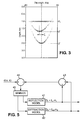
- a DA-CIG 12 is illustrated in figure 1 .
- the illustrated DA-CIG 12 is located above two diffraction points and is computed from measured seismic data using a correct velocity model.
- two kinds of features can thus be distinguished.
- the first kind consists in concave features and the second kind consists in flat features.
- the concave features are related to reflection events and the flat features are related to diffraction events.
- two horizontal features 14, 16 appear in the common image gather of figure 1 . Both horizontal features are related to diffraction points in the subsurface.
- the summation of DA-CIGs obtained for different horizontal positions produces a seismic image of the subsurface.
- An image of a reflector is formed by a constructive summation of these DA-CIGs in a vicinity of the apexes of the concave features, in the form of smiles, related to such reflector.
- the tails of the smile-shaped reflection features are either annihilated in the migrated image due to destructive optimal summation, or they create migration noise due to aliasing in the data and truncation of the migration aperture.
- the ability to control migration aperture is important in order to reduce this noise in migrated images.
- a method of analyzing seismic data comprising:
- the method limits the migration aperture in the dip-angle domain, which can optimally preserve both specular and non-specular components of the wavefield. It uses a modified Radon transform which can be referred to as Limited Aperture Hybrid Radon Transform (LAHRT).
- LAHRT Limited Aperture Hybrid Radon Transform
- the diffraction data can be analyzed separately from the reflection data to look for small-scaled structures of interest.
- the reflection data and diffraction data obtained by transforming the reflection and diffraction models with the Radon operators are added together to obtain a processed common image gather.
- Such processed common image gathers are obtained for different horizontal positions.
- the method may then include a further step of summing the data in the processed common image gathers to generate a migrated image of the subsurface.
- m d and m r are data vectors of the diffraction model and of the reflection model, respectively
- L d and L r are the diffraction and reflection Radon operators, respectively
- d represents a data vector of the common image gather
- W d and W r are model space weights
- ⁇ d and ⁇ r are measures of sparseness for diffraction and reflection, respectively
- ⁇ 2 is an L 2 measure.
- the inversion trajectory of the reflection component is restricted by the apex vicinity only, while typically the diffraction component is fully inverted.
- ⁇ and z are respectively dip angle and depth coordinates in the common image gather
- c, ⁇ and z 1 are respectively parabola curvature, parabola apex shift and depth coordinates in the reflection model, the sum on the parabola apex shift coordinate ⁇ being restricted to values of ⁇ around the dip angle coordinate ⁇ .
- the size of the apex vicinity can be defined by referring to the stationary phase principle and Fresnel zone considerations.
- the Fresnel zone is theoretically defined for monochromatic waves only and reflection seismology deals with broadband wavelets, the Fresnel zone can be thought of as a "zone of influence". This concept can be extended to the angle domain as indicated in the above-mentioned Bienati et al. paper. It provides a criterion for further optimizing the migration aperture.
- the sum on the parabola apex shift coordinate ⁇ can be restricted, for a given value of the parabola curvature coordinate c, to values of ⁇ different from ⁇ by less than about ⁇ ⁇ 4 ⁇ c , where ⁇ is an average wavelength of seismic waves used to measure the seismic data.
- Another aspect of the invention relates to a system for analyzing seismic data, comprising computer resource configured to carry out an analysis method as mentioned above.
- Another aspect of the invention relates to a computer program product for a system for analyzing seismic data, comprising instructions to carry out a method as claimed in any one of the preceding claims when said program product is run in a computer processing unit of the system for analyzing seismic data.
- the computer program product is typically embodied on a computer-readable medium.
- FIG 2 is a schematic illustration of the subsurface with a simplified representation of backscattering structures.
- the subsurface includes numerous reflecting and diffracting structures. So real-world DA-CIGs look much more complex, with many smile-shaped and linear features, and also background noise and aliasing noise, i.e. noise due to the finite spatial sampling rate of the seismic signal.
- the LAHRT method whose flowchart is generally depicted in figure 4 aims at producing seismic images having a low residual noise level, while keeping features representative of small-scaled structures which typically produce diffraction components in the measured seismic signal.
- first step 30 seismic data are received as input for the analysis method.
- the seismic data has been gathered on the field, using technologies well known in the art.
- second step 31 DA-CIGs are computed at different horizontal positions (x, y).
- the DA-CIGs are generated from the measured seismic data using conventional migration techniques.
- a hybrid Radon model is determined as an alternative parameter representation of the DA-CIG in a model space (m r , m d ).
- the Radon representation is said to be hybrid because it includes both a reflection model m r and a diffraction model m d .
- a convenient reflection model can be defined as follows based on the DA-CIG data noted d( ⁇ , z).
- the Radon model may be defined using first diffraction Radon operator L d - 1 from the 2-dimensional DA-CIG data space ( ⁇ , z) to another 3-dimensional parameter space ( ⁇ , ⁇ , z 1 )
- ⁇ designates a lateral distance between a diffractor and an image point
- ⁇ d and ⁇ r are diffraction and reflection measures of sparseness, respectively.
- the notations m d and m r are abbreviations for model vectors including values of the diffraction and reflection models at sampled positions of the model space, to which the Radon operators L d and L r are applied, and d denotes a corresponding input vector whose components are the sampled values of the DA-CIG data.
- W d and W r designate model space weights arranged in diagonal matrices.
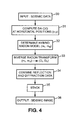
- the minimization process performed in step 32 is diagrammatically depicted in figure 5 .
- the reflection model m r and the diffraction model m d are generated by units 41 and 42 which convert them into the original data space using formulas (2) and (4).
- the reflection and diffraction data D r and D d thus obtained are summed at 43 and the resulting combination is subtracted from the input data d( ⁇ , z) at 44.
- the minimization unit 45 applies a least-square-type of algorithm to minimize the magnitude of the difference d( ⁇ , z) - [D r ( ⁇ , z) + D r ( ⁇ , z)]. It controls the reflection and diffraction model generators 41, 42 in order to find the optimal model parameters m r , m d .
- An example of known minimization algorithm which can be used is the limited-memory quasi-Newton method.
- step 32 Once the optimal reflection and diffraction models m r , m d have been determined in step 32, and inverse Radon transform is applied in step 33 using the operators L r , L d corresponding to formulas (2) and (4), to generate reflection data D r and diffraction data D d which are considered to best represent the structure of the subsurface at the horizontal position of the current DA-CIG.
- the reflection Radon operator L r is adapted to restrict the insertion trajectories in the apex vicinity only, while the diffraction component D d is fully inverted.
- the size of the apex vicinity can be defined on the basis of the stationary phase principle and Fresnel zone considerations.
- ⁇ designates an average value of the wavelength of the seismic waves used in the measurement step.
- the above-described LAHRT procedure eliminates a major part of the noise which is due to the tail portions of the parabola-shaped features while keeping the information contained in the diffraction components of the DA-CIG.
- These DA-CIGs for different horizontal positions (x, y) are then summed in the stacking step 35 to provide the PSDM seismic image output in step 36.
- Figure 6 shows a depth-migrated section obtained from synthetic data using the correct velocity model, and a DA-CIG at the horizontal position A is shown in figure 7 .
- the synthetic input data are well sampled (inter-trace distance is 25 m), and the migration does not suffer from aliasing effects.
- Reflector truncations produce multiple apices at the same depth in some DA-CIGs.
- two apices are located at the depth of about 1.25 km.
- Figure 8-9 show the apex saving approach presented in the above-mentioned Bienati, et al., 2009 paper, with a migration aperture limited by reflection smiles apex vicinities.
- the migrated image ( figure 8 ) is over-smoothed and small scale structural features such as fault planes and steps are not preserved.
- the processed DA-CIG ( figure 9 ) does not contain diffraction component. It also loses multiple apices located at the same depth.
- figures 10-11 show again the same migrated section and DA-CIG obtained with the LAHRT procedure described above.
- the migrated image ( figure 10 ) looks almost identical to the reference image shown in Figure 6 .
- the processed DA-CIG ( figure 11 ) contains mainly specular reflection energy concentrated in a vicinity of the apices and diffractions represented by the quasi-linear events. "Tails" of the reflection response are not contributing to the image.
- Figure 12 shows a migrated section obtained with decimated input data.
- the decimated data was obtained from the synthetic seismic data used in figures 6-11 by removing every second trace.
- the inter-trace distance is thus 50 m instead of 25 m, resulting in data aliasing.
- the migrated image of figure 12 is contaminated with strong migration noise and the corresponding processed DA-CIG shown in figure 13 clearly suffers from aliasing.
- the migrated common image gathers were also determined from the decimated data using the LAHRT procedure. The result is shown in figures 14-15 . Most of the migration noise caused by the input data aliasing disappeared. The DA-CIG of figure 15 contains mostly reflection energy concentrated in the vicinity of the apices. So to speak, "holes" caused by the aliasing are filled.
- FIG. 16 Migration of real seismic data is illustrated in the other example of figures 16-17 .
- the conventional migrated image ( figure 16 ) contains many artifacts in the form of inclined linear noise and migration smiles. After migration using the LAHRT procedure the noise is strongly reduced ( figure 17 ). The scattering points in the upper part of the image which can be associated with small scale heterogeneities or fractures are preserved.
- the embodiments of the method described herein may be implemented on any form of computer or computers and the components may be implemented as dedicated applications or in client-server architectures, including a web-based architecture, and can include functional programs, codes, and code segments.
- Any of the computers may comprise a processor, a memory for storing program data and executing it, a permanent storage such as a disk drive, a communications port for handling communications with external devices, and user interface devices, including a display, keyboard, mouse, etc.
- the method is carried out using software modules which may be stored as program instructions or computer readable codes executable on the processor on a computer-readable media such as read-only memory (ROM), random-access memory (RAM), CD-ROMs, magnetic tapes, floppy disks, and optical data storage devices.
- ROM read-only memory
- RAM random-access memory
- CD-ROMs compact disc-read only memory
- magnetic tapes magnetic tapes
- floppy disks and optical data storage devices
- optical data storage devices optical data storage devices.
- the computer readable recording medium can also be distributed over network coupled computer systems so that the computer readable code is stored and executed in a distributed fashion. This media is readable by the computer, stored in the memory, and executed by the processor.
Landscapes
- Engineering & Computer Science (AREA)
- Remote Sensing (AREA)
- Physics & Mathematics (AREA)
- Life Sciences & Earth Sciences (AREA)
- Acoustics & Sound (AREA)
- Environmental & Geological Engineering (AREA)
- Geology (AREA)
- General Life Sciences & Earth Sciences (AREA)
- General Physics & Mathematics (AREA)
- Geophysics (AREA)
- Geophysics And Detection Of Objects (AREA)
Claims (8)
- Verfahren zur Analyse von seismischen Daten, das aufweist:- Erzeugen einer allgemeinen Postmigrationsbildsammlung in einem Einfallswinkelgebiet aus gemessenen seismischen Daten;- Bestimmen eines hybriden Radonmodells in Verbindung mit der allgemeinen Bildsammlung einschließlich eines Reflexionsmodells, das sich auf konkave Merkmale in der allgemeinen Bildsammlung bezieht, und eines Beugungsmodells, das sich auf lineare Merkmale in der allgemeinen Bildsammlung bezieht;- Transformieren des Reflexionsmodells mit einem Radon-Reflexionsoperator, der entlang Inversionskurven, die um Scheitelpunkte der konkaven Merkmale beschränkt sind, angewendet wird, um Reflexionsdaten zu gewinnen; und- Transformieren des Beugungsmodells mit einem Radon-Beugungsoperator, um Beugungsdaten zu gewinnen.
- Verfahren nach Anspruch 1, das ferner das Hinzufügen der Reflexionsdaten und Beugungsdaten aufweist, die durch Transformieren der Reflexions- und Beugungsmodelle mit den Radon-Operatoren gewonnen werden, um eine verarbeitete allgemeine Bildsammlung zu erhalten.
- Verfahren nach Anspruch 2, das die Gewinnung verarbeiteter allgemeiner Bildsammlungen für verschiedene horizontale Positionen und das Summieren der Daten in den verarbeiteten allgemeinen Bildsammlungen aufweist, um ein migriertes Bild der Teiloberfläche zu gewinnen.
- Verfahren nach einem der vorhergehenden Ansprüche, wobei die Bestimmung des hybriden Radon-Modells, das mit der allgemeinen Bildsammlung verbunden ist, die Minimierung einer Zielfunktion aufweist:

- Verfahren nach einem der vorhergehenden Ansprüche, wobei die Transformation des Reflexionsmodells mr(ξ, c, z') mit dem Radon-Reflexionsoperator die Berechnung der Reflexionsdaten Dr(α, z) als

umfasst, wobei α und z jeweils Einfallswinkel- und Tiefenkoordinaten in der allgemeinen Bildsammlung sind, c, ξ, und z' jeweils Parabelkrümmungs-, Parabelscheitelverschiebungs- und Tiefenkoordinaten in dem Reflexionsmodell sind, wobei die Summe der Parabelscheitelverschiebungskoordinaten ξ auf Werte von ξ um die Einfallswinkelkoordinate α herum beschränkt sind. - Verfahren nach Anspruch 5, wobei, wenn die Reflexionsdaten Dr(α, z) für eine Einfallswinkelkoordinate α und eine Tiefenkoordinate z berechnet werden, die Summe der Parabelscheitelverschiebungskoordinaten ξ für einen gegebenen Wert der Parabelkrümmungskoordinate c auf Werte von ξ beschränkt ist, die sich um weniger als etwa

- System zur Analyse seismischer Daten, das Rechenressourcen aufweist, die konfiguriert sind, um ein Verfahren nach einem der vorhergehenden Ansprüche auszuführen.
- Computerprogrammprodukt für ein System zur Analyse seismischer Daten, das Anweisungen aufweist, um ein Verfahren nach einem der Ansprüche 1 - 6 auszuführen, wenn das Programmprodukt auf einer Rechenverarbeitungseinheit des Systems zur Analyse seismischer Daten laufen gelassen wird.
Applications Claiming Priority (1)
| Application Number | Priority Date | Filing Date | Title |
|---|---|---|---|
| PCT/IB2011/000478 WO2012107792A1 (en) | 2011-02-08 | 2011-02-08 | Method of analyzing seismic data |
Publications (2)
| Publication Number | Publication Date |
|---|---|
| EP2673662A1 EP2673662A1 (de) | 2013-12-18 |
| EP2673662B1 true EP2673662B1 (de) | 2014-12-17 |
Family
ID=44543559
Family Applications (1)
| Application Number | Title | Priority Date | Filing Date |
|---|---|---|---|
| EP11719057.9A Active EP2673662B1 (de) | 2011-02-08 | 2011-02-08 | Verfahren zur analyse von seismischen daten |
Country Status (3)
| Country | Link |
|---|---|
| US (1) | US9880303B2 (de) |
| EP (1) | EP2673662B1 (de) |
| WO (1) | WO2012107792A1 (de) |
Cited By (1)
| Publication number | Priority date | Publication date | Assignee | Title |
|---|---|---|---|---|
| CN107728198A (zh) * | 2016-08-12 | 2018-02-23 | 中国石油化工股份有限公司 | 地震道集成像方法及系统 |
Families Citing this family (22)
| Publication number | Priority date | Publication date | Assignee | Title |
|---|---|---|---|---|
| CN103675897B (zh) * | 2012-08-30 | 2017-10-27 | 中国石油化工股份有限公司 | 一种地震绕射波分离成像方法 |
| US9134444B2 (en) * | 2012-11-27 | 2015-09-15 | Chevron U.S.A., Inc. | System and method for deducing cavern properties |
| US20150301208A1 (en) * | 2014-04-22 | 2015-10-22 | Westerngeco L.L.C. | Seismic data processing |
| CN105223607A (zh) * | 2014-07-04 | 2016-01-06 | 中国石油化工股份有限公司 | 基于反稳相滤波的绕射波成像方法 |
| US10535168B2 (en) * | 2016-03-02 | 2020-01-14 | Schlumberger Technology Corporation | Image enhancement using seismic partition images |
| RU2760102C2 (ru) * | 2016-09-07 | 2021-11-22 | Чайна Петролеум Энд Кемикал Корпорейшн | Способ и система автоматического распознавания центра залежи в карстовой пещере |
| CN106526671B (zh) * | 2016-09-29 | 2018-11-16 | 中国石油天然气股份有限公司 | 一种碳酸盐岩储层地震波响应特征分析方法 |
| CN108693559B (zh) * | 2017-04-05 | 2020-04-07 | 中国石油化工股份有限公司 | 地震波联合成像方法及系统 |
| US10295685B2 (en) | 2017-04-06 | 2019-05-21 | Saudi Arabian Oil Company | Generating common image gather using wave-field separation |
| US11016212B2 (en) | 2017-04-11 | 2021-05-25 | Saudi Arabian Oil Company | Compressing seismic wavefields in three-dimensional reverse time migration |
| US10684382B2 (en) * | 2018-01-23 | 2020-06-16 | Saudi Arabian Oil Company | Generating target-oriented acquisition-imprint-free prestack angle gathers using common focus point operators |
| US11275190B2 (en) | 2018-05-16 | 2022-03-15 | Saudi Arabian Oil Company | Generating diffraction images based on wave equations |
| CN109143344A (zh) * | 2018-11-14 | 2019-01-04 | 中国矿业大学(北京) | 绕射波分离方法、装置和电子设备 |
| CN109283580B (zh) * | 2018-11-15 | 2019-09-17 | 中国地质大学(武汉) | 一种碳酸盐岩储层物理模型选择方法 |
| CN110118993B (zh) * | 2019-05-22 | 2020-05-15 | 中国矿业大学(北京) | 绕射波成像方法及装置 |
| US11681043B2 (en) | 2019-09-03 | 2023-06-20 | Saudi Arabian Oil Company | Diffraction imaging using pseudo dip-angle gather |
| US11313988B2 (en) | 2019-12-13 | 2022-04-26 | Saudi Arabian Oil Company | Identifying geologic features in a subterranean formation using seismic diffraction imaging |
| US11353609B2 (en) | 2019-12-20 | 2022-06-07 | Saudi Arabian Oil Company | Identifying geologic features in a subterranean formation using angle domain gathers sampled in a spiral coordinate space |
| US11402529B2 (en) | 2020-01-09 | 2022-08-02 | Saudi Arabian Oil Company | Identifying geologic features in a subterranean formation using seismic diffraction and refraction imaging |
| US11467303B2 (en) | 2020-03-09 | 2022-10-11 | Saudi Arabian Oil Company | Identifying geologic features in a subterranean formation using a post-stack seismic diffraction imaging condition |
| US11320557B2 (en) | 2020-03-30 | 2022-05-03 | Saudi Arabian Oil Company | Post-stack time domain image with broadened spectrum |
| US11656378B2 (en) | 2020-06-08 | 2023-05-23 | Saudi Arabian Oil Company | Seismic imaging by visco-acoustic reverse time migration |
Family Cites Families (3)
| Publication number | Priority date | Publication date | Assignee | Title |
|---|---|---|---|---|
| US3638176A (en) * | 1970-01-05 | 1972-01-25 | Marathon Oil Co | Seismic diffraction scan |
| WO1991015783A1 (en) * | 1990-04-03 | 1991-10-17 | Thomas Edwin Owen | Enhanced detection of seismic diffractor targets |
| GB2493868B (en) * | 2010-06-07 | 2016-07-20 | Total Sa | Method for analyzing seismic data |
-
2011
- 2011-02-08 WO PCT/IB2011/000478 patent/WO2012107792A1/en not_active Ceased
- 2011-02-08 EP EP11719057.9A patent/EP2673662B1/de active Active
- 2011-02-08 US US13/984,192 patent/US9880303B2/en active Active
Cited By (2)
| Publication number | Priority date | Publication date | Assignee | Title |
|---|---|---|---|---|
| CN107728198A (zh) * | 2016-08-12 | 2018-02-23 | 中国石油化工股份有限公司 | 地震道集成像方法及系统 |
| CN107728198B (zh) * | 2016-08-12 | 2019-02-19 | 中国石油化工股份有限公司 | 地震道集成像方法及系统 |
Also Published As
| Publication number | Publication date |
|---|---|
| US9880303B2 (en) | 2018-01-30 |
| US20140032119A1 (en) | 2014-01-30 |
| EP2673662A1 (de) | 2013-12-18 |
| WO2012107792A1 (en) | 2012-08-16 |
Similar Documents
| Publication | Publication Date | Title |
|---|---|---|
| EP2673662B1 (de) | Verfahren zur analyse von seismischen daten | |
| US9632192B2 (en) | Method of processing seismic data by providing surface offset common image gathers | |
| US20130077832A1 (en) | Method for analyzing seismic data | |
| US8396668B2 (en) | Marine seismic surveying employing interpolated multicomponent streamer pressure data | |
| EP1611461B1 (de) | Verfahren zur simultation von örtlich prestack-tiefenmigrierten seismischen aufnahmen | |
| EP2530491B1 (de) | Verfahren und vorrichtung für seismische untersuchungen mit durch meeresoberflächenveränderungen verursachten druckveränderungen | |
| US9696445B2 (en) | Systems and methods for frequency-domain filtering and space-time domain discrimination of seismic data | |
| US9411062B2 (en) | Method and system for determining source signatures after source ghost removal | |
| EP2375268B1 (de) | Verfahren zur Trennung des sich auf- und abwärts verbreitenden Drucks und vertikaler Geschwindigkeitsfelder aus Druck- und dreiachsigen Bewegungssensoren bei Schleppsonaren | |
| US9864097B2 (en) | System and method for modelling three dimensional shallow water multiples using predictive sea floor reconstruction | |
| US20130289879A1 (en) | Process for characterising the evolution of a reservoir | |
| CA2753252A1 (en) | Device and method for calculating 3d angle gathers from reverse time migration | |
| Halliday et al. | Seismic interferometry of scattered surface waves in attenuative media | |
| Robertsson et al. | Wavefield separation using densely deployed three-component single-sensor groups in land surface-seismic recordings | |
| EP2299296B1 (de) | Verfahren zur Kombination von Signalen aus Druck- und Teilchenbewegungssensoren in marinen seismischen Streamern | |
| CN101663597A (zh) | 根据2-d地震数据进行3-d散射体成像 | |
| Zhang et al. | Common-image gathers in the incident phase-angle domain from reverse time migration in 2D elastic VTI media | |
| Thiel et al. | Comparison of acoustic and elastic full‐waveform inversion of 2D towed‐streamer data in the presence of salt | |
| US10379245B2 (en) | Method and system for efficient extrapolation of a combined source-and-receiver wavefield | |
| EP1879052A2 (de) | Seebeben-Zeitraumüberwachung unter Verwendung der Druckdaten eines interpolierten seismischen Mehrkomponentenkabels | |
| Liu et al. | Wave-equation diffraction imaging using pseudo dip-angle gather | |
| Jiang et al. | Diffraction imaging using reverse time migration with poynting vectors | |
| You et al. | First-order acoustic wave equation reverse time migration based on the dual-sensor seismic acquisition system | |
| Allouche et al. | Converted waves in a shallow marine environment: Experimental and modeling studies | |
| US20240184008A1 (en) | System and method for multiple prediction with angular dependent reflectivity |
Legal Events
| Date | Code | Title | Description |
|---|---|---|---|
| PUAI | Public reference made under article 153(3) epc to a published international application that has entered the european phase |
Free format text: ORIGINAL CODE: 0009012 |
|
| 17P | Request for examination filed |
Effective date: 20130712 |
|
| AK | Designated contracting states |
Kind code of ref document: A1 Designated state(s): AL AT BE BG CH CY CZ DE DK EE ES FI FR GB GR HR HU IE IS IT LI LT LU LV MC MK MT NL NO PL PT RO RS SE SI SK SM TR |
|
| DAX | Request for extension of the european patent (deleted) | ||
| GRAP | Despatch of communication of intention to grant a patent |
Free format text: ORIGINAL CODE: EPIDOSNIGR1 |
|
| INTG | Intention to grant announced |
Effective date: 20140708 |
|
| GRAS | Grant fee paid |
Free format text: ORIGINAL CODE: EPIDOSNIGR3 |
|
| GRAA | (expected) grant |
Free format text: ORIGINAL CODE: 0009210 |
|
| AK | Designated contracting states |
Kind code of ref document: B1 Designated state(s): AL AT BE BG CH CY CZ DE DK EE ES FI FR GB GR HR HU IE IS IT LI LT LU LV MC MK MT NL NO PL PT RO RS SE SI SK SM TR |
|
| REG | Reference to a national code |
Ref country code: GB Ref legal event code: FG4D |
|
| REG | Reference to a national code |
Ref country code: CH Ref legal event code: EP |
|
| REG | Reference to a national code |
Ref country code: IE Ref legal event code: FG4D |
|
| REG | Reference to a national code |
Ref country code: AT Ref legal event code: REF Ref document number: 702300 Country of ref document: AT Kind code of ref document: T Effective date: 20150115 |
|
| REG | Reference to a national code |
Ref country code: DE Ref legal event code: R096 Ref document number: 602011012304 Country of ref document: DE Effective date: 20150129 |
|
| REG | Reference to a national code |
Ref country code: NO Ref legal event code: T2 Effective date: 20141217 |
|
| PG25 | Lapsed in a contracting state [announced via postgrant information from national office to epo] |
Ref country code: FI Free format text: LAPSE BECAUSE OF FAILURE TO SUBMIT A TRANSLATION OF THE DESCRIPTION OR TO PAY THE FEE WITHIN THE PRESCRIBED TIME-LIMIT Effective date: 20141217 Ref country code: LT Free format text: LAPSE BECAUSE OF FAILURE TO SUBMIT A TRANSLATION OF THE DESCRIPTION OR TO PAY THE FEE WITHIN THE PRESCRIBED TIME-LIMIT Effective date: 20141217 |
|
| REG | Reference to a national code |
Ref country code: LT Ref legal event code: MG4D |
|
| PG25 | Lapsed in a contracting state [announced via postgrant information from national office to epo] |
Ref country code: HR Free format text: LAPSE BECAUSE OF FAILURE TO SUBMIT A TRANSLATION OF THE DESCRIPTION OR TO PAY THE FEE WITHIN THE PRESCRIBED TIME-LIMIT Effective date: 20141217 Ref country code: SE Free format text: LAPSE BECAUSE OF FAILURE TO SUBMIT A TRANSLATION OF THE DESCRIPTION OR TO PAY THE FEE WITHIN THE PRESCRIBED TIME-LIMIT Effective date: 20141217 Ref country code: LV Free format text: LAPSE BECAUSE OF FAILURE TO SUBMIT A TRANSLATION OF THE DESCRIPTION OR TO PAY THE FEE WITHIN THE PRESCRIBED TIME-LIMIT Effective date: 20141217 Ref country code: GR Free format text: LAPSE BECAUSE OF FAILURE TO SUBMIT A TRANSLATION OF THE DESCRIPTION OR TO PAY THE FEE WITHIN THE PRESCRIBED TIME-LIMIT Effective date: 20150318 Ref country code: RS Free format text: LAPSE BECAUSE OF FAILURE TO SUBMIT A TRANSLATION OF THE DESCRIPTION OR TO PAY THE FEE WITHIN THE PRESCRIBED TIME-LIMIT Effective date: 20141217 |
|
| REG | Reference to a national code |
Ref country code: AT Ref legal event code: MK05 Ref document number: 702300 Country of ref document: AT Kind code of ref document: T Effective date: 20141217 |
|
| PG25 | Lapsed in a contracting state [announced via postgrant information from national office to epo] |
Ref country code: NL Free format text: LAPSE BECAUSE OF FAILURE TO SUBMIT A TRANSLATION OF THE DESCRIPTION OR TO PAY THE FEE WITHIN THE PRESCRIBED TIME-LIMIT Effective date: 20141217 |
|
| PG25 | Lapsed in a contracting state [announced via postgrant information from national office to epo] |
Ref country code: RO Free format text: LAPSE BECAUSE OF FAILURE TO SUBMIT A TRANSLATION OF THE DESCRIPTION OR TO PAY THE FEE WITHIN THE PRESCRIBED TIME-LIMIT Effective date: 20141217 Ref country code: EE Free format text: LAPSE BECAUSE OF FAILURE TO SUBMIT A TRANSLATION OF THE DESCRIPTION OR TO PAY THE FEE WITHIN THE PRESCRIBED TIME-LIMIT Effective date: 20141217 Ref country code: SK Free format text: LAPSE BECAUSE OF FAILURE TO SUBMIT A TRANSLATION OF THE DESCRIPTION OR TO PAY THE FEE WITHIN THE PRESCRIBED TIME-LIMIT Effective date: 20141217 Ref country code: ES Free format text: LAPSE BECAUSE OF FAILURE TO SUBMIT A TRANSLATION OF THE DESCRIPTION OR TO PAY THE FEE WITHIN THE PRESCRIBED TIME-LIMIT Effective date: 20141217 Ref country code: CZ Free format text: LAPSE BECAUSE OF FAILURE TO SUBMIT A TRANSLATION OF THE DESCRIPTION OR TO PAY THE FEE WITHIN THE PRESCRIBED TIME-LIMIT Effective date: 20141217 |
|
| PG25 | Lapsed in a contracting state [announced via postgrant information from national office to epo] |
Ref country code: AT Free format text: LAPSE BECAUSE OF FAILURE TO SUBMIT A TRANSLATION OF THE DESCRIPTION OR TO PAY THE FEE WITHIN THE PRESCRIBED TIME-LIMIT Effective date: 20141217 Ref country code: IS Free format text: LAPSE BECAUSE OF FAILURE TO SUBMIT A TRANSLATION OF THE DESCRIPTION OR TO PAY THE FEE WITHIN THE PRESCRIBED TIME-LIMIT Effective date: 20150417 Ref country code: PL Free format text: LAPSE BECAUSE OF FAILURE TO SUBMIT A TRANSLATION OF THE DESCRIPTION OR TO PAY THE FEE WITHIN THE PRESCRIBED TIME-LIMIT Effective date: 20141217 |
|
| REG | Reference to a national code |
Ref country code: DE Ref legal event code: R119 Ref document number: 602011012304 Country of ref document: DE |
|
| PG25 | Lapsed in a contracting state [announced via postgrant information from national office to epo] |
Ref country code: LU Free format text: LAPSE BECAUSE OF FAILURE TO SUBMIT A TRANSLATION OF THE DESCRIPTION OR TO PAY THE FEE WITHIN THE PRESCRIBED TIME-LIMIT Effective date: 20150208 |
|
| REG | Reference to a national code |
Ref country code: CH Ref legal event code: PL |
|
| PLBE | No opposition filed within time limit |
Free format text: ORIGINAL CODE: 0009261 |
|
| STAA | Information on the status of an ep patent application or granted ep patent |
Free format text: STATUS: NO OPPOSITION FILED WITHIN TIME LIMIT |
|
| PG25 | Lapsed in a contracting state [announced via postgrant information from national office to epo] |
Ref country code: CH Free format text: LAPSE BECAUSE OF NON-PAYMENT OF DUE FEES Effective date: 20150228 Ref country code: LI Free format text: LAPSE BECAUSE OF NON-PAYMENT OF DUE FEES Effective date: 20150228 Ref country code: MC Free format text: LAPSE BECAUSE OF FAILURE TO SUBMIT A TRANSLATION OF THE DESCRIPTION OR TO PAY THE FEE WITHIN THE PRESCRIBED TIME-LIMIT Effective date: 20141217 Ref country code: DK Free format text: LAPSE BECAUSE OF FAILURE TO SUBMIT A TRANSLATION OF THE DESCRIPTION OR TO PAY THE FEE WITHIN THE PRESCRIBED TIME-LIMIT Effective date: 20141217 |
|
| REG | Reference to a national code |
Ref country code: IE Ref legal event code: MM4A |
|
| 26N | No opposition filed |
Effective date: 20150918 |
|
| PG25 | Lapsed in a contracting state [announced via postgrant information from national office to epo] |
Ref country code: IT Free format text: LAPSE BECAUSE OF FAILURE TO SUBMIT A TRANSLATION OF THE DESCRIPTION OR TO PAY THE FEE WITHIN THE PRESCRIBED TIME-LIMIT Effective date: 20141217 |
|
| REG | Reference to a national code |
Ref country code: FR Ref legal event code: PLFP Year of fee payment: 6 |
|
| PG25 | Lapsed in a contracting state [announced via postgrant information from national office to epo] |
Ref country code: IE Free format text: LAPSE BECAUSE OF NON-PAYMENT OF DUE FEES Effective date: 20150208 Ref country code: DE Free format text: LAPSE BECAUSE OF NON-PAYMENT OF DUE FEES Effective date: 20150901 |
|
| PG25 | Lapsed in a contracting state [announced via postgrant information from national office to epo] |
Ref country code: SI Free format text: LAPSE BECAUSE OF FAILURE TO SUBMIT A TRANSLATION OF THE DESCRIPTION OR TO PAY THE FEE WITHIN THE PRESCRIBED TIME-LIMIT Effective date: 20141217 |
|
| PG25 | Lapsed in a contracting state [announced via postgrant information from national office to epo] |
Ref country code: BE Free format text: LAPSE BECAUSE OF FAILURE TO SUBMIT A TRANSLATION OF THE DESCRIPTION OR TO PAY THE FEE WITHIN THE PRESCRIBED TIME-LIMIT Effective date: 20141217 |
|
| PG25 | Lapsed in a contracting state [announced via postgrant information from national office to epo] |
Ref country code: MT Free format text: LAPSE BECAUSE OF FAILURE TO SUBMIT A TRANSLATION OF THE DESCRIPTION OR TO PAY THE FEE WITHIN THE PRESCRIBED TIME-LIMIT Effective date: 20141217 |
|
| REG | Reference to a national code |
Ref country code: FR Ref legal event code: PLFP Year of fee payment: 7 |
|
| PG25 | Lapsed in a contracting state [announced via postgrant information from national office to epo] |
Ref country code: HU Free format text: LAPSE BECAUSE OF FAILURE TO SUBMIT A TRANSLATION OF THE DESCRIPTION OR TO PAY THE FEE WITHIN THE PRESCRIBED TIME-LIMIT; INVALID AB INITIO Effective date: 20110208 Ref country code: BG Free format text: LAPSE BECAUSE OF FAILURE TO SUBMIT A TRANSLATION OF THE DESCRIPTION OR TO PAY THE FEE WITHIN THE PRESCRIBED TIME-LIMIT Effective date: 20141217 Ref country code: SM Free format text: LAPSE BECAUSE OF FAILURE TO SUBMIT A TRANSLATION OF THE DESCRIPTION OR TO PAY THE FEE WITHIN THE PRESCRIBED TIME-LIMIT Effective date: 20141217 |
|
| PG25 | Lapsed in a contracting state [announced via postgrant information from national office to epo] |
Ref country code: CY Free format text: LAPSE BECAUSE OF FAILURE TO SUBMIT A TRANSLATION OF THE DESCRIPTION OR TO PAY THE FEE WITHIN THE PRESCRIBED TIME-LIMIT Effective date: 20141217 |
|
| PG25 | Lapsed in a contracting state [announced via postgrant information from national office to epo] |
Ref country code: PT Free format text: LAPSE BECAUSE OF FAILURE TO SUBMIT A TRANSLATION OF THE DESCRIPTION OR TO PAY THE FEE WITHIN THE PRESCRIBED TIME-LIMIT Effective date: 20150417 |
|
| PG25 | Lapsed in a contracting state [announced via postgrant information from national office to epo] |
Ref country code: TR Free format text: LAPSE BECAUSE OF FAILURE TO SUBMIT A TRANSLATION OF THE DESCRIPTION OR TO PAY THE FEE WITHIN THE PRESCRIBED TIME-LIMIT Effective date: 20141217 |
|
| REG | Reference to a national code |
Ref country code: FR Ref legal event code: PLFP Year of fee payment: 8 |
|
| PG25 | Lapsed in a contracting state [announced via postgrant information from national office to epo] |
Ref country code: MK Free format text: LAPSE BECAUSE OF FAILURE TO SUBMIT A TRANSLATION OF THE DESCRIPTION OR TO PAY THE FEE WITHIN THE PRESCRIBED TIME-LIMIT Effective date: 20141217 |
|
| PG25 | Lapsed in a contracting state [announced via postgrant information from national office to epo] |
Ref country code: AL Free format text: LAPSE BECAUSE OF FAILURE TO SUBMIT A TRANSLATION OF THE DESCRIPTION OR TO PAY THE FEE WITHIN THE PRESCRIBED TIME-LIMIT Effective date: 20141217 |
|
| REG | Reference to a national code |
Ref country code: FR Ref legal event code: PLFP Year of fee payment: 13 |
|
| P01 | Opt-out of the competence of the unified patent court (upc) registered |
Effective date: 20230524 |
|
| REG | Reference to a national code |
Ref country code: GB Ref legal event code: 732E Free format text: REGISTERED BETWEEN 20240523 AND 20240529 |
|
| PGFP | Annual fee paid to national office [announced via postgrant information from national office to epo] |
Ref country code: GB Payment date: 20260219 Year of fee payment: 16 |
|
| PGFP | Annual fee paid to national office [announced via postgrant information from national office to epo] |
Ref country code: NO Payment date: 20260220 Year of fee payment: 16 |
|
| PGFP | Annual fee paid to national office [announced via postgrant information from national office to epo] |
Ref country code: FR Payment date: 20260218 Year of fee payment: 16 |