EP2674211A1 - Membranes composites comprenant un polyphénylènesulfone sulfoné et leur utilisation dans des processus d'osmose directe - Google Patents
Membranes composites comprenant un polyphénylènesulfone sulfoné et leur utilisation dans des processus d'osmose directe Download PDFInfo
- Publication number
- EP2674211A1 EP2674211A1 EP12171998.3A EP12171998A EP2674211A1 EP 2674211 A1 EP2674211 A1 EP 2674211A1 EP 12171998 A EP12171998 A EP 12171998A EP 2674211 A1 EP2674211 A1 EP 2674211A1
- Authority
- EP
- European Patent Office
- Prior art keywords
- sulfonated
- composite membrane
- water
- substrate layer
- polyphenylenesulfone
- Prior art date
- Legal status (The legal status is an assumption and is not a legal conclusion. Google has not performed a legal analysis and makes no representation as to the accuracy of the status listed.)
- Ceased
Links
Images


Classifications
-
- B—PERFORMING OPERATIONS; TRANSPORTING
- B01—PHYSICAL OR CHEMICAL PROCESSES OR APPARATUS IN GENERAL
- B01D—SEPARATION
- B01D69/00—Semi-permeable membranes for separation processes or apparatus characterised by their form, structure or properties; Manufacturing processes specially adapted therefor
- B01D69/10—Supported membranes; Membrane supports
- B01D69/107—Organic support material
-
- B—PERFORMING OPERATIONS; TRANSPORTING
- B01—PHYSICAL OR CHEMICAL PROCESSES OR APPARATUS IN GENERAL
- B01D—SEPARATION
- B01D61/00—Processes of separation using semi-permeable membranes, e.g. dialysis, osmosis or ultrafiltration; Apparatus, accessories or auxiliary operations specially adapted therefor
- B01D61/002—Forward osmosis or direct osmosis
- B01D61/0022—Apparatus therefor
-
- B—PERFORMING OPERATIONS; TRANSPORTING
- B01—PHYSICAL OR CHEMICAL PROCESSES OR APPARATUS IN GENERAL
- B01D—SEPARATION
- B01D61/00—Processes of separation using semi-permeable membranes, e.g. dialysis, osmosis or ultrafiltration; Apparatus, accessories or auxiliary operations specially adapted therefor
- B01D61/002—Forward osmosis or direct osmosis
- B01D61/0024—Controlling or regulating
-
- B—PERFORMING OPERATIONS; TRANSPORTING
- B01—PHYSICAL OR CHEMICAL PROCESSES OR APPARATUS IN GENERAL
- B01D—SEPARATION
- B01D69/00—Semi-permeable membranes for separation processes or apparatus characterised by their form, structure or properties; Manufacturing processes specially adapted therefor
- B01D69/12—Composite membranes; Ultra-thin membranes
- B01D69/1213—Laminated layers
-
- B—PERFORMING OPERATIONS; TRANSPORTING
- B01—PHYSICAL OR CHEMICAL PROCESSES OR APPARATUS IN GENERAL
- B01D—SEPARATION
- B01D69/00—Semi-permeable membranes for separation processes or apparatus characterised by their form, structure or properties; Manufacturing processes specially adapted therefor
- B01D69/12—Composite membranes; Ultra-thin membranes
- B01D69/1214—Chemically bonded layers, e.g. cross-linking
-
- B—PERFORMING OPERATIONS; TRANSPORTING
- B01—PHYSICAL OR CHEMICAL PROCESSES OR APPARATUS IN GENERAL
- B01D—SEPARATION
- B01D69/00—Semi-permeable membranes for separation processes or apparatus characterised by their form, structure or properties; Manufacturing processes specially adapted therefor
- B01D69/12—Composite membranes; Ultra-thin membranes
- B01D69/125—In situ manufacturing by polymerisation, polycondensation, cross-linking or chemical reaction
- B01D69/1251—In situ manufacturing by polymerisation, polycondensation, cross-linking or chemical reaction by interfacial polymerisation
-
- B—PERFORMING OPERATIONS; TRANSPORTING
- B01—PHYSICAL OR CHEMICAL PROCESSES OR APPARATUS IN GENERAL
- B01D—SEPARATION
- B01D71/00—Semi-permeable membranes for separation processes or apparatus characterised by the material; Manufacturing processes specially adapted therefor
- B01D71/06—Organic material
- B01D71/66—Polymers having sulfur in the main chain, with or without nitrogen, oxygen or carbon only
- B01D71/68—Polysulfones; Polyethersulfones
-
- B—PERFORMING OPERATIONS; TRANSPORTING
- B01—PHYSICAL OR CHEMICAL PROCESSES OR APPARATUS IN GENERAL
- B01D—SEPARATION
- B01D71/00—Semi-permeable membranes for separation processes or apparatus characterised by the material; Manufacturing processes specially adapted therefor
- B01D71/06—Organic material
- B01D71/76—Macromolecular material not specifically provided for in a single one of groups B01D71/08 - B01D71/74
- B01D71/78—Graft polymers
-
- B—PERFORMING OPERATIONS; TRANSPORTING
- B01—PHYSICAL OR CHEMICAL PROCESSES OR APPARATUS IN GENERAL
- B01D—SEPARATION
- B01D71/00—Semi-permeable membranes for separation processes or apparatus characterised by the material; Manufacturing processes specially adapted therefor
- B01D71/06—Organic material
- B01D71/76—Macromolecular material not specifically provided for in a single one of groups B01D71/08 - B01D71/74
- B01D71/80—Block polymers
-
- B—PERFORMING OPERATIONS; TRANSPORTING
- B01—PHYSICAL OR CHEMICAL PROCESSES OR APPARATUS IN GENERAL
- B01D—SEPARATION
- B01D2323/00—Details relating to membrane preparation
- B01D2323/12—Specific ratios of components used
-
- B—PERFORMING OPERATIONS; TRANSPORTING
- B01—PHYSICAL OR CHEMICAL PROCESSES OR APPARATUS IN GENERAL
- B01D—SEPARATION
- B01D2323/00—Details relating to membrane preparation
- B01D2323/15—Use of additives
- B01D2323/218—Additive materials
- B01D2323/2181—Inorganic additives
-
- B—PERFORMING OPERATIONS; TRANSPORTING
- B01—PHYSICAL OR CHEMICAL PROCESSES OR APPARATUS IN GENERAL
- B01D—SEPARATION
- B01D2323/00—Details relating to membrane preparation
- B01D2323/15—Use of additives
- B01D2323/218—Additive materials
- B01D2323/2182—Organic additives
-
- B—PERFORMING OPERATIONS; TRANSPORTING
- B01—PHYSICAL OR CHEMICAL PROCESSES OR APPARATUS IN GENERAL
- B01D—SEPARATION
- B01D2323/00—Details relating to membrane preparation
- B01D2323/219—Specific solvent system
-
- B—PERFORMING OPERATIONS; TRANSPORTING
- B01—PHYSICAL OR CHEMICAL PROCESSES OR APPARATUS IN GENERAL
- B01D—SEPARATION
- B01D2323/00—Details relating to membrane preparation
- B01D2323/34—Use of radiation
- B01D2323/345—UV-treatment
-
- B—PERFORMING OPERATIONS; TRANSPORTING
- B01—PHYSICAL OR CHEMICAL PROCESSES OR APPARATUS IN GENERAL
- B01D—SEPARATION
- B01D2323/00—Details relating to membrane preparation
- B01D2323/38—Graft polymerization
- B01D2323/385—Graft polymerization involving radiation
-
- B—PERFORMING OPERATIONS; TRANSPORTING
- B01—PHYSICAL OR CHEMICAL PROCESSES OR APPARATUS IN GENERAL
- B01D—SEPARATION
- B01D2323/00—Details relating to membrane preparation
- B01D2323/40—Details relating to membrane preparation in-situ membrane formation
-
- B—PERFORMING OPERATIONS; TRANSPORTING
- B01—PHYSICAL OR CHEMICAL PROCESSES OR APPARATUS IN GENERAL
- B01D—SEPARATION
- B01D2325/00—Details relating to properties of membranes
- B01D2325/02—Details relating to pores or porosity of the membranes
- B01D2325/026—Sponge structure
-
- B—PERFORMING OPERATIONS; TRANSPORTING
- B01—PHYSICAL OR CHEMICAL PROCESSES OR APPARATUS IN GENERAL
- B01D—SEPARATION
- B01D2325/00—Details relating to properties of membranes
- B01D2325/14—Membrane materials having negatively charged functional groups
-
- B—PERFORMING OPERATIONS; TRANSPORTING
- B01—PHYSICAL OR CHEMICAL PROCESSES OR APPARATUS IN GENERAL
- B01D—SEPARATION
- B01D2325/00—Details relating to properties of membranes
- B01D2325/16—Membrane materials having positively charged functional groups
-
- B—PERFORMING OPERATIONS; TRANSPORTING
- B01—PHYSICAL OR CHEMICAL PROCESSES OR APPARATUS IN GENERAL
- B01D—SEPARATION
- B01D61/00—Processes of separation using semi-permeable membranes, e.g. dialysis, osmosis or ultrafiltration; Apparatus, accessories or auxiliary operations specially adapted therefor
- B01D61/02—Reverse osmosis; Hyperfiltration ; Nanofiltration
- B01D61/027—Nanofiltration
-
- B—PERFORMING OPERATIONS; TRANSPORTING
- B01—PHYSICAL OR CHEMICAL PROCESSES OR APPARATUS IN GENERAL
- B01D—SEPARATION
- B01D71/00—Semi-permeable membranes for separation processes or apparatus characterised by the material; Manufacturing processes specially adapted therefor
- B01D71/06—Organic material
- B01D71/56—Polyamides, e.g. polyester-amides
Definitions
- the present invention is directed to thin film composite membranes (TFC membranes) comprising a substrate layer (S) based on a sulfonated polyphenylenesulfone, and a polyamide film layer (F) and further to a method for their preparation. Furthermore, the present invention is directed to osmosis processes, in particular to forward osmosis (FO) processes, using said membrane.
- TFC membranes thin film composite membranes
- S substrate layer
- F polyamide film layer
- osmosis describes a diffusion process, wherein solvent molecules move through a selectively permeable membrane (i.e. permeable to solvent but not to solute), which is separating at least two solutions of different solute concentration, into a solution with higher solute concentration.
- This diffusion process aims for equalization of the solute concentrations.
- the selectively permeable membrane used in osmosis process is also referred to as "semi-permeable" membrane or osmosis membrane.
- osmosis membranes exhibit a molecular weight cut off (MWCO) in the range from 10 to 500 Da.
- the molecular weight cut off (MWCO) refers to the lowest molecular weight (given in Daltons) in which al least 80 %, preferably at least 90 %, of solute molecules are retained by the membrane.
- RO reverse osmosis
- FO forward osmosis
- a hydraulic pressure as the driving force for the separation is employed, wherein the solute retains on the pressurized side of the membrane and the solvent passes through the membrane to the other side.
- the forward osmosis (FO) employs the osmotic pressure as a driving force generated by a highly concentrated solution (so called “draw solution”) to allow water to diffuse through a semi-permeable membrane from the so called “feed solution” (e.g. brackish water or seawater), which has a relatively lower salt concentration.
- Forward osmosis offers some advantages over the reverse osmosis (RO) and thermal separation processes.
- forward osmosis can operate without high hydraulic pressures which are necessary in the reverse osmosis process and high temperatures which are necessary in the distillation and may be detrimental to the feed solution. Less energy is required for the FO process compared to other separation processes.
- the forward osmosis also offers the advantages of high rejection of a wide range of contaminants and lower membrane-fouling than traditional reverse osmosis processes.
- FO membranes can be utilized for example for water reuses, seawater desalination and concentration of pharmaceutical solutions.
- the major problems in use of forward osmosis today are e.g. the limited number of commercially available FO membranes, insufficient water permeation and separation performance of known FO membranes and the lack of desirable draw solutions depended on the intended use.
- Membranes which are designed for reverse osmosis processes can often not be applied in the forward osmosis process due to their thick and dense support layer, which is necessitated to withstand high pressure in the reverse osmosis process and which causes decreased water flux and high salt leakage in the FO process.
- an effective support layer (substrate layer) for FO membranes should be as thin as possible, highly porous, and provide a direct path from the draw solution to the active surface of the membrane.
- TFC thin film composite
- the content of sulfonated polymer in the polymer blend is discussed in relation to membrane performance.
- the TFC-membranes described in said documents have improved water flux and sufficient salt rejection.
- One disadvantage of the membranes described in these documents is the need to adjust the amounts of sulfonated and non-sulfonated polymer, which requires at least two starting materials and an additional process step in the production of the substrate layer, i.e. the production of the polymer blend.
- One object of the invention is to provide novel membranes suitable in particular for forward osmosis (FO) processes which can overcome the disadvantages of the state of the art, in particular having superior properties (e.g. high water flux) in use for forward osmosis.
- FO forward osmosis
- the composite membrane comprising a sulfonated polyphenylenesulfone, having a content of sulfonated units in a range of 1 to 10 mol-% (based on the sulfonated polymer), in the substrate layer give rise to FO-membranes with superior performance, especially high water flux in the PRO and FO mode, in particular using seawater as feed.
- a TFC membrane substrate layer can be formed comprising said sulfonated polyphenylenesulfone as only building polymer, in particular a substrate layer can be formed consisting of said polyphenylenesulfone.
- a substrate layer can be formed consisting of said polyphenylenesulfone.
- the present invention is directed to a composite membrane comprising (or preferably composed of):
- the inventive composite membrane shows the following desired characteristics, which are in particular important for use in forward osmosis processes:
- the inventive membrane is particularly suitable for forward osmosis applications.
- the newly developed membranes are designed particularly for seawater desalination, water reclamation from wastewaters, the osmotic concentration of food and pharmaceutical solutions via forward osmosis processes.
- the hydrophilic and macrovoid free membrane substrate layer (S) of the inventive composite membrane can enhance the membrane integrity. Further, the macrovoid-free structure and high content of the sulfonated units in the substrate polymer results in superior improved water flux and low salt leakage. In addition, the membrane fouling will be reduced in particular due to the hydrophilic nature of thin film layer (F) and substrate layer (S).
- microvoid in terms of the present invention means pores (e.g. elongated pores) with a pore size of more than 10 micrometer (> 10 micrometer). Macrovoids can often be found in asymmetric polymeric membranes prepared via phase-inversion techniques.
- a sulfonated polyphenylenesulfone P1 in terms of the present invention is a polymer which comprises sulfonated recurring units and non-sulfonated recurring units, wherein the amount of sulfonated recurring units (based on the total recurring units of polymer P1) is in the range of 1 to 10 mol-%, preferably 2 to 7 mol-%, more preferably 2 to 5 mol-%, based on the total weight of the polymer P1.
- the sulfonated repeating unit or the sulfonated monomeric unit carry at least one, preferably 1 to 4, more preferably 1 or 2, sulfonic acid functional group (also referred to as sulfonate group or sulfo group) according to formula -SO 3 H.
- the at least one sulfonic acid group is directly attached to an aromatic ring of the polyphenylenesulfone units.
- the sulfonic acid groups may be in form of free acid -SO 3 H or in deprotonated form in dependency of the conditions.
- the at least one sulfonated polyphenylenesulfone P1 comprises typically from 1 to 10 mol-%, based on the total polymer P1, sulfonated recurring units.
- a monomer unit(s) (also referred to as structural unit(s)) of a polymer in terms of the present invention is/are the group(s) of atoms in a polymer derived from a monomer molecule which is used in the preparation of the polymer.
- a repeating unit or repeating units of a polymer in terms of the present invention is/are the part/parts of the polymer chain whose repetition would produce the complete polymer except the end groups by linking the repeating unit or repeating units together in any order successively along the chain. There may be more that one monomer unit in a repeating unit, i.e. when at least two different monomers are polymerized.
- the inventive composite membrane comprises at least one substrate layer (S) comprising (or consisting of):
- the polymer P2 can be selected from the group consisting of polyarylether, polyethersulfone (PESU), polyphenylenesulfone (PPSU), polysulfone (PSU), polyacrylonitrile (PAN), polybenzimidazole (PBI), polyetherimide (PEI); polyphenyleneoxide (PPO), polyvinylidenfluoride (PVDF), polyimide (PI), polyetherketone (PEK), polyetheretherketone (PEEK) and copolymers composed of at least two monomeric units of said polymers.
- Suitable polymers P2 are for example described in PCT/EP2010/057591 .
- the at least one polymer P2 is selected from polyarylether, polyethersulfone (PESU), polysulfone (PSU), and copolymers composed of at least two recurring units of said polymer.
- the polymer P2 can also be selected from sulfonated polymers selected from the group consisting of polyarylether, polyethersulfone (PESU), polysulfone (PSU), polyacrylonitrile (PAN), polybenzimidazole (PBI), polyetherimide (PEI); polyphenyleneoxide (PPO), polyvinylidenfluoride (PVDF), polyimide (PI), polyetherketone (PEK), polyetheretherketone (PEEK) and copolymers composed of at least two monomeric units of said polymers.
- Suitable polymers P2 are for example described in PCT/EP2010/057591 .
- the at least one polymer P2 is selected from sulfonated polysulfone (sPSU) and sulfonated polyethersulfone (sPESU).
- the inventive composite membrane (TFC membrane) comprises at least one substrate layer (S), wherein the at least one sulfonated polyphenylenesulfone P1 is the only polymer contained in the substrate layer (S).
- the substrate layer (S) comprises 50 to 100 wt%, preferably 50 to 99.5 wt%, often 80 to 95 wt%, more preferably 95 to 99.5 wt%, of the at least one sulfonated polyphenylenesulfone P1 (based on the total weight of the substrate layer). More preferable the at least one substrate layer (S) is composed of at least one sulfonated polyphenylenesulfone P1.
- the at least one substrate layer (S) may further comprise from 0 to 20 wt%, preferably from 0.001 to 5 wt%, more preferably from 0.001 to 1 wt% of polymeric or non-polymeric further additive, for examples at least one further additive selected from the group consisting of ethylene glycol, diethylene glycol, polyethylene glycol, glycerol, water, methanol, ethanol, isopropanol, polyvinylpyrrolidon, metal halide.
- the preferred sulfonated polyphenylenesulfone (PPSU) P1 which is used for the substrate layer (S) are described in the following.
- the at least one polyphenylenesulfone P1 comprises (or is composed of) recurring units according to formula (1) wherein
- the polyphenylenesulfone P1 comprises (or is composed of) recurring units according to formula (2): wherein R 1 and Ar are as defined above.
- the aromatic rings of the recurring unit according to formula (1) and (2) may further carry one or more same or different substituents selected from C 1 -C 12 -alkyl, C 6 -C 18 aryl, C 1 -C 12 -alkoxy, halogen and sulfonic acid group.
- Suitable substituents may be lower alkyl substituents, like methyl or ethyl.
- Ar represents divalent, mono- or polynucleated, in particular mono- or dinucleated aromatic ring groups which optionally may substituted by one or more groups selected from C 1 -C 12 -alkyl, C 6 -C 18 aryl, C 1 -C 12 -alkoxy, halogen and sulfonic acid group.
- Ar is a divalent aromatic radical containing 10 to 20, preferably 10 to 12, mosre preferably 12 aromatic ring carbon atoms.
- Two or more aromatic ring groups may be condensed or, more preferably non-condensed rings, or may be linked via a group selected from a C-C single bond or an ether (-O-) or an a alkylene bridge, or halogenated alkylene bridge or sulfone group (-SO 2 -).
- Ar can be selected from bisphenylenes, naphthylenes, and phenanthrylens.
- the group Ar can be selected from the following residues: with R selected from a C-C single bond or an ether (-O-) or an a alkylene bridge, or halogenated or alkylene bridge.
- the radical Ar can also have a meaning as given in EP-A 1 394 879 for the structures of the general formula (2) in this document.
- the aromatic radical Ar is preferably a polycyclic aromatic radical, preferably a biphenyl radical of the general formula (3)
- the substrate layer (S) of the inventive composite membrane comprises (or is composed of) at least one sulfonated polymer P1 which comprises (or is composed of) recurring units according to following formula (2): wherein:
- the at least one sulfonated polyphenylenesulfone P1 comprises (or is composed of) at least one non-sulfonated repeating unit according to formula (4) and at least one sulfonated repeating unit according to formula (5) with
- the at least one sulfonated polyphenylenesulfone P1 comprises (or is composed of) at least one non-sulfonated repeating unit of formula (4a) and at least one sulfonated repeating unit of formula (5a)
- the sulfonated repeating units of P1 are contained in a molar ratio of 2 to 10 mol-%, preferably from 2 to 7 mol-%, more preferably from 2 to 5 mol-%, based on the total mole number of repeating units, in particular the total mole number of repeating units according to formulae (4) and (5), or (4a) and (5a), respectively.
- the sulfonated repeating units of P1 are contained in a molar ratio of about 2.5 mol-% or about 5 mol-%, based on the total mole number of repeating units (for example the total mole number of repeating units according to formulae (4) and (5), or (4a) and (5a), respectively).
- the at least one polyphenylenesulfone P1 is obtainable by polymerizing of at least one non-sulfonated monomer and at least one sulfonated monomer.
- the substrate layer (S) comprises (preferably is composed of) a polyphenylenesulfone (P1) which is obtainable by polymerizing of
- Suitable aromatic dihalides (M1a) include: bis(4-chlorophenyl)sulfone, bis(4-fluorophenyl) sulfone, bis(4-bromophenyl) sulfone, bis(4-iodophenyl) sulfone, bis(2-chlorophenyl) sulfone, bis(2-fluorophenyl) sulfone, bis (2-methyl-4-chlorophenyl) sulfone, bis(2-methyl-4-fluorophenyl) sulfone, bis(3,5-dimethyl-4-chlorophenyl) sulfone, bis(3,5-dimethyl-4-flurophenyl) sulfone and corresponding lower alkyl substituted analogs thereof.
- dihalides are bis(4-chlorophenyl) sulfone (also designated (4,4'-dichlorophenyl) sulfone; DCDPS) and bis(4-fluorophenyl) sulfone.
- suitable dihydric aromatic alcohols (M2a) which are to react with the aromatic dihalide are: 1,5-dihydroxynaphthalene, 1,6-dihydroxynaphthalene, 1,7-dihydroxynaphthalene, 2,7-dihydroxynaphthalene, 4,4'-bisphenol, 2,2'-bisphenol, 4,4'-dihydroxybiphenyl, bis(4-hydroxyphenyl) ether, bis(2-hydroxyphenyl) ether, 2,2-bis(4-hydroxyphenyl)propane, 2,2-bis(3-methyl-4-hydroxy-phenyl)propane, 2,2-bis(3,5-dimethyl-4-hydroyphenyl)propane, bis(4-hydroxyphenyl)methane, and 2,2-bis(3,5-dimethyl-4-hydroxypenyl)hexafluoropropane.
- Preferred of them are 4,4'-bisphenol, 2,2'-bisphenol, 4,4'-dihydroxybiphenyl, bis(4-hydroxyphenyl) ether, bis(2-hydroxyphenyl) ether, 2,2-bis(4-hydroxyphenyl)propane, 2,2-bis(3-methyl-4-hydroxyphenyl)propane, 2,2-bis(3,5-dimethyl-4-hydroyphenyl)propane, bis(4-hydroxyphenyl)methane, and 2,2-bis(3,5-dimethyl-4-hydroxypenyl)hexafluoropropane. They may be used either individually or as a combination of two or more monomeric constituents M2a.
- Compounds M1b and M2b are the mono- or poly-sulfonated equivalents of the above-described non-sulfonated monomeric constituents M1a and M1b.
- the M1 a monomer is a dihalodiphenylsulfone according to formula M(11): wherein Hal is as defined above.
- the M2a Monomer is 4,4'-dihydroxybiphenyl according to formula M(21):
- the M1 b monomer is a 5,5'-disulfonic acid-dihalodiphenylsulfone according to formula M (12): wherein Hal is as defined above.
- the M2b monomer is a disulfonic acid- 4,4'-dihydroxybiphenyl according to formula M(22):
- M2b monomer is 3,3'-disulfonic acid-4,4'-dihydroxybiphenyl according to formula M (221):
- the molar proportion of sulfonated monomers M1 b and/or M2b is in the range of 1 to 10 mol-%, preferably from 2 to 7 mol-%, more preferably from 2 to 5 mol-%, based on the total mole number of M1a, M1b, M2a and M2b.
- the molar ratio of (M1a +M1b) : (M2a +M2b) is about 0.95 to 1.05, in particular 0.97 to 1.03.
- the said sulfonated polyphenylenesulfone (P1) may be a block copolymer or a statistical copolymer. Furthermore the sulfonated polyphenylenesulfone P1 has a molecular weight Mw in the range of 50.000 to 150.000, in particular 70.000 to 100.000 g/mol determined by GPC in DMAc. Molecular weights of polymers are, unless otherwise stated as Mw values, in particular determined via GPC in DMAc (dimethylacetamide). In particular, the GPC measurements were performed with dimethylacetamide (DMAc) containing 0.5 wt -% lithium bromide. Polyester copolymers were used as column material. The calibration of the columns was performed with narrowly distributed PMMA standards.
- DMAc dimethylacetamide
- the concentration of the injected polymer solution was 4 mg / ml. If the Mw is above 150.000, the solution viscosity of the polymer is too high. If the Mw is below 50.000, the obtained membrane shows limited mechanical strength.
- the preparation of sulfonated polyphenylenesulfone P1 can be carried out via direct sulfonation in the monomer or post sulfonation method of a non-sulfonated polymer or copolymer as described e.g. in WO 2010/145052 .
- the sulfonated polyphenylenesulfone P1 is obtained via direct sulfonation, i.e. by polymerization of at least one sulfonated monomer.
- the at least one polyphenylenesulfone P1 is obtainable by polymerizing of at least one non-sulfonated monomer and at least one sulfonated monomer.
- the preparation of the sulfonated polyphenylenesulfone P1 is generally performed by applying standard methods of polymer technology.
- the reagents and monomeric constituents as used herein are either commercially available or well known from the prior art or easily accessible.
- the sulfonated polyphenylenesulfone P1 is produced by reacting a mixture of monomers comprising monomers of the type M1a and M2a and at least one sulfonated variant of the Type M1b and M2b.
- the sulfonated polyphenylenesulfone P1 can be synthesized, for example by reacting a dialkali metal salt of an aromatic diol and an aromatic dihalide as described for example in Johnson et al., J. Polym. Sci. A-1, Vol. 5, 2375 (1967 ).
- sulfonated monomeric compounds M1b and M2b are either well-known in the art or easily accessible via routine methods of organic synthesis.
- sulfonated aromatic dihalides such as sodium 5,5'-sulphonyl bis(2-chlorobenzenesulfonate) (the 5,5'-bis sulfonated analog of DCDPS) are, for example, disclosed in Ueda et al., J. Polym. Sci., Part A: Polym. Chem. Vol. 31 853 (1993 ).
- the dialkali metal salt of said dihydric aromatic phenol is obtainable by the reaction between the dihydric aromatic alcohol and an alkali metal compound, such as potassium carbonate, potassium hydroxide, sodium carbonate or sodium hydroxide.
- the reaction between the dihydric aromatic alcohol dialkali metal salt(s) and the aromatic dihalide(s) and a sulfonated monomer as defined above is carried out as described in the art (see for example Harrison et al, Polymer preprints (2000) 41 (2) 1239 ).
- a polar solvent such as dimethyl sulfoxide, sulfolane, N-methyl-2-pyrrolidone, 1,3-dimethyl-2-imidazolidinone, N,N-dimethylformamide, N,N-dimethylacetamide, and diphenyl sulfone, or mixtures thereof or mixtures of such polar solvents with apolar organic solvents like toluene may be applied.
- the reaction temperature is typically in the range of 140 to 320 °C or in particular 160 to 250°C.
- the reaction time may be in the range of 0.5 to 100 h, or in particular 2 to 15 h.
- Reaction of the monomeric constituents, in particular, of the aromatic dihalides M1a and M1b and the dihydric aromatic alcohol alkali metal salts of M2a and optionally M2b may also be performed as described in Geise, G.M., et al J. Poly. Sci, Part B: Polym Phys.: Vol 48, (2010), 1685 .
- the substrate layer (S) has a thickness in the range from 1 to 200 ⁇ m, preferably from 10 to 100 ⁇ m, more preferably from 10 to 50 ⁇ m.
- the present invention is also directed to a composite membrane, which comprises at least one film layer (F) comprising (or consisting of) at least one polyamide, preferably an aromatic polyamide (aramide).
- the invention is directed to a composite membrane as described above, wherein the at least one polyamide is an aromatic polyamide (aramide), in which at least 85 % of amide groups (CO-NH) are attached directly to two aromatic rings.
- the polyamide according to the present invention is poly-metaphenylene isophtalamide (MPIA) and/or a poly-paraphenylene terephtalamide (PPTA).
- the film layer (F) can be obtained via reaction of at least one polyamine monomer having at least two amine groups, and at least one polyacylhalide monomer having at least two acyl halide groups on the surface of the substrate layer.
- Suitable polyamine monomer and polyacylhalide monomer are described below in connection with the method for preparation of composite membrane.
- the film layer (F) has preferably a film thickness in the range from 10 to 500 nm, preferably from 50 to 300 nm, more preferably from 70 to 200 nm.
- the present invention relates to a method for preparation of a composite membrane, which comprises at least one substrate layer (S) and at least one film layer (F), comprising the following steps:
- the above described method provides a reliable and easy method for preparation of forward osmosis membranes, wherein the obtained composite membranes exhibit superior properties in forward osmosis application, in particular improved water flux and sufficient or improved (i.e. reduced) salt leakage and sufficient mechanical stability.
- the sulfonated polyphenylenesulfone as membrane substrate layer (S) can induce hydrophilic property and achieve macrovoid free morphology while retaining membrane's mechanical strength.
- the resultant TFC-FO membranes with macrovoid free morphology can achieve a high water flux in forward osmosis.
- the new developed forward osmosis membranes shows great potential to be applied in seawater desalination, waste water treatment, pharmaceutical and juice concentration, power generation as well as potable water reuse in space.
- Preferred embodiments of at least one sulfonated polyphenylenesulfone P1 are described above in connection with inventive composite membrane.
- the at least one solvent S1 is particularly selected from the group consisting of N-methylpyrrolidone, N-dimethylacetamide, dimethylsulfoxide, dimethylformamide, triethylphosphate, tetrahydrofuran, 1,4-dioxane and methyl ethyl ketone, preferably the at least solvent S1 is N-methyl pyrrolidone.
- the present invention is directed to a method for preparation of a composite membrane as described above, wherein the polymer composition (P) comprises:
- the weight percent given above in connection with the polymer composition (P) is based on the weight of the whole polymer composition (P).
- Step b) of the present invention is directed to separating the sulfonated polyphenylenesulfone P1 from the solvent S1 to form a substrate layer (S).
- step b separating of the sulfonated polyphenylenesulfone P1 from the solvent S1 in step b is effected by the following steps:
- the form of composite membrane can vary, in which case the membrane is particularly present in form of a flat membrane or in form of a fiber, e.g. a hollow fiber.
- the membrane according to the present invention is in form of flat membrane.
- step b) is preferably conducted by means of wet spinning.
- the coagulation composition used in the method is preferably a liquid which is fully miscible with the solvent S1 with the proviso that the sulfonated polyphenylenesulfone P1 is insoluble or partially insoluble in the coagulation composition (C).
- the coagulation composition comprises (or preferably is composed of) at least one aliphatic C 1 - C 6 alcohol or water or mixtures thereof.
- the coagulation composition comprises at least one liquid selected from the group consisting of water, methanol, ethanol and isopropanol.
- water is used as coagulation composition (C).
- Step c) and d) of the present invention are directed to bringing the substrate layer (S) into contact with a composition A1 comprising at least one polyamine monomer and with a composition A2 comprising at least one polyacylhalide monomer to form a film layer (F) onto the substrate layer (S), wherein a composite membrane is obtained.
- the step c) and d) of inventive method, in which the polyamide film layer (F) is formed is carried out by so called interfacial polymerization.
- Interfacial polymerization can form an ultrathin active layer exhibiting high water flux.
- the interfacial polymerization reaction generally takes place very fast on the organic side, and produces a defect-free ultrathin film near the interface. As a result, the membrane production cost will be greatly reduced.
- a polyamine monomer in terms of the present invention is a compound having at least two amine groups (preferably two or three amine groups).
- the polyamine monomer has typically at least two amine groups selected from primary or secondary amine groups.
- Preferably a polyamine monomer having at least two primary amine groups is employed in the inventive method.
- the at least one polyamine monomer is selected from the group consisting of phenylenediamine, phenylenetriamine, cyclohexane triamine, cyclohexane diamine, piperazine and bi-piperidine.
- the polyamine monomer is an aromatic polyamine monomer comprising at least two amine groups, wherein the amine groups are directly attached to an aromatic ring.
- the aromatic ring is an aromatic ring system comprising less than three aromatic rings, preferably the aromatic ring is phenyl.
- the at least one polyamine monomer is selected from phenylendiamine.
- at least one polyamine monomer is metaphenylendiamine (MPD).
- the at least one solvent S2 is preferably a polar solvent.
- the at least one solvent S2 is selected from water and mixtures of water with at least one aliphatic C 1 - C 6 alcohol.
- an aqueous solution of polyamine monomer is used according to the present invention, wherein the aqueous solvent comprises at least 50 wt%, preferably at least 70 wt%, preferably at least 90 wt%, more preferably at least 99 wt % water.
- composition A1 comprises from 0.5 to 5 wt% of at least one polyamine monomer selected from the group consisting of phenylenediamine, phenylenetriamine, cyclohexane triamine, cyclohexane diamine, piperazine, and bi-piperidine and at least one solvent S2 comprising at least 50 wt% water (based on the total weight of solvent S2).
- polyamine monomer selected from the group consisting of phenylenediamine, phenylenetriamine, cyclohexane triamine, cyclohexane diamine, piperazine, and bi-piperidine
- solvent S2 comprising at least 50 wt% water (based on the total weight of solvent S2).
- a polyacylhalide monomer in terms of the present invention is a compound having at least two acyl halide (also known as an acid halide) groups, wherein an acyl halide group is derived from a carboxylic acid group by replacing a hydroxyl group with a halide group.
- the halide may be selected from fluorine, chlorine, bromine or iodine.
- the polyacylhalide monomer is a polyacylchloride.
- an aromatic polyacylhalide comprising at least two acyl halide groups (preferably two or three acyl halide groups) is employed in the inventive method, wherein the acyl halide groups are directly attached to an aromatic ring.
- the aromatic ring is an aromatic ring system comprising less than three aromatic rings.
- the aromatic ring is phenyl, biphenyl, naphthyl, preferably phenyl.
- the at least one polyacylhalide is selected from acyl halides based on aromatic polycarboxylic acids, e.g. phthalic acid, isophthalic acid (meta-phthalic acid), terephthalic acid (para-phthalic acid).
- the at least one polyacylhalide is selected from phthaloyl chloride (1,2-benzenedicarbonyl chloride), isophthaloyl chloride (1,3-benzenedicarbonyl chloride), terephthaloyl chloride (TCL, 1,4-benzenedicarbonyl chloride), and trimesoyl chloride (TMC, 1,3,5-benzene-tri-carbonyl-trichloride).
- the at least one solvent S3 is preferably a hydrocarbon solvent.
- the at least one solvent S3 is selected from the group consisting of C 1 -C 12 alkane, C 6 -C 12 cycloalkane, isoparaffinic liquid (z.B. isopar®), C 6 -C 12 arene (e.g. benzene, toluene).
- the at least solvent S3 is selected from the group consisting of hexane, cyclohexane, heptane and benzene. More preferably n-hexane is used as solvent S3.
- the composition A2 comprises from 0.01 to 4 wt% of at least one polyacylhalide monomers selected from the group consisting of phthaloyl chloride (1,2-benzenedicarbonyl chloride), isophthaloyl chloride (1,3-benzenedicarbonyl chloride), terephthaloyl chloride (TCL, 1,4-benzenedicarbonyl chloride), and trimesoyl chloride (TMC, 1,3,5-benzene-tri-carbonyl-trichloride) and at least one solvent S3, preferably at least one hydrocarbon solvent S3.
- polyacylhalide monomers selected from the group consisting of phthaloyl chloride (1,2-benzenedicarbonyl chloride), isophthaloyl chloride (1,3-benzenedicarbonyl chloride), terephthaloyl chloride (TCL, 1,4-benzenedicarbonyl chloride), and trimesoyl chloride (TMC, 1,3,5-benzene-tri-carbonyl-
- the invention is directed to a method for preparation of a composite membrane as described above, wherein bringing the substrate layer (S) into contact with a composition A1 and/or A2 in steps c and/or d is effected by immersing the substrate layer (S) in the composition A1 and/or composition A2.
- the remaining composition A1 and/or A2 on the substrate layer (S) after step c and/or d) are wiped out after immersing.
- the contacting time of substrate layer (S) in the composition A1 is in the range of 0.1 to 30 minutes (min).
- the contacting time of substrate layer (S) in the composition A2 is in the range of 5 to 240 seconds (s).
- the substrate layer (S) and/or the composite membrane can optionally be treated in a conditioning step after the steps b and/or d, wherein conditioning steps can be selected from cleaning, washing, drying and cross-linking.
- the obtained substrate layer (S) is washed and dried.
- the composite membrane is washed and/or dried (e.g. in air) at a temperature in the range of 30 to 150 °C, preferably at 50 to 100°C, preferably at 50 to 70°C.
- the composite membrane is washed and/or dried for 10 s to 30 min.
- the obtained composite membrane is typically washed and kept in water prior to use.
- the present invention is directed to a process of forward osmosis comprising the following steps:
- forward osmosis in terms of the present invention describes a process, wherein the osmotic pressure as a driving force allows water to diffuse through a semi-permeable membrane from the so called feed solution to a so called draw solution, wherein the feed solution exhibits a relatively lower salt concentration as the draw solution.
- inventive composite membrane in a forward osmosis process for waste water treatment, seawater desalination, concentration of pharmaceutical compositions, concentration of food compositions, water reclamation from wastewaters, power generation and potable water reuse devices, preferably for waste water treatment and seawater desalination.
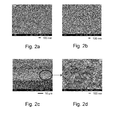
- the Figures 1a-d; 2 a-d, and 3 a-d show typical morphologies of membrane substrates from non-sulfonated PPSU and sulfonated PPSU (sPPSU-2.5 and sPPSU-5).
- the macrovoid-free sponge like structures of substrate layers based on sPPSU-2.5 and sPPSU-5 can for example be seen in the enlarged picture of the cross-section of substrate layer (S) ( Figures 2d and 3d ).
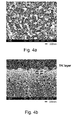
- the Figures 4 a-b show typical morphology of TFC-FO membrane including substrate layers based on sPPSU-2.5%.
- the content of the sDCDPS monomer was estimated taking the S-content of the polymer to be 2.4 mol-%.
- the prepared sulfonated polyphenylenesulfone P1 is referred to as sPPSU-2.5%.
- the content of the sDCDPS monomer was estimated taking the S-content of the polymer to be 4.7 mol-%.
- the prepared polymer is referred to as sPPSU 5 %.
- Example 2 Production of substrate layer (S) based on sulfonated polyphenylensulfones sPPSU-2,5% and sPPSU-5%
- NMP N-methyl-2-pyrrolidone
- EG ethylene glycol
- Casting solutions were prepared by dissolving according amounts of polymers sPPSU 2.5% and sPPSU-5% as prepared in Example 1 in N-methyl pyrrolidone (NMP>99.5%) under addition of 16 wt% ethylene glycol (EG). The casting solutions were allowed to degas overnight prior casting. The polymer solutions were then cast on a glass plate via phase inversion method using casting knife of 100 ⁇ m in thickness to form a homogeneous membrane substrate.
- NMP>99.5% N-methyl pyrrolidone
- EG ethylene glycol
- the as-cast membrane substrate layer was immersed into a water coagulation bath immediately at room temperature to conduct solvent exchange process and to form a hydrophilic porous substrate.
- the as-cast membranes were kept for 1 day in water bath to ensure complete precipitation.
- the water permeability of the support layers prepared from sPPSU-2.5% and sPPSU-5% using pure water (pure water permeability, PWP) and the molecular weight cut off (MWCO) were determined.
- PWP and MWCO values are summarizes in Table 1: Table 1: Pure water permeability (PWP) and molecular weight cut off (MWCO) of inventive substrate layers (S). sPPSU-2,5% sPPSU-5% PWP [l/(m 2 bar h)] 846.1 241.3 MWCO [Da] 195423 169913
- substrate layer (S) The morphology of as-cast membrane substrate (substrate layer (S)) was analyzed by scanning electron microscopy FESEM (top surface, bottom surface and cross section). A fully spounge-like structure without macrovoids was obtained.
- Figures 1 to 3 shows the SEM images of substrate layers (S) with non-sulfonated and sulfonated materials.
- the membrane from non-sulfonated PPSU ( Fig. 1 ) exhibits numerous macrovoids due to instantaneous demixing, while those from sulfonated PPSU of the present invention ( Fig. 2 and 3 ) display a fully sponge-like and interconnected pore structures with no observed macrovoids.
- Comparative Example 2 Production of substrate layer based on blend of sulfonated polyarylethers and unsulfonated polyarylethers
- a casting solution of a non-sulfonated polyethersulfone (PESU) and a sulfonated copolymer of a polyethersulfone (PESU) and a polyphenylensulfone PPSU was produced showing a ratio of said polymers of 50/50wt%.
- the non-sulfonated polyethersulfone was produced using the monomers dichlorodiphenylsulfone (DCDPS) and dihydroxy-diphenylsulfone (DHDPS).
- the sulfonated polyethersulfon/polyphenylensulfone copolymer (polymer P1) comprised recurring units according to the following formula wherein the sulfonated copolymer exhibits 11,5 wt% of sulfonated units (sulfonated PPSU units) based on the weight of the polymer.
- a casting solution of 8 wt% of PESU and 8 wt% of sulfonated copolymer (PESU and PPSU) was prepared as described in Example 2.
- a substrate layer was prepared by casting as described in Example 2 using 100 micron casting knife.
- the pure water permeability (PWP) of the support membrane substrate was 188.63 L/(m 2 h bar) and molecular weight cut off (MWCO) was 414,829 Da.
- the substrate (substrate layer (S)) based on sulfonated sPPSU-2.5% as produced in Example 2 was used for formation of a thin polyamide layer (film layer (F)).
- the formation of a polyamide layer onto the substrate layer was based on the interfacial polymerization.
- the substrate layer was first immersed in 2 wt.-% MPD (meta-phenylenediamine) solution in deionized water (DI water) for 2 minutes. Thereafter, filter paper was used to remove the water droplets on the membrane surface. Subsequently, the top surface of the membranes was brought into contact with the 0,05 wt.% TMC (trimesoylchloride) solution in n-heptane for 15 seconds.
- MPD metal-phenylenediamine
- DI water deionized water
- film layer (F) a thin polyamide film (film layer (F)) was formed on the substrate layer (S).
- the resultant membrane was further dried in the air for 10 minutes and cleaned in deionized water before use in forward osmosis processes (FO) (see Example 4).
- the morphology of membrane was analyzed by scanning electron microscopy (FESEM), wherein the cross section and top surface of thin film layer composite membrane were analyzed. It was observed that the thickness of thin polyamide film was approximately 150-200 nm.
- the FESM images of TFC-FO membranes are shown in Figure 4 (4a top surface and 4b cross section).
- the substrate layer based on a blend of non-sulfonated polymers and sulfonated polyarylether as produced in Comparative Example 2 was used for formation of a thin polyamide layer.
- the formation of a polyamide layer onto the substrate layer was carried out as described in Example 3.
- the thin film composite membrane produced as described in Example 3 based on sPPSU-2,5% was tested in a forward osmosis (FO) experiment.
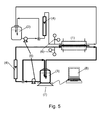
- the crossflow permeation cell (1) was a plate and frame design with a rectangular channel on each side of the membrane.
- the feed solution (2) and the draw solution (3) were in storage tanks and circulated via pumps (5).
- the solution flows were adjusted using flow meters (4).
- the solution flow velocities during the FO process were kept at 6.4 cm/s for both feed solution (2) and draw solution (3) which was co-currently flowed through the cell channels.
- the temperature and the pressure of each solution were measured (6).
- the temperatures of the feed and draw solutions were maintained at 22 ⁇ 0.5°C.
- the pressures at two channel inlets were kept at 1.0 psi.
- the draw solutions with different concentrations were prepared from sodium chloride (NaCl) solutions and used in FO process.
- NaCl sodium chloride
- the change of draw solution concentration was ignored because the ratio of water permeation flux to the volume of the draw solution was less than 2% during the FO process.
- DI water Deionized water
- a balance (7) (EK-4100i, A & D Company Ltd., Japan) connected to a Computer (8) recorded down the mass of water permeating into the draw solution over a selected period of time.
- the water permeation flux was then calculated based on the weight changes of feed water.
- the salt concentration in the feed water was determined from the conductivity measurement in the feed solution using a calibration curve for the single salt solution.
- the thin film composite membrane produced as described in Comparative Example 3 was tested in a forward osmosis (FO) experiment.
- FO experiments were conducted on a lab-scale circulating filtration unit as described in Example 4.
- Table 3 Water flux and salt leakage of comparative composite membrane using DI water as feed in FO and PRO mode.
- Table 3 Water flux and salt leakage of comparative composite membrane using DI water as feed in FO and PRO mode.
- FO mode PRO mode Concentration of NaCl draw solution [mol/L] Water flux [LMH] Salt leakage [gML] Water flux [LMH] Salt leakage [gML] 0.5 15 2.5 16 3 1 22 3.5 24 4.5 2 26 4.5 33 6 3 30 9 46.5 9 4 33 9 54 10 5 39 9.5 57 12.5
- a forward osmosis process using the thin film composite membrane produced as described in Example 3 using sPPSU-2.5% as substrate was carried out similar to Example 4.
- Seawater was used as feed solution instead of deionized water.
- the feed solution concentration consisted of 3.5 wt% NaCl and the draw solution concentration (NaCl) was varied from 2 M (mol/L) to 5 M (mol/L).
- Table 4 Water flux of inventive composite membrane using sea water (3.5 wt % NaCl solution) as feed in FO and PRO mode.
- FO mode PRO mode Concentration of NaCl draw solution [mol/L] Water flux [LMH] Water flux [LMH] 2 22.0 22.0 3 26.0 32.0 4 32.0 38 5 38 42.0
- the membrane based on the new substrate performs better than the membrane described in the comparative Examples (see Table 5).
- Table 5 Water flux of comparative composite membrane using sea water (3,5 wt % NaCl solution) as feed in FO and PRO mode.
- FO mode PRO mode Concentration of NaCl draw solution [mol/L] Water flux [LMH] Water flux [LMH] 2 13.5 15 3 19.5 21 4 22.5 25.5 5 25.5 27.0
Landscapes
- Chemical & Material Sciences (AREA)
- Chemical Kinetics & Catalysis (AREA)
- Engineering & Computer Science (AREA)
- Water Supply & Treatment (AREA)
- Separation Using Semi-Permeable Membranes (AREA)
- Manufacture Of Macromolecular Shaped Articles (AREA)
- Polyamides (AREA)
Priority Applications (6)
| Application Number | Priority Date | Filing Date | Title |
|---|---|---|---|
| EP12171998.3A EP2674211A1 (fr) | 2012-06-14 | 2012-06-14 | Membranes composites comprenant un polyphénylènesulfone sulfoné et leur utilisation dans des processus d'osmose directe |
| JP2015516612A JP2015521534A (ja) | 2012-06-14 | 2013-06-13 | スルホン化ポリフェニレンスルホンを含んでなる複合膜及び正浸透法におけるそれらの使用 |
| PCT/EP2013/062232 WO2013186297A1 (fr) | 2012-06-14 | 2013-06-13 | Membranes composites comprenant une polyphénylènesulfone sulfonée et leur utilisation dans des procédés d'osmose directe |
| CN201380042746.2A CN104540580A (zh) | 2012-06-14 | 2013-06-13 | 含有磺化聚苯砜的复合膜及其在正向渗透方法中的用途 |
| KR20157000279A KR20150036007A (ko) | 2012-06-14 | 2013-06-13 | 술폰화 폴리페닐렌술폰을 포함하는 복합 멤브레인 및 이의 정삼투 공정에서의 용도 |
| EP13728210.9A EP2861332A1 (fr) | 2012-06-14 | 2013-06-13 | Membranes composites comprenant une polyphénylènesulfone sulfonée et leur utilisation dans des procédés d'osmose directe |
Applications Claiming Priority (1)
| Application Number | Priority Date | Filing Date | Title |
|---|---|---|---|
| EP12171998.3A EP2674211A1 (fr) | 2012-06-14 | 2012-06-14 | Membranes composites comprenant un polyphénylènesulfone sulfoné et leur utilisation dans des processus d'osmose directe |
Publications (1)
| Publication Number | Publication Date |
|---|---|
| EP2674211A1 true EP2674211A1 (fr) | 2013-12-18 |
Family
ID=48607287
Family Applications (2)
| Application Number | Title | Priority Date | Filing Date |
|---|---|---|---|
| EP12171998.3A Ceased EP2674211A1 (fr) | 2012-06-14 | 2012-06-14 | Membranes composites comprenant un polyphénylènesulfone sulfoné et leur utilisation dans des processus d'osmose directe |
| EP13728210.9A Withdrawn EP2861332A1 (fr) | 2012-06-14 | 2013-06-13 | Membranes composites comprenant une polyphénylènesulfone sulfonée et leur utilisation dans des procédés d'osmose directe |
Family Applications After (1)
| Application Number | Title | Priority Date | Filing Date |
|---|---|---|---|
| EP13728210.9A Withdrawn EP2861332A1 (fr) | 2012-06-14 | 2013-06-13 | Membranes composites comprenant une polyphénylènesulfone sulfonée et leur utilisation dans des procédés d'osmose directe |
Country Status (5)
| Country | Link |
|---|---|
| EP (2) | EP2674211A1 (fr) |
| JP (1) | JP2015521534A (fr) |
| KR (1) | KR20150036007A (fr) |
| CN (1) | CN104540580A (fr) |
| WO (1) | WO2013186297A1 (fr) |
Cited By (3)
| Publication number | Priority date | Publication date | Assignee | Title |
|---|---|---|---|---|
| CN105080368A (zh) * | 2014-04-25 | 2015-11-25 | 中国石油化工股份有限公司 | 一种反渗透膜及其制备方法 |
| CN108993178A (zh) * | 2018-07-27 | 2018-12-14 | 天津工业大学 | 一种高通量耐高温复合纳滤膜的制备方法 |
| EP3978103A4 (fr) * | 2019-05-31 | 2022-07-20 | Asahi Kasei Kabushiki Kaisha | Système de concentration de liquide de matière première |
Families Citing this family (12)
| Publication number | Priority date | Publication date | Assignee | Title |
|---|---|---|---|---|
| US10040705B2 (en) | 2014-02-19 | 2018-08-07 | Basf Se | Filtration element |
| CN108697991A (zh) * | 2015-12-23 | 2018-10-23 | 索尔维特殊聚合物意大利有限公司 | 包含硅酸盐的多孔聚合物膜 |
| JP6610326B2 (ja) * | 2016-02-22 | 2019-11-27 | 三菱ケミカル株式会社 | フィルム |
| WO2017205713A1 (fr) * | 2016-05-26 | 2017-11-30 | University Of Florida Research Foundation, Inc. | Polysulfones aliphatiques présentant une intégrité mécanique améliorée |
| US11001673B2 (en) | 2016-05-26 | 2021-05-11 | University Of Florida Research Foundation, Incorporated | Aliphatic polysulfones with improved mechanical integrity |
| CN106178684B (zh) * | 2016-07-28 | 2018-02-13 | 上海超高环保科技股份有限公司 | 易去污的聚砜过滤组合物 |
| DK3500357T3 (da) * | 2016-08-18 | 2023-03-27 | Nx Filtration Holding B V | Fremgangsmåde til fremstilling af positivt ladede membraner |
| JP6840364B2 (ja) * | 2017-06-08 | 2021-03-10 | 株式会社神鋼環境ソリューション | 濃縮処理方法、及び濃縮処理装置 |
| CN111432917B (zh) * | 2017-08-28 | 2022-06-03 | 杜邦安全与建筑公司 | 采用在聚合物原液溶液中的共溶剂的膜制造 |
| WO2019157377A1 (fr) * | 2018-02-09 | 2019-08-15 | Board Of Regents, The University Of Texas System | Membranes de poly(arylène éther) sulfoné présentant un rejet de sel monovalent élevé même en présence de charges de sel mélangées contenant des sels multivalents |
| KR102796698B1 (ko) | 2022-03-24 | 2025-04-21 | 주식회사 움틀 | 폴리에테르 설폰을 기반으로 하는 신규 고분자 및 이를 이용한 멤브레인 조성물 |
| KR102778685B1 (ko) | 2022-03-24 | 2025-03-11 | 주식회사 움틀 | 폴리에테르 설폰을 기반으로 하는 신규 고분자를 이용한 멤브레인의 제조방법 |
Citations (5)
| Publication number | Priority date | Publication date | Assignee | Title |
|---|---|---|---|---|
| EP1394879A1 (fr) | 2001-05-08 | 2004-03-03 | Ube Industries, Ltd. | Electrolyte polymere destine a une pile a combustible a polymere solide et pile a combustible |
| WO2009030620A1 (fr) | 2007-09-06 | 2009-03-12 | Basf Se | Mélanges de polyaryléthers ramifiés et de polymères hydrophiles |
| WO2010142585A1 (fr) | 2009-06-08 | 2010-12-16 | Basf Se | Procédé de production de copolymères séquencés d'éther de polyarylène |
| WO2010145052A1 (fr) | 2009-06-19 | 2010-12-23 | 深圳Tcl新技术有限公司 | Télévision et procédé de traitement de programmes télévisuels |
| US20120043274A1 (en) * | 2010-04-30 | 2012-02-23 | Woongjin Chemical Co., Ltd. | Forward osmosis membrane for seawater desalination and method for preparing the same |
Family Cites Families (1)
| Publication number | Priority date | Publication date | Assignee | Title |
|---|---|---|---|---|
| EP2443172B1 (fr) | 2009-06-16 | 2016-09-21 | Basf Se | Copolymères blocs de polyéthersulfone aromatique |
-
2012
- 2012-06-14 EP EP12171998.3A patent/EP2674211A1/fr not_active Ceased
-
2013
- 2013-06-13 KR KR20157000279A patent/KR20150036007A/ko not_active Withdrawn
- 2013-06-13 JP JP2015516612A patent/JP2015521534A/ja not_active Withdrawn
- 2013-06-13 EP EP13728210.9A patent/EP2861332A1/fr not_active Withdrawn
- 2013-06-13 WO PCT/EP2013/062232 patent/WO2013186297A1/fr not_active Ceased
- 2013-06-13 CN CN201380042746.2A patent/CN104540580A/zh active Pending
Patent Citations (5)
| Publication number | Priority date | Publication date | Assignee | Title |
|---|---|---|---|---|
| EP1394879A1 (fr) | 2001-05-08 | 2004-03-03 | Ube Industries, Ltd. | Electrolyte polymere destine a une pile a combustible a polymere solide et pile a combustible |
| WO2009030620A1 (fr) | 2007-09-06 | 2009-03-12 | Basf Se | Mélanges de polyaryléthers ramifiés et de polymères hydrophiles |
| WO2010142585A1 (fr) | 2009-06-08 | 2010-12-16 | Basf Se | Procédé de production de copolymères séquencés d'éther de polyarylène |
| WO2010145052A1 (fr) | 2009-06-19 | 2010-12-23 | 深圳Tcl新技术有限公司 | Télévision et procédé de traitement de programmes télévisuels |
| US20120043274A1 (en) * | 2010-04-30 | 2012-02-23 | Woongjin Chemical Co., Ltd. | Forward osmosis membrane for seawater desalination and method for preparing the same |
Non-Patent Citations (11)
| Title |
|---|
| CHANG HYUN LEE ET AL: "Disulfonated poly(arylene ether sulfone) random copolymer thin film composite membrane fabricated using a benign solvent for reverse osmosis applications", JOURNAL OF MEMBRANE SCIENCE, ELSEVIER SCIENTIFIC PUBL.COMPANY. AMSTERDAM, NL, vol. 389, 1 November 2011 (2011-11-01), pages 363 - 371, XP028394237, ISSN: 0376-7388, [retrieved on 20111107], DOI: 10.1016/J.MEMSCI.2011.11.001 * |
| GEISE, G.M. ET AL., J. POLY. SCI, PART B: POLYM PHYS., vol. 48, 2010, pages 1685 |
| HARRISON ET AL., POLYMER PREPRINTS, vol. 41, no. 2, 2000, pages 1239 |
| JOHNSON ET AL., J. POLYM. SCI. A-1, vol. 5, 1967, pages 2375 |
| KAI YU WANG ET AL: "Developing thin-film-composite forward osmosis membranes on the PES/SPSf substrate through interfacial polymerization", vol. 58, no. 3, 1 March 2012 (2012-03-01), pages 770 - 781, XP002678804, ISSN: 0001-1541, Retrieved from the Internet <URL:http://onlinelibrary.wiley.com/doi/10.1002/aic.12635/abstract> [retrieved on 20110422], DOI: 10.1002/AIC.12635 * |
| KANG M-S ET AL: "Electrochemical characterization of sulfonated poly(arylene ether sulfone) (S-PES) cation-exchange membranes", JOURNAL OF MEMBRANE SCIENCE, ELSEVIER SCIENTIFIC PUBL.COMPANY. AMSTERDAM, NL, vol. 216, no. 1-2, 1 May 2003 (2003-05-01), pages 39 - 53, XP004422228, ISSN: 0376-7388, DOI: 10.1016/S0376-7388(03)00045-0 * |
| M. ELIMELECH: "High Performance thin-film composite forward osmosis membranes", ENVIRON. SCI. TECHNOL., vol. 44, no. 3812, 2010 |
| N. WIDJOJO ET AL., JOURNAL OF MEMBRANE SCIENCE, vol. 338, 2011, pages 214 - 223 |
| NATALIA WIDJOJO ET AL: "The role of sulphonated polymer and macrovoid-free structure in the support layer for thin-film composite (TFC) forward osmosis (FO) membranes", JOURNAL OF MEMBRANE SCIENCE, ELSEVIER SCIENTIFIC PUBL.COMPANY. AMSTERDAM, NL, vol. 383, no. 1, 21 August 2011 (2011-08-21), pages 214 - 223, XP028306478, ISSN: 0376-7388, [retrieved on 20110826], DOI: 10.1016/J.MEMSCI.2011.08.041 * |
| T.Y. CATH; A.E. CHILDRESS: "Forward osmosis: Principles, applications, and recent developments", J. MEMBR. SCI., vol. 281, 2006, pages 70, XP024931849, DOI: doi:10.1016/j.memsci.2006.05.048 |
| UEDA ET AL., J. POLYM. SCI., PART A: POLYM. CHEM., vol. 31, 1993, pages 853 |
Cited By (5)
| Publication number | Priority date | Publication date | Assignee | Title |
|---|---|---|---|---|
| CN105080368A (zh) * | 2014-04-25 | 2015-11-25 | 中国石油化工股份有限公司 | 一种反渗透膜及其制备方法 |
| CN105080368B (zh) * | 2014-04-25 | 2017-05-31 | 中国石油化工股份有限公司 | 一种反渗透膜及其制备方法 |
| CN108993178A (zh) * | 2018-07-27 | 2018-12-14 | 天津工业大学 | 一种高通量耐高温复合纳滤膜的制备方法 |
| EP3978103A4 (fr) * | 2019-05-31 | 2022-07-20 | Asahi Kasei Kabushiki Kaisha | Système de concentration de liquide de matière première |
| US12420233B2 (en) | 2019-05-31 | 2025-09-23 | Asahi Kasei Kabushiki Kaisha | Raw material liquid concentration system |
Also Published As
| Publication number | Publication date |
|---|---|
| CN104540580A (zh) | 2015-04-22 |
| KR20150036007A (ko) | 2015-04-07 |
| EP2861332A1 (fr) | 2015-04-22 |
| JP2015521534A (ja) | 2015-07-30 |
| WO2013186297A1 (fr) | 2013-12-19 |
Similar Documents
| Publication | Publication Date | Title |
|---|---|---|
| EP2674211A1 (fr) | Membranes composites comprenant un polyphénylènesulfone sulfoné et leur utilisation dans des processus d'osmose directe | |
| EP2701831B1 (fr) | Membranes composites comprenant un polyaryléther sulfoné et leur utilisation dans des procédés d'osmose directe | |
| US20130341273A1 (en) | Composite membranes comprising sulfonated polyphenylenesulfone and their use in forward osmosis processes | |
| US9193611B2 (en) | Composite membranes comprising a sulfonated polyarylether and their use in forward osmosis processes | |
| US9199205B2 (en) | Ultrafiltration membranes fabricated from sulfonated polyphenylenesulfones | |
| US9120062B2 (en) | High performance positively charged composite membranes and their use in nanofiltration processes | |
| EP3349887B1 (fr) | Procédé de fabrication de membranes à l'aide de solvants à base de lactame ide | |
| JP6211059B2 (ja) | スルホン化ポリフェニレンスルホンから製造された限外ろ過膜 | |
| US20120178834A1 (en) | Membranes, Coatings and Films and Methods for Their Preparation | |
| US20120083541A1 (en) | Aromatic polyether sulfone block copolymers | |
| EP2626127B1 (fr) | Membrane à polyazole pour la purification d'eau | |
| EP2838646B1 (fr) | Membrane composite chargée positivement à performance élevée pour la nanofiltration et sa préparation | |
| EP3053641B1 (fr) | Membrane de séparation pour traitement d'eau comprenant une couche polymère apte à un échange ionique et son procédé de formation | |
| Choudhurya et al. | Structure-property relationships of post-sulfonated poly (arylene ether sulfone) membranes for water desalination | |
| Arnett | Synthesis and Characterization of Disulfonated Poly (Arylene Ether Sulfone) Random Copolymers as Multipurpose Membranes for Reverse Osmosis and Fuel Cell Applications | |
| WO2019076668A1 (fr) | Membrane asymétrique intégrale de polyamide-imide et de polyaryléther sulfone sulfonée |
Legal Events
| Date | Code | Title | Description |
|---|---|---|---|
| PUAI | Public reference made under article 153(3) epc to a published international application that has entered the european phase |
Free format text: ORIGINAL CODE: 0009012 |
|
| AK | Designated contracting states |
Kind code of ref document: A1 Designated state(s): AL AT BE BG CH CY CZ DE DK EE ES FI FR GB GR HR HU IE IS IT LI LT LU LV MC MK MT NL NO PL PT RO RS SE SI SK SM TR |
|
| AX | Request for extension of the european patent |
Extension state: BA ME |
|
| STAA | Information on the status of an ep patent application or granted ep patent |
Free format text: STATUS: THE APPLICATION HAS BEEN REFUSED |
|
| 18R | Application refused |
Effective date: 20140118 |