EP2674460B1 - Azoverbindung, salz davon, polarisierungsfolie auf farbstoffbasis und polarisierungsplatte damit - Google Patents
Azoverbindung, salz davon, polarisierungsfolie auf farbstoffbasis und polarisierungsplatte damit Download PDFInfo
- Publication number
- EP2674460B1 EP2674460B1 EP12745028.6A EP12745028A EP2674460B1 EP 2674460 B1 EP2674460 B1 EP 2674460B1 EP 12745028 A EP12745028 A EP 12745028A EP 2674460 B1 EP2674460 B1 EP 2674460B1
- Authority
- EP
- European Patent Office
- Prior art keywords
- group
- salt
- formula
- dye
- polarizing film
- Prior art date
- Legal status (The legal status is an assumption and is not a legal conclusion. Google has not performed a legal analysis and makes no representation as to the accuracy of the status listed.)
- Not-in-force
Links
- -1 Azo compound Chemical class 0.000 title claims description 188
- 150000003839 salts Chemical class 0.000 title claims description 76
- 125000001424 substituent group Chemical group 0.000 claims description 107
- 239000000975 dye Substances 0.000 claims description 93
- 125000000020 sulfo group Chemical group O=S(=O)([*])O[H] 0.000 claims description 87
- 125000003277 amino group Chemical group 0.000 claims description 76
- 125000004435 hydrogen atom Chemical group [H]* 0.000 claims description 68
- 239000004973 liquid crystal related substance Substances 0.000 claims description 63
- 125000003545 alkoxy group Chemical group 0.000 claims description 49
- 229910052799 carbon Inorganic materials 0.000 claims description 42
- 125000004432 carbon atom Chemical group C* 0.000 claims description 42
- 125000002490 anilino group Chemical group [H]N(*)C1=C([H])C([H])=C([H])C([H])=C1[H] 0.000 claims description 39
- 125000002887 hydroxy group Chemical group [H]O* 0.000 claims description 38
- 125000002496 methyl group Chemical group [H]C([H])([H])* 0.000 claims description 38
- 125000000956 methoxy group Chemical group [H]C([H])([H])O* 0.000 claims description 35
- 125000001624 naphthyl group Chemical group 0.000 claims description 30
- 125000000043 benzamido group Chemical group [H]N([*])C(=O)C1=C([H])C([H])=C([H])C([H])=C1[H] 0.000 claims description 29
- YTZPUTADNGREHA-UHFFFAOYSA-N 2h-benzo[e]benzotriazole Chemical group C1=CC2=CC=CC=C2C2=NNN=C21 YTZPUTADNGREHA-UHFFFAOYSA-N 0.000 claims description 21
- 239000004372 Polyvinyl alcohol Substances 0.000 claims description 18
- 229920002451 polyvinyl alcohol Polymers 0.000 claims description 18
- 125000000217 alkyl group Chemical group 0.000 claims description 14
- 238000004519 manufacturing process Methods 0.000 claims description 13
- 229920005989 resin Polymers 0.000 claims description 13
- 239000011347 resin Substances 0.000 claims description 13
- 230000001681 protective effect Effects 0.000 claims description 11
- 125000003178 carboxy group Chemical group [H]OC(*)=O 0.000 claims description 10
- IMROMDMJAWUWLK-UHFFFAOYSA-N Ethenol Chemical compound OC=C IMROMDMJAWUWLK-UHFFFAOYSA-N 0.000 claims description 4
- 229920006026 co-polymeric resin Polymers 0.000 claims description 3
- 150000001875 compounds Chemical class 0.000 description 142
- VEXZGXHMUGYJMC-UHFFFAOYSA-N Hydrochloric acid Chemical compound Cl VEXZGXHMUGYJMC-UHFFFAOYSA-N 0.000 description 48
- 230000010287 polarization Effects 0.000 description 48
- 238000010521 absorption reaction Methods 0.000 description 46
- JUJWROOIHBZHMG-UHFFFAOYSA-N Pyridine Chemical compound C1=CC=NC=C1 JUJWROOIHBZHMG-UHFFFAOYSA-N 0.000 description 40
- 238000002834 transmittance Methods 0.000 description 39
- HEMHJVSKTPXQMS-UHFFFAOYSA-M Sodium hydroxide Chemical compound [OH-].[Na+] HEMHJVSKTPXQMS-UHFFFAOYSA-M 0.000 description 36
- XLYOFNOQVPJJNP-UHFFFAOYSA-N water Substances O XLYOFNOQVPJJNP-UHFFFAOYSA-N 0.000 description 36
- VOWZNBNDMFLQGM-UHFFFAOYSA-N 2,5-dimethylaniline Chemical compound CC1=CC=C(C)C(N)=C1 VOWZNBNDMFLQGM-UHFFFAOYSA-N 0.000 description 34
- LPXPTNMVRIOKMN-UHFFFAOYSA-M sodium nitrite Chemical compound [Na+].[O-]N=O LPXPTNMVRIOKMN-UHFFFAOYSA-M 0.000 description 34
- CDBYLPFSWZWCQE-UHFFFAOYSA-L Sodium Carbonate Chemical compound [Na+].[Na+].[O-]C([O-])=O CDBYLPFSWZWCQE-UHFFFAOYSA-L 0.000 description 33
- 239000000203 mixture Substances 0.000 description 33
- 238000003756 stirring Methods 0.000 description 32
- 238000005859 coupling reaction Methods 0.000 description 31
- 239000000243 solution Substances 0.000 description 30
- 238000000034 method Methods 0.000 description 23
- 239000010410 layer Substances 0.000 description 20
- UMJSCPRVCHMLSP-UHFFFAOYSA-N pyridine Natural products COC1=CC=CN=C1 UMJSCPRVCHMLSP-UHFFFAOYSA-N 0.000 description 20
- 238000006193 diazotization reaction Methods 0.000 description 19
- 239000012295 chemical reaction liquid Substances 0.000 description 17
- 235000010288 sodium nitrite Nutrition 0.000 description 17
- 239000000758 substrate Substances 0.000 description 17
- 230000000052 comparative effect Effects 0.000 description 16
- 229910000029 sodium carbonate Inorganic materials 0.000 description 16
- 238000010168 coupling process Methods 0.000 description 15
- PAYRUJLWNCNPSJ-UHFFFAOYSA-N Aniline Chemical compound NC1=CC=CC=C1 PAYRUJLWNCNPSJ-UHFFFAOYSA-N 0.000 description 14
- 230000007935 neutral effect Effects 0.000 description 14
- 230000008878 coupling Effects 0.000 description 13
- 229920006254 polymer film Polymers 0.000 description 13
- 239000000853 adhesive Substances 0.000 description 12
- 230000001070 adhesive effect Effects 0.000 description 12
- 238000006467 substitution reaction Methods 0.000 description 12
- 238000004040 coloring Methods 0.000 description 11
- JJYPMNFTHPTTDI-UHFFFAOYSA-N 3-methylaniline Chemical compound CC1=CC=CC(N)=C1 JJYPMNFTHPTTDI-UHFFFAOYSA-N 0.000 description 10
- ZCYVEMRRCGMTRW-UHFFFAOYSA-N 7553-56-2 Chemical compound [I] ZCYVEMRRCGMTRW-UHFFFAOYSA-N 0.000 description 10
- 210000002858 crystal cell Anatomy 0.000 description 10
- 238000004043 dyeing Methods 0.000 description 10
- 239000011630 iodine Substances 0.000 description 10
- 229910052740 iodine Inorganic materials 0.000 description 10
- 239000011521 glass Substances 0.000 description 9
- 229920002284 Cellulose triacetate Polymers 0.000 description 8
- FAPWRFPIFSIZLT-UHFFFAOYSA-M Sodium chloride Chemical compound [Na+].[Cl-] FAPWRFPIFSIZLT-UHFFFAOYSA-M 0.000 description 8
- NNLVGZFZQQXQNW-ADJNRHBOSA-N [(2r,3r,4s,5r,6s)-4,5-diacetyloxy-3-[(2s,3r,4s,5r,6r)-3,4,5-triacetyloxy-6-(acetyloxymethyl)oxan-2-yl]oxy-6-[(2r,3r,4s,5r,6s)-4,5,6-triacetyloxy-2-(acetyloxymethyl)oxan-3-yl]oxyoxan-2-yl]methyl acetate Chemical compound O([C@@H]1O[C@@H]([C@H]([C@H](OC(C)=O)[C@H]1OC(C)=O)O[C@H]1[C@@H]([C@@H](OC(C)=O)[C@H](OC(C)=O)[C@@H](COC(C)=O)O1)OC(C)=O)COC(=O)C)[C@@H]1[C@@H](COC(C)=O)O[C@@H](OC(C)=O)[C@H](OC(C)=O)[C@H]1OC(C)=O NNLVGZFZQQXQNW-ADJNRHBOSA-N 0.000 description 8
- 150000001448 anilines Chemical class 0.000 description 8
- 125000000751 azo group Chemical group [*]N=N[*] 0.000 description 8
- GFPQSWFFPRQEHH-UHFFFAOYSA-N 7-aminonaphthalene-1,3,6-trisulfonic acid Chemical compound C1=C(S(O)(=O)=O)C=C2C=C(S(O)(=O)=O)C(N)=CC2=C1S(O)(=O)=O GFPQSWFFPRQEHH-UHFFFAOYSA-N 0.000 description 7
- 239000007858 starting material Substances 0.000 description 7
- XPVVBMXZTSOIQD-UHFFFAOYSA-N 3-(2-amino-4-methylphenoxy)propane-1-sulfonic acid Chemical compound CC1=CC=C(OCCCS(O)(=O)=O)C(N)=C1 XPVVBMXZTSOIQD-UHFFFAOYSA-N 0.000 description 6
- YOSMJAZSUZAKTA-UHFFFAOYSA-N 6-amino-4-(3-sulfopropoxy)naphthalene-2-sulfonic acid Chemical compound C1=C(S(O)(=O)=O)C=C(OCCCS(O)(=O)=O)C2=CC(N)=CC=C21 YOSMJAZSUZAKTA-UHFFFAOYSA-N 0.000 description 6
- 239000002253 acid Substances 0.000 description 6
- KGBXLFKZBHKPEV-UHFFFAOYSA-N boric acid Chemical compound OB(O)O KGBXLFKZBHKPEV-UHFFFAOYSA-N 0.000 description 6
- 239000004327 boric acid Substances 0.000 description 6
- 230000008859 change Effects 0.000 description 6
- 239000003795 chemical substances by application Substances 0.000 description 6
- KJCVRFUGPWSIIH-UHFFFAOYSA-N 1-naphthol Chemical compound C1=CC=C2C(O)=CC=CC2=C1 KJCVRFUGPWSIIH-UHFFFAOYSA-N 0.000 description 5
- XOQYBLQTFIAIJP-UHFFFAOYSA-N 7-amino-4-(3-sulfopropoxy)naphthalene-2-sulfonic acid Chemical compound OS(=O)(=O)CCCOC1=CC(S(O)(=O)=O)=CC2=CC(N)=CC=C21 XOQYBLQTFIAIJP-UHFFFAOYSA-N 0.000 description 5
- QTBSBXVTEAMEQO-UHFFFAOYSA-N Acetic acid Chemical compound CC(O)=O QTBSBXVTEAMEQO-UHFFFAOYSA-N 0.000 description 5
- 239000003086 colorant Substances 0.000 description 5
- 239000000463 material Substances 0.000 description 5
- 239000011241 protective layer Substances 0.000 description 5
- 239000000725 suspension Substances 0.000 description 5
- NIXOWILDQLNWCW-UHFFFAOYSA-N 2-Propenoic acid Natural products OC(=O)C=C NIXOWILDQLNWCW-UHFFFAOYSA-N 0.000 description 4
- CMOLPZZVECHXKN-UHFFFAOYSA-N 7-aminonaphthalene-1,3-disulfonic acid Chemical compound C1=C(S(O)(=O)=O)C=C(S(O)(=O)=O)C2=CC(N)=CC=C21 CMOLPZZVECHXKN-UHFFFAOYSA-N 0.000 description 4
- 239000007864 aqueous solution Substances 0.000 description 4
- 239000002585 base Substances 0.000 description 4
- 230000006872 improvement Effects 0.000 description 4
- 239000007788 liquid Substances 0.000 description 4
- 230000003287 optical effect Effects 0.000 description 4
- WXWCDTXEKCVRRO-UHFFFAOYSA-N para-Cresidine Chemical compound COC1=CC=C(C)C=C1N WXWCDTXEKCVRRO-UHFFFAOYSA-N 0.000 description 4
- 125000000843 phenylene group Chemical group C1(=C(C=CC=C1)*)* 0.000 description 4
- 230000009467 reduction Effects 0.000 description 4
- 239000011780 sodium chloride Substances 0.000 description 4
- UHOVQNZJYSORNB-UHFFFAOYSA-N Benzene Chemical compound C1=CC=CC=C1 UHOVQNZJYSORNB-UHFFFAOYSA-N 0.000 description 3
- 0 CC*c1cc(*)c(cc(c(*)c2)N=N[C@]3C=CC(N=N[C@]4C(*)=CC(N=*[C@@]5C=C(*)C(*)=CC5C=C)=CC4)=CC3C)c2c1 Chemical compound CC*c1cc(*)c(cc(c(*)c2)N=N[C@]3C=CC(N=N[C@]4C(*)=CC(N=*[C@@]5C=C(*)C(*)=CC5C=C)=CC4)=CC3C)c2c1 0.000 description 3
- OKKJLVBELUTLKV-UHFFFAOYSA-N Methanol Chemical compound OC OKKJLVBELUTLKV-UHFFFAOYSA-N 0.000 description 3
- VYPSYNLAJGMNEJ-UHFFFAOYSA-N Silicium dioxide Chemical compound O=[Si]=O VYPSYNLAJGMNEJ-UHFFFAOYSA-N 0.000 description 3
- PMZURENOXWZQFD-UHFFFAOYSA-L Sodium Sulfate Chemical compound [Na+].[Na+].[O-]S([O-])(=O)=O PMZURENOXWZQFD-UHFFFAOYSA-L 0.000 description 3
- 239000012752 auxiliary agent Substances 0.000 description 3
- 230000015572 biosynthetic process Effects 0.000 description 3
- 238000006243 chemical reaction Methods 0.000 description 3
- 238000000576 coating method Methods 0.000 description 3
- 229920001577 copolymer Polymers 0.000 description 3
- 125000000664 diazo group Chemical group [N-]=[N+]=[*] 0.000 description 3
- 238000002845 discoloration Methods 0.000 description 3
- QSHDDOUJBYECFT-UHFFFAOYSA-N mercury Chemical compound [Hg] QSHDDOUJBYECFT-UHFFFAOYSA-N 0.000 description 3
- 229910052753 mercury Inorganic materials 0.000 description 3
- 238000002156 mixing Methods 0.000 description 3
- 239000003960 organic solvent Substances 0.000 description 3
- 150000004291 polyenes Chemical class 0.000 description 3
- 238000005185 salting out Methods 0.000 description 3
- 229910052938 sodium sulfate Inorganic materials 0.000 description 3
- 235000011152 sodium sulphate Nutrition 0.000 description 3
- 238000001179 sorption measurement Methods 0.000 description 3
- 229920002554 vinyl polymer Polymers 0.000 description 3
- NAWXUBYGYWOOIX-SFHVURJKSA-N (2s)-2-[[4-[2-(2,4-diaminoquinazolin-6-yl)ethyl]benzoyl]amino]-4-methylidenepentanedioic acid Chemical compound C1=CC2=NC(N)=NC(N)=C2C=C1CCC1=CC=C(C(=O)N[C@@H](CC(=C)C(O)=O)C(O)=O)C=C1 NAWXUBYGYWOOIX-SFHVURJKSA-N 0.000 description 2
- UFFBMTHBGFGIHF-UHFFFAOYSA-N 2,6-dimethylaniline Chemical compound CC1=CC=CC(C)=C1N UFFBMTHBGFGIHF-UHFFFAOYSA-N 0.000 description 2
- MLPVBIWIRCKMJV-UHFFFAOYSA-N 2-ethylaniline Chemical compound CCC1=CC=CC=C1N MLPVBIWIRCKMJV-UHFFFAOYSA-N 0.000 description 2
- ALHUHTFXKISJQG-UHFFFAOYSA-N 2h-benzo[e]benzotriazole-6,8-disulfonic acid Chemical group C1=CC2=NNN=C2C2=CC(S(=O)(=O)O)=CC(S(O)(=O)=O)=C21 ALHUHTFXKISJQG-UHFFFAOYSA-N 0.000 description 2
- MKARNSWMMBGSHX-UHFFFAOYSA-N 3,5-dimethylaniline Chemical compound CC1=CC(C)=CC(N)=C1 MKARNSWMMBGSHX-UHFFFAOYSA-N 0.000 description 2
- QUFFRITXLMVPMV-UHFFFAOYSA-N 4-aminonaphthalene-1,6-disulfonic acid Chemical compound C1=C(S(O)(=O)=O)C=C2C(N)=CC=C(S(O)(=O)=O)C2=C1 QUFFRITXLMVPMV-UHFFFAOYSA-N 0.000 description 2
- HPWUSBAUQHRLIJ-UHFFFAOYSA-N 4-hydroxy-7-[(4-hydroxyphenyl)diazenyl]naphthalene-2-sulfonic acid Chemical compound C1=CC(O)=CC=C1N=NC1=CC=C(C(O)=CC(=C2)S(O)(=O)=O)C2=C1 HPWUSBAUQHRLIJ-UHFFFAOYSA-N 0.000 description 2
- STOOUUMSJPLRNI-UHFFFAOYSA-N 5-amino-4-hydroxy-3-[[4-[4-[(4-hydroxyphenyl)diazenyl]phenyl]phenyl]diazenyl]-6-[(4-nitrophenyl)diazenyl]naphthalene-2,7-disulfonic acid Chemical compound OS(=O)(=O)C1=CC2=CC(S(O)(=O)=O)=C(N=NC=3C=CC(=CC=3)C=3C=CC(=CC=3)N=NC=3C=CC(O)=CC=3)C(O)=C2C(N)=C1N=NC1=CC=C([N+]([O-])=O)C=C1 STOOUUMSJPLRNI-UHFFFAOYSA-N 0.000 description 2
- KZCSUEYBKAPKNH-UHFFFAOYSA-N 6-aminonaphthalene-1,3-disulfonic acid Chemical compound OS(=O)(=O)C1=CC(S(O)(=O)=O)=CC2=CC(N)=CC=C21 KZCSUEYBKAPKNH-UHFFFAOYSA-N 0.000 description 2
- IKHGUXGNUITLKF-UHFFFAOYSA-N Acetaldehyde Chemical compound CC=O IKHGUXGNUITLKF-UHFFFAOYSA-N 0.000 description 2
- CSCPPACGZOOCGX-UHFFFAOYSA-N Acetone Chemical compound CC(C)=O CSCPPACGZOOCGX-UHFFFAOYSA-N 0.000 description 2
- LFQSCWFLJHTTHZ-UHFFFAOYSA-N Ethanol Chemical compound CCO LFQSCWFLJHTTHZ-UHFFFAOYSA-N 0.000 description 2
- JOYRKODLDBILNP-UHFFFAOYSA-N Ethyl urethane Chemical compound CCOC(N)=O JOYRKODLDBILNP-UHFFFAOYSA-N 0.000 description 2
- YCKRFDGAMUMZLT-UHFFFAOYSA-N Fluorine atom Chemical compound [F] YCKRFDGAMUMZLT-UHFFFAOYSA-N 0.000 description 2
- WSFSSNUMVMOOMR-UHFFFAOYSA-N Formaldehyde Chemical compound O=C WSFSSNUMVMOOMR-UHFFFAOYSA-N 0.000 description 2
- UFUQRRYHIHJMPB-DUCFOALUSA-L Sirius red 4B Chemical compound [Na+].[Na+].OS(=O)(=O)c1cc2cc(NC(=O)c3ccccc3)ccc2c([O-])c1\N=N\c1ccc(cc1)\N=N\c1ccc(cc1)S([O-])(=O)=O UFUQRRYHIHJMPB-DUCFOALUSA-L 0.000 description 2
- QAOWNCQODCNURD-UHFFFAOYSA-N Sulfuric acid Chemical compound OS(O)(=O)=O QAOWNCQODCNURD-UHFFFAOYSA-N 0.000 description 2
- 238000010306 acid treatment Methods 0.000 description 2
- 125000005396 acrylic acid ester group Chemical group 0.000 description 2
- 229910052783 alkali metal Inorganic materials 0.000 description 2
- 125000003368 amide group Chemical group 0.000 description 2
- 150000003863 ammonium salts Chemical class 0.000 description 2
- 230000005540 biological transmission Effects 0.000 description 2
- 239000011248 coating agent Substances 0.000 description 2
- 230000000694 effects Effects 0.000 description 2
- 239000011737 fluorine Substances 0.000 description 2
- 229910052731 fluorine Inorganic materials 0.000 description 2
- 229910052500 inorganic mineral Inorganic materials 0.000 description 2
- 229910001507 metal halide Inorganic materials 0.000 description 2
- 150000005309 metal halides Chemical class 0.000 description 2
- 239000011707 mineral Substances 0.000 description 2
- 150000002826 nitrites Chemical class 0.000 description 2
- 125000000449 nitro group Chemical group [O-][N+](*)=O 0.000 description 2
- RNVCVTLRINQCPJ-UHFFFAOYSA-N o-toluidine Chemical compound CC1=CC=CC=C1N RNVCVTLRINQCPJ-UHFFFAOYSA-N 0.000 description 2
- 230000008569 process Effects 0.000 description 2
- 238000000746 purification Methods 0.000 description 2
- 238000007127 saponification reaction Methods 0.000 description 2
- 235000012239 silicon dioxide Nutrition 0.000 description 2
- 159000000000 sodium salts Chemical class 0.000 description 2
- FIXVWFINKCQNFG-UHFFFAOYSA-M sodium;4-[(4-aminophenyl)diazenyl]benzenesulfonate Chemical compound [Na+].C1=CC(N)=CC=C1N=NC1=CC=C(S([O-])(=O)=O)C=C1 FIXVWFINKCQNFG-UHFFFAOYSA-M 0.000 description 2
- 239000000126 substance Substances 0.000 description 2
- 238000003786 synthesis reaction Methods 0.000 description 2
- 238000007740 vapor deposition Methods 0.000 description 2
- VBUBGTCJRMYYRA-UHFFFAOYSA-N 2,5-diethylaniline Chemical compound CCC1=CC=C(CC)C(N)=C1 VBUBGTCJRMYYRA-UHFFFAOYSA-N 0.000 description 1
- NAZDVUBIEPVUKE-UHFFFAOYSA-N 2,5-dimethoxyaniline Chemical compound COC1=CC=C(OC)C(N)=C1 NAZDVUBIEPVUKE-UHFFFAOYSA-N 0.000 description 1
- SMZOUWXMTYCWNB-UHFFFAOYSA-N 2-(2-methoxy-5-methylphenyl)ethanamine Chemical compound COC1=CC=C(C)C=C1CCN SMZOUWXMTYCWNB-UHFFFAOYSA-N 0.000 description 1
- BMYYVVBDTDHTGJ-UHFFFAOYSA-N 2-amino-5-(3-sulfopropoxy)naphthalene-1,7-disulfonic acid Chemical compound OS(=O)(=O)CCCOC1=CC(S(O)(=O)=O)=CC2=C(S(O)(=O)=O)C(N)=CC=C21 BMYYVVBDTDHTGJ-UHFFFAOYSA-N 0.000 description 1
- YAIKCRUPEVOINQ-UHFFFAOYSA-N 2-aminonaphthalene-1,5-disulfonic acid Chemical compound OS(=O)(=O)C1=CC=CC2=C(S(O)(=O)=O)C(N)=CC=C21 YAIKCRUPEVOINQ-UHFFFAOYSA-N 0.000 description 1
- GWIAAIUASRVOIA-UHFFFAOYSA-N 2-aminonaphthalene-1-sulfonic acid Chemical compound C1=CC=CC2=C(S(O)(=O)=O)C(N)=CC=C21 GWIAAIUASRVOIA-UHFFFAOYSA-N 0.000 description 1
- CVPJQYMHOHUEIJ-UHFFFAOYSA-N 2h-benzo[e]benzotriazole-5-sulfonic acid Chemical group C1=CC=C2C(S(=O)(=O)O)=CC3=NNN=C3C2=C1 CVPJQYMHOHUEIJ-UHFFFAOYSA-N 0.000 description 1
- JAEYRUUBSLFISH-UHFFFAOYSA-N 2h-benzo[e]benzotriazole-7,9-disulfonic acid Chemical group C1=CC2=CC(S(=O)(=O)O)=CC(S(O)(=O)=O)=C2C2=C1N=NN2 JAEYRUUBSLFISH-UHFFFAOYSA-N 0.000 description 1
- HGRCOVIWYWYCHV-UHFFFAOYSA-N 2h-benzo[e]benzotriazole-7-sulfonic acid Chemical group C1=CC2=CC(S(=O)(=O)O)=CC=C2C2=NNN=C21 HGRCOVIWYWYCHV-UHFFFAOYSA-N 0.000 description 1
- WNRGWPVJGDABME-UHFFFAOYSA-N 3,5-Dimethoxyaniline Chemical compound COC1=CC(N)=CC(OC)=C1 WNRGWPVJGDABME-UHFFFAOYSA-N 0.000 description 1
- HQUSCQMXYRCTQZ-UHFFFAOYSA-N 3-(2-amino-4-methylphenoxy)butane-1-sulfonic acid Chemical compound OS(=O)(=O)CCC(C)OC1=CC=C(C)C=C1N HQUSCQMXYRCTQZ-UHFFFAOYSA-N 0.000 description 1
- NTFVRNCDLGFPFA-UHFFFAOYSA-N 3-(2-aminophenoxy)propane-1-sulfonic acid Chemical compound NC1=CC=CC=C1OCCCS(O)(=O)=O NTFVRNCDLGFPFA-UHFFFAOYSA-N 0.000 description 1
- RQRWAGRIZLFMMS-UHFFFAOYSA-N 3-amino-5-(3-sulfopropoxy)naphthalene-2,7-disulfonic acid Chemical compound C1=C(S(O)(=O)=O)C=C2C=C(S(O)(=O)=O)C(N)=CC2=C1OCCCS(O)(=O)=O RQRWAGRIZLFMMS-UHFFFAOYSA-N 0.000 description 1
- PANHXTZXRKSGQN-UHFFFAOYSA-N 3-amino-7-(3-sulfopropoxy)naphthalene-1,5-disulfonic acid Chemical compound C1=C(OCCCS(O)(=O)=O)C=C(S(O)(=O)=O)C2=CC(N)=CC(S(O)(=O)=O)=C21 PANHXTZXRKSGQN-UHFFFAOYSA-N 0.000 description 1
- PEFKYEIJIGWGBJ-UHFFFAOYSA-N 3-amino-7-nitronaphthalene-1,5-disulfonic acid Chemical compound C1=C([N+]([O-])=O)C=C(S(O)(=O)=O)C2=CC(N)=CC(S(O)(=O)=O)=C21 PEFKYEIJIGWGBJ-UHFFFAOYSA-N 0.000 description 1
- MTJGVAJYTOXFJH-UHFFFAOYSA-N 3-aminonaphthalene-1,5-disulfonic acid Chemical compound C1=CC=C(S(O)(=O)=O)C2=CC(N)=CC(S(O)(=O)=O)=C21 MTJGVAJYTOXFJH-UHFFFAOYSA-N 0.000 description 1
- QOHOVCGREXOMGH-UHFFFAOYSA-N 3-aminonaphthalene-1-sulfonic acid Chemical compound C1=CC=CC2=CC(N)=CC(S(O)(=O)=O)=C21 QOHOVCGREXOMGH-UHFFFAOYSA-N 0.000 description 1
- AMKPQMFZCBTTAT-UHFFFAOYSA-N 3-ethylaniline Chemical compound CCC1=CC=CC(N)=C1 AMKPQMFZCBTTAT-UHFFFAOYSA-N 0.000 description 1
- PHZVGKMVVKFBCX-UHFFFAOYSA-N 4-aminonaphthalene-1,5-disulfonic acid Chemical compound C1=CC(S(O)(=O)=O)=C2C(N)=CC=C(S(O)(=O)=O)C2=C1 PHZVGKMVVKFBCX-UHFFFAOYSA-N 0.000 description 1
- DQNAQOYOSRJXFZ-UHFFFAOYSA-N 5-Amino-1-naphthalenesulfonic acid Chemical compound C1=CC=C2C(N)=CC=CC2=C1S(O)(=O)=O DQNAQOYOSRJXFZ-UHFFFAOYSA-N 0.000 description 1
- AVERNFJXXRIVQN-XSDYUOFFSA-N 5-[(4-ethoxyphenyl)diazenyl]-2-[(e)-2-[4-[(4-ethoxyphenyl)diazenyl]-2-sulfophenyl]ethenyl]benzenesulfonic acid Chemical compound C1=CC(OCC)=CC=C1N=NC(C=C1S(O)(=O)=O)=CC=C1\C=C\C1=CC=C(N=NC=2C=CC(OCC)=CC=2)C=C1S(O)(=O)=O AVERNFJXXRIVQN-XSDYUOFFSA-N 0.000 description 1
- KPYURLAXBKQIAC-UHFFFAOYSA-N 5-aminonaphthalene-1,3,6-trisulfonic acid Chemical compound C1=C(S(O)(=O)=O)C=C2C(N)=C(S(O)(=O)=O)C=CC2=C1S(O)(=O)=O KPYURLAXBKQIAC-UHFFFAOYSA-N 0.000 description 1
- GHCFYCCXEKHAHC-UHFFFAOYSA-N 5-aminonaphthalene-1,3-disulfonic acid Chemical compound C1=C(S(O)(=O)=O)C=C2C(N)=CC=CC2=C1S(O)(=O)=O GHCFYCCXEKHAHC-UHFFFAOYSA-N 0.000 description 1
- UWPJYQYRSWYIGZ-UHFFFAOYSA-N 5-aminonaphthalene-2-sulfonic acid Chemical compound OS(=O)(=O)C1=CC=C2C(N)=CC=CC2=C1 UWPJYQYRSWYIGZ-UHFFFAOYSA-N 0.000 description 1
- RWVJYGCXNJGNEJ-UHFFFAOYSA-N 6-amino-4-(4-sulfobutoxy)naphthalene-2-sulfonic acid Chemical compound C1=C(S(O)(=O)=O)C=C(OCCCCS(O)(=O)=O)C2=CC(N)=CC=C21 RWVJYGCXNJGNEJ-UHFFFAOYSA-N 0.000 description 1
- SEMRCUIXRUXGJX-UHFFFAOYSA-N 6-aminonaphthalene-2-sulfonic acid Chemical compound C1=C(S(O)(=O)=O)C=CC2=CC(N)=CC=C21 SEMRCUIXRUXGJX-UHFFFAOYSA-N 0.000 description 1
- FDIKFUSYIBDMTK-UHFFFAOYSA-N 7-amino-3-(3-sulfopropoxy)naphthalene-1-sulfonic acid Chemical compound C1=C(OCCCS(O)(=O)=O)C=C(S(O)(=O)=O)C2=CC(N)=CC=C21 FDIKFUSYIBDMTK-UHFFFAOYSA-N 0.000 description 1
- IXGNUZVXNZDYPN-UHFFFAOYSA-N 7-amino-3-(4-sulfobutoxy)naphthalene-1-sulfonic acid Chemical compound C1=C(OCCCCS(O)(=O)=O)C=C(S(O)(=O)=O)C2=CC(N)=CC=C21 IXGNUZVXNZDYPN-UHFFFAOYSA-N 0.000 description 1
- ZRHQESITNFNBQL-UHFFFAOYSA-N 7-amino-4-(4-sulfobutoxy)naphthalene-2-sulfonic acid Chemical compound OS(=O)(=O)CCCCOC1=CC(S(O)(=O)=O)=CC2=CC(N)=CC=C21 ZRHQESITNFNBQL-UHFFFAOYSA-N 0.000 description 1
- HKTWHHAJDJCUPC-UHFFFAOYSA-N 7-aminonaphthalene-1,3,5-trisulfonic acid Chemical compound C1=C(S(O)(=O)=O)C=C(S(O)(=O)=O)C2=CC(N)=CC(S(O)(=O)=O)=C21 HKTWHHAJDJCUPC-UHFFFAOYSA-N 0.000 description 1
- UBDHSURDYAETAL-UHFFFAOYSA-N 8-aminonaphthalene-1,3,6-trisulfonic acid Chemical compound OS(=O)(=O)C1=CC(S(O)(=O)=O)=C2C(N)=CC(S(O)(=O)=O)=CC2=C1 UBDHSURDYAETAL-UHFFFAOYSA-N 0.000 description 1
- CYJJLCDCWVZEDZ-UHFFFAOYSA-N 8-aminonaphthalene-1-sulfonic acid Chemical compound C1=CC(S(O)(=O)=O)=C2C(N)=CC=CC2=C1 CYJJLCDCWVZEDZ-UHFFFAOYSA-N 0.000 description 1
- QEZZCWMQXHXAFG-UHFFFAOYSA-N 8-aminonaphthalene-2-sulfonic acid Chemical compound C1=C(S(O)(=O)=O)C=C2C(N)=CC=CC2=C1 QEZZCWMQXHXAFG-UHFFFAOYSA-N 0.000 description 1
- VGGSQFUCUMXWEO-UHFFFAOYSA-N Ethene Chemical compound C=C VGGSQFUCUMXWEO-UHFFFAOYSA-N 0.000 description 1
- 239000005977 Ethylene Substances 0.000 description 1
- PYVHTIWHNXTVPF-UHFFFAOYSA-N F.F.F.F.C=C Chemical compound F.F.F.F.C=C PYVHTIWHNXTVPF-UHFFFAOYSA-N 0.000 description 1
- CERQOIWHTDAKMF-UHFFFAOYSA-N Methacrylic acid Chemical compound CC(=C)C(O)=O CERQOIWHTDAKMF-UHFFFAOYSA-N 0.000 description 1
- OFOBLEOULBTSOW-UHFFFAOYSA-N Propanedioic acid Natural products OC(=O)CC(O)=O OFOBLEOULBTSOW-UHFFFAOYSA-N 0.000 description 1
- GWEVSGVZZGPLCZ-UHFFFAOYSA-N Titan oxide Chemical compound O=[Ti]=O GWEVSGVZZGPLCZ-UHFFFAOYSA-N 0.000 description 1
- DHKHKXVYLBGOIT-UHFFFAOYSA-N acetaldehyde Diethyl Acetal Natural products CCOC(C)OCC DHKHKXVYLBGOIT-UHFFFAOYSA-N 0.000 description 1
- 150000001241 acetals Chemical class 0.000 description 1
- 239000003929 acidic solution Substances 0.000 description 1
- 230000002378 acidificating effect Effects 0.000 description 1
- 150000007513 acids Chemical class 0.000 description 1
- 150000001298 alcohols Chemical class 0.000 description 1
- 239000012670 alkaline solution Substances 0.000 description 1
- 150000001336 alkenes Chemical class 0.000 description 1
- 125000003282 alkyl amino group Chemical group 0.000 description 1
- 125000003806 alkyl carbonyl amino group Chemical group 0.000 description 1
- 150000001412 amines Chemical class 0.000 description 1
- 239000005388 borosilicate glass Substances 0.000 description 1
- 125000002915 carbonyl group Chemical group [*:2]C([*:1])=O 0.000 description 1
- 150000001735 carboxylic acids Chemical class 0.000 description 1
- 150000001768 cations Chemical class 0.000 description 1
- 229920002301 cellulose acetate Polymers 0.000 description 1
- LDHQCZJRKDOVOX-NSCUHMNNSA-N crotonic acid Chemical compound C\C=C\C(O)=O LDHQCZJRKDOVOX-NSCUHMNNSA-N 0.000 description 1
- 150000001925 cycloalkenes Chemical class 0.000 description 1
- 230000018044 dehydration Effects 0.000 description 1
- 238000006297 dehydration reaction Methods 0.000 description 1
- 238000007033 dehydrochlorination reaction Methods 0.000 description 1
- 239000012954 diazonium Substances 0.000 description 1
- 150000001989 diazonium salts Chemical class 0.000 description 1
- PBOIUUROGJVVNC-UHFFFAOYSA-L disodium 2-hydroxy-5-[[4-[[2-methoxy-4-[(3-sulfonatophenyl)diazenyl]phenyl]carbamoylamino]phenyl]diazenyl]benzoate Chemical compound [Na+].[Na+].COc1cc(ccc1NC(=O)Nc1ccc(cc1)N=Nc1ccc(O)c(c1)C([O-])=O)N=Nc1cccc(c1)S([O-])(=O)=O PBOIUUROGJVVNC-UHFFFAOYSA-L 0.000 description 1
- OYUZMQYZGSMPII-UHFFFAOYSA-L disodium 4-hydroxy-7-[(5-hydroxy-6-phenyldiazenyl-7-sulfonatonaphthalen-2-yl)amino]-3-phenyldiazenylnaphthalene-2-sulfonate Chemical compound [Na+].[Na+].Oc1c(N=Nc2ccccc2)c(cc2cc(Nc3ccc4c(O)c(N=Nc5ccccc5)c(cc4c3)S([O-])(=O)=O)ccc12)S([O-])(=O)=O OYUZMQYZGSMPII-UHFFFAOYSA-L 0.000 description 1
- DSARWKALPGYFTA-UHFFFAOYSA-L disodium 4-hydroxy-7-[(5-hydroxy-6-phenyldiazenyl-7-sulfonatonaphthalen-2-yl)carbamoylamino]-3-phenyldiazenylnaphthalene-2-sulfonate Chemical compound [Na+].[Na+].[O-]S(=O)(=O)C1=CC2=CC(NC(=O)NC=3C=C4C=C(C(N=NC=5C=CC=CC=5)=C(O)C4=CC=3)S([O-])(=O)=O)=CC=C2C(O)=C1N=NC1=CC=CC=C1 DSARWKALPGYFTA-UHFFFAOYSA-L 0.000 description 1
- SUXCALIDMIIJCK-UHFFFAOYSA-L disodium;4-amino-3-[[4-[4-[(1-amino-4-sulfonatonaphthalen-2-yl)diazenyl]-3-methylphenyl]-2-methylphenyl]diazenyl]naphthalene-1-sulfonate Chemical compound [Na+].[Na+].C1=CC=CC2=C(N)C(N=NC3=CC=C(C=C3C)C=3C=C(C(=CC=3)N=NC=3C(=C4C=CC=CC4=C(C=3)S([O-])(=O)=O)N)C)=CC(S([O-])(=O)=O)=C21 SUXCALIDMIIJCK-UHFFFAOYSA-L 0.000 description 1
- 239000000839 emulsion Substances 0.000 description 1
- 125000001301 ethoxy group Chemical group [H]C([H])([H])C([H])([H])O* 0.000 description 1
- 125000001495 ethyl group Chemical group [H]C([H])([H])C([H])([H])* 0.000 description 1
- 238000011156 evaluation Methods 0.000 description 1
- 230000001747 exhibiting effect Effects 0.000 description 1
- 238000001914 filtration Methods 0.000 description 1
- HCDGVLDPFQMKDK-UHFFFAOYSA-N hexafluoropropylene Chemical compound FC(F)=C(F)C(F)(F)F HCDGVLDPFQMKDK-UHFFFAOYSA-N 0.000 description 1
- 229910052739 hydrogen Inorganic materials 0.000 description 1
- 239000001257 hydrogen Substances 0.000 description 1
- 238000007654 immersion Methods 0.000 description 1
- 239000012948 isocyanate Substances 0.000 description 1
- 150000002576 ketones Chemical class 0.000 description 1
- 230000031700 light absorption Effects 0.000 description 1
- 229910003002 lithium salt Inorganic materials 0.000 description 1
- 159000000002 lithium salts Chemical class 0.000 description 1
- NCBZRJODKRCREW-UHFFFAOYSA-N m-anisidine Chemical compound COC1=CC=CC(N)=C1 NCBZRJODKRCREW-UHFFFAOYSA-N 0.000 description 1
- VZCYOOQTPOCHFL-UPHRSURJSA-N maleic acid Chemical compound OC(=O)\C=C/C(O)=O VZCYOOQTPOCHFL-UPHRSURJSA-N 0.000 description 1
- 239000011976 maleic acid Substances 0.000 description 1
- 239000011159 matrix material Substances 0.000 description 1
- 238000005259 measurement Methods 0.000 description 1
- WSFSSNUMVMOOMR-NJFSPNSNSA-N methanone Chemical compound O=[14CH2] WSFSSNUMVMOOMR-NJFSPNSNSA-N 0.000 description 1
- 230000004048 modification Effects 0.000 description 1
- 238000012986 modification Methods 0.000 description 1
- 239000000178 monomer Substances 0.000 description 1
- NRZRRZAVMCAKEP-UHFFFAOYSA-N naphthionic acid Chemical compound C1=CC=C2C(N)=CC=C(S(O)(=O)=O)C2=C1 NRZRRZAVMCAKEP-UHFFFAOYSA-N 0.000 description 1
- 150000004780 naphthols Chemical class 0.000 description 1
- VMPITZXILSNTON-UHFFFAOYSA-N o-anisidine Chemical compound COC1=CC=CC=C1N VMPITZXILSNTON-UHFFFAOYSA-N 0.000 description 1
- 150000002989 phenols Chemical class 0.000 description 1
- 229920002647 polyamide Polymers 0.000 description 1
- 229920000515 polycarbonate Polymers 0.000 description 1
- 239000004417 polycarbonate Substances 0.000 description 1
- 229920001225 polyester resin Polymers 0.000 description 1
- 239000004645 polyester resin Substances 0.000 description 1
- 229920000642 polymer Polymers 0.000 description 1
- 229920005672 polyolefin resin Polymers 0.000 description 1
- 229920001296 polysiloxane Polymers 0.000 description 1
- 229920002689 polyvinyl acetate Polymers 0.000 description 1
- 239000011118 polyvinyl acetate Substances 0.000 description 1
- 239000004800 polyvinyl chloride Substances 0.000 description 1
- 229920000915 polyvinyl chloride Polymers 0.000 description 1
- XAEFZNCEHLXOMS-UHFFFAOYSA-M potassium benzoate Chemical compound [K+].[O-]C(=O)C1=CC=CC=C1 XAEFZNCEHLXOMS-UHFFFAOYSA-M 0.000 description 1
- 238000001556 precipitation Methods 0.000 description 1
- QQONPFPTGQHPMA-UHFFFAOYSA-N propylene Natural products CC=C QQONPFPTGQHPMA-UHFFFAOYSA-N 0.000 description 1
- 125000004805 propylene group Chemical group [H]C([H])([H])C([H])([*:1])C([H])([H])[*:2] 0.000 description 1
- 125000006239 protecting group Chemical group 0.000 description 1
- 239000010453 quartz Substances 0.000 description 1
- 229910052594 sapphire Inorganic materials 0.000 description 1
- 239000010980 sapphire Substances 0.000 description 1
- 239000000377 silicon dioxide Substances 0.000 description 1
- RPACBEVZENYWOL-XFULWGLBSA-M sodium;(2r)-2-[6-(4-chlorophenoxy)hexyl]oxirane-2-carboxylate Chemical compound [Na+].C=1C=C(Cl)C=CC=1OCCCCCC[C@]1(C(=O)[O-])CO1 RPACBEVZENYWOL-XFULWGLBSA-M 0.000 description 1
- 229910052596 spinel Inorganic materials 0.000 description 1
- 239000011029 spinel Substances 0.000 description 1
- 238000004544 sputter deposition Methods 0.000 description 1
- 150000003460 sulfonic acids Chemical class 0.000 description 1
- 238000010998 test method Methods 0.000 description 1
- 238000012360 testing method Methods 0.000 description 1
- WNQPPENQFWLADQ-UHFFFAOYSA-J tetrasodium;4-hydroxy-5-[[4-[[4-[(8-hydroxy-3,6-disulfonatonaphthalen-1-yl)diazenyl]-2-methoxy-5-methylphenyl]carbamoylamino]-5-methoxy-2-methylphenyl]diazenyl]naphthalene-2,7-disulfonate Chemical compound [Na+].[Na+].[Na+].[Na+].[O-]S(=O)(=O)C1=CC(O)=C2C(N=NC3=C(C)C=C(C(=C3)OC)NC(=O)NC3=CC(C)=C(N=NC=4C5=C(O)C=C(C=C5C=C(C=4)S([O-])(=O)=O)S([O-])(=O)=O)C=C3OC)=CC(S([O-])(=O)=O)=CC2=C1 WNQPPENQFWLADQ-UHFFFAOYSA-J 0.000 description 1
- OGIDPMRJRNCKJF-UHFFFAOYSA-N titanium oxide Inorganic materials [Ti]=O OGIDPMRJRNCKJF-UHFFFAOYSA-N 0.000 description 1
- VZCYOOQTPOCHFL-UHFFFAOYSA-N trans-butenedioic acid Natural products OC(=O)C=CC(O)=O VZCYOOQTPOCHFL-UHFFFAOYSA-N 0.000 description 1
- LDHQCZJRKDOVOX-UHFFFAOYSA-N trans-crotonic acid Natural products CC=CC(O)=O LDHQCZJRKDOVOX-UHFFFAOYSA-N 0.000 description 1
- 229910052724 xenon Inorganic materials 0.000 description 1
- FHNFHKCVQCLJFQ-UHFFFAOYSA-N xenon atom Chemical compound [Xe] FHNFHKCVQCLJFQ-UHFFFAOYSA-N 0.000 description 1
Classifications
-
- G—PHYSICS
- G02—OPTICS
- G02B—OPTICAL ELEMENTS, SYSTEMS OR APPARATUS
- G02B5/00—Optical elements other than lenses
- G02B5/30—Polarising elements
- G02B5/3025—Polarisers, i.e. arrangements capable of producing a definite output polarisation state from an unpolarised input state
- G02B5/3033—Polarisers, i.e. arrangements capable of producing a definite output polarisation state from an unpolarised input state in the form of a thin sheet or foil, e.g. Polaroid
- G02B5/3041—Polarisers, i.e. arrangements capable of producing a definite output polarisation state from an unpolarised input state in the form of a thin sheet or foil, e.g. Polaroid comprising multiple thin layers, e.g. multilayer stacks
- G02B5/305—Polarisers, i.e. arrangements capable of producing a definite output polarisation state from an unpolarised input state in the form of a thin sheet or foil, e.g. Polaroid comprising multiple thin layers, e.g. multilayer stacks including organic materials, e.g. polymeric layers
-
- C—CHEMISTRY; METALLURGY
- C09—DYES; PAINTS; POLISHES; NATURAL RESINS; ADHESIVES; COMPOSITIONS NOT OTHERWISE PROVIDED FOR; APPLICATIONS OF MATERIALS NOT OTHERWISE PROVIDED FOR
- C09B—ORGANIC DYES OR CLOSELY-RELATED COMPOUNDS FOR PRODUCING DYES, e.g. PIGMENTS; MORDANTS; LAKES
- C09B31/00—Disazo and polyazo dyes of the type A->B->C, A->B->C->D, or the like, prepared by diazotising and coupling
- C09B31/30—Other polyazo dyes
-
- G—PHYSICS
- G02—OPTICS
- G02B—OPTICAL ELEMENTS, SYSTEMS OR APPARATUS
- G02B1/00—Optical elements characterised by the material of which they are made; Optical coatings for optical elements
- G02B1/08—Optical elements characterised by the material of which they are made; Optical coatings for optical elements made of polarising materials
-
- C—CHEMISTRY; METALLURGY
- C07—ORGANIC CHEMISTRY
- C07C—ACYCLIC OR CARBOCYCLIC COMPOUNDS
- C07C309/00—Sulfonic acids; Halides, esters, or anhydrides thereof
- C07C309/01—Sulfonic acids
- C07C309/28—Sulfonic acids having sulfo groups bound to carbon atoms of six-membered aromatic rings of a carbon skeleton
- C07C309/45—Sulfonic acids having sulfo groups bound to carbon atoms of six-membered aromatic rings of a carbon skeleton containing nitrogen atoms, not being part of nitro or nitroso groups, bound to the carbon skeleton
- C07C309/47—Sulfonic acids having sulfo groups bound to carbon atoms of six-membered aromatic rings of a carbon skeleton containing nitrogen atoms, not being part of nitro or nitroso groups, bound to the carbon skeleton having at least one of the sulfo groups bound to a carbon atom of a six-membered aromatic ring being part of a condensed ring system
-
- C—CHEMISTRY; METALLURGY
- C07—ORGANIC CHEMISTRY
- C07D—HETEROCYCLIC COMPOUNDS
- C07D249/00—Heterocyclic compounds containing five-membered rings having three nitrogen atoms as the only ring hetero atoms
- C07D249/16—Heterocyclic compounds containing five-membered rings having three nitrogen atoms as the only ring hetero atoms condensed with carbocyclic rings or ring systems
-
- C—CHEMISTRY; METALLURGY
- C09—DYES; PAINTS; POLISHES; NATURAL RESINS; ADHESIVES; COMPOSITIONS NOT OTHERWISE PROVIDED FOR; APPLICATIONS OF MATERIALS NOT OTHERWISE PROVIDED FOR
- C09B—ORGANIC DYES OR CLOSELY-RELATED COMPOUNDS FOR PRODUCING DYES, e.g. PIGMENTS; MORDANTS; LAKES
- C09B49/00—Sulfur dyes
- C09B49/04—Sulfur dyes from amino compounds of the benzene, naphthalene or anthracene series
-
- C—CHEMISTRY; METALLURGY
- C09—DYES; PAINTS; POLISHES; NATURAL RESINS; ADHESIVES; COMPOSITIONS NOT OTHERWISE PROVIDED FOR; APPLICATIONS OF MATERIALS NOT OTHERWISE PROVIDED FOR
- C09B—ORGANIC DYES OR CLOSELY-RELATED COMPOUNDS FOR PRODUCING DYES, e.g. PIGMENTS; MORDANTS; LAKES
- C09B56/00—Azo dyes containing other chromophoric systems
-
- C—CHEMISTRY; METALLURGY
- C09—DYES; PAINTS; POLISHES; NATURAL RESINS; ADHESIVES; COMPOSITIONS NOT OTHERWISE PROVIDED FOR; APPLICATIONS OF MATERIALS NOT OTHERWISE PROVIDED FOR
- C09B—ORGANIC DYES OR CLOSELY-RELATED COMPOUNDS FOR PRODUCING DYES, e.g. PIGMENTS; MORDANTS; LAKES
- C09B67/00—Influencing the physical, e.g. the dyeing or printing properties of dyestuffs without chemical reactions, e.g. by treating with solvents grinding or grinding assistants, coating of pigments or dyes; Process features in the making of dyestuff preparations; Dyestuff preparations of a special physical nature, e.g. tablets, films
- C09B67/0033—Blends of pigments; Mixtured crystals; Solid solutions
- C09B67/0046—Mixtures of two or more azo dyes
-
- C—CHEMISTRY; METALLURGY
- C09—DYES; PAINTS; POLISHES; NATURAL RESINS; ADHESIVES; COMPOSITIONS NOT OTHERWISE PROVIDED FOR; APPLICATIONS OF MATERIALS NOT OTHERWISE PROVIDED FOR
- C09B—ORGANIC DYES OR CLOSELY-RELATED COMPOUNDS FOR PRODUCING DYES, e.g. PIGMENTS; MORDANTS; LAKES
- C09B67/00—Influencing the physical, e.g. the dyeing or printing properties of dyestuffs without chemical reactions, e.g. by treating with solvents grinding or grinding assistants, coating of pigments or dyes; Process features in the making of dyestuff preparations; Dyestuff preparations of a special physical nature, e.g. tablets, films
- C09B67/0033—Blends of pigments; Mixtured crystals; Solid solutions
- C09B67/0046—Mixtures of two or more azo dyes
- C09B67/0055—Mixtures of two or more disazo dyes
-
- C—CHEMISTRY; METALLURGY
- C09—DYES; PAINTS; POLISHES; NATURAL RESINS; ADHESIVES; COMPOSITIONS NOT OTHERWISE PROVIDED FOR; APPLICATIONS OF MATERIALS NOT OTHERWISE PROVIDED FOR
- C09B—ORGANIC DYES OR CLOSELY-RELATED COMPOUNDS FOR PRODUCING DYES, e.g. PIGMENTS; MORDANTS; LAKES
- C09B67/00—Influencing the physical, e.g. the dyeing or printing properties of dyestuffs without chemical reactions, e.g. by treating with solvents grinding or grinding assistants, coating of pigments or dyes; Process features in the making of dyestuff preparations; Dyestuff preparations of a special physical nature, e.g. tablets, films
- C09B67/0071—Process features in the making of dyestuff preparations; Dehydrating agents; Dispersing agents; Dustfree compositions
-
- C—CHEMISTRY; METALLURGY
- C09—DYES; PAINTS; POLISHES; NATURAL RESINS; ADHESIVES; COMPOSITIONS NOT OTHERWISE PROVIDED FOR; APPLICATIONS OF MATERIALS NOT OTHERWISE PROVIDED FOR
- C09B—ORGANIC DYES OR CLOSELY-RELATED COMPOUNDS FOR PRODUCING DYES, e.g. PIGMENTS; MORDANTS; LAKES
- C09B67/00—Influencing the physical, e.g. the dyeing or printing properties of dyestuffs without chemical reactions, e.g. by treating with solvents grinding or grinding assistants, coating of pigments or dyes; Process features in the making of dyestuff preparations; Dyestuff preparations of a special physical nature, e.g. tablets, films
- C09B67/0097—Dye preparations of special physical nature; Tablets, films, extrusion, microcapsules, sheets, pads, bags with dyes
-
- G—PHYSICS
- G02—OPTICS
- G02B—OPTICAL ELEMENTS, SYSTEMS OR APPARATUS
- G02B1/00—Optical elements characterised by the material of which they are made; Optical coatings for optical elements
- G02B1/04—Optical elements characterised by the material of which they are made; Optical coatings for optical elements made of organic materials, e.g. plastics
-
- G—PHYSICS
- G02—OPTICS
- G02B—OPTICAL ELEMENTS, SYSTEMS OR APPARATUS
- G02B1/00—Optical elements characterised by the material of which they are made; Optical coatings for optical elements
- G02B1/10—Optical coatings produced by application to, or surface treatment of, optical elements
- G02B1/14—Protective coatings, e.g. hard coatings
-
- G—PHYSICS
- G02—OPTICS
- G02B—OPTICAL ELEMENTS, SYSTEMS OR APPARATUS
- G02B5/00—Optical elements other than lenses
- G02B5/30—Polarising elements
-
- G—PHYSICS
- G02—OPTICS
- G02B—OPTICAL ELEMENTS, SYSTEMS OR APPARATUS
- G02B5/00—Optical elements other than lenses
- G02B5/30—Polarising elements
- G02B5/3025—Polarisers, i.e. arrangements capable of producing a definite output polarisation state from an unpolarised input state
- G02B5/3033—Polarisers, i.e. arrangements capable of producing a definite output polarisation state from an unpolarised input state in the form of a thin sheet or foil, e.g. Polaroid
-
- G—PHYSICS
- G02—OPTICS
- G02F—OPTICAL DEVICES OR ARRANGEMENTS FOR THE CONTROL OF LIGHT BY MODIFICATION OF THE OPTICAL PROPERTIES OF THE MEDIA OF THE ELEMENTS INVOLVED THEREIN; NON-LINEAR OPTICS; FREQUENCY-CHANGING OF LIGHT; OPTICAL LOGIC ELEMENTS; OPTICAL ANALOGUE/DIGITAL CONVERTERS
- G02F1/00—Devices or arrangements for the control of the intensity, colour, phase, polarisation or direction of light arriving from an independent light source, e.g. switching, gating or modulating; Non-linear optics
- G02F1/01—Devices or arrangements for the control of the intensity, colour, phase, polarisation or direction of light arriving from an independent light source, e.g. switching, gating or modulating; Non-linear optics for the control of the intensity, phase, polarisation or colour
- G02F1/13—Devices or arrangements for the control of the intensity, colour, phase, polarisation or direction of light arriving from an independent light source, e.g. switching, gating or modulating; Non-linear optics for the control of the intensity, phase, polarisation or colour based on liquid crystals, e.g. single liquid crystal display cells
- G02F1/133—Constructional arrangements; Operation of liquid crystal cells; Circuit arrangements
- G02F1/1333—Constructional arrangements; Manufacturing methods
- G02F1/1335—Structural association of cells with optical devices, e.g. polarisers or reflectors
-
- G—PHYSICS
- G02—OPTICS
- G02F—OPTICAL DEVICES OR ARRANGEMENTS FOR THE CONTROL OF LIGHT BY MODIFICATION OF THE OPTICAL PROPERTIES OF THE MEDIA OF THE ELEMENTS INVOLVED THEREIN; NON-LINEAR OPTICS; FREQUENCY-CHANGING OF LIGHT; OPTICAL LOGIC ELEMENTS; OPTICAL ANALOGUE/DIGITAL CONVERTERS
- G02F1/00—Devices or arrangements for the control of the intensity, colour, phase, polarisation or direction of light arriving from an independent light source, e.g. switching, gating or modulating; Non-linear optics
- G02F1/01—Devices or arrangements for the control of the intensity, colour, phase, polarisation or direction of light arriving from an independent light source, e.g. switching, gating or modulating; Non-linear optics for the control of the intensity, phase, polarisation or colour
- G02F1/13—Devices or arrangements for the control of the intensity, colour, phase, polarisation or direction of light arriving from an independent light source, e.g. switching, gating or modulating; Non-linear optics for the control of the intensity, phase, polarisation or colour based on liquid crystals, e.g. single liquid crystal display cells
- G02F1/133—Constructional arrangements; Operation of liquid crystal cells; Circuit arrangements
- G02F1/1333—Constructional arrangements; Manufacturing methods
- G02F1/1335—Structural association of cells with optical devices, e.g. polarisers or reflectors
- G02F1/133528—Polarisers
- G02F1/133533—Colour selective polarisers
-
- B—PERFORMING OPERATIONS; TRANSPORTING
- B32—LAYERED PRODUCTS
- B32B—LAYERED PRODUCTS, i.e. PRODUCTS BUILT-UP OF STRATA OF FLAT OR NON-FLAT, e.g. CELLULAR OR HONEYCOMB, FORM
- B32B2457/00—Electrical equipment
- B32B2457/20—Displays, e.g. liquid crystal displays, plasma displays
- B32B2457/202—LCD, i.e. liquid crystal displays
-
- C—CHEMISTRY; METALLURGY
- C09—DYES; PAINTS; POLISHES; NATURAL RESINS; ADHESIVES; COMPOSITIONS NOT OTHERWISE PROVIDED FOR; APPLICATIONS OF MATERIALS NOT OTHERWISE PROVIDED FOR
- C09K—MATERIALS FOR MISCELLANEOUS APPLICATIONS, NOT PROVIDED FOR ELSEWHERE
- C09K2323/00—Functional layers of liquid crystal optical display excluding electroactive liquid crystal layer characterised by chemical composition
- C09K2323/03—Viewing layer characterised by chemical composition
- C09K2323/031—Polarizer or dye
Definitions
- the present invention relates to a novel azo compound and a salt thereof, a dye-based polarizing film containing them, and a polarizing plate.
- the polarizing plate having light transmission/shielding function and also a liquid crystal having light switching function are fundamental components of display devices such as liquid crystal displays (Liquid Crystal Display: LCD).
- LCD liquid crystal displays
- the application field of this LCD has been also extended from small instruments such as initial electronic calculators and clocks to laptop personal computers, word processors, liquid crystal projectors, liquid crystal televisions, car navigation systems and indoor-outdoor measurement instruments, and the like.
- it can be also applied to a lens having polarization function, and has been applied to sunglasses with improved visibility and also, in recent years, polarized glasses for 3D televisions, and the like.
- the application of the polarizing plate is widely broadened and it is used under broad conditions from low temperature to high temperature, from low humidity to high humidity, and from low light amount to high light amount, so a polarizing plate having high polarization performance and excellent durability is required.
- the polarizing film is manufactured by dyeing, with iodine or a dichroic dye as a dichroic coloring matter, a polarizing raw film such as a film formed by stretching and orienting polyvinyl alcohol or a derivative thereof or a polyene-based film formed by producing a polyene by dehydrochlorination of a polyvinyl chloride film or by dehydration of a polyvinyl alcohol-based film and then orienting the polyene, or manufactured by allowing iodine or a dichroic dye as a dichroic coloring matter to be contained in the polarizing raw base.
- a polarizing raw film such as a film formed by stretching and orienting polyvinyl alcohol or a derivative thereof or a polyene-based film formed by producing a polyene by dehydrochlorination of a polyvinyl chloride film or by dehydration of a polyvinyl alcohol-based film and then orienting the polyene, or manufactured by allowing
- the iodine-based polarizing film using iodine as a dichroic coloring matter has excellent polarization performance but is vulnerable to water and heat, and thus it has a problem with its durability when used in the state of high temperature and high humidity for a long period of time.
- Some solution methods have been considered, such as treatment with formalin or an aqueous solution containing boric acid and use of a polymer film having a low water-vapor transmission ratio as a protective film, in order to improve durability, but their effects are not sufficient.
- the dye-based polarizing film using a dichroic dye as a dichroic coloring matter is excellent in moisture fastness and heat fastness as compared with the iodine-based polarizing film but generally has insufficient polarization performance.
- a neutral-color polarizing film formed by adsorption of a few kinds of dichroic dyes into a polymer film and by orientation, if light-leakage (color-leakage) of a certain wavelength in a wavelength region of a visible light region occurs in the state where two polarizing films are superposes so that their orientation direction are orthogonal (in the orthogonal position), the hue of a liquid crystal display could change in a dark state when the polarizing film is provided on a liquid crystal panel.
- the transmittance ratio in the orthogonal position (orthogonal transmittance ratio) in the wavelength region of the visible light region must be uniformly reduced in a neutral color polarizing film formed by adsorption of a dichroic dye into a plural kinds of polymer films and by orientation.
- a polarizing plate is used in its liquid crystal image formation part.
- an iodine-based polarizing plate having good polarization performance and exhibiting neutral gray was used.
- the iodine-based polarizing plate has a problem of insufficiency in light fastness, heat fastness and wet-heat fastness because iodine is used as a dichroic coloring matter as described above.
- a neutral gray polarizing plate with a dye-based dichroic coloring matter being a polarizer has been increasingly used.
- the dye used for manufacturing the above-described dye-based polarizing film includes, for example, water-soluble azo compounds described in Patent Literature 1 to Patent Literature 7, and the like.
- One of the objects of the present invention is to provide a high-performance polarizing plate having excellent polarization performance and moisture, heat and light fastnesses.
- another object of the present invention is to provide a neutral-color polarizing plate formed by adsorption of two or more kinds of dichroic dyes into a polymer film and by orientation, where the polarizing plate is a high-performance polarizing plate causing no color-leakage in the orthogonal position in the visible light wavelength region and having excellent polarization performance and moisture, heat and light fastnesses.
- a further object is to provide a high-performance polarizing plate corresponding to three primary colors for a color liquid crystal projector and being good in all of brightness, polarization performance, durability and light fastness.
- the present inventors have intensively studied to achieve the objects and found that a polarizing film and a polarizing plate containing a certain azo compound and a salt thereof have excellent polarization performance and moisture, heat and light fastnesses, and thus the present invention has been completed.
- the present invention relates to the invention described in (1) to (21) below.
- the azo compound or a salt thereof of the present invention is useful as a dichroic dye for a polarizing film and has high water-solubility.
- polarizing films containing these compounds have high optical performance (for example, high polarization ratio and high contrast) comparable to the polarizing film using iodine and are excellent also in durability. For that reason, they are suitable for various liquid crystal display bodies and liquid crystal projectors, in-vehicle application requiring high optical performance and durability, and display application in industrial instruments used in various environments.
- the azo compound of the present invention is represented by the above-described formula (1).
- A represents a naphthyl group having a substituent
- R 1 to R 6 each independently represent, a hydrogen atom, an alkyl group having a carbon atom number of 1 to 5, an alkoxy group having a carbon atom number of 1 to 5, a sulfo group, or an alkoxy group having a sulfo group and a carbon atom number of 1 to 5
- X represents an amino group having a substituent, a benzoylamino group having a substituent, a phenylamino group having a substituent, a phenylazo group having a substituent, or a naphthotriazole group having a substituent.
- substituted amino group includes a lower alkylcarbonylamino group having a water-soluble substituent, such as a sulfo group, a carboxy group or the like.
- A represents a naphthyl group having a substituent.
- the substituent in the naphthyl group represented by A does not include a hydrogen atom and includes a sulfo group, a hydroxy group, an amino group, a substituted amino group, a nitro group, a substituted amide group, or an alkoxy group having a sulfo group and a carbon atom number of 1 to 5, and it is preferably a sulfo group, a hydroxy group, or an alkoxy group having a sulfo group and a carbon atom number of 1 to 5. It is preferred that the substituent in the naphthyl group represented by A preferably is at least one sulfo group.
- the naphthyl group represented by A has two or more substituents
- one of the substituents is a sulfo group and the other substituent is at least one selected from the group consisting of a sulfo group, a hydroxy group, and an alkoxy group having a sulfo group and a carbon atom number of 1 to 5.
- the alkoxy group having a sulfo group and a carbon atom number of 1 to 5 is preferably a straight-chain alkoxy group having a sulfo group and a carbon atom number of 1 to 5, more preferably a straight-chain alkoxy group having a sulfo group at a terminal of the alkoxy group and a carbon atom number of 1 to 5, and further preferably a 3-sulfopropoxy group or a 4-sulfobutoxy group.
- the naphthyl group represented by A is preferably a naphthyl group substituted with 2 or 3 sulfo groups or a naphthyl group substituted with at least one selected from the group consisting of a hydroxy group, a 3-sulfopropoxy group and a 4-sulfobutoxy group and substituted with 1 or 2 sulfo groups; and more preferably a naphthyl group substituted with 2 or 3 sulfo groups or a naphthyl group substituted with a 3-sulfopropoxy group and a sulfo group.
- a disulfonaphthyl group or a trisulfonaphthyl group is further preferable and a trisulfonaphthyl group is most preferable.
- the preferable substitution positions of these substituents on the naphthalene ring are the 1- and 3-positions in the case of 2 substituents and the 1-, 3- and 6-positions in the case of 3 substituents.
- the substitution position of the azo group in said naphthyl group is preferably the 2-position.
- the group represented by A is preferably a group represented by the following formula (6).
- R 13 represents a hydrogen atom, a hydroxy group, or an alkoxy group having a sulfo group and a carbon atom number of 1 to 5, and n represents an integer number of 1 to 3.
- R 13 in the above-described formula (6) is preferably a hydrogen atom, a hydroxy group, a 3-sulfopropoxy group or a 4-sulfobutoxy group, and a hydrogen atom or a 3-sulfopropoxy group is preferable.
- R 13 when R 13 is an alkoxy group having a sulfo group and a carbon atom number of 1 to 5, and preferably a sulfopropoxy group, n is preferably 1.
- R 13 is a hydrogen atom
- n is preferably 2 or 3 and more preferably 3.
- the preferable substitution positions are the 1- and 3-positions and the 6-position, when the azo group is at the 7-position.
- X represents a benzoylamino group having a substituent, a phenylamino group having a substituent, a phenylazo group having a substituent, or a naphthotriazole group having a substituent.
- X is a benzoylamino group having a substituent, a phenylamino group having a substituent, or a phenylazo group having a substituent
- its substituent is preferably a hydrogen atom, an alkyl group having a carbon atom number of 1 to 5, an alkoxy group having a carbon atom number of 1 to 5, a hydroxy group, a carboxy group, a sulfo group, an amino group or a substituted amino group.
- X is a phenylamino group having a substituent
- its substituent is preferably a group selected from the group consisting of a hydrogen atom, a methyl group, a methoxy group, an amino group, a substituted amino group and a sulfo group.
- the number of substituents other than a hydrogen atom is usually 1 or 2 and preferably 1.
- the phenylamino group having a substituent is more preferably an unsubstituted phenylamino group or a phenylamino group having at least one group selected from the group consisting of a methyl group, a methoxy group, an amino group, a substituted amino group and a sulfo group as a substituent, and particularly preferably an unsubstituted phenylamino group or a phenylamino group substituted with a methoxy group.
- the substitution position when said phenylamino group has a substituent is not particularly limited, but it is preferred that at least one substituent is at the p-position relative to the amino group.
- R 7 and R 8 each independently represent a hydrogen atom, a methyl group, a methoxy group, a sulfo group, an amino group or a substituted amino group, and preferably a hydrogen atom, a methyl group, a methoxy group or an amino group.
- R 7 and R 8 is a hydrogen atom or a sulfo group and the other is a hydrogen atom, a methoxy group or an amino group, and it is further preferred that all of R 7 and R 8 are hydrogen atoms or that one of R 7 and R 8 is a hydrogen atom and the other is a methoxy group.
- phenylamino group having a substituent examples include, for example, a phenylamino group, a 4-methylphenylamino group, a 4-methoxyphenylamino group, a 4-aminophenylamino group, a 4-amino-2-sulfophenylamino group, a 4-amino-3-sulfophenylamino group, a 4-sulfomethylaminophenylamino group, a 4-(2-carboxyethylamino)phenylamino group, and the like.
- the preferable one can include a phenylamino group or a 4-methoxyphenylamino group.
- X is a benzoylamino group having a substituent
- its substituent is preferably a hydrogen atom, an amino group, a substituted amino group or a hydroxy group, and particularly preferably a hydrogen atom or an amino group.
- the benzoylamino group having a substituent is preferably an unsubstituted benzoylamino group or a benzoylamino group having at least one group selected from the group consisting of an amino group, a substituted amino group and a hydroxy group as a substituent, and particularly preferably a benzoylamino group substituted with an amino group.
- the substitution position when said benzoylamino group has a substituent is not particularly limited, but preferably the p-position relative to the carbonyl group.
- R 9 represents a hydrogen atom, a hydroxy group, an amino group or a substituted amino group.
- Said substituted amino group includes, for example, a 3-carboxy-1-oxopropylamino group and a 2-carboxymethoxy-1-oxoethylamino group.
- R 9 in the formula (3) is preferably an amino group.
- benzoylamino group having a substituent for example, a benzoylamino group, a 4-aminobenzoylamino group, a 4-hydroxybenzoylamino group, a 4-(3-carboxy-1-oxopropylamino)benzoylamino group, a 4-(2-carboxymethoxy-1-oxoethylamino)benzoylamino group and the like.
- X is a naphthotriazole group having a substituent
- its substituent is preferably a sulfo group.
- the naphthotriazole group having a substituent is more preferably a naphthotriazole group substituted with 1 or 2 sulfo groups and further preferably a naphthotriazole group substituted with 2 sulfo groups.
- X is a naphthotriazole group having a substituent, it is preferably a 2H-naphtho[1,2-d]triazole-2-yl group represented by the following formula (4).
- m represents 1 or 2 and is preferably 2.
- naphthotriazole group having a substituent examples include, for example, a 6,8-disulfonaphthotriazole group, a 7,9-disulfonaphthotriazole group, a 7-sulfo naphthotriazole group, a 5-sulfo naphthotriazole group or the like.
- a 6,8-disulfonaphthotriazole group is more preferable.
- X is a phenylazo group having a substituent
- its substituent is preferably a hydroxy group, an amino group, a methyl group, a methoxy group or a carboxy group, and particularly preferably a hydroxy group.
- R 10 to R 12 each independently represent a hydrogen atom, a hydroxy group, an alkyl group having a carbon atom number of 1 to 5 (preferably methyl group), an alkoxy group having a carbon atom number of 1 to 5 (preferably methoxy group), an amino group, or a substituted amino group (preferably carboxy lower alkylamino group).
- R 10 to R 12 is preferably a combination where any one thereof is a hydroxy group or an amino group, one of the rest is a hydrogen atom, a carboxy group or a methoxy group and the rest one is a hydrogen atom, and particularly preferably a combination where any one thereof is a hydroxy group and the rest two are hydrogen atoms.
- phenylazo group having a substituent includes, for example, a 2-methylphenylazo group, a 3-methylphenylazo group, a 2,5-dimethylphenylazo group, a 3-methoxyphenylazo group, a 2-methoxy-5-methylphenylazo group, a 2,5-dimethoxyphenylazo group, a 4-aminophenylazo group, a 4-hydroxyphenylazo group or a 4-(2-carboxyethylamino)phenylazo group, a 3-carboxy-4-hydroxyphenylazo group, a 4-hydroxy-3-methoxyphenylazo group and the like, and it is preferably a 4-aminophenylazo group, a 4-hydroxyphenylazo group, or a 4-(2-carboxyethylamino)phenylazo group, a 3-carboxy-4-hydroxyphenylazo group and a 4-hydroxy-3-methoxyphenylazo group.
- X in the formula (1) is preferably a group represented by any of the above-described formulas (2) to (5) and it is more preferred that the groups represented by the above-described formulas (2) to (5) are the above-described preferable groups.
- Preferable X in the formula (1) is any group selected from the group consisting of an unsubstituted phenylamino group, a methoxy-substituted phenylamino group, an amino-substituted benzoylamino group, a disulfo-substituted naphthotriazole group and a hydroxy-substituted phenylazo group.
- More preferable X is, among the above, any group selected from the group consisting of an unsubstituted phenylamino group, a methoxy-substituted phenylamino group, an amino-substituted benzoylamino group and a disulfo-substituted naphthotriazole group, and particularly preferable X is, among the above, any group selected from the group consisting of an unsubstituted phenylamino group, a methoxy-substituted phenylamino group and amino-substituted benzoylamino group.
- R 1 to R 6 in the above formula (1) each independently represent a hydrogen atom, an alkyl group having a carbon atom number of 1 to 5, an alkoxy group having a carbon atom number of 1 to 5, a sulfo group, or an alkoxy group having a sulfo group and a carbon atom number of 1 to 5, they are each preferably a hydrogen atom, a methyl group, an ethyl group, a methoxy group, an ethoxy group, a sulfo group, or an alkoxy group having a sulfo group and a carbon atom number of 1 to 5.
- the alkoxy group having a sulfo group and a carbon atom number of 1 to 5 is preferably a straight-chain alkoxy group and the position of the sulfo group is preferably a terminal of the alkoxy group. Specifically, it is more preferably a 3-sulfopropoxy group or a 4-sulfobutoxy group.
- R 1 to R 6 are, each independently, more preferably any group selected from the group consisting of a hydrogen atom, a methyl group, a methoxy group, a 3-sulfopropoxy group and a 4-sulfobutoxy group, and further preferably, each independently, any group selected from the group consisting of a hydrogen atom, a methyl group, a methoxy group and a 3-sulfopropoxy group.
- each phenylene group in the formula (1) has at least one group other than a hydrogen atom (for example, at least one of R 1 and R 2 , of R 3 and R 4 and of R 5 and R 6 is a group other than hydrogen, respectively), and more preferably that each phenylene group has at least one methyl group.
- R 1 to R 6 are each independently a hydrogen atom or a methyl group, each phenylene group has at least one methyl group and the total number of methyl groups is 3 to 6.
- substitution position for R 1 to R 6 on the phenylene group in the above formula (1) are preferably the 2-position only, the 3-position only, a combination of the 2-position and the 6-position, a combination of the 2-position and the 5-position and a combination of the 3-position and the 5-position, counting from the bond position of the azo group on the naphthyl group side, and particularly preferably the 2-position only, the 5-position only, and a combination of the 2-position and the 5-position.
- “the 2-position only” or “the 3-position only” in the above means that only the 2-position or the 3-position has one substituent other than a hydrogen atom.
- the azo compound represented by the above formula (1) or a salt thereof is preferably an azo compound represented by the following formula (7) or a salt thereof wherein the substitution position for R 1 , R 3 and R 5 is the 2-position and the substitution position for R 2 , R 4 and R 6 is the 5-position.
- A, R 1 to R 6 and X in the formula (7) have the same meanings as A, R 1 to R 6 and X in the above formula (1).
- R 1 , R 3 and R 5 are each independently any group selected from the group consisting of a hydrogen atom, a methyl group, a methoxy group, a 3-sulfopropoxy group and a 4-sulfobutoxy group and R 2 , R 4 and R 6 are each independently any group selected from the group consisting of a methyl group and a methoxy group.
- R 1 , R 3 and R 5 are each independently any group selected from the group consisting of a hydrogen atom, a methyl group, a methoxy group and a 3-sulfopropoxy group and R 2 , R 4 and R 6 are methyl groups. Further, one of the preferable aspects is that R 1 , R 3 and R 5 are each independently a hydrogen atom or a methyl group and R 2 , R 4 and R 6 are methyl groups.
- Preferable azo compounds represented by the above formula (1) or (7) or a salt thereof are as follows.
- the azo compound represented by the above formula (1) and a salt thereof can be easily manufactured by conducting known diazotization and coupling in accordance with a usual azo dye-manufacturing method as described in Non-Patent Literature 1.
- a specific manufacturing method includes, for example, the below-described manufacturing method.
- a compound (hereinafter, referred to as a starting material, for simplicity) to be a starting material for synthesis of an azo compound represented by the formula (1) or a salt thereof of the present invention is a naphthylamine compound corresponding to a naphthyl group represented by A in the above formula (1), and it includes, for example, naphthylamine sulfonic acids, or sulfoalkoxynaphthylamine sulfonic acids obtained by sulfoalkylation of aminonaphtholsulfonic acids in accordance with a manufacturing method described in Patent Literature 8, page 35, lines 35 to 39, or the like.
- a compound corresponding to a naphthyl group represented by A in the above formula (1) is diazotized, followed by primary coupling with an aniline of the following formula (A) to obtain a monoazoamino compound represented by the following formula (B).
- R 1 and R 2 have the same meanings as R 1 and R 2 in the above formula (1).
- A, R 1 and R 2 have the same meanings as A, R 1 and R 2 in the above formula (1).
- this monoazoamino compound (B) is diazotized, followed by secondary coupling with an aniline of the following formula (C) to obtain a disazoamino compound represented by the following formula (D).
- R 3 and R 4 have the same meanings as R 3 and R 4 in the above formula (1).
- a and R 1 to R 4 have the same meanings as A and R 1 to R 4 in the above formula (1).
- This disazoamino compound is diazotized, followed by tertiary coupling with an aniline of the following formula (E) to obtain a trisazoamino compound represented by the following formula (F).
- R 5 and R 6 have the same meanings as R 5 and R 6 in the above formula (1).
- a and R 1 to R 6 have the same meanings A and R 1 to R 6 in the above formula (1).
- This trisazoamino compound is diazotized, followed by quaternary coupling with a naphthol represented by the following formula (G) to obtain an azo compound of the above formula (1).
- a naphthol represented by the following formula (G) to obtain an azo compound of the above formula (1).
- X has the same meaning as X in the above formula (1).
- diazotization process is carried out by a forward method in which a nitrite salt such as sodium nitrite is mixed with a solution or suspension of a diazo component in aqueous mineral acid solution such as hydrochloric acid, sulfuric acid and the like, or by a reverse method in which a nitrite salt is added to an aqueous neutral or weak alkaline solution of a diazo component, and this mixture is mixed with mineral acid.
- the diazotization temperature is appropriately -10 to 40°C.
- the coupling processes with anilines are carried out by mixing each diazo solution described above with an aqueous acidic solution such as hydrochloric acid, acetic acid and the like at a temperature of -10 to 40°C under an acidic condition of pH 2 to 7.
- an aqueous acidic solution such as hydrochloric acid, acetic acid and the like
- the monoazo compound, the disazo compound and the trisazo compound obtained by coupling can be taken out by filtration, according to necessity, after the solution or suspension after reaction is precipitated by aciding out or salting out.
- the solution or suspension after each coupling reaction can be also used in next process as it is.
- the suspension In the case of a suspension of an insoluble diazonium salt, the suspension can be also filtered and used as a press cake in next coupling process.
- anilines represented by the formulas (A), (C) and (E) which are used for the primary, secondary and tertiary couplings a specific method of manufacturing anilines having an alkoxy group substituted with a sulfo group as R 1 to R 6 can include a method in which sulfoalkoxyanilines are manufactured by sulfoalkylation and reduction of phenols in accordance with the manufacturing method described in Patent Literature 8, page 35, lines 35 to 39.
- the quaternary coupling reaction of a diazotized compound of a trisazoamino compound with a naphthol represented by the formula (G) is carried out at a temperature of -10 to 40°C under a neutral to alkaline condition of pH 7 to 10. After completion of reaction, the product is precipitated by salting out and filtered to take out. In addition, when purification is required, salting out may be repeated or precipitation from the reaction liquid may be conducted using an organic solvent.
- the organic solvent used for purification includes a water-soluble organic solvent, for example, alcohols such as methanol and ethanol, and ketones such as acetone, and the like.
- the azo compound represented by the above formula (1) is used as a free acid, and in addition, it can be used as a salt of the azo compound.
- a salt includes alkali metal salts such as lithium salt, sodium salt and potassium salt, an ammonium salt, and organic salts such as amine salt. In general, a sodium salt is used.
- the starting material for synthesis of the azo compound represented by the above formula (1) or a salt thereof is a naphthylamine compound corresponding to a substituted-naphthyl group represented by A.
- the substituent in said naphthylamine compound to be a starting material includes, specifically, a sulfo group, a hydroxy group, a tosylated hydroxy group, an amino group, a substituted amino group, a nitro group, a substituted amide group, a lower alkoxy group having a sulfo group, or the like, and it is preferably a sulfo group, a hydroxy group, or a lower alkoxy group having a sulfo group, and more preferably a sulfo group, or a lower alkoxy group having a sulfo group.
- the lower alkoxy group having a sulfo group is preferably a straight-chain lower alkoxy having a sulfo group, and above all, it is preferred that the substitution position of the sulfo group is a terminal of the alkoxy group.
- the lower alkoxy group refers to an alkoxy group having a carbon atom number of 1 to 5.
- the lower alkoxy group having a sulfo group is preferably either a 3-sulfopropoxy group or a 4-sulfobutoxy group.
- n as the substituent number of the sulfo group in the naphthylamine compound corresponding to the above formula (6) is 1 to 3.
- the position of the sulfo group may be in any either benzene nuclei in the naphthalene ring.
- the preferable substitution position of the sulfo group is any of the 1-position, the 3-position and the 6-position when the position of the amino group is the 7-position, and when a plurality of sulfo groups are present, the preferable substitution positions of the sulfo groups are also in any combination of the 1-position, the 3-position and the 6-position.
- the naphthylamine compound corresponding to the substituted-naphthyl group represented by A includes, for example, 2-aminonaphthalene-1-sulfonic acid, 8-aminonaphthalene-1-sulfonic acid, 5-aminonaphthalene-1-sulfonic acid, 5-aminonaphthalene-2-sulfonic acid, 8-aminonaphthalene-2-sulfonic acid, 3-aminonaphthalene-1-sulfonic acid, 6-aminonaphthalene-2-sulfonic acid, 4-aminonaphthalene-1-sulfonic acid, 7-aminonaphthalene-1,3-disulfonic acid, 6-aminonaphthalene-1,3-disulfonic acid, 3-amino-7-nitronaphthalene-1,5-disulfonic acid, 4-aminonaphthalene-1,6-disulfonic acid, 4-aminonaphthalene-1,5-
- the substituents R 1 to R 6 in the anilines represented by the formulas (A), (C) and (E) which are primary, secondary and tertiary coupling components (also referred to as coupler) each independently represent a hydrogen atom, a lower alkyl group, a lower alkoxy group, a sulfo group, or a lower alkoxy group having a sulfo group.
- R 1 to R 6 are a hydrogen atom, a methyl group, a methoxy group, or a 3-sulfopropoxy group or a 4-sulfobutoxy group, and more preferable R 1 to R 6 are a hydrogen atom, a methyl group, a methoxy group or a 3-sulfopropoxy group.
- R 1 to R 6 are bonded.
- the bonding position for R 1 to R 6 is the 2-position only, the 3-position only, the 2- and 5-positions, the 3- and 5-positions or the 2- and 6-positions, relative to each amino group of anilines, and the 3-position only or the 2- and 5-positions are preferable.
- “the 2-position only” or "the 3-position only” means that only the 2-position or the 3-position has one substituent other than a hydrogen atom.
- R 1 to R 6 are lower alkoxy groups having a sulfo group
- said anilines where R 1 to R 6 are lower alkoxy groups having a sulfo group include 3-(2-amino-4-methylphenoxy)propane-1-sulfonic acid, 3-(2-aminophenoxy)propane-1-sulfonic acid, 3-(2-amino-4-methylphenoxy)butane-1-sulfonic acid and the like.
- anilines other than them for example, aniline, 2-methylaniline, 3-methylaniline, 2-ethylaniline, 3-ethylaniline, 2,5-dimethylaniline, 2,5-diethylaniline, 2-methoxyaniline, 3-methoxyaniline, 2-methoxy-5-methylaniline, 2,5-dimethoxyaniline, 3,5-dimethylaniline, 2,6-dimethylaniline, 3,5-dimethoxyaniline or the like.
- the amino group of these anilines may be protected.
- the protecting group includes, for example, its omega-methanesulfo group.
- An aniline represented by the formula (A) used in the primary coupling, an aniline represented by the formula (C) used in the secondary coupling and/or an aniline represented by the formula (E) used in the tertiary coupling may be the same or different from each other.
- X in a naphthol represented by the formula (G) which is a quaternary coupling component (coupler) is the same as X in the above formula (1), and preferably a phenylamino group having a substituent, a benzoylamino group having a substituent, a phenylazo group having a substituent, or a naphthotriazole group having a substituent.
- substituents are preferably hydrogen atoms, lower alkyl groups, lower alkoxy groups, hydroxy groups, carboxy groups, sulfo groups, amino groups or substituted amino groups.
- X in the formula (G) is a phenylamino group having a substituent
- X is a phenylamino group having R 7 and R 8 represented by the above formula (2).
- R 7 and R 8 each independently represent a hydrogen atom, a methyl group, a methoxy group, a sulfo group, an amino group or a substituted amino group, and are more preferably a hydrogen atom, a methyl group, a methoxy group or an amino group.
- at least one substituent of R 7 and R 8 is in the p-position relative to the amino group.
- X in the formula (G) is a benzoylamino group having a substituent
- X is a benzoylamino group having R 9 represented by the above formula (3).
- R 9 represents a hydrogen atom, a hydroxy group, an amino group or a substituted amino group, and is preferably a hydrogen atom, an amino group or a substituted amino group and more preferably an amino group. It is more preferred that the substitution position of R 9 is the p-position.
- X in the formula (G) is a naphthotriazole group having a substituent
- X is a naphthotriazole group having a sulfo group represented by the above formula (4).
- m represents 1 or 2 and is preferably 2.
- X in the formula (G) is a phenylazo group having a substituent
- it is preferably a phenylazo group having R 10 to R 12 represented by the above formula (5).
- R 10 to R 12 each independently represent a hydrogen atom, a hydroxy group, a lower alkyl group, a lower alkoxy group, an amino group or a substituted amino group. It is preferred that at least one of R 10 to R 12 is a substituent other than a hydrogen atom, and said substituent other than a hydrogen atom is more preferably a hydroxy group, an amino group, or a substituted amino group and particularly preferably a hydroxy group.
- a naphthol represented by the formula (G) which is a quaternary coupling component is a group where X is represented by any of the above formulas (2) to (5), and it is more preferred that a substituent in the above formulas (2) to (5) is a preferable substituent described above.
- naphthols represented by the formula (G) can include 7-aminonaphthalene-1,3,6-trisulfonic acid, 6-(4'-methoxyphenylamino)-1-naphthol-3-sulfonic acid, 6-(4'-aminobenzoylamino)-1-naphthol-3-sulfonic acid, 6-(disulfonaphtholtriazole)-1-naphthol-3-sulfonic acid represented by the later-described formula (70), 6-(4'-hydroxyphenylazo)-3-sulfo-1-naphthol, 6-phenylamino-1-naphthol-3-sulfonic acid, 6-phenylamino-1-naphthol-3-sulfonic acid or the like.
- the azo compound represented by the above formula (1) or a salt thereof is used alone or in combination of a plurality thereof.
- one or more kinds of organic dyes other than the azo compound or represented by the above formula (1) or a salt thereof may be used in combination according to necessity.
- the organic dye to be used in combination is not particularly limited, it is preferably a dye having absorption characteristics in a wavelength region different from the absorption wavelength region of the azo compound or a salt thereof of the present invention and having high dichroism. Typical examples thereof include, for example, C.I. Direct Yellow 12, C.I.
- the kind of dye to be mixed varies depending on the intended polarizing film which is any of a neutral color polarizing film, a color polarizing film for a liquid crystal projector or another color polarizing film, respectively.
- the mixing ratio is not particularly limited but it is preferred to use at least one or more kinds of the above-described organic dyes generally in the range of 0.1 to 10 parts by mass in all, on the basis of the mass of the azo compound of the above formula (1) and a salt thereof.
- each kind of color polarizing film or a polarizing film having neutral color can be manufactured.
- At least one surface of the obtained polarizing film can be provided with a transparent protective film to give a polarizing plate of the present invention.
- the polarizing plate of the present invention can be also provided with a protective layer or an AR (antireflection) layer and a support, and the like, according to necessity.
- the thus-obtained polarizing plate of the present invention is used for liquid crystal projectors, electronic calculators, clocks, laptop personal computers, word processors, liquid crystal televisions, car navigation systems and indoor-outdoor measuring instruments, indicators and the like, lenses and glasses.
- the polarizing raw base material (polymer film) used for the dye-based polarizing film of the present invention is preferably a film comprising a polyvinyl alcohol resin or a derivative thereof (for example, vinyl alcohol copolymer resin, modified form of polyvinyl alcohol resin, or the like).
- polyvinyl alcohol obtained by saponification of polyvinyl acetate, or a vinyl alcohol copolymer (preferably one containing 50% or more of a vinyl alcohol component) obtained by saponification of a copolymer of acetic acid vinyl with another copolymerizable monomer, for example, C2-C3 olefins such as ethylene and propylene and C3-C4 unsaturated carboxylic acids such as crotonic acid, acrylic acid, methacrylic acid and maleic acid; polyvinyl formal or polyvinyl acetal obtained by modification of polyvinyl alcohol with formaldehyde, acetaldehyde or the like; and the like.
- a polyvinyl alcohol film is suitably used in terms of dye adsorptivity and orientation property.
- the thickness of said base material is usually 30 to 100 ⁇ m and preferably approximately 50 to 80 ⁇ m.
- a method of dyeing a polymer film is usually employed.
- the dyeing is conducted, for example, as follows. First, the azo compound or a salt thereof of the present invention, and if necessary, another dichroic dye (hereinafter, both together also referred to as "water-soluble dye") are dissolved in water to prepare a dye bath.
- the dye concentration in the dye bath is not particularly limited but usually selected in the range of approximately 0.001 to 10% by mass.
- a dyeing auxiliary agent may be used for the dye bath, if necessary.
- the dyeing auxiliary agent includes, for example, a sodium sulfate.
- the dyeing auxiliary agent is suitably used at a concentration of approximately 0.1 to 10% by mass in the dye bath.
- a polymer film is immersed for 1 to 10 minutes to conduct dyeing.
- the dyeing temperature is preferably, approximately 40 to 80°C.
- the orientation of the azo compound of the above formula (1) or a salt thereof is conducted by stretching a polymer film dyed as described above.
- a method of stretching any known method may be used, for example, a wet method, a dry method and the like.
- the polymer film stretching may be also conducted before dyeing in some cases. In this case, the water-soluble dye orientation is conducted at the time of dyeing.
- an after-treatment such as boric acid treatment is applied by a known method, according to necessity.
- Such an after-treatment is conducted for the purpose of improving the light ray transmittance and degree of polarization of a polarizing film.
- the conditions of boric acid treatment vary depending on the kind of polymer film used and the kind of dye used, but generally, the boric acid concentration of an aqueous boric acid solution is in the range of 0.1 to 15% by mass and preferably 1 to 10% by mass and the treatment is conducted by immersion at a temperature ranging from 30 to 80°C and preferably from 40 to 75°C for 0.5 to 10 minutes.
- fixing treatment may be additionally conducted with an aqueous solution containing a cation-based polymer compound, according to necessity.
- a transparent protective film excellent in optical transparency and mechanical strength can be attached to give a polarizing plate.
- a material to form a protective film for example, a cellulose acetate-based film, an acrylic-based film, a fluorine-based film like an ethylene tetrafluoride/propylene hexafluoride-based copolymer, a film comprising a polyester resin, a polyolefin resin or a polyamide-based resin, or the like is used.
- a triacetyl cellulose (TAC) film or a cycloolefin-based film is used.
- the protective film thickness is usually 40 to 200 ⁇ m.
- the adhesive which can be used to attach a polarizing film to a protective film includes a polyvinyl alcohol-based adhesive, a urethane emulsion-based adhesive, an acrylic-based adhesive, a polyester-isocyanate-based adhesive and the like, and a polyvinyl alcohol-based adhesive is suitable.
- the surface of the dye-based polarizing plate of the present invention may be further provided with a transparent protective layer.
- the protective layer includes, for example, a hard coat layer comprising an acrylic-based resin or a polysiloxane-based resin, a protective layer comprising a urethane-based resin, and the like.
- an AR layer antireflection layer
- the AR layer can be formed, for example, by vapor deposition or sputtering treatment of a substance such as silicon dioxide, titanium oxide and the like. Further, the AR layer can be formed by thin-coating a fluorine-based substance.
- the dye-based polarizing plate of the present invention can be also used as an elliptically polarizing plate to which a retardation plate is attached.
- the thus-constituted dye-based polarizing plate of the present invention has characteristics of no color-leaking in the orthogonal position in the wavelength region of the visible light region, having excellent polarization performance, and further, causing no discoloration and no reduction in polarization performance even in the state of high temperature and high humidity, and less light-leaking in the orthogonal position in the visible light region.
- the dye-based polarizing plate of the present invention preferably has a single plate average light transmittance ratio (in wavelength region of 380 to 700nm, or in a certain wavelength region in the color polarizing plate) of 38% or more, preferably 39% or more, more preferably 40% or more and further preferably 41% or more, and an average light transmittance in the orthogonal position of 0.4% or less, preferably 0.3% or less, more preferably 0.2% or less and further preferably 0.1 % or less.
- a polarizing plate having a neutral color hue such as neutral gray is made from the dye-based polarizing plate of the present invention, it can be obtained by adsorbing a plurality (for example, 2 to 4 kinds) of other dichroic dyes having the absorption maximum in a different wavelength region into a raw film for a polarizing film, together with the azo compound represented by the formula (1), by a common method so that the resulting polarizing film exhibits a neutral color, followed by orientating the film to obtain a polarizing film having a neutral color hue, which is then formed to be a polarizing plate as above.
- a color polarizing plate having an intended hue can be obtained by appropriately adsorbing, into a raw film for a polarizing film, the azo compound of the formula (1) of the present invention alone, or according to necessity, in combination with another dichroic organic dye according to an intended color, for example, blue, green, red or the like so as to have an intended hue, followed by orientation to give a color polarizing film, which is then formed to a polarizing plate by a common method.
- a preferable polarizing plate containing the azo compound of the formula (1) of the present invention has a high polarization ratio of 99.9% or more and also a high contrast value of 100 or more, preferably 250 or more, more preferably 290 or more and further preferably 350 or more and a particularly preferable one has a high contrast value of 400 or more, so it can be suitably used for various liquid crystal displays according to the purpose. Furthermore, the polarizing plate of the present invention has excellent durability, so it can be suitably used for liquid crystal displays used under severe conditions (liquid crystal displays, liquid crystal projectors and the like which are used in the open air).
- the color polarizing plate for a liquid crystal projector in the present invention contains the azo compound represented by the above formula (1) or a salt thereof as a dichroic coloring matter, and also according to necessity, together with the above other organic dye.
- the polarizing film to be used in the color polarizing plate for a liquid crystal projector of the present invention is also manufactured by the method described in the section of manufacturing method of the above dye-based polarizing film of the present invention.
- the color polarizing plate of the present invention obtained by attaching a protective film to the obtained polarizing film to give a polarizing plate, and according to necessity, by providing a protective or AR layer, a support and the like can be used as a color polarizing plate for a liquid crystal projector.
- the color polarizing plate for a liquid crystal projector is preferably a color polarizing plate having a single plate average light transmittance ratio of 39% or more and an average light transmittance of 0.4% or less in the orthogonal position, in a required wavelength region corresponding to each color of said polarizing plate (A. the peak wavelength in the case of using an extra-high pressure mercury lamp: 420 to 500 nm for blue channel, 500 to 580 nm for green channel and 600 to 680 nm for red channel; and B. the peak wavelength in the case of using a 3 primary color LED lamp: 430 to 450 nm for blue channel, 520 to 535 nm for green channel and 620 to 635 nm for red channel).
- A the peak wavelength in the case of using an extra-high pressure mercury lamp: 420 to 500 nm for blue channel, 500 to 580 nm for green channel and 600 to 680 nm for red channel
- B the peak wavelength in the case of using a 3 primary color LED lamp: 430
- a color polarizing plate having a single plate average light transmittance ratio of 41% or more and an average light transmittance of 0.3% or less and more preferably 0.2% or less in the orthogonal position, in a required wavelength region corresponding to each color of said polarizing plate. Further preferable is a color polarizing plate having a single plate average light transmittance ratio of 42% or more and an average light transmittance of 0.1% or less in the orthogonal position, in a required wavelength region corresponding to each color of said polarizing plate.
- the color polarizing plate for a liquid crystal projector containing the azo compound or a salt thereof of the present invention as a dichroic molecule is excellent in brightness and polarization performance.
- single plate average light transmittance ratio is a light ray transmittance average value in a certain wavelength region when a natural light enters one polarizing plate without providing a support such as an AR layer, a transparent glass plate and the like (hereinafter, when “polarizing plate” is referred for simplicity, it is used in the same meaning).
- the term "average light transmittance in the orthogonal position” is a light ray transmittance average value in a certain wavelength region when a natural light enters two polarizing plates with the orientation direction being arranged in the orthogonal position.
- the liquid crystal display of the present invention may be one having a structure in which a light exiting from a light source such as an extra-high pressure mercury lamp (UHP lamp), a metal halide lamp or a white LED goes through a liquid crystal to display an image on a screen for displaying, where the polarizing film or plate of the present invention is arranged on either or both of the light source side (light-incident side) or the opposite side (light-exit side) from the light source in relation to the liquid crystal on the way of light in the above-described liquid crystal display so that a light exiting from the light source passes through the placed polarizing film or plate of the present invention.
- a light exiting from a light source such as an extra-high pressure mercury lamp (UHP lamp), a metal halide lamp or a white LED goes through a liquid crystal to display an image on a screen for displaying
- the polarizing film or plate of the present invention is arranged on either or both of the light source side (light-incident side) or the
- the color polarizing plate for a liquid crystal projector of the present invention is preferably a polarizing plate with an AR layer where the polarizing plate comprising the polarizing film and the protective film of the present invention is provided with the above AR layer, and more preferably a polarizing plate with an AR layer and a support which is obtained by attaching a polarizing plate with an AR layer to a support such as a transparent glass plate.
- the color polarizing plate for a liquid crystal projector of the present invention is usually used as a polarizing plate with a support.
- the support is preferably has a planar part to attach a polarizing plate, and in addition, it is preferably a transparent substrate for optical application.
- the transparent substrate include a glass plate, a lens, a prism (for example, triangular prism, cubic prism) and the like.
- a lens to which the polarizing plate is attached can be utilized as a condenser lens with a polarizing plate in a liquid crystal projector.
- a prism to which the polarizing plate is attached can be utilized as a polarization beam splitter with a polarizing plate or a dichroic prism with a polarizing plate in a liquid crystal projector.
- the polarizing plate of the present invention may be attached to a liquid crystal cell.
- the main types of the transparent substrate are the inorganic substrate and the organic substrate.
- the inorganic substrate include a soda glass, a borosilicate glass, a quartz substrate, a sapphire substrate, a spinel substrate and the like.
- Specific examples of the organic substrate include an organic substrate comprising acryl, polycarbonate and the like.
- the transparent substrate used for the polarizing plate with a support of the present invention is preferably an inorganic substrate.
- the transparent substrate may have desired thickness and size.
- the polarizing plate with a support (transparent substrate) of the present invention is preferably provided with an AR layer on either or both of its glass surface or its polarizing plate surface in order for more improvement of its single plate light transmittance ratio.
- a transparent adhesive is coated on a support planar part, and then the dye-based polarizing plate of the present invention may be attached to this coated surface.
- a transparent adhesive is coated on a polarizing plate, and then a support may be attached to this coated surface.
- the adhesive (sticking agent) used here a known adhesive and sticking agent can be used, and for example, an acrylic acid ester-based resin is preferable.
- a support is usually attached to the retardation plate side of the elliptically polarizing plate, but a support may be also attached to the polarizing plate side of the elliptically polarizing plate.
- the dye-based polarizing plate of the present invention is arranged on either or both of the incidence side or the exit side of a liquid crystal cell.
- Said polarizing plate may or may not be contacted with the liquid crystal cell, but is preferably not contacted from the viewpoint of durability.
- the dye-based polarizing plate of the present invention with a liquid crystal cell as a support can be used.
- the polarizing plate is not contacted with the liquid crystal cell, it is preferred to use the dye-based polarizing plate of the present invention using a support other than a liquid crystal cell.
- the dye-based polarizing plate of the present invention is preferred to arrange on both the incident side and the exit side of the liquid crystal cell. Further it is preferred to arrange the polarizing plate surface of the dye-based polarizing plate with a support of the present invention on the opposite side of the light source and to arrange the support surface on the light source side.
- the incident side of the liquid crystal cell refers to the light source side and the opposite side refers to the exit side.
- the color liquid crystal projector using the dye-based polarizing plate of the present invention is preferably one with an ultraviolet-cut filter being arranged between a light source and a polarizing plate with a support on the above-described incident side.
- the liquid crystal cell to be used is preferably one which is, for example, an active matrix type and formed by enclosing a liquid crystal between a transparent substrate with an electrode and a TFT being formed and a transparent substrate with a counter electrode being formed.
- a light emitted from a light source such as an extra-high pressure mercury lamp (UHP lamp), a metal halide lamp or a white LED is passed through an ultraviolet-cut filter and separated into three primary colors, which are then passed through a color polarizing plate with a support for each channel of blue, green and red, subsequently united and magnified by a projector lens to be projected on a screen.
- a light emitted from each color LED of blue, green and red is passed through a color polarizing plate with a support for each channel of blue, green and red, and then united and magnified by a projector lens to project on a screen.
- the thus-configured color polarizing plate for a liquid crystal projector has characteristics of being excellent in polarization performance, and further, causing no discoloration and no reduction in polarization performance even in the state of high temperature and high humidity.
- the obtained monoazoamino compound was added to 400 parts of water, and the mixture was dissolved with sodium hydroxide. Thereto, at 10 to 30°C, 25.0 parts of 35% hydrochloric acid and then 5.5 parts of sodium nitrite were added, followed by stirring at 20 to 30°C for 1 hour for diazotization. Thereto, 8.6 parts of 3-methylaniline dissolved in dilute hydrochloric acid water were added, and sodium carbonate were added to give pH 3 while stirring at 20 to 30°C. The mixture was further stirred to complete the coupling reaction, and the reaction liquid was filtered to obtain 39.7 parts of a disazoamino compound represented by the following formula (68).
- the obtained disazoamino compound was added to 250 parts of water, and the mixture was dissolved with sodium hydroxide. Thereto, at 20 to 30°C, 20.0 parts of 35% hydrochloric acid and then 4.4 parts of sodium nitrite were added, followed by stirring at 20 to 30°C for 1 hour for diazotization. Thereto, 7.7 parts of 2,5-dimethylaniline dissolved in dilute hydrochloric acid water were added, and sodium carbonate was added to give pH 3.5 while stirring at 20 to 30°C. The mixture was stirred to complete the coupling reaction, and the reaction liquid was filtered to obtain 38.5 parts of a trisazoamino compound represented by the following formula (69).
- the obtained trisazoamino compound was added to 200 parts of water, and the mixture was dissolved with sodium hydroxide. Thereto, at 20 to 30°C, 16.0 parts of 35% hydrochloric acid and then 3.5 parts of sodium nitrite were added, followed by stirring at 20 to 30°C for 1 hour for diazotization. Meanwhile, 16.1 parts of 6-phenylamino-1-naphthol-3-sulfonic acid were added to 50 parts of water, and the mixture was dissolved as weak alkaline with sodium carbonate. Into this liquid, a diazotized compound of the former-obtained trisazoamino compound was poured while maintaining at pH 8-10, followed by stirring to complete the coupling reaction.
- reaction liquid was salted out with sodium chloride and filtered to obtain 27.6 parts of a tetrakisazo compound represented by the above formula (18).
- the maximum absorption wavelength of this compound in a 20% aqueous pyridine solution was 576 nm.
- Example 2 In the same manner as in Example 1 except that 17.7 parts of 6-(4'-methoxyphenylamino)-1-naphthol-3-sulfonic acid were used as a quaternary coupler instead of 16.1 parts of 6-phenylamino-1-naphthol-3-sulfonic acid, 28.4 parts of a tetrakisazo compound represented by the above formula (17) were obtained.
- the maximum absorption wavelength of this compound in a 20% aqueous pyridine solution was 579 nm.
- Example 2 In the same manner as in Example 1 except that 18.3 parts of 6-(4'-aminobenzoylamino)-1-naphthol-3-sulfonic acid were used as a quaternary coupler instead of 16.1 parts of 6-phenylamino-1-naphthol-3-sulfonic acid, 28.7 parts of a tetrakisazo compound represented by the above formula (23).
- the maximum absorption wavelength of this compound in a 20% aqueous pyridine solution was 562 nm.
- Example 2 In the same manner as in Example 1 except that 28.2 parts of a naphthol represented by the following formula (70) were used as a quaternary coupler instead of 16.1 parts of 6-phenylamino-1-naphthol-3-sulfonic acid, 33.6 parts of a tetrakisazo compound represented by the above formula (26).
- the maximum absorption wavelength of this compound in a 20% aqueous pyridine solution was 574 nm.
- Example 2 In the same manner as in Example 1 except that 17.6 parts of 6-(4'-hydroxyphenylazo)-3-sulfo-1-naphthol were used as a quaternary coupler instead of 16.1 parts of 6-phenylamino-1-naphthol-3-sulfonic acid, 28.3 parts of a tetrakisazo compound represented by the above formula (27) were obtained.
- the maximum absorption wavelength of this compound in a 20% aqueous pyridine solution was 598 nm.
- Example 2 In the same manner as in Example 1 except that 6.9 parts of 3-methylaniline were used as a tertiary coupler instead of 7.7 parts of 2,5-dimethylaniline, 28.0 parts of a tetrakisazo compound represented by the above formula (19) were obtained.
- the maximum absorption wavelength of this compound in a 20% aqueous pyridine solution was 565 nm.
- the obtained monoazoamino compound was added to 400 parts of water, and the mixture was dissolved with sodium hydroxide. Thereto, at 10 to 30°C, 25.0 parts of 35% hydrochloric acid and then 5.5 parts of sodium nitrite were added, followed by stirring at 20 to 30°C for 1 hour for diazotization. Thereto, 9.7 parts of 2,5-dimethylaniline dissolved in dilute hydrochloric acid water were added, and sodium carbonate were added to give pH 3 while stirring at 20 to 30°C. The mixture was further stirred to complete the coupling reaction, and the reaction liquid was filtered to obtain 41.5 parts of a disazoamino compound represented by the following formula (72).
- the obtained disazoamino compound was added to 250 parts of water, and the mixture was dissolved with sodium hydroxide. Thereto, at 20 to 30°C, 20.0 parts of 35% hydrochloric acid and then 4.4 parts of sodium nitrite were added, followed by stirring at 20 to 30°C for 1 hour for diazotization. Thereto, 7.7 parts of 2,5-dimethylaniline dissolved in dilute hydrochloric acid water were added, and sodium carbonate was added to give pH 3.5 while stirring at 20 to 30°C. The mixture was further stirred to complete the coupling reaction, and the reaction liquid was filtered to obtain 39.9 parts of a trisazoamino compound represented by the following formula (73).
- the obtained trisazoamino compound was added to 200 parts of water, and the mixture was dissolved with sodium hydroxide. Thereto, at 20 to 30°C, 16.0 parts of 35% hydrochloric acid and then 3.5 parts of sodium nitrite were added, followed by stirring at 20 to 30°C for 1 hour for diazotization. Meanwhile, 17.7 parts of 6-(4'-methoxyphenylamino)-1-naphthol-3-sulfonic acid were added to 50 parts of water, and the mixture was dissolved as weak alkaline with sodium carbonate. Into this liquid, a diazotized compound of the former-obtained trisazoamino compound was poured while maintaining at pH 8-10, followed by stirring to complete the coupling reaction.
- reaction liquid was salted out with sodium chloride and filtered to obtain 29.1 parts of a tetrakisazo compound represented by the above formula (8).
- the maximum absorption wavelength of this compound in a 20% aqueous pyridine solution was 575 nm.
- Example 1 In the same manner as in Example 1 except that 16.1 parts of 6-phenylamino-1-naphthol-3-sulfonic acid were used as a quaternary coupler instead of 17.7 parts of 6-(4'-methoxyphenylamino)-1-naphthol-3-sulfonic acid, 28.3 parts of a tetrakisazo compound represented by the above formula (11) were obtained.
- the maximum absorption wavelength of this compound in a 20% aqueous pyridine solution was 575 nm.
- Example 2 In the same manner as in Example 1 except that 18.3 parts of 6-(4'-aminobenzoylamino)-1-naphthol-3-sulfonic acid were used as a quaternary coupler instead of 17.7 parts of 6-(4'-methoxyphenylamino)-1-naphthol-3-sulfonic acid, 29.4 parts of a tetrakisazo compound represented by the above formula (12) were obtained. The maximum absorption wavelength of this compound in a 20% aqueous pyridine solution was 563 nm.
- the obtained monoazoamino compound was added to 400 parts of water, and the mixture was dissolved with sodium hydroxide. Thereto, at 10 to 30°C, 25.0 parts of 35% hydrochloric acid and then 5.5 parts of sodium nitrite were added, followed by stirring at 20 to 30°C for 1 hour for diazotization. Thereto, 19.6 parts of 3-(2-amino-4-methylphenoxy)propane-1-sulfonic acid dissolved in dilute hydrochloric acid water were added, and sodium carbonate was added to give pH 3 while stirring at 20 to 30°C. The mixture was further stirred to complete the coupling reaction, and the reaction liquid was filtered to obtain 48.0 parts of a disazoamino compound represented by the following formula (75).
- the obtained disazoamino compound was added to 250 parts of water, and the mixture was dissolved with sodium hydroxide. Thereto, at 20 to 30°C, 20.0 parts of 35% hydrochloric acid and then 4.4 parts of sodium nitrite were added, followed by stirring at 20 to 30°C for 1 hour for diazotization. Thereto, 7.7 parts of 2,5-dimethylaniline dissolved in dilute hydrochloric acid water were added, and sodium carbonate was added to give pH 3.5 while stirring at 20 to 30°C. The mixture was further stirred to complete the coupling reaction, and the reaction liquid was filtered to obtain 45.2 parts of a trisazoamino compound represented by the following formula (76).
- the obtained trisazoamino compound was added to 200 parts of water, and the mixture was dissolved with sodium hydroxide. Thereto, at 20 to 30°C, 16.0 parts of 35% hydrochloric acid and then 3.5 parts of sodium nitrite were added, followed by stirring at 20 to 30°C for 1 hour for diazotization. Meanwhile, 16.1 parts of 6-phenylamino-1-naphthol-3-sulfonic acid were added to 50 parts of water, and the mixture was dissolved as weak alkaline with sodium carbonate. Into this liquid, a diazotized compound of the former-obtained trisazoamino compound was poured while maintaining at pH 8-10, followed by stirring to complete the coupling reaction.
- reaction liquid was salted out with sodium chloride and filtered to obtain 30.9 parts of a tetrakisazo compound represented by the above formula (9).
- the maximum absorption wavelength of this compound in a 20% aqueous pyridine solution was 586 nm.
- Example 10 In the same manner as in Example 10 except that 36.1 parts of 7-amino-4-(3-sulfopropoxy)naphthalene-2-sulfonic acid were used as a starting material instead of 36.1 parts of 6-amino-4-(3-sulfopropoxy)naphthalene-2-sulfonic acid, 30.9 parts of a tetrakisazo compound represented by the above formula (10) were obtained.
- the maximum absorption wavelength of this compound in a 20% aqueous pyridine solution was 587 nm.
- Example 10 In the same manner as in Example 10 except that 18.3 parts of 6-(4'-aminobenzoylamino)-1-naphthol-3-sulfonic acid were used as a quaternary coupler instead of 16.1 parts of 6-phenylamino-1-naphthol-3-sulfonic acid, 32.0 parts of a tetrakisazo compound represented by the above formula (13) were obtained.
- the maximum absorption wavelength of this compound in a 20% aqueous pyridine solution was 575 nm.
- Example 10 In the same manner as in Example 10 except that 30.3 parts of 7-aminonaphthalene-1,3-disulfonic acid were used as a starting material instead of 36.1 parts of 6-amino-4-(3-sulfopropoxy)naphthalene-2-sulfonic acid and 17.7 parts of 6-(4'-methoxyphenylamino)-1-naphthol-3-sulfonic acid were used as a quaternary coupler instead of 16.1 parts of 6-phenylamino-1-naphthol-3-sulfonic acid, 32.0 parts of a tetrakisazo compound represented by the above formula (16) were obtained. The maximum absorption wavelength of this compound in a 20% aqueous pyridine solution was 588 nm.
- the obtained monoazoamino compound was added to 400 parts of water, and the mixture was dissolved with sodium hydroxide. Thereto, at 10 to 30°C, 25.0 parts of 35% hydrochloric acid and then 5.5 parts of sodium nitrite were added, followed by stirring at 20 to 30°C for 1 hour for diazotization. Thereto, 9.7 parts of 2,5-dimethylaniline dissolved in dilute hydrochloric acid water were added, and sodium carbonate was added to give pH 3 while stirring at 20 to 30°C. The mixture was further stirred to complete the coupling reaction, and the reaction liquid was filtered to obtain 42.5 parts of a disazoamino compound represented by the following formula (78).
- the obtained disazoamino compound was added to 250 parts of water, and the mixture was dissolved with sodium hydroxide. Thereto, at 20 to 30°C, 20.0 parts of 35% hydrochloric acid and then 4.4 parts of sodium nitrite were added, followed by stirring at 20 to 30°C for 1 hour for diazotization. Thereto, 7.7 parts of 2,5-dimethylaniline dissolved in dilute hydrochloric acid water were added, and sodium carbonate was added to give pH 3.5 while stirring at 20 to 30°C. The mixture was further stirred to complete the coupling reaction, and the reaction liquid was filtered to obtain 40.8 parts of a trisazoamino compound represented by the following formula (79).
- the obtained trisazoamino compound was added to 200 parts of water, and the mixture was dissolved with sodium hydroxide. Thereto, at 20 to 30°C, 16.0 parts of 35% hydrochloric acid and then 3.5 parts of sodium nitrite were added, followed by stirring at 20 to 30°C for 1 hour for diazotization. Meanwhile, 17.7 parts of 6-(4'-methoxyphenylamino)-1-naphthol-3-sulfonic acid were added to 50 parts of water, and the mixture was dissolved as weak alkaline with sodium carbonate. Into this liquid, a diazotized compound of the former-obtained trisazoamino compound was poured while maintaining at pH 8-10, followed by stirring to complete the coupling reaction.
- reaction liquid was salted out with sodium chloride and filtered to obtain 29.5 parts of a tetrakisazo compound represented by the above formula (20).
- the maximum absorption wavelength of this compound in a 20% aqueous pyridine solution was 582 nm.
- Example 16 In the same manner as in Example 16 except that 8.6 parts of 3-methylaniline were used as a secondary coupler instead of 9.7 parts of 2,5-dimethylaniline, 29.1 parts of a tetrakisazo compound represented by the above formula (21) were obtained.
- the maximum absorption wavelength of this compound in a 20% aqueous pyridine solution was 582 nm.
- Example 16 In the same manner as in Example 16 except that 16.1 parts of 6-phenylamino-1-naphthol-3-sulfonic acid were used as a quaternary coupler instead of 17.7 parts of 6-(4'-methoxyphenylamino)-1-naphthol-3-sulfonic acid, 28.7 parts of a tetrakisazo compound represented by the above formula (22) were obtained.
- the maximum absorption wavelength of this compound in a 20% aqueous pyridine solution was 579 nm.
- Example 16 In the same manner as in Example 16 except that 11.0 parts of 2-methoxy-5-methylaniline were used as a secondary coupler instead of 9.7 parts of 2,5-dimethylaniline, 29.9 parts of a tetrakisazo compound represented by the above formula (24) were obtained.
- the maximum absorption wavelength of this compound in a 20% aqueous pyridine solution was 592 nm.
- Example 16 In the same manner as in Example 16 except that 11.0 parts of 2-methoxy-5-methylaniline were used as a secondary coupler instead of 9.7 parts of 2,5-dimethylaniline and 16.1 parts of 6-phenylamino-1-naphthol-3-sulfonic acid were used as a quaternary coupler instead of 17.7 parts of 6-(4'-methoxyphenylamino)-1-naphthol-3-sulfonic acid, 29.1 parts of a tetrakisazo compound represented by the above formula (25) were obtained. The maximum absorption wavelength of this compound in a 20% aqueous pyridine solution was 590 nm.
- a polyvinyl alcohol film having a thickness of 75 ⁇ m was immersed for 4 minutes. This film was stretched 5 times in a 3% aqueous boric acid solution at 50°C, washed with water and dried while maintaining the tension state, to obtain a polarizing film of the present invention.
- the obtained polarizing film has a maximum absorption wavelength of 581 nm and a polarization ratio of 99.9%, thus having a high polarization ratio.
- the maximum absorption wavelength and polarization ratio of the polarizing film is calculated after the parallel transmittance ratio at the time of polarized light incidence and the orthogonal transmittance ratio were measured using a spectrophotometer (U-4100 manufactured by Hitachi, Ltd.).
- the parallel transmittance ratio (Ky) is a transmittance ratio when the absorption axis of a polarizing film and the absorption axis of a polarizing film are parallel to each other
- the orthogonal transmittance ratio (Kz) refers to a transmittance ratio when the absorption axis of a polarizing film and the absorption axis of a polarizing film are orthogonal to each other.
- the parallel transmittance ratio and orthogonal transmittance ratio of each wavelength were measured at 1 nm intervals from 380 to 780 nm. Using each measured value, the polarization ratio of each wavelength was calculated according to the following formula (i), and the wavelength where the polarization ratio was highest at 380 to 780 nm was defined as the maximum absorption wavelength (nm) of the polarizing film. The obtained maximum absorption wavelength of the polarizing film and the polarization ratio at that time are shown in Table 1.
- Polarization ratio % Ky ⁇ Kz / Ky + Kz ⁇ 100
- One index representing image quality is a contrast showing luminance difference between the white display and the black display.
- the maximum absorption wavelengths of the polarizing films obtained in Examples 21 to 23, 25, 28, 30 to 32, 34 to 37, and 39 and the contrasts at that time are shown in Table 2.
- the maximum absorption wavelength of each-obtained polarizing film and the contrast in the maximum absorption wavelength were calculated from the parallel transmittance ratio and orthogonal transmittance ratio measured using a spectrophotometer (U-4100 manufactured by Hitachi, Ltd.).
- the obtained evaluation results of the polarizing films are shown in Table 2. As shown in Table 2, any of the polarizing films made using a compound of the present invention had a high contrast.
- a compound represented by the following formula (80) was synthesized.
- a polarizing film was made in accordance with the method described in Example 21 so as to have a parallel transmittance ratio, in the maximum absorption wavelength, equal to that of each polarizing film obtained Example 41, and the maximum absorption wavelength and contrast of the polarizing film was calculated in the same manner as in Example 41.
- Table 2 any of the polarizing films of the present invention showed a high contrast and had excellent polarization performance, relative to Comparative Example 1.
- a compound represented by the following formula (81) was synthesized.
- a polarizing film was made in accordance with the method described in Example 21 so as to have a parallel transmittance ratio, in the maximum absorption wavelength, equal to that of each polarizing film obtained in Example 41, and the maximum absorption wavelength and contrast of the polarizing film was calculated in the same manner as in Example 41.
- Table 2 any of the polarizing films of the present invention showed a high contrast and had excellent polarization performance, relative to Comparative Example 2.
- a polarizing film was made in accordance with the method described in Example 21 so as to have a parallel transmittance ratio, in the maximum absorption wavelength, equal to that of each polarizing film obtained in Example 41, and the maximum absorption wavelength and contrast of the polarizing film was calculated in the same manner as in Example 41.
- Table 2 any of the polarizing films of the present invention showed a high contrast and had excellent polarization performance, relative to Comparative Example 3.
- a cellulose triacetate film (TAC Film; manufactured by FUJIFILM Corporation; trade name: TD-80U) was laminated via an adhesive of an aqueous polyvinyl alcohol solution on both surfaces of the polarizing film obtained in Example 31 to make a polarizing plate of the present invention.
- a glass plate was attached to one surface of the obtained polarizing plate using a sticking agent to make a polarizing plate with a support of the present invention.
- the obtained polarizing plate with a support was light-irradiated with an accelerated xenon arc tester (SX-75; manufactured by Suga Test Instruments Co., Ltd.) for 190 hours and the change in the polarization ratio before and after irradiation was measured.
- SX-75 accelerated xenon arc tester
- the change in the polarization ratio was calculated as ⁇ (polarization ratio before irradiation)-(polarization ratio after irradiation) ⁇ /(polarization ratio before irradiation), resulting in 0.37%, and thus the polarizing plate of the present invention showed excellent durability.
- Example 31 Compound of the formula (17) 0.37
- Example 22 Compound of the formula (8) 0.36
- Example 26 Compound of the formula (12) 0.35
- Example 32 Compound of the formula (19) 0.50 Comparative Example 4 Comparative Example 1 Compound of the formula (80) 1.80 Comparative Example 5 Comparative Example 2
- Example 21 In the same manner as in Example 21 except for using, as a dye bath, an aqueous solution of 45°C containing a compound (18) of the present invention obtained in Example 1 at a concentration of 0.2%, C.I. Direct orange 39 at a concentration of 0.07%, C.I. Direct red 81 at a concentration of 0.02%, and a sodium sulfate at a concentration of 0.1%, a polarizing film of the present invention was made.
- the obtained polarizing film had a maximum absorption wavelength of 555 nm, a single panel average transmittance of 42% in 530 to 570 nm, and an average light transmittance of 0.02% in the orthogonal position, thus having a high degree of polarization.
- a cellulose triacetate film (TAC Film; manufactured by FUJIFILM Corporation ;trade name: TD-80U) was attached to one surface of this polarizing film and a film with an about 10 ⁇ m ultraviolet curable hard coat layer formed on one side of said TAC Film was attached to the other surface, to obtain a polarizing plate of the present invention.
- TAC Film cellulose triacetate film
- an adhesive of an aqueous polyvinyl alcohol solution was used for attachment of the TAC Film.
- An acrylic acid ester-based sticking agent was given to the surface of the obtained polarizing plate with no hard coat layer being formed, and also an AR (antireflection) multi-coating was applied to the outside of the hard coat layer by vacuum vapor deposition.
- the obtained polarizing plate with an AR layer was cut into a size of 30mm ⁇ 40mm and attached to a same size and transparent glass plate with an AR layer on one side, to obtain a polarizing plate with an AR layer and support of the present invention (for a liquid crystal projector green channel).
- the polarizing plate with an AR layer and a support of the present invention had a high polarization ratio and showed durability for a long period of time even in the state of high temperature and high humidity. Also it had excellent fastness to light exposure for a long period of time.
- the polarizing film and the polarizing plate containing the azo compound or a salt thereof of the present invention have high polarization performance comparable to a polarizing film and a polarizing plate using iodine as a dichroic coloring matter and are also excellent in durability. Therefore, by containing the azo compound or a salt thereof of the present invention, and according to necessity, another dichroic dye, a color polarizing film or a neutral color polarizing film suitable for various liquid crystal display bodies, color liquid crystal projectors, in-vehicle application requiring high polarization performance and durability, and display application of industrial instruments used for various environments can be provided.
Landscapes
- Chemical & Material Sciences (AREA)
- Physics & Mathematics (AREA)
- Organic Chemistry (AREA)
- General Physics & Mathematics (AREA)
- Optics & Photonics (AREA)
- Nonlinear Science (AREA)
- Chemical Kinetics & Catalysis (AREA)
- Mathematical Physics (AREA)
- Crystallography & Structural Chemistry (AREA)
- Polarising Elements (AREA)
Claims (21)
- Azoverbindung, die durch die folgende Formel (1) dargestellt ist:

- Azoverbindung und/oder oder ein Salz davon nach Anspruch 1, wobei X eine Benzoylaminogruppe mit einem Substituenten, eine Phenylaminogruppe mit einem Substituenten, eine Phenylazogruppe mit einem Substituenten, oder eine Naphthotriazolgruppe mit einem Substituenten ist, und diese Substituenten Gruppen sind, die ausgewählt sind aus der Gruppe bestehend aus einem Wasserstoffatom, einer Alkylgruppe mit einer Kohlenstoffanzahl von 1 bis 5, einer Alkoxygruppe mit einer Kohlenstoffanzahl von 1 bis 5, einer Hydroxygruppe, eine Carboxygruppe, einer Sulfogruppe, eine Aminogruppe oder einer substituierten Aminogruppe .
- Azoverbindung und/oder oder ein Salz davon nach Anspruch 1, wobei X eine Phenylaminogruppe ist, die durch die folgende Formel (2) dargestellt ist:

- Azoverbindung und/oder oder ein Salz davon nach Anspruch 1, wobei X eine Benzoylaminogruppe ist, die durch die folgende Formel (3) dargestellt ist:

- Azoverbindung und/oder oder ein Salz davon nach Anspruch 1, wobei X eine Naphthotriazolgruppe ist, die durch die folgende Formel (4) dargestellt ist:

- Azoverbindung und/oder oder ein Salz davon nach Anspruch 1, wobei X eine Phenylazogruppe ist, die durch die folgende Formel (5) dargestellt ist:

- Azoverbindung und/oder oder ein Salz davon nach einem der Ansprüche 1 bis 6, wobei A eine Naphthylgruppe mit mindestens einem Substituenten ist und mindestens einer der Substituenten eine Sulfogruppe ist.
- Azoverbindung und/oder oder ein Salz davon nach einem der Ansprüche 1 bis 6, wobei A eine Naphthylgruppe ist, die durch die folgende Formel (6) dargestellt ist:

- Azoverbindung und/oder oder ein Salz davon nach einem der Ansprüche 1 bis 8, wobei R1 bis R6 jeweils unabhängig ein Wasserstoffatom, eine Methylgruppe, eine Methoxygruppe, eine Alkoxygruppe mit einer Sulfogruppe und einer Kohlenstoffanzahl von 1 bis 5 darstellen.
- Azoverbindung und/oder oder ein Salz davon nach Anspruch 1, die durch die folgende Formel (7) dargestellt ist:
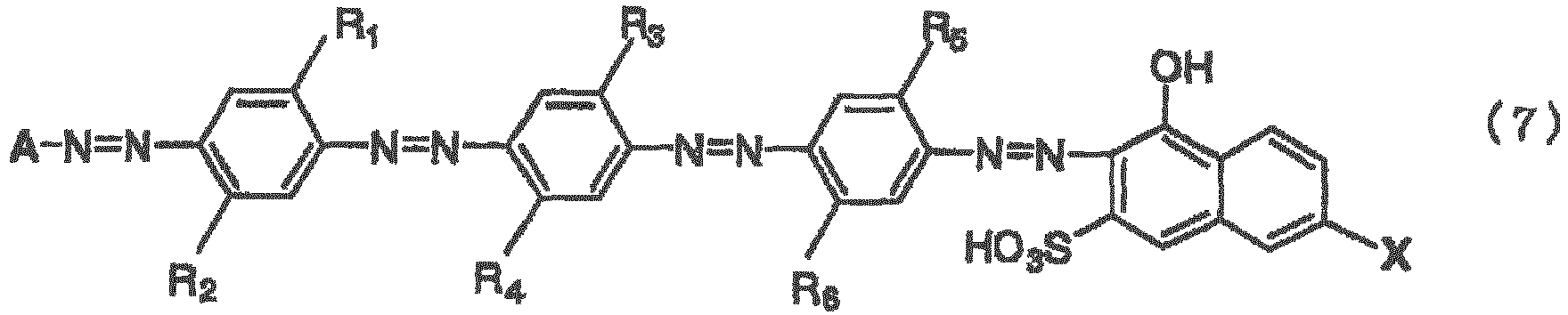
- Azoverbindung und/oder oder ein Salz davon nach einem der Ansprüche 1 bis 10, wobei A eine mit 2 oder 3 Sulfogruppen substituierte Naphthylgruppe oder eine mit einer 3-Sulfopropoxygruppe und einer Sulfogruppe substituierte Naphthylgruppe ist; R1, R3 und R6 jeweils unabhängig ein Wasserstoffatom, eine Methylgruppe, eine Methoxygruppe oder eine 3-Sulfopropoxygruppe sind; R2, R4 und R6 Methylgruppen sind, und X eine Gruppe ist, die ausgewählt ist aus der Gruppe bestehend aus einer unsubstituierten Phenylaminogruppe, einer Phenylaminogruppe, die mit einer Methoxygruppe substituiert ist, einer Benzoylaminogruppe, die mit einer Aminogruppe substituiert ist, und einer Naphthotriazolgruppe, die mit 2 Sulfogruppen substituiert ist.
- Polarisierungsfolie auf Farbstoffbasis enthaltend die Azoverbindung und/oder oder ein Salz davon nach einem der Ansprüche 1 bis 11 in einer Rohfolie für eine Polarisierungsfolie.
- Polarisierungsfolie auf Farbstoffbasis enthaltend die Azoverbindung und/oder oder ein Salz davon nach einem der Ansprüche 1 bis 11 und eine oder mehrere Arten von organischen dichroitischen Farbstoffen, die anders sind als derjenige in einer Rohfolie für eine Polarisierungsfolie.
- Polarisierungsfolie auf Farbstoffbasis enthaltend zwei oder oder mehrere Arten von organischen dichroitischen Farbstoffen, die anders sind als derjenige in einer Rohfolie für eine Polarisierungsfolie.
- Polarisierungsfolie auf Farbstoffbasis enthaltend mindestens eine Art der Azoverbindung und/oder oder eines Salzes davon nach einem der Ansprüche 1 bis 11 in einer Rohfolie für eine Polarisierungsfolie.
- Polarisierungsfolie auf Farbstoffbasis nach einem der Ansprüche 12 bis 14, wobei die Rohfolie für eine Polarisierungsfolie eine Folie ist, die ein Polyvinylalkoholharz, ein Vinylalkoholcopolymerharz oder eine modifizierte Form eines Vinylalkoholcopolymerharzes oder eine modifizierte Form eines Polyvinylalkoholharzes umfasst.
- Polarisierungsfolie auf Farbstoffbasis nach Anspruch 16, wobei die Rohfolie für eine Polarisierungsfolie eine Polyvinylalkoholharzfolie ist.
- Polarisierungsplatte auf Farbstoffbasis mit einem an mindestens einer Oberfläche der Polarisierungsfolie auf Farbstoffbasis nach einem der Ansprüche 12 bis 17 befestigten transparenten Schutzfilm.
- Verwendung einer Polarisierungsfolie auf Farbstoffbasis nach einem der Ansprüche 12 bis 17 oder der Polarisierungsplatte auf Farbstoffbasis nach Anspruch 18 zur Herstellung einer Flüssigkristallanzeige.
- Verwendung der Polarisierungsfolie auf Farbstoffbasis nach einem der Ansprüche 12 bis 17 oder der Polarisierungsplatte auf Farbstoffbasis nach Anspruch 18 zur Herstellung eines Flüssigkristallprojektors.
- Flüssigkristallanzeige umfassend eine Polarisierungsplatte auf Farbstoffbasis nach Anspruch 18.
Applications Claiming Priority (2)
| Application Number | Priority Date | Filing Date | Title |
|---|---|---|---|
| JP2011023748 | 2011-02-07 | ||
| PCT/JP2012/000784 WO2012108173A1 (ja) | 2011-02-07 | 2012-02-06 | アゾ化合物及びその塩、並びにそれらを含有する染料系偏光膜並びに偏光板 |
Publications (3)
| Publication Number | Publication Date |
|---|---|
| EP2674460A1 EP2674460A1 (de) | 2013-12-18 |
| EP2674460A4 EP2674460A4 (de) | 2014-07-30 |
| EP2674460B1 true EP2674460B1 (de) | 2016-04-20 |
Family
ID=46638394
Family Applications (1)
| Application Number | Title | Priority Date | Filing Date |
|---|---|---|---|
| EP12745028.6A Not-in-force EP2674460B1 (de) | 2011-02-07 | 2012-02-06 | Azoverbindung, salz davon, polarisierungsfolie auf farbstoffbasis und polarisierungsplatte damit |
Country Status (7)
| Country | Link |
|---|---|
| US (3) | US9244194B2 (de) |
| EP (1) | EP2674460B1 (de) |
| JP (1) | JP5899123B2 (de) |
| KR (1) | KR101920240B1 (de) |
| CN (1) | CN103347958B (de) |
| TW (1) | TWI503377B (de) |
| WO (1) | WO2012108173A1 (de) |
Families Citing this family (16)
| Publication number | Priority date | Publication date | Assignee | Title |
|---|---|---|---|---|
| US9244194B2 (en) | 2011-02-07 | 2016-01-26 | Nippon Kayaku Kabushiki Kaisha | Azo compound and salt thereof, and dye-based polarizing film and polarizing plate containing the same |
| JP5899122B2 (ja) | 2011-02-07 | 2016-04-06 | 日本化薬株式会社 | アゾ化合物、染料系偏光膜及び偏光板 |
| KR101873216B1 (ko) * | 2011-07-08 | 2018-07-02 | 니폰 가야꾸 가부시끼가이샤 | 편광소자 및 편광판 |
| CN103765255B (zh) * | 2011-09-09 | 2018-01-30 | 日本化药株式会社 | 偏振元件和偏振片 |
| CN104603649B (zh) * | 2012-08-21 | 2017-12-01 | 三菱瓦斯化学株式会社 | 着色偏光膜、着色偏光片材和着色偏光透镜以及它们的制造法 |
| EP2950122B1 (de) * | 2013-01-25 | 2023-04-26 | Mitsubishi Gas Chemical Company, Inc. | Gefärbter film mit geringer polarisierung, gefärbte folie mit geringer polarisierung, linse und verfahren zur herstellung davon |
| TWI665265B (zh) * | 2014-03-31 | 2019-07-11 | 日商日本化藥股份有限公司 | 偶氮化合物及含有該化合物之染料系偏光膜,以及偏光板 |
| HK1243446A1 (zh) * | 2015-04-20 | 2018-07-13 | 日本化药株式会社 | 含有二色性色素的组合物、使用该组合物制作的色素膜以及具有该色素膜的偏振元件 |
| WO2016186183A1 (ja) * | 2015-05-20 | 2016-11-24 | 日本化薬株式会社 | 染料系偏光素子、並びにこれを用いた偏光板及び液晶表示装置 |
| KR101998093B1 (ko) * | 2015-06-03 | 2019-07-09 | 주식회사 엘지화학 | 편광자의 제조방법 및 이를 이용하여 제조된 편광자 |
| JP6662739B2 (ja) * | 2015-10-06 | 2020-03-11 | 日本化薬株式会社 | 無彩色な偏光素子、並びにこれを用いた無彩色偏光板および液晶表示装置 |
| CN105348849B (zh) * | 2015-10-10 | 2017-03-15 | 烟台显华化工科技有限公司 | 一种偶氮型染料及染料液晶组合物 |
| WO2018079651A1 (ja) * | 2016-10-31 | 2018-05-03 | 日本化薬株式会社 | 偏光素子、並びにこれを用いた偏光板及び液晶表示装置 |
| CN112534316A (zh) * | 2018-09-05 | 2021-03-19 | 日本化药株式会社 | 偏光元件及使用该偏光元件的偏光板以及光学构件等 |
| CN116018381B (zh) * | 2020-09-08 | 2025-05-02 | 日本化药株式会社 | 含有偶氮化合物或其盐的偏光膜、偏光板及液晶显示装置 |
| JP2022111055A (ja) * | 2021-01-18 | 2022-07-29 | 住友化学株式会社 | 組成物、膜、積層体および表示装置 |
Family Cites Families (24)
| Publication number | Priority date | Publication date | Assignee | Title |
|---|---|---|---|---|
| US3005814A (en) * | 1956-12-05 | 1961-10-24 | Sandoz Ag | Metal-containing polyazo dyestuffs |
| BE668689A (de) * | 1964-09-04 | |||
| FR2198981B1 (de) * | 1972-09-14 | 1975-01-03 | Ugine Kuhlmann | |
| JP2622748B2 (ja) | 1989-06-12 | 1997-06-18 | 日本化薬株式会社 | 水溶性アゾ染料及びこれを含有する偏光膜 |
| JP4162334B2 (ja) | 1999-07-26 | 2008-10-08 | 日本化薬株式会社 | 染料系偏光膜 |
| JP2003064276A (ja) | 2001-08-27 | 2003-03-05 | Sumitomo Chem Co Ltd | アゾ化合物又はその塩及びそれらを含有する染料系偏光膜 |
| JP4281270B2 (ja) * | 2000-11-27 | 2009-06-17 | 住友化学株式会社 | テトラキスアゾ化合物又はその塩、及びそれらを含有する染料系偏光膜 |
| JP4815721B2 (ja) | 2001-01-10 | 2011-11-16 | 住友化学株式会社 | ポリアゾ化合物又はその塩及びそれらを含有する染料系偏光膜 |
| TW572970B (en) | 2000-11-27 | 2004-01-21 | Sumitomo Chemical Co | Polyazo compound or salt thereof and dye-based polarization film containing the same |
| JP4371345B2 (ja) * | 2001-03-30 | 2009-11-25 | 日本化薬株式会社 | 染料系偏光膜 |
| KR100812553B1 (ko) * | 2001-06-28 | 2008-03-13 | 스미또모 가가꾸 가부시키가이샤 | 폴리아조 화합물 또는 이의 염과 이를 함유하는 염료계편광막 |
| JP2003327858A (ja) | 2002-03-08 | 2003-11-19 | Sumitomo Chem Co Ltd | アゾ化合物又はその塩、及びそれらの偏光膜への適用 |
| JP4473487B2 (ja) * | 2002-04-11 | 2010-06-02 | 株式会社日本化学工業所 | 新規なアゾ染料 |
| JP2003313451A (ja) * | 2002-04-26 | 2003-11-06 | Sumitomo Chem Co Ltd | アゾ化合物又はその塩、及びそれらの偏光膜への適用 |
| JP4270486B2 (ja) | 2002-08-09 | 2009-06-03 | 日本化薬株式会社 | トリスアゾ化合物、水性インク組成物及び着色体 |
| EP1679350A1 (de) | 2003-10-14 | 2006-07-12 | Mitsubishi Chemical Corporation | Farbstoff für anisotropen farbfilm, farbstoffzusammensetzung für anisotropen farbfilm, anisotroper farbfilm und polarisierungsvorrichtung |
| CA2553415A1 (en) | 2004-02-04 | 2005-08-18 | Nippon Kayaku Kabushiki Kaisha | Azo compound and polarizing film and polarizing plate each containing the same |
| JP4547946B2 (ja) * | 2004-03-11 | 2010-09-22 | 三菱化学株式会社 | アゾ色素、異方性色素膜用二色性アゾ色素並びにこれを用いた異方性色素膜形成用組成物、異方性色素膜および偏光素子 |
| CN101479347B (zh) | 2006-06-22 | 2013-08-07 | 日本化药株式会社 | 偶氮化合物和含有该偶氮化合物的染料偏振膜 |
| JP2009115866A (ja) * | 2007-11-02 | 2009-05-28 | Nitto Denko Corp | コーティング液と偏光膜および偏光膜の製造方法 |
| CN102037082B (zh) * | 2008-05-20 | 2014-05-28 | 日本化药株式会社 | 偶氮化合物及包含所述偶氮化合物的染料基偏振膜和偏振片 |
| JP5678429B2 (ja) * | 2008-12-25 | 2015-03-04 | 三菱化学株式会社 | 異方性膜用アゾ化合物、該化合物を含有する組成物、異方性膜及び偏光素子 |
| JP5899122B2 (ja) | 2011-02-07 | 2016-04-06 | 日本化薬株式会社 | アゾ化合物、染料系偏光膜及び偏光板 |
| US9244194B2 (en) | 2011-02-07 | 2016-01-26 | Nippon Kayaku Kabushiki Kaisha | Azo compound and salt thereof, and dye-based polarizing film and polarizing plate containing the same |
-
2012
- 2012-02-06 US US13/983,791 patent/US9244194B2/en not_active Expired - Fee Related
- 2012-02-06 KR KR1020137018074A patent/KR101920240B1/ko not_active Expired - Fee Related
- 2012-02-06 WO PCT/JP2012/000784 patent/WO2012108173A1/ja not_active Ceased
- 2012-02-06 JP JP2012556785A patent/JP5899123B2/ja active Active
- 2012-02-06 CN CN201280008018.5A patent/CN103347958B/zh active Active
- 2012-02-06 EP EP12745028.6A patent/EP2674460B1/de not_active Not-in-force
- 2012-02-07 TW TW101103860A patent/TWI503377B/zh active
-
2015
- 2015-07-30 US US14/813,166 patent/US9341747B2/en not_active Expired - Fee Related
- 2015-12-15 US US14/969,587 patent/US20160103362A1/en not_active Abandoned
Also Published As
| Publication number | Publication date |
|---|---|
| JPWO2012108173A1 (ja) | 2014-07-03 |
| US20150337134A1 (en) | 2015-11-26 |
| TWI503377B (zh) | 2015-10-11 |
| TW201241095A (en) | 2012-10-16 |
| JP5899123B2 (ja) | 2016-04-06 |
| US9341747B2 (en) | 2016-05-17 |
| HK1187939A1 (en) | 2014-04-17 |
| CN103347958B (zh) | 2014-11-12 |
| EP2674460A1 (de) | 2013-12-18 |
| US9244194B2 (en) | 2016-01-26 |
| KR101920240B1 (ko) | 2018-11-20 |
| US20130314786A1 (en) | 2013-11-28 |
| US20160103362A1 (en) | 2016-04-14 |
| CN103347958A (zh) | 2013-10-09 |
| WO2012108173A1 (ja) | 2012-08-16 |
| EP2674460A4 (de) | 2014-07-30 |
| KR20140019310A (ko) | 2014-02-14 |
Similar Documents
| Publication | Publication Date | Title |
|---|---|---|
| EP2674460B1 (de) | Azoverbindung, salz davon, polarisierungsfolie auf farbstoffbasis und polarisierungsplatte damit | |
| EP2674461B1 (de) | Azoverbindung, farbstoffbasierte polarisationsfolie und polarisationsplatte | |
| US8940059B2 (en) | Azo compound and dye polarizing film containing the same | |
| EP2031027A1 (de) | Azoverbindung und sie enthaltender farbstoffpolarisationsfilm | |
| EP2206748A1 (de) | Azoverbindung und farbstoffhaltige polarisationsfolie damit | |
| EP1816170A1 (de) | Azoverbindungen und sie enthaltende farbstoffartige polarisationsfilme oder -platten | |
| KR20160138070A (ko) | 아조 화합물 및 그것들을 함유하는 염료계 편광막 그리고 편광판 | |
| KR20180006926A (ko) | 아조 화합물 및 그것들을 함유하는 염료계 편광막 그리고 편광판 | |
| KR20180006924A (ko) | 아조 화합물 및 그것들을 함유하는 염료계 편광막 그리고 편광판 | |
| HK1187939B (en) | Azo compound, salt thereof, and dye-based polarizing film and polarizing plate containing same | |
| CN114945636A (zh) | 偶氮化合物或其盐,以及含有该化合物或其盐的染料系偏光膜、染料系偏光板及显示装置 | |
| HK1187940B (en) | Azo compound, dye-based polarizing film, and polarizing plate | |
| HK1153217B (en) | Azo compound and salts thereof, as well as dye-based polarization films and polarizing plates comprising the same | |
| HK1152066B (en) | Azo compounds, and dye-based polarizing films and polarizing plates comprising the same | |
| HK1185373B (en) | Azo compounds, and dye-based polarizing films and polarizing plates comprising the same | |
| HK1183682B (en) | Azo compound and salts thereof, as well as dye-based polarization films and polarizing plates comprising the same | |
| HK1153217A1 (en) | Azo compound and salts thereof, as well as dye-based polarization films and polarizing plates comprising the same | |
| HK1152066A1 (en) | Azo compounds, and dye-based polarizing films and polarizing plates comprising the same |
Legal Events
| Date | Code | Title | Description |
|---|---|---|---|
| PUAI | Public reference made under article 153(3) epc to a published international application that has entered the european phase |
Free format text: ORIGINAL CODE: 0009012 |
|
| 17P | Request for examination filed |
Effective date: 20130821 |
|
| AK | Designated contracting states |
Kind code of ref document: A1 Designated state(s): AL AT BE BG CH CY CZ DE DK EE ES FI FR GB GR HR HU IE IS IT LI LT LU LV MC MK MT NL NO PL PT RO RS SE SI SK SM TR |
|
| DAX | Request for extension of the european patent (deleted) | ||
| RIC1 | Information provided on ipc code assigned before grant |
Ipc: C09B 31/30 20060101AFI20140618BHEP Ipc: G02F 1/1335 20060101ALI20140618BHEP Ipc: C09B 67/42 20060101ALI20140618BHEP Ipc: C09B 67/22 20060101ALI20140618BHEP Ipc: G02B 5/30 20060101ALI20140618BHEP |
|
| A4 | Supplementary search report drawn up and despatched |
Effective date: 20140626 |
|
| GRAP | Despatch of communication of intention to grant a patent |
Free format text: ORIGINAL CODE: EPIDOSNIGR1 |
|
| INTG | Intention to grant announced |
Effective date: 20151119 |
|
| GRAS | Grant fee paid |
Free format text: ORIGINAL CODE: EPIDOSNIGR3 |
|
| GRAA | (expected) grant |
Free format text: ORIGINAL CODE: 0009210 |
|
| AK | Designated contracting states |
Kind code of ref document: B1 Designated state(s): AL AT BE BG CH CY CZ DE DK EE ES FI FR GB GR HR HU IE IS IT LI LT LU LV MC MK MT NL NO PL PT RO RS SE SI SK SM TR |
|
| REG | Reference to a national code |
Ref country code: GB Ref legal event code: FG4D |
|
| REG | Reference to a national code |
Ref country code: CH Ref legal event code: EP |
|
| REG | Reference to a national code |
Ref country code: AT Ref legal event code: REF Ref document number: 792433 Country of ref document: AT Kind code of ref document: T Effective date: 20160515 |
|
| REG | Reference to a national code |
Ref country code: IE Ref legal event code: FG4D |
|
| REG | Reference to a national code |
Ref country code: DE Ref legal event code: R096 Ref document number: 602012017358 Country of ref document: DE |
|
| REG | Reference to a national code |
Ref country code: LT Ref legal event code: MG4D |
|
| REG | Reference to a national code |
Ref country code: AT Ref legal event code: MK05 Ref document number: 792433 Country of ref document: AT Kind code of ref document: T Effective date: 20160420 |
|
| REG | Reference to a national code |
Ref country code: NL Ref legal event code: MP Effective date: 20160420 |
|
| PG25 | Lapsed in a contracting state [announced via postgrant information from national office to epo] |
Ref country code: NL Free format text: LAPSE BECAUSE OF FAILURE TO SUBMIT A TRANSLATION OF THE DESCRIPTION OR TO PAY THE FEE WITHIN THE PRESCRIBED TIME-LIMIT Effective date: 20160420 Ref country code: FI Free format text: LAPSE BECAUSE OF FAILURE TO SUBMIT A TRANSLATION OF THE DESCRIPTION OR TO PAY THE FEE WITHIN THE PRESCRIBED TIME-LIMIT Effective date: 20160420 Ref country code: PL Free format text: LAPSE BECAUSE OF FAILURE TO SUBMIT A TRANSLATION OF THE DESCRIPTION OR TO PAY THE FEE WITHIN THE PRESCRIBED TIME-LIMIT Effective date: 20160420 Ref country code: NO Free format text: LAPSE BECAUSE OF FAILURE TO SUBMIT A TRANSLATION OF THE DESCRIPTION OR TO PAY THE FEE WITHIN THE PRESCRIBED TIME-LIMIT Effective date: 20160720 Ref country code: LT Free format text: LAPSE BECAUSE OF FAILURE TO SUBMIT A TRANSLATION OF THE DESCRIPTION OR TO PAY THE FEE WITHIN THE PRESCRIBED TIME-LIMIT Effective date: 20160420 |
|
| PG25 | Lapsed in a contracting state [announced via postgrant information from national office to epo] |
Ref country code: GR Free format text: LAPSE BECAUSE OF FAILURE TO SUBMIT A TRANSLATION OF THE DESCRIPTION OR TO PAY THE FEE WITHIN THE PRESCRIBED TIME-LIMIT Effective date: 20160721 Ref country code: PT Free format text: LAPSE BECAUSE OF FAILURE TO SUBMIT A TRANSLATION OF THE DESCRIPTION OR TO PAY THE FEE WITHIN THE PRESCRIBED TIME-LIMIT Effective date: 20160822 Ref country code: AT Free format text: LAPSE BECAUSE OF FAILURE TO SUBMIT A TRANSLATION OF THE DESCRIPTION OR TO PAY THE FEE WITHIN THE PRESCRIBED TIME-LIMIT Effective date: 20160420 Ref country code: ES Free format text: LAPSE BECAUSE OF FAILURE TO SUBMIT A TRANSLATION OF THE DESCRIPTION OR TO PAY THE FEE WITHIN THE PRESCRIBED TIME-LIMIT Effective date: 20160420 Ref country code: RS Free format text: LAPSE BECAUSE OF FAILURE TO SUBMIT A TRANSLATION OF THE DESCRIPTION OR TO PAY THE FEE WITHIN THE PRESCRIBED TIME-LIMIT Effective date: 20160420 Ref country code: HR Free format text: LAPSE BECAUSE OF FAILURE TO SUBMIT A TRANSLATION OF THE DESCRIPTION OR TO PAY THE FEE WITHIN THE PRESCRIBED TIME-LIMIT Effective date: 20160420 Ref country code: LV Free format text: LAPSE BECAUSE OF FAILURE TO SUBMIT A TRANSLATION OF THE DESCRIPTION OR TO PAY THE FEE WITHIN THE PRESCRIBED TIME-LIMIT Effective date: 20160420 Ref country code: SE Free format text: LAPSE BECAUSE OF FAILURE TO SUBMIT A TRANSLATION OF THE DESCRIPTION OR TO PAY THE FEE WITHIN THE PRESCRIBED TIME-LIMIT Effective date: 20160420 |
|
| PG25 | Lapsed in a contracting state [announced via postgrant information from national office to epo] |
Ref country code: IT Free format text: LAPSE BECAUSE OF FAILURE TO SUBMIT A TRANSLATION OF THE DESCRIPTION OR TO PAY THE FEE WITHIN THE PRESCRIBED TIME-LIMIT Effective date: 20160420 Ref country code: BE Free format text: LAPSE BECAUSE OF FAILURE TO SUBMIT A TRANSLATION OF THE DESCRIPTION OR TO PAY THE FEE WITHIN THE PRESCRIBED TIME-LIMIT Effective date: 20160420 |
|
| REG | Reference to a national code |
Ref country code: FR Ref legal event code: PLFP Year of fee payment: 6 |
|
| REG | Reference to a national code |
Ref country code: DE Ref legal event code: R097 Ref document number: 602012017358 Country of ref document: DE |
|
| PG25 | Lapsed in a contracting state [announced via postgrant information from national office to epo] |
Ref country code: CZ Free format text: LAPSE BECAUSE OF FAILURE TO SUBMIT A TRANSLATION OF THE DESCRIPTION OR TO PAY THE FEE WITHIN THE PRESCRIBED TIME-LIMIT Effective date: 20160420 Ref country code: SK Free format text: LAPSE BECAUSE OF FAILURE TO SUBMIT A TRANSLATION OF THE DESCRIPTION OR TO PAY THE FEE WITHIN THE PRESCRIBED TIME-LIMIT Effective date: 20160420 Ref country code: RO Free format text: LAPSE BECAUSE OF FAILURE TO SUBMIT A TRANSLATION OF THE DESCRIPTION OR TO PAY THE FEE WITHIN THE PRESCRIBED TIME-LIMIT Effective date: 20160420 Ref country code: DK Free format text: LAPSE BECAUSE OF FAILURE TO SUBMIT A TRANSLATION OF THE DESCRIPTION OR TO PAY THE FEE WITHIN THE PRESCRIBED TIME-LIMIT Effective date: 20160420 Ref country code: EE Free format text: LAPSE BECAUSE OF FAILURE TO SUBMIT A TRANSLATION OF THE DESCRIPTION OR TO PAY THE FEE WITHIN THE PRESCRIBED TIME-LIMIT Effective date: 20160420 |
|
| PLBE | No opposition filed within time limit |
Free format text: ORIGINAL CODE: 0009261 |
|
| STAA | Information on the status of an ep patent application or granted ep patent |
Free format text: STATUS: NO OPPOSITION FILED WITHIN TIME LIMIT |
|
| PG25 | Lapsed in a contracting state [announced via postgrant information from national office to epo] |
Ref country code: SM Free format text: LAPSE BECAUSE OF FAILURE TO SUBMIT A TRANSLATION OF THE DESCRIPTION OR TO PAY THE FEE WITHIN THE PRESCRIBED TIME-LIMIT Effective date: 20160420 |
|
| 26N | No opposition filed |
Effective date: 20170123 |
|
| PG25 | Lapsed in a contracting state [announced via postgrant information from national office to epo] |
Ref country code: SI Free format text: LAPSE BECAUSE OF FAILURE TO SUBMIT A TRANSLATION OF THE DESCRIPTION OR TO PAY THE FEE WITHIN THE PRESCRIBED TIME-LIMIT Effective date: 20160420 |
|
| PG25 | Lapsed in a contracting state [announced via postgrant information from national office to epo] |
Ref country code: MC Free format text: LAPSE BECAUSE OF FAILURE TO SUBMIT A TRANSLATION OF THE DESCRIPTION OR TO PAY THE FEE WITHIN THE PRESCRIBED TIME-LIMIT Effective date: 20160420 |
|
| REG | Reference to a national code |
Ref country code: CH Ref legal event code: PL |
|
| GBPC | Gb: european patent ceased through non-payment of renewal fee |
Effective date: 20170206 |
|
| PG25 | Lapsed in a contracting state [announced via postgrant information from national office to epo] |
Ref country code: LI Free format text: LAPSE BECAUSE OF NON-PAYMENT OF DUE FEES Effective date: 20170228 Ref country code: CH Free format text: LAPSE BECAUSE OF NON-PAYMENT OF DUE FEES Effective date: 20170228 |
|
| REG | Reference to a national code |
Ref country code: IE Ref legal event code: MM4A |
|
| PG25 | Lapsed in a contracting state [announced via postgrant information from national office to epo] |
Ref country code: LU Free format text: LAPSE BECAUSE OF NON-PAYMENT OF DUE FEES Effective date: 20170206 |
|
| REG | Reference to a national code |
Ref country code: FR Ref legal event code: PLFP Year of fee payment: 7 |
|
| PG25 | Lapsed in a contracting state [announced via postgrant information from national office to epo] |
Ref country code: GB Free format text: LAPSE BECAUSE OF NON-PAYMENT OF DUE FEES Effective date: 20170206 Ref country code: IE Free format text: LAPSE BECAUSE OF NON-PAYMENT OF DUE FEES Effective date: 20170206 |
|
| PG25 | Lapsed in a contracting state [announced via postgrant information from national office to epo] |
Ref country code: MT Free format text: LAPSE BECAUSE OF NON-PAYMENT OF DUE FEES Effective date: 20170206 |
|
| PG25 | Lapsed in a contracting state [announced via postgrant information from national office to epo] |
Ref country code: AL Free format text: LAPSE BECAUSE OF FAILURE TO SUBMIT A TRANSLATION OF THE DESCRIPTION OR TO PAY THE FEE WITHIN THE PRESCRIBED TIME-LIMIT Effective date: 20160420 |
|
| PG25 | Lapsed in a contracting state [announced via postgrant information from national office to epo] |
Ref country code: HU Free format text: LAPSE BECAUSE OF FAILURE TO SUBMIT A TRANSLATION OF THE DESCRIPTION OR TO PAY THE FEE WITHIN THE PRESCRIBED TIME-LIMIT; INVALID AB INITIO Effective date: 20120206 |
|
| PG25 | Lapsed in a contracting state [announced via postgrant information from national office to epo] |
Ref country code: BG Free format text: LAPSE BECAUSE OF FAILURE TO SUBMIT A TRANSLATION OF THE DESCRIPTION OR TO PAY THE FEE WITHIN THE PRESCRIBED TIME-LIMIT Effective date: 20160420 |
|
| PG25 | Lapsed in a contracting state [announced via postgrant information from national office to epo] |
Ref country code: CY Free format text: LAPSE BECAUSE OF NON-PAYMENT OF DUE FEES Effective date: 20160420 |
|
| PG25 | Lapsed in a contracting state [announced via postgrant information from national office to epo] |
Ref country code: MK Free format text: LAPSE BECAUSE OF FAILURE TO SUBMIT A TRANSLATION OF THE DESCRIPTION OR TO PAY THE FEE WITHIN THE PRESCRIBED TIME-LIMIT Effective date: 20160420 |
|
| PG25 | Lapsed in a contracting state [announced via postgrant information from national office to epo] |
Ref country code: TR Free format text: LAPSE BECAUSE OF FAILURE TO SUBMIT A TRANSLATION OF THE DESCRIPTION OR TO PAY THE FEE WITHIN THE PRESCRIBED TIME-LIMIT Effective date: 20160420 |
|
| PGFP | Annual fee paid to national office [announced via postgrant information from national office to epo] |
Ref country code: DE Payment date: 20200121 Year of fee payment: 9 |
|
| PGFP | Annual fee paid to national office [announced via postgrant information from national office to epo] |
Ref country code: FR Payment date: 20200113 Year of fee payment: 9 |
|
| PG25 | Lapsed in a contracting state [announced via postgrant information from national office to epo] |
Ref country code: IS Free format text: LAPSE BECAUSE OF FAILURE TO SUBMIT A TRANSLATION OF THE DESCRIPTION OR TO PAY THE FEE WITHIN THE PRESCRIBED TIME-LIMIT Effective date: 20160820 |
|
| REG | Reference to a national code |
Ref country code: DE Ref legal event code: R119 Ref document number: 602012017358 Country of ref document: DE |
|
| PG25 | Lapsed in a contracting state [announced via postgrant information from national office to epo] |
Ref country code: FR Free format text: LAPSE BECAUSE OF NON-PAYMENT OF DUE FEES Effective date: 20210228 Ref country code: DE Free format text: LAPSE BECAUSE OF NON-PAYMENT OF DUE FEES Effective date: 20210901 |