EP2674884A1 - Procédé, système et support d'enregistrement lisible par ordinateur pour ajouter une nouvelle image et des informations sur la nouvelle image à une base de données d'images - Google Patents
Procédé, système et support d'enregistrement lisible par ordinateur pour ajouter une nouvelle image et des informations sur la nouvelle image à une base de données d'images Download PDFInfo
- Publication number
- EP2674884A1 EP2674884A1 EP11858235.2A EP11858235A EP2674884A1 EP 2674884 A1 EP2674884 A1 EP 2674884A1 EP 11858235 A EP11858235 A EP 11858235A EP 2674884 A1 EP2674884 A1 EP 2674884A1
- Authority
- EP
- European Patent Office
- Prior art keywords
- image
- images
- database
- unrecognized
- specific
- Prior art date
- Legal status (The legal status is an assumption and is not a legal conclusion. Google has not performed a legal analysis and makes no representation as to the accuracy of the status listed.)
- Withdrawn
Links
Images


Classifications
-
- G—PHYSICS
- G06—COMPUTING OR CALCULATING; COUNTING
- G06F—ELECTRIC DIGITAL DATA PROCESSING
- G06F17/00—Digital computing or data processing equipment or methods, specially adapted for specific functions
- G06F17/40—Data acquisition and logging
-
- G—PHYSICS
- G06—COMPUTING OR CALCULATING; COUNTING
- G06F—ELECTRIC DIGITAL DATA PROCESSING
- G06F16/00—Information retrieval; Database structures therefor; File system structures therefor
- G06F16/50—Information retrieval; Database structures therefor; File system structures therefor of still image data
- G06F16/58—Retrieval characterised by using metadata, e.g. metadata not derived from the content or metadata generated manually
- G06F16/583—Retrieval characterised by using metadata, e.g. metadata not derived from the content or metadata generated manually using metadata automatically derived from the content
-
- G—PHYSICS
- G06—COMPUTING OR CALCULATING; COUNTING
- G06F—ELECTRIC DIGITAL DATA PROCESSING
- G06F16/00—Information retrieval; Database structures therefor; File system structures therefor
- G06F16/50—Information retrieval; Database structures therefor; File system structures therefor of still image data
- G06F16/51—Indexing; Data structures therefor; Storage structures
Definitions
- the present invention relates to a method, a system and a computer-readable recording medium for adding a new image and its information into the image database. More specifically, the present invention relates to the method, the system and the computer-readable recording medium for adding a new image and its information into an image database, unrecognized images that are not matched upon searching queried images input in an image database are stored and grouped, and they are verified using images automatically acquired by methods including web crawling (or images manually provided by a user) and tags so that the unrecognized image and their tag information may be added to an image database more easily.
- search methods are adopted. For example, computer users may search for information by using the Internet (more accurately, web services) in addition to getting the information directly from a dictionary or asking others who are familiar with the information. That is, after accessing a web server that provides a search service by using a browser and entering a keyword relating to the information to be found, a user may be provided with the search service interfaced with the web server.
- search services have been developed and, particularly in Korea, searches for knowledge have become of greater importance, and utilization of the search service for getting information tends to be increasing.
- search service is a function used by many users and visits of users to a website are directly connected to advertising profits, many portal sites offer such search functions.
- an image retrieval system had been developed to allow a user, etc. who wants to get information on a specific image to search by using not text but the image itself.
- the existing image retrieval system had the following problems: First, in order to provide an image search system, an image database including plenty of data is required. With the image database not including sufficient data, even if a queried image was inputted, information on search results could not be provided, and the images which failed to be matched to the queried images, that is, the unrecognized images, came to be abandoned without being recycled, which was a problem. In such a case, until the unrecognized images were reflected manually in the image database, the information on the search results of the unrecognized images still could not be provided even if the searches were repeated.
- a method for adding a new image and its information into an image database comprising (a) a step in which, if a queried image is inputted, a pre-stored image in the image database is matched with the queried image to research whether there are any images similar to the queried image in the image database; (b) a step in which, if there is no image similar to the queried image based on the search result, the queried image is stored in a database for unrecognized images, (c) a step in which images that are related to one another among the images stored in the database for unrecognized images are grouped based on degrees of similarity to organize sets of images, and (d) a step in which, if a specific image and its tag information are inputted from outside, at least some images included in a specific set of images among the organized sets of the images are compared with the specific image inputted to determine whether it has a degree of similarity exceeding a pre-set threshold value, and
- a system for adding a new image and its information into an image database comprising, a search part that, if a queried image is inputted, matches a pre-stored image in the image database with the queried image in the image database to research whether there are any images similar to the queried image in the image database, an unrecognized image storing part that, if there is no image similar to the queried image based on the search result, stores the queried image in a database for unrecognized images, an unrecognized image set organizing part that groups images that are related to one another among the images stored in the database for unrecognized images based on the search result, stores the queried image in a database for unrecognized images, an unrecognized image set organizing part that groups images that are related to one another among the images stored in the database for unrecognized images based on degrees of similarity to organize sets of images, and a new image adding part that
- any unrecognized images that failed to match images stored in the image database are not abandoned but recycled and may be reasonably used to match the queried image to be newly inputted later so that an automatically evolving image database may be ultimately and effectively implemented.
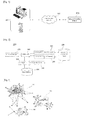
- Figure 1 is a drawing that schematically shows a configuration of a whole system for adding a new image and its information into an image database in accordance with an example embodiment of the present invention.
- Figure 2 is a drawing that illustratively represents an internal configuration of the image processing system (200) in accordance with an example embodiment of the present invention.
- Figure 3 illustrates organization of image sets by grouping images stored in a database for unrecognized images based on degrees of similarity among the images stored in the image database at the unrecognized image set organizing part in accordance with an example embodiment of the present invention.
- Figure 4a and Figure 4b illustrate an example embodiment in which an unrecognized image set organizing part groups images with similarity among the images stored in a database for unrecognized images to organize image sets in accordance with an example embodiment of the present invention.
- Figure 5 is a drawing that illustratively represents the configuration of normalizing feature regions in accordance with an example embodiment of the present invention.
- Figure 6 is a drawing that illustratively represents the distribution of feature regions included in an image collected by a web crawler and an image included in a set of images in accordance with an example embodiment of the present invention.
- Figure 1 is a drawing that schematically shows the configuration of a whole system for adding a new image and its information into an image database in accordance with an example embodiment of the present invention.
- the whole system in accordance with an example embodiment of the present invention may comprise a communication network (100), an image processing system (200) capable of adding a new image and its information into an image database, and a user terminal (300).
- a communication network 100
- an image processing system 200
- a user terminal 300
- the communication network (100) may be configured, regardless of wired or wireless, in a variety of networks, including a local area network (LAN), a metropolitan area network (MAN), a wide area network (WAN), etc. More preferably, the communication network (100) in the present invention may be the World Wide Web (www).
- the image processing system (200) capable of adding a new image and its information to an image database is described below. If a queried image is inputted from a user terminal (300) through a communication network (100), may match the pre-stored image in an image database with the queried image to search whether there is any image similar to the queried image in the image database, and, if there is no similar image based on the search result, it performs a function of storing the queried image in a database for unrecognized images. At the time, it may browse whether there is an image similar to the queried image in the image database by matching normalized feature regions of the pre-stored images in the image database with normalized feature regions of the queried image.
- the image processing system (200) in accordance with an example embodiment of the present invention, may group images that are associated with one another, and are stored in the database for unrecognized images based on degrees of similarity to organize sets of images.
- a specific image and its tag information i.e., information corresponding to an applicable image
- the image processing system (200) may compare the specific image with images in a specific set of images among the above-mentioned sets of images and determine whether at least some of the images in the specific set of images have degrees of similarity exceeding the pre-set threshold value and, if the image is determined to have the degree of similarity exceeding the pre-set threshold value, may allow at least some of the images in the specific set of images and the tag information acquired to be automatically added to the image database to be explained below.
- the image processing system (200) in accordance with an example embodiment of the present invention may determine whether at least some of the images in the specific set of images are associated with the crawled data and/or data inputted by a user by referring to the crawled data and/or data inputted by a user (e.g., image and its tag information) and, if they are determined to have connections, may perform a function to add into the image database at least some of images with the crawled tag information and/or tag information inputted by a user.
- a user e.g., image and its tag information
- the user terminal (300) in accordance with an example embodiment of the present invention is a digital device which includes a function to enable the user to access and communicate the image processing system (200) and any digital devices, including a personal computer (e.g., desktop, notebook computer, etc.), a workstation, a PDA, a web pad, a cellular phone, which have memory capability and microprocessors with calculation ability, may be adopted as the user terminal (300) in accordance with the present invention.
- Figure 2 is a drawing that illustratively represents an internal configuration of the image processing system (200) in accordance with an example embodiment of the present invention.
- the image processing system (200) in accordance with an example embodiment of the present invention may include a search part (210), an unrecognized image storing part (220), an unrecognized image set organizing part (230), a new image adding part (240), an image database (250), a database for unrecognized images (260), a communication part (270) and a control part (280).
- the search part (210), the unrecognized image storing part (220), the unrecognized image set organizing part (230), the new image adding part (240), the image database (250), the database for unrecognized images (260), the communication part (270) and the control part (280) may be program modules at least some of which may communicate with the user terminal (300).
- Such program modules may be included in the image processing system (200) in the form of an operating system, an application program module and other program modules, or they may be physically stored in a number of memory devices.
- such program modules may also be stored in a remote storage device capable of communicating with the image processing system (200).
- program modules include but are not limited to a routine, a subroutine, a program, an object, a component, and a data structure for executing a specific operation or a type of specific abstract data that will be described in accordance with the present invention.
- the search part (210) in accordance with an example embodiment of the present invention performs a function of matching the queried image with images already stored in the image database (250) and searching whether there are any images similar to the queried image in the image database (250) or not.
- the search part (210) in accordance with an example embodiment of the present invention may perform a function of comparing a normalized feature region(s) of the already stored images in the image database (250) with normalized feature region(s) of the queried image and searching whether there are any images similar to the queried image in the image database (250) or not.
- the search part (210), the unrecognized image set organizing part (230) to be described later and the new image adding part (240) may be allowed to pre-extract feature(s) and feature region(s) from images for matching among images.
- the feature means a point including a feature element of an object included in the image
- the feature region means an area around the feature which includes characteristics of the object and may be set to be robust to changes in a viewpoint and an illumination of the image.
- a feature extraction technology is required.
- an article entitled " A combined corner and edge detector” authored jointly by C. Harris and one other and published in "In Alvey Vision Conference” in 1988 and the like may be referred to as such feature recognition technology (the whole content of the article should be considered to have been combined in the present specification).
- the article describes a method for guessing elliptic feature regions by using a second moment matrix which represents slope distributions around the feature.
- the feature extraction technology applicable to the present invention is not limited only to the method mentioned in the article and various modified examples can be applied to implement the present invention.
- the unrecognized image storing part (220) in accordance with an example embodiment of the present invention performs a function of storing the queried image in the database for unrecognized images (260).
- the unrecognized image set organizing part (230) in accordance with an example embodiment of the present invention performs a function of grouping images with high relevance by referring to degrees of similarity of the images among the images stored in the database for unrecognized images (260) (e.g., the degrees of similarity higher than the pre-set value) and organizing sets of the images. More specifically, the unrecognized image set organizing part (230) performs a function of comparing features or feature regions of the images stored in the database for unrecognized images (260), and grouping the images considered to have degrees of similarity to organize sets of the images.
- Figure 3 illustrates organization of image sets by grouping images stored in a database for unrecognized images (260) based on degrees of similarity among the images stored in the image database at the unrecognized image set organizing part (230) in accordance with an example embodiment of the present invention.
- the unrecognized image set organizing part (230) groups the images stored by the unrecognized image storing part (220) based on degrees of similarity of images stored in the database for unrecognized images (260) to organize image sets like 310, 320, and 330.
- Figure 4a and Figure 4b illustrate such an example embodiment that the unrecognized image set organizing part (230) in accordance with an example embodiment of the present invention groups images with high degrees of similarity among the images stored in the database for unrecognized images (260) to organize image sets.
- the unrecognized image set organizing part (230) in accordance with an example embodiment of the present invention first group images that are found to be similar images by applying an image matching scheme as shown in Figure 4a .
- the unrecognized image set organizing part (230) in accordance with an example embodiment of the present invention may array, structure and store the grouped images by time and by a variety of viewpoints.
- Figure 4b illustrates such one example embodiment that the unrecognized image set organizing part (230) in accordance with an example embodiment of the present invention arrays and structures images by time and by a variety of viewpoints but it is not necessary to be limited to this case. And, it is possible for the unrecognized image set organizing part (230) to organize image sets in a variety of methods.
- the new image adding part (240) performs a function of comparing the specific image with at least some images included in a specific set of images and determining whether they have degrees of similarity exceeding the pre-set threshold value or not and, if it is determined that the degrees of similarity are in excess of the pre-set threshold value, performs a function of allowing at least some images with the acquired tag information to be automatically added into the image database (250).
- the new image adding part (240) in accordance with an example embodiment of the present invention may allow analysis operations (i.e., image matching operations) to be performed.
- the images collected by a web crawler, etc. and the images included in the set(s) of images, which are subject to matching may be images photographed from different viewpoints in different luminance environments when the new image adding part (240) performs an image matching operation as above, even the feature region included in each of the images may be differently extracted in size and shape depending on the viewpoints and the luminance. Therefore, it might be difficult to match the images accurately only by directly comparing the feature regions of the images collected by the web crawler, etc. and those of the images included in the set(s) of images.
- the images collected by the web crawler hereby are assumed for convenience but the images collected by the user terminal (300) may be necessarily included.
- the new image adding part (240) in accordance with an example embodiment of the present invention may normalize the size and the shape of each of the feature regions included, respectively, in the images collected by the web crawler, etc. and in the images in the set(s) of images and then perform image matching based on each of the normalized feature regions to thereby compensate errors caused by various viewpoints and luminance.
- Figure 5 is a drawing that illustratively represents the configuration of normalizing feature regions in accordance with an example embodiment of the present invention.
- the image (a) shows the feature region A (510) extracted from the images collected by a web crawler, etc.
- the image (b) of Figure 5 shows the feature region B (520) extracted from the images included in the set of images.
- Examining the images (a) and (b) of Figure 5 it may be found that, although each image shows the same object, the same feature region of the same object is displayed differently in size and shape due to different viewpoints or luminance so that feature regions (510, 520) of different sizes and shapes are extracted from the same feature part of the image that belongs to the images and sets of images collected by a web crawler, etc.
- the new image adding part (240) may normalize a pair of feature regions with different sizes and shapes as a pair of feature regions with same size and shape by using a normalization technology. Accordingly, a pair of feature regions (510, 520) as shown in images (a) and (b) of Figure 5 may be normalized as a pair of feature regions (530, 540) as shown in images (c) and (d) of Figure 5 .
- the article describes a method for normalizing elliptic feature regions in various sizes and shapes as circles in a specific size and a specific shape by using second moment matrices M L 1/2 and M R 1/2 , which guesses the viewpoints and the luminance conditions of the images, and a method for rotating the normalized feature region by using a rotation matrix R to determine whether a pair of normalized feature regions point out the same object or not.
- the normalization technology applicable to the present invention is not limited to the method described in the above article and various modified examples can be applied to implement the present invention.
- the new image adding part (240) in accordance with an example embodiment of the present invention may compare at least one normalized feature region of an image in the set of images with at least one normalized feature region of the collected image and retrieve at least one pair of feature regions from each of the images which are considered to indicate the same object.
- the new image adding part (240) in accordance with an example embodiment of the present invention may compare relative location relationships between at least two feature regions of the image in the set of images, which correspond to at least two pairs of feature regions, and relative location relationships between at least two feature regions of the collected image, which correspond to at least two pairs of feature regions, by using topology and determine whether the image in the set of images matches with the collected image by referring to the above comparison results.
- Figure 6 is a drawing that illustratively represents the distribution of feature regions included in an image collected by a web crawler and an image included in a set of images in accordance with an example embodiment of the present invention.
- the new image adding part (240) in accordance with an example embodiment of the present invention may determine whether there is similarity between both images by comparing the relative location relationships of multiple feature regions on the image (i.e., image (a)) collected by a web crawler, etc. with the relative location relationships of the image (i.e., image (b)) in the set of images.
- a technology of topology is required.
- an article entitled " Image matching using algebraic topology” authored by DERDAR Salah and two others and published in "Proceedings of SPIE, Vol. 6066" in January 2006 and so on may be referred to (the whole content of the article must be considered to have been combined in the present specification).
- the aforementioned article describes a method for measuring a degree of similarity between two images by referring to boundary elements of features included in each of the images through algebraic topology technology.
- the topology technology applicable to the present invention is not limited to the method described in the above-mentioned article and various modified examples can be applied to implement the present invention.
- an effect of improving accuracy of matching between the image collected by the web crawler, etc. and the image included in the set of images can be achieved.
- the new image adding part (240) in accordance with an example embodiment of the present invention may add n pieces of representative images and a representative tag awarded to the representative images. Furthermore, the new image adding part (240) in accordance with an example embodiment of the present invention may also add m pieces of sub images which reflect on different viewpoints or different times while it is adding the representative images.
- the representative image and the sub image refer to an image with a relationship that shares one or more features or feature regions.
- the image database (250) in accordance with an example embodiment of the present invention is a database including the images for which verification has been completed and their tag information
- the database for unrecognized images (260) is a database which stores queried images which failed in matching as a result of retrieval of the image database (250) by the search part (210).
- the image database (250) and the database for unrecognized images (260) are databases not only in a narrow meaning but also in a broad meaning which include data records, etc. based on computer file systems. Hence, it must be understood that even a set of simple operation processing logs may be included in the database in the present invention if it can be browsed and data can be extracted.
- the image database (250) and the database for unrecognized images (260) are illustrated in Figure 2 as if they are included in the image processing system (200), the image database (250) and the database for unrecognized images (260) could be configured separately from the image processing system (200) at the necessity of a person skilled in the art who implements the present invention.
- the communication part (270) in accordance with an example embodiment of the present invention performs a function of enabling the image processing system (200) to communicate with an external device such as the user terminal (300).
- control part (280) in accordance with an example embodiment of the present invention performs a function of controlling data flow among the search part (210), the unrecognized image storing part (220), the unrecognized image set organizing part (230), the new image adding part (240), the image database (250), the database for unrecognized images (260) and the communication part (270).
- control part (280) controls the flow of data from outside or among the components of the image processing system (200) to thereby force the search part (210), the unrecognized image storing part (220), the unrecognized image set organizing part (230), the new image adding part (240), the image database (250), the database for unrecognized images (260) and the communication part (270) to perform their unique functions.
- the whole image processing system (200) or at least a part of its components including the search part (210), the unrecognized image storing part (220), the unrecognized image set organizing part (230), the new image adding part (240), the image database (250), the database for unrecognized images (260), the communication part (270) and the control part (280), may be implemented by a cloud computing server that virtualizes multiple server devices sharing computing resources or server resources.
- the examples described above according to the present invention can be implemented in a form of program command that may be executed through a variety of computer components and recorded on a computer-readable recording media.
- the computer readable media may include solely or in combination, program commands, data files and data structures.
- the program commands recorded on the computer-readable recording medium may be specially designed and configured for the present invention or may be known to and usable by a person skilled in the field of computer software.
- Examples of the computer-readable recording medium include magnetic media such as a hard disk, floppy disk, and magnetic tape; optical media such as a CD-ROM and DVD; magnetooptical media such as a floptical disk; and hardware devices such as a ROM, RAM and flash memory specially configured to store and execute program commands.
- Program commands include not only a machine language code made by a complier but also a high level code that can be used by an interpreter etc., which is executed by a computer.
- the hardware device may be configured to work as one or more software modules to perform the action according to the present invention, and its reverse is also the same.
Landscapes
- Engineering & Computer Science (AREA)
- Theoretical Computer Science (AREA)
- Physics & Mathematics (AREA)
- General Engineering & Computer Science (AREA)
- Data Mining & Analysis (AREA)
- Databases & Information Systems (AREA)
- General Physics & Mathematics (AREA)
- Library & Information Science (AREA)
- Software Systems (AREA)
- Mathematical Physics (AREA)
- Computer Hardware Design (AREA)
- Information Retrieval, Db Structures And Fs Structures Therefor (AREA)
- Processing Or Creating Images (AREA)
Applications Claiming Priority (2)
| Application Number | Priority Date | Filing Date | Title |
|---|---|---|---|
| KR1020110010624A KR101029160B1 (ko) | 2011-02-07 | 2011-02-07 | 이미지 데이터베이스에 신규 이미지 및 이에 대한 정보를 추가하기 위한 방법, 시스템 및 컴퓨터 판독 가능한 기록 매체 |
| PCT/KR2011/010348 WO2012108623A1 (fr) | 2011-02-07 | 2011-12-29 | Procédé, système et support d'enregistrement lisible par ordinateur pour ajouter une nouvelle image et des informations sur la nouvelle image à une base de données d'images |
Publications (2)
| Publication Number | Publication Date |
|---|---|
| EP2674884A1 true EP2674884A1 (fr) | 2013-12-18 |
| EP2674884A4 EP2674884A4 (fr) | 2016-04-27 |
Family
ID=44050088
Family Applications (1)
| Application Number | Title | Priority Date | Filing Date |
|---|---|---|---|
| EP11858235.2A Withdrawn EP2674884A4 (fr) | 2011-02-07 | 2011-12-29 | Procédé, système et support d'enregistrement lisible par ordinateur pour ajouter une nouvelle image et des informations sur la nouvelle image à une base de données d'images |
Country Status (6)
| Country | Link |
|---|---|
| US (1) | US20120203759A1 (fr) |
| EP (1) | EP2674884A4 (fr) |
| JP (1) | JP5617095B2 (fr) |
| KR (1) | KR101029160B1 (fr) |
| CN (1) | CN103430179B (fr) |
| WO (1) | WO2012108623A1 (fr) |
Families Citing this family (18)
| Publication number | Priority date | Publication date | Assignee | Title |
|---|---|---|---|---|
| KR101191172B1 (ko) | 2012-02-15 | 2012-10-15 | (주)올라웍스 | 이미지 데이터베이스의 이미지들을 관리하는 방법, 장치 및 컴퓨터 판독 가능한 기록 매체 |
| US20130329061A1 (en) * | 2012-06-06 | 2013-12-12 | Samsung Electronics Co. Ltd. | Method and apparatus for storing image data |
| US20140072226A1 (en) * | 2012-09-13 | 2014-03-13 | International Business Machines Corporation | Searching and Sorting Image Files |
| KR102115286B1 (ko) * | 2013-01-04 | 2020-06-08 | 삼성전자주식회사 | 이미지 검색 서버, 이미지 검색 서비스 제공 단말, 시스템 및 방법 |
| CN104598534B (zh) | 2014-12-30 | 2018-04-06 | 小米科技有限责任公司 | 图片折叠方法及装置 |
| KR102589853B1 (ko) * | 2016-10-27 | 2023-10-16 | 삼성전자주식회사 | 영상 표시 장치 및 영상 표시 방법 |
| CN106815351A (zh) * | 2017-01-18 | 2017-06-09 | 腾讯科技(深圳)有限公司 | 一种标签推荐方法及服务器 |
| CN106897967A (zh) * | 2017-02-08 | 2017-06-27 | 合网络技术(北京)有限公司 | 背景图像生成方法及装置 |
| CN109212571A (zh) * | 2017-06-29 | 2019-01-15 | 沈阳新松机器人自动化股份有限公司 | 导航定位方法及装置 |
| CN107885835B (zh) * | 2017-11-09 | 2020-08-28 | 东软集团股份有限公司 | 断层扫描图像的相似层图像查找方法和装置 |
| CN107885861A (zh) * | 2017-11-21 | 2018-04-06 | 桂林爱家购股份有限公司 | 一种图像检索系统和方法 |
| JP7029347B2 (ja) * | 2018-05-11 | 2022-03-03 | 株式会社東芝 | 情報処理方法、プログラムおよび情報処理装置 |
| CN109784379B (zh) * | 2018-12-27 | 2021-03-30 | 广州华迅网络科技有限公司 | 纺织品图片特征库的更新方法和装置 |
| CN110674823A (zh) * | 2019-09-26 | 2020-01-10 | 中国科学院声学研究所 | 一种基于深海大型底栖动物自动识别的样本库构建方法 |
| KR102114223B1 (ko) * | 2019-12-10 | 2020-05-22 | 셀렉트스타 주식회사 | 딥러닝 기반 유사 이미지를 필터링하는 방법 및 그를 이용한 장치 |
| CN113178248B (zh) * | 2021-04-28 | 2024-07-23 | 联仁健康医疗大数据科技股份有限公司 | 医学图像数据库建立方法、装置、设备及存储介质 |
| CN114445633B (zh) * | 2022-01-25 | 2024-09-06 | 腾讯科技(深圳)有限公司 | 图像处理方法、装置和计算机可读存储介质 |
| CN115578625B (zh) * | 2022-10-27 | 2026-04-03 | 北京有竹居网络技术有限公司 | 图像检索标签质检方法、装置、电子设备以及存储介质 |
Family Cites Families (20)
| Publication number | Priority date | Publication date | Assignee | Title |
|---|---|---|---|---|
| JP2002189743A (ja) * | 2000-12-20 | 2002-07-05 | Hitachi Information Technology Co Ltd | 情報登録システム |
| JP2004318365A (ja) * | 2003-04-15 | 2004-11-11 | Hokkaido Univ | 画像検索システム、画像検索方法およびそのプログラム |
| JP2005080216A (ja) * | 2003-09-03 | 2005-03-24 | Casio Comput Co Ltd | 画像処理装置、画像処理方法及びそのプログラム |
| JP4474885B2 (ja) * | 2003-09-30 | 2010-06-09 | カシオ計算機株式会社 | 画像分類装置及び画像分類プログラム |
| US7872669B2 (en) * | 2004-01-22 | 2011-01-18 | Massachusetts Institute Of Technology | Photo-based mobile deixis system and related techniques |
| KR100706389B1 (ko) * | 2005-07-15 | 2007-04-10 | (주)첫눈 | 이미지 상호간의 유사도를 고려한 이미지 검색 방법 및장치 |
| JP2007133746A (ja) * | 2005-11-11 | 2007-05-31 | Konica Minolta Photo Imaging Inc | 分類プログラム及び画像データの分類方法 |
| JP5028858B2 (ja) * | 2006-05-09 | 2012-09-19 | セイコーエプソン株式会社 | 画像管理装置 |
| US8468244B2 (en) * | 2007-01-05 | 2013-06-18 | Digital Doors, Inc. | Digital information infrastructure and method for security designated data and with granular data stores |
| JP2008250755A (ja) * | 2007-03-30 | 2008-10-16 | Toshiba Corp | 登録システム及び登録方法 |
| KR101513616B1 (ko) * | 2007-07-31 | 2015-04-20 | 엘지전자 주식회사 | 이동 단말기 및 그 영상정보 관리방법 |
| JP4963105B2 (ja) * | 2007-11-22 | 2012-06-27 | インターナショナル・ビジネス・マシーンズ・コーポレーション | 画像を記憶する方法、装置 |
| US8180112B2 (en) * | 2008-01-21 | 2012-05-15 | Eastman Kodak Company | Enabling persistent recognition of individuals in images |
| KR100955181B1 (ko) * | 2008-04-15 | 2010-04-29 | 엔에이치엔(주) | 이미지 검색방법 및 검색 시스템 |
| US8718383B2 (en) * | 2008-08-06 | 2014-05-06 | Obschestvo s ogranischennoi otvetstvennostiu “KUZNETCH” | Image and website filter using image comparison |
| US8520979B2 (en) * | 2008-08-19 | 2013-08-27 | Digimarc Corporation | Methods and systems for content processing |
| KR20100050110A (ko) * | 2008-11-05 | 2010-05-13 | 에스케이커뮤니케이션즈 주식회사 | 이미지 검색 서비스를 제공하는 방법, 단말기, 이미지 검색서버 및 시스템 |
| JP4897779B2 (ja) * | 2008-11-28 | 2012-03-14 | ヤフー株式会社 | 人物名収集装置、その方法、および、そのプログラム |
| US9495583B2 (en) * | 2009-01-05 | 2016-11-15 | Apple Inc. | Organizing images by correlating faces |
| US9514355B2 (en) * | 2009-01-05 | 2016-12-06 | Apple Inc. | Organizing images by correlating faces |
-
2011
- 2011-02-07 KR KR1020110010624A patent/KR101029160B1/ko not_active Expired - Fee Related
- 2011-11-17 US US13/298,462 patent/US20120203759A1/en not_active Abandoned
- 2011-12-29 EP EP11858235.2A patent/EP2674884A4/fr not_active Withdrawn
- 2011-12-29 CN CN201180068995.XA patent/CN103430179B/zh not_active Expired - Fee Related
- 2011-12-29 WO PCT/KR2011/010348 patent/WO2012108623A1/fr not_active Ceased
- 2011-12-29 JP JP2013553340A patent/JP5617095B2/ja not_active Expired - Fee Related
Also Published As
| Publication number | Publication date |
|---|---|
| WO2012108623A1 (fr) | 2012-08-16 |
| CN103430179B (zh) | 2017-04-05 |
| US20120203759A1 (en) | 2012-08-09 |
| KR101029160B1 (ko) | 2011-04-13 |
| JP2014509004A (ja) | 2014-04-10 |
| JP5617095B2 (ja) | 2014-11-05 |
| CN103430179A (zh) | 2013-12-04 |
| EP2674884A4 (fr) | 2016-04-27 |
Similar Documents
| Publication | Publication Date | Title |
|---|---|---|
| EP2674884A1 (fr) | Procédé, système et support d'enregistrement lisible par ordinateur pour ajouter une nouvelle image et des informations sur la nouvelle image à une base de données d'images | |
| US20250217356A1 (en) | Searchable index | |
| US12412077B2 (en) | Systems and methods for managing decentralized data sources in generative artificial intelligence pipelines | |
| US8682881B1 (en) | System and method for extracting structured data from classified websites | |
| US8255386B1 (en) | Selection of documents to place in search index | |
| US7962500B2 (en) | Digital image retrieval by aggregating search results based on visual annotations | |
| US9317533B2 (en) | Adaptive image retrieval database | |
| JP5917719B2 (ja) | 画像データベースにおける画像管理のための方法、装置、および、コンピュータで読取り可能な記録媒体 | |
| CN107480158A (zh) | 基于相似性得分评估内容项目与图像的匹配的方法和系统 | |
| US10936819B2 (en) | Query-directed discovery and alignment of collections of document passages for improving named entity disambiguation precision | |
| US8312012B1 (en) | Automatic determination of whether a document includes an image gallery | |
| CN109933708A (zh) | 信息检索方法、装置、存储介质及计算机设备 | |
| US20080140606A1 (en) | Searching Descendant Pages for Persistent Keywords | |
| US20100293159A1 (en) | Systems and methods for extracting phases from text | |
| US9977816B1 (en) | Link-based ranking of objects that do not include explicitly defined links | |
| US11636155B2 (en) | Method and apparatus for data search, system, device and computer readable storage medium | |
| RU2420800C2 (ru) | Способ поиска похожих по смысловому содержимому электронных документов, размещенных на устройствах хранения данных | |
| US20110179013A1 (en) | Search Log Online Analytic Processing | |
| CN107092665A (zh) | 一种数据检索系统及检索方法 | |
| US11803918B2 (en) | System and method for identifying experts on arbitrary topics in an enterprise social network | |
| US20160321345A1 (en) | Chain understanding in search | |
| CN103891244B (zh) | 一种进行数据存储和检索的方法及装置 | |
| CN112035723A (zh) | 资源库的确定方法和装置、存储介质及电子装置 | |
| CN112765342B (zh) | 一种基于时间与语义的文章推荐方法 | |
| CN119557421A (zh) | 基于关键字的搜索方法、装置、介质及设备 |
Legal Events
| Date | Code | Title | Description |
|---|---|---|---|
| PUAI | Public reference made under article 153(3) epc to a published international application that has entered the european phase |
Free format text: ORIGINAL CODE: 0009012 |
|
| 17P | Request for examination filed |
Effective date: 20130821 |
|
| AK | Designated contracting states |
Kind code of ref document: A1 Designated state(s): AL AT BE BG CH CY CZ DE DK EE ES FI FR GB GR HR HU IE IS IT LI LT LU LV MC MK MT NL NO PL PT RO RS SE SI SK SM TR |
|
| DAX | Request for extension of the european patent (deleted) | ||
| RA4 | Supplementary search report drawn up and despatched (corrected) |
Effective date: 20160330 |
|
| RIC1 | Information provided on ipc code assigned before grant |
Ipc: G06F 17/30 20060101AFI20160322BHEP |
|
| 17Q | First examination report despatched |
Effective date: 20180731 |
|
| STAA | Information on the status of an ep patent application or granted ep patent |
Free format text: STATUS: THE APPLICATION IS DEEMED TO BE WITHDRAWN |
|
| 18D | Application deemed to be withdrawn |
Effective date: 20190212 |