EP2677304B1 - Verfahren und Vorrichtung zur Identifizierung von unbekannten Substanzen in einem Objekt - Google Patents
Verfahren und Vorrichtung zur Identifizierung von unbekannten Substanzen in einem Objekt Download PDFInfo
- Publication number
- EP2677304B1 EP2677304B1 EP13172976.6A EP13172976A EP2677304B1 EP 2677304 B1 EP2677304 B1 EP 2677304B1 EP 13172976 A EP13172976 A EP 13172976A EP 2677304 B1 EP2677304 B1 EP 2677304B1
- Authority
- EP
- European Patent Office
- Prior art keywords
- function
- rayleigh
- angular range
- substances
- intensity
- Prior art date
- Legal status (The legal status is an assumption and is not a legal conclusion. Google has not performed a legal analysis and makes no representation as to the accuracy of the status listed.)
- Active
Links
Images
Classifications
-
- G—PHYSICS
- G01—MEASURING; TESTING
- G01N—INVESTIGATING OR ANALYSING MATERIALS BY DETERMINING THEIR CHEMICAL OR PHYSICAL PROPERTIES
- G01N23/00—Investigating or analysing materials by the use of wave or particle radiation, e.g. X-rays or neutrons, not covered by groups G01N3/00 – G01N17/00, G01N21/00 or G01N22/00
- G01N23/20—Investigating or analysing materials by the use of wave or particle radiation, e.g. X-rays or neutrons, not covered by groups G01N3/00 – G01N17/00, G01N21/00 or G01N22/00 by using diffraction of the radiation by the materials, e.g. for investigating crystal structure; by using scattering of the radiation by the materials, e.g. for investigating non-crystalline materials; by using reflection of the radiation by the materials
- G01N23/203—Measuring back scattering
-
- G—PHYSICS
- G01—MEASURING; TESTING
- G01N—INVESTIGATING OR ANALYSING MATERIALS BY DETERMINING THEIR CHEMICAL OR PHYSICAL PROPERTIES
- G01N23/00—Investigating or analysing materials by the use of wave or particle radiation, e.g. X-rays or neutrons, not covered by groups G01N3/00 – G01N17/00, G01N21/00 or G01N22/00
- G01N23/20—Investigating or analysing materials by the use of wave or particle radiation, e.g. X-rays or neutrons, not covered by groups G01N3/00 – G01N17/00, G01N21/00 or G01N22/00 by using diffraction of the radiation by the materials, e.g. for investigating crystal structure; by using scattering of the radiation by the materials, e.g. for investigating non-crystalline materials; by using reflection of the radiation by the materials
- G01N23/20091—Measuring the energy-dispersion spectrum [EDS] of diffracted radiation
-
- G—PHYSICS
- G01—MEASURING; TESTING
- G01N—INVESTIGATING OR ANALYSING MATERIALS BY DETERMINING THEIR CHEMICAL OR PHYSICAL PROPERTIES
- G01N2223/00—Investigating materials by wave or particle radiation
- G01N2223/60—Specific applications or type of materials
- G01N2223/643—Specific applications or type of materials object on conveyor
Definitions
- the present invention relates in general to a method and device for identifying unknown substances in an object.
- the present invention has for its purpose to provide such a method and device that are suitable for many different fields of application.
- the unknown substances can be substances of interest, unexpected, suspicious or even unwanted substances depending on the application.
- the present invention aims at providing a solution to this problem with the methods according to the preamble of claims 1 and 2, and the devices according to the preamble of claims 7 and 8.
- the known method allows for discrimination between materials, specifically used as basis for poultry screening. Three types of material, bone, fat and poultry meat are discriminated in order to keep the poultry meat bone free.
- the known method uses X-ray scattering, particularly the Rayleigh scatter in forward scattered geometry under small angles and also backscattered signal such as the Compton signals or as a cross check the Rayleigh - Compton ratio. For the analysis of bone use is made of forward scattered Rayleigh signal under small angles, around 5 degrees, completely penetrated through the material.
- EP2075570 Another method for identifying unknown substances in an object is known from EP2075570 .
- the known method is based on X-ray Diffraction (XRD) techniques.
- XRD is a method for determining crystalline materials while identification of the class of amorphous solids and moreover liquids is today seen as not generally solved.
- XRD is normally applied for lower X-ray energies (Cu, Mo, Ag as characteristic radiation and ⁇ 60 kV high tension or voltage) as known for materials analysis.
- higher energies and higher tensions, for example 160 kV are applied in order to penetrate through the luggage.
- the useful signals are here in the forward direction under small angles so that the known method works in transmission.
- said diffraction profiles are taken under further investigation considering still finer and smaller details.
- Diffraction at amorphous materials generally is not governed by intrinsic peaks compared to crystalline substances. In the end there remains the challenge of significant signal strength and feature significance and differences in features from substance to substance in order to deduce the right information.
- the methods and devices according to the invention are based on the insight that the angle dependent decay of the Rayleigh scattering provides a unique and reliable identification of substances, including liquids. Applicant is convinced that Transportation Security Administration (TSA) Type D demands for luggage inspection can be met by the method and device according to the invention. By measuring a number of points forming part of an angular course, the false rate can be effectively lowered. Throughput time can be saved, for instance by minimizing measurement time for each point and/or by simultaneous measurement at different angles using multiple detectors, thereby rendering the method and device useful not only for inspection of checked-in luggage, but for inspection of carry-on baggage as well.
- TSA Transportation Security Administration
- the method and device according to the invention are complete angle dependent and offer significant, sometimes huge measurement signals that are easy to detect.
- unknown substances comprising mixtures of materials, such as liquid explosives with metal parts can be identified. It has been seen that for said mixtures a function of Rayleigh intensity asymptotically approaches a constant value not being zero.
- a gradient of the function of Rayleigh intensity is calculated to determine an angle or angle interval within the angular range at which the function of Rayleigh intensity is essentially zero.
- a gradient can be calculated based on a minimal amount of measuring points thereby saving time.
- X-ray back scattering techniques are used that offer the possibility of using the method and device in small spaces, or even producing a portable device.
- X-rays are radiated having an energy that is sufficiently high to penetrate luggage barriers.
- the angular range comprises angles between 30 and 140 degrees that allow for detection of most unwanted substances in luggage.
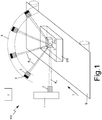
- the device 100 according to the invention is arranged for luggage inspection.
- the object under inspection is a suitcase 200, wherein a container 210 filled with a liquid explosive is present.
- the suitcase 200 is transported on a conveyor belt 9.
- Device 100 comprises an X-ray source 1 for radiating X-rays having an energy that is sufficiently high to penetrate barriers. Applicant believes that 50 to 100 keV or more will be sufficient.
- the preferred embodiment comprises a polychromatic X-ray source, more specifically a tungsten X-ray tube with primary high tension of 100 kV or 160 kV or even higher.
- monochromatic X-ray radiation may be used, other X-ray tube anode materials may be chosen as well as other values for high tension of the tube.
- the method and device according to the invention are not restricted to the use of X-ray tubes.
- a synchrotron is considered to be a suitable source for X- radiation as well.
- the beam emerging from the X-ray source 1 is collimated by a first collimator 2 on the primary side of the optical path in order to define a substantially parallel beam R in .
- the first collimator 2 is arranged to collimate the X-rays into a generally pencil shaped X-ray beam.
- the outgoing radiation R out has a number of components and consists of transmitted radiation and X-ray diffracted signals and X-ray scattered signals emerging in an angular range.
- the detectors 6 are arranged to detect the scattering of X-ray energy from the object 200.
- the detectors are arranged to detect the Rayleigh back scattering of X-ray energy from the object 200.
- each detector is arranged to count X-ray events and to determine the corresponding energy to every count.
- Suitable detectors include a high-purity Ge detector or a CdTe / CdZnTe detector.
- a multi segment Ge detector or multiple single Cd (Zn)Te detector may be used in order to gain measurement time. In the most advanced situation one or multiple pixellated detectors with many pixels, all pixels revealing an energy spectrum, will improve on measuring time such that a high throughput of objects is guaranteed.
- the detectors 6 are preferably arranged to measure X-ray energy within an angle range of 30-140 degrees.
- One or more movable detectors can be used or an array of detectors or any combination thereof to deliver an angular dependent data set.
- an array of detectors 6 is arranged within a detector housing 8.
- the detectors 6 may be arranged movably within the detector housing 8 and/or the detector housing 8 itself may be movable.
- One or more additional detector housings 8 may be placed in transport direction T of the object 200.
- the device 100 is arranged to inspect a region of interest or volume of interaction 3 within the object 200.
- a fan beam geometry is introduced, wherein the first collimators are slit collimators.
- An area of detectors is formed with many rows of detectors, wherein every single detector accepts pencil beam like shaped rays.
- a complete region of interest of a suitcase can be investigated in parallel. This again saves significant time and is suitable for hand baggage as well as for check-in baggage screening.
- a processor 7 is arranged to receive the measured data from the detectors 6.
- the processor 7 is in communication with a memory in which a database is stored filled with information about the angle dependent behaviour of specific substances and/or classes of substances.
- the processor 7 is arranged to identify unknown substances that are present within the region 3 based on comparison between the measured data and the data stored in the database using the method according to the invention.
- Step 1 Directing a collimated X-rav beam onto the object
- energy-dispersive X-ray spectroscopy In a first step energy-dispersive X-ray spectroscopy (EDS or EDX) techniques are used to analyse the object.
- EDS or EDX energy-dispersive X-ray spectroscopy
- Various EDS or EDX devices known in the art will be suitable.
- a collimated X-ray beam is directed onto the object by an X-ray source for radiating X-rays having an energy that is sufficiently high to penetrate luggage barriers.
- Step 2 Detecting and measuring the scattering of X-rav energy from the object
- X-ray scattering spectra are detected.
- X-ray backscattered radiation is detected.
- X-ray scattering signals are known to be elastic and inelastic, referred to as Rayleigh and Compton scattering, respectively.
- Rayleigh and Compton scattering respectively.
- at least Rayleigh spectra are detected. The strength of the signals is dependent on the primary X-ray spectrum impinging on the object to be investigated. Furthermore the intensities of these signals are angle dependent.
- Step 3 Detecting and measuring a function of Rayleigh intensity at a number of angles in a predetermined angular range to determine the angular course of the function of Rayleigh intensity in the angular range
- an energy resolved spectrum is detected by the X-ray detector(s) and preferably recorded.
- the energy spectrum at each angle can contain Rayleigh (elastic) and Compton (inelastic) X-radiation of the characteristic (in this example: tungsten) radiation of the tube and also diffraction peaks stemming from crystalline material.
- step 3 in the scattered X-ray signals a function of the Rayleigh X-ray intensities of the W-radiation scattered by the unknown substance is determined.
- R/C Rayleigh-to-Compton ratio
- I Intensity
- step 3 advantageously no calibrations are necessary as compared to both known methods described in the introductory part.
- mathematical operations of the above mentioned functions e.g. a gradient or logarithm, may be determined and used as the function in step 3.
- Applicant determines the course of those signals as a function of angle or as a function of a deduced measure of the angle. For instance, for normalization purposes one often takes the sin ⁇ / ⁇ ( ⁇ being the X-ray wavelength) as a measure instead of the angle ⁇ itself. The choice is made in order to optimize the determination and discrimination of substances and may be different for different substance classes and X-ray sources.
- Step 4 Determining an angle or angle interval within the angular range at which the function of Rayleigh intensity is essentially zero
- the invention is based on the insight that for a number of substances the Rayleigh intensity approximately vanishes at some point in the angular range. Different approaches can be chosen to determine the angular point or angular points of zero intensity. In a preferred embodiment a gradient of the Rayleigh and/or Rayleigh-to-Compton signals and/or the Rayleigh-to total-Intensity ratio is calculated from which said zero intensity can be determined.
- the invention is based on the further insight that for specific material classes the angular points for which the signal or signal combination vanishes in approximation are lying essentially in a narrow angular interval. It appears that said specific material classes comprise dangerous materials like explosives, be it liquid or solid, and drugs. This further insight is used to determine the presence of unknown substances falling in said specific material classes in the object under inspection.
- intensity value is considered closely approaching zero when it falls below a predetermined threshold value.
- One suitable threshold value may be 3 ⁇ for the top value of a Gaussian curve, when said Gaussian curve is fitted through the intensity values.
- Applicant refers to the angular points of zero intensity as 'k-points' (from key) and applicant refers to the method developed as k-point analysis'.
- the reason for the existence of said k-points can, among others, be understood by regarding the complete scattering function and its radiation components of a substance.
- explosives often exhibit a pronounced content of nitrogen and constitute a class of substances exhibiting a special angular dependency of the scattering signals.
- Liquids and liquid explosives constitute other classes and exhibit other ranges of angular courses with corresponding other k-point intervals.
- Step 5 Identifying unknown substances in the object by comparing the angle or angle interval determined earlier to known angles or angle intervals at which the function of Rayleigh intensity corresponding to specific substances or classes of substances is essentially zero.
- Applicant finds it is possible to identify, pinpoint or determine the presence of (classes of) substances and in particular to find dangerous materials and contraband based on the above 'k-point analysis'. These classes and corresponding k-point data have been pre-determined by numerous experiments and tests resulting in a huge database.
- Table 1 shows materials and corresponding angular value(s) for which the intensity of the elastic component of the scattered X-ray radiation is essentially zero. In general the intensity can be represented by values of Rayleigh (R), Rayleigh/Compton (R/C ratio), a gradient or any other functional representation of scattered X-ray radiation.
- Material k-points (in degrees) Solid explosives 60 - 70 Plastics 35 - 50 Metals 80 - 140 Liquids 40 - 80 Liquid explosives 60 - 70 Acids 70 - 85 H2O 60 Orange juice 55 Coca Cola 55
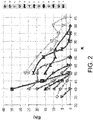
- Figure 2 shows the angular course of a function of Rayleigh intensity E(k) for several liquids.
- the liquids are identified by number in the list below. From figure 2 it can be seen that liquids can be identified by their k-points.
- the material classes can be quickly pinpointed and then determined by comparison with the databank. For instance 'the nitrogen group', in which a number of solid and liquid explosives are contained, can be easily detected. With the k-point analysis a very important first decision can be made, and further, by an extended angular course additional information can be retrieved. For a number of crystalline materials additionally comparisons of diffraction peaks can be conducted. This can be used as a cross-check.
- the method according to the invention does not give the chemical, stoichiometric formula of the substance.
- calibrations can be introduced for quantification purposes (in the sense of how much of a substance is present). This is often the case when there is pre-knowledge of the substances appearing in an object. This may be the case when the present substances are limited to a number of known classes or when classes can be excluded beforehand.
- the method and device according to the present invention have been elucidated by referring to the described and shown preferred embodiment relating to luggage inspection, many other applications are possible.
- the method and the device according to the invention allow for clear identification of inhomogeneities, voids or differences in material composition of an object. All identification can be performed equally well when the object is placed behind barriers or in containers. Some specific examples include: corrosion inspection within tubes or pipelines, discrimination between different food components, such as bones and meat, identification of fake compositions when the object comprises precious metals, et cetera.
- the specific values for tension and/or energy of the X-rays need to be suited to the barrier strength.
Landscapes
- Chemical & Material Sciences (AREA)
- Analytical Chemistry (AREA)
- Crystallography & Structural Chemistry (AREA)
- Physics & Mathematics (AREA)
- Health & Medical Sciences (AREA)
- Life Sciences & Earth Sciences (AREA)
- Biochemistry (AREA)
- General Health & Medical Sciences (AREA)
- General Physics & Mathematics (AREA)
- Immunology (AREA)
- Pathology (AREA)
- Dispersion Chemistry (AREA)
- Analysing Materials By The Use Of Radiation (AREA)
Claims (12)
- Verfahren zum Identifizieren unbekannter Substanzen in einem Objekt, umfassend die Schritte von:a) Richten eines kollimierten Röntgenstrahls auf das Objekt;b) Erfassen und Messen der vom Objekt gestreuten Röntgenenergie;c) Vergleich der Messungen von Schritt b) mit bekannten Messungen, die bestimmten Substanzen oder Substanzklassen entsprechen, um die unbekannten Substanzen im Objekt zu identifizieren;d) Erfassen und Messen einer Funktion der Rayleigh-Intensität bei einer Anzahl von Winkeln in einem vorbestimmten Winkelbereich, um den Winkelverlauf der Funktion der Rayleigh-Intensität im Winkelbereich zu bestimmen;dadurch gekennzeichnet, dass das Verfahren ferner die folgenden Schritte umfasst:e) Bestimmen eines Winkels oder Winkelintervalls innerhalb des Winkelbereichs, bei dem die Funktion der Rayleigh-Intensität im Wesentlichen Null ist; undf) Identifizieren der unbekannten Substanzen im Objekt durch Vergleichen des in Schritt e) bestimmten Winkels oder Winkelintervalls mit bekannten Winkeln oder Winkelintervallen, bei denen die Funktion der Rayleigh-Intensität, die bestimmten Substanzen oder Substanzklassen entspricht, im Wesentlichen Null ist.
- Verfahren zum Identifizieren unbekannter Substanzen in einem Objekt, umfassend die Schritte von:a) Richten eines kollimierten Röntgenstrahls auf das Objekt;b) Erfassen und Messen der vom Objekt gestreuten Röntgenenergie;c) Vergleich der Messungen von Schritt b) mit bekannten Messungen, die bestimmten Substanzen oder Substanzklassen entsprechen, um die unbekannten Substanzen im Objekt zu identifizieren;d) Erfassen und Messen einer Funktion der Rayleigh-Intensität bei einer Anzahl von Winkeln in einem vorbestimmten Winkelbereich, um den Winkelverlauf der Funktion der Rayleigh-Intensität im Winkelbereich zu bestimmen;dadurch gekennzeichnet, dass das Verfahren ferner die folgenden Schritte umfasst:e) Bestimmen eines Winkels oder Winkelintervalls innerhalb des Winkelbereichs, bei dem die Funktion der Rayleigh-Intensität im Wesentlichen Null ist;
und wenn in Schritt e) ein Winkelintervall oder ein Winkel, bei dem sich die Funktion der Rayleigh-Intensität einem konstanten Wert nähert, der nicht Null ist, innerhalb des Winkelbereichs bestimmt werden kann, das Verfahren die folgenden weiteren Schritte umfasst:g) Erfassen und Messen einer Funktion der Compton-Intensität bei einer Anzahl von Winkeln im vorgegebenen Winkelbereich, um den Winkelverlauf der Funktion der Compton-Intensität im Winkelbereich zu bestimmen;h) Bestimmen des Rayleigh-zu-Compton-Verhältnisses bei einer Anzahl von Winkeln in dem vorbestimmten Winkelbereich; undi) Identifizieren der unbekannten Substanzen im Objekt als verdächtig, wenn das Rayleigh-zu-Compton-Verhältnis < 1 ist. - Verfahren nach Anspruch 1, wobei Schritt e) den Schritt des Berechnens eines Gradienten der Funktion der Rayleigh-Intensität umfasst.
- Verfahren nach Anspruch 1, 2 oder 3, wobei Schritt b) das Erfassen einer Funktion der Rayleigh- oder Compton-Rückstreuung von Energie aus dem Objekt umfasst.
- Verfahren nach Anspruch 1, 2 oder 3, wobei in Schritt d) der Winkelbereich Winkel zwischen 30 und 140 Grad umfasst.
- Verfahren nach einem oder mehreren der vorstehenden Ansprüche, wobei in Schritt a) der Röntgenstrahl Röntgenstrahlen mit einer Energie umfasst, die ausreichend hoch ist, um Gepäckschranken zu durchdringen, vorzugsweise mit hohen Spannungen von 100 kV und höher.
- Vorrichtung zur Identifizierung unbekannter Substanzen in einem Objekt, umfassend:a) Mittel zum Richten eines kollimierten Röntgenstrahls auf das Objekt;b) Mittel zum Erfassen und Messen der vom Objekt gestreuten Röntgenenergie;c) Mittel zum Vergleich der Messungen der Mittel b) mit bekannten Messungen, die bestimmten Stoffen oder Stoffklassen entsprechen, um die unbekannten Stoffe im Objekt zu identifizieren.d) Mittel zum Erfassen und Messen einer Funktion der Rayleigh-Intensität bei einer Anzahl von Winkeln in einem vorbestimmten Winkelbereich, um den Winkelverlauf der Funktion der Rayleigh-Intensität im Winkelbereich zu bestimmen; dadurch gekennzeichnet, dass die Vorrichtung ferner umfasst:e) Mittel zum Bestimmen eines Winkels oder Winkelintervalls innerhalb des Winkelbereichs, bei dem die Funktion der Rayleigh-Intensität im Wesentlichen Null ist; undf) Mittel zur Identifizierung der unbekannten Substanzen im Objekt durch Vergleich des mittels e) bestimmten Winkels oder Winkelintervalls mit bekannten Winkeln oder Winkelintervallen, bei denen die Funktion der Rayleigh-Intensität, die bestimmten Substanzen oder Substanzklassen entspricht, im Wesentlichen Null ist.
- Vorrichtung zur Identifizierung unbekannter Substanzen in einem Objekt, umfassend:a) Mittel zum Richten eines kollimierten Röntgenstrahls auf das Objekt;b) Mittel zum Erfassen und Messen der vom Objekt gestreuten Röntgenenergie;c) Mittel zum Vergleichen der Messungen der Mittel b) mit bekannten Messungen, die bestimmten Stoffen oder Stoffklassen entsprechen, um die unbekannten Stoffe im Objekt zu identifizieren:d) Mittel zum Erfassen und Messen einer Funktion der Rayleigh-Intensität bei einer Anzahl von Winkeln in einem vorbestimmten Winkelbereich, um den Winkelverlauf der Funktion der Rayleigh-Intensität im Winkelbereich zu bestimmen; dadurch gekennzeichnet, dass die Vorrichtung ferner umfasst:e) Mittel zum Bestimmen eines Winkels oder Winkelintervalls innerhalb des Winkelbereichs, bei dem die Funktion der Rayleigh-Intensität im Wesentlichen Null ist, worin die Mittel in Schritt e) ein solches Winkelintervall oder einen solchen Winkel innerhalb des Winkelbereichs bestimmen können, bei dem die Funktion der Rayleigh-Intensität im Wesentlichen eine Konstante ist, die nicht Null ist, ferner umfassend:g) Mittel zum Erfassen und Messen einer Funktion der Compton-Intensität bei einer Anzahl von Winkeln im vorbestimmten Winkelbereich, um den Winkelverlauf der Funktion der Compton-Intensität im Winkelbereich zu bestimmen;h) Mittel zum Bestimmen des Rayleigh-zu-Compton-Verhältnisses bei einer Anzahl von Winkeln in dem vorbestimmten Winkelbereich; undi) Mittel zur Charakterisierung der unbekannten Substanzen im Objekt als verdächtig, wenn das Rayleigh-zu-Compton-Verhältnis < 1 ist.
- Vorrichtung nach Anspruch 7, wobei die Mittel e) angeordnet sind, um einen Gradienten der Funktion der Rayleigh-Intensität zu berechnen.
- Vorrichtung nach Anspruch 7, 8 oder 9, wobei die Mittel b) zum Erfassen einer Funktion der Rayleigh- oder Compton-Rückstreuung von Energie aus dem Objekt angeordnet sind.
- Vorrichtung nach einem oder mehreren der vorstehenden Ansprüche 7-10, wobei die Mittel d) so angeordnet sind, dass der Winkelbereich Winkel zwischen 30 und 140 Grad umfasst.
- Vorrichtung nach einem oder mehreren der vorstehenden Ansprüche 7-11, wobei die Mittel a) eine Röntgenquelle zum Abstrahlen von Röntgenstrahlen mit einer Energie umfassen, die ausreichend hoch ist, um Gepäckschranken zu durchdringen, vorzugsweise mit Hochspannungen von 100 kV und höher.
Applications Claiming Priority (1)
| Application Number | Priority Date | Filing Date | Title |
|---|---|---|---|
| NL2009049A NL2009049C2 (en) | 2012-06-21 | 2012-06-21 | Method and device for identifying unknown substances in an object. |
Publications (2)
| Publication Number | Publication Date |
|---|---|
| EP2677304A1 EP2677304A1 (de) | 2013-12-25 |
| EP2677304B1 true EP2677304B1 (de) | 2019-10-30 |
Family
ID=48669795
Family Applications (1)
| Application Number | Title | Priority Date | Filing Date |
|---|---|---|---|
| EP13172976.6A Active EP2677304B1 (de) | 2012-06-21 | 2013-06-20 | Verfahren und Vorrichtung zur Identifizierung von unbekannten Substanzen in einem Objekt |
Country Status (3)
| Country | Link |
|---|---|
| US (1) | US9001970B2 (de) |
| EP (1) | EP2677304B1 (de) |
| NL (1) | NL2009049C2 (de) |
Families Citing this family (6)
| Publication number | Priority date | Publication date | Assignee | Title |
|---|---|---|---|---|
| CN104897703B (zh) * | 2014-03-04 | 2018-09-28 | 清华大学 | 检查设备、方法和系统 |
| CN104165896B (zh) * | 2014-08-18 | 2017-03-22 | 公安部第一研究所 | 一种液态物品安全检查的方法与装置 |
| US9939393B2 (en) * | 2015-09-28 | 2018-04-10 | United Technologies Corporation | Detection of crystallographic properties in aerospace components |
| DE102017220600A1 (de) * | 2017-11-17 | 2019-05-23 | Fraunhofer-Gesellschaft zur Förderung der angewandten Forschung e.V. | Anlage mit einem förderband und einem röntgensystem |
| JP7009230B2 (ja) * | 2018-01-23 | 2022-01-25 | 株式会社日立ビルシステム | 非破壊検査装置及び非破壊検査方法 |
| JP6600929B1 (ja) * | 2018-07-31 | 2019-11-06 | パルステック工業株式会社 | X線回折測定装置システム及びx線回折測定装置 |
Family Cites Families (6)
| Publication number | Priority date | Publication date | Assignee | Title |
|---|---|---|---|---|
| DE3608965A1 (de) | 1986-03-18 | 1987-10-01 | Philips Patentverwaltung | Verfahren zur bestimmung der raeumlichen struktur in einer schicht eines untersuchungsbereiches |
| US5428657A (en) | 1994-03-22 | 1995-06-27 | Georgia Tech Research Corporation | X-ray monitoring system |
| DE19523090C1 (de) * | 1995-06-26 | 1996-08-29 | Siemens Ag | Röntgenuntersuchungsgerät |
| US6054712A (en) * | 1998-01-23 | 2000-04-25 | Quanta Vision, Inc. | Inspection equipment using small-angle topography in determining an object's internal structure and composition |
| US7831019B2 (en) | 2007-12-28 | 2010-11-09 | Morpho Detection, Inc. | System and methods for characterizing a substance |
| US9086366B2 (en) * | 2012-02-15 | 2015-07-21 | L-3 Communications Security And Detection Systems, Inc. | Determining a material property based on scattered radiation |
-
2012
- 2012-06-21 NL NL2009049A patent/NL2009049C2/en not_active IP Right Cessation
-
2013
- 2013-06-20 US US13/922,818 patent/US9001970B2/en active Active
- 2013-06-20 EP EP13172976.6A patent/EP2677304B1/de active Active
Non-Patent Citations (1)
| Title |
|---|
| None * |
Also Published As
| Publication number | Publication date |
|---|---|
| US20130343525A1 (en) | 2013-12-26 |
| US9001970B2 (en) | 2015-04-07 |
| NL2009049C2 (en) | 2013-12-24 |
| EP2677304A1 (de) | 2013-12-25 |
Similar Documents
| Publication | Publication Date | Title |
|---|---|---|
| Runkle et al. | Photon and neutron interrogation techniques for chemical explosives detection in air cargo: A critical review | |
| US7924979B2 (en) | Scatter attenuation tomography | |
| EP2054741B1 (de) | Tomographie mit streuungsdämpfung | |
| US6320933B1 (en) | Multiple scatter system for threat identification | |
| US8233588B2 (en) | Method and apparatus for inspection of materials | |
| US8259900B1 (en) | Adaptive scanning of materials using nuclear resonance fluorescence imaging | |
| US7693261B2 (en) | Method and apparatus for inspection of materials | |
| US8842808B2 (en) | Scatter attenuation tomography using a monochromatic radiation source | |
| US5007072A (en) | X-ray diffraction inspection system | |
| US20060140340A1 (en) | X-ray inspection system for detecting explosives and other contraband | |
| US9001970B2 (en) | Method and device for identifying unknown substances in an object | |
| GB2297835A (en) | Three dimensional detection of contraband using x rays | |
| US20100223016A1 (en) | Method and apparatus for identification and detection of liquids | |
| US8395124B2 (en) | Article inspection system and method | |
| WO2010062543A2 (en) | Apparatus and method for identifying components in a container | |
| EP2743687B1 (de) | Verfahren und Vorrichtung zum Screening von Objekten auf das Vorhandensein von Fremdkörpern | |
| RU2171980C2 (ru) | Способ распознавания химического состава объектов по ослаблению ими рентгеновского излучения | |
| US7949097B2 (en) | Methods and apparatus for the identification of materials using photons scattered from the nuclear “PYGMY resonance” | |
| Faezeh et al. | Comparison of the time behavior in the separation of light and heavy materials in X-ray backscattered method as a diagnostic tool in inspection | |
| Tran et al. | Inspection system design to confirm manifests and detect contraband in shipping containers | |
| Gozani | Elemental imaging for contraband detection |
Legal Events
| Date | Code | Title | Description |
|---|---|---|---|
| PUAI | Public reference made under article 153(3) epc to a published international application that has entered the european phase |
Free format text: ORIGINAL CODE: 0009012 |
|
| AK | Designated contracting states |
Kind code of ref document: A1 Designated state(s): AL AT BE BG CH CY CZ DE DK EE ES FI FR GB GR HR HU IE IS IT LI LT LU LV MC MK MT NL NO PL PT RO RS SE SI SK SM TR |
|
| AX | Request for extension of the european patent |
Extension state: BA ME |
|
| 17P | Request for examination filed |
Effective date: 20140624 |
|
| RBV | Designated contracting states (corrected) |
Designated state(s): AL AT BE BG CH CY CZ DE DK EE ES FI FR GB GR HR HU IE IS IT LI LT LU LV MC MK MT NL NO PL PT RO RS SE SI SK SM TR |
|
| 19U | Interruption of proceedings before grant |
Effective date: 20160429 |
|
| 19W | Proceedings resumed before grant after interruption of proceedings |
Effective date: 20170601 |
|
| RAP1 | Party data changed (applicant data changed or rights of an application transferred) |
Owner name: DT-SOLUTIONS B.V. |
|
| GRAP | Despatch of communication of intention to grant a patent |
Free format text: ORIGINAL CODE: EPIDOSNIGR1 |
|
| RIC1 | Information provided on ipc code assigned before grant |
Ipc: G01V 5/00 20060101ALI20190417BHEP Ipc: G01N 23/20091 20180101ALI20190417BHEP Ipc: G01N 23/20 20180101AFI20190417BHEP Ipc: G01N 23/203 20060101ALI20190417BHEP |
|
| STAA | Information on the status of an ep patent application or granted ep patent |
Free format text: STATUS: GRANT OF PATENT IS INTENDED |
|
| INTG | Intention to grant announced |
Effective date: 20190523 |
|
| GRAS | Grant fee paid |
Free format text: ORIGINAL CODE: EPIDOSNIGR3 |
|
| GRAA | (expected) grant |
Free format text: ORIGINAL CODE: 0009210 |
|
| STAA | Information on the status of an ep patent application or granted ep patent |
Free format text: STATUS: THE PATENT HAS BEEN GRANTED |
|
| AK | Designated contracting states |
Kind code of ref document: B1 Designated state(s): AL AT BE BG CH CY CZ DE DK EE ES FI FR GB GR HR HU IE IS IT LI LT LU LV MC MK MT NL NO PL PT RO RS SE SI SK SM TR |
|
| REG | Reference to a national code |
Ref country code: GB Ref legal event code: FG4D |
|
| REG | Reference to a national code |
Ref country code: CH Ref legal event code: EP |
|
| REG | Reference to a national code |
Ref country code: AT Ref legal event code: REF Ref document number: 1196702 Country of ref document: AT Kind code of ref document: T Effective date: 20191115 |
|
| REG | Reference to a national code |
Ref country code: DE Ref legal event code: R096 Ref document number: 602013062193 Country of ref document: DE |
|
| REG | Reference to a national code |
Ref country code: IE Ref legal event code: FG4D |
|
| REG | Reference to a national code |
Ref country code: NL Ref legal event code: FP |
|
| REG | Reference to a national code |
Ref country code: LT Ref legal event code: MG4D |
|
| PG25 | Lapsed in a contracting state [announced via postgrant information from national office to epo] |
Ref country code: ES Free format text: LAPSE BECAUSE OF FAILURE TO SUBMIT A TRANSLATION OF THE DESCRIPTION OR TO PAY THE FEE WITHIN THE PRESCRIBED TIME-LIMIT Effective date: 20191030 Ref country code: LV Free format text: LAPSE BECAUSE OF FAILURE TO SUBMIT A TRANSLATION OF THE DESCRIPTION OR TO PAY THE FEE WITHIN THE PRESCRIBED TIME-LIMIT Effective date: 20191030 Ref country code: SE Free format text: LAPSE BECAUSE OF FAILURE TO SUBMIT A TRANSLATION OF THE DESCRIPTION OR TO PAY THE FEE WITHIN THE PRESCRIBED TIME-LIMIT Effective date: 20191030 Ref country code: PL Free format text: LAPSE BECAUSE OF FAILURE TO SUBMIT A TRANSLATION OF THE DESCRIPTION OR TO PAY THE FEE WITHIN THE PRESCRIBED TIME-LIMIT Effective date: 20191030 Ref country code: GR Free format text: LAPSE BECAUSE OF FAILURE TO SUBMIT A TRANSLATION OF THE DESCRIPTION OR TO PAY THE FEE WITHIN THE PRESCRIBED TIME-LIMIT Effective date: 20200131 Ref country code: NO Free format text: LAPSE BECAUSE OF FAILURE TO SUBMIT A TRANSLATION OF THE DESCRIPTION OR TO PAY THE FEE WITHIN THE PRESCRIBED TIME-LIMIT Effective date: 20200130 Ref country code: BG Free format text: LAPSE BECAUSE OF FAILURE TO SUBMIT A TRANSLATION OF THE DESCRIPTION OR TO PAY THE FEE WITHIN THE PRESCRIBED TIME-LIMIT Effective date: 20200130 Ref country code: LT Free format text: LAPSE BECAUSE OF FAILURE TO SUBMIT A TRANSLATION OF THE DESCRIPTION OR TO PAY THE FEE WITHIN THE PRESCRIBED TIME-LIMIT Effective date: 20191030 Ref country code: FI Free format text: LAPSE BECAUSE OF FAILURE TO SUBMIT A TRANSLATION OF THE DESCRIPTION OR TO PAY THE FEE WITHIN THE PRESCRIBED TIME-LIMIT Effective date: 20191030 Ref country code: PT Free format text: LAPSE BECAUSE OF FAILURE TO SUBMIT A TRANSLATION OF THE DESCRIPTION OR TO PAY THE FEE WITHIN THE PRESCRIBED TIME-LIMIT Effective date: 20200302 |
|
| PG25 | Lapsed in a contracting state [announced via postgrant information from national office to epo] |
Ref country code: HR Free format text: LAPSE BECAUSE OF FAILURE TO SUBMIT A TRANSLATION OF THE DESCRIPTION OR TO PAY THE FEE WITHIN THE PRESCRIBED TIME-LIMIT Effective date: 20191030 Ref country code: RS Free format text: LAPSE BECAUSE OF FAILURE TO SUBMIT A TRANSLATION OF THE DESCRIPTION OR TO PAY THE FEE WITHIN THE PRESCRIBED TIME-LIMIT Effective date: 20191030 Ref country code: IS Free format text: LAPSE BECAUSE OF FAILURE TO SUBMIT A TRANSLATION OF THE DESCRIPTION OR TO PAY THE FEE WITHIN THE PRESCRIBED TIME-LIMIT Effective date: 20200229 |
|
| PG25 | Lapsed in a contracting state [announced via postgrant information from national office to epo] |
Ref country code: AL Free format text: LAPSE BECAUSE OF FAILURE TO SUBMIT A TRANSLATION OF THE DESCRIPTION OR TO PAY THE FEE WITHIN THE PRESCRIBED TIME-LIMIT Effective date: 20191030 |
|
| PG25 | Lapsed in a contracting state [announced via postgrant information from national office to epo] |
Ref country code: CZ Free format text: LAPSE BECAUSE OF FAILURE TO SUBMIT A TRANSLATION OF THE DESCRIPTION OR TO PAY THE FEE WITHIN THE PRESCRIBED TIME-LIMIT Effective date: 20191030 Ref country code: RO Free format text: LAPSE BECAUSE OF FAILURE TO SUBMIT A TRANSLATION OF THE DESCRIPTION OR TO PAY THE FEE WITHIN THE PRESCRIBED TIME-LIMIT Effective date: 20191030 Ref country code: EE Free format text: LAPSE BECAUSE OF FAILURE TO SUBMIT A TRANSLATION OF THE DESCRIPTION OR TO PAY THE FEE WITHIN THE PRESCRIBED TIME-LIMIT Effective date: 20191030 Ref country code: DK Free format text: LAPSE BECAUSE OF FAILURE TO SUBMIT A TRANSLATION OF THE DESCRIPTION OR TO PAY THE FEE WITHIN THE PRESCRIBED TIME-LIMIT Effective date: 20191030 |
|
| REG | Reference to a national code |
Ref country code: DE Ref legal event code: R097 Ref document number: 602013062193 Country of ref document: DE |
|
| REG | Reference to a national code |
Ref country code: AT Ref legal event code: MK05 Ref document number: 1196702 Country of ref document: AT Kind code of ref document: T Effective date: 20191030 |
|
| PG25 | Lapsed in a contracting state [announced via postgrant information from national office to epo] |
Ref country code: SK Free format text: LAPSE BECAUSE OF FAILURE TO SUBMIT A TRANSLATION OF THE DESCRIPTION OR TO PAY THE FEE WITHIN THE PRESCRIBED TIME-LIMIT Effective date: 20191030 Ref country code: SM Free format text: LAPSE BECAUSE OF FAILURE TO SUBMIT A TRANSLATION OF THE DESCRIPTION OR TO PAY THE FEE WITHIN THE PRESCRIBED TIME-LIMIT Effective date: 20191030 |
|
| PLBE | No opposition filed within time limit |
Free format text: ORIGINAL CODE: 0009261 |
|
| STAA | Information on the status of an ep patent application or granted ep patent |
Free format text: STATUS: NO OPPOSITION FILED WITHIN TIME LIMIT |
|
| 26N | No opposition filed |
Effective date: 20200731 |
|
| PG25 | Lapsed in a contracting state [announced via postgrant information from national office to epo] |
Ref country code: SI Free format text: LAPSE BECAUSE OF FAILURE TO SUBMIT A TRANSLATION OF THE DESCRIPTION OR TO PAY THE FEE WITHIN THE PRESCRIBED TIME-LIMIT Effective date: 20191030 Ref country code: AT Free format text: LAPSE BECAUSE OF FAILURE TO SUBMIT A TRANSLATION OF THE DESCRIPTION OR TO PAY THE FEE WITHIN THE PRESCRIBED TIME-LIMIT Effective date: 20191030 |
|
| PG25 | Lapsed in a contracting state [announced via postgrant information from national office to epo] |
Ref country code: MC Free format text: LAPSE BECAUSE OF FAILURE TO SUBMIT A TRANSLATION OF THE DESCRIPTION OR TO PAY THE FEE WITHIN THE PRESCRIBED TIME-LIMIT Effective date: 20191030 |
|
| REG | Reference to a national code |
Ref country code: CH Ref legal event code: PL |
|
| PG25 | Lapsed in a contracting state [announced via postgrant information from national office to epo] |
Ref country code: LU Free format text: LAPSE BECAUSE OF NON-PAYMENT OF DUE FEES Effective date: 20200620 |
|
| REG | Reference to a national code |
Ref country code: BE Ref legal event code: MM Effective date: 20200630 |
|
| PG25 | Lapsed in a contracting state [announced via postgrant information from national office to epo] |
Ref country code: IE Free format text: LAPSE BECAUSE OF NON-PAYMENT OF DUE FEES Effective date: 20200620 Ref country code: LI Free format text: LAPSE BECAUSE OF NON-PAYMENT OF DUE FEES Effective date: 20200630 Ref country code: CH Free format text: LAPSE BECAUSE OF NON-PAYMENT OF DUE FEES Effective date: 20200630 |
|
| PG25 | Lapsed in a contracting state [announced via postgrant information from national office to epo] |
Ref country code: BE Free format text: LAPSE BECAUSE OF NON-PAYMENT OF DUE FEES Effective date: 20200630 |
|
| PG25 | Lapsed in a contracting state [announced via postgrant information from national office to epo] |
Ref country code: TR Free format text: LAPSE BECAUSE OF FAILURE TO SUBMIT A TRANSLATION OF THE DESCRIPTION OR TO PAY THE FEE WITHIN THE PRESCRIBED TIME-LIMIT Effective date: 20191030 Ref country code: MT Free format text: LAPSE BECAUSE OF FAILURE TO SUBMIT A TRANSLATION OF THE DESCRIPTION OR TO PAY THE FEE WITHIN THE PRESCRIBED TIME-LIMIT Effective date: 20191030 Ref country code: CY Free format text: LAPSE BECAUSE OF FAILURE TO SUBMIT A TRANSLATION OF THE DESCRIPTION OR TO PAY THE FEE WITHIN THE PRESCRIBED TIME-LIMIT Effective date: 20191030 |
|
| PG25 | Lapsed in a contracting state [announced via postgrant information from national office to epo] |
Ref country code: MK Free format text: LAPSE BECAUSE OF FAILURE TO SUBMIT A TRANSLATION OF THE DESCRIPTION OR TO PAY THE FEE WITHIN THE PRESCRIBED TIME-LIMIT Effective date: 20191030 |
|
| PGFP | Annual fee paid to national office [announced via postgrant information from national office to epo] |
Ref country code: NL Payment date: 20250519 Year of fee payment: 13 |
|
| PGFP | Annual fee paid to national office [announced via postgrant information from national office to epo] |
Ref country code: DE Payment date: 20250519 Year of fee payment: 13 |
|
| PGFP | Annual fee paid to national office [announced via postgrant information from national office to epo] |
Ref country code: GB Payment date: 20250519 Year of fee payment: 13 |
|
| PGFP | Annual fee paid to national office [announced via postgrant information from national office to epo] |
Ref country code: FR Payment date: 20250519 Year of fee payment: 13 |
|
| PGFP | Annual fee paid to national office [announced via postgrant information from national office to epo] |
Ref country code: IT Payment date: 20250624 Year of fee payment: 13 |