EP2677708A1 - Kommunikationsverfahren einer audiovisuellen Nachricht, und entsprechendes Kommunikationssystem - Google Patents
Kommunikationsverfahren einer audiovisuellen Nachricht, und entsprechendes Kommunikationssystem Download PDFInfo
- Publication number
- EP2677708A1 EP2677708A1 EP13173166.3A EP13173166A EP2677708A1 EP 2677708 A1 EP2677708 A1 EP 2677708A1 EP 13173166 A EP13173166 A EP 13173166A EP 2677708 A1 EP2677708 A1 EP 2677708A1
- Authority
- EP
- European Patent Office
- Prior art keywords
- message
- information
- audio
- enrichment
- processing
- Prior art date
- Legal status (The legal status is an assumption and is not a legal conclusion. Google has not performed a legal analysis and makes no representation as to the accuracy of the status listed.)
- Granted
Links
Images


Classifications
-
- H—ELECTRICITY
- H04—ELECTRIC COMMUNICATION TECHNIQUE
- H04M—TELEPHONIC COMMUNICATION
- H04M3/00—Automatic or semi-automatic exchanges
- H04M3/42—Systems providing special services or facilities to subscribers
- H04M3/50—Centralised arrangements for answering calls; Centralised arrangements for recording messages for absent or busy subscribers ; Centralised arrangements for recording messages
- H04M3/53—Centralised arrangements for recording incoming messages, i.e. mailbox systems
- H04M3/533—Voice mail systems
-
- H—ELECTRICITY
- H04—ELECTRIC COMMUNICATION TECHNIQUE
- H04L—TRANSMISSION OF DIGITAL INFORMATION, e.g. TELEGRAPHIC COMMUNICATION
- H04L51/00—User-to-user messaging in packet-switching networks, transmitted according to store-and-forward or real-time protocols, e.g. e-mail
- H04L51/06—Message adaptation to terminal or network requirements
- H04L51/066—Format adaptation, e.g. format conversion or compression
-
- H—ELECTRICITY
- H04—ELECTRIC COMMUNICATION TECHNIQUE
- H04L—TRANSMISSION OF DIGITAL INFORMATION, e.g. TELEGRAPHIC COMMUNICATION
- H04L51/00—User-to-user messaging in packet-switching networks, transmitted according to store-and-forward or real-time protocols, e.g. e-mail
- H04L51/07—User-to-user messaging in packet-switching networks, transmitted according to store-and-forward or real-time protocols, e.g. e-mail characterised by the inclusion of specific contents
- H04L51/10—Multimedia information
-
- H—ELECTRICITY
- H04—ELECTRIC COMMUNICATION TECHNIQUE
- H04L—TRANSMISSION OF DIGITAL INFORMATION, e.g. TELEGRAPHIC COMMUNICATION
- H04L51/00—User-to-user messaging in packet-switching networks, transmitted according to store-and-forward or real-time protocols, e.g. e-mail
- H04L51/07—User-to-user messaging in packet-switching networks, transmitted according to store-and-forward or real-time protocols, e.g. e-mail characterised by the inclusion of specific contents
- H04L51/18—Commands or executable codes
Definitions
- the invention relates to a transmission method and a method for receiving an enriched audio or audiovisual message.
- the invention also relates to transmission and / or reception devices and terminals, as well as servers.
- this textual information dictated in the voice message, lengthens and disrupts the voice message.
- reading means display, simultaneously with the voice message, the textual information related to the voice message.
- the invention proposes to overcome the aforementioned drawbacks.
- the invention makes it possible to transmit audio or audiovisual messages, accompanied by enrichment information, while avoiding the need to modify in depth the infrastructures of the communication systems.
- a wide variety of enrichment information can be transmitted, without the need to complicate existing communication systems.
- processing information transmitted by the communication system is coded according to an audio or visual code associated with the content of said processing information.
- the incorporation of the information is therefore transparent to the user, who has no additional processing action to perform.
- further processing of the processing information by a receiving device is facilitated.
- the insertion of the insertion multimedia message into an audio or visual content of the initial audio or audiovisual message comprises the insertion of at least one audio or visual separation tag between the insertion multimedia message and the audio or visual content of the original audio or audiovisual message. Subsequent processing of the message enriched by the receiving device is thus improved and facilitated, thereby reducing processing times and resources.
- the enriched message transmitted by the transmission device comprises a predefined ordered succession of processing information and enrichment information. Subsequent processing of the enriched message by the receiving device is also improved and facilitated.
- the invention makes it possible to introduce new functionalities in message exchanges and in particular in the use of these messages in the communication system, without having to change the infrastructures of the communication system.
- the invention makes it possible to process enrichment information of an audiovisual message, in a manner that is transparent to the user, that is to say that the latter has no additional processing action to perform, and that the treatment put in place is not apparent to the user.
- This type of information facilitates processing at the receiving device, and reduces the processing time and the volume of data to be transferred.
- the enrichment information comprises a link to an address accessible via a communication network.
- the extraction of the insertion multimedia message from an audio or visual content of the audio or audio-visual enriched message comprises the extraction of at least one audio or visual separation tag between the multimedia insertion message and the audio or visual content of the original audio or audiovisual message.
- the enriched message received by the receiving device comprises a predefined ordered succession of processing information and enrichment information.
- the processing of the message enriched by the receiving device is thus improved and facilitated, which reduces the time and processing resources.
- the invention also relates to a server comprising such a device.
- the invention also relates to a transmission and / or reception device as described above.
- the invention also relates to a computer program comprising instructions for executing the transmission method and / or the reception method, when the program is executed by a processor.
- the invention also relates to a processor-readable recording medium on which is recorded a program comprising instructions for executing the transmission method and / or the reception method.
- the invention applies to different types of communication systems, and in particular to mobile communication systems, in particular to voice mail servers.
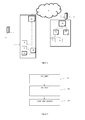
- FIGS. 1 to 3 schematically represent different communication devices for the implementation of the different communication methods described below.
- the Figure 1 is a schematic representation of a device 2 for transmitting an enriched audio or audiovisual message.
- the device 2 comprises conversion means 5. These conversion means 5 are configured to convert enrichment information, for enriching the content of an initial audio or audio-visual message including at least one audio content, and processing information associated with the enrichment information. in at least one insertion multimedia message 11, as explained later.
- the device 2 also comprises insertion means 6, configured to insert the insertion multimedia message 11 at least in the audio or visual content of the initial message 10, so as to create an enriched message 12.
- the device 2 further comprises communication means 7, configured to transmit the enriched message 12, to at least one receiving terminal 4.
- These communication means 7 are conventional, and depend on the type of communication used (network, Bluetooth, Internet, etc.).
- the transmission device 2 comprises means 18 for interaction with a user (for example of the keyboard, interface, screen, etc.) type.
- the various means of the device may in particular comprise one or more processors 20, associated with at least one memory 21 storing a computer program, for the execution of the tasks implemented by these means.
- This processor and this memory may be common to these different means, or not.
- the Figure 2 is a schematic representation of a device 3 for receiving an enriched audio or audiovisual message 12.
- This device comprises extraction means. These means are configured to extract from the enriched message 12 received at least one insertion multimedia message 11 containing enrichment information 8 and processing information 9, and an initial audio or audiovisual message 10.
- the device 3 also comprises reading means 24. These means are configured to read the initial audio or audiovisual message.
- the device 3 comprises processing means 16, configured to process the enrichment information 8, so as to enrich the reading or the presentation of the initial audio or audiovisual message with said enrichment information 8, the processing of the information 8 enrichment being determined according to the processing information contained in the insertion multimedia message 11.
- the reading means 24 comprise elements for rendering the message to be read, for example of the screen or loudspeaker type.
- the device 3 comprises communication means 19, similar to the aforementioned means 7.
- the device 3 also includes, if necessary, means of interaction with a user (keyboard, interface ...), similar to the aforementioned means 18.
- the various means of the device may notably comprise one or more processors 22, associated with at least one memory 23 storing a computer program, for the execution of the tasks implemented by these means.
- the transmission device 2 is integrated in a terminal.
- the receiving device 3 is integrated in a terminal.
- the same terminal may comprise both a transmission device 2 and a reception device 3.
- It may for example be mobile telephone terminals, or computers, or TVs or TV servers, or radios or radio servers, or audio or audiovisual messaging servers, or any other suitable communication device.
- the various means described can be located directly on the terminal, if it has the necessary processing capabilities, or even memory, or be accessible, for example using queries in client-server mode, from a server located somewhere in the communication network.
- the transmission device is part of a server, for example of computer type.
- the transmission and reception device 2 communicate via a communication system 1.
- the communication system 1 depends on the applications: Internet network, mobile phone system, Bluetooth communication system, etc.
- the invention also relates to a computer program comprising instructions for executing the transmission method and / or the reception method as described later, when the program is executed by a processor.
- This program can notably be stored in a memory of the transmission and / or reception device.
- the invention also relates to a processor-readable recording medium on which is recorded a program comprising instructions for executing the transmission method and / or the reception method as described below.
- FIG. 3 and 4 We have shown in Figures 3 and 4 an embodiment of a method for transmitting an audio or audiovisual message between a transmission device 2 and a reception device 3, by a communication system 1. These devices are integrated in transmitting and receiving terminals.
- Audio or audiovisual message means a message comprising at least one audio content, such as for example a voice message.
- This message can, if necessary, but not necessarily, also include visual information, static (images / photos ...) or dynamic (videos ...), which corresponds to the term "audiovisual message”.
- a first step E1 consists of converting enrichment information 8, intended to enrich the content of an initial audio or audiovisual message, or to modify or enrich its future presentation on the recipient's terminal, and processing information 9. associated with the enrichment information 8, in at least one insertion multimedia message 11.
- the multimedia message 11 comprises an insertion audio content, accompanied if necessary by a visual content (photo, video, etc.) of insertion. In one embodiment, only processing information is converted.
- Converting means that all or part of the information must be transferred to a predefined format. Some enrichment information does not, however, necessarily need to be converted, especially if it is directly provided in the format for subsequent insertion (step E2).
- the enrichment information 8 is for example textual information, intended to enrich the initial message 10 during its reading by the receiving device 3.
- the processing information 9 makes it possible to characterize the processing (synchronization, nature of the display, Internet address openings, etc.) of the enrichment information 8 to be performed during the reading of the initial message by the device 3 of FIG. reception.
- the first step E1 is performed by the conversion means 5, described above.
- These conversion means 5 are integrated in the transmission device 2 and / or in an external processing unit.
- a second step E2 consists in inserting each insertion multimedia message 11 at least in the audio content of the initial message 10, so as to create an enriched audio or audio-visual message 12, called an enriched message for the rest of the description.
- This step is performed by the aforementioned insertion means 6, which can be integrated in the transmission device 2, and / or in an external processing unit.
- a third step E3 consists in transmitting, by the communication system 1, the enriched message 12, from the sending device 2 to at least one receiving device 3.
- This step is performed by the communication means 7 in collaboration with the communication system 1.
- the enriched message 12 passes via a voice mail server for example.
- a step E4 consists in extracting from the enriched message 12 received at least one insertion multimedia message 11 containing enrichment information 8 and processing information 9, and an initial audio or audiovisual message 10.
- This extraction enables the receiving device 3 to recover, on the one hand, the initial audio or audiovisual message, and on the other hand, the enrichment and processing information 8, 9.
- the enrichment information 8 and the processing information 9 are extracted and deleted from the initial message.
- This step E4 is performed by the extraction means 15, which can be integrated in the receiving device 3, and / or in an external processing unit.
- a step E5 consists of reading the initial audio or audiovisual message at the reception device 3 and processing the enrichment information 8 so as to enrich or improve the reading or the presentation of the initial audio or audiovisual message with said enrichment information.
- the reading of the initial message 10 is carried out by the reading means 24.
- the processing means 16 allow a differentiated display of the different sequences composing the initial audio or audiovisual message, for example in the case of composite messages, issued for example from a succession of messages. and answers on messages.
- the processing of the enrichment information 8 is performed according to the processing information extracted from the enriched message 12 and associated with the enrichment information 8.
- This processing information makes it possible, for example, but without limitation, to define the nature of the reading or the display of the enrichment information, the duration of this display, their synchronization with the initial audio or audiovisual message, etc. .
- textual enrichment information 8 is displayed simultaneously with the initial audio or audiovisual message, such as, for example, textual subtitles of a voice message, the display being managed by the processing means 16 by means of treatment information.
- the enrichment can also be a photo or a video that can be displayed directly, from its URL (for Uniform Resource Locator in English) provided in the enrichment information, and a predefined display processing.
- URL for Uniform Resource Locator in English
- the method comprises the following steps.
- a conversion step E1 consists in converting the enrichment information 8 and the processing information 9 associated with the enrichment information 8 into an insertion multimedia message 11.
- a second step E2 involves inserting the insertion multimedia message 11 into the audio and video content of the initial audio-visual message so as to create an enriched message 12.
- the conversion means converts this enrichment information and the associated processing information into an insertion (audiovisual) multimedia message. includes both insert video content and inserting audio content.
- the insertion video content includes the video content of the enrichment information.
- Inserting audio content may include the audio content of the enrichment information and the audio content encoding the processing information.
- the insert video content is inserted into the video content of the initial audio-visual message, and the insert audio content is inserted into the audio content of the original audio-visual message.
- the enrichment information may also be one or more static images, accompanied by audio content.
- the enrichment information may also be one or more static images without audio content.
- a third step E3 consists in communicating, by the communication system 1, the enriched message 12, with a transmission device 2 to at least one receiving device 3.
- a fourth step E4 consists in extracting the enrichment information and the processing information of the enriched audiovisual message received by the reception device.
- a fifth step E5 consists in reading the initial audiovisual message, and, simultaneously, processing the enrichment information, so as to enrich the reading of the initial audiovisual message with the enrichment information, the processing of the messages.
- enrichment information being determined based on the processing information extracted from the enriched message, and associated with the enrichment information.
- a video including sound (enrichment information) is read simultaneously to an initial audio-visual message.
- the enrichment information 8 may in particular be provided manually by a user, via the interaction means 18, present for example on its transmission device or terminal.
- the enrichment information 8 is not manually supplied by a user, but automatically aggregated from a database accessible via the communication system 1, or generated from an application present on the device. or terminal.
- the device or terminal connects to the database via its communication means 7 or downloads via the communication system this enrichment information 8.
- an advertising announcer publishes an initial audio message that he wishes to broadcast to terminals (televisions, telephones, etc.), and information 8 for enriching this audio message (visual information on the products, price to be displayed, access plan, etc.).
- the initial audio messages are voice messages from users of a mobile communication system
- the enhancement information is the links between the different messages, and the associated history, which makes it possible to list a sequence of vocal exchanges.
- a wide range of enrichment information can be used.
- a user wishes to transfer, together with an initial audiovisual message, a photo, accessible via an Internet link (URL type).
- the enrichment information 8 then includes this Internet link.
- Other examples include a telephone number, an Internet address of any kind, a subtitling of an audio message, for example for a final recipient who is hard of hearing, a textual translation of an audio message, for example for a foreign final recipient.
- enrichment information 8 include the reference of another voice message, or additional information such as the geolocation of the user of the transmitting terminal when sending, or any other useful information.
- the variety of enrichment information 8 makes complex a simple definition of the processing to be performed at the level of the receiving device 3, by the terminal and / or by an external processing unit in communication with the terminal. Heavy investments would be necessary to define each treatment, depending on the nature and content of the enrichment information.
- a processing common to all enrichment information 8 is possible, for example of the raw display type, but has the disadvantage of not optimally adapting to each case.
- the enrichment information 8 is associated with processing information 9, said processing information 9 being able to be easily processed by the transmission and reception devices, via the different means of processing, of conversion, and aforementioned extraction.
- the processing information 9 can be provided in the communication server 1 in a manner similar to what has been described for the enrichment information 8, that is to say manually, via means of interaction in the terminal, or automatically, by being retrieved by the transmission device 2 from databases or dedicated applications.
- the processing information is related to the enrichment information since, as described later, it characterizes the required processing of the enrichment information at the receiving device.
- Variants are however possible linking different enrichment information.
- the order of this information is used to process a series of information (enrichment content and corresponding processing) successive or predefined.
- two enrichment information may have the same application timeline (for example two titles or subtitles to be superimposed, or a subtitle and a musical background at the same time, ).
- Different types of processing information can be used in the communication method.
- processing information items 9 are associated with the same enrichment information 8, which means that several processing operations will have to be performed on this enrichment information item 8 during the processing step 16 by the means 16. processing at the receiving device 3.
- the processing information includes information on the category of enrichment information transmitted in the enriched audio-visual message.
- categories include: address, phone number, bank number, code, etc.
- the same information 8 of enrichment can belong to several categories, such as, for example, an Internet address and a photo.
- the processing means 16 exploits the processing information pertaining to the category of enrichment information to determine the processing to be applied to the enrichment information.
- an "Internet address” type of enrichment information 8 associated with "photo display” processing information 9 indicates that the processing means 16 must download the picture from the Internet address and display it on the receiving terminal 3.
- An advantage of passing the category of enrichment information is to limit the need in terms of the amount of enrichment information.
- the category "Internet address” avoids systematically converting the sequence of characters "http: //", by the means 5 of conversion, to transmit it. Indeed, the processing means 16 identify the category "Internet address” and automatically add this extension to the address transmitted as enrichment information 8.
- the processing information 9 comprises information for setting the display of the processing information to be performed at the receiving terminal 3.
- This information is a parameter defining the display of the processing information to be performed at the reception terminal 3.
- the parameterization information includes two values: the type of parameter (here the font color) and its value (for example red).
- the processing information 9 comprises information on the time course of the display of the enrichment information 8 to be performed at the receiving terminal 3.
- temporal information indicating the portion of the initial audio-visual message during which the processing means 16 must display the enrichment information.
- a typical example is the textual captioning of an audio message, the time flow information for synchronizing the subtitle display with the audio message.
- Several temporal information can be transmitted, and these can, if necessary, overlap.
- processing information 9 may include information relating to the urgency of the message, or to its advertising nature, or settings related to the size of the screen of the receiving terminal, or the operating system of the receiving terminal. receiving terminal.
- the absence of processing information indicates that a default mode must be performed at the receiving device 3.
- the processing constitutes a constant display of the enrichment information 8, such as an integral and single subtitling.
- the enrichment information 8 can be limited to a simple Internet address allowing access to an enrichment information 8, possibly coupled corresponding processing information.
- two Internet addresses are transmitted, one for each enrichment information and one for the corresponding processing information.
- the processing information and / or the enrichment information are transmitted via an Internet address.
- a default processing mode is executed.
- conversion means 5 make it possible, from enrichment information 8 and processing information 9, to generate an insertion multimedia message 11 which translates this information.
- the conversion has been defined above.
- the conversion means 5 are those used in the state of the art, and depend on the conversion used.
- the coding of the enrichment information 8 may use a multifrequency-type coding, each letter of the alphabet being able for example to be defined by a combination of frequencies as for the DTMF code (" dual-tone multi- frequency"). frequency " ).
- the conversion means 5 are here coding tools capable of transforming text sequences into vocal frequencies.
- the conversion means 5 encode the enrichment information 8 by sound successions of different durations, in the image of the Morse code.
- the conversion means 5 perform an alphabetic coding, a speech synthesis being limited to spell the different successive letters of information in the desired language (language provided as parameter in the information of treatment).
- the expression “hello” is translated by the following phoneme: "b”, “o”, “n”, “j”, “o", “u”, and "r”.
- the conversion means read the enrichment information in the language provided as a parameter, which allows audio coding.
- the converting means converts this enrichment information and the associated processing information into an insertion multimedia message, which includes both a content insertion video and inserting audio content.
- the insertion video content includes the video content of the enrichment information.
- the insert audio content comprises the audio content of the enrichment information and the audio content encoding the processing information, according to the encoding described below.
- these are the subject of a specific audio coding by the conversion means 5, in order to be able to be recognized at the extraction and reading steps carried out at the same time. the receiving terminal.
- This specific audio coding may consist of a predefined coding, from one of the techniques mentioned above. This audio code specific to the content of said processing information makes it possible to decode the processing information during the extraction and the reading.
- It may also consist of a series of sound documents, such as musical notes, or alternatively musical notes from a predefined instrument (eg piano, or violin), or a specific chorus. It is therefore an audio coding that allows to uniquely define the treatment to be performed.
- the conversion means converts the processing information into a combination of audio codes and code positioning.
- the positioning of the codes corresponds for example to a standardization to simplify the processes (example, code 1 for the processing, code 2 for the processing parameter if there is one, code 3 for the time chronology, ..., code 8 for the enrichment content itself) and code 9 for the end of the insertion sequence (and possibly the beginning of a new sequence). If two codes are present successively, this indicates the absence of information (if for example the code 9 directly follows the code 8 is that there is no enrichment content, but only treatments) .
- the musical note "D" is used to indicate that the processing information expresses the fact that the enrichment information is a text.
- sequence of "7", “+”, and "4" vocalized characters indicates that the duration of the enrichment information 8 will extend from the 7th to the 11th seconds of the initial audiovisual message. .
- each processing information transmitted by the communication system 1 is encoded according to an audio code specific to the content of said processing information.
- the coding is identical at the level of the transmission and at the level of the reception of the enriched message 12, which facilitates processing and reading at the receiving device 3.
- the processing information 9 is subject to a specific visual coding by the conversion means 5.
- the processing information can be coded in the form of a 2D code interpretable by a dedicated application, for example a QR code (for Quick Response code in English).
- QR code is a matrix code intended to be read by a barcode reader, phone or webcam and can be quickly decoded by the terminal.
- the audio content of the enriched message 12 firstly includes the processed processing information 9 in audio form, and then the enrichment information 8 also converted into audio form.
- the conversion means 5 convert the enrichment information 8, intended to enrich the content of the initial audio-visual message, and the processing information 9 associated with the enrichment information, into one or more multimedia insertion messages, type audio and / or visual messages.
- Inserting means 6 then insert in the initial audiovisual message, in the audio or visual content of this message, the insertion message 11.
- These processing means 6 are processor-type means associated with a software tool for handling and cutting audio or visual files. Where appropriate, if the enrichment or processing information comprises visual information, the software tool is able to manipulate fixed or dynamic visual contents.
- the processing information when the processing information corresponds to visual codes, the processing information is inserted into the visual content of the audiovisual message.
- the processing means 6 insert the multimedia insertion message 11 in a predefined place in the audio or visual content of the initial audio-visual message, for example at the beginning of the message.
- the Figure 6 is an exemplary embodiment of the enrichment and processing information conversion 8, 9 into a multimedia insertion message, and its insertion into the audio content of an initial message.
- the enrichment information 8 is subtitles of an initial audio or audiovisual message.
- the processing information indicates the timing and display duration of these subtitles, relative to the original audio message.
- the converting means 5 converts the enrichment and processing information 8, 9 into an insertion audio message 11, which the processing means 6 adjoins at the beginning of the content of the initial audiovisual message, in order to create an audio message 12. enriched.
- the processing means 6 frame the audio content of the insertion multimedia message 11 by audio separation tags 19, in this case an initial tag 19 1 and a final tag 19 2 .
- audio tags are audio cues indicating the beginning and end of the audio insertion message.
- the insertion audio message 11 is composed, at its beginning, of an audio sequence relating to the processing information 9, followed by an audio sequence relating to the enrichment information 8. These audio sequences are also separated by an audio tag 19 3 , in order to eliminate any error of extraction or reading by the receiving device 3.
- the conversion means 5 convert the processing information 9 so that it is coded in the form of an ordered and predefined succession. This also makes it possible to eliminate any error of extraction or reading by the receiving device 3.
- the information on audio sequence 9 treatment comprises first Codes 9 1 that relate to the audio type of treatment, then the category 9 2 for processing information, and then to the setting 9 3 of the information display processing, then information 9 4 on the time course of the display of enrichment information to be performed at the level of the receiving device 3.
- Each of these processing information items 9 ends with a specific audio beacon (19 4 , 19 5 , 19 6 ) possibly identical, the last beacon being the end tag of the audio sub-sequence of processing information 9.
- the corresponding audio tags are inserted into the 11 insert audio message, but are not preceded by any audio information related to this topic.
- the same audio code (e.g., DTMF multifrequency code) is used to code the "display of a photo” processing and to code the "text" information type. No confusion is possible for encoding or reading since the first audio code follows the first insertion marker 19 1 , and the second follows another insertion marker 19 4 . This order can therefore be standardized between the transmitting and receiving devices, as well as the number of processing information provided systematically, even if this information is absent.
- the enriched message includes, for example, in the header, a plurality of insert audio messages.
- Insertion means 6 inserts the insertion multimedia message 11 into at least the audio content of the initial audio or audiovisual message.
- This insertion of an audio sequence within another audio sequence is performed using a simple audio editing software tool.
- the insertion message 11 is an audiovisual message
- the visual portion of this message is inserted into the visual content of the initial message, and the sound portion is inserted into the audio content of the initial message.
- visual beacons surround the visual portion of the insertion message to facilitate its subsequent retrieval.
- each insertion multimedia message 11 is inserted into the initial audio-visual message at a time instant which corresponds to the future temporal position of the effect sought for this enrichment information during read-out at the time. of the receiving terminal 3.
- One advantage is to avoid the need to store this particular processing information within the enriched message 12.
- Another advantage is to be able to propose automatically, and without any modification of the databases of the voice mail servers of the different operators, features like responses on messages received, or responses with corrections received messages.
- the enrichment information 8 is information of the type time stamp of the initial sendings of the messages, coordinates of the transmitters, or others.
- the processing information 9 makes it possible to recall the transmitters from the reception terminals and to define the differentiated display of the voice components on the reception terminal.
- each voice component for example, a message to which it is answered vocally, and the set of initial message and voice response of the recipient
- the insertion multimedia messages 11 are therefore default distributed over the entire enriched message 12.
- the insertion multimedia messages 11 are all positioned one after the other, on the one hand according to their generic character, on the other hand according to their chronology, before or after the audio content of the message 10 audiovisual media.
- the same process applies to visual information.
- This variant makes it possible to simply recover this information during the extraction step, truncating them directly, without having to process the whole of the enriched message 12.
- the wildcard is understood as an enrichment information which characterizes the whole of the initial audio or audiovisual message, as compared to those characterizing only part of this message.
- each insertion audio message 11 is delimited by audio tags, making it possible to distinguish it from the initial audio-visual message, at the beginning and / or at the end, as the case may be.
- the resulting audio file is then recorded according to the state of the art.
- the resulting audio file is the subject of a new file, separate from the original target audio file of the original audio-visual message.
- This dual registration has several interests. On the one hand, this allows a use of the method to implement features such as responses on voice messages received.
- the sending of the enhanced audio-visual message comprises a step of verifying the compatibility with the reception device 3 by the communication system 1. In case of incompatibility, only the initial audio-visual message is sent.
- each insert audio message transmitted by the communication system 1 comprises a predefined ordered sequence of processing information and enrichment information.
- the processing information is encoded first, then the enrichment information.
- a predefined order may also be respected depending on the content or type of processing information.
- the enriched message 12 is communicated by the communication system 1, a device 2 to transmit to at least one receiving device 3.
- the means of communication are traditional: antennas, relay antennas, communication via the Internet, Bluetooth network, optical fibers, etc.
- the enriched message 12 is transmitted according to the standard techniques of the state of the art.
- the user of the receiving device 3 retrieves the message, for example, on his voice mailbox. Alternatively, the message is communicated in the space reserved for greetings on the mailbox of the user.
- the enriched audiovisual message 12 is retrieved using a visual voice mail (VVM), from which the user views the list of messages intended for him.
- VVM visual voice mail
- a specific application for example downloaded by the user recipient of a reception terminal 3 from an application store (Apple store, Android Market, etc.) is necessary to retrieve and then process said enriched audiovisual message since the user's voicemail server.
- an application store Apple store, Android Market, etc.
- the extraction means After the reception of the audiovisual message enriched by the reception device 3, the extraction means extract the enrichment information and the processing information of the enriched audiovisual message received by the reception terminal.
- this step and the successive steps are triggered when the user selects the desired message from a list of received messages.
- said steps are triggered as soon as a new message is available in the list of messages received at the reception terminal.
- the extraction means 15 identify the audio content of the insertion multimedia message 11 using the sound tags.
- the extraction means is used to separate the audio content from the multimedia insertion message of the audio content of the original audio-visual message.
- the extracting means also extracts that content.
- the recognition of the audio tags delimiting an insertion audio message, or alternatively the series of insertion audio messages, requires an audio comparison component, for example a comparison component of the audio spectrums.
- the recognition of the visual tags delimiting a visual insertion message requires a visual comparison component.
- the means 15 extraction further retain the information relating to the time of the start of each insertion multimedia message 11.
- the extraction means 15 furthermore make it possible, for each of the insertion multimedia messages 11 retrieved at the end of the preceding step, to analyze said sequence in order to extract the enrichment information and the processing information therefrom. .
- the extraction means comprises a letter-of-a-letter speech recognition component in the predetermined language (or alternatively if the latter has been transmitted as a processing parameter, once the latter has been determined).
- the extraction means 15 recognize and interpret said codes, in order to bring out the corresponding texts.
- the extraction means 15 are notably configured to distinguish the start and end sound tags of the various sound sequences of the insertion audio message (tags separating the processing information from the enrichment information, and tags separating the processing information between they), and, where appropriate, to distinguish visual beacons.
- the extraction means 15 provide a set of information composed of enrichment information and various processing information relating to this enrichment information.
- Each of said groups of information is connected to an initial audiovisual message.
- the reception device 3 has the initial audio-visual message, as it was before insertion of the insertion audio messages.
- Reading means 24 are configured to read the initial audiovisual message
- processing means 16 are configured to process the enrichment information 8, the processing of the enrichment information being determined according to the processing information extracted from the audiovisual message. enriched, and associated with the enrichment information, and at the level of the receiving device 3.
- successive subtitling information (possibly multiple subtitling information in different languages) will be displayed successively according to the desired time course as the listening of said target audiovisual message proceeds.
- a voice message composed of different successive voice sequences will be displayed according to a tree structure distinguishing the different successive voice sequences, with next to said successive voice sequences the timestamp and coordinate information of their respective transmitters.
- a series of photos is presented as the message is listened to, synchronized with the progress of said message.
- the processing means 16 have a processor and a software tool for interpreting the processing information, in order to read the enrichment information as is expected by the transmitter of the initial audiovisual message.
- the processing means 16 recognize the nature and content of the processing information 9 by virtue of their predefined audio coding, as previously described. They therefore have a memory storing the predefined coding of each processing information, and the processing to be implemented for each information.
- the conversion means adds a control audio sub-sequence in the enriched audio-visual message, for example at its end.
- This control subsequence contains information relating, for example, to the number of characters defined in the enrichment information of the enriched audiovisual message, which, after extraction, makes it possible to check whether the transfer of information has been correctly carried out.
- each insertion sequence corresponding to the encoding of the enrichment or processing information is doubled using two distinct information encodings. After extraction at the receiving device, the data of the two insertion sequences relating to the same information encoding are compared to verify that there is no error.
- the step of reading the initial audiovisual message accompanied by the enrichment information 8 is not implemented.
- the reading step is implemented in a degraded manner, an alert message being further displayed indicating a probable anomaly.
- the communication method makes it possible to enrich audio or audiovisual messages without modifying the infrastructure of the communication systems. It can be added to existing infrastructures.
- the method applies in particular to the communication systems of the telephone operators, and in particular to the voicemail servers.
- the method makes it possible to enrich voice messages with a large amount of information, such as textual information.
- the method also makes it possible to exploit the potential of said enrichment information with the aid of various appropriate treatments, without any necessary modification of the underlying voice messaging infrastructures.
- a modification of the databases, in order to achieve similar results, would involve very high costs and implementation deadlines.
- the method can also be implemented for other audio or audiovisual document broadcasting systems, such as radio podcasts broadcast to smart terminals.
Landscapes
- Engineering & Computer Science (AREA)
- Signal Processing (AREA)
- Computer Networks & Wireless Communication (AREA)
- Multimedia (AREA)
- Information Transfer Between Computers (AREA)
Applications Claiming Priority (1)
| Application Number | Priority Date | Filing Date | Title |
|---|---|---|---|
| FR1255863A FR2992508A1 (fr) | 2012-06-21 | 2012-06-21 | Procede de communication d'un message audiovisuel, et systeme de communication |
Publications (2)
| Publication Number | Publication Date |
|---|---|
| EP2677708A1 true EP2677708A1 (de) | 2013-12-25 |
| EP2677708B1 EP2677708B1 (de) | 2019-12-18 |
Family
ID=46598845
Family Applications (1)
| Application Number | Title | Priority Date | Filing Date |
|---|---|---|---|
| EP13173166.3A Active EP2677708B1 (de) | 2012-06-21 | 2013-06-21 | Kommunikationsverfahren einer audiovisuellen Nachricht, und entsprechendes Kommunikationssystem |
Country Status (3)
| Country | Link |
|---|---|
| US (1) | US9473640B2 (de) |
| EP (1) | EP2677708B1 (de) |
| FR (1) | FR2992508A1 (de) |
Citations (6)
| Publication number | Priority date | Publication date | Assignee | Title |
|---|---|---|---|---|
| EP1126721A1 (de) * | 2000-02-16 | 2001-08-22 | Siemens Corporate Research, Inc. | System und Verfahren zur Erzeugung und Wiedergabe von mit Anmerkungen versehenen Multimediapräsentationen |
| US20030016658A1 (en) * | 2001-07-19 | 2003-01-23 | International Business Machines Corporation | E-mail with voice conversation feature |
| WO2003030023A2 (en) * | 2001-10-02 | 2003-04-10 | Honey (Gb) Plc | Film transmission |
| FR2839598A1 (fr) | 2002-05-10 | 2003-11-14 | France Telecom | Accession a une information dependant d'une emission de radio ou de television |
| US20060195505A1 (en) * | 2003-01-31 | 2006-08-31 | Belhassen Jerbi | Method and system for inserting a multimedia message multiple element into a multimedia message |
| US20090049495A1 (en) * | 2007-08-14 | 2009-02-19 | Ketterling Lori K | Method and apparatus for creating, managing, sending and tracking video presentations with emails |
-
2012
- 2012-06-21 FR FR1255863A patent/FR2992508A1/fr not_active Withdrawn
-
2013
- 2013-06-20 US US13/922,708 patent/US9473640B2/en active Active
- 2013-06-21 EP EP13173166.3A patent/EP2677708B1/de active Active
Patent Citations (6)
| Publication number | Priority date | Publication date | Assignee | Title |
|---|---|---|---|---|
| EP1126721A1 (de) * | 2000-02-16 | 2001-08-22 | Siemens Corporate Research, Inc. | System und Verfahren zur Erzeugung und Wiedergabe von mit Anmerkungen versehenen Multimediapräsentationen |
| US20030016658A1 (en) * | 2001-07-19 | 2003-01-23 | International Business Machines Corporation | E-mail with voice conversation feature |
| WO2003030023A2 (en) * | 2001-10-02 | 2003-04-10 | Honey (Gb) Plc | Film transmission |
| FR2839598A1 (fr) | 2002-05-10 | 2003-11-14 | France Telecom | Accession a une information dependant d'une emission de radio ou de television |
| US20060195505A1 (en) * | 2003-01-31 | 2006-08-31 | Belhassen Jerbi | Method and system for inserting a multimedia message multiple element into a multimedia message |
| US20090049495A1 (en) * | 2007-08-14 | 2009-02-19 | Ketterling Lori K | Method and apparatus for creating, managing, sending and tracking video presentations with emails |
Also Published As
| Publication number | Publication date |
|---|---|
| EP2677708B1 (de) | 2019-12-18 |
| US20140003588A1 (en) | 2014-01-02 |
| FR2992508A1 (fr) | 2013-12-27 |
| US9473640B2 (en) | 2016-10-18 |
Similar Documents
| Publication | Publication Date | Title |
|---|---|---|
| US9304657B2 (en) | Audio tagging | |
| KR101513888B1 (ko) | 멀티미디어 이메일 합성 장치 및 방법 | |
| US10282481B2 (en) | Providing link to portion of media object in real time in social networking update | |
| US9715873B2 (en) | Method for adding realism to synthetic speech | |
| US20140161356A1 (en) | Multimedia message from text based images including emoticons and acronyms | |
| US20210014574A1 (en) | Using Text Data in Content Presentation and Content Search | |
| US20110078564A1 (en) | Converting Text Messages into Graphical Image Strings | |
| US10909174B1 (en) | State detection of live feed | |
| CN107733666A (zh) | 一种会议实现方法、装置及电子设备 | |
| US12120154B2 (en) | Filtering video content items | |
| CN114040255A (zh) | 直播字幕生成方法、系统、设备及存储介质 | |
| CN112199932A (zh) | Ppt生成方法、装置、计算机可读存储介质及处理器 | |
| EP1457048A2 (de) | Programsignal einer gesteuerten übertragung, steuerungsschreib- und -lesesystemen, zusammengesetzte produktions- und übertragungskette | |
| US20140161423A1 (en) | Message composition of media portions in association with image content | |
| CN114341866A (zh) | 同声传译方法、装置、服务器和存储介质 | |
| CN104580297B (zh) | 图片发送、接收方法及装置 | |
| CN105550377A (zh) | 多媒体文件的处理方法及装置 | |
| EP2677708B1 (de) | Kommunikationsverfahren einer audiovisuellen Nachricht, und entsprechendes Kommunikationssystem | |
| CN113422998A (zh) | 短视频和笔记内容生成的方法、装置、设备及存储介质 | |
| CN116361492B (zh) | 音视频资源处理方法、装置、介质及电子设备 | |
| JP7179387B1 (ja) | ハイライト動画生成システム、ハイライト動画生成方法、およびプログラム | |
| EP3556102B1 (de) | Verfahren zur aufzeichnung eines bevorstehenden telerundfunkprogramms | |
| US20210026885A1 (en) | Filtering video content items | |
| CN112926546A (zh) | 一种弹幕的发送方法、装置、设备及可读存储介质 | |
| US12526383B1 (en) | Systems and methods for securely captioning video calls |
Legal Events
| Date | Code | Title | Description |
|---|---|---|---|
| PUAI | Public reference made under article 153(3) epc to a published international application that has entered the european phase |
Free format text: ORIGINAL CODE: 0009012 |
|
| AK | Designated contracting states |
Kind code of ref document: A1 Designated state(s): AL AT BE BG CH CY CZ DE DK EE ES FI FR GB GR HR HU IE IS IT LI LT LU LV MC MK MT NL NO PL PT RO RS SE SI SK SM TR |
|
| AX | Request for extension of the european patent |
Extension state: BA ME |
|
| 17P | Request for examination filed |
Effective date: 20140624 |
|
| RBV | Designated contracting states (corrected) |
Designated state(s): AL AT BE BG CH CY CZ DE DK EE ES FI FR GB GR HR HU IE IS IT LI LT LU LV MC MK MT NL NO PL PT RO RS SE SI SK SM TR |
|
| STAA | Information on the status of an ep patent application or granted ep patent |
Free format text: STATUS: EXAMINATION IS IN PROGRESS |
|
| 17Q | First examination report despatched |
Effective date: 20180209 |
|
| GRAP | Despatch of communication of intention to grant a patent |
Free format text: ORIGINAL CODE: EPIDOSNIGR1 |
|
| STAA | Information on the status of an ep patent application or granted ep patent |
Free format text: STATUS: GRANT OF PATENT IS INTENDED |
|
| INTG | Intention to grant announced |
Effective date: 20190710 |
|
| GRAS | Grant fee paid |
Free format text: ORIGINAL CODE: EPIDOSNIGR3 |
|
| GRAA | (expected) grant |
Free format text: ORIGINAL CODE: 0009210 |
|
| STAA | Information on the status of an ep patent application or granted ep patent |
Free format text: STATUS: THE PATENT HAS BEEN GRANTED |
|
| AK | Designated contracting states |
Kind code of ref document: B1 Designated state(s): AL AT BE BG CH CY CZ DE DK EE ES FI FR GB GR HR HU IE IS IT LI LT LU LV MC MK MT NL NO PL PT RO RS SE SI SK SM TR |
|
| REG | Reference to a national code |
Ref country code: GB Ref legal event code: FG4D Free format text: NOT ENGLISH |
|
| REG | Reference to a national code |
Ref country code: CH Ref legal event code: EP |
|
| REG | Reference to a national code |
Ref country code: IE Ref legal event code: FG4D Free format text: LANGUAGE OF EP DOCUMENT: FRENCH |
|
| REG | Reference to a national code |
Ref country code: AT Ref legal event code: REF Ref document number: 1215795 Country of ref document: AT Kind code of ref document: T Effective date: 20200115 |
|
| REG | Reference to a national code |
Ref country code: DE Ref legal event code: R096 Ref document number: 602013064039 Country of ref document: DE |
|
| REG | Reference to a national code |
Ref country code: NL Ref legal event code: MP Effective date: 20191218 |
|
| PG25 | Lapsed in a contracting state [announced via postgrant information from national office to epo] |
Ref country code: SE Free format text: LAPSE BECAUSE OF FAILURE TO SUBMIT A TRANSLATION OF THE DESCRIPTION OR TO PAY THE FEE WITHIN THE PRESCRIBED TIME-LIMIT Effective date: 20191218 Ref country code: LV Free format text: LAPSE BECAUSE OF FAILURE TO SUBMIT A TRANSLATION OF THE DESCRIPTION OR TO PAY THE FEE WITHIN THE PRESCRIBED TIME-LIMIT Effective date: 20191218 Ref country code: LT Free format text: LAPSE BECAUSE OF FAILURE TO SUBMIT A TRANSLATION OF THE DESCRIPTION OR TO PAY THE FEE WITHIN THE PRESCRIBED TIME-LIMIT Effective date: 20191218 Ref country code: NO Free format text: LAPSE BECAUSE OF FAILURE TO SUBMIT A TRANSLATION OF THE DESCRIPTION OR TO PAY THE FEE WITHIN THE PRESCRIBED TIME-LIMIT Effective date: 20200318 Ref country code: GR Free format text: LAPSE BECAUSE OF FAILURE TO SUBMIT A TRANSLATION OF THE DESCRIPTION OR TO PAY THE FEE WITHIN THE PRESCRIBED TIME-LIMIT Effective date: 20200319 Ref country code: BG Free format text: LAPSE BECAUSE OF FAILURE TO SUBMIT A TRANSLATION OF THE DESCRIPTION OR TO PAY THE FEE WITHIN THE PRESCRIBED TIME-LIMIT Effective date: 20200318 Ref country code: FI Free format text: LAPSE BECAUSE OF FAILURE TO SUBMIT A TRANSLATION OF THE DESCRIPTION OR TO PAY THE FEE WITHIN THE PRESCRIBED TIME-LIMIT Effective date: 20191218 |
|
| REG | Reference to a national code |
Ref country code: LT Ref legal event code: MG4D |
|
| PG25 | Lapsed in a contracting state [announced via postgrant information from national office to epo] |
Ref country code: HR Free format text: LAPSE BECAUSE OF FAILURE TO SUBMIT A TRANSLATION OF THE DESCRIPTION OR TO PAY THE FEE WITHIN THE PRESCRIBED TIME-LIMIT Effective date: 20191218 Ref country code: RS Free format text: LAPSE BECAUSE OF FAILURE TO SUBMIT A TRANSLATION OF THE DESCRIPTION OR TO PAY THE FEE WITHIN THE PRESCRIBED TIME-LIMIT Effective date: 20191218 |
|
| PG25 | Lapsed in a contracting state [announced via postgrant information from national office to epo] |
Ref country code: AL Free format text: LAPSE BECAUSE OF FAILURE TO SUBMIT A TRANSLATION OF THE DESCRIPTION OR TO PAY THE FEE WITHIN THE PRESCRIBED TIME-LIMIT Effective date: 20191218 |
|
| RAP2 | Party data changed (patent owner data changed or rights of a patent transferred) |
Owner name: ORANGE |
|
| PG25 | Lapsed in a contracting state [announced via postgrant information from national office to epo] |
Ref country code: CZ Free format text: LAPSE BECAUSE OF FAILURE TO SUBMIT A TRANSLATION OF THE DESCRIPTION OR TO PAY THE FEE WITHIN THE PRESCRIBED TIME-LIMIT Effective date: 20191218 Ref country code: PT Free format text: LAPSE BECAUSE OF FAILURE TO SUBMIT A TRANSLATION OF THE DESCRIPTION OR TO PAY THE FEE WITHIN THE PRESCRIBED TIME-LIMIT Effective date: 20200513 Ref country code: RO Free format text: LAPSE BECAUSE OF FAILURE TO SUBMIT A TRANSLATION OF THE DESCRIPTION OR TO PAY THE FEE WITHIN THE PRESCRIBED TIME-LIMIT Effective date: 20191218 Ref country code: NL Free format text: LAPSE BECAUSE OF FAILURE TO SUBMIT A TRANSLATION OF THE DESCRIPTION OR TO PAY THE FEE WITHIN THE PRESCRIBED TIME-LIMIT Effective date: 20191218 Ref country code: EE Free format text: LAPSE BECAUSE OF FAILURE TO SUBMIT A TRANSLATION OF THE DESCRIPTION OR TO PAY THE FEE WITHIN THE PRESCRIBED TIME-LIMIT Effective date: 20191218 |
|
| PG25 | Lapsed in a contracting state [announced via postgrant information from national office to epo] |
Ref country code: SK Free format text: LAPSE BECAUSE OF FAILURE TO SUBMIT A TRANSLATION OF THE DESCRIPTION OR TO PAY THE FEE WITHIN THE PRESCRIBED TIME-LIMIT Effective date: 20191218 Ref country code: IS Free format text: LAPSE BECAUSE OF FAILURE TO SUBMIT A TRANSLATION OF THE DESCRIPTION OR TO PAY THE FEE WITHIN THE PRESCRIBED TIME-LIMIT Effective date: 20200418 Ref country code: SM Free format text: LAPSE BECAUSE OF FAILURE TO SUBMIT A TRANSLATION OF THE DESCRIPTION OR TO PAY THE FEE WITHIN THE PRESCRIBED TIME-LIMIT Effective date: 20191218 |
|
| REG | Reference to a national code |
Ref country code: DE Ref legal event code: R097 Ref document number: 602013064039 Country of ref document: DE |
|
| REG | Reference to a national code |
Ref country code: AT Ref legal event code: MK05 Ref document number: 1215795 Country of ref document: AT Kind code of ref document: T Effective date: 20191218 |
|
| PLBE | No opposition filed within time limit |
Free format text: ORIGINAL CODE: 0009261 |
|
| STAA | Information on the status of an ep patent application or granted ep patent |
Free format text: STATUS: NO OPPOSITION FILED WITHIN TIME LIMIT |
|
| PG25 | Lapsed in a contracting state [announced via postgrant information from national office to epo] |
Ref country code: ES Free format text: LAPSE BECAUSE OF FAILURE TO SUBMIT A TRANSLATION OF THE DESCRIPTION OR TO PAY THE FEE WITHIN THE PRESCRIBED TIME-LIMIT Effective date: 20191218 Ref country code: DK Free format text: LAPSE BECAUSE OF FAILURE TO SUBMIT A TRANSLATION OF THE DESCRIPTION OR TO PAY THE FEE WITHIN THE PRESCRIBED TIME-LIMIT Effective date: 20191218 |
|
| 26N | No opposition filed |
Effective date: 20200921 |
|
| PG25 | Lapsed in a contracting state [announced via postgrant information from national office to epo] |
Ref country code: SI Free format text: LAPSE BECAUSE OF FAILURE TO SUBMIT A TRANSLATION OF THE DESCRIPTION OR TO PAY THE FEE WITHIN THE PRESCRIBED TIME-LIMIT Effective date: 20191218 Ref country code: AT Free format text: LAPSE BECAUSE OF FAILURE TO SUBMIT A TRANSLATION OF THE DESCRIPTION OR TO PAY THE FEE WITHIN THE PRESCRIBED TIME-LIMIT Effective date: 20191218 |
|
| PG25 | Lapsed in a contracting state [announced via postgrant information from national office to epo] |
Ref country code: IT Free format text: LAPSE BECAUSE OF FAILURE TO SUBMIT A TRANSLATION OF THE DESCRIPTION OR TO PAY THE FEE WITHIN THE PRESCRIBED TIME-LIMIT Effective date: 20191218 Ref country code: MC Free format text: LAPSE BECAUSE OF FAILURE TO SUBMIT A TRANSLATION OF THE DESCRIPTION OR TO PAY THE FEE WITHIN THE PRESCRIBED TIME-LIMIT Effective date: 20191218 |
|
| REG | Reference to a national code |
Ref country code: CH Ref legal event code: PL |
|
| PG25 | Lapsed in a contracting state [announced via postgrant information from national office to epo] |
Ref country code: PL Free format text: LAPSE BECAUSE OF FAILURE TO SUBMIT A TRANSLATION OF THE DESCRIPTION OR TO PAY THE FEE WITHIN THE PRESCRIBED TIME-LIMIT Effective date: 20191218 |
|
| PG25 | Lapsed in a contracting state [announced via postgrant information from national office to epo] |
Ref country code: LU Free format text: LAPSE BECAUSE OF NON-PAYMENT OF DUE FEES Effective date: 20200621 |
|
| REG | Reference to a national code |
Ref country code: BE Ref legal event code: MM Effective date: 20200630 |
|
| PG25 | Lapsed in a contracting state [announced via postgrant information from national office to epo] |
Ref country code: CH Free format text: LAPSE BECAUSE OF NON-PAYMENT OF DUE FEES Effective date: 20200630 Ref country code: LI Free format text: LAPSE BECAUSE OF NON-PAYMENT OF DUE FEES Effective date: 20200630 Ref country code: IE Free format text: LAPSE BECAUSE OF NON-PAYMENT OF DUE FEES Effective date: 20200621 |
|
| PG25 | Lapsed in a contracting state [announced via postgrant information from national office to epo] |
Ref country code: BE Free format text: LAPSE BECAUSE OF NON-PAYMENT OF DUE FEES Effective date: 20200630 |
|
| REG | Reference to a national code |
Ref country code: DE Ref legal event code: R079 Ref document number: 602013064039 Country of ref document: DE Free format text: PREVIOUS MAIN CLASS: H04L0012580000 Ipc: H04L0051000000 |
|
| PG25 | Lapsed in a contracting state [announced via postgrant information from national office to epo] |
Ref country code: TR Free format text: LAPSE BECAUSE OF FAILURE TO SUBMIT A TRANSLATION OF THE DESCRIPTION OR TO PAY THE FEE WITHIN THE PRESCRIBED TIME-LIMIT Effective date: 20191218 Ref country code: MT Free format text: LAPSE BECAUSE OF FAILURE TO SUBMIT A TRANSLATION OF THE DESCRIPTION OR TO PAY THE FEE WITHIN THE PRESCRIBED TIME-LIMIT Effective date: 20191218 Ref country code: CY Free format text: LAPSE BECAUSE OF FAILURE TO SUBMIT A TRANSLATION OF THE DESCRIPTION OR TO PAY THE FEE WITHIN THE PRESCRIBED TIME-LIMIT Effective date: 20191218 |
|
| PG25 | Lapsed in a contracting state [announced via postgrant information from national office to epo] |
Ref country code: MK Free format text: LAPSE BECAUSE OF FAILURE TO SUBMIT A TRANSLATION OF THE DESCRIPTION OR TO PAY THE FEE WITHIN THE PRESCRIBED TIME-LIMIT Effective date: 20191218 |
|
| PGFP | Annual fee paid to national office [announced via postgrant information from national office to epo] |
Ref country code: DE Payment date: 20250520 Year of fee payment: 13 |
|
| PGFP | Annual fee paid to national office [announced via postgrant information from national office to epo] |
Ref country code: GB Payment date: 20250520 Year of fee payment: 13 |
|
| PGFP | Annual fee paid to national office [announced via postgrant information from national office to epo] |
Ref country code: FR Payment date: 20250520 Year of fee payment: 13 |