EP2678346B9 - Metallkomplexe zur verwendung als dotierungsmittel und andere anwendungen davon - Google Patents
Metallkomplexe zur verwendung als dotierungsmittel und andere anwendungen davon Download PDFInfo
- Publication number
- EP2678346B9 EP2678346B9 EP12712740.5A EP12712740A EP2678346B9 EP 2678346 B9 EP2678346 B9 EP 2678346B9 EP 12712740 A EP12712740 A EP 12712740A EP 2678346 B9 EP2678346 B9 EP 2678346B9
- Authority
- EP
- European Patent Office
- Prior art keywords
- complex
- ligands
- formula
- independently
- substituents
- Prior art date
- Legal status (The legal status is an assumption and is not a legal conclusion. Google has not performed a legal analysis and makes no representation as to the accuracy of the status listed.)
- Active
Links
- 0 *C1=NN=C(*)C1 Chemical compound *C1=NN=C(*)C1 0.000 description 25
Images







Classifications
-
- C—CHEMISTRY; METALLURGY
- C09—DYES; PAINTS; POLISHES; NATURAL RESINS; ADHESIVES; COMPOSITIONS NOT OTHERWISE PROVIDED FOR; APPLICATIONS OF MATERIALS NOT OTHERWISE PROVIDED FOR
- C09K—MATERIALS FOR MISCELLANEOUS APPLICATIONS, NOT PROVIDED FOR ELSEWHERE
- C09K9/00—Tenebrescent materials, i.e. materials for which the range of wavelengths for energy absorption is changed as a result of excitation by some form of energy
- C09K9/02—Organic tenebrescent materials
-
- C—CHEMISTRY; METALLURGY
- C07—ORGANIC CHEMISTRY
- C07F—ACYCLIC, CARBOCYCLIC OR HETEROCYCLIC COMPOUNDS CONTAINING ELEMENTS OTHER THAN CARBON, HYDROGEN, HALOGEN, OXYGEN, NITROGEN, SULFUR, SELENIUM OR TELLURIUM
- C07F15/00—Compounds containing elements of Groups 8, 9, 10 or 18 of the Periodic Table
- C07F15/06—Cobalt compounds
-
- C—CHEMISTRY; METALLURGY
- C09—DYES; PAINTS; POLISHES; NATURAL RESINS; ADHESIVES; COMPOSITIONS NOT OTHERWISE PROVIDED FOR; APPLICATIONS OF MATERIALS NOT OTHERWISE PROVIDED FOR
- C09K—MATERIALS FOR MISCELLANEOUS APPLICATIONS, NOT PROVIDED FOR ELSEWHERE
- C09K11/00—Luminescent materials, e.g. electroluminescent or chemiluminescent
- C09K11/06—Luminescent materials, e.g. electroluminescent or chemiluminescent containing organic luminescent materials
-
- H—ELECTRICITY
- H01—ELECTRIC ELEMENTS
- H01M—PROCESSES OR MEANS, e.g. BATTERIES, FOR THE DIRECT CONVERSION OF CHEMICAL ENERGY INTO ELECTRICAL ENERGY
- H01M10/00—Secondary cells; Manufacture thereof
- H01M10/05—Accumulators with non-aqueous electrolyte
-
- H—ELECTRICITY
- H01—ELECTRIC ELEMENTS
- H01M—PROCESSES OR MEANS, e.g. BATTERIES, FOR THE DIRECT CONVERSION OF CHEMICAL ENERGY INTO ELECTRICAL ENERGY
- H01M10/00—Secondary cells; Manufacture thereof
- H01M10/42—Methods or arrangements for servicing or maintenance of secondary cells or secondary half-cells
- H01M10/4235—Safety or regulating additives or arrangements in electrodes, separators or electrolyte
-
- H—ELECTRICITY
- H01—ELECTRIC ELEMENTS
- H01M—PROCESSES OR MEANS, e.g. BATTERIES, FOR THE DIRECT CONVERSION OF CHEMICAL ENERGY INTO ELECTRICAL ENERGY
- H01M14/00—Electrochemical current or voltage generators not provided for in groups H01M6/00 - H01M12/00; Manufacture thereof
-
- H—ELECTRICITY
- H01—ELECTRIC ELEMENTS
- H01M—PROCESSES OR MEANS, e.g. BATTERIES, FOR THE DIRECT CONVERSION OF CHEMICAL ENERGY INTO ELECTRICAL ENERGY
- H01M4/00—Electrodes
- H01M4/02—Electrodes composed of, or comprising, active material
- H01M4/36—Selection of substances as active materials, active masses, active liquids
- H01M4/60—Selection of substances as active materials, active masses, active liquids of organic compounds
-
- H—ELECTRICITY
- H01—ELECTRIC ELEMENTS
- H01M—PROCESSES OR MEANS, e.g. BATTERIES, FOR THE DIRECT CONVERSION OF CHEMICAL ENERGY INTO ELECTRICAL ENERGY
- H01M4/00—Electrodes
- H01M4/02—Electrodes composed of, or comprising, active material
- H01M4/62—Selection of inactive substances as ingredients for active masses, e.g. binders, fillers
- H01M4/624—Electric conductive fillers
-
- H—ELECTRICITY
- H01—ELECTRIC ELEMENTS
- H01M—PROCESSES OR MEANS, e.g. BATTERIES, FOR THE DIRECT CONVERSION OF CHEMICAL ENERGY INTO ELECTRICAL ENERGY
- H01M6/00—Primary cells; Manufacture thereof
- H01M6/14—Cells with non-aqueous electrolyte
-
- H—ELECTRICITY
- H10—SEMICONDUCTOR DEVICES; ELECTRIC SOLID-STATE DEVICES NOT OTHERWISE PROVIDED FOR
- H10K—ORGANIC ELECTRIC SOLID-STATE DEVICES
- H10K30/00—Organic devices sensitive to infrared radiation, light, electromagnetic radiation of shorter wavelength or corpuscular radiation
-
- H—ELECTRICITY
- H10—SEMICONDUCTOR DEVICES; ELECTRIC SOLID-STATE DEVICES NOT OTHERWISE PROVIDED FOR
- H10K—ORGANIC ELECTRIC SOLID-STATE DEVICES
- H10K50/00—Organic light-emitting devices
-
- H—ELECTRICITY
- H10—SEMICONDUCTOR DEVICES; ELECTRIC SOLID-STATE DEVICES NOT OTHERWISE PROVIDED FOR
- H10K—ORGANIC ELECTRIC SOLID-STATE DEVICES
- H10K71/00—Manufacture or treatment specially adapted for the organic devices covered by this subclass
- H10K71/30—Doping active layers, e.g. electron transporting layers
-
- H—ELECTRICITY
- H10—SEMICONDUCTOR DEVICES; ELECTRIC SOLID-STATE DEVICES NOT OTHERWISE PROVIDED FOR
- H10K—ORGANIC ELECTRIC SOLID-STATE DEVICES
- H10K85/00—Organic materials used in the body or electrodes of devices covered by this subclass
- H10K85/30—Coordination compounds
- H10K85/331—Metal complexes comprising an iron-series metal, e.g. Fe, Co, Ni
-
- C—CHEMISTRY; METALLURGY
- C09—DYES; PAINTS; POLISHES; NATURAL RESINS; ADHESIVES; COMPOSITIONS NOT OTHERWISE PROVIDED FOR; APPLICATIONS OF MATERIALS NOT OTHERWISE PROVIDED FOR
- C09K—MATERIALS FOR MISCELLANEOUS APPLICATIONS, NOT PROVIDED FOR ELSEWHERE
- C09K2211/00—Chemical nature of organic luminescent or tenebrescent compounds
- C09K2211/10—Non-macromolecular compounds
- C09K2211/1018—Heterocyclic compounds
- C09K2211/1025—Heterocyclic compounds characterised by ligands
- C09K2211/1029—Heterocyclic compounds characterised by ligands containing one nitrogen atom as the heteroatom
-
- C—CHEMISTRY; METALLURGY
- C09—DYES; PAINTS; POLISHES; NATURAL RESINS; ADHESIVES; COMPOSITIONS NOT OTHERWISE PROVIDED FOR; APPLICATIONS OF MATERIALS NOT OTHERWISE PROVIDED FOR
- C09K—MATERIALS FOR MISCELLANEOUS APPLICATIONS, NOT PROVIDED FOR ELSEWHERE
- C09K2211/00—Chemical nature of organic luminescent or tenebrescent compounds
- C09K2211/10—Non-macromolecular compounds
- C09K2211/1018—Heterocyclic compounds
- C09K2211/1025—Heterocyclic compounds characterised by ligands
- C09K2211/1044—Heterocyclic compounds characterised by ligands containing two nitrogen atoms as heteroatoms
-
- C—CHEMISTRY; METALLURGY
- C09—DYES; PAINTS; POLISHES; NATURAL RESINS; ADHESIVES; COMPOSITIONS NOT OTHERWISE PROVIDED FOR; APPLICATIONS OF MATERIALS NOT OTHERWISE PROVIDED FOR
- C09K—MATERIALS FOR MISCELLANEOUS APPLICATIONS, NOT PROVIDED FOR ELSEWHERE
- C09K2211/00—Chemical nature of organic luminescent or tenebrescent compounds
- C09K2211/18—Metal complexes
- C09K2211/187—Metal complexes of the iron group metals, i.e. Fe, Co or Ni
-
- H—ELECTRICITY
- H01—ELECTRIC ELEMENTS
- H01G—CAPACITORS; CAPACITORS, RECTIFIERS, DETECTORS, SWITCHING DEVICES, LIGHT-SENSITIVE OR TEMPERATURE-SENSITIVE DEVICES OF THE ELECTROLYTIC TYPE
- H01G9/00—Electrolytic capacitors, rectifiers, detectors, switching devices, light-sensitive or temperature-sensitive devices; Processes of their manufacture
- H01G9/20—Light-sensitive devices
- H01G9/2004—Light-sensitive devices characterised by the electrolyte, e.g. comprising an organic electrolyte
- H01G9/2018—Light-sensitive devices characterised by the electrolyte, e.g. comprising an organic electrolyte characterised by the ionic charge transport species, e.g. redox shuttles
-
- H—ELECTRICITY
- H01—ELECTRIC ELEMENTS
- H01G—CAPACITORS; CAPACITORS, RECTIFIERS, DETECTORS, SWITCHING DEVICES, LIGHT-SENSITIVE OR TEMPERATURE-SENSITIVE DEVICES OF THE ELECTROLYTIC TYPE
- H01G9/00—Electrolytic capacitors, rectifiers, detectors, switching devices, light-sensitive or temperature-sensitive devices; Processes of their manufacture
- H01G9/20—Light-sensitive devices
- H01G9/2027—Light-sensitive devices comprising an oxide semiconductor electrode
- H01G9/2031—Light-sensitive devices comprising an oxide semiconductor electrode comprising titanium oxide, e.g. TiO2
-
- H—ELECTRICITY
- H01—ELECTRIC ELEMENTS
- H01G—CAPACITORS; CAPACITORS, RECTIFIERS, DETECTORS, SWITCHING DEVICES, LIGHT-SENSITIVE OR TEMPERATURE-SENSITIVE DEVICES OF THE ELECTROLYTIC TYPE
- H01G9/00—Electrolytic capacitors, rectifiers, detectors, switching devices, light-sensitive or temperature-sensitive devices; Processes of their manufacture
- H01G9/20—Light-sensitive devices
- H01G9/2059—Light-sensitive devices comprising an organic dye as the active light absorbing material, e.g. adsorbed on an electrode or dissolved in solution
-
- H—ELECTRICITY
- H01—ELECTRIC ELEMENTS
- H01G—CAPACITORS; CAPACITORS, RECTIFIERS, DETECTORS, SWITCHING DEVICES, LIGHT-SENSITIVE OR TEMPERATURE-SENSITIVE DEVICES OF THE ELECTROLYTIC TYPE
- H01G9/00—Electrolytic capacitors, rectifiers, detectors, switching devices, light-sensitive or temperature-sensitive devices; Processes of their manufacture
- H01G9/20—Light-sensitive devices
- H01G9/2095—Light-sensitive devices comprising a flexible sustrate
-
- H—ELECTRICITY
- H10—SEMICONDUCTOR DEVICES; ELECTRIC SOLID-STATE DEVICES NOT OTHERWISE PROVIDED FOR
- H10K—ORGANIC ELECTRIC SOLID-STATE DEVICES
- H10K30/00—Organic devices sensitive to infrared radiation, light, electromagnetic radiation of shorter wavelength or corpuscular radiation
- H10K30/10—Organic devices sensitive to infrared radiation, light, electromagnetic radiation of shorter wavelength or corpuscular radiation comprising heterojunctions between organic semiconductors and inorganic semiconductors
- H10K30/15—Sensitised wide-bandgap semiconductor devices, e.g. dye-sensitised TiO2
- H10K30/151—Sensitised wide-bandgap semiconductor devices, e.g. dye-sensitised TiO2 the wide bandgap semiconductor comprising titanium oxide, e.g. TiO2
-
- H—ELECTRICITY
- H10—SEMICONDUCTOR DEVICES; ELECTRIC SOLID-STATE DEVICES NOT OTHERWISE PROVIDED FOR
- H10K—ORGANIC ELECTRIC SOLID-STATE DEVICES
- H10K30/00—Organic devices sensitive to infrared radiation, light, electromagnetic radiation of shorter wavelength or corpuscular radiation
- H10K30/50—Photovoltaic [PV] devices
-
- H—ELECTRICITY
- H10—SEMICONDUCTOR DEVICES; ELECTRIC SOLID-STATE DEVICES NOT OTHERWISE PROVIDED FOR
- H10K—ORGANIC ELECTRIC SOLID-STATE DEVICES
- H10K50/00—Organic light-emitting devices
- H10K50/10—OLEDs or polymer light-emitting diodes [PLED]
- H10K50/11—OLEDs or polymer light-emitting diodes [PLED] characterised by the electroluminescent [EL] layers
- H10K50/135—OLEDs or polymer light-emitting diodes [PLED] characterised by the electroluminescent [EL] layers comprising mobile ions
-
- H—ELECTRICITY
- H10—SEMICONDUCTOR DEVICES; ELECTRIC SOLID-STATE DEVICES NOT OTHERWISE PROVIDED FOR
- H10K—ORGANIC ELECTRIC SOLID-STATE DEVICES
- H10K50/00—Organic light-emitting devices
- H10K50/10—OLEDs or polymer light-emitting diodes [PLED]
- H10K50/14—Carrier transporting layers
- H10K50/15—Hole transporting layers
-
- H—ELECTRICITY
- H10—SEMICONDUCTOR DEVICES; ELECTRIC SOLID-STATE DEVICES NOT OTHERWISE PROVIDED FOR
- H10K—ORGANIC ELECTRIC SOLID-STATE DEVICES
- H10K50/00—Organic light-emitting devices
- H10K50/10—OLEDs or polymer light-emitting diodes [PLED]
- H10K50/14—Carrier transporting layers
- H10K50/16—Electron transporting layers
-
- Y—GENERAL TAGGING OF NEW TECHNOLOGICAL DEVELOPMENTS; GENERAL TAGGING OF CROSS-SECTIONAL TECHNOLOGIES SPANNING OVER SEVERAL SECTIONS OF THE IPC; TECHNICAL SUBJECTS COVERED BY FORMER USPC CROSS-REFERENCE ART COLLECTIONS [XRACs] AND DIGESTS
- Y02—TECHNOLOGIES OR APPLICATIONS FOR MITIGATION OR ADAPTATION AGAINST CLIMATE CHANGE
- Y02E—REDUCTION OF GREENHOUSE GAS [GHG] EMISSIONS, RELATED TO ENERGY GENERATION, TRANSMISSION OR DISTRIBUTION
- Y02E10/00—Energy generation through renewable energy sources
- Y02E10/50—Photovoltaic [PV] energy
- Y02E10/549—Organic PV cells
-
- Y—GENERAL TAGGING OF NEW TECHNOLOGICAL DEVELOPMENTS; GENERAL TAGGING OF CROSS-SECTIONAL TECHNOLOGIES SPANNING OVER SEVERAL SECTIONS OF THE IPC; TECHNICAL SUBJECTS COVERED BY FORMER USPC CROSS-REFERENCE ART COLLECTIONS [XRACs] AND DIGESTS
- Y02—TECHNOLOGIES OR APPLICATIONS FOR MITIGATION OR ADAPTATION AGAINST CLIMATE CHANGE
- Y02E—REDUCTION OF GREENHOUSE GAS [GHG] EMISSIONS, RELATED TO ENERGY GENERATION, TRANSMISSION OR DISTRIBUTION
- Y02E60/00—Enabling technologies; Technologies with a potential or indirect contribution to GHG emissions mitigation
- Y02E60/10—Energy storage using batteries
Definitions
- the present invention relates to novel complexes of transition metals, electrochemical devices comprising the complexes and uses of the complexes in particular in electrochemical devices.
- the invention further relates to methods of preparing electrochemical devices, and further methods.
- Chemical doping is an important strategy to alter the charge transport properties of both molecular and polymeric organic semiconductors, and finds application in organic electronic devices, for instance in organic light-emitting devices (OLEDs).
- OLEDs organic light-emitting devices
- p-dopants for example, ranging from strongly electron-accepting organic molecules such as 2,3,5,6-tetrafluoro-7,7,8,8-tetracyano-quinodimethane (F4-TCNQ) to transition metal oxides such as WO 3 ( Meyer, J. et al., Mater. Chem.
- metal organic complexes such as molybdenum tris-[1,2-bis(trifluoromethyl)ethane-1,2-dithiolene] ( Qi, Y. et al., J. Am. Chem. Soc. 2009, 131, 12530-12531 ) and redox active salts such as NOBF 4 ( Snaith, H. J. et al., Appl. Phys. Lett. 2006, 89, 262114 ) or ( p -BrC 6 H 4 ) 3 NSbCl 6 ( Bach, U. et al., Nature 1998, 395, 583-585 . Many of these materials are usually applied by vacuum deposition techniques and exhibit low solubility in organic solvent, others are facing stability issues or are reactive and prone to side reactions.
- doping of interfaces might be preferable, which is easier if the dopant is deposited by thermal evaporation.
- Dopants based on metal complex having negatively charged ligands may be used to obtain neutral complexes that can be deposited by thermal evaporation.
- Doping at interfaces by evaporation could be used for OLEDs, organic solar cells and also the solid state dye-sensitized solar cells (ssDCSs).
- dopants the solubility of which can be adjusted.
- the dopants are ideally charged or neutral to use by thermal evaporation in organic light emitting diodes, and solar cells.
- OLED organic light emitting diodes
- Dopants are also used in solid state (ss) dye-sensitized solar cell (DSC) applications, in which the liquid electrolyte is replaced by a solid hole transporting material (HTM).
- HTM solid hole transporting material
- 2,2',7,7'-tetrakis(N,N-di- p -methoxyphenyl-amine)-9,9'-spirobifluorene (spiro-MeOTAD) as HTM, high power conversion efficiencies have been yielded.
- spiro-MeOTAD 2,2',7,7'-tetrakis(N,N-di- p -methoxyphenyl-amine)-9,9'-spirobifluorene
- WO 2005/086251 A2 discloses a metal complex being used as n-dopant for doping an organic semiconducting matrix material and having little reduction potential, while achieving high conductivities.
- Said metal complex is a neutral electron-rich metal complex having a central atom and at least one ligand, which can form a Pi complex with the central atom, or can be a bridging ligand, a borate, carborane or triazacycloalkane or comprise at least one carbanion carbon atom or a bivalent atom selected from the group including C (carbene), Si (silylene), Ge (germylene), Sn, Pb.
- rechargeable batteries such batteries are used in many electronic devices, in particular portable devices, such as cell phones, laptops, tablet computers (iPad, etc), portable computer game consoles and so forth, for example.
- Rechargeable batteries in particular lithium-ion batteries, may experience thermal runaway resulting in overheating. Sealed cells will sometimes explode violently. Lithium-ion batteries can rupture, ignite or explode when exposed to high temperature. For example, short-circuiting may cause the cell to overheat and possibly catch fire. It is an objective of the invention to provide ways for preventing or reducing the risk of explosion and/or the risk of over-discharging.
- the present invention addresses the problems and objectives depicted above, which are part of the present invention.
- the present inventors provide complexes of transition metal complexes, in particular of cobalt, that have several useful properties when used in electrochemical devices.
- the complexes are useful as dopants in electronic hole and/or electron transport layers. It has surprisingly been found that the complexes of the invention are suitable to increase the conductivity and charge carrier mobility of organic charge transporting materials.
- the invention relates to a use of a complex of formula (I): M(La) n (Xb) m (I) as p-dopant or as n-dopant, wherein:
- the invention provides a use of a complex of formula (I) as defined above as overcharge and/or overdischarge protection agent for batteries.
- the invention provides a use of a complex of formula (I) as defined above as an additive in redox batteries.
- the invention provides a use of a complex of formula (I) as defined above for increasing conductivity, charge density and/or charge mobility of an organic charge transporting material.
- the invention provides an electrochemical and/or optoelectronic device comprising the complex of formula (I) as defined above.
- the invention provides a complex of formula (I): M(La) n (Xb) m (I) light absorption layer (3) and an electron or hole conducting, organic charge transport layer (6), said charge transport layer comprising the complex of formula (I).
- the present invention provides the use of the complex of the invention as a redox active agent of an electrochemical device.
- the invention provides the use of complexes of the invention as a dopant for doping an organic semiconductor, a charge injection layer, a hole blocker layer, an electrode material, a transport material, a memory material, or combinations comprising two or more of the aforementioned.
- the invention provides the use of the complex of the invention as a dopant, in particular as a p-dopant or as an n-dopant.
- the invention provides the use of a complex of the invention for increasing one or more selected from conductivity, charge density and/or charge mobility of an organic charge transporting material.
- the invention provides the use of the complex of the invention for increasing the conductivity of an organic semiconductor.
- the invention provides the use of the complex of the invention as an additive of an organic semiconductor.
- the invention provides the use of the complex of the invention as an overvoltage protection agent.
- the invention provides the use of the complex of the invention as an over-discharge prevention agent.
- the invention provides the use of the complex of the invention as an explosion prevention agent in rechargeable batteries.
- the invention provides the use of the complex of the invention in redox batteries.
- the complex of the invention is thus useful to improve charge collection and or charge transfer at interfaces.
- the invention provides the use of the complex of the invention in layers applied by evaporation.
- the present invention provides a method of preparing a charge transporting material, the method comprising the step of providing an organic charge transporting material, and, adding thereto the complex of formula (I).
- the present invention provides a method of preparing an electrochemical device, the method comprising the steps of providing a first and a second electrode and providing, between said first and second electrode, an organic charge transporting material comprising the complex of formula (I).
- the invention provides a method for doping an organic charge transporting material, the method comprising the step of adding, to said material, the complex of formula (I).
- the invention provides a method for increasing the conductivity of an organic semiconductor, the method comprising the step of adding, to said semiconductor, the complex of formula (I).
- the invention provides a method for preventing over-discharge of a rechargeable battery, the method comprising the step of adding the complex of formula (I) to the battery.
- the present invention relates to complexes comprising a metal atom selected from first row transition metals and/or from metals of groups 8 to 11 of the periodic table, in particular the platinum group metals (Ru, Os, Rh, Ir, Pd, Pt), Silver (Ag) and Gold (Au).
- a metal atom selected from first row transition metals and/or from metals of groups 8 to 11 of the periodic table, in particular the platinum group metals (Ru, Os, Rh, Ir, Pd, Pt), Silver (Ag) and Gold (Au).
- the metal atom M may thus be selected preferably from the metals Sc, Ti, V, Cr, Mn, Fe, Co, Ni, Cu, Ru, Pt, Rh, Ir and Zn.
- the metal M is selected from Co, Rh, Ir, Ni, Cu, Ru and Pt.
- M is selected from Fe, Co, Ni, and Cu.
- the complexes of the invention comprise a metal atom selected from cobalt (Co), rhodium (Rh), and iridium (Ir). Most preferably, M is cobalt (Co).
- the metal atom M may be present at different oxidation levels in the complex of the invention.
- the metal atom may be present in the +II and/or +III oxidative states. These oxidation numbers may apply, for example, if M is cobalt.
- the complex comprises one or more ligands, preferably two or more ligands.
- the complex comprises at least one N-containing heteroring and/or a ring system comprising at least one N-containing heteroring.
- Said heteroring and/or ring system may be substituted or unsubstituted.
- the heteroring is a five- or six-membered heteroring comprising at least one nitrogen atom and preferably comprising at least one double bond.
- the complex of the invention comprises a structure of formula M(La) n (Xb) m as defined above as formula (I).
- the complex of formula (I) contain at least one but possibly up to six ligands La.
- the coordination number of the complex of the invention is preferably four (4) or six (6), meaning that there are preferably four or six donor atoms of ligands (with the preferred or according metals) that are attached to the metal (M).
- the ligands (La) n (L1, ..., Ln) and (Xb) m (if applicable) together provide four, more preferably six donor atoms that are bound to the metal M by a coordinate covalent bond.
- n 1 and L1 is a monodentate ligand, m is 5:
- n 1 and L1 is a tridentate ligand (m is 3):
- n 2 and L1 and L2 are both monodentate ligands (m is 4):
- L1 and L2 are a mono- and a bidentate ligands, respectively (m is 3):
- n 2 and L1 and L2 are a mono- and a tridentate ligand, respectively (m is 2):
- L1 is a bidentate ligand and L2 is a tridentate ligand (m is 1):
- n 2 and L1 and L2 are both tridentate ligands (m is 0):
- L1 and L3 are all monodentate ligands (m is 3):
- L1 is a bidentate ligand and, L2 and L3 are both monodentate ligands (m is 2):
- L1 and L2 are both bidentate ligands and L3 is monodentate:
- L1 is a tridentate ligand
- L2 and L3 are both monodentate ligands (m is 1):
- L1 is a tridentate ligand
- L2 is a bidentate ligand
- L3 is a monodentate ligand (m is 0):
- L1 is a bidentate ligand
- L2 to L4 are monodentate ligands (m is 1):
- L1 is a tridentate ligand
- L2 to L4 are monodentate ligands (m is 0):
- n 4 and L1 to L4 are all monodentate ligands (m is 2):
- L1 and L2 are both bidentate ligands and L3 and L4 are monodentate:
- L1 is a bidentate ligand and L2 to L5 are all monodentate ligands (m is 0):
- n is 5 (or 6)
- m is 1 (or 0, respectively)
- L1 to L5 are all monodentate ligands, which may be the same or different.
- the complexes of the invention may be homoleptic (contain identical ligands La with m being 0) or heteroleptic (containing at least two different ligands).
- the complex of the invention is selected from the complexes of formulae (II) to (XIX) above.
- n is 1, 2 or 3, more preferably 2 or 3. If n is 2, L1 and L2 are preferably identical. If n is 3, L1 to L3 are preferably identical.
- n 2 (M L1 L2) or 3 (M L1, L2, L3) and m is 0 in both cases.
- the complex of the invention is overall neutral, or carries an overall positive or negative charge.
- the charge of the entire complex can be adjusted to be neutral or even negatively charged, in the oxidized or reduced state, as desired, by selecting appropriate negatively charged ligands.
- the charge of complex can be adjusted to be neutral or negatively charged, so as to avoid electrostatic interactions with other constituents of the electrochemical device.
- the five- or six membered, N-containing heteroring may be, independently provided as an unsubstituted or substituted heteroring.
- the heteroring may be fused to another ring or ring system, and/or two substituents of/on a carbon of the heteroring may form a ring, which may result in a spiro compound in which one of the rings is said five-or six membered heteroring.
- the five- or six membered heteroring may be connected by a covalent bond to another ring or ring system, for example to a pyridine ring or to a polycyclic system containing one or more pyridine rings.
- said substituted or unsubstituted five- or six membered, N-containing heteroring comprises at least one double bond.
- the five- or six membered heteroring comprises at least two double bonds.
- the five- or six membered heteroring is preferably aromatic.
- the complex of the invention comprises at least one, more preferably at least two, even more preferably at least three bidentate ligands La, which may be the same or different.
- the complex of the invention comprises at least one, preferably at least two tridentate ligands La, which may be the same or different.
- At least one of said n ligands La comprises a pyridine ring (six-membered, N-containing heteroring) or a ring system comprising a pyridine ring connected by a covalent single bond or fused to a further heteroring, which may be five- and/or to a six-membered, wherein said pyridine ring or a ring system comprising a pyridine ring and said further heteroring, independently, may or may not be further substituted.
- said further five- or six membered heteroring comprises at least one heteroatom selected from the group of N, O, P and S, preferably at least one N.
- said five-membered, N-containing heteroring comprises two or more (preferably up to 4) heteroatoms.
- at least a first heteroatom is nitrogen
- at least a second heteroatom or further heteroatom is/are selected, independently, from N, O, P and S.
- said second heteroatom is N
- further heteroatoms are selected independently, from N, O, P and S, preferably they are N.
- any La (L1, ... , Ln) ligand is independently selected from substituted and unsubstituted pyridine or polypyridine, substituted and unsubstituted pyrazole, substituted and unsubstituted pyrazine, substituted and unsubstituted triazole, substituted and unsubstituted pyridazine, substituted and unsubstituted imidazole; wherein substituents are independently selected from hydrocarbons comprising 1 to 40 carbons and 0 to 20 heteroatoms, halogen, (-F, -Cl, -Br, -I), -NO 2 , -NH 2 and -OH.
- any one of said n ligands La is, independently, selected from compounds of formulae (1)-(63) below: wherein:
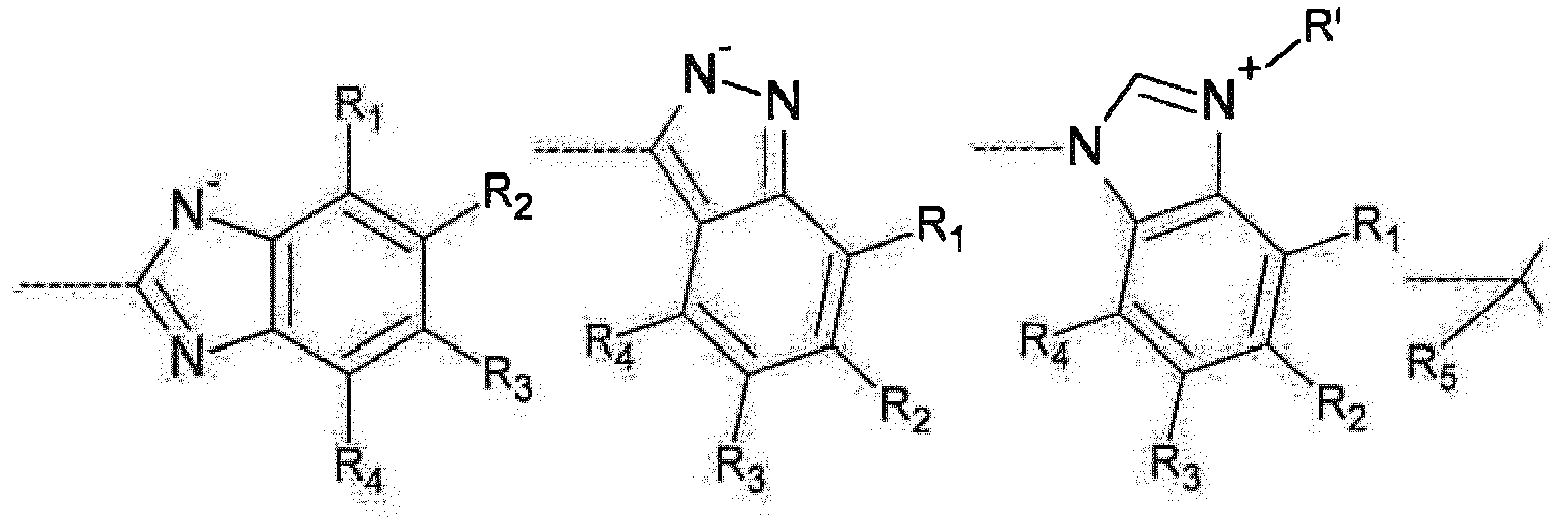
- one or more of said substituents R 1 , R 2 , R 3 , R 4 , R 5 , R 6 , R 7 , R 8 is selected, independently, from a substituent of formula (A-1) to (G-2) below: wherein:
- At least one of said ligands La (L1, ... , Ln) is, independently, selected from compounds of formulae (1-2) to (3-2) below: wherein:
- At least one of said ligands La (L1, ... , Ln) is, independently, selected from compounds of formulae (1-3) to (3-3) below: wherein, said ligand comprises at least one substituent R 1 , R 5 , and/or R 8 , as applicable, selected independently from the substituents (A-1) to (G-2) as elsewhere in this specification.
- any one or at least one of said ligands La is selected independently from the compounds of formula (1-5) to (3-5) below: wherein R 1 is selected from the substituents (A-1) to (G-2) as disclosed elsewhere in this specification.
- the complex of the present invention comprises one or more ligands selected from: (10)-(42), (50)-(63), and, more preferably, from complexes comprising the ligands (1), (2), (3), (4), (1-2), (2-2), (3-2), (1-3), (2-3), (3-3), (1-4), (2-4), (3-4), in as far as these compounds comprise at least one substituent selected from: (B-1) to (B-27), (C-1) to (C-27), (D-1) to (D-3), (F-1) to (F-10), (G-1) and (G-2).
- ligands e.g. La
- ligands comprising a ring with exactly two ring heteroatoms are particularly preferred.
- the complex of the present invention comprises one or more ligands selected from: (13), (15), (16), (17), (18), (23) to (34), (40) to (42), (50) to (54), (60) to (63), and, more preferably, from complexes comprising the ligands (1), (2), (3), (4), (1-2), (2-2), (3-2), (1-3), (2-3), (3-3), (1-4), (2-4), (3-4), in as far as these compounds comprise at least one substituent selected from (B-1), (B-4), (B-6), (B-8), (B-13), (B-24), (B-25), (B-27), (C-1) to (C-8), (C9) to (C-16), (C-18) to (C-27), (D-1) to D-3), (F-1), F-3), (F-4), (F-6), (G-1), (G-2).
- ligands e.g. La
- the complex of the present invention comprises one or more ligands selected from: (13), (15), (16), (17), (18
- ligands comprising a five-membered heteroring are particularly preferred.
- the complex of the present invention comprises one or more ligands selected from: (6) to (34), (43) to (63), and, more preferably, from complexes comprising the ligands (1), (2), (3), (4), (1-2), (2-2), (3-2), (1-3), (2-3), (3-3), (1-4), (2-4), (3-4), in as far as these compounds comprise at least one substituent selected from (A-1) to (A-6), (B-1) to (B-18), (C-1) to (C-8), (D-1) to (D-3), (E-1) to (E-3), (F-1) to (F-10), (G-1) and (G-2).
- ligands comprising a five-membered heteroring that is not fused to any further ring are particularly preferred.
- the complex of the present invention comprises one or more ligands selected from: (6) to (34), and, more preferably, from complexes comprising the ligands (1), (2), (3), (4), (1-2), (2-2), (3-2), (1-3), (2-3), (3-3), (1-4), (2-4), (3-4), in as far as these compounds comprise at least one substituent selected from (A-1) to (A-6), (B-1) to (B-18), (C-1) to (C-8), (D-1) and to (D-3).
- ligands comprising a five- or six-membered heteroring having aromatic properties (being aromatic) are particularly preferred.
- the complex of the present invention comprises one or more ligands selected from: (1) to (5), (6), (7), (10) to (12), (15), (16), (19), (21), (23) to (28), (31) to (34), (35) to (36), (39), (42), (43) to (48), (50) to (53), (55) to (56), (58) to (60) and (62), and, more preferably, from complexes comprising the ligands (1), (2), (3), (4), (1-2), (2-2), (3-2), (1-3), (2-3), (3-3), (1-4), (2-4), (3-4), in as far as these compounds comprise at least one substituent selected from: (A-1) to (G-2).
- the invention provides complexes comprising one or more bi- or tridentate ligands (e.g. La) containing at least one pyridine ring and at least one substituent, wherein said substituent is bound by way of a carbon-nitrogen bond to said pyridine ring.
- bi- or tridentate ligands e.g. La
- the present invention provides complexes comprising one or more ligands of formula (1), (2), (3), (4), (1-2), (2-2), (3-2), (1-3), (2-3), (3-3), (1-4), (2-4), and/or (3-4), wherein said ligands contain one or more substituents selected from: (A-3), (B-8) to (B-10), (B-23), (B-24), (C-4) to (C-6), (C-9) to (C-16), (C-23), (C-26), (D-2), (E-3), (F-3), (F-4), (F-7), (G-1).
- ligands of formula (1), (2), (3), (4), (1-2), (2-2), (3-2), (1-3), (2-3), (3-3), (1-4), (2-4), and/or (3-4), wherein said ligands contain one or more substituents selected from: (A-3), (B-8) to (B-10), (B-23), (B-24), (C-4) to (C-6), (C-9) to (C-16), (C
- the complex of the invention comprises one or more bi- or tridentate ligands (e.g. La) comprising at least one pyridine ring and at least one substituent selected from substituents (A-1) to (A-6), (B-1) to (B-27), (C-1) to (C-27), (D-1) to (D-3), (E-1) to (E-3), (F-1) to (F-19) and (G-1) to (G-2).
- bi- or tridentate ligands e.g. La
- substituents A-1) to (A-6), (B-1) to (B-27), (C-1) to (C-27), (D-1) to (D-3), (E-1) to (E-3), (F-1) to (F-19) and (G-1) to (G-2).
- the complex comprise a ligand selected from compounds that meets the definition of two or more of embodiments A to G (the cut-set, overlap or intersection ⁇ ).
- the complex of the invention comprises a ligand selected from ligands comprising a five-membered heteroring and which ligand has, at the same time, aromatic properties (the overlap of embodiments C and E).
- Further particularly preferred embodiments are the overlap of embodiments A and B; A and C; A and D; A and E; A and F. Further preferred embodiments are provided by the overlap of embodiments B and C; B and E; B and F, B and G; B and F. Further preferred embodiments are the overlap of embodiments C and D; C and E; C and F; C and G. Further preferred embodiments are the overlap of embodiments D and E; D and F; D and G. Further preferred embodiments are the overlap of embodiments E and F; E and G. A further preferred embodiment is the overlap of embodiments F and G.
- embodiments A, B and C relate to complexes of the invention comprising a ligand having a five-membered ring (C) containing at least two (A) adjacent (B) heteroatoms.
- These ligands are those represented by compounds (13), (15) to (18), (23) to (34), (50) to (54), (60) to (63), and preferably the compounds of formulae (1) to (5), (1-2), (2-2), (3-2), (1-3), (2-3), (3-3), (1-4), (2-4), (3-4), in as far as these latter compounds comprise at least one substituent selected from the substituents (B-1), (B-4), (B-6), (B-8), (B-13), (C-1) to (C-8), (D-1) to (D3), (F-1), (F-3), (F-4), (F-6), (G-1), (G-2).
- an overlap of embodiments, A, B, C, and G (underlined above), relates to complexes of the invention comprising a bi-or tridentate ligand (La) comprising at least one pyridine ring (G), and a substituent having a five-membered ring (C) containing at least two (A) adjacent (B) heteroatoms.
- La bi-or tridentate ligand
- C five-membered ring
- Preferred ligands of this embodiment are those represented by compounds of formulae (1) to (5), (1-2), (2-2), (3-2), (1-3), (2-3), (3-3), (1-4), (2-4), (3-4), in as far as these latter compounds comprise at least one substituent selected from the substituents (B-1), (B-4), (B-6), (B-8), (B-13), (C-1) to (C-8), (D-1) to (D3), (F-1), (F-3), (F-4), (F-6), (G-1), (G-2).
- embodiment A may be replaced by embodiment A', resulting in the corresponding overlaps in which a ring with exactly two ring heteroatoms is present.
- heteroatoms are as defined above, but nitrogen being the preferred ring-heteroatom. According to an embodiment, when there are exactly two or more than two ring-heteroatoms, said heteroatoms are preferably nitrogen atoms.
- substituted and unsubstituted ligands comprising a compound of any one of formulae (1) to (5) are preferred. Still more preferred are embodiments wherein La is selected from substituted and unsubstituted ligands of formulae (1), (2) and (3).
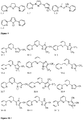
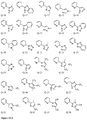
- At least one, at least two, in case of bidentate ligands, three ligands La is/are selected independently from the compounds shown in Figures 6 , 7 , 8 , 9 , 10 , 11 , 12 and/or 13. Accordingly, one, two or more ligands La may be independently selected from any one of ligands H-1 to H-31, J-1 to J-26, K-1 to K-33, L-1 to L-4, M-1 to M-15, N-1 to N-20, P-1 to P16, Q-1 to Q-63.
- any one, more than one or all available hydrogen may independently be replaced by a substituent other than H as defined above for R 1 to R 8 , and/or R 1 , to R 7 , as well as the preferred embodiments of R 1 to R 8 , and R 1 , to R 7 that are other than H.
- methyl substituents on nitrogen atoms corresponding to R' and R" as defined elsewhere in this specification are present (for example, H-2, H-4, H-6, H-8, etc). These N-methyl substituents may, according to an embodiment, be replaced by other substituents as defined for R' and R" elsewhere in this specification. R' and R" may in particular be selected from C1-C5 alkyl substituents.
- any one, more than one or all available hydrogen may independently be replaced by -F, -Cl, -Br, -I, (halogen), -NO 2 , -CN, -OH, -CF 3 , substituted or unsubstituted C1-C30 alkyl, C2-C30 alkenyl, C2-C30 alkynyl, and C5 to C30 aryl as defined elsewhere in this specification for R 1 to R 8 , and/or R 1 , to R 7 , as well as the preferred embodiments of R 1 to R 8 , and R 1 , to R 7 that are other than H.
- any one, more than one or all available hydrogen may independently be replaced by halogen, -CN, C1-C6 alkyls, C2-C6 alkenyls C2-C6 alkynyls, and C6-C10 aryls, wherein in said alkyls, alkenyls, alkynyls and aryls one, several or all available hydrogen may be replaced by halogen, -CN and -CF 3 .
- any one, more than one or all available hydrogen may independently be replaced by halogen, -CN, C1-C4 alkyl, wherein in said alkyl one, several or all available hydrogen may be replaced by halogen, -CN and -CF 3 .
- the complex of the invention comprises at least one ligand (La) selected from the compounds of any one of formula (1), (2), (3), (1-2), (2-2), (3-2), (1-3), (2-3), (3-3), (1-4), (2-4), (3-4), said compound being substituted with one, or, if applicable, two or three substituents, of formulae B-8, the other substituents being selected as specified above, but preferably from H, halogen, -CN, -CF 3 , and C1-C4 alkyls, C2-C4 alkenyls and C2-C4 alkynyls, wherein in said alkyls, alkenyls and alkynyls one, several or all available hydrogen may be replaced by halogen.
- La ligand
- any one of said La is independently selected from any one of compounds of formula (2), (3), (64), (65), (66), and (67), below: wherein any one of R 1 , R 2 , R 3 , R 4 , R 5 , R 6 , R 7 , R 8 , R 9 , R 10 , R 11 , if applicable, is independently selected from H and from hydrocarbons comprising 1 to 20 carbons and 0 to 15 heteroatoms, halogen, (-F, -Cl, -Br, -I), -NO 2 , -NH 2 , and -OH.
- any one of R 1 , R 2 , R 3 , R 4 , R 5 , R 6 , R 7 , R 8 , R 9 , R 10 , R 11 , and of R 1 , R 2 , R 3 , R 4 , R 5 , and R 6 , in as far as the respective substituent is present on the compounds (1) to (67) and their substituents, may thus be independently selected from H, halogen, -NO 2 , -OH, -NH 2 and from hydrocarbons comprising 1 to 30 carbons and 0 to 15 heteroatoms (in the case of R 1 -R 11 ) or from hydrocarbons comprising 1 to 20 carbons and 0 to 15 heteroatoms (in the case of R 1 -R 6 ).
- any one of R 1 , R 2 , R 3 , R 4 , R 5 , R 6 , R 7 , R 8 , R 9 , R 10 , R 11 , and of R 1 , R 2 , R 3 , R 4 , R 5 , and R 6 , in as far as the respective substituent is present on the compounds (1) to (67) and their substituents, may thus be independently selected from H, halogen, -NO 2 , -OH, -NH 2 and from hydrocarbons comprising 1 to 20 carbons and 0 to 15 heteroatoms.
- Heteroatoms are preferably selected, independently, from Si, N, P, As, O, S, Se halogen (in particular F, Cl, Br and I), B, Be; more preferably from Si, N, P, O, S, and halogen, most preferably from N, O, S and halogen.
- any one of said substituents R 1 , R 2 , R 3 , R 4 , R 5 , R 6 , R 7 , R 8 , R 9 , R 10 , R 11 , and of R 1 , R 2 , R 3 , R 4 , R 5 , R 6 , R 7 , R 8 , and R 9 may be independently selected from the substituents of formulae (A-1) to (G-2) (applicable to R 1 -R 11 ), H, halogen (-F, -Cl, -Br, -I), -NO 2 , -CN, -OH, -CF 3 , substituted or unsubstituted C1-C20 alkyl, C2-C20 alkenyl, C2-C20 alkynyl, and C4 to C20 aryl; wherein, in said substituted or unsubstituted alkyl, alkenyl, alkynyl or aryl, any hydrocarbon group (A-1) to
- substituents of said further substituents are preferably selected from halogen, -CN and C1 to C4 alkyl, C2-C4 alkenyl and C2-C4 alkynyl, wherein any available hydrogen of said alkyl, alkenyl or alkynyl may be substituted by halogen.
- R A may be selected from H and from substituted or unsubstituted C1-C15 alkyl, C2-C15 alkenyl, C2-C15 alkynyl C2-C15 alkynyl, C4 to C18 aryl as defined above (including replacement groups).
- R A is selected from H, C1-C10 alkyl, C2-C10 alkenyl, C2-C10 alkynyl, C4-C10 aryl, -CN, wherein said alkyl, alkenyl, alkynyl and/or aryl may be further substituted with -CN, C1-C4 alkyl (partially or totally halogenated) and halogen.
- R A is selected from H, -CN, C1-C5 alkyl, C2-C5 alkenyl, C2-C5 alkynyl, C4 to C6 aryl, which may be further substituted by -CN or halogen.
- R B may be selected from H and from substituted or unsubstituted C1-C8 alkyl, C2-C8 alkenyl, C2-C8 alkynyl, C5-C8 aryl as defined above (including replacement groups).
- R B is selected from H, H, C1-C5 alkyl, C2-C5 alkenyl, C2-C5 alkynyl, C4-C6 aryl, -CN, wherein said alkyl, alkenyl, alkynyl and/or aryl may be further substituted with -CN, C1-C4 alkyl (partially or totally halogenated) and halogen.
- R B is selected from H, -CN, C1-C4 alkyl, C2-C4 alkenyl, C2-C4 alkynyl, C4 to C6 aryl, which may be further substituted by -CN or halogen.
- any one of R A , R B and R C is independently selected from substituents as defined for R A , preferably R B as defined elsewhere in this specification, including preferred embodiments of said substituents R A , preferably R B .
- any alkyl, alkenyl or alkynyl specified herein may be linear, branched and/or cyclic.
- the alkyl, alkenyl and alkynyl has three or more (for example up to 30) carbons, as indicated.
- Any aryl having 4 or 5 carbons has an appropriate number of ring heteroatoms in order to provide an aromatic substituent ring.
- the expression "aryl” thus encompasses heteroaryls.
- an aryl is selected from heteroaryls and from aryls lacking any heteroatom.
- any one of R 1 , R 2 , R 3 , R 4 , R 5 , R 6 , R 7 , R 8 , R 9 , R 10 , and R 11 , in as far as present on the compounds (1) to (67), for example, may independently be selected from the substituents of formulae (A-1) to (G-2), H, halogen, -NO 2 , and from hydrocarbons comprising 1 to 20 carbons and 0 to 10 heteroatoms; preferably from H and C1 to C10 hydrocarbons comprising 0 to 10 heteroaotms; more preferably from H and C1 to C5 hydrocarbons comprising 0 to 5 heteroatoms.
- any one of R 1 , R 2 , R 3 , R 4 , R 5 , R 6 , R 7 , R 8 , and R 9 in as far as present on the substituents (A-1) to (G-2) above or on ligands, such as ligands Xb, for example, may be independently selected from H, halogen, -NO 2 and from hydrocarbons comprising 1 to 15 carbons and 0 to 10 heteroatoms; preferably from H and C1 to C10 hydrocarbons comprising 0 to 10 heteroaotms; more from preferably H and C1 to C5 hydrocarbons comprising 0 to 5 heteroatoms.
- any one of R 1 , R 2 , R 3 , R 4 , R 5 , R 6 , R 7 , R 8 , R 9 , R 10 , R 11 , R 1 , R 2 , R 3 , R 4 , R 5 , R 6 , R 7 , R 8 , R 9 , R' and R", if applicable, is selected independently from the substituents of formulae (A-1) to (G-2) (only applicable to R 1 -R 11 ), H, and from C1-C10 alkyls, C2-C10 alkenyls C2-C10 alkynyls, and C5-C12 aryls (preferably C6-C12 aryls), wherein in said alkyls, alkenyls, alkynyls and aryls one, several or all available hydrogen may be replaced by halogen and/or by -CN, wherein any one of said R 1 to R 12 and R 1 to R 6 may further be selected from
- any one of R 1 , R 2 , R 3 , R 4 , R 5 , R 6 , R 7 , R 8 , R 9 , R 10 , R 11 , R 1 , R 2 , R 3 , R 4 , R 5 , R 6 , R 7 , R 8 , R 9 , R' and R", in as far as present, is selected independently from the substituents of formulae (A-1) to (G-2) (in the case of R 1 -R 11 ), H, and from C1-C6 alkyls, C2-C6 alkenyls C2-C6 alkynyls, and C6-C10 aryls, wherein in said alkyls, alkenyls, alkynyls and aryls one, several or all available hydrogen may be replaced by halogen and/or -CN, wherein any one of said R 1 to R 11 and R 1 to R 6 may further be selected from halogen and from -C ⁇
- any one of R 1 , R 2 , R 3 , R 4 , R 5 , R 6 , R 7 , R 8 , R 9 , R 10 , R 11 , R 1 , R 2 , R 3 , R 4 , R 5 , R 6 , R 7 , R 8 , R 9 , R' and R", in as far as present, is selected independently, from the substituents of formulae (A-1) to (G-2) (in the case of R 1 -R 11 ), H, and from C1-C6, preferably C1-C4, more preferably C1-C3 alkyl, said alkyl, being optionally partially or totally substituted by halogen, wherein any one of said R 1 to R 12 and R 1 to R 6 may further be selected from halogen and from -C ⁇ N.
- R' and R" are selected independently from H and from C1-C6 linear branched or cyclic alkyl, said alkyl being possibly and optionally partially or totally substituted by halogen.
- R 1 , R 2 , R 3 , R 4 , R 5 , R 6 , R 7 , R 8 , R 9 , R 10 , R 11 are selected independently from the substituents of formulae (A-1) to (G-2), H, halogen, -CN, and from C1-C6 alkyl and alkenyl, wherein any available hydrogen of said alkyl and alkenyl may or may not be replaced by halogen and/or -CN.
- R 1 , R 2 , R 3 , R 4 , R 5 , R 6 , R 7 , R 8 , R 9 , R 10 , R 11 are selected independently from H, halogen, -CN, and from C1-C4 alkyl, said alkyl being optionally totally or partially halogenated.
- R 1 , R 2 , R 3 , R 4 , R 5 , R 6 , R 7 , R 8 , R 9 , R 10 , R 11 are selected independently from H, halogen, -CN, -CF3 and C1-C3 alkyl.
- R 1 , R 2 , R 3 , R 4 , R 5 , R 6 , R 7 , R 8 , R 9 are selected independently from H, halogen, -CN, and from C1-C6 alkyl and alkenyl, wherein any available hydrogen of said alkyl and alkenyl may or may not be replaced by halogen and/or -CN.
- R 1 , R 2 , R 3 , R 4 , R 5 , R 6 , R 7 , R 8 , R 9 are selected independently from H, halogen, -CN, and from C1-C4 alkyl, said alkyl being optionally totally or partially halogenated.
- R 1 , R 2 , R 3 , R 4 , R 5 , R 6 , R 7 , R 8 , R 9 in as far as present, are selected independently from H, halogen, -CN, -CF 3 and C1-C4 alkyl.
- R 7 -R 9 are preferably not selected from halogen and/or CN.
- Substituents R 1 , R 2 , R 3 , R 4 , R 5 , R 6 , R 7 , R 8 , R 9 , R 10 , R 11 , R 1 , R 2 , R 3 , R 4 , R 5 , R 6 , R 7 , R 8 , R 9 , other than H are suitable to adjust the oxidation potential of the metal complex. Without wishing to be bound by theory, it is believed that such substituents can help obtaining electrochemical devices, in particular DSCs, with higher V OC values, and to adjust the oxidation potential of the redox couple to the properties of the dye.
- the redox-active compound may comprise one or more co- and/or spectator ligands, such as one or more ligands Xb in accordance with the complex of formula (I), for example.
- the spectator ligands Xb may be independently selected, for example, from H 2 O, Cl - , Br - , I - , CN, NCO, NCS, NCSe, NH 3 , NR 7 R 8 R 9 , and PR 7 R 8 R 9 , wherein R 7 , R 8 , and R 9 are selected independently from substituted or unsubsituted alkyl, alkenyl, alkynyl and aryl.
- said alkyl, alkenyl and aryl is independently selected from substituted or unsubstituted C1-C20 alkyl, C2-C20 alkenyl, C2-C20 alkynyl, and C4 to C20 aryl as defined elsewhere in this specification, and preferred embodiments of alkyl, alkenyl, alkynyl and aryl as defined for R 1 -R 11 and/or R 1 -R 6 elsewhere in this specification.
- two or all three of R 7 , R 8 , and R 9 may connected with each other so as to provide a cyclic or polycyclic ligand.
- any one of R 1 , R 2 , R 3 , R 4 , R 5 , R 6 , R 7 , R 8 , R 9 , R 10 , R 11 , R 1 , R 2 , R 3 , R 4 , R 5 , R 6 , R 7 , R 8 , R 9 , R' and R", if applicable, is selected independently from the substituents of formulae (A-1) to (G-2) (only applicable to R 1 -R 11 ), H, and from C1-C10 alkyls, C2-C10 alkenyls C2-C10 alkynyls, and C5-C12 aryls (preferably C6-C12 aryls), wherein in said alkyls, alkenyls, alkynyls and aryls one, several or all available hydrogen may be replaced by halogen and/or by -CN, wherein any one of said R 1 to R 12 and R 1 to R 6 may further be selected from
- any one of R 1 , R 2 , R 3 , R 4 , R 5 , R 6 , R 7 , R 8 , R 9 , R 10 , R 11 , R 1 , R 2 , R 3 , R 4 , R 5 , R 6 , R' and R", if applicable, is selected independently from H, and from C1-C10 alkyls, C2-C10 alkenyls C2-C10 alkynyls, and C5-C12 aryls (preferably C6-C12 aryls), wherein in said alkyls, alkenyls, alkynyls and aryls one, several or all available hydrogen may be replaced by halogen and/or by -CN, wherein any one of said R 1 to R 8 and R 1 to R 6 may further be selected from halogen and from -C ⁇ N (-CN).
- any one of R 1 , R 2 , R 3 , R 4 , R 5 , R 6 , R 7 , R 8 , and R 9 in as far as present on the substituents (A-1) to (G-2) above or on ligands, such as ligands Xb, for example, may be independently selected from H, halogen, -NO 2 and from hydrocarbons comprising 1 to 15 carbons and 0 to 10 heteroatoms; preferably from H and C1 to C10 hydrocarbons comprising 0 to 10 heteroaotms; more from preferably H and C1 to C5 hydrocarbons comprising 0 to 5 heteroatoms.
- any one of R 1 , R 2 , R 3 , R 4 , R 5 , R 6 is selected independently from H, halogen, C1-C6 linear alkyl, C3-C6 branched or cyclic alkyl, and -C ⁇ N, wherein any one of said linear, branched or cyclic alkyl may be totally or partially halogenated, and may in particular also be-CF 3 .
- ligands of the complex of the invention may, for example, be selected from: H 2 O, Cl - , Br - , I - , CN - , NCO - , NCS - , NCSe - , NH 3 , CO, PR3 (R is independently selected from substituted and unsubstituted C6-C18, preferably C6-C12 aryl and/or aroxyl (for example phenyl or phenoxyl); substituted and unsubstituted C1-C18, preferably C1-10, more preferably C1-C4 alkyl and/or alkoxyl; imidazole, substituted imidazoles; pyridines, substituted pyridines; pyrazoles, substituted pyrazoles; triazoles; pyrazine; for example.
- the ligands Xb are selected from H 2 O, Cl - , Br - , I - , CN - , NCO - , NCS - , NCSe - , NH 3 , CO, and PR3 (R is as above, preferably independently selected from phenyl, phenoxyl, alkyl and alkoxyl).
- the complex of the invention may be charged or uncharged, in dependence of the charge of the ligand.
- the complex is cationic.
- the complex is preferably provided together with a suitable anionic species.
- the anion may be chosen in dependence of the specific device or material, to which the complex is to be added.
- the anion may be chosen, for example in OLED applications, so as to limit migration of the complex, for example to another layer.
- the invention provides a salt comprising the complex of the invention and an anionic species.
- the anionic species may be an organic or an inorganic anion.
- the anion is selected from the group consisting of halogen (in particular Cl - , Br - , I - ), CN - , NCO - , NCS - , NCSe - , ClO 4 - (perchlorate), PF 6 (hexafluorophosphate), BF 4 (tetrafluoroborate), B(CN) 4 (tetracyanoborate), CF 3 SO 3 (trifluoromethanesulfonate, triflate), (CF 3 SO 2 ) 2 N (Bis(trifluoromethane)sulfonamide, TFSI), B(C 6 H 3 ( m -CF 3 ) 2 ) 4 (tetrakis[3,5-bis(trifluoromethyl)phenyl]borate, BARF), B(C 6 F 5 ) 4 (tetrakis(pentafluorophenyl)borate), B(Ph) 4 (tetraphenylborate
- the invention provides an organic charge transport material comprising the complex of the invention and/or a salt comprising the complex.
- the reference to a material comprising the complex of the invention generally encompasses, as a preferred embodiment, a material comprising a salt comprising the complex.
- the "organic charge transport material” may also be referred to as organic electron and/or hole transport material.
- the term “organic” may be omitted, but generally, the charge transport material comprises an organic compound.
- the "organic charge transport material” is an organic semiconductor and/or conductor based on single molecules, oligomers, polymeric compounds and mixtures of the aforementioned. In the organic charge transport material, charges are substantially transported by electronic motion and/or charge hopping and not or only to an insignificant extent by diffusion of charged molecules. Accordingly, this material may be an electron and/or hole conducting material.
- the "organic charge transport material” thus has characteristics such as a conductivity, which is generally influenced by the presence or absence of a dopant.
- Typical current carriers in organic semiconductors are holes and electrons in ⁇ -bonds.
- electrons can move via ⁇ -electron cloud overlaps, especially by hopping, tunneling and related mechanisms.
- Polycyclic aromatic hydrocarbons and phtalocyanine salt crystals are examples of this type of organic semiconductor.
- an ionic liquid and a liquid electrolyte in which charges are transported by diffusion of molecules, are not considered as organic charge transport material.
- the complex (or a salt comprising the complex) of the invention is used to adjust, in particular increase the conductivity of an organic charge transporting material, and/to dope the organic charge transport material.
- the complex (or salt) may also be used as a dopant in other types of conductors or semiconductors.
- the complex or salt comprising the complex may also be used to adjust the ionization potential and/or Fermi level of the organic charge transport material.
- the invention thus provides an organic charge transporting material comprising the complex of the invention.
- the complex may be added at a weight percentage of 0.001 to 10%, preferably 0.01 to 8%, more preferably 0.1% to 5% and most preferably 0.5 to 4%, for example 1 to 3% or 1 to 2.5%, with respect to the weight of the organic charge transporting material.
- the weight percentages do not include any solvent but refer directly and to the organic charge transporting material.
- the organic charge material comprising the complex of the invention forms a doped organic charge transport material of the invention.
- the complexes of the invention may be used as p-dopants and as n-dopants.
- the same complexes having the same overall structure as those used for p-dopants can be used.
- the only difference is that instead of using D+ complex in the D+/D redox couple, the D- in the D/D- redox couple has to be used.
- Such complexes can be prepared by shaking complex D with alkali metals (potassium or lithium for example).
- complex 2 ( Fig. 1 ) will generally be used as n-dopant.
- Complex 2 can be considered as D+ [Co(L)3) 3+ ].
- a complex with same structure but charged as D-, for example [Co(L)3)+] can be used as n-dopant if E(D/D-) ⁇ E (reduction of the material to be doped).
- Co3+ a d6 electron system
- Co+ a d8 electron system
- the complexes prepared can be multiple electron donor.
- E.g. [Fe(bpy)3Na] or [Fe(bpy)3] are expected to give 4 and 3 electrons respectively.
- a complex bis-terdentate would give 2 or 3 electrons.
- the invention provides an electrochemical device comprising the complex of the invention.
- the complex is used as a redox-couple and/or as a dopant in such devices, or in accordance with the other uses specified elsewhere in this specification.
- the invention provides an electrochemical device comprising an organic charge transport material comprising the complex of the invention.
- the invention provides an electrochemical device, preferably a photoelectrochemical device comprising the complex of the invention.
- the electrochemical device of the invention is selected from a photovoltaic cell, a battery, a rechargeable battery (for example a lithium ion battery), a light emitting device, an electrochromic device, a photo-electrochromic device, an electrochemical sensor, a biosensor, an electrochemical display and an electrochemical capacitor, (for example a double layer capacitor and/or a super capacitor).
- a photovoltaic cell for example a battery, a rechargeable battery (for example a lithium ion battery), a light emitting device, an electrochromic device, a photo-electrochromic device, an electrochemical sensor, a biosensor, an electrochemical display and an electrochemical capacitor, (for example a double layer capacitor and/or a super capacitor).
- the device is a battery, for example a lithium ion battery.
- Complexes of the invention may, for example, be used as redox couples in such devices.
- the complexes of the invention may also or specifically as redox couples be used to prevent over-charging and/or over-discharging in rechargeable batteries.
- Wang et al., "A new strategy of molecular overcharge protection shuttles for lithium ion batteries", Electrochem. Commun., 10 (2008) 651-654 discloses the use of redox-shuttle additives in the electrolyte or embedded in a separator between the electrolyte and an electrode, and their use for preventing over-charging and/or over-discharging of the devices.
- the complexes of the invention may be used in the same way, as additives to the electrolyte or in the separator, for example.
- the oxidation potential of the redox couples is either preferably higher than the redox potential of the cathode material ("p-type shuttle"), or lower than the material of the anode material ("n-type shuttle”).
- the redox couple provide an internal shunt, which prevents deterioration of the cell by imposing a limit on cell potential.
- the complexes of the invention may be used as both, n- or p-type shuttles (see above: D+/D, D/D-)) in rechargeable batteries, in particular lithium ion batteries.
- the device of the invention is a photoelectochemical device.
- the photoelectrochemical device may, for example, may be selected from a dye sensitized solar cell (DSC), in particular a solid state DSC (ssDSC), an electrochromic device, a photo-electrochromic device and an organic light emitting diode (OLED) comprising the complex of the invention.
- DSC dye sensitized solar cell
- ssDSC solid state DSC
- electrochromic device a photo-electrochromic device
- OLED organic light emitting diode
- the device of the invention is an OLED.
- WO 2005/036667 discloses OLEDs that comprise ruthenium complexes for doping organic semiconductors.
- the complexes of the invention may used in the same manner.
- the complexes of the invention may also be used to increase charge mobility and/or charge density in organic charge transporting materials, for example in organic semiconductors.
- negatively charged ligands e.g. La and Xb
- neutral complexes may be obtained, which may be applied by an evaporation process as disclosed in WO 2005/036667 .
- Doped layers may be produces by mixed evaporation of a matrix (for example a charge transporting material) and the dopant.
- US 2006/0250076 discloses OLEDs comprising doped charge carrier transport layers.
- the complexes of the invention may thus be used in OLEDs, in particular as dopants in charge carrier transport layers and/or in layers comprising organic charge transport material.
- the invention provides a dye-sensitized solar cell (DSC), most preferably a solid state dye-sensitized solar cell (ssDSC).
- DSC dye-sensitized solar cell
- ssDSC solid state dye-sensitized solar cell
- the invention provides a solar cell comprising a layer comprising a doped organic charge transport material in accordance with the invention.
- the electrochemical device of the invention in particular the DSC is preferably a regenerative device.
- Electrochemical devices generally comprise two electrodes and one or more layer between the electrodes.
- the electrochemical device of the invention preferably comprises a layer comprising an organic charge transport material and the complex of the invention.
- Fig. 14 schematically shows a dye-sensitized solar cell.
- the device of the present invention comprises at least one substrate 1. Contrary to the device shown in Fig. 14 , the present invention also encompasses devices having only one substrate 1, for example only a top or only a bottom substrate 1, as is shown more specifically in Fig. 16 .
- a substrate facing the side of the device intended to be exposed to electromagnetic radiation for production of electrical current is preferably transparent.
- Transparency generally means that the respective structure (for example substrate, counter electrode, conductive layer, porous semiconductor) is transparent to at least some visible light, infrared light or UV light, in order to convert this light to electrical energy in the device of the invention.
- transparent means transparent to all visible light, more preferably also to some of the near infra-red and/or also to at least part of the ultraviolet light spectrum.
- the substrate 1 may be made from plastic or from glass. In flexible devices, the substrate 1 is preferably made from plastic. In an embodiment, the substrate comprises a plastic selected from the groups of polyethylene terephthalate, polyethylene naphthalate, polycarbonate, polypropylene, polyimide, 3-acetyl cellulose, and polyethersulfone, for example.
- the conversion devices of the present invention generally have two conductive layers 2 and 7, wherein a first conductive layer 2 is required for removing the electrons generated from the device, and a second conductive layer 7 for supplying new electrons, or, in other words, removing holes. This is illustrated in Fig. 16 by the signs + and -.
- the conductive layers 2 and 7 may be provided in many different forms and may be made from various materials, depending on the purpose or nature of the device.
- the second conductive layer 7 may be part of the substrate 1, as is the case, for example with ITO (indium tin oxide)-coated plastic or glass, where the transparent ITO is coated on the plastic or glass and makes the later electrically conductive.
- ITO indium tin oxide
- one or both conductive layers 2 and 7 may comprise a transparent metal oxide, such as indium doped tin oxide (ITO), fluorine doped tinoxide (FTO), ZnO-Ga 2 O 3 , ZnO-Al 2 O 3 , tin-oxide, antimony doped tin oxide (ATO) and zinc oxide.
- ITO indium doped tin oxide
- FTO fluorine doped tinoxide
- ZnO-Ga 2 O 3 ZnO-Al 2 O 3
- tin-oxide antimony doped tin oxide
- ATO antimony doped tin oxide
- only the first conductive layer 2 or only the second conductive layer 7 comprises a transparent metal oxide layer as defined above. It is also possible to provide one or both of the two opposed conductive layers 2 and 7 in the form of a conductive foil, for example a metal foil, in particular a titanium foil or zinc foil. This is preferred, for example, in some flexible devices, as detailed below.
- the first conductive layer 2 is made from a conductive metal foil, for example, as is shown in Fig. 16 . Such a foil may not be transparent.
- the device of the present invention generally comprises a counter electrode 7, which faces an intermediate layer 6 towards the inside of the cell, and the substrate 1 on the outside of the cell, if such substrate is present.
- the counter electrode generally comprises a catalytically active material, suitable to provide electrons and/or fill holes towards the inside of the device.
- the counter electrode may thus comprises materials selected from material selected from Pt, Au, Ni, Cu, Ag, In, Ru, Pd, Rh, Ir, Os, C, conductive polymer and a combination of two or more of the aforementioned, for example.
- Conductive polymers may be selected from polymers comprising polyaniline, polypyrrole, polythiophene, polybenzene and acetylene, for example.
- the second conductive layer can be considered as part of the counter electrode 7 or as part of the substrate 1 on the top of the device, and is thus not separately shown. If the second conductive layer is considered to be part of the substrate 1, such substrate could be plastic or glass coated with ITO or other materials, as mentioned above, for example.
- layer 3 is a light absorption layer, which comprises actually at least two separate layers, namely a porous semiconductor layer 4 and, absorbed thereon, a sensitizer layer 5.
- the sensitizer layer may comprise one or more of the group consisting of: organo-metallic sensitizing compounds, metal free organic sensitizing compounds, inorganic sensitizing compounds such as quantum dots, Sb2S3 (Antimonysulfide, for example in the form of thin films), and combinations of the aforementioned.
- the sensitizer may, for example, comprise sensitising dyes 5.
- the sensitizer layer 5 comprises a dye, it generally comprises, besides optional co-adsorbed compounds, such as those disclosed in WO2004/097871A1 , for example, at least one dye or sensitizer, or a combination of two or more different sensitizers.
- organometallic compounds encompass ruthenium dyes, as they are currently used in such devices. Suitable ruthenium dyes are disclosed, for example, in WO2006/010290 .
- the dye layer may comprise organic sensitizers.
- the device may be free of any sensitizer using ruthenium or another noble metal.
- the porous semiconductor layer may be produced by processes described in the art ( B. O'Reagan and M. Grätzel, Nature, 1991, 353, 373 ) from semiconductor nanoparticles, in particular nanocrystalline particles. Such particles generally have a mean diameter of about 0-50nm, for example 5-50 nm. Such nanoparticles may be made from a material selected from the group of Si, TiO 2 , SnO 2 , ZnO, WO 3 , Nb 2 O 5 and TiSrO 3 , for example.
- the constitution of the porous layers from nanocrystalline particles is clearly visible in the schematic Fig. 16 , showing an embodiment of a flexible cell according to the invention.
- the device of the present invention has a layer 6 having the general purpose of mediating the regeneration of electrons in the dye, which were removed due to radiation. These electrons are provided by the counter electrode 7, and layer 6 thus mediates the transport of electrons from the counter electrode to the dye, or of holes from the dye to the counter electrode.
- the transport of electrons and/or holes is preferably mediated by electrically conductive materials.
- the layer 6 is preferably an organic charge transport layer.
- this intermediate (or organic charge transport) layer 6 is substantially free of a solvent.
- This embodiment is particularly relevant with respect to flexible devices.
- Substantially free means, for the purpose of the present invention, that the layer comprises less than 10% by weight, more preferably less than 5wt.%, even more preferably less than 1% and most none added solvent at all.
- the intermediate layer is solvent free provides the important advantage that there is no degradation due to solvent evaporation through the one or two substrate layer(s) 1.
- the organic charge transport layer 6 comprises an organic charge transport material and the complex of the invention.
- the device of the present invention comprises at least one substrate layer 1, a conductive layer 2, a light absorption layer 3, a doped organic charge transport material layer 6, and a counter electrode 7, wherein said conductive layer 2, said light absorption layer 3, said organic charge transport layer 6 and said counter electrode 7 are connected in series.
- the device comprises two transparent substrates 1, on the top and the bottom of the device, respectively.
- the top of the device corresponds to the top of the drawing in Fig. 14 .
- the top corresponds to the side where the major part of light enters the device.
- the intermediate layer 6 comprises an organic charge transporting material comprising the complex of the invention and is provided between the dye layer 5 and the counter electrode 7.
- the device of the present invention is a flexible device.
- the device comprises a flexible substrate 1, a counter electrode 7, a charge transport layer 6, a dye layer 5, which may comprise organometallic dyes, organic dyes, or both, a porous semiconductor layer 4, and a conductive layer 2.
- said layers are connected in series, for example in that order from the top to bottom.
- the said conductive layer 2 is provided by a conductive metal foil, such as a titanium or zinc foil, as shown by reference numeral 2 in Figure 5 , for example, and said flexible substrate 1 is a polymer or plastic foil.
- a second conductive layer, which is transparent, is part of the counter electrode 7 and is in contact with the plastic foil as described above (for example in the form of ITO-PET or ITO-PEN).
- Conductive titanium foils and conductive plastic substrates are disclosed by Seigo Ito et al. Chem. Comm. 2006, 4004-4006 , and in EP1095387 , for example.
- the flexible device of the present invention is an inversed solar cell, with electromagnetic radiation entering the cell mainly from the side of the counter electrode (back illumination), as shown in Fig. 16 , where the arrow hv refers to the side of illumination.
- the flexible cell of the present invention is an inversed solar cell, in which, a transparent plastic substrate 1 comprises a counter electrode assembly 7, which, in this order from top to the bottom, comprises a transparent conductive oxide, for example ITO (tin-doped indium oxide) deposited on the flexible plastic foil 1, and a catalyst, such as carbon or Pt (platinum), for example.
- a transparent conductive oxide for example ITO (tin-doped indium oxide) deposited on the flexible plastic foil 1
- a catalyst such as carbon or Pt (platinum), for example.
- a conductive foil 2 preferably a metal foil, such as a Ti or zinc foil, for example, is provided, which may but need not be provided on a flexible support, such as a plastic material.
- substrates used for two-probe electrical conductivity measurements consisted of highly doped Si with a 300 nm thermally grown SiO 2 layer on which 5 nm Cr / 30 nm Au electrodes were deposited and lithographically patterned to yield a channel length and width of 20 ⁇ m and 1 mm, respectively.
- the substrates were sonicated in acetone and subsequently rinsed with 2-propanol, followed by the removal of residual organic traces via oxygen plasma treatment.
- the hole conductor was subsequently deposited by spin-coating a solution of Spiro-MeOTAD, TBP, LiTFSI and complex 2 in CHCl 3 , whereas the concentrations were the same as in case of photovoltaic devices. I-V characteristics were recorded on a Keithley 4200 Semiconductor Characterization System.
- the oxidation potential of spiro-MeOTAD in solution has been found to be 0.81 V versus normal hydrogen electrode (NHE) ( Moon, S. et al. J. Phys. Chem. C 2009, 113, 16816-16820 .)
- NHE normal hydrogen electrode
- the basic requirement for the Co (III) complex thus is a redox potential lying above this value.
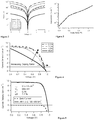
- cobalt(III)tris(1-(pyridin-2-yl)-1H-pyrazol) denoted complex 2 and depicted in Figure 1 , as suitable candidate for p-type doping of Spiro-MeOTAD.
- Complex 2 has a redox potential of 0.95 V vs. NHE as determined by electrochemical measurements, which leaves a sufficient driving force of roughly 150 mV for the charge transfer reaction.
- Complex 2 and its Co (II) analog have almost no absorption in the visible region, which is an advantage in DSCs, because competition with the sensitizer for light harvesting in avoided.
- fluorine-doped tin-oxide (FTO) coated glass substrates (Tec15, Pilkington) were patterned by etching with zinc powder and 2 M hydrochloric acid. After cleaning, a TiO 2 compact layer was deposited on the substrates by aerosol spray pyrolysis at 450 °C using titanium diisopropoxide bis(acetylacetonate) dissolved in ethanol (1:10, volume ratio) as precursor and oxygen as carrier gas. After cooling to room temperature the substrates were treated in an 0.02 M aqueous solution of TiCl 4 for 30 min at 70 °C, rinsed with deionized water and dried at 450 °C during 15 min.
- FTO fluorine-doped tin-oxide
- a 2.5 m thick mesoporous TiO 2 layer composed of 20 nm sized particles was then deposited on the substrates by a screen-printing technique, dried at 125 °C, gradually heated to 500 °C and then baked at this temperature for 15 min.
- the aforementioned treatment in aqueous TiCl 4 solution was repeated and the substrates again dried at 450 °C during 15 min. Prior to sensitization the TiO 2 substrates were heated to 500 °C during 30 min.
- the substrates were immersed into a 10 -4 M solution of the Y123 sensitizer ( Tsao et al., ChemSusChem 2011, 4, 591 - 594 ) in a mixture of acetonitrile and tert-butyl alcohol (1:1, volume ratio) for 1 h.
- the hole-transporting material was deposited by spin-coating at 2000 rpm for 30 s.
- the formulation of the spin-coating solution was 0.15 M (2,2',7,7'-tetrakis(N,N-di-p-methoxyphenylamine)-9,9-spirobifluorene) (Spiro-MeOTAD), 0.02 M Lithium bis(trifluoromethylsulfonyl)imide (LiTFSI) and 0.12 M 4-tert-butylpyridine (TBP) in chlorobenzene.
- Spiro-MeOTAD 2,2',7,7'-tetrakis(N,N-di-p-methoxyphenylamine)-9,9-spirobifluorene)
- LiTFSI Lithium bis(trifluoromethylsulfonyl)imide
- TBP 4-tert-butylpyridine
- the open-circuit potential increases to 923 mV upon the addition of 1.0% complex 2 and surprisingly further increases to 934 and 940 mV when the doping ratio is raised to 1.6% and 2.2%, respectively. This may be due to a lowering of the Fermi level in the Spiro-MeOTAD film when the dopant is added, expanding the gap to the TiO 2 conduction band and therefore the maximum potential difference theoretically achievable. Moreover, a higher conductivity facilitates charge extraction and consequently obviates the accumulation of holes near the sensitized junction.
Landscapes
- Chemical & Material Sciences (AREA)
- Engineering & Computer Science (AREA)
- Chemical Kinetics & Catalysis (AREA)
- Electrochemistry (AREA)
- General Chemical & Material Sciences (AREA)
- Materials Engineering (AREA)
- Organic Chemistry (AREA)
- Manufacturing & Machinery (AREA)
- Physics & Mathematics (AREA)
- Inorganic Chemistry (AREA)
- Electromagnetism (AREA)
- Optics & Photonics (AREA)
- Plural Heterocyclic Compounds (AREA)
- Pyridine Compounds (AREA)
- Secondary Cells (AREA)
- Electroluminescent Light Sources (AREA)
Claims (12)
- Verwendung eines Komplexes der Formel (I):
M(La)n(Xb)m (I)
als p-Dotierstoff oder n-Dotierstoff,
wobei:M für ein Metall steht, das aus Co ausgewählt ist;n für eine ganze Zahl von 1 bis 6 steht und a für eine Laufzahl eines ersten Satzes, der aus den ganzen Zahlen von 1 bis n (1, ..., n) besteht, steht, so dass es n Liganden L1, ..., Ln gibt;m für 0 oder eine ganze Zahl von 1 bis 5 steht und b für eine Laufzahl eines zweiten Satzes, der aus 0 und den ganzen Zahlen von 1 bis m (0, ..., m) besteht, steht, so dass es im Fall von m > 0 m Liganden X1, ..., Xm gibt;wobei n und m gleich der geeigneten Zahl von Liganden am Metall M sind;jedes La (L1, ..., Ln) unabhängig aus einem ein-, zwei- oder dreizähnigen Liganden ausgewählt ist, mit der Maßgabe, dass mindestens einer der Liganden La (L1, ..., Ln) unabhängig aus Verbindungen der nachstehenden Formeln (1-3) bis 3-3) ausgewählt ist:wobei der Ligand mindestens einen Substituenten R1, R5 und/oder R8, wie zutreffend, der unabhängig aus den nachstehenden Substituenten (A-1) bis (G-2) ausgewählt ist, umfasst:


 die gestrichelte Linie die Bindung darstellt, die den Substituenten von (A-1) bis (G-2) mit den Verbindungen der Formeln (1-3) bis (3-3) verbindet; unddie Substituenten R1, R2, R3, R4, R5, R6 und R7, soweit vorhanden, unabhängig aus H, Halogen, -NO2, -OH, -NH2 und aus Kohlenwasserstoffen mit 1 bis 30 Kohlenstoffatomen und 0 bis 15 Heteroatomen ausgewählt sind undXb für einen einzähnigen Co-Liganden steht, der unabhängig aus H2O, Cl-, Br-, I-, CN, NCO, NCS, NCSe, NH3, NR7R8R9 und PR7R8R9 ausgewählt ist, wobei R7, R8 und R9 unabhängig aus substituiertem oder unsubstituiertem Alkyl, Alkenyl, Alkinyl und Aryl ausgewählt sind.
 - Verwendung nach Anspruch 1, wobei n des Komplexes der Formel (I) für 2 (M L1 L2) oder 3 (M L1, L2, L3) steht und m für 0 steht.
- Verwendung nach einem der Ansprüche 1-2, wobei der Komplex der Formel (I) mindestens 2 oder mindestens 3 Liganden La mit identischer Struktur umfasst und wobei L1 = L2 oder L1 = L2 = L3.
- Verwendung nach einem der vorhergehenden Ansprüche, wobei der Komplex der Formel (I) kationisch ist.
- Verwendung nach Anspruch 4, wobei der Komplex der Formel (I), der kationisch ist, zusammen mit einer geeigneten anionischen Spezies aus der Gruppe bestehend aus Halogen (insbesondere Cl-, Br-, I-), CN-, NCO-, NCS-, NCSe-, ClO4 - (Perchlorat), PF6 (Hexafluorophosphat), BF4 (Tetrafluoroborat), B(CN)4 (Tetracyanoborat), CF3SO3 (Trifluormethansulfonat, Triflat), (CF3SO2)2N (Bis(trifluormethan) sulfonamid, TFSI), B(C6H3(m-CF3)2)4 (Tetrakis[3,5-bis(trifluormethyl)phenyl]borat, BARF), B(C6F5)4 (Tetrakis(pentafluorphenyl)borat), B(Ph)4 (Tetraphenylborat), Al(OC(CF3)3)4 und CB11H12 (Carboran-Anion) bereitgestellt wird.
- Verwendung eines Komplexes der Formel (I) gemäß einem der Ansprüche 1 bis 5 als Überladungs- und/oder Überentladungsschutzmittel für Batterien.
- Verwendung eines Komplexes der Formel (I) gemäß einem der Ansprüche 1 bis 5 als Additiv in Redoxbatterien.
- Verwendung eines Komplexes der Formel (I) gemäß einem der Ansprüche 1 bis 5 zur Erhöhung der Leitfähigkeit, Ladungsdichte und/oder Ladungsmobilität eines organischen Ladungstransportmaterials.
- Elektrochemische und/oder optoelektronische Vorrichtung, umfassend den Komplex der Formel (I) gemäß einem der Ansprüche 1 bis 5.
- Vorrichtung nach Anspruch 9, wobei der Komplex und sein reduziertes bzw. oxidiertes Gegenstück als Redoxpaar verwendet wird.
- Elektrochemische Vorrichtung nach einem der Ansprüche 9 und 10 mit einer ersten und einer zweiten Elektrode und einer organischen Ladungstransportschicht zwischen der ersten und zweiten Elektrode, wobei die Ladungstransportschicht den Metallkomplex der Formel (I) umfasst.
- Vorrichtung nach einem der Ansprüche 9 bis 11, die aus einer Photovoltaikzelle, einer Batterie, einer wiederaufladbaren Batterie, einer lichtemittierenden Vorrichtung, einer elektrochromen Vorrichtung, einer photoelektrochromen Vorrichtung, einem elektrochemischen Sensor, einem Biosensor, einer elektrochemischen Anzeige und einem elektrochemischen Kondensator ausgewählt ist.
Priority Applications (1)
| Application Number | Priority Date | Filing Date | Title |
|---|---|---|---|
| EP12712740.5A EP2678346B9 (de) | 2011-02-25 | 2012-02-24 | Metallkomplexe zur verwendung als dotierungsmittel und andere anwendungen davon |
Applications Claiming Priority (6)
| Application Number | Priority Date | Filing Date | Title |
|---|---|---|---|
| EP11156029A EP2492277A1 (de) | 2011-02-25 | 2011-02-25 | Verbessertes Redox-Paar für elektromechanische und optoelektronische Vorrichtungen |
| EP11161739 | 2011-04-08 | ||
| EP11161954A EP2511924A1 (de) | 2011-04-11 | 2011-04-11 | Übergangsmetallkomplexe als Redoxpaare für elektrochemische und optoelektronische Vorrichtungen |
| EP11175732A EP2551949A1 (de) | 2011-07-28 | 2011-07-28 | Metallkomplexe zur Verwendung als Dotierungsmittel und andere Verwendungen |
| PCT/IB2012/050870 WO2012114316A1 (en) | 2011-02-25 | 2012-02-24 | Metal complexes for use as dopants and other uses |
| EP12712740.5A EP2678346B9 (de) | 2011-02-25 | 2012-02-24 | Metallkomplexe zur verwendung als dotierungsmittel und andere anwendungen davon |
Publications (3)
| Publication Number | Publication Date |
|---|---|
| EP2678346A1 EP2678346A1 (de) | 2014-01-01 |
| EP2678346B1 EP2678346B1 (de) | 2018-04-04 |
| EP2678346B9 true EP2678346B9 (de) | 2018-08-08 |
Family
ID=45932455
Family Applications (1)
| Application Number | Title | Priority Date | Filing Date |
|---|---|---|---|
| EP12712740.5A Active EP2678346B9 (de) | 2011-02-25 | 2012-02-24 | Metallkomplexe zur verwendung als dotierungsmittel und andere anwendungen davon |
Country Status (6)
| Country | Link |
|---|---|
| US (1) | US9559321B2 (de) |
| EP (1) | EP2678346B9 (de) |
| JP (2) | JP2014517807A (de) |
| KR (1) | KR101957534B1 (de) |
| CN (1) | CN103492401B (de) |
| WO (1) | WO2012114316A1 (de) |
Families Citing this family (38)
| Publication number | Priority date | Publication date | Assignee | Title |
|---|---|---|---|---|
| JP6243776B2 (ja) * | 2013-06-28 | 2017-12-06 | 積水化学工業株式会社 | 光電変換素子及び光電変換素子の製造方法 |
| EP2985799A1 (de) * | 2014-08-11 | 2016-02-17 | Dyenamo AB | Festkörperlochleitermaterial |
| EP3133664A1 (de) * | 2015-08-18 | 2017-02-22 | Novaled GmbH | Mit metallamiden dotierte triarylamindickschicht zur verwendung als lochinjektionsschicht für eine organische leuchtdiode (oled) |
| EP3133663B1 (de) * | 2015-08-18 | 2022-06-15 | Novaled GmbH | Metallamide zur verwendung als lochinjektionsschicht für eine organische leuchtdiode (oled) |
| EP3157025A1 (de) | 2015-10-15 | 2017-04-19 | g2e glass2energy SA | Porphyrinbasierter sensibilisator für farbstoffsensibilisierte solarzelle |
| US10153442B2 (en) | 2015-12-31 | 2018-12-11 | National Tsing Hua University | Iridium complex, OLED using the same, and nitrogen-containing tridentate ligand having carbene unit |
| US20190214581A1 (en) | 2016-08-22 | 2019-07-11 | Merck Patent Gmbh | Organic semiconducting compounds |
| EP3523836B1 (de) | 2016-10-05 | 2024-09-11 | Raynergy Tek Inc. | Organische halbleitermaterialien |
| US10991893B2 (en) | 2016-10-05 | 2021-04-27 | Raynergy Tek Incorporation | Organic semiconducting compounds |
| EP3523835B1 (de) | 2016-10-05 | 2022-11-16 | Raynergy Tek Inc. | Organischer photodetektor |
| EP3306690B1 (de) | 2016-10-05 | 2022-09-07 | Raynergy Tek Inc. | Organische halbleiterverbindungen |
| WO2018078080A1 (en) | 2016-10-31 | 2018-05-03 | Merck Patent Gmbh | Organic semiconducting compounds |
| EP3333170B1 (de) | 2016-12-06 | 2020-04-29 | Merck Patent GmbH | Asymmetrische polyzyklische verbindungen zur verwendung in organischen halbleitern |
| CN108269931B (zh) * | 2016-12-30 | 2020-01-24 | 昆山国显光电有限公司 | 一种有机电致发光器件及其制备方法 |
| GB2559781A (en) * | 2017-02-17 | 2018-08-22 | Zapgo Ltd | Wearable electronic device including a supercapacitor |
| EP3364476B1 (de) * | 2017-02-20 | 2024-06-05 | Novaled GmbH | Aktive oled-anzeige, verfahren zur herstellung einer aktiven oled-anzeige und verbindung |
| EP3583636B1 (de) | 2017-02-20 | 2023-05-24 | Novaled GmbH | Elektronisches halbleiterbauteil, dessen herstellung und verbidnung |
| JP7116075B2 (ja) | 2017-03-09 | 2022-08-09 | レイナジー テック インコーポレイション | 有機半導体化合物 |
| WO2019030382A1 (en) | 2017-08-11 | 2019-02-14 | Merck Patent Gmbh | ORGANIC SEMICONDUCTOR POLYMER |
| JP7004140B2 (ja) * | 2017-09-01 | 2022-01-21 | 株式会社三洋物産 | 遊技機 |
| JP2019042121A (ja) * | 2017-09-01 | 2019-03-22 | 株式会社三洋物産 | 遊技機 |
| JP2019042120A (ja) * | 2017-09-01 | 2019-03-22 | 株式会社三洋物産 | 遊技機 |
| WO2019052935A1 (en) | 2017-09-13 | 2019-03-21 | Merck Patent Gmbh | ORGANIC SEMICONDUCTOR COMPOUNDS |
| CN111315796B (zh) | 2017-11-02 | 2023-11-24 | 天光材料科技股份有限公司 | 有机半导体化合物 |
| US12101992B2 (en) | 2017-11-10 | 2024-09-24 | Raynergy Tek Incorporation | Organic semiconducting compounds |
| WO2019154973A1 (en) | 2018-02-12 | 2019-08-15 | Merck Patent Gmbh | Organic semiconducting compounds |
| US12532662B2 (en) | 2018-03-28 | 2026-01-20 | Raynergy Tek Incorporation | Organic semiconducting compounds |
| WO2019185578A1 (en) | 2018-03-28 | 2019-10-03 | Merck Patent Gmbh | Organic semiconducting compounds |
| WO2019206926A1 (en) | 2018-04-27 | 2019-10-31 | Merck Patent Gmbh | Organic semiconducting polymers |
| US20210305554A1 (en) * | 2018-05-24 | 2021-09-30 | Zeon Corporation | Electrode material, electrode, electrical storage device, and slurry composition |
| US12193317B2 (en) | 2018-07-13 | 2025-01-07 | Flexenable Technology Limited | Organic semiconducting compounds |
| CN112955456A (zh) | 2018-09-06 | 2021-06-11 | 天光材料科技股份有限公司 | 有机半导体化合物 |
| JP2020127007A (ja) * | 2019-02-01 | 2020-08-20 | 株式会社リコー | 光電変換素子、太陽電池モジュール、電源モジュール、及び電子機器 |
| WO2020161052A1 (en) | 2019-02-06 | 2020-08-13 | Merck Patent Gmbh | Organic semiconducting polymers |
| WO2020178298A1 (en) | 2019-03-07 | 2020-09-10 | Raynergy Tek Inc. | Organic semiconducting composition |
| JP2020099795A (ja) * | 2020-04-01 | 2020-07-02 | 株式会社三洋物産 | 遊技機 |
| KR102493132B1 (ko) * | 2020-09-11 | 2023-01-31 | 삼성디스플레이 주식회사 | 발광 소자 및 이를 포함한 전자 장치 |
| EP4012793A1 (de) | 2020-12-14 | 2022-06-15 | Raynergy Tek Incorporation | Lichtdiode |
Family Cites Families (16)
| Publication number | Priority date | Publication date | Assignee | Title |
|---|---|---|---|---|
| JPS63114066A (ja) * | 1986-07-19 | 1988-05-18 | Naoaki Kumagai | 電池用電極 |
| NL1009431C2 (nl) | 1998-06-18 | 1999-12-27 | Stichting Energie | Omgekeerde kleurstof-gesensibiliseerde foto-voltaïsche cel. |
| DE19844233A1 (de) | 1998-09-26 | 2000-03-30 | Continental Teves Ag & Co Ohg | Unterdruckbremskraftverstärker |
| DE19934837A1 (de) | 1999-07-24 | 2001-01-25 | Bosch Gmbh Robert | Adapterkarte, Naviagtionsgerät und Funkgerät |
| EP1160888A1 (de) | 2000-05-29 | 2001-12-05 | Sony International (Europe) GmbH | Lochleitermaterial und Verwendung in einer (Farbstoff-)Solarzelle |
| EP1473745A1 (de) | 2003-04-30 | 2004-11-03 | Ecole Polytechnique Federale De Lausanne (Epfl) | Farbstoffsensibilisierte Solarzelle |
| DE10338406A1 (de) | 2003-08-18 | 2005-03-24 | Novaled Gmbh | Dotierte organische Halbleitermaterialien sowie Verfahren zu deren Herstellung |
| DE10347856B8 (de) | 2003-10-10 | 2006-10-19 | Colorado State University Research Foundation, Fort Collins | Halbleiterdotierung |
| DE102004010954A1 (de) * | 2004-03-03 | 2005-10-06 | Novaled Gmbh | Verwendung eines Metallkomplexes als n-Dotand für ein organisches halbleitendes Matrixmaterial, organisches Halbleitermaterial und elektronisches Bauteil |
| EP1622178A1 (de) | 2004-07-29 | 2006-02-01 | Ecole Polytechnique Federale De Lausanne (Epfl) | 2,2 -Bipyridinligand, Sensibilisierungsfarbstoff und farbstoffsensibilisierte Solarzelle |
| ATE381117T1 (de) | 2005-04-13 | 2007-12-15 | Novaled Ag | Anordnung für eine organische leuchtdiode vom pin-typ und verfahren zum herstellen |
| EP1837929A1 (de) | 2006-03-23 | 2007-09-26 | Ecole Polytechnique Fédérale de Lausanne (EPFL) | Flüssiges Ladungstransportmaterial |
| DE102007018456B4 (de) | 2007-04-19 | 2022-02-24 | Novaled Gmbh | Verwendung von Hauptgruppenelementhalogeniden und/oder -pseudohalogeniden, organisches halbleitendes Matrixmaterial, elektronische und optoelektronische Bauelemente |
| CN101348502B (zh) * | 2007-07-19 | 2011-11-16 | 中国科学院化学研究所 | 2-苯并咪唑-1,10-菲咯啉过渡金属配合物及其制备方法与应用 |
| JP2012517422A (ja) * | 2009-02-06 | 2012-08-02 | ソルヴェイ(ソシエテ アノニム) | ピリジルトリアゾール配位子を含有するリン光性発光イリジウム錯体 |
| US8598351B2 (en) * | 2011-06-20 | 2013-12-03 | King Abdullah University Of Science And Technology | Phospho-amino pincer-type ligands and catalytic metal complexes thereof |
-
2012
- 2012-02-24 EP EP12712740.5A patent/EP2678346B9/de active Active
- 2012-02-24 JP JP2013554974A patent/JP2014517807A/ja not_active Withdrawn
- 2012-02-24 WO PCT/IB2012/050870 patent/WO2012114316A1/en not_active Ceased
- 2012-02-24 CN CN201280020346.7A patent/CN103492401B/zh not_active Expired - Fee Related
- 2012-02-24 KR KR1020137025196A patent/KR101957534B1/ko not_active Expired - Fee Related
- 2012-02-24 US US14/001,307 patent/US9559321B2/en not_active Expired - Fee Related
-
2017
- 2017-05-10 JP JP2017093604A patent/JP6568142B2/ja not_active Expired - Fee Related
Also Published As
| Publication number | Publication date |
|---|---|
| KR101957534B1 (ko) | 2019-03-12 |
| WO2012114316A1 (en) | 2012-08-30 |
| US9559321B2 (en) | 2017-01-31 |
| US20130330632A1 (en) | 2013-12-12 |
| EP2678346A1 (de) | 2014-01-01 |
| EP2678346B1 (de) | 2018-04-04 |
| CN103492401B (zh) | 2017-02-22 |
| JP2014517807A (ja) | 2014-07-24 |
| KR20140015398A (ko) | 2014-02-06 |
| CN103492401A (zh) | 2014-01-01 |
| JP2017168450A (ja) | 2017-09-21 |
| JP6568142B2 (ja) | 2019-08-28 |
Similar Documents
| Publication | Publication Date | Title |
|---|---|---|
| EP2678346B9 (de) | Metallkomplexe zur verwendung als dotierungsmittel und andere anwendungen davon | |
| US10038150B2 (en) | Metal complexes for use as dopants and other uses | |
| US9779879B2 (en) | Redox couple for electrochemical and optoelectronic devices | |
| US8487119B2 (en) | Organic sensitizers | |
| JP5204848B2 (ja) | 光電気素子 | |
| EP2433989B1 (de) | Lichtabsorbierendes material und fotoelektrisches wandlungselement | |
| EP3225624A1 (de) | Neuartige verbindung und verwendung davon als ein lochtransportmaterial | |
| Chung et al. | Phosphonic acid and lithium salt as effective p-dopants to oxidize spiro-OMeTAD for mesoscopic Sb2S3 solar cells | |
| Elawad et al. | An organic hole-transporting material spiro-OMeTAD doped with a Mn complex for efficient perovskite solar cells with high conversion efficiency | |
| EP2511924A1 (de) | Übergangsmetallkomplexe als Redoxpaare für elektrochemische und optoelektronische Vorrichtungen | |
| JP5233318B2 (ja) | 光電変換素子及び太陽電池 | |
| Murali et al. | Design and synthesis of new ruthenium complex for dye-sensitized solar cells | |
| EP2551949A1 (de) | Metallkomplexe zur Verwendung als Dotierungsmittel und andere Verwendungen | |
| KR102714695B1 (ko) | 정공수송재 조성물 및 이를 포함하는 하이브리드 태양전지 | |
| EP3407361A1 (de) | Redoxschmelzen aus kupfer (i)/(ii)-komplexen als ladungsübertragungs- und ladungsspeicherungsmaterialien | |
| EP2492277A1 (de) | Verbessertes Redox-Paar für elektromechanische und optoelektronische Vorrichtungen | |
| KR101633150B1 (ko) | 플루오렌 유도체 및 그의 염 | |
| Koh | Reducing interfacial recombination for photovoltage enhancement in mesoscopic solar cells |
Legal Events
| Date | Code | Title | Description |
|---|---|---|---|
| PUAI | Public reference made under article 153(3) epc to a published international application that has entered the european phase |
Free format text: ORIGINAL CODE: 0009012 |
|
| 17P | Request for examination filed |
Effective date: 20130823 |
|
| AK | Designated contracting states |
Kind code of ref document: A1 Designated state(s): AL AT BE BG CH CY CZ DE DK EE ES FI FR GB GR HR HU IE IS IT LI LT LU LV MC MK MT NL NO PL PT RO RS SE SI SK SM TR |
|
| DAX | Request for extension of the european patent (deleted) | ||
| RAP1 | Party data changed (applicant data changed or rights of an application transferred) |
Owner name: ECOLE POLYTECHNIQUE FEDERALE DE LAUSANNE (EPFL) |
|
| STAA | Information on the status of an ep patent application or granted ep patent |
Free format text: STATUS: EXAMINATION IS IN PROGRESS |
|
| 17Q | First examination report despatched |
Effective date: 20161129 |
|
| GRAP | Despatch of communication of intention to grant a patent |
Free format text: ORIGINAL CODE: EPIDOSNIGR1 |
|
| STAA | Information on the status of an ep patent application or granted ep patent |
Free format text: STATUS: GRANT OF PATENT IS INTENDED |
|
| INTG | Intention to grant announced |
Effective date: 20171122 |
|
| RIN1 | Information on inventor provided before grant (corrected) |
Inventor name: KESSLER, FLORIAN Inventor name: NAZEERUDDIN, MOHAMMAD KHAJA Inventor name: BURSCHKA, JULIAN Inventor name: BARANOFF, ETIENNE Inventor name: GRAETZEL, MICHAEL |
|
| GRAS | Grant fee paid |
Free format text: ORIGINAL CODE: EPIDOSNIGR3 |
|
| GRAA | (expected) grant |
Free format text: ORIGINAL CODE: 0009210 |
|
| STAA | Information on the status of an ep patent application or granted ep patent |
Free format text: STATUS: THE PATENT HAS BEEN GRANTED |
|
| AK | Designated contracting states |
Kind code of ref document: B1 Designated state(s): AL AT BE BG CH CY CZ DE DK EE ES FI FR GB GR HR HU IE IS IT LI LT LU LV MC MK MT NL NO PL PT RO RS SE SI SK SM TR |
|
| REG | Reference to a national code |
Ref country code: GB Ref legal event code: FG4D |
|
| REG | Reference to a national code |
Ref country code: CH Ref legal event code: EP |
|
| REG | Reference to a national code |
Ref country code: AT Ref legal event code: REF Ref document number: 985492 Country of ref document: AT Kind code of ref document: T Effective date: 20180415 |
|
| REG | Reference to a national code |
Ref country code: DE Ref legal event code: R096 Ref document number: 602012044705 Country of ref document: DE |
|
| GRAT | Correction requested after decision to grant or after decision to maintain patent in amended form |
Free format text: ORIGINAL CODE: EPIDOSNCDEC |
|
| REG | Reference to a national code |
Ref country code: IE Ref legal event code: FG4D |
|
| REG | Reference to a national code |
Ref country code: CH Ref legal event code: NV Representative=s name: ABREMA AGENCE BREVET ET MARQUES, GANGUILLET, CH |
|
| REG | Reference to a national code |
Ref country code: CH Ref legal event code: PK Free format text: BERICHTIGUNG B9 |
|
| REG | Reference to a national code |
Ref country code: NL Ref legal event code: MP Effective date: 20180404 |
|
| REG | Reference to a national code |
Ref country code: LT Ref legal event code: MG4D |
|
| PG25 | Lapsed in a contracting state [announced via postgrant information from national office to epo] |
Ref country code: NL Free format text: LAPSE BECAUSE OF FAILURE TO SUBMIT A TRANSLATION OF THE DESCRIPTION OR TO PAY THE FEE WITHIN THE PRESCRIBED TIME-LIMIT Effective date: 20180404 |
|
| PG25 | Lapsed in a contracting state [announced via postgrant information from national office to epo] |
Ref country code: NO Free format text: LAPSE BECAUSE OF FAILURE TO SUBMIT A TRANSLATION OF THE DESCRIPTION OR TO PAY THE FEE WITHIN THE PRESCRIBED TIME-LIMIT Effective date: 20180704 Ref country code: BG Free format text: LAPSE BECAUSE OF FAILURE TO SUBMIT A TRANSLATION OF THE DESCRIPTION OR TO PAY THE FEE WITHIN THE PRESCRIBED TIME-LIMIT Effective date: 20180704 Ref country code: PL Free format text: LAPSE BECAUSE OF FAILURE TO SUBMIT A TRANSLATION OF THE DESCRIPTION OR TO PAY THE FEE WITHIN THE PRESCRIBED TIME-LIMIT Effective date: 20180404 Ref country code: LT Free format text: LAPSE BECAUSE OF FAILURE TO SUBMIT A TRANSLATION OF THE DESCRIPTION OR TO PAY THE FEE WITHIN THE PRESCRIBED TIME-LIMIT Effective date: 20180404 Ref country code: ES Free format text: LAPSE BECAUSE OF FAILURE TO SUBMIT A TRANSLATION OF THE DESCRIPTION OR TO PAY THE FEE WITHIN THE PRESCRIBED TIME-LIMIT Effective date: 20180404 Ref country code: AL Free format text: LAPSE BECAUSE OF FAILURE TO SUBMIT A TRANSLATION OF THE DESCRIPTION OR TO PAY THE FEE WITHIN THE PRESCRIBED TIME-LIMIT Effective date: 20180404 Ref country code: SE Free format text: LAPSE BECAUSE OF FAILURE TO SUBMIT A TRANSLATION OF THE DESCRIPTION OR TO PAY THE FEE WITHIN THE PRESCRIBED TIME-LIMIT Effective date: 20180404 Ref country code: FI Free format text: LAPSE BECAUSE OF FAILURE TO SUBMIT A TRANSLATION OF THE DESCRIPTION OR TO PAY THE FEE WITHIN THE PRESCRIBED TIME-LIMIT Effective date: 20180404 |
|
| PG25 | Lapsed in a contracting state [announced via postgrant information from national office to epo] |
Ref country code: LV Free format text: LAPSE BECAUSE OF FAILURE TO SUBMIT A TRANSLATION OF THE DESCRIPTION OR TO PAY THE FEE WITHIN THE PRESCRIBED TIME-LIMIT Effective date: 20180404 Ref country code: RS Free format text: LAPSE BECAUSE OF FAILURE TO SUBMIT A TRANSLATION OF THE DESCRIPTION OR TO PAY THE FEE WITHIN THE PRESCRIBED TIME-LIMIT Effective date: 20180404 Ref country code: GR Free format text: LAPSE BECAUSE OF FAILURE TO SUBMIT A TRANSLATION OF THE DESCRIPTION OR TO PAY THE FEE WITHIN THE PRESCRIBED TIME-LIMIT Effective date: 20180705 Ref country code: HR Free format text: LAPSE BECAUSE OF FAILURE TO SUBMIT A TRANSLATION OF THE DESCRIPTION OR TO PAY THE FEE WITHIN THE PRESCRIBED TIME-LIMIT Effective date: 20180404 |
|
| REG | Reference to a national code |
Ref country code: AT Ref legal event code: MK05 Ref document number: 985492 Country of ref document: AT Kind code of ref document: T Effective date: 20180404 |
|
| PG25 | Lapsed in a contracting state [announced via postgrant information from national office to epo] |
Ref country code: PT Free format text: LAPSE BECAUSE OF FAILURE TO SUBMIT A TRANSLATION OF THE DESCRIPTION OR TO PAY THE FEE WITHIN THE PRESCRIBED TIME-LIMIT Effective date: 20180806 |
|
| REG | Reference to a national code |
Ref country code: DE Ref legal event code: R097 Ref document number: 602012044705 Country of ref document: DE |
|
| PG25 | Lapsed in a contracting state [announced via postgrant information from national office to epo] |
Ref country code: EE Free format text: LAPSE BECAUSE OF FAILURE TO SUBMIT A TRANSLATION OF THE DESCRIPTION OR TO PAY THE FEE WITHIN THE PRESCRIBED TIME-LIMIT Effective date: 20180404 Ref country code: AT Free format text: LAPSE BECAUSE OF FAILURE TO SUBMIT A TRANSLATION OF THE DESCRIPTION OR TO PAY THE FEE WITHIN THE PRESCRIBED TIME-LIMIT Effective date: 20180404 Ref country code: DK Free format text: LAPSE BECAUSE OF FAILURE TO SUBMIT A TRANSLATION OF THE DESCRIPTION OR TO PAY THE FEE WITHIN THE PRESCRIBED TIME-LIMIT Effective date: 20180404 Ref country code: SK Free format text: LAPSE BECAUSE OF FAILURE TO SUBMIT A TRANSLATION OF THE DESCRIPTION OR TO PAY THE FEE WITHIN THE PRESCRIBED TIME-LIMIT Effective date: 20180404 Ref country code: CZ Free format text: LAPSE BECAUSE OF FAILURE TO SUBMIT A TRANSLATION OF THE DESCRIPTION OR TO PAY THE FEE WITHIN THE PRESCRIBED TIME-LIMIT Effective date: 20180404 Ref country code: RO Free format text: LAPSE BECAUSE OF FAILURE TO SUBMIT A TRANSLATION OF THE DESCRIPTION OR TO PAY THE FEE WITHIN THE PRESCRIBED TIME-LIMIT Effective date: 20180404 |
|
| PLBE | No opposition filed within time limit |
Free format text: ORIGINAL CODE: 0009261 |
|
| STAA | Information on the status of an ep patent application or granted ep patent |
Free format text: STATUS: NO OPPOSITION FILED WITHIN TIME LIMIT |
|
| PG25 | Lapsed in a contracting state [announced via postgrant information from national office to epo] |
Ref country code: SM Free format text: LAPSE BECAUSE OF FAILURE TO SUBMIT A TRANSLATION OF THE DESCRIPTION OR TO PAY THE FEE WITHIN THE PRESCRIBED TIME-LIMIT Effective date: 20180404 Ref country code: IT Free format text: LAPSE BECAUSE OF FAILURE TO SUBMIT A TRANSLATION OF THE DESCRIPTION OR TO PAY THE FEE WITHIN THE PRESCRIBED TIME-LIMIT Effective date: 20180404 |
|
| 26N | No opposition filed |
Effective date: 20190107 |
|
| PG25 | Lapsed in a contracting state [announced via postgrant information from national office to epo] |
Ref country code: SI Free format text: LAPSE BECAUSE OF FAILURE TO SUBMIT A TRANSLATION OF THE DESCRIPTION OR TO PAY THE FEE WITHIN THE PRESCRIBED TIME-LIMIT Effective date: 20180404 |
|
| PG25 | Lapsed in a contracting state [announced via postgrant information from national office to epo] |
Ref country code: LU Free format text: LAPSE BECAUSE OF NON-PAYMENT OF DUE FEES Effective date: 20190224 Ref country code: MC Free format text: LAPSE BECAUSE OF FAILURE TO SUBMIT A TRANSLATION OF THE DESCRIPTION OR TO PAY THE FEE WITHIN THE PRESCRIBED TIME-LIMIT Effective date: 20180404 |
|
| REG | Reference to a national code |
Ref country code: BE Ref legal event code: MM Effective date: 20190228 |
|
| REG | Reference to a national code |
Ref country code: IE Ref legal event code: MM4A |
|
| PG25 | Lapsed in a contracting state [announced via postgrant information from national office to epo] |
Ref country code: IE Free format text: LAPSE BECAUSE OF NON-PAYMENT OF DUE FEES Effective date: 20190224 |
|
| PG25 | Lapsed in a contracting state [announced via postgrant information from national office to epo] |
Ref country code: BE Free format text: LAPSE BECAUSE OF NON-PAYMENT OF DUE FEES Effective date: 20190228 |
|
| PG25 | Lapsed in a contracting state [announced via postgrant information from national office to epo] |
Ref country code: TR Free format text: LAPSE BECAUSE OF FAILURE TO SUBMIT A TRANSLATION OF THE DESCRIPTION OR TO PAY THE FEE WITHIN THE PRESCRIBED TIME-LIMIT Effective date: 20180404 |
|
| PG25 | Lapsed in a contracting state [announced via postgrant information from national office to epo] |
Ref country code: MT Free format text: LAPSE BECAUSE OF NON-PAYMENT OF DUE FEES Effective date: 20190224 |
|
| REG | Reference to a national code |
Ref country code: CH Ref legal event code: PFUS Owner name: ECOLE POLYTECHNIQUE FEDERALE DE LAUSANNE (EPFL, CH Free format text: FORMER OWNER: ECOLE POLYTECHNIQUE FEDERALE DE LAUSANNE (EPFL), CH |
|
| PG25 | Lapsed in a contracting state [announced via postgrant information from national office to epo] |
Ref country code: CY Free format text: LAPSE BECAUSE OF FAILURE TO SUBMIT A TRANSLATION OF THE DESCRIPTION OR TO PAY THE FEE WITHIN THE PRESCRIBED TIME-LIMIT Effective date: 20180404 |
|
| PG25 | Lapsed in a contracting state [announced via postgrant information from national office to epo] |
Ref country code: IS Free format text: LAPSE BECAUSE OF FAILURE TO SUBMIT A TRANSLATION OF THE DESCRIPTION OR TO PAY THE FEE WITHIN THE PRESCRIBED TIME-LIMIT Effective date: 20180804 |
|
| PG25 | Lapsed in a contracting state [announced via postgrant information from national office to epo] |
Ref country code: HU Free format text: LAPSE BECAUSE OF FAILURE TO SUBMIT A TRANSLATION OF THE DESCRIPTION OR TO PAY THE FEE WITHIN THE PRESCRIBED TIME-LIMIT; INVALID AB INITIO Effective date: 20120224 |
|
| PG25 | Lapsed in a contracting state [announced via postgrant information from national office to epo] |
Ref country code: MK Free format text: LAPSE BECAUSE OF FAILURE TO SUBMIT A TRANSLATION OF THE DESCRIPTION OR TO PAY THE FEE WITHIN THE PRESCRIBED TIME-LIMIT Effective date: 20180404 |
|
| REG | Reference to a national code |
Ref country code: DE Ref legal event code: R082 Ref document number: 602012044705 Country of ref document: DE Representative=s name: KARAKATSANIS, GEORGIOS, DR., DE |
|
| PGFP | Annual fee paid to national office [announced via postgrant information from national office to epo] |
Ref country code: DE Payment date: 20240219 Year of fee payment: 13 Ref country code: GB Payment date: 20240219 Year of fee payment: 13 Ref country code: CH Payment date: 20240301 Year of fee payment: 13 |
|
| PGFP | Annual fee paid to national office [announced via postgrant information from national office to epo] |
Ref country code: FR Payment date: 20240221 Year of fee payment: 13 |
|
| REG | Reference to a national code |
Ref country code: DE Ref legal event code: R119 Ref document number: 602012044705 Country of ref document: DE |
|
| REG | Reference to a national code |
Ref country code: CH Ref legal event code: PL |
|
| PG25 | Lapsed in a contracting state [announced via postgrant information from national office to epo] |
Ref country code: CH Free format text: LAPSE BECAUSE OF NON-PAYMENT OF DUE FEES Effective date: 20250228 |
|
| GBPC | Gb: european patent ceased through non-payment of renewal fee |
Effective date: 20250224 |
|
| PG25 | Lapsed in a contracting state [announced via postgrant information from national office to epo] |
Ref country code: DE Free format text: LAPSE BECAUSE OF NON-PAYMENT OF DUE FEES Effective date: 20250902 |
|
| PG25 | Lapsed in a contracting state [announced via postgrant information from national office to epo] |
Ref country code: GB Free format text: LAPSE BECAUSE OF NON-PAYMENT OF DUE FEES Effective date: 20250224 |
|
| PG25 | Lapsed in a contracting state [announced via postgrant information from national office to epo] |
Ref country code: FR Free format text: LAPSE BECAUSE OF NON-PAYMENT OF DUE FEES Effective date: 20250228 |