EP2679063B1 - Innenraumortung mobiler endgeräte in einem mobilfunknetz - Google Patents
Innenraumortung mobiler endgeräte in einem mobilfunknetz Download PDFInfo
- Publication number
- EP2679063B1 EP2679063B1 EP12713312.2A EP12713312A EP2679063B1 EP 2679063 B1 EP2679063 B1 EP 2679063B1 EP 12713312 A EP12713312 A EP 12713312A EP 2679063 B1 EP2679063 B1 EP 2679063B1
- Authority
- EP
- European Patent Office
- Prior art keywords
- mobile terminal
- identifier
- terminal
- transmitter
- indoor environment
- Prior art date
- Legal status (The legal status is an assumption and is not a legal conclusion. Google has not performed a legal analysis and makes no representation as to the accuracy of the status listed.)
- Not-in-force
Links
- 230000001413 cellular effect Effects 0.000 title claims description 54
- 238000000034 method Methods 0.000 claims description 52
- 230000008569 process Effects 0.000 claims description 27
- 238000004891 communication Methods 0.000 claims description 18
- 238000005516 engineering process Methods 0.000 description 20
- 238000005259 measurement Methods 0.000 description 12
- 230000008901 benefit Effects 0.000 description 9
- 230000005540 biological transmission Effects 0.000 description 7
- 238000012986 modification Methods 0.000 description 6
- 230000004048 modification Effects 0.000 description 6
- 238000013459 approach Methods 0.000 description 4
- 230000000875 corresponding effect Effects 0.000 description 4
- 230000001419 dependent effect Effects 0.000 description 3
- 230000000694 effects Effects 0.000 description 3
- 239000004165 Methyl ester of fatty acids Substances 0.000 description 2
- 238000010586 diagram Methods 0.000 description 2
- 230000006870 function Effects 0.000 description 2
- 230000010354 integration Effects 0.000 description 2
- 230000007246 mechanism Effects 0.000 description 2
- 230000011664 signaling Effects 0.000 description 2
- LSTPKMWNRWCNLS-UHFFFAOYSA-N 1-amino-2,3-dihydroindene-1,5-dicarboxylic acid Chemical compound OC(=O)C1=CC=C2C(N)(C(O)=O)CCC2=C1 LSTPKMWNRWCNLS-UHFFFAOYSA-N 0.000 description 1
- 241001465754 Metazoa Species 0.000 description 1
- 230000003213 activating effect Effects 0.000 description 1
- 230000009118 appropriate response Effects 0.000 description 1
- 230000002596 correlated effect Effects 0.000 description 1
- 125000004122 cyclic group Chemical group 0.000 description 1
- 238000013481 data capture Methods 0.000 description 1
- 238000005265 energy consumption Methods 0.000 description 1
- 230000003116 impacting effect Effects 0.000 description 1
- 238000009434 installation Methods 0.000 description 1
- 230000003993 interaction Effects 0.000 description 1
- 238000012423 maintenance Methods 0.000 description 1
- 238000010295 mobile communication Methods 0.000 description 1
- 238000012545 processing Methods 0.000 description 1
- 230000005855 radiation Effects 0.000 description 1
- 238000011160 research Methods 0.000 description 1
- 230000004044 response Effects 0.000 description 1
- 239000000779 smoke Substances 0.000 description 1
- 230000000007 visual effect Effects 0.000 description 1
Images



Classifications
-
- H—ELECTRICITY
- H04—ELECTRIC COMMUNICATION TECHNIQUE
- H04W—WIRELESS COMMUNICATION NETWORKS
- H04W4/00—Services specially adapted for wireless communication networks; Facilities therefor
- H04W4/02—Services making use of location information
- H04W4/029—Location-based management or tracking services
-
- H—ELECTRICITY
- H04—ELECTRIC COMMUNICATION TECHNIQUE
- H04W—WIRELESS COMMUNICATION NETWORKS
- H04W4/00—Services specially adapted for wireless communication networks; Facilities therefor
- H04W4/30—Services specially adapted for particular environments, situations or purposes
- H04W4/33—Services specially adapted for particular environments, situations or purposes for indoor environments, e.g. buildings
-
- H—ELECTRICITY
- H04—ELECTRIC COMMUNICATION TECHNIQUE
- H04W—WIRELESS COMMUNICATION NETWORKS
- H04W64/00—Locating users or terminals or network equipment for network management purposes, e.g. mobility management
-
- H—ELECTRICITY
- H04—ELECTRIC COMMUNICATION TECHNIQUE
- H04W—WIRELESS COMMUNICATION NETWORKS
- H04W4/00—Services specially adapted for wireless communication networks; Facilities therefor
- H04W4/90—Services for handling of emergency or hazardous situations, e.g. earthquake and tsunami warning systems [ETWS]
-
- H—ELECTRICITY
- H04—ELECTRIC COMMUNICATION TECHNIQUE
- H04W—WIRELESS COMMUNICATION NETWORKS
- H04W76/00—Connection management
- H04W76/50—Connection management for emergency connections
Definitions
- the location service requires the availability of the following data in "push" mode (i.e. directly sent to the information systems of the 911/112 operational stations and displayed as soon as the first ring occurs on the monitor of the station operator):
- GNSS Global Navigation Satellite System
- GPS Global Positioning System
- Said system has an accuracy of approx. 10 metres; for positioning applications in conditions of poor satellite visibility, as in urban centres or within indoor environments, GPS is not very efficient due to insufficient accuracy and to the fact that, in order to operate correctly, it requires a visibility line in the connection between the receiver and at least four satellites.
- the E-CID technique ensures a level of accuracy that depends on cell coverage and may not be sufficient for locating an indoor call; the other techniques based on triangulation/trilateration are more accurate, but require the terminal to communicate with at least three radio base stations; moreover, the U-TDOA technique, which de facto is used in E-911 in the USA, requires modifications to the cellular network.
- Location techniques may vary from fingerprinting to triangulation of power measurements or of time measurements, in the UWB (UltraWide Band) case.
- Patent US 7,242,303 describes a similar solution, which uses a service centre to handle emergencies in a building.
- the tag-reader solution is used for locating emergency calls from VOIP terminals, wherein the terminal, equipped with a reader, reads the data coming from the tags and relays them in a wireless manner to a server, which then compares them with an internal database to determine the caller's location.
- the position information is useful for the emergency centre, which does not know the geography of the place (in particular the tag arrangement inside a building) and therefore only needs to know whether the mobile terminal is inside the building or not: with the current methods described above, this is not possible.
- US 2010/151789 A1 discloses a technique, according to which estimation of a position of a mobile wireless device can be accomplished in a simple system configuration by using short distance communication functions.
- a plurality of standard stations 110 and a plurality of connecting stations 120 are installed within a predetermined area.
- a mobile wireless device moving within the predetermined area has short distance wireless communication functions and receives a device ID of an opponent device (a correspondent device) each time it intersects another mobile wireless device or a standard station, and stores the device ID as an intersecting history data.
- the mobile wireless device moves to a position where it can perform communication to and from a connecting station, which can make access to a position estimation device 150, the stored intersecting history data is uploaded to the position estimation device.
- the intersecting history data as uploaded from the mobile wireless device is stored in an intersecting history database 155.
- the position estimation device identifies positions of installation of all standard stations, and it estimates a moving route of the mobile communication device (for which the position is to be estimated) according to the intersecting history data directly uploaded from the mobile wireless device (for which the position is to be estimated) and a moving route of the mobile wireless device (for which the position is to be estimated) is estimated according to the intersecting history with the mobile wireless device (for which the position is to be estimated) as included in the intersecting history data of another mobile wireless device.
- the number of and the sites where the transmitter apparatuses are installed must ensure coverage of the areas of interest of the indoor environment, i.e. at every point the receiver apparatus must be able to receive the signal from at least one of them.
- said transmitter apparatuses can transmit an identifier that allows the locating station, placed outside the indoor environment of the mobile terminal to be located, to directly associate the geographic address of the place where the terminal is situated.
- the transmitter apparatuses transmit the telephone number of the fixed telephone present in the building: said identifier is received by the receiver apparatus present in the mobile terminal and is then sent to an external locating station through the cellular telephone network. Transmission of data for location purposes over the telephone network is already provided by the location standards defined by OMA and 3GPP.
- the mobile terminal 3 may send to the locating station 7, through the mobile cellular telecommunication network, any data associated with the identifier ID received from the transmitter, based on which said station 7 can determine the original identifier ID, e.g. an encrypted version thereof.
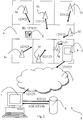
- the system 1 according to the present invention comprises seven transmitter apparatuses 5a-5g; the receiver apparatus 4, from the position where it is situated, can communicate with the transmitter apparatus 5g.
- the transmitter apparatus 5g transmits the same identifier ID of the indoor environment 6 where they are placed: said identifier may include, for example, the telephone number 123123 of a fixed terminal 8 present in the indoor environment 6, i.e. a fixed telephone.
- the transmitter apparatuses 5a-5g are programmed with different telephone numbers depending on which fixed terminal 8a-8c they are closest to.
- FIG. 3 there is shown an example of implementation of the process for locating an emergency call based on the system 1 shown in FIG. 2 , wherein the receiver apparatus 4 associated with a mobile terminal 3 receives the identifier from three different transmitter apparatuses 5a-5c positioned in three indoor environments A, B and C, respectively, and selects the nearest one for relay to the locating station 7 through the cellular telephone network 2.
- the system 1 and the process thereof can be implemented by using technologies already known in the art.
- the RFID technology is well suited to the purposes of the invention, in that tags can be used as transmitter apparatuses, and the reader built in the mobile terminal to be located can be used as a receiver apparatus.
- the RFID technology which is currently being standardized as far as location is concerned, is a low-cost, low-consumption technology that uses small devices which can be easily integrated with other technologies: in fact, RFID platforms based on Wi-Fi IEEE802.11 standards are available which can be easily integrated into state-of-the-art mobile terminals already using this technology; another option is the ZigBee IEEE802.15 technology, which is widely employed in sensor networks.
- the tags can be directly integrated into the fixed communication terminals 8a-8c (e.g. fixed or cordless telephones of a common fixed telephone network) present in the indoor environment 6, so that said tags can share the power supply with the fixed terminals, said tags being programmed to transmit, as an identifier, the telephone number of the fixed terminal into which they are integrated.
- the fixed communication terminals 8a-8c e.g. fixed or cordless telephones of a common fixed telephone network
- Another possible embodiment of the system 1 according to the present invention exploits the increasing presence of wireless access points within buildings, which can be used as transmitter apparatuses, and the increasing integration of wireless interfaces in the currently available terminals: in this case, it is conceivable to use the IP (Internet Protocol) address associated with the access points as an identifier of the indoor environment for external applications using databases associating the IP address with the geographic address of the access point.
- IP Internet Protocol
- FIG. 4 illustrates another embodiment of the invention for providing an LBS-type service within an indoor area 10.
- the building to be served e.g. a museum or a large shopping centre
- transmitters each one identifying a certain indoor area or environment A-G characterized by the presence of particular elements of interest (work of art, shop, type of product being sold, etc.).
- the identifiers ID ⁇ A>- ⁇ G> may identify an indoor area or environment where the service provider wants to offer the mobile terminals situated therein a "location based" service, such as, for example, information about the elements of interest present in the coverage area of the transmitter to which the mobile terminal 3 is locked, or anyway of the closest transmitter that is transmitting a certain identifier.
- the LBS system may also provide the mobile terminal 3 with software applications required for using or interacting with objects or elements placed near the transmitter 5a-5g or anyway within its radio coverage area.
- the service may typically comprise the provision of information of any nature: commercial information (e.g. advertising a product positioned near the mobile terminal), museum information (e.g. multimedia data with text, audio tracks, images or videos concerning a work of art placed near the mobile terminal), location information (e.g. "You are near a toy shop", and so forth), which at any rate depend on the position of the mobile terminal 3 as detected by the locating station 7 based on the identifier ⁇ A>- ⁇ G> received.
- commercial information e.g. advertising a product positioned near the mobile terminal
- museum information e.g. multimedia data with text, audio tracks, images or videos concerning a work of art placed near the mobile terminal
- location information e.g. "You are near a toy shop", and so forth
- the mobile terminal 3 is equipped with a GNSS locating device (e.g. GPS, GLONASS or Galileo) and with a memory where one can store (e.g. through a user interface) the position of the areas where there is an indoor location system 1, when the mobile terminal detects to have entered the area covered by said system because its distance from that position is shorter than a predetermined value, the receiver apparatus 4 will be turned on automatically (if not yet active) in order to listen to the transmitter apparatuses 5 (or to try to activate them if passive RFID tags are used). Vice versa, when the terminal exits the area covered by the system 1, the receiver apparatus 4 can be automatically turned off.
- a GNSS locating device e.g. GPS, GLONASS or Galileo
- a memory where one can store (e.g. through a user interface) the position of the areas where there is an indoor location system 1
- the receiver apparatus 4 will be turned on automatically (if not yet active) in order to listen to the transmitter apparatuses 5 (or to try to activate them
- the terminal alerts the user through any audible and/or visual signal about the presence in the area of a system 1 stored by whatever means in the mobile terminal 3. Through input operations, the user can manually activate the receiver apparatus 4 and set it up for operating within the system 1.
- Another useful feature is the possibility for the terminal to relay the identifier ID or ⁇ A>- ⁇ G> to the cellular telephone network when any predetermined event occurs, which can be defined by the user or by the manufacturer of the terminal 3, and which the terminal itself can detect.
- This event may consist of various occurrences, such as, for example:
- Another advantage is that the process according to the invention makes it easy to use Wi-Fi access points as transmitter apparatuses and the Wi-Fi client interface as receiver apparatuses associated with the mobile terminals; this particular embodiment reduces the number of modifications required on the transmission side (access points are available in many buildings), while any modifications on the receiver side are only software ones, since a large number of modern mobile state-of-the-art terminals already have built-in hardware Wi-Fi interfaces.
- Yet another advantage of the present invention is that the process according to the invention makes it possible to locate the mobile terminal by sending data identifying the position of the mobile user, transmitted by the transmitter apparatuses and received by the receiver apparatus, directly to the locating station through the cellular network, without having to use dedicated locating means and procedures within the mobile terminal and without requiring any modification to the cellular network.
- the present invention is applicable to indoor environments which are generally very crowded (such as shopping centres, museums and the like) and which cannot be covered by a GNSS service while however being covered by the mobile cellular telecommunication network; as a matter of fact, it has been in the interest of the operators of such networks to cover these environments, for they generate considerable traffic volumes.
Landscapes
- Engineering & Computer Science (AREA)
- Computer Networks & Wireless Communication (AREA)
- Signal Processing (AREA)
- Mobile Radio Communication Systems (AREA)
- Telephonic Communication Services (AREA)
- Telephone Function (AREA)
Claims (15)
- Verfahren zur Innenraumlokalisierung eines mobilen Terminals (3), das mit einer Transceiver-Vorrichtung ausgestattet ist, die geeignet ist, mit einem Mobilfunktelekommunikationsnetz (2) durch ein System, das mindestens eine Sendevorrichtung (5a-5g), die in der Innenraumumgebung (6; A-G) vorhanden ist, zu kommunizieren, und das mobile Terminal (3) mit einer Empfängervorrichtung (4) ausgestattet ist, die geeignet ist, Daten, die durch mindestens eine der Sendevorrichtungen (5a-5g), die innerhalb der Innenraumumgebung (6; A-G) vorhanden sind, zu empfangen und diese an eine Lokalisierungsstation (7) durch die Transceiver-Vorrichtung über das Mobilfunktelekommunikationsnetz (2) weiterzugeben, umfassend die folgenden Schritte:a) mindestens eine der Sendevorrichtungen (5a-5g), die in der Innenraumumgebung (6; A-G) vorhanden ist, überträgt mindestens einen Identifikator eines Festnetztelefons (ID), das in der Innenraumumgebung (6; A-G), in der die Sendevorrichtung (5a-5g) sich befindet, gelegen ist;b) die Empfängervorrichtung (4) des mobilen Terminals (3) empfängt den Identifikator eines Festnetztelefons (ID), der durch mindestens eine der Sendevorrichtungen (5a-5g) übertragen wurde;c) die Transceiver-Vorrichtung des mobilen Terminals (3) gibt den Identifikator eines Festnetztelefons (ID) an die Lokalisierungsstation (7) durch das Mobilfunktelekommunikationsnetzwerk (2) weiter; undd) die Lokalisierungsstation (7) lokalisiert das mobile Terminal (3) in Abhängigkeit des Identifikators des Festnetztelefons (ID), das von dem mobilen Terminal (3) durch das Mobilfunktelekommunikationsnetzwerk (2) empfangen wurde, durch Assozüeren des Identifikators (ID) mit einer geographischen Adresse der Innenraumumgebung (6; A-G) nach Konsultieren einer existierenden Datenbasis (9), auf die durch die Lokalisierungsstation (7) zugreifbar ist, wobei die Datenbasis (9) Informationen umfasst, die den Identifikator (ID) mit Daten assoziiert, die mit der geographischen Adresse der Innenraumumgebung (6; A-G) in Beziehung stehen, an der der Sender (5a-5g), der diesen übertragen hat, sich befindet, und wobei der Identifikator (ID) mit mindestens einem Festnetztelefon (8) eines Telefonfestnetzes, das innerhalb der Innenraumumgebung (6) vorhanden ist, assoziiert ist, wobei- in Schritt b) das mobile Terminal (3) von den Sendevorrichtungen (5a-5c) mehrere unterschiedliche Identifikatoren (ID), die mit unterschiedlichen der Festnetztelefone (8a-8c) assoziiert sind, empfängt;- das mobile Terminal (3) einen der Identifikatoren eines Festnetztelefons (ID), das an die Lokalisierungsstation (7) übertragen werden soll, unter den mehreren unterschiedlichen Identifikatoren (ID) auswählt, wobei der ausgewählte Identifikator (ID) derjenige ist, der erwartet wird als von der Sendevorrichtung (5c), die nächstliegend zum mobilen Terminal (3) ist, übertragen worden zu sein; und- Schritt d) das Assoziieren des ausgewählten Identifikators (ID) der nächstliegenden Sendevorrichtung (5c) mit einer geographischen Adresse davon durch die Datenbasis (9) umfasst.
- Verfahren nach Anspruch 1, dadurch gekennzeichnet, dass mindestens eine der Sendevorrichtungen (5a-5g) ein RFID-Tag ist und die Empfängervorrichtung (4), die mit dem mobilen Terminal (3) assoziiert ist, ein RFID-Lesegerät ist.
- Verfahren nach Anspruch 1, dadurch gekennzeichnet, dass mindestens eine der Sendevorrichtungen (5a-5g) ein drahtloser Zugangspunkt und die Empfängervorrichtung (4), die mit dem mobilen Terminal (3) assoziiert ist, ein Drahtlos-LAN, WLAN, Transceiver ist.
- System (1) zur Innenraumlokalisierung eines mobilen Terminals (3), das mit einer Transceiver-Vorrichtung ausgestattet ist, die geeignet ist, mit einem Mobilfunktelekommunikationsnetzwerk (2) zu kommunizieren, umfassend:- mindestens eine Sendevorrichtung (5a-5g), die innerhalb einer Innenraumumgebung (6; A-G) platziert und eingerichtet ist, an das mobile Terminal (3) mindestens einen Identifikator eines Festnetztelefons (ID), der in der Innenraumumgebung (6; A-G) gelegen ist, zu übertragen;- das mobile Terminal (3), das mit mindestens einer Empfängervorrichtung (4) ausgestattet ist, die eingerichtet ist, um den Identifikator (ID) eines Festnetztelefons zu empfangen und zumindest die Transceiver-Vorrichtung eingerichtet ist, den Identifikator des Festnetztelefons (ID) an eine Lokalisierungsstation (7) durch das Mobilfunktelekommunikationsnetzwerk (2) weiterzugeben;- die Lokalisierungsstation (7), die eingerichtet ist, das mobile Terminal (3) in Abhängigkeit des empfangenen Identifikators des Festnetztelefons (ID) zu lokalisieren, wobei die Lokalisierungsstation (7) mindestens eine Datenbasis (9), auf die durch die Lokalisierungsstation (7) zugreifbar ist, konsultieren kann, wobei die Datenbasis (9) Informationen umfasst, die den Identifikator (ID) mit Daten assoziiert, die in Beziehung mit der geographischen Adresse der Innenraumumgebung (6; A-G) stehen, an der der Sender (5a-5g), der diesen übertragen hat, sich befindet, und wobei der Identifikator (ID) mit mindestens einem Festnetztelefon (8) eines Telefonfestnetzes, das innerhalb der Innenraumumgebung (6) vorhanden ist, assoziiert ist, wobei:- das mobile Terminal (3) von der Sendevorrichtung (5a-5c) mehrere verschiedene Identifikatoren (ID), die mit verschiedenen der Festnetztelefone (8a-8c) assoziiert sind, empfängt;- das mobile Terminal (3) einen der Identifikatoren der Festnetztelefone (ID), das an die Lokalisierungsstation (7) übertragen werden soll, unter den mehreren unterschiedlichen Identifikatoren (ID) auswählt, wobei der ausgewählte Identifikator (ID) derjenige ist, der erwartet wird als durch die Sendevorrichtung (5c), die nächstliegend zum mobilen Terminal (3) ist, übertragen worden zu sein; und- die Lokalisierungsstation (7) das mobile Terminal (3) durch Assoziieren des ausgewählten Identifikators (ID) der nächstliegenden Sendevorrichtung (5c) mit einer geographischen Adresse davon durch die Datenbasis (9) lokalisiert.
- System (1) nach Anspruch 4, dadurch gekennzeichnet, dass mindestens eine der Sendevorrichtungen (5a-5g) ein RFID-Tag ist und die Empfängervorrichtung (4), die mit dem mobilen Terminal (3) assoziiert ist, ein RFID-Lesegerät ist.
- System (1) nach Anspruch 4, dadurch gekennzeichnet, dass mindestens eine der Sendevorrichtungen (5a-5g) ein drahtloser Zugangspunkt und die Empfängervorrichtung (4), die mit dem mobilen Terminal (3) assoziiert ist, ein drahtloser LAN, WLAN, Transceiver ist.
- System (1) nach Anspruch 4, dadurch gekennzeichnet, dass der Identifikator (ID) eines Festnetztelefons, das in der Innenraumumgebung gelegen ist, mindestens eines der Folgenden umfasst:- die Telefonnummer des Festnetztelefons, oder- die IP (Internet Protokoll) Adresse, die mit dem Festnetztelefon assoziiert ist.
- Mobiles Terminal (3), das mit einer Transceiver-Vorrichtung zum Kommunizieren mit einem Mobilfunktelekommunikationsnetzwerk (2) ausgestattet ist, durch welches es möglich ist, Daten an mindestens eine Lokalisierungsstation (7) zu übertragen, ausgestattet mit mindestens einer Empfängervorrichtung (4), die geeignet ist, Daten, die von mindestens einer Sendevorrichtung (5a-5g), die innerhalb einer Innenraumumgebung (6; A-G) vorhanden ist, zu empfangen und diese an eine Lokalisierungsstation (7) durch die Transceiver-Vorrichtung weiterzugeben, wobei das mobile Terminal eingerichtet ist zum:- Empfangen von mindestens einer der Sendevorrichtungen (5a-5g), die in der Innenraumumgebung (6; A-G) vorhanden sind, eines Identifikators eines Festnetztelefons (ID), das in der Innenraumumgebung (6; A-G), in der die Sendevorrichtungen (5a-5g) sich befinden, gelegen ist;- Übertragen des Identifikators eines Festnetztelefons (ID) an die Lokalisierungsstation (7) durch das Mobilfunktelekommunikationsnetzwerk (2), sodass die Lokalisierungsstation (7) das mobile Terminal (3) in Abhängigkeit des Identifikators (ID), der durch das mobile Terminal (3) durch das Mobilfunktelekommunikationsnetzwerk (2) weitergegeben wurde, lokalisiert, wobei die Lokalisierungsstation (7) mindestens eine Datenbasis (9), die durch die Lokalisierungsstation (7) zugreifbar ist, umfasst, wobei die Datenbasis (9) Informationen umfasst, die den Identifikator (ID) mit der geographischen Adresse der Innenraumumgebung (6; AG) assoziiert, an der die Sendevorrichtung (5a-5g), die diesen an das mobile Terminal (3) übertragen hat, sich befindet, und wobei der Identifikator (ID) mit mindestens einem Festnetztelefon (8) eines Telefonfestnetzes, das innerhalb der Innenraumumgebung (6) vorhanden ist, assoziiert ist, wobei:- das mobile Terminal (3) mehrere unterschiedliche Identifikatoren eines Festnetztelefons (ID) von den Sendevorrichtungen (5a-5c), die mit unterschiedlichen der Festnetztelefone (8a-8c) assoziiert sind, empfängt; und- das mobile Terminal (3) einen der Identifikatoren der Festnetztelefone zur Übertragung an die Lokalisierungsstation (7) unter den mehreren unterschiedlichen Identifikatoren (ID) auswählt, wobei der ausgewählte Identifikator (ID) derjenige ist, der erwartet wird als von der Sendevorrichtung (5c), die nächstliegend zum mobilen Terminal (3) ist, übertragen worden zu sein.
- Mobiles Terminal nach Anspruch 8, dadurch gekennzeichnet, dass der Identifikator eines Festnetztelefons, das in der Innenraumumgebung gelegen ist, mindestens eines der Folgenden umfasst:- die Telefonnummer des Festnetztelefons, oder- die IP (Internet Protokoll) Adresse, die mit dem Festnetztelefon assoziiert ist.
- Mobiles Terminal (3) nach Anspruch 8, dadurch gekennzeichnet, dass die Empfängervorrichtung (4) zyklisch für begrenzte Zeitintervalle, die durch längere Leerlaufdauern separiert sind, aktiviert wird.
- Mobiles Terminal (3) nach einem der Ansprüche 8 bis 10, dadurch gekennzeichnet, dass das mobile Terminal (3) mit einem GNSS-Lokalisierungsgerät und einem Speicher ausgestattet ist und dass es möglich ist, geographische Adressen mindestens einer Innenraumumgebung (6; A-G) in dem Speicher zu speichern, und dass die Empfängervorrichtung (4) aktiviert ist, wenn das GNSS-Lokalisierungsgerät detektiert, dass die Entfernung des mobilen Terminals (3) von der geographischen Adresse geringer als ein vorbestimmter Wert ist.
- Mobiles Terminal (3) nach einem der Ansprüche 8 bis 11, dadurch gekennzeichnet, dass der Identifikator des Festnetztelefons (ID) automatisch weitergeleitet wird, wenn ein vorbestimmtes Ereignis eintritt.
- Mobiles Terminal (3) nach Anspruch 12, dadurch gekennzeichnet, dass das vorbestimmte Ereignis das Ausführen eines Anrufs oder Senden einer SMS-Nachricht an einen vorbestimmten Telefonbenutzer umfasst und dass die Telefonnummer des Festnetztelefons (ID) in den Datenfluss, der durch das mobile Terminal emittiert wird, eingefügt wird, um den Anruf oder die SMS-Nachricht auszuführen.
- Mobiles Terminal (3) nach Anspruch 8, dadurch gekennzeichnet, dass es mindestens einen der Identifikatoren (ID) von der Sendevorrichtung (5a-5g), die ein RFID-Tag ist, empfängt und die Empfängervorrichtung (4), die mit dem mobilen Terminal (3) assoziiert ist, ein RFID-Lesegerät ist.
- Mobiles Terminal (3) nach Anspruch 8, dadurch gekennzeichnet, dass es mindestens einen der Identifikatoren (ID) von einer Sendevorrichtung (5a-5g) empfängt, die ein drahtloser Zugangspunkt ist, und die Empfängervorrichtung (4), die mit dem mobilen Terminal (3) assoziiert ist, ein drahtloser LAN, WLAN, Transceiver ist.
Applications Claiming Priority (2)
| Application Number | Priority Date | Filing Date | Title |
|---|---|---|---|
| ITTO2011A000160A IT1404531B1 (it) | 2011-02-24 | 2011-02-24 | Procedimento e sistema di localizzazione indoor per terminali mobili in una rete di telecomunicazione mobile cellulare e relativo terminale mobile. |
| PCT/IB2012/050838 WO2012114304A1 (en) | 2011-02-24 | 2012-02-23 | Indoor locating mobile terminals in a mobile cellular telecommunication network |
Publications (2)
| Publication Number | Publication Date |
|---|---|
| EP2679063A1 EP2679063A1 (de) | 2014-01-01 |
| EP2679063B1 true EP2679063B1 (de) | 2017-10-25 |
Family
ID=43976489
Family Applications (1)
| Application Number | Title | Priority Date | Filing Date |
|---|---|---|---|
| EP12713312.2A Not-in-force EP2679063B1 (de) | 2011-02-24 | 2012-02-23 | Innenraumortung mobiler endgeräte in einem mobilfunknetz |
Country Status (8)
| Country | Link |
|---|---|
| US (1) | US10136264B2 (de) |
| EP (1) | EP2679063B1 (de) |
| JP (1) | JP6021190B2 (de) |
| KR (1) | KR101908620B1 (de) |
| CN (1) | CN103404214B (de) |
| IT (1) | IT1404531B1 (de) |
| TW (1) | TWI463890B (de) |
| WO (1) | WO2012114304A1 (de) |
Families Citing this family (35)
| Publication number | Priority date | Publication date | Assignee | Title |
|---|---|---|---|---|
| EP2083081A1 (de) | 2005-07-22 | 2009-07-29 | Five Prime Therapeutics, Inc. | Zusammensetzungen und Verfahren zur Behandlung von Krankheiten mit FGFR-Fusionsproteinen |
| US8481038B2 (en) | 2010-11-15 | 2013-07-09 | Five Prime Therapeutics, Inc. | Treatment of cancer with elevated dosages of soluble FGFR1 fusion proteins |
| IL210169A0 (en) * | 2010-12-22 | 2011-03-31 | Yehuda Binder | System and method for routing-based internet security |
| CN107823630A (zh) | 2011-11-14 | 2018-03-23 | 戊瑞治疗有限公司 | 治疗癌症的方法 |
| US20130214906A1 (en) * | 2012-02-22 | 2013-08-22 | Ernst Wojak | System And Method For Automatically Transmitting Messages To A Mobile Radio Device |
| US20130335233A1 (en) * | 2012-06-11 | 2013-12-19 | Anthony Kamar | Systems and methods for portable device communications and interaction |
| US9578115B2 (en) | 2012-06-15 | 2017-02-21 | Qualcomm Incorporated | Indoor location server provision and discovery |
| US11265673B2 (en) * | 2012-06-15 | 2022-03-01 | Qualcomm Incorporated | Client access to mobile location services |
| US10419890B2 (en) | 2012-06-15 | 2019-09-17 | Qualcomm Incorporated | Client access to mobile location services |
| CN102833855B (zh) * | 2012-09-23 | 2015-09-16 | 苏惠 | 一种室内定位方法和系统 |
| JP2014064232A (ja) * | 2012-09-24 | 2014-04-10 | Ricoh Co Ltd | 通信端末、通信方法、及びプログラム |
| CN102932734B (zh) * | 2012-09-28 | 2016-06-22 | 腾讯科技(深圳)有限公司 | 一种确定终端之间距离的方法、装置及系统 |
| DE102012221921B4 (de) | 2012-11-29 | 2018-04-05 | Technische Hochschule Wildau (Fh) | Orten eines mobilen Endgeräts unter Nutzung von optisch detektierbaren Landmarken |
| US9341479B2 (en) | 2013-03-05 | 2016-05-17 | Google Inc. | Configurable point of interest alerts |
| US9404997B2 (en) * | 2013-03-08 | 2016-08-02 | Intel Corporation | Communication station and method for time-of-flight positioning using cooperating stations |
| US9140777B2 (en) | 2013-05-14 | 2015-09-22 | Symbol Technologies, Llc | Ultrasonic locationing using enrollment mode |
| BR112015030077B1 (pt) * | 2013-05-31 | 2023-04-11 | Qualcomm Incorporated | Método para fornecer serviços de localização em um servidor de localização, servidor de localização, método para fornecer serviços de localização em um cliente de serviços de localização e cliente de serviços de localização |
| WO2015030816A1 (en) | 2013-08-30 | 2015-03-05 | Hewlett-Packard Development Company, L.P. | Localization using time-of-flight |
| US9137776B2 (en) * | 2013-10-30 | 2015-09-15 | Symbol Technologies, Llc | Automatic mode change in ultrasonic locationing |
| CN103685521A (zh) * | 2013-12-16 | 2014-03-26 | 英华达(上海)科技有限公司 | 物品位置记忆系统及方法 |
| US9986375B2 (en) * | 2014-02-12 | 2018-05-29 | Google Llc | Energy-efficient location determination |
| WO2015165673A1 (en) * | 2014-05-02 | 2015-11-05 | Skygd Ab | Communication node, alarm system and method for handling alarm notifications |
| US9936365B1 (en) * | 2014-09-25 | 2018-04-03 | Greenwich Technology Associates | Alarm method and system |
| WO2017084006A1 (en) * | 2015-11-16 | 2017-05-26 | Accenture Global Solutions Limited | Telecommunication network signal analysis for matching a mobile device cellular identifier with a mobile device network identifier |
| US10251023B2 (en) | 2016-04-29 | 2019-04-02 | In-Telligent Properties Inc. | Notification and communication system using geofencing to identify members of a community |
| US11281993B2 (en) | 2016-12-05 | 2022-03-22 | Apple Inc. | Model and ensemble compression for metric learning |
| CN106658712B (zh) * | 2017-01-17 | 2020-11-10 | 深圳市亿兆互联技术有限公司 | 一种通信终端定位方法及系统 |
| US10667232B2 (en) * | 2018-01-12 | 2020-05-26 | Idosens | Wireless computer network and method for locating a node in said network |
| US10423926B1 (en) * | 2018-07-18 | 2019-09-24 | Mapsted Corp. | Method and system for localizing tracking devices indoors and outdoors |
| US11191054B2 (en) * | 2018-11-02 | 2021-11-30 | Qualcomm Incorporated | Method and apparatus for estimating a position of a mobile device using bundled positioning reference signals |
| NL1043505B1 (en) * | 2018-12-12 | 2020-10-27 | Hijdra Retail Services B V | Method of tracking, monitoring tracking system and tracker |
| US11523276B2 (en) | 2019-06-28 | 2022-12-06 | Bank Of America Corporation | Utilizing a high generation cellular network to authorize an event |
| US11317280B2 (en) | 2019-07-24 | 2022-04-26 | Bank Of America Corporation | Real-time authentication using a mobile device on a high generation cellular network |
| US11363409B2 (en) | 2019-09-17 | 2022-06-14 | In-Telligent Properties Llc | Emergency alert systems with tracked user interactions |
| CN115550864B (zh) * | 2022-11-25 | 2023-04-28 | 厦门大学 | 一种基于ue上行信号的5g nr室内定位系统及方法 |
Family Cites Families (23)
| Publication number | Priority date | Publication date | Assignee | Title |
|---|---|---|---|---|
| GB9901300D0 (en) | 1999-01-22 | 1999-03-10 | Olivetti Research Ltd | A method of increasing the capacity and addressing rate of an Ultrasonic location system |
| JP2003009212A (ja) * | 2001-06-27 | 2003-01-10 | Ntt Docomo Inc | 位置推定システム、位置推定装置、移動局及び位置推定方法 |
| JP2003153334A (ja) * | 2001-11-16 | 2003-05-23 | Seiko Instruments Inc | 個人居場所検出システム |
| JP2003274441A (ja) | 2002-03-13 | 2003-09-26 | Mitsubishi Electric Building Techno Service Co Ltd | ビル内位置検出システム |
| US6900762B2 (en) * | 2002-09-30 | 2005-05-31 | Lucent Technologies Inc. | Methods and apparatus for location determination based on dispersed radio frequency tags |
| US7536188B1 (en) * | 2004-09-01 | 2009-05-19 | Avaya Inc. | Communication device locating system |
| EP2527859B1 (de) | 2004-10-29 | 2016-04-20 | Skyhook Wireless, Inc. | Standortbakendatenbank und Server, Verfahren zum Aufbau einer Standortbakendatenbank und standortbasierter Dienst damit |
| US7589616B2 (en) * | 2005-01-20 | 2009-09-15 | Avaya Inc. | Mobile devices including RFID tag readers |
| US7242303B2 (en) * | 2005-03-04 | 2007-07-10 | Cisco Technology, Inc. | Navigation and coordination during emergencies |
| US7388490B2 (en) * | 2005-06-29 | 2008-06-17 | Lucent Technologies Inc. | Methods and systems for locating VOIP terminals for improved 911 service |
| US8880047B2 (en) * | 2005-08-03 | 2014-11-04 | Jeffrey C. Konicek | Realtime, location-based cell phone enhancements, uses, and applications |
| KR101033200B1 (ko) * | 2006-10-20 | 2011-05-06 | 주식회사 케이티 | Rfid와 통신망을 이용한 이동체 위치 확인 서비스시스템 및 그 방법 |
| US20080113674A1 (en) * | 2006-11-10 | 2008-05-15 | Mohammad Faisal Baig | Vicinity-based community for wireless users |
| CN102752814B (zh) * | 2007-02-05 | 2016-06-01 | 日本电气株式会社 | 基站间切换方法、无线通信系统、drx控制方法、基站和通信终端 |
| JP5004678B2 (ja) * | 2007-06-01 | 2012-08-22 | パナソニック株式会社 | 位置推定システム及び無線通信端末並びに位置推定装置 |
| CN101682900B (zh) * | 2007-06-01 | 2013-05-29 | 松下电器产业株式会社 | 通信系统、无线通信终端、位置推定装置、通信中继装置和连接站 |
| JP5440894B2 (ja) | 2007-10-03 | 2014-03-12 | 測位衛星技術株式会社 | 位置情報提供システムおよび屋内送信機 |
| JP2009281927A (ja) * | 2008-05-23 | 2009-12-03 | Nec Electronics Corp | 移動端末、並びにその屋内外判定方法及びプログラム |
| US20100048163A1 (en) * | 2008-08-20 | 2010-02-25 | Parr Mark H | Mobile device location system for wireless e911 services |
| KR101206431B1 (ko) * | 2008-12-03 | 2012-11-29 | 한국전자통신연구원 | 차량의 위치 추적 방법 및 그 장치 |
| US8145239B2 (en) * | 2008-12-10 | 2012-03-27 | At&T Intellectual Property Ii, Lp | Location register for trusted WiFi devices that roam |
| KR101025578B1 (ko) * | 2009-01-23 | 2011-03-28 | 주식회사 비트컴퓨터 | 유비쿼터스망을 이용한 헬스케어 서비스 시스템 및 방법 |
| US20150011249A1 (en) * | 2011-04-27 | 2015-01-08 | Google Inc. | Mobile device location determination using wi-fi signals |
-
2011
- 2011-02-24 IT ITTO2011A000160A patent/IT1404531B1/it active
-
2012
- 2012-02-23 US US13/984,503 patent/US10136264B2/en active Active
- 2012-02-23 CN CN201280010101.6A patent/CN103404214B/zh not_active Expired - Fee Related
- 2012-02-23 JP JP2013554971A patent/JP6021190B2/ja not_active Expired - Fee Related
- 2012-02-23 EP EP12713312.2A patent/EP2679063B1/de not_active Not-in-force
- 2012-02-23 KR KR1020137025150A patent/KR101908620B1/ko not_active Expired - Fee Related
- 2012-02-23 WO PCT/IB2012/050838 patent/WO2012114304A1/en not_active Ceased
- 2012-02-24 TW TW101106290A patent/TWI463890B/zh not_active IP Right Cessation
Non-Patent Citations (1)
| Title |
|---|
| None * |
Also Published As
| Publication number | Publication date |
|---|---|
| JP2014506769A (ja) | 2014-03-17 |
| KR20140012108A (ko) | 2014-01-29 |
| WO2012114304A1 (en) | 2012-08-30 |
| KR101908620B1 (ko) | 2018-12-10 |
| TW201240497A (en) | 2012-10-01 |
| EP2679063A1 (de) | 2014-01-01 |
| IT1404531B1 (it) | 2013-11-22 |
| TWI463890B (zh) | 2014-12-01 |
| CN103404214A (zh) | 2013-11-20 |
| US20130316740A1 (en) | 2013-11-28 |
| US10136264B2 (en) | 2018-11-20 |
| CN103404214B (zh) | 2018-10-02 |
| ITTO20110160A1 (it) | 2012-08-25 |
| JP6021190B2 (ja) | 2016-11-09 |
Similar Documents
| Publication | Publication Date | Title |
|---|---|---|
| EP2679063B1 (de) | Innenraumortung mobiler endgeräte in einem mobilfunknetz | |
| US10136258B2 (en) | Location-transmitting device for determining location of a wireless communication device | |
| EP2534821B1 (de) | System und verfahren zur mobilen überwachung nicht-zugeordneter tags | |
| AU2007299918B2 (en) | Location quality of service indicator | |
| US7305244B2 (en) | Method for activating a location-based function, a system and a device | |
| US20070155489A1 (en) | Device and network enabled geo-fencing for area sensitive gaming enablement | |
| WO2005106523A1 (en) | Methods and apparatuses for beacon assisted position determination systems | |
| AU2011205495A1 (en) | Remotely activatable locator system and method using a wireless location system | |
| EP2594052A1 (de) | Ortungsverfahren | |
| KR101895293B1 (ko) | 적어도 하나의 액세스 포인트를 갖는 무선 네트워크를 포함하는 환경에서 무선 디바이스의 위치를 확인하기 위한 방법 | |
| WO2013060429A1 (en) | Sensor location and tagging system | |
| EP2681965B1 (de) | Verfahren zur bestimmung einer unbekannten adresse eines lokalisierungsservers in einem drahtlosen netzwerk für standortabhängige dienste | |
| EP1437009A2 (de) | System und verfahren zur mobilkommunikationsendgerätepositionierun | |
| KR101188538B1 (ko) | 위치 기반의 알람 시스템, 위치 기반의 알람 서비스를 제공하는 모바일 기기 및 위치 기반의 알람 서비스 제공 방법 | |
| KR20030010318A (ko) | 인접한 이동통신 단말기를 이용하여 위치정보를획득하거나 중계하는 이동통신단말기 | |
| WO2017056111A2 (en) | Establishing a geo-spatial grid and location triangulation of a user/mobile device within large buildings | |
| US9927511B1 (en) | Location communication system and method | |
| CN117939010A (zh) | 一种基于信号发射的手机定位系统 | |
| HK40004180A (en) | An electronic device for tracking an object | |
| KR20130094041A (ko) | 지능형 보안 트레킹 시스템 및 방법 | |
| Huq et al. | A Telematics Application for Stolen Vehicle Recovery Using On-Device Position Fixing | |
| KR20170077478A (ko) | 위치 기반의 저전력 마케팅 단말, 서버 및 방법 |
Legal Events
| Date | Code | Title | Description |
|---|---|---|---|
| PUAI | Public reference made under article 153(3) epc to a published international application that has entered the european phase |
Free format text: ORIGINAL CODE: 0009012 |
|
| 17P | Request for examination filed |
Effective date: 20130923 |
|
| AK | Designated contracting states |
Kind code of ref document: A1 Designated state(s): AL AT BE BG CH CY CZ DE DK EE ES FI FR GB GR HR HU IE IS IT LI LT LU LV MC MK MT NL NO PL PT RO RS SE SI SK SM TR |
|
| DAX | Request for extension of the european patent (deleted) | ||
| 17Q | First examination report despatched |
Effective date: 20150205 |
|
| STAA | Information on the status of an ep patent application or granted ep patent |
Free format text: STATUS: EXAMINATION IS IN PROGRESS |
|
| GRAP | Despatch of communication of intention to grant a patent |
Free format text: ORIGINAL CODE: EPIDOSNIGR1 |
|
| STAA | Information on the status of an ep patent application or granted ep patent |
Free format text: STATUS: GRANT OF PATENT IS INTENDED |
|
| RIC1 | Information provided on ipc code assigned before grant |
Ipc: H04W 4/22 20090101ALN20170428BHEP Ipc: H04W 64/00 20090101AFI20170428BHEP Ipc: H04W 4/04 20090101ALI20170428BHEP |
|
| INTG | Intention to grant announced |
Effective date: 20170519 |
|
| RIC1 | Information provided on ipc code assigned before grant |
Ipc: H04W 64/00 20090101AFI20170508BHEP Ipc: H04W 4/22 20090101ALN20170508BHEP Ipc: H04W 4/04 20090101ALI20170508BHEP |
|
| GRAS | Grant fee paid |
Free format text: ORIGINAL CODE: EPIDOSNIGR3 |
|
| GRAA | (expected) grant |
Free format text: ORIGINAL CODE: 0009210 |
|
| STAA | Information on the status of an ep patent application or granted ep patent |
Free format text: STATUS: THE PATENT HAS BEEN GRANTED |
|
| AK | Designated contracting states |
Kind code of ref document: B1 Designated state(s): AL AT BE BG CH CY CZ DE DK EE ES FI FR GB GR HR HU IE IS IT LI LT LU LV MC MK MT NL NO PL PT RO RS SE SI SK SM TR |
|
| REG | Reference to a national code |
Ref country code: GB Ref legal event code: FG4D |
|
| REG | Reference to a national code |
Ref country code: CH Ref legal event code: EP |
|
| REG | Reference to a national code |
Ref country code: AT Ref legal event code: REF Ref document number: 941015 Country of ref document: AT Kind code of ref document: T Effective date: 20171115 |
|
| RAP2 | Party data changed (patent owner data changed or rights of a patent transferred) |
Owner name: SISVEL TECHNOLOGY SRL |
|
| REG | Reference to a national code |
Ref country code: IE Ref legal event code: FG4D |
|
| REG | Reference to a national code |
Ref country code: DE Ref legal event code: R096 Ref document number: 602012038898 Country of ref document: DE |
|
| REG | Reference to a national code |
Ref country code: FR Ref legal event code: PLFP Year of fee payment: 7 |
|
| REG | Reference to a national code |
Ref country code: NL Ref legal event code: MP Effective date: 20171025 |
|
| REG | Reference to a national code |
Ref country code: LT Ref legal event code: MG4D |
|
| REG | Reference to a national code |
Ref country code: AT Ref legal event code: MK05 Ref document number: 941015 Country of ref document: AT Kind code of ref document: T Effective date: 20171025 |
|
| PG25 | Lapsed in a contracting state [announced via postgrant information from national office to epo] |
Ref country code: NL Free format text: LAPSE BECAUSE OF FAILURE TO SUBMIT A TRANSLATION OF THE DESCRIPTION OR TO PAY THE FEE WITHIN THE PRESCRIBED TIME-LIMIT Effective date: 20171025 |
|
| PG25 | Lapsed in a contracting state [announced via postgrant information from national office to epo] |
Ref country code: SE Free format text: LAPSE BECAUSE OF FAILURE TO SUBMIT A TRANSLATION OF THE DESCRIPTION OR TO PAY THE FEE WITHIN THE PRESCRIBED TIME-LIMIT Effective date: 20171025 Ref country code: ES Free format text: LAPSE BECAUSE OF FAILURE TO SUBMIT A TRANSLATION OF THE DESCRIPTION OR TO PAY THE FEE WITHIN THE PRESCRIBED TIME-LIMIT Effective date: 20171025 Ref country code: LT Free format text: LAPSE BECAUSE OF FAILURE TO SUBMIT A TRANSLATION OF THE DESCRIPTION OR TO PAY THE FEE WITHIN THE PRESCRIBED TIME-LIMIT Effective date: 20171025 Ref country code: FI Free format text: LAPSE BECAUSE OF FAILURE TO SUBMIT A TRANSLATION OF THE DESCRIPTION OR TO PAY THE FEE WITHIN THE PRESCRIBED TIME-LIMIT Effective date: 20171025 Ref country code: NO Free format text: LAPSE BECAUSE OF FAILURE TO SUBMIT A TRANSLATION OF THE DESCRIPTION OR TO PAY THE FEE WITHIN THE PRESCRIBED TIME-LIMIT Effective date: 20180125 |
|
| PG25 | Lapsed in a contracting state [announced via postgrant information from national office to epo] |
Ref country code: AT Free format text: LAPSE BECAUSE OF FAILURE TO SUBMIT A TRANSLATION OF THE DESCRIPTION OR TO PAY THE FEE WITHIN THE PRESCRIBED TIME-LIMIT Effective date: 20171025 Ref country code: LV Free format text: LAPSE BECAUSE OF FAILURE TO SUBMIT A TRANSLATION OF THE DESCRIPTION OR TO PAY THE FEE WITHIN THE PRESCRIBED TIME-LIMIT Effective date: 20171025 Ref country code: IS Free format text: LAPSE BECAUSE OF FAILURE TO SUBMIT A TRANSLATION OF THE DESCRIPTION OR TO PAY THE FEE WITHIN THE PRESCRIBED TIME-LIMIT Effective date: 20180225 Ref country code: GR Free format text: LAPSE BECAUSE OF FAILURE TO SUBMIT A TRANSLATION OF THE DESCRIPTION OR TO PAY THE FEE WITHIN THE PRESCRIBED TIME-LIMIT Effective date: 20180126 Ref country code: RS Free format text: LAPSE BECAUSE OF FAILURE TO SUBMIT A TRANSLATION OF THE DESCRIPTION OR TO PAY THE FEE WITHIN THE PRESCRIBED TIME-LIMIT Effective date: 20171025 Ref country code: BG Free format text: LAPSE BECAUSE OF FAILURE TO SUBMIT A TRANSLATION OF THE DESCRIPTION OR TO PAY THE FEE WITHIN THE PRESCRIBED TIME-LIMIT Effective date: 20180125 Ref country code: HR Free format text: LAPSE BECAUSE OF FAILURE TO SUBMIT A TRANSLATION OF THE DESCRIPTION OR TO PAY THE FEE WITHIN THE PRESCRIBED TIME-LIMIT Effective date: 20171025 |
|
| REG | Reference to a national code |
Ref country code: DE Ref legal event code: R097 Ref document number: 602012038898 Country of ref document: DE |
|
| PG25 | Lapsed in a contracting state [announced via postgrant information from national office to epo] |
Ref country code: DK Free format text: LAPSE BECAUSE OF FAILURE TO SUBMIT A TRANSLATION OF THE DESCRIPTION OR TO PAY THE FEE WITHIN THE PRESCRIBED TIME-LIMIT Effective date: 20171025 Ref country code: SK Free format text: LAPSE BECAUSE OF FAILURE TO SUBMIT A TRANSLATION OF THE DESCRIPTION OR TO PAY THE FEE WITHIN THE PRESCRIBED TIME-LIMIT Effective date: 20171025 Ref country code: EE Free format text: LAPSE BECAUSE OF FAILURE TO SUBMIT A TRANSLATION OF THE DESCRIPTION OR TO PAY THE FEE WITHIN THE PRESCRIBED TIME-LIMIT Effective date: 20171025 Ref country code: CY Free format text: LAPSE BECAUSE OF FAILURE TO SUBMIT A TRANSLATION OF THE DESCRIPTION OR TO PAY THE FEE WITHIN THE PRESCRIBED TIME-LIMIT Effective date: 20171025 Ref country code: CZ Free format text: LAPSE BECAUSE OF FAILURE TO SUBMIT A TRANSLATION OF THE DESCRIPTION OR TO PAY THE FEE WITHIN THE PRESCRIBED TIME-LIMIT Effective date: 20171025 |
|
| PG25 | Lapsed in a contracting state [announced via postgrant information from national office to epo] |
Ref country code: PL Free format text: LAPSE BECAUSE OF FAILURE TO SUBMIT A TRANSLATION OF THE DESCRIPTION OR TO PAY THE FEE WITHIN THE PRESCRIBED TIME-LIMIT Effective date: 20171025 Ref country code: SM Free format text: LAPSE BECAUSE OF FAILURE TO SUBMIT A TRANSLATION OF THE DESCRIPTION OR TO PAY THE FEE WITHIN THE PRESCRIBED TIME-LIMIT Effective date: 20171025 Ref country code: RO Free format text: LAPSE BECAUSE OF FAILURE TO SUBMIT A TRANSLATION OF THE DESCRIPTION OR TO PAY THE FEE WITHIN THE PRESCRIBED TIME-LIMIT Effective date: 20171025 |
|
| PLBE | No opposition filed within time limit |
Free format text: ORIGINAL CODE: 0009261 |
|
| STAA | Information on the status of an ep patent application or granted ep patent |
Free format text: STATUS: NO OPPOSITION FILED WITHIN TIME LIMIT |
|
| REG | Reference to a national code |
Ref country code: CH Ref legal event code: PL |
|
| PG25 | Lapsed in a contracting state [announced via postgrant information from national office to epo] |
Ref country code: MC Free format text: LAPSE BECAUSE OF FAILURE TO SUBMIT A TRANSLATION OF THE DESCRIPTION OR TO PAY THE FEE WITHIN THE PRESCRIBED TIME-LIMIT Effective date: 20171025 |
|
| 26N | No opposition filed |
Effective date: 20180726 |
|
| REG | Reference to a national code |
Ref country code: IE Ref legal event code: MM4A |
|
| REG | Reference to a national code |
Ref country code: BE Ref legal event code: MM Effective date: 20180228 |
|
| PG25 | Lapsed in a contracting state [announced via postgrant information from national office to epo] |
Ref country code: CH Free format text: LAPSE BECAUSE OF NON-PAYMENT OF DUE FEES Effective date: 20180228 Ref country code: SI Free format text: LAPSE BECAUSE OF FAILURE TO SUBMIT A TRANSLATION OF THE DESCRIPTION OR TO PAY THE FEE WITHIN THE PRESCRIBED TIME-LIMIT Effective date: 20171025 Ref country code: LI Free format text: LAPSE BECAUSE OF NON-PAYMENT OF DUE FEES Effective date: 20180228 Ref country code: LU Free format text: LAPSE BECAUSE OF NON-PAYMENT OF DUE FEES Effective date: 20180223 |
|
| PG25 | Lapsed in a contracting state [announced via postgrant information from national office to epo] |
Ref country code: IE Free format text: LAPSE BECAUSE OF NON-PAYMENT OF DUE FEES Effective date: 20180223 |
|
| PG25 | Lapsed in a contracting state [announced via postgrant information from national office to epo] |
Ref country code: BE Free format text: LAPSE BECAUSE OF NON-PAYMENT OF DUE FEES Effective date: 20180228 |
|
| PG25 | Lapsed in a contracting state [announced via postgrant information from national office to epo] |
Ref country code: MT Free format text: LAPSE BECAUSE OF NON-PAYMENT OF DUE FEES Effective date: 20180223 |
|
| PG25 | Lapsed in a contracting state [announced via postgrant information from national office to epo] |
Ref country code: TR Free format text: LAPSE BECAUSE OF FAILURE TO SUBMIT A TRANSLATION OF THE DESCRIPTION OR TO PAY THE FEE WITHIN THE PRESCRIBED TIME-LIMIT Effective date: 20171025 |
|
| PG25 | Lapsed in a contracting state [announced via postgrant information from national office to epo] |
Ref country code: HU Free format text: LAPSE BECAUSE OF FAILURE TO SUBMIT A TRANSLATION OF THE DESCRIPTION OR TO PAY THE FEE WITHIN THE PRESCRIBED TIME-LIMIT; INVALID AB INITIO Effective date: 20120223 Ref country code: PT Free format text: LAPSE BECAUSE OF FAILURE TO SUBMIT A TRANSLATION OF THE DESCRIPTION OR TO PAY THE FEE WITHIN THE PRESCRIBED TIME-LIMIT Effective date: 20171025 |
|
| PG25 | Lapsed in a contracting state [announced via postgrant information from national office to epo] |
Ref country code: MK Free format text: LAPSE BECAUSE OF NON-PAYMENT OF DUE FEES Effective date: 20171025 |
|
| PG25 | Lapsed in a contracting state [announced via postgrant information from national office to epo] |
Ref country code: AL Free format text: LAPSE BECAUSE OF FAILURE TO SUBMIT A TRANSLATION OF THE DESCRIPTION OR TO PAY THE FEE WITHIN THE PRESCRIBED TIME-LIMIT Effective date: 20171025 |
|
| PGFP | Annual fee paid to national office [announced via postgrant information from national office to epo] |
Ref country code: FR Payment date: 20210223 Year of fee payment: 10 Ref country code: IT Payment date: 20210226 Year of fee payment: 10 |
|
| PGFP | Annual fee paid to national office [announced via postgrant information from national office to epo] |
Ref country code: DE Payment date: 20210301 Year of fee payment: 10 Ref country code: GB Payment date: 20210219 Year of fee payment: 10 |
|
| REG | Reference to a national code |
Ref country code: DE Ref legal event code: R081 Ref document number: 602012038898 Country of ref document: DE Owner name: EMERGENT MOBILE LLC, DALLAS, US Free format text: FORMER OWNER: SISVEL TECHNOLOGY S.R.L., NONE, TORINO, IT |
|
| REG | Reference to a national code |
Ref country code: GB Ref legal event code: 732E Free format text: REGISTERED BETWEEN 20211021 AND 20211027 |
|
| REG | Reference to a national code |
Ref country code: DE Ref legal event code: R119 Ref document number: 602012038898 Country of ref document: DE |
|
| GBPC | Gb: european patent ceased through non-payment of renewal fee |
Effective date: 20220223 |
|
| PG25 | Lapsed in a contracting state [announced via postgrant information from national office to epo] |
Ref country code: FR Free format text: LAPSE BECAUSE OF NON-PAYMENT OF DUE FEES Effective date: 20220228 |
|
| PG25 | Lapsed in a contracting state [announced via postgrant information from national office to epo] |
Ref country code: GB Free format text: LAPSE BECAUSE OF NON-PAYMENT OF DUE FEES Effective date: 20220223 Ref country code: DE Free format text: LAPSE BECAUSE OF NON-PAYMENT OF DUE FEES Effective date: 20220901 |
|
| PG25 | Lapsed in a contracting state [announced via postgrant information from national office to epo] |
Ref country code: IT Free format text: LAPSE BECAUSE OF NON-PAYMENT OF DUE FEES Effective date: 20220223 |