EP2679322B1 - Agrégat de particules, procédé de fabrication d'agrégat de particules, élément amplificateur de fluorescence et dispositif utilisant des réactions photochimiques - Google Patents
Agrégat de particules, procédé de fabrication d'agrégat de particules, élément amplificateur de fluorescence et dispositif utilisant des réactions photochimiques Download PDFInfo
- Publication number
- EP2679322B1 EP2679322B1 EP12750017.1A EP12750017A EP2679322B1 EP 2679322 B1 EP2679322 B1 EP 2679322B1 EP 12750017 A EP12750017 A EP 12750017A EP 2679322 B1 EP2679322 B1 EP 2679322B1
- Authority
- EP
- European Patent Office
- Prior art keywords
- group
- particle aggregate
- metal core
- segment
- fteg
- Prior art date
- Legal status (The legal status is an assumption and is not a legal conclusion. Google has not performed a legal analysis and makes no representation as to the accuracy of the status listed.)
- Not-in-force
Links
- 0 CC[C@@](CC=C)(*(CC)=C(C)S)OCCOC(C(OC(*)(C(OC(C)(CO)F)(F)F)F)(F)F)(F)F Chemical compound CC[C@@](CC=C)(*(CC)=C(C)S)OCCOC(C(OC(*)(C(OC(C)(CO)F)(F)F)F)(F)F)(F)F 0.000 description 1
Images








Classifications
-
- C—CHEMISTRY; METALLURGY
- C07—ORGANIC CHEMISTRY
- C07C—ACYCLIC OR CARBOCYCLIC COMPOUNDS
- C07C323/00—Thiols, sulfides, hydropolysulfides or polysulfides substituted by halogen, oxygen or nitrogen atoms, or by sulfur atoms not being part of thio groups
- C07C323/10—Thiols, sulfides, hydropolysulfides or polysulfides substituted by halogen, oxygen or nitrogen atoms, or by sulfur atoms not being part of thio groups containing thio groups and singly-bound oxygen atoms bound to the same carbon skeleton
- C07C323/11—Thiols, sulfides, hydropolysulfides or polysulfides substituted by halogen, oxygen or nitrogen atoms, or by sulfur atoms not being part of thio groups containing thio groups and singly-bound oxygen atoms bound to the same carbon skeleton having the sulfur atoms of the thio groups bound to acyclic carbon atoms of the carbon skeleton
- C07C323/12—Thiols, sulfides, hydropolysulfides or polysulfides substituted by halogen, oxygen or nitrogen atoms, or by sulfur atoms not being part of thio groups containing thio groups and singly-bound oxygen atoms bound to the same carbon skeleton having the sulfur atoms of the thio groups bound to acyclic carbon atoms of the carbon skeleton the carbon skeleton being acyclic and saturated
-
- B—PERFORMING OPERATIONS; TRANSPORTING
- B22—CASTING; POWDER METALLURGY
- B22F—WORKING METALLIC POWDER; MANUFACTURE OF ARTICLES FROM METALLIC POWDER; MAKING METALLIC POWDER; APPARATUS OR DEVICES SPECIALLY ADAPTED FOR METALLIC POWDER
- B22F1/00—Metallic powder; Treatment of metallic powder, e.g. to facilitate working or to improve properties
- B22F1/06—Metallic powder characterised by the shape of the particles
- B22F1/065—Spherical particles
- B22F1/0655—Hollow particles
-
- B—PERFORMING OPERATIONS; TRANSPORTING
- B22—CASTING; POWDER METALLURGY
- B22F—WORKING METALLIC POWDER; MANUFACTURE OF ARTICLES FROM METALLIC POWDER; MAKING METALLIC POWDER; APPARATUS OR DEVICES SPECIALLY ADAPTED FOR METALLIC POWDER
- B22F1/00—Metallic powder; Treatment of metallic powder, e.g. to facilitate working or to improve properties
- B22F1/10—Metallic powder containing lubricating or binding agents; Metallic powder containing organic material
- B22F1/102—Metallic powder coated with organic material
-
- B—PERFORMING OPERATIONS; TRANSPORTING
- B82—NANOTECHNOLOGY
- B82Y—SPECIFIC USES OR APPLICATIONS OF NANOSTRUCTURES; MEASUREMENT OR ANALYSIS OF NANOSTRUCTURES; MANUFACTURE OR TREATMENT OF NANOSTRUCTURES
- B82Y30/00—Nanotechnology for materials or surface science, e.g. nanocomposites
-
- C—CHEMISTRY; METALLURGY
- C07—ORGANIC CHEMISTRY
- C07F—ACYCLIC, CARBOCYCLIC OR HETEROCYCLIC COMPOUNDS CONTAINING ELEMENTS OTHER THAN CARBON, HYDROGEN, HALOGEN, OXYGEN, NITROGEN, SULFUR, SELENIUM OR TELLURIUM
- C07F1/00—Compounds containing elements of Groups 1 or 11 of the Periodic Table
- C07F1/12—Gold compounds
-
- C—CHEMISTRY; METALLURGY
- C09—DYES; PAINTS; POLISHES; NATURAL RESINS; ADHESIVES; COMPOSITIONS NOT OTHERWISE PROVIDED FOR; APPLICATIONS OF MATERIALS NOT OTHERWISE PROVIDED FOR
- C09K—MATERIALS FOR MISCELLANEOUS APPLICATIONS, NOT PROVIDED FOR ELSEWHERE
- C09K11/00—Luminescent materials, e.g. electroluminescent or chemiluminescent
- C09K11/02—Use of particular materials as binders, particle coatings or suspension media therefor
- C09K11/025—Use of particular materials as binders, particle coatings or suspension media therefor non-luminescent particle coatings or suspension media
Definitions
- the present invention relates to a particle aggregate, a production method for a particle aggregate, a light enhancing element and an apparatus utilizing a photochemical reaction.
- a metal nanoparticle having a nanometer scale size has characters different from the metal in a bulky size.
- a metal nanoparticle has characters, for example, of melting point depression, quantum effect, specific surface area increase, and the like. It has been found recently that a new character is added by aggregating metal nanoparticles, and the related studies have been energetically carried out. For example, a large number of reports have appeared on applications of a metal nanoparticle aggregate, such as a photocatalytic reaction, a Raman enhancing element, a chemical formula sensor, and the like.
- Non Patent Literature 1 a 3-dimensional aggregate of zinc oxide fine particles enhanced light scattering and increased the photoelectric conversion efficiency in a solar cell.
- Non Patent Literature 2 a 3-dimensional superlattice structure of gold nano-particles remarkably intensified a Raman scattering spectrum.
- Patent Literature 1 by arraying regularly colloidal particles infrared light was reflected efficiently and the transmittance of visible light was increased.
- Non Patent Literature 3 colloidal fine particles encapsulating a drug were used as a drug delivery system.
- Non Patent Literature 4 discloses a method for aggregating metal nanoparticles on a substrate provided with a polymer.
- Non Patent Literature 5 discloses a method for aggregating metal nanoparticles using a template composed of silica particles.
- Non Patent Literature 6 discloses a process for preparing self-organized nanoparticles comprising a gold core and an organic moiety attached to the gold core via a thiol linker.
- Non Patent Literature 7 discloses the synthesis of water-soluble gold nanoparticles comprising an S-containing linker group linking the nanoparticles with a fluorinated alkylene group.
- Patent Literature 1 Unexamined Japanese Patent Application Kokai Publication No. 2009-20437 .
- the method for aggregating nanoparticles described in Non Patent Literature 4 is limited to aggregation on a planar substrate, and requires a plurality of processing steps, which makes the operation troublesome in some cases. While the method for aggregating nanoparticles described in Non Patent Literature 5 needs a template for aggregation, and further requires an operation for dissolving and removing the template by hydrogen fluoride after the aggregation of nanoparticles, which tends to make the operation troublesome.
- the present invention was made under such circumstances, with an object to provide a particle aggregate, a light enhancing element and an apparatus utilizing a photochemical reaction, that is able to be produced by a simple operation and are superior in a light enhancing effect. Further, the present invention has an object to provide a production method for a particle aggregate that is able to be exercised by a simple operation.
- a particle aggregate according to the first aspect of the present invention is a hollow particle aggregate formed by aggregating a plurality of self-organizable particles, wherein a metal core is modified by a surface modifier for a metal core comprising a first segment comprising an optionally branched fluorinated alkylene glycol group, an optionally branched fluorinated alkylene group, or an optionally branched fluorinated azaalkylene group; a second segment comprising at least one hydrophilic group and bonding to one of the ends of a main chain of the first segment; and a functional group that bonds directly or indirectly to the another end of the main chain of the first segment and is able to bond to the metal core.
- Said surface modifier for a metal core is expressed by a general formula R t -(R h -O) l -R f -R a -X, wherein R t represents a hydrogen atom, a hydroxy group, a C1 to C4 alkoxyl group, or a C1 to C4 alkyl group, R h represents an optionally branched C2 to C6 alkylene group, R f is selected from the set consisting of the following general formulas (1) and (2), R a represents a C3 to C18 normal chain alkyl, a C3 to C18 branched alkyl or a C3 to C18 aralkyl, X represents a thiol group, a cyano group, a dithiol group, an amino group or an isocyano group, each of Y 1 and Y 2 represents a hydrogen atom or a fluorine atom, and at least one of Y 1 and Y 2 is a fluorine atom
- the hollow particle aggregate is a near-spherical body.
- the diameter of the near-spherical body is 30 to 400 nm.
- the coverage of a surface of the metal core by the surface modifier for a metal core is 20% or more.
- the metal core contains gold, platinum, silver, copper, iron or a semiconductor quantum dot.
- a production method for a particle aggregate according to the second aspect of the present invention comprises a step for mixing in a solvent a metal core comprising a ligand on a surface, and a surface modifier for a metal core comprising a first segment comprising an optionally branched fluorinated alkylene glycol group, an optionally branched fluorinated alkylene group, or an optionally branched fluorinated azaalkylene group; a second segment comprising at least one hydrophilic group and bonding to one of the ends of a main chain of the first segment; and a functional group that bonds directly or indirectly to the another end of the main chain of the first segment and is able to bond to the metal core.
- Said surface modifier for a metal core is expressed by a general formula R t -(R h -O) l -R f -R a -X, wherein R t represents a hydrogen atom, a hydroxy group, a C1 to C4 alkoxyl group, or a C1 to C4 alkyl group, R h represents an optionally branched C2 to C6 alkylene group, R f is selected from the set consisting of the following general formulas (1) and (2), R a represents a C3 to C18 normal chain alkyl, a C3 to C18 branched alkyl or a C3 to C18 aralkyl, X represents a thiol group, a cyano group, a dithiol group, an amino group or an isocyano group, each of Y 1 and Y 2 represents a hydrogen atom or a fluorine atom, and at least one of Y 1 and Y 2 is a fluorine atom
- the production method for a particle aggregate comprises after the step further a step for replacing the solvent with a replacement solvent.
- a light enhancing element which enhances the light absorption by localized surface plasmon resonance according to the third aspect of the present invention comprises the hollow particle aggregate.
- An apparatus utilizing a photochemical reaction according to the fourth aspect of the present invention comprises the light enhancing element.
- the present invention is able to provide a hollow particle aggregate producible with a simple operation and superior in light enhancing effect, a light enhancing element, and an apparatus utilizing a photochemical reaction. Further, the present invention is able to provide a production method for a hollow particle aggregate, which is able to be exercised by a simple operation.
- a self-organizable particle according to the present invention is characterized in that a metal core is modified by a surface modifier for a metal core as defined in claim 1 comprising a first segment comprising an optionally branched fluorinated alkylene glycol group, an optionally branched fluorinated alkylene group, or an optionally branched fluorinated azaalkylene group; a second segment comprising at least one hydrophilic group and bonding to one of the ends of a main chain of the first segment; and a functional group that bonds directly or indirectly to the another end of the main chain of the first segment and is able to bond to the metal core.
- a surface modifier for a metal core as defined in claim 1 comprising a first segment comprising an optionally branched fluorinated alkylene glycol group, an optionally branched fluorinated alkylene group, or an optionally branched fluorinated azaalkylene group; a second segment comprising at least one hydrophilic group and bonding to one of the ends
- the metal core means a metal nanoparticle having a nanometer scale diameter.
- a composing element for a metal core it is possible that gold, platinum, silver, copper, iron, semiconductor quantum dot, zinc oxide fine particle, titanium oxide fine particle, as well as a mixture thereof is used.
- gold, platinum, silver, or copper is used as a composing element for a metal core, an effect for enhancing the light absorption by localized surface plasmon resonance described below is promoted.
- an element is selected appropriately, insofar as the same exhibits an advantageous effect of the present invention.
- the diameter of a metal core is approx. 1 to 200 nm, for example, 5 nm, 10 nm, 20 nm, 50 nm, 100 nm, 200 nm.
- the diameter of a metal core is, for example, 20 to 200 nm, the effect for enhancing the light absorption by localized surface plasmon resonance described below is promoted.
- the first segment provided in a surface modifier for a metal core has an optionally branched fluorinated alkylene glycol group, an optionally branched fluorinated alkylene group, or an optionally branched fluorinated azaalkylene group.
- Examples of a fluorinated alkylene glycol group include such groups as obtained by removing one of two hydroxy groups and removing a hydrogen atom of the other hydroxy group, being possessed by fluorinated tetraethylene glycol (FTEG), fluorinated triethylene glycol, fluorinated diethylene glycol, fluorinated monoethylene glycol, fluorinated propylene glycol, fluorinated. butylene glycol,.
- FTEG fluorinated tetraethylene glycol
- each of Y 1 and Y 2 represents a hydrogen atom or a fluorine atom, and at least one of Y 1 and Y 2 is a fluorine atom, m represents an integer of 1 to 12, and n represents an integer of 1 to 6.
- fluorinated alkylene glycol group such groups as obtained by removing one of two hydroxy groups and removing a hydrogen atom of the other hydroxy group, being possessed by, for example, fluorinated tetraethylene glycol (FTEG), fluorinated triethylene glycol, or fluorinated diethylene glycol is favorably used, and a group obtained by removing one of two hydroxy groups and removing a hydrogen atom of the other hydroxy group, being possessed by, for example, fluorinated tetraethylene glycol (FTEG) is able to be more favorably used.
- FTEG fluorinated tetraethylene glycol
- Examples of the fluorinated alkylene group include a group obtained by substituting a fluorine atom for a part or all of hydrogen atoms of a C2 to C12 alkylene group. It is possible that the fluorinated alkylene group has, for example, an ether bond.
- Examples of a fluorinated alkylene group having an ether bond include such groups as obtained by removing one of two hydroxy groups and removing a hydrogen atom of the other hydroxy group, being possessed by 1H,1H,4H,4H-perfluoro-1,4-butanediol; 1H,1H,5H,5H-perfluoro-1,5-pentanediol; 1H,1H,6H,6H-perfluoro-1,6-hexanediol; 1H,1H,8H,8H-perfluoro-1,8-octanediol; 1H,1H,9H,9H-perfluoro-1,9-nonanediol; 1H,1H,10H,10H-perfluoro-1,10-decanediol; and 1H,1H,12H,12H-perfluoro-1,12-dodecanediol.
- Examples of the fluorinated azaalkylene group include a group obtained by substituting a fluorine atom for a part or all of hydrogen atoms of a C2 to C12 azaalkylene group.
- -CH 2 -CF 2 -NH-, -CF 2 -CF 2 -NH-, -CF 2 -CH 2 -NH-, -CH 2 -CF 2 -NH-CF 2 -CH 2 -NH-, -CF 2 -CF 2 -NH-CF 2 -CH 2 -NH-, and -CH 2 -CF 2 -NH-CH 2 -CF 2 -NH- are used.
- the fluorinated azaalkylene group is represented by the following general formula.
- each of Y 1 and Y 2 represents a hydrogen atom or a fluorine atom, and at least one of Y 1 and Y 2 is a fluorine atom, m represents an integer of 1 to 12, and n represents an integer of 1 to 6.
- an optionally branched fluorinated alkylene glycol group, an optionally branched fluorinated alkylene group, or an optionally branched fluorinated azaalkylene group, contained in the first segment it is possible that any group is selected appropriately, insofar as the same exhibits an advantageous effect of the present invention.
- the first segment contains an optionally branched fluorinated alkylene glycol group, an optionally branched fluorinated alkylene group, or an optionally branched fluorinated azaalkylene group, it is able to have a character with high affinity to a hydrophobic organic solvent but low affinity to water.
- the second segment provided in a surface modifier for a metal core has at least one hydrophilic group.
- the second segment has as a hydrophilic group, for example, a hydroxy group, and an ether group.
- the ether group include a group obtained by removing a hydrogen atom from one of two hydroxy groups, being possessed by tetraethylene glycol (PEG4), triethylene glycol (PEG3), diethylene glycol (PEG2), ethylene glycol, pentaethyne glycol, hexaethylene glycol, nonaethylene glycol, heptaethylene glycol, decaethylene glycol, and dodecaethylene glycol.
- PEG4 tetraethylene glycol
- PEG3 triethylene glycol
- PEG2 diethylene glycol
- ethylene glycol pentaethyne glycol
- hexaethylene glycol nonaethylene glycol
- heptaethylene glycol decaethylene glycol
- dodecaethylene glycol dodecaethylene glycol.
- the second segment is represented by the general formula R t -(R h -O) l -.
- R t represents a hydrogen atom, a hydroxy group, a C1 to C4 alkoxyl group or a C1 to C4 alkyl group
- R h represents an optionally branched C2 to C6 alkylene group
- l represents an integer of 1 to 12
- -(R h -O) l - may comprise a cyclic group.
- the alkoxyl group includes, for example, a methoxy group, and an ethoxy group.
- the second segment for example, such groups as obtained by removing a hydrogen atom from one of two hydroxy groups, being possessed by, for example, PEG4, PEG3, PEG2, ethylene glycol, pentaethylene glycol, hexaethylene glycol, nonaethylene glycol, heptaethylene glycol, decaethylene glycol, and dodecaethylene glycol, are favorably used, and, for example, a group obtained by removing a hydrogen atom from one of two hydroxy groups being possessed by, for example, PEG4, PEG3 or PEG2 is able to be more favorably used.
- a hydrophilic group contained in the second segment It is possible that any group is selected appropriately, insofar as the same exhibits an advantageous effect of the present invention.
- the second segment has at least one hydrophilic group, the second segment is able to have a character with low affinity to a hydrophobic organic solvent but high affinity to water.
- the second segment bonds, for example, covalently to an end of a main chain of the first segment.
- a functional group contained in a surface modifier for a metal core is a functional group that is able to bond to a metal core.
- Any functional group that is able to bond to a metal core is able to be used, and example of the functional group include a thiol group, a cyano group, a dithiol group, an amino group and an isocyano group, and, for example, a thiol group is able to be used favorably.
- the functional group it is possible that any group is selected appropriately, insofar as the same exhibits an advantageous effect of the present invention.
- a functional group contained in a surface modifier for a metal core bonds directly or indirectly to the end opposite to the end of a main chain of the first segment, which is bonded with the second segment.
- a functional group bonds directly to the opposite end of a main chain of the first segment means a case that a functional group bonds, for example, covalently to the opposite end of a main chain of the first segment.
- the case that a functional group bonds indirectly to another end of a main chain of the first segment means a case that a functional group bonds to the first segment, for example, through a third segment bonded to another end of a main chain of the first segment.
- a third segment for example, C3 to C18 normal chain alkyl, C3 to C18 branched alkyl, or C3 to C18 aralkyl is used.
- a functional group bonds, for example, covalently to the end of a main chain of the third segment opposite to the end bonded with the first segment.
- a surface modifier for a metal core contains, as above, the first segment, the second segment, and the functional group.
- R t represents a hydrogen atom, a hydroxy group, a Clto C4 alkoxyl group or a C1 to C4 alkyl group
- R h represents an optionally branched C2 to C6 alkylene group
- R f is selected from the set consisting of the following general formulas (1) and (2)
- R a represents C3 to C18 normal chain alkyl, C3 to C18 branched alkyl or C3 to C18 aralkyl
- X represents a thiol group, a cyano group, a dithiol group, an amino group or an isocyano group
- each of Y 1 and Y 2 represents a hydrogen atom or a fluorine atom
- at least one of Y 1 and Y 2 is a fluorine atom
- l represents an integer of 1
- the surface modifier for a metal core is represented by the general formula R t -(R h -O) l -R f -R a -X
- R t -(R h -O) l - represents the second segment
- R f represents the first segment
- R a represents the third segment
- X represents a functional group
- the surface modifier for a metal core for example, 14,14,16,16,17,17,19,19,20,20,22,22-dodecafluoro-35-mercapto-3,6,9,12,15,18,21,24-oct aoxapentatriacontan-1-ol (PEG4-FTEG-C11-SH), 11,11,13,13,14,14,16,16,17,17,19,19-dodecafluoro-32-mercapto-3,6,9,12,15,18,21-hepta oxadotriacontan-1-ol (PEG3-FTEG-C11-SH), and 8,8,10,10,11,11,13,13,14,14,16,16-dodecafluoro-29-mercapto-3,6,9,12,15,18-hexaoxano nacosan-1-ol (PEG2-FTEG-C11-SH) is able
- a self-organizable particle according to the present invention is characterized in that a metal core is modified with the surface modifier for a metal core.
- modification means a state that a functional group contained in a surface modifier for a metal core bonds, for example, through a coordinate bond to a metal core, so as to bind the surface modifier for a metal core and the metal core.
- the coverage of a surface modifier on a metal core surface (Number of metal atoms bonded by surface modifier / Number of metal atoms exposed to metal core surface X 100) of 20% or more is acceptable, if a metal core is, for example, a gold nanoparticle with the diameter of 5 nm, and, for example, approx. 50 to 60% is preferable.
- the coverage by a surface modifier on a metal core surface is able to be measured by an ICP emission analyzer (for example, ICPE-9000 (by Shimadzu Corporation)).
- an ICP emission analyzer for example, ICPE-9000 (by Shimadzu Corporation)
- gold is used as a composing element for a metal core
- PEG4-FTEG-C11-SH, PEG3-FTEG-C11-SH, or PEG2-FTEG-C11-SH is used as a surface modifier
- an obtained hollow particle aggregate (described below) is dissolved in aqua regia, and burnt in high-frequency inductively coupled plasma to determine the content ratio of gold atom to sulfur atom, and the coverage is able to be calculated therefrom.
- Examples of the self-organizable particle according to the present invention include a fluorinated thiol-presenting gold particle, in which a metal core composed of a gold nanoparticle is coated by a surface modifier for a metal core PEG4-FTEG-C11-SH that contains a first segment composed of a group obtained by removing one of two hydroxy groups and removing a hydrogen atom of the other hydroxy group being possessed by FTEG, a second segment composed of a group obtained by removing a hydrogen atom from one of two hydroxy groups, being possessed by PEG4, a functional group composed of a thiol group, and a third domain composed of a C11 alkyl chain.
- the fluorinated thiol-presenting gold particle is able to be expressed as follows:
- a particle aggregate according to the present invention is a hollow particle aggregate formed by aggregating a plurality of self-organizable particles described above.
- the self-organizable particles are aggregated 3-dimensionally.
- a hollow particle aggregate according to the present invention is formed by aggregating, for example, approx. 100 to 200 self-organizable particles mentioned above.
- a hollow particle aggregate Since there is an empty space inside a hollow particle aggregate according to the present invention, the dispersibility of the hollow particle aggregate in a solvent is able to be improved. Further, by encapsulation of a drug and the like in an internal space of a hollow particle aggregate, a hollow particle aggregate is able to be applied to an in vivo diagnostic agent, a drug delivery system,
- a hollow particle aggregate according to the present invention is a hollow body is able to be confirmed, for example, by seeing through the inside of a hollow particle aggregate by observation using an electron microscope (TEM image). It is able to also be confirmed by comparing found values of X-ray scattering intensity in an X-ray small-angle scattering (SAXS) analysis for a hollow particle aggregate and values from a core-shell model, to investigate whether the respective SAXS scattering profiles coincide or not. It is possible that any confirmation method is selected appropriately, insofar as the same exhibits an advantageous effect of the present invention.
- SAXS X-ray small-angle scattering
- a hollow particle aggregate according to the present invention is formed in shapes of, for example, a near-spherical body, a near-spheroid body, a dome, a flat plate and preferably formed in a shape of a near-spherical body.
- a hollow particle aggregate according to the present invention (a near-spherical body and the like) is able to be confirmed by observation with an electron microscope (SEM image or TEM image). It is possible that any confirmation method on the shape is selected appropriately, insofar as the same exhibits an advantageous effect of the present invention.
- a hollow particle aggregate according to the present invention is a near-spherical body
- the diameter thereof is 30 to 400 nm.
- the diameter is able to be adjusted appropriately according to an end use, 30 to 200 nm is generally preferable.
- the diameter is preferably 50 to 200 nm and more preferably 80 to 120 nm from a viewpoint of light enhancement.
- the diameter is preferably 30 to 200 nm and more preferably 50 to 100 nm from a viewpoint of delivery efficiency.
- the average diameter of a hollow particle aggregate (near-spherical body) is approx. 60 nm, so long as the diameter distributes, for example, also in a range of 70 to 80 nm.
- the diameter of a hollow particle aggregate (near-spherical body) according to the present invention is able to be measured by observation with an electron microscope (SEM image or TEM image). It is possible that any measuring method is selected appropriately, insofar as the same exhibits an advantageous effect of the present invention.
- a plurality of self-organizable particles are arrayed, for example, in a 1-layer structure or 2-layer structure, preferably in a 1-layer structure on a near-spherical body surface, and inside the spherical body there exists a spherical empty space.
- the inner diameter of the spherical space inside the spherical body is able to be, for example, approx. 50 to 60 nm.
- Hollow particle aggregates according to the present invention is able to be spread over a solid substrate, for example, by a drop casting process.
- a hollow particle aggregate according to the present invention is able to maintain stably the shape in which a hollow particle aggregate is formed even in a dry state as in the case having been spread over a solid substrate.
- a hollow particle aggregate according to the present invention is able to be present in the state dispersed stably and homogeneously in a polymer, for example, even under the condition that the same is embedded in a polymer.
- the polymer to be used include an epoxy resin, agarose gel, a methacrylate resin, and isopropylacrylamide. It is possible that any polymer is selected appropriately, insofar as the same exhibits an advantageous effect of the present invention.
- a method for embedding a hollow particle aggregate in a polymer for example, a method of mixing a hollow particle aggregate and a polymer, and thermally curing or photo-curing the mixture is usable, but It is possible that any embedding method is selected appropriately, insofar as the same exhibits an advantageous effect of the present invention.
- a production method for a particle aggregate according to the present invention includes a step for mixing a metal core having a ligand on a surface and the surface modifier for a metal core in a solvent (hereinafter referred to as "a mixing step").
- Examples of a ligand that a metal core possesses on a surface include an organic acid, such as citric acid, ascorbic acid, and tannic acid, polyvinylpyrrolidone, polyvinyl alcohol, and cetyltrimethylammonium bromide. If a metal core possessing citric acid, ascorbic acid, and tannic acid as a ligand on a surface, a ligand exchange reaction and self organization described below is able to be progressed more smoothly.
- Examples of a composing material for a metal core include gold, platinum, silver, copper, iron, semiconductor quantum dot, zinc oxide fine particles, and titanium oxide fine particles.
- a metal core possessing a ligand on a surface it is possible that, for example, a commercially available gold-citric acid colloidal solution is used.
- a functional group contained in the surface modifier for a metal core is able to be bonded to a surface of the metal core, for example, through a coordinate bond.
- a reaction for exchanging a ligand present on a surface of the metal core with a functional group contained in a surface modifier hereinafter referred to as "a ligand exchange reaction" occurs.
- a self-organizable particle according to the present invention is able to be thus obtained.
- Self organization of particles occurs in the mixing step.
- Self organization means herein that organization and aggregation of particles take place according to a natural order without inducement or control from the outside.
- Self organization of particles progresses in parallel with the ligand exchange reaction.
- a particle aggregate according to the present invention is formed by self organization of particles. By self organization, for example, hollow particle aggregates with uniform diameters is able to be obtained.
- the balance between the affinity to a hydrophobic organic solvent of the first segment and the non-affinity to a hydrophobic organic solvent of the second segment contained in a surface modifier for a metal core contributes to self organization in the mixing step. It is also believed that self organization occurs spontaneously by a repulsive action between the second segments in a solvent. Further, for example, by using a surface modifier containing the third segment, the third segment acts as a spacer between the metal core and the first segment, which occasionally promotes self organization.
- a solvent having an ether bond for example, a solvent having an ether bond, a solvent having a SP value of approx. 8 to 10 (cal/mL) or the like, or a mixture thereof is used.
- the SP value herein is a value representing a solubility parameter by Hildebrand, et al., which is cohesive energy density (evaporation energy of a molecule per unit area) raised to the 1/2 power and represents the magnitude of polarity per unit volume.
- Examples of a solvent having an ether bond include tetrahydrofuran (THF), dimethyl ether, diethyl ether, diisopropyl ether, di- n -butyl ether, methyl- tert -butyl ether, anisole, 1,4-dioxane, 1,2-dimethoxyethane, bis(2-methoxyethyl) ether, tetrahydropyran and a mixture thereof.
- THF tetrahydrofuran
- dimethyl ether diethyl ether
- diisopropyl ether di- n -butyl ether
- methyl- tert -butyl ether methyl- tert -butyl ether
- anisole 1,4-dioxane
- 1,2-dimethoxyethane 1,2-dimethoxyethane
- bis(2-methoxyethyl) ether bis(2-methoxyethyl)
- Examples of a solvent with a SP value of approx. 8 to 10 (cal/mL) to be used include cyclohexane, carbon tetrachloride, xylene, ethyl acetate, toluene, benzene, chloroform, trichloroethylene, methyl ethyl ketone, acetone, and a mixture thereof.
- a solvent to be used in the mixing step for example, a solvent having an ether bond is able to be used favorably, and for example, THF is able to be more favorably used.
- a particle aggregate is able to be yielded in the mixing step. It is possible that the particle aggregate yielded in the step contain a self-organizable particle. If, for example, the ligand exchange reaction and self organization have progressed well in the mixing step, a larger amount of the particle aggregate is able to be yielded.
- a production method for a particle aggregate according to the present invention further includes after the mixing step, for example, a step for centrifuging a mixture liquid of a metal core having a ligand on a surface and a surface modifier, removing a supernatant, adding a solvent to a pellet followed by stirring and an ultrasonic treatment, centrifuging again the mixture, and removing a supernatant (hereinafter referred to as "a reslurry step").
- a reslurry step By conducting the reslurry step, a contaminant in the mixture liquid is removed and it is possible that self organization is progressed occasionally more smoothly. By doing so, a larger amount of a particle aggregate is able to be produced.
- a solvent to be used in the reslurry step it is possible that a similar solvent as used in the mixing step is used.
- a series or operations in the mixing step are carried out simply by mixing a metal core having a ligand on a surface and a surface modifier in a solvent.
- a production method for a particle aggregate according to the present invention is able to be carried out by a simple operation.
- formation of a particle aggregate is able to be confirmed by observing whether the measured absorbance of a reaction solution after the mixing step has shifted to the long-wavelength side compared to the absorbance of a reaction solution before the mixing step or a solution having not formed a particle aggregate. Further, formation of a particle aggregate is able to be also confirmed by observing the color change of a reaction solution. The color of a reaction solution changes, for example, from red to purple, from before to after the mixing step.
- a production method for a particle aggregate according to the present invention includes after the mixing step or the reslurry step further a step for replacing a solvent with a replacement solvent.
- a replacement solvent it is possible that a solvent similar to those used in the mixing step or the reslurry step is used, or it is possible that a solvent different from those used in the mixing step or the reslurry step is also used.
- Examples of a replacement solvent to be used include THF, ethyl acetate, dichloromethane, butanol, methanol, acetone, and dimethylformamide (DMF).
- a particle aggregate according to the present invention is able to maintain stably in a replacement solvent such a condition, into which the particle aggregate was formed.
- a particle aggregate according to the present invention is formed in the mixing step or the reslurry step in a solvent and then the solvent is replaced with a replacement solvent, the particle aggregate is able to maintain stably in a replacement solvent such a condition, into which the particle aggregate was formed.
- a ligand exchange reaction and self organization in the mixing step is shown below.
- a metal core having a ligand on a surface is used a gold-citric acid colloidal solution, and as a surface modifier for a metal core is used PEG4-FTEG-C11-SH.
- a light enhancing element according to the present invention contains the hollow particle aggregate.
- a light enhancing element means herein an element that enhances the light absorption by localized surface plasmon resonance.
- the light absorption by localized surface plasmon resonance means that a particle and a particle aggregate absorb light with a specific wavelength and light energy or an electric field caused therefrom accumulates on a particle and a particle aggregate.
- the light absorption by localized surface plasmon resonance is able to occur with a particle, but if a plurality of particles aggregate to an aggregate, it is possible that the absorption is sometimes enhanced. This is because when particles aggregate to form an aggregate, gaps are formed among particles and light accumulates to the gaps.
- a Raman spectroscopy method is able to be used. For a Raman spectroscopy method, by utilizing electric field enhancement by localized surface plasmon resonance, a Raman spectrum is able to be measured easier.
- a light enhancing element according to the present invention includes, for example, a photoreaction catalyst. Since the photoreaction catalyst contains a hollow particle aggregate according to the present invention, light is able to be accumulated. Owing to the energy thereof, for example, a chemical reaction is able to be progressed.
- a light enhancing element includes, for example, an in vivo diagnostic agent.
- a drug that is able to be visualized by a light enhancing effect is first, for example, encapsulated in an internal space of a hollow particle aggregate.
- hollow particle aggregates encapsulating the drug are administered to a patient, and when the hollow particle aggregates gather at an affected region (for example, cancer tissue), the aggregates are irradiated with light from outside the body. Since a drug encapsulated in a hollow particle aggregate is able to be visualized by the light enhancing effect, the affected region of the patient is able to be diagnosed.
- a light enhancing element according to the present invention includes, for example, a drug delivery system.
- a drug or the like is encapsulated in an internal space of a hollow particle aggregate.
- hollow particle aggregates encapsulating the drug are administered to a patient, and when the hollow particle aggregates gather at an affected region (for example, cancer tissue), the hollow particle aggregates are regulated to be disintegrated. By doing so, the drug is able to be released from the inside of the hollow particle aggregates to cure the affected region.
- the diameter of a vehicle used in a drug delivery system is preferably 100 nm or less especially from a viewpoint of delivery efficiency when cancer tissues are targeted. Since the diameter of a hollow particle aggregate (near-spherical body) according to the present invention is able to be made 50 to 100 nm, a drug delivery system with higher delivery efficiency is able to be provided.
- a drug or the like is contained in the inside of a hollow particle aggregate according to the present invention, a higher Raman active scattering enhancement effect is able to be obtained. Therefore, if a hollow particle aggregate contains, for example, an anticancer agent (it is possible that the hollow particle aggregate contains additionally a Raman probe), the detection sensitivity of cancer tissues is able to be improved, and at the same time the anticancer agent is able to be released to cancer tissues as a target site from the inside of a hollow particle aggregate. As described above, with a hollow particle aggregate according to the present invention an affected region is able to be simultaneously diagnosed and cured.
- the apparatus includes, for example, a light sensing device, a light sensing material, a solar cell,.
- a light sensing device is provided with the light enhancing element, light is able to be accumulated. Therefore the light sensing device is able to conduct sensing with high sensitivity. Further, using, for example, a drug encapsulated in an internal space of a hollow particle aggregate as a probe, sensing is able to be conducted.
- a light sensing material according to the present invention contains the light enhancing element.
- a light enhancing element has a character to change the color due to a change in distance among particles. Therefore, for example, by mixing (embedding) a light sensing material according to the present invention in a polymer, the expansion and contraction, strain, or the like of a polymer caused by a temperature change, a humidity change, is able to be detected by a color change. Since a light sensing material according to the present invention is able to be present in the state dispersed stably and homogeneously in a polymer as described above, it is particularly useful.
- a solar cell according to the present invention includes the light enhancing element, sunlight is able to be accumulated. Therefore, the solar cell is able to convert efficiently light energy to electric power.
- PEG4-OTs, PEG3-OTs, and PEG2-OTs were synthesized as follows.
- FTEG-C11 was synthesized as follows: (FTEG) and 7.59 g (13.9 mmol) of potassium carbonate were dissolved in 5mL of N, N -dimethylformamide (DMF). To this, the solution of 3.0 g (9.25 mmol) of C11-OTs obtained as above dissolved in 3 mL of DMF was dropped with stirring, and the mixture was further stirred at 80°C in a nitrogen atmosphere for 14 hours. After evaporating the solvent by a rotary evaporator, the residue was diluted by adding 30 mL of ethyl acetate, and washed with 20 mL of a 15 weight-% aqueous solution of ammonium chloride.
- DMF N, N -dimethylformamide
- PEG4-FTEG-C11, PEG3-FTEG-C11, and PEG2-FTEG-C11 were synthesized as follows. charged and the inside of the flask was replaced with nitrogen, to which 15 mL of dioxane (anhydrous grade) was added and further 226 mg (5.66 mmol) of 60% hydrogenated sodium (NaH) was added with good stirring, and the mixture was stirred for 20 min. After white foaming subsided, a solution of 3.3 g (9.05 mmol) of PEG4-OTs obtained as above dissolved in 4 mL of dioxane was dropped, and the mixture was stirred at 50°C overnight.
- dioxane anhydrous grade
- NaH 60% hydrogenated sodium
- PEG3-OTs and PEG2-OTs as obtained above were used instead of PEG4-OTs, were obtained PEG3-FTEG-C11 (1.19g, 1.71 mmol, 45%) and PEG2-FTEG-C11 (490 mg, 0.75 mmol, 28%).
- PEG4-FTEG-C11-SOMe, PEG3-FTEG-C11-SOMe, and PEG2-FTEG-C11-SOMe were synthesized as follows.
- PEG4-FTEG-C11-SH, PEG3-FTEG-C11-SH, and PEG2-FTEG-C11-SH were synthesized as follows.
- PEG4-FTEG-C11-SH, PEG3-FTEG-C11-SH, and PEG2-FTEG-C11-SH as surface modifiers for a metal core were obtained as above.
- the structural formulas for the respective compounds were as follows.
- the dynamic light scattering (DLS) of each particle aggregate in a solution was measured.
- the measurements were carried out with Delsa Nano HC (by Beckman Coulter, Inc.) in THF at 20°C. The results are shown in FIG. 1 .
- the DLS peak values for the respective aggregates were confirmed to be approx. 50 to 70 nm.
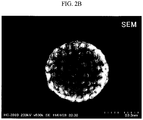
- the fluorinated thiol (PEG4)-presenting gold particle aggregate was observed with an electron microscope (HD-2000, by Hitachi, Ltd.) at an acceleration voltage of 200 kV.
- FIGS. 2A to D From the SEM image of FIG. 2B it was confirmed that a surface of a spherical structure was covered with particles, and that a 3-dimensional spherical structure was formed. Further, it was confirmed from the TEM image of FIG.
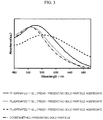
- the absorbance of the THF solution of the fluorinated thiol (PEG4)-presenting gold particle aggregate, the THF solution of the fluorinated thiol (PEG3)-presenting gold particle aggregate, and the THF solution of the fluorinated thiol (PEG2)-presenting gold particle aggregate obtained as above, and the absorbance of a THF solution of a dodecanethiol-presenting gold particle prepared as a control were measured at the substantially same concentration of a gold nanoparticle in each solution with an ultraviolet and visible spectrophotometer (UV-1650PC, by Shimadzu Corporation).
- the dodecanethiol-presenting gold particle does not have a fluorinated segment and a PEG segment.
- the results are shown in FIG. 3 and Table 1. It was confirmed that compared to the absorbance of the THF solution of the dodecanethiol-presenting gold particle, the absorbance of any of the THF solution of the fluorinated thiol (PEG4)-presenting gold particle aggregate, the THF solution of the fluorinated thiol (PEG3)-presenting gold particle aggregate, and the THF solution of the fluorinated thiol (PEG2)-presenting gold particle aggregate was shifted to the long-wavelength side. From this it was confirmed that a particle aggregate was formed in a solution.
- the content ratio of gold atom to sulfur atom was determined by dissolving the THF solution of the fluorinated thiol (PEG2)-presenting gold particle aggregate obtained as above in aqua regia and burning the same in high-frequency inductively coupled plasma. From the content ratio and based on the number of gold atoms presented on a surface, the coverage was calculated. As the result, the coverage was 58.1%.
- PEG2 fluorinated thiol
- SAXS X-ray small-angle scattering
- an X-ray small-angle scattering (SAXS) analysis was conducted on the THF solution of the fluorinated thiol (PEG2)-presenting gold particle aggregate obtained as above. Specifically, the X-ray scattering intensity of the particle aggregate based on found values and the X-ray scattering intensity of a core-shell model (fitting) were compared to examine whether the SAXS scattering profiles coincide.
- SAXS scattering intensity of the particle aggregate an X-ray diffractometer NANO-Viewer (by Rigaku Corporation) was used (measurement conditions: camera length: 600 mm, exposure time: 3 hours, detection: imaging plate, X-ray wavelength: 0.1542 nm).
- NANO-Viewer by Rigaku Corporation
- 2 S q q 4 ⁇ / ⁇ sin 2 ⁇ ⁇ ⁇ /2 (q: scattering vector, ⁇ : X-ray wavelength, ⁇ : one-half of angle between scattered beam and incoming beam)
- a form factor is considered.
- the form factor is represented by the following formula.
- F core_shell q , R , d ⁇ 2 ⁇ ⁇ 1 4 ⁇ ⁇ / q 3 sin qR ⁇ qRcos qR + ⁇ 1 ⁇ ⁇ 0 4 ⁇ ⁇ / q 3 sinq R + d ⁇ q R + d cos q R + d (R: internal radius of shell, d: thickness of shell, ⁇ 0 : density outside shell, ⁇ 1 : density of shell, ⁇ 2 : density inside shell, ( FIG. 4 ))
- FIG. 5 with respect to the X-ray scattering intensity for the particle aggregate, a comparison between a found value curve and a fitting curve is shown. The found value curve and the fitting curve substantially coincided. From this, it was confirmed that the particle aggregate was a hollow body.
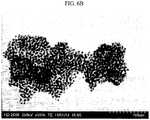
- FTEG-C 11-SH not having a PEG segment, or PEG4-C11-SH not having a fluorinated segment was mixed with a 5 nm gold-citric acid colloidal solution respectively, followed by a ligand exchange reaction same as above, to yield a gold particle solution not having a PEG segment, or a gold particle solution not having a fluorinated segment.
- the gold particle not having a PEG segment and the gold particle not having a fluorinated segment are shown respectively as follows:
- FIG. 6A is an electron microscopic image of a gold particle not having a PEG segment
- FIG. 6B is an electron microscopic image of a gold particle not having a fluorinated segment. It was confirmed that both the particles did not form a particle aggregate. From this it became clear that by using a surface modifier provided with a fluorinated segment (first segment) and a PEG segment (second segment) self organization of particles was attained and a particle aggregate could be yielded.
- the Raman active scattering enhancement activity of a hollow particle aggregate according to the present invention on a substrate was investigated.
- the Raman shift was measured by dropping the 5 nm gold-citric acid colloidal solution used in Example 1 and CV on a silicon substrate same as above.
- a peak originated from CV was not detected, but with respect to the THF solution of the fluorinated thiol (PEG2)-presenting gold particle aggregate, peaks originated from CV were detected. From this it was confirmed that the fluorinated thiol (PEG2)-presenting gold particle aggregate enhanced the Raman scattering activity. In other words, it was confirmed that the fluorinated thiol (PEG2)-presenting gold particle aggregate, when the same was spread over a substrate, enhanced light absorption by localized surface plasmon resonance.
- the Raman active scattering enhancement activity of a hollow particle aggregate according to the present invention in a solution was investigated.
- Formation of a spherical structure was compared by replacing a solvent for the fluorinated thiol (PEG4)-presenting gold particle aggregate with various solvents.
- the THF solution of the fluorinated thiol (PEG4)-presenting gold particle aggregate obtained in Example 1 was centrifuged at 10,000 rpm and 4°C for 5 min. After removing the supernatant with a micropipetter, each of the replacement solvents of ethyl acetate, dichloromethane, acetone, butanol, methanol, and dimethylformamide (DMF) was added to the pellet and the mixture was exposed to ultrasonic waves for approx. 10 sec as above to replace the solvent with each replacement solvent.
- the product was dropped on a grid mesh for a TEM electron microscope as above, dried for half a day or longer, and observed with an electron microscope as above. The results are shown in Table 2.
- a fluorinated thiol (PEG2)-presenting gold particle aggregate was embedded in an epoxy resin by mixing 50 ⁇ L of the THF solution of the fluorinated thiol (PEG2)-presenting gold particle aggregate obtained in Example 1 and 450 ⁇ L of an epoxy resin (Epok812, Okenshoji Co., Ltd.), and curing the same at 60°C for 12 hours.
- the color of the epoxy resin before the curing reaction was purple, and the color of the epoxy resin stored at room temperature for 1 month after the curing reaction was still purple.
- a hollow particle aggregate, a light enhancing element, and an apparatus utilizing a photochemical reaction according to the present invention is able to be produced by a simple operation, and is superior in a light enhancing effect. Further, a production method for a hollow particle aggregate according to the present invention is able to be exercised by a simple operation.
Landscapes
- Chemical & Material Sciences (AREA)
- Organic Chemistry (AREA)
- Engineering & Computer Science (AREA)
- Nanotechnology (AREA)
- Materials Engineering (AREA)
- Composite Materials (AREA)
- Physics & Mathematics (AREA)
- Condensed Matter Physics & Semiconductors (AREA)
- General Physics & Mathematics (AREA)
- Crystallography & Structural Chemistry (AREA)
- Organic Low-Molecular-Weight Compounds And Preparation Thereof (AREA)
- Powder Metallurgy (AREA)
- Catalysts (AREA)
- Medicines Containing Antibodies Or Antigens For Use As Internal Diagnostic Agents (AREA)
- Medicinal Preparation (AREA)
Claims (9)
- Agrégat de particules creuses comprenant une pluralité de particules aptes à s'auto-organiser, dans lequel les particules aptes à s'auto-organiser sont caractérisées en ce qu'un noyau métallique qui est une nanoparticule métallique ayant un diamètre à l'échelle nanométrique est modifié par un modificateur de surface pour un noyau métallique comprenant un premier segment comprenant un groupe alkylène glycol fluoré facultativement ramifié, un groupe alkylène fluoré facultativement ramifié ou un groupe azaalkylène fluoré facultativement ramifié ; un second segment comprenant au moins un groupe hydrophile et se liant à l'une des extrémités d'une chaîne principale du premier segment ; et un groupe fonctionnel qui se lie directement ou indirectement à l'autre extrémité de la chaîne principale du premier segment et est capable de se lier au noyau métallique,
et dans lequel le modificateur de surface pour un noyau métallique est exprimé par une formule générale Rt-(Rh-O)l-Rf-Ra-X, dans lequel Rt représente un atome d'hydrogène, un groupe hydroxy, un groupe alcoxyle en C1 à C4 ou un groupe alkyle en C1 à C4, Rh représente un groupe alkylène en C2 à C6 facultativement ramifié, Rf est choisi parmi l'ensemble constitué des formules générales (1) et (2) suivantes,

- Agrégat de particules creuses selon la revendication 1, dans lequel l'agrégat est un corps presque sphérique.
- Agrégat de particules creuses selon la revendication 2, dans lequel le diamètre du corps presque sphérique est de 30 à 400 nm.
- Agrégat de particules creuses selon l'une quelconque des revendications 1 à 3, dans lequel la couverture d'une surface du noyau métallique par le modificateur de surface pour un noyau métallique est de 20 % ou plus.
- Agrégat de particules creuses selon l'une quelconque des revendications 1 à 4, dans lequel le noyau métallique comprend de l'or, du platine, de l'argent, du cuivre, du fer ou une boîte quantique semi-conductrice.
- Procédé de production pour un agrégat de particules comprenant une étape de mélange dans un solvant d'un noyau métallique comprenant un ligand sur une surface, et d'un modificateur de surface pour un noyau métallique comprenant un premier segment comprenant un groupe alkylène glycol fluoré facultativement ramifié, un groupe alkylène fluoré facultativement ramifié ou un groupe azaalkylène fluoré facultativement ramifié ; un second segment comprenant au moins un groupe hydrophile et se liant à l'une des extrémités d'une chaîne principale du premier segment ; et un groupe fonctionnel qui se lie directement ou indirectement à l'autre extrémité de la chaîne principale du premier segment et est capable de se lier au noyau métallique,
dans lequel le modificateur de surface pour un noyau métallique est exprimé par une formule générale Rt-(Rh-O)l-Rf-Ra-X, dans lequel Rt représente un atome d'hydrogène, un groupe hydroxy, un groupe alcoxyle en C1 à C4 ou un groupe alkyle en C1 à C4, Rh représente un groupe alkylène en C2 à C6 facultativement ramifié, Rf est choisi parmi l'ensemble constitué des formules générales (1) et (2) suivantes,

- Procédé de production pour un agrégat de particules selon la revendication 6 comprenant après l'étape une étape supplémentaire de remplacement du solvant par un solvant de remplacement.
- Élément amplificateur de lumière qui amplifie l'absorption de la lumière par résonance plasmonique de surface localisée comprenant l'agrégat de particules creuses selon l'une quelconque des revendications 1 à 5.
- Appareil utilisant une réaction photochimique, comprenant l'élément amplificateur de lumière selon la revendication 8.
Applications Claiming Priority (2)
| Application Number | Priority Date | Filing Date | Title |
|---|---|---|---|
| JP2011036468 | 2011-02-22 | ||
| PCT/JP2012/054279 WO2012115151A1 (fr) | 2011-02-22 | 2012-02-22 | Agrégat de particules, procédé de fabrication d'agrégat de particules, élément amplificateur de fluorescence et dispositif utilisant des réactions photochimiques |
Publications (3)
| Publication Number | Publication Date |
|---|---|
| EP2679322A1 EP2679322A1 (fr) | 2014-01-01 |
| EP2679322A4 EP2679322A4 (fr) | 2016-04-13 |
| EP2679322B1 true EP2679322B1 (fr) | 2019-02-06 |
Family
ID=46720927
Family Applications (1)
| Application Number | Title | Priority Date | Filing Date |
|---|---|---|---|
| EP12750017.1A Not-in-force EP2679322B1 (fr) | 2011-02-22 | 2012-02-22 | Agrégat de particules, procédé de fabrication d'agrégat de particules, élément amplificateur de fluorescence et dispositif utilisant des réactions photochimiques |
Country Status (4)
| Country | Link |
|---|---|
| US (1) | US9447316B2 (fr) |
| EP (1) | EP2679322B1 (fr) |
| JP (1) | JP5904499B2 (fr) |
| WO (1) | WO2012115151A1 (fr) |
Families Citing this family (4)
| Publication number | Priority date | Publication date | Assignee | Title |
|---|---|---|---|---|
| US10475967B2 (en) * | 2017-04-27 | 2019-11-12 | Osram Opto Semiconductors Gmbh | Wavelength converters with improved thermal conductivity and lighting devices including the same |
| US11121290B2 (en) * | 2017-11-08 | 2021-09-14 | Nano And Advanced Materials Institute Limited | Barrier free stable quantum dot film |
| JP7848500B2 (ja) | 2022-02-18 | 2026-04-21 | セイコーエプソン株式会社 | 射出成形用粉末、射出成形用粉末の製造方法および金属焼結体の製造方法 |
| CN117897066A (zh) * | 2022-05-18 | 2024-04-16 | 韩国烟草人参公社 | 加热结构及包括加热结构的气溶胶生成装置 |
Family Cites Families (5)
| Publication number | Priority date | Publication date | Assignee | Title |
|---|---|---|---|---|
| JPH09913A (ja) * | 1995-06-14 | 1997-01-07 | Res Dev Corp Of Japan | コロイド粒子クラスターとその形成方法 |
| US5888290A (en) * | 1996-05-24 | 1999-03-30 | Minnesota Mining And Manufacturing Company | Composition and process for imparting durable repellency to substrates |
| KR100853086B1 (ko) * | 2007-04-25 | 2008-08-19 | 삼성전자주식회사 | 나노결정-금속산화물 복합체 및 그의 제조방법 |
| JP4356779B2 (ja) | 2007-07-13 | 2009-11-04 | 豊田合成株式会社 | 赤外線反射材、赤外線反射積層体および赤外線反射構造体ならびにその製造方法 |
| CN102307734B (zh) * | 2008-12-11 | 2015-06-03 | 3M创新有限公司 | 图案化方法 |
-
2012
- 2012-02-22 EP EP12750017.1A patent/EP2679322B1/fr not_active Not-in-force
- 2012-02-22 WO PCT/JP2012/054279 patent/WO2012115151A1/fr not_active Ceased
- 2012-02-22 JP JP2013501096A patent/JP5904499B2/ja active Active
- 2012-02-22 US US14/000,749 patent/US9447316B2/en not_active Expired - Fee Related
Non-Patent Citations (1)
| Title |
|---|
| None * |
Also Published As
| Publication number | Publication date |
|---|---|
| WO2012115151A1 (fr) | 2012-08-30 |
| JPWO2012115151A1 (ja) | 2014-07-07 |
| JP5904499B2 (ja) | 2016-04-13 |
| US9447316B2 (en) | 2016-09-20 |
| EP2679322A1 (fr) | 2014-01-01 |
| EP2679322A4 (fr) | 2016-04-13 |
| US20140077132A1 (en) | 2014-03-20 |
Similar Documents
| Publication | Publication Date | Title |
|---|---|---|
| Wang et al. | 2D nanostructures beyond graphene: preparation, biocompatibility and biodegradation behaviors | |
| Su et al. | pH-guided self-assembly of copper nanoclusters with aggregation-induced emission | |
| Zhou et al. | Luminescent gold nanoparticles with mixed valence states generated from dissociation of polymeric Au (I) thiolates | |
| Muhammed et al. | Growth of in situ functionalized luminescent silver nanoclusters by direct reduction and size focusing | |
| JP5577329B2 (ja) | pH感受性金属ナノ粒子およびその製造方法 | |
| US9352394B2 (en) | Nano aggregates of molecular ultra small clusters of noble metals and a process for the preparation thereof | |
| EP2679322B1 (fr) | Agrégat de particules, procédé de fabrication d'agrégat de particules, élément amplificateur de fluorescence et dispositif utilisant des réactions photochimiques | |
| Murugan et al. | Efficient amphiphilic poly (propyleneimine) dendrimer stabilized gold nanoparticle catalysts for aqueous phase reduction of nitrobenzene | |
| CN102643643A (zh) | 一种水溶性闪锌矿结构CuInS2或/和CuInS2/ZnS核壳结构量子点的制备方法 | |
| AU2012232759B2 (en) | Method for producing silver nanofilaments | |
| Kalva et al. | Aggregation-induced emission-active hyperbranched polymer-based nanoparticles and their biological imaging applications | |
| Kashyap et al. | Thermo-responsive and shape transformable amphiphilic scaffolds for loading and delivering anticancer drugs | |
| Zhang et al. | Ultrastable hydrophilic gold nanoclusters protected by sulfonic thiolate ligands | |
| Muthusami et al. | Synthesis of mesoporous silica nanoparticles with a lychee-like morphology and dual pore arrangement and its application towards biomimetic activity via functionalization with copper (II) complex | |
| Fatykhova et al. | Gallic acid-based dendrimers with a thiacalix [4] arene core: synthesis, aggregation and use for stabilization of Pd nanoparticles | |
| Yang et al. | A facile preparation of targetable pH-sensitive polymeric nanocarriers with encapsulated magnetic nanoparticles for controlled drug release | |
| CN107382934A (zh) | 一种巯基功能化香豆素衍生物及其制备方法和应用 | |
| Ocherednyuk et al. | Epichlorohydrin-based CuAAC dendrimers with a calix [4] arene core and polar hydroxyl/oxyethyl terminal groups: synthesis, aggregation and use in catalysis | |
| Patil et al. | Copper and silver nanoparticles stabilized by bistriazole-based dendritic amphiphile micelles for 4-nitrophenol reduction | |
| JP4476899B2 (ja) | 金属ナノ微粒子複合体およびその製造方法、金属ナノ微粒子複合体凝集物およびその製造方法 | |
| CN103694614A (zh) | 一种贵金属/聚合物微球Janus粒子及其制备方法 | |
| CN110559271B (zh) | 具有成像功能的五重刺激响应型纳米载体及其制备方法 | |
| Mi et al. | Synthesis and co-assembly of gold nanoparticles functionalized by a pyrene–thiol derivative | |
| KR101171891B1 (ko) | 폴리올을 이용한 무극성 탄소나노소재 및 그 제조방법 | |
| CN114951677B (zh) | 组装结构可调的金纳米材料组装体及其制备方法与应用 |
Legal Events
| Date | Code | Title | Description |
|---|---|---|---|
| PUAI | Public reference made under article 153(3) epc to a published international application that has entered the european phase |
Free format text: ORIGINAL CODE: 0009012 |
|
| 17P | Request for examination filed |
Effective date: 20130911 |
|
| AK | Designated contracting states |
Kind code of ref document: A1 Designated state(s): AL AT BE BG CH CY CZ DE DK EE ES FI FR GB GR HR HU IE IS IT LI LT LU LV MC MK MT NL NO PL PT RO RS SE SI SK SM TR |
|
| DAX | Request for extension of the european patent (deleted) | ||
| RA4 | Supplementary search report drawn up and despatched (corrected) |
Effective date: 20160311 |
|
| RIC1 | Information provided on ipc code assigned before grant |
Ipc: B82Y 30/00 20110101ALI20160307BHEP Ipc: B22F 1/00 20060101ALI20160307BHEP Ipc: C07F 1/12 20060101ALI20160307BHEP Ipc: B22F 1/02 20060101AFI20160307BHEP Ipc: C07C 323/12 20060101ALI20160307BHEP |
|
| STAA | Information on the status of an ep patent application or granted ep patent |
Free format text: STATUS: EXAMINATION IS IN PROGRESS |
|
| 17Q | First examination report despatched |
Effective date: 20180419 |
|
| GRAP | Despatch of communication of intention to grant a patent |
Free format text: ORIGINAL CODE: EPIDOSNIGR1 |
|
| STAA | Information on the status of an ep patent application or granted ep patent |
Free format text: STATUS: GRANT OF PATENT IS INTENDED |
|
| INTG | Intention to grant announced |
Effective date: 20181008 |
|
| GRAS | Grant fee paid |
Free format text: ORIGINAL CODE: EPIDOSNIGR3 |
|
| GRAA | (expected) grant |
Free format text: ORIGINAL CODE: 0009210 |
|
| STAA | Information on the status of an ep patent application or granted ep patent |
Free format text: STATUS: THE PATENT HAS BEEN GRANTED |
|
| AK | Designated contracting states |
Kind code of ref document: B1 Designated state(s): AL AT BE BG CH CY CZ DE DK EE ES FI FR GB GR HR HU IE IS IT LI LT LU LV MC MK MT NL NO PL PT RO RS SE SI SK SM TR |
|
| REG | Reference to a national code |
Ref country code: GB Ref legal event code: FG4D |
|
| REG | Reference to a national code |
Ref country code: CH Ref legal event code: EP Ref country code: AT Ref legal event code: REF Ref document number: 1094551 Country of ref document: AT Kind code of ref document: T Effective date: 20190215 |
|
| REG | Reference to a national code |
Ref country code: IE Ref legal event code: FG4D |
|
| REG | Reference to a national code |
Ref country code: DE Ref legal event code: R096 Ref document number: 602012056464 Country of ref document: DE |
|
| REG | Reference to a national code |
Ref country code: NL Ref legal event code: MP Effective date: 20190206 |
|
| REG | Reference to a national code |
Ref country code: LT Ref legal event code: MG4D |
|
| PG25 | Lapsed in a contracting state [announced via postgrant information from national office to epo] |
Ref country code: NO Free format text: LAPSE BECAUSE OF FAILURE TO SUBMIT A TRANSLATION OF THE DESCRIPTION OR TO PAY THE FEE WITHIN THE PRESCRIBED TIME-LIMIT Effective date: 20190506 Ref country code: NL Free format text: LAPSE BECAUSE OF FAILURE TO SUBMIT A TRANSLATION OF THE DESCRIPTION OR TO PAY THE FEE WITHIN THE PRESCRIBED TIME-LIMIT Effective date: 20190206 Ref country code: LT Free format text: LAPSE BECAUSE OF FAILURE TO SUBMIT A TRANSLATION OF THE DESCRIPTION OR TO PAY THE FEE WITHIN THE PRESCRIBED TIME-LIMIT Effective date: 20190206 Ref country code: SE Free format text: LAPSE BECAUSE OF FAILURE TO SUBMIT A TRANSLATION OF THE DESCRIPTION OR TO PAY THE FEE WITHIN THE PRESCRIBED TIME-LIMIT Effective date: 20190206 Ref country code: PT Free format text: LAPSE BECAUSE OF FAILURE TO SUBMIT A TRANSLATION OF THE DESCRIPTION OR TO PAY THE FEE WITHIN THE PRESCRIBED TIME-LIMIT Effective date: 20190606 Ref country code: FI Free format text: LAPSE BECAUSE OF FAILURE TO SUBMIT A TRANSLATION OF THE DESCRIPTION OR TO PAY THE FEE WITHIN THE PRESCRIBED TIME-LIMIT Effective date: 20190206 |
|
| REG | Reference to a national code |
Ref country code: AT Ref legal event code: MK05 Ref document number: 1094551 Country of ref document: AT Kind code of ref document: T Effective date: 20190206 |
|
| PG25 | Lapsed in a contracting state [announced via postgrant information from national office to epo] |
Ref country code: LV Free format text: LAPSE BECAUSE OF FAILURE TO SUBMIT A TRANSLATION OF THE DESCRIPTION OR TO PAY THE FEE WITHIN THE PRESCRIBED TIME-LIMIT Effective date: 20190206 Ref country code: IS Free format text: LAPSE BECAUSE OF FAILURE TO SUBMIT A TRANSLATION OF THE DESCRIPTION OR TO PAY THE FEE WITHIN THE PRESCRIBED TIME-LIMIT Effective date: 20190606 Ref country code: BG Free format text: LAPSE BECAUSE OF FAILURE TO SUBMIT A TRANSLATION OF THE DESCRIPTION OR TO PAY THE FEE WITHIN THE PRESCRIBED TIME-LIMIT Effective date: 20190506 Ref country code: RS Free format text: LAPSE BECAUSE OF FAILURE TO SUBMIT A TRANSLATION OF THE DESCRIPTION OR TO PAY THE FEE WITHIN THE PRESCRIBED TIME-LIMIT Effective date: 20190206 Ref country code: HR Free format text: LAPSE BECAUSE OF FAILURE TO SUBMIT A TRANSLATION OF THE DESCRIPTION OR TO PAY THE FEE WITHIN THE PRESCRIBED TIME-LIMIT Effective date: 20190206 Ref country code: GR Free format text: LAPSE BECAUSE OF FAILURE TO SUBMIT A TRANSLATION OF THE DESCRIPTION OR TO PAY THE FEE WITHIN THE PRESCRIBED TIME-LIMIT Effective date: 20190507 |
|
| REG | Reference to a national code |
Ref country code: DE Ref legal event code: R119 Ref document number: 602012056464 Country of ref document: DE |
|
| REG | Reference to a national code |
Ref country code: CH Ref legal event code: PL |
|
| PG25 | Lapsed in a contracting state [announced via postgrant information from national office to epo] |
Ref country code: AL Free format text: LAPSE BECAUSE OF FAILURE TO SUBMIT A TRANSLATION OF THE DESCRIPTION OR TO PAY THE FEE WITHIN THE PRESCRIBED TIME-LIMIT Effective date: 20190206 Ref country code: ES Free format text: LAPSE BECAUSE OF FAILURE TO SUBMIT A TRANSLATION OF THE DESCRIPTION OR TO PAY THE FEE WITHIN THE PRESCRIBED TIME-LIMIT Effective date: 20190206 Ref country code: SK Free format text: LAPSE BECAUSE OF FAILURE TO SUBMIT A TRANSLATION OF THE DESCRIPTION OR TO PAY THE FEE WITHIN THE PRESCRIBED TIME-LIMIT Effective date: 20190206 Ref country code: RO Free format text: LAPSE BECAUSE OF FAILURE TO SUBMIT A TRANSLATION OF THE DESCRIPTION OR TO PAY THE FEE WITHIN THE PRESCRIBED TIME-LIMIT Effective date: 20190206 Ref country code: CZ Free format text: LAPSE BECAUSE OF FAILURE TO SUBMIT A TRANSLATION OF THE DESCRIPTION OR TO PAY THE FEE WITHIN THE PRESCRIBED TIME-LIMIT Effective date: 20190206 Ref country code: DK Free format text: LAPSE BECAUSE OF FAILURE TO SUBMIT A TRANSLATION OF THE DESCRIPTION OR TO PAY THE FEE WITHIN THE PRESCRIBED TIME-LIMIT Effective date: 20190206 Ref country code: LU Free format text: LAPSE BECAUSE OF NON-PAYMENT OF DUE FEES Effective date: 20190222 Ref country code: IT Free format text: LAPSE BECAUSE OF FAILURE TO SUBMIT A TRANSLATION OF THE DESCRIPTION OR TO PAY THE FEE WITHIN THE PRESCRIBED TIME-LIMIT Effective date: 20190206 Ref country code: EE Free format text: LAPSE BECAUSE OF FAILURE TO SUBMIT A TRANSLATION OF THE DESCRIPTION OR TO PAY THE FEE WITHIN THE PRESCRIBED TIME-LIMIT Effective date: 20190206 |
|
| REG | Reference to a national code |
Ref country code: BE Ref legal event code: MM Effective date: 20190228 |
|
| REG | Reference to a national code |
Ref country code: IE Ref legal event code: MM4A |
|
| PG25 | Lapsed in a contracting state [announced via postgrant information from national office to epo] |
Ref country code: SM Free format text: LAPSE BECAUSE OF FAILURE TO SUBMIT A TRANSLATION OF THE DESCRIPTION OR TO PAY THE FEE WITHIN THE PRESCRIBED TIME-LIMIT Effective date: 20190206 Ref country code: PL Free format text: LAPSE BECAUSE OF FAILURE TO SUBMIT A TRANSLATION OF THE DESCRIPTION OR TO PAY THE FEE WITHIN THE PRESCRIBED TIME-LIMIT Effective date: 20190206 |
|
| PLBE | No opposition filed within time limit |
Free format text: ORIGINAL CODE: 0009261 |
|
| STAA | Information on the status of an ep patent application or granted ep patent |
Free format text: STATUS: NO OPPOSITION FILED WITHIN TIME LIMIT |
|
| PG25 | Lapsed in a contracting state [announced via postgrant information from national office to epo] |
Ref country code: CH Free format text: LAPSE BECAUSE OF NON-PAYMENT OF DUE FEES Effective date: 20190228 Ref country code: MC Free format text: LAPSE BECAUSE OF FAILURE TO SUBMIT A TRANSLATION OF THE DESCRIPTION OR TO PAY THE FEE WITHIN THE PRESCRIBED TIME-LIMIT Effective date: 20190206 Ref country code: LI Free format text: LAPSE BECAUSE OF NON-PAYMENT OF DUE FEES Effective date: 20190228 Ref country code: AT Free format text: LAPSE BECAUSE OF FAILURE TO SUBMIT A TRANSLATION OF THE DESCRIPTION OR TO PAY THE FEE WITHIN THE PRESCRIBED TIME-LIMIT Effective date: 20190206 |
|
| 26N | No opposition filed |
Effective date: 20191107 |
|
| PG25 | Lapsed in a contracting state [announced via postgrant information from national office to epo] |
Ref country code: DE Free format text: LAPSE BECAUSE OF NON-PAYMENT OF DUE FEES Effective date: 20190903 Ref country code: IE Free format text: LAPSE BECAUSE OF NON-PAYMENT OF DUE FEES Effective date: 20190222 |
|
| PG25 | Lapsed in a contracting state [announced via postgrant information from national office to epo] |
Ref country code: SI Free format text: LAPSE BECAUSE OF FAILURE TO SUBMIT A TRANSLATION OF THE DESCRIPTION OR TO PAY THE FEE WITHIN THE PRESCRIBED TIME-LIMIT Effective date: 20190206 Ref country code: BE Free format text: LAPSE BECAUSE OF NON-PAYMENT OF DUE FEES Effective date: 20190228 Ref country code: FR Free format text: LAPSE BECAUSE OF NON-PAYMENT OF DUE FEES Effective date: 20190406 |
|
| PG25 | Lapsed in a contracting state [announced via postgrant information from national office to epo] |
Ref country code: TR Free format text: LAPSE BECAUSE OF FAILURE TO SUBMIT A TRANSLATION OF THE DESCRIPTION OR TO PAY THE FEE WITHIN THE PRESCRIBED TIME-LIMIT Effective date: 20190206 |
|
| PGFP | Annual fee paid to national office [announced via postgrant information from national office to epo] |
Ref country code: GB Payment date: 20200225 Year of fee payment: 9 |
|
| PG25 | Lapsed in a contracting state [announced via postgrant information from national office to epo] |
Ref country code: MT Free format text: LAPSE BECAUSE OF NON-PAYMENT OF DUE FEES Effective date: 20190222 |
|
| PG25 | Lapsed in a contracting state [announced via postgrant information from national office to epo] |
Ref country code: CY Free format text: LAPSE BECAUSE OF FAILURE TO SUBMIT A TRANSLATION OF THE DESCRIPTION OR TO PAY THE FEE WITHIN THE PRESCRIBED TIME-LIMIT Effective date: 20190206 |
|
| PG25 | Lapsed in a contracting state [announced via postgrant information from national office to epo] |
Ref country code: HU Free format text: LAPSE BECAUSE OF FAILURE TO SUBMIT A TRANSLATION OF THE DESCRIPTION OR TO PAY THE FEE WITHIN THE PRESCRIBED TIME-LIMIT; INVALID AB INITIO Effective date: 20120222 |
|
| GBPC | Gb: european patent ceased through non-payment of renewal fee |
Effective date: 20210222 |
|
| PG25 | Lapsed in a contracting state [announced via postgrant information from national office to epo] |
Ref country code: GB Free format text: LAPSE BECAUSE OF NON-PAYMENT OF DUE FEES Effective date: 20210222 |
|
| PG25 | Lapsed in a contracting state [announced via postgrant information from national office to epo] |
Ref country code: MK Free format text: LAPSE BECAUSE OF FAILURE TO SUBMIT A TRANSLATION OF THE DESCRIPTION OR TO PAY THE FEE WITHIN THE PRESCRIBED TIME-LIMIT Effective date: 20190206 |