EP2679410B1 - Reifen - Google Patents
Reifen Download PDFInfo
- Publication number
- EP2679410B1 EP2679410B1 EP12750073.4A EP12750073A EP2679410B1 EP 2679410 B1 EP2679410 B1 EP 2679410B1 EP 12750073 A EP12750073 A EP 12750073A EP 2679410 B1 EP2679410 B1 EP 2679410B1
- Authority
- EP
- European Patent Office
- Prior art keywords
- tire
- rubber
- mass
- parts
- amount
- Prior art date
- Legal status (The legal status is an assumption and is not a legal conclusion. Google has not performed a legal analysis and makes no representation as to the accuracy of the status listed.)
- Not-in-force
Links
Images

Classifications
-
- B—PERFORMING OPERATIONS; TRANSPORTING
- B60—VEHICLES IN GENERAL
- B60C—VEHICLE TYRES; TYRE INFLATION; TYRE CHANGING; CONNECTING VALVES TO INFLATABLE ELASTIC BODIES IN GENERAL; DEVICES OR ARRANGEMENTS RELATED TO TYRES
- B60C5/00—Inflatable pneumatic tyres or inner tubes
-
- B—PERFORMING OPERATIONS; TRANSPORTING
- B29—WORKING OF PLASTICS; WORKING OF SUBSTANCES IN A PLASTIC STATE IN GENERAL
- B29D—PRODUCING PARTICULAR ARTICLES FROM PLASTICS OR FROM SUBSTANCES IN A PLASTIC STATE
- B29D30/00—Producing pneumatic or solid tyres or parts thereof
- B29D30/06—Pneumatic tyres or parts thereof (e.g. produced by casting, moulding, compression moulding, injection moulding, centrifugal casting)
- B29D30/52—Unvulcanised treads, e.g. on used tyres; Retreading
- B29D30/58—Applying bands of rubber treads, i.e. applying camel backs
-
- B—PERFORMING OPERATIONS; TRANSPORTING
- B60—VEHICLES IN GENERAL
- B60C—VEHICLE TYRES; TYRE INFLATION; TYRE CHANGING; CONNECTING VALVES TO INFLATABLE ELASTIC BODIES IN GENERAL; DEVICES OR ARRANGEMENTS RELATED TO TYRES
- B60C1/00—Tyres characterised by the chemical composition or the physical arrangement or mixture of the composition
- B60C1/0008—Compositions of the inner liner
-
- B—PERFORMING OPERATIONS; TRANSPORTING
- B60—VEHICLES IN GENERAL
- B60C—VEHICLE TYRES; TYRE INFLATION; TYRE CHANGING; CONNECTING VALVES TO INFLATABLE ELASTIC BODIES IN GENERAL; DEVICES OR ARRANGEMENTS RELATED TO TYRES
- B60C1/00—Tyres characterised by the chemical composition or the physical arrangement or mixture of the composition
- B60C1/0016—Compositions of the tread
-
- B—PERFORMING OPERATIONS; TRANSPORTING
- B60—VEHICLES IN GENERAL
- B60C—VEHICLE TYRES; TYRE INFLATION; TYRE CHANGING; CONNECTING VALVES TO INFLATABLE ELASTIC BODIES IN GENERAL; DEVICES OR ARRANGEMENTS RELATED TO TYRES
- B60C1/00—Tyres characterised by the chemical composition or the physical arrangement or mixture of the composition
- B60C1/0041—Compositions of the carcass layers
-
- B—PERFORMING OPERATIONS; TRANSPORTING
- B60—VEHICLES IN GENERAL
- B60C—VEHICLE TYRES; TYRE INFLATION; TYRE CHANGING; CONNECTING VALVES TO INFLATABLE ELASTIC BODIES IN GENERAL; DEVICES OR ARRANGEMENTS RELATED TO TYRES
- B60C19/00—Tyre parts or constructions not otherwise provided for
-
- C—CHEMISTRY; METALLURGY
- C08—ORGANIC MACROMOLECULAR COMPOUNDS; THEIR PREPARATION OR CHEMICAL WORKING-UP; COMPOSITIONS BASED THEREON
- C08K—Use of inorganic or non-macromolecular organic substances as compounding ingredients
- C08K3/00—Use of inorganic substances as compounding ingredients
- C08K3/02—Elements
- C08K3/04—Carbon
-
- C—CHEMISTRY; METALLURGY
- C08—ORGANIC MACROMOLECULAR COMPOUNDS; THEIR PREPARATION OR CHEMICAL WORKING-UP; COMPOSITIONS BASED THEREON
- C08K—Use of inorganic or non-macromolecular organic substances as compounding ingredients
- C08K5/00—Use of organic ingredients
- C08K5/04—Oxygen-containing compounds
- C08K5/09—Carboxylic acids; Metal salts thereof; Anhydrides thereof
- C08K5/098—Metal salts of carboxylic acids
-
- C—CHEMISTRY; METALLURGY
- C08—ORGANIC MACROMOLECULAR COMPOUNDS; THEIR PREPARATION OR CHEMICAL WORKING-UP; COMPOSITIONS BASED THEREON
- C08L—COMPOSITIONS OF MACROMOLECULAR COMPOUNDS
- C08L7/00—Compositions of natural rubber
-
- C—CHEMISTRY; METALLURGY
- C08—ORGANIC MACROMOLECULAR COMPOUNDS; THEIR PREPARATION OR CHEMICAL WORKING-UP; COMPOSITIONS BASED THEREON
- C08L—COMPOSITIONS OF MACROMOLECULAR COMPOUNDS
- C08L9/00—Compositions of homopolymers or copolymers of conjugated diene hydrocarbons
-
- B—PERFORMING OPERATIONS; TRANSPORTING
- B60—VEHICLES IN GENERAL
- B60C—VEHICLE TYRES; TYRE INFLATION; TYRE CHANGING; CONNECTING VALVES TO INFLATABLE ELASTIC BODIES IN GENERAL; DEVICES OR ARRANGEMENTS RELATED TO TYRES
- B60C1/00—Tyres characterised by the chemical composition or the physical arrangement or mixture of the composition
- B60C2001/0066—Compositions of the belt layers
-
- B—PERFORMING OPERATIONS; TRANSPORTING
- B60—VEHICLES IN GENERAL
- B60C—VEHICLE TYRES; TYRE INFLATION; TYRE CHANGING; CONNECTING VALVES TO INFLATABLE ELASTIC BODIES IN GENERAL; DEVICES OR ARRANGEMENTS RELATED TO TYRES
- B60C1/00—Tyres characterised by the chemical composition or the physical arrangement or mixture of the composition
- B60C2001/0075—Compositions of belt cushioning layers
-
- Y—GENERAL TAGGING OF NEW TECHNOLOGICAL DEVELOPMENTS; GENERAL TAGGING OF CROSS-SECTIONAL TECHNOLOGIES SPANNING OVER SEVERAL SECTIONS OF THE IPC; TECHNICAL SUBJECTS COVERED BY FORMER USPC CROSS-REFERENCE ART COLLECTIONS [XRACs] AND DIGESTS
- Y02—TECHNOLOGIES OR APPLICATIONS FOR MITIGATION OR ADAPTATION AGAINST CLIMATE CHANGE
- Y02T—CLIMATE CHANGE MITIGATION TECHNOLOGIES RELATED TO TRANSPORTATION
- Y02T10/00—Road transport of goods or passengers
- Y02T10/80—Technologies aiming to reduce greenhouse gasses emissions common to all road transportation technologies
- Y02T10/86—Optimisation of rolling resistance, e.g. weight reduction
-
- Y—GENERAL TAGGING OF NEW TECHNOLOGICAL DEVELOPMENTS; GENERAL TAGGING OF CROSS-SECTIONAL TECHNOLOGIES SPANNING OVER SEVERAL SECTIONS OF THE IPC; TECHNICAL SUBJECTS COVERED BY FORMER USPC CROSS-REFERENCE ART COLLECTIONS [XRACs] AND DIGESTS
- Y10—TECHNICAL SUBJECTS COVERED BY FORMER USPC
- Y10T—TECHNICAL SUBJECTS COVERED BY FORMER US CLASSIFICATION
- Y10T152/00—Resilient tires and wheels
- Y10T152/10—Tires, resilient
- Y10T152/10495—Pneumatic tire or inner tube
Definitions
- the present invention relates to a tire in which both low rolling resistance and durability are compatible with each other.
- WO2010122396 discloses a rubber composition for tires for heavy duty vehicles.
- an object of the present invention is to provide a tire in which both low rolling resistance and durability are compatible with each other.
- the present inventor has found that the problem of the present invention can be solved by regulating a rolling resistance coefficient of a tire casing so as not to exceed 4.0, leading to accomplishment of the present invention.
- the present invention provides the following.
- a rolling resistance coefficient of a tire casing so as not to exceed 4.0, it is possible to make low rolling resistance and durability of a tire (tire including a tire casing and a tread portion) compatible with each other.
- the "tire casing” as referred to in the present invention is a tire member exclusive of a tread portion and means both a tire member before sticking a tread portion and a tire member in which a tread portion is eliminated from a finished tire.
- a base tread portion serving as a part of the tread portion may be stuck.
- the “tire casing” means the above-described tire member which has been vulcanized, and the above-described tire member that is unvulcanized is referred to as an "unvulcanized tire casing".
- the tire of the present invention is characterized in that a tire casing thereof has a rolling resistance coefficient according to the coastdown method of JIS D4234 of not exceeding 4.0.
- This rolling resistance coefficient is preferably in the range of not exceeding 3.8, and more preferably in the range of not exceeding 3.7.
- a condition determined on the basis of a size of a tire including a tire casing and a tread portion is adopted.
- the tire casing which is subjected to this test may be either a tire casing before sticking a tread portion or a tire casing in which a tread portion is eliminated from a finished tire, it is suitably a tire casing in which a tread portion is eliminated from a finished tire.
- the rolling resistance of the tire can be reduced to the last stage of running, and even in retreated tires after retreatment as obtained by exchanging a tread portion of the tire, the rolling resistance can be reduced.
- this ratio is 0.1 or more, it is possible to contemplate to reduce the rolling resistance and to enhance the tire durability. From this viewpoint, the foregoing ratio is preferably from 0.1 to 0.8, more preferably from 0.3 to 0.8, and still more preferably from 0.5 to 0.8.
- Examples of a method for reducing the rolling resistance coefficient of the tire casing include various methods such as change of a rubber species of the tire member, change of a vulcanization condition, change of a structure of the tire casing, etc.
- suitable examples of materials of a base tread, a belt coating rubber, a belt wedge rubber, a ply coating rubber, a belt undercushion rubber, and an inner liner rubber, each of which is located in the inside of the radial direction of a tread portion forming member in the tire casing, and suitable manufacturing methods of a tire and its members are hereunder described.
- these show merely a part of the embodiments of the present invention, and unless the gist of the present invention is deviated, these constitutions can be mutually combined, or various modifications can be made.
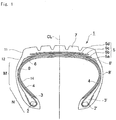
- FIG. 1 is a cross-sectional schematic view showing an example of the tire of the present invention.
- This tire 1 is composed of a tread portion 11 and a tire casing 12.
- the tread portion 11 is constituted of a tread rubber 7.
- the tire casing 12 includes bead cores 2 and 2', a carcass ply 4, belt layers 5a to 5d, and a side rubber 8, and a base tread 13.
- a structure of the tire casing 12 is as follows. Stiffeners 3 and 3' extend outward in the radial direction of the tire 1 from a pair of the bead cores 2 and 2', respectively.
- the carcass ply 4 has a shape in which it goes through the outside of the stiffener 3, is folded inside the stiffener 3 by the bead core 2 to form a shape of a horseshoe tire casing, is folded by the bead core 2' on the opposite side, and is seized outside the stiffener 3'.
- a belt portion 5 composed of a plurality of belt layers (four layers of 5a to 5d in FIG. 1 ) is arranged outside the tire radius of the carcass ply 4.
- a belt undercushion rubber 6 is arranged in the neighborhoods of end portions of the belt layers 5a and 5b forming an intersecting layer.
- a belt end cover rubber (not shown) covering an end portion is arranged in end portions of the belt layers 5a to 5d.
- These belt undercushion rubber 6 and belt end cover rubber are generically named a belt edge rubber.
- a wedge-shaped belt wedge rubber 10 is arranged in the neighborhoods of an end portion between the belt layers 5b and 5c. The belt edge rubber and the belt wedge rubber 10 are also included in the belt portion 5.
- the base tread 13 is arranged outside the tire radius of this belt portion 5, and the tread rubber 7 is further arranged thereon.
- the side rubber 8 is arranged outside the tire axial direction (thickness direction) of the carcass ply 4 and between the tread rubber 7 and the stiffener 3.
- a portion where this side rubber 8 is arranged is named a side portion M, and the more inside of the tire radius than the side portion M is named a bead portion N.
- the bead cores 2 and 2' and the stiffeners 3 and 3' are arranged.
- An inner liner layer 14 is arranged as an air permeation preventive layer in the inside of the carcass ply 4.
- the tire casing 12 has these bead portion N, side portion M and belt portion 5.
- the belt undercushion rubber 6 is described in more detail. As shown in FIG. 2 , the belt undercushion rubber 6 extends in the inside of the tire radial direction of the inner belt layer 5b forming an intersecting layer and the inside of the tire radial direction of the tread rubber 7 from the inside of the tire radial direction of the innermost belt layer 5a along the outside of the tire radial direction of the carcass ply 4 and extends to a space between the side rubber 8 and the carcass ply 4.
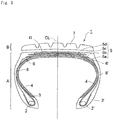
- FIG. 3 is a cross-sectional schematic view showing an example of a tire casing A and a tread portion forming member (precured tread member) B, the both being used for manufacture of the tire of FIG. 1 .
- the tire 1 can be manufactured by sticking the tread portion forming member (precured tread member) B to the tire casing A prepared by vulcanizing an unvulcanized tire casing using an adhesive rubber such as a cushion rubber, etc.
- the same symbols as those in FIG. 1 represent the same portions.
- a part of the tread rubber 7 is arranged in the tire casing prepared by vulcanizing separately from the tread portion. That is, a part of the tread rubber 7 is arranged as the base tread 13 in the outside of the tire radial direction of the belt portion 5. This is made for the purposes of making adhesion to the precured member B good and enhancing durability of the tire.
- Suitable examples of a rubber composition constituting the tire casing A are hereunder described.
- the proportion of the natural rubber is 60 % by mass or more, more preferably 70 % by mass or more, and still more preferably 80 % by mass or more in the rubber component.
- a natural rubber alone is even still more preferable.
- Examples of other synthetic rubbers that may be present include a polybutadiene rubber (BR), a styrene-butadiene copolymer (SBR), or a styrene-isoprene copolymer (SIR).
- BR polybutadiene rubber
- SBR styrene-butadiene copolymer
- SIR styrene-isoprene copolymer
- a proportion of the butadiene rubber is preferably from 10 to 40 % by mass, more preferably from 20 to 40 % by mass, and still more preferably from 25 to 35 % by mass.
- Carbon black having a nitrogen adsorption specific surface area as defined in JIS K6217-2:2001 of from 35 to 45 m 2 /g is used for the rubber composition constituting the base tread 13.
- This carbon black is compounded in an amount of from 25 to 45 parts by mass, more preferably compounded in an amount of from 30 to 45 parts by mass, and still more preferably compounded in an amount of from 30 to 40 parts by mass based on 100 parts by mass of the rubber component.
- the carbon black When the amount of the carbon black is 25 parts by mass or more, the strength of the base tread can be ensured, whereas when it is not more than 45 parts by mass, low heat generation properties and fatigue resistance of the base tread become good, and when the amount of the carbon black falls within the foregoing range, low heat generation properties and durability of the tire can be enhanced.
- An example of the carbon black includes FEF (nitrogen adsorption specific surface area: 40 to 42 m 2 /g).
- the rubber composition constituting the base tread 13 may be compounded with silica in addition to the above-described carbon black.
- silica is preferably contained in an amount of not more than 10 parts by mass based on 100 parts by mass of the rubber component of the rubber composition.
- silica all of commercially available products can be used. Above all, it is preferable to use silica by wet process, silica by dry process, or colloidal silica, and it is especially preferable to use silica by wet process.
- a BET specific surface area (measured in conformity with ISO 5794/1) of silica is preferably from 40 to 350 m 2 /g.
- Silica having a BET specific surface area falling within the foregoing range has such an advantage that both rubber reinforcing properties and dispersibility into the rubber component can be made compatible with each other.
- silica having a BET specific surface area falling within the range of from 80 to 350 m 2 /g is more preferable, and silica having a BET specific surface area falling within the range of from 120 to 350 m 2 /g is still more preferable.
- Sulfur is used as a vulcanizing agent in an amount of from 1.0 to 7.0 parts by mass based on 100 parts by mass of the rubber component in the rubber composition constituting the base tread 13, and still more preferably in the range of from 1.0 to 3.0 parts by mass.
- sulfur is compounded in an amount of not more than 7.0 parts by mass, it is possible to suitably prevent a lowering of aging resistance of the coating rubber composition from occurring.
- sulfur is compounded in an amount of 1.0 part by mass or more, initial adhesion is enhanced, and hence, such is more preferable.
- a vulcanization activator such as zinc oxide, an organic acid (e.g., stearic acid, etc.), etc.
- a vulcanization accelerator such as zinc oxide, an organic acid (e.g., stearic acid, etc.), etc.
- a vulcanization accelerator such as zinc oxide, an organic acid (e.g., stearic acid, etc.), etc.
- a vulcanization accelerator such as zinc oxide, an organic acid (e.g., stearic acid, etc.), etc.
- an inorganic filler other than silica such as an organic acid (e.g., stearic acid, etc.), etc.
- an anti-aging agent e.g., an ozone deterioration preventive agent
- a softener e.g., etc.
- a tan ⁇ of the rubber composition constituting the base tread is preferably not more than 0.09.
- a Banbury mixer, a roll, or an intensive mixer are suitably used as a kneading apparatus in manufacturing the rubber composition in the present invention.
- a natural rubber and/or a synthetic polyisoprene rubber is preferable, and a natural rubber is more preferable.
- a proportion of the natural rubber is preferably 60 % by mass or more, more preferably 70 % by mass or more, and still more preferably 80 % by mass or more in the rubber component.
- a natural rubber alone is especially preferable.
- Examples of other synthetic rubbers include a polybutadiene rubber (BR), a styrene-butadiene copolymer (SBR), and a styrene-isoprene copolymer (SIR).
- BR polybutadiene rubber
- SBR styrene-butadiene copolymer
- SIR styrene-isoprene copolymer
- carbon black having a nitrogen adsorption specific surface area as defined in JIS K6217-2:2001 of from 25 to 99 m 2 /g is suitably used for the coating rubber composition constituting the outermost belt layer 5d.
- the carbon black include HAF (nitrogen adsorption specific surface area: 75 to 80 m 2 /g), HS-HAF (nitrogen adsorption specific surface area: 78 to 83 m 2 /g), LS-HAF (nitrogen adsorption specific surface area: 80 to 85 m 2 /g), FEF (nitrogen adsorption specific surface area: 40 to 42 m 2 /g), GPF (nitrogen adsorption specific surface area: 26 to 28 m 2 /g), SRF (nitrogen adsorption specific surface area: 25 to 28 m 2 /g), N339 (nitrogen adsorption specific surface area: 88 to 96 m 2 /g), LI-HAF (nitrogen adsorption specific surface area: 73 to
- This carbon black is preferably compounded in an amount of from 30 to 60 parts by mass based on 100 parts by mass of the rubber component.
- the amount of the carbon black is 30 parts by mass or more, the strength of the belt layer 5d can be ensured, whereas when it is not more than 60 parts by mass, low heat generation properties and fatigue resistance of the belt layer 5d become good, and when the amount of the carbon black falls within the foregoing range, low heat generation properties and durability of the tire can be enhanced.
- the coating rubber composition of the outermost belt layer 5d may be compounded with silica in addition to the carbon black.
- silica is preferably compounded in an amount of not more than 10 parts by mass based on 100 parts by mass of the rubber component of the coating rubber composition.
- silica all of commercially available products can be used. Above all, it is preferable to use silica by wet process, silica by dry process, or colloidal silica, and it is especially preferable to use silica by wet process.
- a BET specific surface area (measured in conformity with ISO 5794/1) of silica is preferably from 40 to 350 m 2 /g.
- Silica having a BET specific surface area falling within the foregoing range has such an advantage that both rubber reinforcing properties and dispersibility into the rubber component can be made compatible with each other.
- silica having a BET specific surface area falling within the range of from 80 to 350 m 2 /g is more preferable, and silica having a BET specific surface area falling within the range of from 120 to 350 m 2 /g is especially preferable.
- the coating rubber composition of the outermost belt layer 5d in the present invention is preferably compounded with an organic acid cobalt salt in an amount of not more than 0.4 parts by mass in terms of a cobalt amount based on 100 parts by mass of the rubber component.
- the coating rubber composition is more preferably compounded with an organic acid cobalt salt in an amount of from 0.01 to 0.4 parts by mass in terms of a cobalt amount, and still more preferably compounded with an organic acid cobalt salt in an amount of from 0.02 to 0.3 parts by mass in terms of a cobalt amount.
- the organic acid cobalt salt is compounded in an amount of not more than 0.4 parts by mass in terms of a cobalt amount, it is possible to suitably prevent a lowering of aging resistance of the coating rubber composition from occurring.
- the organic acid cobalt salt is compounded in an amount of 0.01 parts by mass or more in terms of a cobalt amount, initial adhesion is enhanced, and hence, such is more preferable.
- organic acid cobalt salt examples include cobalt naphthenate, cobalt rhodinate, cobalt stearate, other linear or branched monocarboxylic acid cobalt salts having the carbon number of from about 5 to 20 (for example, a trade name "MANOBOND C" Series, manufactured by OM Group Inc., etc.).
- the compounding amount of sulfur is more preferably in the range of from 3.0 to 7.0 parts by mass, and still more preferably in the range of from 4.0 to 6.0 parts by mass.
- sulfur is compounded in an amount of not more than 7.0 parts by mass, it is possible to suitably prevent a lowering of aging resistance of the coating rubber composition from occurring.
- sulfur is compounded in an amount of 3.0 parts by mass or more, initial adhesion is enhanced, and hence, such is more preferable.
- a vulcanization activator such as zinc oxide, an organic acid (e.g., stearic acid, etc.), etc.
- a vulcanization accelerator such as zinc oxide, an organic acid (e.g., stearic acid, etc.
- a vulcanization accelerator such as zinc oxide, an organic acid (e.g., stearic acid, etc.
- an inorganic filler other than silica such as silica
- an anti-aging agent e.g., an ozone deterioration preventive agent, a softener, etc.
- a tan ⁇ of the coating rubber composition of the outermost belt layer 5d is preferably not more than 0.17.
- a Banbury mixer, a roll, or an intensive mixer are used as a kneading apparatus which is used in manufacturing the coating rubber composition according to the present invention.
- a proportion of the natural rubber is 60 % by mass or more, more preferably 70 % by mass or more, and still more preferably 80 % by mass or more in the rubber component.
- a natural rubber alone is especially preferable.
- BR polybutadiene rubber
- SBR styrene-butadiene copolymer
- SIR styrene-isoprene copolymer
- examples of carbon black having a nitrogen adsorption specific surface area as defined in JIS K6217-2:2001 of from 38 to 99 m 2 /g, which is used for the rubber composition of the belt wedge rubber 10 of the belt portion 5, include HAF (nitrogen adsorption specific surface area: 75 to 80 m 2 /g), HS-HAF (nitrogen adsorption specific surface area: 78 to 83 m 2 /g), LS-HAF (nitrogen adsorption specific surface area: 80 to 85 m 2 /g), FEF (nitrogen adsorption specific surface area: 40 to 42 m 2 /g), N339 (nitrogen adsorption specific surface area: 88 to 96 m 2 /g), LI-HAF (nitrogen adsorption specific surface area: 73 to 75 m 2 /g), IISAF (nitrogen adsorption specific surface area: 97 to 98 m 2 /g), HS-IISAF (nitrogen adsorption specific surface area: 97
- the carbon black is more preferably HAF or FEF, and still more preferably FEF.
- This carbon black is compounded in an amount of from 40 to 60 parts by mass based on 100 parts by mass of the rubber component.
- the amount of the carbon black is 40 parts by mass or more, the strength of the belt wedge rubber can be ensured, whereas when it is not more than 60 parts by mass, low heat generation properties and fatigue resistance of the belt wedge rubber become good, and when the amount of the carbon black falls within the foregoing range, low heat generation properties and durability of the tire can be enhanced.
- the amount of the carbon black is more preferably from 40 to 55 parts by mass, and still more preferably from 40 to 50 parts by mass.
- the rubber composition of the belt wedge rubber 10 of the belt portion 5 is compounded with silica in addition to the carbon black.
- Silica is contained in an amount of not more than 10 parts by mass based on 100 parts by mass of the rubber component of the rubber composition of the belt wedge rubber 10.
- silica When silica is compounded, its compounding amount is more preferably from 1 to 10 parts by mass, and still more preferably from 2 to 8 parts by mass.
- silica all of commercially available products can be used. Above all, it is preferable to use silica by wet process, silica by dry process, or colloidal silica, and it is especially preferable to use silica by wet process.
- a BET specific surface area (measured in conformity with ISO 5794/1) of silica is from 40 to 350 m 2 /g.
- Silica having a BET specific surface area falling within the foregoing range has such an advantage that both rubber reinforcing properties and dispersibility into the rubber component can be made compatible with each other.
- silica having a BET specific surface area falling within the range of from 80 to 350 m 2 /g is more preferable, and silica having a BET specific surface area falling within the range of from 120 to 350 m 2 /g is especially preferable.
- the rubber composition of the belt wedge rubber 10 of the belt portion 5 in the present invention is compounded with an organic acid cobalt salt in an amount of not more than 0.3 parts by mass in terms of a cobalt amount based on 100 parts by mass of the rubber component.
- the organic acid cobalt salt is preferably compounded in an amount of not more than 0.2 parts by mass in terms of a cobalt amount, and more preferably compounded in an amount of not more than 0.1 parts by mass in terms of a cobalt amount.
- the organic acid cobalt salt is not compounded.
- organic acid cobalt salt examples include cobalt naphthenate, cobalt rhodinate, cobalt stearate, other linear or branched monocarboxylic acid cobalt salts having the carbon number of from about 5 to 20 (for example, a trade name "MANOBOND C" Series, manufactured by OM Group Inc., etc.).
- Sulfur is used as a vulcanizing agent of the rubber composition of the belt wedge rubber 10 of the belt portion 5 in the present invention in in the range of from 3.0 to 7.0 by mass based on 100 parts by mass of the rubber component.
- the compounding amount of sulfur is more preferably in the range of 4 . 0 to 6.0 parts by mass.
- sulfur is compounded in an amount of not more than 7.0 parts by mass, it is possible to suitably prevent a lowering of aging resistance of the belt wedge rubber 10 from occurring.
- a vulcanization activator such as zinc oxide, an organic acid (e.g., stearic acid, etc.), etc.
- a vulcanization accelerator such as zinc oxide, an organic acid (e.g., stearic acid, etc.
- a vulcanization accelerator such as zinc oxide, an organic acid (e.g., stearic acid, etc.
- an inorganic filler other than silica such as silica
- an anti-aging agent e.g., an ozone deterioration preventive agent, a softener, etc.
- a tan ⁇ of the belt wedge rubber 10 of the belt portion 5 is preferably not more than 0.17.
- a Banbury mixer, a roll, or an intensive mixer are used as a kneading apparatus which is used in manufacturing the rubber composition of the belt wedge rubber 10 according to the present invention.
- a natural rubber and/or a synthetic polyisoprene rubber is preferable, and a natural rubber is more preferable.
- a proportion of the natural rubber is preferably 60 % by mass or more, more preferably 70 % by mass or more, and still more preferably 80 % by mass or more in the rubber component.
- a natural rubber alone is especially preferable.
- Examples of other synthetic rubbers include a polybutadiene rubber (BR), a styrene-butadiene copolymer (SBR), and a styrene-isoprene copolymer (SIR).
- BR polybutadiene rubber
- SBR styrene-butadiene copolymer
- SIR styrene-isoprene copolymer
- carbon black having a nitrogen adsorption specific surface area as defined in JIS K6217-2:2001 of from 25 to 90 m 2 /g is suitably used for the coating rubber composition of the carcass ply 4.
- HAF nitrogen adsorption specific surface area: 75 to 80 m 2 /g
- HS-HAF nitrogen adsorption specific surface area: 78 to 83 m 2 /g
- LS-HAF nitrogen adsorption specific surface area: 80 to 85 m 2 /g
- FEF nitrogen adsorption specific surface area: 40 to 42 m 2 /g
- GPF nitrogen adsorption specific surface area: 26 to 28 m 2 /g
- SRF nitrogen adsorption specific surface area: 25 to 28 m 2 /g
- N339 nitrogen adsorption specific surface area: 88 to 96 m 2 /g
- LI-HAF nitrogen adsorption specific surface area: 73 to 75 m
- HAF HAF, HS-HAF, LS-HAF, FEF, LI-HAF, and GPF are preferable.
- This carbon black is preferably compounded in an amount of from 40 to 60 parts by mass based on 100 parts by mass of the rubber component.
- the amount of the carbon black is 40 parts by mass or more, the strength of the belt wedge rubber can be ensured, whereas when it is not more than 60 parts by mass, low heat generation properties and fatigue resistance of the belt layer 5d become good, and when the amount of the carbon black falls within the foregoing range, low heat generation properties and durability of the tire can be enhanced.
- the coating rubber composition of the carcass ply 4 may be compounded with silica in addition to the carbon black.
- silica is preferably contained in an amount of not more than 10 parts by mass based on 100 parts by mass of the rubber component of the coating rubber composition.
- silica all of commercially available products can be used. Above all, it is preferable to use silica by wet process, silica by dry process, or colloidal silica, and it is especially preferable to use silica by wet process.
- a BET specific surface area (measured in conformity with ISO 5794/1) of silica is preferably from 40 to 350 m 2 /g.
- Silica having a BET specific surface area falling within the foregoing range has such an advantage that both rubber reinforcing properties and dispersibility into the rubber component can be made compatible with each other.
- silica having a BET specific surface area falling within the range of from 80 to 350 m 2 /g is more preferable, and silica having a BET specific surface area falling within the range of from 120 to 350 m 2 /g is especially preferable.
- the coating rubber composition of the carcass ply 4 in the present invention is preferably compounded with an organic acid cobalt salt in an amount of not more than 0.4 parts by mass in terms of a cobalt amount based on 100 parts by mass of the rubber component.
- the organic acid cobalt salt is more preferably compounded in an amount of from 0.01 to 0.4 parts by mass in terms of a cobalt amount, and still more preferably compounded in an amount of from 0.02 to 0.3 parts by mass in terms of a cobalt amount.
- the organic acid cobalt salt is compounded in an amount of not more than 0.4 parts by mass in terms of a cobalt amount, it is possible to suitably prevent a lowering of aging resistance of the coating rubber composition from occurring.
- the organic acid cobalt salt is compounded in an amount of 0.01 parts by mass or more in terms of a cobalt amount, initial adhesion is enhanced, and hence, such is more preferable.
- organic acid cobalt salt examples include cobalt naphthenate, cobalt rhodinate, cobalt stearate, other linear or branched monocarboxylic acid cobalt salts having the carbon number of from about 5 to 20 (for example, a trade name "MANOBOND C" Series, manufactured by OM Group Inc., etc.).
- the compounding amount of sulfur is more preferably in the range of from 3.0 to 7.0 parts by mass, and still more preferably in the range of from 4.0 to 6.0 parts by mass.
- sulfur is compounded in an amount of not more than 7.0 parts by mass, it is possible to suitably prevent a lowering of aging resistance of the coating rubber composition from occurring.
- sulfur is compounded in an amount of 3.0 parts by mass or more, initial adhesion is enhanced, and hence, such is more preferable.
- a vulcanization activator such as zinc oxide, an organic acid (e.g., stearic acid, etc.), etc.
- a vulcanization accelerator such as zinc oxide, an organic acid (e.g., stearic acid, etc.), etc.
- a vulcanization accelerator such as zinc oxide, an organic acid (e.g., stearic acid, etc.), etc.
- a vulcanization accelerator such as zinc oxide, an organic acid (e.g., stearic acid, etc.), etc.
- an inorganic filler other than silica such as an organic acid (e.g., stearic acid, etc.)
- an anti-aging agent e.g., an ozone deterioration preventive agent
- a softener e.g., etc., etc.
- a tan ⁇ of the coating rubber composition of the carcass ply 4 is preferably not more than 0.17.
- a Banbury mixer, a roll, or an intensive mixer are used as a kneading apparatus which is used in manufacturing the coating rubber composition according to the present invention.
- a natural rubber and/or a synthetic polyisoprene rubber is preferable, and a natural rubber is more preferable.
- a proportion of the natural rubber is preferably 60 % by mass or more, more preferably 70 % by mass or more, and still more preferably 80 % by mass or more in the rubber component.
- a natural rubber alone is especially preferable.
- Examples of other synthetic rubbers include a polybutadiene rubber (BR), a styrene-butadiene copolymer (SBR), and a styrene-isoprene copolymer (SIR).
- BR polybutadiene rubber
- SBR styrene-butadiene copolymer
- SIR styrene-isoprene copolymer
- carbon black having a nitrogen adsorption specific surface area as defined in JIS K6217-2:2001 of from 25 to 90 m 2 /g is suitably used for the rubber composition of the belt undercushion rubber 6.
- examples thereof include HAF (nitrogen adsorption specific surface area: 75 to 80 m 2 /g), HS-HAF (nitrogen adsorption specific surface area: 78 to 83 m 2 /g), LS-HAF (nitrogen adsorption specific surface area: 80 to 85 m 2 /g), FEF (nitrogen adsorption specific surface area: 40 to 42 m 2 /g), GPF (nitrogen adsorption specific surface area: 26 to 28 m 2 /g), SRF (nitrogen adsorption specific surface area: 25 to 28 m 2 /g), N339 (nitrogen adsorption specific surface area: 88 to 96 m 2 /g), LI-HAF (nitrogen adsorption specific surface area: 73 to 75 m 2 /g
- HAF, HS-HAF, LS-HAF, FEF, LI-HAF, and GPF are preferable, HAF and FEF are more preferable, and HAF is still more preferable.
- This carbon black is preferably compounded in an amount of from 25 to 45 parts by mass based on 100 parts by mass of the rubber component.
- the amount of the carbon black is 25 parts by mass or more, the strength of the belt undercushion rubber 6 can be ensured, whereas when it is not more than 45 parts by mass, low heat generation properties and fatigue resistance of the belt undercushion rubber 6 become good, and when the amount of the carbon black falls within the foregoing range, low heat generation properties and durability of the tire can be enhanced.
- the amount of the carbon black is more preferably from 25 to 40 parts by mass, and still more preferably from 30 to 40 parts by mass.
- the rubber composition of the belt undercushion rubber 6 may contain silica in addition to the carbon black.
- Silica is preferably contained in an amount of not more than 10 parts by mass based on 100 parts by mass of the rubber component of the rubber composition of the belt undercushion rubber 6.
- silica all of commercially available products can be used. Above all, it is preferable to use silica by wet process, silica by dry process, or colloidal silica, and it is especially preferable to use silica by wet process.
- a BET specific surface area (measured in conformity with ISO 5794/1) of silica is preferably from 40 to 350 m 2 /g.
- Silica having a BET specific surface area falling within the foregoing range has such an advantage that both rubber reinforcing properties and dispersibility into the rubber component can be made compatible with each other.
- silica having a BET specific surface area falling within the range of from 80 to 350 m 2 /g is more preferable, and silica having a BET specific surface area falling within the range of from 120 to 350 m 2 /g is especially preferable.
- the coating rubber composition of the belt undercushion rubber 6 in the present invention preferably contains an organic acid cobalt salt in an amount of not more than 0.4 parts by mass in terms of a cobalt amount based on 100 parts by mass of the rubber component.
- the organic acid cobalt salt is more preferably contained in an amount of from 0.01 to 0.4 by mass in terms of a cobalt amount, and still more preferably contained in an amount of from 0.02 to 0.3 parts by mass in terms of a cobalt amount.
- the organic acid cobalt salt is contained in an amount of not more than 0.4 parts by mass in terms of a cobalt amount, it is possible to suitably prevent a lowering of aging resistance of the rubber composition of the belt undercushion rubber 6 from occurring.
- the organic acid cobalt salt is contained in an amount of 0.01 parts by mass or more in terms of a cobalt amount, initial adhesion is enhanced, and hence, such is more preferable.
- organic acid cobalt salt examples include cobalt naphthenate, cobalt rhodinate, cobalt stearate, other linear or branched monocarboxylic acid cobalt salts having the carbon number of from about 5 to 20 (for example, a trade name "MANOBOND C" Series, manufactured by OM Group Inc., etc.).
- sulfur as a vulcanizing agent of the rubber composition of the belt undercushion rubber 6 in the present invention in an amount of not more than 7.0 parts by mass based on 100 parts by mass of the rubber component.
- the amount of sulfur is more preferably in the range of from 3.0 to 7.0 parts by mass, and still more preferably in the range of from 4.0 to 6.0 parts by mass.
- sulfur is contained in an amount of not more than 7.0 parts by mass, it is possible to suitably prevent a lowering of aging resistance of the rubber composition of the belt undercushion rubber 6 from occurring.
- sulfur is contained in an amount of 3.0 parts by mass or more, initial adhesion is enhanced, and hence, such is more preferable.
- a vulcanization activator such as zinc oxide, an organic acid (e.g., stearic acid, etc.), etc.
- a vulcanization accelerator such as zinc oxide, an organic acid (e.g., stearic acid, etc.
- a vulcanization accelerator such as zinc oxide, an organic acid (e.g., stearic acid, etc.
- an inorganic filler other than silica such as silica
- an anti-aging agent e.g., an ozone deterioration preventive agent, a softener, etc.
- a tan ⁇ of the belt undercushion rubber 6 is preferably not more than 0.17.
- the tan ⁇ is a value measured for a tan ⁇ of, for example, a belt undercushion rubber in the neighborhood of the center (most delayed point of vulcanization) of the belt undercushion rubber of the tire using a spectrometer (dynamic viscoelasticity measuring tester), manufactured by Toyo Seiki Seisaku-sho, Ltd. under a condition at an initial load of 160 g, a frequency of 52 Hz, a measuring temperature of 23°C, and a strain of 2 %.
- a Banbury mixer, a roll, or an intensive mixer are used as a kneading apparatus which is used in manufacturing the rubber composition of the belt undercushion rubber 6 according to the present invention.
- a natural rubber and/or a synthetic polyisoprene rubber is preferable, and a natural rubber is more preferable.
- a proportion of the natural rubber is preferably 60 % by mass or more, more preferably 70 % by mass or more, and still more preferably 80 % by mass or more in the rubber component.
- a natural rubber alone is especially preferable.
- Examples of other synthetic rubbers include a polybutadiene rubber (BR), a styrene-butadiene copolymer (SBR), and a styrene-isoprene copolymer (SIR).
- BR polybutadiene rubber
- SBR styrene-butadiene copolymer
- SIR styrene-isoprene copolymer
- carbon black having a nitrogen adsorption specific surface area as defined in JIS K6217-2:2001 of from 25 to 60 m 2 /g is suitably used for the rubber composition of the inner liner layer 14.
- nitrogen adsorption specific surface area 40 to 42 m 2 /g
- GPF nitrogen adsorption specific surface area: 26 to 28 m 2 /g
- SRF nitrogen adsorption specific surface area: 25 to 28 m 2 /g
- MAF nitrogen adsorption specific surface area: 45 to 52 m 2 /g
- HS-MAF nitrogen adsorption specific surface area: 54 to 58 m 2 /g.
- FEF and GPF are preferable.
- This carbon black is preferably compounded in an amount of from 45 to 60 parts by mass based on 100 parts by mass of the rubber component.
- the amount of the carbon black is 45 parts by mass or more, the strength of the inner liner layer 14 can be ensured, whereas when it is not more than 60 parts by mass, low heat generation properties and fatigue resistance of the inner liner layer 14 become good, and when the amount of the carbon black falls within the foregoing range, low heat generation properties and durability of the tire can be enhanced.
- the rubber composition of the inner liner layer 14 may contain silica in addition to the carbon black.
- Silica is preferably contained in an amount of not more than 10 parts by mass based on 100 parts by mass of the rubber component of the inner liner layer rubber composition adjacent to the ply coating rubber.
- silica all of commercially available products can be used. Above all, it is preferable to use silica by wet process, silica by dry process, or colloidal silica, and it is especially preferable to use silica by wet process.
- a BET specific surface area (measured in conformity with ISO 5794/1) of silica is preferably from 40 to 350 m 2 /g.
- Silica having a BET specific surface area falling within the foregoing range has such an advantage that both rubber reinforcing properties and dispersibility into the rubber component can be made compatible with each other.
- silica having a BET specific surface area falling within the range of from 80 to 350 m 2 /g is more preferable, and silica having a BET specific surface area falling within the range of from 120 to 350 m 2 /g is especially preferable.
- the rubber composition of the inner liner layer 14 in the present invention preferably contains an organic acid cobalt salt in an amount of not more than 0.4 parts by mass in terms of a cobalt amount based on 100 parts by mass of the rubber component.
- the organic acid cobalt salt is more preferably contained in an amount of from 0.01 to 0.4 by mass in terms of a cobalt amount, and still more preferably contained in an amount of from 0.02 to 0.3 parts by mass in terms of a cobalt amount.
- the organic acid cobalt salt is contained in an amount of not more than 0.4 parts by mass in terms of a cobalt amount, it is possible to suitably prevent a lowering of aging resistance of the inner liner layer adjacent to the ply coating rubber from occurring.
- the organic acid cobalt salt is contained in an amount of 0.01 parts by mass or more in terms of a cobalt amount, initial adhesion is enhanced, and hence, such is more preferable.
- organic acid cobalt salt examples include cobalt naphthenate, cobalt rhodinate, cobalt stearate, other linear or branched monocarboxylic acid cobalt salts having the carbon number of from about 5 to 20 (for example, a trade name "MANOBOND C" Series, manufactured by OM Group Inc., etc.).
- sulfur as a vulcanizing agent of the rubber composition of the inner liner layer 14 in the present invention in an amount of not more than 7.0 parts by mass based on 100 parts by mass of the rubber component.
- the amount of sulfur is more preferably in the range of from 3.0 to 7.0 parts by mass, and still more preferably in the range of from 4.0 to 6.0 parts by mass.
- sulfur is contained in an amount of not more than 7.0 parts by mass, it is possible to suitably prevent a lowering of aging resistance of the inner liner layer adjacent to the ply coating rubber from occurring.
- sulfur is contained in an amount of 3.0 parts by mass or more, initial adhesion is enhanced, and hence, such is more preferable.
- a vulcanization activator such as zinc oxide, an organic acid (e.g., stearic acid, etc.), etc.
- a vulcanization accelerator such as zinc oxide, an organic acid (e.g., stearic acid, etc.
- a vulcanization accelerator such as zinc oxide, an organic acid (e.g., stearic acid, etc.
- an inorganic filler other than silica such as silica
- an anti-aging agent e.g., an ozone deterioration preventive agent, a softener, etc.
- a tan ⁇ of the rubber composition of the inner liner layer 14 is preferably not more than 0.17.
- the tan ⁇ is a value measured for the inner liner layer rubber adjacent to the ply coating rubber, for example, at the crown center position of the tire using a spectrometer (dynamic viscoelasticity measuring tester), manufactured by Toyo Seiki Seisaku-sho, Ltd. under a condition at an initial load of 160 g, a frequency of 52 Hz, a measuring temperature of 23°C, and a strain of 2 %.
- a Banbury mixer, a roll, or an intensive mixer are used as a kneading apparatus which is used in manufacturing the rubber composition of the inner liner layer 14 according to the present invention.
- the tire casing A is manufactured by vulcanizing an unvulcanized tire casing. At this time of vulcanization, an unvulcanized tire casing is first formed.
- the unvulcanized tire casing is formed in the same manner as that in a building step of a green tire in a known tire manufacturing method. For example, a carcass ply having been rubber-coated with an unvulcanized rubber is wound around a building drum; a bead core is set in both end portions thereof; the both end portions are then folded; and an unvulcanized rubber of a sidewall portion is further stuck thereto.
- a central portion thereof in the width direction is formed into an annular shape of a horseshoe cross section by expanding the diameter; an unvulcanized belt layer is then provided on the outer periphery of the carcass layer; and a thin layer (base tread 13) of a rubber composition which is preferably the same as or analogous to the inner layer of the tread rubber 7 is stuck thereonto.
- the tire casing A having a part of the tread rubber 7 or not having the tread rubber 7 at all can be obtained.
- a method for vulcanizing the unvulcanized tire casing is preferably a method for surrounding the unvulcanized tire casing from the outside by a vulcanizing mold tool, in which a bead portion side of the unvulcanized tire casing is heated by a first heating unit; a belt portion side of the unvulcanized tire casing is heated by a second heating unit; and vulcanization molding is performed such that an amount of heat per unit volume to be given to the belt portion side by the second heating unit is smaller than an amount of heat per unit volume to be given to the bead portion side by the first heating unit.
- a vulcanizing temperature at which the innermost belt layer 5a (in particular, a most delayed point of vulcanization of the innermost belt layer 5a) arrives at the time of vulcanization of the unvulcanized tire casing is from 110 to 160°C;
- a vulcanizing temperature at which the bead portion N (in particular, a most delayed point of vulcanization of the bead portion N) arrives is from 125 to 180°C;
- the vulcanizing temperature at which the most delayed point of vulcanization of the innermost belt layer 5a arrives is preferably lower by from 2 to 25°C, more preferably lower by from 4 to 25°C, still more preferably lower by from 4 to 20°C, and yet still more preferably lower by from 4 to 10°C than the vulcanizing temperature at which the bead portion N arrives.
- the vulcanizing temperature at which the innermost belt layer 5a (in particular, a most delayed point of vulcanization of the innermost belt layer 5a) arrives is 110°C or higher, the vulcanization suitably proceeds, and hence, such is preferable; whereas when it is not higher than 160°C, the initial adhesion to the steel cord is enhanced, and hence, such is preferable.
- the vulcanizing temperature is preferably from 110 to 160°C, more preferably from 120 to 160°C, and still more preferably from 130 to 160°C.
- the vulcanizing temperature at which the bead portion N (in particular, a most delayed point of vulcanization of the innermost belt layer 5a) arrives is 125°C or higher, a vulcanizing time of the tire casing A can be shortened, and hence, such is preferable; whereas when it is not higher than 180°C, the durability of the bead portion is enhanced, and hence, such is preferable.
- the vulcanizing temperature is preferably from 125 to 180°C, more preferably from 130 to 170°C, and still more preferably from 145 to 165°C.
- the precured tread member (tread portion forming member) B can be suitably manufactured according to the following procedures. First of all, a tread material made of an unvulcanized rubber in which a cross section thereof in the width direction has a substantially trapezoidal shape is extruded from an extruder (not shown) and then cut into a prescribed length. This cut strip-shaped tread material is, for example, set in a vulcanizing mold tool provided with an upper mold and a lower mold and vulcanized to obtain the ring-shaped precured tread member B. At that time, plural grooves extending to the longitudinal direction of the ring-shaped outer surface of the precured tread member B are formed.
- the vulcanization condition it is preferable to perform the vulcanization at from about 100 to 185°C for a time until completion of vulcanization of the precured tread member B.
- the rubber composition of the precured tread member in addition to a rubber component, a variety of vulcanization accelerating components, and a crosslinking component, all of which are used for a usual rubber composition, if desired, chemicals which are generally used in the rubber industry, for example, carbon black as a reinforcing filler, a softener (oil), an anti-aging agent, a crosslinking agent such as sulfur, etc., can be properly compounded.
- a natural rubber (NR) or a synthetic rubber can be used solely, or a blend of these rubbers can be used.
- the synthetic rubber examples include a synthetic polyisoprene rubber, a polybutadiene rubber (BR), a styrene butadiene rubber (SBR), a butyl rubber, a halogenated butyl rubber. It is preferable to use a tread rubber composition (in particular, a tread base rubber composition) as the rubber composition.
- a tread rubber composition in particular, a tread base rubber composition
- the tire 1 can be suitably manufactured by carrying the tire casing A having the precured tread member B stuck thereonto via an unvulcanized cushion rubber layer into a non-illustrated vulcanization apparatus (for example, a vulcanizer) and vulcanizing the unvulcanized cushion rubber layer.
- a non-illustrated vulcanization apparatus for example, a vulcanizer
- the precured tread member B is subjected to co-vulcanization bonding to the outer periphery of the crown portion of the tire casing A.
- the vulcanization condition it is preferable to perform the vulcanization at from about 60 to 140°C.
- an arrival temperature of the most delayed point of vulcanization of the innermost belt layer 5a at the time of integrally vulcanizing the tire casing A and the precured tread member B by bonding is lower than an arrival temperature of the most delayed point of vulcanization of the innermost belt layer 5a at the time of vulcanizing the unvulcanized tire casing.
- RRC rolling resistance coefficient
- a rolling resistance value calculated by the coastdown method was used.
- a measuring condition was set up on the basis of a size of a tire before eliminating the tread rubber.
- a crack of 0.5 mm was put in a central portion of a JIS No. 3 test piece after long-term heat aging, fatigue with a strain of from 50 to 100 % was repeatedly given at room temperature, and the number of times until the sample was broken was measured. Values at the respective strains were determined, and an average value thereof was used.
- the crack resistance was expressed with an index according to the following equation while defining Comparative Example 1 as 100. It is meant that the larger the index value, the more favorable the crack resistance is.
- Crack resistance index after long ⁇ term use number of times until the test sample is brokenof / ( number of times until the sample of Comparative Example 1 or Example 7 is broken ) ⁇ 100
- a belt wedge rubber composition, a base tread rubber composition, a tread rubber composition, and a side rubber composition were manufactured in the usual way according to the compound formulations shown in Table 1.
- a tire having a tire size of 11R22.5 was manufactured.
- a plurality of unvulcanized tire casings (Examples 1 to 3) were manufactured using Compound A as the belt wedge rubber composition and Compound C as the base tread rubber, each of which is described in Table 2, and also using a material shown in Table 1 as the side rubber composition.
- Each of these unvulcanized tire casings was vulcanized while not only surrounding from the outside by a vulcanizing mold tool but also heating under pressure (pressurizing with a high-pressure water vapor at 150°C) from the inside by a vulcanizing bladder, thereby manufacturing a tire casing.
- a first heating unit of the vulcanizing mold tool block corresponding to the bead portion side of the unvulcanized tire casing was kept at 170°C
- a second heating unit of the vulcanizing mold tool block corresponding to the belt portion side of the unvulcanized tire casing was kept at 140°C. According to this, an amount of heat per unit volume to be given to the belt portion side by the second heating unit was made smaller than an amount of heat per unit volume to be given to the bead portion side by the first heating unit.
- a vulcanizing temperature at which a most delayed point of vulcanization of the innermost belt layer arrived was 150°C
- a vulcanizing temperature at which a most delayed point of vulcanization of the bead portion arrived was 155°C.
- a vulcanizing time was 30 minutes in all of the cases.
- the tread rubber composition was previously marked with a tread pattern and then subjected to vulcanization molding by heating at 160°C, thereby manufacturing a precured tread member.
- a cushion rubber for bonding the tire casing and the precured tread member to each other was manufactured in a compound described in Table 1.
- An unvulcanized cushion rubber sheet was stuck to the tire casing, and subsequently, each precured tread member was stuck to each tire casing, followed by vulcanization at 120°C for 2 hours by a vulcanizing apparatus (vulcanizer).
- vulcanizer vulcanizing apparatus
- the tread portion was removed at the boundary between a portion in which the tire casing was located and a portion in which the precured tread member was located, thereby obtaining a tire casing. At that time, the removal of the tread portion was performed by a buff machine.
- the belt wedge rubber composition of Compound A shown in Table 1 was vulcanized so as to reproduce a belt wedge rubber temperature (both temperatures of two stages) at the time of tire vulcanization, thereby obtaining a test piece for measuring crack resistance after long-term use (JIS No. 3 test piece) .
- the belt wedge rubber temperature at the time of tire vulcanization was reproduced by a vulcanizing method of a tire having a tire size of 11R22.5 as described below, in which a thermocouple was embedded in the belt wedge rubber layer, and a result obtained by measuring a change in temperature relative to the vulcanizing time was given feedback to the vulcanizing temperature of the test piece.
- the JIS No. 3 test piece enclosed in a container in a nitrogen atmosphere was allowed to stand in a gear oven at 100°C for 24 hours, thereby obtaining a JIS No. 3 test piece after long-term heat aging.
- the obtained tire (tire size: 11R22.5) and tire casing after removing the tread portion were used and evaluated for the low rolling resistance according to the above-described method.
- the obtained JIS No. 3 test piece after long-term heat aging was used and evaluated for the crack resistance after long-term heat aging according to the above-described method.
- the evaluation results are shown in Table 2.
- a tire having a tire size of 11R22.5 was manufactured.
- a plurality of unvulcanized tire casings were manufactured using Compound B as a belt wedge rubber composition and Compound D as a base tread rubber composition and also using materials shown in Table 1 as a tread rubber composition and a side rubber composition.
- a precured tread member manufactured in the same manner as that in Example 1 was stuck onto the outside of the tire radial direction thereof, thereby obtaining a green tire.
- the green tire was vulcanized by means of usual one-stage vulcanization (temperatures of first and second heating units: 145°C, vulcanizing time: 30 minutes), thereby manufacturing a tire.
- tire casings (Comparative Examples 1 to 3) were manufactured in the same manner as that in Examples 1 to 3.
- the belt wedge rubber composition of Compound B shown in Table 1 was vulcanized so as to reproduce a belt wedge rubber temperature (one-stage temperature) at the time of tire vulcanization, thereby obtaining a test piece for measuring crack resistance after long-term use (JIS No. 3 test piece).
- the belt wedge rubber temperature at the time of tire vulcanization was reproduced by a vulcanizing method of a tire having a tire size of 11R22.5 as described below, in which a thermocouple was embedded in the belt wedge rubber layer, and a result obtained by measuring a change in temperature relative to the vulcanizing time was given feedback to the vulcanizing temperature of the test piece.
- the JIS No. 3 test piece enclosed in a container in a nitrogen atmosphere was allowed to stand in a gear oven at 100°C for 24 hours, thereby obtaining a JIS No. 3 test piece after long-term heat aging.
- the obtained tire (tire size: 11R22.5) and tire casing after removing the tread portion were used and evaluated for the low rolling resistance according to the above-described method.
- the obtained JIS No. 3 test piece after long-term heat aging was used and evaluated for the crack resistance after long-term deterioration according to the above-described method.
- the evaluation results are shown in Table 2.
- the tires of Examples 1 to 3 having a rolling resistance index of tire casing of smaller than 4.0 exhibited excellent low rolling properties as a tire as compared with the tires of Comparative Examples 1 to 3.
- the tires of Examples 1 to 3 were excellent in terms of durability as compared with the tires of Comparative Examples 1 to 3.
- the tire of the present invention a tire which is enhanced in terms of low rolling resistance and durability is obtained. Therefore, the tire of the present invention is suitably used as a variety of pneumatic tires, in particular, pneumatic radial tires for light trucks and large-sized vehicles (for trucks and buses, construction vehicles, etc.), etc.
Landscapes
- Chemical & Material Sciences (AREA)
- Engineering & Computer Science (AREA)
- Mechanical Engineering (AREA)
- Health & Medical Sciences (AREA)
- Chemical Kinetics & Catalysis (AREA)
- Medicinal Chemistry (AREA)
- Polymers & Plastics (AREA)
- Organic Chemistry (AREA)
- Compositions Of Macromolecular Compounds (AREA)
- Tires In General (AREA)
Claims (6)
- Reifen (1), umfassend eine Reifenkarkasse (A), welche einen Rollwiderstandsbeiwert, gemessen mit dem Coastdown-Verfahren nach JIS D4234 kleiner gleich 4,0 aufweist, wobei die Reifenkarkasse eine Basislauffläche und ein Gürtelkeilgummi umfasst,
wobei die Basislauffläche aus einer Gummizusammensetzung besteht, welche eine Gummikomponente, umfassend Naturgummi in einer Menge von 60 Masse-% oder mehr, Ruß mit einer spezifischen Stickstoffadsorptionsoberfläche nach JIS K6217-2:2001 zwischen 35 und 45 m2/g in einer Menge von zwischen 25 und 45 Massenteilen, bezogen auf 100 Massenteile der Gummikomponente und Schwefel in einer Menge von 1,0 bis 7,0 Massenteilen, bezogen auf 100 Massenteile der Gummikomponente, umfasst,
wobei das Gürtelkeilgummi aus einer Gummizusammensetzung besteht, welche eine Gummikomponente, umfassend Naturgummi in einer Menge von 60 Masse-% oder mehr, Ruß mit einer spezifischen Stickstoffadsorptionsoberfläche nach JIS K6217-2:2001 zwischen 38 und 99 m2/g in einer Menge von zwischen 40 und 60 Massenteilen, bezogen auf 100 Massenteile der Gummikomponente, Kieselsäure mit einer BET-spezifischen Oberfläche (gemessen nach ISO 5794/1) zwischen 40 und 350 m2/g in einer Menge von nicht mehr als 10 Massenteilen, bezogen auf 100 Massenteile der Gummikomponente, Kobaltsalz einer organischen Säure in einer Menge von nicht mehr als 0,3 Massenteilen ausgedrückt in einer Menge von Kobalt, bezogen auf 100 Massenteile der Gummikomponente, und Schwefel in einer Menge von 3,0 bis 7,0 Massenteilen, bezogen auf 100 Massenteile der Gummikomponente, umfasst. - Reifen nach Anspruch 1, wobei das Verhältnis zwischen dem Rollwiderstand der Reifenkarkasse und dem Rollwiderstand des Reifens, gemessen mit dem Coastdown-Verfahren nach JIS D4234, folgende Ungleichung erfüllt:

- Reifen nach Anspruch 1 oder 2, wobei ein den Laufflächenabschnitt bildendes Element an einer Reifenkarkasse festgeklebt ist, welche von einem Laufflächenabschnitt getrennt geformt wird, und diese Reifenkarkasse und dieses den Laufflächenabschnitt bildendes Element zusammengeklebt werden.
- Reifen nach Anspruch 3, wobei die Reifenkarkasse, welche von einem Laufflächenabschnitt getrennt geformt wird, durch Vulkanisationsformen gebildet wird, sodass in einer nicht vulkanisierten Reifenkarkasse die Wärmemenge pro Volumeneinheit, welche der Gürtelabschnittseite (5) zugeführt werden muss kleiner als die Wärmemenge pro Volumeneinheit ist, welche der Wulstabschnittseite (N) zugeführt werden muss.
- Reifen nach einem der Ansprüche 1 bis 4, wobei der Reifen eine Reifenkarkasse aufweist, welche einen Wulstkern (2, 2'), eine Karkassenlage (4), eine Gürtelschicht (5a bis 5d) und ein Seitengummi (8, 8'); und einen Laufflächenabschnitt umfasst.
- Reifen nach einem der Ansprüche 1 bis 5, welcher ein Schwerlastreifen ist.
Applications Claiming Priority (2)
| Application Number | Priority Date | Filing Date | Title |
|---|---|---|---|
| JP2011036479 | 2011-02-22 | ||
| PCT/JP2012/053268 WO2012114920A1 (ja) | 2011-02-22 | 2012-02-13 | タイヤ |
Publications (3)
| Publication Number | Publication Date |
|---|---|
| EP2679410A1 EP2679410A1 (de) | 2014-01-01 |
| EP2679410A4 EP2679410A4 (de) | 2015-04-22 |
| EP2679410B1 true EP2679410B1 (de) | 2017-03-29 |
Family
ID=46720702
Family Applications (1)
| Application Number | Title | Priority Date | Filing Date |
|---|---|---|---|
| EP12750073.4A Not-in-force EP2679410B1 (de) | 2011-02-22 | 2012-02-13 | Reifen |
Country Status (5)
| Country | Link |
|---|---|
| US (1) | US20140007999A1 (de) |
| EP (1) | EP2679410B1 (de) |
| JP (1) | JP5857031B2 (de) |
| CN (1) | CN103384604B (de) |
| WO (1) | WO2012114920A1 (de) |
Families Citing this family (2)
| Publication number | Priority date | Publication date | Assignee | Title |
|---|---|---|---|---|
| WO2015057981A1 (en) | 2013-10-17 | 2015-04-23 | Bridgestone Americas Tire Operations, Llc | Tire innerliner with carbon black blend |
| BR112017025163B1 (pt) * | 2015-05-26 | 2023-03-28 | The Regents Of The University Of California | Dispersão de material à base de grafeno, método para formar material à base de grafeno e uso de dispersão |
Family Cites Families (14)
| Publication number | Priority date | Publication date | Assignee | Title |
|---|---|---|---|---|
| JPH0798367B2 (ja) * | 1990-12-14 | 1995-10-25 | 株式会社ブリヂストン | 空気入りラジアルタイヤの更生方法 |
| US6318431B1 (en) * | 1997-07-01 | 2001-11-20 | Sumitomo Rubber Industries, Ltd. | Heavy load radial tire with specified carcass turnup |
| JP3182375B2 (ja) * | 1997-07-01 | 2001-07-03 | 住友ゴム工業株式会社 | 重荷重用ラジアルタイヤ |
| ES2384258T3 (es) * | 1998-12-17 | 2012-07-03 | Bridgestone Corporation | Neumático |
| JP2004268578A (ja) * | 2003-02-21 | 2004-09-30 | Bridgestone Corp | 重荷重用タイヤの製造方法及びその更生タイヤの製造方法 |
| DE10358460B3 (de) * | 2003-12-13 | 2004-09-02 | Continental Aktiengesellschaft | Fahrzeugluftreifen |
| US7021350B2 (en) * | 2004-04-06 | 2006-04-04 | The Goodyear Tire & Rubber Company | Pneumatic run-flat tire with porous elastomeric layer |
| JP4778697B2 (ja) | 2004-10-21 | 2011-09-21 | 株式会社ブリヂストン | 重荷重用空気入りラジアルタイヤ |
| JP2007276581A (ja) | 2006-04-05 | 2007-10-25 | Bridgestone Corp | 空気入りタイヤ |
| JP5065650B2 (ja) * | 2006-10-30 | 2012-11-07 | 東洋ゴム工業株式会社 | タイヤベーストレッド用ゴム組成物 |
| BRPI0920663A2 (pt) | 2008-10-08 | 2016-01-12 | Bridgestone Corp | composição de borracha para banda de rodagem e pneu produzido utilizando a mesma |
| JP2010221914A (ja) * | 2009-03-24 | 2010-10-07 | Bridgestone Corp | ランフラットタイヤ |
| BRPI1014590B1 (pt) * | 2009-04-22 | 2020-02-27 | Pirelli Tyre S.P.A. | Pneu para rodas de veículo de carga pesada |
| JP5216029B2 (ja) * | 2010-01-27 | 2013-06-19 | 住友ゴム工業株式会社 | サイドウォール、インスレーション又はブレーカークッション用ゴム組成物、これらの製造方法及び空気入りタイヤ |
-
2012
- 2012-02-13 EP EP12750073.4A patent/EP2679410B1/de not_active Not-in-force
- 2012-02-13 JP JP2013500962A patent/JP5857031B2/ja not_active Expired - Fee Related
- 2012-02-13 CN CN201280010085.0A patent/CN103384604B/zh not_active Expired - Fee Related
- 2012-02-13 WO PCT/JP2012/053268 patent/WO2012114920A1/ja not_active Ceased
- 2012-02-13 US US14/000,637 patent/US20140007999A1/en not_active Abandoned
Also Published As
| Publication number | Publication date |
|---|---|
| CN103384604B (zh) | 2016-02-17 |
| US20140007999A1 (en) | 2014-01-09 |
| CN103384604A (zh) | 2013-11-06 |
| JP5857031B2 (ja) | 2016-02-10 |
| WO2012114920A1 (ja) | 2012-08-30 |
| EP2679410A4 (de) | 2015-04-22 |
| EP2679410A1 (de) | 2014-01-01 |
| JPWO2012114920A1 (ja) | 2014-07-07 |
Similar Documents
| Publication | Publication Date | Title |
|---|---|---|
| EP2940071B1 (de) | Kautschukzusammensetzung für luftreifen für baumaschinen | |
| EP2633986B1 (de) | Verfahren zur herstellung eines basisreifens und verfahren zur herstellung eines reifens | |
| EP2633987B1 (de) | Verfahren zur herstellung einer reifenkarkasse und eines reifens | |
| EP2692544B1 (de) | Reifenüberzug | |
| EP2633985B1 (de) | Verfahren zur herstellung eines reifenmantels und eines reifens | |
| EP2679410B1 (de) | Reifen | |
| EP3378677B1 (de) | Luftreifen | |
| JP5095297B2 (ja) | スタッドレスタイヤおよびスタッドレスタイヤの製造方法 | |
| EP3766708A1 (de) | Luftreifen |
Legal Events
| Date | Code | Title | Description |
|---|---|---|---|
| PUAI | Public reference made under article 153(3) epc to a published international application that has entered the european phase |
Free format text: ORIGINAL CODE: 0009012 |
|
| 17P | Request for examination filed |
Effective date: 20130830 |
|
| AK | Designated contracting states |
Kind code of ref document: A1 Designated state(s): AL AT BE BG CH CY CZ DE DK EE ES FI FR GB GR HR HU IE IS IT LI LT LU LV MC MK MT NL NO PL PT RO RS SE SI SK SM TR |
|
| DAX | Request for extension of the european patent (deleted) | ||
| REG | Reference to a national code |
Ref country code: DE Ref legal event code: R079 Ref document number: 602012030471 Country of ref document: DE Free format text: PREVIOUS MAIN CLASS: B60C0019000000 Ipc: B60C0001000000 |
|
| RA4 | Supplementary search report drawn up and despatched (corrected) |
Effective date: 20150324 |
|
| RIC1 | Information provided on ipc code assigned before grant |
Ipc: B60C 19/00 20060101ALI20150318BHEP Ipc: B29D 30/58 20060101ALI20150318BHEP Ipc: B60C 1/00 20060101AFI20150318BHEP |
|
| GRAP | Despatch of communication of intention to grant a patent |
Free format text: ORIGINAL CODE: EPIDOSNIGR1 |
|
| INTG | Intention to grant announced |
Effective date: 20160923 |
|
| GRAS | Grant fee paid |
Free format text: ORIGINAL CODE: EPIDOSNIGR3 |
|
| GRAA | (expected) grant |
Free format text: ORIGINAL CODE: 0009210 |
|
| AK | Designated contracting states |
Kind code of ref document: B1 Designated state(s): AL AT BE BG CH CY CZ DE DK EE ES FI FR GB GR HR HU IE IS IT LI LT LU LV MC MK MT NL NO PL PT RO RS SE SI SK SM TR |
|
| REG | Reference to a national code |
Ref country code: GB Ref legal event code: FG4D |
|
| REG | Reference to a national code |
Ref country code: CH Ref legal event code: EP |
|
| REG | Reference to a national code |
Ref country code: AT Ref legal event code: REF Ref document number: 879360 Country of ref document: AT Kind code of ref document: T Effective date: 20170415 |
|
| REG | Reference to a national code |
Ref country code: IE Ref legal event code: FG4D |
|
| REG | Reference to a national code |
Ref country code: DE Ref legal event code: R096 Ref document number: 602012030471 Country of ref document: DE |
|
| PG25 | Lapsed in a contracting state [announced via postgrant information from national office to epo] |
Ref country code: FI Free format text: LAPSE BECAUSE OF FAILURE TO SUBMIT A TRANSLATION OF THE DESCRIPTION OR TO PAY THE FEE WITHIN THE PRESCRIBED TIME-LIMIT Effective date: 20170329 Ref country code: HR Free format text: LAPSE BECAUSE OF FAILURE TO SUBMIT A TRANSLATION OF THE DESCRIPTION OR TO PAY THE FEE WITHIN THE PRESCRIBED TIME-LIMIT Effective date: 20170329 Ref country code: GR Free format text: LAPSE BECAUSE OF FAILURE TO SUBMIT A TRANSLATION OF THE DESCRIPTION OR TO PAY THE FEE WITHIN THE PRESCRIBED TIME-LIMIT Effective date: 20170630 Ref country code: NO Free format text: LAPSE BECAUSE OF FAILURE TO SUBMIT A TRANSLATION OF THE DESCRIPTION OR TO PAY THE FEE WITHIN THE PRESCRIBED TIME-LIMIT Effective date: 20170629 Ref country code: LT Free format text: LAPSE BECAUSE OF FAILURE TO SUBMIT A TRANSLATION OF THE DESCRIPTION OR TO PAY THE FEE WITHIN THE PRESCRIBED TIME-LIMIT Effective date: 20170329 |
|
| REG | Reference to a national code |
Ref country code: NL Ref legal event code: MP Effective date: 20170329 |
|
| REG | Reference to a national code |
Ref country code: AT Ref legal event code: MK05 Ref document number: 879360 Country of ref document: AT Kind code of ref document: T Effective date: 20170329 |
|
| PG25 | Lapsed in a contracting state [announced via postgrant information from national office to epo] |
Ref country code: LV Free format text: LAPSE BECAUSE OF FAILURE TO SUBMIT A TRANSLATION OF THE DESCRIPTION OR TO PAY THE FEE WITHIN THE PRESCRIBED TIME-LIMIT Effective date: 20170329 Ref country code: RS Free format text: LAPSE BECAUSE OF FAILURE TO SUBMIT A TRANSLATION OF THE DESCRIPTION OR TO PAY THE FEE WITHIN THE PRESCRIBED TIME-LIMIT Effective date: 20170329 Ref country code: SE Free format text: LAPSE BECAUSE OF FAILURE TO SUBMIT A TRANSLATION OF THE DESCRIPTION OR TO PAY THE FEE WITHIN THE PRESCRIBED TIME-LIMIT Effective date: 20170329 Ref country code: BG Free format text: LAPSE BECAUSE OF FAILURE TO SUBMIT A TRANSLATION OF THE DESCRIPTION OR TO PAY THE FEE WITHIN THE PRESCRIBED TIME-LIMIT Effective date: 20170629 |
|
| PG25 | Lapsed in a contracting state [announced via postgrant information from national office to epo] |
Ref country code: NL Free format text: LAPSE BECAUSE OF FAILURE TO SUBMIT A TRANSLATION OF THE DESCRIPTION OR TO PAY THE FEE WITHIN THE PRESCRIBED TIME-LIMIT Effective date: 20170329 |
|
| PG25 | Lapsed in a contracting state [announced via postgrant information from national office to epo] |
Ref country code: SK Free format text: LAPSE BECAUSE OF FAILURE TO SUBMIT A TRANSLATION OF THE DESCRIPTION OR TO PAY THE FEE WITHIN THE PRESCRIBED TIME-LIMIT Effective date: 20170329 Ref country code: ES Free format text: LAPSE BECAUSE OF FAILURE TO SUBMIT A TRANSLATION OF THE DESCRIPTION OR TO PAY THE FEE WITHIN THE PRESCRIBED TIME-LIMIT Effective date: 20170329 Ref country code: RO Free format text: LAPSE BECAUSE OF FAILURE TO SUBMIT A TRANSLATION OF THE DESCRIPTION OR TO PAY THE FEE WITHIN THE PRESCRIBED TIME-LIMIT Effective date: 20170329 Ref country code: EE Free format text: LAPSE BECAUSE OF FAILURE TO SUBMIT A TRANSLATION OF THE DESCRIPTION OR TO PAY THE FEE WITHIN THE PRESCRIBED TIME-LIMIT Effective date: 20170329 Ref country code: AT Free format text: LAPSE BECAUSE OF FAILURE TO SUBMIT A TRANSLATION OF THE DESCRIPTION OR TO PAY THE FEE WITHIN THE PRESCRIBED TIME-LIMIT Effective date: 20170329 Ref country code: CZ Free format text: LAPSE BECAUSE OF FAILURE TO SUBMIT A TRANSLATION OF THE DESCRIPTION OR TO PAY THE FEE WITHIN THE PRESCRIBED TIME-LIMIT Effective date: 20170329 |
|
| PG25 | Lapsed in a contracting state [announced via postgrant information from national office to epo] |
Ref country code: PT Free format text: LAPSE BECAUSE OF FAILURE TO SUBMIT A TRANSLATION OF THE DESCRIPTION OR TO PAY THE FEE WITHIN THE PRESCRIBED TIME-LIMIT Effective date: 20170731 Ref country code: PL Free format text: LAPSE BECAUSE OF FAILURE TO SUBMIT A TRANSLATION OF THE DESCRIPTION OR TO PAY THE FEE WITHIN THE PRESCRIBED TIME-LIMIT Effective date: 20170329 Ref country code: SM Free format text: LAPSE BECAUSE OF FAILURE TO SUBMIT A TRANSLATION OF THE DESCRIPTION OR TO PAY THE FEE WITHIN THE PRESCRIBED TIME-LIMIT Effective date: 20170329 Ref country code: IS Free format text: LAPSE BECAUSE OF FAILURE TO SUBMIT A TRANSLATION OF THE DESCRIPTION OR TO PAY THE FEE WITHIN THE PRESCRIBED TIME-LIMIT Effective date: 20170729 |
|
| REG | Reference to a national code |
Ref country code: DE Ref legal event code: R097 Ref document number: 602012030471 Country of ref document: DE |
|
| PG25 | Lapsed in a contracting state [announced via postgrant information from national office to epo] |
Ref country code: DK Free format text: LAPSE BECAUSE OF FAILURE TO SUBMIT A TRANSLATION OF THE DESCRIPTION OR TO PAY THE FEE WITHIN THE PRESCRIBED TIME-LIMIT Effective date: 20170329 |
|
| PLBE | No opposition filed within time limit |
Free format text: ORIGINAL CODE: 0009261 |
|
| STAA | Information on the status of an ep patent application or granted ep patent |
Free format text: STATUS: NO OPPOSITION FILED WITHIN TIME LIMIT |
|
| REG | Reference to a national code |
Ref country code: FR Ref legal event code: PLFP Year of fee payment: 7 |
|
| 26N | No opposition filed |
Effective date: 20180103 |
|
| PG25 | Lapsed in a contracting state [announced via postgrant information from national office to epo] |
Ref country code: SI Free format text: LAPSE BECAUSE OF FAILURE TO SUBMIT A TRANSLATION OF THE DESCRIPTION OR TO PAY THE FEE WITHIN THE PRESCRIBED TIME-LIMIT Effective date: 20170329 |
|
| REG | Reference to a national code |
Ref country code: CH Ref legal event code: PL |
|
| PG25 | Lapsed in a contracting state [announced via postgrant information from national office to epo] |
Ref country code: MC Free format text: LAPSE BECAUSE OF FAILURE TO SUBMIT A TRANSLATION OF THE DESCRIPTION OR TO PAY THE FEE WITHIN THE PRESCRIBED TIME-LIMIT Effective date: 20170329 |
|
| GBPC | Gb: european patent ceased through non-payment of renewal fee |
Effective date: 20180213 |
|
| REG | Reference to a national code |
Ref country code: IE Ref legal event code: MM4A |
|
| REG | Reference to a national code |
Ref country code: BE Ref legal event code: MM Effective date: 20180228 |
|
| PG25 | Lapsed in a contracting state [announced via postgrant information from national office to epo] |
Ref country code: CH Free format text: LAPSE BECAUSE OF NON-PAYMENT OF DUE FEES Effective date: 20180228 Ref country code: LU Free format text: LAPSE BECAUSE OF NON-PAYMENT OF DUE FEES Effective date: 20180213 Ref country code: LI Free format text: LAPSE BECAUSE OF NON-PAYMENT OF DUE FEES Effective date: 20180228 |
|
| PG25 | Lapsed in a contracting state [announced via postgrant information from national office to epo] |
Ref country code: IE Free format text: LAPSE BECAUSE OF NON-PAYMENT OF DUE FEES Effective date: 20180213 |
|
| PG25 | Lapsed in a contracting state [announced via postgrant information from national office to epo] |
Ref country code: GB Free format text: LAPSE BECAUSE OF NON-PAYMENT OF DUE FEES Effective date: 20180213 Ref country code: BE Free format text: LAPSE BECAUSE OF NON-PAYMENT OF DUE FEES Effective date: 20180228 |
|
| PG25 | Lapsed in a contracting state [announced via postgrant information from national office to epo] |
Ref country code: MT Free format text: LAPSE BECAUSE OF NON-PAYMENT OF DUE FEES Effective date: 20180213 |
|
| PG25 | Lapsed in a contracting state [announced via postgrant information from national office to epo] |
Ref country code: TR Free format text: LAPSE BECAUSE OF FAILURE TO SUBMIT A TRANSLATION OF THE DESCRIPTION OR TO PAY THE FEE WITHIN THE PRESCRIBED TIME-LIMIT Effective date: 20170329 |
|
| PG25 | Lapsed in a contracting state [announced via postgrant information from national office to epo] |
Ref country code: HU Free format text: LAPSE BECAUSE OF FAILURE TO SUBMIT A TRANSLATION OF THE DESCRIPTION OR TO PAY THE FEE WITHIN THE PRESCRIBED TIME-LIMIT; INVALID AB INITIO Effective date: 20120213 |
|
| PG25 | Lapsed in a contracting state [announced via postgrant information from national office to epo] |
Ref country code: MK Free format text: LAPSE BECAUSE OF NON-PAYMENT OF DUE FEES Effective date: 20170329 Ref country code: CY Free format text: LAPSE BECAUSE OF FAILURE TO SUBMIT A TRANSLATION OF THE DESCRIPTION OR TO PAY THE FEE WITHIN THE PRESCRIBED TIME-LIMIT Effective date: 20170329 |
|
| PG25 | Lapsed in a contracting state [announced via postgrant information from national office to epo] |
Ref country code: AL Free format text: LAPSE BECAUSE OF FAILURE TO SUBMIT A TRANSLATION OF THE DESCRIPTION OR TO PAY THE FEE WITHIN THE PRESCRIBED TIME-LIMIT Effective date: 20170329 |
|
| PGFP | Annual fee paid to national office [announced via postgrant information from national office to epo] |
Ref country code: IT Payment date: 20220218 Year of fee payment: 11 Ref country code: FR Payment date: 20220216 Year of fee payment: 11 |
|
| P01 | Opt-out of the competence of the unified patent court (upc) registered |
Effective date: 20230531 |
|
| PG25 | Lapsed in a contracting state [announced via postgrant information from national office to epo] |
Ref country code: IT Free format text: LAPSE BECAUSE OF NON-PAYMENT OF DUE FEES Effective date: 20230213 Ref country code: FR Free format text: LAPSE BECAUSE OF NON-PAYMENT OF DUE FEES Effective date: 20230228 |
|
| PGFP | Annual fee paid to national office [announced via postgrant information from national office to epo] |
Ref country code: DE Payment date: 20240219 Year of fee payment: 13 |
|
| REG | Reference to a national code |
Ref country code: DE Ref legal event code: R119 Ref document number: 602012030471 Country of ref document: DE |
|
| PG25 | Lapsed in a contracting state [announced via postgrant information from national office to epo] |
Ref country code: DE Free format text: LAPSE BECAUSE OF NON-PAYMENT OF DUE FEES Effective date: 20250902 |