EP2680114A2 - Panneau tactile et son procédé de fabrication - Google Patents
Panneau tactile et son procédé de fabrication Download PDFInfo
- Publication number
- EP2680114A2 EP2680114A2 EP13173107.7A EP13173107A EP2680114A2 EP 2680114 A2 EP2680114 A2 EP 2680114A2 EP 13173107 A EP13173107 A EP 13173107A EP 2680114 A2 EP2680114 A2 EP 2680114A2
- Authority
- EP
- European Patent Office
- Prior art keywords
- touch panel
- sensing electrode
- gas
- blocking layer
- insulation part
- Prior art date
- Legal status (The legal status is an assumption and is not a legal conclusion. Google has not performed a legal analysis and makes no representation as to the accuracy of the status listed.)
- Ceased
Links
Images

Classifications
-
- G—PHYSICS
- G06—COMPUTING OR CALCULATING; COUNTING
- G06F—ELECTRIC DIGITAL DATA PROCESSING
- G06F3/00—Input arrangements for transferring data to be processed into a form capable of being handled by the computer; Output arrangements for transferring data from processing unit to output unit, e.g. interface arrangements
- G06F3/01—Input arrangements or combined input and output arrangements for interaction between user and computer
- G06F3/03—Arrangements for converting the position or the displacement of a member into a coded form
- G06F3/041—Digitisers, e.g. for touch screens or touch pads, characterised by the transducing means
- G06F3/044—Digitisers, e.g. for touch screens or touch pads, characterised by the transducing means by capacitive means
- G06F3/0443—Digitisers, e.g. for touch screens or touch pads, characterised by the transducing means by capacitive means using a single layer of sensing electrodes
-
- G—PHYSICS
- G06—COMPUTING OR CALCULATING; COUNTING
- G06F—ELECTRIC DIGITAL DATA PROCESSING
- G06F3/00—Input arrangements for transferring data to be processed into a form capable of being handled by the computer; Output arrangements for transferring data from processing unit to output unit, e.g. interface arrangements
- G06F3/01—Input arrangements or combined input and output arrangements for interaction between user and computer
- G06F3/03—Arrangements for converting the position or the displacement of a member into a coded form
- G06F3/041—Digitisers, e.g. for touch screens or touch pads, characterised by the transducing means
-
- H—ELECTRICITY
- H01—ELECTRIC ELEMENTS
- H01H—ELECTRIC SWITCHES; RELAYS; SELECTORS; EMERGENCY PROTECTIVE DEVICES
- H01H1/00—Contacts
- H01H1/64—Protective enclosures, baffle plates, or screens for contacts
-
- G—PHYSICS
- G06—COMPUTING OR CALCULATING; COUNTING
- G06F—ELECTRIC DIGITAL DATA PROCESSING
- G06F3/00—Input arrangements for transferring data to be processed into a form capable of being handled by the computer; Output arrangements for transferring data from processing unit to output unit, e.g. interface arrangements
- G06F3/01—Input arrangements or combined input and output arrangements for interaction between user and computer
- G06F3/03—Arrangements for converting the position or the displacement of a member into a coded form
- G06F3/041—Digitisers, e.g. for touch screens or touch pads, characterised by the transducing means
- G06F3/044—Digitisers, e.g. for touch screens or touch pads, characterised by the transducing means by capacitive means
- G06F3/0446—Digitisers, e.g. for touch screens or touch pads, characterised by the transducing means by capacitive means using a grid-like structure of electrodes in at least two directions, e.g. using row and column electrodes
-
- G—PHYSICS
- G06—COMPUTING OR CALCULATING; COUNTING
- G06F—ELECTRIC DIGITAL DATA PROCESSING
- G06F2203/00—Indexing scheme relating to G06F3/00 - G06F3/048
- G06F2203/041—Indexing scheme relating to G06F3/041 - G06F3/045
- G06F2203/04103—Manufacturing, i.e. details related to manufacturing processes specially suited for touch sensitive devices
-
- G—PHYSICS
- G06—COMPUTING OR CALCULATING; COUNTING
- G06F—ELECTRIC DIGITAL DATA PROCESSING
- G06F2203/00—Indexing scheme relating to G06F3/00 - G06F3/048
- G06F2203/041—Indexing scheme relating to G06F3/041 - G06F3/045
- G06F2203/04111—Cross over in capacitive digitiser, i.e. details of structures for connecting electrodes of the sensing pattern where the connections cross each other, e.g. bridge structures comprising an insulating layer, or vias through substrate
Definitions
- the disclosure relates to a touch panel and a method of manufacturing the same.
- the disclosure relates to a touch panel capable of solving the problem of quality deterioration due to the gas generated from the touch panel, and a method of manufacturing the same.
- a touch panel including an input unit has been extensively used in displays of electronic devices such as personal digital assistants (PDA), a notebook computer, office automation (OA) device, a medical device, or an automobile navigation system.
- PDA personal digital assistants
- OA office automation
- the touch panel including a capacitive touch panel as well as a resistive touch panel, an electromagnetic induction touch panel, and an optical touch panel is generally known, and recently, the capacitive touch panel has been extensively used.
- FIG. 1 is a view showing a touch panel according to the related art.
- the touch panel includes a plurality of first sensing electrode patterns 131 and a second sensing electrode pattern 132 formed on a substrate 110.
- An insulation part 50 is formed on the second sensing electrode pattern 132 and a bridge electrode 90 is formed on the insulation part 50, such that the first sensing electrode patterns 131 spaced apart from one another are electrically connected to one another.
- various materials are used according to the structure of the touch panel according to the related art, so that gases are generated from the materials, thereby deteriorating the optical and electrical properties of the sensing electrode patterns 131 and 132 or the bridge electrode 90.
- the disclosure provides a touch panel which includes a separated gas blocking layer for blocking the gases generated from a touch panel substrate, a printed pattern or an insulation part so that the problems of the optical and electrical properties caused in a sensing electrode pattern or a bridge electrode formed of a transparent material are prevented, thereby ensuring the quality of the touch panel and minimizing the defective rate.
- a touch panel including a gas generation layer; a sensing electrode pattern on the gas generation layer; a gas blocking layer between the gas generation layer and the sensing electrode pattern to block a gas generated from the gas generation layer.
- the gas generation layer includes one of PET (polyethylene terephthalate resin), PC (polycarbonate), PMMA (polymethyl methacrylate), TAC (triacetate cellulose) and PES (polyether sulfone).
- PET polyethylene terephthalate resin
- PC polycarbonate
- PMMA polymethyl methacrylate
- TAC triacetate cellulose
- PES polyether sulfone
- the gas generation layer includes a printed pattern formed on glass.
- the printed pattern includes an organic material or a mesoporous material.
- a touch panel including a plurality of first sensing electrode patterns on a substrate; a plurality of second sensing electrode patterns on the substrate; an insulation part on the second sensing electrode patterns; a bridge electrode on the insulation part to electrically connect the first sensing electrode patterns to each other; and a gas blocking layer between the insulation part and the bridge electrode to block gas from the insulation part.
- the gas blocking layer covers the first sensing electrode patterns, the second sensing electrode patterns and the insulation part.
- a touch panel including a bridge electrode on a substrate; an insulation part on the bridge electrode; a gas blocking layer on the insulation part to block gas from the insulation part; and a plurality of sensing electrode patterns formed on the gas blocking layer such that the sensing electrode patterns are electrically connected to each other through the bridge electrode.
- the gas blocking layer covers the bridge electrode and the insulation part.
- the gas blocking layer includes at least one of ITO (Indium-tin oxide), IZO (Indium Zinc Oxide), ZnO (Zinc Oxide), CNT (carbon nanotube), graphene, and an Ag NW (silver nano-wire).
- ITO Indium-tin oxide
- IZO Indium Zinc Oxide
- ZnO Zinc Oxide
- CNT carbon nanotube
- graphene graphene
- Ag NW silver nano-wire
- the gas blocking layer includes an oxide material or a nitride material including at least one of Si, Nb, Si, Al, Hf, Zr, TiO, Ta and Zn.
- the gas blocking layer has a thickness of 100 nm or less.
- the substrate includes tempered glass, heat strengthened glass, sodalime glass or reinforced plastic.
- the insulation part comprises OCA (Optically Clear Adhesive).
- a method of manufacturing a touch panel includes: forming a plurality of first sensing electrode patterns on a substrate; forming a plurality of second sensing electrode patterns on the substrate; forming an insulation part on the second sensing electrode patterns; forming a bridge electrode on the insulation part to electrically connect the first sensing electrode patterns to each other; and forming a gas blocking layer between the insulation part and the bridge electrode to block gas from the insulation part.
- the gas blocking layer covers the first sensing electrode patterns, the second sensing electrode patterns and the insulation part.
- the gas generated from the touch panel substrate, the printed pattern, and the insulation part can be blocked by the separated gas blocking layer, so that the degradation of optical or electrical property caused in the sensing electrode pattern or the bridge electrode formed of the transparent material can be prevented.
- the optical property of the touch panel can be improved so that the visibility can be enhanced. Further, the quality of the touch panel can be ensured so that the defective rate can be minimized.
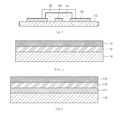
- FIG. 1 is a view showing a touch panel according to the related art
- FIG. 2 is a sectional view showing a touch panel according to an embodiment
- FIG. 3 is a sectional view showing a touch panel according to another embodiment
- FIG. 4 is a sectional view showing a touch panel according to still another embodiment.
- FIG. 5 is a sectional view showing a touch panel according to still another embodiment.
- FIG. 2 is a sectional view showing a touch panel according to an embodiment.
- the touch panel includes a gas blocking layer 112 formed on a gas generation layer 110.
- the gas generation layer 110 includes a plastic substrate and an organic or porous material so that a gas is generated therefrom. Meanwhile, when the gas generation layer 110 includes the plastic substrate, the gas generation layer 110 may include one of PET (polyethylene terephthalate resin), PC (polycarbonate), PMMA (polymethyl methacrylate), TAC (triacetate cellulose) and PES (polyether sulfone).
- PET polyethylene terephthalate resin
- PC polycarbonate
- PMMA polymethyl methacrylate
- TAC triacetate cellulose
- PES polyether sulfone
- the sensing electrode pattern 113 is formed on the gas blocking layer 112.
- the gas blocking layer 112 may be formed by using a material similar to the sensing electrode pattern 113 formed of a transparent material.
- the gas blocking layer 112 may include at least one of ITO (Indium-tin oxide), IZO (Indium Zinc Oxide), ZnO (Zinc Oxide), CNT (carbon nanotube), graphene, and an Ag NW (silver nano-wire). Further, the gas blocking layer 112 may have a thickness of 100 nm or less.
- the gas blocking layer 112 is formed on the gas generation layer 110, since the gas generated from the gas generation layer 110 is blocked even if the sensing electrode pattern 113 is formed by using a vacuum deposition scheme, the degradation of optical or electrical property in the sensing electrode pattern 113 formed of a transparent material may be prevented.
- FIG. 3 is a sectional view showing a touch panel according to another embodiment.
- the touch panel according to another embodiment will be described with reference to FIG. 3 .
- the touch panel includes a printed pattern 111 on the glass substrate 110.
- the printed pattern 111 is formed on an inactive region of the touch panel.
- the inactive region is a concept opposite to an active region into which a touch instruction may be input, even if the inactive region is touched, the inactive region is not active so that an input of a touch instruction is not performed therein.
- the printed pattern 111 is formed by using an ink of an organic material or a mesoporous material.
- the glass substrate 110 includes one of tempered glass, heat strengthened glass, sodalime glass and reinforced plastic.
- the gas blocking layer 112 is formed on the printed pattern 111 and the sensing electrode pattern 113 is formed on the gas blocking layer 112.
- the gas blocking layer 112 may be formed of a material similar to that of the transparent sensing electrode pattern 113.
- the gas blocking layer 112 may be formed of at least one of ITO (Indium-tin oxide), IZO (Indium Zinc Oxide), ZnO (Zinc Oxide), CNT (carbon nanotube), graphene, and an Ag NW (silver nano-wire).
- the gas blocking layer 112 is formed on the gas generation layer 110, since the gas generated from the glass substrate 110 and the printed pattern 111 is blocked even if the sensing electrode pattern 113 is formed by using a vacuum deposition scheme, the degradation of optical or electrical property in the sensing electrode pattern 113 formed of a transparent material may be prevented.
- the gas blocking layer 112 may be formed of a material similar to a transparent material of which the sensing electrode pattern 113 is formed.
- the gas blocking layer 112 may be formed of at least one of ITO (Indium-tin oxide), IZO (Indium Zinc Oxide), ZnO (Zinc Oxide), CNT (carbon nanotube), graphene, and an Ag NW (silver nano-wire). Further, the gas blocking layer 112 has a thickness of 100 nm or less.
- FIG. 4 is a sectional view showing a touch panel according to still another embodiment.
- the touch panel according to still another embodiment will be described with reference to FIG. 4 .
- the touch panel includes a substrate 210 on which a plurality of first sensing electrode patterns 211 and a second sensing electrode pattern 212 are formed.
- the substrate 210 may be formed of tempered glass, heat strengthened glass, sodalime glass or reinforced plastic.
- An insulation part 213 including OCA (Optically Clear Adhesive) may be formed on the second sensing electrode pattern 212.
- a gas blocking layer 214 is formed on the insulation part 213.
- the gas blocking layer 214 is formed to cover the first sensing electrode patterns 211, the second sensing electrode pattern 212 and the insulation part 213.
- a bridge electrode 215 is formed on the gas blocking layer 214 which is formed to cover the insulation part 213, such that the bridge electrode 215 connects the plurality of first sensing electrode patterns 211 to each other.
- the gas blocking layer 214 blocks the gas generated from the insulation part 213, so that the degradation of optical or electrical property caused in the bridge electrode 215 may be prevented.
- the gas blocking layer 214 is formed of an oxide or nitride material including one of Si, Nb, Si, Al, Hf, Zr, TiO, Ta and Zn through a vacuum deposition scheme and has a thickness of 100 nm or less, so that an electrical short circuit between the first sensing electrode patterns 211 and the bridge electrode 215 is prevented.
- FIG. 5 is a sectional view showing a touch panel according to still another embodiment.
- the touch panel according to another embodiment will be described with reference to FIG. 5 .
- the touch panel includes a substrate 310 on which a bridge electrode 311 is formed.
- the substrate 310 may be formed of tempered glass, heat strengthened glass, sodalime glass or reinforced plastic.
- An insulation part 313 including OCA (Optically Clear Adhesive) may be formed on the bridge electrode 311.
- a gas blocking layer 312 is formed on the insulation part 313.
- the gas blocking layer 312 is formed to cover the bridge electrode 311 and the insulation part 313.
- a plurality of first sensing electrode patterns 314, which are electrically connected to each other through the bridge electrode 311, and a second sensing electrode pattern 315 are formed on the insulation part 313.
- the gas blocking layer 312 blocks the gas generated from the insulation part 311, so that the degradation of optical or electrical property caused in the first sensing electrode patterns 314 and the second sensing electrode pattern 315 due to the gas may be prevented.
- the gas blocking layer 312 is formed of an oxide or nitride material including one of Si, Nb, Si, Al, Hf, Zr, TiO, Ta and Zn through a vacuum deposition scheme and has a thickness of 100 nm or less, so that an electrical short circuit between the first sensing electrode patterns 314 and the bridge electrode 311 is prevented.
- the gas blocking layer 112 is formed on the gas generation layer 110 and the sensing electrode pattern 113 is formed on the gas blocking layer 112.
- the gas blocking layer 112 is formed on the gas generation layer 110, , the gas generated from the substrate 110 is blocked when the sensing electrode pattern 113 is formed through a vacuum deposition scheme so that the degradation of optical or electrical property caused in the sensing electrode pattern 113 formed of a transparent material may be prevented.
- the printed pattern 111 is formed on the glass substrate 110.
- the gas blocking layer 112 is formed on the printed pattern 111 formed and the sensing electrode pattern 113 is formed on the gas blocking layer 112, as described above.
- the sensing electrode pattern 113 is formed through a vacuumed deposition scheme after the gas blocking layer 112 is formed on the glass substrate 110 and the printed pattern 111, the gas generated from the glass substrate 110 and the printed pattern 111 is blocked so that the degradation of optical or electrical property caused in the sensing electrode pattern 113 formed of a transparent material may be prevented.
- the first sensing electrode patterns 211 and the second sensing electrode pattern 212 are formed on the substrate 210 and the insulation part 213 is formed on the second sensing electrode pattern 212.
- the gas blocking layer 214 is formed on the insulation part 213 such that the gas blocking layer 214 is formed to cover the first sensing electrode patterns 211, the second sensing electrode pattern 212 and the insulation part 213.
- the gas blocking layer 214 is formed to have a thickness of 100 nm or less, such that the electrical short circuit between the first sensing electrode patterns 211 and the bridge electrode 215 is prevented.
- the bridge electrode 215 is formed on the gas blocking layer 214 formed to cover the insulation part 213, so that the plurality of first sensing electrode patterns 211 are electrically connected to each other.
- the gas generated from the insulation part 213 is blocked by the gas blocking layer 214, so that the degradation of optical or electrical property caused in the bridge electrode 215 may be prevented.
- the bridge electrode 311 is formed on the substrate 310 and the insulation part 313 is formed on the bridge electrode 311.
- the gas blocking layer 312 is formed on the insulation part 313.
- the gas blocking layer 312 is formed to cover the bridge electrode 311 and the insulation part 313.
- the plurality of first sensing electrode patterns 314, which are electrically connected to each other through the bridge electrode 311, and the second sensing electrode pattern 315 are formed on the gas blocking layer 312 of covering the insulation part 313. That is, the gas blocking layer 312 blocks the gas generated from the insulation part 311, so that the degradation of optical or electrical property caused in the first sensing electrode patterns 314 and the second sensing electrode pattern 315 due to the gas may be prevented.
- the gas blocking layer 312 has a thickness of 100 nm or less, such that an electrical short circuit between the first sensing electrode patterns 314 and the bridge electrode 311 is prevented.
Landscapes
- Engineering & Computer Science (AREA)
- General Engineering & Computer Science (AREA)
- Theoretical Computer Science (AREA)
- Human Computer Interaction (AREA)
- Physics & Mathematics (AREA)
- General Physics & Mathematics (AREA)
- Position Input By Displaying (AREA)
- Manufacture Of Switches (AREA)
- Laminated Bodies (AREA)
- Investigating Or Analyzing Materials By The Use Of Fluid Adsorption Or Reactions (AREA)
Applications Claiming Priority (1)
| Application Number | Priority Date | Filing Date | Title |
|---|---|---|---|
| KR1020120071437A KR101402823B1 (ko) | 2012-06-29 | 2012-06-29 | 터치 패널 및 그 제조 방법 |
Publications (2)
| Publication Number | Publication Date |
|---|---|
| EP2680114A2 true EP2680114A2 (fr) | 2014-01-01 |
| EP2680114A3 EP2680114A3 (fr) | 2016-12-07 |
Family
ID=48699566
Family Applications (1)
| Application Number | Title | Priority Date | Filing Date |
|---|---|---|---|
| EP13173107.7A Ceased EP2680114A3 (fr) | 2012-06-29 | 2013-06-20 | Panneau tactile et son procédé de fabrication |
Country Status (5)
| Country | Link |
|---|---|
| US (1) | US9214291B2 (fr) |
| EP (1) | EP2680114A3 (fr) |
| KR (1) | KR101402823B1 (fr) |
| CN (1) | CN103529980B (fr) |
| TW (1) | TWI507938B (fr) |
Cited By (3)
| Publication number | Priority date | Publication date | Assignee | Title |
|---|---|---|---|---|
| EP3026536A1 (fr) * | 2014-11-25 | 2016-06-01 | LG Innotek Co., Ltd. | Fenêtre tactile comprenant mailles de filet |
| EP3343336B1 (fr) * | 2016-12-27 | 2020-09-23 | LG Display Co., Ltd. | Afficheur |
| EP3291068B1 (fr) * | 2016-09-06 | 2023-09-20 | Apple Inc. | Routage et fabrication pour capteurs tactiles |
Families Citing this family (3)
| Publication number | Priority date | Publication date | Assignee | Title |
|---|---|---|---|---|
| TWI506508B (zh) | 2014-04-10 | 2015-11-01 | Ind Tech Res Inst | 觸控感測結構 |
| KR20160124372A (ko) * | 2015-04-17 | 2016-10-27 | 삼성디스플레이 주식회사 | 터치 패널 |
| CN107732286B (zh) * | 2017-05-19 | 2020-07-07 | 东莞市创明电池技术有限公司 | 安全型锂离子电池及其制备方法 |
Family Cites Families (19)
| Publication number | Priority date | Publication date | Assignee | Title |
|---|---|---|---|---|
| JP4138672B2 (ja) * | 2003-03-27 | 2008-08-27 | セイコーエプソン株式会社 | 電気光学装置の製造方法 |
| KR100846493B1 (ko) * | 2006-05-11 | 2008-07-17 | 삼성전자주식회사 | 탄소나노튜브 가스 센서 및 그 제조 방법 |
| KR100883737B1 (ko) * | 2007-01-17 | 2009-02-12 | 삼성전자주식회사 | 망상 탄소나노튜브 박막층을 포함하는 탄소나노튜브 투명전극 및 그의 제조방법 |
| CN100495139C (zh) * | 2007-10-10 | 2009-06-03 | 友达光电股份有限公司 | 触控面板及其制作方法 |
| US20100108409A1 (en) * | 2008-11-06 | 2010-05-06 | Jun Tanaka | Capacitive coupling type touch panel |
| WO2010058988A2 (fr) * | 2008-11-19 | 2010-05-27 | 주식회사 엘지화학 | Substrat en plastique stratifié et son procédé de production |
| US20100304013A1 (en) * | 2009-06-01 | 2010-12-02 | Wang Xuei-Min | Touch Panel Manufacturing Method |
| JP5993541B2 (ja) * | 2009-06-29 | 2016-09-14 | 大日本印刷株式会社 | タッチパネル用耐湿熱性透明導電積層体及び耐湿熱透明積層プラスチックタッチパネル |
| KR20110038518A (ko) * | 2009-10-08 | 2011-04-14 | 엘지이노텍 주식회사 | 터치 패널용 면상 부재 및 그 제조 방법 및 터치 패널용 면상 부재를 이용한 터치패널 |
| KR101082609B1 (ko) * | 2009-10-16 | 2011-11-15 | 엘지이노텍 주식회사 | 터치패널용 면상 부재 및 이의 제조 방법 |
| JP5838152B2 (ja) * | 2010-03-04 | 2015-12-24 | 株式会社きもと | 機能性積層板、タッチパネル用透明導電性積層板、およびこれを用いたタッチパネル |
| KR101082134B1 (ko) * | 2010-03-16 | 2011-11-09 | 삼성모바일디스플레이주식회사 | 드라이 에칭 장치를 이용한 터치 스크린 패널의 제작방법 |
| KR101140997B1 (ko) * | 2010-05-14 | 2012-05-02 | 삼성전기주식회사 | 단층 정전용량식 터치스크린 및 그 제조방법 |
| KR101119293B1 (ko) * | 2010-07-26 | 2012-03-16 | 삼성전기주식회사 | 터치 스크린 패널 및 그 제조 방법 |
| TW201213949A (en) * | 2010-09-29 | 2012-04-01 | Catcher Technology Co Ltd | Touch panel |
| CN102566842B (zh) * | 2010-12-06 | 2014-10-29 | 乐金显示有限公司 | 静电电容型触摸屏面板 |
| JP5445438B2 (ja) * | 2010-12-15 | 2014-03-19 | Smk株式会社 | 静電容量式タッチパネル |
| KR101311407B1 (ko) * | 2011-03-03 | 2013-09-25 | 박준영 | 터치 패널용 패드와 기판의 결합 방법 및 이에 의해 제조되는 결합체 |
| KR101096559B1 (ko) * | 2011-03-24 | 2011-12-20 | (주) 태양기전 | 터치 장치 및 그 제조 방법 |
-
2012
- 2012-06-29 KR KR1020120071437A patent/KR101402823B1/ko active Active
-
2013
- 2013-06-18 TW TW102121579A patent/TWI507938B/zh not_active IP Right Cessation
- 2013-06-20 EP EP13173107.7A patent/EP2680114A3/fr not_active Ceased
- 2013-06-28 US US13/930,499 patent/US9214291B2/en active Active
- 2013-06-28 CN CN201310269260.4A patent/CN103529980B/zh not_active Expired - Fee Related
Non-Patent Citations (1)
| Title |
|---|
| None |
Cited By (9)
| Publication number | Priority date | Publication date | Assignee | Title |
|---|---|---|---|---|
| EP3026536A1 (fr) * | 2014-11-25 | 2016-06-01 | LG Innotek Co., Ltd. | Fenêtre tactile comprenant mailles de filet |
| EP3291068B1 (fr) * | 2016-09-06 | 2023-09-20 | Apple Inc. | Routage et fabrication pour capteurs tactiles |
| EP3343336B1 (fr) * | 2016-12-27 | 2020-09-23 | LG Display Co., Ltd. | Afficheur |
| US10840311B2 (en) | 2016-12-27 | 2020-11-17 | Lg Display Co., Ltd. | Display device |
| EP3757737A1 (fr) * | 2016-12-27 | 2020-12-30 | LG Display Co., Ltd. | Dispositif d'affichage |
| US11137862B2 (en) | 2016-12-27 | 2021-10-05 | Lg Display Co., Ltd. | Display device |
| EP3757737B1 (fr) * | 2016-12-27 | 2022-10-26 | LG Display Co., Ltd. | Afficheur |
| US11513644B2 (en) | 2016-12-27 | 2022-11-29 | Lg Display Co., Ltd. | Display device having a touch sensor |
| US11755156B2 (en) | 2016-12-27 | 2023-09-12 | Lg Display Co., Ltd. | Display device having a touch sensor |
Also Published As
| Publication number | Publication date |
|---|---|
| CN103529980A (zh) | 2014-01-22 |
| EP2680114A3 (fr) | 2016-12-07 |
| TW201403419A (zh) | 2014-01-16 |
| TWI507938B (zh) | 2015-11-11 |
| KR101402823B1 (ko) | 2014-06-27 |
| CN103529980B (zh) | 2016-12-28 |
| US9214291B2 (en) | 2015-12-15 |
| KR20140003287A (ko) | 2014-01-09 |
| US20140001019A1 (en) | 2014-01-02 |
Similar Documents
| Publication | Publication Date | Title |
|---|---|---|
| US9086766B2 (en) | Touch panel and touch display panel | |
| US9949366B2 (en) | Touch panel | |
| US10049826B2 (en) | Touch window having improved electrode pattern structure | |
| US10048820B2 (en) | Touch panel and manufacturing method thereof | |
| US9214291B2 (en) | Touch panel and method of manufacturing the same | |
| US20130135229A1 (en) | Touch panel and touch display panel using the same | |
| KR101461290B1 (ko) | 터치패널 | |
| US20130157022A1 (en) | Transparent panel and method of manufacturing the same | |
| GB2559575A (en) | Touch sensor | |
| US20150169104A1 (en) | Touch panel | |
| KR101303705B1 (ko) | 초박형 멀티 터치스크린 패널 | |
| US20140001017A1 (en) | Touch panel | |
| US9696753B2 (en) | Touch panel | |
| KR102325384B1 (ko) | 터치 패널 및 이의 제조방법 | |
| KR20190030666A (ko) | 터치 패널 및 그 제조 방법 | |
| TWI588700B (zh) | 觸控裝置 | |
| KR101987345B1 (ko) | 터치 패널 및 그 제조 방법 | |
| KR101916306B1 (ko) | 터치 패널 | |
| US20170045966A1 (en) | Touch screen panel | |
| KR101961262B1 (ko) | 터치 패널 및 그 제조 방법 | |
| KR101956202B1 (ko) | 터치 패널 | |
| KR101886315B1 (ko) | 터치 패널 | |
| CN106155397B (zh) | 电路衬底的静电防护结构 | |
| KR20130121339A (ko) | 터치 패널 및 그 제조 방법 | |
| KR20150014725A (ko) | 터치 윈도우 및 이를 포함하는 디스플레이 |
Legal Events
| Date | Code | Title | Description |
|---|---|---|---|
| PUAI | Public reference made under article 153(3) epc to a published international application that has entered the european phase |
Free format text: ORIGINAL CODE: 0009012 |
|
| AK | Designated contracting states |
Kind code of ref document: A2 Designated state(s): AL AT BE BG CH CY CZ DE DK EE ES FI FR GB GR HR HU IE IS IT LI LT LU LV MC MK MT NL NO PL PT RO RS SE SI SK SM TR |
|
| AX | Request for extension of the european patent |
Extension state: BA ME |
|
| 17P | Request for examination filed |
Effective date: 20140331 |
|
| RBV | Designated contracting states (corrected) |
Designated state(s): AL AT BE BG CH CY CZ DE DK EE ES FI FR GB GR HR HU IE IS IT LI LT LU LV MC MK MT NL NO PL PT RO RS SE SI SK SM TR |
|
| PUAL | Search report despatched |
Free format text: ORIGINAL CODE: 0009013 |
|
| AK | Designated contracting states |
Kind code of ref document: A3 Designated state(s): AL AT BE BG CH CY CZ DE DK EE ES FI FR GB GR HR HU IE IS IT LI LT LU LV MC MK MT NL NO PL PT RO RS SE SI SK SM TR |
|
| AX | Request for extension of the european patent |
Extension state: BA ME |
|
| RIC1 | Information provided on ipc code assigned before grant |
Ipc: G06F 3/041 20060101AFI20161103BHEP Ipc: H01H 1/64 20060101ALI20161103BHEP Ipc: G06F 3/044 20060101ALI20161103BHEP |
|
| RAP1 | Party data changed (applicant data changed or rights of an application transferred) |
Owner name: LG INNOTEK CO., LTD. |
|
| STAA | Information on the status of an ep patent application or granted ep patent |
Free format text: STATUS: EXAMINATION IS IN PROGRESS |
|
| 17Q | First examination report despatched |
Effective date: 20171222 |
|
| STAA | Information on the status of an ep patent application or granted ep patent |
Free format text: STATUS: THE APPLICATION HAS BEEN REFUSED |
|
| 18R | Application refused |
Effective date: 20200307 |