EP2682191A2 - A method for utilization of waste electric and electronic equipment - Google Patents
A method for utilization of waste electric and electronic equipment Download PDFInfo
- Publication number
- EP2682191A2 EP2682191A2 EP20120183671 EP12183671A EP2682191A2 EP 2682191 A2 EP2682191 A2 EP 2682191A2 EP 20120183671 EP20120183671 EP 20120183671 EP 12183671 A EP12183671 A EP 12183671A EP 2682191 A2 EP2682191 A2 EP 2682191A2
- Authority
- EP
- European Patent Office
- Prior art keywords
- fraction
- metallic
- magnetic
- separated
- water
- Prior art date
- Legal status (The legal status is an assumption and is not a legal conclusion. Google has not performed a legal analysis and makes no representation as to the accuracy of the status listed.)
- Withdrawn
Links
- 239000002699 waste material Substances 0.000 title claims abstract description 16
- 238000000034 method Methods 0.000 title claims abstract description 13
- PEDCQBHIVMGVHV-UHFFFAOYSA-N Glycerine Chemical compound OCC(O)CO PEDCQBHIVMGVHV-UHFFFAOYSA-N 0.000 claims abstract description 14
- 102000004882 Lipase Human genes 0.000 claims abstract description 14
- 108090001060 Lipase Proteins 0.000 claims abstract description 14
- 239000000463 material Substances 0.000 claims abstract description 13
- XLYOFNOQVPJJNP-UHFFFAOYSA-N water Substances O XLYOFNOQVPJJNP-UHFFFAOYSA-N 0.000 claims abstract description 12
- 239000007788 liquid Substances 0.000 claims abstract description 10
- 239000006148 magnetic separator Substances 0.000 claims abstract description 9
- 102000004190 Enzymes Human genes 0.000 claims abstract description 8
- 108090000790 Enzymes Proteins 0.000 claims abstract description 8
- 235000011187 glycerol Nutrition 0.000 claims abstract description 7
- 229910052751 metal Inorganic materials 0.000 claims abstract description 7
- 239000002184 metal Substances 0.000 claims abstract description 6
- 150000002739 metals Chemical class 0.000 claims abstract description 5
- 238000005406 washing Methods 0.000 claims abstract description 4
- 238000000926 separation method Methods 0.000 description 9
- 239000004033 plastic Substances 0.000 description 5
- 229920003023 plastic Polymers 0.000 description 5
- XEEYBQQBJWHFJM-UHFFFAOYSA-N Iron Chemical compound [Fe] XEEYBQQBJWHFJM-UHFFFAOYSA-N 0.000 description 4
- 239000012467 final product Substances 0.000 description 4
- 238000004064 recycling Methods 0.000 description 3
- 229910052742 iron Inorganic materials 0.000 description 2
- -1 iron metals Chemical class 0.000 description 2
- 239000005060 rubber Substances 0.000 description 2
- 230000009897 systematic effect Effects 0.000 description 2
- 239000002023 wood Substances 0.000 description 2
- LFQSCWFLJHTTHZ-UHFFFAOYSA-N Ethanol Chemical compound CCO LFQSCWFLJHTTHZ-UHFFFAOYSA-N 0.000 description 1
- 150000001298 alcohols Chemical class 0.000 description 1
- 239000005030 aluminium foil Substances 0.000 description 1
- 150000001875 compounds Chemical class 0.000 description 1
- 230000018044 dehydration Effects 0.000 description 1
- 238000006297 dehydration reaction Methods 0.000 description 1
- 238000010586 diagram Methods 0.000 description 1
- 235000014113 dietary fatty acids Nutrition 0.000 description 1
- 238000005516 engineering process Methods 0.000 description 1
- 239000003344 environmental pollutant Substances 0.000 description 1
- 229930195729 fatty acid Natural products 0.000 description 1
- 239000000194 fatty acid Substances 0.000 description 1
- 150000004665 fatty acids Chemical class 0.000 description 1
- 239000011521 glass Substances 0.000 description 1
- 230000005484 gravity Effects 0.000 description 1
- 239000004519 grease Substances 0.000 description 1
- 229910001385 heavy metal Inorganic materials 0.000 description 1
- 230000007062 hydrolysis Effects 0.000 description 1
- 238000006460 hydrolysis reaction Methods 0.000 description 1
- 239000000203 mixture Substances 0.000 description 1
- 231100000719 pollutant Toxicity 0.000 description 1
- 239000010970 precious metal Substances 0.000 description 1
- 238000002360 preparation method Methods 0.000 description 1
- 238000005204 segregation Methods 0.000 description 1
- 239000004575 stone Substances 0.000 description 1
Images
Classifications
-
- B—PERFORMING OPERATIONS; TRANSPORTING
- B03—SEPARATION OF SOLID MATERIALS USING LIQUIDS OR USING PNEUMATIC TABLES OR JIGS; MAGNETIC OR ELECTROSTATIC SEPARATION OF SOLID MATERIALS FROM SOLID MATERIALS OR FLUIDS; SEPARATION BY HIGH-VOLTAGE ELECTRIC FIELDS
- B03B—SEPARATING SOLID MATERIALS USING LIQUIDS OR USING PNEUMATIC TABLES OR JIGS
- B03B5/00—Washing granular, powdered or lumpy materials; Wet separating
- B03B5/28—Washing granular, powdered or lumpy materials; Wet separating by sink-float separation
- B03B5/30—Washing granular, powdered or lumpy materials; Wet separating by sink-float separation using heavy liquids or suspensions
- B03B5/44—Application of particular media therefor
- B03B5/442—Application of particular media therefor composition of heavy media
-
- B—PERFORMING OPERATIONS; TRANSPORTING
- B03—SEPARATION OF SOLID MATERIALS USING LIQUIDS OR USING PNEUMATIC TABLES OR JIGS; MAGNETIC OR ELECTROSTATIC SEPARATION OF SOLID MATERIALS FROM SOLID MATERIALS OR FLUIDS; SEPARATION BY HIGH-VOLTAGE ELECTRIC FIELDS
- B03B—SEPARATING SOLID MATERIALS USING LIQUIDS OR USING PNEUMATIC TABLES OR JIGS
- B03B9/00—General arrangement of separating plant, e.g. flow sheets
- B03B9/06—General arrangement of separating plant, e.g. flow sheets specially adapted for refuse
- B03B9/061—General arrangement of separating plant, e.g. flow sheets specially adapted for refuse the refuse being industrial
-
- B—PERFORMING OPERATIONS; TRANSPORTING
- B03—SEPARATION OF SOLID MATERIALS USING LIQUIDS OR USING PNEUMATIC TABLES OR JIGS; MAGNETIC OR ELECTROSTATIC SEPARATION OF SOLID MATERIALS FROM SOLID MATERIALS OR FLUIDS; SEPARATION BY HIGH-VOLTAGE ELECTRIC FIELDS
- B03C—MAGNETIC OR ELECTROSTATIC SEPARATION OF SOLID MATERIALS FROM SOLID MATERIALS OR FLUIDS; SEPARATION BY HIGH-VOLTAGE ELECTRIC FIELDS
- B03C1/00—Magnetic separation
- B03C1/02—Magnetic separation acting directly on the substance being separated
- B03C1/04—Magnetic separation acting directly on the substance being separated with the material carriers in the form of trays or with tables
-
- B—PERFORMING OPERATIONS; TRANSPORTING
- B03—SEPARATION OF SOLID MATERIALS USING LIQUIDS OR USING PNEUMATIC TABLES OR JIGS; MAGNETIC OR ELECTROSTATIC SEPARATION OF SOLID MATERIALS FROM SOLID MATERIALS OR FLUIDS; SEPARATION BY HIGH-VOLTAGE ELECTRIC FIELDS
- B03C—MAGNETIC OR ELECTROSTATIC SEPARATION OF SOLID MATERIALS FROM SOLID MATERIALS OR FLUIDS; SEPARATION BY HIGH-VOLTAGE ELECTRIC FIELDS
- B03C1/00—Magnetic separation
- B03C1/02—Magnetic separation acting directly on the substance being separated
- B03C1/30—Combinations with other devices, not otherwise provided for
-
- C—CHEMISTRY; METALLURGY
- C22—METALLURGY; FERROUS OR NON-FERROUS ALLOYS; TREATMENT OF ALLOYS OR NON-FERROUS METALS
- C22B—PRODUCTION AND REFINING OF METALS; PRETREATMENT OF RAW MATERIALS
- C22B7/00—Working up raw materials other than ores, e.g. scrap, to produce non-ferrous metals and compounds thereof; Methods of a general interest or applied to the winning of more than two metals
- C22B7/005—Separation by a physical processing technique only, e.g. by mechanical breaking
-
- B—PERFORMING OPERATIONS; TRANSPORTING
- B03—SEPARATION OF SOLID MATERIALS USING LIQUIDS OR USING PNEUMATIC TABLES OR JIGS; MAGNETIC OR ELECTROSTATIC SEPARATION OF SOLID MATERIALS FROM SOLID MATERIALS OR FLUIDS; SEPARATION BY HIGH-VOLTAGE ELECTRIC FIELDS
- B03C—MAGNETIC OR ELECTROSTATIC SEPARATION OF SOLID MATERIALS FROM SOLID MATERIALS OR FLUIDS; SEPARATION BY HIGH-VOLTAGE ELECTRIC FIELDS
- B03C2201/00—Details of magnetic or electrostatic separation
- B03C2201/20—Magnetic separation of bulk or dry particles in mixtures
-
- Y—GENERAL TAGGING OF NEW TECHNOLOGICAL DEVELOPMENTS; GENERAL TAGGING OF CROSS-SECTIONAL TECHNOLOGIES SPANNING OVER SEVERAL SECTIONS OF THE IPC; TECHNICAL SUBJECTS COVERED BY FORMER USPC CROSS-REFERENCE ART COLLECTIONS [XRACs] AND DIGESTS
- Y02—TECHNOLOGIES OR APPLICATIONS FOR MITIGATION OR ADAPTATION AGAINST CLIMATE CHANGE
- Y02P—CLIMATE CHANGE MITIGATION TECHNOLOGIES IN THE PRODUCTION OR PROCESSING OF GOODS
- Y02P10/00—Technologies related to metal processing
- Y02P10/20—Recycling
-
- Y—GENERAL TAGGING OF NEW TECHNOLOGICAL DEVELOPMENTS; GENERAL TAGGING OF CROSS-SECTIONAL TECHNOLOGIES SPANNING OVER SEVERAL SECTIONS OF THE IPC; TECHNICAL SUBJECTS COVERED BY FORMER USPC CROSS-REFERENCE ART COLLECTIONS [XRACs] AND DIGESTS
- Y02—TECHNOLOGIES OR APPLICATIONS FOR MITIGATION OR ADAPTATION AGAINST CLIMATE CHANGE
- Y02W—CLIMATE CHANGE MITIGATION TECHNOLOGIES RELATED TO WASTEWATER TREATMENT OR WASTE MANAGEMENT
- Y02W30/00—Technologies for solid waste management
- Y02W30/50—Reuse, recycling or recovery technologies
- Y02W30/52—Mechanical processing of waste for the recovery of materials, e.g. crushing, shredding, separation or disassembly
-
- Y—GENERAL TAGGING OF NEW TECHNOLOGICAL DEVELOPMENTS; GENERAL TAGGING OF CROSS-SECTIONAL TECHNOLOGIES SPANNING OVER SEVERAL SECTIONS OF THE IPC; TECHNICAL SUBJECTS COVERED BY FORMER USPC CROSS-REFERENCE ART COLLECTIONS [XRACs] AND DIGESTS
- Y02—TECHNOLOGIES OR APPLICATIONS FOR MITIGATION OR ADAPTATION AGAINST CLIMATE CHANGE
- Y02W—CLIMATE CHANGE MITIGATION TECHNOLOGIES RELATED TO WASTEWATER TREATMENT OR WASTE MANAGEMENT
- Y02W30/00—Technologies for solid waste management
- Y02W30/50—Reuse, recycling or recovery technologies
- Y02W30/82—Recycling of waste of electrical or electronic equipment [WEEE]
Definitions
- the present invention relates to a method for utilization of waste electric and electronic equipment.
- the aim of the invention is the development of a method for utilization of waste electric and electronic equipment, providing high quantitative and qualitative efficiency, in particular, precise separation of metallic and non-metallic scrap fraction.
- the object of the invention is a method for utilization of waste electric and electronic equipment, whereby the waste material is separated into a magnetic fraction, a fraction of other metals and a non-metallic fraction, comprising the steps of fragmenting waste electric and electronic equipment using a ring shredder, separating magnetic fraction using a vibrating gutter and a magnetic separator located above the gutter, sorting the residues by means of a rotary separator into a light fraction and a heavy fraction, dividing the heavy fraction into two size groups, supplying each size group into an eddy current separator to be separated into a metallic fraction and a non-metallic fraction, supplying the non-metallic fractions together with the light fraction to a knife shredder to be fragmented into pieces smaller than 15 mm, from which magnetic fraction is separated using a vibrating gutter and magnetic separator located above the gutter, directing the rest to a liquid separator table, wherein a metallic fraction is separated from lighter elements by washing the material on the liquid separator table by using a water-glycerine solution of
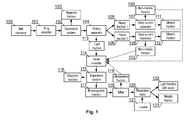
- Fig. 1 presents a diagram of a technological line for waste electric and electronic equipment utilization using the method according to the invention.
- Scrap in the form of waste electric and electronic equipment is transported by a crane with a grab and rotary head to a belt conveyor 100, where manual sorting of scrap is performed in order to separate undesirable elements, which are not suited for direct processing in the further elements of the line.
- Sorted scrap is transported to ring shredder 101, where it is fragmented into pieces.
- Scrap pieces are submitted to a separation system for magnetic fraction 102, that is vibrating gutter and magnetic separator located above the gutter. This way magnetic elements are transported from the stream of fragmented material to the belt conveyor for magnetic fraction 103.
- Deironed scrap is immediately directed to rotary wind separator 104, where the material is separated into two heavy fractions and one light fraction.
- Heavy fraction is a mixture consisting mostly of non-iron metal pieces, together with heavy metals, but the first fraction contains larger elements than the second fraction, and the size segregation of fraction elements depends on the size of sieves mounted in the rotary separator 104. Heavy fractions are taken by belt conveyors 105 and 106 and transported to eddy current separators 107, 108, where non-metallic elements, such as plastic, rubber, wood, glass, stones and earth are separated from heavy fraction. Non-metallic fractions are transported by belt conveyor 109, 110 to knife shredder 114. Purified metallic fractions constitute final product, which is stored in containers 111,112.
- Light fraction retrieved from the rotary separator 104 by belt conveyor 113 is mainly composed of isolated wires, for example aluminium foil, light plastics, rubber, wood and earth. Fractions from the conveyors 109, 110, 113 are transported to the knife shredder 114.
- the knife shredder 114 is equipped with exchangeable sieve with round mesh of a diameter selected for the type of processed scrap in the scope of 10 mm to 15 mm.
- the batch material is supplied from a buffer tank to the hopper of the shredder, in which rotary rack-type knives together with stationary knives shred the material, which leaves the shredder 114 through the sieve.
- the shredded material is supplied to the separation system for magnetic fraction 115, that is vibrating gutter and magnetic separator located above the gutter, which removes the remaining magnetic elements released from the processed material, after which the magnetic fraction is directed to the container 116, and non-magnetic fraction - to the container 117.
- Magnetic fraction constitutes final product, which is stored in the container 116.
- Non-magnetic fraction from the container 117 is further directed to a sifter 118, on which potential too large pieces are separated, and return through the feeder 119 to the knife shredder 114.
- the small elements are transported onto the liquid separator table 120, on which precise final separation is conducted.
- liquid separator table 120 usable metals, including precious metals, are separated from other elements.
- the intermediate, not entirely separated elements are directed back to the shredder 114.
- Metallic fraction is supplied to the container 123 and constitutes final product.
- Light fraction is supplied with water to the container 122. where, after dehydration, it constitutes final product as well.
- a water-glycerine solution of lipase enzyme is applied o the liquid separator table. This solution is obtained by mixing 0.005% to 0.025% of powdered lipase enzyme in 5% glycerine water solution (i.e. 5% of glycerine in water by weight). During the process, part of the wash solution, approx.
- glycerine solution is any other solution of higher alcohol with water, which reduces the surface tension of the solution and limits its frothing.
- lipase enzyme allowed to effectively clean the washed material from pollutants, such as fat, grease and oil, which, thanks to this enzyme, underwent hydrolysis to make compounds soluble in water, i.e. alcohols and fatty acids, which made them easily washable on the separation table 120.
Landscapes
- Engineering & Computer Science (AREA)
- Chemical & Material Sciences (AREA)
- Geology (AREA)
- Life Sciences & Earth Sciences (AREA)
- General Life Sciences & Earth Sciences (AREA)
- Manufacturing & Machinery (AREA)
- Environmental & Geological Engineering (AREA)
- Materials Engineering (AREA)
- Mechanical Engineering (AREA)
- Metallurgy (AREA)
- Organic Chemistry (AREA)
- Separation Of Solids By Using Liquids Or Pneumatic Power (AREA)
- Processing Of Solid Wastes (AREA)
Applications Claiming Priority (1)
| Application Number | Priority Date | Filing Date | Title |
|---|---|---|---|
| PL39975412A PL399754A1 (pl) | 2012-07-02 | 2012-07-02 | Sposób utylizacji zuzytego sprzetu elektrycznego i elektronicznego |
Publications (1)
| Publication Number | Publication Date |
|---|---|
| EP2682191A2 true EP2682191A2 (en) | 2014-01-08 |
Family
ID=46880606
Family Applications (1)
| Application Number | Title | Priority Date | Filing Date |
|---|---|---|---|
| EP20120183671 Withdrawn EP2682191A2 (en) | 2012-07-02 | 2012-09-10 | A method for utilization of waste electric and electronic equipment |
Country Status (2)
| Country | Link |
|---|---|
| EP (1) | EP2682191A2 (pl) |
| PL (1) | PL399754A1 (pl) |
Families Citing this family (1)
| Publication number | Priority date | Publication date | Assignee | Title |
|---|---|---|---|---|
| PL423618A1 (pl) * | 2017-11-28 | 2019-06-03 | Enerbio Spolka Z Ograniczona Odpowiedzialnoscia | Sposób przetwarzania odpadów opakowaniowych |
Citations (1)
| Publication number | Priority date | Publication date | Assignee | Title |
|---|---|---|---|---|
| US4940187A (en) | 1989-10-26 | 1990-07-10 | Tocew Lee | Systematic equipments for recycling raw materials from waste wires |
-
2012
- 2012-07-02 PL PL39975412A patent/PL399754A1/pl unknown
- 2012-09-10 EP EP20120183671 patent/EP2682191A2/en not_active Withdrawn
Patent Citations (1)
| Publication number | Priority date | Publication date | Assignee | Title |
|---|---|---|---|---|
| US4940187A (en) | 1989-10-26 | 1990-07-10 | Tocew Lee | Systematic equipments for recycling raw materials from waste wires |
Also Published As
| Publication number | Publication date |
|---|---|
| PL399754A1 (pl) | 2014-01-07 |
Similar Documents
| Publication | Publication Date | Title |
|---|---|---|
| AU2020201679B2 (en) | System and method for recovering metals from a waste stream | |
| CN101602029B (zh) | 从原煤和中煤的夹矸煤中选精煤的工艺 | |
| Li et al. | Recycle of spent potlining with low carbon grade by floatation | |
| US11130141B2 (en) | System and method for recovering glass and metal from a mixed waste stream | |
| US8469296B2 (en) | Method and equipment for conditioning a heavy fraction high in plastics | |
| CN107362977A (zh) | 装潢垃圾自动分选线 | |
| JP2016089196A (ja) | 有価金属回収方法及び有価金属回収システム | |
| JP2018164872A (ja) | 金属含有廃棄物の処理方法 | |
| US20260055481A1 (en) | Method, process, and system of using a mill to separate metals from fibrous feedstock | |
| EP2682191A2 (en) | A method for utilization of waste electric and electronic equipment | |
| CN109647612B (zh) | 一种多产品重介质分选抛尾工艺 | |
| KR20240033356A (ko) | 폐기물로부터 고철을 선별하는 장치 | |
| KR101976775B1 (ko) | 폐차잔재 재활용 처리장치 | |
| EP3436200B1 (en) | Method and system for producing aggregate | |
| AU2017200716A1 (en) | System and method for processing mixed waste | |
| US4883584A (en) | Process of separating special steel components from lump shredder scrap | |
| CN202909804U (zh) | 废旧干电池破碎回收成套设备 | |
| Maul et al. | Pre-conditioning of old-landfilled material for further upscale processes | |
| RU2509606C1 (ru) | Способ переработки радиоэлектронного скрапа | |
| Landim et al. | RECOVERY OF GLASS FROM MBT HEAVY REJECTS-OPTIMIZATION OF THE GRAVITY CONCENTRATION FLOWSHEET | |
| WO2025022122A1 (en) | Method and system of processing a flow of waste material | |
| US8623929B2 (en) | Method and equipment for conditioning low-metal plastic scrap | |
| Reis et al. | MOBILE-PRO-U DESIGN: A NOVEL APPROACH FOR GLASS RECOVERY | |
| CN112676166A (zh) | 废玻璃干法自动分选干燥后细选处理系统 | |
| Štrumberger et al. | Material Recycling in Transport |
Legal Events
| Date | Code | Title | Description |
|---|---|---|---|
| PUAI | Public reference made under article 153(3) epc to a published international application that has entered the european phase |
Free format text: ORIGINAL CODE: 0009012 |
|
| AK | Designated contracting states |
Kind code of ref document: A2 Designated state(s): AL AT BE BG CH CY CZ DE DK EE ES FI FR GB GR HR HU IE IS IT LI LT LU LV MC MK MT NL NO PL PT RO RS SE SI SK SM TR |
|
| AX | Request for extension of the european patent |
Extension state: BA ME |
|
| STAA | Information on the status of an ep patent application or granted ep patent |
Free format text: STATUS: THE APPLICATION IS DEEMED TO BE WITHDRAWN |
|
| 18D | Application deemed to be withdrawn |
Effective date: 20150401 |