EP2682290B2 - Kupplungspfanne mit Festkörperschmierstoff - Google Patents
Kupplungspfanne mit Festkörperschmierstoff Download PDFInfo
- Publication number
- EP2682290B2 EP2682290B2 EP13171734.0A EP13171734A EP2682290B2 EP 2682290 B2 EP2682290 B2 EP 2682290B2 EP 13171734 A EP13171734 A EP 13171734A EP 2682290 B2 EP2682290 B2 EP 2682290B2
- Authority
- EP
- European Patent Office
- Prior art keywords
- coupling
- lubricant component
- ball
- coupling socket
- socket
- Prior art date
- Legal status (The legal status is an assumption and is not a legal conclusion. Google has not performed a legal analysis and makes no representation as to the accuracy of the status listed.)
- Active
Links
Images


Classifications
-
- B—PERFORMING OPERATIONS; TRANSPORTING
- B60—VEHICLES IN GENERAL
- B60D—VEHICLE CONNECTIONS
- B60D1/00—Traction couplings; Hitches; Draw-gear; Towing devices
- B60D1/01—Traction couplings or hitches characterised by their type
- B60D1/06—Ball-and-socket hitches
-
- B—PERFORMING OPERATIONS; TRANSPORTING
- B60—VEHICLES IN GENERAL
- B60D—VEHICLE CONNECTIONS
- B60D1/00—Traction couplings; Hitches; Draw-gear; Towing devices
- B60D1/58—Auxiliary devices
- B60D1/586—Lubrication means
Definitions
- the present invention relates to a coupling socket of a ball coupling according to the preamble of claim 1.
- the present invention also relates to a ball coupling according to the preamble of claim 13.
- the known spring ring is also designed and dimensioned in such a way that it is expanded by the latter when the joint ball is inserted into the ball socket and, after passing through the equator of the joint ball, relaxes behind it again to a dimension with a smaller clear width than the equatorial diameter of the joint ball.
- a ball coupling with a coupling socket and coupling ball for coupling a trailing vehicle to a towing vehicle is from the FR 903 599 A known, which was published on October 9, 1945.
- This publication discloses the arrangement of a rubber intermediate element on the coupling socket in such a way that the rubber intermediate element is in turn located between the coupling socket and the coupling ball in the coupled state.
- the rubber intermediate element is held on the coupling socket by means of a rivet.
- a sheet steel bearing shell is vulcanized into the rubber intermediate element as a sliding element.
- the rubber intermediate element is approximately cylindrical at its longitudinal end on the insertion side and is hemispherical at its rivet fastening end (contact end) opposite the insertion end.
- Movable clamping jaws are provided on the coupling socket which, after inserting the coupling ball into the coupling socket, bring the cylindrical section of the rubber intermediate element into contact with the coupling ball and thus hold the coupling ball in the known coupling socket in a form-fitting manner.
- Another ball coupling for coupling a trailing vehicle to a towing vehicle and its coupling socket are from the DE 201 16 970 U1 known.
- This publication discloses a ball coupling whose coupling socket and / or coupling ball is designed with recessed lubrication pockets in its coupling section or mating coupling section, into which lubricating grease can be introduced and which can thus serve as a lubricating grease reservoir.
- the lubricating grease Before coupling the coupling socket to the coupling ball, the lubricating grease can be applied by hand or with a suitable tool, or it can be applied, for example from the WO-A-2006 122807 is known, via a grease nipple provided on the coupling socket or the coupling ball, also in the coupled State of coupling socket and coupling ball are introduced into the coupling section or mating coupling section.
- a coupling ball of a generic ball coupling for coupling a trailing vehicle to a towing vehicle with a convex mating coupling section and a solid lubricant component attached to it is from the WO 2007/134070 A2 known.
- the convex mating coupling section of the known coupling ball lies opposite a concave coupling section of a corresponding coupling socket in the coupled state and touches it in a contact area.
- a lubrication area is provided which is designed to accommodate a solid lubricant component. That from the WO 2007/134070 A2 known solid lubricant component is in a reference state defined in the present application as a solid.
- a solid lubricant component is accommodated in the at least one lubrication area, which is present as a solid at least in a reference state with a temperature of 20 ° C, an air pressure of 1 bar and mechanically only loaded by its own weight, is the maintenance work required in particular for lubrication a grease-lubricated ball coupling and / or coupling socket.
- the arrangement of a solid lubricant component in the at least one lubrication area eliminates the need for frequent refilling or loading of the lubrication area with grease, as was necessary with the prior art ball coupling.
- the solid lubricant component provides a sliding surface on which the mating coupling section of the coupling ball in the coupled state of the coupling socket and coupling ball can slide with reduced friction compared to the direct, unlubricated contact between the coupling socket and the coupling ball, without the sliding contact between the coupling section and the coupling section and the existing coupling section Gap space promotes or distributes more or less in an uncontrolled manner.
- the lubrication situation created by the at least one solid lubricant component remains essentially unchanged for a long time due to the higher dimensional stability of the solid lubricant component compared to a formless powder lubricant such as graphite or a pasty or liquid lubricant such as lubricating grease or lubricating oil.
- the maintenance effort to restore a predetermined lubrication situation can thus be omitted or is considerably reduced.
- a lubricant used is a solid in the sense of the present application or not, a reference state of the lubricant with a temperature of 20 ° C, an atmospheric pressure of normal air atmosphere of 1 bar and a lubricant component that is not loaded by its own weight, except for its own weight. If the lubricant component in the relevant state is a solid body with a predetermined shape, i. H. neither liquid, nor pasty or powdery or even gaseous, then such a lubricant component should be considered a solid lubricant component within the meaning of the present application.
- the presence of a solid in the relevant reference state should in no way exclude the possibility that the lubricant component is a solid even at higher or lower temperatures or at higher and lower air pressures. As a rule, this will actually be the case.
- the lubricant component should be considered in the reference state defined above.
- the designated temperature denotes both the temperature of the lubricant component and the temperature of the atmosphere surrounding it.
- the object of the present invention is to improve the generic ball coupling and / or its essential component: coupling socket in such a way that the assembly of the solid lubricant component is made easier with the same stability of the assembled ball coupling or one of its essential components compared to the prior art.
- this object is achieved on a coupling socket of the generic type by the features of the characterizing part of claim 1 and / or on a ball coupling of the generic type by the features of the characterizing part of claim 13.
- Both solutions have in common that the solid-state lubricant component is held on the coupling socket by a form fit.
- the solid lubricant component can be inserted into a complementary recess in the coupling section of the coupling socket, the radial thickness of the lubricant component preferably being greater than the radial dimension of the recess into which it is inserted in order to ensure that the contact surface protrudes over an adjacent surface of the coupling section .
- the solid lubricant component can be secured in position on the coupling socket by means of positive engagement of a groove in a component made up of the solid lubricant component and the coupling socket with a latching projection formed in the other component.
- a form-fitting mounting of the solid lubricant component on the coupling socket is achieved according to the invention in a particularly simple way structurally that in an insertion direction in which the coupling ball is inserted into an insertion opening of the coupling socket during coupling along an insertion path, a shoulder is formed behind the insertion opening, which is from the solid lubricant component is engaged from behind.
- the shoulder is preferably a shoulder running around the infeed track, so that the largest possible contact surface of the solid lubricant component engaging behind the shoulder is provided with the shoulder and so that the situation behind the grip is as independent as possible of the circumferential location around the infeed track.
- the shoulder can be the end face of a shoulder component, for example a pipe section, which can be removed along the insertion path from an insertion region of the coupling socket containing the insertion opening.
- the shoulder component or pipe section can have an external thread with which it can be screwed into and unscrewed from the insertion area of the coupling socket by means of an internal thread provided there.
- Such a detachable shoulder component can make it considerably easier to replace a worn or excessively soiled solid lubricant component with an operational solid lubricant component.
- the shoulder described above is preferably part of the groove described above, which can be formed in the coupling section.
- the groove or the shoulder preferably run completely around the insertion path, so that a fastening state that is as uniform as possible around the circumference of an insertion area of the coupling socket can be achieved.
- the latching projection is therefore preferably formed on the solid-state lubricant component, although this need not be the case. With the formation of the groove on the solid lubricant component, however, this would generally have a thin point, which does not appear to be advantageous compared to a thickening caused by the formation of a latching projection.
- the latching projection can further advantageously be formed at one end of the solid lubricant component, so that the solid lubricant component is flush with the latching projection at one end.
- the end of the solid lubricant component is preferably that insertion end through which the coupling ball is inserted for the coupling ball to rest on the solid lubricant component attached to the coupling socket.
- the invention is developed based on its application to a coupling socket.
- the solid lubricant component can develop its effect in the best possible way, it is advantageous if it has a contact surface on which the coupling ball is in contact when the coupling socket and the coupling ball are in the coupled state when the solid lubricant component is arranged in the coupling socket.
- the contact surface is curved, particularly advantageously curved around two mutually orthogonal spatial axes. Since the coupling area as well as the mating coupling area are designed at least in sections as a spherical cap surface, the contact surface of the solid lubricant component is preferably also designed as a spherical cap surface. This is a concave spherical cap surface when the solid lubricant component is arranged in the coupling socket.
- the contact surface of the solid lubricant component protrudes from a surface of the coupling section adjacent to the solid lubricant component.
- the solid-state lubricant component can be glued to the coupling socket when it is arranged in the coupling socket.
- the entire coupling section of the coupling socket is formed by the solid lubricant component.
- the entire coupling section can thus be formed by the contact surface of the solid lubricant component, which ensures that the contact area described at the beginning between the coupling ball and the coupling socket is always located in the contact surface of the solid lubricant component.
- the solid lubricant component is then advantageously formed in one piece, or precisely one solid lubricant component is provided to facilitate its assembly on a coupling socket.
- the coupling socket has a plurality of solid lubricant components which are provided distributed over the coupling section or the mating coupling section.
- the solid lubricant components can be provided, which can be arranged equidistantly around the insertion path in the coupling socket. In this way, too, with a corresponding angular width of the solid-state lubricant components, a contact surface of the solid-state lubricant components that is constant in the coupled state can be ensured in all or at least in most operating situations. 4, 5, 6 or More solid lubricant components can be provided distributed over the coupling section, whereby in the case of an arrangement of several solid lubricant components, the number of three solid lubricant components is preferred, since this requires the least assembly effort when using a plurality of solid lubricant components if the coupling section with the contact surface of the solid lubricant components is sufficiently covered.
- “Lubricant” within the meaning of the present application is any material or any combination of materials whose interposition between the coupling ball and coupling socket reduces the friction occurring between these ball coupling components compared to their direct unlubricated contact.
- a polymer can be used as the solid-state lubricant, with partially or highly crystalline polymers being preferred because of their wear resistance.
- Polymers with a degree of crystallization of 20 to 95% are preferred. The degree of crystallization is the quotient of the crystalline polymer mass to the total polymer mass.
- polyamide or even more aromatic polyamide is preferred as a solid lubricant.
- Polyaramid has shown the best overall performance in terms of lubricity with high wear resistance and stability at the same time, which is therefore the most preferred solid lubricant in the application described here in a ball coupling.
- At least partially fluorinated plastics such as polytetrafluoroethylene or polyvinylidene fluoride can also serve as solid lubricants, although their expected service life in the highly stressful coupling operation is likely to be lower than that of the aromatic polyamides or even polyaramids.
- polymers with a molecular weight of more than 500,000 g / mol can also be considered as solid-state lubricants.
- Possible application examples are high molecular weight polyethylene (HNPE) or ultra high molecular weight polyethylene (OHM-PE).
- HNPE high molecular weight polyethylene
- OOM-PE ultra high molecular weight polyethylene
- Other polyolefins with a correspondingly high molecular weight are also suitable.
- polymeric solid-state lubricants are aliphatic polyethers, such as polyacetal, or aromatic polyethers, such as aromatic polyether ketones (PEEK).
- Aromatic polyesters such as polyethylene terephthalate, can also be used as polymeric solid-state lubricants, although all of these will have a shorter service life than the preferred aromatic polyamides or even polyaramides in the mechanically particularly stressful operation of a ball coupling, which is particularly often used in agricultural vehicles .
- All of the polymers mentioned can contain fillers, which can increase their lubricity.
- suitable fillers are oils, molybdenum sulfide, graphite, particles and / or fibers made of polytetrafluoroethylene, or also strength-enhancing fillers such as glass.
- polymeric solid-state lubricant components is the material elasticity of the material.
- the solid lubricant component can thus be designed in its final predetermined shape and can also be arranged on the coupling socket by means of assembly deformation without dismantling the assembly of the coupling socket carrying it. For example, the solid lubricant component be moved with the locking projection formed thereon over the above-described paragraph away by deformation in the coupling socket until a final assembly position is reached. Then, when the locking projection faces a groove on the load-bearing coupling component, the solid-state lubricant component will relax with its locking projection into the groove due to its material elasticity and thus produce the desired positive locking engagement.
- the coupling socket is formed in one piece, for example forged from one piece, and in this one-piece state comprises at least one coupling formation on which the concave coupling section is formed and a drawbar section protruding from the coupling formation.
- This one-piece design should not exclude the possibility that further components are mounted on the one-piece coupling socket formed in this way, which only expand the functional scope of the coupling socket, but are not necessary to produce its basic coupling function.
- the above-described assembly of the solid lubricant component on the coupling socket in the case of a solid solid lubricant component can take place solely on the basis of the deformation described.
- the deformation ends when the described locking projection relaxes to grip behind the shoulder in the coupling socket.
- the solid lubricant component has at least one recess which, starting from an insertion end through which the coupling ball can be inserted to rest on the solid lubricant component, extends into the solid lubricant component extends into it.
- this at least one recess which is preferably a groove-shaped recess, the force required to deform the solid lubricant component when it is arranged on the coupling socket or on the coupling ball can be reduced.
- the preferably groove-shaped recess can be configured as a material thin point
- the at least one groove-shaped recess is particularly preferably configured as a slot penetrating the solid lubricant component in the thickness direction.
- the force required for deformation during the assembly of the solid lubricant component on the coupling socket depends, among other things, on the length of the recess which this has from the insertion end into the solid lubricant component.
- the at least one recess extends at least over a fifth of the axial length of the solid lubricant component from the insertion end to the contact end opposite it.
- the axial length corresponds essentially to the extension length of the solid lubricant component along the insertion path, along which a coupling ball is inserted into the solid lubricant component.
- its axial extent from the inlet end to the system end is therefore the radius of the hemispherical concave cavity of the solid lubricant component that receives the coupling ball.
- the at least one recess therefore preferably extends over at least one third of the axial length of the solid lubricant component from the inlet end to the end of the system.
- the at least one recess extends over at least half the axial length of the solid lubricant component.
- the holding force of the solid lubricant component on the coupling socket also changes with the axial length of the at least one recess, in particular becomes smaller with increasing axial length of the recess, it is advantageously provided that the at least one recess is located for a secure hold of the solid lubricant component on the coupling socket extends over no more than three quarters of the axial length of the solid lubricant component from the inlet end to the opposite end of the system.
- the longitudinal end of the at least one recess located in the solid lubricant component and remote from the insertion end is preferably rounded.
- the at least one recess extends at an angle away from the insertion end into the solid lubricant component. However, this is not preferable. For reasons of keeping the coupling section clean, it is much more preferred if the at least one recess extends substantially orthogonally away from the insertion end. In this case, there is the possibility that undesirably accumulated dirt will loosen in the at least one recess and fall out of the recess. For the same reason it is preferred that the at least one recess has a straight course in the surface of the solid lubricant component. A curvature of the surface having the at least one cutout should not play a role in assessing the straightness of the cutout.
- a center line of a recess and the insertion path are therefore in a common plane.
- the solid lubricant component can have a plurality of cutouts, as described above. These recesses are preferably provided at a distance around the insertion path in the circumferential direction, particularly preferably at an equidistant distance.
- lamellae are formed from the solid lubricant material, which are firmly connected at one longitudinal end to the rest of the solid lubricant component in the manner of a leaf spring and protrude resiliently from this towards the insertion end.
- the preferred equidistant spacing of the recesses in the circumferential direction can ensure that the deformation of each lamella formed in this way requires approximately the same amount of force for the same amount of deformation.
- the at least one recess or the plurality of recesses intersects the locking projection described above on the solid lubricant component, since the locking projection as a material thickening gives the solid lubricant component a locally increased rigidity, which additionally increases the force required for assembly deformation.
- the at least one recess or the plurality of recesses intersects the latching projection preferably at a right angle.
- the present invention is illustrated using the example of a coupling socket.
- the present invention can also be implemented on a coupling ball of a ball coupling.
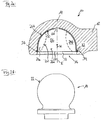
- Fig. 1 is a first embodiment of the invention of a coupling socket generally designated 10.
- the coupling socket which is in Fig. 1 is shown in perspective obliquely from below in a partial view, shows first of all a section of a drawbar 12 and a coupling formation 14 of the coupling socket 10 firmly connected to the drawbar 12. in order to achieve the highest possible component strength through the cold deformation achieved in this way.
- the drawbar 12 can be connected in the usual way to a vehicle, usually a trailing vehicle.
- the coupling formation 14 has an insertion opening 16 through which a coupling ball, such as the one in FIG Figure 2b
- the coupling ball 18 shown can be inserted along an insertion path E in the insertion direction K.
- the infeed path E which can be a straight and / or a curvilinear path, is assumed to be a straight infeed path E in the example shown here for the sake of simplicity.
- a concave coupling section 20 which, in the coupled state of the coupling socket 10, is connected to a concave mating coupling section 22 of the coupling ball 18 (see FIG Figure 2b ) can be in contact with the system and touches it in a contact area.
- the contact area can change in its position and / or extent depending on the load case occurring on the coupled ball coupling. For example, in accelerated pulling operation, the contact area can be located closer to the longitudinal end of the coupling section 20 remote from the drawbar, as in FIG Fig. 2a is indicated by the dashed touch area 24a.
- both contact areas 24a and 24b are preferably mirror-symmetrical to the sectional plane of the longitudinal sectional view of FIG Fig. 2a .
- a friction-reducing component 26 is provided, which is in the illustrated embodiments Extends essentially over the entire coupling section 20 of the coupling socket 10.
- the friction-reducing component 26 which is referred to as a lubricant component because of its friction-reducing effect, is in a reference state with a temperature of 20 ° C, an air pressure of one bar and an exclusive mechanical load due to its own weight as a solid with a predetermined shape.
- the friction-reducing component 26 is therefore referred to as a solid-state lubricant component 26 in the present application.
- the solid lubricant component 26 is advantageously a polymer component which, due to the material, can be easily manufactured in the desired shape.
- a solid lubricant component 26 is formed from aromatic polyamide or, even more preferably, from polyaramide. At least the contact surface 26a of the solid lubricant component 26 can be formed from the materials mentioned.
- the solid-state lubricant component 26 is shown as a one-piece component which advantageously covers the entire concave coupling section 20.
- the solid lubricant component 26 can have an opening 28 to facilitate assembly in order to provide an escape opening for the air present between the solid lubricant component 26 and the concave surface 30 of the coupling formation 14 when the solid lubricant component 26 is mounted on the coupling formation 14, so that the solid lubricant component 26 essentially can be mounted in full contact with the concave surface 30 of the coupling formation 14.
- the solid lubricant component therefore preferably rests against the concave wall of the coupling formation 14 with a large part of its outer surface 26b opposite to the contact surface.
- the entire outer surface 26b opposite to the contact surface 26a lies against the concave surface 30 of the coupling formation 14.
- the opening 28 is preferably provided at the contact end 29 of the solid lubricant component 26.
- solid lubricant component 26 is only held in the coupling formation 14 in a form-fitting manner.
- the coupling formation 14 can have a shoulder 32 behind the insertion opening 16 in the insertion direction K, which shoulder preferably runs continuously around the insertion path E.
- This shoulder 32 can be part of a groove 34, which likewise preferably runs completely around the insertion path E.
- the shoulder 32 and / or the groove 34 to facilitate the assembly of the solid lubricant component 26 in the coupling formation 14 lies in a plane which is particularly preferably oriented parallel to the insertion opening 16 or orthogonally to the insertion path E.
- a cantilevered latching projection 36 can be formed radially outward on the solid lubricant component 26, which particularly preferably runs continuously around the solid lubricant component 26.
- the latching projection 26 is preferably at an end closest to the insertion opening 16 when the solid lubricant component 26 is installed 17 (introductory end) of the solid lubricant component 26 is provided.
- the insertion end 17 lies axially opposite the contact end 29, that is to say with respect to the insertion path E.
- the end section of the solid lubricant component 26 closest to the insertion opening 16 in the assembled state can be adjoined by a cylindrical or generally only curved area around an axis of curvature, which is located further inside in the insertion direction K.
- a dome-like section that is to say a section curved about two mutually orthogonal axes of curvature, preferably a spherical cap-shaped section or a section with at least one spherical cap-shaped contact surface 26a is connected.
- an insertion section 38 of the coupling socket 10 or the coupling formation 14 can also be provided, which can preferably be designed with a cylindrical surface and the insertion path E as a cylinder axis in order to insert the coupling ball 18 into the coupling section 20 facilitate.
- FIG. 3 a second embodiment of the invention of a coupling socket is shown.
- the ring member 114 can, as in FIG Fig. 3 shown may be attached to the coupling formation 114 by fasteners such as screws 142.
- the only screw 142 shown is screwed into the coupling formation 114 with its screw axis parallel to the insertion path E, penetrating the ring component 140.
- a radial screwing in of fastening screws with respect to the insertion path E can also be thought of.
- a plurality of screws 142 are advantageously provided, of which only one is in the sectional plane of Fig. 3 is located.
- the screws 142 are provided equidistant from one another in the circumferential direction around the insertion path E.
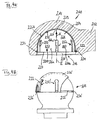
- Figure 4a shows another embodiment of the invention of a coupling socket of the present application.
- the view of Figure 4a corresponds in perspective to that of Fig. 2a .
- Identical or functionally identical Components or component sections as in Fig. 2a are in Figure 4a provided with the same reference numerals, but increased by the number 200.
- the embodiment of Figure 4a will only be described in so far as it differs from that of the Fig. 2a differs, on the description of which otherwise expressly also to explain the Figure 4a is referred.
- the coupling socket 210 corresponds completely to the coupling socket 10 of FIG Fig. 2a .
- the embodiment of the Figure 4a differs from that of the Fig. 2a only through the design of the solid lubricant component 226. This is provided with at least one recess 250, which will be explained in more detail below.
- the solid lubricant component 226 has more than one recess 250, although a single recess can be sufficient to facilitate assembly.
- the solid-state lubricant component 226 has six recesses 250, which are preferably provided equidistantly in the circumferential direction around the insertion path E.
- six recesses 250 are preferably provided equidistantly in the circumferential direction around the insertion path E.
- two, three, four, five or more than six recesses can also be provided.
- the recesses 250 are preferably designed to be identical in terms of shape, direction of extent and length of extent.
- the radial deformation or displacement of the lamellae 252 requires less force than the deformation of the recess-free solid lubricant component 26 of the embodiment of FIG Fig. 2a .
- the recesses 250 extend from the insertion end 227 of the solid lubricant component 226, preferably in a straight line at a right angle away into the solid lubricant component 226 in the direction of the contact end 229 opposite the insertion end 227 with respect to the insertion path E.
- the recesses 250 extend approximately over half the axial length of the solid lubricant component between the insertion end 217 and the contact end 229 Figure 4a
- the one-piece coupling socket 210 shown, or the deformation required on the one-piece coupling formation 214 thereof, is reduced to such an extent that it can be effected without a tool.
- the fitter can thus by hand elastically deflect the lamellae 252 radially inward towards the insertion path E so that the locking projection 36 can be moved past the insertion section 238 until the locking projection 236 moves into the Groove 234 can relax into it and there the paragraph 236 can reach behind without loss.
- the shoulder 232 forms an end face of the groove 234.
- the longitudinal end 252a of the recess 250 remote from the insertion end 227 is rounded.
- the at least one recess 250 is preferably designed as a slot penetrating the solid lubricant component 226 in the thickness direction in order to reduce the force required for the assembly deformation as much as possible. However, it should be ensured that the circumferential extension length of a lamella 252 located between two recesses 250 is greater than three times the clear width in the circumferential direction of a recess 250.
- the insertion end 227 of a solid lubricant component 226 preferably has an essentially flat edge which particularly preferably extends orthogonally to the insertion path E.
- the latching projection 236 is particularly preferably arranged directly on the insertion end 217.
- the recess 250 intersects the latching projection 236, since the latching projection 236 as a material thickening of the solid lubricant component 226 locally increases its rigidity against radial deformation . This increase can be counteracted by an arrangement of the at least one recess that intersects the locking projection.
- FIG. 4b which does not show an embodiment of the present invention, is shown as a solid lubricant component 226 of FIG Figure 4a corresponding solid lubricant component 226 'is to be attached to a coupling ball 218 in an analogous manner.
- the coupling ball 218 has a shoulder 232 'which is part of a groove 234' which is preferably formed completely circumferentially on the coupling ball 218, preferably on its equator.
- a latching projection 236 'of the solid lubricant component 226' again engages in this groove 234 ', this latching projection 236' engaging behind the shoulder 232 'in a form-fitting manner.
- Substantial difference of the embodiment of the Figure 4b is that on the solid lubricant component 226 'of the latching projection 236' protrudes toward the insertion path E, while in the embodiment of FIG Figure 4a protrudes from this away from the solid lubricant component 226.
Landscapes
- Engineering & Computer Science (AREA)
- Transportation (AREA)
- Mechanical Engineering (AREA)
- Pivots And Pivotal Connections (AREA)
- Mechanical Operated Clutches (AREA)
Description
- Die vorliegende Erfindung betrifft eine Kupplungspfanne einer Kugelkupplung gemäß dem Oberbegriff von Anspruch 1.
- Die vorliegende Erfindung betrifft ebenso eine Kugelkupplung gemäß dem Oberbegriff von Anspruch 13.
- Aus der
DE 22 35 874 C3 ist ein Kugelgelenk mit Gelenkkugel und Kugelpfanne bekannt. Diese Druckschrift lehrt, in der Kugelpfanne eine Lagerschale, die aus Kunststoff hergestellt sein kann, derart anzuordnen, dass dann, wenn Gelenkkugel und Kugelpfanne miteinander gekuppelt sind, die Lagerschale sich zwischen Gelenkkugel und Kugelpfanne befindet. Die Lagerschale ist in die die Gelenkkugel aufnehmende Kavität der Kugelpfanne eingesetzt und dort über einen gesondert ausgebildeten Feder- bzw. Sprengring formschlüssig gehalten. Der Federring ist in eine Nut der einstückig ausgebildeten Kugelpfanne in an sich bekannter Weise eingesetzt. - Der bekannte Federring ist überdies derart ausgestaltet und bemessen, dass er beim Einführen der Gelenkkugel in die Kugelpfanne von dieser aufgeweitet wird und nach Durchgang des Äquators der Gelenkkugel sich hinter dieser wieder zu einem Durchgangsmaß mit geringerer lichter Weite als der Äquatordurchmesser der Gelenkkugel entspannt.
- Eine Kugelkupplung mit Kupplungspfanne und Kupplungskugel zum Ankuppeln eines Nachlauffahrzeugs an ein Zugfahrzeug ist aus der
FR 903 599 A - Eine weitere Kugelkupplung zum Ankuppeln eines Nachlauffahrzeugs an ein Zugfahrzeug sowie deren Kupplungspfanne sind aus der
DE 201 16 970 U1 bekannt. Diese Druckschrift offenbart eine Kugelkupplung, deren Kupplungspfanne oder/und Kupplungskugel in ihrem Kupplungsabschnitt bzw. Gegenkupplungsabschnitt mit vertieften Schmiertaschen ausgebildet ist, in welche Schmierfett einbringbar ist und die somit als ein Schmierfettreservoir dienen können. Das Schmierfett kann vor dem Ankuppeln der Kupplungspfanne an die Kupplungskugel von Hand oder mit einem geeigneten Werkzeug aufgetragen werden oder es kann, wie beispielsweise aus derWO-A-2006 122807 bekannt ist, über einen an der Kupplungspfanne oder der Kupplungskugel vorgesehenen Schmiernippel auch im gekuppelten Zustand von Kupplungspfanne und Kupplungskugel in den Kupplungsabschnitt bzw. Gegenkupplungsabschnitt eingebracht werden. - Eine Kupplungskugel einer gattungsgemäßen Kugelkupplung zum Ankuppeln eines Nachlauffahrzeugs an ein Zugfahrzeug mit einem konvexen Gegenkupplungsabschnitt und einem daran angebrachten Festkörperschmierstoffbauteil ist aus der
WO 2007/134070 A2 bekannt. Der konvexe Gegenkupplungsabschnitt der bekannten Kupplungskugel liegt im gekuppelten Zustand einem konkaven Kupplungsabschnitt einer entsprechenden Kupplungspfanne gegenüber und berührt diesen in einem Berührbereich. Im Gegenkupplungsabschnitt der bekannten Kupplungskugel ist ein Schmierungsbereich vorgesehen, welcher zur Aufnahme eines Festkörperschmierstoffbauteils ausgebildet ist. Das aus derWO 2007/134070 A2 bekannte Festkörperschmierstoffbauteil liegt in einem in der vorliegenden Anmeldung definierten Bezugszustand als Festkörper vor. - Dadurch, dass in dem wenigstens einen Schmierungsbereich ein Festkörperschmierstoffbauteil aufgenommen ist, welches zumindest in einem Bezugszustand mit einer Temperatur von 20°C, einem Luftdruck von 1 bar und mechanisch nur durch sein Eigengewicht belastet als Festkörper vorliegt, ist die insbesondere zum Schmieren notwendige Wartungsarbeit gegenüber einer fettgeschmierten Kugelkupplung oder/und Kupplungspfanne reduziert.
- Durch die Anordnung eines Festkörperschmierstoffbauteils in dem wenigstens einen Schmierungsbereich entfällt ein häufiges Nachfüllen oder Beladen des Schmierungsbereichs mit Schmierfett, wie es bei der Kugelkupplung des Standes der Technik notwendig war. Das Festkörperschmierstoffbauteil stellt eine Gleitfläche bereit, an der der Gegenkupplungsabschnitt der Kupplungskugel im gekuppelten Zustand von Kupplungspfanne und Kupplungskugel im Vergleich zum unmittelbaren ungeschmierten Anlageeingriff von Kupplungspfanne und Kupplungskugel mit verminderter Reibung gleitend anliegen kann, ohne dass der Gleitanlageeingriff den Festkörperschmierstoff in den zwischen Kupplungsabschnitt und Gegenkupplungsabschnitt vorhandenen Spaltraum mehr oder weniger unkontrolliert fördert oder verteilt. Die durch das wenigstens eine Festkörperschmierstoffbauteil geschaffene Schmierungssituation bleibt aufgrund der, verglichen mit einem formlosen pulverförmigen Schmierstoff, wie etwa Graphit, oder einem pastösen oder flüssigen Schmierstoff, wie Schmierfett oder Schmieröl, höheren Formstabilität des Festkörperschmierstoffbauteils über lange Zeit im Wesentlichen unverändert erhalten. Der Wartungsaufwand zur Wiederherstellung einer vorbestimmten Schmierungssituation, wie er bei der Verwendung von pulverförmigem Graphit, pastösem Schmierfett oder flüssigem Schmieröl notwendig ist, kann somit entfallen oder ist erheblich reduziert.
- Da Werkstoffe allgemein unter unterschiedlichen vorbestimmten Bedingungen in unterschiedlichen Aggregatszuständen vorliegen können, soll zur Feststellung, ob ein verwendeter Schmierstoff ein Festkörper im Sinne der vorliegenden Anmeldung ist oder nicht, ein Bezugszustand des Schmierstoffs mit einer Temperatur von 20°C, einem Atmosphärendruck der normalen Luftatmosphäre von 1 bar und einem außer durch sein Eigengewicht unbelasteten Schmierstoffbauteil herangezogen werden. Ist das Schmierstoffbauteil in dem betreffenden Zustand ein Festkörper mit vorgegebener Gestalt, d. h. weder flüssig, noch pastös oder pulverförmig oder gar gasförmig, dann soll ein derartiges Schmierstoffbauteil als Festkörperschmierstoffbauteil im Sinne der vorliegenden Anmeldung gelten.
- Das Vorliegen als Festkörper in dem betreffenden Bezugszustand soll keinesfalls ausschließen, dass das Schmierstoffbauteil auch bei höheren oder tieferen Temperaturen oder bei höheren und niedrigeren Luftdrücken ein Festkörper ist. Dies wird in der Regel sogar der Fall sein. Zur Entscheidung, ob ein Schmierstoffbauteil ein Festkörperschmierstoffbauteil im Sinne der vorliegenden Anmeldung ist, soll jedoch das Schmierstoffbauteil in dem oben definierten Bezugszustand betrachtet werden. Mit der bezeichneten Temperatur ist dabei sowohl die Temperatur des Schmierstoffbauteils als auch die Temperatur der es umgebenden Atmosphäre bezeichnet.
- Aufgabe der vorliegenden Erfindung ist, die gattungsgemäße Kugelkupplung oder/und ihr maßgebliches Bestandteil: Kupplungspfanne, derart zu verbessern, dass die Montage des Festkörperschmierstoffbauteils bei gleicher Standfestigkeit der montierten Kugelkupplung oder eines ihrer maßgeblichen Bestandteile gegenüber dem Stand der Technik erleichtert ist.
- Diese Aufgabe wird gemäß der vorliegenden Erfindung an einer gattungsgemäßen Kupplungspfanne durch die Merkmale des kennzeichnenden Teils des Anspruchs 1 gelöst oder/und an einer gattungsgemäßen Kugelkupplung durch die Merkmale des kennzeichnenden Teils des Anspruchs 13 gelöst. Gemeinsam ist beiden Lösungen, dass das Festkörperschmierstoffbauteil durch Formschluss an der Kupplungspfanne gehalten ist. Beispielsweise kann das Festkörperschmierstoffbauteil in eine komplementäre Vertiefung im Kupplungsabschnitt der Kupplungspfanne eingesetzt sein, wobei bevorzugt die radiale Dicke des Schmierstoffbauteils größer ist als die radiale Abmessung der Vertiefung, in die es eingesetzt ist, um ein Vorstehen der Anlagefläche über eine benachbarte Oberfläche des Kupplungsabschnitts zu gewährleisten. Das Festkörperschmierstoffbauteil kann durch Formschlusseingriff einer Nut in einem Bauteil aus Festkörperschmierstoffbauteil und Kupplungspfanne mit einem im jeweils anderen Bauteil ausgebildeten Rastvorsprung an der Kupplungspfanne lagegesichert sein.
- Eine formschlüssige Halterung des Festkörperschmierstoffbauteils an der Kupplungspfanne ist erfindungsgemäß in besonders einfacher Weise konstruktiv dadurch erreicht, dass in einer Einführrichtung, in welcher die Kupplungskugel beim Ankuppeln längs einer Einführbahn in eine Einführöffnung der Kupplungspfanne eingeführt wird, hinter der Einführöffnung ein Absatz ausgebildet ist, welcher von dem Festkörperschmierstoffbauteil hintergriffen ist. Vorzugsweise ist der Absatz ein um die Einführbahn umlaufender Absatz, so dass eine möglichst große Anlagefläche des den Absatz hintergreifenden Festkörperschmierstoffbauteils mit dem Absatz gegeben ist und so dass die Hintergriffsituation möglichst unabhängig vom Umfangsort um die Einführbahn ist. Der Absatz kann die Stirnfläche eines längs der Einführbahn aus einem die Einführöffnung enthaltenden Einführbereich der Kupplungspfanne entnehmbaren Absatzbauteils, etwa eines Rohrstücks, sein.
- Beispielsweise kann das Absatzbauteil bzw. Rohrstück ein Außengewinde aufweisen, mit welchem es in den Einführbereich der Kupplungspfanne vermittels eines dort vorgesehenen Innengewindes einschraubbar und aus diesem ausschraubbar sein kann.
- Aber auch andere Festlegungsmittel eines den Absatz bildenden gesonderten Bauteils der Kupplungspfanne, wie etwa von außen in die Kupplungspfanne bis zu dem Absatzbauteil eingedrehte Schrauben und dergleichen, sollen nicht ausgeschlossen sein.
- Durch ein derartiges lösbares Absatzbauteil kann der Austausch eines verschlissenen oder zu stark verschmutzten Festkörperschmierstoffbauteils gegen ein betriebsbereites Festkörperschmierstoffbauteil erheblich erleichtert sein.
- Vorzugsweise ist der oben beschriebene Absatz Teil der zuvor beschriebenen Nut, die im Kupplungsabschnitt ausgebildet sein kann. Die Nut bzw. der Absatz laufen vorzugsweise vollständig um die Einführbahn kontinuierlich um, so dass ein um den Umfang eines Einführbereichs der Kupplungspfanne herum möglichst gleichmäßiger Befestigungszustand erreicht werden kann.
- Vorzugsweise ist der Rastvorsprung also an dem Festkörperschmierstoffbauteil ausgebildet, wenngleich dies nicht so sein muss. Mit Ausbildung der Nut am Festkörperschmierstoffbauteil würde dieses jedoch in der Regel eine Dünnstelle aufweisen, was gegenüber einer durch Ausbilden eines Rastvorsprungs bewirkten Verdickung nicht vorteilhaft erscheint.
- Weiter vorteilhaft kann der Rastvorsprung an einem Ende des Festkörperschmierstoffbauteils ausgebildet sein, so dass das Festkörperschmierstoffbauteil an einem Ende mit dem Rastvorsprung abschließt. Dadurch werden im montierten Zustand Spalte zwischen Festkörperschmierstoffbauteil und Kupplungspfanne oder Kupplungskugel vermieden oder reduziert, in denen sich unerwünschterweise Schmutz ansammeln kann. Das Ende des Festkörperschmierstoffbauteils ist vorzugsweise jenes Einführende, durch welches hindurch die Kupplungskugel zur Anlage der Kupplungskugel an dem an der Kupplungspfanne festgelegten Festkörperschmierstoffbauteil eingeführt wird.
- Im Folgenden wird die Erfindung anhand ihrer Anwendung an einer Kupplungspfanne weitergebildet.
- Damit das Festkörperschmierstoffbauteil seine Wirkung bestmöglich entfalten kann, ist es vorteilhaft, wenn es eine Anlagefläche aufweist, an welcher im gekuppelten Zustand von Kupplungspfanne und Kupplungskugel bei Anordnung des Festkörperschmierstoffbauteils in der Kupplungspfanne die Kupplungskugel in Anlageeingriff ist.
- Zur Vermeidung unerwünscht hoher Flächenpressungen zwischen Kupplungspfanne oder/und Kupplungskugel und der Anlagefläche des Festkörperschmierstoffbauteils ist es bevorzugt, wenn die Anlagefläche gekrümmt, besonders vorteilhaft um zwei zueinander orthogonale Raumachsen gekrümmt ausgebildet ist. Da der Kupplungsbereich wie auch der Gegenkupplungsbereich zumindest abschnittsweise als Kugelkalottenoberfläche ausgebildet sind, ist bevorzugt auch die Anlagefläche des Festkörperschmierstoffbauteils als Kugelkalottenfläche ausgebildet. Dabei handelt es sich um eine konkave Kugelkalottenfläche bei Anordnung des Festkörperschmierstoffbauteils in der Kupplungspfanne.
- Um sicherzustellen, dass die Kupplungskugel im gekuppelten Zustand in Anlageeingriff mit der Anlagefläche des Festkörperschmierstoffbauteils gelangen, kann vorgesehen sein, dass die Anlagefläche des Festkörperschmierstoffbauteils gegenüber einer dem Festkörperschmierstoffbauteil benachbarten Oberfläche des Kupplungsabschnitts vorsteht.
- Zusätzlich kann das Festkörperschmierstoffbauteil bei Anordnung in der Kupplungspfanne mit dieser verklebt sein.
- Zur Sicherstellung einer Anlage des Gegenkupplungsabschnitts der Kupplungskugel an der Anlagefläche des Festkörperschmierstoffbauteils in möglichst vielen oder sogar allen Betriebssituationen der hier diskutierten Kugelkupplung ist es vorteilhaft, wenn der gesamte Kupplungsabschnitt der Kupplungspfanne durch das Festkörperschmierstoffbauteil gebildet ist. Somit kann der gesamte Kupplungsabschnitt durch die Anlagefläche des Festkörperschmierstoffbauteils gebildet sein, wodurch gewährleistet ist, dass der eingangs beschriebene Berührbereich zwischen Kupplungskugel und Kupplungspfanne stets in der Anlagefläche des Festkörperschmierstoffbauteils gelegen ist.
- Dann ist das Festkörperschmierstoffbauteil vorteilhaft einstückig ausgebildet, bzw. es ist zur Erleichterung seiner Montage an einer Kupplungspfanne genau ein Festkörperschmierstoffbauteil vorgesehen. Jedoch soll ebenfalls nicht ausgeschlossen sein, dass die Kupplungspfanne eine Mehrzahl von Festkörperschmierstoffbauteilen aufweist, welche über den Kupplungsabschnitt bzw. den Gegenkupplungsabschnitt verteilt vorgesehen sind.
- Beispielsweise können die Festkörperschmierstoffbauteile vorgesehen sein, welche äquidistant um die Einführbahn herum in der Kupplungspfanne angeordnet sein können. Auch dadurch kann bei entsprechender Winkelbreite der Festkörperschmierstoffbauteile eine im gekuppelten Zustand stetige Anlagefläche der Festkörperschmierstoffbauteile in allen oder zumindest in den meisten Betriebssituationen sichergestellt sein. Ebenso können 4, 5, 6 oder mehr Festkörperschmierstoffbauteile über den Kupplungsabschnitt verteilt vorgesehen sein, wobei im Falle einer Anordnung mehrerer Festkörperschmierstoffbauteile die Anzahl von drei Festkörperschmierstoffbauteilen bevorzugt ist, da diese bei ausreichender Abdeckung des Kupplungsabschnitts mit Anlagefläche der Festkörperschmierstoffbauteile den geringsten Montageaufwand bei der Verwendung einer Mehrzahl von Festkörperschmierstoffbauteilen erfordert.
- "Schmierstoff" im Sinne der vorliegenden Anmeldung ist jedes Material oder jede Materialkombination, dessen bzw. deren Zwischenanordnung zwischen Kupplungskugel und Kupplungspfanne die zwischen diesen Kugelkupplungsbauteilen auftretende Reibung im Vergleich zu deren unmittelbarem ungeschmiertem Kontakt mindert.
- Als Festkörperschmierstoff kommt grundsätzlich ein Polymer in Frage, wobei teil- oder hochkristalline Polymere aufgrund ihrer Verschleißfestigkeit bevorzugt sind. Dabei sind Polymere mit einem Kristallisationsgrad von 20 bis 95 % bevorzugt. Der Kristallisationsgrad ist dabei der Quotient der kristalli - nen Polymermasse zur gesamten Polymermasse.
- Aufgrund ihrer besonders ausgeprägten Verschleißfestigkeit bei gleichzeitig guter Schmierwirkung ist Polyamid oder stärker noch aromatisches Polyamid als Festkörperschmierstoff bevorzugt. Die beste Gesamtleistung aus Schmierfähigkeit bei gleichzeitig hoher Verschleißfestigkeit bzw. Standfestigkeit hat Polyaramid gezeigt, welches daher der am meisten bevorzugte Festkörperschmierstoff in der hier geschilderten Anwendung in einer Kugelkupplung ist.
- Neben den oben genannten Polyamiden, aromatischen Polyamiden und den ganz besonders bevorzugten Polyaramiden können jedoch auch wenigstens teilfluorierte Kunststoffe wie Polytetrafluorethylen oder Polyvinylidenfluorid als Festkörperschmierstoff dienen, wenngleich deren erwartete Standzeit in dem hochbelastenden Kupplungsbetrieb niedriger ausfallen dürfte als die der aromatischen Polyamide oder gar Polyaramide.
- Weiter kann in einzelnen Anwendungsfällen auch an Polymere mit einem Molekulargewicht von mehr als 500.000 g/mol als Festkörperschmierstoff gedacht werden. Als mögliche Anwendungsbeispiele sei an hochmolekulares Polyethylen (HNPE) oder an ultrahochmolekulares Polyethylen (OHM-PE) gedacht. Andere Polyolefine mit entsprechend hohem Molekulargewicht kommen dabei ebenfalls in Frage.
- Weitere mögliche polymere Festkörperschmierstoffe sind aliphatische Polyether, wie etwa Polyacetal, oder aromatische Polyether, wie etwa aromatische Polyeterketone (PEEK). Auch aromatische Polyester, wie etwa Polyethylenterephthalat, kommen als polymere Festkörperschmierstoffe in Frage, wenngleich alle diese in dem mechanisch besonders belastenden Betrieb einer Kugelkupplung, die besonders häufig in landwirtschaftlichen Fahrzeugen Verwendung findet, eine niedrigere Standzeit aufweisen werden, als die bevorzugten aromatischen Polyamide oder gar Polyaramide.
- Alle genannten Polymere können Füllstoffe enthalten, welche ihre Schmierungsfähigkeit verstärken können. Mögliche geeignete Füllstoffe sind Öle, Molybdänsulfid, Graphit, Partikel oder/und Fasern aus Polytetrafluorethylen, oder auch festigkeitsverstärkende Füllstoffe, wie Glas.
- Ein Vorteil von polymeren Festkörperschmierstoffbauteilen liegt in der Materialelastizität des Werkstoffs. Das Festkörperschmierstoffbauteil kann so in seiner endgültigen vorbestimmten Gestalt ausgebildet werden und auch ohne zerlegende Montage der es tragenden Kupplungspfanne durch Montageverformung an dieser angeordnet werden. Beispielsweise kann das Festkörperschmierstoffbauteil mit dem daran ausgebildeten Rastvorsprung über den oben beschriebenen Absatz hinweg durch Verformung in die Kupplungspfanne bis zum Erreichen einer endgültigen Montageposition bewegt werden. Dann, wenn der Rastvorsprung einer Nut am tragenden Kupplungsbauteil gegenübersteht, wird sich das Festkörperschmierstoffbauteil aufgrund seiner Materialelastizität mit seinem Rastvorsprung in die Nut hinein entspannen und somit den gewünschten formschlüssigen Rasteingriff herstellen. Entsprechendes gilt auch für den Fall, dass der Rastvorsprung an einem Kupplungsbauteil und die zugeordnete Nut am Festkörperschmierstoffbauteil ausgebildet ist, was jedoch aus den oben genannten Gründen, aber auch aus dem erhöhten Fertigungsaufwand eines in einem konkaven Kupplungsabschnitt vorzusehenden Rastvorsprung nicht bevorzugt ist.
- Erfindungsgemäß ist die Kupplungspfanne einstückig ausgebildet, beispielsweise aus einem Stück geschmiedet und umfasst in diesem einstückigen Zustand wenigstens eine Kupplungsausbildung, an welchem der konkave Kupplungsabschnitt ausgebildet ist und einen von der Kupplungsausbildung abstehenden Deichselabschnitt. Diese einstückige Ausbildung soll nicht ausschließen, dass an die so gebildete einstückige Kupplungspfanne weitere Bauteile anmontiert sind, die den Funktionsumfang der Kupplungspfanne lediglich erweitern, aber nicht notwendig sind, um ihre grundlegende Kupplungsfunktion herzustellen.
- Grundsätzlich kann die oben beschriebene Montage des Festkörperschmierstoffbauteils an der Kupplungspfanne bei einem massiven Festkörperschmierstoffbauteil allein aufgrund der geschilderten Verformung erfolgen. Die Verformung endet dann, wenn der beschriebene Rastvorsprung sich zum Hintergriff des Absatzes in der Kupplungspfanne entspannt.
- Die Montage kann dadurch erleichtert werden, dass das Festkörperschmierstoffbauteil wenigstens eine Aussparung aufweist, welche sich ausgehend von einem Einführende, durch welches hindurch die Kupplungskugel zur Anlage an das Festkörperschmierstoffbauteil einführbar ist, in das Festkörperschmierstoffbauteil hinein erstreckt. Durch diese wenigstens eine Aussparung, welche bevorzugt eine nutförmige Aussparung ist, kann die zur Verformung des Festkörperschmierstoffbauteils bei dessen Anordnung an der Kupplungspfanne oder an der Kupplungskugel notwendige Kraft vermindert werden.
- Wenngleich die vorzugsweise nutförmig ausgebildete Aussparung als Materialdünnstelle ausgebildet sein kann, so ist besonders bevorzugt die wenigstens eine nutförmige Aussparung als das Festkörperschmierstoffbauteil in Dickenrichtung durchsetzender Schlitz ausgebildet. Dadurch kann das Festkörperschmierstoffbauteil mit so geringer Kraft zur Montage ausreichend verformt werden, dass ein Werkzeugeinsatz zur Verformung nicht erforderlich ist.
- Die zur Verformung bei der Montage des Festkörperschmierstoffbauteils an der Kupplungspfanne benötigte Kraft hängt dabei unter anderem von der Länge der Aussparung ab, welche diese ausgehend von dem Einführende in das Festkörperschmierstoffbauteil hinein hat.
- Eine signifikante Herabsetzung der zur Verformung bei der Montage notwendigen Kraft kann dann erzielt werden, wenn die wenigstens eine Aussparung sich wenigstens über ein Fünftel der axialen Länge des Festkörperschmierstoffbauteils vom Einführende bis zu dem diesem entgegengesetzten Anlageende erstreckt. Die axiale Länge entspricht im Wesentlichen der Erstreckungslänge des Festkörperschmierstoffbauteils längs der Einführbahn, längs welcher eine Kupplungskugel in das Festkörperschmierstoffbauteil hinein eingeführt wird. Bei einem beispielsweise halbkugelförmigen Festkörperschmierstoffbauteil ist daher dessen axiale Erstreckung vom Einführende bis zum Anlagenende der Radius der halbkugelförmigen konkaven, die Kupplungskugel aufnehmenden Höhle des Festkörperschmierstoffbauteils.
- Bei der oben bezeichneten Länge eines Fünftels der axialen Abmessung des Festkörperschmierstoffbauteils vom Einführende bis zum Anlagenende ist die Montage zwar erleichtert, jedoch können die zur Montage erforderliche Verformungskräfte immer noch den Einsatz von Werkzeug erfordern. Bevorzugt erstreckt sich daher die wenigstens eine Aussparung über wenigstens ein Drittel der axialen Länge des Festkörperschmierstoffbauteils vom Einführende bis zum Anlagenende.
- Um sicherzustellen, dass auch weniger kräftige Monteure das Festkörperschmierstoffbauteil werkzeugfrei an der Kupplungspfanne anbringen können, ist besonders bevorzugt vorgesehen, dass sich die wenigstens eine Aussparung über wenigstens die Hälfte der axialen Länge des Festkörperschmierstoffbauteils erstreckt.
- Da sich allerdings auch die Haltekraft des Festkörperschmierstoffbauteils an der Kupplungspfanne mit der axialen Länge der wenigstens einen Aussparung ändert, insbesondere mit zunehmender axialer Länge der Aussparung geringer wird, ist für einen sicheren Halt des Festkörperschmierstoffbauteils an der Kupplungspfanne vorteilhafterweise vorgesehen, dass sich die wenigstens eine Aussparung über nicht mehr als drei Viertel der axialen Länge des Festkörperschmierstoffbauteils vom Einführende bis zu dem diesem entgegengesetzten Anlagenende erstreckt.
- Zur Vermeidung von unerwünschten Kerbwirkungen ist bevorzugt das im Festkörperschmierstoffbauteil gelegene, dem Einführende fern liegende Längsende der wenigstens einen Aussparung abgerundet ausgebildet.
- Zwar soll nicht ausgeschlossen sein, dass sich die wenigstens eine Aussparung in einem Winkel von dem Einführende weg in das Festkörperschmierstoffbauteil hinein erstreckt. Jedoch ist dies nicht bevorzugt. Aus Gründen einer Reinhaltung des Kupplungsabschnitts ist es viel mehr bevorzugt, wenn sich die wenigstens eine Aussparung im Wesentlichen orthogonal von dem Einführende weg erstreckt. In diesem Falle besteht die Möglichkeit, dass in der wenigstens einen Aussparung sich unerwünschterweise angesammelter Schmutz löst und aus der Aussparung hinaus fällt. Aus demselben Grunde ist bevorzugt, dass die wenigstens eine Aussparung einen geradlinigen Verlauf in der Oberfläche des Festkörperschmierstoffbauteils aufweist. Eine Krümmung der die wenigstens eine Aussparung aufweisenden Oberfläche soll dabei für die Beurteilung der Geradlinigkeit der Aussparung keine Rolle spielen. Vorteilhafterweise liegen also eine Mittellinie einer Aussparung und die Einführbahn in einer gemeinsamen Ebene.
- Zur weiteren Montageerleichterung kann das Festkörperschmierstoffbauteil eine Mehrzahl von Aussparungen aufweisen, wie sie zuvor beschrieben wurden. Vorzugsweise sind diese Aussparungen um die Einführbahn herum in Umfangsrichtung mit Abstand vorgesehen, besonders bevorzugt mit äquidistantem Abstand. Somit sind zwischen zwei in Umfangsrichtung benachbarten Aussparungen Lamellen aus dem Festkörperschmierstoffmaterial gebildet, welche in der Art einer Blattfeder an ihrem einen Längsende fest mit dem übrigen Festkörperschmierstoffbauteil verbunden sind und federnd von diesem zum Einführende hin auskragen. Durch den bevorzugten äquidistanten Abstand der Aussparungen in Umfangsrichtung kann gewährleistet werden, dass die Verformung jeder so gebildeten Lamelle bei gleichem Verformungsbetrag in etwa den gleichen Kraftbetrag erfordert.
- Bevorzugt schneidet die wenigstens eine Aussparung bzw. die Mehrzahl von Aussparungen, den oben beschriebenen Rastvorsprung am Festkörperschmierstoffbauteil, da der Rastvorsprung als Materialverdickung dem Festkörperschmierstoffbauteil eine lokal erhöhte Steifigkeit verleiht, was den zur Montageverformung notwendigen Kraftaufwand zusätzlich erhöht. Aus den oben genannten Gründen schneidet die wenigstens eine Ausnehmung bzw. die Mehrzahl von Ausnehmungen, den Rastvorsprung bevorzugt in einem rechten Winkel.
- Nicht nur kann daran gedacht sein, alleine die Kupplungspfanne mit einem Festkörperschmierstoffbauteil auszurüsten, sondern es kann auch erwogen werden, Kupplungspfanne und Kupplungskugel einer Kugelkupplung mit Festkörperschmierstoffbauteilen zu versehen, wengleich dies wegen des hierzu nötigen Aufwands im Verhältnis zu der dadurch erzielten Wirkung nicht bevorzugt ist.
- Die vorliegende Erfindung wird nachfolgend anhand der beiliegenden Figuren beschrieben werden. Es stellt dar:
- Fig. 1
- eine perspektivische Teilansicht einer erfindungsgemäßen Kupplungspfanne mit Blick in den konkaven Kupplungsabschnitt der Kupplungspfanne,
- Fig. 2a
- eine Längsschnittansicht durch die Kupplungspfanne von
Fig. 1 , - Fig. 2b
- eine mit der Kupplungspfanne von
Fig. 2a kuppelbare Kupplungskugel, - Fig. 3
- eine der Perspektive von
Fig. 2a entsprechende Längsschnittansicht durch eine alternative Ausführungsform einer erfindungsgemäßen Kupplungspfanne, - Fig. 4a
- eine der Perspektive von
Fig. 2a entsprechende Längsschnittansicht durch eine Kupplungspfanne vonFig. 2a mit einer zweiten Ausführungsform eines Festkörperschmierstoffbauteils und - Fig. 4b
- eine von der vorliegenden Erfindung nicht erfasste Kupplungskugel mit daran angeordnetem Festkörperschmierstoffbauteil in der Teilschnittansicht, wobei das Festkörperschmierstoffbauteil mutatis mutandis entsprechend jenem von
Fig. 4a ausgestaltet ist. - In den dargestellten Ausführungsformen ist die vorliegende Erfindung am Beispiel einer Kupplungspfanne dargestellt. Die vorliegende Erfindung kann aber zusätzlich an einer Kupplungskugel einer Kugelkupplung ausgeführt sein.
- In
Fig. 1 ist eine erste erfindungsgemäße Ausführungsform einer Kupplungspfanne allgemein mit 10 bezeichnet. Die Kupplungspfanne, welche inFig. 1 perspektivisch von schräg unten in Teilansicht dargestellt ist, zeigt zunächst einen Abschnitt einer Deichsel 12 und einer mit der Deichsel 12 fest verbundene Kupplungsausbildung 14 der Kupplungspfanne 10. Erfindungsgemäß sind Deichsel 12 und Kupplungsausbildung 14 aus einem Rohling einstückig geschmiedet, um durch die dadurch erzielte Kaltverformung eine möglichst hohe Bauteilfestigkeit zu erzielen. Die Deichsel 12 kann in üblicher Weise mit einem Fahrzeug, in der Regel einem Nachlauffahrzeug, verbunden sein. - Die Kupplungsausbildung 14 weist eine Einführöffnung 16 auf, durch welche hindurch eine Kupplungskugel, wie etwa die in
Fig. 2b dargestellte Kupplungskugel 18 längs einer Einführbahn E in Einführrichtung K einführbar ist. Die Einführbahn E, welche eine geradlinige oder/und eine krummlinige Bahn sein kann, sei im hier dargestellten Beispiel der Einfachheit halber als geradlinige Einführbahn E angenommen. - In Einführrichtung K hinter der Einführöffnung 16 ist ein konkaver Kupplungsabschnitt 20 gelegen, welcher im gekuppelten Zustand der Kupplungspfanne 10 mit einem konkaven Gegenkupplungsabschnitt 22 der Kupplungskugel 18 (siehe
Fig. 2b ) in Anlageeingriff stehen kann, und diesen in einem Berührbereich berührt. Der Berührbereich kann sich in seiner Lage oder/und Ausdehnung abhängig von dem an der gekuppelten Kugelkupplung auftretenden Lastfall ändern. Beispielsweise kann im beschleunigten Zugbetrieb der Berührbereich näher am deichselfernen Längsende des Kupplungsabschnitts 20 gelegen sein, wie inFig. 2a durch den strichlinierten Berührbereich 24a angedeutet ist. - Bei Verzögerung des gekuppelten Zugs kann dagegen der Berührbereich näher am deichselnäheren Längsende des Kupplungsabschnitts gelegen sein, wie in
Fig. 2a durch den strichlinierten Berührbereich 24b angedeutet ist. Beide Berührbereiche 24a und 24b liegen bei Geradeausfahrt des gekuppelten Zugs vorzugsweise spiegelsymmetrisch zur Schnittebene der Längsschnittdarstellung vonFig. 2a . - Zur Verminderung der zwischen der Kupplungskugel 18 und der Kupplungspfanne 10 im gekuppelten Zustand auftretenden Reibung ist in dem in den
Fig. 1 bis 3 gezeigten Beispiel in der Kupplungspfanne 10 ein reibungsverminderndes Bauteil 26 vorgesehen, welches sich in den dargestellten Ausführungsbeispielen im Wesentlichen über den gesamten Kupplungsabschnitt 20 der Kupplungspfanne 10 erstreckt. - Das reibungsvermindernde Bauteil 26, welches wegen seiner reibungsvermindernden Wirkung als Schmierstoffbauteil bezeichnet wird, liegt in einem Bezugszustand mit einer Temperatur von 20°C, einem Luftdruck von einem bar und einer ausschließlichen mechanischen Belastung aufgrund seines Eigengewichtes als Festkörper mit vorgegebener Gestalt vor. Deshalb ist das reibungsvermindernde Bauteil 26 in der vorliegenden Anmeldung als Festkörperschmierstoffbauteil 26 bezeichnet.
- Das Festkörperschmierstoffbauteil 26 ist vorteilhafterweise ein Polymerbauteil, welches werkstoffbedingt einfach in gewünschter Gestalt herzustellen ist.
- Hinsichtlich der möglichen Werkstoffe zur Bildung des Festkörperschmierstoffbauteils 26 oder wenigstens seiner zur Kupplungskugel 18 hin weisenden Anlagefläche 26a wird auf die Ausführungen in der vorstehenden Beschreibungseinleitung verwiesen. Aus Gründen einer besonders vorteilhaften kombinierten Wirkung hoher Standfestigkeit und geringer Reibung ist ein Festkörperschmierstoffbauteil 26 aus aromatischem Polyamid oder noch stärker bevorzugt aus Polyaramid gebildet. Wenigstens die Anlagefläche 26a des Festkörperschmierstoffbauteils 26 kann aus den genannten Werkstoffen gebildet sein.
- In den
Fig. 1 und2a ist das Festkörperschmierstoffbauteil 26 als einstückiges Bauteil gezeigt, welches vorteilhaft den gesamten konkaven Kupplungsabschnitt 20 bedeckt. Hierzu kann das Festkörperschmierstoffbauteil 26 als Montageerleichterung eine Öffnung 28 aufweisen, um der bei der Montage des Festkörperschmierstoffbauteils 26 an die Kupplungsausbildung 14 zwischen dem Festkörperschmierstoffbauteil 26 und der konkaven Oberfläche 30 der Kupplungsausbildung 14 vorhandenen Luft eine Entweichungsöffnung bereitzustellen, so dass das Festkörperschmierstoffbauteil 26 im Wesentlichen vollflächig an der konkaven Fläche 30 der Kupplungsausbildung 14 anliegend montiert werden kann. Vorzugsweise liegt also das Festkörperschmierstoffbauteil mit einem Großteil seiner zur Anlagefläche entgegengesetzten Außenfläche 26b an der konkaven Wand der Kupplungsausbildung 14 an. Besonders bevorzugt liegt die gesamte der Anlagefläche 26a entgegengesetze Außenfläche 26b an der konkaven Fläche 30 der Kupplungsausbildung 14 an. Die Öffnung 28 ist bevorzugt an dem Anlageende 29 des Festkörperschmierstoffbauteils 26 vorgesehen. - Grundsätzlich kann daran gedacht sein, die Flächen 26b und 30 des Festkörperschmierstoffbauteils 26 einerseits und der Kupplungsausbildung 14 andererseits miteinander zu verkleben.
- Zur erleichterten Reparatur und Wartung des Festkörperschmierstoffbauteils 26, insbesondere zu seinem erleichterten Austausch im Falle einer Beschädigung ist es jedoch vorteilhaft, wenn das Festkörperschmierstoffbauteil 26 nur formschlüssig in der Kupplungsausbildung 14 gehalten ist.
- Hierzu kann die Kupplungsausbildung 14 in Einführrichtung K hinter der Einführöffnung 16 einen Absatz 32 aufweisen, welcher vorzugsweise kontinuierlich um die Einführbahn E umläuft. Dieser Absatz 32 kann Teil einer Nut 34 sein, welche ebenfalls vorzugsweise vollständig um die Einführbahn E umläuft.
- Vorzugsweise liegt der Absatz 32 oder/und die Nut 34 zur Erleichterung der Montage des Festkörperschmierstoffbauteils 26 in der Kupplungsausbildung 14 in einer Ebene, die besonders bevorzugt parallel zur Einführöffnung 16 oder orthogonal zur Einführbahn E orientiert ist.
- Zum Rasteingriff in die Nut 34 kann radial außen am Festkörperschmierstoffbauteil 26 ein auskragender Rastvorsprung 36 ausgebildet sein, welcher besonders bevorzugt kontinuierlich um das Festkörperschmierstoffbauteil 26 umläuft.
- Um unerwünschte vom Kupplungsabschnitt 20 weg weisende Spalte zwischen dem Festkörperschmierstoffbauteil 26 und dem Kupplungsabschnitt 14 zu vermeiden, in welchen sich im Betrieb der hier diskutierten Kupplung Schmutz ansammeln kann, ist bevorzugt der Rastvorsprung 26 an einem im montierten Zustand des Festkörperschmierstoffbauteils 26 der Einführöffnung 16 nächstgelegenen Ende 17 (Einführende) des Festkörperschmierstoffbauteils 26 vorgesehen. Das Einführende 17 liegt dem Anlageende 29 axial, also bezüglich der Einführbahn E, gegenüber.
- Abhängig von der Gestaltung der Kupplungsausbildung 14 und der darin vorgesehenen konkaven Ausnehmung kann sich an den im montierten Zustand der Einführöffnung 16 nächstgelegenen Endabschnitt des Festkörperschmierstoffbauteils 26 ein zylindrischer oder allgemein nur um eine Krümmungsachse gekrümmter Bereich anschließen, an welchen sich in Einführrichtung K noch weiter innen gelegen ein domartiger Abschnitt, also ein um zwei zueinander orthogonale Krümmungsachsen gekrümmter Abschnitt, vorzugsweise ein kugelkalottenförmiger Abschnitt oder ein Abschnitt mit wenigstens einer kugelkalottenförmigen Anlagefläche 26a anschließt.
- Entgegen der Einführrichtung K vor der Nut 34 kann ebenfalls ein Einführabschnitt 38 der Kupplungspfanne 10 bzw. der Kupplungsausbildung 14 vorgesehen sein, welcher vorzugsweise mit zylindrischer Fläche und der Einführbahn E als Zylinderachse ausgebildet sein kann, um das Einführen der Kupplungskugel 18 in den Kupplungsabschnitt 20 zu erleichtern.
- In
Fig. 3 ist eine zweite erfindungsgemäße Ausführungsform einer Kupplungspfanne dargestellt. - Die zweite Ausführungsform, bei welcher gleiche und funktionsgleiche Bauteile bzw. Bauteilabschnitte wie in der ersten Ausführungsform der
Fig. 1 und2a gleiche Bezugszeichen aufweisen, jedoch erhöht um die Zahl 100, wird nachfolgend nur insofern beschrieben werden, als es sich von der ersten Ausführungsform unterscheidet, auf deren Beschreibung ansonsten ausdrücklich verwiesen sei. Im Gegensatz zur ersten Ausführungsform, bei welcher die Kupplungsausbildung 14 einstückig ausgebildet ist, ist bei der inFig. 3 dargestellten zweiten Ausführungsform einer erfindungsgemäßen Kupplungspfanne die Einführöffnung 116 und vorzugsweise auch der Einführabschnitt 138 an einem gesondert von der Kupplungsausbildung 114 ausgebildeten Ringbauteil 140 vorgesehen. - Das Ringbauteil 114 kann, wie in
Fig. 3 dargestellt ist, durch Befestigungsmittel, wie etwa Schrauben 142 an der Kupplungsausbildung 114 befestigt sein. In dem inFig. 3 dargestellten Beispiel ist die einzig dargestellte Schraube 142 mit ihrer Schraubenachse parallel zur Einführbahn E das Ringbauteil 140 durchsetzend in die Kupplungsausbildung 114 eingedreht. Bei größerer axialer Länge bezogen auf die Einführbaren E des Ringbauteils 140 kann alternativ oder zusätzlich zu der inFig. 3 dargestellten Lösung auch an ein radiales Eindrehen von Befestigungsschrauben bezüglich der Einführbahn E gedacht sein. - Zur möglichst gleichmäßigen Ausübung einer Befestigungskraft zur Befestigung des Ringbauteils 140 an der Kupplungsausbildung 114 ist vorteilhaft eine Mehrzahl von Schrauben 142 vorgesehen, von welchen lediglich eine in der Schnittebene von
Fig. 3 gelegen ist. Besonders bevorzugt sind die Schrauben 142 in Umfangsrichtung um die Einführbahn E äquidistant voneinander vorgesehen. - Die in
Fig. 3 dargestellte Ausführungsform mit lösbar an der Kupplungsausbildung 114 festgelegten Ringbauteil 140 erleichtert einen Austausch des Festkörperschmierstoffbauteils 126 im Falle seiner Beschädigung bzw. in Falle des Erreichens seiner Betriebslebensdauer. - In
Fig. 4a ist eine weitere erfindungsgemäße Ausführungsform einer Kupplungspfanne der vorliegenden Anmeldung gezeigt. Die Ansicht vonFig. 4a entspricht in der Perspektive jener vonFig. 2a . Gleiche bzw. funktionsgleiche Bauteile bzw. Bauteilabschnitte wie inFig. 2a sind inFig. 4a mit gleichen Bezugszeichen versehen, jedoch erhöht um die Zahl 200. Die Ausführungsform derFig. 4a wird nur insofern beschrieben werden, als sie sich von jener derFig. 2a unterscheidet, auf deren Beschreibung ansonsten ausdrücklich auch zur Erläuterung derFig. 4a verwiesen wird. - Die Kupplungspfanne 210 entspricht hinsichtlich der Kupplungsausbildung 214 und der Deichsel 212 vollständig der Kupplungspfanne 10 von
Fig. 2a . Die Ausführungsform derFig. 4a unterscheidet sich von jener derFig. 2a lediglich durch die Ausgestaltung des Festkörperschmierstoffbauteils 226. Dieses ist mit wenigstens einer Aussparung 250 versehen, welche nachfolgend näher erläutert werden wird. - Das Festkörperschmierstoffbauteil 226 weist in dem dargestellten Ausführungsbeispiel mehr als eine Aussparung 250 auf, wenngleich als Montageerleichterung bereits eine einzige Aussparung ausreichen kann.
- Im vorliegenden Ausführungsbeispiel weist das Festkörperschmierstoffbauteil 226 sechs Aussparungen 250 auf, welche bevorzugt äquidistant in Umfangsrichtung um die Einführbahn E herum vorgesehen sind. Lediglich der Vollständigkeit halber wird darauf hingewiesen, dass statt der beispielhaft verwendeten Anzahl von sechs Aussparungen auch zwei, drei, vier, fünf oder mehr als sechs Aussparungen vorgesehen sein können.
- Die Aussparungen 250 sind vorzugsweise hinsichtlich Gestalt, Erstreckungsrichtung und Erstreckungslänge identisch ausgebildet.
- Durch die in Umfangsrichtung um die Einführbahn E umlaufende Anordnung der Aussparungen 250 bilden diese in Umfangsrichtung zwischen sich eine der Anzahl an Aussparungen entsprechende Anzahl an Lamellen 252, welche bezüglich der Einführbahn E radial federnd von einem gemeinsamen Festkörperschmierstoffbauteilabschnitt 254 auskragen.
- Die radiale Verformung bzw. Verlagerung der Lamellen 252 erfordert bei gleichem radialen Verformungsbetrag weniger Kraft als die Verformung des aussparungsfreien Festkörperschmierstoffbauteils 26 der Ausführungsform von
Fig. 2a . - Die Aussparungen 250 erstrecken sich vom Einführende 227 des Festkörperschmierstoffbauteils 226 vorzugsweise geradlinig in rechtem Winkel weg in das Festkörperschmierstoffbauteil 226 hinein in Richtung zu dem dem Einführende 227 bezüglich der Einführbahn E entgegengesetzten Anlageende 229. Der Umstand, dass das Festkörperschmierstoffbauteil 226 in dem Bereich, in dem die Aussparung 250 vorgesehen ist, wenigstens abschnittsweise gekrümmt ist, soll an der Geradlinigkeit der Aussparung 250 nichts ändern. Die Aussparung 250 ist vielmehr deshalb geradlinig, weil es am jeweiligen lokalen Anbringungsort der Aussparung 250 keine zu der die Aussparung 250 aufweisenden Oberfläche des Festkörperschmierstoffbauteils 226 orthogonale Krümmungsachse gibt, um welche die Aussparung 250 gekrümmt ist.
- In dem in
Fig. 4a dargestellten Beispiel erstrecken sich die Aussparungen 250 etwa über die halbe axiale Länge des Festkörperschmierstoffbauteils zwischen dem Einführende 217 und dem Anlageende 229. Mit einer derart gewählten Länge der Aussparung ist eine zur Montage des Festkörperschmierstoffbauteils 226 an der inFig. 4a gezeigten einstückig ausgebildeten Kupplungspfanne 210 bzw. an deren einstückigen Kupplungsausbildung 214 erforderlichen Verformung benötigte Kraft so weit reduziert, dass diese ohne Werkzeug bewirkt werden kann. - Zur Montage des Festkörperschmierstoffbauteils 226 an der Kupplungspfanne 210 kann der Monteur also von Hand die Lamellen 252 so weit nach radial innen zur Einführbahn E hin elastisch auslenken, dass der Rastvorsprung 36 an dem Einführabschnitt 238 vorbei bewegt werden kann, bis sich der Rastvorsprung 236 in die Nut 234 hinein entspannen kann und dort den Absatz 236 verliersicher hintergreifen kann. Der Absatz 232 bildet in den hier gezeigten Beispielen eine Stirnfläche der Nut 234.
- Zur Vermeidung unerwünschter Kerbwirkungen ist das vom Einführende 227 fern liegende Längsende 252a der Aussparung 250 abgerundet ausgebildet.
- Vorzugsweise ist die wenigstens eine Aussparung 250 als das Festkörperschmierstoffbauteil 226 in Dickenrichtung durchsetzender Schlitz ausgebildet, um die für die Montageverformung benötigte Kraft so weit wie möglich herabzusetzen. Dabei sollte jedoch darauf geachtet werden, dass die Umfangserstreckungslänge einer zwischen zwei Aussparungen 250 gelegenen Lamelle 252 größer ist als das Dreifache der lichten Weite in Umfangsrichtung einer Aussparung 250.
- Vorzugsweise weist das Einführende 227 eines Festkörperschmierstoffbauteils 226 einen im Wesentlichen ebenen Rand auf, der sich besonders bevorzugt orthogonal zur Einführbahn E erstreckt. Durch diese Ausbildung kann eine über den Umfang gleichmäßige Anlagebedingung einer Kupplungskugel an das Festkörperschmierstoffbauteil 226 erreicht werden.
- Besonders bevorzugt ist der Rastvorsprung 236 unmittelbar am Einführende 217 angeordnet.
- Zur Montageerleichterung durch Verringerung der für die Anbringung des Festkörperschmierstoffbauteils 226 an der Kupplungsausbildung 214 der Kupplungspfanne 210 notwendigen Kraft ist es besonders vorteilhaft, wenn die Aussparung 250 den Rastvorsprung 236 schneidet, da der Rastvorsprung 236 als Materialverdickung des Festkörperschmierstoffbauteils 226 dessen Steifigkeit gegen radiale Verformung lokal erhöht. Dieser Erhöhung kann durch eine den Rastvorsprung schneidende Anordnung der wenigstens einen Aussparung entgegengewirkt werden.
- In
Fig. 4b , welche keine erfindungsgemäße Ausführungsform zeigt, ist dargestellt, wie ein dem Festkörperschmierstoffbauteil 226 vonFig. 4a entsprechendes Festkörperschmierstoffbauteil 226' an einer Kupplungskugel 218 in analoger Weise anzubringen ist. - Die Kupplungskugel 218 weist in analoger Weise bezüglich der Kupplungspfanne 210 einen Absatz 232' auf, welcher Teil einer Nut 234' ist, die vorzugsweise vollständig umlaufend an der Kupplungskugel 218, bevorzugt an deren Äquator, ausgebildet ist. In diese Nut 234' greift wiederum ein Rastvorsprung 236' des Festkörperschmierstoffbauteils 226' ein, wobei dieser Rastvorsprung 236' den Absatz 232' formschlüssig hintergreift.
- Wesentlicher Unterschied der Ausführungsform der
Fig. 4b ist, dass an dem Festkörperschmierstoffbauteil 226' der Rastvorsprung 236' zur Einführbahn E hin auskragt, während er im Ausführungsbeispiel derFig. 4a von dieser weg vom Festkörperschmierstoffbauteil 226 auskragt. - Ansonsten wird zur Beschreibung des Festkörperschmierstoffbauteils 226' von
Fig. 4b auf die Beschreibung des Festkörperschmierstoffbauteils 226 vonFig. 4a verwiesen.
Claims (13)
- Kupplungspfanne (10; 110; 210) einer Kugelkupplung für einen Zugbetrieb, wobei die Kupplungspfanne (10; 110) zur Herstellung eines gekuppelten Zugs zur Kupplung mit einer Kupplungskugel (18; 218) ausgebildet ist und hierzu einen konkaven Kupplungsabschnitt (20; 120; 220) aufweist, der im gekuppelten Zustand der Kupplungspfanne (10; 110; 210) einem konvexen Gegenkupplungsabschnitt (22; 222) der Kupplungskugel (18; 218) gegenüberliegt und diesen in einem Berührbereich (24a, 24b) berührt,dadurch gekennzeichnet, dass die Kupplungspfanne (10; 110; 210) einstückig ausgebildet ist und eine Kupplungsausbildung (14; 114; 214) sowie einen einstückig mit der Kupplungsausbildung (14; 114; 214) geschmiedeten Deichselabschnitt (12; 112; 212) zur Verbindung mit einem Nachlauffahrzeug aufweist, wobei im Kupplungsabschnitt (20; 120; 220) der Kupplungspfanne (10; 110; 210) wenigstens ein Schmierungsbereich (30; 130; 230) vorgesehen ist, welcher zur Aufnahme von Schmiermittel (26; 126; 226) ausgebildet ist, wobei in dem wenigstens einen Schmierungsbereich (30; 130; 230) ein Festkörperschmierstoffbauteil (26; 126; 226) aufgenommen ist, welches zumindest in einem Bezugszustand mit einer Temperatur von 20°C, einem Luftdruck von 1 bar und mechanisch nur durch sein Eigengewicht belastet als Festkörper vorliegt,wobei das Festkörperschmierstoffbauteil durch Formschluss an der Kupplungspfanne (10; 110; 210) gehalten ist, wobei die Kupplungspfanne (10; 110; 210) eine Einführöffnung (16; 116; 216) aufweist, in welche die Kupplungskugel (18; 218) beim Ankuppeln längs einer Einführbahn (E) eingeführt wird, wobei in Einführrichtung (K) hinter der Einführöffnung (16; 116; 216) ein Absatz (32; 132; 232), vorzugsweise ein um die Einführbahn (E) umlaufender Absatz (32; 132; 232), in der Kupplungspfanne (10; 110; 210) ausgebildet ist, welcher von dem Festkörperschmierstoffbauteil (26; 126; 226) hintergriffen ist.
- Kupplungspfanne (10; 110; 210) nach Anspruch 1,
dadurch gekennzeichnet, dass der Absatz (32; 132; 232) in der Kupplungspfanne (10; 110; 210) Teil einer Nut (34; 134; 234) ist, welche vorzugsweise vollständig um die Einführbahn (E) kontinuierlich umläuft. - Kupplungspfanne nach einem der vorhergehenden Ansprüche,
dadurch gekennzeichnet, dass das Festkörperschmierstoffbauteil (226) wenigstens eine Aussparung (250) aufweist, welche sich ausgehend von einem Einführende (27; 127; 227), durch welches hindurch die Kupplungskugel (18; 218) zur Anlage an das Festkörperschmierstoffbauteil (26; 126; 226) einführbar ist, in das Festkörperschmierstoffbauteil (226) hinein erstreckt. - Kupplungspfanne nach Anspruch 3,
dadurch gekennzeichnet, dass sich die wenigstens eine Aussparung (250) vom Einführende (27; 127; 227) ausgehend über wenigstens ein Fünftel, bevorzugt, über wenigstens ein Drittel, besonders bevorzugt über wenigstens die Hälfte der axialen Länge des Festkörperschmierstoffbauteils (226) vom Einführende (27; 127; 227), jedoch über nicht mehr als drei Viertel der axialen Länge des Festkörperschmierstoffbauteils erstreckt bis zu dem diesem entgegengesetzten Anlageende (29; 129; 229) erstreckt. - Kupplungspfanne nach einem der Ansprüche 3 oder 4,
dadurch gekennzeichnet, dass sich die wenigstens eine Aussparung (250) im Wesentlichen orthogonal von dem Einführende (27; 127; 227) weg, besonders bevorzugt geradlinig weg, erstreckt. - Kupplungspfanne nach einem der Ansprüche 3 bis 5,
dadurch gekennzeichnet, dass das Festkörperschmierstoffbauteil (226) eine Mehrzahl von Aussparungen (250) aufweist, welche bevorzugt in Umfangsrichtung um die Einführbahn (E) äquidistant angeordnet sind. - Kupplungspfanne nach einem der vorhergehenden Ansprüche,
dadurch gekennzeichnet, dass das Festkörperschmierstoffbauteil (26; 126, 226) eine Anlagefläche (26a; 126a; 226a) zur Anlage an die Kupplungskugel (18; 218) im gekuppelten Zustand aufweist. - Kupplungspfanne nach Anspruch 7,
dadurch gekennzeichnet, dass die Anlagefläche (26a; 126a; 226a) des Festkörperschmierstoffbauteils (26a; 126a; 226a) gegenüber einer dem Festkörperschmierstoffbauteil (26; 126; 226a) benachbarten Oberfläche des Kupplungsabschnitts vorsteht. - Kupplungspfanne nach Anspruch 7 oder 8,
dadurch gekennzeichnet, dass die Anlagefläche (26a; 126a; 226a) die Gestalt einer Kugelkalotte aufweist. - Kupplungspfanne nach einem der vorhergehenden Ansprüche,
dadurch gekennzeichnet, dass der gesamte Kupplungsabschnitt (20; 120; 220) durch das Festkörperschmierstoffbauteil (26; 126; 226) gebildet ist. - Kupplungspfanne nach einem der vorhergehenden Ansprüche,
dadurch gekennzeichnet, dass der Festkörperschmierstoff (26; 126; 226) ein Polymer, vorzugsweise ein teil- oder hochkristallines Polymer, insbesondere Polyamid, stärker bevorzugt aromatisches Polyamid, noch stärker bevorzugt Polyaramid umfasst. - Kugelkupplung für einen Zugbetrieb, mit einer Kupplungskugel (18) und mit einer einstückigen Kupplungspfanne (10; 110), welche mit der Kupplungskugel (18) zur Herstellung eines gekuppelten Zugs kuppelbar ist, wobei die Kupplungspfanne (10; 110) eine Kupplungsausbildung (14; 114; 214) und einen einstückig mit der Kupplungsausbildung (14; 114; 214) geschmiedeten Deichselabschnitt (12; 112; 212) zur Verbindung mit einem Nachlauffahrzeug aufweist, wobei die Kupplungspfanne (10; 110) einen konkaven Kupplungsabschnitt (20; 120) aufweist, der im gekuppelten Zustand der Kugelkupplung einem konvexen Gegenkupplungsabschnitt (22) der Kupplungskugel (18) gegenüberliegt und diesen in einem Berührbereich (24a, 24b) berührt, wobei im Kupplungsabschnitt (20; 120) der Kupplungspfanne (10; 110) oder/und im Gegenkupplungsabschnitt (22) der Kupplungskugel (18) wenigstens ein Schmierungsbereich (30; 130) vorgesehen ist, welcher zur Aufnahme von Schmiermittel (26; 126) ausgebildet ist,wobei in dem wenigstens einen Schmierungsbereich (30; 130) ein Festkörperschmierstoffbauteil (26; 126) aufgenommen ist, welches zumindest in einem Bezugszustand mit einer Temperatur von 20°C, einem Luftdruck von 1 bar und mechanisch nur durch sein Eigengewicht belastet als Festkörper vorliegt,dadurch gekennzeichnet, dass das Festkörperschmierstoffbauteil durch Formschluss an der Kupplungspfanne (10; 110; 210) gehalten ist, wobei die Kupplungspfanne (10; 110; 210) eine Einführöffnung (16; 116; 216) aufweist, in welche die Kupplungskugel (18; 218) beim Ankuppeln längs einer Einführbahn (E) eingeführt wird, wobei in Einführrichtung (K) hinter der Einführöffnung (16; 116; 216) ein Absatz (32; 132; 232), vorzugsweise ein um die Einführbahn (E) umlaufender Absatz (32; 132; 232), in der Kupplungspfanne (10; 110; 210) ausgebildet ist, welcher von dem Festkörperschmierstoffbauteil (26; 126; 226) hintergriffen ist.
- Kugelkupplung nach Anspruch 12,
dadurch gekennzeichnet, dass diese durch Merkmale wenigstens eines der Ansprüche 2 bis 12 weitergebildet ist.
Applications Claiming Priority (1)
| Application Number | Priority Date | Filing Date | Title |
|---|---|---|---|
| DE102012211666.4A DE102012211666B4 (de) | 2012-07-04 | 2012-07-04 | Kupplungspfanne mit Festkörperschmierstoff |
Publications (3)
| Publication Number | Publication Date |
|---|---|
| EP2682290A1 EP2682290A1 (de) | 2014-01-08 |
| EP2682290B1 EP2682290B1 (de) | 2016-04-27 |
| EP2682290B2 true EP2682290B2 (de) | 2021-11-10 |
Family
ID=48672388
Family Applications (1)
| Application Number | Title | Priority Date | Filing Date |
|---|---|---|---|
| EP13171734.0A Active EP2682290B2 (de) | 2012-07-04 | 2013-06-12 | Kupplungspfanne mit Festkörperschmierstoff |
Country Status (3)
| Country | Link |
|---|---|
| EP (1) | EP2682290B2 (de) |
| DE (1) | DE102012211666B4 (de) |
| PL (1) | PL2682290T3 (de) |
Families Citing this family (3)
| Publication number | Priority date | Publication date | Assignee | Title |
|---|---|---|---|---|
| DE202018100321U1 (de) | 2018-01-19 | 2018-01-29 | Jost-Werke Deutschland Gmbh | Kugelkupplung zur Bildung eines Fahrzeugzuges mit die Kugelkupplung vor äußeren Einflüssen schützender hüllenartiger Ummantelung |
| AT522340B1 (de) | 2019-10-16 | 2020-10-15 | Josef Scharmueller Ing | Kupplungspfanne |
| US11827065B2 (en) | 2022-02-23 | 2023-11-28 | Lloyd Frank Estes | Lubricated trailer ball and receiver assembly |
Family Cites Families (13)
| Publication number | Priority date | Publication date | Assignee | Title |
|---|---|---|---|---|
| FR903599A (fr) * | 1944-04-22 | 1945-10-09 | Attelage perfectionné pour remorques de véhicules automobiles ou autres | |
| US3679234A (en) * | 1969-09-17 | 1972-07-25 | Frank Colliau | Reflective plastic coated trailer hitch ball |
| DE2235874C3 (de) * | 1972-07-21 | 1975-06-19 | Lemfoerder Metallwaren Ag, 2844 Lemfoerde | Lösbares Kugelgelenk, insbesondere für Bediengestänge von Kraftfahrzeugen |
| US3968981A (en) * | 1975-08-28 | 1976-07-13 | Suarez Roderick A | Variable size trailer hitch assembly |
| DE8429103U1 (de) * | 1984-10-04 | 1985-01-10 | Westfalia-Werke Franz Knöbel & Söhne KG, 4840 Rheda-Wiedenbrück | Kugelkopfkupplung fuer anhaenger |
| US5547089A (en) * | 1994-09-19 | 1996-08-20 | Westinghouse Air Brake Company | Slackless drawbar assembly utilizing a ball and race assembly |
| US6382656B1 (en) * | 2000-08-07 | 2002-05-07 | Howard Percival Johnson, Jr. | Anti-rattle device for a trailer hitch |
| DE20107002U1 (de) * | 2001-04-23 | 2001-08-23 | Igus Spritzgußteile für die Industrie GmbH, 51147 Köln | Winkelgelenk |
| DE20116970U1 (de) * | 2001-10-16 | 2003-02-20 | Rockinger Spezialfabrik für Anhängerkupplungen GmbH & Co, 80935 München | Kugelkupplung |
| AT412459B (de) * | 2002-06-03 | 2005-03-25 | Scharmueller Gmbh & Co Kg | Kupplungsvorrichtung |
| US20080036179A1 (en) | 2002-11-27 | 2008-02-14 | Andersen John I | Systems and methods for providing a towing apparatus having an integral ball |
| AT413361B (de) * | 2004-02-13 | 2006-02-15 | Josef Ing Scharmueller | Kupplungskörper |
| DE102005022879A1 (de) * | 2005-05-18 | 2006-11-23 | Jost-Werke Gmbh & Co. Kg | Kugelkupplung mit abgedichtetem Anlagebereich |
-
2012
- 2012-07-04 DE DE102012211666.4A patent/DE102012211666B4/de active Active
-
2013
- 2013-06-12 EP EP13171734.0A patent/EP2682290B2/de active Active
- 2013-06-12 PL PL13171734.0T patent/PL2682290T3/pl unknown
Also Published As
| Publication number | Publication date |
|---|---|
| PL2682290T3 (pl) | 2016-09-30 |
| EP2682290A1 (de) | 2014-01-08 |
| EP2682290B1 (de) | 2016-04-27 |
| DE102012211666A1 (de) | 2014-01-09 |
| DE102012211666B4 (de) | 2024-12-24 |
Similar Documents
| Publication | Publication Date | Title |
|---|---|---|
| AT508701B1 (de) | Zahnradanordnung | |
| EP2248946B1 (de) | Verbindungselement für Laufschienen | |
| EP2888501B1 (de) | Scheibenbremse für ein kraftfahrzeug mit plastisch deformierbarer rückstellfeder und rückstellfeder | |
| DE60114542T2 (de) | Kugelumlaufmutter und -schraube mit Schmiervorrichtung | |
| EP3077684B1 (de) | Ringförmige steckkupplung sowie ein herstellungs- und ein verbindungsverfahren dafür | |
| EP2682290B2 (de) | Kupplungspfanne mit Festkörperschmierstoff | |
| AT502800B1 (de) | Lagerung einer drehstabfeder des antiwanksystems eines schienenfahrzeuges | |
| DE102007038254B4 (de) | Kupplungsglied für eine Mitnehmerkupplung und Herstellungsverfahren | |
| WO2011157384A1 (de) | Handschutz für eine waffe | |
| EP4259951B1 (de) | Energiefuhrüngsketten für lange verfahrwege, insbesondere mit laufrollen | |
| DE102008056202A1 (de) | Gleitlager | |
| WO2013182333A1 (de) | Kontakt mit widerstandsfähiger primärlanze zum verriegeln in einer kontaktkammer einer steckverbinders | |
| WO2014183752A1 (de) | Verliergesicherte hülsendrehverbindung einer spann- oder führungsschiene, sowie zugmitteltrieb | |
| EP2664806A2 (de) | Steck-Schnapp-System für Kühlmöbel | |
| WO2008040553A1 (de) | Öffnungsvorrichtung für eine schliesseinheit | |
| DE102010046887B4 (de) | Verschiebegelenk | |
| WO2022253436A1 (de) | Sphärisches lager | |
| WO2016156490A1 (de) | Lager für kugelzapfen eines kugelgelenks | |
| EP3368810B1 (de) | Vorrichtung, vorzugsweise rohrschelle, mit verschlussmechanismus mit führungskanälen | |
| EP2756198A1 (de) | Anschlaganordnung für die eingefahrene kolbenstange eines geberzylinders | |
| DE102011108406A1 (de) | Schienenfahrzeug mit einer Puffereinrichtung mit Aufkletterschutzmitteln | |
| EP2544939A1 (de) | Vorrichtung zum begrenzen einer nickbewegung bei schienenfahrzeugen | |
| DE102018128553B4 (de) | Gebereinheit für einen Dreh-Sensor | |
| WO2008086784A2 (de) | Wälzlagerkäfig mit vereinfachtem einbau der wälzkörper | |
| EP2139706A1 (de) | Schwingungsdämpfer |
Legal Events
| Date | Code | Title | Description |
|---|---|---|---|
| PUAI | Public reference made under article 153(3) epc to a published international application that has entered the european phase |
Free format text: ORIGINAL CODE: 0009012 |
|
| AK | Designated contracting states |
Kind code of ref document: A1 Designated state(s): AL AT BE BG CH CY CZ DE DK EE ES FI FR GB GR HR HU IE IS IT LI LT LU LV MC MK MT NL NO PL PT RO RS SE SI SK SM TR |
|
| AX | Request for extension of the european patent |
Extension state: BA ME |
|
| 17P | Request for examination filed |
Effective date: 20140220 |
|
| RBV | Designated contracting states (corrected) |
Designated state(s): AL AT BE BG CH CY CZ DE DK EE ES FI FR GB GR HR HU IE IS IT LI LT LU LV MC MK MT NL NO PL PT RO RS SE SI SK SM TR |
|
| GRAP | Despatch of communication of intention to grant a patent |
Free format text: ORIGINAL CODE: EPIDOSNIGR1 |
|
| INTG | Intention to grant announced |
Effective date: 20151120 |
|
| GRAS | Grant fee paid |
Free format text: ORIGINAL CODE: EPIDOSNIGR3 |
|
| GRAA | (expected) grant |
Free format text: ORIGINAL CODE: 0009210 |
|
| RAP1 | Party data changed (applicant data changed or rights of an application transferred) |
Owner name: ROCKINGER AGRICULTURE GMBH |
|
| AK | Designated contracting states |
Kind code of ref document: B1 Designated state(s): AL AT BE BG CH CY CZ DE DK EE ES FI FR GB GR HR HU IE IS IT LI LT LU LV MC MK MT NL NO PL PT RO RS SE SI SK SM TR |
|
| REG | Reference to a national code |
Ref country code: GB Ref legal event code: FG4D Free format text: NOT ENGLISH |
|
| REG | Reference to a national code |
Ref country code: CH Ref legal event code: EP |
|
| REG | Reference to a national code |
Ref country code: AT Ref legal event code: REF Ref document number: 794318 Country of ref document: AT Kind code of ref document: T Effective date: 20160515 |
|
| REG | Reference to a national code |
Ref country code: IE Ref legal event code: FG4D Free format text: LANGUAGE OF EP DOCUMENT: GERMAN |
|
| REG | Reference to a national code |
Ref country code: DE Ref legal event code: R096 Ref document number: 502013002730 Country of ref document: DE |
|
| REG | Reference to a national code |
Ref country code: FR Ref legal event code: PLFP Year of fee payment: 4 |
|
| REG | Reference to a national code |
Ref country code: NL Ref legal event code: FP |
|
| REG | Reference to a national code |
Ref country code: LT Ref legal event code: MG4D |
|
| PG25 | Lapsed in a contracting state [announced via postgrant information from national office to epo] |
Ref country code: LT Free format text: LAPSE BECAUSE OF FAILURE TO SUBMIT A TRANSLATION OF THE DESCRIPTION OR TO PAY THE FEE WITHIN THE PRESCRIBED TIME-LIMIT Effective date: 20160427 Ref country code: NO Free format text: LAPSE BECAUSE OF FAILURE TO SUBMIT A TRANSLATION OF THE DESCRIPTION OR TO PAY THE FEE WITHIN THE PRESCRIBED TIME-LIMIT Effective date: 20160727 Ref country code: FI Free format text: LAPSE BECAUSE OF FAILURE TO SUBMIT A TRANSLATION OF THE DESCRIPTION OR TO PAY THE FEE WITHIN THE PRESCRIBED TIME-LIMIT Effective date: 20160427 |
|
| PG25 | Lapsed in a contracting state [announced via postgrant information from national office to epo] |
Ref country code: RS Free format text: LAPSE BECAUSE OF FAILURE TO SUBMIT A TRANSLATION OF THE DESCRIPTION OR TO PAY THE FEE WITHIN THE PRESCRIBED TIME-LIMIT Effective date: 20160427 Ref country code: HR Free format text: LAPSE BECAUSE OF FAILURE TO SUBMIT A TRANSLATION OF THE DESCRIPTION OR TO PAY THE FEE WITHIN THE PRESCRIBED TIME-LIMIT Effective date: 20160427 Ref country code: PT Free format text: LAPSE BECAUSE OF FAILURE TO SUBMIT A TRANSLATION OF THE DESCRIPTION OR TO PAY THE FEE WITHIN THE PRESCRIBED TIME-LIMIT Effective date: 20160829 Ref country code: SE Free format text: LAPSE BECAUSE OF FAILURE TO SUBMIT A TRANSLATION OF THE DESCRIPTION OR TO PAY THE FEE WITHIN THE PRESCRIBED TIME-LIMIT Effective date: 20160427 Ref country code: GR Free format text: LAPSE BECAUSE OF FAILURE TO SUBMIT A TRANSLATION OF THE DESCRIPTION OR TO PAY THE FEE WITHIN THE PRESCRIBED TIME-LIMIT Effective date: 20160728 Ref country code: ES Free format text: LAPSE BECAUSE OF FAILURE TO SUBMIT A TRANSLATION OF THE DESCRIPTION OR TO PAY THE FEE WITHIN THE PRESCRIBED TIME-LIMIT Effective date: 20160427 Ref country code: LV Free format text: LAPSE BECAUSE OF FAILURE TO SUBMIT A TRANSLATION OF THE DESCRIPTION OR TO PAY THE FEE WITHIN THE PRESCRIBED TIME-LIMIT Effective date: 20160427 |
|
| REG | Reference to a national code |
Ref country code: DE Ref legal event code: R026 Ref document number: 502013002730 Country of ref document: DE |
|
| PLBI | Opposition filed |
Free format text: ORIGINAL CODE: 0009260 |
|
| PG25 | Lapsed in a contracting state [announced via postgrant information from national office to epo] |
Ref country code: DK Free format text: LAPSE BECAUSE OF FAILURE TO SUBMIT A TRANSLATION OF THE DESCRIPTION OR TO PAY THE FEE WITHIN THE PRESCRIBED TIME-LIMIT Effective date: 20160427 Ref country code: EE Free format text: LAPSE BECAUSE OF FAILURE TO SUBMIT A TRANSLATION OF THE DESCRIPTION OR TO PAY THE FEE WITHIN THE PRESCRIBED TIME-LIMIT Effective date: 20160427 Ref country code: MC Free format text: LAPSE BECAUSE OF FAILURE TO SUBMIT A TRANSLATION OF THE DESCRIPTION OR TO PAY THE FEE WITHIN THE PRESCRIBED TIME-LIMIT Effective date: 20160427 Ref country code: SK Free format text: LAPSE BECAUSE OF FAILURE TO SUBMIT A TRANSLATION OF THE DESCRIPTION OR TO PAY THE FEE WITHIN THE PRESCRIBED TIME-LIMIT Effective date: 20160427 Ref country code: RO Free format text: LAPSE BECAUSE OF FAILURE TO SUBMIT A TRANSLATION OF THE DESCRIPTION OR TO PAY THE FEE WITHIN THE PRESCRIBED TIME-LIMIT Effective date: 20160427 Ref country code: CZ Free format text: LAPSE BECAUSE OF FAILURE TO SUBMIT A TRANSLATION OF THE DESCRIPTION OR TO PAY THE FEE WITHIN THE PRESCRIBED TIME-LIMIT Effective date: 20160427 |
|
| PG25 | Lapsed in a contracting state [announced via postgrant information from national office to epo] |
Ref country code: SM Free format text: LAPSE BECAUSE OF FAILURE TO SUBMIT A TRANSLATION OF THE DESCRIPTION OR TO PAY THE FEE WITHIN THE PRESCRIBED TIME-LIMIT Effective date: 20160427 |
|
| 26 | Opposition filed |
Opponent name: SCHARMUELLER GESELLSCHAFT M.B.H. & CO.KG Effective date: 20170124 |
|
| PLAX | Notice of opposition and request to file observation + time limit sent |
Free format text: ORIGINAL CODE: EPIDOSNOBS2 |
|
| REG | Reference to a national code |
Ref country code: IE Ref legal event code: MM4A |
|
| PG25 | Lapsed in a contracting state [announced via postgrant information from national office to epo] |
Ref country code: IE Free format text: LAPSE BECAUSE OF NON-PAYMENT OF DUE FEES Effective date: 20160612 Ref country code: SI Free format text: LAPSE BECAUSE OF FAILURE TO SUBMIT A TRANSLATION OF THE DESCRIPTION OR TO PAY THE FEE WITHIN THE PRESCRIBED TIME-LIMIT Effective date: 20160427 |
|
| REG | Reference to a national code |
Ref country code: FR Ref legal event code: PLFP Year of fee payment: 5 |
|
| PLBB | Reply of patent proprietor to notice(s) of opposition received |
Free format text: ORIGINAL CODE: EPIDOSNOBS3 |
|
| PG25 | Lapsed in a contracting state [announced via postgrant information from national office to epo] |
Ref country code: CY Free format text: LAPSE BECAUSE OF FAILURE TO SUBMIT A TRANSLATION OF THE DESCRIPTION OR TO PAY THE FEE WITHIN THE PRESCRIBED TIME-LIMIT Effective date: 20160427 Ref country code: HU Free format text: LAPSE BECAUSE OF FAILURE TO SUBMIT A TRANSLATION OF THE DESCRIPTION OR TO PAY THE FEE WITHIN THE PRESCRIBED TIME-LIMIT; INVALID AB INITIO Effective date: 20130612 |
|
| PG25 | Lapsed in a contracting state [announced via postgrant information from national office to epo] |
Ref country code: IS Free format text: LAPSE BECAUSE OF FAILURE TO SUBMIT A TRANSLATION OF THE DESCRIPTION OR TO PAY THE FEE WITHIN THE PRESCRIBED TIME-LIMIT Effective date: 20160427 Ref country code: MK Free format text: LAPSE BECAUSE OF FAILURE TO SUBMIT A TRANSLATION OF THE DESCRIPTION OR TO PAY THE FEE WITHIN THE PRESCRIBED TIME-LIMIT Effective date: 20160427 Ref country code: TR Free format text: LAPSE BECAUSE OF FAILURE TO SUBMIT A TRANSLATION OF THE DESCRIPTION OR TO PAY THE FEE WITHIN THE PRESCRIBED TIME-LIMIT Effective date: 20160427 Ref country code: LU Free format text: LAPSE BECAUSE OF NON-PAYMENT OF DUE FEES Effective date: 20160612 Ref country code: MT Free format text: LAPSE BECAUSE OF FAILURE TO SUBMIT A TRANSLATION OF THE DESCRIPTION OR TO PAY THE FEE WITHIN THE PRESCRIBED TIME-LIMIT Effective date: 20160427 |
|
| REG | Reference to a national code |
Ref country code: FR Ref legal event code: PLFP Year of fee payment: 6 |
|
| REG | Reference to a national code |
Ref country code: DE Ref legal event code: R082 Ref document number: 502013002730 Country of ref document: DE Representative=s name: RUTTENSPERGER LACHNIT TROSSIN GOMOLL PATENT- U, DE Ref country code: DE Ref legal event code: R082 Ref document number: 502013002730 Country of ref document: DE Representative=s name: RUTTENSPERGER LACHNIT TROSSIN GOMOLL, PATENT- , DE |
|
| PG25 | Lapsed in a contracting state [announced via postgrant information from national office to epo] |
Ref country code: BG Free format text: LAPSE BECAUSE OF FAILURE TO SUBMIT A TRANSLATION OF THE DESCRIPTION OR TO PAY THE FEE WITHIN THE PRESCRIBED TIME-LIMIT Effective date: 20160427 |
|
| PG25 | Lapsed in a contracting state [announced via postgrant information from national office to epo] |
Ref country code: AL Free format text: LAPSE BECAUSE OF FAILURE TO SUBMIT A TRANSLATION OF THE DESCRIPTION OR TO PAY THE FEE WITHIN THE PRESCRIBED TIME-LIMIT Effective date: 20160427 |
|
| APBM | Appeal reference recorded |
Free format text: ORIGINAL CODE: EPIDOSNREFNO |
|
| APBP | Date of receipt of notice of appeal recorded |
Free format text: ORIGINAL CODE: EPIDOSNNOA2O |
|
| APAH | Appeal reference modified |
Free format text: ORIGINAL CODE: EPIDOSCREFNO |
|
| REG | Reference to a national code |
Ref country code: CH Ref legal event code: PL |
|
| APBQ | Date of receipt of statement of grounds of appeal recorded |
Free format text: ORIGINAL CODE: EPIDOSNNOA3O |
|
| PG25 | Lapsed in a contracting state [announced via postgrant information from national office to epo] |
Ref country code: CH Free format text: LAPSE BECAUSE OF NON-PAYMENT OF DUE FEES Effective date: 20180630 Ref country code: LI Free format text: LAPSE BECAUSE OF NON-PAYMENT OF DUE FEES Effective date: 20180630 |
|
| PG25 | Lapsed in a contracting state [announced via postgrant information from national office to epo] |
Ref country code: PL Free format text: LAPSE BECAUSE OF NON-PAYMENT OF DUE FEES Effective date: 20180612 |
|
| PGFP | Annual fee paid to national office [announced via postgrant information from national office to epo] |
Ref country code: NL Payment date: 20200620 Year of fee payment: 8 Ref country code: BE Payment date: 20200620 Year of fee payment: 8 |
|
| PLAB | Opposition data, opponent's data or that of the opponent's representative modified |
Free format text: ORIGINAL CODE: 0009299OPPO |
|
| R26 | Opposition filed (corrected) |
Opponent name: SCHARMUELLER GESELLSCHAFT M.B.H. & CO.KG Effective date: 20170124 |
|
| APBU | Appeal procedure closed |
Free format text: ORIGINAL CODE: EPIDOSNNOA9O |
|
| PUAH | Patent maintained in amended form |
Free format text: ORIGINAL CODE: 0009272 |
|
| STAA | Information on the status of an ep patent application or granted ep patent |
Free format text: STATUS: PATENT MAINTAINED AS AMENDED |
|
| 27A | Patent maintained in amended form |
Effective date: 20211110 |
|
| AK | Designated contracting states |
Kind code of ref document: B2 Designated state(s): AL AT BE BG CH CY CZ DE DK EE ES FI FR GB GR HR HU IE IS IT LI LT LU LV MC MK MT NL NO PL PT RO RS SE SI SK SM TR |
|
| REG | Reference to a national code |
Ref country code: DE Ref legal event code: R102 Ref document number: 502013002730 Country of ref document: DE |
|
| REG | Reference to a national code |
Ref country code: NL Ref legal event code: MM Effective date: 20210701 |
|
| REG | Reference to a national code |
Ref country code: BE Ref legal event code: MM Effective date: 20210630 |
|
| PG25 | Lapsed in a contracting state [announced via postgrant information from national office to epo] |
Ref country code: NL Free format text: LAPSE BECAUSE OF NON-PAYMENT OF DUE FEES Effective date: 20210701 |
|
| PG25 | Lapsed in a contracting state [announced via postgrant information from national office to epo] |
Ref country code: BE Free format text: LAPSE BECAUSE OF NON-PAYMENT OF DUE FEES Effective date: 20210630 |
|
| PGFP | Annual fee paid to national office [announced via postgrant information from national office to epo] |
Ref country code: GB Payment date: 20250621 Year of fee payment: 13 |
|
| PGFP | Annual fee paid to national office [announced via postgrant information from national office to epo] |
Ref country code: FR Payment date: 20250617 Year of fee payment: 13 |
|
| PGFP | Annual fee paid to national office [announced via postgrant information from national office to epo] |
Ref country code: AT Payment date: 20250618 Year of fee payment: 13 |
|
| PGFP | Annual fee paid to national office [announced via postgrant information from national office to epo] |
Ref country code: DE Payment date: 20250630 Year of fee payment: 13 |
|
| PGFP | Annual fee paid to national office [announced via postgrant information from national office to epo] |
Ref country code: IT Payment date: 20250627 Year of fee payment: 13 |