EP2682376A2 - Procédé de préparation d'oxynitrure d'aluminium polycristallin ayant une transparence améliorée - Google Patents
Procédé de préparation d'oxynitrure d'aluminium polycristallin ayant une transparence améliorée Download PDFInfo
- Publication number
- EP2682376A2 EP2682376A2 EP12751946.0A EP12751946A EP2682376A2 EP 2682376 A2 EP2682376 A2 EP 2682376A2 EP 12751946 A EP12751946 A EP 12751946A EP 2682376 A2 EP2682376 A2 EP 2682376A2
- Authority
- EP
- European Patent Office
- Prior art keywords
- sintering
- aion
- ain
- value
- transmittance
- Prior art date
- Legal status (The legal status is an assumption and is not a legal conclusion. Google has not performed a legal analysis and makes no representation as to the accuracy of the status listed.)
- Withdrawn
Links
- 238000000034 method Methods 0.000 title claims abstract description 38
- XAGFODPZIPBFFR-UHFFFAOYSA-N aluminium Chemical compound [Al] XAGFODPZIPBFFR-UHFFFAOYSA-N 0.000 title claims abstract description 16
- 229910052782 aluminium Inorganic materials 0.000 title claims abstract description 16
- 238000005245 sintering Methods 0.000 claims abstract description 239
- 238000002834 transmittance Methods 0.000 claims abstract description 101
- 239000000843 powder Substances 0.000 claims abstract description 77
- 239000000203 mixture Substances 0.000 claims abstract description 32
- PMHQVHHXPFUNSP-UHFFFAOYSA-M copper(1+);methylsulfanylmethane;bromide Chemical compound Br[Cu].CSC PMHQVHHXPFUNSP-UHFFFAOYSA-M 0.000 claims description 73
- CPLXHLVBOLITMK-UHFFFAOYSA-N magnesium oxide Inorganic materials [Mg]=O CPLXHLVBOLITMK-UHFFFAOYSA-N 0.000 claims description 54
- 239000000395 magnesium oxide Substances 0.000 claims description 54
- AXZKOIWUVFPNLO-UHFFFAOYSA-N magnesium;oxygen(2-) Chemical compound [O-2].[Mg+2] AXZKOIWUVFPNLO-UHFFFAOYSA-N 0.000 claims description 54
- TWNQGVIAIRXVLR-UHFFFAOYSA-N oxo(oxoalumanyloxy)alumane Chemical compound O=[Al]O[Al]=O TWNQGVIAIRXVLR-UHFFFAOYSA-N 0.000 claims description 52
- 150000001875 compounds Chemical class 0.000 claims description 24
- 239000000654 additive Substances 0.000 claims description 23
- SIWVEOZUMHYXCS-UHFFFAOYSA-N oxo(oxoyttriooxy)yttrium Chemical compound O=[Y]O[Y]=O SIWVEOZUMHYXCS-UHFFFAOYSA-N 0.000 claims description 23
- 230000000996 additive effect Effects 0.000 claims description 20
- IJGRMHOSHXDMSA-UHFFFAOYSA-N Atomic nitrogen Chemical compound N#N IJGRMHOSHXDMSA-UHFFFAOYSA-N 0.000 claims description 15
- MRELNEQAGSRDBK-UHFFFAOYSA-N lanthanum(3+);oxygen(2-) Chemical compound [O-2].[O-2].[O-2].[La+3].[La+3] MRELNEQAGSRDBK-UHFFFAOYSA-N 0.000 claims description 12
- 239000011777 magnesium Substances 0.000 claims description 11
- 229910001873 dinitrogen Inorganic materials 0.000 claims description 9
- 229910052746 lanthanum Inorganic materials 0.000 claims description 6
- 230000002194 synthesizing effect Effects 0.000 claims description 6
- 229910052727 yttrium Inorganic materials 0.000 claims description 6
- FZLIPJUXYLNCLC-UHFFFAOYSA-N lanthanum atom Chemical compound [La] FZLIPJUXYLNCLC-UHFFFAOYSA-N 0.000 claims description 5
- VWQVUPCCIRVNHF-UHFFFAOYSA-N yttrium atom Chemical compound [Y] VWQVUPCCIRVNHF-UHFFFAOYSA-N 0.000 claims description 5
- FYYHWMGAXLPEAU-UHFFFAOYSA-N Magnesium Chemical compound [Mg] FYYHWMGAXLPEAU-UHFFFAOYSA-N 0.000 claims description 4
- 229910052749 magnesium Inorganic materials 0.000 claims description 4
- 230000001965 increasing effect Effects 0.000 abstract description 49
- 239000000919 ceramic Substances 0.000 abstract description 29
- 239000002994 raw material Substances 0.000 abstract description 5
- PNEYBMLMFCGWSK-UHFFFAOYSA-N aluminium oxide Inorganic materials [O-2].[O-2].[O-2].[Al+3].[Al+3] PNEYBMLMFCGWSK-UHFFFAOYSA-N 0.000 abstract description 4
- 229910052593 corundum Inorganic materials 0.000 abstract 1
- 229910001845 yogo sapphire Inorganic materials 0.000 abstract 1
- 239000011148 porous material Substances 0.000 description 38
- 239000012071 phase Substances 0.000 description 33
- 230000003247 decreasing effect Effects 0.000 description 26
- 239000013078 crystal Substances 0.000 description 25
- 235000019589 hardness Nutrition 0.000 description 17
- 238000000280 densification Methods 0.000 description 11
- 229910017109 AlON Inorganic materials 0.000 description 7
- 230000000694 effects Effects 0.000 description 7
- 239000007791 liquid phase Substances 0.000 description 7
- 238000001878 scanning electron micrograph Methods 0.000 description 7
- 230000007423 decrease Effects 0.000 description 6
- 206010030924 Optic ischaemic neuropathy Diseases 0.000 description 4
- 238000002441 X-ray diffraction Methods 0.000 description 4
- 239000012298 atmosphere Substances 0.000 description 4
- 238000005516 engineering process Methods 0.000 description 4
- 239000007789 gas Substances 0.000 description 4
- 239000000463 material Substances 0.000 description 4
- 238000002156 mixing Methods 0.000 description 4
- 239000000126 substance Substances 0.000 description 4
- 238000007731 hot pressing Methods 0.000 description 3
- 150000002500 ions Chemical class 0.000 description 3
- 229910052757 nitrogen Inorganic materials 0.000 description 3
- 229910052594 sapphire Inorganic materials 0.000 description 3
- 239000010980 sapphire Substances 0.000 description 3
- 239000007790 solid phase Substances 0.000 description 3
- OKTJSMMVPCPJKN-UHFFFAOYSA-N Carbon Chemical compound [C] OKTJSMMVPCPJKN-UHFFFAOYSA-N 0.000 description 2
- LFQSCWFLJHTTHZ-UHFFFAOYSA-N Ethanol Chemical compound CCO LFQSCWFLJHTTHZ-UHFFFAOYSA-N 0.000 description 2
- 230000002159 abnormal effect Effects 0.000 description 2
- 238000000149 argon plasma sintering Methods 0.000 description 2
- QVGXLLKOCUKJST-UHFFFAOYSA-N atomic oxygen Chemical compound [O] QVGXLLKOCUKJST-UHFFFAOYSA-N 0.000 description 2
- 238000000498 ball milling Methods 0.000 description 2
- 238000001354 calcination Methods 0.000 description 2
- 229910052799 carbon Inorganic materials 0.000 description 2
- 238000001704 evaporation Methods 0.000 description 2
- 238000000465 moulding Methods 0.000 description 2
- 239000001301 oxygen Substances 0.000 description 2
- 229910052760 oxygen Inorganic materials 0.000 description 2
- 239000002245 particle Substances 0.000 description 2
- 238000004445 quantitative analysis Methods 0.000 description 2
- 239000011029 spinel Substances 0.000 description 2
- 229910052596 spinel Inorganic materials 0.000 description 2
- ZOXJGFHDIHLPTG-UHFFFAOYSA-N Boron Chemical compound [B] ZOXJGFHDIHLPTG-UHFFFAOYSA-N 0.000 description 1
- PZNSFCLAULLKQX-UHFFFAOYSA-N Boron nitride Chemical compound N#B PZNSFCLAULLKQX-UHFFFAOYSA-N 0.000 description 1
- 229910052581 Si3N4 Inorganic materials 0.000 description 1
- 238000005299 abrasion Methods 0.000 description 1
- SNAAJJQQZSMGQD-UHFFFAOYSA-N aluminum magnesium Chemical compound [Mg].[Al] SNAAJJQQZSMGQD-UHFFFAOYSA-N 0.000 description 1
- 230000000903 blocking effect Effects 0.000 description 1
- 229910052796 boron Inorganic materials 0.000 description 1
- 239000006229 carbon black Substances 0.000 description 1
- 230000006866 deterioration Effects 0.000 description 1
- 229910003460 diamond Inorganic materials 0.000 description 1
- 239000010432 diamond Substances 0.000 description 1
- 238000009792 diffusion process Methods 0.000 description 1
- 230000005611 electricity Effects 0.000 description 1
- 230000002708 enhancing effect Effects 0.000 description 1
- 235000019441 ethanol Nutrition 0.000 description 1
- 230000008020 evaporation Effects 0.000 description 1
- 239000011521 glass Substances 0.000 description 1
- -1 grain boundaries Substances 0.000 description 1
- 229910002804 graphite Inorganic materials 0.000 description 1
- 239000010439 graphite Substances 0.000 description 1
- 238000001513 hot isostatic pressing Methods 0.000 description 1
- 238000007654 immersion Methods 0.000 description 1
- 239000012535 impurity Substances 0.000 description 1
- 238000003801 milling Methods 0.000 description 1
- 239000012299 nitrogen atmosphere Substances 0.000 description 1
- 229920002635 polyurethane Polymers 0.000 description 1
- 239000004814 polyurethane Substances 0.000 description 1
- 238000003825 pressing Methods 0.000 description 1
- 238000011160 research Methods 0.000 description 1
- HQVNEWCFYHHQES-UHFFFAOYSA-N silicon nitride Chemical compound N12[Si]34N5[Si]62N3[Si]51N64 HQVNEWCFYHHQES-UHFFFAOYSA-N 0.000 description 1
- 239000002904 solvent Substances 0.000 description 1
- 238000001228 spectrum Methods 0.000 description 1
- 238000010301 surface-oxidation reaction Methods 0.000 description 1
- 239000005341 toughened glass Substances 0.000 description 1
- 238000003826 uniaxial pressing Methods 0.000 description 1
Images


Classifications
-
- C—CHEMISTRY; METALLURGY
- C04—CEMENTS; CONCRETE; ARTIFICIAL STONE; CERAMICS; REFRACTORIES
- C04B—LIME, MAGNESIA; SLAG; CEMENTS; COMPOSITIONS THEREOF, e.g. MORTARS, CONCRETE OR LIKE BUILDING MATERIALS; ARTIFICIAL STONE; CERAMICS; REFRACTORIES; TREATMENT OF NATURAL STONE
- C04B35/00—Shaped ceramic products characterised by their composition; Ceramics compositions; Processing powders of inorganic compounds preparatory to the manufacturing of ceramic products
- C04B35/515—Shaped ceramic products characterised by their composition; Ceramics compositions; Processing powders of inorganic compounds preparatory to the manufacturing of ceramic products based on non-oxide ceramics
- C04B35/58—Shaped ceramic products characterised by their composition; Ceramics compositions; Processing powders of inorganic compounds preparatory to the manufacturing of ceramic products based on non-oxide ceramics based on borides, nitrides, i.e. nitrides, oxynitrides, carbonitrides or oxycarbonitrides or silicides
- C04B35/581—Shaped ceramic products characterised by their composition; Ceramics compositions; Processing powders of inorganic compounds preparatory to the manufacturing of ceramic products based on non-oxide ceramics based on borides, nitrides, i.e. nitrides, oxynitrides, carbonitrides or oxycarbonitrides or silicides based on aluminium nitride
-
- C—CHEMISTRY; METALLURGY
- C04—CEMENTS; CONCRETE; ARTIFICIAL STONE; CERAMICS; REFRACTORIES
- C04B—LIME, MAGNESIA; SLAG; CEMENTS; COMPOSITIONS THEREOF, e.g. MORTARS, CONCRETE OR LIKE BUILDING MATERIALS; ARTIFICIAL STONE; CERAMICS; REFRACTORIES; TREATMENT OF NATURAL STONE
- C04B35/00—Shaped ceramic products characterised by their composition; Ceramics compositions; Processing powders of inorganic compounds preparatory to the manufacturing of ceramic products
- C04B35/01—Shaped ceramic products characterised by their composition; Ceramics compositions; Processing powders of inorganic compounds preparatory to the manufacturing of ceramic products based on oxide ceramics
- C04B35/10—Shaped ceramic products characterised by their composition; Ceramics compositions; Processing powders of inorganic compounds preparatory to the manufacturing of ceramic products based on oxide ceramics based on aluminium oxide
-
- C—CHEMISTRY; METALLURGY
- C04—CEMENTS; CONCRETE; ARTIFICIAL STONE; CERAMICS; REFRACTORIES
- C04B—LIME, MAGNESIA; SLAG; CEMENTS; COMPOSITIONS THEREOF, e.g. MORTARS, CONCRETE OR LIKE BUILDING MATERIALS; ARTIFICIAL STONE; CERAMICS; REFRACTORIES; TREATMENT OF NATURAL STONE
- C04B35/00—Shaped ceramic products characterised by their composition; Ceramics compositions; Processing powders of inorganic compounds preparatory to the manufacturing of ceramic products
- C04B35/515—Shaped ceramic products characterised by their composition; Ceramics compositions; Processing powders of inorganic compounds preparatory to the manufacturing of ceramic products based on non-oxide ceramics
- C04B35/58—Shaped ceramic products characterised by their composition; Ceramics compositions; Processing powders of inorganic compounds preparatory to the manufacturing of ceramic products based on non-oxide ceramics based on borides, nitrides, i.e. nitrides, oxynitrides, carbonitrides or oxycarbonitrides or silicides
-
- C—CHEMISTRY; METALLURGY
- C01—INORGANIC CHEMISTRY
- C01B—NON-METALLIC ELEMENTS; COMPOUNDS THEREOF; METALLOIDS OR COMPOUNDS THEREOF NOT COVERED BY SUBCLASS C01C
- C01B21/00—Nitrogen; Compounds thereof
- C01B21/06—Binary compounds of nitrogen with metals, with silicon, or with boron, or with carbon, i.e. nitrides; Compounds of nitrogen with more than one metal, silicon or boron
- C01B21/072—Binary compounds of nitrogen with metals, with silicon, or with boron, or with carbon, i.e. nitrides; Compounds of nitrogen with more than one metal, silicon or boron with aluminium
-
- C—CHEMISTRY; METALLURGY
- C04—CEMENTS; CONCRETE; ARTIFICIAL STONE; CERAMICS; REFRACTORIES
- C04B—LIME, MAGNESIA; SLAG; CEMENTS; COMPOSITIONS THEREOF, e.g. MORTARS, CONCRETE OR LIKE BUILDING MATERIALS; ARTIFICIAL STONE; CERAMICS; REFRACTORIES; TREATMENT OF NATURAL STONE
- C04B35/00—Shaped ceramic products characterised by their composition; Ceramics compositions; Processing powders of inorganic compounds preparatory to the manufacturing of ceramic products
- C04B35/622—Forming processes; Processing powders of inorganic compounds preparatory to the manufacturing of ceramic products
- C04B35/626—Preparing or treating the powders individually or as batches ; preparing or treating macroscopic reinforcing agents for ceramic products, e.g. fibres; mechanical aspects section B
- C04B35/62605—Treating the starting powders individually or as mixtures
- C04B35/6261—Milling
-
- C—CHEMISTRY; METALLURGY
- C04—CEMENTS; CONCRETE; ARTIFICIAL STONE; CERAMICS; REFRACTORIES
- C04B—LIME, MAGNESIA; SLAG; CEMENTS; COMPOSITIONS THEREOF, e.g. MORTARS, CONCRETE OR LIKE BUILDING MATERIALS; ARTIFICIAL STONE; CERAMICS; REFRACTORIES; TREATMENT OF NATURAL STONE
- C04B2235/00—Aspects relating to ceramic starting mixtures or sintered ceramic products
- C04B2235/02—Composition of constituents of the starting material or of secondary phases of the final product
- C04B2235/30—Constituents and secondary phases not being of a fibrous nature
- C04B2235/32—Metal oxides, mixed metal oxides, or oxide-forming salts thereof, e.g. carbonates, nitrates, (oxy)hydroxides, chlorides
- C04B2235/3205—Alkaline earth oxides or oxide forming salts thereof, e.g. beryllium oxide
- C04B2235/3206—Magnesium oxides or oxide-forming salts thereof
-
- C—CHEMISTRY; METALLURGY
- C04—CEMENTS; CONCRETE; ARTIFICIAL STONE; CERAMICS; REFRACTORIES
- C04B—LIME, MAGNESIA; SLAG; CEMENTS; COMPOSITIONS THEREOF, e.g. MORTARS, CONCRETE OR LIKE BUILDING MATERIALS; ARTIFICIAL STONE; CERAMICS; REFRACTORIES; TREATMENT OF NATURAL STONE
- C04B2235/00—Aspects relating to ceramic starting mixtures or sintered ceramic products
- C04B2235/02—Composition of constituents of the starting material or of secondary phases of the final product
- C04B2235/30—Constituents and secondary phases not being of a fibrous nature
- C04B2235/32—Metal oxides, mixed metal oxides, or oxide-forming salts thereof, e.g. carbonates, nitrates, (oxy)hydroxides, chlorides
- C04B2235/3217—Aluminum oxide or oxide forming salts thereof, e.g. bauxite, alpha-alumina
-
- C—CHEMISTRY; METALLURGY
- C04—CEMENTS; CONCRETE; ARTIFICIAL STONE; CERAMICS; REFRACTORIES
- C04B—LIME, MAGNESIA; SLAG; CEMENTS; COMPOSITIONS THEREOF, e.g. MORTARS, CONCRETE OR LIKE BUILDING MATERIALS; ARTIFICIAL STONE; CERAMICS; REFRACTORIES; TREATMENT OF NATURAL STONE
- C04B2235/00—Aspects relating to ceramic starting mixtures or sintered ceramic products
- C04B2235/02—Composition of constituents of the starting material or of secondary phases of the final product
- C04B2235/30—Constituents and secondary phases not being of a fibrous nature
- C04B2235/32—Metal oxides, mixed metal oxides, or oxide-forming salts thereof, e.g. carbonates, nitrates, (oxy)hydroxides, chlorides
- C04B2235/3224—Rare earth oxide or oxide forming salts thereof, e.g. scandium oxide
- C04B2235/3225—Yttrium oxide or oxide-forming salts thereof
-
- C—CHEMISTRY; METALLURGY
- C04—CEMENTS; CONCRETE; ARTIFICIAL STONE; CERAMICS; REFRACTORIES
- C04B—LIME, MAGNESIA; SLAG; CEMENTS; COMPOSITIONS THEREOF, e.g. MORTARS, CONCRETE OR LIKE BUILDING MATERIALS; ARTIFICIAL STONE; CERAMICS; REFRACTORIES; TREATMENT OF NATURAL STONE
- C04B2235/00—Aspects relating to ceramic starting mixtures or sintered ceramic products
- C04B2235/02—Composition of constituents of the starting material or of secondary phases of the final product
- C04B2235/30—Constituents and secondary phases not being of a fibrous nature
- C04B2235/32—Metal oxides, mixed metal oxides, or oxide-forming salts thereof, e.g. carbonates, nitrates, (oxy)hydroxides, chlorides
- C04B2235/3224—Rare earth oxide or oxide forming salts thereof, e.g. scandium oxide
- C04B2235/3227—Lanthanum oxide or oxide-forming salts thereof
-
- C—CHEMISTRY; METALLURGY
- C04—CEMENTS; CONCRETE; ARTIFICIAL STONE; CERAMICS; REFRACTORIES
- C04B—LIME, MAGNESIA; SLAG; CEMENTS; COMPOSITIONS THEREOF, e.g. MORTARS, CONCRETE OR LIKE BUILDING MATERIALS; ARTIFICIAL STONE; CERAMICS; REFRACTORIES; TREATMENT OF NATURAL STONE
- C04B2235/00—Aspects relating to ceramic starting mixtures or sintered ceramic products
- C04B2235/02—Composition of constituents of the starting material or of secondary phases of the final product
- C04B2235/30—Constituents and secondary phases not being of a fibrous nature
- C04B2235/38—Non-oxide ceramic constituents or additives
- C04B2235/3852—Nitrides, e.g. oxynitrides, carbonitrides, oxycarbonitrides, lithium nitride, magnesium nitride
- C04B2235/3865—Aluminium nitrides
-
- C—CHEMISTRY; METALLURGY
- C04—CEMENTS; CONCRETE; ARTIFICIAL STONE; CERAMICS; REFRACTORIES
- C04B—LIME, MAGNESIA; SLAG; CEMENTS; COMPOSITIONS THEREOF, e.g. MORTARS, CONCRETE OR LIKE BUILDING MATERIALS; ARTIFICIAL STONE; CERAMICS; REFRACTORIES; TREATMENT OF NATURAL STONE
- C04B2235/00—Aspects relating to ceramic starting mixtures or sintered ceramic products
- C04B2235/65—Aspects relating to heat treatments of ceramic bodies such as green ceramics or pre-sintered ceramics, e.g. burning, sintering or melting processes
- C04B2235/656—Aspects relating to heat treatments of ceramic bodies such as green ceramics or pre-sintered ceramics, e.g. burning, sintering or melting processes characterised by specific heating conditions during heat treatment
-
- C—CHEMISTRY; METALLURGY
- C04—CEMENTS; CONCRETE; ARTIFICIAL STONE; CERAMICS; REFRACTORIES
- C04B—LIME, MAGNESIA; SLAG; CEMENTS; COMPOSITIONS THEREOF, e.g. MORTARS, CONCRETE OR LIKE BUILDING MATERIALS; ARTIFICIAL STONE; CERAMICS; REFRACTORIES; TREATMENT OF NATURAL STONE
- C04B2235/00—Aspects relating to ceramic starting mixtures or sintered ceramic products
- C04B2235/65—Aspects relating to heat treatments of ceramic bodies such as green ceramics or pre-sintered ceramics, e.g. burning, sintering or melting processes
- C04B2235/656—Aspects relating to heat treatments of ceramic bodies such as green ceramics or pre-sintered ceramics, e.g. burning, sintering or melting processes characterised by specific heating conditions during heat treatment
- C04B2235/6562—Heating rate
-
- C—CHEMISTRY; METALLURGY
- C04—CEMENTS; CONCRETE; ARTIFICIAL STONE; CERAMICS; REFRACTORIES
- C04B—LIME, MAGNESIA; SLAG; CEMENTS; COMPOSITIONS THEREOF, e.g. MORTARS, CONCRETE OR LIKE BUILDING MATERIALS; ARTIFICIAL STONE; CERAMICS; REFRACTORIES; TREATMENT OF NATURAL STONE
- C04B2235/00—Aspects relating to ceramic starting mixtures or sintered ceramic products
- C04B2235/65—Aspects relating to heat treatments of ceramic bodies such as green ceramics or pre-sintered ceramics, e.g. burning, sintering or melting processes
- C04B2235/656—Aspects relating to heat treatments of ceramic bodies such as green ceramics or pre-sintered ceramics, e.g. burning, sintering or melting processes characterised by specific heating conditions during heat treatment
- C04B2235/6565—Cooling rate
-
- C—CHEMISTRY; METALLURGY
- C04—CEMENTS; CONCRETE; ARTIFICIAL STONE; CERAMICS; REFRACTORIES
- C04B—LIME, MAGNESIA; SLAG; CEMENTS; COMPOSITIONS THEREOF, e.g. MORTARS, CONCRETE OR LIKE BUILDING MATERIALS; ARTIFICIAL STONE; CERAMICS; REFRACTORIES; TREATMENT OF NATURAL STONE
- C04B2235/00—Aspects relating to ceramic starting mixtures or sintered ceramic products
- C04B2235/65—Aspects relating to heat treatments of ceramic bodies such as green ceramics or pre-sintered ceramics, e.g. burning, sintering or melting processes
- C04B2235/656—Aspects relating to heat treatments of ceramic bodies such as green ceramics or pre-sintered ceramics, e.g. burning, sintering or melting processes characterised by specific heating conditions during heat treatment
- C04B2235/6567—Treatment time
-
- C—CHEMISTRY; METALLURGY
- C04—CEMENTS; CONCRETE; ARTIFICIAL STONE; CERAMICS; REFRACTORIES
- C04B—LIME, MAGNESIA; SLAG; CEMENTS; COMPOSITIONS THEREOF, e.g. MORTARS, CONCRETE OR LIKE BUILDING MATERIALS; ARTIFICIAL STONE; CERAMICS; REFRACTORIES; TREATMENT OF NATURAL STONE
- C04B2235/00—Aspects relating to ceramic starting mixtures or sintered ceramic products
- C04B2235/65—Aspects relating to heat treatments of ceramic bodies such as green ceramics or pre-sintered ceramics, e.g. burning, sintering or melting processes
- C04B2235/66—Specific sintering techniques, e.g. centrifugal sintering
- C04B2235/661—Multi-step sintering
-
- C—CHEMISTRY; METALLURGY
- C04—CEMENTS; CONCRETE; ARTIFICIAL STONE; CERAMICS; REFRACTORIES
- C04B—LIME, MAGNESIA; SLAG; CEMENTS; COMPOSITIONS THEREOF, e.g. MORTARS, CONCRETE OR LIKE BUILDING MATERIALS; ARTIFICIAL STONE; CERAMICS; REFRACTORIES; TREATMENT OF NATURAL STONE
- C04B2235/00—Aspects relating to ceramic starting mixtures or sintered ceramic products
- C04B2235/70—Aspects relating to sintered or melt-casted ceramic products
- C04B2235/74—Physical characteristics
- C04B2235/76—Crystal structural characteristics, e.g. symmetry
- C04B2235/762—Cubic symmetry, e.g. beta-SiC
-
- C—CHEMISTRY; METALLURGY
- C04—CEMENTS; CONCRETE; ARTIFICIAL STONE; CERAMICS; REFRACTORIES
- C04B—LIME, MAGNESIA; SLAG; CEMENTS; COMPOSITIONS THEREOF, e.g. MORTARS, CONCRETE OR LIKE BUILDING MATERIALS; ARTIFICIAL STONE; CERAMICS; REFRACTORIES; TREATMENT OF NATURAL STONE
- C04B2235/00—Aspects relating to ceramic starting mixtures or sintered ceramic products
- C04B2235/70—Aspects relating to sintered or melt-casted ceramic products
- C04B2235/74—Physical characteristics
- C04B2235/77—Density
-
- C—CHEMISTRY; METALLURGY
- C04—CEMENTS; CONCRETE; ARTIFICIAL STONE; CERAMICS; REFRACTORIES
- C04B—LIME, MAGNESIA; SLAG; CEMENTS; COMPOSITIONS THEREOF, e.g. MORTARS, CONCRETE OR LIKE BUILDING MATERIALS; ARTIFICIAL STONE; CERAMICS; REFRACTORIES; TREATMENT OF NATURAL STONE
- C04B2235/00—Aspects relating to ceramic starting mixtures or sintered ceramic products
- C04B2235/70—Aspects relating to sintered or melt-casted ceramic products
- C04B2235/74—Physical characteristics
- C04B2235/78—Grain sizes and shapes, product microstructures, e.g. acicular grains, equiaxed grains, platelet-structures
-
- C—CHEMISTRY; METALLURGY
- C04—CEMENTS; CONCRETE; ARTIFICIAL STONE; CERAMICS; REFRACTORIES
- C04B—LIME, MAGNESIA; SLAG; CEMENTS; COMPOSITIONS THEREOF, e.g. MORTARS, CONCRETE OR LIKE BUILDING MATERIALS; ARTIFICIAL STONE; CERAMICS; REFRACTORIES; TREATMENT OF NATURAL STONE
- C04B2235/00—Aspects relating to ceramic starting mixtures or sintered ceramic products
- C04B2235/70—Aspects relating to sintered or melt-casted ceramic products
- C04B2235/80—Phases present in the sintered or melt-cast ceramic products other than the main phase
-
- C—CHEMISTRY; METALLURGY
- C04—CEMENTS; CONCRETE; ARTIFICIAL STONE; CERAMICS; REFRACTORIES
- C04B—LIME, MAGNESIA; SLAG; CEMENTS; COMPOSITIONS THEREOF, e.g. MORTARS, CONCRETE OR LIKE BUILDING MATERIALS; ARTIFICIAL STONE; CERAMICS; REFRACTORIES; TREATMENT OF NATURAL STONE
- C04B2235/00—Aspects relating to ceramic starting mixtures or sintered ceramic products
- C04B2235/70—Aspects relating to sintered or melt-casted ceramic products
- C04B2235/80—Phases present in the sintered or melt-cast ceramic products other than the main phase
- C04B2235/81—Materials characterised by the absence of phases other than the main phase, i.e. single phase materials
-
- C—CHEMISTRY; METALLURGY
- C04—CEMENTS; CONCRETE; ARTIFICIAL STONE; CERAMICS; REFRACTORIES
- C04B—LIME, MAGNESIA; SLAG; CEMENTS; COMPOSITIONS THEREOF, e.g. MORTARS, CONCRETE OR LIKE BUILDING MATERIALS; ARTIFICIAL STONE; CERAMICS; REFRACTORIES; TREATMENT OF NATURAL STONE
- C04B2235/00—Aspects relating to ceramic starting mixtures or sintered ceramic products
- C04B2235/70—Aspects relating to sintered or melt-casted ceramic products
- C04B2235/80—Phases present in the sintered or melt-cast ceramic products other than the main phase
- C04B2235/85—Intergranular or grain boundary phases
-
- C—CHEMISTRY; METALLURGY
- C04—CEMENTS; CONCRETE; ARTIFICIAL STONE; CERAMICS; REFRACTORIES
- C04B—LIME, MAGNESIA; SLAG; CEMENTS; COMPOSITIONS THEREOF, e.g. MORTARS, CONCRETE OR LIKE BUILDING MATERIALS; ARTIFICIAL STONE; CERAMICS; REFRACTORIES; TREATMENT OF NATURAL STONE
- C04B2235/00—Aspects relating to ceramic starting mixtures or sintered ceramic products
- C04B2235/70—Aspects relating to sintered or melt-casted ceramic products
- C04B2235/96—Properties of ceramic products, e.g. mechanical properties such as strength, toughness, wear resistance
-
- C—CHEMISTRY; METALLURGY
- C04—CEMENTS; CONCRETE; ARTIFICIAL STONE; CERAMICS; REFRACTORIES
- C04B—LIME, MAGNESIA; SLAG; CEMENTS; COMPOSITIONS THEREOF, e.g. MORTARS, CONCRETE OR LIKE BUILDING MATERIALS; ARTIFICIAL STONE; CERAMICS; REFRACTORIES; TREATMENT OF NATURAL STONE
- C04B2235/00—Aspects relating to ceramic starting mixtures or sintered ceramic products
- C04B2235/70—Aspects relating to sintered or melt-casted ceramic products
- C04B2235/96—Properties of ceramic products, e.g. mechanical properties such as strength, toughness, wear resistance
- C04B2235/9646—Optical properties
- C04B2235/9653—Translucent or transparent ceramics other than alumina
Definitions
- the present invention relates to a method for preparing aluminum oxynitride (AION), and more particularly, to a method for preparing polycrystalline AION having enhanced transparency.
- AION aluminum oxynitride
- Polycrystalline ceramic is generally opaque since a light is scattered due to pores, grain boundaries, or impurities. However, when such causes for light scattering are removed, the polycrystalline ceramic may become transparent like a single crystal.
- alumina is capable of transmitting a light by removing most pores by performing atmosphere-sintering using high purity powders and removing grain boundaries by increasing sizes of crystal grains.
- crystals have anisotropic hexagonal shapes, a light transmittance is affected by directions of the crystal grains, and thus the alumina becomes light-transmissive, instead of transparent like glass.
- Aluminum oxynitride (Al 23 O 27 N 5 ) is commonly denoted by "AION", and in detail, ⁇ -AlON has an isotropic cubic shape and is a distinctive material that may become transparent since pores are relatively easily removed due to satisfactory sinterability.
- AION Aluminum oxynitride
- ⁇ -AlON has an isotropic cubic shape and is a distinctive material that may become transparent since pores are relatively easily removed due to satisfactory sinterability.
- the value of AION may increase when AION has very a high light transmittance close to about 85% that is a light transmittance of sapphire. Accordingly, pores of AION ceramic, which are biggest causes for reducing a transmittance, are removed as much as possible, thereby easing the reduction of the transmittance caused by a thick thickness.
- US 4,241,000 first disclosed a method for preparing polycrystalline AION having a light transmittance by mixing Al 2 O 3 powder and AIN powder, thermally treating the powder mixture under a nitrogen gas atmosphere for 24 hours at 1200°C, and then sintering the thermally treated powder mixture at 1800°C under an atmospheric pressure.
- a polycrystalline whose relative density is equal to or higher than 99% and a visible-light transmittance of a specimen having a thickness of 1.78 mm is 43% is prepared by calcining AIN and Al 2 O 3 powders to synthesize AION powder, and then adding a small amount of a boron (B) compound, an yttrium (Y) compound, or a lanthanum (La) compound as a sintering aid to the AION powder.
- B boron
- Y yttrium
- La lanthanum
- US 4,481,300 and US 4,686,070 disclose a method for preparing AION having an infrared-light transmittance of 80% at a thickness of 1.45 mm by mixing Al 2 O 3 powder and carbon black powder in a suitable ratio and calcining the mixture at a temperature around 1600°C to prepare Al 2 O 3 and AIN, thermally treating Al 2 O 3 and AIN at a temperature around 1800°C in a boron nitride (BN) container to synthesize AION, ball-milling AION for a long period of time to prepare minute AION powder, molding the minute AION powder, and then sintering the molded AION powder under a nitrogen gas atmosphere and atmospheric pressure for 24 to 48 hours at a temperature from 1900°C to 2140°C, wherein a Y compound and a La compound is added as a sintering accelerator.
- BN boron nitride
- US 4,720,362 discloses a preparing process of adding about 0.5 wt% of a B compound or a Y compound to AION powder, molding the AION powder, and then sintering the molded AION powder for 20 to 100 hours at a temperature equal to or higher than 1900°C.
- B 2 O 3 that is the B compound or Y 2 O 3 that is the Y compound which is added as a sintering additive, forms a liquid phase during sintering to accelerate densification during the beginning and middle of the sintering and to prevent growth of abnormal crystal grains as a secondary phase solute-dragged or precipitated pins grain boundaries during the end of the sintering. Accordingly, pores are prevented from being no longer removed as the pores enter crystal grains.
- US 5,231,062 discloses a method for preparing transparent aluminum magnesium oxynitride (AIMgON) by adding 2.0 to 16 wtT of MgO.
- US 5,688,730 discloses a method for preparing AION powder by mixing Al 2 O 3 and AIN powders having a relatively high specific surface area.
- US 6,955,798 discloses a method for preparing AION powder by thermally treating a mixture of Al and AIO powders under a nitrogen gas atmosphere to prepare a nitrated mixture of Al and AIO, milling the nitrated mixture, and then re-thermally treating the milled nitrated mixture at a sufficiently high temperature.
- US 7,045,091 discloses a method for preparing transparent AION, wherein, instead of first synthesizing AION powder and then sintering the AION powder generally performed to prepare transparent AION, a powder mixture of Al 2 O 3 and AIN is sintered with a help of a liquid phase at a temperature from 1950°C to 2025°C in which the liquid phase and a solid phase coexist, and then the powder mixture is re-sintered to change the liquid phase to the solid phase at a temperature that is lower than 1950°C to 2025°C by at least 50°C, in which only the solid phase exists.
- a visible-light transmittance of the transparent AION prepared as such and having a thickness of 1 mm only exceeds 10%.
- US 7,163,656 discloses a method for preparing high density AION regardless of transparency, via uniaxial hot pressing.
- the uniaxial hot pressing is used to obtain theoretical high density or to sinter a material that is difficult to be densified due to low sinterability.
- a shape after sintering is largely limited, productivity is low, and costs are high.
- a graphite mold is used for pressing, a color of the AION becomes generally black, and thus it is difficult to prepare a transparent product.
- AION starts to evaporate at a temperature equal to or higher than 1950°C. Evaporation during high temperature sintering may be reduced if possible, and AION is easily suppressed from being evaporated even at a low nitrogen gas pressure from 0.1 MPa to 0.3 MPa.
- an overpressure of 1 atm to 3 atm is applied to a nitrogen gas via electricity during a general atmospheric pressure sintering under a flowing nitrogen gas atmosphere, and thus costs are barely increased.
- a special pressure electric furnace may be used to remarkably increase a gas pressure up to about 10 MPa, and a gas pressure sintering (GPS) furnace may be used during GPS, but costs are increased and productivity is decreased.
- GPS gas pressure sintering
- the GPS is developed to further increase sintering density by suppressing silicon nitride from evaporating during high temperature sintering and increasing sintering power by using a gas pressure, and may be used to prepare AION, but product sizes are limited and costs are remarkably increased. Furthermore, hot isostatic pressing (HIP) for applying a gas pressure around 200 MPa may be used, but a size of a high pressure chamber is further decreased and costs are further increased.
- HIP hot isostatic pressing
- AION ceramics prepared via such general technologies above are prepared by mixing a suitable amount of carbon powder with Al 2 O 3 or by thermally treating AIN and Al 2 O 3 powders at a high temperature to separately synthesize AION powder, costs are increased. Also, since sintering is performed at a temperature equal to or higher than 2000°C, or is performed at a temperature lower than 2000°C for a long period of time in order to increase transparency, costs are further increased. On the other hand, it is difficult for AION ceramic that is prepared by sintering Al 2 O 3 and AIN powders under an atmospheric pressure to have high transparency.
- WO 2008-047955 filed by the present inventors discloses a method for preparing AION by sintering Al 2 O 3 and AIN powders, wherein 0.1 to 0.2 wt% of MgO is added as a sintering aid, as well as a well-known sintering aid, under a condition where the content of AIN is fixed to 35 mol%, and transparent AION whose visible-light transmittance reaches 80% in a specimen having a thickness of 1.9 mm is prepared by performing presintering at a temperature of 1650°C and then performing final sintering.
- the final sintering is performed for 5 hours at a relatively high temperature of 2000°C, and despite of such final sintering, the visible-light transmittance of the specimen having the thickness of 1.9 mm does not exceed 80%. Accordingly, a new method for preparing AION having a largely enhanced transmittance despite of a low final sintering temperature from 1950°C to 1970°C is required.
- a chemical formula of AION is generally Al 23 O 27 N 5 , or may be Al (64+x)/3 O (32-x) Nx based on nonstoichiometric determination capable of having a relatively large range of N, wherein AION is in a single phase even when the number of N is higher than or smaller than 5.
- a visible-light transmittance according to a ratio of Al 2 O 3 and AIN powders i.e., an effect of an "x" value in Al (64+x)/3 O (32-x) N x on a visible-light transmittance, is not studied with respect to preparing transparent AION by sintering AION powder after synthesizing the AION powder as a separate process or by sintering a powder mixture of Al 2 O 3 and AIN powders.
- AION A Brief History of Its Emergence and Evolution
- the "x" value of AION ceramic is 4.0, i.e., AIN is 31 mol%, in Surmet Corporation, U.S., that solely successfully commercialized transparent AION worldwide.
- AION powder is synthesized and sintered, and in order to obtain high transparency, AION is prepared to have an average size of crystal grains from 200 to 250 ⁇ m.
- sintering may be performed for a long time at a relatively high sintering temperature.
- crystal grains having a large size cause deterioration of strength of ceramic.
- the present inventors suitably adjusted a molar fraction of Al 2 O 3 and AIN, which are raw-material powders, while preparing AION prepared via sintering, so as to increase sinterability, thereby further enhancing a light transmittance of AION.
- a molar fraction of Al 2 O 3 and AIN which are raw-material powders
- the present inventors suitably adjusted a molar fraction of Al 2 O 3 and AIN, which are raw-material powders, so as to increase sinterability, thereby further enhancing a light transmittance of AION.
- the same density may be obtained in a short time at a lower final sintering temperature.
- the present invention provides a method for preparing transparent aluminum oxynitride (AION) ceramic by further removing pores of AION ceramic.
- a method for preparing transparent polycrystalline aluminum oxynitride wherein a powder mixture of aluminum oxide (Al 2 O 3 ) and aluminum nitride (AIN) is sintered under an atmospheric pressure, the method including: performing first sintering at a temperature from 1575°C to 1675°C such that a relative density is equal to or higher than 95% and the content of pure AIN is in a range from 17 to 26 mol%; and performing second sintering at a temperature from 1900°C to 2050°C such that a relative density higher than that in the first sintering is obtained, wherein a visible-light transmittance of a specimen having a thickness of 1.5 mm, which is obtained by the second sintering, is equal to or higher than 70%.
- x may be 1.9 to 3.3 in Al (64+x)/3 O (32-x) N x , and in detail, the content of the pure
- a transmittance of the transparent polycrystalline AION may be remarkably reduced due to a massive amount of secondary phases, and when the content of the pure AIN is more than 26 mol%, sinterability that is a function between a sintering temperature and a time starts to decrease, and thus the transmittance may be remarkably decreased.
- a sintering additive used in the method may include at least one selected from 0.02 to 0.5 wt% of yttrium oxide (Y 2 O 3 ), 0.02 to 0.5 wt% of lanthanum oxide (La 2 O 3 ), yttrium (Y) compound corresponding to 0.02 to 0.5 wt% of Y 2 O 3 or lanthanum (La) compound corresponding to 0.02 to 0.5wt% of La 2 O 3 .
- the Y compound may be YO
- the La compound may be LaO.
- the sintering additive may further include 0.06 to 0.29 wt% of magnesium oxide (MgO) or magnesium (Mg) compound corresponding to 0.06 to 0.29 wt% of MgO.
- the Mg compound may be MgO.
- a transmittance of a finally sintered specimen may be low in a visible light.
- the method may include: performing the first sintering at a temperature from 1575°C to 1675°C such that the relative density is equal to or higher than 95%; and performing the second sintering at a temperature equal to or higher than 1925°C, in detail, from 1900°C to 2050°C, such that the relative density higher than that in the first sintering is obtained.
- the method may include: performing the first sintering for 10 hours at a temperature of 1650°C such that the relative density is equal to or higher than 95%; and performing the second sintering at a temperature of 1970°C such that the relative density higher than that in the first sintering is obtained.
- relative density denotes a ratio of a relative value of relative density with respect to theoretical density
- porosity is obtained by subtracting relative density from 100.
- Relative density may be measured via an immersion method using an Archemedes' principle.
- the first sintering and second sintering may be performed in an overpressure of 0.1 to 10 MPa, in detail, 0.1 to 0.3 MPa, by using a nitrogen gas pressure. Accordingly, AION may be suppressed from being evaporated during the first sintering and the second sintering.
- the content of the pure AIN is 17 to 26 mol%, a visible-light in-line transmittance is equal to or higher than 70%, in detail, 80%.
- the visible-light in-line transmittance is equal to or higher than 75%, a small amount of a ⁇ '-AlON phase exists in a ⁇ -AION phase, and Vickers hardness is equal to or higher than 16.5 GPa.
- a method for preparing transparent polycrystalline aluminum oxynitride comprising synthesizing AION powder and then sintering, wherein x is from 1.9 to 3.3 in Al (64+x)/3 O (32-x) N x representing a composition of the AION powder, and at least one selected from 0.02 to 0.5 wt% of yttrium oxide (Y 2 O 3 ), 0.02 to 0.5 wt% of lanthanum oxide (La 2 O 3 ), yttrium (Y) compound corresponding to 0.02 to 0.5 wt% of Y 2 O 3 , or lanthanum (La) compound corresponding to 0.02 to 0.5wt% of La 2 O 3 , and at least one selected from 0.06 to 0.29 wt% of magnesium oxide (MgO) or magnesium (Mg) compound corresponding to 0.06 to 0.29 wt% of MgO are added as sintering additives.
- MgO magnesium oxide
- Mg magnesium
- x may be from 1.9 to 2.4, a small amount of a ⁇ '-AlON phase may exist in a ⁇ -AlON phase, and Vickers hardness may be equal to or higher than 16.5 GPa.
- amounts of nitrogen and oxygen of AION to be sintered i.e., a mole ratio of Al 2 O 3 powder and AIN powder that are to be mixed, are optimized, and a sintering additive is added to AION before performing presintering and then final sintering.
- the mole ratio of the AIN powder and the Al 2 O 3 powder is determined such that AIN is from 17 to 26 mol%, and thus Al 2 O 3 is from 74 to 83 mol%, and in detail, AIN is from 21 to 23 mol% so as to increase transparency.
- First sintering is performed on the AION at a temperature of about 1650°C, and then second sintering is performed on the AION at a temperature equal to or higher than 1900°C.
- Second sintering is performed on the AION at a temperature equal to or higher than 1900°C.
- a temperature of a sintering furnace is increased to a final sintering temperature equal to or higher than 1900°C without the first sintering
- Al 2 O 3 and AIN react with each other and change to AION at a temperature around 1675°C.
- sinterability of AION is relatively low, and since particles and pores of the AION prepared without the first sintering are large, it is difficult to obtain high density by removing pores during final sintering.
- the powder mixture of Al 2 O 3 and AIN is densified as much as possible before the powder mixture is changed to AION.
- Al 2 O 3 starts to densify at a temperature of about 1500°C
- AIN starts to density at a temperature equal to or higher than about 1700°C when several wt% of sintering additive exists. Accordingly, the powder mixture is easily densified when the content of Al 2 O 3 whose sintering temperature is low is high.
- the first sintering is performed at a relatively low temperature, and the content of Al 2 O 3 whose sinterability is high may be high, i.e., the content of AIN may be high during the first sintering.
- the transparency may be low.
- the AION has an inverse spinel structure, and may be represented by a chemical formula of Al (64+x)/3 ⁇ (8-x)/3 O (32-x) N x .
- a square ( ⁇ ) denotes a vacancy of an Al ion, which varies according to an x value that is an amount of nitrogen.
- concentration of the vacancy is increased.
- the vacancy increases in a crystal, a diffusion speed of atoms or ions is increased, and thus sinterability may be increased.
- the ratio of AIN to Al 2 O 3 i.e., the x value
- the concentration of vacancy in Al is increased, and thus sinterability is further increased and the pores may be easily removed.
- the sinterability of the AION phase is further increased as the x value is decreased, and thus AION may be further densified during the second sintering.
- such a small x value increases the content of Al 2 O 3 whose sinterability is high, thereby accelerating densification during the first sintering and quickly removing the pores.
- the relative density is increased and almost all pores are removed during the second sintering.
- a very high light transmittance is obtained by reducing the x value as much as possible.
- cubic polycrystalline aluminum oxynitride (AION) ceramic whose visible-light in-line transmittance is equal to or higher than 80% may be provided by removing almost all pores therein.
- transparent polycrystalline AION ceramic has high intensity, high hardness, and high wear-resistance, it may be used in a product that requires high intensity, high hardness, and high wear-resistance, such as a transparent armor plate, a window of an infrared ray sensor, a radar dome, a transparent watch window, or a transparent display window.
- a method of preparing a transparent AION ceramic may be simplified and may be performed at a low cost since highly transparent AION ceramic may be prepared at a relatively low sintering temperature and in a relatively short sintering time even when Al 2 O 3 powder and AIN powder are mixed and sintered as they are without having to synthesize and sinter AION powder.
- AIN aluminum nitride
- the actual content of aluminum oxide (Al 2 O 3 ) and AIN that are two main materials were calculated based on an x value while considering the content of oxygen (about 1 wt%) contained in AIN powder due to surface oxidation and an abrasion loss of a Al 2 O 3 ball during a ball-milling process.
- Such raw-material powders and sintering additives were milled in a polyurethane container for 48 hours by using a high purity Al 2 O 3 ball by using ethylalcohol as a solvent, and then were dried by using a rotary evaporator drier.
- the dried powders were molded into a disk having a diameter of 2.0 mm and a thickness of 3 mm by using a dry uniaxial press, and then were cold isostatic pressed at 275 MPa.
- a specimen of the disk was sintered under a nitrogen atmosphere of 1 atm in a high temperature electric furnace, wherein first sintering was performed at 1660°C for 10 hours and second sintering was performed at 1970°C for 2 hours.
- a temperature was increased by 20°C per minute up to 1500°C, and by 10°C per minute afterwards, and was decreased by 20°C per minute.
- the specimen upon which the second sintering is performed was grinded to have two flat surfaces, and then was surface-polished by using a diamond paste having a size of 3 ⁇ m by using a test surface polisher.
- a thickness of a final specimen was about 1.5 mm.
- An in-line transmittance of the specimen was measured within a wavelength range from 200 to 2500 nm by using a Varian Spectrophotometer (Carry 500).
- FIG. 1 is a table of photographs for comparing transparencies of AION ceramic specimens on which second sintering is performed without first sintering and of AION ceramic specimens on which first sintering and second sintering are performed, according to x values.
- first sintering is not performed, in detail, when an x value is high, transparency was definitely low.
- FIG. 2 is a graph for comparing in-line transmittances of a light having a wavelength of 632 nm according to x values, based on whether the first sintering is performed. Transmittances of specimens on which only the second sintering is performed without the first sintering are remarkably low compared to those of specimens on which the first sintering and the second sintering are performed, especially when the x value is high.
- the transmittances of two types of the specimens were less than 0.5%, and as the x value decreases, the transmittances of the two types of specimens remarkably increased and reached the maximum value when the x value was 2.25 (20.0 mol% of AIN). Then, the transmittances decreased when the x value was 2.0.
- a highest transmittance equal to or higher than 80% was obtained at the x value of 2.25 when the first sintering is performed, and the transmittance was slightly lower, but still near 80% when the x value was 2.5.
- 35.7 mol% (x value of 5.0) or 30 mol% (x value of 3.9) of AIN composition that is generally used in a conventional technology is used, a transmittance less than 0.5% or equal to about 45% is obtained.
- FIG. 3 is scanning electron microscopic (SEM) images of fracture surfaces of specimens on which only first sintering is performed.
- SEM scanning electron microscopic
- More AION phases are generated during the first sintering when there is more AIN, and since densification is interrupted during the first sintering like AIN, when an x value is high, i.e., when the content of AIN is high, sinterability of the powder mixture of Al 2 O 3 and AIN is still low during the first sintering. Also, when the temperature of the first sintering is higher than 1675°C, AION phases generated during sintering is remarkably increased, and thus densification is difficult. Thus, transparency after the second sintering is low.
- FIG. 4 is a graph showing a relative density according to x values of AION specimens on which first sintering is performed like the specimens of FIG. 2 .
- the relative density is remarkably decreased when the x value is higher than 2.5, and the density of the first sintering affects the density or porosity of the second sintering.
- the transmittance is highest when the x value is 2.25 to 2.5 because as described above, the AION specimens have high density, i.e., low porosity and small pores, during the first sintering, and such small pores are mostly removed during the second sintering.
- the x value is equal to or higher than 3.0, in detail, 3.5, large pores having high porosity after the first sintering are not mostly removed during the second sintering.
- FIG. 5 shows in-line transmittances in a wavelength range from 200 to 2500 nm of AION specimens whose x values are different and on which first sintering and second sintering are performed.
- the in-line transmittance was high, i.e., around 80%, in an entire region of a wavelength of a visible light.
- the x value is higher than 2.5, a visible-light transmittance is low, and when the x value is higher than 3.5, the visible-light transmittance is remarkably low.
- FIG. 6 is SEM images of fracture surfaces of AION specimens on which first sintering and second sintering are performed.
- an x value is 2.0 as in the left SEM image
- fracture surfaces of crystal grains are rough since ⁇ '-AION phases that are secondary phases are generated when the x value is lower than or equal to 2.25.
- Such secondary phases are seen even from an X-ray diffraction pattern, and cause the transmittance to decrease when the x value is 2.0 in FIG. 3 .
- the secondary phases are slightly found when the x value is 2.25, but since sinterability is higher than when the x value is 2.5, a light transmittance is the highest when the x value is 2.25.
- the x value When the x value is lower than or equal to 2.5, it is difficult to find pores in the AION specimens, and when the x value is equal to or higher than 3.0, micropores are found in the crystal grains. When the x value increases, the number of pores is increased and the transmittance is remarkably decreased. The micropores in the crystal grains are generated as large pores generated after the first sintering due to the large content of AIN whose sinterability is low are not removed during the second sintering and enter the crystal grains.
- Specimens on which only the first sintering is performed were prepared in the same manner as in Example 1, except that a temperature was varied from 1600°C to 1725°C.
- FIG. 7 is SEM images of fracture surfaces of specimens, wherein a temperature is varied from 1625°C to 1725°C. After performing the first sintering for 10 hours, the density of the specimens is the highest at 1650°C and the porosity of the specimens is remarkably high at 1675°C or higher because Al 2 O 3 and AIN react with each other to change into AION, and AION is slowly sintered at that temperature.
- FIG. 8 is a graph of volume fractions on AION, Al 2 O 3 , and AIN, as results of a quantitative analysis in X-ray diffraction patterns of specimens on which only first sintering is performed while varying a temperature from 1600°C to 1725°C.
- An AION phase is a main phase after 10 hours at 1650°C, and densification and phase change both occur at this temperature, and the densification is assumed to be completed when a relatively high amount of Al 2 O 3 is left.
- the phase change is completed and only the AION phase is left. In this case, the phase change occurs too quickly before the densification, and thus the densification is not satisfactorily performed and too many pores are left as shown in FIG. 7 .
- the relative density i.e., remove the pores
- the phase is changed too much, i.e., when there are many Al 2 O 3 left.
- the temperature is between 1600°C and 1625°C, the Al2O3 phase is mostly left even after 10 hours, but due to the low temperature, sintering may be relatively slow.
- the first sintering is performed for a relatively long time to remove the pores at this temperature.
- AION ceramic specimens were prepared in the same manner as in Example 1, except that a temperature of first sintering was 1640°C, a duration was varied from 1 to 10 hours, and both MgO and Y 2 O 3 or only Y 2 O 3 was added as a sintering additive.
- FIG. 9 is SEM images of minute structures of fracture surfaces after first sintering, which are changed as duration of the first sintering is varied from 1 hour to 10 hours when an x value is 2.5 and both MgO and Y 2 O 3 are added.
- duration was short, porosity was high, and a relative density continuously increased up to 10 hours. Accordingly, in order to obtain a high relative density 10 hours need to be maintained at the temperature of the first sintering.
- FIG. 10 is a graph showing an in-line transmittance of a light having a wavelength of 632 nm, which changes according to duration of first sintering, based on an x value and based on whether MgO is added as a sintering additive.
- Specimens including MgO and Y 2 O 3 always had transmittances higher than specimens only including Y 2 O 3 , and the transmittances of the specimens only including Y 2 O 3 were remarkably increased like the specimens including MgO and Y 2 O 3 when the x value decreases from 4.5 to 2.5.
- the transmittance was 80.8% when the x value was 2.5, and when the duration of the first sintering slowly increases up to 10 hours, the transmittance was 83.3% after the second sintering of 2 hours at 1970°C.
- the transmittance is higher if the relative density is high after the first sintering.
- the x value is low, i.e., 2.5 (21.7 mol% of AIN) and the content of Al 2 O 3 is high during the first sintering, the sinterability is high, and when the relative density is high after the first sintering, a high light transmittance may be obtained.
- AION ceramic specimens on which first sintering and second sintering are performed were prepared in the same manner as in Example 1, except that the first sintering was performed for 10 hours at 1650°C, an x value was fixed to 2.5, 0.08 wt% of Y 2 O 3 was added as a sintering additive while the content of MgO as another sintering additive was varied from 0 to 0.5 wt%.
- FIG. 11 is a graph of an in-line transmittance in a wavelength range from 200 to 2500 nm, which varies according to the content of MgO as the sintering additive.
- FIG. 12 is a graph of an in-line transmittance according to the content of MgO.
- the in-line transmittance of a specimen that does not include MgO was 78.9%. When 0.05 wt% of MgO was added, the in-line transmittance was slightly increased up to 79.3%, and when 0.15 wt% of MgO was added, the in-line transmittance was highest, i.e., 83.0%.
- Mg-spinel a secondary phase, such as Mg-spinel, was not precipitated by adding a small amount of MgO, for example, at least up to 0.3 wt% of MgO.
- a limitation of employing Mg with respect to AION is known to be 4000 ppm at 1870°C ( Solubility Limits of La and Y in Aluminum Oxynitride at 1870°C, J. Am. Ceram.
- AION ceramic specimens on which first sintering is performed were prepared in the same manner as in Example 1, except that second sintering was performed for 5 hours at 1970°C.
- FIG. 13 is a graph for comparing in-line transmittances of a light having a wavelength of 632 nm in the AION specimens prepared as such according to x values, and in-line transmittances of the specimens of FIG. 2 on which first sintering and second sintering are performed but duration of the second sintering is short, i.e., 2 hours.
- duration of the second sintering is increased, not only pores are further reduced or removed, but also crystal grains are further grown, and thus light scattering in a crystal grain system is reduced and transmittance is increased. Accordingly, the specimens of 5 hours have overall higher transmittances than the specimens of 2 hours.
- transmittances show the same tendencies according to x values
- transmittances were highest when x values were 2.25 and 2.5.
- duration of final sintering was 5 hours, the transmittance was higher when the x value was 2.5 than that when the x value was 2.25 because more ⁇ '-AION secondary phases are generated when the x value is 2.25.
- the in-line transmittance of the light having the wavelength of 632 nm was highest, i.e., 84.9% when the x value was 2.5, via sintering of 5 hours at 1970°C that is a relatively low final sintering temperature.
- such an in-line transmittance corresponds to a theoretical in-line transmittance equal to or higher than 99% that is near a transmittance of single crystal sapphire.
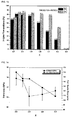
- FIG. 14 is a graph showing average sizes of crystal grains and Vickers hardnesses of such AION specimens measured in a weight of 2.94 N.
- the x value increased, sizes of the crystal grains were decreased according to an effect of relatively a large number of pores during sintering.
- the x value was 2.5, the Vickers hardness was 16.1 GPa that is similar to a known Vickers hardness of AION.
- the x value decreased to 2.25, the Vickers hardness was remarkably increased to 17.7 GPa, and when the x value was 2.0, the Vickers hardness was increased to 17.0 GPa. It is assumed that the Vickers hardness increases due to ⁇ '-AlON secondary phases generated from when the x value is 2.25.
- the Vickers hardness somewhat increases even when the x value is higher than 2.5, but it is assumed that the Vickers hardness increases since the sizes of the crystal grains are decreased. Also, transparency may be remarkably decreased according to a final sintering temperature and time, ⁇ '-AlON secondary phases also decrease the transparency, but increase the Vickers hardness, and thus when the x value is very low, i.e., 2.25, AION may turn into transparent ceramic having a transparency equal to or higher than 81%, and high Vickers hardness or high wear-resistance.
- the Vickers hardness is increased as the ⁇ '-AlON secondary phases are generated when the powder mixture of Al 2 O 3 and AIN is sintered, when synthesized AION powder is sintered, or when the x value is about 2.25, regardless of a method of preparing AION.
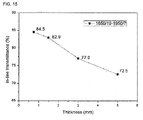
- AION ceramic specimens on which first sintering and second sintering are performed were prepared in the same manner as in Example 1, except that the first sintering was performed at 1650°C for 10 hours, the second sintering was performed at 1950°C for 7 or 20 hours, and an x value was fixed to 2.5 while varying a thickness of a specimen from 0.75 mm to 5 mm.
- FIG. 15 is a graph showing an in-line transmittance of a light having a wavelength of 632 nm according to thicknesses of a specimen from 0.75 mm to 5mm.
- the in-line transmittance is high.
- the transmittance exceeds 80% up to the thickness of about 2 mm.
- the transmittance remarkably decreased below 80%, and thus a final sintering temperature or sintering time may be increased in order to obtain a high transmittance or to apply a thick thickness.
- the transmittance is increased when the final sintering temperature or the sintering time is increased, and at this time, the number of pores is decreased, but the number of pores is decreased because the number of grain boundaries is decreased according to the growth of crystal grains.
- first sintering may be sufficiently performed at a temperature around 1650°C.
- the first sintering is performed to prepare transparent AION by sintering the powder mixture of Al 2 O 3 and AIN, and the small x value around 2.5 may be helpful not only in sintering the powder mixture of Al 2 O 3 and AIN, but also in sintering AION powder after synthesizing the AION powder.
- a temperature quickly increases by 600°C per hour, and thus an AION phase including many pores without being densified is formed, and a sintering temperature increases up to 1900°C. This is similar to preparing an AION specimen without an effect of the first sintering.
- FIG. 2 shows the light transmittances of the specimens that are prepared without the first sintering according to the x values.
- the transmittance of the AION phase obtained via sintering is similar to that when the first sintering and then the second sintering are performed on the powder mixture of Al 2 O 3 and AIN having the relative density of about 95%.
- the transmittance remarkably increased, and when the x value was increased to 5.0, the transmittance remarkably decreased. Accordingly, even when AION powder having a low x value is synthesized and the sintered, the sinterability or densification is increased like when the powder mixture of Al 2 O 3 and AIN is sintered. Thus, the pores may be easily removed, and as a result, the transmittance may be remarkably increased.
- the x value increases the densification of the powder mixture during the first sintering and increases the sinterability during the second sintering according to the increase of vacancies of Al positive ions in AION as described in detail above.
- the x value only increases the sinterability according to the increase of vacancies.
- the sinterability is increased sufficiently high such that the transmittance of AION prepared by sintering the synthesized AION powder having a low x value is increased.
- the transmittance may be increased when AION is prepared by sintering the synthesized AION powder.
- AION is prepared by sintering the powder mixture of Al 2 O 3 and AIN whose AIN composition of a raw material is fixed to 35 mol%
- the transmittance of the specimen sintered for 5 hours at 2000°C without the first sintering dramatically changes according to the content of MgO.
- the transmittance largely changed to 0.2%, 3.2% 63.1%, 28.7%, and 2.5% when the content of MgO changed to 0 wt%, 0.05 wt%, 0.1 wt%, 0.2 wt%, and 0.3 wt%.
- the transmittance vertically increases from 3.2% that is opaque to 63.1% that is relatively transparent, and when the content of MgO is 0.3 wt%, the transmittance decreased to 2.5%.
- the adding of MgO is effective regardless of the x value, i.e., in all ranges of x values from 2.5 to 4.5. Accordingly, it is easily expected that the increase of the transmittance obtained by only performing the second sintering by adding MgO would be obtained when AION is prepared by sintering the synthesized AION powder.
Landscapes
- Chemical & Material Sciences (AREA)
- Engineering & Computer Science (AREA)
- Ceramic Engineering (AREA)
- Manufacturing & Machinery (AREA)
- Organic Chemistry (AREA)
- Materials Engineering (AREA)
- Structural Engineering (AREA)
- Inorganic Chemistry (AREA)
- Ceramic Products (AREA)
- Compositions Of Oxide Ceramics (AREA)
Applications Claiming Priority (2)
| Application Number | Priority Date | Filing Date | Title |
|---|---|---|---|
| KR1020110017858A KR20120098118A (ko) | 2011-02-28 | 2011-02-28 | 투명도가 향상된 다결정 산질화알루미늄의 제조방법 |
| PCT/KR2012/001483 WO2012118315A2 (fr) | 2011-02-28 | 2012-02-28 | Procédé de préparation d'oxynitrure d'aluminium polycristallin ayant une transparence améliorée |
Publications (2)
| Publication Number | Publication Date |
|---|---|
| EP2682376A2 true EP2682376A2 (fr) | 2014-01-08 |
| EP2682376A4 EP2682376A4 (fr) | 2015-04-08 |
Family
ID=46758368
Family Applications (1)
| Application Number | Title | Priority Date | Filing Date |
|---|---|---|---|
| EP12751946.0A Withdrawn EP2682376A4 (fr) | 2011-02-28 | 2012-02-28 | Procédé de préparation d'oxynitrure d'aluminium polycristallin ayant une transparence améliorée |
Country Status (7)
| Country | Link |
|---|---|
| US (1) | US9321688B2 (fr) |
| EP (1) | EP2682376A4 (fr) |
| JP (1) | JP5819992B2 (fr) |
| KR (1) | KR20120098118A (fr) |
| CN (1) | CN103492347B (fr) |
| RU (1) | RU2013141975A (fr) |
| WO (1) | WO2012118315A2 (fr) |
Families Citing this family (16)
| Publication number | Priority date | Publication date | Assignee | Title |
|---|---|---|---|---|
| RU2014123066A (ru) * | 2011-11-07 | 2015-12-20 | Керамтек-Этек Гмбх | Прозрачная керамика |
| JP6064482B2 (ja) * | 2012-09-21 | 2017-01-25 | 住友電気工業株式会社 | セラミック焼結体およびその製造方法、ならびに工具 |
| US9637415B2 (en) * | 2013-10-24 | 2017-05-02 | Surmet Corporation | Method of making high purity polycrystalline aluminum oxynitride bodies useful in semiconductor process chambers |
| CN104311038B (zh) * | 2014-10-21 | 2015-12-09 | 山东理工大学 | 一种AlON涂层AlN陶瓷基片的制备方法 |
| US10466013B2 (en) | 2014-11-17 | 2019-11-05 | Bae Systems Information And Electronic Sytems Integration Inc. | Hyper hemisphere unitary dome for a defensive infrared countermeasure system |
| CN105401034B (zh) * | 2015-12-12 | 2018-05-18 | 郑州旭日磨具技术开发有限公司 | 高密度聚晶超硬材料及其制备方法 |
| CN107344854A (zh) * | 2016-05-06 | 2017-11-14 | 中国科学院上海光学精密机械研究所 | 一种制备氮氧化铝透明陶瓷的方法 |
| KR102557205B1 (ko) * | 2016-12-21 | 2023-07-18 | 엔지케이 인슐레이터 엘티디 | 투명 AlN 소결체 및 그 제법 |
| JP6982000B2 (ja) * | 2016-12-21 | 2021-12-17 | 日本碍子株式会社 | 配向AlN焼結体及びその製法 |
| CN110418773B (zh) * | 2017-03-13 | 2022-03-18 | Agc株式会社 | 透光性陶瓷烧结体和其制造方法 |
| US20200123042A1 (en) * | 2018-10-19 | 2020-04-23 | Lifeport, Llc F/K/A Lifeport, Inc. | Oxynitride glass, its use, and methods of making |
| CN112225564B (zh) * | 2019-07-15 | 2022-01-04 | 中国科学院上海硅酸盐研究所 | 一种氮氧化铝透明陶瓷及其制备方法 |
| CN113880588B (zh) * | 2021-11-03 | 2022-10-21 | 安徽理工大学 | 一种制备均匀包覆的AlON粉体及其透明陶瓷的方法 |
| CN114014668B (zh) * | 2021-11-25 | 2022-08-09 | 中国科学院上海硅酸盐研究所 | 一种3d打印用水基氮氧化铝透明陶瓷浆料及其制备方法 |
| CN114133252B (zh) * | 2021-12-21 | 2023-04-28 | 厦门钜瓷科技有限公司 | AlON透明陶瓷保形红外头罩及其制备方法 |
| CN114538931B (zh) * | 2022-03-11 | 2022-11-29 | 北京理工大学 | 一种高性能AlON透明陶瓷及其低温快速制备方法 |
Family Cites Families (21)
| Publication number | Priority date | Publication date | Assignee | Title |
|---|---|---|---|---|
| US4241000A (en) | 1978-08-24 | 1980-12-23 | The United States Of America As Represented By The Secretary Of The Army | Process for producing polycrystalline cubic aluminum oxynitride |
| US4250116A (en) | 1979-12-19 | 1981-02-10 | Union Carbide Corporation | Production of methyl and ethylamines with rhodium-iron catalysts |
| US4686070A (en) | 1981-08-31 | 1987-08-11 | Raytheon Company | Method of producing aluminum oxynitride having improved optical characteristics |
| US4481300A (en) | 1981-08-31 | 1984-11-06 | Raytheon Company | Aluminum oxynitride having improved optical characteristics and method of manufacture |
| US4720362A (en) * | 1981-08-31 | 1988-01-19 | Raytheon Company | Transparent aluminum oxynitride and method of manufacture |
| US4520116A (en) | 1981-08-31 | 1985-05-28 | Raytheon Company | Transparent aluminum oxynitride and method of manufacture |
| GB2126568B (en) * | 1981-08-31 | 1986-05-14 | Raytheon Co | Transparent aluminum oxynitride and method of manufacture |
| JPH064516B2 (ja) * | 1990-01-19 | 1994-01-19 | 新日本製鐵株式会社 | 溶融金属用セラミックス焼結体および製造方法 |
| US5231062A (en) | 1990-08-09 | 1993-07-27 | Minnesota Mining And Manufacturing Company | Transparent aluminum oxynitride-based ceramic article |
| FR2703348B1 (fr) | 1993-03-30 | 1995-05-12 | Atochem Elf Sa | Procédé de préparation de poudre pour céramique en oxynitrure d'aluminium gamma optiquement transparente et la poudre ainsi obtenue. |
| FR2722492B1 (fr) * | 1994-07-12 | 1997-03-14 | Sumitomo Chemical Co | Poudre de nitrure d'aluminium et corps fritte et composition de resine la contenant |
| JP2003054920A (ja) * | 2001-08-16 | 2003-02-26 | National Institute Of Advanced Industrial & Technology | 平均粒子径がミクロンオーダー以上及び球形度の高い窒化アルミニウム粉体、その製造方法及び製造装置 |
| US6955798B2 (en) | 2002-05-01 | 2005-10-18 | Nanomat, Inc. | Method for manufacturing aluminum oxynitride (AlON) powder and other nitrogen-containing powders |
| US7163656B1 (en) | 2002-05-17 | 2007-01-16 | The United States Of America As Represented By The Secretary Of The Army | Method for making dense polycrystalline aluminum oxynitride |
| US7045091B1 (en) | 2002-08-05 | 2006-05-16 | The United States Of America As Represented By The Secretary Of The Army | Transient liquid phase reactive sintering of aluminum oxynitride (AlON) |
| JP4458409B2 (ja) * | 2003-12-09 | 2010-04-28 | 日本碍子株式会社 | 透光性セラミックスの製造方法および透光性セラミックス |
| US7927705B2 (en) * | 2005-10-13 | 2011-04-19 | The United States Of America As Represented By The Secretary Of The Navy | Low loss visible-IR transmitting glass-aluminum oxynitride composites and process |
| US7459122B2 (en) * | 2006-06-30 | 2008-12-02 | Battelle Energy Alliance, Llc | Methods of forming aluminum oxynitride-comprising bodies, including methods of forming a sheet of transparent armor |
| CN101528631A (zh) * | 2006-10-16 | 2009-09-09 | 岭南大学校产学协力团 | 制作透明的多晶氮氧化铝的方法 |
| DE202007001565U1 (de) * | 2007-02-02 | 2007-04-05 | Isoclima Gmbh | Panzerscheibe |
| CN101033139A (zh) * | 2007-02-07 | 2007-09-12 | 山东理工大学 | 透明氮氧化铝陶瓷的制备工艺 |
-
2011
- 2011-02-28 KR KR1020110017858A patent/KR20120098118A/ko not_active Ceased
-
2012
- 2012-02-28 RU RU2013141975/03A patent/RU2013141975A/ru not_active Application Discontinuation
- 2012-02-28 JP JP2013556546A patent/JP5819992B2/ja not_active Expired - Fee Related
- 2012-02-28 WO PCT/KR2012/001483 patent/WO2012118315A2/fr not_active Ceased
- 2012-02-28 CN CN201280018370.7A patent/CN103492347B/zh not_active Expired - Fee Related
- 2012-02-28 EP EP12751946.0A patent/EP2682376A4/fr not_active Withdrawn
- 2012-02-28 US US14/001,873 patent/US9321688B2/en not_active Expired - Fee Related
Also Published As
| Publication number | Publication date |
|---|---|
| JP2014508092A (ja) | 2014-04-03 |
| US20130337993A1 (en) | 2013-12-19 |
| RU2013141975A (ru) | 2015-04-10 |
| CN103492347A (zh) | 2014-01-01 |
| WO2012118315A3 (fr) | 2012-12-20 |
| WO2012118315A2 (fr) | 2012-09-07 |
| KR20120098118A (ko) | 2012-09-05 |
| JP5819992B2 (ja) | 2015-11-24 |
| US9321688B2 (en) | 2016-04-26 |
| EP2682376A4 (fr) | 2015-04-08 |
| CN103492347B (zh) | 2015-10-14 |
Similar Documents
| Publication | Publication Date | Title |
|---|---|---|
| US9321688B2 (en) | Method for preparing polycrystalline aluminum oxynitride having enhanced transparency | |
| KR101502601B1 (ko) | 입방 구조를 가진 소결 제품 | |
| EP3252023B1 (fr) | Corps fritté en zircone translucide, son procédé de fabrication et utilisation | |
| Yang et al. | Optical, thermal, and mechanical properties of (Y1− x Sc x) 2O3 transparent ceramics | |
| Min et al. | Fabrication of transparent γ-AlON by direct 2-step pressureless sintering of Al2O3 and AlN using an AlN-deficient composition | |
| Guo et al. | Effects of AlN content on mechanical and optical properties of AlON transparent ceramics | |
| Zegadi et al. | Transparent MgAl2O4 spinel fabricated by spark plasma sintering from commercial powders | |
| KR101575561B1 (ko) | 투명도가 향상된 다결정 산질화알루미늄의 제조방법 | |
| Holz et al. | Effect of Fe2O3 doping on colour and mechanical properties of Y-TZP ceramics | |
| KR101122929B1 (ko) | 투명한 다결정 산질화알루미늄의 제조방법 | |
| US11267761B2 (en) | Light-transmitting ceramic sintered body and method for producing same | |
| Carreaud et al. | Fabrication and optical properties of transparent fine-grained Zn1. 1Ga1. 8Ge0. 1O4 and Ni2+ (or Cr3+)-doped Zn1. 1Ga1. 8Ge0. 1O4 spinel ceramics | |
| Gan et al. | The effects of the temperature and pressure on ZrO2-doped transparent yttria ceramics fabricated by a hot-pressing method | |
| CN112225564B (zh) | 一种氮氧化铝透明陶瓷及其制备方法 | |
| Qi et al. | Reaction sintering of transparent aluminum oxynitride (AlON) ceramics using MgO and Y2O3 as co-additives | |
| KR20190098133A (ko) | 투명 AlN 소결체 및 그 제법 | |
| Nagashima et al. | Fabrication and optical characterization of high-density Al2O3 doped with slight MnO dopant | |
| CN117986004A (zh) | 一种尖晶石型高熵透明陶瓷及其制备方法和应用 | |
| Chen et al. | Preparation of γ-AlON transparent ceramics by pressureless sintering | |
| Avcioglu et al. | Investigation of the influence of initial powder size on the optical properties of Dy-α-SiAlON ceramics fabricated by gas pressure sintering | |
| Tang et al. | Effect of the Al2O3 content on the mechanical properties and microstructure of 3Y-TZP ceramics for dental applications | |
| Yang et al. | Reactive sintered highly transparent AlON ceramics with SrO doping | |
| CN106414367B (zh) | 透明的尖晶石陶瓷及其制造方法 | |
| WO2021145449A1 (fr) | Céramique frittée transmettant la lumière et élément résistant aux plasmas | |
| JP2025002948A (ja) | 酸化物セラミックス及びその製造方法 |
Legal Events
| Date | Code | Title | Description |
|---|---|---|---|
| PUAI | Public reference made under article 153(3) epc to a published international application that has entered the european phase |
Free format text: ORIGINAL CODE: 0009012 |
|
| 17P | Request for examination filed |
Effective date: 20130930 |
|
| AK | Designated contracting states |
Kind code of ref document: A2 Designated state(s): AL AT BE BG CH CY CZ DE DK EE ES FI FR GB GR HR HU IE IS IT LI LT LU LV MC MK MT NL NO PL PT RO RS SE SI SK SM TR |
|
| DAX | Request for extension of the european patent (deleted) | ||
| A4 | Supplementary search report drawn up and despatched |
Effective date: 20150306 |
|
| RIC1 | Information provided on ipc code assigned before grant |
Ipc: C04B 35/645 20060101ALI20150302BHEP Ipc: C04B 35/50 20060101ALI20150302BHEP Ipc: C04B 35/58 20060101AFI20150302BHEP |
|
| STAA | Information on the status of an ep patent application or granted ep patent |
Free format text: STATUS: THE APPLICATION IS DEEMED TO BE WITHDRAWN |
|
| 18D | Application deemed to be withdrawn |
Effective date: 20151006 |