EP2682819A2 - Verfahren zur Bildung eines mehrfarbigen Bildes - Google Patents
Verfahren zur Bildung eines mehrfarbigen Bildes Download PDFInfo
- Publication number
- EP2682819A2 EP2682819A2 EP13174075.5A EP13174075A EP2682819A2 EP 2682819 A2 EP2682819 A2 EP 2682819A2 EP 13174075 A EP13174075 A EP 13174075A EP 2682819 A2 EP2682819 A2 EP 2682819A2
- Authority
- EP
- European Patent Office
- Prior art keywords
- image
- collecting device
- toner
- toner image
- stations
- Prior art date
- Legal status (The legal status is an assumption and is not a legal conclusion. Google has not performed a legal analysis and makes no representation as to the accuracy of the status listed.)
- Withdrawn
Links
- 238000000034 method Methods 0.000 title claims abstract description 54
- 238000012546 transfer Methods 0.000 claims abstract description 155
- 239000000463 material Substances 0.000 claims abstract description 133
- 238000007639 printing Methods 0.000 claims abstract description 34
- 230000008569 process Effects 0.000 claims abstract description 21
- 238000000151 deposition Methods 0.000 claims abstract description 10
- 230000001955 cumulated effect Effects 0.000 claims abstract description 8
- 239000002245 particle Substances 0.000 claims abstract description 8
- 239000007788 liquid Substances 0.000 claims description 8
- 239000007787 solid Substances 0.000 claims description 5
- 239000000543 intermediate Substances 0.000 description 35
- 239000003086 colorant Substances 0.000 description 30
- 238000005259 measurement Methods 0.000 description 13
- 230000000694 effects Effects 0.000 description 12
- 230000008901 benefit Effects 0.000 description 11
- 238000004140 cleaning Methods 0.000 description 8
- -1 polyethylene Polymers 0.000 description 6
- 239000000123 paper Substances 0.000 description 5
- 230000008859 change Effects 0.000 description 4
- 239000004033 plastic Substances 0.000 description 4
- 229920003023 plastic Polymers 0.000 description 4
- 238000007790 scraping Methods 0.000 description 4
- 238000004088 simulation Methods 0.000 description 4
- 238000004458 analytical method Methods 0.000 description 3
- 230000015572 biosynthetic process Effects 0.000 description 3
- 230000001419 dependent effect Effects 0.000 description 3
- 238000011161 development Methods 0.000 description 3
- 239000000758 substrate Substances 0.000 description 3
- 239000004698 Polyethylene Substances 0.000 description 2
- 239000004642 Polyimide Substances 0.000 description 2
- 239000004743 Polypropylene Substances 0.000 description 2
- 230000007423 decrease Effects 0.000 description 2
- 238000006073 displacement reaction Methods 0.000 description 2
- 230000006872 improvement Effects 0.000 description 2
- 238000004519 manufacturing process Methods 0.000 description 2
- 229920000573 polyethylene Polymers 0.000 description 2
- 229920000139 polyethylene terephthalate Polymers 0.000 description 2
- 239000005020 polyethylene terephthalate Substances 0.000 description 2
- 229920001721 polyimide Polymers 0.000 description 2
- 229920000098 polyolefin Polymers 0.000 description 2
- 229920001155 polypropylene Polymers 0.000 description 2
- 230000001105 regulatory effect Effects 0.000 description 2
- 230000009471 action Effects 0.000 description 1
- 238000004364 calculation method Methods 0.000 description 1
- 230000015556 catabolic process Effects 0.000 description 1
- 239000002131 composite material Substances 0.000 description 1
- 238000010276 construction Methods 0.000 description 1
- 238000012937 correction Methods 0.000 description 1
- 230000001186 cumulative effect Effects 0.000 description 1
- 238000013016 damping Methods 0.000 description 1
- 230000007547 defect Effects 0.000 description 1
- 238000006731 degradation reaction Methods 0.000 description 1
- 230000003111 delayed effect Effects 0.000 description 1
- 238000007599 discharging Methods 0.000 description 1
- 229920001971 elastomer Polymers 0.000 description 1
- 230000005684 electric field Effects 0.000 description 1
- 238000011156 evaluation Methods 0.000 description 1
- 230000001747 exhibiting effect Effects 0.000 description 1
- 239000011888 foil Substances 0.000 description 1
- 238000003384 imaging method Methods 0.000 description 1
- 230000010354 integration Effects 0.000 description 1
- 238000012986 modification Methods 0.000 description 1
- 230000004048 modification Effects 0.000 description 1
- 239000002985 plastic film Substances 0.000 description 1
- 229920006255 plastic film Polymers 0.000 description 1
- 229920000728 polyester Polymers 0.000 description 1
- 229920006267 polyester film Polymers 0.000 description 1
- 238000012545 processing Methods 0.000 description 1
- 230000005855 radiation Effects 0.000 description 1
- 230000009467 reduction Effects 0.000 description 1
- 230000002441 reversible effect Effects 0.000 description 1
- 238000012216 screening Methods 0.000 description 1
- 238000000926 separation method Methods 0.000 description 1
- 230000035939 shock Effects 0.000 description 1
- 229920002379 silicone rubber Polymers 0.000 description 1
- 239000004945 silicone rubber Substances 0.000 description 1
- 230000001960 triggered effect Effects 0.000 description 1
Images







Classifications
-
- G—PHYSICS
- G03—PHOTOGRAPHY; CINEMATOGRAPHY; ANALOGOUS TECHNIQUES USING WAVES OTHER THAN OPTICAL WAVES; ELECTROGRAPHY; HOLOGRAPHY
- G03G—ELECTROGRAPHY; ELECTROPHOTOGRAPHY; MAGNETOGRAPHY
- G03G15/00—Apparatus for electrographic processes using a charge pattern
- G03G15/01—Apparatus for electrographic processes using a charge pattern for producing multicoloured copies
-
- G—PHYSICS
- G03—PHOTOGRAPHY; CINEMATOGRAPHY; ANALOGOUS TECHNIQUES USING WAVES OTHER THAN OPTICAL WAVES; ELECTROGRAPHY; HOLOGRAPHY
- G03G—ELECTROGRAPHY; ELECTROPHOTOGRAPHY; MAGNETOGRAPHY
- G03G15/00—Apparatus for electrographic processes using a charge pattern
- G03G15/14—Apparatus for electrographic processes using a charge pattern for transferring a pattern to a second base
- G03G15/16—Apparatus for electrographic processes using a charge pattern for transferring a pattern to a second base of a toner pattern, e.g. a powder pattern, e.g. magnetic transfer
- G03G15/1605—Apparatus for electrographic processes using a charge pattern for transferring a pattern to a second base of a toner pattern, e.g. a powder pattern, e.g. magnetic transfer using at least one intermediate support
- G03G15/162—Apparatus for electrographic processes using a charge pattern for transferring a pattern to a second base of a toner pattern, e.g. a powder pattern, e.g. magnetic transfer using at least one intermediate support details of the the intermediate support, e.g. chemical composition
Definitions
- the present invention is related to a colour image reproduction system wherein a developed image is transferred from an image-forming member to a receptor material via at least one intermediate transfer member.
- Electrostatographic printing operates according to the principles and embodiments of non-impact printing as described, e.g., in " Principles of Non-Impact Printing” by Jerome L Johnson (1986) - Palatino Press - Irvine Calif., 92715 USA ).
- Electrostatographic printing includes electrographic printing in which an electrostatic charge is deposited image-wise e.g. by ionography, on a dielectric recording member as well as electrophotographic printing in which an overall electrostatically charged photoconductive dielectric recording member is image-wise exposed to conductivity increasing radiation producing thereby a toner-developable charge pattern on the recording member.
- an electrostatographic single-pass multiple station multi-colour printer in which an image is formed on a photoconductive belt or drum and is then transferred to a paper receiving sheet or web whereon the toner image is fixed, whereupon the web is usually cut into sheets containing the desired print frame.
- toner images are transferred to a belt from distinct image-forming stations and are then transferred to the receiving sheet or web and fixed thereon.
- US 3,694,073 disclosed an electrostatographic printer for forming an image onto a web.
- the printer comprises a plurality of toner image-producing stations each comprising a photoconductive drum as an electrostatic image element, onto which a toner image can be formed, means for forming an electrostatic latent image on each drum and a developing unit for depositing toner onto the electrostatic latent image to render the image visible and transferable.
- the printer further includes means for conveying a web past the image-producing stations and transfer means for transferring the toner image on the drum onto the web.
- CMYK systems are often used with Cyan, Magenta, Yellow and black as basic colours.
- JP 2005-338424A1 discloses an image forming apparatus where a variety of image formation are performed by using a plurality of developing devices, and which outputs a high-quality image at high speed without lowering speed not only in image formation in six colors but image formation in four colors by when setting a mode other than a six-color designating mode such as a four-color designating mode according to an instruction from the outside (user), the action of an intermediate transfer member where a two-color image forming means is arranged is stopped. In this case, control to separate an intermediate transfer roller is performed.
- JP 2005-338424A1 is Figure 1 exemplifies the use of an intermediate transfer belt 51 collecting two toner images and depositing on the four toner images collected on internediate transfer belt 50 before transfer to the recording material, but is silent in respect of the stiffness of the two intermediate seamless transfer belts, the process speed capability and the colour registration capability.
- US 2011/116838A discloses an electrophotographic engine comprising: a) a series of electrophotographic modules including one or more multi-development stations and a primary imaging member; b) an inverter to invert a receiver sheet to allow the receiver sheet to be printed in a duplex mode; c) a diverter to allow a receiver sheet to enter the inverter; d) a second diverter that would allow the imaged receiver sheet to exit the electrophotographic engine with the simplex imaged side facing up.
- Figures 8E and 8F in US 2011/116838A exemplify the use of two intermediate seamless transfer belts served by 4 and 3 and 5 and 3 toner image-forming stations respectively.
- US 2011/116838A is silent in respect of the stiffness of the intermediate seamless transfer belts, the colour registration capabilityand process speed capability
- US 2010/0310285A1 discloses an image forming apparatus comprising: a first image forming unit which includes a first image carrier and is configured to form a toner image on the first image carrier; a first intermediate transfer member configured to carry the toner image primarily transferred from the first image carrier; a second image forming unit which includes a second image carrier and is configured to form a toner image on the second image carrier; a second intermediate transfer member configured to carry the toner image primarily transferred from the second image carrier; an execution unit configured to execute an operation to cause the second image forming unit to form an image while the first image forming unit is forming an image; a secondary transfer unit configured to transfer the toner image from the first intermediate transfer member to the second intermediate transfer member such that the toner image formed on the first intermediate transfer member is superposed on the toner image formed on the second intermediate transfer member; and a tertiary transfer unit configured to transfer the toner image formed on the second intermediate transfer member by the secondary transfer unit onto a recording material from the second intermediate transfer member.
- image forming unit is divided into two parts and toner images superimposed on an intermediate transfer belt included in one of the image forming unit is once secondary transferred onto toner images superimposed on an intermediate transfer belt included in the other image forming unit and then the secondary transferred images are collectively transferred (tertiary transferred) onto a recording material at once.
- US 2010/0310285A1 is silent in respect of the use of five or more image-forming units, the stiffness of the two intermediate seamless transfer belts, the colour registration capability and the process speed capability.
- JP 2005-338150A1 disclosesa multicolour image-forming apparatus having two photosensitive drums and two intermediate transfer bodies in which color application is controlled and the number of times that primary transfer is carried out on each of the intermediate transfer bodies is reduced, but is silent in respect of the stiffness of the two intermediate seamless transfer belts, the colour registration capabilityand the process speed capability.
- a typical technique which avoids dependence on the receptor material is to collect the different coloured toner images on a collecting device such as a drum or a seamless belt to avoid dependence on the characteristics of the receptor material. If a seamless belt is used this is typically made of a stiff material with a variation inn printing due to stretching thereof being typically less than 20 ⁇ m.
- An objective of the present invention is to realise a print engine configuration (printer) capable of printing images comprising a large number of coloured toner sub-images (more than with the traditional four coloured toners) in registration within 50 ⁇ m (preferably within 20 ⁇ m and particularly preferably within 10 ⁇ m) at high process speeds e.g. above 60 mm/s and preferably up to 3m/s.
- One solution to this problem would be to have multiple collecting devices, each with 1 or more print stations. These collecting devices can then each transfer the resulting image of its print stations to the receptor material, e.g. the paper. Using techniques to ensure registration between the images of the various collecting devices, the result can be a full colour image.
- the receptor material e.g. the paper.
- the registration of the images of the multiple collecting devices thereon proves to be very difficult. Any variation in web tension results in variation in speed and length of the material.
- the fact that the different colours transferred from different intermediates are not transferred at the same place to the passing web means that any difference in web speed directly results in inter-colour registration defects. This has an effect on the colour printed because of the incorrect placing of the basic colours in the screening.
- a model has been developed to simulate the observed dependence of registration upon print engine configuration.
- Xeikon's current commercial print engine configuration e.g. that of the Xeikon 8000, with the traditional four colours ameliorates variability in registration by printing without a collecting device directly on the receptor material, but registration problems occur between the first and last colour printed in the case of very flexible substrates.
- Very flexible receptor materials (print media) with unstable tension conditions exhibit bad registration quality. This was shown experimentally. These experimental results could be simulated using this model in which the tension condition varied over time at the transfer point.
- This problem can be solved by using a collecting device, but such collecting devices (intermediate members) need to be of limited length to avoid the high production costs of such collecting devices and mechanical problems in their use.
- a collecting device of limited length being too small to accommodate the large number of colours. Therefore, this problem cannot be solved by all image-producing stations depositing partial images on the same collecting device, and the resulting image being transferred in a single transfer to the receptor material.
- the above-mentioned model has been used to establish the way in which alternative multiple collecting device options influence colour registration where there is a need to print a large number of colours.
- the present invention has the considerable advantage of combining insensitivity to the properties of the receptor material (i.e. does not require complicated sensors, actuators etc.) with a toner image-collecting device for electrostatographic printers with more than four different toners, which is not prohibitively large and not too expensive to produce.
- the above objective is accomplished by an electrostatographic printer and method of forming a multi-colour image on a receptor material according to the present invention.
- a method of forming a multi-colour image on a web-fed receptor material (13) is provided with a system comprising an array of at least two toner image-collecting devices (11) with at least a first toner image-collecting device and a final toner-image-collecting device optionally with at least one toner image-collecting device in between, said first toner-image-collecting device coming into contact with said final toner-image-collecting device or the next toner-image-collecting device in the array and the next toner-image-collecting device either coming into contact with following toner-image-collecting device in said array or said final toner-image-collecting device in said array, each toner image-collecting device being comprised in a colour unit (60) with at least one image-forming station (14) directly associated therewith that can transfer a toner image to said associated toner image-collecting device, a transfer zone (19) between a toner image-collecting device in a particular colour unit and a to
- an electrostatographic printer for forming an image onto a receptor element, which printer comprises: an array of at least two toner image-collecting devices with at least a first collecting device and a final collecting device optionally with at least one collecting device in between, said first collecting device coming into contact with said final collecting device or the next collecting device in the array and the next collecting device either coming into contact with the following collecting device in said array or said final collecting device in said array, each collecting device being capable of receiving the toner images produced by a set of at least two electrostatographic stations directly associated therewith via a transfer means for transferring the toner image from each directly associated image-producing electrostatographic station in said set to said directly associated collecting device together, if applicable, with the cumulated toner images from the preceding collecting device; each set of electrostatotographic stations comprising:
- the method of the first aspect of the present invention and the printer of the second aspect of the present invention are equally suitable for simplex and duplex printing. Indeed the compact nature of the printer lends itself to application in simultaneous duplex printing.
- Coupled should not be interpreted as being restricted to direct connections only.
- the terms “coupled” and “connected”, along with their derivatives, may be used. It should be understood that these terms are not intended as synonyms for each other.
- the scope of the expression “a device A coupled to a device B” should not be limited to devices or systems wherein an output of device A is directly connected to an input of device B. It means that there exists a path between an output of A and an input of B which may be a path including other devices or means.
- Coupled may mean that two or more elements are either in direct physical or electrical contact, or that two or more elements are not in direct contact with each other but yet still co-operate or interact with each other.
- an element described herein of an apparatus embodiment is an example of a means for carrying out the function performed by the element for the purpose of carrying out the invention.
- connecting includes touching, and separation of up to 200 ⁇ m (preferably up to 100 ⁇ m and particularly preferably up to 50 ⁇ m).
- connected collecting device means that two toner image collecting devices are in contact with one another, such that toner images can be transferred from at least a first toner-image collecting device to a second toner image collecting device.
- two toner image collecting devices could have a common contact area at which toner image transfer can take place.
- coloured toner means a toner having a different colour which includes black and transparent toners which may or may not have a visually perceptible colour i.e. in the case of no colour are "colourless".
- process speed means the actual printing speed.
- colour registration is the displacement of the individual coloured toner images (from printing station 14) in the final toner image from exact registration of the individual coloured toner images in the final toner image in the printing direction as measured with the benefit of registration marks.
- the registration error can be positive or negative i.e. the coloured toner image is printed before or after the exact position in the final image.
- FIG. 1 shows the components of a typical image-forming station.
- the photosensitive medium (1) rotates, in a circular or other movement that allows the photosensitive medium to pass the various parts of the image-forming station.
- a charging device (7) which could, for example, be a corona wire or a charging roller, which is placed at a potential that puts charges on the photosensitive medium.
- the photosensitive medium next passes a light emitting device (8).
- This device could be a laser or a set of LED's or other light emitting components.
- the light emitting device (8) emits the light in a pattern that corresponds at least partly to the image to be formed in the colour of the print station.
- the light emitted is the reverse of the image to be formed in that colour.
- the result of the light shining on any place on the photosensitive medium is that the amount of electrical charge on the place where the light is received changes, which results in an image-wise pattern of charges on the photosensitive medium called an electrostatic latent image.
- the photosensitive medium (1) While rotating, the photosensitive medium (1) next passes an image-developing unit (3).
- the image developing unit (3) brings the toner of the colour of the image-forming station into contact or near contact with the photosensitive medium (1) in a development zone. In that development zone, the toner is in a charged state, resulting in an image-wise transfer of toner towards the photosensitive medium.
- the photosensitive medium (1) next passes a toner image-collecting device (2) which it contacts.
- a transfer charge device (4) is placed so that the charged toner on the photosensitive drum is attracted towards the transfer charge device (4) and hence moves to the toner image-collecting device (2).
- the movement of the charged toner towards the transfer charge device is called electrophotographic transfer.
- the transfer charge device could be a corona wire, or a shielded corotron also known as a scorotron.
- Another embodiment uses a roller. An electric potential is applied to the transfer charge device so as to attract the charged toner thereby enabling it to be transferred from the photosensitive drum to the toner image-collecting device (2).
- the photosensitive medium While rotating, the photosensitive medium typically can also pass a discharging device (6) to remove charge on the surface of the photosensitive medium and charge on the toner that was not transferred to the collecting device (2).
- the photosensitive medium next passes a cleaning device (5) that removes any residual toner from the photosensitive medium.
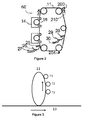
- Figure 2 exemplifies a colour unit (60) with two image-forming electrophotographic stations.
- a colour unit contains a toner image-collecting device (11) and at least one image-forming electrophotographic station (14), each in contact with the said toner image-collecting device.
- a transfer device (4) allows the image to be transferred from the image-forming electrophotographic station to the toner image-collecting device. Having more image-forming electrophotographic stations has the advantage of having more colours of toner that can be used to form the final image.
- the invention provides a way of having more image-forming electrophotographic stations without resulting in a toner image-collecting device that is too large.
- each with one toner image-collecting device there are preferably at least two colour units, each with one toner image-collecting device.
- Each of the toner image-collecting devices is or can be in contact with multiple image-forming electrophotographic stations (14), each forming an image-wise toner image in a specific colour.
- Multiple image-forming electrophotographic stations can produce the same colour, but each image-forming electrophotographic station produces only one colour. That way, each toner image-collecting device collects the image of at least one colour, and collects the images of the image-forming electrophotographic stations by electrophotographic transfer from the image-forming electrophotographic stations to the collecting device.
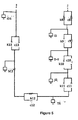
- Figure 3 shows a schematic representation of the transfer of three toner images, T1, T2 and T3 from a single toner image collecting device to the receptor material.
- the trajectory up to the receptor material is considered as a known and fixed path.
- any speed variations result in positional differences of the colours.
- the position of the printed image on that receptor material also changes.
- the cause of the stretch is a force or tension. If this is the case, the result is a displacement, which is inversely proportional to the stiffness of the receptor material.
- An infinitely stiff receptor material would react to varying disturbance forces without changing the position of the colour image. Therefore, a print engine featuring several long image colour trajectories has preferably very constant and stable speed control, and consists of stiff components.
- a time simulation was performed of the dynamics of the rollers/belt/receptor material system, driven by the motors and disturbed by e.g. a force, e.g. from a scraper, on a roll.
- the great advantage is that non-linear aspects, such as the limitations of the motors, can be added to the model.
- This provides the movements of the rollers as a function of time.
- At least as interesting are the modal analysis (vibration eigen frequency) and frequency analysis (Bode plots) of the systems obtained. It was established that if the position/speed control functions well, the zero points of the transfer function motor couple ⁇ motor speed is reflected in the vibratory behaviour of the system.
- the determining property of the belt for the registration is the overall stiffness of the belt per unit width, which is defined as the force F needed to expand elastically a piece of belt of unit width b divided by the corresponding relative expansion.
- this stiffness per unit width equals the product of the material's Young's Modulus and its thickness.
- this overall stiffness per unit width equals the sum of all stiffnesses of the individual layers.
- the overall stiffness of belt ⁇ i E i * d i , where i is the number of layers in the belt.
- the engine control within the engine control process is represented here by a simple PI-speed control with encoder on the motor shaft itself (co-located control).
- drumlinepositionK ⁇ 1 interp ⁇ 1 positionK_tower ⁇ 1. ⁇ time , positionK_tower ⁇ 1. ⁇ signals . values , 4 ⁇ FLpulse ⁇ 1 This is also the case for the respective drum positions of the associated colour lines.
- the colours are transferred to the belt, which is a stretching medium.
- the starting point is that the position on the belt is normalized to the nominal stretch condition with respect to a chosen reference line on the belt. This forms a sort of absolute position for each colour line on the belt.
- a disturbance means e.g. a scraper
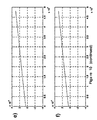
- Figure 6 shows the effect of applying a force to the belt via a disturbance means, e.g. a scraper, on the position of the rollers.
- a disturbance means e.g. a scraper
- the tension in the drawn part of the belt between the drive and the disturbance means increases, the tension in the pushed part decreases.
- the difference between the increase and the decrease corresponds to the extra force of the disturbance means.
- the actual value of for example the tension increase in the drawn part partially depends upon the stiffness ratio of the drawn and pushed parts.
- the rollers in the drawn part will experience a quite immediate change in position, and this is greater as the distance to the drive increases i.e. Y colour will experience a greater drift than K colour.
- the printing process proceeds under increased tension: This can be explained in two ways: either one compares the situation with the situation under normal belt-tension and then the K-lines become closer together or one compares the situation with the situation of the actual belt position, but then through the extra stretching the Y-lines become further apart.
- Figure 8 shows a first (11) and second (12) toner image-collecting devices (seamless belts) with toners T4, T5, T6 and T7; and T1, T2 and T3 respectively in contact with a receptor material (13).
- a receptor material 13
- a machine configuration suitable for an industrial market should also allow good registration performance with thin flexible foils. Therefore, a similar simulation is used to evaluate this medium impact on the registration in case of two separate belts.
- the physical model now consists of two belt modules, each connected in the transfer point to the receptor material as shown in Figure 8 .
- a speed-controlled motor drives the receptor material.
- Disturbance forces can be applied to the belts (representing variable disturbance means forces) and on the receptor material (e.g. force variations in the contact fusing system).
- the architecture with two individual belts in contact with the receptor material at different places is more sensitive in terms of registration errors to variations in web tension, or stiffness parameters of the receptor material, compared to an architecture where all colours are transferred to the receptor material in one single point.
- the model has been used to model the effect of a configuration using connected toner image collecting devices, for example two connected toner image collecting devices.
- transfer to the receptor material is confined to a single toner image collecting device. This means that the registration between the colours is already fixed as soon as the last colour is added to the last intermediate member.
- the final transfer step toward the receptor material cannot change anything to the registration quality; in other words, no variations in speed, tension condition in the receptor material can have any effect on the final registration.
- the big advantage of the present invention is therefore its insensitivity to the receptor material properties (without any complicated sensors, actuators etc.) in combination with a limitation in the size, and hence increased manufacturability, of the intermediate collecting devices.
- the intermediate members still play an important role, but these can be selected and tuned by the engine manufacturer, and will preferably be quite stiff material.
- Figure 11 shows such a configuration with two toner image collecting devices: a first (11) and second (12) toner image-collecting devices (belts) with toners T1, T2 and T3; and T4, T5, T6 and T7 respectively, but unlike the situation in Figure 8 only the first toner image collecting device transfers toners T1, T2 and T3 to the second toner image collecting device and the second toner image collecting device transfers toners T1 to T7 to the receptor material (13).
- two connected collecting devices perform better that two non-connected belts proportional to the stiffness of their materials.
- a method of forming a multi-colour image on a web-fed receptor material (13) is provided with a system comprising an array of at least two toner image-collecting devices (11) with at least a first toner image-collecting device and a final toner image-collecting device optionally with at least one toner image-collecting device in between, said first toner image-collecting device coming into contact with said final collecting device or the next collecting device in the array and the next collecting device either coming into contact with the following collecting device in said array or said final collecting device in said array, each toner-image-collecting device being comprised in a colour unit (60) with at least one image-forming station (14) directly associated therewith that can transfer a toner image to said associated toner image-collecting device, a transfer zone (19) between a collecting device in a particular colour unit and a collecting device directly associated with a different colour unit (60), comprising the steps of: receiving the toner image or images on said first toner image-collecting device
- At least one of said set of electrostatotographic stations comprises at least two electrostatographic stations, with at least three electrostatographic stations being preferred and at least four electrostatographic stations being particularly preferred.
- At least two of said set of electrostatotographic stations comprises at least two electrostatographic stations, with at least three electrostatographic stations being preferred and at least four electrostatographic stations being particularly preferred.
- a method of forming a multi-colour image on a receptor material (13) comprising: a set of multiple colour units (60), each comprising: a toner image-collecting device (11), and at least one image-forming station (14) directly associated therewith that can transfer a toner image to said toner image-collecting device, a transfer zone (19) from each collecting device in said set of multiple units to another collecting device in said set of multiple units, wherein the toner image received on said first collecting device is transferred from said first collecting device to said second collecting device via a transfer zone on one collecting device of said set of multiple devices wherein the collected toner image is transferred directly or indirectly to said receptor material using a transfer device (18) such that the image transferred in said transfer zone contains the individual images of all image-forming stations in said multiple colour units.
- a method of forming a multi-colour image on a receptor material with a system comprising at least two image-forming stations wherein for at least one of the image-forming stations the image produced by the image-forming station undergoes at least two electrophotographic transfers and at least one additional transfer before it is placed on the receptor material.
- the toner is a dry electrostatographic toner.
- the toner is a liquid toner, comprising a liquid component and a solid component.
- said seamless belt has an overall stiffness in the range of 1 x 10 -3 to 5x10 -6 N/m and preferably from 1 x 10 -4 to 1 x 10 -5 N/m.
- at least one of the image-collecting devices is a drum.
- At least one device (60) comprises at least two image-forming stations.
- all toner image-collecting devices are seamless belts.
- the seamless belt is of a cast, extruded, multi-layer, woven or non-woven material, the material being selected from rubber (e.g. silicone rubber), polyimide etc.
- the receptor element may be paper or plastic, or a label material, where the face of the label material (material in contact with the toner) can be paper or plastic.
- the receptor material is a plastic film selected from the group consisting of polyolefin film (such as polyethylene or polypropylene film) and polyester film (such as polyethylene terephthalate film).
- the thickness of a plastic receptor material is typically less than 100 ⁇ m.
- the receptor material is a label material and the face of the label material is a plastic selected from the group consisting of polyolefin (such as polyethylene or polypropylene) and polyester (such as polyethylene terephthalate).
- polyolefin such as polyethylene or polypropylene
- polyester such as polyethylene terephthalate
- an electrostatographic printer for forming an image onto a receptor element, which printer comprises: an array of at least two collecting devices with at least a first collecting device and a final collecting device optionally with at least one collecting device in between, said first collecting device in contact with said final collecting device or the next collecting device in the array and the next collecting device either in contact with the following collecting device in said array or said final collecting device in said array, each collecting device being capable of receiving the toner images produced by a set of at least two electrostatographic stations associated therewith via a transfer means for transferring the toner image from each associated image-producing electrostatographic station in said set to said associated collecting device together, if applicable, with the cumulated toner images from the preceding collecting device; each set of electrostatotographic stations comprising:
- an electrostatographic printer for forming an image onto a receptor element, which printer comprises:
- the image is formed from differently coloured toners.
- This toner may be a dry toner or a liquid toner comprising a liquid component and a solid component.
- the part of the image that is composed with a particular colour is formed by at least one toner image-forming station (14).
- the printer is capable of printing with at least five coloured toners, with at least seven coloured toners being preferred.
- At least one of said set of electrostatotographic stations comprises at least two electrostatographic stations, with at least three electrostatographic stations being preferred and at least four electrostatographic stations being particularly preferred.
- At least two of said set of electrostatotographic stations comprises at least two electrostatographic stations, with at least three electrostatographic stations being preferred and at least four electrostatographic stations being particularly preferred.
- the printer is capable of printing at a process speed of at least 30 cm/s, with at least 60 cm/s being preferred and 1 m/s being particularly preferred.
- the printer is capable of printing at a process speed of at most 3 m/s.
- the printer is capable of printing with at least five colours with a registration of at most 50 ⁇ m.
- the printer is capable of printing with at least seven colours with a registration of at most 100 ⁇ m, with a registration of at most 50 ⁇ m being preferred.
- At least one toner image-collecting device is a seamless belt, with all toner image-collecting devices being seamless belts being preferred.
- the seamless belts preferably having an overall stiffness in the range of 1x10 -2 to 1x10 -6 N/m and more preferably from 1 x 10 -3 to 5x10 -6 N/m and more preferably from 1 x 10 -4 to 1 x 10 -5 N/m.
- the seamless belt could be polyimide based or could be a multi-layer belt.
- the toner image-collecting device is a cylindrical roll or a seamless belt on a cylindrical roll or a blanket on a cylindrical roll.
- a first toner image-collecting device (11) is in contact with a second collecting device (12) in a transfer zone (19).
- the image formed on the first toner image-collecting device (11) is transferred to the second toner image-collecting device (12) using a transfer device (4).
- the image of all of the image-forming electrophotographic stations in contact with the second toner image-collecting device is collected with the image that was formed on the first toner image-collecting device (11).
- the second toner image-collecting device comes into contact with the receptor material (13) on which the final image is formed.
- the second toner image-collecting device contains the final image, and transfers the final image first to an intermediate means from where it is transferred to the receptor material.
- there are more than two toner image-collecting devices of which one toner image-collecting device is in contact with the receptor material (13).
- the toner image-collecting devices that are not in contact with the receptor material are each in contact with one other toner image-collecting device in a contact zone.
- the toner image formed on one toner image-collecting device is transferred to the other toner image-collecting device using electrophotographic transfer. That way, the image on the toner image-collecting devices is transferred from one toner image-collecting device to another toner image-collecting device until finally all single-colour images are collected together on one toner image-collecting device.
- That toner image-collecting device is in contact with the receptor material or with an intermediate means that is in contact with the receptor material. In that contact, the final image is transferred.
- the number of toner image-collecting devices may be more than two.
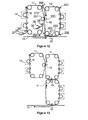
- Figure 13 shows an embodiment of the present invention with three toner image-collecting devices.
- the image formed on the first toner image-collecting device (11) is transferred to the second toner image-collecting device (12).
- the image of all of the image-forming electrophotographic stations in contact with the second toner image-collecting device is collected with the image that was formed on the first toner image-collecting device (11).
- the second toner image-collecting device comes into contact with a third toner image-collecting device (21) in a contact zone where the image is transferred to the third toner image-collecting device (21) in a transfer zone (20).
- a third toner image-collecting device again additional image-forming electrophotographic stations add a single-colour image on the toner image-collecting device.
- the toner image-collecting device is in contact with the receptor material (13) on which the final image is formed by means of an electrophotographic transfer by means of a transfer device (18).
- the second toner image-collecting device contains the final image, and transfers the final image first to an intermediate means from where it is transferred to the receptor material, which can be called an indirect transfer to the receptor material.
- Figure 14 shows an embodiment of the present invention with three toner image collection devices with some advantages over the setup in Figure 13 .
- the image formed on the first toner image-collecting device (11) is transferred to the second toner image-collecting device (12).
- the image of all of the image-forming electrophotographic stations in contact with the second toner image-collecting device is collected with the image that was formed on the first toner image-collecting device (11).
- the toner image-collecting device (12) comes into contact with a third toner image-collecting device (40) in a contact zone where the image is transferred from the third toner image-collecting device (40) to the second toner image-collecting device (12).
- the resulting image can be transferred to the receptor material (13) in a transfer zone (42) with the receptor material.
- the receptor material (13) on which the final image is formed can be a web or can be sheets.
- At least one of the image-forming electrophotographic stations can be decoupled from the toner image-collecting devices when not used. This has the advantage that the components of the image-forming electrophotographic stations do not wear when they are not used.
- the toner image-collecting devices can be decoupled in the transfer zone between the toner image-collecting devices.
- the goal of decoupling is that in the case of not using any of the image-forming electrophotographic stations that are coupled to a specific toner image-collecting device, also the toner image-collecting device does not wear when the printing device is operating.
- the toner image-collecting device that is in contact with the receptor material can be decoupled from the receptor material.
- the aim is that the image-forming electrophotographic stations can be running and tested without receptor material being consumed.
- each toner image-collecting device there is cleaning on the outside of each toner image-collecting device.
- This cleaning ensures the toner image-collecting device is free of residual toner before a new image is transferred to it.
- This cleaning can consist of a scraping blade (25), a collecting device (26) and a hose (27) in which a pressure is maintained lower than the ambient pressure, resulting in a suction so that the toner that is removed by the scraping blade (25) from outside of the toner image-collecting device.
- Another embodiment uses a rotating cleaning brush to remove the residual toner.
- each image-collecting device there is a cleaning on the inside of each image-collecting device.
- This cleaning ensures the toner image-collecting device does not accumulate toner on the inside. This is needed because accumulating toner can diminish the transfer efficiency at the place where images are transferred from or transferred to the toner image-collecting device, resulting in a locally lighter area.
- This cleaning can consist of a scraping blade (28), a collecting device (29) and a hose (30) in which a pressure is maintained lower than the ambient pressure, resulting in a suction so that the toner that is removed by the scraping blade (28) from inside of the toner image-collecting device.
- the electrical potential applied to the transfer devices is influenced by a control loop.
- This control loop uses measurements performed by measurement devices that measure well known images on the toner image-collecting devices. These measurement devices can be e.g. densitometers. In another embodiment, where the toner image-collecting devices are reflective, the measurement devices use the amount of reflected light to estimate how much toner is present on the toner image-collecting device.
- a measurement device such as, for example, a densitometer to measure the transfer efficiency from the image-forming electrophotographic stations to the toner image-collecting device.
- a measurement device (201) can not only be on the first toner image-collecting device, but also on other toner image-collecting devices.
- a well-known image such as, for example, a small patch produced only by one image-forming electrophotographic station can be measured and be used as the feed to a control loop that steers the voltages applied in the transfer charge device (4).
- a measurement device (203) such as, for example, a densitometer to measure the transfer efficiency from one toner image-collecting device to another toner image-collecting device.
- a well-known image such as, for example, a small patch produced only by one image-forming electrophotographic station can be measured and be used as the feed to a control loop that steers the voltages applied in the transfer charge device in the transfer zone (19) between the toner image-collecting devices.
- a measurement device (204) such as, for example, a densitometer to measure residual toner on a toner image-collecting device after the transfer to a second toner image-collecting device.
- a well-known image such as, for example, a small patch produced only by one image-forming electrophotographic station can be measured and be used as the feed to a control loop that steers the voltages applied in the transfer charge device in the transfer zone (19) between the toner image-collecting devices.
- a measurement device (202) such as, for example, a densitometer to measure residual toner on a toner image-collecting device after the transfer to the receptor material.
- a well-known image such as, for example, a small patch produced only by one image-forming electrophotographic station can be measured and be used as the feed to a control loop that steers the voltages applied in the transfer charge device (18) that does the toner transfer between a toner image-collecting device and the receptor material.
- the transfer zone (19) where the transfer is performed from one toner image-collecting device (11) to another toner image-collecting device (12) is constructed this way that the transfer only happens when the toner image-collecting devices are touching each other. This means there should be no large area where the image-collecting devices are almost touching. Such an area must be avoided because in such an area, the toner can be attracted enough so that it crosses the small gap between the toner image-collecting devices, and actually transfer over a certain distance, resulting in a disturbance of the image.
- One way to avoid a larger area where the image-collecting devices are almost touching is to make the roller (220) on the inside of one toner image-collecting device substantially smaller than the roller (221) on the inside of the other toner image-collecting device.
- the receptor material contacts a toner image-collecting device in a transfer zone, where the toner image-collecting device is below the receptor material during the contact zone.
- the receptor material leaves the transfer zone with a multi-colour image at a higher distance to the bottom of the machine.
- a higher distance has the advantage that with a roll (52) and possibly a second roll (53), where these rollers don't touch the imaged side of the receptor material, the material can be led to a fusing device (51).
- This fusing device does not add additional height to the machine since the receptor material has turned with the rollers.
- the fact that the rollers don't touch the imaged side of the receptor material is especially important since at that moment, the image is not fused yet, and any mechanical contact can disturb the formed image.
- corona's (210) before the transfer from one toner image-collecting device to another. This can help to induce a more equal charge to all toner particles that are present on the toner image-collecting device, and result in a better image transfer.
- a charging corona (211) before the transfer from a toner image-collecting device to the receptor material (13). This can help to induce a more equal charge to all toner particles that are present on the toner image-collecting device, and result in a better image transfer to the receptor material.
- the roller (222) that is on the inside of the toner image-collecting device at the transfer zone with the receptor material can also be set to a certain electrical potential. This helps the image transfer to the receptor material with certain materials that contain e.g. a metalized layer. In such media, the layer that is metalized shields the toner on the toner image-collecting device from the transfer device (18), resulting in a poor transfer. To remedy this, an electrical potential applied to the roller (222) on the inside of the toner image-collecting device creates an electrical field that pushes the toner towards the receptor material, with a good image transfer as a result.
Landscapes
- Physics & Mathematics (AREA)
- General Physics & Mathematics (AREA)
- Electrostatic Charge, Transfer And Separation In Electrography (AREA)
- Liquid Developers In Electrophotography (AREA)
- Color Electrophotography (AREA)
- Developing Agents For Electrophotography (AREA)
Priority Applications (1)
| Application Number | Priority Date | Filing Date | Title |
|---|---|---|---|
| EP13174075.5A EP2682819A2 (de) | 2012-07-04 | 2013-06-27 | Verfahren zur Bildung eines mehrfarbigen Bildes |
Applications Claiming Priority (2)
| Application Number | Priority Date | Filing Date | Title |
|---|---|---|---|
| EP12175006 | 2012-07-04 | ||
| EP13174075.5A EP2682819A2 (de) | 2012-07-04 | 2013-06-27 | Verfahren zur Bildung eines mehrfarbigen Bildes |
Publications (1)
| Publication Number | Publication Date |
|---|---|
| EP2682819A2 true EP2682819A2 (de) | 2014-01-08 |
Family
ID=48692342
Family Applications (1)
| Application Number | Title | Priority Date | Filing Date |
|---|---|---|---|
| EP13174075.5A Withdrawn EP2682819A2 (de) | 2012-07-04 | 2013-06-27 | Verfahren zur Bildung eines mehrfarbigen Bildes |
Country Status (3)
| Country | Link |
|---|---|
| US (1) | US20140010577A1 (de) |
| EP (1) | EP2682819A2 (de) |
| JP (1) | JP2014013388A (de) |
Families Citing this family (5)
| Publication number | Priority date | Publication date | Assignee | Title |
|---|---|---|---|---|
| MX2008013777A (es) * | 2006-04-27 | 2009-02-03 | Lantmaennen As Faktor Ab | Usos medicos adicionales de la proteina antisecretora. |
| EP3299892B1 (de) * | 2015-05-19 | 2021-01-20 | Kao Corporation | Bindeharzzusammensetzung für elektrostatische bildentwicklungstoner |
| EP3871049B1 (de) | 2018-10-23 | 2024-05-08 | Hewlett-Packard Development Company, L.P. | Polaritätsfixierung von tintenpartikeln |
| JP2023144990A (ja) * | 2022-03-28 | 2023-10-11 | 富士フイルムビジネスイノベーション株式会社 | 画像形成装置 |
| JP7852334B2 (ja) | 2022-03-28 | 2026-04-28 | 富士フイルムビジネスイノベーション株式会社 | 画像形成装置 |
Citations (5)
| Publication number | Priority date | Publication date | Assignee | Title |
|---|---|---|---|---|
| US3694073A (en) | 1970-07-20 | 1972-09-26 | Xerox Corp | Method for duplexing |
| JP2005338424A (ja) | 2004-05-27 | 2005-12-08 | Canon Inc | 画像形成装置 |
| JP2005338150A (ja) | 2004-05-24 | 2005-12-08 | Nitto Denko Corp | 表面保護フィルム付光学フィルムおよび画像表示装置 |
| US20100310285A1 (en) | 2009-06-05 | 2010-12-09 | Canon Kabushiki Kaisha | Image forming apparatus |
| US20110116838A1 (en) | 2009-11-13 | 2011-05-19 | Shifley James D | Dual diverter |
Family Cites Families (8)
| Publication number | Priority date | Publication date | Assignee | Title |
|---|---|---|---|---|
| GB9918585D0 (en) * | 1999-08-07 | 1999-10-06 | Xeikon Nv | Printers |
| JP2007240893A (ja) * | 2006-03-09 | 2007-09-20 | Kyocera Mita Corp | 画像形成装置 |
| US8964256B2 (en) * | 2008-04-30 | 2015-02-24 | Xerox Corporation | Method of correcting streaks using exposure modulation and spatially varying TRCs |
| KR101315459B1 (ko) * | 2008-10-14 | 2013-10-04 | 삼성전자주식회사 | 전사유닛 및 이를 포함하는 화상형성장치 |
| JP5397776B2 (ja) * | 2009-06-11 | 2014-01-22 | 株式会社リコー | 画像形成装置 |
| US8295749B2 (en) * | 2010-06-02 | 2012-10-23 | Xerox Corporation | Method and apparatus for printing various sheet sizes within a pitch mode in a digital printing system |
| JP5589781B2 (ja) * | 2010-11-09 | 2014-09-17 | 富士ゼロックス株式会社 | 回転体規制装置、画像形成装置 |
| US8731447B2 (en) * | 2011-02-18 | 2014-05-20 | Xerox Corporation | Skew aligning interacting belts apparatus |
-
2013
- 2013-06-27 EP EP13174075.5A patent/EP2682819A2/de not_active Withdrawn
- 2013-07-01 JP JP2013137700A patent/JP2014013388A/ja active Pending
- 2013-07-02 US US13/933,908 patent/US20140010577A1/en not_active Abandoned
Patent Citations (5)
| Publication number | Priority date | Publication date | Assignee | Title |
|---|---|---|---|---|
| US3694073A (en) | 1970-07-20 | 1972-09-26 | Xerox Corp | Method for duplexing |
| JP2005338150A (ja) | 2004-05-24 | 2005-12-08 | Nitto Denko Corp | 表面保護フィルム付光学フィルムおよび画像表示装置 |
| JP2005338424A (ja) | 2004-05-27 | 2005-12-08 | Canon Inc | 画像形成装置 |
| US20100310285A1 (en) | 2009-06-05 | 2010-12-09 | Canon Kabushiki Kaisha | Image forming apparatus |
| US20110116838A1 (en) | 2009-11-13 | 2011-05-19 | Shifley James D | Dual diverter |
Non-Patent Citations (1)
| Title |
|---|
| JEROME L JOHNSON: "Principles of Non-Impact Printing", 1986, PALATINO PRESS |
Also Published As
| Publication number | Publication date |
|---|---|
| JP2014013388A (ja) | 2014-01-23 |
| US20140010577A1 (en) | 2014-01-09 |
Similar Documents
| Publication | Publication Date | Title |
|---|---|---|
| US6453139B2 (en) | Image forming apparatus | |
| EP2682819A2 (de) | Verfahren zur Bildung eines mehrfarbigen Bildes | |
| JP2008224955A (ja) | 画像形成装置及び画像形成方法 | |
| US6226465B1 (en) | Image forming apparatus with relative speed differential between intermediate transfer member and image bearing member | |
| CN102262369A (zh) | 成像装置 | |
| KR20110039002A (ko) | 화상형성장치 | |
| US8099024B2 (en) | Systems and methods of producing gradient index optics by sequential printing of toners having different indices of refraction | |
| US8311434B2 (en) | Removing toner from skive mount in printer | |
| JP2011018042A (ja) | 複数の中間転写ベルトを有する拡張可能な印刷システム | |
| US9563170B2 (en) | Image forming apparatus configured to use a common driving source for image bearing members | |
| JP2010529501A (ja) | フラッドコーティングシステムのための分割ローラ | |
| US8666275B2 (en) | Image forming apparatus | |
| JPH0762771B2 (ja) | 電子写真方法 | |
| US8543030B2 (en) | Electrophotographic printer with dust seal | |
| JP2007156194A (ja) | 角変位又は変位制御装置及びこれを使用する画像形成装置 | |
| JP2008185849A (ja) | 画像形成装置 | |
| CN101551625B (zh) | 图像形成装置用带、带张紧装置以及图像形成装置 | |
| JPH1078689A (ja) | 画像形成装置 | |
| JP5884679B2 (ja) | 画像形成装置 | |
| JP5441988B2 (ja) | ベルトユニットおよび画像形成装置 | |
| JP4283572B2 (ja) | 画像形成方法および装置 | |
| JP2003029489A (ja) | 画像形成装置 | |
| JP2005017424A (ja) | 画像形成装置 | |
| JPH08305120A (ja) | カラー電子写真方法 | |
| JP2002268322A (ja) | 多色画像形成装置 |
Legal Events
| Date | Code | Title | Description |
|---|---|---|---|
| PUAI | Public reference made under article 153(3) epc to a published international application that has entered the european phase |
Free format text: ORIGINAL CODE: 0009012 |
|
| AK | Designated contracting states |
Kind code of ref document: A2 Designated state(s): AL AT BE BG CH CY CZ DE DK EE ES FI FR GB GR HR HU IE IS IT LI LT LU LV MC MK MT NL NO PL PT RO RS SE SI SK SM TR |
|
| AX | Request for extension of the european patent |
Extension state: BA ME |
|
| STAA | Information on the status of an ep patent application or granted ep patent |
Free format text: STATUS: THE APPLICATION IS DEEMED TO BE WITHDRAWN |
|
| 18D | Application deemed to be withdrawn |
Effective date: 20160105 |