EP2682880A1 - Dispositif d'extension d'ensemble, procédé d'extension d'ensemble, programme et support de stockage non transitoire - Google Patents
Dispositif d'extension d'ensemble, procédé d'extension d'ensemble, programme et support de stockage non transitoire Download PDFInfo
- Publication number
- EP2682880A1 EP2682880A1 EP12755096.0A EP12755096A EP2682880A1 EP 2682880 A1 EP2682880 A1 EP 2682880A1 EP 12755096 A EP12755096 A EP 12755096A EP 2682880 A1 EP2682880 A1 EP 2682880A1
- Authority
- EP
- European Patent Office
- Prior art keywords
- segment
- score
- segments
- string
- component
- Prior art date
- Legal status (The legal status is an assumption and is not a legal conclusion. Google has not performed a legal analysis and makes no representation as to the accuracy of the status listed.)
- Withdrawn
Links
Images






Classifications
-
- G—PHYSICS
- G06—COMPUTING OR CALCULATING; COUNTING
- G06F—ELECTRIC DIGITAL DATA PROCESSING
- G06F16/00—Information retrieval; Database structures therefor; File system structures therefor
- G06F16/20—Information retrieval; Database structures therefor; File system structures therefor of structured data, e.g. relational data
- G06F16/24—Querying
- G06F16/245—Query processing
- G06F16/2457—Query processing with adaptation to user needs
- G06F16/24578—Query processing with adaptation to user needs using ranking
-
- G—PHYSICS
- G06—COMPUTING OR CALCULATING; COUNTING
- G06F—ELECTRIC DIGITAL DATA PROCESSING
- G06F16/00—Information retrieval; Database structures therefor; File system structures therefor
- G06F16/20—Information retrieval; Database structures therefor; File system structures therefor of structured data, e.g. relational data
- G06F16/24—Querying
- G06F16/245—Query processing
- G06F16/2457—Query processing with adaptation to user needs
- G06F16/24575—Query processing with adaptation to user needs using context
-
- G—PHYSICS
- G06—COMPUTING OR CALCULATING; COUNTING
- G06F—ELECTRIC DIGITAL DATA PROCESSING
- G06F16/00—Information retrieval; Database structures therefor; File system structures therefor
- G06F16/30—Information retrieval; Database structures therefor; File system structures therefor of unstructured textual data
- G06F16/33—Querying
- G06F16/3331—Query processing
- G06F16/3332—Query translation
- G06F16/3338—Query expansion
-
- G—PHYSICS
- G06—COMPUTING OR CALCULATING; COUNTING
- G06F—ELECTRIC DIGITAL DATA PROCESSING
- G06F16/00—Information retrieval; Database structures therefor; File system structures therefor
- G06F16/30—Information retrieval; Database structures therefor; File system structures therefor of unstructured textual data
- G06F16/35—Clustering; Classification
-
- G—PHYSICS
- G06—COMPUTING OR CALCULATING; COUNTING
- G06Q—INFORMATION AND COMMUNICATION TECHNOLOGY [ICT] SPECIALLY ADAPTED FOR ADMINISTRATIVE, COMMERCIAL, FINANCIAL, MANAGERIAL OR SUPERVISORY PURPOSES; SYSTEMS OR METHODS SPECIALLY ADAPTED FOR ADMINISTRATIVE, COMMERCIAL, FINANCIAL, MANAGERIAL OR SUPERVISORY PURPOSES, NOT OTHERWISE PROVIDED FOR
- G06Q30/00—Commerce
- G06Q30/06—Buying, selling or leasing transactions
- G06Q30/0601—Electronic shopping [e-shopping]
Definitions
- the present invention relates to a set expansion processing device, set expansion processing method, program and non-transitory memory medium, and more particularly to acquisition of words contained in the same category semantically.
- Patent Literature 1 In Internet shopping, products handled by a shopping site are displayed to users divided into categories. For example, in Patent Literature 1 an information sending and receiving system for displaying product categories such as "home appliances", “books” and “computer” on pages listing products is disclosed. A user can easily narrow down products by selecting a category of products they are interested in purchasing from among these categories.
- Non-Patent Literature 1 an algorithm (called the "g-Espresso algorithm”) is disclosed for extracting semantic categories from sentences with words separated by spaces.
- g-Monaka algorithm an algorithm for extracting semantic categories from sentences in which words are not separated by spaces.
- the set expansion processing device comprises:
- the set expansion processing device further comprises:
- the segment component score of each segment component appearing in each of the obtained segments decays exponentially with respect to the shortest distance between the position where the received seed string appears in that segment and the position where the segment component appears in that segment.
- the program according to a third aspect of the present invention causes a computer to function as:
- the non-transitory computer-readable recording medium stores a program for causing a computer to function as:
- the above-described program can be distributed and/or sold via a computer communication network, independent of a computer executing the program.
- the above-described recording medium can be distributed and/or sold independent of a computer.
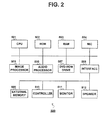
- IPL Initial Program Loader
- ROM 502 An IPL (Initial Program Loader) that is executed immediately after the power is turned on is recorded in the ROM 502, and by this being executed a predetermined program is read out of the RAM 503 and execution of that program is started by the CPU 501.
- various data and an operating system program necessary for controlling the actions of the information processing device 500 as a whole are recorded in the ROM 502.
- the audio processor 506 converts audio data read from a DVD-ROM and/or the like into an analog audio signal and outputs such from a speaker 512 connected thereto. In addition, under the control of the CPU 501, this processor generates sounds that should be emitted during progress in processes accomplished by the information processing device 500, and outputs audio corresponding thereto from the speaker 512.
- the DVD-ROM loaded into the DVD-ROM drive 507 for example may have recorded thereon a program for realizing the set expansion processing device 100 according to the preferred embodiments.
- the DVD-ROM drive 507 accomplishes the process of reading the DVD-ROM that was loaded, reading necessary programs and data and temporarily storing such in the RAM 503 and/or the like.
- the external memory 509, the controller 510, the monitor 511 and the speaker 512 are removably connected to the interface 508.
- Data relating to personal information of the user and/or the like is overwritably stored in the external memory 509.
- the controller 510 receives operation input accomplished at various setting times of the information processing device 500.
- the user of the information processing device 500 can store such data in the appropriate external memory 509 by accomplishing instruction input via the controller 510.
- the monitor 511 presents to the user of the information processing device 500 data output by the image processor 505.
- the speaker 512 presents to the user of the information processing device 500 audio data output by the audio processor 506.
- the information processing device 500 may be composed to achieve the same functions as the ROM 502, RAM 503, external memory 509, DVD-ROM loaded in the DVD-ROM drive 507 and/or the like, using a large-capacity external memory device such as a hard disk.
- the schematic configuration of the set expansion processing device 100 according to the preferred embodiments realized in the above-described information processing device 500 is explained with reference to FIGS. 1 to 13 .
- a program that functions as the set expansion processing device 100 according to the preferred embodiments is executed and the set expansion processing device 100 according to the preferred embodiments is realized.
- the set expansion processing device 100 selects candidate of an instance contained in an expanded set which is an expansion of a set containing seed string.
- the set expansion processing device 100 is composed of a receive unit 101, a search unit 102, a segment acquisition unit 103, a segment component acquisition unit 104, a segment score computation unit 105, a segment component score computation unit 106 and a selection unit 107, as shown in FIG. 3 .
- the explanation below uses as an example a case in which the set expansion processing device 100 accomplishes display of a suitable term (instance) candidate as a term belonging to the pot category of kitchen products.
- the receive unit 101 receives a seed string.
- the seed string is, for example, a correct term ("Chinese wok” or "pressure cooker” and/or the like) contained in the set of terms belonging to the "pot" category.
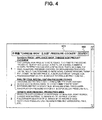
- the user inputs the all of the seed strings linked by spaces into a search field 601 of a search engine on a Web page, and pressed a search button 602.
- the receive unit 101 receives "Chinese wok” and "pressure cooker” input into the search field 601 as the seed strings.
- the type of search engine is arbitrary.
- the CPU 501 and the controller 510 work together to function as the receive unit 101.
- the search unit 102 searches documents containing the received seed string and obtains snippets.
- a snippet is, for example, a portion of text containing the query displayed as search results when the search engine of the Web page is used.
- the search unit 102 obtains a list of the top 300 snippets, for example, from search results when all of the seed strings linked with spaces are input as a query into the search engine of the Web page.
- the search unit 102 accomplishes a Web page search using the search engine with "Chinese wok pressure cooker" as the query, and obtains snippets 1, 2, 3, ..., 300 (unrepresented) of FIG.
- the search unit 102 is not limited to obtaining documents using an external device as described above, and may be provided with a search function internally.
- the search unit 102 may obtain snippets using a Web search API.
- the CPU 501 and the NIC 504 work together to function as the search unit 102.
- the segment acquisition unit 103 obtains segments composed of strings arranged in order of appearance of the seed string and strings appearing before and after the seed string, by partitioning the obtained snippets using a predetermined segment partition string.
- the snippets are typically partitioned by a predetermined partition string so that in the page containing search terms, the user can tell at a glance how these search terms were used. For example, suppose the predetermined segment partition string is "... ".
- the segment acquisition unit 103 standardizes the obtained snippets 1, 2, 3, ..., 300 using Unicode NFKC, makes these uniformly lower case, and divides into the multiple strings by the segment partition string "". Furthermore, the segment acquisition unit 103 excludes redundant strings out of the divided strings, and obtains the remaining strings as segments.
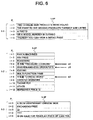
- FIG. 5 shows segments 1-1 to 1-3 obtained by the segment acquisition unit 103 from the snippet 1.
- the segment partition string is not limited to the string "".
- the snippets displayed by the Web engine used by the search unit 102 or the Web search API are partitioned by the string "---" or "##", for example, the segment partition string becomes the string "---" or "##".
- the method of obtaining the segments is not limited to a method of obtaining segments using segment partition strings. Segments are appropriately obtained in accordance with snippets presented by the search engine or Web search API used. For example, when one snippet is presented without being partitioned by symbols such as "", that snippet becomes one segment. In addition, when a portion corresponding to a segment within a snippet is presented by itemization and/or the like in advance, the portion corresponding to one row of the itemization becomes one segment.
- the CPU 501 functions as the segment acquisition unit 103.
- the segment component acquisition unit 104 obtains segment elements by partitioning the respective segments obtained using a predetermined segment component partition string.
- the predetermined segment component partition string is punctuation or symbols ("," (Japanese punctuation mark), ",", “.”, “!, “[”, "]” and/or the like), and the segment is partitioned by these segment component partition strings, and then segment components are obtained.
- the segment component acquisition unit 104 partitions the segments 1-1, 1-2 and 1-3 in FIG.
- the CPU 501 functions as the segment component acquisition unit 104.
- the segment score computation unit 105 computes a segment score for each of the obtained segments based on the standard deviation or variance of the length of each of the segment components appearing in that segment. For each of the obtained segments, when the standard deviation of the length of each of the segment components appearing in that segment exceeds a predetermined threshold value, the segment score and the below-described segment component score are values such that the segment components contained in that segment are not selected by the selection unit 107 as instance candidates.
- the length of a segment component is defined by the number of characters (Japanese characters of Japanese translation for the segment component) in Unicode, but this is intended to be illustrative and not limiting. For example, as the length of a segment component it is possible to use the byte number of another character code.
- segments 1-1 and 1-3 contain normal text but the segment 1-2 does not contain normal text.
- the variation in the length of segment components contained in the segments 1-1 and 1-3 is larger than the variation in the length of segment components contained in the segment 1-2.
- segments containing normal text in general tend to have lengths of segment components contained in that segment that are not as uniform as those of segments not containing normal text.
- segments containing normal text often do not contain instances belonging to the same contextual range as the seed string, and thus are not suitable as segments for obtaining instance candidates. Accordingly, segments in which the standard deviation of the length of segment components exceeds a predetermined threshold value are excluded below from segments for obtaining instance candidates.
- the predetermined threshold value is 5.00.
- the segment score computation unit 105 uses the value of the standard deviation itself as the segment score when the standard deviation of the lengths of segment components is less than 5.00, and sets the segment score at 5.00 when the standard deviation is at least 5.00.
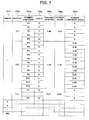
- FIG. 7 shows segment scores computed by the segment score computation unit 105.
- “snippet 701 a” obtained with the seed string as a query
- “segment 702a” contained in the snippet 701a
- “segment component 703a” contained in the segment 702a
- “standard deviation 705a” of the length 704a
- “segment score 706a” computed based on the standard deviation 705a
- “segment component score 707a” computed by the below-described segment component score computation unit 106 are recorded associated with each other.
- the CPU 501 functions as the segment score computation unit 105.
- the segment component score computation unit 106 computes segment component scores for each of the segment components contained in each of the obtained segments based on the distance between the position where the received seed string appears in the segment and the position where that segment component appears in the segment, and the segment score computed for that segment.
- the segment component score computation unit 106 sets the segment component score to "0" when the segment score is "5.00".
- the segment component score computation unit 106 computes the segment component score based on the distance between the position where the received seed string appears in the segment and the position where that segment component appears in that segment.
- a position s j (j: number of the seed string) where the seed string appears in the segment, and a position p i where the segment component appears in that segment are in appearance order in the segment when the segment components are arranged in appearance order in the segment, as shown in FIG. 6 , and the distance is the difference in appearance order between the position s j and the position p i . That is to say, taking the seed strings to be "Chinese wok" and "pressure cooker", the position s 1 where the seed string “pressure cooker” (P 4 ) appears in the segment 1-2 is "4", and the position s 2 where the seed string "Chinese wok” (P 8 ) appears in is "8".
- a score that decays exponentially in accordance with distance to the closest seed string is found, but a variety of variations on the method of finding the score are possible. For example, when multiple seed strings exist, the distances between each seed string and the segment component may each be found, and a score that decays linearly in accordance with the average value of the distances found may be taken as the segment component score of each segment component.
- the CPU 501 functions as the segment component score computation unit 106.
- the selection unit 107 selects any of the obtained segment components as instance candidates contained in the expanded set that is an expansion of a set containing the seed string received, based on the segment component score computed for each of those segment components.
- the expanded set is a set obtained after implementing the set expansion process, and is a set of terms contained in a category semantically the same as the seed string.
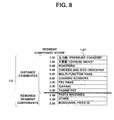
- the selection unit 107 excludes from instance candidates segment components whose segment component score value is less than "0.10", and selects the remaining segment components as instance candidates. That is to say, the selection unit excludes from candidates segment components obtained from the segments 1-1 and 1-3 because the segment component scores of the segment components obtained from the segments 1-1 and 1-3 are all "0" ( FIG. 7 ). Furthermore, as shown in FIG.
- the selection unit 107 excludes the "pasta machine,” “other” and “furthermore the price is” segment components, whose segment component scores are less than "0.10,” and selects the remaining segment components as instance candidates contained in the semantically same category as "Chinese wok” and "pressure cooker.”
- a method of selecting instance candidates was explained using a single snippet as an example, but in reality segments components are obtained from multiple snippets, segment component scores are found and instance candidates are selected. In this case, segment component scores are respectively found from different snippets in the same segment component.
- segment components contained in the semantically same category as the seed string are thought to be contained in multiple snippets, so the probability of multiple segment component scores being obtained is high. Accordingly, when multiple segment component scores are obtained, the sum or maximum value thereof becomes the segment component score of that segment component. By processing in this manner, it is possible to select more appropriate instance candidates.
- the CPU 501 functions as the selection unit 107.
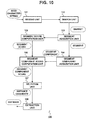
- the receive unit 101 receives seed string (step S101).
- the receive unit 101 receives as seed strings "Chinese wok” and "pressure cooker” input as queries into the search field 601 of the Web page's search engine, as shown in FIG. 4 .
- the search unit 102 searches documents containing the received seed string and obtains snippets (step S102). For example, the search unit 102 searches the seed strings "Chinese wok” and "pressure cooker” as queries and obtains the top 300 snippets 1, 2, 3, ..., 300 of the search results, as shown in FIG. 4 .
- the number of snippets the search unit 102 obtains is arbitrary but by obtaining at least 100 or so snippets, it is possible to select more suitable instance candidates.
- the segment acquisition unit 103 obtains segments by using a segment partition string to partition the snippets obtained by the search unit 102 (step S103). For example, the segment acquisition unit 103 obtains segments by partitioning the snippets 1, 2, 3, ..., 300 using the segment partition string "". For example, the segment acquisition unit 103 obtains the segments 1-1 to 1-3 from the snippet 1, as shown in FIG. 5 .
- the segment component acquisition unit 104 obtains segment components by partitioning those segments using predetermined segment component partition string (step S104). For example, the segments 1-1 to 1-3 are partitioned using segment component partition strings ("," (Japanese punctuation mark), ",”, “.”, “!, “[”, "]” and/or the like) to obtain the segment components (segment component groups 1-1P, 1-2P, 1-3P) of FIG. 6 .
- the segment score computation unit 105 computes the segment scores of each of those segments based on the standard deviation of the lengths of the segment components contained in the segment (step S105). For example, when the standard deviation of the lengths of the segment components is less than 5.00, the segment score computation unit 105 sets the value or the standard deviation as the segment score, and when the standard deviation of the lengths of the segment components is at least 5.00, sets 5.00 as the segment score.
- the segment score computation unit 105 sets "5.00” as the segment score of the segment 1-1 having a standard deviation of "5.89,” sets "1.34" as the segment score of the segment 1-2 having a standard deviation of '1.34,” and sets "5.00” as the segment score of the segment 1-3 having a standard device of "5.27".
- the segment component score computation unit 106 computes the segment component scores of the segment components based on the distance between the position where the received seed string appears in the segment and the position where that segment component appears in that segment, and the segment score computed for that segment (step S106). For example, the segment component score computation unit 106 sets "0" as the segment component score when the segment score is "5.00", and when the segment score is less than "5.00," computes the segment component score 707a ( FIG. 7 ) based on an equation (Formula 1) using the distance between the position where the seed string appears in the segment and the position where the segment component appears in the segment.
- the selection unit 107 selects instance candidates belonging to the semantically same category as the seed string based on the segment component scores for the obtained segment components (step S107). For example, the selection unit 107 selects as instance candidates segment components whose segment component score value is at least "0.10", as shown in FIG. 8 .
- the set expansion processing device 100 of a second preferred embodiment removes semantically unrelated terms by applying a filter based on context for instance candidates contained in the expanded set.
- the set expansion processing device 100 is composed of a receive unit 101, a search unit 102, a segment acquisition unit 103, a segment component acquisition unit 104, a segment score computation unit 105, a segment component score computation unit 106, a selection unit 107 and an extraction unit 108, as shown in FIG. 10 .
- the receive unit 101, the search unit 102, the segment acquisition unit 103, the segment component acquisition unit 104, the segment score computation unit 105, the segment component score computation unit 106 and the selection unit 107 have the same functions as in the first preferred embodiment.
- the extraction unit 108 which has a different function, is described.
- the extraction unit 108 generates a connection graph of the n-gram containing the extracted instance candidates, from snippets obtained through searches using the instance candidates. Furthermore, the extraction unit 108 computes the similarity between the received seed string and that instance based on the context before and after the seed string and the context before and after the instance candidate in that connection graph, and extracts an instance that should be contained in an expanded set that is an expansion of the set including those seed string, from those instance candidates, based on that similarity.
- the method of computing the similarity based on the g-Monaka algorithm is explained in detail.
- the extraction unit 108 obtains a list of the top 300 snippets in the search results by inputting the respective instance candidates selected by the selection unit 107 as queries in the Web page's search engine. Furthermore, the extraction unit 108 standardizes the obtained snippets through Unicode NFKC, makes everything lower case and removes redundancies. In addition, when the percentage of Japanese characters is extremely low and there are numerous symbols, the snippet is excluded as inappropriate.
- connection matrix M(u,v) For all text n-grams contained in the remaining snippet set.
- the connection matrix M(u,v) is expressed by an equation (Formula 2).
- is the frequency of an n-gram v following an n-gram u
- are respectively the appearance frequencies of the n-gram u and the n-gram v.
- are search result numbers when each is searched as a query
- pmi (u,v) uses the natural logarithm of that search result number.
- connection graph a directed weighted graph
- M the connection matrix
- V the set V of all n-grams
- FIG. 11 An example of the generated connection graph G M is shown in FIG. 11 .
- this graph it is possible to consider the meanings of the n-gram u and the n-gram v to be similar to the extent that the right-side context and the left-side context of the n-gram u and the n-gram v are similar.
- a bibliographic coupling means that documents x and y cite the same document. That is to say, the bibliographic coupling can be thought of as corresponding to whether or not the n-gram u and the n-gram v are connected to the same n-gram.
- the left-side context of the n-gram u and the left-side context of the n-gram v are similar can be thought of as corresponding to the concept of co-citation of the citation analysis method.
- Co-citation means that documents x and y are cited by the same document. That is to say, this can be thought of as corresponding to whether or not the same n-gram is connected to the n-gram u and the n-gram v.
- the similarity matrices A R and A L indicating whether or not the left-side context and the right-side context of the n-gram u and the n-gram v are similar are found by corresponding each to the bibliographic coupling matrix and the co-citation matrix.
- the right-side context similarity matrix A R and the left-side context similarity matrix A L can be expressed by an equation (Formula 3) using the connection matrix M.
- a R 1 V 2 ⁇ MM T
- a L 1 V 2 ⁇ M T ⁇ M
- the extraction unit 108 finds the right-side context similarity matrix A R and the left-side context similarity matrix A L for all of the n-grams.
- the extraction unit 108 finds the Laplacian kernel R ⁇ (A) from the equations of Formula 5 and Formula 6, using this similarity matrix A.
- the element (i,j) in R ⁇ (A) corresponds to the similarity between the n-gram i and the n-gram j.
- the extraction unit 108 computes R ⁇ (A)v 0 using a seed vector v 0 (a vector in which the element corresponding to the seed string is 1 and all others are 0), and the computed value is the similarity.
- the value of ⁇ is arbitrary and for example is 1.0 to 2.
- connection graph G M of FIG. 11 "Chinese wok” is connected to the particle “NO” (Japanese particle), and “cooking scissors” and “tagine pot” are both connected to the particle “no".
- the "no” connected to “Chinese wok” is connected to "tagine pot", but the "NO” is not connected to "cooking scissors”.
- the similarity R ⁇ (A)v 0 of "cooking scissors” to "Chinese wok” is a smaller value than the similarity R ⁇ (A)v 0 of "tagine pot” to "Chinese work”.
- the extraction unit 108 for example extracts as instances those whose computed similarity exceeds a predetermined value. For example, the similarity is found as in FIG. 12 , and when the predetermined value is "0.10", the extraction unit 108 extracts as instances “pressure cooker”, “Chinese wok”, “crockpot for chicken and eggs”, “tagine pot”, and "igayaki”.
- the CPU 501 functions as the extraction unit 108.
- the extraction unit 108 acquires snippets by searching with a search engine using the instance candidates (step S208). For example, the extraction unit 108 inputs the instance candidates as queries into the Web page's search engine and obtains a list of the top 300 snippets of the search results.
- the extraction unit 108 generates a connection graph of n-gram containing instance candidates from the obtained snippets (step S209). For example, the extraction unit 108 removes inappropriate items from the 300 snippets and finds a connection matrix M for the n-grams of all text contained in the set of remaining snippets. Furthermore, as shown in FIG. 11 , the set V of all n-grams is made the node set and a connection graph C M expressing M (Formula 2) as a connection matrix is generated.
- the extraction unit 108 computes the similarity between the seed string and the instance candidate based on the context before and after the seed string and the context before and after the instance candidate in the connection graph (step S210). For example, the extraction unit 108 finds the right-side context similarity matrix A R and the left-side context similarity matrix A L based on the equation (Formula 3), and finds the similarity matrix A using a weighted general average of each component, as shown in the equation (Formula 4). Furthermore, the Laplacian kernel R ⁇ (A) is found using the similarity matrix A based on the equations (Formulae 5 and 6), and the similarity of the instance candidates to the seed string is found by multiplying by the seed vector v 0 .
- the extraction unit 108 extracts instances based on similarity (step S211). For example, the extraction unit 108 extracts as instances those with a computed similarity exceeding "0.10", as shown in FIG. 12 . Or, the extraction unit 108 may extract only a predetermined number from those with high similarities. For example, when there are nine instance candidates as shown in FIG. 12 , when the predetermined number is four the extraction unit 108 extracts as instances the top four in terms of similarity, namely "pressure cooker”, “Chinese wok”, “crockpot for chicken and eggs” and "tagine pot”.
- the set expansion processing device 100 was exhibited using an example applied to category generation for shopping site products, but this is intended to be illustrative and not limiting.
- the present invention can also be applied to unique expression acquisition or dictionary building and/or the like.
Landscapes
- Engineering & Computer Science (AREA)
- Theoretical Computer Science (AREA)
- Physics & Mathematics (AREA)
- General Physics & Mathematics (AREA)
- Data Mining & Analysis (AREA)
- Databases & Information Systems (AREA)
- General Engineering & Computer Science (AREA)
- Business, Economics & Management (AREA)
- Computational Linguistics (AREA)
- Accounting & Taxation (AREA)
- Finance (AREA)
- Development Economics (AREA)
- Economics (AREA)
- Marketing (AREA)
- Strategic Management (AREA)
- General Business, Economics & Management (AREA)
- Information Retrieval, Db Structures And Fs Structures Therefor (AREA)
- Document Processing Apparatus (AREA)
Applications Claiming Priority (2)
| Application Number | Priority Date | Filing Date | Title |
|---|---|---|---|
| JP2011048124A JP5043209B2 (ja) | 2011-03-04 | 2011-03-04 | 集合拡張処理装置、集合拡張処理方法、プログラム、及び、記録媒体 |
| PCT/JP2012/054211 WO2012121011A1 (fr) | 2011-03-04 | 2012-02-22 | Dispositif d'extension d'ensemble, procédé d'extension d'ensemble, programme et support de stockage non transitoire |
Publications (2)
| Publication Number | Publication Date |
|---|---|
| EP2682880A1 true EP2682880A1 (fr) | 2014-01-08 |
| EP2682880A4 EP2682880A4 (fr) | 2014-12-17 |
Family
ID=46797980
Family Applications (1)
| Application Number | Title | Priority Date | Filing Date |
|---|---|---|---|
| EP12755096.0A Withdrawn EP2682880A4 (fr) | 2011-03-04 | 2012-02-22 | Dispositif d'extension d'ensemble, procédé d'extension d'ensemble, programme et support de stockage non transitoire |
Country Status (9)
| Country | Link |
|---|---|
| US (1) | US9268821B2 (fr) |
| EP (1) | EP2682880A4 (fr) |
| JP (1) | JP5043209B2 (fr) |
| KR (1) | KR101243457B1 (fr) |
| CN (1) | CN102971733B (fr) |
| BR (1) | BR112012030691A2 (fr) |
| CA (1) | CA2801298C (fr) |
| TW (1) | TWI385545B (fr) |
| WO (1) | WO2012121011A1 (fr) |
Families Citing this family (10)
| Publication number | Priority date | Publication date | Assignee | Title |
|---|---|---|---|---|
| US9519691B1 (en) * | 2013-07-30 | 2016-12-13 | Ca, Inc. | Methods of tracking technologies and related systems and computer program products |
| US9886950B2 (en) * | 2013-09-08 | 2018-02-06 | Intel Corporation | Automatic generation of domain models for virtual personal assistants |
| CN104216933A (zh) * | 2013-09-29 | 2014-12-17 | 北大方正集团有限公司 | 一种知识点隐性关系获取方法及其系统 |
| CN104216934B (zh) * | 2013-09-29 | 2018-02-13 | 北大方正集团有限公司 | 一种知识抽取方法及系统 |
| CN104516904B (zh) * | 2013-09-29 | 2018-04-03 | 北大方正集团有限公司 | 一种关键知识点推荐方法及其系统 |
| US10095747B1 (en) * | 2016-06-06 | 2018-10-09 | @Legal Discovery LLC | Similar document identification using artificial intelligence |
| US10679088B1 (en) * | 2017-02-10 | 2020-06-09 | Proofpoint, Inc. | Visual domain detection systems and methods |
| CN111047130B (zh) * | 2019-06-11 | 2021-03-02 | 北京嘀嘀无限科技发展有限公司 | 用于交通分析和管理的方法和系统 |
| JP7553314B2 (ja) * | 2020-10-13 | 2024-09-18 | 株式会社リクルート | 推定装置、推定方法及びプログラム |
| US11734365B1 (en) | 2022-02-28 | 2023-08-22 | Unlimidata Limited | Knowledge-enriched item set expansion system and method |
Family Cites Families (25)
| Publication number | Priority date | Publication date | Assignee | Title |
|---|---|---|---|---|
| JP3099298B2 (ja) * | 1991-03-20 | 2000-10-16 | 株式会社日立製作所 | 文書検索方法および装置 |
| US5757983A (en) | 1990-08-09 | 1998-05-26 | Hitachi, Ltd. | Document retrieval method and system |
| US6711585B1 (en) * | 1999-06-15 | 2004-03-23 | Kanisa Inc. | System and method for implementing a knowledge management system |
| US6636848B1 (en) * | 2000-05-31 | 2003-10-21 | International Business Machines Corporation | Information search using knowledge agents |
| US6941297B2 (en) * | 2002-07-31 | 2005-09-06 | International Business Machines Corporation | Automatic query refinement |
| US20080177994A1 (en) * | 2003-01-12 | 2008-07-24 | Yaron Mayer | System and method for improving the efficiency, comfort, and/or reliability in Operating Systems, such as for example Windows |
| US7350187B1 (en) * | 2003-04-30 | 2008-03-25 | Google Inc. | System and methods for automatically creating lists |
| US20050060150A1 (en) * | 2003-09-15 | 2005-03-17 | Microsoft Corporation | Unsupervised training for overlapping ambiguity resolution in word segmentation |
| US7870039B1 (en) * | 2004-02-27 | 2011-01-11 | Yahoo! Inc. | Automatic product categorization |
| GB0413743D0 (en) * | 2004-06-19 | 2004-07-21 | Ibm | Method and system for approximate string matching |
| US7565348B1 (en) * | 2005-03-24 | 2009-07-21 | Palamida, Inc. | Determining a document similarity metric |
| TW200821913A (en) * | 2006-11-15 | 2008-05-16 | Univ Nat Chiao Tung | String matching system by using bloom filter to achieve sub-linear computation time and method thereof |
| US7930302B2 (en) * | 2006-11-22 | 2011-04-19 | Intuit Inc. | Method and system for analyzing user-generated content |
| CN101261623A (zh) * | 2007-03-07 | 2008-09-10 | 国际商业机器公司 | 基于搜索的无词边界标记语言的分词方法以及装置 |
| JP5001089B2 (ja) | 2007-08-13 | 2012-08-15 | 楽天株式会社 | 情報送受信システム、情報管理装置、申込受付装置、情報送受信方法、情報管理処理プログラム、及び申込受付処理プログラム |
| JP4724701B2 (ja) * | 2007-10-30 | 2011-07-13 | 日本電信電話株式会社 | 文章検索サーバコンピュータ,文章検索方法,文章検索プログラム,そのプログラムを記録した記録媒体 |
| US7849081B1 (en) * | 2007-11-28 | 2010-12-07 | Adobe Systems Incorporated | Document analyzer and metadata generation and use |
| US8001139B2 (en) * | 2007-12-20 | 2011-08-16 | Yahoo! Inc. | Using a bipartite graph to model and derive image and text associations |
| JP4759600B2 (ja) * | 2008-08-26 | 2011-08-31 | 日本電信電話株式会社 | 文章検索装置、文章検索方法、文章検索プログラムおよびその記録媒体 |
| JP4912384B2 (ja) * | 2008-11-21 | 2012-04-11 | 日本電信電話株式会社 | 文書検索装置、文書検索方法、および文書検索プログラム |
| JP5020274B2 (ja) * | 2009-02-25 | 2012-09-05 | ヤフー株式会社 | 意味ドリフトの発生評価方法及び装置 |
| TW201035783A (en) * | 2009-03-31 | 2010-10-01 | Inventec Corp | Chinese word segmentation syatem and method thereof |
| US9569285B2 (en) * | 2010-02-12 | 2017-02-14 | International Business Machines Corporation | Method and system for message handling |
| US8548800B2 (en) * | 2010-10-29 | 2013-10-01 | Verizon Patent And Licensing Inc. | Substitution, insertion, and deletion (SID) distance and voice impressions detector (VID) distance |
| US8972240B2 (en) * | 2011-05-19 | 2015-03-03 | Microsoft Corporation | User-modifiable word lattice display for editing documents and search queries |
-
2011
- 2011-03-04 JP JP2011048124A patent/JP5043209B2/ja active Active
-
2012
- 2012-02-22 CN CN201280001852.1A patent/CN102971733B/zh active Active
- 2012-02-22 BR BR112012030691A patent/BR112012030691A2/pt not_active Application Discontinuation
- 2012-02-22 CA CA2801298A patent/CA2801298C/fr active Active
- 2012-02-22 EP EP12755096.0A patent/EP2682880A4/fr not_active Withdrawn
- 2012-02-22 KR KR1020127032826A patent/KR101243457B1/ko active Active
- 2012-02-22 US US13/700,898 patent/US9268821B2/en active Active
- 2012-02-22 WO PCT/JP2012/054211 patent/WO2012121011A1/fr not_active Ceased
- 2012-02-29 TW TW101106600A patent/TWI385545B/zh active
Also Published As
| Publication number | Publication date |
|---|---|
| JP5043209B2 (ja) | 2012-10-10 |
| CN102971733B (zh) | 2014-05-14 |
| JP2012185666A (ja) | 2012-09-27 |
| CN102971733A (zh) | 2013-03-13 |
| TWI385545B (zh) | 2013-02-11 |
| US20130144875A1 (en) | 2013-06-06 |
| KR101243457B1 (ko) | 2013-03-13 |
| TW201250505A (en) | 2012-12-16 |
| EP2682880A4 (fr) | 2014-12-17 |
| BR112012030691A2 (pt) | 2017-07-11 |
| CA2801298A1 (fr) | 2012-09-13 |
| CA2801298C (fr) | 2014-11-25 |
| WO2012121011A1 (fr) | 2012-09-13 |
| KR20130016372A (ko) | 2013-02-14 |
| US9268821B2 (en) | 2016-02-23 |
Similar Documents
| Publication | Publication Date | Title |
|---|---|---|
| US9268821B2 (en) | Device and method for term set expansion based on semantic similarity | |
| US8452763B1 (en) | Extracting and scoring class-instance pairs | |
| CN106156111B (zh) | 专利文件检索方法、装置和系统 | |
| JP6908644B2 (ja) | 文書検索装置及び文書検索方法 | |
| KR101874604B1 (ko) | 창작 레시피 생성방법 | |
| JP6305630B2 (ja) | 文書検索装置、方法及びプログラム | |
| CN115033797A (zh) | 内容搜索方法及装置、存储介质、计算机设备 | |
| US20130202208A1 (en) | Information processing device and information processing method | |
| EP4617906A1 (fr) | Appareil de traitement d'informations, procédé de traitement d'informations et support d'informations lisible par ordinateur | |
| US20160335343A1 (en) | Method and apparatus for utilizing agro-food product hierarchical taxonomy | |
| CN109923538B (zh) | 文本检索装置、文本检索方法以及计算机程序 | |
| US8112707B2 (en) | Capturing reading styles | |
| US11010433B2 (en) | System and method for identifying candidates for back-of-book index | |
| JP2019133367A (ja) | 営業支援装置及び方法 | |
| CN109284364B (zh) | 一种用于语音连麦互动的互动词汇更新方法及装置 | |
| JP5505028B2 (ja) | 翻訳支援装置、方法及びプログラム | |
| JP2004280756A (ja) | 特許明細書分析システム及び特許明細書分析方法及びプログラムを記録したコンピュータ読み取り可能な記録媒体及びプログラム | |
| CN106547757B (zh) | 匹配关键词与创意内容的方法和装置 | |
| JP2016192067A (ja) | 検索装置 | |
| JP2002117043A (ja) | 文書検索装置、文書検索方法およびその方法を実施するためのプログラムを記録した記録媒体 | |
| CN109992776A (zh) | 一种中文分词方法 | |
| JP2001325293A (ja) | 全文検索方法及び装置及び全文検索プログラムを格納した記憶媒体 | |
| JP2003196308A (ja) | 情報検索方法、情報検索装置及び記録媒体 | |
| JPH10171821A (ja) | 検索語候補提示方法およびその装置 | |
| JP2003173348A (ja) | 情報検索方法、情報検索装置、および記憶媒体 |
Legal Events
| Date | Code | Title | Description |
|---|---|---|---|
| PUAI | Public reference made under article 153(3) epc to a published international application that has entered the european phase |
Free format text: ORIGINAL CODE: 0009012 |
|
| 17P | Request for examination filed |
Effective date: 20121130 |
|
| AK | Designated contracting states |
Kind code of ref document: A1 Designated state(s): AL AT BE BG CH CY CZ DE DK EE ES FI FR GB GR HR HU IE IS IT LI LT LU LV MC MK MT NL NO PL PT RO RS SE SI SK SM TR |
|
| DAX | Request for extension of the european patent (deleted) | ||
| A4 | Supplementary search report drawn up and despatched |
Effective date: 20141118 |
|
| RIC1 | Information provided on ipc code assigned before grant |
Ipc: G06F 17/30 20060101AFI20141112BHEP Ipc: G06Q 30/06 20120101ALI20141112BHEP |
|
| RAP1 | Party data changed (applicant data changed or rights of an application transferred) |
Owner name: RAKUTEN, INC. |
|
| 17Q | First examination report despatched |
Effective date: 20151105 |
|
| STAA | Information on the status of an ep patent application or granted ep patent |
Free format text: STATUS: THE APPLICATION HAS BEEN WITHDRAWN |
|
| 18W | Application withdrawn |
Effective date: 20200429 |