EP2682954A2 - Bande d'espacement à paire torsadée pour utilisation dans un câble de réseau local - Google Patents
Bande d'espacement à paire torsadée pour utilisation dans un câble de réseau local Download PDFInfo
- Publication number
- EP2682954A2 EP2682954A2 EP13305816.4A EP13305816A EP2682954A2 EP 2682954 A2 EP2682954 A2 EP 2682954A2 EP 13305816 A EP13305816 A EP 13305816A EP 2682954 A2 EP2682954 A2 EP 2682954A2
- Authority
- EP
- European Patent Office
- Prior art keywords
- spacer
- openings
- conductors
- twisted pair
- fibers
- Prior art date
- Legal status (The legal status is an assumption and is not a legal conclusion. Google has not performed a legal analysis and makes no representation as to the accuracy of the status listed.)
- Withdrawn
Links
- 125000006850 spacer group Chemical group 0.000 title claims abstract description 90
- 239000004020 conductor Substances 0.000 claims abstract description 39
- 229920000642 polymer Polymers 0.000 claims abstract description 26
- 238000000034 method Methods 0.000 claims abstract description 12
- 230000008569 process Effects 0.000 claims abstract description 12
- 239000000835 fiber Substances 0.000 claims description 12
- 239000000463 material Substances 0.000 claims description 10
- 229920003235 aromatic polyamide Polymers 0.000 claims description 4
- 239000004760 aramid Substances 0.000 claims description 3
- 239000004810 polytetrafluoroethylene Substances 0.000 claims description 3
- 229920001343 polytetrafluoroethylene Polymers 0.000 claims description 3
- 239000004812 Fluorinated ethylene propylene Substances 0.000 claims description 2
- 229920000271 Kevlar® Polymers 0.000 claims description 2
- -1 MFA Polymers 0.000 claims description 2
- 229920000784 Nomex Polymers 0.000 claims description 2
- 239000004697 Polyetherimide Substances 0.000 claims description 2
- 239000004743 Polypropylene Substances 0.000 claims description 2
- 239000004699 Ultra-high molecular weight polyethylene Substances 0.000 claims description 2
- 229920001903 high density polyethylene Polymers 0.000 claims description 2
- 239000004700 high-density polyethylene Substances 0.000 claims description 2
- 239000004761 kevlar Substances 0.000 claims description 2
- 239000004763 nomex Substances 0.000 claims description 2
- 229920000785 ultra high molecular weight polyethylene Polymers 0.000 claims description 2
- 229920005594 polymer fiber Polymers 0.000 claims 1
- 239000000945 filler Substances 0.000 description 5
- 230000006835 compression Effects 0.000 description 4
- 238000007906 compression Methods 0.000 description 4
- 238000010276 construction Methods 0.000 description 3
- 238000009413 insulation Methods 0.000 description 3
- 230000009467 reduction Effects 0.000 description 3
- RYGMFSIKBFXOCR-UHFFFAOYSA-N Copper Chemical compound [Cu] RYGMFSIKBFXOCR-UHFFFAOYSA-N 0.000 description 2
- 230000008901 benefit Effects 0.000 description 2
- 238000004891 communication Methods 0.000 description 2
- 238000003780 insertion Methods 0.000 description 2
- 230000037431 insertion Effects 0.000 description 2
- 238000004519 manufacturing process Methods 0.000 description 2
- 239000002184 metal Substances 0.000 description 2
- 229910052751 metal Inorganic materials 0.000 description 2
- 238000012986 modification Methods 0.000 description 2
- 230000004048 modification Effects 0.000 description 2
- 229920000915 polyvinyl chloride Polymers 0.000 description 2
- 239000004800 polyvinyl chloride Substances 0.000 description 2
- 238000004513 sizing Methods 0.000 description 2
- 239000000654 additive Substances 0.000 description 1
- 229940000425 combination drug Drugs 0.000 description 1
- 229910052802 copper Inorganic materials 0.000 description 1
- 239000010949 copper Substances 0.000 description 1
- 230000001419 dependent effect Effects 0.000 description 1
- 230000000694 effects Effects 0.000 description 1
- 238000005516 engineering process Methods 0.000 description 1
- 230000007613 environmental effect Effects 0.000 description 1
- 239000012467 final product Substances 0.000 description 1
- 238000012423 maintenance Methods 0.000 description 1
- 238000005259 measurement Methods 0.000 description 1
- 230000006855 networking Effects 0.000 description 1
- 230000000717 retained effect Effects 0.000 description 1
- 238000000926 separation method Methods 0.000 description 1
- 239000000779 smoke Substances 0.000 description 1
- 239000007787 solid Substances 0.000 description 1
- 238000006467 substitution reaction Methods 0.000 description 1
- 239000002759 woven fabric Substances 0.000 description 1
Images




Classifications
-
- H—ELECTRICITY
- H01—ELECTRIC ELEMENTS
- H01B—CABLES; CONDUCTORS; INSULATORS; SELECTION OF MATERIALS FOR THEIR CONDUCTIVE, INSULATING OR DIELECTRIC PROPERTIES
- H01B11/00—Communication cables or conductors
-
- H—ELECTRICITY
- H01—ELECTRIC ELEMENTS
- H01B—CABLES; CONDUCTORS; INSULATORS; SELECTION OF MATERIALS FOR THEIR CONDUCTIVE, INSULATING OR DIELECTRIC PROPERTIES
- H01B11/00—Communication cables or conductors
- H01B11/002—Pair constructions
-
- H—ELECTRICITY
- H01—ELECTRIC ELEMENTS
- H01B—CABLES; CONDUCTORS; INSULATORS; SELECTION OF MATERIALS FOR THEIR CONDUCTIVE, INSULATING OR DIELECTRIC PROPERTIES
- H01B11/00—Communication cables or conductors
- H01B11/02—Cables with twisted pairs or quads
- H01B11/06—Cables with twisted pairs or quads with means for reducing effects of electromagnetic or electrostatic disturbances, e.g. screens
Definitions
- the present invention relates to the field of cables. More particularly, the present invention relates to a component for use in networking cables.
- Communication cables are broadly grouped into two arrangements, fiber optic cables and metal conductor cables, each of which has their own unique set of construction parameters that affect the quality of the communication signals carried therethrough.
- LAN Local Area Network
- LAN Local Area Network
- Other larger cables may em ploy more pairs of conductors.
- U.S. Patent No. 6,506,976 shows an alternative option that uses a single spacer element placed between two conductors forming each pair in the four pairs as shown in the prior art Figure 2 .
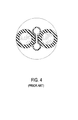
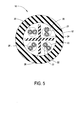
- Another arrangement shown in prior art Figures 3 and 4 from U.S. Patent Publication No. 2009/0236120 uses a spacer between the pairs to improve electrical and mechanical performance of cable.
- the spacer in its basic form is a divider placed between the two conductors of the pair prior to twinning. After twinning, the spacer remains helically twisted with the conductors of the pair, between the two conductors, such that the outer surfaces of the insulated conductors are prevented from touching one another.
- the spacer may employ a hollow profile.
- the present arrangement overcomes certain drawbacks with the prior art arrangements and provides a twisted pair spacer for use in twisted pairs of a LAN cable that not only provides improved electrical characteristics versus a solid tape or film spacer noted in US 6,506,976 (e.g. , reduced insertion loss, reduced propagation delay, reduced delay/skew between pairs) but also offers improvements in terms of mechanical crush resistance versus hollow spacer elements mentioned in US Patent Publication No. 2009/0236120
- prior art arrangements may in theory improve electrical properties of a cable, because of cable manufacturing line speeds and tensions, particularly in the process of "twinning" (twisting two conductors into a pair), such hollow spacers (e.g. prior art Figure 4 ) attempting to create pockets of air between the conductors are crushed and/or deformed negating the effects of any airgaps.
- the present arrangement spacer is constructed so that the spacer makes use of open spaces that provide improved electrical characteristics, while simultaneously structuring the open spaces to be maintained during the twinning process and thus remain present in the final product.
- a spacer for use in a twisted pair of electrical conductors where the spacer includes a polymer strip and a series of openings in the polymer strip.
- the polymer strip is configured to be placed between two adjacent conductors of a twisted pair.
- the polymer strip and series of openings are constructed so that the series of openings are not substantially crushed during a twinning process of twisting the adjacent conductors of the twisted pair.
- a LAN (Local Area Network) cable 10 is shown.
- LAN cable 10 has a jacket 12 constructed for example from any typical jacket polymer such as PVC (Poly-Vinyl Chloride). Within jacket 12 there are four twisted pairs 20. Each twisted pair is formed of two primary conductors 22 twisted around one another.
- primary conductors 22 are typically made from a copper wire conductor 23 covered with an insulation layer 24.
- insulation layer 24 The use of a four twisted pair LAN cable is for exemplary purposes.
- cable 10 is shown with a cross filler 26, but the salient features of the below described spacer element may be used in cables 10 with or without cross fillers 26.
- Spacer element 30 is provided.
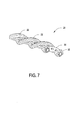
- Spacer element 30 is formed as a longitudinal rectangular divider with openings 32. Spacer 30 roughly sized to match the size and dimensions of primary conductors 22 of a twisted pair 20. Spacer 30 is configured to be placed between primary conductors 22 during the twinning process that generates a twisted pair 20 as described in more detail below with respect to Figure 7 .
- spacer 30 is a tape having a thickness substantially between 0.005" to 0.020" with preferred thickness around 0.008".
- the width of spacer 30 may be anywhere from 0.030" to 0.060" with preferred width about 0.045".
- spacer 30 width can be doubled and then folded back over itself to yield a spacer twice as thick to increase insulated pair spacing. It is understood that such dimensions are exemplary and additional sizing may be used depending on the desired physical and electrical characteristics.
- openings 32 in spacer 30 may be circular, ovoid, square, rectangular, polygon shaped, or other such geometric shapes.
- rectangular openings 32 could be about 0.040" long and 0.020" wide in a spacer 30 that is 0.008" thick and 0.045" wide.
- the distance between the center of the rectangular openings could be 0.080.” This center to center distance can either be constant or variable along the length of spacer 30.
- spacer 30 is made as a polymer tape. Any polymer with good electrical properties and mechanical toughness can be selected. Common examples of such materials could be but are not limited to UHMWPE, HDPE, PP, PEI, FEP, PTFE, MFA, PFA, and poly-aram ids such as Nomex. These polymers could also contain additives to improve crush resistance or enhance flame performance.
- a polymer woven mesh tape (woven fabric constructed of polymer strands or polymers that are spun into fibers) may be used for spacer 30.
- These may include, but would not be limited to PP, PET, PEI, and poly-aramid (Kevlar).
- Such woven mesh polymer spacers 30 may be used in as desired for the light weight and crush resistance.
- the thickness of the woven fibers and the distance between the fibers can vary. An example of this would be using fibers of 0.0025" woven together with spacing of 0.0025" between the fibers. It is understood that such dimensions are exemplary and additional/alternative opening sizing may be used depending on the desired physical and electrical characteristics.
- spacer 30 a reason for using spacer 30 is to increase dielectric separation between conductors 22 in pair 20.
- the air that fills openings 32 in spacer 30 has better dielectric properties than the polymer so such openings are ideally maximized.
- spacer 30 must not only be constructed to have such openings 32, but there must be at least enough polymer in spacer 30 so that such openings are retained, at least to some desired extent, through the twinning process as explained in more detail below.
- spacer 30 may be pulled in between each individual wire pair 22 prior to entering the twinner (a machine that twists the pair at a given lay length/twist rate).
- Figure 8 shows an alternative arrangement of spacer 30 as a woven mesh tape between conductors 22 of pair 20.
- the example of a polymer tape with openings 32 as shown in Figure 7 is used.
- the final lay length of twisted pair 20 incorporating spacer 30 would typically vary anywhere between 0.25" to 1.00" (longitudinal length per 1 full twist) depending on the construction. Modified closing dies may be utilized during twisting to maintain component positioning. It is understood that these measurements are for typical LAN cable applications, but spacer 30 in twinned pair 20 may be used at any desired lay length.
- spacer 30 is constructed, as outlined above, to both reduce the amount of material used (e.g. openings 32) as well as to resist crushing forces inherent to the twinning process.
- Twinning conductors 22 into pair 20 causes some amount of force to be applied against one another during twisting. With spacer 30 therebetween the force is exerted on spacer 30.
- the speed of the twist is governed by a com bination of bow speed and take up speed of the twisted pair containing the spacer onto the reel.
- An exemplary bow rotation speed could range anywhere from approximately 100 RPM to 3,000 RPM while the resulting take up speed of the twisted pair containing the spacer can vary anywhere from 20 FPM to 500 FPM.
- the desired lay length of twisted pair 20 containing spacer 30 between them governs both the bow rotation speed and the twisted pair take up speed.
- the size of spacer 30 and the location, size and number of openings 32 are advantageously constructed such that the basic structure of spacer 30 and its spacing goal (desired space between conductors 22), and desired electrical characteristics are maintained during the twinning process.
- the material selected for spacer 30 has an impact on compression of spacer 30 during twinning, with for example a material like PEI being more resistant to compression than a material like PTFE.
- the twinning process also has a role in the amount of compression spacer 30 encounters, with bow speed and lay length being the critical factors.
- the twinning process may be adjusted accordingly to minimize compression.
- spacer 30 provides a lower cable cost due to reduction of material consumption.
- reduction of insulated conductor 20 size may be achieved due to improved electrical properties realized by spacer 30.
- the advantageous electrical properties of spacer 30 with openings 32 allows for insulated wires 20 in cables with excellent electrical properties to fit into existing connector arrangements which is a benefit for the end user.
- reduction of the amount of insulation used for conductors 20 also leads to reduced overall cable size, another cable characteristic desired by end users.
Landscapes
- Communication Cables (AREA)
- Insulated Conductors (AREA)
Applications Claiming Priority (1)
| Application Number | Priority Date | Filing Date | Title |
|---|---|---|---|
| US13/540,778 US20140008102A1 (en) | 2012-07-03 | 2012-07-03 | Twisted pair spacer tape for use in lan cable |
Publications (2)
| Publication Number | Publication Date |
|---|---|
| EP2682954A2 true EP2682954A2 (fr) | 2014-01-08 |
| EP2682954A3 EP2682954A3 (fr) | 2015-02-11 |
Family
ID=48703378
Family Applications (1)
| Application Number | Title | Priority Date | Filing Date |
|---|---|---|---|
| EP13305816.4A Withdrawn EP2682954A3 (fr) | 2012-07-03 | 2013-06-18 | Bande d'espacement à paire torsadée pour utilisation dans un câble de réseau local |
Country Status (6)
| Country | Link |
|---|---|
| US (1) | US20140008102A1 (fr) |
| EP (1) | EP2682954A3 (fr) |
| KR (1) | KR20140004599A (fr) |
| CN (1) | CN103531285A (fr) |
| BR (1) | BR102013017103A2 (fr) |
| CA (1) | CA2820268A1 (fr) |
Cited By (1)
| Publication number | Priority date | Publication date | Assignee | Title |
|---|---|---|---|---|
| EP3929945A1 (fr) * | 2020-06-26 | 2021-12-29 | Huber+Suhner AG | Câble à refroidissement liquide et ensemble câble de charge |
Families Citing this family (2)
| Publication number | Priority date | Publication date | Assignee | Title |
|---|---|---|---|---|
| CN106024145A (zh) * | 2016-05-19 | 2016-10-12 | 安徽华源电缆集团有限公司 | 一种水下使用的防水电缆 |
| CN114400111B (zh) * | 2022-01-28 | 2022-12-06 | 金湖博通科技有限公司 | 一种抗压抗冲击电缆 |
Citations (2)
| Publication number | Priority date | Publication date | Assignee | Title |
|---|---|---|---|---|
| US6506976B1 (en) | 1999-09-14 | 2003-01-14 | Avaya Technology Corp. | Electrical cable apparatus and method for making |
| US20090236120A1 (en) | 2008-03-19 | 2009-09-24 | David Allyn Wiebelhaus | Separator tape for twisted pair in lan cable |
Family Cites Families (3)
| Publication number | Priority date | Publication date | Assignee | Title |
|---|---|---|---|---|
| US5969295A (en) * | 1998-01-09 | 1999-10-19 | Commscope, Inc. Of North Carolina | Twisted pair communications cable |
| WO2006132716A2 (fr) * | 2005-04-25 | 2006-12-14 | Leyendecker Robert R | Cables pour signaux electriques |
| MX2013005719A (es) * | 2010-11-22 | 2013-10-30 | Commscope Inc | Cable de comunicaciones torcido par con separacion selectiva de pares. |
-
2012
- 2012-07-03 US US13/540,778 patent/US20140008102A1/en not_active Abandoned
-
2013
- 2013-06-18 EP EP13305816.4A patent/EP2682954A3/fr not_active Withdrawn
- 2013-06-28 CA CA2820268A patent/CA2820268A1/fr not_active Abandoned
- 2013-07-02 BR BR102013017103A patent/BR102013017103A2/pt not_active Application Discontinuation
- 2013-07-03 CN CN201310332632.3A patent/CN103531285A/zh active Pending
- 2013-07-03 KR KR1020130078033A patent/KR20140004599A/ko not_active Withdrawn
Patent Citations (2)
| Publication number | Priority date | Publication date | Assignee | Title |
|---|---|---|---|---|
| US6506976B1 (en) | 1999-09-14 | 2003-01-14 | Avaya Technology Corp. | Electrical cable apparatus and method for making |
| US20090236120A1 (en) | 2008-03-19 | 2009-09-24 | David Allyn Wiebelhaus | Separator tape for twisted pair in lan cable |
Cited By (1)
| Publication number | Priority date | Publication date | Assignee | Title |
|---|---|---|---|---|
| EP3929945A1 (fr) * | 2020-06-26 | 2021-12-29 | Huber+Suhner AG | Câble à refroidissement liquide et ensemble câble de charge |
Also Published As
| Publication number | Publication date |
|---|---|
| EP2682954A3 (fr) | 2015-02-11 |
| CN103531285A (zh) | 2014-01-22 |
| BR102013017103A2 (pt) | 2016-09-13 |
| US20140008102A1 (en) | 2014-01-09 |
| CA2820268A1 (fr) | 2014-01-03 |
| KR20140004599A (ko) | 2014-01-13 |
Similar Documents
| Publication | Publication Date | Title |
|---|---|---|
| CA2386896C (fr) | Separateur cannele de cable | |
| CA2545161C (fr) | Cable de donnees avec profil d'ame de cable torsade croise | |
| CN105051834B (zh) | 具有utp对环境的屏蔽电缆 | |
| CA2677681A1 (fr) | Cable de donnees avec un profil d'ame de cable torsade transversalement | |
| EP1198800A1 (fr) | Cable a paires multiples a faible asymetrie de retard et son procede de fabrication | |
| KR20080078612A (ko) | 개선된 utp 케이블 | |
| US8546693B2 (en) | Cable with twisted pairs of insulated conductors and filler elements | |
| EP2682954A2 (fr) | Bande d'espacement à paire torsadée pour utilisation dans un câble de réseau local | |
| CN101335110B (zh) | 铜包铝三芯阻燃软电缆制造方法 | |
| CN207367659U (zh) | 一种本安型柔性数据传输电缆 | |
| CN103606409A (zh) | 一种阻燃耐高温抗曲柔软型控制电缆 | |
| EP2682955A2 (fr) | Tubes de remplissage de profil dans des câbles de réseau local | |
| CN101335118B (zh) | 铜包铝单芯阻燃双护套软电缆的制造方法 | |
| CN102646472A (zh) | 野外用特种传输电缆及其制备工艺 | |
| CN101335119B (zh) | 铜包铝单芯阻燃软电缆的制造方法 | |
| CN201549266U (zh) | 舰船用低烟交联聚乙烯绝缘轻型薄壁通信电缆 | |
| CN101335115B (zh) | 铜包铝二芯阻燃软电缆的制造方法 | |
| CN101335109B (zh) | 铜包铝五芯阻燃软电缆的制造方法 | |
| US20110048767A1 (en) | Twisted Pairs Cable with Tape Arrangement | |
| KR101225572B1 (ko) | 고속 통신용 유티피 케이블 | |
| CN101335112B (zh) | 铜包铝四芯阻燃软电缆的制造方法 | |
| CN207624412U (zh) | 加强型扁平数字通信电缆 | |
| CN106024119A (zh) | 硅橡胶填充的防水电缆及其制备方法 |
Legal Events
| Date | Code | Title | Description |
|---|---|---|---|
| PUAI | Public reference made under article 153(3) epc to a published international application that has entered the european phase |
Free format text: ORIGINAL CODE: 0009012 |
|
| AK | Designated contracting states |
Kind code of ref document: A2 Designated state(s): AL AT BE BG CH CY CZ DE DK EE ES FI FR GB GR HR HU IE IS IT LI LT LU LV MC MK MT NL NO PL PT RO RS SE SI SK SM TR |
|
| AX | Request for extension of the european patent |
Extension state: BA ME |
|
| PUAL | Search report despatched |
Free format text: ORIGINAL CODE: 0009013 |
|
| AK | Designated contracting states |
Kind code of ref document: A3 Designated state(s): AL AT BE BG CH CY CZ DE DK EE ES FI FR GB GR HR HU IE IS IT LI LT LU LV MC MK MT NL NO PL PT RO RS SE SI SK SM TR |
|
| AX | Request for extension of the european patent |
Extension state: BA ME |
|
| RIC1 | Information provided on ipc code assigned before grant |
Ipc: H01B 11/06 20060101ALN20150106BHEP Ipc: H01B 11/00 20060101AFI20150106BHEP |
|
| STAA | Information on the status of an ep patent application or granted ep patent |
Free format text: STATUS: THE APPLICATION IS DEEMED TO BE WITHDRAWN |
|
| 18D | Application deemed to be withdrawn |
Effective date: 20150812 |