EP2683015A1 - Électrolyte non aqueux destiné à une batterie secondaire au lithium et batterie secondaire au lithium contenant cet électrolyte - Google Patents
Électrolyte non aqueux destiné à une batterie secondaire au lithium et batterie secondaire au lithium contenant cet électrolyte Download PDFInfo
- Publication number
- EP2683015A1 EP2683015A1 EP13750618.4A EP13750618A EP2683015A1 EP 2683015 A1 EP2683015 A1 EP 2683015A1 EP 13750618 A EP13750618 A EP 13750618A EP 2683015 A1 EP2683015 A1 EP 2683015A1
- Authority
- EP
- European Patent Office
- Prior art keywords
- electrolyte solution
- carbonate
- secondary battery
- aqueous electrolyte
- lithium secondary
- Prior art date
- Legal status (The legal status is an assumption and is not a legal conclusion. Google has not performed a legal analysis and makes no representation as to the accuracy of the status listed.)
- Granted
Links
Images
Classifications
-
- H—ELECTRICITY
- H01—ELECTRIC ELEMENTS
- H01M—PROCESSES OR MEANS, e.g. BATTERIES, FOR THE DIRECT CONVERSION OF CHEMICAL ENERGY INTO ELECTRICAL ENERGY
- H01M10/00—Secondary cells; Manufacture thereof
- H01M10/05—Accumulators with non-aqueous electrolyte
- H01M10/056—Accumulators with non-aqueous electrolyte characterised by the materials used as electrolytes, e.g. mixed inorganic/organic electrolytes
- H01M10/0564—Accumulators with non-aqueous electrolyte characterised by the materials used as electrolytes, e.g. mixed inorganic/organic electrolytes the electrolyte being constituted of organic materials only
- H01M10/0566—Liquid materials
- H01M10/0567—Liquid materials characterised by the additives
-
- H—ELECTRICITY
- H01—ELECTRIC ELEMENTS
- H01M—PROCESSES OR MEANS, e.g. BATTERIES, FOR THE DIRECT CONVERSION OF CHEMICAL ENERGY INTO ELECTRICAL ENERGY
- H01M10/00—Secondary cells; Manufacture thereof
- H01M10/05—Accumulators with non-aqueous electrolyte
- H01M10/052—Li-accumulators
-
- H—ELECTRICITY
- H01—ELECTRIC ELEMENTS
- H01M—PROCESSES OR MEANS, e.g. BATTERIES, FOR THE DIRECT CONVERSION OF CHEMICAL ENERGY INTO ELECTRICAL ENERGY
- H01M10/00—Secondary cells; Manufacture thereof
- H01M10/05—Accumulators with non-aqueous electrolyte
- H01M10/056—Accumulators with non-aqueous electrolyte characterised by the materials used as electrolytes, e.g. mixed inorganic/organic electrolytes
-
- H—ELECTRICITY
- H01—ELECTRIC ELEMENTS
- H01M—PROCESSES OR MEANS, e.g. BATTERIES, FOR THE DIRECT CONVERSION OF CHEMICAL ENERGY INTO ELECTRICAL ENERGY
- H01M10/00—Secondary cells; Manufacture thereof
- H01M10/05—Accumulators with non-aqueous electrolyte
- H01M10/056—Accumulators with non-aqueous electrolyte characterised by the materials used as electrolytes, e.g. mixed inorganic/organic electrolytes
- H01M10/0564—Accumulators with non-aqueous electrolyte characterised by the materials used as electrolytes, e.g. mixed inorganic/organic electrolytes the electrolyte being constituted of organic materials only
- H01M10/0566—Liquid materials
- H01M10/0568—Liquid materials characterised by the solutes
-
- H—ELECTRICITY
- H01—ELECTRIC ELEMENTS
- H01M—PROCESSES OR MEANS, e.g. BATTERIES, FOR THE DIRECT CONVERSION OF CHEMICAL ENERGY INTO ELECTRICAL ENERGY
- H01M10/00—Secondary cells; Manufacture thereof
- H01M10/05—Accumulators with non-aqueous electrolyte
- H01M10/056—Accumulators with non-aqueous electrolyte characterised by the materials used as electrolytes, e.g. mixed inorganic/organic electrolytes
- H01M10/0564—Accumulators with non-aqueous electrolyte characterised by the materials used as electrolytes, e.g. mixed inorganic/organic electrolytes the electrolyte being constituted of organic materials only
- H01M10/0566—Liquid materials
- H01M10/0569—Liquid materials characterised by the solvents
-
- H—ELECTRICITY
- H01—ELECTRIC ELEMENTS
- H01M—PROCESSES OR MEANS, e.g. BATTERIES, FOR THE DIRECT CONVERSION OF CHEMICAL ENERGY INTO ELECTRICAL ENERGY
- H01M4/00—Electrodes
- H01M4/02—Electrodes composed of, or comprising, active material
- H01M4/62—Selection of inactive substances as ingredients for active masses, e.g. binders, fillers
-
- H—ELECTRICITY
- H01—ELECTRIC ELEMENTS
- H01M—PROCESSES OR MEANS, e.g. BATTERIES, FOR THE DIRECT CONVERSION OF CHEMICAL ENERGY INTO ELECTRICAL ENERGY
- H01M2300/00—Electrolytes
- H01M2300/0017—Non-aqueous electrolytes
- H01M2300/0025—Organic electrolyte
- H01M2300/0028—Organic electrolyte characterised by the solvent
- H01M2300/0034—Fluorinated solvents
-
- H—ELECTRICITY
- H01—ELECTRIC ELEMENTS
- H01M—PROCESSES OR MEANS, e.g. BATTERIES, FOR THE DIRECT CONVERSION OF CHEMICAL ENERGY INTO ELECTRICAL ENERGY
- H01M2300/00—Electrolytes
- H01M2300/0017—Non-aqueous electrolytes
- H01M2300/0025—Organic electrolyte
- H01M2300/0028—Organic electrolyte characterised by the solvent
- H01M2300/0037—Mixture of solvents
-
- H—ELECTRICITY
- H01—ELECTRIC ELEMENTS
- H01M—PROCESSES OR MEANS, e.g. BATTERIES, FOR THE DIRECT CONVERSION OF CHEMICAL ENERGY INTO ELECTRICAL ENERGY
- H01M2300/00—Electrolytes
- H01M2300/0017—Non-aqueous electrolytes
- H01M2300/0025—Organic electrolyte
- H01M2300/0028—Organic electrolyte characterised by the solvent
- H01M2300/0037—Mixture of solvents
- H01M2300/004—Three solvents
-
- H—ELECTRICITY
- H01—ELECTRIC ELEMENTS
- H01M—PROCESSES OR MEANS, e.g. BATTERIES, FOR THE DIRECT CONVERSION OF CHEMICAL ENERGY INTO ELECTRICAL ENERGY
- H01M4/00—Electrodes
- H01M4/02—Electrodes composed of, or comprising, active material
- H01M4/36—Selection of substances as active materials, active masses, active liquids
- H01M4/48—Selection of substances as active materials, active masses, active liquids of inorganic oxides or hydroxides
- H01M4/50—Selection of substances as active materials, active masses, active liquids of inorganic oxides or hydroxides of manganese
- H01M4/505—Selection of substances as active materials, active masses, active liquids of inorganic oxides or hydroxides of manganese of mixed oxides or hydroxides containing manganese for inserting or intercalating light metals, e.g. LiMn2O4 or LiMn2OxFy
-
- H—ELECTRICITY
- H01—ELECTRIC ELEMENTS
- H01M—PROCESSES OR MEANS, e.g. BATTERIES, FOR THE DIRECT CONVERSION OF CHEMICAL ENERGY INTO ELECTRICAL ENERGY
- H01M4/00—Electrodes
- H01M4/02—Electrodes composed of, or comprising, active material
- H01M4/36—Selection of substances as active materials, active masses, active liquids
- H01M4/48—Selection of substances as active materials, active masses, active liquids of inorganic oxides or hydroxides
- H01M4/52—Selection of substances as active materials, active masses, active liquids of inorganic oxides or hydroxides of nickel, cobalt or iron
- H01M4/525—Selection of substances as active materials, active masses, active liquids of inorganic oxides or hydroxides of nickel, cobalt or iron of mixed oxides or hydroxides containing iron, cobalt or nickel for inserting or intercalating light metals, e.g. LiNiO2, LiCoO2 or LiCoOxFy
-
- Y—GENERAL TAGGING OF NEW TECHNOLOGICAL DEVELOPMENTS; GENERAL TAGGING OF CROSS-SECTIONAL TECHNOLOGIES SPANNING OVER SEVERAL SECTIONS OF THE IPC; TECHNICAL SUBJECTS COVERED BY FORMER USPC CROSS-REFERENCE ART COLLECTIONS [XRACs] AND DIGESTS
- Y02—TECHNOLOGIES OR APPLICATIONS FOR MITIGATION OR ADAPTATION AGAINST CLIMATE CHANGE
- Y02E—REDUCTION OF GREENHOUSE GAS [GHG] EMISSIONS, RELATED TO ENERGY GENERATION, TRANSMISSION OR DISTRIBUTION
- Y02E60/00—Enabling technologies; Technologies with a potential or indirect contribution to GHG emissions mitigation
- Y02E60/10—Energy storage using batteries
-
- Y—GENERAL TAGGING OF NEW TECHNOLOGICAL DEVELOPMENTS; GENERAL TAGGING OF CROSS-SECTIONAL TECHNOLOGIES SPANNING OVER SEVERAL SECTIONS OF THE IPC; TECHNICAL SUBJECTS COVERED BY FORMER USPC CROSS-REFERENCE ART COLLECTIONS [XRACs] AND DIGESTS
- Y02—TECHNOLOGIES OR APPLICATIONS FOR MITIGATION OR ADAPTATION AGAINST CLIMATE CHANGE
- Y02T—CLIMATE CHANGE MITIGATION TECHNOLOGIES RELATED TO TRANSPORTATION
- Y02T10/00—Road transport of goods or passengers
- Y02T10/60—Other road transportation technologies with climate change mitigation effect
- Y02T10/70—Energy storage systems for electromobility, e.g. batteries
Definitions
- the present invention relates to a non-aqueous electrolyte solution for a lithium secondary battery having the possibility of generating a swelling phenomenon after storing for a long time and conducting a charging/discharging cycle at a high temperature may be effectively restrained, and a lithium secondary battery including the same.
- a lithium secondary battery is a kind of a battery satisfying the requirements best, and researches on the lithium secondary battery have been actively conducted nowadays.
- the lithium secondary battery developed at the early in 1900 includes an anode formed by using a carbon material absorbing and desorbing lithium ions, a cathode formed by using an oxide including lithium and a non-aqueous electrolyte solution obtained by dissolving an appropriate amount of a lithium salt into an organic solvent mixture.
- the structural stability and capacity of a lithium transition metal oxide or a complex oxide used as the active material of the cathode of the lithium secondary battery may be determined by the absorption and desorption of lithium ions.
- the capacity may be increased as the charging voltage increases.
- the desorption of the transition metal constituting the active material may be accelerated to induce structural instability.
- the organic solvent commonly used in the non-aqueous electrolyte solution may include ethylene carbonate, propylene carbonate, dimethoxyethane, gamma butyrolactone, N,N-dimethyl formamide, tetrahydrofurane, acetonitrile, etc.
- the electrolyte solution may be oxidized to generate a gas. Then, a swelling phenomenon may be generated to deteriorate the battery. In this case, the thus decomposed and generated gas may deform a pouch type or a can type battery assembly to induce an internal short. In severe cases, the battery may ignite or be exploded. The oxidation of the electrolyte solution may be accelerated by the transition metal eluted under a high voltage condition.
- An aspect of the present invention is solving technical objects and providing a non-aqueous electrolyte solution for a lithium secondary battery restraining the swelling phenomenon of the battery and improving a charging/discharging cycle lifetime, and a lithium secondary battery including the same.
- a non-aqueous electrolyte solution including an organic solvent, an ionizable lithium salt, a dinitrile compound including an ether bond represented by following Chemical Formula 1, and an aliphatic dinitrile compound represented by following Chemical Formula 2.
- R 1 , R 2 and R 3 independently represents an alkylene having 1 to 5 carbon atoms or an alkenyl having 2 to 5 carbon atoms, n represents an integer of 1 to 5, and m represents an integer of 1 to 3.
- a lithium secondary battery including an electrode assembly including a cathode including a cathode active material, an anode and a separator interposed between the cathode and the anode, a battery container receiving the electrode assembly, and a non-aqueous electrolyte solution for the lithium secondary battery injected in the battery container.
- the non-aqueous electrolyte solution according to the present invention has an excellent effect on restraining the swelling phenomenon of a battery.
- the swelling phenomenon possibly generated when storing the battery at a high temperature may be solved by using a non-aqueous electrolyte solution including a dinitrile compound having an ether bond.
- the swelling phenomenon possibly generated while repeatedly charging/discharging at a high temperature may be solved by adding an aliphatic dinitrile compound such as succinonitrile in the non-aqueous electrolyte solution.
- the non-aqueous electrolyte solution according to the present invention includes an organic solvent, an ionizable lithium salt, a dinitrile compound including an ether bond represented by following Chemical Formula 1, and an aliphatic dinitrile compound represented by following Chemical Formula 2.
- R 1 , R 2 and R 3 independently represents an alkylene having 1 to 5 carbon atoms or an alkenyl having 2 to 5 carbon atoms, n represents an integer of 1 to 5, and m represents an integer of 1 to 3.
- a compound including a vinylene group or a vinyl group, used in a non-aqueous electrolyte solution according to the present invention may form a passivating layer called as a solid electrolyte interphase (SEI) film on the surface of an anode during conducting an initial charging.
- SEI solid electrolyte interphase
- the SEI layer may restrain the reduction decomposition of a carbonate used as a non-aqueous solvent to improve a charging/discharging efficiency and to exhibit a good cycle characteristic.
- the thus formed SEI film may be thermally unstable and may be broken under an operation at a high temperature or a storage at a high temperature by an increased electrochemical energy and thermal energy.
- the SEI film is unstable as described above, the deterioration of the performance of the battery, the decomposition of the electrolyte solution and the continuous generation of gas due to the breakage of the SEI film may be induced. In this case, the swelling phenomenon of increasing the internal pressure and the thickness of the battery may be generated.
- the decomposed and generated gas may deform the pouch type or the can type battery assembly to induce an internal short. In severe cases, the battery may ignite or be exploded.
- the generation of the gas while storing a battery at a high temperature may increase as the amount of an additive forming a layer on an anode increases.
- vinylene carbonate (VC) may form the SEI film on the anode in the beginning of the operation.
- the VC remaining in the electrolyte solution may be oxidized at a cathode during storing at a high temperature to rapidly generate a gas.
- the generated gas may include CO, CO 2 , CH 4 , C 3 H 6 , etc.
- the gas generation or the swelling phenomenon possibly generated by adding the compound including the vinylene group or the vinyl group into the non-aqueous electrolyte solution and by storing at a high temperature may be prevented by adding a dinitrile compound having an ether bond represented by Chemical Formula 1 above.
- the organic solvent used in the non-aqueous electrolyte solution of the lithium secondary battery may be oxidized and decomposed at the surface of the cathode during charging/discharging.
- the transition metal when a lithium transition metal oxide is used as the cathode active material, the transition metal may function as an oxidizing agent, the decomposition of the electrolyte solution may be promoted.
- the dinitrile compound having the ether bond represented by Chemical Formula 1 may form a complex at the surface of the cathode including a lithium-transition metal oxide.
- the oxidation reaction of the electrolyte solution and the anode may be restrained and heating may be restrained.
- the internal short due to the rapid increase of the temperature of the battery may be prevented.
- Various compounds may be present in the non-aqueous electrolyte solution during charging/discharging.
- HF, PF 6 , etc. may make the non-aqueous electrolyte solution acidic.
- the oxidization reaction at the surface of the cathode of the non-aqueous electrolyte solution may be accelerated.
- oxygen (-O-) included in the ether group of the dinitrile compound including the ether bond represented by Chemical Formula 1 may make a bond with HF, PF 6 , etc. in the non-aqueous electrolyte solution.
- the forming of the acidic solution may be prevented to restrain the acceleration of the oxidation and decomposing reaction of the non-aqueous electrolyte solution.
- the dinitrile compound having the ether bond represented by Chemical Formula 1 may illustrate an improved effect in the performance of the battery when comparing with the common additives. Particularly, a capacity retention ratio may be good, and a battery having an improved charging/discharging cycle lifetime property and a good electrochemical property may be provided.
- the dinitrile compound having the ether bond represented by Chemical Formula 1 may be at least one selected from the group consisting of 3,5-dioxa-heptanedinitrile, 1,4-bis(cyanoethoxy)butane, bis(2-cyanoethyl)-monoformal, bis(2-cyanoethyl)-diformal, bis(2-cyanoethyl)-triformal, ethylene glycol bis(2-cyanoethyl)ether, diethylene glycol bis(2-cyanoehtyl)ether, triethylene glycol bis(2-cyanoethyl)ether, tetraethylene glycol bis(2-cyanoethyl)ether, 3,6,9,12,15,18-hexaoxaeico acid dinitrile, 1,3-bis(2-cyanoethoxy)propane, 1,4-bis(2-cyanoethoxy)butane, 1,5-bis(2-cyanoethoxy)pentane and ethylene glycol bis(4-cyano
- the dinitrile compound having the ether bond may be included in an amount of 0.1 to 10 % by weight based on the total amount of the electrolyte solution.
- the amount of the dinitrile compound having the ether bond is less than 0.1 % by weight, the swelling phenomenon may be insufficiently restrained, and when the amount exceeds 10 % by weight, the cycle characteristic while charging/discharging at a high temperature may be restrained, and a side reaction inhibiting the stability of the battery may be generated.
- the restraining effect of the dinitrile compound having the ether bond on the swelling phenomenon while storing at a high temperature is excellent.
- the improving effect concerning the swelling when repeating the charging/discharging cycle at a high temperature may be further improved by adding an aliphatic dinitrile compound represented by Chemical Formula 2. That is, the restraining effect of the swelling of the battery while repeating the charging/discharging cycle may be remarkably improved by using the non-aqueous electrolyte solution including both the dinitrile compound having the ether bond and the aliphatic dinitrile compound represented by Chemical Formula 2, when comparing with the non-aqueous electrolyte solution including only the dinitrile compound having the ether bond.
- the aliphatic dinitrile compound represented by Chemical Formula 2 may restrain the decomposition of a carbonate organic solvent such as a linear carbonate or a cyclic carbonate and may restrain the generation of the gas of a decomposed product.
- succinonitrile is the most effective compound for restraining the decomposition of the carbonate organic solvent.
- the aliphatic dinitrile compound represented by Chemical Formula 2 may be included in an amount of 0.1 to 10 % by weight based on the non-aqueous electrolyte solution.
- the non-aqueous electrolyte solution in accordance with an example embodiment of the present invention may further include a compound including a vinylene group or a vinyl group possibly forming an SEI film at the surface of the anode in the beginning of the charging as described above.
- the compound including the vinylene group or the vinyl group may be at least one selected from the group consisting of a vinylene carbonate compound, an acrylate compound including the vinyl group, a sulfonate compound including the vinyl group, and an ethylene carbonate compound including the vinyl group.
- the vinylene carbonate compound may be vinylene carbonate.
- the compound including the vinylene group or the vinyl group may be included in an amount of 1 to 3 % by weight based on the total amount of the non-aqueous electrolyte solution.
- non-aqueous electrolyte solution in accordance with an example embodiment of the present invention may further include a cyclic carbonate replaced with a halogen.
- the cyclic carbonate replaced with the halogen along with the compound including the vinylene group or the vinyl group may be used to even more effectively restrain the swelling phenomenon of the battery by improving the physical property of the SEI layer formed at the surface of the anode.
- the cyclic carbonate replaced with the halogen may be a compound represented by following Chemical Formula 3.
- each of X and Y independently represents hydrogen, chlorine or fluorine. Both of X and Y do not represent hydrogen at the same time.
- the cyclic carbonate replaced with the halogen may be fluoroethylene carbonate (FEC). Further, when fluoroethylene carbonate is added into the non-aqueous electrolyte solution, the amount may be 1 to 5 % by weight based on the total amount of the electrolyte solution.
- FEC fluoroethylene carbonate
- non-aqueous electrolyte solution in accordance with an example embodiment of the present invention may further include at least one additive selected from the group consisting of 1,3-propnane sultone, ethylene sulfate and N-acetyl lactam in order to form a stable SEI film at the surface of the electrode.
- the ionizable lithium salt included in the electrolyte solution of the present invention may be at least one selected from the group consisting of LiPF 6 , LiBF 4 , LiSbF 6 , LiAsF 6 , LiClO 4 , LiN(C 2 F 5 SO 2 ) 2 , LiN(CF 3 SO 2 ) 2 , CF 3 SO 3 Li, LiC(CF 3 SO 2 ) 3 and LiC 4 BO 8 .
- the organic solvent included in the non-aqueous electrolyte solution of the present invention may include commonly used organic solvents as the electrolyte for a lithium secondary battery without limitation.
- organic solvents for a lithium secondary battery without limitation.
- at least one of an ether compound, an ester compound, an amide compound, a linear carbonate compound, a cyclic carbonate compound, etc. may be used.
- the organic solvent may include the cyclic carbonate compound, the linear carbonate compound or a mixture carbonate compound thereof.
- the typical cyclic carbonate may be at least one selected from the group consisting of ethylene carbonate (EC), propylene carbonate (PC), 1,2-butylene carbonate, 2,3-butylene carbonate, 1,2-pentylene carbonate, 2,3-pentylene carbonate, vinylene carbonate and a halogenated compound thereof.
- the typical linear carbonate compound may be at least one selected from the group consisting of dimethyl carbonate (DMC), diethyl carbonate (DEC), dipropyl carbonate (DPC), ethyl methyl carbonate (EMC), methyl propyl carbonate (MPC), and ethyl propyl carbonate (EPC), without limitation.
- DMC dimethyl carbonate
- DEC diethyl carbonate
- DPC dipropyl carbonate
- EMC ethyl methyl carbonate
- MPC methyl propyl carbonate
- EPC ethyl propyl carbonate
- ethylene carbonate and propylene carbonate among the cyclic carbonate may be desirably used because they are organic solvents having a high viscosity and having a high dielectricity, and dissociate a lithium salt in the electrolyte solution well.
- an electrolyte solution having a high electric conductivity may be obtained and may be desirably used.
- the ester compound among the organic solvent may be at least one selected from the group consisting of methyl acetate, ethyl acetate, propyl acetate, methyl propionate, ethyl propionate, ⁇ -butyrolactone, ⁇ -valerolactone, ⁇ -caprolactone, ⁇ -valerolactone and ⁇ -caprolactone.
- the ester compound may not be limited to these compounds.
- An electrode assembly including a cathode, an anode and a separator disposed between the cathode and the anode may be received in a battery container. Then, the non-aqueous electrolyte solution for the lithium secondary battery according to the present invention may be injected into the battery container to manufacture the lithium secondary battery. Commonly used cathode, anode and separator may be used for constituting the electrode assembly without limitation.
- a lithium containing transition metal oxide may be preferably used as the cathode active material and may be selected from the group consisting of a lithium-manganese oxide, a lithium-nickel-manganese oxide, a lithium-manganese-cobalt oxide and a lithium-nickel-manganese-cobalt oxide.
- a metal oxide having a potential of 2 V or less with respect to lithium ions such as TiO 2 , SnO 2 may be used.
- a carbon material may be preferably used.
- the carbon material may include low crystallized carbon and highly crystallized carbon.
- the low crystallized carbon may typically include soft carbon and hard carbon
- the highly crystallized carbon may typically include clacined carbon at a high temperature such as natural graphite, artificial graphite, kisi graphite, pyrolytic carbon, mesophase pitch based carbon fiber, meso-carbon microbeads, mesophase pitch and petroleum or coal tar pitch derived cokes, etc.
- the cathode and/or the anode may include a binder.
- the binder may include an organic binder such as vinylidenefluoride-hexafluoropropylene copolymer, polyvinylidenefluoride, polyacrylonitrile, polymethyl methacrylate, etc. and an aqueous binder such as styrene-butadiene rubber, etc. along with a viscosity increasing agent such as carboxymethyl cellulose.
- the aqueous binder exhibiting a good adhesiveness even when using a relatively small amount may be used.
- the separator may include a porous polymer film, which is a commonly used separator.
- the porous polymer film manufactured from polyolefin polymer such as an ethylene homopolymer, a propylene homopolymer, an ethylene/butene copolymer, an ethylene/hexane copolymer and an ethylene/methacrylate copolymer, etc. may be used.
- the porous polymer film may be used alone or as a laminated shape using them.
- a commonly used porous non-woven fabric for example, a non-woven fabric of a glass fiber of a high melting point, a polyethyleneterephthalate fiber, etc. may be used without limitation.
- the figure of the battery container for receiving the lithium secondary battery may be any type without limitation and may include a cylinder type using a can, a polygon type, a pouch type, a coin type, etc.
- the non-aqueous electrolyte solution may be injected into the battery container.
- VC vinylene carbonate
- PS 1,3-propanesultone
- FEC fluoroethylene carbonate
- 1.5 % by weight of ethylene glycol bis(2-cyanoethyl)ether (EGPN) and 5 % by weight of succinonitrile were added to prepare a non-aqueous electrolyte solution.
- LiCoO 2 as a cathode active material, polyvinylidene fluoride (PVdF) as a binder and carbon as a conductive material were mixed by a mixing ratio of 93:4:4 by weight.
- the mixture was dispersed in N-methyl-2-pyrrolidone to prepare a cathode slurry.
- the slurry was coated on an aluminum foil having a thickness of 15 ⁇ m, dried and rolled to manufacture a cathode.
- An artificial graphite as an anode active material, a styrene-butadiene rubber as a binder and carboxymethyl cellulose as a viscosity increasing agent were mixed by a mixing ratio of 96:2:2 by weight.
- the mixture was dispersed in water to prepare an anode slurry.
- the slurry was coated on a copper foil having a thickness of 10 ⁇ m, dried and rolled to manufacture an anode.
- a pouch type battery was manufactured by using the thus manufactured cathode and anode, and a porous separator through a common method.
- the non-aqueous electrolyte solution was injected to complete a battery.
- a non-aqueous electrolyte solution and a lithium secondary battery were manufactured by conducting the same procedure described in Example 1 except for adding 3 % by weight of ethylene glycol bis(2-cyanoethyl)ether.
- a non-aqueous electrolyte solution and a lithium secondary battery were manufactured by conducting the same procedure described in Example 1 except for preparing the electrolyte solution excluding succinonitrile.
- a non-aqueous electrolyte solution and a lithium secondary battery were manufactured by conducting the same procedure described in Example 2 except for preparing the electrolyte solution excluding succinonitrile.
- a non-aqueous electrolyte solution and a lithium secondary battery were manufactured by conducting the same procedure described in Example 1 except for preparing the electrolyte solution excluding ethylene glycol bis(2-cyanoethyl)ether.
- each of the batteries was stored in a 4.4 V over-charged state at 60°C for 13 days. Then, the thickness change of each of the batteries was measured. The results on the swelling test were obtained as a maximum thickness change ( ⁇ t) with respect to an initial thickness for each battery and are illustrated in following Table 1.
- Table 1 ⁇ t (mm) Example 1 3.220
- the thickness change of the battery using the non-aqueous electrolyte solution excluding ethylene glycol bis(2-cyanoethyl)ether according to Comparative Example 3 is found large when comparing with those of the batteries using the non-aqueous electrolyte solutions including ethylene glycol bis(2-cyanoethyl)ether according to Examples 1 and 2 and Comparative Examples 1 and 2.
- ethylene glycol bis(2-cyanoethyl)ether is found to have a restraining effect on the swelling phenomenon at a high temperature.
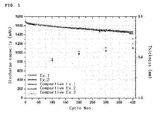
- Each of the lithium secondary batteries according to Examples 1 and 2 and Comparative Examples 1 to 3 was charged at the temperature condition of 60°C with constant current of 0.7 C and 1,155 mA. After the voltage of the battery reached 4.35 V, a first time charging was conducted until the charge current reached 20 mA at constant voltage of 4.35 V. With respect to the firstly charged battery, discharging was conducted until the battery voltage reached 3 V at constant current of 1 C and 1,650 mA. Then, the discharge capacity and the thickness of a battery for the first cycle were measured.
- the thicknesses of the batteries according to Examples 1 and 2 and Comparative Examples 1 to 3 are similar at 100 th cycle. However, as the cycle progressed, the increasing degree of the thickness of the battery becomes different. When examining the thickness increase between 100 th cycle to 400 th cycle, the thickness increase for the battery according to Examples 1 and 2 is confirmed to be the smallest. That is, the restraining effect of the swelling of the battery due to the charging/discharging at a high temperature is the best when using the electrolyte solution including both of ethylene glycol bis(2-cyanoethyl)ether and succinonitrile.
- the generating amount of CO 2 in the battery including only ethylene glycol bis(2-cyanoethyl)ether and excluding succinonitrile is found to be remarkably large when comparing with the battery additionally including succinonitrile (Examples 1 and 2). Accordingly, the swelling of the battery while repeating the charging/discharging at a high temperature may be generated when using ethylene glycol bis(2-cyanoethyl)ether alone. In addition, the swelling of the battery due to the generation of the gas may be confirmed to be effectively controlled by succinonitrile added into the non-aqueous electrolyte solution. While the present invention has been shown and described in connection with the exemplary embodiments, it will be apparent to those skilled in the art that modifications and variations can be made without departing from the spirit and scope of the invention as defined by the appended claims.
Landscapes
- Chemical & Material Sciences (AREA)
- Chemical Kinetics & Catalysis (AREA)
- Electrochemistry (AREA)
- General Chemical & Material Sciences (AREA)
- Engineering & Computer Science (AREA)
- Manufacturing & Machinery (AREA)
- Inorganic Chemistry (AREA)
- Physics & Mathematics (AREA)
- Condensed Matter Physics & Semiconductors (AREA)
- General Physics & Mathematics (AREA)
- Secondary Cells (AREA)
Priority Applications (1)
| Application Number | Priority Date | Filing Date | Title |
|---|---|---|---|
| PL13750618T PL2683015T3 (pl) | 2012-05-08 | 2013-01-30 | Niewodny elektrolit dla litowej baterii akumulatorowej i zawierająca go litowa bateria akumulatorowa |
Applications Claiming Priority (2)
| Application Number | Priority Date | Filing Date | Title |
|---|---|---|---|
| KR1020120048652A KR101502656B1 (ko) | 2012-05-08 | 2012-05-08 | 리튬 이차 전지용 비수 전해액 및 이를 구비하는 리튬 이차 전지 |
| PCT/KR2013/000726 WO2013168882A1 (fr) | 2012-05-08 | 2013-01-30 | Électrolyte non aqueux destiné à une batterie secondaire au lithium et batterie secondaire au lithium contenant cet électrolyte |
Publications (3)
| Publication Number | Publication Date |
|---|---|
| EP2683015A1 true EP2683015A1 (fr) | 2014-01-08 |
| EP2683015A4 EP2683015A4 (fr) | 2015-10-07 |
| EP2683015B1 EP2683015B1 (fr) | 2019-03-06 |
Family
ID=49550886
Family Applications (1)
| Application Number | Title | Priority Date | Filing Date |
|---|---|---|---|
| EP13750618.4A Active EP2683015B1 (fr) | 2012-05-08 | 2013-01-30 | Électrolyte non aqueux destiné à une batterie secondaire au lithium et batterie secondaire au lithium contenant cet électrolyte |
Country Status (7)
| Country | Link |
|---|---|
| US (1) | US9478827B2 (fr) |
| EP (1) | EP2683015B1 (fr) |
| KR (1) | KR101502656B1 (fr) |
| CN (1) | CN103518285B (fr) |
| DE (3) | DE202013012773U1 (fr) |
| PL (1) | PL2683015T3 (fr) |
| WO (1) | WO2013168882A1 (fr) |
Cited By (4)
| Publication number | Priority date | Publication date | Assignee | Title |
|---|---|---|---|---|
| WO2016188884A1 (fr) * | 2015-05-27 | 2016-12-01 | Basf Se | Cellules électrochimiques utilisant des combinaisons de composés nitriles comme additifs |
| EP3113273A1 (fr) * | 2015-06-30 | 2017-01-04 | Automotive Energy Supply Corporation | Batterie secondaire lithium-ion |
| EP3373375A1 (fr) * | 2017-03-08 | 2018-09-12 | Basf Se | Utilisation de dinitrils alipatiques dans des cellules électrochimiques pour réduire le leaching métallique |
| CN112751081A (zh) * | 2020-12-29 | 2021-05-04 | 东莞新能源科技有限公司 | 电解液、电化学装置及电子装置 |
Families Citing this family (28)
| Publication number | Priority date | Publication date | Assignee | Title |
|---|---|---|---|---|
| CN103779604B (zh) * | 2014-02-21 | 2016-10-19 | 宁德新能源科技有限公司 | 锂离子二次电池及其电解液 |
| CN104953176B (zh) * | 2014-03-26 | 2018-02-16 | 中国科学院福建物质结构研究所 | 低色号乙二醇(双丙腈基)醚的处理方法 |
| CN103985904A (zh) * | 2014-05-21 | 2014-08-13 | 珠海市赛纬电子材料有限公司 | 改善电池高温性能的锂离子电池非水电解液 |
| KR102349731B1 (ko) * | 2014-06-02 | 2022-01-11 | 에스케이온 주식회사 | 리튬 이차 전지 |
| CN105529494B (zh) * | 2014-09-29 | 2019-01-08 | 宁德时代新能源科技股份有限公司 | 非水电解液及锂离子电池 |
| CN104319418A (zh) * | 2014-10-24 | 2015-01-28 | 东莞锂威能源科技有限公司 | 一种高容量锂离子电池 |
| US20170317383A1 (en) * | 2014-10-29 | 2017-11-02 | Hitachi Maxell, Ltd. | Lithium-ion secondary battery |
| CN104466247B (zh) * | 2014-12-16 | 2018-05-08 | 东莞新能源科技有限公司 | 一种非水电解液及应用该电解液的锂离子电池 |
| CN106033824B (zh) * | 2015-03-18 | 2018-12-04 | 宁德时代新能源科技股份有限公司 | 高电压锂离子电池及其电解液 |
| CN105449264B (zh) * | 2015-03-24 | 2017-11-17 | 万向一二三股份公司 | 一种高电压钴酸锂/钛酸锂电池及其制备方法 |
| CN104752769A (zh) * | 2015-04-10 | 2015-07-01 | 宁德新能源科技有限公司 | 非水电解液及使用该电解液的锂离子电池 |
| FR3038455B1 (fr) * | 2015-07-01 | 2020-03-13 | Renault S.A.S. | Compose utilise en tant qu'additif dans un electrolyte pour batterie a circulation d'ions |
| CN105355975B (zh) * | 2015-10-20 | 2018-08-21 | 宁德新能源科技有限公司 | 电解液以及包括该电解液的锂离子电池 |
| CN105449283B (zh) * | 2015-12-25 | 2018-01-09 | 中南大学 | 一种高电压锂离子电池用电解液 |
| CN107293781B (zh) * | 2016-04-11 | 2020-06-12 | 宁德新能源科技有限公司 | 电解液及锂离子电池 |
| CN106058155B (zh) * | 2016-06-02 | 2019-04-19 | 宁德时代新能源科技股份有限公司 | 一种锂离子电池 |
| CN106099187A (zh) * | 2016-07-13 | 2016-11-09 | 东莞市凯欣电池材料有限公司 | 一种宽温区均相非水电解质溶液 |
| KR102692820B1 (ko) | 2016-12-27 | 2024-08-08 | 선천 캡쳄 테크놀로지 컴퍼니 리미티드 | 이차전지용 전해액 및 이를 포함하는 이차전지 |
| KR102761047B1 (ko) * | 2017-02-14 | 2025-02-03 | 에스케이온 주식회사 | 리튬 이차전지 전해액 및 이를 포함하는 리튬 이차전지 |
| KR102170434B1 (ko) * | 2017-08-16 | 2020-10-28 | 주식회사 포스코 | 이종 겔 고분자 전해질을 포함하는 전기화학 소자 |
| KR102751882B1 (ko) * | 2017-11-14 | 2025-01-10 | 주식회사 엘지에너지솔루션 | 이차 전지용 전해질 및 이를 포함하는 리튬 이차 전지 |
| CN111740160B (zh) * | 2018-09-21 | 2022-04-15 | 宁德新能源科技有限公司 | 电解液和包含该电解液的电化学装置 |
| CN111326792B (zh) * | 2018-12-14 | 2021-02-23 | 宁德时代新能源科技股份有限公司 | 电解液及电池 |
| CN111326793B (zh) | 2018-12-14 | 2021-07-13 | 宁德时代新能源科技股份有限公司 | 锂离子电池 |
| US12199282B2 (en) | 2020-09-18 | 2025-01-14 | WATTRII Inc. | Halogenated battery comprising a greenhouse gas |
| JP7431846B2 (ja) | 2020-10-15 | 2024-02-15 | 寧徳新能源科技有限公司 | 電気化学装置及び電子装置 |
| CN116057746A (zh) * | 2020-12-24 | 2023-05-02 | 株式会社Lg新能源 | 用于锂二次电池的电解质的组合物、凝胶聚合物电解质和包含该凝胶聚合物电解质的锂二次电池 |
| WO2022178655A1 (fr) * | 2021-02-23 | 2022-09-01 | 宁德新能源科技有限公司 | Dispositif électrochimique et dispositif électronique |
Family Cites Families (9)
| Publication number | Priority date | Publication date | Assignee | Title |
|---|---|---|---|---|
| JPH11185808A (ja) * | 1997-12-19 | 1999-07-09 | Sunstar Eng Inc | 有機電解液 |
| JP4812067B2 (ja) * | 2004-03-16 | 2011-11-09 | 日立マクセルエナジー株式会社 | 有機電解液およびそれを用いた有機電解液電池 |
| US7776475B2 (en) * | 2004-08-03 | 2010-08-17 | Samsung Sdi Co., Ltd. | Lithium rechargeable battery and lithium rechargeable battery pack |
| TWI371124B (en) * | 2006-01-12 | 2012-08-21 | Lg Chemical Ltd | Non-aqueous electrolyte and electrochemical device with an improved safety |
| EP2768067B1 (fr) * | 2006-12-06 | 2017-09-06 | Mitsubishi Chemical Corporation | Solution d'électrolyte non aqueuse et batterie secondaire d'électrolyte non aqueuse |
| KR101033697B1 (ko) * | 2007-10-17 | 2011-05-09 | 주식회사 엘지화학 | 리튬이차전지용 전해액 첨가제, 상기 전해액 첨가제를포함하는 비수성 전해액 및 리튬이차전지 |
| KR101649260B1 (ko) * | 2008-05-07 | 2016-08-19 | 히다치 막셀 가부시키가이샤 | 비수 2차전지 및 전자기기 |
| KR101050333B1 (ko) * | 2008-07-07 | 2011-07-19 | 삼성에스디아이 주식회사 | 리튬이차전지 |
| WO2012021029A2 (fr) * | 2010-08-13 | 2012-02-16 | 주식회사 엘지화학 | Électrolyte non aqueux pour une pile rechargeable au lithium, et pile rechargeable au lithium contenant celui-ci |
-
2012
- 2012-05-08 KR KR1020120048652A patent/KR101502656B1/ko active Active
-
2013
- 2013-01-30 DE DE202013012773.2U patent/DE202013012773U1/de not_active Expired - Lifetime
- 2013-01-30 DE DE202013012774.0U patent/DE202013012774U1/de not_active Expired - Lifetime
- 2013-01-30 WO PCT/KR2013/000726 patent/WO2013168882A1/fr not_active Ceased
- 2013-01-30 EP EP13750618.4A patent/EP2683015B1/fr active Active
- 2013-01-30 PL PL13750618T patent/PL2683015T3/pl unknown
- 2013-01-30 DE DE202013012772.4U patent/DE202013012772U1/de not_active Expired - Lifetime
- 2013-01-30 CN CN201380000913.7A patent/CN103518285B/zh active Active
- 2013-08-14 US US13/966,632 patent/US9478827B2/en active Active
Cited By (5)
| Publication number | Priority date | Publication date | Assignee | Title |
|---|---|---|---|---|
| WO2016188884A1 (fr) * | 2015-05-27 | 2016-12-01 | Basf Se | Cellules électrochimiques utilisant des combinaisons de composés nitriles comme additifs |
| EP3113273A1 (fr) * | 2015-06-30 | 2017-01-04 | Automotive Energy Supply Corporation | Batterie secondaire lithium-ion |
| US10777848B2 (en) | 2015-06-30 | 2020-09-15 | Envision Aesc Japan Ltd. | Lithium ion secondary battery |
| EP3373375A1 (fr) * | 2017-03-08 | 2018-09-12 | Basf Se | Utilisation de dinitrils alipatiques dans des cellules électrochimiques pour réduire le leaching métallique |
| CN112751081A (zh) * | 2020-12-29 | 2021-05-04 | 东莞新能源科技有限公司 | 电解液、电化学装置及电子装置 |
Also Published As
| Publication number | Publication date |
|---|---|
| WO2013168882A1 (fr) | 2013-11-14 |
| EP2683015A4 (fr) | 2015-10-07 |
| EP2683015B1 (fr) | 2019-03-06 |
| PL2683015T3 (pl) | 2019-08-30 |
| KR20130125133A (ko) | 2013-11-18 |
| US9478827B2 (en) | 2016-10-25 |
| KR101502656B1 (ko) | 2015-03-16 |
| DE202013012774U1 (de) | 2019-05-29 |
| CN103518285B (zh) | 2017-09-19 |
| DE202013012773U1 (de) | 2019-06-05 |
| CN103518285A (zh) | 2014-01-15 |
| US20130330598A1 (en) | 2013-12-12 |
| DE202013012772U1 (de) | 2019-06-05 |
Similar Documents
| Publication | Publication Date | Title |
|---|---|---|
| EP2683015B1 (fr) | Électrolyte non aqueux destiné à une batterie secondaire au lithium et batterie secondaire au lithium contenant cet électrolyte | |
| EP2605324B1 (fr) | Électrolyte non aqueux pour une pile rechargeable au lithium, et pile rechargeable au lithium contenant celui-ci | |
| KR101511733B1 (ko) | 리튬 이차전지용 비수 전해액 및 이를 구비한 리튬 이차전지 | |
| CN112204773B (zh) | 锂二次电池 | |
| KR20180054499A (ko) | 리튬 이차전지용 비수전해액 및 이를 포함하는 리튬 이차전지 | |
| KR101538485B1 (ko) | 리튬 이차전지용 비수 전해액 및 이를 함유한 리튬 이차전지 | |
| KR101249350B1 (ko) | 비수 전해액 및 이를 이용한 리튬 이차전지 | |
| KR20180083272A (ko) | 비수 전해액 및 이를 포함하는 리튬 이차전지 | |
| KR20130137941A (ko) | 리튬 이차전지용 비수 전해액 및 이를 구비한 리튬 이차전지 | |
| KR102109833B1 (ko) | 리튬 이차전지용 비수전해액 및 이를 포함하는 리튬 이차전지 | |
| KR20170051286A (ko) | 리튬 이차전지용 비수 전해액 및 이를 구비한 리튬 이차전지 | |
| KR102069212B1 (ko) | 비수전해액 첨가제, 이를 포함하는 비수전해액 및 이를 구비한 리튬 이차전지 | |
| EP2908375B1 (fr) | Pile rechargeable au lithium | |
| KR101431259B1 (ko) | 비수전해액 첨가제 및 이를 이용한 이차 전지 | |
| KR101902646B1 (ko) | 리튬 이차전지용 비수 전해액 및 이를 포함하는 리튬 이차전지 | |
| KR101605935B1 (ko) | 리튬 이차전지용 전해액 및 이를 구비한 리튬 이차전지 | |
| KR101565533B1 (ko) | 리튬 이차전지용 비수 전해액 및 이를 구비한 리튬 이차전지 | |
| KR101537848B1 (ko) | 리튬 이차전지용 전해액 및 이를 구비한 리튬 이차전지 | |
| KR20190063931A (ko) | 리튬 이차전지용 비수전해액 및 이를 포함하는 리튬 이차전지 | |
| KR20130137935A (ko) | 리튬 이차전지용 비수 전해액 및 이를 구비한 리튬 이차전지 |
Legal Events
| Date | Code | Title | Description |
|---|---|---|---|
| PUAI | Public reference made under article 153(3) epc to a published international application that has entered the european phase |
Free format text: ORIGINAL CODE: 0009012 |
|
| 17P | Request for examination filed |
Effective date: 20130828 |
|
| AK | Designated contracting states |
Kind code of ref document: A1 Designated state(s): AL AT BE BG CH CY CZ DE DK EE ES FI FR GB GR HR HU IE IS IT LI LT LU LV MC MK MT NL NO PL PT RO RS SE SI SK SM TR |
|
| RIN1 | Information on inventor provided before grant (corrected) |
Inventor name: OH, JAE SEUNG Inventor name: LEE, HYO JIN Inventor name: SHIM, YOU JIN Inventor name: LEE, BYOUNG BAE Inventor name: HONG, YEON SUK |
|
| DAX | Request for extension of the european patent (deleted) | ||
| RA4 | Supplementary search report drawn up and despatched (corrected) |
Effective date: 20150907 |
|
| RIC1 | Information provided on ipc code assigned before grant |
Ipc: H01M 4/505 20100101ALN20150901BHEP Ipc: H01M 10/0568 20100101ALN20150901BHEP Ipc: H01M 10/052 20100101ALI20150901BHEP Ipc: H01M 4/525 20100101ALN20150901BHEP Ipc: H01M 10/0567 20100101AFI20150901BHEP Ipc: H01M 10/0569 20100101ALN20150901BHEP |
|
| STAA | Information on the status of an ep patent application or granted ep patent |
Free format text: STATUS: EXAMINATION IS IN PROGRESS |
|
| 17Q | First examination report despatched |
Effective date: 20170403 |
|
| GRAP | Despatch of communication of intention to grant a patent |
Free format text: ORIGINAL CODE: EPIDOSNIGR1 |
|
| STAA | Information on the status of an ep patent application or granted ep patent |
Free format text: STATUS: GRANT OF PATENT IS INTENDED |
|
| RIC1 | Information provided on ipc code assigned before grant |
Ipc: H01M 10/0569 20100101ALN20180821BHEP Ipc: H01M 10/0567 20100101AFI20180821BHEP Ipc: H01M 10/052 20100101ALI20180821BHEP Ipc: H01M 4/505 20100101ALN20180821BHEP Ipc: H01M 4/525 20100101ALN20180821BHEP Ipc: H01M 10/0568 20100101ALN20180821BHEP |
|
| INTG | Intention to grant announced |
Effective date: 20180907 |
|
| GRAJ | Information related to disapproval of communication of intention to grant by the applicant or resumption of examination proceedings by the epo deleted |
Free format text: ORIGINAL CODE: EPIDOSDIGR1 |
|
| STAA | Information on the status of an ep patent application or granted ep patent |
Free format text: STATUS: EXAMINATION IS IN PROGRESS |
|
| GRAP | Despatch of communication of intention to grant a patent |
Free format text: ORIGINAL CODE: EPIDOSNIGR1 |
|
| STAA | Information on the status of an ep patent application or granted ep patent |
Free format text: STATUS: GRANT OF PATENT IS INTENDED |
|
| INTC | Intention to grant announced (deleted) | ||
| RIC1 | Information provided on ipc code assigned before grant |
Ipc: H01M 10/0568 20100101ALN20181031BHEP Ipc: H01M 10/0567 20100101AFI20181031BHEP Ipc: H01M 10/0569 20100101ALN20181031BHEP Ipc: H01M 10/052 20100101ALI20181031BHEP Ipc: H01M 4/525 20100101ALN20181031BHEP Ipc: H01M 4/505 20100101ALN20181031BHEP |
|
| INTG | Intention to grant announced |
Effective date: 20181115 |
|
| GRAS | Grant fee paid |
Free format text: ORIGINAL CODE: EPIDOSNIGR3 |
|
| GRAA | (expected) grant |
Free format text: ORIGINAL CODE: 0009210 |
|
| STAA | Information on the status of an ep patent application or granted ep patent |
Free format text: STATUS: THE PATENT HAS BEEN GRANTED |
|
| AK | Designated contracting states |
Kind code of ref document: B1 Designated state(s): AL AT BE BG CH CY CZ DE DK EE ES FI FR GB GR HR HU IE IS IT LI LT LU LV MC MK MT NL NO PL PT RO RS SE SI SK SM TR |
|
| REG | Reference to a national code |
Ref country code: GB Ref legal event code: FG4D |
|
| REG | Reference to a national code |
Ref country code: CH Ref legal event code: EP Ref country code: AT Ref legal event code: REF Ref document number: 1105786 Country of ref document: AT Kind code of ref document: T Effective date: 20190315 |
|
| REG | Reference to a national code |
Ref country code: DE Ref legal event code: R096 Ref document number: 602013051845 Country of ref document: DE |
|
| REG | Reference to a national code |
Ref country code: IE Ref legal event code: FG4D |
|
| REG | Reference to a national code |
Ref country code: NL Ref legal event code: FP |
|
| REG | Reference to a national code |
Ref country code: LT Ref legal event code: MG4D |
|
| PG25 | Lapsed in a contracting state [announced via postgrant information from national office to epo] |
Ref country code: LT Free format text: LAPSE BECAUSE OF FAILURE TO SUBMIT A TRANSLATION OF THE DESCRIPTION OR TO PAY THE FEE WITHIN THE PRESCRIBED TIME-LIMIT Effective date: 20190306 Ref country code: SE Free format text: LAPSE BECAUSE OF FAILURE TO SUBMIT A TRANSLATION OF THE DESCRIPTION OR TO PAY THE FEE WITHIN THE PRESCRIBED TIME-LIMIT Effective date: 20190306 Ref country code: NO Free format text: LAPSE BECAUSE OF FAILURE TO SUBMIT A TRANSLATION OF THE DESCRIPTION OR TO PAY THE FEE WITHIN THE PRESCRIBED TIME-LIMIT Effective date: 20190606 Ref country code: FI Free format text: LAPSE BECAUSE OF FAILURE TO SUBMIT A TRANSLATION OF THE DESCRIPTION OR TO PAY THE FEE WITHIN THE PRESCRIBED TIME-LIMIT Effective date: 20190306 |
|
| PG25 | Lapsed in a contracting state [announced via postgrant information from national office to epo] |
Ref country code: RS Free format text: LAPSE BECAUSE OF FAILURE TO SUBMIT A TRANSLATION OF THE DESCRIPTION OR TO PAY THE FEE WITHIN THE PRESCRIBED TIME-LIMIT Effective date: 20190306 Ref country code: LV Free format text: LAPSE BECAUSE OF FAILURE TO SUBMIT A TRANSLATION OF THE DESCRIPTION OR TO PAY THE FEE WITHIN THE PRESCRIBED TIME-LIMIT Effective date: 20190306 Ref country code: HR Free format text: LAPSE BECAUSE OF FAILURE TO SUBMIT A TRANSLATION OF THE DESCRIPTION OR TO PAY THE FEE WITHIN THE PRESCRIBED TIME-LIMIT Effective date: 20190306 Ref country code: GR Free format text: LAPSE BECAUSE OF FAILURE TO SUBMIT A TRANSLATION OF THE DESCRIPTION OR TO PAY THE FEE WITHIN THE PRESCRIBED TIME-LIMIT Effective date: 20190607 Ref country code: BG Free format text: LAPSE BECAUSE OF FAILURE TO SUBMIT A TRANSLATION OF THE DESCRIPTION OR TO PAY THE FEE WITHIN THE PRESCRIBED TIME-LIMIT Effective date: 20190606 |
|
| REG | Reference to a national code |
Ref country code: AT Ref legal event code: MK05 Ref document number: 1105786 Country of ref document: AT Kind code of ref document: T Effective date: 20190306 |
|
| PG25 | Lapsed in a contracting state [announced via postgrant information from national office to epo] |
Ref country code: SK Free format text: LAPSE BECAUSE OF FAILURE TO SUBMIT A TRANSLATION OF THE DESCRIPTION OR TO PAY THE FEE WITHIN THE PRESCRIBED TIME-LIMIT Effective date: 20190306 Ref country code: ES Free format text: LAPSE BECAUSE OF FAILURE TO SUBMIT A TRANSLATION OF THE DESCRIPTION OR TO PAY THE FEE WITHIN THE PRESCRIBED TIME-LIMIT Effective date: 20190306 Ref country code: PT Free format text: LAPSE BECAUSE OF FAILURE TO SUBMIT A TRANSLATION OF THE DESCRIPTION OR TO PAY THE FEE WITHIN THE PRESCRIBED TIME-LIMIT Effective date: 20190706 Ref country code: AL Free format text: LAPSE BECAUSE OF FAILURE TO SUBMIT A TRANSLATION OF THE DESCRIPTION OR TO PAY THE FEE WITHIN THE PRESCRIBED TIME-LIMIT Effective date: 20190306 Ref country code: RO Free format text: LAPSE BECAUSE OF FAILURE TO SUBMIT A TRANSLATION OF THE DESCRIPTION OR TO PAY THE FEE WITHIN THE PRESCRIBED TIME-LIMIT Effective date: 20190306 Ref country code: CZ Free format text: LAPSE BECAUSE OF FAILURE TO SUBMIT A TRANSLATION OF THE DESCRIPTION OR TO PAY THE FEE WITHIN THE PRESCRIBED TIME-LIMIT Effective date: 20190306 Ref country code: EE Free format text: LAPSE BECAUSE OF FAILURE TO SUBMIT A TRANSLATION OF THE DESCRIPTION OR TO PAY THE FEE WITHIN THE PRESCRIBED TIME-LIMIT Effective date: 20190306 |
|
| PG25 | Lapsed in a contracting state [announced via postgrant information from national office to epo] |
Ref country code: SM Free format text: LAPSE BECAUSE OF FAILURE TO SUBMIT A TRANSLATION OF THE DESCRIPTION OR TO PAY THE FEE WITHIN THE PRESCRIBED TIME-LIMIT Effective date: 20190306 |
|
| REG | Reference to a national code |
Ref country code: DE Ref legal event code: R097 Ref document number: 602013051845 Country of ref document: DE |
|
| PG25 | Lapsed in a contracting state [announced via postgrant information from national office to epo] |
Ref country code: IS Free format text: LAPSE BECAUSE OF FAILURE TO SUBMIT A TRANSLATION OF THE DESCRIPTION OR TO PAY THE FEE WITHIN THE PRESCRIBED TIME-LIMIT Effective date: 20190706 Ref country code: AT Free format text: LAPSE BECAUSE OF FAILURE TO SUBMIT A TRANSLATION OF THE DESCRIPTION OR TO PAY THE FEE WITHIN THE PRESCRIBED TIME-LIMIT Effective date: 20190306 |
|
| PLBE | No opposition filed within time limit |
Free format text: ORIGINAL CODE: 0009261 |
|
| STAA | Information on the status of an ep patent application or granted ep patent |
Free format text: STATUS: NO OPPOSITION FILED WITHIN TIME LIMIT |
|
| PG25 | Lapsed in a contracting state [announced via postgrant information from national office to epo] |
Ref country code: DK Free format text: LAPSE BECAUSE OF FAILURE TO SUBMIT A TRANSLATION OF THE DESCRIPTION OR TO PAY THE FEE WITHIN THE PRESCRIBED TIME-LIMIT Effective date: 20190306 |
|
| 26N | No opposition filed |
Effective date: 20191209 |
|
| PG25 | Lapsed in a contracting state [announced via postgrant information from national office to epo] |
Ref country code: SI Free format text: LAPSE BECAUSE OF FAILURE TO SUBMIT A TRANSLATION OF THE DESCRIPTION OR TO PAY THE FEE WITHIN THE PRESCRIBED TIME-LIMIT Effective date: 20190306 |
|
| PG25 | Lapsed in a contracting state [announced via postgrant information from national office to epo] |
Ref country code: TR Free format text: LAPSE BECAUSE OF FAILURE TO SUBMIT A TRANSLATION OF THE DESCRIPTION OR TO PAY THE FEE WITHIN THE PRESCRIBED TIME-LIMIT Effective date: 20190306 |
|
| PG25 | Lapsed in a contracting state [announced via postgrant information from national office to epo] |
Ref country code: MC Free format text: LAPSE BECAUSE OF FAILURE TO SUBMIT A TRANSLATION OF THE DESCRIPTION OR TO PAY THE FEE WITHIN THE PRESCRIBED TIME-LIMIT Effective date: 20190306 |
|
| REG | Reference to a national code |
Ref country code: CH Ref legal event code: PL |
|
| REG | Reference to a national code |
Ref country code: BE Ref legal event code: MM Effective date: 20200131 |
|
| PG25 | Lapsed in a contracting state [announced via postgrant information from national office to epo] |
Ref country code: LU Free format text: LAPSE BECAUSE OF NON-PAYMENT OF DUE FEES Effective date: 20200130 |
|
| PG25 | Lapsed in a contracting state [announced via postgrant information from national office to epo] |
Ref country code: BE Free format text: LAPSE BECAUSE OF NON-PAYMENT OF DUE FEES Effective date: 20200131 Ref country code: CH Free format text: LAPSE BECAUSE OF NON-PAYMENT OF DUE FEES Effective date: 20200131 Ref country code: LI Free format text: LAPSE BECAUSE OF NON-PAYMENT OF DUE FEES Effective date: 20200131 |
|
| PG25 | Lapsed in a contracting state [announced via postgrant information from national office to epo] |
Ref country code: IE Free format text: LAPSE BECAUSE OF NON-PAYMENT OF DUE FEES Effective date: 20200130 |
|
| PG25 | Lapsed in a contracting state [announced via postgrant information from national office to epo] |
Ref country code: MT Free format text: LAPSE BECAUSE OF FAILURE TO SUBMIT A TRANSLATION OF THE DESCRIPTION OR TO PAY THE FEE WITHIN THE PRESCRIBED TIME-LIMIT Effective date: 20190306 Ref country code: CY Free format text: LAPSE BECAUSE OF FAILURE TO SUBMIT A TRANSLATION OF THE DESCRIPTION OR TO PAY THE FEE WITHIN THE PRESCRIBED TIME-LIMIT Effective date: 20190306 |
|
| PG25 | Lapsed in a contracting state [announced via postgrant information from national office to epo] |
Ref country code: MK Free format text: LAPSE BECAUSE OF FAILURE TO SUBMIT A TRANSLATION OF THE DESCRIPTION OR TO PAY THE FEE WITHIN THE PRESCRIBED TIME-LIMIT Effective date: 20190306 |
|
| REG | Reference to a national code |
Ref country code: NL Ref legal event code: PD Owner name: LG ENERGY SOLUTION, LTD.; KR Free format text: DETAILS ASSIGNMENT: CHANGE OF OWNER(S), ASSIGNMENT; FORMER OWNER NAME: LG CHEM, LTD. Effective date: 20221108 |
|
| P01 | Opt-out of the competence of the unified patent court (upc) registered |
Effective date: 20230323 |
|
| REG | Reference to a national code |
Ref country code: DE Ref legal event code: R081 Ref document number: 602013051845 Country of ref document: DE Owner name: LG ENERGY SOLUTION, LTD., KR Free format text: FORMER OWNER: LG CHEM, LTD., SEOUL, KR |
|
| REG | Reference to a national code |
Ref country code: GB Ref legal event code: 732E Free format text: REGISTERED BETWEEN 20230824 AND 20230831 |
|
| PGFP | Annual fee paid to national office [announced via postgrant information from national office to epo] |
Ref country code: GB Payment date: 20251222 Year of fee payment: 14 |
|
| PGFP | Annual fee paid to national office [announced via postgrant information from national office to epo] |
Ref country code: FR Payment date: 20251223 Year of fee payment: 14 Ref country code: NL Payment date: 20251223 Year of fee payment: 14 |
|
| PGFP | Annual fee paid to national office [announced via postgrant information from national office to epo] |
Ref country code: PL Payment date: 20251229 Year of fee payment: 14 |
|
| PGFP | Annual fee paid to national office [announced via postgrant information from national office to epo] |
Ref country code: DE Payment date: 20251222 Year of fee payment: 14 |
|
| PGFP | Annual fee paid to national office [announced via postgrant information from national office to epo] |
Ref country code: IT Payment date: 20251223 Year of fee payment: 14 |