EP2683544B1 - Procédé et dispositif de production d'un matériau composite renforcé par des fibres et notamment d'un tirant - Google Patents
Procédé et dispositif de production d'un matériau composite renforcé par des fibres et notamment d'un tirant Download PDFInfo
- Publication number
- EP2683544B1 EP2683544B1 EP12708538.9A EP12708538A EP2683544B1 EP 2683544 B1 EP2683544 B1 EP 2683544B1 EP 12708538 A EP12708538 A EP 12708538A EP 2683544 B1 EP2683544 B1 EP 2683544B1
- Authority
- EP
- European Patent Office
- Prior art keywords
- rovings
- roving
- spreading
- apart
- spread
- Prior art date
- Legal status (The legal status is an assumption and is not a legal conclusion. Google has not performed a legal analysis and makes no representation as to the accuracy of the status listed.)
- Active
Links
- 238000000034 method Methods 0.000 title claims description 53
- 239000000463 material Substances 0.000 title claims description 41
- 239000003733 fiber-reinforced composite Substances 0.000 title description 43
- 239000000835 fiber Substances 0.000 claims description 79
- 229920000642 polymer Polymers 0.000 claims description 58
- 238000003892 spreading Methods 0.000 claims description 53
- 230000007480 spreading Effects 0.000 claims description 53
- 239000002243 precursor Substances 0.000 claims description 49
- 230000008569 process Effects 0.000 claims description 22
- 238000009826 distribution Methods 0.000 claims description 17
- 229920001169 thermoplastic Polymers 0.000 claims description 16
- 239000004416 thermosoftening plastic Substances 0.000 claims description 16
- 229920001187 thermosetting polymer Polymers 0.000 claims description 15
- 239000011159 matrix material Substances 0.000 claims description 10
- 238000001125 extrusion Methods 0.000 claims description 9
- OKTJSMMVPCPJKN-UHFFFAOYSA-N Carbon Chemical compound [C] OKTJSMMVPCPJKN-UHFFFAOYSA-N 0.000 claims description 6
- 229910052799 carbon Inorganic materials 0.000 claims description 4
- 229920001971 elastomer Polymers 0.000 claims description 3
- 239000000806 elastomer Substances 0.000 claims description 2
- 239000011208 reinforced composite material Substances 0.000 claims 4
- 238000011437 continuous method Methods 0.000 claims 2
- 238000005470 impregnation Methods 0.000 description 15
- 239000002131 composite material Substances 0.000 description 13
- 238000004519 manufacturing process Methods 0.000 description 13
- 229920000049 Carbon (fiber) Polymers 0.000 description 11
- 239000004917 carbon fiber Substances 0.000 description 11
- 239000003054 catalyst Substances 0.000 description 11
- 239000000203 mixture Substances 0.000 description 11
- 239000000725 suspension Substances 0.000 description 10
- 239000000178 monomer Substances 0.000 description 6
- 238000006116 polymerization reaction Methods 0.000 description 6
- 238000010924 continuous production Methods 0.000 description 5
- 239000003822 epoxy resin Substances 0.000 description 5
- 229920000647 polyepoxide Polymers 0.000 description 5
- 230000008901 benefit Effects 0.000 description 4
- 238000004132 cross linking Methods 0.000 description 4
- 229920001568 phenolic resin Polymers 0.000 description 4
- 238000007493 shaping process Methods 0.000 description 4
- 238000001514 detection method Methods 0.000 description 3
- LNEPOXFFQSENCJ-UHFFFAOYSA-N haloperidol Chemical compound C1CC(O)(C=2C=CC(Cl)=CC=2)CCN1CCCC(=O)C1=CC=C(F)C=C1 LNEPOXFFQSENCJ-UHFFFAOYSA-N 0.000 description 3
- 150000002924 oxiranes Chemical class 0.000 description 3
- 239000005011 phenolic resin Substances 0.000 description 3
- 229920001228 polyisocyanate Polymers 0.000 description 3
- 239000005056 polyisocyanate Substances 0.000 description 3
- 229920005862 polyol Polymers 0.000 description 3
- 150000003077 polyols Chemical class 0.000 description 3
- -1 that is Substances 0.000 description 3
- 229920002725 thermoplastic elastomer Polymers 0.000 description 3
- KXGFMDJXCMQABM-UHFFFAOYSA-N 2-methoxy-6-methylphenol Chemical compound [CH]OC1=CC=CC([CH])=C1O KXGFMDJXCMQABM-UHFFFAOYSA-N 0.000 description 2
- LFQSCWFLJHTTHZ-UHFFFAOYSA-N Ethanol Chemical compound CCO LFQSCWFLJHTTHZ-UHFFFAOYSA-N 0.000 description 2
- ISWSIDIOOBJBQZ-UHFFFAOYSA-N Phenol Chemical compound OC1=CC=CC=C1 ISWSIDIOOBJBQZ-UHFFFAOYSA-N 0.000 description 2
- 239000004952 Polyamide Substances 0.000 description 2
- 229910000831 Steel Inorganic materials 0.000 description 2
- 230000005540 biological transmission Effects 0.000 description 2
- IISBACLAFKSPIT-UHFFFAOYSA-N bisphenol A Chemical compound C=1C=C(O)C=CC=1C(C)(C)C1=CC=C(O)C=C1 IISBACLAFKSPIT-UHFFFAOYSA-N 0.000 description 2
- 239000004918 carbon fiber reinforced polymer Substances 0.000 description 2
- 150000001735 carboxylic acids Chemical class 0.000 description 2
- 238000006243 chemical reaction Methods 0.000 description 2
- 229920006037 cross link polymer Polymers 0.000 description 2
- 150000002009 diols Chemical class 0.000 description 2
- JBKVHLHDHHXQEQ-UHFFFAOYSA-N epsilon-caprolactam Chemical compound O=C1CCCCCN1 JBKVHLHDHHXQEQ-UHFFFAOYSA-N 0.000 description 2
- 239000010439 graphite Substances 0.000 description 2
- 229910002804 graphite Inorganic materials 0.000 description 2
- 238000010438 heat treatment Methods 0.000 description 2
- 239000007788 liquid Substances 0.000 description 2
- 239000002905 metal composite material Substances 0.000 description 2
- VNWKTOKETHGBQD-UHFFFAOYSA-N methane Chemical compound C VNWKTOKETHGBQD-UHFFFAOYSA-N 0.000 description 2
- 229920002647 polyamide Polymers 0.000 description 2
- 229920000728 polyester Polymers 0.000 description 2
- 239000004814 polyurethane Substances 0.000 description 2
- 229920002635 polyurethane Polymers 0.000 description 2
- 238000004513 sizing Methods 0.000 description 2
- 239000010959 steel Substances 0.000 description 2
- 229920001567 vinyl ester resin Polymers 0.000 description 2
- SMZOUWXMTYCWNB-UHFFFAOYSA-N 2-(2-methoxy-5-methylphenyl)ethanamine Chemical compound COC1=CC=C(C)C=C1CCN SMZOUWXMTYCWNB-UHFFFAOYSA-N 0.000 description 1
- NIXOWILDQLNWCW-UHFFFAOYSA-N 2-Propenoic acid Natural products OC(=O)C=C NIXOWILDQLNWCW-UHFFFAOYSA-N 0.000 description 1
- 229920002748 Basalt fiber Polymers 0.000 description 1
- BRLQWZUYTZBJKN-UHFFFAOYSA-N Epichlorohydrin Chemical compound ClCC1CO1 BRLQWZUYTZBJKN-UHFFFAOYSA-N 0.000 description 1
- 239000004593 Epoxy Substances 0.000 description 1
- CERQOIWHTDAKMF-UHFFFAOYSA-N Methacrylic acid Chemical compound CC(=C)C(O)=O CERQOIWHTDAKMF-UHFFFAOYSA-N 0.000 description 1
- 239000004433 Thermoplastic polyurethane Substances 0.000 description 1
- 229920008262 Thermoplastic starch Polymers 0.000 description 1
- 239000002253 acid Substances 0.000 description 1
- 230000009471 action Effects 0.000 description 1
- 230000001070 adhesive effect Effects 0.000 description 1
- WYTGDNHDOZPMIW-RCBQFDQVSA-N alstonine Natural products C1=CC2=C3C=CC=CC3=NC2=C2N1C[C@H]1[C@H](C)OC=C(C(=O)OC)[C@H]1C2 WYTGDNHDOZPMIW-RCBQFDQVSA-N 0.000 description 1
- 150000001412 amines Chemical class 0.000 description 1
- 239000004760 aramid Substances 0.000 description 1
- 229920006231 aramid fiber Polymers 0.000 description 1
- 238000010923 batch production Methods 0.000 description 1
- 239000007767 bonding agent Substances 0.000 description 1
- 239000007833 carbon precursor Substances 0.000 description 1
- 238000010000 carbonizing Methods 0.000 description 1
- 230000003197 catalytic effect Effects 0.000 description 1
- 238000005253 cladding Methods 0.000 description 1
- 239000011248 coating agent Substances 0.000 description 1
- 238000000576 coating method Methods 0.000 description 1
- 150000001875 compounds Chemical class 0.000 description 1
- 238000005516 engineering process Methods 0.000 description 1
- 125000004185 ester group Chemical group 0.000 description 1
- 230000032050 esterification Effects 0.000 description 1
- 238000005886 esterification reaction Methods 0.000 description 1
- 150000002148 esters Chemical class 0.000 description 1
- 238000011156 evaluation Methods 0.000 description 1
- 239000004744 fabric Substances 0.000 description 1
- 239000013305 flexible fiber Substances 0.000 description 1
- 230000009969 flowable effect Effects 0.000 description 1
- 125000002485 formyl group Chemical class [H]C(*)=O 0.000 description 1
- 239000003365 glass fiber Substances 0.000 description 1
- 239000002184 metal Substances 0.000 description 1
- 239000007769 metal material Substances 0.000 description 1
- 230000003287 optical effect Effects 0.000 description 1
- 150000002902 organometallic compounds Chemical class 0.000 description 1
- 230000035515 penetration Effects 0.000 description 1
- 229920002239 polyacrylonitrile Polymers 0.000 description 1
- 238000006068 polycondensation reaction Methods 0.000 description 1
- 229920001225 polyester resin Polymers 0.000 description 1
- 239000004645 polyester resin Substances 0.000 description 1
- 229920005594 polymer fiber Polymers 0.000 description 1
- 239000002861 polymer material Substances 0.000 description 1
- 229920005749 polyurethane resin Polymers 0.000 description 1
- 229920005989 resin Polymers 0.000 description 1
- 239000011347 resin Substances 0.000 description 1
- 230000004044 response Effects 0.000 description 1
- 239000005060 rubber Substances 0.000 description 1
- 230000035939 shock Effects 0.000 description 1
- 239000004753 textile Substances 0.000 description 1
- 229920002397 thermoplastic olefin Polymers 0.000 description 1
- 229920002803 thermoplastic polyurethane Polymers 0.000 description 1
- 238000009827 uniform distribution Methods 0.000 description 1
- JOYRKODLDBILNP-UHFFFAOYSA-N urethane group Chemical group NC(=O)OCC JOYRKODLDBILNP-UHFFFAOYSA-N 0.000 description 1
- 125000000391 vinyl group Chemical group [H]C([*])=C([H])[H] 0.000 description 1
Images


Classifications
-
- B—PERFORMING OPERATIONS; TRANSPORTING
- B29—WORKING OF PLASTICS; WORKING OF SUBSTANCES IN A PLASTIC STATE IN GENERAL
- B29C—SHAPING OR JOINING OF PLASTICS; SHAPING OF MATERIAL IN A PLASTIC STATE, NOT OTHERWISE PROVIDED FOR; AFTER-TREATMENT OF THE SHAPED PRODUCTS, e.g. REPAIRING
- B29C70/00—Shaping composites, i.e. plastics material comprising reinforcements, fillers or preformed parts, e.g. inserts
- B29C70/04—Shaping composites, i.e. plastics material comprising reinforcements, fillers or preformed parts, e.g. inserts comprising reinforcements only, e.g. self-reinforcing plastics
- B29C70/28—Shaping operations therefor
- B29C70/40—Shaping or impregnating by compression not applied
- B29C70/50—Shaping or impregnating by compression not applied for producing articles of indefinite length, e.g. prepregs, sheet moulding compounds [SMC] or cross moulding compounds [XMC]
- B29C70/52—Pultrusion, i.e. forming and compressing by continuously pulling through a die
- B29C70/523—Pultrusion, i.e. forming and compressing by continuously pulling through a die and impregnating the reinforcement in the die
-
- B—PERFORMING OPERATIONS; TRANSPORTING
- B29—WORKING OF PLASTICS; WORKING OF SUBSTANCES IN A PLASTIC STATE IN GENERAL
- B29B—PREPARATION OR PRETREATMENT OF THE MATERIAL TO BE SHAPED; MAKING GRANULES OR PREFORMS; RECOVERY OF PLASTICS OR OTHER CONSTITUENTS OF WASTE MATERIAL CONTAINING PLASTICS
- B29B15/00—Pretreatment of the material to be shaped, not covered by groups B29B7/00 - B29B13/00
- B29B15/08—Pretreatment of the material to be shaped, not covered by groups B29B7/00 - B29B13/00 of reinforcements or fillers
- B29B15/10—Coating or impregnating independently of the moulding or shaping step
- B29B15/12—Coating or impregnating independently of the moulding or shaping step of reinforcements of indefinite length
- B29B15/122—Coating or impregnating independently of the moulding or shaping step of reinforcements of indefinite length with a matrix in liquid form, e.g. as melt, solution or latex
-
- B—PERFORMING OPERATIONS; TRANSPORTING
- B29—WORKING OF PLASTICS; WORKING OF SUBSTANCES IN A PLASTIC STATE IN GENERAL
- B29C—SHAPING OR JOINING OF PLASTICS; SHAPING OF MATERIAL IN A PLASTIC STATE, NOT OTHERWISE PROVIDED FOR; AFTER-TREATMENT OF THE SHAPED PRODUCTS, e.g. REPAIRING
- B29C48/00—Extrusion moulding, i.e. expressing the moulding material through a die or nozzle which imparts the desired form; Apparatus therefor
- B29C48/15—Extrusion moulding, i.e. expressing the moulding material through a die or nozzle which imparts the desired form; Apparatus therefor incorporating preformed parts or layers, e.g. extrusion moulding around inserts
- B29C48/154—Coating solid articles, i.e. non-hollow articles
-
- D—TEXTILES; PAPER
- D07—ROPES; CABLES OTHER THAN ELECTRIC
- D07B—ROPES OR CABLES IN GENERAL
- D07B1/00—Constructional features of ropes or cables
- D07B1/02—Ropes built-up from fibrous or filamentary material, e.g. of vegetable origin, of animal origin, regenerated cellulose, plastics
-
- D—TEXTILES; PAPER
- D07—ROPES; CABLES OTHER THAN ELECTRIC
- D07B—ROPES OR CABLES IN GENERAL
- D07B1/00—Constructional features of ropes or cables
- D07B1/16—Ropes or cables with an enveloping sheathing or inlays of rubber or plastics
-
- D—TEXTILES; PAPER
- D07—ROPES; CABLES OTHER THAN ELECTRIC
- D07B—ROPES OR CABLES IN GENERAL
- D07B7/00—Details of, or auxiliary devices incorporated in, rope- or cable-making machines; Auxiliary apparatus associated with such machines
- D07B7/02—Machine details; Auxiliary devices
- D07B7/14—Machine details; Auxiliary devices for coating or wrapping ropes, cables, or component strands thereof
- D07B7/145—Coating or filling-up interstices
-
- B—PERFORMING OPERATIONS; TRANSPORTING
- B29—WORKING OF PLASTICS; WORKING OF SUBSTANCES IN A PLASTIC STATE IN GENERAL
- B29C—SHAPING OR JOINING OF PLASTICS; SHAPING OF MATERIAL IN A PLASTIC STATE, NOT OTHERWISE PROVIDED FOR; AFTER-TREATMENT OF THE SHAPED PRODUCTS, e.g. REPAIRING
- B29C48/00—Extrusion moulding, i.e. expressing the moulding material through a die or nozzle which imparts the desired form; Apparatus therefor
- B29C48/03—Extrusion moulding, i.e. expressing the moulding material through a die or nozzle which imparts the desired form; Apparatus therefor characterised by the shape of the extruded material at extrusion
-
- B—PERFORMING OPERATIONS; TRANSPORTING
- B29—WORKING OF PLASTICS; WORKING OF SUBSTANCES IN A PLASTIC STATE IN GENERAL
- B29L—INDEXING SCHEME ASSOCIATED WITH SUBCLASS B29C, RELATING TO PARTICULAR ARTICLES
- B29L2031/00—Other particular articles
- B29L2031/06—Rods, e.g. connecting rods, rails, stakes
-
- B—PERFORMING OPERATIONS; TRANSPORTING
- B29—WORKING OF PLASTICS; WORKING OF SUBSTANCES IN A PLASTIC STATE IN GENERAL
- B29L—INDEXING SCHEME ASSOCIATED WITH SUBCLASS B29C, RELATING TO PARTICULAR ARTICLES
- B29L2031/00—Other particular articles
- B29L2031/748—Machines or parts thereof not otherwise provided for
- B29L2031/75—Shafts
-
- D—TEXTILES; PAPER
- D07—ROPES; CABLES OTHER THAN ELECTRIC
- D07B—ROPES OR CABLES IN GENERAL
- D07B1/00—Constructional features of ropes or cables
- D07B1/02—Ropes built-up from fibrous or filamentary material, e.g. of vegetable origin, of animal origin, regenerated cellulose, plastics
- D07B1/04—Ropes built-up from fibrous or filamentary material, e.g. of vegetable origin, of animal origin, regenerated cellulose, plastics with a core of fibres or filaments arranged parallel to the centre line
-
- D—TEXTILES; PAPER
- D07—ROPES; CABLES OTHER THAN ELECTRIC
- D07B—ROPES OR CABLES IN GENERAL
- D07B1/00—Constructional features of ropes or cables
- D07B1/22—Flat or flat-sided ropes; Sets of ropes consisting of a series of parallel ropes
-
- D—TEXTILES; PAPER
- D07—ROPES; CABLES OTHER THAN ELECTRIC
- D07B—ROPES OR CABLES IN GENERAL
- D07B2201/00—Ropes or cables
- D07B2201/20—Rope or cable components
- D07B2201/2015—Strands
- D07B2201/2016—Strands characterised by their cross-sectional shape
-
- D—TEXTILES; PAPER
- D07—ROPES; CABLES OTHER THAN ELECTRIC
- D07B—ROPES OR CABLES IN GENERAL
- D07B2201/00—Ropes or cables
- D07B2201/20—Rope or cable components
- D07B2201/2015—Strands
- D07B2201/2033—Parallel wires
-
- D—TEXTILES; PAPER
- D07—ROPES; CABLES OTHER THAN ELECTRIC
- D07B—ROPES OR CABLES IN GENERAL
- D07B2205/00—Rope or cable materials
- D07B2205/30—Inorganic materials
- D07B2205/3007—Carbon
-
- D—TEXTILES; PAPER
- D07—ROPES; CABLES OTHER THAN ELECTRIC
- D07B—ROPES OR CABLES IN GENERAL
- D07B2501/00—Application field
- D07B2501/20—Application field related to ropes or cables
- D07B2501/2007—Elevators
Definitions
- the present invention relates to a continuous process for producing a fiber-reinforced composite material, in particular a tensile carrier, a fiber-reinforced composite material obtainable by this process, its use and an apparatus for producing such a fiber-reinforced composite material.
- Fiber reinforced composites consist of fibers embedded in a matrix.
- Prominent examples of these are carbon fiber reinforced plastics (CFRP), which are composed of a, for example, phenolic resin or epoxy resin matrix in which carbon fibers or graphite fibers embedded in one or more fiber layers, and carbon fiber reinforced carbon (CFC), which consists of a carbon matrix, in which carbon fibers or graphite fibers are embedded in one or more fiber layers, are composed.
- CFRP carbon fiber reinforced plastics
- CFC carbon fiber reinforced carbon
- Composite materials containing such carbon fibers have high strength and rigidity, especially in the fiber direction, and are also distinguished from other materials, such as steel, by their low weight, low thermal expansion and excellent thermal shock resistance. Because of these advantageous properties composites containing such carbon fibers are used in many technical fields, such as as a belt-shaped support means for load applications, eg for elevator systems, such as these in the WO 2009/090299 A1 are described.
- spreading a roving is meant that the roving widened in the direction transverse to the conveying direction, ie in the width direction of the roving becomes.
- spreading in the sense of the present patent application means that a roving is brought to a cross section which is wider than that of the unspread roving. From a roving with a cylindrical cross-section thus becomes a roving with a band-shaped cross-section during spreading.
- the broadening is achieved in that the fibers of the roving are distributed in the width direction of the roving, the result is ideally that a monofilament layer is obtained, ie a fiber layer in which all the fibers are parallel to each other.
- pultrusion is understood to mean exclusively a shaping step, ie a step without the previous impregnation.
- the distribution of the fibers in the roving is made uniform the splayed roving has a more even distribution of fibers across its cross section.
- the fibers contained in the roving are aligned at least partially in the longitudinal direction of the roving, so that the spread roving comprises an increased proportion of fibers aligned in parallel in the longitudinal direction of the roving and thus in the loading direction of the later suspension element or tension member.
- the ripping thus creates a roving with a wider cross-section compared to an unexpanded roving and a more uniform distribution of fibers aligned substantially in the longitudinal direction of the roving.
- the inventive method is particularly suitable for the production of, for example, belt or belt-shaped tension members having a greater width than height, in which two or more layers of fibers in the height direction of the belt or belt to be produced are arranged one above the other.
- the width of the rovings is at least 50%, preferably at least 75%, particularly preferably at least 100%, very particularly preferably at least 150% and most preferably at least 300%.
- the width of the rovings can be increased in the spreading, in particular up to 800%.
- the at least two rovings used can be spread by means of mutually independent spreader units or by means of one and the same spreader unit.
- At least one of the at least two rovings is preferably spread by means of a spreader unit, which comprises two preferably curved rollers, two of which an intermediate space is formed, through which the at least one roving is guided.
- a spreader unit is particularly suitable for achieving the alignment of the individual fibers of the splayed roving parallel to the longitudinal direction of the roving and also for ensuring a controllable broadening of the roving.
- At least one of the at least two rovings is spread by a controlled spreading process, the controlled spreading process detecting the actual spreading quality of the at least one spread roving and controlling the spreading process this rovings depending on the detected current Sp Schwarzgüte includes.
- the detection of the spreading quality may include detecting at least one parameter of the splayed roving, which is preferably selected from the group consisting of the width of the splayed roving, the presence of gaps in the splayed roving, the distribution of gaps in the splayed roving, and the Location of gaps in the splayed roving exists.
- a setpoint value can be specified for the parameter of the spread roving, and control of the spread can be carried out as a function of a deviation from the detected actual value of the parameter from its setpoint value.
- the detection of the current expansion quality comprises recording and evaluation a spatially resolved image of the splayed roving.
- a spatially resolved image can be generated and processed in a simple manner and provide detailed information about individual parameters of the current expansion quality.
- rovings in the process according to the invention, of which at least one and preferably all contain carbon fibers. Good results are obtained in particular if at least one and preferably all of the used rovings at least 50%, more preferably at least 80%, more preferably at least 90% and most preferably entirely consist of carbon fibers. Rovings with all carbon fibers known to the person skilled in the art can be used in the process according to the invention.
- the carbon fibers may have been prepared by carbonizing and optionally subsequently graphitizing a carbon precursor, such as polyacrylonitrile or pitch.
- the remaining fiber portion may be, for example, glass fibers, polymer fibers such as aramid fibers, basalt fibers, or any mixtures of two or more of the foregoing types of fibers.
- a roving may be fibers with a higher tensile loadability in the longitudinal direction, while another roving comprises more flexible fibers in order to suitably control the mechanical properties of the manufactured product.
- At least one roving preferably carbon fiber roving, with a filament number of between 1,000 and 300,000, preferably between 12,000 and 60,000 and particularly preferably between 24,000 and 50,000.
- a roving containing, for example, 24,000 or 50,000 filaments or fibers is also referred to as 24k roving or 50k roving.
- these rovings can be processed by spreading particularly well to spread rovings with uniform fiber distribution and high degree of alignment of the fibers in the longitudinal direction of the roving.
- Fiber-reinforced composite materials with particularly good mechanical properties and in particular particularly high tensile loads are achieved with the method according to the invention in particular if at least one roving is used whose fibers have a length weight between 1 and 10 g / m, preferably between 2 and 5 g / m and particularly preferred between 3 and 4 g / m.
- a particularly good adhesion between the fibers and the polymer impregnation and thus a particularly strong bond can be produced in the fiber-reinforced composite material.
- At least one roving is preferably used whose fibers have a diameter of between 5 and 10 ⁇ m and more preferably between 6 and 7 ⁇ m.
- the at least one roving in the method according to the invention the at least partially containing fibers which are coated with a size, wherein the size preferably contains a polyurethane or an epoxy ester.
- a size preferably contains a polyurethane or an epoxy ester.
- Such sizing acts as a bonding agent between the fibers and the matrix material, so that a particularly complete and firmly adhering impregnation of the fibers with the polymer is achieved by the use of the sizing.
- the at least two merged rovings are impregnated with a polymer precursor, which is then cured immediately thereafter or in a later process step to the polymer.
- the at least two merged rovings can also be impregnated with a polymer, in particular elastomer become.
- a polymer precursor here is a single- or multi-component composition referred to, from which the polymer can be produced by curing or by polymerization.
- the at least one polymer precursor may contain, for example, reactive monomers and / or oligomers.
- the polymer precursor contains uncrosslinked polymer which is crosslinked by curing.
- Suitable polymer precursors for the process according to the invention are in particular reactive thermoplastic precursors and reactive thermoset precursors.
- a reactive thermoplastic precursor here is referred to a polymer precursor which is polymerizable by curing to a thermoplastic
- a reactive thermoset precursor a polymer precursor is known, which is crosslinkable by curing to a thermoset or polymerizable by curing to a thermoset and crosslinkable.
- the thermoplastic or Duroplastvor ariser is preferably cured by a heat treatment, wherein the thermoplastic or Duroplastvorierir for this purpose, a catalyst can be added.
- oligomer is a molecule which contains between 2 and less than 100 structurally identical repeat units.
- polymer denotes a molecule which contains at least 100 structurally identical repeat units.
- the temperature at which the thermoplastic precursor is polymerized can be adjusted specifically, so that the curing of the thermoplastic precursor to the thermoplastic can be carried out in a particularly controlled.
- thermoplastic precursors are polyamide precursors, that is, compositions which polymerize to a polyamide upon curing.
- a caprolactam and optionally a catalyst-containing mixture can be used.
- At least one reactive thermoset precursor is used.
- This may for example be selected from the group consisting of phenolic resins, polyurethane resins, epoxy resins, polyester resins and vinyl ester resins.
- thermoset precursors which polymerize and crosslink during curing, or already polymers which are uncrosslinked or only slightly precrosslinked, which are then crosslinked or completely cured be networked.
- Phenoplasts are thermosetting plastics based on phenolic resin produced by polycondensation, for which reason phenol precursors are, for example, mixtures of a phenol, an aldehyde and an acid or base as catalyst.
- thermosetting polyurethanes are crosslinked polymers containing urethane groups, which can be advantageously synthesized by a polyaddition reaction from polyols and polyisocyanates, the polyol and / or the polyisocyanate being trifunctional or higher functional.
- a corresponding thermoset precursor thus contains, for example, a polyol, a tritunctional polyisocyanate and a catalyst, for example an amine or an organometallic compound.
- Epoxy resins can be prepared, for example, by catalytic polymerization of epoxides or by reacting epoxides with diols such that a corresponding epoxy resin precursor contains, for example, an epoxide such as epichlorohydrin, a diol such as bisphenol A, and a catalyst.
- thermosetting polyesters are crosslinked polymers containing ester groups, such that, for example, as precursors for thermosetting polyesters a mixture of an alcohol, a carboxylic acid and a catalyst is used, wherein the alcohol and / or the carboxylic acid trifunictionell or higher functional.
- vinyl esters are prepared, for example, by the esterification of epoxy resins with acrylic acid or methacrylic acid.
- the process according to the invention can be carried out in such a way that the polymer precursor cures completely during the impregnation and the subsequent pultrusion.
- the process according to the invention has proven to be more simple in terms of process technology to pre-cure the polymer precursor during the impregnation and the subsequent pultrusion and to cure completely only after the pultrusion.
- Curing means in this case the complete polymerization of the thermoplastic precursor in the case of a thermoplastic precursor and in the case of a thermoset precursor complete crosslinking or complete polymerization and crosslinking of the thermoset precursor, whereas precuring only partially, but not yet complete polymerization of a Thermaplast precursor or partially, but not yet denoting complete crosslinking or polymerization and crosslinking of a thermoset precursor.
- the polymer precursor can be heated, for example by means of a heating device contained in the pultrusion tool, for example to a temperature of at least 50 ° C and preferably of at least 80 ° C.
- the polymer precursor is injected during the impregnation in a pultrusion tool.
- a pultrusion tool This allows a particularly targeted and material-saving impregnation of the fiber structure with polymer precursor.
- the Polymer precursor injected in this embodiment with a pressure between 1 and 50 bar in the pultrusion tool.
- the pultrusion tool comprises a forming tool.
- the shaping tool can be or comprise a shaping nozzle, through which the fiber structure is pulled, so that the cross section of the fiber structure is brought at least approximately to a predetermined by the shaping nozzle cross-section.
- the polymer precursor be injected in step a) into the forming tool, preferably into the forming die of the forming tool.
- a further subject matter of the present invention is a continuous process for the production of a jacketed fiber-reinforced composite material, in which a fiber-reinforced composite material is produced by a previously described method and this is subsequently coated at least in regions by means of extrusion with a layer of a polymer.
- the embodiments and advantages described above with regard to the production of the fiber-reinforced composite material are correspondingly used for the production of the coated fiber-reinforced composite material.
- the extrusion produces a polymer layer which surrounds the fiber-reinforced composite material, for example a tensile carrier, at least in regions, which bonds to the matrix material of the composite material, thus creating a load-bearing material bond between the fiber-reinforced composite material and the surrounding polymer layer.
- the fiber-reinforced composite material against mechanical influences also provides the elastic properties of the produced coated fiber-reinforced composite in a desired manner.
- a jacket is especially advantageous when the method according to the invention produces a jacketed tension member or suspension element for a load application, such as an elevator system. The jacket thereby protects the tension member formed by the fiber-reinforced composite material and also serves for the transmission of Forces that are exerted on the casing, for example, by a drive or deflection roller of an elevator system, on the tension member.
- any polymer can be used for the sheath, as long as it is extrudable, but good results are obtained in particular if a thermoplastic and particularly preferably a thermoplastic elastomer is used for this purpose.
- a polymer selected from the group consisting of thermoplastic polyolefins, thermoplastic polyurethanes, thermoplastic starches, thermoplastic rubbers, elastomeric rubbers and any mixtures of two or more of the aforementioned compounds is used for the cladding of the fiber-reinforced composite material consists.
- the extrusion can be carried out at any suitable temperature, wherein the polymer during the extrusion, for example, to a temperature between 100 ° C and 400 ° C, preferably between 150 ° C and 300 ° C and more preferably between 180 ° C and 250 ° C. is heated.
- a readily flowable extrudate with good adhesive properties can be produced with the usual thermoplastics and thermoplastic elastomers, which leads to a uniform sheathing of the tension member and to a very strong cohesive material Connection between the sheath and the fiber reinforced composite leads.
- the polymer for the sheathing is extruded onto the impregnated tensile carrier, preferably substantially perpendicular to the longitudinal direction of the tensile carrier.
- an extrusion die can be used, the outlet opening of which is directed essentially perpendicular to the longitudinal direction of the impregnated tensile carrier onto the impregnated tensile carrier.
- a fiber reinforced composite particularly tensile, or a jacketed, fiber reinforced composite obtainable by a previously described process.
- the advantageous embodiments and advantages described above in relation to the methods apply correspondingly to the fiber-reinforced composite material or covered fiber-reinforced composite material according to the invention.
- the fiber-reinforced composite material described above and, in particular, a fiber-reinforced composite material sheathed with a polymer layer can in particular be designed as a suspension element and is outstandingly suitable for use as a suspension in a load application, preferably in a conveyor, in a transport system, in a train, in a machine for train or power transmission or in an elevator system and more preferably in a passenger elevator system.
- the merging device can be, for example, a pultrusion tool.
- the spreading device of the device preferably comprises at least one spreader unit for spreading at least one of the at least two rovings comprising two, in particular, curved rollers, between which a gap is formed, through which a roving can be carried out.
- the spreading device comprises at least one spreader unit for spreading at least one of the at least two rovings and a control circuit assigned to the spreader unit, wherein the control loop comprises a sensor for detecting an expansion quality of the at least one splayed roving Adjustment unit for adjusting the spreading process of this roving in dependence on the detected Sp Schwarzgüte includes.
- the senor may include an optical detection device that receives a spatially resolved image of the splayed roving.
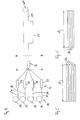
- the Fig. 1 shows a production line for producing a fiber-reinforced composite according to an exemplary, non-inventive method.
- the production line comprises in the conveying direction successively the steps described below.
- a feeder 10 ' comprises a plurality of reel feed units 12' which provide continuous rovings 14 '.
- the feeding device 10 ' is followed by an impregnating device 16'.
- the impregnation device 16 ' comprises a pultrusion tool, into which the rovings 14' are drawn in, and a drawing unit for pulling the rovings 14 '.
- the impregnating device 16 ' is adjoined by a take-up unit 18' onto which the fiber-reinforced composite material 20 'produced in the impregnating device 16' is wound up.
- FIGS. 2 and 3 show the rovings 14 'in a along in the Fig. 1 shown lines AA and BB cut view. In each case, only the cross sections of the rovings 14 'and not the individual fibers contained in the rovings 14' are shown.
- the non-controllable combination of the rovings 14 ' also disturbs the orientation of the fibers contained in the rovings 14', so that, for example, in the edge regions of the rovings 14 'reinforced obliquely and in particular serpentine to the longitudinal direction of the rovings 4' extending fibers occur.
- Fig. 1 to 7 are mutually corresponding elements each identified by the same reference numerals, wherein in the Fig. 1 to 3 corresponding dashed reference numerals (10 ', 12' etc.,) and in the Fig. 4 to 7 the corresponding unlined reference numerals 12, 12, etc.) are used.
- a spreader 22 which comprises a spreader unit 24 for each roving 14, in which the respective roving 14 on an opposite the unspreaded roving 14 widened, substantially band-shaped cross-section with a width b is brought, as in the Fig. 5 is shown.
- a merging device 26 which combines the splayed rovings 14 so that the merged rovings 14, as in the Fig. 6 are shown, each completely completely superposed fiber layers.
- the recombiner 26 may include an opening through which the rovings 14 pass, and / or one or more rollers on which the rovings 14 are drained.
- a merging device could, in principle, also be wholly or partially formed by the pultrusion device or a component of the pultrusion device or of the pultrusion tool, for example a pultrusion nozzle.
- the spread creates a well-defined cross-section of the fiber structure resulting from the plurality of merged rovings 14, wherein the fibers contained in the rovings 14 are more uniform in their distribution and increasingly aligned in the longitudinal direction of the roving 14.
- each spreader unit 24 comprises a control circuit 28 with a sensor 30 for detecting the expansion quality and an adjusting unit 32 with a control line 34 for adjusting the spreading process carried out by the spreader unit 24 as a function of the detected spreading quality.
- the in the Fig. 4 and 7 The devices shown could each further comprise an extrusion device by means of which a polymeric sheathing is applied to the fiber-reinforced composite materials 20 produced.
Landscapes
- Engineering & Computer Science (AREA)
- Mechanical Engineering (AREA)
- Chemical & Material Sciences (AREA)
- Composite Materials (AREA)
- Moulding By Coating Moulds (AREA)
- Reinforced Plastic Materials (AREA)
Claims (11)
- Procédé continu de production d'un matériau composite renforcé par des fibres (20) constitué de plusieurs fibres incorporées dans une matrice polymère, et notamment d'un tirant, comprenant les étapes consistant à :- préparer au moins deux stratifils (14),- écarquiller lesdits au moins deux stratifils (14),- réunir lesdits au moins deux stratifils (14) écarquillés de telle façon que lesdits au moins deux stratifils (14) réunis forment des couches de fibres qui, au moins par endroits, sont superposées et/ou juxtaposées,- imprégner lesdits au moins deux stratifils (14) réunis par un polymère et/ou un précurseur de polymère et- effectuer la pultrusion desdits au moins deux stratifils imprégnés,caractérisé en ce qu'au moins un desdits au moins deux stratifils (14) est écarquillé par un processus d'écarquillement régulé, le processus d''carquillement régulé comprenant la détection de la qualité d'écarquillement actuelle de l'au moins un stratifil (14) écarquillé et le pilotage de l'opération d'écarquillement de ce stratifil (14) en fonction de la qualité d'écarquillement actuelle détectée.
- Procédé selon la revendication 1, caractérisé en ce que
lors de l'écarquillement, la largeur des stratifils (14) augmente d'au moins 50 %, de préférence d'au moins 75 %, de manière particulièrement préférée d'au moins 100 %, de manière tout particulièrement préférée d'au moins 150 % et de manière préférée entre toutes d'au moins 300 %. - Procédé selon la revendication 1 ou la revendication 2, caractérisé en ce que la détection de la qualité d'écarquillement actuelle comprend la détection d'au moins un paramètre du stratifil écarquillé (14), qui est sélectionné dans le groupe constitué de la largeur du stratifil écarquillé, de la présence de trous dans le stratifil écarquillé (14), de la répartition des trous dans le stratifil écarquillé (14) et de l'emplacement des trous dans le stratifil écarquillé (14).
- Procédé selon au moins une des revendications précédentes caractérisé en ce que la détection de la qualité d'écarquillement actuelle comprend l'enregistrement et l'évaluation d'une image à résolution spatiale du stratifil (14) écarquillé.
- Procédé selon au moins une des revendications précédentes caractérisé en ce qu'au moins un stratifil (14) contenant des fibres de carbone est utilisé, lequel est constitué de fibres de carbone de préférence au moins à 50 %, de manière particulièrement préférée au moins à 80 %, de manière tout particulièrement préférée au moins à 90 % et de manière préférée entre toutes en intégralité.
- Procédé selon au moins une des revendications précédentes caractérisé en ce qu'au moins un stratifil (14) ayant un nombre de fibres compris entre 1 000 et 300 000, de préférence entre 12 000 et 60 000 et de manière particulièrement préférée entre 24 000 et 50 000, est utilisé,
- Procédé selon au moins une des revendications précédentes caractérisé en ce qu'au moins un stratifil (14) est utilisé, dont les fibres possèdent une masse linéique comprise entre 1 et 10 g/m, de préférence entre 2 et 5 g/m et de manière particulièrement préférée entre 3 et 4 g/m.
- Procédé selon au moins une des revendications précédentes caractérisé en ce qu'au moins un stratifil (14) est utilisé dont les fibres possèdent un diamètre compris entre 5 et 10 µm et de préférence entre 6 et 7 µm.
- Procédé selon la revendication 8, caractérisé en ce que lesdits au moins deux stratifils (14) réunis sont imprégnés par un précurseur de polymère qui est au moins un précurseur réactif de thermoplastique, au moins un précurseur réactif de plastique thermodurcissable et/ou au moins un élastomère.
- Procédé continu de production d'un matériau composite enrobé, renforcé par des fibres, caractérisé en ce qu'un matériau composite renforcé par des fibres est produit à l'aide d'un procédé selon au moins une des revendications précédentes et qu'il est enrobé au moins par endroits d'une couche de polymère, par extrusion.
- Installation de production continue d'un matériau composite renforcé par des fibres (20) constitué de plusieurs fibres incorporées dans une matrice, laquelle comprend- un dispositif d'alimentation (10) pour l'alimentation continue d'au moins deux stratifils (14),- un dispositif d'écarquillement (22) pour l'écarquillement desdits au moins deux stratifils (14) et- un dispositif de regroupement (26) pour la réunion desdits au moins deux stratifils (14) écarquillés de telle façon que lesdits au moins deux stratifils (14) réunis forment chacun une couche sur au moins deux couches de fibres qui, au moins par endroits, sont superposées et/ou juxtaposées,caractérisée en ce que
le dispositif d'écarquillement (22) comprend au moins une unité d'écarquillement (24) pour l'écarquillement d'au moins un desdits au moins deux stratifils (14) et un circuit de régulation (28) associé à unité d'écarquillement (24), le circuit de régulation (28) comprenant un capteur (30) pour la détection de la qualité d'écarquillement de l'au moins un stratifil (14) écarquillé et une unité de réglage (32) pour le réglage du processus d'écarquillement de ce stratifil (14) en fonction de la qualité d'écarquillement détectée.
Applications Claiming Priority (2)
| Application Number | Priority Date | Filing Date | Title |
|---|---|---|---|
| DE102011005329A DE102011005329A1 (de) | 2011-03-10 | 2011-03-10 | Verfahren und Vorrichtung zur Herstellung eines faserverstärkten Verbundwerkstoffs und insbesondere eines Zugträgers |
| PCT/EP2012/053955 WO2012120064A1 (fr) | 2011-03-10 | 2012-03-08 | Procédé et dispositif de production d'un matériau composite renforcé par des fibres et notamment d'un tirant |
Publications (2)
| Publication Number | Publication Date |
|---|---|
| EP2683544A1 EP2683544A1 (fr) | 2014-01-15 |
| EP2683544B1 true EP2683544B1 (fr) | 2017-07-26 |
Family
ID=45819210
Family Applications (1)
| Application Number | Title | Priority Date | Filing Date |
|---|---|---|---|
| EP12708538.9A Active EP2683544B1 (fr) | 2011-03-10 | 2012-03-08 | Procédé et dispositif de production d'un matériau composite renforcé par des fibres et notamment d'un tirant |
Country Status (3)
| Country | Link |
|---|---|
| EP (1) | EP2683544B1 (fr) |
| DE (1) | DE102011005329A1 (fr) |
| WO (1) | WO2012120064A1 (fr) |
Families Citing this family (12)
| Publication number | Priority date | Publication date | Assignee | Title |
|---|---|---|---|---|
| FI125572B (en) * | 2013-03-11 | 2015-11-30 | Exel Composites Oyj | A method of making a flexible composite belt or rope |
| DE102014222667A1 (de) * | 2014-11-06 | 2016-05-12 | Audi Ag | Spreizvorrichtung für Rovings |
| BR112017021124B1 (pt) | 2015-04-02 | 2022-03-15 | Evonik Operations Gmbh | Processo para a produção de um material compósito de fibra |
| DE102016000703B4 (de) | 2016-01-18 | 2019-10-02 | Audi Ag | Verfahren und Vorrichtung zur Herstellung eines Faserkunststoffverbund-Profils mit integrierten Lasteinleitungselementen |
| DE102016206025A1 (de) | 2016-04-12 | 2017-10-12 | Volkswagen Aktiengesellschaft | Verfahren zur Herstellung eines pultrudierten Faserverbundkunststoff-Profils |
| AU2017268631B2 (en) | 2016-12-02 | 2023-09-28 | Otis Elevator Company | Overbraided non-metallic tension members |
| DE102018201347A1 (de) * | 2018-01-30 | 2019-08-01 | Bayerische Motoren Werke Aktiengesellschaft | Verfahren und Vorrichtung zum Herstellen von thermoplastischen faserverstärkten Halbzeugen mit konstanter Querschnittsfläche |
| CN113550038B (zh) | 2018-03-06 | 2023-03-10 | Aerlyte有限公司 | 分离碳纤维丝束的方法 |
| DE102018108804A1 (de) * | 2018-04-13 | 2019-10-17 | Rehau Ag + Co | Verfahren zur Herstellung eines thermoplastischen Strangprofils |
| DE102018119368A1 (de) | 2018-08-09 | 2020-02-13 | Audi Ag | Vorrichtung und Verfahren zur Herstellung von Faserstacks |
| WO2020200431A1 (fr) * | 2019-04-02 | 2020-10-08 | Thyssenkrupp Elevator Innovation And Operations Ag | Imprégneur de noyau et procédé de production d'une courroie d'ascenseur composite à l'aide d'un imprégneur d'âme conique |
| DE102022124091A1 (de) * | 2022-09-20 | 2024-03-21 | Bayerische Motoren Werke Aktiengesellschaft | Faserverbundbauteil für ein Fahrzeug |
Family Cites Families (15)
| Publication number | Priority date | Publication date | Assignee | Title |
|---|---|---|---|---|
| US3529050A (en) * | 1967-02-06 | 1970-09-15 | Koppers Co Inc | Method and apparatus for producing a resin rich surface |
| US3798095A (en) * | 1970-12-14 | 1974-03-19 | Hercules Inc | Process for spreading a graphite fiber tow into a ribbon of graphite filaments |
| JPS5914924A (ja) * | 1982-07-16 | 1984-01-25 | Mitsubishi Rayon Co Ltd | プリブレグの製造方法 |
| US4900499A (en) * | 1988-01-14 | 1990-02-13 | Phillips Petroleum Company | Molding process for forming a tape of long reinforcement |
| US5436980A (en) * | 1988-05-10 | 1995-07-25 | E. I. Du Pont De Nemours And Company | Method for determining quality of dispersion of glass fibers in a thermoplastic resin preform layer and preform layer characterized thereby |
| US5198281A (en) | 1989-04-17 | 1993-03-30 | Georgia Tech Research Corporation | Non-woven flexible multiply towpreg fabric |
| DE4419691C1 (de) * | 1994-06-04 | 1995-08-24 | Deutsche Forsch Luft Raumfahrt | Längskräfte übertragender gerader Stab aus Faserverbundwerkstoffen |
| US5607531A (en) | 1995-06-05 | 1997-03-04 | Polyplus, Inc. | Filament coating process |
| JP3336911B2 (ja) * | 1996-06-20 | 2002-10-21 | 松下電工株式会社 | プリプレグの製造方法およびその装置 |
| US6131285A (en) | 1997-12-31 | 2000-10-17 | Dana Corporation | Pultrusion method of manufacturing a composite structural component |
| DE10319237A1 (de) * | 2003-04-30 | 2004-12-02 | Ticona Gmbh | Pultrusionsverfahren und damit hergestellte Artikel |
| US7875675B2 (en) * | 2005-11-23 | 2011-01-25 | Milgard Manufacturing Incorporated | Resin for composite structures |
| GB2458001B (en) | 2008-01-18 | 2010-12-08 | Kone Corp | An elevator hoist rope, an elevator and method |
| EP2399056A1 (fr) * | 2009-02-20 | 2011-12-28 | Fyfe Co., LLC | Systèmes et procédés de renfort d'un tuyau à l'aide de faisceaux de fibres |
| US8883908B2 (en) * | 2009-06-02 | 2014-11-11 | Johns Manville | Methods for making reinforced thermoplastic composites using reactive fibers and/or reactive flakes |
-
2011
- 2011-03-10 DE DE102011005329A patent/DE102011005329A1/de not_active Ceased
-
2012
- 2012-03-08 WO PCT/EP2012/053955 patent/WO2012120064A1/fr not_active Ceased
- 2012-03-08 EP EP12708538.9A patent/EP2683544B1/fr active Active
Non-Patent Citations (1)
| Title |
|---|
| None * |
Also Published As
| Publication number | Publication date |
|---|---|
| EP2683544A1 (fr) | 2014-01-15 |
| DE102011005329A1 (de) | 2012-09-13 |
| WO2012120064A1 (fr) | 2012-09-13 |
Similar Documents
| Publication | Publication Date | Title |
|---|---|---|
| WO2012120064A1 (fr) | Procédé et dispositif de production d'un matériau composite renforcé par des fibres et notamment d'un tirant | |
| WO2012120144A2 (fr) | Procédé de production d'un tirant enrobé d'une couche polymérique | |
| EP0579047B1 (fr) | Procédé de fabrication de semi-produits en résines thermoplastiques de moyenne ou haute viscosité | |
| DE60105303T2 (de) | Notlaufstützkörper | |
| DE69733387T2 (de) | Verbundfaden und daraus hergestellte faserverstärkte verbundwerkstoffe | |
| EP3277473B1 (fr) | Procédé pour produire un matériau composite fibreux | |
| EP3240662B1 (fr) | Procédé et dispositif de fabrication d'un matériau composite en fibres | |
| EP3288739B1 (fr) | Procédé et dispositif de production d'un matériau composite en fibres | |
| DE102016210040A1 (de) | Verfahren zum Herstellen eines zumindest bereichsweise profilierten, faserverstärkten Kunststoffprofils, ein profiliertes, faserverstärktes Kunststoffprofil und seine Verwendung | |
| EP2736691B1 (fr) | Fil de fibre de renforcement flexible pre-impregne de resine | |
| EP2948499B1 (fr) | Fibres de renforcement imprégnées et leur utilisation pour la fabrication de matières composites | |
| EP1737633B1 (fr) | File impregne d'une resine epoxy et son utilisation pour la production d'une preforme | |
| DE102011003560B4 (de) | Verfahren zum Herstellen eines Faserhalbzeugs für die Herstellung eines faserverstärkten Bauteils einer Windenergieanlage, insbesondere Rotorblattgurt, sowie Faserhalbzeug und Verwendung eines Faserhalbzeugs | |
| DE102012015448A1 (de) | Organoblech und Verfahren zum Herstellen desselben | |
| WO2017012802A1 (fr) | Matériau pourvu d'au moins une enveloppe bicouche | |
| EP0427111A2 (fr) | Procédé de préparation d'un élément de renforcement fibreux à surfaces rugueuse pour le béton | |
| EP3490782B1 (fr) | Procédé pour la fabrication d'une pièce composite à fibres multicouche, tridimensionnelle | |
| EP3805437B1 (fr) | Nouveau fil présentant un certain degré de torsion | |
| DE102019204427B4 (de) | Verfahren zur Herstellung von mit Fasern verstärkten Bauteilen aus Kunststoff | |
| EP0611640B1 (fr) | Granulé en résine thermoplastique renforcée de fibres | |
| EP1283776A1 (fr) | Procede de fabrication de produits a partir de matieres polymeres auxquelles des elements de renforcement sont integres | |
| DE4112129A1 (de) | Unidirektionale verbundwerkstoffe mit hoher reissfestigkeit und verfahren zu ihrer herstellung | |
| WO2020048625A1 (fr) | Procédé et dispositif d'extrusion par étirage pour la fabrication de ressorts à lame à structure composite renforcée par des fibres | |
| DE102019125531A1 (de) | Verfahren zur Herstellung von Carbonfaserstrangabschnitten, Verfahren zum Verstärken von Bauteilen, Carbonfaserstrangabschnittherstellungsvorrichtung und Bauteilherstellungsvorrichtung | |
| AT514390A1 (de) | Bewehrungsstab |
Legal Events
| Date | Code | Title | Description |
|---|---|---|---|
| PUAI | Public reference made under article 153(3) epc to a published international application that has entered the european phase |
Free format text: ORIGINAL CODE: 0009012 |
|
| 17P | Request for examination filed |
Effective date: 20131010 |
|
| AK | Designated contracting states |
Kind code of ref document: A1 Designated state(s): AL AT BE BG CH CY CZ DE DK EE ES FI FR GB GR HR HU IE IS IT LI LT LU LV MC MK MT NL NO PL PT RO RS SE SI SK SM TR |
|
| DAX | Request for extension of the european patent (deleted) | ||
| GRAP | Despatch of communication of intention to grant a patent |
Free format text: ORIGINAL CODE: EPIDOSNIGR1 |
|
| RIC1 | Information provided on ipc code assigned before grant |
Ipc: B29B 15/12 20060101ALI20170126BHEP Ipc: B29L 31/06 20060101ALI20170126BHEP Ipc: B29B 15/10 20060101ALI20170126BHEP Ipc: D07B 1/02 20060101ALI20170126BHEP Ipc: F16C 7/02 20060101ALI20170126BHEP Ipc: D07B 1/22 20060101ALN20170126BHEP Ipc: B29C 70/52 20060101AFI20170126BHEP Ipc: B29C 47/02 20060101ALI20170126BHEP Ipc: D07B 1/16 20060101ALI20170126BHEP Ipc: B29C 47/00 20060101ALI20170126BHEP |
|
| INTG | Intention to grant announced |
Effective date: 20170214 |
|
| GRAS | Grant fee paid |
Free format text: ORIGINAL CODE: EPIDOSNIGR3 |
|
| GRAA | (expected) grant |
Free format text: ORIGINAL CODE: 0009210 |
|
| AK | Designated contracting states |
Kind code of ref document: B1 Designated state(s): AL AT BE BG CH CY CZ DE DK EE ES FI FR GB GR HR HU IE IS IT LI LT LU LV MC MK MT NL NO PL PT RO RS SE SI SK SM TR |
|
| REG | Reference to a national code |
Ref country code: GB Ref legal event code: FG4D Free format text: NOT ENGLISH |
|
| REG | Reference to a national code |
Ref country code: CH Ref legal event code: EP |
|
| REG | Reference to a national code |
Ref country code: AT Ref legal event code: REF Ref document number: 912024 Country of ref document: AT Kind code of ref document: T Effective date: 20170815 |
|
| REG | Reference to a national code |
Ref country code: IE Ref legal event code: FG4D Free format text: LANGUAGE OF EP DOCUMENT: GERMAN |
|
| REG | Reference to a national code |
Ref country code: DE Ref legal event code: R096 Ref document number: 502012010855 Country of ref document: DE |
|
| REG | Reference to a national code |
Ref country code: NL Ref legal event code: MP Effective date: 20170726 |
|
| REG | Reference to a national code |
Ref country code: LT Ref legal event code: MG4D |
|
| PG25 | Lapsed in a contracting state [announced via postgrant information from national office to epo] |
Ref country code: LT Free format text: LAPSE BECAUSE OF FAILURE TO SUBMIT A TRANSLATION OF THE DESCRIPTION OR TO PAY THE FEE WITHIN THE PRESCRIBED TIME-LIMIT Effective date: 20170726 Ref country code: NL Free format text: LAPSE BECAUSE OF FAILURE TO SUBMIT A TRANSLATION OF THE DESCRIPTION OR TO PAY THE FEE WITHIN THE PRESCRIBED TIME-LIMIT Effective date: 20170726 Ref country code: SE Free format text: LAPSE BECAUSE OF FAILURE TO SUBMIT A TRANSLATION OF THE DESCRIPTION OR TO PAY THE FEE WITHIN THE PRESCRIBED TIME-LIMIT Effective date: 20170726 Ref country code: NO Free format text: LAPSE BECAUSE OF FAILURE TO SUBMIT A TRANSLATION OF THE DESCRIPTION OR TO PAY THE FEE WITHIN THE PRESCRIBED TIME-LIMIT Effective date: 20171026 Ref country code: HR Free format text: LAPSE BECAUSE OF FAILURE TO SUBMIT A TRANSLATION OF THE DESCRIPTION OR TO PAY THE FEE WITHIN THE PRESCRIBED TIME-LIMIT Effective date: 20170726 Ref country code: FI Free format text: LAPSE BECAUSE OF FAILURE TO SUBMIT A TRANSLATION OF THE DESCRIPTION OR TO PAY THE FEE WITHIN THE PRESCRIBED TIME-LIMIT Effective date: 20170726 |
|
| PG25 | Lapsed in a contracting state [announced via postgrant information from national office to epo] |
Ref country code: RS Free format text: LAPSE BECAUSE OF FAILURE TO SUBMIT A TRANSLATION OF THE DESCRIPTION OR TO PAY THE FEE WITHIN THE PRESCRIBED TIME-LIMIT Effective date: 20170726 Ref country code: ES Free format text: LAPSE BECAUSE OF FAILURE TO SUBMIT A TRANSLATION OF THE DESCRIPTION OR TO PAY THE FEE WITHIN THE PRESCRIBED TIME-LIMIT Effective date: 20170726 Ref country code: BG Free format text: LAPSE BECAUSE OF FAILURE TO SUBMIT A TRANSLATION OF THE DESCRIPTION OR TO PAY THE FEE WITHIN THE PRESCRIBED TIME-LIMIT Effective date: 20171026 Ref country code: LV Free format text: LAPSE BECAUSE OF FAILURE TO SUBMIT A TRANSLATION OF THE DESCRIPTION OR TO PAY THE FEE WITHIN THE PRESCRIBED TIME-LIMIT Effective date: 20170726 Ref country code: PL Free format text: LAPSE BECAUSE OF FAILURE TO SUBMIT A TRANSLATION OF THE DESCRIPTION OR TO PAY THE FEE WITHIN THE PRESCRIBED TIME-LIMIT Effective date: 20170726 Ref country code: IS Free format text: LAPSE BECAUSE OF FAILURE TO SUBMIT A TRANSLATION OF THE DESCRIPTION OR TO PAY THE FEE WITHIN THE PRESCRIBED TIME-LIMIT Effective date: 20171126 Ref country code: GR Free format text: LAPSE BECAUSE OF FAILURE TO SUBMIT A TRANSLATION OF THE DESCRIPTION OR TO PAY THE FEE WITHIN THE PRESCRIBED TIME-LIMIT Effective date: 20171027 |
|
| PG25 | Lapsed in a contracting state [announced via postgrant information from national office to epo] |
Ref country code: CZ Free format text: LAPSE BECAUSE OF FAILURE TO SUBMIT A TRANSLATION OF THE DESCRIPTION OR TO PAY THE FEE WITHIN THE PRESCRIBED TIME-LIMIT Effective date: 20170726 Ref country code: DK Free format text: LAPSE BECAUSE OF FAILURE TO SUBMIT A TRANSLATION OF THE DESCRIPTION OR TO PAY THE FEE WITHIN THE PRESCRIBED TIME-LIMIT Effective date: 20170726 Ref country code: RO Free format text: LAPSE BECAUSE OF FAILURE TO SUBMIT A TRANSLATION OF THE DESCRIPTION OR TO PAY THE FEE WITHIN THE PRESCRIBED TIME-LIMIT Effective date: 20170726 |
|
| REG | Reference to a national code |
Ref country code: DE Ref legal event code: R097 Ref document number: 502012010855 Country of ref document: DE |
|
| PG25 | Lapsed in a contracting state [announced via postgrant information from national office to epo] |
Ref country code: IT Free format text: LAPSE BECAUSE OF FAILURE TO SUBMIT A TRANSLATION OF THE DESCRIPTION OR TO PAY THE FEE WITHIN THE PRESCRIBED TIME-LIMIT Effective date: 20170726 Ref country code: SK Free format text: LAPSE BECAUSE OF FAILURE TO SUBMIT A TRANSLATION OF THE DESCRIPTION OR TO PAY THE FEE WITHIN THE PRESCRIBED TIME-LIMIT Effective date: 20170726 Ref country code: SM Free format text: LAPSE BECAUSE OF FAILURE TO SUBMIT A TRANSLATION OF THE DESCRIPTION OR TO PAY THE FEE WITHIN THE PRESCRIBED TIME-LIMIT Effective date: 20170726 Ref country code: EE Free format text: LAPSE BECAUSE OF FAILURE TO SUBMIT A TRANSLATION OF THE DESCRIPTION OR TO PAY THE FEE WITHIN THE PRESCRIBED TIME-LIMIT Effective date: 20170726 |
|
| PLBE | No opposition filed within time limit |
Free format text: ORIGINAL CODE: 0009261 |
|
| STAA | Information on the status of an ep patent application or granted ep patent |
Free format text: STATUS: NO OPPOSITION FILED WITHIN TIME LIMIT |
|
| 26N | No opposition filed |
Effective date: 20180430 |
|
| PG25 | Lapsed in a contracting state [announced via postgrant information from national office to epo] |
Ref country code: SI Free format text: LAPSE BECAUSE OF FAILURE TO SUBMIT A TRANSLATION OF THE DESCRIPTION OR TO PAY THE FEE WITHIN THE PRESCRIBED TIME-LIMIT Effective date: 20170726 |
|
| PG25 | Lapsed in a contracting state [announced via postgrant information from national office to epo] |
Ref country code: MT Free format text: LAPSE BECAUSE OF FAILURE TO SUBMIT A TRANSLATION OF THE DESCRIPTION OR TO PAY THE FEE WITHIN THE PRESCRIBED TIME-LIMIT Effective date: 20170726 |
|
| REG | Reference to a national code |
Ref country code: CH Ref legal event code: PL |
|
| GBPC | Gb: european patent ceased through non-payment of renewal fee |
Effective date: 20180308 |
|
| PG25 | Lapsed in a contracting state [announced via postgrant information from national office to epo] |
Ref country code: MC Free format text: LAPSE BECAUSE OF FAILURE TO SUBMIT A TRANSLATION OF THE DESCRIPTION OR TO PAY THE FEE WITHIN THE PRESCRIBED TIME-LIMIT Effective date: 20170726 |
|
| REG | Reference to a national code |
Ref country code: BE Ref legal event code: MM Effective date: 20180331 |
|
| REG | Reference to a national code |
Ref country code: IE Ref legal event code: MM4A |
|
| PG25 | Lapsed in a contracting state [announced via postgrant information from national office to epo] |
Ref country code: LU Free format text: LAPSE BECAUSE OF NON-PAYMENT OF DUE FEES Effective date: 20180308 |
|
| PG25 | Lapsed in a contracting state [announced via postgrant information from national office to epo] |
Ref country code: IE Free format text: LAPSE BECAUSE OF NON-PAYMENT OF DUE FEES Effective date: 20180308 |
|
| PG25 | Lapsed in a contracting state [announced via postgrant information from national office to epo] |
Ref country code: LI Free format text: LAPSE BECAUSE OF NON-PAYMENT OF DUE FEES Effective date: 20180331 Ref country code: CH Free format text: LAPSE BECAUSE OF NON-PAYMENT OF DUE FEES Effective date: 20180331 Ref country code: GB Free format text: LAPSE BECAUSE OF NON-PAYMENT OF DUE FEES Effective date: 20180308 Ref country code: BE Free format text: LAPSE BECAUSE OF NON-PAYMENT OF DUE FEES Effective date: 20180331 |
|
| PG25 | Lapsed in a contracting state [announced via postgrant information from national office to epo] |
Ref country code: FR Free format text: LAPSE BECAUSE OF NON-PAYMENT OF DUE FEES Effective date: 20180331 |
|
| REG | Reference to a national code |
Ref country code: AT Ref legal event code: MM01 Ref document number: 912024 Country of ref document: AT Kind code of ref document: T Effective date: 20180308 |
|
| PG25 | Lapsed in a contracting state [announced via postgrant information from national office to epo] |
Ref country code: AT Free format text: LAPSE BECAUSE OF NON-PAYMENT OF DUE FEES Effective date: 20180308 |
|
| PG25 | Lapsed in a contracting state [announced via postgrant information from national office to epo] |
Ref country code: TR Free format text: LAPSE BECAUSE OF FAILURE TO SUBMIT A TRANSLATION OF THE DESCRIPTION OR TO PAY THE FEE WITHIN THE PRESCRIBED TIME-LIMIT Effective date: 20170726 |
|
| PG25 | Lapsed in a contracting state [announced via postgrant information from national office to epo] |
Ref country code: HU Free format text: LAPSE BECAUSE OF FAILURE TO SUBMIT A TRANSLATION OF THE DESCRIPTION OR TO PAY THE FEE WITHIN THE PRESCRIBED TIME-LIMIT; INVALID AB INITIO Effective date: 20120308 Ref country code: PT Free format text: LAPSE BECAUSE OF FAILURE TO SUBMIT A TRANSLATION OF THE DESCRIPTION OR TO PAY THE FEE WITHIN THE PRESCRIBED TIME-LIMIT Effective date: 20170726 |
|
| PG25 | Lapsed in a contracting state [announced via postgrant information from national office to epo] |
Ref country code: CY Free format text: LAPSE BECAUSE OF FAILURE TO SUBMIT A TRANSLATION OF THE DESCRIPTION OR TO PAY THE FEE WITHIN THE PRESCRIBED TIME-LIMIT Effective date: 20170726 Ref country code: MK Free format text: LAPSE BECAUSE OF NON-PAYMENT OF DUE FEES Effective date: 20170726 |
|
| PG25 | Lapsed in a contracting state [announced via postgrant information from national office to epo] |
Ref country code: AL Free format text: LAPSE BECAUSE OF FAILURE TO SUBMIT A TRANSLATION OF THE DESCRIPTION OR TO PAY THE FEE WITHIN THE PRESCRIBED TIME-LIMIT Effective date: 20170726 |
|
| PGFP | Annual fee paid to national office [announced via postgrant information from national office to epo] |
Ref country code: DE Payment date: 20250319 Year of fee payment: 14 |