EP2683617B1 - Procédé et dispositif de fermeture d'un sac - Google Patents
Procédé et dispositif de fermeture d'un sac Download PDFInfo
- Publication number
- EP2683617B1 EP2683617B1 EP11761027.9A EP11761027A EP2683617B1 EP 2683617 B1 EP2683617 B1 EP 2683617B1 EP 11761027 A EP11761027 A EP 11761027A EP 2683617 B1 EP2683617 B1 EP 2683617B1
- Authority
- EP
- European Patent Office
- Prior art keywords
- base body
- starting material
- material strip
- open
- strip
- Prior art date
- Legal status (The legal status is an assumption and is not a legal conclusion. Google has not performed a legal analysis and makes no representation as to the accuracy of the status listed.)
- Active
Links
Images




Classifications
-
- B—PERFORMING OPERATIONS; TRANSPORTING
- B65—CONVEYING; PACKING; STORING; HANDLING THIN OR FILAMENTARY MATERIAL
- B65D—CONTAINERS FOR STORAGE OR TRANSPORT OF ARTICLES OR MATERIALS, e.g. BAGS, BARRELS, BOTTLES, BOXES, CANS, CARTONS, CRATES, DRUMS, JARS, TANKS, HOPPERS, FORWARDING CONTAINERS; ACCESSORIES, CLOSURES, OR FITTINGS THEREFOR; PACKAGING ELEMENTS; PACKAGES
- B65D33/00—Details of, or accessories for, sacks or bags
- B65D33/16—End- or aperture-closing arrangements or devices
- B65D33/1691—End- or aperture-closing arrangements or devices using adhesive applied to attached closure elements
-
- B—PERFORMING OPERATIONS; TRANSPORTING
- B29—WORKING OF PLASTICS; WORKING OF SUBSTANCES IN A PLASTIC STATE IN GENERAL
- B29C—SHAPING OR JOINING OF PLASTICS; SHAPING OF MATERIAL IN A PLASTIC STATE, NOT OTHERWISE PROVIDED FOR; AFTER-TREATMENT OF THE SHAPED PRODUCTS, e.g. REPAIRING
- B29C65/00—Joining or sealing of preformed parts, e.g. welding of plastics materials; Apparatus therefor
- B29C65/02—Joining or sealing of preformed parts, e.g. welding of plastics materials; Apparatus therefor by heating, with or without pressure
- B29C65/10—Joining or sealing of preformed parts, e.g. welding of plastics materials; Apparatus therefor by heating, with or without pressure using hot gases (e.g. combustion gases) or flames coming in contact with at least one of the parts to be joined
- B29C65/103—Joining or sealing of preformed parts, e.g. welding of plastics materials; Apparatus therefor by heating, with or without pressure using hot gases (e.g. combustion gases) or flames coming in contact with at least one of the parts to be joined direct heating both surfaces to be joined
-
- B—PERFORMING OPERATIONS; TRANSPORTING
- B29—WORKING OF PLASTICS; WORKING OF SUBSTANCES IN A PLASTIC STATE IN GENERAL
- B29C—SHAPING OR JOINING OF PLASTICS; SHAPING OF MATERIAL IN A PLASTIC STATE, NOT OTHERWISE PROVIDED FOR; AFTER-TREATMENT OF THE SHAPED PRODUCTS, e.g. REPAIRING
- B29C65/00—Joining or sealing of preformed parts, e.g. welding of plastics materials; Apparatus therefor
- B29C65/48—Joining or sealing of preformed parts, e.g. welding of plastics materials; Apparatus therefor using adhesives, i.e. using supplementary joining material; solvent bonding
- B29C65/50—Joining or sealing of preformed parts, e.g. welding of plastics materials; Apparatus therefor using adhesives, i.e. using supplementary joining material; solvent bonding using adhesive tape, e.g. thermoplastic tape; using threads or the like
- B29C65/5092—Joining or sealing of preformed parts, e.g. welding of plastics materials; Apparatus therefor using adhesives, i.e. using supplementary joining material; solvent bonding using adhesive tape, e.g. thermoplastic tape; using threads or the like characterised by the tape handling mechanisms, e.g. using vacuum
-
- B—PERFORMING OPERATIONS; TRANSPORTING
- B29—WORKING OF PLASTICS; WORKING OF SUBSTANCES IN A PLASTIC STATE IN GENERAL
- B29C—SHAPING OR JOINING OF PLASTICS; SHAPING OF MATERIAL IN A PLASTIC STATE, NOT OTHERWISE PROVIDED FOR; AFTER-TREATMENT OF THE SHAPED PRODUCTS, e.g. REPAIRING
- B29C66/00—General aspects of processes or apparatus for joining preformed parts
- B29C66/70—General aspects of processes or apparatus for joining preformed parts characterised by the composition, physical properties or the structure of the material of the parts to be joined; Joining with non-plastics material
- B29C66/71—General aspects of processes or apparatus for joining preformed parts characterised by the composition, physical properties or the structure of the material of the parts to be joined; Joining with non-plastics material characterised by the composition of the plastics material of the parts to be joined
-
- B—PERFORMING OPERATIONS; TRANSPORTING
- B29—WORKING OF PLASTICS; WORKING OF SUBSTANCES IN A PLASTIC STATE IN GENERAL
- B29C—SHAPING OR JOINING OF PLASTICS; SHAPING OF MATERIAL IN A PLASTIC STATE, NOT OTHERWISE PROVIDED FOR; AFTER-TREATMENT OF THE SHAPED PRODUCTS, e.g. REPAIRING
- B29C66/00—General aspects of processes or apparatus for joining preformed parts
- B29C66/80—General aspects of machine operations or constructions and parts thereof
- B29C66/83—General aspects of machine operations or constructions and parts thereof characterised by the movement of the joining or pressing tools
- B29C66/834—General aspects of machine operations or constructions and parts thereof characterised by the movement of the joining or pressing tools moving with the parts to be joined
- B29C66/8341—Roller, cylinder or drum types; Band or belt types; Ball types
- B29C66/83411—Roller, cylinder or drum types
- B29C66/83413—Roller, cylinder or drum types cooperating rollers, cylinders or drums
-
- B—PERFORMING OPERATIONS; TRANSPORTING
- B29—WORKING OF PLASTICS; WORKING OF SUBSTANCES IN A PLASTIC STATE IN GENERAL
- B29C—SHAPING OR JOINING OF PLASTICS; SHAPING OF MATERIAL IN A PLASTIC STATE, NOT OTHERWISE PROVIDED FOR; AFTER-TREATMENT OF THE SHAPED PRODUCTS, e.g. REPAIRING
- B29C66/00—General aspects of processes or apparatus for joining preformed parts
- B29C66/80—General aspects of machine operations or constructions and parts thereof
- B29C66/84—Specific machine types or machines suitable for specific applications
- B29C66/851—Bag or container making machines
- B29C66/8511—Bag making machines
-
- B—PERFORMING OPERATIONS; TRANSPORTING
- B65—CONVEYING; PACKING; STORING; HANDLING THIN OR FILAMENTARY MATERIAL
- B65B—MACHINES, APPARATUS OR DEVICES FOR, OR METHODS OF, PACKAGING ARTICLES OR MATERIALS; UNPACKING
- B65B51/00—Devices for, or methods of, sealing or securing package folds or closures; Devices for gathering or twisting wrappers, or necks of bags
- B65B51/10—Applying or generating heat or pressure or combinations thereof
- B65B51/16—Applying or generating heat or pressure or combinations thereof by rotary members
-
- B—PERFORMING OPERATIONS; TRANSPORTING
- B65—CONVEYING; PACKING; STORING; HANDLING THIN OR FILAMENTARY MATERIAL
- B65B—MACHINES, APPARATUS OR DEVICES FOR, OR METHODS OF, PACKAGING ARTICLES OR MATERIALS; UNPACKING
- B65B51/00—Devices for, or methods of, sealing or securing package folds or closures; Devices for gathering or twisting wrappers, or necks of bags
- B65B51/10—Applying or generating heat or pressure or combinations thereof
- B65B51/20—Applying or generating heat or pressure or combinations thereof by fluid pressure acting directly on folds or on opposed surfaces, e.g. using hot-air jets
-
- B—PERFORMING OPERATIONS; TRANSPORTING
- B29—WORKING OF PLASTICS; WORKING OF SUBSTANCES IN A PLASTIC STATE IN GENERAL
- B29C—SHAPING OR JOINING OF PLASTICS; SHAPING OF MATERIAL IN A PLASTIC STATE, NOT OTHERWISE PROVIDED FOR; AFTER-TREATMENT OF THE SHAPED PRODUCTS, e.g. REPAIRING
- B29C65/00—Joining or sealing of preformed parts, e.g. welding of plastics materials; Apparatus therefor
- B29C65/48—Joining or sealing of preformed parts, e.g. welding of plastics materials; Apparatus therefor using adhesives, i.e. using supplementary joining material; solvent bonding
- B29C65/4805—Joining or sealing of preformed parts, e.g. welding of plastics materials; Apparatus therefor using adhesives, i.e. using supplementary joining material; solvent bonding characterised by the type of adhesives
- B29C65/481—Non-reactive adhesives, e.g. physically hardening adhesives
- B29C65/4815—Hot melt adhesives, e.g. thermoplastic adhesives
-
- B—PERFORMING OPERATIONS; TRANSPORTING
- B29—WORKING OF PLASTICS; WORKING OF SUBSTANCES IN A PLASTIC STATE IN GENERAL
- B29C—SHAPING OR JOINING OF PLASTICS; SHAPING OF MATERIAL IN A PLASTIC STATE, NOT OTHERWISE PROVIDED FOR; AFTER-TREATMENT OF THE SHAPED PRODUCTS, e.g. REPAIRING
- B29C65/00—Joining or sealing of preformed parts, e.g. welding of plastics materials; Apparatus therefor
- B29C65/48—Joining or sealing of preformed parts, e.g. welding of plastics materials; Apparatus therefor using adhesives, i.e. using supplementary joining material; solvent bonding
- B29C65/50—Joining or sealing of preformed parts, e.g. welding of plastics materials; Apparatus therefor using adhesives, i.e. using supplementary joining material; solvent bonding using adhesive tape, e.g. thermoplastic tape; using threads or the like
- B29C65/5042—Joining or sealing of preformed parts, e.g. welding of plastics materials; Apparatus therefor using adhesives, i.e. using supplementary joining material; solvent bonding using adhesive tape, e.g. thermoplastic tape; using threads or the like covering both elements to be joined
-
- B—PERFORMING OPERATIONS; TRANSPORTING
- B29—WORKING OF PLASTICS; WORKING OF SUBSTANCES IN A PLASTIC STATE IN GENERAL
- B29C—SHAPING OR JOINING OF PLASTICS; SHAPING OF MATERIAL IN A PLASTIC STATE, NOT OTHERWISE PROVIDED FOR; AFTER-TREATMENT OF THE SHAPED PRODUCTS, e.g. REPAIRING
- B29C65/00—Joining or sealing of preformed parts, e.g. welding of plastics materials; Apparatus therefor
- B29C65/48—Joining or sealing of preformed parts, e.g. welding of plastics materials; Apparatus therefor using adhesives, i.e. using supplementary joining material; solvent bonding
- B29C65/50—Joining or sealing of preformed parts, e.g. welding of plastics materials; Apparatus therefor using adhesives, i.e. using supplementary joining material; solvent bonding using adhesive tape, e.g. thermoplastic tape; using threads or the like
- B29C65/5064—Joining or sealing of preformed parts, e.g. welding of plastics materials; Apparatus therefor using adhesives, i.e. using supplementary joining material; solvent bonding using adhesive tape, e.g. thermoplastic tape; using threads or the like of particular form, e.g. being C-shaped, T-shaped
- B29C65/5071—Joining or sealing of preformed parts, e.g. welding of plastics materials; Apparatus therefor using adhesives, i.e. using supplementary joining material; solvent bonding using adhesive tape, e.g. thermoplastic tape; using threads or the like of particular form, e.g. being C-shaped, T-shaped and being composed by one single element
-
- B—PERFORMING OPERATIONS; TRANSPORTING
- B29—WORKING OF PLASTICS; WORKING OF SUBSTANCES IN A PLASTIC STATE IN GENERAL
- B29C—SHAPING OR JOINING OF PLASTICS; SHAPING OF MATERIAL IN A PLASTIC STATE, NOT OTHERWISE PROVIDED FOR; AFTER-TREATMENT OF THE SHAPED PRODUCTS, e.g. REPAIRING
- B29C65/00—Joining or sealing of preformed parts, e.g. welding of plastics materials; Apparatus therefor
- B29C65/48—Joining or sealing of preformed parts, e.g. welding of plastics materials; Apparatus therefor using adhesives, i.e. using supplementary joining material; solvent bonding
- B29C65/50—Joining or sealing of preformed parts, e.g. welding of plastics materials; Apparatus therefor using adhesives, i.e. using supplementary joining material; solvent bonding using adhesive tape, e.g. thermoplastic tape; using threads or the like
- B29C65/5064—Joining or sealing of preformed parts, e.g. welding of plastics materials; Apparatus therefor using adhesives, i.e. using supplementary joining material; solvent bonding using adhesive tape, e.g. thermoplastic tape; using threads or the like of particular form, e.g. being C-shaped, T-shaped
- B29C65/5085—Joining or sealing of preformed parts, e.g. welding of plastics materials; Apparatus therefor using adhesives, i.e. using supplementary joining material; solvent bonding using adhesive tape, e.g. thermoplastic tape; using threads or the like of particular form, e.g. being C-shaped, T-shaped and comprising grooves, e.g. being E-shaped, H-shaped
-
- B—PERFORMING OPERATIONS; TRANSPORTING
- B29—WORKING OF PLASTICS; WORKING OF SUBSTANCES IN A PLASTIC STATE IN GENERAL
- B29C—SHAPING OR JOINING OF PLASTICS; SHAPING OF MATERIAL IN A PLASTIC STATE, NOT OTHERWISE PROVIDED FOR; AFTER-TREATMENT OF THE SHAPED PRODUCTS, e.g. REPAIRING
- B29C66/00—General aspects of processes or apparatus for joining preformed parts
- B29C66/01—General aspects dealing with the joint area or with the area to be joined
- B29C66/05—Particular design of joint configurations
- B29C66/10—Particular design of joint configurations particular design of the joint cross-sections
- B29C66/11—Joint cross-sections comprising a single joint-segment, i.e. one of the parts to be joined comprising a single joint-segment in the joint cross-section
- B29C66/112—Single lapped joints
- B29C66/1122—Single lap to lap joints, i.e. overlap joints
-
- B—PERFORMING OPERATIONS; TRANSPORTING
- B29—WORKING OF PLASTICS; WORKING OF SUBSTANCES IN A PLASTIC STATE IN GENERAL
- B29C—SHAPING OR JOINING OF PLASTICS; SHAPING OF MATERIAL IN A PLASTIC STATE, NOT OTHERWISE PROVIDED FOR; AFTER-TREATMENT OF THE SHAPED PRODUCTS, e.g. REPAIRING
- B29C66/00—General aspects of processes or apparatus for joining preformed parts
- B29C66/40—General aspects of joining substantially flat articles, e.g. plates, sheets or web-like materials; Making flat seams in tubular or hollow articles; Joining single elements to substantially flat surfaces
- B29C66/41—Joining substantially flat articles ; Making flat seams in tubular or hollow articles
- B29C66/43—Joining a relatively small portion of the surface of said articles
- B29C66/431—Joining the articles to themselves
- B29C66/4312—Joining the articles to themselves for making flat seams in tubular or hollow articles, e.g. transversal seams
- B29C66/43121—Closing the ends of tubular or hollow single articles, e.g. closing the ends of bags
-
- B—PERFORMING OPERATIONS; TRANSPORTING
- B29—WORKING OF PLASTICS; WORKING OF SUBSTANCES IN A PLASTIC STATE IN GENERAL
- B29C—SHAPING OR JOINING OF PLASTICS; SHAPING OF MATERIAL IN A PLASTIC STATE, NOT OTHERWISE PROVIDED FOR; AFTER-TREATMENT OF THE SHAPED PRODUCTS, e.g. REPAIRING
- B29C66/00—General aspects of processes or apparatus for joining preformed parts
- B29C66/70—General aspects of processes or apparatus for joining preformed parts characterised by the composition, physical properties or the structure of the material of the parts to be joined; Joining with non-plastics material
- B29C66/72—General aspects of processes or apparatus for joining preformed parts characterised by the composition, physical properties or the structure of the material of the parts to be joined; Joining with non-plastics material characterised by the structure of the material of the parts to be joined
- B29C66/723—General aspects of processes or apparatus for joining preformed parts characterised by the composition, physical properties or the structure of the material of the parts to be joined; Joining with non-plastics material characterised by the structure of the material of the parts to be joined being multi-layered
- B29C66/7234—General aspects of processes or apparatus for joining preformed parts characterised by the composition, physical properties or the structure of the material of the parts to be joined; Joining with non-plastics material characterised by the structure of the material of the parts to be joined being multi-layered comprising a barrier layer
-
- B—PERFORMING OPERATIONS; TRANSPORTING
- B29—WORKING OF PLASTICS; WORKING OF SUBSTANCES IN A PLASTIC STATE IN GENERAL
- B29C—SHAPING OR JOINING OF PLASTICS; SHAPING OF MATERIAL IN A PLASTIC STATE, NOT OTHERWISE PROVIDED FOR; AFTER-TREATMENT OF THE SHAPED PRODUCTS, e.g. REPAIRING
- B29C66/00—General aspects of processes or apparatus for joining preformed parts
- B29C66/70—General aspects of processes or apparatus for joining preformed parts characterised by the composition, physical properties or the structure of the material of the parts to be joined; Joining with non-plastics material
- B29C66/72—General aspects of processes or apparatus for joining preformed parts characterised by the composition, physical properties or the structure of the material of the parts to be joined; Joining with non-plastics material characterised by the structure of the material of the parts to be joined
- B29C66/729—Textile or other fibrous material made from plastics
-
- B—PERFORMING OPERATIONS; TRANSPORTING
- B31—MAKING ARTICLES OF PAPER, CARDBOARD OR MATERIAL WORKED IN A MANNER ANALOGOUS TO PAPER; WORKING PAPER, CARDBOARD OR MATERIAL WORKED IN A MANNER ANALOGOUS TO PAPER
- B31B—MAKING CONTAINERS OF PAPER, CARDBOARD OR MATERIAL WORKED IN A MANNER ANALOGOUS TO PAPER
- B31B70/00—Making flexible containers, e.g. envelopes or bags
- B31B70/004—Closing bags
-
- B—PERFORMING OPERATIONS; TRANSPORTING
- B31—MAKING ARTICLES OF PAPER, CARDBOARD OR MATERIAL WORKED IN A MANNER ANALOGOUS TO PAPER; WORKING PAPER, CARDBOARD OR MATERIAL WORKED IN A MANNER ANALOGOUS TO PAPER
- B31B—MAKING CONTAINERS OF PAPER, CARDBOARD OR MATERIAL WORKED IN A MANNER ANALOGOUS TO PAPER
- B31B70/00—Making flexible containers, e.g. envelopes or bags
- B31B70/60—Uniting opposed surfaces or edges; Taping
- B31B70/61—Uniting opposed surfaces or edges; Taping by applying or securing strips or tape
-
- B—PERFORMING OPERATIONS; TRANSPORTING
- B31—MAKING ARTICLES OF PAPER, CARDBOARD OR MATERIAL WORKED IN A MANNER ANALOGOUS TO PAPER; WORKING PAPER, CARDBOARD OR MATERIAL WORKED IN A MANNER ANALOGOUS TO PAPER
- B31B—MAKING CONTAINERS OF PAPER, CARDBOARD OR MATERIAL WORKED IN A MANNER ANALOGOUS TO PAPER
- B31B70/00—Making flexible containers, e.g. envelopes or bags
- B31B70/74—Auxiliary operations
- B31B70/81—Forming or attaching accessories, e.g. opening devices, closures or tear strings
- B31B70/812—Applying patches, strips or strings on sheets or webs
- B31B70/8123—Applying strips
-
- B—PERFORMING OPERATIONS; TRANSPORTING
- B65—CONVEYING; PACKING; STORING; HANDLING THIN OR FILAMENTARY MATERIAL
- B65B—MACHINES, APPARATUS OR DEVICES FOR, OR METHODS OF, PACKAGING ARTICLES OR MATERIALS; UNPACKING
- B65B51/00—Devices for, or methods of, sealing or securing package folds or closures; Devices for gathering or twisting wrappers, or necks of bags
- B65B51/04—Applying separate sealing or securing members, e.g. clips
- B65B51/046—Applying a closure element to the mouths of bags
-
- B—PERFORMING OPERATIONS; TRANSPORTING
- B65—CONVEYING; PACKING; STORING; HANDLING THIN OR FILAMENTARY MATERIAL
- B65B—MACHINES, APPARATUS OR DEVICES FOR, OR METHODS OF, PACKAGING ARTICLES OR MATERIALS; UNPACKING
- B65B55/00—Preserving, protecting or purifying packages or package contents in association with packaging
- B65B55/24—Cleaning of, or removing dust from, containers, wrappers, or packaging ; Preventing of fouling
-
- B—PERFORMING OPERATIONS; TRANSPORTING
- B65—CONVEYING; PACKING; STORING; HANDLING THIN OR FILAMENTARY MATERIAL
- B65B—MACHINES, APPARATUS OR DEVICES FOR, OR METHODS OF, PACKAGING ARTICLES OR MATERIALS; UNPACKING
- B65B61/00—Auxiliary devices, not otherwise provided for, for operating on sheets, blanks, webs, binding material, containers or packages
- B65B61/005—Auxiliary devices, not otherwise provided for, for operating on sheets, blanks, webs, binding material, containers or packages for removing material by cutting
-
- B—PERFORMING OPERATIONS; TRANSPORTING
- B65—CONVEYING; PACKING; STORING; HANDLING THIN OR FILAMENTARY MATERIAL
- B65B—MACHINES, APPARATUS OR DEVICES FOR, OR METHODS OF, PACKAGING ARTICLES OR MATERIALS; UNPACKING
- B65B7/00—Closing containers or receptacles after filling
- B65B7/02—Closing containers or receptacles deformed by, or taking-up shape, of, contents, e.g. bags, sacks
Definitions
- the present invention relates to a method for sealing a tubular starting material of coated or uncoated polyolefin fabric, in particular polypropylene or HDPE fabric, for the production of an open-sack.
- the invention relates to a method for closing a filled, unilaterally closed open-sack made of coated or uncoated polyolefin fabric, in particular polypropylene or HDPE fabric, with a essentially tubular body for producing a bag closed on both sides.
- the present invention also relates to a device for sealing a tubular starting material of coated or uncoated polyolefin fabric, in particular polypropylene or HDPE fabric, for producing an open-sided sack.
- the present invention further relates to a device for closing a filled, unilaterally closed open-sack made of coated or uncoated polyolefin fabric, in particular polypropylene or HDPE fabric, with a substantially tubular base body for producing a two-sided closed bag.
- open sacks are very popular due to the flexible nature of the filling, when it comes to the packaging of free-flowing bulk goods of all kinds (fine-grained, coarse-grained, powder, granules, pellets, etc.).
- open sack generally and without restriction to a specific material designates a sack with a substantially tubular basic body which is closed only in a first end region and open in a second end region.
- polypropylene such as polyethylene belongs to the polyolefins
- sealing cords or sealing strips can be used.
- the sewing machines used are mainly distinguished as single-needle and double-needle machines. It is the basically the same for all systems, according to which the filled open sack of the sewing machine is fed via an insertion system, which typically operates on chains or belts, and an underlying conveyor belt and sewn by concatenation of at least one thread.
- a disadvantage of this type of closure is the weakening or damage of the open bag material by pinholes. An absolute tightness of the closure can thus be hardly guaranteed, which is e.g. at very fine-grained filling particularly detrimental effect. Furthermore, there is the danger that the filling material is contaminated by sewing threads, sealing cords or sealing strips. Sewing with Offensackumfaltung is also economically disadvantageous, since this requires an increased amount of Offensackmaterial due to the necessary larger Offensackacin required. Possible yarn breaks also cause relatively long production stoppages. In addition, sewing units are generally relatively maintenance-intensive and cause a high noise level.
- the application of this method is problematic when contamination of the area to be welded by filling material. This is often the case, in particular in the case of powdery contents, as a result of which a secure, tight closure is thwarted. But above all, weakened or damaged by the described type of welding, the polypropylene bag fabric, as also according to the in the GB 937011 A disclosed method is necessarily the case.
- the closure takes place of plastic bags by slipping a heat-sealable tape over the open end of the bag and pressing it against the open end followed by welding in a heat-sealing machine, applying thermal energy to the tape from opposite sides from the outside.
- the lower side edge of a tubular starting material closed with a thermoplastic tape, wherein also in this case, the thermal energy input takes place from the outside through the entire material.
- the AT 400831 B to mention a method for producing a bag with a box-shaped end, in which a flat cover sheet is welded to a folded, flat bottom surface of a bag of at least one side coated fabric of monoaxially drawn polymer ribbon.
- the cover sheet also consists of a coated ribbon fabric. The hot air causes heating of the facing coatings until their plasticization. Thereafter, the flat topsheet and the flat bottom of the bag are pulled through a pair of cooled rollers whereby the heated coatings are pressed together.
- this is achieved by using a tubular starting material of coated or uncoated polyolefin fabric, in particular of polypropylene or HDPE fabric (high density polyethylene), or a filled open sack of coated or uncoated polyolefin fabric.
- Fabric in particular polypropylene or HDPE fabric, is thermally welded at an open end region with a coated material strip. This ensures a tight seal and avoids possible contamination by thread material, sealing cords or sealing strips. Economically advantageous is also that against the closure by suturing with refolding of the open end region a Offensack- or Sackmaterialeinsparung is achieved.
- a thermally activated sealing layer is advantageous. This can be made available, for example, by a coating of the material strip, wherein the coating can be present on a wide variety of carrier materials.
- thermoplastic materials such as polyolefins are suitable as the sealing layer. These are easy to process and chemically resistant. Polyethylene is one such plastic.
- a closure method which avoids damage or weakening of the polypropylene or HDPE fabric by applying the energy required for thermal welding between the layers to be welded and thus directly onto the surfaces to be welded.
- it is in a process for one-sided closing of a tubular starting material for producing an open bag or for closing a filled open-sided bag closed with a tubular body for producing a two-sided closed bag, wherein a strip-shaped, coated or uncoated strip of material folded in cross-section V- or U-shaped and an open first
- the side of the material strip facing the starting material or main body can be provided with a coating and the overlapping results in an overlapping region in which the V- or U-shaped material band covers the first end region of the tubular starting material or body between them, according to the invention provided that the tubular starting material or the base body of coated or uncoated Pol yolefin fabric, in particular polypropylene or HDPE fabric, and that thermal energy, preferably in the form of a hot
- the starting material or the base body is continuously moved during the closing and the material band with controllable, preferably synchronous speed with respect to the starting material or the Base body is pulled over the open first end portion of the starting material or body.
- the starting material or the base body is trimmed to a defined length over its first end region before coating the material band, wherein preferably the resulting section strips are conveyed into a collecting container.
- the starting material or the basic body is cleaned after the trimming but before the introduction of the thermal energy by means of compressed air in the open first end region.
- contaminants e.g. Bulk material, in particular powdered bulk material or residues caused by the trimming of starting material or basic body material, which is impaired surfaces to be welded.
- a device for one-sided closing of a tubular starting material of coated or uncoated polyolefin fabric, in particular polypropylene or HDPE fabric, for producing an open bag or for closing a filled unilaterally closed open bag made of coated or uncoated polyolefin fabric , in particular polypropylene or HDPE fabric, having a tubular base body for producing a double-sided closed bag, wherein the device comprises a Materialbandabrollsystem for a strip-shaped material strip and means for cross-section V- or U-shaped folding and overstretching of the material strip over an open first end region of the starting material or base body, according to the invention provided that the device comprises means for simultaneously with the overstretching of the material band thermal energy directly into an overlap region, in which the V- or U-shaped band
- the device comprises conveying means for conveying the starting material or body at a constant speed and the material tape unrolling system is synchronously controllable at this speed, the conveying means preferably comprising a belt system comprising the starting material or body at an open first Fixed end and leads to the means for folding and overstretching of the material band and away from this again.
- the conveying means further comprise a conveyor belt system, by means of which the preferably lying starting material or the preferably stationary base body is conveyed.
- the continuous movement of the starting materials or the open sacks through the device means that the material strip on moving starting materials or
- a further embodiment provides that the means for folding and overstripping the material strip over the open first end region of the starting material or base body comprise a forming shoulder having a gap through which the open first end region is feasible in a conveying direction.
- the Formschulter allows folding and coating of the material strip.
- thermal energy is introduced into an overlap area only when it actually exists, i. in fact, when the V- or U-shaped band of material receives the first end portion of the parent material between it.
- the means for introducing thermal energy at least one movably arranged air nozzle, which can be moved from a rest position to a working position, wherein the at least one air nozzle is arranged in the working position so that parallel to the conveying direction of the starting material or body hot Gases, preferably hot air, into the overlap region, onto which the starting material or base body facing side of the material band and / or on the side of the material band facing surface of the starting material or body are blown.
- the movement of the at least one air nozzle from the rest position into the working position takes place by swiveling in a vertical plane which is parallel to the conveying direction of the starting material or base body.
- the pressing means comprise pressure rollers mounted directly after the forming shoulder.
- a further embodiment provides that the pressure rollers are frictionally connected to the material band and deduct the material strip from the Materialbandabrollsystem.
- the device comprises a trimming device in order to truncate the starting material or the base body to a defined, selectable length at the first end region over which the material band is pulled.
- the device comprises a cutting unit in order to cut off the material strip in the conveying direction before and after the first end region of the starting material or base body, which is coated with the material strip. Consequently, the starting material or the base body can subsequently be transported out of the device without residues of the material band projecting in or against the conveying direction in the closed first end region.
- Fig. 1 Left shows a schematic, not to scale representation of the front cross-sectional view of an inventively with a V-shaped folded strip-shaped material band 14 closed end portion of an open bag 4 with a surface 34.
- Fig. 1 Right shows a schematic, not to scale true side view, wherein a closed first end portion 24 and an open second end portion 26 are indicated.
- FIG. 2 Left, the schematic, not to scale front cross-sectional view of a two-sided closed bag 25 with a surface 34, wherein both end portions according to the invention with a U-shaped folded strip-shaped material tape 14 are closed.
- the legs 27 of the material strip 14 with the tubular body 23 of the bag 25 are thermally welded.
- schematic, not to scale true side view shown again shows the two closed end portions 38, 39 of the two-sided closed bag 25th
- Fig. 3 Left shows in detail a schematic, not to scale front cross-sectional view of a sealed according to the invention first end portion 24, 38 of an uncoated tubular body 23.
- Fig. 4 shows an axonometric view of an apparatus for closing open socks according to the invention coated or uncoated polyolefin fabric, in particular polypropylene or HDPE fabric.
- a filled open bag 4 is conveyed with a conveyor belt system standing and with the open side upwards continuously through the closure device whose components are held by a carrier system 1 in a conveying direction 20 on.
- the conveyor belt system consists of a conveyor belt 15, a conveyor belt motor 18 and a height-adjustable guardrail 22.
- the conveyor belt 15 is thereby driven by a frequency converter controlled by an electric motor 18.
- the adjustable in height guardrail 22 prevents falling of the filled open bag 4 and provides a rough guide of the open bag 4.
- the open first end region 38 is also fixed via an electrically driven belt system 2 and guided to those components of the device where the actual closure process takes place or where the open first end region 38 is prepared for the closure, see Fig. 5 , Furthermore, the belt system 2 leads the open first end region 38 away from these components.
- the belt system 2 is driven by a separate motor 17 and can also be controlled by frequency converter.
- the belt speed is adjusted synchronously with the speed of the conveyor belt 15.
- the typical operating range of the belt speed, which is also the throughput speed of the open bag 4, is between 8 and 20 m / min.
- the open sack 4 is first guided by a continuously running trimming device 3, where it is trimmed by means of two disc blades to a defined, selectable height.
- the thereby incurred section strips are, for example, by means of integrated in the trimming device 3 compressed air nozzles and baffles or Vakuumabsaugung in a designated container transported.
- the open first end region 38 which is later to be welded or sealed, is subsequently cleaned via nozzles (not shown).
- a coated or uncoated material strip 14 which may also be referred to as a rider band, is used.
- the carrier material 28 of which may be constructed from polypropylene fabric, cardboard or paper, in particular kraft paper.
- a tear-resistant paper is referred to as kraft paper, whose pulp fibers are obtained via the so-called force process.
- the material strip 14 is laid or pulled over the cut edge 36 of the first end region 38.
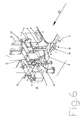
- the material strip 14 which is withdrawn from a Materialbandabrollsystem 7 via stabilizing deflection rollers 21, folded over a forming shoulder 8 down in the direction of the open bag 4, so that the material band 14, the open first end portion 38 of the two, substantially parallel to the conveying direction 20 of the open bag 4 extending sides surrounds and has a coated side of the material strip 14 towards the open bag surface 34, see Fig. 5 and Fig. 6 ,
- the material band 14 may be uncoated on its other, outer side, ie the outside of the material band 14 is formed by the carrier material 28, as in Fig. 3 shown. Alternatively, the material band 14 outside the same coating 29 as on the Offensackober Structure 34 facing side have. However, it is also conceivable that the material band 14 has on its outer side a different coating, for example, to meet optical or other requirements.
- Fig. 7 shows the forming shoulder 8 in detail in an axonometric view of obliquely below.
- the forming shoulder consists of two parts which are mirror-symmetrical with respect to a plane which is spanned by the conveying direction 20 of the open bag 4 and the direction in which the open side of the open bag 4 faces (ie vertically upwards).
- the two parts form a gap 31, over which the material strip 14 is folded and through which the open first end region 38 is conveyed.
- Illustrated here Fig. 8 likewise the forming shoulder 8 in detail, but with the material band 14 pulled over it.
- the surfaces 35 flanking the inlet opening for the open sack 4 are convex and oblique from top to bottom in the conveying direction 20. On the one hand, this allows nestling of the material strip 14 against the forming shoulder 8 and, on the other hand, easy insertion of the open bag 4 into the forming shoulder 8 so that the material strip 14 is laid over the cut edge 36 of the first end region 38.
- air nozzles 6 Simultaneously with the coating of the material strip 14 on the forming shoulder 8 air nozzles 6 by means of a hydraulic ram 16 from a rest position 32 (see Fig. 11 ) into a working position 33 (see in particular FIG. 10 ) swung in. In this position, the air nozzles 6 are arranged so that they have a defined, selectable distance of typically 2 to 8 mm to the forming shoulder 8. In the illustrated embodiment, a total of two air nozzles 6 are present, wherein in each case an air nozzle on the two, is substantially parallel to the conveying direction 20 of the open bag 4 extending sides.
- the outlet openings 37 of the air nozzles 6 have slightly to each other and in the pivoted state in the conveying direction 20 of the open bag 4, see Fig. 6 respectively.
- Fig. 10 The outlet openings 37 are located in each case at the end of a substantially rectangular knee, which connects to a respective, in the working position 33 vertical pipe through which hot air is supplied.
- the outlet openings 37 of the air nozzles 6 are also bevelled, similar to the contour of the forming shoulder 8, see Fig. 6 .
- Fig. 10 and Fig. 11 which favors the swinging.
- hot compressed air or other suitable hot gases are blown into the overlap region 30, in which the material band 14 receives the open first end region 38 V- or U-shaped between them.
- thermal energy is applied without transfer through the carrier material 28 of the material band 14 or through the open bag 4 between and thus on the surfaces 29, 34 to be joined, so that they melt.
- the respective coating or the material of the base body or the carrier material melts.
- the compressed air or suitable gases are heated via a controllable air heater 5.
- the energy input can be specifically changed via the gas temperature and / or via the pressure, and thus via the injected gas quantity.
- the pinch rollers 9 are frictionally connected to the material strip 14 and simultaneously act as a deduction of the material strip 14 from the Materialbandabrollsystem 7.
- the pinch rollers 9 are driven by a variable frequency drive electric motor 19, see Fig. 5 , and run at synchronous speed to the belt system 2.
- a further sensor 12 is mounted, which starts the then placed cutting unit 11 with two knives, see Fig. 6 .
- the cutting unit 11 initially cuts off the material strip 14 in the conveying direction 20 from the already closed first end region 38, see Fig. 6 , As a result, a protrusion of the material strip 14 over the closed cut edge 36 of the first end region 38 in the conveying direction is minimized or avoided.
- the material band 14, as seen in the conveying direction 20 is cut off after the closed first end region 38, see FIG Fig. 11 ,
- the now double-sealed bag 25 can be promoted unhindered from the sealing machine.
- the resulting section strips are transported for example by means of compressed air nozzles and baffles or vacuum suction in a designated container.
- Fig. 11 shows that in the embodiment, the air nozzles 6 vertically Swing up, so that the pivoting action in a vertical plane which is parallel to the conveying direction 20 of the open bag 4, takes place.
- the temperature and the pressure or the amount of injected hot gases and the exact position the air nozzles 6 in the pivoted state to form shoulder 8 for the closing process prevail.
- external influences such as ambient temperature, humidity and impurities, especially dust, can affect the welding process.
- the closure process can be controlled and adapted in this regard.
- a substantially tubular starting material made of coated or uncoated polyolefin fabric, in particular polypropylene or HDPE fabric for the production of an open bag 4 is completely analogous and is not specifically shown.
- a tubular starting material made of coated or uncoated polyolefin fabric, in particular polypropylene or HDPE fabric of which an open first end portion 24 is closed according to the invention with the material strip 14. It may possibly be convenient to convey the starting material lying down. In this case, the spatial arrangement of the device would have to be adapted.
- the positioning of the trimming device 3, the air nozzles 8 in the working position 33, the forming shoulder 8, the pressure rollers 9 and the cutting unit 11 would have to be selected so that lying conveyed starting material at an open first end portion 24, inserted into the forming shoulder 8, coated with the material strip 14 and welded and can be transported out of the device again out.
- the material strip 14 can additionally be sewn in order, for example, to meet particular stresses.
- an already sewn-on end region could thus be reliably sealed off or a first end region 24, 38 already sealed according to the invention could additionally be reinforced.
- the one-sided closure according to the invention can also be applied if the tubular starting material additionally comprises material for an inner sack.
- filled open sacks 4 made of coated or uncoated polyolefin fabric, in particular polypropylene or HDPE fabric, for the production of sacks sealed on two sides can be closed according to the invention if the substantially tubular base body 23 comprises an inner sack.
Landscapes
- Engineering & Computer Science (AREA)
- Mechanical Engineering (AREA)
- Physics & Mathematics (AREA)
- Fluid Mechanics (AREA)
- Chemical & Material Sciences (AREA)
- Combustion & Propulsion (AREA)
- Textile Engineering (AREA)
- Making Paper Articles (AREA)
- Bag Frames (AREA)
Claims (14)
- Procédé pour fermer sur un côté un matériau de départ en forme de tube pour fabriquer un sac ouvert (4) ou pour fermer un sac ouvert (4) rempli et fermé d'un côté ayant un corps de base (23) en forme de tube pour fabriquer un sac fermé des deux côtés (25), dans lequel un lé de matériau (14) en forme de bande, enduit ou non enduit, est plié en forme de V ou de U en section et tiré par-dessus une première partie d'extrémité ouverte (24, 38) du matériau de départ ou du corps de base (23) en forme de tube, le côté du lé de matériau (14) tourné vers le matériau de départ ou le corps de base (23), en particulier, pouvant être enduit d'un revêtement (29) et cette traction produisant une zone de recouvrement (30) dans laquelle le lé de matériau (14) en forme de V ou de U reçoit entre soi la première partie d'extrémité (24, 38) du matériau de départ ou du corps de base (23) en forme de tube, caractérisé en ce que le matériau de départ ou le corps de base (23) en forme de tube est composé de textile de polyoléfine enduit ou non enduit, en particulier de tissu de polypropylène ou de HDPE, et en ce que de l'énergie thermique, de préférence sous la forme d'un gaz, en particulier sous la forme d'air chaud, est introduite directement, de préférence soufflée, dans la zone de recouvrement (30), sur le côté du lé de matériau (14) tourné vers le matériau de départ ou le corps de base (23) et/ou sur la surface du matériau de départ ou du corps de base (23) tournée vers ce côté du lé de matériau (14), et le lé de matériau (14) ainsi que le matériau de départ ou le corps de base (23) sont ensuite pressés ensemble dans la zone de recouvrement (30), l'apport de l'énergie thermique ayant lieu en même temps que la traction du lé de matériau (14) par-dessus la première zone d'extrémité (24, 38) ouverte du matériau de départ ou du corps de base (23) en forme de tube.
- Procédé selon la revendication 1, caractérisé en ce que le matériau de départ ou le corps de base (23) est avancé de façon continue pendant la fermeture et le lé de matériau (14) est tiré à une vitesse réglable, de préférence synchrone par rapport au matériau de départ ou au corps de base (23), par-dessus la première zone d'extrémité (24, 38) ouverte du matériau de départ ou du corps de base (23).
- Procédé selon l'une des revendications 1 à 2, caractérisé en ce que le matériau de départ ou le corps de base (23) est découpé, avant que le lé de matériau (14) soit tiré par-dessus sa première zone d'extrémité (24, 38), à une longueur définie, les bandes découpées formées étant de préférence acheminées vers un bac collecteur.
- Procédé selon la revendication 3, caractérisé en ce que le matériau de départ ou le corps de base (23) est nettoyé après la découpe mais avant l'apport de l'énergie thermique au moyen d'air comprimé dans la première zone d'extrémité (24, 38) ouverte.
- Dispositif pour fermer sur un côté un matériau de départ en forme de tube en tissu de polyoléfine enduit ou non enduit, en particulier en tissu de polypropylène ou de HDPE, pour fabriquer un sac ouvert (4) ou pour fermer un sac ouvert (4) rempli et fermé d'un côté fait d'un tissu de polyoléfine enduit ou non enduit, en particulier d'un tissu de polypropylène ou de HDPE, ayant un corps de base (23) en forme de tube pour fabriquer un sac fermé des deux côtés (25), lequel dispositif comprend un système de dévidage de lé de matériau (7) pour un lé de matériau (14) en forme de bande, ainsi que des moyens (8) pour plier le lé de matériau (14) en forme de V ou de U en section et le tirer par-dessus une première partie d'extrémité (24, 38) ouverte du matériau de départ ou du corps de base (23), caractérisé en ce que le dispositif comprend des moyens (6) pour amener de l'énergie thermique, en même temps que le lé de matériau (14) est tiré par-dessus, directement dans une zone de recouvrement (30), dans laquelle le lé de matériau (14) en forme de V ou de U reçoit entre soi la première partie d'extrémité (24, 38) du matériau de départ ou du corps de base (23), sur la face du lé de matériau (14) tournée vers le matériau de départ ou le corps de base (23) et/ou sur la surface du matériau de départ ou du corps de base tournée vers cette face du lé de matériau (14), ainsi que des moyens presseurs (9) pour presser le lé de matériau (14) sur la surface du matériau de départ ou la surface du corps de base.
- Dispositif selon la revendication 5, caractérisé en ce que le dispositif comprend des moyens de transport (2, 15, 17, 18, 22) pour le transport du matériau de départ ou du corps de base (23) à une vitesse constate et le système de dévidage de lé de matériau (7) peut être réglé de façon synchrone à cette vitesse, les moyens de transport (2, 15, 17, 18, 22) comprenant de préférence un système de courroie (2) qui fixe le matériau de départ ou le corps de base (23) sur la première partie d'extrémité (24, 38) ouverte et l'amène vers les moyens (8) pour le pliage et la traction du lé de matériau (14) et l'éloigne de ceux-ci.
- Dispositif selon la revendication 6, caractérisé en ce que les moyens de transport (2, 15, 17, 18, 22) comprennent en outre un système de bande transporteuse (15, 18, 22) au moyen duquel le matériau de départ, de préférence horizontal, ou le corps de base (23), de préférence vertical, est transporté.
- Dispositif selon l'une des revendications 5 à 7, caractérisé en ce que les moyens (8) pour plier le lé de matériau (14) et le tirer par-dessus la première partie d'extrémité (24, 38) ouverte du matériau de départ ou du corps de base (23) comprennent un épaulement de mise en forme (8) qui présente une fente (31) à travers laquelle la première partie d'extrémité (24, 38) ouverte peut être passée dans une direction de transport (20).
- Dispositif selon la revendication 8, caractérisé en ce que les moyens presseurs (9) comprennent des rouleaux presseurs (9) disposés immédiatement après l'épaulement de mise en forme (8).
- Dispositif selon la revendication 9, caractérisé en ce que les rouleaux presseurs (9) sont reliés par friction avec le lé de matériau (14) et retirent le lé de matériau (14) du système de dévidage du lé de matériau (7).
- Dispositif selon l'une des revendications 5 à 10, caractérisé en ce que les moyens pour apporter de l'énergie thermique comprennent au moins une buse d'air (6) disposée de façon mobile, qui peut être déplacée d'une position de repos (32) à une position de travail (33), l'au moins une buse d'air (6) étant disposée, dans la position de travail (33), de telle façon que des gaz chauds, de préférence de l'air chaud, puissent être soufflés parallèlement au sens de transport (20) du matériau de départ ou du corps de base (23) dans la zone de recouvrement (30), sur la surface du lé de matériau (14) tournée vers le matériau de départ ou le corps de base (23) ou sur la surface du matériau de départ ou du corps de base (23) tournée vers cette face du lé de matériau (14).
- Dispositif selon la revendication 11, caractérisé en ce que le mouvement de l'au moins une buse d'air (6) de la position de repos (32) à la position de travail (33) s'effectue par un pivotement dans un plan vertical parallèle au sens de transport (20) du matériau de départ ou du corps de base (23).
- Dispositif selon l'une des revendications 5 à 12, caractérisé en ce qu'il comprend un dispositif de coupe (3) pour couper le matériau de départ ou le corps de base (23) dans la première partie d'extrémité (24, 38), par-dessus laquelle le lé de matériau (14) est tiré, à une longueur définie et sélectionnable.
- Dispositif selon l'une des revendications 5 à 13, caractérisé en ce que le dispositif comprend une unité de coupe (11) pour couper le lé de matériau (14) avant et après, dans le sens de transport (20), la première partie d'extrémité (24, 38) du matériau de départ ou du corps de base (23) avec lequel le lé de matériau (14) est recouvert.
Applications Claiming Priority (2)
| Application Number | Priority Date | Filing Date | Title |
|---|---|---|---|
| AT0012711U AT12257U1 (de) | 2011-03-07 | 2011-03-07 | Offensack mit einem mittels materialband verschlossenen endbereich |
| PCT/EP2011/065045 WO2012119667A1 (fr) | 2011-03-07 | 2011-08-31 | Sac ouvert ou sac fermé des deux côtés comportant une zone d'extrémité fermée au moyen d'une bande de matériau, procédé et dispositif de fermeture d'un sac |
Publications (2)
| Publication Number | Publication Date |
|---|---|
| EP2683617A1 EP2683617A1 (fr) | 2014-01-15 |
| EP2683617B1 true EP2683617B1 (fr) | 2014-10-01 |
Family
ID=45217919
Family Applications (1)
| Application Number | Title | Priority Date | Filing Date |
|---|---|---|---|
| EP11761027.9A Active EP2683617B1 (fr) | 2011-03-07 | 2011-08-31 | Procédé et dispositif de fermeture d'un sac |
Country Status (6)
| Country | Link |
|---|---|
| EP (1) | EP2683617B1 (fr) |
| AT (1) | AT12257U1 (fr) |
| BR (1) | BR112013022393B1 (fr) |
| CA (1) | CA2829265C (fr) |
| ES (1) | ES2525836T3 (fr) |
| WO (1) | WO2012119667A1 (fr) |
Cited By (2)
| Publication number | Priority date | Publication date | Assignee | Title |
|---|---|---|---|---|
| EP4132854A4 (fr) * | 2020-04-06 | 2024-06-12 | Lohia Corp Limited | Appareil et procédé pour sceller des extrémités ouvertes de sacs par une couture facile à ouvrir et sac à couture facile à ouvrir |
| EP4699943A1 (fr) * | 2024-08-19 | 2026-02-25 | Poly-clip System GmbH & Co. KG | Machine d'emballage avec unité de retrait |
Families Citing this family (13)
| Publication number | Priority date | Publication date | Assignee | Title |
|---|---|---|---|---|
| AT15695U1 (de) * | 2016-10-14 | 2018-04-15 | Starlinger & Co Gmbh | Vorrichtung und Verfahren zum Verschließen eines offenen Endes eines Schlauchkörpers |
| CN109205055A (zh) * | 2017-07-03 | 2019-01-15 | 广元公正科技有限公司 | 买冰冻产品的设备 |
| CN107745547B (zh) * | 2017-11-06 | 2024-07-26 | 浙江瑞航塑业有限公司 | 塑料立体袋方底两侧烫合排气成型装置 |
| CN110371400B (zh) * | 2019-07-31 | 2024-03-12 | 厦门成飞自动化设备有限公司 | 一种具有下料功能的真空装配体 |
| CN111590959B (zh) * | 2020-06-22 | 2025-06-17 | 成都雕腾包装有限公司 | 一种用于包装盒粘胶部位施压热烫固化装置及流水线系统 |
| CN111746870A (zh) * | 2020-06-23 | 2020-10-09 | 深圳市俊达通办公智能科技有限公司 | 一种封口效果好的包装设备 |
| CN112959741A (zh) * | 2021-03-04 | 2021-06-15 | 涡阳县利达塑料包装制品有限公司 | 一种可靠稳定的塑编袋输送装置 |
| CN113493029A (zh) * | 2021-07-27 | 2021-10-12 | 江苏凯威药用包装有限公司 | 一种应用于包装设计的袋口封装设备 |
| CN113547794A (zh) * | 2021-09-01 | 2021-10-26 | 汕头市浩普智能设备有限公司 | 一种包装筒袋侧面易撕口打孔装置 |
| CN114180120B (zh) * | 2021-12-24 | 2023-03-14 | 武汉轻工大学 | 一种双层包装袋外袋夹紧装置、双层包装袋外袋扎口设备 |
| CN114408289B (zh) * | 2022-01-11 | 2025-03-14 | 温州市中轻五金刀具有限公司 | 一种胶带粘贴装置及其自动胶带泡壳贴卡机 |
| CN117342077B (zh) * | 2023-12-04 | 2024-02-06 | 常州树杰塑业有限公司 | 一种pe塑料薄膜的热封包装装置 |
| CN118769616A (zh) * | 2024-09-10 | 2024-10-15 | 明达塑胶科技(苏州)有限公司 | 基于塑胶袋生产的热封制袋控制系统 |
Family Cites Families (9)
| Publication number | Priority date | Publication date | Assignee | Title |
|---|---|---|---|---|
| GB937011A (en) * | 1960-07-02 | 1963-09-18 | Du Pont Canada | Bag closure |
| US3720565A (en) * | 1970-06-29 | 1973-03-13 | M Cavanna | Device for longitudinally welding tapes of plastics material - in packaging machines |
| US4278488A (en) * | 1979-10-01 | 1981-07-14 | Kimberly-Clark Corporation | Tape delivery system |
| GB2073130B (en) * | 1980-03-13 | 1983-12-14 | Hammex Machines Ltd | Re-closable package |
| MY105246A (en) * | 1989-01-24 | 1994-08-30 | Ohishi Sangyo Co Ltd | Overtape-sealed bag |
| AT400831B (de) | 1994-05-04 | 1996-03-25 | Starlinger & Co Gmbh | Sack aus polymer-, insbesondere polyolefingewebe und verfahren zu seiner herstellung |
| FR2741599B1 (fr) * | 1995-11-29 | 1998-01-09 | Jr Maruani Sarl Ets | Emballage a ouverture facile |
| FR2816586B1 (fr) * | 2000-11-13 | 2003-01-10 | Cif | Procede de fermeture d'un sac a gueule ouverte et installation pour la mise en oeuvre d'un tel procede |
| US20100266223A1 (en) * | 2006-06-15 | 2010-10-21 | Standard Multiwall Bag Manufacturing Co. | Pinch bottom open mouth bag |
-
2011
- 2011-03-07 AT AT0012711U patent/AT12257U1/de not_active IP Right Cessation
- 2011-08-31 WO PCT/EP2011/065045 patent/WO2012119667A1/fr not_active Ceased
- 2011-08-31 EP EP11761027.9A patent/EP2683617B1/fr active Active
- 2011-08-31 CA CA2829265A patent/CA2829265C/fr active Active
- 2011-08-31 BR BR112013022393-6A patent/BR112013022393B1/pt active IP Right Grant
- 2011-08-31 ES ES11761027.9T patent/ES2525836T3/es active Active
Cited By (2)
| Publication number | Priority date | Publication date | Assignee | Title |
|---|---|---|---|---|
| EP4132854A4 (fr) * | 2020-04-06 | 2024-06-12 | Lohia Corp Limited | Appareil et procédé pour sceller des extrémités ouvertes de sacs par une couture facile à ouvrir et sac à couture facile à ouvrir |
| EP4699943A1 (fr) * | 2024-08-19 | 2026-02-25 | Poly-clip System GmbH & Co. KG | Machine d'emballage avec unité de retrait |
Also Published As
| Publication number | Publication date |
|---|---|
| EP2683617A1 (fr) | 2014-01-15 |
| CA2829265C (fr) | 2018-10-23 |
| BR112013022393A2 (pt) | 2016-12-06 |
| BR112013022393B1 (pt) | 2020-06-23 |
| CA2829265A1 (fr) | 2012-09-13 |
| ES2525836T3 (es) | 2014-12-30 |
| WO2012119667A1 (fr) | 2012-09-13 |
| AT12257U1 (de) | 2012-02-15 |
Similar Documents
| Publication | Publication Date | Title |
|---|---|---|
| AT12257U1 (de) | Offensack mit einem mittels materialband verschlossenen endbereich | |
| DE3316065C2 (de) | Verfahren zum Füllen, Entlüften und Verschließen von Säcken | |
| DE69000994T2 (de) | Verpackungsmaschine. | |
| DE4126557A1 (de) | Ultraschallschweissen bei der herstellung von beuteln | |
| DE112012004359T5 (de) | Vorrichtung zur formung einer langgestreckten kunststofffolie zu einem rohr rund um artikel variabler grösse | |
| EP2199208B1 (fr) | Dispositif de dosage | |
| DE112015005455T5 (de) | Vorrichtung, Verfahren und Systeme zur Heißversiegelung | |
| DE2550609A1 (de) | Verpackungsmaschine und verfahren zum verpacken von im vakuum oder einem schutzgas aufzubewahrenden erzeugnissen | |
| WO2015155054A2 (fr) | Moyen d'emballage et dispositif et procédé de fabrication d'un moyen d'emballage | |
| DE19538146A1 (de) | Beutel mit mindestens einer Entlüftungsstelle und Verfahren zur Herstellung des Beutels | |
| DE102010035437A1 (de) | Schlauchbeutelmaschine zum Herstellen und Füllen von schlauchartigen Beuteln | |
| DE2730132A1 (de) | Beutel aus folienmaterial | |
| EP3024625A1 (fr) | Procédé et dispositif de production de sacs en tissu | |
| DE102008056979A1 (de) | Verfahren und Vorrichtung zum Herstellen von Endloshalbschlauch | |
| EP3131825A2 (fr) | Moyen d'emballage et procédé et dispositif de fabrication d'un moyen d'emballage | |
| DE1291677B (de) | Verfahren und Vorrichtung zum Zufuehren einer Folienbahn zu einer Faltstation | |
| DE102019103886B4 (de) | Verfahren zum Betreiben, insbesondere Zurücksetzen, einer Folienverpackungsmaschine und Folienverpackungsmaschine | |
| DE2020622A1 (de) | Verfahren und Vorrichtung zur Herstellung von Verpackungsmaterial fuer feuchtigkeitsempfindliches Gut | |
| EP1232850B1 (fr) | Procédé et appareil pour le formage et/ou la fermeture d'un unité d'emballage | |
| DE10134255B4 (de) | Verpackungsmaschine | |
| DE102018102369B4 (de) | Folienverpackungsmaschine zum Verpacken von Gegenständen in Luftpolsterfolienverpackungen | |
| EP3047962B1 (fr) | Dispositif de scellage d'un emballage ou d'un materiau d'emballage | |
| DE1953953A1 (de) | Verfahren und Vorrichtung zum Herstellen eines Beutels mit Tragegriff | |
| WO2026012626A1 (fr) | Station de formation de fond et procédé de formation d'un fond repliable sur une pièce de tube en tissu | |
| DE102024110016A1 (de) | Verpackungsmaschine und Verfahren |
Legal Events
| Date | Code | Title | Description |
|---|---|---|---|
| PUAI | Public reference made under article 153(3) epc to a published international application that has entered the european phase |
Free format text: ORIGINAL CODE: 0009012 |
|
| 17P | Request for examination filed |
Effective date: 20131007 |
|
| AK | Designated contracting states |
Kind code of ref document: A1 Designated state(s): AL AT BE BG CH CY CZ DE DK EE ES FI FR GB GR HR HU IE IS IT LI LT LU LV MC MK MT NL NO PL PT RO RS SE SI SK SM TR |
|
| RIC1 | Information provided on ipc code assigned before grant |
Ipc: B65B 51/20 20060101ALI20140224BHEP Ipc: B31B 19/60 20060101ALI20140224BHEP Ipc: B65B 51/06 20060101ALI20140224BHEP Ipc: B29C 65/10 20060101ALI20140224BHEP Ipc: B65B 7/16 20060101ALI20140224BHEP Ipc: B31B 19/90 20060101ALI20140224BHEP Ipc: B65B 51/16 20060101ALI20140224BHEP Ipc: B29C 65/50 20060101ALI20140224BHEP Ipc: B65B 51/04 20060101ALI20140224BHEP Ipc: B65B 1/02 20060101ALI20140224BHEP Ipc: B29C 65/00 20060101ALI20140224BHEP Ipc: B65B 61/00 20060101ALI20140224BHEP Ipc: B65D 33/16 20060101AFI20140224BHEP Ipc: B65B 7/02 20060101ALI20140224BHEP Ipc: B65B 55/24 20060101ALI20140224BHEP |
|
| GRAP | Despatch of communication of intention to grant a patent |
Free format text: ORIGINAL CODE: EPIDOSNIGR1 |
|
| DAX | Request for extension of the european patent (deleted) | ||
| INTG | Intention to grant announced |
Effective date: 20140417 |
|
| GRAS | Grant fee paid |
Free format text: ORIGINAL CODE: EPIDOSNIGR3 |
|
| GRAA | (expected) grant |
Free format text: ORIGINAL CODE: 0009210 |
|
| AK | Designated contracting states |
Kind code of ref document: B1 Designated state(s): AL AT BE BG CH CY CZ DE DK EE ES FI FR GB GR HR HU IE IS IT LI LT LU LV MC MK MT NL NO PL PT RO RS SE SI SK SM TR |
|
| REG | Reference to a national code |
Ref country code: GB Ref legal event code: FG4D Free format text: NOT ENGLISH |
|
| REG | Reference to a national code |
Ref country code: AT Ref legal event code: REF Ref document number: 689392 Country of ref document: AT Kind code of ref document: T Effective date: 20141015 Ref country code: CH Ref legal event code: EP |
|
| REG | Reference to a national code |
Ref country code: IE Ref legal event code: FG4D Free format text: LANGUAGE OF EP DOCUMENT: GERMAN |
|
| REG | Reference to a national code |
Ref country code: DE Ref legal event code: R096 Ref document number: 502011004553 Country of ref document: DE Effective date: 20141113 |
|
| REG | Reference to a national code |
Ref country code: NL Ref legal event code: T3 |
|
| REG | Reference to a national code |
Ref country code: ES Ref legal event code: FG2A Ref document number: 2525836 Country of ref document: ES Kind code of ref document: T3 Effective date: 20141230 |
|
| REG | Reference to a national code |
Ref country code: LT Ref legal event code: MG4D |
|
| PG25 | Lapsed in a contracting state [announced via postgrant information from national office to epo] |
Ref country code: LT Free format text: LAPSE BECAUSE OF FAILURE TO SUBMIT A TRANSLATION OF THE DESCRIPTION OR TO PAY THE FEE WITHIN THE PRESCRIBED TIME-LIMIT Effective date: 20141001 Ref country code: FI Free format text: LAPSE BECAUSE OF FAILURE TO SUBMIT A TRANSLATION OF THE DESCRIPTION OR TO PAY THE FEE WITHIN THE PRESCRIBED TIME-LIMIT Effective date: 20141001 Ref country code: CZ Free format text: LAPSE BECAUSE OF FAILURE TO SUBMIT A TRANSLATION OF THE DESCRIPTION OR TO PAY THE FEE WITHIN THE PRESCRIBED TIME-LIMIT Effective date: 20141001 Ref country code: PT Free format text: LAPSE BECAUSE OF FAILURE TO SUBMIT A TRANSLATION OF THE DESCRIPTION OR TO PAY THE FEE WITHIN THE PRESCRIBED TIME-LIMIT Effective date: 20150202 Ref country code: NO Free format text: LAPSE BECAUSE OF FAILURE TO SUBMIT A TRANSLATION OF THE DESCRIPTION OR TO PAY THE FEE WITHIN THE PRESCRIBED TIME-LIMIT Effective date: 20150101 Ref country code: IS Free format text: LAPSE BECAUSE OF FAILURE TO SUBMIT A TRANSLATION OF THE DESCRIPTION OR TO PAY THE FEE WITHIN THE PRESCRIBED TIME-LIMIT Effective date: 20150201 |
|
| PG25 | Lapsed in a contracting state [announced via postgrant information from national office to epo] |
Ref country code: RS Free format text: LAPSE BECAUSE OF FAILURE TO SUBMIT A TRANSLATION OF THE DESCRIPTION OR TO PAY THE FEE WITHIN THE PRESCRIBED TIME-LIMIT Effective date: 20141001 Ref country code: LV Free format text: LAPSE BECAUSE OF FAILURE TO SUBMIT A TRANSLATION OF THE DESCRIPTION OR TO PAY THE FEE WITHIN THE PRESCRIBED TIME-LIMIT Effective date: 20141001 Ref country code: CY Free format text: LAPSE BECAUSE OF FAILURE TO SUBMIT A TRANSLATION OF THE DESCRIPTION OR TO PAY THE FEE WITHIN THE PRESCRIBED TIME-LIMIT Effective date: 20141001 Ref country code: SE Free format text: LAPSE BECAUSE OF FAILURE TO SUBMIT A TRANSLATION OF THE DESCRIPTION OR TO PAY THE FEE WITHIN THE PRESCRIBED TIME-LIMIT Effective date: 20141001 Ref country code: HR Free format text: LAPSE BECAUSE OF FAILURE TO SUBMIT A TRANSLATION OF THE DESCRIPTION OR TO PAY THE FEE WITHIN THE PRESCRIBED TIME-LIMIT Effective date: 20141001 Ref country code: GR Free format text: LAPSE BECAUSE OF FAILURE TO SUBMIT A TRANSLATION OF THE DESCRIPTION OR TO PAY THE FEE WITHIN THE PRESCRIBED TIME-LIMIT Effective date: 20150102 Ref country code: PL Free format text: LAPSE BECAUSE OF FAILURE TO SUBMIT A TRANSLATION OF THE DESCRIPTION OR TO PAY THE FEE WITHIN THE PRESCRIBED TIME-LIMIT Effective date: 20141001 |
|
| REG | Reference to a national code |
Ref country code: DE Ref legal event code: R097 Ref document number: 502011004553 Country of ref document: DE |
|
| PG25 | Lapsed in a contracting state [announced via postgrant information from national office to epo] |
Ref country code: DK Free format text: LAPSE BECAUSE OF FAILURE TO SUBMIT A TRANSLATION OF THE DESCRIPTION OR TO PAY THE FEE WITHIN THE PRESCRIBED TIME-LIMIT Effective date: 20141001 Ref country code: SK Free format text: LAPSE BECAUSE OF FAILURE TO SUBMIT A TRANSLATION OF THE DESCRIPTION OR TO PAY THE FEE WITHIN THE PRESCRIBED TIME-LIMIT Effective date: 20141001 Ref country code: RO Free format text: LAPSE BECAUSE OF FAILURE TO SUBMIT A TRANSLATION OF THE DESCRIPTION OR TO PAY THE FEE WITHIN THE PRESCRIBED TIME-LIMIT Effective date: 20141001 Ref country code: EE Free format text: LAPSE BECAUSE OF FAILURE TO SUBMIT A TRANSLATION OF THE DESCRIPTION OR TO PAY THE FEE WITHIN THE PRESCRIBED TIME-LIMIT Effective date: 20141001 |
|
| PLBE | No opposition filed within time limit |
Free format text: ORIGINAL CODE: 0009261 |
|
| STAA | Information on the status of an ep patent application or granted ep patent |
Free format text: STATUS: NO OPPOSITION FILED WITHIN TIME LIMIT |
|
| 26N | No opposition filed |
Effective date: 20150702 |
|
| PG25 | Lapsed in a contracting state [announced via postgrant information from national office to epo] |
Ref country code: SI Free format text: LAPSE BECAUSE OF FAILURE TO SUBMIT A TRANSLATION OF THE DESCRIPTION OR TO PAY THE FEE WITHIN THE PRESCRIBED TIME-LIMIT Effective date: 20141001 |
|
| PG25 | Lapsed in a contracting state [announced via postgrant information from national office to epo] |
Ref country code: MC Free format text: LAPSE BECAUSE OF FAILURE TO SUBMIT A TRANSLATION OF THE DESCRIPTION OR TO PAY THE FEE WITHIN THE PRESCRIBED TIME-LIMIT Effective date: 20141001 Ref country code: LU Free format text: LAPSE BECAUSE OF FAILURE TO SUBMIT A TRANSLATION OF THE DESCRIPTION OR TO PAY THE FEE WITHIN THE PRESCRIBED TIME-LIMIT Effective date: 20150831 |
|
| REG | Reference to a national code |
Ref country code: CH Ref legal event code: PL |
|
| PG25 | Lapsed in a contracting state [announced via postgrant information from national office to epo] |
Ref country code: CH Free format text: LAPSE BECAUSE OF NON-PAYMENT OF DUE FEES Effective date: 20150831 Ref country code: LI Free format text: LAPSE BECAUSE OF NON-PAYMENT OF DUE FEES Effective date: 20150831 |
|
| REG | Reference to a national code |
Ref country code: IE Ref legal event code: MM4A |
|
| PG25 | Lapsed in a contracting state [announced via postgrant information from national office to epo] |
Ref country code: IE Free format text: LAPSE BECAUSE OF NON-PAYMENT OF DUE FEES Effective date: 20150831 |
|
| REG | Reference to a national code |
Ref country code: FR Ref legal event code: PLFP Year of fee payment: 6 |
|
| PG25 | Lapsed in a contracting state [announced via postgrant information from national office to epo] |
Ref country code: MT Free format text: LAPSE BECAUSE OF FAILURE TO SUBMIT A TRANSLATION OF THE DESCRIPTION OR TO PAY THE FEE WITHIN THE PRESCRIBED TIME-LIMIT Effective date: 20141001 |
|
| PG25 | Lapsed in a contracting state [announced via postgrant information from national office to epo] |
Ref country code: HU Free format text: LAPSE BECAUSE OF FAILURE TO SUBMIT A TRANSLATION OF THE DESCRIPTION OR TO PAY THE FEE WITHIN THE PRESCRIBED TIME-LIMIT; INVALID AB INITIO Effective date: 20110831 Ref country code: BG Free format text: LAPSE BECAUSE OF FAILURE TO SUBMIT A TRANSLATION OF THE DESCRIPTION OR TO PAY THE FEE WITHIN THE PRESCRIBED TIME-LIMIT Effective date: 20141001 Ref country code: SM Free format text: LAPSE BECAUSE OF FAILURE TO SUBMIT A TRANSLATION OF THE DESCRIPTION OR TO PAY THE FEE WITHIN THE PRESCRIBED TIME-LIMIT Effective date: 20141001 |
|
| REG | Reference to a national code |
Ref country code: FR Ref legal event code: PLFP Year of fee payment: 7 |
|
| PG25 | Lapsed in a contracting state [announced via postgrant information from national office to epo] |
Ref country code: TR Free format text: LAPSE BECAUSE OF FAILURE TO SUBMIT A TRANSLATION OF THE DESCRIPTION OR TO PAY THE FEE WITHIN THE PRESCRIBED TIME-LIMIT Effective date: 20141001 Ref country code: MK Free format text: LAPSE BECAUSE OF FAILURE TO SUBMIT A TRANSLATION OF THE DESCRIPTION OR TO PAY THE FEE WITHIN THE PRESCRIBED TIME-LIMIT Effective date: 20141001 |
|
| REG | Reference to a national code |
Ref country code: FR Ref legal event code: PLFP Year of fee payment: 8 |
|
| PG25 | Lapsed in a contracting state [announced via postgrant information from national office to epo] |
Ref country code: AL Free format text: LAPSE BECAUSE OF FAILURE TO SUBMIT A TRANSLATION OF THE DESCRIPTION OR TO PAY THE FEE WITHIN THE PRESCRIBED TIME-LIMIT Effective date: 20141001 |
|
| P01 | Opt-out of the competence of the unified patent court (upc) registered |
Effective date: 20230510 |
|
| PGFP | Annual fee paid to national office [announced via postgrant information from national office to epo] |
Ref country code: NL Payment date: 20250825 Year of fee payment: 15 |
|
| PGFP | Annual fee paid to national office [announced via postgrant information from national office to epo] |
Ref country code: ES Payment date: 20250901 Year of fee payment: 15 |
|
| PGFP | Annual fee paid to national office [announced via postgrant information from national office to epo] |
Ref country code: DE Payment date: 20250828 Year of fee payment: 15 |
|
| PGFP | Annual fee paid to national office [announced via postgrant information from national office to epo] |
Ref country code: IT Payment date: 20250725 Year of fee payment: 15 |
|
| PGFP | Annual fee paid to national office [announced via postgrant information from national office to epo] |
Ref country code: BE Payment date: 20250827 Year of fee payment: 15 Ref country code: GB Payment date: 20250828 Year of fee payment: 15 |
|
| PGFP | Annual fee paid to national office [announced via postgrant information from national office to epo] |
Ref country code: FR Payment date: 20250725 Year of fee payment: 15 Ref country code: AT Payment date: 20250822 Year of fee payment: 15 |