EP2683686B1 - Verfahren zur herstellung von primären aminen durch homogen-katalysierte alkoholaminierung - Google Patents
Verfahren zur herstellung von primären aminen durch homogen-katalysierte alkoholaminierung Download PDFInfo
- Publication number
- EP2683686B1 EP2683686B1 EP12707089.4A EP12707089A EP2683686B1 EP 2683686 B1 EP2683686 B1 EP 2683686B1 EP 12707089 A EP12707089 A EP 12707089A EP 2683686 B1 EP2683686 B1 EP 2683686B1
- Authority
- EP
- European Patent Office
- Prior art keywords
- alkyl
- group
- aryl
- independently
- unsubstituted
- Prior art date
- Legal status (The legal status is an assumption and is not a legal conclusion. Google has not performed a legal analysis and makes no representation as to the accuracy of the status listed.)
- Not-in-force
Links
- 238000000034 method Methods 0.000 title claims description 46
- 238000005576 amination reaction Methods 0.000 title claims description 30
- 150000003141 primary amines Chemical class 0.000 title claims description 16
- 238000002360 preparation method Methods 0.000 title claims description 10
- 150000001298 alcohols Chemical class 0.000 title description 16
- 125000005842 heteroatom Chemical group 0.000 claims description 130
- 229910052760 oxygen Inorganic materials 0.000 claims description 121
- 229910052717 sulfur Inorganic materials 0.000 claims description 106
- 125000000008 (C1-C10) alkyl group Chemical group 0.000 claims description 91
- YXFVVABEGXRONW-UHFFFAOYSA-N Toluene Chemical compound CC1=CC=CC=C1 YXFVVABEGXRONW-UHFFFAOYSA-N 0.000 claims description 78
- 229910052794 bromium Inorganic materials 0.000 claims description 76
- 229910052801 chlorine Inorganic materials 0.000 claims description 76
- 229910052731 fluorine Inorganic materials 0.000 claims description 76
- QGZKDVFQNNGYKY-UHFFFAOYSA-N Ammonia Chemical compound N QGZKDVFQNNGYKY-UHFFFAOYSA-N 0.000 claims description 71
- 239000003054 catalyst Substances 0.000 claims description 60
- 125000001424 substituent group Chemical group 0.000 claims description 51
- 125000001313 C5-C10 heteroaryl group Chemical group 0.000 claims description 45
- 239000003446 ligand Substances 0.000 claims description 41
- CXNIUSPIQKWYAI-UHFFFAOYSA-N xantphos Chemical compound C=12OC3=C(P(C=4C=CC=CC=4)C=4C=CC=CC=4)C=CC=C3C(C)(C)C2=CC=CC=1P(C=1C=CC=CC=1)C1=CC=CC=C1 CXNIUSPIQKWYAI-UHFFFAOYSA-N 0.000 claims description 39
- 229910021529 ammonia Inorganic materials 0.000 claims description 35
- AXVOAMVQOCBPQT-UHFFFAOYSA-N triphos Chemical compound C=1C=CC=CC=1P(C=1C=CC=CC=1)CCP(C=1C=CC=CC=1)CCP(C=1C=CC=CC=1)C1=CC=CC=C1 AXVOAMVQOCBPQT-UHFFFAOYSA-N 0.000 claims description 35
- -1 monosubstituted methylene, ethylene, trimethylene, tetramethylene, pentamethylene Chemical group 0.000 claims description 34
- 229910052698 phosphorus Inorganic materials 0.000 claims description 32
- OAICVXFJPJFONN-UHFFFAOYSA-N Phosphorus Chemical compound [P] OAICVXFJPJFONN-UHFFFAOYSA-N 0.000 claims description 26
- 125000000524 functional group Chemical group 0.000 claims description 26
- UHOVQNZJYSORNB-UHFFFAOYSA-N Benzene Chemical compound C1=CC=CC=C1 UHOVQNZJYSORNB-UHFFFAOYSA-N 0.000 claims description 25
- 125000000172 C5-C10 aryl group Chemical group 0.000 claims description 25
- 239000011574 phosphorus Substances 0.000 claims description 24
- 125000001997 phenyl group Chemical group [H]C1=C([H])C([H])=C(*)C([H])=C1[H] 0.000 claims description 22
- 239000007858 starting material Substances 0.000 claims description 22
- XLYOFNOQVPJJNP-UHFFFAOYSA-N water Substances O XLYOFNOQVPJJNP-UHFFFAOYSA-N 0.000 claims description 17
- LFQSCWFLJHTTHZ-UHFFFAOYSA-N Ethanol Chemical compound CCO LFQSCWFLJHTTHZ-UHFFFAOYSA-N 0.000 claims description 15
- 125000000027 (C1-C10) alkoxy group Chemical group 0.000 claims description 14
- 230000000737 periodic effect Effects 0.000 claims description 13
- RTZKZFJDLAIYFH-UHFFFAOYSA-N Diethyl ether Chemical compound CCOCC RTZKZFJDLAIYFH-UHFFFAOYSA-N 0.000 claims description 12
- IMNFDUFMRHMDMM-UHFFFAOYSA-N N-Heptane Chemical compound CCCCCCC IMNFDUFMRHMDMM-UHFFFAOYSA-N 0.000 claims description 12
- WYURNTSHIVDZCO-UHFFFAOYSA-N Tetrahydrofuran Chemical compound C1CCOC1 WYURNTSHIVDZCO-UHFFFAOYSA-N 0.000 claims description 12
- VLKZOEOYAKHREP-UHFFFAOYSA-N n-Hexane Chemical class CCCCCC VLKZOEOYAKHREP-UHFFFAOYSA-N 0.000 claims description 12
- KJTLSVCANCCWHF-UHFFFAOYSA-N Ruthenium Chemical compound [Ru] KJTLSVCANCCWHF-UHFFFAOYSA-N 0.000 claims description 11
- 229910052707 ruthenium Inorganic materials 0.000 claims description 11
- 125000004836 hexamethylene group Chemical group [H]C([H])([*:2])C([H])([H])C([H])([H])C([H])([H])C([H])([H])C([H])([H])[*:1] 0.000 claims description 10
- 229910052799 carbon Inorganic materials 0.000 claims description 9
- 229910052741 iridium Inorganic materials 0.000 claims description 9
- GKOZUEZYRPOHIO-UHFFFAOYSA-N iridium atom Chemical compound [Ir] GKOZUEZYRPOHIO-UHFFFAOYSA-N 0.000 claims description 9
- 229910052757 nitrogen Inorganic materials 0.000 claims description 9
- 239000012454 non-polar solvent Substances 0.000 claims description 9
- 125000004178 (C1-C4) alkyl group Chemical group 0.000 claims description 8
- BARUNXKDFNLHEV-UHFFFAOYSA-N [3-diphenylphosphanyl-2-(diphenylphosphanylmethyl)-2-methylpropyl]-diphenylphosphane Chemical compound C=1C=CC=CC=1P(C=1C=CC=CC=1)CC(CP(C=1C=CC=CC=1)C=1C=CC=CC=1)(C)CP(C=1C=CC=CC=1)C1=CC=CC=C1 BARUNXKDFNLHEV-UHFFFAOYSA-N 0.000 claims description 7
- 239000008096 xylene Substances 0.000 claims description 7
- BCJVBDBJSMFBRW-UHFFFAOYSA-N 4-diphenylphosphanylbutyl(diphenyl)phosphane Chemical compound C=1C=CC=CC=1P(C=1C=CC=CC=1)CCCCP(C=1C=CC=CC=1)C1=CC=CC=C1 BCJVBDBJSMFBRW-UHFFFAOYSA-N 0.000 claims description 6
- LVEYOSJUKRVCCF-UHFFFAOYSA-N 1,3-Bis(diphenylphosphino)propane Substances C=1C=CC=CC=1P(C=1C=CC=CC=1)CCCP(C=1C=CC=CC=1)C1=CC=CC=C1 LVEYOSJUKRVCCF-UHFFFAOYSA-N 0.000 claims description 4
- XDTMQSROBMDMFD-UHFFFAOYSA-N Cyclohexane Chemical compound C1CCCCC1 XDTMQSROBMDMFD-UHFFFAOYSA-N 0.000 claims description 4
- XTHFKEDIFFGKHM-UHFFFAOYSA-N Dimethoxyethane Chemical compound COCCOC XTHFKEDIFFGKHM-UHFFFAOYSA-N 0.000 claims description 4
- AUHZEENZYGFFBQ-UHFFFAOYSA-N mesitylene Substances CC1=CC(C)=CC(C)=C1 AUHZEENZYGFFBQ-UHFFFAOYSA-N 0.000 claims description 4
- 125000001827 mesitylenyl group Chemical group [H]C1=C(C(*)=C(C([H])=C1C([H])([H])[H])C([H])([H])[H])C([H])([H])[H] 0.000 claims description 4
- RYHBNJHYFVUHQT-UHFFFAOYSA-N 1,4-Dioxane Chemical compound C1COCCO1 RYHBNJHYFVUHQT-UHFFFAOYSA-N 0.000 claims description 3
- BZLVMXJERCGZMT-UHFFFAOYSA-N Methyl tert-butyl ether Chemical compound COC(C)(C)C BZLVMXJERCGZMT-UHFFFAOYSA-N 0.000 claims description 3
- TVMXDCGIABBOFY-UHFFFAOYSA-N octane Chemical compound CCCCCCCC TVMXDCGIABBOFY-UHFFFAOYSA-N 0.000 claims description 3
- QFMZQPDHXULLKC-UHFFFAOYSA-N 1,2-bis(diphenylphosphino)ethane Chemical compound C=1C=CC=CC=1P(C=1C=CC=CC=1)CCP(C=1C=CC=CC=1)C1=CC=CC=C1 QFMZQPDHXULLKC-UHFFFAOYSA-N 0.000 claims description 2
- CTQNGGLPUBDAKN-UHFFFAOYSA-N O-Xylene Chemical compound CC1=CC=CC=C1C CTQNGGLPUBDAKN-UHFFFAOYSA-N 0.000 claims description 2
- BOUYBUIVMHNXQB-UHFFFAOYSA-N dicyclohexyl(2-dicyclohexylphosphanylethyl)phosphane Chemical compound C1CCCCC1P(C1CCCCC1)CCP(C1CCCCC1)C1CCCCC1 BOUYBUIVMHNXQB-UHFFFAOYSA-N 0.000 claims description 2
- SBZXBUIDTXKZTM-UHFFFAOYSA-N diglyme Chemical compound COCCOCCOC SBZXBUIDTXKZTM-UHFFFAOYSA-N 0.000 claims description 2
- 230000008030 elimination Effects 0.000 claims description 2
- 238000003379 elimination reaction Methods 0.000 claims description 2
- JJRYTJCOOYOVOZ-UHFFFAOYSA-N 1-diphenylphosphanylbutan-2-yl(diphenyl)phosphane Chemical compound C=1C=CC=CC=1P(C=1C=CC=CC=1)C(CC)CP(C=1C=CC=CC=1)C1=CC=CC=C1 JJRYTJCOOYOVOZ-UHFFFAOYSA-N 0.000 claims 1
- WGOBPPNNYVSJTE-UHFFFAOYSA-N 1-diphenylphosphanylpropan-2-yl(diphenyl)phosphane Chemical compound C=1C=CC=CC=1P(C=1C=CC=CC=1)C(C)CP(C=1C=CC=CC=1)C1=CC=CC=C1 WGOBPPNNYVSJTE-UHFFFAOYSA-N 0.000 claims 1
- 238000007172 homogeneous catalysis Methods 0.000 claims 1
- 238000006243 chemical reaction Methods 0.000 description 53
- 125000000217 alkyl group Chemical group 0.000 description 41
- 239000000047 product Substances 0.000 description 38
- 239000002904 solvent Substances 0.000 description 38
- ZVENKBGRIGHMRG-UHFFFAOYSA-M carbon monoxide chloro(hydrido)ruthenium triphenylphosphane Chemical compound [C-]#[O+].[H][Ru]Cl.c1ccc(cc1)P(c1ccccc1)c1ccccc1.c1ccc(cc1)P(c1ccccc1)c1ccccc1.c1ccc(cc1)P(c1ccccc1)c1ccccc1 ZVENKBGRIGHMRG-UHFFFAOYSA-M 0.000 description 33
- 125000003118 aryl group Chemical group 0.000 description 28
- URLKBWYHVLBVBO-UHFFFAOYSA-N Para-Xylene Chemical group CC1=CC=C(C)C=C1 URLKBWYHVLBVBO-UHFFFAOYSA-N 0.000 description 18
- MTHSVFCYNBDYFN-UHFFFAOYSA-N diethylene glycol Chemical compound OCCOCCO MTHSVFCYNBDYFN-UHFFFAOYSA-N 0.000 description 15
- 125000002887 hydroxy group Chemical group [H]O* 0.000 description 15
- XYFCBTPGUUZFHI-UHFFFAOYSA-N Phosphine Chemical compound P XYFCBTPGUUZFHI-UHFFFAOYSA-N 0.000 description 12
- 239000000758 substrate Substances 0.000 description 12
- LYCAIKOWRPUZTN-UHFFFAOYSA-N Ethylene glycol Chemical compound OCCO LYCAIKOWRPUZTN-UHFFFAOYSA-N 0.000 description 10
- WERYXYBDKMZEQL-UHFFFAOYSA-N butane-1,4-diol Chemical compound OCCCCO WERYXYBDKMZEQL-UHFFFAOYSA-N 0.000 description 10
- KBPLFHHGFOOTCA-UHFFFAOYSA-N caprylic alcohol Natural products CCCCCCCCO KBPLFHHGFOOTCA-UHFFFAOYSA-N 0.000 description 10
- 239000007788 liquid Substances 0.000 description 10
- 150000002009 diols Chemical class 0.000 description 9
- 229910052751 metal Inorganic materials 0.000 description 9
- 239000002184 metal Substances 0.000 description 9
- 239000012071 phase Substances 0.000 description 9
- 150000003839 salts Chemical class 0.000 description 9
- XEEYBQQBJWHFJM-UHFFFAOYSA-N Iron Chemical compound [Fe] XEEYBQQBJWHFJM-UHFFFAOYSA-N 0.000 description 7
- 230000015572 biosynthetic process Effects 0.000 description 7
- XXMIOPMDWAUFGU-UHFFFAOYSA-N hexane-1,6-diol Chemical compound OCCCCCCO XXMIOPMDWAUFGU-UHFFFAOYSA-N 0.000 description 7
- 229910000073 phosphorus hydride Inorganic materials 0.000 description 7
- 229920005862 polyol Polymers 0.000 description 7
- 150000003077 polyols Chemical class 0.000 description 7
- 150000003138 primary alcohols Chemical class 0.000 description 7
- 230000035484 reaction time Effects 0.000 description 7
- 150000004072 triols Chemical class 0.000 description 7
- YPFDHNVEDLHUCE-UHFFFAOYSA-N 1,3-propanediol Substances OCCCO YPFDHNVEDLHUCE-UHFFFAOYSA-N 0.000 description 6
- MSXVEPNJUHWQHW-UHFFFAOYSA-N 2-methylbutan-2-ol Chemical compound CCC(C)(C)O MSXVEPNJUHWQHW-UHFFFAOYSA-N 0.000 description 6
- IJGRMHOSHXDMSA-UHFFFAOYSA-N Atomic nitrogen Chemical compound N#N IJGRMHOSHXDMSA-UHFFFAOYSA-N 0.000 description 6
- PEDCQBHIVMGVHV-UHFFFAOYSA-N Glycerine Chemical compound OCC(O)CO PEDCQBHIVMGVHV-UHFFFAOYSA-N 0.000 description 6
- 125000000058 cyclopentadienyl group Chemical group C1(=CC=CC1)* 0.000 description 6
- 238000004821 distillation Methods 0.000 description 6
- ZSWFCLXCOIISFI-UHFFFAOYSA-N endo-cyclopentadiene Natural products C1C=CC=C1 ZSWFCLXCOIISFI-UHFFFAOYSA-N 0.000 description 6
- 238000011156 evaluation Methods 0.000 description 6
- DNIAPMSPPWPWGF-UHFFFAOYSA-N monopropylene glycol Natural products CC(O)CO DNIAPMSPPWPWGF-UHFFFAOYSA-N 0.000 description 6
- 239000002798 polar solvent Substances 0.000 description 6
- 229920001451 polypropylene glycol Polymers 0.000 description 6
- 125000000999 tert-butyl group Chemical group [H]C([H])([H])C(*)(C([H])([H])[H])C([H])([H])[H] 0.000 description 6
- PXHVJJICTQNCMI-UHFFFAOYSA-N Nickel Chemical compound [Ni] PXHVJJICTQNCMI-UHFFFAOYSA-N 0.000 description 5
- 150000001924 cycloalkanes Chemical class 0.000 description 5
- 150000004985 diamines Chemical class 0.000 description 5
- 125000001072 heteroaryl group Chemical group 0.000 description 5
- 125000000623 heterocyclic group Chemical group 0.000 description 5
- 239000000203 mixture Substances 0.000 description 5
- 125000002097 pentamethylcyclopentadienyl group Chemical group 0.000 description 5
- 239000012429 reaction media Substances 0.000 description 5
- SNOOUWRIMMFWNE-UHFFFAOYSA-M sodium;6-[(3,4,5-trimethoxybenzoyl)amino]hexanoate Chemical compound [Na+].COC1=CC(C(=O)NCCCCCC([O-])=O)=CC(OC)=C1OC SNOOUWRIMMFWNE-UHFFFAOYSA-M 0.000 description 5
- 150000003738 xylenes Chemical class 0.000 description 5
- ALVZNPYWJMLXKV-UHFFFAOYSA-N 1,9-Nonanediol Chemical compound OCCCCCCCCCO ALVZNPYWJMLXKV-UHFFFAOYSA-N 0.000 description 4
- UFHFLCQGNIYNRP-UHFFFAOYSA-N Hydrogen Chemical compound [H][H] UFHFLCQGNIYNRP-UHFFFAOYSA-N 0.000 description 4
- RYXZOQOZERSHHQ-UHFFFAOYSA-N [2-(2-diphenylphosphanylphenoxy)phenyl]-diphenylphosphane Chemical compound C=1C=CC=C(P(C=2C=CC=CC=2)C=2C=CC=CC=2)C=1OC1=CC=CC=C1P(C=1C=CC=CC=1)C1=CC=CC=C1 RYXZOQOZERSHHQ-UHFFFAOYSA-N 0.000 description 4
- DZBUGLKDJFMEHC-UHFFFAOYSA-N acridine Chemical compound C1=CC=CC2=CC3=CC=CC=C3N=C21 DZBUGLKDJFMEHC-UHFFFAOYSA-N 0.000 description 4
- 150000001335 aliphatic alkanes Chemical class 0.000 description 4
- 239000006227 byproduct Substances 0.000 description 4
- 125000004122 cyclic group Chemical group 0.000 description 4
- FOTKYAAJKYLFFN-UHFFFAOYSA-N decane-1,10-diol Chemical compound OCCCCCCCCCCO FOTKYAAJKYLFFN-UHFFFAOYSA-N 0.000 description 4
- 229940083124 ganglion-blocking antiadrenergic secondary and tertiary amines Drugs 0.000 description 4
- 239000007789 gas Substances 0.000 description 4
- 239000001257 hydrogen Substances 0.000 description 4
- 229910052739 hydrogen Inorganic materials 0.000 description 4
- 238000003475 lamination Methods 0.000 description 4
- 125000002950 monocyclic group Chemical group 0.000 description 4
- SLCVBVWXLSEKPL-UHFFFAOYSA-N neopentyl glycol Chemical compound OCC(C)(C)CO SLCVBVWXLSEKPL-UHFFFAOYSA-N 0.000 description 4
- 125000002924 primary amino group Chemical group [H]N([H])* 0.000 description 4
- VNFWTIYUKDMAOP-UHFFFAOYSA-N sphos Chemical compound COC1=CC=CC(OC)=C1C1=CC=CC=C1P(C1CCCCC1)C1CCCCC1 VNFWTIYUKDMAOP-UHFFFAOYSA-N 0.000 description 4
- YLQBMQCUIZJEEH-UHFFFAOYSA-N tetrahydrofuran Natural products C=1C=COC=1 YLQBMQCUIZJEEH-UHFFFAOYSA-N 0.000 description 4
- UJPKMTDFFUTLGM-UHFFFAOYSA-N 1-aminoethanol Chemical compound CC(N)O UJPKMTDFFUTLGM-UHFFFAOYSA-N 0.000 description 3
- YBYIRNPNPLQARY-UHFFFAOYSA-N 1H-indene Natural products C1=CC=C2CC=CC2=C1 YBYIRNPNPLQARY-UHFFFAOYSA-N 0.000 description 3
- WEVYAHXRMPXWCK-UHFFFAOYSA-N Acetonitrile Chemical compound CC#N WEVYAHXRMPXWCK-UHFFFAOYSA-N 0.000 description 3
- IAZDPXIOMUYVGZ-UHFFFAOYSA-N Dimethylsulphoxide Chemical compound CS(C)=O IAZDPXIOMUYVGZ-UHFFFAOYSA-N 0.000 description 3
- OTMSDBZUPAUEDD-UHFFFAOYSA-N Ethane Chemical compound CC OTMSDBZUPAUEDD-UHFFFAOYSA-N 0.000 description 3
- VGGSQFUCUMXWEO-UHFFFAOYSA-N Ethene Chemical compound C=C VGGSQFUCUMXWEO-UHFFFAOYSA-N 0.000 description 3
- OKKJLVBELUTLKV-UHFFFAOYSA-N Methanol Chemical compound OC OKKJLVBELUTLKV-UHFFFAOYSA-N 0.000 description 3
- ZMXDDKWLCZADIW-UHFFFAOYSA-N N,N-Dimethylformamide Chemical compound CN(C)C=O ZMXDDKWLCZADIW-UHFFFAOYSA-N 0.000 description 3
- ATUOYWHBWRKTHZ-UHFFFAOYSA-N Propane Chemical compound CCC ATUOYWHBWRKTHZ-UHFFFAOYSA-N 0.000 description 3
- GSEJCLTVZPLZKY-UHFFFAOYSA-N Triethanolamine Chemical compound OCCN(CCO)CCO GSEJCLTVZPLZKY-UHFFFAOYSA-N 0.000 description 3
- 150000001412 amines Chemical class 0.000 description 3
- MWPLVEDNUUSJAV-UHFFFAOYSA-N anthracene Chemical compound C1=CC=CC2=CC3=CC=CC=C3C=C21 MWPLVEDNUUSJAV-UHFFFAOYSA-N 0.000 description 3
- 125000002619 bicyclic group Chemical group 0.000 description 3
- 239000004305 biphenyl Substances 0.000 description 3
- 125000004432 carbon atom Chemical group C* 0.000 description 3
- 150000004292 cyclic ethers Chemical class 0.000 description 3
- 125000000113 cyclohexyl group Chemical group [H]C1([H])C([H])([H])C([H])([H])C([H])(*)C([H])([H])C1([H])[H] 0.000 description 3
- 125000001511 cyclopentyl group Chemical group [H]C1([H])C([H])([H])C([H])([H])C([H])(*)C1([H])[H] 0.000 description 3
- ZEIZANJFJXHMNS-UHFFFAOYSA-N ditert-butyl-(5-ditert-butylphosphanyl-9,9-dimethylxanthen-4-yl)phosphane Chemical compound O1C2=C(P(C(C)(C)C)C(C)(C)C)C=CC=C2C(C)(C)C2=C1C(P(C(C)(C)C)C(C)(C)C)=CC=C2 ZEIZANJFJXHMNS-UHFFFAOYSA-N 0.000 description 3
- 125000001495 ethyl group Chemical group [H]C([H])([H])C([H])([H])* 0.000 description 3
- 125000003454 indenyl group Chemical group C1(C=CC2=CC=CC=C12)* 0.000 description 3
- 125000001449 isopropyl group Chemical group [H]C([H])([H])C([H])(*)C([H])([H])[H] 0.000 description 3
- 239000007791 liquid phase Substances 0.000 description 3
- 238000004519 manufacturing process Methods 0.000 description 3
- VNWKTOKETHGBQD-UHFFFAOYSA-N methane Chemical compound C VNWKTOKETHGBQD-UHFFFAOYSA-N 0.000 description 3
- 125000002496 methyl group Chemical group [H]C([H])([H])* 0.000 description 3
- 229920000768 polyamine Polymers 0.000 description 3
- 125000000075 primary alcohol group Chemical group 0.000 description 3
- 239000011541 reaction mixture Substances 0.000 description 3
- 229920006395 saturated elastomer Polymers 0.000 description 3
- 150000003335 secondary amines Chemical class 0.000 description 3
- DNIAPMSPPWPWGF-VKHMYHEASA-N (+)-propylene glycol Chemical compound C[C@H](O)CO DNIAPMSPPWPWGF-VKHMYHEASA-N 0.000 description 2
- DNIAPMSPPWPWGF-GSVOUGTGSA-N (R)-(-)-Propylene glycol Chemical compound C[C@@H](O)CO DNIAPMSPPWPWGF-GSVOUGTGSA-N 0.000 description 2
- 229940035437 1,3-propanediol Drugs 0.000 description 2
- BBMCTIGTTCKYKF-UHFFFAOYSA-N 1-heptanol Chemical compound CCCCCCCO BBMCTIGTTCKYKF-UHFFFAOYSA-N 0.000 description 2
- BMVXCPBXGZKUPN-UHFFFAOYSA-N 1-hexanamine Chemical compound CCCCCCN BMVXCPBXGZKUPN-UHFFFAOYSA-N 0.000 description 2
- DSLRVRBSNLHVBH-UHFFFAOYSA-N 2,5-furandimethanol Chemical compound OCC1=CC=C(CO)O1 DSLRVRBSNLHVBH-UHFFFAOYSA-N 0.000 description 2
- AUWDOZOUJWEPBA-UHFFFAOYSA-N 2-(4-methoxyphenyl)ethanol Chemical compound COC1=CC=C(CCO)C=C1 AUWDOZOUJWEPBA-UHFFFAOYSA-N 0.000 description 2
- HZAXFHJVJLSVMW-UHFFFAOYSA-N 2-Aminoethan-1-ol Chemical compound NCCO HZAXFHJVJLSVMW-UHFFFAOYSA-N 0.000 description 2
- VARKIGWTYBUWNT-UHFFFAOYSA-N 2-[4-(2-hydroxyethyl)piperazin-1-yl]ethanol Chemical compound OCCN1CCN(CCO)CC1 VARKIGWTYBUWNT-UHFFFAOYSA-N 0.000 description 2
- GVNHOISKXMSMPX-UHFFFAOYSA-N 2-[butyl(2-hydroxyethyl)amino]ethanol Chemical compound CCCCN(CCO)CCO GVNHOISKXMSMPX-UHFFFAOYSA-N 0.000 description 2
- MIOCUERTSIJEDP-UHFFFAOYSA-N 2-diethylphosphanylethyl(diethyl)phosphane Chemical compound CCP(CC)CCP(CC)CC MIOCUERTSIJEDP-UHFFFAOYSA-N 0.000 description 2
- YIWUKEYIRIRTPP-UHFFFAOYSA-N 2-ethylhexan-1-ol Chemical compound CCCCC(CC)CO YIWUKEYIRIRTPP-UHFFFAOYSA-N 0.000 description 2
- QWGRWMMWNDWRQN-UHFFFAOYSA-N 2-methylpropane-1,3-diol Chemical compound OCC(C)CO QWGRWMMWNDWRQN-UHFFFAOYSA-N 0.000 description 2
- WRMNZCZEMHIOCP-UHFFFAOYSA-N 2-phenylethanol Chemical compound OCCC1=CC=CC=C1 WRMNZCZEMHIOCP-UHFFFAOYSA-N 0.000 description 2
- WFCSWCVEJLETKA-UHFFFAOYSA-N 2-piperazin-1-ylethanol Chemical compound OCCN1CCNCC1 WFCSWCVEJLETKA-UHFFFAOYSA-N 0.000 description 2
- 125000003903 2-propenyl group Chemical group [H]C([*])([H])C([H])=C([H])[H] 0.000 description 2
- UQRONKZLYKUEMO-UHFFFAOYSA-N 4-methyl-1-(2,4,6-trimethylphenyl)pent-4-en-2-one Chemical group CC(=C)CC(=O)Cc1c(C)cc(C)cc1C UQRONKZLYKUEMO-UHFFFAOYSA-N 0.000 description 2
- XKRFYHLGVUSROY-UHFFFAOYSA-N Argon Chemical compound [Ar] XKRFYHLGVUSROY-UHFFFAOYSA-N 0.000 description 2
- SHZGCJCMOBCMKK-UHFFFAOYSA-N D-mannomethylose Natural products CC1OC(O)C(O)C(O)C1O SHZGCJCMOBCMKK-UHFFFAOYSA-N 0.000 description 2
- PIICEJLVQHRZGT-UHFFFAOYSA-N Ethylenediamine Chemical compound NCCN PIICEJLVQHRZGT-UHFFFAOYSA-N 0.000 description 2
- ZHNUHDYFZUAESO-UHFFFAOYSA-N Formamide Chemical compound NC=O ZHNUHDYFZUAESO-UHFFFAOYSA-N 0.000 description 2
- WQZGKKKJIJFFOK-GASJEMHNSA-N Glucose Natural products OC[C@H]1OC(O)[C@H](O)[C@@H](O)[C@@H]1O WQZGKKKJIJFFOK-GASJEMHNSA-N 0.000 description 2
- LRHPLDYGYMQRHN-UHFFFAOYSA-N N-Butanol Chemical compound CCCCO LRHPLDYGYMQRHN-UHFFFAOYSA-N 0.000 description 2
- AMQJEAYHLZJPGS-UHFFFAOYSA-N N-Pentanol Chemical compound CCCCCO AMQJEAYHLZJPGS-UHFFFAOYSA-N 0.000 description 2
- UFWIBTONFRDIAS-UHFFFAOYSA-N Naphthalene Chemical compound C1=CC=CC2=CC=CC=C21 UFWIBTONFRDIAS-UHFFFAOYSA-N 0.000 description 2
- KDLHZDBZIXYQEI-UHFFFAOYSA-N Palladium Chemical compound [Pd] KDLHZDBZIXYQEI-UHFFFAOYSA-N 0.000 description 2
- ALQSHHUCVQOPAS-UHFFFAOYSA-N Pentane-1,5-diol Chemical compound OCCCCCO ALQSHHUCVQOPAS-UHFFFAOYSA-N 0.000 description 2
- MCMNRKCIXSYSNV-UHFFFAOYSA-N Zirconium dioxide Chemical compound O=[Zr]=O MCMNRKCIXSYSNV-UHFFFAOYSA-N 0.000 description 2
- 239000006096 absorbing agent Substances 0.000 description 2
- 125000002015 acyclic group Chemical group 0.000 description 2
- XXROGKLTLUQVRX-UHFFFAOYSA-N allyl alcohol Chemical compound OCC=C XXROGKLTLUQVRX-UHFFFAOYSA-N 0.000 description 2
- 125000004104 aryloxy group Chemical group 0.000 description 2
- QVGXLLKOCUKJST-UHFFFAOYSA-N atomic oxygen Chemical compound [O] QVGXLLKOCUKJST-UHFFFAOYSA-N 0.000 description 2
- 239000002585 base Substances 0.000 description 2
- WQZGKKKJIJFFOK-VFUOTHLCSA-N beta-D-glucose Chemical compound OC[C@H]1O[C@@H](O)[C@H](O)[C@@H](O)[C@@H]1O WQZGKKKJIJFFOK-VFUOTHLCSA-N 0.000 description 2
- BMRWNKZVCUKKSR-UHFFFAOYSA-N butane-1,2-diol Chemical compound CCC(O)CO BMRWNKZVCUKKSR-UHFFFAOYSA-N 0.000 description 2
- 150000004649 carbonic acid derivatives Chemical class 0.000 description 2
- 239000001913 cellulose Substances 0.000 description 2
- 229920002678 cellulose Polymers 0.000 description 2
- 150000001875 compounds Chemical class 0.000 description 2
- 238000001816 cooling Methods 0.000 description 2
- 239000010949 copper Substances 0.000 description 2
- 125000000753 cycloalkyl group Chemical group 0.000 description 2
- 230000018044 dehydration Effects 0.000 description 2
- 238000006297 dehydration reaction Methods 0.000 description 2
- ZBCBWPMODOFKDW-UHFFFAOYSA-N diethanolamine Chemical compound OCCNCCO ZBCBWPMODOFKDW-UHFFFAOYSA-N 0.000 description 2
- LVTYICIALWPMFW-UHFFFAOYSA-N diisopropanolamine Chemical compound CC(O)CNCC(C)O LVTYICIALWPMFW-UHFFFAOYSA-N 0.000 description 2
- 229940043276 diisopropanolamine Drugs 0.000 description 2
- NJQAVBPPWNSBBC-UHFFFAOYSA-N ditert-butyl-[[6-(ditert-butylphosphanylmethyl)pyridin-2-yl]methyl]phosphane Chemical compound CC(C)(C)P(C(C)(C)C)CC1=CC=CC(CP(C(C)(C)C)C(C)(C)C)=N1 NJQAVBPPWNSBBC-UHFFFAOYSA-N 0.000 description 2
- 238000000605 extraction Methods 0.000 description 2
- 239000008103 glucose Substances 0.000 description 2
- SXCBDZAEHILGLM-UHFFFAOYSA-N heptane-1,7-diol Chemical compound OCCCCCCCO SXCBDZAEHILGLM-UHFFFAOYSA-N 0.000 description 2
- 239000002638 heterogeneous catalyst Substances 0.000 description 2
- BXWNKGSJHAJOGX-UHFFFAOYSA-N hexadecan-1-ol Chemical compound CCCCCCCCCCCCCCCCO BXWNKGSJHAJOGX-UHFFFAOYSA-N 0.000 description 2
- ZSIAUFGUXNUGDI-UHFFFAOYSA-N hexan-1-ol Chemical compound CCCCCCO ZSIAUFGUXNUGDI-UHFFFAOYSA-N 0.000 description 2
- 125000004435 hydrogen atom Chemical group [H]* 0.000 description 2
- 239000003112 inhibitor Substances 0.000 description 2
- 239000000543 intermediate Substances 0.000 description 2
- ZXEKIIBDNHEJCQ-UHFFFAOYSA-N isobutanol Chemical compound CC(C)CO ZXEKIIBDNHEJCQ-UHFFFAOYSA-N 0.000 description 2
- JVTAAEKCZFNVCJ-UHFFFAOYSA-N lactic acid Chemical compound CC(O)C(O)=O JVTAAEKCZFNVCJ-UHFFFAOYSA-N 0.000 description 2
- 239000000463 material Substances 0.000 description 2
- CRVGTESFCCXCTH-UHFFFAOYSA-N methyl diethanolamine Chemical compound OCCN(C)CCO CRVGTESFCCXCTH-UHFFFAOYSA-N 0.000 description 2
- 125000001570 methylene group Chemical group [H]C([H])([*:1])[*:2] 0.000 description 2
- IJDNQMDRQITEOD-UHFFFAOYSA-N n-butane Chemical compound CCCC IJDNQMDRQITEOD-UHFFFAOYSA-N 0.000 description 2
- 125000001624 naphthyl group Chemical group 0.000 description 2
- QJGQUHMNIGDVPM-UHFFFAOYSA-N nitrogen group Chemical group [N] QJGQUHMNIGDVPM-UHFFFAOYSA-N 0.000 description 2
- ZWRUINPWMLAQRD-UHFFFAOYSA-N nonan-1-ol Chemical compound CCCCCCCCCO ZWRUINPWMLAQRD-UHFFFAOYSA-N 0.000 description 2
- GLDOVTGHNKAZLK-UHFFFAOYSA-N octadecan-1-ol Chemical compound CCCCCCCCCCCCCCCCCCO GLDOVTGHNKAZLK-UHFFFAOYSA-N 0.000 description 2
- IOQPZZOEVPZRBK-UHFFFAOYSA-N octan-1-amine Chemical compound CCCCCCCCN IOQPZZOEVPZRBK-UHFFFAOYSA-N 0.000 description 2
- OEIJHBUUFURJLI-UHFFFAOYSA-N octane-1,8-diol Chemical compound OCCCCCCCCO OEIJHBUUFURJLI-UHFFFAOYSA-N 0.000 description 2
- WXZMFSXDPGVJKK-UHFFFAOYSA-N pentaerythritol Chemical compound OCC(CO)(CO)CO WXZMFSXDPGVJKK-UHFFFAOYSA-N 0.000 description 2
- 125000003386 piperidinyl group Chemical group 0.000 description 2
- 229920001223 polyethylene glycol Polymers 0.000 description 2
- 229940068917 polyethylene glycols Drugs 0.000 description 2
- 229920000909 polytetrahydrofuran Polymers 0.000 description 2
- 229920000166 polytrimethylene carbonate Polymers 0.000 description 2
- 239000002243 precursor Substances 0.000 description 2
- BDERNNFJNOPAEC-UHFFFAOYSA-N propan-1-ol Chemical compound CCCO BDERNNFJNOPAEC-UHFFFAOYSA-N 0.000 description 2
- 235000013772 propylene glycol Nutrition 0.000 description 2
- 239000000376 reactant Substances 0.000 description 2
- 238000003756 stirring Methods 0.000 description 2
- 239000000057 synthetic resin Substances 0.000 description 2
- 229920003002 synthetic resin Polymers 0.000 description 2
- 229910052723 transition metal Inorganic materials 0.000 description 2
- 150000003624 transition metals Chemical class 0.000 description 2
- ZIBGPFATKBEMQZ-UHFFFAOYSA-N triethylene glycol Chemical compound OCCOCCOCCO ZIBGPFATKBEMQZ-UHFFFAOYSA-N 0.000 description 2
- RIOQSEWOXXDEQQ-UHFFFAOYSA-N triphenylphosphine Chemical compound C1=CC=CC=C1P(C=1C=CC=CC=1)C1=CC=CC=C1 RIOQSEWOXXDEQQ-UHFFFAOYSA-N 0.000 description 2
- TVLNGWSWPKIYAO-UHFFFAOYSA-N tris(2-diphenylphosphanylethyl)phosphane Chemical compound C=1C=CC=CC=1P(C=1C=CC=CC=1)CCP(CCP(C=1C=CC=CC=1)C=1C=CC=CC=1)CCP(C=1C=CC=CC=1)C1=CC=CC=C1 TVLNGWSWPKIYAO-UHFFFAOYSA-N 0.000 description 2
- MTCFGRXMJLQNBG-REOHCLBHSA-N (2S)-2-Amino-3-hydroxypropansäure Chemical compound OC[C@H](N)C(O)=O MTCFGRXMJLQNBG-REOHCLBHSA-N 0.000 description 1
- SZCWBURCISJFEZ-UHFFFAOYSA-N (3-hydroxy-2,2-dimethylpropyl) 3-hydroxy-2,2-dimethylpropanoate Chemical compound OCC(C)(C)COC(=O)C(C)(C)CO SZCWBURCISJFEZ-UHFFFAOYSA-N 0.000 description 1
- 125000000923 (C1-C30) alkyl group Chemical group 0.000 description 1
- LAXRNWSASWOFOT-UHFFFAOYSA-J (cymene)ruthenium dichloride dimer Chemical compound [Cl-].[Cl-].[Cl-].[Cl-].[Ru+2].[Ru+2].CC(C)C1=CC=C(C)C=C1.CC(C)C1=CC=C(C)C=C1 LAXRNWSASWOFOT-UHFFFAOYSA-J 0.000 description 1
- ORTVZLZNOYNASJ-UPHRSURJSA-N (z)-but-2-ene-1,4-diol Chemical compound OC\C=C/CO ORTVZLZNOYNASJ-UPHRSURJSA-N 0.000 description 1
- REQHFDTZLMVFIX-UHFFFAOYSA-N 1,1-bis(diphenylphosphanyl)ethyl-diphenylphosphane Chemical compound C=1C=CC=CC=1P(C=1C=CC=CC=1)C(P(C=1C=CC=CC=1)C=1C=CC=CC=1)(C)P(C=1C=CC=CC=1)C1=CC=CC=C1 REQHFDTZLMVFIX-UHFFFAOYSA-N 0.000 description 1
- 229940015975 1,2-hexanediol Drugs 0.000 description 1
- 229940031723 1,2-octanediol Drugs 0.000 description 1
- XFRVVPUIAFSTFO-UHFFFAOYSA-N 1-Tridecanol Chemical compound CCCCCCCCCCCCCO XFRVVPUIAFSTFO-UHFFFAOYSA-N 0.000 description 1
- CXJDBSWOTHJCJJ-UHFFFAOYSA-N 1-aminopentane-1,5-diol Chemical compound NC(O)CCCCO CXJDBSWOTHJCJJ-UHFFFAOYSA-N 0.000 description 1
- 125000001637 1-naphthyl group Chemical group [H]C1=C([H])C([H])=C2C(*)=C([H])C([H])=C([H])C2=C1[H] 0.000 description 1
- OWEGMIWEEQEYGQ-UHFFFAOYSA-N 100676-05-9 Natural products OC1C(O)C(O)C(CO)OC1OCC1C(O)C(O)C(O)C(OC2C(OC(O)C(O)C2O)CO)O1 OWEGMIWEEQEYGQ-UHFFFAOYSA-N 0.000 description 1
- BBOMJCSSXWZKGW-UHFFFAOYSA-N 2,4-dimethylhexane-2,5-diol Chemical compound CC(O)C(C)CC(C)(C)O BBOMJCSSXWZKGW-UHFFFAOYSA-N 0.000 description 1
- GIAFURWZWWWBQT-UHFFFAOYSA-N 2-(2-aminoethoxy)ethanol Chemical compound NCCOCCO GIAFURWZWWWBQT-UHFFFAOYSA-N 0.000 description 1
- SRQAJMUHZROVHW-UHFFFAOYSA-N 2-(3,4-dimethoxyphenyl)ethanol Chemical compound COC1=CC=C(CCO)C=C1OC SRQAJMUHZROVHW-UHFFFAOYSA-N 0.000 description 1
- GHKSKVKCKMGRDU-UHFFFAOYSA-N 2-(3-aminopropylamino)ethanol Chemical compound NCCCNCCO GHKSKVKCKMGRDU-UHFFFAOYSA-N 0.000 description 1
- LJDSTRZHPWMDPG-UHFFFAOYSA-N 2-(butylamino)ethanol Chemical compound CCCCNCCO LJDSTRZHPWMDPG-UHFFFAOYSA-N 0.000 description 1
- IWSZDQRGNFLMJS-UHFFFAOYSA-N 2-(dibutylamino)ethanol Chemical compound CCCCN(CCO)CCCC IWSZDQRGNFLMJS-UHFFFAOYSA-N 0.000 description 1
- VWVJUKGMXCKXCW-UHFFFAOYSA-N 2-(dimethylamino)ethanol;2-(methylamino)ethanol Chemical compound CNCCO.CN(C)CCO VWVJUKGMXCKXCW-UHFFFAOYSA-N 0.000 description 1
- MIJDSYMOBYNHOT-UHFFFAOYSA-N 2-(ethylamino)ethanol Chemical compound CCNCCO MIJDSYMOBYNHOT-UHFFFAOYSA-N 0.000 description 1
- JCBPETKZIGVZRE-UHFFFAOYSA-N 2-aminobutan-1-ol Chemical compound CCC(N)CO JCBPETKZIGVZRE-UHFFFAOYSA-N 0.000 description 1
- PKGKENZMQLXYCF-UHFFFAOYSA-N 2-aminoheptan-1-ol Chemical compound CCCCCC(N)CO PKGKENZMQLXYCF-UHFFFAOYSA-N 0.000 description 1
- DPEOTCPCYHSVTC-UHFFFAOYSA-N 2-aminohexan-1-ol Chemical compound CCCCC(N)CO DPEOTCPCYHSVTC-UHFFFAOYSA-N 0.000 description 1
- DGXJAZWKEXOLBW-UHFFFAOYSA-N 2-aminooctan-1-ol Chemical compound CCCCCCC(N)CO DGXJAZWKEXOLBW-UHFFFAOYSA-N 0.000 description 1
- ULAXUFGARZZKTK-UHFFFAOYSA-N 2-aminopentan-1-ol Chemical compound CCCC(N)CO ULAXUFGARZZKTK-UHFFFAOYSA-N 0.000 description 1
- BKMMTJMQCTUHRP-UHFFFAOYSA-N 2-aminopropan-1-ol Chemical compound CC(N)CO BKMMTJMQCTUHRP-UHFFFAOYSA-N 0.000 description 1
- MWGATWIBSKHFMR-UHFFFAOYSA-N 2-anilinoethanol Chemical compound OCCNC1=CC=CC=C1 MWGATWIBSKHFMR-UHFFFAOYSA-N 0.000 description 1
- ASJSAQIRZKANQN-CRCLSJGQSA-N 2-deoxy-D-ribose Chemical compound OC[C@@H](O)[C@@H](O)CC=O ASJSAQIRZKANQN-CRCLSJGQSA-N 0.000 description 1
- BFSVOASYOCHEOV-UHFFFAOYSA-N 2-diethylaminoethanol Chemical compound CCN(CC)CCO BFSVOASYOCHEOV-UHFFFAOYSA-N 0.000 description 1
- 125000001622 2-naphthyl group Chemical group [H]C1=C([H])C([H])=C2C([H])=C(*)C([H])=C([H])C2=C1[H] 0.000 description 1
- PYSGFFTXMUWEOT-UHFFFAOYSA-N 3-(dimethylamino)propan-1-ol Chemical compound CN(C)CCCO PYSGFFTXMUWEOT-UHFFFAOYSA-N 0.000 description 1
- AGMZSYQMSHMXLT-UHFFFAOYSA-N 3-aminobutan-1-ol Chemical compound CC(N)CCO AGMZSYQMSHMXLT-UHFFFAOYSA-N 0.000 description 1
- BLFRQYKZFKYQLO-UHFFFAOYSA-N 4-aminobutan-1-ol Chemical compound NCCCCO BLFRQYKZFKYQLO-UHFFFAOYSA-N 0.000 description 1
- LQGKDMHENBFVRC-UHFFFAOYSA-N 5-aminopentan-1-ol Chemical compound NCCCCCO LQGKDMHENBFVRC-UHFFFAOYSA-N 0.000 description 1
- NOEGNKMFWQHSLB-UHFFFAOYSA-N 5-hydroxymethylfurfural Chemical compound OCC1=CC=C(C=O)O1 NOEGNKMFWQHSLB-UHFFFAOYSA-N 0.000 description 1
- SUTWPJHCRAITLU-UHFFFAOYSA-N 6-aminohexan-1-ol Chemical compound NCCCCCCO SUTWPJHCRAITLU-UHFFFAOYSA-N 0.000 description 1
- KYJSXYQQYWMITG-UHFFFAOYSA-N 7-aminoheptan-1-ol Chemical compound NCCCCCCCO KYJSXYQQYWMITG-UHFFFAOYSA-N 0.000 description 1
- WDCOJSGXSPGNFK-UHFFFAOYSA-N 8-aminooctan-1-ol Chemical compound NCCCCCCCCO WDCOJSGXSPGNFK-UHFFFAOYSA-N 0.000 description 1
- GJCOSYZMQJWQCA-UHFFFAOYSA-N 9H-xanthene Chemical compound C1=CC=C2CC3=CC=CC=C3OC2=C1 GJCOSYZMQJWQCA-UHFFFAOYSA-N 0.000 description 1
- GUBGYTABKSRVRQ-XLOQQCSPSA-N Alpha-Lactose Chemical compound O[C@@H]1[C@@H](O)[C@@H](O)[C@@H](CO)O[C@H]1O[C@@H]1[C@@H](CO)O[C@H](O)[C@H](O)[C@H]1O GUBGYTABKSRVRQ-XLOQQCSPSA-N 0.000 description 1
- 229920000856 Amylose Polymers 0.000 description 1
- ROFVEXUMMXZLPA-UHFFFAOYSA-N Bipyridyl Chemical compound N1=CC=CC=C1C1=CC=CC=N1 ROFVEXUMMXZLPA-UHFFFAOYSA-N 0.000 description 1
- 0 CC(C)(N(*P(*)*)*P(*)*)IP(C)* Chemical compound CC(C)(N(*P(*)*)*P(*)*)IP(C)* 0.000 description 1
- RYGMFSIKBFXOCR-UHFFFAOYSA-N Copper Chemical compound [Cu] RYGMFSIKBFXOCR-UHFFFAOYSA-N 0.000 description 1
- GUBGYTABKSRVRQ-CUHNMECISA-N D-Cellobiose Chemical compound O[C@@H]1[C@@H](O)[C@H](O)[C@@H](CO)O[C@H]1O[C@@H]1[C@@H](CO)OC(O)[C@H](O)[C@H]1O GUBGYTABKSRVRQ-CUHNMECISA-N 0.000 description 1
- FBPFZTCFMRRESA-FSIIMWSLSA-N D-Glucitol Natural products OC[C@H](O)[C@H](O)[C@@H](O)[C@H](O)CO FBPFZTCFMRRESA-FSIIMWSLSA-N 0.000 description 1
- FBPFZTCFMRRESA-JGWLITMVSA-N D-glucitol Chemical compound OC[C@H](O)[C@@H](O)[C@H](O)[C@H](O)CO FBPFZTCFMRRESA-JGWLITMVSA-N 0.000 description 1
- WQZGKKKJIJFFOK-QTVWNMPRSA-N D-mannopyranose Chemical compound OC[C@H]1OC(O)[C@@H](O)[C@@H](O)[C@@H]1O WQZGKKKJIJFFOK-QTVWNMPRSA-N 0.000 description 1
- HMFHBZSHGGEWLO-SOOFDHNKSA-N D-ribofuranose Chemical compound OC[C@H]1OC(O)[C@H](O)[C@@H]1O HMFHBZSHGGEWLO-SOOFDHNKSA-N 0.000 description 1
- 241000196324 Embryophyta Species 0.000 description 1
- 239000005977 Ethylene Substances 0.000 description 1
- BDAGIHXWWSANSR-UHFFFAOYSA-N Formic acid Chemical compound OC=O BDAGIHXWWSANSR-UHFFFAOYSA-N 0.000 description 1
- 229930091371 Fructose Natural products 0.000 description 1
- RFSUNEUAIZKAJO-ARQDHWQXSA-N Fructose Chemical compound OC[C@H]1O[C@](O)(CO)[C@@H](O)[C@@H]1O RFSUNEUAIZKAJO-ARQDHWQXSA-N 0.000 description 1
- 239000005715 Fructose Substances 0.000 description 1
- PNNNRSAQSRJVSB-SLPGGIOYSA-N Fucose Natural products C[C@H](O)[C@@H](O)[C@H](O)[C@H](O)C=O PNNNRSAQSRJVSB-SLPGGIOYSA-N 0.000 description 1
- SQUHHTBVTRBESD-UHFFFAOYSA-N Hexa-Ac-myo-Inositol Natural products CC(=O)OC1C(OC(C)=O)C(OC(C)=O)C(OC(C)=O)C(OC(C)=O)C1OC(C)=O SQUHHTBVTRBESD-UHFFFAOYSA-N 0.000 description 1
- SHZGCJCMOBCMKK-DHVFOXMCSA-N L-fucopyranose Chemical compound C[C@@H]1OC(O)[C@@H](O)[C@H](O)[C@@H]1O SHZGCJCMOBCMKK-DHVFOXMCSA-N 0.000 description 1
- SHZGCJCMOBCMKK-JFNONXLTSA-N L-rhamnopyranose Chemical compound C[C@@H]1OC(O)[C@H](O)[C@H](O)[C@H]1O SHZGCJCMOBCMKK-JFNONXLTSA-N 0.000 description 1
- PNNNRSAQSRJVSB-UHFFFAOYSA-N L-rhamnose Natural products CC(O)C(O)C(O)C(O)C=O PNNNRSAQSRJVSB-UHFFFAOYSA-N 0.000 description 1
- GUBGYTABKSRVRQ-QKKXKWKRSA-N Lactose Natural products OC[C@H]1O[C@@H](O[C@H]2[C@H](O)[C@@H](O)C(O)O[C@@H]2CO)[C@H](O)[C@@H](O)[C@H]1O GUBGYTABKSRVRQ-QKKXKWKRSA-N 0.000 description 1
- GUBGYTABKSRVRQ-PICCSMPSSA-N Maltose Natural products O[C@@H]1[C@@H](O)[C@H](O)[C@@H](CO)O[C@@H]1O[C@@H]1[C@@H](CO)OC(O)[C@H](O)[C@H]1O GUBGYTABKSRVRQ-PICCSMPSSA-N 0.000 description 1
- OVRNDRQMDRJTHS-UHFFFAOYSA-N N-acelyl-D-glucosamine Natural products CC(=O)NC1C(O)OC(CO)C(O)C1O OVRNDRQMDRJTHS-UHFFFAOYSA-N 0.000 description 1
- OVRNDRQMDRJTHS-FMDGEEDCSA-N N-acetyl-beta-D-glucosamine Chemical compound CC(=O)N[C@H]1[C@H](O)O[C@H](CO)[C@@H](O)[C@@H]1O OVRNDRQMDRJTHS-FMDGEEDCSA-N 0.000 description 1
- MBLBDJOUHNCFQT-LXGUWJNJSA-N N-acetylglucosamine Natural products CC(=O)N[C@@H](C=O)[C@@H](O)[C@H](O)[C@H](O)CO MBLBDJOUHNCFQT-LXGUWJNJSA-N 0.000 description 1
- 150000001204 N-oxides Chemical class 0.000 description 1
- 239000004372 Polyvinyl alcohol Substances 0.000 description 1
- WUGQZFFCHPXWKQ-UHFFFAOYSA-N Propanolamine Chemical compound NCCCO WUGQZFFCHPXWKQ-UHFFFAOYSA-N 0.000 description 1
- PYMYPHUHKUWMLA-LMVFSUKVSA-N Ribose Natural products OC[C@@H](O)[C@@H](O)[C@@H](O)C=O PYMYPHUHKUWMLA-LMVFSUKVSA-N 0.000 description 1
- MTCFGRXMJLQNBG-UHFFFAOYSA-N Serine Natural products OCC(N)C(O)=O MTCFGRXMJLQNBG-UHFFFAOYSA-N 0.000 description 1
- 229920002125 Sokalan® Polymers 0.000 description 1
- 229920002472 Starch Polymers 0.000 description 1
- 229910000831 Steel Inorganic materials 0.000 description 1
- CZMRCDWAGMRECN-UGDNZRGBSA-N Sucrose Chemical compound O[C@H]1[C@H](O)[C@@H](CO)O[C@@]1(CO)O[C@@H]1[C@H](O)[C@@H](O)[C@H](O)[C@@H](CO)O1 CZMRCDWAGMRECN-UGDNZRGBSA-N 0.000 description 1
- 229930006000 Sucrose Natural products 0.000 description 1
- ZJCCRDAZUWHFQH-UHFFFAOYSA-N Trimethylolpropane Chemical compound CCC(CO)(CO)CO ZJCCRDAZUWHFQH-UHFFFAOYSA-N 0.000 description 1
- 239000007983 Tris buffer Substances 0.000 description 1
- QCWXUUIWCKQGHC-UHFFFAOYSA-N Zirconium Chemical compound [Zr] QCWXUUIWCKQGHC-UHFFFAOYSA-N 0.000 description 1
- YIMQCDZDWXUDCA-UHFFFAOYSA-N [4-(hydroxymethyl)cyclohexyl]methanol Chemical compound OCC1CCC(CO)CC1 YIMQCDZDWXUDCA-UHFFFAOYSA-N 0.000 description 1
- 125000000641 acridinyl group Chemical group C1(=CC=CC2=NC3=CC=CC=C3C=C12)* 0.000 description 1
- 239000013543 active substance Substances 0.000 description 1
- 239000003513 alkali Substances 0.000 description 1
- 229910052783 alkali metal Inorganic materials 0.000 description 1
- 150000008044 alkali metal hydroxides Chemical class 0.000 description 1
- 229910052784 alkaline earth metal Inorganic materials 0.000 description 1
- 125000003342 alkenyl group Chemical group 0.000 description 1
- 125000003302 alkenyloxy group Chemical group 0.000 description 1
- 125000003545 alkoxy group Chemical group 0.000 description 1
- 125000003282 alkyl amino group Chemical group 0.000 description 1
- 125000005248 alkyl aryloxy group Chemical group 0.000 description 1
- 125000004390 alkyl sulfonyl group Chemical group 0.000 description 1
- 125000000304 alkynyl group Chemical group 0.000 description 1
- 150000004808 allyl alcohols Chemical class 0.000 description 1
- HMFHBZSHGGEWLO-UHFFFAOYSA-N alpha-D-Furanose-Ribose Natural products OCC1OC(O)C(O)C1O HMFHBZSHGGEWLO-UHFFFAOYSA-N 0.000 description 1
- WQZGKKKJIJFFOK-PHYPRBDBSA-N alpha-D-galactose Chemical compound OC[C@H]1O[C@H](O)[C@H](O)[C@@H](O)[C@H]1O WQZGKKKJIJFFOK-PHYPRBDBSA-N 0.000 description 1
- HSFWRNGVRCDJHI-UHFFFAOYSA-N alpha-acetylene Natural products C#C HSFWRNGVRCDJHI-UHFFFAOYSA-N 0.000 description 1
- LHIJANUOQQMGNT-UHFFFAOYSA-N aminoethylethanolamine Chemical compound NCCNCCO LHIJANUOQQMGNT-UHFFFAOYSA-N 0.000 description 1
- 229910052786 argon Inorganic materials 0.000 description 1
- 239000012298 atmosphere Substances 0.000 description 1
- 235000012216 bentonite Nutrition 0.000 description 1
- 125000004618 benzofuryl group Chemical group O1C(=CC2=C1C=CC=C2)* 0.000 description 1
- 125000004196 benzothienyl group Chemical group S1C(=CC2=C1C=CC=C2)* 0.000 description 1
- GUBGYTABKSRVRQ-QUYVBRFLSA-N beta-maltose Chemical compound OC[C@H]1O[C@H](O[C@H]2[C@H](O)[C@@H](O)[C@H](O)O[C@@H]2CO)[C@H](O)[C@@H](O)[C@@H]1O GUBGYTABKSRVRQ-QUYVBRFLSA-N 0.000 description 1
- MUALRAIOVNYAIW-UHFFFAOYSA-N binap Chemical compound C1=CC=CC=C1P(C=1C(=C2C=CC=CC2=CC=1)C=1C2=CC=CC=C2C=CC=1P(C=1C=CC=CC=1)C=1C=CC=CC=1)C1=CC=CC=C1 MUALRAIOVNYAIW-UHFFFAOYSA-N 0.000 description 1
- 230000002051 biphasic effect Effects 0.000 description 1
- 238000009529 body temperature measurement Methods 0.000 description 1
- DLDJFQGPPSQZKI-UHFFFAOYSA-N but-2-yne-1,4-diol Chemical compound OCC#CCO DLDJFQGPPSQZKI-UHFFFAOYSA-N 0.000 description 1
- 239000001273 butane Substances 0.000 description 1
- OWBTYPJTUOEWEK-UHFFFAOYSA-N butane-2,3-diol Chemical compound CC(O)C(C)O OWBTYPJTUOEWEK-UHFFFAOYSA-N 0.000 description 1
- 125000004369 butenyl group Chemical group C(=CCC)* 0.000 description 1
- 125000003917 carbamoyl group Chemical group [H]N([H])C(*)=O 0.000 description 1
- 125000004623 carbolinyl group Chemical group 0.000 description 1
- NQZFAUXPNWSLBI-UHFFFAOYSA-N carbon monoxide;ruthenium Chemical group [Ru].[Ru].[Ru].[O+]#[C-].[O+]#[C-].[O+]#[C-].[O+]#[C-].[O+]#[C-].[O+]#[C-].[O+]#[C-].[O+]#[C-].[O+]#[C-].[O+]#[C-].[O+]#[C-].[O+]#[C-] NQZFAUXPNWSLBI-UHFFFAOYSA-N 0.000 description 1
- 150000003857 carboxamides Chemical class 0.000 description 1
- 230000003197 catalytic effect Effects 0.000 description 1
- 238000006555 catalytic reaction Methods 0.000 description 1
- 229960000541 cetyl alcohol Drugs 0.000 description 1
- 239000002738 chelating agent Substances 0.000 description 1
- 239000007795 chemical reaction product Substances 0.000 description 1
- 239000003795 chemical substances by application Substances 0.000 description 1
- 125000000259 cinnolinyl group Chemical group N1=NC(=CC2=CC=CC=C12)* 0.000 description 1
- 229910017052 cobalt Inorganic materials 0.000 description 1
- 239000010941 cobalt Substances 0.000 description 1
- GUTLYIVDDKVIGB-UHFFFAOYSA-N cobalt atom Chemical compound [Co] GUTLYIVDDKVIGB-UHFFFAOYSA-N 0.000 description 1
- 229910000431 copper oxide Inorganic materials 0.000 description 1
- 238000005260 corrosion Methods 0.000 description 1
- 230000007797 corrosion Effects 0.000 description 1
- 125000001995 cyclobutyl group Chemical group [H]C1([H])C([H])([H])C([H])(*)C1([H])[H] 0.000 description 1
- 125000000582 cycloheptyl group Chemical group [H]C1([H])C([H])([H])C([H])([H])C([H])([H])C([H])(*)C([H])([H])C1([H])[H] 0.000 description 1
- HPXRVTGHNJAIIH-UHFFFAOYSA-N cyclohexanol Chemical compound OC1CCCCC1 HPXRVTGHNJAIIH-UHFFFAOYSA-N 0.000 description 1
- URYYVOIYTNXXBN-UPHRSURJSA-N cyclooctene Chemical compound C1CCC\C=C/CC1 URYYVOIYTNXXBN-UPHRSURJSA-N 0.000 description 1
- 239000004913 cyclooctene Substances 0.000 description 1
- 125000001559 cyclopropyl group Chemical group [H]C1([H])C([H])([H])C1([H])* 0.000 description 1
- 125000004663 dialkyl amino group Chemical group 0.000 description 1
- 125000004852 dihydrofuranyl group Chemical group O1C(CC=C1)* 0.000 description 1
- 125000005043 dihydropyranyl group Chemical group O1C(CCC=C1)* 0.000 description 1
- 125000005057 dihydrothienyl group Chemical group S1C(CC=C1)* 0.000 description 1
- 229950010286 diolamine Drugs 0.000 description 1
- 239000000975 dye Substances 0.000 description 1
- 239000003995 emulsifying agent Substances 0.000 description 1
- 239000003822 epoxy resin Substances 0.000 description 1
- 125000002534 ethynyl group Chemical group [H]C#C* 0.000 description 1
- 239000002816 fuel additive Substances 0.000 description 1
- XPFVYQJUAUNWIW-UHFFFAOYSA-N furfuryl alcohol Chemical compound OCC1=CC=CO1 XPFVYQJUAUNWIW-UHFFFAOYSA-N 0.000 description 1
- 125000002541 furyl group Chemical group 0.000 description 1
- 229930182830 galactose Natural products 0.000 description 1
- 229910052736 halogen Inorganic materials 0.000 description 1
- 150000002367 halogens Chemical class 0.000 description 1
- LNEPOXFFQSENCJ-UHFFFAOYSA-N haloperidol Chemical compound C1CC(O)(C=2C=CC(Cl)=CC=2)CCN1CCCC(=O)C1=CC=C(F)C=C1 LNEPOXFFQSENCJ-UHFFFAOYSA-N 0.000 description 1
- GCXZDAKFJKCPGK-UHFFFAOYSA-N heptane-1,2-diol Chemical compound CCCCCC(O)CO GCXZDAKFJKCPGK-UHFFFAOYSA-N 0.000 description 1
- 125000005241 heteroarylamino group Chemical group 0.000 description 1
- 125000005553 heteroaryloxy group Chemical group 0.000 description 1
- FHKSXSQHXQEMOK-UHFFFAOYSA-N hexane-1,2-diol Chemical compound CCCCC(O)CO FHKSXSQHXQEMOK-UHFFFAOYSA-N 0.000 description 1
- 125000004051 hexyl group Chemical group [H]C([H])([H])C([H])([H])C([H])([H])C([H])([H])C([H])([H])C([H])([H])* 0.000 description 1
- 239000002815 homogeneous catalyst Substances 0.000 description 1
- 150000002431 hydrogen Chemical class 0.000 description 1
- 150000004679 hydroxides Chemical class 0.000 description 1
- 125000004356 hydroxy functional group Chemical group O* 0.000 description 1
- RJGBSYZFOCAGQY-UHFFFAOYSA-N hydroxymethylfurfural Natural products COC1=CC=C(C=O)O1 RJGBSYZFOCAGQY-UHFFFAOYSA-N 0.000 description 1
- 125000002883 imidazolyl group Chemical group 0.000 description 1
- 125000003453 indazolyl group Chemical group N1N=C(C2=C1C=CC=C2)* 0.000 description 1
- 125000003387 indolinyl group Chemical group N1(CCC2=CC=CC=C12)* 0.000 description 1
- 125000001041 indolyl group Chemical group 0.000 description 1
- CDAISMWEOUEBRE-GPIVLXJGSA-N inositol Chemical compound O[C@H]1[C@H](O)[C@@H](O)[C@H](O)[C@H](O)[C@@H]1O CDAISMWEOUEBRE-GPIVLXJGSA-N 0.000 description 1
- 229960000367 inositol Drugs 0.000 description 1
- 229910052740 iodine Inorganic materials 0.000 description 1
- 150000002500 ions Chemical class 0.000 description 1
- 229910052742 iron Inorganic materials 0.000 description 1
- 125000000959 isobutyl group Chemical group [H]C([H])([H])C([H])(C([H])([H])[H])C([H])([H])* 0.000 description 1
- 125000000904 isoindolyl group Chemical group C=1(NC=C2C=CC=CC12)* 0.000 description 1
- 125000002183 isoquinolinyl group Chemical group C1(=NC=CC2=CC=CC=C12)* 0.000 description 1
- 125000001786 isothiazolyl group Chemical group 0.000 description 1
- 125000000842 isoxazolyl group Chemical group 0.000 description 1
- 239000004310 lactic acid Substances 0.000 description 1
- 235000014655 lactic acid Nutrition 0.000 description 1
- 239000008101 lactose Substances 0.000 description 1
- 229910000476 molybdenum oxide Inorganic materials 0.000 description 1
- 229910052901 montmorillonite Inorganic materials 0.000 description 1
- 125000002757 morpholinyl group Chemical group 0.000 description 1
- VMOWKUTXPNPTEN-UHFFFAOYSA-N n,n-dimethylpropan-2-amine Chemical compound CC(C)N(C)C VMOWKUTXPNPTEN-UHFFFAOYSA-N 0.000 description 1
- 229950006780 n-acetylglucosamine Drugs 0.000 description 1
- 125000004108 n-butyl group Chemical group [H]C([H])([H])C([H])([H])C([H])([H])C([H])([H])* 0.000 description 1
- GOQYKNQRPGWPLP-UHFFFAOYSA-N n-heptadecyl alcohol Natural products CCCCCCCCCCCCCCCCCO GOQYKNQRPGWPLP-UHFFFAOYSA-N 0.000 description 1
- OFBQJSOFQDEBGM-UHFFFAOYSA-N n-pentane Natural products CCCCC OFBQJSOFQDEBGM-UHFFFAOYSA-N 0.000 description 1
- 125000000740 n-pentyl group Chemical group [H]C([H])([H])C([H])([H])C([H])([H])C([H])([H])C([H])([H])* 0.000 description 1
- 125000004123 n-propyl group Chemical group [H]C([H])([H])C([H])([H])C([H])([H])* 0.000 description 1
- 125000004593 naphthyridinyl group Chemical group N1=C(C=CC2=CC=CN=C12)* 0.000 description 1
- 229910052759 nickel Inorganic materials 0.000 description 1
- 229910000480 nickel oxide Inorganic materials 0.000 description 1
- LJZULWUXNKDPCG-UHFFFAOYSA-N nonane-1,2-diol Chemical compound CCCCCCCC(O)CO LJZULWUXNKDPCG-UHFFFAOYSA-N 0.000 description 1
- AEIJTFQOBWATKX-UHFFFAOYSA-N octane-1,2-diol Chemical compound CCCCCCC(O)CO AEIJTFQOBWATKX-UHFFFAOYSA-N 0.000 description 1
- 238000010943 off-gassing Methods 0.000 description 1
- 229910052762 osmium Inorganic materials 0.000 description 1
- SYQBFIAQOQZEGI-UHFFFAOYSA-N osmium atom Chemical compound [Os] SYQBFIAQOQZEGI-UHFFFAOYSA-N 0.000 description 1
- 125000002971 oxazolyl group Chemical group 0.000 description 1
- PQQKPALAQIIWST-UHFFFAOYSA-N oxomolybdenum Chemical compound [Mo]=O PQQKPALAQIIWST-UHFFFAOYSA-N 0.000 description 1
- 239000001301 oxygen Substances 0.000 description 1
- 229910052763 palladium Inorganic materials 0.000 description 1
- WCVRQHFDJLLWFE-UHFFFAOYSA-N pentane-1,2-diol Chemical compound CCCC(O)CO WCVRQHFDJLLWFE-UHFFFAOYSA-N 0.000 description 1
- 239000000546 pharmaceutical excipient Substances 0.000 description 1
- 238000005191 phase separation Methods 0.000 description 1
- WVDDGKGOMKODPV-ZQBYOMGUSA-N phenyl(114C)methanol Chemical compound O[14CH2]C1=CC=CC=C1 WVDDGKGOMKODPV-ZQBYOMGUSA-N 0.000 description 1
- 125000004193 piperazinyl group Chemical group 0.000 description 1
- 239000004014 plasticizer Substances 0.000 description 1
- 229920001467 poly(styrenesulfonates) Polymers 0.000 description 1
- 239000004584 polyacrylic acid Substances 0.000 description 1
- 125000003367 polycyclic group Chemical group 0.000 description 1
- 229920000647 polyepoxide Polymers 0.000 description 1
- 239000004848 polyfunctional curative Substances 0.000 description 1
- 229920000642 polymer Polymers 0.000 description 1
- 229920002635 polyurethane Polymers 0.000 description 1
- 239000004814 polyurethane Substances 0.000 description 1
- 229920002451 polyvinyl alcohol Polymers 0.000 description 1
- 230000008092 positive effect Effects 0.000 description 1
- LPNYRYFBWFDTMA-UHFFFAOYSA-N potassium tert-butoxide Chemical compound [K+].CC(C)(C)[O-] LPNYRYFBWFDTMA-UHFFFAOYSA-N 0.000 description 1
- TVDSBUOJIPERQY-UHFFFAOYSA-N prop-2-yn-1-ol Chemical compound OCC#C TVDSBUOJIPERQY-UHFFFAOYSA-N 0.000 description 1
- 239000001294 propane Substances 0.000 description 1
- 125000002568 propynyl group Chemical group [*]C#CC([H])([H])[H] 0.000 description 1
- 239000011814 protection agent Substances 0.000 description 1
- 238000000746 purification Methods 0.000 description 1
- 125000000561 purinyl group Chemical group N1=C(N=C2N=CNC2=C1)* 0.000 description 1
- 125000004309 pyranyl group Chemical group O1C(C=CC=C1)* 0.000 description 1
- 125000003373 pyrazinyl group Chemical group 0.000 description 1
- 125000003072 pyrazolidinyl group Chemical group 0.000 description 1
- 125000002755 pyrazolinyl group Chemical group 0.000 description 1
- 125000003226 pyrazolyl group Chemical group 0.000 description 1
- 125000002098 pyridazinyl group Chemical group 0.000 description 1
- 125000004076 pyridyl group Chemical group 0.000 description 1
- 125000000714 pyrimidinyl group Chemical group 0.000 description 1
- 125000000719 pyrrolidinyl group Chemical group 0.000 description 1
- 125000001422 pyrrolinyl group Chemical group 0.000 description 1
- 125000000168 pyrrolyl group Chemical group 0.000 description 1
- 150000003856 quaternary ammonium compounds Chemical class 0.000 description 1
- 125000002294 quinazolinyl group Chemical group N1=C(N=CC2=CC=CC=C12)* 0.000 description 1
- 125000002943 quinolinyl group Chemical group N1=C(C=CC2=CC=CC=C12)* 0.000 description 1
- 125000001567 quinoxalinyl group Chemical group N1=C(C=NC2=CC=CC=C12)* 0.000 description 1
- 229910052703 rhodium Inorganic materials 0.000 description 1
- 239000010948 rhodium Substances 0.000 description 1
- MHOVAHRLVXNVSD-UHFFFAOYSA-N rhodium atom Chemical compound [Rh] MHOVAHRLVXNVSD-UHFFFAOYSA-N 0.000 description 1
- 125000006413 ring segment Chemical group 0.000 description 1
- FZHCFNGSGGGXEH-UHFFFAOYSA-N ruthenocene Chemical compound [Ru+2].C=1C=C[CH-]C=1.C=1C=C[CH-]C=1 FZHCFNGSGGGXEH-UHFFFAOYSA-N 0.000 description 1
- 229930195734 saturated hydrocarbon Natural products 0.000 description 1
- CDAISMWEOUEBRE-UHFFFAOYSA-N scyllo-inosotol Natural products OC1C(O)C(O)C(O)C(O)C1O CDAISMWEOUEBRE-UHFFFAOYSA-N 0.000 description 1
- 125000002914 sec-butyl group Chemical group [H]C([H])([H])C([H])([H])C([H])(*)C([H])([H])[H] 0.000 description 1
- 150000003333 secondary alcohols Chemical class 0.000 description 1
- 125000000467 secondary amino group Chemical group [H]N([*:1])[*:2] 0.000 description 1
- 238000000926 separation method Methods 0.000 description 1
- 239000000243 solution Substances 0.000 description 1
- 239000000600 sorbitol Substances 0.000 description 1
- 239000003381 stabilizer Substances 0.000 description 1
- 229910001220 stainless steel Inorganic materials 0.000 description 1
- 239000010935 stainless steel Substances 0.000 description 1
- 239000008107 starch Substances 0.000 description 1
- 235000019698 starch Nutrition 0.000 description 1
- 239000010959 steel Substances 0.000 description 1
- 239000005720 sucrose Substances 0.000 description 1
- 235000000346 sugar Nutrition 0.000 description 1
- 150000008163 sugars Chemical class 0.000 description 1
- 239000004094 surface-active agent Substances 0.000 description 1
- 238000003786 synthesis reaction Methods 0.000 description 1
- 150000003512 tertiary amines Chemical class 0.000 description 1
- 125000001302 tertiary amino group Chemical group 0.000 description 1
- 125000003718 tetrahydrofuranyl group Chemical group 0.000 description 1
- 125000001412 tetrahydropyranyl group Chemical group 0.000 description 1
- 125000003507 tetrahydrothiofenyl group Chemical group 0.000 description 1
- 239000004753 textile Substances 0.000 description 1
- 125000004627 thianthrenyl group Chemical group C1(=CC=CC=2SC3=CC=CC=C3SC12)* 0.000 description 1
- 125000000335 thiazolyl group Chemical group 0.000 description 1
- 125000001544 thienyl group Chemical group 0.000 description 1
- 150000003573 thiols Chemical class 0.000 description 1
- 125000004568 thiomorpholinyl group Chemical group 0.000 description 1
- 125000004417 unsaturated alkyl group Chemical group 0.000 description 1
- 229930195735 unsaturated hydrocarbon Natural products 0.000 description 1
- 125000000391 vinyl group Chemical group [H]C([*])=C([H])[H] 0.000 description 1
- 229920002554 vinyl polymer Polymers 0.000 description 1
- 238000004073 vulcanization Methods 0.000 description 1
- 238000005406 washing Methods 0.000 description 1
- 229920001285 xanthan gum Polymers 0.000 description 1
- 239000010457 zeolite Substances 0.000 description 1
- 229910001928 zirconium oxide Inorganic materials 0.000 description 1
Classifications
-
- C—CHEMISTRY; METALLURGY
- C07—ORGANIC CHEMISTRY
- C07C—ACYCLIC OR CARBOCYCLIC COMPOUNDS
- C07C209/00—Preparation of compounds containing amino groups bound to a carbon skeleton
- C07C209/04—Preparation of compounds containing amino groups bound to a carbon skeleton by substitution of functional groups by amino groups
- C07C209/14—Preparation of compounds containing amino groups bound to a carbon skeleton by substitution of functional groups by amino groups by substitution of hydroxy groups or of etherified or esterified hydroxy groups
- C07C209/16—Preparation of compounds containing amino groups bound to a carbon skeleton by substitution of functional groups by amino groups by substitution of hydroxy groups or of etherified or esterified hydroxy groups with formation of amino groups bound to acyclic carbon atoms or to carbon atoms of rings other than six-membered aromatic rings
-
- C—CHEMISTRY; METALLURGY
- C07—ORGANIC CHEMISTRY
- C07D—HETEROCYCLIC COMPOUNDS
- C07D207/00—Heterocyclic compounds containing five-membered rings not condensed with other rings, with one nitrogen atom as the only ring hetero atom
- C07D207/02—Heterocyclic compounds containing five-membered rings not condensed with other rings, with one nitrogen atom as the only ring hetero atom with only hydrogen or carbon atoms directly attached to the ring nitrogen atom
- C07D207/04—Heterocyclic compounds containing five-membered rings not condensed with other rings, with one nitrogen atom as the only ring hetero atom with only hydrogen or carbon atoms directly attached to the ring nitrogen atom having no double bonds between ring members or between ring members and non-ring members
- C07D207/06—Heterocyclic compounds containing five-membered rings not condensed with other rings, with one nitrogen atom as the only ring hetero atom with only hydrogen or carbon atoms directly attached to the ring nitrogen atom having no double bonds between ring members or between ring members and non-ring members with radicals, containing only hydrogen and carbon atoms, attached to ring carbon atoms
-
- C—CHEMISTRY; METALLURGY
- C07—ORGANIC CHEMISTRY
- C07C—ACYCLIC OR CARBOCYCLIC COMPOUNDS
- C07C213/00—Preparation of compounds containing amino and hydroxy, amino and etherified hydroxy or amino and esterified hydroxy groups bound to the same carbon skeleton
- C07C213/02—Preparation of compounds containing amino and hydroxy, amino and etherified hydroxy or amino and esterified hydroxy groups bound to the same carbon skeleton by reactions involving the formation of amino groups from compounds containing hydroxy groups or etherified or esterified hydroxy groups
-
- C—CHEMISTRY; METALLURGY
- C07—ORGANIC CHEMISTRY
- C07D—HETEROCYCLIC COMPOUNDS
- C07D207/00—Heterocyclic compounds containing five-membered rings not condensed with other rings, with one nitrogen atom as the only ring hetero atom
- C07D207/02—Heterocyclic compounds containing five-membered rings not condensed with other rings, with one nitrogen atom as the only ring hetero atom with only hydrogen or carbon atoms directly attached to the ring nitrogen atom
- C07D207/18—Heterocyclic compounds containing five-membered rings not condensed with other rings, with one nitrogen atom as the only ring hetero atom with only hydrogen or carbon atoms directly attached to the ring nitrogen atom having one double bond between ring members or between a ring member and a non-ring member
- C07D207/20—Heterocyclic compounds containing five-membered rings not condensed with other rings, with one nitrogen atom as the only ring hetero atom with only hydrogen or carbon atoms directly attached to the ring nitrogen atom having one double bond between ring members or between a ring member and a non-ring member with only hydrogen atoms, hydrocarbon or substituted hydrocarbon radicals, directly attached to ring carbon atoms
-
- C—CHEMISTRY; METALLURGY
- C07—ORGANIC CHEMISTRY
- C07D—HETEROCYCLIC COMPOUNDS
- C07D265/00—Heterocyclic compounds containing six-membered rings having one nitrogen atom and one oxygen atom as the only ring hetero atoms
- C07D265/28—1,4-Oxazines; Hydrogenated 1,4-oxazines
- C07D265/30—1,4-Oxazines; Hydrogenated 1,4-oxazines not condensed with other rings
-
- C—CHEMISTRY; METALLURGY
- C07—ORGANIC CHEMISTRY
- C07D—HETEROCYCLIC COMPOUNDS
- C07D295/00—Heterocyclic compounds containing polymethylene-imine rings with at least five ring members, 3-azabicyclo [3.2.2] nonane, piperazine, morpholine or thiomorpholine rings, having only hydrogen atoms directly attached to the ring carbon atoms
- C07D295/02—Heterocyclic compounds containing polymethylene-imine rings with at least five ring members, 3-azabicyclo [3.2.2] nonane, piperazine, morpholine or thiomorpholine rings, having only hydrogen atoms directly attached to the ring carbon atoms containing only hydrogen and carbon atoms in addition to the ring hetero elements
- C07D295/023—Preparation; Separation; Stabilisation; Use of additives
-
- C—CHEMISTRY; METALLURGY
- C07—ORGANIC CHEMISTRY
- C07D—HETEROCYCLIC COMPOUNDS
- C07D307/00—Heterocyclic compounds containing five-membered rings having one oxygen atom as the only ring hetero atom
- C07D307/02—Heterocyclic compounds containing five-membered rings having one oxygen atom as the only ring hetero atom not condensed with other rings
- C07D307/34—Heterocyclic compounds containing five-membered rings having one oxygen atom as the only ring hetero atom not condensed with other rings having two or three double bonds between ring members or between ring members and non-ring members
- C07D307/38—Heterocyclic compounds containing five-membered rings having one oxygen atom as the only ring hetero atom not condensed with other rings having two or three double bonds between ring members or between ring members and non-ring members with substituted hydrocarbon radicals attached to ring carbon atoms
- C07D307/52—Radicals substituted by nitrogen atoms not forming part of a nitro radical
Definitions
- the present invention relates to a process for preparing primary amines by Chrysleraminierung of primary alcohols with ammonia with dehydration in the presence of a complex catalyst containing at least one element selected from groups 8 and 9 of the Periodic Table and at least one phosphorus ligand of the general formula (I).
- Primary amines are valuable products with a variety of different uses, for example as solvents, stabilizers, for the synthesis of chelating agents, as starting materials for the production of synthetic resins, inhibitors, surface-active substances, intermediates in the preparation of fuel additives (US Pat. US 3,275,554 A . DE 2125039 A and DE 36 11 230 A ), Surfactants, pharmaceutical and plant protection agents, hardeners for epoxy resins, catalysts for polyurethanes, intermediates for the preparation of quaternary ammonium compounds, plasticizers, corrosion inhibitors, synthetic resins, ion exchangers, textile auxiliaries, dyes, vulcanization accelerators and / or emulsifiers.
- the WO 2008/006752 A1 describes a process for preparing amines by reacting primary alcohols with ammonia in the presence of a heterogeneous catalyst containing zirconia and nickel.
- the WO 03/051508 A1 relates to a process for the amination of alcohols using specific heterogeneous Cu / Ni / Zr / Sn catalysts.
- From the EP 0 696 572 A1 are known nickel, copper, zirconium and molybdenum oxide containing heterogeneous catalysts for the amination of alcohols with ammonia and hydrogen. The reactions are carried out in the above-mentioned documents at temperatures in the range of 150 to 210 ° C and ammonia pressures in the range of 30 to 200 bar.
- the homogeneous-catalyzed amination of monoalcohols with primary and secondary amines has been known since the 1970s, mostly ruthenium or iridium catalysts are described. Homogeneously catalyzed amination proceeds at significantly lower temperatures of 100 to 150 ° C compared to heterogeneously catalyzed reactions.
- the reaction of alcohols with primary and secondary amines is described, for example, in the following publications: US 3708539 ; Y. Watanabe, Y. Tsuji, Y. Ohsugi, Tetrahedron Lett. 1981, 22, 2667-2670 ; S. Bähn, S. Imm, K. Mevius, L. Neubert, A.
- EP 0 234 401 A1 describes the reaction of diethylene glycol with ammonia in the presence of a ruthenium carbonyl compound. At the in EP 0 234 401 A1 described method forms the monoamine (monoethanolamine).
- the disadvantage is that as by-products, the secondary and tertiary amines (Di and Triethanolamine) and cyclic products (N- (hydroxyethyl) piperazine and N, N'-bis (hydroxyethyl) piperazine).
- the object of the present invention is to provide a process for the preparation of primary amines by homogeneously catalyzed alcohol lamination of primary alcohols with ammonia with dehydration, in which no acridine-based complex catalyst is used and in which the formation of undesirable by-products such as secondary and tertiary amines As well as cyclic amines is largely avoided.
- starting materials used are alcohols which have at least one functional group of the formula (-CH 2 -OH).
- Suitable starting materials are virtually all alcohols which fulfill the abovementioned requirements.
- the alcohols can be straight-chain, branched or cyclic.
- the alcohols may also carry substituents which are inert under the alcohol alcoholation reaction conditions, for example, alkoxy, alkenyloxy, alkylamino, dialkylamino and halogens (F, Cl, Br, I).
- suitable starting materials according to the invention are diols, triols, polyols and alkanolamines which have at least one functional group of the formula (-CH 2 -OH).
- Monoalcohols to be used according to the invention are alcohols which have only one functional group of the formula (-CH 2 -OH).
- Diols, triols and polyols to be used according to the invention are alcohols which have at least one functional group of the formula (-CH 2 -OH) and one, two or more further hydroxyl groups.
- Alkanolamines to be used according to the invention are compounds which have at least one functional group of the formula (-CH 2 -OH) and at least one further primary, secondary or tertiary amino group.
- the following alcohols are preferably aminated: methanol, ethanol, n-propanol, n-butanol, isobutanol, n-pentanol, n-hexanol, n-heptanol, n-octanol, n-nonanol, 2-ethylhexanol, tridecanol, Stearyl alcohol, palmityl alcohol, benzyl alcohol, 2-phenylethanol, 2- (p-methoxyphenyl) ethanol, 2- (3,4-dimethoxyphenyl) ethanol, allyl alcohol, propargyl alcohol, 2-hydroxymethylfuran, hydroxymethylfurfural, lactic acid and serine.
- diols which have at least one functional group of the formula (-CH 2 -OH).
- diols which can be used as starting materials in the process according to the invention are 1,2-ethanediol (ethylene glycol), 1,2-propanediol (1,2-propylene glycol), 1,3-propanediol (1,3-propylene glycol) , 1,4-butanediol (1,4-butylene glycol), 1,2-butanediol (1,2-butylene glycol), 2,3-butanediol, 2-methyl-1,3-propanediol, 2,2-dimethyl-1 , 3-propanediol (neopentyl glycol), 1,5-pentanediol, 1,2-pentanediol, 1,6-hexanediol, 1,2-hexanediol, 1,7-heptanediol, 1,
- diols are 1,2-ethanediol (ethylene glycol), 1,2-propanediol (1,2-propylene glycol), 1,3-propanediol (1,3-propylene glycol), 1,4-butanediol (1,4-butylene glycol ), 2-methyl-1,3-propanediol, 2,2-dimethyl-1,3-propanediol (neopentyl glycol), 1,5-pentanediol, 1,6-hexanediol, 1,7-heptanediol, 1,8-octanediol , 1,9-nonanediol, diethylene glycol, triethylene glycol, polyethyleneglycols, polypropylene glycols such as 1,2-polypropylene glycol and 1,3-polypropylene glycol, polytetrahydrofuran, diethanolamine, diisopropanolamine, N-buty
- triols which have at least one functional group of the formula (-CH 2 -OH).
- examples of triols which can be used as starting materials in the process according to the invention are glycerol, trimethylolpropane and triethanolamine.
- triols which have at least two functional groups of the formula (-CH 2 -OH).
- triols are glycerol and triethanolamine.
- polyols which have at least one functional group of the formula (-CH 2 -OH).
- polyols which can be used as starting materials in the process according to the invention are 2,2-bis (hydroxymethyl) -1,3-propanediol (pentaerythritol), sorbitol, inositol, sugars and polymers having primary hydroxyl groups (-CH 2 -OH ) such as glucose, mannose, fructose, ribose, deoxyribose, galactose, N-acetyl-glucosamine, fucose, rhamnose, sucrose, lactose, cellobiose, maltose and amylose, cellulose, starch and xanthan.
- polyols which have at least two functional groups of the formula (-CH 2 -OH).
- Particularly preferred polyols are cellulose, polyvinyl alcohol and glucose.
- alkanolamines which have at least one primary hydroxyl group (-CH 2 -OH).
- alkanolamines which can be used as starting materials in the process according to the invention are monoaminoethanol, 3-aminopropan-1-ol, 2-aminopropan-1-ol, 4-aminobutan-1-ol, 2-aminobutan-1-ol, 3-aminobutan-1-ol, 5-aminopentan-1-ol, 2-aminopentan-1-ol, 6-aminohexan-1-ol, 2-aminohexan-1-ol, 7-aminoheptan-1-ol, 2- Aminoheptan-1-ol, 8-aminooctan-1-ol, 2-aminooctan-1-ol, N- (2-hydroxyethyl) aniline, N- (2-aminoethyl) ethanolamine, 1- (2-hydroxyethyl
- alkanolamines which have at least one primary hydroxyl group (-CH 2 -OH) and at least one primary amino group of the formula (-CH 2 -NH 2 ).
- Particularly preferred alkanolamine is monoaminoethanol.
- A is a bridging group according to the invention.
- the nitrogen forms three bonds to the adjacent substituents Y 1 , Y 2 and Y 3 .
- n 0.
- the oxygen forms two bonds to the adjacent substituents Y 1 and Y 2 .
- the elements of Groups 8 and 9 of the Periodic Table include iron, cobalt, ruthenium, rhodium, osmium and iridium.
- Complex catalysts containing at least one element selected from ruthenium and iridium are preferred.
- the inventive method in the presence of at least one complex catalyst containing at least one element selected from groups 8 and 9 of the Periodic Table and at least one phosphorus ligand of the general formula (IX) or (X), for m, q, R 1 , R 2 , R 3 , R 4 , R 8 , R 9 , X 1 , X 2 and X 3, the definitions and preferences given above apply.
- the process according to the invention is carried out in the presence of at least one complex catalyst which comprises at least one element selected from the group consisting of ruthenium and iridium and at least one phosphorus donor ligand selected from the group consisting of 1,2-bis (diphenylphosphino) ethane (dppe), 1, 2-bis (dicyclohexylphosphino) ethane, 1,3-bis (diphenylphosphino) propane (dppp), 1,4-bis (diphenylphosphino) butane (dppb), 2,3-bis (dicyclohexylphosphino) ethane (dcpe), 4.5 Bis (diphenylphosphino) -9,9-dimethylxanthene (xanthphos), 1,1 '- [2,7-bis (1,1-dimethylethyl) -9,9-dimethyl-9H-xanthene-4,5-diyl] bis [
- the phosphorus donor ligand is 1,1 '- [2,7-bis (1,1-dimethylethyl) -9,9-dimethyl-9H-xanthene-4,5-diyl] bis [1,1-diphenyl] phosphine ( t-Bu-xantphos).
- the inventive method in the presence of a complex catalyst, the ruthenium and at least one phosphorus ligand selected from the group 4,5-bis (diphenyl-phosphino) -9,9-dimethylxanthene (xantphos), bis (2-diphenylphosphinoethyl ) phenyl-phosphine and 1,1,1-tris (diphenylphosphinomethyl) ethane (Triphos).
- the inventive method in the presence of a complex catalyst, the iridium and at least one phosphorus ligand selected from the group of 4,5-bis (diphenylphosphino) -9,9-dimethylxanthene (xantphos), bis (2-diphenylphosphinoethyl) phenylphosphine and 1,1,1-tris (diphenylphosphinomethyl) ethane (Triphos).
- a complex catalyst the iridium and at least one phosphorus ligand selected from the group of 4,5-bis (diphenylphosphino) -9,9-dimethylxanthene (xantphos), bis (2-diphenylphosphinoethyl) phenylphosphine and 1,1,1-tris (diphenylphosphinomethyl) ethane (Triphos).
- C 1 -C 10 -alkyl is understood to mean branched, unbranched, saturated and unsaturated groups. Preferred are alkyl groups with 1 to 6 carbon atoms (C 1 -C 6 -alkyl). More preferred are alkyl groups having 1 to 4 carbon atoms (C 1 -C 4 alkyl).
- saturated alkyl groups are methyl, ethyl, n-propyl, isopropyl, n-butyl, isobutyl, sec-butyl, tert-butyl, amyl and hexyl.
- unsaturated alkyl groups are vinyl, allyl, butenyl, ethynyl and propynyl.
- the C 1 -C 10 alkyl group may be unsubstituted or, with one or more substituents selected from the group consisting of F, Cl, Br, hydroxy (OH), C 1 -C 10 alkoxy, C 5 -C 10 aryloxy, C 5 C 10 alkylaryloxy, C 5 -C 10 heteroaryloxy containing at least one heteroatom selected from N, O, S, oxo, C 3 -C 10 cycloalkyl, phenyl, C 5 -C 10 heteroaryl containing at least one heteroatom selected from N, O, S, C 5 -C 10 -heterocyclyl containing at least one heteroatom selected from N, O, S, naphthyl, amino, C 1 -C 10 -alkylamino, C 5 -C 10 -arylamino, C 5 -C 10 Heteroarylamino containing at least one heteroatom selected from N, O, S, C 1 -C 10 -dialkylamino
- C 3 -C 10 -cycloalkyl is understood herein to mean saturated, unsaturated monocyclic and polycyclic groups.
- Examples of C 3 -C 10 -cycloalkyl are cyclopropyl, cyclobutyl, cyclopentyl, cyclohexyl or cycloheptyl.
- the cycloalkyl groups may be unsubstituted or substituted with one or more substituents as defined above for the C 1 -C 10 alkyl group.
- C 5 -C 14 -aryl is understood as meaning an aromatic ring system having 5 to 14 carbon atoms.
- the aromatic ring system may be monocyclic or bicyclic.
- aryl groups are phenyl, naphthyl, such as 1-naphthyl and 2-naphthyl.
- the aryl group may be unsubstituted or substituted with one or more substituents as defined above under C 1 -C 10 alkyl.
- C 5 -C 10 heteroaryl is understood as meaning a heteroaromatic system which contains at least one heteroatom selected from the group consisting of N, O and S.
- the heteroaryl groups may be monocyclic or bicyclic.
- nitrogen is a ring atom
- the present invention also includes N-oxides of the nitrogen-containing heteroaryls.
- heteroaryls are thienyl, benzothienyl, 1-naphthothienyl, thianthrenyl, furyl, benzofuryl, pyrrolyl, imidazolyl, pyrazolyl, pyridyl, pyrazinyl, pyrimidinyl, pyridazinyl, indolyl, isoindolyl, indazolyl, purinyl, isoquinolinyl, quinolinyl, acridinyl, naphthyridinyl, quinoxalinyl, Quinazolinyl, cinnolinyl, piperidinyl, carbolinyl, thiazolyl, oxazolyl, isothiazolyl, isoxazolyl.
- the heteroaryl groups may be unsubstituted or substituted with one or more substituents defined above under C 1 -C 10 alkyl.
- C 3 -C 10 -heterocyclyl is understood as meaning five- to ten-membered ring systems which contain at least one heteroatom from the group consisting of N, O and S.
- the ring systems can be monocyclic or bicyclic.
- heterocyclic ring systems examples include piperidinyl, pyrrolidinyl, pyrrolinyl, pyrazolinyl, pyrazolidinyl, morpholinyl, thiomorpholinyl, pyranyl, thiopyranyl, piperazinyl, indolinyl, dihydrofuranyl, tetrahydrofuranyl, dihydrothiophenyl, tetrahydrothiophenyl, dihydropyranyl and tetrahydropyranyl.
- the homogeneous catalysts can be produced both directly in their active form and starting from customary precursors with addition of the corresponding ligands only under the reaction conditions.
- Typical precursors are, for example, [Ru (p-cymene) Cl 2 ] 2 , [Ru (benzene) Cl 2 ] n , [Ru (CO) 2 Cl 2 ] n , [Ru (CO) 3 Cl 2 ] 2 [Ru (Ru COD) (allyl)], [RuCl 3 * H 2 O], [Ru (acteylacetonate) 3 ], [Ru (DMSO) 4 Cl 2 ], [Ru (PPh 3 ) 3 (CO) (H) Cl], [Ru (PPh 3 ) 3 (CO) Cl 2 ], [Ru (PPh 3 ) 3 (CO) Cl 2 ], [Ru (PPh 3 ) 3 (CO) (H) 2 ], [Ru (PPh 3 ) 3 Cl 2 ], [Ru (PPh 3 ) 3 Cl 2 ], [Ru (cyclopenta
- homogeneous-catalyzed is understood to mean that the catalytically active part of the complex catalyst is at least partially dissolved in the liquid reaction medium.
- at least 90% of the complex catalyst used in the process is dissolved in the liquid reaction medium, more preferably at least 95%, most preferably more than 99%, most preferably the complex catalyst is completely dissolved in the liquid reaction medium before (100%), respectively based on the total amount in the liquid reaction medium.
- the amount of the metal component of the catalyst is generally from 0.1 to 5000 ppm by weight, based in each case on the entire liquid reaction medium.
- the reaction takes place in the liquid phase generally at a temperature of 20 to 250 ° C.
- the process according to the invention is preferably carried out at temperatures in the range from 100 ° C. to 200 ° C., particularly preferably in the range from 110 to 160 ° C.
- the reaction may generally be carried out at a total pressure of 0.1 to 20 MPa absolute, which may be both the autogenous pressure of the solvent at the reaction temperature and the pressure of a gas such as nitrogen, argon or hydrogen.
- the process according to the invention is preferably carried out absolutely at a total pressure in the range from 0.5 to 15 MPa absolute, particularly preferably at a total pressure in the range from 1 to 10 MPa.
- the average reaction time is generally 15 minutes to 100 hours.
- aminating agent (ammonia) can be used in stoichiometric, substoichiometric or superstoichiometric amounts with respect to the hydroxyl groups to be aminated.
- ammonia is at a 1.5 to 250 times, preferably at a 2- to 100-fold, in particular at a 2- to 10-fold molar Excess per mole used in the reactant hydroxyl groups. There are also higher excesses of ammonia possible.
- Suitable solvents are polar and nonpolar solvents which can be used in pure form or in mixtures.
- polar solvents only a non-polar or a polar solvent can be used in the process according to the invention. It is also possible to use mixtures of two or more polar solvents or mixtures of two or more non-polar solvents or mixtures of one or more polar with one or more non-polar solvents.
- the product can also be used as a solvent in pure form or in mixtures with polar or nonpolar solvents.
- nonpolar solvents are saturated and unsaturated hydrocarbons, such as hexane, heptane, octane, cyclohexane, benzene, toluene, xylene and mesitylene, and linear and cyclic ethers, such as THF, diethyl ether, 1,4-dioxane, MTBE (tert-butyl methyl ether), Diglyme and 1,2-dimethoxyethane. Preference is given to using toluene, xylenes or mesitylene. Depending on the polarity of the product, the product may also be used as a non-polar solvent for the reaction.
- saturated and unsaturated hydrocarbons such as hexane, heptane, octane, cyclohexane, benzene, toluene, xylene and mesitylene
- linear and cyclic ethers such as THF, diethyl
- Suitable polar solvents are water, dimethylformamide, formamide, tert-amyl alcohol and acetonitrile.
- water is used.
- the water can be added either before the reaction, formed in the reaction as water of reaction or added after the reaction in addition to the water of reaction.
- the product can also be used as a polar solvent for the reaction.
- Another preferred solvent is tert-amyl alcohol.
- ammonia the educt comprising at least one functional group of the formula (-CH 2 -OH), if appropriate together with one or more solvents, together with the complex catalyst are passed into a reactor.
- the supply of ammonia, educt, optionally solvent and complex catalyst can be carried out simultaneously or separately.
- the reaction can be carried out continuously, in semibatch mode, in batch mode, back-mixed in product as a solvent or not backmixed in a straight pass.
- reactors which are fundamentally suitable for gas / liquid reactions under the given temperature and the given pressure can be used for the process according to the invention.
- Suitable standard reactors for gas / liquid and for liquid / liquid are, for example, in KD Henkel, "Reactor Types and Their Industrial Applications," in Ullmann's Encyclopedia of Industrial Chemistry, 2005, Wiley-VCH Verlag GmbH & Co. KGaA, DOI: 10.1002 / 14356007.b04_087, Chapter 3.3 "Reactors for gas-liquid reactions Examples which may be mentioned are stirred tank reactors, tubular reactors or bubble column reactors.
- At least one primary hydroxyl group (-CH 2 -OH) of the starting material is reacted with ammonia to form a primary amino group (-CH 2 -NH 2 ), forming one mole of water of reaction per mole of hydroxyl group reacted.
- a primary alcohol group (-CH 2 -OH) is aminated. It is also possible to react two, three or more hydroxyl groups with ammonia to give the corresponding primary monoamines, diamines, triamines or polyamines. The formation of the primary monamines, diamines, triamines or polyamines can be controlled by the amount of ammonia used and by the reaction conditions.
- the reaction product formed in the reaction generally contains the corresponding amination products, optionally the one or more solvents, the complex catalyst, optionally unreacted starting materials and ammonia and the resulting water of reaction.
- reaction effluent optionally present excess ammonia, optionally present solvent, the complex catalyst and the water of reaction are removed.
- the resulting amination product can be worked up further.
- the excess ammonia, the complex catalyst, optionally the solvent or solvents and optionally unreacted starting materials can be recycled to the amination reaction.
- the homogeneous complex catalyst is dissolved in the product after the reaction. This can remain in the product or be separated from it by a suitable method. Ways of separating off the catalyst are, for example, washing out with a solvent which is not miscible with the product, in which the catalyst dissolves better by suitable choice of the ligands than in the product.
- the catalyst is depleted of the product by multi-stage extraction.
- the extractant used is preferably a suitable solvent for the target reaction such as toluene, benzene, xylenes, alkanes such as hexanes, heptanes and octanes, and acyclic or cyclic ethers such as diethyl ether and tetrahydrofuran, which after concentration together with the extracted catalyst again for the implementation can be used. It is also possible to remove the catalyst with a suitable absorber material. Separation may also be accomplished by adding water to the product phase if the reaction is conducted in a water-immiscible solvent. If the catalyst preferably dissolves in the solvent, it can be separated off from the aqueous product phase with the solvent and optionally reused. This can be effected by choosing suitable ligands. The resulting aqueous mono-, di-, tri- or polyamines can be used directly as technical amine solutions. It is also possible to separate the amination product from the catalyst by distillation.
- the reaction is carried out in a solvent, this may be miscible with the amination product and separated by distillation after the reaction. It is also possible to use solvents which have a miscibility gap with the amination products or the educts.
- suitable solvents for this purpose include toluene, benzene, xylenes, alkanes, such as hexanes, heptanes and octanes, and acyclic or cyclic ethers, such as diethyl ether, tetrahydrofuran and dioxane.
- phosphine ligands triggers
- the catalyst is in the solvent phase, ie in the non-product containing phase.
- the phosphine ligands can also be chosen so that the catalyst dissolves in the amination product. In this case, the amination product can be separated by distillation from the catalyst.
- the solvent may also be miscible with the starting materials and the product under the reaction conditions and only after cooling form a second liquid phase which contains the major part of the catalyst.
- solvents which exhibit this property include toluene, benzene, xylenes, alkanes, such as hexanes, heptanes and octanes.
- the catalyst can then be separated together with the solvent and reused.
- the product phase can also be mixed with water in this variant.
- the portion of the catalyst contained in the product can then be separated off by suitable absorber materials such as, for example, polyacrylic acid and its salts, sulfonated polystyrenes and their salts, activated carbons, montmorillonites, bentonites and zeolites, or left in the product.
- suitable absorber materials such as, for example, polyacrylic acid and its salts, sulfonated polystyrenes and their salts, activated carbons, montmorillonites, bentonites and zeolites, or left in the product.
- the amination reaction can also be carried out in two phases.
- toluene, benzene, xylenes, alkanes, such as hexanes, heptanes and octanes in combination with lipophilic phosphine ligands on the transition metal catalyst are particularly suitable as non-polar solvents, as a result of which the transition metal catalyst accumulates in the non-polar phase.
- the majority of the catalyst can be separated from the product phase by simple phase separation and reused.
- the water of reaction can be separated directly by distillation from the reaction mixture or as an azeotrope with the addition of a suitable solvent (tractor) and using a water separator, or be removed by the addition of water-extracting excipients.
- bases can have a positive effect on product formation.
- Suitable bases are alkali metal hydroxides, alkaline earth hydroxides, alkali metal alkoxides, alkaline earth metal alkoxides, Alkali carbonates and alkaline earth carbonates, of which 0.01 to 100 molar equivalents can be used with respect to the metal catalyst used.
- reaction mixture was analyzed by GC (30m RTX5 amine 0.32mm 1.5 ⁇ m).
- a purification of the respective products can be carried out, for example, by distillation.
Landscapes
- Chemical & Material Sciences (AREA)
- Organic Chemistry (AREA)
- Chemical Kinetics & Catalysis (AREA)
- Organic Low-Molecular-Weight Compounds And Preparation Thereof (AREA)
- Low-Molecular Organic Synthesis Reactions Using Catalysts (AREA)
- Furan Compounds (AREA)
- Catalysts (AREA)
- Pyrrole Compounds (AREA)
Description
- Die vorliegende Erfindung betrifft ein Verfahren zur Herstellung von primären Aminen durch Alkoholaminierung von primären Alkoholen mit Ammoniak unter Wasserabspaltung in Gegenwart eines Komplexkatalysators, der mindestens ein Element ausgewählt aus den Gruppen 8 und 9 des Periodensystems sowie mindestens einen Phosphordonorliganden der allgemeinen Formel (I) enthält.
- Primäre Amine sind wertvolle Produkte mit einer Vielzahl unterschiedlicher Verwendungen, beispielsweise als Lösungsmittel, Stabilisatoren, zur Synthese von ChelatBildnern, als Edukte zur Herstellung von Kunstharzen, Inhibitoren, grenzflächenaktiven Substanzen, Zwischenprodukte bei der Herstellung von Kraftstoffadditiven (
US 3,275,554 A ,DE 2125039 A undDE 36 11 230 A ), Tensiden, Arznei- und Planzenschutzmitteln, Härtern für Epoxyharze, Katalysatoren für Polyurethane, Zwischenprodukte zur Herstellung quaternärer Ammoniumverbindungen, Weichmachern, Korrosionsinhibitoren, Kunstharzen, Ionenaustauschern, Textilhilfsmitteln, Farbstoffen, Vulkanisationsbeschleunigern und/oder Emulgatoren. - Primäre Amine werden gegenwärtig durch die heterogen-katalysierte Alkoholaminierung von Alkoholen mit Ammoniak hergestellt. Die
WO 2008/006752 A1 beschreibt ein Verfahren zur Herstellung von Aminen durch Umsetzung von primären Alkoholen mit Ammoniak in Gegenwart eines heterogenen Katalysators, der Zirkoniumdioxid und Nickel enthält. DieWO 03/051508 A1 EP 0 696 572 A1 sind Nickel-, Kupfer-, Zirkonium- und Molybdänoxid enthaltende heterogene Katalysatoren zur Aminierung von Alkoholen mit Ammoniak und Wasserstoff bekannt. Die Reaktionen werden in den vorstehend genannten Dokumenten bei Temperaturen im Bereich von 150 bis 210 °C und Ammoniakdrücken im Bereich von 30 bis 200 bar durchgeführt. - Die homogen-katalysierte Aminierung von Monoalkoholen mit primären und sekundären Aminen ist seit den 1970er Jahren bekannt, wobei meist Ruthenium- oder Iridiumkatalysatoren beschreiben sind. Die homogen-katalysierte Aminierung läuft, im Vergleich zu heterogen-katalysierten Reaktionen, bei deutlich niedrigeren Temperaturen von 100 bis 150°C ab. Die Umsetzung von Alkoholen mit primären und sekundären Aminen ist beispielsweise in folgenden Veröffentlichungen beschrieben:
US 3708539 ; Y. Watanabe, Y. Tsuji, Y. Ohsugi, Tetrahedron Lett. 1981, 22, 2667-2670; S. Bähn, S. Imm, K. Mevius, L. Neubert, A. Tillack, J. M. J. Williams, M. Beller, Chem. Eur. J. 2010 , DOI: 10.1002/chem.200903144; A. Tillack, D. Hollmann, D. Michalik, M. Beller, Tetrahedron Lett. 2006, 47, 8881-8885; D. Hollmann, S. Bähn, A. Tillack, M. Beller, Angew. Chem. Int. Ed. 2007, 46, 8291-8294; A. Tillack, D. Hollmann, K. Mevius, D. Michalik, S. Bähn, M. Beller, Eur. J. Org. Chem. 2008, 4745-4750; M. H. S. A. Hamid, C. L. Allen, G. W. Lamb, A. C. Maxwell, H. C. Maytum, A. J. A. Watson, J. M. J. Williams, J. Am. Chem. Soc. 2009, 131, 1766-1774; O. Saidi, A. J. Blacker, M. M. Farah, S. P. Marsden, J. M. J. Williams, Chem. Commun. 2010, 46, 1541-1543; A. Tillack, D. Hollmann, D. Michalik, M. Beller, Tet. Lett. 2006, 47, 8881-8885; A. Del Zlotto, W. Baratta, M. Sandri, G. Verardo, P. Rigo, Eur. J. Org. Chem. 2004, 524-529; A. Fujita, Z. Li, N. Ozeki, R. Yamaguchi, Tetrahedron Lett. 2003, 44, 2687-2690; Y. Watanabe, Y. Morisaki, T. Kondo, T. Mitsudo J. Org. Chem. 1996, 61, 4214-4218, B. Blank, M. Madalska, R. Kempe, Adv. Synth. Catal. 2008, 350, 749-750, A. Martinez-Asencio, D. J. Ramon, M. Yus, Tetrahedron Lett. 2010, 51, 325-327. Der größte Nachteil der vorstehend beschriebenen Systeme ist, dass mit diesen Verfahren nur die Aminierung von Alkoholen mit primären und sekundären Aminen unter Bildung von sekundären und tertiären Aminen möglich ist. Die Umsetzung von Alkoholen mit Ammoniak, welches die wirtschaftlich attraktivste Aminierungsreaktion darstellt, wird in diesen Arbeiten nicht beschrieben. - S. Imm, S. Bähn, L. Neubert, H. Neumann, M. Beller, Angew. Chem. 2010, 122, 8303-8306 und D. Pingen, C. Müller, D. Vogt, Angew. Chem. 2010, 122, 8307-8310 beschreiben die mit Rutheniumkatalysatoren homogen-katalysierte Aminierung von sekundären Alkoholen wie Cyclohexanol mit Ammoniak.
EP 0 320 269 A2 offenbart die Palladium katalysierte Aminierung von primären Allylalkohlen mit Ammoniak unter Erhalt primärer Allylamine.WO 2010/018570 und C. Gunanathan, D. Milstein, Angew. Chem. Int. Ed. 2008, 47, 8661-8664 beschreiben die Aminierung von primären Alkoholen mit Ammoniak zu primären Aminen mit Hilfe eines speziellen Rutheniumkatalysators mit Acridin-basierten Pinzettenliganden. - R. Kawahara, K.I. Fujita, R. Yamaguchi, J. Am. Chem. Soc. DOI: 10.1021/ja107274w beschreibt die Aminierung primärer Alkohole mit Ammoniak unter Verwendung eines Iridiumkatalysators, der als Liganden Cp* (1,2,3,4,5-Pentamethylcyclopentadienyl) und Ammoniak aufweist. Mit dem dort beschriebenen Katalysatorsystem werden beim Umsatz primärer Alkohole mit Ammoniak jedoch ausschließlich die unerwünschten tertiären Amine erhalten.
-
EP 0 234 401 A1 beschreibt die Umsetzung von Diethylenglykol mit Ammoniak in Gegenwart einer Rutheniumcarbonylverbindung. Bei dem inEP 0 234 401 A1 beschriebenen Verfahren bildet sich das Monoaminierungsprodukt (Monoethanolamin). Nachteilig ist jedoch, dass sich als Nebenprodukte die sekundären und tertiären Amine (Di-und Triethanolamin) und zyklische Produkte (N-(Hydroxyethyl)Piperazin und N,N'-Bis(hydroxyethyl)piperazin) bilden. - Obwohl im Stand der Technik Verfahren zur homogen-katalysierten Umsetzung von primären Alkoholen zu primären Aminen beschrieben sind, besteht dennoch ein großer Bedarf an alternativen, verbesserten Herstellungsverfahren mit einfacheren und leicht zugänglichen Phosphanliganden.
- Aufgabe der vorliegenden Erfindung ist es, ein Verfahren zur Herstellung von primären Aminen durch homogen-katalysierte Alkoholaminierung von primären Alkoholen mit Ammoniak unter Wasserabspaltung bereitzustellen, bei dem kein Komplexkatalysator auf Acridin-Basis eingesetzt wird und bei dem die Bildung unerwünschter Nebenprodukte wie sekundärer und tertiärer Amine sowie zyklischer Amine weitestgehend vermieden wird.
- Gelöst wird die Aufgabe durch ein Verfahren zur Herstellung von primären Aminen, die mindestens eine funktionelle Gruppe der Formel (-CH2-NH2) aufweisen, durch Alkoholaminierung von Edukten, die mindestens eine funktionelle Gruppe der Formel (-CH2-OH) aufweisen, mit Ammoniak unter Wasserabspaltung, wobei die Alkoholaminierung homogen-katalysiert in Gegenwart mindestens eines Komplexkatalysators, der mindestens ein Element ausgewählt aus den Gruppen 8 und 9 des Periodensystems sowie mindestens einen Phosphordonorliganden der allgemeinen Formel (I) enthält,

- n
- ist 0 oder 1;
- R1, R2, R3, R4, R5, R6
- sind unabhängig voneinander unsubstituiertes oder zumindest monosubstituiertes C1-C10-Alkyl, C1-C4-Alkyldiphenylphosphin (-C1-C4-Alkyl-P(Phenyl)2), C3-C10-Cycloalkyl, C3-C10-Heterocyclyl enthaltend mindestens ein Heteroatom ausgewählt aus N, O und S, C5-C14-Aryl oder C5-C10-Heteroaryl enthaltend mindestens ein Heteroatom ausgewählt aus N, O und S,
wobei die Substituenten ausgewählt sind aus der Gruppe bestehend aus: F, Cl, Br, OH, CN, NH2 und C1-C10-Alkyl; - A
- ist
- i) eine Brückengruppe ausgewählt aus der Gruppe unsubstituiertes oder zumindest monosubstituiertes N, O, P, C1-C6-Alkan, C3-C10-Cycloalkan, C3-C10-Heterocycloalkan enthaltend mindestens ein Heteroatom ausgewählt aus N, O und S, C5-C14-Aromat und C5-C6-Heteroaromat enthaltend mindestens ein Heteroatom ausgewählt aus N, O und S.
wobei die Substituenten ausgewählt sind aus der Gruppe bestehend aus: C1-C4-Alkyl, Phenyl, F, Cl, Br, OH, OR7, NH2, NHR7 oder N(R7)2,
wobei R7 ausgewählt ist aus C1-C10-Alkyl und C5-C10-Aryl;
oder - ii) eine Brückengruppe der Formel II oder III:

m, q sind unabhängig voneinander 0, 1, 2, 3 oder 4;
R8, R9 sind unabhängig voneinander ausgewählt aus der Gruppe C1-C10-Alkyl, F, Cl, Br, OH, OR7, NH2, NHR7 und N(R7)2,
wobei R7 ausgewählt ist aus C1-C10-Alkyl und C5-C10-Aryl;
X1, X2 sind unabhängig voneinander NH, O oder S;
X3 ist eine Bindung, NH, NR10, O, S oder CR11R12;
R10 ist unsubstituiertes oder zumindest monosubstituiertes C1-C10-Alkyl, C3-C10-Cycloalkyl, C3-C10-Heterocyclyl enthaltend mindestens ein Heteroatom ausgewählt aus N, O und S, C5-C14-Aryl oder C5-C10-Heteroaryl enthaltend mindestens ein Heteroatom ausgewählt aus N, O und S,
wobei die Substituenten ausgewählt sind aus der Gruppe bestehend aus: F, Cl, Br, OH, CN, NH2 und C1-C10-Alkyl;
R11, R12 sind unabhängig voneinander unsubstituiertes oder zumindest monosubstituiertes C1-C10-Alkyl, C1-C10-Alkoxy, C3-C10-Cycloalkyl, C3-C10-Cycloalkoxy, C3-C10-Heterocyclyl enthaltend mindestens ein Heteroatom ausgewählt aus N, O und S, C5-C14-Aryl, C5-C14-Aryloxy oder C5-C10-Heteroaryl enthaltend mindestens ein Heteroatom ausgewählt aus N, O und S,
wobei die Substituenten ausgewählt sind aus der Gruppe bestehend aus: F, Cl, Br, OH, CN, NH2 und C1-C10-Alkyl;
- i) eine Brückengruppe ausgewählt aus der Gruppe unsubstituiertes oder zumindest monosubstituiertes N, O, P, C1-C6-Alkan, C3-C10-Cycloalkan, C3-C10-Heterocycloalkan enthaltend mindestens ein Heteroatom ausgewählt aus N, O und S, C5-C14-Aromat und C5-C6-Heteroaromat enthaltend mindestens ein Heteroatom ausgewählt aus N, O und S.
- Y1, Y2, Y3
- sind unabhängig voneinander eine Bindung, unsubstituiertes oder zumindest monosubstituiertes Methylen, Ethylen, Trimethylen, Tetramethylen, Pentamethylen oder Hexamethylen,
- Überraschend wurde festgestellt, dass mit den im erfindungsgemäßen Verfahren eingesetzten Komplexkatalysatoren, die mindestens ein Element ausgewählt aus den Gruppen 8 und 9 des Periodensystems sowie mindestens einen Phosphordonorliganden der allgemeinen Formel (I) enthalten, primäre Amine gegenüber den im Stand der Technik beschriebenen Verfahren, in deutlich verbesserten Ausbeuten erhalten werden. Darüber hinaus wird die Bildung unerwünschter Nebenprodukte wie sekundärer und tertiärer Amine sowie zyklischer Amine weitestgehend vermieden.
- Im erfindungsgemäßen Verfahren werden als Edukte Alkohole eingesetzt, die mindestens eine funktionelle Gruppe der Formel (-CH2-OH) aufweisen.
- Als Edukte sind praktisch alle Alkohole geeignet, die die vorstehend genannten Voraussetzungen erfüllen. Die Alkohole können geradkettig, verzweigt oder zyklisch sein. Die Alkohole können darüber hinaus Substituenten tragen, die sich unter den Reaktionsbedingungen der Alkoholaminierung inert verhalten, beispielsweise Alkoxy, Alkenyloxy, Alkylamino, Dialkylamino und Halogene (F, Cl, Br, I). Als Edukte können erfindungsgemäß neben Monoalkoholen auch Diole, Triole, Polyole und Alkanolamine eingesetzt werden, die mindestens eine funktionelle Gruppe der Formel (-CH2-OH) aufweisen.
- Erfindungsgemäß einzusetzende Monoalkohole sind Alkohole, die nur eine funktionelle Gruppe der Formel (-CH2-OH) aufweisen. Erfindungsgemäß einzusetzende Diole, Triole und Polyole sind Alkohole, die mindestens eine funktionelle Gruppe der Formel (-CH2-OH) und eine, zwei oder mehrere weitere Hydroxylgruppen aufweisen. Erfindungsgemäß einzusetzende Alkanolamine sind Verbindungen, die mindestens eine funktionelle Gruppe der Formel (-CH2-OH) und mindestens eine weitere primäre, sekundäre, oder tertiäre Aminogruppe aufweisen.
- Geeignete Alkohole sind beispielsweise solche der allgemeinen Formel (IV):
Ra-CH2-OH (IV),
wobei - Ra
- ist ausgewählt aus der Gruppe Wasserstoff, unsubstituiertes oder zumindest monosubstituiertes C1-C30-Alkyl, C3-C10-Cycloalkyl, C3-C10-Heterocyclyl enthaltend mindestens ein Heteroatom ausgewählt aus N, O und S, C5-C14-Aryl und C5-C14-Heteroaryl enthaltend mindestens ein Heteroatom ausgewählt aus N, O und S,
wobei die Substituenten ausgewählt sind aus der Gruppe bestehend aus: F, Cl, Br, OH, OR7, CN, NH2, NHR7 oder N(R7)2, C1-C10-Alkyl, C3-C10-Cycloalkyl, C3-C10-Heterocyclyl enthaltend mindestens ein Heteroatom ausgewählt aus N, O und S, C5-C14-Aryl und C5-C14-Heteroaryl enthaltend mindestens ein Heteroatom ausgewählt aus N, O und S.
wobei R7 ausgewählt ist aus C1-C10-Alkyl und C5-C10-Aryl. - Bevorzugt werden beispielsweise die folgenden Alkohole aminiert: Methanol, Ethanol, n-Propanol, n-Butanol, iso-Butanol, n-Pentanol, n-Hexanol, n-Heptanol, n-Octanol, n-Nonanol, 2-Ethylhexanol, Tridecanol, Stearylalkohol, Palmitylalkohol, Benzylalkohol, 2-Phenyl-ethanol, 2-(p-Methoxyphenyl)ethanol, 2-(3,4-Dimethoxyphenyl)ethanol, Allylalkohol, Propargylalkohol, 2-Hydroxymethylfuran, Hydroxymethylfurfural, Milchsäure und Serin.
- Als Edukte können alle bekannten Diole eingesetzt werden, die mindestens eine funktionelle Gruppe der Formel (-CH2-OH) aufweisen. Beispiele für Diole, die als Edukte in das erfindungsgemäße Verfahren eingesetzt werden können, sind 1,2-Ethandiol (Ethylenglykol), 1,2-Propandiol (1,2-Propylenglykol), 1,3-Propandiol (1,3-Propylenglykol), 1,4-Butandiol (1,4-Butylenglykol), 1,2-Butandiol (1,2-Butylenglykol), 2,3-Butandiol, 2-Methyl-1,3-propandiol, 2,2-Dimethyl-1,3-propandiol (Neopentylglykol), 1,5-Pentandiol, 1,2-Pentandiol, 1,6-Hexandiol, 1,2-Hexandiol, 1,7-Heptandiol, 1,2-Heptandiol, 1,8-Oktandiol, 1,2-Oktandiol, 1,9-Nonandiol, 1,2-Nonandiol, 1,10-Decandiol, 2,4-Dimethyl-2,5-hexandiol, Hydroxypivalinsäureneopentylglykolester, Diethylenglykol, Triethylenglykol, 2-Buten-1,4-diol, 2-Butin-1,4-diol, Polyethylenglykole, Polypropylenglykole wie 1,2-Polypropylenglykol und 1,3-Polypropylenglykol, Polytetrahydrofuran, Diethanolamin, 1,4-Bis-(2-hydroxyethyl)piperazin, Diisopropanolamin, N-Butyldiethanolamin, 2,5-(Dimethanol)furan, 1,4-Bis(hydroxymethyl)cyclohexan und N-Methyldiethanolamin. 2,5-(Dimethanol)furan wird auch als 2,5-Bis(hydroxymethyl)furan bezeichnet.
- Bevorzugt sind Diole, die zwei funktionelle Gruppen der Formel (-CH2-OH) aufweisen.
- Insbesondere bevorzugte Diole sind 1,2-Ethandiol (Ethylenglykol), 1,2-Propandiol (1,2-Propylenglykol), 1,3-Propandiol (1,3-Propylenglykol), 1,4-Butandiol (1,4-Butylenglykol), 2-Methyl-1,3-propandiol, 2,2-Dimethyl-1,3-propandiol (Neopentylglykol), 1,5-Pentandiol, 1,6-Hexandiol, 1,7-Heptandiol, 1,8-Oktandiol, 1,9-Nonandiol, Diethylenglykol, Triethylenglykol, Poylyethylenglykole, Polypropylenglykole wie 1,2-Polypropylenglykol und 1,3 Polypropylenglykol, Polytetrahydrofuran, Diethanolamin, Diisopropanolamin, N-Butyldiethanolamin, 2,5-(Dimethanol)furan und N-Methyldiethanolamin.
- Als Edukte können alle bekannten Triole eingesetzt werden, die mindestens eine funktionelle Gruppe der Formel (-CH2-OH) aufweisen. Beispiele für Triole, die als Edukte in das erfindungsgemäße Verfahren eingesetzt werden können, sind Glycerin, Trimethylolpropan und Triethanolamin.
- Bevorzugt sind Triole, die mindestens zwei funktionelle Gruppen der Formel (-CH2-OH) aufweisen.
- Insbesondere bevorzugte Triole sind Glycerin und Triethanolamin.
- Als Edukte können alle bekannten Polyole eingesetzt werden, die mindestens eine funktionelle Gruppe der Formel (-CH2-OH) aufweisen. Beispiele für Polyole, die als Edukte in das erfindungsgemäße Verfahren eingesetzt werden können, sind 2,2-Bis(hydroxymethyl)-1,3-propandiol (Pentaerythrit), Sorbit, Inositol, Zucker und Polymere mit primären Hydroxylgruppen (-CH2-OH) wie beispielsweise Glucose, Mannose, Fructose, Ribose, Desoxyribose, Galactose, N-Acetyl-Glucosamin, Fucose, Rhamnose, Saccharose, Lactose, Cellobiose, Maltose und Amylose, Cellulose, Stärke und Xanthan.
- Bevorzugt sind Polyole, die mindestens zwei funktionelle Gruppen der Formel (-CH2-OH) aufweisen.
- Insbesondere bevorzugte Polyole sind Cellulose, Polyvinylalkohol und Glucose.
- Als Edukte können alle bekannten Alkanolamine eingesetzt werden, die mindestens eine primäre Hydroxylgruppe (-CH2-OH) aufweisen. Beispiele für Alkanolamine, die als Edukte in das erfindungsgemäße Verfahren eingesetzt werden können, sind Monoaminoethanol, 3-Aminopropan-1-ol, 2-Aminopropan-1-ol, 4-Aminobutan-1-ol, 2-Aminobutan-1-ol, 3-Aminobutan-1-ol, 5-Aminopentan-1-ol, 2-Aminopentan-1-ol, 6-Aminohexan-1-ol, 2-Aminohexan-1-ol, 7-Aminoheptan-1-ol, 2-Aminoheptan-1-ol, 8-Aminooctan-1-ol, 2-Aminooctan-1-ol, N-(2-Hydroxyethyl)anilin, N-(2-Aminoethyl)ethanolamin, 1-(2-Hydroxyethyl)piperazin, 2-(2-Aminoethoxy)ethanol, N-Butylethanolamin, N-Ethylethanolamin, N-Methylethanolamin N,N-Dimethylethanolamin, N-(2-Hydroxyethyl)-1,3-propandiamin, 3-(2-Hydroxyethyl)amino-1-propanol, 3-Dimethylamino-1-propanol, N,N-Dibutylethanolamin, N,N-Dimethyl-isopropylamin und N,N-Diethylethanolamin.
- Bevorzugt sind Alkanolamine, die mindestens eine primäre Hydroxylgruppe (-CH2-OH) und mindestens eine primäre Aminogruppe der Formel (-CH2-NH2) aufweisen.
- Insbesondere bevorzugtes Alkanolamin ist Monoaminoethanol.
- Im erfindungsgemäßen Verfahren wird mindestens ein Komplexkatalysator, der mindestens ein Element ausgewählt aus den Gruppen 8 und 9 des Periodensystems (Nomenklatur gemäß IUPAC) sowie mindestens einen Phosphordonorliganden der allgemeinen Formel (I) enthält,

- n
- ist 0 oder 1;
- R1, R2, R3, R4, R5, R6
- sind unabhängig voneinander unsubstituiertes oder zumindest monosubstituiertes C1-C10-Alkyl, C1-C4-Alkyldiphenylphosphin (-C1-C4-Alkyl-P(Phenyl)2), C3-C10-Cycloalkyl, C3-C10-Heterocyclyl enthaltend mindestens ein Heteroatom ausgewählt aus N, O und S, C5-C14-Aryl oder C5-C10-Heteroaryl enthaltend mindestens ein Heteroatom ausgewählt aus N, O und S,
wobei die Substituenten ausgewählt sind aus der Gruppe bestehend aus: F, Cl, Br, OH, CN, NH2 und C1-C10-Alkyl; - A
- ist
- i) eine Brückengruppe ausgewählt aus der Gruppe unsubstituiertes oder zumindest monosubstituiertes N, O, P, C1-C6-Alkan, C3-C10-Cycloalkan, C3-C10-Heterocycloalkan enthaltend mindestens ein Heteroatom ausgewählt aus N, O und S, C5-C14-Aromat und C5-C6-Heteroaromat enthaltend mindestens ein Heteroatom ausgewählt aus N, O und S,
wobei die Substituenten ausgewählt sind aus der Gruppe bestehend aus: C1-C4-Alkyl, Phenyl, F, Cl, Br, OH, OR7, NH2, NHR7 oder N(R7)2,
wobei R7 ausgewählt ist aus C1-C10-Alkyl und C5-C10-Aryl;
oder - ii) eine Brückengruppe der Formel II oder III:

m, q sind unabhängig voneinander 0, 1, 2, 3 oder 4;
R8, R9 sind unabhängig voneinander ausgewählt aus der Gruppe C1-C10-Alkyl, F, Cl, Br, OH, OR7, NH2, NHR7 und N(R7)2,
wobei R7 ausgewählt ist aus C1-C10-Alkyl und C5-C10-Aryl;
X1, X2 sind unabhängig voneinander NH, O oder S;
X3 ist eine Bindung, NH, NR10, O, S oder CR11R12;
R10 ist unsubstituiertes oder zumindest monosubstituiertes C1-C10-Alkyl, C3-C10-Cycloalkyl, C3-C10-Heterocyclyl enthaltend mindestens ein Heteroatom ausgewählt aus N, O und S, C5-C14-Aryl oder C5-C10-Heteroaryl enthaltend mindestens ein Heteroatom ausgewählt aus N, O und S,
wobei die Substituenten ausgewählt sind aus der Gruppe bestehend aus: F, Cl, Br, OH, CN, NH2 und C1-C10-Alkyl;
R11, R12 sind unabhängig voneinander unsubstituiertes oder zumindest monosubstituiertes C1-C10-Alkyl, C1-C10-Alkoxy, C3-C10-Cycloalkyl, C3-C10-Cycloalkoxy,C3-C10-Heterocyclyl enthaltend mindestens ein Heteroatom ausgewählt aus N, O und S, C5-C14-Aryl, C5-C14-Aryloxy oder C5-C10-Heteroaryl enthaltend mindestens ein Heteroatom ausgewählt aus N, O und S,
wobei die Substituenten ausgewählt sind aus der Gruppe bestehend aus: F, Cl, Br, OH, CN, NH2 und C1-C10-Alkyl;
- i) eine Brückengruppe ausgewählt aus der Gruppe unsubstituiertes oder zumindest monosubstituiertes N, O, P, C1-C6-Alkan, C3-C10-Cycloalkan, C3-C10-Heterocycloalkan enthaltend mindestens ein Heteroatom ausgewählt aus N, O und S, C5-C14-Aromat und C5-C6-Heteroaromat enthaltend mindestens ein Heteroatom ausgewählt aus N, O und S,
- Y1, Y2, Y3
- sind unabhängig voneinander eine Bindung, unsubstituiertes oder zumindest monosubstituiertes Methylen, Ethylen, Trimethylen, Tetramethylen, Pentamethylen oder Hexamethylen,
wobei die Substituenten ausgewählt sind aus der Gruppe bestehend aus: F, Cl, Br, OH, OR7, CN, NH2, NHR7, N(R7)2 und C1-C10-Alkyl,
wobei R7 ausgewählt ist aus C1-C10-Alkyl und C5-C10-Aryl. - A ist erfindungsgemäß eine Brückengruppe. Für den Fall, dass A ausgewählt ist aus der Gruppe unsubstituiertes oder zumindest monosubstituiertes C1-C6-Alkan, C3-C10-Cycloalkan, C3-C10 Heterocycloalkan, C5-C14-Aromat und C5-C6-Heteroaromat und Brückengruppen der Formel (II) oder (III), sind für den Fall (n = 0) zwei Wasserstoffatome der Brückengruppe durch Bindungen zu den benachbarten Substituenten Y1 und Y2 ersetzt. Für den Fall (n = 1) sind drei Wasserstoffatome der Brückengruppe durch drei Bindungen zu den benachbarten Substituenten Y1, Y2 und Y3 ersetzt.
- Für den Fall, dass A P (Phosphor) ist, bildet der Phosphor für den Fall (n=0) zwei Bindungen zu den benachbarten Substituenten Y1 und Y2 und eine Bindung zu einem Substituenten ausgewählt aus der Gruppe bestehend aus C1-C4-Alkyl und Phenyl aus. Für den Fall (n=1) bildet der Phosphor drei Bindungen zu den benachbarten Substituenten Y1, Y2 und Y3 aus.
- Für den Fall, dass A N (Stickstoff) ist, bildet der Stickstoff für den Fall (n = 0) zwei Bindungen zu den benachbarten Substituenten Y1 und Y2 und eine Bindung zu einem Substituenten ausgewählt aus der Gruppe bestehend aus C1-C4-Alkyl und Phenyl aus. Für den Fall (n = 1) bildet der Stickstoff drei Bindungen zu den benachbarten Substituenten Y1, Y2 und Y3 aus.
- Für den Fall, dass A O (Sauerstoff) ist, ist n = 0. Der Sauerstoff bildet zwei Bindungen zu den benachbarten Substituenten Y1 und Y2 aus.
- Die Elemente der Gruppen 8 und 9 des Periodensystems umfassen Eisen, Cobalt, Ruthenium, Rhodium, Osmium und Iridium. Bevorzugt sind Komplexkatalysatoren, die mindestens ein Element ausgewählt aus Ruthenium und Iridium enthalten.
- In einer bevorzugten Ausführungsform wird das erfindungsgemäße Verfahren in Gegenwart mindestens eines Komplexkatalysators, der mindestens ein Element ausgewählt aus den Gruppen 8 und 9 des Periodensystems sowie mindestens einen Phosphordonorliganden der allgemeinen Formel (I) enthält, durchgeführt, wobei
- n
- ist 0 oder 1;
- R1, R2, R3, R4, R5, R6
- sind unabhängig voneinander unsubstituiertes C1-C10-Alkyl, C3-C10-Cycloalkyl, C3-C10-Heterocyclyl enthaltend mindestens ein Heteroatom ausgewählt aus N, O und S, C5-C14-Aryl oder C5-C10-Heteroaryl enthaltend mindestens ein Heteroatom ausgewählt aus N, O und S;
- A
- ist
- i) eine Brückengruppe ausgewählt aus der Gruppe unsubstituierte(r)s C1-C6-Alkan, C3-C10-Cycloalkan, C3-C10-Heterocycloalkan enthaltend mindestens ein Heteroatom ausgewählt aus N, O und S, C5-C14-Aromat und C5-C6-Heteroaromat enthaltend mindestens ein Heteroatom ausgewählt aus N, O und S;
oder - ii) eine Brückengruppe der Formel (II) oder (III):

m, q sind unabhängig voneinander 0, 1, 2, 3 oder 4;
R8, R9 sind unabhängig voneinander ausgewählt aus der Gruppe C1-C10-Alkyl, F, Cl, Br, OH, OR7, NH2, NHR7 und N(R7)2,
wobei R7 ausgewählt ist aus C1-C10-Alkyl und C5-C10-Aryl;
X1, X2 sind unabhängig voneinander NH, O oder S;
X3 ist eine Bindung, NH, NR10, O, S oder CR11R12;
R10 ist unsubstituiertes C1-C10-Alkyl, C3-C10-Cycloalkyl, C3-C10-Heterocyclyl enthaltend mindestens ein Heteroatom ausgewählt aus N, O und S, C5-C14-Aryl oder C5-C10-Heteroaryl enthaltend mindestens ein Heteroatom ausgewählt aus N, O und S;
R11, R12 sind unabhängig voneinander unsubstituiertes C1-C10-Alkyl, C1-C10-Alkoxy, C3-C10-Cycloalkyl, C3-C10-Cycloalkoxy,C3-C10-Heterocyclyl enthaltend mindestens ein Heteroatom ausgewählt aus N, O und S, C5-C14-Aryl, C5-C14-Aryloxy oder C5-C10-Heteroaryl enthaltend mindestens ein Heteroatom ausgewählt aus N, O und S;
- i) eine Brückengruppe ausgewählt aus der Gruppe unsubstituierte(r)s C1-C6-Alkan, C3-C10-Cycloalkan, C3-C10-Heterocycloalkan enthaltend mindestens ein Heteroatom ausgewählt aus N, O und S, C5-C14-Aromat und C5-C6-Heteroaromat enthaltend mindestens ein Heteroatom ausgewählt aus N, O und S;
- Y1, Y2, Y3
- sind unabhängig voneinander eine Bindung, unsubstituiertes Methylen, Ethylen, Trimethylen, Tetramethylen, Pentamethylen oder Hexamethylen.
- In einer weiteren bevorzugten Ausführungsform wird das erfindungsgemäße Verfahren in Gegenwart mindestens eines Komplexkatalysators, der mindestens ein Element ausgewählt aus den Gruppen 8 und 9 des Periodensystems sowie mindestens einen Phosphordonorliganden der allgemeinen Formel (V) enthält,

- R1, R2, R3, R4
- sind unabhängig voneinander unsubstituiertes oder zumindest monosubstituiertes C1-C10-Alkyl, C1-C4-Alkyldiphenylphosphin (-C1-C4-Alkyl-P(Phenyl)2), C3-C10-Cycloalkyl, C3-C10-Heterocyclyl enthaltend mindestens ein Heteroatom ausgewählt aus N, O und S, C5-C14-Aryl oder C5-C10-Heteroaryl enthaltend mindestens ein Heteroatom ausgewählt aus N, O und S,
wobei die Substituenten ausgewählt sind aus der Gruppe bestehend aus: F, Cl, Br, OH, CN, NH2 und C1-C10-Alkyl; - A
- ist
- i) eine Brückengruppe ausgewählt aus der Gruppe unsubstituiertes oder zumindest monosubstituiertes N, O, P, C1-C6-Alkan, C3-C10-Cycloalkan, C3-C10-Heterocycloalkan enthaltend mindestens ein Heteroatom ausgewählt aus N, O und S, C5-C14-Aromat und C5-C6-Heteroaromat enthaltend mindestens ein Heteroatom ausgewählt aus N, O und S,
wobei die Substituenten ausgewählt sind aus der Gruppe bestehend aus: C1-C4-Alkyl, Phenyl, F, Cl, Br, OH, OR7, NH2, NHR7 oder N(R7)2,
wobei R7 ausgewählt ist aus C1-C10-Alkyl und C5-C10-Aryl;
oder - ii) eine Brückengruppe der Formel II oder III:

m, q sind unabhängig voneinander 0, 1, 2, 3 oder 4;
R8, R9 sind unabhängig voneinander ausgewählt aus der Gruppe C1-C10-Alkyl, F, Cl, Br, OH, OR7, NH2, NHR7 und N(R7)2,
wobei R7 ausgewählt ist aus C1-C10-Alkyl und C5-C10-Aryl;
X1, X2 sind unabhängig voneinander NH, O oder S,
X3 ist eine Bindung, NH, NR10, O, S oder CR11R12;
R10 ist unsubstituiertes oder zumindest monosubstituiertes C1-C10-Alkyl, C3-C10-Cycloalkyl, C3-C10-Heterocyclyl enthaltend mindestens ein Heteroatom ausgewählt aus N, O und S, C5-C14-Aryl oder C5-C10-Heteroaryl enthaltend mindestens ein Heteroatom ausgewählt aus N, O und S,
wobei die Substituenten ausgewählt sind aus der Gruppe bestehend aus: F, Cl, Br, OH, CN, NH2 und C1-C10-Alkyl;
R11, R12 sind unabhängig voneinander unsubstituiertes oder zumindest monosubstituiertes C1-C10-Alkyl, C1-C10-Alkoxy, C3-C10-Cycloalkyl, C3-C10-Cycloalkoxy,C3-C10-Heterocyclyl enthaltend mindestens ein Heteroatom ausgewählt aus N, O und S, C5-C14-Aryl, C5-C14-Aryloxy oder C5-C10-Heteroaryl enthaltend mindestens ein Heteroatom ausgewählt aus N, O und S,
wobei die Substituenten ausgewählt sind aus der Gruppe bestehend aus: F, Cl, Br, OH, CN, NH2 und C1-C10-Alkyl;
- i) eine Brückengruppe ausgewählt aus der Gruppe unsubstituiertes oder zumindest monosubstituiertes N, O, P, C1-C6-Alkan, C3-C10-Cycloalkan, C3-C10-Heterocycloalkan enthaltend mindestens ein Heteroatom ausgewählt aus N, O und S, C5-C14-Aromat und C5-C6-Heteroaromat enthaltend mindestens ein Heteroatom ausgewählt aus N, O und S,
- Y1, Y2
- sind unabhängig voneinander eine Bindung, unsubstituiertes oder zumindest monosubstituiertes Methylen, Ethylen, Trimethylen, Tetramethylen, Pentamethylen oder Hexamethylen,
wobei die Substituenten ausgewählt sind aus der Gruppe bestehend aus: F, Cl, Br, OH, OR7, CN, NH2, NHR7, N(R7)2 und C1-C10-Alkyl,
wobei R7 ausgewählt ist aus C1-C10-Alkyl und C5-C10-Aryl. - In einer weiteren bevorzugten Ausführungsform wird das erfindungsgemäße Verfahren in Gegenwart mindestens eines Komplexkatalysators, der mindestens ein Element ausgewählt aus den Gruppen 8 und 9 des Periodensystems sowie mindestens einen Phosphordonorliganden der allgemeinen Formel (VI) enthält,

- R1, R2, R3, R4, R5, R6
- sind unabhängig voneinander unsubstituiertes oder zumindest monosubstituiertes C1-C10-Alkyl, C1-C4-Alkyldiphenylphosphin, C3-C10-Cycloalkyl, C3-C10-Heterocyclyl enthaltend mindestens ein Heteroatom ausgewählt aus N, O und S, C5-C14-Aryl oder C5-C10-Heteroaryl enthaltend mindestens ein Heteroatom ausgewählt aus N, O und S,
wobei die Substituenten ausgewählt sind aus der Gruppe bestehend aus: F, Cl, Br, OH, CN, NH2 und C1-C10-Alkyl; - A
- ist eine Brückengruppe ausgewählt aus der Gruppe unsubstituiertes oder zumindest monosubstituiertes N, P, C1-C6-Alkan, C3-C10-Cycloalkan, C3-C10-Heterocycloalkan enthaltend mindestens ein Heteroatom ausgewählt aus N, O und S, C5-C14-Aromat und C5-C6-Heteroaromat enthaltend mindestens ein Heteroatom ausgewählt aus N, O und S,
wobei die Substituenten ausgewählt sind aus der Gruppe bestehend aus: C1-C4-Alkyl, Phenyl, F, Cl, Br, OH, OR7, NH2, NHR7 oder N(R7)2,
wobei R7 ausgewählt ist aus C1-C10-Alkyl und C5-C10-Aryl; - Y1, Y2, Y3
- sind unabhängig voneinander eine Bindung, unsubstituiertes oder zumindest monosubstituiertes Methylen, Ethylen, Trimethylen, Tetramethylen, Pentamethylen oder Hexamethylen,
wobei die Substituenten ausgewählt sind aus der Gruppe bestehend aus: F, Cl, Br, OH, OR7, CN, NH2, NHR7, N(R7)2 und C1-C10-Alkyl,
wobei R7 ausgewählt ist aus C1-C10-Alkyl und C5-C10-Aryl. - In einer weiteren bevorzugten Ausführungsform wird das erfindungsgemäße Verfahren in Gegenwart mindestens eines Komplexkatalysators, der mindestens ein Element ausgewählt aus den Gruppen 8 und 9 des Periodensystems sowie mindestens einen Phosphordonorliganden der allgemeinen Formel (V) enthält, durchgeführt, wobei
- R1, R2, R3, R4
- sind unabhängig voneinander Methyl, Ethyl, Isopropyl, tert.-Butyl, Cyclopentyl, Cyclohexyl, Phenyl, oder Mesityl;
- A
- ist
- i) eine Brückengruppe ausgewählt aus der Gruppe Methan, Ethan, Propan, Butan, Cyclohexan, Benzol, Napthalin und Anthracen:
oder - ii) eine Brückengruppe der Formel (VII) oder (VIII):

X1, X2 sind unabhängig voneinander NH, O oder S;
X3 ist eine Bindung, NH, O, S oder CR11R12;
R11, R12 sind unabhängig voneinander unsubstituiertes C1-C10-Alkyl;
- i) eine Brückengruppe ausgewählt aus der Gruppe Methan, Ethan, Propan, Butan, Cyclohexan, Benzol, Napthalin und Anthracen:
- Y1, Y2
- sind unabhängig voneinander eine Bindung, Methylen oder Ethylen.
- In einer besonders bevorzugten Ausführungsform wird das erfindungsgemäße Verfahren in Gegenwart mindestens eines Komplexkatalysators, der mindestens ein Element ausgewählt aus den Gruppen 8 und 9 des Periodensystems sowie mindestens einen Phosphordonorliganden der allgemeinen Formel (IX) oder (X) enthält,

- In einer weiteren besonders bevorzugten Ausführungsform wird das erfindungsgemäße Verfahren in Gegenwart mindestens eines Komplexkatalysators, der mindestens ein Element ausgewählt aus der Gruppe Ruthenium und Iridium sowie mindestens einen Phosphordonorliganden ausgewählt aus der Gruppe 1,2-Bis(diphenylphosphino)ethan (dppe), 1,2-Bis(dicylohexylphosphino)ethan, 1,3-Bis(diphenylphosphino)propan (dppp), 1,4-Bis(diphenylphosphino)butan (dppb), 2,3-Bis(dicyclohexylphosphino)ethan (dcpe), 4,5-Bis(diphenylphosphino)-9,9-dimethylxanthen (Xantphos), 1,1'-[2,7-Bis(1,1-dimethylethyl)-9,9-dimethyl-9H-xanthen-4,5-diyl]bis[1,1-diphenyl]phosphin (t-Bu-Xantphos), Bis(2-diphenylphosphinoethyl)phenylphosphin und 1,1,1-Tris(Diphenylphosphinomethyl)ethan (Triphos) enthält, durchgeführt. Weiterhin bevorzugt ist der Phosphordonorligand 1,1'-[2,7-bis(1,1-dimethylethyl)-9,9-dimethyl-9H-xanthene-4,5-diyl]bis[1,1-diphenyl]phosphin (t-Bu-Xantphos).
- In einer weiteren besonders bevorzugten Ausführungsform wird das erfindungsgemäße Verfahren in Gegenwart eines Komplexkatalysators, der Ruthenium sowie mindestens einen Phosphordonorliganden ausgewählt aus der Gruppe 4,5-Bis(diphenyl-phosphino)-9,9-dimethylxanthen (Xantphos), Bis(2-diphenylphosphinoethyl)phenyl-phosphin und 1,1,1-Tris(Diphenylphosphinomethyl)ethan (Triphos) enthält, durchgeführt.
- In einer weiteren besonders bevorzugten Ausführungsform wird das erfindungsgemäße Verfahren in Gegenwart eines Komplexkatalysators, der Iridium sowie mindestens einen Phosphordonorliganden ausgewählt aus der Gruppe 4,5-Bis(diphenylphosphino)-9,9-dimethylxanthen (Xantphos), Bis(2-diphenylphosphinoethyl)phenylphosphin und 1,1,1-Tris(Diphenylphosphinomethyl)ethan (Triphos) enthält, durchgeführt.
- Im Rahmen der vorliegenden Erfindung werden unter C1-C10-Alkyl verzweigte, unverzweigte, gesättigte und ungesättigte Gruppen verstanden. Bevorzugt sind Alkylgruppen mit 1 bis 6 Kohlenstoffatomen (C1-C6-Alkyl). Mehr bevorzugt sind Alkylgruppen mit 1 bis 4 Kohlenstoffatomen (C1-C4-Alkyl).
- Beispiele für gesättigte Alkylgruppen sind Methyl, Ethyl, n-Propyl, Isopropyl, n-Butyl, Isobutyl, sec.-Butyl, tert.-Butyl, Amyl und Hexyl.
- Beispiele für ungesättigte Alkylgruppen (Alkenyl, Alkinyl) sind Vinyl, Allyl, Butenyl, Ethinyl und Propinyl.
- Die C1-C10-Alkylgruppe kann unsubstituiert oder, mit einem oder mehreren Substituenten ausgewählt aus der Gruppe F, Cl, Br, Hydroxy (OH), C1-C10-Alkoxy, C5-C10-Aryloxy, C5-C10-Alkylaryloxy, C5-C10-Heteroaryloxy enthaltend mindestens ein Heteroatom ausgewählt aus N, O, S, Oxo, C3-C10-Cycloalkyl, Phenyl, C5-C10-Heteroaryl enthaltend mindestens ein Heteroatom ausgewählt aus N, O, S, C5-C10-Heterocyclyl enthaltend mindestens ein Heteroatom ausgewählt aus N, O, S, Naphthyl, Amino, C1-C10-Alkylamino, C5-C10-Arylamino, C5-C10-Heteroarylamino enthaltend mindestens ein Heteroatom ausgewählt aus N, O, S, C1-C10-Dialkylamino, C10-C12-Diarylamino, C10-C20-Alkylarylamino, C1-C10-Acyl, C1-C10-Acyloxy, NO2, C1-C10-Carboxy, Carbamoyl, Carboxamid, Cyano, Sulfonyl, Sulfonylamino, Sulfinyl, Sulfinylamino, Thiol, C1-C10-Alkylthiol, C5-C10-Arylthiol oder C1-C10-Alkylsulfonyl substituiert sein.
Die vorstehende Definition für C1-C10-Alkyl gilt für C1-C30-Alkyl und für C1-C6-Alkan sinngemäß. - Unter C3-C10-Cycloalkyl werden vorliegend gesättigte, ungesättigte monozyklische und polyzyklische Gruppen verstanden. Beispiele für C3-C10-Cycloalkyl sind Cyclopropyl, Cyclobutyl, Cyclopentyl, Cyclohexyl oder Cycloheptyl. Die Cycloalkylgruppen können unsubstituiert oder substituiert sein mit einem oder mehreren Substituenten, wie sie vorstehend zu der Gruppe C1-C10-Alkyl definiert wurde.
- Die vorstehend genannte Definition für C3-C10-Cycloalkyl gilt für C3-C10-Cycloalkan sinngemäß.
- Im Rahmen der vorliegenden Erfindung wird unter C5-C14-Aryl ein aromatisches Ringsystem mit 5 bis 14 Kohlenstoffen verstanden. Das aromatisches Ringsystem kann monozyklisch oder bizyklisch sein. Beispiele für Arylgruppen sind Phenyl, Naphthyl wie 1-Naphthyl und 2-Naphthyl. Die Arylgruppe kann unsubstituiert oder substituiert sein, mit einem oder mehreren Substituenten wie vorstehend unter C1-C10-Alkyl definiert.
- Die vorstehend genannte Definition für C5-C14-Aryl gilt für C5-C14-Aromat sinngemäß.
- Im Rahmen der vorliegenden Erfindung wird unter C5-C10-Heteroaryl ein heteroaromatisches System verstanden, das mindestens ein Heteroatom, ausgewählt aus der Gruppe N, O und S, enthält. Die Heteroarylgruppen können monozyklisch oder bizyklisch sein. Für den Fall, dass Stickstoff ein Ringatom ist, umfasst die vorliegende Erfindung auch N-Oxide der stickstoffenthaltenden Heteroaryle. Beispiele für Heteroaryle sind Thienyl, Benzothienyl, 1-Naphthothienyl, Thianthrenyl, Furyl, Benzofuryl, Pyrrolyl, Imidazolyl, Pyrazolyl, Pyridyl, Pyrazinyl, Pyrimidinyl, Pyridazinyl, Indolyl, Isoindolyl, Indazolyl, Purinyl, Isoquinolinyl, Quinolinyl, Acridinyl, Naphthyridinyl, Quinoxalinyl, Quinazolinyl, Cinnolinyl, Piperidinyl, Carbolinyl, Thiazolyl, Oxazolyl, Isothiazolyl, Isoxazolyl. Die Heteroarylgruppen können unsubstituiert oder substituiert sein, mit einem oder mehreren Substituenten, die vorstehend unter C1-C10-Alkyl definiert wurden.
- Die vorstehend genannte Definition für C5-C10-Heteroaryl gilt für C5-C6-Heteroaromat sinngemäß.
- Im Rahmen der vorliegenden Erfindung werden unter C3-C10-Heterocyclyl fünf- bis zehngliedrige Ringsysteme verstanden, die mindestens ein Heteroatom aus der Gruppe N, O und S enthalten. Die Ringsysteme können mono- oder bizyklisch sein. Beispiele für geeignete heterozyklische Ringsysteme sind Piperidinyl, Pyrrolidinyl, Pyrrolinyl, Pyrazolinyl, Pyrazolidinyl, Morpholinyl, Thiomorpholinyl, Pyranyl, Thiopyranyl, Piperazinyl, Indolinyl, Dihydrofuranyl, Tetrahydrofuranyl, Dihydrothiophenyl, Tetrahydrothiophenyl, Dihydropyranyl und Tetrahydropyranyl.
- Die vorstehend genannte Definition für C3-C10-Hetercyclyl gilt für C3-C10- Heterocycloalkan sinngemäß.
- Die homogenen Katalysatoren können sowohl direkt in ihrer aktiven Form als auch ausgehend von üblichen Vorstufen unter Zugabe der entsprechenden Liganden erst unter den Reaktionsbedingungen erzeugt werden. Übliche Vorstufen sind beispielsweise [Ru(p-cymene)Cl2]2, [Ru(benzol)Cl2]n, [Ru(CO)2Cl2]n, [Ru(CO)3Cl2]2 [Ru(COD)(allyl)], [RuCl3*H2O], [Ru(acteylacetonat)3], [Ru(DMSO)4Cl2], [Ru(PPh3)3(CO)(H)Cl], [Ru(PPh3)3(CO)Cl2], [Ru(PPh3)3(CO)(H)2], [Ru(PPh3)3Cl2], [Ru(cyclopentadienyl)(PPh3)2Cl], [Ru(cyclopentadienyl)(CO)2Cl], [Ru(cyclopentadienyl)(CO)2H], [Ru(cyclopentadienyl)(CO)2]2, [Ru(pentamethylcyclopentadienyl)(CO)2Cl], [Ru(pentamethylcylcopentadienyl)(CO)2H], [Ru(pentamethylcyclopentadienyl)(CO)2]2, [Ru(indenyl)(CO)2Cl], [Ru(indenyl)(CO)2H], [Ru(indenyl)(CO)2]2, Ruthenocen, [Ru(binap)Cl2], [Ru(bipyridin)2Cl2*2H2O], [Ru(COD)Cl2]2, [Ru(pentamethylcyclopentadienyl)(COD)CI], [Ru3(CO)12], [Ru(tetraphenylhydroxy-cyclopentadienyl)(CO)2H], [Ru(PMe3)4(H)2], [Ru(PEt3)4(H)2], [Ru(PnPr3)4(H)2], [Ru(PnBu3)4(H)2], [Ru(PnOctyl3)4(H)2], [IrCl3*H2O], KIrCl4, K3IrCl6, [Ir(COD)Cl]2, [Ir(cycloocten)2Cl]2, [Ir(ethen)2Cl]2, [Ir(cyclopentadienyl)Cl2]2, [Ir(pentamethylcyclopentadienyl)Cl2]2, [Ir(cylopentadienyl)(CO)2], [Ir(pentamethylcyclopentadienyl)(CO)2], [Ir(PPh3)2(CO)(H)], [Ir(PPh3)2(CO)(Cl)], [Ir(PPh3)3(Cl)].
- Unter homogen-katalysiert wird im Rahmen der vorliegenden Erfindung verstanden, dass der katalytisch-aktive Teil des Komplexkatalysators zumindest teilweise im flüssigen Reaktionsmedium gelöst vorliegt. In einer bevorzugten Ausführungsform liegen mindestens 90 % des im Verfahren eingesetzten Komplexkatalysators im flüssigen Reaktionsmedium gelöst vor, mehr bevorzugt mindestens 95 %, insbesondere bevorzugt mehr als 99 %, am meisten bevorzugt liegt der Komplexkatalysator vollständig gelöst im flüssigen Reaktionsmedium vor (100%), jeweils bezogen auf die Gesamtmenge im flüssigen Reaktionsmedium.
- Die Menge der Metallkomponente des Katalysators, bevorzugt Ruthenium oder Iridium, beträgt im Allgemeinen 0,1 bis 5000 Gewichts-ppm, jeweils bezogen auf das gesamte flüssige Reaktionsmedium.
- Die Reaktion erfolgt in der Flüssigphase im Allgemeinen bei einer Temperatur von 20 bis 250°C. Bevorzugt wird das erfindungsgemäße Verfahren bei Temperaturen im Bereich von 100 °C bis 200 °C, besonders bevorzugt im Bereich von 110 bis 160°C durchgeführt.
- Die Reaktion kann im Allgemeinen bei einem Gesamtdruck von 0,1 bis 20 MPa absolut, der sowohl der Eigendruck des Lösungsmittels bei der Reaktionstemperatur als auch der Druck eines Gases wie Stickstoff, Argon oder Wasserstoff sein kann, durchgeführt werden. Bevorzugt wird das erfindungsgemäße Verfahren bei einem Gesamtdruck im Bereich von 0,5 bis 15 MPa absolut, insbesondere bevorzugt bei einem Gesamtdruck im Bereich von 1 bis 10 MPa absolut durchgeführt.
- Die mittlere Reaktionszeit beträgt im Allgemeinen 15 Minuten bis 100 Stunden.
- Das Aminierungsmittel (Ammoniak) kann bezüglich der zu aminierenden Hydroxylgruppen in stöchiometrischen, unterstöchiometrischen oder überstöchiometrischen Mengen eingesetzt werden.
- In einer bevorzugten Ausführungsform wird Ammoniak mit einem 1,5- bis 250-fachen, bevorzugt mit einem 2- bis 100-fachen, insbesondere mit einem 2- bis 10-fachen molaren Überschuss pro Mol im Edukt umzusetzender Hydroxylgruppen eingesetzt. Es sind auch höhere Überschüsse an Ammoniak möglich.
- Das erfindungsgemäße Verfahren kann sowohl in einem Lösungsmittel als auch ohne Lösungsmittel durchgeführt werden. Als Lösungsmittel eignen sich polare und unpolare Lösungsmittel, die in Reinform oder in Mischungen eingesetzt werden können. Beispielsweise kann im erfindungsgemäßen Verfahren nur ein unpolares oder ein polares Lösungsmittel eingesetzt werden. Es ist auch möglich, Mischungen von zwei oder mehr polaren Lösungsmitteln oder Mischungen von zwei oder mehr unpolaren Lösungsmitteln oder Mischungen aus einem oder mehr polaren mit einem oder mehr unpolaren Lösungsmitteln einzusetzen. Auch das Produkt kann als Lösungsmittel in Reinform oder in Mischungen mit polaren oder mit unpolaren Lösungsmittel eingesetzt werden.
- Als unpolare Lösungsmittel eignen sich beispielsweise gesättigte und ungesättigte Kohlenwasserstoffe wie Hexan, Heptan, Oktan, Cyclohexan, Benzol, Toluol, Xylol und Mesitylen, und lineare und zyklische Ether wie THF, Diethylether, 1,4-Dioxan, MTBE (tert-Butylmethylether), Diglyme und 1,2-Dimethoxyethan. Bevorzugt werden Toluol, Xylole oder Mesitylen eingesetzt. Je nach Polarität des Produkts, kann auch das Produkt als unpolares Lösungsmittel für die Reaktion eingesetzt werden.
- Als polare Lösungsmittel eignen sich beispielsweise Wasser, Dimethylformamid, Formamid, tert-Amylalkohol und Acetonitril. Bevorzugt wird Wasser eingesetzt. Das Wasser kann sowohl vor der Reaktion zugesetzt werden, bei der Reaktion als Reaktionswasser entstehen oder auch nach der Reaktion zusätzlich zum Reaktionswasser zugesetzt werden. Je nach Polarität des Produkts, kann auch das Produkt als polares Lösungsmittel für die Reaktion eingesetzt werden. Ein weiteres bevorzugtes Lösungsmittel ist tert-Amylalkohol.
- Für die Umsetzung in der Flüssigphase leitet man Ammoniak, das mindestens eine funktionelle Gruppe der Formel (-CH2-OH) aufweisende Edukt, gegebenenfalls zusammen mit einem oder mehreren Lösungsmitteln, zusammen mit dem Komplexkatalysator in einen Reaktor.
- Die Zuleitung von Ammoniak, Edukt, gegebenenfalls Lösungsmittel und Komplexkatalysator kann dabei simultan oder getrennt voneinander erfolgen. Die Reaktion kann dabei kontinuierlich, in semibatch-Fahrweise, in batch-Fahrweise, rückvermischt in Produkt als Lösungsmittel oder im geraden Durchgang nicht rückvermischt durchgeführt werden.
- Für das erfindungsgemäße Verfahren können prinzipiell alle Reaktoren eingesetzt werden, welche für gas/flüssig-Reaktionen unter der gegebenen Temperatur und dem gegebenen Drucks grundsätzlich geeignet sind. Geeignete Standardreaktoren für gas/flüssig- und für flüssig/flüssig-Reaktionssyteme sind beispielsweise in K.D. Henkel, "Reactor Types and Their Industrial Applications", in Ullmann's Encyclopedia of Industrial Chemistry, 2005, Wiley-VCH Verlag GmbH & Co. KGaA, DOI: 10.1002/14356007.b04_087, Kapitel 3.3 "Reactors for gas-liquid reactions" angegeben. Als Beispiele seien genannt Rührkesselreaktoren, Rohrreaktoren oder Blasensäulenreaktoren.
- Bei der Aminierungsreaktion wird mindestens eine primäre Hydroxylgruppe (-CH2-OH) des Edukts mit Ammoniak zu einer primären Aminogruppe (-CH2-NH2) umgesetzt, wobei sich jeweils ein Mol Reaktionswasser pro Mol umgesetzter Hydroxylgruppe bildet.
- So bilden sich bei der Umsetzung von Alkanolaminen, die nur eine primäre Hydroxylgruppe (-CH2-OH) aufweisen, die entsprechenden Diamine. Die Umsetzung von Monoaminoethanol führt somit zum entsprechenden 1,2-Diaminoethan.
- Bei der Reaktion von Edukten, die neben der funktionellen Gruppe der Formel (-CH2-OH) eine weitere Hydroxylgruppe aufweisen (Diole), wird bevorzugt nur die primäre Alkoholgruppe (-CH2-OH) aminiert. Die Umsetzung von 1,2-Ethylenglykol führt somit zum entsprechenden Monoethanolamin. Es ist auch möglich, beide Hydroxylgruppen unter Erhalt von 1,2-Diaminoethan zu aminieren.
- Bei der Reaktion von Edukten, die neben der funktionellen Gruppe der Formel (-CH2-OH) zwei weitere Hydroxylgruppen aufweisen (Triole), wird bevorzugt nur eine primäre Alkoholgruppe (-CH2-OH) aminiert. Es ist auch möglich zwei oder drei Hydroxylgruppen mit Ammoniak zu den entsprechenden primären Diaminen oder Triaminen umzusetzen. Die Bildung von primären Monoaminen, Diaminen oder Triaminen kann dabei durch die Menge des eingesetzten Ammoniaks und durch die Reaktionsbedingungen gesteuert werden.
- Bei der Reaktion von Edukten, die neben der funktionellen Gruppe der Formel (-CH2-OH) mehr als drei weitere Hydroxylgruppen aufweisen (Polyole), wird bevorzugt nur eine primäre Alkoholgruppe (-CH2-OH) aminiert. Es ist auch möglich zwei, drei oder mehr Hydroxylgruppen mit Ammoniak zu den entsprechenden primären Monoaminen, Diaminen, Triaminen oder Polyaminen umzusetzen. Die Bildung der primären Monaminen, Diaminen, Triaminen oder Polyaminen kann dabei durch die Menge des eingesetzten Ammoniaks und durch die Reaktionsbedingungen gesteuert werden.
- Der bei der Umsetzung entstehende Reaktionsaustrag enthält im Allgemeinen die entsprechenden Aminierungsprodukte, gegebenenfalls das eine oder die mehreren Lösungsmittel, den Komplexkatalysator, gegebenenfalls nicht umgesetzte Edukte und Ammoniak sowie das entstandene Reaktionswasser.
- Aus dem Reaktionsaustrag werden der gegebenenfalls vorhandene überschüssige Ammoniak, das gegebenenfalls vorhandene Lösungsmittel, der Komplexkatalysator und das Reaktionswasser entfernt. Das erhaltene Aminierungsprodukt kann weiter aufgearbeitet werden. Der überschüssige Ammoniak, der Komplexkatalysator, gegebenenfalls das oder die Lösungsmittel und gegebenenfalls nicht umgesetzte Edukte können in die Aminierungsreaktion zurückgeführt werden.
- Wird die Aminierungsreaktion ohne Lösungsmittel durchgeführt, so ist der homogene Komplexkatalysator nach der Reaktion im Produkt gelöst. Dieser kann im Produkt verbleiben oder durch eine geeignete Methode aus diesem abgetrennt werden. Möglichkeiten zur Abtrennung des Katalysators sind zum Beispiel das Auswaschen mit einem nicht mit dem Produkt mischbaren Lösungsmittel, in welchem sich der Katalysator durch geeignete Wahl der Liganden besser löst als im Produkt. Gegebenenfalls wird der Katalysator durch mehrstufige Extraktion aus dem Produkt abgereichert. Als Extraktionsmittel wird bevorzugt ein auch für die Zielreaktion geeignetes Lösungsmittel wie Toluol, Benzol, Xylole, Alkane, wie Hexane, Heptane und Oktane, und azyklische oder zyklische Ether, wie Diethylether und Tetrahydrofuran eingesetzt, welches nach dem Einengen zusammen mit dem extrahierten Katalysator wieder für die Umsetzung eingesetzt werden kann. Möglich ist auch die Entfernung des Katalysators mit einem geeigneten Absorbermaterial. Eine Abtrennung kann auch durch Zufügen von Wasser zu der Produktphase erfolgen, falls die Reaktion in einem mit Wasser nicht mischbaren Lösungsmittel durchgeführt wird. Löst sich der Katalysator dabei bevorzugt in dem Lösungsmittel, kann er mit dem Lösungsmittel von der wässrigen Produktphase abgetrennt und gegebenenfalls erneut eingesetzt werden. Dies kann durch Wahl geeigneter Liganden bewirkt werden. Die resultierenden wässrigen Mono-, Di-, Tri-, oder Polyamine können direkt als technische Aminlösungen eingesetzt werden. Es ist auch möglich, das Aminierungsprodukt durch Destillation vom Katalysator zu trennen.
- Wird die Reaktion in einem Lösungsmittels durchgeführt, so kann dieses mit dem Aminierungsprodukt mischbar sein und nach der Reaktion durch Destillation abgetrennt werden. Es können auch Lösungsmittel eingesetzt werden, welche eine Mischungslücke mit den Aminierungsprodukten oder den Edukten aufweisen. Als geeignete Lösungsmittel hierfür seien beispielsweise Toluol, Benzol, Xylole, Alkane, wie Hexane, Heptane und Oktane, und azyklische oder zyklische Ether, wie Diethylether, Tetrahydrofuran und Dioxan genannt. Durch geeignete Wahl der Phosphinliganden löst sich der Katalysator bevorzugt in der Lösungsmittelphase, d.h. in der nicht-Produktenthaltenden Phase. Die Phosphinliganden können auch so gewählt werden, dass sich der Katalysator im Aminierungsprodukt löst. In diesem Fall lässt sich das Aminierungsprodukt durch Destillation vom Katalysator trennen.
- Das Lösungsmittel kann auch unter den Reaktionsbedingungen mit den Edukten und dem Produkt mischbar sein und erst nach dem Abkühlen eine zweite flüssige Phase ausbilden, welche den Großteil des Katalysators enthält. Als Lösungsmittel, die diese Eigenschaft zeigen, seien beispielsweise Toluol, Benzol, Xylole, Alkane, wie Hexane, Heptane und Oktane, genannt. Der Katalysator kann dann zusammen mit dem Lösungsmittel abgetrennt und wieder verwendet werden. Die Produktphase kann auch in dieser Variante mit Wasser versetzt werden. Der in dem Produkt enthaltene Teil des Katalysators kann anschließend durch geeignete Absorbermaterialien wie beispielsweise Polyacrylsäure und deren Salze, sulfonierte Polystyrole und deren Salze, Aktivkohlen, Montmorillonite, Bentonite sowie Zeolithe abgetrennt werden oder aber in dem Produkt belassen werden.
- Die Aminierungsreaktion kann auch zweiphasig durchgeführt werden. Bei der Ausführungsform der zweiphasigen Reaktionsführung eignen sich als unpolare Lösungsmittel besonders Toluol, Benzol, Xylole, Alkane, wie Hexane, Heptane und Oktane, in Kombination mit lipophilen Phosphinliganden am Übergangsmetallkatalysator, wodurch sich der Übergangsmetallkatalysator in der unpolaren Phase anreichert. Bei dieser Ausführungsform, in welcher das Produkt sowie das Reaktionswasser und ggf. nicht umgesetzte Edukte eine mit diesen Verbindungen angereicherte Zweitphase bilden, kann der Großteil des Katalysators durch einfache Phasentrennung von der Produktphase abgetrennt und wiederverwendet werden.
- Falls flüchtige Nebenprodukte oder nicht umgesetzte Edukte oder auch das bei der Reaktion entstandene oder nach der Reaktion zur besseren Extraktion zugesetzte Wasser unerwünscht sind, können diese problemlos von dem Produkt durch Destillation abgetrennt werden.
- Es kann auch vorteilhaft sein, das bei der Reaktion gebildete Wasser kontinuierlich aus dem Reaktionsgemisch zu entfernen. Das Reaktionswasser kann direkt durch Destillation aus dem Reaktionsgemisch oder als Azeotrop unter Zusatz eines geeigneten Lösungsmittels (Schleppers) und unter Verwendung eines Wasserabscheiders abgetrennt, oder durch Zusatz von Wasser entziehenden Hilfsstoffen entfernt werden.
- Der Zusatz von Basen kann einen positiven Effekt auf die Produktbildung haben. Als geeignete Basen seien hier Alkalihydroxide, Erdalkalihydroxide, Alkalialkoholate, Erdalkalialkoholate, Alkali-Carbonate und Erdalkalicarbonate genannt, von welchen 0,01 bis 100 molare Äquivalente in Bezug auf den verwendeten Metallkatalysator eingesetzt werden können.
- Ein weiterer Gegenstand der vorliegenden Erfindung ist die Verwendung eines Komplexkatalysators, der mindestens ein Element ausgewählt aus den Gruppen 8 und 9 des Periodensystems sowie mindestens einen Phosphordonorliganden der allgemeine Formel (I) enthält,

- n
- ist 0 oder 1;
- R1, R2, R3, R4, R5, R6
- sind unabhängig voneinander unsubstituiertes oder zumindest monosubstituiertes C1-C10-Alkyl, C1-C4-Alkyldiphenylphosphin (-C1-C4-Alkyl-P(Phenyl)2), C3-C10-Cycloalkyl, C3-C10-Heterocyclyl enthaltend mindestens ein Heteroatom ausgewählt aus N, O und S, C5-C14-Aryl oder C5-C10-Heteroaryl enthaltend mindestens ein Heteroatom ausgewählt aus N, O und S,
wobei die Substituenten ausgewählt sind aus der Gruppe bestehend aus: F, Cl, Br, OH, CN, NH2 und C1-C10-Alkyl; - A
- ist
- i) eine Brückengruppe ausgewählt aus der Gruppe unsubstituiertes oder zumindest monosubstituiertes N, O, P, C1-C6-Alkan, C3-C10-Cycloalkan, C3-C10-Heterocycloalkan enthaltend mindestens ein Heteroatom ausgewählt aus N, O und S, C5-C14-Aromat oder C5-C6-Heteroaromat enthaltend mindestens ein Heteroatom ausgewählt aus N, O und S,
wobei die Substituenten ausgewählt sind aus der Gruppe bestehend aus: C1-C4-Alkyl, Phenyl, F, Cl, Br, OH, OR7, NH2, NHR7 oder N(R7)2,
wobei R7 ausgewählt ist aus C1-C10-Alkyl und C5-C10-Aryl;
oder - ii) eine Brückengruppe der Formel II oder III:

m, q sind unabhängig voneinander 0, 1, 2, 3 oder 4;
R8, R9 sind unabhängig voneinander ausgewählt aus der Gruppe C1-C10-Alkyl, F, Cl, Br, OH, OR7, NH2, NHR7 und N(R7)2,
wobei R7 ausgewählt ist aus C1-C10-Alkyl und C5-C10-Aryl;
X1, X2 sind unabhängig voneinander NH, O oder S;
X3 ist eine Bindung, NH, NR10, O, S oder CR11R12;
R10 ist unsubstituiertes oder zumindest monosubstituiertes C1-C10-Alkyl, C3-C10-Cycloalkyl, C3-C10-Heterocyclyl enthaltend mindestens ein Heteroatom ausgewählt aus N, O und S, C5-C14-Aryl oder C5-C10-Heteroaryl enthaltend mindestens ein Heteroatom ausgewählt aus N, O und S,
wobei die Substituenten ausgewählt sind aus der Gruppe bestehend aus: F, Cl, Br, OH, CN, NH2 und C1-C10-Alkyl;
R11, R12 sind unabhängig voneinander unsubstituiertes oder zumindest monosubstituiertes C1-C10-Alkyl, C1-C10-Alkoxy, C3-C10-Cycloalkyl, C3-C10-Cycloalkoxy,C3-C10-Heterocyclyl enthaltend mindestens ein Heteroatom ausgewählt aus N, O und S, C5-C14-Aryl, C5-C14-Aryloxy oder C5-C10-Heteroaryl enthaltend mindestens ein Heteroatom ausgewählt aus N, O und S,
wobei die Substituenten ausgewählt sind aus der Gruppe bestehend aus: F, Cl, Br, OH, CN, NH2 und C1-C10-Alkyl;
- i) eine Brückengruppe ausgewählt aus der Gruppe unsubstituiertes oder zumindest monosubstituiertes N, O, P, C1-C6-Alkan, C3-C10-Cycloalkan, C3-C10-Heterocycloalkan enthaltend mindestens ein Heteroatom ausgewählt aus N, O und S, C5-C14-Aromat oder C5-C6-Heteroaromat enthaltend mindestens ein Heteroatom ausgewählt aus N, O und S,
- Y1, Y2, Y3
- sind unabhängig voneinander eine Bindung, unsubstituiertes oder zumindest monosubstituiertes Methylen, Ethylen, Trimethylen, Tetramethylen, Pentamethylen oder Hexamethylen,
wobei die Substituenten ausgewählt sind aus der Gruppe bestehend aus: F, Cl, Br, OH, OR7, CN, NH2, NHR7, N(R7)2 und C1-C10-Alkyl,
wobei R7 ausgewählt ist aus C1-C10-Alkyl und C5-C10-Aryl, - Für die Verwendung des Komplexkatalysators zur homogen-katalysierten Herstellung von primären Aminen, die mindestens eine funktionelle Gruppe der Formel (-CH2-NH2) aufweisen, durch Alkoholaminierung von Edukten, die mindestens eine funktionelle Gruppe der Formel (-CH2-OH) aufweisen, mit Ammoniak gelten die für das erfindungsgemäße Verfahren beschriebenen Definitionen und Bevorzugungen.
- Die Erfindung wird durch die nachfolgenden Beispiele verdeutlicht, ohne sie darauf zu beschränken.
- Generelle Vorschrift für die erfindungsgemäße katalytische Aminierung von Alkoholen mit Ammoniak:
Ligand L, Metallsalz M, Lösungsmittel und der angegebene Alkohol wurden unter Ar-Atmosphäre in einem 160 ml Parr-Autoklaven (Firma hte, (Edelstahl V4A)) mit magnetisch gekoppeltem Schrägblattrührer (Rührgeschwindigkeit: 200-500 Umdrehungen/Minute) vorgelegt. Die angegebene Menge an Ammoniak wurde bei Raumtemperatur entweder vorkondensiert oder direkt aus der NH3-Druckgasflasche zudosiert. Falls Wasserstoff eingesetzt wurde, erfolgte dies durch iterative Differenzdruck-Dosierung. Der Stahlautoklav wurde auf die angegebene Temperatur elektrisch aufgeheizt und für die angegebene Zeit unter Rühren (500 Umdrehungen/Minute) erhitzt (Innentemperaturmessung). Nach dem Abkühlen auf Raumtemperatur, Entspannung des Autoklaven und Ausgasen des Ammoniaks bei Normaldruck wurde die Reaktionsmischung mittels GC (30m RTX5 Amin 0,32mm 1,5µm) analysiert. Eine Aufreinigung der jeweiligen Produkte kann z.B. durch Destillation erfolgen. Die Ergebnisse für die Aminierung von Octanol (Tabellen 1 a und 1 b), 1,4-Butandiol (Tabelle 2), Diethylenglykol (Tabelle 3), 1,9-Nonandiol, 1,6-Hexandiol, 1,10-Decandiol (Tabelle 4) und 1,2-Dimethanolfuran (Tabelle 5) sind im Folgenden angegeben:Ligandenbezeichnung (L) CAS IUPAC Triphos 22031-12-5 1,1,1-Tris(diphenylphosphino-methyl)ethan Xantphos 161265-03-8 4,5-Bis(diphenylphosphino)-9,9-dimethylxanthen S-Phos 657408-07-6 2-Dicyclohexylphosphino-2',6'-dimethoxybiphenyl Rhodaphos 22031-14-7 1,1,1-Tris(diethylposphino-methyl)ethan DPPEPP 23582-02-7 Bis(2-diphenylphosphinoethyl)phenylphosphin Tetraphos 23582-03-8 Tris[2-(diphenylphosphino)ethyl]phosphin tBu-Xantphos 221462-97-1 1,1'-[2,7-bis(1,1-dimethylethyl)-9,9-dimethyl-9H-xanthene-4,5-diyl]bis[1,1-diphenyl]phosphin tBuPPyP 338800-13-8 2,6-Bis[(di-tert-butylphosphino)methyl]pyridin DPEPhos 166330-10-5 Bis[2-(diphenylphosphanyl)phenyl]ether Depe 6411-21-8 1,2-Bis(diethylphosphino)ethane dppb 7688-25-7 1,4-Bis(diphenylphosphino)butane Tabelle 1a 
Nra) Lösungsmittel T[°C] NH3 [Eq.]f) Reaktionsdruck [bar] Metallsalz [M] Met. [M] (mol%) Ligand [L] Lig. [L] (mol%) Umsatz b) Selektivität c) 1 p-Xylol 155 6 42 [RuHCl(CO)(PPh3)3] 0,10 6,1 1,4 2 p-Xylol 155 6 41 [RuHCl(CO)(PPh3)3] 0,10 Triphos 0,10 58,6 83,6 3 Toluol 180 6 40 [RuHCl(CO)(PPh3)3] 0,20 Triphos 0,20 99,1 91,8 5 p-Xylol 155 6 43 [Ru(COD)methylallyl2] 0,10 Tetraphos 0,10 13,1 21,4 6 p-Xylol 155 6 43 [RuHCl(CO)(PPh3)3] 0,10 Xantphos 0,10 29,8 77,1 7 p-Xylol 155 6 42 [RuHCl(CO)(PPh3)3] 0,10 Triphenylphos phin 0,30 6,4 0,4 8 p-Xylol 155 6 41 [Ru(COD)methylallyl2] 0,10 Sphos 0,10 3,5 21,7 9 Toluol 155 6 42 [RuHCl(CO)(PPh3)3] 0,10 DPPEPP 0,10 46,9 74,4 10 Toluol 155 6 44 [RuHCl(CO)(PPh3)3] 0,10 Rhodaphos 0,10 24,0 44,8 11 d) p-Xylol 160 6 n.b. [Ru(COD)methylallyl2] 0,20 DPEPhos 0,20 14,7 20,0 12d, e) p-Xylol 160 6 n.b. [Ru(COD)Cl2] 0,20 depe 0,20 16,6 29.5 13d) p-Xylol 160 6 n.b. [Ru(COD)methylallyl2] 0,20 tBuPPyP 0,20 19,5 25,2 15 Toluol 155 6 38 [Ir(COD)Cl]2 0,10 Triphos 0,20 2,4 1,3 16 Toluol 155 6 42 [Ir(COD)Cl]2 0,10 Xantphos 0,20 11,6 48,8 a) 50ml Lösungsmittel; Ansatzgröße: 50mmol Octanol, Reaktionszeit: 12 h; b) Auswertung per GC (FI.%); c) Produktselektivität zu n-Octylamin bestimmt per GC (FI.%) d) 10ml Lösungsmittel; Ansatzgröße: 25mmol Substrat e) Zugabe von 0,4 mol% KOtBu (bezogen auf Octanol); f) Molare Equivalente NH3 pro OH-Funktion am Substrat; Tabelle 1 b Nra) Lösungsmittel T[°C] NH3 [Eq.]d) Reaktionsdruck [bar] Metallsalz [M] Met. [M] (mol%) Ligand [L] Lig. [L] (mol%) Umsatz b) Selektivität c) 1 Toluol 180 6 41,8 [RuHCl(CO)(PPh3)3] 0,10 DPPEPP 0,10 91,5 81,8 2 Toluol 155 6 43,2 [Ru(COD)Cl2] 0,10 t-Bu-Xantphos 0,10 18,7 67,3 3e) Toluol 155 6 39,2 [RuHCl(CO)(PPh3)3] 0,2 Triphos 0,2 47,0 83,8 4f) Toluol 155 6 42,2 [RuHCl(CO)(PPh3)3] 0,2 Triphos 0,2 70,4 84,5 5g) Toluol 155 6 43,0 [RuHCl(CO)(PPh3)3] 0,2 Triphos 0,2 50,7 85,6 6h) Toluol 155 6 42,1 [RuHCl(CO)(PPh3)3] 0,2 Triphos 0,2 67,2 85,9 7 THF 155 6 39,9 [RuHCl(CO)(PPh3)3] 0,2 dppb 0,2 35,2 75,2 a) 50ml Lösungsmittel; Ansatzgröße: 50mmol Octanol, Reaktionszeit: 12 h; b) Auswertung per GC (FI.%); c) Produktselektivität zu n-Octylamin bestimmt per GC (FI.%) d) Molare Equivalente NH3 pro OH-Funktion am Substrat; e) Zugabe von 50mmol H2O; f) Zugabe von 50mmol Hexylamin; g) Zugabe von 25mmol H2O; h) Zugabe von 25mmol Hexylamin; Tabelle 2 
Nr a) T [°C) NH3 [Eq.]e) Reaktions druck [bar] Metallsalz [M] Met. [M] (mol%)f) Ligand [L] Lig. [L] Umsatz b Selektivität c (mol%)f) a : b : c 1 155 6 49 [RuHCl(CO)(PPh3)3] 0,1 Triphos 0,1 74,7 59,1 0,7 6,7 2 155 6 66d) [RuHCl(CO)(PPh3)3] 0,1 Triphos 0,1 61,8 78,0 0,6 5,4 3 180 6 49 [RuHCl(CO)(PPh3)3] 0,2 Triphos 0,2 99,9 1,7 4,7 37,7 4 155 6 45 [RuHCl(CO)(PPh3)3] 0,1 Xantphos 0,1 35,0 81,8 0,0 6,4 5 155 6 47 [Ru(COD)methylallyl2] 0,1 Tetraphos 0,1 6,0 8,5 0,0 1,6 6 155 6 39 [RuHCl(CO)(PPh3)3] 0,2 Rhodaphos 0,2 39,8 17,5 0,0 4,6 7 155 6 38 [RuHCl(CO)(PPh3)3] 0,2 DPPEPP 0,2 66,6 68,1 0,1 11,0 a) 50ml Toluol; Ansatzgröße: 25 mmol 1,4-Butandiol, Reaktionszeit: 12 h; b) Auswertung per GC (FI.%); c) Produktselektivität bestimmt per GC (FI.%); d) kalt aufgepresst: 5 bar H2, 8 bar NH3, e) Molare Equivalente NH3 pro OH-Funktion am Substrat, f) mol% bezogen auf Anzahl der OH-Funktionen am Substrat; Tabelle 3 
Nr a) T[°C] NH3 [Eq.] e) Reaktionsdruck [bar] Metallsalz [M] Met. [M] (mol%)f) Ligand [L] Lig. [L] (mol%)f) Umsatz b Selektivitätc a : b : c 1 155 6 41 [RuHCl(CO)(PPh3)3] 0,1 Triphos 0,1 51,0 66,2 0,9 5,9 2 155 6 59d) [RuHCl(CO)(PPh3)3] 0,1 Triphos 0,1 16,2 87,3 0,1 2,3 3 180 6 41 [RuHCl(CO)(PPh3)3] 0,2 Triphos 0,2 97,6 26,4 13,4 54,0 4 180 6 43 [RuHCl(CO)(PPh3)3] 0,2 Xantphos 0,1 27,7 67,1 0,2 5,3 5 155 6 44 [Ru(COD)methylallyl2] 0,1 Tetraphos 0,1 3,9 0,0 0,0 1,1 6 155 6 40 [RuHCl(CO)(PPh3)3] 0,2 Rhodaphos 0,2 21,8 4,8 0,0 1,3 7 155 6 38 [RuHCl(CO)(PPh3)3] 0,2 DPPEPP 0,2 21,5 46,0 0,0 1,8 a) 50ml Toluol; Ansatzgröße: 25 mmol Diethylenglykol, Reaktionszeit: 12 h; b) Auswertung per GC (FI.%); c) Produktselektivität bestimmt per GC (FI.%); d) kalt aufgepresst: 5 bar H2, 8 bar NH3, e) Molare Äquivalente NH3 pro OH-Funktion am Substrat, f) mol% bezogen auf Anzahl der OH-Funktionen am Substrat Tabelle 4 
Nra) Substrat T [°C] Reaktionsze it [t] NH3 [Eq.]e) Reaktionsdruck [bar] Lösungsmittel (wasserfrei) Metallsalz [M] Met. [M] (mol%) f) Ligand [L] Lig. [L] (mol%) f) Umsatz b) Selektivität c a : b 1 1,6-Hexandiol 155 12 6 42 Toluol [RuHCl(CO)(PPh3)3] 0,10 Triphos 0,10 83,0 61,3 25,7 2 1,6-Hexandiol 155 12 6 36 Toluol [RuHCl(CO)(PPh3)3] 0,10 Xantphos 0,10 33,4 84,9 4,6 3 1,6-Hexandiol 155 12 6 40 Toluol [RuHCl(CO)(PPh3)3] 0,10 DPPEPP 0,10 70,7 66,5 16,0 4 1,6-Hexandiol 155 12 6 44 Toluol [RuHCl(CO)(PPh3)3] 0,10 Rhodaphos 0,10 35,1 53,0 2,0 5 1,10-Decandiol 155 24 6 39 Toluol [RuHCl(CO)(PPh3)3] 0,20 Triphos 0,20 85,7 43,0 44,4 6 1,10-Decandiol 180 24 6 43 Toluol [RuHCl(CO)(PPh3)3] 0,20 Triphos 0,20 93,3 2,0 90,1 7d) 1,9-Nonandiol 155 24 12 14 Mesitylen [RuHCl(CO)(PPh3)3] 0,20 Triphos 0,20 79,3 54,0 31,1 a) 50ml Lösungsmittel; Ansatzgröße: 25 mmol Diol; b) Auswertung per GC (FI.%); c) Produktselektivität bestimmt per GC (FI.%); d) Ansatzgröße: 50 mmol Substrat; e) Molare Equivalente NH3 pro OH-Funktion am Substrat; f) mol% bezogen auf Anzahl der OH-Funktionen am Substrat Tabelle 5 
Nra) Substrat T [°C] Reaktionszeit [t] konz. [mol/l] NH3 [Eq.]d) Reaktionsdruck [bar] Lösungsmittel (wasserfrei) Metallsalz [M] Met. [M] (mol%) e) Ligand [L] Lig. [L] (mol%)e) Umsatz b) Selektivität c) a : b 1 2,5-Dimethanolfuran 140 24 1 6 15 THF [RuHCl(CO)(PPh3)3] 0,20 Triphos 0,20 46,8 63,1 10,2 a) 40ml Lösungsmittel; Ansatzgröße: 40 mmol Diol; b) Auswertung per GC (FI.%); c) Produktselektivität bestimmt per GC (FI.%); d) Molare Äquivalente NH3 pro OH-Funktion am Substrat; e) mol% bezogen auf Anzahl der OH-Funktionen am Substrat;
wobei R7 ausgewählt ist aus C1-C10-Alkyl und C5-C10-Aryl.
Claims (15)
- Verfahren zur Herstellung von primären Aminen, die mindestens eine funktionelle Gruppe der Formel (-CH2-NH2) aufweisen, durch Alkoholaminierung von Edukten, die mindestens eine funktionelle Gruppe der Formel (-CH2-OH) aufweisen, mit Ammoniak unter Wasserabspaltung, wobei die Alkoholaminierung homogen-katalysiert in Gegenwart mindestens eines Komplexkatalysators, der mindestens ein Element ausgewählt aus den Gruppen 8 und 9 des Periodensystems sowie mindestens einen Phosphordonorliganden der allgemeinen Formel (I) enthält,
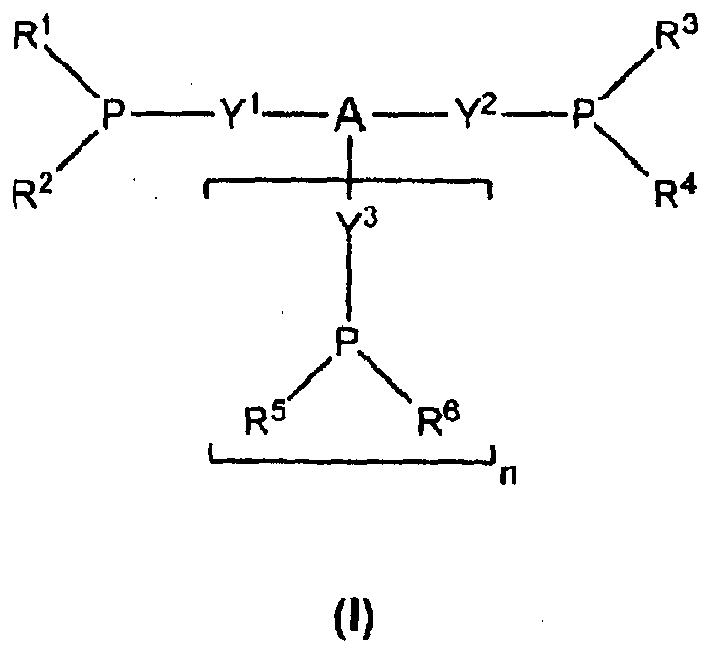 n ist 0 oder 1,R1, R2, R3, R4, R5, R8 sind unabhängig voneinander unsubstituiertes oder zumindest monosubstituiertes C1-C10-Alkyl, C1-C4-Alkyldiphenylphosphin (-C1-C4-Alkyl-P(Phenyl)2), C3-C10-Cycloalkyl, C3-C10-Heterocyclyl enthaltend mindestens ein Heteroatom ausgewählt aus N, O und S, C5-C14-Aryl oder C5-C10-Heteroaryl enthaltend mindestens ein Heteroatom ausgewählt aus N, O und S,
wobei die Substituenten ausgewählt sind aus der Gruppe bestehend aus: F, Cl, Br, OH, CN, NH2 und C1-C10-Alkyl;A isti) eine Brückengruppe ausgewählt aus der Gruppe unsubstituiertes oder zumindest monosubstituiertes N, O, P, C1-C8-Alkan, C3-C10-Cycloalkan, C3-C10-Heterocycloalkan enthaltend mindestens ein Heteroatom ausgewählt aus N, O und S, C5-C6-Heteroaromat enthaltend mindestens ein Heteroatom ausgewählt aus N, O und S und C5-C14-Aromat,
wobei die Substituenten ausgewählt sind aus der Gruppe bestehend aus: C1-C4-Alkyl, Phenyl, F, Cl, Br, OH, OR7, NH2, NHR7 oder N(R7)2,
wobei R7 ausgewählt ist aus C1-C10-Alkyl und C6-C10-Aryl;
oderii) eine Brückengruppe der Formel (II) oder (III): m, q sind unabhängig voneinander 0, 1, 2, 3 oder 4,R8, R9 sind unabhängig voneinander ausgewählt aus der Gruppe C1-C10-Alkyl, F, Cl, Br, OH, OR7, NH2, NHR7 und N(R7)2,
wobei R7 ausgewählt ist aus C1-C10-Alkyl und C5-C10-Aryl;X1, X2 sind unabhängig voneinander NH, O oder S,X3 ist eine Bindung, NH, NR10, O, S oder CR11R12,R10 ist unsubstituiertes oder zumindest monosubstituiertes C1-C10-Alkyl, C3-C10-Cycloalkyl, C3-C10-Heterocyclyl enthaltend mindestens ein Heteroatom ausgewählt aus N, O und S, C5-C14-Aryl oder C5-C10-Heteroaryl enthaltend mindestens ein Heteroatom ausgewählt aus N, O und S,
wobei die Substituenten ausgewählt sind aus der Gruppe bestehend aus: F, Cl, Br, OH, CN, NH2 und C1-C10-Alkyl;R11, R12 sind unabhängig voneinander unsubstituiertes oder zumindest monosubstituiertes C1-C10-Alkyl, C1-C10-Alkoxy, C3-C10-Cycloalkyl, C3-C10-Cycloalkoxy, C3-C10-Heterocyclyl enthaltend mindestens ein Heteroatom ausgewählt aus N, O und S, C5-C14-Aryl, C5-C14-Aryloxy oder C5-C10-Heteroaryl enthaltend mindestens ein Heteroatom ausgewählt aus N, O und S,
wobei die Substituenten ausgewählt sind aus der Gruppe bestehend aus: F, Cl, Br, OH, CN, NH2 und C1-C10-Alkyl;Y1, Y2, Y3 sind unabhängig voneinander eine Bindung, unsubstituiertes oder zumindest monosubstituiertes Methylen, Ethylen, Trimethylen, Tetramethylen, Pentamethylen oder Hexamethylen,
wobei die Substituenten ausgewählt sind aus der Gruppe bestehend aus: F, Cl, Br, OH, OR7, CN, NH2, NHR7, N(R7)2 und C1-C10-Alkyl,
wobei R7 ausgewählt ist aus C1-C10-Alkyl und C5-C10-Aryl. - Verfahren nach Anspruch 1, wobein ist 0 oder 1;R1, R2, R3, R4, R5, R6 sind unabhängig voneinander unsubstituiertes C1-C10-Alkyl, C1-C4-Alkyldiphenylphosphin, C3-C10-Cycloalkyl, C3-C10-Heterocyclyl enthaltend mindestens ein Heteroatom ausgewählt aus N, O und S, C5-C14-Aryl oder C5-C10-Heteroaryl enthaltend mindestens ein Heteroatom ausgewählt aus N, O und S;A isti) eine Brückengruppe ausgewählt aus der Gruppe unsubstituiertes N, O, P, C1-C6-Alkan, C3-C10-Cycloalkan, C3-C10-Heterocycloalkan enthaltend mindestens ein Heteroatom ausgewählt aus N, O und S, C5-C6-Heteroaromat enthaltend mindestens ein Heteroatom ausgewählt aus N, O und S und C5-C14-Aromat;
oderii) eine Brückengruppe der Formel II oder III: m, q sind unabhängig voneinander 0, 1, 2, 3 oder 4;R8, R9 sind unabhängig voneinander ausgewählt aus der Gruppe C1-C10-Alkyl, F, Cl, Br, OH, OR7, NH2, NHR7 und N(R7)2,
wobei R7 ausgewählt ist aus C1-C10-Alkyl und C5-C10-Aryl;X1, X2 sind unabhängig voneinander NH, O oder S;X3 ist eine Bindung, NH, NR10, O, S oder CR11R12;R10 ist unsubstituiertes C1-C10-Alkyl, C3-C10-Cycloalkyl, C3-C10-Heterocyclyl enthaltend mindestens ein Heteroatom ausgewählt aus N, O und S, C6-C14-Aryl oder C5-C10-Heteroaryl enthaltend mindestens ein Heteroatom ausgewählt aus N, O und S;R11, R12 sind unabhängig voneinander unsubstituiertes C1-C10-Alkyl, C1-C10-Alkoxy, C3-C10-Cycloalkyl, C3-C10-Cycloalkoxy,C3-C10-Heterocyclyl enthaltend mindestens ein Heteroatom ausgewählt aus N, O und S, C5-C14-Aryl, C5-C14-Aryloxy oder C5-C10-Heteroaryl enthaltend mindestens ein Heteroatom ausgewählt aus N, O und S;Y1, Y2, Y3 sind unabhängig voneinander eine Bindung, unsubstituiertes Methylen, Ethylen, Trimethylen, Tetramethylen, Pentamethylen oder Hexamethylen. - Verfahren nach Anspruch 1 oder 2, wobei der Komplexkatalysator mindestens einen Phosphordonorliganden der allgemeinen Formel (V) enthält:
 R1, R2, R3, R4 sind unabhängig voneinander unsubstituiertes oder zumindest monosubstituiertes C1-C10-Alkyl, C1-C4-Alkyldiphenylphosphin (-C1-C4-Alkyl-P(Phenyl)2), C3-C10-Cycloalkyl, C3-C10-Heterocyclyl enthaltend mindestens ein Heteroatom ausgewählt aus N, O und S, C5-C14-Aryl oder C5-C10-Heteroaryl enthaltend mindestens ein Heteroatom ausgewählt aus N, O und S,
wobei die Substituenten ausgewählt sind aus der Gruppe bestehend aus: F, Cl, Br, OH, CN, NH2 und C1-C10-Alkyl;A isti) eine Brückengruppe ausgewählt aus der Gruppe unsubstituiertes oder zumindest monosubstituiertes N, P, C1-C6-Alkan, C3-C10-Cycloalkan, C3-C10-Heterocycloalkan enthaltend mindestens ein Heteroatom ausgewählt aus N, O und S, C5-C6-Heteroaromat enthaltend mindestens ein Heteroatom ausgewählt aus N, O und S und C5-C14-Aromat,
wobei die Substituenten ausgewählt sind aus der Gruppe bestehend aus: C1-C4-Alkyl, Phenyl, F, Cl, Br, OH, OR7, NH2, NHR7 oder N(R7)2,
wobei R7 ausgewählt ist aus C1-C10-Alkyl und C5-C10-Aryl;
oderii) eine Brückengruppe der Formel II oder III: m, q sind unabhängig voneinander 0, 1, 2, 3 oder 4;R8, R9 sind unabhängig voneinander ausgewählt aus der Gruppe C1-C10-Alkyl, F, Cl, Br, OH, OR7, NH2, NHR7 und N(R7)2,
wobei R7 ausgewählt ist aus C1-C10-Alkyl und C5-C10-Aryl;X1, X2 sind unabhängig voneinander NH, O oder S,X3 ist eine Bindung, NH, NR10, O, S oder CR11R12;R10 ist unsubstituiertes oder zumindest monosubstituiertes C1-C10-Alkyl, C3-C10-Cycloalkyl, C3-C10-Heterocyclyl enthaltend mindestens ein Heteroatom ausgewählt aus N, O und S, C5-C14-Aryl oder C5-C10-Heteroaryl enthaltend mindestens ein Heteroatom ausgewählt aus N, O und S,
wobei die Substituenten ausgewählt sind aus der Gruppe bestehend aus: F, Cl, Br, OH, CN, NH2 und C1-C10-Alkyl;R11, R12 sind unabhängig voneinander unsubstituiertes oder zumindest monosubstituiertes C1-C10-Alkyl, C1-C10-Alkoxy, C3-C10-Cycloalkyl, C3-C10-Cycloalkoxy,C3-C10-Heterocyclyl enthaltend mindestens ein Heteroatom ausgewählt aus N, O und S, C5-C14-Aryl, C5-C14-Aryloxy oder C5-C10-Heteroaryl enthaltend mindestens ein Heteroatom ausgewählt aus N, O und S,
wobei die Substituenten ausgewählt sind aus der Gruppe bestehend aus: F, Cl, Br, OH, CN, NH2 und C1-C10-Alkyl;Y1, Y2 sind unabhängig voneinander eine Bindung, unsubstituiertes oder zumindest monosubstituiertes Methylen, Ethylen, Trimethylen, Tetramethylen, Pentamethylen oder Hexamethylen,
wobei die Substituenten ausgewählt sind aus der Gruppe bestehend aus: F, Cl, Br, OH, OR7, CN, NH2, NHR7, N(R7)2 und C1-C10-Alkyl,
wobei R7 ausgewählt ist aus C1-C10-Alkyl und C5-C10-Aryl. - Verfahren nach Anspruch 1 oder 2, wobei der Komplexkatalysator mindestens einen Phosphordonorliganden der allgemeinen Formel (VI) enthält:
 R1, R2, R3, R4, R5, R6 sind unabhängig voneinander unsubstituiertes oder zumindest monosubstituiertes C1-C10-Alkyl, C3-C10-Cycloalkyl, C3-C10-Heterocyclyl enthaltend mindestens ein Heteroatom ausgewählt aus N, O und S, C5-C14-Aryl oder C5-C10-Heteroaryl enthaltend mindestens ein Heteroatom ausgewählt aus N, O und S,
wobei die Substituenten ausgewählt sind aus der Gruppe bestehend aus: F, Cl, Br, OH, CN, NH2 und C1-C10-Alkyl;A ist eine Brückengruppe ausgewählt aus der Gruppe unsubstituiertes oder zumindest monosubstituiertes N, P, C1-C8-Alkan, C3-C10-Cycloalkan, C3-C10-Heterocycloalkan enthaltend mindestens ein Heteroatom ausgewählt aus N, O und S, C5-C6-Heteroaromat enthaltend mindestens ein Heteroatom ausgewählt aus N, O und S und C5-C14-Aromat,
wobei die Substituenten ausgewählt sind aus der Gruppe bestehend aus: C1-C4-Alkyl, F, Cl, Br, OH, OR7, NH2, NHR7 oder N(R7)2,
wobei R7 ausgewählt ist aus C1-C10-Alkyl und C5-C10-Aryl;Y1, Y2, Y3 sind unabhängig voneinander eine Bindung, unsubstituiertes oder zumindest monosubstituiertes Methylen, Ethylen, Trimethylen, Tetramethylen, Pentamethylen oder Hexamethylen,
wobei die Substituenten ausgewählt sind aus der Gruppe bestehend aus: F, Cl, Br, OH, OR7, CN, NH2, NHR7, N(R7)2 und C1-C10-Alkyl,
wobei R7 ausgewählt ist aus C1-C10-Alkyl und C5-C10-Aryl. - Verfahren nach einem der Ansprüche 1 bis 3, wobei der Komplexkatalysator mindestens einen Phosphordonorliganden der allgemeinen Formel (IX) oder (X) enthält,

- Verfahren nach einem der Ansprüche 1 oder 2, wobei der Komplexkatalysator mindestens ein Element ausgewählt aus der Gruppe Ruthenium und Iridium sowie mindestens einen Phosphordonorliganden ausgewählt aus der Gruppe 1,2-Bis(diphenylphosphino)ethan (dppe), 1.2-Bis(dicylohexylphosphino)ethan, 1,2-Bis(diphenylphosphino)propan (dppp), 1,2-Bis(diphenytphosphino)butan (dppb), 2,3-Bis(dicyclohexylphosphino)ethan (dcpe), 4,5-Bis(dlphenylphosphino)-9,9-dimethylxanthen (Xantphos), Bis(2-diphenylphosphinaethyl)phenylphosphin und 1,1,1-Tris(Diphenylphosphinomethyl)ethan (Triphos) enthält.
- Verfahren nach einem der Ansprüche 1 oder 2, wobei der Komplexkatalysator Ruthenium sowie mindestens einen Phosphordonorliganden ausgewählt aus der Gruppe 4,5-Bis(diphenylphosphino)-9,9-dimethylxanthen (Xantphos), Bis(2-diphenylphosphinoethyl)phenylphosphin und 1,1,1-Tris(Diphenylphosphino-methyl)ethan (Triphos) enthält.
- Verfahren nach Anspruch 7, wobei der Komplexkatalysator Ruthenium und einen Phosphordonorliganden ausgewählt aus der Gruppe Bis(2-diphenylphosphino-ethyl)phenylphosphin und Triphos enthält.
- Verfahren nach einem der Ansprüche 1 oder 2, wobei der Komplexkatalysator Iridium sowie mindestens einen Phosphordonorliganden ausgewählt aus der Gruppe 4,5-Bis(diphenylphosphino)-9,9-dimethylxanthen (Xantphos), Bis(2-diphenylphosphinoethyl)phenylphosphin und 1,1,1-Tris(Diphenylphosphinomethyl)ethan (Triphos) enthält.
- Verfahren nach einem der Ansprüche 1 bis 9, wobei das Edukt mindestens zwei funktiontionelle Gruppen der Formel (-CH2-OH) enthält.
- Verfahren nach einem der Ansprüche 1 bis 10, wobei die Alkoholaminierung in Gegenwart eines unpolaren Lösungsmittels durchgeführt wird.
- Verfahren nach Anspruch 11, wobei das unpolare Lösungsmittel ausgewählt ist aus der Gruppe bestehend aus gesättigtem Hexan, Heptan, Oktan, Cyclohexan, Benzol, Toluol, Xylol, Mesltylen, THF, Diethylether, 1,4-Dioxan, MTBE, Diglyme und 1,2-Dimethoxyethan.
- Verfahren nach einem der Ansprüche 1 bis 12, wobei die Alkoholaminierung bei 20 bis 250 °C und bei Drücken von 0,1 bis 20 MPas absolut durchgeführt wird:
- Verfahren nach einem der Ansprüche 1 bis 13, wobei die Alkoholaminierung unter Zusatz von Basen erfolgt
- Verwendung eines Komplexkatalysators, der mindestens ein Element ausgewählt aus den Gruppen 8 und 9 des Periodensystems sowie mindestens einen Phosphordonorliganden der allgemeinen Formel (I) enthält,

Priority Applications (1)
| Application Number | Priority Date | Filing Date | Title |
|---|---|---|---|
| EP12707089.4A EP2683686B1 (de) | 2011-03-08 | 2012-03-01 | Verfahren zur herstellung von primären aminen durch homogen-katalysierte alkoholaminierung |
Applications Claiming Priority (3)
| Application Number | Priority Date | Filing Date | Title |
|---|---|---|---|
| EP11157288 | 2011-03-08 | ||
| EP12707089.4A EP2683686B1 (de) | 2011-03-08 | 2012-03-01 | Verfahren zur herstellung von primären aminen durch homogen-katalysierte alkoholaminierung |
| PCT/EP2012/053582 WO2012119927A1 (de) | 2011-03-08 | 2012-03-01 | Verfahren zur herstellung von primären aminen durch homogen-katalysierte alkoholaminierung |
Publications (2)
| Publication Number | Publication Date |
|---|---|
| EP2683686A1 EP2683686A1 (de) | 2014-01-15 |
| EP2683686B1 true EP2683686B1 (de) | 2015-05-13 |
Family
ID=45808879
Family Applications (1)
| Application Number | Title | Priority Date | Filing Date |
|---|---|---|---|
| EP12707089.4A Not-in-force EP2683686B1 (de) | 2011-03-08 | 2012-03-01 | Verfahren zur herstellung von primären aminen durch homogen-katalysierte alkoholaminierung |
Country Status (12)
| Country | Link |
|---|---|
| EP (1) | EP2683686B1 (de) |
| JP (2) | JP2014515731A (de) |
| CN (1) | CN103502212B (de) |
| AU (1) | AU2012224718A1 (de) |
| BR (1) | BR112013022671A2 (de) |
| CA (1) | CA2828166A1 (de) |
| ES (1) | ES2543309T3 (de) |
| HU (1) | HUE025168T2 (de) |
| MX (1) | MX2013010154A (de) |
| MY (1) | MY185051A (de) |
| RU (1) | RU2013144820A (de) |
| WO (1) | WO2012119927A1 (de) |
Cited By (1)
| Publication number | Priority date | Publication date | Assignee | Title |
|---|---|---|---|---|
| DE102014210464B4 (de) * | 2014-06-03 | 2018-02-22 | Hydrogenious Technologies Gmbh | Verwendung eines Substrates zur Wasserstoffspeicherung |
Families Citing this family (13)
| Publication number | Priority date | Publication date | Assignee | Title |
|---|---|---|---|---|
| US9193666B2 (en) | 2011-03-08 | 2015-11-24 | Basf Se | Process for preparing alkanolamines by homogeneously catalyzed alcohol amination |
| EP2683681B1 (de) * | 2011-03-08 | 2015-07-01 | Basf Se | Verfahren zur herstellung von di-, tri- und polyaminen durch homogen-katalysierte alkoholaminierung |
| JP5766307B2 (ja) * | 2011-03-08 | 2015-08-19 | ビーエーエスエフ ソシエタス・ヨーロピアBasf Se | 均一系触媒作用を利用したアルコール・アミノ化による一級アミンの製造方法 |
| WO2012119928A1 (de) * | 2011-03-08 | 2012-09-13 | Basf Se | Verfahren zur herstellung von alkanolaminen durch homogen-katalysierte alkoholaminierung |
| US8981093B2 (en) | 2012-06-06 | 2015-03-17 | Basf Se | Process for preparing piperazine |
| ES2531144T3 (es) * | 2012-09-07 | 2015-03-11 | Evonik Industries Ag | Composiciones curables a base de resinas epoxídicas sin alcohol bencílico |
| EP2961731B1 (de) | 2013-02-28 | 2017-02-01 | Basf Se | Verfahren zur herstellung von eda unter verwendung von so2-freier blausäure |
| CN104277018B (zh) * | 2013-07-02 | 2016-04-13 | 中国科学院大连化学物理研究所 | 2,5-二甲酰基呋喃制备2,5-二甲胺基呋喃的方法 |
| CN104277017B (zh) * | 2013-07-02 | 2016-04-13 | 中国科学院大连化学物理研究所 | 2,5-二羟甲基呋喃制备2,5-二甲胺基呋喃的方法 |
| CN106565793B (zh) * | 2016-11-15 | 2019-05-17 | 山西大学 | 一种π-烯丙基钯(II)配合物及其制备方法和应用 |
| WO2018132960A1 (en) * | 2017-01-18 | 2018-07-26 | Solvay Specialty Polymers Italy S.P.A | Process for the synthesis of (per) fluoropolyether-amino derivatives |
| WO2018157395A1 (en) * | 2017-03-03 | 2018-09-07 | Rhodia Operations | Process for preparing an amine via a direct amination reaction |
| EP4549621A1 (de) | 2023-10-31 | 2025-05-07 | Basf Se | Verfahren zur herstellung von aminen aus alkoholen unter verwendung von wasserstoff mit niedrigem deuteriumgehalt, der mit nicht-fossil-energie hergestellt wurde |
Family Cites Families (20)
| Publication number | Priority date | Publication date | Assignee | Title |
|---|---|---|---|---|
| NL137371C (de) | 1963-08-02 | |||
| US3708539A (en) | 1970-02-06 | 1973-01-02 | Union Oil Co | Condensation of ammonia or a primary or secondary amine with an alcohol |
| NL169595C (nl) | 1970-05-21 | 1982-08-02 | Shell Int Research | Werkwijze voor de bereiding van aminen en van smeerolien en vloeibare motorbrandstoffen die deze bevatten. |
| US4709034A (en) | 1986-02-14 | 1987-11-24 | Air Products And Chemicals, Inc. | Process for the synthesis of hydroxyalkyl amines and hydroxyalkyl piperazines |
| DE3611230A1 (de) | 1986-04-04 | 1987-10-08 | Basf Ag | Polybutyl- und polyisobutylamine, verfahren zu deren herstellung und diese enthaltende kraft- und schmierstoffzusammensetzungen |
| JPS632958A (ja) * | 1986-06-20 | 1988-01-07 | Showa Denko Kk | アリル型アミンの製造法 |
| EP0320269B1 (de) | 1987-12-11 | 1993-09-01 | Showa Denko Kabushiki Kaisha | Verfahren zur Herstellung von Aminen vom Allyltyp |
| JPH0759535B2 (ja) * | 1987-12-11 | 1995-06-28 | 昭和電工株式会社 | アリル型アミンの製造法 |
| DE4428004A1 (de) | 1994-08-08 | 1996-02-15 | Basf Ag | Verfahren zur Herstellung von Aminen |
| US7196033B2 (en) | 2001-12-14 | 2007-03-27 | Huntsman Petrochemical Corporation | Advances in amination catalysis |
| JP4250011B2 (ja) * | 2003-04-08 | 2009-04-08 | 三井化学株式会社 | 芳香族アミン化合物の製造方法 |
| US7754922B2 (en) | 2006-07-14 | 2010-07-13 | Basf Se | Process for preparing amines and zirconium dioxide- and nickel-containing catalysts for use therein |
| CA2712990C (en) * | 2008-02-28 | 2016-09-27 | Bayard R. Huck | Benzonaphthyridinyl compounds as protein kinase inhibitors and use thereof |
| JP5738185B2 (ja) * | 2008-08-10 | 2015-06-17 | イェダ リサーチ アンド デベロップメント カンパニー リミテッド | アルコールおよびアンモニアからアミンを調製する方法 |
| FR2948369B1 (fr) * | 2009-07-27 | 2013-04-12 | Sanofi Aventis | Derives d'uree de tetrahydroquinoxaline, leur preparation et leur application en therapeutique |
| DE102011075162A1 (de) * | 2010-12-08 | 2012-06-14 | Evonik Degussa Gmbh | Verfahren zur homogen-katalysierte, hochselektiven direkten Aminierung von primären Alkoholen mit Ammoniak zu primären Aminen bei hohem Volumenverhältnis von Flüssig- zu Gasphase und/oder hohen Drücken |
| EP2678306B1 (de) * | 2011-02-21 | 2017-06-21 | Evonik Degussa GmbH | Verfahren zur direkten aminierung von alkoholen mit ammoniak zu primären aminen mittels eines xantphos katalysatorsystems |
| EP2683681B1 (de) * | 2011-03-08 | 2015-07-01 | Basf Se | Verfahren zur herstellung von di-, tri- und polyaminen durch homogen-katalysierte alkoholaminierung |
| WO2012119928A1 (de) * | 2011-03-08 | 2012-09-13 | Basf Se | Verfahren zur herstellung von alkanolaminen durch homogen-katalysierte alkoholaminierung |
| JP5766307B2 (ja) * | 2011-03-08 | 2015-08-19 | ビーエーエスエフ ソシエタス・ヨーロピアBasf Se | 均一系触媒作用を利用したアルコール・アミノ化による一級アミンの製造方法 |
-
2012
- 2012-03-01 EP EP12707089.4A patent/EP2683686B1/de not_active Not-in-force
- 2012-03-01 CA CA2828166A patent/CA2828166A1/en not_active Abandoned
- 2012-03-01 HU HUE12707089A patent/HUE025168T2/en unknown
- 2012-03-01 ES ES12707089.4T patent/ES2543309T3/es active Active
- 2012-03-01 AU AU2012224718A patent/AU2012224718A1/en not_active Abandoned
- 2012-03-01 BR BR112013022671A patent/BR112013022671A2/pt not_active IP Right Cessation
- 2012-03-01 WO PCT/EP2012/053582 patent/WO2012119927A1/de not_active Ceased
- 2012-03-01 MY MYPI2013003249A patent/MY185051A/en unknown
- 2012-03-01 JP JP2013557047A patent/JP2014515731A/ja active Pending
- 2012-03-01 MX MX2013010154A patent/MX2013010154A/es not_active Application Discontinuation
- 2012-03-01 CN CN201280021278.6A patent/CN103502212B/zh not_active Expired - Fee Related
- 2012-03-01 RU RU2013144820/04A patent/RU2013144820A/ru not_active Application Discontinuation
-
2015
- 2015-09-11 JP JP2015179212A patent/JP6188757B2/ja not_active Expired - Fee Related
Cited By (1)
| Publication number | Priority date | Publication date | Assignee | Title |
|---|---|---|---|---|
| DE102014210464B4 (de) * | 2014-06-03 | 2018-02-22 | Hydrogenious Technologies Gmbh | Verwendung eines Substrates zur Wasserstoffspeicherung |
Also Published As
| Publication number | Publication date |
|---|---|
| CN103502212A (zh) | 2014-01-08 |
| MX2013010154A (es) | 2013-09-26 |
| EP2683686A1 (de) | 2014-01-15 |
| ES2543309T3 (es) | 2015-08-18 |
| MY185051A (en) | 2021-04-30 |
| JP2014515731A (ja) | 2014-07-03 |
| RU2013144820A (ru) | 2015-04-20 |
| JP2016006114A (ja) | 2016-01-14 |
| BR112013022671A2 (pt) | 2016-07-19 |
| CA2828166A1 (en) | 2012-09-13 |
| CN103502212B (zh) | 2016-05-18 |
| JP6188757B2 (ja) | 2017-08-30 |
| AU2012224718A1 (en) | 2013-09-19 |
| WO2012119927A1 (de) | 2012-09-13 |
| HUE025168T2 (en) | 2016-02-29 |
Similar Documents
| Publication | Publication Date | Title |
|---|---|---|
| EP2683686A1 (de) | Verfahren zur herstellung von primären aminen durch homogen-katalysierte alkoholaminierung | |
| EP2683681B1 (de) | Verfahren zur herstellung von di-, tri- und polyaminen durch homogen-katalysierte alkoholaminierung | |
| EP2683707B1 (de) | Verfahren zur herstellung von alkanolaminen durch homogen-katalysierte alkoholaminierung | |
| US8785693B2 (en) | Process for the preparation of primary amines by homogeneously catalyzed alcohol amination | |
| EP2678306B1 (de) | Verfahren zur direkten aminierung von alkoholen mit ammoniak zu primären aminen mittels eines xantphos katalysatorsystems | |
| EP2649040B1 (de) | Verfahren zur homogen-katalysierten, hochselektiven direkten aminierung von primären alkoholen mit ammoniak zu primären aminen bei hohem volumenverhältnis von flüssig- zu gasphase und/oder hohen drücken | |
| EP2683680B1 (de) | Verfahren zur herstellung von primären aminen durch homogen-katalysierte alkoholaminierung | |
| US8637709B2 (en) | Process for the preparation of primary amines by homogeneously catalyzed alcohol amination | |
| USRE46374E1 (en) | Process for preparing di-, tri- and polyamines by homogeneously catalyzed alcohol amination | |
| EP1414783B1 (de) | Verfahren zur herstellung von aminen durch reduktive aminierung von carbonylverbindungen unter transfer-hydrierungsbedingungen | |
| EP2484659B1 (de) | Herstellung von in ihrer Hauptkette linearen primären Diaminen für Polyamidsynthesen | |
| US8853400B2 (en) | Process for the homogeneously catalyzed amination of alcohols with ammonia in the presence of a complex catalyst which comprises no anionic ligands | |
| DE102012019441A1 (de) | Verfahren zur Herstellung von Formamidverbindungen | |
| EP2875027B1 (de) | Verfahren zur homogen-katalysierten aminierung von alkoholen mit ammoniak in gegenwart eines komplexkatalysators ohne anionische liganden |
Legal Events
| Date | Code | Title | Description |
|---|---|---|---|
| PUAI | Public reference made under article 153(3) epc to a published international application that has entered the european phase |
Free format text: ORIGINAL CODE: 0009012 |
|
| 17P | Request for examination filed |
Effective date: 20131008 |
|
| AK | Designated contracting states |
Kind code of ref document: A1 Designated state(s): AL AT BE BG CH CY CZ DE DK EE ES FI FR GB GR HR HU IE IS IT LI LT LU LV MC MK MT NL NO PL PT RO RS SE SI SK SM TR |
|
| DAX | Request for extension of the european patent (deleted) | ||
| REG | Reference to a national code |
Ref country code: DE Ref legal event code: R079 Ref document number: 502012003125 Country of ref document: DE Free format text: PREVIOUS MAIN CLASS: C07D0207060000 Ipc: C07C0209160000 |
|
| GRAP | Despatch of communication of intention to grant a patent |
Free format text: ORIGINAL CODE: EPIDOSNIGR1 |
|
| RIC1 | Information provided on ipc code assigned before grant |
Ipc: C07D 207/20 20060101ALI20141106BHEP Ipc: C07D 265/30 20060101ALI20141106BHEP Ipc: C07D 307/52 20060101ALI20141106BHEP Ipc: C07C 215/08 20060101ALI20141106BHEP Ipc: C07C 213/02 20060101ALI20141106BHEP Ipc: C07C 209/16 20060101AFI20141106BHEP Ipc: C07D 207/06 20060101ALI20141106BHEP |
|
| INTG | Intention to grant announced |
Effective date: 20141209 |
|
| GRAS | Grant fee paid |
Free format text: ORIGINAL CODE: EPIDOSNIGR3 |
|
| GRAA | (expected) grant |
Free format text: ORIGINAL CODE: 0009210 |
|
| AK | Designated contracting states |
Kind code of ref document: B1 Designated state(s): AL AT BE BG CH CY CZ DE DK EE ES FI FR GB GR HR HU IE IS IT LI LT LU LV MC MK MT NL NO PL PT RO RS SE SI SK SM TR |
|
| REG | Reference to a national code |
Ref country code: GB Ref legal event code: FG4D Free format text: NOT ENGLISH |
|
| REG | Reference to a national code |
Ref country code: CH Ref legal event code: EP |
|
| REG | Reference to a national code |
Ref country code: IE Ref legal event code: FG4D Free format text: LANGUAGE OF EP DOCUMENT: GERMAN |
|
| REG | Reference to a national code |
Ref country code: AT Ref legal event code: REF Ref document number: 726774 Country of ref document: AT Kind code of ref document: T Effective date: 20150615 |
|
| REG | Reference to a national code |
Ref country code: DE Ref legal event code: R096 Ref document number: 502012003125 Country of ref document: DE Effective date: 20150625 |
|
| REG | Reference to a national code |
Ref country code: ES Ref legal event code: FG2A Ref document number: 2543309 Country of ref document: ES Kind code of ref document: T3 Effective date: 20150818 |
|
| REG | Reference to a national code |
Ref country code: NL Ref legal event code: T3 |
|
| REG | Reference to a national code |
Ref country code: SE Ref legal event code: TRGR |
|
| REG | Reference to a national code |
Ref country code: LT Ref legal event code: MG4D |
|
| PG25 | Lapsed in a contracting state [announced via postgrant information from national office to epo] |
Ref country code: PT Free format text: LAPSE BECAUSE OF FAILURE TO SUBMIT A TRANSLATION OF THE DESCRIPTION OR TO PAY THE FEE WITHIN THE PRESCRIBED TIME-LIMIT Effective date: 20150914 Ref country code: NO Free format text: LAPSE BECAUSE OF FAILURE TO SUBMIT A TRANSLATION OF THE DESCRIPTION OR TO PAY THE FEE WITHIN THE PRESCRIBED TIME-LIMIT Effective date: 20150813 Ref country code: HR Free format text: LAPSE BECAUSE OF FAILURE TO SUBMIT A TRANSLATION OF THE DESCRIPTION OR TO PAY THE FEE WITHIN THE PRESCRIBED TIME-LIMIT Effective date: 20150513 Ref country code: LT Free format text: LAPSE BECAUSE OF FAILURE TO SUBMIT A TRANSLATION OF THE DESCRIPTION OR TO PAY THE FEE WITHIN THE PRESCRIBED TIME-LIMIT Effective date: 20150513 Ref country code: FI Free format text: LAPSE BECAUSE OF FAILURE TO SUBMIT A TRANSLATION OF THE DESCRIPTION OR TO PAY THE FEE WITHIN THE PRESCRIBED TIME-LIMIT Effective date: 20150513 |
|
| PG25 | Lapsed in a contracting state [announced via postgrant information from national office to epo] |
Ref country code: IS Free format text: LAPSE BECAUSE OF FAILURE TO SUBMIT A TRANSLATION OF THE DESCRIPTION OR TO PAY THE FEE WITHIN THE PRESCRIBED TIME-LIMIT Effective date: 20150913 Ref country code: GR Free format text: LAPSE BECAUSE OF FAILURE TO SUBMIT A TRANSLATION OF THE DESCRIPTION OR TO PAY THE FEE WITHIN THE PRESCRIBED TIME-LIMIT Effective date: 20150814 Ref country code: BG Free format text: LAPSE BECAUSE OF FAILURE TO SUBMIT A TRANSLATION OF THE DESCRIPTION OR TO PAY THE FEE WITHIN THE PRESCRIBED TIME-LIMIT Effective date: 20150813 Ref country code: RS Free format text: LAPSE BECAUSE OF FAILURE TO SUBMIT A TRANSLATION OF THE DESCRIPTION OR TO PAY THE FEE WITHIN THE PRESCRIBED TIME-LIMIT Effective date: 20150513 Ref country code: LV Free format text: LAPSE BECAUSE OF FAILURE TO SUBMIT A TRANSLATION OF THE DESCRIPTION OR TO PAY THE FEE WITHIN THE PRESCRIBED TIME-LIMIT Effective date: 20150513 |
|
| PG25 | Lapsed in a contracting state [announced via postgrant information from national office to epo] |
Ref country code: DK Free format text: LAPSE BECAUSE OF FAILURE TO SUBMIT A TRANSLATION OF THE DESCRIPTION OR TO PAY THE FEE WITHIN THE PRESCRIBED TIME-LIMIT Effective date: 20150513 Ref country code: EE Free format text: LAPSE BECAUSE OF FAILURE TO SUBMIT A TRANSLATION OF THE DESCRIPTION OR TO PAY THE FEE WITHIN THE PRESCRIBED TIME-LIMIT Effective date: 20150513 |
|
| REG | Reference to a national code |
Ref country code: DE Ref legal event code: R097 Ref document number: 502012003125 Country of ref document: DE |
|
| PG25 | Lapsed in a contracting state [announced via postgrant information from national office to epo] |
Ref country code: RO Free format text: LAPSE BECAUSE OF NON-PAYMENT OF DUE FEES Effective date: 20150513 Ref country code: SK Free format text: LAPSE BECAUSE OF FAILURE TO SUBMIT A TRANSLATION OF THE DESCRIPTION OR TO PAY THE FEE WITHIN THE PRESCRIBED TIME-LIMIT Effective date: 20150513 Ref country code: PL Free format text: LAPSE BECAUSE OF FAILURE TO SUBMIT A TRANSLATION OF THE DESCRIPTION OR TO PAY THE FEE WITHIN THE PRESCRIBED TIME-LIMIT Effective date: 20150513 Ref country code: CZ Free format text: LAPSE BECAUSE OF FAILURE TO SUBMIT A TRANSLATION OF THE DESCRIPTION OR TO PAY THE FEE WITHIN THE PRESCRIBED TIME-LIMIT Effective date: 20150513 |
|
| REG | Reference to a national code |
Ref country code: HU Ref legal event code: AG4A Ref document number: E025168 Country of ref document: HU |
|
| PLBE | No opposition filed within time limit |
Free format text: ORIGINAL CODE: 0009261 |
|
| STAA | Information on the status of an ep patent application or granted ep patent |
Free format text: STATUS: NO OPPOSITION FILED WITHIN TIME LIMIT |
|
| REG | Reference to a national code |
Ref country code: FR Ref legal event code: PLFP Year of fee payment: 5 |
|
| 26N | No opposition filed |
Effective date: 20160216 |
|
| PG25 | Lapsed in a contracting state [announced via postgrant information from national office to epo] |
Ref country code: SI Free format text: LAPSE BECAUSE OF FAILURE TO SUBMIT A TRANSLATION OF THE DESCRIPTION OR TO PAY THE FEE WITHIN THE PRESCRIBED TIME-LIMIT Effective date: 20150513 |
|
| PGFP | Annual fee paid to national office [announced via postgrant information from national office to epo] |
Ref country code: SE Payment date: 20160329 Year of fee payment: 5 |
|
| PG25 | Lapsed in a contracting state [announced via postgrant information from national office to epo] |
Ref country code: LU Free format text: LAPSE BECAUSE OF FAILURE TO SUBMIT A TRANSLATION OF THE DESCRIPTION OR TO PAY THE FEE WITHIN THE PRESCRIBED TIME-LIMIT Effective date: 20160301 Ref country code: MC Free format text: LAPSE BECAUSE OF FAILURE TO SUBMIT A TRANSLATION OF THE DESCRIPTION OR TO PAY THE FEE WITHIN THE PRESCRIBED TIME-LIMIT Effective date: 20150513 |
|
| REG | Reference to a national code |
Ref country code: CH Ref legal event code: PL |
|
| REG | Reference to a national code |
Ref country code: IE Ref legal event code: MM4A |
|
| PG25 | Lapsed in a contracting state [announced via postgrant information from national office to epo] |
Ref country code: CH Free format text: LAPSE BECAUSE OF NON-PAYMENT OF DUE FEES Effective date: 20160331 Ref country code: LI Free format text: LAPSE BECAUSE OF NON-PAYMENT OF DUE FEES Effective date: 20160331 Ref country code: IE Free format text: LAPSE BECAUSE OF NON-PAYMENT OF DUE FEES Effective date: 20160301 |
|
| REG | Reference to a national code |
Ref country code: FR Ref legal event code: PLFP Year of fee payment: 6 |
|
| PGFP | Annual fee paid to national office [announced via postgrant information from national office to epo] |
Ref country code: HU Payment date: 20170321 Year of fee payment: 6 |
|
| PG25 | Lapsed in a contracting state [announced via postgrant information from national office to epo] |
Ref country code: IT Free format text: LAPSE BECAUSE OF NON-PAYMENT OF DUE FEES Effective date: 20160301 |
|
| PG25 | Lapsed in a contracting state [announced via postgrant information from national office to epo] |
Ref country code: MT Free format text: LAPSE BECAUSE OF FAILURE TO SUBMIT A TRANSLATION OF THE DESCRIPTION OR TO PAY THE FEE WITHIN THE PRESCRIBED TIME-LIMIT Effective date: 20150513 Ref country code: IT Free format text: LAPSE BECAUSE OF NON-PAYMENT OF DUE FEES Effective date: 20160301 |
|
| PGRI | Patent reinstated in contracting state [announced from national office to epo] |
Ref country code: IT Effective date: 20170710 |
|
| REG | Reference to a national code |
Ref country code: SE Ref legal event code: EUG |
|
| PG25 | Lapsed in a contracting state [announced via postgrant information from national office to epo] |
Ref country code: SE Free format text: LAPSE BECAUSE OF NON-PAYMENT OF DUE FEES Effective date: 20170302 |
|
| REG | Reference to a national code |
Ref country code: FR Ref legal event code: PLFP Year of fee payment: 7 |
|
| REG | Reference to a national code |
Ref country code: AT Ref legal event code: MM01 Ref document number: 726774 Country of ref document: AT Kind code of ref document: T Effective date: 20170301 |
|
| PG25 | Lapsed in a contracting state [announced via postgrant information from national office to epo] |
Ref country code: SM Free format text: LAPSE BECAUSE OF FAILURE TO SUBMIT A TRANSLATION OF THE DESCRIPTION OR TO PAY THE FEE WITHIN THE PRESCRIBED TIME-LIMIT Effective date: 20150513 Ref country code: CY Free format text: LAPSE BECAUSE OF FAILURE TO SUBMIT A TRANSLATION OF THE DESCRIPTION OR TO PAY THE FEE WITHIN THE PRESCRIBED TIME-LIMIT Effective date: 20150513 |
|
| PG25 | Lapsed in a contracting state [announced via postgrant information from national office to epo] |
Ref country code: TR Free format text: LAPSE BECAUSE OF FAILURE TO SUBMIT A TRANSLATION OF THE DESCRIPTION OR TO PAY THE FEE WITHIN THE PRESCRIBED TIME-LIMIT Effective date: 20150513 Ref country code: MK Free format text: LAPSE BECAUSE OF FAILURE TO SUBMIT A TRANSLATION OF THE DESCRIPTION OR TO PAY THE FEE WITHIN THE PRESCRIBED TIME-LIMIT Effective date: 20150513 |
|
| PG25 | Lapsed in a contracting state [announced via postgrant information from national office to epo] |
Ref country code: AT Free format text: LAPSE BECAUSE OF NON-PAYMENT OF DUE FEES Effective date: 20170301 |
|
| PG25 | Lapsed in a contracting state [announced via postgrant information from national office to epo] |
Ref country code: AL Free format text: LAPSE BECAUSE OF FAILURE TO SUBMIT A TRANSLATION OF THE DESCRIPTION OR TO PAY THE FEE WITHIN THE PRESCRIBED TIME-LIMIT Effective date: 20150513 |
|
| PG25 | Lapsed in a contracting state [announced via postgrant information from national office to epo] |
Ref country code: HU Free format text: LAPSE BECAUSE OF NON-PAYMENT OF DUE FEES Effective date: 20180302 |
|
| PGFP | Annual fee paid to national office [announced via postgrant information from national office to epo] |
Ref country code: GB Payment date: 20190327 Year of fee payment: 8 Ref country code: IT Payment date: 20190321 Year of fee payment: 8 |
|
| PGFP | Annual fee paid to national office [announced via postgrant information from national office to epo] |
Ref country code: NL Payment date: 20190325 Year of fee payment: 8 |
|
| PGFP | Annual fee paid to national office [announced via postgrant information from national office to epo] |
Ref country code: FI Payment date: 20190409 Year of fee payment: 14 |
|
| PGFP | Annual fee paid to national office [announced via postgrant information from national office to epo] |
Ref country code: BE Payment date: 20190328 Year of fee payment: 8 Ref country code: FR Payment date: 20190401 Year of fee payment: 8 |
|
| PGFP | Annual fee paid to national office [announced via postgrant information from national office to epo] |
Ref country code: DE Payment date: 20200528 Year of fee payment: 9 |
|
| REG | Reference to a national code |
Ref country code: NL Ref legal event code: MM Effective date: 20200401 |
|
| REG | Reference to a national code |
Ref country code: BE Ref legal event code: MM Effective date: 20200331 |
|
| PG25 | Lapsed in a contracting state [announced via postgrant information from national office to epo] |
Ref country code: NL Free format text: LAPSE BECAUSE OF NON-PAYMENT OF DUE FEES Effective date: 20200401 |
|
| PG25 | Lapsed in a contracting state [announced via postgrant information from national office to epo] |
Ref country code: FR Free format text: LAPSE BECAUSE OF NON-PAYMENT OF DUE FEES Effective date: 20200331 |
|
| PG25 | Lapsed in a contracting state [announced via postgrant information from national office to epo] |
Ref country code: BE Free format text: LAPSE BECAUSE OF NON-PAYMENT OF DUE FEES Effective date: 20200331 |
|
| GBPC | Gb: european patent ceased through non-payment of renewal fee |
Effective date: 20200301 |
|
| PG25 | Lapsed in a contracting state [announced via postgrant information from national office to epo] |
Ref country code: GB Free format text: LAPSE BECAUSE OF NON-PAYMENT OF DUE FEES Effective date: 20200301 |
|
| REG | Reference to a national code |
Ref country code: ES Ref legal event code: FD2A Effective date: 20210727 |
|
| REG | Reference to a national code |
Ref country code: DE Ref legal event code: R119 Ref document number: 502012003125 Country of ref document: DE |
|
| PG25 | Lapsed in a contracting state [announced via postgrant information from national office to epo] |
Ref country code: ES Free format text: LAPSE BECAUSE OF NON-PAYMENT OF DUE FEES Effective date: 20200302 |
|
| PG25 | Lapsed in a contracting state [announced via postgrant information from national office to epo] |
Ref country code: DE Free format text: LAPSE BECAUSE OF NON-PAYMENT OF DUE FEES Effective date: 20211001 |
|
| PG25 | Lapsed in a contracting state [announced via postgrant information from national office to epo] |
Ref country code: IT Free format text: LAPSE BECAUSE OF NON-PAYMENT OF DUE FEES Effective date: 20200301 |